EP2912925B1 - Lighting methods for providing personalized lighting to users positioned proximal to one another - Google Patents
Lighting methods for providing personalized lighting to users positioned proximal to one another Download PDFInfo
- Publication number
- EP2912925B1 EP2912925B1 EP13821155.2A EP13821155A EP2912925B1 EP 2912925 B1 EP2912925 B1 EP 2912925B1 EP 13821155 A EP13821155 A EP 13821155A EP 2912925 B1 EP2912925 B1 EP 2912925B1
- Authority
- EP
- European Patent Office
- Prior art keywords
- lighting
- user
- color temperature
- light intensity
- light
- Prior art date
- Legal status (The legal status is an assumption and is not a legal conclusion. Google has not performed a legal analysis and makes no representation as to the accuracy of the status listed.)
- Not-in-force
Links
- 238000000034 method Methods 0.000 title claims description 39
- 230000004936 stimulating effect Effects 0.000 description 40
- 238000004891 communication Methods 0.000 description 23
- 230000002040 relaxant effect Effects 0.000 description 23
- 238000005286 illumination Methods 0.000 description 22
- 230000003595 spectral effect Effects 0.000 description 22
- 238000001228 spectrum Methods 0.000 description 19
- 230000005855 radiation Effects 0.000 description 15
- 230000001225 therapeutic effect Effects 0.000 description 11
- 230000007935 neutral effect Effects 0.000 description 9
- 230000008901 benefit Effects 0.000 description 7
- 230000006870 function Effects 0.000 description 7
- 230000004044 response Effects 0.000 description 7
- 230000004071 biological effect Effects 0.000 description 5
- 230000003287 optical effect Effects 0.000 description 5
- 230000000694 effects Effects 0.000 description 4
- 238000005516 engineering process Methods 0.000 description 4
- 230000009467 reduction Effects 0.000 description 4
- 238000001429 visible spectrum Methods 0.000 description 4
- OAICVXFJPJFONN-UHFFFAOYSA-N Phosphorus Chemical compound [P] OAICVXFJPJFONN-UHFFFAOYSA-N 0.000 description 3
- 239000003086 colorant Substances 0.000 description 3
- 238000010586 diagram Methods 0.000 description 3
- 238000005401 electroluminescence Methods 0.000 description 3
- 239000004065 semiconductor Substances 0.000 description 3
- 230000005540 biological transmission Effects 0.000 description 2
- 230000002596 correlated effect Effects 0.000 description 2
- 230000003247 decreasing effect Effects 0.000 description 2
- 238000001514 detection method Methods 0.000 description 2
- 230000001815 facial effect Effects 0.000 description 2
- 239000000835 fiber Substances 0.000 description 2
- 239000000463 material Substances 0.000 description 2
- 229920000642 polymer Polymers 0.000 description 2
- 230000000638 stimulation Effects 0.000 description 2
- 238000002560 therapeutic procedure Methods 0.000 description 2
- 241000282412 Homo Species 0.000 description 1
- DGAQECJNVWCQMB-PUAWFVPOSA-M Ilexoside XXIX Chemical compound C[C@@H]1CC[C@@]2(CC[C@@]3(C(=CC[C@H]4[C@]3(CC[C@@H]5[C@@]4(CC[C@@H](C5(C)C)OS(=O)(=O)[O-])C)C)[C@@H]2[C@]1(C)O)C)C(=O)O[C@H]6[C@@H]([C@H]([C@@H]([C@H](O6)CO)O)O)O.[Na+] DGAQECJNVWCQMB-PUAWFVPOSA-M 0.000 description 1
- 238000003491 array Methods 0.000 description 1
- 230000009286 beneficial effect Effects 0.000 description 1
- 238000006243 chemical reaction Methods 0.000 description 1
- 238000004590 computer program Methods 0.000 description 1
- 230000001276 controlling effect Effects 0.000 description 1
- 238000013500 data storage Methods 0.000 description 1
- 230000005670 electromagnetic radiation Effects 0.000 description 1
- 230000004907 flux Effects 0.000 description 1
- 229910052736 halogen Inorganic materials 0.000 description 1
- 150000002367 halogens Chemical class 0.000 description 1
- 238000002329 infrared spectrum Methods 0.000 description 1
- 238000002347 injection Methods 0.000 description 1
- 239000007924 injection Substances 0.000 description 1
- 238000009434 installation Methods 0.000 description 1
- 230000001795 light effect Effects 0.000 description 1
- QSHDDOUJBYECFT-UHFFFAOYSA-N mercury Chemical compound [Hg] QSHDDOUJBYECFT-UHFFFAOYSA-N 0.000 description 1
- 229910001507 metal halide Inorganic materials 0.000 description 1
- 150000005309 metal halides Chemical class 0.000 description 1
- 239000000203 mixture Substances 0.000 description 1
- 230000006855 networking Effects 0.000 description 1
- 230000000737 periodic effect Effects 0.000 description 1
- 229910052708 sodium Inorganic materials 0.000 description 1
- 239000011734 sodium Substances 0.000 description 1
- 238000002211 ultraviolet spectrum Methods 0.000 description 1
Images


Classifications
-
- A—HUMAN NECESSITIES
- A61—MEDICAL OR VETERINARY SCIENCE; HYGIENE
- A61N—ELECTROTHERAPY; MAGNETOTHERAPY; RADIATION THERAPY; ULTRASOUND THERAPY
- A61N5/00—Radiation therapy
- A61N5/06—Radiation therapy using light
- A61N5/0613—Apparatus adapted for a specific treatment
- A61N5/0618—Psychological treatment
-
- H—ELECTRICITY
- H05—ELECTRIC TECHNIQUES NOT OTHERWISE PROVIDED FOR
- H05B—ELECTRIC HEATING; ELECTRIC LIGHT SOURCES NOT OTHERWISE PROVIDED FOR; CIRCUIT ARRANGEMENTS FOR ELECTRIC LIGHT SOURCES, IN GENERAL
- H05B39/00—Circuit arrangements or apparatus for operating incandescent light sources
- H05B39/04—Controlling
- H05B39/041—Controlling the light-intensity of the source
- H05B39/044—Controlling the light-intensity of the source continuously
-
- H—ELECTRICITY
- H05—ELECTRIC TECHNIQUES NOT OTHERWISE PROVIDED FOR
- H05B—ELECTRIC HEATING; ELECTRIC LIGHT SOURCES NOT OTHERWISE PROVIDED FOR; CIRCUIT ARRANGEMENTS FOR ELECTRIC LIGHT SOURCES, IN GENERAL
- H05B47/00—Circuit arrangements for operating light sources in general, i.e. where the type of light source is not relevant
- H05B47/10—Controlling the light source
- H05B47/105—Controlling the light source in response to determined parameters
- H05B47/115—Controlling the light source in response to determined parameters by determining the presence or movement of objects or living beings
-
- A—HUMAN NECESSITIES
- A61—MEDICAL OR VETERINARY SCIENCE; HYGIENE
- A61M—DEVICES FOR INTRODUCING MEDIA INTO, OR ONTO, THE BODY; DEVICES FOR TRANSDUCING BODY MEDIA OR FOR TAKING MEDIA FROM THE BODY; DEVICES FOR PRODUCING OR ENDING SLEEP OR STUPOR
- A61M21/00—Other devices or methods to cause a change in the state of consciousness; Devices for producing or ending sleep by mechanical, optical, or acoustical means, e.g. for hypnosis
- A61M2021/0005—Other devices or methods to cause a change in the state of consciousness; Devices for producing or ending sleep by mechanical, optical, or acoustical means, e.g. for hypnosis by the use of a particular sense, or stimulus
- A61M2021/0044—Other devices or methods to cause a change in the state of consciousness; Devices for producing or ending sleep by mechanical, optical, or acoustical means, e.g. for hypnosis by the use of a particular sense, or stimulus by the sight sense
-
- A—HUMAN NECESSITIES
- A61—MEDICAL OR VETERINARY SCIENCE; HYGIENE
- A61M—DEVICES FOR INTRODUCING MEDIA INTO, OR ONTO, THE BODY; DEVICES FOR TRANSDUCING BODY MEDIA OR FOR TAKING MEDIA FROM THE BODY; DEVICES FOR PRODUCING OR ENDING SLEEP OR STUPOR
- A61M2205/00—General characteristics of the apparatus
- A61M2205/58—Means for facilitating use, e.g. by people with impaired vision
- A61M2205/587—Lighting arrangements
-
- A—HUMAN NECESSITIES
- A61—MEDICAL OR VETERINARY SCIENCE; HYGIENE
- A61N—ELECTROTHERAPY; MAGNETOTHERAPY; RADIATION THERAPY; ULTRASOUND THERAPY
- A61N5/00—Radiation therapy
- A61N5/06—Radiation therapy using light
- A61N2005/0626—Monitoring, verifying, controlling systems and methods
-
- A—HUMAN NECESSITIES
- A61—MEDICAL OR VETERINARY SCIENCE; HYGIENE
- A61N—ELECTROTHERAPY; MAGNETOTHERAPY; RADIATION THERAPY; ULTRASOUND THERAPY
- A61N5/00—Radiation therapy
- A61N5/06—Radiation therapy using light
- A61N2005/0658—Radiation therapy using light characterised by the wavelength of light used
- A61N2005/0662—Visible light
- A61N2005/0663—Coloured light
-
- A—HUMAN NECESSITIES
- A61—MEDICAL OR VETERINARY SCIENCE; HYGIENE
- A61N—ELECTROTHERAPY; MAGNETOTHERAPY; RADIATION THERAPY; ULTRASOUND THERAPY
- A61N5/00—Radiation therapy
- A61N5/06—Radiation therapy using light
-
- H—ELECTRICITY
- H05—ELECTRIC TECHNIQUES NOT OTHERWISE PROVIDED FOR
- H05B—ELECTRIC HEATING; ELECTRIC LIGHT SOURCES NOT OTHERWISE PROVIDED FOR; CIRCUIT ARRANGEMENTS FOR ELECTRIC LIGHT SOURCES, IN GENERAL
- H05B47/00—Circuit arrangements for operating light sources in general, i.e. where the type of light source is not relevant
- H05B47/10—Controlling the light source
- H05B47/105—Controlling the light source in response to determined parameters
- H05B47/115—Controlling the light source in response to determined parameters by determining the presence or movement of objects or living beings
- H05B47/13—Controlling the light source in response to determined parameters by determining the presence or movement of objects or living beings by using passive infrared detectors
-
- Y—GENERAL TAGGING OF NEW TECHNOLOGICAL DEVELOPMENTS; GENERAL TAGGING OF CROSS-SECTIONAL TECHNOLOGIES SPANNING OVER SEVERAL SECTIONS OF THE IPC; TECHNICAL SUBJECTS COVERED BY FORMER USPC CROSS-REFERENCE ART COLLECTIONS [XRACs] AND DIGESTS
- Y02—TECHNOLOGIES OR APPLICATIONS FOR MITIGATION OR ADAPTATION AGAINST CLIMATE CHANGE
- Y02B—CLIMATE CHANGE MITIGATION TECHNOLOGIES RELATED TO BUILDINGS, e.g. HOUSING, HOUSE APPLIANCES OR RELATED END-USER APPLICATIONS
- Y02B20/00—Energy efficient lighting technologies, e.g. halogen lamps or gas discharge lamps
- Y02B20/40—Control techniques providing energy savings, e.g. smart controller or presence detection
Definitions
- the present invention is directed generally to lighting control and lighting apparatus. More particularly, various inventive methods and apparatus disclosed herein relate to methods and apparatus for providing personalized lighting to users positioned proximal to one another.
- LEDs light-emitting diodes
- Functional advantages and benefits of LEDs include high energy conversion and optical efficiency, durability, lower operating costs, and many others.
- Recent advances in LED technology have provided efficient and robust full-spectrum lighting sources that enable a variety of lighting effects in many applications.
- Some of the fixtures embodying these sources feature a lighting module, including one or more LEDs capable of producing different colors, e.g. red, green, and blue, as well as a processor for independently controlling the output of the LEDs in order to generate a variety of colors and color-changing lighting effects.
- User-responsive lighting systems have been implemented where users carry a personal device that communicates their lighting needs to the lighting system.
- the light output of one or more lighting fixtures in the lighting environment may be adjusted in response to a users' lighting preferences based on their lighting needs.
- a user may want to move as desired throughout the environment while still maintaining his or her lighting preferences.
- Some user-responsive lighting systems may not enable such freedom of movement while maintaining lighting preferences.
- users with differing lighting needs may not be supplied with individualized lighting zones that lessen contrast between the individualized lighting zones.
- An example of a lighting system which is controllable according to user's preference is provided by the International Patent Application WO 2010/079388 A1 .
- Such therapeutic lighting systems often include a lighting fixture that a user must sit or stand in front of for a period of time for therapy purposes.
- Such therapeutic lighting systems may have one or more drawbacks such as, for example, the requirement of dedicated spaces or locations for use and/or the bright therapeutic light being bothersome to other individuals present nearby that have other lighting needs.
- first lighting may be provided to a first user when the first user is not proximal any conflicting lighting users.
- Second lighting may be provided to the first user when a first user lighting need is in conflict with a conflicting user lighting need of a conflicting user that is proximal the first user.
- the second lighting may be set to minimize contrast with lighting supplied to the conflicting user.
- the second lighting may be more conforming to the conflicting user lighting need in light output intensity than the first lighting is to the conflicting user lighting.
- the second lighting may be more conforming to the conflicting user lighting need in color temperature than the first lighting is to the conflicting user lighting.
- a method of providing individualized lighting settings in a lighting system includes the steps of: identifying first user lighting information indicative of first user lighting needs of a first user, the first user lighting needs indicative of a first light intensity at a reference color temperature and a first color temperature at a reference light intensity; identifying second user lighting information indicative of second user lighting needs of a second user, the second user lighting needs indicative of a second light intensity at the reference color temperature and a second color temperature at the reference light intensity; and providing a first lighting having a modified first light characteristic to the first user and simultaneously providing a second lighting having a second light characteristic to the second user when the first user and the second user are within a predefined distance and when variation between the first user lighting needs and the second user lighting needs is outside of a predefined variation.
- the modified first light characteristic includes at least one of a modified first light intensity and a modified first color temperature.
- the second light characteristic includes an actual second light intensity and an actual second color temperature.
- the first lighting and the second lighting satisfy either a first condition or a second condition, wherein in the first condition a modified light intensity absolute difference between the modified first light intensity and the actual second light intensity is less than an original light intensity absolute difference between the first light intensity and the second light intensity; and where in the second condition a modified color temperature absolute difference between the modified first color temperature and the actual second color temperature is less than an original color temperature absolute difference between the first color temperature and the second color temperature.
- the modified first light characteristic includes both the modified first light intensity and the modified first color temperature. In some versions of those embodiments the modified first color temperature is adjusted to maintain the first user lighting needs at the modified first light intensity.
- the first lighting includes a face first lighting component having a face first light intensity and a task first lighting component having a task first light intensity. In some versions of those embodiments the face first light intensity is closer to the first user lighting needs than the task first light intensity is to the first user lighting needs. In some versions of those embodiments the second lighting includes a face second lighting component having a face second light intensity and a task second lighting component having a task second light intensity. In some versions of those embodiments the face second light intensity is closer to the second user lighting needs than the task second light intensity is to the second user lighting needs. In some versions of those embodiments a face absolute difference between the face first light intensity and the face second light intensity is greater than a task absolute difference between the task first light intensity and the task second light intensity.
- the first lighting includes a face first lighting component having a face first color temperature and a task first lighting component having a task first color temperature
- the second lighting includes a face second lighting component having a face second color temperature and a task second lighting component having a task second color temperature
- the face first color temperature is more conforming to the face second color temperature than the task first color temperature is to the task second color temperature
- the first lighting is provided on an intermittent basis.
- the method further includes identifying a first user position, identifying a second user position, and comparing the first user position to the second user position to determine the predefined distance.
- the modified color temperature absolute difference between the modified first color temperature and the modified second color temperature is greater than the original color temperature absolute difference between the first color temperature and the second color temperature.
- the modified light intensity absolute difference between the modified first light intensity and the actual second light intensity is greater than the original light intensity absolute difference between the first light intensity and the second light intensity.
- the modified light intensity absolute difference between the modified first light intensity and the actual second light intensity is greater than the original light intensity absolute difference between the first light intensity and the second light intensity.
- a method of providing individualized lighting settings in a lighting system includes the steps of: identifying a first lighting to provide to a first user when the first user is not proximal any conflicting lighting users, the first lighting conforming to a first user lighting need of the first user and having a first lighting light output intensity and a first lighting color temperature; and providing second lighting to the first user when the first user lighting need is in conflict with a conflicting user lighting need of a conflicting user that is proximal the first user, the second lighting having a second lighting light output intensity that is more conforming to light output intensity of the conflicting user lighting need than the first lighting light output intensity is to the light output intensity of the conflicting user lighting need.
- the second lighting has a second lighting color temperature that is less conforming to the color temperature of the conflicting user lighting need than the first color temperature is to the color temperature of the conflicting user lighting need.
- the second lighting includes a face first lighting component having a face first light intensity and a face first color temperature and a task first lighting component having a task first light intensity and a task first color temperature.
- the task first light intensity is more conforming to the light output intensity of the conflicting user lighting need than the face first light intensity is to the light output intensity of the conflicting user lighting need.
- the task first color temperature is more conforming to the color temperature of the conflicting user lighting need than the face first color temperature is to the light output intensity of the conflicting user lighting need.
- the second lighting is provided after the first user and the conflicting user are within a predefined distance of one another for a predefined amount of time.
- the second lighting is provided on an intermittent basis.
- the second lighting may have a spectral power distribution that is increased in at least one of the blue-green region and the yellow-red region relative to the first lighting.
- the method further includes the step of setting the second lighting color temperature of the second lighting to achieve the first user lighting need at the second lighting light output intensity.
- a method of providing individualized lighting settings in a lighting system includes the steps of: identifying first lighting to provide to a first user when the first user is not proximal any conflicting lighting users, the first lighting conforming to a first user lighting need of the first user and having a first lighting light output intensity and a first lighting color temperature; and providing second lighting to the first user when the first user lighting need is in conflict with a conflicting user lighting need of a conflicting user that is proximal to the first user, the second lighting having a second lighting color temperature that is more conforming to light output color temperature of the conflicting user lighting need than the first lighting color temperature is to the light color temperature of the conflicting user lighting need.
- the second lighting has a second lighting light output intensity that is less conforming to the light output intensity of the conflicting user lighting need than the first light output intensity is to the light output intensity of the conflicting user lighting need.
- the second lighting includes a face first lighting component having a face first light intensity and a face first color temperature and a task first lighting component having a task first light intensity and a task first color temperature.
- the task first light intensity is more conforming to the light output intensity of the conflicting user lighting need than the face first light intensity is to the light output intensity of the conflicting user lighting need.
- the task first color temperature is more conforming to the color temperature of the conflicting user lighting need than the face first color temperature is to the light output intensity of the conflicting user lighting need.
- the second lighting is provided after the first user and the conflicting user are within a predefined distance of one another for a predefined amount of time.
- the second lighting is provided on an intermittent basis.
- the second lighting may have a spectral power distribution that is increased in at least one of the blue-green region and the yellow-red region relative to the first lighting.
- the method further includes the step of setting the second light output intensity of the second lighting to achieve the first user lighting need at the second lighting color temperature.
- a method of providing individualized lighting settings in a lighting system includes the steps of: identifying a first user position of a first user; identifying first user information indicative of first user biological lighting needs of the first user; identifying a second user position of a second user; identifying second user information indicative of second user biological lighting needs of the second user that are distinct from the first user biological lighting needs; comparing the first user position to the second user position; and determining a first lighting setting for the first user and a second lighting setting for the second user when the first user position and the second user position are within a predefined distance.
- the first lighting setting and the second lighting setting are chosen to reduce contrast between the first lighting setting and the second lighting setting via reduction of light intensity differential between the first lighting setting and the second lighting setting, while setting color temperatures for each of the first lighting setting and the second lighting setting to maintain respective of the first user biological lighting needs and the second user biological lighting needs.
- a method of providing individualized lighting settings in a lighting system includes the step of: identifying a first user position of a first user; identifying first user information indicative of first user biological lighting needs of the first user; identifying a second user position of a second user; identifying second user information indicative of second user biological lighting needs of the second user that are distinct from the first user biological lighting needs; comparing the first user position to the second user position; and determining a first lighting setting for the first user and a second lighting setting for the second user when the first user position and the second user position are within a predefined distance.
- the first lighting setting and the second lighting setting are chosen to reduce contrast between the first lighting setting and the second lighting setting via reduction of color temperature differential between the first lighting setting and the second lighting setting, while setting light intensity for each of the first lighting setting and the second lighting setting to maintain respective of the first user biological lighting needs and the second user biological lighting needs.
- a method of providing individualized lighting settings in a lighting system includes the steps of: identifying first user lighting information indicative of first user lighting needs of a first user, the first user lighting needs indicative of a first light intensity at a reference color temperature and a first color temperature at a reference light intensity; identifying second user lighting information indicative of second user lighting needs of a second user, the second user lighting needs indicative of a second light intensity at the reference color temperature and a second color temperature at the reference light intensity; and providing a first lighting having a first light characteristic to the first user and simultaneously providing a second lighting having a second light characteristic to the second user when the first user and the second user are within a predefined distance and when variation between the first user lighting needs and the second user lighting needs is outside of a predefined variation.
- the first light characteristic includes an actual first light intensity and an actual modified first color temperature
- the second light characteristic includes an actual second light intensity and an actual second color temperature
- the modified light intensity absolute difference between the actual first light intensity and the actual second light intensity is less than an original light intensity absolute difference between the first light intensity and the second light intensity
- a modified color temperature absolute difference between the actual first color temperature and the actual second color temperature is more than an original color temperature absolute difference between the first color temperature and the second color temperature.
- a method of providing individualized lighting settings in a lighting system includes the steps of: identifying first user lighting information indicative of first user lighting needs of a first user, the first user lighting needs indicative of a first light intensity at a reference color temperature and a first color temperature at a reference light intensity; identifying second user lighting information indicative of second user lighting needs of a second user, the second user lighting needs indicative of a second light intensity at the reference color temperature and a second color temperature at the reference light intensity; and providing a first lighting having a first light characteristic to the first user and simultaneously providing a second lighting having a second light characteristic to the second user when the first user and the second user are within a predefined distance and when variation between the first user lighting needs and the second user lighting needs is outside of a predefined variation.
- the first light characteristic includes an actual first light intensity and an actual modified first color temperature
- the second light characteristic includes an actual second light intensity and an actual second color temperature
- a modified color temperature absolute difference between the actual first color temperature and the actual second color temperature is less than an original color temperature absolute difference between the first color temperature and the second color temperature
- a modified light intensity absolute difference between the actual first light intensity and the actual second light intensity is more than an original light intensity absolute difference between the first light intensity and the second light intensity.
- inventions may include a non-transitory computer readable storage medium storing instructions executable by a processor to perform a method such as one or more of the methods described herein.
- implementations may include a system including memory and one or more processors operable to execute instructions, stored in the memory, to perform a method such as one or more of the methods described herein.
- the term "LED” should be understood to include any electroluminescent diode or other type of carrier injection/junction-based system that is capable of generating radiation in response to an electric signal.
- the term LED includes, but is not limited to, various semiconductor-based structures that emit light in response to current, light emitting polymers, organic light emitting diodes (OLEDs), electroluminescent strips, and the like.
- the term LED refers to light emitting diodes of all types (including semi-conductor and organic light emitting diodes) that may be configured to generate radiation in one or more of the infrared spectrum, ultraviolet spectrum, and various portions of the visible spectrum (generally including radiation wavelengths from approximately 400 nanometers to approximately 700 nanometers).
- LEDs include, but are not limited to, various types of infrared LEDs, ultraviolet LEDs, red LEDs, blue LEDs, green LEDs, yellow LEDs, amber LEDs, orange LEDs, and white LEDs (discussed further below). It also should be appreciated that LEDs may be configured and/or controlled to generate radiation having various bandwidths (e.g., full widths at half maximum, or FWHM) for a given spectrum (e.g., narrow bandwidth, broad bandwidth), and a variety of dominant wavelengths within a given general color categorization.
- bandwidths e.g., full widths at half maximum, or FWHM
- an LED configured to generate essentially white light may include a number of dies which respectively emit different spectra of electroluminescence that, in combination, mix to form essentially white light.
- a white light LED may be associated with a phosphor material that converts electroluminescence having a first spectrum to a different second spectrum.
- electroluminescence having a relatively short wavelength and narrow bandwidth spectrum "pumps" the phosphor material, which in turn radiates longer wavelength radiation having a somewhat broader spectrum.
- an LED does not limit the physical and/or electrical package type of an LED.
- an LED may refer to a single light emitting device having multiple dies that are configured to respectively emit different spectra of radiation (e.g., that may or may not be individually controllable).
- an LED may be associated with a phosphor that is considered as an integral part of the LED (e.g., some types of white LEDs).
- the term LED may refer to packaged LEDs, non-packaged LEDs, surface mount LEDs, chip-on-board LEDs, T-package mount LEDs, radial package LEDs, power package LEDs, LEDs including some type of encasement and/or optical element (e.g., a diffusing lens), etc.
- light source should be understood to refer to any one or more of a variety of radiation sources, including, but not limited to, LED-based sources (including one or more LEDs as defined above), incandescent sources (e.g., filament lamps, halogen lamps), fluorescent sources, phosphorescent sources, high-intensity discharge sources (e.g., sodium vapor, mercury vapor, and metal halide lamps), lasers, and various types of electroluminescent sources, including luminescent polymers.
- LED-based sources including one or more LEDs as defined above
- incandescent sources e.g., filament lamps, halogen lamps
- fluorescent sources e.g., phosphorescent sources
- high-intensity discharge sources e.g., sodium vapor, mercury vapor, and metal halide lamps
- lasers e.g., lasers, and various types of electroluminescent sources, including luminescent polymers.
- a given light source may be configured to generate electromagnetic radiation within the visible spectrum, outside the visible spectrum, or a combination of both.
- a light source may include as an integral component one or more filters (e.g., color filters), lenses, or other optical components.
- filters e.g., color filters
- light sources may be configured for a variety of applications, including, but not limited to, indication, display, and/or illumination.
- An "illumination source” is a light source that is particularly configured to generate radiation having a sufficient intensity to effectively illuminate an interior or exterior space.
- sufficient intensity refers to sufficient radiant power in the visible spectrum generated in the space or environment (the unit “lumens” often is employed to represent the total light output from a light source in all directions, in terms of radiant power or "luminous flux”) to provide ambient illumination (i.e., light that may be perceived indirectly and that may be, for example, reflected off of one or more of a variety of intervening surfaces before being perceived in whole or in part).
- spectrum should be understood to refer to any one or more frequencies (or wavelengths) of radiation produced by one or more light sources. Accordingly, the term “spectrum” refers to frequencies (or wavelengths) not only in the visible range, but also frequencies (or wavelengths) in the infrared, ultraviolet, and other areas of the overall electromagnetic spectrum. Also, a given spectrum may have a relatively narrow bandwidth (e.g., a FWHM having essentially few frequency or wavelength components) or a relatively wide bandwidth (several frequency or wavelength components having various relative strengths). It should also be appreciated that a given spectrum may be the result of a mixing of two or more other spectra (e.g., mixing radiation respectively emitted from multiple light sources).
- color is used interchangeably with the term “spectrum.”
- the term “color” generally is used to refer primarily to a property of radiation that is perceivable by an observer (although this usage is not intended to limit the scope of this term). Accordingly, the terms “different colors” implicitly refer to multiple spectra having different wavelength components and/or bandwidths. It also should be appreciated that the term “color” may be used in connection with both white and non-white light.
- color temperature generally is used herein in connection with white light, although this usage is not intended to limit the scope of this term.
- Color temperature essentially refers to a particular color content or shade (e.g., reddish, bluish) of white light.
- the color temperature of a given radiation sample conventionally is characterized according to the temperature in degrees Kelvin (K) of a black body radiator that radiates essentially the same spectrum as the radiation sample in question.
- Black body radiator color temperatures generally fall within a range of from approximately 700 degrees K (typically considered the first visible to the human eye) to over 10,000 degrees K; white light generally is perceived at color temperatures above 1500-2000 degrees K.
- Lower color temperatures generally indicate white light having a more significant red component or a "warmer feel,” while higher color temperatures generally indicate white light having a more significant blue component or a "cooler feel.”
- fire has a color temperature of approximately 1,800 degrees K
- a conventional incandescent bulb has a color temperature of approximately 2848 degrees K
- early morning daylight has a color temperature of approximately 3,000 degrees K
- overcast midday skies have a color temperature of approximately 10,000 degrees K.
- a color image viewed under white light having a color temperature of approximately 3,000 degree K has a relatively reddish tone
- the same color image viewed under white light having a color temperature of approximately 10,000 degrees K has a relatively bluish tone.
- light fixture and “luminaire” are used interchangeably herein to refer to an implementation or arrangement of one or more lighting units in a particular form factor, assembly, or package.
- the term “lighting unit” is used herein to refer to an apparatus including one or more light sources of same or different types.
- a given lighting unit may have any one of a variety of mounting arrangements for the light source(s), enclosure/housing arrangements and shapes, and/or electrical and mechanical connection configurations. Additionally, a given lighting unit optionally may be associated with (e.g., include, be coupled to and/or packaged together with) various other components (e.g., control circuitry) relating to the operation of the light source(s).
- LED-based lighting unit refers to a lighting unit that includes one or more LED-based light sources as discussed above, alone or in combination with other non LED-based light sources.
- a “multi-channel” lighting unit refers to an LED-based or non LED-based lighting unit that includes at least two light sources configured to respectively generate different spectrums of radiation, wherein each different source spectrum may be referred to as a "channel" of the multi-channel lighting unit.
- controller is used herein generally to describe various apparatus relating to the operation of one or more light sources.
- a controller can be implemented in numerous ways (e.g., such as with dedicated hardware) to perform various functions discussed herein.
- a "processor” is one example of a controller which employs one or more microprocessors that may be programmed using software (e.g., microcode) to perform various functions discussed herein.
- a controller may be implemented with or without employing a processor, and also may be implemented as a combination of dedicated hardware to perform some functions and a processor (e.g., one or more programmed microprocessors and associated circuitry) to perform other functions. Examples of controller components that may be employed in various embodiments of the present disclosure include, but are not limited to, conventional microprocessors, application specific integrated circuits (ASICs), and field-programmable gate arrays (FPGAs).
- ASICs application specific integrated circuits
- FPGAs field-programmable gate arrays
- a processor or controller may be associated with one or more storage media (generically referred to herein as "memory,” e.g., volatile and non-volatile computer memory such as RAM, PROM, EPROM, and EEPROM, floppy disks, compact disks, optical disks, magnetic tape, etc.).
- the storage media may be encoded with one or more programs that, when executed on one or more processors and/or controllers, perform at least some of the functions discussed herein.
- Various storage media may be fixed within a processor or controller or may be transportable, such that the one or more programs stored thereon can be loaded into a processor or controller so as to implement various aspects of the present invention discussed herein.
- program or “computer program” are used herein in a generic sense to refer to any type of computer code (e.g., software or microcode) that can be employed to program one or more processors or controllers.
- one or more devices coupled to a network may serve as a controller for one or more other devices coupled to the network (e.g., in a master/slave relationship).
- a networked environment may include one or more dedicated controllers that are configured to control one or more of the devices coupled to the network.
- multiple devices coupled to the network each may have access to data that is present on the communications medium or media; however, a given device may be "addressable" in that it is configured to selectively exchange data with (i.e., receive data from and/or transmit data to) the network, based, for example, on one or more particular identifiers (e.g., "addresses") assigned to it.
- network refers to any interconnection of two or more devices (including controllers or processors) that facilitates the transport of information (e.g. for device control, data storage, data exchange, etc.) between any two or more devices and/or among multiple devices coupled to the network.
- networks suitable for interconnecting multiple devices may include any of a variety of network topologies and employ any of a variety of communication protocols.
- any one connection between two devices may represent a dedicated connection between the two systems, or alternatively a non-dedicated connection.
- non-dedicated connection may carry information not necessarily intended for either of the two devices (e.g., an open network connection).
- various networks of devices as discussed herein may employ one or more wireless, wire/cable, and/or fiber optic links to facilitate information transport throughout the network.
- user interface refers to an interface between a human user or operator and one or more devices that enables communication between the user and the device(s).
- user interfaces that may be employed in various implementations of the present disclosure include, but are not limited to, switches, potentiometers, buttons, dials, sliders, a mouse, keyboard, keypad, various types of game controllers (e.g., joysticks), track balls, display screens, various types of graphical user interfaces (GUIs), touch screens, microphones and other types of sensors that may receive some form of human-generated stimulus and generate a signal in response thereto.
- game controllers e.g., joysticks
- GUIs graphical user interfaces
- User-responsive lighting systems have been implemented where users carry a personal device that communicates their lighting needs to the lighting system.
- the light output of one or more lighting fixtures in the lighting environment may be adjusted in response to a user's lighting preferences based on their lighting needs.
- Such systems enable adjustment of a lighting fixture based on the individual settings of a user, they may have one or more drawbacks.
- User-responsive lighting systems may not enable freedom of movement while maintaining lighting preferences.
- closely positioned users with differing lighting needs may not be supplied with individualized lighting zones that lessen contrast between the individualized lighting zones.
- Such therapeutic lighting systems often include a lighting fixture that a user must sit or stand in front of for a period of time for therapy purposes.
- Such therapeutic lighting systems may have one or more drawbacks such as, for example, the requirement of dedicated spaces or locations for use and/or the bright therapeutic light being bothersome to other individuals present in proximity that have other lighting needs.
- Applicants have recognized and appreciated a need to provide methods and apparatus related to lighting that may compensate for varying lighting needs of adjacent users to lessen contrast between the lighting provided to the adjacent users while maintaining benefits of separate users' lighting preferences.
- Applicants have recognized and appreciated that it would be beneficial to provide lighting methods and apparatus for providing personalized lighting to users positioned proximal to one another.
- Lighting fixture 110 includes eight individual lighting zones 110A-H.
- Each of the lighting zones 110A-H may optionally be independently controlled and allow for adjustments to one or more light output characteristics of generated light output such as the intensity, color, and/or color temperature.
- the light intensity, color, and/or color temperature of the light output generated by lighting zone 110A may be independently adjusted and the light intensity, color, and/or color temperature of the light output generated by lighting zone 110B may be separately independently adjusted.
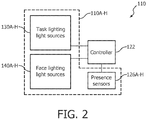
- the lighting zones 110A-H include task lighting light sources 130A-H, face lighting light sources 140A-H, and presence sensors 126A-H.
- At least one controller 122 is in communication with the lighting zones 110A-H and the presence sensors 126A-H and controls the lighting zones 110A-H based at least in part on input received via the presence sensors 126A-H.
- the task lighting light sources 130A-H each contain one or more light sources that selectively generate light output that is directed toward and illuminates at least a portion of the table 107.
- the face lighting light sources 140A-H each contain one or more light sources that selectively generate light output that is directed toward and illuminates at least a portion of the area adjacent to respective of chairs 105A-H (e.g., at least the area that would be occupied by faces of humans that are sitting in the chairs 105A-H).
- the light sources may include LEDs.
- a single light source may generate task lighting and face lighting.
- the controller 122 controls the status of the task lighting light sources 130A-H and the face lighting light sources 140A-H.
- the controller 122 may be in communication with one or more drivers powering task lighting light sources 130A-H to control whether each of the task lighting light sources 130A-H is generating light output and, if generating light output, to optionally control one or more characteristics of the light output generated by the respective task lighting light sources 130A-H.
- the controller 122 may be in communication with one or more drivers powering the face lighting light sources 140A-H to control whether the face lighting light sources 140A-H generate light output and, if generating light output, to optionally control one or more characteristics of the light output generated by the respective face lighting light sources 140A-H.
- each of the presence sensors 126A-H may be provided in combination with one of the individual lighting zones 110A-H and may detect the presence of a user in the vicinity of a respective of the individual lighting zones 110A-H.
- the presence sensors 126A-H may each include a passive Infrared (PIR) sensor having a field of view generally directed toward the area in which light output would be provided by a respective of the individual lighting zones 110A-H.
- PIR passive Infrared
- a single presence sensor may detect presence for multiple lighting zones 110A-H.
- a single presence sensor may be provided that detects presence in all lighting zones 110A-H.
- a first presence sensor may be provided that detects presence in all lighting zones 110A-B and a second presence sensor may be provided that detects presence in lighting zones 110C-D.
- the presence sensors 126A-H may optionally include one or more sensors utilized to directly or indirectly determine the location of one or more users.
- the presence sensors 126A-H may include one or more radars, cameras, distance sensors, and/or PIR sensors.
- a radar may be utilized to detect the location of a personal device carried by a user ( e.g ., based on detection of RF signals emitted by the personal device and/or RF signals emitted by the radar) and it may be assumed that the location of the personal device corresponds to the location of the user.
- a camera and a distance sensor may be utilized to identify a location of a particular user based on facial recognition and a distance reading from the distance sensor.
- the presence sensors 126A-H may be omitted.
- location data for a user may be received via input from personal devices of users (e.g ., via a GPS device and/or other location device of the personal devices) and the presence sensors 126A-H may optionally be omitted.
- the presence sensors 126A-H and/or other device may also optionally receive lighting needs data from users indicative of the lighting needs of those users.
- a user may have an electronic personal device such as a smart phone, a tablet computer, a dedicated lighting device, and/or other device that transmits lighting information concerning the lighting preferences associated with the user.
- the personal device of that user may provide a signal that is indicative of such (e.g ., by indicating a lighting type preference; by indicating color temperature, color, and/or intensity preferences; by indicating a travel schedule that may be utilized to determine lighting preferences; and/or by indicating a sleep schedule that may be utilized to determine lighting preferences).
- a signal that is indicative of such (e.g ., by indicating a lighting type preference; by indicating color temperature, color, and/or intensity preferences; by indicating a travel schedule that may be utilized to determine lighting preferences; and/or by indicating a sleep schedule that may be utilized to determine lighting preferences).
- Each of the lighting zones 110A-H may direct light output toward a most closely adjacent of the chairs 105A-H and/or toward an area of the table 107 located generally under the respective of the lighting zones 110A-H.
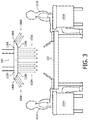
- FIG. 3 a side view of table 107, chairs 105A, 105H, and lighting zones 110A, 110H is illustrated.
- a first user 102A is present in chair 105A and a second user 102H is present in chair 105H.
- Lighting zone 110A is generating light output having a vertical lighting component 106A (via face lighting light sources 140A) and a horizontal lighting component 103A (via task lighting light sources 130A).
- the vertical lighting component 106A is generally directed toward the chair 105A and toward the face of the first user 102A.
- the horizontal lighting component 103A is generally directed toward the table 107 below the lighting zone 110A.
- Lighting zone 110H is generating light output having a vertical lighting component 106H (via face lighting light sources 140H) and a horizontal lighting component 103H (via face lighting light sources 130H).
- the vertical lighting component 106H is generally directed toward the chair 105H and toward the face of the second user 102H.
- the horizontal lighting component 103H is generally directed toward the table 107 below the lighting zone 110H.
- the vertical lighting components 106A and/or 106H may have narrow beam angles to lessen the visibility of the face lighting to a neighboring user.
- the vertical lighting components 106A and 106H are directed to different areas (faces of different users 102A, 102H) and have no interference between one another.
- Horizontal lighting components 103A and 103H are directed toward the same general task area and may have some overlap with one another and/or have some light output in close proximity with one another.
- the light output from lighting zones 110A and/or 110H may be adjusted to provide a desired light output to users 102A and/or 102E.
- the light output characteristics of the face lighting provided to a user via vertical lighting components 106A or 106H and/or the light output characteristics of the task lighting provided via horizontal lighting components 103A or 103H may be individually tunable.
- One or more of the lighting components 103A, 103H, 106A, 106H may have one or more independently controllable light output characteristics such as intensity, color, and/or color temperature.
- the lighting preferences of users 102A, 102H may be represented by the respective vertical lighting component 106A, 106H, horizontal lighting component 103A, 103H, and/or a combination of both horizontal and vertical lighting components.
- the ratio of vertical lighting to horizontal lighting may be changed for a user in a single area to match the user's lighting preferences while minimizing interference with lighting preferences of one or more other users.
- the differences in the horizontal lighting components 103A and 103H may be minimalized to create little noticeable difference between the two lighting components, while the vertical lighting components 106A and 106H may be configured to provide the appropriate stimulating light (e.g ., vertical lighting component 106A having high intensity and vertical lighting component 106H having low intensity). Due to the particularized and distinct directions of the vertical lighting components 106A and 106H, differences in lighting between the two components may be less noticeable than any differences between the horizontal lighting components 103A and 103H.
- the face lighting light sources 140A-H may each illuminate a relatively small area using a narrow beam.
- face lighting light sources 140A-H may generate a light output having a beam width of approximately ten degrees that illuminates a user's face while not illuminating a significant area outside of the user's face.
- the lighting system may optionally include a sensor that may recognize the position of a user's face. In some versions of those implementations the lighting system may maintain the face lighting on the user's face when the user moves locally while continuing to be situated in the same general lighting area.
- the sensor may detect this movement and readjust the face lighting slightly to maintain illumination of the user's face.
- the lighting beam may not continue to follow the user and/or another lighting fixture in the room may be activated and/or adjusted to provide the appropriate lighting.
- contrast between the lighting provided to the two users may be reduced by making the difference smaller between two light outputs applied to the users with respect to illumination intensity but by making the difference larger between the two light outputs with respect to color temperature.
- the illumination intensity of lighting components 103A and/or 106A may be substantially the same as respective of lighting components 103H and/or 106H and may be set to an illumination intensity so as to provide neutral lighting at a color temperature range of 3000K to 4000K ( e.g ., approximately 225 lux).
- the color temperature of the lighting components 103H and/or 106H may be set approximately within the range of 3000K to 4000K to achieve neutral lighting for the user 102H.
- the color temperature of the lighting components 103A and/or 106A may be increased to increase the stimulating effect of the light at the lower illumination intensity level (e.g ., approximately 225 lux).
- the color temperature of the lighting components 103A and/or 106A may be set to approximately 5000K.
- the lighting components 103A and/or 106A may additionally and/or alternatively be provided with a spectral power distribution that is more concentrated in one or more color region such as the blue-green region to increase the biologically stimulating nature of the light.
- the lighting components 103H and/or 106H may additionally and/or alternatively be provided with a spectral power distribution that is more concentrated in one or more color region such as the yellow-red region to increase the biologically relaxing nature of the light.
- the color temperature of the lighting components 103A and/or 106A may be increased to increase the stimulating effect of the light and the spectral power distribution may be more concentrated in the blue-green region to increase the biologically stimulating nature of the light.
- the amount of color temperature increase needed to achieve the biologically stimulating light may be lessened by increasing the spectral power distribution in the blue-green region. Also, the amount of color temperature decrease needed to achieve biologically stimulating light may be lessened by increasing the spectral power distribution in the yellow-red region.
- contrast between the lighting provided to the two users may be reduced by making the difference smaller between two light outputs applied to the users with respect to color temperature but by making the difference larger between the two light outputs with respect to illumination intensity.
- the color temperature of lighting components 103A and/or 106A may be substantially the same as respective of lighting components 103H and/or 106H and may be set to a color temperature so as to provide neutral lighting at an illumination intensity of approximately 200 to 300 lux ( e.g ., approximately 3000K to 4000K).
- the illumination intensity of the lighting components 103H and/or 106H may be set approximately at 225 lux to achieve neutral lighting for the user 102H.
- the illumination intensity of the lighting components 103A and/or 106A may be increased to increase the stimulating effect of the light at the selected color temperature (e.g ., approximately 3000K to 4000K).
- the illumination intensity of the lighting components 103A and/or 106A may be set to approximately 350 lux.
- the lighting components 103A and/or 106A may additionally and/or alternatively be provided with a spectral power distribution that is more concentrated in one or more color region such as the blue-green region to increase the biologically stimulating nature of the light.
- the lighting components 103H and/or 106H may additionally and/or alternatively be provided with a spectral power distribution that is more concentrated in one or more color region such as the yellow-red region to increase the biologically relaxing nature of the light.
- the intensity of the lighting components 103A and/or 106A may be increased to increase the stimulating effect of the light and the spectral power distribution may be more concentrated in the blue-green region to increase the biologically stimulating nature of the light.
- the amount of intensity increase needed to achieve the biologically stimulating light may be lessened by increasing the spectral power distribution in the blue-green region. Also, the amount of intensity decrease needed to achieve biologically stimulating light may be lessened by increasing the spectral power distribution in the yellow-red region.
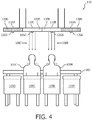
- FIG. 4 a view of table 107, chairs 105A-D, and lighting zones 110A-D is illustrated.
- a third user 102B is present in chair 105B and a fourth user 102C is present in chair 105C.
- Vertical lighting component 106B of lighting zone 110B is directed toward the face of user 102B and vertical lighting component 106C of lighting zone 110C is directed toward the face of user 102C.
- a light output may be generated such that a ratio of the light intensity of the vertical lighting component 106B relative to the light intensity of vertical lighting component 106C is less than a ratio of the preferred stimulating intensity relative to the preferred relaxing intensity.
- the difference between the preferred intensities in one or more wavelengths is reduced in the generated lighting components 106B, 106C ( e.g ., via reduction of the preferred stimulating intensity and/or increase of the preferred relaxing intensity).
- the generated light output may also be such that a ratio of the color temperature of the vertical lighting component 106B relative to the color temperature of vertical lighting component 106C is greater than a ratio of the preferred stimulating color temperature relative to the preferred relaxing color temperature.
- the difference between the preferred color temperatures may be increased in the generated lighting components 106B, 106C ( e.g ., via increase of the preferred stimulating color temperature and/or decrease of the preferred relaxing color temperature).
- a given biological stimulation at a given lux may be maintained when the lux is decreased by increasing the color temperature.
- the biological effect obtained at 4000 lux and 4000 K may be substantially equivalent to the biological effect obtained at 2100 lux and 17000 K.
- the correlation between lux and color temperature to achieve a given biological effect is generally logarithmic in nature.
- the lighting component 106B may additionally and/or alternatively be provided with a spectral power distribution that is more concentrated in the blue-green region to increase the biologically stimulating nature of the light.
- the lighting component 106C may additionally and/or alternatively be provided with a spectral power distribution that is more concentrated in the yellow-red region to increase the biologically relaxing nature of the light.
- a light output may be generated such that a ratio of the color temperature of the vertical lighting component 106B relative to the color temperature of the vertical lighting component 106C is less than a ratio of the preferred stimulating color temperature relative to the preferred relaxing color temperature.
- the difference between the color temperatures is reduced in the generated lighting components 106B, 106C ( e.g ., via reduction of the preferred stimulating color temperature and/or increase of the preferred relaxing color temperature).
- the generated light output may also be such that a ratio of the illumination intensity of the vertical lighting component 106B relative to the illumination intensity of vertical lighting component 106C is greater than a ratio of the preferred stimulating illumination intensity relative to the preferred relaxing illumination intensity.
- the difference between the illumination intensities may be increased in the generated lighting components 106B, 106C ( e.g ., via increase of the preferred stimulating illumination intensity and/or decrease of the preferred relaxing illumination intensity).
- a given biological stimulation at a given color temperature may be maintained when the color temperature is decreased by increasing the illumination intensity.
- the biological effect obtained at 2100 lux and 17000 K may be substantially equivalent to the biological effect obtained at 4000 lux and 4000 K.
- the lighting component 106B may additionally and/or alternatively be provided with a spectral power distribution that is more concentrated in the blue-green region to increase the biologically stimulating nature of the light.
- the lighting component 106C may additionally and/or alternatively be provided with a spectral power distribution that is more concentrated in the yellow-red region to increase the biologically relaxing nature of the light.
- any applied biological stimulating light may additionally and/or alternatively be locally applied to a user with biologically stimulating needs in a periodic manner.
- applied biological stimulating light may be applied for approximately five minutes each half hour (either in a continuous five minute increment or spread intermittently across the half hour such as for 1/6 of every second for a half hour).
- one of the face lighting components may contain increased blue-green spectral power distribution (relative to the spectral power distribution of the task lighting component) that may benefit a user with biological stimulating lighting needs.
- one of the face lighting components may additionally and/or alternatively contain increased yellow-red spectral power distribution (relative to the spectral power distribution of the task lighting component) that may benefit a user with biological relaxing lighting needs.
- the face lighting components may additionally and/or alternatively have larger differences in light output intensity and/or color temperature than the task lighting components.
- the user may have the option to manually alter one or more light output characteristics of light applied to the user.
- a user may have the option to manually alter the intensity and/or color temperature of his lighting components using manual controls.
- the lighting controls may be accessible via an electronic personal device of the user, which then may relay the changes to the controller 122 ( e.g ., via a network connection).
- the controls to manually alter the lighting effects of the user's lighting settings may be directly in connection with the controller 122 through a device present in the room with the user.
- each user may have a device in the vicinity of his seat at table 107 which may give the user options for fine tuning the intensity and/or color temperature of his lighting components.
- the lighting system includes a controller 220 in communication with a presence sensor 226 and in communication with one or more lighting fixtures 210.
- the controller 220 is also in communication with personal devices 205A, 205B of two separate users.
- the controller 220 and/or the location sensor 226 may be integrated with one or more of the lighting fixtures 210.
- multiple lighting fixtures 210 may be provided, each having a controller integrated therein and controllers across multiple lighting fixtures 210 may optionally communicate with one another.
- multiple lighting fixtures 210 may be provided, with one having a controller integrated therein that controls multiple lighting fixtures 210 via network communication with those other lighting fixtures.
- the lighting fixtures 210 may include one or more lighting fixtures that generate light with unique light output characteristics and/or that alter light output characteristics of light thereof responsive to communications from controller 220.
- the lighting fixture 210 may include a first lighting fixture and a second lighting fixture.
- the first lighting fixture may generate a first light output having first light output characteristics in a first area in response to communications from controller 220.
- the second lighting fixture may generate a distinct second light output having second light output characteristics in a second area in response to communications from controller 220.
- the first and/or the second lighting fixture may have adjustable light output characteristics such as light output level, color, color temperature, and/or beam shape.
- the area(s) in which a lighting fixture provides light output may be fixed ( e.g ., as a function of the installation location of the lighting fixtures) or may be adjustable. Adjustability of the areas in which a lighting fixture provides light output may be achieved utilizing one or more of a variety of methods and/or apparatus. For example, adjustability may be achieved by turning on/off one of multiple light sources in the lighting fixture; by mechanically adjusting the position and/or orientation of the entire lighting fixture; and/or by mechanically adjusting the position and/or orientation of a light source and/or an optical element (e.g ., a reflector, a refractor) of the lighting fixture.
- an optical element e.g ., a reflector, a refractor
- the lighting fixtures 210 may include a LED-based lighting fixture having a plurality of LEDs that may be individually turned on/off, individually dimmed, and/or individually tuned (e.g ., tunable color, beam shape, beam size).
- a first group of the LEDs of the LED-based lighting fixture may be adjusted to achieve a light output having first light output characteristics and a second LED group of the LED-based lighting fixture may be adjusted to achieve a light output having second light output characteristics.
- the lighting fixtures 210 may include a plurality of light emitting ceiling tile groups, with each group containing one or more tiles (e.g ., tiles with implemented LEDs) and having a unique lighting setting. Examples of specific lighting fixture implementations are provided herein. One of ordinary skill in the art, having had the benefit of the present disclosure, will recognize and appreciate that in other embodiments additional and/or alternative lighting fixtures may be utilized in the lighting systems and/or lighting methods described herein.
- the location sensor 226 may include one or more sensors utilized to determine the location of one or more users.
- the location sensor 226 may include one or more radars, cameras, distance sensors, and/or PIR sensors.
- a radar may be utilized to detect the location of the personal device 205A (e.g ., based on detection of RF signals emitted by the personal device and/or RF signals emitted by the radar) and it may be assumed that the location of the personal device 205A corresponds to the location of a first user.
- a camera and a distance sensor may be utilized to identify a location of a particular user based on facial recognition and a distance reading from the distance sensor. In some embodiments the location sensor 226 may be omitted.
- location data may be received via input from personal devices 205A, 205B (e.g ., via a GPS device and/or other location device of the personal devices 205A, 205B) and the location sensor 226 may optionally be omitted.
- the personal devices 205A, 205B may include a lighting token carried by a user that enables communication of information relevant to the lighting needs of the user.
- the personal devices 205A, 205B may include a RFID tag carried by the user that may be read by a RFID receiver to identify the lighting needs of the user.
- the RFID tag may communicate the identity of the user to the controller 220.
- the controller 220 may utilize the identity of the user to retrieve therapeutic lighting settings that are correlated with the user in a database (local database and/or a database accessible via a network).
- the RFID tag may communicate the identity of the user to the controller 220; the controller 220 may utilize the identity of the user to retrieve travel history and/or travel plans of the user that are correlated with the user in a database; and based on such travel history and/or travel plans the controller 220 may identify the therapeutic lighting needs of the user.
- the personal devices 205A, 205B may include a smart phone, a tablet computer, and/or other handheld device capable of performing additional functions beyond those described herein.
- the personal devices 205A, 205B may include a smart phone that communicates therapeutic lighting needs to the controller 220 (either directly or via the supplying of travel itinerary information).
- the personal devices 205A, 205B may additionally or alternatively communicate location information to the controller 220.
- the location may be determined at the personal devices 205A, 205B via GPS and/or RF triangulation and such location communicated to the controller 220.
- the personal devices 205A, 205B may include a light sensor to sense if the appropriate lighting effect is present.
- the readings from the light sensor may optionally be communicated to the controller 220 to optionally modify the light output directed toward the user's location to achieve a desired light output.
- the readings from the light sensor may be tracked over time and optionally be utilized to determine whether appropriate light effects have been received in a timely manner by the user.
- the communication between the various components of the lighting system and/or other devices may optionally utilize one or more communications mediums, communications technologies, protocols, and/or inter-process communication techniques.
- the communication mediums may include any physical medium, including, for example, twisted pair coaxial cables, fiber optics, and/or a wireless link using, for example, infrared, microwave, or encoded visible light transmissions and any suitable transmitters, receivers or transceivers to effectuate communication in the lighting fixture network.
- the communications technologies may include any suitable protocol for data transmission, including, for example, TCP/IP, variations of Ethernet, Universal Serial Bus, Bluetooth, FireWire, Zigbee, DMX, Dali, 802.11b, 802.11a, 802.11g, token ring, a token bus, serial bus, power line networking over mains or low voltage power lines, and/or any other suitable wireless or wired protocol.
- TCP/IP Transmission Control Protocol
- the personal devices 205A, 205B may communicate with the controller 220 via RF communications and the controller 220 may communicate with lighting fixtures 210, and/or location sensor 226 via a wired connection.
- controller 220 determines that two (or more) users with conflicting lighting needs are within a predefined distance of one another (e.g ., via sensed or obtained location data and/or sensed or obtained lighting need data), individualized lighting may be supplied to the users that may compensate for the varying lighting needs to lessen contrast between the lighting provided to the adjacent users while maintaining benefits of the separate users' lighting preferences. For example, assume a first user desires biologically stimulating light and a second user desires biologically neutral light. In some embodiments the difference between the light intensity of the lighting applied to the two users may be minimalized while the color temperature and/or spectral power distribution of the lighting is adjusted to supply the users with appropriate lighting needs.
- second light with a neutral light intensity at approximately 3500 K may be supplied to the second user and first light with the same light intensity, but at approximately 5000 K and/or with a spectral power distribution that is increased in the green-blue region may be supplied to the first user.
- a first of the lighting fixtures 210 may supply the first light and an adjacent of the lighting fixtures 210 may supply the second light.
- a single of the lighting fixtures 210 may supply both the first light and the second light.
- first vertical face lighting that is particularized to the first user's lighting needs may be supplied to the first user and second vertical face lighting that is particularized to the second user's lighting needs may be supplied to the second user.
- first horizontal task lighting may additionally be supplied in a task area adjacent the first user and second horizontal task lighting may additionally be supplied in a task area adjacent the second user.
- the first and second horizontal task lighting may be more conforming to one another than the first and second vertical face lighting.
- multiple lighting fixtures 210 may supply the first and second light.
- a single of the lighting fixtures 210 may supply the first and second light.
Landscapes
- Health & Medical Sciences (AREA)
- Biomedical Technology (AREA)
- Engineering & Computer Science (AREA)
- Psychiatry (AREA)
- Nuclear Medicine, Radiotherapy & Molecular Imaging (AREA)
- Psychology (AREA)
- Social Psychology (AREA)
- Developmental Disabilities (AREA)
- Child & Adolescent Psychology (AREA)
- Pathology (AREA)
- Hospice & Palliative Care (AREA)
- Radiology & Medical Imaging (AREA)
- Life Sciences & Earth Sciences (AREA)
- Animal Behavior & Ethology (AREA)
- General Health & Medical Sciences (AREA)
- Public Health (AREA)
- Veterinary Medicine (AREA)
- Circuit Arrangement For Electric Light Sources In General (AREA)
Applications Claiming Priority (2)
| Application Number | Priority Date | Filing Date | Title |
|---|---|---|---|
| US201261718934P | 2012-10-26 | 2012-10-26 | |
| PCT/IB2013/059426 WO2014064587A1 (en) | 2012-10-26 | 2013-10-17 | Lighting methods for providing personalized lighting to users positioned proximal to one another |
Publications (2)
| Publication Number | Publication Date |
|---|---|
| EP2912925A1 EP2912925A1 (en) | 2015-09-02 |
| EP2912925B1 true EP2912925B1 (en) | 2018-12-19 |
Family
ID=49956256
Family Applications (1)
| Application Number | Title | Priority Date | Filing Date |
|---|---|---|---|
| EP13821155.2A Not-in-force EP2912925B1 (en) | 2012-10-26 | 2013-10-17 | Lighting methods for providing personalized lighting to users positioned proximal to one another |
Country Status (5)
| Country | Link |
|---|---|
| US (1) | US9491833B2 (enExample) |
| EP (1) | EP2912925B1 (enExample) |
| JP (1) | JP6339088B2 (enExample) |
| CN (1) | CN104737627B (enExample) |
| WO (1) | WO2014064587A1 (enExample) |
Families Citing this family (29)
| Publication number | Priority date | Publication date | Assignee | Title |
|---|---|---|---|---|
| US10813199B2 (en) * | 2012-02-07 | 2020-10-20 | Dolan Designs Incorporated | Combined lighting device with an integrated dimming control system |
| US9392651B2 (en) * | 2012-04-11 | 2016-07-12 | Koninklijke Philips N.V. | Lighting methods and apparatus with selectively applied face lighting component |
| JP2015534701A (ja) | 2012-08-28 | 2015-12-03 | デロス リビング エルエルシーDelos Living Llc | 居住環境に関連するウェルネスを増進するためのシステム、方法、及び物品 |
| US9788394B2 (en) * | 2014-02-27 | 2017-10-10 | Philips Lighting Holding B.V. | Lighting system, controller and lighting method |
| US10712722B2 (en) | 2014-02-28 | 2020-07-14 | Delos Living Llc | Systems and articles for enhancing wellness associated with habitable environments |
| JP6617113B2 (ja) * | 2014-03-17 | 2019-12-04 | シグニファイ ホールディング ビー ヴィ | 物品を照光するための照明システム |
| DE102014205761B4 (de) * | 2014-03-27 | 2026-01-08 | Zumtobel Lighting Gmbh | Beleuchtungssystem und Verfahren zur Ansteuerung eines Beleuchtungssystems |
| JP6736543B2 (ja) * | 2014-09-08 | 2020-08-05 | シグニファイ ホールディング ビー ヴィSignify Holding B.V. | 照明選好調停 |
| US10045427B2 (en) * | 2014-09-29 | 2018-08-07 | Philips Lighting Holding B.V. | System and method of autonomous restore point creation and restoration for luminaire controllers |
| JP6416002B2 (ja) * | 2015-01-29 | 2018-10-31 | シャープ株式会社 | 照明装置および照明システム |
| WO2016184852A1 (en) * | 2015-05-16 | 2016-11-24 | Danmarks Tekniske Universitet | Lamp for sunshine simulation |
| DE102016211063A1 (de) * | 2016-06-21 | 2017-12-21 | Fraunhofer-Gesellschaft zur Förderung der angewandten Forschung e.V. | Tragbare Vorrichtung zur Übermittlung von personenbezogenen Daten an ein Verarbeitungssystem und das Verarbeitungssystem zum Ausgeben eines Steuersignals in Abhängigkeit der personenbezogenen Daten |
| EP3542338A1 (en) | 2016-11-17 | 2019-09-25 | Signify Holding B.V. | System and method for managing lighting based on population mobility patterns |
| WO2018091315A1 (en) * | 2016-11-17 | 2018-05-24 | Philips Lighting Holding B.V. | System and method for managing lighting based on population mobility patterns |
| CN110463352B (zh) * | 2017-04-06 | 2022-05-03 | 昕诺飞控股有限公司 | 用于照明系统的控制器和方法 |
| US11668481B2 (en) | 2017-08-30 | 2023-06-06 | Delos Living Llc | Systems, methods and articles for assessing and/or improving health and well-being |
| WO2019105880A1 (en) * | 2017-11-28 | 2019-06-06 | Signify Holding B.V. | Lighting fixture design |
| DE102017130864A1 (de) * | 2017-12-21 | 2019-06-27 | Ledvance Gmbh | Beleuchtungsvorrichtung, Steuereinheit für eine Beleuchtungsvorrichtung und Verfahren zum Betreiben einer Beleuchtungsvorrichtung |
| EP3850458A4 (en) | 2018-09-14 | 2022-06-08 | Delos Living, LLC | AIR CLEANING SYSTEMS AND PROCEDURES |
| CN112566333A (zh) * | 2018-12-29 | 2021-03-26 | 中国计量大学 | 基于各向对称吸顶灯的公共宿舍混合照明系统 |
| US11844163B2 (en) | 2019-02-26 | 2023-12-12 | Delos Living Llc | Method and apparatus for lighting in an office environment |
| WO2020198183A1 (en) | 2019-03-25 | 2020-10-01 | Delos Living Llc | Systems and methods for acoustic monitoring |
| EP3863380B1 (en) * | 2020-02-04 | 2024-06-12 | Helvar Oy Ab | Method and arrangement for automatic control of lighting in a personal light space |
| EP4101267B1 (en) | 2020-02-06 | 2024-07-10 | Signify Holding B.V. | A controller for controlling a plurality of lighting units in a space and a method thereof |
| NL2025610B1 (en) * | 2020-05-18 | 2021-12-03 | Medilux B V | Luminaire for lighting a control room |
| WO2021259816A1 (en) * | 2020-06-23 | 2021-12-30 | Signify Holding B.V. | A lighting system |
| JP2022115270A (ja) * | 2021-01-28 | 2022-08-09 | パナソニックIpマネジメント株式会社 | 環境制御システム、環境制御方法、及びプログラム |
| EP4062971A3 (en) * | 2021-03-25 | 2022-12-21 | National Yang Ming Chiao Tung University | Ambient lighting for improving sleeping disorders, cognition and/or neurological disorders |
| FR3140634B1 (fr) | 2022-10-06 | 2026-02-13 | Commissariat Energie Atomique | Utilisation de dérivés lipophiles d’acides aminopolycarboxyliques pour l’extraction de terres rares d’une solution aqueuse acide |
Family Cites Families (19)
| Publication number | Priority date | Publication date | Assignee | Title |
|---|---|---|---|---|
| DE4413070A1 (de) | 1994-04-15 | 1995-10-19 | Thorn Licht Gmbh | Arbeitsplatzleuchte |
| US20040052076A1 (en) | 1997-08-26 | 2004-03-18 | Mueller George G. | Controlled lighting methods and apparatus |
| JP2001143877A (ja) * | 1999-11-11 | 2001-05-25 | Matsushita Electric Works Ltd | 照明装置 |
| US7564368B2 (en) | 2006-05-04 | 2009-07-21 | Zary Segall | Semantic light |
| DE102007011155A1 (de) * | 2007-03-07 | 2008-09-18 | Airbus Deutschland Gmbh | Luftfahrzeug mit einer Beleuchtungsvorrichtung |
| US8035320B2 (en) | 2007-04-20 | 2011-10-11 | Sibert W Olin | Illumination control network |
| TWI357285B (en) | 2007-09-13 | 2012-01-21 | Ind Tech Res Inst | Automatic lighting control system and method |
| US7866848B2 (en) | 2008-07-07 | 2011-01-11 | Edison Opto Corporation | Illumination system capable of automatically adjusting illumination direction according to human body's signal |
| KR101622268B1 (ko) * | 2009-01-07 | 2016-05-18 | 코닌클리케 필립스 엔.브이. | 지능형 제어가능한 조명 네트워크들 및 이를 위한 스키마 |
| RU2538786C2 (ru) | 2009-01-29 | 2015-01-10 | Конинклейке Филипс Электроникс, Н.В. | Система управления освещением, реагирующая на условия окружающего освещения |
| DE102010030501A1 (de) * | 2009-06-24 | 2010-12-30 | Osram Gesellschaft mit beschränkter Haftung | Vorrichtung und Verfahren zum Anpassen eines Circadianen Rhythmus |
| WO2011001320A1 (en) * | 2009-06-30 | 2011-01-06 | Koninklijke Philips Electronics, N.V. | Systems and methods for managing interaction with controllable lighting networks |
| US9220154B2 (en) | 2009-09-29 | 2015-12-22 | Koninklijke Philips N.V. | Lighting system and method for controlling a lighting system |
| US8706310B2 (en) | 2010-06-15 | 2014-04-22 | Redwood Systems, Inc. | Goal-based control of lighting |
| WO2012113856A1 (en) * | 2011-02-25 | 2012-08-30 | Trilite Technologies Gmbh | Display device with movement elements for obtaining a high resolution and/or a 3d effect |
| CN102182985A (zh) * | 2011-03-15 | 2011-09-14 | 中山伟强科技有限公司 | 一种基于网络操控的室内照明系统 |
| US9392651B2 (en) * | 2012-04-11 | 2016-07-12 | Koninklijke Philips N.V. | Lighting methods and apparatus with selectively applied face lighting component |
| EP2874701B1 (en) * | 2012-07-18 | 2018-04-04 | Philips Lighting Holding B.V. | Methods and apparatus for providing personalized lighting |
| US9795004B2 (en) * | 2014-04-14 | 2017-10-17 | Abl Ip Holding Llc | Learning capable lighting equipment |
-
2013
- 2013-10-17 WO PCT/IB2013/059426 patent/WO2014064587A1/en not_active Ceased
- 2013-10-17 EP EP13821155.2A patent/EP2912925B1/en not_active Not-in-force
- 2013-10-17 JP JP2015538598A patent/JP6339088B2/ja not_active Expired - Fee Related
- 2013-10-17 US US14/438,460 patent/US9491833B2/en not_active Expired - Fee Related
- 2013-10-17 CN CN201380056178.1A patent/CN104737627B/zh not_active Expired - Fee Related
Non-Patent Citations (1)
| Title |
|---|
| None * |
Also Published As
| Publication number | Publication date |
|---|---|
| US20150289347A1 (en) | 2015-10-08 |
| EP2912925A1 (en) | 2015-09-02 |
| JP2015536540A (ja) | 2015-12-21 |
| CN104737627A (zh) | 2015-06-24 |
| US9491833B2 (en) | 2016-11-08 |
| JP6339088B2 (ja) | 2018-06-06 |
| CN104737627B (zh) | 2018-01-12 |
| WO2014064587A1 (en) | 2014-05-01 |
Similar Documents
| Publication | Publication Date | Title |
|---|---|---|
| US9491833B2 (en) | Lighting methods for providing personalized lighting to users positioned proximal to one another | |
| EP2874701B1 (en) | Methods and apparatus for providing personalized lighting | |
| US10598363B2 (en) | Apparatus and method for providing downlighting and wall-washing lighting effects | |
| EP2837271B1 (en) | Lighting methods and apparatus with selectively applied face lighting component | |
| US9936556B2 (en) | Apparatus for controlling lighting parameters based on time of day and/or ambient light conditions and related methods | |
| EP3201524B1 (en) | Flame simulating light-emitting devices and related methods | |
| EP3162170B1 (en) | Automatically commissioning a group of lighting units | |
| US12398852B2 (en) | Edgelit lighting assembly with adjustable light distribution | |
| WO2010079388A1 (en) | Intelligent controllable lighting networks and schemata therefore | |
| TW201208476A (en) | Systems and apparatus for automatically deriving and modifying personal preferences applicable to multiple controllable lighting networks |
Legal Events
| Date | Code | Title | Description |
|---|---|---|---|
| PUAI | Public reference made under article 153(3) epc to a published international application that has entered the european phase |
Free format text: ORIGINAL CODE: 0009012 |
|
| 17P | Request for examination filed |
Effective date: 20150526 |
|
| AK | Designated contracting states |
Kind code of ref document: A1 Designated state(s): AL AT BE BG CH CY CZ DE DK EE ES FI FR GB GR HR HU IE IS IT LI LT LU LV MC MK MT NL NO PL PT RO RS SE SI SK SM TR |
|
| AX | Request for extension of the european patent |
Extension state: BA ME |
|
| DAX | Request for extension of the european patent (deleted) | ||
| RAP1 | Party data changed (applicant data changed or rights of an application transferred) |
Owner name: PHILIPS LIGHTING HOLDING B.V. |
|
| RIN1 | Information on inventor provided before grant (corrected) |
Inventor name: SCHLANGEN, LUCAS JOSEF MARIA Inventor name: BAAIJENS, JOHANNES PETRUS WILHELMUS |
|
| REG | Reference to a national code |
Ref country code: DE Ref legal event code: R079 Ref document number: 602013048534 Country of ref document: DE Free format text: PREVIOUS MAIN CLASS: H05B0037020000 Ipc: A61N0005060000 |
|
| GRAP | Despatch of communication of intention to grant a patent |
Free format text: ORIGINAL CODE: EPIDOSNIGR1 |
|
| RIC1 | Information provided on ipc code assigned before grant |
Ipc: H05B 37/02 20060101ALI20180607BHEP Ipc: A61N 5/06 20060101AFI20180607BHEP Ipc: A61M 21/00 20060101ALI20180607BHEP |
|
| STAA | Information on the status of an ep patent application or granted ep patent |
Free format text: STATUS: GRANT OF PATENT IS INTENDED |
|
| INTG | Intention to grant announced |
Effective date: 20180712 |
|
| GRAS | Grant fee paid |
Free format text: ORIGINAL CODE: EPIDOSNIGR3 |
|
| GRAA | (expected) grant |
Free format text: ORIGINAL CODE: 0009210 |
|
| STAA | Information on the status of an ep patent application or granted ep patent |
Free format text: STATUS: THE PATENT HAS BEEN GRANTED |
|
| RAP1 | Party data changed (applicant data changed or rights of an application transferred) |
Owner name: PHILIPS LIGHTING HOLDING B.V. |
|
| AK | Designated contracting states |
Kind code of ref document: B1 Designated state(s): AL AT BE BG CH CY CZ DE DK EE ES FI FR GB GR HR HU IE IS IT LI LT LU LV MC MK MT NL NO PL PT RO RS SE SI SK SM TR |
|
| REG | Reference to a national code |
Ref country code: GB Ref legal event code: FG4D |
|
| REG | Reference to a national code |
Ref country code: CH Ref legal event code: EP |
|
| REG | Reference to a national code |
Ref country code: IE Ref legal event code: FG4D |
|
| REG | Reference to a national code |
Ref country code: DE Ref legal event code: R096 Ref document number: 602013048534 Country of ref document: DE |
|
| REG | Reference to a national code |
Ref country code: AT Ref legal event code: REF Ref document number: 1078030 Country of ref document: AT Kind code of ref document: T Effective date: 20190115 |
|
| RAP2 | Party data changed (patent owner data changed or rights of a patent transferred) |
Owner name: SIGNIFY HOLDING B.V. |
|
| REG | Reference to a national code |
Ref country code: NL Ref legal event code: MP Effective date: 20181219 |
|
| PG25 | Lapsed in a contracting state [announced via postgrant information from national office to epo] |
Ref country code: BG Free format text: LAPSE BECAUSE OF FAILURE TO SUBMIT A TRANSLATION OF THE DESCRIPTION OR TO PAY THE FEE WITHIN THE PRESCRIBED TIME-LIMIT Effective date: 20190319 Ref country code: FI Free format text: LAPSE BECAUSE OF FAILURE TO SUBMIT A TRANSLATION OF THE DESCRIPTION OR TO PAY THE FEE WITHIN THE PRESCRIBED TIME-LIMIT Effective date: 20181219 Ref country code: LV Free format text: LAPSE BECAUSE OF FAILURE TO SUBMIT A TRANSLATION OF THE DESCRIPTION OR TO PAY THE FEE WITHIN THE PRESCRIBED TIME-LIMIT Effective date: 20181219 Ref country code: HR Free format text: LAPSE BECAUSE OF FAILURE TO SUBMIT A TRANSLATION OF THE DESCRIPTION OR TO PAY THE FEE WITHIN THE PRESCRIBED TIME-LIMIT Effective date: 20181219 Ref country code: NO Free format text: LAPSE BECAUSE OF FAILURE TO SUBMIT A TRANSLATION OF THE DESCRIPTION OR TO PAY THE FEE WITHIN THE PRESCRIBED TIME-LIMIT Effective date: 20190319 Ref country code: LT Free format text: LAPSE BECAUSE OF FAILURE TO SUBMIT A TRANSLATION OF THE DESCRIPTION OR TO PAY THE FEE WITHIN THE PRESCRIBED TIME-LIMIT Effective date: 20181219 |
|
| REG | Reference to a national code |
Ref country code: LT Ref legal event code: MG4D |
|
| REG | Reference to a national code |
Ref country code: AT Ref legal event code: MK05 Ref document number: 1078030 Country of ref document: AT Kind code of ref document: T Effective date: 20181219 |
|
| PG25 | Lapsed in a contracting state [announced via postgrant information from national office to epo] |
Ref country code: GR Free format text: LAPSE BECAUSE OF FAILURE TO SUBMIT A TRANSLATION OF THE DESCRIPTION OR TO PAY THE FEE WITHIN THE PRESCRIBED TIME-LIMIT Effective date: 20190320 Ref country code: RS Free format text: LAPSE BECAUSE OF FAILURE TO SUBMIT A TRANSLATION OF THE DESCRIPTION OR TO PAY THE FEE WITHIN THE PRESCRIBED TIME-LIMIT Effective date: 20181219 Ref country code: SE Free format text: LAPSE BECAUSE OF FAILURE TO SUBMIT A TRANSLATION OF THE DESCRIPTION OR TO PAY THE FEE WITHIN THE PRESCRIBED TIME-LIMIT Effective date: 20181219 Ref country code: AL Free format text: LAPSE BECAUSE OF FAILURE TO SUBMIT A TRANSLATION OF THE DESCRIPTION OR TO PAY THE FEE WITHIN THE PRESCRIBED TIME-LIMIT Effective date: 20181219 |
|
| PG25 | Lapsed in a contracting state [announced via postgrant information from national office to epo] |
Ref country code: NL Free format text: LAPSE BECAUSE OF FAILURE TO SUBMIT A TRANSLATION OF THE DESCRIPTION OR TO PAY THE FEE WITHIN THE PRESCRIBED TIME-LIMIT Effective date: 20181219 |
|
| PG25 | Lapsed in a contracting state [announced via postgrant information from national office to epo] |
Ref country code: IT Free format text: LAPSE BECAUSE OF FAILURE TO SUBMIT A TRANSLATION OF THE DESCRIPTION OR TO PAY THE FEE WITHIN THE PRESCRIBED TIME-LIMIT Effective date: 20181219 Ref country code: PL Free format text: LAPSE BECAUSE OF FAILURE TO SUBMIT A TRANSLATION OF THE DESCRIPTION OR TO PAY THE FEE WITHIN THE PRESCRIBED TIME-LIMIT Effective date: 20181219 Ref country code: PT Free format text: LAPSE BECAUSE OF FAILURE TO SUBMIT A TRANSLATION OF THE DESCRIPTION OR TO PAY THE FEE WITHIN THE PRESCRIBED TIME-LIMIT Effective date: 20190419 Ref country code: CZ Free format text: LAPSE BECAUSE OF FAILURE TO SUBMIT A TRANSLATION OF THE DESCRIPTION OR TO PAY THE FEE WITHIN THE PRESCRIBED TIME-LIMIT Effective date: 20181219 Ref country code: ES Free format text: LAPSE BECAUSE OF FAILURE TO SUBMIT A TRANSLATION OF THE DESCRIPTION OR TO PAY THE FEE WITHIN THE PRESCRIBED TIME-LIMIT Effective date: 20181219 |
|
| PG25 | Lapsed in a contracting state [announced via postgrant information from national office to epo] |
Ref country code: SM Free format text: LAPSE BECAUSE OF FAILURE TO SUBMIT A TRANSLATION OF THE DESCRIPTION OR TO PAY THE FEE WITHIN THE PRESCRIBED TIME-LIMIT Effective date: 20181219 Ref country code: EE Free format text: LAPSE BECAUSE OF FAILURE TO SUBMIT A TRANSLATION OF THE DESCRIPTION OR TO PAY THE FEE WITHIN THE PRESCRIBED TIME-LIMIT Effective date: 20181219 Ref country code: RO Free format text: LAPSE BECAUSE OF FAILURE TO SUBMIT A TRANSLATION OF THE DESCRIPTION OR TO PAY THE FEE WITHIN THE PRESCRIBED TIME-LIMIT Effective date: 20181219 Ref country code: SK Free format text: LAPSE BECAUSE OF FAILURE TO SUBMIT A TRANSLATION OF THE DESCRIPTION OR TO PAY THE FEE WITHIN THE PRESCRIBED TIME-LIMIT Effective date: 20181219 Ref country code: IS Free format text: LAPSE BECAUSE OF FAILURE TO SUBMIT A TRANSLATION OF THE DESCRIPTION OR TO PAY THE FEE WITHIN THE PRESCRIBED TIME-LIMIT Effective date: 20190419 |
|
| REG | Reference to a national code |
Ref country code: DE Ref legal event code: R097 Ref document number: 602013048534 Country of ref document: DE |
|
| PLBE | No opposition filed within time limit |
Free format text: ORIGINAL CODE: 0009261 |
|
| STAA | Information on the status of an ep patent application or granted ep patent |
Free format text: STATUS: NO OPPOSITION FILED WITHIN TIME LIMIT |
|
| PG25 | Lapsed in a contracting state [announced via postgrant information from national office to epo] |
Ref country code: DK Free format text: LAPSE BECAUSE OF FAILURE TO SUBMIT A TRANSLATION OF THE DESCRIPTION OR TO PAY THE FEE WITHIN THE PRESCRIBED TIME-LIMIT Effective date: 20181219 Ref country code: AT Free format text: LAPSE BECAUSE OF FAILURE TO SUBMIT A TRANSLATION OF THE DESCRIPTION OR TO PAY THE FEE WITHIN THE PRESCRIBED TIME-LIMIT Effective date: 20181219 |
|
| 26N | No opposition filed |
Effective date: 20190920 |
|
| PG25 | Lapsed in a contracting state [announced via postgrant information from national office to epo] |
Ref country code: SI Free format text: LAPSE BECAUSE OF FAILURE TO SUBMIT A TRANSLATION OF THE DESCRIPTION OR TO PAY THE FEE WITHIN THE PRESCRIBED TIME-LIMIT Effective date: 20181219 |
|
| PG25 | Lapsed in a contracting state [announced via postgrant information from national office to epo] |
Ref country code: TR Free format text: LAPSE BECAUSE OF FAILURE TO SUBMIT A TRANSLATION OF THE DESCRIPTION OR TO PAY THE FEE WITHIN THE PRESCRIBED TIME-LIMIT Effective date: 20181219 |
|
| REG | Reference to a national code |
Ref country code: DE Ref legal event code: R119 Ref document number: 602013048534 Country of ref document: DE |
|
| PG25 | Lapsed in a contracting state [announced via postgrant information from national office to epo] |
Ref country code: MC Free format text: LAPSE BECAUSE OF FAILURE TO SUBMIT A TRANSLATION OF THE DESCRIPTION OR TO PAY THE FEE WITHIN THE PRESCRIBED TIME-LIMIT Effective date: 20181219 |
|
| REG | Reference to a national code |
Ref country code: CH Ref legal event code: PL |
|
| PG25 | Lapsed in a contracting state [announced via postgrant information from national office to epo] |
Ref country code: CH Free format text: LAPSE BECAUSE OF NON-PAYMENT OF DUE FEES Effective date: 20191031 Ref country code: LI Free format text: LAPSE BECAUSE OF NON-PAYMENT OF DUE FEES Effective date: 20191031 Ref country code: DE Free format text: LAPSE BECAUSE OF NON-PAYMENT OF DUE FEES Effective date: 20200501 Ref country code: LU Free format text: LAPSE BECAUSE OF NON-PAYMENT OF DUE FEES Effective date: 20191017 |
|
| REG | Reference to a national code |
Ref country code: BE Ref legal event code: MM Effective date: 20191031 |
|
| PG25 | Lapsed in a contracting state [announced via postgrant information from national office to epo] |
Ref country code: BE Free format text: LAPSE BECAUSE OF NON-PAYMENT OF DUE FEES Effective date: 20191031 |
|
| GBPC | Gb: european patent ceased through non-payment of renewal fee |
Effective date: 20191017 |
|
| PG25 | Lapsed in a contracting state [announced via postgrant information from national office to epo] |
Ref country code: GB Free format text: LAPSE BECAUSE OF NON-PAYMENT OF DUE FEES Effective date: 20191017 Ref country code: FR Free format text: LAPSE BECAUSE OF NON-PAYMENT OF DUE FEES Effective date: 20191031 Ref country code: IE Free format text: LAPSE BECAUSE OF NON-PAYMENT OF DUE FEES Effective date: 20191017 |
|
| PG25 | Lapsed in a contracting state [announced via postgrant information from national office to epo] |
Ref country code: CY Free format text: LAPSE BECAUSE OF FAILURE TO SUBMIT A TRANSLATION OF THE DESCRIPTION OR TO PAY THE FEE WITHIN THE PRESCRIBED TIME-LIMIT Effective date: 20181219 |
|
| PG25 | Lapsed in a contracting state [announced via postgrant information from national office to epo] |
Ref country code: MT Free format text: LAPSE BECAUSE OF FAILURE TO SUBMIT A TRANSLATION OF THE DESCRIPTION OR TO PAY THE FEE WITHIN THE PRESCRIBED TIME-LIMIT Effective date: 20181219 Ref country code: HU Free format text: LAPSE BECAUSE OF FAILURE TO SUBMIT A TRANSLATION OF THE DESCRIPTION OR TO PAY THE FEE WITHIN THE PRESCRIBED TIME-LIMIT; INVALID AB INITIO Effective date: 20131017 |
|
| PG25 | Lapsed in a contracting state [announced via postgrant information from national office to epo] |
Ref country code: MK Free format text: LAPSE BECAUSE OF FAILURE TO SUBMIT A TRANSLATION OF THE DESCRIPTION OR TO PAY THE FEE WITHIN THE PRESCRIBED TIME-LIMIT Effective date: 20181219 |