EP2903018B1 - Verfahren zur bildung eines feinen musters - Google Patents
Verfahren zur bildung eines feinen musters Download PDFInfo
- Publication number
- EP2903018B1 EP2903018B1 EP13841594.8A EP13841594A EP2903018B1 EP 2903018 B1 EP2903018 B1 EP 2903018B1 EP 13841594 A EP13841594 A EP 13841594A EP 2903018 B1 EP2903018 B1 EP 2903018B1
- Authority
- EP
- European Patent Office
- Prior art keywords
- substrate
- pattern
- fine pattern
- target material
- sputtering
- Prior art date
- Legal status (The legal status is an assumption and is not a legal conclusion. Google has not performed a legal analysis and makes no representation as to the accuracy of the status listed.)
- Active
Links
Images


Classifications
-
- H01L21/203—
-
- C—CHEMISTRY; METALLURGY
- C23—COATING METALLIC MATERIAL; COATING MATERIAL WITH METALLIC MATERIAL; CHEMICAL SURFACE TREATMENT; DIFFUSION TREATMENT OF METALLIC MATERIAL; COATING BY VACUUM EVAPORATION, BY SPUTTERING, BY ION IMPLANTATION OR BY CHEMICAL VAPOUR DEPOSITION, IN GENERAL; INHIBITING CORROSION OF METALLIC MATERIAL OR INCRUSTATION IN GENERAL
- C23C—COATING METALLIC MATERIAL; COATING MATERIAL WITH METALLIC MATERIAL; SURFACE TREATMENT OF METALLIC MATERIAL BY DIFFUSION INTO THE SURFACE, BY CHEMICAL CONVERSION OR SUBSTITUTION; COATING BY VACUUM EVAPORATION, BY SPUTTERING, BY ION IMPLANTATION OR BY CHEMICAL VAPOUR DEPOSITION, IN GENERAL
- C23C14/00—Coating by vacuum evaporation, by sputtering or by ion implantation of the coating forming material
- C23C14/04—Coating on selected surface areas, e.g. using masks
-
- C—CHEMISTRY; METALLURGY
- C23—COATING METALLIC MATERIAL; COATING MATERIAL WITH METALLIC MATERIAL; CHEMICAL SURFACE TREATMENT; DIFFUSION TREATMENT OF METALLIC MATERIAL; COATING BY VACUUM EVAPORATION, BY SPUTTERING, BY ION IMPLANTATION OR BY CHEMICAL VAPOUR DEPOSITION, IN GENERAL; INHIBITING CORROSION OF METALLIC MATERIAL OR INCRUSTATION IN GENERAL
- C23C—COATING METALLIC MATERIAL; COATING MATERIAL WITH METALLIC MATERIAL; SURFACE TREATMENT OF METALLIC MATERIAL BY DIFFUSION INTO THE SURFACE, BY CHEMICAL CONVERSION OR SUBSTITUTION; COATING BY VACUUM EVAPORATION, BY SPUTTERING, BY ION IMPLANTATION OR BY CHEMICAL VAPOUR DEPOSITION, IN GENERAL
- C23C14/00—Coating by vacuum evaporation, by sputtering or by ion implantation of the coating forming material
- C23C14/06—Coating by vacuum evaporation, by sputtering or by ion implantation of the coating forming material characterised by the coating material
- C23C14/08—Oxides
-
- C—CHEMISTRY; METALLURGY
- C23—COATING METALLIC MATERIAL; COATING MATERIAL WITH METALLIC MATERIAL; CHEMICAL SURFACE TREATMENT; DIFFUSION TREATMENT OF METALLIC MATERIAL; COATING BY VACUUM EVAPORATION, BY SPUTTERING, BY ION IMPLANTATION OR BY CHEMICAL VAPOUR DEPOSITION, IN GENERAL; INHIBITING CORROSION OF METALLIC MATERIAL OR INCRUSTATION IN GENERAL
- C23C—COATING METALLIC MATERIAL; COATING MATERIAL WITH METALLIC MATERIAL; SURFACE TREATMENT OF METALLIC MATERIAL BY DIFFUSION INTO THE SURFACE, BY CHEMICAL CONVERSION OR SUBSTITUTION; COATING BY VACUUM EVAPORATION, BY SPUTTERING, BY ION IMPLANTATION OR BY CHEMICAL VAPOUR DEPOSITION, IN GENERAL
- C23C14/00—Coating by vacuum evaporation, by sputtering or by ion implantation of the coating forming material
- C23C14/06—Coating by vacuum evaporation, by sputtering or by ion implantation of the coating forming material characterised by the coating material
- C23C14/12—Organic material
-
- C—CHEMISTRY; METALLURGY
- C23—COATING METALLIC MATERIAL; COATING MATERIAL WITH METALLIC MATERIAL; CHEMICAL SURFACE TREATMENT; DIFFUSION TREATMENT OF METALLIC MATERIAL; COATING BY VACUUM EVAPORATION, BY SPUTTERING, BY ION IMPLANTATION OR BY CHEMICAL VAPOUR DEPOSITION, IN GENERAL; INHIBITING CORROSION OF METALLIC MATERIAL OR INCRUSTATION IN GENERAL
- C23C—COATING METALLIC MATERIAL; COATING MATERIAL WITH METALLIC MATERIAL; SURFACE TREATMENT OF METALLIC MATERIAL BY DIFFUSION INTO THE SURFACE, BY CHEMICAL CONVERSION OR SUBSTITUTION; COATING BY VACUUM EVAPORATION, BY SPUTTERING, BY ION IMPLANTATION OR BY CHEMICAL VAPOUR DEPOSITION, IN GENERAL
- C23C14/00—Coating by vacuum evaporation, by sputtering or by ion implantation of the coating forming material
- C23C14/06—Coating by vacuum evaporation, by sputtering or by ion implantation of the coating forming material characterised by the coating material
- C23C14/14—Metallic material, boron or silicon
- C23C14/16—Metallic material, boron or silicon on metallic substrates or on substrates of boron or silicon
- C23C14/165—Metallic material, boron or silicon on metallic substrates or on substrates of boron or silicon by cathodic sputtering
-
- C—CHEMISTRY; METALLURGY
- C23—COATING METALLIC MATERIAL; COATING MATERIAL WITH METALLIC MATERIAL; CHEMICAL SURFACE TREATMENT; DIFFUSION TREATMENT OF METALLIC MATERIAL; COATING BY VACUUM EVAPORATION, BY SPUTTERING, BY ION IMPLANTATION OR BY CHEMICAL VAPOUR DEPOSITION, IN GENERAL; INHIBITING CORROSION OF METALLIC MATERIAL OR INCRUSTATION IN GENERAL
- C23C—COATING METALLIC MATERIAL; COATING MATERIAL WITH METALLIC MATERIAL; SURFACE TREATMENT OF METALLIC MATERIAL BY DIFFUSION INTO THE SURFACE, BY CHEMICAL CONVERSION OR SUBSTITUTION; COATING BY VACUUM EVAPORATION, BY SPUTTERING, BY ION IMPLANTATION OR BY CHEMICAL VAPOUR DEPOSITION, IN GENERAL
- C23C14/00—Coating by vacuum evaporation, by sputtering or by ion implantation of the coating forming material
- C23C14/06—Coating by vacuum evaporation, by sputtering or by ion implantation of the coating forming material characterised by the coating material
- C23C14/14—Metallic material, boron or silicon
- C23C14/18—Metallic material, boron or silicon on other inorganic substrates
- C23C14/185—Metallic material, boron or silicon on other inorganic substrates by cathodic sputtering
-
- C—CHEMISTRY; METALLURGY
- C23—COATING METALLIC MATERIAL; COATING MATERIAL WITH METALLIC MATERIAL; CHEMICAL SURFACE TREATMENT; DIFFUSION TREATMENT OF METALLIC MATERIAL; COATING BY VACUUM EVAPORATION, BY SPUTTERING, BY ION IMPLANTATION OR BY CHEMICAL VAPOUR DEPOSITION, IN GENERAL; INHIBITING CORROSION OF METALLIC MATERIAL OR INCRUSTATION IN GENERAL
- C23C—COATING METALLIC MATERIAL; COATING MATERIAL WITH METALLIC MATERIAL; SURFACE TREATMENT OF METALLIC MATERIAL BY DIFFUSION INTO THE SURFACE, BY CHEMICAL CONVERSION OR SUBSTITUTION; COATING BY VACUUM EVAPORATION, BY SPUTTERING, BY ION IMPLANTATION OR BY CHEMICAL VAPOUR DEPOSITION, IN GENERAL
- C23C14/00—Coating by vacuum evaporation, by sputtering or by ion implantation of the coating forming material
- C23C14/22—Coating by vacuum evaporation, by sputtering or by ion implantation of the coating forming material characterised by the process of coating
- C23C14/34—Sputtering
- C23C14/3435—Applying energy to the substrate during sputtering
- C23C14/345—Applying energy to the substrate during sputtering using substrate bias
-
- Y—GENERAL TAGGING OF NEW TECHNOLOGICAL DEVELOPMENTS; GENERAL TAGGING OF CROSS-SECTIONAL TECHNOLOGIES SPANNING OVER SEVERAL SECTIONS OF THE IPC; TECHNICAL SUBJECTS COVERED BY FORMER USPC CROSS-REFERENCE ART COLLECTIONS [XRACs] AND DIGESTS
- Y10—TECHNICAL SUBJECTS COVERED BY FORMER USPC
- Y10T—TECHNICAL SUBJECTS COVERED BY FORMER US CLASSIFICATION
- Y10T428/00—Stock material or miscellaneous articles
- Y10T428/24—Structurally defined web or sheet [e.g., overall dimension, etc.]
- Y10T428/24479—Structurally defined web or sheet [e.g., overall dimension, etc.] including variation in thickness
- Y10T428/24612—Composite web or sheet
Definitions
- the present invention relates to a method of forming a fine pattern.
- photolithography is mainly utilized to form a desired pattern in such a manner that a photoresist is thinly applied, a mask pattern is placed thereon, light is applied and then etching is performed to thus remove unnecessary portions.
- this photolithography process involves multiple steps of fabrication of a photomask, application of the photoresist, setting of the unnecessary portions by the mask, removal of the unnecessary photoresist via development, and etching, there are drawbacks in which process equipment or costs required therefor are significant.
- patterning may be carried out by forming a coating layer and then performing mechanical processing or irradiation with X-ray or e-beam.
- this process requires expensive equipment, undesirably resulting in very high processing costs.
- LEE HWAN-SOO ET AL "Control of resputtering in biased CoCrPt-SiO2 media to enhance grain decoupling and grain size distribution",JOURNAL OF APPLIED PHYSICS, AMERICAN INSTITUTE OF PHYSICS, US, vol. 103, no. 7, 18 March 2008 (2008-03-18), pages 7F541-7F541 ,a similar process is described.
- an object of the present invention is to provide a method of forming a fine pattern using sputtering and a fine pattern formed thereby, wherein process conditions are controlled upon sputtering, and thereby a fine pattern may be formed simply at low cost using only sputtering, without the use of photolithography involving multiple steps or laser processing requiring expensive equipment to form a pattern.
- the present invention provides a method of forming a fine pattern according to independent claim 1.
- the substrate comprises at least one selected from the group consisting of silicon, glass, a metal and ceramic.
- the bias condition has a bias of 0.11 ⁇ 0.76 W/cm 2 .
- the distance between the substrate and a target upon sputtering is 3 ⁇ 7 cm.
- the pressure in the chamber upon sputtering is 1 ⁇ 7 mTorr.
- the method further comprises forming a water-repellent coating layer on the substrate, before or after forming the pattern.
- a method of forming a fine pattern enables the simple formation of a fine pattern at low cost, thus exhibiting superior productivity and economic benefits.
- the present invention can provide a fine pattern that is atypical but is similar to a regular pattern.
- the present invention is technically characterized in that a fine pattern is formed by controlling process conditions upon sputtering. In particular, at least one of power and bias conditions is controlled in the present invention.
- a method of forming a fine pattern using sputtering comprises: preparing a substrate; and sputtering a target material on the substrate to form a pattern, wherein at least one of a power condition and a bias condition is controlled in a predetermined range upon sputtering, thus forming the fine pattern on the substrate.
- the power condition is to apply power to the extent that a portion of the target material collides with a pre-deposited target material on the substrate to allow the pre-deposited target material to be separated from the substrate.
- the power condition may be differently controlled depending on the kind of target material.
- the bias condition is to apply bias such that an inert gas in a chamber where the substrate is located collides with the substrate to allow the pre-deposited target material to be separated from the substrate.
- the bias condition may be differently controlled depending on the kind of target material.
- a temperature condition may be further controlled upon sputtering. Specifically, when the temperature is raised, a coating layer deposited on the surface of the substrate may be softened or reaction activation energy may increase, and thus the etching effect of the coating layer may be enhanced even upon collision of target material particles at the same energy, thereby facilitating the formation of a fine pattern.
- the substrate on which the target material is deposited may be heated to 50°C or more.
- the temperature condition especially the maximum heating temperature, may vary depending on the kind of target material.
- the maximum heating temperature indicates a temperature at which the target material may not be easily applied due to excessive softening of a coating layer having the target material deposited thereon.
- At least one of power, bias and temperature conditions may be controlled upon sputtering, and thereby the size of the resulting fine pattern or the pattern interval may be adjusted.
- the substrate may include all materials generally used in the art. For example, at least one selected from the group consisting of silicon, glass, a metal and ceramic may be employed, and any material may be selectively utilized depending on the application fields and desired properties.
- the target material which is applied on the substrate to form a fine pattern, may include all materials generally used in the art.
- useful is at least one selected from the group consisting of an oxide, a metal and a polymer including Teflon.
- FIG. 1 schematically illustrates the formation of a fine pattern according to embodiments of the present invention.
- a substrate 20 and a target 30 are provided in a chamber 10, and power and bias are applied to the substrate 20 and the target 30, whereby an inert gas such as argon (Ar) in the chamber 10 may collide with the target, so that a target material (T) is separated from the target 30, and the separated target material (T) is deposited on the substrate 20.
- Ar argon
- the fine pattern according to the present invention may be simply formed at low cost by applying high power or bias.
- the term "fine pattern" refers to a nano-sized or micro-sized pattern.
- process conditions are controlled, without the use of existing pattern formation processes including photolithography, mechanical processing, irradiation with X-ray or e-beam, etc., thereby making it possible to simply form the fine pattern at low cost using only sputtering, resulting in superior productivity and economic benefits.
- fine pattern refers to an atypical or random pattern in which at least one of shape and array interval of individual elements of the pattern is different but the individual elements appear to be overall similar to a regular pattern, rather than a pattern in which individual elements are completely regularly arranged and have a predetermined shape.
- the atypical fine pattern is similar to a regular pattern, and also may have advantages that cannot be ensured in a completely regular pattern. This is because the aforementioned process factors are controlled, and thus the fine pattern according to the present invention having an atypical shape may be designed so as to be adapted for desired purposes and end-uses in such a manner that the pattern of the invention may be formed as it is or may be formed to be very similar to a regular pattern.
- a pattern having a large pattern interval and an irregular shape hereinafter, referred to as a "coarse pattern”
- a pattern having a dense pattern interval and a more regular shape hereinafter, referred to as a "dense pattern”
- a structure in which the above patterns are mixed hereinafter, referred to as a "mixed pattern”
- such patterns have different contact angles, they may be employed in processing of a fine pattern for use in electronic devices or bio devices, and especially may be applied to the control of extreme properties including ultra water repellency or ultra hydrophilicity.
- Teflon is used as the target material, power is set to 3.46 ⁇ 14.81 W/cm 2 , and bias is set to 0.11 ⁇ 0.76 W/cm 2 .
- power falls in the range of 4.94 ⁇ 14.81 W/cm 2 and more preferably 4.94 ⁇ 9.87 W/cm 2 .
- bias is preferably in the range of 0.15 ⁇ 0.76 W/cm 2 and more preferably 0.15 ⁇ 0.38 W/cm 2 .
- the power condition is 3.46 ⁇ 14.81 W/cm 2
- the bias condition is 0.11 ⁇ 0.76 W/cm 2
- the temperature condition is 50 ⁇ 300°C (which is the heating temperature at a position spaced apart by 12 cm from the substrate).
- power applied to the target preferably falls in the range of 3.46 ⁇ 14.81 W/cm 2
- bias applied to the substrate is in the range of 0.11 ⁇ 0.76 W/cm 2 . If the power is less than 3.46 W/cm 2 or the bias is less than 0.11 W/cm 2 , when the target material is sputtered on the substrate, energy applied to the target material is low, and thus the target material may be uniformly applied on the substrate as in a general sputtering process, making it difficult to form the pattern.
- the power applied to the target is set to 3.46 ⁇ 14.81 W/cm 2 , and simultaneously, heating is performed so that the temperature is in the range of 50 ⁇ 300°C. If the temperature is lower than 50°C, the coating layer may not be effectively softened, making it difficult to form the fine pattern. In contrast, if the temperature is higher than 300°C, the coating process with the target material may not be easy due to excessive softening of the coating layer.
- the temperature is set to the range of 50 ⁇ 300°C, and preferably 100 ⁇ 300°C for energy enhancement effects. Much more preferably, the temperature is set to 150 ⁇ 250°C taking into consideration the target material weak to high temperature, such as a polymer.
- heating for controlling the temperature condition may be conducted at a position by a predetermined distance from the substrate due to the nature of an apparatus for use in the method of the invention, and this distance may vary as necessary or may be set differently depending on the kind of apparatus.
- heating was performed at a position spaced apart by about 12 cm from the substrate.
- heating may be conducted at a position shorter or longer from the substrate, or may be implemented directly under the substrate.
- heating may be carried out in the temperature range different from the heating temperature range disclosed in the examples of the present invention based on 12 cm, which may be incorporated in the scope of the present invention.
- the temperature near the substrate is much lower than the heating temperature due to almost vacuum-like atmosphere in the chamber.
- the temperature near the substrate may become similar to the temperature level increasing in proportion to application of the power or bias.
- a distance between the substrate and the target is set to 3 ⁇ 7 cm. If the distance is less than 3 cm, excessive energy is supplied to the target material due to the very short distance between the substrate and the target, making it difficult to form the fine pattern. In contrast, if the distance is greater than 7 cm, too low energy is applied to the target material and thus the pattern cannot be formed. More preferably, the distance between the substrate and the target is set to 4 ⁇ 6 cm.
- the pressure in the chamber where sputtering is performed in the following examples is preferably set to 1 ⁇ 7 mTorr under general experimental conditions.
- the pressure in the chamber is related to collision energy of target material particles. As the pressure approximates to high vacuum, interference between the target material particles colliding with the substrate may decrease in terms of mean free path, and thus collision energy of the target material particles may increase, making it easy to form the pattern.
- the pressure in the chamber is preferably set to 7 mTorr or less. If the pressure in the chamber is less than 1 mTorr, an excessive vacuum atmosphere may be formed, thus making it difficult to perform sputtering.
- specific experimental conditions are given without the use of inert gas in the chamber, instead of general experimental conditions, sputtering is possible even at a pressure in the chamber of less than 1 mTorr.
- the method of the invention enables the simple formation of a fine pattern at low cost.
- the fine pattern of the invention may be water-repellent and may thus be effectively applied to products requiring water repellency.
- the magnitude of water repellency may be appropriately controlled by adjusting the shape of the fine pattern and by changing the kind of coating material.
- water repellency refers to a contact angle with water of 100° or more.
- forming a water-repellent coating layer may be further carried out either or both of before and after forming the fine pattern, thereby further enhancing water repellency.
- a general water-repellent coating layer has a contact angle of about 110°, and the fine pattern of the invention has water repellency similar to or superior to the general water-repellent coating layer. Accordingly, when the water-repellent coating layer is formed either or both of before and after forming the fine pattern, it is possible to prepare a substrate having a coating layer having a contact angle of 130 ⁇ 150°, and thus such a substrate is preferably applied to products requiring ultra water repellency.
- Forming the water-repellent coating layer is not particularly limited in the present invention, and may be performed using any material or process widely known in the art.
- a silicon substrate and a 2-inch Teflon target having a circular disk shape were prepared, and the silicone substrate was coated with the target material for 60 min using a sputtering apparatus under sputtering conditions as shown in Table 1 below. Then, Ar gas was allowed to flow in the chamber.
- the distance indicates a distance between the substrate and the target
- the heating temperature is a temperature applied toward the substrate at a position spaced apart by 12 cm from the substrate
- the measurement temperature is a temperature measured at a position spaced apart by 4 ⁇ 6 cm from the substrate.
- fine pattern-formed substrates 1 to 3 resulting from coating the substrate with the target material were obtained.
- Comparative substrates 1 to 9 were obtained in the same manner as in Example 1, with the exception that sputtering conditions as shown in Table 2 below were applied.
- Table 2 Class. Power (W/cm 2 ) Bias (W/cm 2 ) Distance (cm) Pressure in chamber (mTorr) Gas flow rate (SCCM) Heating temp. (°C) Measurement temp.
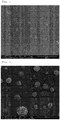
- the surfaces of the fine pattern-formed substrates 1 to 3 obtained in Examples 1 to 3 were observed. The results are shown in FIGS. 2 to 4 . Also, the surfaces of the comparative substrates 1 to 10 obtained in Comparative Examples 1 to 10 were observed. The results are shown in FIGS. 5 to 7 .
- the fine pattern-formed substrates 1 to 3 obtained in Examples 1 to 3 under the sputtering conditions according to the present invention had a fine pattern.
- FIG. 2 illustrates the surface of the fine pattern-formed substrate 1 obtained in Example 1.
- Example 1 where all of power, bias and heating among the process conditions according to the present invention were applied appropriately, a mixed pattern including a large atypical pattern and a small circular-like pattern, which are combined properly, was formed.
- FIG. 3 illustrates the surface of the fine pattern-formed substrate 2 obtained in Example 2.
- Example 2 where power and heating among the process conditions according to the present invention were applied appropriately, a dense pattern having a circular-like shape and a narrow pattern interval was formed.
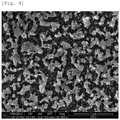
- FIG. 4 illustrates the surface of the fine pattern-formed substrate 3 obtained in Example 3.
- Example 3 where power and bias among the process conditions according to the present invention were applied appropriately, an atypical coarse pattern, the shape of which is not relatively specific but overall shows a predetermined pattern, was formed compared to Example 2.
- the pattern interval can also be seen to be large.
- FIG. 5 illustrates the surface of the comparative substrate 1 obtained in Comparative Example 1.
- the resulting coating layer was configured such that small grains were distributed and large grains were very irregularly formed on a certain portion.
- FIG. 6 illustrates the surface of the comparative substrate 4 obtained in Comparative Example 4.
- the resulting coating layer was configured such that comparatively large grains were very irregularly formed and supported by a matrix having a network structure.
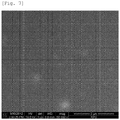
- FIG. 7 illustrates the surface of the comparative substrate 6 obtained in Comparative Example 6. As illustrated in FIG. 7 , in Comparative Example 6 where power was applied so as to satisfy the power condition according to the present invention but bias and heating were not applied, a uniform coating layer as in general sputtering was formed.
- Comparative Examples 3, 7 and 10 where bias and heating were applied so as to satisfy the conditions according to the present invention but power was applied at a lower level, the resulting comparative substrates 3, 7 and 10 had no fine pattern and had a uniform coating layer as in general sputtering. Also, in Comparative Example 8 where power was applied so as to satisfy the power condition according to the present invention but bias and heating were not applied, a uniform coating layer as in general sputtering was formed, like Comparative Example 6.
- the fine pattern-formed substrate 1 obtained in Example 1 had a contact angle as large as 116°, and thus exhibited superior water repellency. Further, since the fine pattern-formed substrate 2 obtained in Example 2 had a contact angle of 109°, superior water repellency was obtained. Furthermore, the fine pattern-formed substrate 3 obtained in Example 3 had a contact angle of 106°, resulting in superior water repellency.
Landscapes
- Chemical & Material Sciences (AREA)
- Chemical Kinetics & Catalysis (AREA)
- Engineering & Computer Science (AREA)
- Materials Engineering (AREA)
- Mechanical Engineering (AREA)
- Metallurgy (AREA)
- Organic Chemistry (AREA)
- Inorganic Chemistry (AREA)
- Physical Vapour Deposition (AREA)
Claims (4)
- Verfahren zum Bilden eines feinen Musters mittels Sputtern, welches umfasst:ein Vorbereiten eines Substrats (20); undein Sputtem eines Targetmaterials (T) auf dem Substrat (20), wodurch ein Muster gebildet wird,wobei bei dem Sputtem mindestens eine Prozessbedingung einer Leistungsbedingung, bei der ein Teil des Targetmaterials (T) mit einem vorab abgeschiedenen Targetmaterial (T) auf dem Substrat (20) kollidiert, um zu ermöglichen, dass das vorab abgeschiedene Targetmaterial (T) von dem Substrat (20) getrennt wird, und einer Vorspannungsbedingung, bei der ein Inertgas in einer Kammer (10) mit dem Substrat (20) kollidiert, um zu ermöglichen, dass das vorher abgeschiedene Targetmaterial (T) von dem Substrat (20) getrennt wird, gesteuert wird, dadurch gekennzeichnet, dass das Targetmaterial (T) ein Teflon ist und dass die Leistungsbedingung auf 3,46 bis 14,81 W/cm2 eingestellt wird und dass ein Erhitzen auf eine solche Weise durchgeführt wird, dass die Temperatur in einem Bereich von 50 bis 300 °C liegt und dass die Vorspannungsbedingung eine Vorspannung von 0,11 bis 0,76 W/cm2 aufweist und dass ein Abstand zwischen dem Substrat (20) und einem Target (30) bei dem Sputtem 3 bis 7 cm beträgt und dass ein Druck in der Kammer (10) bei dem Sputtem 1 bis 7 mTorr beträgt.
- Verfahren nach Anspruch 1, wobei das Erhitzen auf eine solche Weise durchgeführt wird, dass die Temperatur in einem Bereich von 150 bis 250 °C liegt.
- Verfahren nach Anspruch 1, wobei das Substrat (20) mindestens eines aufweist, das aus der Gruppe ausgewählt worden ist, die ein Silizium, ein Glas, ein Metall und eine Keramik umfasst.
- Verfahren nach Anspruch 1, welches ferner ein Bilden einer wasserabweisenden Beschichtungsschicht auf dem Substrat (20) vor oder nach dem Bilden des Musters umfasst.
Applications Claiming Priority (2)
| Application Number | Priority Date | Filing Date | Title |
|---|---|---|---|
| KR1020120107946A KR101375878B1 (ko) | 2012-09-27 | 2012-09-27 | 미세패턴 형성 방법 |
| PCT/KR2013/008634 WO2014051355A1 (ko) | 2012-09-27 | 2013-09-26 | 미세패턴 형성 방법 및 상기 방법으로 형성된 미세패턴 |
Publications (3)
| Publication Number | Publication Date |
|---|---|
| EP2903018A1 EP2903018A1 (de) | 2015-08-05 |
| EP2903018A4 EP2903018A4 (de) | 2016-05-18 |
| EP2903018B1 true EP2903018B1 (de) | 2021-11-24 |
Family
ID=50388649
Family Applications (1)
| Application Number | Title | Priority Date | Filing Date |
|---|---|---|---|
| EP13841594.8A Active EP2903018B1 (de) | 2012-09-27 | 2013-09-26 | Verfahren zur bildung eines feinen musters |
Country Status (4)
| Country | Link |
|---|---|
| US (1) | US9637815B2 (de) |
| EP (1) | EP2903018B1 (de) |
| KR (1) | KR101375878B1 (de) |
| WO (1) | WO2014051355A1 (de) |
Families Citing this family (2)
| Publication number | Priority date | Publication date | Assignee | Title |
|---|---|---|---|---|
| KR102311423B1 (ko) * | 2016-10-31 | 2021-10-12 | 한국생산기술연구원 | 고경도 ptfe코팅막 |
| KR101914573B1 (ko) * | 2016-10-31 | 2018-11-02 | 한국생산기술연구원 | 고경도 ptfe코팅막 및 상기 ptfe코팅막 제조방법 |
Citations (1)
| Publication number | Priority date | Publication date | Assignee | Title |
|---|---|---|---|---|
| US20030173207A1 (en) * | 2002-03-16 | 2003-09-18 | Symmorphix, Inc. | Biased pulse DC reactive sputtering of oxide films |
Family Cites Families (5)
| Publication number | Priority date | Publication date | Assignee | Title |
|---|---|---|---|---|
| EP0731490A3 (de) * | 1995-03-02 | 1998-03-11 | Ebara Corporation | Ultrafeines Mikroherstellungsverfahren unter Verwendung eines Energiebündel |
| US6679976B2 (en) * | 2001-03-16 | 2004-01-20 | 4Wave, Inc. | System and method for performing sputter deposition with multiple targets using independent ion and electron sources and independent target biasing with DC pulse signals |
| US7842605B1 (en) * | 2003-04-11 | 2010-11-30 | Novellus Systems, Inc. | Atomic layer profiling of diffusion barrier and metal seed layers |
| JP2005254637A (ja) * | 2004-03-12 | 2005-09-22 | Casio Comput Co Ltd | 撥水性構造およびその製造方法 |
| KR101272009B1 (ko) * | 2008-12-26 | 2013-06-05 | 캐논 아네르바 가부시키가이샤 | 스퍼터링 장치, 스퍼터링 방법 및 전자 디바이스의 제조 방법 |
-
2012
- 2012-09-27 KR KR1020120107946A patent/KR101375878B1/ko active Active
-
2013
- 2013-09-26 WO PCT/KR2013/008634 patent/WO2014051355A1/ko not_active Ceased
- 2013-09-26 EP EP13841594.8A patent/EP2903018B1/de active Active
- 2013-09-26 US US14/431,645 patent/US9637815B2/en not_active Expired - Fee Related
Patent Citations (1)
| Publication number | Priority date | Publication date | Assignee | Title |
|---|---|---|---|---|
| US20030173207A1 (en) * | 2002-03-16 | 2003-09-18 | Symmorphix, Inc. | Biased pulse DC reactive sputtering of oxide films |
Also Published As
| Publication number | Publication date |
|---|---|
| EP2903018A4 (de) | 2016-05-18 |
| US9637815B2 (en) | 2017-05-02 |
| EP2903018A1 (de) | 2015-08-05 |
| KR101375878B1 (ko) | 2014-03-17 |
| US20150259778A1 (en) | 2015-09-17 |
| WO2014051355A1 (ko) | 2014-04-03 |
Similar Documents
| Publication | Publication Date | Title |
|---|---|---|
| CN101429644B (zh) | 金属或金属氧化物纳米颗粒的薄膜制备方法 | |
| US8273407B2 (en) | Systems and methods for forming magnetic nanocomposite materials | |
| KR100958480B1 (ko) | 유기 el 디스플레이 및 그 제조 방법 | |
| JP5586752B2 (ja) | 高密度の耐熱金属及び合金のスパッタリングターゲット | |
| TWI510428B (zh) | 透明導電物件 | |
| CN111943130B (zh) | 纳米针阵列及其制备方法和应用 | |
| TW201029950A (en) | Sintered complex oxide and sputtering target comprising same | |
| US20130265690A1 (en) | Electrostatic chuck apparatus | |
| TWI496758B (zh) | In-Ga-O-based oxide sintered body, target material, oxide semiconductor thin film, and the like | |
| TW200533764A (en) | Textured-grain-powder metallurgy tantalum sputter target | |
| CN101687709A (zh) | 烧结硅晶片 | |
| KR20180071747A (ko) | 반도체 제조용 부품, 복합체 코팅층을 포함하는 반도체 제조용 부품 및 그 제조방법 | |
| EP2903018B1 (de) | Verfahren zur bildung eines feinen musters | |
| JP2008073825A (ja) | Cmpコンディショナおよびその製造方法 | |
| KR20200122648A (ko) | SiC 소재 및 이의 제조방법 | |
| US8603304B2 (en) | Method for manufacturing nickel silicide nano-wires | |
| JP7158102B2 (ja) | Itoスパッタリングターゲット及びその製造方法並びにito透明導電膜及びito透明導電膜の製造方法 | |
| CN102051497B (zh) | 金银镶嵌靶材及其薄膜的制备方法 | |
| CN103320753B (zh) | 一种尺寸密度可控铝纳米颗粒阵列的制备方法 | |
| CN109314033B (zh) | 由碳化钨块构成的等离子体设备用部件 | |
| Savaloni et al. | Fabrication, characterization and some applications of graded chiral zigzag shaped nano-sculptured silver thin films | |
| JP7210370B2 (ja) | 硝子成形用型の製造方法 | |
| EP2535311B1 (de) | Partikel und herstellungsverfahren dafür | |
| KR101475133B1 (ko) | 소결용 Sb-Te 계 합금 분말 및 그 분말의 제조 방법 그리고 소결체 타겟 | |
| CN112687801B (zh) | 一种iv-vi族半导体薄膜及其制备方法 |
Legal Events
| Date | Code | Title | Description |
|---|---|---|---|
| PUAI | Public reference made under article 153(3) epc to a published international application that has entered the european phase |
Free format text: ORIGINAL CODE: 0009012 |
|
| 17P | Request for examination filed |
Effective date: 20150416 |
|
| AK | Designated contracting states |
Kind code of ref document: A1 Designated state(s): AL AT BE BG CH CY CZ DE DK EE ES FI FR GB GR HR HU IE IS IT LI LT LU LV MC MK MT NL NO PL PT RO RS SE SI SK SM TR |
|
| AX | Request for extension of the european patent |
Extension state: BA ME |
|
| DAX | Request for extension of the european patent (deleted) | ||
| RA4 | Supplementary search report drawn up and despatched (corrected) |
Effective date: 20160418 |
|
| RIC1 | Information provided on ipc code assigned before grant |
Ipc: C23C 14/12 20060101ALI20160412BHEP Ipc: H01L 21/203 20060101AFI20160412BHEP Ipc: C23C 14/34 20060101ALI20160412BHEP |
|
| STAA | Information on the status of an ep patent application or granted ep patent |
Free format text: STATUS: EXAMINATION IS IN PROGRESS |
|
| 17Q | First examination report despatched |
Effective date: 20180806 |
|
| RIC1 | Information provided on ipc code assigned before grant |
Ipc: H01L 21/203 20060101AFI20210526BHEP Ipc: C23C 14/34 20060101ALI20210526BHEP Ipc: C23C 14/12 20060101ALI20210526BHEP Ipc: C23C 14/04 20060101ALI20210526BHEP |
|
| GRAP | Despatch of communication of intention to grant a patent |
Free format text: ORIGINAL CODE: EPIDOSNIGR1 |
|
| STAA | Information on the status of an ep patent application or granted ep patent |
Free format text: STATUS: GRANT OF PATENT IS INTENDED |
|
| INTG | Intention to grant announced |
Effective date: 20210804 |
|
| GRAS | Grant fee paid |
Free format text: ORIGINAL CODE: EPIDOSNIGR3 |
|
| GRAA | (expected) grant |
Free format text: ORIGINAL CODE: 0009210 |
|
| STAA | Information on the status of an ep patent application or granted ep patent |
Free format text: STATUS: THE PATENT HAS BEEN GRANTED |
|
| AK | Designated contracting states |
Kind code of ref document: B1 Designated state(s): AL AT BE BG CH CY CZ DE DK EE ES FI FR GB GR HR HU IE IS IT LI LT LU LV MC MK MT NL NO PL PT RO RS SE SI SK SM TR |
|
| REG | Reference to a national code |
Ref country code: GB Ref legal event code: FG4D |
|
| REG | Reference to a national code |
Ref country code: AT Ref legal event code: REF Ref document number: 1450498 Country of ref document: AT Kind code of ref document: T Effective date: 20211215 |
|
| REG | Reference to a national code |
Ref country code: DE Ref legal event code: R096 Ref document number: 602013080211 Country of ref document: DE |
|
| REG | Reference to a national code |
Ref country code: IE Ref legal event code: FG4D |
|
| REG | Reference to a national code |
Ref country code: LT Ref legal event code: MG9D |
|
| REG | Reference to a national code |
Ref country code: NL Ref legal event code: MP Effective date: 20211124 |
|
| REG | Reference to a national code |
Ref country code: AT Ref legal event code: MK05 Ref document number: 1450498 Country of ref document: AT Kind code of ref document: T Effective date: 20211124 |
|
| PG25 | Lapsed in a contracting state [announced via postgrant information from national office to epo] |
Ref country code: RS Free format text: LAPSE BECAUSE OF FAILURE TO SUBMIT A TRANSLATION OF THE DESCRIPTION OR TO PAY THE FEE WITHIN THE PRESCRIBED TIME-LIMIT Effective date: 20211124 Ref country code: LT Free format text: LAPSE BECAUSE OF FAILURE TO SUBMIT A TRANSLATION OF THE DESCRIPTION OR TO PAY THE FEE WITHIN THE PRESCRIBED TIME-LIMIT Effective date: 20211124 Ref country code: FI Free format text: LAPSE BECAUSE OF FAILURE TO SUBMIT A TRANSLATION OF THE DESCRIPTION OR TO PAY THE FEE WITHIN THE PRESCRIBED TIME-LIMIT Effective date: 20211124 Ref country code: BG Free format text: LAPSE BECAUSE OF FAILURE TO SUBMIT A TRANSLATION OF THE DESCRIPTION OR TO PAY THE FEE WITHIN THE PRESCRIBED TIME-LIMIT Effective date: 20220224 Ref country code: AT Free format text: LAPSE BECAUSE OF FAILURE TO SUBMIT A TRANSLATION OF THE DESCRIPTION OR TO PAY THE FEE WITHIN THE PRESCRIBED TIME-LIMIT Effective date: 20211124 |
|
| PG25 | Lapsed in a contracting state [announced via postgrant information from national office to epo] |
Ref country code: IS Free format text: LAPSE BECAUSE OF FAILURE TO SUBMIT A TRANSLATION OF THE DESCRIPTION OR TO PAY THE FEE WITHIN THE PRESCRIBED TIME-LIMIT Effective date: 20220324 Ref country code: SE Free format text: LAPSE BECAUSE OF FAILURE TO SUBMIT A TRANSLATION OF THE DESCRIPTION OR TO PAY THE FEE WITHIN THE PRESCRIBED TIME-LIMIT Effective date: 20211124 Ref country code: PT Free format text: LAPSE BECAUSE OF FAILURE TO SUBMIT A TRANSLATION OF THE DESCRIPTION OR TO PAY THE FEE WITHIN THE PRESCRIBED TIME-LIMIT Effective date: 20220324 Ref country code: PL Free format text: LAPSE BECAUSE OF FAILURE TO SUBMIT A TRANSLATION OF THE DESCRIPTION OR TO PAY THE FEE WITHIN THE PRESCRIBED TIME-LIMIT Effective date: 20211124 Ref country code: NO Free format text: LAPSE BECAUSE OF FAILURE TO SUBMIT A TRANSLATION OF THE DESCRIPTION OR TO PAY THE FEE WITHIN THE PRESCRIBED TIME-LIMIT Effective date: 20220224 Ref country code: NL Free format text: LAPSE BECAUSE OF FAILURE TO SUBMIT A TRANSLATION OF THE DESCRIPTION OR TO PAY THE FEE WITHIN THE PRESCRIBED TIME-LIMIT Effective date: 20211124 Ref country code: LV Free format text: LAPSE BECAUSE OF FAILURE TO SUBMIT A TRANSLATION OF THE DESCRIPTION OR TO PAY THE FEE WITHIN THE PRESCRIBED TIME-LIMIT Effective date: 20211124 Ref country code: HR Free format text: LAPSE BECAUSE OF FAILURE TO SUBMIT A TRANSLATION OF THE DESCRIPTION OR TO PAY THE FEE WITHIN THE PRESCRIBED TIME-LIMIT Effective date: 20211124 Ref country code: GR Free format text: LAPSE BECAUSE OF FAILURE TO SUBMIT A TRANSLATION OF THE DESCRIPTION OR TO PAY THE FEE WITHIN THE PRESCRIBED TIME-LIMIT Effective date: 20220225 Ref country code: ES Free format text: LAPSE BECAUSE OF FAILURE TO SUBMIT A TRANSLATION OF THE DESCRIPTION OR TO PAY THE FEE WITHIN THE PRESCRIBED TIME-LIMIT Effective date: 20211124 |
|
| PG25 | Lapsed in a contracting state [announced via postgrant information from national office to epo] |
Ref country code: SM Free format text: LAPSE BECAUSE OF FAILURE TO SUBMIT A TRANSLATION OF THE DESCRIPTION OR TO PAY THE FEE WITHIN THE PRESCRIBED TIME-LIMIT Effective date: 20211124 Ref country code: SK Free format text: LAPSE BECAUSE OF FAILURE TO SUBMIT A TRANSLATION OF THE DESCRIPTION OR TO PAY THE FEE WITHIN THE PRESCRIBED TIME-LIMIT Effective date: 20211124 Ref country code: RO Free format text: LAPSE BECAUSE OF FAILURE TO SUBMIT A TRANSLATION OF THE DESCRIPTION OR TO PAY THE FEE WITHIN THE PRESCRIBED TIME-LIMIT Effective date: 20211124 Ref country code: EE Free format text: LAPSE BECAUSE OF FAILURE TO SUBMIT A TRANSLATION OF THE DESCRIPTION OR TO PAY THE FEE WITHIN THE PRESCRIBED TIME-LIMIT Effective date: 20211124 Ref country code: DK Free format text: LAPSE BECAUSE OF FAILURE TO SUBMIT A TRANSLATION OF THE DESCRIPTION OR TO PAY THE FEE WITHIN THE PRESCRIBED TIME-LIMIT Effective date: 20211124 Ref country code: CZ Free format text: LAPSE BECAUSE OF FAILURE TO SUBMIT A TRANSLATION OF THE DESCRIPTION OR TO PAY THE FEE WITHIN THE PRESCRIBED TIME-LIMIT Effective date: 20211124 |
|
| REG | Reference to a national code |
Ref country code: DE Ref legal event code: R097 Ref document number: 602013080211 Country of ref document: DE |
|
| PLBE | No opposition filed within time limit |
Free format text: ORIGINAL CODE: 0009261 |
|
| STAA | Information on the status of an ep patent application or granted ep patent |
Free format text: STATUS: NO OPPOSITION FILED WITHIN TIME LIMIT |
|
| PG25 | Lapsed in a contracting state [announced via postgrant information from national office to epo] |
Ref country code: AL Free format text: LAPSE BECAUSE OF FAILURE TO SUBMIT A TRANSLATION OF THE DESCRIPTION OR TO PAY THE FEE WITHIN THE PRESCRIBED TIME-LIMIT Effective date: 20211124 |
|
| 26N | No opposition filed |
Effective date: 20220825 |
|
| PG25 | Lapsed in a contracting state [announced via postgrant information from national office to epo] |
Ref country code: SI Free format text: LAPSE BECAUSE OF FAILURE TO SUBMIT A TRANSLATION OF THE DESCRIPTION OR TO PAY THE FEE WITHIN THE PRESCRIBED TIME-LIMIT Effective date: 20211124 |
|
| REG | Reference to a national code |
Ref country code: DE Ref legal event code: R119 Ref document number: 602013080211 Country of ref document: DE |
|
| PG25 | Lapsed in a contracting state [announced via postgrant information from national office to epo] |
Ref country code: MC Free format text: LAPSE BECAUSE OF FAILURE TO SUBMIT A TRANSLATION OF THE DESCRIPTION OR TO PAY THE FEE WITHIN THE PRESCRIBED TIME-LIMIT Effective date: 20211124 |
|
| REG | Reference to a national code |
Ref country code: CH Ref legal event code: PL |
|
| REG | Reference to a national code |
Ref country code: BE Ref legal event code: MM Effective date: 20220930 |
|
| PG25 | Lapsed in a contracting state [announced via postgrant information from national office to epo] |
Ref country code: IT Free format text: LAPSE BECAUSE OF FAILURE TO SUBMIT A TRANSLATION OF THE DESCRIPTION OR TO PAY THE FEE WITHIN THE PRESCRIBED TIME-LIMIT Effective date: 20211124 |
|
| PG25 | Lapsed in a contracting state [announced via postgrant information from national office to epo] |
Ref country code: LU Free format text: LAPSE BECAUSE OF NON-PAYMENT OF DUE FEES Effective date: 20220926 |
|
| PG25 | Lapsed in a contracting state [announced via postgrant information from national office to epo] |
Ref country code: LI Free format text: LAPSE BECAUSE OF NON-PAYMENT OF DUE FEES Effective date: 20220930 Ref country code: IE Free format text: LAPSE BECAUSE OF NON-PAYMENT OF DUE FEES Effective date: 20220926 Ref country code: FR Free format text: LAPSE BECAUSE OF NON-PAYMENT OF DUE FEES Effective date: 20220930 Ref country code: DE Free format text: LAPSE BECAUSE OF NON-PAYMENT OF DUE FEES Effective date: 20230401 Ref country code: CH Free format text: LAPSE BECAUSE OF NON-PAYMENT OF DUE FEES Effective date: 20220930 |
|
| PG25 | Lapsed in a contracting state [announced via postgrant information from national office to epo] |
Ref country code: BE Free format text: LAPSE BECAUSE OF NON-PAYMENT OF DUE FEES Effective date: 20220930 |
|
| PG25 | Lapsed in a contracting state [announced via postgrant information from national office to epo] |
Ref country code: HU Free format text: LAPSE BECAUSE OF FAILURE TO SUBMIT A TRANSLATION OF THE DESCRIPTION OR TO PAY THE FEE WITHIN THE PRESCRIBED TIME-LIMIT; INVALID AB INITIO Effective date: 20130926 |
|
| PG25 | Lapsed in a contracting state [announced via postgrant information from national office to epo] |
Ref country code: CY Free format text: LAPSE BECAUSE OF FAILURE TO SUBMIT A TRANSLATION OF THE DESCRIPTION OR TO PAY THE FEE WITHIN THE PRESCRIBED TIME-LIMIT Effective date: 20211124 |
|
| PG25 | Lapsed in a contracting state [announced via postgrant information from national office to epo] |
Ref country code: MK Free format text: LAPSE BECAUSE OF FAILURE TO SUBMIT A TRANSLATION OF THE DESCRIPTION OR TO PAY THE FEE WITHIN THE PRESCRIBED TIME-LIMIT Effective date: 20211124 |
|
| PG25 | Lapsed in a contracting state [announced via postgrant information from national office to epo] |
Ref country code: TR Free format text: LAPSE BECAUSE OF FAILURE TO SUBMIT A TRANSLATION OF THE DESCRIPTION OR TO PAY THE FEE WITHIN THE PRESCRIBED TIME-LIMIT Effective date: 20211124 |
|
| PG25 | Lapsed in a contracting state [announced via postgrant information from national office to epo] |
Ref country code: MT Free format text: LAPSE BECAUSE OF FAILURE TO SUBMIT A TRANSLATION OF THE DESCRIPTION OR TO PAY THE FEE WITHIN THE PRESCRIBED TIME-LIMIT Effective date: 20211124 |
|
| PGFP | Annual fee paid to national office [announced via postgrant information from national office to epo] |
Ref country code: GB Payment date: 20250707 Year of fee payment: 13 |