EP2898079B1 - Verfahren zur vermeidung der hemmung von acetogenen durch co - Google Patents
Verfahren zur vermeidung der hemmung von acetogenen durch co Download PDFInfo
- Publication number
- EP2898079B1 EP2898079B1 EP13770769.1A EP13770769A EP2898079B1 EP 2898079 B1 EP2898079 B1 EP 2898079B1 EP 13770769 A EP13770769 A EP 13770769A EP 2898079 B1 EP2898079 B1 EP 2898079B1
- Authority
- EP
- European Patent Office
- Prior art keywords
- clostridium
- syngas
- fermentation
- subsequent
- another aspect
- Prior art date
- Legal status (The legal status is an assumption and is not a legal conclusion. Google has not performed a legal analysis and makes no representation as to the accuracy of the status listed.)
- Not-in-force
Links
Images

Classifications
-
- C—CHEMISTRY; METALLURGY
- C12—BIOCHEMISTRY; BEER; SPIRITS; WINE; VINEGAR; MICROBIOLOGY; ENZYMOLOGY; MUTATION OR GENETIC ENGINEERING
- C12Q—MEASURING OR TESTING PROCESSES INVOLVING ENZYMES, NUCLEIC ACIDS OR MICROORGANISMS; COMPOSITIONS OR TEST PAPERS THEREFOR; PROCESSES OF PREPARING SUCH COMPOSITIONS; CONDITION-RESPONSIVE CONTROL IN MICROBIOLOGICAL OR ENZYMOLOGICAL PROCESSES
- C12Q1/00—Measuring or testing processes involving enzymes, nucleic acids or microorganisms; Compositions therefor; Processes of preparing such compositions
- C12Q1/02—Measuring or testing processes involving enzymes, nucleic acids or microorganisms; Compositions therefor; Processes of preparing such compositions involving viable microorganisms
- C12Q1/04—Determining presence or kind of microorganism; Use of selective media for testing antibiotics or bacteriocides; Compositions containing a chemical indicator therefor
-
- C—CHEMISTRY; METALLURGY
- C12—BIOCHEMISTRY; BEER; SPIRITS; WINE; VINEGAR; MICROBIOLOGY; ENZYMOLOGY; MUTATION OR GENETIC ENGINEERING
- C12P—FERMENTATION OR ENZYME-USING PROCESSES TO SYNTHESISE A DESIRED CHEMICAL COMPOUND OR COMPOSITION OR TO SEPARATE OPTICAL ISOMERS FROM A RACEMIC MIXTURE
- C12P7/00—Preparation of oxygen-containing organic compounds
- C12P7/02—Preparation of oxygen-containing organic compounds containing a hydroxy group
- C12P7/04—Preparation of oxygen-containing organic compounds containing a hydroxy group acyclic
- C12P7/06—Ethanol, i.e. non-beverage
-
- C—CHEMISTRY; METALLURGY
- C12—BIOCHEMISTRY; BEER; SPIRITS; WINE; VINEGAR; MICROBIOLOGY; ENZYMOLOGY; MUTATION OR GENETIC ENGINEERING
- C12P—FERMENTATION OR ENZYME-USING PROCESSES TO SYNTHESISE A DESIRED CHEMICAL COMPOUND OR COMPOSITION OR TO SEPARATE OPTICAL ISOMERS FROM A RACEMIC MIXTURE
- C12P7/00—Preparation of oxygen-containing organic compounds
- C12P7/02—Preparation of oxygen-containing organic compounds containing a hydroxy group
- C12P7/04—Preparation of oxygen-containing organic compounds containing a hydroxy group acyclic
- C12P7/06—Ethanol, i.e. non-beverage
- C12P7/065—Ethanol, i.e. non-beverage with microorganisms other than yeasts
-
- C—CHEMISTRY; METALLURGY
- C12—BIOCHEMISTRY; BEER; SPIRITS; WINE; VINEGAR; MICROBIOLOGY; ENZYMOLOGY; MUTATION OR GENETIC ENGINEERING
- C12P—FERMENTATION OR ENZYME-USING PROCESSES TO SYNTHESISE A DESIRED CHEMICAL COMPOUND OR COMPOSITION OR TO SEPARATE OPTICAL ISOMERS FROM A RACEMIC MIXTURE
- C12P7/00—Preparation of oxygen-containing organic compounds
- C12P7/02—Preparation of oxygen-containing organic compounds containing a hydroxy group
- C12P7/04—Preparation of oxygen-containing organic compounds containing a hydroxy group acyclic
- C12P7/06—Ethanol, i.e. non-beverage
- C12P7/08—Ethanol, i.e. non-beverage produced as by-product or from waste or cellulosic material substrate
-
- C—CHEMISTRY; METALLURGY
- C12—BIOCHEMISTRY; BEER; SPIRITS; WINE; VINEGAR; MICROBIOLOGY; ENZYMOLOGY; MUTATION OR GENETIC ENGINEERING
- C12Q—MEASURING OR TESTING PROCESSES INVOLVING ENZYMES, NUCLEIC ACIDS OR MICROORGANISMS; COMPOSITIONS OR TEST PAPERS THEREFOR; PROCESSES OF PREPARING SUCH COMPOSITIONS; CONDITION-RESPONSIVE CONTROL IN MICROBIOLOGICAL OR ENZYMOLOGICAL PROCESSES
- C12Q3/00—Condition responsive control processes
-
- G—PHYSICS
- G01—MEASURING; TESTING
- G01N—INVESTIGATING OR ANALYSING MATERIALS BY DETERMINING THEIR CHEMICAL OR PHYSICAL PROPERTIES
- G01N21/00—Investigating or analysing materials by the use of optical means, i.e. using sub-millimetre waves, infrared, visible or ultraviolet light
- G01N21/17—Systems in which incident light is modified in accordance with the properties of the material investigated
- G01N21/25—Colour; Spectral properties, i.e. comparison of effect of material on the light at two or more different wavelengths or wavelength bands
- G01N21/31—Investigating relative effect of material at wavelengths characteristic of specific elements or molecules, e.g. atomic absorption spectrometry
-
- G—PHYSICS
- G01—MEASURING; TESTING
- G01N—INVESTIGATING OR ANALYSING MATERIALS BY DETERMINING THEIR CHEMICAL OR PHYSICAL PROPERTIES
- G01N33/00—Investigating or analysing materials by specific methods not covered by groups G01N1/00 - G01N31/00
- G01N33/48—Biological material, e.g. blood, urine; Haemocytometers
- G01N33/50—Chemical analysis of biological material, e.g. blood, urine; Testing involving biospecific ligand binding methods; Immunological testing
- G01N33/84—Chemical analysis of biological material, e.g. blood, urine; Testing involving biospecific ligand binding methods; Immunological testing involving inorganic compounds or pH
-
- Y—GENERAL TAGGING OF NEW TECHNOLOGICAL DEVELOPMENTS; GENERAL TAGGING OF CROSS-SECTIONAL TECHNOLOGIES SPANNING OVER SEVERAL SECTIONS OF THE IPC; TECHNICAL SUBJECTS COVERED BY FORMER USPC CROSS-REFERENCE ART COLLECTIONS [XRACs] AND DIGESTS
- Y02—TECHNOLOGIES OR APPLICATIONS FOR MITIGATION OR ADAPTATION AGAINST CLIMATE CHANGE
- Y02E—REDUCTION OF GREENHOUSE GAS [GHG] EMISSIONS, RELATED TO ENERGY GENERATION, TRANSMISSION OR DISTRIBUTION
- Y02E50/00—Technologies for the production of fuel of non-fossil origin
- Y02E50/10—Biofuels, e.g. bio-diesel
Definitions
- a process for fermenting CO-containing gaseous substrates More specifically, the process includes determining CO concentration in a first fermentation medium in a first fermentation zone. If the CO concentration in the first fermentation medium has a value of about 0.12 ⁇ M or greater, then at least a portion of the syngas provided to the first fermentation zone is provided to one or more subsequent fermentation zones in an amount effective for providing a CO concentration in any subsequent fermentation zone of about 0.12 ⁇ M or less.
- Acetogenic microorganisms can produce ethanol from carbon monoxide (CO) through fermentation of gaseous substrates. Fermentations using anaerobic microorganisms from the genus Clostridium produce ethanol and other useful products.
- U.S. Patent No. 5,173,429 describes Clostridium ljungdahlii ATCC No. 49587, an anaerobic microorganism that produces ethanol and acetate from synthesis gas.
- U.S. Patent No. 5,807,722 describes a method and apparatus for converting waste gases into organic acids and alcohols using Clostridium ljungdahlii ATCC No. 55380.
- U.S. Patent No. 6,136,577 describes a method and apparatus for converting waste gases into ethanol using Clostridium ljungdahlii ATCC No. 55988 and 55989.
- HEISKANEN ET AL "The effect of syngas composition on the growth and product formation of Butyribacterium methylotrophicum", ENZYME AND MICROBIAL TECHNOLOGY, vol. 41, no. 3, 19 May 2007, pages 362-367 ; and MARCO RICCI & CARLO PEREGO, "From syngas to fuels and chemicals: Chemical and biotechnological routes", 23 September 2011 (http://www.eurobioref.org/Summer_Schooi/Lectures_Slides/ day6/L 17 M.Ricci.pdf ).
- Acetogenic microorganisms may be grown to produce ethanol from carbon monoxide.
- the growth process may involve culturing the acetogenic bacteria on increasing amounts of CO over time.
- Acetogenic microorganisms may be grown to produce ethanol from syngas that includes carbon monoxide.
- the growth process may involve culturing the acetogenic bacteria on increasing amounts of CO over time. High or low levels of CO in the fermentation may result in lower productivity
- a process is effective for maintaining high ethanol productivity levels during syngas fermentation.
- the process is effective for decreasing lag times and maintaining a culture in steady state by controlling CO concentration and minimizing effects of high or low CO concentrations during fermentation.
- a syngas fermentation process comprising:
- Syngas fermentations conducted in bioreactors with medium and acetogenic bacteria as described herein are effective for providing conversions of CO in syngas into alcohols and other products.
- Control of CO concentrations in the fermentation through determining CO concentration in the fermentation medium is effective for providing high productivity levels.
- productivity may be expressed as STY (space time yield expressed as g ethanol/(L ⁇ day).
- the process is effective for providing a STY (space time yield) of at least about 10 g ethanol/(L ⁇ day).
- Possible STY values include about 10 g ethanol/(L ⁇ day) to about 200 g ethanol/(L ⁇ day), in another aspect, about 10 g ethanol/(L ⁇ day) to about 160 g ethanol/(L ⁇ day), in another aspect, about 10 g ethanol/(L ⁇ day) to about 120 g ethanol/(L ⁇ day), in another aspect, about 10 g ethanol/(L ⁇ day) to about 80 g ethanol/(L ⁇ day), in another aspect, about 20 g ethanol/(L ⁇ day) to about 140 g ethanol/(L ⁇ day), in another aspect, about 20 g ethanol/(L ⁇ day) to about 100 g ethanol/(L ⁇ day), in another aspect, about 40 g ethanol/(L ⁇ day) to about 140 g ethanol/(L ⁇ day), and in another aspect, about 40 g ethanol/(L ⁇ day) to about 100 g ethanol/(L ⁇ day).
- any amount refers to the variation in that amount encountered in real world conditions, e.g., in the lab, pilot plant, or production facility.
- an amount of an ingredient or measurement employed in a mixture or quantity when modified by “about” includes the variation and degree of care typically employed in measuring in an experimental condition in production plant or lab.
- the amount of a component of a product when modified by “about” includes the variation between batches in a multiple experiments in the plant or lab and the variation inherent in the analytical method. Whether or not modified by “about,” the amounts include equivalents to those amounts. Any quantity stated herein and modified by “about” can also be employed in the present disclosure as the amount not modified by "about”.
- syngas or "synthesis gas” means synthesis gas which is the name given to a gas mixture that contains varying amounts of carbon monoxide and hydrogen.
- Examples of production methods include steam reforming of natural gas or hydrocarbons to produce hydrogen, the gasification of coal and in some types of waste-to-energy gasification facilities. The name comes from their use as intermediates in creating synthetic natural gas (SNG) and for producing ammonia or methanol. Syngas is combustible and is often used as a fuel source or as an intermediate for the production of other chemicals.
- the term “fermentor” includes a fermentation device consisting of one or more vessels and/or towers or piping arrangements, which includes the Continuous Stirred Tank Reactor (CSTR), Immobilized Cell Reactor (ICR), Trickle Bed Reactor (TBR), Moving Bed Biofilm Reactor (MBBR), Bubble Column, Gas Lift Fermenter, Membrane Reactor such as Hollow Fibre Membrane Bioreactor (HFMBR), Static Mixer, or other vessel or other device suitable for gas-liquid contact.
- CSTR Continuous Stirred Tank Reactor
- ICR Immobilized Cell Reactor
- TBR Trickle Bed Reactor
- MBBR Moving Bed Biofilm Reactor
- Bubble Column Gas Lift Fermenter
- Membrane Reactor such as Hollow Fibre Membrane Bioreactor (HFMBR), Static Mixer, or other vessel or other device suitable for gas-liquid contact.
- fermentation refers to conversion of CO to alcohol.
- cell density means mass of microorganism cells per unit volume of fermentation broth, for example, grams/liter.
- the term “increasing the efficiency”, “increased efficiency” and the like, when used in relation to a fermentation process includes increasing one or more of the rate of growth of microorganisms in the fermentation, the volume or mass of desired product (such as alcohols) produced per volume or mass of substrate (such as carbon monoxide) consumed, the rate of production or level of production of the desired product, and the relative proportion of the desired product produced compared with other by-products of fermentation.
- desired product such as alcohols
- substrate such as carbon monoxide
- Syngas may be provided from any know source.
- syngas may be sourced from gasification of carbonaceous materials. Gasification involves partial combustion of biomass in a restricted supply of oxygen. The resultant gas mainly includes CO and H 2 .
- syngas will contain at least about 10 mole % CO, in one aspect, at least about 20 mole %, in one aspect, about 10 to about 100 mole %, in another aspect, about 20 to about 100 mole % CO, in another aspect, about 30 to about 90 mole % CO, in another aspect, about 40 to about 80 mole % CO, and in another aspect, about 50 to about 70 mole % CO.
- syngas may be provided directly to a fermentation process or may be further modified to include an appropriate H 2 to CO molar ratio.
- syngas provided to the fermentor has an H 2 to CO molar ratio of about 0.2 or more, in another aspect, about 0.25 or more, and in another aspect, about 0.5 or more.
- syngas provided to the fermentor may include about 40 mole percent or more CO plus H 2 and about 30 mole percent or less CO, in another aspect, about 50 mole percent or more CO plus H 2 and about 35 mole percent or less CO, and in another aspect, about 80 mole percent or more CO plus H 2 and about 20 mole percent or less CO.
- the process has applicability to supporting the production of alcohol from gaseous substrates such as high volume CO-containing industrial flue gases.
- a gas that includes CO is derived from carbon containing waste, for example, industrial waste gases or from the gasification of other wastes.
- the processes represent effective processes for capturing carbon that would otherwise be exhausted into the environment.
- industrial flue gases include gases produced during ferrous metal products manufacturing, non-ferrous products manufacturing, petroleum refining processes, gasification of coal, gasification of biomass, electric power production, carbon black production, ammonia production, methanol production and coke manufacturing.
- a gas separator is configured to substantially separate at least one portion of the gas stream, wherein the portion includes one or more components.
- the gas separator may separate CO 2 from a gas stream comprising the following components: CO, CO 2 , H 2 , wherein the CO 2 may be passed to a CO 2 remover and the remainder of the gas stream (comprising CO and H 2 ) may be passed to a bioreactor. Any gas separator known in the art may be utilized.
- syngas provided to the fermentor will have about 10 mole % or less CO 2 , in another aspect, about 1 mole % or less CO 2 , and in another aspect, about 0.1 mole % or less CO 2 .
- Certain gas streams may include a high concentration of CO and low concentrations of H 2 .
- the concentration of H 2 in the substrate stream may be increased before the stream is passed to the bioreactor.
- streams from two or more sources can be combined and/or blended to produce a desirable and/or optimized substrate stream.
- a stream comprising a high concentration of CO such as the exhaust from a steel mill converter
- a stream comprising high concentrations of H 2 such as the off-gas from a steel mill coke oven.
- the gaseous CO-containing substrate may also be desirable to treat it to remove any undesired impurities, such as dust particles before introducing it to the fermentation.
- the gaseous substrate may be filtered or scrubbed using known methods.
- a fermentor design may include different fermentation zones in the same fermentor.
- a large fermentor or a bubble column type reactor may include different fermentation zones.
- Descriptions of fermentor designs are described in U.S. Serial Nos. 13/471,827 and 13/471,858 , both filed May 15, 2012, and U.S. Serial No. 13/473,167, filed May 16, 2012 .
- a fermentor 100 includes multiple fermentation zones 200. As shown, the fermentor 100 includes a first fermentation zone 200 and four additional fermentations zones 201, 202, 203, 204. In another aspect, the fermentor 100 may include two or more fermentation zones, and may includes from two to ten fermentation zones. A fermentation zone is defined as space above a gas inlet/sparger 122 and below the next gas/inlet sparger 122, or above a gas inlet/sparger 122 and the top of the fermentor 100. Medium, microbes and gases 305 in the fermentor 100 may flow between fermentation zones. The fermentor 100 may also include pumps 124. The pumps 124 may be used for product 222 removal and for removal of samples 210.
- syngas enters the fermentor 100 through a syngas supply 120.
- the syngas supply 120 provides syngas to the gas inlet/spargers 122.
- Medium and nutrients may be supplied through medium/nutrient supply 250.
- Off-gas may exit the fermentor 100 through an off-gas port 270.
- Off-gas may be provided to a vent-gas boiler.
- the vent-gas boiler may be utilized to provide steam for energy production.
- the fermentation process is started by addition of medium to the reactor vessel.
- medium compositions are described in U.S. Serial Nos. 61/650,098 and 61/650,093, filed May 22, 2012 , and in U.S. Patent No. 7,285,402, filed July 23, 2001 .
- the medium may be sterilized to remove undesirable microorganisms and the reactor is inoculated with the desired microorganisms. Sterilization may not always be required.
- acetogenic bacteria examples include those of the genus Clostridium, such as strains of Clostridium ljungdahlii, including those described in WO 2000/68407 , EP 117309 , U.S. Patent Nos.
- Some examples of useful bacteria include Acetogenium kivui, Acetoanaerobium noterae, Acetobacterium woodii, Alkalibaculum bacchi CP11 (ATCC BAA-1772), Blautia producta, Butyribacterium methylotrophicum , Caldanaerobacter subterraneous, Caldanaerobacter subterraneous pacificus, Carboxydothermus hydrogenoformans, Clostridium aceticum , Clostridium acetobutylicum , Clostridium acetobutylicum P262 (DSM 19630 of DSMZ Germany), Clostridium autoethanogenum (DSM 19630 of DSMZ Germany), Clostridium autoethanogenum (DSM 10061 of DSMZ Germany), Clostridium autoethanogenum (DSM 23693 of DSMZ Germany), Clostridium autoethanogenum (DSM 24138 of DSMZ Germany), Clostridium carboxidivorans P7
- an initial feed gas supply rate is established effective for supplying the initial population of microorganisms.
- Effluent gas is analyzed to determine the content of the effluent gas. Results of gas analysis are used to control feed gas rates.
- the process provides a CO concentration to initial cell density ratio of about 0.5 to about 0.9, in another aspect, about 0.6 to about 0.8, in another aspect, about 0.5 to about 0.7, and in another aspect, about 0.5 to about 0.6.
- liquid phase and cellular material is withdrawn from the reactor and replenished with medium.
- the process is effective for increasing cell density to about 2.0 grams/liter or more, in another aspect, about 2 to about 25 grams/liter, in another aspect, about 2 to about 20 grams/liter, in another aspect, about 2 to about 10 grams/liter, in another aspect, about 2 to about 8 grams/liter, in another aspect, about 3 to about 6 grams/liter, and in another aspect, about 4 to about 5 grams/liter.
- the process is effective for maintaining a CO concentration ( ⁇ M) to cell density (grams/liter) ratio of about 0.001 to about 1.0.
- a CO concentration to cell density ratio of about 0.01 to about 0.9, in another aspect, about 0.01 to about 0.8, in another aspect, about 0.02 to about 0.8, in another aspect, about 0.02 to about 0.75, in another aspect, about 0.03 to about 0.75, and in another aspect, about 0.03 to about 0.5.
- the process is effective for maintaining a CO concentration ( ⁇ M) to cell density (grams/liter) ratio of about 0.001 to about 1.0.
- a CO concentration to cell density ratio of about 0.01 to about 0.9, in another aspect, about 0.01 to about 0.8, in another aspect, about 0.02 to about 0.8, in another aspect, about 0.02 to about 0.75, in another aspect, about 0.03 to about 0.75, and in another aspect, about 0.03 to about 0.5.
- syngas is supplied to a first fermentation zone 200. If a CO concentration in the first fermentation zone 200 is about 0.12 ⁇ M or greater, then at least a portion of the syngas being supplied to the first fermentation zone 200 is provided to one or more subsequent fermentation zones through gas inlet/spargers 122. The portion of syngas provided to the one or more subsequent fermentation zones provides a CO concentration in any subsequent fermentation zone of about 0.12 ⁇ M or less, in another aspect, about 0.10 ⁇ M or less, in another aspect, about 0.08 ⁇ M or less, in another aspect, about 0.06 ⁇ M or less, in another aspect, about 0.04 ⁇ M or less, and in another aspect, about 0.02 ⁇ M or less.
- Syngas may be supplied to each fermentation zone one at a time or may be supplied to one or more fermentation zones simultaneously.
- syngas entering a fermentation zone will have about 20 mole % or more CO, in another aspect, about 30 mole % or more, in another aspect, about 40 mole % or more, and in another aspect, about 50 mole % or more.
- syngas supplied to any fermentation zone will have an H 2 to CO molar ratio of about 0.2 or more, and from about 4 mole % to about 99.9 mole % CO.
- syngas entering any subsequent fermentation zone will have an H 2 to CO molar ratio of about 0.5 or more, in another aspect, about 1.0 or more, and in another aspect, about 3.5 or more.
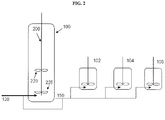
- the design includes a first fermentor 100 connected in series to subsequent fermentors, such as for example, second fermentor 102, third fermentor 104, and fourth fermentor 106.
- the design may include any number of subsequent fermentors from 1 to about 10 (for example, 1, 2, 3,4, 5, 6, 7, 8, 9 or 10 subsequent fermentors).
- syngas enters the first fermentor 100 through a gas inlet/sparger 120. Dispersion of the syngas and further mixing is accomplished with at least one gas dispersion impeller 225 and at least one mixing impeller 220 which are coupled to a drive shaft 200.
- Syngas 150 may be conveyed to one or more subsequent bioreactors. Syngas 150 may be supplied to each subsequent fermentor one at a time in series, or may be supplied to one or more subsequent fermentors simultaneously in parallel. In this aspect, the syngas entering any subsequent fermentor will have about 20 mole % or more CO, in another aspect, about 30 mole % or more, in another aspect, about 40 mole % or more, and in another aspect, about 50 mole % or more.
- syngas supplied to any subsequent fermentor will have an H 2 to CO molar ratio of about 0.2 or more, and from about 4 mole % to about 99.9 mole % CO.
- syngas entering any subsequent fermentor will have an H 2 to CO molar ratio of about 0.5 or more, in another aspect, about 1.0 or more, and in another aspect, about 3.5 or more.
- off-gas from a first or any subsequent fermentor may be provided to a vent-gas boiler.
- the vent-gas boiler may be utilized to provide steam for energy production.
- Certain ratios of H 2 to CO and/or CO 2 to CO are effective for providing enhanced STY.
- the process is effective for providing a STY (space time yield) of about 1 gram or more total alcohol/(L ⁇ day).
- the process is effective for providing a providing a STY of at least about 10 g total alcohol/(L ⁇ day).
- Possible STY values include about 10 g total alcohol/(L ⁇ day) to about 300 g/(L ⁇ day), in another aspect, about 10 g total alcohol/(L ⁇ day) to about 200 g total alcohol/(L ⁇ day), in another aspect, about 10 g total alcohol/(L ⁇ day) to about 160 g total alcohol/(L ⁇ day), in another aspect, about 10 g total alcohol/(L ⁇ day) to about 120 g total alcohol/(L ⁇ day), in another aspect, about 10 g total alcohol/(L ⁇ day) to about 80 g total alcohol/(L ⁇ day), in another aspect, about 20 g total alcohol/(L ⁇ day) to about 140 g total alcohol/(L ⁇ day), in another aspect, about 20 g total alcohol/(L ⁇ day) to about 100 g total alcohol/(L ⁇ day), in another aspect, about 40 g total alcohol/(L ⁇ day) to about 140 g total alcohol/(L ⁇ day), and in another aspect, about 40 g total alcohol/(L ⁇ day) to about 100 g total
- total alcohol includes ethanol, butanol, propanol and methanol. In one aspect, the total alcohol may include at least about 80 weight percent or more ethanol. In another aspect, total alcohol may include at least about 25 weight percent or less butanol.
- productivity may be expressed as STY (space time yield expressed as g ethanol/(L ⁇ day).
- the process is effective for providing a STY (space time yield) of at least about 10 g ethanol/(L ⁇ day).
- Possible STY values include about 10 g ethanol/(L ⁇ day) to about 200 g ethanol/(L ⁇ day), in another aspect, about 10 g ethanol/(L ⁇ day) to about 160 g ethanol/(L ⁇ day), in another aspect, about 10 g ethanol/(L ⁇ day) to about 120 g ethanol/(L ⁇ day), in another aspect, about 10 g ethanol/(L ⁇ day) to about 80 g ethanol/(L ⁇ day), in another aspect, about 20 g ethanol/(L ⁇ day) to about 140 g ethanol/(L ⁇ day), in another aspect, about 20 g ethanol/(L ⁇ day) to about 100 g ethanol/(L ⁇ day), in another aspect, about 40 g ethanol/(L ⁇ day) to
- the process includes contacting an aliquot of fermentation medium with at least one CO binding ligand and at least one microbial activator.
- the process may include taking an aliquot of fermentation medium directly from the bioreactor or from various recycle loops associated with the bioreactor.
- the amount of fermentation medium removed corresponds to any amount effective for providing an accurate determination of CO concentration. In this aspect, the amount of fermentation medium removed is adjusted based on expected CO concentration levels.
- sample amounts will range from about 0.02 ml to about 20 ml, in another aspect about, 1 ml to about 7 ml, in another aspect, about 0.1 ml to about 1 ml, in another aspect about 5 ml to about 10 ml, and in another aspect about 7 ml to about 8 ml.
- Aliquots removed from the bioreactor will include fermentation medium and microbes capable of producing and/or consuming CO.
- Fermentation mediums may include known mediums as described herein.
- Microbes capable of producing and/or consuming CO include acetogenic bacteria as described herein.
- the process may include removal of microbes from the aliquots of fermentation medium prior to CO measurements. In another aspect, the process may include analysis without removal of microbes.
- sampling may be conducted using any type of sampling probe known in the art.
- An appropriate sampling probe is an FISP® probe (available from Flownamics).
- the FISP® probe is a sampling probe capable of withdrawing sterile, cell-free samples from the fermentor.
- FISP® allows direct on-line sample transfer to a variety of analyzers, such as biochemistry and HPLC systems, as well as collection for off-line analysis.
- FISP® is a small, tube-shaped, sterilizable 316 stainless steel carrier which is surrounded by a tubular, micro-porous membrane.
- tubing utilized for sampling should be gas impermeable.
- tubing should be non-metallic and non-ferrous.
- tubing that may be utilized includes tubing made from polyetheretherketone.
- CO binding ligands are effective for bonding to dissolved CO in the fermentation medium.
- examples of CO binding ligands include hemoglobin, myoglobin, free heme, heme containing compounds, and mixtures thereof.
- the CO binding ligand includes a chelating agent.
- the chelating agent is a non-heme containing compound capable of binding CO.
- Amounts of CO binding ligand utilized will be in an excess of the amount of CO that may be in the sample. Generally, the amount of CO binding ligand utilized in the process will be about 7 mg/ml or more.
- Microbial inactivators are effective for preventing any microbes in the sample from consuming or creating CO.
- microbial inactivators may include salt, acid, base, oxidizing agents, organic solvent, heat, cold, and mixtures thereof.
- the salt may include NaCl, KCl, ammonium chloride, sodium sulfate, sodium bromide, and mixtures thereof.
- the salt solution will be at a concentration effective for inactivating microbes capable of consuming or creating CO. In this aspect, the salt solution will have a concentration of 0.2 to about 5 M.
- the acid may include HCl, sulfuric acid, trifluroacetic acid, acetic acid, and mixtures thereof
- the base may include NaOH, ammonium hydroxide, triethylamine, potassium hydroxide, and mixtures thereof.
- the acid or base solution will be at a concentration effective for inactivating microbes capable of consuming or creating CO.
- the acid solution will have a concentration of about 0.02 to about 5 M
- the base will have a concentration of about 0.02 to about 5 M.
- the inactivator is hydrogen peroxide
- the concentration may be from about 1% to about 3%.
- temperatures from about -270 °C to about 0 °C are effective.
- temperatures from about 35 °C to about 100 °C are effective.
- any known spectrophotometric equipment may provide absorbance measurements.
- Some examples of spectrophotometric equipment include Beckman Coulter sectrophotometers (DU 800, DU730) and microplate readers such as the Spectramax (M1, M2, and M3).
- a ratio of absorbance measurements at 538 nm and 555 nm provides a measure of CO bound to CO binding ligand.
- the process may include use of a flow through cell in connection with an appropriate spectrophotometer to provide continuous absorbance measurements.
- direct measurement of CO indicates a CO concentration in the fermentation medium of about 0.12 ⁇ M or more
- at least a portion of the syngas provided to the first fermentor is provided a one or more subsequent fermentors either operating in series or in parallel.
- the amount of syngas provided to the one of more subsequent fermentors is effective for providing a CO concentration in the fermentation medium of any subsequent fermentor of about 0.12 ⁇ M or less (as determined by direct measurement).
- Hemoglobin solution was prepared as follows: A 7 mg/ml solution of bovine hemoglobin was prepared in a 100 mM carbonate buffer (pH 9.3). Sodium dithionite (20 mg/ml) was added and the mixture was centrifuged at 7500g at 4°C. Supernatant was removed and one half volume of 5M NaCl was added.
- Sampling was conducted as follows : Hemoglobin/salt solution was drawn into a serological syringe equipped with a stopcock. Sampling of fermentate was conducted by drawing a sample from a cell recycle system from a "T" off a main line from a bioreactor that was fermenting syngas. Lines were first cleared by withdrawing about 10 ml of fermentate. A 7 ml aliquot of fermentate was then rapidly removed with the syringe containing the hemoglobin/salt solution pointing downward to effect mixing the fermentate with the hemoglobin/salt solution.
- Absorbance measurements were conducted as follows : All samples and standards were held at room temperature for a minimum of 10 minutes and a maximum of 2 hours. Absorbance of standards and samples was determined at 538 nm and 555 nm.
Landscapes
- Chemical & Material Sciences (AREA)
- Life Sciences & Earth Sciences (AREA)
- Organic Chemistry (AREA)
- Engineering & Computer Science (AREA)
- Health & Medical Sciences (AREA)
- Zoology (AREA)
- Wood Science & Technology (AREA)
- General Health & Medical Sciences (AREA)
- Biochemistry (AREA)
- Microbiology (AREA)
- Biotechnology (AREA)
- General Engineering & Computer Science (AREA)
- Bioinformatics & Cheminformatics (AREA)
- Genetics & Genomics (AREA)
- Immunology (AREA)
- Physics & Mathematics (AREA)
- Molecular Biology (AREA)
- Chemical Kinetics & Catalysis (AREA)
- General Chemical & Material Sciences (AREA)
- Analytical Chemistry (AREA)
- Proteomics, Peptides & Aminoacids (AREA)
- Biomedical Technology (AREA)
- Hematology (AREA)
- Urology & Nephrology (AREA)
- General Physics & Mathematics (AREA)
- Pathology (AREA)
- Spectroscopy & Molecular Physics (AREA)
- Cell Biology (AREA)
- Food Science & Technology (AREA)
- Medicinal Chemistry (AREA)
- Inorganic Chemistry (AREA)
- Biophysics (AREA)
- Toxicology (AREA)
- Preparation Of Compounds By Using Micro-Organisms (AREA)
- Micro-Organisms Or Cultivation Processes Thereof (AREA)
- Apparatus Associated With Microorganisms And Enzymes (AREA)
Claims (14)
- Synthesegasfermentationsverfahren umfassend:Bereitstellen einer ersten Fermentationszone und einer oder mehrerer nachfolgender Fermentationszonen;Zuführen von Synthesegas zu jeder Fermentationszone einzeln oder gleichzeitig zu einer oder mehreren Fermentationszonen und Fermentieren des Synthesegases unter Verwendung von acetogenen Bakterien; wobei das Verfahren außerdem umfasst:Bereitstellen von Synthesegas für die erste Fermentationszone;Fermentieren des Synthesegases; undBestimmen einer CO-Konzentration in dem Fermentationsmedium in der ersten Fermentationszone,wobei, wenn die CO-Konzentration in dem Fermentationsmedium in der ersten Fermentationszone einen Wert von 0,12 µM oder größer aufweist, dann wenigstens ein Teil des Synthesegases, das der ersten Fermentationszone bereitgestellt wird, einer oder mehreren nachfolgenden Fermentationszonen in einer Menge bereitgestellt wird, die zum Bereitstellen einer CO-Konzentration in einer nachfolgenden Fermentationszone von 0,12 µM oder weniger wirksam ist.
- Synthesegasfermentationsverfahren nach Anspruch 1, wobei die erste Fermentationszone ein erster Fermenter ist und die eine oder mehreren nachfolgende(n) Fermentationszonen eine oder mehrere nachfolgende Fermenter sind.
- Verfahren nach Anspruch 1 oder Anspruch 2, wobei eine CO-Konzentration durch Inkontaktbringen eines Aliquots des Fermentationsmediums mit wenigstens einem CO-bindenden Liganden und wenigstens einem mikrobiellen Inaktivator, und Messen einer an den CO-bindenden Liganden gebundenen Menge von CO bestimmt wird, und wobei vorzugsweise die an den CO-bindenden Liganden gebundene Menge von CO durch Bestimmen von Änderungen der Absorbanz gemessen wird.
- Verfahren nach Anspruch 3, wobei der CO-bindende Ligand ausgewählt ist aus der Gruppe bestehend aus Hämoglobin, Myoglobin, freiem Häm, Häm-enthaltenden Verbindungen und Mischungen davon.
- Verfahren nach Anspruch 3, wobei der mikrobielle Inaktivator ausgewählt ist aus der Gruppe bestehend aus Salz, Säure, Base, organischem Lösungsmittel, Oxidationsmitteln, Wärme, Kälte und Mischungen davon.
- Verfahren nach Anspruch 1 oder Anspruch 2, wobei das der ersten oder einer nachfolgenden Fermentationszone/Fermenter bereitgestellte Synthesegas ein Molverhältnis von H2 zu CO von 0,2 oder mehr aufweist.
- Verfahren nach Anspruch 1 oder Anspruch 2, wobei das der ersten oder einer nachfolgenden Fermentationszone/Fermenter bereitgestellte Synthesegas 40 mol% oder mehr CO plus H2 und einen H2-Gehalt von 30 mol% oder weniger aufweist.
- Verfahren nach Anspruch 1 oder Anspruch 2, wobei das der ersten oder einer nachfolgenden Fermentationszone/Fermenter bereitgestellte Synthesegas ein CO/CO2-Molverhältnis von wenigstens 0,75 aufweist.
- Verfahren nach Anspruch 1 oder Anspruch 2, wobei das Verfahren zum Erhöhen der Zelldichte auf 2,0 g/l oder mehr in der ersten oder einer nachfolgenden Fermentationszone/Fermenter wirksam ist.
- Verfahren nach Anspruch 1 oder Anspruch 2, wobei das Verfahren ein Verhältnis der CO-Konzentration zu der Ausgangszelldichte von 0,5 bis 0,9 bereitstellt.
- Verfahren nach Anspruch 1 oder Anspruch 2, wobei das Verfahren zum Aufrechterhalten eines Verhältnisses der CO-Konzentration zu der Zelldichte von 0,001 bis 1,0 wirksam ist.
- Verfahren nach Anspruch 1 oder Anspruch 2, wobei die acetogenen Bakterien ausgewählt sind aus der Gruppe bestehend aus Acetogenium kivui, Acetoanaerobium noterae, Acetobacterium woodii, Alkalibaculum bacchi CP11 (ATCC BAA-1772), Blautia producta, Butyribacterium methylotrophicum, Caldanaerobacter subterraneous, Caldanaerobacter subterraneous pacificus, Carboxydothermus hydrogenoformans, Clostridium aceticum, Clostridium acetobutylicum, Clostridium acetobutylicum P262 (DSM 19630 von DSMZ Deutschland), Clostridium autoethanogenum (DSM 19630 von DSMZ Deutschland), Clostridium autoethanagenum (DSM 10061 von DSMZ Deutschland), Clostridium autoethanogenum (DSM 23693 von DSMZ Deutschland), Clostridium autoethanogenum (DSM 24138 von DSMZ Deutschland), Clostridium carboxidivorans P7 (ATCC PTA-7827), Clostridium coskatii (ATCC PTA-10522), Clostridium drakei, Clostridium ljungdahlii PETC (ATCC 49587), Clostridium ljungdahlii ERI2 (ATCC 55380), Clostridium ljungdahlii C-01 (ATCC 55988), Clostridium ljungdahlii O-52 (ATCC 55889), Clostridium magnum, Clostridium pasteurianum (DSM 525 von DSMZ Deutschland), Clostridium ragsdali P11 (ATCC BAA-622), Clostridium scatologenes, Clostridium thermoaceticum, Clostridium ultunense, Desulfotomaculum kuznetsovii, Eubacterium limosum, Geobactersulfurreducens, Methanosarcina acetivorans, Methanosarcina barkeri, Morrella thermoacetica, Morrella thermoautotrophica, Oxobacter pfennigii, Peptostreptococcus productus, Ruminococcus productus, Thermoanaerobacter kivui und Mischungen davon.
- Verfahren nach Anspruch 2, wobei Synthesegas nachfolgenden Fermentern bereitgestellt wird, die parallel betrieben werden, oder wobei Synthesegas nachfolgenden Fermentern bereitgestellt wird, die in Reihe geschaltet betrieben werden.
- Verfahren nach Anspruch 2, wobei wenigstens ein Teil des Abgases von einem ersten oder einem nachfolgenden Fermenter einem Abgasboiler bereitgestellt wird.
Priority Applications (1)
| Application Number | Priority Date | Filing Date | Title |
|---|---|---|---|
| PL13770769T PL2898079T3 (pl) | 2012-09-19 | 2013-09-18 | Sposób unikania inhibicji acetogenów przez CO |
Applications Claiming Priority (6)
| Application Number | Priority Date | Filing Date | Title |
|---|---|---|---|
| US201261702824P | 2012-09-19 | 2012-09-19 | |
| US201261702826P | 2012-09-19 | 2012-09-19 | |
| US201261702837P | 2012-09-19 | 2012-09-19 | |
| US201261702832P | 2012-09-19 | 2012-09-19 | |
| US14/018,670 US8980576B2 (en) | 2012-09-19 | 2013-09-05 | Process to avoid inhibition of acetogens by CO |
| PCT/US2013/060239 WO2014047083A1 (en) | 2012-09-19 | 2013-09-18 | A process to avoid inhibition of acetogens by co |
Publications (2)
| Publication Number | Publication Date |
|---|---|
| EP2898079A1 EP2898079A1 (de) | 2015-07-29 |
| EP2898079B1 true EP2898079B1 (de) | 2018-01-10 |
Family
ID=50274850
Family Applications (3)
| Application Number | Title | Priority Date | Filing Date |
|---|---|---|---|
| EP13770768.3A Active EP2898078B1 (de) | 2012-09-19 | 2013-09-17 | Verfahren zur verminderung von co2-emissionen und steigerung der alkoholproduktivität in der syngasfermentation |
| EP13771010.9A Not-in-force EP2898080B1 (de) | 2012-09-19 | 2013-09-18 | Verfahren zur vermeidung der hemmung von acetogenen durch co |
| EP13770769.1A Not-in-force EP2898079B1 (de) | 2012-09-19 | 2013-09-18 | Verfahren zur vermeidung der hemmung von acetogenen durch co |
Family Applications Before (2)
| Application Number | Title | Priority Date | Filing Date |
|---|---|---|---|
| EP13770768.3A Active EP2898078B1 (de) | 2012-09-19 | 2013-09-17 | Verfahren zur verminderung von co2-emissionen und steigerung der alkoholproduktivität in der syngasfermentation |
| EP13771010.9A Not-in-force EP2898080B1 (de) | 2012-09-19 | 2013-09-18 | Verfahren zur vermeidung der hemmung von acetogenen durch co |
Country Status (11)
| Country | Link |
|---|---|
| US (5) | US10233478B2 (de) |
| EP (3) | EP2898078B1 (de) |
| CN (4) | CN104812904B (de) |
| BR (1) | BR112015005715B1 (de) |
| CA (1) | CA2884542C (de) |
| ES (2) | ES2662522T3 (de) |
| IN (3) | IN2015DN01981A (de) |
| PL (2) | PL2898079T3 (de) |
| RU (1) | RU2636349C2 (de) |
| TW (1) | TWI635179B (de) |
| WO (4) | WO2014047079A1 (de) |
Families Citing this family (13)
| Publication number | Priority date | Publication date | Assignee | Title |
|---|---|---|---|---|
| US9885063B2 (en) * | 2013-06-10 | 2018-02-06 | Ineos Bio Sa | Process for fermenting co-containing gaseous substrates in a low phosphate medium effective for reducing water usage |
| US9850503B2 (en) * | 2013-06-10 | 2017-12-26 | Ineos Bio Sa | Control of conductivity in anaerobic fermentation |
| US9617566B2 (en) | 2014-07-11 | 2017-04-11 | Lanzatech New Zealand Limited | Control of bioreactor processes |
| HUE062028T2 (hu) * | 2014-10-22 | 2023-09-28 | Lanzatech Nz Inc | Többszakaszos bioreaktor-folyamatok |
| JP7602998B2 (ja) * | 2018-08-08 | 2024-12-19 | ジュペン バイオ (エイチケイ) リミテッド | 一酸化炭素および二酸化炭素の生物変換方法 |
| CN112300971B (zh) * | 2019-07-26 | 2022-12-23 | 安徽吐露港生物科技有限公司 | 高通量基因合成法提高食气梭菌一氧化碳利用率的方法 |
| CN111154683B (zh) * | 2020-01-19 | 2022-05-13 | 南京工业大学 | 一种食甲基丁酸杆菌的优化培养方法及其应用 |
| CN111849801A (zh) * | 2020-06-11 | 2020-10-30 | 北京首钢朗泽新能源科技有限公司 | 一种通过梭菌发酵废液回收菌体蛋白的方法及设备 |
| CN116888268A (zh) * | 2020-12-08 | 2023-10-13 | 巨鹏生物(香港)有限公司 | 控制乙醇生产的方法和组合物 |
| US12491484B2 (en) | 2021-01-15 | 2025-12-09 | CRI, hf | Reactor for synthesis of methanol or other products |
| CA3203689A1 (en) | 2021-01-15 | 2022-07-21 | Ingi Mar JONSSON | Methanol synthesis reactor |
| CN117120623B (zh) * | 2021-04-09 | 2024-10-18 | 朗泽科技有限公司 | 用于改进二氧化碳转化为产物的灵活发酵平台 |
| CN113755534B (zh) * | 2021-08-13 | 2024-02-27 | 巨鹏生物(香港)有限公司 | 通过焦炉煤气发酵制备乙醇的方法和系统 |
Family Cites Families (26)
| Publication number | Priority date | Publication date | Assignee | Title |
|---|---|---|---|---|
| US4533211A (en) | 1983-01-31 | 1985-08-06 | International Business Machines Corporation | Frequency multiplexed optical spatial filter based upon photochemical hole burning |
| US4560658A (en) * | 1983-12-05 | 1985-12-24 | Cpc International Inc. | Production of butanol by fermentation in the presence of carbon monoxide |
| DK624088A (da) * | 1987-03-10 | 1989-01-03 | Helmut Effenberger | Fremgangsmaade til kontinuerlig forgaering af carbonhydratholdige medier ved hjaelp af bakterier |
| US5173429A (en) | 1990-11-09 | 1992-12-22 | The Board Of Trustees Of The University Of Arkansas | Clostridiumm ljungdahlii, an anaerobic ethanol and acetate producing microorganism |
| US6136577A (en) | 1992-10-30 | 2000-10-24 | Bioengineering Resources, Inc. | Biological production of ethanol from waste gases with Clostridium ljungdahlii |
| US5807722A (en) | 1992-10-30 | 1998-09-15 | Bioengineering Resources, Inc. | Biological production of acetic acid from waste gases with Clostridium ljungdahlii |
| US5593886A (en) * | 1992-10-30 | 1997-01-14 | Gaddy; James L. | Clostridium stain which produces acetic acid from waste gases |
| UA72220C2 (uk) | 1998-09-08 | 2005-02-15 | Байоенджініерінг Рісорсиз, Інк. | Незмішувана з водою суміш розчинник/співрозчинник для екстрагування оцтової кислоти, спосіб одержання оцтової кислоти (варіанти), спосіб анаеробного мікробного бродіння для одержання оцтової кислоти (варіанти), модифікований розчинник та спосіб його одержання |
| JP4486760B2 (ja) | 1999-05-07 | 2010-06-23 | エモース・フアンデーシヨン・インコーポレーテツド | 基質が含有するガスからエタノールを生産するクロストリジウム菌株 |
| EA006106B1 (ru) | 2000-07-25 | 2005-08-25 | Эммаус Фаундейшн, Инк. | Способ стабильной непрерывной выработки этанола |
| US6774148B2 (en) | 2002-06-25 | 2004-08-10 | Chevron U.S.A. Inc. | Process for conversion of LPG and CH4 to syngas and higher valued products |
| CN101027402A (zh) * | 2004-05-26 | 2007-08-29 | 诺沃斯能量有限责任公司 | 从生物废物中生产乙醇 |
| NZ546496A (en) | 2006-04-07 | 2008-09-26 | Lanzatech New Zealand Ltd | Gas treatment process |
| US7623909B2 (en) | 2006-05-26 | 2009-11-24 | Cameron Health, Inc. | Implantable medical devices and programmers adapted for sensing vector selection |
| US7704723B2 (en) | 2006-08-31 | 2010-04-27 | The Board Of Regents For Oklahoma State University | Isolation and characterization of novel clostridial species |
| JP5777889B2 (ja) * | 2008-03-10 | 2015-09-09 | イネオス ユーエスエイ リミテッド ライアビリティ カンパニー | 種々の基質が低濃度であるか又は存在しない合成ガス発酵プロセスにおいて微生物培養を持続させるための方法 |
| CA2718219C (en) * | 2008-03-12 | 2013-01-08 | Lanzatech New Zealand Limited | Microbial alcohol production process |
| US20110144393A1 (en) | 2008-06-09 | 2011-06-16 | Lanza Tech New Zealand Limited | Production of butanediol by anaerobic microbial fermentation |
| US8592190B2 (en) * | 2009-06-11 | 2013-11-26 | Ineos Bio Limited | Methods for sequestering carbon dioxide into alcohols via gasification fermentation |
| KR101666236B1 (ko) * | 2009-01-29 | 2016-10-13 | 란자테크 뉴질랜드 리미티드 | 알코올의 제조 방법 |
| CN107858381A (zh) * | 2009-07-02 | 2018-03-30 | 朗泽科技新西兰有限公司 | 醇生产方法 |
| US8597934B2 (en) * | 2009-10-30 | 2013-12-03 | Coskata, Inc. | Process for controlling sulfur in a fermentation syngas feed stream |
| CN103038353A (zh) | 2010-05-04 | 2013-04-10 | 新西兰郎泽科技公司 | 改良的废气发酵 |
| US8535919B2 (en) * | 2010-06-30 | 2013-09-17 | Coskata, Inc. | Process for converting gas stream comprising CO, CO2 and H2 to liquid products by fermentation |
| EA025778B1 (ru) | 2010-07-28 | 2017-01-30 | Ланзатек Нью Зиленд Лимитед | Новые бактерии и способы их применения |
| WO2012074544A1 (en) * | 2010-12-03 | 2012-06-07 | Ineos Bio Sa | Method of operation of fermentation of carbon monoxide and hydrogen containing gaseous substrate |
-
2013
- 2013-09-04 US US14/017,903 patent/US10233478B2/en active Active
- 2013-09-05 US US14/018,608 patent/US8975013B2/en active Active
- 2013-09-05 US US14/018,670 patent/US8980576B2/en active Active
- 2013-09-05 US US14/018,487 patent/US8980575B2/en active Active
- 2013-09-17 RU RU2015111634A patent/RU2636349C2/ru not_active IP Right Cessation
- 2013-09-17 BR BR112015005715-2A patent/BR112015005715B1/pt active IP Right Grant
- 2013-09-17 CA CA2884542A patent/CA2884542C/en active Active
- 2013-09-17 EP EP13770768.3A patent/EP2898078B1/de active Active
- 2013-09-17 WO PCT/US2013/060231 patent/WO2014047079A1/en not_active Ceased
- 2013-09-17 CN CN201380048570.1A patent/CN104812904B/zh active Active
- 2013-09-18 WO PCT/US2013/060238 patent/WO2014047082A1/en not_active Ceased
- 2013-09-18 WO PCT/US2013/060234 patent/WO2014047081A1/en not_active Ceased
- 2013-09-18 PL PL13770769T patent/PL2898079T3/pl unknown
- 2013-09-18 TW TW102133896A patent/TWI635179B/zh active
- 2013-09-18 CN CN201380060089.4A patent/CN104919049B/zh active Active
- 2013-09-18 CN CN201910505081.3A patent/CN110373433A/zh active Pending
- 2013-09-18 CN CN201380060090.7A patent/CN104955954B/zh active Active
- 2013-09-18 ES ES13771010.9T patent/ES2662522T3/es active Active
- 2013-09-18 ES ES13770769.1T patent/ES2661517T3/es active Active
- 2013-09-18 WO PCT/US2013/060239 patent/WO2014047083A1/en not_active Ceased
- 2013-09-18 PL PL13771010T patent/PL2898080T3/pl unknown
- 2013-09-18 EP EP13771010.9A patent/EP2898080B1/de not_active Not-in-force
- 2013-09-18 EP EP13770769.1A patent/EP2898079B1/de not_active Not-in-force
-
2015
- 2015-02-03 US US14/612,528 patent/US9593357B2/en active Active
- 2015-03-11 IN IN1981DEN2015 patent/IN2015DN01981A/en unknown
- 2015-03-13 IN IN2084DEN2015 patent/IN2015DN02084A/en unknown
- 2015-03-16 IN IN2134DEN2015 patent/IN2015DN02134A/en unknown
Non-Patent Citations (1)
| Title |
|---|
| MARCO RICCI, CARLO PEREGO: "From syngas to fuels and chemicals:Chemical and biotechnological routes", 23 September 2011 (2011-09-23), Retrieved from the Internet <URL:http://www.eurobioref.org/Summer_School/Lectures_Slides/day6/L17_M.Ricci.pdf> [retrieved on 20160412] * |
Also Published As
Similar Documents
| Publication | Publication Date | Title |
|---|---|---|
| EP2898079B1 (de) | Verfahren zur vermeidung der hemmung von acetogenen durch co | |
| KR102142234B1 (ko) | 합성가스 발효 방법의 수행 방법 | |
| AU2014216472A1 (en) | A process for fermenting co-containing gaseous substrates | |
| KR102214878B1 (ko) | 물 사용을 감소시키는데 효과적인 저 포스페이트 배지 내의 co-함유 가스 기질의 발효 방법 | |
| EP4090755A1 (de) | Prozesssteuerung für biokonversionen |
Legal Events
| Date | Code | Title | Description |
|---|---|---|---|
| PUAI | Public reference made under article 153(3) epc to a published international application that has entered the european phase |
Free format text: ORIGINAL CODE: 0009012 |
|
| 17P | Request for examination filed |
Effective date: 20150317 |
|
| AK | Designated contracting states |
Kind code of ref document: A1 Designated state(s): AL AT BE BG CH CY CZ DE DK EE ES FI FR GB GR HR HU IE IS IT LI LT LU LV MC MK MT NL NO PL PT RO RS SE SI SK SM TR |
|
| AX | Request for extension of the european patent |
Extension state: BA ME |
|
| DAX | Request for extension of the european patent (deleted) | ||
| 17Q | First examination report despatched |
Effective date: 20160422 |
|
| STAA | Information on the status of an ep patent application or granted ep patent |
Free format text: STATUS: EXAMINATION IS IN PROGRESS |
|
| GRAP | Despatch of communication of intention to grant a patent |
Free format text: ORIGINAL CODE: EPIDOSNIGR1 |
|
| STAA | Information on the status of an ep patent application or granted ep patent |
Free format text: STATUS: GRANT OF PATENT IS INTENDED |
|
| INTG | Intention to grant announced |
Effective date: 20170810 |
|
| GRAS | Grant fee paid |
Free format text: ORIGINAL CODE: EPIDOSNIGR3 |
|
| GRAA | (expected) grant |
Free format text: ORIGINAL CODE: 0009210 |
|
| STAA | Information on the status of an ep patent application or granted ep patent |
Free format text: STATUS: THE PATENT HAS BEEN GRANTED |
|
| AK | Designated contracting states |
Kind code of ref document: B1 Designated state(s): AL AT BE BG CH CY CZ DE DK EE ES FI FR GB GR HR HU IE IS IT LI LT LU LV MC MK MT NL NO PL PT RO RS SE SI SK SM TR |
|
| REG | Reference to a national code |
Ref country code: CH Ref legal event code: EP Ref country code: AT Ref legal event code: REF Ref document number: 962478 Country of ref document: AT Kind code of ref document: T Effective date: 20180115 |
|
| REG | Reference to a national code |
Ref country code: IE Ref legal event code: FG4D |
|
| REG | Reference to a national code |
Ref country code: DE Ref legal event code: R096 Ref document number: 602013031942 Country of ref document: DE |
|
| REG | Reference to a national code |
Ref country code: SE Ref legal event code: TRGR |
|
| REG | Reference to a national code |
Ref country code: ES Ref legal event code: FG2A Ref document number: 2661517 Country of ref document: ES Kind code of ref document: T3 Effective date: 20180402 |
|
| REG | Reference to a national code |
Ref country code: NL Ref legal event code: FP |
|
| REG | Reference to a national code |
Ref country code: AT Ref legal event code: MK05 Ref document number: 962478 Country of ref document: AT Kind code of ref document: T Effective date: 20180110 |
|
| PG25 | Lapsed in a contracting state [announced via postgrant information from national office to epo] |
Ref country code: NO Free format text: LAPSE BECAUSE OF FAILURE TO SUBMIT A TRANSLATION OF THE DESCRIPTION OR TO PAY THE FEE WITHIN THE PRESCRIBED TIME-LIMIT Effective date: 20180410 Ref country code: FI Free format text: LAPSE BECAUSE OF FAILURE TO SUBMIT A TRANSLATION OF THE DESCRIPTION OR TO PAY THE FEE WITHIN THE PRESCRIBED TIME-LIMIT Effective date: 20180110 Ref country code: HR Free format text: LAPSE BECAUSE OF FAILURE TO SUBMIT A TRANSLATION OF THE DESCRIPTION OR TO PAY THE FEE WITHIN THE PRESCRIBED TIME-LIMIT Effective date: 20180110 Ref country code: LT Free format text: LAPSE BECAUSE OF FAILURE TO SUBMIT A TRANSLATION OF THE DESCRIPTION OR TO PAY THE FEE WITHIN THE PRESCRIBED TIME-LIMIT Effective date: 20180110 Ref country code: CY Free format text: LAPSE BECAUSE OF FAILURE TO SUBMIT A TRANSLATION OF THE DESCRIPTION OR TO PAY THE FEE WITHIN THE PRESCRIBED TIME-LIMIT Effective date: 20180110 |
|
| PG25 | Lapsed in a contracting state [announced via postgrant information from national office to epo] |
Ref country code: GR Free format text: LAPSE BECAUSE OF FAILURE TO SUBMIT A TRANSLATION OF THE DESCRIPTION OR TO PAY THE FEE WITHIN THE PRESCRIBED TIME-LIMIT Effective date: 20180411 Ref country code: BG Free format text: LAPSE BECAUSE OF FAILURE TO SUBMIT A TRANSLATION OF THE DESCRIPTION OR TO PAY THE FEE WITHIN THE PRESCRIBED TIME-LIMIT Effective date: 20180410 Ref country code: RS Free format text: LAPSE BECAUSE OF FAILURE TO SUBMIT A TRANSLATION OF THE DESCRIPTION OR TO PAY THE FEE WITHIN THE PRESCRIBED TIME-LIMIT Effective date: 20180110 Ref country code: LV Free format text: LAPSE BECAUSE OF FAILURE TO SUBMIT A TRANSLATION OF THE DESCRIPTION OR TO PAY THE FEE WITHIN THE PRESCRIBED TIME-LIMIT Effective date: 20180110 Ref country code: IS Free format text: LAPSE BECAUSE OF FAILURE TO SUBMIT A TRANSLATION OF THE DESCRIPTION OR TO PAY THE FEE WITHIN THE PRESCRIBED TIME-LIMIT Effective date: 20180510 Ref country code: AT Free format text: LAPSE BECAUSE OF FAILURE TO SUBMIT A TRANSLATION OF THE DESCRIPTION OR TO PAY THE FEE WITHIN THE PRESCRIBED TIME-LIMIT Effective date: 20180110 |
|
| REG | Reference to a national code |
Ref country code: FR Ref legal event code: PLFP Year of fee payment: 6 |
|
| REG | Reference to a national code |
Ref country code: DE Ref legal event code: R097 Ref document number: 602013031942 Country of ref document: DE |
|
| PG25 | Lapsed in a contracting state [announced via postgrant information from national office to epo] |
Ref country code: EE Free format text: LAPSE BECAUSE OF FAILURE TO SUBMIT A TRANSLATION OF THE DESCRIPTION OR TO PAY THE FEE WITHIN THE PRESCRIBED TIME-LIMIT Effective date: 20180110 Ref country code: RO Free format text: LAPSE BECAUSE OF FAILURE TO SUBMIT A TRANSLATION OF THE DESCRIPTION OR TO PAY THE FEE WITHIN THE PRESCRIBED TIME-LIMIT Effective date: 20180110 Ref country code: AL Free format text: LAPSE BECAUSE OF FAILURE TO SUBMIT A TRANSLATION OF THE DESCRIPTION OR TO PAY THE FEE WITHIN THE PRESCRIBED TIME-LIMIT Effective date: 20180110 |
|
| PGFP | Annual fee paid to national office [announced via postgrant information from national office to epo] |
Ref country code: IT Payment date: 20180920 Year of fee payment: 6 |
|
| PLBE | No opposition filed within time limit |
Free format text: ORIGINAL CODE: 0009261 |
|
| STAA | Information on the status of an ep patent application or granted ep patent |
Free format text: STATUS: NO OPPOSITION FILED WITHIN TIME LIMIT |
|
| PG25 | Lapsed in a contracting state [announced via postgrant information from national office to epo] |
Ref country code: CZ Free format text: LAPSE BECAUSE OF FAILURE TO SUBMIT A TRANSLATION OF THE DESCRIPTION OR TO PAY THE FEE WITHIN THE PRESCRIBED TIME-LIMIT Effective date: 20180110 Ref country code: SK Free format text: LAPSE BECAUSE OF FAILURE TO SUBMIT A TRANSLATION OF THE DESCRIPTION OR TO PAY THE FEE WITHIN THE PRESCRIBED TIME-LIMIT Effective date: 20180110 Ref country code: DK Free format text: LAPSE BECAUSE OF FAILURE TO SUBMIT A TRANSLATION OF THE DESCRIPTION OR TO PAY THE FEE WITHIN THE PRESCRIBED TIME-LIMIT Effective date: 20180110 Ref country code: SM Free format text: LAPSE BECAUSE OF FAILURE TO SUBMIT A TRANSLATION OF THE DESCRIPTION OR TO PAY THE FEE WITHIN THE PRESCRIBED TIME-LIMIT Effective date: 20180110 |
|
| PGFP | Annual fee paid to national office [announced via postgrant information from national office to epo] |
Ref country code: SE Payment date: 20180927 Year of fee payment: 6 Ref country code: NL Payment date: 20180926 Year of fee payment: 6 Ref country code: PL Payment date: 20180905 Year of fee payment: 6 |
|
| 26N | No opposition filed |
Effective date: 20181011 |
|
| PG25 | Lapsed in a contracting state [announced via postgrant information from national office to epo] |
Ref country code: SI Free format text: LAPSE BECAUSE OF FAILURE TO SUBMIT A TRANSLATION OF THE DESCRIPTION OR TO PAY THE FEE WITHIN THE PRESCRIBED TIME-LIMIT Effective date: 20180110 |
|
| PGFP | Annual fee paid to national office [announced via postgrant information from national office to epo] |
Ref country code: CH Payment date: 20181030 Year of fee payment: 15 |
|
| PG25 | Lapsed in a contracting state [announced via postgrant information from national office to epo] |
Ref country code: MC Free format text: LAPSE BECAUSE OF FAILURE TO SUBMIT A TRANSLATION OF THE DESCRIPTION OR TO PAY THE FEE WITHIN THE PRESCRIBED TIME-LIMIT Effective date: 20180110 |
|
| REG | Reference to a national code |
Ref country code: CH Ref legal event code: PL |
|
| REG | Reference to a national code |
Ref country code: IE Ref legal event code: MM4A |
|
| PG25 | Lapsed in a contracting state [announced via postgrant information from national office to epo] |
Ref country code: LU Free format text: LAPSE BECAUSE OF NON-PAYMENT OF DUE FEES Effective date: 20180918 |
|
| PG25 | Lapsed in a contracting state [announced via postgrant information from national office to epo] |
Ref country code: IE Free format text: LAPSE BECAUSE OF NON-PAYMENT OF DUE FEES Effective date: 20180918 |
|
| PG25 | Lapsed in a contracting state [announced via postgrant information from national office to epo] |
Ref country code: CH Free format text: LAPSE BECAUSE OF NON-PAYMENT OF DUE FEES Effective date: 20180930 Ref country code: LI Free format text: LAPSE BECAUSE OF NON-PAYMENT OF DUE FEES Effective date: 20180930 |
|
| PGFP | Annual fee paid to national office [announced via postgrant information from national office to epo] |
Ref country code: FR Payment date: 20190925 Year of fee payment: 7 |
|
| PGFP | Annual fee paid to national office [announced via postgrant information from national office to epo] |
Ref country code: GB Payment date: 20190927 Year of fee payment: 7 |
|
| PG25 | Lapsed in a contracting state [announced via postgrant information from national office to epo] |
Ref country code: MT Free format text: LAPSE BECAUSE OF NON-PAYMENT OF DUE FEES Effective date: 20180918 |
|
| PGFP | Annual fee paid to national office [announced via postgrant information from national office to epo] |
Ref country code: DE Payment date: 20190927 Year of fee payment: 7 |
|
| PGFP | Annual fee paid to national office [announced via postgrant information from national office to epo] |
Ref country code: BE Payment date: 20190927 Year of fee payment: 7 |
|
| PG25 | Lapsed in a contracting state [announced via postgrant information from national office to epo] |
Ref country code: TR Free format text: LAPSE BECAUSE OF FAILURE TO SUBMIT A TRANSLATION OF THE DESCRIPTION OR TO PAY THE FEE WITHIN THE PRESCRIBED TIME-LIMIT Effective date: 20180110 |
|
| PG25 | Lapsed in a contracting state [announced via postgrant information from national office to epo] |
Ref country code: SE Free format text: LAPSE BECAUSE OF NON-PAYMENT OF DUE FEES Effective date: 20190919 |
|
| REG | Reference to a national code |
Ref country code: SE Ref legal event code: EUG |
|
| REG | Reference to a national code |
Ref country code: NL Ref legal event code: MM Effective date: 20191001 |
|
| PG25 | Lapsed in a contracting state [announced via postgrant information from national office to epo] |
Ref country code: PT Free format text: LAPSE BECAUSE OF FAILURE TO SUBMIT A TRANSLATION OF THE DESCRIPTION OR TO PAY THE FEE WITHIN THE PRESCRIBED TIME-LIMIT Effective date: 20180110 |
|
| PG25 | Lapsed in a contracting state [announced via postgrant information from national office to epo] |
Ref country code: MK Free format text: LAPSE BECAUSE OF NON-PAYMENT OF DUE FEES Effective date: 20180110 Ref country code: HU Free format text: LAPSE BECAUSE OF FAILURE TO SUBMIT A TRANSLATION OF THE DESCRIPTION OR TO PAY THE FEE WITHIN THE PRESCRIBED TIME-LIMIT; INVALID AB INITIO Effective date: 20130918 |
|
| PG25 | Lapsed in a contracting state [announced via postgrant information from national office to epo] |
Ref country code: NL Free format text: LAPSE BECAUSE OF NON-PAYMENT OF DUE FEES Effective date: 20191001 |
|
| PG25 | Lapsed in a contracting state [announced via postgrant information from national office to epo] |
Ref country code: IT Free format text: LAPSE BECAUSE OF NON-PAYMENT OF DUE FEES Effective date: 20190918 |
|
| REG | Reference to a national code |
Ref country code: ES Ref legal event code: FD2A Effective date: 20210129 |
|
| REG | Reference to a national code |
Ref country code: DE Ref legal event code: R119 Ref document number: 602013031942 Country of ref document: DE |
|
| GBPC | Gb: european patent ceased through non-payment of renewal fee |
Effective date: 20200918 |
|
| PG25 | Lapsed in a contracting state [announced via postgrant information from national office to epo] |
Ref country code: ES Free format text: LAPSE BECAUSE OF NON-PAYMENT OF DUE FEES Effective date: 20190919 |
|
| REG | Reference to a national code |
Ref country code: BE Ref legal event code: MM Effective date: 20200930 |
|
| PG25 | Lapsed in a contracting state [announced via postgrant information from national office to epo] |
Ref country code: DE Free format text: LAPSE BECAUSE OF NON-PAYMENT OF DUE FEES Effective date: 20210401 Ref country code: FR Free format text: LAPSE BECAUSE OF NON-PAYMENT OF DUE FEES Effective date: 20200930 |
|
| PG25 | Lapsed in a contracting state [announced via postgrant information from national office to epo] |
Ref country code: BE Free format text: LAPSE BECAUSE OF NON-PAYMENT OF DUE FEES Effective date: 20200930 Ref country code: GB Free format text: LAPSE BECAUSE OF NON-PAYMENT OF DUE FEES Effective date: 20200918 |
|
| PG25 | Lapsed in a contracting state [announced via postgrant information from national office to epo] |
Ref country code: PL Free format text: LAPSE BECAUSE OF NON-PAYMENT OF DUE FEES Effective date: 20190918 |