EP2895707B1 - Arbeitsmittelgemisch für dampfkraftanlagen - Google Patents
Arbeitsmittelgemisch für dampfkraftanlagen Download PDFInfo
- Publication number
- EP2895707B1 EP2895707B1 EP13753881.5A EP13753881A EP2895707B1 EP 2895707 B1 EP2895707 B1 EP 2895707B1 EP 13753881 A EP13753881 A EP 13753881A EP 2895707 B1 EP2895707 B1 EP 2895707B1
- Authority
- EP
- European Patent Office
- Prior art keywords
- mass
- working medium
- steam
- equipment
- lubricant
- Prior art date
- Legal status (The legal status is an assumption and is not a legal conclusion. Google has not performed a legal analysis and makes no representation as to the accuracy of the status listed.)
- Not-in-force
Links
- 239000000203 mixture Substances 0.000 title claims description 8
- CSCPPACGZOOCGX-UHFFFAOYSA-N Acetone Chemical compound CC(C)=O CSCPPACGZOOCGX-UHFFFAOYSA-N 0.000 claims description 32
- 239000000314 lubricant Substances 0.000 claims description 11
- XLYOFNOQVPJJNP-UHFFFAOYSA-N water Substances O XLYOFNOQVPJJNP-UHFFFAOYSA-N 0.000 claims description 10
- OFBQJSOFQDEBGM-UHFFFAOYSA-N Pentane Chemical compound CCCCC OFBQJSOFQDEBGM-UHFFFAOYSA-N 0.000 claims description 6
- VLKZOEOYAKHREP-UHFFFAOYSA-N n-Hexane Chemical compound CCCCCC VLKZOEOYAKHREP-UHFFFAOYSA-N 0.000 claims description 6
- 229920013639 polyalphaolefin Polymers 0.000 claims description 5
- 238000009835 boiling Methods 0.000 claims description 3
- 229920001223 polyethylene glycol Polymers 0.000 claims description 3
- 150000002148 esters Chemical class 0.000 claims description 2
- 229920001515 polyalkylene glycol Polymers 0.000 claims description 2
- 229920002545 silicone oil Polymers 0.000 claims description 2
- 239000008207 working material Substances 0.000 claims 4
- LFQSCWFLJHTTHZ-UHFFFAOYSA-N Ethanol Chemical compound CCO LFQSCWFLJHTTHZ-UHFFFAOYSA-N 0.000 claims 1
- 239000002202 Polyethylene glycol Substances 0.000 claims 1
- 230000003247 decreasing effect Effects 0.000 claims 1
- 230000000694 effects Effects 0.000 claims 1
- 125000003827 glycol group Chemical group 0.000 claims 1
- 239000000463 material Substances 0.000 claims 1
- 239000012530 fluid Substances 0.000 description 16
- 238000000034 method Methods 0.000 description 5
- UGFAIRIUMAVXCW-UHFFFAOYSA-N Carbon monoxide Chemical compound [O+]#[C-] UGFAIRIUMAVXCW-UHFFFAOYSA-N 0.000 description 3
- 238000002485 combustion reaction Methods 0.000 description 3
- 239000003546 flue gas Substances 0.000 description 3
- 239000000446 fuel Substances 0.000 description 2
- 239000007789 gas Substances 0.000 description 2
- 238000000926 separation method Methods 0.000 description 2
- 239000000654 additive Substances 0.000 description 1
- 239000003990 capacitor Substances 0.000 description 1
- 239000003795 chemical substances by application Substances 0.000 description 1
- 238000004140 cleaning Methods 0.000 description 1
- 238000009833 condensation Methods 0.000 description 1
- 230000005494 condensation Effects 0.000 description 1
- 239000013527 degreasing agent Substances 0.000 description 1
- 230000001419 dependent effect Effects 0.000 description 1
- 239000000839 emulsion Substances 0.000 description 1
- -1 for example Substances 0.000 description 1
- 239000002918 waste heat Substances 0.000 description 1
Images
Classifications
-
- F—MECHANICAL ENGINEERING; LIGHTING; HEATING; WEAPONS; BLASTING
- F01—MACHINES OR ENGINES IN GENERAL; ENGINE PLANTS IN GENERAL; STEAM ENGINES
- F01K—STEAM ENGINE PLANTS; STEAM ACCUMULATORS; ENGINE PLANTS NOT OTHERWISE PROVIDED FOR; ENGINES USING SPECIAL WORKING FLUIDS OR CYCLES
- F01K25/00—Plants or engines characterised by use of special working fluids, not otherwise provided for; Plants operating in closed cycles and not otherwise provided for
- F01K25/06—Plants or engines characterised by use of special working fluids, not otherwise provided for; Plants operating in closed cycles and not otherwise provided for using mixtures of different fluids
-
- F—MECHANICAL ENGINEERING; LIGHTING; HEATING; WEAPONS; BLASTING
- F01—MACHINES OR ENGINES IN GENERAL; ENGINE PLANTS IN GENERAL; STEAM ENGINES
- F01K—STEAM ENGINE PLANTS; STEAM ACCUMULATORS; ENGINE PLANTS NOT OTHERWISE PROVIDED FOR; ENGINES USING SPECIAL WORKING FLUIDS OR CYCLES
- F01K25/00—Plants or engines characterised by use of special working fluids, not otherwise provided for; Plants operating in closed cycles and not otherwise provided for
- F01K25/08—Plants or engines characterised by use of special working fluids, not otherwise provided for; Plants operating in closed cycles and not otherwise provided for using special vapours
-
- F—MECHANICAL ENGINEERING; LIGHTING; HEATING; WEAPONS; BLASTING
- F01—MACHINES OR ENGINES IN GENERAL; ENGINE PLANTS IN GENERAL; STEAM ENGINES
- F01K—STEAM ENGINE PLANTS; STEAM ACCUMULATORS; ENGINE PLANTS NOT OTHERWISE PROVIDED FOR; ENGINES USING SPECIAL WORKING FLUIDS OR CYCLES
- F01K9/00—Plants characterised by condensers arranged or modified to co-operate with the engines
- F01K9/003—Plants characterised by condensers arranged or modified to co-operate with the engines condenser cooling circuits
Definitions
- the invention relates to the use of a working fluid in steam power plants with a steam generator for generating working medium vapor, a pump for generating an increased pressure in the working medium vapor, an expansion machine for generating mechanical and / or electrical work by expansion of the working fluid from an elevated pressure to a lower pressure level under work and a condenser for condensation of the working fluid, wherein the working fluid contains a lubricant.
- thermal energy is transferable to a working medium.
- the thermal energy contained in the working medium is converted into mechanical work.
- the engine may be an expansion engine in which the working fluid is released under the power of work.
- the steam generator is formed by a heat exchanger, through which a working medium for receiving heat can be conducted.
- the working medium is in the form of a fluid.
- the fluid for example, water or water vapor, is passed through one or more channels, which is flowed around by a hot gas stream.
- the hot gas stream may be the hot flue gas of a burner in which fuel is exothermally burned, or the waste heat of an internal combustion engine.
- heat is transferred to the fluid, which is vaporized and overheated. It has a high pressure and temperature level in the order of a few hundred ° C when leaving the steam generator.
- the working fluid is expanded from the high first pressure level to a lower second pressure level under operating power.
- the piston drives a shaft, which drives, for example, a power generator or to move a vehicle serves.
- the expanded fluid is cooled in a condenser and liquefied and recycled to the fluid circuit via a pump. The higher the pressure and temperature difference, the higher the efficiency of the system.
- An expansion machine is to be understood here as any engine which operates in phase change with a gaseous or vaporous working medium. It should be distinguished from internal combustion engines, such as a two-stroke engine in which a fuel is burned inside the engine. As a working medium usually water vapor is used, which is released while giving off work. Combustion takes place outside the engine to vaporize the water. A downstream capacitor arrangement serves to liquefy the expanded working medium. Typical working medium temperatures are 550 ° C for the high-energy vapor state and 100 ° C for the condensing station temperature.
- Such a steam cycle process is for example from DE 10226445 C1 or WO 2005/001248 A1 known. There, a cycle of the type mentioned is described. Feed water is used as the working medium. Water is easy to handle, inexpensive and has good thermodynamic properties. The water is evaporated in an evaporator. The steam is expanded in an expansion machine under work. After expansion, the vapor is condensed in a condenser and fed by means of a pump to a reservoir, from which it is again available for the circulation.
- the work machine described is used for example as an auxiliary unit in motor vehicles.
- the object is achieved in that the working fluid contains acetone and lubricants.
- Acetone is also referred to as propanone, 2-propanone, dimethyl ketone or propane-2-one. It is known as a degreaser, at dentists for tooth cleaning as a nail cleaner and thinner.
- the invention is based on the surprising finding that the efficiency of a steam power plant is improved by the addition of acetone.
- the polarity properties of acetone enhance the stability of the solution with the individual components and the lubricant.
- the lubricant is more soluble.
- the expansion machine is then lubricated better and has less friction losses. As a result, the efficiency can be improved.
- the working medium preferably contains pentane or another agent which influences the boiling behavior.
- Polyalphaolefins PAO, polyalkylene glycols PAG, silicone oils, esters or polyethylene glycols PEG and / or mixtures thereof are particularly suitable as lubricants. In this case, particularly good efficiencies are achieved when the lubricant is present in an amount between 2 and 20 mass%.
- the above-described working medium mixture in the form of a stable emulsion or a solution is also well suited for the high-pressure and high-temperature range, as occurs in typical steam cycle processes.
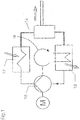
- Fig.1 schematically the steam cycle 10 of an expansion machine 10 is shown.
- the steam cycle process comprises an expansion machine 14 and a continuous steam generator 12.
- the continuous steam generator 12 is charged with the hot flue gas of a burner.
- the cycle further comprises a variable speed feedwater pump 16 and a condenser 18.
- the continuous steam generator 12 is traversed by working fluid with some additives.
- the working fluid is under an increased pressure, which is generated by a pump 16.
- the working medium or working medium vapor is a quantity of heat ⁇ H supplied from the flue gas.
- the working medium steam is overheated, ie brought to a high temperature.
- the inner energy increases.
- the working medium vapor is released.
- the pressure drops back to a lower pressure level. With this relaxation, work becomes free.
- the relaxed working medium vapor is then fed to a condenser 18, in which it is condensed, so that the working medium for the cycle continues to be available. In this case, the amount of heat ⁇ c is released, which can be used for example for heat purposes.
- the condensed working medium is supplied to the pump 16 again.
- the working medium is pure acetone with a boiling point at 56 ° C with 15 mass% lubricant.
- the working medium is a mixture of 65% by mass of pentane, 18% by mass of acetone, 5% by mass of water and 12% by mass of polyalphaolefin PAO. This mixture boils from a temperature of 32 ° C.
- the working medium is a mixture of 50% by mass of acetone, 35% by mass of hexane and 15% lubricant. This mixture boils at 50 ° C. It is thermally stable up to a temperature of 400 ° C. It can therefore be worked at a large temperature difference between steam and condensate, whereby a high efficiency is achieved.
Landscapes
- Engineering & Computer Science (AREA)
- Chemical & Material Sciences (AREA)
- Combustion & Propulsion (AREA)
- Mechanical Engineering (AREA)
- General Engineering & Computer Science (AREA)
- Lubricants (AREA)
Description
- Die Erfindung betrifft die Verwendung eines Arbeitsmittels in Dampfkraftanlagen mit einem Dampferzeuger zur Erzeugung von Arbeitsmitteldampf, einer Pumpe zur Erzeugung eines erhöhten Drucks in dem Arbeitsmitteldampf, einer Expansionsmaschine zur Erzeugung mechanischer und/oder elektrischer Arbeit durch Expansion des Arbeitsmittels von einem erhöhten Druck auf ein niedrigeres Druckniveau unter Arbeitsleistung und einem Kondensator zur Kondensation des Arbeitsmittels, wobei das Arbeitsmittel ein Schmiermittel enthält.
- Bei einem Dampfkreisprozess mit einem Dampferzeuger ist thermische Energie auf ein Arbeitsmedium übertragbar. In einer Kraftmaschinewird die in dem Arbeitsmedium enthaltene thermische Energie in mechanische Arbeit umgewandelt. Die Kraftmaschine kann eine Expansionsmaschine sein, in welcher das Arbeitsmedium unter Leistung von Arbeit entspannt wird.
- Üblicherweise wird der Dampferzeuger von einem Wärmeübertrager gebildet, durch welchen ein Arbeitsmedium zur Aufnahme von Wärme leitbar ist. Das Arbeitsmedium liegt in Form eines Fluids vor. Das Fluid, beispielsweise Wasser oder Wasserdampf, wird durch einen oder mehrere Kanäle geleitet, der von einem Heißgasstrom umströmt ist. Der Heißgasstrom kann das heiße Rauchgas eines Brenners sein, bei dem Brennstoff exotherm verbrannt wird, oder die Abwärme eines Verbrennungsmotors. Beim Umströmen der fluiddurchstömten Kanäle wird Wärme auf das Fluid übertragen, wobei dieses verdampft und überhitzt wird. Es hat bei Verlassen des Dampferzeugers ein hohes Druck- und Temperaturniveau in der Größenordnung von einigen hundert °C.
- In der Expansionsmaschine, zum Beispiel einer Hub- oder Rotationskolbenmaschine, wird das Arbeitsmedium von dem hohen ersten Druckniveau auf ein niedrigeres zweites Druckniveau unter Arbeitsleistung expandiert. Dabei treibt der Kolben eine Welle an, welche beispielsweise einen Stromgenerator antreibt oder zum Bewegen eines Fahrzeugs dient. Das expandierte Fluid wird in einem Kondensator gekühlt und verflüssigt und dem Fluidkreislauf über eine Pumpe erneut zugeführt. Je höher die Druck- und Temperaturdifferenz, um so höher ist der Wirkungsgrad der Anlage.
- Unter einer Expansionsmaschine soll hier jede Kraftmaschine verstanden werden, die mit einem gas- oder dampfförmigen Arbeitsmedium in Phasenwechsel arbeitet. Zu unterscheiden sind davon Kraftmaschinen mit innerer Verbrennung, wie z.B. ein Zweitaktmotor, bei denen ein Brennstoff innerhalb der Kraftmaschine verbrannt wird. Als Arbeitsmedium wird gewöhnlich Wasserdampf verwendet, der unter Abgabe von Arbeit entspannt wird. Eine Verbrennung findet außerhalb der Kraftmaschine statt, um das Wasser zu verdampfen. Eine nachgeschaltete Kondensatoranordnung dient zur Verflüssigung des expandierten Arbeitsmediums. Typische Temperaturen des Arbeitsmediums liegen bei 550°C für den energiereichen Dampfzustand und 100°C als Kondenstationstemperatur.
- Ein solcher Dampfkreisprozess ist zum Beispiel aus der
DE 10226445 C1 oderWO 2005/001248 A1 bekannt. Dort wird ein Kreislauf der eingangs genannten Art beschrieben. Als Arbeitsmedium wird Speisewasser verwendet. Wasser ist problemlos handhabbar, kostengünstig und verfügt über gute thermodynamische Eigenschaften. Das Wasser wird in einem Verdampfer verdampft. Der Dampf wird in einer Expansionsmaschine unter Arbeitsleistung expandiert. Nach der Expansion wird der Dampf in einem Kondensator kondensiert und mittels einer Pumpe einem Reservoir zugeführt, aus welchem es für den Kreislauf erneut zur Verfügung steht. Die beschriebene Arbeitsmaschine wird zum Beispiel als Hilfsaggregat in Kraftfahrzeugen eingesetzt. -
DE 10 2007 043373 A1 offenbart die Verwendung von Aceton und Wasser in einem Dampfkreisprozess. - Es ist Aufgabe der Erfindung, Arbeitsmittel der eingangs genannten Art zu schaffen, mit dem der Wirkungsgrad einer Dampfkraftanlage verbessert wird.
- Erfindungsgemäß wird die Aufgabe dadurch gelöst, dass das Arbeitsmittel Aceton und Schmiermittele enthält. Aceton wird auch als Propanon, 2-Propanon, Dimethylketon oder Propan- 2 - on bezeichnet. Es ist als Entfettungsmittel, bei Zahnärzten zur Zahnreinigung als Nagelreiniger und Verdünner bekannt. Die Erfindung basiert auf der überraschenden Erkenntnis, dass der Wirkungsgrad einer Dampfkraftanlage durch die Zugabe von Aceton verbessert wird. Die Polaritätseigenschaften von Aceton verbessern die Stabilität der Lösung mit den einzelnen Komponenten und dem Schmiermittel. Das Schmiermittel ist besser löslich. Die Expansionsmaschine ist dann besser geschmiert und hat weniger Reibungsverluste. Dadurch kann der Wirkungsgrad verbessert werden. Zudem kann auf eine aufwendige, nachgeschaltete Trennvorrichtung zur Separation von Arbeitsmedium und Schmiermittel verzichtet werden
- Vorzugsweise enthält das Arbeitsmittel Pentan oder ein anderes das Siedeverhalten beeinflussendes Mittel. Als Schmiermittel sind Polyalphaolefine PAO, Polyalkylenglykole PAG, Silikonöle, Esther oder Polyethylenglykole PEG und/oder deren Mischungen besonders gut geeignet. Dabei werden besonders gute Wirkungsgrade erreicht, wenn das Schmiermittel in einer Menge zwischen 2 und 20 Massen-% vorliegt.
- Das vorstehend beschriebene Arbeitsmittelgemisch in Form einer stabilen Emulsion oder einer Lösung ist auch für den Hochdruck- und Hochtemperaturbereich gut geeignet, wie er bei typischen Dampfkreisprozessen auftritt.
- Ausgestaltungen der Erfindung sind Gegenstand der Unteransprüche. Ein Ausführungsbeispiel ist nachstehend unter Bezugnahme auf die beigefügten Zeichnungen näher erläutert.
-
- Fig.1
- zeigt schematisch einen Dampfkreisprozess
- In
Fig.1 ist schematisch der Dampfkreisprozess 10 einer Expansionsmaschine 10 dargestellt. Der Dampfkreisprozess umfasst eine Expansionsmaschine 14 und einen Durchlaufdampferzeuger 12. Der Durchlaufdampferzeuger 12 ist mit dem heißen Rauchgas eines Brenners beaufschlagt. Der Kreisprozess umfasst weiterhin eine drehzahlregelbare Speisewasserpumpe 16 und einen Kondensator 18. Der Durchlaufdampferzeuger 12 ist von Arbeitsmedium mit einigen Zusätzen durchflossen. Das Arbeitsmedium steht dabei unter einem erhöhten Druck, welcher von einer Pumpe 16 erzeugt wird. Dem Arbeitsmedium oder Arbeitsmediendampf wird eine Wärmemenge ΦH aus dem Rauchgas zugeführt. Dadurch wird der Arbeitsmediendampf überhitzt, d.h. auf eine hohe Temperatur gebracht. Die innere Energie steigt. In einer Expansionsmaschine 14 wird der Arbeitsmediendampf entspannt. Dabei sinkt der Druck wieder auf ein niedrigeres Druckniveau. Bei dieser Entspannung wird Arbeit frei. Der entspannte Arbeitsmediendampf wird dann einem Kondensator 18 zugeführt, in welchem er kondensiert wird, damit das Arbeitsmedium für den Kreisprozess weiter zur Verfügung steht. Dabei wird die Wärmemenge Φc frei, die zum Beispiel für Wärmezwecke genutzt werden kann. Das kondensierte Arbeitsmedium wird erneut der Pumpe 16 zugeführt. - In einem ersten Ausführungsbeispiel ist das Arbeitsmedium reines Aceton mit einem Siedepunkt bei 56 °C mit 15 Massen-% Schmiermittel. In einem alternativen Ausführungsbeispiel ist das Arbeitsmedium ein Gemisch aus 65 Massen-% Pentan, 18 Massen-% Aceton, 5 Massen-% Wasser und 12 Massen-% Polyalphaolefin PAO. Diese Mischung siedet ab einer Temperatur von 32°C.
- In einem weiteren, alternativen Ausführungsbeispiel ist das Arbeitsmedium ein Gemisch aus 50 Massen-% Aceton, 35 Massen-% Hexan und 15% Schmiermittel. Diese Mischung siedet bei 50°C. Sie ist bis zu einer Temperatur von 400°C thermisch stabil. Es kann also bei einer großen Temperaturdifferenz zwischen Dampf und Kondensat gearbeitet werden, wodurch ein hoher Wirkungsgrad erreicht wird.
Claims (2)
- Verwendung eines Arbeitsmittels in Dampfkraftanlagen mit einem Dampferzeuger zur Erzeugung von Arbeitsmitteldampf, einer Pumpe zur Erzeugung eines erhöhten Drucks in dem Arbeitsmitteldampf, einer Expansionsmaschine zur Erzeugung mechanischer und/oder elektrischer Arbeit durch Expansion des Arbeitsmittels von einem erhöhten Druck auf ein niedrigeres Druckniveau unter Arbeitsleistung und einem Kondensator zur Kondensation des Arbeitsmittels, wobei das Arbeitsmittel ein Schmiermittel enthält, dadurch gekennzeichnet, dass das Arbeitsmittel Aceton und Schmiermittel ausgewählt aus der Gruppe Polyalphaolefine, Polyalkylenglykole, Silikonöle, Esther oder Polyethylenglykole und/oder deren Mischungen in einer Menge zwischen 2 Massen-% und 20 Massen-%, vorzugsweise zwischen 10 Massen-% und 20 Massen-% und höchst vorzugsweise zwischen 15 Massen-% und 20 Massen-% enthält.
- Verwendung nach Anspruch 1, dadurch gekennzeichnet, dass das Arbeitsmittel Pentan, Hexan, Alkohol, Wasser oder ein anderes das Siedeverhalten beeinflussendes Mittel enthält.
Applications Claiming Priority (2)
| Application Number | Priority Date | Filing Date | Title |
|---|---|---|---|
| DE102012108468.8A DE102012108468A1 (de) | 2012-09-11 | 2012-09-11 | Arbeitsmittelgemisch für Dampfkraftanlagen |
| PCT/EP2013/068085 WO2014040875A2 (de) | 2012-09-11 | 2013-09-02 | Arbeitsmittelgemisch für dampfkraftanlagen |
Publications (2)
| Publication Number | Publication Date |
|---|---|
| EP2895707A2 EP2895707A2 (de) | 2015-07-22 |
| EP2895707B1 true EP2895707B1 (de) | 2017-05-31 |
Family
ID=49083689
Family Applications (1)
| Application Number | Title | Priority Date | Filing Date |
|---|---|---|---|
| EP13753881.5A Not-in-force EP2895707B1 (de) | 2012-09-11 | 2013-09-02 | Arbeitsmittelgemisch für dampfkraftanlagen |
Country Status (4)
| Country | Link |
|---|---|
| US (1) | US9856756B2 (de) |
| EP (1) | EP2895707B1 (de) |
| DE (1) | DE102012108468A1 (de) |
| WO (1) | WO2014040875A2 (de) |
Families Citing this family (2)
| Publication number | Priority date | Publication date | Assignee | Title |
|---|---|---|---|---|
| DE102013110256A1 (de) * | 2013-09-17 | 2015-03-19 | Fuchs Petrolub Se | Betriebsmittel für einen Dampfkreisprozess |
| WO2017083145A1 (en) * | 2015-11-13 | 2017-05-18 | Dow Global Technologies Llc | Thermodynamic cycle system |
Family Cites Families (11)
| Publication number | Priority date | Publication date | Assignee | Title |
|---|---|---|---|---|
| GB519171A (en) * | 1938-09-13 | 1940-03-19 | Rudolf Doczekal | Improvements in or relating to vapour-pressure power plant |
| FR2483009A1 (fr) * | 1980-05-23 | 1981-11-27 | Inst Francais Du Petrole | Procede de production d'energie mecanique a partir de chaleur utilisant un melange de fluides comme agent de travail |
| DE10226445C1 (de) | 2002-06-13 | 2003-06-12 | Enginion Ag | Vorrichtung zur Umsetzung thermischer Energie in mechanische Arbeit |
| DE10328289B3 (de) | 2003-06-23 | 2005-01-05 | Enginion Ag | Arbeitsmedium für Dampfkreisprozesse |
| DE102004006837A1 (de) * | 2004-02-12 | 2005-08-25 | Erwin Dr. Oser | Stromgewinnung aus Luft |
| US7428816B2 (en) * | 2004-07-16 | 2008-09-30 | Honeywell International Inc. | Working fluids for thermal energy conversion of waste heat from fuel cells using Rankine cycle systems |
| US20070101989A1 (en) * | 2005-11-08 | 2007-05-10 | Mev Technology, Inc. | Apparatus and method for the conversion of thermal energy sources including solar energy |
| JP2010513827A (ja) * | 2006-09-01 | 2010-04-30 | イー・アイ・デュポン・ドウ・ヌムール・アンド・カンパニー | 閉ループ・サイクル中の選択された伝熱流体の循環方法 |
| DE102007043373A1 (de) * | 2007-09-12 | 2009-03-19 | Voith Patent Gmbh | Verdampfer für eine Dampfkreisprozessvorrichtung |
| US20090071155A1 (en) * | 2007-09-14 | 2009-03-19 | General Electric Company | Method and system for thermochemical heat energy storage and recovery |
| JP5535908B2 (ja) * | 2008-03-07 | 2014-07-02 | アーケマ・インコーポレイテッド | 油リターンが改善されたハロゲン化アルケン冷媒組成物及びこれらを用いた方法 |
-
2012
- 2012-09-11 DE DE102012108468.8A patent/DE102012108468A1/de not_active Withdrawn
-
2013
- 2013-09-02 US US14/427,131 patent/US9856756B2/en not_active Expired - Fee Related
- 2013-09-02 WO PCT/EP2013/068085 patent/WO2014040875A2/de not_active Ceased
- 2013-09-02 EP EP13753881.5A patent/EP2895707B1/de not_active Not-in-force
Non-Patent Citations (1)
| Title |
|---|
| None * |
Also Published As
| Publication number | Publication date |
|---|---|
| WO2014040875A3 (de) | 2014-08-07 |
| EP2895707A2 (de) | 2015-07-22 |
| US20150240668A1 (en) | 2015-08-27 |
| DE102012108468A1 (de) | 2014-03-13 |
| US9856756B2 (en) | 2018-01-02 |
| WO2014040875A2 (de) | 2014-03-20 |
Similar Documents
| Publication | Publication Date | Title |
|---|---|---|
| DE102007009503B4 (de) | Mehrstufiger ORC-Kreislauf mit Zwischenenthitzung | |
| DE102006043139B4 (de) | Vorrichtung zur Gewinnung von mechanischer oder elektrischer Energie aus der Abwärme eines Verbrennungsmotors eines Kraftfahrzeugs | |
| EP2476869B1 (de) | Schmierung volumetrisch arbeitender Expansionsmaschinen | |
| EP1706600A1 (de) | Arbeitsmedium für dampfkreisprozesse | |
| DE102010019718A1 (de) | Regelung eines thermischen Kreisprozesses | |
| DE1551274A1 (de) | Leistungserzeugungssystem mit Thiophen als Arbeitsmittel | |
| WO2009036857A2 (de) | Verdampfer für eine dampfkreisprozessvorrichtung | |
| WO2014040875A2 (de) | Arbeitsmittelgemisch für dampfkraftanlagen | |
| EP3320189B1 (de) | Überkritischer kreisprozess mit isothermer expansion und freikolben-wärmekraftmaschine mit hydraulischer energieauskopplung für diesen kreisprozess | |
| WO2008055720A2 (de) | Arbeitsmedium für dampfkreisprozesse | |
| DE102009043720A1 (de) | Carnotisierter Rankineprozess für Solarthermische Kraftwerke | |
| DE102008013545A1 (de) | Vorrichtung und Verfahren zur Abwärmenutzung mittels eines ORC-Prozesses | |
| DE102012024031B4 (de) | Vorrichtung und Verfahren zum Umwandeln von thermischer Energie mit einer Expansionseinrichtung | |
| DE102016205267B4 (de) | Vorrichtung zur Energierückgewinnung an einem Verbrennungsmotor mit Abgasturbolader als Wärmequelle für einen Dampfkraftmaschinenkreislauf und Verfahren zum Betrieb der Vorrichtung | |
| DE102010024186A1 (de) | Regelungsverfahren für eine Abwärmenutzungsvorrichtung | |
| EP3366894B1 (de) | Vorrichtung zum umwandeln von thermischer energie | |
| DE10035289A1 (de) | Vorrichtung zur Erzeugung von mechanischer Energie mit einer mit äußerer Verbrennung arbeitenden Wärmekraftmaschine | |
| DE102010027347A1 (de) | Vorrichtung zur Durchführung eines thermodynamischen Kreisprozesses | |
| WO2006128423A2 (de) | Verfahren und vorrichtung zur erzeugung mechanischer energie | |
| DE102012024023B4 (de) | Verfahren und Vorrichtung zum Umwandeln thermischer Energie aus einer Niedertemperatur-Wärmequelle | |
| DE102014011763A1 (de) | Anordnung zur Gewinnung mechanischer Energie aus Verlustwärme einer Verbrennungskraftmaschine eines Kraftfahrzeuges | |
| DE102013017566A1 (de) | Verwendung eines gewickelten Wärmeübertragers zur Erzeugung überhitzten Dampfs aus Verbrennungs- oder Abgasen bei Heizanlagen oder Verbrennungsmaschinen | |
| DE102005054487A1 (de) | Verfahren zur Erwärmung dampfförmiger Arbeitsmittel | |
| DE102014004523A1 (de) | Wärmekraftmaschine mit geschlossenem Kreislauf | |
| DE202015101744U1 (de) | Vorrichtung zur Energierückgewinnung an einem Verbrennungsmotor mit Abgasturbolader als Wärmequelle für einen Dampfkraftmaschinenkreislauf |
Legal Events
| Date | Code | Title | Description |
|---|---|---|---|
| PUAI | Public reference made under article 153(3) epc to a published international application that has entered the european phase |
Free format text: ORIGINAL CODE: 0009012 |
|
| 17P | Request for examination filed |
Effective date: 20150316 |
|
| AK | Designated contracting states |
Kind code of ref document: A2 Designated state(s): AL AT BE BG CH CY CZ DE DK EE ES FI FR GB GR HR HU IE IS IT LI LT LU LV MC MK MT NL NO PL PT RO RS SE SI SK SM TR |
|
| AX | Request for extension of the european patent |
Extension state: BA ME |
|
| DAX | Request for extension of the european patent (deleted) | ||
| RAP1 | Party data changed (applicant data changed or rights of an application transferred) |
Owner name: MAHLE INTERNATIONAL GMBH |
|
| GRAP | Despatch of communication of intention to grant a patent |
Free format text: ORIGINAL CODE: EPIDOSNIGR1 |
|
| STAA | Information on the status of an ep patent application or granted ep patent |
Free format text: STATUS: GRANT OF PATENT IS INTENDED |
|
| INTG | Intention to grant announced |
Effective date: 20170308 |
|
| GRAS | Grant fee paid |
Free format text: ORIGINAL CODE: EPIDOSNIGR3 |
|
| GRAA | (expected) grant |
Free format text: ORIGINAL CODE: 0009210 |
|
| STAA | Information on the status of an ep patent application or granted ep patent |
Free format text: STATUS: THE PATENT HAS BEEN GRANTED |
|
| AK | Designated contracting states |
Kind code of ref document: B1 Designated state(s): AL AT BE BG CH CY CZ DE DK EE ES FI FR GB GR HR HU IE IS IT LI LT LU LV MC MK MT NL NO PL PT RO RS SE SI SK SM TR |
|
| REG | Reference to a national code |
Ref country code: CH Ref legal event code: EP Ref country code: GB Ref legal event code: FG4D Free format text: NOT ENGLISH |
|
| REG | Reference to a national code |
Ref country code: AT Ref legal event code: REF Ref document number: 897681 Country of ref document: AT Kind code of ref document: T Effective date: 20170615 |
|
| REG | Reference to a national code |
Ref country code: IE Ref legal event code: FG4D Free format text: LANGUAGE OF EP DOCUMENT: GERMAN |
|
| REG | Reference to a national code |
Ref country code: DE Ref legal event code: R096 Ref document number: 502013007390 Country of ref document: DE |
|
| REG | Reference to a national code |
Ref country code: FR Ref legal event code: PLFP Year of fee payment: 5 |
|
| REG | Reference to a national code |
Ref country code: NL Ref legal event code: MP Effective date: 20170531 |
|
| REG | Reference to a national code |
Ref country code: LT Ref legal event code: MG4D |
|
| PG25 | Lapsed in a contracting state [announced via postgrant information from national office to epo] |
Ref country code: GR Free format text: LAPSE BECAUSE OF FAILURE TO SUBMIT A TRANSLATION OF THE DESCRIPTION OR TO PAY THE FEE WITHIN THE PRESCRIBED TIME-LIMIT Effective date: 20170901 Ref country code: ES Free format text: LAPSE BECAUSE OF FAILURE TO SUBMIT A TRANSLATION OF THE DESCRIPTION OR TO PAY THE FEE WITHIN THE PRESCRIBED TIME-LIMIT Effective date: 20170531 Ref country code: LT Free format text: LAPSE BECAUSE OF FAILURE TO SUBMIT A TRANSLATION OF THE DESCRIPTION OR TO PAY THE FEE WITHIN THE PRESCRIBED TIME-LIMIT Effective date: 20170531 Ref country code: FI Free format text: LAPSE BECAUSE OF FAILURE TO SUBMIT A TRANSLATION OF THE DESCRIPTION OR TO PAY THE FEE WITHIN THE PRESCRIBED TIME-LIMIT Effective date: 20170531 Ref country code: NO Free format text: LAPSE BECAUSE OF FAILURE TO SUBMIT A TRANSLATION OF THE DESCRIPTION OR TO PAY THE FEE WITHIN THE PRESCRIBED TIME-LIMIT Effective date: 20170831 Ref country code: HR Free format text: LAPSE BECAUSE OF FAILURE TO SUBMIT A TRANSLATION OF THE DESCRIPTION OR TO PAY THE FEE WITHIN THE PRESCRIBED TIME-LIMIT Effective date: 20170531 |
|
| PG25 | Lapsed in a contracting state [announced via postgrant information from national office to epo] |
Ref country code: LV Free format text: LAPSE BECAUSE OF FAILURE TO SUBMIT A TRANSLATION OF THE DESCRIPTION OR TO PAY THE FEE WITHIN THE PRESCRIBED TIME-LIMIT Effective date: 20170531 Ref country code: IS Free format text: LAPSE BECAUSE OF FAILURE TO SUBMIT A TRANSLATION OF THE DESCRIPTION OR TO PAY THE FEE WITHIN THE PRESCRIBED TIME-LIMIT Effective date: 20170930 Ref country code: NL Free format text: LAPSE BECAUSE OF FAILURE TO SUBMIT A TRANSLATION OF THE DESCRIPTION OR TO PAY THE FEE WITHIN THE PRESCRIBED TIME-LIMIT Effective date: 20170531 Ref country code: BG Free format text: LAPSE BECAUSE OF FAILURE TO SUBMIT A TRANSLATION OF THE DESCRIPTION OR TO PAY THE FEE WITHIN THE PRESCRIBED TIME-LIMIT Effective date: 20170831 Ref country code: RS Free format text: LAPSE BECAUSE OF FAILURE TO SUBMIT A TRANSLATION OF THE DESCRIPTION OR TO PAY THE FEE WITHIN THE PRESCRIBED TIME-LIMIT Effective date: 20170531 Ref country code: SE Free format text: LAPSE BECAUSE OF FAILURE TO SUBMIT A TRANSLATION OF THE DESCRIPTION OR TO PAY THE FEE WITHIN THE PRESCRIBED TIME-LIMIT Effective date: 20170531 |
|
| PG25 | Lapsed in a contracting state [announced via postgrant information from national office to epo] |
Ref country code: CZ Free format text: LAPSE BECAUSE OF FAILURE TO SUBMIT A TRANSLATION OF THE DESCRIPTION OR TO PAY THE FEE WITHIN THE PRESCRIBED TIME-LIMIT Effective date: 20170531 Ref country code: RO Free format text: LAPSE BECAUSE OF FAILURE TO SUBMIT A TRANSLATION OF THE DESCRIPTION OR TO PAY THE FEE WITHIN THE PRESCRIBED TIME-LIMIT Effective date: 20170531 Ref country code: EE Free format text: LAPSE BECAUSE OF FAILURE TO SUBMIT A TRANSLATION OF THE DESCRIPTION OR TO PAY THE FEE WITHIN THE PRESCRIBED TIME-LIMIT Effective date: 20170531 Ref country code: SK Free format text: LAPSE BECAUSE OF FAILURE TO SUBMIT A TRANSLATION OF THE DESCRIPTION OR TO PAY THE FEE WITHIN THE PRESCRIBED TIME-LIMIT Effective date: 20170531 Ref country code: DK Free format text: LAPSE BECAUSE OF FAILURE TO SUBMIT A TRANSLATION OF THE DESCRIPTION OR TO PAY THE FEE WITHIN THE PRESCRIBED TIME-LIMIT Effective date: 20170531 |
|
| PG25 | Lapsed in a contracting state [announced via postgrant information from national office to epo] |
Ref country code: PL Free format text: LAPSE BECAUSE OF FAILURE TO SUBMIT A TRANSLATION OF THE DESCRIPTION OR TO PAY THE FEE WITHIN THE PRESCRIBED TIME-LIMIT Effective date: 20170531 Ref country code: SM Free format text: LAPSE BECAUSE OF FAILURE TO SUBMIT A TRANSLATION OF THE DESCRIPTION OR TO PAY THE FEE WITHIN THE PRESCRIBED TIME-LIMIT Effective date: 20170531 Ref country code: IT Free format text: LAPSE BECAUSE OF FAILURE TO SUBMIT A TRANSLATION OF THE DESCRIPTION OR TO PAY THE FEE WITHIN THE PRESCRIBED TIME-LIMIT Effective date: 20170531 |
|
| REG | Reference to a national code |
Ref country code: DE Ref legal event code: R097 Ref document number: 502013007390 Country of ref document: DE |
|
| PLBE | No opposition filed within time limit |
Free format text: ORIGINAL CODE: 0009261 |
|
| STAA | Information on the status of an ep patent application or granted ep patent |
Free format text: STATUS: NO OPPOSITION FILED WITHIN TIME LIMIT |
|
| REG | Reference to a national code |
Ref country code: CH Ref legal event code: PL |
|
| 26N | No opposition filed |
Effective date: 20180301 |
|
| GBPC | Gb: european patent ceased through non-payment of renewal fee |
Effective date: 20170902 |
|
| PG25 | Lapsed in a contracting state [announced via postgrant information from national office to epo] |
Ref country code: SI Free format text: LAPSE BECAUSE OF FAILURE TO SUBMIT A TRANSLATION OF THE DESCRIPTION OR TO PAY THE FEE WITHIN THE PRESCRIBED TIME-LIMIT Effective date: 20170531 Ref country code: MC Free format text: LAPSE BECAUSE OF FAILURE TO SUBMIT A TRANSLATION OF THE DESCRIPTION OR TO PAY THE FEE WITHIN THE PRESCRIBED TIME-LIMIT Effective date: 20170531 |
|
| REG | Reference to a national code |
Ref country code: IE Ref legal event code: MM4A |
|
| REG | Reference to a national code |
Ref country code: BE Ref legal event code: MM Effective date: 20170930 |
|
| PG25 | Lapsed in a contracting state [announced via postgrant information from national office to epo] |
Ref country code: LU Free format text: LAPSE BECAUSE OF NON-PAYMENT OF DUE FEES Effective date: 20170902 |
|
| PG25 | Lapsed in a contracting state [announced via postgrant information from national office to epo] |
Ref country code: IE Free format text: LAPSE BECAUSE OF NON-PAYMENT OF DUE FEES Effective date: 20170902 Ref country code: LI Free format text: LAPSE BECAUSE OF NON-PAYMENT OF DUE FEES Effective date: 20170930 Ref country code: CH Free format text: LAPSE BECAUSE OF NON-PAYMENT OF DUE FEES Effective date: 20170930 Ref country code: GB Free format text: LAPSE BECAUSE OF NON-PAYMENT OF DUE FEES Effective date: 20170902 |
|
| PG25 | Lapsed in a contracting state [announced via postgrant information from national office to epo] |
Ref country code: BE Free format text: LAPSE BECAUSE OF NON-PAYMENT OF DUE FEES Effective date: 20170930 |
|
| PG25 | Lapsed in a contracting state [announced via postgrant information from national office to epo] |
Ref country code: MT Free format text: LAPSE BECAUSE OF FAILURE TO SUBMIT A TRANSLATION OF THE DESCRIPTION OR TO PAY THE FEE WITHIN THE PRESCRIBED TIME-LIMIT Effective date: 20170531 |
|
| REG | Reference to a national code |
Ref country code: FR Ref legal event code: PLFP Year of fee payment: 6 |
|
| PGFP | Annual fee paid to national office [announced via postgrant information from national office to epo] |
Ref country code: FR Payment date: 20180928 Year of fee payment: 6 |
|
| PGFP | Annual fee paid to national office [announced via postgrant information from national office to epo] |
Ref country code: DE Payment date: 20181130 Year of fee payment: 6 |
|
| PG25 | Lapsed in a contracting state [announced via postgrant information from national office to epo] |
Ref country code: HU Free format text: LAPSE BECAUSE OF FAILURE TO SUBMIT A TRANSLATION OF THE DESCRIPTION OR TO PAY THE FEE WITHIN THE PRESCRIBED TIME-LIMIT; INVALID AB INITIO Effective date: 20130902 |
|
| PG25 | Lapsed in a contracting state [announced via postgrant information from national office to epo] |
Ref country code: CY Free format text: LAPSE BECAUSE OF FAILURE TO SUBMIT A TRANSLATION OF THE DESCRIPTION OR TO PAY THE FEE WITHIN THE PRESCRIBED TIME-LIMIT Effective date: 20170531 |
|
| REG | Reference to a national code |
Ref country code: AT Ref legal event code: MM01 Ref document number: 897681 Country of ref document: AT Kind code of ref document: T Effective date: 20180902 |
|
| PG25 | Lapsed in a contracting state [announced via postgrant information from national office to epo] |
Ref country code: MK Free format text: LAPSE BECAUSE OF FAILURE TO SUBMIT A TRANSLATION OF THE DESCRIPTION OR TO PAY THE FEE WITHIN THE PRESCRIBED TIME-LIMIT Effective date: 20170531 |
|
| PG25 | Lapsed in a contracting state [announced via postgrant information from national office to epo] |
Ref country code: AT Free format text: LAPSE BECAUSE OF NON-PAYMENT OF DUE FEES Effective date: 20180902 |
|
| PG25 | Lapsed in a contracting state [announced via postgrant information from national office to epo] |
Ref country code: TR Free format text: LAPSE BECAUSE OF FAILURE TO SUBMIT A TRANSLATION OF THE DESCRIPTION OR TO PAY THE FEE WITHIN THE PRESCRIBED TIME-LIMIT Effective date: 20170531 |
|
| REG | Reference to a national code |
Ref country code: DE Ref legal event code: R119 Ref document number: 502013007390 Country of ref document: DE |
|
| PG25 | Lapsed in a contracting state [announced via postgrant information from national office to epo] |
Ref country code: PT Free format text: LAPSE BECAUSE OF FAILURE TO SUBMIT A TRANSLATION OF THE DESCRIPTION OR TO PAY THE FEE WITHIN THE PRESCRIBED TIME-LIMIT Effective date: 20170531 |
|
| PG25 | Lapsed in a contracting state [announced via postgrant information from national office to epo] |
Ref country code: AL Free format text: LAPSE BECAUSE OF FAILURE TO SUBMIT A TRANSLATION OF THE DESCRIPTION OR TO PAY THE FEE WITHIN THE PRESCRIBED TIME-LIMIT Effective date: 20170531 Ref country code: DE Free format text: LAPSE BECAUSE OF NON-PAYMENT OF DUE FEES Effective date: 20200401 |
|
| PG25 | Lapsed in a contracting state [announced via postgrant information from national office to epo] |
Ref country code: FR Free format text: LAPSE BECAUSE OF NON-PAYMENT OF DUE FEES Effective date: 20190930 |