EP2883988B1 - Artificial turf for landscape and sports - Google Patents
Artificial turf for landscape and sports Download PDFInfo
- Publication number
- EP2883988B1 EP2883988B1 EP13197271.3A EP13197271A EP2883988B1 EP 2883988 B1 EP2883988 B1 EP 2883988B1 EP 13197271 A EP13197271 A EP 13197271A EP 2883988 B1 EP2883988 B1 EP 2883988B1
- Authority
- EP
- European Patent Office
- Prior art keywords
- fibers
- layer
- artificial turf
- mechanically bounded
- mechanically
- Prior art date
- Legal status (The legal status is an assumption and is not a legal conclusion. Google has not performed a legal analysis and makes no representation as to the accuracy of the status listed.)
- Active
Links
Images

Classifications
-
- D—TEXTILES; PAPER
- D04—BRAIDING; LACE-MAKING; KNITTING; TRIMMINGS; NON-WOVEN FABRICS
- D04H—MAKING TEXTILE FABRICS, e.g. FROM FIBRES OR FILAMENTARY MATERIAL; FABRICS MADE BY SUCH PROCESSES OR APPARATUS, e.g. FELTS, NON-WOVEN FABRICS; COTTON-WOOL; WADDING ; NON-WOVEN FABRICS FROM STAPLE FIBRES, FILAMENTS OR YARNS, BONDED WITH AT LEAST ONE WEB-LIKE MATERIAL DURING THEIR CONSOLIDATION
- D04H11/00—Non-woven pile fabrics
- D04H11/08—Non-woven pile fabrics formed by creation of a pile on at least one surface of a non-woven fabric without addition of pile-forming material, e.g. by needling, by differential shrinking
-
- D—TEXTILES; PAPER
- D05—SEWING; EMBROIDERING; TUFTING
- D05C—EMBROIDERING; TUFTING
- D05C17/00—Embroidered or tufted products; Base fabrics specially adapted for embroidered work; Inserts for producing surface irregularities in embroidered products
- D05C17/02—Tufted products
-
- D—TEXTILES; PAPER
- D06—TREATMENT OF TEXTILES OR THE LIKE; LAUNDERING; FLEXIBLE MATERIALS NOT OTHERWISE PROVIDED FOR
- D06N—WALL, FLOOR, OR LIKE COVERING MATERIALS, e.g. LINOLEUM, OILCLOTH, ARTIFICIAL LEATHER, ROOFING FELT, CONSISTING OF A FIBROUS WEB COATED WITH A LAYER OF MACROMOLECULAR MATERIAL; FLEXIBLE SHEET MATERIAL NOT OTHERWISE PROVIDED FOR
- D06N7/00—Flexible sheet materials not otherwise provided for, e.g. textile threads, filaments, yarns or tow, glued on macromolecular material
- D06N7/0063—Floor covering on textile basis comprising a fibrous top layer being coated at the back with at least one polymer layer, e.g. carpets, rugs, synthetic turf
- D06N7/0065—Floor covering on textile basis comprising a fibrous top layer being coated at the back with at least one polymer layer, e.g. carpets, rugs, synthetic turf characterised by the pile
-
- D—TEXTILES; PAPER
- D06—TREATMENT OF TEXTILES OR THE LIKE; LAUNDERING; FLEXIBLE MATERIALS NOT OTHERWISE PROVIDED FOR
- D06N—WALL, FLOOR, OR LIKE COVERING MATERIALS, e.g. LINOLEUM, OILCLOTH, ARTIFICIAL LEATHER, ROOFING FELT, CONSISTING OF A FIBROUS WEB COATED WITH A LAYER OF MACROMOLECULAR MATERIAL; FLEXIBLE SHEET MATERIAL NOT OTHERWISE PROVIDED FOR
- D06N7/00—Flexible sheet materials not otherwise provided for, e.g. textile threads, filaments, yarns or tow, glued on macromolecular material
- D06N7/0063—Floor covering on textile basis comprising a fibrous top layer being coated at the back with at least one polymer layer, e.g. carpets, rugs, synthetic turf
- D06N7/0068—Floor covering on textile basis comprising a fibrous top layer being coated at the back with at least one polymer layer, e.g. carpets, rugs, synthetic turf characterised by the primary backing or the fibrous top layer
-
- E—FIXED CONSTRUCTIONS
- E01—CONSTRUCTION OF ROADS, RAILWAYS, OR BRIDGES
- E01C—CONSTRUCTION OF, OR SURFACES FOR, ROADS, SPORTS GROUNDS, OR THE LIKE; MACHINES OR AUXILIARY TOOLS FOR CONSTRUCTION OR REPAIR
- E01C13/00—Pavings or foundations specially adapted for playgrounds or sports grounds; Drainage, irrigation or heating of sports grounds
- E01C13/08—Surfaces simulating grass ; Grass-grown sports grounds
Definitions
- the present invention relates to surfaces simulating natural grass and, more specifically, to artificial turf imitating the volume effect and density of natural grass and manufacturing such turf.
- Artificial turf also often referred to as synthetic grass, is a surface of synthetic fibers made to look like natural grass. It is most often used in sports applications. However, it is now being used on residential lawns and landscaping as well. Artificial turf stands up to heavy use and requires no irrigation or trimming. Domed, covered, and partially covered stadiums may require artificial turf because of the difficulty of getting grass enough sunlight to stay healthy. But, artificial turfs currently available still fail to provide the excellent shock absorbing properties of natural grass surfaces and also fall short in mimicking the volume effect of natural grass.
- Today's generation artificial turfs are typically made from UV-enhanced polypropylene fiber or polyethylene fiber that is tufted into a woven synthetic primary backing that receives a secondary backing in form of a coating or laminate on the opposite side of the face fibers to give the turf dimensional stability and to aid fiber binding.
- the turf's face i.e., the grass "blades"
- the turf's face is generally given a layer of sand to augment water drainage and/or a layer of cryogenic rubber granules to help keeping the tufts more vertically oriented and to provide shock-absorbency.
- the infill typically provides ballast and structure for the artificial turf, helping the fibers to stand and to provide a "cushion” effect when stepping over the turf. This protects the roots of the tuft fibers.
- non-infill artificial turf refers to those artificial turf models with short pile height, narrow gauge (distance between rows), and high stitch rate.
- Artificial turfs that are used without such infill are typically made from shorter, denser polyethylene fibers that include even shorter crimped fibers to keep the tufts resembling grass blades upright.
- Some non-infill systems provide an underlay under the turf to provide cushioning.
- GB 1,154,842 discloses raised tufted, bonded fibrous structures.
- a fibrous web of desired weight and structure was placed on top of another such web and the assembled fibrous structure then needle punched in a conventional single bed needle loom.
- the needle loom On passage through the needle loom, fibres from one fibrous web are carried by the needles through the other fibrous web as the foundation layer and the needle penetration is controlled so as to ensure that the aligned fibres pass through the foundation layer and project beyond its surface as fibre tufts.
- WO 2001/37657 A1 discloses a vertically draining, rubber filled synthetic turf.
- the vertically draining synthetic turf comprises a porous geotextile membrane positioned between an open graded aggregate layer and a sand layer.
- the synthetic turf also includes a pile fabric comprising a plurality of pile elements tufted to a woven or non-woven backing above the open graded aggregate layer.
- An infill layer consisting of resilient particles, preferably a mixture of high and low density rubber, is interspersed among the pile elements of the pile fabric.
- the backing layer may be solely a non-woven, in a single layer or in multiple layers.
- a suitable non-woven, dimensionally stable material is a polyester/nylon blend, spunbound, non-woven material.
- WO 2012/125513 A1 discloses a synthetic ground cover system for erosion control to be placed atop the ground, which includes a synthetic grass comprising a composite of one or more geo- textiles tufted with synthetic yarns.
- the synthetic ground cover also includes a sand/soil infill ballast applied to the synthetic grass and a binding agent applied to the sand/soil infill to stabilize the sand/soil infill against high velocity water shear forces.
- the system includes a synthetic turf which includes a backing and synthetic turf blades secured to the backing.
- the synthetic grass blades are tufted into the substrate or backing comprising a synthetic woven or non-woven fabric.
- the backing can be a single ply backing or can be a multi-ply backing, as desired.
- a filter can be secured to the substrate to reinforce the substrate and better secure the synthetic grass blades.
- the at least one filter fabric may also comprise non-woven synthetic fabric.
- the present invention seeks to provide artificial turf for landscape and sports applications that imitates more closely the root zone, the volume effect, and density of natural grass and that has an improved wear and drainage property.
- the mechanically bounded layer of fibers allows moving of the fiber so that compaction of the surface, thus hardening of the surface will be extensively be reduced.
- the artificial turf can be made from materials that are entirely recyclable thereby reducing the amount of waste that presently has to be disposed of in landfills.
- an artificial turf adapted for use in landscape and sports applications comprises a mechanically bounded layer of fibers made of one or more natural and/or synthetic fibers.
- Pile yarn is inserted through the mechanically bounded layer of fibers, the pile yarn being anchored to the mechanically bounded layer of fibers.
- the mechanically bounded layer of fibers has a density that decreases from the bottom to the top of the mechanically bounded layer of fibers.
- the artificial turf in accordance with advantageous embodiments of the present invention dries quickly provided drainage of the subsoil.
- the water holding capacity of the artificial turf can be improved compared to known prior art products.
- decrease in density occurs at a constant rate.
- the layer provides structural support for the tufts and shock-absorbance to contribute to a more natural feeling of the artificial turf.
- the mechanically bounded layer of fibers includes a lower layer and a upper layer, the lower layer being positioned at the bottom of the mechanically bounded layer of fibers and the upper layer being positioned on top of the lower layer, and the upper layer having a higher fiber coarseness than the lower layer.
- upper and “top”, on the one hand, and “lower” and “bottom”, on the other hand, are used herein to designate sides or portions of the artificial turf with reference to their relative positioning when the turf is deployed for normal use on a ground surface.
- upper and “top” refer to portions at or near the side from which free ends of the tufts stick out; and “lower” and “bottom” refer to portions at or near the opposite side.
- This embodiment also provides structural support for the tufts and shock-absorbance to contribute to a natural feeling of the artificial turf, while allowing an efficient manufacturing process starting from two homogeneous non-woven mats having different fiber coarseness.
- the lower layer provides structural support for the pile yarn.
- the upper layer acts as a shock-absorbing layer and contributes to a natural feeling of the artificial turf.
- the lower layer is formed by fibers that are more flexible and form a denser structure than fibers forming the upper layer, the fibers of the lower layer having a smaller linear mass density than fibers forming the upper layer.
- the fibers of the lower layer have a linear mass density in the range of about 3,3 dtex to about 110 dtex.
- the fibers of the upper layer have a linear mass density in the range of about 11 dtex to about 600 dtex.
- the upper layer is thicker and has a higher fiber coarseness than the lower layer.
- fill yarn is created on the upper surface of the upper layer through velour needle-punching, the fill yarn giving the upper surface of the upper layer a velour-like appearance, thereby imitating the root zone of natural grass, providing cushioning, and assisting the pile yarn of the tufts to stand.
- velour-needle punching the upper surface of the upper layer the surface is given a fluffy structure that provides cushioning. Since the fill yarn assists the pile yarn to stand, no infill, as often used in the known prior art is needed with the artificial turf in accordance with advantageous embodiments of the present invention.
- the mechanically bounded layer of fibers is manufactured as a single fabric or as two separate fabrics that are joined together.
- the mechanically bounded layer of fibers is formed by needle-punching.
- the mechanically bounded layer of fibers consists of up to eight different types of fibers.
- the mechanically bounded layer of fibers, the pile yarn, and a backing anchoring the pile yarn to the mechanically bounded layer of fibers are made of eco-friendly materials that are 100% recyclable by being mechanically deconstructable. It is furthermore advantageous to choose a homogenous polymer composition for all elements of the inventive artificial turf to support the recyclability.
- a method for manufacturing artificial turf for use in landscape and sports applications comprises the steps of:
- a method for manufacturing artificial turf for use in landscape and sports applications comprises the steps of: forming by needle-punching a lower layer from a plurality of natural and/or synthetic fibers; forming by needle-punching an upper layer from a plurality of natural and/or synthetic fibers that have a higher linear mass density than the fibers of the lower layer, the upper layer having a less dense structure than the lower layer; placing the upper layer on top of the lower layer to form a mechanically bounded layer of fibers; creating fill yarn on the upper surface of the upper layer through velour needle-punching thereby giving the upper surface of the upper layer a velour-like appearance; inserting pile yarn through the mechanically bounded layer of fibers; and anchoring the pile yarn at the backside of the mechanically bounded layer of fibers.
- backside is used herein to denote the side of the mechanically bounded layer of fibers which faces away from the side from which free edges of the tufts stick out.
- fiber coarseness is defined as weight per fiber length and is normally expressed in units of mg/m or g/m.
- the fiber coarseness depends on fiber diameter, cell wall thickness, cell wall density, and fiber cross section. A high coarseness value indicates a thick fiber wall, giving stiff fibers unable to collapse. Thin walled fibers with low coarseness value give flexible fibers and a denser structure. The coarser the fibers, the stronger they will be.
- tex refers to a unit of measure for the linear mass density of fibers and is defined as the mass in grams per 1000 meters. The most commonly used unit is the decitex, abbreviated dtex, which is the mass in grams per 10,000 meters. When measuring objects that consist of multiple fibers the term “filament tex” is sometimes used, referring to the mass in grams per 1000 meters of a single filament.
- tufting refers to a type of textile process in which a thread is inserted on a carrier base. Tufted carpets are manufactured by insertion of tufts (a short cluster of elongates strands of yarn attached at the base) through a backing fabric, creating a pile surface of cut and/or loop ends.
- filament refers to a single continuous strand of natural or synthetic fiber.
- the term “yarn” refers to a continuous strand of twisted or untwisted threads of natural or synthetic material.
- the term "pile” refers to the visible surface (wearing surface) of carpet consisting of upright ends of yarn or yarn tufts in loop and/or cut configuration. Sometimes it is called “face” or "nap”.
- backing refers to a substrate applied to the back of the carpet to increase dimensional stability and enhances the anchoring of the pile yarn.
- non-woven refers to engineered fabric (sheet or web structure) bonded together by entangling fibers mechanically, thermally, or chemically.
- needle-punch refers to a mechanical process involving thousands of needles that orient and interlock fibers to create nonwoven fabric.
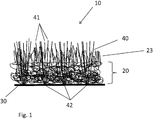
- the artificial turf 10 includes a mechanically bounded layer of fibers 20, a backing 30, and a plurality of tufts 40.
- the mechanically bounded layer of fibers 20 is formed as a non-woven matting made of one or more natural and/or synthetic fibers or yarns.
- the mechanically bounded layer of fibers 20 serves as a carrier for the tufts 40.
- the mechanically bounded layer of fibers 20 can be a single layer containing a mixture of fibers.
- the coarseness of the fibers forming the mechanically bounded layer of fibers 20 may increase from the bottom to the top of the layer 20.
- the coarseness may gradually increase at a constant rate.
- the mechanically bounded layer of fibers 20 can include visually two or more layers, such as, a structural layer 21 and a volume simulating layer 22.
- the structural layer 21 is positioned at the bottom of the mechanically bounded layer of fibers 20 facing away from the pile yarn 41.
- the volume simulating layer 22 is positioned on top of the structural layer 21 facing the pile yarn 41.
- the mechanically bounded layer of fibers is divided into multiple functionalities, such as, for example, structural enhancements (layer 21) and volume simulating (layer 22).
- the mechanically bounded layer of fibers 20 can be manufactured as a single fabric or as two separate fabrics that are joined together.
- the mechanically bounded layer of fibers 20 is formed by needle-punching. During this mechanical bonding method, fibers are transported with felting needles and interlocked in the non-woven structure. This procedure increases the friction between the fibers, which reinforces the non-woven fabric.
- the web can be further structured using special machines equipped with structuring fork or crown needles.
- the surface can be structured as a velour or rib, or with geometrical or linear patterns.
- Needle-punching is an ecologically friendly technology, as it permits the use of recycled material including that from polyethylene terephthalate bottles and regenerated fibers from apparel, as well as natural fibers. It may be possible to use other technologies to form non-woven fabrics to obtain the mechanically bounded layer of fibers 20.
- the mechanically bounded layer of fibers 20 may consist of up to eight different types of fibers. Each of the fibers can have a different color, if desired.
- the types of fibers can include moisture absorbent fibers, such as coco, cotton, jute, wool, rayon or other natural or synthetic fibers.
- the types of fibers can further include synthetic fibers, such as polypropylene (PP), polyethylene (PE), polyamides (PA), and polyester (PES) or a combination thereof.
- the fibers can be treated, for example, with anti-algae, with herbicide, UV-stabilizer, or to be anti-static.
- the fibers can be melt fibers.
- the fibers can among others further include mineral based fibers, animal based fibers, or plant based fibers.
- the mechanically bounded layer of fibers 20 is formed as a single layer, as shown in Fig. 1 , a mixture of relatively thin walled fibers that are flexible and form a relatively dense structure and, thus, having a relatively low coarseness value and relatively thick walled fibers that are stiff and form a relatively sparse structure and, thus, having a relatively low coarseness value is used in combination.
- the density of the mechanically bounded layer of fibers 20 can gradually decrease from the bottom to the top of the layer 20. Accordingly, the coarseness of the fibers will gradually increase from the bottom to the top of the layer 20.
- the mechanically bounded layer of fibers 20 is formed as a single layer, as shown in Fig. 2 , the structural layer 21 is formed by relatively thin walled fibers that are flexible and form a relatively dense structure. Accordingly, fibers with the relatively low linear mass density (dtex value) are selected for the structural layer 21.
- the structural layer 21 is utilized for anchoring the tufts 40.
- the structural layer 21 provides dimensional stability for the artificial turf 10 and protection for the bending points 42 of the tufts 40.
- the fibers of the structural layer 21 have preferably a linear mass density in the range of about 3,3 dtex to about 110 dtex, and more preferably of about 11 dtex.
- the volume simulating layer 22 is formed by fibers having a larger linear mass density than the fibers of the structural layer 21.
- the fibers of the volume simulating layer 22 have preferably a linear mass density in the range of about 11 dtex to about 600 dtex, and more preferably of about 110 dtex. Consequently, the volume simulating layer 22 has also a higher fiber coarseness (weight per fiber length) than the structural layer 21. A high coarseness value indicates a thick fiber wall, giving stiff fibers unable to collapse. Therefore, the volume simulating layer 22 of the mechanically bounded layer of fibers 20 is thicker and coarser than the structural layer 21. Fibers with a higher dtex value are selected for the volume simulating layer 22 so that the mechanically bounded layer of fibers 20 can act as a shock-absorbing layer and contribute to a natural feeling of the artificial turf 10.
- the fibers of the mechanically bounded layer of fibers 20 can be given a velour effect by needling to mimic the root zone volume effect of natural grass. Due to a mechanical needling process, fiber is pushed out of the upper surface of the layer 20.
- Velour needle-punched non-woven material can be produced by placing an non-woven material on a brush-like stitch base and needling of the non-woven material on this stitch base. Since with this method the fibers seized by the needles are needled into the bristles or lamellas of the needle stitch base, the non-woven material needled in this way is given a velour-like appearance where the fiber stands out above the surface.
- fill yarn 23 is created.
- the fill yarn 23 is punched out of the non-woven fibrous matting of the mechanically bounded layer of fibers 20 creating a natural grass like root zone .
- the fill yarn 23 gives the upper surface of the mechanically bounded layer of fibers 20 (facing the pile yarn 41) a fluffy appearance and provide cushioning.
- the fill yarn 23 also assists the pile yarn 41 of the tufts 40 to stand.
- a tuft 40 is a short cluster of elongates strands of pile yarn 41 attached at the base, the bending point 42.
- the tufts 40 are inserted through the mechanically bounded layer of fibers 20. Tufting usually is accomplished by inserting reciprocating needles threaded with pile yarn 41 into the mechanically bounded layer of fibers 20 to form tufts 40 of yarn.
- Loopers or hooks typically working in timed relationship with the needles, are located such that the loopers are positioned just above the needle eye when the needles are at an extreme point in their stroke through the mechanically bounded layer of fibers 20. When the needles reach that point, pile yarn 41 is picked up from the needles by the loopers and held briefly.
- Loops or tufts 40 of yarn result from passage of the needles back through the mechanically bounded layer of fibers 20. This process typically is repeated as the loops move away from the loopers due to advancement of the backing through the needling apparatus. Subsequent, the loops can be cut to form a cut pile, for example, by using a looper and knife combination in the tufting process to cut the loops.
- the pile yarn 41 can consist of up to four different types of yarns. Each yarn can have a different color, if desired.
- the pile yarn 41 can be monofilament, tape or a combination thereof.
- the pile yarn 41 has preferably a linear mass density of about 400 dtex to about 3000 dtex and, more preferably of about 1600 dtex.
- the number of strands of pile yarn 41 in a tuft 40 is between 2 and 10, and preferably 6.
- the tuft gauge (distance between rows) is between 1/2" and 1/16" and typical 3/8" or 3/16" or 1/8".
- the stitch rate of the tufting is between 8/10 cm and 30/10 cm and preferably 12/10 cm.
- the mechanically bounded layer of fibers 20 may have a height H3 of about 3 mm to about 15 mm, and more preferably about 8 mm.
- the fill yarn 23 may extend from the upper surface of the mechanically bounded layer of fibers 20 for a height H2 of about 1 mm to about 20 mm, and more preferably of about 10 mm.
- the pile yarns 41 may extend from the fill yarn 23 for about 1 mm to about 20 mm, and more preferably 10 mm (height H1).
- the total height H4 of the artificial turf 10 may be about 10 mm to about 60 mm, and more preferably about 28 mm.
- the backing 30 is applied to the mechanically bounded layer of fibers 20 as a last finishing step to enhance the anchoring of the tufts to the mechanically bounded layer of fibers 20.
- the backing 30 can be a coated backing such as, for example, a polyethylene (PE) backing that is applied by means of powder or hot melt coating.
- the backing 30 can further be a calander backing or latex backing.
- the backside or stitched surface of the mechanically bounded layer of fibers 20 is coated with an adhesive, such as a natural or synthetic rubber or resin latex or emulsion or a powder or hot melt adhesive, to enhance locking or anchoring of tufts 40 to the mechanically bounded layer of fibers 20.
- an adhesive such as a natural or synthetic rubber or resin latex or emulsion or a powder or hot melt adhesive
- Use of such further improves dimensional stability of the tufted turf 10, resulting in more durable turf.
- Further stabilization can be provided in the finishing operation by laminating, for example, a thermoplastic film or a woven or nonwoven fabric made from polypropylene, polyethylene, or ethylene-propylene copolymers or natural fibers such as jute, to the tufted mechanically bounded layer of fibers 20.
- the mechanically bounded layer of fibers 20, the tufts 40, and the backing 30 may all be made of materials that are recyclable, such as, for example, 100% polyolefin.
Landscapes
- Engineering & Computer Science (AREA)
- Textile Engineering (AREA)
- Architecture (AREA)
- Civil Engineering (AREA)
- Structural Engineering (AREA)
- Road Paving Structures (AREA)
Priority Applications (9)
| Application Number | Priority Date | Filing Date | Title |
|---|---|---|---|
| PL13197271.3T PL2883988T3 (pl) | 2013-12-13 | 2013-12-13 | Sztuczna murawa przeznaczona do zastosowań krajobrazowych i sportowych |
| ES13197271.3T ES2581769T3 (es) | 2013-12-13 | 2013-12-13 | Césped artificial para paisaje y deportes |
| EP13197271.3A EP2883988B1 (en) | 2013-12-13 | 2013-12-13 | Artificial turf for landscape and sports |
| CN201480067685.XA CN106414828B (zh) | 2013-12-13 | 2014-12-09 | 用于景观和体育的簇状结构 |
| PCT/EP2014/077092 WO2015086626A1 (en) | 2013-12-13 | 2014-12-09 | Tufted structure for landscape and sports |
| ES14824790T ES2743454T3 (es) | 2013-12-13 | 2014-12-09 | Estructura de mechones insertados para paisaje y deportes |
| EP14824790.1A EP3080346B1 (en) | 2013-12-13 | 2014-12-09 | Tufted structure for landscape and sports |
| PL14824790T PL3080346T3 (pl) | 2013-12-13 | 2014-12-09 | Struktura tuftowana do zastosowań krajobrazowych i sportowych |
| US15/103,469 US10370799B2 (en) | 2013-12-13 | 2014-12-09 | Tufted structure for landscape and sports |
Applications Claiming Priority (1)
| Application Number | Priority Date | Filing Date | Title |
|---|---|---|---|
| EP13197271.3A EP2883988B1 (en) | 2013-12-13 | 2013-12-13 | Artificial turf for landscape and sports |
Publications (2)
| Publication Number | Publication Date |
|---|---|
| EP2883988A1 EP2883988A1 (en) | 2015-06-17 |
| EP2883988B1 true EP2883988B1 (en) | 2016-04-13 |
Family
ID=49841506
Family Applications (1)
| Application Number | Title | Priority Date | Filing Date |
|---|---|---|---|
| EP13197271.3A Active EP2883988B1 (en) | 2013-12-13 | 2013-12-13 | Artificial turf for landscape and sports |
Country Status (3)
| Country | Link |
|---|---|
| EP (1) | EP2883988B1 (pl) |
| ES (1) | ES2581769T3 (pl) |
| PL (1) | PL2883988T3 (pl) |
Cited By (1)
| Publication number | Priority date | Publication date | Assignee | Title |
|---|---|---|---|---|
| US12392094B2 (en) | 2018-08-28 | 2025-08-19 | Columbia Insurance Company | Artificial turf and methods of making same |
Families Citing this family (3)
| Publication number | Priority date | Publication date | Assignee | Title |
|---|---|---|---|---|
| WO2017084914A1 (en) * | 2015-11-17 | 2017-05-26 | Beaulieu International Group Nv | Artificial turf |
| BE1024290B1 (nl) * | 2016-11-09 | 2018-01-16 | Sports And Leisure Group Nv | Kunstgrasveld met waterhoudende basislaag |
| EP4461525A1 (en) * | 2023-03-23 | 2024-11-13 | Johns Manville | Carpet with layered nonwoven primary backing |
Family Cites Families (10)
| Publication number | Priority date | Publication date | Assignee | Title |
|---|---|---|---|---|
| GB1154842A (en) | 1965-07-21 | 1969-06-11 | Ici Ltd | Raised Tufted, Bonded Fibrous Structures |
| DE2452136A1 (de) * | 1974-11-02 | 1976-05-06 | Pegulan Werke Ag | Mehrschichtiges textiles flaechengebilde und verfahren zu seiner herstellung |
| US4140071A (en) * | 1977-08-09 | 1979-02-20 | E. I. Du Pont De Nemours And Company | Process for preparing tufted carpet |
| CH637516B (de) * | 1980-12-23 | Breveteam Sa | Verfahren zur herstellung eines mehrschichtigen, nichtgewebten, textilen flaechengebildes, sowie mehrschichtiges, nichtgewebtes, textiles flaechengebilde. | |
| DE3616297A1 (de) * | 1986-05-14 | 1987-11-19 | Lentia Gmbh | Badematte |
| GB2311247B (en) * | 1996-03-23 | 1999-05-12 | Nordon Enterprises Ltd | Artificial turf carpet |
| IL131902A0 (en) * | 1997-03-10 | 2001-03-19 | Fieldturf Holdings Inc | Synthetic turf |
| AU4688200A (en) | 1999-11-24 | 2001-06-04 | Daniel A. Daluise | Vertically draining, rubber-filled synthetic turf and method of manufacture |
| DE202005013023U1 (de) * | 2005-08-16 | 2006-12-28 | Carcoustics Tech Center Gmbh | Textile Verkleidung, insbesondere für einen Fahrgastraum eines Kraftfahrzeuges |
| WO2012125513A1 (en) | 2011-03-11 | 2012-09-20 | Closureturf, Llc | Synthetic ground cover system with binding infill for erosion control |
-
2013
- 2013-12-13 PL PL13197271.3T patent/PL2883988T3/pl unknown
- 2013-12-13 ES ES13197271.3T patent/ES2581769T3/es active Active
- 2013-12-13 EP EP13197271.3A patent/EP2883988B1/en active Active
Cited By (1)
| Publication number | Priority date | Publication date | Assignee | Title |
|---|---|---|---|---|
| US12392094B2 (en) | 2018-08-28 | 2025-08-19 | Columbia Insurance Company | Artificial turf and methods of making same |
Also Published As
| Publication number | Publication date |
|---|---|
| EP2883988A1 (en) | 2015-06-17 |
| PL2883988T3 (pl) | 2016-10-31 |
| ES2581769T3 (es) | 2016-09-07 |
Similar Documents
| Publication | Publication Date | Title |
|---|---|---|
| US10190267B2 (en) | Artificial turf for landscape and sports | |
| US10370799B2 (en) | Tufted structure for landscape and sports | |
| CA2400009C (en) | Artificial turf system | |
| US4181450A (en) | Erosion control matting | |
| CN102057093B (zh) | 具有簇绒状表面的丝绒毛毯 | |
| CN101135133A (zh) | 人工草皮及其制备方法 | |
| AU2024202368B2 (en) | Method for manufacturing a carpet or a rug and a carpet or rug obtained thereby | |
| EP2883988B1 (en) | Artificial turf for landscape and sports | |
| US20250154733A1 (en) | Novel Artificial Turf and Methods of Making Same | |
| US20040077242A1 (en) | Composite backing for stabilized carpet | |
| EP3080346B1 (en) | Tufted structure for landscape and sports | |
| JP2017221136A (ja) | 緑化用マットの製造方法 | |
| US20060107880A1 (en) | Synthetic sports surfaces | |
| US20250354329A1 (en) | Permeable backing and tufted articles comprising said backing | |
| CN220927170U (zh) | 簇绒制品 | |
| KR102634824B1 (ko) | 에어 탄성층이 포함된 인조잔디 구조체의 제조방법 및 에어 탄성층이 포함된 인조잔디 구조체 | |
| JPH0226965Y2 (pl) | ||
| JP3081584B2 (ja) | タフテッドカーペット | |
| WO2022186788A1 (en) | Synthetic turf and weaving method | |
| KR20260045880A (ko) | 모세관 지오텍스타일로서의 텍스타일 직물의 용도 | |
| TR2023017114A1 (tr) | Senteti̇k çi̇m ve dokuma yöntemi̇ | |
| JP2008125857A (ja) | タフテッドカーペット用基布 | |
| CS245923B1 (cs) | Geotextilie pro dočasné komunikace |
Legal Events
| Date | Code | Title | Description |
|---|---|---|---|
| PUAI | Public reference made under article 153(3) epc to a published international application that has entered the european phase |
Free format text: ORIGINAL CODE: 0009012 |
|
| 17P | Request for examination filed |
Effective date: 20141231 |
|
| AK | Designated contracting states |
Kind code of ref document: A1 Designated state(s): AL AT BE BG CH CY CZ DE DK EE ES FI FR GB GR HR HU IE IS IT LI LT LU LV MC MK MT NL NO PL PT RO RS SE SI SK SM TR |
|
| AX | Request for extension of the european patent |
Extension state: BA ME |
|
| GRAP | Despatch of communication of intention to grant a patent |
Free format text: ORIGINAL CODE: EPIDOSNIGR1 |
|
| INTG | Intention to grant announced |
Effective date: 20150806 |
|
| GRAS | Grant fee paid |
Free format text: ORIGINAL CODE: EPIDOSNIGR3 |
|
| INTG | Intention to grant announced |
Effective date: 20160121 |
|
| RAP1 | Party data changed (applicant data changed or rights of an application transferred) |
Owner name: BFS EUROPE NV |
|
| GRAA | (expected) grant |
Free format text: ORIGINAL CODE: 0009210 |
|
| AK | Designated contracting states |
Kind code of ref document: B1 Designated state(s): AL AT BE BG CH CY CZ DE DK EE ES FI FR GB GR HR HU IE IS IT LI LT LU LV MC MK MT NL NO PL PT RO RS SE SI SK SM TR |
|
| REG | Reference to a national code |
Ref country code: GB Ref legal event code: FG4D |
|
| REG | Reference to a national code |
Ref country code: AT Ref legal event code: REF Ref document number: 790282 Country of ref document: AT Kind code of ref document: T Effective date: 20160415 Ref country code: CH Ref legal event code: EP |
|
| REG | Reference to a national code |
Ref country code: IE Ref legal event code: FG4D |
|
| REG | Reference to a national code |
Ref country code: DE Ref legal event code: R096 Ref document number: 602013006454 Country of ref document: DE |
|
| REG | Reference to a national code |
Ref country code: LT Ref legal event code: MG4D Ref country code: NL Ref legal event code: FP |
|
| REG | Reference to a national code |
Ref country code: ES Ref legal event code: FG2A Ref document number: 2581769 Country of ref document: ES Kind code of ref document: T3 Effective date: 20160907 |
|
| PG25 | Lapsed in a contracting state [announced via postgrant information from national office to epo] |
Ref country code: NO Free format text: LAPSE BECAUSE OF FAILURE TO SUBMIT A TRANSLATION OF THE DESCRIPTION OR TO PAY THE FEE WITHIN THE PRESCRIBED TIME-LIMIT Effective date: 20160713 Ref country code: LT Free format text: LAPSE BECAUSE OF FAILURE TO SUBMIT A TRANSLATION OF THE DESCRIPTION OR TO PAY THE FEE WITHIN THE PRESCRIBED TIME-LIMIT Effective date: 20160413 Ref country code: FI Free format text: LAPSE BECAUSE OF FAILURE TO SUBMIT A TRANSLATION OF THE DESCRIPTION OR TO PAY THE FEE WITHIN THE PRESCRIBED TIME-LIMIT Effective date: 20160413 |
|
| PG25 | Lapsed in a contracting state [announced via postgrant information from national office to epo] |
Ref country code: GR Free format text: LAPSE BECAUSE OF FAILURE TO SUBMIT A TRANSLATION OF THE DESCRIPTION OR TO PAY THE FEE WITHIN THE PRESCRIBED TIME-LIMIT Effective date: 20160714 Ref country code: PT Free format text: LAPSE BECAUSE OF FAILURE TO SUBMIT A TRANSLATION OF THE DESCRIPTION OR TO PAY THE FEE WITHIN THE PRESCRIBED TIME-LIMIT Effective date: 20160816 Ref country code: LV Free format text: LAPSE BECAUSE OF FAILURE TO SUBMIT A TRANSLATION OF THE DESCRIPTION OR TO PAY THE FEE WITHIN THE PRESCRIBED TIME-LIMIT Effective date: 20160413 Ref country code: SE Free format text: LAPSE BECAUSE OF FAILURE TO SUBMIT A TRANSLATION OF THE DESCRIPTION OR TO PAY THE FEE WITHIN THE PRESCRIBED TIME-LIMIT Effective date: 20160413 Ref country code: RS Free format text: LAPSE BECAUSE OF FAILURE TO SUBMIT A TRANSLATION OF THE DESCRIPTION OR TO PAY THE FEE WITHIN THE PRESCRIBED TIME-LIMIT Effective date: 20160413 Ref country code: HR Free format text: LAPSE BECAUSE OF FAILURE TO SUBMIT A TRANSLATION OF THE DESCRIPTION OR TO PAY THE FEE WITHIN THE PRESCRIBED TIME-LIMIT Effective date: 20160413 |
|
| REG | Reference to a national code |
Ref country code: FR Ref legal event code: PLFP Year of fee payment: 4 |
|
| REG | Reference to a national code |
Ref country code: DE Ref legal event code: R097 Ref document number: 602013006454 Country of ref document: DE |
|
| PG25 | Lapsed in a contracting state [announced via postgrant information from national office to epo] |
Ref country code: SK Free format text: LAPSE BECAUSE OF FAILURE TO SUBMIT A TRANSLATION OF THE DESCRIPTION OR TO PAY THE FEE WITHIN THE PRESCRIBED TIME-LIMIT Effective date: 20160413 Ref country code: EE Free format text: LAPSE BECAUSE OF FAILURE TO SUBMIT A TRANSLATION OF THE DESCRIPTION OR TO PAY THE FEE WITHIN THE PRESCRIBED TIME-LIMIT Effective date: 20160413 Ref country code: RO Free format text: LAPSE BECAUSE OF FAILURE TO SUBMIT A TRANSLATION OF THE DESCRIPTION OR TO PAY THE FEE WITHIN THE PRESCRIBED TIME-LIMIT Effective date: 20160413 Ref country code: DK Free format text: LAPSE BECAUSE OF FAILURE TO SUBMIT A TRANSLATION OF THE DESCRIPTION OR TO PAY THE FEE WITHIN THE PRESCRIBED TIME-LIMIT Effective date: 20160413 |
|
| PLBE | No opposition filed within time limit |
Free format text: ORIGINAL CODE: 0009261 |
|
| STAA | Information on the status of an ep patent application or granted ep patent |
Free format text: STATUS: NO OPPOSITION FILED WITHIN TIME LIMIT |
|
| PG25 | Lapsed in a contracting state [announced via postgrant information from national office to epo] |
Ref country code: SM Free format text: LAPSE BECAUSE OF FAILURE TO SUBMIT A TRANSLATION OF THE DESCRIPTION OR TO PAY THE FEE WITHIN THE PRESCRIBED TIME-LIMIT Effective date: 20160413 |
|
| 26N | No opposition filed |
Effective date: 20170116 |
|
| PG25 | Lapsed in a contracting state [announced via postgrant information from national office to epo] |
Ref country code: SI Free format text: LAPSE BECAUSE OF FAILURE TO SUBMIT A TRANSLATION OF THE DESCRIPTION OR TO PAY THE FEE WITHIN THE PRESCRIBED TIME-LIMIT Effective date: 20160413 |
|
| REG | Reference to a national code |
Ref country code: CH Ref legal event code: PL |
|
| PG25 | Lapsed in a contracting state [announced via postgrant information from national office to epo] |
Ref country code: MC Free format text: LAPSE BECAUSE OF FAILURE TO SUBMIT A TRANSLATION OF THE DESCRIPTION OR TO PAY THE FEE WITHIN THE PRESCRIBED TIME-LIMIT Effective date: 20160413 |
|
| PG25 | Lapsed in a contracting state [announced via postgrant information from national office to epo] |
Ref country code: LI Free format text: LAPSE BECAUSE OF NON-PAYMENT OF DUE FEES Effective date: 20161231 Ref country code: CH Free format text: LAPSE BECAUSE OF NON-PAYMENT OF DUE FEES Effective date: 20161231 Ref country code: LU Free format text: LAPSE BECAUSE OF NON-PAYMENT OF DUE FEES Effective date: 20161213 |
|
| REG | Reference to a national code |
Ref country code: FR Ref legal event code: PLFP Year of fee payment: 5 |
|
| PG25 | Lapsed in a contracting state [announced via postgrant information from national office to epo] |
Ref country code: HU Free format text: LAPSE BECAUSE OF FAILURE TO SUBMIT A TRANSLATION OF THE DESCRIPTION OR TO PAY THE FEE WITHIN THE PRESCRIBED TIME-LIMIT; INVALID AB INITIO Effective date: 20131213 |
|
| PG25 | Lapsed in a contracting state [announced via postgrant information from national office to epo] |
Ref country code: MK Free format text: LAPSE BECAUSE OF FAILURE TO SUBMIT A TRANSLATION OF THE DESCRIPTION OR TO PAY THE FEE WITHIN THE PRESCRIBED TIME-LIMIT Effective date: 20160413 Ref country code: CY Free format text: LAPSE BECAUSE OF FAILURE TO SUBMIT A TRANSLATION OF THE DESCRIPTION OR TO PAY THE FEE WITHIN THE PRESCRIBED TIME-LIMIT Effective date: 20160413 Ref country code: IS Free format text: LAPSE BECAUSE OF FAILURE TO SUBMIT A TRANSLATION OF THE DESCRIPTION OR TO PAY THE FEE WITHIN THE PRESCRIBED TIME-LIMIT Effective date: 20160413 |
|
| PG25 | Lapsed in a contracting state [announced via postgrant information from national office to epo] |
Ref country code: BG Free format text: LAPSE BECAUSE OF FAILURE TO SUBMIT A TRANSLATION OF THE DESCRIPTION OR TO PAY THE FEE WITHIN THE PRESCRIBED TIME-LIMIT Effective date: 20160413 |
|
| REG | Reference to a national code |
Ref country code: AT Ref legal event code: UEP Ref document number: 790282 Country of ref document: AT Kind code of ref document: T Effective date: 20160413 |
|
| PG25 | Lapsed in a contracting state [announced via postgrant information from national office to epo] |
Ref country code: MT Free format text: LAPSE BECAUSE OF NON-PAYMENT OF DUE FEES Effective date: 20161213 |
|
| PG25 | Lapsed in a contracting state [announced via postgrant information from national office to epo] |
Ref country code: AL Free format text: LAPSE BECAUSE OF FAILURE TO SUBMIT A TRANSLATION OF THE DESCRIPTION OR TO PAY THE FEE WITHIN THE PRESCRIBED TIME-LIMIT Effective date: 20160413 Ref country code: TR Free format text: LAPSE BECAUSE OF FAILURE TO SUBMIT A TRANSLATION OF THE DESCRIPTION OR TO PAY THE FEE WITHIN THE PRESCRIBED TIME-LIMIT Effective date: 20160413 |
|
| PGFP | Annual fee paid to national office [announced via postgrant information from national office to epo] |
Ref country code: CZ Payment date: 20191127 Year of fee payment: 7 Ref country code: IE Payment date: 20191220 Year of fee payment: 7 |
|
| PGFP | Annual fee paid to national office [announced via postgrant information from national office to epo] |
Ref country code: PL Payment date: 20191209 Year of fee payment: 7 |
|
| PGFP | Annual fee paid to national office [announced via postgrant information from national office to epo] |
Ref country code: AT Payment date: 20191220 Year of fee payment: 7 |
|
| PG25 | Lapsed in a contracting state [announced via postgrant information from national office to epo] |
Ref country code: CZ Free format text: LAPSE BECAUSE OF NON-PAYMENT OF DUE FEES Effective date: 20201213 |
|
| REG | Reference to a national code |
Ref country code: AT Ref legal event code: MM01 Ref document number: 790282 Country of ref document: AT Kind code of ref document: T Effective date: 20201213 |
|
| PG25 | Lapsed in a contracting state [announced via postgrant information from national office to epo] |
Ref country code: AT Free format text: LAPSE BECAUSE OF NON-PAYMENT OF DUE FEES Effective date: 20201213 Ref country code: IE Free format text: LAPSE BECAUSE OF NON-PAYMENT OF DUE FEES Effective date: 20201213 |
|
| PG25 | Lapsed in a contracting state [announced via postgrant information from national office to epo] |
Ref country code: PL Free format text: LAPSE BECAUSE OF NON-PAYMENT OF DUE FEES Effective date: 20201213 |
|
| P01 | Opt-out of the competence of the unified patent court (upc) registered |
Effective date: 20230602 |
|
| PGFP | Annual fee paid to national office [announced via postgrant information from national office to epo] |
Ref country code: DE Payment date: 20241230 Year of fee payment: 12 |
|
| PGFP | Annual fee paid to national office [announced via postgrant information from national office to epo] |
Ref country code: ES Payment date: 20250131 Year of fee payment: 12 |
|
| PGFP | Annual fee paid to national office [announced via postgrant information from national office to epo] |
Ref country code: GB Payment date: 20251219 Year of fee payment: 13 |
|
| PGFP | Annual fee paid to national office [announced via postgrant information from national office to epo] |
Ref country code: IT Payment date: 20251223 Year of fee payment: 13 |
|
| PGFP | Annual fee paid to national office [announced via postgrant information from national office to epo] |
Ref country code: NL Payment date: 20251215 Year of fee payment: 13 Ref country code: FR Payment date: 20251223 Year of fee payment: 13 |
|
| PGFP | Annual fee paid to national office [announced via postgrant information from national office to epo] |
Ref country code: BE Payment date: 20251215 Year of fee payment: 13 |