EP2881968A1 - Keramische metallhalogenlampe - Google Patents
Keramische metallhalogenlampe Download PDFInfo
- Publication number
- EP2881968A1 EP2881968A1 EP13826125.0A EP13826125A EP2881968A1 EP 2881968 A1 EP2881968 A1 EP 2881968A1 EP 13826125 A EP13826125 A EP 13826125A EP 2881968 A1 EP2881968 A1 EP 2881968A1
- Authority
- EP
- European Patent Office
- Prior art keywords
- metal halide
- halide lamp
- ceramic metal
- wavelength region
- wavelength
- Prior art date
- Legal status (The legal status is an assumption and is not a legal conclusion. Google has not performed a legal analysis and makes no representation as to the accuracy of the status listed.)
- Withdrawn
Links
Images

Classifications
-
- H—ELECTRICITY
- H01—ELECTRIC ELEMENTS
- H01J—ELECTRIC DISCHARGE TUBES OR DISCHARGE LAMPS
- H01J61/00—Gas-discharge or vapour-discharge lamps
- H01J61/02—Details
- H01J61/30—Vessels; Containers
- H01J61/34—Double-wall vessels or containers
-
- H—ELECTRICITY
- H01—ELECTRIC ELEMENTS
- H01J—ELECTRIC DISCHARGE TUBES OR DISCHARGE LAMPS
- H01J61/00—Gas-discharge or vapour-discharge lamps
- H01J61/02—Details
- H01J61/12—Selection of substances for gas fillings; Specified operating pressure or temperature
- H01J61/125—Selection of substances for gas fillings; Specified operating pressure or temperature having an halogenide as principal component
-
- H—ELECTRICITY
- H01—ELECTRIC ELEMENTS
- H01J—ELECTRIC DISCHARGE TUBES OR DISCHARGE LAMPS
- H01J61/00—Gas-discharge or vapour-discharge lamps
- H01J61/82—Lamps with high-pressure unconstricted discharge having a cold pressure > 400 Torr
- H01J61/827—Metal halide arc lamps
Definitions
- the present invention relates to a high intensity discharge lamp, in particular, relates to a ceramic metal halide lamp.
- the high intensity discharge lamp (hereinafter, referred to as "HID lamp”) has been widely used because it has high efficiency and is excellent in economy.
- HID lamps can be roughly divided into three type of a mercury lamp, a metal halide lamp, and a high-pressure sodium lamp depending on the type of the additives sealed in the luminous tube.
- a high-pressure sodium lamp has a long lifetime and high luminous efficiency
- a high-chroma and high-color-rendering type of high-pressure sodium lamp is known as a light source configured to show reddish colors vividly although it is inferior to a general high-pressure sodium lamp in lifetime and luminous efficiency.
- a ceramic metal halide lamp using a luminous tube made of ceramic (translucent alumina: PCA) in place of a luminous tube made of quartz glass has been widely used.
- the lamp lifetime and luminous efficiency of a ceramic metal halide lamp are said to be superior to those of a high-chroma and high-color-rendering type of high-pressure sodium lamp.
- the correlated color temperature is about 2500 K in the case of a high-chroma and high-color-rendering type of high-pressure sodium lamp, while the correlated color temperature in the case of a ceramic metal halide lamp is relatively high, and is difficult to reach about 2500 K.
- a ceramic metal halide lamp having the correlated color temperature of 2000 to 4500 K is described in JP 2004-288617 A ( JP 4279122 B1 ), and a ceramic metal halide lamp having the color temperature of 2500 to 4500 K is described in JP 2003-187744 A and JP 2009-520323 A , and a ceramic metal halide lamp having the color temperature of 2800 to 3700 K is described in JP 2007-53004 A and JP 2011-154847 A .
- JP 2004-288617 A JP 4279122 B1
- JP 2003-187744 A and JP 2009-520323 A a ceramic metal halide lamp having the color temperature of 2800 to 3700 K is described in JP 2007-53004 A and JP 2011-154847 A .
- the wavelength spectral distribution is also important.
- JP 2009-87602 A and JP 2012-113883 A it is described that the additives in a luminous tube are set so as to adjust the distribution ratio of energy strength of wavelength regions of three colors to a predetermined value, for performing efficient growth in a plant factory.
- any method for showing the irradiated object of reddish color vividly has not been established in ceramic metal halide lamp like a high-chroma and high-color-rendering type of high-pressure sodium lamp.
- An object of the present invention is to provide a ceramic metal halide lamp that is favorable for illuminating fresh foods required to show reddish colors vividly like a high-chroma and high-color-rendering type of high-pressure sodium lamp.
- a method for producing a ceramic metal halide lamp comprising: a luminous tube in which a starting noble gas, mercury, and an additive are sealed, the luminous tube formed from translucent ceramic; and a translucent outer tube accommodating the luminous tube, the method comprising:
- the method for producing a ceramic metal halide lamp wherein in the additive setting step, a composition and amount of the additive are set so that a distribution ratio of an integrated value of energy strength of light from the luminous tube calculated for each of the four wavelength regions is 6 ⁇ 1 : 18 ⁇ 3 : 6 ⁇ 1 : 70 ⁇ 5 (where the sum is 100).
- a ceramic metal halide lamp comprising: a luminous tube in which a starting noble gas, mercury, and an additive are sealed, the luminous tube formed from translucent ceramic; and a translucent outer tube accommodating the luminous tube, wherein a wavelength region of 380 to 780 nm of visible light is split into a first wavelength region of a violet-bluish colors of wavelengths of 380 to 490 nm, a second wavelength region of greenish colors of wavelengths of 490 to 570 nm, a third wavelength region of yellowish colors of wavelengths of 570 to 590 nm, and a fourth wavelength region of orange-reddish colors of wavelengths of 590 to 780 nm, and a composition and amount of the additive are set so that a distribution ratio of an integrated value of energy strength of light from the luminous tube calculated for each of the four wavelength regions is 6 ⁇ 3 : 18 ⁇ 5 : 6 ⁇ 3 : 70 ⁇ 11 (where the sum is 100).
- the ceramic metal halide lamp wherein a composition and amount of the additive are set so that a distribution ratio of an integrated value of energy strength of light from the luminous tube calculated for each of the four wavelength regions is 6 ⁇ 1 : 18 ⁇ 3 : 6 ⁇ 1 : 71 ⁇ 5 (where the sum is 100).
- a ceramic metal halide lamp that is favorable for illuminating fresh foods required to show reddish colors vividly like a high-chroma and high-color-rendering type of high-pressure sodium lamp.
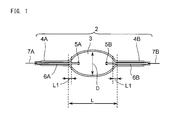
- Luminous tube 2 includes a light-emitting portion 3 and capillaries 4A and 4B extending from both ends thereof.
- Light-emitting portion 3 and capillaries 4A and 4B are formed by integral molding by compressing the powder of translucent ceramic such as alumina.
- Electrode assemblies 6A and 6B are inserted at both ends of capillaries 4A and 4B, respectively. Both ends of capillaries 4A and 4B are sealed airtightly by frit glass having electrical insulating property. Thereby, electrode assemblies 6A and 6B are secured in place in capillaries 4A and 4B.
- Electrodes 5A and 5B disposed at the inner ends of electrode assemblies 6A and 6B are disposed in place in light-emitting portion 3.
- Power supply leads 7A and 7B are protruded from both ends of capillaries 4A and 4B.
- Additives are sealed in the inside of light-emitting portion 3 in addition to argon and mercury.
- the additives include a light-emitting substance such as alkali metal iodide, alkali earth metal iodide, and rare earth metal iodide.
- the additives sealed in light-emitting portion 3 will be described below in detail.
- Effective length L is a distance between both the end faces in the cylindrical luminous tube, and is defined as the distance between the outer ends of transition curved surfaces L1 and L1 between straight tubular capillaries 4A and 4B and light-emitting portion 3 in the luminous tube where the light-emitting portion and the capillaries are continuously molded as shown in Fig. 1 .
- Effective inner diameter D is defined as the maximum inner diameter of the central portion between the electrodes 5A and 5B in a non-cylindrical luminous tube.
- the effective length of luminous tube 2 is denoted by "L”
- the effective inner diameter is denoted by "D”
- the ratio L/D of the two is referred to as "aspect ratio”.
- the temperature of each part of light-emitting portion 3 depends on the wall load of luminous tube, the gas pressure in the translucent outer tube, the material of the luminous tube and the aspect ratio (L/D) of the luminous tube, and is in particular highly dependent on the wall load.
- the wall load is defined as a value obtained by dividing the lamp power by the total internal area of light-emitting portion 3.
- light-emitting portion 3 is designed so that the wall load is 20 to 30 W/cm 2 (rated output 35 to 400 W).
- the chemical reaction rate between a material constituting the inner wall of the light-emitting portion and rare earth metal iodide can be kept low, and the lamp can have a longer lifetime.
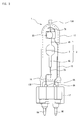
- Ceramic metal halide lamp 1 of the present embodiment includes luminous tube 2, cylindrical translucent sleeve 18 disposed so as to surround light-emitting portion 3, and outer bulb 13 having base 12 disposed at one end of the outer bulb.
- the structure of luminous tube 2 is described with reference to Fig. 1 .
- Two struts 15 and 16 are mounted on stem 14 of base 12. On the struts, two support disks 17A and 17B are mounted at a predetermined interval. In addition, cylindrical translucent sleeve 18 is fixed to disks 17A and 17B. Getter 20 is mounted on disk 17B. Power supply leads 7A and 7B are protruded from both ends of capillaries 4A and 4B. The tips of power supply leads 7A and 7B are welded to struts 15 and 16 directly or through nickel wires 19A and 19B, respectively. Thus, electrodes 5A and 5B of luminous tube 2 are electrically connected to base 12 through power supply leads 7A and 7B and struts 15 and 16.
- Ceramic metal halide lamp 1 of the present embodiment includes luminous tube 2 and outer bulb 13.
- the structure of luminous tube 2 is described with reference to FIG. 1 .
- outer bulb chip-off portion 13A is formed, and at the other end, pinch seal portion 13B is formed.
- Base 12 is mounted to an end portion of pinch seal portion 13B.
- External terminals 9A and 9B are mounted to base 12.
- Two struts 15 and 16 are fixed to pinch seal portion 13B.
- Power supply leads 7A and 7B are protruded from both ends of capillaries 4A and 4B. The tips of power supply leads 7A and 7B are respectively welded to struts 15 and 16.
- Getter 20 is mounted to strut 15. Struts 15 and 16 are electrically connected to external terminals 9A and 9B through metal foil 8A and 8B at pinch seal portion 13B.
- electrodes 5A and 5B of luminous tube 2 are electrically connected to external terminals 9A and 9B through power supply leads 7A and 7B, struts 15 and 16, and metal foil 8A and 8B.
- the ceramic metal halide lamp according to the present embodiment may be a reflective ceramic metal halide lamp with a concave reflector in addition to the examples shown in Figs. 2 and 3 .
- the inventor of the present application has studied the reason why a high-chroma and high-color-rendering type of high-pressure sodium lamp has been used favorably for the lighting for fresh foods. As the reasons for this, a variety of factors such as correlated color temperature CCT, color-rendering index CRI, and wavelength spectral distribution can be considered, but the inventor of the present application has focused on the wavelength spectrum distribution.
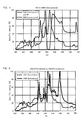
- Fig. 4 illustrates an example of wavelength spectrums of a high-chroma and high-color-rendering type of high-pressure sodium lamp ("NH” in the figure) and a conventional ceramic metal halide lamp ("CMH (conventional)" in the figure).
- the vertical axis represents energy [%]
- the horizontal axis represents wavelength [nm].
- the solid line curve denotes a wavelength spectrum of a high-chroma and high-color-rendering type of high-pressure sodium lamp (NH)
- the broken line curve denotes a wavelength spectrum of a conventional ceramic metal halide lamp (CMH).
- the high-chroma and high-color-rendering type of high-pressure sodium lamp in comparison with the conventional ceramic metal halide lamp, although the energy value of wavelength components of reddish colors of the wavelength of 600 nm or more is larger, there is no energy value of wavelength components in the vicinity of the wavelength of 580 nm. Therefore, the high-chroma and high-color-rendering type of high-pressure sodium lamp seems to be inappropriate for the lighting of fresh foods such as vegetables, bread, and meat which are required to show reddish colors vividly.
- a high-chroma and high-color-rendering type of high-pressure sodium lamp has been used favorably for the lighting for fresh foods. The reason why it has been used favorably cannot be understood by the wavelength spectrum of the high-chroma and high-color-rendering type of high-pressure sodium lamp shown in Fig. 4 .
- the inventor of the present application has succeed in prototyping a ceramic metal halide lamp that can show reddish colors vividly to the same extent as the high-chroma and high-color-rendering type of high-pressure sodium lamp.
- Table 1 shows the measurement results of color rendering indexes of the high-chroma and high-color-rendering type of high-pressure sodium lamp (NH), the conventional ceramic metal halide lamp (CMH), and the prototyped ceramic metal halide lamp (CMH).
- the prototyped ceramic metal halide lamp (CMH) is an example of the present embodiment, and therefore that this lamp is described as "the ceramic metal halide lamp (CMH) of the present embodiment" in Table 1.
- CMH Conventional CMH CMH of the present embodiment
- Ra Average color rendering index ( CRI) 83 93 95 R9 Red color rendering index 45 46 50
- the first column shows symbols of color rendering indexes.
- the second column shows names of color rendering indexes.
- the third column shows measurement results of color rendering indexes of the high-chroma and high-color-rendering type of high-pressure sodium lamp (NH).
- the fourth column shows measurement results of color rendering indexes of the conventional ceramic metal halide lamp (CMH).
- the fifth column shows measurement results of color rendering indexes of the ceramic metal halide lamp (CMH) according to the present embodiment.
- Each color rendering index represents the deviation from the color viewed under the reference light standardized by JIS.
- the color rendering index is 100
- the index indicates a state where there is no deviation from the color viewed under the reference light.
- the color rendering index is closer to 100, the color deviation is indicated to be smaller.
- Table 1 various kinds of color rendering indexes of the conventional ceramic metal halide lamp and the ceramic metal halide lamp according to the present embodiment are sufficiently high as compared with the case of a high-chroma and high-color-rendering type of high-pressure sodium lamp.
- various kinds of color rendering indexes of the ceramic metal halide lamp according to the present embodiment are higher as compared with the conventional ceramic metal halide lamp.
- the present invention has been possible to be completed.
- Fig. 5 illustrates an example of wavelength spectrums of a ceramic metal halide lamp according to the present embodiment and a conventional ceramic metal halide lamp.
- the vertical axis represents energy [%], and the horizontal axis represents wavelength [nm].
- the solid line curve denotes a wavelength spectrum of a ceramic metal halide lamp according to the present embodiment, and the broken line curve denotes a wavelength spectrum of a conventional ceramic metal halide lamp.
- the energy of wavelength components of reddish colors of the wavelength of 630 nm or more is small, but in the case of the ceramic metal halide lamp according to the present embodiment, the energy of wavelength components has a wavelength peak in the vicinity of the wavelength of 680 nm.
- the ceramic metal halide lamp according to the present embodiment there is no lack of energy of wavelength components in the vicinity of the wavelength of 580 nm as in the case of a high-chroma and high-color-rendering type of high-pressure sodium lamp.
- the ceramic metal halide lamp according to the present embodiment has been found to be appropriate for the lighting for fresh foods, the reason why it's appropriate cannot be understood by the wavelength spectrum shown in Fig. 5 .
- the inventor of the present application has split the wavelength region of 380 to 780 nm of visible light into six wavelength regions and obtained an integrated value (relative value) of the energy strength of each wavelength region for the high-chroma and high-color-rendering type of high-pressure sodium lamp (NH), the conventional ceramic metal halide lamp (CMH), and the ceramic metal halide lamp (CMH) according to the present embodiment.
- the result is shown in Table 2. It should be noted that the integrated value of the energy strength corresponds to the area under the waveform.
- the first column shows the six wavelength regions.
- the second column shows the color of each wavelength region.
- the third column shows the upper limit and lower limit of the wavelength of each wavelength region.
- the fourth column shows the integrated value of the energy strength of each wavelength region in the case of the high-chroma and high-color-rendering type of high-pressure sodium lamp (NH).
- the fifth column shows the integrated value of the energy strength of each wavelength region in the case of the conventional ceramic metal halide lamp (CMH).
- the sixth column shows the integrated value of the energy strength of each wavelength region in the case of the ceramic metal halide lamp (CMH) according to the present embodiment. It should be noted that the integrated values in the fourth, the fifth, and the sixth column are relative values.
- the first wavelength region represents violetish colors with wavelengths of 380 to 430 nm.
- the second wavelength region represents bluish colors with wavelengths of 430 to 490 nm.
- the third wavelength region represents greenish colors with wavelengths of 490 to 570 nm.
- the fourth wavelength region represents yellowish colors with wavelengths of 570 to 590 nm.
- the fifth wavelength region represents orangish colors with wavelengths of 590 to 620 nm.
- the sixth wavelength region represents reddish colors with wavelengths of 620 to 780 nm.
- the distribution ratio of the energy strength in the case of the conventional ceramic metal halide lamp differs greatly from that in the case of the high-pressure sodium lamp.
- the distribution ratio of the energy strength in the case of the ceramic metal halide lamp according to the present embodiment also differs from that in the case of the high-chroma and high-color-rendering type of high-pressure sodium lamp. Therefore, from Table 2, even though the reason why the conventional ceramic metal halide lamp is inappropriate for the lighting for fresh foods required to show reddish colors can be explained, the reason why the ceramic metal halide lamp according to the present embodiment is appropriate for the lighting for fresh foods as well as the high-chroma and high-color-rendering type of high-pressure sodium lamp cannot be explained.
- the inventor of the present application has split the wavelength region of 380 to 780 nm of visible light into four wavelength regions and obtained an integrated value (relative value) of the energy strength of each wavelength region for the high pressure sodium lamp (NH), the conventional ceramic metal halide lamp (CMH), and the ceramic metal halide lamp (CMH) according to the present embodiment.
- the result is shown in Table 3.
- the first wavelength region represents violet-bluish colors with wavelengths of 380 to 490 nm.
- the second wavelength region represents greenish colors with wavelengths of 490 to 570 nm.
- the third wavelength region represents yellowish colors with wavelengths of 570 to 590 nm.
- the fourth wavelength region represents orange-reddish colors with wavelengths of 590 to 780 nm.
- the distribution ratio of the energy strength in the case of the conventional ceramic metal halide lamp differs greatly from that in the case of the high-pressure sodium lamp.
- the distribution ratio of the energy strength in the case of the ceramic metal halide lamp according to the present embodiment substantially coincides with that in the case of the high-pressure sodium lamp.
- the distribution ratio of energy strength in the four wavelength regions is 6 : 19 : 6 : 69.
- the distribution ratio of energy strength in the four wavelength regions is 5 : 17 : 5 : 73. Therefore, if the ceramic metal halide lamp according to the present embodiment has the distribution ratio of the energy strength in the four wavelength regions reaching the range of at least 5 to 6 : 17 to 19 : 5 to 6 : 69 to 73 (where the sum is 100), the lamp can be said to be appropriate for the lighting for fresh foods.
- the inventor of the present application has actually measured the allowable range of the distribution ratio of the integrated value of energy strength in the four wavelength regions, as a condition of being appropriate for the lighting for fresh foods required to show reddish colors vividly.
- the distribution ratio of the integrated value of the energy strength in the four wavelength regions has been varied in the ceramic metal halide lamps according to the present embodiment, which have been used for the lighting for fresh foods such as vegetables, bread, and meat.
- Respondents consist of fifty men and women of 18 to 64 years old. As a result, the following findings have been obtained.
- the distribution ratio of energy strength in the four wavelength regions is 6 ⁇ 3 : 18 ⁇ 5 : 6 ⁇ 3 : 70 ⁇ 11 (where the sum is 100), and preferably 6 ⁇ 1 : 18 ⁇ 3 : 6 ⁇ 1 : 70 ⁇ 5 (where the sum is 100).
- Table 4 shows the compositions of the additives in the luminous tube of the ceramic metal halide lamp used in the experiment the inventor of the present application has performed.
- examples of the five type of ceramic metal halide lamps having a correlated color temperature of 2500 K and a chromaticity deviation Duv within ⁇ 2 are shown.
- M(TmI 3 ), M(HoI 3 ), M(TlI), M(NaI), M(CaI 2 ), and M(LiI) represent the mole fractions (percentage) of Thulium iodide TmI 3 , Holmium iodide HoI 3 , Thallium iodide TlI, Sodium iodide NaI, Calcium iodide CaI 2 , and Lithium iodide LiI, respectively.
- the additives in the luminous tube includes Thallium iodide TlI, Sodium iodide NaI, Calcium iodide CaI 2 , and Lithium iodide LiI.
- Sodium Na contributes to orangish colors
- Calcium Ca contributes to reddish colors
- Lithium Li contributes to ruby-reddish colors.
- a desired correlated color temperature is obtained by adding Sodium iodide NaI, Calcium iodide CaI 2 , and Lithium iodide LiI in the respective predetermined mole fractions.
- chromaticity deviation Duv is deviated in the direction of increasing.
- the increase of chromaticity deviation Duv is suppressed by adding Calcium iodide CaI 2 .
- the additives may include Thulium iodide TmI 3 , and further may include Holmium iodide HoI 3 as rare earth metal iodide ReI 3 .
- Thulium iodide TmI 3 and Holmium iodide HoI 3 luminous efficiency is improved individually.
- the additives in the luminous tube include Sodium iodide NaI, Calcium iodide CaI 2 , and Lithium iodide LiI, and these mole fractions can be expressed as follows. 30 ⁇ mol % ⁇ M NaI ⁇ 70 ⁇ mol % 10 ⁇ mol % ⁇ M CaI 2 ⁇ 40 ⁇ mol % 10 ⁇ mol % ⁇ M LiI ⁇ 30 ⁇ mol %
- the inventor of the present application has selected the parameters as follows by focusing on the amount of Sodium iodide included in the additives.
- G(ReI 3 ) the amount of rare earth metal iodide is denoted by G(ReI 3 ), and that the amount of alkaline metal iodide is denoted by G(AI), and that the amount of alkaline earth metal iodide is denoted by G(AeI 2 ).
- G(TlI) the amount of Thallium iodide is denoted by G(TlI)
- G(total) of the additives is represented by the following equation.
- G total G ReI 3 + G AI + G AeI 2 + G TlI ,where each of G(total), G(ReI 3 ), G(AI), G(AeI 2 ), and G(TlI) is the mass per luminous tube volume of 1 cm 3 and the unit is [mg/cm 3 ].
- Numerical values of Table 5 show the calculated results of the value of ⁇ represented by Formula 6, the sum M(ReI 3 + TlI) of the mole fraction of rare earth metal iodide and the mole fraction of Thallium iodide, the total amount G(total) of the additives per luminous tube volume of 1 cm 3 represented by Formula 5, and the amount G(ReI 3 ) of rare earth metal iodide per luminous tube volume of 1 cm 3 , for the additives shown in Table 4.
- Rare earth metal iodide ReI 3 includes Thulium iodide TmI 3 and Holmium Iodide HoI 3 as shown in Table 4.
- Test number ⁇ M(NaI)/ M(ReI 3 +T1I) M(ReI 3 +TlI) [mol %] G(total) [mg/cm 3 ] G(ReI 3 ) [mg/cm 3 ] 1 9.1 6.8 26 2.9 2 9.0 6.9 38 4.1 3 8.9 6.9 32 3.4 4 13.8 4.2 31 1.5 5 4.1 8.5 44 2.0
- Table 6 shows the results of measuring correlated color temperature CCT, chromaticity deviation Duv, average color-rendering index Ra, and luminous efficiency ⁇ for these five type of ceramic metal halide lamps. All the average color-rendering indexes Ra are larger than 90, and all the luminous efficiencies are larger than 75 lm/W. [Table 6] Test number CCT [K] Duv Ra ⁇ [lm/W] 1 2520 0.0 93 82.7 2 2490 -0.7 93 82.7 3 2520 -2.1 93 79.9 4 2380 -0.7 95 76.8 5 2720 0.5 92 75.3
Landscapes
- Discharge Lamp (AREA)
- Vessels And Coating Films For Discharge Lamps (AREA)
- Manufacture Of Electron Tubes, Discharge Lamp Vessels, Lead-In Wires, And The Like (AREA)
Applications Claiming Priority (2)
| Application Number | Priority Date | Filing Date | Title |
|---|---|---|---|
| JP2012173201A JP5370878B1 (ja) | 2012-08-03 | 2012-08-03 | セラミックメタルハライドランプ |
| PCT/JP2013/068356 WO2014021049A1 (ja) | 2012-08-03 | 2013-07-04 | セラミックメタルハライドランプ |
Publications (2)
| Publication Number | Publication Date |
|---|---|
| EP2881968A1 true EP2881968A1 (de) | 2015-06-10 |
| EP2881968A4 EP2881968A4 (de) | 2016-04-27 |
Family
ID=49954906
Family Applications (1)
| Application Number | Title | Priority Date | Filing Date |
|---|---|---|---|
| EP13826125.0A Withdrawn EP2881968A4 (de) | 2012-08-03 | 2013-07-04 | Keramische metallhalogenlampe |
Country Status (3)
| Country | Link |
|---|---|
| EP (1) | EP2881968A4 (de) |
| JP (1) | JP5370878B1 (de) |
| WO (1) | WO2014021049A1 (de) |
Cited By (2)
| Publication number | Priority date | Publication date | Assignee | Title |
|---|---|---|---|---|
| EP3065162A4 (de) * | 2013-10-28 | 2017-06-28 | Iwasaki Electric Co., Ltd | Lichtquelle und herstellungsverfahren dafür |
| US11236869B2 (en) | 2019-10-23 | 2022-02-01 | Samsung Electronics Co., Ltd. | Light emitting device and light apparatus for plant growth |
Family Cites Families (17)
| Publication number | Priority date | Publication date | Assignee | Title |
|---|---|---|---|---|
| JPH07183003A (ja) * | 1993-12-22 | 1995-07-21 | Toshiba Lighting & Technol Corp | メタルハライドランプおよびこの点灯装置ならびに照明装置 |
| US6605888B1 (en) * | 1999-10-26 | 2003-08-12 | Matsushita Electric Works, Ltd. | Metal halide lamp with enhanced red emission, in excess of a blackbody |
| US6731068B2 (en) | 2001-12-03 | 2004-05-04 | General Electric Company | Ceramic metal halide lamp |
| US20030141818A1 (en) * | 2002-01-25 | 2003-07-31 | Kelly Timothy Lee | Metal halide lamp with enhanced red emission |
| JP4279122B2 (ja) | 2003-03-03 | 2009-06-17 | オスラム・メルコ・東芝ライティング株式会社 | 高圧放電ランプおよび照明装置 |
| WO2005036585A2 (en) * | 2003-10-10 | 2005-04-21 | Koninklijke Philips Electronics N.V. | High pressure discharge lamp |
| US7012375B2 (en) * | 2004-03-23 | 2006-03-14 | Osram Sylvania Inc. | Thallium-free metal halide fill for discharge lamps and discharge lamp containing same |
| US7268495B2 (en) | 2005-01-21 | 2007-09-11 | General Electric Company | Ceramic metal halide lamp |
| DE102005025418A1 (de) * | 2005-06-02 | 2006-12-07 | Patent-Treuhand-Gesellschaft für elektrische Glühlampen mbH | Metallhalogenidlampe |
| JP2007053004A (ja) | 2005-08-18 | 2007-03-01 | Matsushita Electric Ind Co Ltd | メタルハライドランプおよびそれを用いた照明装置 |
| US7714512B2 (en) * | 2005-10-19 | 2010-05-11 | Matsushita Electric Industrial Co., Ltd. | High red color rendition metal halide lamp |
| US20070141871A1 (en) | 2005-12-19 | 2007-06-21 | 3M Innovative Properties Company | Boardmount header to cable connector assembly |
| JP5167743B2 (ja) | 2007-09-28 | 2013-03-21 | 岩崎電気株式会社 | メタルハライドランプ |
| JP5190582B2 (ja) | 2008-06-19 | 2013-04-24 | Omtl株式会社 | メタルハライドランプおよび照明器具 |
| EP2313910B1 (de) * | 2008-08-06 | 2013-04-24 | Koninklijke Philips Electronics N.V. | Metallhalogenlampe |
| JP5370181B2 (ja) | 2010-01-27 | 2013-12-18 | 岩崎電気株式会社 | メタルハライドランプ及び照明器具 |
| JP5810515B2 (ja) | 2010-11-22 | 2015-11-11 | 岩崎電気株式会社 | メタルハライドランプ |
-
2012
- 2012-08-03 JP JP2012173201A patent/JP5370878B1/ja not_active Expired - Fee Related
-
2013
- 2013-07-04 EP EP13826125.0A patent/EP2881968A4/de not_active Withdrawn
- 2013-07-04 WO PCT/JP2013/068356 patent/WO2014021049A1/ja not_active Ceased
Cited By (2)
| Publication number | Priority date | Publication date | Assignee | Title |
|---|---|---|---|---|
| EP3065162A4 (de) * | 2013-10-28 | 2017-06-28 | Iwasaki Electric Co., Ltd | Lichtquelle und herstellungsverfahren dafür |
| US11236869B2 (en) | 2019-10-23 | 2022-02-01 | Samsung Electronics Co., Ltd. | Light emitting device and light apparatus for plant growth |
Also Published As
| Publication number | Publication date |
|---|---|
| JP5370878B1 (ja) | 2013-12-18 |
| JP2014032875A (ja) | 2014-02-20 |
| EP2881968A4 (de) | 2016-04-27 |
| WO2014021049A1 (ja) | 2014-02-06 |
Similar Documents
| Publication | Publication Date | Title |
|---|---|---|
| CN1322542C (zh) | 陶瓷金属卤化物灯 | |
| EP1844488B1 (de) | Keramische metallhalogenlampe | |
| CN100377286C (zh) | 金属卤化物灯 | |
| JP3209752B2 (ja) | 高圧放電ランプ | |
| US20050194908A1 (en) | Ceramic metal halide lamp with optimal shape | |
| EP2082416B1 (de) | Entladungslampe mit hoher farbtemperatur | |
| EP1916699A2 (de) | Kompakte fluoreszierende Lampe und Verfahren zu ihrer Herstellung | |
| JP5504682B2 (ja) | セラミックメタルハライドランプ | |
| EP2881968A1 (de) | Keramische metallhalogenlampe | |
| US20050073257A1 (en) | Dimmable metal halide lamp and lighting method | |
| US7034461B2 (en) | Ceramic arc tube with internal ridge | |
| JP3490461B2 (ja) | フラット形投射器 | |
| EP3065162A1 (de) | Lichtquelle und herstellungsverfahren dafür | |
| EP2881975A1 (de) | Keramische metallhalogenlampe | |
| JP5874589B2 (ja) | セラミックメタルハライドランプ | |
| JP5825130B2 (ja) | セラミックメタルハライドランプ | |
| US7893619B2 (en) | High intensity discharge lamp | |
| US20140015403A1 (en) | Ceramic discharge metal halide (cdm) lamp and method ofmanufacture thereof | |
| CN103377872B (zh) | 金属卤化物灯 | |
| JP2002352769A (ja) | 高圧放電ランプおよび照明装置 | |
| KR20060013430A (ko) | 더미 씰을 구비한 저압 수은 증기 방전 램프 | |
| JP2014186835A (ja) | セラミックメタルハライドランプ | |
| CN104183458A (zh) | 陶瓷金卤灯电极及陶瓷金卤灯 | |
| CN104183464A (zh) | 陶瓷金卤灯电极及陶瓷金卤灯 |
Legal Events
| Date | Code | Title | Description |
|---|---|---|---|
| PUAI | Public reference made under article 153(3) epc to a published international application that has entered the european phase |
Free format text: ORIGINAL CODE: 0009012 |
|
| 17P | Request for examination filed |
Effective date: 20150205 |
|
| AK | Designated contracting states |
Kind code of ref document: A1 Designated state(s): AL AT BE BG CH CY CZ DE DK EE ES FI FR GB GR HR HU IE IS IT LI LT LU LV MC MK MT NL NO PL PT RO RS SE SI SK SM TR |
|
| AX | Request for extension of the european patent |
Extension state: BA ME |
|
| DAX | Request for extension of the european patent (deleted) | ||
| RA4 | Supplementary search report drawn up and despatched (corrected) |
Effective date: 20160324 |
|
| RIC1 | Information provided on ipc code assigned before grant |
Ipc: H01J 61/34 20060101ALN20160318BHEP Ipc: H01J 61/82 20060101ALI20160318BHEP Ipc: H01J 61/12 20060101AFI20160318BHEP |
|
| STAA | Information on the status of an ep patent application or granted ep patent |
Free format text: STATUS: THE APPLICATION IS DEEMED TO BE WITHDRAWN |
|
| 18D | Application deemed to be withdrawn |
Effective date: 20161025 |