EP2860052A1 - Dach für ein Kraftfahrzeug - Google Patents
Dach für ein Kraftfahrzeug Download PDFInfo
- Publication number
- EP2860052A1 EP2860052A1 EP20130187877 EP13187877A EP2860052A1 EP 2860052 A1 EP2860052 A1 EP 2860052A1 EP 20130187877 EP20130187877 EP 20130187877 EP 13187877 A EP13187877 A EP 13187877A EP 2860052 A1 EP2860052 A1 EP 2860052A1
- Authority
- EP
- European Patent Office
- Prior art keywords
- roof
- guide rail
- motor vehicle
- vehicle according
- right guide
- Prior art date
- Legal status (The legal status is an assumption and is not a legal conclusion. Google has not performed a legal analysis and makes no representation as to the accuracy of the status listed.)
- Granted
Links
- OSUHJPCHFDQAIT-UHFFFAOYSA-N ethyl 2-{4-[(6-chloroquinoxalin-2-yl)oxy]phenoxy}propanoate Chemical compound C1=CC(OC(C)C(=O)OCC)=CC=C1OC1=CN=C(C=C(Cl)C=C2)C2=N1 OSUHJPCHFDQAIT-UHFFFAOYSA-N 0.000 claims abstract description 10
- 238000003860 storage Methods 0.000 claims description 5
- 238000005096 rolling process Methods 0.000 claims description 3
- 239000000463 material Substances 0.000 description 9
- 239000004744 fabric Substances 0.000 description 6
- 230000008878 coupling Effects 0.000 description 4
- 238000010168 coupling process Methods 0.000 description 4
- 238000005859 coupling reaction Methods 0.000 description 4
- 239000011521 glass Substances 0.000 description 4
- 238000004026 adhesive bonding Methods 0.000 description 3
- 229910052751 metal Inorganic materials 0.000 description 3
- 239000002184 metal Substances 0.000 description 3
- XLYOFNOQVPJJNP-UHFFFAOYSA-N water Substances O XLYOFNOQVPJJNP-UHFFFAOYSA-N 0.000 description 3
- 229910052782 aluminium Inorganic materials 0.000 description 2
- XAGFODPZIPBFFR-UHFFFAOYSA-N aluminium Chemical compound [Al] XAGFODPZIPBFFR-UHFFFAOYSA-N 0.000 description 2
- 230000001419 dependent effect Effects 0.000 description 2
- 238000011161 development Methods 0.000 description 2
- 230000018109 developmental process Effects 0.000 description 2
- 238000009958 sewing Methods 0.000 description 2
- 239000007787 solid Substances 0.000 description 2
- 230000015572 biosynthetic process Effects 0.000 description 1
- 239000002131 composite material Substances 0.000 description 1
- 238000006073 displacement reaction Methods 0.000 description 1
- 230000007613 environmental effect Effects 0.000 description 1
- 238000001125 extrusion Methods 0.000 description 1
- 238000002347 injection Methods 0.000 description 1
- 239000007924 injection Substances 0.000 description 1
- 238000012423 maintenance Methods 0.000 description 1
- 238000000034 method Methods 0.000 description 1
- 238000003825 pressing Methods 0.000 description 1
Images


Classifications
-
- B—PERFORMING OPERATIONS; TRANSPORTING
- B60—VEHICLES IN GENERAL
- B60J—WINDOWS, WINDSCREENS, NON-FIXED ROOFS, DOORS, OR SIMILAR DEVICES FOR VEHICLES; REMOVABLE EXTERNAL PROTECTIVE COVERINGS SPECIALLY ADAPTED FOR VEHICLES
- B60J7/00—Non-fixed roofs; Roofs with movable panels, e.g. rotary sunroofs
- B60J7/0053—Collapsible lateral roof side beams
- B60J7/0061—Collapsible lateral roof side beams where the beam moves inwardly during folding of roof, e.g. by swiveling, sliding or translation, to disconnect the beam from windshield header
-
- B—PERFORMING OPERATIONS; TRANSPORTING
- B60—VEHICLES IN GENERAL
- B60J—WINDOWS, WINDSCREENS, NON-FIXED ROOFS, DOORS, OR SIMILAR DEVICES FOR VEHICLES; REMOVABLE EXTERNAL PROTECTIVE COVERINGS SPECIALLY ADAPTED FOR VEHICLES
- B60J7/00—Non-fixed roofs; Roofs with movable panels, e.g. rotary sunroofs
- B60J7/02—Non-fixed roofs; Roofs with movable panels, e.g. rotary sunroofs of sliding type, e.g. comprising guide shoes
- B60J7/026—Non-fixed roofs; Roofs with movable panels, e.g. rotary sunroofs of sliding type, e.g. comprising guide shoes with rigid non plate-like elements, e.g. for convertible vehicles
-
- B—PERFORMING OPERATIONS; TRANSPORTING
- B60—VEHICLES IN GENERAL
- B60J—WINDOWS, WINDSCREENS, NON-FIXED ROOFS, DOORS, OR SIMILAR DEVICES FOR VEHICLES; REMOVABLE EXTERNAL PROTECTIVE COVERINGS SPECIALLY ADAPTED FOR VEHICLES
- B60J7/00—Non-fixed roofs; Roofs with movable panels, e.g. rotary sunroofs
- B60J7/02—Non-fixed roofs; Roofs with movable panels, e.g. rotary sunroofs of sliding type, e.g. comprising guide shoes
- B60J7/06—Non-fixed roofs; Roofs with movable panels, e.g. rotary sunroofs of sliding type, e.g. comprising guide shoes with non-rigid element or elements
- B60J7/061—Non-fixed roofs; Roofs with movable panels, e.g. rotary sunroofs of sliding type, e.g. comprising guide shoes with non-rigid element or elements sliding and folding
Definitions
- the present invention relates to a roof for a motor vehicle, in particular a Targa roof, which can be brought into an open position and a closed position, comprising a folding roof, and one left and one right guide rail, wherein the left and the right guide rail are displaceable.
- a Targa roof Under a Targa roof is basically understood that between the windshield frame and the connection of the B-pillar of a motor vehicle, the roof center part is completely removable. Unlike a convertible, a Targa roof has a fixed safety bar. The roof or roof parts of such a trained motor vehicle must often be removed by hand, and can, if a storage space in the motor vehicle is provided for it, or otherwise stored in another location.
- a hard top roof is described, which is retractable over several positions.
- the roof is divided into sections, in a front fixed plate, in which the windshield is received, an intermediate plate and a rear plate.
- the intermediate plate of the roof is telescopically retractable to the rear plate and both moving plates are then withdrawn in the rear hood of the vehicle.
- a Seitholmholmiges coupling element which can be brought into engagement with the windshield frame, wherein the coupling element is driven by an electric motor and wherein the coupling element is received in a coupling element receiving longitudinally displaceable in the roof part.
- a roof for a motor vehicle in particular a Targa roof, which can be brought into an open position and a closed position, comprising a folding roof, and one left and one right guide rail, wherein the left and the right guide rail slidably are, wherein the left and the right guide rail are retractable in each case in a body-mounted component part of the motor vehicle in the vehicle longitudinal direction.
- the guide rail is designed as a left-hand and right-hand part, that is to say in a substantially mirror-inverted manner.
- the guide rails are in the vehicle longitudinal direction, or direction of travel, displaced.
- the guide rails are retractable in a body-mounted component.
- the guide rails can be solid and each in one piece or for example telescopically, or in any other way be executed in several parts.
- a body-mounted component while every component is understood, which is immovably arranged to the rest of the vehicle body, which may for example be a body component itself.
- the folding roof is stored in the open state in the vehicle longitudinal direction at the rear end of the motor vehicle roof or at the rear end of the roof area provided for the folding roof.
- the folding roof is stored at the front end of the motor vehicle roof, for example in the region of the windshield frame.
- the body-mounted component on the left or right or on both sides of the motor vehicle may be a B, C or D pillar or a component fastened to these pillars.
- the B-pillar is the pillar which establishes the connection between the vehicle floor and the vehicle roof in the middle of the passenger compartment.
- the C-pillar is the pillar which connects the vehicle roof and the fender (rear side wall) at the rear of the vehicle.
- the D-pillar is the fourth pillar of Kombis and Vans.
- the C-pillar is used as the body-mounted component, as it is bulkier compared to the other pillars, and therefore has a larger internal cavity than the other pillars.
- the invention also relates to embodiments in which a cover of the guide rails only results from a combination of bodywork and (inner) trim parts, for example when the bodywork is designed such that the guide rails are only partially enclosed by the body in order, for example. for maintenance purposes to allow access, but by additional interior trim parts or carpets, etc. only the impression arises that the guide rails are recessed in the vehicle.
- a seal is arranged, which prevents ingress of dirt and / or water into the body.
- a cover cap or cover cover can be provided which closes the opening of the body-fixed component, and Motor vehicle to give a nicer design, the cap is fixed manually or by means of a corresponding device in the opening of the body-mounted component.
- the cap If the folding roof is brought into a closed position, the cap must be removed before closing the folding roof. If a corresponding device is present, the device removes the cap.
- At least one guide rail is driven by a motor.
- a motor Preferably, an electric motor is used here as the drive.
- the drive can also be done manually, hydraulically or pneumatically.
- the cap If the cap is manually attachable, it must be removed before moving the guide rail. If the cover cap is not removed, a warning is given when the motorized drive is actuated, and the procedure is not carried out until the cover cap has been removed.
- the motor drive can be arranged in the left and right B, C, or D pillars, respectively.
- a motor drive is used which, in a preferred embodiment, is arranged centrally in the rear area in the vehicle transverse direction and drives both guide rails.
- the at least one guide rail has a frictional connection to the motor drive.
- the at least one guide rail has a positive connection to the motor drive.
- Both cable or drive cable and the rack run substantially parallel in the profile of the guide rail.
- a servomotor is used as a motor drive.
- a servomotor is in principle a servomotor, wherein the operation of the servomotor can be torque, speed or position-controlled.
- the guide rail according to the invention is a profile part.
- the guide rail is preferably produced as an endless extruded profile, which is cut off according to its required length.
- the Guide rail has a curvature which substantially corresponds to the course of the body-mounted component.
- the material used is metal, preferably aluminum.
- the guide rail can also be made of plastic, composite or other materials, if allow the forces acting on the guide rail forces.
- the profile here has a cross section adapted to the technical task.
- the guide rail may have a carrier plate, which allows attachment of a seal.
- the profile can be designed such that at least one drive cable can run in the profile, essentially parallel to the vehicle longitudinal direction.
- the folding roof is permanently connected at the foremost point with the guide rail and / or a closing element.
- the end element is a rigid component, which is preferably made of plastic.
- the folding roof for example, permanently connected by a piping with the closing element.
- the folding roof can be connected by gluing, sewing or riveting with the closing element.
- the closing element is permanently connected, for example, by screwing or riveting with the left and right guide rail.
- the folding roof and the guide rails can only be moved together.
- the closing element is movably connected to the guide rails.
- the closing element can be connected, for example by means of a respective slider with the guide rail.
- the closing element it would also be possible for the closing element to have slots in the area of the guide rail fastening, in which a bolt or screw, which connects to the guide rails, can slide.
- the closing element and / or the guide rails are connected in the closed position with a windshield frame, wherein the closing element and / or the windshield frame has a seal which is pressed in the closed position against the windshield frame or against each other.
- the locking preferably takes place by means of locking hooks and / or centering bolts.
- At least one guide rail and / or the closing element is assigned at least one positioning motor.
- the drive movement is transferable to another pair of cables or drive cable, which also extend in the profile of the guide rail, whereby the guide rail and the closing element can be moved in the vehicle longitudinal direction.
- the folding roof in the vehicle longitudinal direction is automatically mit mentor. This can be relatively easily realized by the windshield frame facing the end of a mechanical driver is arranged.
- At least one roof bow is arranged.
- the roof hoop extends in the vehicle transverse direction, whereby the folding roof can be fastened to the at least one roof hoop.
- the folding roof is permanently connected, for example by gluing, or sewing the roof bow in the folding roof, with the roof bow.
- the at least one roof bow has a crowning adapted to the roof contour in the vehicle transverse direction and is arranged longitudinally displaceably in the guide rail.
- the roof bow is a hollow profile, which is produced by extrusion, wherein preferably aluminum is used as the material.
- At least one slider is arranged in the left and right guide rails.
- the roof hoop is connected to sliders, wherein the roof hoop is slidably mounted on the sliders in the vehicle transverse direction.
- the roof bow is displaceable in the transverse direction, the roof can also have a non-parallel course, since the roof bow on the slider can make a difference in movement, whereby a width compensation can take place.
- the sliders are guided within the guide rail, which is designed as a profile, by means of a sliding shoe.
- the shoe has a profile adapted to the guide rail geometry.
- the shoe is designed so that a longitudinal displacement in the guide rail can be performed without tilting.
- the profile of the guide rail is slotted in the vehicle longitudinal direction, or an open towards the top profile, so that the slider from the guide rail for connection to a roof bow, can protrude. It is, however conceivable that the profile is formed slotted on the side, wherein preferably the inside of the guide rail, so that side shows the direction occupant cabin, is formed slotted.
- the slider is preferably made as an injection molded part, wherein preferably plastic is used as the material.
- the slider has a sliding arm, wherein the roof bow is slidably mounted on the sliding arm via a sliding bush, and wherein a sliding bushing is provided at each end of the roof bow.
- the sliding arm is essentially an extension of the slider in the vehicle transverse direction. Wherein the sliding arm extends in the direction of the passenger cabin, and wherein the sliding arm preferably has a shape which prevents a rotation of the roof bow about the longitudinal axis of the sliding arm. At the end of the sliding arm, this has a captive, which prevents the roof bows can be pulled unintentionally from the slider.
- the sliding bush is slidably mounted on the sliding arm, wherein a sliding bush is arranged at each end of the roof bow.
- the sliding bush is preferably made of plastic.
- the number of roof bows determine the number of folds of the folding roof. By determining the number of roof hoops, it is possible to specify how often the folding roof should fold.
- the storage height of the folding roof in the open state is also determined by the number of roof bows.
- transparent elements for example glass
- the folding roof which is preferably a top material
- the length of the glass elements in the vehicle longitudinal direction, or the number of glass elements arranged one behind the other in the vehicle longitudinal direction determine the number or the position of the roof bow and thus the number of folds, since the roof bow can only be arranged between the transparent elements, for fixing the folding roof on the roof bow.
- the sliders in the left and right guide rails are moved with.
- the sliding shoes of the slider are lined up in the open position in a preferred inventive embodiment in a so-called block-on-block arrangement.
- the frontmost fold of the folded folding roof at an open position at an angle to the normal plane to the vehicle longitudinal axis of -45 ° to 80 °, preferably 10 ° to 80 °, more preferably 30 ° to 60 °.
- the folding roof consists of a top cloth, or in the top fabric incorporated rigid parts, and the top fabric is not stiff, and can sag in the folded state, or which may be cambered in the top cloth incorporated rigid parts, the indication of the angle is only a " Average value "for the entire first convolution.
- the vehicle longitudinal axis runs parallel to the vehicle longitudinal direction. At an angle of -45 °, at least the frontmost fold is placed inclined forward.
- This configuration can be made possible by the arrangement of the closing element and by the formation of the Faltdachbefest Trent or by the distance between the closing element and the first slider. This makes it possible to reduce drafts, air turbulence and wind noise in the vehicle interior when the roof is open, as well as drafts from behind, comparable to a wind deflector.
- the arrangement can thus be designed, on the one hand, as a wind deflector for the vehicle interior and, on the other hand, as a spoiler, that is to say as a component influencing the aerodynamics.
- roller or needle roller bearings are preferred because of their low space requirement. It can, of course, in the context of the invention, and if it allows the space in the body-mounted component, another type of bearing can be used. Of course, it is also possible according to the invention that slide bearings are used.
- the left and right guide rails do not run parallel in the vehicle longitudinal direction, wherein the guide rails to the vehicle longitudinal axis preferably include the same angle left and right. It is of course also possible that the guide rails each have different angles to the vehicle longitudinal direction.
- a targa roof variant according to the invention is shown in the open position.
- the guide rails are sunk in the body-mounted components 3, in the arrow direction.
- the folding roof 1 has a top material 1.1, in which transparent elements 1.2, for example, glass elements, are integrated.
- the top fabric 1.1 has two folds, which on two, connected to the guide rail 2, roof bow 5 closes (not shown).
- FIG. 2 A partial view of a folding roof 1 according to the invention is in Fig. 2 shown.
- the foremost element, for example the end element 1.3, of the folded folding roof 1 has an angle X to the normal plane to the vehicle longitudinal axis of -45 ° to 80 °.
- the distance T between the end element 1.3 and the first slider 6 can be the angle X vary.
- the folding roof 1 acts in the open state on the one hand as a wind deflector for the vehicle interior, on the other hand as a spoiler.
- Fig. 3 the roof 1 according to the invention is shown in a closed position.
- the guide rails 2 (not shown) are connected via closure elements, which are arranged in the closing element 1.3, with the windshield frame 4.
- the top cloth 1.1 has a plurality of transparent elements 1.2, wherein the transparent elements 1.2 have different geometries.
- the guide rails 2 are mounted at its other end in the body-mounted components 3 via rolling or plain bearings, preferably roller or needle roller bearings.
- FIG. 4 Another illustration in the closed position is in Fig. 4 shown, wherein the arrangement of the guide rails 2 is shown in the roof of a motor vehicle, wherein, in the vehicle longitudinal direction, the right guide rail 2 according to the invention shown solid, while alternatively the left guide rail 2 is shown as a profile.
- the guide rails 2 are connected to the windshield frame 4 via locking hooks and / or centering bolts, which are arranged at one end of the guide rails 2.
- the other end of the guide rails 2 is in the C-pillars, which represent the body-mounted component 3, stored. To avoid that dirt and / or water can penetrate a seal is provided between the guide rail 2 and the body-mounted component 3.
- the folding roof 1 is opened in the direction of the arrow.
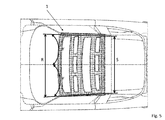
- Fig. 5 shows a plan view of a folding roof according to the invention 1.
- the left and right guide rail 2 extend in the vehicle longitudinal direction is not parallel, wherein in a preferred embodiment of Distance R in the front region of the motor vehicle is greater than the distance S in the rear region of the motor vehicle.
- the left and the right guide rail 2 include in an inventive embodiment an angle Y to the vehicle longitudinal direction.
- the left and right guide rails 2 each include a different angle to the vehicle longitudinal direction.
- the guide rail 2 has a profile shape, which allows to fulfill several functions.
- the outer contour is formed so that the guide rail 2 in rolling bearings, which are arranged in the body-mounted component, can be stored.
- the inner profile of the guide rail 2 is formed so that a sliding shoe 6.1 of a slider 6 is guided against rotation.
- the profile can have receptacles for tension cables or drive cables (not shown).
- the guide rail 2 has a carrier plate which extends in the direction of the vehicle outside to the side window. On this support plate, a seal A is arranged, which seals the top material 1.1 against the side window 8 and substantially prevents the ingress of environmental influences.
- the guide rail 2 has a second seal B, which is arranged on a further carrier plate of the profile of the guide rail 2.
- the seals A, B are preferably permanently connected by gluing to the guide rail 2.
- Seal B seals against the top material 1.1 and seal A and prevents dirt and / or water from entering the guide rail 2.
- the side window 8 is slightly opened to prevent damage to the seal A.
- the guide rail 2 has an open towards the top profile through which the slider 6 protrudes. While the sliding shoe 6.1 is guided in the profile of the guide rail 2, the slider 6 has a sliding arm 6.2, which extends substantially in the y-direction, or even vehicle transverse direction.
- a roof hoop 5 is arranged, which allows a width compensation, especially for non-parallel roof slopes.
- the sliding arm 6.2 is formed in a preferred embodiment with a geometry that prevents twisting of the roof spoiler 5 about the longitudinal axis of the sliding arm 6.2. So that the roof bow 5 can not be pulled unintentionally by the slider 6 or sliding 6.2, the slider 6 at the end of the sliding 6.2 a captive 6.3, which has a larger outer diameter than a arranged at the end of the roof spoiler bore of a sliding bushing 7.
- the sliding bush 7 is in each case at one end of the roof spoiler 5, preferably by pressing, arranged and serves for storage or for moving the roof spoiler 5 on the slider. 6
Landscapes
- Engineering & Computer Science (AREA)
- Mechanical Engineering (AREA)
- Body Structure For Vehicles (AREA)
Abstract
Description
- Die vorliegende Erfindung betrifft ein Dach für ein Kraftfahrzeug, insbesondere ein Targa-Dach, welches in eine Öffnungsstellung und in eine Schließstellung bringbar ist, umfassend ein Faltdach, und je eine linke und eine rechte Führungsschiene, wobei die linke und die rechte Führungsschiene verschiebbar sind.
- Unter einem Targa-Dach wird grundsätzlich verstanden, dass dem zwischen Windschutzscheibenrahmen und der Verbindung der B-Säule eines Kraftfahrzeugs der Dachmittelteil vollständig entfernbar ist. Im Gegensatz zu einem Cabriolet weist ein Targa-Dach einen fest montierten Sicherheitsbügel auf. Das Dach bzw. Dachteile eines derart ausgebildeten Kraftfahrzeugs müssen dabei oft von Hand entnommen werden, und können, wenn ein Ablageplatz im Kraftfahrzeug dafür vorgesehen ist, oder sonst an einem anderen Ort abgelegt werden.
- Aus der
DE4100677A1 wird ein Hardtop-Dach beschrieben, welches über mehrere Stellungen zurücknehmbar ist. Das Dach ist in Abschnitte unterteilt, und zwar in eine vordere fixierte Platte, in welche die Windschutzscheibe aufgenommen ist, eine Zwischenplatte und eine hintere Platte. Die Zwischenplatte des Daches ist teleskopisch auf die hintere Platte zurücknehmbar und beide beweglichen Platten werden danach in das hintere Verdeck des Fahrzeugs zurückgenommen. - In der
DE102006002080A1 wird ein seitenholmartiges Kopplungselement beschrieben, das mit dem Windschutzscheibenrahmen in Eingriff gebracht werden kann, wobei das Kopplungselement elektromotorisch antreibbar ist und wobei das Kopplungselement in einer Kopplungselementaufnahme im Dachteil längsverschiebbar aufgenommen ist. - Es ist eine Aufgabe der Erfindung, ein Dach für ein Kraftfahrzeug, insbesondere ein Targa-Dach, bereitzustellen, welches einfach und schnell handhabbar, und dabei im Kraftfahrzeug ohne wesentlichen Bauraumverlust im Kraftfahrzeug abgelegt werden kann, und weiters platzsparend aufgebaut und kostengünstig herstellbar ist.
- Gelöst wird diese Aufgabe durch die Merkmale von Anspruch 1. Weiterbildungen der Erfindung sind Gegenstand der Unteransprüche.
- Die Lösung der Aufgabe erfolgt durch ein Dach für ein Kraftfahrzeug, insbesondere ein Targa-Dach, welches in eine Öffnungsstellung und in eine Schließstellung bringbar ist, umfassend ein Faltdach, und je eine linke und eine rechte Führungsschiene, wobei die linke und die rechte Führungsschiene verschiebbar sind, wobei die linke und die rechte Führungsschiene jeweils in einen karosseriefestes Bauteilteil des Kraftfahrzeugs in Fahrzeuglängsrichtung versenkbar sind.
- Erfindungsgemäß ist die Führungsschiene als Links- und als Rechtsteil, also im Wesentlichen spiegelbildlich, ausgebildet. Die Führungsschienen sind dabei in Fahrzeuglängsrichtung, oder Fahrtrichtung, verschiebbar. Dabei sind die Führungsschienen in einem karosseriefesten Bauteil versenkbar. Die Führungsschienen können hierbei massiv und jeweils einstückig oder beispielsweise auch teleskopisch, oder in anderer Weise jeweils mehrteilig ausgeführt sein.
- Unter einem karosseriefesten Bauteil wird dabei jedes Bauteil verstanden, welches unbeweglich zur restlichen Fahrzeugkarosserie angeordnet ist, das kann beispielsweise ein Karosseriebauteil selbst sein.
- Weiterbildungen der Erfindung sind in den abhängigen Ansprüchen, der Beschreibung sowie den beigefügten Zeichnungen angegeben.
- In einer erfinderischen Ausführungsform ist das Faltdach im geöffneten Zustand in Fahrzeuglängsrichtung am hinteren Ende des Kraftfahrzeugdachs oder am hinteren Ende des für das Faltdach vorgesehenen Dachbereiches abgelegt.
- Es ist jedoch auch möglich, dass das Faltdach am vorderen Ende des Kraftfahrzeugdachs, beispielsweise im Bereich des Windschutzscheibenrahmens abgelegt ist.
- Erfindungsgemäß kann das karosseriefeste Bauteil links oder rechts oder an beiden Seiten des Kraftfahrzeugs eine B-, C- oder D-Säule bzw. ein an diesen Säulen befestigtes Bauteil sein.
- Die B-Säule ist jene Säule, welche die Verbindung zwischen Fahrzeugboden und Fahrzeugdach in der Mitte der Fahrgastzelle herstellt.
- Die C-Säule ist jene Säule, welche das Fahrzeugdach und den Kotflügel (hintere Seitenwand) am Fahrzeugheck miteinander verbindet.
- Die D-Säule ist bei Kombis und Vans die vierte Säule.
- Bevorzugt wird die C-Säule als karosseriefestes Bauteil verwendet, da diese im Vergleich zu den anderen Säulen voluminöser ausgebildet ist, und daher einen größeren Innenhohlraum als die anderen Säulen aufweist.
- Da die Führungsschiene der Geometrie der B-,C-, oder D-Säule angepasst sein muss, ist es je nach Gestaltung der Gesamtkarosserie besonders vorteilhaft, wenn die B-,C-, oder D-Säule flach verläuft.
- Bei Verwendung eines erfindungsgemäßen Targa-Dachs bei einem Kombi oder Van ist es vorteilhaft, die Führungsschiene in einem hinter dem Targa-Dach angeordneten feststehenden Blechdach oder sonstigem karosseriefesten Bauteil zu versenken. Hierbei sei zur Klarstellung noch erwähnt, dass die Führungsschiene nicht zur Gänze in einem karosseriefesten Blech-Bauteil versenkbar sein muss. Die Erfindung betrifft auch Ausführungen, in denen sich erst aus einer Kombination von Karosserie und (Innen-)Verkleidungsteilen eine Abdeckung der Führungsschienen ergibt, beispielsweise wenn die Karosserie so ausgebildet ist, dass die Führungsschienen nur teilweise von der Karosserie umschlossen sind, um z.B. für Wartungszwecke einen Zugang zu ermöglichen, aber durch zusätzliche Innenverkleidungsteile bzw. Teppiche etc. erst der Eindruck entsteht, dass die Führungsschienen im Kraftfahrzeug versenkt sind.
- Zwischen der feststehenden Karosserie und der Führungsschiene ist eine Dichtung angeordnet, die ein Eindringen von Schmutz und/oder Wasser in die Karosserie verhindert.
- Ist die Führungsschiene vollständig im karosseriefesten Bauteil versenkbar kann eine Abdeckkappe oder ein Abdeckdeckel vorgesehen werden welche die Öffnung des karosseriefesten Bauteils verschließt, und dem Kraftfahrzeug ein schöneres Design geben soll, wobei die Abdeckkappe manuell oder mittels einer entsprechenden Vorrichtung in der Öffnung des karosseriefesten Bauteils befestigt wird.
- Wird das Faltdach in eine Geschlossenstellung gebracht, muss die Abdeckkappe vor dem Verschließen des Faltdachs entfernt werden. Ist eine entsprechende Vorrichtung vorhanden, entfernt die Vorrichtung die Abdeckkappe.
- Gemäß einer weiteren Ausgestaltung der Erfindung ist zumindest eine Führungsschiene motorisch antreibbar. Bevorzugt wird hierbei als Antrieb ein Elektromotor verwendet. Der Antrieb kann aber auch manuell, hydraulisch oder pneumatisch erfolgen.
- Falls die Abdeckkappe manuell befestigbar ist, muss diese vor dem Verschieben der Führungsschiene entfernt werden. Wird die Abdeckkappe nicht entfernt, so wird bei Betätigen des motorischen Antriebs eine Warnung abgegeben und der Vorgang erst durchgeführt, wenn die Abdeckkappe entfernt wurde.
- In einer erfinderischen Ausführungsform kann der motorische Antrieb jeweils in der linken und in der rechten B, C, oder D-Säule angeordnet sein.
- In einer weiteren erfinderischen Ausführung wird ein motorischer Antrieb verwendet der, in einer bevorzugten Ausführung, im Heckbereich in Fahrzeugquerrichtung mittig angeordnet ist und beide Führungsschienen antreibt.
- Erfindungsgemäß weist die zumindest eine Führungsschiene eine reibschlüssige Verbindung zum motorischen Antrieb auf.
- Dies kann beispielsweise mittels eines Seilzugs oder Antriebskabel erfolgen. Alternativ ist auch ein Reib- oder Zahnrad denkbar.
- Gemäß einer Ausführungsform der Erfindung weist die zumindest eine Führungsschiene eine formschlüssige Verbindung zum motorischen Antrieb auf.
- Beispielsweise erfolgt hier der Antrieb der zumindest einen Führungsschiene über eine Zahnstange.
- Sowohl Seilzug oder Antriebskabel als auch die Zahnstange verlaufen im Wesentlichen parallel im Profil der Führungsschiene.
- Für die reib- bzw. kraftschlüssige und formschlüssige Verbindung zum motorischen Antrieb der Führungsschiene ist jede dem Fachmann bekannte Variante denkbar.
- Bevorzugt wird als motorischer Antrieb ein Stellmotor verwendet. Ein Stellmotor ist im Prinzip ein Servomotor, wobei der Betrieb des Stellmotors momenten-, geschwindigkeits- oder positionsgeregelt erfolgen kann.
- Es ist jedoch auch denkbar, dass beispielsweise ein Schrittmotor verwendet wird.
- Die Führungsschiene ist erfindungsgemäß ein Profilteil. Dabei wird die Führungsschiene bevorzugt als endloses Strangpressprofil hergestellt, welches entsprechend seiner erforderlichen Länge abgeschnitten wird. Die Führungsschiene weist eine Krümmung auf, welcher im Wesentlichen dem Verlauf des karosseriefesten Bauteils entspricht.
- Als Werkstoff wird Metall, bevorzugt Aluminium, verwendet. Die Führungsschiene kann aber auch, wenn es die auf die Führungsschiene wirkenden Kräfte zulassen, aus Kunststoff, Verbundstoff oder anderen Stoffen hergestellt sein.
- Das Profil weist hierbei einen der technischen Aufgabe angepassten Querschnitt auf. Beispielsweise kann die Führungsschiene eine Trägerplatte aufweisen, welche eine Befestigung einer Dichtung erlaubt. Das Profil kann so ausgebildet sein, dass im Profil zumindest ein Antriebskabel, im Wesentlichen parallel zur Fahrzeuglängsrichtung, verlaufen kann.
- Das Faltdach ist am vordersten Punkt dauerhaft mit der Führungsschiene und/oder einem Abschlusselement verbunden. Das Abschlusselement ist ein biegesteifes Bauteil, welches bevorzugt aus Kunststoff hergestellt wird. Das Faltdach wird beispielsweise durch einen Keder mit dem Abschlusselement dauerhaft verbunden. Alternativ kann das Faltdach durch Kleben, Nähen oder Nieten mit dem Abschlusselement verbunden sein.
- In einer weiteren bevorzugten erfinderischen Ausführungsform wird das Abschlusselement beispielsweise durch Verschrauben oder Vernieten mit der linken und rechten Führungsschiene dauerhaft verbunden. Bei dieser Ausführungsform können das Faltdach und die Führungsschienen nur gemeinsam verschoben werden. Um vor allem bei einer nicht parallelen Anordnung der beiden Führungsschienen einen stetigen Breitenausgleich durchführen zu können, ist das Abschlusselement beweglich mit den Führungsschienen verbunden. Hierzu kann das Abschlusselement beispielsweis mittels jeweils eines Gleiters mit der Führungsschiene verbunden sein. Erfindungsgemäß wäre es auch möglich, dass das Abschlusselement im Bereich der Führungsschienenbefestigung Langlöcher aufweist, in denen ein Bolzen oder eine Schraube, welche die Verbindung zu den Führungsschienen herstellt, gleiten kann.
- Das Abschlusselement und/oder die Führungsschienen sind in der Geschlossenstellung mit einem Windschutzscheibenrahmen verbunden, wobei das Abschlusselement und/oder der Windschutzscheibenrahmen eine Dichtung aufweist, welche in der Geschlossenstellung gegen den Windschutzscheibenrahmen bzw. gegen einander gepresst wird.
- Die Verriegelung erfolgt bevorzugt mittels Verschlusshaken und/oder Zentrierbolzen.
- Erfindungsgemäß ist zumindest einer Führungsschiene und/oder dem Abschlusselement zumindest ein Stellmotor zugeordnet. Über ein Umschaltgetriebe ist die Antriebsbewegung auf ein weiteres Paar von Seilzügen oder Antriebskabel übertragbar, welche ebenfalls im Profil der Führungsschiene verlaufen, wodurch die Führungsschiene und das Abschlusselement in Fahrzeuglängsrichtung verfahrbar sind.
- Es ist jedoch auch denkbar, dass für jedes Paar Antriebskabel, bzw. Zahnstangen, ein motorischer Antrieb vorgesehen wird.
- Bei Verschieben der Führungsschienen wird das Faltdach in Fahrzeuglängsrichtung automatisch mitverfahren. Dies lässt sich relativ einfach realisieren, indem dem Windschutzscheibenrahmen zugewandten Ende ein mechanischer Mitnehmer angeordnet ist.
- Zwischen der linken und rechten Führungsschiene ist zumindest ein Dachspriegel angeordnet.
- Der Dachspriegel verläuft in Fahrzeugquerrichtung wobei das Faltdach an dem zumindest einem Dachspriegel befestigbar ist. Das Faltdach wird hierbei beispielsweise durch Kleben, oder Einnähen des Dachspriegels in das Faltdach, mit dem Dachspriegel dauerhaft verbunden. Der zumindest eine Dachspriegel weist eine der in Fahrzeugquerrichtung entsprechenden Dachkontur angepasste Bombierung auf und ist in der Führungsschiene längsverschieblich angeordnet.
- Bevorzugt ist der Dachspriegel ein Hohlprofil, welcher durch Strangpressziehen hergestellt wird, wobei als Werkstoff bevorzugt Aluminium verwendet wird.
- In einer weiteren erfinderischen Ausführungsform ist in der linken und rechten Führungsschiene jeweils zumindest ein Gleiter angeordnet.
- Der Dachspriegel ist mit Gleitern verbunden, wobei der Dachspriegel auf den Gleitern in Fahrzeugquerrichtung verschiebbar angeordnet ist.
- Da der Dachspriegel in Querrichtung verschiebbar ist, kann das Dach auch einen nicht parallelen Verlauf aufweisen, da der Dachspriegel auf dem Gleiter eine Differenzbewegung machen kann, wodurch ein Breitenausgleich erfolgen kann.
- Die Gleiter sind innerhalb der Führungsschiene, welche als Profil ausgebildet ist, mittels eines Gleitschuhs geführt. Der Gleitschuh weist dabei eine dem Profil der Führungsschiene angepasste Geometrie auf. Der Gleitschuh ist so ausgebildet, dass eine Längsverschiebung in der Führungsschiene ohne ein Verkanten durchgeführt werden kann. Das Profil der Führungsschiene ist in Fahrzeuglängsrichtung geschlitzt, bzw. ein nach oben hin offenes Profil, so dass der Gleiter aus der Führungsschiene zur Verbindung mit einem Dachspriegel, ragen kann. Es ist jedoch auch denkbar, dass das Profil an der Seite geschlitzt ausgebildet ist, wobei bevorzugt die Innenseite der Führungsschiene, also jene Seite die Richtung Insassenkabine zeigt, geschlitzt ausgebildet ist.
- Der Gleiter wird bevorzugt als Spritzgussteil hergestellt, wobei bevorzugt Kunststoff als Werkstoff verwendet wird.
- Erfindungsgemäß weist der Gleiter einen Gleitarm auf, wobei der Dachspriegel über eine Gleitbuchse verschiebbar auf dem Gleitarm angeordnet ist, und wobei an jedem Ende des Dachspriegels eine Gleitbuchse vorgesehen ist.
- Der Gleitarm ist im Wesentlichen eine Erstreckung des Gleiters in Fahrzeugquerrichtung. Wobei sich der Gleitarm in Richtung Insassenkabine erstreckt, und wobei der Gleitarm bevorzugt eine Form aufweist, welche eine Verdrehung des Dachspriegels um die Längsachse des Gleitarms verhindert. Am Ende des Gleitarms weist dieser eine Verliersicherung auf, die verhindert, dass der Dachspriegel unbeabsichtigt vom Gleiter gezogen werden kann. Die Gleitbuchse ist auf dem Gleitarm verschiebbar angeordnet, wobei an jedem Ende des Dachspriegels eine Gleitbuchse angeordnet ist. Die Gleitbuchse ist bevorzugt aus Kunststoff hergestellt.
- Die Anzahl der Dachspriegel bestimmen die Anzahl der Faltungen des Faltdachs. Man kann gezielt durch die Bestimmung der Anzahl der Dachspriegel festlegen, wie oft sich das Faltdach falten soll. Die Ablagehöhe des Faltdachs im geöffneten Zustand wird ebenfalls durch die Anzahl der Dachspriegel bestimmt.
- In einer weiteren Ausführungsform sind im Faltdach, das bevorzugt ein Verdeckstoff ist, transparente Elemente, beispielsweise Glas, angeordnet, wobei die Länge der Glaselemente in Fahrzeuglängsrichtung, bzw. die Anzahl der in Fahrzeuglängsrichtung hintereinander angeordneten Glaselemente die Anzahl bzw. die Position der Dachspriegel und somit die Anzahl der Faltungen bestimmen, da der Dachspriegel nur zwischen den transparenten Elementen, zur Befestigung des Faltdachs am Dachspriegel, angeordnet werden kann.
- Durch das Verschieben der linken und rechten Führungsschiene werden die Gleiter in der linken und rechten Führungsschiene mit verschoben. Dabei werden die Gleitschuhe der Gleiter in der Öffnungsstellung in einer bevorzugten erfinderischen Ausführungsform in eine sogenannte Block-auf-Block Anordnung aneinandergereiht.
- Erfindungsgemäß weist die vorderste Faltung des gefalteten Faltdachs bei einer Öffnungsstellung einen Winkel zur Normalebene auf die Fahrzeuglängsachse von -45° bis 80°, bevorzugt 10° bis 80°, noch bevorzugter 30° bis 60°, auf. Da das Faltdach aus einem Verdeckstoff, bzw. im Verdeckstoff eingearbeitete starren Teilen, besteht und der Verdeckstoff nicht steif ist, und im gefalteten Zustand durchhängen kann, bzw. die im Verdeckstoff eingearbeiteten starren Teile bombiert sein können, ist die Angabe des Winkels nur ein "Durchschnittswert" für die gesamte erste Faltung. Die Fahrzeuglängsachse verläuft parallel zur Fahrzeuglängsrichtung. Bei einem Winkel von -45° ist zumindest die vorderste Faltung nach vorne geneigt abgelegt. Diese Ausgestaltung kann durch die Anordnung des Abschlusselements sowie durch die Ausbildung der Faltdachbefestigung oder durch den Abstand zwischen dem Abschlusselement und dem ersten Gleiter ermöglicht werden. Dadurch ist es möglich, bei geöffnetem Dach Zugluft, Luftverwirbelungen und Windgeräusche im Kraftfahrzeuginneren zu reduzieren, ebenso Zugluft von hinten, vergleichbar einem Windschott. Die Anordnung kann somit einerseits als Windabweiser für den Fahrzeuginnenraum und andererseits als Spoiler, also als ein die Aerodynamik beeinflussendes Bauteil, ausgebildet sein.
- Die Lagerung der linken und rechten Führungsschiene erfolgt mittels Rollenlager im karosseriefesten Bauteil.
- Dadurch wird eine besonders reibungsarme Führung der Führungsschiene im karosseriefesten Bauteil realisiert. Rollen- bzw. Nadellager werden wegen ihren geringen Bauraumbedarf bevorzugt verwendet. Es kann natürlich, im Rahmen der Erfindung, und wenn es der Bauraum im karosseriefesten Bauteil zulässt, auch ein anderer Wälzlagertyp verwendet werden. Es ist erfindungsgemäß natürlich auch möglich, dass Gleitlager verwendet werden.
- In einer weiteren erfinderischen Ausführungsform verlaufen die linke und die rechte Führungsschiene in Fahrzeuglängsrichtung nicht parallel, wobei die Führungsschienen zur Fahrzeuglängsachse vorzugsweise links und rechts denselben Winkel einschließen. Es ist natürlich auch möglich dass die Führungsschienen jeweils unterschiedliche Winkel zur Fahrzeuglängsrichtung aufweisen.
- Die Erfindung wird im Folgenden beispielhaft unter Bezugnahme auf die Zeichnungen beschrieben.
- Fig. 1
- ist eine perspektivische Ansicht eines erfindungsgemäßen Faltdaches in geöffnetem Zustand.
- Fig. 2
- zeigt eine Teilansicht eines erfindungsgemäßen Faltdaches in geöffnetem Zustand.
- Fig. 3
- ist eine perspektivische Ansicht eines Faltdaches gemäß
Fig. 1 in geschlossenem Zustand. - Fig. 4
- ist eine weitere perspektivische Ansicht eines Faltdaches gemäß
Fig. 1 in geschlossenem Zustand. - Fig. 5
- ist eine Draufsicht eines Faltdachs gemäß
Fig. 1 in geschlossenem Zustand. - Fig. 6
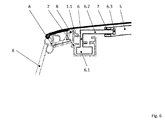
- ist eine Teilschnittdarstellung in Fahrzeugquerrichtung.
- In
Fig. 1 ist eine erfindungsgemäße Targa-Dach Variante in der Öffnungsstellung dargestellt. Zur leichteren Erkennbarkeit ist die linke und rechte Führungsschiene 2 hervorgehoben dargestellt. Die Führungsschienen sind in den karosseriefesten Bauteilen 3, in Pfeilrichtung, versenkt. Das Faltdach 1 weist einen Verdeckstoff 1.1 auf, in dem transparente Elemente 1.2, beispielsweise Glaselemente, integriert sind. - Der Verdeckstoff 1.1 weist zwei Faltungen auf, was auf zwei, mit der Führungsschiene 2 verbundene, Dachspriegel 5 schließt (nicht dargestellt).
- Eine Teilansicht eines erfindungsgemäßen Faltdachs 1 wird in
Fig. 2 dargestellt. Dabei weist das vorderste Element, beispielsweise das Abschlusselement 1.3, des gefalteten Faltdachs 1 einen Winkel X zur Normalebene auf die Fahrzeuglängsachse von -45° bis 80° auf. Mit Hilfe des Abstands T zwischen dem Abschlusselement 1.3 und dem ersten Gleiter 6 lässt sich der Winkel X variieren. Dadurch wirkt das Faltdach 1 im geöffneten Zustand einerseits als Windabweiser für den Fahrzeuginnenraum, andererseits als Spoiler. - In
Fig. 3 wird das erfindungsgemäße Dach 1 in einer Geschlossenstellung dargestellt. Die Führungsschienen 2 (nicht dargestellt) sind über Verschlusselemente, die im Abschlusselement 1.3 angeordnet sind, mit dem Windschutzscheibenrahmen 4 verbunden. Der Verdeckstoff 1.1 weist eine Vielzahl von transparenten Elementen 1.2 auf, wobei die transparenten Elemente 1.2 unterschiedliche Geometrien aufweisen. Die Führungsschienen 2 sind an ihrem anderen Ende in den karosseriefesten Bauteilen 3 über Wälz- oder Gleitlager, bevorzugt Rollen- bzw. Nadellager gelagert. - Eine weitere Darstellung in der Geschlossenstellung wird in
Fig. 4 gezeigt, wobei die Anordnung der Führungsschienen 2 im Dach eines Kraftfahrzeugs dargestellt ist, wobei, in Fahrzeuglängsrichtung, die rechte Führungsschiene 2 erfindungsgemäß massiv ausgebildet dargestellt ist, während alternativ die linke Führungsschiene 2 als Profil dargestellt ist. Die Führungsschienen 2 sind über Verschlusshaken und/oder Zentrierbolzen, die an einem Ende der Führungsschienen 2 angeordnet sind, mit dem Windschutzscheibenrahmen 4 verbunden. Das andere Ende der Führungsschienen 2 ist in den C-Säulen, welche das karosseriefeste Bauteil 3 darstellen, gelagert. Zur Vermeidung, dass Schmutz und/oder Wasser eindringen kann wird zwischen der Führungsschiene 2 und dem karosseriefesten Bauteil 3 eine Dichtung vorgesehen. Das Faltdach 1 wird in Pfeilrichtung geöffnet. -
Fig. 5 zeigt eine Draufsicht eines erfindungsgemäßen Faltdachs 1. Die linke und rechte Führungsschiene 2 verlaufen in Fahrzeuglängsrichtung gesehen nicht parallel, wobei in einer bevorzugten Ausführungsform der Abstand R im vorderen Bereich des Kraftfahrzeugs größer ist als der Abstand S im hinteren Bereich des Kraftfahrzeugs. Die linke und die rechte Führungsschiene 2 schließen dabei in einer erfinderischen Ausführungsform einen Winkel Y zur Fahrzeuglängsrichtung ein. Es ist jedoch auch möglich, dass die linke und rechte Führungsschiene 2 jeweils einen unterschiedlichen Winkel zur Fahrzeuglängsrichtung einschließen. - Eine Teilschnittdarstellung wird in
Fig. 6 dargestellt. Die Führungsschiene 2 weist eine Profilform auf, welche es erlaubt mehrere Funktionen zu erfüllen. Die Außenkontur ist so ausgebildet, dass die Führungsschiene 2 in Wälzlagern, die im karosseriefesten Bauteil angeordnet sind, lagerbar ist. Das Innenprofil der Führungsschiene 2 ist so ausgebildet, dass ein Gleitschuh 6.1 eines Gleiters 6 verdrehsicher geführt ist. Das Profil kann in einer weiteren erfinderischen Ausbildung Aufnahmen für Zugseile oder Antriebskabel (nicht dargestellt) aufweisen. Die Führungsschiene 2 weist eine Trägerplatte auf, die sich in Richtung Fahrzeugaußenseite bis zur Seitenscheibe erstreckt. Auf dieser Trägerplatte ist eine Dichtung A angeordnet, die den Verdeckstoff 1.1 gegen die Seitenscheibe 8 abdichtet und im Wesentlichen das Eindringen von Umwelteinflüssen verhindert. Die Führungsschiene 2 weist eine zweite Dichtung B auf, welche auf einer weiteren Trägerplatte des Profils der Führungsschiene 2 angeordnet ist. Die Dichtungen A, B werden bevorzugt durch Kleben mit der Führungsschiene 2 dauerhaft verbunden. Dichtung B dichtet gegen den Verdeckstoff 1.1 und Dichtung A ab und verhindert, dass Schmutz und/oder Wasser in die Führungsschiene 2 eindringen können. Vor dem Versenken der Führungsschienen 2 in das karosseriefeste Bauteil 3 wird die Seitenscheibe 8 leicht geöffnet, um eine Beschädigung der Dichtung A zu vermeiden. Die Führungsschiene 2 weist ein nach oben hin offenes Profil auf, durch welches der Gleiter 6 ragt. Während der Gleitschuh 6.1 im Profil der Führungsschiene 2 geführt ist, weist der Gleiter 6 einen Gleitarm 6.2 auf, welcher sich im Wesentlichen in y-Richtung, oder auch Fahrzeugquerrichtung, erstreckt. Auf dem Gleitarm 6.2 ist ein Dachspriegel 5 angeordnet, der einen Breitenausgleich, insbesondere bei nicht parallel verlaufenden Dachverläufen, ermöglicht. Der Gleitarm 6.2 ist in einer bevorzugten Ausführungsform mit einer Geometrie ausgebildet, die ein Verdrehen des Dachspriegels 5 um die Längsachse des Gleitarms 6.2 verhindert. Damit der Dachspriegel 5 nicht unbeabsichtigt vom Gleiter 6 bzw. Gleitarm 6.2 gezogen werden kann, weist der Gleiter 6 am Ende des Gleitarms 6.2 eine Verliersicherung 6.3 auf, die einen größeren Außendurchmesser aufweist als eine am Ende des Dachspriegels angeordnete Bohrung einer Gleitbuchse 7. Die Gleitbuchse 7 ist jeweils an einem Ende des Dachspriegels 5, bevorzugt durch Einpressen, angeordnet und dient zur Lagerung bzw. zum Verschieben des Dachspriegels 5 auf dem Gleiter 6. -
- 1
- Faltdach
- 1.1
- Verdeckstoff
- 1.2
- transparente Elemente
- 1.3
- Abschlusselement
- 2
- Führungsschiene
- 3
- karosseriefestes Bauteil
- 4
- Windschutzscheibenrahmen
- 5
- Dachspriegel
- 6
- Gleiter
- 6.1
- Gleitschuh
- 6.2
- Gleitarm
- 6.3
- Verliersicherung
- 7
- Gleitbuchse
- 8
- Seitenscheibe
- A
- Dichtung
- B
- Dichtung
- R
- Abstand
- S
- Abstand
- T
- Abstand
- X
- Winkel
- Y
- Winkel
Claims (21)
- Dach für ein Kraftfahrzeug, insbesondere ein Targa-Dach, welches in eine Öffnungsstellung und in eine Schließstellung bringbar ist, umfassend ein Faltdach (1), und je eine linke und eine rechte Führungsschiene (2), wobei die linke und die rechte Führungsschiene (2) verschiebbar sind,
dadurch gekennzeichnet, dass die linke und die rechte Führungsschiene (2) jeweils in einem karosseriefesten Bauteil (3) des Kraftfahrzeugs in Fahrzeuglängsrichtung versenkbar sind. - Dach für ein Kraftfahrzeug nach Anspruch 1,
dadurch gekennzeichnet, dass das Faltdach (1) im geöffneten Zustand in Fahrzeuglängsrichtung am hinteren Ende abgelegt ist. - Dach für ein Kraftfahrzeug nach Anspruch 1,
dadurch gekennzeichnet, dass das karosseriefeste Bauteil (3) eine B-, C-, oder D-Säule ist, oder im Bereich einer B-, C-, oder D-Säule angeordnet ist. - Dach für ein Kraftfahrzeug nach Anspruch 1,
dadurch gekennzeichnet, dass zumindest eine Führungsschiene (2) motorisch antreibbar ist. - Dach für ein Kraftfahrzeug nach zumindest einem der vorhergehenden Ansprüche,
dadurch gekennzeichnet, dass zumindest eine Führungsschiene (2) eine formschlüssige Verbindung zum motorischen Antrieb aufweist. - Dach für ein Kraftfahrzeug nach zumindest einem der vorhergehenden Ansprüche,
dadurch gekennzeichnet, dass zumindest eine Führungsschiene (2) eine reibschlüssige Verbindung zum motorischen Antrieb aufweist. - Dach für ein Kraftfahrzeug nach zumindest einem der vorhergehenden Ansprüche,
dadurch gekennzeichnet, dass der motorische Antrieb ein Stellmotor ist. - Dach für ein Kraftfahrzeug nach zumindest einem der vorhergehenden Ansprüche,
dadurch gekennzeichnet, dass die Führungsschiene (2) ein Profilteil ist. - Dach für ein Kraftfahrzeug nach zumindest einem der vorhergehenden Ansprüche,
dadurch gekennzeichnet, dass das Faltdach (1) am vordersten Punkt dauerhaft mit der Führungsschiene (2) und/oder einem Abschlusselement (1.3) verbunden ist. - Dach für ein Kraftfahrzeug nach zumindest einem der vorhergehenden Ansprüche,
dadurch gekennzeichnet, dass das Abschlusselement (1.3) relativ zur Führungsschiene (2) in Fahrzeugquerrichtung verschiebbar ist. - Dach für ein Kraftfahrzeug nach zumindest einem der vorhergehenden Ansprüche,
dadurch gekennzeichnet, dass der zumindest einen Führungsschiene (2) und/oder dem Abschlusselement (1.3) zumindest ein Stellmotor zugeordnet ist. - Dach für ein Kraftfahrzeug nach zumindest einem der vorhergehenden Ansprüche,
dadurch gekennzeichnet, dass zwischen der linken und rechten Führungsschiene (2) zumindest ein Dachspriegel (5) angeordnet ist. - Dach für ein Kraftfahrzeug nach zumindest einem der vorhergehenden Ansprüche,
dadurch gekennzeichnet, dass in der linken und rechten Führungsschiene (2) jeweils zumindest ein Gleiter (6) angeordnet ist. - Dach für ein Kraftfahrzeug nach zumindest einem der vorhergehenden Ansprüche,
dadurch gekennzeichnet, dass der Dachspriegel (5) mit Gleitern (6) verbunden ist, wobei der Dachspriegel (5) auf den Gleitern (6) in Fahrzeugquerrichtung verschiebbar angeordnet ist. - Dach für ein Kraftfahrzeug nach zumindest einem der vorhergehenden Ansprüche,
dadurch gekennzeichnet, dass der Gleiter (6) innerhalb der Führungsschiene (2), welche vorzugsweise als Profil ausgebildet ist, geführt ist. - Dach für ein Kraftfahrzeug nach zumindest einem der vorhergehenden Ansprüche,
dadurch gekennzeichnet, dass der Gleiter (6) einen Gleitarm (6.2) aufweist, wobei der Dachspriegel (5) über eine Gleitbuchse (7) verschiebbar auf dem Gleitarm (6.2) angeordnet ist, und wobei an jedem Ende des Dachspriegels (5) jeweils eine Gleitbuchse (7) vorgesehen ist. - Dach für ein Kraftfahrzeug nach zumindest einem der vorhergehenden Ansprüche,
dadurch gekennzeichnet, dass die Anzahl der Dachspriegel (5) die Anzahl der Faltungen des Faltdachs (1.1) bestimmen. - Dach für ein Kraftfahrzeug nach zumindest einem der vorhergehenden Ansprüche,
dadurch gekennzeichnet, dass durch das Verschieben der linken und rechten Führungsschiene (2) die Gleiter (6) in der linken und rechten Führungsschiene (2) in Längsrichtung mit verschoben werden. - Dach für ein Kraftfahrzeug nach zumindest einem der vorhergehenden Ansprüche,
dadurch gekennzeichnet, dass die vorderste Faltung des gefalteten Faltdachs (1) bei einer Öffnungsstellung einen Winkel (X) zur Normalebene auf die Fahrzeuglängsachse von -45° bis 80°, bevorzugt 10° bis 80°, noch bevorzugter 30° bis 60°, aufweist. - Dach für ein Kraftfahrzeug nach zumindest einem der vorhergehenden Ansprüche,
dadurch gekennzeichnet, dass die Lagerung der linken und rechten Führungsschiene (2) mittels Wälz- oder Gleitlager, insbesondere ein Nadellager, im karosseriefesten Bauteil (3) erfolgt. - Dach für ein Kraftfahrzeug nach zumindest einem der vorhergehenden Ansprüche,
dadurch gekennzeichnet, dass die linke und die rechte Führungsschiene (2) in Fahrzeuglängsrichtung nicht parallel verlaufen, wobei die Führungsschienen (2) zur Fahrzeuglängsachse vorzugsweise links und rechts denselben Winkel (Y) einschließen.
Priority Applications (1)
| Application Number | Priority Date | Filing Date | Title |
|---|---|---|---|
| EP13187877.9A EP2860052B1 (de) | 2013-10-09 | 2013-10-09 | Dach für ein Kraftfahrzeug |
Applications Claiming Priority (1)
| Application Number | Priority Date | Filing Date | Title |
|---|---|---|---|
| EP13187877.9A EP2860052B1 (de) | 2013-10-09 | 2013-10-09 | Dach für ein Kraftfahrzeug |
Publications (2)
| Publication Number | Publication Date |
|---|---|
| EP2860052A1 true EP2860052A1 (de) | 2015-04-15 |
| EP2860052B1 EP2860052B1 (de) | 2016-07-20 |
Family
ID=49382231
Family Applications (1)
| Application Number | Title | Priority Date | Filing Date |
|---|---|---|---|
| EP13187877.9A Not-in-force EP2860052B1 (de) | 2013-10-09 | 2013-10-09 | Dach für ein Kraftfahrzeug |
Country Status (1)
| Country | Link |
|---|---|
| EP (1) | EP2860052B1 (de) |
Families Citing this family (1)
| Publication number | Priority date | Publication date | Assignee | Title |
|---|---|---|---|---|
| DE102020104611A1 (de) | 2020-02-21 | 2021-08-26 | Berndt Riedel | Kombi-Cabriolet |
Citations (3)
| Publication number | Priority date | Publication date | Assignee | Title |
|---|---|---|---|---|
| DE4100677A1 (de) | 1990-01-12 | 1991-08-08 | C & C Inc | Ueber mehrere stellungen zuruecknehmbares fahrzeugdach |
| DE10120358A1 (de) * | 2001-04-26 | 2002-10-31 | Karmann Gmbh W | Fahrzeug mit einem zu öffnenden Verdeck |
| DE102006002080A1 (de) | 2006-01-16 | 2007-07-19 | Webasto Ag | Öffnungsfähiges Fahrzeugdach sowie Betriebsverfahren hierfür |
-
2013
- 2013-10-09 EP EP13187877.9A patent/EP2860052B1/de not_active Not-in-force
Patent Citations (3)
| Publication number | Priority date | Publication date | Assignee | Title |
|---|---|---|---|---|
| DE4100677A1 (de) | 1990-01-12 | 1991-08-08 | C & C Inc | Ueber mehrere stellungen zuruecknehmbares fahrzeugdach |
| DE10120358A1 (de) * | 2001-04-26 | 2002-10-31 | Karmann Gmbh W | Fahrzeug mit einem zu öffnenden Verdeck |
| DE102006002080A1 (de) | 2006-01-16 | 2007-07-19 | Webasto Ag | Öffnungsfähiges Fahrzeugdach sowie Betriebsverfahren hierfür |
Also Published As
| Publication number | Publication date |
|---|---|
| EP2860052B1 (de) | 2016-07-20 |
Similar Documents
| Publication | Publication Date | Title |
|---|---|---|
| DE102015121030A1 (de) | Angetriebene ausfahrbare Spoileranordnung für Kraftfahrzeuge | |
| DE102016009136B4 (de) | Kraftwagen mit einem Dachmodul | |
| DE10139977C2 (de) | Fahrzeug mit einer verschließbaren Dachöffnung | |
| DE102014013772B4 (de) | Fahrzeug mit einer Fahrzeugtür | |
| DE10218241C1 (de) | Verdeck für ein Cabrioletfahrzeug | |
| EP2017109A1 (de) | Fahrzeugspoilerdach | |
| EP3224074B1 (de) | Kraftfahrzeug | |
| DE10350522B4 (de) | Motorhaube für ein Personenkraftfahrzeug | |
| DE102007001286B4 (de) | Öffenbares Fahrzeugdach mit Antriebsschlitten für ein Dachelement | |
| EP2860052B1 (de) | Dach für ein Kraftfahrzeug | |
| EP1744920B1 (de) | Dachstruktur für ein zu öffnendes starres kraftfahrzeugdach | |
| DE102020112528A1 (de) | Kraftfahrzeug mit einer Karosserie | |
| DE102007004180A1 (de) | Verstellbares Fahrzeugdach | |
| EP2004432A1 (de) | Hardtop-klappverdeck für einen offenen kraftwagen | |
| DE102004055404A1 (de) | Fahrzeugdach | |
| EP3319827B1 (de) | Dachmodul für einen kraftwagen | |
| DE10138027A1 (de) | Dachspoiler für Kraftfahrzeuge | |
| DE10331144B4 (de) | Fahrzeugdach mit einem bewegbar gelagerten und verriegelbaren Dachbauteil | |
| DE102007022551A1 (de) | Überrollschutzsystem | |
| DE202005018138U1 (de) | Kabelführung für ein Antriebskabel eines bewegbaren Fahrzeugteils | |
| DE102005024109B3 (de) | Fahrzeug mit einer Fahrgastzelle und einem umwandelbaren Dach/-Heckaufbau | |
| DE102009043248B3 (de) | Führungsanordnung für ein bewegbares Dachteil eines Fahrzeugdachs | |
| DE102004013753B4 (de) | Dachanordnung | |
| DE102004035372B4 (de) | Verstellbares Fahrzeugdach mit verschwenkbaren Dachsegmenten | |
| DE102008024917A1 (de) | Kraftfahrzeug mit einem manuell notbetätigbaren Aussenhautteil |
Legal Events
| Date | Code | Title | Description |
|---|---|---|---|
| PUAI | Public reference made under article 153(3) epc to a published international application that has entered the european phase |
Free format text: ORIGINAL CODE: 0009012 |
|
| 17P | Request for examination filed |
Effective date: 20150310 |
|
| AK | Designated contracting states |
Kind code of ref document: A1 Designated state(s): AL AT BE BG CH CY CZ DE DK EE ES FI FR GB GR HR HU IE IS IT LI LT LU LV MC MK MT NL NO PL PT RO RS SE SI SK SM TR |
|
| AX | Request for extension of the european patent |
Extension state: BA ME |
|
| RIC1 | Information provided on ipc code assigned before grant |
Ipc: B60J 7/06 20060101AFI20160219BHEP Ipc: B60J 7/00 20060101ALI20160219BHEP |
|
| GRAP | Despatch of communication of intention to grant a patent |
Free format text: ORIGINAL CODE: EPIDOSNIGR1 |
|
| INTG | Intention to grant announced |
Effective date: 20160401 |
|
| GRAS | Grant fee paid |
Free format text: ORIGINAL CODE: EPIDOSNIGR3 |
|
| GRAA | (expected) grant |
Free format text: ORIGINAL CODE: 0009210 |
|
| AK | Designated contracting states |
Kind code of ref document: B1 Designated state(s): AL AT BE BG CH CY CZ DE DK EE ES FI FR GB GR HR HU IE IS IT LI LT LU LV MC MK MT NL NO PL PT RO RS SE SI SK SM TR |
|
| REG | Reference to a national code |
Ref country code: GB Ref legal event code: FG4D Free format text: NOT ENGLISH |
|
| REG | Reference to a national code |
Ref country code: CH Ref legal event code: EP |
|
| REG | Reference to a national code |
Ref country code: IE Ref legal event code: FG4D Free format text: LANGUAGE OF EP DOCUMENT: GERMAN |
|
| REG | Reference to a national code |
Ref country code: AT Ref legal event code: REF Ref document number: 813761 Country of ref document: AT Kind code of ref document: T Effective date: 20160815 |
|
| REG | Reference to a national code |
Ref country code: DE Ref legal event code: R096 Ref document number: 502013003778 Country of ref document: DE |
|
| REG | Reference to a national code |
Ref country code: FR Ref legal event code: PLFP Year of fee payment: 4 |
|
| REG | Reference to a national code |
Ref country code: LT Ref legal event code: MG4D |
|
| REG | Reference to a national code |
Ref country code: NL Ref legal event code: MP Effective date: 20160720 |
|
| PG25 | Lapsed in a contracting state [announced via postgrant information from national office to epo] |
Ref country code: LT Free format text: LAPSE BECAUSE OF FAILURE TO SUBMIT A TRANSLATION OF THE DESCRIPTION OR TO PAY THE FEE WITHIN THE PRESCRIBED TIME-LIMIT Effective date: 20160720 Ref country code: FI Free format text: LAPSE BECAUSE OF FAILURE TO SUBMIT A TRANSLATION OF THE DESCRIPTION OR TO PAY THE FEE WITHIN THE PRESCRIBED TIME-LIMIT Effective date: 20160720 Ref country code: RS Free format text: LAPSE BECAUSE OF FAILURE TO SUBMIT A TRANSLATION OF THE DESCRIPTION OR TO PAY THE FEE WITHIN THE PRESCRIBED TIME-LIMIT Effective date: 20160720 Ref country code: NL Free format text: LAPSE BECAUSE OF FAILURE TO SUBMIT A TRANSLATION OF THE DESCRIPTION OR TO PAY THE FEE WITHIN THE PRESCRIBED TIME-LIMIT Effective date: 20160720 Ref country code: HR Free format text: LAPSE BECAUSE OF FAILURE TO SUBMIT A TRANSLATION OF THE DESCRIPTION OR TO PAY THE FEE WITHIN THE PRESCRIBED TIME-LIMIT Effective date: 20160720 Ref country code: IS Free format text: LAPSE BECAUSE OF FAILURE TO SUBMIT A TRANSLATION OF THE DESCRIPTION OR TO PAY THE FEE WITHIN THE PRESCRIBED TIME-LIMIT Effective date: 20161120 Ref country code: IT Free format text: LAPSE BECAUSE OF FAILURE TO SUBMIT A TRANSLATION OF THE DESCRIPTION OR TO PAY THE FEE WITHIN THE PRESCRIBED TIME-LIMIT Effective date: 20160720 Ref country code: NO Free format text: LAPSE BECAUSE OF FAILURE TO SUBMIT A TRANSLATION OF THE DESCRIPTION OR TO PAY THE FEE WITHIN THE PRESCRIBED TIME-LIMIT Effective date: 20161020 |
|
| PG25 | Lapsed in a contracting state [announced via postgrant information from national office to epo] |
Ref country code: PL Free format text: LAPSE BECAUSE OF FAILURE TO SUBMIT A TRANSLATION OF THE DESCRIPTION OR TO PAY THE FEE WITHIN THE PRESCRIBED TIME-LIMIT Effective date: 20160720 Ref country code: GR Free format text: LAPSE BECAUSE OF FAILURE TO SUBMIT A TRANSLATION OF THE DESCRIPTION OR TO PAY THE FEE WITHIN THE PRESCRIBED TIME-LIMIT Effective date: 20161021 Ref country code: SE Free format text: LAPSE BECAUSE OF FAILURE TO SUBMIT A TRANSLATION OF THE DESCRIPTION OR TO PAY THE FEE WITHIN THE PRESCRIBED TIME-LIMIT Effective date: 20160720 Ref country code: PT Free format text: LAPSE BECAUSE OF FAILURE TO SUBMIT A TRANSLATION OF THE DESCRIPTION OR TO PAY THE FEE WITHIN THE PRESCRIBED TIME-LIMIT Effective date: 20161121 Ref country code: BE Free format text: LAPSE BECAUSE OF NON-PAYMENT OF DUE FEES Effective date: 20161031 Ref country code: LV Free format text: LAPSE BECAUSE OF FAILURE TO SUBMIT A TRANSLATION OF THE DESCRIPTION OR TO PAY THE FEE WITHIN THE PRESCRIBED TIME-LIMIT Effective date: 20160720 Ref country code: ES Free format text: LAPSE BECAUSE OF FAILURE TO SUBMIT A TRANSLATION OF THE DESCRIPTION OR TO PAY THE FEE WITHIN THE PRESCRIBED TIME-LIMIT Effective date: 20160720 |
|
| REG | Reference to a national code |
Ref country code: DE Ref legal event code: R097 Ref document number: 502013003778 Country of ref document: DE |
|
| PG25 | Lapsed in a contracting state [announced via postgrant information from national office to epo] |
Ref country code: RO Free format text: LAPSE BECAUSE OF FAILURE TO SUBMIT A TRANSLATION OF THE DESCRIPTION OR TO PAY THE FEE WITHIN THE PRESCRIBED TIME-LIMIT Effective date: 20160720 Ref country code: EE Free format text: LAPSE BECAUSE OF FAILURE TO SUBMIT A TRANSLATION OF THE DESCRIPTION OR TO PAY THE FEE WITHIN THE PRESCRIBED TIME-LIMIT Effective date: 20160720 |
|
| PLBE | No opposition filed within time limit |
Free format text: ORIGINAL CODE: 0009261 |
|
| STAA | Information on the status of an ep patent application or granted ep patent |
Free format text: STATUS: NO OPPOSITION FILED WITHIN TIME LIMIT |
|
| PG25 | Lapsed in a contracting state [announced via postgrant information from national office to epo] |
Ref country code: BG Free format text: LAPSE BECAUSE OF FAILURE TO SUBMIT A TRANSLATION OF THE DESCRIPTION OR TO PAY THE FEE WITHIN THE PRESCRIBED TIME-LIMIT Effective date: 20161020 Ref country code: SK Free format text: LAPSE BECAUSE OF FAILURE TO SUBMIT A TRANSLATION OF THE DESCRIPTION OR TO PAY THE FEE WITHIN THE PRESCRIBED TIME-LIMIT Effective date: 20160720 Ref country code: DK Free format text: LAPSE BECAUSE OF FAILURE TO SUBMIT A TRANSLATION OF THE DESCRIPTION OR TO PAY THE FEE WITHIN THE PRESCRIBED TIME-LIMIT Effective date: 20160720 Ref country code: CZ Free format text: LAPSE BECAUSE OF FAILURE TO SUBMIT A TRANSLATION OF THE DESCRIPTION OR TO PAY THE FEE WITHIN THE PRESCRIBED TIME-LIMIT Effective date: 20160720 Ref country code: SM Free format text: LAPSE BECAUSE OF FAILURE TO SUBMIT A TRANSLATION OF THE DESCRIPTION OR TO PAY THE FEE WITHIN THE PRESCRIBED TIME-LIMIT Effective date: 20160720 |
|
| REG | Reference to a national code |
Ref country code: CH Ref legal event code: PL |
|
| 26N | No opposition filed |
Effective date: 20170421 |
|
| REG | Reference to a national code |
Ref country code: IE Ref legal event code: MM4A |
|
| PG25 | Lapsed in a contracting state [announced via postgrant information from national office to epo] |
Ref country code: CH Free format text: LAPSE BECAUSE OF NON-PAYMENT OF DUE FEES Effective date: 20161031 Ref country code: LI Free format text: LAPSE BECAUSE OF NON-PAYMENT OF DUE FEES Effective date: 20161031 |
|
| PG25 | Lapsed in a contracting state [announced via postgrant information from national office to epo] |
Ref country code: LU Free format text: LAPSE BECAUSE OF NON-PAYMENT OF DUE FEES Effective date: 20161009 Ref country code: SI Free format text: LAPSE BECAUSE OF FAILURE TO SUBMIT A TRANSLATION OF THE DESCRIPTION OR TO PAY THE FEE WITHIN THE PRESCRIBED TIME-LIMIT Effective date: 20160720 |
|
| REG | Reference to a national code |
Ref country code: FR Ref legal event code: PLFP Year of fee payment: 5 |
|
| PG25 | Lapsed in a contracting state [announced via postgrant information from national office to epo] |
Ref country code: IE Free format text: LAPSE BECAUSE OF NON-PAYMENT OF DUE FEES Effective date: 20161009 |
|
| REG | Reference to a national code |
Ref country code: BE Ref legal event code: MM Effective date: 20161031 |
|
| PG25 | Lapsed in a contracting state [announced via postgrant information from national office to epo] |
Ref country code: HU Free format text: LAPSE BECAUSE OF FAILURE TO SUBMIT A TRANSLATION OF THE DESCRIPTION OR TO PAY THE FEE WITHIN THE PRESCRIBED TIME-LIMIT; INVALID AB INITIO Effective date: 20131009 |
|
| PG25 | Lapsed in a contracting state [announced via postgrant information from national office to epo] |
Ref country code: CY Free format text: LAPSE BECAUSE OF FAILURE TO SUBMIT A TRANSLATION OF THE DESCRIPTION OR TO PAY THE FEE WITHIN THE PRESCRIBED TIME-LIMIT Effective date: 20160720 Ref country code: MK Free format text: LAPSE BECAUSE OF FAILURE TO SUBMIT A TRANSLATION OF THE DESCRIPTION OR TO PAY THE FEE WITHIN THE PRESCRIBED TIME-LIMIT Effective date: 20160720 Ref country code: MC Free format text: LAPSE BECAUSE OF FAILURE TO SUBMIT A TRANSLATION OF THE DESCRIPTION OR TO PAY THE FEE WITHIN THE PRESCRIBED TIME-LIMIT Effective date: 20160720 Ref country code: MT Free format text: LAPSE BECAUSE OF FAILURE TO SUBMIT A TRANSLATION OF THE DESCRIPTION OR TO PAY THE FEE WITHIN THE PRESCRIBED TIME-LIMIT Effective date: 20160720 |
|
| REG | Reference to a national code |
Ref country code: FR Ref legal event code: PLFP Year of fee payment: 6 |
|
| PG25 | Lapsed in a contracting state [announced via postgrant information from national office to epo] |
Ref country code: TR Free format text: LAPSE BECAUSE OF FAILURE TO SUBMIT A TRANSLATION OF THE DESCRIPTION OR TO PAY THE FEE WITHIN THE PRESCRIBED TIME-LIMIT Effective date: 20160720 Ref country code: AL Free format text: LAPSE BECAUSE OF FAILURE TO SUBMIT A TRANSLATION OF THE DESCRIPTION OR TO PAY THE FEE WITHIN THE PRESCRIBED TIME-LIMIT Effective date: 20160720 |
|
| REG | Reference to a national code |
Ref country code: AT Ref legal event code: MM01 Ref document number: 813761 Country of ref document: AT Kind code of ref document: T Effective date: 20181009 |
|
| PG25 | Lapsed in a contracting state [announced via postgrant information from national office to epo] |
Ref country code: AT Free format text: LAPSE BECAUSE OF NON-PAYMENT OF DUE FEES Effective date: 20181009 |
|
| PGFP | Annual fee paid to national office [announced via postgrant information from national office to epo] |
Ref country code: FR Payment date: 20191028 Year of fee payment: 7 |
|
| PGFP | Annual fee paid to national office [announced via postgrant information from national office to epo] |
Ref country code: GB Payment date: 20191021 Year of fee payment: 7 |
|
| GBPC | Gb: european patent ceased through non-payment of renewal fee |
Effective date: 20201009 |
|
| PG25 | Lapsed in a contracting state [announced via postgrant information from national office to epo] |
Ref country code: FR Free format text: LAPSE BECAUSE OF NON-PAYMENT OF DUE FEES Effective date: 20201031 |
|
| PG25 | Lapsed in a contracting state [announced via postgrant information from national office to epo] |
Ref country code: GB Free format text: LAPSE BECAUSE OF NON-PAYMENT OF DUE FEES Effective date: 20201009 |
|
| PGFP | Annual fee paid to national office [announced via postgrant information from national office to epo] |
Ref country code: DE Payment date: 20221019 Year of fee payment: 10 |
|
| REG | Reference to a national code |
Ref country code: DE Ref legal event code: R119 Ref document number: 502013003778 Country of ref document: DE |
|
| PG25 | Lapsed in a contracting state [announced via postgrant information from national office to epo] |
Ref country code: DE Free format text: LAPSE BECAUSE OF NON-PAYMENT OF DUE FEES Effective date: 20240501 |