EP2860008A1 - Durch thermoplastische Verarbeitung von Polymer-Bornitrid-Compounds hergestellte Bauteile, Polymer-Bornitrid-Compounds zur Herstellung solcher Bauteile, Verfahren zur Herstellung solcher Bauteile sowie deren Verwendung - Google Patents
Durch thermoplastische Verarbeitung von Polymer-Bornitrid-Compounds hergestellte Bauteile, Polymer-Bornitrid-Compounds zur Herstellung solcher Bauteile, Verfahren zur Herstellung solcher Bauteile sowie deren Verwendung Download PDFInfo
- Publication number
- EP2860008A1 EP2860008A1 EP20130188410 EP13188410A EP2860008A1 EP 2860008 A1 EP2860008 A1 EP 2860008A1 EP 20130188410 EP20130188410 EP 20130188410 EP 13188410 A EP13188410 A EP 13188410A EP 2860008 A1 EP2860008 A1 EP 2860008A1
- Authority
- EP
- European Patent Office
- Prior art keywords
- boron nitride
- polymer
- injection molding
- thermal conductivity
- agglomerates
- Prior art date
- Legal status (The legal status is an assumption and is not a legal conclusion. Google has not performed a legal analysis and makes no representation as to the accuracy of the status listed.)
- Withdrawn
Links
- PZNSFCLAULLKQX-UHFFFAOYSA-N Boron nitride Chemical class N#B PZNSFCLAULLKQX-UHFFFAOYSA-N 0.000 title claims abstract description 400
- 229920000642 polymer Polymers 0.000 title claims abstract description 105
- 238000004519 manufacturing process Methods 0.000 title claims abstract description 33
- 229920001169 thermoplastic Polymers 0.000 title claims description 17
- 238000012545 processing Methods 0.000 title claims description 12
- 239000004416 thermosoftening plastic Substances 0.000 title claims description 10
- 229910052582 BN Inorganic materials 0.000 claims abstract description 415
- 238000001746 injection moulding Methods 0.000 claims abstract description 155
- 239000000945 filler Substances 0.000 claims abstract description 116
- 239000007924 injection Substances 0.000 claims abstract description 83
- 238000002347 injection Methods 0.000 claims abstract description 83
- 239000002245 particle Substances 0.000 claims abstract description 48
- 239000011231 conductive filler Substances 0.000 claims abstract description 35
- 239000002861 polymer material Substances 0.000 claims abstract description 35
- 238000000034 method Methods 0.000 claims abstract description 32
- -1 boron nitride compound Chemical class 0.000 claims abstract description 29
- 238000000429 assembly Methods 0.000 claims abstract description 8
- 230000000712 assembly Effects 0.000 claims abstract description 8
- 150000001875 compounds Chemical class 0.000 claims description 133
- 239000003365 glass fiber Substances 0.000 claims description 58
- 239000011230 binding agent Substances 0.000 claims description 57
- 239000000203 mixture Substances 0.000 claims description 44
- 239000000843 powder Substances 0.000 claims description 44
- 239000000155 melt Substances 0.000 claims description 36
- 229910052799 carbon Inorganic materials 0.000 claims description 27
- 229910052782 aluminium Inorganic materials 0.000 claims description 21
- 150000004767 nitrides Chemical class 0.000 claims description 21
- XAGFODPZIPBFFR-UHFFFAOYSA-N aluminium Chemical compound [Al] XAGFODPZIPBFFR-UHFFFAOYSA-N 0.000 claims description 19
- VYPSYNLAJGMNEJ-UHFFFAOYSA-N Silicium dioxide Chemical compound O=[Si]=O VYPSYNLAJGMNEJ-UHFFFAOYSA-N 0.000 claims description 18
- PMHQVHHXPFUNSP-UHFFFAOYSA-M copper(1+);methylsulfanylmethane;bromide Chemical group Br[Cu].CSC PMHQVHHXPFUNSP-UHFFFAOYSA-M 0.000 claims description 18
- OKTJSMMVPCPJKN-UHFFFAOYSA-N Carbon Chemical group [C] OKTJSMMVPCPJKN-UHFFFAOYSA-N 0.000 claims description 17
- 229910000323 aluminium silicate Inorganic materials 0.000 claims description 15
- 238000002844 melting Methods 0.000 claims description 13
- 230000008018 melting Effects 0.000 claims description 13
- CPLXHLVBOLITMK-UHFFFAOYSA-N magnesium oxide Inorganic materials [Mg]=O CPLXHLVBOLITMK-UHFFFAOYSA-N 0.000 claims description 12
- 229910052751 metal Inorganic materials 0.000 claims description 12
- 239000002184 metal Substances 0.000 claims description 12
- NRTOMJZYCJJWKI-UHFFFAOYSA-N Titanium nitride Chemical compound [Ti]#N NRTOMJZYCJJWKI-UHFFFAOYSA-N 0.000 claims description 9
- 239000000395 magnesium oxide Substances 0.000 claims description 9
- 229910052581 Si3N4 Inorganic materials 0.000 claims description 8
- HQVNEWCFYHHQES-UHFFFAOYSA-N silicon nitride Chemical compound N12[Si]34N5[Si]62N3[Si]51N64 HQVNEWCFYHHQES-UHFFFAOYSA-N 0.000 claims description 8
- 229910002804 graphite Inorganic materials 0.000 claims description 7
- 239000010439 graphite Substances 0.000 claims description 7
- 235000012239 silicon dioxide Nutrition 0.000 claims description 7
- 229910004298 SiO 2 Inorganic materials 0.000 claims description 6
- XUIMIQQOPSSXEZ-UHFFFAOYSA-N Silicon Chemical compound [Si] XUIMIQQOPSSXEZ-UHFFFAOYSA-N 0.000 claims description 6
- AXZKOIWUVFPNLO-UHFFFAOYSA-N magnesium;oxygen(2-) Chemical compound [O-2].[Mg+2] AXZKOIWUVFPNLO-UHFFFAOYSA-N 0.000 claims description 6
- 239000010703 silicon Substances 0.000 claims description 6
- 229910052710 silicon Inorganic materials 0.000 claims description 6
- 239000000377 silicon dioxide Substances 0.000 claims description 6
- 229910018072 Al 2 O 3 Inorganic materials 0.000 claims description 5
- RTAQQCXQSZGOHL-UHFFFAOYSA-N Titanium Chemical compound [Ti] RTAQQCXQSZGOHL-UHFFFAOYSA-N 0.000 claims description 5
- PNEYBMLMFCGWSK-UHFFFAOYSA-N aluminium oxide Inorganic materials [O-2].[O-2].[O-2].[Al+3].[Al+3] PNEYBMLMFCGWSK-UHFFFAOYSA-N 0.000 claims description 5
- TWNQGVIAIRXVLR-UHFFFAOYSA-N oxo(oxoalumanyloxy)alumane Chemical compound O=[Al]O[Al]=O TWNQGVIAIRXVLR-UHFFFAOYSA-N 0.000 claims description 5
- 239000010936 titanium Substances 0.000 claims description 5
- 229910052719 titanium Inorganic materials 0.000 claims description 5
- XEEYBQQBJWHFJM-UHFFFAOYSA-N Iron Chemical compound [Fe] XEEYBQQBJWHFJM-UHFFFAOYSA-N 0.000 claims description 4
- 239000011777 magnesium Substances 0.000 claims description 4
- HBMJWWWQQXIZIP-UHFFFAOYSA-N silicon carbide Chemical compound [Si+]#[C-] HBMJWWWQQXIZIP-UHFFFAOYSA-N 0.000 claims description 3
- 229910010271 silicon carbide Inorganic materials 0.000 claims description 3
- 229910000906 Bronze Inorganic materials 0.000 claims description 2
- RYGMFSIKBFXOCR-UHFFFAOYSA-N Copper Chemical compound [Cu] RYGMFSIKBFXOCR-UHFFFAOYSA-N 0.000 claims description 2
- 239000010974 bronze Substances 0.000 claims description 2
- 229910052599 brucite Inorganic materials 0.000 claims description 2
- 239000006229 carbon black Substances 0.000 claims description 2
- 229910052802 copper Inorganic materials 0.000 claims description 2
- 239000010949 copper Substances 0.000 claims description 2
- KUNSUQLRTQLHQQ-UHFFFAOYSA-N copper tin Chemical compound [Cu].[Sn] KUNSUQLRTQLHQQ-UHFFFAOYSA-N 0.000 claims description 2
- 229910052906 cristobalite Inorganic materials 0.000 claims description 2
- 229910021389 graphene Inorganic materials 0.000 claims description 2
- 229910052742 iron Inorganic materials 0.000 claims description 2
- 229910052749 magnesium Inorganic materials 0.000 claims description 2
- VTHJTEIRLNZDEV-UHFFFAOYSA-L magnesium dihydroxide Chemical compound [OH-].[OH-].[Mg+2] VTHJTEIRLNZDEV-UHFFFAOYSA-L 0.000 claims description 2
- 239000000347 magnesium hydroxide Substances 0.000 claims description 2
- 229910001862 magnesium hydroxide Inorganic materials 0.000 claims description 2
- HCWCAKKEBCNQJP-UHFFFAOYSA-N magnesium orthosilicate Chemical compound [Mg+2].[Mg+2].[O-][Si]([O-])([O-])[O-] HCWCAKKEBCNQJP-UHFFFAOYSA-N 0.000 claims description 2
- 239000000391 magnesium silicate Substances 0.000 claims description 2
- 229910052919 magnesium silicate Inorganic materials 0.000 claims description 2
- 235000019792 magnesium silicate Nutrition 0.000 claims description 2
- 239000012764 mineral filler Substances 0.000 claims description 2
- 239000010453 quartz Substances 0.000 claims description 2
- 230000017525 heat dissipation Effects 0.000 abstract description 4
- 238000005259 measurement Methods 0.000 description 84
- 238000013329 compounding Methods 0.000 description 61
- 239000000523 sample Substances 0.000 description 61
- 239000012071 phase Substances 0.000 description 59
- 239000011164 primary particle Substances 0.000 description 54
- 239000008187 granular material Substances 0.000 description 43
- 229920002292 Nylon 6 Polymers 0.000 description 39
- 238000002360 preparation method Methods 0.000 description 26
- 238000007493 shaping process Methods 0.000 description 20
- 238000011049 filling Methods 0.000 description 18
- 238000002156 mixing Methods 0.000 description 17
- 238000011282 treatment Methods 0.000 description 17
- 239000002994 raw material Substances 0.000 description 16
- HNPSIPDUKPIQMN-UHFFFAOYSA-N dioxosilane;oxo(oxoalumanyloxy)alumane Chemical compound O=[Si]=O.O=[Al]O[Al]=O HNPSIPDUKPIQMN-UHFFFAOYSA-N 0.000 description 13
- IJGRMHOSHXDMSA-UHFFFAOYSA-N Atomic nitrogen Chemical compound N#N IJGRMHOSHXDMSA-UHFFFAOYSA-N 0.000 description 12
- XKRFYHLGVUSROY-UHFFFAOYSA-N Argon Chemical compound [Ar] XKRFYHLGVUSROY-UHFFFAOYSA-N 0.000 description 10
- 239000000835 fiber Substances 0.000 description 10
- 239000000463 material Substances 0.000 description 10
- 238000005121 nitriding Methods 0.000 description 10
- 230000008569 process Effects 0.000 description 10
- XLYOFNOQVPJJNP-UHFFFAOYSA-N water Substances O XLYOFNOQVPJJNP-UHFFFAOYSA-N 0.000 description 10
- 239000004952 Polyamide Substances 0.000 description 9
- 238000001816 cooling Methods 0.000 description 9
- 229920002647 polyamide Polymers 0.000 description 9
- 229920006088 Schulamid® Polymers 0.000 description 8
- 238000000137 annealing Methods 0.000 description 8
- 230000015556 catabolic process Effects 0.000 description 8
- 238000006731 degradation reaction Methods 0.000 description 8
- 238000005469 granulation Methods 0.000 description 8
- 230000003179 granulation Effects 0.000 description 8
- VNWKTOKETHGBQD-UHFFFAOYSA-N methane Chemical compound C VNWKTOKETHGBQD-UHFFFAOYSA-N 0.000 description 8
- 239000001301 oxygen Substances 0.000 description 8
- 229910052760 oxygen Inorganic materials 0.000 description 8
- 229920002037 poly(vinyl butyral) polymer Polymers 0.000 description 8
- PIGFYZPCRLYGLF-UHFFFAOYSA-N Aluminum nitride Chemical compound [Al]#N PIGFYZPCRLYGLF-UHFFFAOYSA-N 0.000 description 7
- QVGXLLKOCUKJST-UHFFFAOYSA-N atomic oxygen Chemical compound [O] QVGXLLKOCUKJST-UHFFFAOYSA-N 0.000 description 7
- 239000003638 chemical reducing agent Substances 0.000 description 7
- 229920002451 polyvinyl alcohol Polymers 0.000 description 7
- 239000012899 standard injection Substances 0.000 description 7
- ZOXJGFHDIHLPTG-UHFFFAOYSA-N Boron Chemical compound [B] ZOXJGFHDIHLPTG-UHFFFAOYSA-N 0.000 description 6
- 239000004594 Masterbatch (MB) Substances 0.000 description 6
- 229910052796 boron Inorganic materials 0.000 description 6
- 239000008202 granule composition Substances 0.000 description 6
- 238000004898 kneading Methods 0.000 description 6
- 229910052757 nitrogen Inorganic materials 0.000 description 6
- GWEVSGVZZGPLCZ-UHFFFAOYSA-N Titan oxide Chemical compound O=[Ti]=O GWEVSGVZZGPLCZ-UHFFFAOYSA-N 0.000 description 5
- 229910052786 argon Inorganic materials 0.000 description 5
- 230000007423 decrease Effects 0.000 description 5
- 150000002736 metal compounds Chemical class 0.000 description 5
- 230000004048 modification Effects 0.000 description 5
- 238000012986 modification Methods 0.000 description 5
- 238000002604 ultrasonography Methods 0.000 description 5
- QGZKDVFQNNGYKY-UHFFFAOYSA-N Ammonia Chemical compound N QGZKDVFQNNGYKY-UHFFFAOYSA-N 0.000 description 4
- UFHFLCQGNIYNRP-UHFFFAOYSA-N Hydrogen Chemical compound [H][H] UFHFLCQGNIYNRP-UHFFFAOYSA-N 0.000 description 4
- 239000012634 fragment Substances 0.000 description 4
- 238000000265 homogenisation Methods 0.000 description 4
- 239000001257 hydrogen Substances 0.000 description 4
- 229910052739 hydrogen Inorganic materials 0.000 description 4
- 230000008595 infiltration Effects 0.000 description 4
- 238000001764 infiltration Methods 0.000 description 4
- 239000011159 matrix material Substances 0.000 description 4
- 238000000465 moulding Methods 0.000 description 4
- 230000009467 reduction Effects 0.000 description 4
- 238000007873 sieving Methods 0.000 description 4
- 239000000126 substance Substances 0.000 description 4
- 238000012360 testing method Methods 0.000 description 4
- 229920002725 thermoplastic elastomer Polymers 0.000 description 4
- 238000002441 X-ray diffraction Methods 0.000 description 3
- 230000009471 action Effects 0.000 description 3
- 230000006978 adaptation Effects 0.000 description 3
- 239000000654 additive Substances 0.000 description 3
- 239000000919 ceramic Substances 0.000 description 3
- 238000005056 compaction Methods 0.000 description 3
- 229920001940 conductive polymer Polymers 0.000 description 3
- 238000013461 design Methods 0.000 description 3
- 239000006185 dispersion Substances 0.000 description 3
- 229920001971 elastomer Polymers 0.000 description 3
- 238000000605 extraction Methods 0.000 description 3
- 238000001125 extrusion Methods 0.000 description 3
- 230000006870 function Effects 0.000 description 3
- 239000011521 glass Substances 0.000 description 3
- 230000003647 oxidation Effects 0.000 description 3
- 238000007254 oxidation reaction Methods 0.000 description 3
- 238000005070 sampling Methods 0.000 description 3
- 238000001878 scanning electron micrograph Methods 0.000 description 3
- 238000007711 solidification Methods 0.000 description 3
- 230000008023 solidification Effects 0.000 description 3
- 239000000243 solution Substances 0.000 description 3
- 238000007669 thermal treatment Methods 0.000 description 3
- 241001061225 Arcos Species 0.000 description 2
- 229910052580 B4C Inorganic materials 0.000 description 2
- ODINCKMPIJJUCX-UHFFFAOYSA-N Calcium oxide Chemical compound [Ca]=O ODINCKMPIJJUCX-UHFFFAOYSA-N 0.000 description 2
- 229920001651 Cyanoacrylate Polymers 0.000 description 2
- 229920000106 Liquid crystal polymer Polymers 0.000 description 2
- 229920000877 Melamine resin Polymers 0.000 description 2
- 101100365384 Mus musculus Eefsec gene Proteins 0.000 description 2
- 229930040373 Paraformaldehyde Natural products 0.000 description 2
- 239000004696 Poly ether ether ketone Substances 0.000 description 2
- 239000004698 Polyethylene Substances 0.000 description 2
- 239000004734 Polyphenylene sulfide Substances 0.000 description 2
- 239000004743 Polypropylene Substances 0.000 description 2
- 239000004372 Polyvinyl alcohol Substances 0.000 description 2
- 239000004830 Super Glue Substances 0.000 description 2
- 239000004433 Thermoplastic polyurethane Substances 0.000 description 2
- 239000005354 aluminosilicate glass Substances 0.000 description 2
- OJMOMXZKOWKUTA-UHFFFAOYSA-N aluminum;borate Chemical class [Al+3].[O-]B([O-])[O-] OJMOMXZKOWKUTA-UHFFFAOYSA-N 0.000 description 2
- INJRKJPEYSAMPD-UHFFFAOYSA-N aluminum;silicic acid;hydrate Chemical compound O.[Al].[Al].O[Si](O)(O)O INJRKJPEYSAMPD-UHFFFAOYSA-N 0.000 description 2
- 229910021529 ammonia Inorganic materials 0.000 description 2
- 229920005601 base polymer Polymers 0.000 description 2
- 230000015572 biosynthetic process Effects 0.000 description 2
- 229910001593 boehmite Inorganic materials 0.000 description 2
- INAHAJYZKVIDIZ-UHFFFAOYSA-N boron carbide Chemical compound B12B3B4C32B41 INAHAJYZKVIDIZ-UHFFFAOYSA-N 0.000 description 2
- 150000001642 boronic acid derivatives Chemical class 0.000 description 2
- 238000003490 calendering Methods 0.000 description 2
- 238000005266 casting Methods 0.000 description 2
- 238000007906 compression Methods 0.000 description 2
- 230000006835 compression Effects 0.000 description 2
- 238000002425 crystallisation Methods 0.000 description 2
- 230000008025 crystallization Effects 0.000 description 2
- 238000005520 cutting process Methods 0.000 description 2
- JKWMSGQKBLHBQQ-UHFFFAOYSA-N diboron trioxide Chemical compound O=BOB=O JKWMSGQKBLHBQQ-UHFFFAOYSA-N 0.000 description 2
- 230000000694 effects Effects 0.000 description 2
- 239000011152 fibreglass Substances 0.000 description 2
- 238000000227 grinding Methods 0.000 description 2
- FAHBNUUHRFUEAI-UHFFFAOYSA-M hydroxidooxidoaluminium Chemical compound O[Al]=O FAHBNUUHRFUEAI-UHFFFAOYSA-M 0.000 description 2
- 239000012535 impurity Substances 0.000 description 2
- 238000002354 inductively-coupled plasma atomic emission spectroscopy Methods 0.000 description 2
- 239000010443 kyanite Substances 0.000 description 2
- 229910052850 kyanite Inorganic materials 0.000 description 2
- JDSHMPZPIAZGSV-UHFFFAOYSA-N melamine Chemical compound NC1=NC(N)=NC(N)=N1 JDSHMPZPIAZGSV-UHFFFAOYSA-N 0.000 description 2
- 150000001247 metal acetylides Chemical class 0.000 description 2
- 239000002105 nanoparticle Substances 0.000 description 2
- 150000002894 organic compounds Chemical class 0.000 description 2
- SIWVEOZUMHYXCS-UHFFFAOYSA-N oxo(oxoyttriooxy)yttrium Chemical compound O=[Y]O[Y]=O SIWVEOZUMHYXCS-UHFFFAOYSA-N 0.000 description 2
- 229920003023 plastic Polymers 0.000 description 2
- 239000004033 plastic Substances 0.000 description 2
- 229920002530 polyetherether ketone Polymers 0.000 description 2
- 229920006324 polyoxymethylene Polymers 0.000 description 2
- 229920000069 polyphenylene sulfide Polymers 0.000 description 2
- 229920001155 polypropylene Polymers 0.000 description 2
- 238000003825 pressing Methods 0.000 description 2
- 229910001404 rare earth metal oxide Inorganic materials 0.000 description 2
- 230000002787 reinforcement Effects 0.000 description 2
- 229920005989 resin Polymers 0.000 description 2
- 239000011347 resin Substances 0.000 description 2
- 239000005060 rubber Substances 0.000 description 2
- 238000010008 shearing Methods 0.000 description 2
- 238000005245 sintering Methods 0.000 description 2
- 238000001694 spray drying Methods 0.000 description 2
- 238000009864 tensile test Methods 0.000 description 2
- 229920002803 thermoplastic polyurethane Polymers 0.000 description 2
- VXUYXOFXAQZZMF-UHFFFAOYSA-N titanium(IV) isopropoxide Chemical compound CC(C)O[Ti](OC(C)C)(OC(C)C)OC(C)C VXUYXOFXAQZZMF-UHFFFAOYSA-N 0.000 description 2
- 238000004438 BET method Methods 0.000 description 1
- MYMOFIZGZYHOMD-UHFFFAOYSA-N Dioxygen Chemical compound O=O MYMOFIZGZYHOMD-UHFFFAOYSA-N 0.000 description 1
- 239000004593 Epoxy Substances 0.000 description 1
- 238000004566 IR spectroscopy Methods 0.000 description 1
- 239000006244 Medium Thermal Substances 0.000 description 1
- MXRIRQGCELJRSN-UHFFFAOYSA-N O.O.O.[Al] Chemical compound O.O.O.[Al] MXRIRQGCELJRSN-UHFFFAOYSA-N 0.000 description 1
- 241000237509 Patinopecten sp. Species 0.000 description 1
- 239000002202 Polyethylene glycol Substances 0.000 description 1
- 239000002196 Pyroceram Substances 0.000 description 1
- BLRPTPMANUNPDV-UHFFFAOYSA-N Silane Chemical compound [SiH4] BLRPTPMANUNPDV-UHFFFAOYSA-N 0.000 description 1
- BOTDANWDWHJENH-UHFFFAOYSA-N Tetraethyl orthosilicate Chemical compound CCO[Si](OCC)(OCC)OCC BOTDANWDWHJENH-UHFFFAOYSA-N 0.000 description 1
- 241000276425 Xiphophorus maculatus Species 0.000 description 1
- 150000001252 acrylic acid derivatives Chemical class 0.000 description 1
- 238000004026 adhesive bonding Methods 0.000 description 1
- 238000005054 agglomeration Methods 0.000 description 1
- 230000002776 aggregation Effects 0.000 description 1
- 229910045601 alloy Inorganic materials 0.000 description 1
- 239000000956 alloy Substances 0.000 description 1
- SMZOGRDCAXLAAR-UHFFFAOYSA-N aluminium isopropoxide Chemical compound [Al+3].CC(C)[O-].CC(C)[O-].CC(C)[O-] SMZOGRDCAXLAAR-UHFFFAOYSA-N 0.000 description 1
- 238000010923 batch production Methods 0.000 description 1
- 230000008901 benefit Effects 0.000 description 1
- KGBXLFKZBHKPEV-UHFFFAOYSA-N boric acid Chemical compound OB(O)O KGBXLFKZBHKPEV-UHFFFAOYSA-N 0.000 description 1
- 239000000292 calcium oxide Substances 0.000 description 1
- 235000012255 calcium oxide Nutrition 0.000 description 1
- 150000001735 carboxylic acids Chemical class 0.000 description 1
- 239000012159 carrier gas Substances 0.000 description 1
- 230000008859 change Effects 0.000 description 1
- 238000006243 chemical reaction Methods 0.000 description 1
- 239000003795 chemical substances by application Substances 0.000 description 1
- 239000011248 coating agent Substances 0.000 description 1
- 238000000576 coating method Methods 0.000 description 1
- 238000002485 combustion reaction Methods 0.000 description 1
- 239000004020 conductor Substances 0.000 description 1
- 238000011109 contamination Methods 0.000 description 1
- 229920001577 copolymer Polymers 0.000 description 1
- 230000008878 coupling Effects 0.000 description 1
- 238000010168 coupling process Methods 0.000 description 1
- 238000005859 coupling reaction Methods 0.000 description 1
- 238000000354 decomposition reaction Methods 0.000 description 1
- 230000001419 dependent effect Effects 0.000 description 1
- 230000006866 deterioration Effects 0.000 description 1
- 230000029087 digestion Effects 0.000 description 1
- KZHJGOXRZJKJNY-UHFFFAOYSA-N dioxosilane;oxo(oxoalumanyloxy)alumane Chemical compound O=[Si]=O.O=[Si]=O.O=[Al]O[Al]=O.O=[Al]O[Al]=O.O=[Al]O[Al]=O KZHJGOXRZJKJNY-UHFFFAOYSA-N 0.000 description 1
- 239000012153 distilled water Substances 0.000 description 1
- 238000009826 distribution Methods 0.000 description 1
- 238000001035 drying Methods 0.000 description 1
- 239000000806 elastomer Substances 0.000 description 1
- 230000007717 exclusion Effects 0.000 description 1
- 239000012765 fibrous filler Substances 0.000 description 1
- 239000011888 foil Substances 0.000 description 1
- ZZUFCTLCJUWOSV-UHFFFAOYSA-N furosemide Chemical compound C1=C(Cl)C(S(=O)(=O)N)=CC(C(O)=O)=C1NCC1=CC=CO1 ZZUFCTLCJUWOSV-UHFFFAOYSA-N 0.000 description 1
- 239000007789 gas Substances 0.000 description 1
- 239000003979 granulating agent Substances 0.000 description 1
- 238000001033 granulometry Methods 0.000 description 1
- 238000007731 hot pressing Methods 0.000 description 1
- 230000007062 hydrolysis Effects 0.000 description 1
- 238000006460 hydrolysis reaction Methods 0.000 description 1
- XLYOFNOQVPJJNP-UHFFFAOYSA-M hydroxide Chemical compound [OH-] XLYOFNOQVPJJNP-UHFFFAOYSA-M 0.000 description 1
- 150000004679 hydroxides Chemical class 0.000 description 1
- 230000006872 improvement Effects 0.000 description 1
- 230000006698 induction Effects 0.000 description 1
- 229910052500 inorganic mineral Inorganic materials 0.000 description 1
- 230000001788 irregular Effects 0.000 description 1
- 238000000462 isostatic pressing Methods 0.000 description 1
- 239000007788 liquid Substances 0.000 description 1
- 239000007791 liquid phase Substances 0.000 description 1
- 238000000691 measurement method Methods 0.000 description 1
- 238000001465 metallisation Methods 0.000 description 1
- 238000003801 milling Methods 0.000 description 1
- 239000011707 mineral Substances 0.000 description 1
- 235000010755 mineral Nutrition 0.000 description 1
- 239000003607 modifier Substances 0.000 description 1
- 229910052863 mullite Inorganic materials 0.000 description 1
- 239000003921 oil Substances 0.000 description 1
- 238000005457 optimization Methods 0.000 description 1
- 150000002902 organometallic compounds Chemical class 0.000 description 1
- 235000011837 pasties Nutrition 0.000 description 1
- 239000000049 pigment Substances 0.000 description 1
- 239000004417 polycarbonate Substances 0.000 description 1
- 229920000515 polycarbonate Polymers 0.000 description 1
- 229920000647 polyepoxide Polymers 0.000 description 1
- 229920001223 polyethylene glycol Polymers 0.000 description 1
- 239000004848 polyfunctional curative Substances 0.000 description 1
- 229920005749 polyurethane resin Polymers 0.000 description 1
- 229920000036 polyvinylpyrrolidone Polymers 0.000 description 1
- 239000001267 polyvinylpyrrolidone Substances 0.000 description 1
- 235000013855 polyvinylpyrrolidone Nutrition 0.000 description 1
- 239000000047 product Substances 0.000 description 1
- 229910052761 rare earth metal Inorganic materials 0.000 description 1
- 235000020637 scallop Nutrition 0.000 description 1
- 238000012216 screening Methods 0.000 description 1
- 229910000077 silane Inorganic materials 0.000 description 1
- 150000004756 silanes Chemical class 0.000 description 1
- 238000002444 silanisation Methods 0.000 description 1
- 229920002050 silicone resin Polymers 0.000 description 1
- 239000007787 solid Substances 0.000 description 1
- 238000001179 sorption measurement Methods 0.000 description 1
- 239000010935 stainless steel Substances 0.000 description 1
- 229910001220 stainless steel Inorganic materials 0.000 description 1
- 239000007858 starting material Substances 0.000 description 1
- 239000006228 supernatant Substances 0.000 description 1
- 238000004381 surface treatment Methods 0.000 description 1
- 238000010301 surface-oxidation reaction Methods 0.000 description 1
- 239000000725 suspension Substances 0.000 description 1
- 229920003051 synthetic elastomer Polymers 0.000 description 1
- 239000005061 synthetic rubber Substances 0.000 description 1
- 239000000454 talc Substances 0.000 description 1
- 229910052623 talc Inorganic materials 0.000 description 1
- 230000002123 temporal effect Effects 0.000 description 1
- 239000012815 thermoplastic material Substances 0.000 description 1
- 229920001187 thermosetting polymer Polymers 0.000 description 1
- 238000012546 transfer Methods 0.000 description 1
- VLCLHFYFMCKBRP-UHFFFAOYSA-N tricalcium;diborate Chemical class [Ca+2].[Ca+2].[Ca+2].[O-]B([O-])[O-].[O-]B([O-])[O-] VLCLHFYFMCKBRP-UHFFFAOYSA-N 0.000 description 1
- WRECIMRULFAWHA-UHFFFAOYSA-N trimethyl borate Chemical compound COB(OC)OC WRECIMRULFAWHA-UHFFFAOYSA-N 0.000 description 1
- 238000003826 uniaxial pressing Methods 0.000 description 1
- 238000005303 weighing Methods 0.000 description 1
- 239000000080 wetting agent Substances 0.000 description 1
Images

Classifications
-
- B—PERFORMING OPERATIONS; TRANSPORTING
- B29—WORKING OF PLASTICS; WORKING OF SUBSTANCES IN A PLASTIC STATE IN GENERAL
- B29C—SHAPING OR JOINING OF PLASTICS; SHAPING OF MATERIAL IN A PLASTIC STATE, NOT OTHERWISE PROVIDED FOR; AFTER-TREATMENT OF THE SHAPED PRODUCTS, e.g. REPAIRING
- B29C45/00—Injection moulding, i.e. forcing the required volume of moulding material through a nozzle into a closed mould; Apparatus therefor
- B29C45/0013—Injection moulding, i.e. forcing the required volume of moulding material through a nozzle into a closed mould; Apparatus therefor using fillers dispersed in the moulding material, e.g. metal particles
-
- B—PERFORMING OPERATIONS; TRANSPORTING
- B29—WORKING OF PLASTICS; WORKING OF SUBSTANCES IN A PLASTIC STATE IN GENERAL
- B29C—SHAPING OR JOINING OF PLASTICS; SHAPING OF MATERIAL IN A PLASTIC STATE, NOT OTHERWISE PROVIDED FOR; AFTER-TREATMENT OF THE SHAPED PRODUCTS, e.g. REPAIRING
- B29C45/00—Injection moulding, i.e. forcing the required volume of moulding material through a nozzle into a closed mould; Apparatus therefor
- B29C45/17—Component parts, details or accessories; Auxiliary operations
- B29C45/76—Measuring, controlling or regulating
- B29C45/77—Measuring, controlling or regulating of velocity or pressure of moulding material
-
- C—CHEMISTRY; METALLURGY
- C08—ORGANIC MACROMOLECULAR COMPOUNDS; THEIR PREPARATION OR CHEMICAL WORKING-UP; COMPOSITIONS BASED THEREON
- C08K—Use of inorganic or non-macromolecular organic substances as compounding ingredients
- C08K3/00—Use of inorganic substances as compounding ingredients
- C08K3/38—Boron-containing compounds
-
- B—PERFORMING OPERATIONS; TRANSPORTING
- B29—WORKING OF PLASTICS; WORKING OF SUBSTANCES IN A PLASTIC STATE IN GENERAL
- B29C—SHAPING OR JOINING OF PLASTICS; SHAPING OF MATERIAL IN A PLASTIC STATE, NOT OTHERWISE PROVIDED FOR; AFTER-TREATMENT OF THE SHAPED PRODUCTS, e.g. REPAIRING
- B29C2945/00—Indexing scheme relating to injection moulding, i.e. forcing the required volume of moulding material through a nozzle into a closed mould
- B29C2945/76—Measuring, controlling or regulating
- B29C2945/76494—Controlled parameter
- B29C2945/76531—Temperature
-
- B—PERFORMING OPERATIONS; TRANSPORTING
- B29—WORKING OF PLASTICS; WORKING OF SUBSTANCES IN A PLASTIC STATE IN GENERAL
- B29C—SHAPING OR JOINING OF PLASTICS; SHAPING OF MATERIAL IN A PLASTIC STATE, NOT OTHERWISE PROVIDED FOR; AFTER-TREATMENT OF THE SHAPED PRODUCTS, e.g. REPAIRING
- B29C2945/00—Indexing scheme relating to injection moulding, i.e. forcing the required volume of moulding material through a nozzle into a closed mould
- B29C2945/76—Measuring, controlling or regulating
- B29C2945/76494—Controlled parameter
- B29C2945/76545—Flow rate
-
- B—PERFORMING OPERATIONS; TRANSPORTING
- B29—WORKING OF PLASTICS; WORKING OF SUBSTANCES IN A PLASTIC STATE IN GENERAL
- B29C—SHAPING OR JOINING OF PLASTICS; SHAPING OF MATERIAL IN A PLASTIC STATE, NOT OTHERWISE PROVIDED FOR; AFTER-TREATMENT OF THE SHAPED PRODUCTS, e.g. REPAIRING
- B29C2945/00—Indexing scheme relating to injection moulding, i.e. forcing the required volume of moulding material through a nozzle into a closed mould
- B29C2945/76—Measuring, controlling or regulating
- B29C2945/76655—Location of control
- B29C2945/76765—Moulding material
-
- B—PERFORMING OPERATIONS; TRANSPORTING
- B29—WORKING OF PLASTICS; WORKING OF SUBSTANCES IN A PLASTIC STATE IN GENERAL
- B29K—INDEXING SCHEME ASSOCIATED WITH SUBCLASSES B29B, B29C OR B29D, RELATING TO MOULDING MATERIALS OR TO MATERIALS FOR MOULDS, REINFORCEMENTS, FILLERS OR PREFORMED PARTS, e.g. INSERTS
- B29K2507/00—Use of elements other than metals as filler
- B29K2507/02—Boron
-
- B—PERFORMING OPERATIONS; TRANSPORTING
- B29—WORKING OF PLASTICS; WORKING OF SUBSTANCES IN A PLASTIC STATE IN GENERAL
- B29K—INDEXING SCHEME ASSOCIATED WITH SUBCLASSES B29B, B29C OR B29D, RELATING TO MOULDING MATERIALS OR TO MATERIALS FOR MOULDS, REINFORCEMENTS, FILLERS OR PREFORMED PARTS, e.g. INSERTS
- B29K2509/00—Use of inorganic materials not provided for in groups B29K2503/00 - B29K2507/00, as filler
- B29K2509/08—Glass
-
- C—CHEMISTRY; METALLURGY
- C08—ORGANIC MACROMOLECULAR COMPOUNDS; THEIR PREPARATION OR CHEMICAL WORKING-UP; COMPOSITIONS BASED THEREON
- C08K—Use of inorganic or non-macromolecular organic substances as compounding ingredients
- C08K3/00—Use of inorganic substances as compounding ingredients
- C08K3/38—Boron-containing compounds
- C08K2003/382—Boron-containing compounds and nitrogen
- C08K2003/385—Binary compounds of nitrogen with boron
-
- C—CHEMISTRY; METALLURGY
- C08—ORGANIC MACROMOLECULAR COMPOUNDS; THEIR PREPARATION OR CHEMICAL WORKING-UP; COMPOSITIONS BASED THEREON
- C08K—Use of inorganic or non-macromolecular organic substances as compounding ingredients
- C08K3/00—Use of inorganic substances as compounding ingredients
- C08K3/34—Silicon-containing compounds
-
- C—CHEMISTRY; METALLURGY
- C08—ORGANIC MACROMOLECULAR COMPOUNDS; THEIR PREPARATION OR CHEMICAL WORKING-UP; COMPOSITIONS BASED THEREON
- C08K—Use of inorganic or non-macromolecular organic substances as compounding ingredients
- C08K7/00—Use of ingredients characterised by shape
- C08K7/02—Fibres or whiskers
- C08K7/04—Fibres or whiskers inorganic
- C08K7/14—Glass
Definitions
- the present invention relates to a high through-plane thermal conductivity member manufactured by thermoplastic processing of a polymer compound using hexagonal boron nitride platelet particles, a polymer boron nitride compound for producing such components, a method of manufacturing such components, and the use such components for heat dissipation.
- Thermoplastically processable plastics are used in a variety of applications.
- the properties of the base polymer are often modified by compounding with additional components and thereby adapted to the particular application.
- organic, mineral, ceramic, glassy and metallic fillers can be used as additional components for compounding with the polymer matrix.
- the fillers may be present, for example, as brocked, spherical, platelet-shaped or fibrous particles or as particles with random morphology.
- the additional components can be used, for example, to modify the mechanical or electrical properties, the thermal expansion coefficient or the density or to increase the thermal conductivity.
- a mixed material of polymers and the additional components which is typically obtained as granules and processed in shaping processes.
- the shaping of components is preferably carried out by injection molding.
- thermally conductive fillers are introduced into the usually only slightly thermally conductive thermoplastic matrix.
- Hexagonal boron nitride is a highly thermally conductive filler with platelet-shaped particle morphology, which can be used for the production of thermally conductive polymer-boron nitride (polymer-boron nitride) compound materials.
- extruders When compounding thermoplastically processable polymers with fillers, extruders are generally used. For example, twin screw extruders are used, with the screws next to the Material support take on other tasks.
- conveying elements, mixing elements, shearing elements, such as kneading blocks, and backflow elements in different embodiments can be used in different zones in the extruder. Mixing elements and shear elements ensure good mixing and homogenization of polymer melt and filler.
- Fillers can be supplied with the polymer via the main funnel or via side doses.
- the addition of the filler via side dosing is particularly important if the filler is shear sensitive.
- the polymer granules are metered via the main metering into the feed zone of the extruder and subsequently melted under high pressure and high shear.
- the shear-sensitive filler is fed via a side dosing to the already molten polymer.
- glass fibers which can be used as fillers for mechanical reinforcement, are fed with as little shear as possible in a side metering at a late point in time of the compounding process.
- shear-sensitive fillers can be supplied via further side dosages at an earlier time in further side dosages or in the main dosage together with the polymer. Less shear-sensitive fillers, or fillers that need to be very well homogenized, such as pigments, remain longer in the extruder and go through from the position of their addition to all still following homogenization and shear ranges in the extruder.
- degradation or partial degradation of the filler may take place, depending on the compounding parameters chosen, such as the screw speed and the temperature.
- degradation means comminution of the glass fibers and, associated therewith, deterioration of the mechanical properties of injection molded parts of the glass fiber compound.
- the compound exits the extruder at the end of the extruder as polymer melt through nozzles in the form of extrudates. After cooling and solidification of the strand, a compound granulate is produced via a granulator, which is intended for further processing in shaping processes.
- One possible shaping process for unfilled polymer granules and also for compound granules of polymers and fillers is injection molding.
- Polymer granules or the compound granules are remelted in the injection molding machine and filled under high pressure into a mold. There, the polymer or compound melt solidifies and the injection-molded component can be ejected.
- injection molding there is a great deal of design freedom in the design, whereby injection molded complex components can perform many functions.
- the polymers are adapted by the use of fillers to the respective tasks and functions they are to fulfill.
- high-strength plastic components When using glass fibers in compounds, high-strength plastic components can be manufactured.
- the tensile strength of the finished injection molded part is highest in the direction in which the polymer melt has filled the forming tool during molding.
- the glass fibers are strongly oriented during the injection molding process. As a result of this orientation, the material properties, for example the mechanical properties, in the injection-molded component are anisotropic.
- thermally conductive polymer boron nitride compounds and their processing into components many influencing factors have a decisive effect on the result of the thermal conductivity. These factors include compounding, shaping, sample geometry, sampling and the method of measurement used.
- co-kneader systems (Buss kneader), single-screw extruder and twin-screw extruder can be used.
- a rough or gentle compounding can be set via the plant design and / or via the process parameters.
- dispersing and shearing elements such as kneading blocks can be used, for setting a gentler compounding can be completely dispensed kneading blocks, for example.
- a higher screw speed leads to a comparatively greater shear of the compound and of the filler in the compound, while a lower screw speed leads to a comparatively weaker shear of the compound and of the filler in the compound.
- the subsequent shaping also has an influence on the result of the thermal conductivity. If samples are produced by hot pressing from the polymer-boron nitride compound produced using a rough compounding, the through-plane thermal conductivity is 40% higher than with tensile test bars produced by injection molding from the same polymer-boron nitride compound. The values for the through-plane thermal conductivity of the hot-pressed samples are up to 100% higher than those measured on 2 mm thin injection-molded plates. If thin sheets with a thickness of 2 mm are produced by injection molding from the polymer-boron nitride compound produced with gentle compounding, the through-plane thermal conductivity is up to 15% higher than with the injection-molded 2 mm sheets from the compound with the harsh compounding.
- the sample geometry also has an influence on the result of the thermal conductivity.
- the through-plane thermal conductivity measured at the 4 mm thick injection-molded tensile bar is up to 50% higher than the through-plane thermal conductivity measured on the injection-molded 2 mm thick panel.
- the type of sampling has an influence on the result of thermal conductivity. It has been shown, for example, that with rough compounding and injection molding of 2 mm thin plates, the thermal conductivity close to the casting, in the center of the sample and away from the nozzle, can be very different.
- the thermal conductivity of highly filled compounds may vary by up to 20%, depending on the position of the sample.
- the thermal conductivity of a sample close to the nozzle close to the first sample shoulder may deviate by up to 10% from a sample remote from the nozzle before the second sample shoulder.
- the measurement method also has an influence on the result of through-plane thermal conductivity. If the through-plane thermal conductivity is measured on 4 mm thick injection-molded plates using the hot-disk method, the measurement result for isotropic fillers is approximately 15-20% higher than for measurements using the laser flash method on 2 mm thin injection-molded plates, while platelet-shaped fillers with the hot-disk method, a more than 50% higher thermal conductivity is measured.
- results from thermal conductivity measurements can only be compared with each other when the preparation of the compound, the shaping of the compound granules, the sampling and the thermal conductivity measurement are carried out under identical conditions.
- Hexagonal boron nitride powder particles which are present as primary particles and not as agglomerates of primary particles, are anisotropic in their thermal conductivity.
- Well crystalline boron nitride powder has a platelet particle morphology.
- the boron nitride platelets typically have an aspect ratio, i. a ratio of platelet diameter to platelet thickness, of> 10. The thermal conductivity through the plate is low in relation to the thermal conductivity in platelet plane.
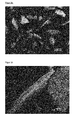
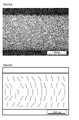
- boron nitride primary particles are predominantly finely dispersed. If such a compound is injection-molded, in particular for thin-walled components, platelet-shaped boron nitride primary particles are largely aligned plane-parallel to the surface of the injection-molding tool and plane-parallel to the component surface. The orientation of the platelet-shaped boron nitride primary particles takes place due to a shear gradient in the injection-molded component between areas near the tool wall and areas remote from the tool wall.
- the alignment of the platelet-shaped boron nitride primary particles in the injection-molded component leads to an anisotropy of the properties, in particular the thermal conductivity.
- the thermal conductivity of thin-walled components with a wall thickness of ⁇ 3 or ⁇ 2 mm in the flow direction of the polymer compound (in-plane) is usually more than four times and up to seven times and more the thermal conductivity through the component wall (through- plane), at fillages of ⁇ 30% by volume.
- the anisotropy in the thermal conductivity of thermoplastic injection molded components is disadvantageous in many applications. For example, the removal of heat through a housing wall with low through-plane thermal conductivity is also low.
- Boron nitride can also be used in the form of agglomerates of platelet-shaped primary particles as a heat-conducting filler in polymers.
- Various processes for the production of boron nitride agglomerates, for example by spray drying, isostatic pressing or pressing and subsequent sintering, are described in US Pat US 2006/0 127 422 A1 .
- WO 2005/021 428 A1 US 5,854,155 and US 6,096,671 ,
- DE 10 2010 050 900 A1 describes a method for producing textured boron nitride agglomerates, in which the boron nitride platelets in the agglomerate have a preferred orientation.
- thermoplastic polymer compounds takes place, for example, by injection molding in an injection molding machine.
- a compound granulate is filled into the injection molding machine, melted and filled under high pressure into the injection mold.
- Typical injection molding parameters are, for example, for a low-viscosity polyamide 6 (eg Schulamid 6 NV12, A. Schulman, Kerpen, Germany) without fillers at a melt temperature of the compound melt of 250 ° -270 ° C., a mold temperature of the injection molding tool of 60 ° -90 ° C. and an injection speed of 250 mm / s.
- a low-viscosity polyamide 6 eg Schulamid 6 NV12, A. Schulman, Kerpen, Germany
- Thermoplastic polymers have a very low thermal conductivity of typically ⁇ 0.3 W / m * K.
- Thermoplastic compounds with the addition of glass fibers or other low thermal conductivity fillers usually also have a low or hardly higher thermal conductivity. Since the solidification of a polymer melt with low thermal conductivity begins only slowly during the mold filling and continues after complete mold filling, low mold temperatures in the injection molding are used to shorten the cycle times for economical production. The low mold temperatures are commonly used in combination with high injection speeds to prevent component failure and achieve long flow paths. Due to the low mold temperature during injection molding, near-fiberglass-containing compounds form near-wall areas with fiber orientation in the flow direction during mold filling, resulting in higher tensile strengths.
- medium and high thermal conductivity polymer boron nitride compounds containing boron nitride agglomerates are processed with these standard injection molding parameters (high injection speed, high melt temperature, low mold temperature), components with comparatively low heat conductivities, in particular low through-plane heat conductivities, are produced.
- comparatively low strengths are achieved with standard injection molding parameters.
- a through-plane thermal conductivity of 1 to ⁇ 2.5 W / m.sup.K and as high heat-conductive a through-plane thermal conductivity of .gtoreq.2.5 W / m.sup.K are referred to as medium thermal conductivity.
- the invention is therefore based on the object, overcoming the disadvantages of the prior art, to provide thermoplastically processable polymer-boron nitride compounds with which process-reliable high through-plane thermal conductivity values and high in-plane thermal conductivity values are obtained in thin-walled components can.
- the invention thus relates to a method for producing a component having a wall thickness of at most 3 mm on at least a part of the component, comprising the step of injection molding by means of an injection molding tool in an injection molding machine using a polymer boron nitride compound, wherein the polymer boron nitride Compound comprises a thermoplastically processable polymer material and a heat conductive filler, wherein the filler comprises platelet-shaped hexagonal boron nitride particles, and wherein the injection rate in injection molding is at most 200 mm / s.
- the invention further relates to a component having a wall thickness of at most 3 mm on at least a part of the component, obtainable by such a method.
- the invention furthermore relates to a component having a wall thickness of at most 3 mm on at least one part of the component, wherein the component is produced by thermoplastic processing of a polymer-boron nitride compound, and wherein the component comprises a thermoplastically processable polymer material and a heat-conducting filler, wherein the filler comprises platelet-shaped hexagonal boron nitride particles.
- the invention further relates to a polymer-boron nitride compound for producing such a component, wherein the polymer-boron nitride compound a thermoplastic polymer material and a heat-conductive filler, wherein the filler comprises platelet-shaped hexagonal boron nitride particles.
- the invention further relates to the use of such a component for heat dissipation of components or assemblies to be cooled, preferably of electronic components or assemblies.
- the polymer-boron nitride compounds according to the invention can overcome the disadvantage of the low through-plane thermal conductivity of injection-molded thin-walled components of polymer-boron nitride compounds.
- the through-plane thermal conductivity is the thermal conductivity measured in the through-plane direction, ie perpendicular to the plate plane.
- the in-plane thermal conductivity is the thermal conductivity measured in the in-plane direction, ie in the plane of the plate.
- polymer-boron nitride compounds can be used with not too high degrees of filling of thermally conductive fillers. It is therefore possible to add further additives and fillers, for example glass fibers, to increase the mechanical stability for further property adaptation of the filled polymer materials, so that total fill levels of ⁇ 50% by volume and for TPE polymers (thermoplastic elastomers) in most common thermoplastic polymers of ⁇ 70% by volume are possible.
- the manufacturing method according to the invention enables a reduction of the fiberglass shear and a advantageous orientation of the glass fibers in the flow direction. With the manufacturing method according to the invention, the tensile strength of injection molded samples could be increased by up to 15% and more compared to samples prepared using standard injection molding parameters.
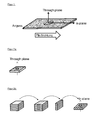
- thermoplastic injection molding layers are formed within the injection-molded part during mold filling.
- edge layer that already solidifies during mold filling, so that the melt does not fill the mold over the entire flow front. Rather, the melt flows through between the solidified edge zones to the flow front.
- shear gradient between near-wall and wall-distant areas, where the shear in the near-wall not yet frozen area is highest.
- the melt flows more slowly into the mold than in the core area.
- Anisotropic fillers such as fibers or platelets, are oriented parallel to the wall surface during mold filling due to the shear rate in areas close to the wall. Within the shear gap close to the wall glass fibers align parallel to the direction of flow.
- Platelet-shaped boron nitride particles align plane-parallel to the wall surface.
- fibers and platelets are oriented transversely to the main flow direction.
- the shape of the respective layers and the degree of orientation in the respective layers influences the anisotropy of the component properties with respect to thermal conductivity and strength.
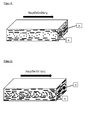
- a pronounced core region leads to a high through-plane thermal conductivity and a relatively low in-plane thermal conductivity.
- the strength is relatively lower in the case of polymer-boron nitride compounds containing glass fibers than in the case of less pronounced core regions.
- edge regions with longitudinal orientation of the fibers parallel to the main flow direction or platelet-shaped thermally conductive particles plane-parallel to the wall surface lead to a relatively high tensile strength in the main flow direction and to a relatively high in-plane thermal conductivity. Both effects, the high in-plane thermal conductivity and the high tensile strength, can occur simultaneously for compounds with platelet-shaped, thermally conductive particles in combination with glass fibers.
- the thickness of the middle layer does not increase with increasing injection speed, but decreases.
- low injection rates lead to the expression thicker middle classes.
- thick middle layers can thus be produced by low injection speeds, which lead to a comparatively increased through-plane thermal conductivity.
- the thickness of the middle layer does not increase as the mold temperature of the injection molding tool increases, which the skilled person would have expected, but that the thickness of the middle layer decreases. Contrary to expectations, the thickness of the middle layer increases as the mold temperature is lowered. Thus, a significant increase in the through-plane thermal conductivity could be determined at comparatively low mold temperatures.
- the through-plane thermal conductivity is the thermal conductivity measured in the through-plane direction, ie perpendicular to the plane of the plate.
- the in-plane thermal conductivity is the thermal conductivity measured in the in-plane direction, ie in the plane of the plate.
- the through-plane thermal conductivity of the components according to the invention and polymer-boron nitride compounds is preferably at least 1 W / m * K, more preferably at least 1.2 W / m * K, more preferably at least 1.5 W / m * K and in particular preferably at least 1.8 W / m * K.
- the thermal conductivity is measured in accordance with DIN EN ISO 22007-4 on disc-shaped injection-molded samples with a thickness of 2 mm.
- the in-plane thermal conductivity of the components according to the invention and polymer boron nitride compounds is preferably at least 1.5 W / m * K, farther preferably at least 1.8 W / m * K, more preferably at least 2.2 W / m * K, and most preferably at least 2.7 W / m * K.
- in-plane thermal conductivity For the measurement of the in-plane thermal conductivity, disk-shaped injection-molded samples with a thickness of 2 mm are stacked on top of each other and glued together. From the thus prepared plate stack, a 2 mm thin sample with the dimensions 2x10 ⁇ 10 mm 3 is prepared parallel to the through-plane direction and perpendicular to the flow direction of the injection-molded plates. The measurement of the in-plane thermal conductivity is carried out according to DIN EN ISO 22007-4 on the thus prepared 2 mm thick sample.
- the through-plane thermal conductivity of the component according to the invention and of the polymer-boron nitride compound is preferably at least 0.8 W / m.sup.-3 K, more preferably at least 1 W / m.sup.-K, more preferably at least 1.3 W / m.sup.2 *. K and in particular preferably by at least 1.6 W / m * K higher than the thermal conductivity of the polymer material without heat-conductive filler.
- the in-plane thermal conductivity of the component according to the invention and of the polymer-boron nitride compound is preferably at least 1.3 W / m.sup.-K, more preferably at least 1.6 W / m.sup.-K, more preferably at least 2.0 W / s. m * K and in particular preferably by at least 2.5 W / m * K higher than the thermal conductivity of the polymer material without heat-conducting filler.
- the proportion of boron nitride in the form of platelet-shaped hexagonal boron nitride particles or boron nitride agglomerates in the component according to the invention and polymer boron nitride compound is preferably at least 5% by volume, more preferably at least 10% by volume, more preferably at least 20% by volume. % and more preferably at least 30% by volume, based on the total volume of the polymer-boron nitride compound.
- the proportion of boron nitride in the form of platelet-shaped hexagonal boron nitride particles or boron nitride agglomerates in the component according to the invention and polymer-boron nitride compound is preferably at most 70% by volume, more preferably at most 60% by volume and particularly preferably at most 50% by volume. %, based on the total volume of the polymer-boron nitride compound.
- thermoplastically processable polymers are used as polymers.
- thermoplastic materials polyamide (PA), polyphenylene sulfide (PPS), polycarbonate (PC), polypropylene (PP), thermoplastic elastomers (TPE), thermoplastic polyurethane elastomers (TPU) and polyetheretherketones (PEEK), liquid crystalline polymers (LCP) and polyoxymethylene (POM).
- PA polyamide
- PPS polyphenylene sulfide
- PC polycarbonate
- PP polypropylene
- TPE thermoplastic elastomers
- TPU thermoplastic polyurethane elastomers
- PEEK polyetheretherketones
- LCP liquid crystalline polymers
- POM polyoxymethylene
- duroplastic molding compositions which can be processed thermoplastically as polymers.
- rubber for example synthetic rubber, which can be thermoplastically processed.
- the component according to the invention and the polymer boron nitride compound contains platelet-shaped hexagonal boron nitride particles which may be present as non-agglomerated primary particles or else in the form of boron nitride agglomerates.
- platelet-shaped hexagonal boron nitride primary particles well-crystalline hexagonal boron nitride powder is used.
- the average particle size d 50 of the well-crystalline hexagonal boron nitride powder is 3 to 50 microns, but it can also be used larger platelets.
- mixtures of different hexagonal boron nitride powders with different particle sizes can be used.
- the measurement of the average particle size (d 50 ) of the boron nitride powder is usually carried out by means of laser diffraction (wet measurement, Mastersizer 2000, Malvern). If non-agglomerated boron nitride particles are used, the aspect ratio of the platelet-shaped hexagonal boron nitride particles, ie the ratio of platelet diameter to platelet thickness, is preferably 10 or more. It can B 2 O 3 -free boron nitride powder and boron nitride powder with lower B 2 O 3 contents of up to 0.5 wt .-%, but also with higher B 2 O 3 contents of up to 10 wt. -% and more are used. It is also possible to use mixtures of powdered or granulated boron nitride.
- the platelet-shaped hexagonal boron nitride particles are used in the form of flaky boron nitride agglomerates.
- These boron nitride agglomerates are agglomerates comprising platelet-shaped hexagonal boron nitride primary particles which are agglomerated with one another to form shingled boron nitride agglomerates.
- These boron nitride agglomerates may also be referred to as flaky boron nitride agglomerates or as boron nitride flakes.
- boron nitride flakes are to be distinguished from non-agglomerated platelet-shaped boron nitride primary particles, which are often referred to in the English literature as "flaky boron nitride particles".
- the scale-shaped boron nitride agglomerates are structured in their structure of many individual boron nitride platelets.
- the platelet-shaped boron nitride primary particles are not randomly oriented in these agglomerates.
- the scale-shaped boron nitride agglomerates comprise platelet-shaped boron nitride primary particles whose platelet planes are aligned parallel to one another.
- the platelet-shaped boron nitride primary particles are agglomerated with each other in such a way that the platelet planes of the boron nitride primary particles are aligned substantially parallel to each other.
- the flaky boron nitride agglomerates have anisotropic properties, since the platelet-shaped boron nitride primary particles are not randomly oriented in these agglomerates.
- the degree of alignment of the platy boron nitride primary particles in the anisotropic flaky boron nitride agglomerates can be characterized by the texture index.
- the texture index of hexagonal boron nitride (hBN) with completely isotropic orientation of the platelet-shaped boron nitride primary particles, ie without preferential orientation, is 1.
- the degree of orientation in the sample that is, the more platelet-shaped boron nitride primary particles with their basal surfaces on one another or parallel are arranged to each other, or the more platelet planes of the boron nitride primary particles are aligned parallel to each other, the texture index increases.
- the texture index of the anisotropic flaky boron nitride agglomerates used for the components according to the invention is preferably at values of greater than 2.0, preferably 2.5 and more, more preferably 3.0 and more, particularly preferably 3.5 and more.
- the texture index of the flaky agglomerates may also have values of 5.0 and more, as well as 10.0 and more.
- the texture index of the flaky boron nitride agglomerates is at values of 200 and less, more preferably at values of 50 and less.
- the determination of the texture index is done by X-ray.
- the ratio of the intensities of the (002) and (100) diffraction reflections measured on X-ray diffraction patterns is determined and divided by the corresponding ratio value for an ideal, non-textured hBN sample.
- This ideal ratio can be determined from the JCPDS data and is 7.29.
- the texture index of the boron nitride agglomerates is measured on a bed of boron nitride agglomerates. The measurement is carried out at 20 ° C.
- the texture index on large scale-shaped single agglomerates of a size of about 3.5 cm 2 (based on the area of the top or bottom of the scale-shaped agglomerates) is determined, so can the texture index very high Values of 100 and more and up to about 500 can be obtained. These values measured on the large flaky agglomerates are evidence of the very strong orientation of the primary particles in the flaky boron nitride agglomerates.
- the texture index values obtained on smaller flaky agglomerates ⁇ 1 mm in size are always lower than the orientation of the primary particles in the single flaky agglomerate.
- the anisotropic flaky boron nitride agglomerates are preferably with a mean agglomerate diameter (d 50 ) of ⁇ 1000 ⁇ m, more preferably ⁇ 500 ⁇ m, more preferably ⁇ 300 ⁇ m, and particularly preferably ⁇ 200 microns used.
- the average agglomerate diameter (d 50 ) of the anisotropic flaky boron nitride agglomerates used in the polymer-boron nitride compounds and the inventive components is preferably ⁇ 20 ⁇ m, more preferably ⁇ 30 ⁇ m, more preferably ⁇ 50 ⁇ m and particularly preferably ⁇ 100 ⁇ m.
- the mean agglomerate diameter (d 50 ) can be determined by means of laser diffraction (wet measurement, Mastersizer 2000, Malvern).
- the average agglomerate diameter corresponds to at least twice the mean particle size of the boron nitride primary particles used in the agglomerate preparation, preferably at least three times the size.
- the mean agglomerate diameter can also be ten times or even fifty times or more the average particle size of the boron nitride primary particles used in the agglomerate production.
- the average particle size of the primary particles (d 50 ) in the anisotropic flaky boron nitride agglomerates is ⁇ 50 ⁇ m, preferably ⁇ 30 ⁇ m, more preferably ⁇ 15 ⁇ m, more preferably ⁇ 10 ⁇ m and particularly preferably ⁇ 6 ⁇ m.
- the thickness of the anisotropic flaky boron nitride agglomerates is ⁇ 500 ⁇ m, preferably ⁇ 200 ⁇ m, more preferably ⁇ 100 ⁇ m, more preferably ⁇ 70 ⁇ m, more preferably ⁇ 50 ⁇ m and particularly preferably ⁇ 35 ⁇ m.
- the thickness is at least 1 ⁇ m, more preferably ⁇ 2 ⁇ m, more preferably ⁇ 3 ⁇ m, and most preferably ⁇ 5 ⁇ m.
- the thickness of the anisotropic flaky boron nitride agglomerates can be determined with a precision digital dial gauge or in a scanning electron microscope (SEM).
- the ratio of the agglomerate diameter to the agglomerate thickness of the flaky boron nitride agglomerates can be determined from scanning electron micrographs (SEM) images by measuring the agglomerate diameter and thickness.
- the aspect ratio of the flaky agglomerates is greater than 1, preferably at values of 2 and greater, more preferably at values of 3 and greater, and most preferably at levels of 5 and greater.
- the anisotropic flaky boron nitride agglomerates are high density boron nitride agglomerates.
- the flaky boron nitride agglomerates which are preferably used for the components according to the invention and boron nitride polymer compounds have surfaces produced directly on their top and bottom sides by the shaping method and not produced by comminution. These surfaces are hereinafter referred to as "forming surfaces".
- the forming surfaces are comparatively smooth, unlike the rough side surfaces (fracture surfaces) of the agglomerates formed by fracturing or crushing steps.
- the surfaces of the flaky boron nitride agglomerates are essentially planar and their top and bottom are largely parallel to one another.
- the proportion of the shaping surface on the total surface of the scale-shaped boron nitride agglomerates is assuming a platelet or flake mold with a round base on average at least 33% (in the event that the diameter of the agglomerates is equal to their height) and assuming a platelet or Scallop with square base also at least 33% (in the case of cube-shaped agglomerates).
- the proportion of the shaping surface on the total surface is significantly higher, for agglomerates with an aspect ratio> 3.0, the proportion is usually between 60 and 95%, for very large agglomerates, the proportion may be even higher.
- the proportion of the shaping surface on the total surface can be reduced, but as a rule the proportion is always at least 10%, preferably at least 20%.
- the flaky boron nitride agglomerates preferably used for the component according to the invention and the polymer-boron nitride compound have a high agglomerate stability.
- Boron nitride agglomerates having a high agglomerate stability are only partially degraded to primary particles or agglomerate fragments under the action of high shear forces, as occur in the compounding of the polymers together with the boron nitride fillers, in particular at high fill levels.
- the advantageous properties of the polymer-boron-tride compound according to the invention, in particular the anisotropy ratio, are maintained despite the partial degradation.
- the stability of the agglomerates can be investigated, for example, in ultrasound examinations with simultaneous measurement of the agglomerate size by means of laser granulometry, the agglomerate decaying over time as a result of the action of the ultrasound.
- the disintegration of the agglomerates is recorded over the temporal change of the agglomerate size, forming depending on the agglomerate stability different curves.
- Soft agglomerates disintegrate faster than mechanically more stable agglomerates.
- boron nitride agglomerates smaller than 200 ⁇ m are crushed and the fine fraction ⁇ 100 ⁇ m is screened off.
- the agglomerate stability is determined on the sieve fraction 100-200 ⁇ m thus obtained by means of a laser granulometer (Mastersizer 2000 with dispersing unit Hydro 2000S, Malvern,dorfberg, Germany).
- a solution of a wetting agent in water mixture of 2 ml of a rinsing agent (G 530 Spülfix, BUZIL factory Wagner GmbH & Co.
- the agglomerate stability of the flaky boron nitride agglomerates preferably used for the novel polymer boron nitride compounds and the components according to the invention is preferably at least 40%, more preferably at least 50% and most preferably at least 60%.
- the agglomerate stability is determined using the ultrasound method described above.
- the specific surface area (BET) of the flaky boron nitride agglomerates preferably used for the novel polymer boron nitride compounds and the components according to the invention is preferably 20 m 2 / g and less, more preferably 10 m 2 / g and less.
- the flaky boron nitride agglomerates which are preferably used for the novel polymer boron nitride compounds and the components according to the invention are free-flowing and readily meterable.
- Boron nitride starting powder in the form of boron nitride primary particles or amorphous boron nitride, to produce the flaky boron nitride agglomerates, optionally mixed with binder phase raw materials, processed in a shaping step into flaky agglomerates and then subjected to a thermal treatment step, a high-temperature annealing, and optionally subsequently comminuted and / or fractionated, the resulting flaky agglomerates.
- Shaped boron nitride agglomerates are shaped by compacting the dry or wetted powder mixture by means of uniaxial pressing or roller compacting.
- the boron nitride starting powder or the powder mixture of boron nitride starting powder and binder phase raw materials is pressed between two rotating counter-rotating rolls.
- contact forces in the nip ⁇ 0.5 kN, preferably of ⁇ 1 kN, more preferably of ⁇ 2 kN, more preferably of ⁇ 3 kN, more preferably of ⁇ 5 kN, more preferably of ⁇ 7 kN and most preferably of ⁇ 10 kN per cm roll gap length set.
- the contact pressure of the rolls has an influence on the density of the anisotropic flaky boron nitride agglomerates.
- boron nitride raw material At high contact pressures, a portion of the boron nitride raw material is amorphized, which recrystallizes in the subsequent high-temperature annealing.
- the preparation of the anisotropic flaky boron nitride agglomerates can also take place when using microstructured rolls.
- the residual moisture of the agglomerates produced can be expelled by drying at about 100 ° C prior to further temperature treatment or nitridation.
- the material compacted into flaky agglomerates is subjected to a thermal treatment step, a high-temperature annealing. If the flaky agglomerates are prepared without addition of binder phase raw materials and only using boron nitride starting powders, ie boron nitride primary particles or amorphous boron nitride, the high temperature annealing of the flaky agglomerates takes place at temperatures of at least 1600 ° C., preferably at least 1800 ° C.
- the resulting flaky agglomerates can then be comminuted and / or fractionated.
- the stability of the anisotropic increases flaky boron nitride agglomerates, as well as the thermal conductivity, measured on thin plates of a thickness of 2 mm, which were prepared from polymer-boron nitride compounds according to the invention using the anisotropic flaky boron nitride agglomerates.
- Boron nitride powders can be used without further additives in the preparation of the anisotropic flaky boron nitride agglomerates and processed into the anisotropic flaky boron nitride agglomerates.
- mixtures of hexagonal boron nitride powder and other powders are used, and thus anisotropic flaky mixed agglomerates of boron nitride and secondary phases are produced ("boron nitride hybrid flakes").
- the further powders added to the hexagonal boron nitride powder for the preparation of the anisotropic flaky agglomerates are binder phase raw materials for producing an inorganic binder phase.
- the hexagonal boron nitride primary particles are bonded to each other by means of an inorganic binder phase as the secondary phase.
- the inorganic binder phase of the anisotropic flaky boron nitride mixed agglomerates comprises at least one carbide, boride, nitride, oxide, hydroxide, metal or carbon.
- the platelet-shaped boron nitride primary particles are not randomly oriented to one another in these flaky mixed agglomerates, as in the binder-phase-free anisotropic flaky boron nitride agglomerates.
- the flaky boron nitride mixed agglomerates comprise platelet-shaped boron nitride primary particles whose platelet planes are aligned parallel to one another.
- the platelet-shaped boron nitride primary particles are agglomerated with each other in such a way that the platelet planes of the boron nitride primary particles are aligned substantially parallel to one another.
- the flaky boron nitride mixed agglomerates have anisotropic properties, since the platelet-shaped boron nitride primary particles are not randomly oriented in these agglomerates.
- the binder phase is located in the anisotropic flaky boron nitride hybrid agglomerates (boron nitride hybrid flakes) between the boron nitride primary particles, it may also be at least partially on the surface of the boron nitride hybrid flakes or cover the surface to a large extent.
- the binder phase binds the boron nitride primary particles in the boron nitride hybrid flakes, so that mechanically more stable agglomerates can be obtained compared to binder-free agglomerates.
- the anisotropic flaky boron nitride mixed agglomerates have a binder phase content of at least 1%, more preferably at least 5%, more preferably at least 10%, even more preferably at least 20% and most preferably at least 30%, based on the total amount the flaky boron nitride agglomerates.
- the high-temperature annealing of the flaky boron nitride agglomerates with inorganic binder phase is carried out at temperatures of at least 1000 ° C.
- the inorganic binder phase of the anisotropic flaky mixed agglomerates comprises at least one nitride and / or oxynitride.
- the nitrides and oxynitrides are preferably compounds of the elements aluminum, silicon, titanium and boron.
- boron nitride mixed agglomerates can also be referred to as anisotropic nitride-bonded boron nitride agglomerates or as anisotropic boron nitride agglomerates with nitridic binder phase.
- the nitrides and oxynitrides contained in the binder phase are aluminum nitride (AIN), aluminum oxynitride, titanium nitride (TiN), silicon nitride (Si 3 N 4 ) and boron nitride (BN), preferably aluminum nitride, aluminum oxynitride, titanium nitride and / or silicon nitride, further preferably contains aluminum nitride and / or aluminum oxynitride.
- the binder phase contains aluminum nitride.
- the nitrides and oxynitrides of the binder phase may be amorphous, semi-crystalline or crystalline.
- the binder phase is preferably crystalline, since it allows higher thermal conductivity values to be achieved in the polymer-boron nitride compounds according to the invention and the components according to the invention.
- the binder phase containing nitrides and / or oxynitrides may additionally also contain oxidic phases, such as, for example, boron oxide (B 2 O 3 ), aluminum oxide (Al 2 O 3 ), silicon dioxide (SiO 2 ), titanium dioxide (TiO 2 ), yttrium oxide (Y 2 O 3 ), magnesium oxide (MgO), calcium oxide (CaO) and rare earth metal oxides.
- oxidic phases such as, for example, boron oxide (B 2 O 3 ), aluminum oxide (Al 2 O 3 ), silicon dioxide (SiO 2 ), titanium dioxide (TiO 2 ), yttrium oxide (Y 2 O 3 ), magnesium oxide (MgO), calcium oxide (CaO) and rare earth metal oxides.
- the binder phase may additionally contain borates, for example aluminum borates or calcium borates.
- the binder phase may still contain impurities, such as carbon, metallic Impurities, elemental boron, borides, boron carbide or other carbides such as silicon carbide.
- the proportion of nitrides and oxynitrides in the binder phase is preferably at least 50 wt .-%, more preferably at least 80 wt .-%, based on the total amount of the binder phase.
- the binder phase contains aluminum nitride, silicon nitride or titanium nitride or mixtures thereof in a proportion of ⁇ 50 wt .-% based on the total amount of the binder phase.
- the binder phase particularly preferably comprises aluminum nitride, preferably in a proportion of ⁇ 90% by weight, based on the total amount of the binder phase.
- metal powders are preferably used which are converted by direct nitridation into the corresponding metal nitride or into an oxynitride or into mixtures of metal nitrides and oxynitrides.
- the metal powders used are preferably aluminum, silicon or titanium powders or mixtures thereof. Particular preference is given to using aluminum powder.
- the metal is converted to the corresponding metal nitride. It is also possible that oxynitrides or mixtures of metal nitrides and oxynitrides are formed in the nitridation.
- metal compounds used are preferably compounds of the elements aluminum, silicon and titanium, preferably oxides and / or hydroxides such as, for example, aluminum oxide (Al 2 O 3 ), aluminum hydroxide (Al (OH) 3 ), boehmite (AIOOH), silicon dioxide (SiO 2 ). and titanium dioxide (TiO 2 ). Borates, for example aluminum borate, can furthermore be used as metal compounds.
- a reducing agent carbon and hydrogen and organic compounds such as polyvinyl butyral (PVB), melamine and methane can be used. If gaseous substances such as, for example, hydrogen or methane are used as reducing agents, these substances are added to the nitriding atmosphere.
- the reducing agent necessary for the reduction can already be present in the metal compound, so that the use of additional reducing agents is unnecessary, for example when using aluminum isopropoxide, tetraethyl orthosilicate or titanium isopropoxide as a binder raw material.
- the metal compounds become the corresponding ones Metal nitrides implemented. It is also possible that oxynitrides or mixtures of metal nitrides and oxynitrides are formed in the nitridation, and the binder phase may also contain residues of unreacted oxides.
- educts for producing boron nitride can be an oxidic boron source such as boric acid (H 3 BO 3 ) and boron oxide (B 2 O 3 ) in combination with a reducing agent such as carbon or hydrogen or organic compounds such as polyvinyl alcohol (PVA), polyvinyl butyral (PVB). , Melamine and methane.
- oxidic boron source such as boric acid (H 3 BO 3 ) and boron oxide (B 2 O 3 )
- a reducing agent such as carbon or hydrogen
- organic compounds such as polyvinyl alcohol (PVA), polyvinyl butyral (PVB).
- gaseous substances such as, for example, hydrogen or methane are used as reducing agents, these substances are added to the nitriding atmosphere.
- essentially oxygen-free boron sources such as, for example, elemental boron, boron carbide and trimethylborate, as starting materials for the production of boron nitride. In the nitriding step, these raw materials are converted to hexagonal boron nitride.
- nitridic binder phase raw materials for producing the nitridic binder phase of the anisotropic nitride-bonded boron nitride agglomerates it is also possible to use nitridic materials which solidify during the temperature treatment in the nitriding atmosphere.
- the nitridic material may be a nitride and / or oxynitride compound of aluminum and silicon, titanium nitride and the rare earth nitrides may also be used, as well as compounds of the sialone group.
- liquid phases such as yttrium oxide, alumina, magnesia, calcia, silica and rare earth oxides can be used.
- boron nitride starting powder for the production of the anisotropic flaky boron nitride agglomerates hexagonal boron nitride, amorphous boron nitride, partially crystalline boron nitride, and mixtures thereof can be used.
- the mean particle size d 50 of the boron nitride powder used may be 0.5-50 ⁇ m, preferably 0.5-15 ⁇ m, more preferably 0.5-5 ⁇ m.
- hexagonal boron nitride powders having an average particle size of 1 .mu.m, 3 .mu.m, 6 .mu.m, 9 .mu.m and 15 .mu.m can be used, but also higher average particle sizes of up to 50 .mu.m are possible.
- mixtures of different hexagonal boron nitride powders with different particle sizes can be used.
- the average particle size (d 50 ) of the boron nitride powders used is usually measured by means of laser diffraction (wet measurement, Mastersizer 2000, Malvern).
- B 2 O 3 -free boron nitride powder and boron nitride powder with lower B 2 O 3 contents of up to 0.5 wt .-%, but also with higher B 2 O 3 contents of up to 10 wt. -% and more are used. It is also possible to use mixtures of powdered or granulated boron nitride.
- the binder phase raw materials may be in solid or liquid or pasty form.
- the mixing of boron nitride starting powder and binder phase raw materials can be done, for example, in a mixing drum, in a V mixer, Röhnradmischer, a vibrating mill or a Eirichmischer.
- the homogeneity can be further increased in a subsequent milling step (e.g., beater mill, drum mill, stirred ball mill).
- the powder mixture can be dry or moistened.
- the addition of pressing aids and possibly slip aids is also possible.
- the mixing can also be wet, for example if the subsequent production of the granules takes place via spray-drying or build-up granulation.
- the material compacted into flaky agglomerates is then subjected to high temperature annealing in a nitriding atmosphere at temperatures of at least 1600 ° C, preferably at least 1800 ° C.
- the nitriding atmosphere preferably comprises nitrogen and / or ammonia.
- the Nitridieratmospotrore additionally contains argon. After reaching the maximum temperature, a holding time of up to several hours or days can be inserted.
- the temperature treatment can be carried out in a continuous or in a batch process.
- the temperature treatment in the Nitridieratmospreheat creates a nitridic binder phase as a secondary phase, which connects the boron nitride primary particles together.
- the degree of crystallization of the primary particles may increase, which is associated with primary particle growth.
- the balance of unconverted raw materials in the binder phase in the nitriding in the anisotropic nitride bonded boron nitride mixed agglomerates is preferably ⁇ 10%, more preferably ⁇ 5%, more preferably ⁇ 3%, and most preferably ⁇ 2%.
- the contamination with oxygen is preferably ⁇ 10%, more preferably ⁇ 5%, more preferably ⁇ 2%, and particularly preferably ⁇ 1%.
- the material compacted into flaky agglomerates is preferably added to a temperature treatment before the high-temperature treatment subjected to a temperature of at least 700 ° C in a Nitridieratmospotrore, wherein the temperature of this first temperature treatment is below the temperature of the high temperature treatment.
- the NitridieratmospPSre this Vornitrid ist preferably comprises nitrogen and / or ammonia.
- the Nitridieratmosptude additionally contains argon.
- the degree of crystallization of the boron nitride primary particles contained in the flaky boron nitride mixed agglomerates increases, and the oxygen content and the specific surface area of the boron nitride primary particles contained decrease.
- the defined comminution of the agglomerates can also be carried out by means of screens, classifier mills, structured roll crushers and cutting wheels. A grinding, for example in a ball mill is possible. The several millimeters to several centimeters large agglomerates are processed in a further process step to defined agglomerate sizes. For this purpose, for example, commercial sieves of different mesh size and sieve aids can be used on a vibrating screen. A multi-stage sieve / sieve comminution process has proved to be advantageous.
- the surface treatments listed can also be carried out for mixtures of anisotropic nitride bonded boron nitride agglomerates with other boron nitride fillers such as boron nitride primary particles.
- the treatments can be carried out, for example, in the fluidized bed process.
- the anisotropic nitride-bound boron nitride agglomerates have excellent mechanical stability.
- the mechanical stability of the boron nitride agglomerates is of importance, since they endure the filling, transport, metering, compounding, ie the further processing of the boron nitride agglomerates into polymer boron nitride compounds and the subsequent shaping via injection molding, if possible with only slight decomposition have to.
- the boron nitride agglomerates in Compounding decompose, there is a risk that the rheological properties of the polymer-boron nitride compounds deteriorate and the thermal conductivity in the components made from the compounds decreases, especially in injection-molded thin plates in the through-plane direction. There is the risk that the boron nitride agglomerates degrade to such an extent that the thermal conductivity in the through-plane direction drops so low that it drops to a comparable level to a polymer compound produced using boron nitride primary particles.
- the thermal conductivity in the boron nitride polymer compounds according to the invention is not as much direction-dependent as in boron nitride polymer compounds prepared using platelet-shaped boron nitride primary particles.
- the anisotropic flaky boron nitride agglomerates and the anisotropic nitride-bonded boron nitride agglomerates have such high strength that they survive the compounding process with a polymer melt in a large number and size.
- the anisotropic flaky boron nitride agglomerates and the flaky boron nitride agglomerates with inorganic binder phase are stable enough for use in the compounding and injection molding of thin plates with a wall thickness of about 2 mm.
- mixtures with abrasive secondary fillers are possible by adjustability or increasing the stability of the flaky boron nitride agglomerates with inorganic binder phase.
- conventional boron nitride agglomerates are degraded.
- the degradation is reduced to such an extent that the advantageous heat conduction properties can be obtained.
- a further advantage is that the stability of the flaky boron nitride agglomerates with inorganic binder phase can be adjusted by increasing the binder phase content, especially at high filler contents in which the melt viscosity in the thermoplastic processing is high and thus high shear of the filler takes place Processing high filler contents or high levels of filler mixtures is possible.
- the component according to the invention and the polymer boron nitride compound can also contain, in addition to boron nitride in the form of platelet-shaped hexagonal boron nitride particles or boron nitride agglomerates as heat-conducting filler, at least one boron nitride-different filler which increases the thermal conductivity.
- additional fillers are also referred to below as secondary fillers.
- the thermal conductivity of such secondary fillers is usually ⁇ 5 W / m * K, preferably ⁇ 8 W / m * K.
- the total amount of boron nitride in the form of boron nitride agglomerates or platelet-shaped hexagonal boron nitride particles and the secondary fillers in the component and polymer boron nitride compound according to the invention is preferably at least 20% by volume, more preferably at least 30% by volume, based in each case on the Total volume of the polymer boron nitride compound.
- the total amount of boron nitride in the form of boron nitride agglomerates or platelet-shaped hexagonal boron nitride particles and secondary fillers in the component according to the invention and polymer boron nitride compound is preferably not more than 70% by volume, more preferably not more than 60% by volume, in each case based on the total volume of Polymer boron nitride compounds.
- the total amount of boron nitride in the form of boron nitride agglomerates or platelet-shaped hexagonal boron nitride particles and secondary fillers in the component and polymer boron nitride compound according to the invention is at most 50% by volume, in each case based on the total volume of the polymer boron nitride compound.
- Metal powders and alloys preferably selected from the group comprising aluminum, silicon, titanium, copper, iron and bronze powders and mixtures thereof, can be used as secondary fillers.
- ceramic fillers such as oxides, nitrides and carbides can also be used as secondary fillers, preferably selected from the group comprising aluminum oxide, magnesium oxide, aluminum nitride, silicon dioxide, silicon carbide, silicon nitride and mixtures thereof, particularly preferably aluminum oxide, magnesium oxide and / or aluminum nitride.
- Mineral fillers may also be used as secondary fillers, preferably selected from the group comprising aluminosilicates, aluminum silicates, magnesium silicate (2MgO * SiO 2 ), magnesium aluminate (MgO * Al 2 O 3 ), brucite (magnesium hydroxide, Mg (OH) 2 ), quartz, Cristobalite and mixtures thereof.
- alumosilicates or aluminum silicates for example, kyanite (Al 2 SiO 5 ) and / or mullite (3Al 2 O 3 * 2SiO 2 ) can be used.
- a combination of anisotropic nitride-bonded boron nitride agglomerates, aluminosilicate and expanded graphite as heat-conducting fillers has proven particularly advantageous in the component according to the invention and in the polymer boron nitride compound.
- the secondary fillers are preferably particulate.
- the secondary filler particles may be irregular, brocked or spherical or platelet-shaped in shape.
- the proportion of platelet-shaped secondary fillers in the component according to the invention and polymer-boron nitride compound is preferably not more than 10% by volume, more preferably not more than 5% by volume.
- the secondary fillers preferably have a particle diameter or platelet diameter of ⁇ 0.5 ⁇ m, more preferably 1 ⁇ m, more preferably 2 ⁇ m, and particularly preferably 5 ⁇ m.
- the secondary filler is present as a powder, preferably as an agglomerated powder.
- the agglomeration of the secondary filler can be carried out by roll compaction or by built-up granulation, for example in an Eirich mixer.
- a PVA solution can be used.
- the secondary filler granules are blended with the boron nitride filler prior to metering during compounding in the extruder. Prior to blending the secondary filler granules with the boron nitride filler, the secondary filler granules are dried. The granulation of the secondary filler supports the uniform dosage during compounding.
- the anisotropic flaky boron nitride agglomerates are used in combination with secondary fillers.
- the thermal conductivity of the components according to the invention and polymer boron nitride compounds with filler combinations of flaky boron nitride agglomerates and secondary fillers is higher than the polymer compounds produced solely by using the secondary fillers, in each case with the same total volume fraction of fillers.
- the thermal conductivity values of the polymer-boron nitride compounds produced by the filler combinations according to the invention are higher than would have been expected if the thermal conductivity values for those with the corresponding proportions of boron nitride were Agglomerates and secondary fillers each individually filled polymer materials, each minus the thermal conductivity of the unfilled base polymer, added. This is true for both in-plane and through-plane thermal conductivity.
- the components according to the invention and polymer boron nitride compounds may additionally contain boron nitride primary particles in addition to the flaky boron nitride agglomerates which are preferably used.
- the polymer boron nitride compounds prepared using boron nitride agglomerate and secondary filler filler combinations may also be added Boron nitride primary particles are added.
- Boron nitride powders can be used as boron nitride primary particles, but also unstable boron nitride agglomerates, such as, for example, spray-dried boron nitride agglomerates, which are degraded substantially or completely to primary particles during compounding.
- the proportion of additional boron nitride primary particles in the polymer-boron nitride compound according to the invention is preferably ⁇ 20% by volume, more preferably ⁇ 10% by volume.
- the components and polymer boron nitride compounds according to the invention may also contain other fillers which differ from boron nitride and have a lower thermal conductivity of ⁇ 5 W /. m * K such as talc.
- the components according to the invention and polymer-boron nitride compounds may, in addition to the heat-conductive fillers, also contain additional additives and fillers which perform other functions, such as the adaptation of the mechanical or electrical properties or the thermal expansion coefficient.
- the fillers can be present, for example, as brocked, spherical, platelet-shaped, fibrous or as particles with random morphology.
- glass fibers can be used in order to improve the mechanical properties, in particular the strength.
- Commercially available glass fibers can be used to reinforce thermoplastic polymers.
- the glass fibers may also contain surface modifiers.
- the diameter of the glass fibers for example, 14 microns, the length of the glass fibers may be 4.5 mm, for example. Other diameters and lengths are possible.
- the content of glass fibers in the polymer-boron nitride compounds is preferably 5 to 40% by volume.
- the polymer-boron nitride compounds according to the invention can be prepared by compounding with all common compounding units. These include, but are not limited to, single screw extruders, twin screw extruders, tangential or close-meshed, equal or counter-rotating, planetary roller extruder, grooved roller extruder, pin extruder, calendering, Buss co-kneader, shear roller extruder and injection molding machines. Compounding in the twin-screw extruder is preferred.
- the polymer used for compounding can be present in powder form or as granules.
- the polymer may be dry premixed with the boron nitride agglomerates or the boron nitride agglomerates and other fillers before the mixture is fed to a compounding unit.
- the addition of the boron nitride agglomerates and optionally other fillers via side doses in the polymer melt can be done without the fillers are previously premixed with the polymer.
- masterbatches ie polymer compounds with a high filler content, can be produced and granule mixtures of the masterbatches can be injection-molded in an injection molding machine.
- the compounding of the polymer-boron nitride compounds according to the invention is preferably carried out under the gentlest possible conditions. Preferably, at most 50% of the maximum flow rate of the extruder should be adjusted.
- the screw speed should preferably be at most 300 rpm.
- the filled polymer melt is granulated.
- the granulation of the polymer-boron nitride compound can be carried out, for example, by strand granulation, underwater granulation, hot stamping or cold cutting. It is also possible to combine the methods for processing the compound.
- the resulting polymer-boron nitride compound in granular form can be further processed by molding processes such as injection molding into components.
- the components according to the invention are produced by thermoplastic processing of the polymer boron nitride compounds.
- the polymer boron nitride compounds can be formed into any desired shape by injection molding, extrusion, calendering or injection compression, preferably by injection molding or extrusion. Injection molding is particularly preferred.
- the compound granules or compound granules mixture of masterbatches can be melted in a hydraulically or electromechanically driven plasticizing unit and, if appropriate still be homogenized with further additional fillers or polymers until it leaves the nozzle. Subsequently, the melt can be injected during the injection phase in the closed mold of an injection molding plant. Both classic injection molds and tools with hot runner systems can be used here.
- the holding pressure can be kept constant until complete solidification of the component.
- the tool can be opened and the component ejected.
- the ejection can in turn be done via the ejector unit of the injection molding machine or other removal options such as robot arms.
- the components according to the invention are, as stated above, produced by a method comprising the step of injection molding by means of an injection molding tool in an injection molding machine using a polymer-boron nitride compound according to the invention, wherein the injection rate is ⁇ 200 mm / s.
- the injection speed is ⁇ 175 mm / s, and more preferably, ⁇ 150 mm / s.
- the injection speed is ⁇ 200 mm / s, preferably ⁇ 175 mm / s, more preferably ⁇ 150 mm / s, more preferably ⁇ 125 mm / s, further preferably ⁇ 100 mm / s, more preferably ⁇ 80 mm / s and especially preferably ⁇ 70 mm / s.
- the melt temperature of the compound melt in the injection molding machine is preferably chosen to be at least 10 ° C, more preferably at least 20 ° C and especially preferably at least 30 ° C above the melting temperature of the polymer material without heat-conductive filler.
- the melt temperature of the compound melt in the injection molding machine is preferably at most 60 ° C, more preferably at most 50 ° C and particularly preferably at most 40 ° C above the melting temperature of the polymer material without heat-conductive filler.
- the mold temperature of the injection molding tool is preferably adjusted to be at least 30 ° C, more preferably at least 60, for compounds that do not contain glass fibers and have a thermal conductivity of 1 W / m * K to ⁇ 2.5 W / m * K ° C and especially preferably at least 90 ° C below the measured at 0.45 MPa according to DIN EN ISO 75-1 / -2 measured heat distortion temperature of the polymer material without heat conductive filler.
- the mold temperature of the injection molding tool is preferably at most 120 ° C. and more preferably at most 100 ° C. below the heat distortion temperature of 0.45 MPa of DIN EN ISO 75-1 / -2 of the polymer material without heat-conductive filler.
- the melt temperature of the compound melt in the injection molding machine is preferably at least 229 ° C., more preferably at least 239 ° C, more preferably at least 249 ° C.
- the melt temperature of the compound melt with polyamide 6 is preferably not more than 279 ° C., more preferably not more than 269 ° C., more preferably not more than 259 ° C.
- the mold temperature of the injection molding tool is preferably at most 160 ° C, more preferably at most 130 ° C, more preferably at most 110 ° C, and it is preferably at least 70 ° C, more preferably at least 90 ° C.
- Polyamide 6 has a melting point of 219 ° C., the heat distortion temperature of polyamide 6 measured at 0.45 MPa according to DIN EN ISO 75-1 / -2 is 190 ° C.
- the injection rate during injection molding is ⁇ 200 mm / s, preferably ⁇ 175 mm / s preferably ⁇ 150 mm / s, more preferably ⁇ 125 mm / s, more preferably ⁇ 100 mm / s, more preferably ⁇ 80 mm / s, and particularly preferably ⁇ 70 mm / s.
- melt temperature of the compound melt in the injection molding machine a temperature which is at least 10 ° C, more preferably at least 20 ° C above the melting temperature of the polymer material without heat-conductive filler.
- the melt temperature of the compound melt in the injection molding machine is preferably at most 60 ° C, more preferably at most 50 ° C and more preferably at most 40 ° C and most preferably at most 35 ° C above the melting temperature of the polymer material without heat-conductive filler.
- the mold temperature of the injection molding tool is preferably adjusted to be at least 5 ° C, more preferably at least 10 ° C below that at 0.45, for compounds that do not contain glass fibers and have a thermal conductivity of ⁇ 2.5 W / m * K MPa according to DIN EN ISO 75-1 / -2 measured heat distortion temperature of the polymer material without heat-conductive filler is.
- the mold temperature of the injection molding tool is preferably at most 70 ° C., more preferably at most 50 ° C. and particularly preferably at most 40 ° C. below the heat distortion temperature of the polymer material without thermally conductive filler measured at 0.45 MPa according to DIN EN ISO 75-1 / -2.
- the melt temperature of the compound melt in the injection molding machine is preferably at least 229 ° C., more preferably at least 239 ° C.
- Melt temperature of the compound melt with polyamide 6 preferably at a maximum of 279 ° C, more preferably at a maximum of 269 ° C, more preferably at a maximum of 254 ° C.
- the mold temperature of the injection molding tool is preferably at most 185 ° C and more preferably at most 180 ° C, and it is preferably at least 120 ° C, more preferably at least 140 ° C, particularly preferably at least 150 ° C.
- a pre-sample can be prepared to determine the through-plane thermal conductivity range.
- the injection rate during injection molding is ⁇ 200 mm / s, preferably ⁇ 175 mm / s and particularly preferably ⁇ 150 mm / s.
- the injection rate for glass fiber-containing polymer-boron nitride compounds is preferably at least 50 mm / s, more preferably at least 70 mm / s.
- the melt temperature of the compound melt in the injection molding machine is preferably chosen to be at least 10 ° C., more preferably at least 20 ° C., and in particular preferably at least 30 ° C above the melting temperature of the polymer material without thermally conductive filler.
- the melt temperature of the compound melt in the injection molding machine is preferably at most 60 ° C, more preferably at most 55 ° C above the melting temperature of the polymer material without heat-conductive filler.
- the mold temperature of the injection molding tool for glass fiber-containing compounds is preferably adjusted so that it is at least 5 ° C, more preferably at least 10 ° C below measured at 0.45 MPa according to DIN EN ISO 75-1 / -2 heat distortion temperature of the polymer material without heat conductive filler ,
- the mold temperature of the injection molding tool is preferably at most 40 ° C., more preferably at most 30 ° C. and particularly preferably at most 25 ° C. below the heat deflection temperature of the polymer material measured at 0.45 MPa according to DIN EN ISO 75-1 / -2 without thermally conductive filler.
- the melt temperature of the compound melt in the injection molding machine is preferably at least 229 ° C., more preferably at least 239 ° C., more preferably at least 249 ° C.
- the melt temperature of the compound melt with polyamide 6 is preferably at most 279 ° C., more preferably at most 274 ° C.
- the mold temperature of the injection molding tool is preferably at most 185 ° C, more preferably at most 180 ° C, and it is preferably at least 150 ° C, more preferably at least 160 ° C and particularly preferably at least 165 ° C.
- the components according to the invention are used for heat dissipation of components or assemblies to be cooled, preferably of electronic components or assemblies.
- the components of the invention contain thin-walled components, can be dissipated by the heat of components or assemblies to be cooled.
- the thin-walled parts of the component have a thickness of ⁇ 3 mm, preferably ⁇ 2 mm.
- the component according to the invention may, for example, be in the form of a thin plate having a thickness of ⁇ 3 mm, preferably ⁇ 2 mm, which may be produced, for example, by means of injection molding or extrusion as a shaping method.
- the components according to the invention may be electrically conductive or electrically insulating.
- the component according to the invention can be provided with a coating after the shaping, for example by means of injection molding, for example, a metallization can be carried out. It is also possible to apply printed conductors.
- the component according to the invention can be present as a flat or curved plate with uniform or non-uniform wall thickness.
- the surface of the component according to the invention may be planar or structured.
- the component according to the invention can serve as a carrier plate for electronic components, or transfer heat from one component to another.
- the component according to the invention can also be present as a foil or as a thin-walled tube.
- the component according to the invention can also be present as a thin-walled essential component of a predominantly thin-walled housing, a holder or a connecting element or a tube.
- the component according to the invention may be present as a cooling fin as part of a heat sink, a housing, a holder, a connecting element or tube, wherein the holder may be, for example, a lamp cap.
- the component according to the invention can be part of a plate stack in more complex components as a plate, wherein the plate can serve as a cooling rib in the plate stack.
- a twin-screw extruder ZSE 18 maxx (Leistritz, Nuremberg, Germany) is used.
- the comparatively rugged screw configuration "standard” with two mixing elements and six kneading blocks (screw configuration 1)
- the gentler screw configuration "soft” with three mixing elements and without kneading block (screw configuration 2).
- the screw speeds are set at 300 rpm and 900 rpm.
- polymer is a polyamide PA 6 (Schulamid ® 6 NV 12) is used. During compounding, the polymer melt is heated to 265.degree.
- the throughput is set to 6 kg / h in all tests.
- the polymer is supplied via the main metering.
- the filler boron nitride agglomerates
- the filler mixture boron nitride agglomerates and secondary fillers
- the filler-containing polymer melt is discharged through two 3 mm nozzles, cooled in the form of strands and processed in a shredder into granules. From the granules, 2 mm thin plates with a base area of 80 ⁇ 80 mm 2 are produced by injection molding.
- the sprue is drawn over the entire sample width. It should have a thickness of 1 - 1.8 mm, preferably 1.3 - 1.7 mm. In the following examples, the thickness of the gate is 1.3 mm.
- a force of 75 kN is applied to the rolls, which corresponds to 3 kN / cm roll gap length and sets a roll speed of 20 rpm.
- Green bonded (ie compacted but not yet heat treated) boron nitride hybrid flakes adhering to the rollers are peeled off by a scraper.
- the fine fraction ⁇ 200 microns is screened after compaction and fed in the next raw material homogenization with 4000 g of aluminum paste and 7000 g of boron nitride powder S1 in PE barrel.
- the process is repeated until a total of 55 kg of boron nitride hybrid flakes is produced were.
- the boron nitride hybrid flakes are debindered in an atmosphere of 80% nitrogen and 20% argon at 300 ° C with exclusion of air and the aluminum content in the boron nitride hybrid flakes is 800 ° C in an atmosphere of 80% nitrogen and 20% Argon converted to AIN for the most part during a 5 hour hold. This is followed by a high-temperature annealing at 2050 ° C for 2 hours in an atmosphere of 80% nitrogen and 20% argon.
- the total aluminum content in the boron nitride hybrid flakes is 24.6% by weight as measured by alkaline melt digestion and ICP-OES (Arcos, Spectro, Kleve, Germany). Calculated results from the aluminum content, an aluminum nitride content in the boron nitride hybrid flake of 37 wt .-%.
- the aluminum-free content is 0.35 wt .-%.
- the aluminum-free content is measured by extraction with 2 molar HCl for 16 h at room temperature. On the clear supernatant from the extraction of the aluminum content of the solution with ICP-OES (Arcos, Spectro, Kleve, Germany) is determined.
- the carbon content is 0.05%, it is measured indirectly by combustion in oxygen in the induction furnace and subsequent IR measurement of CO 2 (CS200, LECO, Mönchengladbach, Germany).
- the specific surface area is measured according to ISO 18757 by means of nitrogen adsorption and the 5-point BET method on the SA3100 device (Coulter, USA). The sample is baked in a vacuum at 300 ° C. for 360 minutes before the measurement. The specific surface area is 6.8 m 2 / g.
- the oxygen content is measured indirectly by means of carrier gas heat extraction, wherein the oxygen from the sample is reacted with carbon and the content of resulting CO 2 is determined by IR spectroscopy (TCH 600, LECO, Mönchengladbach, Germany). The oxygen content is 0.15%.
- X-ray analysis shows only the phases boron nitride and aluminum nitride.
- the boron nitride hybrid flakes are screened in a vibrating screen with rubber balls. Sieves are used in the order 5 mm, 2 mm, 1 mm, 500 ⁇ m.
- the boron nitride hybrid flakes obtained in the sieve fraction ⁇ 500 ⁇ m have an average particle size (d 50 ) of 192 ⁇ m, measured by means of laser diffraction (Mastersizer 2000, Malvern, wet measurement).
- the thickness of the boron nitride hybrid flakes is 30 ⁇ m. The thickness is determined with a precision digital dial gauge.
- the texture index measured on a bed of boron nitride hybrid flakes, is 20.6.
- a fraction ⁇ 200 ⁇ m is broken and the fine fraction ⁇ 100 ⁇ m is separated by sieving.
- the sieve fraction 100-200 ⁇ m of the boron nitride hybrid flakes thus obtained the agglomerate stability is determined by the ultrasonic method.
- the agglomerate stability determined on the boron nitride hybrid flakes is 75%.
- FIG. 3 a shows a fracture surface of an agglomerate with a thickness of 30 microns, the planar shaping surface of this agglomerate and the planar shaping surface of another agglomerate.
- the compound granulate from Example 1 b) is injection-molded in an injection molding machine (Krauss Maffei KM80-220C2) into 2 mm thin plates with the dimensions 80 ⁇ 80 ⁇ 2 mm 3 .
- the screw speed during plasticizing is 80 rpm.
- the injection speed during injection molding is 20 mm / s, the injection pressure 780 bar, the pressure 260 bar, the mold temperature of the injection mold 90 ° C and the melt temperature of the compound melt 250 ° C.
- the thermal conductivity is measured on disk-shaped injection-molded samples with a thickness of 2 mm, the sample prepared for the measurement of through-plane thermal conductivity from the center of an injection-molded plate of thickness 2 mm (dimensions 2x80x80 mm 3 ) with dimensions 2x10x10 mm 3 becomes.
- the thickness of the sample for the thermal conductivity measurement corresponds to the plate thickness from the injection molding.
- a plate stack of injection-molded 2 mm thin plates is glued with superglue and from the thus prepared plate stack is parallel to the through-plane direction and perpendicular to the flow direction of the injection-molded samples, a 2 mm thin plate with the dimensions 2x10x10 mm 3 prepared.
- the in-plane thermal conductivity is determined on this sample.
- the laser flash method is used and performed with the Nanoflash LFA 447 (Netzsch, Selb, Germany) according to DIN EN ISO 22007-4. The measurement takes place at 22 ° C.
- the measurement of a and c p is carried out with the Nanoflash LFA 447 (Netzsch, Selb, Germany) on the samples of size 10 ⁇ 10 ⁇ 2 mm 3 prepared as described above.
- the density is determined by weighing and determining the geometric dimensions of the exactly shaped samples.
- Pyroceram 9606 is used for the measurement.
- the thermal conductivity of 80x80x2 mm 3 determined on an injection-molded thin plate of dimensions for the unfilled polymer PA 6 (Schulamid ® 6 NV 12) is 0.26 W / m * K.
- Example 1 The preparation of the boron nitride hybrid flakes and the compounding carried out according to Example 1.
- the injection molding is carried out as described in Example 1, but with an injection speed of 70 mm / s.
- the injection pressure is 700 bar, the holding pressure 230 bar.
- thermal conductivity measurements are carried out as described in Example 1.
- the injection molding parameters and the results of the thermal conductivity measurements are listed in Table 1.
- Example 1 The preparation of the boron nitride hybrid flakes and the compounding are carried out according to Example 1.
- the injection molding is carried out as described in Example 1, but with an injection rate of 120 mm / s.
- the injection pressure is 765 bar, the negative pressure 255 bar.
- thermal conductivity measurements are carried out as described in Example 1.
- the injection molding parameters and the results of the thermal conductivity measurements are listed in Table 1.
- the production of the boron nitride hybrid flakes and the compounding are carried out according to Example 1.
- the injection molding is carried out as described in Example 1, but with a mold temperature of 150 ° C.
- the injection pressure is 820 bar, the back pressure 260 bar.
- thermal conductivity measurements are carried out as described in Example 1.
- the injection molding parameters and the results of the thermal conductivity measurements are listed in Table 1.
- Example 1 The preparation of the boron nitride hybrid flakes and the compounding carried out according to Example 1.
- the injection molding is carried out as described in Example 1, but with an injection speed of 120 mm / s and a mold temperature of 150 ° C.
- the injection pressure is 640 bar, the negative pressure 255 bar.
- thermal conductivity measurements are carried out as described in Example 1.
- the injection molding parameters and the results of the thermal conductivity measurements are listed in Table 1.
- the preparation of the boron nitride hybrid flakes is carried out according to Example 1.
- the compounding is carried out according to Example 1, wherein 1.84 kg / h of PA 6 on the main dosage and 4.16 kg / h of boron nitride hybrid flakes from the sieve fraction ⁇ 500 ⁇ m are incorporated via the side dosing.
- the injection molding is carried out as described in Example 1, but with an injection speed of 70 mm / s and a mold temperature of 150 ° C.
- the injection pressure is 1270 bar, the holding pressure 425 bar.
- thermal conductivity measurements are carried out as described in Example 1.
- the injection molding parameters and the results of the thermal conductivity measurements are listed in Table 1.
- Example 6 The preparation of the boron nitride hybrid flakes and the compounding carried out according to Example 6.
- the injection molding is carried out as described in Example 6, but with an injection rate of 120 mm / s.
- thermal conductivity measurements are carried out as described in Example 1.
- the injection molding parameters and the results of the thermal conductivity measurements are listed in Table 1.
- Example 6 The preparation of the boron nitride hybrid flakes and the compounding are carried out according to Example 6.
- the injection molding is carried out as described in Example 6, but with a mold temperature of 175 ° C.
- the thermal conductivity measurements are carried out as described in Example 1.
- the injection molding parameters and the results of the thermal conductivity measurements are listed in Table 1.
- the production of the boron nitride hybrid flakes and the compounding are carried out according to Example 6.
- the injection molding is carried out as described in Example 6, but with an injection rate of 120 mm / s and a mold temperature of 175 ° C.
- thermal conductivity measurements are carried out as described in Example 1.
- the injection molding parameters and the results of the thermal conductivity measurements are listed in Table 1.
- Example 6 The preparation of the boron nitride hybrid flakes and the compounding carried out according to Example 6.
- the injection molding is carried out as described in Example 6, but with an injection rate of 20 mm / s, a mold temperature of 175 ° C. and a melt temperature of 265 ° C.
- the injection pressure is 1300 bar, the holding pressure 425 bar.
- thermal conductivity measurements are carried out as described in Example 1.
- the injection molding parameters and the results of the thermal conductivity measurements are listed in Table 1.
- Example 6 The preparation of the boron nitride hybrid flakes and the compounding carried out according to Example 6.
- the injection molding is carried out as described in Example 6, but with a mold temperature of 175 ° C and a melt temperature of 265 ° C.
- the injection pressure is 1300 bar, the holding pressure 425 bar.
- thermal conductivity measurements are carried out as described in Example 1.
- the injection molding parameters and the results of the thermal conductivity measurements are listed in Table 1.
- Example 6 The preparation of the boron nitride hybrid flakes and the compounding carried out according to Example 6.
- the injection molding is carried out as described in Example 6, but with an injection rate of 120 mm / s, a mold temperature of 175 ° C and a melt temperature of 265 ° C.
- the injection pressure is 1290 bar, the holding pressure 425 bar.
- thermal conductivity measurements are carried out as described in Example 1.
- the injection molding parameters and the results of the thermal conductivity measurements are listed in Table 1.
- the proportion of boron nitride hybrid flakes in the PA 6 compound produced in this way is 50% by volume.
- a second PA 6 compound with 50% by volume aluminosilicate is produced.
- the aluminosilicate has a density of 3.6 g / cm 3 , the thermal conductivity is 14 W / m * K.
- the main phase of the aluminosilicate is kyanite (Al 2 SiO 5 ).
- the compounds obtained are each passed through two 3 mm nozzles, run through a cooling section in a water bath and are individually chopped into compound granules.
- the compound granules obtained with boron nitride hybrid flakes and with aluminosilicate are mixed so that 10 vol.% Of boron nitride hybrid flakes and 40 vol.% Of aluminosilicate are present in the compound granulate mixture.
- the mixing ratio corresponds to 16 wt .-% compound granules with boron nitride hybrid flakes and 84 wt .-% compound granules with aluminosilicate.
- the compound granulate mixture is then injection molded in an injection molding machine (Kraus Maffei, KM80-220C2) into 2 mm thin plates measuring 80 ⁇ 80 ⁇ 2 mm 3 .
- the injection speed is 120 mm / s
- the mold temperature is 80 ° C
- the melt temperature is 250 ° C.
- the injection pressure is 1800 bar, the holding pressure 1000 bar.
- thermal conductivity measurements are carried out as described in Example 1.
- the injection molding parameters and the results of the thermal conductivity measurements are listed in Table 1.
- the preparation of the boron nitride hybrid flakes, the compounding and the injection molding are carried out according to Example 13, wherein the compound granule mixture of the respective individual compounds is mixed so that a proportion of 20 vol .-% boron nitride hybrid flakes and 30 vol .-% Alumosilicate be obtained in the PA6 compound.
- the thermal conductivity measurements are carried out as described in Example 1.
- the injection molding parameters and the results of the thermal conductivity measurements are listed in Table 1.
- the production of the boron nitride hybrid flakes and the compounding are carried out according to Example 13, wherein the compound granule mixture from the respective individual compounds is mixed so that 30% by volume of boron nitride hybrid flakes and 20% by volume of aluminosilicate are obtained.
- the injection molding is carried out according to Example 13, but the injection rate is 70 mm / s and the mold temperature 175 ° C.
- the injection pressure is 1300 bar, the holding pressure 425 bar.
- the Thermal conductivity measurements are carried out as described in Example 1.
- the injection molding parameters and the results of the thermal conductivity measurements are listed in Table 1.
- the production of the boron nitride hybrid flakes and the compounding are carried out according to Example 13, wherein the compound granule mixture from the respective individual compounds is mixed so that 40% by volume of boron nitride hybrid flakes and 10% by volume of aluminosilicate are obtained.
- the injection molding is carried out according to Example 13, but the injection rate is 70 mm / s and the mold temperature of 175 ° C.
- the injection pressure is 1300 bar, the back pressure at 425 bar.
- the thermal conductivity measurements are carried out as described in Example 1.
- the injection molding parameters and the results of the thermal conductivity measurements are listed in Table 1.
- the proportion of boron nitride hybrid flakes in the PA 6 compound produced in this way is 50% by volume.
- a second PA 6 compound with 50% by volume glass fibers is produced.
- 2.05 kg / h PA6 are metered in the twin-screw extruder at the main dosage and 3.95 kg / h glass fibers at the side metering.
- the glass fibers used are commercially available glass fibers for fiber reinforcement of thermoplastic polymers with a diameter of 14 ⁇ m and a fiber length of 4.5 mm.
- the residual moisture content is ⁇ 0.1%.
- the glass fibers are silanized with 0.65 wt .-% silane content.
- the compounds obtained are each passed through two 3 mm nozzles, run through a cooling section in a water bath and are individually chopped into compound granules.
- the compound granules obtained with boron nitride hybrid flakes and with glass fibers are mixed in such a way that 20% by volume of boron nitride hybrid flakes and 30% by volume of glass fibers are present in the compound granulate mixture.
- the mixing ratio is 43 Wt .-% compound granules with boron nitride hybrid flakes and 57 wt .-% compound granules with glass fibers.
- the compound granulate mixture is then injection molded in an injection molding machine (Kraus Maffei, KM80-220C2) into 2 mm thin plates measuring 80 ⁇ 80 ⁇ 2 mm 3 .
- the injection speed is 120 mm / s, the mold temperature is 175 ° C and the melt temperature 265 ° C.
- the screw speed during plasticizing is 80 rpm, the injection pressure is 1300 bar and the holding pressure 425 bar.
- the 2 mm thin plates are used to measure the thermal conductivity.
- tensile bars (total sample width 20 mm, test width 10 mm, total sample length 170 mm, test length 80 mm, sample thickness 4 mm) are injection-molded.
- the injection speed is 120 mm / s, the tool temperature 175 ° C and the melt temperature 265 ° C.
- the screw speed of the plasticizing unit is 80 rpm, the injection pressure is 1300 bar and the holding pressure is 425 bar.
- the determination of the tensile strength is carried out in accordance with DIN EN ISO 527.
- thermal conductivity measurements are carried out as described in Example 1.
- the injection molding parameters and the results of the thermal conductivity measurements as well as the tensile strength are listed in Table 1.
- Example 17 The preparation of the boron nitride hybrid flakes, the compounding and the injection molding are carried out according to Example 17, wherein the compound granule mixture of the respective individual compounds is mixed so that 30 vol .-% boron nitride hybrid flakes and 20 vol .-% glass fibers are obtained ,
- the thermal conductivity measurements are carried out as described in Example 1.
- the injection molding parameters and the results of the thermal conductivity measurements as well as the tensile strength are listed in Table 1.
- the production of the boron nitride hybrid flakes, the compounding and the injection molding are carried out according to Example 17, wherein the compound granule mixture of the respective individual compounds is mixed so that 40 vol .-% boron nitride hybrid flakes and 10 vol .-% glass fibers are obtained ,
- the thermal conductivity measurements are carried out as described in Example 1.
- the injection molding parameters and the results of the thermal conductivity measurements as well as the tensile strength are listed in Table 1.
- the polyamide PA 6 is used as the polymer in the main gravimetric dosing (Schulamid® 6 NV 12, A. Schulman, Kerpen, Germany) and in a gravimetric side dosing boron nitride hybrid flakes from Example 1 a) added.
- the gentle screw configuration 2 is used.
- a screw speed of 300 rpm is set and a throughput of 6 kg / h driven, with the main dosage 1.84 kg / h PA 6 and at the side metering 4.16 kg / h boron nitride hybrid flakes from the sieve fraction ⁇ 500 microns are metered.
- the proportion of boron nitride hybrid flakes in the PA 6 compound produced in this way is 50% by volume.
- a second PA 6 compound with 50% by volume glass fibers is produced.
- 2.05 kg / h of PA 6 are metered in the twin-screw extruder with the main metering and 3.95 kg / h of glass fibers on the side metering.
- Commercially available glass fibers are used as in Example 17.
- a third PA 6 compound is produced with 50% by volume aluminosilicate.
- 1.44 kg / h of PA 6 are metered in the twin-screw extruder at the main metering and 4.56 kg / h of aluminosilicate (from Example 17) at the side metering.
- the compounds obtained are each passed through two 3 mm nozzles, run through a cooling section in a water bath and are chopped individually into compound granules.
- the compound granules obtained are mixed in such a way that 20 vol.% Of boron nitride hybrid flakes, 15 vol.% Of glass fibers and 15 vol.% Of aluminosilicate are present in the compound granulate mixture.
- the mixing ratio corresponds to 38 wt .-% compound granules with boron nitride hybrid flakes, 36 wt .-% compound granules with aluminosilicate and 26 wt .-% compound granules with glass fibers.
- the compound granulate mixture is then injection molded in an injection molding machine (Kraus Maffei, KM80-220C2) into 2 mm thin plates measuring 80 ⁇ 80 ⁇ 2 mm 3 .
- the injection speed is 120 mm / s, the mold temperature is 175 ° C and the melt temperature 265 ° C.
- the screw speed during plasticizing is 80 rpm, the injection pressure is 1100 bar and the holding pressure 425 bar.
- the 2 mm thin plates are used to measure the thermal conductivity.
- thermal conductivity measurements are carried out as described in Example 1.
- the injection molding parameters and the results of the thermal conductivity measurements are listed in Table 1.
- twin-screw extruder In a twin-screw extruder (Leistritz ZSE18 max, Nuremberg, Germany) are in the main gravimetric dosing as a polymer, the polyamide PA 6 (Schulamid® 6 NV 12, A. Schulman, Kerpen, Germany) and in a Gravimetric side dosing boron nitride hybrid flakes from Example 1 a) added.
- the rugged screw configuration 1 is used.
- a screw speed of 300 rpm is set and a throughput of 6 kg / h driven, with the main dosage 3.05 kg / h PA 6 and at the side dosing 2.95 kg / h boron nitride hybrid flakes from the sieve fraction ⁇ 500 microns are metered.
- the compound obtained is passed through two 3 mm nozzles, passes through a cooling section in a water bath and is chopped into granules.
- the proportion of boron nitride hybrid flakes in the compound is 30% by
- the compound granules obtained are injection molded in an injection molding machine (Engel e-motion) to 2 mm thin plates with the dimensions 80x80x2 mm 3 .
- the injection speed is 250 mm / s, the tool temperature 90 ° C and the melt temperature 275 ° C.
- thermal conductivity measurements are carried out as described in Example 1.
- the injection molding parameters and the results of the thermal conductivity measurements are listed in Table 1.
- the compounding is carried out according to Reference Example 1, wherein 1.84 kg / h of PA 6 are incorporated via the main metering and 4.16 kg / h of boron nitride hybrid flakes via the side metering. Boron nitride hybrid flakes according to Example 1 are used.
- the injection molding is carried out according to Reference Example 1.
- thermal conductivity measurements are carried out as described in Example 1.
- the injection molding parameters and the results of the thermal conductivity measurements are listed in Table 1.
- Example 17 The preparation of the boron nitride hybrid flakes and the compounding carried out according to Example 17.
- the injection molding is carried out according to Example 17, but the injection rate is 40 mm / s, the mold temperature 80 ° C and the melt temperature 250 ° C.
- the injection pressure is 820 bar and the back pressure 500 bar.
- the thermal conductivity measurements are carried out as described in Example 1.
- the injection molding parameters and the results of the thermal conductivity measurements as well as the tensile strength are listed in Table 1.
- Example 18 The preparation of the boron nitride hybrid flakes and the compounding carried out according to Example 18.
- the injection molding is carried out according to Example 18, but the injection rate is 40 mm / s, the mold temperature 80 ° C and the Melt temperature 250 ° C.
- the injection pressure is 900 bar and the pressure 480 bar.
- the thermal conductivity measurements are carried out as described in Example 1.
- the injection molding parameters and the results of the thermal conductivity measurements as well as the tensile strength are listed in Table 1.
- Example 19 The preparation of the boron nitride hybrid flakes and the compounding carried out according to Example 19.
- the injection molding is carried out according to Example 19, but the injection rate is 40 mm / s, the mold temperature 80 ° C and the melt temperature 250 ° C.
- the injection pressure is 1000 bar and the pressure 410 bar.
- the thermal conductivity measurements are carried out as described in Example 1.
- the injection molding parameters and the results of the thermal conductivity measurements as well as the tensile strength are listed in Table 1.
- Table 1 example Scaled boron nitride agglomerates aluminosilicate glass fiber Injection speed Melt temperature mold temperature Thermal conductivity through-plane Thermal conductivity in-plane tensile strenght No.
Landscapes
- Chemical & Material Sciences (AREA)
- Engineering & Computer Science (AREA)
- Manufacturing & Machinery (AREA)
- Mechanical Engineering (AREA)
- Dispersion Chemistry (AREA)
- Chemical Kinetics & Catalysis (AREA)
- Health & Medical Sciences (AREA)
- Medicinal Chemistry (AREA)
- Polymers & Plastics (AREA)
- Organic Chemistry (AREA)
- Injection Moulding Of Plastics Or The Like (AREA)
- Compositions Of Macromolecular Compounds (AREA)
- Manufacture Of Macromolecular Shaped Articles (AREA)
Priority Applications (7)
| Application Number | Priority Date | Filing Date | Title |
|---|---|---|---|
| EP20130188410 EP2860008A1 (de) | 2013-10-14 | 2013-10-14 | Durch thermoplastische Verarbeitung von Polymer-Bornitrid-Compounds hergestellte Bauteile, Polymer-Bornitrid-Compounds zur Herstellung solcher Bauteile, Verfahren zur Herstellung solcher Bauteile sowie deren Verwendung |
| EP17173820.6A EP3254821A3 (de) | 2013-10-14 | 2013-10-14 | Durch thermoplastische verarbeitung von polymer-bornitrid-compounds hergestellte bauteile, polymer-bornitrid-compounds zur herstellung solcher bauteile, verfahren zur herstellung solcher bauteile sowie deren verwendung |
| JP2016523233A JP2016533282A (ja) | 2013-10-14 | 2014-10-13 | ポリマー/窒化ホウ素化合物の熱可塑加工によって生成される構成部品、そのような構成部品を生成するためのポリマー/窒化ホウ素化合物、そのような構成部品を生成するための方法及びその使用 |
| KR1020167011872A KR20160072138A (ko) | 2013-10-14 | 2014-10-13 | 중합체/질화붕소 배합물의 열가소성 가공에 의해 제조되는 구성 부품, 그러한 구성 부품을 제조하기 위한 중합체/질화붕소 배합물, 그러한 구성 부품을 제조하기 위한 방법 및 그의 용도 |
| PCT/EP2014/071836 WO2015055552A1 (en) | 2013-10-14 | 2014-10-13 | Component parts produced by thermoplastic processing of polymer/boron nitride compounds, polymer/boron nitride compounds for producing such component parts, method for producing such component parts and use thereof |
| US15/029,526 US10328620B2 (en) | 2013-10-14 | 2014-10-13 | Component parts produced by thermoplastic processing of polymer/boron nitride compounds, polymer/boron nitride compounds for producing such component parts, method for producing such component parts and use thereof |
| CN201480056546.7A CN106061703A (zh) | 2013-10-14 | 2014-10-13 | 通过聚合物/氮化硼复合物的热塑性加工所制备的组成部件、用于制备此类组成部件的聚合物/氮化硼复合物,用于制备此类组成部件的方法及其用途 |
Applications Claiming Priority (1)
| Application Number | Priority Date | Filing Date | Title |
|---|---|---|---|
| EP20130188410 EP2860008A1 (de) | 2013-10-14 | 2013-10-14 | Durch thermoplastische Verarbeitung von Polymer-Bornitrid-Compounds hergestellte Bauteile, Polymer-Bornitrid-Compounds zur Herstellung solcher Bauteile, Verfahren zur Herstellung solcher Bauteile sowie deren Verwendung |
Related Child Applications (1)
| Application Number | Title | Priority Date | Filing Date |
|---|---|---|---|
| EP17173820.6A Division EP3254821A3 (de) | 2013-10-14 | 2013-10-14 | Durch thermoplastische verarbeitung von polymer-bornitrid-compounds hergestellte bauteile, polymer-bornitrid-compounds zur herstellung solcher bauteile, verfahren zur herstellung solcher bauteile sowie deren verwendung |
Publications (1)
| Publication Number | Publication Date |
|---|---|
| EP2860008A1 true EP2860008A1 (de) | 2015-04-15 |
Family
ID=49328417
Family Applications (2)
| Application Number | Title | Priority Date | Filing Date |
|---|---|---|---|
| EP20130188410 Withdrawn EP2860008A1 (de) | 2013-10-14 | 2013-10-14 | Durch thermoplastische Verarbeitung von Polymer-Bornitrid-Compounds hergestellte Bauteile, Polymer-Bornitrid-Compounds zur Herstellung solcher Bauteile, Verfahren zur Herstellung solcher Bauteile sowie deren Verwendung |
| EP17173820.6A Withdrawn EP3254821A3 (de) | 2013-10-14 | 2013-10-14 | Durch thermoplastische verarbeitung von polymer-bornitrid-compounds hergestellte bauteile, polymer-bornitrid-compounds zur herstellung solcher bauteile, verfahren zur herstellung solcher bauteile sowie deren verwendung |
Family Applications After (1)
| Application Number | Title | Priority Date | Filing Date |
|---|---|---|---|
| EP17173820.6A Withdrawn EP3254821A3 (de) | 2013-10-14 | 2013-10-14 | Durch thermoplastische verarbeitung von polymer-bornitrid-compounds hergestellte bauteile, polymer-bornitrid-compounds zur herstellung solcher bauteile, verfahren zur herstellung solcher bauteile sowie deren verwendung |
Country Status (6)
| Country | Link |
|---|---|
| US (1) | US10328620B2 (cg-RX-API-DMAC7.html) |
| EP (2) | EP2860008A1 (cg-RX-API-DMAC7.html) |
| JP (1) | JP2016533282A (cg-RX-API-DMAC7.html) |
| KR (1) | KR20160072138A (cg-RX-API-DMAC7.html) |
| CN (1) | CN106061703A (cg-RX-API-DMAC7.html) |
| WO (1) | WO2015055552A1 (cg-RX-API-DMAC7.html) |
Cited By (2)
| Publication number | Priority date | Publication date | Assignee | Title |
|---|---|---|---|---|
| CN116478449B (zh) * | 2023-05-23 | 2023-10-27 | 哈尔滨理工大学 | 一种一维核壳结构导热填料的制备方法及其应用 |
| DE102018118478B4 (de) * | 2018-07-31 | 2025-05-22 | Dr. Schneider Kunststoffwerke Gmbh | Verfahren zur Herstellung einer beleuchtbaren Baugruppe und beleuchtbare Baugruppe |
Families Citing this family (13)
| Publication number | Priority date | Publication date | Assignee | Title |
|---|---|---|---|---|
| JP6721692B2 (ja) | 2016-02-01 | 2020-07-15 | キャボット コーポレイションCabot Corporation | カーボンブラックを含有する熱伝導性ポリマー組成物 |
| EP3326989A1 (en) * | 2016-11-28 | 2018-05-30 | Infineon Technologies AG | Resin-impregnated boron nitride body and a method for producing the same |
| JP6746540B2 (ja) * | 2017-07-24 | 2020-08-26 | 積水化学工業株式会社 | 熱伝導シート |
| DE102017221039B4 (de) * | 2017-11-24 | 2020-09-03 | Tesa Se | Verfahren zur Herstellung einer Haftklebemasse auf Basis von Acrylnitril-Butadien-Kautschuk |
| EP3616914A1 (en) * | 2018-08-29 | 2020-03-04 | 3M Innovative Properties Company | 3d printed component part comprising a matrix material-boron nitride composite, method for making a 3d printed component part and use of a 3d printed component part |
| EP3616915A1 (en) * | 2018-08-29 | 2020-03-04 | 3M Innovative Properties Company | 3d printed component part comprising a composite material of a thermoplastically workable material and boron nitride, method for making a 3d printed component part and use of a 3d printed component part |
| US11117346B2 (en) | 2019-07-18 | 2021-09-14 | Hamilton Sundstrand Corporation | Thermally-conductive polymer and components |
| CN111534075B (zh) * | 2020-06-29 | 2021-09-17 | 四川大学 | 一种热塑性导热复合材料及其制备方法 |
| WO2022096400A1 (en) * | 2020-11-06 | 2022-05-12 | Tetra Laval Holdings & Finance S.A. | An induction sealing device |
| JP7608392B2 (ja) | 2022-06-02 | 2025-01-06 | 古河電気工業株式会社 | 射出成形用樹脂組成物、射出成形品、射出成形品の製造方法および射出成形品の解析方法 |
| DE102023109660A1 (de) * | 2023-04-18 | 2024-10-24 | Kerafol Holding Gmbh | Thermisch leitfähiges Spritzgießmaterial |
| CN117701049B (zh) * | 2024-02-05 | 2024-05-24 | 北京希柯节能环保科技有限公司 | 一种乙烯裂解炉炉管内壁使用的复合结晶膜浆料 |
| CN119036747B (zh) * | 2024-09-20 | 2025-05-09 | 宁波市柏丽凯日用工艺品有限公司 | 一种塑料垃圾桶用防粘式塑料注射成型机及其成型工艺 |
Citations (9)
| Publication number | Priority date | Publication date | Assignee | Title |
|---|---|---|---|---|
| US5854155A (en) | 1996-01-24 | 1998-12-29 | Denki Kagaku Kogyo Kabushiki Kaisha | Hexagonal system boron nitride powder |
| EP0939066A1 (en) | 1998-02-16 | 1999-09-01 | Advanced Ceramics Corporation | Method for forming high density boron nitride and high density agglomerated boron nitride particles |
| US6048511A (en) | 1996-03-19 | 2000-04-11 | Advanced Ceramics Corporation | Method for forming high density boron nitride and high density agglomerated boron nitride particles |
| US20020006373A1 (en) | 2000-05-18 | 2002-01-17 | Clere Thomas M. | Agglomerated hexagonal boron nitride powders, method of making, and uses thereof |
| WO2003013845A1 (en) | 2001-08-07 | 2003-02-20 | Saint-Gobain Ceramics And Plastics, Inc. | A high solids hbn slurry hbn paste spherical hbn powder, and methods of making and using them |
| US20040208812A1 (en) | 2000-11-28 | 2004-10-21 | Clere Thomas M. | Method for making high thermal diffusivity boron nitride powders |
| WO2005021428A1 (en) | 2003-08-21 | 2005-03-10 | Saint-Gobain Ceramics & Plastics, Inc. | Boron nitride agglomerated powder |
| US20060127422A1 (en) | 1999-08-31 | 2006-06-15 | General Electric Company | Boron nitride particles of spherical geometry and process for making thereof |
| DE102010050900A1 (de) | 2010-11-10 | 2012-05-10 | Esk Ceramics Gmbh & Co. Kg | Bornitrid-Agglomerate, Verfahren zu deren Herstellung und deren Verwendung |
Family Cites Families (7)
| Publication number | Priority date | Publication date | Assignee | Title |
|---|---|---|---|---|
| JP4243949B2 (ja) * | 2002-11-29 | 2009-03-25 | 日精樹脂工業株式会社 | 絶縁表層を有する導電性樹脂成形品とその成形方法 |
| US7527859B2 (en) * | 2006-10-08 | 2009-05-05 | Momentive Performance Materials Inc. | Enhanced boron nitride composition and compositions made therewith |
| JP5543789B2 (ja) * | 2010-01-22 | 2014-07-09 | 三菱エンジニアリングプラスチックス株式会社 | 熱伝導性ポリアルキレンテレフタレート系樹脂組成物および樹脂成形体 |
| JP2012136684A (ja) * | 2010-05-17 | 2012-07-19 | Shin Kobe Electric Mach Co Ltd | 熱可塑性樹脂組成物及び樹脂成形品 |
| US8184030B2 (en) * | 2010-09-01 | 2012-05-22 | Himax Technologies Limited | Source driver not including any P-type digital-to-analog converter |
| WO2012050083A1 (ja) * | 2010-10-13 | 2012-04-19 | 株式会社カネカ | 高熱伝導性樹脂成形体およびその製造方法 |
| DE102012104049A1 (de) * | 2012-05-09 | 2013-11-28 | Esk Ceramics Gmbh & Co. Kg | Bornitrid-Agglomerate, Verfahren zu deren Herstellung und deren Verwendung |
-
2013
- 2013-10-14 EP EP20130188410 patent/EP2860008A1/de not_active Withdrawn
- 2013-10-14 EP EP17173820.6A patent/EP3254821A3/de not_active Withdrawn
-
2014
- 2014-10-13 KR KR1020167011872A patent/KR20160072138A/ko not_active Withdrawn
- 2014-10-13 JP JP2016523233A patent/JP2016533282A/ja not_active Ceased
- 2014-10-13 CN CN201480056546.7A patent/CN106061703A/zh active Pending
- 2014-10-13 WO PCT/EP2014/071836 patent/WO2015055552A1/en not_active Ceased
- 2014-10-13 US US15/029,526 patent/US10328620B2/en not_active Expired - Fee Related
Patent Citations (10)
| Publication number | Priority date | Publication date | Assignee | Title |
|---|---|---|---|---|
| US5854155A (en) | 1996-01-24 | 1998-12-29 | Denki Kagaku Kogyo Kabushiki Kaisha | Hexagonal system boron nitride powder |
| US6096671A (en) | 1996-01-24 | 2000-08-01 | Denki Kagaku Kogyo Kabushiki Kaisha | Method of using hexagonal system boron nitride powder |
| US6048511A (en) | 1996-03-19 | 2000-04-11 | Advanced Ceramics Corporation | Method for forming high density boron nitride and high density agglomerated boron nitride particles |
| EP0939066A1 (en) | 1998-02-16 | 1999-09-01 | Advanced Ceramics Corporation | Method for forming high density boron nitride and high density agglomerated boron nitride particles |
| US20060127422A1 (en) | 1999-08-31 | 2006-06-15 | General Electric Company | Boron nitride particles of spherical geometry and process for making thereof |
| US20020006373A1 (en) | 2000-05-18 | 2002-01-17 | Clere Thomas M. | Agglomerated hexagonal boron nitride powders, method of making, and uses thereof |
| US20040208812A1 (en) | 2000-11-28 | 2004-10-21 | Clere Thomas M. | Method for making high thermal diffusivity boron nitride powders |
| WO2003013845A1 (en) | 2001-08-07 | 2003-02-20 | Saint-Gobain Ceramics And Plastics, Inc. | A high solids hbn slurry hbn paste spherical hbn powder, and methods of making and using them |
| WO2005021428A1 (en) | 2003-08-21 | 2005-03-10 | Saint-Gobain Ceramics & Plastics, Inc. | Boron nitride agglomerated powder |
| DE102010050900A1 (de) | 2010-11-10 | 2012-05-10 | Esk Ceramics Gmbh & Co. Kg | Bornitrid-Agglomerate, Verfahren zu deren Herstellung und deren Verwendung |
Non-Patent Citations (5)
| Title |
|---|
| "Bornitrid - Boron nitride Fuelstoffe fuer polymere", 27 April 2012 (2012-04-27), XP055115327, Retrieved from the Internet <URL:http://web.archive.org/web/20120427094521/http://www.henze-bnp.de/datasheets/2012_03_19_HeBoFill_Polymer_deu.pdf> [retrieved on 20140425] * |
| CARL HANSER VERLAG ET AL: "Wärme besser leiten", 31 December 2009 (2009-12-31), pages 55 - 60, XP055111083, Retrieved from the Internet <URL:https://www.kunststoffe.de/_storage/asset/538981/storage/master/file/5806046/download/Wärme besser leiten.pdf> [retrieved on 20140331], DOI: EP131884108 * |
| JAE-DO NAM ET AL: "Development of smart heat sink composites using hybrid fillers", 16 July 2012 (2012-07-16), XP055115174, Retrieved from the Internet <URL:http://www.4spepro.org/pdf/004317/004317.pdf> [retrieved on 20140424], DOI: 10.1002/spepro.004317 * |
| JANG MIN PARK ET AL: "Flake Orientation in Injection Molding of Pigmented Thermoplastics", JOURNAL OF MANUFACTURING SCIENCE AND ENGINEERING, ASME INTERNATIONAL, NEW YORK, NY, US, vol. 134, no. 1, 11 January 2012 (2012-01-11), pages 14501 - 1, XP009195513, ISSN: 1087-1357 * |
| RALF DAMASCH: "417 5.4 Bornitrid als multifunktioneller Füllstoff in Polymersystemen", 7 May 2007 (2007-05-07), XP055109849, Retrieved from the Internet <URL:http://www.keramverband.de/keramik/pdf/07/sem07-13.pdf> [retrieved on 20140325] * |
Cited By (2)
| Publication number | Priority date | Publication date | Assignee | Title |
|---|---|---|---|---|
| DE102018118478B4 (de) * | 2018-07-31 | 2025-05-22 | Dr. Schneider Kunststoffwerke Gmbh | Verfahren zur Herstellung einer beleuchtbaren Baugruppe und beleuchtbare Baugruppe |
| CN116478449B (zh) * | 2023-05-23 | 2023-10-27 | 哈尔滨理工大学 | 一种一维核壳结构导热填料的制备方法及其应用 |
Also Published As
| Publication number | Publication date |
|---|---|
| JP2016533282A (ja) | 2016-10-27 |
| EP3254821A2 (de) | 2017-12-13 |
| CN106061703A (zh) | 2016-10-26 |
| EP3254821A3 (de) | 2018-05-23 |
| US10328620B2 (en) | 2019-06-25 |
| KR20160072138A (ko) | 2016-06-22 |
| WO2015055552A1 (en) | 2015-04-23 |
| US20160263791A1 (en) | 2016-09-15 |
Similar Documents
| Publication | Publication Date | Title |
|---|---|---|
| EP2816083B1 (de) | Bauteil hergestellt aus einem Polymer-Bornitrid-Compound, Polymer-Bornitrid-Compound zur Herstellung eines solchen Bauteils sowie dessen Verwendung | |
| EP2816082B1 (de) | Durch thermoplastische Verarbeitung von Polymer-Bornitrid-Compounds hergestellte Bauteile, Polymer-Bornitrid-Compounds zur Herstellung solcher Bauteile sowie deren Verwendung | |
| EP2860008A1 (de) | Durch thermoplastische Verarbeitung von Polymer-Bornitrid-Compounds hergestellte Bauteile, Polymer-Bornitrid-Compounds zur Herstellung solcher Bauteile, Verfahren zur Herstellung solcher Bauteile sowie deren Verwendung | |
| EP2847129B1 (de) | Bornitrid-agglomerate, verfahren zu deren herstellung und deren verwendung | |
| EP2637985B1 (de) | Bornitrid-agglomerate, verfahren zu deren herstellung und deren vewendung | |
| JP6936442B2 (ja) | 熱伝導性フィラー、熱伝導性複合材料、及び熱伝導性フィラーの製造方法 | |
| DE3786249T2 (de) | Kugelförmige korundkörper, verfahren zu ihrer herstellung und sie enthaltende hochwärmeleitende gummi- und kunststoffzusammensetzungen. | |
| US20200385625A1 (en) | Powder Composition Comprising First and Second Agglomerates of Inorganic Particles and Polymer Composition Comprising a Polymer and the Powder Composition | |
| DE102018217957A1 (de) | Verbundmaterial auf Aluminiumbasis, Elektrodraht, welcher dasselbe verwendet, und Herstellungsverfahren für ein Verbundmaterial auf Aluminiumbasis | |
| DE19529863B4 (de) | Siliciumnitrid-Pulver | |
| EP1053214B1 (de) | Polymercompound, dessen herstellung und verwendung sowie daraus hergestellter sinterkörper | |
| EP2748119B1 (de) | Titandiborid-granulate als erosionsschutz für kathoden | |
| DE19958197A1 (de) | Polymercompound, dessen Herstellung und Verwendung, sowie daraus hergestellter Sinterkörper |
Legal Events
| Date | Code | Title | Description |
|---|---|---|---|
| PUAI | Public reference made under article 153(3) epc to a published international application that has entered the european phase |
Free format text: ORIGINAL CODE: 0009012 |
|
| 17P | Request for examination filed |
Effective date: 20131014 |
|
| AK | Designated contracting states |
Kind code of ref document: A1 Designated state(s): AL AT BE BG CH CY CZ DE DK EE ES FI FR GB GR HR HU IE IS IT LI LT LU LV MC MK MT NL NO PL PT RO RS SE SI SK SM TR |
|
| AX | Request for extension of the european patent |
Extension state: BA ME |
|
| RAP1 | Party data changed (applicant data changed or rights of an application transferred) |
Owner name: 3M INNOVATIVE PROPERTIES COMPANY |
|
| R17P | Request for examination filed (corrected) |
Effective date: 20151009 |
|
| RBV | Designated contracting states (corrected) |
Designated state(s): AL AT BE BG CH CY CZ DE DK EE ES FI FR GB GR HR HU IE IS IT LI LT LU LV MC MK MT NL NO PL PT RO RS SE SI SK SM TR |
|
| 17Q | First examination report despatched |
Effective date: 20160510 |
|
| STAA | Information on the status of an ep patent application or granted ep patent |
Free format text: STATUS: EXAMINATION IS IN PROGRESS |
|
| STAA | Information on the status of an ep patent application or granted ep patent |
Free format text: STATUS: THE APPLICATION IS DEEMED TO BE WITHDRAWN |
|
| 18D | Application deemed to be withdrawn |
Effective date: 20191009 |