EP2852296B1 - Process for producing a high-purity steviol glycoside - Google Patents
Process for producing a high-purity steviol glycoside Download PDFInfo
- Publication number
- EP2852296B1 EP2852296B1 EP13794215.7A EP13794215A EP2852296B1 EP 2852296 B1 EP2852296 B1 EP 2852296B1 EP 13794215 A EP13794215 A EP 13794215A EP 2852296 B1 EP2852296 B1 EP 2852296B1
- Authority
- EP
- European Patent Office
- Prior art keywords
- udp
- reb
- steviol glycoside
- rebaudioside
- glucosyltransferase
- Prior art date
- Legal status (The legal status is an assumption and is not a legal conclusion. Google has not performed a legal analysis and makes no representation as to the accuracy of the status listed.)
- Active
Links
Images


Classifications
-
- A—HUMAN NECESSITIES
- A23—FOODS OR FOODSTUFFS; TREATMENT THEREOF, NOT COVERED BY OTHER CLASSES
- A23L—FOODS, FOODSTUFFS OR NON-ALCOHOLIC BEVERAGES, NOT OTHERWISE PROVIDED FOR; PREPARATION OR TREATMENT THEREOF
- A23L27/00—Spices; Flavouring agents or condiments; Artificial sweetening agents; Table salts; Dietetic salt substitutes; Preparation or treatment thereof
- A23L27/30—Artificial sweetening agents
- A23L27/33—Artificial sweetening agents containing sugars or derivatives
- A23L27/36—Terpene glycosides
-
- A—HUMAN NECESSITIES
- A61—MEDICAL OR VETERINARY SCIENCE; HYGIENE
- A61P—SPECIFIC THERAPEUTIC ACTIVITY OF CHEMICAL COMPOUNDS OR MEDICINAL PREPARATIONS
- A61P3/00—Drugs for disorders of the metabolism
- A61P3/08—Drugs for disorders of the metabolism for glucose homeostasis
- A61P3/10—Drugs for disorders of the metabolism for glucose homeostasis for hyperglycaemia, e.g. antidiabetics
-
- C—CHEMISTRY; METALLURGY
- C07—ORGANIC CHEMISTRY
- C07H—SUGARS; DERIVATIVES THEREOF; NUCLEOSIDES; NUCLEOTIDES; NUCLEIC ACIDS
- C07H15/00—Compounds containing hydrocarbon or substituted hydrocarbon radicals directly attached to hetero atoms of saccharide radicals
- C07H15/20—Carbocyclic rings
- C07H15/24—Condensed ring systems having three or more rings
-
- C—CHEMISTRY; METALLURGY
- C12—BIOCHEMISTRY; BEER; SPIRITS; WINE; VINEGAR; MICROBIOLOGY; ENZYMOLOGY; MUTATION OR GENETIC ENGINEERING
- C12N—MICROORGANISMS OR ENZYMES; COMPOSITIONS THEREOF; PROPAGATING, PRESERVING, OR MAINTAINING MICROORGANISMS; MUTATION OR GENETIC ENGINEERING; CULTURE MEDIA
- C12N9/00—Enzymes; Proenzymes; Compositions thereof; Processes for preparing, activating, inhibiting, separating or purifying enzymes
- C12N9/10—Transferases (2.)
- C12N9/1048—Glycosyltransferases (2.4)
- C12N9/1081—Glycosyltransferases (2.4) transferring other glycosyl groups (2.4.99)
-
- C—CHEMISTRY; METALLURGY
- C12—BIOCHEMISTRY; BEER; SPIRITS; WINE; VINEGAR; MICROBIOLOGY; ENZYMOLOGY; MUTATION OR GENETIC ENGINEERING
- C12P—FERMENTATION OR ENZYME-USING PROCESSES TO SYNTHESISE A DESIRED CHEMICAL COMPOUND OR COMPOSITION OR TO SEPARATE OPTICAL ISOMERS FROM A RACEMIC MIXTURE
- C12P19/00—Preparation of compounds containing saccharide radicals
- C12P19/18—Preparation of compounds containing saccharide radicals produced by the action of a glycosyl transferase, e.g. alpha-, beta- or gamma-cyclodextrins
-
- C—CHEMISTRY; METALLURGY
- C12—BIOCHEMISTRY; BEER; SPIRITS; WINE; VINEGAR; MICROBIOLOGY; ENZYMOLOGY; MUTATION OR GENETIC ENGINEERING
- C12P—FERMENTATION OR ENZYME-USING PROCESSES TO SYNTHESISE A DESIRED CHEMICAL COMPOUND OR COMPOSITION OR TO SEPARATE OPTICAL ISOMERS FROM A RACEMIC MIXTURE
- C12P19/00—Preparation of compounds containing saccharide radicals
- C12P19/44—Preparation of O-glycosides, e.g. glucosides
- C12P19/56—Preparation of O-glycosides, e.g. glucosides having an oxygen atom of the saccharide radical directly bound to a condensed ring system having three or more carbocyclic rings, e.g. daunomycin, adriamycin
-
- C—CHEMISTRY; METALLURGY
- C12—BIOCHEMISTRY; BEER; SPIRITS; WINE; VINEGAR; MICROBIOLOGY; ENZYMOLOGY; MUTATION OR GENETIC ENGINEERING
- C12Y—ENZYMES
- C12Y204/00—Glycosyltransferases (2.4)
- C12Y204/01—Hexosyltransferases (2.4.1)
-
- A—HUMAN NECESSITIES
- A23—FOODS OR FOODSTUFFS; TREATMENT THEREOF, NOT COVERED BY OTHER CLASSES
- A23V—INDEXING SCHEME RELATING TO FOODS, FOODSTUFFS OR NON-ALCOHOLIC BEVERAGES AND LACTIC OR PROPIONIC ACID BACTERIA USED IN FOODSTUFFS OR FOOD PREPARATION
- A23V2002/00—Food compositions, function of food ingredients or processes for food or foodstuffs
-
- Y—GENERAL TAGGING OF NEW TECHNOLOGICAL DEVELOPMENTS; GENERAL TAGGING OF CROSS-SECTIONAL TECHNOLOGIES SPANNING OVER SEVERAL SECTIONS OF THE IPC; TECHNICAL SUBJECTS COVERED BY FORMER USPC CROSS-REFERENCE ART COLLECTIONS [XRACs] AND DIGESTS
- Y02—TECHNOLOGIES OR APPLICATIONS FOR MITIGATION OR ADAPTATION AGAINST CLIMATE CHANGE
- Y02P—CLIMATE CHANGE MITIGATION TECHNOLOGIES IN THE PRODUCTION OR PROCESSING OF GOODS
- Y02P20/00—Technologies relating to chemical industry
- Y02P20/50—Improvements relating to the production of bulk chemicals
- Y02P20/582—Recycling of unreacted starting or intermediate materials
Definitions
- the present invention relates to a biocatalytic process for preparing compositions comprising steviol glycosides as characterized in the appended claims, including highly purified steviol glycoside compositions as characterized in the appended claims.
- High intensity sweeteners possess a sweetness level that is many times greater than the sweetness level of sucrose. They are essentially non-caloric and are commonly used in diet and reduced-calorie products, including foods and beverages. High intensity sweeteners do not elicit a glycemic response, making them suitable for use in products targeted to diabetics and others interested in controlling for their intake of carbohydrates.
- Steviol glycosides are a class of compounds found in the leaves of Stevia rebaudiana Bertoni, a perennial shrub of the Asteraceae ( Compositae ) family native to certain regions of South America. They are characterized structurally by a single base, steviol, differing by the presence of carbohydrate residues at positions C13 and C19. They accumulate in Stevia leaves, composing approximately 10% - 20% of the total dry weight. On a dry weight basis, the four major glycosides found in the leaves of Stevia typically include stevioside (9.1%), rebaudioside A (3.8%), rebaudioside C (0.6-1.0%) and dulcoside A (0.3%). Other known steviol glycosides include rebaudioside B, C, D, E, F and X , steviolbioside and rubusoside.
- WO2011153378 discloses in fig.2A to use the enzyme UGT76G1 to produce rebaudioside B or A or to produce rebaudioside F (fig.2D).
- compositions comprising steviol glycosides, including highly purified steviol glycoside compositions.
- the present invention provides a biocatalytic process for preparing a composition comprising a target steviol glycoside as characterized in the appended claims by contacting a starting composition comprising a steviol glycoside substrate with UDP-glucosyltransferase, thereby producing a composition comprising a target steviol glycoside comprising one or more additional glucose units than the steviol glycoside substrate. More specifically, the present invention provides a method for producing highly purified rebaudioside X, comprising the steps of: a. providing a starting composition comprising rebaudioside D; b. providing the UDP-glucosyltransferase UGT76G1; c.
- a biocatalyst capable of UDP-glucose overproduction and recycling and a substrate for said recycling; d. contacting the UDP-glucosyltransferase with a medium containing the starting composition to produce a composition comprising rebaudioside X comprising one or more additional glucose units than rebaudioside D; and e. separating the rebaudioside X from the medium to provide a highly purified rebaudioside X composition.
- the starting composition can be any composition comprising at least one steviol glycoside substrate, wherein the steviol glycoside substrate is rebaudioside D.
- the starting composition may be commercially available or prepared.
- the starting composition may comprise a purified steviol glycoside substrate or a partially purified steviol glycoside substrate.
- the target steviol glycoside is rebaudioside X .
- the UDP-glucosyltransferase ist UGT76G1.
- the UDP-glucosyltransferase is produced in a host.
- the host may be, for example, E. coli, Saccharomyces sp., Aspergillus sp., Pichia sp.
- the UDP-glucosyltransferase is synthesized.
- the UDP-glucosyltransferase can be provided in any suitable form, including free, immobilized or as a whole cell system.
- the degree of purity of the UDP-glucosyltransferase may vary, e.g., it may be provided as a crude, semi-purified or purified enzyme preparation(s).
- the UDP- glucosyltransferase is free. In another embodiment, the UDP-glucosyltransferase is immobilized, for example on an inorganic or organic support. In yet another embodiment, the UDP-glucosyltransferase is provided in the form of a whole cell system, for example as a living microbial cell, or in the form of a cell lysate.
- the UDP-glucosyltransferase may be any UDP-glucosyltransferase capable of adding at least one glucose unit to rebaudioside D to form rebaudioside X .
- the UDP-glucosyltransferase is UGT76G1.
- the method of the present invention further comprises recycling UDP to provide UDP-glucose.
- the method may comprise recycling UDP by providing a recycling catalyst and a recycling substrate, such that the biotransformation of the steviol glycoside substrate to the target steviol glycoside is carried out using catalytic amounts of UDP-glucosyltransferase and UDP-glucose ( FIG. 3 ).
- the recycling catalyst may be sucrose synthase.
- the recycling substrate may be sucrose.
- the method further comprises separating the target steviol glycoside from the starting composition.
- the target steviol glycoside can be separated by any suitable method, such as, for example, crystallization, separation by membranes, centrifugation, extraction, chromatographic separation or a combination of such methods.
- Separation produces a composition comprising greater than about 80% by weight of the target steviol glycoside on an anhydrous basis, i.e., a highly purified steviol glycoside composition.
- separation produces a composition comprising greater than about 90% by weight of the target steviol glycoside.
- the composition comprises greater than about 95% by weight of the target steviol glycoside.
- the target steviol glycoside as produced can be in any polymorphic or amorphous form, including hydrates, solvates, anhydrous or combinations thereof.
- Purified target steviol glycosides as produced as characterized in the appended claims can be used in consumable products as a sweetener.
- suitable consumer products include, but are not limited to, food, beverages, pharmaceutical compositions, tobacco products, nutraceutical compositions, oral hygiene compositions, and cosmetic compositions.
- the present invention is characterized by the appended claims and provides a biocatalytic process for the preparation of a composition comprising a target steviol glycoside from a starting composition comprising a steviol glycoside substrate, wherein the target steviol glycoside comprises one or more additional glucose units than the steviol glycoside substrate.
- One object of the invention is to provide an efficient biocatalytic method for preparing reb X from reb D.
- biocatalysis or “biocatalytic” refers to the use of natural catalysts, such as protein enzymes, to perform chemical transformations on organic compounds. Biocatalysis is alternatively known as biotransformation or biosynthesis. Both isolated and whole-cell biocatalysis methods are known in the art. Biocatalyst protein enzymes can be naturally occurring or recombinant proteins.
- steviol glycoside(s) refers to a glycoside of steviol, including, but not limited to, naturally occurring steviol glycosides, e.g. steviolmonoside, steviolbioside, rubusoside, dulcoside B, dulcoside A, rebaudioside B, rebaudioside G, stevioside, rebaudioside C , rebaudioside F, rebaudioside A, rebaudioside I, rebaudioside E , rebaudioside H, rebaudioside L, rebaudioside K, rebaudioside J, rebaudioside X, rebaudioside D, rebaudioside N, rebaudioside O, synthetic steviol glycosides, e.g. enzymatically glucosylated steviol glycosides and combinations thereof.
- naturally occurring steviol glycosides e.g. steviolmonoside, steviolbioside, rubusoside, dulco
- starting composition refers to any composition (generally an aqueous solution) containing one or more steviol glycosides as characterized by the appended claims, where the one or more steviol glycosides serve as the substrate for the biotransformation.
- the starting composition comprises the steviol glycoside substrate rebaudioside D .
- the starting composition may be synthetic or purified (partially or entirely), commercially available or prepared.
- a starting composition useful in the method of the present invention is an extract obtained from purification of Stevia rebaudiana plant material (e.g. leaves).
- Another example of a starting composition is a commercially available stevia extract brought into solution with a solvent.
- Yet another example of a starting composition is a commercially available mixture of steviol glycosides brought into solution with a solvent.
- Other suitable starting compositions include by-products of processes to isolate and purify steviol glycosides.
- the starting composition may comprise purified rebaudioside D.
- the starting composition may contain greater than about 99% rebaudioside D by weight on a dry basis.
- the starting composition may comprise partially purified rebaudioside D
- the starting composition may contain greater than about 50%, about 60%, about 70%, about 80% or about 90% rebaudioside D by weight on a dry basis.
- the steviol glycoside component(s) of the starting composition serve as a substrate(s) for the production of the target steviol glycoside(s), as described herein.
- the target steviol glycoside target(s) differs chemically from its corresponding steviol glycoside substrate(s) by the addition of one or more glucose units.
- the target steviol glycoside is reb X.
- the target steviol glycoside can be in any polymorphic or amorphous form, including hydrates, solvates, anhydrous or combinations thereof.
- the present invention relates to a biocatalytic process for the production of reb X from reb D , where the starting composition comprises the steviol glycoside substrate reb D.
- the process is a biocatalytic process for the production of reb X from reb D, where the starting composition may comprise partially purified reb D .
- the process is a biocatalytic process for the production of reb X from reb D, where the starting composition may comprise purified reb D .
- the target steviol glycoside may be present in a mixture.
- target steviol glycoside is reb X present in a mixture.
- the purity of the target steviol glycoside may be increased relative to the purity of the target steviol glycoside present in the starting composition.
- the purity of reb X present in the starting composition may be increased as a result of carrying out the method of the present invention.
- the method of the present invention further comprises separating the target steviol glycoside from the starting composition.
- the target steviol glycoside can be separated by any suitable method, such as, for example, crystallization, separation by membranes, centrifugation, extraction, chromatographic separation or a combination of such methods.
- the process described herein results in a highly purified target steviol glycoside composition, as characterized by the appended claims.
- the term "highly purified”, as used herein, refers to a composition having greater than about 80% by weight of the target steviol glycoside on an anhydrous basis.
- the highly purified target steviol glycoside composition contains greater than about 90% by weight of the target steviol glycoside on an anhydrous basis, such as, for example, 91% greater than about 92%, greater than about 93%, greater than about 94%, greater than about 95%, greater than about 95%, greater than about 97%, greater than about 98% or greater than about 99% target steviol glycoside content on a dry basis.
- the process described herein when the target steviol glycoside is reb X, the process described herein provides a composition having greater than about 90% reb X content by weight on a dry basis. In another particular embodiment, when the target steviol glycoside is reb X , the process described herein provides a composition comprising greater than about 95% reb X content by weight on a dry basis.
- the biocatalytic method may be carried out more than one time, such that the target steviol glycoside produced by a first biocatalytic process serves as the steviol glycoside substrate (which could also be considered an intermediate target steviol glycoside) for a second biocatalytic process in which the target steviol glycoside is produced.
- a biocatalytic process for preparing a composition comprising a target steviol glycoside by contacting a starting composition comprising a steviol glycoside substrate with a UDP-glucosyltransferase, thereby producing a composition comprising an intermediate target steviol glycoside comprising one or more additional glucose units than the steviol glycoside substrate; contacting the composition comprising the intermediate target steviol glycoside with UDP-glucosyltransferase, thereby producing a target steviol glycoside comprising one or more additional glucose units than the intermediate target steviol glycoside.
- intermediate target steviol glycosides e.g., a first intermediate target steviol glycoside, a second intermediate target steviol glycoside, a third intermediate target steviol glycoside
- intermediate target steviol glycosides e.g., a first intermediate target steviol glycoside, a second intermediate target steviol glycoside, a third intermediate target steviol glycoside
- the present method is biocatalytic, i.e., utilizes a biological catalyst.
- the biocatalyst is a UDP-glucosyltransferase, as characterized by the appended claims.
- the UDP-glucosyltransferase is produced in a host, such as a microorganism.
- a DNA sequence encoding UDP-glucosyltransferase is cloned into an expression vector and transferred into a production host such as a microbe, e.g., a bacteria.
- suitable hosts include E. coli, Saccharomyces sp., Aspergillus sp., Pichia sp.
- the overexpressed protein can be isolated from the cell extract based on its physical and chemical properties, using techniques known in the art.
- Representative non-limiting techniques for isolating UDP-glucosyltransferase from a host include centrifugation, electrophoresis, liquid chromatography, ion exchange chromatography, gel filtration chromatography or affinity chromatography.
- UDP-glucosyltransferase can be provided as a crude, semi-purified and purified enzyme preparation(s).
- the UDP-glucosyltransferase is free. In another embodiment, the UDP-glucosyltransferase is immobilized.
- UDP-glucosyltransferase may be immobilized to a solid support made from inorganic or organic materials.
- solid supports suitable to immobilize UDP-glucosyltransferase include derivatized cellulose or glass, ceramics, metal oxides or membranes.
- UDP-glucosyltransferase may be immobilized to the solid support, for example, by covalent attachment, adsorption, cross-linking, entrapment or encapsulation.
- the reaction medium for conversion is generally aqueous, e.g., purified water, buffer or a combination thereof.
- the reaction medium is a buffer.
- Suitable buffers include, but are not limited to, PIPES buffer, acetate buffer and phosphate buffer.
- the reaction medium is a phosphate buffer.
- the reaction medium can also be, alternatively, an organic solvent.
- the UDP-glucosyltransferase is provided in the form of a whole cell system, such as a living microbial cell.
- the whole cell system may optionally be immobilized, as well, utilizing the techniques identified above with respect to immobilization of the enzyme.
- the UDP-glucosyltransferase is UGT76G1 and is capable of adding at least one glucose unit to rebaudioside D to form rebaudioside X .
- the method of the present invention further comprises recycling UDP to provide UDP-glucose.
- the method comprises recycling UDP by providing a recycling catalyst, i.e., a biocatalyst capable of UDP-glucose overproduction, and a recycling substrate, such that the conversion of the substrate steviol glycoside to the target steviol glycoside is carried out using catalytic amounts of UDP-glucosyltransferase and UDP-glucose ( FIG. 3 ).
- the UDP-glucose recycling catalyst may be sucrose synthase.
- the recycling substrate may be sucrose.
- a starting composition comprising rubusoside is contacted with a UDP-glucosyltransferase capable of catalyzing the reaction of UDP-glucose and stevioside to produce stevioside.
- the starting composition comprises partially purified rubusoside.
- the starting composition comprises purified rubusoside.
- the starting composition comprises >99% rubusoside.
- the starting composition comprises greater than about 50%, about 60%, about 70% about 80% or about 90% rubusoside.
- the UDP-glucosyltransferase is UGT91D2, which has been described by Joseph et al. (Genbank accession no. ACE87855). It has to be noted that a similar sequence was described later in a patent application WO/2011/153378 and named UGT91D2e. UGT91D2e shares >95% identity with UGT91D11 (Genbank accession no. AAR06918) and >99% identity with UGT of Joseph et al. (Genbank accession no. ACE87855).
- the UDP-glucosyltransferase such as UGT91D2
- UGT91D2 is prepared by expression in a host microorganism.
- Suitable host microorganisms include, but are not limited to, E. coli, Saccharomyces sp., Aspergillus sp., Pichia sp.
- UGT91D2 is expressed in E. coli.
- the UDP-glucosyltransferase such as UGT91D2
- the enzyme preparation may be crude, semi-purified and purified.
- the UDP-glucosyltransferase is provided as a whole-cell system, e.g., a living microbial cell, or whole microbial cells, cell lysate and/or any other form of known in the art.
- the reaction medium for conversion is generally aqueous, and can be purified water, buffer or a combination thereof.
- the reaction medium is a buffer.
- Suitable buffers include, but are not limited to, PIPES buffer, acetate buffer and phosphate buffer.
- the reaction medium may be phosphate buffer.
- conversion of rubusoside to stevioside further comprises the addition of compounds other than UDP-glucose, rubusoside and the UDP-glucosyltranferase.
- the reaction medium includes MgCl 2 and/or MnCl 2
- the reaction can be carried out at temperature between about 0 °C and about 60 °C, such as, for example, about 10 °C, about 20 °C, about 30 °C, about 40 °C, about 50 °C or about 60 °C. In particular, the reaction is carried out at about 30 °C.
- the reaction can proceed for a duration of time between 1 hour and 1 week, such as, for example, about 6 hours, about 12 hours, about 24 hours, about 48 hours, about 72 hours, about 120 hours, about 3 days, about 4 days, about 5 days, about 6 days or about 7 days. In a particular aspect of this disclosure, the reaction is carried out for about 120 hours.
- the UDP-glucose which is used as glucose donor, can be recycled by the use of the enzyme sucrose synthase ( FIG.3 ).
- Rubusoside is transformed into stevioside with UDP-glucose which is recycled by the reaction between sucrose and UDP.
- rubusoside and sucrose are used in stoichiometric amounts whereas UDP is present in catalytic amounts.
- the reaction can be monitored by suitable method including, but not limited to, HPLC, LCMS, TLC, IR or NMR.
- the conversion of rubusoside to stevioside is at least about 2% complete, as determined by any of the methods mentioned above.
- the conversion of rubusoside to stevioside may be at least about 10% complete, at least about 20% complete, at least about 30% complete, at least about 40% complete, at least about 50% complete, at least about 60% complete, at least about 70% complete, at least about 80% complete or at least about 90% complete.
- the conversion of rubusoside to stevioside may be at least about 95% complete.
- a starting composition comprising stevioside is contacted with a UDP-glucosyltransferase capable of catalyzing the reaction of UDP-glucose and stevioside to produce reb A.
- a glucose unit is added to the disaccharide at the C13 position of stevioside to provide reb A.
- the starting composition comprises partially purified stevioside.
- the starting composition comprises purified stevioside.
- the starting composition comprises >99% stevioside.
- the starting composition comprises greater than about 50%, about 60%, about 70% about 80% or about 90% stevioside.
- the UDP-glucosyltransferase is UGT76G1.
- UGT76G1 has been described by Richman et al. ( Richman, A., Swanson, A., Humphrey, T., Chapman, R., McGarvey, B., Pocs, R., Brandle, J. Functional genomics uncovers three glucosyltransferases involved in the synthesis of the major sweet glucosides of Stevia rebaudiana. The Plant Journal, 2005, 41, 56-67 ) and is accessible in Genbank (ACT33422.1) and Uniprot (C7EA09). The enzyme was overexpressed in E. coli and was shown to transform stevioside to reb A.
- the UDP-glucosyltransferase such as UGT76G1
- UGT76G1 can be prepared by expression in a host microorganism.
- Suitable host microorganisms include, but are not limited to, E. coli, Saccharomyces sp., Aspergillus sp., Pichia sp.
- UGT76G1 is expressed in E. coli.
- the UDP-glucosyltransferase such as UGT76G1
- UGT76G1 can be free or immobilized. It can be in the form of crude, semi-purified and purified enzyme preparation(s).
- the UDP-glucosyltransferase can also be provided as a whole cell system, e.g., a living microbial cell, a whole microbial cell or cell lysate and/or any other form of known in the art.
- the reaction medium for conversion is generally aqueous, and can be purified water, buffer or a combination thereof.
- the reaction medium is a buffer.
- Suitable buffers include, but are not limited to, PIPES buffer, acetate buffer and phosphate buffer.
- the reaction medium is phosphate buffer.
- conversion of stevioside to reb A further comprising the addition of compounds other than UDP-glucose, stevioside and the UDP-glucosyltranferase.
- the reaction medium includes MgCl 2 and/or MnCl 2 .
- the reaction can be carried out at temperature between about 0 °C and about 60 °C, such as, for example, about 10 °C, about 20 °C, about 30 °C, about 40 °C, about 50 °C or about 60 °C. In a particular aspect of this disclosure, the reaction is carried out at about 30 °C.
- the reaction can proceed for a duration of time between 1 hour and 1 week, such as, for example, about 6 hours, about 12 hours, about 24 hours, about 48 hours, about 72 hours, about 120 hours, about 3 days, about 4 days, about 5 days, about 6 days or about 7 days. In a particular aspect of this disclosure, the reaction is carried out for about 120 hours.
- the UDP-glucose which is used as glucose donor, can be recycled by the use of the enzyme sucrose synthase ( FIG.3 ).
- Stevioside is transformed into reb A with UDP-glucose which is recycled by the reaction between sucrose and UDP.
- stevioside and sucrose are used in stoichiometric amounts whereas UDP is present in catalytic amounts.
- the reaction can be monitored by suitable method including, but not limited to, HPLC, LCMS, TLC, IR or NMR.
- the biocatalytic conversion or biotransformation of stevioside to reb A is at least about 50% complete, as determined by any of the methods mentioned above.
- the conversion of stevioside to reb A is at least about 60% complete, at least about 70% complete, at least about 80% complete or at least about 90% complete.
- the conversion of stevioside to reb A is at least about 95% complete.
- a starting composition comprising reb A is contacted with a UDP-glucosyltransferase capable of catalyzing the reaction of UDP-glucose and reb A to produce reb D.
- a glucose unit is added to the monosaccharide at the C19 position of reb A to provide reb D.
- the starting composition comprises partially purified reb A.
- the starting composition comprises purified reb A.
- the starting composition comprises >99% reb A.
- the starting composition comprises greater than about 50%, about 60%, about 70% about 80% or about 90% reb A.
- the UDP-glucosyltransferase is UGT91D2, which has been described by Joseph et al. (Genbank accession no. ACE87855). It has to be noted that similar sequence was described later in a patent application WO/2011/153378 and named UGT91D2e. UGT91D2e shares >95% identity with UGT91D11 (Genbank accession no. AAR06918) and >99% identity with UGT of Joseph et al. (Genbank accession no. ACE87855).
- the UDP-glucosyltransferase such as UGT91D2
- UGT91D2 is prepared by expression in a host microorganism.
- Suitable host microorganisms include, but are not limited to, E. coli, Saccharomyces sp., Aspergillus sp., Pichia sp.
- UGT91D2 is expressed in E. coli.
- the UDP-glucosyltransferase such as UGT91D2
- the enzyme preparation may be crude, semi-purified and purified.
- the UDP-glucosyltransferase is provided as a whole-cell system, e.g., a living microbial cell, or whole microbial cells, cell lysate and/or any other form of known in the art.
- the reaction medium for conversion is generally aqueous, and can be purified water, buffer or a combination thereof.
- the reaction medium is a buffer.
- Suitable buffers include, but are not limited to, PIPES buffer, acetate buffer and phosphate buffer.
- the reaction medium is phosphate buffer.
- conversion of reb A to reb D further comprising the addition of compounds other than UDP-glucose, reb A and the UDP-glucosyltranferase.
- the reaction medium includes MgCl 2 and/or MnCl 2.
- the reaction can be carried out at temperature between about 0 °C and about 60 °C, such as, for example, about 10 °C, about 20 °C, about 30 °C, about 40 °C, about 50 °C or about 60 °C. In a particular aspect of this disclosure, the reaction is carried out at about 30 °C.
- the reaction can proceed for a duration of time between 1 hour and 1 week, such as, for example, about 6 hours, about 12 hours, about 24 hours, about 48 hours, about 72 hours, about 120 hours, about 3 days, about 4 days, about 5 days, about 6 days or about 7 days. In a particular aspect of this disclosure, the reaction is carried out for about 120 hours.
- the UDP-glucose which is used as glucose donor, can be recycled by the use of the enzyme sucrose synthase ( FIG.3 ).
- Reb A is transformed into reb D with UDP-glucose which is recycled by the reaction between sucrose and UDP.
- reb A and sucrose are used in stoichiometric amounts whereas UDP is present in catalytic amounts.
- the reaction can be monitored by suitable method including, but not limited to, HPLC, LCMS, TLC, IR or NMR.
- the conversion of reb A to reb D is at least about 2% complete, as determined by any of the methods mentioned above. In a particular aspect of this disclosure, the conversion of reb A to reb D is at least about 10% complete, at least about 20% complete, at least about 30% complete, at least about 40% complete, at least about 50% complete, at least about 60% complete, at least about 70% complete, at least about 80% complete or at least about 90% complete. In a particular aspect of this disclosure, the conversion of reb A to reb D is at least about 95% complete.
- the starting composition comprises reb D , which is contacted with a UDP-glucosyltransferase capable of catalyzing the reaction of UDP-glucose and reb D to produce reb X. Chemically, a glucose unit is added to the disaccharide at the C19 position of reb D to provide reb X.
- the starting composition comprises partially purified reb D .
- the starting composition comprises purified reb D .
- the starting composition comprises >99% reb D .
- the starting composition comprises greater than about 50%, about 60%, about 70% about 80% or about 90% reb D .
- the UDP-glucosyltransferase is UGT76G1.
- the UDP-glucosyltransferase can be prepared by expression in a host microorganism.
- Suitable host microorganisms include, but are not limited to, E. coli, Saccharomyces sp., Aspergillus sp., Pichia sp.
- UGT76G1 is expressed in E.coli.
- the UDP-glucosyltransferase can be provided as free or immobilized.
- the enzyme preparation can be crude, semi-purified and purified.
- the UDP-glucosyltransferase is provided as a whole cell preparation, e.g., living microbial cells, or in the form of whole microbial cells, cell lysate and/or any other form of known in the art.
- the reaction medium for conversion is generally aqueous, and can be purified water, buffer or a combination thereof.
- the reaction medium is a buffer.
- Suitable buffers include, but are not limited to, PIPES buffer, acetate buffer and phosphate buffer.
- the reaction medium is phosphate buffer.
- conversion of reb D to reb X employs compounds in addition to UDP-glucose, reb D and the UDP-glucosyltranferase.
- the reaction medium includes MgCl 2 and/or MnCl 2.
- the reaction can be carried out at temperature between about 0 °C and about 60 °C, such as, for example, about 10 °C, about 20 °C, about 30 °C, about 40 °C, about 50 °C or about 60 °C. In a particular embodiment, the reaction is carried out at about 30 °C.
- the reaction can proceed for a duration of time between 1 hour and 1 week, such as, for example, about 6 hours, about 12 hours, about 24 hours, about 48 hours, about 72 hours, about 120 hours, about 3 days, about 4 days, about 5 days, about 6 days or about 7 days. In a particular embodiment, the reaction is carried out for about 120 hours.
- the UDP-glucose which is used as glucose donor, can be recycled by the use of the enzyme Sucrose Synthase ( FIG.3 ).
- Reb D is transformed into reb X with UDP-glucose which is recycled by the reaction between sucrose and UDP.
- reb D and sucrose are used in stoichiometric amounts whereas UDP is present in catalytic amounts.
- the reaction can be monitored by suitable method including, but not limited to, HPLC, LCMS, TLC, IR or NMR.
- the conversion of reb D to reb X is at least about 50% complete, as determined by any of the methods mentioned above. In a particular embodiment, the conversion of reb D to reb X is at least about 60% complete, at least about 70% complete, at least about 80% complete or at least about 90% complete. In a particular embodiment, the conversion of reb D to reb X is at least about 95% complete.
- the target steviol glycoside is purified from the resulting composition.
- Purification of the target steviol glycoside from the reaction medium can be achieved by any suitable method to provide a highly purified target steviol glycoside composition. Suitable methods include crystallization, separation by membranes, centrifugation, extraction (liquid or solid phase), chromatographic separation, HPLC (preparative or analytical) or a combination of such methods.
- the particular biocatalytic conversion can be quenched to stop the reaction.
- the resultant mixture is then centrifuged.
- the supernatant generally contains the target steviol glycosides, and can then be further purified, if desired.
- analytical or preparative HPLC can be used to separate remaining target or starting steviol glycoside(s) or reaction by-products from the target steviol glycoside.
- separation is achieved with analytical HPLC.
- separation is achieved with preparative HPLC.
- One of skill in the art will recognize that the particular HPLC method used can vary based on the particular system, solvent, and column. A suitable system for separating reb X from reb D is provided in the Example 20.
- the method provided herein can be repeated, wherein the composition resulting from the initial process, i.e., the composition comprising the target steviol glycoside, can then be used as the starting composition when the method is carried out a second time- or optionally, the target steviol glycoside can be purified from the composition comprising the target steviol glycoside to provide a highly purified target steviol glycoside or steviol glycoside composition.
- the target steviol glycoside produced when the method is carried out the first time can be considered a first target steviol glycoside or an intermediate target steviol glycoside, useful as a substrate for the production of a second target steviol glycoside, a second intermediate target steviol glycoside or an ultimate target steviol glycoside.
- the process can be repeated as many times as required to arrive at the ultimate target steviol glycoside.
- the method may be repeated one, two or three times or the method is repeated four, five, six, seven, eight or nine times.
- the particular UDP-glucosyltransferase used in each reaction can either be the same or different, depending on the particular site on the steviol glycoside substrate where glucose is to be added.
- the method is repeated once, wherein the starting composition of the first method comprises reb A and the target steviol glycoside is reb D, and wherein the starting composition of the second method comprises reb D and the target steviol glycoside is reb X.
- the method is repeated twice, wherein the starting composition of the first method comprises stevioside and the target steviol glycoside is reb A ; the starting composition of the second method comprises reb A and the target steviol glycoside is reb D ; and the starting composition of the third method comprises reb D and the target steviol glycoside is reb X.
- the method is repeated three times, where the starting composition of the first method comprises rubusoside and the target steviol glycoside is stevioside; the starting composition of the second method comprises stevioside and the target steviol glycoside is reb A; the starting composition of the third method comprises reb A and the target steviol glycoside is reb D ; and the starting composition of the fourth method comprises reb D and the target steviol glycoside is reb X.
- a method for producing a highly purified target steviol glycoside composition comprises:
- One or more of the steps of contacting the composition comprising the steviol glycoside substrate with UDP-glucosyltransferase further includes providing a biocatalyst capable of UDP-overproduction and recycling and a substrate for said recycling.
- a method for producing a highly purified target steviol glycoside composition comprises:
- a method for producing a highly purified target steviol glycoside composition comprises:
- Purified steviol glycosides may be used in a variety of products including, but not limited to, foods, beverages, pharmaceutical compositions, tobacco products, nutraceutical compositions, oral hygiene compositions, and cosmetic compositions.
- the high purity reb X obtained in this invention having a molecular weight of 1291.29, a molecular formula of C 56 H 90 O 33 , and the structure presented in FIG. 1 , is in the form of a white and odorless powder.
- the compound is about 200 times sweeter than sugar when compared to a 10% sucrose solution.
- the infrared absorption spectrum is shown in FIG. 4 .
- Reb X is soluble in diluted solutions of methanol, ethanol, n-propanol, and isopropanol. However, it is insoluble in acetone, benzene, chloroform, and ether.
- Reb X obtained in accordance with the present invention is heat and pH-stable.
- Highly purified target glycoside(s), i.e. reb X , obtained according to this invention can be used "as-is” or in combination with other sweeteners, flavors and food ingredients.
- Non-limiting examples of flavors include lime, lemon, orange, fruit, banana, grape, pear, pineapple, mango, bitter almond, cola, cinnamon, sugar, cotton candy and vanilla flavors.
- Non-limiting examples of other food ingredients include flavors, acidulants, organic and amino acids, coloring agents, bulking agents, modified starches, gums, texturizers, preservatives, antioxidants, emulsifiers, stabilisers, thickeners and gelling agents.
- Highly purified target glycoside(s), i.e. reb X , obtained according to this invention can be prepared in various polymorphic forms, including but not limited to hydrates, solvates, anhydrous, amorphous forms and/or mixtures thereof.
- Highly purified target steviol glycoside(s), i.e. reb X , obtained according to this invention may be incorporated as a high intensity natural sweetener in foodstuffs, beverages, pharmaceutical compositions, cosmetics, chewing gums, table top products, cereals, dairy products, toothpastes and other oral cavity compositions, etc.
- Highly purified target steviol glycoside(s), i.e. reb X , as a sweetening compound may be employed as the sole sweetener, or it may be used together with other naturally occurring high intensity sweeteners such as stevioside, reb A, reb B, reb C , reb D, reb E , reb F, steviolbioside, dulcoside A, rubusoside, mogrosides, brazzein, neohesperidin dihydrochalcone, glycyrrhizic acid and its salts, thaumatin, perillartine, pernandulcin, mukuroziosides, baiyunoside, phlomisoside-I, dimethyl-hexahydrofluorene-dicarboxylic acid, abrusosides, periandrin, carnosiflosides, cyclocarioside, pterocaryosides, polypodoside A,
- Highly purified target steviol glycoside(s), i.e. reb X may also be used in combination with synthetic high intensity sweeteners such as sucralose, potassium acesulfame, aspartame, alitame, saccharin, neohesperidin dihydrochalcone, cyclamate, neotame, dulcin, suosan, N-[N-[3-(3-hydroxy-4-methoxyphenyl)propyl]-L- ⁇ -aspartyl]-L-phenylalanine 1-methyl ester, N-[N-[3-(3-hydroxy-4-methoxyphenyl)-3-methylbutyl]-L- ⁇ -aspartyl]-L- phenylalanine 1-methyl ester, N-[N-[3-(3-methoxy-4-hydroxyphenyl)propyl]-L- ⁇ -aspartyl]-L-phenylalanine 1-methyl ester
- highly purified target steviol glycoside(s), i.e. reb X can be used in combination with natural sweetener suppressors such as gymnemic acid, hodulcin, ziziphin, lactisole, and others.
- Reb X may also be combined with various umami taste enhancers.
- Reb X can be mixed with umami tasting and sweet aminoacids such as glutamate, aspartic acid, glycine, alanine, threonine, proline, serine, glutamate, and tryptophan.
- Highly purified target steviol glycoside(s), i.e. reb X may also be combined with polyols or sugar alcohols.
- polyol refers to a molecule that contains more than one hydroxyl group.
- a polyol may be a diol, triol, or a tetraol which contain 2, 3, and 4 hydroxyl groups, respectively.
- a polyol also may contain more than four hydroxyl groups, such as a pentaol, hexaol, heptaol, or the like, which contain 5, 6, or 7 hydroxyl groups, respectively.
- a polyol also may be a sugar alcohol, polyhydric alcohol, or polyalcohol which is a reduced form of carbohydrate, wherein the carbonyl group (aldehyde or ketone, reducing sugar) has been reduced to a primary or secondary hydroxyl group.
- polyols include, but are not limited to, erythritol, maltitol, mannitol, sorbitol, lactitol, xylitol, inositol, isomalt, propylene glycol, glycerol, threitol, galactitol, hydrogenated isomaltulose, reduced isomalto-oligosaccharides, reduced xylo-oligosaccharides, reduced gentio-oligosaccharides, reduced maltose syrup, reduced glucose syrup, hydrogenated starch hydrolyzates, polyglycitols and sugar alcohols or any other carbohydrates capable of being reduced which do not adversely affect the taste of the sweetener composition.
- Highly purified target steviol glycoside(s), i.e. reb X may be combined with reduced calorie sweeteners such as D-tagatose, L-sugars, L-sorbose, L-arabinose, and others.
- Carbohydrate generally refers to aldehyde or ketone compounds substituted with multiple hydroxyl groups, of the general formula (CH 2 O) n , wherein n is 3-30, as well as their oligomers and polymers.
- the carbohydrates of the present invention can, in addition, be substituted or deoxygenated at one or more positions.
- Carbohydrates, as used herein, encompass unmodified carbohydrates, carbohydrate derivatives, substituted carbohydrates, and modified carbohydrates. As used herein, the phrases “carbohydrate derivatives", “substituted carbohydrate”, and “modified carbohydrates” are synonymous.
- Modified carbohydrate means any carbohydrate wherein at least one atom has been added, removed, or substituted, or combinations thereof.
- carbohydrate derivatives or substituted carbohydrates include substituted and unsubstituted monosaccharides, disaccharides, oligosaccharides, and polysaccharides.
- the carbohydrate derivatives or substituted carbohydrates optionally can be deoxygenated at any corresponding C-position, and/or substituted with one or more moieties such as hydrogen, halogen, haloalkyl, carboxyl, acyl, acyloxy, amino, amido, carboxyl derivatives, alkylamino, dialkylamino, arylamino, alkoxy, aryloxy, nitro, cyano, sulfo, mercapto, imino, sulfonyl, sulfenyl, sulfinyl, sulfamoyl, carboalkoxy, carboxamido, phosphonyl, phosphinyl, phosphoryl, phosphino, thioester, thioether, oximino, hydrazino, carbamyl, phospho, phosphonato, or any other viable functional group provided the carbohydrate derivative or substituted carbohydrate functions to improve the sweet taste
- Highly purified target steviol glycoside(s), i.e. reb X , obtained according to this invention can be used in combination with various physiologically active substances or functional ingredients.
- Functional ingredients generally are classified into categories such as carotenoids, dietary fiber, fatty acids, saponins, antioxidants, nutraceuticals, flavonoids, isothiocyanates, phenols, plant sterols and stanols (phytosterols and phytostanols); polyols; prebiotics, probiotics; phytoestrogens; soy protein; sulfides/thiols; amino acids; proteins; vitamins; and minerals.
- Functional ingredients also may be classified based on their health benefits, such as cardiovascular, cholesterol-reducing, and anti-inflammatory.
- Highly purified target steviol glycoside(s), i.e. reb X obtained according to this invention may be applied as a high intensity sweetener to produce zero calorie, reduced calorie or diabetic beverages and food products with improved taste characteristics. It may also be used in drinks, foodstuffs, pharmaceuticals, and other products in which sugar cannot be used. In addition, highly purified target steviol glycoside(s), i.e. reb X , can be used as a sweetener not only for drinks, foodstuffs, and other products dedicated for human consumption, but also in animal feed and fodder with improved characteristics.
- Examples of products in which highly purified target steviol glycoside(s), i.e. reb X , may be used as a sweetening compound include, but are not limited to, alcoholic beverages such as vodka, wine, beer, liquor, and sake, etc.; natural juices; refreshing drinks; carbonated soft drinks; diet drinks; zero calorie drinks; reduced calorie drinks and foods; yogurt drinks; instant juices; instant coffee; powdered types of instant beverages; canned products; syrups; fermented soybean paste; soy sauce; vinegar; dressings; mayonnaise; ketchups; curry; soup; instant bouillon; powdered soy sauce; powdered vinegar; types of biscuits; rice biscuit; crackers; bread; chocolates; caramel; candy; chewing gum; jelly; pudding; preserved fruits and vegetables; fresh cream; jam; marmalade; flower paste; powdered milk; ice cream; sorbet; vegetables and fruits packed in bottles; canned and boiled beans; meat and foods boiled in sweetened sauce; agricultural vegetable food products; seafood;
- the conventional methods such as mixing, kneading, dissolution, pickling, permeation, percolation, sprinkling, atomizing, infusing and other methods may be used.
- the highly purified target steviol glycoside(s), i.e. reb X , obtained in this invention may be used in dry or liquid forms. It can be added before or after heat treatment of food products.
- the amount of the highly purified target steviol glycoside(s), i.e. reb X depends on the purpose of usage. As discussed above, it can be added alone or in combination with other compounds.
- the UGT76G1_pET30a+ plasmid was introduced in E. coli B121(DE3) and E. coli EC100 by electroporation.
- the obtained cells were grown in petri-dishes in the presence of Kanamycin and suitable colonies were selected and allowed to grow in liquid LB medium (erlenmeyer flasks).
- Glycerol was added to the suspension as cryoprotectant and 400 ⁇ L aliquots were stored at -20 °C and at -80 °C.
- E. coli BL21(DE3) containing the pET30A+_UGT76G1 plasmid were thawed and added to 30 mL of LBGKP medium (20 g/L Luria Broth Lennox; 50 mM PIPES buffer pH 7.00; 50 mM Phosphate buffer pH 7.00; 2.5 g/L glucose and 50 mg/L of Kanamycin). This culture was allowed to shake at 135 rpm at 30 °C for 8 h.
- the production medium contained 60 g/L of overnight express instant TB medium (Novagen), 10 g/L of glycerol and 50 mg/L of Kanamycin. The medium was allowed to stir at 20 °C while taking samples to measure the OD and pH. The cultures gave significant growth and a good OD was obtained. After 40 h, the cells were harvested by centrifugation and frozen to yield 12.7 g of cell wet weight.
- Lysis was performed by addition of Bugbuster Master mix (Novagen) and the lysate was recovered by centrifugation and kept frozen. Activity tests were performed with thawed lysate.
- the S30 T7 High Yield Protein expression system kit from Promega was used. 4 ⁇ g of UGT76G1_pET30a+ plasmid from E. coli EC100 was mixed with 80 ⁇ L of S30 premix plus and 72 ⁇ L of S30 T7 extract was added. Nuclease-free water was added in order to obtain a total volume of 200 ⁇ L and the resulting solution was incubated for 2 h at 30°C. 180 ⁇ L was used in the catalytic test reaction.
- the UGT91D2_pET30a+ plasmid was introduced into E. coli EC100 by electroporation.
- the obtained cells were grown in the presence of Kanamycin and suitable colonies were selected and allowed to grow in liquid LB medium (erlenmeyer flasks).
- Glycerol was added to the suspension as cryoprotectant and 400 ⁇ L aliquots were stored at -20 °C and at -80 °C.
- the S30 T7 High Yield Protein expression system kit from Promega was used for the in-vitro synthesis of the protein.
- the total volume of the reaction was 5.0 mL with the following composition: 50 mM sodium phosphate buffer pH 7.2, 3 mM MgCl 2 , 2.5 mM UDP-glucose, 0.5 mM Stevioside and 500 ⁇ L of UGT76G1 thawed lysate.
- the reactions were run at 30 °C on an orbitary shaker at 135 rpm.
- 460 ⁇ L of the reaction mixture was quenched with 40 ⁇ L of 2N H 2 SO 4 and 420 ⁇ L of methanol/water (6/4).
- the samples were immediately centrifuged and kept at 10 °C before analysis by HPLC (CAD). HPLC indicated almost complete conversion of stevioside to rebaudioside A.
- the total volume of the reaction was 0.5 mL with the following composition: 50 mM sodium phosphate buffer pH 7.2, 3 mM MgCl 2 , 3.8 mM UDP-glucose, 0.1 mM Rebaudioside A and 180 ⁇ L of in-vitro produced UGT91D2.
- the reactions were run at 30 °C on an orbitary shaker at 135 rpm.
- 450 ⁇ L of reaction mixture was quenched with 45 ⁇ L of 2N H 2 SO 4 and 405 ⁇ L of 60% MeOH. After centrifugation, the supernatant was analyzed by HPLC (CAD). HPLC indicated a 4.7% conversion of rebaudioside A to rebaudioside D after 120 h.
- the total volume of the reaction was 2 mL with the following composition: 50 mM sodium phosphate buffer pH 7.2, 3 mM MgCl 2 , 3.8 mM UDP-glucose, 0.5 mM Rebaudioside D and 180 ⁇ L of in-vitro produced UGT76G1.
- the reactions were run at 30 °C on an orbitary shaker at 135 rpm.
- 400 ⁇ L of reaction mixture was quenched with 40 ⁇ L of 2N H 2 SO 4 and 360 ⁇ L of 60% MeOH. After centrifugation, the supernatant was analyzed by HPLC (CAD). HPLC indicated 80% conversion of rebaudioside D to rebaudioside X after 120 h.
- LBGKP medium 20 g/L Luria Broth Lennox
- 2.5 g/L glucose and 50 mg/L of Kanamycin or Ampicillin LB medium (20 g/L Luria Broth Lennox)
- the pET30a+_UGT76G1 plasmid was transformed into BL21(DE3) expression strain (Lucigen E. Cloni ® EXPRESS Electrocompetent Cells). The obtained cells were grown on LB Agar medium in petri-dishes in the presence of Kanamycin. Suitable colonies were selected and allowed to grow in liquid LBGKP medium containing Kanamycin. Glycerol was added and 400 ⁇ L aliquots were stored at -20°C and at -80°C.
- a storage aliquot was thawed and added to 30 mL of LBGKP medium. This culture was allowed to shake at 30°C for 8 h. and subsequently used to inoculate 400 mL of production medium containing 60 g/L of "Overnight express instant TB medium" (Novagen, reference 71491-5), 10 g/L of glycerol and 50 mg/L of Kanamycin. The medium was allowed to stir at 20°C while taking samples to measure the OD (600 nm) and pH. After 40 h, the cells were harvested by centrifugation and frozen. The obtained cell wet weight was 10.58 g.
- the pET30a+_UGT76G1 plasmid was transformed into Tuner (DE3) expression strain (Novagen Tuner tm (DE3) Competent cells) by heat shock treatment.
- Tuner (DE3) expression strain (Novagen Tuner tm (DE3) Competent cells) by heat shock treatment.
- the obtained cells were grown on LB Agar medium in petri-dishes in the presence of Kanamycin. Suitable colonies were selected and allowed to grow in liquid LBGKP medium containing Kanamycin). Glycerol was added and 400 ⁇ L aliquots were stored at -20°C and at -80°C.
- a storage aliquot was thawed and added to 100 mL of LB medium containing 50 mg/L of Kanamycin. This culture allowed to shake at 30°C for 15 h. 4.4 mL of this culture was used to inoculate 200 mL of production medium containing LB. This medium was allowed to stir at 37°C until an OD (600 nm) of 0.9 was obtained, after which 400 ⁇ L of a 100 mM IPTG solution was added and the medium was allowed to stir at 30 °C for 4 h. The cells were harvested by centrifugation and frozen. The obtained cell wet weight was 1.38 g.
- the obtained pellet was lysed by addition of 4.9 mL of "Bugbuster Master mix” (Novagen, reference 71456) and 2.1 mL of water. The lysate was recovered by centrifugation and kept frozen.
- the pMAL_UGT76G1 plasmid was transformed into BL21 expression strain (New England Biolabs BL21 Competent E. coli ) by heat shock treatment. The obtained cells were grown on LB Agar medium in petri-dishes in the presence of Ampicillin. Suitable colonies were selected and allowed to grow in liquid LBGKP medium containing Ampicillin). Glycerol was added and 400 ⁇ L aliquots were stored at -20°C and at -80°C.
- a storage aliquot was thawed and added to 30 mL of LBGKP medium. This culture was allowed to shake at 30°C for 8 h. and subsequently used to inoculate 400 mL of production medium containing 60 g/L of "Overnight express instant TB medium" (Novagen, reference 71491-5), 10 g/L of glycerol and 50 mg/L of Ampicillin. The medium was allowed to stir at 20 °C while taking samples to measure the OD and pH. After 40 h, the cells were harvested by centrifugation and frozen. The obtained cell wet weight was 5.86 g.
- the pMAL_UGT76G1 plasmid was transformed into ArcticExpress expression strain (Agilent ArcticExpress competent cells) by heat shock treatment.
- the obtained cells were grown on LB Agar medium in petri-dishes in the presence of Ampicillin and Geneticin. Suitable colonies were selected and allowed to grow in liquid LBGKP medium containing of Ampicillin and Geneticin. Glycerol was added and 400 ⁇ L aliquots were stored at -20°C and at -80°C.
- LBGKP medium containing Ampicillin and Geneticin. This culture was allowed to shake at 30°C for 8 h. and subsequently used to inoculate 400 mL of production medium containing 60 g/L of "Overnight express instant TB medium" (Novagen, reference 71491-5), 10 g/L of glycerol and 50 mg/L of Ampicillin. The medium was allowed to stir at 12°C while taking samples to measure the OD (600 nm) and pH. After 68 h, the cells were harvested by centrifugation and frozen. The obtained cell wet weight was 8.96 g.
- the pCOLDIII_UGT76G1 plasmid was transformed into ArcticExpress expression strain (Agilent ArcticExpress competent cells) by heat shock treatment.
- the obtained cells were grown on LB Agar medium in petri-dishes in the presence of Ampicillin and Geneticin. Suitable colonies were selected and allowed to grow in liquid LBGKP medium containing Ampicillin and Geneticin. Glycerol was added and 400 ⁇ L aliquots were stored at -20°C and at -80°C.
- LBGKP medium containing Ampicillin and Geneticin. This culture was allowed to shake at 30°C for 8 h. and subsequently used to inoculate 400 mL of production medium containing 60 g/L of "Overnight express instant TB medium" (Novagen, reference 71491-5), 10 g/L of glycerol and 50 mg/L of Kanamycin. The medium was allowed to stir at 12°C while taking samples to measure the OD (600 nm) and pH. After 63 h, the cells were harvested by centrifugation and frozen. The obtained cell wet weight was 6.54 g.
- the pCOLDIII_UGT76G1 plasmid was transformed into Origami2 (DE3) expression strain (Novagen Origami TM 2 (DE3) Competent Cells) by heat shock treatment.
- Origami2 DE3 expression strain
- the obtained cells were grown on LB Agar medium in petri-dishes in the presence of Ampicillin. Suitable colonies were selected and allowed to grow in liquid LBGKP medium containing Ampicillin. Glycerol was added and 400 ⁇ L aliquots were stored at - 20°C and at -80°C.
- LBGKP medium containing Ampicillin
- This culture was allowed to shake at 30°C for 8 h. and subsequently used to inoculate 400 mL of production medium containing 60 g/L of "Overnight express instant TB medium" (Novagen, reference 71491-5), 10 g/L of glycerol and 50 mg/L of Kanamycin.
- the medium was allowed to stir at 12 °C while taking samples to measure the OD (600 nm) and pH. After 68 h, the cells were harvested by centrifugation and frozen. The obtained cell wet weight was 2.53 g.
- Example Plasmid Expression strain Transformation activity Stevioside to Rebaudioside A Rebaudioside D to Rebaudioside X 7 pET30a+ BL21 (DE3) 29 U mL -1 0.31 U mL -1 8 pET30a+ Tuner (DE3) 33 U mL -1 0.40 U mL -1 9 pMAL BL21 20 U mL -1 0.15 U mL -1 10 pMAL ArcticExpress 15 U mL -1 0.25 U mL -1 11 pCOLDIII ArcticExpress 15 U mL -1 0.11 U mL -1 12 pCOLDIII Origami2 (DE3) 37 U mL -1 0.20 U mL -1 ⁇ Note The activities for the transformation of Stevioside and Rebaudioside X are mentioned per mL of lysate. 1 U will transform 1 ⁇ mol of substrate in 1 hour at 30 °C and pH 7.2
- Example 12 5 mL of the lysate of Example 12 was used to transform Rebaudioside D to Rebaudioside X on a 50 mL scale.
- the reaction medium consisted of 50 mM Sodium Phosphate buffer pH 7.2, 3 mM of MgCl 2 , 2.5 mM of UDP-Glucose and 0.5 mM of Rebaudioside D . After allowing the reaction to be shaken at 30°C for 90 h. 50 mL of ethanol was added and the resulting mixture was allowed to stir at -20 °C for 1 h. After centrifugation at 5000 g for 10 min. the supernatant was purified via ultrafiltration (Vivaflow MWCO 30000).
- HPLC trace of the product mixture is shown in FIG. 5 .
- HPLC was carried out on an Agilent 1200 series equipped with a binary pump, auto sampler, and thermostat column compartment. The method was isocratic, with a mobile phase composed of 70% water (0.1% formic acid): 30% acetonitrile. The flow rate was 0.1 ⁇ L/min.
- the column used was Phenomenex Prodigy 5 ⁇ ODS (3) 100 A; 250x2mm. The column temperature was maintained at 40 °C. The injection volume was 20-40 ⁇ l.
- the pMAL_UGT91D2 plasmid was transformed into BL21 expression strain (New England Biolabs BL21 Competent E. coli ) by heat shock treatment. The obtained cells were grown on LB Agar medium in petri-dishes in the presence of Ampicillin. Suitable colonies were selected and allowed to grow in liquid LBGKP medium containing Ampicillin). Glycerol was added and 400 ⁇ L aliquots were stored at -20°C and at -80°C.
- a storage aliquot was thawed and added to 30 mL of LBGKP medium. This culture was allowed to shake at 30°C for 8 h. and subsequently used to inoculate 400 mL of production medium containing 60 g/L of "Overnight express instant TB medium" (Novagen, reference 71491-5), 10 g/L of glycerol and 50 mg/L of Ampicillin. The medium was allowed to stir at 20 °C while taking samples to measure the OD and pH. After 40 h, the cells were harvested by centrifugation and frozen. The obtained cell wet weight is 12.32g.
- the pMAL_UGT91D2 plasmid was transformed into ArcticExpress expression strain (Agilent ArcticExpress competent cells) by heat shock treatment.
- the obtained cells were grown on LB Agar medium in petri-dishes in the presence of Ampicillin and Geneticin. Suitable colonies were selected and allowed to grow in liquid LBGKP medium containing Ampicillin and Geneticin. Glycerol was added and 400 ⁇ L aliquots were stored at -20°C and at -80°C.
- LBGKP medium containing Ampicillin and Geneticin. This culture was allowed to shake at 30°C for 8 h. and subsequently used to inoculate 400 mL of production medium containing 60 g/L of "Overnight express instant TB medium" (Novagen, reference 71491-5), 10 g/L of glycerol and 50 mg/L of Ampicillin. The medium was allowed to stir at 20°C for 16 h. followed by another 50 h. at 12°C while taking samples to measure the OD (600 nm) and pH. The cells were harvested by centrifugation and frozen. The obtained cell wet weight is 15.77 g.
- the pET30a+_UGT91D2 plasmid was transformed into Tuner (DE3) expression strain (Novagen Tuner tm (DE3) Competent cells) by heat shock treatment.
- Tuner (DE3) expression strain (Novagen Tuner tm (DE3) Competent cells) by heat shock treatment.
- the obtained cells were grown on LB Agar medium in petri-dishes in the presence of Kanamycin. Suitable colonies were selected and allowed to grow in liquid LBGKP medium (containing Kanamycin). Glycerol was added and 400 ⁇ L aliquots were stored at -20°C and at -80°C.
- a storage aliquot was thawed and added to 100 mL of LB medium containing 50 mg/L of Kanamycin. This culture allowed to shake at 30°C for 15 h. 6.2 mL of this culture was used to inoculate 500 mL of production medium containing LB. This medium was allowed to stir at 37°C until an OD (600 nm) of 0.9 was obtained after which 500 ⁇ L of a 100 mM IPTG solution was added (IPTG concentration in medium is 100 ⁇ M) and the medium was allowed to stir at 30 °C for 4 h, the cells were harvested by centrifugation and frozen. The obtained cell wet weight is 4.02 g.
- the pET30a+_UGT91D2 plasmid was transformed into ArcticExpress (DE3) expression strain (Agilent ArcticExpress competent cells) by heat shock treatment.
- the obtained cells were grown on LB Agar medium in petri-dishes in the presence of Kanamycin and Geneticin. Suitable colonies were selected and allowed to grow in liquid LBGKP medium containing of Kanamycin and Geneticin. Glycerol was added and 400 ⁇ L aliquots were stored at -20°C and at -80°C.
- LBGKP medium containing Kanamycin and Geneticin
- This culture was allowed to shake at 30°C for 8 h. and subsequently used to inoculate 400 mL of production medium containing 60 g/L of "Overnight express instant TB medium" (Novagen, reference 71491-5), 10 g/L of glycerol and 50 mg/L of Ampicillin.
- the medium was allowed to stir at 20°C for 16h. followed by another 50 h. at 12°C while taking samples to measure the OD (600 nm) and pH. After 60 h, the cells were harvested by centrifugation and frozen. The obtained cell wet weight is 16.07 g.
- Example 14 The amount of the product mixture of Example 14 was not large enough to separate via preparative HPLC methods. Accordingly, analytical HPLC with a series of injections was used to separate the components of the mixture. Separation was conducted according to the method described above in Example 14 to provide two fractions corresponding to the two main peaks in the HPLC trace of FIG. 5 : Fraction A (retention time 24.165 minutes) and Fraction B (retention time 31.325 minutes).
- Fraction A The retention time of Fraction A was consistent with reb D , indicating unreacted starting material from the biotransformation reaction.
- Fraction B The retention time of purified Fraction B ( FIG. 6 ) was consistent with reb X , indicating successful biotransformation from reb D .
- Fraction B was concentrated under rotovapor, freeze dried and dried for 40 h at 40 °C.
- the NMR sample was dissolved in deuterated pyridine (C 5 D 5 N) and spectra were acquired on a Varian Unity Plus 600 MHz instrument using standard pulse sequences.
- the NMR spectra of Fraction B was compared to the NMR spectra of reb X.
- An overlay of the two spectra ( FIG. 9 ) showed consistency of peaks of Fraction B with reb X.
- a table of the NMR assignments for reb X is shown below: 1 H and 13 C NMR spectral data for Rebaudioside X in C 5 D 5 N a-c .
- HRMS ( FIG. 10 ) was generated with a Waters Premier Quadropole Time-of-Flight (Q-TOF) mass spectrometer equipped with an electrospray ionization source operated in the positive-ion mode.
- the sample was dissolved in methanol and eluted in 2:2:1 methanol: acetonitrile: water and introduced via infusion using the onboard syringe pump.
- the presence of reb X was confirmed by a [M+Na] + adduct at m/z 1313.5265, which corresponds to a molecular formula of C 56 H 90 O 33 :
Landscapes
- Chemical & Material Sciences (AREA)
- Organic Chemistry (AREA)
- Life Sciences & Earth Sciences (AREA)
- Health & Medical Sciences (AREA)
- Engineering & Computer Science (AREA)
- Wood Science & Technology (AREA)
- Zoology (AREA)
- Genetics & Genomics (AREA)
- General Health & Medical Sciences (AREA)
- Biochemistry (AREA)
- Bioinformatics & Cheminformatics (AREA)
- Biotechnology (AREA)
- General Engineering & Computer Science (AREA)
- Microbiology (AREA)
- General Chemical & Material Sciences (AREA)
- Chemical Kinetics & Catalysis (AREA)
- Molecular Biology (AREA)
- Nutrition Science (AREA)
- Proteomics, Peptides & Aminoacids (AREA)
- Polymers & Plastics (AREA)
- Food Science & Technology (AREA)
- Diabetes (AREA)
- Medicinal Chemistry (AREA)
- Nuclear Medicine, Radiotherapy & Molecular Imaging (AREA)
- Emergency Medicine (AREA)
- Pharmacology & Pharmacy (AREA)
- Animal Behavior & Ethology (AREA)
- Public Health (AREA)
- Veterinary Medicine (AREA)
- Obesity (AREA)
- Hematology (AREA)
- Endocrinology (AREA)
- Biomedical Technology (AREA)
- Preparation Of Compounds By Using Micro-Organisms (AREA)
- Seasonings (AREA)
- Saccharide Compounds (AREA)
- Enzymes And Modification Thereof (AREA)
- Medicinal Preparation (AREA)
- Coloring Foods And Improving Nutritive Qualities (AREA)
- Manufacture Of Tobacco Products (AREA)
Description
- The present invention relates to a biocatalytic process for preparing compositions comprising steviol glycosides as characterized in the appended claims, including highly purified steviol glycoside compositions as characterized in the appended claims.
- High intensity sweeteners possess a sweetness level that is many times greater than the sweetness level of sucrose. They are essentially non-caloric and are commonly used in diet and reduced-calorie products, including foods and beverages. High intensity sweeteners do not elicit a glycemic response, making them suitable for use in products targeted to diabetics and others interested in controlling for their intake of carbohydrates.
- Steviol glycosides are a class of compounds found in the leaves of Stevia rebaudiana Bertoni, a perennial shrub of the Asteraceae (Compositae) family native to certain regions of South America. They are characterized structurally by a single base, steviol, differing by the presence of carbohydrate residues at positions C13 and C19. They accumulate in Stevia leaves, composing approximately 10% - 20% of the total dry weight. On a dry weight basis, the four major glycosides found in the leaves of Stevia typically include stevioside (9.1%), rebaudioside A (3.8%), rebaudioside C (0.6-1.0%) and dulcoside A (0.3%). Other known steviol glycosides include rebaudioside B, C, D, E, F and X, steviolbioside and rubusoside.
- Although methods are known for preparing steviol glycosides from Stevia rebaudiana, many of these methods are unsuitable for use commercially.
WO2011153378 discloses in fig.2A to use the enzyme UGT76G1 to produce rebaudioside B or A or to produce rebaudioside F (fig.2D). - Accordingly, there remains a need for simple, efficient, and economical methods for preparing compositions comprising steviol glycosides, including highly purified steviol glycoside compositions.
- The present invention provides a biocatalytic process for preparing a composition comprising a target steviol glycoside as characterized in the appended claims by contacting a starting composition comprising a steviol glycoside substrate with UDP-glucosyltransferase, thereby producing a composition comprising a target steviol glycoside comprising one or more additional glucose units than the steviol glycoside substrate. More specifically, the present invention provides a method for producing highly purified rebaudioside X, comprising the steps of: a. providing a starting composition comprising rebaudioside D; b. providing the UDP-glucosyltransferase UGT76G1; c. optionally providing a biocatalyst capable of UDP-glucose overproduction and recycling and a substrate for said recycling; d. contacting the UDP-glucosyltransferase with a medium containing the starting composition to produce a composition comprising rebaudioside X comprising one or more additional glucose units than rebaudioside D; and e. separating the rebaudioside X from the medium to provide a highly purified rebaudioside X composition.
- The starting composition can be any composition comprising at least one steviol glycoside substrate, wherein the steviol glycoside substrate is rebaudioside D. The starting composition may be commercially available or prepared. The starting composition may comprise a purified steviol glycoside substrate or a partially purified steviol glycoside substrate.
- In accordance with the present invention, the target steviol glycoside is rebaudioside X.
- In accordance with the present invention, the UDP-glucosyltransferase ist UGT76G1. In one embodiment, the UDP-glucosyltransferase is produced in a host. The host may be, for example, E. coli, Saccharomyces sp., Aspergillus sp., Pichia sp. In another embodiment, the UDP-glucosyltransferase is synthesized.
- The UDP-glucosyltransferase can be provided in any suitable form, including free, immobilized or as a whole cell system. The degree of purity of the UDP-glucosyltransferase may vary, e.g., it may be provided as a crude, semi-purified or purified enzyme preparation(s).
- In one embodiment, the UDP- glucosyltransferase is free. In another embodiment, the UDP-glucosyltransferase is immobilized, for example on an inorganic or organic support. In yet another embodiment, the UDP-glucosyltransferase is provided in the form of a whole cell system, for example as a living microbial cell, or in the form of a cell lysate.
- Described herein is that the UDP-glucosyltransferase may be any UDP-glucosyltransferase capable of adding at least one glucose unit to rebaudioside D to form rebaudioside X. In accordance with the present invention, the UDP-glucosyltransferase is UGT76G1.
- Optionally, the method of the present invention further comprises recycling UDP to provide UDP-glucose. The method may comprise recycling UDP by providing a recycling catalyst and a recycling substrate, such that the biotransformation of the steviol glycoside substrate to the target steviol glycoside is carried out using catalytic amounts of UDP-glucosyltransferase and UDP-glucose (
FIG. 3 ). - The recycling catalyst may be sucrose synthase.
- The recycling substrate may be sucrose.
- Optionally, the method further comprises separating the target steviol glycoside from the starting composition. The target steviol glycoside can be separated by any suitable method, such as, for example, crystallization, separation by membranes, centrifugation, extraction, chromatographic separation or a combination of such methods.
- Separation produces a composition comprising greater than about 80% by weight of the target steviol glycoside on an anhydrous basis, i.e., a highly purified steviol glycoside composition. In another embodiment, separation produces a composition comprising greater than about 90% by weight of the target steviol glycoside. In particular embodiments, the composition comprises greater than about 95% by weight of the target steviol glycoside.
- The target steviol glycoside as produced can be in any polymorphic or amorphous form, including hydrates, solvates, anhydrous or combinations thereof.
- Purified target steviol glycosides as produced as characterized in the appended claims can be used in consumable products as a sweetener. Suitable consumer products include, but are not limited to, food, beverages, pharmaceutical compositions, tobacco products, nutraceutical compositions, oral hygiene compositions, and cosmetic compositions.
- The accompanying drawings are included to provide a further understanding of the invention. The drawings illustrate embodiments of the invention and together with the description serve to explain the principles of the embodiments of the invention.
-
FIG. 1 shows the structure of reb X. -
FIG. 2 shows the biocatalytic production of reb X from stevioside. -
FIG. 3 shows the biocatalytic production of reb A from stevioside using the enzyme UGT76G1 and concomitant recycling of UDP to UDP glucose via sucrose synthase. -
FIG. 4 shows the IR spectrum of reb X. -
FIG. 5 . shows the HPLC chromatogram of the product of the biocatalytic production of reb X from reb D, as detailed in Example 14. The peak with retention time of 24.165 minutes corresponds to unreacted reb D. The peak with retention time of 31.325 minutes corresponds to reb X. -
FIG. 6 . shows the HPLC chromatogram of purified reb X produced by biocatalysis from reb D. -
FIG. 7 shows the HPLC chromatogram of a reb X standard. -
FIG. 8 shows the HPLC chromatogram of co-injection of a reb X standard and reb X purified from biotransformation from reb D. -
FIG. 9 shows an overlay of the 1H NMR spectra of a reb X standard and reb X purified following biosynthesis from reb D. -
FIG. 10 shows the HRMS spectrum of reb X purified following biocatalytic production from reb D. - The present invention is characterized by the appended claims and provides a biocatalytic process for the preparation of a composition comprising a target steviol glycoside from a starting composition comprising a steviol glycoside substrate, wherein the target steviol glycoside comprises one or more additional glucose units than the steviol glycoside substrate.
- One object of the invention is to provide an efficient biocatalytic method for preparing reb X from reb D.
- As used herein, "biocatalysis" or "biocatalytic" refers to the use of natural catalysts, such as protein enzymes, to perform chemical transformations on organic compounds. Biocatalysis is alternatively known as biotransformation or biosynthesis. Both isolated and whole-cell biocatalysis methods are known in the art. Biocatalyst protein enzymes can be naturally occurring or recombinant proteins.
- As used herein, the term "steviol glycoside(s)" refers to a glycoside of steviol, including, but not limited to, naturally occurring steviol glycosides, e.g. steviolmonoside, steviolbioside, rubusoside, dulcoside B, dulcoside A, rebaudioside B, rebaudioside G, stevioside, rebaudioside C, rebaudioside F, rebaudioside A, rebaudioside I, rebaudioside E, rebaudioside H, rebaudioside L, rebaudioside K, rebaudioside J, rebaudioside X, rebaudioside D, rebaudioside N, rebaudioside O, synthetic steviol glycosides, e.g. enzymatically glucosylated steviol glycosides and combinations thereof.
-

Compound R1 R2 Steviol H H Steviolmonoside H β-Glc Steviol monoglucosyl ester β-Glc H Rubusoside β-Glc β-Glc Steviolbioside H β-Glc-β-Glc (2→1) Stevioside β-Glc β-Glc-β-Glc (2→1) Rebaudioside A β-Glc 

Rebaudioside D β-Glc-β-Glc (2→1) 
Rebaudioside X 

(Glc=glucose) - As used herein, "starting composition" refers to any composition (generally an aqueous solution) containing one or more steviol glycosides as characterized by the appended claims, where the one or more steviol glycosides serve as the substrate for the biotransformation.
- In accordance with the present invention, the starting composition comprises the steviol glycoside substrate rebaudioside D.
- The starting composition may be synthetic or purified (partially or entirely), commercially available or prepared. One example of a starting composition useful in the method of the present invention is an extract obtained from purification of Stevia rebaudiana plant material (e.g. leaves). Another example of a starting composition is a commercially available stevia extract brought into solution with a solvent. Yet another example of a starting composition is a commercially available mixture of steviol glycosides brought into solution with a solvent. Other suitable starting compositions include by-products of processes to isolate and purify steviol glycosides.
- The starting composition may comprise purified rebaudioside D. In particular, the starting composition may contain greater than about 99% rebaudioside D by weight on a dry basis. The starting composition may comprise partially purified rebaudioside D The starting composition may contain greater than about 50%, about 60%, about 70%, about 80% or about 90% rebaudioside D by weight on a dry basis.
- The steviol glycoside component(s) of the starting composition serve as a substrate(s) for the production of the target steviol glycoside(s), as described herein. The target steviol glycoside target(s) differs chemically from its corresponding steviol glycoside substrate(s) by the addition of one or more glucose units.
- In accordance with the present invention, the target steviol glycoside is reb X.
- The target steviol glycoside can be in any polymorphic or amorphous form, including hydrates, solvates, anhydrous or combinations thereof.
- The present invention relates to a biocatalytic process for the production of reb X from reb D, where the starting composition comprises the steviol glycoside substrate reb D. The process is a biocatalytic process for the production of reb X from reb D, where the starting composition may comprise partially purified reb D. The process is a biocatalytic process for the production of reb X from reb D, where the starting composition may comprise purified reb D.
- The target steviol glycoside may be present in a mixture. For example, target steviol glycoside is reb X present in a mixture. The purity of the target steviol glycoside may be increased relative to the purity of the target steviol glycoside present in the starting composition. For example, the purity of reb X present in the starting composition may be increased as a result of carrying out the method of the present invention.
- Optionally, the method of the present invention further comprises separating the target steviol glycoside from the starting composition. The target steviol glycoside can be separated by any suitable method, such as, for example, crystallization, separation by membranes, centrifugation, extraction, chromatographic separation or a combination of such methods.
- In particular embodiments, the process described herein results in a highly purified target steviol glycoside composition, as characterized by the appended claims. The term "highly purified", as used herein, refers to a composition having greater than about 80% by weight of the target steviol glycoside on an anhydrous basis. In one embodiment, the highly purified target steviol glycoside composition contains greater than about 90% by weight of the target steviol glycoside on an anhydrous basis, such as, for example, 91% greater than about 92%, greater than about 93%, greater than about 94%, greater than about 95%, greater than about 95%, greater than about 97%, greater than about 98% or greater than about 99% target steviol glycoside content on a dry basis.
- In a more particular embodiment, when the target steviol glycoside is reb X, the process described herein provides a composition having greater than about 90% reb X content by weight on a dry basis. In another particular embodiment, when the target steviol glycoside is reb X, the process described herein provides a composition comprising greater than about 95% reb X content by weight on a dry basis.
- The biocatalytic method may be carried out more than one time, such that the target steviol glycoside produced by a first biocatalytic process serves as the steviol glycoside substrate (which could also be considered an intermediate target steviol glycoside) for a second biocatalytic process in which the target steviol glycoside is produced.
- Not according to the present invention is a biocatalytic process for preparing a composition comprising a target steviol glycoside by contacting a starting composition comprising a steviol glycoside substrate with a UDP-glucosyltransferase, thereby producing a composition comprising an intermediate target steviol glycoside comprising one or more additional glucose units than the steviol glycoside substrate; contacting the composition comprising the intermediate target steviol glycoside with UDP-glucosyltransferase, thereby producing a target steviol glycoside comprising one or more additional glucose units than the intermediate target steviol glycoside. Depending on the number of times the method is carried out, there may be one or more intermediate target steviol glycosides (e.g., a first intermediate target steviol glycoside, a second intermediate target steviol glycoside, a third intermediate target steviol glycoside) involved in the production of the target steviol glycoside.
- The present method is biocatalytic, i.e., utilizes a biological catalyst. In accordance with the present invention, the biocatalyst is a UDP-glucosyltransferase, as characterized by the appended claims.
- In one embodiment, the UDP-glucosyltransferase is produced in a host, such as a microorganism. For example, a DNA sequence encoding UDP-glucosyltransferase is cloned into an expression vector and transferred into a production host such as a microbe, e.g., a bacteria. Non-limiting examples of suitable hosts include E. coli, Saccharomyces sp., Aspergillus sp., Pichia sp. The overexpressed protein can be isolated from the cell extract based on its physical and chemical properties, using techniques known in the art. Representative non-limiting techniques for isolating UDP-glucosyltransferase from a host include centrifugation, electrophoresis, liquid chromatography, ion exchange chromatography, gel filtration chromatography or affinity chromatography.
- UDP-glucosyltransferase can be provided as a crude, semi-purified and purified enzyme preparation(s).
- In one embodiment, the UDP-glucosyltransferase is free. In another embodiment, the UDP-glucosyltransferase is immobilized. For example, UDP-glucosyltransferase may be immobilized to a solid support made from inorganic or organic materials. Non-limiting examples of solid supports suitable to immobilize UDP-glucosyltransferase include derivatized cellulose or glass, ceramics, metal oxides or membranes. UDP-glucosyltransferase may be immobilized to the solid support, for example, by covalent attachment, adsorption, cross-linking, entrapment or encapsulation.
- The reaction medium for conversion is generally aqueous, e.g., purified water, buffer or a combination thereof. In a particular embodiment, the reaction medium is a buffer. Suitable buffers include, but are not limited to, PIPES buffer, acetate buffer and phosphate buffer. In a particular embodiment, the reaction medium is a phosphate buffer. The reaction medium can also be, alternatively, an organic solvent.
- In one embodiment, the UDP-glucosyltransferase is provided in the form of a whole cell system, such as a living microbial cell. The whole cell system may optionally be immobilized, as well, utilizing the techniques identified above with respect to immobilization of the enzyme.
- In accordance with the present invention, the UDP-glucosyltransferase is UGT76G1 and is capable of adding at least one glucose unit to rebaudioside D to form rebaudioside X.Optionally, the method of the present invention further comprises recycling UDP to provide UDP-glucose. In one embodiment, the method comprises recycling UDP by providing a recycling catalyst, i.e., a biocatalyst capable of UDP-glucose overproduction, and a recycling substrate, such that the conversion of the substrate steviol glycoside to the target steviol glycoside is carried out using catalytic amounts of UDP-glucosyltransferase and UDP-glucose (
FIG. 3 ). - The UDP-glucose recycling catalyst may be sucrose synthase.
- The recycling substrate may be sucrose.
- Described herein is that a starting composition comprising rubusoside is contacted with a UDP-glucosyltransferase capable of catalyzing the reaction of UDP-glucose and stevioside to produce stevioside. In one aspect of this disclosure, the starting composition comprises partially purified rubusoside. In another aspect of this disclosure, the starting composition comprises purified rubusoside. In a particular aspect of this disclosure, the starting composition comprises >99% rubusoside. In a particular aspect of this disclosure, the starting composition comprises greater than about 50%, about 60%, about 70% about 80% or about 90% rubusoside.
- In an aspect of this disclosure, the UDP-glucosyltransferase is UGT91D2, which has been described by Joseph et al. (Genbank accession no. ACE87855). It has to be noted that a similar sequence was described later in a patent application
WO/2011/153378 and named UGT91D2e. UGT91D2e shares >95% identity with UGT91D11 (Genbank accession no. AAR06918) and >99% identity with UGT of Joseph et al. (Genbank accession no. ACE87855). - In some aspects of this disclosure, the UDP-glucosyltransferase, such as UGT91D2, is prepared by expression in a host microorganism. Suitable host microorganisms include, but are not limited to, E. coli, Saccharomyces sp., Aspergillus sp., Pichia sp. In a particular aspect of this disclosure, UGT91D2 is expressed in E. coli.
- The UDP-glucosyltransferase, such as UGT91D2, can be provided free or in an immobilized form. The enzyme preparation may be crude, semi-purified and purified. In one aspect of this disclosure, the UDP-glucosyltransferase is provided as a whole-cell system, e.g., a living microbial cell, or whole microbial cells, cell lysate and/or any other form of known in the art.
- The reaction medium for conversion is generally aqueous, and can be purified water, buffer or a combination thereof. In a particular aspect of this disclosure, the reaction medium is a buffer. Suitable buffers include, but are not limited to, PIPES buffer, acetate buffer and phosphate buffer. The reaction medium may be phosphate buffer.
- In one aspect of this disclosure, conversion of rubusoside to stevioside further comprises the addition of compounds other than UDP-glucose, rubusoside and the UDP-glucosyltranferase. For example, the reaction medium includes MgCl2 and/or MnCl2
- The reaction can be carried out at temperature between about 0 °C and about 60 °C, such as, for example, about 10 °C, about 20 °C, about 30 °C, about 40 °C, about 50 °C or about 60 °C. In particular, the reaction is carried out at about 30 °C.
- The reaction can proceed for a duration of time between 1 hour and 1 week, such as, for example, about 6 hours, about 12 hours, about 24 hours, about 48 hours, about 72 hours, about 120 hours, about 3 days, about 4 days, about 5 days, about 6 days or about 7 days. In a particular aspect of this disclosure, the reaction is carried out for about 120 hours.
- Optionally, the UDP-glucose, which is used as glucose donor, can be recycled by the use of the enzyme sucrose synthase (
FIG.3 ). Rubusoside is transformed into stevioside with UDP-glucose which is recycled by the reaction between sucrose and UDP. As a consequence, rubusoside and sucrose are used in stoichiometric amounts whereas UDP is present in catalytic amounts. - The reaction can be monitored by suitable method including, but not limited to, HPLC, LCMS, TLC, IR or NMR.
- In one aspect of this disclosure, the conversion of rubusoside to stevioside is at least about 2% complete, as determined by any of the methods mentioned above. The conversion of rubusoside to stevioside may be at least about 10% complete, at least about 20% complete, at least about 30% complete, at least about 40% complete, at least about 50% complete, at least about 60% complete, at least about 70% complete, at least about 80% complete or at least about 90% complete. The conversion of rubusoside to stevioside may be at least about 95% complete.
- Also described herein is that a starting composition comprising stevioside is contacted with a UDP-glucosyltransferase capable of catalyzing the reaction of UDP-glucose and stevioside to produce reb A. Chemically, a glucose unit is added to the disaccharide at the C13 position of stevioside to provide reb A. In one aspect of this disclosure, the starting composition comprises partially purified stevioside. In another aspect of this disclosure, the starting composition comprises purified stevioside. In a particular aspect of this disclosure, the starting composition comprises >99% stevioside. In a particular aspect of this disclosure, the starting composition comprises greater than about 50%, about 60%, about 70% about 80% or about 90% stevioside.
- In a particular aspect of this disclosure, the UDP-glucosyltransferase is UGT76G1. UGT76G1 has been described by Richman et al. (Richman, A., Swanson, A., Humphrey, T., Chapman, R., McGarvey, B., Pocs, R., Brandle, J. Functional genomics uncovers three glucosyltransferases involved in the synthesis of the major sweet glucosides of Stevia rebaudiana. The Plant Journal, 2005, 41, 56-67) and is accessible in Genbank (ACT33422.1) and Uniprot (C7EA09). The enzyme was overexpressed in E. coli and was shown to transform stevioside to reb A.
- In some aspects of this disclosure, the UDP-glucosyltransferase, such as UGT76G1, can be prepared by expression in a host microorganism. Suitable host microorganisms include, but are not limited to, E. coli, Saccharomyces sp., Aspergillus sp., Pichia sp. In a particular aspect of this disclosure, UGT76G1 is expressed in E. coli.
- The UDP-glucosyltransferase, such as UGT76G1, can be free or immobilized. It can be in the form of crude, semi-purified and purified enzyme preparation(s). The UDP-glucosyltransferase can also be provided as a whole cell system, e.g., a living microbial cell, a whole microbial cell or cell lysate and/or any other form of known in the art.
- The reaction medium for conversion is generally aqueous, and can be purified water, buffer or a combination thereof. In a particular aspect of this disclosure, the reaction medium is a buffer. Suitable buffers include, but are not limited to, PIPES buffer, acetate buffer and phosphate buffer. In one aspect of this disclosure, the reaction medium is phosphate buffer.
- In one aspect of this disclosure, conversion of stevioside to reb A further comprising the addition of compounds other than UDP-glucose, stevioside and the UDP-glucosyltranferase. For example, in some aspects of this disclosure, the reaction medium includes MgCl2 and/or MnCl2.
- The reaction can be carried out at temperature between about 0 °C and about 60 °C, such as, for example, about 10 °C, about 20 °C, about 30 °C, about 40 °C, about 50 °C or about 60 °C. In a particular aspect of this disclosure, the reaction is carried out at about 30 °C.
- The reaction can proceed for a duration of time between 1 hour and 1 week, such as, for example, about 6 hours, about 12 hours, about 24 hours, about 48 hours, about 72 hours, about 120 hours, about 3 days, about 4 days, about 5 days, about 6 days or about 7 days. In a particular aspect of this disclosure, the reaction is carried out for about 120 hours.
- Optionally, the UDP-glucose, which is used as glucose donor, can be recycled by the use of the enzyme sucrose synthase (
FIG.3 ). Stevioside is transformed into reb A with UDP-glucose which is recycled by the reaction between sucrose and UDP. As a consequence, stevioside and sucrose are used in stoichiometric amounts whereas UDP is present in catalytic amounts. - The reaction can be monitored by suitable method including, but not limited to, HPLC, LCMS, TLC, IR or NMR.
- In one aspect of this disclosure, the biocatalytic conversion or biotransformation of stevioside to reb A is at least about 50% complete, as determined by any of the methods mentioned above. In a particular aspect of this disclosure, the conversion of stevioside to reb A is at least about 60% complete, at least about 70% complete, at least about 80% complete or at least about 90% complete. In a particular aspect of this disclosure, the conversion of stevioside to reb A is at least about 95% complete.
- Further described herein is that a starting composition comprising reb A is contacted with a UDP-glucosyltransferase capable of catalyzing the reaction of UDP-glucose and reb A to produce reb D. Chemically, a glucose unit is added to the monosaccharide at the C19 position of reb A to provide reb D. In one aspect of this disclosure, the starting composition comprises partially purified reb A. In another aspect of this disclosure, the starting composition comprises purified reb A. In a particular aspect of this disclosure, the starting composition comprises >99% reb A. In a particular aspect of this disclosure, the starting composition comprises greater than about 50%, about 60%, about 70% about 80% or about 90% reb A.
- In a particular aspect of this disclosure, the UDP-glucosyltransferase is UGT91D2, which has been described by Joseph et al. (Genbank accession no. ACE87855). It has to be noted that similar sequence was described later in a patent application
WO/2011/153378 and named UGT91D2e. UGT91D2e shares >95% identity with UGT91D11 (Genbank accession no. AAR06918) and >99% identity with UGT of Joseph et al. (Genbank accession no. ACE87855). - In some aspects of this disclosure, the UDP-glucosyltransferase, such as UGT91D2, is prepared by expression in a host microorganism. Suitable host microorganisms include, but are not limited to, E. coli, Saccharomyces sp., Aspergillus sp., Pichia sp. In a particular aspect of this disclosure, UGT91D2 is expressed in E. coli.
- The UDP-glucosyltransferase, such as UGT91D2, can be provided free or in an immobilized form. The enzyme preparation may be crude, semi-purified and purified. In one aspect of this disclosure, the UDP-glucosyltransferase is provided as a whole-cell system, e.g., a living microbial cell, or whole microbial cells, cell lysate and/or any other form of known in the art.
- The reaction medium for conversion is generally aqueous, and can be purified water, buffer or a combination thereof. In a particular aspect of this disclosure, the reaction medium is a buffer. Suitable buffers include, but are not limited to, PIPES buffer, acetate buffer and phosphate buffer. In one aspect of this disclosure, the reaction medium is phosphate buffer.
- In one aspect of this disclosure, conversion of reb A to reb D further comprising the addition of compounds other than UDP-glucose, reb A and the UDP-glucosyltranferase. For example, in some aspect of this disclosure, the reaction medium includes MgCl2 and/or MnCl2.
- The reaction can be carried out at temperature between about 0 °C and about 60 °C, such as, for example, about 10 °C, about 20 °C, about 30 °C, about 40 °C, about 50 °C or about 60 °C. In a particular aspect of this disclosure, the reaction is carried out at about 30 °C.
- The reaction can proceed for a duration of time between 1 hour and 1 week, such as, for example, about 6 hours, about 12 hours, about 24 hours, about 48 hours, about 72 hours, about 120 hours, about 3 days, about 4 days, about 5 days, about 6 days or about 7 days. In a particular aspect of this disclosure, the reaction is carried out for about 120 hours.
- Optionally, the UDP-glucose, which is used as glucose donor, can be recycled by the use of the enzyme sucrose synthase (
FIG.3 ). Reb A is transformed into reb D with UDP-glucose which is recycled by the reaction between sucrose and UDP. As a consequence, reb A and sucrose are used in stoichiometric amounts whereas UDP is present in catalytic amounts. - The reaction can be monitored by suitable method including, but not limited to, HPLC, LCMS, TLC, IR or NMR.
- In one aspect of this disclosure, the conversion of reb A to reb D is at least about 2% complete, as determined by any of the methods mentioned above. In a particular aspect of this disclosure, the conversion of reb A to reb D is at least about 10% complete, at least about 20% complete, at least about 30% complete, at least about 40% complete, at least about 50% complete, at least about 60% complete, at least about 70% complete, at least about 80% complete or at least about 90% complete. In a particular aspect of this disclosure, the conversion of reb A to reb D is at least about 95% complete.
- In accordance with the present invention, the starting composition comprises reb D, which is contacted with a UDP-glucosyltransferase capable of catalyzing the reaction of UDP-glucose and reb D to produce reb X. Chemically, a glucose unit is added to the disaccharide at the C19 position of reb D to provide reb X. In one embodiment, the starting composition comprises partially purified reb D. In another embodiment, the starting composition comprises purified reb D. In a particular embodiment, the starting composition comprises >99% reb D. In a particular embodiment, the starting composition comprises greater than about 50%, about 60%, about 70% about 80% or about 90% reb D. In accordance with the present invention, the UDP-glucosyltransferase is UGT76G1.
- In some embodiments, the UDP-glucosyltransferase, can be prepared by expression in a host microorganism. Suitable host microorganisms include, but are not limited to, E. coli, Saccharomyces sp., Aspergillus sp., Pichia sp. In a particular embodiment, UGT76G1 is expressed in E.coli.
- The UDP-glucosyltransferase, can be provided as free or immobilized. The enzyme preparation can be crude, semi-purified and purified. In one embodiment, the UDP-glucosyltransferase is provided as a whole cell preparation, e.g., living microbial cells, or in the form of whole microbial cells, cell lysate and/or any other form of known in the art.
- The reaction medium for conversion is generally aqueous, and can be purified water, buffer or a combination thereof. In a particular embodiment, the reaction medium is a buffer. Suitable buffers include, but are not limited to, PIPES buffer, acetate buffer and phosphate buffer. In one embodiment, the reaction medium is phosphate buffer.
- In one embodiment, conversion of reb D to reb X employs compounds in addition to UDP-glucose, reb D and the UDP-glucosyltranferase. For example, in some embodiments, the reaction medium includes MgCl2 and/or MnCl2.
- The reaction can be carried out at temperature between about 0 °C and about 60 °C, such as, for example, about 10 °C, about 20 °C, about 30 °C, about 40 °C, about 50 °C or about 60 °C. In a particular embodiment, the reaction is carried out at about 30 °C.
- The reaction can proceed for a duration of time between 1 hour and 1 week, such as, for example, about 6 hours, about 12 hours, about 24 hours, about 48 hours, about 72 hours, about 120 hours, about 3 days, about 4 days, about 5 days, about 6 days or about 7 days. In a particular embodiment, the reaction is carried out for about 120 hours.
- Optionally, the UDP-glucose, which is used as glucose donor, can be recycled by the use of the enzyme Sucrose Synthase (
FIG.3 ). Reb D is transformed into reb X with UDP-glucose which is recycled by the reaction between sucrose and UDP. As a consequence, reb D and sucrose are used in stoichiometric amounts whereas UDP is present in catalytic amounts. - The reaction can be monitored by suitable method including, but not limited to, HPLC, LCMS, TLC, IR or NMR.
- In one embodiment, the conversion of reb D to reb X is at least about 50% complete, as determined by any of the methods mentioned above. In a particular embodiment, the conversion of reb D to reb X is at least about 60% complete, at least about 70% complete, at least about 80% complete or at least about 90% complete. In a particular embodiment, the conversion of reb D to reb X is at least about 95% complete.
- The target steviol glycoside is purified from the resulting composition. Purification of the target steviol glycoside from the reaction medium can be achieved by any suitable method to provide a highly purified target steviol glycoside composition. Suitable methods include crystallization, separation by membranes, centrifugation, extraction (liquid or solid phase), chromatographic separation, HPLC (preparative or analytical) or a combination of such methods.
- In one embodiment, the particular biocatalytic conversion can be quenched to stop the reaction. The resultant mixture is then centrifuged. The supernatant generally contains the target steviol glycosides, and can then be further purified, if desired. For example, analytical or preparative HPLC can be used to separate remaining target or starting steviol glycoside(s) or reaction by-products from the target steviol glycoside. In one embodiment, separation is achieved with analytical HPLC. In another embodiment, separation is achieved with preparative HPLC. One of skill in the art will recognize that the particular HPLC method used can vary based on the particular system, solvent, and column. A suitable system for separating reb X from reb D is provided in the Example 20.
- It is envisaged that the method provided herein can be repeated, wherein the composition resulting from the initial process, i.e., the composition comprising the target steviol glycoside, can then be used as the starting composition when the method is carried out a second time- or optionally, the target steviol glycoside can be purified from the composition comprising the target steviol glycoside to provide a highly purified target steviol glycoside or steviol glycoside composition. The target steviol glycoside produced when the method is carried out the first time can be considered a first target steviol glycoside or an intermediate target steviol glycoside, useful as a substrate for the production of a second target steviol glycoside, a second intermediate target steviol glycoside or an ultimate target steviol glycoside. The process can be repeated as many times as required to arrive at the ultimate target steviol glycoside. The method may be repeated one, two or three times or the method is repeated four, five, six, seven, eight or nine times. One of skill in the art will recognize that the particular UDP-glucosyltransferase used in each reaction can either be the same or different, depending on the particular site on the steviol glycoside substrate where glucose is to be added.
- Accordingly, the method is repeated once, wherein the starting composition of the first method comprises reb A and the target steviol glycoside is reb D, and wherein the starting composition of the second method comprises reb D and the target steviol glycoside is reb X.
- The method is repeated twice, wherein the starting composition of the first method comprises stevioside and the target steviol glycoside is reb A; the starting composition of the second method comprises reb A and the target steviol glycoside is reb D; and the starting composition of the third method comprises reb D and the target steviol glycoside is reb X.
- The method is repeated three times, where the starting composition of the first method comprises rubusoside and the target steviol glycoside is stevioside; the starting composition of the second method comprises stevioside and the target steviol glycoside is reb A; the starting composition of the third method comprises reb A and the target steviol glycoside is reb D; and the starting composition of the fourth method comprises reb D and the target steviol glycoside is reb X.
- A method for producing a highly purified target steviol glycoside composition comprises:
- a. contacting a first starting composition comprising a steviol glycoside substrate with a first UDP-glucosyltransferase to produce a composition comprising a first target steviol glycoside;
- b. optionally separating the first target steviol glycoside from the medium to provide a highly purified first target steviol glycoside composition;
- c. contacting the composition comprising a first target steviol glycoside or the highly purified first target steviol glycoside composition with a second UDP-glucosyltransferase to produce a composition comprising a second target steviol glycoside;
- d. optionally separating the second target steviol glycoside from the medium to provide a highly purified second target steviol glycoside composition;
- e. contacting the composition comprising the second target steviol glycoside or the highly purified second target steviol glycoside composition with a third UDP-glucosyltransferase to produce a composition comprising a third target steviol glycoside; and
- f. optionally separating the third target steviol glycoside from the medium to provide a highly purified third target steviol glycoside composition, wherein
- the first starting composition comprises stevioside, the first target steviol glycoside is reb A, and the first UDP-glucosyltransferase is UGT76G1,
- the second UDP-glucosyltransferase is UGT91D2 and the second target steviol glycoside is reb D and
- the third UDP-glucosyltransferase is UGT76G1 and the third target steviol glycoside is reb X.
- One or more of the steps of contacting the composition comprising the steviol glycoside substrate with UDP-glucosyltransferase further includes providing a biocatalyst capable of UDP-overproduction and recycling and a substrate for said recycling.
- A method for producing a highly purified target steviol glycoside composition comprises:
- a. contacting a first starting composition comprising a steviol glycoside substrate with a first UDP-glucosyltransferase to produce a composition comprising a first target steviol glycoside;
- b. optionally providing a biocatalyst capable of UDP-overproduction and recycling and a substrate for said recycling;
- c. optionally separating the first target steviol glycoside from the medium to provide a highly purified first target steviol glycoside composition;
- d. contacting the composition comprising a first target steviol glycoside or the highly purified first target steviol glycoside composition with a second UDP-glucosyltransferase to produce a composition comprising a second target steviol glycoside;
- e. optionally providing a biocatalyst capable of UDP-overproduction and recycling and a substrate for said recycling;
- f. optionally separating the second target steviol glycoside from the medium to provide a highly purified second target steviol glycoside composition;
- g. contacting the composition comprising the second target steviol glycoside or the highly purified second target steviol glycoside composition with a third UDP-glucosyltransferase to produce a composition comprising a third target steviol glycoside; and
- h. optionally separating the third target steviol glycoside from the medium to provide a highly purified third target steviol glycoside composition, wherein
- the first starting composition comprises stevioside, the first target steviol glycoside is reb A, and the first UDP-glucosyltransferase is UGT76G1,
- the second UDP-glucosyltransferase is UGT91D2 and the second target steviol glycoside is reb D and
- the third UDP-glucosyltransferase is UGT76G1 and the third target steviol glycoside is reb X.
- A method for producing a highly purified target steviol glycoside composition comprises:
- a. contacting a first starting composition comprising a steviol glycoside substrate with a first UDP-glucosyltransferase to produce a composition comprising a first target steviol glycoside;
- b. optionally providing a biocatalyst capable of UDP-overproduction and recycling and a substrate for said recycling;
- c. optionally separating the first target steviol glycoside from the medium to provide a highly purified first target steviol glycoside composition;
- d. contacting the composition comprising a first target steviol glycoside or the highly purified first target steviol glycoside composition with a second UDP-glucosyltransferase to produce a composition comprising a second target steviol glycoside;
- e. optionally providing a biocatalyst capable of UDP-overproduction and recycling and a substrate for said recycling;
- f. optionally separating the second target steviol glycoside from the medium to provide a highly purified second target steviol glycoside composition;
- g. contacting the composition comprising the second target steviol glycoside or the highly purified second target steviol glycoside composition with a third UDP-glucosyltransferase to produce a composition comprising a third target steviol glycoside; and
- h. optionally providing a biocatalyst capable of UDP-overproduction and recycling and a substrate for said recycling;
- i. optionally separating the third target steviol glycoside from the medium to provide a highly purified third target steviol glycoside composition;
- j. contacting the composition comprising the third target steviol glycoside or the highly purified third target steviol glycoside composition with a fourth UDP-glucosyltransferase to produce a composition comprising a fourth target steviol glycoside; and
- k. optionally providing a biocatalyst capable of UDP-overproduction and recycling and a substrate for said recycling;
- l. optionally separating the fourth target steviol glycoside from the medium to provide a highly purified fourth target steviol glycoside composition, wherein
- the first starting composition comprises rubusoside, the first target steviol glycoside is stevioside, and the first UDP-glucosyltransferase is UGT91D2,
- the second UDP-glucosyltransferase is UGT76G1 and the second target steviol glycoside is reb A,
- the third UDP-glucosyltransferase is UGT91D2 and the third target steviol glycoside is reb D, and
- the fourth UDP-glucosyltransferase is UGT76G1 and the fourth target steviol glycoside is reb X.
- Purified steviol glycosides, prepared in accordance with the present invention, may be used in a variety of products including, but not limited to, foods, beverages, pharmaceutical compositions, tobacco products, nutraceutical compositions, oral hygiene compositions, and cosmetic compositions.
- The high purity reb X obtained in this invention, having a molecular weight of 1291.29, a molecular formula of C56H90O33, and the structure presented in
FIG. 1 , is in the form of a white and odorless powder. The compound is about 200 times sweeter than sugar when compared to a 10% sucrose solution. The infrared absorption spectrum is shown inFIG. 4 . - Other properties of the pure reb X compound include a melting point of 249-250°C, and a specific rotation of [α]D 25 -19.0° in 50% ethanol (C=1.0). The solubility of reb X in water is around 0.3%, and increases with an increase in temperature.
- Reb X is soluble in diluted solutions of methanol, ethanol, n-propanol, and isopropanol. However, it is insoluble in acetone, benzene, chloroform, and ether.
- Reb X obtained in accordance with the present invention is heat and pH-stable.
- Highly purified target glycoside(s), i.e. reb X, obtained according to this invention can be used "as-is" or in combination with other sweeteners, flavors and food ingredients.
- Non-limiting examples of flavors include lime, lemon, orange, fruit, banana, grape, pear, pineapple, mango, bitter almond, cola, cinnamon, sugar, cotton candy and vanilla flavors.
- Non-limiting examples of other food ingredients include flavors, acidulants, organic and amino acids, coloring agents, bulking agents, modified starches, gums, texturizers, preservatives, antioxidants, emulsifiers, stabilisers, thickeners and gelling agents.
- Highly purified target glycoside(s), i.e. reb X, obtained according to this invention can be prepared in various polymorphic forms, including but not limited to hydrates, solvates, anhydrous, amorphous forms and/or mixtures thereof.
- Highly purified target steviol glycoside(s), i.e. reb X, obtained according to this invention may be incorporated as a high intensity natural sweetener in foodstuffs, beverages, pharmaceutical compositions, cosmetics, chewing gums, table top products, cereals, dairy products, toothpastes and other oral cavity compositions, etc.
- Highly purified target steviol glycoside(s), i.e. reb X, as a sweetening compound may be employed as the sole sweetener, or it may be used together with other naturally occurring high intensity sweeteners such as stevioside, reb A, reb B, reb C, reb D, reb E, reb F, steviolbioside, dulcoside A, rubusoside, mogrosides, brazzein, neohesperidin dihydrochalcone, glycyrrhizic acid and its salts, thaumatin, perillartine, pernandulcin, mukuroziosides, baiyunoside, phlomisoside-I, dimethyl-hexahydrofluorene-dicarboxylic acid, abrusosides, periandrin, carnosiflosides, cyclocarioside, pterocaryosides, polypodoside A, brazilin, hernandulcin, phillodulcin, glycyphyllin, phlorizin, trilobatin, dihydroflavonol, dihydroquercetin-3-acetate, neoastilibin, trans-cinnamaldehyde, monatin and its salts, selligueain A, hematoxylin, monellin, osladin, pterocaryoside A, pterocaryoside B, mabinlin, pentadin, miraculin, curculin, neoculin, chlorogenic acid, cynarin, Luo Han Guo sweetener, mogroside V, siamenoside and others.
- Highly purified target steviol glycoside(s), i.e. reb X, may also be used in combination with synthetic high intensity sweeteners such as sucralose, potassium acesulfame, aspartame, alitame, saccharin, neohesperidin dihydrochalcone, cyclamate, neotame, dulcin, suosan, N-[N-[3-(3-hydroxy-4-methoxyphenyl)propyl]-L-α-aspartyl]-L-phenylalanine 1-methyl ester, N-[N-[3-(3-hydroxy-4-methoxyphenyl)-3-methylbutyl]-L-α-aspartyl]-L- phenylalanine 1-methyl ester, N-[N-[3-(3-methoxy-4-hydroxyphenyl)propyl]-L-α-aspartyl]-L-phenylalanine 1-methyl ester, salts thereof, and the like.
- Moreover, highly purified target steviol glycoside(s), i.e. reb X, can be used in combination with natural sweetener suppressors such as gymnemic acid, hodulcin, ziziphin, lactisole, and others. Reb X may also be combined with various umami taste enhancers. Reb X can be mixed with umami tasting and sweet aminoacids such as glutamate, aspartic acid, glycine, alanine, threonine, proline, serine, glutamate, and tryptophan.
- Highly purified target steviol glycoside(s), i.e. reb X, may also be combined with polyols or sugar alcohols. The term "polyol" refers to a molecule that contains more than one hydroxyl group. A polyol may be a diol, triol, or a tetraol which contain 2, 3, and 4 hydroxyl groups, respectively. A polyol also may contain more than four hydroxyl groups, such as a pentaol, hexaol, heptaol, or the like, which contain 5, 6, or 7 hydroxyl groups, respectively. Additionally, a polyol also may be a sugar alcohol, polyhydric alcohol, or polyalcohol which is a reduced form of carbohydrate, wherein the carbonyl group (aldehyde or ketone, reducing sugar) has been reduced to a primary or secondary hydroxyl group. Examples of polyols include, but are not limited to, erythritol, maltitol, mannitol, sorbitol, lactitol, xylitol, inositol, isomalt, propylene glycol, glycerol, threitol, galactitol, hydrogenated isomaltulose, reduced isomalto-oligosaccharides, reduced xylo-oligosaccharides, reduced gentio-oligosaccharides, reduced maltose syrup, reduced glucose syrup, hydrogenated starch hydrolyzates, polyglycitols and sugar alcohols or any other carbohydrates capable of being reduced which do not adversely affect the taste of the sweetener composition.
- Highly purified target steviol glycoside(s), i.e. reb X, may be combined with reduced calorie sweeteners such as D-tagatose, L-sugars, L-sorbose, L-arabinose, and others.
- Highly purified target steviol glycoside(s), i.e. reb X, may also be combined with various carbohydrates. The term "carbohydrate" generally refers to aldehyde or ketone compounds substituted with multiple hydroxyl groups, of the general formula (CH2O)n, wherein n is 3-30, as well as their oligomers and polymers. The carbohydrates of the present invention can, in addition, be substituted or deoxygenated at one or more positions. Carbohydrates, as used herein, encompass unmodified carbohydrates, carbohydrate derivatives, substituted carbohydrates, and modified carbohydrates. As used herein, the phrases "carbohydrate derivatives", "substituted carbohydrate", and "modified carbohydrates" are synonymous. Modified carbohydrate means any carbohydrate wherein at least one atom has been added, removed, or substituted, or combinations thereof. Thus, carbohydrate derivatives or substituted carbohydrates include substituted and unsubstituted monosaccharides, disaccharides, oligosaccharides, and polysaccharides. The carbohydrate derivatives or substituted carbohydrates optionally can be deoxygenated at any corresponding C-position, and/or substituted with one or more moieties such as hydrogen, halogen, haloalkyl, carboxyl, acyl, acyloxy, amino, amido, carboxyl derivatives, alkylamino, dialkylamino, arylamino, alkoxy, aryloxy, nitro, cyano, sulfo, mercapto, imino, sulfonyl, sulfenyl, sulfinyl, sulfamoyl, carboalkoxy, carboxamido, phosphonyl, phosphinyl, phosphoryl, phosphino, thioester, thioether, oximino, hydrazino, carbamyl, phospho, phosphonato, or any other viable functional group provided the carbohydrate derivative or substituted carbohydrate functions to improve the sweet taste of the sweetener composition.
- Examples of carbohydrates which may be used in accordance with this invention include, but are not limited to, tagatose, trehalose, galactose, rhamnose, various cyclodextrins, cyclic oligosaccharides, various types of maltodextrins, dextran, sucrose, glucose, ribulose, fructose, threose, arabinose, xylose, lyxose, allose, altrose, mannose, idose, lactose, maltose, invert sugar, isotrehalose, neotrehalose, isomaltulose, erythrose, deoxyribose, gulose, idose, talose, erythrulose, xylulose, psicose, turanose, cellobiose, amylopectin, glucosamine, mannosamine, fucose, glucuronic acid, gluconic acid, gluconolactone, abequose, galactosamine, beet oligosaccharides, isomalto-oligosaccharides (isomaltose, isomaltotriose, panose and the like), xylo-oligosaccharides (xylotriose, xylobiose and the like), xylo-terminated oligosaccharides, gentio-oligosaccharides (gentiobiose, gentiotriose, gentiotetraose and the like), sorbose, nigero-oligosaccharides, palatinose oligosaccharides, fructooligosaccharides (kestose, nystose and the like), maltotetraol, maltotriol, malto-oligosaccharides (maltotriose, maltotetraose, maltopentaose, maltohexaose, maltoheptaose and the like), starch, inulin, inulooligosaccharides, lactulose, melibiose, raffinose, ribose, isomerized liquid sugars such as high fructose corn syrups, coupling sugars, and soybean oligosaccharides. Additionally, the carbohydrates as used herein may be in either the D- or L-configuration.
- Highly purified target steviol glycoside(s), i.e. reb X, obtained according to this invention can be used in combination with various physiologically active substances or functional ingredients. Functional ingredients generally are classified into categories such as carotenoids, dietary fiber, fatty acids, saponins, antioxidants, nutraceuticals, flavonoids, isothiocyanates, phenols, plant sterols and stanols (phytosterols and phytostanols); polyols; prebiotics, probiotics; phytoestrogens; soy protein; sulfides/thiols; amino acids; proteins; vitamins; and minerals. Functional ingredients also may be classified based on their health benefits, such as cardiovascular, cholesterol-reducing, and anti-inflammatory.
- Highly purified target steviol glycoside(s), i.e. reb X, obtained according to this invention may be applied as a high intensity sweetener to produce zero calorie, reduced calorie or diabetic beverages and food products with improved taste characteristics. It may also be used in drinks, foodstuffs, pharmaceuticals, and other products in which sugar cannot be used. In addition, highly purified target steviol glycoside(s), i.e. reb X, can be used as a sweetener not only for drinks, foodstuffs, and other products dedicated for human consumption, but also in animal feed and fodder with improved characteristics.
- Examples of products in which highly purified target steviol glycoside(s), i.e. reb X, may be used as a sweetening compound include, but are not limited to, alcoholic beverages such as vodka, wine, beer, liquor, and sake, etc.; natural juices; refreshing drinks; carbonated soft drinks; diet drinks; zero calorie drinks; reduced calorie drinks and foods; yogurt drinks; instant juices; instant coffee; powdered types of instant beverages; canned products; syrups; fermented soybean paste; soy sauce; vinegar; dressings; mayonnaise; ketchups; curry; soup; instant bouillon; powdered soy sauce; powdered vinegar; types of biscuits; rice biscuit; crackers; bread; chocolates; caramel; candy; chewing gum; jelly; pudding; preserved fruits and vegetables; fresh cream; jam; marmalade; flower paste; powdered milk; ice cream; sorbet; vegetables and fruits packed in bottles; canned and boiled beans; meat and foods boiled in sweetened sauce; agricultural vegetable food products; seafood; ham; sausage; fish ham; fish sausage; fish paste; deep fried fish products; dried seafood products; frozen food products; preserved seaweed; preserved meat; tobacco; medicinal products; and many others. In principle it can have unlimited applications.
- During the manufacturing of products such as foodstuffs, drinks, pharmaceuticals, cosmetics, table top products, and chewing gum, the conventional methods such as mixing, kneading, dissolution, pickling, permeation, percolation, sprinkling, atomizing, infusing and other methods may be used.
- Moreover, the highly purified target steviol glycoside(s), i.e. reb X, obtained in this invention may be used in dry or liquid forms. It can be added before or after heat treatment of food products. The amount of the highly purified target steviol glycoside(s), i.e. reb X, depends on the purpose of usage. As discussed above, it can be added alone or in combination with other compounds.
- The following examples illustrate preferred embodiments of the invention for the preparation of highly purified target steviol glycoside(s), in particular reb X.
- Ncol and NdeI restriction sides were added to the original nucleic sequence as described in Genbank accession no. AAR06912.1. After codon optimization the following nucleic sequence (SEQ ID NO. 1) was obtained:
Sequence Listing Free Text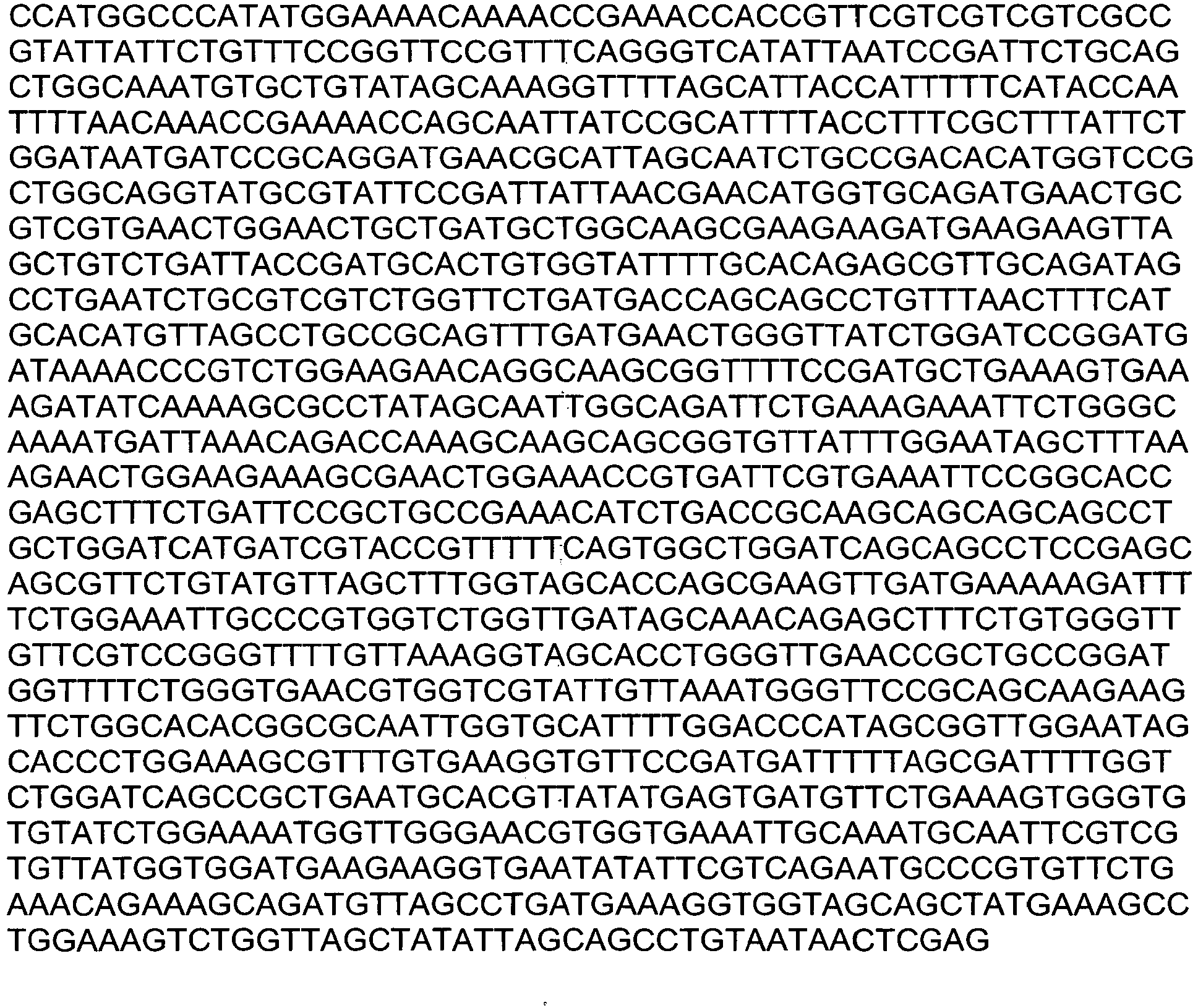
- After synthesis of the gene and subcloning into pET30A+ vector using NdeI and Xhol cloning sites, the UGT76G1_pET30a+ plasmid was introduced in E. coli B121(DE3) and E. coli EC100 by electroporation. The obtained cells were grown in petri-dishes in the presence of Kanamycin and suitable colonies were selected and allowed to grow in liquid LB medium (erlenmeyer flasks). Glycerol was added to the suspension as cryoprotectant and 400 µL aliquots were stored at -20 °C and at -80 °C.
- The storage aliquots of E. coli BL21(DE3) containing the pET30A+_UGT76G1 plasmid were thawed and added to 30 mL of LBGKP medium (20 g/L Luria Broth Lennox; 50 mM PIPES buffer pH 7.00; 50 mM Phosphate buffer pH 7.00; 2.5 g/L glucose and 50 mg/L of Kanamycin). This culture was allowed to shake at 135 rpm at 30 °C for 8 h.
- The production medium contained 60 g/L of overnight express instant TB medium (Novagen), 10 g/L of glycerol and 50 mg/L of Kanamycin. The medium was allowed to stir at 20 °C while taking samples to measure the OD and pH. The cultures gave significant growth and a good OD was obtained. After 40 h, the cells were harvested by centrifugation and frozen to yield 12.7 g of cell wet weight.
- Lysis was performed by addition of Bugbuster Master mix (Novagen) and the lysate was recovered by centrifugation and kept frozen. Activity tests were performed with thawed lysate.
- The S30 T7 High Yield Protein expression system kit from Promega was used. 4 µg of UGT76G1_pET30a+ plasmid from E. coli EC100 was mixed with 80 µL of S30 premix plus and 72 µL of S30 T7 extract was added. Nuclease-free water was added in order to obtain a total volume of 200 µL and the resulting solution was incubated for 2 h at 30°C. 180 µL was used in the catalytic test reaction.
- Ncol and NdeI restriction sides were added to the original nucleic sequence as described in Genbank accession no. ACE87855.1. After codon optimization the following nucleic sequence (SEQ ID NO. 2) was obtained:
Sequence Listing Free Text
- After synthesis of the gene and subcloning into pET30A+ vector using Ncol and XhoI cloning sites, the UGT91D2_pET30a+ plasmid was introduced into E. coli EC100 by electroporation. The obtained cells were grown in the presence of Kanamycin and suitable colonies were selected and allowed to grow in liquid LB medium (erlenmeyer flasks). Glycerol was added to the suspension as cryoprotectant and 400 µL aliquots were stored at -20 °C and at -80 °C.
- The S30 T7 High Yield Protein expression system kit from Promega was used for the in-vitro synthesis of the protein.
- 4 µg of UGT91D2_pET30a+ plasmid was mixed with 80 µL of S30 premix plus and 72 µL of S30 T7 extract was added. Nuclease-free water was added in order to obtain a total volume of 200 µL and the resulting solution was incubated for 2 h at 30°C. 5 µL was used for SDS-page analysis while the remaining 45 µL was used in the catalytic test reaction.
- The total volume of the reaction was 5.0 mL with the following composition: 50 mM sodium phosphate buffer pH 7.2, 3 mM MgCl2, 2.5 mM UDP-glucose, 0.5 mM Stevioside and 500 µL of UGT76G1 thawed lysate. The reactions were run at 30 °C on an orbitary shaker at 135 rpm. For each sample, 460 µL of the reaction mixture was quenched with 40 µL of 2N H2SO4 and 420 µL of methanol/water (6/4). The samples were immediately centrifuged and kept at 10 °C before analysis by HPLC (CAD). HPLC indicated almost complete conversion of stevioside to rebaudioside A.

- The total volume of the reaction was 0.5 mL with the following composition: 50 mM sodium phosphate buffer pH 7.2, 3 mM MgCl2, 3.8 mM UDP-glucose, 0.1 mM Rebaudioside A and 180 µL of in-vitro produced UGT91D2. The reactions were run at 30 °C on an orbitary shaker at 135 rpm. For each sample, 450 µL of reaction mixture was quenched with 45 µL of 2N H2SO4 and 405 µL of 60% MeOH. After centrifugation, the supernatant was analyzed by HPLC (CAD). HPLC indicated a 4.7% conversion of rebaudioside A to rebaudioside D after 120 h.
- The total volume of the reaction was 2 mL with the following composition: 50 mM sodium phosphate buffer pH 7.2, 3 mM MgCl2, 3.8 mM UDP-glucose, 0.5 mM Rebaudioside D and 180 µL of in-vitro produced UGT76G1. The reactions were run at 30 °C on an orbitary shaker at 135 rpm. For each sample, 400 µL of reaction mixture was quenched with 40 µL of 2N H2SO4 and 360 µL of 60% MeOH. After centrifugation, the supernatant was analyzed by HPLC (CAD). HPLC indicated 80% conversion of rebaudioside D to rebaudioside X after 120 h.For examples 7 to 12, the following abbreviations were used: LBGKP medium: 20 g/L Luria Broth Lennox; 50 mM PIPES buffer pH 7.00; 50 mM Phosphate buffer pH 7.00; 2.5 g/L glucose and 50 mg/L of Kanamycin or Ampicillin LB medium: (20 g/L Luria Broth Lennox)
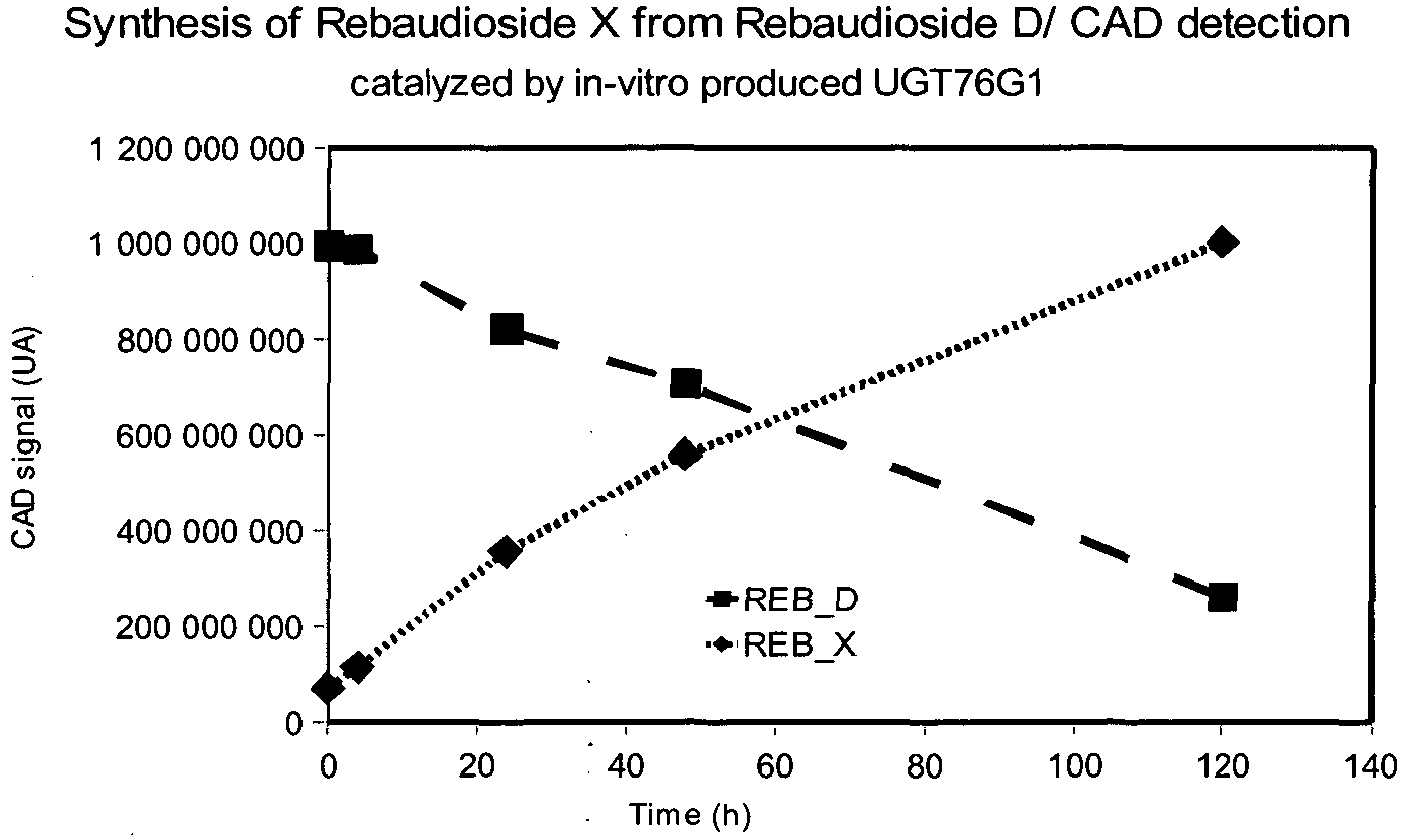
- The pET30a+_UGT76G1 plasmid was transformed into BL21(DE3) expression strain (Lucigen E. Cloni ® EXPRESS Electrocompetent Cells). The obtained cells were grown on LB Agar medium in petri-dishes in the presence of Kanamycin. Suitable colonies were selected and allowed to grow in liquid LBGKP medium containing Kanamycin. Glycerol was added and 400 µL aliquots were stored at -20°C and at -80°C.
- A storage aliquot was thawed and added to 30 mL of LBGKP medium. This culture was allowed to shake at 30°C for 8 h. and subsequently used to inoculate 400 mL of production medium containing 60 g/L of "Overnight express instant TB medium" (Novagen, reference 71491-5), 10 g/L of glycerol and 50 mg/L of Kanamycin. The medium was allowed to stir at 20°C while taking samples to measure the OD (600 nm) and pH. After 40 h, the cells were harvested by centrifugation and frozen. The obtained cell wet weight was 10.58 g.
- 3.24 g of obtained pellet was lysed by addition of 8.1 mL of "Bugbuster Master mix" (Novagen, reference 71456) and 3.5 mL of water. The lysate was recovered by centrifugation and kept frozen.
- The pET30a+_UGT76G1 plasmid was transformed into Tuner (DE3) expression strain (Novagen Tunertm (DE3) Competent cells) by heat shock treatment. The obtained cells were grown on LB Agar medium in petri-dishes in the presence of Kanamycin. Suitable colonies were selected and allowed to grow in liquid LBGKP medium containing Kanamycin). Glycerol was added and 400 µL aliquots were stored at -20°C and at -80°C.
- A storage aliquot was thawed and added to 100 mL of LB medium containing 50 mg/L of Kanamycin. This culture allowed to shake at 30°C for 15 h. 4.4 mL of this culture was used to inoculate 200 mL of production medium containing LB. This medium was allowed to stir at 37°C until an OD (600 nm) of 0.9 was obtained, after which 400 µL of a 100 mM IPTG solution was added and the medium was allowed to stir at 30 °C for 4 h. The cells were harvested by centrifugation and frozen. The obtained cell wet weight was 1.38 g.
- The obtained pellet was lysed by addition of 4.9 mL of "Bugbuster Master mix" (Novagen, reference 71456) and 2.1 mL of water. The lysate was recovered by centrifugation and kept frozen.
- After subcloning the synthetic UGT76G1 gene into the pMAL plasmid using Nde1 and Sal1 cloning sites, the pMAL_UGT76G1 plasmid was transformed into BL21 expression strain (New England Biolabs BL21 Competent E. coli) by heat shock treatment. The obtained cells were grown on LB Agar medium in petri-dishes in the presence of Ampicillin. Suitable colonies were selected and allowed to grow in liquid LBGKP medium containing Ampicillin). Glycerol was added and 400 µL aliquots were stored at -20°C and at -80°C.
- A storage aliquot was thawed and added to 30 mL of LBGKP medium. This culture was allowed to shake at 30°C for 8 h. and subsequently used to inoculate 400 mL of production medium containing 60 g/L of "Overnight express instant TB medium" (Novagen, reference 71491-5), 10 g/L of glycerol and 50 mg/L of Ampicillin. The medium was allowed to stir at 20 °C while taking samples to measure the OD and pH. After 40 h, the cells were harvested by centrifugation and frozen. The obtained cell wet weight was 5.86 g.
- 2.74 g of obtained pellet was lysed by addition of 9.6 mL of "Bugbuster Master Mix" (Novagen, reference 71456) and 4.1 mL of water. The lysate was recovered by centrifugation and kept frozen.
- The pMAL_UGT76G1 plasmid was transformed into ArcticExpress expression strain (Agilent ArcticExpress competent cells) by heat shock treatment. The obtained cells were grown on LB Agar medium in petri-dishes in the presence of Ampicillin and Geneticin. Suitable colonies were selected and allowed to grow in liquid LBGKP medium containing of Ampicillin and Geneticin. Glycerol was added and 400 µL aliquots were stored at -20°C and at -80°C.
- A storage aliquot was thawed and added to 30 mL of LBGKP medium (containing Ampicillin and Geneticin). This culture was allowed to shake at 30°C for 8 h. and subsequently used to inoculate 400 mL of production medium containing 60 g/L of "Overnight express instant TB medium" (Novagen, reference 71491-5), 10 g/L of glycerol and 50 mg/L of Ampicillin. The medium was allowed to stir at 12°C while taking samples to measure the OD (600 nm) and pH. After 68 h, the cells were harvested by centrifugation and frozen. The obtained cell wet weight was 8.96 g.
- 2.47 g of the obtained pellet was lysed by addition of 8.73 mL of "Bugbuster Master Mix" (Novagen, reference 71456) and 3.79 mL of water. The lysate was recovered by centrifugation and kept frozen.
- After subcloning the synthetic UGT76G1 gene into the pCOLDIII plasmid using Nde1 and Xhol cloning sites, the pCOLDIII_UGT76G1 plasmid was transformed into ArcticExpress expression strain (Agilent ArcticExpress competent cells) by heat shock treatment. The obtained cells were grown on LB Agar medium in petri-dishes in the presence of Ampicillin and Geneticin. Suitable colonies were selected and allowed to grow in liquid LBGKP medium containing Ampicillin and Geneticin. Glycerol was added and 400 µL aliquots were stored at -20°C and at -80°C.
- A storage aliquot was thawed and added to 30 mL of LBGKP medium (containing Ampicillin and Geneticin). This culture was allowed to shake at 30°C for 8 h. and subsequently used to inoculate 400 mL of production medium containing 60 g/L of "Overnight express instant TB medium" (Novagen, reference 71491-5), 10 g/L of glycerol and 50 mg/L of Kanamycin. The medium was allowed to stir at 12°C while taking samples to measure the OD (600 nm) and pH. After 63 h, the cells were harvested by centrifugation and frozen. The obtained cell wet weight was 6.54 g.
- 2.81 g of the obtained pellet was lysed by addition of 9.8 mL of "Bugbuster Master Mix" (Novagen, reference 71456) and 4.2 mL of water. The lysate was recovered by centrifugation and kept frozen.
- The pCOLDIII_UGT76G1 plasmid was transformed into Origami2 (DE3) expression strain (Novagen Origami™2 (DE3) Competent Cells) by heat shock treatment. The obtained cells were grown on LB Agar medium in petri-dishes in the presence of Ampicillin. Suitable colonies were selected and allowed to grow in liquid LBGKP medium containing Ampicillin. Glycerol was added and 400 µL aliquots were stored at - 20°C and at -80°C.
- A storage aliquot was thawed and added to 30 mL of LBGKP medium (containing Ampicillin). This culture was allowed to shake at 30°C for 8 h. and subsequently used to inoculate 400 mL of production medium containing 60 g/L of "Overnight express instant TB medium" (Novagen, reference 71491-5), 10 g/L of glycerol and 50 mg/L of Kanamycin. The medium was allowed to stir at 12 °C while taking samples to measure the OD (600 nm) and pH. After 68 h, the cells were harvested by centrifugation and frozen. The obtained cell wet weight was 2.53 g.
- 1.71 g of the obtained pellet was lysed by addition of 6.0 mL of "Bugbuster Master mix" (Novagen, reference 71456) and 1.9 mL of water. The lysate was recovered by centrifugation and kept frozen.
- Activity tests were performed on a 5 mL scale with 500 µL of thawed lysate for the transformation of Stevioside to Rebaudioside A and Rebaudioside D to Rebaudioside X using 0.5 mM of substrate, 2.5 mM of UDP-Glucose and 3 mM MgCl2 in 50 mM Sodium Phosphate buffer at pH 7.2. Samples were taken and analyzed by HPLC. The results for the different preparations of UGT76G1 are summarized in the following table.
Example Plasmid Expression strain Transformation activity∗ Stevioside to Rebaudioside A Rebaudioside D to Rebaudioside X 7 pET30a+ BL21 (DE3) 29 U mL-1 0.31 U mL -18 pET30a+ Tuner (DE3) 33 U mL-1 0.40 U mL-1 9 pMAL BL21 20 U mL-1 0.15 U mL -110 pMAL ArcticExpress 15 U mL-1 0.25 U mL -111 pCOLDIII ArcticExpress 15 U mL-1 0.11 U mL-1 12 pCOLDIII Origami2 (DE3) 37 U mL-1 0.20 U mL-1 ∗ Note
The activities for the transformation of Stevioside and Rebaudioside X are mentioned per mL of lysate. 1 U will transform 1 µmol of substrate in 1 hour at 30 °C and pH 7.2 - 5 mL of the lysate of Example 12 was used to transform Rebaudioside D to Rebaudioside X on a 50 mL scale. The reaction medium consisted of 50 mM Sodium Phosphate buffer pH 7.2, 3 mM of MgCl2, 2.5 mM of UDP-Glucose and 0.5 mM of Rebaudioside D. After allowing the reaction to be shaken at 30°C for 90 h. 50 mL of ethanol was added and the resulting mixture was allowed to stir at -20 °C for 1 h. After centrifugation at 5000 g for 10 min. the supernatant was purified via ultrafiltration (Vivaflow MWCO 30000). 78 mL of permeate was obtained and the 9 mL of retentate was diluted with 9 mL of ethanol and resubjected to Ultrafiltration (Vivaflow MWCO 30000). Another 14 mL of filtrate was obtained, which was combined with the first permeate. The combined permeates were concentrated under reduced pressure at 30°C until 32 mL of a clear solution was obtained.
- The HPLC trace of the product mixture is shown in
FIG. 5 . HPLC was carried out on anAgilent 1200 series equipped with a binary pump, auto sampler, and thermostat column compartment. The method was isocratic, with a mobile phase composed of 70% water (0.1% formic acid): 30% acetonitrile. The flow rate was 0.1 µL/min. The column used was Phenomenex Prodigy 5µ ODS (3) 100 A; 250x2mm. The column temperature was maintained at 40 °C. The injection volume was 20-40 µl. - After subcloning the synthetic UGT91D2 gene into the pMAL plasmid using Nde1 and Sal1 cloning sites, the pMAL_UGT91D2 plasmid was transformed into BL21 expression strain (New England Biolabs BL21 Competent E. coli) by heat shock treatment. The obtained cells were grown on LB Agar medium in petri-dishes in the presence of Ampicillin. Suitable colonies were selected and allowed to grow in liquid LBGKP medium containing Ampicillin). Glycerol was added and 400 µL aliquots were stored at -20°C and at -80°C.
- A storage aliquot was thawed and added to 30 mL of LBGKP medium. This culture was allowed to shake at 30°C for 8 h. and subsequently used to inoculate 400 mL of production medium containing 60 g/L of "Overnight express instant TB medium" (Novagen, reference 71491-5), 10 g/L of glycerol and 50 mg/L of Ampicillin. The medium was allowed to stir at 20 °C while taking samples to measure the OD and pH. After 40 h, the cells were harvested by centrifugation and frozen. The obtained cell wet weight is 12.32g.
- 2.18 g of obtained pellet was lysed by addition of 7.7 mL of "Bugbuster Master Mix" (Novagen, reference 71456) and 3.2 mL of water. The lysate was recovered by centrifugation and used directly for activity testing.
- The pMAL_UGT91D2 plasmid was transformed into ArcticExpress expression strain (Agilent ArcticExpress competent cells) by heat shock treatment. The obtained cells were grown on LB Agar medium in petri-dishes in the presence of Ampicillin and Geneticin. Suitable colonies were selected and allowed to grow in liquid LBGKP medium containing Ampicillin and Geneticin. Glycerol was added and 400 µL aliquots were stored at -20°C and at -80°C.
- A storage aliquot was thawed and added to 30 mL of LBGKP medium (containing Ampicillin and Geneticin). This culture was allowed to shake at 30°C for 8 h. and subsequently used to inoculate 400 mL of production medium containing 60 g/L of "Overnight express instant TB medium" (Novagen, reference 71491-5), 10 g/L of glycerol and 50 mg/L of Ampicillin. The medium was allowed to stir at 20°C for 16 h. followed by another 50 h. at 12°C while taking samples to measure the OD (600 nm) and pH. The cells were harvested by centrifugation and frozen. The obtained cell wet weight is 15.77 g.
- 2.57 g of the obtained pellet was lysed by addition of 9.0 mL of "Bugbuster Master Mix" (Novagen, reference 71456) and 3.8 mL of water. The lysate was recovered by centrifugation and used directly for activity testing.
- The pET30a+_UGT91D2 plasmid was transformed into Tuner (DE3) expression strain (Novagen Tunertm (DE3) Competent cells) by heat shock treatment. The obtained cells were grown on LB Agar medium in petri-dishes in the presence of Kanamycin. Suitable colonies were selected and allowed to grow in liquid LBGKP medium (containing Kanamycin). Glycerol was added and 400 µL aliquots were stored at -20°C and at -80°C.
- A storage aliquot was thawed and added to 100 mL of LB medium containing 50 mg/L of Kanamycin. This culture allowed to shake at 30°C for 15 h. 6.2 mL of this culture was used to inoculate 500 mL of production medium containing LB. This medium was allowed to stir at 37°C until an OD (600 nm) of 0.9 was obtained after which 500 µL of a 100 mM IPTG solution was added (IPTG concentration in medium is 100 µM) and the medium was allowed to stir at 30 °C for 4 h, the cells were harvested by centrifugation and frozen. The obtained cell wet weight is 4.02 g.
- 1.92 g of the obtained pellet was lysed by addition of 6.8 mL of "Bugbuster Master mix" (Novagen, reference 71456) and 2.8 mL of water. The lysate was recovered by centrifugation and tested directly for activity.
- The pET30a+_UGT91D2 plasmid was transformed into ArcticExpress (DE3) expression strain (Agilent ArcticExpress competent cells) by heat shock treatment. The obtained cells were grown on LB Agar medium in petri-dishes in the presence of Kanamycin and Geneticin. Suitable colonies were selected and allowed to grow in liquid LBGKP medium containing of Kanamycin and Geneticin. Glycerol was added and 400 µL aliquots were stored at -20°C and at -80°C.
- A storage aliquot was thawed and added to 30 mL of LBGKP medium (containing Kanamycin and Geneticin). This culture was allowed to shake at 30°C for 8 h. and subsequently used to inoculate 400 mL of production medium containing 60 g/L of "Overnight express instant TB medium" (Novagen, reference 71491-5), 10 g/L of glycerol and 50 mg/L of Ampicillin. The medium was allowed to stir at 20°C for 16h. followed by another 50 h. at 12°C while taking samples to measure the OD (600 nm) and pH. After 60 h, the cells were harvested by centrifugation and frozen. The obtained cell wet weight is 16.07 g.
- 3.24 g of the obtained pellet was lysed by addition of 11.4 mL of "Bugbuster Master Mix" (Novagen, reference 71456) and 4.8 mL of water. The lysate was recovered by centrifugation and used directly for activity testing.
- Activity tests were performed at 5 mL scale with 1000 µL of lysate for the transformation of Rubusoside to Stevioside using 0.5 mM of substrate, 2.5 mM of UDP-Glucose and 3 mM MgCl2 in 50 mM Sodium Phosphate buffer at pH 7.2. Samples were taken and analyzed by HPLC. The results for the different preparations of UGT91D2 are summarized in the following table.
Example Plasmid Expression strain Transformation activity∗ Rubusoside to Stevioside 15 pMAL BL21 9 mU mL-1 16 pMAL ArcticExpress 60 mU mL -117 pET30a+ Tuner (DE3) 28 mU mL -118 pET30a+ ArcticExpress (DE3) 21 mU mL-1 ∗ Note: The activities are mentioned per mL of lysate. 1 U will transform 1 µmol of substrate in 1 hour at 30 °C and pH 7.2 - The amount of the product mixture of Example 14 was not large enough to separate via preparative HPLC methods. Accordingly, analytical HPLC with a series of injections was used to separate the components of the mixture. Separation was conducted according to the method described above in Example 14 to provide two fractions corresponding to the two main peaks in the HPLC trace of
FIG. 5 : Fraction A (retention time 24.165 minutes) and Fraction B (retention time 31.325 minutes). - The retention time of Fraction A was consistent with reb D, indicating unreacted starting material from the biotransformation reaction.
- The retention time of purified Fraction B (
FIG. 6 ) was consistent with reb X, indicating successful biotransformation from reb D. The identity of the material collected in Fraction B as reb X was confirmed by co-injection of purified Fraction B with a reb X standard (available from Pure Circle, HPLC trace of reb X standard shown inFIG. 7 ). Both Fraction B and the reb X standard were found to elute at the same retention time (FIG. 8 ), indicating Fraction B was reb X. - The identity of Fraction B as reb X was also separately confirmed by NMR and HRMS. For sampling, Fraction B was concentrated under rotovapor, freeze dried and dried for 40 h at 40 °C.
- The NMR sample was dissolved in deuterated pyridine (C5D5N) and spectra were acquired on a
Varian Unity Plus 600 MHz instrument using standard pulse sequences. The NMR spectra of Fraction B was compared to the NMR spectra of reb X. An overlay of the two spectra (FIG. 9 ) showed consistency of peaks of Fraction B with reb X. A table of the NMR assignments for reb X is shown below:
1H and 13C NMR spectral data for Rebaudioside X in C5D5N a-c .Position 13C NMR 1H NMR 1 40.3 0.75 t (13.2) 1.76 m 2 19.6 1.35 m 2.24 m 3 38.4 1.01 m 2.30 d (13.3) 4 44.3 --- 5 57.4 1.06 d (12.8) 6 23.5 2.23 m 2.41 q (13.2) 7 42.6 1.41 m 1.80 m 8 41.2 --- 9 54.3 0.91 d (7.7) 10 39.7 --- 11 20.2 1.65 m 1.75 m 12 38.5 1.86 m 2.73 m 13 87.6 --- 14 43.3 2.02 m 2.74 m 15 46.5 1.88 d (16.4) 2.03 m 16 153.3 --- 17 104.9 4.90 s 5.69 s 18 28.2 1.32 s 19 176.9 --- 20 16.8 1.38 s 1′ 94.9 6.39 d (8.2) 2′ 76.9 4.51 t (8.5) 3′ 88.6 5.09 t (8.5) 4′ 70.1 4.18 m 5′ 78.4 4.13 m 6′ 61.8 4.20 m 4.31 m 1ʺ 96.2 5.46 d (7.1) 2ʺ 81.4 4.13 m 3ʺ 87.9 4.98 t (8.5) 4ʺ 70.4 4.07 t (9.6) 5ʺ 77.7 3.94 m 6ʺ 62.6 4.19 m 4.32 m 1‴ 104.8 5.48 d (7.7) 2‴ 75.8 4.15 m 3‴ 78.6 4.13 m 4‴ 73.2 3.98 m 5‴ 77.6 3.74 ddd (2.8, 6.4, 9.9) 6‴ 64.0 4.27 m 4.51m 1ʺʺ 103.9 5.45 d (7.5) 2ʺʺ 75.6 3.98 m 3ʺʺ 77.8 4.50 t (7.8) 4ʺʺ 71.3 4.14 m 5ʺʺ 78.0 3.99 m 6ʺʺ 62.1 4.20 m 4.32 m 1‴ʺ 104.2 5.81 d (7.2) 2‴ʺ 75.5 4.20 m 3‴ʺ 78.4 4.20 m 4‴ʺ 73.6 4.10 m 5‴ʺ 77.8 3.90 ddd (2.8, 6.4, 9.9) 6‴ʺ 64.0 4.32 m 4.64 d (10.3) 1‴‴ 104.1 5.31 d (8.0) 2‴‴ 75.5 3.95 m 3‴‴ 78.0 4.37 t (9.1) 4‴‴ 71.1 4.10 m 5‴‴ 78.1 3.85 ddd (1.7, 6.1, 9.9) 6‴‴ 62.1 4.10 m 4.32 m a assignments made on the basis of COSY, HMQC and HMBC correlations; b Chemical shift values are in δ (ppm); c Coupling constants are in Hz. - HRMS (
FIG. 10 ) was generated with a Waters Premier Quadropole Time-of-Flight (Q-TOF) mass spectrometer equipped with an electrospray ionization source operated in the positive-ion mode. The sample was dissolved in methanol and eluted in 2:2:1 methanol: acetonitrile: water and introduced via infusion using the onboard syringe pump. The presence of reb X was confirmed by a [M+Na]+ adduct at m/z 1313.5265, which corresponds to a molecular formula of C56H90O33:
-
- <110> PureCircle Sdn Bhd The Coca-Cola Company
- <120> HIGH-PURITY STEVIOL GLYCOSIDES
- <130> X3580 EP
- <140>
EP 13 79 4215.7
<141> 2013-03-12 - <160> 2
- <170> PatentIn version 3.5
- <210> 1
<211> 1397
<212> DNA
<213> Escherichia coli - <400> 1


- <210> 2
<211> 1442
<212> DNA
<213> Escherichia coli - <400> 2

Claims (10)
- A method for producing highly purified rebaudioside X, comprising the steps of:a. providing a starting composition comprising rebaudioside D;b. providing the UDP-glucosyltransferase UGT76G1;c. optionally providing a biocatalyst capable of UDP-glucose overproduction and recycling and a substrate for said recycling;d. contacting the UDP-glucosyltransferase with a medium containing the starting composition to produce a composition comprising rebaudioside X comprising one or more additional glucose units than rebaudioside D; ande. separating the rebaudioside X from the medium to provide a highly purified rebaudioside X composition.
- The method of claim 1, wherein the UDP-glucosyltransferase is expressed in a microorganism selected from the group consisting of E. coli, Saccharomyces sp., Aspergillus sp., Pichia sp. or another suitable microorganism suitable for hosting the UDP-glucosyltransferase gene and its subsequent expression.
- The method of claim 1, wherein in step (c) the biocatalyst is expressed in a microorganism selected from the group consisting of E. coli, Saccharomyces sp., Aspergillus sp., Pichia sp. or another microorganism suitable for UDP-glucose recycling enzyme genes and their subsequent expression and functioning.
- The method of claim 1, wherein the UDP-glucosyltransferase in step (b) and optionally the biocatalyst in step (c) are included in the same microbial cell.
- The method of claim 1, wherein the UDP-glucosyltransferase in step (b) and/or biocatalyst in step (c) is applied as a free or immobilized form of crude, semi-purified and purified enzyme preparation(s), living microbial cells, whole microbial cells, cell lysate and/or any other form of biocatalyst known to art.
- The method of claim 1, wherein rebaudioside X is separated from the reaction medium using crystallization, separation by membranes, centrifugation, extraction, chromatographic separation or a combination of such methods.
- The method of claim 1, wherein steps (a) - (e) are repeated.
- The method of claim 7, wherein steps (a) - (e) are repeated once.
- The method of claim 7, wherein steps (a) - (e) are repeated twice.
- The method of claim 1, wherein the rebaudioside X content is greater than 95% by weight on a dry basis.
Priority Applications (1)
| Application Number | Priority Date | Filing Date | Title |
|---|---|---|---|
| EP21201645.5A EP4012041A1 (en) | 2012-05-22 | 2013-03-12 | High-purity steviol glycosides |
Applications Claiming Priority (2)
| Application Number | Priority Date | Filing Date | Title |
|---|---|---|---|
| US201261649978P | 2012-05-22 | 2012-05-22 | |
| PCT/US2013/030439 WO2013176738A1 (en) | 2012-05-22 | 2013-03-12 | High-purity steviol glycosides |
Related Child Applications (2)
| Application Number | Title | Priority Date | Filing Date |
|---|---|---|---|
| EP21201645.5A Division EP4012041A1 (en) | 2012-05-22 | 2013-03-12 | High-purity steviol glycosides |
| EP21201645.5A Division-Into EP4012041A1 (en) | 2012-05-22 | 2013-03-12 | High-purity steviol glycosides |
Publications (3)
| Publication Number | Publication Date |
|---|---|
| EP2852296A1 EP2852296A1 (en) | 2015-04-01 |
| EP2852296A4 EP2852296A4 (en) | 2016-06-22 |
| EP2852296B1 true EP2852296B1 (en) | 2021-12-15 |
Family
ID=49624216
Family Applications (2)
| Application Number | Title | Priority Date | Filing Date |
|---|---|---|---|
| EP21201645.5A Pending EP4012041A1 (en) | 2012-05-22 | 2013-03-12 | High-purity steviol glycosides |
| EP13794215.7A Active EP2852296B1 (en) | 2012-05-22 | 2013-03-12 | Process for producing a high-purity steviol glycoside |
Family Applications Before (1)
| Application Number | Title | Priority Date | Filing Date |
|---|---|---|---|
| EP21201645.5A Pending EP4012041A1 (en) | 2012-05-22 | 2013-03-12 | High-purity steviol glycosides |
Country Status (7)
| Country | Link |
|---|---|
| US (6) | US9243273B2 (en) |
| EP (2) | EP4012041A1 (en) |
| JP (5) | JP6346174B2 (en) |
| CN (2) | CN103974628B (en) |
| BR (1) | BR112014028819A2 (en) |
| MX (2) | MX352678B (en) |
| WO (1) | WO2013176738A1 (en) |
Families Citing this family (88)
| Publication number | Priority date | Publication date | Assignee | Title |
|---|---|---|---|---|
| US9107436B2 (en) | 2011-02-17 | 2015-08-18 | Purecircle Sdn Bhd | Glucosylated steviol glycoside as a flavor modifier |
| US20150344512A1 (en) | 2011-12-19 | 2015-12-03 | Purecircle Usa Inc. | Methods of purifying steviol glycosides and uses of the same |
| US10696706B2 (en) | 2010-03-12 | 2020-06-30 | Purecircle Usa Inc. | Methods of preparing steviol glycosides and uses of the same |
| EP2575432B1 (en) | 2010-06-02 | 2019-08-14 | Evolva, Inc. | Recombinant production of steviol glycosides |
| US11690391B2 (en) | 2011-02-17 | 2023-07-04 | Purecircle Sdn Bhd | Glucosylated steviol glycoside as a flavor modifier |
| US9771434B2 (en) | 2011-06-23 | 2017-09-26 | Purecircle Sdn Bhd | Products from stevia rebaudiana |
| AU2012294452C1 (en) | 2011-08-08 | 2017-11-30 | Danstar Ferment Ag | Recombinant production of steviol glycosides |
| EP3735841A1 (en) * | 2011-12-19 | 2020-11-11 | PureCircle SDN BHD | Methods for purifying steviol glycosides and uses of the same |
| EP2826861B1 (en) | 2012-03-16 | 2020-04-29 | Suntory Holdings Limited | Steviol glycosyltransferase and gene encoding same |
| JP6189828B2 (en) | 2012-03-27 | 2017-08-30 | サントリーホールディングス株式会社 | Method for producing steviol glycosides |
| MX352678B (en) * | 2012-05-22 | 2017-12-04 | Purecircle Sdn Bhd | HIGH PURITY ESTEVIOL GLUCOSIDS. |
| US9752174B2 (en) * | 2013-05-28 | 2017-09-05 | Purecircle Sdn Bhd | High-purity steviol glycosides |
| TW201402599A (en) | 2012-05-30 | 2014-01-16 | Suntory Holdings Ltd | Steviol glycosyltransferase and gene coding the same |
| WO2014122227A2 (en) * | 2013-02-06 | 2014-08-14 | Evolva Sa | Methods for improved production of rebaudioside d and rebaudioside m |
| BR112015019160A2 (en) | 2013-02-11 | 2017-08-22 | Dalgaard Mikkelsen Michael | PRODUCTION OF STEVIOL GLYCOSIDES IN RECOMBINANT HOSTERS |
| EP3714699B1 (en) | 2013-06-07 | 2024-12-18 | PureCircle USA Inc. | Stevia extract containing selected steviol glycosides as flavor, salty and sweetness profile modifier |
| US10952458B2 (en) | 2013-06-07 | 2021-03-23 | Purecircle Usa Inc | Stevia extract containing selected steviol glycosides as flavor, salty and sweetness profile modifier |
| MY178970A (en) | 2013-06-10 | 2020-10-26 | Suntory Holdings Ltd | Plant extract containing diketopiperazine and method for producing same |
| BR112016000745B1 (en) * | 2013-07-15 | 2021-01-05 | Dsm Ip Assets B.V. | process for preparing rebaudioside m |
| WO2015014969A1 (en) * | 2013-07-31 | 2015-02-05 | Dsm Ip Assets B.V. | Steviol glycosides |
| CN103397064B (en) * | 2013-08-14 | 2015-04-15 | 苏州汉酶生物技术有限公司 | Method for preparing rebaudioside M through enzyme method |
| US20150305380A1 (en) * | 2013-12-23 | 2015-10-29 | International Flavors & Fragrances Inc. | Transglucosylated rubus suavissimus extract and methods of preparation and use |
| CN103757074B (en) * | 2014-01-16 | 2015-12-02 | 苏州汉酶生物技术有限公司 | A kind of enzyme process prepares the method for rebaudioside M |
| CN106471128A (en) * | 2014-01-28 | 2017-03-01 | 百事可乐公司 | A method for enzymatically preparing rebaudioside M |
| CN103859401A (en) * | 2014-03-11 | 2014-06-18 | 苏州科大微龙信息技术有限公司 | Fruit scented tea enzyme capable of nourishing yin and beautifying and preparation method of fruit scented tea enzyme |
| US9522929B2 (en) | 2014-05-05 | 2016-12-20 | Conagen Inc. | Non-caloric sweetener |
| US11185096B2 (en) | 2014-05-06 | 2021-11-30 | Dr Pepper/Seven Up, Inc. | Sweet taste improving compositions including naringenin and steviol glycosides |
| US10231474B2 (en) | 2014-05-06 | 2019-03-19 | Dr Pepper/Seven Up, Inc. | Sweet taste improving compositions including naringenin |
| MX2016014427A (en) | 2014-05-13 | 2017-01-24 | Cargill Inc | Highly soluble steviol glycosides. |
| CN114410493A (en) | 2014-08-11 | 2022-04-29 | 埃沃尔瓦公司 | Production of steviol glycosides in recombinant hosts |
| EP3683315A1 (en) * | 2014-08-19 | 2020-07-22 | Purecircle SDN BHD | Method for preparing rebaudioside m |
| WO2017035524A1 (en) * | 2015-08-27 | 2017-03-02 | Purecircle Usa Inc. | Stevia extracts |
| WO2016034942A1 (en) | 2014-09-02 | 2016-03-10 | Purecircle Usa Inc. | Stevia extracts enriched in rebaudioside d, e, n and/or o and process for the preparation thereof |
| KR20170052647A (en) | 2014-09-09 | 2017-05-12 | 에볼바 에스아 | Production of steviol glycosides in recombinant hosts |
| CN113549664B (en) * | 2014-09-19 | 2025-10-28 | 谱赛科有限责任公司 | High-purity steviol glycosides |
| US9907326B2 (en) | 2014-09-30 | 2018-03-06 | Suntory Beverage & Food Limited | Carbonated beverage, syrup used for preparing carbonated beverage, method for manufacturing carbonated beverage, and method for suppressing foaming in carbonated beverage |
| CN113603736A (en) | 2014-10-03 | 2021-11-05 | 康纳根有限公司 | Non-caloric sweetener and its synthesis method |
| WO2016073740A1 (en) | 2014-11-05 | 2016-05-12 | Manus Biosynthesis, Inc. | Microbial production of steviol glycosides |
| MY185981A (en) * | 2014-11-24 | 2021-06-14 | Cargill Inc | Glycoside compositions |
| AU2016211124B2 (en) * | 2015-01-30 | 2022-04-14 | Danstar Ferment Ag | Production of steviol glycosides in recombinant hosts |
| JP6976173B2 (en) * | 2015-03-10 | 2021-12-08 | レイクスユニフェルシテイト フローニンゲン | Enzymatic modification methods of steviol glycosides, the resulting modified steviol glycosides, and their use as sweeteners. |
| AU2016230587B2 (en) * | 2015-03-11 | 2020-06-25 | Morita Kagaku Kogyo Co., Ltd. | Sweetener composition and food containing same |
| EP3271457B1 (en) | 2015-03-16 | 2021-01-20 | DSM IP Assets B.V. | Udp-glycosyltransferases |
| JP6793957B2 (en) | 2015-04-14 | 2020-12-02 | コナゲン インコーポレイテッド | Production of non-caloric sweeteners using modified whole cell catalysts |
| AU2016264732A1 (en) | 2015-05-20 | 2017-11-30 | Cargill, Incorporated | Glycoside compositions |
| WO2016196321A1 (en) * | 2015-05-29 | 2016-12-08 | Cargill, Incorporated | Fermentation methods for producing steviol glycosides using high ph and compositions obtained therefrom |
| US11219663B2 (en) | 2015-07-27 | 2022-01-11 | Suntory Holdings Limited | Composition containing cyclic dipeptide and sweetening agent |
| EP3332018B1 (en) | 2015-08-07 | 2022-07-27 | Evolva SA | Production of steviol glycosides in recombinant hosts |
| BR112018006724A2 (en) * | 2015-10-05 | 2018-10-09 | Dsm Ip Assets Bv | kaurenoic acid hydroxylases |
| BR122020008481B1 (en) * | 2015-10-26 | 2022-10-18 | Purecircle Usa Inc | COMPOSITION OF STEVIOL GLYCOSIDE CONTAINING REBAUDIOSIDE Q GLYCOSYLATE AND REBAUDIOSIDE R GLYCOSYLATE AND METHOD FOR IMPROVING THE SWEETNESS PROFILE OF A STEVIA SWEETENER |
| CN105380224A (en) * | 2015-11-19 | 2016-03-09 | 南京诺云生物科技有限公司 | Novel stevioside derivative, preparation method and application thereof |
| CN108884484A (en) * | 2015-11-30 | 2018-11-23 | 谱赛科有限责任公司 | Method for preparing high-purity steviol glycosides |
| WO2017106577A1 (en) | 2015-12-15 | 2017-06-22 | Purecircle Usa Inc. | Steviol glycoside compositions |
| JP6109353B1 (en) | 2016-01-05 | 2017-04-05 | サントリー食品インターナショナル株式会社 | Beverage, method for producing beverage, and method for suppressing foaming of beverage |
| US12193460B2 (en) | 2016-01-07 | 2025-01-14 | Purecircle Usa Inc. | Highly soluble steviol glycosides |
| CN105777824A (en) * | 2016-03-28 | 2016-07-20 | 南京诺云生物科技有限公司 | Stevioside derivative and application of stevioside derivative |
| CN105803021A (en) * | 2016-03-28 | 2016-07-27 | 南京诺云生物科技有限公司 | Preparing method for sweetening agent |
| CN105837644A (en) * | 2016-03-28 | 2016-08-10 | 南京诺云生物科技有限公司 | Novel sweetening agent and application thereof |
| CN105838759A (en) * | 2016-03-28 | 2016-08-10 | 南京诺云生物科技有限公司 | Preparation method of stevia sugar derivative |
| CN105732740A (en) * | 2016-03-28 | 2016-07-06 | 南京诺云生物科技有限公司 | Preparation method of novel sweetening agent |
| KR20180132696A (en) | 2016-04-13 | 2018-12-12 | 에볼바 에스아 | Production of steviol glycosides in recombinant hosts |
| US10815514B2 (en) | 2016-05-16 | 2020-10-27 | Evolva Sa | Production of steviol glycosides in recombinant hosts |
| US20190297932A1 (en) * | 2016-06-06 | 2019-10-03 | Tate & Lyle Ingredients Americas Llc | Glycosylated steviol glycoside compositions and methods of preparing glycosylated steviol glycoside compositions |
| EP3472308A4 (en) * | 2016-06-15 | 2020-07-29 | Codexis, Inc. | ENZYMATIC GLYCOSYLATION OF STEVIOL GLYCOSIDES AND OTHER COMPOUNDS WITH GLUCOSE-1-PHOSPHATE |
| US11299723B2 (en) | 2016-06-15 | 2022-04-12 | Codexis, Inc. | Engineered beta-glucosidases and glucosylation methods |
| WO2018031955A2 (en) | 2016-08-12 | 2018-02-15 | Amyris, Inc. | Udp-dependent glycosyltransferase for high efficiency production of rebaudiosides |
| KR102540615B1 (en) * | 2016-10-14 | 2023-06-08 | 코나겐 인크. | Biosynthetic preparation of steviol glycosides and methods therefor |
| JP2019532650A (en) | 2016-10-21 | 2019-11-14 | ペプシコ・インク | Method for preparing rebaudioside C by using an enzymatic method |
| JP6842800B2 (en) * | 2016-10-21 | 2021-03-17 | ペプシコ・インク | A method for preparing rebaudioside J using an enzymatic method |
| EP3530745A4 (en) * | 2016-10-21 | 2020-07-22 | Pepsico, Inc. | Method for preparing rebaudioside n using enzymatic method |
| WO2018083338A1 (en) | 2016-11-07 | 2018-05-11 | Evolva Sa | Production of steviol glycosides in recombinant hosts |
| CN110050068A (en) | 2016-11-14 | 2019-07-23 | 谱赛科美国股份有限公司 | Stevia-derived molecules, methods of obtaining such molecules and uses thereof |
| CA3045722A1 (en) | 2016-12-08 | 2018-06-14 | Dsm Ip Assets B.V. | Kaurenoic acid hydroxylases |
| EP3878967A3 (en) | 2017-02-03 | 2021-12-08 | Codexis, Inc. | Engineered glycosyltransferases and steviol glycoside glucosylation methods |
| EP3765627A4 (en) | 2018-03-12 | 2021-10-13 | Conagen Inc. | BIOSYNTHETIC PRODUCTION OF STEVIOL GLYCOSIDES REBAUDIOSIDE J AND REBAUDIOSIDE N |
| SG11202100450TA (en) * | 2018-07-16 | 2021-02-25 | Manus Bio Inc | Production of steviol glycosides through whole cell biotransformation |
| CA3108268A1 (en) | 2018-07-30 | 2020-02-06 | Codexis, Inc. | Engineered glycosyltransferases and steviol glycoside glucosylation methods |
| CN112771018A (en) | 2018-08-30 | 2021-05-07 | 罗地亚经营管理公司 | Substituted catechol monomers, copolymers, and methods of use |
| WO2020062437A1 (en) * | 2018-09-29 | 2020-04-02 | 四川盈嘉合生科技有限公司 | Composite sweetening agent and production method therefor |
| MY207775A (en) | 2018-09-29 | 2025-03-18 | Firmenich & Cie | Terpene glycoside derivatives and uses thereof |
| CN109293718A (en) * | 2018-10-08 | 2019-02-01 | 山东奥晶生物科技有限公司 | A kind of preparation method of stevia rebaudianum carbohydrase modification stevioside |
| WO2020123877A1 (en) * | 2018-12-12 | 2020-06-18 | Conagen Inc. | Biosynthetic production of variant steviol glycosides |
| KR102303661B1 (en) * | 2019-06-14 | 2021-09-23 | 씨제이제일제당 주식회사 | Compositions comprising glucose transferase for producing glucosylated steviol glycosides and method for producing glucosylated steviol glycosides using the same |
| CN113025541B (en) * | 2019-12-24 | 2022-08-12 | 北京化工大学 | Engineering bacteria for synthesizing salicin and its construction method and application |
| WO2022002918A1 (en) | 2020-07-03 | 2022-01-06 | C-Lecta Gmbh | One-pot cell-free glycosylation process |
| KR102546737B1 (en) * | 2020-11-25 | 2023-06-22 | 씨제이제일제당 주식회사 | Composition comprising transglycosylated steviol glycoside |
| JP7210626B2 (en) * | 2021-02-18 | 2023-01-23 | ペプシコ・インク | Method for preparing rebaudioside J using enzymatic methods |
| JP2024520118A (en) * | 2021-06-01 | 2024-05-21 | エーバイオケム バイオテクノロジー(グループ)カンパニー,リミティド | Glycosyltransferases and uses thereof |
Citations (1)
| Publication number | Priority date | Publication date | Assignee | Title |
|---|---|---|---|---|
| WO2013096420A1 (en) * | 2011-12-19 | 2013-06-27 | The Coca-Cola Company | Methods for purifying steviol glycosides and uses of the same |
Family Cites Families (219)
| Publication number | Priority date | Publication date | Assignee | Title |
|---|---|---|---|---|
| US3723410A (en) | 1970-12-01 | 1973-03-27 | Amazon Natural Drug Co | Method of producing stevioside |
| JPS525800Y2 (en) | 1972-06-17 | 1977-02-07 | ||
| JPS51142570A (en) | 1975-06-04 | 1976-12-08 | Morita Kagaku Kogyo | Method of imparting sweetness to food or pharmaceutical agent |
| JPS5828246Y2 (en) | 1975-06-04 | 1983-06-20 | 株式会社東芝 | Ondochiyousetsouchi |
| JPS525800A (en) | 1975-06-27 | 1977-01-17 | Sanyo Kokusaku Pulp Co Ltd | Method of purifying stevioside |
| JPS5430199Y2 (en) | 1975-09-03 | 1979-09-22 | ||
| JPS5719758Y2 (en) | 1975-12-18 | 1982-04-26 | ||
| JPS5283731A (en) | 1976-01-01 | 1977-07-12 | Ajinomoto Co Inc | Rebaudiosides |
| JPS52100500U (en) | 1976-01-27 | 1977-07-29 | ||
| JPS52100500A (en) | 1976-02-18 | 1977-08-23 | Japan Organo Co Ltd | Purification and concentration of aqueous stevioside extract |
| JPS52136200U (en) | 1976-04-12 | 1977-10-15 | ||
| JPS52136200A (en) | 1976-05-12 | 1977-11-14 | Daicel Chem Ind Ltd | Extraction purification of stevioside |
| JPS572656Y2 (en) | 1976-06-11 | 1982-01-18 | ||
| JPS5338669A (en) | 1976-09-16 | 1978-04-08 | Toyo Soda Mfg Co Ltd | Separation of natural sweetening agent |
| JPS5539731Y2 (en) | 1976-11-27 | 1980-09-17 | ||
| JPS5430199A (en) | 1977-08-08 | 1979-03-06 | Sanyo Kokusaku Pulp Co Ltd | Purification of stevia sweetening agnet |
| JPS54132599U (en) | 1978-03-04 | 1979-09-13 | ||
| JPS54132599A (en) | 1978-04-04 | 1979-10-15 | Sanyo Kokusaku Pulp Co Ltd | Separation and purification of stevioside sweetening |
| JPS5828247Y2 (en) | 1978-05-04 | 1983-06-20 | 株式会社クボタ | Hydraulic control lever guide device |
| JPS575663Y2 (en) | 1978-05-23 | 1982-02-02 | ||
| US4219571A (en) | 1978-06-15 | 1980-08-26 | Kabushiki Kaisha Hayashibara Seibutsu Kagaku Kenkyujo | Process for producing a sweetener |
| JPS5539731A (en) | 1978-09-11 | 1980-03-19 | Res Inst For Prod Dev | Extraction of stevioside |
| JPS5581567U (en) | 1978-12-01 | 1980-06-05 | ||
| JPS5581567A (en) | 1978-12-13 | 1980-06-19 | Res Inst For Prod Dev | Extraction and purification of stevioside |
| JPS5648320Y2 (en) | 1978-12-19 | 1981-11-11 | ||
| JPS5592400A (en) | 1978-12-29 | 1980-07-12 | Daikin Ind Ltd | Purification of stevioside |
| JPS5746998Y2 (en) | 1979-02-03 | 1982-10-15 | ||
| JPS5855253Y2 (en) | 1979-02-21 | 1983-12-17 | 富士電機株式会社 | chemical vapor deposition equipment |
| JPS5820170Y2 (en) | 1979-03-05 | 1983-04-26 | アサヒ軽金属工業株式会社 | Pressure cooker |
| JPS55120770A (en) | 1979-03-14 | 1980-09-17 | Chisso Corp | Purification of stevioside solution |
| JPS6222925Y2 (en) | 1979-03-22 | 1987-06-11 | ||
| JPS6027496Y2 (en) | 1979-04-09 | 1985-08-19 | 日本特殊陶業株式会社 | Electrostrictive vibrator for liquid atomization device |
| JPS55138372A (en) | 1979-04-13 | 1980-10-29 | Chisso Corp | Purification of stevioside solution |
| JPS55162953U (en) | 1979-05-09 | 1980-11-22 | ||
| JPS55162953A (en) | 1979-06-04 | 1980-12-18 | Yamada Masami | Preparation of stevioside |
| JPS5699768U (en) | 1979-12-28 | 1981-08-06 | ||
| JPS5699768A (en) | 1980-01-09 | 1981-08-11 | Hayashibara Biochem Lab Inc | Preparation of steviol glycoside |
| JPS56109568U (en) | 1980-01-25 | 1981-08-25 | ||
| JPS56109568A (en) | 1980-02-01 | 1981-08-31 | Maruzen Kasei Kk | Purification of stevia sweetening substance |
| JPS56121453U (en) | 1980-02-14 | 1981-09-16 | ||
| JPS56121455U (en) | 1980-02-18 | 1981-09-16 | ||
| JPS5843956Y2 (en) | 1980-02-18 | 1983-10-05 | 幸雄 佐藤 | Self-cleaning defoaming nozzle |
| JPS56121454A (en) | 1980-02-27 | 1981-09-24 | Ajinomoto Co Inc | Separation of stevioside and rebaudioside a by crystallization |
| JPS56121455A (en) | 1980-02-27 | 1981-09-24 | Ajinomoto Co Inc | Separation of stevioside and rebaudioside a by crystallization |
| JPS56121453A (en) | 1980-02-27 | 1981-09-24 | Ajinomoto Co Inc | Separation of stevioside and rebaudioside a |
| JPS56160962U (en) | 1980-04-30 | 1981-11-30 | ||
| JPS56160962A (en) | 1980-05-14 | 1981-12-11 | Dick Fine Chem Kk | Purification of solution containing stevioside-type sweetening substance |
| JPS55159770A (en) | 1980-05-26 | 1980-12-12 | Res Inst For Prod Dev | Extraction and purification of stevioside |
| JPS572656A (en) | 1980-06-05 | 1982-01-08 | Shinnakamura Kagaku Kogyo Kk | Decoloration and purification of stevia extract |
| JPS575663A (en) | 1980-06-13 | 1982-01-12 | Res Inst For Prod Dev | Purification of stevioside through extraction |
| JPS5746998A (en) | 1980-09-04 | 1982-03-17 | Fuji Food:Kk | Preparation of stevioside |
| US4454290A (en) | 1980-09-22 | 1984-06-12 | Dynapol | Stevioside analogs |
| JPS6018313Y2 (en) | 1980-10-24 | 1985-06-03 | 雄次 横川 | Corner rounding and corner cutting machine |
| JPS5775992A (en) | 1980-10-30 | 1982-05-12 | Tama Seikagaku Kk | Purification of stevioside |
| JPS5846310B2 (en) | 1980-11-19 | 1983-10-15 | 丸善化成株式会社 | How to isolate the main sweetening components in Stevia |
| JPS57134498A (en) | 1981-02-12 | 1982-08-19 | Hayashibara Biochem Lab Inc | Anhydrous crystalline maltitol and its preparation and use |
| US4361697A (en) | 1981-05-21 | 1982-11-30 | F. K. Suzuki International, Inc. | Extraction, separation and recovery of diterpene glycosides from Stevia rebaudiana plants |
| JPS5786264U (en) | 1981-05-25 | 1982-05-27 | ||
| JPS5820170A (en) | 1981-07-24 | 1983-02-05 | Toshizo Fukushima | Preparation of sweetener |
| JPS5828246A (en) | 1981-08-10 | 1983-02-19 | Mitsubishi Acetate Co Ltd | Preparation of stevioside |
| JPS5828247A (en) | 1981-08-10 | 1983-02-19 | Mitsubishi Acetate Co Ltd | Purification method of stevioside solution |
| JPS58149697A (en) | 1982-02-27 | 1983-09-06 | Dainippon Ink & Chem Inc | Preparation of beta-1,3-glycosyl stevioside |
| JPS58212760A (en) | 1982-06-04 | 1983-12-10 | Sekisui Chem Co Ltd | Purification of stevia sweetening substance |
| JPS58212759A (en) | 1982-06-04 | 1983-12-10 | Sekisui Chem Co Ltd | Purification of stevia sweetening substance |
| JPS5945848A (en) | 1982-09-09 | 1984-03-14 | Morita Kagaku Kogyo Kk | Novel natural sweetener |
| JPS5945848U (en) | 1982-09-18 | 1984-03-27 | 日本電子株式会社 | Exhaust operation display device for vacuum equipment |
| JPS607108A (en) | 1983-06-24 | 1985-01-14 | Mitsubishi Electric Corp | Oil-filled electric apparatus |
| US4612942A (en) | 1984-03-08 | 1986-09-23 | Stevia Company, Inc. | Flavor enhancing and modifying materials |
| JPS6192283A (en) | 1984-10-08 | 1986-05-10 | 日本電気株式会社 | Hermetical seal structure of door |
| US4657638A (en) | 1985-07-29 | 1987-04-14 | University Of Florida | Distillation column |
| US4599403A (en) | 1985-10-07 | 1986-07-08 | Harold Levy | Method for recovery of stevioside |
| JPS62166861A (en) | 1986-01-20 | 1987-07-23 | Sanpack:Kk | Extraction and purification of sweetener component from dry leaf of stevia |
| JPS62166861U (en) | 1986-04-10 | 1987-10-23 | ||
| JPS63173531U (en) | 1987-05-01 | 1988-11-10 | ||
| DE3788351D1 (en) | 1987-07-21 | 1994-01-13 | Roger H Giovanetto | Process for the production of steviosides from vegetable raw material. |
| JP3111203B2 (en) | 1987-12-26 | 2000-11-20 | 中里 隆憲 | Plants belonging to new Stevia varieties |
| DE3810681A1 (en) | 1988-03-29 | 1989-10-12 | Udo Kienle | METHOD FOR PRODUCING A NATURAL SWEETENER BASED ON STEVIA REBAUDIANA AND ITS USE |
| CN1024348C (en) | 1990-05-23 | 1994-04-27 | 孟凡彬 | Process for extracting stevioside from ordinary resin |
| US5576042A (en) | 1991-10-25 | 1996-11-19 | Fuisz Technologies Ltd. | High intensity particulate polysaccharide based liquids |
| US5240488A (en) | 1992-08-14 | 1993-08-31 | At&T Bell Laboratories | Manufacture of vitreous silica product via a sol-gel process using a polymer additive |
| FR2698630B1 (en) | 1992-11-27 | 1995-01-06 | Atochem Elf Sa | Process for the preparation of thermoplastic elastomer block copolymers derived from conjugated dienes and from methyl methacrylate, with improved heat resistance and products obtained. |
| CN1032651C (en) | 1993-09-21 | 1996-08-28 | 袁斯鸣 | Method for refining stevioside |
| JPH0843860A (en) | 1994-04-28 | 1996-02-16 | Xerox Corp | Electrically isolated pixel elements in low voltage driven active matrix liquid crystal displays |
| US5549757A (en) | 1994-06-10 | 1996-08-27 | Ingredient Technology Corporation | Process for recrystallizing sugar and product thereof |
| JPH08214A (en) | 1994-06-17 | 1996-01-09 | Ikeda Pan:Kk | Rebaudioside a-based sweetener and its production |
| JP3262458B2 (en) | 1994-07-29 | 2002-03-04 | キヤノン株式会社 | Recording device |
| JPH0877862A (en) | 1994-08-31 | 1996-03-22 | Matsushita Electric Works Ltd | Detecting switch device |
| CN1112565A (en) | 1995-03-06 | 1995-11-29 | 北京市环境保护科学研究院 | Process for extracting stevioside by membrane method combined technology |
| JP3352860B2 (en) | 1995-10-19 | 2002-12-03 | 守田化学工業株式会社 | α-Glucosylated Stevia sweetener |
| RU2111969C1 (en) | 1995-11-08 | 1998-05-27 | Республиканская научно-исследовательская лаборатория по биологически активным веществам | Method of stevioside preparing |
| US5962678A (en) | 1996-09-13 | 1999-10-05 | Alberta Research Council | Method of extracting selected sweet glycosides from the Stevia rebaudiana plant |
| TW557327B (en) | 1996-11-08 | 2003-10-11 | Hayashibara Biochem Lab | Kojibiose phosphorylase, its preparation and uses |
| JPH10271928A (en) | 1997-01-30 | 1998-10-13 | Morita Kagaku Kogyo Kk | New plant belonging to stevia rabaudiana berton. |
| JP2002262822A (en) | 1997-01-30 | 2002-09-17 | Morita Kagaku Kogyo Kk | Sweetener obtained from plant body of variety of stevia rebaudiana cultivatable from seed |
| RU2123267C1 (en) | 1997-06-24 | 1998-12-20 | Дмитриенко Николай Васильевич | Method of preparing concentrate of extract from powder of stevia herb |
| RU2156083C2 (en) | 1997-06-24 | 2000-09-20 | Дмитриенко Николай Васильевич | Method of obtaining extract from stevia grass |
| JPH1131191A (en) | 1997-07-14 | 1999-02-02 | Olympus Optical Co Ltd | Multimedia information reader |
| US5972120A (en) | 1997-07-19 | 1999-10-26 | National Research Council Of Canada | Extraction of sweet compounds from Stevia rebaudiana Bertoni |
| JP3646497B2 (en) | 1997-12-22 | 2005-05-11 | 味の素株式会社 | Granular sweetener |
| CN1078217C (en) | 1998-02-18 | 2002-01-23 | 南开大学 | Adsorption resin method for conectrating and separating vegetable baudy glucoside from stevioside |
| JP3038179B2 (en) | 1998-04-08 | 2000-05-08 | 日高精機株式会社 | Fin for heat exchanger and method of manufacturing the same |
| US5972917A (en) | 1998-05-29 | 1999-10-26 | Bone Care Int Inc | 1 α-hydroxy-25-ene-vitamin D, analogs and uses thereof |
| CN1098860C (en) | 1998-06-08 | 2003-01-15 | 江苏省中国科学院植物研究所 | Process for separating and concentrating high-quality stevioside |
| JP2000236842A (en) | 1998-12-24 | 2000-09-05 | Nippon Paper Industries Co Ltd | Stevia sweetener |
| US6228996B1 (en) | 1999-02-24 | 2001-05-08 | James H. Zhou | Process for extracting sweet diterpene glycosides |
| RU2167544C2 (en) | 1999-03-09 | 2001-05-27 | Краснодарский научно-исследовательский институт хранения и переработки сельскохозяйственной продукции | Method of preparing extract from plant stevia rebaudiana bertoni for winemaking |
| US6280871B1 (en) | 1999-10-12 | 2001-08-28 | Cabot Corporation | Gas diffusion electrodes containing modified carbon products |
| US20020132320A1 (en) * | 2001-01-10 | 2002-09-19 | Wang Peng George | Glycoconjugate synthesis using a pathway-engineered organism |
| RU2198548C1 (en) | 2001-06-01 | 2003-02-20 | Общество с ограниченной ответственностью Научно-производственное холдинговое объединение "СТЕВИЯ-АГРОМЕДФАРМ" | Method of producing extract from plants stevia rebaudiana bertoni |
| CN1132840C (en) | 2001-10-24 | 2003-12-31 | 青岛创升生物科技有限公司 | Stevioside glycoside refining process |
| CA2474082A1 (en) | 2002-02-14 | 2003-08-21 | Novozymes A/S | Process for producing starch hydrolysate |
| SE0200539D0 (en) | 2002-02-25 | 2002-02-25 | Metcon Medicin Ab | Granulation process and starch granulate |
| CN1237182C (en) | 2002-06-25 | 2006-01-18 | 山东华仙甜菊股份有限公司 | Process for improving taste of ribaudiose |
| KR101106509B1 (en) | 2003-03-10 | 2012-01-20 | 다니스코 유에스 인크. | Grain compositions containing pre-biotic isomalto- oligosaccharides and methods of making and using same |
| BRPI0507583A (en) | 2004-03-17 | 2007-07-03 | Cargill Inc | low glycemic index sweeteners and products made using the same |
| US7476248B2 (en) | 2004-04-06 | 2009-01-13 | Alcon, Inc. | Method of calculating the required lens power for an opthalmic implant |
| US7923552B2 (en) | 2004-10-18 | 2011-04-12 | SGF Holdings, LLC | High yield method of producing pure rebaudioside A |
| US7838044B2 (en) | 2004-12-21 | 2010-11-23 | Purecircle Sdn Bhd | Extraction, separation and modification of sweet glycosides from the Stevia rebaudiana plant |
| US20060142555A1 (en) | 2004-12-23 | 2006-06-29 | Council Of Scientific And Industrial Research | Process for production of steviosides from stevia rebaudiana bertoni |
| WO2006072879A1 (en) | 2005-01-07 | 2006-07-13 | Ranbaxy Laboratories Limited | Preparation of sweetener tablets of stevia extract by dry granulation methods |
| WO2006072878A1 (en) | 2005-01-07 | 2006-07-13 | Ranbaxy Laboratories Limited | Oral dosage forms of sertraline having controlled particle size and processes for their preparation |
| US7862845B2 (en) | 2005-10-11 | 2011-01-04 | Purecircle Sdn Bhd | Process for manufacturing a sweetener and use thereof |
| US7807206B2 (en) | 2005-10-11 | 2010-10-05 | Purecircle Sdn Bhd | Sweetner and use |
| US8318459B2 (en) * | 2011-02-17 | 2012-11-27 | Purecircle Usa | Glucosyl stevia composition |
| US8318232B2 (en) | 2005-10-11 | 2012-11-27 | Purecircle Sdn Bhd | Sweetner and use |
| US8257948B1 (en) | 2011-02-17 | 2012-09-04 | Purecircle Usa | Method of preparing alpha-glucosyl Stevia composition |
| US8337927B2 (en) | 2005-10-11 | 2012-12-25 | Purecircle Sdn Bhd | Process for manufacturing a sweetener and use thereof |
| US8790730B2 (en) | 2005-10-11 | 2014-07-29 | Purecircle Usa | Process for manufacturing a sweetener and use thereof |
| US8334006B2 (en) | 2005-10-11 | 2012-12-18 | Purecircle Sdn Bhd | Process for manufacturing a sweetener and use thereof |
| US9386797B2 (en) * | 2011-02-17 | 2016-07-12 | Purecircle Sdn Bhd | Glucosyl stevia composition |
| US8956677B2 (en) | 2005-11-23 | 2015-02-17 | The Coca-Cola Company | High-potency sweetener composition with glucosamine and compositions sweetened therewith |
| US20070116839A1 (en) | 2005-11-23 | 2007-05-24 | The Coca-Cola Company | High-Potency Sweetener Composition With C-Reactive Protein Reducing Substance and Compositions Sweetened Therewith |
| US8956678B2 (en) | 2005-11-23 | 2015-02-17 | The Coca-Cola Company | High-potency sweetener composition with preservative and compositions sweetened therewith |
| US8524303B2 (en) | 2005-11-23 | 2013-09-03 | The Coca-Cola Company | High-potency sweetener composition with phytosterol and compositions sweetened therewith |
| US8377491B2 (en) | 2005-11-23 | 2013-02-19 | The Coca-Cola Company | High-potency sweetener composition with vitamin and compositions sweetened therewith |
| US9144251B2 (en) | 2005-11-23 | 2015-09-29 | The Coca-Cola Company | High-potency sweetener composition with mineral and compositions sweetened therewith |
| US20070116822A1 (en) | 2005-11-23 | 2007-05-24 | The Coca-Cola Company | High-potency sweetener composition with saponin and compositions sweetened therewith |
| US8435588B2 (en) | 2005-11-23 | 2013-05-07 | The Coca-Cola Company | High-potency sweetener composition with an anti-inflammatory agent and compositions sweetened therewith |
| US8945652B2 (en) | 2005-11-23 | 2015-02-03 | The Coca-Cola Company | High-potency sweetener for weight management and compositions sweetened therewith |
| US8367137B2 (en) | 2005-11-23 | 2013-02-05 | The Coca-Cola Company | High-potency sweetener composition with fatty acid and compositions sweetened therewith |
| US8962058B2 (en) | 2005-11-23 | 2015-02-24 | The Coca-Cola Company | High-potency sweetener composition with antioxidant and compositions sweetened therewith |
| US20070116823A1 (en) | 2005-11-23 | 2007-05-24 | The Coca-Cola Company | High-potency sweetener for hydration and sweetened hydration composition |
| US20070116825A1 (en) | 2005-11-23 | 2007-05-24 | The Coca-Cola Company | Confection with High-Potency Sweetener |
| MX2008006583A (en) | 2005-11-23 | 2008-05-31 | Coca Cola Co | COMPOSITIONS OF HIGH POWER NATURAL EDULCORANT, WITH TASTE PROFILE AND / OR IMPROVED TEMPORARY PROFILE, METHODS FOR FORMULATION, AND USES |
| US8367138B2 (en) | 2005-11-23 | 2013-02-05 | The Coca-Cola Company | Dairy composition with high-potency sweetener |
| US20070116836A1 (en) | 2005-11-23 | 2007-05-24 | The Coca-Cola Company | High-Potency Sweetener Composition for Treatment and/or Prevention of Osteoporosis and Compositions Sweetened Therewith |
| US20070116820A1 (en) | 2005-11-23 | 2007-05-24 | The Coca-Cola Company | Edible gel compositions comprising high-potency sweeteners |
| US9101160B2 (en) | 2005-11-23 | 2015-08-11 | The Coca-Cola Company | Condiments with high-potency sweetener |
| US20070116800A1 (en) | 2005-11-23 | 2007-05-24 | The Coca-Cola Company | Chewing Gum with High-Potency Sweetener |
| US20070116833A1 (en) | 2005-11-23 | 2007-05-24 | The Coca-Cola Company | High-Potency Sweetener Composition with Calcium and Compositions Sweetened Therewith |
| US8512789B2 (en) | 2005-11-23 | 2013-08-20 | The Coca-Cola Company | High-potency sweetener composition with dietary fiber and compositions sweetened therewith |
| US20070116829A1 (en) | 2005-11-23 | 2007-05-24 | The Coca-Cola Company | Pharmaceutical Composition with High-Potency Sweetener |
| US20070116831A1 (en) | 2005-11-23 | 2007-05-24 | The Coca-Cola Company | Dental Composition with High-Potency Sweetener |
| US8435587B2 (en) | 2005-11-23 | 2013-05-07 | The Coca-Cola Company | High-potency sweetener composition with long-chain primary aliphatic saturated alcohol and compositions sweetened therewith |
| US8993027B2 (en) | 2005-11-23 | 2015-03-31 | The Coca-Cola Company | Natural high-potency tabletop sweetener compositions with improved temporal and/or flavor profile, methods for their formulation, and uses |
| US8940350B2 (en) | 2005-11-23 | 2015-01-27 | The Coca-Cola Company | Cereal compositions comprising high-potency sweeteners |
| US8524304B2 (en) | 2005-11-23 | 2013-09-03 | The Coca-Cola Company | High-potency sweetener composition with probiotics/prebiotics and compositions sweetened therewith |
| US8940351B2 (en) | 2005-11-23 | 2015-01-27 | The Coca-Cola Company | Baked goods comprising high-potency sweetener |
| US20070134391A1 (en) | 2005-11-23 | 2007-06-14 | The Coca-Cola Company | High-Potency Sweetener Composition for Treatment and/or Prevention of Autoimmune Disorders and Compositions Sweetened Therewith |
| US7927851B2 (en) * | 2006-03-21 | 2011-04-19 | Vineland Research And Innovation Centre | Compositions having ent-kaurenoic acid 13-hydroxylase activity and methods for producing same |
| US8791253B2 (en) | 2006-06-19 | 2014-07-29 | The Coca-Cola Company | Rebaudioside A composition and method for purifying rebaudioside A |
| US9012626B2 (en) | 2006-06-19 | 2015-04-21 | The Coca-Cola Company | Rebaudioside a composition and method for purifying rebaudioside a |
| CN101095500B (en) * | 2006-06-26 | 2011-05-04 | 王德骥 | Technology of producing stevioside |
| EP2049673B1 (en) | 2006-08-11 | 2011-04-13 | Danisco US Inc. | Native grain amylases in enzyme combinations for granular starch hydrolysis |
| JP5012806B2 (en) | 2006-09-20 | 2012-08-29 | 株式会社湯山製作所 | Drug packaging device |
| FR2906712B1 (en) | 2006-10-09 | 2025-02-28 | France Chirurgie Instr | SIMPLIFIED INSTALLATION METAL PLUG. |
| FR2906973B1 (en) | 2006-10-17 | 2009-01-16 | Roquette Freres | GRANULATED EDULCORING COMPOSITION |
| US20080102497A1 (en) | 2006-10-31 | 2008-05-01 | Dominic Wong | Enzymatic hydrolysis of starch |
| US9101161B2 (en) | 2006-11-02 | 2015-08-11 | The Coca-Cola Company | High-potency sweetener composition with phytoestrogen and compositions sweetened therewith |
| US20080107787A1 (en) | 2006-11-02 | 2008-05-08 | The Coca-Cola Company | Anti-Diabetic Composition with High-Potency Sweetener |
| US8017168B2 (en) | 2006-11-02 | 2011-09-13 | The Coca-Cola Company | High-potency sweetener composition with rubisco protein, rubiscolin, rubiscolin derivatives, ace inhibitory peptides, and combinations thereof, and compositions sweetened therewith |
| FI20070521A7 (en) | 2006-11-10 | 2008-05-11 | Atacama Labs Oy | Granules, tablets and granulation method |
| CN101200480B (en) | 2006-12-15 | 2011-03-30 | 成都华高药业有限公司 | Extraction method of rebaudioside A |
| MX2009007834A (en) | 2007-01-22 | 2009-09-10 | Cargill Inc | Method of producing purified rebaudioside a compositions using solvent/antisolvent crystallization. |
| US9877500B2 (en) | 2007-03-14 | 2018-01-30 | Concentrate Manufacturing Company Of Ireland | Natural beverage products |
| BRPI0701736A (en) | 2007-04-05 | 2008-07-15 | Stevia Natus Produtos Naturais | physical-chemical industrial process of obtaining natural sweeteners and pure active principles of stevioside and rebaudioside a from stevia leaf without the use of organic solvents for the manufacture of sweeteners |
| CN103865967B (en) | 2007-04-26 | 2018-08-31 | 株式会社林原 | Branch alpha-glucans and the manufacturing method and purposes for generating its alpha-glucosyl transferase and they |
| US8030481B2 (en) | 2007-05-21 | 2011-10-04 | The Coca-Cola Company | Stevioside polymorphic and amorphous forms, methods for their formulation, and uses |
| US20080292765A1 (en) | 2007-05-22 | 2008-11-27 | The Coca-Cola Company | Sweetness Enhancers, Sweetness Enhanced Sweetener Compositions, Methods for Their Formulation, and Uses |
| US8709521B2 (en) | 2007-05-22 | 2014-04-29 | The Coca-Cola Company | Sweetener compositions having enhanced sweetness and improved temporal and/or flavor profiles |
| US20080292775A1 (en) | 2007-05-22 | 2008-11-27 | The Coca-Cola Company | Delivery Systems for Natural High-Potency Sweetener Compositions, Methods for Their Formulation, and Uses |
| NZ599729A (en) | 2007-06-29 | 2013-11-29 | Mcneil Nutricitionals Llc | Stevia-containing tabletop sweeteners and methods of producing same |
| US7964232B2 (en) | 2007-09-17 | 2011-06-21 | Pepsico, Inc. | Steviol glycoside isomers |
| JP5258783B2 (en) * | 2007-11-12 | 2013-08-07 | 三栄源エフ・エフ・アイ株式会社 | Improvement of sweetness of stevia extract |
| TWI475963B (en) | 2008-02-25 | 2015-03-11 | 可口可樂公司 | Stevioside A derivative product and method for producing same |
| FR2929533B1 (en) | 2008-04-03 | 2010-04-30 | Novasep | MULTICOLOUR GRADIENT SEPARATION PROCESS. |
| EP2276463A4 (en) | 2008-04-11 | 2013-12-04 | Univ Louisiana State | GLYCOSIDES OF DITERPENE AS NATURAL SOLUBILISANTS |
| US8321670B2 (en) | 2008-07-11 | 2012-11-27 | Bridgewater Systems Corp. | Securing dynamic authorization messages |
| KR101345172B1 (en) | 2008-07-18 | 2013-12-27 | 엘지디스플레이 주식회사 | Electrophoretic display deivce |
| EP2350110B1 (en) * | 2008-10-03 | 2016-06-15 | Morita Kagaku Kogyo Co., Ltd. | New steviol glycosides |
| WO2010118218A1 (en) | 2009-04-09 | 2010-10-14 | Cargill, Incorporated | Sweetener composition comprising high solubility form of rebaudioside a and method of making |
| CN104286779B (en) | 2009-06-16 | 2018-11-27 | 浙江绿世界制药有限公司 | Composition and its application containing rebandioside D |
| US8299224B2 (en) | 2009-10-15 | 2012-10-30 | Purecircle Sdn Bhd | High-purity Rebaudioside D |
| EP2358730B1 (en) * | 2009-10-15 | 2014-01-15 | Purecircle SDN BHD | Method for preparing high-purity rebaudioside d |
| CN101691389B (en) * | 2009-10-16 | 2011-11-16 | 南京师范大学 | Method for improving sweetness of stevia sugar |
| US8703224B2 (en) | 2009-11-04 | 2014-04-22 | Pepsico, Inc. | Method to improve water solubility of Rebaudioside D |
| US20110111115A1 (en) | 2009-11-06 | 2011-05-12 | Jingang Shi | Rebaudioside a polymorphs and methods to prepare them |
| CA2780561C (en) | 2009-11-12 | 2019-03-26 | Purecircle Usa Inc. | Granulation of a stevia sweetener |
| CN102762111B (en) | 2009-12-28 | 2015-05-27 | 可口可乐公司 | Sweetness enhancers, compositions thereof, and methods of use |
| US20110189360A1 (en) | 2010-02-04 | 2011-08-04 | Pepsico, Inc. | Method to Increase Solubility Limit of Rebaudioside D in an Aqueous Solution |
| US8501261B2 (en) * | 2010-05-21 | 2013-08-06 | Purecircle Sdn Bhd | High-purity Rebaudioside C and process for purification of the same |
| EP2575432B1 (en) | 2010-06-02 | 2019-08-14 | Evolva, Inc. | Recombinant production of steviol glycosides |
| WO2012075030A1 (en) * | 2010-11-30 | 2012-06-07 | Massachusetts Institute Of Technology | Microbial production of natural sweeteners, diterpenoid steviol glycosides |
| MY184606A (en) | 2010-12-13 | 2021-04-07 | Cargill Inc | Glycoside blends |
| US9090647B2 (en) | 2010-12-13 | 2015-07-28 | Cargill, Incorporated | Crystalline forms of rebaudioside B |
| ES2595628T3 (en) | 2010-12-24 | 2017-01-02 | Daicel Corporation | Acetic acid production method |
| US9603373B2 (en) * | 2011-02-17 | 2017-03-28 | Purecircle Sdn Bhd | Glucosyl stevia composition |
| CN102220274B (en) * | 2011-06-15 | 2012-12-12 | 南京师范大学 | Microbacterium barkeri XJ and method for preparing steviol by microbacterium barkeri XJ |
| AU2012294452C1 (en) * | 2011-08-08 | 2017-11-30 | Danstar Ferment Ag | Recombinant production of steviol glycosides |
| CN103159808B (en) * | 2011-12-09 | 2017-03-29 | 上海泓博智源医药股份有限公司 | A kind of process for preparing natural sweetener |
| MX355028B (en) * | 2012-01-23 | 2018-03-28 | Dsm Ip Assets Bv | Diterpene production. |
| US9752174B2 (en) * | 2013-05-28 | 2017-09-05 | Purecircle Sdn Bhd | High-purity steviol glycosides |
| MX352678B (en) * | 2012-05-22 | 2017-12-04 | Purecircle Sdn Bhd | HIGH PURITY ESTEVIOL GLUCOSIDS. |
| JP6192283B2 (en) | 2012-10-11 | 2017-09-06 | スリーエム イノベイティブ プロパティズ カンパニー | Fastener parts |
| WO2014122227A2 (en) * | 2013-02-06 | 2014-08-14 | Evolva Sa | Methods for improved production of rebaudioside d and rebaudioside m |
| BR112015019160A2 (en) * | 2013-02-11 | 2017-08-22 | Dalgaard Mikkelsen Michael | PRODUCTION OF STEVIOL GLYCOSIDES IN RECOMBINANT HOSTERS |
| WO2015011209A1 (en) * | 2013-07-23 | 2015-01-29 | Dsm Ip Assets B.V. | Diterpene production in yarrowia |
| CN103397064B (en) * | 2013-08-14 | 2015-04-15 | 苏州汉酶生物技术有限公司 | Method for preparing rebaudioside M through enzyme method |
| CN105200098A (en) * | 2015-06-30 | 2015-12-30 | 苏州汉酶生物技术有限公司 | Method for preparing rebaudioside M according to saccharomyces cerevisiae enzymatic method |
-
2013
- 2013-03-12 MX MX2014014080A patent/MX352678B/en active IP Right Grant
- 2013-03-12 MX MX2017015621A patent/MX395285B/en unknown
- 2013-03-12 EP EP21201645.5A patent/EP4012041A1/en active Pending
- 2013-03-12 WO PCT/US2013/030439 patent/WO2013176738A1/en not_active Ceased
- 2013-03-12 CN CN201380002119.6A patent/CN103974628B/en active Active
- 2013-03-12 JP JP2015514002A patent/JP6346174B2/en active Active
- 2013-03-12 EP EP13794215.7A patent/EP2852296B1/en active Active
- 2013-03-12 CN CN201910173608.7A patent/CN110358795B/en active Active
- 2013-03-12 BR BR112014028819A patent/BR112014028819A2/en not_active Application Discontinuation
-
2014
- 2014-08-26 US US14/469,076 patent/US9243273B2/en active Active
-
2015
- 2015-11-30 US US14/954,213 patent/US20160192685A1/en not_active Abandoned
-
2017
- 2017-01-06 US US15/400,325 patent/US10485257B2/en active Active
-
2018
- 2018-05-24 JP JP2018099319A patent/JP6612389B2/en active Active
-
2019
- 2019-10-30 JP JP2019197300A patent/JP2020018322A/en active Pending
- 2019-11-25 US US16/694,893 patent/US20200221746A1/en not_active Abandoned
-
2021
- 2021-09-20 US US17/479,597 patent/US20220071252A1/en not_active Abandoned
-
2022
- 2022-02-28 JP JP2022030027A patent/JP2022082472A/en active Pending
-
2024
- 2024-02-13 JP JP2024019488A patent/JP7783923B2/en active Active
- 2024-07-03 US US18/763,510 patent/US20240349769A1/en active Pending
Patent Citations (1)
| Publication number | Priority date | Publication date | Assignee | Title |
|---|---|---|---|---|
| WO2013096420A1 (en) * | 2011-12-19 | 2013-06-27 | The Coca-Cola Company | Methods for purifying steviol glycosides and uses of the same |
Also Published As
| Publication number | Publication date |
|---|---|
| JP2022082472A (en) | 2022-06-01 |
| EP2852296A4 (en) | 2016-06-22 |
| WO2013176738A9 (en) | 2014-02-06 |
| US20150031869A1 (en) | 2015-01-29 |
| BR112014028819A2 (en) | 2017-07-25 |
| US20240349769A1 (en) | 2024-10-24 |
| JP2015519059A (en) | 2015-07-09 |
| CN110358795B (en) | 2024-12-03 |
| MX395285B (en) | 2025-03-25 |
| US9243273B2 (en) | 2016-01-26 |
| MX2014014080A (en) | 2015-07-21 |
| US20160192685A1 (en) | 2016-07-07 |
| WO2013176738A1 (en) | 2013-11-28 |
| CN103974628A (en) | 2014-08-06 |
| US10485257B2 (en) | 2019-11-26 |
| JP7783923B2 (en) | 2025-12-10 |
| CN103974628B (en) | 2019-04-05 |
| JP2018139613A (en) | 2018-09-13 |
| EP4012041A1 (en) | 2022-06-15 |
| JP2024040374A (en) | 2024-03-25 |
| US20170112176A1 (en) | 2017-04-27 |
| US20220071252A1 (en) | 2022-03-10 |
| MX352678B (en) | 2017-12-04 |
| EP2852296A1 (en) | 2015-04-01 |
| CN110358795A (en) | 2019-10-22 |
| JP6346174B2 (en) | 2018-06-20 |
| JP2020018322A (en) | 2020-02-06 |
| JP6612389B2 (en) | 2019-11-27 |
| US20200221746A1 (en) | 2020-07-16 |
Similar Documents
| Publication | Publication Date | Title |
|---|---|---|
| US20240349769A1 (en) | Method of making steviol glycosides | |
| US11542537B2 (en) | High-purity steviol glycosides | |
| US20250263768A1 (en) | High-purity steviol glycosides | |
| US20210246156A1 (en) | High-purity steviol glycosides | |
| EP3887383A1 (en) | High-purity steviol glycosides | |
| KR20210129679A (en) | High Purity Steviol Glycoside | |
| AU2019236227B2 (en) | High-purity steviol glycosides | |
| US20260009063A1 (en) | High-purity steviol glycosides | |
| WO2024228615A1 (en) | High-purity steviol glycosides | |
| US20240360489A1 (en) | High-purity steviol glycosides | |
| BR112020018931B1 (en) | STEVIOL GLYCOSIDES, METHODS FOR PRODUCING AT LEAST ONE STEVIOL GLYCOSIDE AND CONSUMPABLE PRODUCT |
Legal Events
| Date | Code | Title | Description |
|---|---|---|---|
| PUAI | Public reference made under article 153(3) epc to a published international application that has entered the european phase |
Free format text: ORIGINAL CODE: 0009012 |
|
| 17P | Request for examination filed |
Effective date: 20141222 |
|
| AK | Designated contracting states |
Kind code of ref document: A1 Designated state(s): AL AT BE BG CH CY CZ DE DK EE ES FI FR GB GR HR HU IE IS IT LI LT LU LV MC MK MT NL NO PL PT RO RS SE SI SK SM TR |
|
| AX | Request for extension of the european patent |
Extension state: BA ME |
|
| DAX | Request for extension of the european patent (deleted) | ||
| RIC1 | Information provided on ipc code assigned before grant |
Ipc: C07H 1/06 20060101ALI20160208BHEP Ipc: A23L 27/30 20160101AFI20160208BHEP Ipc: C12N 15/00 20060101ALI20160208BHEP |
|
| RA4 | Supplementary search report drawn up and despatched (corrected) |
Effective date: 20160523 |
|
| RIC1 | Information provided on ipc code assigned before grant |
Ipc: C12N 15/00 20060101ALI20160523BHEP Ipc: C07H 15/24 20060101AFI20160523BHEP Ipc: C12P 19/56 20060101ALI20160523BHEP |
|
| STAA | Information on the status of an ep patent application or granted ep patent |
Free format text: STATUS: EXAMINATION IS IN PROGRESS |
|
| 17Q | First examination report despatched |
Effective date: 20180809 |
|
| REG | Reference to a national code |
Ref country code: DE Ref legal event code: R079 Ref document number: 602013080431 Country of ref document: DE Free format text: PREVIOUS MAIN CLASS: A23L0001236000 Ipc: C12P0019560000 |
|
| GRAP | Despatch of communication of intention to grant a patent |
Free format text: ORIGINAL CODE: EPIDOSNIGR1 |
|
| STAA | Information on the status of an ep patent application or granted ep patent |
Free format text: STATUS: GRANT OF PATENT IS INTENDED |
|
| RIC1 | Information provided on ipc code assigned before grant |
Ipc: C12P 19/56 20060101AFI20210412BHEP Ipc: A23L 27/30 20160101ALI20210412BHEP Ipc: A61P 3/10 20060101ALI20210412BHEP Ipc: C07H 15/24 20060101ALI20210412BHEP |
|
| INTG | Intention to grant announced |
Effective date: 20210514 |
|
| GRAS | Grant fee paid |
Free format text: ORIGINAL CODE: EPIDOSNIGR3 |
|
| RAP1 | Party data changed (applicant data changed or rights of an application transferred) |
Owner name: PURECIRCLE SDN BHD |
|
| GRAA | (expected) grant |
Free format text: ORIGINAL CODE: 0009210 |
|
| STAA | Information on the status of an ep patent application or granted ep patent |
Free format text: STATUS: THE PATENT HAS BEEN GRANTED |
|
| AK | Designated contracting states |
Kind code of ref document: B1 Designated state(s): AL AT BE BG CH CY CZ DE DK EE ES FI FR GB GR HR HU IE IS IT LI LT LU LV MC MK MT NL NO PL PT RO RS SE SI SK SM TR |
|
| REG | Reference to a national code |
Ref country code: GB Ref legal event code: FG4D Ref country code: CH Ref legal event code: EP |
|
| REG | Reference to a national code |
Ref country code: IE Ref legal event code: FG4D Ref country code: DE Ref legal event code: R096 Ref document number: 602013080431 Country of ref document: DE |
|
| REG | Reference to a national code |
Ref country code: AT Ref legal event code: REF Ref document number: 1455532 Country of ref document: AT Kind code of ref document: T Effective date: 20220115 |
|
| REG | Reference to a national code |
Ref country code: NL Ref legal event code: FP |
|
| REG | Reference to a national code |
Ref country code: LT Ref legal event code: MG9D |
|
| PG25 | Lapsed in a contracting state [announced via postgrant information from national office to epo] |
Ref country code: RS Free format text: LAPSE BECAUSE OF FAILURE TO SUBMIT A TRANSLATION OF THE DESCRIPTION OR TO PAY THE FEE WITHIN THE PRESCRIBED TIME-LIMIT Effective date: 20211215 Ref country code: LT Free format text: LAPSE BECAUSE OF FAILURE TO SUBMIT A TRANSLATION OF THE DESCRIPTION OR TO PAY THE FEE WITHIN THE PRESCRIBED TIME-LIMIT Effective date: 20211215 Ref country code: FI Free format text: LAPSE BECAUSE OF FAILURE TO SUBMIT A TRANSLATION OF THE DESCRIPTION OR TO PAY THE FEE WITHIN THE PRESCRIBED TIME-LIMIT Effective date: 20211215 Ref country code: BG Free format text: LAPSE BECAUSE OF FAILURE TO SUBMIT A TRANSLATION OF THE DESCRIPTION OR TO PAY THE FEE WITHIN THE PRESCRIBED TIME-LIMIT Effective date: 20220315 |
|
| REG | Reference to a national code |
Ref country code: AT Ref legal event code: MK05 Ref document number: 1455532 Country of ref document: AT Kind code of ref document: T Effective date: 20211215 |
|
| PG25 | Lapsed in a contracting state [announced via postgrant information from national office to epo] |
Ref country code: SE Free format text: LAPSE BECAUSE OF FAILURE TO SUBMIT A TRANSLATION OF THE DESCRIPTION OR TO PAY THE FEE WITHIN THE PRESCRIBED TIME-LIMIT Effective date: 20211215 Ref country code: NO Free format text: LAPSE BECAUSE OF FAILURE TO SUBMIT A TRANSLATION OF THE DESCRIPTION OR TO PAY THE FEE WITHIN THE PRESCRIBED TIME-LIMIT Effective date: 20220315 Ref country code: LV Free format text: LAPSE BECAUSE OF FAILURE TO SUBMIT A TRANSLATION OF THE DESCRIPTION OR TO PAY THE FEE WITHIN THE PRESCRIBED TIME-LIMIT Effective date: 20211215 Ref country code: HR Free format text: LAPSE BECAUSE OF FAILURE TO SUBMIT A TRANSLATION OF THE DESCRIPTION OR TO PAY THE FEE WITHIN THE PRESCRIBED TIME-LIMIT Effective date: 20211215 Ref country code: GR Free format text: LAPSE BECAUSE OF FAILURE TO SUBMIT A TRANSLATION OF THE DESCRIPTION OR TO PAY THE FEE WITHIN THE PRESCRIBED TIME-LIMIT Effective date: 20220316 |
|
| PG25 | Lapsed in a contracting state [announced via postgrant information from national office to epo] |
Ref country code: SM Free format text: LAPSE BECAUSE OF FAILURE TO SUBMIT A TRANSLATION OF THE DESCRIPTION OR TO PAY THE FEE WITHIN THE PRESCRIBED TIME-LIMIT Effective date: 20211215 Ref country code: SK Free format text: LAPSE BECAUSE OF FAILURE TO SUBMIT A TRANSLATION OF THE DESCRIPTION OR TO PAY THE FEE WITHIN THE PRESCRIBED TIME-LIMIT Effective date: 20211215 Ref country code: RO Free format text: LAPSE BECAUSE OF FAILURE TO SUBMIT A TRANSLATION OF THE DESCRIPTION OR TO PAY THE FEE WITHIN THE PRESCRIBED TIME-LIMIT Effective date: 20211215 Ref country code: PT Free format text: LAPSE BECAUSE OF FAILURE TO SUBMIT A TRANSLATION OF THE DESCRIPTION OR TO PAY THE FEE WITHIN THE PRESCRIBED TIME-LIMIT Effective date: 20220418 Ref country code: ES Free format text: LAPSE BECAUSE OF FAILURE TO SUBMIT A TRANSLATION OF THE DESCRIPTION OR TO PAY THE FEE WITHIN THE PRESCRIBED TIME-LIMIT Effective date: 20211215 Ref country code: EE Free format text: LAPSE BECAUSE OF FAILURE TO SUBMIT A TRANSLATION OF THE DESCRIPTION OR TO PAY THE FEE WITHIN THE PRESCRIBED TIME-LIMIT Effective date: 20211215 Ref country code: CZ Free format text: LAPSE BECAUSE OF FAILURE TO SUBMIT A TRANSLATION OF THE DESCRIPTION OR TO PAY THE FEE WITHIN THE PRESCRIBED TIME-LIMIT Effective date: 20211215 |
|
| PG25 | Lapsed in a contracting state [announced via postgrant information from national office to epo] |
Ref country code: PL Free format text: LAPSE BECAUSE OF FAILURE TO SUBMIT A TRANSLATION OF THE DESCRIPTION OR TO PAY THE FEE WITHIN THE PRESCRIBED TIME-LIMIT Effective date: 20211215 Ref country code: AT Free format text: LAPSE BECAUSE OF FAILURE TO SUBMIT A TRANSLATION OF THE DESCRIPTION OR TO PAY THE FEE WITHIN THE PRESCRIBED TIME-LIMIT Effective date: 20211215 |
|
| REG | Reference to a national code |
Ref country code: DE Ref legal event code: R097 Ref document number: 602013080431 Country of ref document: DE |
|
| PG25 | Lapsed in a contracting state [announced via postgrant information from national office to epo] |
Ref country code: IS Free format text: LAPSE BECAUSE OF FAILURE TO SUBMIT A TRANSLATION OF THE DESCRIPTION OR TO PAY THE FEE WITHIN THE PRESCRIBED TIME-LIMIT Effective date: 20220415 |
|
| PLBE | No opposition filed within time limit |
Free format text: ORIGINAL CODE: 0009261 |
|
| STAA | Information on the status of an ep patent application or granted ep patent |
Free format text: STATUS: NO OPPOSITION FILED WITHIN TIME LIMIT |
|
| PG25 | Lapsed in a contracting state [announced via postgrant information from national office to epo] |
Ref country code: MC Free format text: LAPSE BECAUSE OF FAILURE TO SUBMIT A TRANSLATION OF THE DESCRIPTION OR TO PAY THE FEE WITHIN THE PRESCRIBED TIME-LIMIT Effective date: 20211215 Ref country code: DK Free format text: LAPSE BECAUSE OF FAILURE TO SUBMIT A TRANSLATION OF THE DESCRIPTION OR TO PAY THE FEE WITHIN THE PRESCRIBED TIME-LIMIT Effective date: 20211215 Ref country code: AL Free format text: LAPSE BECAUSE OF FAILURE TO SUBMIT A TRANSLATION OF THE DESCRIPTION OR TO PAY THE FEE WITHIN THE PRESCRIBED TIME-LIMIT Effective date: 20211215 |
|
| 26N | No opposition filed |
Effective date: 20220916 |
|
| PG25 | Lapsed in a contracting state [announced via postgrant information from national office to epo] |
Ref country code: SI Free format text: LAPSE BECAUSE OF FAILURE TO SUBMIT A TRANSLATION OF THE DESCRIPTION OR TO PAY THE FEE WITHIN THE PRESCRIBED TIME-LIMIT Effective date: 20211215 |
|
| REG | Reference to a national code |
Ref country code: BE Ref legal event code: MM Effective date: 20220331 |
|
| PG25 | Lapsed in a contracting state [announced via postgrant information from national office to epo] |
Ref country code: LU Free format text: LAPSE BECAUSE OF NON-PAYMENT OF DUE FEES Effective date: 20220312 Ref country code: IE Free format text: LAPSE BECAUSE OF NON-PAYMENT OF DUE FEES Effective date: 20220312 |
|
| PG25 | Lapsed in a contracting state [announced via postgrant information from national office to epo] |
Ref country code: BE Free format text: LAPSE BECAUSE OF NON-PAYMENT OF DUE FEES Effective date: 20220331 |
|
| PG25 | Lapsed in a contracting state [announced via postgrant information from national office to epo] |
Ref country code: IT Free format text: LAPSE BECAUSE OF FAILURE TO SUBMIT A TRANSLATION OF THE DESCRIPTION OR TO PAY THE FEE WITHIN THE PRESCRIBED TIME-LIMIT Effective date: 20211215 |
|
| P01 | Opt-out of the competence of the unified patent court (upc) registered |
Effective date: 20230601 |
|
| PG25 | Lapsed in a contracting state [announced via postgrant information from national office to epo] |
Ref country code: HU Free format text: LAPSE BECAUSE OF FAILURE TO SUBMIT A TRANSLATION OF THE DESCRIPTION OR TO PAY THE FEE WITHIN THE PRESCRIBED TIME-LIMIT; INVALID AB INITIO Effective date: 20130312 |
|
| PG25 | Lapsed in a contracting state [announced via postgrant information from national office to epo] |
Ref country code: MK Free format text: LAPSE BECAUSE OF FAILURE TO SUBMIT A TRANSLATION OF THE DESCRIPTION OR TO PAY THE FEE WITHIN THE PRESCRIBED TIME-LIMIT Effective date: 20211215 Ref country code: CY Free format text: LAPSE BECAUSE OF FAILURE TO SUBMIT A TRANSLATION OF THE DESCRIPTION OR TO PAY THE FEE WITHIN THE PRESCRIBED TIME-LIMIT Effective date: 20211215 |
|
| PG25 | Lapsed in a contracting state [announced via postgrant information from national office to epo] |
Ref country code: TR Free format text: LAPSE BECAUSE OF FAILURE TO SUBMIT A TRANSLATION OF THE DESCRIPTION OR TO PAY THE FEE WITHIN THE PRESCRIBED TIME-LIMIT Effective date: 20211215 |
|
| PG25 | Lapsed in a contracting state [announced via postgrant information from national office to epo] |
Ref country code: MT Free format text: LAPSE BECAUSE OF FAILURE TO SUBMIT A TRANSLATION OF THE DESCRIPTION OR TO PAY THE FEE WITHIN THE PRESCRIBED TIME-LIMIT Effective date: 20211215 |
|
| PGFP | Annual fee paid to national office [announced via postgrant information from national office to epo] |
Ref country code: CH Payment date: 20250401 Year of fee payment: 13 |
|
| REG | Reference to a national code |
Ref country code: CH Ref legal event code: U11 Free format text: ST27 STATUS EVENT CODE: U-0-0-U10-U11 (AS PROVIDED BY THE NATIONAL OFFICE) Effective date: 20260401 |
|
| PGFP | Annual fee paid to national office [announced via postgrant information from national office to epo] |
Ref country code: GB Payment date: 20260327 Year of fee payment: 14 |
|
| PGFP | Annual fee paid to national office [announced via postgrant information from national office to epo] |
Ref country code: DE Payment date: 20260327 Year of fee payment: 14 |
|
| PGFP | Annual fee paid to national office [announced via postgrant information from national office to epo] |
Ref country code: NL Payment date: 20260326 Year of fee payment: 14 |
|
| PGFP | Annual fee paid to national office [announced via postgrant information from national office to epo] |
Ref country code: FR Payment date: 20260325 Year of fee payment: 14 |