EP2850169B1 - Wasserarmes, flüssiges waschmittel mit aus nachwachsenden rohstoffen gewonnenen tensiden - Google Patents
Wasserarmes, flüssiges waschmittel mit aus nachwachsenden rohstoffen gewonnenen tensiden Download PDFInfo
- Publication number
- EP2850169B1 EP2850169B1 EP13720952.4A EP13720952A EP2850169B1 EP 2850169 B1 EP2850169 B1 EP 2850169B1 EP 13720952 A EP13720952 A EP 13720952A EP 2850169 B1 EP2850169 B1 EP 2850169B1
- Authority
- EP
- European Patent Office
- Prior art keywords
- water
- cleaning agent
- soluble
- washing
- fatty
- Prior art date
- Legal status (The legal status is an assumption and is not a legal conclusion. Google has not performed a legal analysis and makes no representation as to the accuracy of the status listed.)
- Active
Links
Classifications
-
- C—CHEMISTRY; METALLURGY
- C11—ANIMAL OR VEGETABLE OILS, FATS, FATTY SUBSTANCES OR WAXES; FATTY ACIDS THEREFROM; DETERGENTS; CANDLES
- C11D—DETERGENT COMPOSITIONS; USE OF SINGLE SUBSTANCES AS DETERGENTS; SOAP OR SOAP-MAKING; RESIN SOAPS; RECOVERY OF GLYCEROL
- C11D17/00—Detergent materials or soaps characterised by their shape or physical properties
- C11D17/04—Detergent materials or soaps characterised by their shape or physical properties combined with or containing other objects
- C11D17/041—Compositions releasably affixed on a substrate or incorporated into a dispensing means
- C11D17/042—Water soluble or water disintegrable containers or substrates containing cleaning compositions or additives for cleaning compositions
- C11D17/043—Liquid or thixotropic (gel) compositions
-
- C—CHEMISTRY; METALLURGY
- C11—ANIMAL OR VEGETABLE OILS, FATS, FATTY SUBSTANCES OR WAXES; FATTY ACIDS THEREFROM; DETERGENTS; CANDLES
- C11D—DETERGENT COMPOSITIONS; USE OF SINGLE SUBSTANCES AS DETERGENTS; SOAP OR SOAP-MAKING; RESIN SOAPS; RECOVERY OF GLYCEROL
- C11D1/00—Detergent compositions based essentially on surface-active compounds; Use of these compounds as a detergent
- C11D1/02—Anionic compounds
- C11D1/12—Sulfonic acids or sulfuric acid esters; Salts thereof
- C11D1/14—Sulfonic acids or sulfuric acid esters; Salts thereof derived from aliphatic hydrocarbons or mono-alcohols
-
- C—CHEMISTRY; METALLURGY
- C11—ANIMAL OR VEGETABLE OILS, FATS, FATTY SUBSTANCES OR WAXES; FATTY ACIDS THEREFROM; DETERGENTS; CANDLES
- C11D—DETERGENT COMPOSITIONS; USE OF SINGLE SUBSTANCES AS DETERGENTS; SOAP OR SOAP-MAKING; RESIN SOAPS; RECOVERY OF GLYCEROL
- C11D1/00—Detergent compositions based essentially on surface-active compounds; Use of these compounds as a detergent
- C11D1/66—Non-ionic compounds
- C11D1/722—Ethers of polyoxyalkylene glycols having mixed oxyalkylene groups; Polyalkoxylated fatty alcohols or polyalkoxylated alkylaryl alcohols with mixed oxyalkylele groups
-
- C—CHEMISTRY; METALLURGY
- C11—ANIMAL OR VEGETABLE OILS, FATS, FATTY SUBSTANCES OR WAXES; FATTY ACIDS THEREFROM; DETERGENTS; CANDLES
- C11D—DETERGENT COMPOSITIONS; USE OF SINGLE SUBSTANCES AS DETERGENTS; SOAP OR SOAP-MAKING; RESIN SOAPS; RECOVERY OF GLYCEROL
- C11D1/00—Detergent compositions based essentially on surface-active compounds; Use of these compounds as a detergent
- C11D1/66—Non-ionic compounds
- C11D1/83—Mixtures of non-ionic with anionic compounds
-
- C—CHEMISTRY; METALLURGY
- C11—ANIMAL OR VEGETABLE OILS, FATS, FATTY SUBSTANCES OR WAXES; FATTY ACIDS THEREFROM; DETERGENTS; CANDLES
- C11D—DETERGENT COMPOSITIONS; USE OF SINGLE SUBSTANCES AS DETERGENTS; SOAP OR SOAP-MAKING; RESIN SOAPS; RECOVERY OF GLYCEROL
- C11D10/00—Compositions of detergents, not provided for by one single preceding group
- C11D10/04—Compositions of detergents, not provided for by one single preceding group based on mixtures of surface-active non-soap compounds and soap
-
- C—CHEMISTRY; METALLURGY
- C11—ANIMAL OR VEGETABLE OILS, FATS, FATTY SUBSTANCES OR WAXES; FATTY ACIDS THEREFROM; DETERGENTS; CANDLES
- C11D—DETERGENT COMPOSITIONS; USE OF SINGLE SUBSTANCES AS DETERGENTS; SOAP OR SOAP-MAKING; RESIN SOAPS; RECOVERY OF GLYCEROL
- C11D3/00—Other compounding ingredients of detergent compositions covered in group C11D1/00
- C11D3/16—Organic compounds
- C11D3/20—Organic compounds containing oxygen
- C11D3/2003—Alcohols; Phenols
-
- C—CHEMISTRY; METALLURGY
- C11—ANIMAL OR VEGETABLE OILS, FATS, FATTY SUBSTANCES OR WAXES; FATTY ACIDS THEREFROM; DETERGENTS; CANDLES
- C11D—DETERGENT COMPOSITIONS; USE OF SINGLE SUBSTANCES AS DETERGENTS; SOAP OR SOAP-MAKING; RESIN SOAPS; RECOVERY OF GLYCEROL
- C11D3/00—Other compounding ingredients of detergent compositions covered in group C11D1/00
- C11D3/16—Organic compounds
- C11D3/20—Organic compounds containing oxygen
- C11D3/2003—Alcohols; Phenols
- C11D3/2006—Monohydric alcohols
- C11D3/201—Monohydric alcohols linear
-
- C—CHEMISTRY; METALLURGY
- C11—ANIMAL OR VEGETABLE OILS, FATS, FATTY SUBSTANCES OR WAXES; FATTY ACIDS THEREFROM; DETERGENTS; CANDLES
- C11D—DETERGENT COMPOSITIONS; USE OF SINGLE SUBSTANCES AS DETERGENTS; SOAP OR SOAP-MAKING; RESIN SOAPS; RECOVERY OF GLYCEROL
- C11D3/00—Other compounding ingredients of detergent compositions covered in group C11D1/00
- C11D3/16—Organic compounds
- C11D3/20—Organic compounds containing oxygen
- C11D3/2003—Alcohols; Phenols
- C11D3/2041—Dihydric alcohols
- C11D3/2044—Dihydric alcohols linear
-
- C—CHEMISTRY; METALLURGY
- C11—ANIMAL OR VEGETABLE OILS, FATS, FATTY SUBSTANCES OR WAXES; FATTY ACIDS THEREFROM; DETERGENTS; CANDLES
- C11D—DETERGENT COMPOSITIONS; USE OF SINGLE SUBSTANCES AS DETERGENTS; SOAP OR SOAP-MAKING; RESIN SOAPS; RECOVERY OF GLYCEROL
- C11D3/00—Other compounding ingredients of detergent compositions covered in group C11D1/00
- C11D3/43—Solvents
-
- C—CHEMISTRY; METALLURGY
- C11—ANIMAL OR VEGETABLE OILS, FATS, FATTY SUBSTANCES OR WAXES; FATTY ACIDS THEREFROM; DETERGENTS; CANDLES
- C11D—DETERGENT COMPOSITIONS; USE OF SINGLE SUBSTANCES AS DETERGENTS; SOAP OR SOAP-MAKING; RESIN SOAPS; RECOVERY OF GLYCEROL
- C11D1/00—Detergent compositions based essentially on surface-active compounds; Use of these compounds as a detergent
- C11D1/02—Anionic compounds
- C11D1/04—Carboxylic acids or salts thereof
-
- C—CHEMISTRY; METALLURGY
- C11—ANIMAL OR VEGETABLE OILS, FATS, FATTY SUBSTANCES OR WAXES; FATTY ACIDS THEREFROM; DETERGENTS; CANDLES
- C11D—DETERGENT COMPOSITIONS; USE OF SINGLE SUBSTANCES AS DETERGENTS; SOAP OR SOAP-MAKING; RESIN SOAPS; RECOVERY OF GLYCEROL
- C11D1/00—Detergent compositions based essentially on surface-active compounds; Use of these compounds as a detergent
- C11D1/02—Anionic compounds
- C11D1/12—Sulfonic acids or sulfuric acid esters; Salts thereof
- C11D1/14—Sulfonic acids or sulfuric acid esters; Salts thereof derived from aliphatic hydrocarbons or mono-alcohols
- C11D1/146—Sulfuric acid esters
-
- C—CHEMISTRY; METALLURGY
- C11—ANIMAL OR VEGETABLE OILS, FATS, FATTY SUBSTANCES OR WAXES; FATTY ACIDS THEREFROM; DETERGENTS; CANDLES
- C11D—DETERGENT COMPOSITIONS; USE OF SINGLE SUBSTANCES AS DETERGENTS; SOAP OR SOAP-MAKING; RESIN SOAPS; RECOVERY OF GLYCEROL
- C11D1/00—Detergent compositions based essentially on surface-active compounds; Use of these compounds as a detergent
- C11D1/02—Anionic compounds
- C11D1/12—Sulfonic acids or sulfuric acid esters; Salts thereof
- C11D1/28—Sulfonation products derived from fatty acids or their derivatives, e.g. esters, amides
-
- C—CHEMISTRY; METALLURGY
- C11—ANIMAL OR VEGETABLE OILS, FATS, FATTY SUBSTANCES OR WAXES; FATTY ACIDS THEREFROM; DETERGENTS; CANDLES
- C11D—DETERGENT COMPOSITIONS; USE OF SINGLE SUBSTANCES AS DETERGENTS; SOAP OR SOAP-MAKING; RESIN SOAPS; RECOVERY OF GLYCEROL
- C11D1/00—Detergent compositions based essentially on surface-active compounds; Use of these compounds as a detergent
- C11D1/02—Anionic compounds
- C11D1/12—Sulfonic acids or sulfuric acid esters; Salts thereof
- C11D1/29—Sulfates of polyoxyalkylene ethers
-
- C—CHEMISTRY; METALLURGY
- C11—ANIMAL OR VEGETABLE OILS, FATS, FATTY SUBSTANCES OR WAXES; FATTY ACIDS THEREFROM; DETERGENTS; CANDLES
- C11D—DETERGENT COMPOSITIONS; USE OF SINGLE SUBSTANCES AS DETERGENTS; SOAP OR SOAP-MAKING; RESIN SOAPS; RECOVERY OF GLYCEROL
- C11D1/00—Detergent compositions based essentially on surface-active compounds; Use of these compounds as a detergent
- C11D1/66—Non-ionic compounds
- C11D1/662—Carbohydrates or derivatives
-
- C—CHEMISTRY; METALLURGY
- C11—ANIMAL OR VEGETABLE OILS, FATS, FATTY SUBSTANCES OR WAXES; FATTY ACIDS THEREFROM; DETERGENTS; CANDLES
- C11D—DETERGENT COMPOSITIONS; USE OF SINGLE SUBSTANCES AS DETERGENTS; SOAP OR SOAP-MAKING; RESIN SOAPS; RECOVERY OF GLYCEROL
- C11D1/00—Detergent compositions based essentially on surface-active compounds; Use of these compounds as a detergent
- C11D1/66—Non-ionic compounds
- C11D1/72—Ethers of polyoxyalkylene glycols
-
- C—CHEMISTRY; METALLURGY
- C11—ANIMAL OR VEGETABLE OILS, FATS, FATTY SUBSTANCES OR WAXES; FATTY ACIDS THEREFROM; DETERGENTS; CANDLES
- C11D—DETERGENT COMPOSITIONS; USE OF SINGLE SUBSTANCES AS DETERGENTS; SOAP OR SOAP-MAKING; RESIN SOAPS; RECOVERY OF GLYCEROL
- C11D1/00—Detergent compositions based essentially on surface-active compounds; Use of these compounds as a detergent
- C11D1/66—Non-ionic compounds
- C11D1/74—Carboxylates or sulfonates esters of polyoxyalkylene glycols
Definitions
- the invention relates to a water-soluble packaging comprising a water-soluble coating and a liquid washing or cleaning agent with anionic and nonionic surfactants.
- detergents or cleaners usually contain combinations of several surfactants in order to meet the requirements for the agent with regard to washing and cleaning performance.
- the surfactants are usually both those which are obtained from renewable raw materials, such as, for example, ethoxylated fatty alcohols, fatty alcohol sulfates, fatty alcohol ether sulfates or alkylpolyglycosides, and also petrochemically obtained surfactants, in particular alkylbenzenesulfonates.
- a detergent or cleaning agent that is as climate neutral as possible, which can be accomplished through the use of surfactants derived from renewable resources.
- Detergents or cleaners are now available to the consumer in a variety of forms.
- this offer includes, for example, liquids, gels or sachets (tablets or filled pouches).
- portion packs containing liquid detergents or cleaning agents are becoming increasingly popular, fulfilling, on the one hand, the consumer's desire for simplified dosing and, on the other hand, more and more consumers prefering liquid detergents or cleaners.
- WO2013 / 135512 A1 discloses a dusted water-soluble package containing an agent and a water-soluble wrapper.
- WO 2002/057398 A1 is, for example, a water-soluble container containing a liquid detergent composition comprising: a) an alkylbenzenesulfonic acid neutralized with an alkanolamine, b) an organic solvent and c) less than 3% by weight of water.
- Alkylbenzenesulfonates are preferably used not only because of their good washing and cleaning performance in low-water liquid detergents or cleaners, but also because they can be highly concentrated, that is in low-water form, can be used. This means that the use of alkylbenzenesulfonates as anionic surfactant little water enters the liquid detergents or cleaning agents.
- Other anionic surfactants such as fatty alcohol ether sulfates obtained from renewable raw materials, already contain large amounts (> 25%) of water in the raw material.
- the ionic strength I c of the washing or cleaning agent is preferably less than 250 mmol / l. It has been found that such an ionic strength prevents ingredients, in particular surfactants, of the liquid detergent or cleaning agent from being salted out and depositing on the inner surface of the water-soluble coating.
- the washing or cleaning agent has a particularly high cleaning performance and good foaming behavior, when the anionic surfactant is a mixture of fatty alcohol ether sulfate and fatty acid soap.
- the amount of fatty alcohol ether sulfate in the liquid detergent or cleaning agent is at least 5% by weight.
- the washing or cleaning agent has a water activity a w ⁇ 0.38.
- the amount of aerobically non-biodegradable organic ingredients (aNBO) in the detergent or cleaner is less than 0.55 g per kg wash load.
- the amount of anaerobically non-biodegradable organic ingredients (anNBO) in the detergent or cleaner is less than 0.70 g per kg wash load.
- the water-soluble coating contains polyvinyl alcohol or a polyvinyl alcohol copolymer.
- Water-soluble coatings containing polyvinyl alcohol or a polyvinyl alcohol copolymer have a good stability with a sufficiently high water solubility, in particular cold water solubility on.
- the application relates to a water-soluble packaging which contains a liquid washing or cleaning agent and a water-soluble coating.
- the water-soluble package contains a water-soluble envelope which forms a closed structure having in its interior one or more chambers for receiving one or more detergents or cleaning agents.
- the water-soluble packaging may be dimensionally stable or deformable.
- the water-soluble packaging may be formed as a dimensionally stable container, for example in the form of a capsule, box, box or container.
- the water-soluble packaging in principle it is also possible and preferred to mold the water-soluble packaging as a non-dimensionally stable container, for example as a bag.
- the shape of such a water-soluble packaging can be largely adapted to the conditions of use.
- various forms such as hoses, pillows, cylinders, bottles or discs in question.
- the water-soluble packaging contains a liquid washing or cleaning agent.
- the liquid washing or cleaning agent contains only surfactants, which are obtained from renewable raw materials.
- the liquid washing or cleaning agent contains nonionic surfactant selected from the group consisting of alkoxylated fatty alcohols, alkyl polyglycosides, ethoxylated methyl esters of natural fatty acids and mixtures thereof.
- the alkoxylated fatty alcohols used are preferably ethoxylated, in particular primary, alcohols having preferably 8 to 18 carbon atoms and on average 4 to 12 moles of ethylene oxide (EO) per mole of alcohol, in which the alcohol radical is linear.
- EO ethylene oxide
- alcohol ethoxylates having 12 to 18 C atoms for example coconut, palm, tallow or oleyl alcohol, and on average 5 to 8 EO per mole of alcohol are preferred.
- the preferred ethoxylated alcohols include, for example, C 12-14 alcohols with 4 EO or 7 EO, C 9-11 alcohols with 7 EO, C 12-18 alcohols with 5 EO or 7 EO and mixtures of these.
- the degrees of ethoxylation given represent statistical means which, for a particular product, may be an integer or a fractional number.
- Preferred alcohol ethoxylates have a narrow homolog distribution (narrow range ethoxylates, NRE).
- fatty alcohols containing more than 12 EO can also be used. Examples include tallow fatty alcohol with 14 EO, 25 EO, 30 EO or 40 EO.
- Alkoxylated fatty alcohols which contain EO and PO groups together in the molecule can also be used according to the invention.
- alkyl glycosides of the general formula RO (G) x can be used in which R is a primary straight-chain or methyl-branched, especially methyl-branched in the 2-position aliphatic radical having 8 to 22, preferably 12 to 18 carbon atoms and G is the Is a symbol which represents a glycose unit having 5 or 6 C atoms, preferably glucose.
- the degree of oligomerization x which indicates the distribution of monoglycosides and oligoglycosides, is any number between 1 and 10; preferably x is 1.2 to 1.4.
- nonionic surfactants are ethoxylated methyl esters of natural fatty acids, such as coconut, palm kernel or olive oil fatty acids, preferably having 8 to 18 EO units.
- the liquid washing or cleaning agent preferably contains exclusively alkoxylated fatty alcohols as nonionic surfactants.
- the total amount of nonionic surfactant in the liquid washing or cleaning agent is up to 45 wt .-%, preferably 15 to 40 wt .-% and particularly preferably 20 to 30 wt .-%, based on the total liquid detergent or cleaning agent.
- the liquid detergent or cleaning agent further contains anionic surfactant selected from the group consisting of fatty alcohol sulfates, fatty alcohol ether sulfates, fatty acid soaps, sulfonated estolides and mixtures thereof.
- the liquid washing or cleaning agent particularly preferably contains fatty alcohol ether sulfates and / or fatty acid soaps as anionic surfactant.
- the anionic surfactant most preferably contains a mixture of fatty alcohol ether sulfates and fatty acid soaps and is free of further anionic surfactants.
- fatty alcohol sulfates the salts of the sulfuric acid half esters of C 12 -C 18 fatty alcohols, for example from coconut oil fatty alcohol, tallow fatty alcohol, lauryl, myristyl, cetyl or stearyl alcohol are preferred.
- the C 12 -C 16 alkyl sulfates and C 12 -C 15 alkyl sulfates and C 14 -C 15 alkyl sulfates are preferred.
- fatty alcohol ether sulfates are, for example, the sulfuric acid monoesters of ethoxylated with 1 to 6 moles of ethylene oxide straight or branched C 7-21 alcohols such as 2-methyl-branched C 9-11 alcohols having an average of 3.5 moles of ethylene oxide (EO) or C 12th -18 fatty alcohols with 1 to 4 EO used.
- EO ethylene oxide
- Suitable anionic surfactants are fatty acid soaps.
- Suitable are saturated and unsaturated fatty acid soaps, such as the salts of lauric acid, myristic acid, palmitic acid, stearic acid, (hydrogenated) erucic acid and behenic acid and, in particular, soap mixtures derived from natural fatty acids, for example coconut, palm kernel, olive oil or tallow fatty acids.
- the anionic surfactants may be in the form of their sodium, potassium or ammonium salts.
- the anionic surfactants are in the form of their sodium salts or ammonium salts.
- the ammonium salts may be the salts of organic bases.
- the amine used for the neutralization is preferably choline, triethylamine, monoethanolamine, diethanolamine, triethanolamine, methylethylamine or a mixture thereof, with monoethanolamine being preferred.
- Suitable sulfonated estolides include compounds of the following formula wherein n is an integer from 1 to 30, one of X or Y is SO 3 -Z and the other is hydrogen, wherein X and Y are present in each repeating unit, A 1 and A 2 are linear or branched, saturated or unsaturated, substituted or unsubstituted C 8 -C 22 alkylene units, a is independently 0, 1, or 2 in each repeat unit, R is a linear or branched, saturated or unsaturated, substituted or unsubstituted C 1 -C 24 alkyl moiety, W is a monovalent or divalent Metal cation, an ammonium cation, a substituted ammonium cation, hydrogen, an alkyl group or a substituted alkyl group and Z is hydrogen, a monovalent or divalent metal cation, an ammonium cation or a substituted ammonium cation.
- the liquid washing or cleaning agent contains the sodium salt of a fatty alcohol ether sulfate and a fatty acid neutralized with monoethanolamine. It is also preferred that the amount of fatty alcohol ether sulfate in the total liquid detergent or cleaning agent is at least 5% by weight.
- the total amount of anionic surfactant in the liquid washing or cleaning agent is up to 35% by weight and preferably 15 to 30% by weight, based on the total liquid detergent or cleaning agent.
- the total amount of nonionic and anionic surfactant in the liquid washing or cleaning agent is up to 75% by weight and preferably 50 to 60% by weight, based on the total liquid detergent or cleaning agent.
- the liquid detergent or cleaning agent further contains organic solvent comprising a mixture of 1,2-propanediol and ethanol.
- the amount of ethanol is up to 5 wt .-%, and preferably between 1 and 3 wt .-%, each based on the total washing or cleaning agent.
- the amount of 1,2-propanediol is up to 50 wt .-%, preferably between 10 and 40 wt .-%, and most preferably between 20 and 35 wt .-%, each based on the total washing or cleaning agent.
- liquid washing or cleaning agents which have other organic solvent systems, for example a mixture of 1,2-propanediol and isopropanol, are unstable.
- liquid washing or cleaning agent is free of isopropanol and in a most preferred embodiment free of further organic solvents. Accordingly, a particularly preferred liquid washing or cleaning agent contains an organic solvent which is a mixture of 1,2-propanediol and ethanol.
- the liquid washing or cleaning agent contains water, wherein the content of water is less than 15 wt .-%, and more preferably less than 13 wt .-%, each based on the total liquid detergent or cleaning agent. Particularly preferably, the entire liquid washing or cleaning agent contains 7 to 12 wt .-% water.
- the liquid washing or cleaning agent has a water activity a w of more than 0.38, and more preferably more than 0.42.
- the determination of the water activity is carried out at 25 ° C with an "AquaLab Lite" device from IUL Instruments GmbH.
- the water activity a w is a measure of freely available water in a material and indicates the availability of the water for chemical, biochemical and microbial reactions.
- the washing or cleaning agent may contain other ingredients containing the improve the performance and / or aesthetic properties of the detergent or cleaning agent, but not destroy the structural integrity of the water-soluble envelope.
- the washing or cleaning agent preferably additionally contains one or more substances from the group of builders, bleaches, enzymes, pH adjusters, perfumes, perfume carriers, fluorescers, dyes, hydrotopes, foam inhibitors, silicone oils, antiredeposition agents, grayness inhibitors, anti-shrinkage agents Anti-crease agents, color transfer inhibitors, antimicrobial agents, non-aqueous solvents, germicides, fungicides, antioxidants, preservatives, corrosion inhibitors, antistatic agents, bittering agents, ironing aids, repellents and impregnating agents, skin-care agents, swelling and anti-slip agents, plasticizing components and UV absorbers ,
- liquid washing or cleaning agent is free from added inorganic salts.
- the amount of aerobic non-biodegradable organic ingredients (aNBO) in the detergent or cleaning agent is less than 0.55 g per kg wash load.
- anaerobically nonbiodegradable organic ingredients (anNBO) in the detergent or cleaner be less than 0.70 g per kg wash load.
- a wash load corresponds to a dosage of 35 g washing or cleaning agent to 4.5 kg of laundry.
- the liquid washing or cleaning agent is in a water-soluble coating.
- a water-soluble packaging contains, in addition to the liquid washing or cleaning agent, a water-soluble coating.
- the water-soluble coating is preferably formed by a water-soluble film material.
- Such water-soluble packages can be made by either vertical fill-seal (VFFS) or thermoforming techniques.
- VFFS vertical fill-seal
- the thermoforming process generally includes forming a first layer of water-soluble sheet material to form protrusions for receiving a composition therein, filling the composition into the protrusions, covering the composition-filled protrusions with a second layer of water-soluble sheet material, and sealing the first and second layers at least around the bulges.
- the water-soluble coating is preferably formed from a water-soluble film material selected from the group comprising polymers and polymer blends.
- the wrapper may be formed of one or two or more layers of the water-soluble film material.
- the water-soluble film material of the first layer and the further layers, if present, may be the same or different.
- the water-soluble coating contains polyvinyl alcohol or a polyvinyl alcohol copolymer.
- Suitable water-soluble films for producing the water-soluble coating are preferably based on a polyvinyl alcohol or a polyvinyl alcohol copolymer whose molecular weight is in the range of 10,000 to 1,000,000 gmol -1 , preferably 20,000 to 500,000 gmol -1 , more preferably 30,000 to 100,000 gmol -1 and especially from 40,000 to 80,000 gmol -1 .
- polyvinyl alcohol is usually carried out by hydrolysis of polyvinyl acetate, since the direct synthesis route is not possible.
- polyvinyl alcohol copolymers which are prepared from correspondingly polyvinyl acetate copolymers. It is preferred if at least one layer of the water-soluble coating comprises a polyvinyl alcohol whose degree of hydrolysis makes up 70 to 100 mol%, preferably 80 to 90 mol%, particularly preferably 81 to 89 mol% and in particular 82 to 88 mol%.
- a polymer selected from the group consisting of (meth) acrylic acid-containing (co) polymers, polyacrylamides, oxazoline polymers, polystyrenesulfonates, polyurethanes, polyesters, polyethers, polylactic acids or mixtures of the above may additionally be selected from a polyvinyl alcohol-containing film material suitable for producing the water-soluble coating Be added polymers.
- a preferred additional polymer is polylactic acids.
- Preferred polyvinyl alcohol copolymers include, in addition to vinyl alcohol, dicarboxylic acids as further monomers.
- Suitable dicarboxylic acids are itaconic acid, malonic acid, succinic acid and mixtures thereof, with itaconic acid being preferred.
- polyvinyl alcohol copolymers include, in addition to vinyl alcohol, an ethylenically unsaturated carboxylic acid, its salt or its esters.
- Such polyvinyl alcohol copolymers particularly preferably contain, in addition to vinyl alcohol, acrylic acid, methacrylic acid, acrylates, methacrylates or mixtures thereof.
- the film material contains further additives.
- the film material may contain, for example, plasticizers such as dipropylene glycol, ethylene glycol, diethylene glycol, propylene glycol, glycerol, sorbitol, mannitol or mixtures thereof.
- Further additives include, for example, release aids, fillers, crosslinking agents, surfactants, antioxidants, UV absorbers, antiblocking agents, anti-sticking agents or mixtures thereof.
- Suitable water-soluble films for use in the water-soluble casings of the water-soluble packaging according to the invention are films sold by MonoSol LLC, for example under the designation M8630, M8310, C8400 or M8900.
- Other suitable films include films named Solublon® PT, Solublon® GA, Solublon® KC or Solublon® KL from Aicello Chemical Europe GmbH or the films VF-HP from Kuraray.
- the water-soluble packaging has a chamber for receiving the liquid detergent or cleaning agent.
- the water-soluble packaging has two chambers.
- the first chamber contains the above-described liquid detergent or cleaning agent and the second chamber may contain a solid or a liquid detergent or cleaning agent.
- the water-soluble packaging has three chambers, these chambers can each contain a liquid washing or cleaning agent. But it is also possible that a chamber containing a solid detergent or detergent and two chambers containing a liquid detergent or cleaning agent. It is also possible that a solid detergent or cleaning agent is contained in two chambers and a liquid detergent or cleaning agent in a chamber.
- At least one chamber contains the above-described liquid detergent or cleaning agent according to the invention with exclusively surfactants which are obtained from renewable raw materials.
- the liquid detergents or cleaning agents contained in the other chambers of a water-soluble packaging may have the same composition.
- the liquid detergents or cleaners in a water-soluble packaging with at least two chambers preferably have compositions which differ at least in the content of an ingredient.
- the amount of detergent or cleaning agent, which is in total in the water-soluble packaging, preferably corresponds to the full or half dose required for a wash.
- Liquid detergents or cleaners were prepared by conventional and known methods and procedures. Table 1 below shows the compositions of two detergents or cleaners E1 and E2 according to the invention and four detergents or cleaners V1 to V4 not according to the invention. Table 1: Liquid washing or cleaning agents E1 and E2 and also V1 to V4 [all amounts are given in% by weight of active ingredient based on the composition] ingredients E1 E2 V1 V2 V3 V4 Na lauryl ether sulfate (2 EO) 12 12 12 12 12 12 12 C 12-18 fatty alcohol with 7 EO 25 25 25 25 25 25 25 C 12-18 fatty acid 15 15 15 15 15 15 15 15 15 15 15 15 15 15 ethanol 1.4 1.4 - - - - isopropanol - - 1.4 1.4 1.4 1.4 phosphonate 1 1 1 1 1 1 Monoethanolamine 3.86 3.86 3.94 3.67 3.71 3.91 Citric acid, sodium salt - - - 1.4 2.25 - MgCl 2 ⁇ 6
- the ionic strength I c of the liquid washing or cleaning agents E1 and E2 was in each case less than 150 mmol / l.
- the amount of aerobic non-biodegradable organic ingredients (aNBO) in detergents E1 and E2 was 0.13 g per kg wash load, respectively.
- the amount of aerobic non-biodegradable organic ingredients (ANNBO) in detergents E1 and E2 was 0.14 g per kg wash load, respectively.
- the water activity a w of the liquid washing or cleaning agents E1 and E2 was 0.45 in each case.
- a film of the type M 8630 Ex Monosol
- a thickness of 76 ⁇ m was pulled into a depression by means of a vacuum to form a bulge.
- the bulge was mixed with 30 ml of one of the liquid detergents or cleaners E1, E2 or V1 to V4 filled.
- the first and second layers were sealed together.
- the sealing temperature was 150 ° C and the sealing time 1.1 seconds.
- a liquid detergent or cleaning agent which acts as a surfactant system C 12-18 fatty acid soap, C 12-18 fatty alcohol containing 7 EO and a C 9-13 alkylbenzenesulfonate, an equally good cleaning performance.
Landscapes
- Chemical & Material Sciences (AREA)
- Life Sciences & Earth Sciences (AREA)
- Engineering & Computer Science (AREA)
- Chemical Kinetics & Catalysis (AREA)
- Oil, Petroleum & Natural Gas (AREA)
- Wood Science & Technology (AREA)
- Organic Chemistry (AREA)
- Health & Medical Sciences (AREA)
- Emergency Medicine (AREA)
- Dispersion Chemistry (AREA)
- Detergent Compositions (AREA)
Description
- Die Erfindung betrifft eine wasserlösliche Verpackung, umfassend eine wasserlösliche Umhüllung und ein flüssiges Wasch- oder Reinigungsmittel mit anionischen und nichtionischen Tensiden.
- Handelsübliche Wasch- oder Reinigungsmittel enthalten meist Kombinationen aus mehreren Tensiden, um die Anforderungen an das Mittel bezüglich Wasch- und Reinigungsleistung zu erfüllen. Bei den Tensiden handelt es sich dabei üblicherweise sowohl um solche, die aus nachwachsenden Rohstoffen gewonnen werden, wie beispielsweise ethoxylierte Fettalkohole, Fettalkoholsulfate, Fettalkoholethersulfate oder Alkylpolyglycoside, als auch um petrochemisch gewonnene Tenside, wie insbesondere Alkylbenzolsulfonate. Im Zuge des steigenden Umweltbewusstseins bei Industrie und Verbrauchern ist es jedoch wünschenswert, ein Wasch- oder Reinigungsmittel zu formulieren, welches so klimaneutral wie möglich ist, was durch den Einsatz von aus nachwachsenden Rohstoffen gewonnenen Tensiden bewirkt werden kann.
- Wasch- oder Reinigungsmittel sind heute für den Verbraucher in vielfältigen Angebotsformen erhältlich. Neben Pulvern und Granulaten umfasst dieses Angebot beispielsweise auch Flüssigkeiten, Gele oder Portionspackungen (Tabletten oder gefüllte Beutel).
- Insbesondere Portionspackungen mit flüssigen Wasch- oder Reinigungsmitteln werden immer beliebter, erfüllen sie einerseits den Wunsch des Verbrauchers nach vereinfachter Dosierung und andererseits bevorzugen immer mehr Verbraucher flüssige Wasch- oder Reinigungsmittel.
- Bei der Formulierung von flüssigen Wasch- oder Reinigungsmitteln zur Verpackung in wasserlöslichen Beuteln muss insbesondere darauf geachtet werden, dass die Inhaltsstoffe des Wasch- oder Reinigungsmittels die wasserlösliche Umhüllung des Beutels nicht schon vor ihrem Einsatz auf- oder anlösen und so zu unerwünschten Leckagen führen.
- Ein Inhaltsstoff, der die strukturelle Integrität der wasserlöslichen Umhüllung eines Beutels zerstören kann, ist Wasser. Aus diesem Grund enthalten flüssige Wasch- oder Reinigungsmittel zur Verpackung in wasserlöslichen Beuteln einen möglichst geringen Gehalt an Wasser
EP0656416 A1 offenbart Tensidkonzentrate als Basistenside für konzentrierte Flüssigformulierungen. -
WO2013/135512 A1 offenbart eine bestäubte wasserlösliche Verpackung, die ein Mittel und eine wasserlösliche Umhüllung enthält. - Aus der
WO 2002/057398 A1 ist beispielsweise ein wasserlöslicher Behälter, enthaltend eine flüssige Detergenszusammensetzung, umfassend: a) eine mit einem Alkanolamin neutralisierte Alkylbenzolsulfonsäure, b) ein organisches Lösungsmittel und c) weniger als 3 Gew.-% Wasser, bekannt. - Alkylbenzolsulfonate werden nicht nur wegen ihrer guten Wasch- und Reinigungsleistung bevorzugt in wasserarmen flüssigen Wasch- oder Reinigungsmitteln eingesetzt, sondern auch weil sie hochkonzentriert, dass heißt in wasserarmer Form, eingesetzt werden können. Dies bedeutet, dass über den Einsatz von Alkylbenzolsulfonaten als anionisches Tensid wenig Wasser in die flüssigen Wasch- oder Reinigungsmitteln gelangt. Andere anionische Tenside, wie beispielsweise aus nachwachsenden Rohstoffen gewonnene Fettalkoholethersulfate, enthalten bereits im Rohstoff hohe Mengen (> 25 %) Wasser.
- Es besteht somit Bedarf, in wasserlöslichen Umhüllungen verpackte Wasch- oder Reinigungsmitteln bereitzustellen, die ausschließlich Tenside enthalten, die aus nachwachsenden Rohstoffen gewonnenen werden.
- Entsprechend war es eine Aufgabe der vorliegenden Erfindung, stabile, in wasserlöslichen Umhüllungen verpackte Wasch- oder Reinigungsmittel bereitzustellen, die ausschließlich Tenside enthalten, die aus nachwachsenden Rohstoffen gewonnenen werden.
- Diese Aufgabe wird gelöst durch eine wasserlösliche Verpackung, die ein flüssiges Wasch- oder Reinigungsmittel und eine wasserlösliche Umhüllung enthält, wobei das flüssige Wasch- oder Reinigungsmittel
- a) nichtionisches Tensid ausgewählt aus der Gruppe bestehend aus alkoxylierten Fettalkoholen, Alkylpolyglycosiden, ethoxylierten Methylestern von natürlichen Fettsäuren und Mischungen daraus,
- b) anionisches Tensid ausgewählt aus der Gruppe bestehend aus Fettalkoholsulfaten, Fettalkoholethersulfaten, Fettsäureseifen, sulfonierten Estoliden und Mischungen daraus,
- c) organisches Lösungsmittel, welches eine Mischung aus 1,2-Propandiol und Ethanol umfasst,
- d) bis zu 15 Gew.-%, bezogen auf das gesamte Wasch- oder Reinigungsmittel, Wasser,
- e) bis zu 50 Gew.-%, bezogen auf das gesamte Wasch- oder Reinigungsmittel, 1,2-Propandiol,
- f) bis zu 5 Gew.-%, bezogen auf das gesamte Wasch- oder Reinigungsmittel, Ethanol enthält, und g) frei von Isopropanol, vorzugsweise frei von weiteren organischen Lösungsmittel, ist,
- Es hat sich überraschenderweise gezeigt, dass mit Hilfe des ausgewählten Tensidsystems und des ausgewählten Lösungsmittelsystems eine stabile wasserlösliche Verpackung mit einem flüssigen Wasch- oder Reinigungsmittel, umfassend ausschließlich aus nachwachsenden Rohstoffen gewonnene Tenside, erhalten werden kann. Andere Lösungsmittelsysteme führen zu Sedimentationen und/oder Synärese.
- Bevorzugt beträgt die Ionenstärke Ic des Wasch- oder Reinigungsmittels kleiner 250 mmol/l. Es hat sich gezeigt, dass eine solche lonenstärke verhindert, dass Inhaltsstoffe, insbesondere Tenside, des flüssigen Wasch- oder Reinigungsmittels ausgesalzt werden und sich an der inneren Oberfläche der wasserlöslichen Umhüllung ablagern.
- Das Wasch- oder Reinigungsmittel weist eine besonders hohe Reinigungsleistung und gutes Schaumverhalten auf, wenn das anionische Tensid eine Mischung aus Fettalkoholethersulfat und Fettsäureseife ist.
- Es ist ferner bevorzugt, dass die Menge an Fettalkoholethersulfat in dem flüssigen Wasch- oder Reinigungsmittel mindestens 5 Gew.-% beträgt.
- Außerdem ist es bevorzugt, dass das Wasch- oder Reinigungsmittel eine Wasseraktivität aw ≥ 0,38 aufweist.
- In einer bevorzugten Ausführungsform der Erfindung beträgt die Menge an aerob nicht biologisch abbaubaren organischen Inhaltsstoffen (aNBO) in dem Wasch- oder Reinigungsmittel weniger als 0,55 g pro kg Waschladung.
- In einer weiteren Ausführungsform der Erfindung beträgt die Menge an anaerob nicht biologisch abbaubaren organischen Inhaltsstoffen (anNBO) in dem Wasch- oder Reinigungsmittel weniger als 0,70 g pro kg Waschladung.
- Es ist bevorzugt, dass die wasserlösliche Umhüllung Polyvinylalkohol oder ein Polyvinylalkoholcopolymer enthält. Wasserlösliche Umhüllungen, die Polyvinylalkohol oder ein Polyvinylalkoholcopolymer enthalten, weisen eine gute Stabilität bei einer ausreichend hohen Wasserlöslichkeit, insbesondere Kaltwasserlöslichkeit, auf.
- Im Folgenden soll die Erfindung, unter anderem anhand von Beispielen, eingehender erläutert werden.
- Die Anmeldung betrifft eine wasserlösliche Verpackung, die ein flüssiges Wasch- oder Reinigungsmittel und eine wasserlösliche Umhüllung enthält.
- Die wasserlösliche Verpackung enthält eine wasserlösliche Umhüllung, welche eine geschlossene Struktur ausbildet, die in ihrem Inneren eine oder mehrere Kammern zur Aufnahme eines oder mehrerer Wasch- oder Reinigungsmittel aufweist.
- Die wasserlösliche Verpackung kann formstabil oder verformbar ausgebildet sein.
- Die wasserlösliche Verpackung kann als formstabiler Behälter, beispielsweise in Form einer Kapsel, Box, Dose oder eines Containers ausgebildet sein.
- Es ist grundsätzlich jedoch auch möglich und bevorzugt, die wasserlösliche Verpackung als einen nicht formstabilen Behälter, beispielsweise als Beutel auszuformen. Die Form einer derartigen wasserlöslichen Verpackung kann den Gebrauchsgegebenheiten weitgehend angepasst werden. Es kommen beispielsweise verschiedenste Formen wie beispielsweise Schläuche, Kissen, Zylinder, Flaschen oder Scheiben in Frage.
- Die wasserlösliche Verpackung enthält ein flüssiges Wasch- oder Reinigungsmittel. Das flüssige Wasch- oder Reinigungsmittel enthält ausschließlich Tenside, die aus nachwachsenden Rohstoffen gewonnenen werden.
- Das flüssige Wasch- oder Reinigungsmittel enthält nichtionisches Tensid ausgewählt aus der Gruppe bestehend aus alkoxylierten Fettalkoholen, Alkylpolyglycosiden, ethoxylierten Methylestern von natürlichen Fettsäuren und Mischungen daraus.
- Als alkoxylierte Fettalkohole werden vorzugsweise ethoxylierte, insbesondere primäre Alkohole mit vorzugsweise 8 bis 18 C-Atomen und durchschnittlich 4 bis 12 Mol Ethylenoxid (EO) pro Mol Alkohol eingesetzt, in denen der Alkoholrest linear ist. Insbesondere sind Alkoholethoxylate mit 12 bis 18 C-Atomen, zum Beispiel aus Kokos-, Palm-, Talgfett- oder Oleylalkohol, und durchschnittlich 5 bis 8 EO pro Mol Alkohol bevorzugt. Zu den bevorzugten ethoxylierten Alkoholen gehören beispielsweise C12-14-Alkohole mit 4 EO oder 7 EO, C9-11-Alkohol mit 7 EO, C12-18-Alkohole mit 5 EO oder 7 EO und Mischungen aus diesen. Die angegebenen Ethoxylierungsgrade stellen statistische Mittelwerte dar, die für ein spezielles Produkt eine ganze oder eine gebrochene Zahl sein können. Bevorzugte Alkoholethoxylate weisen eine eingeengte Homologenverteilung auf (narrow range ethoxylates, NRE). Zusätzlich zu diesen alkoxylierte Fettalkoholen oder alternativ können auch Fettalkohole mit mehr als 12 EO eingesetzt werden. Beispiele hierfür sind Talgfettalkohol mit 14 EO, 25 EO, 30 EO oder 40 EO. Auch alkoxylierte Fettalkohole, die EO- und PO-Gruppen zusammen im Molekül enthalten, sind erfindungsgemäß einsetzbar.
- Außerdem können als nichtionische Tenside Alkylglykoside der allgemeinen Formel RO(G)x eingesetzt werden, in der R einen primären geradkettigen oder methylverzweigten, insbesondere in 2-Stellung methylverzweigten aliphatischen Rest mit 8 bis 22, vorzugsweise 12 bis 18 C-Atomen bedeutet und G das Symbol ist, das für eine Glykoseeinheit mit 5 oder 6 C-Atomen, vorzugsweise für Glucose, steht. Der Oligomerisierungsgrad x, der die Verteilung von Monoglykosiden und Oligoglykosiden angibt, ist eine beliebige Zahl zwischen 1 und 10; vorzugsweise liegt x bei 1,2 bis 1,4.
- Weitere geeignete nichtionische Tenside sind ethoxylierte Methylester von natürlichen Fettsäuren, wie beispielsweise Kokos-, Palmkern- oder Olivenölfettsäuren, mit vorzugsweise 8 bis 18 EO-Einheiten.
- Vorzugsweise enthält das flüssige Wasch- oder Reinigungsmittel ausschließlich alkoxylierte Fettalkohole als nichtionische Tenside.
- Die Gesamtmenge an nichtionischem Tensid in dem flüssigen Wasch- oder Reinigungsmittel beträgt bis zu 45 Gew.-%, vorzugsweise 15 bis 40 Gew.-% und besonders bevorzugt 20 bis 30 Gew.-%, bezogen auf das gesamte flüssige Wasch- oder Reinigungsmittel.
- Das flüssige Wasch- oder Reinigungsmittel enthält ferner anionisches Tensid ausgewählt aus der Gruppe bestehend aus Fettalkoholsulfaten, Fettalkoholethersulfaten, Fettsäureseifen, sulfonierten Estoliden und Mischungen daraus. Insbesondere bevorzugt enthält das flüssige Wasch- oder Reinigungsmittel als anionisches Tensid Fettalkoholethersulfate und/oder Fettsäureseifen. Ganz besonders bevorzugt enthält das anionische Tensid eine Mischung aus Fettalkoholethersulfaten und Fettsäureseifen und ist frei von weiteren anionischen Tensiden.
- Als Fettalkoholsulfate werden die Salze der Schwefelsäurehalbester der C12-C18-Fettalkohole, beispielsweise aus Kokosfettalkohol, Talgfettalkohol, Lauryl-, Myristyl-, Cetyl- oder Stearylalkohol bevorzugt. Aus waschtechnischem Interesse sind die C12-C16-Alkylsulfate und C12-C15-Alkylsulfate sowie C14-C15-Alkylsulfate bevorzugt.
- Als Fettalkoholethersulfate werden beispielsweise die Schwefelsäuremonoester der mit 1 bis 6 Mol Ethylenoxid ethoxylierten geradkettigen oder verzweigten C7-21-Alkohole, wie 2-Methyl-verzweigte C9-11-Alkohole mit im Durchschnitt 3,5 Mol Ethylenoxid (EO) oder C12-18-Fettalkohole mit 1 bis 4 EO, eingesetzt.
- Weitere geeignete anionische Tenside sind Fettsäureseifen. Geeignet sind gesättigte und ungesättigte Fettsäureseifen, wie die Salze der Laurinsäure, Myristinsäure, Palmitinsäure, Stearinsäure, (hydrierten) Erucasäure und Behensäure sowie insbesondere aus natürlichen Fettsäuren, zum Beispiel Kokos-, Palmkern-, Olivenöl- oder Talgfettsäuren, abgeleitete Seifengemische.
- Die anionischen Tenside, einschließlich der Fettsäureseifen, können in Form ihrer Natrium-, Kalium- oder Ammoniumsalze vorliegen. Vorzugsweise liegen die anionischen Tenside in Form ihrer Natriumsalze oder Ammoniumsalze vor. Die Ammoniumsalze können die Salze organischer Basen sein. Das zur Neutralisation eingesetzte Amin ist vorzugsweise Cholin, Triethylamin, Monoethanolamin, Diethanolamin, Triethanolamin, Methylethylamin oder eine Mischung daraus, wobei Monoethanolamin bevorzugt ist.
- Geeignete sulfonierte Estolide umfassen Verbindungen der folgenden Formel
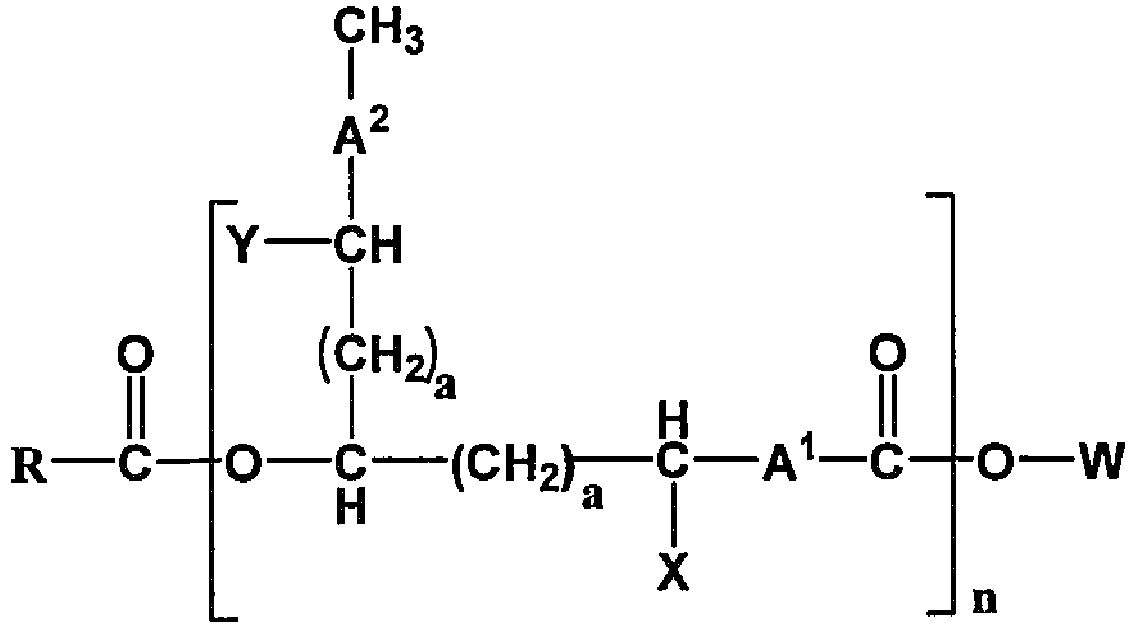
- In einer ganz besonders bevorzugten Ausführungsform enthält das flüssige Wasch- oder Reinigungsmittel das Natriumsalz eines Fettalkoholethersulfats und eine mit Monoethanolamin neutralisierte Fettsäure. Es ist auch bevorzugt, dass die Menge an Fettalkoholethersulfat in dem gesamten flüssigen Wasch- oder Reinigungsmittel mindestens 5 Gew.-% beträgt.
- Die Gesamtmenge an anionischem Tensid in dem flüssigen Wasch- oder Reinigungsmittel beträgt bis zu 35 Gew.-% und vorzugsweise 15 bis 30 Gew.-%, bezogen auf das gesamte flüssige Wasch- oder Reinigungsmittel.
- Die Gesamtmenge an nichtionischem und anionischem Tensid in dem flüssigen Wasch- oder Reinigungsmittel beträgt bis zu 75 Gew.-% und vorzugsweise 50 bis 60 Gew.-%, bezogen auf das gesamte flüssige Wasch- oder Reinigungsmittel.
- Das flüssige Wasch- oder Reinigungsmittel enthält ferner organisches Lösungsmittel, welches eine Mischung aus 1,2-Propandiol und Ethanol umfasst.
- Die Menge an Ethanol beträgt dabei bis zu 5 Gew.-% und vorzugsweise zwischen 1 und 3 Gew.-%, jeweils bezogen auf das gesamte Wasch- oder Reinigungsmittel.
- Die Menge an 1,2-Propandiol beträgt bis zu 50 Gew.-%, vorzugsweise zwischen 10 und 40 Gew.-%, und ganz besonders bevorzugt zwischen 20 und 35 Gew.-%, jeweils bezogen auf das gesamte Wasch- oder Reinigungsmittel.
- Es hat sich insbesondere gezeigt, dass flüssige Wasch- oder Reinigungsmittel, die andere organische Lösungsmittelsysteme besitzen, beispielsweise eine Mischung aus 1,2-Propandiol und Isopropanol, instabil sind.
- Deshalb ist das flüssige Wasch- oder Reinigungsmittel frei von Isopropanol und in einer ganz besonders bevorzugten Ausführungsform frei von weiteren organischen Lösungsmitteln. Entsprechend enthält ein besonders bevorzugtes flüssiges Wasch- oder Reinigungsmittel ein organisches Lösungsmittel, welches eine Mischung aus 1,2-Propandiol und Ethanol ist.
- Das flüssige Wasch- oder Reinigungsmittel enthält Wasser, wobei der Gehalt an Wasser weniger als 15 Gew.-% und mehr bevorzugt weniger als 13 Gew.-%, jeweils bezogen auf das gesamte flüssige Wasch- oder Reinigungsmittel, beträgt. Insbesondere bevorzugt enthält das gesamte flüssige Wasch- oder Reinigungsmittel 7 bis 12 Gew.-% Wasser.
- Vorzugsweise weist das flüssige Wasch- oder Reinigungsmittel eine Wasseraktivität aw von mehr als 0,38 und mehr bevorzugt von mehr als 0,42 auf. Die Bestimmung der Wasseraktivität erfolgt bei 25 °C mit einem "AquaLab Lite"-Gerät der Firma IUL Instruments GmbH.
- Die Wasseraktivität aw ist ein Maß für frei verfügbares Wasser in einem Material und gibt die Verfügbarkeit des Wassers für chemische, biochemische und mikrobielle Reaktionen an. Die Wasseraktivität wird als aw-Wert angegeben und ist definiert als der Quotient aus der Konzentration an Wasser in der Dampfphase im Luftraum über dem Material und der Wasserkonzentration im Luftraum über reinem Wasser bei einer bestimmten Temperatur:

- Zusätzlich zu dem nichtionischen Tensid, dem anionischen Tensid und dem organischen Lösungsmittel kann das Wasch- oder Reinigungsmittel weitere Inhaltsstoffe enthalten, die die anwendungstechnischen und/oder ästhetischen Eigenschaften des Wasch- oder Reinigungsmittels weiter verbessern, aber die die strukturelle Integrität der wasserlöslichen Umhüllung nicht zerstören. Im Rahmen der vorliegenden Erfindung enthält das Wasch- oder Reinigungsmittel vorzugsweise zusätzlich einen oder mehrere Stoffe aus der Gruppe der Gerüststoffe, Bleichmittel, Enzyme, pH-Stellmittel, Parfüme, Parfümträger, Fluoreszenzmittel, Farbstoffe, Hydrotope, Schauminhibitoren, Silikonöle, Antiredepositionsmittel, Vergrauungsinhibitoren, Einlaufverhinderer, Knitterschutzmittel, Farbübertragungsinhibitoren, antimikrobiellen Wirkstoffe, nicht-wässrigen Lösungsmittel, Germizide, Fungizide, Antioxidantien, Konservierungsmittel, Korrosionsinhibitoren, Antistatika, Bittermittel, Bügelhilfsmittel, Phobier- und Imprägniermittel, Haut-pflegende Wirkstoffe, Quell- und Schiebefestmittel, weichmachenden Komponenten sowie UV-Absorber.
- Das flüssige Wasch- oder Reinigungsmittel weist vorzugsweise eine Ionenstärke Ic von kleiner 250 mmol/l, mehr bevorzugt kleiner 200 mmol/l und ganz besonders bevorzugt kleiner 150 mmol/l auf. Die Ionenstärke I einer Lösung ist ein Maß für die elektrische Feldstärke aufgrund gelöster Ionen. Die Ionenstärke I kann sowohl über die Molarität c, als auch die Molalität b der gelösten Ionen wie folgt definiert werden:


- ci = Molarität der Ionensorte i (in mol/l)
- bi = Molalität der Ionensorte i (in mol/kg)
- zi = Ladungszahl der Ionensorte i
- Ic bzw. Ib: Ionenstärke der Lösung bezogen auf die Molarität bzw. die Molalität
- Es hat sich gezeigt, dass eine Erhöhung der Ionenstärke Ic auf 250 mol/l und mehr, beispielsweise durch Zusatz von anorganischen Salzen, um freies Wasser zu binden, zu einem Aussalzen von Inhaltsstoffen des Wasch- oder Reinigungsmittels und/oder zu Ablagerungen an der wasserlöslichen Umhüllung führen kann.
- Aus diesem Grund kann es bevorzugt sein, dass das flüssige Wasch- oder Reinigungsmittel frei von zugesetzten anorganischen Salzen ist.
- Es ist ferner bevorzugt, dass die Menge an aerob nicht biologisch abbaubaren organischen Inhaltsstoffen (aNBO) in dem Wasch- oder Reinigungsmittel weniger als 0,55 g pro kg Waschladung beträgt.
- Ebenso ist bevorzugt, dass die Menge an anaerob nicht biologisch abbaubaren organischen Inhaltsstoffen (anNBO) in dem Wasch- oder Reinigungsmittel weniger als 0,70 g pro kg Waschladung beträgt.
- Eine Waschladung entspricht einer Dosierung von 35 g Wasch- oder Reinigungsmittel auf 4,5 kg Wäsche.
- Das flüssige Wasch- oder Reinigungsmittel befindet sich in einer wasserlöslichen Umhüllung.
- Eine wasserlösliche Verpackung enthält neben dem flüssigen Wasch- oder Reinigungsmittel eine wasserlösliche Umhüllung. Die wasserlösliche Umhüllung wird vorzugsweise durch ein wasserlösliches Folienmaterial gebildet.
- Solche wasserlöslichen Verpackungen können entweder durch Verfahren des vertikalen Formfüllversiegelns (VFFS) oder Warmformverfahren hergestellt werden.
- Das Warmformverfahren schließt im Allgemeinen das Formen einer ersten Lage aus einem wasserlöslichen Folienmaterial zum Bilden von Ausbuchtungen zum Aufnehmen einer Zusammensetzung darin, Einfüllen der Zusammensetzung in die Ausbuchtungen, Bedecken der mit der Zusammensetzung gefüllten Ausbuchtungen mit einer zweiten Lage aus einem wasserlöslichen Folienmaterial und Versiegeln der ersten und zweiten Lagen miteinander zumindest um die Ausbuchtungen herum ein.
- Die wasserlösliche Umhüllung wird vorzugsweise aus einem wasserlöslichen Folienmaterial ausgewählt aus der Gruppe umfassend Polymeren und Polymergemischen gebildet. Die Umhüllung kann aus einer oder aus zwei oder mehr Lagen aus dem wasserlöslichen Folienmaterial gebildet werden. Das wasserlösliche Folienmaterial der ersten Lage und der weiteren Lagen, falls vorhanden, kann gleich oder unterschiedlich sein.
- Es ist bevorzugt, dass die wasserlösliche Umhüllung Polyvinylalkohol oder ein Polyvinylalkoholcopolymer enthält.
- Geeignete wasserlösliche Folien zur Herstellung der wasserlöslichen Umhüllung basieren bevorzugt auf einem Polyvinylalkohol oder einem Polyvinylalkoholcopolymer, dessen Molekulargewicht im Bereich von 10.000 bis 1.000.000 gmol-1, vorzugsweise von 20.000 bis 500.000 gmol-1, besonders bevorzugt von 30.000 bis 100.000 gmol-1 und insbesondere von 40.000 bis 80.000 gmol-1 liegt.
- Die Herstellung von Polyvinylalkohol geschieht üblicherweise durch Hydrolyse von Polyvinylacetat, da der direkte Syntheseweg nicht möglich ist. Ähnliches gilt für Polyvinylalkoholcopolymere, die aus entsprechend aus Polyvinylacetatcopolymeren hergestellt werden. Bevorzugt ist, wenn wenigstens eine Lage der wasserlöslichen Umhüllung einen Polyvinylalkohol umfasst, dessen Hydrolysegrad 70 bis 100 Mol-%, vorzugsweise 80 bis 90 Mol-%, besonders bevorzugt 81 bis 89 Mol-% und insbesondere 82 bis 88 Mol-% ausmacht.
- Einem zur Herstellung der wasserlöslichen Umhüllung geeignetem Polyvinylalkohol-enthaltendem Folienmaterial kann zusätzlich ein Polymer ausgewählt aus der Gruppe umfassend (Meth)Acrylsäure-haltige (Co)Polymere, Polyacrylamide, Oxazolin-Polymere, Polystyrolsulfonate, Polyurethane, Polyester, Polyether, Polymilchsäuren oder Mischungen der vorstehenden Polymere zugesetzt sein. Ein bevorzugtes zusätzliches Polymer sind Polymilchsäuren.
- Bevorzugte Polyvinylalkoholcopolymere umfassen neben Vinylalkohol Dicarbonsäuren als weitere Monomere. Geeignete Dicarbonsäure sind Itaconsäure, Malonsäure, Bernsteinsäure und Mischungen daraus, wobei Itaconsäure bevorzugt ist.
- Ebenfalls bevorzugte Polyvinylalkoholcopolymere umfassen neben Vinylalkohol eine ethylenisch ungesättige Carbonsäure, deren Salz oder deren Ester. Besonders bevorzugt enthalten solche Polyvinylalkoholcopolymere neben Vinylalkohol Acrylsäure, Methacrylsäure, Acrylsäureester, Methacrylsäureester oder Mischungen daraus.
- Es kann bevorzugt sein, dass das Folienmaterial weitere Zusatzstoffe enthält. Das Folienmaterial kann beispielsweise Weichmacher wie Dipropylenglycol, Ethylenglycol, Diethylenglycol, Propylenglycol, Glycerin, Sorbitol, Mannitol oder Mischungen daraus enthalten. Weitere Zusatzstoffe umfassen beispielsweise Freisetzungshilfen, Füllmittel, Vernetzungsmittel, Tenside, Antioxidationsmittel, UV-Absorber, Antiblockmittel, Antiklebemittel oder Mischungen daraus.
- Geeignete wasserlösliche Folien zum Einsatz in den wasserlöslichen Umhüllungen der wasserlöslichen Verpackungen gemäß der Erfindung sind Folien, die von der Firma MonoSol LLC beispielsweise unter der Bezeichnung M8630, M8310, C8400 oder M8900 vertrieben werden. Andere geeignete Folien umfassen Folien mit der Bezeichnung Solublon® PT, Solublon® GA, Solublon® KC oder Solublon® KL von der Aicello Chemical Europe GmbH oder die Folien VF-HP von Kuraray.
- In einer bevorzugten Ausführungsform weist die wasserlösliche Verpackung eine Kammer zur Aufnahme des flüssigen Wasch- oder Reinigungsmittels auf.
- In einer weiteren, ebenfalls bevorzugten Ausführungsform weist die wasserlösliche Verpackung zwei Kammern auf. In dieser Ausführungsform enthält die erste Kammer das oben beschriebene flüssige Wasch- oder Reinigungsmittel und die zweite Kammer kann ein festes oder ein flüssiges Wasch- oder Reinigungsmittel enthalten.
- Weist die wasserlösliche Verpackung drei Kammern auf, können diese Kammern alle jeweils ein flüssiges Wasch- oder Reinigungsmittel enthalten. Möglich ist aber auch, dass eine Kammer ein festes Wasch- oder Reinigungsmittel und zwei Kammern ein flüssiges Wasch- oder Reinigungsmittel enthalten. Außerdem ist es möglich, dass in zwei Kammern ein festes Wasch- oder Reinigungsmittel und in einer Kammer ein flüssiges Wasch- oder Reinigungsmittel enthalten ist.
- Bei wasserlöslichen Verpackungen mit vier oder mehr Kammern bestehen entsprechend noch mehr Kombinationsmöglichkeiten im Hinblick auf die Zahl der Kammern mit einem festen oder einem flüssigen Wasch- oder Reinigungsmittel.
- Bei wasserlöslichen Verpackungen mit zwei oder mehr Kammern enthält mindestens eine Kammer das oben beschriebene, erfindungsgemäße flüssige Wasch- oder Reinigungsmittel mit ausschließlich Tensiden, die aus nachwachsenden Rohstoffen gewonnenen werden. Die flüssigen Wasch- oder Reinigungsmittel, die in den anderen Kammern einer wasserlöslichen Verpackung enthalten sind, können dieselbe Zusammensetzung aufweisen. Vorzugsweise weisen die flüssigen Wasch- oder Reinigungsmittels in einer wasserlöslichen Verpackung mit mindestens zwei Kammern Zusammensetzungen auf, die sich mindestens im Gehalt eines Inhaltsstoffs unterscheiden.
- Die Menge an Wasch- oder Reinigungsmittel, welche sich insgesamt in der wasserlöslichen Verpackung befindet, entspricht vorzugsweise der vollen oder halben Dosis, die für einen Waschgang benötigt wird.
- Es wurden flüssige Wasch- oder Reinigungsmittel mittels üblicher und bekannter Methoden und Verfahren hergestellt. In der folgenden Tabelle 1 sind die Zusammensetzungen von zwei erfindungsgemäßen Wasch- oder Reinigungsmitteln E1 und E2 sowie vier nicht erfindungsgemäßen Wasch- oder Reinigungsmitteln V1 bis V4 gezeigt.
Tabelle 1: Flüssige Wasch- oder Reinigungsmittel E1 und E2 sowie V1 bis V4 [alle Mengen sind in Gew.-% Aktivstoff, bezogen auf die Zusammensetzung, angegeben] Inhaltsstoffe E1 E2 V1 V2 V3 V4 Na-Laurylethersulfat (2 EO) 12 12 12 12 12 12 C12-18-Fettalkohol mit 7 EO 25 25 25 25 25 25 C12-18-Fettsäure 15 15 15 15 15 15 Ethanol 1,4 1,4 -- -- -- -- Isopropanol -- -- 1,4 1,4 1,4 1,4 Phosphonat 1 1 1 1 1 1 Monoethanolamin 3,86 3,86 3,94 3,67 3,71 3,91 Citronensäure, Natriumsalz -- -- -- 1,4 2,25 -- MgCl2 x 6 H2O -- -- -- -- -- 1,4 Farbstoffe, Enzyme (Cellulase, 0,8 0,8 0,8 0,8 0,8 0,8 Amylase & Protease), Parfüm Optischer Aufheller 0,1 -- 0,1 0,1 0,1 0,1 Wasser 2 2 2 2 2 2 1,2-Propandiol auf 100 auf 100 auf 100 auf 100 auf 100 auf 100 - Die Ionenstärke Ic der flüssigen Wasch- oder Reinigungsmittel E1 und E2 betrug jeweils kleiner 150 mmol/l. Die Menge an aerob nicht biologisch abbaubaren organischen Inhaltsstoffen (aNBO) betrug in den Wasch- oder Reinigungsmitteln E1 und E2 jeweils 0,13 g pro kg Waschladung. Die Menge an aerob nicht biologisch abbaubaren organischen Inhaltsstoffen (anNBO) betrug in den Wasch- oder Reinigungsmitteln E1 und E2 jeweils 0,14 g pro kg Waschladung. Die Wasseraktivität aw der flüssigen Wasch- oder Reinigungsmittel E1 und E2 betrug jeweils 0,45.
- Zur Herstellung von wasserlöslichen Verpackungen mit den Wasch- oder Reinigungsmitteln E1 und E2 sowie V1 bis V4 wurde eine Folie vom Typ M 8630 (ex Monosol) mit einer Dicke von 76 µm zum Ausbilden einer Ausbuchtung mittels Vakuum in eine Mulde gezogen. Anschließend wurde die Ausbuchtung mit 30 ml eines der flüssigen Wasch- oder Reinigungsmittel E1, E2 oder V1 bis V4 befüllt. Nach Bedecken der mit dem Mittel befüllten Ausbuchtungen mit einer zweiten Lage einer Folie vom Typ M 8630 wurden die erste und zweite Lage miteinander versiegelt. Die Siegelungstemperatur betrug 150 °C und die Siegelungsdauer 1,1 Sekunden.
- Nach 4, 8 und 12 Wochen Lagerzeit der wasserlöslichen Verpackungen mit den Wasch- oder Reinigungsmitteln E1 und E2 unter verschiedenen klimatischen Bedingungen konnte keinerlei An- oder Auflösung der wasserlöslichen Umhüllung beobachtet werden. Zudem konnten keine Poren oder Löcher, die ebenfalls zum Produktaustritt oder Leckagen führen würden, festgestellt werden.
- Wasserlösliche Verpackungen mit den flüssigen Wasch- oder Reinigungsmitteln E1 und E2 lösten sich in Waschgängen bei Temperaturen, die im Bereich von 20 bis 95 °C lagen, rückstandslos auf und zeigten verglichen mit einer wasserlöslichen Verpackung mit einem flüssigen Wasch- oder Reinigungsmittel, welches als Tensidsystem C12-18-Fettsäureseife, C12-18-Fettalkohol mit 7 EO und ein C9-13-Alkylbenzolsulfonat enthielt, eine gleich gute Reinigungsleistung auf.
- Bei wasserlöslichen Verpackungen mit den flüssigen Wasch- oder Reinigungsmitteln V2 bis V4 zeigten sich bereits nach einem Tag starke Sedimentationen. Das flüssige Wasch- oder Reinigungsmittel V1 gelierte während der Lagerung in der wasserlöslichen Verpackung. Außerdem trat Flüssigkeit durch die wasserlösliche Umhüllung auf die Oberfläche der wasserlöslichen Verpackung aus.
Claims (6)
- Wasserlösliche Verpackung, die ein flüssiges Wasch- oder Reinigungsmittel und eine wasserlösliche Umhüllung enthält, dadurch gekennzeichnet, dass das flüssige Wasch- oder Reinigungsmittela) nichtionisches Tensid ausgewählt aus der Gruppe bestehend aus alkoxylierten Fettalkoholen, Alkylpolyglycosiden, ethoxylierten Methylestern von natürlichen Fettsäuren und Mischungen daraus,b) anionisches Tensid ausgewählt aus der Gruppe bestehend aus Fettalkoholsulfaten, Fettalkoholethersulfaten, Fettsäureseifen, sulfonierten Estoliden und Mischungen daraus,c) organisches Lösungsmittel, welches eine Mischung aus 1,2-Propandiol und Ethanol umfasst,d) bis zu 15 Gew.-%, bezogen auf das gesamte Wasch- oder Reinigungsmittel, Wasser,e) bis zu 50 Gew.-%, bezogen auf das gesamte Wasch- oder Reinigungsmittel, 1,2-Propandiolf) bis zu 5 Gew.-%, bezogen auf das gesamte Wasch- oder Reinigungsmittel, Ethanol enthält, undg) frei von Isopropanol, vorzugsweise frei von weiteren organischen Lösungsmitteln, ist, wobei die Gesamtmenge an anionischem Tensid bis zu 35 Gew.-% bezogen auf das gesamte Wasch- oder Reinigungsmittel beträgt.
- Wasserlösliche Verpackung gemäß Anspruch 1, dadurch gekennzeichnet, dass die Ionenstärke Ic des Wasch- oder Reinigungsmittels kleiner 250 mmol/l ist.
- Wasserlösliche Verpackung gemäß einem Ansprüche 1 bis 2, dadurch gekennzeichnet, dass das anionische Tensid eine Mischung aus Fettalkoholethersulfaten und Fettsäureseifen ist.
- Wasserlösliche Verpackung gemäß einem Ansprüche 1 bis 3, dadurch gekennzeichnet, dass das flüssigen Wasch- oder Reinigungsmittel mindestens 5 Gew.-% Fettalkoholethersulfat enthält.
- Wasserlösliche Verpackung gemäß einem Ansprüche 1 bis 4, dadurch gekennzeichnet, dass das Wasch- oder Reinigungsmittel eine Wasseraktivität aw ≥ 0,38 aufweist.
- Wasserlösliche Verpackung gemäß einem Ansprüche 1 bis 5, dadurch gekennzeichnet, dass die wasserlösliche Umhüllung Polyvinylalkohol oder ein Polyvinylalkoholcopolymer enthält.
Applications Claiming Priority (2)
| Application Number | Priority Date | Filing Date | Title |
|---|---|---|---|
| DE102012208286A DE102012208286A1 (de) | 2012-05-16 | 2012-05-16 | Wasserarmes, flüssiges Waschmittel mit aus nachwachsenden Rohstoffen gewonnenen Tensiden |
| PCT/EP2013/059469 WO2013171095A1 (de) | 2012-05-16 | 2013-05-07 | Wasserarmes, flüssiges waschmittel mit aus nachwachsenden rohstoffen gewonnenen tensiden |
Publications (3)
| Publication Number | Publication Date |
|---|---|
| EP2850169A1 EP2850169A1 (de) | 2015-03-25 |
| EP2850169B1 true EP2850169B1 (de) | 2018-11-14 |
| EP2850169B2 EP2850169B2 (de) | 2025-04-02 |
Family
ID=48325722
Family Applications (1)
| Application Number | Title | Priority Date | Filing Date |
|---|---|---|---|
| EP13720952.4A Active EP2850169B2 (de) | 2012-05-16 | 2013-05-07 | Wasserarmes, flüssiges waschmittel mit aus nachwachsenden rohstoffen gewonnenen tensiden |
Country Status (4)
| Country | Link |
|---|---|
| US (1) | US10160939B2 (de) |
| EP (1) | EP2850169B2 (de) |
| DE (1) | DE102012208286A1 (de) |
| WO (1) | WO2013171095A1 (de) |
Families Citing this family (9)
| Publication number | Priority date | Publication date | Assignee | Title |
|---|---|---|---|---|
| DE102014202221A1 (de) * | 2014-02-06 | 2015-08-06 | Henkel Ag & Co. Kgaa | Mehrphasiges vorportioniertes Reinigungsmittel |
| DE102014225478A1 (de) * | 2014-12-10 | 2016-06-16 | Henkel Ag & Co. Kgaa | Wasch- oder Reinigungsmittel mit spezieller a-Amylase und definierter Wasseraktivität aw |
| US9796948B2 (en) | 2016-01-13 | 2017-10-24 | The Procter & Gamble Company | Laundry detergent compositions comprising renewable components |
| US9896648B2 (en) | 2016-03-02 | 2018-02-20 | The Procter & Gamble Company | Ethoxylated diols and compositions containing ethoxylated diols |
| EP3363889A1 (de) * | 2017-02-21 | 2018-08-22 | The Procter & Gamble Company | Verwendung einer flüssigen wäschewaschmittelzusammensetzung zur minimierung von nebenwirkungen bei versehentlicher exposition mit inhaltsstoffen von wasserlöslichen einheitsdosisartikeln |
| EP3372664A3 (de) * | 2017-02-21 | 2018-11-28 | The Procter & Gamble Company | Verwendung einer flüssigen wäschewaschmittelzusammensetzung zur minimierung von nebenwirkungen bei versehentlicher exposition mit inhaltsstoffen von wasserlöslichen einheitsdosisartikeln |
| US20190048296A1 (en) * | 2017-08-10 | 2019-02-14 | Henkel IP & Holding GmbH | Unit dose detergent products with improved pac rigidity |
| CN114231362B (zh) * | 2021-12-29 | 2023-10-31 | 赞宇科技集团股份有限公司 | 一种抑菌洗衣凝珠及其制备方法 |
| US20250136900A1 (en) * | 2023-10-31 | 2025-05-01 | Henkel Ag & Co. Kgaa | Surfactant blends in unit dose packages for improved mildness |
Citations (8)
| Publication number | Priority date | Publication date | Assignee | Title |
|---|---|---|---|---|
| WO1998000491A1 (en) | 1996-06-28 | 1998-01-08 | The Procter & Gamble Company | Detergent composition |
| US7012053B1 (en) | 1999-10-22 | 2006-03-14 | The Procter & Gamble Company | Fabric care composition and method comprising a fabric care polysaccharide and wrinkle control agent |
| US20100093595A1 (en) | 2008-10-15 | 2010-04-15 | Holzhauer Frederick W | Liquid cleaning compositions |
| US20110065625A1 (en) | 2009-09-14 | 2011-03-17 | Jean-Pol Boutique | External structuring system for liquid laundry detergent composition |
| WO2011075551A1 (en) | 2009-12-18 | 2011-06-23 | The Procter & Gamble Company | Perfumes and perfume encapsulates |
| US8097579B2 (en) | 2007-11-09 | 2012-01-17 | The Procter & Gamble Company | Cleaning compositions with amphiphilic water-soluble polyalkylenimines having an inner polyethylene oxide block and an outer polypropylene oxide block |
| WO2012166768A1 (en) | 2011-06-03 | 2012-12-06 | The Procter & Gamble Company | Laundry care compositions containing dyes |
| WO2013135512A1 (de) * | 2012-03-14 | 2013-09-19 | Henkel Ag & Co. Kgaa | Bestäubte, wasserlösliche verpackung |
Family Cites Families (13)
| Publication number | Priority date | Publication date | Assignee | Title |
|---|---|---|---|---|
| DE4341050A1 (de) * | 1993-12-02 | 1995-06-08 | Huels Chemische Werke Ag | Tensidkonzentrate als Basistenside für konzentrierte Flüssigformulierungen |
| US6995126B2 (en) * | 2000-04-28 | 2006-02-07 | The Procter & Gamble Company | Pouched compositions |
| EP1352044B1 (de) | 2001-01-19 | 2006-05-10 | Reckitt Benckiser N.V. | Verbesserungen bei flüssigen waschmitteln |
| EP1354939A1 (de) * | 2002-04-19 | 2003-10-22 | The Procter & Gamble Company | Reinigungsmittelzusammensetzungen in Beuteln |
| US7666828B2 (en) * | 2008-01-22 | 2010-02-23 | Stepan Company | Sulfonated estolides and other derivatives of fatty acids, methods of making them, and compositions and processes employing them |
| US7879790B2 (en) * | 2008-01-22 | 2011-02-01 | Stepan Company | Mixed salts of sulfonated estolides and other derivatives of fatty acids, and methods of making them |
| ATE539141T1 (de) * | 2008-06-13 | 2012-01-15 | Procter & Gamble | Beutel mit mehreren kammern |
| US7939487B2 (en) * | 2008-08-26 | 2011-05-10 | The Clorox Company | Natural cleaners |
| US8119588B2 (en) * | 2009-01-21 | 2012-02-21 | Stepan Company | Hard surface cleaner compositions of sulfonated estolides and other derivatives of fatty acids and uses thereof |
| HUE048039T2 (hu) * | 2009-06-02 | 2020-05-28 | Procter & Gamble | Vízoldható tasak |
| PL2528955T3 (pl) * | 2010-01-29 | 2019-09-30 | Monosol, Llc | Rozpuszczalna w wodzie folia o ulepszonych właściwościach rozpuszczania i związanych z naprężeniem oraz wykonane z niej opakowania |
| WO2012003351A2 (en) * | 2010-07-02 | 2012-01-05 | The Procter & Gamble Company | Web material and method for making same |
| EP2441824A1 (de) * | 2010-10-15 | 2012-04-18 | Cognis IP Management GmbH | Zum Verpacken in Polyvinylalkoholbeutel geeignete Waschmittelflüssigkeit |
-
2012
- 2012-05-16 DE DE102012208286A patent/DE102012208286A1/de not_active Withdrawn
-
2013
- 2013-05-07 WO PCT/EP2013/059469 patent/WO2013171095A1/de not_active Ceased
- 2013-05-07 EP EP13720952.4A patent/EP2850169B2/de active Active
-
2014
- 2014-11-06 US US14/534,902 patent/US10160939B2/en not_active Expired - Fee Related
Patent Citations (9)
| Publication number | Priority date | Publication date | Assignee | Title |
|---|---|---|---|---|
| WO1998000491A1 (en) | 1996-06-28 | 1998-01-08 | The Procter & Gamble Company | Detergent composition |
| US7012053B1 (en) | 1999-10-22 | 2006-03-14 | The Procter & Gamble Company | Fabric care composition and method comprising a fabric care polysaccharide and wrinkle control agent |
| US8097579B2 (en) | 2007-11-09 | 2012-01-17 | The Procter & Gamble Company | Cleaning compositions with amphiphilic water-soluble polyalkylenimines having an inner polyethylene oxide block and an outer polypropylene oxide block |
| US20100093595A1 (en) | 2008-10-15 | 2010-04-15 | Holzhauer Frederick W | Liquid cleaning compositions |
| WO2010044835A1 (en) | 2008-10-15 | 2010-04-22 | Method Products, Inc. | Liquid cleaning compositions |
| US20110065625A1 (en) | 2009-09-14 | 2011-03-17 | Jean-Pol Boutique | External structuring system for liquid laundry detergent composition |
| WO2011075551A1 (en) | 2009-12-18 | 2011-06-23 | The Procter & Gamble Company | Perfumes and perfume encapsulates |
| WO2012166768A1 (en) | 2011-06-03 | 2012-12-06 | The Procter & Gamble Company | Laundry care compositions containing dyes |
| WO2013135512A1 (de) * | 2012-03-14 | 2013-09-19 | Henkel Ag & Co. Kgaa | Bestäubte, wasserlösliche verpackung |
Also Published As
| Publication number | Publication date |
|---|---|
| EP2850169A1 (de) | 2015-03-25 |
| US20150065410A1 (en) | 2015-03-05 |
| EP2850169B2 (de) | 2025-04-02 |
| DE102012208286A1 (de) | 2013-11-21 |
| WO2013171095A1 (de) | 2013-11-21 |
| US10160939B2 (en) | 2018-12-25 |
Similar Documents
| Publication | Publication Date | Title |
|---|---|---|
| EP2850169B2 (de) | Wasserarmes, flüssiges waschmittel mit aus nachwachsenden rohstoffen gewonnenen tensiden | |
| EP2867352B1 (de) | Hochkonzentriertes flüssiges wasch- oder reinigungsmittel | |
| EP2773735B1 (de) | STRUKTURIERTES WASCH- ODER REINIGUNGSMITTEL MIT FLIEßGRENZE | |
| DE60106631T2 (de) | Wasserlösliche, warmgeformte, wässrige zusammensetzungen enthaltende behälter | |
| DE60216256T2 (de) | Wasserlöslicher behälter mit mindestens zwei öffnungen | |
| EP2802643B1 (de) | Duftende, wasserlösliche verpackung | |
| EP3354592A1 (de) | Gefärbte, wasserlösliche verpackung | |
| EP3204309A1 (de) | Folienverpackte mittelportion | |
| DE602004007791T2 (de) | Wasserlöslicher behälter | |
| EP3126260A1 (de) | Wasserlösliche portionspackung mit formstabilem deckel | |
| EP2828368B1 (de) | Flüssiges waschmittel mit erhöhter reinigungsleistung | |
| EP2895588A1 (de) | Strukturiertes, wasserarmes, flüssiges waschmittel mit partikeln | |
| EP2809759B1 (de) | Wasserarmes, flüssiges waschmittel mit erhöhter fettlösekraft | |
| EP2875107B1 (de) | Stabiles, flüssiges waschmittel mit vergrauungsinhibierender leistung | |
| DE102013226426A1 (de) | Konservierungsmittelsystem für Waschmittel | |
| DE102011085639A1 (de) | Strukturiertes Wasch- oder Reinigungsmittel mit Fließgrenze | |
| DE602004000316T2 (de) | Wassserlösliche Verpackung mit flüssigem Inhalt | |
| DE102014014767A1 (de) | Folienverpackte Mittelportion | |
| EP4077623B1 (de) | Textilbehandlungsmittel | |
| EP2875106B1 (de) | Stabiles, flüssiges waschmittel mit vergrauungsinhibierender leistung | |
| DE102016206647A1 (de) | Flüssigwaschmittel | |
| DE102019219881A1 (de) | Klarspülmittel für automatische Geschirrspülmaschinen | |
| WO2015091109A1 (de) | Hpmc-haltige flüssigwaschmittel |
Legal Events
| Date | Code | Title | Description |
|---|---|---|---|
| PUAI | Public reference made under article 153(3) epc to a published international application that has entered the european phase |
Free format text: ORIGINAL CODE: 0009012 |
|
| 17P | Request for examination filed |
Effective date: 20140306 |
|
| AK | Designated contracting states |
Kind code of ref document: A1 Designated state(s): AL AT BE BG CH CY CZ DE DK EE ES FI FR GB GR HR HU IE IS IT LI LT LU LV MC MK MT NL NO PL PT RO RS SE SI SK SM TR |
|
| AX | Request for extension of the european patent |
Extension state: BA ME |
|
| RIN1 | Information on inventor provided before grant (corrected) |
Inventor name: KOELLING, LEYLA Inventor name: SCHUEMANN, SABINE Inventor name: MEIER, FRANK Inventor name: BELLOMI, LUCA Inventor name: SUNDER, MATTHIAS |
|
| DAX | Request for extension of the european patent (deleted) | ||
| STAA | Information on the status of an ep patent application or granted ep patent |
Free format text: STATUS: EXAMINATION IS IN PROGRESS |
|
| 17Q | First examination report despatched |
Effective date: 20170104 |
|
| GRAP | Despatch of communication of intention to grant a patent |
Free format text: ORIGINAL CODE: EPIDOSNIGR1 |
|
| STAA | Information on the status of an ep patent application or granted ep patent |
Free format text: STATUS: GRANT OF PATENT IS INTENDED |
|
| INTG | Intention to grant announced |
Effective date: 20180627 |
|
| GRAS | Grant fee paid |
Free format text: ORIGINAL CODE: EPIDOSNIGR3 |
|
| GRAA | (expected) grant |
Free format text: ORIGINAL CODE: 0009210 |
|
| STAA | Information on the status of an ep patent application or granted ep patent |
Free format text: STATUS: THE PATENT HAS BEEN GRANTED |
|
| AK | Designated contracting states |
Kind code of ref document: B1 Designated state(s): AL AT BE BG CH CY CZ DE DK EE ES FI FR GB GR HR HU IE IS IT LI LT LU LV MC MK MT NL NO PL PT RO RS SE SI SK SM TR |
|
| REG | Reference to a national code |
Ref country code: CH Ref legal event code: EP Ref country code: AT Ref legal event code: REF Ref document number: 1064828 Country of ref document: AT Kind code of ref document: T Effective date: 20181115 |
|
| REG | Reference to a national code |
Ref country code: DE Ref legal event code: R096 Ref document number: 502013011608 Country of ref document: DE |
|
| REG | Reference to a national code |
Ref country code: IE Ref legal event code: FG4D Free format text: LANGUAGE OF EP DOCUMENT: GERMAN |
|
| REG | Reference to a national code |
Ref country code: NL Ref legal event code: MP Effective date: 20181114 |
|
| REG | Reference to a national code |
Ref country code: LT Ref legal event code: MG4D |
|
| PG25 | Lapsed in a contracting state [announced via postgrant information from national office to epo] |
Ref country code: ES Free format text: LAPSE BECAUSE OF FAILURE TO SUBMIT A TRANSLATION OF THE DESCRIPTION OR TO PAY THE FEE WITHIN THE PRESCRIBED TIME-LIMIT Effective date: 20181114 Ref country code: IS Free format text: LAPSE BECAUSE OF FAILURE TO SUBMIT A TRANSLATION OF THE DESCRIPTION OR TO PAY THE FEE WITHIN THE PRESCRIBED TIME-LIMIT Effective date: 20190314 Ref country code: BG Free format text: LAPSE BECAUSE OF FAILURE TO SUBMIT A TRANSLATION OF THE DESCRIPTION OR TO PAY THE FEE WITHIN THE PRESCRIBED TIME-LIMIT Effective date: 20190214 Ref country code: LT Free format text: LAPSE BECAUSE OF FAILURE TO SUBMIT A TRANSLATION OF THE DESCRIPTION OR TO PAY THE FEE WITHIN THE PRESCRIBED TIME-LIMIT Effective date: 20181114 Ref country code: NO Free format text: LAPSE BECAUSE OF FAILURE TO SUBMIT A TRANSLATION OF THE DESCRIPTION OR TO PAY THE FEE WITHIN THE PRESCRIBED TIME-LIMIT Effective date: 20190214 Ref country code: LV Free format text: LAPSE BECAUSE OF FAILURE TO SUBMIT A TRANSLATION OF THE DESCRIPTION OR TO PAY THE FEE WITHIN THE PRESCRIBED TIME-LIMIT Effective date: 20181114 Ref country code: HR Free format text: LAPSE BECAUSE OF FAILURE TO SUBMIT A TRANSLATION OF THE DESCRIPTION OR TO PAY THE FEE WITHIN THE PRESCRIBED TIME-LIMIT Effective date: 20181114 Ref country code: FI Free format text: LAPSE BECAUSE OF FAILURE TO SUBMIT A TRANSLATION OF THE DESCRIPTION OR TO PAY THE FEE WITHIN THE PRESCRIBED TIME-LIMIT Effective date: 20181114 |
|
| PG25 | Lapsed in a contracting state [announced via postgrant information from national office to epo] |
Ref country code: AL Free format text: LAPSE BECAUSE OF FAILURE TO SUBMIT A TRANSLATION OF THE DESCRIPTION OR TO PAY THE FEE WITHIN THE PRESCRIBED TIME-LIMIT Effective date: 20181114 Ref country code: RS Free format text: LAPSE BECAUSE OF FAILURE TO SUBMIT A TRANSLATION OF THE DESCRIPTION OR TO PAY THE FEE WITHIN THE PRESCRIBED TIME-LIMIT Effective date: 20181114 Ref country code: SE Free format text: LAPSE BECAUSE OF FAILURE TO SUBMIT A TRANSLATION OF THE DESCRIPTION OR TO PAY THE FEE WITHIN THE PRESCRIBED TIME-LIMIT Effective date: 20181114 Ref country code: GR Free format text: LAPSE BECAUSE OF FAILURE TO SUBMIT A TRANSLATION OF THE DESCRIPTION OR TO PAY THE FEE WITHIN THE PRESCRIBED TIME-LIMIT Effective date: 20190215 Ref country code: NL Free format text: LAPSE BECAUSE OF FAILURE TO SUBMIT A TRANSLATION OF THE DESCRIPTION OR TO PAY THE FEE WITHIN THE PRESCRIBED TIME-LIMIT Effective date: 20181114 Ref country code: PT Free format text: LAPSE BECAUSE OF FAILURE TO SUBMIT A TRANSLATION OF THE DESCRIPTION OR TO PAY THE FEE WITHIN THE PRESCRIBED TIME-LIMIT Effective date: 20190314 |
|
| PG25 | Lapsed in a contracting state [announced via postgrant information from national office to epo] |
Ref country code: IT Free format text: LAPSE BECAUSE OF FAILURE TO SUBMIT A TRANSLATION OF THE DESCRIPTION OR TO PAY THE FEE WITHIN THE PRESCRIBED TIME-LIMIT Effective date: 20181114 Ref country code: PL Free format text: LAPSE BECAUSE OF FAILURE TO SUBMIT A TRANSLATION OF THE DESCRIPTION OR TO PAY THE FEE WITHIN THE PRESCRIBED TIME-LIMIT Effective date: 20181114 Ref country code: DK Free format text: LAPSE BECAUSE OF FAILURE TO SUBMIT A TRANSLATION OF THE DESCRIPTION OR TO PAY THE FEE WITHIN THE PRESCRIBED TIME-LIMIT Effective date: 20181114 Ref country code: CZ Free format text: LAPSE BECAUSE OF FAILURE TO SUBMIT A TRANSLATION OF THE DESCRIPTION OR TO PAY THE FEE WITHIN THE PRESCRIBED TIME-LIMIT Effective date: 20181114 |
|
| REG | Reference to a national code |
Ref country code: DE Ref legal event code: R026 Ref document number: 502013011608 Country of ref document: DE |
|
| PLBI | Opposition filed |
Free format text: ORIGINAL CODE: 0009260 |
|
| PLAX | Notice of opposition and request to file observation + time limit sent |
Free format text: ORIGINAL CODE: EPIDOSNOBS2 |
|
| PG25 | Lapsed in a contracting state [announced via postgrant information from national office to epo] |
Ref country code: EE Free format text: LAPSE BECAUSE OF FAILURE TO SUBMIT A TRANSLATION OF THE DESCRIPTION OR TO PAY THE FEE WITHIN THE PRESCRIBED TIME-LIMIT Effective date: 20181114 Ref country code: SM Free format text: LAPSE BECAUSE OF FAILURE TO SUBMIT A TRANSLATION OF THE DESCRIPTION OR TO PAY THE FEE WITHIN THE PRESCRIBED TIME-LIMIT Effective date: 20181114 Ref country code: RO Free format text: LAPSE BECAUSE OF FAILURE TO SUBMIT A TRANSLATION OF THE DESCRIPTION OR TO PAY THE FEE WITHIN THE PRESCRIBED TIME-LIMIT Effective date: 20181114 Ref country code: SK Free format text: LAPSE BECAUSE OF FAILURE TO SUBMIT A TRANSLATION OF THE DESCRIPTION OR TO PAY THE FEE WITHIN THE PRESCRIBED TIME-LIMIT Effective date: 20181114 |
|
| 26 | Opposition filed |
Opponent name: THE PROCTER & GAMBLE COMPANY Effective date: 20190814 Opponent name: DALLI-WERKE GMBH & CO. KG Effective date: 20190809 |
|
| PG25 | Lapsed in a contracting state [announced via postgrant information from national office to epo] |
Ref country code: SI Free format text: LAPSE BECAUSE OF FAILURE TO SUBMIT A TRANSLATION OF THE DESCRIPTION OR TO PAY THE FEE WITHIN THE PRESCRIBED TIME-LIMIT Effective date: 20181114 |
|
| REG | Reference to a national code |
Ref country code: CH Ref legal event code: PL |
|
| PLBB | Reply of patent proprietor to notice(s) of opposition received |
Free format text: ORIGINAL CODE: EPIDOSNOBS3 |
|
| PG25 | Lapsed in a contracting state [announced via postgrant information from national office to epo] |
Ref country code: LI Free format text: LAPSE BECAUSE OF NON-PAYMENT OF DUE FEES Effective date: 20190531 Ref country code: CH Free format text: LAPSE BECAUSE OF NON-PAYMENT OF DUE FEES Effective date: 20190531 Ref country code: MC Free format text: LAPSE BECAUSE OF FAILURE TO SUBMIT A TRANSLATION OF THE DESCRIPTION OR TO PAY THE FEE WITHIN THE PRESCRIBED TIME-LIMIT Effective date: 20181114 |
|
| REG | Reference to a national code |
Ref country code: BE Ref legal event code: MM Effective date: 20190531 |
|
| PG25 | Lapsed in a contracting state [announced via postgrant information from national office to epo] |
Ref country code: LU Free format text: LAPSE BECAUSE OF NON-PAYMENT OF DUE FEES Effective date: 20190507 |
|
| PG25 | Lapsed in a contracting state [announced via postgrant information from national office to epo] |
Ref country code: TR Free format text: LAPSE BECAUSE OF FAILURE TO SUBMIT A TRANSLATION OF THE DESCRIPTION OR TO PAY THE FEE WITHIN THE PRESCRIBED TIME-LIMIT Effective date: 20181114 |
|
| PG25 | Lapsed in a contracting state [announced via postgrant information from national office to epo] |
Ref country code: IE Free format text: LAPSE BECAUSE OF NON-PAYMENT OF DUE FEES Effective date: 20190507 |
|
| PG25 | Lapsed in a contracting state [announced via postgrant information from national office to epo] |
Ref country code: BE Free format text: LAPSE BECAUSE OF NON-PAYMENT OF DUE FEES Effective date: 20190531 |
|
| REG | Reference to a national code |
Ref country code: AT Ref legal event code: MM01 Ref document number: 1064828 Country of ref document: AT Kind code of ref document: T Effective date: 20190507 |
|
| PG25 | Lapsed in a contracting state [announced via postgrant information from national office to epo] |
Ref country code: AT Free format text: LAPSE BECAUSE OF NON-PAYMENT OF DUE FEES Effective date: 20190507 |
|
| PLAB | Opposition data, opponent's data or that of the opponent's representative modified |
Free format text: ORIGINAL CODE: 0009299OPPO |
|
| PLCK | Communication despatched that opposition was rejected |
Free format text: ORIGINAL CODE: EPIDOSNREJ1 |
|
| R26 | Opposition filed (corrected) |
Opponent name: DALLI-WERKE GMBH & CO. KG Effective date: 20190809 |
|
| PG25 | Lapsed in a contracting state [announced via postgrant information from national office to epo] |
Ref country code: CY Free format text: LAPSE BECAUSE OF FAILURE TO SUBMIT A TRANSLATION OF THE DESCRIPTION OR TO PAY THE FEE WITHIN THE PRESCRIBED TIME-LIMIT Effective date: 20181114 |
|
| APAH | Appeal reference modified |
Free format text: ORIGINAL CODE: EPIDOSCREFNO |
|
| APBM | Appeal reference recorded |
Free format text: ORIGINAL CODE: EPIDOSNREFNO |
|
| APBP | Date of receipt of notice of appeal recorded |
Free format text: ORIGINAL CODE: EPIDOSNNOA2O |
|
| PG25 | Lapsed in a contracting state [announced via postgrant information from national office to epo] |
Ref country code: MT Free format text: LAPSE BECAUSE OF FAILURE TO SUBMIT A TRANSLATION OF THE DESCRIPTION OR TO PAY THE FEE WITHIN THE PRESCRIBED TIME-LIMIT Effective date: 20181114 Ref country code: HU Free format text: LAPSE BECAUSE OF FAILURE TO SUBMIT A TRANSLATION OF THE DESCRIPTION OR TO PAY THE FEE WITHIN THE PRESCRIBED TIME-LIMIT; INVALID AB INITIO Effective date: 20130507 |
|
| APBQ | Date of receipt of statement of grounds of appeal recorded |
Free format text: ORIGINAL CODE: EPIDOSNNOA3O |
|
| PG25 | Lapsed in a contracting state [announced via postgrant information from national office to epo] |
Ref country code: MK Free format text: LAPSE BECAUSE OF FAILURE TO SUBMIT A TRANSLATION OF THE DESCRIPTION OR TO PAY THE FEE WITHIN THE PRESCRIBED TIME-LIMIT Effective date: 20181114 |
|
| P01 | Opt-out of the competence of the unified patent court (upc) registered |
Effective date: 20230530 |
|
| APBU | Appeal procedure closed |
Free format text: ORIGINAL CODE: EPIDOSNNOA9O |
|
| PLAY | Examination report in opposition despatched + time limit |
Free format text: ORIGINAL CODE: EPIDOSNORE2 |
|
| PLBC | Reply to examination report in opposition received |
Free format text: ORIGINAL CODE: EPIDOSNORE3 |
|
| PLAY | Examination report in opposition despatched + time limit |
Free format text: ORIGINAL CODE: EPIDOSNORE2 |
|
| PUAH | Patent maintained in amended form |
Free format text: ORIGINAL CODE: 0009272 |
|
| STAA | Information on the status of an ep patent application or granted ep patent |
Free format text: STATUS: PATENT MAINTAINED AS AMENDED |
|
| 27A | Patent maintained in amended form |
Effective date: 20250402 |
|
| AK | Designated contracting states |
Kind code of ref document: B2 Designated state(s): AL AT BE BG CH CY CZ DE DK EE ES FI FR GB GR HR HU IE IS IT LI LT LU LV MC MK MT NL NO PL PT RO RS SE SI SK SM TR |
|
| REG | Reference to a national code |
Ref country code: DE Ref legal event code: R102 Ref document number: 502013011608 Country of ref document: DE |
|
| PGFP | Annual fee paid to national office [announced via postgrant information from national office to epo] |
Ref country code: DE Payment date: 20250521 Year of fee payment: 13 |
|
| PGFP | Annual fee paid to national office [announced via postgrant information from national office to epo] |
Ref country code: GB Payment date: 20250521 Year of fee payment: 13 |
|
| PGFP | Annual fee paid to national office [announced via postgrant information from national office to epo] |
Ref country code: FR Payment date: 20250528 Year of fee payment: 13 |
|
| REG | Reference to a national code |
Ref country code: DE Ref legal event code: R084 Ref document number: 502013011608 Country of ref document: DE |