EP2827804B1 - Intraocular lens delivery systems - Google Patents
Intraocular lens delivery systems Download PDFInfo
- Publication number
- EP2827804B1 EP2827804B1 EP13764305.2A EP13764305A EP2827804B1 EP 2827804 B1 EP2827804 B1 EP 2827804B1 EP 13764305 A EP13764305 A EP 13764305A EP 2827804 B1 EP2827804 B1 EP 2827804B1
- Authority
- EP
- European Patent Office
- Prior art keywords
- cartridge
- plunger
- intraocular lens
- fluid
- plug element
- Prior art date
- Legal status (The legal status is an assumption and is not a legal conclusion. Google has not performed a legal analysis and makes no representation as to the accuracy of the status listed.)
- Active
Links
Images









Classifications
-
- A—HUMAN NECESSITIES
- A61—MEDICAL OR VETERINARY SCIENCE; HYGIENE
- A61F—FILTERS IMPLANTABLE INTO BLOOD VESSELS; PROSTHESES; DEVICES PROVIDING PATENCY TO, OR PREVENTING COLLAPSING OF, TUBULAR STRUCTURES OF THE BODY, e.g. STENTS; ORTHOPAEDIC, NURSING OR CONTRACEPTIVE DEVICES; FOMENTATION; TREATMENT OR PROTECTION OF EYES OR EARS; BANDAGES, DRESSINGS OR ABSORBENT PADS; FIRST-AID KITS
- A61F9/00—Methods or devices for treatment of the eyes; Devices for putting in contact-lenses; Devices to correct squinting; Apparatus to guide the blind; Protective devices for the eyes, carried on the body or in the hand
- A61F9/007—Methods or devices for eye surgery
-
- A—HUMAN NECESSITIES
- A61—MEDICAL OR VETERINARY SCIENCE; HYGIENE
- A61F—FILTERS IMPLANTABLE INTO BLOOD VESSELS; PROSTHESES; DEVICES PROVIDING PATENCY TO, OR PREVENTING COLLAPSING OF, TUBULAR STRUCTURES OF THE BODY, e.g. STENTS; ORTHOPAEDIC, NURSING OR CONTRACEPTIVE DEVICES; FOMENTATION; TREATMENT OR PROTECTION OF EYES OR EARS; BANDAGES, DRESSINGS OR ABSORBENT PADS; FIRST-AID KITS
- A61F2/00—Filters implantable into blood vessels; Prostheses, i.e. artificial substitutes or replacements for parts of the body; Appliances for connecting them with the body; Devices providing patency to, or preventing collapsing of, tubular structures of the body, e.g. stents
- A61F2/02—Prostheses implantable into the body
- A61F2/14—Eye parts, e.g. lenses or corneal implants; Artificial eyes
- A61F2/16—Intraocular lenses
- A61F2/1662—Instruments for inserting intraocular lenses into the eye
- A61F2/167—Instruments for inserting intraocular lenses into the eye with pushable plungers
-
- A—HUMAN NECESSITIES
- A61—MEDICAL OR VETERINARY SCIENCE; HYGIENE
- A61F—FILTERS IMPLANTABLE INTO BLOOD VESSELS; PROSTHESES; DEVICES PROVIDING PATENCY TO, OR PREVENTING COLLAPSING OF, TUBULAR STRUCTURES OF THE BODY, e.g. STENTS; ORTHOPAEDIC, NURSING OR CONTRACEPTIVE DEVICES; FOMENTATION; TREATMENT OR PROTECTION OF EYES OR EARS; BANDAGES, DRESSINGS OR ABSORBENT PADS; FIRST-AID KITS
- A61F2/00—Filters implantable into blood vessels; Prostheses, i.e. artificial substitutes or replacements for parts of the body; Appliances for connecting them with the body; Devices providing patency to, or preventing collapsing of, tubular structures of the body, e.g. stents
- A61F2/02—Prostheses implantable into the body
- A61F2/14—Eye parts, e.g. lenses or corneal implants; Artificial eyes
- A61F2/16—Intraocular lenses
- A61F2/1662—Instruments for inserting intraocular lenses into the eye
-
- A—HUMAN NECESSITIES
- A61—MEDICAL OR VETERINARY SCIENCE; HYGIENE
- A61F—FILTERS IMPLANTABLE INTO BLOOD VESSELS; PROSTHESES; DEVICES PROVIDING PATENCY TO, OR PREVENTING COLLAPSING OF, TUBULAR STRUCTURES OF THE BODY, e.g. STENTS; ORTHOPAEDIC, NURSING OR CONTRACEPTIVE DEVICES; FOMENTATION; TREATMENT OR PROTECTION OF EYES OR EARS; BANDAGES, DRESSINGS OR ABSORBENT PADS; FIRST-AID KITS
- A61F2/00—Filters implantable into blood vessels; Prostheses, i.e. artificial substitutes or replacements for parts of the body; Appliances for connecting them with the body; Devices providing patency to, or preventing collapsing of, tubular structures of the body, e.g. stents
- A61F2/02—Prostheses implantable into the body
- A61F2/14—Eye parts, e.g. lenses or corneal implants; Artificial eyes
- A61F2/16—Intraocular lenses
- A61F2/1662—Instruments for inserting intraocular lenses into the eye
- A61F2/1675—Instruments for inserting intraocular lenses into the eye with a lubricated inner surface, e.g. the lubricant being coated on the inner surface or being injected through a port
-
- A—HUMAN NECESSITIES
- A61—MEDICAL OR VETERINARY SCIENCE; HYGIENE
- A61F—FILTERS IMPLANTABLE INTO BLOOD VESSELS; PROSTHESES; DEVICES PROVIDING PATENCY TO, OR PREVENTING COLLAPSING OF, TUBULAR STRUCTURES OF THE BODY, e.g. STENTS; ORTHOPAEDIC, NURSING OR CONTRACEPTIVE DEVICES; FOMENTATION; TREATMENT OR PROTECTION OF EYES OR EARS; BANDAGES, DRESSINGS OR ABSORBENT PADS; FIRST-AID KITS
- A61F2250/00—Special features of prostheses classified in groups A61F2/00 - A61F2/26 or A61F2/82 or A61F9/00 or A61F11/00 or subgroups thereof
- A61F2250/0058—Additional features; Implant or prostheses properties not otherwise provided for
- A61F2250/0069—Sealing means
Definitions
- Intraocular lenses are positioned within a patient's eye, such as in the anterior chamber or posterior chamber. After making a small incision in the eye, a physician typically positions a distal opening of a delivery device within or adjacent to the opening. The physician then delivers the intraocular lens out of the delivery device, through the opening, and into the target location within the eye. In some procedures, but not all, an intraocular lens is delivered into a native capsule after the native lens has been removed.
- Some intraocular lenses because of their size and/or their configuration, and possibly the desired incision size, need to be reconfigured and/or have at least a first portion reoriented with respect to a second portion to be delivered into an eye.
- forces on the intraocular lens can damage the intraocular lens.
- US 2009/030425 A1 discloses a hydraulic loading system for loading an intraocular lens into a delivery device.
- a fluid containing compression chamber has a tapered inner surface.
- a delivery device comprises an elongate loading element in fluid communication with the compression chamber.
- An intraocular lens is disposed in a first configuration within the compression chamber.
- a loading device is adapted to cause the fluid to flow through the compression chamber and into the elongate loading element, thereby loading the ophthalmic device into the elongate loading element.
- the loading device comprises a plunger to direct the fluid through the compression chamber and into the elongate loading element.
- US 2009/0292293 A1 discloses an insertion system for inserting an intraocular lens which comprises a pusher which has an extensible distal portion elongated by fluid pressure when a plunger is activated. The elongated distal portion contacts an intraocular lens inserted into a cartrdige thereby urging the intraocular lens through the cartridge.
- a method of deploying an intraocular lens into an eye comprising providing an intraocular lens within a delivery device; at least partially plugging a gap between the intraocular lens and an inner surface of the delivery device; and delivering a fluid into the delivery device to deploy the intraocular lens from the delivery device and into an eye.
- at least partially plugging a gap reduces the amount of fluid that flows passed the intraocular lens in the delivery device.
- at least partially plugging a gap allow for an increase in fluid pressure in the delivery device proximal to an optic portion of the intraocular lens.
- At least partially plugging a gap increase a pressure differential in the delivery device between a location proximal to an optic portion of the intraocular lens and a location distal to the intraocular lens.
- at least partially plugging a gap comprises at least partially plugging a gap that is disposed radially between the intraocular lens and an inner surface of the delivery device.
- at least partially plugging a gap between the intraocular lens and an inner surface of the delivery device comprises at least plugging a gap that exists between a trailing haptic and an inner surface of the delivery device.
- Some methods further comprise reconfiguring a plugging element while delivering the fluid into the delivery device. Reconfiguring the plugging element can act to form a seal between the plugging element and an inner surface of the delivery device. Reconfiguring the plugging element can include unrolling the plugging element.
- delivering a fluid into the delivery device to deploy the intraocular lens from the delivery device comprises delivering a fluid through a porous material.
- Also disclosed herein is a method of deploying an intraocular lens into an eye, comprising providing an intraocular lens within a delivery device; at least partially plugging a gap disposed radially between the intraocular lens and an inner surface of the delivery device; and delivering a fluid into the delivery device to deploy the intraocular lens from the delivery device.
- at least partially plugging a gap disposed radially between the intraocular lens and an inner surface of the delivery device comprises at least partially plugging a gap disposed radially between a haptic extending generally longitudinally through the delivery device and in inner surface of the delivery device.
- a method of deploying an intraocular lens into an eye comprising providing an intraocular lens within a delivery device; delivering a fluid into the delivery device to deploy the intraocular lens from the delivery device; and increasing fluid pressure proximal to at least an optic portion of the IOL, wherein increasing the fluid pressure is a step different than delivering the fluid into the delivery device.
- increasing fluid pressure proximal to at least an optic portion of the IOL comprises plugging a gap between the IOL and an inner surface of the delivery device.
- a method of deploying an intraocular lens into an eye comprising providing an intraocular lens within a delivery device; delivering a fluid into the delivery device to deploy the intraocular lens from the delivery device; and venting air from within the delivery device through a vent, wherein the vent is not an intraocular lens delivery port.
- the disclosure is related to methods and devices for delivering an intraocular lens ("IOL") into an eye.
- IOL intraocular lens
- the systems and methods herein can, however, be used to advance any type of IOL within a delivery or loading device.
- the intraocular lens can be accommodating or non-accommodating.
- the methods and devices herein may be beneficial when the IOL body does not occupy the entire volume of a section of the delivery device in which the IOL is positioned.
- An IOL is typically implanted within a patient's eye to replace or supplement the function of an eye's native lens.
- the native lens can become diseased (e.g., cataract), or the lens can lose the ability to accommodate over time (i.e., presbyopia). In either case, the native lens can be removed and replaced with an IOL.
- the IOL typically undergoes some type of deformation or reconfiguration during the loading and/or delivery process to reduce the profile of the IOL.
- IOLs include components that can be reoriented and/or reconfigured relative to another component, such as a peripheral portion relative to an optic portion, and the controlled positioning or deformation of these components during the loading and/or delivery steps can enhance the loading and/or delivery and reduce the likelihood of damage to the IOL.
- the delivery systems can be used to deliver an IOL that have one or more flowable media therein.
- the delivery systems can be used to deliver fluid-filled accommodating IOLs, while in some embodiments the IOL may comprise a low viscosity polymeric material.
- the disclosure is not limited by the exemplary IOLs provided herein. Any suitable IOL that can benefit from the use of the systems and methods of herein can be delivered as described herein.
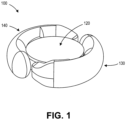
- FIG. 1 illustrates an exemplary intraocular lens that is delivered in any of the method herein.
- Accommodating intraocular lens 100 includes optic body120 with a fluid chamber therein that is in fluid communication with fluid chambers in haptic 130 and haptic 140.
- Haptics 130 and 140, part of the peripheral portion of the IOL, are responsive to capsular reshaping, and the IOL is adapted such that flowable media, such as a fluid, is moved between the haptics and optic in response to capsular reshaping.
- Additional exemplary details of accommodating IOL 100 can be found in U.S. App. No. 13/672,608, filed November 8, 2012 .
- One first aspect of the disclosure is a delivery device adapted to deliver an accommodating intraocular lens, such as the intraocular lens shown in Figure 1 , into the eye. While the delivery device is described as delivering the lens shown in Figure 1 , it is understood that any other suitable lens can be delivered using the devices, systems, and methods described herein.
- Figures 2A and 2B illustrate an exploded view and assembly view, respectively, of an exemplary delivery device ("device” may be used interchangeably with “system” herein unless there is a specific indication to the contrary).
- Figures 3A and 3B illustrate top sectional views of the assembly, with Figure 3B showing a partial sectional view of a distal portion of the assembly (only a portion of tray 14 and plunger 12 are shown).
- Delivery device 10 includes plunger 12, tray 14, and cartridge 16.
- Tray 14 is adapted to interact with plunger 12 and cartridge 16, allowing an intraocular lens to be delivered from within cartridge 16 into an eye.
- Tray 14 includes plunger guide 22 extending through a proximal portion that is adapted to receive plunger 12 therein (see Figure 3A ).
- Plunger 12 includes stop 20 that is configured to engage a complimentary stop feature on the tray to prevent further distal movement of plunger 12 within tray 14.
- Plunger 12 includes lumen 32 extending from its proximal end to its distal end, allowing material, such as viscoelastic fluid, to be advanced from the proximal end of plunger into the cartridge.
- Plunger 12 also includes sealing members 18 in the form of O-rings that engage with an inner surface of cartridge 16 and provide a fluid seal between the distal end of plunger 12, cartridge 16, and tray 14.
- Cartridge 16 includes stabilizing elements 23 that are adapted to secure the cartridge with respect to tray 14 by engaging corresponding stabilizing elements 24 on tray 14. As seen in Figures 3A and 3B , when plunger 12 is fully advanced within tray 14, and when cartridge 16 is interfacing tray 14, the distal end of plunger 12 is within the proximal end of channel extending through cartridge 16.
- FIGs 4A and 4B illustrate the exemplary intraocular lens from Figure 1 already loaded into the cartridge lumen 30.
- the intraocular lens can be advanced from a staging area in the tray (referred to generally as 34 in Figure 2A ) into the cartridge by any suitable loading technique.
- the intraocular lens is positioned within staging area 34 in a configuration such that leading haptic 36 is positioned generally distal to optic 38, while trailing haptic 40 is positioned generally proximal to optic 38.
- the lens can be advanced into cartridge.
- the lens can be loaded into the cartridge with any suitable plunger by being pushed into the cartridge.
- the lens could also be hydraulically loaded into the cartridge using a fluid.
- the loading device and approach can vary and is not limited herein.
- the system includes a plunger that is both adapted to load the lens from the tray into the cartridge, and is also adapted to deliver the lens from the cartridge into the eye as described below. Additional exemplary loading devices can be found in U.S. Provisional Application No. 61/467,352, filed March 24, 2011 .
- a viscoelastic fluid or other type of fluid, is delivered from a syringe and into lumen 32 of plunger 12 (see Figure 4B ).
- the viscoelastic fluid is delivered from the distal port of plunger 12 and into contact with the intraocular lens, forcing the lens distally within cartridge and out the distal end 28 of the cartridge.
- the delivery of the intraocular lens from the cartridge relies on development of pressure differential in the viscoelastic over the lens to move it down the reducing section of the cartridge (shown as surface 42 in Figure 4B ) and into the eye.
- the device includes a plunger that includes at least one component that creates a seal behind the lens body.
- the component preferably does not restrict the deployment of the trailing haptic from the cartridge during the last portion of the delivery process. Additionally, the component(s) preferably do not exit the distal end of the cartridge into the eye at the end of the delivery process. While the sealing component is described as part of the plunger herein, it is understood that the sealing component could be a part of the tray, the cartridge, or other part of the delivery device, although such embodiments do not fall under the claimed invention.
- Figures 5A-5C show a portion of a delivery sequence of the lens in which the delivery device includes a sealing component, or plug, in the form of a compliant filament of material that is introduced into the viscoelastic stream.
- the filament is adapted to flow toward and into the location at which the viscoelastic fluid is flowing past the lens body. Once impeded by a restriction, the filament collapses and further obstructs the fluid flow path. This develops a soft sealing mechanism behind the lens body that also follows the lens while moving for delivery.
- Figure 5A illustrates the device including sealing component 52 in the form of a filament attached to the distal end of plunger 12 at attachment point 50.
- filament 52 is initially disposed within lumen 32 of plunger 12, with the filament distal end extending in the proximal direction within the lumen.
- filament 52 is carried by the fluid in the distal direction, as shown in Figure 5B .
- the filament flows toward the location at which the viscoelastic fluid is flowing past the lens body and creates a seal, as shown in Figure 5B .
- the filament is shown plugging up a space adjacent the trailing haptic 130, creating at least a substantial seal.
- FIG 5C shows the leading haptic partially deployed from the cartridge while the optic body has been properly advanced through the cartridge.
- the lens is advanced further through the cartridge until the leading haptic 140, optic body 120, and trailing haptic 140 are delivered, in that order, from the cartridge and into the eye. Once delivered the lens will inherently revert toward its original configuration, which is generally shown in the sectional view of Figure 1 . The deployment occurs without damage to the lens, particularly at the attachment point between the leading haptic and the optic body.
- Figures 6A and 6B illustratea an embodiment falling under the claimed invention of filament 56 with slit 58 formed therein extending along substantially the entire length of filament 56.
- the slit forms two filament segments 60 extending along the length of filament 56.
- the length of the segments 60 is substantially greater than the width of the segments.
- Filament 56 from Figure 6A is then folded to bring two ends 62 together, as shown in Figure 6B.
- Figures 7A and 7B illustrate the folded filament attached to plunger 12.
- the filament is secured to the distal region of the plunger by compressing the two filament end regions under the two o-rings 18 that are a seal to the cartridge, as discussed above.
- the segments 60 in the form of loops, are tucked within the plunger lumen and ready for deployment during the delivery, as shown in Figure 7B .
- the filament loops extend and roll out of the lumen in the viscoelastic stream and flow into an open volume behind the lens buttress and adjacent the trailing haptic as discussed above in the embodiment in Figures 5A-5C .
- the filament bunches into that area until sufficiently plugging the flow at which time the lens body moves forward. When the lens moves sufficiently forward to plug the tip completely and there is substantially no viscoelastic flow by the lens body, the filament will be left behind.
- the filaments are adapted to again move to the area of leakage to act as a plug to the viscoelastic and move the lens out of the cartridge.
- FIGS 5A-7B illustrate embodiments in which the proximal end of the filament is attached to the distal region and the exterior of the plunger, and the filament is considered to roll out of the plunger during delivery of the lens.
- This allows the filament to slide out of the plunger past the attachment location and the first contact with the lens will be with a region of the filament that is near the proximal end of the filament.
- the filament repositions into suitable plugging orientation. There are, however, a number of variations in attachment points of the filament to the plunger (or other portions of the delivery device) yielding variations in deployment of the filament.
- Figures 8A-8C illustrate an alternative embodiment the claimed invention in which the proximal end of the filament is attached to the distal region of the plunger, but is attached at a location on the interior of the plunger (i.e., within the plunger lumen).
- the plunger has a proximal lumen section with a larger diameter bore than a distal tip section.
- Filament 70 is attached to stopper 72 at its proximal end. Filament 70 extends from stopper 70 towards the distal end of the plunger.
- the reduced diameter distal section acts as a lumen restriction and prevents stopper 72 from advancing further distally, as shown in Figure 8C . This prevents the filament from flowing out of the distal tip of the cartridge.
- stopper 72 As the viscoelastic is delivered through the lumen, stopper 72 is advanced distally within the lumen, and filament 70 flows straight out of the lumen and does not double back (or fold) back on itself as in the previously described embodiments above.
- the filament is adapted to flow towards the flow leakage as described elsewhere herein.
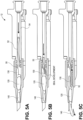
- FIGs 9A-9C illustrate sectional views of an alternative embodiment of the claimed invention in which the proximal end of the filament 80 is secured to the proximal region of the plunger interior using press-ring filament capture 78, which is shown in greater detail in Figure 15 .
- Filament 74 includes a coiled or stretchable section 76 that is adapted to uncoil or stretch as the viscoelastic is delivered. The uncoiling or stretching of the filament effectively lengthens the filament, allowing the filament to be advanced into the cartridge to plug up any leaks, but is prevented from flowing out of the distal end of the cartridge.
- Figure 9B shows the filament finding the leaking area and plugging it.
- the embodiment shown in Figures 9A-9C includes a plunger with a distal tip region that has a reduced diameter relative to the proximal region.
- This feature can be incorporated into any the embodiments herein.
- the reduced diameter can create a relatively higher flow rate of fluid from the plunger distal tip, which helps pull the filament out of the distal end of the plunger.
- the increased flow rate minimizes tangles and compaction of the filament in the proximal end of the plunger as the viscoelastic is delivered.
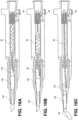
- Figures 10A-10C illustrate an alternative embodiment similar to that in Figures 9A-9C in that the proximal end of the filament 82 is attached to an internal proximal region of the plunger 84.
- the filament 82 is a material that has a stretching property to it, such as a material that is perforated in such a way that it compresses efficiently in the plunger lumen (see Figure 10A ) and yet stretches to a static length when deployed (see Figure 10C ).
- the filament is an axially compressed perforated tubing.
- the filament is secured at its proximal end 845, and the plunger has a fluid channel radially outward from the attachment point.
- FIG 10B This is shown in Figure 10B , in which the fluid flow is indicated the arrows.
- the fluid causes the perforated tubing to stretch as shown in Figure 10B .
- This plunger design with the distal reduced diameter, provides for a low velocity flow region and a high velocity flow region in the distal region.
- Figure 10B illustrates the plunger sealing the leak
- Figure 10C illustrates the leading haptic being deployed from the cartridge.
- the filament material and design should be selected to enable the filament to seal the fluid flow as described above.
- An optimization of material structure and properties will generally provide a filament that is best suited to seal the fluid flow and allow for the intraocular lens to be delivered undamaged. It is envisioned, however, that in some instances it may be desirable to have some amount of fluid that does pass the optic body, after which the sealing should occur.
- the filament material can theoretically be selected that will provide that functionality to the system.
- the properties of the filament will influence how it responds during the delivery process.
- Properties that can be modified to accomplish the specific goal include without limitation, compliance, coefficient of friction, and elasticity.
- properties that have been shown to influence performance include compliance, a low coefficient of friction, and in some cases elasticity. It is understood that not all of these need to be optimized, and there may be other properties that can be controlled to achieve a desired result.
- the filament has a degree of deformability and elasticity that allows it to be pulled from the plunger and seal the leak.
- expanded PTFE an expanded Teflon material
- the filament comprises an open cell foam.
- a low durometer open cell silicone foam with a single strand form can be used in both the straight out method (e.g., Figures 8A-8C ) and roll out methods (e.g., Figures 5A-5C ).
- PVA bio-absorbable type foams that provide good open cell performance can also be used.
- light wall (e.g., 0.004in) low durometer (e.g., 20-35shoreA) silicone tubing can be used, particularly with the roll-out method.
- electro-spun or non-woven materials are used, and materials that allow for compaction of the mat under low pressures can be used in a straight out method with a relatively large cross section. It is understood that other suitable materials can be used to accomplish the intended goal.
- the filaments can be further manipulated to control the performance characteristics.
- one or more slits formed in the filament can provide desired functionality. Radial and axial slits have been shown to increase compliance and bending of the filament to optimize sealing performance to the lens.
- One or more slits can be formed in the filaments. The one or more slits can take on any configuration within the material.
- the filament is a monofilament ePTFE material.
- the material can be formed with one or more loops (see Figures 6A-7B ), and in some embodiments between one and three loops to optimize cross section in the plunger lumen relative to the tip plunger lumen size.
- the sealing element is a sealed porous tube of PTFE that is filled with viscoelastic or other fluid.
- the porous tube is adapted to allow viscoelastic to pass through the tube, or "weep" through the pores.
- all of the viscoelastic fluid delivered into the system is pushed through the porous tube.
- the tube is adapted to seal off the fluid leaks as described above.
- the pore size can be varied to control the flow rate. Additionally, different viscoelastic fluids have different viscosities and flow properties, and thus the fluid can be varied to modify the flow rate as well.
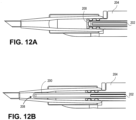
- FIGS 11A-11C and 12A and 12B illustrate an embodiment of the claimed invention that includes a plug component that is a flexible porous tube 200 sealed on its distal end.
- the tube is sheathed over a hypo-tube support 202 that is sealed to the interior lumen of the proximal end of the plunger 204.
- the porous tube 200 is long relative to the length of the support tube 202 to be able to extend to the tip of the cartridge when deployed. In a packaged state, the porous tube 200 is packed onto the support 202 to decrease the length.
- the support tube 202 communicates with the proximal end 206 of the plunger to allow for the passage of viscoelastic (not shown) to be delivered directly to the tip 208 of the sealed porous tube 200.
- the porous tube 200 With flow of viscoelastic through support tube 202 and into the porous tube 200, the porous tube 200 will pressurize slightly and extend off of the support tubing 202 to move into a region behind the lens that both seals, as described above, and is able to transmit axial force mechanically to the lens.
- the sealing and mechanical action of the porous tube will lend less influence to its functionality and it will transition in performance to simply pass viscoelastic therethrough (via the pores), which will move the lens forward with pressure differential.
- the functionality of the porous tubing can be modified as needed by modifying the properties of the tubing.
- the tube will generally develop a higher internal pressure while the viscoelastic tubing is flowing, which will allow it to function more as a mechanical hydraulic piston applying force to the lens when contacted.
- the tube will behave more similarly to the filament structures described above, acting more prominently as a sealing element to seal off any leaking fluid.
- the porosity (or other property of the tube) is therefore modified as needed to achieve the desired functionality of the porous tubing.
- Figures 13A and 13B illustrate an alternative embodiment of the claimed invention of an IOL delivery system adapted to deliver an IOL into an eye of a patient.
- the system includes cartridge 301, tray 302, and plunger 303.
- Figure 13B shows the assembled system, which figure 13A shows the disassembled system components. In other embodiments one or more of the three components may be integrally formed rather than separate parts.
- cartridge 301 is positioned with respect to tray 302 such that cartridge 301 and tray 302 are in secured engagement.
- cartridge 301 and tray 302 are integrally formed such that cartridge 301 is not adapted to be disassociated from tray 302.
- Tray 302 is adapted to receive a distal portion of plunger 303 therein.
- the distal end 306 of plunger 303 is sized and configured to be disposed within proximal opening 305 in cartridge 301 when assembled.
- Plunger 303 includes seals 307 in the form of O-rings. Seals 307 are adapted to create a seal between an inner surface of cartridge 301 when distal portion 306 of plunger is advanced into opening 305 of cartridge 301.
- Tray 302 facilitates the interaction between the cartridge and the plunger.
- Plunger 303 has a proximal portion that is adapted to interact with a fluid delivery device, such as a syringe, so that fluid can be advanced from the fluid delivery device and into an inner lumen within plunger 303.
- a fluid delivery device such as a syringe
- Distal end 306 of plunger 303 is disposed within the cartridge, and thus the fluid is delivered to a location that is radially and axially within the lumen, even if it does not exit the plunger.
- Tray 302 includes two clips 361 with locking elements 365, wherein the clip are adapted to interface with camming surfaces 363 on plunger. Clips will splay outward as plunger 303 is advanced in tray 302, and locks 367 on plunger will lock with locks 365 on tray 302.
- Figures 14A and 14B illustrate top section views of the assembled system from Figure 13B (IOL not shown for clarity). As can be seen, the distal portion 306 of plunger 303 is disposed within a proximal portion of lumen 310 of cartridge. While not shown, an IOL will also be disposed within lumen 310 and positioned to be deployed out of the distal end 311 of cartridge 301.
- Plunger 303 includes outer shell 313, on which seals 307 are disposed. As can be seen, seals 307 create a seal between outer shell 313 and an inner surface of lumen 310. Plunger 303 also includes plug subassembly 321 within a lumen of plunger 303. The plug subassembly is also shown in greater detail in Figure 15 .
- Plug subassembly 321 includes support tube base 316, in which support tube 314 is disposed and secured thereto, and plug element 317. Plug element 317 is sheathed over and secured to the outer surface of support tube 314 at location 308 (see Figure 15 ). In one embodiment a heat shrunk collar secures plug element 317 to support tube 314 at location 308.
- the distal end of support tube 314 extends from the distal end of base 316, and is configured with an orientation to one side. That is, the distal portion of tube 314 does not extend along the longitudinal axis of plunger 303. This helps direct support tube 314 and plug 317 away from the trailing haptic.
- Plug element 317 is long relative to the length of the support tube 314 such that the distal end of plug element 317 is disposed at the tip of the cartridge when the plug is fully deployed. In a packaged, or loaded, state (see Figures 14A and 14B ), plug element 317 is packed onto support tube 314 to decrease its relative length.
- Support tube 314 communicates with the proximal end of plunger 303 to allow for the passage of a fluid such as viscoelastic (not shown) into plug element 317.
- Plug subassembly 321 also include seal 315 adapted to create a seal between plug subassembly 321 and an inner surface of outer shell 313 of plunger 313.
- plug element 317 is a tubular structure secured to the distal end of support tube 314 as shown in Figure 15 .
- plug element is a flexible and porous material but need not necessary be porous.
- plug element is tubular ePTFE.
- the tubing is open-ended at both ends and is tied in a knot 327 along its length, with distal section 309 of plug 317 extending distally from knot 327.
- Knot 327 acts as a flow restrictor, and also helps stabilize the plug on the support tube.
- plug element 317 includes one or more optional perforations 325 just proximal to knot 327.
- the flow restrictor can be, for example, tied, glued, crimped, or swaged.
- plug assembly 321 is then advanced distally through open end 312 of outer shell 313 of plunger 303 until it is in the loaded position shown in Figures 14A and 14B .
- FIG. 14A illustrates the biased configuration of the distal end of support tube 314.
- Figure 14B is a side section view of the plug subassembly in a loaded configuration and position within outer shell 313 of plunger 303.
- FIGs 16A and 16B illustrate a fully deployed configuration of plug element 317 within cartridge 301, as is also shown in Figure 15 outside of a cartridge. For clarity, this is illustrated without showing the IOL. A method of use with an IOL is shown below.
- a fluid is delivered through support tube 314 to initiate the deployment of plug element 317.
- the everted section 309 remains everted until the full extension of the proximal portion of the plug element 317, at which time everted section 309 begins to unroll, and ultimately plug element 317 assumes the general elongate configuration shown in Figures 16A and 16B .
- the distal end of plug element 317 is substantially at the tip of cartridge 301 when fully deployed.
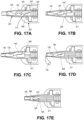
- Figure 17A illustrates an IOL comprising optic 120 and haptics 130 and 140 positioned (e.g., such as the IOL shown in Figure 1 ) within cartridge 301.
- the IOL has been loaded into cartridge 301, and exemplary methods of loading the IOL into cartridge are described below.
- the disclosure herein is not intended to be limited to the manner in which IOL becomes positioned into cartridge 301.
- leading haptic 130 has been reoriented from an at-rest orientation (see Figure 1 ) and extends distally from optic 120.
- Trailing haptic 140 has also been reoriented from an at-rest orientation (see Figure 1 ) and extends relatively proximally from optic 120 within cartridge.
- the delivery of the IOL out of the cartridge relies on development of a pressure differential in the cartridge to move the IOL distally through the cartridge and into the eye.
- the configuration of the IOL in general and/or the configuration that the IOL assumes when loaded into the cartridge, however, creates some gaps between the IOL and the inner surface(s) of the cartridge. That is, the IOL does not occupy the entire volume defined by the inner surfaces of the cartridge.
- the gaps, or voids provide a path for some of the fluid to leak past the optic portion as fluid is advanced during the delivery. Ideally, none (or substantially none) of the fluid flows past the optic body portion.
- all, or substantially all, of the fluid remains proximal to at least the optic body portion, building up pressure and forcing the IOL to be deployed out of the distal end of the cartridge.
- fluid does flow past the lens body it can create drag on leading haptic 130 that is efficiently filling the tip of the cartridge.
- the advancing leading haptic can create a high strain at the connection between the leading haptic and the optic body, possibly causing damage at the connection point. Any IOL that may be susceptible to damage while being delivered may benefit from the systems and methods described herein.
- An exemplary method of assembling the system includes placing cartridge 301 in tray 302, loading the IOL into cartridge 301, and then positioning plunger 303 relative to tray 302 such that it extends into cartridge 301, as shown in Figure 17A .
- plug subassembly 321 is in the same loaded position and configuration within cartridge 301 as shown in Figures 14A and 14B .
- the plug element 317, and specifically everted portion 309, is positioned adjacent trailing haptic 140.
- Plug element 317 is disposed in a gap that exists between trailing haptic 140 and the inner surface of cartridge 301.
- this distal end of support tube 314 is oriented away from trailing haptic 140, which disposes the plug element 317 in the position shown in Figure 17A , which is radially adjacent to trailing haptic 140.
- the support tube distal end is therefore adapted to avoid damaging the IOL when positioned in the cartridge.
- plug element 317 acts like a plug to fill in the gap, or a substantial portion of the gap, to obstruct the flow of fluid, thereby minimize the amount of fluid that flows passed the trailing haptic 140 during the delivery. Plug element 317 may or may not be in contact with the IOL at this time.
- plug element 317 reduces the volume of fluid that flows past the optic during delivery, increasing the pressure differential, and thus reducing the risk of damage to the lens.
- Plug element 317 can also be thought of as creating a seal, or a substantial seal, behind the IOL body to reduce the flow of viscoelastic around the IOL.
- "Plug” or “seal” are not limited to mean a completely fluid tight seal is created. These terms are used herein to mean that fluid flow around the IOL is reduced from what it would be without the plug or seal element.
- the plug element can also be any of the components described above as creating a seal behind the optic.
- a fluid such as a viscoelastic
- a fluid delivery device such as a syringe (not shown).
- plug element 317 will pressurize slightly and reconfigure off of the support tube 314 to move more fully into a region behind the lens that plugs the gap and is able to transmit force mechanically to the lens.
- the sealing and mechanical action of the porous tube will lend less influence to its functionality and it will transition in performance to pass viscoelastic therethrough (via the pores, or other perforation constructs), which will move the lens forward with pressure differential.
- the functionality of the porous tubing can be modified as needed by modifying the properties of the tubing. For example, in an example not belonging to the present invention, with a low porosity (i.e., small pore size) material, the tube will generally develop a higher internal pressure while the viscoelastic is flowing, which will allow it to function more as a mechanical hydraulic piston applying force to the lens when contacted.
- the tube will behave more similarly to the filament structures above, acting more prominently as a plug element to seal off leaking fluid.
- the porosity (or other property of the tube) is therefore modified as needed to achieve the desired functionality of the plug element.
- plug element 317 As the fluid exists the distal end of support tube 314, the fluid pressure within the everted portion 309 of plug element 317 causes the distal end of plug element 317 to be released from the distal end of outer shell 313 of plunger 303. As the free distal end of the plug is released from the inner lumen of the plunger, it begins to at least partially seal against the inner walls of the cartridge, further reducing the volume of fluid that flows past the IOL.
- the plug element also at least partially plugs the gap that exists radially between adjacent trailing haptic 140 and the inner wall of the cartridge. This plugging action minimizes the volume of fluid that can flow passed trailing haptic and therefore passed optic portion, increasing the pressure differential in the cartridge.
- the everted plug element continues to follow the IOL, still plugging the gap between trailing haptic 140 and the cartridge.
- the optic As the optic is advanced closer to the distal port, as shown in Figure 17D , the size of the port and the volume that the optic occupies cause the optic to begin to self-seal, or substantially create a seal in the distal port.
- the IOL begins to move distally relative to plug element 317, or outrun the plug element 317.
- the optic has been delivered out of the cartridge and trailing haptic 140 is rolling off of everted portion 309. This causes the everted portion of the plug element to unroll, as shown in Figure 17E .
- the everted portion 309 of the plug element reduces drag on trailing haptic 140 between at least Figures 17D and 17E , when it is unfurling, or unrolling.
- a static plug element unlike everted portion 309, can cause the trailing haptic to get stuck against the wall of the cartridge due to the radial expansion of the plug and static friction between the plug and the haptic.
- the plug element includes a feature that can contact and unfurl with the trailing haptic, drag on the trailing haptic is reduced, preventing it from sticking against the cartridge wall and not deploying properly. This also reduces the likelihood of damage at the junction between the optic and the trailing haptic.
- plug 317 is a porous ePTFE material.
- the porous material is adapted to allow viscoelastic to pass through the tube, or "weep" through the pores.
- plug 317 also includes optional perforations 325 (two shown in the embodiment in Figures 17A-17E ) in the plug material just proximal to the knot location 327.
- the perforations are created with a 32G surgical needle about 1mm proximal to the knot. The perforations act as an over-pressure relief for the viscoelastic material (or other fluid).
- the porosity of the ePTFE can be variable, and in some cases, which may depend on the viscoelastic material used, the material may fully contain the viscoelastic without allowing for effective weeping. If this occurs the plug element may disengage from the support tube 314 due to pressure at the end of extension.
- the perforations can thus serve as an over-pressure relief to prevent this possibility.
- the perforation can also direct fluid into the everted section of the plug to facilitate its release from the plunger and thus sealing against the inner surface of the cartridge.
- the porosity of the plug allows viscoelastic to lubricate the interfaces between the moving plug and other system components.
- the porosity also allows the continued flow of the fluid when the plug is at full deployment and the IOL is moving due to a hydraulic seal at the tip.
- the pore size can be varied to control the flow rate. Additionally, different viscoelastic fluids have different viscosities and flow properties, and thus the fluid can be varied to modify the flow rate as well.
- the plug element is ePTFE and the intermodal distance (i.e., the distance between the nodes), which determines the porosity, is 100 ⁇ m. ePTFE with other internodal distances can also be used.
- Figures 13A, 13B , 14A, 14B , 16A, 16B , and 17A-17E are also adapted to purge trapped air in the system that, if not purged, can interfere with the delivery process.
- Figure 18 illustrates a side section view of the assembled device shown in Figure 14B (IOL not shown for clarity), illustrating the purging of air from the plunger. As described herein, fluid travels from a syringe (not shown) through support tube 314 and exits in proximity of the trailing haptic of the IOL within the plug element (everted section 309 labeled).
- a fluid front travels both distally in the "D” direction shown, filling the plug element, and rearward in the "P” direction, which evacuates dead volume air through vent 330 in the direction of arrow "A.”
- the vent will not pass viscoelastic so is able to maintain pressure when fully evacuated. This effect purges the air from the back of the system to reduce spring effects of trapped air during the release of the IOL during delivery. In some instances if the air is not purged the air can forcefully push the IOL forward during delivery, without operator action/input, possibly damaging the IOL or the capsule in the eye, and can even cause the IOL to be delivered outside of the capsule.
- the purging of air is important for a smooth, controlled delivery of the IOL. Some IOLs may not require as much control in the delivery, and thus venting of air may not be required.
- the delivery system includes a vent and does not include a plug, or sealing element.
- fluid such as viscoelastic is delivered towards the lens as part of the delivery process. Air venting to increase control during delivery while decreasing the volume of air bubbles that are moved forward through the tip into the eye provides a significant advantage even in the absence of a plug element.
- the device is similar to the delivery device in Figures 14A and 14B but does not include a plug element 317.
- FIGs 19A-19C illustrate an exemplary way of driving fluid such as viscoelastic from within a delivery device into the support tube 314.
- the delivery assembly including cartridge 301, tray 302, and plunger 303, with syringe 360 secured thereto, are mounted into screwdrive assembly 370.
- Screwdrive assembly 370 includes base 390 with end posts 372 over which slots in tray 302 are aligned.
- the delivery assembly self-aligns with screw 380.
- Screw 380 is advanced until it touches the plunger of the syringe, as shown in Figure 19C .
- Screw 380 is then turned to cause the syringe plunger to be advanced, which drives the fluid from the syringe and into support tube 314.
- the screwdrive assembly can be modified to more finely control the force applied to the syringe, and can include a pressure gauge.
- an IOL can be positioned, or loaded, into the cartridge using any suitable technique.
- the loading process includes changing the orientation of the haptics with respect to the optic, such that the haptics generally extend away from the optic. In general this process of reorienting the haptics is referred to herein as splaying the haptics.
- the loading process also includes reconfiguring at least one portion of the IOL, such as the optic. Exemplary loading techniques include without limitation, hydraulically loading the IOL, as is set forth in U.S. App. No. 12/178,565, filed July 23, 2008 .
- the IOL can be mechanically loaded, such as is described in U.S. App. No. 13/427,617, filed March 22, 2012 .
- Another example of mechanical loading includes using forceps to pick up the IOL, reorient one or more haptics, and advance the IOL into the cartridge.
- the IOL can be loaded into the cartridge and stored, such as for packaging, or loading can occur just prior to implantation.
- the devices and methods herein are able to deliver an IOL through an incision that is between about 2.8 mm to about 4.5 mm. In some embodiments the incision is about 4 mm.
- the devices and methods can be modified if needed to deliver an IOL through a bigger or smaller incision.
- the IOL to be delivered need not have one or more dedicated "haptics" as described herein.
- the IOL can more generally include a peripheral portion.
Landscapes
- Health & Medical Sciences (AREA)
- Ophthalmology & Optometry (AREA)
- Public Health (AREA)
- Life Sciences & Earth Sciences (AREA)
- Veterinary Medicine (AREA)
- Engineering & Computer Science (AREA)
- Biomedical Technology (AREA)
- Heart & Thoracic Surgery (AREA)
- Vascular Medicine (AREA)
- General Health & Medical Sciences (AREA)
- Animal Behavior & Ethology (AREA)
- Oral & Maxillofacial Surgery (AREA)
- Cardiology (AREA)
- Transplantation (AREA)
- Nuclear Medicine, Radiotherapy & Molecular Imaging (AREA)
- Surgery (AREA)
- Prostheses (AREA)
Priority Applications (1)
| Application Number | Priority Date | Filing Date | Title |
|---|---|---|---|
| EP24155324.7A EP4338710A3 (en) | 2012-03-21 | 2013-03-15 | Intraocular lens delivery systems and methods of use |
Applications Claiming Priority (2)
| Application Number | Priority Date | Filing Date | Title |
|---|---|---|---|
| US201261613929P | 2012-03-21 | 2012-03-21 | |
| PCT/US2013/032054 WO2013142323A1 (en) | 2012-03-21 | 2013-03-15 | Intraocular lens delivery systems and methods of use |
Related Child Applications (2)
| Application Number | Title | Priority Date | Filing Date |
|---|---|---|---|
| EP24155324.7A Division EP4338710A3 (en) | 2012-03-21 | 2013-03-15 | Intraocular lens delivery systems and methods of use |
| EP24155324.7A Division-Into EP4338710A3 (en) | 2012-03-21 | 2013-03-15 | Intraocular lens delivery systems and methods of use |
Publications (3)
| Publication Number | Publication Date |
|---|---|
| EP2827804A1 EP2827804A1 (en) | 2015-01-28 |
| EP2827804A4 EP2827804A4 (en) | 2015-11-11 |
| EP2827804B1 true EP2827804B1 (en) | 2024-04-03 |
Family
ID=49223251
Family Applications (2)
| Application Number | Title | Priority Date | Filing Date |
|---|---|---|---|
| EP13764305.2A Active EP2827804B1 (en) | 2012-03-21 | 2013-03-15 | Intraocular lens delivery systems |
| EP24155324.7A Pending EP4338710A3 (en) | 2012-03-21 | 2013-03-15 | Intraocular lens delivery systems and methods of use |
Family Applications After (1)
| Application Number | Title | Priority Date | Filing Date |
|---|---|---|---|
| EP24155324.7A Pending EP4338710A3 (en) | 2012-03-21 | 2013-03-15 | Intraocular lens delivery systems and methods of use |
Country Status (7)
| Country | Link |
|---|---|
| EP (2) | EP2827804B1 (https=) |
| JP (1) | JP2015510825A (https=) |
| CN (1) | CN104203156B (https=) |
| AU (5) | AU2013235467B2 (https=) |
| CA (2) | CA2865954C (https=) |
| ES (1) | ES2978897T3 (https=) |
| WO (1) | WO2013142323A1 (https=) |
Families Citing this family (24)
| Publication number | Priority date | Publication date | Assignee | Title |
|---|---|---|---|---|
| US10835373B2 (en) | 2002-12-12 | 2020-11-17 | Alcon Inc. | Accommodating intraocular lenses and methods of use |
| US8968396B2 (en) | 2007-07-23 | 2015-03-03 | Powervision, Inc. | Intraocular lens delivery systems and methods of use |
| US10299913B2 (en) | 2009-01-09 | 2019-05-28 | Powervision, Inc. | Accommodating intraocular lenses and methods of use |
| EP3263574B1 (en) | 2010-02-23 | 2019-04-03 | PowerVision, Inc. | Accomodating intraocular lens |
| WO2011137191A1 (en) | 2010-04-27 | 2011-11-03 | Ramgopal Rao | Accommodating intraocular lens device |
| US9220590B2 (en) | 2010-06-10 | 2015-12-29 | Z Lens, Llc | Accommodative intraocular lens and method of improving accommodation |
| US10433949B2 (en) | 2011-11-08 | 2019-10-08 | Powervision, Inc. | Accommodating intraocular lenses |
| US9364318B2 (en) | 2012-05-10 | 2016-06-14 | Z Lens, Llc | Accommodative-disaccommodative intraocular lens |
| EP2967842B1 (en) | 2013-03-15 | 2020-11-04 | Alcon Inc. | Method of reconfiguring an intraocular lens for delivery to a delivery device |
| EP3062741B1 (en) | 2013-11-01 | 2023-04-26 | Lensgen, Inc. | Accomodating intraocular lens device |
| CN109806027A (zh) | 2013-11-01 | 2019-05-28 | 雷恩斯根公司 | 双部件调节性人工晶状体设备 |
| US10004596B2 (en) | 2014-07-31 | 2018-06-26 | Lensgen, Inc. | Accommodating intraocular lens device |
| EP4574093A3 (en) * | 2014-08-26 | 2025-09-17 | Shifamed Holdings, LLC | Accommodating intraocular lens |
| US10647831B2 (en) | 2014-09-23 | 2020-05-12 | LensGens, Inc. | Polymeric material for accommodating intraocular lenses |
| WO2016172113A1 (en) * | 2015-04-19 | 2016-10-27 | Atrion Corporation | Spring-powered, hydraulically-operate intraocular lens inserter |
| JP6839100B2 (ja) | 2015-06-10 | 2021-03-03 | アルコン インコーポレイティド | 眼内レンズ材料及び部材 |
| CA3001477A1 (en) | 2015-11-06 | 2017-05-11 | Alcon Inc. | Accommodating intraocular lenses and methods of manufacturing |
| CN113180886A (zh) | 2015-12-01 | 2021-07-30 | 雷恩斯根公司 | 调节性人工晶状体装置 |
| WO2017205811A1 (en) | 2016-05-27 | 2017-11-30 | Thomas Silvestrini | Lens oil having a narrow molecular weight distribution for intraocular lens devices |
| CN114532976A (zh) | 2016-05-31 | 2022-05-27 | 酷拉公司 | 可植入眼压传感器和使用方法 |
| JP7074960B2 (ja) | 2016-08-24 | 2022-05-25 | カール ツァイス メディテック アーゲー | デュアルモード調節型-非調節型眼内レンズ |
| US20180200105A1 (en) * | 2017-01-14 | 2018-07-19 | Rxsight, Inc. | Intraocular lens inserter cartridge with a trailing haptic protection structure |
| US10925722B2 (en) * | 2018-04-26 | 2021-02-23 | Visioncare Inc. | Apparatus for use in implanting intraocular lenses and method of preparing apparatus for use |
| DE102024109753A1 (de) * | 2024-04-08 | 2025-10-09 | Carl Zeiss Meditec Ag | Injektor für ein einführen einer intraokularlinse, mit einer kartusche mit einer barriere |
Family Cites Families (22)
| Publication number | Priority date | Publication date | Assignee | Title |
|---|---|---|---|---|
| US1201016A (en) * | 1913-10-27 | 1916-10-10 | Lynde Bradley | System of constant-speed motor control. |
| US4880000A (en) * | 1987-12-15 | 1989-11-14 | Iolab Corporation | Lens insertion instrument |
| US5728102A (en) * | 1992-09-30 | 1998-03-17 | Staar Surgical Company, Inc. | Disposable intraocular lens insertion system |
| US5425734A (en) * | 1993-07-02 | 1995-06-20 | Iovision, Inc. | Intraocular lens injector |
| WO2002005015A2 (en) * | 2000-07-11 | 2002-01-17 | The Johns Hopkins University School Of Medicine | Device for inserting an injectable bag intraocular lens within a human eye |
| FR2833154B1 (fr) * | 2001-12-12 | 2004-11-19 | Ioltechnologie Production | Cassette et injecteur de lentille intraoculaire souple et procede d'injection de telles lentilles |
| US20070005135A1 (en) * | 2005-07-01 | 2007-01-04 | Harish Makker | Intraocular lens insertion plunger with low stimulus soft tip |
| US8088161B2 (en) * | 2005-07-28 | 2012-01-03 | Visioncare Ophthalmic Technologies Inc. | Compressed haptics |
| WO2007037223A1 (ja) * | 2005-09-28 | 2007-04-05 | Hoya Corporation | 眼内レンズ挿入用器具 |
| JP4877643B2 (ja) * | 2005-12-08 | 2012-02-15 | Hoya株式会社 | 眼内レンズ挿入用器具 |
| CN1985781B (zh) * | 2005-12-20 | 2010-10-13 | 视达日本有限公司 | 眼内插入用晶状体的插入器具 |
| EP1800623A1 (en) * | 2005-12-20 | 2007-06-27 | Canon-Staar Co., Inc. | Insertion device for intraocular lens |
| WO2007087641A2 (en) * | 2006-01-26 | 2007-08-02 | Advanced Medical Optics, Inc. | Intraocular lens insertion apparatus and lens case |
| JP5086713B2 (ja) * | 2007-07-11 | 2012-11-28 | Hoya株式会社 | 眼内レンズ挿入器具 |
| EP2647353B1 (en) * | 2007-07-23 | 2014-12-31 | PowerVision, Inc. | Lens delivery system |
| ATE526907T1 (de) * | 2007-11-16 | 2011-10-15 | Staar Japan Inc | Einsetzvorrichtung für eine intraokularlinse |
| JP5255832B2 (ja) * | 2007-12-28 | 2013-08-07 | 興和株式会社 | 眼内レンズの挿入器具 |
| US8702794B2 (en) * | 2008-04-28 | 2014-04-22 | Abbott Medical Optics Inc. | Back loaded IOL insertion cartridge |
| US8439973B2 (en) * | 2008-05-20 | 2013-05-14 | Amo Regional Holdings | Plungers for intraocular lens injectors |
| TWI455734B (zh) * | 2008-11-20 | 2014-10-11 | Alcon Res Ltd | 帶有具內部塗層之匣的人工水晶體輸送裝置 |
| NL2005182C2 (en) * | 2010-07-30 | 2012-01-31 | Oculentis B V | Intraocular lens injector system. |
| CN202288610U (zh) * | 2011-09-30 | 2012-07-04 | 爱博诺德(北京)医疗科技有限公司 | 一种人工晶体推杆和一种人工晶体植入器 |
-
2013
- 2013-03-15 EP EP13764305.2A patent/EP2827804B1/en active Active
- 2013-03-15 CA CA2865954A patent/CA2865954C/en active Active
- 2013-03-15 WO PCT/US2013/032054 patent/WO2013142323A1/en not_active Ceased
- 2013-03-15 CA CA3126124A patent/CA3126124A1/en active Pending
- 2013-03-15 AU AU2013235467A patent/AU2013235467B2/en active Active
- 2013-03-15 ES ES13764305T patent/ES2978897T3/es active Active
- 2013-03-15 JP JP2015501804A patent/JP2015510825A/ja active Pending
- 2013-03-15 EP EP24155324.7A patent/EP4338710A3/en active Pending
- 2013-03-15 CN CN201380015325.0A patent/CN104203156B/zh active Active
-
2018
- 2018-02-09 AU AU2018200978A patent/AU2018200978B2/en active Active
-
2019
- 2019-11-07 AU AU2019261747A patent/AU2019261747B2/en active Active
-
2022
- 2022-01-25 AU AU2022200477A patent/AU2022200477B2/en active Active
-
2024
- 2024-06-11 AU AU2024203942A patent/AU2024203942B2/en active Active
Also Published As
| Publication number | Publication date |
|---|---|
| AU2018200978B2 (en) | 2019-08-08 |
| CN104203156B (zh) | 2017-05-03 |
| WO2013142323A9 (en) | 2013-11-21 |
| EP4338710A3 (en) | 2024-05-22 |
| AU2024203942B2 (en) | 2026-01-22 |
| CA2865954A1 (en) | 2013-09-26 |
| CN104203156A (zh) | 2014-12-10 |
| EP4338710A2 (en) | 2024-03-20 |
| EP2827804A4 (en) | 2015-11-11 |
| CA2865954C (en) | 2021-10-05 |
| AU2022200477B2 (en) | 2024-03-14 |
| ES2978897T3 (es) | 2024-09-23 |
| AU2018200978A1 (en) | 2018-03-01 |
| AU2013235467B2 (en) | 2017-11-09 |
| AU2019261747A1 (en) | 2019-11-28 |
| JP2015510825A (ja) | 2015-04-13 |
| AU2013235467A1 (en) | 2014-09-18 |
| AU2024203942A1 (en) | 2024-07-04 |
| WO2013142323A1 (en) | 2013-09-26 |
| CA3126124A1 (en) | 2013-09-26 |
| AU2022200477A1 (en) | 2022-02-17 |
| EP2827804A1 (en) | 2015-01-28 |
| AU2019261747B2 (en) | 2021-10-28 |
Similar Documents
| Publication | Publication Date | Title |
|---|---|---|
| AU2024203942B2 (en) | Intraocular lens delivery systems and methods of use | |
| US9855139B2 (en) | Intraocular lens delivery systems and methods of use | |
| EP2178464B1 (en) | Lens delivery system and method | |
| JP6071995B2 (ja) | 眼内レンズ装填システムおよび使用方法 |
Legal Events
| Date | Code | Title | Description |
|---|---|---|---|
| PUAI | Public reference made under article 153(3) epc to a published international application that has entered the european phase |
Free format text: ORIGINAL CODE: 0009012 |
|
| 17P | Request for examination filed |
Effective date: 20141013 |
|
| AK | Designated contracting states |
Kind code of ref document: A1 Designated state(s): AL AT BE BG CH CY CZ DE DK EE ES FI FR GB GR HR HU IE IS IT LI LT LU LV MC MK MT NL NO PL PT RO RS SE SI SK SM TR |
|
| AX | Request for extension of the european patent |
Extension state: BA ME |
|
| DAX | Request for extension of the european patent (deleted) | ||
| RA4 | Supplementary search report drawn up and despatched (corrected) |
Effective date: 20151012 |
|
| RIC1 | Information provided on ipc code assigned before grant |
Ipc: A61F 2/14 20060101ALI20151006BHEP Ipc: A61F 2/76 20060101ALI20151006BHEP Ipc: A61F 2/16 20060101AFI20151006BHEP |
|
| RAP1 | Party data changed (applicant data changed or rights of an application transferred) |
Owner name: POWERVISION, INC. |
|
| STAA | Information on the status of an ep patent application or granted ep patent |
Free format text: STATUS: EXAMINATION IS IN PROGRESS |
|
| 17Q | First examination report despatched |
Effective date: 20170203 |
|
| RAP1 | Party data changed (applicant data changed or rights of an application transferred) |
Owner name: ALCON INC. |
|
| P01 | Opt-out of the competence of the unified patent court (upc) registered |
Effective date: 20230507 |
|
| GRAP | Despatch of communication of intention to grant a patent |
Free format text: ORIGINAL CODE: EPIDOSNIGR1 |
|
| STAA | Information on the status of an ep patent application or granted ep patent |
Free format text: STATUS: GRANT OF PATENT IS INTENDED |
|
| INTG | Intention to grant announced |
Effective date: 20230622 |
|
| GRAJ | Information related to disapproval of communication of intention to grant by the applicant or resumption of examination proceedings by the epo deleted |
Free format text: ORIGINAL CODE: EPIDOSDIGR1 |
|
| STAA | Information on the status of an ep patent application or granted ep patent |
Free format text: STATUS: EXAMINATION IS IN PROGRESS |
|
| GRAP | Despatch of communication of intention to grant a patent |
Free format text: ORIGINAL CODE: EPIDOSNIGR1 |
|
| STAA | Information on the status of an ep patent application or granted ep patent |
Free format text: STATUS: GRANT OF PATENT IS INTENDED |
|
| INTC | Intention to grant announced (deleted) | ||
| INTG | Intention to grant announced |
Effective date: 20231026 |
|
| GRAS | Grant fee paid |
Free format text: ORIGINAL CODE: EPIDOSNIGR3 |
|
| GRAA | (expected) grant |
Free format text: ORIGINAL CODE: 0009210 |
|
| STAA | Information on the status of an ep patent application or granted ep patent |
Free format text: STATUS: THE PATENT HAS BEEN GRANTED |
|
| AK | Designated contracting states |
Kind code of ref document: B1 Designated state(s): AL AT BE BG CH CY CZ DE DK EE ES FI FR GB GR HR HU IE IS IT LI LT LU LV MC MK MT NL NO PL PT RO RS SE SI SK SM TR |
|
| REG | Reference to a national code |
Ref country code: GB Ref legal event code: FG4D |
|
| REG | Reference to a national code |
Ref country code: CH Ref legal event code: EP |
|
| REG | Reference to a national code |
Ref country code: DE Ref legal event code: R096 Ref document number: 602013085521 Country of ref document: DE |
|
| REG | Reference to a national code |
Ref country code: IE Ref legal event code: FG4D |
|
| REG | Reference to a national code |
Ref country code: NL Ref legal event code: FP |
|
| REG | Reference to a national code |
Ref country code: LT Ref legal event code: MG9D |
|
| REG | Reference to a national code |
Ref country code: AT Ref legal event code: MK05 Ref document number: 1671409 Country of ref document: AT Kind code of ref document: T Effective date: 20240403 |
|
| REG | Reference to a national code |
Ref country code: ES Ref legal event code: FG2A Ref document number: 2978897 Country of ref document: ES Kind code of ref document: T3 Effective date: 20240923 |
|
| PG25 | Lapsed in a contracting state [announced via postgrant information from national office to epo] |
Ref country code: IS Free format text: LAPSE BECAUSE OF FAILURE TO SUBMIT A TRANSLATION OF THE DESCRIPTION OR TO PAY THE FEE WITHIN THE PRESCRIBED TIME-LIMIT Effective date: 20240803 |
|
| PG25 | Lapsed in a contracting state [announced via postgrant information from national office to epo] |
Ref country code: BG Free format text: LAPSE BECAUSE OF FAILURE TO SUBMIT A TRANSLATION OF THE DESCRIPTION OR TO PAY THE FEE WITHIN THE PRESCRIBED TIME-LIMIT Effective date: 20240403 |
|
| PG25 | Lapsed in a contracting state [announced via postgrant information from national office to epo] |
Ref country code: HR Free format text: LAPSE BECAUSE OF FAILURE TO SUBMIT A TRANSLATION OF THE DESCRIPTION OR TO PAY THE FEE WITHIN THE PRESCRIBED TIME-LIMIT Effective date: 20240403 Ref country code: FI Free format text: LAPSE BECAUSE OF FAILURE TO SUBMIT A TRANSLATION OF THE DESCRIPTION OR TO PAY THE FEE WITHIN THE PRESCRIBED TIME-LIMIT Effective date: 20240403 |
|
| PG25 | Lapsed in a contracting state [announced via postgrant information from national office to epo] |
Ref country code: GR Free format text: LAPSE BECAUSE OF FAILURE TO SUBMIT A TRANSLATION OF THE DESCRIPTION OR TO PAY THE FEE WITHIN THE PRESCRIBED TIME-LIMIT Effective date: 20240704 |
|
| PG25 | Lapsed in a contracting state [announced via postgrant information from national office to epo] |
Ref country code: PT Free format text: LAPSE BECAUSE OF FAILURE TO SUBMIT A TRANSLATION OF THE DESCRIPTION OR TO PAY THE FEE WITHIN THE PRESCRIBED TIME-LIMIT Effective date: 20240805 |
|
| PG25 | Lapsed in a contracting state [announced via postgrant information from national office to epo] |
Ref country code: CZ Free format text: LAPSE BECAUSE OF FAILURE TO SUBMIT A TRANSLATION OF THE DESCRIPTION OR TO PAY THE FEE WITHIN THE PRESCRIBED TIME-LIMIT Effective date: 20240403 |
|
| PG25 | Lapsed in a contracting state [announced via postgrant information from national office to epo] |
Ref country code: AT Free format text: LAPSE BECAUSE OF FAILURE TO SUBMIT A TRANSLATION OF THE DESCRIPTION OR TO PAY THE FEE WITHIN THE PRESCRIBED TIME-LIMIT Effective date: 20240403 |
|
| PG25 | Lapsed in a contracting state [announced via postgrant information from national office to epo] |
Ref country code: PL Free format text: LAPSE BECAUSE OF FAILURE TO SUBMIT A TRANSLATION OF THE DESCRIPTION OR TO PAY THE FEE WITHIN THE PRESCRIBED TIME-LIMIT Effective date: 20240403 |
|
| PG25 | Lapsed in a contracting state [announced via postgrant information from national office to epo] |
Ref country code: LV Free format text: LAPSE BECAUSE OF FAILURE TO SUBMIT A TRANSLATION OF THE DESCRIPTION OR TO PAY THE FEE WITHIN THE PRESCRIBED TIME-LIMIT Effective date: 20240403 |
|
| PG25 | Lapsed in a contracting state [announced via postgrant information from national office to epo] |
Ref country code: PT Free format text: LAPSE BECAUSE OF FAILURE TO SUBMIT A TRANSLATION OF THE DESCRIPTION OR TO PAY THE FEE WITHIN THE PRESCRIBED TIME-LIMIT Effective date: 20240805 Ref country code: PL Free format text: LAPSE BECAUSE OF FAILURE TO SUBMIT A TRANSLATION OF THE DESCRIPTION OR TO PAY THE FEE WITHIN THE PRESCRIBED TIME-LIMIT Effective date: 20240403 Ref country code: NO Free format text: LAPSE BECAUSE OF FAILURE TO SUBMIT A TRANSLATION OF THE DESCRIPTION OR TO PAY THE FEE WITHIN THE PRESCRIBED TIME-LIMIT Effective date: 20240703 Ref country code: LV Free format text: LAPSE BECAUSE OF FAILURE TO SUBMIT A TRANSLATION OF THE DESCRIPTION OR TO PAY THE FEE WITHIN THE PRESCRIBED TIME-LIMIT Effective date: 20240403 Ref country code: IS Free format text: LAPSE BECAUSE OF FAILURE TO SUBMIT A TRANSLATION OF THE DESCRIPTION OR TO PAY THE FEE WITHIN THE PRESCRIBED TIME-LIMIT Effective date: 20240803 Ref country code: HR Free format text: LAPSE BECAUSE OF FAILURE TO SUBMIT A TRANSLATION OF THE DESCRIPTION OR TO PAY THE FEE WITHIN THE PRESCRIBED TIME-LIMIT Effective date: 20240403 Ref country code: GR Free format text: LAPSE BECAUSE OF FAILURE TO SUBMIT A TRANSLATION OF THE DESCRIPTION OR TO PAY THE FEE WITHIN THE PRESCRIBED TIME-LIMIT Effective date: 20240704 Ref country code: FI Free format text: LAPSE BECAUSE OF FAILURE TO SUBMIT A TRANSLATION OF THE DESCRIPTION OR TO PAY THE FEE WITHIN THE PRESCRIBED TIME-LIMIT Effective date: 20240403 Ref country code: CZ Free format text: LAPSE BECAUSE OF FAILURE TO SUBMIT A TRANSLATION OF THE DESCRIPTION OR TO PAY THE FEE WITHIN THE PRESCRIBED TIME-LIMIT Effective date: 20240403 Ref country code: BG Free format text: LAPSE BECAUSE OF FAILURE TO SUBMIT A TRANSLATION OF THE DESCRIPTION OR TO PAY THE FEE WITHIN THE PRESCRIBED TIME-LIMIT Effective date: 20240403 Ref country code: AT Free format text: LAPSE BECAUSE OF FAILURE TO SUBMIT A TRANSLATION OF THE DESCRIPTION OR TO PAY THE FEE WITHIN THE PRESCRIBED TIME-LIMIT Effective date: 20240403 Ref country code: RS Free format text: LAPSE BECAUSE OF FAILURE TO SUBMIT A TRANSLATION OF THE DESCRIPTION OR TO PAY THE FEE WITHIN THE PRESCRIBED TIME-LIMIT Effective date: 20240703 |
|
| REG | Reference to a national code |
Ref country code: DE Ref legal event code: R097 Ref document number: 602013085521 Country of ref document: DE |
|
| PG25 | Lapsed in a contracting state [announced via postgrant information from national office to epo] |
Ref country code: DK Free format text: LAPSE BECAUSE OF FAILURE TO SUBMIT A TRANSLATION OF THE DESCRIPTION OR TO PAY THE FEE WITHIN THE PRESCRIBED TIME-LIMIT Effective date: 20240403 |
|
| PG25 | Lapsed in a contracting state [announced via postgrant information from national office to epo] |
Ref country code: EE Free format text: LAPSE BECAUSE OF FAILURE TO SUBMIT A TRANSLATION OF THE DESCRIPTION OR TO PAY THE FEE WITHIN THE PRESCRIBED TIME-LIMIT Effective date: 20240403 |
|
| PG25 | Lapsed in a contracting state [announced via postgrant information from national office to epo] |
Ref country code: RO Free format text: LAPSE BECAUSE OF FAILURE TO SUBMIT A TRANSLATION OF THE DESCRIPTION OR TO PAY THE FEE WITHIN THE PRESCRIBED TIME-LIMIT Effective date: 20240403 Ref country code: SK Free format text: LAPSE BECAUSE OF FAILURE TO SUBMIT A TRANSLATION OF THE DESCRIPTION OR TO PAY THE FEE WITHIN THE PRESCRIBED TIME-LIMIT Effective date: 20240403 |
|
| PG25 | Lapsed in a contracting state [announced via postgrant information from national office to epo] |
Ref country code: SM Free format text: LAPSE BECAUSE OF FAILURE TO SUBMIT A TRANSLATION OF THE DESCRIPTION OR TO PAY THE FEE WITHIN THE PRESCRIBED TIME-LIMIT Effective date: 20240403 |
|
| PG25 | Lapsed in a contracting state [announced via postgrant information from national office to epo] |
Ref country code: SM Free format text: LAPSE BECAUSE OF FAILURE TO SUBMIT A TRANSLATION OF THE DESCRIPTION OR TO PAY THE FEE WITHIN THE PRESCRIBED TIME-LIMIT Effective date: 20240403 Ref country code: SK Free format text: LAPSE BECAUSE OF FAILURE TO SUBMIT A TRANSLATION OF THE DESCRIPTION OR TO PAY THE FEE WITHIN THE PRESCRIBED TIME-LIMIT Effective date: 20240403 Ref country code: RO Free format text: LAPSE BECAUSE OF FAILURE TO SUBMIT A TRANSLATION OF THE DESCRIPTION OR TO PAY THE FEE WITHIN THE PRESCRIBED TIME-LIMIT Effective date: 20240403 Ref country code: EE Free format text: LAPSE BECAUSE OF FAILURE TO SUBMIT A TRANSLATION OF THE DESCRIPTION OR TO PAY THE FEE WITHIN THE PRESCRIBED TIME-LIMIT Effective date: 20240403 Ref country code: DK Free format text: LAPSE BECAUSE OF FAILURE TO SUBMIT A TRANSLATION OF THE DESCRIPTION OR TO PAY THE FEE WITHIN THE PRESCRIBED TIME-LIMIT Effective date: 20240403 |
|
| PLBE | No opposition filed within time limit |
Free format text: ORIGINAL CODE: 0009261 |
|
| STAA | Information on the status of an ep patent application or granted ep patent |
Free format text: STATUS: NO OPPOSITION FILED WITHIN TIME LIMIT |
|
| 26N | No opposition filed |
Effective date: 20250106 |
|
| PG25 | Lapsed in a contracting state [announced via postgrant information from national office to epo] |
Ref country code: SI Free format text: LAPSE BECAUSE OF FAILURE TO SUBMIT A TRANSLATION OF THE DESCRIPTION OR TO PAY THE FEE WITHIN THE PRESCRIBED TIME-LIMIT Effective date: 20240403 |
|
| PGFP | Annual fee paid to national office [announced via postgrant information from national office to epo] |
Ref country code: ES Payment date: 20250411 Year of fee payment: 13 |
|
| PG25 | Lapsed in a contracting state [announced via postgrant information from national office to epo] |
Ref country code: SE Free format text: LAPSE BECAUSE OF FAILURE TO SUBMIT A TRANSLATION OF THE DESCRIPTION OR TO PAY THE FEE WITHIN THE PRESCRIBED TIME-LIMIT Effective date: 20240403 |
|
| PG25 | Lapsed in a contracting state [announced via postgrant information from national office to epo] |
Ref country code: MC Free format text: LAPSE BECAUSE OF FAILURE TO SUBMIT A TRANSLATION OF THE DESCRIPTION OR TO PAY THE FEE WITHIN THE PRESCRIBED TIME-LIMIT Effective date: 20240403 |
|
| REG | Reference to a national code |
Ref country code: CH Ref legal event code: H13 Free format text: ST27 STATUS EVENT CODE: U-0-0-H10-H13 (AS PROVIDED BY THE NATIONAL OFFICE) Effective date: 20251024 |
|
| PG25 | Lapsed in a contracting state [announced via postgrant information from national office to epo] |
Ref country code: LU Free format text: LAPSE BECAUSE OF NON-PAYMENT OF DUE FEES Effective date: 20250315 |
|
| REG | Reference to a national code |
Ref country code: BE Ref legal event code: MM Effective date: 20250331 |
|
| PG25 | Lapsed in a contracting state [announced via postgrant information from national office to epo] |
Ref country code: IT Free format text: LAPSE BECAUSE OF NON-PAYMENT OF DUE FEES Effective date: 20250315 |
|
| PG25 | Lapsed in a contracting state [announced via postgrant information from national office to epo] |
Ref country code: BE Free format text: LAPSE BECAUSE OF NON-PAYMENT OF DUE FEES Effective date: 20250331 |
|
| PG25 | Lapsed in a contracting state [announced via postgrant information from national office to epo] |
Ref country code: CH Free format text: LAPSE BECAUSE OF NON-PAYMENT OF DUE FEES Effective date: 20250331 |
|
| PGFP | Annual fee paid to national office [announced via postgrant information from national office to epo] |
Ref country code: NL Payment date: 20260227 Year of fee payment: 14 |
|
| PGFP | Annual fee paid to national office [announced via postgrant information from national office to epo] |
Ref country code: GB Payment date: 20260223 Year of fee payment: 14 |
|
| PGFP | Annual fee paid to national office [announced via postgrant information from national office to epo] |
Ref country code: IE Payment date: 20260224 Year of fee payment: 14 Ref country code: DE Payment date: 20260218 Year of fee payment: 14 |
|
| PG25 | Lapsed in a contracting state [announced via postgrant information from national office to epo] |
Ref country code: IT Free format text: LAPSE BECAUSE OF NON-PAYMENT OF DUE FEES Effective date: 20250315 |
|
| PGFP | Annual fee paid to national office [announced via postgrant information from national office to epo] |
Ref country code: IT Payment date: 20260226 Year of fee payment: 14 |
|
| PGRI | Patent reinstated in contracting state [announced from national office to epo] |
Ref country code: IT Effective date: 20250731 |
|
| PGFP | Annual fee paid to national office [announced via postgrant information from national office to epo] |
Ref country code: FR Payment date: 20260223 Year of fee payment: 14 |