EP2824148A1 - Hochdisperse Kieselsäure mit einer hohen positiven Oberflächenladung - Google Patents
Hochdisperse Kieselsäure mit einer hohen positiven Oberflächenladung Download PDFInfo
- Publication number
- EP2824148A1 EP2824148A1 EP14167029.9A EP14167029A EP2824148A1 EP 2824148 A1 EP2824148 A1 EP 2824148A1 EP 14167029 A EP14167029 A EP 14167029A EP 2824148 A1 EP2824148 A1 EP 2824148A1
- Authority
- EP
- European Patent Office
- Prior art keywords
- groups
- radical
- trib
- oder
- reaction
- Prior art date
- Legal status (The legal status is an assumption and is not a legal conclusion. Google has not performed a legal analysis and makes no representation as to the accuracy of the status listed.)
- Granted
Links
Classifications
-
- C—CHEMISTRY; METALLURGY
- C09—DYES; PAINTS; POLISHES; NATURAL RESINS; ADHESIVES; COMPOSITIONS NOT OTHERWISE PROVIDED FOR; APPLICATIONS OF MATERIALS NOT OTHERWISE PROVIDED FOR
- C09C—TREATMENT OF INORGANIC MATERIALS, OTHER THAN FIBROUS FILLERS, TO ENHANCE THEIR PIGMENTING OR FILLING PROPERTIES ; PREPARATION OF CARBON BLACK ; PREPARATION OF INORGANIC MATERIALS WHICH ARE NO SINGLE CHEMICAL COMPOUNDS AND WHICH ARE MAINLY USED AS PIGMENTS OR FILLERS
- C09C1/00—Treatment of specific inorganic materials other than fibrous fillers; Preparation of carbon black
- C09C1/28—Compounds of silicon
- C09C1/30—Silicic acid
- C09C1/3081—Treatment with organo-silicon compounds
-
- B—PERFORMING OPERATIONS; TRANSPORTING
- B82—NANOTECHNOLOGY
- B82Y—SPECIFIC USES OR APPLICATIONS OF NANOSTRUCTURES; MEASUREMENT OR ANALYSIS OF NANOSTRUCTURES; MANUFACTURE OR TREATMENT OF NANOSTRUCTURES
- B82Y30/00—Nanotechnology for materials or surface science, e.g. nanocomposites
-
- C—CHEMISTRY; METALLURGY
- C09—DYES; PAINTS; POLISHES; NATURAL RESINS; ADHESIVES; COMPOSITIONS NOT OTHERWISE PROVIDED FOR; APPLICATIONS OF MATERIALS NOT OTHERWISE PROVIDED FOR
- C09C—TREATMENT OF INORGANIC MATERIALS, OTHER THAN FIBROUS FILLERS, TO ENHANCE THEIR PIGMENTING OR FILLING PROPERTIES ; PREPARATION OF CARBON BLACK ; PREPARATION OF INORGANIC MATERIALS WHICH ARE NO SINGLE CHEMICAL COMPOUNDS AND WHICH ARE MAINLY USED AS PIGMENTS OR FILLERS
- C09C1/00—Treatment of specific inorganic materials other than fibrous fillers; Preparation of carbon black
- C09C1/36—Compounds of titanium
- C09C1/3607—Titanium dioxide
- C09C1/3684—Treatment with organo-silicon compounds
-
- C—CHEMISTRY; METALLURGY
- C09—DYES; PAINTS; POLISHES; NATURAL RESINS; ADHESIVES; COMPOSITIONS NOT OTHERWISE PROVIDED FOR; APPLICATIONS OF MATERIALS NOT OTHERWISE PROVIDED FOR
- C09C—TREATMENT OF INORGANIC MATERIALS, OTHER THAN FIBROUS FILLERS, TO ENHANCE THEIR PIGMENTING OR FILLING PROPERTIES ; PREPARATION OF CARBON BLACK ; PREPARATION OF INORGANIC MATERIALS WHICH ARE NO SINGLE CHEMICAL COMPOUNDS AND WHICH ARE MAINLY USED AS PIGMENTS OR FILLERS
- C09C1/00—Treatment of specific inorganic materials other than fibrous fillers; Preparation of carbon black
- C09C1/40—Compounds of aluminium
- C09C1/407—Aluminium oxides or hydroxides
-
- C—CHEMISTRY; METALLURGY
- C09—DYES; PAINTS; POLISHES; NATURAL RESINS; ADHESIVES; COMPOSITIONS NOT OTHERWISE PROVIDED FOR; APPLICATIONS OF MATERIALS NOT OTHERWISE PROVIDED FOR
- C09C—TREATMENT OF INORGANIC MATERIALS, OTHER THAN FIBROUS FILLERS, TO ENHANCE THEIR PIGMENTING OR FILLING PROPERTIES ; PREPARATION OF CARBON BLACK ; PREPARATION OF INORGANIC MATERIALS WHICH ARE NO SINGLE CHEMICAL COMPOUNDS AND WHICH ARE MAINLY USED AS PIGMENTS OR FILLERS
- C09C3/00—Treatment in general of inorganic materials, other than fibrous fillers, to enhance their pigmenting or filling properties
- C09C3/12—Treatment with organosilicon compounds
-
- C—CHEMISTRY; METALLURGY
- C01—INORGANIC CHEMISTRY
- C01P—INDEXING SCHEME RELATING TO STRUCTURAL AND PHYSICAL ASPECTS OF SOLID INORGANIC COMPOUNDS
- C01P2002/00—Crystal-structural characteristics
- C01P2002/80—Crystal-structural characteristics defined by measured data other than those specified in group C01P2002/70
- C01P2002/86—Crystal-structural characteristics defined by measured data other than those specified in group C01P2002/70 by NMR- or ESR-data
-
- C—CHEMISTRY; METALLURGY
- C01—INORGANIC CHEMISTRY
- C01P—INDEXING SCHEME RELATING TO STRUCTURAL AND PHYSICAL ASPECTS OF SOLID INORGANIC COMPOUNDS
- C01P2004/00—Particle morphology
- C01P2004/50—Agglomerated particles
-
- C—CHEMISTRY; METALLURGY
- C01—INORGANIC CHEMISTRY
- C01P—INDEXING SCHEME RELATING TO STRUCTURAL AND PHYSICAL ASPECTS OF SOLID INORGANIC COMPOUNDS
- C01P2004/00—Particle morphology
- C01P2004/60—Particles characterised by their size
- C01P2004/61—Micrometer sized, i.e. from 1-100 micrometer
-
- C—CHEMISTRY; METALLURGY
- C01—INORGANIC CHEMISTRY
- C01P—INDEXING SCHEME RELATING TO STRUCTURAL AND PHYSICAL ASPECTS OF SOLID INORGANIC COMPOUNDS
- C01P2004/00—Particle morphology
- C01P2004/60—Particles characterised by their size
- C01P2004/62—Submicrometer sized, i.e. from 0.1-1 micrometer
-
- C—CHEMISTRY; METALLURGY
- C01—INORGANIC CHEMISTRY
- C01P—INDEXING SCHEME RELATING TO STRUCTURAL AND PHYSICAL ASPECTS OF SOLID INORGANIC COMPOUNDS
- C01P2004/00—Particle morphology
- C01P2004/60—Particles characterised by their size
- C01P2004/64—Nanometer sized, i.e. from 1-100 nanometer
-
- C—CHEMISTRY; METALLURGY
- C01—INORGANIC CHEMISTRY
- C01P—INDEXING SCHEME RELATING TO STRUCTURAL AND PHYSICAL ASPECTS OF SOLID INORGANIC COMPOUNDS
- C01P2006/00—Physical properties of inorganic compounds
- C01P2006/12—Surface area
-
- C—CHEMISTRY; METALLURGY
- C01—INORGANIC CHEMISTRY
- C01P—INDEXING SCHEME RELATING TO STRUCTURAL AND PHYSICAL ASPECTS OF SOLID INORGANIC COMPOUNDS
- C01P2006/00—Physical properties of inorganic compounds
- C01P2006/80—Compositional purity
-
- Y—GENERAL TAGGING OF NEW TECHNOLOGICAL DEVELOPMENTS; GENERAL TAGGING OF CROSS-SECTIONAL TECHNOLOGIES SPANNING OVER SEVERAL SECTIONS OF THE IPC; TECHNICAL SUBJECTS COVERED BY FORMER USPC CROSS-REFERENCE ART COLLECTIONS [XRACs] AND DIGESTS
- Y10—TECHNICAL SUBJECTS COVERED BY FORMER USPC
- Y10T—TECHNICAL SUBJECTS COVERED BY FORMER US CLASSIFICATION
- Y10T428/00—Stock material or miscellaneous articles
- Y10T428/29—Coated or structually defined flake, particle, cell, strand, strand portion, rod, filament, macroscopic fiber or mass thereof
- Y10T428/2982—Particulate matter [e.g., sphere, flake, etc.]
- Y10T428/2991—Coated
- Y10T428/2993—Silicic or refractory material containing [e.g., tungsten oxide, glass, cement, etc.]
- Y10T428/2995—Silane, siloxane or silicone coating
Definitions
- the invention relates to metal oxides which have a high surface positive charge, their preparation and use.
- the surface charge properties of particulate metal oxides are important properties in the use of these materials to control flow properties and triboelectric charge in toners, developers, and powder coatings.
- Particulate metal oxides with electrostatically positive chargeability are used primarily as constituents of developers and toners for the visualization of negative electrostatic charge images.
- a prerequisite is a high, stable, uniform positive triboelectric chargeability of said particles.
- Particular metal oxides with electrostatically positive chargeability are mainly used as constituents of powder coatings for controlling the charging in the triboelectric application of powder coatings.
- a prerequisite is a high, stable, uniform positive triboelectric chargeability of said particles.
- Particulate metal oxides with electrostatic negative chargeability are used primarily as constituents of developers and toners for the visualization of positive electrostatic charge images.
- a prerequisite is a high, stable, uniform negative triboelectric chargeability of said particles.
- Particulate metal oxides with electrostatically negative chargeability are mainly used as constituents of powder coatings for controlling the powder flow properties during application by means of a corona process.
- the sign, the magnitude and the density of the surface charge of particulate metal oxides are largely determined by the chemical structure of the particle surface.
- metal oxides such as silicon dioxides, aluminum oxides or titanium dioxides
- superficial hydroxyl groups are the charge-determining groups, the acid strength of the metal-hydroxy groups decisively influencing the charge sign and the surface charge density.
- unmodified silicic acids or alkylsiloxy-modified metal oxides are triboelectrically negatively chargeable particles.
- a more stable triboelectric charging can be achieved by an additional hydrophobization of the particles, such as in DE 33 30 380 or DE 37 07 226 described. However, even in these cases, the amount of positive triboelectric charging is often low.
- the object of the invention was to overcome the disadvantages of the prior art and in particular particulate metal oxides, which have a high positive and stable triboelectric charging to provide.
- T group is understood as meaning a monoalkyltrisiloxy group R-Si (O-) 3 , where the superscript number represents the number of siloxane bonds.
- R-Si (OR ') 2 -O-Si T 2 R-Si (OR ') (- O-Si) 2 T 3 : R-Si (-O-Si) 3 , where R 'may be alkyl group or hydrogen atom.
- Preferred groups R 1 are the hydrogen atom or alkyl groups such as the methyl, the ethyl, the propyl, such as the n-propyl or i-propyl group, the hexyl, such as the n-hexyl or i-hexyl group or the acetoxy group.
- Preferred groups R 2 are the methylene group (- (CH 2 -), the ethylene group (-C 2 H 4 -), the 1,3-propyl group (-C 3 H 7 -) and the phenylene group (-C 6 H 4 -) ).
- Preferred groups R 3 are the hydrogen atom, alkyl groups such as the methyl, the ethyl, the propyl, such as the n-propyl or i-propyl group, the butyl group, such as the n-butyl or i-butyl group, the pentyl group, the Hexyl, such as the n-hexyl or i-hexyl group, the octyl group, such as the n-octyl or i-octyl group, cycloaliphatic groups such as the cyclopentyl or the cyclohexyl group, aromatic rings such as the phenyl ring, or N-substituted radicals such the aminoethyl radical (NH 2 -C 2 H 4 -) or the n-butylaminoethyl radical (BuNH-C 2 H 4 -).
- Particularly preferred groups of the general formula (I) are (-O) 1 + n Si (OCH 3 ) 2-n -CH 2 -N (C 2 H 5 ) 2 (-O) 1 + nSi (OC 2 H 5 ) 2-n -CH 2 -N (C 2 H 5 ) 2 (-O) 1 + n Si (OH) 2-n -CH 2 -N (C 2 H 5 ) 22 (-O) 1 + nSi (OCH 3 ) 2-n -CH 2 -N (C 4 H 9 ) 2 (-O) 1 + nSi (OC 2 H 5 ) 2-n -CH 2 -N (C 4 H 9 ) 2 (-O) 1 + nSi (OH) 2-n -CH 2 -N (C 4 H 9 ) 2 (-O) 1 + nSi (OCH 3 ) 2-n -CH 2 -NH (C 6 H 5 ) (-O) 1 + nSi (OC 2 H 5 ) 2-
- Radicals R 5 are preferably alkyl radicals such as methyl, ethyl, propyl, hexyl such as n-hexyl or i-hexyl, octyl or n-octyl or i-octyl, n-dodecyl , n-hexadecyl or n-octadecyl radicals.
- Radicals R 6 are preferably alkyl radicals, such as methyl, ethyl or propyl radicals.
- Preferred groups of the general formula III on the silica surface are Trimethylsilyloxy- (CH 3 ) 3 Si (O -)) ⁇ , dimethylsilyldioxy- (CH 3 ) 2 Si (O-) 2 ) ⁇ , n-Propylsilyltrioxy-C 3 H 7 Si (O-) 3 , n-octylsilyltrioxy-C 8 H 17 Si (O-) 3 , i-octylsilyltrioxy- C 8 H 17 Si (O-) 3 , n-octylmethylsilyldioxy- CgH 17 SiCH 3 (O-) 2 , i-Octylmethylsilyldioxy-C 8 H 17 SiCH 3 (O-) 2 , n-hexadecylsilyltrioxy- C 16 H 33 Si (O-) 3 n-hexadecylmethylsilyldioxy- C 16 H 33 Si (O-)
- methyltrichlorosilane dimethyldichlorosilane, trimethylchlorosilane, methyltrimethoxysilane, dimethyldimethoxysilane, trimethylmethoxysilane or hexamethyldisilazane.
- organosiloxanes can furthermore be synthesized from units of the formula (R 5 3 SiO 1/2 ), and / or (R 5 2 SiO 2/2 ), and / or (R 5 SiO 3/2 ) are used, wherein the number of these units in an organosiloxane is preferably at least 2, and R 5 has the abovementioned meaning.
- the surface modification can be carried out exclusively by organosiloxanes or in any mixtures with silanes of general formula IV.
- organosiloxanes are linear or cyclic dialkylsiloxanes having an average number of dialkylsiloxy units greater than 3.
- the dialkylsiloxanes are preferably dimethylsiloxanes.
- Particular preference is given to linear polydimethylsiloxanes having the following end groups: trimethylsiloxy, dimethylhydroxysiloxy, dimethylchlorosiloxy, methyldichlorosiloxy, dimethylmethoxysiloxy, methyldimethoxysiloxy, dimethylethoxysiloxy, methyldiethoxysiloxy, dimethylacethoxysiloxy, methyldiacetoxysiloxy and dimethylhydroxysiloxy groups, in particular having trimethylsiloxy or dimethylhydroxysiloxy end groups.
- said polydimethylsiloxanes have a viscosity at 25 ° C of 2 to 100 mPa ⁇ s.
- organosiloxanes are silicone resins, in particular those which contain methyl groups as alkyl groups, these being particularly preferably those which contain R 5 3 SiO 1/2 and SiO 4/2 units or those which contain R 5 SiO 3 / 2 and optionally R 5 contain 2 SiO 2/2 units, wherein R 5 has one of the meanings mentioned above.
- said silicone resins have a viscosity at 25 ° C of 500 to 5000 mm 2 / s.
- silicone resins with a viscosity of greater than 1000 mm 2 / s at 25 ° C are those which are in a technically easy to handle solvents, such as preferably alcohols such as methanol, ethanol, isopropanol, ethers such as diethyl ether, tetrahydrofuran, siloxanes such Hexamethyldisiloxane, alkanes such as cyclohexane or n-octane, aromatics such as toluene or xylene, with a concentration above 10 Wt .-% and a mixture viscosity less than 1000 mm 2 / s at a temperature of 25 ° C and the pressure of the surrounding atmosphere to solve.
- solvents such as preferably alcohols such as methanol, ethanol, isopropanol, ethers such as diethyl ether, tetrahydrofuran, siloxanes such Hexamethyldisiloxane, alkanes such
- Preferred solid organosiloxanes are those which dissolve in a technically usable solvent (as defined above) with a concentration greater than 10% by weight and a mixture viscosity of less than 1000 mm 2 / s at a temperature of 25 ° C.
- the metal oxides (a) according to the invention are preferably modified in parallel with silanes of the general formula IV or organopolysiloxanes and silanes of the general formula II or (b) modified first with silanes of the general formula IV or organopolysiloxanes and then with silanes of the general formula II or ( c) first modified with silanes of the general formula II and then with silanes of the general formula IV or organopolysiloxanes, preferably the metal oxides according to the invention are first modified with silanes of the general formula IV or organopolysiloxanes and then with silanes of the general formula II, wherein the metal oxides after the modification with silanes of the general formula IV or organopolysiloxanes can be isolated and then modified with silanes of the general formula II, or can be modified without prior isolation with silanes of the general formula II, preferably the previous Isoli enlargement.
- the metal oxides pre-modified with groups of the general formula III preferably have a degree of modification of the surface metal OH groups, that is to say for example the silanol groups Si-OH, of from 5 to 90%, preferably from 10 to 80% and particularly preferably from 20 to 75%.
- n (MOH) (n ges (MOH) -n (MOH)) * 100% / n ges (MOH), where n (MOH) is the molar amount of Surface metal OH groups per nm 2 after modification and n ges (MOH) is the molar amount of surface metal OH groups per nm 2 before modification, the amounts of each being based on the specific surface area (measured according to the BET method according to DIN EN ISO 9277 / DIN 66132) of the hydrophilic starting metal oxide and for fumed silicas n ges (MOH), ie n ges (SiOH), usually the value of 1.8 (nm 2 ) -1 .
- the molar amount of the silanol groups can be determined, for example, by means of acid-base titration according to GW Sears, anal. Chem. 1956, 28, 1981 ,
- the metal oxides pre-modified with groups of general formula III preferably have a carbon content of 0.1 to 10%, preferably 0.25 to 5%.
- the solid used may be a metal oxide having OH groups on the surface.
- the base (starting) product of the surface modification is preferably a solid having an average particle size of not more than 1000 .mu.m, in particular having an average primary particle particle size of from 5 to 100 nm. These primary particles can not exist in isolation, but be components of larger aggregates and agglomerates.
- Preferred solids are metal oxides, with silicic acid being particularly preferred.
- the metal oxide preferably has a specific surface area of from 0.1 to 1000 m 2 / g (measured by the BET method according to DIN EN ISO 9277 / DIN 66132), more preferably from 10 to 500 m 2 / g.
- the metal oxide may have aggregates (definition according to DIN 53206) in the range of diameters 50 to 1000 nm, preferably 50 to 500 nm and particularly preferably 75 to 350 nm, wherein the metal oxide of aggregates constructed agglomerates (definition according to DIN 53206) which, depending on the external shear load (eg due to the measuring conditions), can have sizes of 1 to 1000 ⁇ m.
- the diameter of the aggregates is determined as a hydrodynamic equivalent diameter by means of photon correlation spectroscopy.
- the metal oxide is preferably an oxide having a covalent bond portion in the metal-oxygen bond, preferably an oxide in the solid state state of the main and sub-group elements such as boron, aluminum, gallium, for technical handleability or indium oxide, or the 4th main group such as silica, germanium dioxide, or tin oxide or dioxide, lead oxide or dioxide, or an oxide of the 4th subgroup, such as titanium dioxide, zirconium oxide, or hafnium oxide.
- Other examples are stable nickel, cobalt, iron, manganese, chromium or vanadium oxides.
- aluminum (III), titanium (IV) and silicon (IV) oxides such as, for example, precipitated silicas or silica gels prepared by wet chemistry, or aluminum oxides, titanium dioxides or silicas prepared in processes at elevated temperature, for example pyrogenically prepared aluminas , Titanium dioxides or silicas or silicic acids.
- fumed silica which is prepared in a flame reaction from organosilicon compounds, for example from silicon tetrachloride or methyltrichlorosilane, or hydrogentrichlorosilane or hydrogenmethyldichlorosilane, or other methylchlorosilanes or alkylchlorosilanes, also mixed with hydrocarbons, or any volatilizable or sprayable mixtures of organosilicon compounds, as mentioned, and Hydrocarbons, for example in a hydrogen-oxygen flame, or even a carbon monoxide-oxygen flame is produced.
- organosilicon compounds for example from silicon tetrachloride or methyltrichlorosilane, or hydrogentrichlorosilane or hydrogenmethyldichlorosilane, or other methylchlorosilanes or alkylchlorosilanes, also mixed with hydrocarbons, or any volatilizable or sprayable mixtures of organosilicon compounds, as mentioned, and Hydrocarbons, for example in
- the fumed silica has a fractal surface dimension of preferably less than or equal to 2.3, more preferably less than or equal to 2.1, most preferably from 1.95 to 2.05, the fractal dimension of the surface being D S here defined as: Particle surface A is proportional to the particle radius R high D S
- the silica has a fractal dimension of mass D m of preferably less than or equal to 2.8, preferably less than or equal to 2.3, more preferably from 1.7 to 2.1, such as given in F. Saint-Michel, F. Pignon, A. Magnin, J. Colloid Interface Sci. 2003, 267, 314
- the fractal dimension of the mass D m is defined as: Particle mass M is proportional to the particle radius R high D m .
- the unmodified silica preferably has a density of surface silanol groups SiOH of less than 2.5 SiOH / nm 2 , preferably less than 2.1 SiOH / nm 2 , preferably less than 2 SiOH / nm 2 , particularly preferably from 1.7 to 1.9 SiOH / nm 2 .
- hydrophilic silicas which, freshly prepared, come directly from the burner, are stored intermediately or are already packed in a commercial manner.
- silicas Preferably, uncompressed, with bulk densities below 60 g / l, but also compacted, with bulk densities above 60 g / l, silicas can be used.
- Mixtures of different metal oxides or silicas may be used, e.g. Mixtures of metal oxides or silicic acids of different BET surface area, or mixtures of metal oxides with different degree of hydrophobing or Silyliergrad.
- the metal oxide may preferably be prepared in continuous or batch processes, the silylation process may be composed of one or more steps.
- the silylated metal oxide is preferably prepared by a process in which the preparation process takes place in separate steps: (A) firstly preparing the hydrophilic metal oxide, (B) optionally premodifying the metal oxide by known methods with silanes of the general formula IV or organopolysiloxanes, then C) the silylation / modification of the metal oxide with (1) loading of the hydrophilic or premodified metal oxide with silanes of the general formula II, (2) reaction of the metal oxide with the applied compounds and (3) purification of the metal oxide from excess applied compounds.
- the surface treatment is preferably carried out in an atmosphere which does not lead to the oxidation of the silylated metal oxide, ie preferably less than 10% by volume.
- Oxygen more preferably less than 2.5 vol.%, Most preferably less than 1 vol.% Oxygen.
- Assignment, reaction and purification may preferably be carried out as a batch or continuous process.
- the coating (step C1) is preferably carried out at temperatures of -30 to 250 ° C, preferably at 20 to 150 ° C, particularly preferably at 20 to 80 ° C; most preferably the occupation step takes place at 30 to 50 ° C.
- the residence time is preferably 1 min - 24 h, preferably 15 min to 300 min, for reasons of space-time yield particularly preferably 15 min to 240 min.
- the pressure in the occupancy preferably ranges from weak negative pressure to 0.2 bar to overpressure of 100 bar, for technical reasons normal pressure, that is pressure-free working against outside / atmospheric pressure is preferred.
- the silanes of the general formula II and, if appropriate, of the formula IV or organopolysiloxanes are preferably added in liquid form, and in particular mixed into the pulverulent silica.
- the compounds can be mixed in pure form or as solutions in known technically used solvents such as alcohols such as methanol, ethanol, or i-propanol, ethers such as diethyl ether, THF, or dioxane, or hydrocarbons such as hexanes or toluene.
- concentration in the solution is 5 to 95% by weight, preferably 30 to 95% by weight, particularly preferably 50 to 95% by weight.
- the admixing is preferably done by nozzle techniques, or similar techniques, such as effective atomization techniques, such as atomizing in 1-fluid nozzles under pressure (preferably 5 to 20 bar), spraying in 2-fluid nozzles under pressure (preferably gas and liquid 2-20 bar) with atomizers or gas-solid exchange units with movable, rotating or static internals, which allow a homogeneous distribution of the silanes of the general formula II with the powdered silica.
- effective atomization techniques such as atomizing in 1-fluid nozzles under pressure (preferably 5 to 20 bar), spraying in 2-fluid nozzles under pressure (preferably gas and liquid 2-20 bar) with atomizers or gas-solid exchange units with movable, rotating or static internals, which allow a homogeneous distribution of the silanes of the general formula II with the powdered silica.
- the aerosol can preferably be sprayed from above onto the fluidized solid or into the fluidized solid, preference being given to atomization from above onto the product.
- the silanes of the general formula II are added as a finely divided aerosol, characterized in that the aerosol has a sinking rate of 0.1 to 20 cm / s.
- the loading of the silica and the reaction with the silanes of the general formula II takes place under mechanical or gas-borne fluidization.
- mechanical fluidization is particularly preferred.
- a gas-supported fluidization can be carried out preferably by all inert gases that do not react with the silanes of the general formula II, the silica, and the modified silica, so do not lead to side reactions, degradation reactions, oxidation processes and flame and explosion phenomena, preferably N 2 , Ar, other noble gases, CO 2 , etc.
- the supply of the gases for fluidization is preferably in the range of Leerrohrgas Oberen of 0.05 to 5 cm / s, more preferably from 0.5 to 2.5 cm / s.
- Particular preference is given to the mechanical fluidization, which does not involve any additional use of gas beyond the inertization, by paddle stirrer, anchor stirrer, and other suitable stirrers.
- unreacted silanes of the general formula II and optionally of the formula IV or organopolysiloxanes and offgases from the purification step are returned to the step of occupying and loading the silica; this can be done partially or completely, preferably at 10-90% of the total volume flow of the gas volumes leaving the purification.
- This recycling is preferably carried out in non-condensed phase, ie as gas or as vapor.
- This recycling can be carried out as mass transfer along a pressure equalization or as controlled mass transport with the technically usual systems of gas transport, such as fans, pumps, compressed air membrane pumps. Since the return of the non-condensed phase is preferred, the heating of the returning lines is recommended if appropriate.
- the recycling of the unreacted silanes of the general formula II and, if appropriate, the formula IV or organopolysiloxanes and the offgases can be between preferably 5 and 100% by weight, based on their total mass, preferably between 30 and 80% by weight.
- the recycling can be based on 100 parts freshly used silane between 1 and 200 parts, preferably 10 to 30 parts.
- the return of the purification products of the modification reaction in the occupancy is preferably carried out continuously.
- the reaction (step C2) is preferably carried out at temperatures from 20 to 300 ° C, preferably from 20 to 200 ° C, and more preferably from 40 to 180 ° C.
- the reaction was carried out in a temperature gradient, that is, the reaction temperature increases over the course of the reaction time.
- the wall temperature of the reaction vessel is preferably in a range of 20-100 ° C, preferably in a range of 40-80 ° C and towards the end of the reaction, the wall temperature of the reaction vessel in a range of preferably 80 -. 180 ° C, preferably in a range of 100-150 ° C, with the proviso that the wall temperature of the reaction vessel at the beginning of the reaction is lower than towards the end of the reaction.
- the wall temperature of the reaction vessel at the beginning of the reaction in a range of preferably 20-100 ° C and towards the end of the reaction in a range of 80-180 ° C, with the proviso that the wall temperature of the reaction vessel at the beginning of the reaction is lower is at the end of the reaction, preferably the wall temperature of the reaction vessel at the beginning of the reaction in a range of 40 - 80 ° C and towards the end of the reaction in a range of 80 - 150 ° C.
- the product temperature at the beginning of the reaction is preferably in a range of 20-100 ° C, preferably in a range of 40-80 ° C and towards the end of the reaction, the product temperature in a range of 80-180 ° C, preferably in a range of 100-150 ° C, with the proviso that the product temperature at the beginning of the reaction is lower than towards the end of the reaction.
- the product temperature at the beginning of the reaction is in one Range of 20-100 ° C and towards the end of the reaction in a range of 80-180 ° C, with the proviso that the product temperature at the beginning of the reaction is lower than towards the end of the reaction, preferably the product temperature at the beginning of the reaction in a range of 40-80 ° C and towards the end of the reaction in a range of 80-150 ° C.
- the temperature gradient depending on the location dT / dx (continuously) or depending on the time dT / dt (discontinuous) may be, is the continuous process control.
- the residence time per reaction temperature is preferably between 5 minutes and 240 minutes, preferably between 10 minutes and 180 minutes and more preferably between 15 minutes and 120 minutes.
- the heating of the reaction zone may e.g. over the container wall e.g. by means of electrical heating or by means of tempering liquid or steam.
- the heating can be done from the outside via infrared radiator.
- the temperature measurement of wall and product temperature can preferably be carried out by means of commonly used measuring instruments such as thermocouples, resistance thermometers, bimetallic thermometers, IR sensors or others.
- the total reaction time is preferably 10 minutes to 48 hours, preferably 15 minutes to 5 hours, more preferably 20 minutes to 4 hours.
- protic organic solvents may be added, such as liquid or vaporizable alcohols; typical alcohols are isopropanol, ethanol and methanol. It is also possible to add mixtures of the abovementioned protic organic solvents. Preferably, 1 to 50% by weight of protic solvents, based on the silica, are added, more preferably 5 to 25%.
- the modification of the metal oxides is carried out in an anhydrous environment.
- the content of physically adsorbed water of the hydrophilic metal oxides or metal oxides modified with groups of the general formula III is less than 5% by weight, preferably less than 1.5% by weight and particularly preferably less than 0.5% by weight ,
- the process gases used are dried before the feed.
- the metal oxides used for the modification with silanes of the general formula II can be dried before the reaction.
- basic catalysts of basic character in terms of a Lewis base or a Brönsted base such as ammonia or amines such as triethylamine, are added. These are preferably added in traces, ie less than 1000 ppm. Most preferably, no catalysts are added.
- the cleaning (step C3) is preferably carried out at a purification temperature of 20 to 200 ° C, preferably 50 ° C to 180 ° C, more preferably from 50 to 150 ° C.
- the cleaning step is preferably characterized by movement, with slow movement and low mixing being particularly preferred.
- the stirrers are advantageously adjusted and moved so that preferably a mixing and fluidizing, but not complete turbulence, occurs.
- the cleaning step may furthermore preferably be characterized by increased gas introduction, corresponding to an empty tube gas velocity of preferably 0.001 to 10 cm / s, preferably 0.01 to 1 cm / s.
- This can be done by any inert gases that do not react with the silanes of the general formula II, the silica, and the modified silica, so do not lead to side reactions, degradation reactions, oxidation processes and flame and explosion phenomena, such as preferably N 2 , Ar, others Noble gases, CO 2 , etc.
- the purification processes for mechanical densification of the silica are used, such as press rolls, grinding units, such as edge mills and ball mills, continuous or discontinuous, compaction by screws or screw mixers, screw compressors, briquetting, or compacting Suction of the air or gas content by suitable vacuum methods.
- step C by press rolls, the above grinding units such as ball mills or compaction by screws, screw mixers, screw compressors, briquetting.
- processes for the mechanical densification of the silica are used following the purification, such as compression by aspiration of the air or gas contents by suitable vacuum methods or press rolls or a combination of both methods.
- processes for deagglomerating the silica can be used, such as pin mills, hammer mills, countercurrent mills, impact mills or devices for grinding sifting.
- dispersions of the hydrophilic metal oxide are used in typical industrial organic solvents such as preferably alcohols such as methanol, ethanol, i-propanol such as ketones such as acetone, methyl ethyl ketone such as ethers such as diethyl ether, THF, hydrocarbons such as pentane, Hexanes, aromatics such as toluene or other volatile solvents such as hexamethyldisiloxane or mixtures thereof reacted with the silanes of the general formula II.
- alcohols such as methanol, ethanol, i-propanol
- ketones such as acetone
- methyl ethyl ketone such as ethers such as diethyl ether
- THF solvent
- hydrocarbons such as pentane, Hexanes
- aromatics such as toluene or other volatile solvents such as hexamethyldisiloxane or mixtures thereof reacted with the silanes of
- the process can be carried out continuously or batchwise and be composed of one or more steps. Preferred is a continuous process.
- the modified metal oxide is prepared by a process in which the metal oxide (1) is mixed in one of the above solvents, (2) reacted with the silanes, and (3) freed of solvents, excess silanes, and by-products ,
- the dispersion (1), reaction (2), drying (3) and optionally post-reaction (4) are preferably carried out in an atmosphere with less than 10% by volume of oxygen, more preferably less than 2.5% by volume, best results are achieved with less than 1% by volume of oxygen.
- the mixing (1) can preferably be carried out by means of conventional mixing units such as anchor stirrer or bar stirrer.
- the mixing under high shear by means of dissolvers, rotor-stator assemblies, optionally with direct metered addition into the shear gap, by means of ultrasound or by means of grinding units such as ball mills.
- various of the above aggregates can be used in parallel or sequentially.
- the silanes in pure form or as a solution in suitable solvents are preferably added to the metal oxide dispersion and mixed homogeneously.
- the addition of the silanes can be carried out preferably in the container used to prepare the dispersion or in a separate reaction vessel. If the silanes are added in the dispersing container, this can take place parallel to or after completion of the dispersion.
- the silanes dissolved in the dispersing medium can be added directly in the dispersing step.
- reaction mixture acid catalysts such as Bronsted acids such as liquid or gaseous HCl, sulfuric acid, phosphoric acid or acetic acid, or basic catalysts such as Brönsted bases such as liquid or gaseous ammonia, amines such as NEt 3 or NaOH are added.
- the reaction step is preferably carried out at a temperature of 0 ° C to 200 ° C, preferably at 10 ° C to 180 ° C and more preferably from 20 ° C to 150 ° C.
- the removal of solvents, excess silanes and By-products (3) may preferably be effected by means of dryers or by spray-drying.
- a post-reaction step (4) may be connected to the drying step to complete the reaction.
- the after-reaction is preferably carried out at temperatures of 20-300 ° C, preferably 20-200 ° C and more preferably at 40-180 ° C.
- the post-reaction was carried out in a temperature gradient, i.e., the reaction temperature increases over the course of the reaction time, as described above for the case of modification of the metal oxide as a solid.
- the total post-reaction reaction time is preferably 10 minutes to 48 hours, preferably 15 minutes to 5 hours, more preferably 20 minutes to 4 hours.
- methods for mechanical densification of the metal oxide can be used, such as press rolls, grinding units such as edge mills and ball mills, continuous or discontinuous, compaction by screws or screw mixers, screw compressors, briquetting, or compacting Suction of the air or gas content by suitable vacuum methods.
- processes for the mechanical compression of the metal oxide are used following the drying or after-reaction, such as densification by suction of the air or gas content through suitable vacuum methods or press rolls or combination of both methods.
- processes for deagglomerating the metal oxide can be used, such as pin mills, hammer mills, countercurrent mills, impact mills or devices for grinding sifting.
- the silanes of the general formula II are preferably used in an amount of from 1% by weight to 20% by weight (based on the metal oxide), preferably in an amount of from 2.0% by weight to 15% by weight (based on the metal oxide) , particularly preferably used in an amount of 2.5 wt.% To 10 wt.% (Based on the metal oxide), per an inserted hydrophilic metal oxide surface of 100 m 2 / g BET surface area (measured by the BET method according to DIN EN ISO 9277 / DIN 66132).
- a silica is prepared with a homogeneously modified surface having an average primary particle size of less than 100 nm, preferably having an average primary particle size of 5 to 50 nm, these primary particles do not exist in isolation in the silica, but components of larger aggregates (Definition according to DIN 53206), which have a diameter of 50 to 1000 nm, preferably 50 to 500 nm and more preferably 75 to 350 nm and agglomerates (definition according to DIN 53206) build up, depending on the external shear load sizes of 1 to 1000 ⁇ m, the silica having a specific surface area of 10 to 400 m 2 / g (measured according to the BET method according to DIN 66131 and 66132), the silica having a fractal dimension of the mass D m of less than or equal to 2.8 less than or equal to 2.3, especially preferably from 1.7 to 2.1, such as given in F. Saint-Michel, F. Pignon, A. Magnin, J. Colloid Interface
- the silica surface is chemically permanently modified with groups of general formula I or I and III.
- a suitable method for evaluating the permanence of a modification is the quantitative determination of extractable, i. not chemically bound to the silica surface silane.
- the silicas according to the invention are distinguished by the fact that they preferably have an extractable fraction of less than 5% by weight, preferably less than 2% by weight, more preferably less than 1% by weight, and in a specific embodiment no extractable fraction can be detected leaves.
- the modified metal oxide surface in addition to T 3 groups also T 2 - and optionally T 1 groups.
- the proportion of the sum of the NMR signal intensities of the T 1 and T 2 groups in the total intensity of the T groups T 1 + T 2 + T 3 is at least 20%, preferably greater than or equal to 25%, particularly preferably greater than or equal to 30% and in a specific embodiment greater than or equal to 35% of the total intensity of the T groups T 1 + T 2 + T 3 .
- the relative proportion of the T 1 , T 2 and T 3 groups can be determined by solid-state NMR spectroscopy in the 29 Si CPMAS mode.
- the single peak areas (PF) are accessible by peak dec convolution of the total peak of the corresponding group signal by means of Gauss fit.
- the metal oxides according to the invention preferably have a carbon content of from 1% by weight to 20% by weight, preferably from 1% by weight to 15% by weight, particularly preferably from 1% by weight to 10% by weight.
- the metal oxides according to the invention are characterized in that they have a high positive triboelectric surface charge q trib of preferably +50 ⁇ C / g to +1000 ⁇ C / g, preferably +75 ⁇ C / g to +750 ⁇ C / g and more preferably +100 ⁇ C / g to +500 ⁇ C / g.
- the metal oxides according to the invention are characterized in that the positive triboelectric surface charge has excellent process stability.
- the relative decrease of the triboelectric surface charge (q trib (3600) - q trib (150)) x 100% / q trib (150) is at most 60%, preferably at most 55% and particularly preferably at most 50%, where q trib (3500) is the triboelectric surface charge after 3600 s activation time and q trib (150) is the triboelectric surface charge after 150 s activation time of a mixture of a toner powder and the metal oxide according to the invention and q trib (150) must be greater than 0.
- the metal oxides according to the invention are characterized in that the positive triboelectric surface charge has excellent stability against high humidity and temperatures.
- the relative decrease in the triboelectric surface charge (q trib (3600) -q trib (150)) x 100% / q trib (150) is at most 60%, preferably at most 55% and particularly preferably at most 50%, where q trib (3600) the triboelectric surface charge after 3600 s activation time and q trib (150) the triboelectric surface charge after 150 s activation time of a mixture of a toner powder and the metal oxide of the invention and q trib (150) must be greater than 0, wherein the mixture before the measurement 5 d at 32 ° C and 80% rel. Humidity was stored.
- the metal oxides according to the invention After deagglomeration, for example by means of a classifier mill or pin mill, the metal oxides according to the invention have an average agglomerate size D 50 of preferably less than 50 ⁇ m, preferably less than 25 ⁇ m, particularly preferably less than 20 ⁇ m and very particularly preferably less than 15 ⁇ m.
- the metal oxides according to the invention also have a narrow particle size distribution of the agglomerates after deagglomeration, for example by means of a classifier mill or pin mill.
- This means that the quotient of the D 95 value and the D 50 value is preferably less than 3.0, preferably less than or equal to 2.5, and particularly preferably less than or equal to 2.0.
- the particle size of the agglomerates is determined by means of Fraunhofer laser diffraction on an ultrasonically treated dispersion of the metal oxide particles in i-propanol.
- the metal oxides of the invention are characterized by further characterized in that they prevent caking or clumping in powdery systems, eg under the influence of moisture, but also do not tend to Reagglomeration, and thus the undesirable separation, but powder flowable and thus give load stable and storage-stable mixtures. This is especially true for use in nonmagnetic and magnetic toners and developers and charge control agents, eg, in contactless or electrophotographic printing / reproduction processes, which may be 1- and 2-component systems.
- the flowability of a mixture of a toner powder and the metal oxide according to the invention after 150 s activation time is at least a factor of 1.1 better than an analogously treated blank of the toner powder without silicic acid according to the invention, preferably the flowability is better by a factor of 1.2 and particularly preferably, the flowability is better by a factor of 1.3, wherein the flowability is determined by means of a Q / m mono-measuring device of the company. Epping GmbH, D-85375 Neufahrn, by differential weighing upwards activation time.
- the invention further relates to the use of the inventive matal oxides in systems of low to high polarity as a viscosity-giving component. This applies to all solvent-free, solvent-based, film-forming paints, rubber-like to hard coatings, adhesives, sealants and potting compounds as well as other comparable systems.
- the metal oxides according to the invention as rheological additive in these systems, provide the required viscosity, intrinsic viscosity, thixotropy and a yield strength sufficient for stability on vertical surfaces.
- the metal oxides of the present invention can be specifically used as a rheological additive and reinforcing filler in uncrosslinked and crosslinked silicone systems such as silicone elastomers composed of silicone polymers such as polydimethylsiloxanes, fillers, and other additives. These may e.g. be crosslinked with peroxides, or crosslinked via addition reactions, the so-called hydrosilylation reaction, between olefinic groups and Si-H groups, or via condensation reactions between silanol groups, e.g. those that arise when exposed to water.
- the metal oxides according to the invention can furthermore be used in particular as reinforcing filler in solvent-based, solvent-free and water-based coatings, adhesives, sealants and potting compounds and other comparable systems for improving the mechanical properties of the cured System. Due to the special properties of the metal oxides according to the invention, it is possible to realize high degrees of filling of metal oxides in the uncured systems without the viscosity rising excessively.
- Another object of the invention are toners, developers and charge control adjuvants containing the metal oxides of the invention.
- Such developers and toners are e.g. magnetic 1-component and 2-component toner, but also non-magnetic toner.
- These toners may be composed of resins such as styrene and acrylic resins, and preferably milled to particle distributions of 1-100 microns, or may be resins used in dispersion or emulsion or solution polymerization processes or in bulk to particle distributions of preferably 1-100 microns were manufactured.
- the silicas of the invention are preferably used to improve and control the powder flow behavior, and / or to regulate and control the triboelectric charging properties of the toner or developer.
- Such toners and developers can be used preferably in electrophotographic printing and printing processes, and are also useful in direct image transfer processes.
- the toner can be used in various development processes, such as electrophotographic imaging and reproduction, such as e.g. magnetic brush method, cascade method, use of conductive and non-conductive magnetic systems, powder cloud method, development in impression, and others.
- electrophotographic imaging and reproduction such as e.g. magnetic brush method, cascade method, use of conductive and non-conductive magnetic systems, powder cloud method, development in impression, and others.
- N 2 At a temperature of 25 ° C under inert gas N 2 are added to 100 g of a dimethylsiloxy modified hydrophobic silica, with a moisture content of less than 0.5%, a carbon content of about 2% and a degree of modification of about 50% and with a specific Surface of the starting silicic acid of 300 m 2 / g (measured according to the BET method according to DIN EN ISO 9277 / DIN 66132) (available under the name HDK ® H30 from Wacker Chemie AG, Kunststoff, D), by spraying over a single - substance nozzle (pressure 5 bar), 12 g Cyclohexylaminopropyltrimethoxysilan added.
- a dimethylsiloxy modified hydrophobic silica with a moisture content of less than 0.5%, a carbon content of about 2% and a degree of modification of about 50% and with a specific Surface of the starting silicic acid of 300 m 2 / g (measured according to the BET method according to DIN
- the thus loaded silicic acid is further fluidized with stirring at a temperature of 25 ° C at a residence time of 0.25 hours, and then in a 100 1 drying oven under N 2 for 1 h at 80 ° C and 2 h at 150 ° C to the reaction brought.
- the analytical data are listed in Table 1.
- N 2 At a temperature of 25 ° C under inert gas N 2 are added to 100 g of a dimethylsiloxy modified hydrophobic silica, with a moisture content of less than 0.5%, a carbon content of about 2% and a degree of modification of about 50% and with a specific Surface of the starting silicic acid of 300 m 2 / g (measured according to the BET method according to DIN EN ISO 9277 / DIN 66132) (available under the name WACKER HDK ® H30 at Wacker Chemie AG, Kunststoff, D), by spraying over a one-fluid nozzle (pressure 5 bar), 5 g of water and then 12 g Cyclohexylaminopropyltrimethoxysilan added.
- a dimethylsiloxy modified hydrophobic silica with a moisture content of less than 0.5%, a carbon content of about 2% and a degree of modification of about 50% and with a specific Surface of the starting silicic acid of 300 m 2 / g (
- the silicic acid thus loaded becomes at a residence time of 0.25 hours at a temperature of 25 ° C further fluidized by stirring, and then reacted in a 100 1 drying oven under N 2 for 1 h at 80 ° C and 2 h at 150 ° C for reaction.
- the analytical data are listed in Table 1.
- the thus loaded silicic acid is further fluidized with stirring at a temperature of 25 ° C at a residence time of 0.25 hours, and then in a 100 1 drying oven under N 2 for 1 h at 80 ° C and 2 h at 150 ° C to the reaction brought.
- the analytical data are listed in Table 1.
- the thus loaded silicic acid is further fluidized with stirring at a temperature of 25 ° C at a residence time of 0.25 hours, and then in a 100 l drying oven under N 2 for 1 h at 80 ° C and 2 h at 150 ° C for reaction brought.
- the analytical data are listed in Table 1.
- a continuous system are at a temperature of 50 ° C under inert gas N 2 15 kg / h of a modified with dimethylsiloxy hydrophobic KIESELS ⁇ URE, with a moisture content of less than 0.5%, a carbon content of about 2% and a degree of modification of about 50 % and having a specific surface area of the starting silica is 300 m 2 / g (measured by the BET method according to DIN EN ISO 9277 / DIN 66132) (available under the name of HDK ® H30 from Wacker Chemie AG, Ober, D), by spraying a two-fluid nozzle, mixed with 1.8 kg / h cyclohexylaminopropyltrimethoxysilane.
- the SOCHIIC ACID thus loaded is conveyed through a reactor with an inlet temperature of 50 ° C and a final temperature of 80 ° C and thereby reacted.
- the residence time in the temperature gradient field is about 2 h.
- the silica is dried in a dryer at 120 ° C.
- the analytical data are listed in Table 1.
- Proportion of % 1 7.4 37.0 +196 34 less than 0.05 2 6.9 0.0 -472 neg. less than 0.05 3 2.7 42.1 +194 29 less than 0.05 4 4.6 66.7 +94 49 less than 0.05 5 4.3 5.3 -100 neg. less than 0.05 6 6.0 60.8 +336 15 0.2 7 6.4 45.5 +372 20 less than 0.05 *)
Landscapes
- Chemical & Material Sciences (AREA)
- Organic Chemistry (AREA)
- Engineering & Computer Science (AREA)
- Nanotechnology (AREA)
- Composite Materials (AREA)
- Condensed Matter Physics & Semiconductors (AREA)
- General Physics & Mathematics (AREA)
- Materials Engineering (AREA)
- Crystallography & Structural Chemistry (AREA)
- Physics & Mathematics (AREA)
- Compositions Of Macromolecular Compounds (AREA)
- Silicon Compounds (AREA)
- Developing Agents For Electrophotography (AREA)
- Pigments, Carbon Blacks, Or Wood Stains (AREA)
Abstract
Description
- Die Erfindung betrifft Metalloxide, die eine hohe positive Oberflächenladung aufweisen, deren Herstellung und Verwendung.
- Die Oberflächenladungseigenschaften von partikulären Metalloxiden sind wichtige Eigenschaften beim Einsatz dieser Stoffe zur Steuerung der Fließeigenschaften und triboelektrischen Ladung in Tonern, Entwicklern und Pulverlacken.
- Partikuläre Metalloxide mit elektrostatisch positiver Aufladbarkeit werden vor allem als Bestandteile von Entwicklern und Tonern zur Sichtbarmachung von negativen elektrostatischen Ladungsbildern eingesetzt. Voraussetzung ist dabei eine hohe, stabile, gleichmäßige positive triboelektrische Aufladbarkeit besagter Partikel.
- Partikuläre Metalloxide mit elektrostatisch positiver Aufladbarkeit werden vor allem als Bestandteile von Pulverlacken zur Steuerung der Aufladung bei der triboelektrischen Applikation von Pulverlacken eingesetzt. Voraussetzung ist dabei eine hohe, stabile, gleichmäßige positive triboelektrische Aufladbarkeit besagter Partikel.
- Partikuläre Metalloxide mit elektrostatisch negativer Aufladbarkeit werden vor allem als Bestandteile von Entwicklern und Tonern zur Sichtbarmachung von positiven elektrostatischen Ladungsbildern eingesetzt. Voraussetzung ist dabei eine hohe, stabile, gleichmäßige negative triboelektrische Aufladbarkeit besagter Partikel.
- Partikuläre Metalloxide mit elektrostatisch negativer Aufladbarkeit werden vor allem als Bestandteile von Pulverlacken zur Steuerung der Pulverfließeigenschaften bei der Applikation mittels Corona-Prozess eingesetzt.
- Das Vorzeichen, der Betrag und die Dichte der Oberflächenladung partikulärer Metalloxide werden maßgeblich durch die chemische Struktur der Partikeloberfläche bestimmt. Im Falle von Metalloxiden wie Siliziumdioxiden, Aluminiumoxiden oder Titandioxiden sind oberflächliche Hydroxylgruppen die ladungsbestimmenden Gruppen, wobei die Säurestärke der Metall-Hydroxygruppen maßgeblich das Ladungsvorzeichen und die Oberflächenladungsdichte beeinflußt. So sind unmodifizierte Kieselsäuren bzw. mit Alkylsiloxygruppen modifizierte Metalloxide triboelektrisch negativ aufladbare Partikel.
- Zur Erzeugung positiver triboelektrischer Ladungen können wie z.B. in
DE 33 30 380 beschrieben, beispielsweise Aminosilane chemisch auf der Partikeloberfläche fixiert werden. Die mit derartig modifizierten Partikeln erzielten positiven triboelektrischen Aufladungen sind jedoch betragsmäßig eher gering und stark von den Umgebungsbedingungen wie z.B. der Luftfeuchtigkeit abhängig. - Eine stabilere triboelektrische Aufladung läßt sich durch eine zusätzliche Hydrophobierung der Partikel erzielen, wie z.B. in
DE 33 30 380 oderDE 37 07 226 beschrieben. Jedoch ist auch in diesen Fällen der Betrag der positiven triboelektrischen Aufladung häufig gering. - Aufgabe der Erfindung war es, die Nachteile des Stands der Technik zu überwinden und insbesondere partikuläre Metalloxide, die eine hohe positive und stabile triboelektrische Aufladung aufweisen, zur Verfügung zu stellen.
- Die Aufgabe wird durch die Erfindung gelöst.
- Gegenstand der Erfindung sind Metalloxide, die mit Gruppen der allgemeinen Formel (I)
-O1+n-Si(OR1)2-n-R2-NR3 2 (I)
modifiziert sind, wobei
n 0, 1, 2 sein kann, wobei - R1
- ein Wasserstoffatom oder ein C-O gebundener C1-C15-Kohlenwasserstoff-Rest, oder ein Acetylrest sein kann,
- R2
- ein Si-C gebundener C1-C20-Kohlenwasserstoffrest oder ein Arylrest, oder C1-C15-Kohlenwasserstoffoxyrest sein kann, in denen jeweils eine oder mehrere, einander nicht benachbarte Methyleneinheiten durch Gruppen -O-, -CO-, -COO-, -OCO-, oder -OCOO-, -S-, oder -NR3- ersetzt sein können und in denen eine oder mehrere, einander nicht benachbarte Methineinheiten durch Gruppen, -N=,-N=N-,oder -P= ersetzt sein können,
- R3
- ein Wasserstoffatom oder einen gegebenenfalls mit -CN, -NCO, -NR4 2, -COOH, -COOR4, -Halogen, -Acryl, - Epoxy, -SH, -OH oder -CONR4 2 substituierter, gegebenenfalls einfach oder mehrfach ungesättigter N-C gebundener, einwertiger, gegebenenfalls zweiwertiger, C1-C20-Kohlenwasserstoffrest, oder ein Arylrest, oder C1-C15-Kohlenwasserstoffoxyrest sein kann, in denen jeweils eine oder mehrere, einander nicht benachbarte Methyleneinheiten durch Gruppen -O-, -CO-, -COO-, -OCO-, oder -OCOO-, -S-, oder -NR4- ersetzt sein können und in denen eine oder mehrere, einander nicht benachbarte Methineinheiten durch Gruppen, -N=,-N=N-, oder -P= ersetzt sein können, wobei R3 gleich oder verschieden sein kann, oder die Amingruppe - N(R3)2 auch Teil eines aliphatischen oder aromatischen Heterocyclus sein kann,
- R4
- die gleiche Bedeutung wie R1 hat und R4 gleich oder verschieden sein kann, wobei der Anteil der Summe der NMR-Signalintensitäten der T1- und T2-Gruppen an der Gesamtintensität der T-Gruppen T1 + T2+ T3 mindestens 20% beträgt, wobei die T Gruppen als
- T1:
- R-Si(OR1)2-O-Si
- T2:
- R-Si(OR1)(-O-Si)2
- T3:
- R-Si(-O-Si)3,
- Dabei war erstaunlich und für den Fachmann in keiner Weise vorherzusehen, daß sich durch eine Steuerung des Verhältnisses der T1- : T2- : T3-Gruppen der ladungsbestimmenden Aminosilane hohe positive triboelektrische Aufladungen erhalten lassen. Unter einer T-Gruppe versteht man eine Monoalkyltrisiloxygruppe R-Si(O-)3, wobei die hochgestellte Zahl die Anzahl an Siloxanbindungen wiedergibt. D.h.
T1: R-Si(OR')2-O-Si
T2: R-Si(OR')(-O-Si)2
T3: R-Si(-O-Si)3,
wobei R' Alkylgruppe oder Wasserstoffatom sein kann. - Die erfindungsgemäßen Metalloxide sind mit Gruppen der allgemeinen Formel (I)
-O1+n-Si(OR1)2-n-R2-NR3 2 (I)
modifiziert, wobei
n 0, 1, 2 sein kann, wobei - R1
- ein Wasserstoffatom oder ein C-O gebundener C1-C15-Kohlenwasserstoff-Rest, bevorzugt ein C1-C8 Kohlenwasserstoff-Rest, besonders bevorzugt ein C1-C3-Kohlenwasserstoff-Rest, oder ein Acetylrest sein kann,
- R2
- ein Si-C gebundener C1-C20-Kohlenwasserstoffrest, bevorzugt ein C1-C8-Kohlenwasserstoff-Rest, besonders bevorzugt ein C1-C3-Kohlenwasserstoff-Rest, oder ein Arylrest, oder C1-C15-Kohlenwasserstoffoxyrest, bevorzugt ein C1-C8-Kohlenwasserstoffoxy-Rest, besonders bevorzugt ein C1-C4- Kohlenwasserstoffoxy-Rest sein kann, in denen jeweils eine oder mehrere, einander nicht benachbarte Methyleneinheiten durch Gruppen -O-, -CO-, -COO-, -OCO-, oder -OCOO-, -S-, oder -NR3- ersetzt sein können und in denen eine oder mehrere, einander nicht benachbarte Methineinheiten durch Gruppen, -N=,-N=N-, oder -P= ersetzt sein können,
- R3
- ein Wasserstoffatom oder einen gegebenenfalls mit -CN, -NCO, -NR4 2, -COOH, -COOR4, -Halogen, -Acryl, - Epoxy, -SH, -OH oder -CONR4 2 substituierter, gegebenenfalls einfach oder mehrfach ungesättigter N-C gebundener, einwertiger, gegebenenfalls zweiwertiger, C1-C20- Kohlenwasserstoffrest, bevorzugt ein C1-C8-Kohlenwasserstoff-Rest, besonders bevorzugt ein C1-C3-Kohlenwasserstoff-Rest, oder ein Arylrest, oder C1-C15- Kohlenwasserstoffoxyrest, bevorzugt ein C1-C8-Kohlenwasserstoffoxy-Rest, besonders bevorzugt ein C1-C4- Kohlenwasserstoffoxy-Rest sein kann, in denen jeweils eine oder mehrere, einander nicht benachbarte Methyleneinheiten durch Gruppen -O-, -CO-, -COO-, -OCO-, oder -OCOO-, -S-, oder -NR4- ersetzt sein können und in denen eine oder mehrere, einander nicht benachbarte Methineinheiten durch Gruppen, -N=,-N=N-,oder -P= ersetzt sein können, wobei R3 gleich oder verschieden sein kann, oder die Amingruppe - N(R3)2 auch Teil eines aliphatischen oder aromatischen Heterocyclus sein kann, wie z.B. eines Pyridin-Rests, eines N-Alkyl-Imidazol-Rests wie N-Methyl-Imidazol-Rests, N-Alkyl-Morpholin-Rests, wie N-Methyl-Morpholin-Rest,
- R4
- die gleiche Bedeutung wie R1 hat und R4 gleich oder verschieden sein kann.
- Bevorzugte Gruppen R1 sind das Wasserstoffatom oder Alkylgruppen wie die Methyl-, die Ethyl, die Propyl-, wie die n-Propyl- oder i-Propylgruppe, die Hexyl-, wie die n-Hexyl- oder i-Hexylgruppe oder die Acetoxygruppe.
- Bevorzugte Gruppen R2 sind die Methylengruppe (-(CH2-), die Ethylengruppe (-C2H4-), die 1,3-Propylgruppe (-C3H7-) und die Phenylengruppe (-C6H4-).
- Bevorzugte Gruppen R3 sind das Wasserstoffatom, Alkylgruppen wie die Methyl-, die Ethyl, die Propyl-, wie die n-Propyl- oder i-Propylgruppe, die Butylgruppe, wie die n-Butyl- oder i-Butylgruppe, die Pentylgruppe, die Hexyl-, wie die n-Hexyl- oder i-Hexylgruppe, die Octylgruppe, wie die n-Octyl- oder i-Octylgruppe, cycloaliphatische Gruppen wie die Cyclopentyl- oder die Cyclohexylgruppe, aromatische Ringe wie der Phenylring, oder N-substituierte Reste wie der Aminoethylrest (NH2-C2H4-) oder der n-Butylaminoethylrest (BuNH-C2H4-).
- Besonders bevorzugte Gruppen der allgemeinen Formel (I) sind
(-O)1+nSi(OCH3)2-n-CH2-N(C2H5)2
(-O)1+nSi(OC2H5)2-n-CH2-N(C2H5)2
(-O)1+nSi(OH)2-n-CH2-N(C2H5)22
(-O)1+nSi(OCH3)2-n-CH2-N(C4H9)2
(-O)1+nSi(OC2H5)2-n-CH2-N(C4H9)2
(-O)1+nSi(OH)2-n-CH2-N(C4H9)2
(-O)1+nSi(OCH3)2-n-CH2-NH(C6H5)
(-O)1+nSi(OC2H5)2-n-CH2-NH(C6H5)
(-O)1+nSi(OH)2-n-CH2-NH(C6H5)
(-O)1+nSi(OCH3)2-n-CH2-NH(C6H11)
(-O)1+nSi(OC2H5)2-n-CH2-NH(C6H11)
(-O)1+nSi-(OH)2-n-CH2-NH(C6H11)


(-O)1+nSi(OCH3)2-n-C3H7-NH2
(-O)1+nSi(OC2H5)2-n-C3H7-NH2
(-O)1+nSi(OH)2-n-C3H7-NH2
(-O)1+nSi(OCH3)2-n-C3H7-NH(CH3)
(-O)1+nSi(OC2H5)2-n-C3H7-NH(CH3)
(-O)1+nSi(OH)2-n-C3H7-NH(CH3)
(-O)1+nSi(OCH3)2-n-C3H7-N(CH3)2
(-O)1+nSi(OC2H5)2-n-C3H7-N(CH3)2
(-O)1+nSi(OH)2-n-C3H7-N(CH3)2
(-O)1+nSi(OCH3)2-n-C3H7-NH(C2H5)
(-O)1+nSi(OC2H5)2-n-C3H7-NH(C2H5)
(-O)1+nSi(OH)2-n-C3H7-NH(C2H5)
(-O)1+nSi(OCH3)2-n-C3H7-N(C2H5)2
(-O)1+nSi(OC2H5)2-n-C3H7-N(C2H5)2
(-O)1+nSi(OH)2-n-C3H7-N(C2H5)2
(-O)1+nSi(OCH3)2-n-C3H7-NH(C6H11)
(-O)1+nSi(OC2H5)2-n-C3H7-NH(C6H11)
(-O)1+nSi(OH)2-n-C3H7-NH(C6H11)
(-O)1+nSi(OCH3)2-n-C3H7-NH(C6H5)
(-O)1+nSi(OC2H5)2-n-C3H7-NH(C6H5)
(-O)1+nSi(OH)2-n-C3H7-NH(C6H5)
(-O)1+nSi(OCH3)2-n-C3H7-NH(C4H9)
(-O)1+nSi-(OC2H5)2-n-C3H7-NH(C4H9)
(-O)1+nSi(OH)2-n-C3H7-NH(C4H9)
(-O)1+nSi(OCH3)2-n-C3H7-N(C4H9)2
(-O)1+nSi(OC2H5)2-n-C3H7-N(C4H9)2
(-O)1+nSi(OH)2-n-C3H7-N(C4H9)2
(-O)1+nSi(OCH3)2-n-C3H7-NH(C2H4)NH2
(-O)1+nSi(OC2H5)2-n-C3H7-NH(C2H4)NH2
(-O)1+nSi(OH)2-n-C3H7-NH(C2H4)NH2


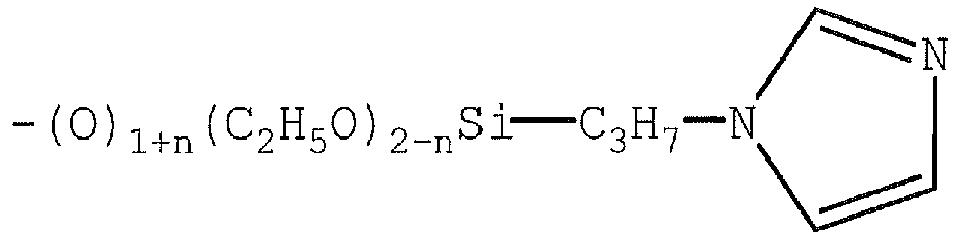
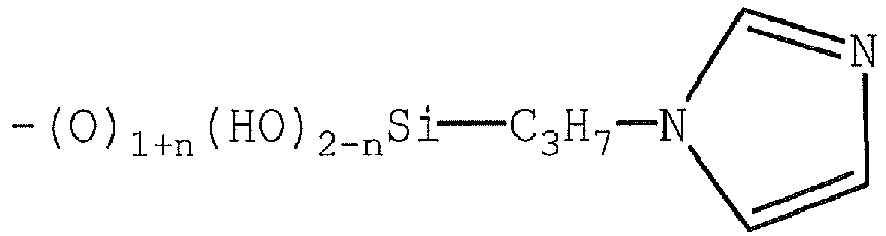
- Ein weiterer Gegenstand ist ein Verfahren zur Modifizierung der Metalloxide, dadurch gekennzeichnet, dass die Metalloxide mit Organosilanen der allgemeinen Formel II
X1+nSi (OR1) 2-n-R2-NR3 2 (II)
wasserfrei modifiziert werden, wobei R1, R2, R3, R4 und n die oben genannte Bedeutung haben, R1 und R4 identisch sein können und X = Halogen, Stickstoffrest, OR4, OCOR4, O(CH2)xOR4 und x = 1, 2, 3 bedeutet. - Die Modifizierung der Kieselsäure mit Gruppen der allgemeinen Formel I kann gemäß bekannter Verfahren erfolgen, wie z.B. beschrieben in
EP 686 676 B1
X1+nSi-(OR1)2-n-R2-NR3 2 (II)
wobei R1, R2, R3, R4 und n die oben genannte Bedeutung haben, R1 und R4 identisch sein können und X = Halogen, Stickstoffrest, OR4, OCOR4, O(CH2)xOR4 und x = 1, 2, 3 bedeutet. - Bevorzugt sind die erfindungsgemäßen Metalloxide zusätzlich zu Gruppen der allgemeinen Formel I mit weiteren Gruppen der allgemeinen Formel III
R5 aSiR6 bOc- (III)
modifiziert, wobei
a 1, 2, 3,
b 0, 1, 2,
c 1, 2, 3, sein kann, wobei
a + b + c = 4 ist, wobei - R5
- ein einwertiger, gegebenenfalls einfach oder mehrfach ungesättigter, gegebenenfalls verzweigter Kohlenwasserstoffrest mit 1 bis 24 C-Atomen,
- R6
- ein ebenfalls einwertiger, gegebenenfalls einfach oder mehrfach ungesättigter, gegebenenfalls verzweigter Kohlenwasserstoffrest mit 1 bis 20 C-Atomen sein kann.
- Bevorzugt handelt es sich bei Resten R5 um Alkylreste wie Methyl-, Ethyl-, Propyl-, Hexyl- wie n-Hexyl- oder i-Hexyl-, Octyl- wie n-Octyl- oder i-Octyl-, n-Dodecyl-, n-Hexadecyl- oder n-Octadecylreste.
- Bevorzugt handelt es sich bei Resten R6 um Alkylreste wie Methyl-, Ethyl- oder Propylreste.
- Bevorzugte Gruppen der allgemeinen Formel III auf der Kieselsäureoberfläche sind
Trimethylsilyloxy- (CH3)3Si(O-))̵, Dimethylsilyldioxy-(CH3)2Si(O-)2)̵,
n-Propylsilyltrioxy- C3H7Si(O-)3, n-Octylsilyltrioxy-C8H17Si(O-)3, i-Octylsilyltrioxy- C8H17Si(O-)3, n-Octylmethylsilyldioxy- CgH17SiCH3(O-)2, i-Octylmethylsilyldioxy-C8H17SiCH3 (O-)2, n-Hexadecylsilyltrioxy- C16H33Si(O-)3 n-Hexadecylmethylsilyldioxy- C16H33SiCH3 (O-)2, n-Dodecylsilyltrioxy- C18H37Si(O-)3.
Ganz besonders bevorzugt sind die Trimethylsilyloxygruppe (CH3)3Si(O-)3 und die Dimethylsilyldioxygruppe (CH3)2Si(O-)2. - Die Modifizierung der Metalloxide mit Gruppen der allgemeinen Formel III kann gemäß bekannter Verfahren erfolgen, wie z.B. beschrieben in
EP 686 676 B1
R5 aSiR6 bXc (IV)
wobei R4, R5, R6, a, b, c die oben genannte Bedeutung haben und X = Halogen, Stickstoffrest, OR4, OCOR4, O(CH2)xOR4 und x = 1, 2, 3 bedeutet. - Bevorzugt ist Methyltrichlorsilan, Dimethyldichlorsilan, Trimethylchlorsilan, Methyltrimethoxysilan, Dimethyldimethoxysilan, Trimethylmethoxysilan oder Hexamethyldisilazan.
- Zur Oberflächenmodifizierung mit Gruppen der allgemeinen Formel III können ferner Organosiloxane aufgebaut aus Einheiten der Formel
(R5 3SiO1/2), und/oder
(R5 2SiO2/2), und/oder
(R5SiO3/2)
eingesetzt werden, wobei die Anzahl von diesen Einheiten in einem Organosiloxan vorzugsweise mindestens 2 ist, und R5 die oben genannte Bedeutung hat. Gegebenenfalls kann die Oberflächenmodifizierung ausschließlich durch Organosiloxane erfolgen oder in beliebigen Gemischen mit Silanen der allgemeinen Formel IV. - Beispiele für Organosiloxane sind lineare oder cyclische Dialkylsiloxane mit einer mittleren Anzahl an Dialkylsiloxyeinheiten von größer als 3. Die Dialkylsiloxane sind bevorzugt Dimethylsiloxane. Besonders bevorzugt sind lineare Polydimethylsiloxane mit folgenden Endgruppen: Trimethylsiloxy-, Dimethylhydroxysiloxy-, Dimethylchlorsiloxy-, Methyldichlorsiloxy-, Dimethylmethoxysiloxy-, Methyldimethoxysiloxy-, Dimethylethoxysiloxy-, Methyldiethoxysiloxy-, Dimethylacethoxysiloxy-, Methyldiacetoxysiloxy- und Dimethylhydroxysiloxygruppen, insbesondere mit Trimethylsiloxy- oder Dimethylhydroxysiloxyendgruppen.
- Bevorzugt haben die genannten Polydimethylsiloxane eine Viskosität bei 25°C von 2 bis 100 mPa˙s.
- Weitere Beispiele für Organosiloxane sind Siliconharze, im besonderen solche, die als Alkylgruppen Methylgruppen enthalten, wobei es sich besonders bevorzugt um solche handelt, die R5 3SiO1/2 und SiO4/2-Einheiten enthalten oder solche, die R5SiO3/2 und gegebenenfalls R5 2SiO2/2-Einheiten enthalten, wobei R5 eine der oben genannten Bedeutungen hat.
- Bevorzugt haben die genannten Siliconharze eine Viskosität bei 25°C von 500 bis 5000 mm2/s.
- Bei Siliconharzen mit einer Viskosität von größer als 1000 mm2/s bei 25°C sind solche bevorzugt, die sich in einem technisch gut handhabbaren Lösungsmittel, wie vorzugsweise Alkohole wie Methanol, Ethanol, iso-Propanol, Ether wie Diethylether, Tetrahydrofuran, Siloxane wie Hexamethyldisiloxan, Alkane wie Cyclohexan oder n-Octan, Aromaten wie Toluol oder Xylol, mit einer Konzentration über 10 Gew.-% und einer Mischungsviskosität kleiner als 1000 mm2/s bei einer Temperatur von 25°C und dem Druck der umgebenden Atmosphäre lösen lassen.
- Unter den festen Organosiloxanen sind solche bevorzugt, die sich in einem technisch handhabbaren Lösungsmittel (wie oben definiert) mit einer Konzentration größer als 10 Gew.% und einer Mischungsviskosität kleiner als 1000 mm2/s bei einer Temperatur von 25°C lösen.
- Vorzugsweise werden die erfindungsgemäßen Metalloxide (a) parallel mit Silanen der allgemeinen Formel IV bzw. Organopolysiloxanen und Silanen der allgemeinen Formel II modifiziert oder (b) erst mit Silanen der allgemeinen Formel IV bzw. Organopolysiloxanen und anschließend mit Silanen der allgemeinen Formel II modifiziert oder (c) erst mit Silanen der allgemeinen Formel II und anschließend mit Silanen der allgemeinen Formel IV bzw. Organopolysiloxanen modifiziert, bevorzugt werden die erfindungsgemäßen Metalloxide erst mit Silanen der allgemeinen Formel IV bzw. Organopolysiloxanen und anschließend mit Silanen der allgemeinen Formel II modifiziert, wobei die Metalloxide nach der Modifizierung mit Silanen der allgemeinen Formel IV bzw. Organopolysiloxanen isoliert werden können und dann mit Silanen der allgemeinen Formel II modifiziert werden können, oder ohne vorherige Isolierung mit Silanen der allgemeinen Formel II modifiziert werden können, bevorzugt ist die vorherige Isolierung.
- Die mit Gruppen der allgemeinen Formel III vormodifizierten Metalloxide weisen vorzugsweise einen Modifizierungsgrad der Oberflächen-Metall-OH-Gruppen, also beispielsweise der Silanolgruppen Si-OH, von 5 bis 90%, bevorzugt von 10 bis 80% und besonders bevorzugt von 20 bis 75% auf, wobei der Modifizierungsgrad f (MOH) definiert ist als f(MOH) = (nges (MOH) - n(MOH)) * 100% / nges(MOH), wobei n(MOH) die Stoffmenge der Oberflächen-Metall-OH-Gruppen pro nm2 nach der Modifizierung und nges(MOH) die Stoffmenge der Oberflächen-Metall-OH-Gruppen pro nm2 vor der Modifizierung ist, wobei sich die Stoffmengen jeweils auf die spezifische Oberfläche (gemessen nach der BET Methode nach DIN EN ISO 9277/DIN 66132) des hydrophilen Ausgangmetalloxids beziehen und für pyrogene Kieselsäuren nges(MOH), d.h. nges(SiOH), üblicherweise den Wert 1,8 (nm2)-1 aufweist. Die Stoffmenge der Silanolgruppen läßt sich beispielsweise bestimmen mittels Säure-Basen-Titration gemäß G. W. Sears, Anal. Chem. 1956, 28, 1981.
- Die mit Gruppen der allgemeinen Formel III vormodifizierten Metalloxide weisen vorzugsweise einen Kohlenstoffgehalt 0,1 bis 10%, bevorzugt 0,25 bis 5% auf.
- Der eingesetzte Feststoff kann ein Metalloxid sein, das an der Oberfläche OH-Gruppen aufweist.
- Als Basis-(Ausgangs-)-Produkt der Oberflächenmodifizierung wird bevorzugt ein Feststoff mit einer mittleren Partikelgröße keiner 1000 µm, insbesondere mit einer mittleren Primärteilchen-Partikelgröße von 5 bis 100 nm eingesetzt. Dabei können diese Primärteilchen nicht isoliert existieren, sondern Bestandteile größerer Aggregate und Agglomerate sein.
- Bevorzugte Feststoffe sind Metalloxide, wobei Kieselsäure besonders bevorzugt ist. Vorzugsweise weist das Metalloxid eine spezifische Oberfläche von 0,1 bis 1000 m2/g (gemessen nach der BET Methode nach DIN EN ISO 9277/DIN 66132) auf, besonders bevorzugt von 10 bis 500 m2/g.
- Das Metalloxid kann Aggregate (Definition nach DIN 53206) im Bereich von Durchmessern 50 bis 1000 nm aufweisen, bevorzugt 50 bis 500 nm und besonders bevorzugt 75 bis 350 nm, wobei das Metalloxid aus Aggregaten aufgebaute Agglomerate (Definition nach DIN 53206) aufweist, die in Abhängigkeit von der äußeren Scherbelastung (z.B. bedingt durch die Meßbedingungen) Größen von 1 bis 1000 µm aufweisen können. Der Durchmesser der Aggregate wird dabei bestimmt als hydrodynamischer Äquivalentdurchmesser mittel Photonenkorrelationsspektroskopie.
- Das Metalloxid ist aus Gründen der technischen Handhabbarkeit vorzugsweise ein Oxid mit kovalentem Bindungs-Anteil in der Metall-Sauerstoff-Bindung, vorzugsweise ein Oxid im Aggregatszustand Feststoff der Haupt- und Nebengruppenelemente, wie der 3. Hauptgruppe, wie Bor-, Aluminium-, Gallium- oder Indiumoxid, oder der 4. Hauptgruppe wie Siliciumdioxid, Germaniumdioxid, oder Zinnoxid oder -dioxid, Bleioxid oder - dioxid, oder ein Oxid der 4. Nebengruppe, wie Titandioxid, Zirkonoxid, oder Hafniumoxid. Andere Beispiele sind stabile Nickel-, Cobalt-, Eisen-, Mangan-, Chrom- oder Vanadiumoxide.
- Besonders bevorzugt sind Aluminium(III)-, Titan(IV)- und Silicium(IV)oxide, wie naßchemisch hergestellte, beispielsweise gefällte Kieselsäuren oder Kieselgele, oder in Prozessen bei erhöhter Temperatur hergestellte Aluminiumoxide, Titandioxide oder Siliciumdioxide, wie zum Beispiel pyrogen hergestellte Aluminiumoxide, Titandioxide oder Siliciumdioxide oder Kieselsäuren.
- Besonders bevorzugt ist pyrogene Kieselsäure, die in einer Flammenreaktion aus Organosiliciumverbindungen hergestellt wird, z.B. aus Siliciumtetrachlorid oder Methyltrichlorsilan, oder Hydrogentrichlorsilan oder Hydrogenmethyldichlorsilan, oder anderen Methylchlorsilanen oder Alkylchlorsilanen, auch im Gemisch mit Kohlenwasserstoffen, oder beliebigen verflüchtigbaren oder versprühbaren Gemischen aus Organosiliciumverbindungen, wie genannt, und Kohlenwasserstoffen, z.B. in einer Wasserstoff-Sauerstoff-Flamme, oder auch einer Kohlenmonoxid-Sauerstoff-Flamme, hergestellt wird. Die Herstellung der Kieselsäure kann dabei wahlweise mit und ohne zusätzlichem Zusatz von Wasser erfolgen, zum Beispiel im Schritt der Reinigung; bevorzugt ist kein Zusatz von Wasser.
- Es können beliebige Gemische der genannten Feststoffe zur Oberflächenmodifizierung eingesetzt werden.
- Vorzugsweise weist die pyrogene Kieselsäure eine fraktale Dimension der Oberfläche von vorzugsweise kleiner oder gleich 2,3 auf, besonders bevorzugt von kleiner oder gleich 2,1, im besonderen bevorzugt von 1,95 bis 2,05, wobei die fraktale Dimension der Oberfläche DS hierbei definiert ist als: Partikel-Oberfläche A ist proportional zum Partikel-Radius R hoch DS
- Vorzugsweise weist die Kieselsäure eine fraktale Dimension der Masse Dm von vorzugsweise kleiner oder gleich 2,8, bevorzugt kleiner oder gleich 2,3, besonders bevorzugt von 1,7 bis 2,1 auf, wie z.B. gegeben in F. Saint-Michel, F. Pignon, A. Magnin, J. Colloid Interface Sci. 2003, 267, 314.. Die fraktale Dimension der Masse Dm ist hierbei definiert als: Partikel-Masse M ist proportional zum Partikel-Radius R hoch Dm.
- Vorzugsweise weist die unmodifizierte Kieselsäure eine Dichte an Oberflächen-Silanolgruppen SiOH von kleiner als 2,5 SiOH / nm2, vorzugsweise kleiner 2,1 SiOH / nm2, bevorzugt von kleiner als 2 SiOH / nm2, besonders bevorzugt von 1,7 bis 1,9 SiOH / nm2 auf.
- Es können vorzugsweise auch hydrophile Kieselsäuren eingesetzt werden, die frisch hergestellt direkt aus dem Brenner kommen, zwischengelagert oder bereits handelsüblich verpackt sind.
- Es können vorzugsweise unverdichtete, mit Schüttdichten unter 60 g/l, aber auch verdichtete, mit Schüttdichten über 60 g/l, Kieselsäuren eingesetzt werden.
- Es können vorzugsweise Gemische aus verschiedenen Metalloxiden oder Kieselsäuren eingesetzt werden, so z.B. Mischungen aus Metalloxiden oder Kieselsäuren unterschiedlicher BET-Oberfläche, oder Mischungen aus Metalloxiden mit unterschiedlichem Hydrophobier- oder Silyliergrad.
- Das Metalloxid kann vorzugsweise in kontinuierlichen oder diskontinuierlichen Verfahren hergestellt werden, das Verfahren zur Silylierung kann aus einem oder mehreren Schritten aufgebaut sein. Bevorzugt wird das silylierte Metalloxid mittels eines Verfahren hergestellt, bei dem der Herstellungsprozeß in getrennten Schritten erfolgt: (A) zunächst Herstellung des hydrophilen Metalloxids, (B) gegebenenfalls prämodifizieren des Metalloxids mittels bekannter Methoden mit Silanen der allgemeinen Formel IV bzw. Organopolysiloxanen, sodann (C) die Silylierung/Modifizierung des Metalloxids mit (1) Beladung des hydrophilen oder prämodifizierten Metalloxids mit Silanen der allgemeinen Formel II, (2) Reaktion des Metalloxids mit den aufgebrachten Verbindungen und (3) Reinigung des Metalloxids von überschüssigen aufgebrachten Verbindungen.
- Die Oberflächenbehandlung wird bevorzugt in einer Atmosphäre durchgeführt, die nicht zur Oxidation des silylierten Metalloxids führt, d.h. bevorzugt weniger als 10 Vol.% Sauerstoff, besonders bevorzugt weniger als 2,5 Vol.%, ganz besonders bevorzugt bei weniger als 1 Vol.% Sauerstoff.
- Belegung, Reaktion und Reinigung können vorzugsweise als diskontinuierlicher oder kontinuierlicher Prozess durchgeführt werden.
- Aus technischen Gründen bevorzugt ist eine kontinuierliche Reaktionsführung.
- Die Belegung (Schritt C1) erfolgt vorzugsweise bei Temperaturen von -30 bis 250 °C, bevorzugt bei 20 bis 150 °C, besonders bevorzugt bei 20 bis 80 °C; ganz besonders bevorzugt erfolgt der Belegungsschritt bei 30 bis 50 °C.
- Die Verweilzeit beträgt vorzugsweise 1 Min - 24 h, bevorzugt 15 Min bis 300 Min, aus Gründen der Raumzeitausbeute besonders bevorzugt 15 Min bis 240 Min.
- Der Druck in der Belegung reicht vorzugsweise von schwachem Unterdruck bis 0,2 bar bis zum Überdruck von 100 bar, wobei aus technischen Gründen Normaldruck, das heißt druckfreies Arbeiten gegenüber Außen-/Atmosphären-Druck bevorzugt ist.
- Die Silane der allgemeinen Formel II und gegebenenfalls der Formel IV bzw. Organopolysiloxane werden bevorzugt in flüssiger Form zugefügt, und insbesondere der pulverförmigen Kieselsäure zugemischt. Die Verbindungen können dabei in reiner Form oder als Lösungen in bekannten technisch eingesetzten Lösungsmitteln wie z.B. Alkoholen wie z.B. Methanol, Ethanol, oder i-Propanol, Ethern wie z.B. Diethylether, THF, oder Dioxan, oder Kohlenwasserstoffen wie z.B. Hexanen oder Toluol zugemischt werden. Die Konzentration in der Lösung beträgt dabei 5 - 95 Gew.%, bevorzugt 30 - 95 Gew.%, besonders bevorzugt 50 - 95 Gew.%.
- Das Zumischen geschieht vorzugsweise durch Düsentechniken, oder vergleichbare Techniken, wie effektive Verdüsungstechniken, wie Verdüsen in 1-Stoffdüsen unter Druck (vorzugsweise 5 bis 20 bar), Versprühen in 2-Stoffdüsen unter Druck (vorzugsweise Gas und Flüssigkeit 2-20 bar), feinstverteilen mit Atomizern oder Gas-Feststoff-Austauschaggregaten mit beweglichen, rotierenden oder statischen Einbauten, die eine homogene Verteilung der Silane der allgemeinen Formel II mit der pulverförmigen Kieselsäure erlauben.
- Das Aerosol kann vorzugsweise von oben auf den fluidisierten Feststoff aufgedüst werden oder in den fluidisierten Feststoff hinein, bevorzugt ist Verdüsung von oben auf das Produkt.
- Bevorzugt werden die Silane der allgemeinen Formel II als feinstverteiltes Aerosol zugefügt, dadurch gekennzeichnet, daß das Aerosol eine Sinkgeschwindigkeit von 0,1 - 20 cm/s aufweist.
- Bevorzugt erfolgt die Beladung der Kieselsäure und die Reaktion mit den Silanen der allgemeinen Formel II unter mechanischer oder gasgetragener Fluidisierung. Besonders bevorzugt ist die mechanische Fluidisierung.
- Eine Gas-getragene Fluidisierung kann vorzugsweise durch alle inerten Gase erfolgen, die nicht mit den Silanen der allgemeinen Formel II , der Kieselsäure, und der modifizierten Kieselsäure reagieren, also nicht zu Nebenreaktionen, Abbaureaktionen, Oxidationsvorgängen und Flammen- und Explosionserscheinungen führen, wie vorzugsweise N2, Ar, andere Edelgase, CO2, etc. Die Zuführung der Gase zur Fluidisierung erfolgt bevorzugt im Bereich von Leerrohrgasgeschwindigkeiten von 0,05 bis 5 cm/s, besonders bevorzugt von 0,5-2,5 cm/s. Besonders bevorzugt ist die mechanische Fluidisierung, die ohne zusätzlichen über die Inertisierung hinausgehenden Gaseinsatz, durch Flügelrührer, Ankerrührer, und sonstige geeignete Rührorgane erfolgt.
- In einer besonders bevorzugten Ausführung werden nicht abreagierte Silane der allgemeinen Formel II und gegebenenfalls der Formel IV bzw. Organopolysiloxane und Abgase aus dem Reinigungsschritt wieder in den Schritt der Belegung und Beladung der Kieselsäure zurückgeführt; dies kann teilweise oder vollständig geschehen, bevorzugt zu 10 - 90 % des gesamten Volumenstromes der aus der Abreinigung austretenden Gasvolumina.
- Dies geschieht in geeignet temperierten Vorrichtungen. Diese Rückführung erfolgt bevorzugt in nicht-kondensierter Phase, also als Gas oder als Dampf. Diese Rückführung kann als Stofftransport entlang eines Druckausgleichs erfolgen oder als gesteuerter Stofftransport mit den technisch üblichen Systemen des Gastransports, wie Ventilatoren, Pumpen, Druckluftmembranpumpen. Da die Rückführung der nichtkondensierten Phase bevorzugt ist, empfiehlt sich gegebenenfalls die Beheizung der rückführenden Leitungen.
- Die Rückführung der nicht abreagierten Silane der allgemeinen Formel II und gegebenenfalls der Formel IV bzw. Organopolysiloxane und der Abgase kann dabei zwischen vorzugsweise 5 und 100 Gew.%, bezogen auf deren Gesamtmasse, bevorzugt zwischen 30 und 80 Gew.% liegen. Die Rückführung kann dabei, bezogen auf 100 Teile frisch eingesetztes Silan zwischen 1 und 200 Teile, bevorzugt 10 bis 30 Teile betragen.
- Die Rückführung der Abreinigungsprodukte der Modifizierungsreaktion in die Belegung erfolgt bevorzugt kontinuierlich.
- Die Reaktion (Schritt C2) erfolgt vorzugsweise bei Temperaturen von 20 - 300 °C, bevorzugt 20 - 200 °C und besonders bevorzugt bei 40 - 180 °C.
- Bevorzugt erfolgte die Reaktion in einem Temperaturgradienten d.h., daß die Reaktionstemperatur im Laufe der Reaktionszeit ansteigt.
- Dies bedeutet, daß zu Beginn der Reaktion die Wandtemperatur des Reaktionsbehälters vorzugsweise in einem Bereich von 20 - 100 °C, bevorzugt in einem Bereich von 40 - 80 °C liegt und gegen Ende der Reaktion die Wandtemperatur des Reaktionsbehälters in einem Bereich von vorzugsweise 80 - 180 °C, bevorzugt in einem Bereich von 100 - 150 °C liegt, mit der Maßgabe, daß die Wandtemperatur des Reaktionsbehälters zu Beginn der Reaktion niedriger als gegen Ende der Reaktion ist. Vorzugsweise liegt also die Wandtemperatur des Reaktionsbehälters zu Beginn der Reaktion in einem Bereich von vorzugsweise 20 - 100 °C und gegen Ende der Reaktion in einem Bereich von 80 - 180 °C, mit der Maßgabe, daß die Wandtemperatur des Reaktionsbehälters zu Beginn der Reaktion niedriger als gegen Ende der Reaktion ist, bevorzugt liegt die Wandtemperatur des Reaktionsbehälters zu Beginn der Reaktion in einem Bereich von 40 - 80 °C und gegen Ende der Reaktion in einem Bereich von 80 - 150 °C.
- Dies bedeutet ferner, daß die Produkttemperatur zu Beginn der Reaktion vorzugsweise in einem Bereich von 20 - 100 °C, bevorzugt in einem Bereich von 40 - 80 °C liegt und gegen Ende der Reaktion die Produkttemperatur in einem Bereich von 80 - 180 °C, bevorzugt in einem Bereich von 100 - 150 °C liegt, mit der Maßgabe, daß die Produkttemperatur zu Beginn der Reaktion niedriger als gegen Ende der Reaktion ist. Vorzugsweise liegt also die Produkttemperatur zu Beginn der Reaktion in einem Bereich von 20 - 100 °C und gegen Ende der Reaktion in einem Bereich von 80 - 180 °C, mit der Maßgabe, daß die Produkttemperatur zu Beginn der Reaktion niedriger als gegen Ende der Reaktion ist, bevorzugt liegt die Produkttemperatur zu Beginn der Reaktion in einem Bereich von 40 - 80 °C und gegen Ende der Reaktion in einem Bereich von 80 - 150 °C.
- Dies bedeutet, daß je nach Prozessdurchführung, d.h. kontinuierlicher oder diskontinuierlicher Prozessdurchführung, der Temperaturgradient abhängig vom Ort dT/dx (kontinuierlich) oder abhängig von der Zeit dT/dt (diskontinuierlich) sein kann, bevorzugt ist die kontinuierliche Prozessführung.
- Die Reaktionstemperatur, d.h. die Wand- bzw. Produkttemperatur und deren Gradient kann dabei gemäß folgender Verfahren erreicht werden.
- 1. Kontinuierlicher Prozessverlauf (d.h. dT/dx):
- Das Metalloxid wird vorzugsweise mittels Gas-getragener oder mechanischer Fluidisierung/Förderung durch eine Heizzone mit ansteigender Wandtemperatur gefördert. Die Wandtemperatur kann dabei kontinuierlich oder in Stufen ansteigen. Im Fall eines stufenweisen Anstiegs kann die Reaktionszone aus vorzugsweise bis zu 10 separaten Heizzonen unterschiedlicher Temperatur, bevorzugt 5 separaten Heizzonen unterschiedlicher Temperatur, besonders bevorzugt 3 separaten Heizzonen unterschiedlicher Temperatur , in einer speziellen Ausführung aus 2 separaten Heizzonen unterschiedlicher Temperatur, d.h. von Heizzone zu Heizzone ansteigender Temperatur, bestehen. Gegebenenfalls können die einzelnen Heizzonen durch Klappen von einander getrennt sein. Der Reaktionsbehälter kann senkrecht oder waagerecht stehen. Bevorzugt ist die senkrechte Ausführung. Bei senkrechter Ausführung kann das Metalloxid von unten nach oben oder von oben nach unten die Reaktionszone durchlaufen. Bevorzugt ist von oben nach unten.
- Das Metalloxid wird vorzugsweise mittels Gas-getragener oder mechanischer Fluidisierung/Förderung durch separate Reaktionsbehälter mit unterschiedlicher, d.h. ansteigender Wandtemperatur gefördert. Die Reaktionskaskade kann dabei aus vorzugsweise bis zu 10 Reaktionsbehältern unterschiedlicher Wandtemperatur, bevorzugt bis zu 5 Reaktionsbehältern unterschiedlicher Wandtemperatur, besonders bevorzugt bis zu 3 Reaktionsbehältern unterschiedlicher Wandtemperatur, und in einer speziellen Ausführung aus 2 Reaktionsbehältern unterschiedlicher Wandtemperatur bestehen, mit der Maßgabe daß die Wandtemperatur von Reaktionsbehälter zu Reaktionsbehälter ansteigt. Die Reaktionsbehälter können senkrecht oder waagerecht stehen. Bevorzugt ist die senkrechte Ausführung. Bei senkrechter Ausführung kann das Metalloxid von unten nach oben oder von oben nach unten die Reaktionszone durchlaufen. Bevorzugt ist von oben nach unten.
- Das Metalloxid wird vorzugsweise mittels mechanischer Fluidisierung/Förderung durch einen senkrecht stehenden Reaktionsbehälter gefördert. Der Reaktionsbehälter wird im unteren Teil auf die maximale Reaktionstemperatur beheizt. Im Reaktionsbehälter stellt sich dann ein Temperaturgefälle zwischen dem oberen Teil des Reaktionsbehälters (niedrigste Temperatur) und dem unteren Teil des Reaktionsbehälters (höchste Temperatur) ein. Der Temperaturgradient der Produkttemperatur kann beispielsweise durch geeignete Rührtechnik mit Pfropfenströmung gesteuert werden. Vorzugsweise kann dies durch eine Kombination verschiedener Rührerelemente erzielt werden, die in Segmenten angeordnet sein können. So können beispielsweise Segmente mit horizontaler Durchmischung gefolgt von Segmenten mit vertikaler Mischcharkteristik eingesetzt werden.
- 2. Diskontinuierlicher Produktionsverlauf (Batchbetrieb)
- Das Metalloxid wird vorzugsweise mittels Inertgas oder mechanisches Rühren im Reaktionsbehälter fluidisiert. Im Laufe der Reaktionsdauer wird die Reaktionstemperatur im Reaktionsbehälter sukzessive, d.h. in Form einer Rampe oder stufenweise erhöht.
- Die Verweilzeit pro Reaktionstemperatur liegt vorzugsweise zwischen 5 min und 240 min, bevorzugt zwischen 10 min und 180 min und besonders bevorzugt zwischen 15 min und 120 min.
- Die Beheizung der Reaktionszone kann z.B. über die Behälterwand z.B. mittels elektrischer Beheizung oder mittels Temperierflüssigkeit oder Dampf erfolgen. Gegebenenfalls können im Reaktionsgefäß z.B. Heizschlangen eingesetzt werden. Gegebenenfalls kann die Beheizung von außen über Infrarotstrahler erfolgen.
- Die Temperaturmessung von Wand- und Produkttemperatur kann vorzugsweise mittels üblicherweise eingesetzten Messinstrumenten wie Thermoelementen, Widerstandsthermometern, Bimetallthermometern, IR-Sensoren oder anderen erfolgen.
- Die Gesamtreaktionszeit beträgt vorzugsweise 10 Min bis 48 h, bevorzugt 15 Min bis 5 h, besonders bevorzugt 20 min bis 4 h.
- Gegebenenfalls können protische organische Lösungsmittel hinzugefügt werden, wie flüssige oder verdampfbare Alkohole; typische Alkohole sind iso-Propanol, Ethanol und Methanol. Es können auch Gemische der oben genannten protischen organischen Lösungsmittel zugefügt werden. Vorzugsweise werden 1 bis 50 Gew.% an protischen Lösungsmitteln bezogen auf die Kieselsäure zugefügt, besonders bevorzugt 5 bis 25%.
- Vorzugsweise wird die Modifizierung der Metalloxide in wasserfreier Umgebung durchgeführt. Das heißt, daß der Gehalt an physikalisch adsorbiertem Wasser der eingesetzten hydrophilen Metalloxide bzw. mit Gruppen der allgemeinen Formel III modifizierten Metalloxide kleiner als 5 Gew.%, bevorzugt kleiner 1,5 Gew.% und besonders bevorzugt kleiner 0,5 Gew.% ist.
- Vorzugsweise wird zur Reaktion der Metalloxiden mit Silanen der allgemeinen Formel II kein Wasser zugesetzt.
- Vorzugsweise werden die eingesetzten Prozessgase vor der Einspeisung getrocknet.
- Gegebenenfalls können die zur Modifizierung mit Silanen der allgemeinen Formel II eingesetzten Metalloxide vor der Reaktion getrocknet werden.
- Gegebenenfalls können basische Katalysatoren, von basischem Charakter im Sinne einer Lewis Base oder einer Brönsted Base, wie Ammoniak oder Amine wie Triethylamin, zugesetzt werden. Bevorzugt werden diese in Spuren zugesetzt, d.h. kleiner als 1000 ppm. Besonders bevorzugt werden keine Katalysatoren zugesetzt.
- Die Abreinigung (Schritt C3) erfolgt vorzugsweise bei einer Reinigungstemperatur von 20 bis 200 °C, bevorzugt 50°C bis 180°C, besonders bevorzugt von 50 bis 150 °C. Der Reinigungsschritt ist vorzugsweise durch Bewegung gekennzeichnet, wobei langsame Bewegung und geringes Durchmischen besonders bevorzugt ist. Die Rührorgane werden dabei vorteilhafterweise so eingestellt und bewegt, daß bevorzugt ein Mischen und ein Fluidisieren, jedoch nicht völlige Verwirbelung, eintritt.
- Der Reinigungsschritt kann weiterhin vorzugsweise durch erhöhten Gaseintrag gekennzeichnet sein, entsprechend einer Leerrohrgasgeschwindigkeit von vorzugsweise 0,001 bis 10 cm/s, bevorzugt 0,01 bis 1 cm/s. Dies kann durch alle inerten Gase erfolgen, die nicht mit den Silanen der allgemeinen Formel II, der Kieselsäure, und der modifizierten Kieselsäure reagieren, also nicht zu Nebenreaktionen, Abbaureaktionen, Oxidationsvorgängen und Flammen- und Explosionserscheinungen führen, wie vorzugsweise N2, Ar, andere Edelgase, CO2, etc.
- Vorzugsweise werden während der Modifizierung oder im Anschluß an die Reinigung Verfahren zur mechanischen Verdichtung der Kieselsäure eingesetzt werden, wie zum Beispiel Presswalzen, Mahlaggregate, wie Kollergänge und wie Kugelmühlen, kontinuierlich oder diskontinuierlich, Verdichtung durch Schnecken oder Schraubenmischer, Schraubenverdichter, Brikettierer, oder Verdichten durch Absaugen des Luft- oder Gasinhaltes durch geeignete Vakuummethoden.
- Besonders bevorzugt ist die mechanische Verdichtung während der Modifizierung, im Schritt C durch Preßwalzen, oben genannte Mahlaggregate wie Kugelmühlen oder Verdichtung durch Schnecken, Schraubenmischer, Schraubenverdichter, Brikettierer gekennzeichnet.
- In einer weiteren besonders bevorzugten Verfahrensweise werden im Anschluss an die Reinigung Verfahren zur mechanischen Verdichtung der Kieselsäure eingesetzt, wie Verdichten durch Absaugen des Luft- oder Gasinhaltes durch geeignete Vakuummethoden oder Preßwalzen oder Kombination von beiden Verfahren.
- Zusätzlich können in einer besonders bevorzugten Verfahrensweise im Anschluss an die Reinigung Verfahren zur Desagglomerierung der Kieselsäure eingesetzt werden, wie Stiftmühlen, Hammermühlen, Gegenstrommühlen, Prallmühlen oder Vorrichtungen zur Mahlsichtung.
- In einem weiteren bevorzugten Verfahren werden Dispersionen des hydrophilen Metalloxids in typischen industriell eingesetzten organischen Lösungsmitteln wie vorzugsweise Alkoholen wie Methanol, Ethanol, i-Propanol, wie Ketonen wie Aceton, Methyl-Ethyl-Keton, wie Ethern wie Diethylether, THF, Kohlenwasserstoffen wie Pentan, Hexanen, Aromaten wie Toluol oder anderen flüchtigen Lösungsmitteln wie Hexamethyldisiloxan oder deren Mischungen mit den Silanen der allgemeinen Formel II umgesetzt.
- Das Verfahren kann kontinuierlich oder diskontinuierlich durchgeführt werden und aus einem oder mehreren Schritten aufgebaut sein. Bevorzugt ist ein kontinuierliches Verfahren. Bevorzugt wird das modifizierte Metalloxid mittels eines Verfahren hergestellt, bei dem das Metalloxid (1) in einem der oben genannten Lösungsmittel eingemischt wird, (2) mit den Silanen zur Reaktion gebracht wird, und (3) von Lösungsmitteln, überschüssigen Silanen und Nebenprodukten befreit wird.
- Die Dispergierung (1), Reaktion (2), Trocknung (3) und gegebenenfalls Nachreaktion (4) werden bevorzugt durchgeführt in einer Atmosphäre mit weniger als 10 Vol.-% Sauerstoff, besonders bevorzugt weniger als 2,5 Vol.-%, beste Ergebnisse werden erzielt bei weniger als 1 Vol.-% Sauerstoff. Das Einmischen (1) kann vorzugsweise mittels üblicher Mischaggregate wie Ankerrührer oder Balkenrührer erfolgen. Gegebenenfalls kann das Einmischen unter hoher Scherung mittels Dissolvern, Rotor-Stator-Aggregaten, gegebenenfalls unter direkter Zudosierung in den Scherspalt, mittels Ultraschallgebern oder mittels Mahlaggregaten wie Kugelmühlen erfolgen. Gegebenenfalls können verschiedene der oben genannten Aggregate parallel oder nacheinander eingesetzt werden. Zur Reaktion (2) der Silane mit der allgemeinen Formel II mit dem Metalloxid werden vorzugsweise die Silane in reiner Form oder als Lösung in geeigneten Lösungsmitteln der Metalloxiddispersion zugegeben und homogen vermischt. Die Zugabe der Silane kann dabei vorzugsweise in dem Behälter, der zur Herstellung der Dispersion eingesetzt wird oder in einem separaten Reaktionsbehälter erfolgen. Werden die Silane im Dispergierbehälter zugefügt, kann dies parallel zur oder nach Abschluß der Dispergierung erfolgen. Gegebenenfalls können die Silane gelöst im Dispergiermedium direkt im Dispergierschritt zugefügt werden.
- Gegebenenfalls werden der Reaktionsmischung saure Katalysatoren wie Brönsted-Säuren wie flüssige oder gasförmige HCl, Schwefelsäure, Phosphorsäure oder Essigsäure, oder basische Katalysatoren wie Brönsted-Basen wie flüssiger oder gasförmiger Ammoniak, Amine wie NEt3 oder NaOH zugefügt. Der Reaktionsschritt wird vorzugsweise bei einer Temperatur von 0 °C bis 200 °C, bevorzugt bei 10 °C bis 180 °C und besonders bevorzugt von 20 °C bis 150 °C durchgeführt.
- Das Entfernen von Lösungsmitteln, überschüssigen Silanen und Nebenprodukten (3) kann vorzugsweise mittels Trocknern oder durch Sprühtrocknen erfolgen.
- Gegebenenfalls kann an den Trocknungsschritt noch ein Nachreaktionsschritt (4) zur Vervollständigung der Reaktion angeschlossen sein.
- Die Nachreaktion erfolgt vorzugsweise bei Temperaturen von 20 - 300 °C, bevorzugt 20 - 200 °C und besonders bevorzugt bei 40 - 180 °C.
- Bevorzugt erfolgte die Nachreaktion in einem Temperaturgradienten d.h., daß die Reaktionstemperatur im Laufe der Reaktionszeit ansteigt, wie bereits oben für den Fall der Modifizierung des Metalloxids als Feststoff beschrieben.
- Die Gesamtnachreaktionsreaktionszeit beträgt vorzugsweise 10 Min bis 48 h, bevorzugt 15 Min bis 5 h, besonders bevorzugt 20 min bis 4 h.
- Zusätzlich können vorzugsweise im Anschluss an die Trocknung bzw. Nachreaktion Verfahren zur mechanischen Verdichtung des Metalloxids eingesetzt werden, wie zum Beispiel Presswalzen, Mahlaggregate, wie Kollergänge und wie Kugelmühlen, kontinuierlich oder diskontinuierlich, Verdichtung durch Schnecken oder Schraubenmischer, Schraubenverdichter, Brikettierer, oder Verdichten durch Absaugen des Luft- oder Gasinhaltes durch geeignete Vakuummethoden.
- In einer weiteren besonders bevorzugten Verfahrensweise werden im Anschluss an die Trocknung bzw. Nachreaktion Verfahren zur mechanischen Verdichtung des Metalloxids eingesetzt, wie Verdichten durch Absaugen des Luft- oder Gasinhaltes durch geeignete Vakuummethoden oder Presswalzen oder Kombination von beiden Verfahren.
- Zusätzlich können in einer besonders bevorzugten Verfahrensweise im Anschluss an die Trocknung bzw. Nachreaktion Verfahren zur Desagglomerierung des Metalloxids eingesetzt werden, wie Stiftmühlen, Hammermühlen, Gegenstrommühlen, Prallmühlen oder Vorrichtungen zur Mahlsichtung.
- Die Silane der allgemeinen Formel II werden vorzugsweise in einer Menge von 1 Gew.% bis 20 Gew.% (bezogen auf das Metalloxid), bevorzugt in einer Menge von 2,0 Gew.% bis 15 Gew.% (bezogen auf das Metalloxid), besonders bevorzugt in einer Menge von 2,5 Gew.% bis 10 Gew.% (bezogen auf das Metalloxid), pro einer eingesetzten hydrophilen MetalloxidOberfläche von 100 m2/g BET-Oberfläche eingesetzt (gemessen nach der BET Methode nach DIN EN ISO 9277/DIN 66132).
- Vorzugsweise wird eine Kieselsäure hergestellt mit homogen modifizierter Oberfläche, mit einer mittleren Primärteilchen-Partikelgröße kleiner als 100 nm, bevorzugt mit einer mittleren Primärteilchen-Partikelgröße von 5 bis 50 nm, wobei diese Primärteilchen nicht isoliert in der Kieselsäure existieren, sondern Bestandteile größerer Aggregate (Definition nach DIN 53206) sind, die einen Durchmessern von 50 bis 1000 nm aufweisen, bevorzugt 50 bis 500 nm und besonders bevorzugt 75 bis 350 nm und Agglomerate (Definition nach DIN 53206) aufbauen, die in Abhängigkeit von der äußeren Scherbelastung Größen von 1 bis 1000 µm aufweisen, wobei die Kieselsäure eine spezifische Oberfläche von 10 bis 400 m2/g (gemessen nach der BET Methode nach DIN 66131 und 66132) aufweist, wobei die Kieselsäure eine fraktale Dimension der Masse Dm von kleiner oder gleich 2,8, bevorzugt kleiner oder gleich 2,3, besonders bevorzugt von 1,7 bis 2,1 aufweist, wie z.B. gegeben in F. Saint-Michel, F. Pignon, A. Magnin, J. Colloid Interface Sci. 2003, 267, 314.
- Vorzugsweise ist die Kieselsäureoberfläche chemisch permanent mit Gruppen der allgemeinen Formel I oder I und III modifiziert.
- Eine geeignete Methode zur Bewertung der Permanenz einer Modifizierung ist die quantitative Bestimmung von extrahierbarem, d.h. nicht chemisch an der Kieselsäureoberfläche gebundenem Silan. Die erfindungsgemäßen Kieselsäuren zeichnen sich dadurch aus, daß sie vorzugsweise einen extrahierbaren Anteil von weniger als 5 Gew.%, bevorzugt weniger als 2 Gew.%, besonders bevorzugt von weniger als 1 Gew.% aufweisen und in einer speziellen Ausführung sich kein extrahierbarer Anteil nachweisen läßt.
- Vorzugsweise weist die modifizierte Metalloxidoberfläche neben T3-Gruppen auch T2- und gegebenenfalls T1-Gruppen auf. Vorzugsweise ist der Anteil der Summe der NMR-Signalintensitäten der T1- und T2-Gruppen an der Gesamtintensität der T-Gruppen T1 + T2 + T3 mindestens 20%, bevorzugt größer oder gleich 25%, besonders bevorzugt größer oder gleich 30% und in einer speziellen Ausführung größer oder gleich 35% der Gesamtintensität der T-Gruppen T1 + T2 + T3.
- Der relative Anteil der T1-, T2- und T3-Gruppen läßt sich durch Festkörper-NMR-Spektroskopie im 29Si-CPMAS-Modus bestimmen. Dabei wird der relative Flächenanteil F der einzelnen Peaks aus den Einzelpeakflächen (PF) der entsprechenden Einzelsignale für die T1-, T2-, T3-Gruppen relativ zur Gesamtpeakfläche der T-Gruppen bestimmt, d.h. z.B.

wobei die Einzelpeakflächen (PF) durch Peakdekonvolution des Gesamtpeaks des entsprechenden Gruppensignals mittels Gauß-Fit zugänglich sind. - Für die anderen oben genannten Gruppen wird analog vorgegangen.
- Die chemische Verschiebung der einzelnen siliciumorganischen Gruppen im 29Si-NMR-Spektrum ist z.B. gegeben in D. W. Sindorf, G. E. Maciel, Journal of the American Chemical Society 1983, 105, 3767.
- Vorzugsweise weisen die erfindungsgemäßen Metalloxide einen Kohlenstoffgehalt von 1 Gew.-% bis 20 Gew.-%, bevorzugt von 1 Gew.-% bis 15 Gew.-%, besonders bevorzugt von 1 Gew.-% bis 10 Gew.-% auf.
- Ferner sind die erfindungsgemäßen Metalloxide dadurch charakterisiert, daß sie eine hohe positive triboelektrische Oberflächenladung qtrib von vorzugsweise +50 µC/g bis +1000 µC/g, bevorzugt von +75 µC/g bis +750 µC/g und besonders bevorzugt von +100 µC/g bis +500 µC/g aufweisen.
- Ferner sind die erfindungsgemäßen Metalloxide dadurch charakterisiert, daß die positive triboelektrische Oberflächenladung eine ausgezeichnete Prozeß-Stabilität aufweist. Dies bedeutet, daß die relative Abnahme der triboelektrischen Oberflächenladung (qtrib(3600) - qtrib(150)) × 100% / qtrib(150) maximal 60%, bevorzugt maximal 55% und besonders bevorzugt maximal 50% beträgt, wobei qtrib(3500) die triboelektrische Oberflächenladung nach 3600 s Aktivierungszeit und qtrib(150) die triboelektrische Oberflächenladung nach 150 s Aktivierungszeit eines Gemisches aus einem Tonerpulver und des erfindungsgemäßen Metalloxids bedeutet und qtrib(150) größer 0 sein muß.
- Ferner sind die erfindungsgemäßen Metalloxide dadurch charakterisiert, daß die positive triboelektrische Oberflächenladung eine ausgezeichnete Stabilität gegen hohe Luftfeuchtigkeit und Temperaturen aufweist. Dies bedeutet, daß die relative Abnahme der triboelektrischen Oberflächenladung (qtrib(3600) - qtrib(150)) × 100% / qtrib(150) maximal 60%, bevorzugt maximal 55% und besonders bevorzugt maximal 50% beträgt, wobei qtrib(3600) die triboelektrische Oberflächenladung nach 3600 s Aktivierungszeit und qtrib(150) die triboelektrische Oberflächenladung nach 150 s Aktivierungszeit eines Gemisches aus einem Tonerpulver und des erfindungsgemäßen Metalloxids bedeutet und qtrib(150) größer 0 sein muß, wobei das Gemisch vor der Messung 5 d bei 32 °C und 80% rel. Luftfeuchtigkeit gelagert wurde.
- Die erfindungsgemäßen Metalloxide weisen nach Desagglomeration beispielsweise mittels Sichtermühle oder Stiftmühle eine mittlere Agglomeratgröße D50 von vorzugsweise kleiner 50 µm, bevorzugt kleiner 25 µm, besonders bevorzugt kleiner 20 µm und ganz besonders bevorzugt kleiner 15 µm auf.
- Die erfindungsgemäßen Metalloxide weisen nach Desagglomeration beispielsweise mittels Sichtermühle oder Stiftmühle ferner eine enge Partikelgrößenverteilung der Agglomerate auf. Dies bedeutet, daß der Quotient aus dem D95-Wert und dem D50-Wert vorzugsweise kleiner als 3,0, bevorzugt kleiner oder gleich 2,5 und besonders bevorzugt kleiner oder gleich 2,0 ist.
- Die Partikelgröße der Agglomerate wird dabei mittels Fraunhofer-Laserbeugung an einer ultraschallbehandelten Dispersion der Metalloxid-Partikel in i-Propanol bestimmt.
- Die erfindungsgemäßen Metalloxide sind im weiteren dadurch gekennzeichnet, daß sie in pulverförmigen Systemen Verbackungen oder Verklumpungen, z.B. unter Feuchteeinfluß verhindern, aber auch nicht zur Reagglomeration neigen, und damit zur unerwünschten Separierung, sondern Pulver fließfähig erhalten und somit belastungsstabile und lagerstabile Mischungen ergeben. Dies gilt im besonderen für den Einsatz in nichtmagnetischen und magnetischen Tonern und Entwicklern und Ladungssteuerungshilfsmitteln, z.B. in kontaktlosen oder elektrofotografischen Druck-/Reproduktionsverfahren die 1- und 2-Komponenten Systeme sein können. Dies bedeutet, daß die Fließfähigkeit eines Gemisches aus einem Tonerpulver und dem erfindungsgemäßen Metalloxid nach 150 s Aktivierungszeit mindestens um den Faktor 1,1 besser ist als eine analog behandelte Blindprobe des Tonerpulvers ohne erfindungsgemäße Kieselsäure, bevorzugt ist die Fließfähigkeit um den Faktor 1,2 besser und besonders bevorzugt ist die Fließfähigkeit um den Faktor 1,3 besser, wobei die Fließfähigkeit mittels eines Q/m-mono-Meßgerätes der Fa. Epping GmbH, D-85375 Neufahrn, durch Differenzwägung nach oben genannter Aktivierungszeit bestimmt wird.
- Dies gilt auch in pulverförmigen Harzen, die als Beschichtungssysteme verwendet werden.
- Die Erfindung betrifft ferner den Einsatz der erfindungsgemäßen Matalloxide in Systemen von niedriger bis hoher Polarität als viskositätsgebende Komponente. Dies betrifft alle lösemittelfreie, lösemittelhaltige, filmbildende Anstrichmittel, gummiartige bis harte Beschichtungen, Klebstoffe, Versiegelungs- und Vergußmassen sowie andere vergleichbare Systeme.
- Die erfindungsgemäßen Metalloxide können eingesetzt werden in Systemen, wie:
- Epoxidsysteme
- Polyurethansysteme (PUR)
- Vinylesterharze
- Ungesättigte Polyesterharze
- Lösemittelarme Harzsysteme, sogenannte "high solids".
- Lösemittelfreie Harze, die in Pulverform z.B. als Beschichtungsstoffe appliziert werden.
- Die erfindungsgemäßen Metalloxide liefern als rheologisches Additiv in diesen Systemen die erforderte notwendige Viskosität, Strukturviskosität, Thixotropie und eine für das Standvermögen an senkrechten Flächen ausreichende Fließgrenze.
- Die erfindungsgemäßen Metalloxide können speziell eingesetzt werden als rheologisches Additiv und Verstärkerfüllstoff in unvernetzten und vernetzten Siliconsystemen, wie Siliconelastomere, die aus Siliconpolymeren, wie Polydimethylsiloxanen, Füllstoffen, und weiteren Additiven zusammengesetzt sind. Diese können z.B. mit Peroxiden vernetzt werden, oder über Additions-Reaktionen, die sogenannte Hydrosilylierungsreaktion, zwischen olefinischen Gruppen und Si-H Gruppen vernetzt werden, oder über Kondensationsreaktionen zwischen Silanolgruppen, z.B. solche, die unter Wassereinwirkung entstehen.
- Die erfindungsgemäßen Metalloxide können ferner speziell eingesetzt werden als Verstärkerfüllstoff in lösungsmittelbasierenden, lösungsmittelfreien und wasserbasierenden Beschichtungen, Klebstoffen, Versiegelungs- und Vergußmassen sowie anderen vergleichbaren Systemen zur Verbesserung der mechanischen Eigenschaften des ausgehärteten Systems. Dabei lassen sich aufgrund der speziellen Eigenschaften der erfindungsgemäßen Metalloxide hohe Füllgrade an Metalloxiden in den ungehärteten Systemen realisieren, ohne daß die Viskosität übermäßig ansteigt.
- Ein weiterer Gegenstand der Erfindung sind Toner, Entwickler und Ladungssteuerungshilfsmittel, die die erfindungsgemäßen Metalloxide enthalten. Derartige Entwickler und Toner sind z.B. magnetische 1-Komponenten und 2-Komponenten Toner, aber auch nichtmagnetische Toner. Diese Toner können aus Harzen, wie Styrol- und Acrylharze bestehen, und bevorzugt zu Partikelverteilungen von 1-100 µm vermahlen sein, oder können Harze sein, die in Polymerisationsverfahren in Dispersion oder Emulsion oder Lösung oder in Masse zu Partikelverteilungen von bevorzugt 1 - 100 µm hergestellt wurden. Die erfindungsgemäßen Kieselsäuren werden bevorzugt eingesetzt zur Verbesserung und Steuerung des Pulver-Fließverhaltens, und / oder zur Regulierung und Steuerung der triboelektrischen Ladungseigenschaften des Toners oder Entwicklers. Derartige Toner und Entwickler können eingesetzt werden bevorzugt bei elektrophotografischen Print- und Druckverfahren, auch sind sie einsetzbar bei direkten Bildübertragungsverfahren.
- Ein Toner hat typischerweise folgende Zusammensetzung
- Fest-Harz als Binder, das ausreichend hart ist, um ein Pulver hieraus herzustellen, vorzugsweise mit einem Molekulargewicht über 10000, bevorzugt mit einem Anteil an Polymeren von einem Molekulargewicht unter 10000 von weniger als 10%, z.B. ein Polyesterharz, das ein Co-Kondensat aus Diol und Carbonsäure, - ester, oder -anhydrid sein kann, z.B. mit einer Säurezahl von 1-1000, bevorzugt 5-200, oder ein Polyacrylat oder ein Polystyrol, oder Mischungen, oder Co-Polymerisate hieraus sein kann, und mit einem mittleren Partikeldurchmesser kleiner 20 µm, bevorzugt kleiner 15 µm, besonders bevorzugt kleiner 10 µm.
- Das Tonerharz kann
- Alkohole, Carbonsäuren und Polycarbonsäure
- Technisch übliche Farbstoffe, wie schwarzer Ruß, Farb-Ruß, Cyan-Farbstoffe, Magenta-Farbstoffe, Gelbe Farbstoffe
- Typischerweise positive Ladungssteuerungsmittel, wie Ladungssteuernde Additive z.B. vom Typ Nigrosin-Farbstoff, oder Triphenylmethan Farbstoffe substituiert mit tertiären Aminen, oder quaternäre Amoniumsalze wie CTAB (cetyltrimethylammonium bromide = hexadecyltrimethylammoniumbromide), oder Polyamine, typischerweise kleiner 5 Gew.%
- Wahlweise negative Ladungssteuerungsmittel, wie Ladungssteuernde Additive wie Metall-haltige Azo-Farbstoffe, oder Kupfer-Phthalocyanin Farbstoffe, oder Metall-Komplexe zum Beispiel von alkylierten Salicylsäure-Derivaten oder Benzoesäure, insbesondere mit Bor oder Aluminium, in den erforderlichen Mengen, typischerweise kleiner 5 Gew.% enthalten.
- Gegebenenfalls können, zur Herstellung magnetischer Toner, magnetische Pulver zugesetzt werden, wie z.B. Pulver, die in einem magnetischen Feld magnetisiert werden können, wie ferromagnetische Substanzen, wie Eisen, Kobalt, Nickel, Legierungen, oder Verbindungen wie Magnetit, Hermatit oder Ferrit.
- Wahlweise können auch Entwickler zugesetzt werden, wie Eisenpulver, Glaspulver, Nickelpulver, Ferritpulver.
- Erfindungsgemäße Metalloxide in Gehalten, bezogen auf ein Fest-Harz als Binder mit 20 µm mittlerem Partikeldurchmesser, von vorzugsweise größer 0,01 Gew.%, bevorzugt größer 0,1 Gew.%. Mit abnehmendem mittlerem Partikeldurchmesser des Binders werden i.a. höhere Gehalte an Metalloxid erforderlich, wobei die notwendige Menge an Metalloxid umgekehrt proportional zum Partikeldurchmesser des Binders zunimmt. Der Gehalt an Metalloxid ist vorzugsweise jedoch in jedem Fall kleiner 5 Gew.% bezogen auf Binder-Harz.
- Weitere anorganische Zusätze, wie feinteilige und grobteilige Siliciumdioxide, darunter auch solche mit vorzugsweise 100 bis 1000 nm mittlere Durchmesser, Aluminiumoxide, wie pyrogene Aluminiumoxide, Titandioxide, wie pyrogene oder Anatas oder Rutile, Zirkonoxide können enthalten sein.
- Wachse, wie paraffinische Waxe mit 10-500 C-Atomen, Siliconwachse, olefinische Wachse, Wachse mit einer Jodzahl kleiner 50, bevorzugt kleiner 25, und einer Verseifungszahl von vorzugsweise 10-1000, bevorzugt 25-300 können enthalten sein.
- Der Toner kann in verschiedenen Entwicklungsverfahren eingesetzt werden, wie zur elektrophotografischen Bilderzeugung und Reproduktion, wie z.B. magnetische Bürsten-Verfahren, Kaskaden Verfahren, Einsatz von leitfähigen und nicht leitfähigen magnetischen Systemen, Pulverwolkenverfahren, Entwicklung in Abdruck, und andere.
- Alle vorstehenden Symbole der vorstehenden Formeln weisen ihre Bedeutungen jeweils unabhängig voneinander auf.
- Bei einer Temperatur von 25 °C unter Inertgas N2 werden zu 100 g einer mit Dimethylsiloxygruppen modifizierten hydrophoben KIESELSÄURE, mit einer Feuchte kleiner 0,5%, einem Kohlenstoffgehalt von ca. 2% und einem Modifizierungsgrad von ca. 50% und mit einer spezifischen Oberfläche der Ausgangskieselsäure von 300 m2/g (gemessen nach der BET Methode nach DIN EN ISO 9277/DIN 66132) (erhältlich unter dem Namen HDK® H30 bei Wacker Chemie AG, München, D), durch Verdüsen über eine Einstoffdüse (Druck 5 bar), 12 g Cyclohexylaminopropyltrimethoxysilan zugefügt. Die so beladene KIESELSÄURE wird bei einer Verweilzeit von 0,25 Stunden bei einer Temperatur von 25 °C weiter mittels Rühren fluidisiert, und anschließend in einem 100 1 Trockenschrank unter N2 1 h bei 80 °C und 2 h bei 150 °C zur Reaktion gebracht.
Die Analysedaten sind in Tabelle 1 aufgeführt. - Bei einer Temperatur von 25 °C unter Inertgas N2 werden zu 100 g einer mit Dimethylsiloxygruppen modifizierten hydrophoben KIESELSÄURE, mit einer Feuchte kleiner 0,5%, einem Kohlenstoffgehalt von ca. 2% und einem Modifizierungsgrad von ca. 50% und mit einer spezifischen Oberfläche der Ausgangskieselsäure von 300 m2/g (gemessen nach der BET Methode nach DIN EN ISO 9277/DIN 66132) (erhältlich unter dem Namen WACKER HDK® H30 bei Wacker Chemie AG, München, D), durch Verdüsen über eine Einstoffdüse (Druck 5 bar), 5 g Wasser und anschließend 12 g Cyclohexylaminopropyltrimethoxysilan zugefügt. Die so beladene KIESELSÄURE wird bei einer Verweilzeit von 0,25 Stunden bei einer Temperatur von 25 °C weiter mittels Rühren fluidisiert, und anschließend in einem 100 1 Trockenschrank unter N2 1 h bei 80 °C und 2 h bei 150 °C zur Reaktion gebracht.
Die Analysedaten sind in Tabelle 1 aufgeführt. - Bei einer Temperatur von 25 °C unter Inertgas N2 werden zu 100 g einer mit Dimethylsiloxygruppen modifizierten hydrophoben KIESELSÄURE, mit einer Feuchte kleiner 0,5%, einem Kohlenstoffgehalt von ca. 1% und einem Modifizierungsgrad von ca. 50% und mit einer spezifischen Oberfläche der Ausgangskieselsäure von 150 m2/g (gemessen nach der BET Methode nach DIN EN ISO 9277/DIN 66132) (erhältlich unter dem Namen HDK® H15 bei Wacker Chemie AG, München, D), durch Verdüsen über eine Einstoffdüse (Druck 5 bar), 6 g Cyclohexylaminopropyltrimethoxysilan zugefügt. Die so beladene KIESELSÄURE wird bei einer Verweilzeit von 0,25 Stunden bei einer Temperatur von 25 °C weiter mittels Rühren fluidisiert, und anschließend in einem 100 1 Trockenschrank unter N2 1 h bei 80 °C und 2 h bei 150 °C zur Reaktion gebracht.
Die Analysedaten sind in Tabelle 1 aufgeführt. - Bei einer Temperatur von 25 °C unter Inertgas N2 werden zu 100 g einer hydrophilen KIESELSÄURE, mit einer Feuchte kleiner 0,5% und mit einer spezifischen Oberfläche von 300 m2/g (gemessen nach der BET Methode nach DIN EN ISO 9277/DIN 66132) (erhältlich unter dem Namen HDK® T30 bei Wacker Chemie AG, München, D), durch Verdüsen über eine Einstoffdüse (Druck 5 bar), 16 g Aminopropyltrimethoxysilan zugefügt. Die so beladene KIESELSÄURE wird bei einer Verweilzeit von 0,25 Stunden bei
- einer Temperatur von 25 °C weiter mittels Rühren fluidisiert, und anschließend in einem 100 1 Trockenschrank unter N2 1 h bei 80 °C und 2 h bei 150 °C zur Reaktion gebracht.
Die Analysedaten sind in Tabelle 1 aufgeführt. - Bei einer Temperatur von 25 °C unter Inertgas N2 werden zu 100 g einer hydrophilen KIESELSÄURE, mit einer Feuchte kleiner 0,5% und mit einer spezifischen Oberfläche von 300 m2/g (gemessen nach der BET Methode nach DIN EN ISO 9277/DIN 66132) (erhältlich unter dem Namen HDK® T30 bei Wacker Chemie AG, München, D), durch Verdüsen über eine Einstoffdüse (Druck 5 bar), 5 g Wasser und anschließend 16 g Aminopropyltrimethoxysilan zugefügt. Die so beladene KIESELSÄURE wird bei einer Verweilzeit von 0,25 Stunden bei einer Temperatur von 25 °C weiter mittels Rühren fluidisiert, und anschließend in einem 100 l Trockenschrank unter N2 1 h bei 80 °C und 2 h bei 150 °C zur Reaktion gebracht.
Die Analysedaten sind in Tabelle 1 aufgeführt. - In einem 2 l-Dreihalskolben unter Argon als Schutzgas werden 800 ml Hexamethyldisiloxan vorgelegt und anschließend 50 g einer mit Dimethylsiloxygruppen modifizierten hydrophoben KIESELSÄURE, mit einer Feuchte kleiner 0,5%, einem Kohlenstoffgehalt von ca. 2% und einem Modifizierungsgrad von ca. 50% und mit einer spezifischen Oberfläche der Ausgangskieselsäure von 300 m2/g (gemessen nach der BET Methode nach DIN EN ISO 9277/DIN 66132) (erhältlich unter dem Namen HDK® H30 bei Wacker Chemie AG, München, D), 6 g Cyclohexylaminopropyltrimethoxysilan zugegeben. Die Suspension wird 2 h unter Rückfluß erhitzt und nach dem Abkühlen auf Raumtemperatur das Lösungsmittel bei vermindertem Druck entfernt. Anschließend wird der pulverförmige Rückstand bei einer Gesamtverweilzeit von 3 Stunden 1 h bei 100 °C und anschließend 2 h bei 150 °C in einem 100 l Trockenschrank unter N2 zur Reaktion gebracht.
Die Analysendaten sind in Tabelle 1 aufgeführt. - In einer kontinuierlichen Anlage werden bei einer Temperatur von 50 °C unter Inertgas N2 15 kg/h einer mit Dimethylsiloxygruppen modifizierten hydrophoben KIESELSÄURE, mit einer Feuchte kleiner 0,5%, einem Kohlenstoffgehalt von ca. 2% und einem Modifizierungsgrad von ca. 50% und mit einer spezifischen Oberfläche der Ausgangskieselsäure von 300 m2/g (gemessen nach der BET Methode nach DIN EN ISO 9277/DIN 66132) (erhältlich unter dem Namen HDK® H30 bei Wacker Chemie AG, München, D), durch Verdüsen über eine Zweistoffdüse, mit 1,8 kg/h Cyclohexylaminopropyltrimethoxysilan vermischt. Die so beladene KIESELSÄURE wird durch einen Reaktor mit einer Eintrittstemperatur von 50 °C und einer Endtemperatur von 80 °C gefördert und dabei zur Reaktion gebracht. Die Verweilzeit im Temperaturgradientenfeld beträgt dabei ca. 2 h. Anschließend wird die Kieselsäure in einem Trockner bei 120 °C getrocknet. Die Analysedaten sind in Tabelle 1 aufgeführt.
Beispiel %C F(T1+T2)*) % qtrib µC/g Δqrel / % extr. Anteil % 1 7,4 37,0 +196 34 kleiner 0,05 2 6,9 0,0 -472 neg. kleiner 0,05 3 2,7 42,1 +194 29 kleiner 0,05 4 4,6 66,7 +94 49 kleiner 0,05 5 4,3 5,3 -100 neg. kleiner 0,05 6 6,0 60,8 +336 15 0,2 7 6,4 45,5 +372 20 kleiner 0,05 *) Gemessen im CPMAS-Modus - Elementaranalyse auf Kohlenstoff; Verbrennen der Probe bei über 1000°C im O2-Strom, Detektion und Quantifizierung des entstehenden CO2 mit IR; Gerät LECO 244
- Unbeschichtetes Eisenpulver (d50 = 172 µm) wird mit 1% Kieselsäure versetzt und in einer PE-Flasche durch 50-maliges Schütteln vermischt. Im Anschluß wird die PE-Flasche für 5 min auf einer Aktivierungseinheit oder auch Rollenbock (Fa. Epping) gegeben. Zur Messung wird eine definierte Menge der Fe-Pulver-Kieselsäure-Mischung in die hochisolierte Metallzelle eines q/m-Meters (Fa. EPPING GmbH, D-85375 Neufahrn bei Freising) gegeben und vermessen, wobei folgende Parameter verwendet wurden:
- Siebmaterial: Edelstahl
- Siebmaschenweite oben und unten: 45 µm
- Druckluft: 2,4 bar; 1 Liter/Minute
- Vakuum: kleiner 900 mbar
- Δqrel Δqrel = (qtrib (3600) - qtrib (150)) × 100% / qtrib(150), wobei qtrib(3600) die triboelektrische Oberflächenladung nach 3600 s Aktivierungszeit und qtrib(150) die triboelektrische Oberflächenladung nach 150 s Aktivierungszeit eines Gemisches aus einem Tonerpulver und des erfindungsgemäßen Metalloxids bedeutet und qtrib(150) größer 0 sein muß. Zur Messung werden ein handelsüblicher 1-K-Toner (magnetisch; Polystyrolacrylat; d50 = 14,2 µm) mit 0,8% Kieselsäure versetzt und für 2 Stunden im Turbula (Fa. Willy A. Bachofen AG Maschinenfabrik, CH-4058 Basel) bei 20 U/min gemischt. Eine definierte Menge der Toner/Kieselsäure-Mischung wird auf die Aktivierungswalze eines Q/m-mono Meßgerätes (Fa. EPPING GmbH, D-85375 Neufahrn bei Freising) aufgebracht und nach den 150 s bzw. 3600 s Aktivierungszeiten die triboelektrische Ladung gemessen. Dabei gelten folgende Meßbedingungen:
- Meßzellen Abstand: 0,3 mm
- Luftdurchfluß: 100 ml/min
- Meßzeit 15 sec.
- 25 g Kieselsäure werden mit einem Spatel in 100 g THF eingearbeitet und anschließend unter Eiskühlung mit dem Dissolver Dispermat CA-40-C (Fa. Getzmann) mit Zahnscheibe 40 mm zu flüssiger Konsistenz verrührt, anschließend 60 s bei 8400 UpM geschert, dann 60 min mit Ultraschall equilibriert und nach 2 Tagen wird über eine Druckfiltration klares Filtrat abgetrennt. Das Filtrat wird mittels Atomabsorptionsspektroskopie (AAS) auf Siliciumgehalt untersucht. Nachweisgrenze kleiner 100 ppm Organosiliciumverbindungen bezogen auf Kieselsäure.
Claims (3)
- Pyrogene Kieselsäuren, die mit Gruppen der allgemeinen Formel (I)
-O1+n-Si (OR1)2-n-R2-NR3 2 (I)
modifiziert sind, wobei
n 0, 1, 2 sein kann, wobeiR1 ein Wasserstoffatom oder ein C-O gebundener C1-C15-Kohlenwasserstoff-Rest, oder ein Acetylrest sein kann,R2 eine Methylengruppe (-CH2-), Ethylengruppe (-C2H4-), 1, 3-Propylgruppe (-C3H6-) oder Phenylengruppe (-C6H4-) sein kann,R3 ein Wasserstoffatom oder einen gegebenenfalls mit -CN, -NCO, -NR4 2, -COOH, -COOR4, -Halogen, -Acryl, -Epoxy, - SH, -OH oder -CONR4 2 substituierter, gegebenenfalls einfach oder mehrfach ungesättigter N-C gebundener, einwertiger, gegebenenfalls zweiwertiger, C1-C20-Kohlenwasserstoffrest, oder ein Arylrest, oder C1-C15-Kohlenwasserstoffoxyrest in denen jeweils eine oder mehrere, einander nicht benachbarte Methyleneinheiten durch Gruppen -O-, -CO-, -COO-, -OCO-, oder -OCOO-, -S-, oder -NR4- ersetzt sein können und in denen eine oder mehrere, einander nicht benachbarte Methineinheiten durch Gruppen, -N=,-N=N-,oder -P= ersetzt sein können, wobei R3 gleich oder verschieden sein kann, oder die Amingruppe -N(R3)2 auch Teil eines aliphatischen oder aromatischen Heterocyclus sein kann,R4 die gleiche Bedeutung wie R1 hat und R4 gleich oder verschieden sein kann,dadurch gekennzeichnet, dass sie eine positive triboelektrische Oberflächenladung qtrib von +50 µC/g bis +1000 µC/g und eine relative Abnahme der triboelektrischen Oberflächenladung (qtrib(3600) - qtrib(150) ) x 100% / qtrib(150) von maximal 60% aufweisen, wobei qtrib(3600) die triboelektrische Oberflächenladung nach 3600 s Aktivierungszeit und qtrib(150) die triboelektrische Oberflächenladung nach 150 s Aktivierungszeit eines Gemisches aus einem Tonerpulver und des erfindungsgemäßen Metalloxids bedeutet und qtrib(150) größer 0 sein muss, wobei das Gemisch vor der Messung 5 d bei 32 °C und 80% rel. Luftfeuchtigkeit gelagert wurde,
wobei der Anteil der Summe der NMR-Signalintensitäten der T1- und T2-Gruppen an der Gesamtintensität der T-Gruppen T1 + T2 + T3 mindestens 20% beträgt, wobei die T-Gruppen als T1: R-Si (OR1)2-O-Si
T2: R-Si(OR1)(-O-Si)2
T3: R-Si(-O-Si)3, definiert sind, wobei sich der relative Anteil der T1-, T2- und T3-Gruppen sich durch Festkörper-NMR-Spektroskopie im 29Si-CPMAS-Modus bestimmen lässt, wobei R eine beliebige organische Gruppe ist und R1 ein Wasserstoffatom oder ein C-O gebundener C1-C15-Kohlenwasserstoff-Rest, oder ein Acetylrest ist. - Toner, Entwickler, Pulverlacke und Ladungssteuerungshilfsmittel, dadurch gekennzeichnet, dass pyrogene Kieselsäuren nach Anspruch 1 enthalten sind.
- Pulverförmige Beschichtungsstoffe, dadurch gekennzeichnet, dass pyrogene Kieselsäuren nach Anspruch 1 enthalten sind.
Applications Claiming Priority (2)
| Application Number | Priority Date | Filing Date | Title |
|---|---|---|---|
| DE102007033448A DE102007033448A1 (de) | 2007-07-18 | 2007-07-18 | Hochdisperse Metalloxide mit einer hohen positiven Oberflächenladung |
| EP08774983.4A EP2167588B1 (de) | 2007-07-18 | 2008-07-10 | Verfahren zur herstellung von hochdisperser pyrogener kieselsäure mit einer hohen positiven oberflächenladung |
Related Parent Applications (2)
| Application Number | Title | Priority Date | Filing Date |
|---|---|---|---|
| EP08774983.4A Division EP2167588B1 (de) | 2007-07-18 | 2008-07-10 | Verfahren zur herstellung von hochdisperser pyrogener kieselsäure mit einer hohen positiven oberflächenladung |
| EP08774983.4A Division-Into EP2167588B1 (de) | 2007-07-18 | 2008-07-10 | Verfahren zur herstellung von hochdisperser pyrogener kieselsäure mit einer hohen positiven oberflächenladung |
Publications (2)
| Publication Number | Publication Date |
|---|---|
| EP2824148A1 true EP2824148A1 (de) | 2015-01-14 |
| EP2824148B1 EP2824148B1 (de) | 2017-01-11 |
Family
ID=39768517
Family Applications (2)
| Application Number | Title | Priority Date | Filing Date |
|---|---|---|---|
| EP14167029.9A Active EP2824148B1 (de) | 2007-07-18 | 2008-07-10 | Hochdisperse Kieselsäure mit einer hohen positiven Oberflächenladung |
| EP08774983.4A Active EP2167588B1 (de) | 2007-07-18 | 2008-07-10 | Verfahren zur herstellung von hochdisperser pyrogener kieselsäure mit einer hohen positiven oberflächenladung |
Family Applications After (1)
| Application Number | Title | Priority Date | Filing Date |
|---|---|---|---|
| EP08774983.4A Active EP2167588B1 (de) | 2007-07-18 | 2008-07-10 | Verfahren zur herstellung von hochdisperser pyrogener kieselsäure mit einer hohen positiven oberflächenladung |
Country Status (7)
| Country | Link |
|---|---|
| US (1) | US8361622B2 (de) |
| EP (2) | EP2824148B1 (de) |
| JP (1) | JP5661461B2 (de) |
| KR (1) | KR101172146B1 (de) |
| CN (1) | CN101755014B (de) |
| DE (1) | DE102007033448A1 (de) |
| WO (1) | WO2009010447A1 (de) |
Cited By (2)
| Publication number | Priority date | Publication date | Assignee | Title |
|---|---|---|---|---|
| WO2024002482A1 (de) | 2022-06-29 | 2024-01-04 | Wacker Chemie Ag | Verfahren zur modifizierung von kieselsäure in der flüssigphase |
| WO2025242315A1 (de) | 2024-05-24 | 2025-11-27 | Wacker Chemie Ag | Verfahren zur modifizierung von kieselsäure in der flüssigphase |
Families Citing this family (10)
| Publication number | Priority date | Publication date | Assignee | Title |
|---|---|---|---|---|
| US9228785B2 (en) | 2010-05-04 | 2016-01-05 | Alexander Poltorak | Fractal heat transfer device |
| BE1020749A3 (fr) | 2012-06-13 | 2014-04-01 | Detandt Simon Ets | Revetement superhydrophobe. |
| JP6008137B2 (ja) * | 2013-09-18 | 2016-10-19 | 信越化学工業株式会社 | 表面有機樹脂被覆疎水性球状シリカ微粒子、その製造方法及びそれを用いた静電荷像現像用トナー外添剤 |
| DE102013224206A1 (de) | 2013-11-27 | 2015-05-28 | Wacker Chemie Ag | Oberflächenmodifizierte partikuläre Metalloxide |
| US10830545B2 (en) | 2016-07-12 | 2020-11-10 | Fractal Heatsink Technologies, LLC | System and method for maintaining efficiency of a heat sink |
| US10745283B1 (en) * | 2018-05-11 | 2020-08-18 | Applied Material Solutions, Inc. | Demulsification compound and method for oil separation from waste streams |
| WO2019241498A1 (en) | 2018-06-15 | 2019-12-19 | W. R. Grace & Co.-Conn | Defoamer active, manufacturing method thereof, and defoaming formuation |
| US11054757B2 (en) * | 2018-09-27 | 2021-07-06 | Ricoh Company, Ltd. | Toner, image forming apparatus, image forming method, and process cartridge |
| CN111355401B (zh) * | 2020-02-28 | 2023-06-06 | 广西大学 | 一种富氧基团改性的纤维素纳米纤丝基摩擦纳米发电机 |
| CN115540759B (zh) * | 2022-11-16 | 2023-05-09 | 江西滕创洪科技有限公司 | 一种基于图像识别技术修饰金属的检测方法及检测系统 |
Citations (8)
| Publication number | Priority date | Publication date | Assignee | Title |
|---|---|---|---|---|
| DE3330380A1 (de) | 1982-08-23 | 1984-02-23 | Canon K.K., Tokyo | Entwickler und entwicklungsverfahren |
| DE3707226A1 (de) | 1987-03-06 | 1988-09-15 | Wacker Chemie Gmbh | Verfahren zur herstellung von hochdispersem metalloxid mit ammoniumfunktionellem organopolysiloxan modifizierter oberflaeche als positiv steuerndes ladungsmittel fuer toner |
| US4973540A (en) * | 1988-08-31 | 1990-11-27 | Minolta Camera Kabushiki Kaisha | Developer for electrostatic latent image containing fine particle comprising positively and negatively chargeable polar group |
| US5102763A (en) * | 1990-03-19 | 1992-04-07 | Xerox Corporation | Toner compositions containing colored silica particles |
| EP0609870A1 (de) * | 1993-02-03 | 1994-08-10 | Mitsubishi Materials Corporation | Hydrophobes Kieselsäurepulver, Verfahren zu seiner Herstellung und Entwickler für Elektrophotographie |
| US5665511A (en) * | 1991-05-14 | 1997-09-09 | Fuji Xerox Co., Ltd. | Surface-treated inorganic fine particle and electrophotographic developer using the same |
| EP0686676B1 (de) | 1994-06-01 | 1998-08-19 | Wacker-Chemie GmbH | Verfahren zur Silylierung von anorganischen Oxiden und derart silylierte Kieselsäure |
| EP1138724A2 (de) * | 2000-03-31 | 2001-10-04 | Nippon Aerosil Co., Ltd. | Oberflächenbehandeltes Metalloxidpulver, seine Herstellung und Verwendung |
Family Cites Families (14)
| Publication number | Priority date | Publication date | Assignee | Title |
|---|---|---|---|---|
| JPS6023863A (ja) * | 1983-07-19 | 1985-02-06 | Canon Inc | 画像形成方法 |
| DE4202694C1 (en) * | 1992-01-31 | 1993-07-01 | Degussa Ag, 6000 Frankfurt, De | Silane surface-modified pyrogenic alumina, for use in toner - to increase charge stability, produced by spraying with silane mixt. free from solvent |
| EP0716350B1 (de) | 1994-12-05 | 2001-04-11 | Canon Kabushiki Kaisha | Toner für die Entwicklung elektrostatischer Bilder |
| JPH08319115A (ja) * | 1995-05-22 | 1996-12-03 | Mitsubishi Materials Corp | 疎水性金属酸化物粉体およびこれを含有する電子写真用現像剤 |
| US5763388A (en) | 1996-12-18 | 1998-06-09 | Dsm Copolymer, Inc. | Process for producing improved silica-reinforced masterbatch of polymers prepared in latex form |
| CA2224609A1 (en) * | 1996-12-18 | 1998-06-18 | David J. Kneiling | Process for producing improved silica-reinforced masterbatch of polymers in latex form |
| US7687107B2 (en) * | 1999-08-19 | 2010-03-30 | Ppg Industries Ohio, Inc. | Process for producing chemically modified amorphous precipitated silica |
| US6342560B1 (en) * | 1999-08-19 | 2002-01-29 | Ppg Industries Ohio, Inc. | Chemically modified fillers and polymeric compositions containing same |
| US7704552B2 (en) * | 1999-08-19 | 2010-04-27 | Ppg Industries Ohio, Inc. | Process for producing chemically treated amorphous precipitated silica |
| US6203960B1 (en) * | 2000-08-22 | 2001-03-20 | Xerox Corporation | Toner compositions |
| DE10145162A1 (de) * | 2001-09-13 | 2003-04-10 | Wacker Chemie Gmbh | Kieselsäure mit geringem Gehalt an Kieselsäure-Silanolgruppen |
| JP4377215B2 (ja) * | 2002-12-27 | 2009-12-02 | 株式会社トクヤマ | シリカ微粒子 |
| DE10319937A1 (de) * | 2003-05-02 | 2004-12-02 | Wacker-Chemie Gmbh | Organofunktionelle oberflächenmodifizierte Metalloxide |
| JP3983234B2 (ja) * | 2004-08-16 | 2007-09-26 | 電気化学工業株式会社 | トナー外添材の製造方法 |
-
2007
- 2007-07-18 DE DE102007033448A patent/DE102007033448A1/de not_active Withdrawn
-
2008
- 2008-07-10 EP EP14167029.9A patent/EP2824148B1/de active Active
- 2008-07-10 WO PCT/EP2008/059020 patent/WO2009010447A1/de not_active Ceased
- 2008-07-10 US US12/669,301 patent/US8361622B2/en active Active
- 2008-07-10 EP EP08774983.4A patent/EP2167588B1/de active Active
- 2008-07-10 KR KR1020107003552A patent/KR101172146B1/ko active Active
- 2008-07-10 CN CN200880025150.0A patent/CN101755014B/zh active Active
- 2008-07-10 JP JP2010516470A patent/JP5661461B2/ja active Active
Patent Citations (9)
| Publication number | Priority date | Publication date | Assignee | Title |
|---|---|---|---|---|
| DE3330380A1 (de) | 1982-08-23 | 1984-02-23 | Canon K.K., Tokyo | Entwickler und entwicklungsverfahren |
| US4618556A (en) * | 1982-08-23 | 1986-10-21 | Canon Kabushiki Kaisha | Developer and developing method |
| DE3707226A1 (de) | 1987-03-06 | 1988-09-15 | Wacker Chemie Gmbh | Verfahren zur herstellung von hochdispersem metalloxid mit ammoniumfunktionellem organopolysiloxan modifizierter oberflaeche als positiv steuerndes ladungsmittel fuer toner |
| US4973540A (en) * | 1988-08-31 | 1990-11-27 | Minolta Camera Kabushiki Kaisha | Developer for electrostatic latent image containing fine particle comprising positively and negatively chargeable polar group |
| US5102763A (en) * | 1990-03-19 | 1992-04-07 | Xerox Corporation | Toner compositions containing colored silica particles |
| US5665511A (en) * | 1991-05-14 | 1997-09-09 | Fuji Xerox Co., Ltd. | Surface-treated inorganic fine particle and electrophotographic developer using the same |
| EP0609870A1 (de) * | 1993-02-03 | 1994-08-10 | Mitsubishi Materials Corporation | Hydrophobes Kieselsäurepulver, Verfahren zu seiner Herstellung und Entwickler für Elektrophotographie |
| EP0686676B1 (de) | 1994-06-01 | 1998-08-19 | Wacker-Chemie GmbH | Verfahren zur Silylierung von anorganischen Oxiden und derart silylierte Kieselsäure |
| EP1138724A2 (de) * | 2000-03-31 | 2001-10-04 | Nippon Aerosil Co., Ltd. | Oberflächenbehandeltes Metalloxidpulver, seine Herstellung und Verwendung |
Non-Patent Citations (3)
| Title |
|---|
| D. W. SINDORF; G. E. MACIEL, JOURNAL OF THE AMERICAN CHEMICAL SOCIETY, vol. 105, 1983, pages 3767 |
| F. SAINT-MICHEL; F. PIGNON; A. MAGNIN, J. COLLOID INTERFACE SCI, vol. 267, 2003, pages 314 |
| G. W. SEARS, ANAL. CHEM., vol. 28, 1956, pages 1981 |
Cited By (2)
| Publication number | Priority date | Publication date | Assignee | Title |
|---|---|---|---|---|
| WO2024002482A1 (de) | 2022-06-29 | 2024-01-04 | Wacker Chemie Ag | Verfahren zur modifizierung von kieselsäure in der flüssigphase |
| WO2025242315A1 (de) | 2024-05-24 | 2025-11-27 | Wacker Chemie Ag | Verfahren zur modifizierung von kieselsäure in der flüssigphase |
Also Published As
| Publication number | Publication date |
|---|---|
| EP2167588A1 (de) | 2010-03-31 |
| JP5661461B2 (ja) | 2015-01-28 |
| KR101172146B1 (ko) | 2012-08-07 |
| US8361622B2 (en) | 2013-01-29 |
| EP2824148B1 (de) | 2017-01-11 |
| CN101755014B (zh) | 2014-04-23 |
| DE102007033448A1 (de) | 2009-01-22 |
| CN101755014A (zh) | 2010-06-23 |
| US20100196811A1 (en) | 2010-08-05 |
| WO2009010447A1 (de) | 2009-01-22 |
| EP2167588B1 (de) | 2014-12-31 |
| KR20100041842A (ko) | 2010-04-22 |
| JP2010533636A (ja) | 2010-10-28 |
Similar Documents
| Publication | Publication Date | Title |
|---|---|---|
| EP2167588B1 (de) | Verfahren zur herstellung von hochdisperser pyrogener kieselsäure mit einer hohen positiven oberflächenladung | |
| EP1302444B1 (de) | Kieselsäure mit geringem Gehalt an Kieselsäure-Silanolgruppen | |
| EP1304332B2 (de) | Mit Aminogruppen oberflächenmodifizierte Feststoffe | |
| EP1473296B1 (de) | Organofunktionelle oberflächenmodifizierte Metalloxide | |
| EP1433749B1 (de) | Wasserbenetzbare silylierte Metalloxide | |
| EP1304361B1 (de) | Verfahren zur Herstellung von Kieselsäure mit homogener Silyliermittelschicht | |
| DE69935769T2 (de) | Feines, hydrophobes Metalloxidpulver, Verfahren zu seiner Herstellung und Tonerzusammensetzung für die Elektrophotographie | |
| EP2102291A2 (de) | Organofunktionelle silikonharzschichten auf metalloxiden | |
| DE3707226A1 (de) | Verfahren zur herstellung von hochdispersem metalloxid mit ammoniumfunktionellem organopolysiloxan modifizierter oberflaeche als positiv steuerndes ladungsmittel fuer toner | |
| EP2144968B1 (de) | Dispergierbare nanopartikel | |
| EP2220172A1 (de) | Hydrophobierung von kieselsäuren unter oxidierenden bedingungen | |
| EP1834215A1 (de) | Metalloxide mit einer in einem weiten ph-bereich permanenten positiven oberflächenladung | |
| EP1846495A1 (de) | Hydroxyalkyl-funktionalisierte füllstoffe | |
| EP2825600B1 (de) | Verfahren zur oberflächenmodifikation von partikulären feststoffen |
Legal Events
| Date | Code | Title | Description |
|---|---|---|---|
| 17P | Request for examination filed |
Effective date: 20140505 |
|
| AC | Divisional application: reference to earlier application |
Ref document number: 2167588 Country of ref document: EP Kind code of ref document: P |
|
| AK | Designated contracting states |
Kind code of ref document: A1 Designated state(s): AT BE BG CH CY CZ DE DK EE ES FI FR GB GR HR HU IE IS IT LI LT LU LV MC MT NL NO PL PT RO SE SI SK TR |
|
| PUAI | Public reference made under article 153(3) epc to a published international application that has entered the european phase |
Free format text: ORIGINAL CODE: 0009012 |
|
| 17Q | First examination report despatched |
Effective date: 20150309 |
|
| GRAP | Despatch of communication of intention to grant a patent |
Free format text: ORIGINAL CODE: EPIDOSNIGR1 |
|
| RIC1 | Information provided on ipc code assigned before grant |
Ipc: C09C 3/12 20060101ALI20160628BHEP Ipc: C09C 1/40 20060101ALI20160628BHEP Ipc: C09C 1/36 20060101ALI20160628BHEP Ipc: G03G 9/097 20060101ALI20160628BHEP Ipc: B82Y 30/00 20110101ALI20160628BHEP Ipc: C09C 1/30 20060101AFI20160628BHEP |
|
| GRAJ | Information related to disapproval of communication of intention to grant by the applicant or resumption of examination proceedings by the epo deleted |
Free format text: ORIGINAL CODE: EPIDOSDIGR1 |
|
| INTG | Intention to grant announced |
Effective date: 20160721 |
|
| INTC | Intention to grant announced (deleted) | ||
| GRAP | Despatch of communication of intention to grant a patent |
Free format text: ORIGINAL CODE: EPIDOSNIGR1 |
|
| INTG | Intention to grant announced |
Effective date: 20161014 |
|
| GRAS | Grant fee paid |
Free format text: ORIGINAL CODE: EPIDOSNIGR3 |
|
| GRAA | (expected) grant |
Free format text: ORIGINAL CODE: 0009210 |
|
| AC | Divisional application: reference to earlier application |
Ref document number: 2167588 Country of ref document: EP Kind code of ref document: P |
|
| AK | Designated contracting states |
Kind code of ref document: B1 Designated state(s): AT BE BG CH CY CZ DE DK EE ES FI FR GB GR HR HU IE IS IT LI LT LU LV MC MT NL NO PL PT RO SE SI SK TR |
|
| REG | Reference to a national code |
Ref country code: GB Ref legal event code: FG4D Free format text: NOT ENGLISH |
|
| REG | Reference to a national code |
Ref country code: CH Ref legal event code: EP |
|
| REG | Reference to a national code |
Ref country code: AT Ref legal event code: REF Ref document number: 861248 Country of ref document: AT Kind code of ref document: T Effective date: 20170115 |
|
| REG | Reference to a national code |
Ref country code: IE Ref legal event code: FG4D Free format text: LANGUAGE OF EP DOCUMENT: GERMAN |
|
| REG | Reference to a national code |
Ref country code: DE Ref legal event code: R096 Ref document number: 502008014967 Country of ref document: DE |
|
| REG | Reference to a national code |
Ref country code: LT Ref legal event code: MG4D |
|
| REG | Reference to a national code |
Ref country code: NL Ref legal event code: MP Effective date: 20170111 |
|
| PG25 | Lapsed in a contracting state [announced via postgrant information from national office to epo] |
Ref country code: NL Free format text: LAPSE BECAUSE OF FAILURE TO SUBMIT A TRANSLATION OF THE DESCRIPTION OR TO PAY THE FEE WITHIN THE PRESCRIBED TIME-LIMIT Effective date: 20170111 |
|
| REG | Reference to a national code |
Ref country code: FR Ref legal event code: PLFP Year of fee payment: 10 |
|
| PG25 | Lapsed in a contracting state [announced via postgrant information from national office to epo] |
Ref country code: HR Free format text: LAPSE BECAUSE OF FAILURE TO SUBMIT A TRANSLATION OF THE DESCRIPTION OR TO PAY THE FEE WITHIN THE PRESCRIBED TIME-LIMIT Effective date: 20170111 Ref country code: GR Free format text: LAPSE BECAUSE OF FAILURE TO SUBMIT A TRANSLATION OF THE DESCRIPTION OR TO PAY THE FEE WITHIN THE PRESCRIBED TIME-LIMIT Effective date: 20170412 Ref country code: FI Free format text: LAPSE BECAUSE OF FAILURE TO SUBMIT A TRANSLATION OF THE DESCRIPTION OR TO PAY THE FEE WITHIN THE PRESCRIBED TIME-LIMIT Effective date: 20170111 Ref country code: NO Free format text: LAPSE BECAUSE OF FAILURE TO SUBMIT A TRANSLATION OF THE DESCRIPTION OR TO PAY THE FEE WITHIN THE PRESCRIBED TIME-LIMIT Effective date: 20170411 Ref country code: IS Free format text: LAPSE BECAUSE OF FAILURE TO SUBMIT A TRANSLATION OF THE DESCRIPTION OR TO PAY THE FEE WITHIN THE PRESCRIBED TIME-LIMIT Effective date: 20170511 Ref country code: LT Free format text: LAPSE BECAUSE OF FAILURE TO SUBMIT A TRANSLATION OF THE DESCRIPTION OR TO PAY THE FEE WITHIN THE PRESCRIBED TIME-LIMIT Effective date: 20170111 |
|
| PG25 | Lapsed in a contracting state [announced via postgrant information from national office to epo] |
Ref country code: BG Free format text: LAPSE BECAUSE OF FAILURE TO SUBMIT A TRANSLATION OF THE DESCRIPTION OR TO PAY THE FEE WITHIN THE PRESCRIBED TIME-LIMIT Effective date: 20170411 Ref country code: ES Free format text: LAPSE BECAUSE OF FAILURE TO SUBMIT A TRANSLATION OF THE DESCRIPTION OR TO PAY THE FEE WITHIN THE PRESCRIBED TIME-LIMIT Effective date: 20170111 Ref country code: LV Free format text: LAPSE BECAUSE OF FAILURE TO SUBMIT A TRANSLATION OF THE DESCRIPTION OR TO PAY THE FEE WITHIN THE PRESCRIBED TIME-LIMIT Effective date: 20170111 Ref country code: PL Free format text: LAPSE BECAUSE OF FAILURE TO SUBMIT A TRANSLATION OF THE DESCRIPTION OR TO PAY THE FEE WITHIN THE PRESCRIBED TIME-LIMIT Effective date: 20170111 Ref country code: PT Free format text: LAPSE BECAUSE OF FAILURE TO SUBMIT A TRANSLATION OF THE DESCRIPTION OR TO PAY THE FEE WITHIN THE PRESCRIBED TIME-LIMIT Effective date: 20170511 Ref country code: SE Free format text: LAPSE BECAUSE OF FAILURE TO SUBMIT A TRANSLATION OF THE DESCRIPTION OR TO PAY THE FEE WITHIN THE PRESCRIBED TIME-LIMIT Effective date: 20170111 |
|
| REG | Reference to a national code |
Ref country code: DE Ref legal event code: R097 Ref document number: 502008014967 Country of ref document: DE |
|
| PG25 | Lapsed in a contracting state [announced via postgrant information from national office to epo] |
Ref country code: EE Free format text: LAPSE BECAUSE OF FAILURE TO SUBMIT A TRANSLATION OF THE DESCRIPTION OR TO PAY THE FEE WITHIN THE PRESCRIBED TIME-LIMIT Effective date: 20170111 Ref country code: SK Free format text: LAPSE BECAUSE OF FAILURE TO SUBMIT A TRANSLATION OF THE DESCRIPTION OR TO PAY THE FEE WITHIN THE PRESCRIBED TIME-LIMIT Effective date: 20170111 Ref country code: CZ Free format text: LAPSE BECAUSE OF FAILURE TO SUBMIT A TRANSLATION OF THE DESCRIPTION OR TO PAY THE FEE WITHIN THE PRESCRIBED TIME-LIMIT Effective date: 20170111 Ref country code: RO Free format text: LAPSE BECAUSE OF FAILURE TO SUBMIT A TRANSLATION OF THE DESCRIPTION OR TO PAY THE FEE WITHIN THE PRESCRIBED TIME-LIMIT Effective date: 20170111 Ref country code: IT Free format text: LAPSE BECAUSE OF FAILURE TO SUBMIT A TRANSLATION OF THE DESCRIPTION OR TO PAY THE FEE WITHIN THE PRESCRIBED TIME-LIMIT Effective date: 20170111 |
|
| PLBE | No opposition filed within time limit |
Free format text: ORIGINAL CODE: 0009261 |
|
| STAA | Information on the status of an ep patent application or granted ep patent |
Free format text: STATUS: NO OPPOSITION FILED WITHIN TIME LIMIT |
|
| PG25 | Lapsed in a contracting state [announced via postgrant information from national office to epo] |
Ref country code: DK Free format text: LAPSE BECAUSE OF FAILURE TO SUBMIT A TRANSLATION OF THE DESCRIPTION OR TO PAY THE FEE WITHIN THE PRESCRIBED TIME-LIMIT Effective date: 20170111 |
|
| 26N | No opposition filed |
Effective date: 20171012 |
|
| PG25 | Lapsed in a contracting state [announced via postgrant information from national office to epo] |
Ref country code: SI Free format text: LAPSE BECAUSE OF FAILURE TO SUBMIT A TRANSLATION OF THE DESCRIPTION OR TO PAY THE FEE WITHIN THE PRESCRIBED TIME-LIMIT Effective date: 20170111 |
|
| REG | Reference to a national code |
Ref country code: CH Ref legal event code: PL |
|
| REG | Reference to a national code |
Ref country code: IE Ref legal event code: MM4A |
|
| PG25 | Lapsed in a contracting state [announced via postgrant information from national office to epo] |
Ref country code: IE Free format text: LAPSE BECAUSE OF NON-PAYMENT OF DUE FEES Effective date: 20170710 Ref country code: LI Free format text: LAPSE BECAUSE OF NON-PAYMENT OF DUE FEES Effective date: 20170731 Ref country code: CH Free format text: LAPSE BECAUSE OF NON-PAYMENT OF DUE FEES Effective date: 20170731 |
|
| PG25 | Lapsed in a contracting state [announced via postgrant information from national office to epo] |
Ref country code: LU Free format text: LAPSE BECAUSE OF NON-PAYMENT OF DUE FEES Effective date: 20170710 |
|
| REG | Reference to a national code |
Ref country code: FR Ref legal event code: PLFP Year of fee payment: 11 |
|
| REG | Reference to a national code |
Ref country code: AT Ref legal event code: MM01 Ref document number: 861248 Country of ref document: AT Kind code of ref document: T Effective date: 20170710 |
|
| PG25 | Lapsed in a contracting state [announced via postgrant information from national office to epo] |
Ref country code: MT Free format text: LAPSE BECAUSE OF FAILURE TO SUBMIT A TRANSLATION OF THE DESCRIPTION OR TO PAY THE FEE WITHIN THE PRESCRIBED TIME-LIMIT Effective date: 20170111 |
|
| PG25 | Lapsed in a contracting state [announced via postgrant information from national office to epo] |
Ref country code: AT Free format text: LAPSE BECAUSE OF NON-PAYMENT OF DUE FEES Effective date: 20170710 |
|
| PG25 | Lapsed in a contracting state [announced via postgrant information from national office to epo] |
Ref country code: MC Free format text: LAPSE BECAUSE OF FAILURE TO SUBMIT A TRANSLATION OF THE DESCRIPTION OR TO PAY THE FEE WITHIN THE PRESCRIBED TIME-LIMIT Effective date: 20170111 Ref country code: HU Free format text: LAPSE BECAUSE OF FAILURE TO SUBMIT A TRANSLATION OF THE DESCRIPTION OR TO PAY THE FEE WITHIN THE PRESCRIBED TIME-LIMIT; INVALID AB INITIO Effective date: 20080710 |
|
| PG25 | Lapsed in a contracting state [announced via postgrant information from national office to epo] |
Ref country code: CY Free format text: LAPSE BECAUSE OF FAILURE TO SUBMIT A TRANSLATION OF THE DESCRIPTION OR TO PAY THE FEE WITHIN THE PRESCRIBED TIME-LIMIT Effective date: 20170111 |
|
| PG25 | Lapsed in a contracting state [announced via postgrant information from national office to epo] |
Ref country code: TR Free format text: LAPSE BECAUSE OF FAILURE TO SUBMIT A TRANSLATION OF THE DESCRIPTION OR TO PAY THE FEE WITHIN THE PRESCRIBED TIME-LIMIT Effective date: 20170111 |
|
| P01 | Opt-out of the competence of the unified patent court (upc) registered |
Effective date: 20230502 |
|
| REG | Reference to a national code |
Ref country code: DE Ref legal event code: R081 Ref document number: 502008014967 Country of ref document: DE Owner name: WACKER CHEMIE AG, DE Free format text: FORMER OWNER: WACKER CHEMIE AG, 81737 MUENCHEN, DE |
|
| PGFP | Annual fee paid to national office [announced via postgrant information from national office to epo] |
Ref country code: DE Payment date: 20250722 Year of fee payment: 18 |
|
| PGFP | Annual fee paid to national office [announced via postgrant information from national office to epo] |
Ref country code: BE Payment date: 20250718 Year of fee payment: 18 Ref country code: GB Payment date: 20250722 Year of fee payment: 18 |
|
| PGFP | Annual fee paid to national office [announced via postgrant information from national office to epo] |
Ref country code: FR Payment date: 20250725 Year of fee payment: 18 |