EP2821430A1 - Siloxan-Polymere mit zentralem Polysiloxan-Polymerblock mit organofunktionellen Resten mit jeweils mindestens zwei bivalenten Gruppen ausgewählt aus Harnstoff- und/oder Carbamat-Gruppen und mindestens einem UV/Vis-Chromophor als Rest - Google Patents
Siloxan-Polymere mit zentralem Polysiloxan-Polymerblock mit organofunktionellen Resten mit jeweils mindestens zwei bivalenten Gruppen ausgewählt aus Harnstoff- und/oder Carbamat-Gruppen und mindestens einem UV/Vis-Chromophor als Rest Download PDFInfo
- Publication number
- EP2821430A1 EP2821430A1 EP14171239.8A EP14171239A EP2821430A1 EP 2821430 A1 EP2821430 A1 EP 2821430A1 EP 14171239 A EP14171239 A EP 14171239A EP 2821430 A1 EP2821430 A1 EP 2821430A1
- Authority
- EP
- European Patent Office
- Prior art keywords
- independently
- radical
- radicals
- formula
- carbon atoms
- Prior art date
- Legal status (The legal status is an assumption and is not a legal conclusion. Google has not performed a legal analysis and makes no representation as to the accuracy of the status listed.)
- Withdrawn
Links
- -1 polysiloxane Polymers 0.000 title claims abstract description 179
- 229920000642 polymer Polymers 0.000 title claims abstract description 135
- KPUWHANPEXNPJT-UHFFFAOYSA-N disiloxane Chemical class [SiH3]O[SiH3] KPUWHANPEXNPJT-UHFFFAOYSA-N 0.000 title claims abstract description 121
- 229920001296 polysiloxane Polymers 0.000 title claims abstract description 34
- XSQUKJJJFZCRTK-UHFFFAOYSA-N Urea Chemical compound NC(N)=O XSQUKJJJFZCRTK-UHFFFAOYSA-N 0.000 title claims description 23
- KXDHJXZQYSOELW-UHFFFAOYSA-N Carbamic acid Chemical group NC(O)=O KXDHJXZQYSOELW-UHFFFAOYSA-N 0.000 title description 8
- 239000004202 carbamide Substances 0.000 title description 7
- 239000000203 mixture Substances 0.000 claims abstract description 96
- 238000000034 method Methods 0.000 claims abstract description 39
- 238000002360 preparation method Methods 0.000 claims abstract description 16
- 125000004432 carbon atom Chemical group C* 0.000 claims description 113
- MJKVTPMWOKAVMS-UHFFFAOYSA-N 3-hydroxy-1-benzopyran-2-one Chemical compound C1=CC=C2OC(=O)C(O)=CC2=C1 MJKVTPMWOKAVMS-UHFFFAOYSA-N 0.000 claims description 44
- 238000009472 formulation Methods 0.000 claims description 43
- 125000005842 heteroatom Chemical group 0.000 claims description 43
- 238000010521 absorption reaction Methods 0.000 claims description 42
- 125000003118 aryl group Chemical group 0.000 claims description 42
- 229910052757 nitrogen Inorganic materials 0.000 claims description 40
- 229910052760 oxygen Inorganic materials 0.000 claims description 39
- CJIJXIFQYOPWTF-UHFFFAOYSA-N 7-hydroxycoumarin Natural products O1C(=O)C=CC2=CC(O)=CC=C21 CJIJXIFQYOPWTF-UHFFFAOYSA-N 0.000 claims description 35
- ZYGHJZDHTFUPRJ-UHFFFAOYSA-N benzo-alpha-pyrone Natural products C1=CC=C2OC(=O)C=CC2=C1 ZYGHJZDHTFUPRJ-UHFFFAOYSA-N 0.000 claims description 35
- 210000004209 hair Anatomy 0.000 claims description 34
- 150000001875 compounds Chemical class 0.000 claims description 31
- 238000006243 chemical reaction Methods 0.000 claims description 29
- 125000002496 methyl group Chemical group [H]C([H])([H])* 0.000 claims description 29
- ORHBXUUXSCNDEV-UHFFFAOYSA-N umbelliferone Chemical compound C1=CC(=O)OC2=CC(O)=CC=C21 ORHBXUUXSCNDEV-UHFFFAOYSA-N 0.000 claims description 29
- 229930195733 hydrocarbon Natural products 0.000 claims description 28
- 229920000570 polyether Polymers 0.000 claims description 28
- 239000004215 Carbon black (E152) Substances 0.000 claims description 27
- 239000004721 Polyphenylene oxide Substances 0.000 claims description 25
- 230000008569 process Effects 0.000 claims description 25
- 239000000835 fiber Substances 0.000 claims description 23
- 125000000217 alkyl group Chemical group 0.000 claims description 21
- 125000005442 diisocyanate group Chemical group 0.000 claims description 20
- 239000012948 isocyanate Substances 0.000 claims description 20
- 150000002513 isocyanates Chemical class 0.000 claims description 20
- 229960000956 coumarin Drugs 0.000 claims description 19
- 239000001257 hydrogen Substances 0.000 claims description 19
- 229910052739 hydrogen Inorganic materials 0.000 claims description 19
- 229910052717 sulfur Inorganic materials 0.000 claims description 19
- UFHFLCQGNIYNRP-UHFFFAOYSA-N Hydrogen Chemical compound [H][H] UFHFLCQGNIYNRP-UHFFFAOYSA-N 0.000 claims description 18
- 235000001671 coumarin Nutrition 0.000 claims description 18
- CFNMUZCFSDMZPQ-GHXNOFRVSA-N 7-[(z)-3-methyl-4-(4-methyl-5-oxo-2h-furan-2-yl)but-2-enoxy]chromen-2-one Chemical compound C=1C=C2C=CC(=O)OC2=CC=1OC/C=C(/C)CC1OC(=O)C(C)=C1 CFNMUZCFSDMZPQ-GHXNOFRVSA-N 0.000 claims description 17
- 125000002947 alkylene group Chemical group 0.000 claims description 17
- VXIXUWQIVKSKSA-UHFFFAOYSA-N 4-hydroxycoumarin Chemical compound C1=CC=CC2=C1OC(=O)C=C2O VXIXUWQIVKSKSA-UHFFFAOYSA-N 0.000 claims description 16
- IQPQWNKOIGAROB-UHFFFAOYSA-N isocyanate group Chemical group [N-]=C=O IQPQWNKOIGAROB-UHFFFAOYSA-N 0.000 claims description 15
- 150000003839 salts Chemical class 0.000 claims description 15
- 125000002887 hydroxy group Chemical group [H]O* 0.000 claims description 13
- 239000004753 textile Substances 0.000 claims description 13
- 239000000654 additive Substances 0.000 claims description 12
- 239000002537 cosmetic Substances 0.000 claims description 12
- 230000000996 additive effect Effects 0.000 claims description 11
- 125000003710 aryl alkyl group Chemical group 0.000 claims description 11
- AJBHKPNFKLOZNM-UHFFFAOYSA-N N=C=O.O=c1ccc2ccccc2o1 Chemical class N=C=O.O=c1ccc2ccccc2o1 AJBHKPNFKLOZNM-UHFFFAOYSA-N 0.000 claims description 10
- 125000002924 primary amino group Chemical group [H]N([H])* 0.000 claims description 10
- GOLORTLGFDVFDW-UHFFFAOYSA-N 3-(1h-benzimidazol-2-yl)-7-(diethylamino)chromen-2-one Chemical class C1=CC=C2NC(C3=CC4=CC=C(C=C4OC3=O)N(CC)CC)=NC2=C1 GOLORTLGFDVFDW-UHFFFAOYSA-N 0.000 claims description 9
- 150000003973 alkyl amines Chemical class 0.000 claims description 8
- 239000003054 catalyst Substances 0.000 claims description 8
- 238000004519 manufacturing process Methods 0.000 claims description 8
- KXDHJXZQYSOELW-UHFFFAOYSA-M Carbamate Chemical compound NC([O-])=O KXDHJXZQYSOELW-UHFFFAOYSA-M 0.000 claims description 7
- 239000003795 chemical substances by application Substances 0.000 claims description 7
- MEFQMDODJJVYRG-UHFFFAOYSA-N 3-isocyanatochromen-2-one Chemical compound C1=CC=C2OC(=O)C(N=C=O)=CC2=C1 MEFQMDODJJVYRG-UHFFFAOYSA-N 0.000 claims description 6
- VGGSQFUCUMXWEO-UHFFFAOYSA-N Ethene Chemical compound C=C VGGSQFUCUMXWEO-UHFFFAOYSA-N 0.000 claims description 6
- 239000005977 Ethylene Substances 0.000 claims description 6
- 229920005830 Polyurethane Foam Polymers 0.000 claims description 6
- 229910004298 SiO 2 Inorganic materials 0.000 claims description 6
- CIUQDSCDWFSTQR-UHFFFAOYSA-N [C]1=CC=CC=C1 Chemical compound [C]1=CC=CC=C1 CIUQDSCDWFSTQR-UHFFFAOYSA-N 0.000 claims description 6
- 230000003766 combability Effects 0.000 claims description 6
- 239000003973 paint Substances 0.000 claims description 6
- 239000011496 polyurethane foam Substances 0.000 claims description 6
- WVZMJCASAQOABO-UHFFFAOYSA-N 1-hydroxyisochromen-3-one Chemical compound C1=CC=CC2=C(O)OC(=O)C=C21 WVZMJCASAQOABO-UHFFFAOYSA-N 0.000 claims description 5
- 239000003599 detergent Substances 0.000 claims description 5
- 125000004836 hexamethylene group Chemical group [H]C([H])([*:2])C([H])([H])C([H])([H])C([H])([H])C([H])([H])C([H])([H])[*:1] 0.000 claims description 5
- 239000001301 oxygen Substances 0.000 claims description 5
- ZGEGCLOFRBLKSE-UHFFFAOYSA-N 1-Heptene Chemical group CCCCCC=C ZGEGCLOFRBLKSE-UHFFFAOYSA-N 0.000 claims description 4
- XDTMQSROBMDMFD-UHFFFAOYSA-N Cyclohexane Chemical compound C1CCCCC1 XDTMQSROBMDMFD-UHFFFAOYSA-N 0.000 claims description 4
- XUIMIQQOPSSXEZ-UHFFFAOYSA-N Silicon Chemical group [Si] XUIMIQQOPSSXEZ-UHFFFAOYSA-N 0.000 claims description 4
- 239000002253 acid Substances 0.000 claims description 4
- 125000001931 aliphatic group Chemical group 0.000 claims description 4
- QVGXLLKOCUKJST-UHFFFAOYSA-N atomic oxygen Chemical compound [O] QVGXLLKOCUKJST-UHFFFAOYSA-N 0.000 claims description 4
- 239000006071 cream Substances 0.000 claims description 4
- CZZYITDELCSZES-UHFFFAOYSA-N diphenylmethane Chemical compound C=1C=CC=CC=1CC1=CC=CC=C1 CZZYITDELCSZES-UHFFFAOYSA-N 0.000 claims description 4
- 125000001997 phenyl group Chemical group [H]C1=C([H])C([H])=C(*)C([H])=C1[H] 0.000 claims description 4
- 230000004224 protection Effects 0.000 claims description 4
- 229920006395 saturated elastomer Polymers 0.000 claims description 4
- 229930195734 saturated hydrocarbon Natural products 0.000 claims description 4
- 229930195735 unsaturated hydrocarbon Natural products 0.000 claims description 4
- 125000003903 2-propenyl group Chemical group [H]C([*])([H])C([H])=C([H])[H] 0.000 claims description 3
- 239000006260 foam Substances 0.000 claims description 3
- 239000008266 hair spray Substances 0.000 claims description 3
- 150000002431 hydrogen Chemical class 0.000 claims description 3
- 239000008194 pharmaceutical composition Substances 0.000 claims description 3
- AFFLGGQVNFXPEV-UHFFFAOYSA-N 1-decene Chemical group CCCCCCCCC=C AFFLGGQVNFXPEV-UHFFFAOYSA-N 0.000 claims description 2
- CRSBERNSMYQZNG-UHFFFAOYSA-N 1-dodecene Chemical group CCCCCCCCCCC=C CRSBERNSMYQZNG-UHFFFAOYSA-N 0.000 claims description 2
- JRZJOMJEPLMPRA-UHFFFAOYSA-N 1-nonene Chemical group CCCCCCCC=C JRZJOMJEPLMPRA-UHFFFAOYSA-N 0.000 claims description 2
- KWKAKUADMBZCLK-UHFFFAOYSA-N 1-octene Chemical group CCCCCCC=C KWKAKUADMBZCLK-UHFFFAOYSA-N 0.000 claims description 2
- 229910004283 SiO 4 Inorganic materials 0.000 claims description 2
- 125000003282 alkyl amino group Chemical group 0.000 claims description 2
- 125000004103 aminoalkyl group Chemical group 0.000 claims description 2
- 239000013067 intermediate product Substances 0.000 claims description 2
- 239000006072 paste Substances 0.000 claims description 2
- 229910052710 silicon Inorganic materials 0.000 claims description 2
- 230000003595 spectral effect Effects 0.000 claims description 2
- 239000007921 spray Substances 0.000 claims description 2
- 239000003381 stabilizer Substances 0.000 claims description 2
- 125000000391 vinyl group Chemical group [H]C([*])=C([H])[H] 0.000 claims description 2
- 239000001993 wax Substances 0.000 claims description 2
- 125000002877 alkyl aryl group Chemical group 0.000 claims 1
- 230000001419 dependent effect Effects 0.000 claims 1
- 238000005187 foaming Methods 0.000 claims 1
- 239000000546 pharmaceutical excipient Substances 0.000 claims 1
- 239000005058 Isophorone diisocyanate Substances 0.000 abstract description 40
- NIMLQBUJDJZYEJ-UHFFFAOYSA-N isophorone diisocyanate Chemical compound CC1(C)CC(N=C=O)CC(C)(CN=C=O)C1 NIMLQBUJDJZYEJ-UHFFFAOYSA-N 0.000 abstract description 37
- 125000005647 linker group Chemical group 0.000 abstract description 7
- 230000002209 hydrophobic effect Effects 0.000 abstract description 3
- OSCJHTSDLYVCQC-UHFFFAOYSA-N 2-ethylhexyl 4-[[4-[4-(tert-butylcarbamoyl)anilino]-6-[4-(2-ethylhexoxycarbonyl)anilino]-1,3,5-triazin-2-yl]amino]benzoate Chemical compound C1=CC(C(=O)OCC(CC)CCCC)=CC=C1NC1=NC(NC=2C=CC(=CC=2)C(=O)NC(C)(C)C)=NC(NC=2C=CC(=CC=2)C(=O)OCC(CC)CCCC)=N1 OSCJHTSDLYVCQC-UHFFFAOYSA-N 0.000 description 124
- 150000003254 radicals Chemical class 0.000 description 67
- 229920000435 poly(dimethylsiloxane) Polymers 0.000 description 38
- XLYOFNOQVPJJNP-UHFFFAOYSA-N water Substances O XLYOFNOQVPJJNP-UHFFFAOYSA-N 0.000 description 38
- 230000015572 biosynthetic process Effects 0.000 description 35
- 238000003786 synthesis reaction Methods 0.000 description 30
- YMWUJEATGCHHMB-UHFFFAOYSA-N Dichloromethane Chemical compound ClCCl YMWUJEATGCHHMB-UHFFFAOYSA-N 0.000 description 27
- ZMANZCXQSJIPKH-UHFFFAOYSA-N Triethylamine Chemical compound CCN(CC)CC ZMANZCXQSJIPKH-UHFFFAOYSA-N 0.000 description 27
- KRKNYBCHXYNGOX-UHFFFAOYSA-N citric acid Chemical compound OC(=O)CC(O)(C(O)=O)CC(O)=O KRKNYBCHXYNGOX-UHFFFAOYSA-N 0.000 description 27
- 239000004205 dimethyl polysiloxane Substances 0.000 description 27
- 235000013870 dimethyl polysiloxane Nutrition 0.000 description 27
- DNIAPMSPPWPWGF-UHFFFAOYSA-N Propylene glycol Chemical compound CC(O)CO DNIAPMSPPWPWGF-UHFFFAOYSA-N 0.000 description 24
- 239000000047 product Substances 0.000 description 21
- KWIUHFFTVRNATP-UHFFFAOYSA-N glycine betaine Chemical compound C[N+](C)(C)CC([O-])=O KWIUHFFTVRNATP-UHFFFAOYSA-N 0.000 description 20
- 239000002304 perfume Substances 0.000 description 20
- 239000003755 preservative agent Substances 0.000 description 19
- 230000002335 preservative effect Effects 0.000 description 19
- CXQXSVUQTKDNFP-UHFFFAOYSA-N octamethyltrisiloxane Chemical compound C[Si](C)(C)O[Si](C)(C)O[Si](C)(C)C CXQXSVUQTKDNFP-UHFFFAOYSA-N 0.000 description 14
- 238000004987 plasma desorption mass spectroscopy Methods 0.000 description 14
- MRUAUOIMASANKQ-UHFFFAOYSA-N cocamidopropyl betaine Chemical compound CCCCCCCCCCCC(=O)NCCC[N+](C)(C)CC([O-])=O MRUAUOIMASANKQ-UHFFFAOYSA-N 0.000 description 13
- 229940073507 cocamidopropyl betaine Drugs 0.000 description 13
- LFQSCWFLJHTTHZ-UHFFFAOYSA-N Ethanol Chemical compound CCO LFQSCWFLJHTTHZ-UHFFFAOYSA-N 0.000 description 12
- ZMXDDKWLCZADIW-UHFFFAOYSA-N N,N-Dimethylformamide Chemical compound CN(C)C=O ZMXDDKWLCZADIW-UHFFFAOYSA-N 0.000 description 11
- FAPWRFPIFSIZLT-UHFFFAOYSA-M Sodium chloride Chemical compound [Na+].[Cl-] FAPWRFPIFSIZLT-UHFFFAOYSA-M 0.000 description 10
- 229960003237 betaine Drugs 0.000 description 10
- JVTAAEKCZFNVCJ-UHFFFAOYSA-N lactic acid Chemical compound CC(O)C(O)=O JVTAAEKCZFNVCJ-UHFFFAOYSA-N 0.000 description 10
- JOYRKODLDBILNP-UHFFFAOYSA-N urethane group Chemical group NC(=O)OCC JOYRKODLDBILNP-UHFFFAOYSA-N 0.000 description 10
- 238000005160 1H NMR spectroscopy Methods 0.000 description 9
- 229960004106 citric acid Drugs 0.000 description 9
- 229940057950 sodium laureth sulfate Drugs 0.000 description 9
- SXHLENDCVBIJFO-UHFFFAOYSA-M sodium;2-[2-(2-dodecoxyethoxy)ethoxy]ethyl sulfate Chemical compound [Na+].CCCCCCCCCCCCOCCOCCOCCOS([O-])(=O)=O SXHLENDCVBIJFO-UHFFFAOYSA-M 0.000 description 9
- 238000003756 stirring Methods 0.000 description 9
- HFTAFOQKODTIJY-UHFFFAOYSA-N umbelliferone Natural products Cc1cc2C=CC(=O)Oc2cc1OCC=CC(C)(C)O HFTAFOQKODTIJY-UHFFFAOYSA-N 0.000 description 9
- HEDRZPFGACZZDS-MICDWDOJSA-N Trichloro(2H)methane Chemical compound [2H]C(Cl)(Cl)Cl HEDRZPFGACZZDS-MICDWDOJSA-N 0.000 description 8
- 230000006750 UV protection Effects 0.000 description 8
- 229940081733 cetearyl alcohol Drugs 0.000 description 8
- 230000003750 conditioning effect Effects 0.000 description 8
- 239000010432 diamond Substances 0.000 description 8
- 229910003460 diamond Inorganic materials 0.000 description 8
- 238000001840 matrix-assisted laser desorption--ionisation time-of-flight mass spectrometry Methods 0.000 description 8
- GLDOVTGHNKAZLK-UHFFFAOYSA-N octadecan-1-ol Chemical compound CCCCCCCCCCCCCCCCCCO GLDOVTGHNKAZLK-UHFFFAOYSA-N 0.000 description 8
- 238000005033 Fourier transform infrared spectroscopy Methods 0.000 description 7
- HJOVHMDZYOCNQW-UHFFFAOYSA-N Isophorone Natural products CC1=CC(=O)CC(C)(C)C1 HJOVHMDZYOCNQW-UHFFFAOYSA-N 0.000 description 7
- 230000000694 effects Effects 0.000 description 7
- IJGRMHOSHXDMSA-UHFFFAOYSA-N Atomic nitrogen Chemical compound N#N IJGRMHOSHXDMSA-UHFFFAOYSA-N 0.000 description 6
- HEDRZPFGACZZDS-UHFFFAOYSA-N Chloroform Chemical compound ClC(Cl)Cl HEDRZPFGACZZDS-UHFFFAOYSA-N 0.000 description 6
- XEKOWRVHYACXOJ-UHFFFAOYSA-N Ethyl acetate Chemical compound CCOC(C)=O XEKOWRVHYACXOJ-UHFFFAOYSA-N 0.000 description 6
- FPVVYTCTZKCSOJ-UHFFFAOYSA-N Ethylene glycol distearate Chemical compound CCCCCCCCCCCCCCCCCC(=O)OCCOC(=O)CCCCCCCCCCCCCCCCC FPVVYTCTZKCSOJ-UHFFFAOYSA-N 0.000 description 6
- HEMHJVSKTPXQMS-UHFFFAOYSA-M Sodium hydroxide Chemical compound [OH-].[Na+] HEMHJVSKTPXQMS-UHFFFAOYSA-M 0.000 description 6
- 125000003917 carbamoyl group Chemical group [H]N([H])C(*)=O 0.000 description 6
- 238000009826 distribution Methods 0.000 description 6
- 229940100608 glycol distearate Drugs 0.000 description 6
- 125000004051 hexyl group Chemical group [H]C([H])([H])C([H])([H])C([H])([H])C([H])([H])C([H])([H])C([H])([H])* 0.000 description 6
- 239000011734 sodium Substances 0.000 description 6
- 239000000126 substance Substances 0.000 description 6
- 238000012360 testing method Methods 0.000 description 6
- 229940045136 urea Drugs 0.000 description 6
- PUAQLLVFLMYYJJ-UHFFFAOYSA-N 2-aminopropiophenone Chemical compound CC(N)C(=O)C1=CC=CC=C1 PUAQLLVFLMYYJJ-UHFFFAOYSA-N 0.000 description 5
- DHMQDGOQFOQNFH-UHFFFAOYSA-N Glycine Chemical compound NCC(O)=O DHMQDGOQFOQNFH-UHFFFAOYSA-N 0.000 description 5
- 229910002808 Si–O–Si Inorganic materials 0.000 description 5
- 150000001412 amines Chemical class 0.000 description 5
- 229910052786 argon Inorganic materials 0.000 description 5
- WOWHHFRSBJGXCM-UHFFFAOYSA-M cetyltrimethylammonium chloride Chemical compound [Cl-].CCCCCCCCCCCCCCCC[N+](C)(C)C WOWHHFRSBJGXCM-UHFFFAOYSA-M 0.000 description 5
- 229940071160 cocoate Drugs 0.000 description 5
- 230000000052 comparative effect Effects 0.000 description 5
- 150000004775 coumarins Chemical class 0.000 description 5
- GLSRFBDXBWZNLH-UHFFFAOYSA-L disodium;2-chloroacetate;2-(4,5-dihydroimidazol-1-yl)ethanol;hydroxide Chemical compound [OH-].[Na+].[Na+].[O-]C(=O)CCl.OCCN1CCN=C1 GLSRFBDXBWZNLH-UHFFFAOYSA-L 0.000 description 5
- 239000012634 fragment Substances 0.000 description 5
- RRAMGCGOFNQTLD-UHFFFAOYSA-N hexamethylene diisocyanate Chemical compound O=C=NCCCCCCN=C=O RRAMGCGOFNQTLD-UHFFFAOYSA-N 0.000 description 5
- 239000004310 lactic acid Substances 0.000 description 5
- 235000014655 lactic acid Nutrition 0.000 description 5
- 238000010992 reflux Methods 0.000 description 5
- 239000011780 sodium chloride Substances 0.000 description 5
- 229940096501 sodium cocoamphoacetate Drugs 0.000 description 5
- 239000002904 solvent Substances 0.000 description 5
- 239000012209 synthetic fiber Substances 0.000 description 5
- 229920002994 synthetic fiber Polymers 0.000 description 5
- VBICKXHEKHSIBG-UHFFFAOYSA-N 1-monostearoylglycerol Chemical compound CCCCCCCCCCCCCCCCCC(=O)OCC(O)CO VBICKXHEKHSIBG-UHFFFAOYSA-N 0.000 description 4
- RZRNAYUHWVFMIP-KTKRTIGZSA-N 1-oleoylglycerol Chemical compound CCCCCCCC\C=C/CCCCCCCC(=O)OCC(O)CO RZRNAYUHWVFMIP-KTKRTIGZSA-N 0.000 description 4
- NIXOWILDQLNWCW-UHFFFAOYSA-N 2-Propenoic acid Natural products OC(=O)C=C NIXOWILDQLNWCW-UHFFFAOYSA-N 0.000 description 4
- YSAANLSYLSUVHB-UHFFFAOYSA-N 2-[2-(dimethylamino)ethoxy]ethanol Chemical compound CN(C)CCOCCO YSAANLSYLSUVHB-UHFFFAOYSA-N 0.000 description 4
- KDHWOCLBMVSZPG-UHFFFAOYSA-N 3-imidazol-1-ylpropan-1-amine Chemical class NCCCN1C=CN=C1 KDHWOCLBMVSZPG-UHFFFAOYSA-N 0.000 description 4
- UPMLOUAZCHDJJD-UHFFFAOYSA-N 4,4'-Diphenylmethane Diisocyanate Chemical compound C1=CC(N=C=O)=CC=C1CC1=CC=C(N=C=O)C=C1 UPMLOUAZCHDJJD-UHFFFAOYSA-N 0.000 description 4
- XKRFYHLGVUSROY-UHFFFAOYSA-N Argon Chemical compound [Ar] XKRFYHLGVUSROY-UHFFFAOYSA-N 0.000 description 4
- BQXUPNKLZNSUMC-YUQWMIPFSA-N CCN(CCCCCOCC(=O)N[C@H](C(=O)N1C[C@H](O)C[C@H]1C(=O)N[C@@H](C)c1ccc(cc1)-c1scnc1C)C(C)(C)C)CCOc1ccc(cc1)C(=O)c1c(sc2cc(O)ccc12)-c1ccc(O)cc1 Chemical compound CCN(CCCCCOCC(=O)N[C@H](C(=O)N1C[C@H](O)C[C@H]1C(=O)N[C@@H](C)c1ccc(cc1)-c1scnc1C)C(C)(C)C)CCOc1ccc(cc1)C(=O)c1c(sc2cc(O)ccc12)-c1ccc(O)cc1 BQXUPNKLZNSUMC-YUQWMIPFSA-N 0.000 description 4
- 239000005057 Hexamethylene diisocyanate Substances 0.000 description 4
- UEEJHVSXFDXPFK-UHFFFAOYSA-N N-dimethylaminoethanol Chemical compound CN(C)CCO UEEJHVSXFDXPFK-UHFFFAOYSA-N 0.000 description 4
- 238000005481 NMR spectroscopy Methods 0.000 description 4
- 229910020388 SiO1/2 Inorganic materials 0.000 description 4
- 229910020447 SiO2/2 Inorganic materials 0.000 description 4
- 229910020487 SiO3/2 Inorganic materials 0.000 description 4
- UIIMBOGNXHQVGW-UHFFFAOYSA-M Sodium bicarbonate Chemical compound [Na+].OC([O-])=O UIIMBOGNXHQVGW-UHFFFAOYSA-M 0.000 description 4
- PHYFQTYBJUILEZ-UHFFFAOYSA-N Trioleoylglycerol Natural products CCCCCCCCC=CCCCCCCCC(=O)OCC(OC(=O)CCCCCCCC=CCCCCCCCC)COC(=O)CCCCCCCC=CCCCCCCCC PHYFQTYBJUILEZ-UHFFFAOYSA-N 0.000 description 4
- 150000001408 amides Chemical group 0.000 description 4
- YSJGOMATDFSEED-UHFFFAOYSA-M behentrimonium chloride Chemical compound [Cl-].CCCCCCCCCCCCCCCCCCCCCC[N+](C)(C)C YSJGOMATDFSEED-UHFFFAOYSA-M 0.000 description 4
- 229940075506 behentrimonium chloride Drugs 0.000 description 4
- 230000001588 bifunctional effect Effects 0.000 description 4
- 229910052799 carbon Inorganic materials 0.000 description 4
- 150000004985 diamines Chemical class 0.000 description 4
- IUNMPGNGSSIWFP-UHFFFAOYSA-N dimethylaminopropylamine Chemical compound CN(C)CCCN IUNMPGNGSSIWFP-UHFFFAOYSA-N 0.000 description 4
- 229940074046 glyceryl laurate Drugs 0.000 description 4
- 229940029223 peg-200 hydrogenated glyceryl palmate Drugs 0.000 description 4
- 229940086539 peg-7 glyceryl cocoate Drugs 0.000 description 4
- 239000012071 phase Substances 0.000 description 4
- ARIWANIATODDMH-UHFFFAOYSA-N rac-1-monolauroylglycerol Chemical compound CCCCCCCCCCCC(=O)OCC(O)CO ARIWANIATODDMH-UHFFFAOYSA-N 0.000 description 4
- 125000001424 substituent group Chemical group 0.000 description 4
- HXKKHQJGJAFBHI-UHFFFAOYSA-N 1-aminopropan-2-ol Chemical compound CC(O)CN HXKKHQJGJAFBHI-UHFFFAOYSA-N 0.000 description 3
- KZVIUXKOLXVBPC-UHFFFAOYSA-N 16-methylheptadecanamide Chemical compound CC(C)CCCCCCCCCCCCCCC(N)=O KZVIUXKOLXVBPC-UHFFFAOYSA-N 0.000 description 3
- FTVFPPFZRRKJIH-UHFFFAOYSA-N 2,2,6,6-tetramethylpiperidin-4-amine Chemical compound CC1(C)CC(N)CC(C)(C)N1 FTVFPPFZRRKJIH-UHFFFAOYSA-N 0.000 description 3
- CYDQOEWLBCCFJZ-UHFFFAOYSA-N 4-(4-fluorophenyl)oxane-4-carboxylic acid Chemical compound C=1C=C(F)C=CC=1C1(C(=O)O)CCOCC1 CYDQOEWLBCCFJZ-UHFFFAOYSA-N 0.000 description 3
- 229930091371 Fructose Natural products 0.000 description 3
- 239000005715 Fructose Substances 0.000 description 3
- RFSUNEUAIZKAJO-ARQDHWQXSA-N Fructose Chemical compound OC[C@H]1O[C@](O)(CO)[C@@H](O)[C@@H]1O RFSUNEUAIZKAJO-ARQDHWQXSA-N 0.000 description 3
- SQUHHTBVTRBESD-UHFFFAOYSA-N Hexa-Ac-myo-Inositol Natural products CC(=O)OC1C(OC(C)=O)C(OC(C)=O)C(OC(C)=O)C(OC(C)=O)C1OC(C)=O SQUHHTBVTRBESD-UHFFFAOYSA-N 0.000 description 3
- 238000004566 IR spectroscopy Methods 0.000 description 3
- 229920002884 Laureth 4 Polymers 0.000 description 3
- DFPAKSUCGFBDDF-UHFFFAOYSA-N Nicotinamide Chemical compound NC(=O)C1=CC=CN=C1 DFPAKSUCGFBDDF-UHFFFAOYSA-N 0.000 description 3
- 229920002125 Sokalan® Polymers 0.000 description 3
- 125000003277 amino group Chemical group 0.000 description 3
- 229960001631 carbomer Drugs 0.000 description 3
- 239000004359 castor oil Substances 0.000 description 3
- 235000019438 castor oil Nutrition 0.000 description 3
- 229960002788 cetrimonium chloride Drugs 0.000 description 3
- 230000008859 change Effects 0.000 description 3
- KORSJDCBLAPZEQ-UHFFFAOYSA-N dicyclohexylmethane-4,4'-diisocyanate Chemical compound C1CC(N=C=O)CCC1CC1CCC(N=C=O)CC1 KORSJDCBLAPZEQ-UHFFFAOYSA-N 0.000 description 3
- 229940008099 dimethicone Drugs 0.000 description 3
- SFNALCNOMXIBKG-UHFFFAOYSA-N ethylene glycol monododecyl ether Chemical compound CCCCCCCCCCCCOCCO SFNALCNOMXIBKG-UHFFFAOYSA-N 0.000 description 3
- 229960002737 fructose Drugs 0.000 description 3
- ZEMPKEQAKRGZGQ-XOQCFJPHSA-N glycerol triricinoleate Natural products CCCCCC[C@@H](O)CC=CCCCCCCCC(=O)OC[C@@H](COC(=O)CCCCCCCC=CC[C@@H](O)CCCCCC)OC(=O)CCCCCCCC=CC[C@H](O)CCCCCC ZEMPKEQAKRGZGQ-XOQCFJPHSA-N 0.000 description 3
- CDAISMWEOUEBRE-GPIVLXJGSA-N inositol Chemical compound O[C@H]1[C@H](O)[C@@H](O)[C@H](O)[C@H](O)[C@@H]1O CDAISMWEOUEBRE-GPIVLXJGSA-N 0.000 description 3
- 229960000367 inositol Drugs 0.000 description 3
- 229940061515 laureth-4 Drugs 0.000 description 3
- 238000005259 measurement Methods 0.000 description 3
- 125000001570 methylene group Chemical group [H]C([H])([*:1])[*:2] 0.000 description 3
- 229940049292 n-(3-(dimethylamino)propyl)octadecanamide Drugs 0.000 description 3
- WWVIUVHFPSALDO-UHFFFAOYSA-N n-[3-(dimethylamino)propyl]octadecanamide Chemical compound CCCCCCCCCCCCCCCCCC(=O)NCCCN(C)C WWVIUVHFPSALDO-UHFFFAOYSA-N 0.000 description 3
- 229960003966 nicotinamide Drugs 0.000 description 3
- 235000005152 nicotinamide Nutrition 0.000 description 3
- 239000011570 nicotinamide Substances 0.000 description 3
- 239000008188 pellet Substances 0.000 description 3
- BASFCYQUMIYNBI-UHFFFAOYSA-N platinum Chemical compound [Pt] BASFCYQUMIYNBI-UHFFFAOYSA-N 0.000 description 3
- 230000005855 radiation Effects 0.000 description 3
- 239000000376 reactant Substances 0.000 description 3
- 239000011541 reaction mixture Substances 0.000 description 3
- CDAISMWEOUEBRE-UHFFFAOYSA-N scyllo-inosotol Natural products OC1C(O)C(O)C(O)C(O)C1O CDAISMWEOUEBRE-UHFFFAOYSA-N 0.000 description 3
- 230000001953 sensory effect Effects 0.000 description 3
- 239000002453 shampoo Substances 0.000 description 3
- WXMKPNITSTVMEF-UHFFFAOYSA-M sodium benzoate Chemical compound [Na+].[O-]C(=O)C1=CC=CC=C1 WXMKPNITSTVMEF-UHFFFAOYSA-M 0.000 description 3
- 235000010234 sodium benzoate Nutrition 0.000 description 3
- 239000004299 sodium benzoate Substances 0.000 description 3
- 239000001540 sodium lactate Substances 0.000 description 3
- 235000011088 sodium lactate Nutrition 0.000 description 3
- 229940005581 sodium lactate Drugs 0.000 description 3
- CRPCXAMJWCDHFM-UHFFFAOYSA-M sodium;5-oxopyrrolidine-2-carboxylate Chemical compound [Na+].[O-]C(=O)C1CCC(=O)N1 CRPCXAMJWCDHFM-UHFFFAOYSA-M 0.000 description 3
- DVKJHBMWWAPEIU-UHFFFAOYSA-N toluene 2,4-diisocyanate Chemical compound CC1=CC=C(N=C=O)C=C1N=C=O DVKJHBMWWAPEIU-UHFFFAOYSA-N 0.000 description 3
- 238000002211 ultraviolet spectrum Methods 0.000 description 3
- ATOUXIOKEJWULN-UHFFFAOYSA-N 1,6-diisocyanato-2,2,4-trimethylhexane Chemical compound O=C=NCCC(C)CC(C)(C)CN=C=O ATOUXIOKEJWULN-UHFFFAOYSA-N 0.000 description 2
- OVSKIKFHRZPJSS-UHFFFAOYSA-N 2,4-D Chemical compound OC(=O)COC1=CC=C(Cl)C=C1Cl OVSKIKFHRZPJSS-UHFFFAOYSA-N 0.000 description 2
- WXTMDXOMEHJXQO-UHFFFAOYSA-N 2,5-dihydroxybenzoic acid Chemical compound OC(=O)C1=CC(O)=CC=C1O WXTMDXOMEHJXQO-UHFFFAOYSA-N 0.000 description 2
- YBRJTUFWBLSLHY-UHFFFAOYSA-N 2-[2-(2-octadecanoyloxyethoxy)ethoxy]ethyl octadecanoate Chemical compound CCCCCCCCCCCCCCCCCC(=O)OCCOCCOCCOC(=O)CCCCCCCCCCCCCCCCC YBRJTUFWBLSLHY-UHFFFAOYSA-N 0.000 description 2
- LSYBWANTZYUTGJ-UHFFFAOYSA-N 2-[2-(dimethylamino)ethyl-methylamino]ethanol Chemical compound CN(C)CCN(C)CCO LSYBWANTZYUTGJ-UHFFFAOYSA-N 0.000 description 2
- OYINQIKIQCNQOX-UHFFFAOYSA-M 2-hydroxybutyl(trimethyl)azanium;chloride Chemical compound [Cl-].CCC(O)C[N+](C)(C)C OYINQIKIQCNQOX-UHFFFAOYSA-M 0.000 description 2
- RMTFNDVZYPHUEF-XZBKPIIZSA-N 3-O-methyl-D-glucose Chemical compound O=C[C@H](O)[C@@H](OC)[C@H](O)[C@H](O)CO RMTFNDVZYPHUEF-XZBKPIIZSA-N 0.000 description 2
- SENZJQMAKQVBIP-UHFFFAOYSA-N 3-ethyloctan-3-yl hydrogen carbonate Chemical class CCCCCC(CC)(CC)OC(O)=O SENZJQMAKQVBIP-UHFFFAOYSA-N 0.000 description 2
- NIXOWILDQLNWCW-UHFFFAOYSA-M Acrylate Chemical compound [O-]C(=O)C=C NIXOWILDQLNWCW-UHFFFAOYSA-M 0.000 description 2
- ZAMOUSCENKQFHK-UHFFFAOYSA-N Chlorine atom Chemical compound [Cl] ZAMOUSCENKQFHK-UHFFFAOYSA-N 0.000 description 2
- YASYEJJMZJALEJ-UHFFFAOYSA-N Citric acid monohydrate Chemical compound O.OC(=O)CC(O)(C(O)=O)CC(O)=O YASYEJJMZJALEJ-UHFFFAOYSA-N 0.000 description 2
- 229920000742 Cotton Polymers 0.000 description 2
- PQMOXTJVIYEOQL-UHFFFAOYSA-N Cumarin Natural products CC(C)=CCC1=C(O)C(C(=O)C(C)CC)=C(O)C2=C1OC(=O)C=C2CCC PQMOXTJVIYEOQL-UHFFFAOYSA-N 0.000 description 2
- 244000303965 Cyamopsis psoralioides Species 0.000 description 2
- SNRUBQQJIBEYMU-UHFFFAOYSA-N Dodecane Natural products CCCCCCCCCCCC SNRUBQQJIBEYMU-UHFFFAOYSA-N 0.000 description 2
- KCXVZYZYPLLWCC-UHFFFAOYSA-N EDTA Chemical compound OC(=O)CN(CC(O)=O)CCN(CC(O)=O)CC(O)=O KCXVZYZYPLLWCC-UHFFFAOYSA-N 0.000 description 2
- 239000004471 Glycine Substances 0.000 description 2
- DGAQECJNVWCQMB-PUAWFVPOSA-M Ilexoside XXIX Chemical compound C[C@@H]1CC[C@@]2(CC[C@@]3(C(=CC[C@H]4[C@]3(CC[C@@H]5[C@@]4(CC[C@@H](C5(C)C)OS(=O)(=O)[O-])C)C)[C@@H]2[C@]1(C)O)C)C(=O)O[C@H]6[C@@H]([C@H]([C@@H]([C@H](O6)CO)O)O)O.[Na+] DGAQECJNVWCQMB-PUAWFVPOSA-M 0.000 description 2
- XUMBMVFBXHLACL-UHFFFAOYSA-N Melanin Chemical compound O=C1C(=O)C(C2=CNC3=C(C(C(=O)C4=C32)=O)C)=C2C4=CNC2=C1C XUMBMVFBXHLACL-UHFFFAOYSA-N 0.000 description 2
- FSOGIJPGPZWNGO-UHFFFAOYSA-N Meomammein Natural products CCC(C)C(=O)C1=C(O)C(CC=C(C)C)=C(O)C2=C1OC(=O)C=C2CCC FSOGIJPGPZWNGO-UHFFFAOYSA-N 0.000 description 2
- HSHXDCVZWHOWCS-UHFFFAOYSA-N N'-hexadecylthiophene-2-carbohydrazide Chemical compound CCCCCCCCCCCCCCCCNNC(=O)c1cccs1 HSHXDCVZWHOWCS-UHFFFAOYSA-N 0.000 description 2
- BBAFBDLICMHBNU-MFZOPHKMSA-N N-(2-hydroxyoctadecanoyl)-4-hydroxysphinganine Chemical compound CCCCCCCCCCCCCCCCC(O)C(=O)N[C@@H](CO)[C@H](O)[C@H](O)CCCCCCCCCCCCCC BBAFBDLICMHBNU-MFZOPHKMSA-N 0.000 description 2
- PMZURENOXWZQFD-UHFFFAOYSA-L Sodium Sulfate Chemical compound [Na+].[Na+].[O-]S([O-])(=O)=O PMZURENOXWZQFD-UHFFFAOYSA-L 0.000 description 2
- 229930006000 Sucrose Natural products 0.000 description 2
- CZMRCDWAGMRECN-UGDNZRGBSA-N Sucrose Chemical compound O[C@H]1[C@H](O)[C@@H](CO)O[C@@]1(CO)O[C@@H]1[C@H](O)[C@@H](O)[C@H](O)[C@@H](CO)O1 CZMRCDWAGMRECN-UGDNZRGBSA-N 0.000 description 2
- ATJFFYVFTNAWJD-UHFFFAOYSA-N Tin Chemical compound [Sn] ATJFFYVFTNAWJD-UHFFFAOYSA-N 0.000 description 2
- GWEVSGVZZGPLCZ-UHFFFAOYSA-N Titan oxide Chemical compound O=[Ti]=O GWEVSGVZZGPLCZ-UHFFFAOYSA-N 0.000 description 2
- 239000006096 absorbing agent Substances 0.000 description 2
- 125000006294 amino alkylene group Chemical group 0.000 description 2
- 150000008064 anhydrides Chemical group 0.000 description 2
- NUZWLKWWNNJHPT-UHFFFAOYSA-N anthralin Chemical compound C1C2=CC=CC(O)=C2C(=O)C2=C1C=CC=C2O NUZWLKWWNNJHPT-UHFFFAOYSA-N 0.000 description 2
- 239000012298 atmosphere Substances 0.000 description 2
- 238000004061 bleaching Methods 0.000 description 2
- PVEOYINWKBTPIZ-UHFFFAOYSA-N but-3-enoic acid Chemical compound OC(=O)CC=C PVEOYINWKBTPIZ-UHFFFAOYSA-N 0.000 description 2
- 230000003197 catalytic effect Effects 0.000 description 2
- 239000000460 chlorine Substances 0.000 description 2
- 229910052801 chlorine Inorganic materials 0.000 description 2
- 229960002303 citric acid monohydrate Drugs 0.000 description 2
- 238000004140 cleaning Methods 0.000 description 2
- 239000013065 commercial product Substances 0.000 description 2
- GLNDAGDHSLMOKX-UHFFFAOYSA-N coumarin 120 Chemical compound C1=C(N)C=CC2=C1OC(=O)C=C2C GLNDAGDHSLMOKX-UHFFFAOYSA-N 0.000 description 2
- CVSVTCORWBXHQV-UHFFFAOYSA-N creatine Chemical compound NC(=[NH2+])N(C)CC([O-])=O CVSVTCORWBXHQV-UHFFFAOYSA-N 0.000 description 2
- 229960002887 deanol Drugs 0.000 description 2
- NUCJYHHDSCEKQN-UHFFFAOYSA-M dimethyl-bis(2-octadecanoyloxyethyl)azanium;chloride Chemical compound [Cl-].CCCCCCCCCCCCCCCCCC(=O)OCC[N+](C)(C)CCOC(=O)CCCCCCCCCCCCCCCCC NUCJYHHDSCEKQN-UHFFFAOYSA-M 0.000 description 2
- 239000012972 dimethylethanolamine Substances 0.000 description 2
- 229960002311 dithranol Drugs 0.000 description 2
- 125000003438 dodecyl group Chemical group [H]C([H])([H])C([H])([H])C([H])([H])C([H])([H])C([H])([H])C([H])([H])C([H])([H])C([H])([H])C([H])([H])C([H])([H])C([H])([H])C([H])([H])* 0.000 description 2
- 238000011156 evaluation Methods 0.000 description 2
- 239000004744 fabric Substances 0.000 description 2
- 239000002979 fabric softener Substances 0.000 description 2
- 239000012530 fluid Substances 0.000 description 2
- 229960002449 glycine Drugs 0.000 description 2
- BXWNKGSJHAJOGX-UHFFFAOYSA-N hexadecan-1-ol Chemical compound CCCCCCCCCCCCCCCCO BXWNKGSJHAJOGX-UHFFFAOYSA-N 0.000 description 2
- 239000001866 hydroxypropyl methyl cellulose Substances 0.000 description 2
- 229920003088 hydroxypropyl methyl cellulose Polymers 0.000 description 2
- 235000010979 hydroxypropyl methyl cellulose Nutrition 0.000 description 2
- 239000011261 inert gas Substances 0.000 description 2
- 229960000448 lactic acid Drugs 0.000 description 2
- 239000000463 material Substances 0.000 description 2
- 125000000956 methoxy group Chemical group [H]C([H])([H])O* 0.000 description 2
- BEGLCMHJXHIJLR-UHFFFAOYSA-N methylisothiazolinone Chemical compound CN1SC=CC1=O BEGLCMHJXHIJLR-UHFFFAOYSA-N 0.000 description 2
- SWVGZFQJXVPIKM-UHFFFAOYSA-N n,n-bis(methylamino)propan-1-amine Chemical compound CCCN(NC)NC SWVGZFQJXVPIKM-UHFFFAOYSA-N 0.000 description 2
- 229930014626 natural product Natural products 0.000 description 2
- QJGQUHMNIGDVPM-UHFFFAOYSA-N nitrogen group Chemical group [N] QJGQUHMNIGDVPM-UHFFFAOYSA-N 0.000 description 2
- 239000012074 organic phase Substances 0.000 description 2
- 125000000913 palmityl group Chemical group [H]C([*])([H])C([H])([H])C([H])([H])C([H])([H])C([H])([H])C([H])([H])C([H])([H])C([H])([H])C([H])([H])C([H])([H])C([H])([H])C([H])([H])C([H])([H])C([H])([H])C([H])([H])C([H])([H])[H] 0.000 description 2
- 229920001223 polyethylene glycol Polymers 0.000 description 2
- 230000035484 reaction time Effects 0.000 description 2
- GHMLBKRAJCXXBS-UHFFFAOYSA-N resorcinol Chemical compound OC1=CC=CC(O)=C1 GHMLBKRAJCXXBS-UHFFFAOYSA-N 0.000 description 2
- 229940083542 sodium Drugs 0.000 description 2
- 229910052708 sodium Inorganic materials 0.000 description 2
- 229960003885 sodium benzoate Drugs 0.000 description 2
- 235000017557 sodium bicarbonate Nutrition 0.000 description 2
- 229910000030 sodium bicarbonate Inorganic materials 0.000 description 2
- 229910052938 sodium sulfate Inorganic materials 0.000 description 2
- 235000011152 sodium sulphate Nutrition 0.000 description 2
- 239000000243 solution Substances 0.000 description 2
- 239000007858 starting material Substances 0.000 description 2
- 125000004079 stearyl group Chemical group [H]C([*])([H])C([H])([H])C([H])([H])C([H])([H])C([H])([H])C([H])([H])C([H])([H])C([H])([H])C([H])([H])C([H])([H])C([H])([H])C([H])([H])C([H])([H])C([H])([H])C([H])([H])C([H])([H])C([H])([H])C([H])([H])[H] 0.000 description 2
- 239000005720 sucrose Substances 0.000 description 2
- 239000004094 surface-active agent Substances 0.000 description 2
- 210000002268 wool Anatomy 0.000 description 2
- PICXIOQBANWBIZ-UHFFFAOYSA-N zinc;1-oxidopyridine-2-thione Chemical compound [Zn+2].[O-]N1C=CC=CC1=S.[O-]N1C=CC=CC1=S PICXIOQBANWBIZ-UHFFFAOYSA-N 0.000 description 2
- JNYAEWCLZODPBN-JGWLITMVSA-N (2r,3r,4s)-2-[(1r)-1,2-dihydroxyethyl]oxolane-3,4-diol Chemical compound OC[C@@H](O)[C@H]1OC[C@H](O)[C@H]1O JNYAEWCLZODPBN-JGWLITMVSA-N 0.000 description 1
- DYLIWHYUXAJDOJ-OWOJBTEDSA-N (e)-4-(6-aminopurin-9-yl)but-2-en-1-ol Chemical compound NC1=NC=NC2=C1N=CN2C\C=C\CO DYLIWHYUXAJDOJ-OWOJBTEDSA-N 0.000 description 1
- GFNDFCFPJQPVQL-UHFFFAOYSA-N 1,12-diisocyanatododecane Chemical compound O=C=NCCCCCCCCCCCCN=C=O GFNDFCFPJQPVQL-UHFFFAOYSA-N 0.000 description 1
- OHTRJOZKRSVAOX-UHFFFAOYSA-N 1,3-diisocyanato-2-methylcyclohexane Chemical compound CC1C(N=C=O)CCCC1N=C=O OHTRJOZKRSVAOX-UHFFFAOYSA-N 0.000 description 1
- OVBFMUAFNIIQAL-UHFFFAOYSA-N 1,4-diisocyanatobutane Chemical compound O=C=NCCCCN=C=O OVBFMUAFNIIQAL-UHFFFAOYSA-N 0.000 description 1
- CDMDQYCEEKCBGR-UHFFFAOYSA-N 1,4-diisocyanatocyclohexane Chemical compound O=C=NC1CCC(N=C=O)CC1 CDMDQYCEEKCBGR-UHFFFAOYSA-N 0.000 description 1
- AHBNSOZREBSAMG-UHFFFAOYSA-N 1,5-diisocyanato-2-methylpentane Chemical compound O=C=NCC(C)CCCN=C=O AHBNSOZREBSAMG-UHFFFAOYSA-N 0.000 description 1
- 229940008841 1,6-hexamethylene diisocyanate Drugs 0.000 description 1
- OQWWMUWGSBRNMA-UHFFFAOYSA-N 1-(2,4-diaminophenoxy)ethanol Chemical compound CC(O)OC1=CC=C(N)C=C1N OQWWMUWGSBRNMA-UHFFFAOYSA-N 0.000 description 1
- QADNIOOUIIQJRS-UHFFFAOYSA-N 1-isocyanato-2-(isocyanatomethyl)-1-methylcyclohexane Chemical compound O=C=NC1(C)CCCCC1CN=C=O QADNIOOUIIQJRS-UHFFFAOYSA-N 0.000 description 1
- FRPZMMHWLSIFAZ-UHFFFAOYSA-N 10-undecenoic acid Chemical compound OC(=O)CCCCCCCCC=C FRPZMMHWLSIFAZ-UHFFFAOYSA-N 0.000 description 1
- 238000004009 13C{1H}-NMR spectroscopy Methods 0.000 description 1
- GQHTUMJGOHRCHB-UHFFFAOYSA-N 2,3,4,6,7,8,9,10-octahydropyrimido[1,2-a]azepine Chemical compound C1CCCCN2CCCN=C21 GQHTUMJGOHRCHB-UHFFFAOYSA-N 0.000 description 1
- 229940113489 2,4-diaminophenoxyethanol Drugs 0.000 description 1
- KZTWOUOZKZQDMN-UHFFFAOYSA-N 2,5-diaminotoluene sulfate Chemical compound OS(O)(=O)=O.CC1=CC(N)=CC=C1N KZTWOUOZKZQDMN-UHFFFAOYSA-N 0.000 description 1
- SMZOUWXMTYCWNB-UHFFFAOYSA-N 2-(2-methoxy-5-methylphenyl)ethanamine Chemical compound COC1=CC=C(C)C=C1CCN SMZOUWXMTYCWNB-UHFFFAOYSA-N 0.000 description 1
- FPVJYHHGNGJAPC-UHFFFAOYSA-N 2-[3-(decanoylamino)propyl-dimethylazaniumyl]acetate Chemical compound CCCCCCCCCC(=O)NCCC[N+](C)(C)CC([O-])=O FPVJYHHGNGJAPC-UHFFFAOYSA-N 0.000 description 1
- UIJMHOVIUFGSNF-UHFFFAOYSA-N 2-[dimethyl-[3-(undec-10-enoylamino)propyl]azaniumyl]acetate Chemical compound [O-]C(=O)C[N+](C)(C)CCCNC(=O)CCCCCCCCC=C UIJMHOVIUFGSNF-UHFFFAOYSA-N 0.000 description 1
- 229940100555 2-methyl-4-isothiazolin-3-one Drugs 0.000 description 1
- LEACJMVNYZDSKR-UHFFFAOYSA-N 2-octyldodecan-1-ol Chemical compound CCCCCCCCCCC(CO)CCCCCCCC LEACJMVNYZDSKR-UHFFFAOYSA-N 0.000 description 1
- QCDWFXQBSFUVSP-UHFFFAOYSA-N 2-phenoxyethanol Chemical compound OCCOC1=CC=CC=C1 QCDWFXQBSFUVSP-UHFFFAOYSA-N 0.000 description 1
- IREAODMQYCOAGP-UHFFFAOYSA-N 3-(hexadecanoylamino)propyl-trimethylazanium;chloride Chemical compound [Cl-].CCCCCCCCCCCCCCCC(=O)NCCC[N+](C)(C)C IREAODMQYCOAGP-UHFFFAOYSA-N 0.000 description 1
- WJIOHMVWGVGWJW-UHFFFAOYSA-N 3-methyl-n-[4-[(3-methylpyrazole-1-carbonyl)amino]butyl]pyrazole-1-carboxamide Chemical compound N1=C(C)C=CN1C(=O)NCCCCNC(=O)N1N=C(C)C=C1 WJIOHMVWGVGWJW-UHFFFAOYSA-N 0.000 description 1
- XXBAQTDVRLRXEV-UHFFFAOYSA-N 3-tetradecoxypropan-1-ol Chemical compound CCCCCCCCCCCCCCOCCCO XXBAQTDVRLRXEV-UHFFFAOYSA-N 0.000 description 1
- USEYFCOAPFGKLX-JTQLQIEISA-N 4-Dimethylamino-L-phenylalanine Chemical compound CN(C)C1=CC=C(C[C@H](N)C(O)=O)C=C1 USEYFCOAPFGKLX-JTQLQIEISA-N 0.000 description 1
- 102220525692 5'-AMP-activated protein kinase catalytic subunit alpha-1_K12G_mutation Human genes 0.000 description 1
- NLXLAEXVIDQMFP-UHFFFAOYSA-N Ammonium chloride Substances [NH4+].[Cl-] NLXLAEXVIDQMFP-UHFFFAOYSA-N 0.000 description 1
- VHUUQVKOLVNVRT-UHFFFAOYSA-N Ammonium hydroxide Chemical compound [NH4+].[OH-] VHUUQVKOLVNVRT-UHFFFAOYSA-N 0.000 description 1
- AVWGXUJVMHKUAK-UHFFFAOYSA-N CCC(C(C1CC(C)(CC(C(Oc2ccc(C=CC(O3)=O)c3c2)=O)=C)CC(C)(C)C1)=C)O Chemical compound CCC(C(C1CC(C)(CC(C(Oc2ccc(C=CC(O3)=O)c3c2)=O)=C)CC(C)(C)C1)=C)O AVWGXUJVMHKUAK-UHFFFAOYSA-N 0.000 description 1
- VEXZGXHMUGYJMC-UHFFFAOYSA-M Chloride anion Chemical compound [Cl-] VEXZGXHMUGYJMC-UHFFFAOYSA-M 0.000 description 1
- 241001440269 Cutina Species 0.000 description 1
- XMSXQFUHVRWGNA-UHFFFAOYSA-N Decamethylcyclopentasiloxane Chemical compound C[Si]1(C)O[Si](C)(C)O[Si](C)(C)O[Si](C)(C)O[Si](C)(C)O1 XMSXQFUHVRWGNA-UHFFFAOYSA-N 0.000 description 1
- MYMOFIZGZYHOMD-UHFFFAOYSA-N Dioxygen Chemical compound O=O MYMOFIZGZYHOMD-UHFFFAOYSA-N 0.000 description 1
- 239000003109 Disodium ethylene diamine tetraacetate Substances 0.000 description 1
- 238000001157 Fourier transform infrared spectrum Methods 0.000 description 1
- VEXZGXHMUGYJMC-UHFFFAOYSA-N Hydrochloric acid Chemical compound Cl VEXZGXHMUGYJMC-UHFFFAOYSA-N 0.000 description 1
- 102000011782 Keratins Human genes 0.000 description 1
- 108010076876 Keratins Proteins 0.000 description 1
- 239000004166 Lanolin Substances 0.000 description 1
- CERQOIWHTDAKMF-UHFFFAOYSA-N Methacrylic acid Chemical compound CC(=C)C(O)=O CERQOIWHTDAKMF-UHFFFAOYSA-N 0.000 description 1
- TTYJSGGZUTUXQV-UHFFFAOYSA-N N=C=O.C1CCNCC1 Chemical compound N=C=O.C1CCNCC1 TTYJSGGZUTUXQV-UHFFFAOYSA-N 0.000 description 1
- XBXFGOSIPGWNLZ-UHFFFAOYSA-N O=C1C=C(CC(C)(C)C1)C.N=C=O Chemical compound O=C1C=C(CC(C)(C)C1)C.N=C=O XBXFGOSIPGWNLZ-UHFFFAOYSA-N 0.000 description 1
- 244000025272 Persea americana Species 0.000 description 1
- 235000011236 Persea americana var americana Nutrition 0.000 description 1
- 239000004698 Polyethylene Substances 0.000 description 1
- 239000002202 Polyethylene glycol Substances 0.000 description 1
- 229910008051 Si-OH Chemical group 0.000 description 1
- 229910020485 SiO4/2 Inorganic materials 0.000 description 1
- VYPSYNLAJGMNEJ-UHFFFAOYSA-N Silicium dioxide Chemical compound O=[Si]=O VYPSYNLAJGMNEJ-UHFFFAOYSA-N 0.000 description 1
- BQCADISMDOOEFD-UHFFFAOYSA-N Silver Chemical compound [Ag] BQCADISMDOOEFD-UHFFFAOYSA-N 0.000 description 1
- 229910006358 Si—OH Chemical group 0.000 description 1
- DBMJMQXJHONAFJ-UHFFFAOYSA-M Sodium laurylsulphate Chemical compound [Na+].CCCCCCCCCCCCOS([O-])(=O)=O DBMJMQXJHONAFJ-UHFFFAOYSA-M 0.000 description 1
- 235000021355 Stearic acid Nutrition 0.000 description 1
- GNVMUORYQLCPJZ-UHFFFAOYSA-M Thiocarbamate Chemical compound NC([S-])=O GNVMUORYQLCPJZ-UHFFFAOYSA-M 0.000 description 1
- XTPWKTDOZRVFAT-UHFFFAOYSA-N [4-methyl-1,3-bis(6-methylheptyl)cyclohexyl] cyanate Chemical compound CC(C)CCCCCC1CC(CCCCCC(C)C)(OC#N)CCC1C XTPWKTDOZRVFAT-UHFFFAOYSA-N 0.000 description 1
- UKLDJPRMSDWDSL-UHFFFAOYSA-L [dibutyl(dodecanoyloxy)stannyl] dodecanoate Chemical compound CCCCCCCCCCCC(=O)O[Sn](CCCC)(CCCC)OC(=O)CCCCCCCCCCC UKLDJPRMSDWDSL-UHFFFAOYSA-L 0.000 description 1
- 238000002835 absorbance Methods 0.000 description 1
- 229920006322 acrylamide copolymer Polymers 0.000 description 1
- 150000001252 acrylic acid derivatives Chemical class 0.000 description 1
- 239000002671 adjuvant Substances 0.000 description 1
- 125000004450 alkenylene group Chemical group 0.000 description 1
- 125000005250 alkyl acrylate group Chemical group 0.000 description 1
- 150000001371 alpha-amino acids Chemical class 0.000 description 1
- 235000008206 alpha-amino acids Nutrition 0.000 description 1
- 235000001014 amino acid Nutrition 0.000 description 1
- 150000001413 amino acids Chemical class 0.000 description 1
- 235000011114 ammonium hydroxide Nutrition 0.000 description 1
- 238000004458 analytical method Methods 0.000 description 1
- 150000001449 anionic compounds Chemical class 0.000 description 1
- BTFJIXJJCSYFAL-UHFFFAOYSA-N arachidyl alcohol Natural products CCCCCCCCCCCCCCCCCCCCO BTFJIXJJCSYFAL-UHFFFAOYSA-N 0.000 description 1
- 150000005840 aryl radicals Chemical class 0.000 description 1
- 125000004429 atom Chemical group 0.000 description 1
- 235000021302 avocado oil Nutrition 0.000 description 1
- 239000008163 avocado oil Substances 0.000 description 1
- 230000008901 benefit Effects 0.000 description 1
- 230000005540 biological transmission Effects 0.000 description 1
- 150000001622 bismuth compounds Chemical class 0.000 description 1
- 229940073742 capramidopropyl betaine Drugs 0.000 description 1
- KHAVLLBUVKBTBG-UHFFFAOYSA-N caproleic acid Natural products OC(=O)CCCCCCCC=C KHAVLLBUVKBTBG-UHFFFAOYSA-N 0.000 description 1
- 229940095137 ceramide 6 ii Drugs 0.000 description 1
- 229960000541 cetyl alcohol Drugs 0.000 description 1
- 239000007795 chemical reaction product Substances 0.000 description 1
- HVYWMOMLDIMFJA-DPAQBDIFSA-N cholesterol Chemical compound C1C=C2C[C@@H](O)CC[C@]2(C)[C@@H]2[C@@H]1[C@@H]1CC[C@H]([C@H](C)CCCC(C)C)[C@@]1(C)CC2 HVYWMOMLDIMFJA-DPAQBDIFSA-N 0.000 description 1
- 239000012459 cleaning agent Substances 0.000 description 1
- 229940080421 coco glucoside Drugs 0.000 description 1
- 238000009833 condensation Methods 0.000 description 1
- 230000005494 condensation Effects 0.000 description 1
- 238000010276 construction Methods 0.000 description 1
- 229920001577 copolymer Polymers 0.000 description 1
- 229960003624 creatine Drugs 0.000 description 1
- 239000006046 creatine Substances 0.000 description 1
- 229920006037 cross link polymer Polymers 0.000 description 1
- 239000012043 crude product Substances 0.000 description 1
- 125000004122 cyclic group Chemical group 0.000 description 1
- 125000004956 cyclohexylene group Chemical group 0.000 description 1
- 125000002704 decyl group Chemical group [H]C([H])([H])C([H])([H])C([H])([H])C([H])([H])C([H])([H])C([H])([H])C([H])([H])C([H])([H])C([H])([H])C([H])([H])* 0.000 description 1
- XUDOZULIAWNMIU-UHFFFAOYSA-N delta-hexenoic acid Chemical compound OC(=O)CCCC=C XUDOZULIAWNMIU-UHFFFAOYSA-N 0.000 description 1
- PXEDJBXQKAGXNJ-QTNFYWBSSA-L disodium L-glutamate Chemical compound [Na+].[Na+].[O-]C(=O)[C@@H](N)CCC([O-])=O PXEDJBXQKAGXNJ-QTNFYWBSSA-L 0.000 description 1
- 229940047642 disodium cocoamphodiacetate Drugs 0.000 description 1
- 229940079779 disodium cocoyl glutamate Drugs 0.000 description 1
- 235000019301 disodium ethylene diamine tetraacetate Nutrition 0.000 description 1
- 229940079868 disodium laureth sulfosuccinate Drugs 0.000 description 1
- 229940079886 disodium lauryl sulfosuccinate Drugs 0.000 description 1
- YGAXLGGEEQLLKV-UHFFFAOYSA-L disodium;4-dodecoxy-4-oxo-2-sulfonatobutanoate Chemical compound [Na+].[Na+].CCCCCCCCCCCCOC(=O)CC(C([O-])=O)S([O-])(=O)=O YGAXLGGEEQLLKV-UHFFFAOYSA-L 0.000 description 1
- KHIQYZGEUSTKSB-UHFFFAOYSA-L disodium;4-dodecoxy-4-oxo-3-sulfobutanoate Chemical compound [Na+].[Na+].CCCCCCCCCCCCOC(=O)C(S(O)(=O)=O)CC([O-])=O.CCCCCCCCCCCCOC(=O)C(S(O)(=O)=O)CC([O-])=O KHIQYZGEUSTKSB-UHFFFAOYSA-L 0.000 description 1
- 239000000975 dye Substances 0.000 description 1
- 238000011067 equilibration Methods 0.000 description 1
- 150000002148 esters Chemical group 0.000 description 1
- 125000000524 functional group Chemical group 0.000 description 1
- 238000007306 functionalization reaction Methods 0.000 description 1
- 238000009499 grossing Methods 0.000 description 1
- 239000000118 hair dye Substances 0.000 description 1
- 230000003699 hair surface Effects 0.000 description 1
- 229920006158 high molecular weight polymer Polymers 0.000 description 1
- 150000002430 hydrocarbons Chemical class 0.000 description 1
- 238000006459 hydrosilylation reaction Methods 0.000 description 1
- 125000004356 hydroxy functional group Chemical group O* 0.000 description 1
- 239000004615 ingredient Substances 0.000 description 1
- 238000011835 investigation Methods 0.000 description 1
- 229940039717 lanolin Drugs 0.000 description 1
- 235000019388 lanolin Nutrition 0.000 description 1
- PYIDGJJWBIBVIA-UYTYNIKBSA-N lauryl glucoside Chemical compound CCCCCCCCCCCCO[C@@H]1O[C@H](CO)[C@@H](O)[C@H](O)[C@H]1O PYIDGJJWBIBVIA-UYTYNIKBSA-N 0.000 description 1
- 229940048848 lauryl glucoside Drugs 0.000 description 1
- 239000011159 matrix material Substances 0.000 description 1
- 239000010445 mica Substances 0.000 description 1
- 229910052618 mica group Inorganic materials 0.000 description 1
- 238000012986 modification Methods 0.000 description 1
- 230000004048 modification Effects 0.000 description 1
- 239000002324 mouth wash Substances 0.000 description 1
- 229940051866 mouthwash Drugs 0.000 description 1
- 125000001421 myristyl group Chemical group [H]C([*])([H])C([H])([H])C([H])([H])C([H])([H])C([H])([H])C([H])([H])C([H])([H])C([H])([H])C([H])([H])C([H])([H])C([H])([H])C([H])([H])C([H])([H])C([H])([H])[H] 0.000 description 1
- 239000005445 natural material Substances 0.000 description 1
- 125000004433 nitrogen atom Chemical group N* 0.000 description 1
- 238000000655 nuclear magnetic resonance spectrum Methods 0.000 description 1
- QIQXTHQIDYTFRH-UHFFFAOYSA-N octadecanoic acid Chemical compound CCCCCCCCCCCCCCCCCC(O)=O QIQXTHQIDYTFRH-UHFFFAOYSA-N 0.000 description 1
- OQCDKBAXFALNLD-UHFFFAOYSA-N octadecanoic acid Natural products CCCCCCCC(C)CCCCCCCCC(O)=O OQCDKBAXFALNLD-UHFFFAOYSA-N 0.000 description 1
- WWZKQHOCKIZLMA-UHFFFAOYSA-N octanoic acid Chemical compound CCCCCCCC(O)=O WWZKQHOCKIZLMA-UHFFFAOYSA-N 0.000 description 1
- 239000003921 oil Substances 0.000 description 1
- 235000019198 oils Nutrition 0.000 description 1
- 230000003287 optical effect Effects 0.000 description 1
- 150000002891 organic anions Chemical class 0.000 description 1
- 230000001151 other effect Effects 0.000 description 1
- 125000004430 oxygen atom Chemical group O* 0.000 description 1
- 229940037624 palmitamidopropyltrimonium chloride Drugs 0.000 description 1
- 229960005323 phenoxyethanol Drugs 0.000 description 1
- 239000000049 pigment Substances 0.000 description 1
- 229940068196 placebo Drugs 0.000 description 1
- 239000000902 placebo Substances 0.000 description 1
- 229910052697 platinum Inorganic materials 0.000 description 1
- 239000005056 polyisocyanate Substances 0.000 description 1
- 229920001228 polyisocyanate Polymers 0.000 description 1
- 239000004814 polyurethane Substances 0.000 description 1
- 229920002635 polyurethane Polymers 0.000 description 1
- 239000011148 porous material Substances 0.000 description 1
- 229940116987 ppg-3 myristyl ether Drugs 0.000 description 1
- 230000009257 reactivity Effects 0.000 description 1
- 229910052709 silver Inorganic materials 0.000 description 1
- 239000004332 silver Substances 0.000 description 1
- 235000019333 sodium laurylsulphate Nutrition 0.000 description 1
- 238000004611 spectroscopical analysis Methods 0.000 description 1
- 238000001228 spectrum Methods 0.000 description 1
- 239000008117 stearic acid Substances 0.000 description 1
- 238000006467 substitution reaction Methods 0.000 description 1
- 150000003512 tertiary amines Chemical class 0.000 description 1
- 238000010998 test method Methods 0.000 description 1
- 150000003558 thiocarbamic acid derivatives Chemical class 0.000 description 1
- KSBAEPSJVUENNK-UHFFFAOYSA-L tin(ii) 2-ethylhexanoate Chemical compound [Sn+2].CCCCC(CC)C([O-])=O.CCCCC(CC)C([O-])=O KSBAEPSJVUENNK-UHFFFAOYSA-L 0.000 description 1
- 239000004408 titanium dioxide Substances 0.000 description 1
- RUELTTOHQODFPA-UHFFFAOYSA-N toluene 2,6-diisocyanate Chemical compound CC1=C(N=C=O)C=CC=C1N=C=O RUELTTOHQODFPA-UHFFFAOYSA-N 0.000 description 1
- 230000007704 transition Effects 0.000 description 1
- 238000005829 trimerization reaction Methods 0.000 description 1
- 238000000870 ultraviolet spectroscopy Methods 0.000 description 1
- 229960002703 undecylenic acid Drugs 0.000 description 1
- 150000003673 urethanes Chemical class 0.000 description 1
- 238000005406 washing Methods 0.000 description 1
- 238000005303 weighing Methods 0.000 description 1
- 239000002023 wood Substances 0.000 description 1
- 229940043810 zinc pyrithione Drugs 0.000 description 1
Images


Classifications
-
- C—CHEMISTRY; METALLURGY
- C08—ORGANIC MACROMOLECULAR COMPOUNDS; THEIR PREPARATION OR CHEMICAL WORKING-UP; COMPOSITIONS BASED THEREON
- C08G—MACROMOLECULAR COMPOUNDS OBTAINED OTHERWISE THAN BY REACTIONS ONLY INVOLVING UNSATURATED CARBON-TO-CARBON BONDS
- C08G77/00—Macromolecular compounds obtained by reactions forming a linkage containing silicon with or without sulfur, nitrogen, oxygen or carbon in the main chain of the macromolecule
- C08G77/04—Polysiloxanes
- C08G77/38—Polysiloxanes modified by chemical after-treatment
- C08G77/382—Polysiloxanes modified by chemical after-treatment containing atoms other than carbon, hydrogen, oxygen or silicon
- C08G77/388—Polysiloxanes modified by chemical after-treatment containing atoms other than carbon, hydrogen, oxygen or silicon containing nitrogen
-
- A—HUMAN NECESSITIES
- A61—MEDICAL OR VETERINARY SCIENCE; HYGIENE
- A61K—PREPARATIONS FOR MEDICAL, DENTAL OR TOILETRY PURPOSES
- A61K8/00—Cosmetics or similar toiletry preparations
- A61K8/18—Cosmetics or similar toiletry preparations characterised by the composition
- A61K8/72—Cosmetics or similar toiletry preparations characterised by the composition containing organic macromolecular compounds
- A61K8/84—Cosmetics or similar toiletry preparations characterised by the composition containing organic macromolecular compounds obtained by reactions otherwise than those involving only carbon-carbon unsaturated bonds
- A61K8/89—Polysiloxanes
- A61K8/896—Polysiloxanes containing atoms other than silicon, carbon, oxygen and hydrogen, e.g. dimethicone copolyol phosphate
- A61K8/898—Polysiloxanes containing atoms other than silicon, carbon, oxygen and hydrogen, e.g. dimethicone copolyol phosphate containing nitrogen, e.g. amodimethicone, trimethyl silyl amodimethicone or dimethicone propyl PG-betaine
-
- A—HUMAN NECESSITIES
- A61—MEDICAL OR VETERINARY SCIENCE; HYGIENE
- A61Q—SPECIFIC USE OF COSMETICS OR SIMILAR TOILETRY PREPARATIONS
- A61Q5/00—Preparations for care of the hair
-
- A—HUMAN NECESSITIES
- A61—MEDICAL OR VETERINARY SCIENCE; HYGIENE
- A61Q—SPECIFIC USE OF COSMETICS OR SIMILAR TOILETRY PREPARATIONS
- A61Q5/00—Preparations for care of the hair
- A61Q5/02—Preparations for cleaning the hair
-
- A—HUMAN NECESSITIES
- A61—MEDICAL OR VETERINARY SCIENCE; HYGIENE
- A61Q—SPECIFIC USE OF COSMETICS OR SIMILAR TOILETRY PREPARATIONS
- A61Q5/00—Preparations for care of the hair
- A61Q5/06—Preparations for styling the hair, e.g. by temporary shaping or colouring
-
- A—HUMAN NECESSITIES
- A61—MEDICAL OR VETERINARY SCIENCE; HYGIENE
- A61Q—SPECIFIC USE OF COSMETICS OR SIMILAR TOILETRY PREPARATIONS
- A61Q5/00—Preparations for care of the hair
- A61Q5/12—Preparations containing hair conditioners
-
- C—CHEMISTRY; METALLURGY
- C08—ORGANIC MACROMOLECULAR COMPOUNDS; THEIR PREPARATION OR CHEMICAL WORKING-UP; COMPOSITIONS BASED THEREON
- C08L—COMPOSITIONS OF MACROMOLECULAR COMPOUNDS
- C08L83/00—Compositions of macromolecular compounds obtained by reactions forming in the main chain of the macromolecule a linkage containing silicon with or without sulfur, nitrogen, oxygen or carbon only; Compositions of derivatives of such polymers
- C08L83/04—Polysiloxanes
- C08L83/08—Polysiloxanes containing silicon bound to organic groups containing atoms other than carbon, hydrogen and oxygen
-
- C—CHEMISTRY; METALLURGY
- C11—ANIMAL OR VEGETABLE OILS, FATS, FATTY SUBSTANCES OR WAXES; FATTY ACIDS THEREFROM; DETERGENTS; CANDLES
- C11D—DETERGENT COMPOSITIONS; USE OF SINGLE SUBSTANCES AS DETERGENTS; SOAP OR SOAP-MAKING; RESIN SOAPS; RECOVERY OF GLYCEROL
- C11D3/00—Other compounding ingredients of detergent compositions covered in group C11D1/00
- C11D3/0005—Other compounding ingredients characterised by their effect
- C11D3/001—Softening compositions
-
- A—HUMAN NECESSITIES
- A61—MEDICAL OR VETERINARY SCIENCE; HYGIENE
- A61K—PREPARATIONS FOR MEDICAL, DENTAL OR TOILETRY PURPOSES
- A61K2800/00—Properties of cosmetic compositions or active ingredients thereof or formulation aids used therein and process related aspects
- A61K2800/40—Chemical, physico-chemical or functional or structural properties of particular ingredients
- A61K2800/52—Stabilizers
Definitions
- the invention relates to siloxane polymers comprising a central polysiloxane polymer block B with terminal or organofunctional radicals attached to the polymer block, based preferably on IPDI and UV / vis chromophores or derivatives thereof, in particular on UV chromophores which have a hydrophobic or hydrophilic linker.
- Group Q1 Q2 ' are covalently linked and compositions containing these siloxane polymers. Furthermore, there are disclosed methods for their preparation and their use.
- the property profile and the effect achieved in the field of hair, body care or treatment of textiles can be significantly improved by adding modified siloxanes as additives.
- significant product properties can be significantly improved by adding modified silicones. These include the improved smoothness of creams, the feel of the skin, the shine of hair or its combability as well as the water resistance of sun creams.
- ultraviolet light of wavelengths of 200 to 380 nm and short wavelength Vis light of 320 to 400 nm are responsible for bleaching and damage of textiles, synthetic fibers and natural fibers (e.g., wool, cotton and hair).
- siloxanes In order to broaden the range of applications of the siloxanes, in particular nitrogen-containing siloxanes, there is a need for further modified siloxanes.
- a special focus is on siloxanes, whose framework has targeted areas with different properties.
- siloxanes which have hydrophobic regions and at the same time have regions which are hydrophilic or water-soluble.
- siloxanes that cross over Hydrogen bonds to natural surfaces, such as keratinic fibers or textile natural fibers can attach.
- the siloxanes should be adjustable with respect to their hydrophilicity and / or hydrophobicity.
- a siloxane or a mixture of siloxanes is to be developed, which can be used both as an additive in cosmetic formulations or in the treatment of textiles to shield the skin, keratin fibers, textiles, synthetic fibers and natural fibers from UV radiation, or to allow control over the degree of damage.
- a siloxane or a mixture of siloxanes is to be developed, which can be used both as an additive in cosmetic formulations or in the treatment of textiles to shield the skin, keratin fibers, textiles, synthetic fibers and natural fibers from UV radiation, or to allow control over the degree of damage.
- UV-absorbing substances There is therefore a growing demand for UV-absorbing substances. It is therefore desirable to provide compounds that can exert control over the UV radiation to which the fabrics or synthetic or natural fibers are exposed.
- the complex object of the invention was to provide modified siloxanes which can reduce UV damage to the surfaces treated with the siloxanes, such as fibers or textiles, and in which the content of UV-absorbing groups and groups containing nitrogen, in particular of tertiary or quaternary nitrogen-containing groups and UV-absorbing groups can be varied independently as desired can.
- the substantivity of these compounds for natural or synthetic fibers (eg wool, cotton or hair) or other surfaces (eg the skin) should be able to be set as desired.
- the purpose of the siloxane chain is to achieve a smoothing, nourishing and softening effect on natural or synthetic fibers.
- a further object was to provide a UV radiation-absorbing gemini surfactant (bistenside or double surfactant) which is suitable for use in the cosmetics sector, in the textile industry, in detergent formulations and as an additive for influencing the surface properties of paints, impression compounds, etc. and, for example, the spread of water droplets, etc., can positively influence.
- a UV radiation-absorbing gemini surfactant consistent or double surfactant
- siloxane polymers which have a central polysiloxane polymer block B and at least two terminal or at least one terminal and at least one side chain, organofunctional group, each of which is derived from a reaction of an isocyanate group of diisocyanates with a UV / Vis chromophore, preferably with at least one absorption maximum in the range from 300 to 380 nm optionally with a second absorption maximum in the range from 250 to 299 nm, preferably a UV chromophore, preferably at least one absorption maximum in the range from 280 to 380 nm, which preferably has at least two absorption maxima in this range.
- Cumarin or a coumarin derivative such as a hydroxy- or amino-functional coumarin, coumarin derivative or its salt, is particularly preferably used as the UV chromophore, the UV chromophore isocyanate formed, in particular coumarin isocyanate, being prepared via a linker (Q1 ', Q1'AH, Q2', Q2'AH) is bound to the polysiloxane.
- Preferred chromophores according to the invention are UV chromophores, preferably UVA2 chromophores, which preferably have at least one absorption maximum in the range from 320 to 340 nm and / or have a UVB chromophore, which in particular has an absorption maximum in the range from 280 to 320 nm, particularly preferably the UVB chromophore has two absorption maxima, such as between 280 to 299 nm and between 300 to 320 nm.
- Preferred according to the invention are coumarin, coumarin derivatives or salts thereof.
- each of Q1 'or Q2' is independently a bifunctional linear, branched or cyclic alkylene radical having 1 to 22 C atoms, a bifunctional aryl, arylalkylene radical having 6 to 30 C atoms or polyethers.
- Q1 "and Q2" which are each independently bifunctional linear, branched or cyclic alkylene group having 1 to 22 carbon atoms or bifunctional aryl, arylalkylene radicals having 6 to 30 carbon atoms.
- chromophore refers only to the part of a substance that is responsible for the color itself (color carrier).
- a UV chromophore shows a good absorption behavior in the spectral range of the UV rays or preferably an absorption maximum.
- the chromophore absorbs the energy of the ultraviolet light and preferably does not change chemically. The energy is released as heat or phosphorescence / fluorescence. Alternatively or additionally, the chromophore itself or in its environment can cause molecular changes.
- the chromophores according to the invention are preferably characterized in that they release the energy as heat or phosphorescence / fluorescence.
- the best known UV chromophore is melanin.
- UV chromophore is the DNA itself. Its absorption maximum is 260nm.
- a UV chromophore according to the invention has at least one absorption maximum between 280 and 380 nm, preferably it has at least two absorption maxima in this range, preferably in the range from 280 to 340, particularly preferably at least one maximum in the range from 315 to 340 nm
- a UVA chromophore according to the invention is a compound having at least one absorption maximum between 315 and 380 nm, a preferred UVA chromophore according to the invention being a UVA2 chromophore having at least one absorption maximum in the range from 315 to 340 nm -Chromophore apply compounds having at least one absorption maximum in the range of 280 to 315 nm, preferred UVB chromophores have at least two absorption maxima in this area.
- the Vis chromophores include compounds having absorption maxima of 320 to 790, wherein as the VIS chromophores according to the invention for pure UV protection only the colorless Vis chromophores with a Absortionsmaximum of 380 to 400 nm count, while according to an alternative b) also colored Vis chromophores with absorption maxima of 400 to 790 nm can be used if a native color is desired.
- pure UV protection only colorless siloxane polymers can be used in order not to change the color appearance of a treated surface.
- the siloxane polymers according to the invention have the general formulas I, IIa and IIb as -D'-Q1 * and -D'-Q2 * each independently as radicals comprise a UV chromophore having at least one absorption maximum in the range of 280 to 380 nm, more preferably having at least one absorption maximum of 300 to 380 nm, preferably they comprise a UVA2 chromophore as residue with at least one absorption maximum of 315 to 340 nm, preferably of 320 to 340 nm and / or a UVB chromophore with at least one absorption maximum in the range of 280-315 nm, preferably with at least one absorption maximum in the range of 300 up to 315 nm.
- the siloxane polymers of the general formulas I, IIa and IIb in -D'-Q1 * and -D'-Q2 * each independently comprise a Vis chromophore as residue with at least one absorption maximum in the range from 320 to 790 nm, in particular 320 to 380 nm and / or a Vis chromophore absorbing between 420 to 790 nm.
- siloxanes with the following substitution pattern have particularly advantageous properties with regard to improved UV protection of keratinic fibers, in particular hair.
- another object of the invention is at least one siloxane polymer or a composition comprising at least one corresponding siloxane polymer or a mixture thereof, comprising the radicals -Q1 and -Q2 of the formula I where A is -O-, D is -NH- 'A' is -NH- and D 'is -NH- or -O-, in particular with D' being -O-, wherein the radicals -D'-Q1 * and -D'-Q2 * are each independently derived from hydroxy Coumarin, hydroxy coumarin derivatives or amino functional coumarin derivatives.
- the radicals -Q1 and -Q2 of the formula I comprise the radicals -D'-Q1 * and -D'-Q2 *, which are each independently derived from a hydroxycoumarin or hydroxycoumarin derivative, more preferably from 7-hydroxycoumarin ( CAS: 93-35-6), 4-hydroxycoumarin (CAS: 1076-38-6), 6-hydroxycoumarin (CAS: 6093-68-1), or an amino coumarin, amino coumarin derivative such as 7-amino 4-methylcoumarin (coumarin 120), hydroxy-isocoumarin.
- the radicals -Q1 and -Q2 of the formula I for A are -O-, D is -NH-, A 'is -NH- and D' is -O-, and the radicals -D'-Q1 * and -D'-Q2 * are each independently derived from a hydroxycoumarin or hydroxycoumarin derivative, especially 7-hydroxycoumarin, 4-hydroxycoumarin or 6-hydroxycoumarin.
- the siloxane polymer of the general formulas I, IIa and IIb comprises radicals, in particular additional radicals, which are selected from -D'-Q1 * and -D'-Q2 * with D 'equal to -NH- with Q1 * or Q2 * each independently an amino-functional hydrocarbon radical, in particular with a tertiary or quaternary nitrogen atom.
- radicals -D'-Q2 * and -D'-Q1 * are provided according to the invention in addition to the -O-Q2 * and -O-Q1 * radicals comprising coumarin in a siloxane of the formula I.
- the nitrogen-containing residues cause improved substantivity on keratinic fibers.
- the subject matter of the invention is at least one siloxane polymer of the general formula I or mixtures thereof, in which the polymer block B corresponds to at least one of the general formulas IIIa or IIIb, with B. with a, b, c, d and e in formulas IIIa and IIIb each independently an integer with a from 1 to 200, in particular 2 to 150, preferably 2 to 100, particularly preferably 5 to 100, preferably 20 to 100, with b from 0 to 200, in particular 2 to 150, preferably 2 to 100, particularly preferably 5 to 100, preferably 20 to 100, with c from 0 to 200, in particular 2 to 150, preferably 2 to 100, particularly preferably 5 to 50, preferably 5 to 20, with d from 0 to 200, in particular 2 to 150, preferably 2 to 100, particularly preferably 5 to 100, preferably 20 to 100, with e from 0 to 200, in particular 2 to 150, preferably 2 to 100, particularly preferably 5 to 50, preferably 5 to 20,
- R 1 and R 2 are particularly preferably selected from alkyl groups having 1, 2, 3 or 4 C atoms, in particular from methyl groups or at least one R 2 is an aminoalkyl group, in particular with a primary amino group or a quaternary alkylamine group.
- the indices b, c, d and e are 0 and a is 2 to 200, in particular 2 to 100, preferably 20 to 100, in particular a is 30 or 80 with a fluctuation range of plus / minus 5.
- radicals -Q1 and -Q2 of the formula I the bivalent radicals -Q1 "- and -Q2" - which are selected independently from bivalent, linear, branched or cyclic alkylene radicals with 4 to 25 C atoms, in particular with 6, 7, 8, 9, 10, 11, 12, 13 or 14 C atoms, preferably hexylene (-CH 2 ) 6 , heptylene, bivalent 2,4-toluolyl, diphenylmethane , polymeric diphenylmethane, 3,5,5-trimethyl-1-methylene-3-ethylene-cyclohexane derived from the reaction of IPDI or 4,4'-dicyclohexylene.
- IPID isophorone diisocyanate
- Siloxane polymers according to the invention may preferably have in the radicals -Q1 and -Q2 of the formula (I) at least one radical containing the bivalent radicals -Q1 "- and -Q2" - independently containing a bivalent cyclohexane, selected from the formulas Va and Vb in particular, Q2 "- a bivalent cyclohexane-containing radical of the formula Va and -Q1" of the formula Vb.
- the siloxane polymer, in particular of the formula I preferably having the structure shown, in particular the formulas Ia, Ib, Ia *, Ib *, as the main product by the process according to the invention according to variant a)
- the process variant b) preferably leads to the formation of the siloxane polymers of the formula Ic.
- the linker (-Q1'-A-, -Q2'-A-) is preferably selected from an olefinic alcohol having 3 to 200 carbon atoms, preferably having 3 to 25 carbon atoms, optionally with at least one heteroatom comprising N, O or S.
- the bivalent radicals -Q1'- and -Q2'- selected from alkylene radicals having 3 to 22 carbon atoms optionally with at least one heteroatom comprising N, O.
- - (CH 2 ) n with n of 3 to 22 optionally having at least one heteroatom comprising N, O or S also preferred are hexylene (-CH 2 ) 6 -, heptylene (-CH 2 ) 7 -, octylene (-CH 2 ) 8 -, nonylene (-CH 2 ) 9 -, decylene (-CH 2 ) 10 -, undecylene (-CH 2 ) 11 -, dodecylene (-CH 2 ) 12 -, or having at least one heteroatom, such as alkylene-CO-, based on the reaction of 10-undecenoic acid, 3-butenoic acid, acrylic acid, methacrylic acid and 5-hexenoic acid, alkylene-O (CO) -alkylene, alkylene- (CO) O-alkylene, alkylene-NH ( CO) -alkylene, alkylene- (CO) -NH-alkylene, alkylene-NH-al
- bivalent radicals -Q1 "- and -Q2" - are isophorone derivatives, cyclohexylene-containing radicals and polymethylene, such as hexamethylene.
- siloxane polymers are particularly preferred siloxane polymers and are selected from siloxane polymers of formula Ia and Ib with n or n 'each independently selected from an integer of 2 to 40, more preferably 3 to 22, a of 1 to 200, b of 0 to 200, c of 0 to 200, d of 0 to 200 with e from 0 to 200 and with R 1 in formula Ia and Ib, each independently the same or different, wherein R 1 comprises alkyl radicals having 1 to 4 carbon atoms or phenyl radicals, with R 2 equal to an alkyl radical with 1 to 22 C-atoms, preferably 1 to 4 C-atoms, in particular 1, 2, 3, 4, 6 C-atoms, an alkyl radical having at least one Heteroatom selected from N, OS, preferably alkylamine, glycidyloxyalkyl radical or phenyl radical, in particular, R 2 is an alkylamine or a residue obtained by reaction of an alkylamine with
- An embodiment of the invention comprises siloxane polymers selected from siloxane polymers of the formula Ia * and Ib ** with n or n 'each independently selected from an integer of 3 to 22, with a from 1 to 200, in particular a from 20 to 100, with b from 0 to 200, with c from 0 to 200, with d from 0 to 200, with e from 0 to 200, each as defined above, and with R 1 in formula Ia and Ib, each independently the same or different, wherein R 1 comprises alkyl radicals having 1 to 4 C atoms or phenyl radicals, with R 2 is alkyl radical having 1 to 22 C atoms, preferably 1 to 4 C atoms, in particular 1, 2, 3, 4 C atoms, an alkyl radical having at least one heteroatom selected from N, OS, such as alkylamine, Glycidyloxyalkyl radical, or phenyl radical and with Q1 * and Q2 * each independently coumarin or a coumarin derivative, in
- FIGS. 1 to 6 exemplify the obtainable by the process according to the invention siloxane polymers of the formulas Ia, Ib, Ic, without limiting the invention to these examples.
- FIG. 1a represents a siloxane polymer of general formula Ia, which from the reaction with isophorone diisocyanate and a hydroxy or Amino-functional coumarin, such as umbelliferone, the linker is an alkylene with n or n 'each independently an integer between 2 and 40, A can be -O- or -NH-, -S-.
- FIG. 1b represents a concretized compound with oxygen bridged coumarin, where the linkers Q1 'and Q2' may be an alkylene or a polyether.
- FIG. 2 represents a preferred embodiment of the general formula Ib *, which is also obtainable by reaction with an isophorone isocyanate and a hydroxy-functional UV chromophore, such as coumarin, and the isocyanate group of the second isocyanate with a hydroxy-functionalized siloxane, for example Hydroxyalkyl-functionalized siloxane was reacted.
- FIG. 3 substantiates in formula Ia * the formula Ia to the effect that Q2 'and Q1' are each a bivalent alkylene and A is -O-.
- Ib ** is represented by a bivalent polyether - [EO] v [PO] w-, with v and w as defined above.
- FIG. 6 shows a possible isomer when the process according to an alternative route of variant b) via the preparation of UV-chromophore isocyanates, preferably coumarin isocyanates, by reacting a hydroxy-functional chromophore with IPDI to give a compound of formula IX, and followed by reaction with a siloxane derivative of the formula VI ( FIG. 6 : Ic).
- a siloxane of the general formula XI can also be used in the process according to the invention, in particular as explained below.
- index numbers a, b, c, d, e, f "a1, a2, a3, b1, b2, b3 reproduced in formulas I, II, III, IV, XI and all associated substructures, which are designated by Arabic letters, for example , c1, c2, c3, d1, d2, d3, v, w, n, n ', etc., and the value ranges of the given indices are understood as the means of the possible statistical distribution of the actual structures and / or their mixtures also for exactly as such as such reproduced structural formulas, such as for example for formula I, II, III and III, or IIa, IIb, IIIa, IIIb.
- Statistical distributions can be constructed block by block with an arbitrary number of blocks and an arbitrary sequence or a randomized distribution, they can also be of alternating construction or also form a gradient over the chain, in particular they can also form all mixed forms in which optionally groups of different Distributions can follow one another. Special designs may lead to the statistical Distributions experienced by the execution restrictions. For all areas that are not affected by the restriction, the statistical distribution does not change.
- R 17 in M A and / or D A is optionally T A selected from the two following formulas IX1 and IX2 or comprise a radical of the formulas XIIa or XIIb.
- UV chromophore isocyanates such as coumarin isocyanates of the general formulas (IXa to IXd)
- further substituted isocyanate derivatives preferably from the reaction with diamines comprising a tertiary and a primary amino group of hydrocarbons optionally comprising O or N in the reaction with a reactive hydroxy or amino-functional siloxane, for example.
- the formula VI are reacted.
- the reaction may also be carried out in a mixture comprising coumarin isocyanates.
- an additional reaction with sterically hindered amines having a primary amino or hydroxyl group can be carried out, particularly preferred are the diamines having a sterically hindered nitrogen as the basic group, Particular preference is given to HALS-amine of the formula XIII (4-amino-2,2,6,6-tetramethylpiperidine) or N, N-dimethylaminopropylamine (DMAPA) or 3- (dimethylamino) propylamine (CAS: 109-55-7 ), N- (3-aminopropyl) imidazoles (CAS: 5036-48-6), dimethylethanolamine (CAS: 108-01-0), dimethylaminoethoxyethanol (CAS: 1704-62-7); Trimethylaminoethylethanolamine (CAS: 2212-32-0) or their salts. Also conceivable is a reaction of side-chain, functional groups or Si-OH groups with one of the
- FIG. 9 represents an available diisocyanate according to formula VII wherein each D is equal to -NH-.
- the hydroxy or amino functional UV / Vis chromophore is a UV chromophore comprising hydroxycoumarin, amino coumarin or a derivative of coumarin
- the UV / Vis chromophore isocyanate is a UV chromophore selected from coumarin isocyanates of the formulas IXa, IXb, IXc and IXd, with -O-Q1 * and -O-Q2 * each independently as the radical - Q1 * and / or -Q2 * coumarin or coumarin derivative, and / or (iii) in formula IIa, IIb, IXa, IXb, IXc and / or IXd and I include -O-Q1 * and -O-Q2 * each independently radicals from the reaction of hydroxycoumarin or hydroxycoumarin derivative, in particular
- the reaction in step a) can proceed in the presence of a catalyst, such as the catalysts known in the art for polyurethane production and isocyanate trimerization.
- a catalyst such as the catalysts known in the art for polyurethane production and isocyanate trimerization.
- examples include tertiary amines such as triethylamine, tetraethylenediamine, or strong bases such as DBU, and tin and bismuth compounds, such as dibutyltin laurate or stannous octoate.
- the formula IVa, IVb and I as -ONH-Q1 * and, -O-Q2 * each independently comprise radicals derived from a hydroxy-functional 7-coumarin, 4-coumarin, 6-coumarin.
- hydrosilylation catalysts For the reaction of olefinic compounds with the Si-H group hydrosilylation catalysts are used. Usual is the use of a Karstedt catalyst. In general, platinum catalysts are preferred in which platinum (0) is present.
- Mercaptoalkyl-substituted siloxanes in particular of the formula I, VI or XI, can be prepared by a person skilled in the art by condensation and / or equilibration methods known from the prior art.
- a diisocyanate is reacted with a hydroxy-functional UV / Vis chromophore, in particular a hydroxy-functional UV chromophore, to give a UV-chromophore isocyanate, for example according to the formulas IXa and IXb.
- hydroxy-functional UVA 2 chromophores in particular having at least one absorption maximum in the range from 320 to 340 nm and optionally a further absorption maximum in the range from 280 to 320
- a hydroxy-functional UVB chromophore in particular having at least one absorption maximum in the range of 280-320 nm, preferably an absorption maximum in the range of 280 to 300 and optionally another of 301 to 320 nm.
- Particularly preferred are hydroxy-functional coumarin, coumarin derivative or a salt thereof.
- di-functional isocyanates can be selected from the group comprising, for example; Toluene 2,4-diisocyanate (TDI), diphenylmethane diisocyanate or methylene diphenyl diisocyanate (MDI), hexamethylene diisocyanate (HMDI), 2,2,4-trimethylhexane-1,6-diisocyanate (TMDI), polymeric diphenylmethane diisocyanate (PMDI), isophorone diisocyanate ( IPDI), 4,4'-diisocyanatodicyclohexylmethane (H12MDI) can be used, wherein the aliphatic products are preferred, and isophorone diisocyanate (IPDI) is particularly preferred.
- TDI Toluene 2,4-diisocyanate
- MDI diphenylmethane diisocyanate or methylene diphenyl diisocyanate
- HMDI
- isocyanates have stereogenic centers.
- isophorone diisocyanate can be distinguished into a cis and a trans isomer.
- isophorone diisocyanate from a cis / trans mixture of 5: 1 to 1: 5, preferably 3: 1 to 1: 3, more preferably 1: 1.
- a particularly preferred commercial product consists of a cis / trans mixture of 3: 1. The use of commercial isophorone diisocyanate is preferred.
- Isophorone diisocyanate is available under other designations included as synonyms within the scope of this invention: 3-isocyanato-methyl-3,5,5-trimethylcyclohexylisocyanate, 5-isocyanato-1- (isocyanatomethyl) -1,3,3-trimethylcyclohexane, CA RN: 4098-71-9.
- Typical specifications for isophorone diisocyanate are: total chlorine content ⁇ 400 mg / kg, hydrolyzable chlorine ⁇ 200 mg / kg, purity> 99.5% by weight, refractive index n 25 D 1.483 (DIN 51 423, part 2), NCO content 37, 5 - 37.8% by weight (EN ISO 11 909 / ASTM D 2572), the commercial product is described as colorless to slightly yellow.
- the said isocyanates may optionally comprise at least partially prepolymers.
- Suitable compounds containing isocyanate groups are all known isocyanates. Preferred in the sense of teaching according to the invention are z.
- Preferred starting materials for the preparation of the urethane groups and preferably the urea group-containing compounds are isophorone diisocyanate (IPDI) and / or 4,4'-diisocyanatodicyclohexylmethane.
- the following hydroxycoumarin or hydroxy coumarin are used in the process, and more particularly, the hydroxy group is reacted with an isocyanate group.
- the reaction with diisocyanates a coumarin isocyanate is obtained.
- compositions obtainable by the process according to the invention, in particular comprising siloxane polymers having at least two carbamate groups, one urea group and one carbamate group or two urea groups per organofunctional radical and comprising a UV chromophore
- Another object of the invention is an intermediate for the preparation of siloxane polymers, in particular of the formula I, selected from coumarin isocyanates selected from the formulas IXa, IXb, IXc and IXd, in particular IXa *, IXb *, and optionally IXc * and IXd *, or their salts or mixtures of coumarin derivatives.
- Q2 * -O (CO) NH- "2Q-NCO (IXa) Q1 * -O (CO) NH-" 1Q-NCO (IXb) Q2 * -O (CO) NH-Q2 "-NCO (IXc) Q1 * -O (CO) NH-Q1 "-NCO (IXd)
- HA -Q2'-B-Q1'-AH can react, in particular with B equal to formula IIIa or IIIb, and alternatively in the meaning of formula XI with R 17 each independently equal to -Q1'-AH or HA-Q2'- can be set.
- Q2 *, Q2 ", Q1 * and Q1" as defined above, wherein Q2 * and Q1 * are each independently coumarin or a coumarin derivative, especially coumarin linked to C-7, C-4 or C-6 of coumarin or a coumarin derivative, preferably coumarin isocyanates of the formulas IXa * and IXb * or their salts
- IXe and IXf Q2 * and Q1 * represent amino-functional hydrocarbon radicals which are in particular obtainable from the reaction of an isophorone diisocyanate (IPDI) with a diamine, in particular the formula XIII HALS-amine or N, N-dimethylaminopropylamine (DMAPA) or 3- (dimethylamino) -propylamines (CAS: 109-55-7), N- (3-aminopropyl) imidazoles (CAS: 5036-48-6), dimethylethanolamine (CAS: 108-01-0), dimethylaminoethoxyethanol ( CAS: 1704-62-7); Trimethylaminoethylethanolamine (CAS: 2212-32-0) or its salts, N, N-dimethylaminopropylamino (DMAPA).
- IPDI isophorone diisocyanate
- DMAPA N-dimethylaminopropylamine
- DMAPA N-dimethylaminopropyl
- siloxane polymers of the invention of the invention are said to have advantageous properties in terms of their UV activity.
- siloxanes that are endowed with chromophore groups to prevent damage to natural surfaces, such as the skin or hair, by having an absorption maximum in the UV region near the transition from UVB to UVA at 315.
- An additive with these properties would be able to protect hair from UV damage without weighing it down.
- such a siloxane, especially with basic amino groups would be able to lay on the hair surface and protect the hair from damage from sunlight by the UV chromophore.
- the polysiloxane with 7-hydroxycoumarin, 4-hydroxycoumarin or 6-hydroxycoumarin is bound via a diisocyanate to the siloxane and serves as protection against solar radiation in the range around 315 nm.
- a side chain bound via a urea and carbamate group of siloxane polymers umbelliferone is able to be used as UV protection in the range of about 327 nm in hair care products.
- the compound 32 In order to determine the absorption maximum at a specific wavelength of the compound 32 provided with the chromophoric substituents, it was dissolved in chloroform and measured using a UV spectrometer. The values obtained were standardized and are in Figure 7a shown. As can be clearly seen, the PDMS umbelliferone (32) absorbs most strongly at 286 and 315 nm, respectively. In the literature, inter alia 315 nm is defined as the boundary between the so-called UV-B and UV-A range. Compound 32 thus absorbs light precisely in this Limit range and thus corresponds to the previously described requirements for use as a UV absorber in hair care products.
- Suitable compounds are basic amines with sterically hindered amino groups such as HALS or DMAPA residues, which can be bound to the siloxanes of the invention.
- an object of the invention is a formulation comprising at least one siloxane polymer or a mixture comprising at least one siloxane polymer or siloxane polymer produced via the intermediate and at least one adjuvant.
- the formulation is a cosmetic conditioner for hair, skin care or hair product, paint, hair spray, hair dye, paint, mouthwash, pharmaceutical formulation, impression material (technical, pharmaceutical, cosmetic, dental), cleaning agent, wood care product, paint care.
- siloxane polymers the obtainable compositions comprising siloxane polymers according to the inventive method as an additive in cosmetic formulations, as an additive in pharmaceutical formulations, in paints, pastes, as a foam stabilizer or foam additive for polyurethane foams, in particular rigid polyurethane foams and flexible polyurethane foams, as a handle or impregnating agent in the manufacture of fibers, textiles, in cosmetic formulations for the treatment, aftertreatment and protection of keratinic fibers, in particular in hair conditioning formulations.
- Another object of the present invention is the use of the siloxanes of the invention and / or the siloxanes obtainable by the process according to the invention for the preparation of formulations, especially of Care and cleaning formulations for use in domestic and industrial environments.
- Preferred care and cleaning formulations for use in domestic and industrial environments in this context are textile care agents, such as softeners, and hard surface care agents.
- the diisocyanate component reacts twice with the hydroxyl groups of the PDMS and no free isocyanate group is available for a further reaction with a substituent. Furthermore, this can prevent gelling of the reaction mixture due to the formation of high molecular masses.
- the isophorone diisocyanate ( 16 ) is initially charged in a sekur convinced apparatus and with the addition of catalytic amounts of triethylamine with the dripped ⁇ , ⁇ , -Bis (hydroxyhexyl) polydimethylsiloxane (PDMS-30 or PDMS-80) ( 14 or 15 ) in Substance implemented.
- tacticity all possibilities that result from the stereochemical definitions of tacticity are included, eg, isotactic, syndiotactic, heterotactic, hemi-isotactic, atactic.
- Preferred within the meaning of the invention are polyethers and polyether fragments with at least partial atactic substituent sequence.
- UV-VIS spectroscopy For the UV-VIS spectroscopic measurements, a two-beam spectrometer from Analytik Jena AG, model Specord ⁇ 210 Plus, was used. To avoid Pumbleverunreiniieux the samples and they were filtered by means of a syringe filter of pore size 0.45 microns and transferred into a quartz glass cuvette of the layer thickness 1 cm. The measurements were carried out in a range of 250 to max. 800 nm and carried out at a temperature of 25 ° C.
- MALDI-TOF-MS Ultraflex time of flight mass spectrometer, Bruker. 337 nm nitrogen laser, linear mode or reflector mode. Weighed samples were dissolved in a suitable solvent. The matrix used was dithranol (DIT) or 2,5-dihydroxybenzoic acid (DHB).
- DIT dithranol
- DHB 2,5-dihydroxybenzoic acid
- FT-IR spectra FT-IR-5SXB, Nicolet used. Calibration: by means of HeNe laser. ATR measurements: specac golden-gate diamond ATR unit.
- NMR spectroscopy 300 MHz NMR spectrometer, Bruker, model Avance III-300, magnetic field strength 7.05 Tesla.
- Absorbance frequency 1 H NMR at 300 MHz, 13C ⁇ 1 H ⁇ NMR at 75 MHz.
- 200 or 500 MHz NMR spectra FT-NMR spectrometer, Bruker DRX200 and DRX500, respectively.
- the advantage of the IPDI is that the diisocyanate component does not react twice with the hydroxyl groups of the PDMS. Furthermore, a gelling of the reaction mixture could be prevented due to the formation of high molecular masses.
- Isophorone diisocyanate ( 16 ) is placed in a sekur convinced apparatus and catalytic amounts of triethylamine with the added dropwise ⁇ , ⁇ -bis (hydroxyhexyl) -polydimethylsiloxan added (PDMS-30 or PDMS-80) ( 14 or 15 ) reacted in substance.
- PDMS-30 or PDMS-80 dropwise ⁇ , ⁇ -bis (hydroxyhexyl) -polydimethylsiloxan added
- the product 32 was subsequently analyzed by means of 1H-NMR and IR spectroscopy as well as MALDI-TOF.
- a MALDI-TOF spectrum of the PDMS-Umb ( 32 ) was determined.
- the mass numbers of higher intensity correspond to the umbelliferone disubstituted polydimethylsiloxane derivative of different chain lengths, which is ionized with sodium.
- the distance between these mass numbers can in turn be assigned to exactly one siloxane unit.
- the compound 32 In order to determine the absorption maximum at a specific wavelength of the compound 32 provided with the chromophoric substituents, it was dissolved in chloroform and measured using a UV spectrometer. The values obtained were standardized and are in Figure 7a shown. As can be clearly seen, the PDMS-umb ( 32 ) absorbs most strongly at 286 and 315 nm, respectively. In the literature, inter alia 315 nm is defined as the boundary between the so-called UV-B and UV-A range. Compound 32 therefore absorbs light precisely in this boundary region and thus meets the requirements described above for use as a UV absorber in hair care products.
- FIG. 8a Dissolve 7-hydroxycoumarin (0.39 g, 2.4 mmol) in a centrifuged round-bottomed flask together with reflux condenser and dropping funnel in a mixture of 20 mL dichloromethane and 20 mL dimethylformamide. Triethylamine (0.5 mL) is added.
- Example 8 Synthesis of an isocyanate-functionalized coumarin derivative (C-IPDI), coumarin-IPDI, in particular synthesis of an isocyanate-functionalized umbelliferone derivative (U-IPDI) (34)
- Isophorone diisocyanate (4.72 mL, 22.5 mmol) is placed in a previously seked apparatus at RT. There are added 1-2 drops of triethylamine under argon countercurrent. Subsequently, 7-hydroxycoumarin (3.65 g, 22.5 mmol), which had previously been dissolved in a mixture of 10 mL dichloromethane and 10 mL dimethylformamide, is added dropwise to the reaction mixture over 2 hours via a dropping funnel. After stirring at RT for 24 h, the solvents are removed on a rotary evaporator and the product is finally dried under high vacuum.
- Example 8 can also be a diisocyanate, in particular IPDI, with 4-amino-2,2,6,6-tetramethylpiperidine to a piperidine isocyanate of the general formula IX as an intermediate for the preparation of side chain or terminally substituted polysiloxanes ,
- the compounds according to the invention were Synthesis Examples 2 (PDMS umbelliferone) and 9 (PDMS-4-ATMP) and the commercially available product ABIL® Quat 3272 (INCI: Quaternium-80, manufacturer Evonik Industries) in one simple cosmetic hair conditioner formulation used.
- the hair was pretreated by a shampoo containing no conditioning agents.
- the hair tresses were wetted under running, warm water (38 ° C, 10 ° dH). The excess water was gently squeezed out by hand, then the shampoo is applied and gently incorporated into the hair (1 ml / hair tress (2 g)). After a residence time of 1 min, the hair was rinsed for 1 min. Immediately afterwards, the rinse was applied and gently incorporated into the hair (1 ml / hair tress (2 g)). After a residence time of 1 min, the hair was rinsed for 1 min.
- Test criteria were scored on scores ranging from 1 to 5, with 1 being the worst and 5 being the best scores.
- the individual test criteria each received their own rating.
- the test criteria are: wet combability, wet grip, dry combability, dry grip, appearance / gloss.
- inventive formulations 1a and 2a with the compounds of the invention Example 2 and 9 showed in the sensory assessment good cosmetic ratings.
- Control formulation 0a (with CTAC) was significantly improved by the addition of only 0.3% active silicone product.
- a significantly better rating was also achieved in the gloss by the use of formulations 1a and 2a according to the invention.
- the better results compared to comparative formulation V3a is surprising in that the comparative product ABIL® Quat 3272 has the same silicone chain length as Examples 2 and 9 according to the invention.
- the preparation of the formulation requires the separate preparation or mixture of formulation ingredients beforehand, this is referred to as a multiphase preparation.
- Formulation Example 1 Shampoo TEXAPON NSO ®, BASF, 28% strength (INCI: Sodium Laureth Sulfate) 32.00% Synthetic Example 9 0.40% Perfume 0.50% Water ad 100% TEGO ® betaine F 50, Evonik Industries, 38% (INCI: cocamidopropyl betaine) 8.00% ANTIL ® 171, Evonik Industries (INCI: PEG-18 Glyceryl Oleate / Cocoate) 1.00% NaCl 0.50% Preservative qs REWOTERIC AM ® C, Evonik Industries, 32% strength (INCI: Sodium Cocoampho
Landscapes
- Health & Medical Sciences (AREA)
- Life Sciences & Earth Sciences (AREA)
- Chemical & Material Sciences (AREA)
- General Health & Medical Sciences (AREA)
- Veterinary Medicine (AREA)
- Public Health (AREA)
- Animal Behavior & Ethology (AREA)
- Chemical Kinetics & Catalysis (AREA)
- Organic Chemistry (AREA)
- Medicinal Chemistry (AREA)
- Polymers & Plastics (AREA)
- Dermatology (AREA)
- General Chemical & Material Sciences (AREA)
- Birds (AREA)
- Epidemiology (AREA)
- Engineering & Computer Science (AREA)
- Oil, Petroleum & Natural Gas (AREA)
- Wood Science & Technology (AREA)
- Silicon Polymers (AREA)
Abstract
Die Erfindung betrifft Siloxan-Polymer umfassend einen zentralen Polysiloxan-Polymerblock B mit terminalen oder am Polymerblock seitenständig gebunden organofunktionellen Resten basierend auf IPDI und UV/Vis-Chromophoren oder Derivaten, insbesondere UV-Chromophoren, die über eine hydrophobe oder hydrophile Linker-Gruppe Q1', Q2' kovalent verbunden sind sowie Zusammensetzungen enthaltend diese Siloxane. Ferner werden Verfahren zu ihrer Herstellung und ihre Verwendung offenbart.
Description
- Die Erfindung betrifft Siloxan-Polymere umfassend einen zentralen Polysiloxan-Polymerblock B mit terminalen oder am Polymerblock seitenständig gebunden organofunktionellen Resten basierend auf vorzugsweise IPDI und UV/Vis-Chromophoren oder deren Derivaten, insbesondere auf UV-Chromophoren, die über eine hydrophobe oder hydrophile Linker-Gruppe Q1 Q2' kovalent verbunden sind sowie Zusammensetzungen enthaltend diese Siloxan-Polymere. Ferner werden Verfahren zu ihrer Herstellung und ihre Verwendung offenbart.
- Zur Behandlung und Modifizierung der Eigenschaften von textilen Fasern sowie keratinischen Fasern als auch der Haut kann das Eigenschaftsprofil und der erzielte Effekt im Bereich der Haar-, Körperpflege oder Behandlung von Textilien deutlich verbessert werden, indem modifizierte Siloxane als Additive zugesetzt werden. So lassen sich wesentliche Produkteigenschaften erheblich durch einen Zusatz von modifizierten Silokonen verbessern. Zu nennen sind die verbesserte Geschmeidigkeit von Cremes, das Hautgefühl, der Glanz von Haaren oder ihre Kämmbarkeit sowie auch die Wasserfestigkeit von Sonnencremes.
- Es ist bekannt, dass UV-Licht der Wellenlängen von 200 bis 380 nm bzw. kurzwelliges Vis-Licht 320 bis 400 nm für das Ausbleichen und die Schädigung von Textilien, synthetischen Fasern und natürlichen Fasern (z.B. Wolle, Baumwolle und Haare) verantwortlich ist.
- Um das Anwendungsspektrum der Siloxane, insbesondere Stickstoff enthaltender Siloxane, zu erweitern, besteht ein Bedarf an weiteren modifizierten Siloxanen. Ein besonderer Fokus liegt dabei auf Siloxanen, deren Gerüst gezielt Bereiche mit unterschiedlichen Eigenschaften aufweist. So besteht ein Bedarf an Siloxanen, die hydrophobe Bereiche aufweisen und zugleich Bereiche aufweisen, die hydrophil oder wasserlöslich sind. Ein besonderer Bedarf besteht an Siloxanen, die sich über Wasserstoffbrückenbindungen an natürliche Oberflächen, wie keratinische Fasern oder auch textile natürliche Fasern, anlagern können. Besonders bevorzugt sollen die Siloxane bezüglich ihrer Hydrophile und/oder Hydrophobie einstellbar sein. Bevorzugt soll ein Siloxan oder ein Gemisch von Siloxanen entwickelt werden, dass sowohl als Additiv in kosmetischen Formulierungen oder bei der Behandlung von Textilien zur Anwendung kommen kann, um die Haut, keratinische Fasern, Textilien, synthetische Fasern und natürliche Fasern vor UV-Strahlung abzuschirmen oder eine Kontrolle über den Grad der Schädigung erlauben. Es besteht daher ein wachsender Bedarf an UV-Strahlung absorbierenden Substanzen. Wünschenswert ist daher die Bereitstellung von Verbindungen, die eine Kontrolle über die UV-Strahlung ausüben können, der die Textilien bzw. die synthetischen oder natürlichen Fasern ausgesetzt werden.
- Aus der Literatur ist eine große Anzahl von Verbindungen bekannt, die für den UV-Lichtschutz von Fasern, Farbstoffen und Pigmenten eingesetzt werden. Solche Verbindungen werden typischerweise direkt bei der Herstellung der Faser eingesetzt. Diese Verbindungen zeigen aber keinen pflegenden bzw. weichmachenden Effekt. Zusätzlich fehlt ihnen oft die Haftung auf der Faseroberfläche, so dass schon nach wenigen Waschvorgängen der UV-Schutz auf der Faser verlorengeht.
- Es ist darüber hinaus wünschenswert, Verbindungen bereitzustellen, die einen pflegenden Effekt auf natürliche oder synthetische Fasern ausüben, eine hohe Substantivität auf der Faser zeigen und zusätzlich einen Schutz vor Schädigungen durch mechanische und/oder optische (z.B. UV-Licht) Einflüsse bieten. Um auch nach mehrmaliger Wäsche einen hinreichenden UV-Schutz bereitstellen zu können, sollten die Verbindungen auch in Weichspülformulierungen einarbeitbar sein und während des Weichspülvorgangs auf die Faser aufziehen.
- Die komplexe Aufgabe der Erfindung bestand darin, modifizierte Siloxane bereitzustellen, die eine UV-Schädigung der mit den Siloxanen behandelten Oberflächen, wie Fasern oder Textilien, vermindern können und in denen der Gehalt an UV-Strahlung absorbierenden Gruppen sowie an Stickstoff enthaltenden Gruppen, insbesondere von tertiären oder quartären Stickstoff enthaltenden Gruppen und UV-Strahlung absorbierenden Gruppen unabhängig voneinander beliebig variiert werden kann. Zudem soll die Substantivität dieser Verbindungen für natürliche oder synthetische Fasern (z.B. Wolle, Baumwolle oder Haare) oder andere Oberflächen (z.B. der Haut) nach Wunsch eingestellt werden können. Durch die Siloxan-Kette soll ein glättender, pflegender und weichmachender Effekt auf natürliche oder synthetische Fasern erzielt werden. Eine weitere Aufgabe bestand darin, ein UV-Strahlung Absorbierendes Gemini-Tensid (Bistensid oder Doppel-Tensid) bereitzustellen, dass zur Anwendung im Kosmetikbereich, in der Textilindustrie, in Waschmittelformulierungen sowie als Additiv zur Beeinfluss der Oberflächeneigenschaften von Lacken, Abformmassen etc. geeignet ist und beispielsweise die Spreitung von Wassertropfen etc., positiv beeinflussen kann.
- Gelöst werden die Aufgaben durch das erfindungsgemäße Siloxan und Zusammensetzungen enthaltend diese entsprechend den Merkmalen der Ansprüche 1 sowie 24 und 25 betreffend die erfindungsgemäße Zusammensetzung enthaltend mindestens ein erfindungsgemäßes Siloxan sowie durch das Verfahren zur Herstellung nach Anspruch 17 als auch die erfindungsgemäße Formulierung entsprechend den Merkmalen des Patentanspruchs 27.
- Überraschend konnten die Aufgaben gelöst werden durch die Bereitstellung von Siloxan-Polymeren, die einen zentralen Polysiloxan-Polymerblock B sowie mindestens zwei terminale oder mindestens eine terminale und mindestens eine seitenkettenständige, organofunktionelle Gruppe, die jeweils abgeleitet sind aus einer Umsetzung einer Isocyanat-Gruppe von Diisocyanaten mit einem UV/Vis-Chromophor, vorzugsweise mit mindestens einem Absorptionsmaximum im Bereich von 300 bis 380 nm optional mit einem zweiten Absorptionsmaximum im Bereich von 250 bis 299 nm, bevorzugt einem UV-Chromophor, das vorzugsweise mindestens ein Absorptionsmaximum im Bereich von 280 bis 380 nm aufweist, das bevorzugt mindestens zwei Absorptionsmaxima in diesem Bereich aufweist. Besonders bevorzugt wird als UV-Chromophor Cumarin oder ein Cumarin-Derivat, wie ein Hydroxy- oder Amino-funktionelles Cumarin, Cumarin-Derivat oder deren Salz eingesetzt, wobei das gebildete UV-Chromophor-Isocyanat, insbesondere Cumarin-Isocyanat über einen Linker (Q1', Q1'AH, Q2', Q2'AH) an das Polysiloxan gebunden ist. Als Linker kommen vorzugsweise in Betracht Alkylen-, -(CH2)n- (n = 2 bis 200), Aryl-, Arylalkylen, optional mit Heterotatomen O, N und/oder S, Aminoalklyen-, quartäre Aminoalkylen, Allyl-, Ester-, Amid-, Anhydride-, Harnstoff-, (Meth)acrylat-Gruppen enthaltende Verbindungen sowie substituierte und unsubstituierte Polyether, insbesondere Polyethylenglykol-[EO]v, Propylenglykol- [PO]w oder [EO]v[PO]w.
- Gegenstand der Erfindung ist mindestens ein Siloxan-Polymer der allgemeinen Formel I umfassend einen zentralen Polysiloxan-Polymerblock B,
- (i.) der mit organofunktionellen Resten substituiert ist, die organofunktionellen Reste umfassen vorzugsweise einen Alkylen-Rest mit 1 bis 22 C-Atomen und/oder eine Phenyl-Gruppen oder einen Polyether,
- (ii) der Polymerblock B weist lineare und/oder verzweigte Strukturen mit mindestens zwei difunktionellen Siloxan-Einheiten auf,
- (iii.) der Polymerblock B weist an mindestens zwei terminalen Silizium-Atomen oder mindestens einem terminalen und mindestens einem seitenkettenständigen Silizium-Atom der Siloxan-Einheiten des Polymerblocks B die organofunktionellen Reste -Q1 und -Q2 auf, wobei die Reste gleich oder verschieden sind,
Q2-B-Q1 (I)
wobei -Q1 der allgemeinen Formel Ila und -Q2 der Formel Ilb entsprechen, die unabhängig gleich oder unterschiedlich sind,
-Q1 =-Q1'-A-(C=O)-D-Q1"-A'-(C=O)-D'-Q1* (IIa)
-Q2 = -Q2'-A-(C=O)-D-Q2"-A'-(C=O)-D'-Q2* (IIb)
- mit A gleich -NH-, -O- oder -S- und D gleich -NH- jeweils unabhängig in Formeln IIa und Ilb,
- mit A' gleich -NH- und D' gleich -NH-, -O- oder -S-, vorzugsweise -O- jeweils unabhängig
in Formeln IIa und IIb, wobei jeder Rest Q1 und Q2 der Formeln IIa oder IIb mindestens zwei bivalente Gruppen, ausgewählt aus Carbamat- und Harnstoff-Gruppe aufweist, bevorzugt können IIa und IIb jeweils zwei Carbamat-Gruppen oder eine Harnstoff- und eine Carbamat-Gruppe oder zwei Harnstoff-Gruppen aufweisen, - mit Q1' und Q2' jeweils unabhängig umfassend einen bivalenten Kohlenwasserstoff-Rest mit 6 bis 200 C-Atomen optional umfassend mindestens ein Heteroatom O, N oder S, einen bivalenten Rest umfassend Aryl-, Arylalkyl-Gruppen optional umfassend mindestens ein Heteroatom O, N oder S oder Alkyl-, Aryl- oder Alkyl- und Aryl-Gruppen enthaltende Polyether-Reste,
- mit Q1" und Q2" jeweils unabhängig umfassend einen bivalenten linearen, verzweigten und/oder cyclischen Alkyl-Rest mit 4 bis 200 C-Atomen, insbesondere Cyclohexenyl-Rest basiert, wie aus der Umsetzung von IPDI oder einen bivalenten Rest umfassend einen Aryl- und/oder Arylalkyl-Rest mit 6 bis 200 C-Atomen, und
- mit -D'-Q1 und -D'-Q2* mit D', wie vorstehend definiert, wobei -D'-Q1 und -D'-Q2* jeweils unabhängig als Reste Q1* und Q2* ein UV/Vis-Chromophor als Rest umfassen, das vorzugsweise mindestens ein Absorptionsmaximum zwischen 300 und 380 nm aufweist, besonderes bevorzugt weist das Chromophor mindestens zwei Absorptionsmaxima zwischen 280 und 340 auf, die vorzugsweise zwischen 280 und 299 nm und zwischen 300 und 340 nm liegen. Vorzugsweise sind D' in beiden Resten -D'-Q1* und -D'-Q2* mit D' = -O-. Als Carbamat-Gruppen gelten sowohl -O-(C=O)-NH-als auch -S-(C=O)-NH-Gruppen, die auch als Thiocarbamate (Thiolurethan) bezeichnet werden.
- Erfindungsgemäß bevorzugte Chromophore sind UV-Chromophore, bevorzugt UVA2-Chromophore, die vorzugsweise mindestens ein Absorptionsmaximum im Bereich von 320 bis 340 nm aufweisen und/oder ein UVB-Chromophor, das insbesondere ein Absorptionsmaximum im Bereich von 280-320 nm aufweist, besonderes bevorzugt weist das UVB-Chromophor zwei Absorptionsmaxima auf, wie beispielsweise zwischen 280 bis 299 nm und zwischen 300 bis 320 nm. Erfindungsgemäß bevorzugt sind Cumarin, Cumarin-Derivate oder Salze davon.
- Bevorzugt entspricht B gleich Formeln IIIa oder IIIb. Vorzugsweise ist Q1' oder Q2' jeweils unabhängig ein bifunktioneller linearer, verzweigter oder cyclischer Alkylen-Rest mit 1 bis 22 C-Atomen, ein bifunktioneller Aryl-, Arylalkylen-Rest mit 6 bis 30 C-Atomen oder Polyether. Sowie vorzugsweise mit Q1" und Q2", die jeweils unabhängig bifunktionelle lineare, verzweigte oder cyclische Alkylen-Gruppe mit 1 bis 22 C-Atomen oder bifunktionelle Aryl-, Arylalkylen-Reste mit 6 bis 30 C-Atomen sind.
- Im eigentlichen Sinn jedoch wird unter dem Begriff Chromophor nur der Teil einer Substanz bezeichnet, der für die Farbgebung selbst verantwortlich ist (Farbträger). Ein UV-Chromophor zeigt ein gutes Absorptionsverhalten im Spektralbereich der UV-Strahlen oder bevorzugt ein Absorptionsmaximum. Dabei nimmt das Chromophor die Energie des ultravioletten Lichts auf und verändert sich dabei vorzugsweise chemisch nicht. Die Energie wird als Wärme oder Phosphoreszenz/Fluoreszenz abgegeben. Alternativ oder zusätzlich kann das Chromophor selbst oder in seiner Umgebung molekulare Veränderungen hervorrufen. Die erfindungsgemäßen Chromophoren zeichnen sich vorzugsweise dadurch aus, dass sie die Energie als Wärme oder Phosphoreszenz/Fluoreszenz abgeben. Das bekannteste UV-Chromophor ist Melanin. Ein wichtiges UV-Chromophor ist auch die DNA selbst. Ihr Absorptionsmaximum liegt bei 260nm. Ein UV-Chromophor gemäß der Erfindung weist mindestens ein Absorptionsmaximum zwischen 280 bis 380 nm auf, bevorzugt weist es mindestens zwei Absorptionsmaxima in diesem Bereich auf, bevorzugt im Bereich von 280 bis 340, besonders bevorzugt liegt mindestens ein Maximum im Bereich von 315 bis 340 nm. Als ein UVA-Chromophor gemäß der Erfindung gilt eine Verbindung mit mindestens einem Absorptionsmaximum zwischen 315 bis 380 nm, ein bevorzugtes UVA-Chromophor gemäß der Erfindung ist ein UVA2-Chromophor mit mindestens einem Absorptionsmaximum im Bereich von 315 bis 340 nm. Als erfindungsgemäße UVB-Chromophore gelten Verbindungen mit mindestens einem Absorptionsmaximum im Bereich von 280 bis 315 nm, bevorzugte UVB-Chromophore weisen mindestens zwei Absorptionsmaxima in diesem Bereich auf. Zu den Vis-Chromophoren zählen Verbindungen mit Absorptionsmaxima von 320 bis 790, wobei als erfindungsgemäße VIS-Chromophore für einen reinen UV-Schutz nur die farblosen Vis-Chromophore mit einem Absortionsmaximum von 380 bis 400 nm zählen, während nach einer Alternative b) auch farbige Vis-Chromophore mit Absorptionsmaxima von 400 bis 790 nm verwendet werden können, wenn eine Eigenfarbe erwünscht ist. Als reiner UV-Schutz sind nur farblose Siloxan-Polymere einsetzbar, um die farbliche Erscheinung einer behandelten Oberfläche nicht zu verändern.
- Entsprechend einer besonders bevorzugten Ausführungsform weisen die erfindungsgemäßen Siloxan-Polymere der allgemeinen Formeln I, IIa und IIb als -D'-Q1* und -D'-Q2* jeweils unabhängig als Reste ein UV-Chromophor umfassen mit mindestens einem Absorptionsmaximum im Bereich von 280 bis 380 nm, besonders bevorzugt mit mindestens einem Absorptionsmaximum von 300 bis 380 nm, vorzugsweise umfassen sie ein UVA2-Chromophor als Rest mit mindestens einem Absorptionsmaximum von 315 bis 340 nm, vorzugsweise von 320 bis 340 nm und/oder ein UVB-Chromophor mit mindesten einem Absorptionsmaximum im Bereich von 280-315 nm, vorzugsweise mit mindestens einem Absorptionsmaximum im Bereich von 300 bis 315 nm.
- Entsprechend einer Ausführungsform umfassen die Siloxan-Polymere der allgemeinen Formeln I, IIa und IIb in -D'-Q1* und -D'-Q2* jeweils unabhängig ein Vis-Chromophor als Rest mit mindestens einem Absorptionsmaximum im Bereich von 320 bis 790 nm, insbesondere 320 bis 380 nm und/oder ein Vis-Chromophor, das zwischen 420 bis 790 nm absorbiert.
- Siloxane mit dem folgenden Substitutionsmuster haben besonders vorteilhafte Eigenschaften bezüglich einem verbesserten UV-Schutz von keratinischen Fasern, insbesondere Haaren. Somit ist ein weiterer Gegenstand der Erfindung mindestens ein Siloxan-Polymer oder eine Zusammensetzung umfassend mindestens ein entsprechendes Siloxan-Polymer oder eine Mischung dieser, umfassend die Reste -Q1 und -Q2 der Formel I mit A gleich -O-, D gleich -NH-, A' gleich -NH- und D' gleich -NH- oder -O-, insbesondere mit D' gleich -O-, wobei die Reste -D'-Q1* und -D'-Q2* jeweils unabhängig abgeleitet sind aus Hydroxy-Cumarin, Hydroxy-Cumarin-Derivaten oder Amino-funktionellen Cumarin-Derivaten.
- Entsprechend einer Ausführungsform umfassen die Reste -Q1 und -Q2 der Formel I die Reste -D'-Q1* und -D'-Q2*, die jeweils unabhängig abgeleitet sind aus einem Hydroxycumarin oder Hydroxycumarin-Derivat, besonders bevorzugt von 7-Hydroxycumarin (CAS:93-35-6), 4-Hydroxycumarin (CAS: 1076-38-6), 6-Hydroxycumarin (CAS: 6093-68-1) oder einem Amino-Cumarin, Amino-Cumarin-Derivat, wie 7-Amino-4-methylcoumarin (Cumarin 120), Hydroxy-Isocumarin.
- Weiter bevorzugt umfassen die Reste -Q1 und -Q2 der Formel I für A gleich -O-, D gleich -NH-, A' gleich -NH- und D' gleich -O-, und die Reste -D'-Q1* und -D'-Q2* sind jeweils unabhängig abgeleitet aus einem Hydroxycumarin oder Hydroxycumarin-Derivat, insbesondere 7-Hydroxycumarin, 4-Hydroxycumarin oder 6-Hydroxycumarin.
- Entsprechend einer Alternative umfasst das Siloxan-Polymer der allgemeinen Formeln I, Ila und Ilb Reste, insbesondere zusätzliche Reste, die ausgewählt sind aus -D'-Q1* und -D'-Q2* mit D' gleich -NH- mit Q1* oder Q2* jeweils unabhängig einem Amino-funktionellen Kohlenwasserstoff-Rest, insbesondere mit einem tertiären oder quartären Stickstoff-Atom. Diese Reste -D'-Q2* und -D'-Q1* sind erfindungsgemäß zusätzlich zu den -O-Q2* und -O-Q1* Resten umfassend Cumarin in einem Siloxan der Formel I vorgesehen. Die Stickstoff enthaltenden Reste bewirken eine verbesserte Substantivität auf keratinischen Fasern.
- In allen allgemeinen Formeln gilt, dass das folgende Zeicheneine Bindungsstelle/ monovalente Bindungsstelle anzeigt, an die - nicht dargestellt - ein Atom, eine Gruppe bzw. Rest kovalent gebunden ist. Im Falle der substituierten Cyclohexyl-Reste basierend auf den Diisocyanatisophoron-Resten sind an den Bindungssteiien
 die NH(C=O)A- oder NH(C=O)D'-Reste gebunden. In den Formeln IIIa, IIIb sind die Restes Q2- und -Q1 kovalent an
 gebunden.
- Entsprechend einer besonders bevorzugten Ausführungsform ist Gegenstand der Erfindung mindestens ein Siloxan-Polymer der allgemeinen Formel I oder Mischungen dieser, in dem der Polymer-Block B mindestens einer der allgemeinen Formeln IIIa oder IIIb entspricht, mit B gleich


mit c von 0 bis 200, insbesondere 2 bis 150, bevorzugt 2 bis 100, besonders bevorzugt 5 bis 50, vorzugsweise 5 bis 20,
mit d von 0 bis 200, insbesondere 2 bis 150, bevorzugt 2 bis 100, besonders bevorzugt 5 bis 100, vorzugsweise 20 bis 100,
mit e von 0 bis 200, insbesondere 2 bis 150, bevorzugt 2 bis 100, besonders bevorzugt 5 bis 50, vorzugsweise 5 bis 20, wobei (a + b +c +d +e ) größer gleich 1, vorzugsweise größer gleich 20 sind, und mit R1 in Formel IIIa oder IIIb jeweils unabhängig gleich oder verschieden, wobei R1 umfasst Alkyl-Reste mit 1 bis 22 C-Atomen, vorzugsweise 1 bis 4 C-Atomen, besonders bevorzugt 1, 2, 3, 4, 6 C-Atome oder Phenyl-Reste, mit R2 in Formel IIIa oder IIIb gleich Alkyl-Rest mit 1 bis 22 C-Atomen, vorzugsweise 1 bis 4 C-Atomen, besonders bevorzugt 1, 2, 3, 4, 6 C-Atome, ein Alkyl-Rest mit mindestens einem Heteroatom ausgewählt aus N, O S, wie ein Alkylamin, Alkylcarbonsäure, Alkylcarbonsäureamid, Alkylcarbonsäureanhydrid, (Meth)acrylat,Phenyl-Rest oder ein Rest -Q1'-A-(C=O)-D-Q1"-NH2 und/oder Q2'-A-(C=O)-D-Q2"-NH2. Besonders bevorzugt sind R1 und R2 ausgewählt aus Alkyl-Gruppen mit 1, 2, 3 oder 4 C-Atomen, insbesondere aus Methyl-Gruppen oder mindestens ein R2 eine Aminoalkyl-Gruppe, insbesondere mit einer primären Amino-Gruppe oder einer quartäre Alkylamin-Gruppe. - In besonders bevorzugten Siloxan-Polymeren der Formel I, IIIa, und/oder IIIb sind die Indices b, c, d und e gleich 0 und a gleich 2 bis 200, insbesondere 2 bis 100, vorzugsweise 20 bis 100, insbesondere ist a 30 oder 80 mit einer Schwankungsbreite von plus/minus 5.
- Erfindungsgemäß sind die Reste -Q1 und -Q2 in der allgemeinen Formel I unabhängig ausgewählt sind aus
-Q1 =-Q1'-A-(C=O)-D-Q1"-A'-(C=O)-D'-Q1* (IIa)
-Q2 = -Q2'-A-(C=O)-D-Q2"-A'-(C=O)-D'-Q2* (IIb)
- a) mit A gleich -O-, D gleich -NH-, A' gleich -NH- und D' gleich -O-,
- b) mit A gleich -O-, D gleich -NH-, A' gleich -NH- und D' gleich -NH-,
- c) mit A gleich -NH-, D gleich -NH-, A' gleich -NH- und D' gleich -NH-,
- d) mit A gleich -S-, D gleich -NH-, mit A' gleich -NH- und D' gleich -NH-,
- e) mit A gleich -NH-, D gleich -NH-, A' gleich -NH- und D' gleich -O- oder
- f) mit A gleich -S-, D gleich -NH-, A' gleich -NH- und D' gleich -O-,
- g) mit A gleich -O-, D gleich -NH-, A' gleich -NH- und D' gleich -S-,
- h) mit A gleich -NH-, D gleich -NH-, A' gleich -NH- und D' gleich -S- oder
- i) mit A gleich -S-, D gleich -NH-, A' gleich -NH- und D' gleich -S-,
wobei a) mit A gleich -O-, D gleich -NH-, A' gleich -NH- und D' gleich -O- besonders bevorzugt ist. - Als besonders bevorzugte Diisocyanate und daraus abgeleitete Urethane haben sich in den Resten -Q1 und -Q2 der Formel I die bivalenten Reste -Q1 "- und -Q2"- gezeigt, die unabhängig ausgewählt sind aus bivalenten, linearen, verzweigten oder cyclischen Alkylen-Resten mit 4 bis 25 C-Atomen, insbesondere mit 6, 7, 8, 9, 10, 11, 12, 13 oder 14 C-Atomen, vorzugsweise Hexylen (-CH2)6, Heptylen, bivalentes 2,4-Toluolyl, Diphenylmethan, polymeres Diphenylmethan, 3,5,5-Trimethyl-1-methylen-3-ethylen-cyclohexan abgeleitet aus der Umsetzung von IPDI oder 4,4'-Dicyclohexylen. Erfindungsgemäß besonders bevorzugt werden Isophorondiisocyanate (IPID) eingesetzt, die aufgrund der Strukturisomerie eine gute Kontrolle des Verfahrens erlauben, da eine Isocyanat-Gruppe reaktiver ist und somit die Bildung von hochmolekularen Polymeren vermieden werden kann. Daher ist das Verfahren sehr gut reproduzierbar und die Siloxane sind mit definierten Molekulargewichten erhältlich.
- Siloxan-Polymere entsprechend der Erfindung können vorzugsweise in den Resten -Q1 und -Q2 der Formel (I) mindestens als einen der bivalenten Reste -Q1 "- und -Q2"-unabhängig einen bivalenten Cyclohexan enthaltender Rest, ausgewählt aus den Formeln Va und Vb

- Der Linker (-Q1'-A-, -Q2'-A-) ist bevorzugt aus einem olefinischen Alkohol mit 3 bis 200 C-Atomen, vorzugsweise mit 3 bis 25 C-Atomen, optional mit mindestens einem Heteroatom umfassend N, O oder S. Ebenso bevorzugt sind in den Resten -Q1 und - Q2 der Formel I die bivalenten Reste -Q1'- und -Q2'-, ausgewählt aus Alkylen-Resten mit 3 bis 22 C-Atomen optional mit mindestens einem Heteroatom umfassend N, O oder S, insbesondere -(CH2)n mit n von 3 bis 22 optional mit mindestens einem Heteroatom umfassend N, O oder S, bevorzugt sind auch Hexylen (-CH2)6-, Heptylen (-CH2)7-, Octylen (-CH2)8-, Nonylen (-CH2)9-, Decylen (-CH2)10-, Undecylen (-CH2)11-, Dodecylen (-CH2)12-, oder mit mindestens einem Heteroatom, wie Alkylen-CO-, basierend auf der Umsetzung von 10-Undecensäure, 3-Butensäure, Acrylsäure, Methacrylsäure und 5-Hexensäure, , Alkylen-O(CO)-Alkylen, Alkylen-(CO)O-Alkylen, Alkylen-NH(CO)-Alkylen, Alkylen-(CO)NH-Alkylen, Alkylen-NH(CO)NH-Alkylen, Alkylen-NH(CO)O-Alkylen, oder aus Alkyl-, Aryl- oder Alkyl- und Aryl-Gruppen enthaltenden Polyether-Resten der Formeln IVa oder IVb mit Q1' und Q2' jeweils unabhängig gleich
-T-O-(CH2-CH2-O-)x-(CH2-CH(R#)O-)y-(SO)-R" (IVa)
-T-O-(CH2-CH2-O-)x-(CH2-CH(R#)O-)y-R" (IVb),
mit T = bivalenter Kohlenwasserstoffrest mit 2 bis 4 C-Atomen, mit x = 0 bis 200, insbesondere mit 0 bis 100, vorzugsweise mit 0 bis 50, y = 0 bis 200, insbesondere mit 0 bis 100, vorzugsweise mit 0 bis 50, wobei x und y ganze Zahlen sind mit der Maßgabe, dass x oder y mindestens 1 ist, mit R# Wasserstoff oder Methyl, R" Wasserstoff oder Alkylen, insbesondere -(CH2)2-, -(CH(CH3))CH2-, Methylen, Polymethylen oder -(CH2)3-, insbesondere -CH2-CH2-, vorzugsweise Ethylen, vorzugsweise mit T = -(CH2)2- oder -(CH2)3- . Mit R" Wasserstoff in einem Edukt oder Zwischenprodukt und lineares oder verzweigtes Alkylen in einem Zwischen- oder Endprodukt. - Besonders bevorzugte bivalenten Reste -Q1 "- und -Q2"- sind Isophoron-Derivate, Cyclohexylen enthaltende Reste und Polymethylen, wie Hexamethylen.
- Nachfolgende Siloxan-Polymere sind besonders bevorzugte Siloxan-Polymere und sind ausgewählt aus Siloxan-Polymeren der Formel Ia und Ib


insbesondere ist R2 ein Alkylamin oder ein durch Reaktion eines Alkylamins mit einem Cumarin-Isocyanat erhaltener Rest, insbesondere der Formel IX, vorzugsweise der Formeln IXa, IXb, IXc und/oder IXd oder Mischungen dieser, und mit -D'-Q1* und -D'-Q2* jeweils unabhängig abgeleitet aus einem Hydroxy-Cumarin, Hydroxy-Cumarin Derivat oder deren Salzen, und in Formel Ib mit Q1' und Q2' jeweils unabhängig gleich ein lineare, cylisches, verzweigtes Alkylen mit 2 bis 40 C-Atomen oder eine Formel IVa oder IVb
-T-O-(CH2-CH2-O-)x-(CH2-CH(R#)O-)y-(SO)-R" (IVa)
-T-O-(CH2-CH2-O-)x-(CH2-CH(R#)O-)y-R" (IVb)
mit T = bivalenter Kohlenwasserstoffrest mit 2 bis 4 C-Atomen, mit x = 0 bis 200, insbesondere mit 0 bis 150, 1 bis 150, 5 bis 150, 5 bis 100, y = 0 bis 200, insbesondere mit 0 bis 150, 1 bis 150 5 bis 150 5 bis 100, wobei x und y ganze Zahlen sind mit der Maßgabe, dass x oder y mindestens 1 ist, mit R# Wasserstoff oder Methyl, R" Wasserstoff oder Alkylen, -(CH2)2-, -(CH(CH3))CH2-, Methylen, Polymethylen oder -(CH2)3-, insbesondere -CH2-CH2-, vorzugsweise Ethylen, insbesondere mit T = -(CH2)2- oder - (CH2)3-,
R2 zu einem Teil die Bedeutung der Reste R1 haben können und die übrigen Reste R2 unabhängig voneinander Reste der Formeln Id sein können, R2 = -M-Z+ A- (Ic), wobei Reste R2 jeweils ein Rest der Formel -M-Z+ A- sind, Z+ ein Rest der Formel Id
mit R8 ist -O-(C=O)- oder -NH(C=O)-,
R9 ein einwertiger Kohlenwasserstoffrest mit 1 bis 22 Kohlenstoffatomen sein kann, oder,
u = 0 bis 6 in Formel Id,
k = 0 oder 1 ist in Formel Id
M ein zweiwertiger Kohlenwasserstoffrest mit mindestens 4 Kohlenstoffatomen ist, der eine Hydroxylgruppe aufweise kann und der durch ein oder mehrere Sauerstoffatome unterbrochen sein kann, - A- ein anorganisches oder organisches Anion, das von einer üblichen physiologisch verträglichen Säure HA herrührt, ist,
- Eine Ausführungsform der Erfindung umfasst Siloxan-Polymere ausgewählt aus Siloxan-Polymeren der Formel Ia* und Ib**


-T-O-(CH2-CH2-O-)x-(CH2-CH(R#)O-)y-(SO)-R" (IVa)
-T-O-(CH2-CH2-O-)x-(CH2-CH(R#)O-)y-R" (IVb),
mit T = bivalenter Kohlenwasserstoffrest mit 2 bis 4 C-Atomen, mit x = 0 bis 200, y = 0 bis 200, vorzugsweise wie vorstehend definiert, bevorzugt ist x und/oder y 5 bis 100, wobei x und y ganze Zahlen sind mit der Maßgabe, dass x oder y mindestens 1 ist, mit R# Wasserstoff oder Methyl, R" Wasserstoff oder Alkylen, -(CH2)2-, -(CH(CH3))CH2-, Methylen, Polymethylen oder -(CH) -, insbesondere -CH-CH-, und vorzugsweise Ethylen, insbesondere mit T = -(CH2)2- oder -(CH2)3-. Wobei R" in einem Edukt Wasserstoff und in einem Zwischenprodukt oder Produkt einem linearen oder verzweigten Alkylen entsprechen kann. - Die
Figuren 1 bis 6 stellen beispielhaft die nach dem erfindungsgemäßen Verfahren erhältlichen Siloxan-Polymere der Formeln Ia, Ib, Ic dar, ohne die Erfindung auf diese Beispiele zu beschränken.Figur 1a stellt ein Siloxan-Polymer der allgemeinen Formel Ia dar, das aus der Umsetzung mit Isophorondiisocyanat und einem Hydroxy- oder Amino-funktionellen Cumarin, wie Umbelliferon erhältlich ist, der Linker ist ein Alkylen mit n oder n' jeweils unabhängig eine ganze Zahl zwischen 2 und 40, A kann -O- oder -NH-, -S- sein.Figur 1b stellt eine konkretisierte Verbindung mit Sauerstoff verbrücktem Cumarin dar, wobei die Linker Q1' und Q2' ein Alkylen oder ein Polyether sein können.Figur 2 stellt eine bevorzugte Ausführungsform der allgemeinen Formel Ib* dar, die ebenfalls durch eine Umsetzung mit einem Isophorondisocyanat und einem Hydroxy-funktionellen UV-Chromophor, wie Cumarin erhältlich ist, und die zweite Isocyanat-Gruppe des Isophorons mit einem Hydroxy-funktionalisierten Siloxan bspw. einem Hydroxyalkyl-funktionalisierten Siloxan umgesetzt wurde.Figur 3 konkretisiert in Formel Ia* die Formel Ia dahingehend, dass Q2' und Q1' jeweils ein bivalentes Alkylen sind und A gleich -O- ist. InFigur 4 wird Ib** mit einem bivalenten Polyether dargestellt -[EO]v[PO]w-, mit v und w wie vorstehend definiert. Die Siloxan-Polymere der Formeln I können auch mit einem Aminoalkyl-funktionalisierten Siloxan zu einem Siloxan-Polymer mit zwei Harnstoff-Gruppen und Cumarin-Derivaten als terminale Gruppen umgesetzt werden, s. Beispiel 3.Figur 6 zeigt ein mögliches Isomer, wenn das Verfahren nach einer alternativen Route der Variante b) über die Herstellung von UV-Chromophor-Isocyanaten, vorzugsweise Cumarin-Isocyanaten, erfolgt, indem ein Hydroxy-funktionelles Chromophor mit IPDI zu einer Verbindung der Formel IX umgesetzt wird und anschließend eine Umsetzung mit einem Siloxan-Derivat der Formel VI erfolgt (Figur 6 : Ic). - Entsprechend einer besonders bevorzugten Alternative kann in dem erfindungsgemäßen Verfahren ebenfalls ein Siloxan der allgemeinen Formel XI eingesetzt werden, insbesondere wie nachstehend erläutert. In dem erfindungsgemäßen Verfahren ist R17 dann gleich Wasserstoff oder-Q1'-A-(C=O)-D-Q1"-NCO, -Q2'-A-(C=O)-D-Q2"-NCO oder-Q1'-AH, -Q2'-AH.
- Ebenfalls ist ein Siloxan der allgemeinen Formel XI als erfindungsgemäßes Siloxan-Polymer, insbesondere der allgemeinen Formel I, nach dem Verfahren erhältlich, wobei R17 jeweils unabhängig gleich -Q1 und -Q2 für a2 größer gleich 1 sind, insbesondere mit a2 gleich größer gleich 2.
- 1) Generell ist bevorzugt mindestens ein Siloxan der allgemeinen Formel XI nach dem erfindungsgemäßen Verfahren erhältlich mit a) mit R17 wie für Siloxan-Polymere in a) definiert.
- 2) Ebenso kann bevorzugt mindestens ein Siloxan der allgemeinen Formel XI in dem Verfahren eingesetzt werden mit R17 entsprechend der Definition in b) für die allgemeine Formel XI
Ma1MA a2MB a3Db1DA b2DB b3Tc1TA c2TB c3Qd1 (XI)
- M
- = [R16 3SiO1/2]
- MA
- = [R17R16 2SiO1/2]
- MB
- = [R18R16 2SiO1/2]
- D
- = [R16 2SiO2/2]
- DA
- = [R17 1R16 1SiO2/2]
- DB
- = [R18 1R16 1SiO2/2]
- T
- = [R16SiO3/2]
- TA
- = [R17SiO3/2]
- TB
- = [R18SiO3/2]
- Q
- = [SiO4/2],
- a) für das Siloxan-Polymer, insbesondere der Formel I, dargestellt über die Formel XI mit R17 ist jeweils unabhängig -Q1, -Q2 für ein Siloxan-Polymer der allgemeinen Formel I, wobei das Siloxan der Formel XI (ohne Reste R17, d.h. MA = [-R16 2SiO1/2], DA= [-R16 1SiO2/2]) und/oder TA = [-SiO3/2] dem Fragment B der Formel I entspricht und die Formel XI mit R17 der Formel I mit Q2-B-Q1 gleichkommt.
- b) im Verfahren zur Herstellung der Siloxan-Polymere: Alternativ kann ein Siloxan der Formel XI mit R17 im Verfahren zur Herstellung mindestens eines Siloxan-Polymers, insbesondere der Formel I, eingesetzt werden, mit R17 umfassend -Q1'-AH, -Q2'-AH, -Q1'-A-(C=O)-D-Q1"-NCO, OCN-Q2"-D-'(O=C)-A-Q2'-, Wasserstoff für Si-H-Gruppe,-OH, -OR16, insbesondere -OMe, -AH, besonders bevorzugt ist in einer Alternative R17 ein gesättigter Kohlenwasserstoffrest mit endständiger -OH oder -NH2-Gruppe, vorzugsweise mit 8 bis 30, besonders bevorzugt mit 8 bis 20 C-Atomen, insbesondere in MA und optional DA oder R17 gleich R18 in MB, DB und/oder TB,
- a1 = 0-200, bevorzugt 1-60, insbesondere 0,
- a2 = 0-30, bevorzugt 1-20, insbesondere 2-10, wie 2, 3, 4, 5, 6, 7, 8, 9, 10
- a3= 0-30, bevorzugt 1-20, insbesondere 0, wie 1, 2, 2, 3, 4, 5, 6, 7, 8, 9, 10, 15, 20
- b1 = 2 bis 5000, bevorzugt 10 bis 1000, insbesondere 10-500, besonders bevorzugt 2 bis 100, vorzugsweise 10 bis 100,
- b2 = 0 bis 100, bevorzugt 1 bis 30, insbesondere 1 bis10 oder 0,
- b3 = 0 bis 100, bevorzugt 0 bis 30, insbesondere 1 bis 10 oder 0,
- c1 = 0 bis 30, bevorzugt 1 bis 30,
- c2 = 0 bis 30, bevorzugt 0 bis 5, insbesondere 0,
- c3 = 0 bis 30, bevorzugt 0 bis 5, insbesondere 0,
- d1 = 0 bis 30, bevorzugt 0 bis 5, vorzugsweise 0
- Erfindungsgemäß bevorzugte im Verfahren eingesetzte mindestens eine Gruppe ausgewählt aus Hydroxy- und Amino-Gruppe aufweisende Siloxane sind gekennzeichnet durch die Parameterkennzeichnung ausgewählt aus der Gruppe:
- a1 = 0, a2= 2, a3 = 0, b1 = 10-100, b2 = 0, b3 = 0, c1= 0, c2 = 0, c3 = 0 und d1 = 0, a1 = 0, a2= 2, a3 = 0, b1 = 10-100, b2 = 1-30, b3 = 0, c1= 0, c2 = 0, c3 = 0 und d1 = 0;
- a1 = 0, a2= 2, a3 = 0, b1 = 20 -40, b2 = 1-30, b3 = 0, c1= 0, c2 = 0, c3 = 0 und d1 = 0, a1 = 0, a2= 2, a3 = 0, b1 = 41-90, b2 = 1-30, b3 = 0, c1= 0, c2 = 0, c3 = 0 und d1 = 0, a1 = 0, a2= 2, a3 = 0, b1 = 5-350, b2 = 0, b3 = 0, c1= 0, c2 = 0, c3 = 0 und d1 = 0, a1 = 0, a2= 2, a3 = 0, b1 = 15-200, b2 = 0, b3 = 0, c1= 0, c2 = 0, c3 = 0 und d1 = 0, a1 = 0, a2= 2, a3 = 0, b1 = 10-150, b2 = 0, b3 = 1 bis 5, c1= 0, c2 = 0, c3 = 0 und d1 = 0;
- a1 = 0, a2= 0, a3 = 2, b1 = 5-350, b2 = 0, b3 = 0, c1= 0, c2 = 0, c3 = 0 und d1 = 0, a1 = 0, a2= 0, a3 = 2, b1 = 15-200, b2 = 0, b3 = 0, c1= 0, c2 = 0, c3 = 0 und d1 = 0, a1 = 2, a2= 0, a3 = 2 bis 5, b1 = 10-150, b2 = 1-30, b3 = 0, c1≥ 0, c2 ≥ 0, c3 ≥ 0 und d1 = 0; mit (c1 + c2 + c3) größer gleich 1 bis 3
- a1 = 0, a2= 2, a3 = 0, b1 = 10-150, b2 = 0, b3 = 1-2, c1= 0, c2 = 0, c3 = 0 und d1 = 0, a1 = 0, a2= 2, a3 = 0, b1 = 51-90, b2 = 0, b3 = 1-2, c1= 0, c2 = 0, c3 = 0 und d1 = 0, a1 = 0, a2= 0, a3 = 2, b1 = 10-50, b2 = 0, b3 = 1-2, c1= 0, c2 = 0, c3 = 0 und d1 = 0, a1 = 0, a2= 1, a3 = 1, b1 = 10-150, b2 = 0, b3 = 1 bis 5, c1 =0, c2 = 0, c3 = 0 und d1 = 0.
- Die in Formeln I, II, III, IV, XI sowie allen dazugehörigen Unterstrukturen, die beispielsweise mit arabischen Buchstaben benannt sind, wiedergegebenen Indexzahlen a, b, c, d, e, f" a1, a2, a3, b1, b2, b3, c1, c2, c3, d1, d2, d3, v, w, n, n' etc. und die Wertbereiche der angegebenen Indices verstehen sich als die Mittelwerte der möglichen statistischen Verteilung der tatsächlich vorhandenen Strukturen und/oder deren Mischungen. Dies gilt auch für als solche an sich exakt wiedergegebene Strukturformeln, wie beispielsweise für Formel I, II, III und III, oder IIa, IIb, IIIa, IIIb.
- Statistische Verteilungen können blockweise aufgebaut sein mit einer beliebigen Anzahl an Blöcken und einer beliebigen Sequenz oder einer randomisierten Verteilung unterliegen, sie können auch alternierend aufgebaut sein oder auch über die Kette einen Gradienten bilden, insbesondere können sie auch alle Mischformen bilden, bei denen gegebenenfalls Gruppen unterschiedlicher Verteilungen aufeinander folgen können. Spezielle Ausführungen können dazu führen, dass die statistischen Verteilungen durch die Ausführung Beschränkungen erfahren. Für alle Bereiche, die nicht von der Beschränkung betroffen sind, ändert sich die statistische Verteilung nicht.
- Vorzugsweise sind ist R17 in MA und/oder DA optional TA ausgewählt aus den beiden nachfolgenden Formeln IX1 und IX2 oder umfassen einen Rest der Formeln XIIa oder Xllb.


- Zusätzlich zu den UV-Chromophor-Isocyanaten, wie Cumarin-Isocyanaten der allgemeinen Formeln (IXa bis IXd) können auch weitere substituierte Isocyanat-Derivate, vorzugsweise aus der Umsetzung mit Diaminen umfassend eine tertiäre und eine primäre Amino-Gruppen an Kohlenwasserstoffen optional umfassend O oder N in der Reaktion mit einem reaktiven Hydroxy- oder Amino-funktionellen Siloxan, bspw. der Formel VI umgesetzt werden. Die Umsetzung kann auch in einer Mischung umfassen Cumarin-Isocyanate erfolgen. In Formeln IX1, IX2 mit Z = -Q1*, Q2*, wie abgeleitet aus Formel XIII oder einem Amin, einem Diamin, wie DMPAPA, etc.


- Nach einer Alternative kann zusätzlich zur Umsetzung mit Hydroxy-Cumarin oder einem Hydroxy-Cumarin-Derivat eine zusätzliche Umsetzung mit sterisch gehinderten Aminen mit einer primären Amino- oder Hydroxy-Gruppe erfolgen, besonders bevorzugt sind die Diamine mit einem sterisch gehindertem Stickstoff als basische Gruppe, besonders bevorzugt sind HALS-Amin der Formel XIII (4-Amino-2,2,6,6,-tetramethylpiperidin) oder N,N-Dimethylaminopropylamin (DMAPA) bzw. 3-(Dimethylamino)propylamine (CAS:109-55-7), N-(3-Aminopropyl)imidazole (CAS: 5036-48-6), Dimethylethanolamin (CAS:108-01-0), Dimethylaminoethoxyethanol (CAS:1704-62-7); Trimethylaminoethylethanolamine (CAS: 2212-32-0) oder deren Salzen. Denkbar ist auch eine Umsetzung von seitenkettenständigen, funktionellen Gruppen oder Si-OH-Gruppen mit einem der vorgenannten Amine, vorzugsweise der Formel XIII.

- Ebenfalls Gegenstand der Erfindung ist ein Verfahren zur Herstellung eines Siloxan-Polymers, insbesondere der Formel I, vorzugsweise der Formel XI, sowie Siloxan-Polymere und Zusammensetzungen enthaltend diese Siloxan-Polymere erhältlich nach dem Verfahren mit einem zentralen Polysiloxan-Polymerblock B, insbesondere eines Verfahrens zur Herstellung mindestens eines Siloxan-Polymers der allgemeinen Formel (I), wie vorstehend beschrieben, sowie von Zusammensetzungen enthaltend diese Siloxan-Polymere oder Mischungen der Siloxan-Polymere mit einem zentralen Polysiloxan-Polymerblock B, indem a) ein Polysiloxan-Diisocyanat der Formel VII,
OCN-Q2"-D-(O=C)-A-Q2'-B-Q1'-A-(C=O)-D-Q1"-NCO (VII)
mit mindestens einem Hydroxy- oder Amino-funktionellen UV/Vis-Chromophor oder Salz davon umgesetzt wird, wobei die Umsetzung vorzugsweise im molaren Verhältnis von mindestens 1 zu 1 in Bezug auf die Isocyanat-Gruppen des Polysiloxans zu Amino- oder Hydroxy-Gruppen der Chromophore erfolgt,
und ein Siloxan-Polymer der allgemeinen Formel (I)
Q2-B-Q1 (I)
erhalten wird, wobei -Q1 der allgemeinen Formel Ila und -Q2 der Formel IIb entsprechen,
-Q1 =-Q1'-A-(C=O)-D-Q1"-A'-(C=O)-D'-Q1* (IIa)
-Q2 = -Q2'-A-(C=O)-D-Q2"-A'-(C=O)-D'-Q2* (IIb)
- mit A gleich -NH-, -O- oder -S- und D gleich -NH- jeweils unabhängig in Formeln IIa und IIb,
- mit A' gleich -NH- und D' gleich -NH-, -O- oder -S- jeweils unabhängig in Formeln IIa und IIb, wobei jeder Rest Q1 und Q2 der Formel IIa oder IIb jeweils unabhängig mindestens zwei bivalente Gruppen ausgewählt aus Carbamat- und
- mit A gleich -NH-, -O- oder -S- und D gleich -NH- jeweils unabhängig in Formeln VII, I, VI, IXa, IXb, IXc und IXd, insbesondere umfassend IXa und IXb,
- mit Q1' und Q2' jeweils unabhängig umfassend einen bivalenten Kohlenwasserstoff-Rest mit 6 bis 200 C-Atomen optional umfassend mindestens ein Heteroatom umfassend O, N oder S, einen bivalenten Rest umfassend Aryl-, Arylalkyl-Gruppen oder einen bivalenten Rest
umfassend Aryl-, Arylalkyl-Gruppen optional umfassend mindestens ein Heteroatom O, N oder S oder Alkyl-, Aryl- oder Alkyl- und Aryl- Gruppen enthaltende Polyether-Reste, jeweils unabhängig in Formeln VII, I und/oder VI, - mit Q1" und Q2" jeweils unabhängig umfassend einen bivalenten linearen, verzweigten und/oder cyclischen Alkyl-Rest mit 4 bis 200 C-Atomen, insbesondere einem cyclischen C6 Alkyl-Rest mit Alkylseitenketten, oder einen bivalenten Rest umfassend einen Aryl- und/oder Arylalkyl-Rest mit 6 bis 200 C-Atomen, jeweils unabhängig in Formeln VII, I IVa und/oder IVb,
- mit -O-Q1* oder -O-Q2*für d'-Q1*, D'-Q2* jeweils unabhängig als -Q1* und -Q2* ein UV/Vis-Chromophor als Rest, insbesondere ein UVA2-Chromophor, insbesondere mit mindestens einem Absorptionsmaximum von 320 bis 340 nm, und/oder UVB-Chromophor, insbesondere mit mindestens einem Absorptionsmaximum von 280-320 nm, das vorzugsweise ein Cumarin, Cumarin-Derivat oder ein Salz davon umfasst.
-
Figur 9 stellt ein erhältliches Diisocyanat nach Formel VII mit D jeweils gleich -NH- dar. Vorzugsweise ist (i) das Hydroxy- oder Amino-funktionelle UV/Vis-Chromophor ein UV-Chromophor umfassend Hydroxy-Cumarin, Amino-Cumarin oder ein Derivat von Cumarin, ii) das UV/Vis-Chromophor-Isocyanat ist ein UV-Chromophor, ausgewählt aus Cumarin-Isocyanaten aus den Formeln IXa, IXb, IXc und IXd, mit -O-Q1* und -O-Q2* jeweils unabhängig als Rest -Q1* und/oder -Q2* Cumarin oder Cumarin-Derivat, und/oder (iii) in Formel IIa, IIb, IXa, IXb, IXc und/oder IXd und I umfassen -O-Q1* und -O-Q2* jeweils unabhängig Reste aus der Umsetzung von Hydroxycumarin oder Hydroxycumarin-Derivat, insbesondere 7-Hydroxycumarin, 4-Hydroxycumarin, 6-Hydroxycumarin oder Hydroxy-Isocumarin mit einem Diisocyanat. - Die Umsetzung in Schritt a) kann in Gegenwart eines Katalysators ablaufen, wie den im Stand der Technik bekannten Katalysatoren zur Polyurethanherstellung und Isocyanattrimerisierung. Beispielhaft genannt sind tertiäre Amine wie Triethylamin, Tetraethylendiamin, oder starke Basen wie DBU, sowie Zinn- und Bismuthverbindungen, wie beispielsweise Dibutylzinnlaurat oder Zinn(II)-octoat.
- Nach einer Verfahrensvariante umfassen die Formel IVa, IVb und I als -ONH-Q1* und, -O-Q2* jeweils unabhängig Reste, die aus einem Hydroxy-funktionellen 7-Cumarin, 4-Cumarin, 6-Cumarin abgeleitet sind.
- Das erfindungsgemäße Verfahren kann insbesondere die folgenden Schritte umfassen sowie einzelne Schritte umfassen:
- (I) H-B-H (x) + Q1'-AH (VIIIa), Q2'-AH (VIIIb) → HA-Q2'-B-Q1'-AH (VI)
- (II) HA-Q2'-B-Q1'-AH + Diisocyanat → OCN-Q2"-D-(O=C)-A-Q2'-B-Q1'-A-(C=O)-D-Q1"-NCO (VII)
mit -AH gleich -NH2 oder -OH - (III) OCN-Q2"-D-(O=C)-A-Q2'-B-Q1'-A-(C=O)-D-Q1 "-NCO (VII) + Cumarin-Derivat → Q2-B-Q1 (I)
- (la) Diisocyanat (bspw. IPDI) + Hydroxy-Cumarin-Derivat → Q2*-O(CO)NH-"2Q-NCO (IXa) + Q1*-O(CO)NH-"1Q-NCO (IXb) und optional Q2*-O(CO)NH-Q2"-NCO (IXc) und/oder Q1*-O(CO)NH-Q1"-NCO (IXd)
- (Ib) H-B-H (x) + Q1'-AH (VIIIa), Q2'-AH (VIIIb) → HA-Q2'-B-Q1'-AH (VI)
- (II) HA-Q2'-B-Q1'-AH (VI) + Q2*-O(CO)NH-"2Q2-NCO (IXa)/ Q1*-O(CO)NH-"1Q-NCO (IXb) → Q2-B-Q1 (I)
- Zur Herstellung der Siloxan-Polymere kann zunächst
- (i) ein Polysiloxan-Gruppen enthaltender linearer und/oder verzweigter Polymerblock B, insbesondere der Formeln IIIa und/oder IIIb oder der Formel XI mit R17 =H und a2 größer gleich 2, b1 größer gleich 1 oder a1 größer gleich 1, a2 größer gleich 1 und b1 größer gleich 1, mit mindestens zwei terminalen Si-H-Gruppen oder mindestens einer terminalen Si-H-Gruppe und mindestens einer seitenkettenständigen Si-H-Gruppe, bspw. H-B-H (X), wobei -H zwei Si-H Gruppen entspricht, umgesetzt werden
- (ii) mit einer olefinischen Verbindung umfassend Alkylen und optional mindestens ein Heteroatom wie N, O, S, insbesondere Alkenylenol, Alkylenamin, Alkylencarbonsäure, Alkylenester, Alkylenamid oder einen olefinischen Polyether umgesetzt wird, wobei die olefinische Verbindung jeweils unabhängig eine Allyl- oder Vinyl-Gruppe aufweist und den Formeln VIIIa und/oder Vlllb entspricht
Q1' -AH (VIIIa) Q2'-AH (VIIIb)
mit Q1' und Q2' jeweils unabhängig umfassend ein Alkenylen mit 6 bis 200 C-Atomen optional umfassend mindestens ein Heteroatom O oder N, Aryl- oder Arylalkyl-Gruppen optional umfassend mindestens ein Heteroatom O oder N, olefinischen Polyether mit -AH in Formeln VIIIa und Vlllb unabhängig ausgewählt aus
sind aus -OH und -NH2. Die Umsetzung erfolgt vorzugsweise in (iii), in Gegenwart eines Katalysators, wie einem Karstedt-Katalysator, zu einem Polysiloxan der Formel VI,
HA-Q2'-B-Q1'-AH (VI)
wobei jeweils unabhängig in Formeln VIIIa, Vlllb und VI mit AH unabhängig ausgewählt aus -OH und -NH2, und mit -Q2'- und -Q1'- jeweils unabhängig umfassend einen bivalenten Kohlenwasserstoff-Rest mit 6 bis 200 C-Atomen optional umfassend mindestens ein Heteroatom O oder N einen bivalenten Rest umfassend Aryl-, Arylalkyl-Gruppen optional umfassend mindestens ein Heteroatom O oder N oder olefinischen Polyether. - Zur Umsetzung von olefinischen Verbindungen mit der Si-H-Gruppe werden Hydrosilylier-Katalysatoren eingesetzt. Üblich ist die Verwendung eines Karstedt-Katalysators. Generell sind Platinkatalysatoren bevorzugt, bei denen Platin(0) vorliegt.
- Mercaptoalkyl substituierte Siloxane, insbesondere der Formel I, VI oder XI kann der Fachmann nach ihm aus dem Stand der Technik bekannten Verfahren über eine Kondensation und/oder Equilibrierung herstellen.
- In einem nachfolgenden Verfahrensschritt kann das Polysiloxan der Formel VI
HA-Q2'-B-Q1'-AH (VI)
mit A ausgewählt aus -O, -NH,-S- bzw. AH ausgewählt aus -OH, -NH2, und -SH mit - Q2'- und -Q1'- wie vorstehend definiert, umgesetzt werden mit einem Diisocyanat zu einem Polysiloxan-Diisocyanat der Formel VII, vorzugsweise ist das Diisocyanat IPDI,
OCN-Q2"-D-(O=C)-A-Q2'-B-Q1'-A-(C=O)-D-Q1 "-NCO (VII)
mit -Q2"- und/oder -Q1"- unabhängig ausgewählt aus einem bivalenten, linearen, verzweigten und/oder cyclischen Alkyl-Rest mit 4 bis 200 C-Atomen, insbesondere ein Isophoron-Rest, oder einem bivalenten Rest umfassend einen Aryl- und/oder Arylalkyl-Rest mit 6 bis 200 C-Atomen, wobei das molare Verhältnis von HA-Gruppen im Polysiloxan zu Isocyanat-Gruppen mindestens 1 zu 1 beträgt, insbesondere ist das Verhältnis 1 : 100 bis 1 : 1, vorzugsweise 1 : 10 bis 1 : 1. - Besonders bevorzugt wird ein Diisocyanat mit einem Hydroxy-funktionellen UV/Vis-Chromophor, insbesondere Hydroxy-funktionellen UV-Chromophor zu einem UV-Chromophor-Isocyanat umgesetzt, bspw. gemäß den Formeln IXa und IXb.
- Im nächsten Verfahrensschritt kann das hergestellte Polysiloxan-Diisocyanat der Formel VII oder ein beliebiges über ein anderes Verfahren hergestelltes Polysiloxan-Diisocyanat der Formel VII
OCN-Q2"-D-(O=C)-A-Q2'-B-Q1'-A-(C=O)-D-Q1 "-NCO (VII)
mit B gleich einem linearen und/oder verzweigten Polysiloxan-Polymerblock B, mit -Q2'- und -Q1'- jeweils unabhängig umfassend einen bivalenten Kohlenwasserstoff-Rest mit 6 bis 200 C-Atomen optional umfassend mindestens ein Heteroatom O, N oder S, einem bivalenten Rest umfassend Aryl-, Arylalkyl-Gruppen optional umfassend mindestens ein Heteroatom O, N oder S, oder Alkyl-, Aryl- oder Alkyl- und Aryl-Gruppen enthaltende Polyether-Reste, mit A jeweils unabhängig gleich -NH-, -O- oder -S- und D gleich -NH- jeweils unabhängig in Formel VII, und mit -Q2"- und/oder -Q1 "- unabhängig ausgewählt aus einem bivalenten, linearen, verzweigten und/oder cyclischen Alkyl-Rest mit 4 bis 200 C-Atomen, oder einem bivalenten Rest umfassend einen Aryl- und/oder Arylalkyl-Rest mit 6 bis 200 C-Atomen,
umgesetzt werden mit einem Hydroxy- oder Amino-funktionellen UV/Vis-Chromophor, insbesondere einem Hydroxy-funktionellen UV-Chromophor, vorzugsweise mit mindestens einem Absorptionsmaximum im Bereich von 280 bis 380 nm und optional mit mindestens einem Absorptionsmaximum von 300 bis 380 nm, vorzugsweise einem Hydroxy-funktionellen Cumarin, Cumarin-Derivat oder einem Salz davon. - Bevorzugt sind Hydroxy-funktionelle UVA2-Chromophore, insbesondere mit mindestens einem Absorptionsmaximum im Bereich von 320 bis 340 nm auf und optional einem weiteren Absorptionsmaximum im Bereich von 280 bis 320, und/oder ein Hydroxy-funktionelles UVB-Chromophor, insbesondere mit mindestens einem Absorptionsmaximum im Bereich von 280-320 nm, vorzugsweise einem Absorptionsmaximum im Bereich von 280 bis 300 und optional einem weiteren von 301 bis 320 nm. Besonders bevorzugt sind Hydroxy-funktionelles Cumarin, Cumarin-Derivat oder ein Salz davon.
- Im erfindungsgemäßen Verfahren können di-funktionelle Isocyanate ausgewählt aus der Gruppe umfassend beispielsweise; Toluol-2,4-diisocyanat (TDI), Diphenylmethandiisocyanat oder Methylendiphenyldiisocyanat (MDI), Hexamethylen-diisocyanat (HMDI), 2,2,4-Trimethylhexan-1,6-diisocyanat (TMDI), Polymeres Diphenylmethandiisocyanat (PMDI), Isophorondiisocyanat (IPDI), 4,4'-Diisocyanatodicyclohexylmethan (H12MDI) eingesetzt werden, wobei die aliphatischen Produkte bevorzugt sind, und Isophorondiisocyanat (IPDI) besonders bevorzugt ist.
- Einige dieser Isocyanate weisen Stereozentren auf. Insbesondere wird auf die Isomere des Isophorons hingewiesen. Ausdrücklich sind alle denkbaren Isomere im Umfang dieser Erfindung eingeschlossen. So kann beispielsweise Isophorondiisocyanat in ein cis- und ein trans-Isomer unterschieden werden. Besonders bevorzugt ist Isophorondiisocyanat aus einem cis/trans Gemisch von 5:1 bis 1:5, bevorzugt 3:1 bis 1:3, weiter bevorzugt 1:1. Ein besonders bevorzugtes, kommerzielles Produkt besteht aus einem cis/trans Gemisch von 3:1. Der Einsatz von kommerziellem Isophorondiisocyanat ist bevorzugt. Isophorondiisocyanat ist unter anderen Bezeichnungen erhältlich, welche als Synonyma im Umfang dieser Erfindung eingeschlossen sind: 3-Isocyanatmethyl-3,5,5-trimethylcyclohexylisocyanat, 5-Isocyanato-1-(isocyanatomethyl)-1,3,3-trimethylcyclohexane, CA RN: 4098-71-9. Es sind diverse Handelsnamen üblich, häufig enthalten sie den Namen des Stammmoleküls Isophoron, es sind jedoch auch andere Handelsnamen geläufig: z.B. Desmodur®I (BAYER), Isocur IPDI 22-200 (ISO-ELEKTRA), VESTANAT® IPDI (EVONIK INDUSTRIES), welche ebenfalls im Umfang der vorliegenden Erfindung eingeschlossen sind. Übliche Spezifikationen für Isophorondiisocyanat sind: Gesamtchlorgehalt <400 mg/kg, hydrolysierbares Chlor <200 mg/kg, Reinheit >99,5 Gew.-%, Brechungsindex n25D 1,483 (DIN 51 423, Teil 2), NCO-Gehalt 37,5 - 37,8 Gew.-% (EN ISO 11 909 / ASTM D 2572), das kommerzielle Produkt wird als farblos bis leicht gelb beschrieben. Die genannten Isocyanate können optional zumindest teilweise Prepolymere umfassen.
- Als Isocyanat-Gruppen haltige Verbindungen eignen sich alle bekannten Isocyanate. Bevorzugt im Sinne der erfindungsgemässen Lehre sind z. B. aromatische, aliphatische und cycloaliphatische Polyisocyanate mit einer zahlenmittleren Molmasse von unter 800 g/mol. So sind beispielsweise geeignet Diisocyanate ausgewählt aus der Reihe 2,4-/2,6-Toluoldiisocyanat (TDI), Methyldiphenyldiisocyanat (MDI), Triisocyanatononan (TIN), Naphthyldiisocyanat (NDI), 4,4'-Diisocyanatodicyclohexylmethan, 3-Isocyanatomethyl-3,3,5-trimethylcyclohexylisocyanat (Isophorondiisocyanat = IPDI), Tetramethylendiisocyanat, Hexamethylendiisocyanat (HDI), 2-Methylpentamethylendiisocyanat, 2,2,4-Trimethyl-hexamethylendiisocyanat (THDI), Dodecamethylendiisocyanat, 1,4-Diisocyanato-Cyclohexan, 4,4'-Diisocyanato-3,3'-dimethyldicyclohexylmethan, 4,4'-Diisocyanatodicyclohexylpropan(2,2), 3-Isocyanatomethyl-1-methyl-1-isocyanatocyclohexan (MCI), 1,3-Diisooctylcyanato-4-methyl-cyclohexan, 1,3-Diisocyanato-2-methyl-cyclohexan und [alpha],[alpha], [alpha]',[alpha]'-Tetramethyl-m-oder -p-xylylen-diisocyanat (TMXDI), sowie aus diesen Verbindungen bestehenden Gemischen.
- Bevorzugte Ausgangsstoffe für die Herstellung der Urethan-Gruppen und vorzugsweise der Harnstoff-Gruppen haltigen Verbindungen sind Isophorondiisocyanat (IPDI) und/ oder 4,4'-Diisocyanatodicyclohexylmethan.
- Bevorzugt werden die folgenden Hydroxy-Cumarin oder Hydroxy-Cumarin in dem Verfahren eingesetzt, und insbesondere wird die Hydroxy-Gruppe mit einer Isocyanat-Gruppe umgesetzt. Bei der Umsetzung mit Diisocyanaten wird ein Cumarin-Isocyanat erhalten.
- Gegenstand der Erfindung sind auch Zusammensetzungen erhältlich nach dem erfindungsgemäßen Verfahren, insbesondere umfassend Siloxan-Polymere mit mindestens zwei Carbamat-Gruppen, einer Harnstoff- und einer Carbamat-Gruppe oder zwei Harnstoff-Gruppen je organofunktionellem Rest und umfassend ein UV-Chromophor
- Entsprechend einer weiteren Ausführungsform ist Gegenstand der Erfindung eine Zusammensetzung enthaltend a) Siloxan-Polymere der allgemeinen Formel XI sowie Mischungen dieser oder b) Siloxan-Polymere mit einem zentralen Polysiloxan-Polymerblock B ausgewählt aus (i) mindestens ein Siloxan-Polymer der allgemeinen Formel I sowie Mischungen umfassend dieses Polymer,
- (ii) mindestens ein Siloxan-Polymer der allgemeinen Formel Ia sowie Mischungen umfassend dieses Polymer oder
- (iii) mindestens ein Siloxan-Polymer der allgemeinen Formel Ib sowie Mischungen umfassend dieses Polymer sowie der Formel Ia* und/oder Ib* als auch deren Mischungen oder Mischungen enthaltend diese.
- Ein weiterer Gegenstand der Erfindung ist ein Zwischenprodukt zur Herstellung von Siloxan-Polymeren, insbesondere der Formel I, ausgewählt aus Cumarin-Isocyanaten ausgewählt aus den Formeln IXa, IXb, IXc und IXd, insbesondere IXa*, IXb*, und optional IXc* und IXd*, oder deren Salzen oder Mischungen der Cumarin-Derivate.
Q2*-O(CO)NH-"2Q-NCO (IXa) Q1*-O(CO)NH-"1 Q-NCO (IXb) Q2*-O(CO)NH-Q2"-NCO (IXc) Q1*-O(CO)NH-Q1"-NCO (IXd)
- Mit -"2Q- und -"1Q- mit der Bedeutung, das die sekundären Isocyanat-Gruppen mit der Hydroxy-Gruppe des Cumarins reagiert hat und die primäre -CH2-NCO-Gruppe später mit einem Polysiloxan der allgemeinen Formel (VI) HA-Q2'-B-Q1'-AH reagieren kann, insbesondere mit B gleich Formel IIIa oder IIIb sowie alternativ in der Bedeutung der Formel XI mit R17 jeweils unabhängig gleich -Q1'-AH oder HA-Q2'- ungesetzt werden kann.
- Mit Q2*, Q2", Q1* und Q1", wie vorstehend definiert, wobei Q2* und Q1* jeweils unabhängig Cumarin oder ein Cumarin-Derivat sind, insbesondere Cumrarin gebunden an C-7, C-4 oder C-6 des Cumarins oder eines Cumarin-Derivates, vorzugsweise Cumarin-Isocyanate der Formeln IXa* und IXb* oder deren Salzen


- In den Formen IXe und IXf stellen Q2* und Q1* Amino-funktionelle KohlenwasserstoffReste dar, die insbesondere erhältlich sind aus der Umsetzung eines Isophorondiisocyanats (IPDI) mit einem Diamin, insbesondere der Formel XIII HALS-Amin oder N,N-Dimethylaminopropylamin (DMAPA) bzw. 3-(Dimethylamino)-propylamine (CAS:109-55-7), N-(3-Aminopropyl)imidazole (CAS: 5036-48-6), Dimethylethanolamin (CAS:108-01-0), Dimethylaminoethoxyethanol (CAS:1704-62-7); Trimethylaminoethylethanolamin (CAS: 2212-32-0) oder deren Salzen, N,N-Dimethylaminopropylamoin (DMAPA).
- Die erfindungsgemäßen Siloxan-Polymere der Erfindung sollen hinsichtlich ihrer UV-Aktivität vorteilhafte Eigenschaften aufweisen. Von besonderem Interesse sind Siloxane, die mit Chromophoren-Gruppen ausgestattet sind um eine Schädigung natürlicher Oberflächen, wie der Haut oder von Haaren vorzubeugen, indem in UV-Bereich nahe des Übergangs von UVB zu UVA bei 315 ein Absorptionsmaximum aufweisen. Ein Additiv mit diesen Eigenschaften wäre in der Lage Haar vor UV-Schädigungen zu schützen, ohne es zu beschweren. Darüber hinaus wäre ein solches Siloxan, insbesondere mit basischen Amino-Gruppen in der Lage sich auf die Haaroberfläche zu legen und durch das UV-Chromophor das Haar vor einer Schädigung durch Sonneneinstrahlung zu schützen. Erfindungsgemäß wird das Polysiloxan mit 7-Hydroxycumarin, 4-Hydroxycumarin oder 6-Hydroxycumarin über ein Diisocyanat an das Siloxan gebunden und dient als Schutz vor Sonneneinstrahlung im Bereich um 315 nm. Ein seitenkettenständiges über eine Harnstoff und Carbamat-Gruppe an Siloxan-Polymere gebundenes Umbelliferon ist in der Lage als UV-Schutz im Bereich von etwa 327 nm in Haarpflegeprodukten eingesetzt zu werden.
- Um nun das Absorptionsmaximum bei einer bestimmten Wellenlänge der mit den chromophoren Substituenten versehenen Verbindung 32 zu bestimmen, wurde diese in Chloroform gelöst und einem UV-Spektrometer vermessen. Die erhaltenen Werte wurden normiert und sind in
Abbildung 7a dargestellt. Wie deutlich zu erkennen ist, absorbiert das PDMS-Umbelliferon (32) am stärksten bei 286 bzw. 315 nm. In der Literatur wird u.a. 315 nm als Grenze zwischen dem sogenannten UV-B und UV-A Bereich definiert. Verbindung 32 absorbiert Licht demnach genau in diesem Grenzbereich und entspricht somit den zuvor beschriebenen Anforderungen für die Anwendung als UV-Absorber in Haarpflegeprodukten. - Zusätzlich zu einem UV-Schutz war es ein Anliegen auch Siloxane zu entwickeln, die in der Lage sind das Haar vor freien Radikalen zu schützen. Geeignete Verbindungen sind basische Amine mit sterisch gehinderten Amino-Gruppen wie HALS oder DMAPA-Reste, die an die erfindungsgemäßen Siloxane gebunden werden können.
- Daher ist ein Gegenstand der Erfindung eine Formulierung, enthaltend mindestens ein Siloxan-Polymer oder eine Mischung enthaltend mindestens ein Siloxan-Polymer oder über das Zwischenprodukt hergestelltes Siloxan-Polymer und mindestens einen Hilfsstoff. Vorzugsweise ist die Formulierung eine kosmetische Spülung für Haare, pflegendes Haut oder Haarprodukt, Lack, Haarspray, Haarfärbemittel, Farbe, Mundspülung, pharmazeutische Formulierung, Abformmasse (technisch, pharmazeutisch, kosmetisch, dental), Reinigungsmittel, Holzpflegeprodukt, Lackpflege.
- Ein weiterer Gegenstand der Erfindung ist die Verwendung der Siloxan-Polymere, der erhältlichen Zusammensetzungen umfassend Siloxan-Polymere nach dem erfindungsgemäßen Verfahren als Additiv in kosmetischen Formulierungen, als Additiv in pharmazeutischen Formulierungen, in Lacken, Pasten, als Schaumstabilisator oder Schaumadditiv für Polyurethanschäume, insbesondere Polyurethanhartschäume und Polyurethanweichschäume, als Griffverbessere oder Imprägniermittel bei der Herstellung von Fasern, Textilien, in kosmetischen Formulierungen zur Behandlung, Nachbehandlung und Schutz von keratinischen Fasern, insbesondere in Haarkonditionierungsformulierungen. sowie Haut und Hautanhangsgebilden, als Additiv in Waschmittel-, Weichspülerformulierungen, in kosmetischen Formulierungen umfassend Cremes, Spülungen, Haarwachsmittel, Waschmittel, Festiger, Pflegespülungen, pflegende Pasten, Sprays, Haarsprays, zur Verbesserung der Kämmbarkeit von keratinischen oder textilen Fasern natürlichen oder synthetischen Ursprungs.
- Ein weiterer Gegenstand der vorliegenden Erfindung ist die Verwendung der erfindungsgemäßen Siloxane und/oder der Siloxane erhältlich nach dem erfindungsgemäßen Verfahren zur Herstellung von Formulierungen, insbesondere von Pflege- und Reinigungsformulierungen für die Anwendung im häuslichen und industriellen Umfeld. Bevorzugte Pflege- und Reinigungsformulierungen für die Anwendung im häuslichen und industriellen Umfeld sind in diesem Zusammenhang Textilpflegemittel, wie beispielsweise Weichspüler, und Pflegemittel für harte Oberflächen.
- Die generelle Synthese eines Isocyanat-terminierten PDMS erfolgt durch Umsetzung Hydroxy-terminierter PDMS verschiedener Kettenlängen, wie (n= 30 bzw. 80) (Die konkreten Verbindungen sind in den Herstellbeispielen näher erläutert; 14 bzw. 15) mit Isophorondiisiocyanat (16), welches sich auf Grund seiner unterschiedlich reaktiven Isocyanat-Gruppen für eine Funktionalisierung der PDMS besonders empfiehlt. So kann ausgeschlossen werden, dass die Diisocyanat-Komponente zweifach mit den Hydroxylgruppen der PDMS reagiert und keine freie Isocyanat-Gruppe für eine weitere Reaktion mit einem Substituenten zur Verfügung steht. Des Weiteren kann dadurch eine Vergelung des Reaktionsgemisches bedingt durch die Bildung hoher Molekülmassen verhindert werden. Das Isophorondiisocyanat (16) wird hierfür zunächst in einer sekurierten Apparatur vorgelegt und unter Zugabe katalytischer Mengen Triethylamin mit dem zugetropften α,ω,-Bis(hydroxyhexyl)-polydimethylsiloxan (PDMS-30 bzw. PDMS-80) (14 bzw. 15) in Substanz umgesetzt.
- Sofern im Umfang dieser Erfindung auf Naturstoffe Bezug genommen wird, z.B. Aminosäure, sind grundsätzlich alle Isomeren damit gemeint, bevorzugt sind die jeweils in der Natur vorkommenden Isomere, im hier genannten Falle also die alpha-Aminosäuren. Zur Definition von Naturstoffen wird auf den Umfang des "Dictionary of Natural Products", Chapman and Hall/CRC Press, Taylor and Francis Group, z.B. in der online Ausführung von 2011: http://dnp.chemnetbase.com/ verwiesen.
- Wo immer Moleküle beziehungsweise Molekülfragmente ein oder mehrere Stereozentren aufweisen oder aufgrund von Symmetrien in Isomere unterschieden werden können oder aufgrund anderer Effekte z.B. eingeschränkter Rotation in Isomere unterschieden werden können, sind alle möglichen Isomere von der vorliegenden Erfindung mit eingeschlossen. Isomere sind dem Fachmann bekannt, in besonderer Weise wird auf die Definitionen von Prof. Kazmaier der Universität des Saarlandes verwiesen, z.B. http://www.uni-saarland.de/fak8/kazmaier/PDF_files/vorlesungen/ Stereochemie%2Strassb%20Vorlage.pdf. Insbesondere sind alle Möglichkeiten, die sich aus den stereochemischen Definitionen der Taktizität ergeben eingeschlossen, z.B. isotaktisch, syndiotaktisch, heterotaktisch, hemiisotaktisch, ataktisch. Bevorzugt im Sinne der Erfindung sind Polyether und Polyetherfragmente mit zumindest teilweiser ataktischer Substituentenfolge.
- Die folgenden Beispiele erläutern die erfindungsgemäßen Siloxan-Polymere sowie das erfindungsgemäße Verfahren näher, ohne die Erfindung auf diese Beispiele zu beschränken.
- UV-VIS-Spektroskopie: Für die UV-VIS spektroskopischen Messungen wurde ein zweistrahliges Spektrometer der Analytik Jena AG, Modell Specord© 210 Plus, verwendet. Zur Vermeidung von Partikelverunreiniungen der Proben und wurden diese mittels eines Spritzenfilters der Porengröße 0,45 µm filtriert und in eine Quarzglasküvette der Schichtdicke 1 cm überführt. Die Messungen wurden in einem Bereich von 250 bis max. 800 nm und bei einer Temperatur von 25 °C durchgeführt.
- MALDI-TOF-MS: Ultraflex time of flight-Massenspektrometer, Bruker. 337 nm Stickstofflaser, Linearmodus oder Reflektormodus. Eingewogene Proben wurden in geeignetem Lösungsmittel gelöst. Als Matrix diente Dithranol (DIT) oder 2,5-Dihydroxybenzoesäure (DHB).
- FT-IR-Spektren: FT-IR-5SXB, Nicolet verwendet. Kalibrierung: mittels HeNe-Lasers. ATR-Messungen: specac golden-gate Diamant ATR-Einheit.
- NMR-Spektroskopie: 300 MHz-NMR Spektrometer, Bruker, Modell Avance III - 300, Magnetfeldstärke 7.05 Tesla. Absorptionsfrequenz: 1 H-NMR bei 300 MHz, 13C{1H}-NMR bei 75 MHz. 200 bzw. 500 MHz-NMR-Spektren: FT-NMR-Spektrometer, Bruker DRX200 bzw. DRX500.
- Die Synthese eines Isocyanat-terminierten PDMS erfolgte durch Umsetzung Hydroxy-terminierter PDMS verschiedener Kettenlängen (n= 30 bzw. 80) (14 bzw. 15) mit Isophorondiisiocyanat (16). Der Vorteil des IPDIs ist, dass die Diisocyanat-Komponente nicht zweifach mit den Hydroxylgruppen der PDMS reagiert. Des Weiteren konnte eine Vergelung des Reaktionsgemisches bedingt durch die Bildung hoher Molekülmassen verhindert werden. Isophorondiisocyanat (16) wird in einer sekurierten Apparatur vorgelegt und katalytische Mengen Triethylamin mit dem zugetropften α,ω-Bis(hydroxyhexyl)-polydimethylsiloxan zugegeben (PDMS-30 bzw. PDMS-80) (14 bzw. 15) in Substanz umgesetzt. Die Reaktion der α,ω-Bis(hydroxyhexyl)-polydimethylsiloxane 14 (n=30) und 15 (n=80) mit Isophorondiisocyanat (16) zu den α,ω-Bis[hexyl(3-(isocyanatomethyl)-3,5,5-trimethylcyclohexyl)carbamyl]-polydimethylsiloxanen 17 und 18 (PDMS-30-IPDI, n= 30 bzw. PDMS-80-IPDI, n=80) kann vorzugsweise in Gegenwart von Dichlormethan bei 60 °C erfolgen. Eine übliche Reaktionsdauer beträgt 2 Stunden.
- Analytik Isocyanat-terminierter PDMS: MS, 1H-NMR-, IR-Spektroskopie, Molmassen (MALDI-TOF) bestätigen Verbindungen 17 und 18; IR: charakteristische C-H Valenz- und Deformationsschwingungen des Polydimethylsiloxans bei 2961, 1412 und 1257 cm-1, 2256 cm-1 freie Isocyanat-Gruppen, 1709 cm-1 C=O Valenzschwingung Urethaneinheit. Die Umsetzung von PDMS-30-IPDI, n= 30 (17) mit Umbelliferon (31) zu einem Umbelliferon-terminierten Polydimethylsiloxan (PDMS-Umb) (32) kann vorzugsweise in einem Gemisch aus Dichlormethan/DMF bei Raumtemperatur erfolgen. Eine übliche Reaktionsdauer beträgt etwa 24 Stunden.
- Das Produkt 32 wurde anschließend mittels 1H-NMR und IR-Spektroskopie sowie MALDI-TOF analysiert. Es wurde ein MALDI-TOF Spektrum des PDMS-Umb (32) bestimmt. Die Massenzahlen höhere Intensität entsprechen dabei dem mit Umbelliferon disubstituierten Polydimethylsiloxan-Derivat unterschiedlicher Kettenlängen, welches mit Natrium ionisiert vorliegt. Der Abstand zwischen diesen Massenzahlen kann wiederum genau einer Siloxaneinheit zugeordnet werden. Somit deutet das Ergebnis der massenspektroskopischen Untersuchung auf die gelungene Synthese der Struktur 32 hin. Dies wird anhand der IR-Daten noch einmal bestätigt. Es wird keine Valenzschwingung einer freien Isocyanatgruppe des Eduktes 17 mehr detektiert, was auf eine vollständige Umsetzung der Edukte 17 und 31 zu dem gewünschten Produkt 32 schließen lässt. Des Weiteren beweist die 1H-NMR spektroskopische Analyse die Entstehung des Umbelliferon-terminierten PDMS (32).
- Um nun das Absorptionsmaximum bei einer bestimmten Wellenlänge der mit den chromophoren Substituenten versehenen Verbindung 32 zu bestimmen, wurde diese in Chloroform gelöst und einem UV-Spektrometer vermessen. Die erhaltenen Werte wurden normiert und sind in
Abbildung 7a dargestellt. Wie deutlich zu erkennen ist, absorbiert das PDMS-Umb (32) am stärksten bei 286 bzw. 315 nm. In der Literatur wird u.a. 315 nm als Grenze zwischen dem sogenannten UV-B und UV-A Bereich definiert. Verbindung 32 absorbiert Licht demnach genau in diesem Grenzbereich und entspricht somit den zuvor beschriebenen Anforderungen für die Anwendung als UV-Absorber in Haarpflegeprodukten. - Strukturformel des Umbelliferon-terminierten PDMS:
Figur 8a .
1 H-NMR (600 MHz, CDCI3, 24 °C): δ [ppm]= 7.59 (2H, m, H-t), 7.39 (2H, m, H-s), 7.07 (4H, m, H-r/H-v), 6.32-6.15 (2H, m, H-u), 3.98 (4H, m, H-g), 3.76 (2H, m, H-i), 2.86 (4H, m, H-p), 1.97-1.44 (8H, m, H-f/H-n), 1.26 (12H, m, H-c/H-d/H-e), 1.15-0.66 (26H, m, H- j/H-k/H-1/H-m/H-o), 0.46 (4H, m, H-b), 0.00 (144H, m, H-a)
FT-IR (Diamant): ü [cm-1]= 2960 (u R-CH3, Si-CH3, m-w), 1666 (u C=C, RCO-O-CH=CH-R, s), 1530 (u C=O, Urethan, m-w), 1437 (δ C-H, Si-CH3, w), 1257 (δ C-H, Siloxan, s-m), 1089 (u Si-O-Si, Siloxan, s-m)
MALDI-TOF-MS m/z: 1505 [M+Na]+ (für n=7), disubstituiert
UV-Spektrum (Chloroform):Figur 7a
UV-Spektrum (Ethanol):Figur 8b
100 mg der Verbindung wurden in 1 I Ethanol gelöst und in einem UV-Spektrometer gemessen. Das Transmissionsminimum (=Absorptionsmaximum) der Verbindung aus Beispiel 2 liegt bei 327 nm.
Ausbeute: 94% - U-IPDI (24.0 mg, 0.06 mmol) wird in einer zuvor sekurierten Apparatur bei RT in 10 mL Dichlormethan vorgelegt. Über einen Tropftrichter wird anschließend das Aminopropyl-Polydimethylsiloxan-Copolymer (10.0 g, 2.0 mmol), welches zuvor ebenfalls in 40 mL Dichlormethan gelöst wurde, innerhalb von 1 h tropfenweise unter Argongegenstrom hinzugegeben. Nach 24 h Rühren bei RT wird das Lösungsmittel am Rotationsverdampfer entfernt und das Produkt abschließend im Hochvakuum getrocknet.

Figur 7b -
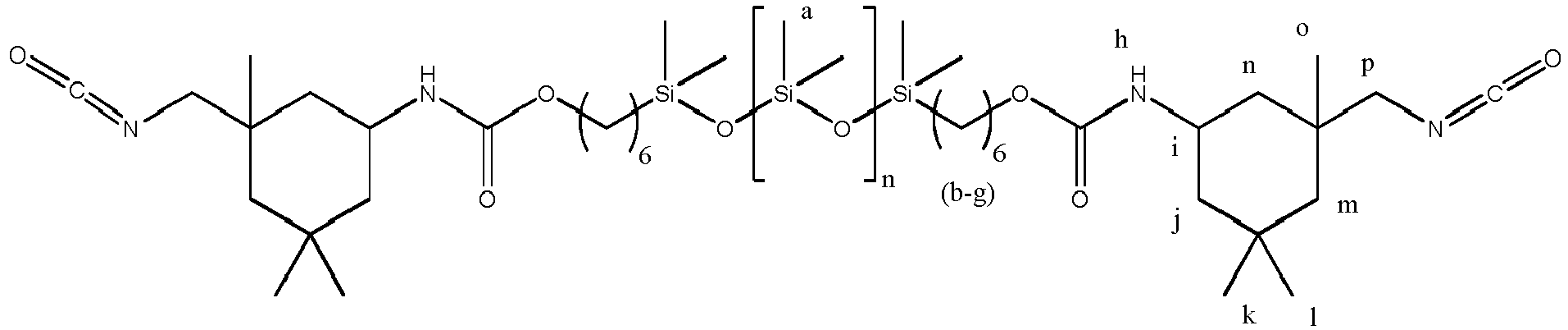
- Isophorondiisocyanat (4,72 mL, 22,5 mmol) wird in einem sekurierten Rundkolben mit Rückflusskühler und Tropftrichter vorgelegt. Unter Schutzgasatmosphäre und Rühren wird auf 60 °C erhitzt. 0,1 Gew.-% Triethylamin (32 mg) werden hinzugefügt. Innerhalb von 2 h wird α,ω-Bis(hydroxyhexyl)-poly(dimethylsiloxan) (n=30) (26.4 g, 11.0 mmol) langsam zugetropft. Es wird solange gerührt, bis keine Trübung mehr auftritt. Das Produkt wird in quantitativer Ausbeute erhalten.
- 1 H-NMR (300 MHz, CDCl3, 24 °C): δ [ppm]= 3.98 (4H, m, H-g), 3.57 (2H, m, H-i), 2.98 (4H, m, H-p), 1.88-1.38 (8H, m, H-f/H-n), 1.26 (12H, m, H-c/H-d/H-e), 1.20-0.72 (26H, m, H-j/H-k/H-l/H-m/H-o), 0.46 (4H, m, H-b), 0.00 (168H, m, H-a); FT-IR (Diamant): ũ [cm-1]= 2961 (u R-CH3, Si-CH3, m-w), 2256 (u -NCO, Isocyanat, s), 1709 (u C=O, Urethan, s), 1412 (δ C-H, Si-CH3, w), 1257 (δ C-H, Siloxan, s-m), 1011 (u Si-O-Si, Siloxan, s-m); MALDI-TOF-MS m/z: 1542 [M+Na]+ (für n=10), disubstituiert
- Isophorondiisocyanat (4,72 mL, 22,5 mmol) wird in einem sekurierten Rundkolben samt Rückflusskühler und Tropftrichter vorgelegt. Unter Schutzgasatmosphäre und Rühren wird auf 60°C erhitzt. 0,1 Gew.-% Triethylamin (32 mg) werden hinzugegeben. α,ω-Bis(hydroxyhexyl)-poly(dimethylsiloxan) (n=80) (67.1 g, 11.0 mmol) wird innerhalb von 2 h langsam zugetropft. Es wird solange gerührt, bis keine Trübung mehr auftritt. Das Produkt wird in quantitativer Ausbeute erhalten.
- 1 H-NMR (300 MHz, CDCl3, 24 °C): δ [ppm]= 4.01 (4H, m, H-g), 3.77 (2H, m, H-i), 3.01 (4H, m, H-p), 1.89-1.42 (8H, m, H-f/H-n), 1.33 (12H, m, H-c/H-d/H-e), 1.24-0.76 (26H, m, H-j/H-k/H-l/H-m/H-o), 0.51 (4H, m, H-b), 0.00 (396H, m, H-a); FT-IR (Diamant): ũ [cm-1]= 2960 (u R-CH3, Si-CH3, m-w), 2256 (u -NCO, Isocyanat, s), 1711 (u C=O, Urethan, s), 1411 (δ C-H, Si-CH3, w), 1257 (δ C-H, Siloxan, s-m), 1010 (u Si-O-Si, Siloxan, s-m); MALDI-TOF-MS m/z: 2283 [M+Na]+ (für n=20), disubstituiert
-

- 2,00 g (11.89 mmol) 1,6-Hexamethylendiisocyanat, gelöst in 20 mL Ethylacetat, werden in einer ausgeheizten, mit Argon gespülten und sekurierten Apparatur mit Rückflusskühler und Tropftrichter vorgelegt. Man erhitzt unter Rühren auf 75 °C und gibt anschließend 0,1 Gew.-% (16 mg) Triethylamin hinzu. Per Tropftrichter werden anschließend 14 g (5.8 mmol) α,ω-Bis(hydroxyhexyl)-poly(dimethylsiloxan), gelöst in 30 mL Ethylacetat, zur Diisocyanat-Komponente langsam zugegeben (Tropfzeit 2 Std.). Dabei wird stets gerührt. Anschließend wird für weitere 16 Std. bei 75 °C gerührt. Ausbeute: 15,90 g
- 1H-NMR: (300 MHz, CDCl3) δ = 4.01 (m, 4H, 7), 3.27 (q, 4H, 1), 3.13 (m, 4H, 6), 1.68-1.23 (m, 32H, 2, 3, 4, 5, 8, 9, 10, 11), 0.50 (m, 4H, 12), 0.04 (m, 180H, 13) ppm. FT-IR (Diamant): ṽ = 2964 v(C-H), 2267 v(NCO), 1708 v(C=O)Urethan, 1523 δ(N-H), 1410 δas(C-H), 1254 δsym(C-H), 1011 v(Si-O-C), 853 + 789 v(SI-C) cm-1.
- Die Verbindungen der Beispiele 4, 5 und 6 können anschließend mit Hydroxy- oder Amino-funktionellen Chromophoren zu den erfindungsgemäßen Siloxan-Polymeren umgesetzt werden.
-

-

- 1 H-NMR (300 MHz, CDCl3, 24 °C): δ [ppm]= 7.65 (1 H, d, H-b), 7.41 (1 H, m, H-c), 7.08 (2H, m, H-d/H-e), 6.32 (1 H, d, H-a), 3.90-3.27 (3H, m, H-g/H-n), 1.78 (2H, m, H-m), 1.28-0.78 (13H, m, H-i/H-j/H-k/H-I); FT-IR (Diamant): ü [cm-1]= 3291 (u N-H, Urethan, w), 2927 (u C-H, R-CH2-R, m-w), 2255 (u -NCO, Isocyanat, s), 1735 (u C=O, Urethan, s), 1660 (u C=O, R-CO-O-R, s), 1619 (u C=C, Aromat, v), 1537 (u C=O, Urethan, m-w), 1385 (δ C-H, R-CH3, s-m) (u -NCO, Isocyanat, m-w), 1222 (u C-O, R-O-Ar, s), 1152 (u C-O, R-O-Ar, m);
ESI-lon-Trap-MS m/z (%): 385 [M]+ - Entsprechend der Darstellung nach Beispiel 8 kann auch ein Diisocyanat, insbesondere IPDI, mit 4-Amino-2,2,6,6-tetramethylpiperidin zu einem Piperidin-Isocyanat der allgemeinen Formel IX als Zwischenprodukt zur Herstellung von seitenketten- oder terminal substituierten Polysiloxanen hergestellt werden.
-

- 1 H-NMR (300 MHz, CDCl3, 24 °C): δ [ppm]= 3.96 (6H, m, H-g/H-s), 3.88-3.50 (2H, m, H-i), 3.24-2.74 (4H, m, H-p), 1.85 (2H, m, H-t), 1.76-1.43 (12H, m, H-f/H-n), 1.30-0.71 (66H, m, H-c/H-d/H-e H-j/H-k/H-I/H-m/H-o/H-t/H-u/H-v), 0.46 (4H, m, H-b), 0.00 (168H, m, H-a); FT-IR (Diamant): ũ [cm-1]= 2961 (u R-CH3, Si-CH3, m-w), 2923 (u C-H, - CH2-, m-w), 1701 (u C=O, Urethan, m-w), 1630 (u C=O, N-CO-N, v), 1559 (u C=O, N-CO-N, v) (δ N-H, Amin, w), 1410 (δ C-H, Si-CH3, w), 1257 (δ C-H, Siloxan, s-m), 1012 (u Si-O-Si, Siloxan, s-m); MALDI-TOF-MS m/z: 1781 [M+Na]+ (für n=9), disubstituiert
- Austestung der Konditionierung von Haar mittels Sensoriktests in einer Haarspülung:
- Für die anwendungstechnische Beurteilung der Konditionierung von Haar wurden die erfindungsgemäßen Verbindungen Synthesebeispiele 2 (PDMS-Umbelliferon) und 9 (PDMS-4-ATMP) sowie das kommerziell erhältliche Produkt ABIL® Quat 3272 (INCI: Quaternium-80, Hersteller Evonik Industries) in einer einfachen kosmetischen Haarspülungs-Formulierung eingesetzt.
- Die anwendungstechnischen Eigenschaften der erfindungsgemäßen Verbindungen beim Einsatz in Haarspülungen wurden in den folgenden Rezepturen überprüft (Angaben in Gew.-% bezogen auf die Gesamtformulierung, mit Wasser wurde zu 100% aufgefüllt):
Formulierungsbeispiele 0a 1a 2a V3a TEGINACID® C, Evonik Industries (INCI: Ceteareth-25) 0,5% 0,5% 0,5% 0,5% TEGO® Alkanol 1618, Evonik Industries (INCI: Cetearyl Alcohol) 5,0% 5,0% 5,0% 5,0% VARISOFT® 300, 30%-ig, Evonik Industries (INCI: Cetrimonium Chloride (=CTAC)) 2,0% 2,0% 2,0% 2,0% Neolone PE, The Dow Chemical Company (INCI: Phenoxyethanol; Methylisothiazolinone) 0,45% 0,45% 0,45% 0,45% Wasser, demineralisiert ad. 100,0% Zitronensäure ad. pH 4,5 ± 0,3 Synthesebeispiel 2 (PDMS-Umbelliferon) 0,30% Synthesebeispiel 9 (PDMS-4-ATMP)] 0,30% ABIL® Quat 3272, 50%ig in Propylenglycol (nicht erfindungsgemäß) 0,60% - Für die anwendungstechnische Beurteilung wurden Haartressen (Fa. Kerling, Deutschland) durch eine Bleichbehandlung standardisiert vorgeschädigt. Dazu wurden friseurübliche Produkte verwendet. Der Testablauf, die verwendeten Basismaterialien sowie die Details der Beurteilungskriterien wurden in
DE 103 27 871 beschrieben. - Die Vorbehandlung der Haare erfolgte durch ein Shampoo, welches keine Konditioniermittel enthält.
- Standardisierte Behandlung von vorgeschädigten Haartressen mit konditionierenden Formulierungen:
- Die, wie oben beschrieben, vorgeschädigten Haartressen wurden wie folgt mit den oben beschriebenen konditionierenden Spülungen behandelt:
- Die Haartressen wurden unter fließendem, warmem Wasser (38 °C, 10 °dH) benetzt. Das überschüssige Wasser wurde leicht von Hand ausgedrückt, dann wird das Shampoo aufgebracht und sanft im Haar eingearbeitet (1 ml/Haartresse (2 g)). Nach einer Verweilzeit von 1 min wurde das Haar für 1 min gespült. Direkt im Anschluss wurde die Spülung aufgebracht und sanft im Haar eingearbeitet (1 ml/Haartresse (2 g)). Nach einer Verweilzeit von 1 min wurde das Haar für 1 min gespült.
- Die sensorischen Bewertungen erfolgten nach Noten, die auf einer Skala von 1 bis 5 vergeben wurden, wobei 1 die schlechteste und 5 die beste Bewertung ist. Die einzelnen Testkriterien erhielten jeweils eine eigene Bewertung.
Die Testkriterien sind: Nasskämmbarkeit, Nassgriff, Trockenkämmbarkeit, Trockengriff, Aussehen/Glanz. - In der folgenden Tabelle wurden die Ergebnisse der sensorischen Beurteilung der wie oben beschrieben mit den erfindungsgemäßen Formulierungen 1 a und 2a, der Vergleichsformulierung V3a und der Kontrollformulierung 0a (Placebo ohne konditionierende Silicon-Testsubstanz) behandelten Haarsträhnchen verglichen.
Nasskämmbarkeit Nassgriff Trockenkämmbarkeit Trockengriff Glanz Kontrollformulierung 0a 3,9 3,8 3,9 4,0 3,0 Erfindungsgemäße Formulierung 1a 4,5 4,4 4,5 4,4 4,0 Erfindungsgemäße Formulierung 2a 4,6 4,4 4,6 4,7 4,0 Vergleichsformulierung (nicht erfindungsgemäß) V3a 4,6 4,3 4,4 4,2 3,5 - Die erfindungsgemäßen Formulierungen 1a und 2a mit den erfindungsgemäßen Verbindungen Beispiel 2 und 9 zeigten in der sensorischen Beurteilung gute kosmetische Bewertungen. Die Kontrollformulierung 0a (mit CTAC) wurde durch die Zugabe von lediglich 0,3% aktiv Siliconprodukt signifikant verbessert. Dabei wurden die bereits sehr guten Eigenschaften der Vergleichsformulierung V3a vor allem bzgl. Trockenkämmbarkeit und Trockengriff durch die erfindungsgemäßen Formulierungen 1a und 2a noch weiter gesteigert. Eine signifikant bessere Bewertung wurde auch beim Glanz durch die Verwendung der erfindungsgemäßen Formulierungen 1a und 2a erreicht. Die besseren Resultate im vergleich zur Vergleichsformulierung V3a ist insofern überraschend, da das Vergleichsprodukt ABIL® Quat 3272 die gleiche Siliconkettenlänge wie die erfindungsgemäßen Beispiele 2 und 9 aufweist.
- Die in den nachfolgenden Tabellen angegebenen Formulierungsbeispiele zeigen exemplarische Vertreter einer Vielzahl von möglichen erfindungsgemäßen Zusammensetzungen.
- Falls die Herstellung der Formulierung zuvor die getrennte Zubereitung bzw. Mischung von Formulierungsbestandteilen erfordert, wird dieses als mehrphasige Zubereitung bezeichnet.
- Falls eine zweiphasige Herstellung erforderlich ist, werden die beiden Phasen mit A und B in den angegebenen Tabellen gekennzeichnet. Bei dreiphasigen Prozessen werden die drei Phasen mit A, B und C benannt. Wenn nicht anders angegeben handelt es sich bei den Angaben in den folgenden Tabellen um Angaben in Gew.-% bezogen auf die Gesamtformulierung, mit Wasser wurde zu 100% aufgefüllt, q.s. bedeutet, dass so viel wie notwendig zugesetzt wird und dass diese Menge von der Menge Wasser subtrahiert wird:
Formulierungsbeispiel 1) Shampoo TEXAPON® NSO, BASF, 28%-ig (INCI: Sodium Laureth Sulfate) 32,00% Synthesebeispiel 9 0,40% Perfume 0,50% Water ad 100% TEGO® Betain F 50, Evonik Industries, 38%-ig (INCI: Cocamidopropyl Betaine) 8,00% ANTIL® 171, Evonik Industries (INCI: PEG-18 Glyceryl Oleate/Cocoate) 1,00% NaCl 0,50% Preservative q.s. Formulierungsbeispiel 2) Shampoo, PEG- & sulfate-free REWOTERIC® AM C, Evonik Industries, 32%-ig (INCI: Sodium Cocoamphoacetate) 15,00% Plantapon ACG 50, BASF (INCI: Disodium Cocoyl Glutamate) 3,80% Synthesebeispiel 9 1,00% Perfume 0,30% Water ad 100% TEGO® Betain F 50, Evonik Industries, 38%-ig (INCI: Cocamidopropyl Betaine) 10,00% VARISOFT® PATC, Evonik Industries (INCI: Palmitamidopropyltrimonium Chloride) 2,30% ANTIL® SPA 80, Evonik Industries (INCI: Isostearamide MIPA; Glyceryl Laurate) 2,00% Preservative 0,30% Citric Acid, 30 %-ig q.s. Formulierungsbeispiel 3) Conditioning Shampoo TEXAPON® NSO, BASF, 28%-ig (INCI: Sodium Laureth Sulfate) 32,00% ANTIL® 200, Evonik Industries (INCI: PEG-200 Hydrogenated Glyceryl Palmate; PEG-7 Glyceryl Cocoate) 2,00% Synthesebeispiel 9 0,50% Perfume 0,25% Water ad 100% Polymer JR 400, Amerchol (INCI: Polyquaternium-10) 0,20% TEGO® Betain F 50, Evonik Industries, 38%-ig (INCI: Cocamidopropyl Betaine) 8,00% NaCl 0,30% Preservative q.s. Formulierungsbeispiel 4) Conditioning Shampoo TEXAPON® NSO, BASF, 28%-ig (INCI: Sodium Laureth Sulfate) 32,00% ANTIL® 200, Evonik Industries (INCI: PEG-200 Hydrogenated Glyceryl Palmate; PEG-7 Glyceryl Cocoate) 2,00% ABIL® Quat 3272, Evonik Industries (INCI: Quaternium-80) 0,75% Synthesebeispiel 9 1,50% Synthesebeispiel 2 0,40% Perfume 0,25% Water ad 100% Jaguar C-162, Rhodia (INCI: Hydroxypropyl Guar Hydroxypropyltrimonium Chloride) 0,10% Polymer JR 400, Amerchol (INCI: Polyquaternium-10) 0,20% REWOTERIC® AM C, Evonik Industries, 32%-ig (INCI: Sodium Cocoamphoacetate) 3,00% TEGO® Betain F 50, Evonik Industries, 38%-ig (INCI: Cocamidopropyl Betaine) 5,00% TEGO® Pearl N 300 Evonik Industries (INCI: Glycol Distearate; Laureth-4; Cocamidopropyl Betaine) 2,00% NaCl 0,30% Preservative q.s. Formulierungsbeispiel 5) Shampoo, PEG- & sulfate-free A REWOTERIC® AM C, Evonik Industries, 32%-ig (INCI: Sodium Cocoamphoacetate) 20,00% REWOPOL® SB F 12 P, Evonik Goldschmidt, 96%-ig (INCI: Disodium Lauryl Sulfosuccinate) 5,90% Synthesebeispiel 2 1,00% ANTIL® SPA 80, Evonik Industries, (INCI: Isostearamide MIPA; Glyceryl Laurate) 1,70% B Water ad 100% Citric Acid, 30%-ig 3,60% C ANTIL® HS 60, Evonik Industries, (INCI: Cocamidopropyl Betaine; Glyceryl Laurate) 3,00% Preservative 0,60% Formulierungsbeispiel 6) Rinse-Off Conditioner Water ad 100% VARISOFT® EQ 65, Evonik Industries (INCI: Distearoylethyl Dimonium Chloride; Cetearyl Alcohol) 2,00% VARISOFT® BT 85, Evonik Industries (INCI: Behentrimonium Chloride) 1,00% Synthesebeispiel 9 1,10% TEGO® Alkanol 1618, Evonik Industries (INCI: Cetearyl Alcohol) 5,00% Preservative, Perfume q.s. Formulierungsbeispiel 7) Rinse-Off Conditioner Water ad 100% VARISOFT® EQ 65, Evonik Industries (INCI: Distearoylethyl Dimonium Chloride; Cetearyl Alcohol) 2,00% VARISOFT® BT 85, Evonik Industries (INCI: Behentrimonium Chloride) 2,00% ABIL® Quat 3272, Evonik Industries (INCI: Quaternium-80) 0,50% Synthesebeispiel 2 1,30% Synthesebeispiel 9 0,50% TEGO® Alkanol 1618, Evonik Industries (INCI: Cetearyl Alcohol) 5,00% Preservative, Perfume q.s. Formulierungsbeispiel 8) Rinse-Off Conditioner TEGINACID® C, Evonik Industries (INCI: Ceteareth-25) 0,50% TEGO® Alkanol 16, Evonik Industries (INCI: Cetyl Alcohol) 2,00% TEGO® Amid S 18, Evonik Industries (INCI: Stearamidopropyl Dimethylamine) 1,00% Synthesebeispiel 2 0,50% Propylene Glycol 2,00% Citric Acid Monohydrate 0,30% Water ad 100% Preservative, Perfume q.s. Formulierungsbeispiel 9) Leave-In Conditioner Spray Lactic Acid, 80% 0,40% Water ad 100% TEGO® Amid S 18, Evonik Industries (INCI: Stearamidopropyl Dimethylamine) 1,20% TEGIN® G 1100 Pellets, Evonik Industries (INCI: Glycol Distearate) 0,60% TEGO® Care PS, Evonik Industries (INCI: Methyl Glucose Sesquistearate) 1,20% TEGOSOFT® DEC, Evonik Industries (INCI: Diethylhexyl Carbonate) 0,30% Synthesebeispiel 9 1,20% Preservative, Perfume q.s. Formulierungsbeispiel 10) Leave-In Conditioner Spray TAGAT® CH 40, Evonik Industries (INCI: PEG-40 Hydrogenated Castor Oil) 6,00% Ceramide VI, Evonik Industries (INCI: Ceramide 6 II) 0,05% Perfume 0,20% Water ad 100% Synthesebeispiel 2 2,00% LACTIL®, Evonik Industries (INCI: Sodium Lactate; Sodium PCA; Glycine; Fructose; Urea; Niacinamide; Inositol; Sodium benzoate; Lactic Acid) 2,00% TEGO® Betain F 50, Evonik Industries 38% (INCI: Cocamidopropyl Betaine) 4,30% Citric Acid (10% in water) 2,00% Formulierungsbeispiel 11) Leave-In Conditioner Foam Synthesebeispiel 2 0,50% TAGAT® CH 40, Evonik Industries (INCI: PEG-40 Hydrogenated Castor Oil) 0,90% Perfume 0,30% TEGO® Betain 810, Evonik Industries (INCI: Capryl/Capramidopropyl Betaine) 2,00% Water ad 100% TEGO® Cosmo C 100, Evonik Industries (INCI: Creatine) 0,50% TEGOCEL® HPM 50, Evonik Industries (INCI: Hydroxypropyl Methylcellulose) 0,30% VARISOFT® 300, Evonik Industries (INCI: Cetrimonium Chloride) 1,30% LACTIL® Evonik Industries (INCI: Sodium Lactate; Sodium PCA; Glycine; Fructose; Urea; Niacinamide; Inositol; Sodium benzoate; Lactic Acid) 0,50% Citric Acid (30% in water) 0,10% Preservative q.s. Formulierungsbeispiel 12) Strong Hold Styling Gel TEGO® Carbomer 141, Evonik Industries (INCI: Carbomer) 1,20% Water ad 100% NaOH, 25% 2,70% PVP/VA W-735, ISP (INCI: PVP/VA Copolymer) 16,00% Synthesebeispiel 2 0,50% Synthesebeispiel 9 1,00% Alcohol Denat. 10,00% TAGAT® O 2 V, Evonik Industries (INCI: PEG-20 Glyceryl Oleate) 2,00% Perfume 0,30% ABIL® B 88183, Evonik Industries (INCI: PEG/PPG-20/6 Dimethicone) 0,30% Preservative q.s. Formulierungsbeispiel 13) Schaumiges Körperpflegemittel TEXAPON® NSO, BASF, 28%-ig (INCI: Sodium Laureth Sulfate) 14,30% Perfume 0,30% Synthesebeispiel 2 1,00% REWOTERIC® AM C, Evonik Industries, 32%-ig (INCI: Sodium Cocoamphoacetate) 8,00% Water ad 100% Polyquaternium-7, Nalco, (INCI: Merquat 550) 0,30% LACTIL®, Evonik Industries (INCI: Sodium Lactate; Sodium PCA; Glycine; Fructose; Urea; Niacinamide; Inositol; Sodium benzoate; Lactic Acid) 0,50% Citric Acid Monohydrate 0,50% Formulierungsbeispiel 14) Mild Foam Bath TEXAPON® NSO, BASF, 28%-ig (INCI: Sodium Laureth Sulfate) 27,00% REWOPOL® SB FA 30, Evonik Industries, 40%-ig (INCI: Disodium Laureth Sulfosuccinate) 12,00% TEGOSOFT® LSE 65 K SOFT, Evonik Industries (INCI: Sucrose Cocoate) 2,00% Water ad 100% REWOTERIC® AM C, Evonik Industries, 32%-ig (INCI: Sodium Cocoamphoacetate) 13,00% Synthesebeispiel 9 0,30% Citric Acid (30% in water) 3,00% ANTIL® 171, Evonik Industries (INCI: PEG-18 Glyceryl Oleate/Cocoate) 1,50% TEGO® Pearl N 300 Evonik Industries (INCI: Glycol Distearate; Laureth-4; Cocamidopropyl Betaine) 2,00% Formulierungsbeispiel 15) Rinse-Off Conditioner Water ad 100% VARISOFT® 300, Evonik Industries (INCI: Cetrimonium Chloride) 2,00% VARISOFT® BT 85, Evonik Industries (INCI: Behentrimonium Chloride) 2,00% ABIL® OSW 5, Evonik Industries (INCI: Cyclopentasiloxane; Dimethiconol) 1,00% Synthesebeispiel 2 0,80% TEGO® Alkanol 1618, Evonik Industries (INCI: Cetearyl Alcohol) 5,00% Preservative, Perfume q.s. Formulierungsbeispiel 16) Rinse-Off Conditioner Water ad 100% VARISOFT® BT 85, Evonik Industries (INCI: Behentrimonium Chloride) 3,00% SF 1708, Momentive (INCI: Amodimethicone) 2,00% Synthesebeispiel 9 0,50% Synthesebeispiel 2 0,80% TEGO® Alkanol 1618, Evonik Industries (INCI: Cetearyl Alcohol) 5,00% Preservative, Perfume q.s. Formulierungsbeispiel 17, feuchtigkeitsspendendes Hautreinigungsmittel A TEXAPON® NSO, BASF, 28%-ig (INCI: Sodium Laureth Sulfate) 30,00% Synthesebeispiel 2 0,70% Perfume 0,30% B Water ad 100% TEGOCEL® fluid HPM 4000, Evonik Industries (INCI: Hydroxypropyl Methylcellulose) 1,20% TEGO® Betain C 60, Evonik Industries, 46%-ig (INCI: Cocamidopropyl Betaine) 8,10% TEGOSOFT® APM, Evonik Industries (INCI: PPG-3 Myristyl Ether) 1,00% Cutina TS, BASF (INCI: PEG- 3 Distearate) 1,00% REWODERM® LI S 80, Evonik Industries (INCI: PEG-200 Hydrogenated Glyceryl Palmate; PEG-7 Glyceryl Cocoate) 1,50% Preservative 0,60% Citric Acid, 30%-ig q.s. Formulierungsbeispiel 18, Turbid Conditioning Shampoo TEXAPON® NSO, BASF, 28%-ig (INCI: Sodium Laureth Sulfate) 32,00% ANTIL® 200, Evonik Industries (INCI: PEG-200 Hydrogenated Glyceryl Palmate; PEG-7 Glyceryl Cocoate) 2,00% Synthesebeispiel 2 1,00% Perfume 0,25% Water ad 100% Polymer JR 400, Amerchol (INCI: Polyquaternium-10) 0,20% TEGO® Betain F 50, Evonik Industries, 38%-ig (INCI: Cocamidopropyl Betaine) 8,00% DC1503 Fluid, Dow Corning (INCI: Dimethicone; Dimethiconol) 1,00% TEGO® Pearl N 300 Evonik Industries (INCI: Glycol Distearate; Laureth-4; Cocamidopropyl Betaine) 2,00% NaCl 0,30% Preservative q.s. Formulierungsbeispiel 19) Mild Hair & Body Wash, PEG- und Sulfate-free Plantacare® 1200 UP, BASF, 50%-ig (INCI: Lauryl Glucoside) 11,40% Plantacare® 818 UP, BASF, 51%-ig (INCI: Coco Glucoside) 5,60% Water ad 100% ANTIL® Soft SC, Evonik Industries (INCI: Sorbitan Sesquicaprylate) 0,90% Synthesebeispiel 2 1,00% TEGOSOFT® LSE 65 K SOFT, Evonik Industries (INCI: Sucrose Cocoate) 1,50% TEGO® Betain F 50, Evonik Industries, 38%-ig (INCI: Cocamidopropyl Betaine) 18,00% Perfume, preservative q.s. Citric Acid, 30% q.s. Formulierungsbeispiel 20) Sprayable Hairmilk, PEG-free A Water ad 100% Lactic Acid, 80%-ig 0,40% B TEGO® AMID S 18, Evonik Industries (INCI: Stearamidopropyl Dimethylamine) 1,20% TEGIN® G 1100 Pellets, Evonik Industries (INCI: Glycol Distearate) 0,60% TEGO® Care PS, Evonik Industries (INCI: Methyl Glucose Sesquistearate) 1,20% TEGOSOFT® DEC, Evonik Industries (INCI: Diethylhexyl Carbonate) 0,30% Synthesebeispiel 2 0,60% Perfume, preservative q.s. Formulierungsbeispiel 21: Conditioning Anti-Schuppen Shampoo A TEGIN® G 1100 Pellets, Evonik Industries (INCI: Glycol Distearate) 3,00% TEXAPON® NSO, Cognis, 28%-ig (INCI: Sodium Laureth Sulfate) 40,00% B Perfume 0,30% Zinc-Pyrion NF, WeylChem, 48%-ig (INCI: Zinc Pyrithione) 2,00% Synthesebeispiel 9 1,00% C Water ad 100% TEGO® Carbomer 341 ER, Evonik Industries (INCI: Acrylates/C10-30 Alkyl Acrylate Crosspolymer) 0,20% Water 0,30% NaOH, 25%-ig 0,30% D REWOTERIC® AM B U 185, Evonik Industries, 30%-ig (INCI: Undecylenamidopropyl Betaine) 12,50% ANTIL® SPA 80, Evonik Industries (INCI: Isostearamide MIPA; Glyceryl Laurate) 3,70% E Preservative q.s. Formulierungsbeispiel 22: Haarfärbemittel Water demineralized ad 100% TEGO® Alkanol 1618, Evonik Industries, (INCI: Cetearyl Alcohol) 12,00% Eutanol® G, BASF (INCI: Octyldodecanol) 3,00% REWOMID® C 212, Evonik Industries (INCI: Cocamide MEA) 1,50% Super Hartolan® B, Crodo (INCI: Lanolin Alcohol) 3,00% Avocadoöl, Henry Lamotte (INCI: Persea Gratissima Oil) 1,50% Pristerene® 4960, Uniquema (INCI: Stearic Acid) 6,00% EDTA BD, BASF (INCI: Disodium EDTA) 0,10% Texapon® K12G, BASF (INCI: Sodium Lauryl Sulfate) 0,50% Propylenglycol 5,00% Timica Silver Sparkle, BASF (INCI: MICA; Titanium Dioxide) 1,00% Ammoniaklösung, 25%ig 6,00% 2,5-Diaminotoluolsulfat, (INCI: Toluene-2,5-Diamine) 1,40% Rodol® RS, Jos. H. Lowenstein & Sons (INCI: Resorcinol) 0,30% HC Blue A42, (INCI: 2,4-Diaminophenoxyethanol di HCl) 0,10% Natriumsulfit 0,50% Perfume 0,20% Synthesebeispiel 9 0,50% Formulierungsbeispiel 23: Shampoo TEXAPON® NSO, Cognis, 28%-ig (INCI: Sodium Laureth Sulfate) 28,00% REWOTERIC® AM 2 C NM, Evonik Industries, 39%-ig (INCI: Disodium Cocoamphodiacetate) 4,00% TEGO® Betain F 50, Evonik Industries, 38%-ig (INCI: Cocamidopropyl Betaine) 7,00% REWOMID® C 212, Evonik Industries (INCI: Cocamide MEA) 0,80% ANTIL® 171, Evonik Industries (INCI: PEG-18 Glyceryl Oleate/Cocoate) 0,50% N-Hance® SP-100, Hercules (INCI: Acrylamidopropyl Trimonium Chloride/Acrylamide Copolymer) Polymer JR 400, Amerchol (INCI: Polyquaternium-10) 0,10% Jaguar C-162, Rhodia (INCI: Hydroxypropyl Guar Hydroxypropyltrimonium Chloride) 0,20% DC 193, Dow Corning (INCI: PEG-12 Dimethicone) 0,40% Synthesebeispiel 2 0,70% Synthesebeispiel 9 0,60% TEGIN® D 1102, Evonik Industries (INCI: PEG-3 Distearate) 0,40% TAGAT® CH 40, Evonik Industries (INCI: PEG-40 Hydrogenated Castor Oil) 0,20% Water ad 100% NaCl 0,70% Citric Acid ad. pH=~5,5 Perfume q.s. Preservative q.s.
R16 unabhängig voneinander gleiche oder verschiedene lineare oder verzweigte, gesättigte oder ungesättigte Kohlenwasserstoffreste mit 1 bis 30 Kohlenstoffatomen oder auch aromatische Kohlenwasserstoffreste mit 6 bis 30 Kohlenstoffatomen bevorzugt Methyl oder Phenyl, insbesondere Methyl,
einen aromatischen Kohlenwasserstoffrest mit 6 bis 40 Kohlenstoffatomen, einen Alkylarylrest mit 7 bis 40 Kohlenstoffatomen,
einen durch ein oder mehrere Heteroatome (Sauerstoff, NH, NR' mit R' gleich einem gegebenenfalls Doppelbindungen enthaltenden C1 bis C30-Alkylrest, insbesondere-CH3) unterbrochenen linearen oder verzweigten gegebenenfalls Doppelbindungen enthaltenden aliphatischen Kohlenwasserstoffrest mit 2 bis 30 Kohlenstoffatomen,
einen durch eine oder mehrere Funktionalitäten, ausgewählt aus der Gruppe -OH, -O-C(O)-, -(O)C-O-, -NH-C(O)-, -(O)C-NH, - (CH3)N-C (O)-, -(O)C-N(CH3)-, -S(O2)-O-, - O-S(O2)-, -S(O2)-NH-, -NH-S(O2)-, -S (O2)-N (CH3)-, -N(CH3)-S(O2)-, unterbrochenen linearen oder verzweigten gegebenenfalls Doppelbindungen enthaltenden aliphatischen Kohlenwasserstoffrest mit 2 bis 30 Kohlenstoffatomen,
einen endständig OH, OR', NH2, N(H)R', N(R')2 (mit R' gleich einem gegebenenfalls Doppelbindungen enthaltenden C1- bis C30-Alkylrest) funktionalisierten linearen oder verzweigten gegebenenfalls Doppelbindungen enthaltenden aliphatischen oder cycloaliphatischen Kohlenwasserstoffrest mit 1 bis 30 Kohlenstoffatomen oder
einen blockweise oder statistisch aufgebauten Polyether gemäß -(R5-O)n-R6, wobei R5 ein 2 bis 4 Kohlenstoffatome enthaltender linearer oder verzweigter Kohlenwasserstoffrest, n 1 bis 100, vorzugsweise 2 bis 60, ist und R6 Wasserstoff, einen linearen oder verzweigten gegebenenfalls Doppelbindungen enthaltenden aliphatischen Kohlenwasserstoffrest mit 1 bis 30 Kohlenstoffatomen, einen gegebenenfalls Doppelbindungen enthaltenden cycloaliphatischen Kohlenwasserstoffrest mit 5 bis 40 Kohlenstoffatomen, einen aromatischen Kohlenwasserstoffrest mit 6 bis 40 Kohlenstoffatomen, einen Alkylarylrest mit 7 bis 40 Kohlenstoffatomen,
oder ein Rest -C(O)-R7 mit R7 gleich einem linearen oder verzweigten gegebenenfalls Doppelbindungen enthaltenden aliphatischen Kohlenwasserstoffrest mit 1 bis 30 Kohlenstoffatomen, einen gegebenenfalls Doppelbindungen enthaltenden cycloaliphatischen Kohlenwasserstoffrest mit 5 bis 40 Kohlenstoffatomen, einem aromatischen Kohlenwasserstoffrest mit 6 bis 40 Kohlenstoffatomen, einem Alkylarylrest mit 7 bis 40 Kohlenstoffatomen, besonders bevorzugt ist in einer Alternative R18 ein gesättigter Kohlenwasserstoffrest mit endständiger -NH2-Gruppen, vorzugsweise mit 8 bis 30 C-Atomen, besonders bevorzugt mit 8 bis 20 C-Atomen,
mit
b) ein Polysiloxan der Formel VI
HA-Q2'-B-Q1'-AH (VI)
mit einem UV/Vis-Chromophor-Isocyanat, insbesondere ein UV-Chromophor-Isocyanat ausgewählt aus Cumarin-Isocyanaten, ausgewählt aus den Formeln IXa, IXb, IXc und IXd
Q2*-O(CO)NH-"2Q-NCO (IXa) Q1*-O(CO)NH-"1Q-NCO (IXb) Q2*-O(CO)NH-Q2"-NCO (IXc) Q1*-O(CO)NH-Q1"-NCO (IXd)
umgesetzt wird,
Claims (28)
- Siloxan-Polymer der allgemeinen Formel I umfassend einen zentralen Polysiloxan-Polymerblock B,(i.) der mit organofunktionellen Resten substituiert ist,(ii) der Polymerblock B weist lineare und/oder verzweigte Strukturen mit mindestens zwei difunktionellen Siloxan-Einheiten auf,(iii.) der Polymerblock B weist an mindestens zwei terminalen Silizium-Atomen oder mindestens einem terminalen und mindestens einem seitenkettenständigen Silizium-Atom der Siloxan-Einheiten des Polymerblocks B die organofunktionellen Reste -Q1 und -Q2 auf, wobei Reste gleich oder verschieden sind,
Q2-B-Q1 (I)
wobei -Q1 der allgemeinen Formel IIa und -Q2 der Formel IIb entsprechen,
-Q1 =-Q1'-A-(C=O)-D-Q1"-A'-(C=O)-D'-Q1* (IIa)
-Q2 = -Q2'-A-(C=O)-D-Q2"-A'-(C=O)-D'-Q2* (IIb)
- mit A gleich -NH-, -O- oder -S- und D gleich -NH- jeweils unabhängig in Formeln IIa und IIb,- mit A' gleich -NH- und D' gleich -NH-, -O- oder -S- jeweils unabhängig in Formeln IIa und IIb, wobei jeder Rest Q1 und Q2 der Formeln IIa oder IIb jeweils unabhängig mindestens zwei bivalente Gruppen ausgewählt aus Carbamat- und Harnstoff- Gruppe aufweist,- mit Q1' und Q2'jeweils unabhängig umfassend einen bivalenten Kohlenwasserstoff-Rest mit 6 bis 200 C-Atomen optional umfassend mindestens ein Heteroatom ausgewählt aus O, N und S, einen bivalenten Rest umfassend Aryl-, Arylalkyl-Gruppen optional umfassend mindestens ein Heteroatom O, N oder S oder Alkyl-, Aryl- oder Alkyl- und Aryl-Gruppen enthaltende Polyether-Reste,- mit Q1" und Q2" jeweils unabhängig umfassend einen bivalenten linearen, verzweigten und/oder cyclischen Alkyl-Rest mit 4 bis 200 C-Atomen oder einen bivalenten Rest umfassend einen Aryl- und/oder Arylalkyl-Rest mit 6 bis 200 C-Atomen, und- mit -D'-Q1* und -D'-Q2* mit D', wie vorstehend definiert, wobei -D'-Q1* und -D'-Q2* jeweils unabhängig als Reste Q1* und Q2* ein UV/Vis-Chromophor als Rest umfassen. - Siloxan-Polymer nach Anspruch 1,
dadurch gekennzeichnet,
dass in dem Siloxan-Polymer der allgemeinen Formeln I, IIa und IIb -D'-Q1* und -D'-Q2* jeweils unabhängig als Reste ein UV-Chromophor umfassen mit mindestens einem Absorptionsmaximum im Bereich von 280 bis 380 nm, besonders bevorzugt mit mindestens einem Absorptionsmaximum im Spektralbereich von 300 bis 380 nm. - Siloxan-Polymer nach Anspruch 1 oder 2,
dadurch gekennzeichnet,
dass in dem Siloxan-Polymer der allgemeinen Formeln I, IIa und IIb -D'-Q1 * und -D'-Q2* jeweils unabhängig ein Vis-Chromophor als Rest umfassen mit mindestens einem Absorptionsmaximum im Bereich von 320 bis 790 nm, insbesondere 320 bis 380 nm. - Siloxan-Polymer nach einem der Ansprüche 1 bis 4,
dadurch gekennzeichnet,
dass in dem Siloxan-Polymer der allgemeinen Formel I der Polymerblock B der allgemeinen Formel IIIa oder IIIb entspricht, mit B gleich

- Siloxan-Polymer nach einem der Ansprüche 1 bis 3,
dadurch gekennzeichnet,
dass b, c, d und e gleich 0 sind und a gleich 20 bis 100 ist, insbesondere 30 oder 80 mit einer Schwankungsbreite von plus/minus 5. - Siloxan-Polymer nach einem der Ansprüche 1 bis 4,
dadurch gekennzeichnet,
dass R1 und R2 ausgewählt sind aus Alkyl-Gruppen mit 1, 2, 3 oder 4 C-Atomen, insbesondere aus Methyl-Gruppen oder mindestens ein R2 eine Aminoalkyl-Gruppe, insbesondere mit einer primären Amino-Gruppe oder eine quartäre Alkylamin-Gruppe ist. - Siloxan-Polymer nach einem der Ansprüche 1 bis 5,
dadurch gekennzeichnet,
dass die Reste -Q1 und -Q2 in der allgemeinen Formel I unabhängig ausgewählt sind aus
-Q1 =-Q1'-A-(C=O)-D-Q1"-A'-(C=O)-D'-Q1* (IIa)
-Q2 = -Q2'-A-(C=O)-D-Q2"-A'-(C=O)-D'-Q2* (IIb)
a) mit A gleich -O-, D gleich -NH-, A' gleich -NH- und D' gleich -O-,b) mit A gleich -O-, D gleich -NH-, A' gleich -NH- und D' gleich -NH-,c) mit A gleich -NH-, D gleich -NH-, A' gleich -NH- und D' gleich -NH-,d) mit A gleich -S-, D gleich -NH-, A' gleich -NH- und D' gleich -NH-,e) mit A gleich -NH-, D gleich -NH-, A' gleich -NH- und D' gleich -O- oderf) mit A gleich -S-, D gleich -NH-, A' gleich -NH- und D' gleich -O-,g) mit A gleich -O-, D gleich -NH-, A' gleich -NH- und D' gleich -S-,h) mit A gleich -NH-, D gleich -NH-, A' gleich -NH- und D' gleich -S- oderi) mit A gleich -S-, D gleich -NH-, mit A' gleich -NH- und D' gleich -S-. - Siloxan-Polymer nach einem der Ansprüche 1 bis 6,
dadurch gekennzeichnet,
dass in den Resten -Q1 und -Q2 der Formel I die Reste -D'-Q1* und -D'-Q2* jeweils unabhängig abgeleitet sind aus einem Hydroxycumarin oder Hydroxycumarin-Derivat, insbesondere 7-Hydroxycumarin, 4-Hydroxycumarin, 6-Hydroxycumarin, Hydroxy-Isocumarin, ein Amino-Cumarin oder Amino-Cumarin-Derviat. - Siloxan-Polymer nach einem der Ansprüche 1 bis 7,
dadurch gekennzeichnet,
dass in den Resten -Q1 und -Q2 der Formel I
A gleich -O-, D gleich -NH-, A' gleich -NH- und D' gleich -O- sind, und die Reste -D'-Q1* und -D'-Q2* jeweils unabhängig abgeleitet sind ausgewählt aus einem Hydroxycumarin oder Hydroxycumarin-Derivat, insbesondere 7-Hydroxycumarin, 4-Hydroxycumarin und 6-Hydroxycumarin. - Siloxan-Polymer nach einem der Ansprüche 1 bis 7,
dadurch gekennzeichnet,
dass in dem Siloxan-Polymer der allgemeinen Formeln I, IIa und IIb die Reste ausgewählt aus -D'-Q1 * und -D'-Q2* jeweils unabhängig mit D' gleiche -NH- und mit Q1* oder Q2* ein Amino-funktioneller Kohlenwasserstoff-Rest. - Siloxan-Polymer nach einem der Ansprüche 1 bis 10,
dadurch gekennzeichnet,
dass in den Resten -Q1 und -Q2 der Formel I die bivalenten Reste -Q1 "- und -Q2"- unabhängig ausgewählt sind aus bivalenten, linearen, verzweigten oder cyclischen Alkylen-Resten mit 4 bis 25 C-Atomen, insbesondere mit 6, 7, 8, 9, 10, 11, 12, 13 oder 14 C-Atomen, vorzugsweise Hexylen (-CH2)6, Heptylen, bivalentes 2,4-Toluolyl, Diphenylmethan, polymeres Diphenylmethan, 3,5,5-Trimethyl-1-methylen-3-ethylen-cyclohexan oder 4,4'-Dicyclohexylen. - Siloxan-Polymer nach einem der Ansprüche 1 bis 11,
dadurch gekennzeichnet,
dass in den Resten -Q1 und -Q2 der Formel I die bivalenten Reste -Q1'- und -Q2'-ausgewählt sind aus Alkylen-Resten mit 3 bis 22 C-Atomen optional mit mindestens einem Heteroatom umfassend N, O oder S, insbesondere -(CH2)n mit n von 3 bis 22 C-Atomen, vorzugsweise Hexylen (-CH2)6-, Heptylen (-CH2)7-, Octylen (-CH2)8-, Nonylen (-CH2)9-, Decylen (-CH2)10-, Undecylen (-CH2)11-, Dodecylen (-CH2)12-, oder mit Heteroatomen, Alkylen-(C=O)-, Alkylen-O(CO)-Alkylen, Alkylen-(CO)O-Alkylen, Alkylen-NH(CO)-Alkylen, Alkylen-(CO)NH-Alkylen, Alkylen-NH(CO)NH-Alkylen, Alkylen-NH(CO)O-Alkylen, oder aus Alkyl-, Aryl- oder Alkyl- und Aryl-Gruppen enthaltenden Polyether-Resten den Formeln IVa oder IVb mit Q1' und Q2' jeweils unabhängig gleich
-T-O-(CH2-CH2-O-)x-(CH2-CH(R#)O-)y-(SO)-R" (IVa)
-T-O-(CH2-CH2-O-)x-(CH2-CH(R#)O-)y-R" (IVb),
mit T = bivalenter Kohlenwasserstoffrest mit 2 bis 4 C-Atomen, mit x = 0 bis 200, y = 0 bis 200, wobei x und y ganze Zahlen sind, mit der Maßgabe, dass x oder y mindestens 1 ist, mit R# Wasserstoff oder Methyl, R" Alkylen, insbesondere Ethylen, vorzugsweise mit T = -(CH2)2- oder -(CH2)3-. - Siloxan-Polymer nach einem der Ansprüche 1 bis 12,
dadurch gekennzeichnet,
dass in den Resten -Q1 und -Q2 der Formel I mindestens einer der bivalenten Reste -Q1 "- und -Q2"- unabhängig ein bivalenter Cyclohexan enthaltender-Rest ausgewählt aus den Formeln Va und Vb
- Siloxan-Polymer nach einem der Ansprüche 1 oder 2 und 7 bis 13, dadurch gekennzeichnet,
dass Siloxan der allgemeinen Formel I dem Siloxan-Polymer der allgemeinen Formel XI entspricht mit
Ma1MA a2MB a3Db1DA b2DB b3Tc1TAc2TB c3Qd1 (XI)
mit M = [R16 3SiO1/2], MA = [R17R16 2SiO1/2], MB = [R18R16 2SiO1/2],
D = [R16 2SiO2/2], DA = [R17 1R16 1SiO2/2], DB = [R18 1R16 1Si02/2],
T = [R16SiO3/2], TA = [R17SiO3/2], TB=[R18SiO3/2], Q = [SiO4/2],
mit
R16 unabhängig voneinander gleiche oder verschiedene lineare oder verzweigte, gesättigte oder ungesättigte Kohlenwasserstoffreste mit 1 bis 30 Kohlenstoffatomen oder auch aromatische Kohlenwasserstoffreste mit 6 bis 30 Kohlenstoffatomen bevorzugt Methyl oder Phenyl, insbesondere Methyl,
R17 ist jeweils unabhängig -Q1 oder -Q2,
R18 unabhängig voneinander gleiche oder verschiedene lineare oder verzweigte, gesättigte oder olefinisch ungesättigte Kohlenwasserstoffreste mit 8 bis 30 Kohlenstoffatomen, aromatischer Kohlenwasserstoffrest mit 6 bis 40 Kohlenstoffatomen, Alkylarylrest mit 7 bis 40 Kohlenstoffatomen, ein durch ein oder mehrere Heteroatome, wie Sauerstoff, NH, NR' mit R' gleich einem gegebenenfalls Doppelbindungen enthaltenden C1 bis C30-Alkylrest unterbrochenen linearen oder verzweigten gegebenenfalls Doppelbindungen enthaltenden aliphatischen Kohlenwasserstoffrest mit 2 bis 30 Kohlenstoffatomen, ein durch eine oder mehrere Funktionalitäten, ausgewählt aus der Gruppe -OH, -O-C(O)-, -(O)C-O-, -NH-C(O)-, -(O)C-NH, - (CH3)N-C (O)-, -(O)C-N(CH3)-, -S(O2)-O-, -O-S(O2)-, -S(O2)-NH-, -NH-S(O2)-, -S (O2)-N (CH3)-, -N(CH3)-S(O2)-, unterbrochenen linearen oder verzweigten gegebenenfalls Doppelbindungen enthaltenden aliphatischen Kohlenwasserstoffrest mit 2 bis 30 Kohlenstoffatomen, ein endständig OH, OR', NH2, N(H)R', N(R')2 mit R' gleich einem gegebenenfalls Doppelbindungen enthaltenden C1- bis C30-Alkylrest, funktionalisierten linearen oder verzweigten gegebenenfalls Doppelbindungen enthaltenden aliphatischen oder cycloaliphatischen Kohlenwasserstoffrest mit 1 bis 30 Kohlenstoffatomen oder einen blockweise oder statistisch aufgebauten Polyether gemäß -(R5-O)n-R6, wobei R5 ein 2 bis 4 Kohlenstoffatome enthaltender linearer oder verzweigter Kohlenwasserstoffrest, n 1 bis 100, vorzugsweise 2 bis 60, ist und R6 Wasserstoff, einen linearen oder verzweigten gegebenenfalls Doppelbindungen enthaltenden aliphatischen Kohlenwasserstoffrest mit 1 bis 30 Kohlenstoffatomen, einen gegebenenfalls Doppelbindungen enthaltenden cycloaliphatischen Kohlenwasserstoffrest mit 5 bis 40 Kohlenstoffatomen, einen aromatischen Kohlenwasserstoffrest mit 6 bis 40 Kohlenstoffatomen, einen Alkylarylrest mit 7 bis 40 Kohlenstoffatomen, oder ein Rest -C(O)-R7 mit R7 gleich einem linearen oder verzweigten gegebenenfalls Doppelbindungen enthaltenden aliphatischen Kohlenwasserstoffrest mit 1 bis 30 Kohlenstoffatomen, einen gegebenenfalls Doppelbindungen enthaltenden cycloaliphatischen Kohlenwasserstoffrest mit 5 bis 40 Kohlenstoffatomen, einem aromatischen Kohlenwasserstoffrest mit 6 bis 40 Kohlenstoffatomen, einem Alkylarylrest mit 7 bis 40 Kohlenstoffatomen,
mit den Indices
a1 = 0-200, bevorzugt 1-60, insbesondere 0,
a2 = 0-30, bevorzugt 1-20, insbesondere 2-10,
a3= 0-30, bevorzugt 1-20,
b1 = 2 bis 5000, bevorzugt 10 bis 1000,
b2 = 0 bis 100, bevorzugt 1 bis 30, insbesondere 1 bis10 oder 0,
b3 = 0 bis 100, bevorzugt 0 bis 30, insbesondere 1 bis 10 oder 0,
c1 = 0 bis 30, bevorzugt 1 bis 30,
c2 = 0 bis 30, bevorzugt 0 bis 5, insbesondere 0,
c3 = 0 bis 30, bevorzugt 0 bis 5, insbesondere 0,
d1 = 0 bis 30, bevorzugt 0 bis 5, vorzugsweise 0
mit der Maßgabe, dass mindestens einer der Indices ausgewählt aus a2 und a3 ungleich 0 ist, vorzugsweise ist a2 eine ganze Zahl zwischen 2 und 10. - Siloxan-Polymer nach einem der Ansprüche 1 bis 14,
dadurch gekennzeichnet,
dass es ausgewählt ist aus Siloxan-Polymeren der Formeln Ia und Ib oder Mischungen dieser

in Formel Ib mit Q1' und Q2'jeweils unabhängig gleich Alkylen mit 2 bis 40 C-Atomen oder einem Polyether der Formeln IVa oder IVb
-T-O-(CH2-CH2-O-)x-(CH2-CH(R#)O-)y-(SO)-R" (IVa)
-T-O-(CH2-CH2-O-)x-(CH2-CH(R#)O-)y-R" (IVb)
ist, mit T = bivalenter Kohlenwasserstoffrest mit 2 bis 4 C-Atomen, mit x = 0 bis 200, y = 0 bis 200, wobei x und y ganze Zahlen sind mit der Maßgabe, dass x oder y mindestens 1 ist, mit R4 Wasserstoff oder Methyl, R" Alkylen, insbesondere Ethylen, insbesondere mit T = -(CH2)2- oder -(CH2)3-. - Siloxan-Polymer nach einem der Ansprüche 1 bis 15,
dadurch gekennzeichnet,
dass sie ausgewählt sind aus Siloxan-Polymeren der Formel Ia* und Ib*

mit R1 in Formeln Ia* und Ib* jeweils unabhängig gleich oder verschieden, wobei R1 umfasst Alkyl-Reste mit 1 bis 4 C-Atomen oder Phenyl-Reste, mit R2 Alkyl-Rest mit 1 bis 22 C-Atomen, vorzugsweise 1 bis 4 C-Atomen, ein Alkyl-Rest mit mindestens einem Heteroatom umfassend N, O S oder Phenyl-Rest, und
mit Q1 * und Q2* jeweils unabhängig Cumarin oder ein Cumarin-Derivat, insbesondere Cumarin gebunden an C-7, C-4 oder C-6 des Cumarins oder eines Cumarin-Derivates,
und in Formel Ib* mit Q1' und Q2' jeweils unabhängig gleich
-T-O-(CH2-CH2-O-)x-(CH2-CH(R#)O-)y-(SO)-R" (IVa)
-T-O-(CH2-CH2-O-)x-(CH2-CH(R#)O-)y-R" (IVb),
mit T = bivalenter Kohlenwasserstoffrest mit 2 bis 4 C-Atomen, mit x = 0 bis 200,
y = 0 bis 200, wobei x und y ganze Zahlen sind mit der Maßgabe, dass x oder y mindestens 1 ist, mit R# Wasserstoff oder Methyl, R" Wasserstoff oder Alkylen, insbesondere Ethylen, insbesondere mit T = -(CH2)2- oder -(CH2)3-. - Verfahren zur Herstellung eines Siloxan-Polymers sowie von Zusammensetzungen enthaltend diese Siloxan-Polymere oder Mischungen der Siloxan-Polymere mit einem zentralen Polysiloxan-Polymerblock B, indema) ein Polysiloxan-Diisocyanat der Formel VII,
OCN-Q2"-D-(O=C)-A-Q2'-B-Q1'-A-(C=O)-D-Q1 "-NCO (VII)
mit mindestens einem Hydroxy- oder Amino-funktionellen UV/Vis-Chromophor umgesetzt wird und ein Siloxan-Polymer der allgemeinen Formel I
Q2-B-Q1 (I)
erhalten wird, wobei -Q1 der allgemeinen Formel IIa und -Q2 der Formel IIb entsprechen,
-Q1 =-Q1'-A-(C=O)-D-Q1"-A'-(C=O)-D'-Q1* (IIa)
-Q2 = -Q2'-A-(C=O)-D-Q2"-A'-(C=O)-D'-Q2* (IIb)
- mit A gleich -NH-, -O- oder -S- und D gleich -NH- jeweils unabhängig in Formeln IIa und IIb,- mit A' gleich -NH- und D' gleich -NH-, -O- oder -S- jeweils unabhängig in Formeln IIa und IIb, wobei jeder Rest Q1 und Q2 der Formel IIa oder IIb jeweils abhängig mindestens zwei bivalente Gruppen ausgewählt aus Carbamat- und Harnstoff-Gruppe aufweist,
oderb) ein Polysiloxan der Formel VI
HA-Q2'-B-Q1'-AH (VI)
mit einem UV/Vis-Chromophor-Isocyanat ausgewählt aus den Formeln IXa,IXb, IXc, IXd oder Gemischen enthaltend diese
Q2*-O(CO)NH-"2Q-NCO (IXa) Q1 *-O(CO)NH-"1 Q-NCO (IXb)
Q2*-O(CO)NH-Q2"-NCO (IXc) Q1*-O(CO)NH-Q1"-NCO (IXd)
umgesetzt wird,- mit A gleich -NH-, -O- oder -S- und D gleich -NH- jeweils unabhängig in Formeln VII, I und VI,- mit Q1' und Q2' jeweils unabhängig umfassend einen bivalenten Kohlenwasserstoff-Rest mit 6 bis 200 C-Atomen optional umfassend mindestens ein Heteroatom O, N oder S, einen bivalenten Rest umfassend Aryl-, Arylalkyl-Gruppen oder einen bivalenten Rest umfassend Aryl-, Arylalkyl-Gruppen optional umfassend mindestens ein Heteroatom O, N oder S oder Alkyl-, Aryl- oder Alkyl- und Aryl-Gruppen enthaltende Polyether-Reste, jeweils unabhängig in Formeln VII, I und VI,- mit Q1" und Q2" jeweils unabhängig umfassend einen bivalenten linearen, verzweigten und/oder cyclischen Alkyl-Rest mit 4 bis 200 C-Atomen, oder einen bivalenten Rest umfassend einen Aryl- und/oder Arylalkyl-Rest mit 6 bis 200 C-Atomen, jeweils unabhängig in Formeln VII, I, IXa, IXb, IXc und IXd- mit -O-Q1* oder -O-Q2* jeweils unabhängig als -Q1* und -Q2* ein UV/Vis-Chromophor als Rest. - Verfahren nach Anspruch 17,
dadurch gekennzeichnet,dass (i) das Hydroxy- oder Amino-funktionelle UV/Vis-Chromophor ein UV-Chromophor umfassend Hydroxy-Cumarin, Amino-Cumarin oder ein Derivat von Cumarin ist,(ii) das UV/Vis-Chromophor-Isocyanat ein UV-Chromophor ausgewählt aus Cumarin-Isocyanaten aus den Formeln IXa, IXb, IXc und IXd ist, mit -O-Q1* und -O-Q2* jeweils unabhängig als Rest -Q1 * und/oder -Q2* Cumarin oder Cumarin-Derivat, und/oder(iii) in Formel IIa, IIb, IXa, IXb, IXc und/oder IXd und I-O-Q1* und -O-Q2* jeweils unabhängig Reste umfassen aus der Umsetzung von Hydroxycumarin oder Hydroxycumarin-Derivat, insbesondere 7-Hydroxycumarin, 4-Hydroxycumarin, 6-Hydroxycumarin oder Hydroxy-Isocumarin mit einem Diisocyanat. - Verfahren nach Anspruch 17 oder 18,
dadurch gekennzeichnet,
dass ein Polysiloxan der Formel VI
HA-Q2'-B-Q1'-AH (VI)
eingesetzt wird, mit A ausgewählt aus -O, -NH bzw. AH ausgewählt aus -OH, -NH2 oder -SH mit -Q2'- und -Q1'-, wie vorstehend definiert, und umgesetzt wird mit einem Diisocyanat zu einem Polysiloxan-Diisocyanat der Formel VII,
OCN-Q2"-D-(O=C)-A-Q2'-B-Q1'-A-(C=O)-D-Q1 "-NCO (VII)
mit -Q2"- und/oder -Q1 "- unabhängig ausgewählt aus einem bivalenten, linearen, verzweigten und/oder cyclischen Alkyl-Rest mit 4 bis 200 C-Atomen, oder einem bivalenten Rest umfassend einen Aryl- und/oder Arylalkyl-Rest mit 6 bis 200 C-Atomen, wobei das molare Verhältnis von HA-Gruppen im Polysiloxan zu Isocyanat-Gruppen in Formel VII mindestens 1 zu 1 beträgt, insbesondere ist das Verhältnis 1 : 100 bis 1 : 1, vorzugsweise 1 : 10 bis 1 : 1. - Verfahren nach einem der Ansprüche 17 bis 19,
dadurch gekennzeichnet,dass (i) a) ein Polysiloxan-Gruppen enthaltender linearer und/oder verzweigter Polymerblock B, insbesondere der Formeln IIIa und/oder IIIb, mit mindestens zwei terminalen Si-H-Gruppen oder mindestens einer terminalen Si-H-Gruppen und mindestens einer seitenkettenständigen Si-H-Gruppe, oder b) ein Polysiloxan-Gruppen der Formel XI mit mindestens ein R17 Wasserstoff, vorzugsweise zwei R17 sind Wasserstoff,(ii) mit einer olefinischen Verbindung umfassend Alkylen und optional umfassend mindestens ein Heteroatom N oder O, insbesondere Alkenylenol, Alkylenamin, quartäres Alkylamin, Alkylencarbonsäure, Alkylenester, Alkylenamid oder einen olefinischen Polyether umgesetzt wird,
wobei die olefinische Verbindung jeweils unabhängig eine Allyl- oder Vinyl-Gruppe aufweist und den Formeln VIIIa und/oder Vlllb entspricht
Q1'-AH (VIIIa)
Q2'-AH (Vlllb)
(iii) und die Umsetzung in Gegenwart eines Katalysators zu einem Polysiloxan der Formel VI
HA-Q2'-B-Q1'-AH (VI)
erfolgt, wobei jeweils unabhängig in Formeln VIIIa, Vlllb und VI mit AH unabhängig ausgewählt aus -OH und -NH2, und mit -Q2'- und -Q1'- jeweils unabhängig in Formeln VIIIa, VIIIb und VI umfassend einen bivalenten Kohlenwasserstoff-Rest mit 6 bis 200 C-Atomen optional umfassend mindestens ein Heteroatom O oder N, einen bivalenten Rest umfassend Aryl-, Arylalkyl-Gruppen optional umfassend mindestens ein Heteroatom O oder N oder olefinischen Polyether. - Verfahren nach Anspruch 17,
dadurch gekennzeichnet,
dass ein Polysiloxan-Diisocyanat der Formel VII,
OCN-Q2"-D-(O=C)-A-Q2'-B-Q1'-A-(C=O)-D-Q1 "-NCO (VII)
mit B einem linearen und/oder verzweigten Polysiloxan-Polymerblock B, mit -Q2'-und -Q1'- jeweils unabhängig umfassend einen bivalenten Kohlenwasserstoff-Rest mit 6 bis 200 C-Atomen optional umfassend mindestens ein Heteroatom O, N oder S, einen bivalenten Rest umfassend Aryl-, Arylalkyl-Gruppen optional umfassend mindestens ein Heteroatom O, N oder S, oder Alkyl-, Aryl- oder Alkyl- und Aryl-Gruppen enthaltende Polyether-Reste, mit A jeweils unabhängig gleich -NH-, -O-oder -S- und D gleich -NH- jeweils unabhängig in Formel VII, und mit -Q2"-und/oder -Q1"- unabhängig ausgewählt aus einem bivalenten, linearen, verzweigten und/oder cyclischen Alkyl-Rest mit 4 bis 200 C-Atomen, oder einem bivalenten Rest umfassend einen Aryl- und/oder Arylalkyl-Rest mit 6 bis 200 C-Atomen, umgesetzt wird mit einem Hydroxy- oder Amino-funktionellen UV/Vis-Chromophor, insbesondere einem Hydroxy-funktionellen UV-Chromophor, bevorzugt einem Chromophor mit mindestens einem Absorptionsmaximum von 300 bis 380 nm. - Verfahren nach Anspruch 17 oder 21,
dadurch gekennzeichnet,
dass das Chromophor ein Hydroxycumarin oder Hydroxycumarin-Derivat ist, insbesondere 7-Hydroxycumarin, 4-Hydroxycumarin, 6-Hydroxycumarin oder Hydroxy-Isocumarin. - Verfahren nach Anspruch 17,
dadurch gekennzeichnet,
dass ein Diisocyanat mit einem Hydroxy-Cumarin oder Hydroxy-Cumarin-Derivat oder dessen Salz zu einem Cumarin-Isocyanat umgesetzt wird, insbesondere zu einem Cumarin-Isocyanat ausgewählt aus den Formeln IXa und IXb, wie vorstehend definiert. - Zusammensetzung erhältlich nach einem Verfahren nach einem der Ansprüche 17 bis 23.
- Zusammensetzungen enthaltend Siloxan-Polymere nach einem der Ansprüche 1 bis 16 sowie Mischungen dieser umfassenda) Siloxan-Polymere der allgemeinen Formel XI sowie Mischungen dieser oderb) Siloxan-Polymere mit einem zentralen Polysiloxan-Polymerblock B ausgewähltaus (i) mindestens ein Siloxan-Polymer der allgemeinen Formel I sowie Mischungen umfassend dieses Polymer,(ii) mindestens ein Siloxan-Polymer der allgemeinen Formel Ia sowie Mischungen umfassend dieses Polymer oder(iii) mindestens ein Siloxan-Polymer der allgemeinen Formel Ib sowie Mischungen umfassend dieses Polymer.


- Zwischenprodukt zur Herstellung von Siloxan-Polymeren der Formel I nach einem der Ansprüche 1 bis 16, ausgewählt aus Cumarin-Isocyanaten ausgewählt aus den Formeln IXa, IXb, IXc und IXd
deren Salzen oder Mischungen davon
Q2*-O(CO)NH-"2Q-NCO (IXa) und/oder Q1*-O(CO)NH-"1Q-NCO (IXb)
Q2*-O(CO)NH-Q2"-NCO (IXc) und/oder Q1*-O(CO)NH-Q1"-NCO (IXd)
mit Q2*, Q2", Q1* und Q1", wie vorstehend definiert, wobei Q2* und Q1* jeweils unabhängig Cumarin oder ein Cumarin-Derivat sind, vorzugsweise Cumarin-Isocyanate der Formeln IXa*, IXb*, IXc*, IXd* oder deren Salze, - Formulierung enthaltend mindestens ein Siloxan-Polymere nach einem der Ansprüche 1 bis 16, 24, 25 oder hergestellt nach einem der Ansprüche 17 bis 23 oder hergestellt über das Zwischenprodukt nach Anspruch 26 und mindestens einen Hilfsstoff.
- Verwendung der Siloxan-Polymere nach einem der Ansprüche 1 bis 16 oder der erhaltenen Zusammensetzungen umfassend Siloxan-Polymere nach einem der Ansprüche 17 bis 23 oder der Zusammensetzungen nach Anspruch 24 oder 25 als Additiv in kosmetischen Formulierungen, als Additiv in pharmazeutischen Formulierungen, in Lacken, Pasten, als Schaumstabilisator oder Schaumadditiv für Polyurethanschäume, insbesondere Polyurethanhartschäume und Polyurethanweichschäume, als Griffverbessere oder Imprägniermittel bei der bei der Herstellung von Fasern, Textilien, in kosmetischen Formulierungen zur Behandlung, Nachbehandlung und Schutz von keratinischen Fasern sowie Haut und Hautanhangsgebilden, als Additiv in Waschmittel-, Weichspülerformulierungen, in kosmetischen Formulierungen umfassend Cremes, Spülungen, Haarwachsmittel, Waschmittel, Festiger, Pflegespülungen, pflegende Pasten, Sprays, Haarsprays, zur Verbesserung der Kämmbarkeit von keratinischen oder textilen Fasern natürlichen oder synthetischen Ursprungs.
Applications Claiming Priority (1)
| Application Number | Priority Date | Filing Date | Title |
|---|---|---|---|
| DE102013106905.3A DE102013106905A1 (de) | 2013-07-01 | 2013-07-01 | Siloxan-Polymere mit zentralem Polysiloxan-Polymerblock mit organofunktionellen Resten mit jeweils mindestens zwei bivalenten Gruppen ausgewählt aus Harnstoff- und/oder Carbamat-Gruppen und mindestens einem UV/Vis-Chromophor als Rest |
Publications (1)
| Publication Number | Publication Date |
|---|---|
| EP2821430A1 true EP2821430A1 (de) | 2015-01-07 |
Family
ID=50846868
Family Applications (1)
| Application Number | Title | Priority Date | Filing Date |
|---|---|---|---|
| EP14171239.8A Withdrawn EP2821430A1 (de) | 2013-07-01 | 2014-06-05 | Siloxan-Polymere mit zentralem Polysiloxan-Polymerblock mit organofunktionellen Resten mit jeweils mindestens zwei bivalenten Gruppen ausgewählt aus Harnstoff- und/oder Carbamat-Gruppen und mindestens einem UV/Vis-Chromophor als Rest |
Country Status (4)
| Country | Link |
|---|---|
| US (1) | US20150004112A1 (de) |
| EP (1) | EP2821430A1 (de) |
| CN (1) | CN104277226A (de) |
| DE (1) | DE102013106905A1 (de) |
Cited By (1)
| Publication number | Priority date | Publication date | Assignee | Title |
|---|---|---|---|---|
| US11498996B2 (en) | 2019-05-28 | 2022-11-15 | Evonik Operations Gmbh | Process for producing polyoxyalkylene polysiloxane block polymers |
Families Citing this family (37)
| Publication number | Priority date | Publication date | Assignee | Title |
|---|---|---|---|---|
| DE102013208328A1 (de) | 2013-05-07 | 2014-11-13 | Evonik Industries Ag | Polyoxyalkylene mit seitenständigen langkettigen Acyloxyresten und Verfahren zu ihrer Herstellung mittels DMC-Katalysatoren |
| DE102014213507A1 (de) | 2014-07-11 | 2016-01-14 | Evonik Degussa Gmbh | Platin enthaltende Zusammensetzung |
| EP3020749B1 (de) | 2014-11-12 | 2020-09-30 | Evonik Operations GmbH | Verfahren zur herstellung von platin enthaltenden zusammensetzungen |
| TR201911295T4 (tr) * | 2015-04-27 | 2019-08-21 | Huntsman Int Llc | İşlevselleştirilmiş izosiyanat bazlı gözenekli malzemeler. |
| DE102015209627A1 (de) | 2015-05-26 | 2016-12-01 | Rudolf Gmbh | Polyurethan-Organopolysiloxane |
| ES2676430T3 (es) | 2015-11-11 | 2018-07-19 | Evonik Degussa Gmbh | Polímeros curables |
| EP3168251B1 (de) | 2015-11-16 | 2019-02-06 | Evonik Degussa GmbH | Vernetzte polyglycerinester |
| US12059488B2 (en) * | 2016-02-16 | 2024-08-13 | Specialty Operations France | Oil in water personal care emulsions comprising a sulfosuccinate/lauramphoacetate surfactant mixture |
| EP3452174B1 (de) | 2016-05-05 | 2021-11-24 | Avlon Industries, Inc. | Haarentspannungszusammensetzung und verfahren |
| EP3272331B1 (de) | 2016-07-22 | 2018-07-04 | Evonik Degussa GmbH | Verfahren zur herstellung von siloxanen enthaltend glycerinsubstituenten |
| WO2018056472A1 (en) | 2016-09-23 | 2018-03-29 | Menicon Co., Ltd. | Cosmetic composition for nails, method of using same, and cosmetic resin for nails |
| PL3321304T3 (pl) | 2016-11-15 | 2019-11-29 | Evonik Degussa Gmbh | Mieszaniny cyklicznych, rozgałęzionych siloksanów typu D/T i ich dalszych produktów |
| EP3415548B1 (de) | 2017-06-13 | 2020-03-25 | Evonik Operations GmbH | Verfahren zur herstellung sic-verknüpfter polyethersiloxane |
| EP3415547B1 (de) | 2017-06-13 | 2020-03-25 | Evonik Operations GmbH | Verfahren zur herstellung sic-verknüpfter polyethersiloxane |
| EP3438158B1 (de) | 2017-08-01 | 2020-11-25 | Evonik Operations GmbH | Herstellung von sioc-verknüpften polyethersiloxanen |
| EP3467006B1 (de) | 2017-10-09 | 2022-11-30 | Evonik Operations GmbH | Mischungen zyklischer-verzweigter siloxane vom d/t-typ und deren folgeprodukte |
| EP3470475B1 (de) | 2017-10-13 | 2021-01-27 | Evonik Operations GmbH | Härtbare zusammensetzung für beschichtungen mit anti-adhäsiver eigenschaft |
| EP3492513B1 (de) | 2017-11-29 | 2021-11-03 | Evonik Operations GmbH | Verfahren zur herstellung von im siloxanteil verzweigten sioc-verknüpften polyethersiloxanen |
| EP3611215A1 (de) | 2018-08-15 | 2020-02-19 | Evonik Operations GmbH | Verfahren zur herstellung acetoxygruppen-tragender siloxane |
| EP3611214A1 (de) | 2018-08-15 | 2020-02-19 | Evonik Operations GmbH | Sioc-verknüpfte, lineare polydimethylsiloxan-polyoxyalkylen-blockcopolymere |
| CN109517355B (zh) * | 2018-11-20 | 2020-12-15 | 江南大学 | 一种基于改性黑色素纳米颗粒的紫外屏蔽复合材料及其制备方法 |
| ES2970332T3 (es) | 2018-12-04 | 2024-05-28 | Evonik Operations Gmbh | Siloxanos reactivos |
| EP3744754B1 (de) | 2019-05-28 | 2024-10-02 | Evonik Operations GmbH | Verfahren zur herstellung acetoxygruppen-tragender siloxane |
| EP3744760A1 (de) | 2019-05-28 | 2020-12-02 | Evonik Operations GmbH | Verfahren zur herstellung von im siloxanteil verzweigten sioc-verknüpften polyethersiloxanen |
| EP3744755B1 (de) | 2019-05-28 | 2024-10-09 | Evonik Operations GmbH | Verfahren zur herstellung acetoxygruppen-tragender siloxane |
| PL3744756T3 (pl) | 2019-05-28 | 2024-10-28 | Evonik Operations Gmbh | Układy acetoksylowe |
| EP3744774B1 (de) | 2019-05-28 | 2021-09-01 | Evonik Operations GmbH | Verfahren zum recycling von silikonen |
| DK3744763T3 (da) | 2019-05-28 | 2024-11-04 | Evonik Operations Gmbh | Skræddersyede sioc baserede polyethersiloxaner |
| ES2913783T3 (es) | 2019-05-28 | 2022-06-06 | Evonik Operations Gmbh | Procedimiento para la purificación de acetoxisiloxanos |
| EP3744759B1 (de) | 2019-05-28 | 2024-07-17 | Evonik Operations GmbH | Verfahren zur herstellung von im siloxanteil verzweigten sioc-verknüpften polyethersiloxanen |
| EP4038169A1 (de) * | 2019-10-03 | 2022-08-10 | Rhodia Operations | Polymerdispersion und dieselbe umfassende stoffkonditionierungszusammensetzung |
| US12264220B2 (en) | 2020-01-30 | 2025-04-01 | Evonik Operations Gmbh | Process for producing high-purity hydrosilylation products |
| EP3885096B1 (de) | 2020-03-27 | 2024-02-14 | Evonik Operations GmbH | Stoffliche wiederverwertung silikonisierter flächengebilde |
| EP3954740A1 (de) * | 2020-08-14 | 2022-02-16 | Evonik Operations GmbH | Entschäumerzusammensetzung auf basis von organofunktionell modifizierten polysiloxanen |
| US11732092B2 (en) | 2020-10-19 | 2023-08-22 | Evonik Operations Gmbh | Upcycling process for processing silicone wastes |
| CN112331809B (zh) * | 2020-11-13 | 2024-03-19 | 浙江理工大学 | 一种基于碳量子点的发光二极管的制备方法 |
| CN113150594B (zh) * | 2021-01-29 | 2022-06-21 | 浙江大学衢州研究院 | 一种紫外响应香豆素控释和自修复的防污涂料的制备方法 |
Citations (4)
| Publication number | Priority date | Publication date | Assignee | Title |
|---|---|---|---|---|
| US4684538A (en) * | 1986-02-21 | 1987-08-04 | Loctite Corporation | Polysiloxane urethane compounds and adhesive compositions, and method of making and using the same |
| DE10327871A1 (de) | 2003-06-18 | 2005-01-05 | Goldschmidt Ag | Verwendung von Alkylguanidin-Verbindungen zur Behandlung und Nachbehandlung von Haaren |
| EP1688453A1 (de) * | 2005-02-02 | 2006-08-09 | Goldschmidt GmbH | UV-Licht absorbierende quaternäre Polysiloxane |
| WO2007072000A1 (en) * | 2005-12-21 | 2007-06-28 | The Secretary Of State For Defence | Supramolecular polymers |
Family Cites Families (2)
| Publication number | Priority date | Publication date | Assignee | Title |
|---|---|---|---|---|
| US6252032B1 (en) * | 1999-07-07 | 2001-06-26 | Minimed Inc. | UV absorbing polymer |
| JP5052786B2 (ja) * | 2005-12-26 | 2012-10-17 | モメンティブ・パフォーマンス・マテリアルズ・ジャパン合同会社 | 蛍光作用を示す発色基を有するポリオルガノシロキサン |
-
2013
- 2013-07-01 DE DE102013106905.3A patent/DE102013106905A1/de not_active Withdrawn
-
2014
- 2014-06-05 EP EP14171239.8A patent/EP2821430A1/de not_active Withdrawn
- 2014-06-24 US US14/313,209 patent/US20150004112A1/en not_active Abandoned
- 2014-06-30 CN CN201410305733.6A patent/CN104277226A/zh active Pending
Patent Citations (4)
| Publication number | Priority date | Publication date | Assignee | Title |
|---|---|---|---|---|
| US4684538A (en) * | 1986-02-21 | 1987-08-04 | Loctite Corporation | Polysiloxane urethane compounds and adhesive compositions, and method of making and using the same |
| DE10327871A1 (de) | 2003-06-18 | 2005-01-05 | Goldschmidt Ag | Verwendung von Alkylguanidin-Verbindungen zur Behandlung und Nachbehandlung von Haaren |
| EP1688453A1 (de) * | 2005-02-02 | 2006-08-09 | Goldschmidt GmbH | UV-Licht absorbierende quaternäre Polysiloxane |
| WO2007072000A1 (en) * | 2005-12-21 | 2007-06-28 | The Secretary Of State For Defence | Supramolecular polymers |
Non-Patent Citations (1)
| Title |
|---|
| "Dictionary of Natural Products", CHAPMAN AND HALL/CRC PRESS, TAYLOR AND FRANCIS GROUP |
Cited By (1)
| Publication number | Priority date | Publication date | Assignee | Title |
|---|---|---|---|---|
| US11498996B2 (en) | 2019-05-28 | 2022-11-15 | Evonik Operations Gmbh | Process for producing polyoxyalkylene polysiloxane block polymers |
Also Published As
| Publication number | Publication date |
|---|---|
| CN104277226A (zh) | 2015-01-14 |
| DE102013106905A1 (de) | 2015-01-08 |
| US20150004112A1 (en) | 2015-01-01 |
Similar Documents
| Publication | Publication Date | Title |
|---|---|---|
| EP2821429B1 (de) | Siloxan-Polymere mit zentralem Polysiloxan-Polymerblock mit terminalen organofunktionellen Resten umfassend Harnstoff- und/oder Carbamat-Gruppen sowie Aminosäure-Reste | |
| DE102013106905A1 (de) | Siloxan-Polymere mit zentralem Polysiloxan-Polymerblock mit organofunktionellen Resten mit jeweils mindestens zwei bivalenten Gruppen ausgewählt aus Harnstoff- und/oder Carbamat-Gruppen und mindestens einem UV/Vis-Chromophor als Rest | |
| EP2419074B1 (de) | Verwendung organomodifizierter, im siliconteil verzweigter siloxane zur herstellung kosmetischer oder pharmazeutischer zusammensetzungen | |
| EP2525771B1 (de) | Neuartige polysiloxane mit quatären ammoniumgruppen, verfahren zu deren herstellung und deren verwendung in reinigenden und pflegenden formulierungen | |
| EP2678376B1 (de) | Neuartige polysiloxane mit betaingruppen, deren herstellung und verwendung | |
| DE102010062676A1 (de) | Zubereitungen enthaltend Polysiloxane mit stickstoffhaltigen Gruppen | |
| EP1688453B1 (de) | UV-Licht absorbierende quaternäre Polysiloxane | |
| EP3678634B1 (de) | Zusammensetzung enthaltend quaternäre ammoniumverbindung, insbesondere zur herstellung von pflege- und reinigungsformulierungen | |
| EP1917290B1 (de) | Polyammonium-polysiloxancopolymere | |
| EP2528660B1 (de) | Neuartige lineare polydimethylsiloxan-polyether-copolymere mit amino- und/oder quaternären ammoniumgruppen und deren verwendung | |
| EP0017121B1 (de) | Neue quartäre Polysiloxanderivate, deren Verwendung in Haarkosmetika, sowie diese enthaltende Haarwasch- und Haarbehandlungsmittel | |
| EP1887024B1 (de) | Neuartige Polysiloxane mit quaternären Ammoniumgruppen, Verfahren zu deren Herstellung und deren Verwendung in reinigenden und pflegenden Formulierungen | |
| EP1844106B1 (de) | Guanidinogruppen- haltige siloxane und deren verwendung für kosmetische formulierungen | |
| EP3122328B1 (de) | Silan enthaltend jeweils mindestens zwei alkoxygruppen sowie eine guanidino- oder harnstoffgruppe | |
| EP2826806A1 (de) | Neue aminosäuremodifizierte Siloxane, Verfahren zu ihrer Herstellung und Anwendung | |
| DE102011085492A1 (de) | Neue aminogruppenhaltige Siloxane, Verfahren zu deren Herstellung und Anwendung | |
| EP0017122A1 (de) | Verwendung neuer quartärer Polysiloxanderivate in Haarkosmetika, sowie diese enthaltende Haarwasch- und Haarbehandlungsmittel | |
| EP2789642A1 (de) | Polysiloxan-Polyether-Copolymere mit Amino- und/oder quaternären Ammoniumgruppen im Polyetherteil und Verfahren zu deren Herstellung | |
| WO2004069137A2 (de) | Verwendung von polyamino- und/oder polyammonium-polysiloxancopolymeren | |
| EP1285943B1 (de) | UV-Licht absorbierende quartäre Polysiloxane | |
| EP2432557B1 (de) | Kosmetisches haarshampoo mit einem organopolysiloxanmodifiziertem saccharid und einem aminosilikon | |
| WO2011080034A2 (de) | Haarbehandlungsmittel umfassend trialkoxysilan-substituierte verbindungen und alkoxysilyl-modifizierte makromoleküle | |
| EP4504821B1 (de) | Wässrige dispersionen von vorvernetzten organopolysiloxanen | |
| DE10304923A1 (de) | Herstellung und Verwendung Polyamino- und/oder Polyammonium-Polysiloxancopolymere enthaltender Formulierungen | |
| EP2082728A2 (de) | Verwendung kationischer polymerer Haarfärbemittel |
Legal Events
| Date | Code | Title | Description |
|---|---|---|---|
| PUAI | Public reference made under article 153(3) epc to a published international application that has entered the european phase |
Free format text: ORIGINAL CODE: 0009012 |
|
| 17P | Request for examination filed |
Effective date: 20140605 |
|
| AK | Designated contracting states |
Kind code of ref document: A1 Designated state(s): AL AT BE BG CH CY CZ DE DK EE ES FI FR GB GR HR HU IE IS IT LI LT LU LV MC MK MT NL NO PL PT RO RS SE SI SK SM TR |
|
| AX | Request for extension of the european patent |
Extension state: BA ME |
|
| STAA | Information on the status of an ep patent application or granted ep patent |
Free format text: STATUS: THE APPLICATION IS DEEMED TO BE WITHDRAWN |
|
| 18D | Application deemed to be withdrawn |
Effective date: 20150708 |