EP2812420B1 - Gefrieröl und zusammensetzungen mit kohlenwasserstoff und kältemitteln - Google Patents
Gefrieröl und zusammensetzungen mit kohlenwasserstoff und kältemitteln Download PDFInfo
- Publication number
- EP2812420B1 EP2812420B1 EP13742541.9A EP13742541A EP2812420B1 EP 2812420 B1 EP2812420 B1 EP 2812420B1 EP 13742541 A EP13742541 A EP 13742541A EP 2812420 B1 EP2812420 B1 EP 2812420B1
- Authority
- EP
- European Patent Office
- Prior art keywords
- formula
- esters
- pentaerythritol
- working fluid
- independently selected
- Prior art date
- Legal status (The legal status is an assumption and is not a legal conclusion. Google has not performed a legal analysis and makes no representation as to the accuracy of the status listed.)
- Active
Links
Images

Classifications
-
- C—CHEMISTRY; METALLURGY
- C10—PETROLEUM, GAS OR COKE INDUSTRIES; TECHNICAL GASES CONTAINING CARBON MONOXIDE; FUELS; LUBRICANTS; PEAT
- C10M—LUBRICATING COMPOSITIONS; USE OF CHEMICAL SUBSTANCES EITHER ALONE OR AS LUBRICATING INGREDIENTS IN A LUBRICATING COMPOSITION
- C10M169/00—Lubricating compositions characterised by containing as components a mixture of at least two types of ingredient selected from base-materials, thickeners or additives, covered by the preceding groups, each of these compounds being essential
- C10M169/04—Mixtures of base-materials and additives
-
- C—CHEMISTRY; METALLURGY
- C10—PETROLEUM, GAS OR COKE INDUSTRIES; TECHNICAL GASES CONTAINING CARBON MONOXIDE; FUELS; LUBRICANTS; PEAT
- C10M—LUBRICATING COMPOSITIONS; USE OF CHEMICAL SUBSTANCES EITHER ALONE OR AS LUBRICATING INGREDIENTS IN A LUBRICATING COMPOSITION
- C10M171/00—Lubricating compositions characterised by purely physical criteria, e.g. containing as base-material, thickener or additive, ingredients which are characterised exclusively by their numerically specified physical properties, i.e. containing ingredients which are physically well-defined but for which the chemical nature is either unspecified or only very vaguely indicated
-
- C—CHEMISTRY; METALLURGY
- C09—DYES; PAINTS; POLISHES; NATURAL RESINS; ADHESIVES; COMPOSITIONS NOT OTHERWISE PROVIDED FOR; APPLICATIONS OF MATERIALS NOT OTHERWISE PROVIDED FOR
- C09K—MATERIALS FOR MISCELLANEOUS APPLICATIONS, NOT PROVIDED FOR ELSEWHERE
- C09K5/00—Heat-transfer, heat-exchange or heat-storage materials, e.g. refrigerants; Materials for the production of heat or cold by chemical reactions other than by combustion
- C09K5/02—Materials undergoing a change of physical state when used
- C09K5/04—Materials undergoing a change of physical state when used the change of state being from liquid to vapour or vice versa
- C09K5/041—Materials undergoing a change of physical state when used the change of state being from liquid to vapour or vice versa for compression-type refrigeration systems
- C09K5/042—Materials undergoing a change of physical state when used the change of state being from liquid to vapour or vice versa for compression-type refrigeration systems comprising compounds containing carbon and hydrogen only
-
- C—CHEMISTRY; METALLURGY
- C10—PETROLEUM, GAS OR COKE INDUSTRIES; TECHNICAL GASES CONTAINING CARBON MONOXIDE; FUELS; LUBRICANTS; PEAT
- C10M—LUBRICATING COMPOSITIONS; USE OF CHEMICAL SUBSTANCES EITHER ALONE OR AS LUBRICATING INGREDIENTS IN A LUBRICATING COMPOSITION
- C10M171/00—Lubricating compositions characterised by purely physical criteria, e.g. containing as base-material, thickener or additive, ingredients which are characterised exclusively by their numerically specified physical properties, i.e. containing ingredients which are physically well-defined but for which the chemical nature is either unspecified or only very vaguely indicated
- C10M171/008—Lubricant compositions compatible with refrigerants
-
- C—CHEMISTRY; METALLURGY
- C10—PETROLEUM, GAS OR COKE INDUSTRIES; TECHNICAL GASES CONTAINING CARBON MONOXIDE; FUELS; LUBRICANTS; PEAT
- C10M—LUBRICATING COMPOSITIONS; USE OF CHEMICAL SUBSTANCES EITHER ALONE OR AS LUBRICATING INGREDIENTS IN A LUBRICATING COMPOSITION
- C10M171/00—Lubricating compositions characterised by purely physical criteria, e.g. containing as base-material, thickener or additive, ingredients which are characterised exclusively by their numerically specified physical properties, i.e. containing ingredients which are physically well-defined but for which the chemical nature is either unspecified or only very vaguely indicated
- C10M171/02—Specified values of viscosity or viscosity index
-
- C—CHEMISTRY; METALLURGY
- C10—PETROLEUM, GAS OR COKE INDUSTRIES; TECHNICAL GASES CONTAINING CARBON MONOXIDE; FUELS; LUBRICANTS; PEAT
- C10M—LUBRICATING COMPOSITIONS; USE OF CHEMICAL SUBSTANCES EITHER ALONE OR AS LUBRICATING INGREDIENTS IN A LUBRICATING COMPOSITION
- C10M2203/00—Organic non-macromolecular hydrocarbon compounds and hydrocarbon fractions as ingredients in lubricant compositions
- C10M2203/10—Petroleum or coal fractions, e.g. tars, solvents, bitumen
- C10M2203/1006—Petroleum or coal fractions, e.g. tars, solvents, bitumen used as base material
-
- C—CHEMISTRY; METALLURGY
- C10—PETROLEUM, GAS OR COKE INDUSTRIES; TECHNICAL GASES CONTAINING CARBON MONOXIDE; FUELS; LUBRICANTS; PEAT
- C10M—LUBRICATING COMPOSITIONS; USE OF CHEMICAL SUBSTANCES EITHER ALONE OR AS LUBRICATING INGREDIENTS IN A LUBRICATING COMPOSITION
- C10M2205/00—Organic macromolecular hydrocarbon compounds or fractions, whether or not modified by oxidation as ingredients in lubricant compositions
- C10M2205/02—Organic macromolecular hydrocarbon compounds or fractions, whether or not modified by oxidation as ingredients in lubricant compositions containing acyclic monomers
- C10M2205/028—Organic macromolecular hydrocarbon compounds or fractions, whether or not modified by oxidation as ingredients in lubricant compositions containing acyclic monomers containing aliphatic monomers having more than four carbon atoms
- C10M2205/0285—Organic macromolecular hydrocarbon compounds or fractions, whether or not modified by oxidation as ingredients in lubricant compositions containing acyclic monomers containing aliphatic monomers having more than four carbon atoms used as base material
-
- C—CHEMISTRY; METALLURGY
- C10—PETROLEUM, GAS OR COKE INDUSTRIES; TECHNICAL GASES CONTAINING CARBON MONOXIDE; FUELS; LUBRICANTS; PEAT
- C10M—LUBRICATING COMPOSITIONS; USE OF CHEMICAL SUBSTANCES EITHER ALONE OR AS LUBRICATING INGREDIENTS IN A LUBRICATING COMPOSITION
- C10M2205/00—Organic macromolecular hydrocarbon compounds or fractions, whether or not modified by oxidation as ingredients in lubricant compositions
- C10M2205/22—Alkylation reaction products with aromatic type compounds, e.g. Friedel-crafts
- C10M2205/223—Alkylation reaction products with aromatic type compounds, e.g. Friedel-crafts used as base material
-
- C—CHEMISTRY; METALLURGY
- C10—PETROLEUM, GAS OR COKE INDUSTRIES; TECHNICAL GASES CONTAINING CARBON MONOXIDE; FUELS; LUBRICANTS; PEAT
- C10M—LUBRICATING COMPOSITIONS; USE OF CHEMICAL SUBSTANCES EITHER ALONE OR AS LUBRICATING INGREDIENTS IN A LUBRICATING COMPOSITION
- C10M2207/00—Organic non-macromolecular hydrocarbon compounds containing hydrogen, carbon and oxygen as ingredients in lubricant compositions
- C10M2207/28—Esters
- C10M2207/2805—Esters used as base material
-
- C—CHEMISTRY; METALLURGY
- C10—PETROLEUM, GAS OR COKE INDUSTRIES; TECHNICAL GASES CONTAINING CARBON MONOXIDE; FUELS; LUBRICANTS; PEAT
- C10M—LUBRICATING COMPOSITIONS; USE OF CHEMICAL SUBSTANCES EITHER ALONE OR AS LUBRICATING INGREDIENTS IN A LUBRICATING COMPOSITION
- C10M2207/00—Organic non-macromolecular hydrocarbon compounds containing hydrogen, carbon and oxygen as ingredients in lubricant compositions
- C10M2207/28—Esters
- C10M2207/283—Esters of polyhydroxy compounds
- C10M2207/2835—Esters of polyhydroxy compounds used as base material
-
- C—CHEMISTRY; METALLURGY
- C10—PETROLEUM, GAS OR COKE INDUSTRIES; TECHNICAL GASES CONTAINING CARBON MONOXIDE; FUELS; LUBRICANTS; PEAT
- C10M—LUBRICATING COMPOSITIONS; USE OF CHEMICAL SUBSTANCES EITHER ALONE OR AS LUBRICATING INGREDIENTS IN A LUBRICATING COMPOSITION
- C10M2209/00—Organic macromolecular compounds containing oxygen as ingredients in lubricant compositions
- C10M2209/02—Macromolecular compounds obtained by reactions only involving carbon-to-carbon unsaturated bonds
- C10M2209/04—Macromolecular compounds obtained by reactions only involving carbon-to-carbon unsaturated bonds containing monomers having an unsaturated radical bound to an alcohol or ester thereof; bound to an aldehyde, ketonic, ether, ketal or acetal radical
- C10M2209/043—Macromolecular compounds obtained by reactions only involving carbon-to-carbon unsaturated bonds containing monomers having an unsaturated radical bound to an alcohol or ester thereof; bound to an aldehyde, ketonic, ether, ketal or acetal radical used as base material
-
- C—CHEMISTRY; METALLURGY
- C10—PETROLEUM, GAS OR COKE INDUSTRIES; TECHNICAL GASES CONTAINING CARBON MONOXIDE; FUELS; LUBRICANTS; PEAT
- C10M—LUBRICATING COMPOSITIONS; USE OF CHEMICAL SUBSTANCES EITHER ALONE OR AS LUBRICATING INGREDIENTS IN A LUBRICATING COMPOSITION
- C10M2209/00—Organic macromolecular compounds containing oxygen as ingredients in lubricant compositions
- C10M2209/10—Macromolecular compoundss obtained otherwise than by reactions only involving carbon-to-carbon unsaturated bonds
- C10M2209/103—Polyethers, i.e. containing di- or higher polyoxyalkylene groups
- C10M2209/1033—Polyethers, i.e. containing di- or higher polyoxyalkylene groups used as base material
-
- C—CHEMISTRY; METALLURGY
- C10—PETROLEUM, GAS OR COKE INDUSTRIES; TECHNICAL GASES CONTAINING CARBON MONOXIDE; FUELS; LUBRICANTS; PEAT
- C10M—LUBRICATING COMPOSITIONS; USE OF CHEMICAL SUBSTANCES EITHER ALONE OR AS LUBRICATING INGREDIENTS IN A LUBRICATING COMPOSITION
- C10M2209/00—Organic macromolecular compounds containing oxygen as ingredients in lubricant compositions
- C10M2209/10—Macromolecular compoundss obtained otherwise than by reactions only involving carbon-to-carbon unsaturated bonds
- C10M2209/103—Polyethers, i.e. containing di- or higher polyoxyalkylene groups
- C10M2209/109—Polyethers, i.e. containing di- or higher polyoxyalkylene groups esterified
- C10M2209/1095—Polyethers, i.e. containing di- or higher polyoxyalkylene groups esterified used as base material
-
- C—CHEMISTRY; METALLURGY
- C10—PETROLEUM, GAS OR COKE INDUSTRIES; TECHNICAL GASES CONTAINING CARBON MONOXIDE; FUELS; LUBRICANTS; PEAT
- C10M—LUBRICATING COMPOSITIONS; USE OF CHEMICAL SUBSTANCES EITHER ALONE OR AS LUBRICATING INGREDIENTS IN A LUBRICATING COMPOSITION
- C10M2213/00—Organic macromolecular compounds containing halogen as ingredients in lubricant compositions
- C10M2213/06—Perfluoro polymers
- C10M2213/0606—Perfluoro polymers used as base material
-
- C—CHEMISTRY; METALLURGY
- C10—PETROLEUM, GAS OR COKE INDUSTRIES; TECHNICAL GASES CONTAINING CARBON MONOXIDE; FUELS; LUBRICANTS; PEAT
- C10M—LUBRICATING COMPOSITIONS; USE OF CHEMICAL SUBSTANCES EITHER ALONE OR AS LUBRICATING INGREDIENTS IN A LUBRICATING COMPOSITION
- C10M2223/00—Organic non-macromolecular compounds containing phosphorus as ingredients in lubricant compositions
- C10M2223/02—Organic non-macromolecular compounds containing phosphorus as ingredients in lubricant compositions having no phosphorus-to-carbon bonds
- C10M2223/04—Phosphate esters
-
- C—CHEMISTRY; METALLURGY
- C10—PETROLEUM, GAS OR COKE INDUSTRIES; TECHNICAL GASES CONTAINING CARBON MONOXIDE; FUELS; LUBRICANTS; PEAT
- C10M—LUBRICATING COMPOSITIONS; USE OF CHEMICAL SUBSTANCES EITHER ALONE OR AS LUBRICATING INGREDIENTS IN A LUBRICATING COMPOSITION
- C10M2223/00—Organic non-macromolecular compounds containing phosphorus as ingredients in lubricant compositions
- C10M2223/02—Organic non-macromolecular compounds containing phosphorus as ingredients in lubricant compositions having no phosphorus-to-carbon bonds
- C10M2223/04—Phosphate esters
- C10M2223/0405—Phosphate esters used as base material
-
- C—CHEMISTRY; METALLURGY
- C10—PETROLEUM, GAS OR COKE INDUSTRIES; TECHNICAL GASES CONTAINING CARBON MONOXIDE; FUELS; LUBRICANTS; PEAT
- C10N—INDEXING SCHEME ASSOCIATED WITH SUBCLASS C10M RELATING TO LUBRICATING COMPOSITIONS
- C10N2020/00—Specified physical or chemical properties or characteristics, i.e. function, of component of lubricating compositions
- C10N2020/09—Characteristics associated with water
- C10N2020/097—Refrigerants
- C10N2020/101—Containing Hydrofluorocarbons
-
- C—CHEMISTRY; METALLURGY
- C10—PETROLEUM, GAS OR COKE INDUSTRIES; TECHNICAL GASES CONTAINING CARBON MONOXIDE; FUELS; LUBRICANTS; PEAT
- C10N—INDEXING SCHEME ASSOCIATED WITH SUBCLASS C10M RELATING TO LUBRICATING COMPOSITIONS
- C10N2020/00—Specified physical or chemical properties or characteristics, i.e. function, of component of lubricating compositions
- C10N2020/09—Characteristics associated with water
- C10N2020/097—Refrigerants
- C10N2020/103—Containing Hydrocarbons
-
- C—CHEMISTRY; METALLURGY
- C10—PETROLEUM, GAS OR COKE INDUSTRIES; TECHNICAL GASES CONTAINING CARBON MONOXIDE; FUELS; LUBRICANTS; PEAT
- C10N—INDEXING SCHEME ASSOCIATED WITH SUBCLASS C10M RELATING TO LUBRICATING COMPOSITIONS
- C10N2020/00—Specified physical or chemical properties or characteristics, i.e. function, of component of lubricating compositions
- C10N2020/09—Characteristics associated with water
- C10N2020/097—Refrigerants
- C10N2020/106—Containing Carbon dioxide
-
- C—CHEMISTRY; METALLURGY
- C10—PETROLEUM, GAS OR COKE INDUSTRIES; TECHNICAL GASES CONTAINING CARBON MONOXIDE; FUELS; LUBRICANTS; PEAT
- C10N—INDEXING SCHEME ASSOCIATED WITH SUBCLASS C10M RELATING TO LUBRICATING COMPOSITIONS
- C10N2030/00—Specified physical or chemical properties which is improved by the additive characterising the lubricating composition, e.g. multifunctional additives
- C10N2030/02—Pour-point; Viscosity index
-
- C—CHEMISTRY; METALLURGY
- C10—PETROLEUM, GAS OR COKE INDUSTRIES; TECHNICAL GASES CONTAINING CARBON MONOXIDE; FUELS; LUBRICANTS; PEAT
- C10N—INDEXING SCHEME ASSOCIATED WITH SUBCLASS C10M RELATING TO LUBRICATING COMPOSITIONS
- C10N2030/00—Specified physical or chemical properties which is improved by the additive characterising the lubricating composition, e.g. multifunctional additives
- C10N2030/06—Oiliness; Film-strength; Anti-wear; Resistance to extreme pressure
-
- C—CHEMISTRY; METALLURGY
- C10—PETROLEUM, GAS OR COKE INDUSTRIES; TECHNICAL GASES CONTAINING CARBON MONOXIDE; FUELS; LUBRICANTS; PEAT
- C10N—INDEXING SCHEME ASSOCIATED WITH SUBCLASS C10M RELATING TO LUBRICATING COMPOSITIONS
- C10N2040/00—Specified use or application for which the lubricating composition is intended
- C10N2040/30—Refrigerators lubricants or compressors lubricants
-
- C—CHEMISTRY; METALLURGY
- C10—PETROLEUM, GAS OR COKE INDUSTRIES; TECHNICAL GASES CONTAINING CARBON MONOXIDE; FUELS; LUBRICANTS; PEAT
- C10N—INDEXING SCHEME ASSOCIATED WITH SUBCLASS C10M RELATING TO LUBRICATING COMPOSITIONS
- C10N2070/00—Specific manufacturing methods for lubricant compositions
Definitions
- a polyol ester lubricant composition as defined in claim 1 and a C 1-6 hydrocarbon refrigerant, suitable for heat transfer devices including refrigeration and air conditioning systems.
- the polyol ester lubricant compositions have a kinematic viscosity at 40 °C of 22-125 cSt and a viscosity index of greater than 140, and are characterized by having very high lubricity, excellent load carrying properties and excellent low temperature properties.
- Heat transfer devices such as refrigerators, freezers, heat pumps and air conditioning systems are well known. In simple terms such devices operate via a cycle wherein a refrigerant of a suitable boiling point evaporates at low pressure taking heat from its surroundings, then condenses back to a liquid in a different location giving off heat to its new surroundings.
- a refrigerant of a suitable boiling point evaporates at low pressure taking heat from its surroundings, then condenses back to a liquid in a different location giving off heat to its new surroundings.
- specially suited materials are needed, including refrigerant, suitable heat transfer materials and lubricants to allow for functioning of the movable parts of the device.
- the combination of lubricant and refrigerant in a heat transfer device is referred to as the working fluid.
- the refrigeration lubricant must also be compatible with the refrigerant, which typically requires good miscibility between lubricant and refrigerant under a variety of operating conditions.
- Synthetic ester based lubricants are effective refrigeration lubricants in many systems.
- US Pat 6,444,626 discloses formulated fluids well suited for use as a coolant or lubricant comprising mixtures of pentaerythritol, di-pentaerythritol, tri-pentaerythritol and tetra-pentaerythritol esters as well as mixtures with the aforementioned esters and trimethylol polyol esters.
- the mixtures of pentaerythritol and poly-pentaerythritol esters of US Pat 6,444,626 are prepared from a starting polyol which is predominately mono-pentaerythritol in a two step process.
- the first step follows the general teaching of US Pat 3,670,013 by partially esterification the polyol under acidic conditions using less carboxylic acid than needed for full esterification under conditions that also lead to oligomerization of the polyol/ester.
- the following step completes the esterification of the hydroxy groups.
- the physical properties of the ester mixtures are dependent on the types of esters and the ratio of the esters present. For example, compositions with higher amounts of di- and tri-pentaerythritol esters would have a higher viscosity than similar compositions with higher amounts of mono-pentaerythritol esters. In many large, high performance applications, high viscosity lubricants are desirable.
- US 6,774,093 discloses a refrigeration lubricant comprising esters similar to those of US Pat 6,444,626 , but with a much higher viscosity making it suitable for use with fluorinated refrigerants.
- Co-pending US Pat Appl. No. 12/684,315 discloses refrigeration lubricants comprising mixtures of carboxy esters of mono-, di-, tri-, tetra- and higher oligomers of pentaerythritol, wherein at least 25% are esters of tetra-pentaerythritol or higher oligomers, which have the high viscosity and lubricity characteristics needed for use with CO 2 . Ester mixtures high in carboxy groups containing 7 or more carbons, e.g. n-heptylcarboxy, are preferred.
- 13/080,739 (published as US 2011/0240910 A1 ) also discloses high viscosity lubricants useful with CO 2 , which contain predominately esters of straight chain C 3-6 linear carboxylic acids, for example, n-pentanoic acid esters, and which comprise 30 wt % or more of esters of pentaerythritol oligomers containing 4 or more pentaerythritol groups.
- JP 2003073681 discloses a biodegradable refrigeration working fluid comprising isobutane and a polyol ester, wherein the poly ester is prepared from neopentyl glycol, trimethylol propane and pentaerythritol and at least one C 4-8 straight chain carboxylic acid and has a kinematic viscosity at 40°C of 5-20mm 2 /g.
- JP 2003041278 discloses a refrigeration oil compatible with hydrocarbon refrigerants, e.g., ethane, propane, butane, isobutane etc., the oil comprising one or more polyol ester prepared from one or more C 5-10 neopentyl polyol such as neopentyl glycol, trimethylol propane, pentaerythritol and di-pentaerythritol and one or more C 5-9 straight or branched chain carboxylic acid. Examples with a kinematic viscosity at 40°C of 30-33 mm 2 /g are shown.
- hydrocarbon refrigerants e.g., ethane, propane, butane, isobutane etc.
- the oil comprising one or more polyol ester prepared from one or more C 5-10 neopentyl polyol such as neopentyl glycol, trimethylol propane, pentaerythritol and di
- US Pat. 7,718,083 discloses a refrigerator oil composition
- a base oil selected from a polyalkylene glycol, a polyol ester, a poly- ⁇ -olefin, an alkylbenzene, and an mineral oil
- an organic sulfur compound B
- a refrigerant C
- carbon dioxide a hydrocarbon
- ammonia a refrigerant
- JP 2010090284 discloses a refrigerator oil composition comprising a hydrocarbon refrigerant and esters of polyols with C 10-20 straight chain carboxylic acids.
- JP 2010031134 discloses a compressor which uses a refrigerator oil composition comprising propane as refrigerant and esters of pentaerythritol erythritol and/or di-pentaerythritol with C 11-19 carboxylic acids.
- polyol esters prepared from select polyols and predominately or exclusively straight chain carboxylic acids are highly effective base oils for use as a refrigeration lubricant with hydrocarbon refrigerants.
- Said polyol ester mixtures have a surprising combination of physical properties, e.g., viscosity, lubricity, etc, and hydrocarbon solubility, ideal for use with hydrocarbon refrigerants in refrigeration working fluids.
- the invention provides a working fluid comprising a C 1-6 hydrocarbon refrigerant and a polyol ester lubricant composition, which polyol ester lubricant composition has a kinematic viscosity at 40 °C of 22-125 cSt, and a viscosity index of greater than 140.
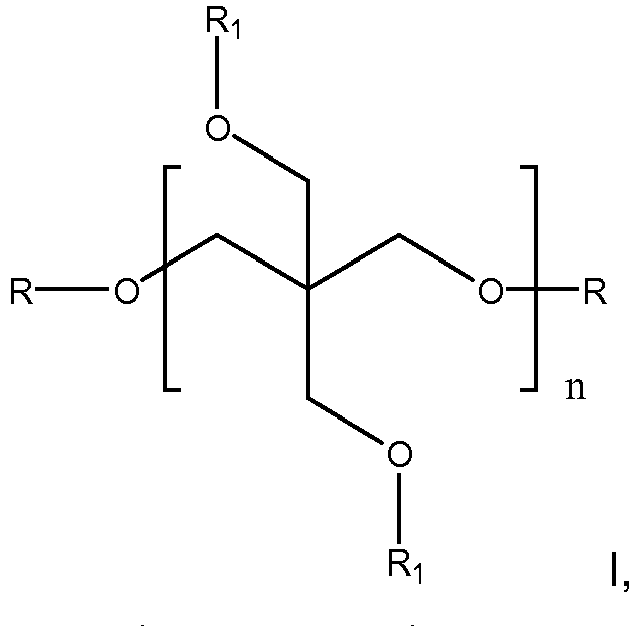
- the polyol ester lubricant composition comprises a mixture of compounds of formula I
- Pentaerythritol based polyol esters of formulia I may be conveniently prepared in a two step process by reacting pentaerythritol with less than a stoichiometric amount of carboxylic acid, based on available hydroxyl groups, under strong acid catalysis at elevated temperatures to form a mixture of partial esters of pentaerythritol, dipentaerythritol and higher polypentaerythritols; partial esters being polyol compounds wherein some but not all of the hydroxyl groups are esterified.
- the amount of oligomerization and viscosity can be controlled by the amount of time the reaction is allowed to proceed and is influenced by the amount of carboxylic acid added, the temperature and other easily varied reaction parameters. After neutralizing the strong acid the remaining hydroxyl groups are esterified in a second step with additional carboxylic acid using standard means.
- Polyol esters of use in the invention can also be prepared by simple esterification of one or more polyols and it is also common to blend separately prepared esters to arrive at the polyol ester mixture of use in the invention.
- mixtures of pentaerythritol based polyol esters prepared from the two step process above may be blended with C 5-10 carboxylic acid esters of trimethylol propane in order to adjust the viscosity of the lubricant composition.
- the C 5-10 carboxylic acids used to form the polyol esters are selected from C 7-10 carboxylic acids, and often a mixture of acids are used, e.g. the acids may be selected from n-heptanoic, n-octanoic and n-decanoic acid.
- a working fluid for a heat transfer device comprising:
- the polyol ester lubricant composition comprises a mixture of compounds of formula I
- the polyol ester lubricant composition comprises a mixture of:
- the polyol ester lubricant composition comprises a mixture of compounds of formula I and C 5-10 alkylcarboxlate esters of trimethylol propane.
- At least 60% for example 75% by weight of all esters in the polyol ester lubricant composition are compounds of formula I, in one embodiment, 90% or more are compounds of formula I. In other embodiments, 50%, 60%, 75%, 90% or more by weight of all esters in the polyol ester lubricant composition are esters of trimethylol propane.
- Each R is independently an alkylcarbonyl of 5 to 10 carbon atoms, which can be linear or branched, but at least 80 molar % or more, for example 90%, 95 molar % or more, of the alkylcarbonyl groups are linear alkylcarbonyls of 7-10 carbon atoms, for example R is selected from alkylcarbonyls of 7, 8 and 10 carbon atoms.
- at least 50 molar %, for example, at least 60, 75, 80 or at least 90 molar % are straight chain alkylcarbonyls of 7, 8 and 10 carbon atoms.
- essentially all alkylcarbonyls are straight chain alkylcarbonyls of 7, 8 and 10 carbon atoms.
- At least 60%, for example, at least 70, 80 or at least 90 % or more of esters in the compounds of formula I comprise alkanoyls wherein R is n-heptanoyl.
- the carboxy groups of other neopentyl polyol esters in the lubricant composition are selected from the same alkylcarbonyls as described for R in compounds of formula I.
- the compounds of formula I which are pentaerythritol oligomers can be linear or branched oligomer.
- an oligomer of formula I wherein n is 4, i.e., formula III can be a linear pentaerythritol tetramer if all R 1 groups are alkylcarbonyl.
- any number of the R 1 groups can be a pentaerythritol group of formula II, and if, for example, the R 1 group marked with the arrow is a group of formula II, the result would be a branched pentaerythritol pentamer, i.e., a branched oligomer of 5 pentaerythritol monomer units.
- an oligomer of formula I of 4 pentaerythritol monomer units or more does not require that n in formula I is 4 or more.
- Formula IV represents an oligomer of formula I with 4 pentaerythritol units where n is 3 and one R 1 group is a pentaerythritol group: and the compound of formula V is an oligomer of formula I with 5 pentaerythritol units where n is 3 and two groups R 1 are pentaerythritol:
- the mixture of the above esters may be prepared by simple esterification of the appropriate polyols, e.g., pentaerythritol, dipentaerythritol, and poly(pentaerythritol)s, however this requires obtaining the individual polyols as starting materials.
- polyols e.g., pentaerythritol, dipentaerythritol, and poly(pentaerythritol)s
- Polyol esters of the inventive compositions may be conveniently prepared by a two step process which incorporates a first step similar to the process described in U.S. Pat 3,670,013 .
- pentaerythritol, a strong acid catalyst, and a C 5 to C 10 monocarboxylic acid or mixture of said acids are charged to a reaction vessel such that the mole ratio of carboxyl groups to hydroxyl groups is less than 1:1, for example from about 1:4 to about 1:2.
- Suitable strong acid catalysts include mineral acids, for example, sulfuric acid, hydrochloric acid, and the like, and sulfonic acids, for example, benzenesulfonic acid, toluenesulfonic acid, polystyrene sulfonic acid, methanesulfonic acid, ethanesulfonic acid, and the like.
- the reaction mixture is then heated to a temperature of between about 150°C and about 250°C, typically between about 170°C and about 200°C, while water vapor is continuously removed from the reaction vessel, generally by the application of a vacuum.
- Any carboxylic acid which co-distills with the water vapor may be returned to the reactor or replaced by adding a replacement portion of carboxylic acid.
- a degree of pentaerythritol oligomerization occurs under the conditions generating a mixture of partial esters of pentaerythritol, di-pentaerythritol, tri-pentaerythritol and higher polypentaerythritols.
- the amount of oligomerization, and thus the viscosity can be controlled by the amount of time the reaction of the first step is allowed to proceed at elevated temperatures.
- the acid catalyst is neutralized with alkali at the end of the first reaction step.
- the second step of the process completes the esterification of the partial esters.
- additional C 5 to C 10 monocarboxylic acid or acid mixture acid and optionally an esterification catalyst is added to the reaction mixture.
- the additional carboxylic acid can be the same as or different from that used in the initial step and is generally added in amount to provide a 10 to 25 percent excess of carboxyl groups, with respect to hydroxyl groups.
- the reaction mixture is then heated to complete the esterification under conditions well known for ester formation.
- Any known catalyst, or no catalyst may be employed in the second step, such as acid catalysts, acid salts, metal catalysts such as organo metallic catalysts, clays etc. Good results have been obtained using tin oxylate and/or activated carbon and in some instances, no added catalyst was required for the second step.
- the resulting mixture of esters may be used without further purification or may be purified using conventional techniques such as distillation, treatment with acid scavengers to remove trace acidity, treatment with moisture scavengers to remove moisture and/or filtration to improve clarity.
- Di-pentaerythritol is often present at the beginning of the process, particularly as technical grades of the pentaerythritol starting material often contain some of this dimer. Small amounts of other pentaerythritol oligomers may also be present in the starting materials.
- pentaerythritol is mixed with approximately 50 moles of n-heptanoic acid.
- this amount of acid represents only half of the stoichiometric equivalence needed for full esterification.
- a catalytic amount of sulfuric acid or methane sulfonic acid is also added. About 10 milimoles of acid catalyst is often sufficient but there is no limitation on the amount of catalyst used and higher amounts are common.
- the mixture is stirred or otherwise agitated and heated to about 160 to about 200°C, for example from about 170 to about 180°C, and water is collected, for example in a Dean Stark trap. The amount of time that the reaction is heated depends on how much polymerization is desired.
- the reaction is then cooled and the acid catalyst is neutralized by addition of a base, e.g., sodium hydroxide.
- a base e.g., sodium hydroxide.
- Carboxylic acid for example, additional n-heptanoic acid or a mixture of heptanoic acid and other carboxylic acids, sufficient to react with any remaining hydroxyl groups and any optional catalyst is added to complete the esterification.
- the reaction mixture is the heated with mixing and water is collected until the reaction is complete.
- the temperature of reaction may vary depending on whether a catalyst is employed and what that catalyst may be therefore temperatures may be encountered that are higher or lower than used in the first step.
- the amount of carboxylic acid included in the initial charge can vary widely so long as it is less than the amount needed to esterify all hydroxy groups present.
- dipentaerythritol and polypentaerythritol may included in the initial charge of starting materials and when this is the case one must consider different hydroxyl group quantities available on the dimers and polymers when determining the amount of carboxylic acid to add.
- One advantage of this process is that one can start with readily available starting materials. Another advantage is that the degree of oligomerization can be controlled by simply varying the length of time the reaction mixture is exposed to strong acids at elevated temperature, which allows one to effectively control the viscosity of the resulting ester composition. That is, longer reaction times at elevated temperature in the first step lead to higher viscosity.
- the polyol ester compositions containing esters of formula I as defined above are all conveniently prepared by this process.
- ester product of the preceding process may blend with other neopentyl polyol esters, for example, esters of neopentyl glycol to prepare the lubricant composition.
- ester of formula I is blended with C 5-10 alkylcarboxylate esters of trimethylol propane.
- the polyol esters can also be blended with other lubricants, such as polyalphaolefins, polyalkylene glycols, alkylated aromatics, polyvinyl ethers, mineral oils, other ester based lubricants, vegetable oils etc to form the lubricant composition,
- lubricants such as polyalphaolefins, polyalkylene glycols, alkylated aromatics, polyvinyl ethers, mineral oils, other ester based lubricants, vegetable oils etc.
- the mixture of polyol esters defined above is the majority or sole component of the lubricant composition that is mixed with the hydrocarbon refrigerant to prepare the working fluid and care must be used when adding other lubricant base stocks so that the desirable properties of the polyol ester composition relative to its use with hydrocarbon refrigerants are not diminished.
- the lubricant composition has a viscosity, as measured without refrigerant at 40°C, of from 22 cSt to 125 cSt, more typically from 25 cSt to 100 cSt, for example, a viscosity as measured without refrigerant at 40°C, of from 25 to 60 cSt or from 25 to 45 cSt.
- ester lubricant compositions of the invention demonstrate consistent viscosity over a wide range of temperatures as shown by their high viscosity indices of greater than 140.
- the polyol ester lubricant compositions of claim 1 are ideally suited for working fluids containing hydrocarbon refrigerants.
- Other similar polyol ester lubricants possess a variety of useful properties, but do not exhibit the full complement of performance criteria, that is, both lubricating properties and hydrocarbon miscibility, that are needed for a hydrocarbon based working fluid and found in the ester mixtures of the invention.
- the mixing ratio of the polyol ester lubricant to the refrigerant is not particularly restricted, but the lubricant is present in a ratio of 1 to 500 parts by weight, more preferably 2 to 400 parts by weight per 100 parts by weight of the refrigerant.
- the working fluid comprises about 5 to 20 weight percent of the ester lubricant based on the weight of lubricant and refrigerant.
- the working fluids of the invention can comprise other components common to the art, including additives, other lubricants, and refrigerants in addition to the hydrocarbon.
- refrigerants which may be present in the working fluid include CO 2 , halocarbons, ammonia and the like, but in many embodiments of the invention the C 1-6 hydrocarbon is the majority refrigerant, and often, the hydrocarbon is the only refrigerant.
- Halocarbon refrigerants include fluorocarbon and hydrofluorocarbon compounds such as carbon tetrafluoride (R-14), difluoromethane (R-32), 1,1,1,2-tetrafluoroethane (R-134a), 1,1,2,2-tetrafluoroethane (R-134), pentafluoroethane (R-125), 1,1,1-trifluoroethane (R-143a) and tetrafluoropropene (R-1234yf) and mixtures comprising fluorocarbons, hydrofluorocarbons and/or hydrocarbons are well known and may be used in the present working fluids.
- fluorocarbon and hydrofluorocarbon compounds such as carbon tetrafluoride (R-14), difluoromethane (R-32), 1,1,1,2-tetrafluoroethane (R-134a), 1,1,2,2-tetrafluoroethane (R-134), pentafluoroethane (R-
- Common additives which may also be present in the working fluid include antioxidants, extreme-pressure additives, antiwear additives, friction reducing additives, defoaming agents, profoaming agents, metal deactivators, acid scavengers and the like.
- antioxidants examples include phenolic antioxidants such as 2,6-di-t-butyl-4-methylphenol and 4,4'-methylenebis(2,6-di-t-butylphenol); amine antioxidants such as p,p-dioctylphenylamine, monooctyldiphenylamine, phenothiazine, 3,7-dioctylphenothiazine, phenyl-1-naphthylamine, phenyl-2-naphthylamine, alkylphenyl-1-naphthylamine, and alkylphenyl-2 -naphthylamine; sulfur-containing antioxidants such as alkyl disulfide, thiodipropionic acid esters and benzothiazole; and zinc dialkyl dithiophosphate and zinc diaryl dithiophosphate.
- phenolic antioxidants such as 2,6-di-t-butyl-4-methylphenol and 4,4
- Examples of the extreme-pressure additives, antiwear additives, friction reducing additives that can be used include zinc compounds such as zinc dialkyl dithiophosphate and zinc diaryl dithiophosphate; sulfur compounds such as thiodipropinoic acid esters, dialkyl sulfide, dibenzyl sulfide, dialkyl polysulfide, alkylmercaptan, dibenzothiophene and 2,2'-dithiobis(benzothiazole); sulfur/nitrogen ashless antiwear additives such as dialkyldimercaptothiadiazoles and methylenebis(N,N-dialkyldithiocarbamates); phosphorus compounds such as triaryl phosphates such as tricresyl phosphate and trialkyl phosphates; dialkyl or diaryl phosphates; trialkyl or triaryl phosphites; amine salts of alkyl and dialkylphosphoric acid esters such as the dodecylamine
- defoaming and profoaming agents examples include silicone oils such as dimethylpolysiloxane and organosilicates such as diethyl silicate.
- metal deactivators examples include benzotriazole, tolyltriazole, alizarin, quinizarin and mercaptobenzothiazole.
- epoxy compounds such as phenyl glycidyl ethers, alkyl glycidyl ethers, alkylglycidyl esters, epoxystearic acid esters and epoxidized vegetable oil, organotin compounds and boron compounds may be added as acid scavengers or stabilizers.
- moisture scavengers examples include trialkylorthoformates such as trimethylorthoformate and triethylorthoformate, ketals such as 1,3-dioxacyclopentane, and amino ketals such as 2,2-dialkyloxazolidines.
- the working fluids comprising the present polyol esters and a refrigerant can be used in a wide variety of refrigeration and heat energy transfer applications.
- Nonlimiting examples include all ranges of air conditioning equipment from small window air conditioners, centralized home air conditioning units to light industrial air conditioners and large industrial units for factories, office buildings, apartment buildings and warehouses.
- Refrigeration applications include small home appliances such as home refrigerators, freezers, water coolers, vending machines and icemakers to large scale refrigerated warehouses and ice skating rinks. Also included in industrial applications would be cascade grocery store refrigeration and freezer systems.
- Heat energy transfer applications include heat pumps for house hold heating and hot water heaters.
- Transportation related applications include automotive and truck air conditioning, refrigerated semi-trailers as well as refrigerated marine and rail shipping containers.
- Positive displacement compressors increase refrigerant vapor pressure by reducing the volume of the compression chamber through work applied to the compressor's mechanism.
- Positive displacement compressors include many styles of compressors currently in use, such as reciprocating, rotary (rolling piston, rotary vane, single screw, twin screw), and orbital (scroll or trochoidal).
- Dynamic compressors increase refrigerant vapor pressure by continuous transfer of kinetic energy from the rotating member to the vapor, followed by conversion of this energy into a pressure rise. Centrifugal compressors function based on these principles.
- the reaction mixture containing partial esters of pentaerythritol, dipentaerythritol, tripentaerythritol, tetrapentaerythritol, and higher oligomer esters of pentaerythritol was cooled to about 134°C, an additional 236.6 grams (1.82 moles) of n-heptanoic acid was added, along with 264.4 grams (2.05 moles) of a 6:4 blend of n-octanoic:n-decanoic acids and an amount of alkali sufficient to neutralize the strong acid catalyst used in the first step.
- the reaction mixture was heated to 240°C for about 8 hours, during which time 173 ml water was collected and after which time the hydroxyl value was 6.4 mg KOH/g.
- the reaction mixture was held at 240°C for about 3 additional hours, under vacuum to remove excess acid until the acid value was less than 1.0 mg KOH/g.
- the mixture was cooled to 80°C and residual acidity was neutralized with alkali.
- the viscosity at 40°C was 140 cSt and at 100°C was 19.6 cSt.
- the reaction mixture was heated at 240 °C, vaccuum was applied and water of reaction was collected in the trap and any collected acid was returned to the reactor.
- the reaction was held at 240 °C until the hydroxyl value dropped to below 2.5 mg KOH/gram.
- the reaction was then held at 240°C for about 3 additional hours, with vacuum being applied to remove excess acid until the acid value was less than 1.0 mg KOH/g.
- the mixture was cooled to 80°C and residual acidity was neutralized with alkali.
- the kinematic viscosity of the polyester product at 40°C was 19 cSt and at 100°C was 4.4 cSt.
- Example 1 The esters of Example 1 and Example 2 were blended in a ratio of 2:3 to give a blended polyol ester with a kinematic viscosity at 40 °C of about 32 cSt.
- the physical properties of the product are given in Table 1.
- the reaction mixture was held at 240°C for about 3 additional hours, under vacuum to remove excess acid until the acid value was less than 2.5 mg KOH/g.
- the mixture was cooled to 80°C and residual acidity was neutralized with alkali.
- the kinematic viscosity of the polyester product at 40°C was 31 cSt and at 100°C was 6.2 cSt.
- the physical properties for the product are given in Table 1.
- Comparative Example 1 is a 84:16, wt:wt blend of two polyol esters having kinematic viscosities at 40 °C of 7.5 cSt and 44 cSt.
- the 7.5 cSt ester is the reaction product of neopentyl glycol with 2-ethylhexanoic acid.
- the 44 cSt ester is the reaction product of pentaerythritol with 2-ethylhexanoic acid. Physical properties are given in Table 1.
- Comparative Example 2 is an ISO 32 grade alkylated benzene commercially available from Virginia KMP Corporation as SPECIAL DUTY AB150. Physical properties for the product are given in Table 1. Table 1. Physical Properties of Example 3 and Example 4 (Comparative) and Comparative Examples Ex 3 Ex4 Comp Ex 1 Comp Ex 2 ISO Viscosity Grade 32 32 32 32 Kinematic Viscosity, 40 °C (cSt) 31.9 31 32 31.3 Kinematic Viscosity, 100 °C (cSt) 6.31 6.2 - 4.15 Viscosity Index 153 154 ⁇ 80 ⁇ 70 Total Acid Number (mg KOH/g) ⁇ 0.05 ⁇ 0.05 ⁇ 0.05 0.05 Specific Gravity @ 15.6 °C/15.6 °C 0.964 0.963 0.927 0.870 Density at 15.6 °C (Ibs./USG) [kg/m 3 ] 8.03 [962.2] 8.02 [961.0] 7.72 [925.1] 7.24 [867.5] Flash Point, COC (
- a steel journal held in place by a brass shear pin is rotated against two stationary V-blocks to give a four-line contact.
- the test pieces and their supporting jaws are immersed in the oil sample cup for oil lubricants.
- the journal is driven at 250 rpm and load is applied to the V-blocks through a nutcracker action lever arm and spring gage.
- the load is actuated and ramped continuously during the test by means of a ratchet wheel mechanism until the brass shear pin shears or the test pin breaks.
- the torque is reported in pounds from the gauge attached to the Falex lubricant tester (Table 2).
- the lubricity of the lubricants was evaluated using a mini-traction machine (MTM) commercially available from PCS Instruments. This test measures the lubricity/frictional properties of lubricants by two different techniques using a rotating ball-on-disk geometry. In the first mode of operation, the lubricity is measured over the total range of lubrication regimes including boundary (metal-to-metal contact), mixed film (mixture of fluid film and metal contact), elastrohydrodynamic (fluid film) and hydrodynamic (fluid film). The speed of the ball and disk are ramped simultaneously at a slide-roll-ratio of 50% and the coefficient of friction is measured as a function of entrainment speed at constant load and temperature.
- MTM mini-traction machine
- Table 3 lists the coefficient of friction at various entrainment speeds for Example Reference 1, Comparative Example 1 and Comparative Example 2 at 40 °C, 80 °C and 120°C.
- Table 3 Coefficient of Friction @ Entrainment Speed (mm/sec) 40°C 10 mm/s 100 mm/s 1000 mm/s Reference Ex 1 0.052 0.036 0.033 Comp Ex 1 0.071 0.052 0.048 Comp Ex 2 0.089 0.081 0.073 80°C 10 mm/s 100 mm/s 1000 mm/s Reference Ex 1 0.066 0.032 0.020 Comp Ex 1 0.084 0.044 0.032 Comp Ex 2 0.096 0.070 0.058 120°C 10 mm/s 100 mm/s 1000 mm/s Reference Ex 1 0.090 0.050 0.014 Comp Ex 1 0.090 0.066 0.024 Comp Ex 2 0.100 0.072 0.046
- the lubricity of the lubricant is measured under full fluid film conditions (hydrodynamic lubrication).
- the coefficient of friction is measured at constant load and temperature at various slide/roll ratios (i.e., the ball and disk are rotated at different speeds relative to one another).
- the test is typically conducted at several different fixed temperatures; in this case 40, 80 and 120 °C and a load of 30 N.
- Coefficient of friction is a direct measurement of the lubricity of the lubricant; the lower the coefficient of friction, the higher the lubricity of the lubricant. It is important to note that for this test it usually only meaningful to compare lubricants of equivalent ISO viscosity grade.
- Table 4 lists the coefficient of friction at various slide roll ratios for Reference Example 1, Comparative Example 1 and Comparative Example 2 at 40°C, 80 °C and 120°C.
- Table 4 Coefficient of Friction @ Slide Roll Ratio 40°C 10 % 30% 50% 70% Reference Ex 1 0.022 0.030 0.032 0.032 Comp Ex 1 0.037 0.044 0.045 0.042 Comp Ex 2 0.065 0.067 0.064 0.061 80°C 10 % 30% 50% 70% Reference Ex 1 0.008 0.016 0.020 0.023 Comp Ex 1 0.017 0.028 0.032 0.033 Comp Ex 2 0.047 0.055 0.056 0.055 120°C 10 % 30% 50% 70% Reference Ex 1 0.004 0.008 0.013 0.015 Comp Ex 1 0.007 0.015 0.019 0.023 Comp Ex 2 0.026 0.037 0.042 0.044
- the apparatus for measuring the viscosity and composition of lubricant/propane mixtures as a function of temperature and pressure consists of a temperature controlled circulation loop containing a pump, mass flow/density meter, high pressure viscometer, bulk lubricant/refrigerant reservoir and pressure transducer. Thermocouples are located at multiple locations in the loop as well as directly in the mass flow meter and viscometer. The design of the loop allows for continuous circulation of the liquid mixture and provides agitation to achieve rapid vapor-liquid equilibrium. The lubricant was first charged to the system gravimetrically ( ⁇ 0.02 grams) and the circulation loop cooled to -10 °C.
- the propane was next charged gravimetrically ( ⁇ 0.02 grams) from a small stainless steel sample cylinder in an amount necessary to achieve the desired bulk propane/lubricant composition. For safety reasons the loop was not filled to capacity and a small vapor space existed at the top of the bulk reservoir, so a vapor space correction was applied to the composition to account for propane in the vapor phase.
- a gear pump was used to circulate the liquid through each of the measurement devices. The bulk mixture pressure was measured to ⁇ 0.20 Bar. The liquid density was measured to ⁇ 0.002 g/cc with a Micromotion CMF 10 mass flow meter. The liquid viscosity was measured to ⁇ 1.0% of value using a Cambridge Viscosity high pressure electromagnetic viscometer.
- Incorporated into the viscometer housing are two high pressure sight glasses to allow observation of the liquid miscibility where, if bulk mixture pressure is within 1% of saturated refrigerant pressure, the mixture can be checked for possible phase separation. Measurements were collected in the temperature range from -10 °C to 120 °C ( ⁇ 0.5 °C) and compositions of propane in lubricant from 0 to 20 wt%.
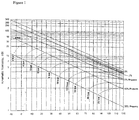
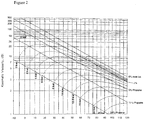
- Daniel Charts were created for each of the lubricants ( Figures 1-3 ), which relate the kinematic viscosity of the refrigerant/lubricant mixtures to temperature, pressure (isobaric curved lines) and composition (straight lines). Comparison of the charts demonstrates that propane solutions with the lubricant of Reference Example 1, see Figure 1 , exhibit a higher kinematic viscosity at high temperatures at any given pressure/temperature combination (i.e., there is less refrigerant dilution) than propane solutions with the lubricant of Comparative Example 1, see Figure 2 , or Comparative Example 2, see Figure 3 .
- the lubricant/propane mixtures of the present invention generally have a lower viscosity at low temperatures and low refrigerant concentrations (conditions typically observed in the compressor environment at start up). This lower viscosity means that the lubricant will impart less viscous drag to the compressor which will result in less energy consumption, especially at start up.
Landscapes
- Chemical & Material Sciences (AREA)
- Chemical Kinetics & Catalysis (AREA)
- Organic Chemistry (AREA)
- General Chemical & Material Sciences (AREA)
- Oil, Petroleum & Natural Gas (AREA)
- Engineering & Computer Science (AREA)
- Physics & Mathematics (AREA)
- Combustion & Propulsion (AREA)
- Thermal Sciences (AREA)
- Materials Engineering (AREA)
- Lubricants (AREA)
Claims (8)
- Arbeitsfluid für eine Wärmeübertragungsvorrichtung, umfassend:i) ein C1-6-Kohlenwasserstoff-Kältemittel; undii) eine Polyolester-Schmiermittelzusammensetzung, die eine kinematische Viskosität bei 40 °C von 22-125 cSt und einen Viskositätsindex von mehr als 140 aufweist und ein Gemisch von Verbindungen der Formel Iumfasst, wobei sich die Gew.-%-Angaben auf das Gewicht aller in der Schmiermittelzusammensetzung vorliegenden Verbindungen der Formel I beziehen,
 wobei n für eine ganze Zahl von 1 bis 12 steht,R jeweils unabhängig für ein Alkylcarbonyl mit 5 bis 10 Kohlenstoffatomen steht,R1 jeweils unabhängig ausgewählt ist und entweder für eine Gruppe R oder einen Substituenten der Formel II:
 steht, wobei mindestens 80 Mol-% aller R-Gruppen unabhängig aus geradkettigen Alkylcarbonylgruppen mit 7 bis 10 Kohlenstoffatomen ausgewählt sind, umfasst undwobei die Polyolester-Schmiermittelzusammensetzunga) 30 bis 55 Gew.-% einer Verbindung der Formel I, wobei n für 1 steht und R1 jeweils unabhängig ausgewählt ist und für eine Gruppe R steht,b) 1 bis 20 Gew.-% einer Verbindung der Formel I, wobei n für 2 steht und R1 jeweils unabhängig ausgewählt ist und für eine Gruppe R steht,c) 1 bis 10 Gew.-% einer Verbindung der Formel I, wobei n für 3 steht und R1 jeweils unabhängig ausgewählt ist und für eine Gruppe R steht,d) 25 bis 45 Gew.-% einer Verbindung der Formel I, bei der es sich um Pentaerythritol-Oligomere mit 4 oder mehr Pentaerythritol-Monomergruppen handelt,
wobei die Polyester-Schmiermittelzusammensetzung ferner C5-10-Alkylcarboxylatester von Trimethylolpropan umfasst, wobei es sich bei 75 Mol-% oder mehr der Alkylcarbonylgruppen in den Trimethylpolyolestern um geradkettige Alkylcarbonylgruppen handelt, und
wobei das Polyester-Schmiermittel in einem Verhältnis von 1 bis 500 Gewichtsteilen pro 100 Gewichtsteile des Kältemittels vorliegt. - Arbeitsfluid nach Anspruch 1, wobei es sich bei mindestens 60 Gew.-% aller Ester in der Polyolester-Schmiermittelzusammensetzung um Verbindungen der Formel I handelt.
- Arbeitsfluid nach Anspruch 1 oder 2, wobei mindestens 90 Mol-% aller R-Gruppen unabhängig aus geradkettigen Alkylcarbonylgruppen mit 7, 8 und 10 Kohlenstoffatomen ausgewählt sind.
- Arbeitsfluid nach Anspruch 1 oder 2, wobei mindestens 90 Mol-% aller R-Gruppen unabhängig aus geradkettigen Alkylcarbonylgruppen mit 7, 8 und 10 Kohlenstoffatomen ausgewählt sind und wobei es sich bei mindestens 75 Mol-% aller R-Gruppen um n-Heptanoyl handelt.
- Arbeitsfluid nach Anspruch 1, wobei es sich bei dem C1-6-Kohlenwasserstoff-Kältemittel um das einzige Kältemittel handelt.
- Arbeitsfluid nach Anspruch 1, wobei es sich bei dem Kältemittel um ein oder mehrere Kältemittel, die aus Propan, Butan, Isobutan, Buten und Isobuten ausgewählt sind, handelt.
- Arbeitsfluid nach Anspruch 1, ferner umfassend neben Komponenten i) und ii) ein oder mehrere Mineralöle, Poly-α-olefine, Alkylbenzole, Carbonsäureester, die von einer Verbindung der Formel I verschieden sind, Polyether, Polyvinylether, Perfluorpolyether, Phosphorsäureester oder ein Gemisch davon.
- Arbeitsfluid nach Anspruch 1, ferner umfassend ein oder mehrere Antioxidantien, Hochdruckadditive, Verschleißschutzadditive, reibungsmindernde Additive, Entschäumer, schäumungsfördernde Mittel, Metalldesaktivatoren, Säurefänger oder ein Gemisch davon.
Applications Claiming Priority (3)
| Application Number | Priority Date | Filing Date | Title |
|---|---|---|---|
| US201261596376P | 2012-02-08 | 2012-02-08 | |
| US13/759,139 US8685271B2 (en) | 2012-02-08 | 2013-02-05 | Refrigeration oil and compositions with hydrocarbon refrigerants |
| PCT/US2013/024712 WO2013119532A2 (en) | 2012-02-08 | 2013-03-19 | Refrigeration oil and compositions with hydrocarbon refrigerants |
Publications (2)
| Publication Number | Publication Date |
|---|---|
| EP2812420A2 EP2812420A2 (de) | 2014-12-17 |
| EP2812420B1 true EP2812420B1 (de) | 2019-06-26 |
Family
ID=48902095
Family Applications (1)
| Application Number | Title | Priority Date | Filing Date |
|---|---|---|---|
| EP13742541.9A Active EP2812420B1 (de) | 2012-02-08 | 2013-03-19 | Gefrieröl und zusammensetzungen mit kohlenwasserstoff und kältemitteln |
Country Status (6)
| Country | Link |
|---|---|
| US (1) | US8685271B2 (de) |
| EP (1) | EP2812420B1 (de) |
| KR (1) | KR20150020524A (de) |
| BR (1) | BR112014017640B1 (de) |
| MX (1) | MX341563B (de) |
| WO (1) | WO2013119532A2 (de) |
Families Citing this family (11)
| Publication number | Priority date | Publication date | Assignee | Title |
|---|---|---|---|---|
| ITTO20120627A1 (it) * | 2012-07-16 | 2014-01-17 | Tazzetti S P A | Miscele refrigeranti |
| CN104132472B (zh) * | 2014-07-16 | 2017-03-29 | 广东美芝制冷设备有限公司 | 空调系统 |
| CN104101138B (zh) * | 2014-07-16 | 2017-03-29 | 广东美芝制冷设备有限公司 | 空调系统 |
| US9683158B2 (en) * | 2015-06-26 | 2017-06-20 | Lanxess Solutions Us, Inc. | Working fluids comprising fluorinated olefins and polyol esters |
| US20190122479A1 (en) * | 2017-10-23 | 2019-04-25 | Nidec Motor Corporation | Drive system for vending machine |
| FR3077773B1 (fr) | 2018-02-15 | 2023-05-26 | Arkema France | Procede de chauffage et / ou de climatisation d’un vehicule |
| FR3077822B1 (fr) | 2018-02-15 | 2020-07-24 | Arkema France | Compositions de transfert de chaleur en remplacement du r-134a |
| US11028300B1 (en) * | 2020-09-16 | 2021-06-08 | David L. Couchot | Environmentally friendly refrigerant compositions |
| CN117285971B (zh) * | 2022-06-20 | 2025-11-18 | 联泓(江苏)新材料研究院有限公司 | 冷冻机油组合物及其制备方法和应用 |
| US20240287366A1 (en) * | 2023-02-22 | 2024-08-29 | The Coulan Company, L.L.C. | Drop-in recycled refrigerant compositions having low net gwp replacing r-454b |
| DE102023109698A1 (de) * | 2023-04-18 | 2024-10-24 | A S Trust & Holdings Inc. | Reine Mehrfachmischungen oder Einzelmischungen von Kohlenwasserstoffen zur Verwendung als Kältemittel bzw. Wärmeübertragungsmedium |
Family Cites Families (18)
| Publication number | Priority date | Publication date | Assignee | Title |
|---|---|---|---|---|
| US3670013A (en) | 1969-10-16 | 1972-06-13 | Hercules Inc | Synthesis of partial esters of certain poly(neopentyl polyols) and aliphatic monocarboxylic acids |
| ES2104738T3 (es) | 1991-01-17 | 1997-10-16 | Cpi Eng Services Inc | Composicion lubricante para refrigerantes fluorados. |
| US5895778A (en) | 1997-08-25 | 1999-04-20 | Hatco Corporation | Poly(neopentyl polyol) ester based coolants and improved additive package |
| JP4564111B2 (ja) | 1998-09-02 | 2010-10-20 | Jx日鉱日石エネルギー株式会社 | 冷凍機油 |
| GB0105065D0 (en) * | 2001-03-01 | 2001-04-18 | Ici Plc | Lubricant compositions |
| JP3909744B2 (ja) | 2001-07-31 | 2007-04-25 | 株式会社ジャパンエナジー | 炭化水素冷媒用冷凍機油 |
| JP2003073681A (ja) | 2001-09-03 | 2003-03-12 | Hitachi Ltd | 冷蔵庫用作動媒体組成物又は該組成物を用いた冷蔵庫 |
| US6774093B2 (en) * | 2002-07-12 | 2004-08-10 | Hatco Corporation | High viscosity synthetic ester lubricant base stock |
| JP4630283B2 (ja) | 2004-09-14 | 2011-02-09 | 出光興産株式会社 | 冷凍機油組成物 |
| JP5179043B2 (ja) * | 2006-11-06 | 2013-04-10 | 出光興産株式会社 | 冷凍機油組成物 |
| JP2010031134A (ja) | 2008-07-29 | 2010-02-12 | Hitachi Appliances Inc | 冷媒圧縮機 |
| JP5265294B2 (ja) | 2008-10-08 | 2013-08-14 | Jx日鉱日石エネルギー株式会社 | 炭化水素冷媒用冷凍機油及び冷凍機用作動流体組成物 |
| US8419968B2 (en) | 2008-11-13 | 2013-04-16 | Chemtura Corporation | Lubricants for refrigeration systems |
| WO2010083100A1 (en) | 2009-01-16 | 2010-07-22 | Chemtura Corporation | Carbon dioxide-based working fluids for refrigeration and air conditioning systems |
| EP2382288B1 (de) | 2009-01-26 | 2017-03-01 | Chemtura Corporation | Herstellung von polyolesterschmierstoffen für kühlsysteme |
| JP2011021870A (ja) * | 2009-06-17 | 2011-02-03 | Sanden Corp | 冷凍回路及びその改良法 |
| EP2556135B1 (de) * | 2010-04-06 | 2020-12-09 | LANXESS Corporation | Kühlöl und zusammensetzungen mit einem kohlendioxidkühlmittel |
| JP2012031239A (ja) * | 2010-07-29 | 2012-02-16 | Hitachi Appliances Inc | 冷凍空調用圧縮機及び冷凍空調装置 |
-
2013
- 2013-02-05 US US13/759,139 patent/US8685271B2/en active Active
- 2013-03-19 WO PCT/US2013/024712 patent/WO2013119532A2/en not_active Ceased
- 2013-03-19 KR KR20147022054A patent/KR20150020524A/ko not_active Ceased
- 2013-03-19 MX MX2014008908A patent/MX341563B/es active IP Right Grant
- 2013-03-19 EP EP13742541.9A patent/EP2812420B1/de active Active
- 2013-03-19 BR BR112014017640-0A patent/BR112014017640B1/pt active IP Right Grant
Non-Patent Citations (1)
| Title |
|---|
| None * |
Also Published As
| Publication number | Publication date |
|---|---|
| MX2014008908A (es) | 2014-10-13 |
| BR112014017640A2 (pt) | 2020-07-14 |
| BR112014017640B1 (pt) | 2022-10-11 |
| BR112014017640A8 (pt) | 2017-07-11 |
| WO2013119532A2 (en) | 2013-08-15 |
| WO2013119532A3 (en) | 2013-11-07 |
| KR20150020524A (ko) | 2015-02-26 |
| US20130200294A1 (en) | 2013-08-08 |
| MX341563B (es) | 2016-08-25 |
| US8685271B2 (en) | 2014-04-01 |
| EP2812420A2 (de) | 2014-12-17 |
Similar Documents
| Publication | Publication Date | Title |
|---|---|---|
| AU2011237762B2 (en) | Refrigeration oil and compositions with carbon dioxide refrigerant | |
| US8685271B2 (en) | Refrigeration oil and compositions with hydrocarbon refrigerants | |
| KR101581070B1 (ko) | 냉동 시스템용 폴리올 에스테르 윤활제의 제조 | |
| EP2379683B1 (de) | Auf kohlenstoffdioxid basierende arbeitsmedien für kühl- und klimatisierungssysteme | |
| JP5848465B2 (ja) | 炭化水素冷媒を有する冷凍オイルおよび組成物 | |
| AU2010303861B2 (en) | Lubricants for refrigeration systems | |
| US8865015B2 (en) | Production of polyol ester lubricants for refrigeration systems | |
| EP3313965B1 (de) | Arbeitsflüssigkeiten mit fluorierten olefinen und polyolestern |
Legal Events
| Date | Code | Title | Description |
|---|---|---|---|
| PUAI | Public reference made under article 153(3) epc to a published international application that has entered the european phase |
Free format text: ORIGINAL CODE: 0009012 |
|
| 17P | Request for examination filed |
Effective date: 20140808 |
|
| AK | Designated contracting states |
Kind code of ref document: A2 Designated state(s): AL AT BE BG CH CY CZ DE DK EE ES FI FR GB GR HR HU IE IS IT LI LT LU LV MC MK MT NL NO PL PT RO RS SE SI SK SM TR |
|
| AX | Request for extension of the european patent |
Extension state: BA ME |
|
| DAX | Request for extension of the european patent (deleted) | ||
| STAA | Information on the status of an ep patent application or granted ep patent |
Free format text: STATUS: EXAMINATION IS IN PROGRESS |
|
| 17Q | First examination report despatched |
Effective date: 20171115 |
|
| GRAP | Despatch of communication of intention to grant a patent |
Free format text: ORIGINAL CODE: EPIDOSNIGR1 |
|
| STAA | Information on the status of an ep patent application or granted ep patent |
Free format text: STATUS: GRANT OF PATENT IS INTENDED |
|
| RAP1 | Party data changed (applicant data changed or rights of an application transferred) |
Owner name: LANXESS SOLUTIONS US INC. |
|
| INTG | Intention to grant announced |
Effective date: 20180724 |
|
| GRAJ | Information related to disapproval of communication of intention to grant by the applicant or resumption of examination proceedings by the epo deleted |
Free format text: ORIGINAL CODE: EPIDOSDIGR1 |
|
| STAA | Information on the status of an ep patent application or granted ep patent |
Free format text: STATUS: EXAMINATION IS IN PROGRESS |
|
| GRAP | Despatch of communication of intention to grant a patent |
Free format text: ORIGINAL CODE: EPIDOSNIGR1 |
|
| STAA | Information on the status of an ep patent application or granted ep patent |
Free format text: STATUS: GRANT OF PATENT IS INTENDED |
|
| INTC | Intention to grant announced (deleted) | ||
| INTG | Intention to grant announced |
Effective date: 20190107 |
|
| RAP1 | Party data changed (applicant data changed or rights of an application transferred) |
Owner name: LANXESS SOLUTIONS US INC. |
|
| GRAS | Grant fee paid |
Free format text: ORIGINAL CODE: EPIDOSNIGR3 |
|
| GRAA | (expected) grant |
Free format text: ORIGINAL CODE: 0009210 |
|
| STAA | Information on the status of an ep patent application or granted ep patent |
Free format text: STATUS: THE PATENT HAS BEEN GRANTED |
|
| AK | Designated contracting states |
Kind code of ref document: B1 Designated state(s): AL AT BE BG CH CY CZ DE DK EE ES FI FR GB GR HR HU IE IS IT LI LT LU LV MC MK MT NL NO PL PT RO RS SE SI SK SM TR |
|
| REG | Reference to a national code |
Ref country code: GB Ref legal event code: FG4D |
|
| REG | Reference to a national code |
Ref country code: CH Ref legal event code: EP |
|
| REG | Reference to a national code |
Ref country code: AT Ref legal event code: REF Ref document number: 1148285 Country of ref document: AT Kind code of ref document: T Effective date: 20190715 |
|
| REG | Reference to a national code |
Ref country code: DE Ref legal event code: R096 Ref document number: 602013057097 Country of ref document: DE |
|
| REG | Reference to a national code |
Ref country code: IE Ref legal event code: FG4D |
|
| REG | Reference to a national code |
Ref country code: NL Ref legal event code: MP Effective date: 20190626 |
|
| PG25 | Lapsed in a contracting state [announced via postgrant information from national office to epo] |
Ref country code: FI Free format text: LAPSE BECAUSE OF FAILURE TO SUBMIT A TRANSLATION OF THE DESCRIPTION OR TO PAY THE FEE WITHIN THE PRESCRIBED TIME-LIMIT Effective date: 20190626 Ref country code: SE Free format text: LAPSE BECAUSE OF FAILURE TO SUBMIT A TRANSLATION OF THE DESCRIPTION OR TO PAY THE FEE WITHIN THE PRESCRIBED TIME-LIMIT Effective date: 20190626 Ref country code: AL Free format text: LAPSE BECAUSE OF FAILURE TO SUBMIT A TRANSLATION OF THE DESCRIPTION OR TO PAY THE FEE WITHIN THE PRESCRIBED TIME-LIMIT Effective date: 20190626 Ref country code: NO Free format text: LAPSE BECAUSE OF FAILURE TO SUBMIT A TRANSLATION OF THE DESCRIPTION OR TO PAY THE FEE WITHIN THE PRESCRIBED TIME-LIMIT Effective date: 20190926 Ref country code: LT Free format text: LAPSE BECAUSE OF FAILURE TO SUBMIT A TRANSLATION OF THE DESCRIPTION OR TO PAY THE FEE WITHIN THE PRESCRIBED TIME-LIMIT Effective date: 20190626 Ref country code: HR Free format text: LAPSE BECAUSE OF FAILURE TO SUBMIT A TRANSLATION OF THE DESCRIPTION OR TO PAY THE FEE WITHIN THE PRESCRIBED TIME-LIMIT Effective date: 20190626 |
|
| REG | Reference to a national code |
Ref country code: LT Ref legal event code: MG4D |
|
| PG25 | Lapsed in a contracting state [announced via postgrant information from national office to epo] |
Ref country code: LV Free format text: LAPSE BECAUSE OF FAILURE TO SUBMIT A TRANSLATION OF THE DESCRIPTION OR TO PAY THE FEE WITHIN THE PRESCRIBED TIME-LIMIT Effective date: 20190626 Ref country code: RS Free format text: LAPSE BECAUSE OF FAILURE TO SUBMIT A TRANSLATION OF THE DESCRIPTION OR TO PAY THE FEE WITHIN THE PRESCRIBED TIME-LIMIT Effective date: 20190626 Ref country code: BG Free format text: LAPSE BECAUSE OF FAILURE TO SUBMIT A TRANSLATION OF THE DESCRIPTION OR TO PAY THE FEE WITHIN THE PRESCRIBED TIME-LIMIT Effective date: 20190926 Ref country code: GR Free format text: LAPSE BECAUSE OF FAILURE TO SUBMIT A TRANSLATION OF THE DESCRIPTION OR TO PAY THE FEE WITHIN THE PRESCRIBED TIME-LIMIT Effective date: 20190927 |
|
| REG | Reference to a national code |
Ref country code: AT Ref legal event code: MK05 Ref document number: 1148285 Country of ref document: AT Kind code of ref document: T Effective date: 20190626 |
|
| PG25 | Lapsed in a contracting state [announced via postgrant information from national office to epo] |
Ref country code: PT Free format text: LAPSE BECAUSE OF FAILURE TO SUBMIT A TRANSLATION OF THE DESCRIPTION OR TO PAY THE FEE WITHIN THE PRESCRIBED TIME-LIMIT Effective date: 20191028 Ref country code: SK Free format text: LAPSE BECAUSE OF FAILURE TO SUBMIT A TRANSLATION OF THE DESCRIPTION OR TO PAY THE FEE WITHIN THE PRESCRIBED TIME-LIMIT Effective date: 20190626 Ref country code: EE Free format text: LAPSE BECAUSE OF FAILURE TO SUBMIT A TRANSLATION OF THE DESCRIPTION OR TO PAY THE FEE WITHIN THE PRESCRIBED TIME-LIMIT Effective date: 20190626 Ref country code: AT Free format text: LAPSE BECAUSE OF FAILURE TO SUBMIT A TRANSLATION OF THE DESCRIPTION OR TO PAY THE FEE WITHIN THE PRESCRIBED TIME-LIMIT Effective date: 20190626 Ref country code: NL Free format text: LAPSE BECAUSE OF FAILURE TO SUBMIT A TRANSLATION OF THE DESCRIPTION OR TO PAY THE FEE WITHIN THE PRESCRIBED TIME-LIMIT Effective date: 20190626 Ref country code: RO Free format text: LAPSE BECAUSE OF FAILURE TO SUBMIT A TRANSLATION OF THE DESCRIPTION OR TO PAY THE FEE WITHIN THE PRESCRIBED TIME-LIMIT Effective date: 20190626 Ref country code: CZ Free format text: LAPSE BECAUSE OF FAILURE TO SUBMIT A TRANSLATION OF THE DESCRIPTION OR TO PAY THE FEE WITHIN THE PRESCRIBED TIME-LIMIT Effective date: 20190626 |
|
| PG25 | Lapsed in a contracting state [announced via postgrant information from national office to epo] |
Ref country code: IT Free format text: LAPSE BECAUSE OF FAILURE TO SUBMIT A TRANSLATION OF THE DESCRIPTION OR TO PAY THE FEE WITHIN THE PRESCRIBED TIME-LIMIT Effective date: 20190626 Ref country code: IS Free format text: LAPSE BECAUSE OF FAILURE TO SUBMIT A TRANSLATION OF THE DESCRIPTION OR TO PAY THE FEE WITHIN THE PRESCRIBED TIME-LIMIT Effective date: 20191026 Ref country code: SM Free format text: LAPSE BECAUSE OF FAILURE TO SUBMIT A TRANSLATION OF THE DESCRIPTION OR TO PAY THE FEE WITHIN THE PRESCRIBED TIME-LIMIT Effective date: 20190626 Ref country code: ES Free format text: LAPSE BECAUSE OF FAILURE TO SUBMIT A TRANSLATION OF THE DESCRIPTION OR TO PAY THE FEE WITHIN THE PRESCRIBED TIME-LIMIT Effective date: 20190626 |
|
| PG25 | Lapsed in a contracting state [announced via postgrant information from national office to epo] |
Ref country code: TR Free format text: LAPSE BECAUSE OF FAILURE TO SUBMIT A TRANSLATION OF THE DESCRIPTION OR TO PAY THE FEE WITHIN THE PRESCRIBED TIME-LIMIT Effective date: 20190626 |
|
| PG25 | Lapsed in a contracting state [announced via postgrant information from national office to epo] |
Ref country code: PL Free format text: LAPSE BECAUSE OF FAILURE TO SUBMIT A TRANSLATION OF THE DESCRIPTION OR TO PAY THE FEE WITHIN THE PRESCRIBED TIME-LIMIT Effective date: 20190626 Ref country code: DK Free format text: LAPSE BECAUSE OF FAILURE TO SUBMIT A TRANSLATION OF THE DESCRIPTION OR TO PAY THE FEE WITHIN THE PRESCRIBED TIME-LIMIT Effective date: 20190626 |
|
| PG25 | Lapsed in a contracting state [announced via postgrant information from national office to epo] |
Ref country code: IS Free format text: LAPSE BECAUSE OF FAILURE TO SUBMIT A TRANSLATION OF THE DESCRIPTION OR TO PAY THE FEE WITHIN THE PRESCRIBED TIME-LIMIT Effective date: 20200224 |
|
| REG | Reference to a national code |
Ref country code: DE Ref legal event code: R097 Ref document number: 602013057097 Country of ref document: DE |
|
| PLBE | No opposition filed within time limit |
Free format text: ORIGINAL CODE: 0009261 |
|
| STAA | Information on the status of an ep patent application or granted ep patent |
Free format text: STATUS: NO OPPOSITION FILED WITHIN TIME LIMIT |
|
| PG2D | Information on lapse in contracting state deleted |
Ref country code: IS |
|
| 26N | No opposition filed |
Effective date: 20200603 |
|
| PG25 | Lapsed in a contracting state [announced via postgrant information from national office to epo] |
Ref country code: SI Free format text: LAPSE BECAUSE OF FAILURE TO SUBMIT A TRANSLATION OF THE DESCRIPTION OR TO PAY THE FEE WITHIN THE PRESCRIBED TIME-LIMIT Effective date: 20190626 |
|
| PG25 | Lapsed in a contracting state [announced via postgrant information from national office to epo] |
Ref country code: MC Free format text: LAPSE BECAUSE OF FAILURE TO SUBMIT A TRANSLATION OF THE DESCRIPTION OR TO PAY THE FEE WITHIN THE PRESCRIBED TIME-LIMIT Effective date: 20190626 |
|
| REG | Reference to a national code |
Ref country code: CH Ref legal event code: PL |
|
| REG | Reference to a national code |
Ref country code: BE Ref legal event code: MM Effective date: 20200331 |
|
| PG25 | Lapsed in a contracting state [announced via postgrant information from national office to epo] |
Ref country code: LU Free format text: LAPSE BECAUSE OF NON-PAYMENT OF DUE FEES Effective date: 20200319 |
|
| PG25 | Lapsed in a contracting state [announced via postgrant information from national office to epo] |
Ref country code: LI Free format text: LAPSE BECAUSE OF NON-PAYMENT OF DUE FEES Effective date: 20200331 Ref country code: IE Free format text: LAPSE BECAUSE OF NON-PAYMENT OF DUE FEES Effective date: 20200319 Ref country code: CH Free format text: LAPSE BECAUSE OF NON-PAYMENT OF DUE FEES Effective date: 20200331 |
|
| PG25 | Lapsed in a contracting state [announced via postgrant information from national office to epo] |
Ref country code: BE Free format text: LAPSE BECAUSE OF NON-PAYMENT OF DUE FEES Effective date: 20200331 |
|
| REG | Reference to a national code |
Ref country code: DE Ref legal event code: R081 Ref document number: 602013057097 Country of ref document: DE Owner name: LANXESS CORPORATION (N.D.GES.D. STAATES DELAWA, US Free format text: FORMER OWNER: LANXESS SOLUTIONS US INC., SHELTON, CT, US |
|
| PG25 | Lapsed in a contracting state [announced via postgrant information from national office to epo] |
Ref country code: MT Free format text: LAPSE BECAUSE OF FAILURE TO SUBMIT A TRANSLATION OF THE DESCRIPTION OR TO PAY THE FEE WITHIN THE PRESCRIBED TIME-LIMIT Effective date: 20190626 Ref country code: CY Free format text: LAPSE BECAUSE OF FAILURE TO SUBMIT A TRANSLATION OF THE DESCRIPTION OR TO PAY THE FEE WITHIN THE PRESCRIBED TIME-LIMIT Effective date: 20190626 |
|
| PG25 | Lapsed in a contracting state [announced via postgrant information from national office to epo] |
Ref country code: MK Free format text: LAPSE BECAUSE OF FAILURE TO SUBMIT A TRANSLATION OF THE DESCRIPTION OR TO PAY THE FEE WITHIN THE PRESCRIBED TIME-LIMIT Effective date: 20190626 |
|
| P01 | Opt-out of the competence of the unified patent court (upc) registered |
Effective date: 20230608 |
|
| PGFP | Annual fee paid to national office [announced via postgrant information from national office to epo] |
Ref country code: FR Payment date: 20251231 Year of fee payment: 14 |
|
| PGFP | Annual fee paid to national office [announced via postgrant information from national office to epo] |
Ref country code: GB Payment date: 20260106 Year of fee payment: 14 |
|
| PGFP | Annual fee paid to national office [announced via postgrant information from national office to epo] |
Ref country code: DE Payment date: 20260102 Year of fee payment: 14 |