EP2809799B1 - Rotatable platform for conducting nucleic acid sequencing - Google Patents
Rotatable platform for conducting nucleic acid sequencing Download PDFInfo
- Publication number
- EP2809799B1 EP2809799B1 EP12867519.6A EP12867519A EP2809799B1 EP 2809799 B1 EP2809799 B1 EP 2809799B1 EP 12867519 A EP12867519 A EP 12867519A EP 2809799 B1 EP2809799 B1 EP 2809799B1
- Authority
- EP
- European Patent Office
- Prior art keywords
- platform
- well
- nucleic acid
- polynucleotide molecule
- reagent
- Prior art date
- Legal status (The legal status is an assumption and is not a legal conclusion. Google has not performed a legal analysis and makes no representation as to the accuracy of the status listed.)
- Active
Links
Images







Classifications
-
- B—PERFORMING OPERATIONS; TRANSPORTING
- B01—PHYSICAL OR CHEMICAL PROCESSES OR APPARATUS IN GENERAL
- B01L—CHEMICAL OR PHYSICAL LABORATORY APPARATUS FOR GENERAL USE
- B01L3/00—Containers or dishes for laboratory use, e.g. laboratory glassware; Droppers
- B01L3/50—Containers for the purpose of retaining a material to be analysed, e.g. test tubes
- B01L3/502—Containers for the purpose of retaining a material to be analysed, e.g. test tubes with fluid transport, e.g. in multi-compartment structures
- B01L3/5027—Containers for the purpose of retaining a material to be analysed, e.g. test tubes with fluid transport, e.g. in multi-compartment structures by integrated microfluidic structures, i.e. dimensions of channels and chambers are such that surface tension forces are important, e.g. lab-on-a-chip
- B01L3/502753—Containers for the purpose of retaining a material to be analysed, e.g. test tubes with fluid transport, e.g. in multi-compartment structures by integrated microfluidic structures, i.e. dimensions of channels and chambers are such that surface tension forces are important, e.g. lab-on-a-chip characterised by bulk separation arrangements on lab-on-a-chip devices, e.g. for filtration or centrifugation
-
- B—PERFORMING OPERATIONS; TRANSPORTING
- B01—PHYSICAL OR CHEMICAL PROCESSES OR APPARATUS IN GENERAL
- B01L—CHEMICAL OR PHYSICAL LABORATORY APPARATUS FOR GENERAL USE
- B01L7/00—Heating or cooling apparatus; Heat insulating devices
- B01L7/52—Heating or cooling apparatus; Heat insulating devices with provision for submitting samples to a predetermined sequence of different temperatures, e.g. for treating nucleic acid samples
-
- C—CHEMISTRY; METALLURGY
- C12—BIOCHEMISTRY; BEER; SPIRITS; WINE; VINEGAR; MICROBIOLOGY; ENZYMOLOGY; MUTATION OR GENETIC ENGINEERING
- C12Q—MEASURING OR TESTING PROCESSES INVOLVING ENZYMES, NUCLEIC ACIDS OR MICROORGANISMS; COMPOSITIONS OR TEST PAPERS THEREFOR; PROCESSES OF PREPARING SUCH COMPOSITIONS; CONDITION-RESPONSIVE CONTROL IN MICROBIOLOGICAL OR ENZYMOLOGICAL PROCESSES
- C12Q1/00—Measuring or testing processes involving enzymes, nucleic acids or microorganisms; Compositions therefor; Processes of preparing such compositions
- C12Q1/68—Measuring or testing processes involving enzymes, nucleic acids or microorganisms; Compositions therefor; Processes of preparing such compositions involving nucleic acids
- C12Q1/6869—Methods for sequencing
-
- B—PERFORMING OPERATIONS; TRANSPORTING
- B01—PHYSICAL OR CHEMICAL PROCESSES OR APPARATUS IN GENERAL
- B01L—CHEMICAL OR PHYSICAL LABORATORY APPARATUS FOR GENERAL USE
- B01L2200/00—Solutions for specific problems relating to chemical or physical laboratory apparatus
- B01L2200/06—Fluid handling related problems
- B01L2200/0647—Handling flowable solids, e.g. microscopic beads, cells, particles
- B01L2200/0668—Trapping microscopic beads
-
- B—PERFORMING OPERATIONS; TRANSPORTING
- B01—PHYSICAL OR CHEMICAL PROCESSES OR APPARATUS IN GENERAL
- B01L—CHEMICAL OR PHYSICAL LABORATORY APPARATUS FOR GENERAL USE
- B01L2200/00—Solutions for specific problems relating to chemical or physical laboratory apparatus
- B01L2200/14—Process control and prevention of errors
- B01L2200/142—Preventing evaporation
-
- B—PERFORMING OPERATIONS; TRANSPORTING
- B01—PHYSICAL OR CHEMICAL PROCESSES OR APPARATUS IN GENERAL
- B01L—CHEMICAL OR PHYSICAL LABORATORY APPARATUS FOR GENERAL USE
- B01L2300/00—Additional constructional details
- B01L2300/06—Auxiliary integrated devices, integrated components
- B01L2300/0681—Filter
-
- B—PERFORMING OPERATIONS; TRANSPORTING
- B01—PHYSICAL OR CHEMICAL PROCESSES OR APPARATUS IN GENERAL
- B01L—CHEMICAL OR PHYSICAL LABORATORY APPARATUS FOR GENERAL USE
- B01L2300/00—Additional constructional details
- B01L2300/08—Geometry, shape and general structure
- B01L2300/0803—Disc shape
-
- B—PERFORMING OPERATIONS; TRANSPORTING
- B01—PHYSICAL OR CHEMICAL PROCESSES OR APPARATUS IN GENERAL
- B01L—CHEMICAL OR PHYSICAL LABORATORY APPARATUS FOR GENERAL USE
- B01L2300/00—Additional constructional details
- B01L2300/08—Geometry, shape and general structure
- B01L2300/0803—Disc shape
- B01L2300/0806—Standardised forms, e.g. compact disc [CD] format
-
- B—PERFORMING OPERATIONS; TRANSPORTING
- B01—PHYSICAL OR CHEMICAL PROCESSES OR APPARATUS IN GENERAL
- B01L—CHEMICAL OR PHYSICAL LABORATORY APPARATUS FOR GENERAL USE
- B01L2400/00—Moving or stopping fluids
- B01L2400/04—Moving fluids with specific forces or mechanical means
- B01L2400/0403—Moving fluids with specific forces or mechanical means specific forces
- B01L2400/0409—Moving fluids with specific forces or mechanical means specific forces centrifugal forces
-
- B—PERFORMING OPERATIONS; TRANSPORTING
- B01—PHYSICAL OR CHEMICAL PROCESSES OR APPARATUS IN GENERAL
- B01L—CHEMICAL OR PHYSICAL LABORATORY APPARATUS FOR GENERAL USE
- B01L2400/00—Moving or stopping fluids
- B01L2400/04—Moving fluids with specific forces or mechanical means
- B01L2400/0403—Moving fluids with specific forces or mechanical means specific forces
- B01L2400/043—Moving fluids with specific forces or mechanical means specific forces magnetic forces
Definitions
- Sequencing by ligation is also known.
- This DNA sequencing method uses the enzyme DNA ligase to identify the nucleotide present at a given position in a DNA sequence.
- the mismatch sensitivity of a DNA ligase enzyme is used to determine the underlying sequence of the target DNA molecule. See for example US Patent No.'s 5,750,341 and US 4,883,750 .
- the support surfaces are preferably magnetic beads, and a magnet is used to retain magnetic beads in the wells during centrifugation.
- the single stranded DNA ssDNA
- the reagents may be removed after each new addition of reagent, or after multiple additions.
- the centrifugal washing step dries the support surface and prepares it for a subsequent reagent, and also removes unwanted by-products from the assay.
- the present invention also relates to apparatus for rotating the platform and holding the support surface within a respective well, and kits comprising a platform and support surface.
- the nucleic acid sequencing is pyrosequencing.
- the support surface is in the form of a magnetic particle and said magnetic particle is magnetically held within said well by positioning a magnet sufficiently close to said platform to magnetically hold said magnetic particle(s) within said well during rotation of said platform.
- the magnet is in the form of a plate or a ring which sits underneath the platform.
- the magnetic plate or ring is further adapted to heat said well(s) up to about 150 °C, thereby heating said support surface.
- an electromagnet is engaged to magnetically hold said magnetic particle(s) within said well during rotation of said platform.
- the platform is substantially circular and said wells are distributed about the periphery of said circular platform.
- the wells comprise a volume of between about 0.5 to 100 ⁇ L or a well depth of about 0.5 to 5 mm.
- the wells are dimensioned to contain between about 1 to about 50 discrete support surfaces.
- the platform is formed of a plastics material selected from the group consisting of polycarbonate, polystyrene, high impact polystyrene, polyethylene and polypropylene, or is formed from glass or quartz.
- a trough is disposed at the periphery of said platform for receiving waste fluids which are spun off or centrifuged away from said platform during rotation.
- the first binding partner is chemically adsorbed or covalently or ironically, or hydrogen bonded onto said support surface, or van der Waals forces immobilise said first binding partner to said support surface.
- the platform is vibrated sufficiently to thoroughly mix together said reagent and said support surface(s).
- kits comprising a platform having at least one well for containing one or more support surfaces, and at least one support surface in the kit, wherein said support surface is adapted to immobilise a first binding partner.
- the support surface is contained in said well and wherein a removable disposable sheet is adhered to the surface of said platform for retaining said support surface in said well.
- the kit comprises one or more reagents for conducting nucleic acid sequencing, and in particular for pyrosequencing.
- an apparatus for conducting nucleic acid sequencing comprising:
- the present invention provides a method for conducting nucleic acid sequencing, said method comprising the steps of:
- a first binding partner is already chemically adsorbed or covalently or ionically, or hydrogen bonded onto said support surface, or van der Waals forces immobilise a first binding partner to said support surface, and said second binding partner is bindable or reactable to said first binding partner already bound to said support surface.
- a series of reagents are dispensed into each said well, and the first of the series of reagents comprises the second binding partner to the first binding partner, and the subsequent reagents are chosen from washing and/or rinsing reagents.
- kits comprising a platform having at least one well for containing one or more support surfaces, and at least one support surface, wherein said support surface is adapted to selectively bind or immobilise a second binding partner.
- the present invention provides a method for conducting sequencing of a nucleic acid strand, said method comprising the steps of:
- the nucleic acid strand is DNA or RNA or a modified form thereof.
- the sequencing of a nucleic acid strand is pyrosequencing.
- the nucleic acid strand is biotinylated and the nucleic acid strand binding partner comprises avidin or streptavidin or an analogue for binding the biotinylated nucleic acid strand.
- the sequential contacting/dispensing step comprises either:
- the step of analysing said nucleic acid strand during and/or after each said dispensing step comprises detecting the next base pair in said nucleic acid strand by correlating the output of light with the number of nucleotides which have become bound to the nucleic acid strand.
- each said support surface is prepared for each said subsequent reagent by substantially drying said support surface by rotation of said platform to substantially centrifugally remove any residual reagents such that there is substantially no contamination of said support surface with a reagent.
- kits for conducting sequencing of a nucleic acid strand comprising a rotatable platform having at least one well for containing one or more support surfaces, and at least one support surface, wherein said support surface is adapted to immobilise a nucleic acid strand binding partner.
- an apparatus for sequencing a nucleic acid strand comprising:
- the present invention provides a method for conducting sequencing of a nucleic acid strand, said method comprising the steps of:
- the support surface already has immobilised thereto a nucleic acid strand binding partner, and wherein said nucleic acid strand selectively binds to said nucleic acid strand binding partner.
- the nucleic acid strand is DNA or RNA or a modified form thereof.
- the nucleic acid strand is biotinylated and the first binding partner comprises avidin or streptavidin or an analogue for binding the biotinylated nucleic acid strand.
- kits comprising a rotatable platform having at least one well for containing one or more support surfaces, and at least one support surface, wherein said support surface is adapted to selectively immobilise a nucleic acid strand.
- kits for conducing sequencing of a nucleic acid strand are also described herein.
- an apparatus for sequencing a nucleic acid strand comprising:
- the rotatable platform comprises a plurality of relatively shallow wells which comprise a volume of between about 0.5 to 100 ⁇ L or a well depth of about 0.5 to 3 mm.
- the wells are relatively deep, at about 5 to 8 mm for containing magnetic beads which themselves are adapted to immobilise a first binding partner or adapted to selectively immobilise a second binding partner.
- the beads are considered as discrete areas, and one or more beads may be contained in each well.
- the first binding partner is chemically adsorbed or the surface of the bead or particle.
- the first binding partner is covalently or ionically or hydrogen bonded to the surface of the bead or particle, and in yet other embodiments van der Waals forces hold the first binding partner to the surface of the bead or particle.
- the second binding partner is bindable or reactable to the first binding partner already bound to the surface of the bead or particle.
- the present invention is particularly relevant to methods and assays such as nucleic acid sequencing methods, for example pyrosequencing.
- the first and second binding partners are binding partner pairs (optionally one of which may be detectably labelled), which are preferably selected from avidin or streptavidin or streptactin or analogs and biotin or analogs.
- an advantage of the present invention is to provide relatively fast and relatively simple washing steps, and associated low waste volumes of washing solution and reagents.
- the support surface held within the well is adapted to immobilise a first binding partner, which may be for example avidin or streptavidin or streptactin or analogs, and then the avidin or streptavidin or streptactin or analogs can be subsequently reacted with say, biotinylated DNAs, in a subsequent processing step.
- a first binding partner which may be for example avidin or streptavidin or streptactin or analogs
- the support surface already comprises a first binding partner, and the surface is adapted to selectively immobilise a second binding partner. It will therefore be appreciated that the support surface according to the first embodiment can be considered to be 'unfunctionalised', and the support surface according to the second embodiment can be considered to be 'functionalised' or 'pre-functionalised'.
- the first of the series of reagents comprises the second or complementary binding partner to the first binding partner, and then the subsequent reagents are chosen from, say, washing or rinsing reagents, and as discussed further below.
- the method of the invention further comprises the step of analysing the nucleic acid sequencing assay during and/or after each said contacting or dispensing step.
- each said support surface prior to contacting the support surfaces with a subsequent reagent each said support surface is subjected to a washing or rinsing step with a washing reagent.
- the washing reagent may be any reagent which can substantially wash off any residual solution from the previous contacting step or reduce the amount of any residual solution and the components present in said solution (active agents like, e.g., apyrase or other suitable enzymes which degrade by-products or otherwise reduce the concentration of by-products).
- the washing reagent may be any reagent which can substantially wash off any residual solution from the previous contacting/dispensing step or reduce the amount of any residual solution and the components present in said solution, and may be an active agent like apyrase
- the washing step for removal of excess nucleotide is free from apyrase, as detailed in Mashayekhi F., and Ronaghi M., Analysis of read-length limiting factors in pyrosequencing chemistry. Anal. Biochem. (2007), 363(2): 275-287 .
- replacing the washing step with an apyrase-free washing step her been shown to improving the read-length of pyrosequencing.
- each said support surface is prepared for each said subsequent reagent by substantially 'drying' said support surfaces by rotation of said platform to centrifugally remove any residual reagents such that there is a substantially reduced, preferably substantially no contamination of said support surface with the reagent from the previous step.
- nucleic acid sequencing method employed is pyrosequencing.
- other methods of sequencing a nucleic acid strand may be utilised, as discussed further below.
- the rotatable platform is substantially circular and has a diameter between about 50 to 500mm.
- the rotatable platform comprises between about 2 to 500 wells which are equidistantly spaced from the centre of the rotatable platform.
- the diameter may be any diameter, and the diameter may be chosen to accommodate the number of wells, which may be 1 or more in number.
- the wells are distributed or positioned substantially evenly around the periphery of the rotatable platform to form a substantially circular array.
- the support surfaces or the beads are adapted to bind, capture, or immobilise avidin, and preferably streptavidin, and in a subsequent step the biotinylated nucleic acid strand is selectively immobilised to the avidin/streptavidin bound to the support surfaces.
- biotinylated nucleic acid strand is selectively immobilised to the avidin/streptavidin bound to the support surfaces.
- other chemistries are available for immobilising a nucleic acid strand to a discrete areas.
- the present invention is not limited to the chemistry which can be employed to immobilise the nucleic acid strand to the discrete areas.
- template binding agents could be by way of ligand binding, universal primer/probe or an antibody.
- the rotatable platform which may be a substantially circular disc, further comprises a trough disposed at the periphery of the platform for receiving waste fluids which are spun off or centrifuged away from the surface of the rotatable platform during its rotation.
- a trough disposed at the periphery of the platform for receiving waste fluids which are spun off or centrifuged away from the surface of the rotatable platform during its rotation.
- nucleic acid strand immobilised to the support surfaces may need to be denatured to remove the complementary nucleic acid strand.
- Denaturing may be achieved by any method, however preferred examples comprise heating the wells and the support surfaces or even the entire rotatable platform to a temperature sufficient to denature, e.g. 94 to 99°C, or by exposing the support surfaces to a solvent heated to in excess of 94°C, such as a buffer.
- the support surfaces may be exposed to a denaturing composition (e.g. compositions comprising NaOH).
- a denaturing composition e.g. compositions comprising NaOH
- Other methods include heating by infra-red or equivalent radiation. It will be appreciated that the rotatable platform should be formed of materials which are capable of withstanding such denaturing conditions.
- the apparatus as herein described enables the remaining nucleotides to be removed at a much higher speed (i.e. via centrifugation steps, washing steps). This results in a much shorter cycle time for one base being incorporated.
- the cycle time can be reduced to approximately 15 seconds, thereby creating an approximate at least a four-fold decrease in run time. However, it is contemplated that the cycle time can be reduced even further.
- the method allows sequencing of a single strand of DNA by synthesizing the complementary strand along it, one base pair at a time, and detecting which base was actually added at each step.
- the template DNA or the sequencing primer is immobilized, and solutions of A, C, G, and/or T nucleotides are added and removed after the reaction, sequentially. Light is produced only when the added nucleotide complements the first unpaired base or bases of the template.
- the sequence of added nucleotides which produce detectable signals e.g. chemiluminescent signals, allows the determination of the sequence of the template.
- flowthrough DNA sequencing includes, for example, a method of immobilizing a nucleic acid template or a sequencing primer, hybridising the primer to the template or vice-versa and perform a primer mediated synthesis in a step-wise manner in the presence of nucleotides wherein the nucleotides include, for example, optionally with a strand extension termination moiety, such as a dideoxy moiety, and optionally a detectable label (e.g. Sanger sequencing).
- a further nucleic acid sequencing method embodiment comprises the steps of: incorporating a labelled nucleotide into the extending primer strand; identifying the incorporated nucleotide; and removal of the strand extension termination moiety and label so that the extending strand is ready for incorporation of a successive nucleotide.
- each said support area is contacted sequentially with a series of reagents comprising A, T, G and/or C nucleotides.
- the sequential contacting step may comprise one of the following:
- the sequential contacting step a.) is particularly useful for the pyrosequencing methodology, and the sequential contacting step b.) is particularly useful if labelled nucleotides are utilised, such as fluorescently labelled nucleotides where each is labelled with a different dye.
- the entire method is iterative in that the sequence of nucleotides may be added in any predefined order and/or any predefined combination and the sequence repeated a sufficient number of times as required to sequence the nucleic acid template.
- A, T, G, and C may be added only at a known mutation site.
- the advantage of this embodiment it that this procedure speeds up known mutation detection, as fewer base additions are required.
- the method of the invention further comprises the step of analysing the nucleic acid strand during and/or after each said contacting step.
- the analysis can be any analysis however it will be appreciated that in the context of pyrosequencing the analysis step comprises in each step of said analysis identifying the next base pair in the nucleic acid strand by correlating the output of light with the number of nucleotides which have been incorporated to the nucleic acid strand. All appropriate and suitable technical measures to detect the incorporation of a nucleotide may be taken by the artisan.
- a suitable detector for detecting the light produced by the reaction is a photomultiplier tube (PMT). It will be appreciated that as the rotatable platform is rotated the samples pass the detector, preferably all the samples pass the detector.
- PMT photomultiplier tube
- each said support surface is subjected to a washing or rinsing step with a washing reagent.
- the washing reagent may be any reagent which is suitable to wash off residual solution from the previous contacting step, preferably to wash off substantially all residual solution from the previous contacting step.
- the washing reagent is the buffer in which the following reaction step is performed.
- the washing reagent may also contain washing enhancers, such as - by way of example - apyrase, phosphatase, etc. Suitable washing reagent are well known to the killed artisan.
- the denaturing step may comprise heating the nucleic acid strand to effect denaturing, or exposing the nucleic acid strand to elevated pH, or exposing the nucleic acid strand to a suitable enzyme or enzyme mixture.
- the method of the invention comprises the step of wherein after the nucleic acid strand is denatured the complementary strand is removed by a rinsed step with a rinsing reagent.
- the apparatus for dispensing said nucleic acid strand, for dispensing A, T, G and/or C nucleotides, and for dispensing washing reagent can be any apparatus, however preferably the apparatus is similar to ink jet-type technology, piezo actuated or driven by air pulses.
- the apparatus is also preferably provided with a vacuum extraction system to extract the waste reagents which are spun off the rotatable platform.
- the apparatus is also provided with a suitable detection means to detect light produced by the pyrosequencing reaction. Suitable detectors will be known to the skilled person, for example a photomultiplier which may be mounted above the rotatable platform.
- one or more solid state pH meters are mounted under each well of the platform.
- the platform is therefore re-usable as magnetic beads can be used to support the bound DNA for detection of the sequence, and the wells can be washed as described above between each sequencing cycle. Once the sequencing is complete, the beads can be released by removing the magnet from the underneath of the platform, and the platform can be thoroughly washed and then loaded with new samples for analysis.
- magnetic beads will be employed to capture the ssDNA.
- the surface of the gate of the ISFET could be coated to capture the ssDNA, or magnetic beads could also be used.
- the present invention provides the use of an ISFET detector with the rotatable platform of the invention and employing discrete removable support surfaces in each well.
- the ISFET detection elements form the base of each well.
- the enumerated listing of items does not imply that any or all of the items are mutually exclusive.
- the enumerated listing of items does not imply that any or all of the items are collectively exhaustive of anything, unless expressly specified otherwise.
- the enumerated listing of items does not imply that the items are ordered in any manner according to the order in which they are enumerated.
- binding partner is understood to mean one of a binding partner pair, which can be any ligand/receptor pair.
- One of the binding partner pair is referred to as the "first binding partner” and the other of the binding partner pair is referred to as the "second binding partner”.
- the binding partner pairs can be streptavidin/avidin and biotin.
- the binding partner pairs can, for example, include streptavidin and biotinylated nucleic acid.
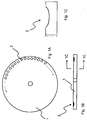
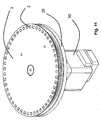
- a rotatable platform (or disc) in the form of a polycarbonate disc 1 which comprises two or more wells 2 adapted to contain at least one support surface in the form of a bead for selectively retaining a nucleic acid strand for conducting sequencing of the nucleic acid.
- the wells 2 are preferably about 2-3 mm in diameter and are positioned around the circumference of the disc 1 in equally spaced intervals.
- a disc 1 having a diameter of 120 mm has a circumference of 377 mm, and by forming 3 mm diameter discrete areas 2 spaced apart by 6mm (between centres of discrete areas/target sites 2) at radius of 55 mm from the centre of the disc 1 results in approximately 57 wells around the periphery of the disc 1.
- the number of wells could be a smaller or greater number by using either a larger disc 1 or smaller discrete areas, e.g. 0.5 mm diameter with a spacing of, say, 1 mm, or any combination thereof.
- the wells 2 are shallow wells, which comprise a volume of between about 0.5 to 100 ⁇ L.
- each support surface 2 is subjected to a washing or rinsing step with a washing reagent.
- the washing reagent may be any reagent which can substantially wash off any residual solution from the previous contacting step, and is preferably a PCR buffer.
- the rotatable platform 1 is rotated at low speed whilst dispensing the nucleotide reagents and enzyme, for example at between about 10 to 200 rpm, and the platform 1 is rotated at high speed whilst dispensing the washing reagent, for example at between about 400 to 4000 rpm.
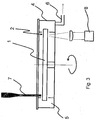
- the present invention also provides apparatus for use with the rotatable platform 1 for sequencing a nucleic acid strand.
- the apparatus comprises a motor 50 for rotating the platform 1 at a predetermined controllable user-selectable rotational speed, such as a motor capable of delivering rotational speeds of between about 10 to 4000 rpm.
- Apparatus is also provided for dispensing the nucleic acid strand into the wells 2 for immobilising the nucleic acid strand to the support surfaces.
- Such apparatus may take the form of ink jet-type technology or a suitable dispenser 7 such as a syringe pump.
- Apparatus is also provided for dispensing A, T, G and C nucleotides into contact with the support surfaces and for dispensing a washing reagent. Again, such apparatus may take the form of ink jet-type technology. Apparatus is also provided for denaturing and removing any complementary nucleic acid strand, and such apparatus may take the form of a heating coil (not shown in this Figure) disposed within the housing 4.
- the rotatable platform 1 can be rotated a low speed to dispense the enzyme and nucleotide(s) mixture (i.e. 200 rpm or less) where the centrifugal force is low enough not to move the mixture from the wells 2 and to allow for the reaction to proceed and optical detection to be completed.
- Wash reagents can be added at high rotor speed, (i.e. 400+ rpm) so the wash removes all reagents from the wells 2 and does not substantially contaminate between wells 2.
- a sequencing primer was added and hybridised to the DNA target though an annealing process of heating the sample to over 80°C and cooling to a temperature below 30°C.
- the residual dNTP from the PCR would have all incorporated upon addition of the enzyme and substrate mix, completing the sequence instantaneously, thereby delivering a single high peak with a subsequent attenuation of the remaining sequencing reaction due to little remaining non-incorporated template.
- the data demonstrated that rotational velocities greater than 2000 rpm were required to achieve complete removal of supernatant.
- the optimum bead to use was the Streptavidin Mag Sepharose beads, however it should be appreciated that the other beads are still viable for the method of the invention.
- the magnetic particles were capable of immobilising the DNA target with washing centrifugation carried out at certain velocities to ensure cleaner templates for sequencing.
- the inert out shell also meant that non-specific binding of the pyrosequencing enzymes was not an issue affecting sequencing performance through nonsynchronous incorporation of dNTP.
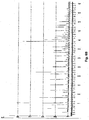
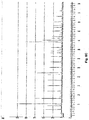
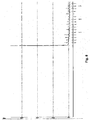
- Figures 6A to C shows pyrosequencing peak heights for A ) Streptavidin Mag Sepharose, B ) MyOne Streptavidin C1, and C) Sera-Mag Magnetic SpeedBeads Neutravidin.
- One picomole of DNA template was added to a solution of 10 ⁇ L binding buffer and incubated for 10 min. The immobilised beads were washed in buffer solution prior to and following denaturation with NaOH.
- Sequencing primer was added at 400 nM concentration and annealed by heating to 80°C for 60 seconds and then cooled to 30°C. Enzyme and substrate were added and the pyrosequencing reaction conducted de novo using 15 cycles of dATP, dCTP, dGTP and dTTP. The highest peaks were observed for the Sera-Mag Magnetic SpeedBeads Neutravidin.
- Figure 7 shows pyrosequencing peaks achieved for the Streptavidin Mag Sepharose beads using a higher frequency of mixing. Signal peaks increased from an average single peak height of 5 to over 40 units. However, due to the attenuation of signal though the darker colour of the magnetic bead particles, the peak heights did not exceed that observed for the other two beads.
- Figure 8 shows a high peak following addition of enzyme and substrate mixes to a PCR amplicon immobilised to Sera-Mag Magnetic SpeedBeads Neutravidin washed at a centrifugal speed of 1500 rpm.
- the subsequent sequencing reaction peaks following the addition of the enzyme and substrate mix was significantly attenuated. The same beads did not remain within the well after centrifugation above 2000 rpm.
- Figure 9 shows phase shifting and wider peak signals observed during pyrosequencing using DNA target immobilised to Dynabeads MyOne Streptavidin C1 beads.
- Figure 25 is a photograph of an actual production platform showing magnetic beads loaded into wells 1 to 3.
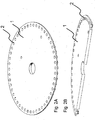
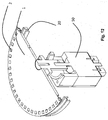
- Figures 26 and 27 are perspective views of a platform according to the invention engaged with a motor for rotating the platform, and show an annular peripheral magnetic ring in a first position where there is little or no magnetic force being applied on the platform.
- Figures 28 and 29 are sectional side views showing the magnetic ring in first and second positions respectively. In the second position the ring is positioned sufficiently close to the platform to exert a magnetic force on any magnetic beads contained in the wells.
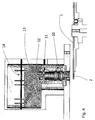
- Figures 15 is another embodiment of the invention, and shows a platform having wells which are configured and arranged such that under rotation the beads spin into a cavity and the waste fluid is driven by centrifugal force through a frit or similar filter.
- Sequencing is achieved by detecting the release of pyrophosphate following the incorporation of a complementary three prime deoxyribonucleoside five prime triphosphate (dNTP) into a single stranded template by the DNA polymerase enzyme.
- dNTP complementary three prime deoxyribonucleoside five prime triphosphate
- the pyrophosphate must be converted to adenosine triphosphate (ATP) by the sulfurylase enzyme. It is the reaction of ATP with luciferin through the luciferase enzyme that generates a light signal, indicating the incorporation of the nucleotide and hence, the sequence of the template strand.
- ATP adenosine triphosphate
- the apyrase enzyme is used to allow for the incorporation and detection of the next nucleotide without interference from the previously added nucleotide. Apyrase will degrade excess nucleotide prior to the addition of the next nucleotide.
Landscapes
- Chemical & Material Sciences (AREA)
- Health & Medical Sciences (AREA)
- Life Sciences & Earth Sciences (AREA)
- Organic Chemistry (AREA)
- Proteomics, Peptides & Aminoacids (AREA)
- General Health & Medical Sciences (AREA)
- Molecular Biology (AREA)
- Engineering & Computer Science (AREA)
- Zoology (AREA)
- Wood Science & Technology (AREA)
- Biochemistry (AREA)
- Analytical Chemistry (AREA)
- Chemical Kinetics & Catalysis (AREA)
- Clinical Laboratory Science (AREA)
- Bioinformatics & Cheminformatics (AREA)
- Biotechnology (AREA)
- Microbiology (AREA)
- General Engineering & Computer Science (AREA)
- Genetics & Genomics (AREA)
- Physics & Mathematics (AREA)
- Biophysics (AREA)
- Immunology (AREA)
- Dispersion Chemistry (AREA)
- Hematology (AREA)
- Measuring Or Testing Involving Enzymes Or Micro-Organisms (AREA)
- Apparatus Associated With Microorganisms And Enzymes (AREA)
- Sustainable Development (AREA)
- Biomedical Technology (AREA)
- Medicinal Chemistry (AREA)
- Automatic Analysis And Handling Materials Therefor (AREA)
Priority Applications (1)
| Application Number | Priority Date | Filing Date | Title |
|---|---|---|---|
| HUE12867519A HUE032997T2 (en) | 2012-02-03 | 2012-02-03 | Rotary platform for nucleic acid sequencing |
Applications Claiming Priority (1)
| Application Number | Priority Date | Filing Date | Title |
|---|---|---|---|
| PCT/AU2012/000089 WO2013113054A1 (en) | 2012-02-03 | 2012-02-03 | Rotatable platform for conducting nucleic acid sequencing |
Publications (3)
| Publication Number | Publication Date |
|---|---|
| EP2809799A1 EP2809799A1 (en) | 2014-12-10 |
| EP2809799A4 EP2809799A4 (en) | 2015-10-21 |
| EP2809799B1 true EP2809799B1 (en) | 2017-04-05 |
Family
ID=48904296
Family Applications (1)
| Application Number | Title | Priority Date | Filing Date |
|---|---|---|---|
| EP12867519.6A Active EP2809799B1 (en) | 2012-02-03 | 2012-02-03 | Rotatable platform for conducting nucleic acid sequencing |
Country Status (15)
| Country | Link |
|---|---|
| EP (1) | EP2809799B1 (enExample) |
| JP (1) | JP6047586B2 (enExample) |
| KR (1) | KR101916989B1 (enExample) |
| CN (1) | CN104379762B (enExample) |
| DK (1) | DK2809799T3 (enExample) |
| ES (1) | ES2632423T3 (enExample) |
| HU (1) | HUE032997T2 (enExample) |
| IN (1) | IN2014DN07114A (enExample) |
| MX (1) | MX353148B (enExample) |
| PH (1) | PH12014501746B1 (enExample) |
| PL (1) | PL2809799T3 (enExample) |
| PT (1) | PT2809799T (enExample) |
| RU (1) | RU2601139C2 (enExample) |
| SG (1) | SG11201404440RA (enExample) |
| WO (1) | WO2013113054A1 (enExample) |
Families Citing this family (12)
| Publication number | Priority date | Publication date | Assignee | Title |
|---|---|---|---|---|
| WO2013113072A1 (en) * | 2012-02-03 | 2013-08-08 | Axxin Pty Ltd | Nucleic acid amplification and detection apparatus and method |
| EP2864503B1 (en) | 2012-06-26 | 2019-10-09 | Axxin Pty Ltd | Nucleic acid amplification and detection kit |
| AU2015346009B2 (en) | 2014-11-14 | 2020-07-23 | Axxin Pty Ltd | Biological sample collection and storage assembly |
| US9835640B2 (en) | 2015-02-13 | 2017-12-05 | Abbott Laboratories | Automated storage modules for diagnostic analyzer liquids and related systems and methods |
| AU2016295422B2 (en) | 2015-07-17 | 2022-01-06 | Axxin Pty Ltd | Diagnostic test assembly, apparatus, method |
| WO2019060950A1 (en) | 2017-09-27 | 2019-04-04 | Axxin Pty Ltd | SYSTEM AND METHOD FOR DIAGNOSTIC TESTING |
| CN108142214A (zh) * | 2018-01-03 | 2018-06-12 | 河南天蚕生物科技有限公司 | 一种立式虫草菌扩培装置及其扩培瓶 |
| CN108325761B (zh) * | 2018-02-10 | 2018-12-14 | 东台市苏泰饲料有限公司 | 一种饲料用酶制备装置 |
| CN108855600B (zh) * | 2018-06-22 | 2019-12-24 | 江西振彪建筑工程有限公司 | 一种建材石英砂磁选用旋转式送料设备 |
| CN111558402B (zh) * | 2020-03-10 | 2021-05-11 | 青岛英赛特生物科技有限公司 | 一种气压驱动的离心式微流控检测芯片 |
| CN112246140B (zh) * | 2020-10-12 | 2021-07-27 | 广州爱索达生物医药技术有限公司 | 一种基于肿瘤诊断及预测的外泌体中rna检测装置 |
| US20220403466A1 (en) * | 2021-06-17 | 2022-12-22 | Mgi Tech Co., Ltd. | Sequencing systems and methods utilizing curved imaging paths on rotating substrates |
Family Cites Families (4)
| Publication number | Priority date | Publication date | Assignee | Title |
|---|---|---|---|---|
| US6632655B1 (en) * | 1999-02-23 | 2003-10-14 | Caliper Technologies Corp. | Manipulation of microparticles in microfluidic systems |
| AU2002952797A0 (en) * | 2002-11-20 | 2002-12-05 | Bio-Molecular Holdings Pty Limited | Centrifugal device and method using same |
| RU2328531C2 (ru) * | 2006-06-09 | 2008-07-10 | Всероссийский государственный научно-исследовательский институт животноводства (ВИЖ) | Способ диагностики аллелей t30n, s52g, i199v и r200q гена prkag3 |
| SG177733A1 (en) * | 2009-07-29 | 2012-02-28 | Pyrobett Pte Ltd | Method and apparatus for conducting an assay |
-
2012
- 2012-02-03 DK DK12867519.6T patent/DK2809799T3/en active
- 2012-02-03 RU RU2014134097/10A patent/RU2601139C2/ru active
- 2012-02-03 WO PCT/AU2012/000089 patent/WO2013113054A1/en not_active Ceased
- 2012-02-03 CN CN201280072351.2A patent/CN104379762B/zh not_active Expired - Fee Related
- 2012-02-03 JP JP2014555038A patent/JP6047586B2/ja not_active Expired - Fee Related
- 2012-02-03 HU HUE12867519A patent/HUE032997T2/en unknown
- 2012-02-03 SG SG11201404440RA patent/SG11201404440RA/en unknown
- 2012-02-03 PL PL12867519T patent/PL2809799T3/pl unknown
- 2012-02-03 KR KR1020147024457A patent/KR101916989B1/ko not_active Expired - Fee Related
- 2012-02-03 PT PT128675196T patent/PT2809799T/pt unknown
- 2012-02-03 EP EP12867519.6A patent/EP2809799B1/en active Active
- 2012-02-03 IN IN7114DEN2014 patent/IN2014DN07114A/en unknown
- 2012-02-03 MX MX2014009367A patent/MX353148B/es active IP Right Grant
- 2012-02-03 ES ES12867519.6T patent/ES2632423T3/es active Active
-
2014
- 2014-08-01 PH PH12014501746A patent/PH12014501746B1/en unknown
Also Published As
| Publication number | Publication date |
|---|---|
| CN104379762B (zh) | 2016-08-24 |
| MX2014009367A (es) | 2015-09-22 |
| WO2013113054A1 (en) | 2013-08-08 |
| DK2809799T3 (en) | 2017-07-17 |
| EP2809799A4 (en) | 2015-10-21 |
| NZ628992A (en) | 2016-09-30 |
| KR101916989B1 (ko) | 2018-11-08 |
| JP6047586B2 (ja) | 2016-12-21 |
| ES2632423T3 (es) | 2017-09-13 |
| RU2601139C2 (ru) | 2016-10-27 |
| PH12014501746A1 (en) | 2014-11-10 |
| MX353148B (es) | 2017-12-19 |
| PH12014501746B1 (en) | 2014-11-10 |
| RU2014134097A (ru) | 2016-03-27 |
| PT2809799T (pt) | 2017-06-05 |
| CN104379762A (zh) | 2015-02-25 |
| HUE032997T2 (en) | 2017-11-28 |
| KR20150014908A (ko) | 2015-02-09 |
| JP2015506690A (ja) | 2015-03-05 |
| EP2809799A1 (en) | 2014-12-10 |
| IN2014DN07114A (enExample) | 2015-04-24 |
| PL2809799T3 (pl) | 2017-09-29 |
| SG11201404440RA (en) | 2014-08-28 |
Similar Documents
| Publication | Publication Date | Title |
|---|---|---|
| EP2809799B1 (en) | Rotatable platform for conducting nucleic acid sequencing | |
| US8597882B2 (en) | Method and apparatus for conducting an assay | |
| US8921040B2 (en) | Method and apparatus for conducting an assay | |
| JP2011062119A (ja) | 生体試料定量用チップ | |
| FI4078181T3 (fi) | Menetelmä kiinnostuksen kohteena olevan analyytin havaitsemiseksi ja/tai kvantitoimiseksi joukossa biologisia nestenäytteitä | |
| JP2022037151A (ja) | 対流流体装置における核酸の表面ベースの検出方法 | |
| US20040043398A1 (en) | Use of the multipin platform as anchor device | |
| CA2766760C (en) | Method and appartus for conducting an assay | |
| AU2012200646B2 (en) | Method and apparatus for conducting an assay | |
| JP5505646B2 (ja) | 生体試料定量方法 | |
| NZ628992B2 (en) | Rotatable platform for conducting nucleic acid sequencing | |
| JP4556230B2 (ja) | 核酸検出容器 | |
| JP4666133B2 (ja) | 核酸検出装置 | |
| Mai et al. | Detecting CYP2C19 genes through an integrated CRISPR/Cas13a-assisted system | |
| Comley | qPCR ASSAYS | |
| EP2985603A1 (en) | Method for carrying out a ligand binding assay and device for carrying out such a method |
Legal Events
| Date | Code | Title | Description |
|---|---|---|---|
| PUAI | Public reference made under article 153(3) epc to a published international application that has entered the european phase |
Free format text: ORIGINAL CODE: 0009012 |
|
| 17P | Request for examination filed |
Effective date: 20140826 |
|
| AK | Designated contracting states |
Kind code of ref document: A1 Designated state(s): AL AT BE BG CH CY CZ DE DK EE ES FI FR GB GR HR HU IE IS IT LI LT LU LV MC MK MT NL NO PL PT RO RS SE SI SK SM TR |
|
| AX | Request for extension of the european patent |
Extension state: BA ME |
|
| DAX | Request for extension of the european patent (deleted) | ||
| RA4 | Supplementary search report drawn up and despatched (corrected) |
Effective date: 20150917 |
|
| RIC1 | Information provided on ipc code assigned before grant |
Ipc: C12Q 1/68 20060101AFI20150911BHEP |
|
| GRAP | Despatch of communication of intention to grant a patent |
Free format text: ORIGINAL CODE: EPIDOSNIGR1 |
|
| INTG | Intention to grant announced |
Effective date: 20161104 |
|
| GRAS | Grant fee paid |
Free format text: ORIGINAL CODE: EPIDOSNIGR3 |
|
| GRAA | (expected) grant |
Free format text: ORIGINAL CODE: 0009210 |
|
| AK | Designated contracting states |
Kind code of ref document: B1 Designated state(s): AL AT BE BG CH CY CZ DE DK EE ES FI FR GB GR HR HU IE IS IT LI LT LU LV MC MK MT NL NO PL PT RO RS SE SI SK SM TR |
|
| REG | Reference to a national code |
Ref country code: GB Ref legal event code: FG4D |
|
| REG | Reference to a national code |
Ref country code: CH Ref legal event code: EP |
|
| REG | Reference to a national code |
Ref country code: AT Ref legal event code: REF Ref document number: 881899 Country of ref document: AT Kind code of ref document: T Effective date: 20170415 |
|
| REG | Reference to a national code |
Ref country code: IE Ref legal event code: FG4D |
|
| REG | Reference to a national code |
Ref country code: DE Ref legal event code: R096 Ref document number: 602012030923 Country of ref document: DE |
|
| REG | Reference to a national code |
Ref country code: PT Ref legal event code: SC4A Ref document number: 2809799 Country of ref document: PT Date of ref document: 20170605 Kind code of ref document: T Free format text: AVAILABILITY OF NATIONAL TRANSLATION Effective date: 20170525 |
|
| REG | Reference to a national code |
Ref country code: RO Ref legal event code: EPE |
|
| REG | Reference to a national code |
Ref country code: NL Ref legal event code: FP |
|
| REG | Reference to a national code |
Ref country code: CH Ref legal event code: NV Representative=s name: FIAMMENGHI-FIAMMENGHI, CH |
|
| REG | Reference to a national code |
Ref country code: DK Ref legal event code: T3 Effective date: 20170706 |
|
| REG | Reference to a national code |
Ref country code: SE Ref legal event code: TRGR |
|
| REG | Reference to a national code |
Ref country code: LT Ref legal event code: MG4D |
|
| REG | Reference to a national code |
Ref country code: NO Ref legal event code: T2 Effective date: 20170405 |
|
| REG | Reference to a national code |
Ref country code: ES Ref legal event code: FG2A Ref document number: 2632423 Country of ref document: ES Kind code of ref document: T3 Effective date: 20170913 |
|
| PG25 | Lapsed in a contracting state [announced via postgrant information from national office to epo] |
Ref country code: LT Free format text: LAPSE BECAUSE OF FAILURE TO SUBMIT A TRANSLATION OF THE DESCRIPTION OR TO PAY THE FEE WITHIN THE PRESCRIBED TIME-LIMIT Effective date: 20170405 Ref country code: HR Free format text: LAPSE BECAUSE OF FAILURE TO SUBMIT A TRANSLATION OF THE DESCRIPTION OR TO PAY THE FEE WITHIN THE PRESCRIBED TIME-LIMIT Effective date: 20170405 |
|
| REG | Reference to a national code |
Ref country code: GR Ref legal event code: EP Ref document number: 20170401754 Country of ref document: GR Effective date: 20171122 |
|
| REG | Reference to a national code |
Ref country code: HU Ref legal event code: AG4A Ref document number: E032997 Country of ref document: HU |
|
| PG25 | Lapsed in a contracting state [announced via postgrant information from national office to epo] |
Ref country code: IS Free format text: LAPSE BECAUSE OF FAILURE TO SUBMIT A TRANSLATION OF THE DESCRIPTION OR TO PAY THE FEE WITHIN THE PRESCRIBED TIME-LIMIT Effective date: 20170805 Ref country code: LV Free format text: LAPSE BECAUSE OF FAILURE TO SUBMIT A TRANSLATION OF THE DESCRIPTION OR TO PAY THE FEE WITHIN THE PRESCRIBED TIME-LIMIT Effective date: 20170405 Ref country code: BG Free format text: LAPSE BECAUSE OF FAILURE TO SUBMIT A TRANSLATION OF THE DESCRIPTION OR TO PAY THE FEE WITHIN THE PRESCRIBED TIME-LIMIT Effective date: 20170705 Ref country code: RS Free format text: LAPSE BECAUSE OF FAILURE TO SUBMIT A TRANSLATION OF THE DESCRIPTION OR TO PAY THE FEE WITHIN THE PRESCRIBED TIME-LIMIT Effective date: 20170405 |
|
| REG | Reference to a national code |
Ref country code: FR Ref legal event code: PLFP Year of fee payment: 7 |
|
| REG | Reference to a national code |
Ref country code: DE Ref legal event code: R097 Ref document number: 602012030923 Country of ref document: DE |
|
| PG25 | Lapsed in a contracting state [announced via postgrant information from national office to epo] |
Ref country code: SK Free format text: LAPSE BECAUSE OF FAILURE TO SUBMIT A TRANSLATION OF THE DESCRIPTION OR TO PAY THE FEE WITHIN THE PRESCRIBED TIME-LIMIT Effective date: 20170405 Ref country code: EE Free format text: LAPSE BECAUSE OF FAILURE TO SUBMIT A TRANSLATION OF THE DESCRIPTION OR TO PAY THE FEE WITHIN THE PRESCRIBED TIME-LIMIT Effective date: 20170405 |
|
| PLBE | No opposition filed within time limit |
Free format text: ORIGINAL CODE: 0009261 |
|
| STAA | Information on the status of an ep patent application or granted ep patent |
Free format text: STATUS: NO OPPOSITION FILED WITHIN TIME LIMIT |
|
| PG25 | Lapsed in a contracting state [announced via postgrant information from national office to epo] |
Ref country code: SM Free format text: LAPSE BECAUSE OF FAILURE TO SUBMIT A TRANSLATION OF THE DESCRIPTION OR TO PAY THE FEE WITHIN THE PRESCRIBED TIME-LIMIT Effective date: 20170405 |
|
| 26N | No opposition filed |
Effective date: 20180108 |
|
| PG25 | Lapsed in a contracting state [announced via postgrant information from national office to epo] |
Ref country code: SI Free format text: LAPSE BECAUSE OF FAILURE TO SUBMIT A TRANSLATION OF THE DESCRIPTION OR TO PAY THE FEE WITHIN THE PRESCRIBED TIME-LIMIT Effective date: 20170405 |
|
| REG | Reference to a national code |
Ref country code: AT Ref legal event code: UEP Ref document number: 881899 Country of ref document: AT Kind code of ref document: T Effective date: 20170405 |
|
| PG25 | Lapsed in a contracting state [announced via postgrant information from national office to epo] |
Ref country code: MT Free format text: LAPSE BECAUSE OF NON-PAYMENT OF DUE FEES Effective date: 20180203 |
|
| PG25 | Lapsed in a contracting state [announced via postgrant information from national office to epo] |
Ref country code: CY Free format text: LAPSE BECAUSE OF FAILURE TO SUBMIT A TRANSLATION OF THE DESCRIPTION OR TO PAY THE FEE WITHIN THE PRESCRIBED TIME-LIMIT Effective date: 20170405 |
|
| PG25 | Lapsed in a contracting state [announced via postgrant information from national office to epo] |
Ref country code: AL Free format text: LAPSE BECAUSE OF FAILURE TO SUBMIT A TRANSLATION OF THE DESCRIPTION OR TO PAY THE FEE WITHIN THE PRESCRIBED TIME-LIMIT Effective date: 20170405 |
|
| PGFP | Annual fee paid to national office [announced via postgrant information from national office to epo] |
Ref country code: RO Payment date: 20220127 Year of fee payment: 11 Ref country code: MK Payment date: 20220126 Year of fee payment: 11 Ref country code: MC Payment date: 20220128 Year of fee payment: 11 |
|
| PGFP | Annual fee paid to national office [announced via postgrant information from national office to epo] |
Ref country code: NO Payment date: 20230327 Year of fee payment: 12 Ref country code: LU Payment date: 20230330 Year of fee payment: 12 Ref country code: IE Payment date: 20230323 Year of fee payment: 12 Ref country code: FI Payment date: 20230324 Year of fee payment: 12 Ref country code: DK Payment date: 20230327 Year of fee payment: 12 Ref country code: AT Payment date: 20230327 Year of fee payment: 12 |
|
| PGFP | Annual fee paid to national office [announced via postgrant information from national office to epo] |
Ref country code: TR Payment date: 20230320 Year of fee payment: 12 Ref country code: SE Payment date: 20230314 Year of fee payment: 12 Ref country code: PT Payment date: 20230320 Year of fee payment: 12 Ref country code: PL Payment date: 20230328 Year of fee payment: 12 Ref country code: GR Payment date: 20230327 Year of fee payment: 12 Ref country code: BE Payment date: 20230324 Year of fee payment: 12 |
|
| PGFP | Annual fee paid to national office [announced via postgrant information from national office to epo] |
Ref country code: NL Payment date: 20230324 Year of fee payment: 12 |
|
| PGFP | Annual fee paid to national office [announced via postgrant information from national office to epo] |
Ref country code: IT Payment date: 20230328 Year of fee payment: 12 Ref country code: ES Payment date: 20230330 Year of fee payment: 12 Ref country code: CZ Payment date: 20230329 Year of fee payment: 12 Ref country code: CH Payment date: 20230405 Year of fee payment: 12 |
|
| PGFP | Annual fee paid to national office [announced via postgrant information from national office to epo] |
Ref country code: HU Payment date: 20230405 Year of fee payment: 12 |
|
| PG25 | Lapsed in a contracting state [announced via postgrant information from national office to epo] |
Ref country code: MC Free format text: LAPSE BECAUSE OF NON-PAYMENT OF DUE FEES Effective date: 20230228 |
|
| PG25 | Lapsed in a contracting state [announced via postgrant information from national office to epo] |
Ref country code: RO Free format text: LAPSE BECAUSE OF NON-PAYMENT OF DUE FEES Effective date: 20230203 |
|
| REG | Reference to a national code |
Ref country code: DK Ref legal event code: EBP Effective date: 20240229 |
|
| REG | Reference to a national code |
Ref country code: CH Ref legal event code: PL |
|
| REG | Reference to a national code |
Ref country code: SE Ref legal event code: EUG |
|
| REG | Reference to a national code |
Ref country code: NL Ref legal event code: MM Effective date: 20240301 |
|
| PG25 | Lapsed in a contracting state [announced via postgrant information from national office to epo] |
Ref country code: FI Free format text: LAPSE BECAUSE OF NON-PAYMENT OF DUE FEES Effective date: 20240203 |
|
| PG25 | Lapsed in a contracting state [announced via postgrant information from national office to epo] |
Ref country code: GR Free format text: LAPSE BECAUSE OF NON-PAYMENT OF DUE FEES Effective date: 20240904 |
|
| PG25 | Lapsed in a contracting state [announced via postgrant information from national office to epo] |
Ref country code: PT Free format text: LAPSE BECAUSE OF NON-PAYMENT OF DUE FEES Effective date: 20240805 |
|
| PG25 | Lapsed in a contracting state [announced via postgrant information from national office to epo] |
Ref country code: LU Free format text: LAPSE BECAUSE OF NON-PAYMENT OF DUE FEES Effective date: 20240203 |
|
| REG | Reference to a national code |
Ref country code: AT Ref legal event code: MM01 Ref document number: 881899 Country of ref document: AT Kind code of ref document: T Effective date: 20240203 |
|
| PG25 | Lapsed in a contracting state [announced via postgrant information from national office to epo] |
Ref country code: CH Free format text: LAPSE BECAUSE OF NON-PAYMENT OF DUE FEES Effective date: 20240229 |
|
| PG25 | Lapsed in a contracting state [announced via postgrant information from national office to epo] |
Ref country code: CZ Free format text: LAPSE BECAUSE OF NON-PAYMENT OF DUE FEES Effective date: 20240203 |
|
| PG25 | Lapsed in a contracting state [announced via postgrant information from national office to epo] |
Ref country code: AT Free format text: LAPSE BECAUSE OF NON-PAYMENT OF DUE FEES Effective date: 20240203 |
|
| PG25 | Lapsed in a contracting state [announced via postgrant information from national office to epo] |
Ref country code: HU Free format text: LAPSE BECAUSE OF NON-PAYMENT OF DUE FEES Effective date: 20240204 |
|
| PG25 | Lapsed in a contracting state [announced via postgrant information from national office to epo] |
Ref country code: PT Free format text: LAPSE BECAUSE OF NON-PAYMENT OF DUE FEES Effective date: 20240805 Ref country code: NO Free format text: LAPSE BECAUSE OF NON-PAYMENT OF DUE FEES Effective date: 20240229 Ref country code: LU Free format text: LAPSE BECAUSE OF NON-PAYMENT OF DUE FEES Effective date: 20240203 Ref country code: HU Free format text: LAPSE BECAUSE OF NON-PAYMENT OF DUE FEES Effective date: 20240204 Ref country code: GR Free format text: LAPSE BECAUSE OF NON-PAYMENT OF DUE FEES Effective date: 20240904 Ref country code: FI Free format text: LAPSE BECAUSE OF NON-PAYMENT OF DUE FEES Effective date: 20240203 Ref country code: CZ Free format text: LAPSE BECAUSE OF NON-PAYMENT OF DUE FEES Effective date: 20240203 Ref country code: CH Free format text: LAPSE BECAUSE OF NON-PAYMENT OF DUE FEES Effective date: 20240229 Ref country code: AT Free format text: LAPSE BECAUSE OF NON-PAYMENT OF DUE FEES Effective date: 20240203 |
|
| PG25 | Lapsed in a contracting state [announced via postgrant information from national office to epo] |
Ref country code: NL Free format text: LAPSE BECAUSE OF NON-PAYMENT OF DUE FEES Effective date: 20240301 |
|
| PG25 | Lapsed in a contracting state [announced via postgrant information from national office to epo] |
Ref country code: NL Free format text: LAPSE BECAUSE OF NON-PAYMENT OF DUE FEES Effective date: 20240301 |
|
| REG | Reference to a national code |
Ref country code: BE Ref legal event code: MM Effective date: 20240229 |
|
| PG25 | Lapsed in a contracting state [announced via postgrant information from national office to epo] |
Ref country code: DK Free format text: LAPSE BECAUSE OF NON-PAYMENT OF DUE FEES Effective date: 20240229 |
|
| PG25 | Lapsed in a contracting state [announced via postgrant information from national office to epo] |
Ref country code: BE Free format text: LAPSE BECAUSE OF NON-PAYMENT OF DUE FEES Effective date: 20240229 |
|
| PG25 | Lapsed in a contracting state [announced via postgrant information from national office to epo] |
Ref country code: IE Free format text: LAPSE BECAUSE OF NON-PAYMENT OF DUE FEES Effective date: 20240203 |
|
| PG25 | Lapsed in a contracting state [announced via postgrant information from national office to epo] |
Ref country code: IE Free format text: LAPSE BECAUSE OF NON-PAYMENT OF DUE FEES Effective date: 20240203 Ref country code: DK Free format text: LAPSE BECAUSE OF NON-PAYMENT OF DUE FEES Effective date: 20240229 Ref country code: BE Free format text: LAPSE BECAUSE OF NON-PAYMENT OF DUE FEES Effective date: 20240229 |
|
| PG25 | Lapsed in a contracting state [announced via postgrant information from national office to epo] |
Ref country code: IT Free format text: LAPSE BECAUSE OF NON-PAYMENT OF DUE FEES Effective date: 20240203 |
|
| REG | Reference to a national code |
Ref country code: ES Ref legal event code: FD2A Effective date: 20250326 |
|
| PGFP | Annual fee paid to national office [announced via postgrant information from national office to epo] |
Ref country code: DE Payment date: 20250214 Year of fee payment: 14 |
|
| PG25 | Lapsed in a contracting state [announced via postgrant information from national office to epo] |
Ref country code: ES Free format text: LAPSE BECAUSE OF NON-PAYMENT OF DUE FEES Effective date: 20240204 |
|
| PG25 | Lapsed in a contracting state [announced via postgrant information from national office to epo] |
Ref country code: PL Free format text: LAPSE BECAUSE OF NON-PAYMENT OF DUE FEES Effective date: 20240203 |
|
| PGFP | Annual fee paid to national office [announced via postgrant information from national office to epo] |
Ref country code: FR Payment date: 20250210 Year of fee payment: 14 |
|
| PGFP | Annual fee paid to national office [announced via postgrant information from national office to epo] |
Ref country code: GB Payment date: 20250213 Year of fee payment: 14 |
|
| PG25 | Lapsed in a contracting state [announced via postgrant information from national office to epo] |
Ref country code: SE Free format text: LAPSE BECAUSE OF NON-PAYMENT OF DUE FEES Effective date: 20240204 |