EP2807973B1 - Endoskopsystem, prozessorvorrichtung für ein endoskopsystem und bildverarbeitungsverfahren - Google Patents
Endoskopsystem, prozessorvorrichtung für ein endoskopsystem und bildverarbeitungsverfahren Download PDFInfo
- Publication number
- EP2807973B1 EP2807973B1 EP13741638.4A EP13741638A EP2807973B1 EP 2807973 B1 EP2807973 B1 EP 2807973B1 EP 13741638 A EP13741638 A EP 13741638A EP 2807973 B1 EP2807973 B1 EP 2807973B1
- Authority
- EP
- European Patent Office
- Prior art keywords
- blood vessel
- light
- image
- illumination light
- amount ratio
- Prior art date
- Legal status (The legal status is an assumption and is not a legal conclusion. Google has not performed a legal analysis and makes no representation as to the accuracy of the status listed.)
- Active
Links
Images











Classifications
-
- A—HUMAN NECESSITIES
- A61—MEDICAL OR VETERINARY SCIENCE; HYGIENE
- A61B—DIAGNOSIS; SURGERY; IDENTIFICATION
- A61B1/00—Instruments for performing medical examinations of the interior of cavities or tubes of the body by visual or photographical inspection, e.g. endoscopes; Illuminating arrangements therefor
- A61B1/00002—Operational features of endoscopes
- A61B1/00004—Operational features of endoscopes characterised by electronic signal processing
- A61B1/00009—Operational features of endoscopes characterised by electronic signal processing of image signals during a use of endoscope
- A61B1/000094—Operational features of endoscopes characterised by electronic signal processing of image signals during a use of endoscope extracting biological structures
-
- A—HUMAN NECESSITIES
- A61—MEDICAL OR VETERINARY SCIENCE; HYGIENE
- A61B—DIAGNOSIS; SURGERY; IDENTIFICATION
- A61B1/00—Instruments for performing medical examinations of the interior of cavities or tubes of the body by visual or photographical inspection, e.g. endoscopes; Illuminating arrangements therefor
- A61B1/04—Instruments for performing medical examinations of the interior of cavities or tubes of the body by visual or photographical inspection, e.g. endoscopes; Illuminating arrangements therefor combined with photographic or television appliances
- A61B1/043—Instruments for performing medical examinations of the interior of cavities or tubes of the body by visual or photographical inspection, e.g. endoscopes; Illuminating arrangements therefor combined with photographic or television appliances for fluorescence imaging
-
- A—HUMAN NECESSITIES
- A61—MEDICAL OR VETERINARY SCIENCE; HYGIENE
- A61B—DIAGNOSIS; SURGERY; IDENTIFICATION
- A61B1/00—Instruments for performing medical examinations of the interior of cavities or tubes of the body by visual or photographical inspection, e.g. endoscopes; Illuminating arrangements therefor
- A61B1/06—Instruments for performing medical examinations of the interior of cavities or tubes of the body by visual or photographical inspection, e.g. endoscopes; Illuminating arrangements therefor with illuminating arrangements
- A61B1/0638—Instruments for performing medical examinations of the interior of cavities or tubes of the body by visual or photographical inspection, e.g. endoscopes; Illuminating arrangements therefor with illuminating arrangements providing two or more wavelengths
-
- A—HUMAN NECESSITIES
- A61—MEDICAL OR VETERINARY SCIENCE; HYGIENE
- A61B—DIAGNOSIS; SURGERY; IDENTIFICATION
- A61B1/00—Instruments for performing medical examinations of the interior of cavities or tubes of the body by visual or photographical inspection, e.g. endoscopes; Illuminating arrangements therefor
- A61B1/06—Instruments for performing medical examinations of the interior of cavities or tubes of the body by visual or photographical inspection, e.g. endoscopes; Illuminating arrangements therefor with illuminating arrangements
- A61B1/0646—Instruments for performing medical examinations of the interior of cavities or tubes of the body by visual or photographical inspection, e.g. endoscopes; Illuminating arrangements therefor with illuminating arrangements with illumination filters
-
- A—HUMAN NECESSITIES
- A61—MEDICAL OR VETERINARY SCIENCE; HYGIENE
- A61B—DIAGNOSIS; SURGERY; IDENTIFICATION
- A61B1/00—Instruments for performing medical examinations of the interior of cavities or tubes of the body by visual or photographical inspection, e.g. endoscopes; Illuminating arrangements therefor
- A61B1/06—Instruments for performing medical examinations of the interior of cavities or tubes of the body by visual or photographical inspection, e.g. endoscopes; Illuminating arrangements therefor with illuminating arrangements
- A61B1/0653—Instruments for performing medical examinations of the interior of cavities or tubes of the body by visual or photographical inspection, e.g. endoscopes; Illuminating arrangements therefor with illuminating arrangements with wavelength conversion
-
- A—HUMAN NECESSITIES
- A61—MEDICAL OR VETERINARY SCIENCE; HYGIENE
- A61B—DIAGNOSIS; SURGERY; IDENTIFICATION
- A61B5/00—Measuring for diagnostic purposes; Identification of persons
- A61B5/0059—Measuring for diagnostic purposes; Identification of persons using light, e.g. diagnosis by transillumination, diascopy, fluorescence
- A61B5/0082—Measuring for diagnostic purposes; Identification of persons using light, e.g. diagnosis by transillumination, diascopy, fluorescence adapted for particular medical purposes
- A61B5/0084—Measuring for diagnostic purposes; Identification of persons using light, e.g. diagnosis by transillumination, diascopy, fluorescence adapted for particular medical purposes for introduction into the body, e.g. by catheters
-
- A—HUMAN NECESSITIES
- A61—MEDICAL OR VETERINARY SCIENCE; HYGIENE
- A61B—DIAGNOSIS; SURGERY; IDENTIFICATION
- A61B5/00—Measuring for diagnostic purposes; Identification of persons
- A61B5/02—Detecting, measuring or recording for evaluating the cardiovascular system, e.g. pulse, heart rate, blood pressure or blood flow
- A61B5/02007—Evaluating blood vessel condition, e.g. elasticity, compliance
-
- G—PHYSICS
- G06—COMPUTING OR CALCULATING; COUNTING
- G06T—IMAGE DATA PROCESSING OR GENERATION, IN GENERAL
- G06T11/00—Two-dimensional [2D] image generation
- G06T11/10—Texturing; Colouring; Generation of textures or colours
-
- G—PHYSICS
- G06—COMPUTING OR CALCULATING; COUNTING
- G06T—IMAGE DATA PROCESSING OR GENERATION, IN GENERAL
- G06T7/00—Image analysis
- G06T7/0002—Inspection of images, e.g. flaw detection
- G06T7/0012—Biomedical image inspection
-
- G—PHYSICS
- G06—COMPUTING OR CALCULATING; COUNTING
- G06T—IMAGE DATA PROCESSING OR GENERATION, IN GENERAL
- G06T7/00—Image analysis
- G06T7/90—Determination of colour characteristics
-
- G—PHYSICS
- G06—COMPUTING OR CALCULATING; COUNTING
- G06V—IMAGE OR VIDEO RECOGNITION OR UNDERSTANDING
- G06V20/00—Scenes; Scene-specific elements
- G06V20/60—Type of objects
- G06V20/69—Microscopic objects, e.g. biological cells or cellular parts
- G06V20/695—Preprocessing, e.g. image segmentation
-
- A—HUMAN NECESSITIES
- A61—MEDICAL OR VETERINARY SCIENCE; HYGIENE
- A61B—DIAGNOSIS; SURGERY; IDENTIFICATION
- A61B1/00—Instruments for performing medical examinations of the interior of cavities or tubes of the body by visual or photographical inspection, e.g. endoscopes; Illuminating arrangements therefor
- A61B1/00002—Operational features of endoscopes
- A61B1/00043—Operational features of endoscopes provided with output arrangements
- A61B1/00045—Display arrangement
- A61B1/0005—Display arrangement combining images e.g. side-by-side, superimposed or tiled
-
- A—HUMAN NECESSITIES
- A61—MEDICAL OR VETERINARY SCIENCE; HYGIENE
- A61B—DIAGNOSIS; SURGERY; IDENTIFICATION
- A61B1/00—Instruments for performing medical examinations of the interior of cavities or tubes of the body by visual or photographical inspection, e.g. endoscopes; Illuminating arrangements therefor
- A61B1/06—Instruments for performing medical examinations of the interior of cavities or tubes of the body by visual or photographical inspection, e.g. endoscopes; Illuminating arrangements therefor with illuminating arrangements
- A61B1/063—Instruments for performing medical examinations of the interior of cavities or tubes of the body by visual or photographical inspection, e.g. endoscopes; Illuminating arrangements therefor with illuminating arrangements for monochromatic or narrow-band illumination
-
- G—PHYSICS
- G06—COMPUTING OR CALCULATING; COUNTING
- G06T—IMAGE DATA PROCESSING OR GENERATION, IN GENERAL
- G06T2207/00—Indexing scheme for image analysis or image enhancement
- G06T2207/10—Image acquisition modality
- G06T2207/10024—Color image
-
- G—PHYSICS
- G06—COMPUTING OR CALCULATING; COUNTING
- G06T—IMAGE DATA PROCESSING OR GENERATION, IN GENERAL
- G06T2207/00—Indexing scheme for image analysis or image enhancement
- G06T2207/10—Image acquisition modality
- G06T2207/10068—Endoscopic image
-
- G—PHYSICS
- G06—COMPUTING OR CALCULATING; COUNTING
- G06T—IMAGE DATA PROCESSING OR GENERATION, IN GENERAL
- G06T2207/00—Indexing scheme for image analysis or image enhancement
- G06T2207/10—Image acquisition modality
- G06T2207/10141—Special mode during image acquisition
- G06T2207/10152—Varying illumination
-
- G—PHYSICS
- G06—COMPUTING OR CALCULATING; COUNTING
- G06T—IMAGE DATA PROCESSING OR GENERATION, IN GENERAL
- G06T2207/00—Indexing scheme for image analysis or image enhancement
- G06T2207/30—Subject of image; Context of image processing
- G06T2207/30004—Biomedical image processing
- G06T2207/30101—Blood vessel; Artery; Vein; Vascular
Definitions
- the present invention relates to an endoscope system capable of extracting blood vessels, such as superficial blood vessels and medium-deep blood vessels, from a subject, a processor device of the endoscope system, and an image processing method.
- Types of blood vessels mainly include superficial blood vessels distributed on a living tissue surface and medium-deep blood vessels located below the superficial blood vessels.
- diagnosis may be performed focusing on certain blood vessels.
- diagnosis may be interrupted by the blood vessel. For this reason, differentiating superficial blood vessels or medium-deep blood vessels from the image and displaying an image, which is obtained by extracting only blood vessels to be observed, on a monitor has been demanded.
- JP2011-135983A discloses a method of performing determination as a superficial blood vessel when the hue of a narrowband image generated based on narrowband light in a specified wavelength region (415 nm, 540 nm) is 5 to 35 and performing determination as a medium-deep blood vessel when the hue is 170 to 200.
- EP 2 368 480 A1 teaches an electronic endoscope system comprising a light applying section and a blood vessel information obtaining section. In this prior art endoscope system, blood vessel information is obtained with respect to the area of a blood vessel and the depths of the blood vessel, based on narrow band signals corresponding to different types of narrow band light.
- EP 2 301 416 A1 teaches a method of controlling an endoscope including a first light source that emits white illumination light and a second light source that emits narrow-band light having a wavelength band narrower than that of the white illumination light.
- EP 2 305 094 A1 teaches an electronic endoscope system comprising an illuminating device, an electronic endoscope, a first narrowband signal obtaining device and a vascular information acquiring device.
- a semiconductor light source such as a laser light source
- a semiconductor light source such as a laser light source
- a subject is illuminated with fluorescent light (green to red) that is excited and emitted by irradiating a phosphor with first blue laser light having a center wavelength of 405 nm and second blue laser light having a center wavelength of 445 nm.
- the ratio between the components of respective colors of illumination light is also changed by adjusting the light amount ratio between the first blue laser light and the second blue laser light. Since the degree of penetration of illumination light into the living tissue has a wavelength dependency, it is possible to change a part to be made clear.
- a superficial blood vessel can be made clear.
- a medium-deep blood vessel can be made clear.
- a blood vessel to be observed can be made clear by adjusting the light amount ratio.
- some blood vessels that are not to be observed are slightly displayed although not noticeable.
- the aforementioned slightly displayed blood vessels reduce the visibility of a blood vessel to be observed. Therefore, it is necessary to distinguish and extract only a blood vessel to be observed.
- the hue on the image is changed. For this reason, in the blood vessel discrimination method based on the hue disclosed in JP2011-135983A , it is not possible to reliably extract a blood vessel to be observed.
- the present invention has been made in view of the above-background, and it is an object of the present invention to provide an endoscope system capable of reliably extracting a plurality of types of blood vessels at different depths even if the ratio between blue and green components of illumination light irradiated to a subject is changed, a processor device of the endoscope system, and an image processing method.
- an endoscope system of the present invention includes: illumination means that includes a light emitting unit, which emits two or more illumination light beams including first illumination light and second illumination light having different wavelength regions, and a light amount ratio setting unit, which sets a light amount ratio between the first illumination light and the second illumination light, and that irradiates a subject with the first illumination light and the second illumination light based on the light amount ratio set by the light amount ratio setting unit; image signal acquisition means for acquiring two or more color signals having different pieces of color information by receiving and imaging return light from the subject using an imaging element; multi-color image generation means for generating a multi-color image formed from calculated values obtained by performing predetermined calculation for each pixel using the two or more color signals; and blood vessel extraction image generation means for generating at least one of a first layer blood vessel extraction image, which is obtained by extracting a first layer blood vessel at a specific depth from the multi-color image, and a second layer blood vessel extraction image, which is obtained by extracting a second layer
- the light amount ratio setting unit sets one of a plurality of light amount ratios set in advance
- the blood vessel extraction image generation means includes a plurality of calculated value tables, which are set for the plurality of light amount ratios and which store a correlation between a mucous membrane, the first layer blood vessel, and the second layer blood vessel of the subject and the calculated values, and a blood vessel extraction image generation unit that generates at least one of the first layer blood vessel extraction image and the second layer blood vessel extraction image by performing blood vessel extraction processing using a calculated value table corresponding to the light amount ratio set by the light amount ratio setting unit.
- a calculated value indicating a boundary between the mucous membrane and the first layer blood vessel is stored as a first boundary value
- a calculated value indicating a boundary between the mucous membrane and the second layer blood vessel is stored as a second boundary value.
- the first and second boundary values differ depending on each calculated value table.
- blood vessel enhancement image or suppression image generation means for generating a first layer blood vessel enhancement image or suppression image, in which the first layer blood vessel is enhanced or suppressed, using the first layer blood vessel extraction image or generating a second layer blood vessel enhancement image or suppression image, in which the second layer blood vessel is enhanced or suppressed, using the second layer blood vessel extraction image. It is preferable to further include display means for displaying at least one of the first layer blood vessel enhancement image or suppression image and the second layer blood vessel enhancement image or suppression image.
- the illumination means irradiates first illumination light, which includes blue excitation light and fluorescent light that is wavelength-converted by a wavelength conversion member using the blue excitation light, and second illumination light, which has a wavelength region in which a center wavelength is on a short wavelength side compared with the excitation light, simultaneously toward the subject.
- the image signal acquisition means images the subject, to which the first illumination light and the second illumination light are irradiated simultaneously, using a color imaging element.
- the wavelength conversion member is provided in a separate light source device from an endoscope that irradiates the first illumination light and the second illumination light toward the subject.
- the wavelength conversion member is provided at a distal end of an endoscope that irradiates the first illumination light and the second illumination light toward the subject.
- a center wavelength of the excitation light is 445 nm
- a center wavelength of the second illumination light is 405 nm.
- the first illumination light is illumination light having a center wavelength of 420 nm
- the second illumination light is illumination light having a center wavelength of 530 nm.
- the color signals include a blue signal having information of a blue component and a green signal having information of a green component
- the multi-color image is a B/G image having a B/G ratio obtained by dividing the blue signal by the green signal for each pixel.
- the center wavelength 420 nm of the first illumination light is intended to include a range in which a center wavelength is 420 nm ⁇ 5 nm
- the center wavelength 530 nm of the second illumination light is intended to include a range in which a center wavelength is 530 nm ⁇ 5 nm.
- a processor device of an endoscope system including illumination means, which includes a light emitting unit that emits two or more illumination light beams including first illumination light and second illumination light having different wavelength regions and a light amount ratio setting unit that sets a light amount ratio between the first illumination light and the second illumination light and which irradiates a subject with the first illumination light and the second illumination light based on the light amount ratio set by the light amount ratio setting unit, and an electronic endoscope for acquiring two or more color signals having different pieces of color information by receiving and imaging return light from the subject using an imaging element.
- the processor device of an endoscope system includes: multi-color image generation means for generating a multi-color image formed from calculated values obtained by performing predetermined calculation for each pixel using the two or more color signals; and blood vessel extraction image generation means for generating at least one of a first layer blood vessel extraction image, which is obtained by extracting a first layer blood vessel at a specific depth from the multi-color image, and a second layer blood vessel extraction image, which is obtained by extracting a second layer blood vessel at a position deeper than the first layer blood vessel from the multi-color image, by performing blood vessel extraction processing, which differs depending on the light amount ratio, on the multi-color image.
- an image processing method performed in an endoscope system including illumination means, which includes a light emitting unit that emits two or more illumination light beams including first illumination light and second illumination light having different wavelength regions and a light amount ratio setting unit that sets a light amount ratio between the first illumination light and the second illumination light and which irradiates a subject with the first illumination light and the second illumination light based on the light amount ratio set by the light amount ratio setting unit, and an electronic endoscope for acquiring two or more color signals having different pieces of color information by receiving and imaging return light from the subject using an imaging element.
- illumination means which includes a light emitting unit that emits two or more illumination light beams including first illumination light and second illumination light having different wavelength regions and a light amount ratio setting unit that sets a light amount ratio between the first illumination light and the second illumination light and which irradiates a subject with the first illumination light and the second illumination light based on the light amount ratio set by the light amount ratio setting unit, and an electronic endoscope for acquiring two or more color signals having different pieces of color
- the image processing method includes: generating a multi-color image formed from calculated values obtained by performing predetermined calculation for each pixel using the two or more color signals; and generating at least one of a first layer blood vessel extraction image, which is obtained by extracting a first layer blood vessel at a specific depth from the multi-color image, and a second layer blood vessel extraction image, which is obtained by extracting a second layer blood vessel at a position deeper than the first layer blood vessel from the multi-color image, by performing blood vessel extraction processing, which differs depending on the light amount ratio, on the multi-color image.
- the present invention since blood vessel extraction processing, which differs depending on the light amount ratio of the first illumination light and the second illumination light to illuminate a subject, is performed, it is possible to reliably extract a plurality of types of blood vessels at different depths even if the light amount ratio is changed.
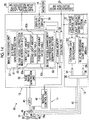
- an electronic endoscope system 10 includes an electronic endoscope 11 that images the inside of a subject, a processor device 12 that generates an endoscope image based on a signal obtained by imaging, a light source device 13 that generates light for illuminating the subject, and a monitor 14 that displays an endoscope image.
- the electronic endoscope 11 includes a flexible insertion unit 16 that is inserted into the body cavity, an operating unit 17 provided at the proximal end of the insertion unit 16, and a universal code 18 that makes a connection between the operating unit 17 and the processor device 12 and the light source device 13.
- the electronic endoscope system 10 has a function of generating a superficial blood vessel enhancement image or suppression image, in which a superficial blood vessel of a subject is enhanced/suppressed, and a medium-deep blood vessel enhancement image or suppression image, in which a medium-deep superficial blood vessel is enhanced/suppressed.
- Which blood vessel enhancement image or suppression image is to be generated is determined by the operation of a superficial layer and medium-deep layer selection SW 28 (refer to Fig. 2 ).
- the electronic endoscope system 10 has three observation modes of a first observation mode in which the inside of the subject is observed with illumination light in which the percentage of the blue component is approximately the same as the percentage of the green component, a second observation mode in which the inside of the subject is observed with illumination light in which the percentage of the blue component is larger than the percentage of the green component, and a third observation mode in which the inside of the subject is observed with illumination light in which the percentage of the green component is larger than the percentage of the blue component.
- the first to third observation modes are switched by an observation mode selection SW 29 (refer to Fig. 2 ).
- a curved portion 19 obtained by connecting a plurality of curved pieces is formed at the distal end of the insertion unit 16.
- the curved portion 19 is curved in the horizontal and vertical directions by operating an angle knob 21 of the operating unit.
- a distal portion 16a including an optical system for imaging the body cavity and the like is provided at the distal end of the curved portion 19. The distal portion 16a is directed in a desired direction within the body cavity by the bending operation of the curved portion 19.
- a connector 24 is attached to the universal code 18 on the side of the processor device 12 and the light source device 13.
- the connector 24 is a composite connector including a communication connector and a light source connector, and the electronic endoscope 11 is detachably connected to the processor device 12 and the light source device 13 through the connector 24.
- the light source device 13 (a form of illumination means) includes a broadband light source 30, a blue narrowband light source 33, a coupler 36, and a light source control unit 37.
- the broadband light source 30 includes an excitation light source 30a that emits excitation light having a center wavelength of 445 nm and a phosphor 30b that is excited to emit fluorescent light of green to red due to the excitation light from the excitation light source 30a.
- the excitation light source 30a is a semiconductor light source, such as a light emitting diode (LED) or a laser diode (LD).
- a broad area type InGaN-based laser diode can be used.
- an InGaNAs-based laser diode, a GaNAs-based laser diode, or the like can also be used.
- the phosphor 30b is configured to contain a plurality of kinds of fluorescent materials (for example, a YAG-based fluorescent material or a fluorescent material, such as BAM (BaMgAl 10 O 17 )) that absorb a part of excitation light and are excited to emit light of green to red. Accordingly, by combining the emitted excitation light (fluorescent light) of green to red emitted from the phosphor 30b with excitation light that is transmitted through the phosphor 30b without being absorbed by the phosphor 30b, white light BB (pseudo white light) having an emission spectrum shown in Fig. 3 is generated. The generated white light BB is incident on a broadband optical fiber 34.
- fluorescent materials for example, a YAG-based fluorescent material or a fluorescent material, such as BAM (BaMgAl 10 O 17 )
- the phosphor 30b may have an approximately rectangular parallelepiped shape.
- the phosphor 30b may be formed by solidifying a phosphor material in an approximately rectangular parallelepiped shape using a binder, or may be formed in an approximately rectangular parallelepiped shape by mixing a phosphor material with resin, such as inorganic glass.
- the phosphor 30b is also referred to as a Micro White (MW, registered trademark) as a product name.
- the blue narrowband light source 33 is a light emitting diode (LED), a laser diode (LD), or the like. As shown in Fig. 3 , the blue narrowband light source 33 generates blue narrowband light BN having a limited wavelength of 400 ⁇ 10 nm (center wavelength of 405 nm). The blue narrowband light BN emitted from the blue narrowband light source 33 is incident on a narrowband optical fiber 35.
- LED light emitting diode
- LD laser diode
- the coupler 36 connects a light guide 43 in the electronic endoscope 11 to the broadband optical fiber 34 and the narrowband optical fiber 35. Therefore, both the white light BB and the blue narrowband light BN are simultaneously incident on the light guide 43.
- the light source control unit 37 controls the light amount of the excitation light source 30a and the blue narrowband light source 33 to maintain the light amount ratio of the white light BB and the blue narrowband light BN constant.
- the light amount ratio is set by a light amount ratio setting section 37a. Since the light amount ratio is set in advance for each of the first to third observation modes, the light amount ratio setting section 37a sets a light amount ratio corresponding to the observation mode selected by the observation mode selection SW 29.
- the first light amount ratio in the first observation mode is set such that the percentage of the blue component of the illumination light irradiated to the subject is approximately the same as the percentage of the green component of the illumination light.
- the second light amount ratio in the second observation mode is set such that the percentage of the blue component of the illumination light is larger than the percentage of the green component of the illumination light.
- the third light amount ratio in the third observation mode is set such that the percentage of the green component of the illumination light is larger than the percentage of the blue component of the illumination light.
- the light amount of the blue narrowband light BN be set to about 10% of the maximum light amount.
- the electronic endoscope 11 includes the light guide 43, a CCD 44, an analog processing circuit 45 (analog front end: AFE), and an imaging control unit 46.
- the light guide 43 is a large-diameter optical fiber, a bundle fiber, or the like, and the incidence end is inserted into the coupler 36 in the light source device and the exit end is directed toward an irradiation lens 48 provided in the distal portion 16a.
- the white light BB and the blue narrowband light BN guided by the light guide 43 are irradiated into the subject through the irradiation lens 48 and an illumination window 49 attached to the end surface of the distal portion 16a.
- the white light BB and the blue narrowband light BN reflected within the subject are incident on a condensing lens 51 through an observation window 50 attached to the end surface of the distal portion 16a.
- the CCD 44 receives light from the condensing lens 51 through an imaging surface 44a, performs photoelectric conversion of the received light and accumulates signal charges, and reads the accumulated signal charges as an imaging signal.
- the read imaging signal is transmitted to an AFE 45.
- the CCD 44 is a color CCD, and pixels of three colors of a B pixel in which a color filter of B color is provided, a G pixel in which a color filter of G color is provided, and an R pixel in which a color filter of R color is provided are arrayed on the imaging surface 44a.
- the CCD 44 it is preferable to adopt the Bayer array in which the ratio of B, G, and R pixels is 1:2:1.
- a form of image signal acquisition means is configured to include the condensing lens 51, the CCD 44 having the imaging surface 44a, and the AFE 45.
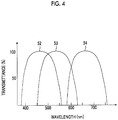
- the color filters of B, G, and R colors have transmission distributions 52, 53, and 54, respectively, as shown in Fig. 4 .
- the color filters of B, G, and R colors allow light having a wavelength corresponding to the transmission distributions 52, 53, and 54, of the white light BB, to be transmitted therethrough.
- a signal photoelectrically converted by the R pixel is a red signal R
- a signal photoelectrically converted by the G pixel is a green signal G
- a signal photoelectrically converted by the B pixel is a blue signal B.
- the AFE 45 is configured to include a correlated double sampling circuit (CDS), an automatic gain control circuit (AGC), and an analog/digital converter (A/D) (all not shown).
- the CDS performs correlated double sampling processing on an imaging signal from the CCD 44 to remove noise caused by the driving of the CCD 44.
- the AGC amplifies an imaging signal from which noise has been removed by the CDS.
- the A/D converts an imaging signal amplified by the AGC into a digital imaging signal of a predetermined number of bits, and inputs the digital imaging signal to the processor device 12.
- the imaging control unit 46 is connected to a controller 59 in the processor device 12, and transmits a driving signal to the CCD 44 when there is an instruction from the controller 59.
- the CCD 44 outputs an imaging signal to the AFE 45 at a predetermined frame rate based on the driving signal from the imaging control unit 46.
- the processor device 12 includes a base image generation unit 55, a frame memory 56, an image processing unit 57, and a display control circuit 58.
- the controller 59 controls each of the units.
- the base image generation unit 55 generates a base image by performing various kinds of signal processing on the blue signal B, the green signal G, and the red signal R output from the AFE 45 of the electronic endoscope.
- the generated base image is temporarily stored in the frame memory 56.
- the blue signal B, the green signal G, and the red signal R output from the AFE 45 are stored in the frame memory 56.
- the base image may be a pseudo color image obtained by pseudo coloring of blood vessel function information, such as oxygen saturation.
- the image processing unit 57 includes a B/G image generation section 61 (a form of multi-color image generation means), a blood vessel extraction image generation section 63, and a blood vessel enhancement image or suppression image generation section 65 (a form of blood vessel enhancement image or suppression image generation means).
- the B/G image generation section 61 generates a B/G image having a brightness ratio B/G (B/G ratio) between the blue signal B and the green signal G.
- B/G ratio indicates a brightness ratio of pixels at the same position between the blue signal B and the green signal G.
- the blood vessel extraction image generation section 63 generates a superficial blood vessel extraction image by extracting the superficial blood vessel based on the B/G image, or generates a medium-deep blood vessel extraction image by extracting the medium-deep blood vessel based on the B/G image.
- the method of generating the blood vessel extraction images differs depending on which of the first to third observation modes is set.
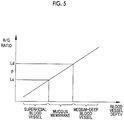
- a superficial blood vessel extraction image or a medium-deep blood vessel extraction image is generated using a first light amount ratio table 63a that is suitable for the first light amount ratio in the first observation mode. Correlation between the brightness ratio B/G and the blood vessel depth shown in Fig. 5 is stored in the first light amount ratio table 63a.
- a form of blood vessel extraction image generation means is configured to include a blood vessel extraction image generation section 63 and the first light amount ratio table 63a to a third light amount ratio table 63c.
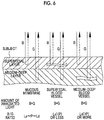
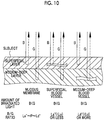
- the percentage of the blue component (B component) of the illumination light is approximately the same as the percentage of the green component (G component) of the illumination light. Therefore, as shown in Fig. 6 , when the illumination light is irradiated to the mucous membrane with no blood vessels, the ratio of the B and G components of the return light is approximately fixed. This is because there is no large light absorption in the mucous membrane. Assuming that the average B/G ratio in this case is P, the B/G ratio in the mucous membrane falls within a fixed range of "Ls to P to Ld".
- Ls is a lower limit of the B/G ratio of the mucous membrane in the first observation mode
- Ld is an upper limit of the B/G ratio of the mucous membrane in the first observation mode.
- the B component of the illumination light When illumination light is irradiated to a superficial blood vessel, the B component of the illumination light is largely absorbed by the superficial blood vessel, while the G component is not absorbed almost. For this reason, the B/G ratio is equal to or less than Ls in most cases. Therefore, it can be seen that the superficial blood vessel is projected to the pixel having a B/G ratio equal to or less than Ls (that is, Ls is a boundary value between the mucous membrane and the superficial blood vessel).
- Ls is a boundary value between the mucous membrane and the superficial blood vessel.
- the B/G ratio is equal to or greater than Ld in most cases. Therefore, it can be seen that the medium-deep blood vessel is projected to the pixel having a B/G ratio equal to or larger than Ld (that is, Ld is a boundary value between the mucous membrane and the medium-deep blood vessel).
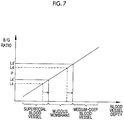
- a superficial blood vessel extraction image or a medium-deep blood vessel extraction image is generated using a second light amount ratio table 63b that is suitable for the second light amount ratio in the second observation mode.
- the second light amount ratio table 63b shows a proportional relationship in which the brightness ratio B/G (B/G ratio) increases as the blood vessel depth increases.
- the B/G ratio is generally high.
- a boundary value Ls' between the mucous membrane and the superficial blood vessel is larger than the boundary value Ls in the first observation mode
- a boundary value Ld' between the mucous membrane and the medium-deep blood vessel is larger than the boundary value Ld in the first observation mode
- a superficial blood vessel extraction image or a medium-deep blood vessel extraction image is generated using a third light amount ratio table 63c that is suitable for the third light amount ratio in the third observation mode.
- the third light amount ratio table 63c shows a proportional relationship in which the brightness ratio B/G (B/G ratio) increases as the blood vessel depth increases.
- the B/G ratio is generally low.
- a boundary value Ls" between the mucous membrane and the superficial blood vessel is smaller than the boundary value Ls in the first observation mode
- a boundary value Ld" between the mucous membrane and the medium-deep blood vessel is smaller than the boundary value Ld in the first observation mode
- the blood vessel enhancement image or suppression image generation section 65 generates a superficial blood vessel enhancement image or suppression image, in which a superficial blood vessel is enhanced (or suppressed), by combining the superficial blood vessel extraction image and the base image, and generates a medium-deep blood vessel enhancement image or suppression image, in which a medium-deep blood vessel is enhanced (or suppressed), by combining the medium-deep blood vessel extraction image and the base image.
- a value obtained by increasing the pixel value of each pixel in the superficial blood vessel extraction image (or a medium-deep blood vessel extraction image) several times is added to the pixel value of each pixel of the base image.
- a value obtained by increasing the pixel value of each pixel in the superficial blood vessel extraction image (or a medium-deep blood vessel extraction image) several times is subtracted from the pixel value of each pixel of the base image.
- the display control circuit 58 displays the blood vessel enhancement image or suppression image on the monitor 14 (a form of display means). For example, as shown in Fig. 11 , when a superficial blood vessel 71 extracted from the B/G image is enhanced on the blood vessel enhancement image or suppression image, diagnosis focusing on only the superficial blood vessel 71 is possible since the superficial blood vessel 71 is noticeable compared with a medium-deep blood vessel 72. In contrast, as shown in Fig. 12 , when the medium-deep blood vessel 72 extracted from the B/G image is enhanced on the blood vessel enhancement image or suppression image, diagnosis focusing on only the medium-deep blood vessel 72 is possible since the medium-deep blood vessel 72 is noticeable compared with the superficial blood vessel 71.
- blood vessels are divided into the superficial blood vessel and the medium-deep blood vessel so as to be separately extracted and each of the superficial blood vessel and the medium-deep blood vessel is separately enhanced/suppressed, diagnosis focusing on the superficial blood vessel or diagnosis focusing on the medium-deep blood vessel is possible.
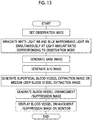
- a predetermined observation mode of the first to third observation modes is set.
- a light amount ratio (light amount ratio between the white light BB and the blue narrowband light BN) corresponding to the predetermined observation mode is set.
- the light amount of the white light BB and the blue narrowband light BN which are emitted from the light source device 13 and are irradiated simultaneously into the subject through the light guide 43, is controlled so as to become the set light amount.
- Reflected light from the subject is imaged by the color CCD 44.
- a base image is generated from the blue signal B, the green signal G, and the red signal R obtained by this imaging.
- the generated base image, the blue signal B, the green signal G, and the red signal R are temporarily stored in the frame memory 56.
- the B/G image generation section 61 generates a B/G image having the brightness ratio B/G between the blue signal B and the green signal G.
- a superficial blood vessel extraction image is generated by extracting the superficial blood vessel from the B/G image
- a medium-deep blood vessel extraction image is generated by extracting the medium-deep blood vessel from the B/G image.
- a light amount ratio table corresponding to the set light amount ratio is used for the blood vessel extraction. If the blood vessel extraction image is generated, a blood vessel enhancement image or suppression image in which a superficial blood vessel (or a medium-deep blood vessel) is enhanced/suppressed is generated from the superficial blood vessel extraction image (or the medium-deep blood vessel extraction image) and the base image.
- the generated blood vessel enhancement image or suppression image is converted into a signal, which can be displayed on a monitor, by the display control circuit 58 and is then image-displayed on the monitor 14 as shown in Fig. 11 or 12 .
- the second observation mode is set in which the inside of the subject is observed with illumination light in which the percentage of the blue component is larger than the percentage of the green component
- a pseudo color image in which the superficial blood vessel and the medium-deep blood vessel are displayed in different colors, is displayed on the monitor 14.
- the white light BB is emitted from the broadband light source 30 in the light source device 13.
- fluorescent light may be emitted by providing a phosphor 100 in the distal portion 16a of the electronic endoscope 11 and exciting the phosphor 30b with excitation light from an excitation light source 101 provided in the light source device 13, as shown in Fig. 14 .
- light obtained by combining the fluorescent light and excitation light, which is not absorbed by the phosphor 100 is irradiated into the subject as the white light BB.
- the phosphor 100 is the same as the phosphor 30b of the embodiment described above
- the excitation light source 101 is the same as the excitation light source 30a of the embodiment described above.
- the white light from the phosphor is irradiated into the subject.
- some of a plurality of illumination light beams to illuminate the inside of the subject may be light from a semiconductor light source, and the other light beams may be light wavelength-separated from the white light of a xenon lamp or the like.
- an electronic endoscope system 100 shown in Fig. 15 is used.
- the electronic endoscope system 100 is different from the electronic endoscope system 10 in that an entire light source device 113 is different from the light source device 13 and a CCD 101 of an electronic endoscope 111 is a monochrome CCD.
- the electronic endoscope system 100 has a normal observation mode, in which the inside of the subject is observed with illumination light of three colors of blue light, green light, and red light, and first to third special observation modes, in which the inside of the subject is observed with illumination light of two colors of blue narrowband light and green light.
- the light amount of the blue narrowband light and the light amount of the green light are different in the first to third special observation modes.
- the first special observation mode the light amount of the blue narrowband light and the light amount of the green light are equal.
- the second special observation mode the light amount of the blue narrowband light is larger than the light amount of the green light.
- the third special observation mode the light amount of the green light is larger than the light amount of the blue narrowband light. That is, the first to third special observation modes approximately correspond to the first to third observation modes of the embodiment described above. Therefore, blood vessel extraction methods in the first to third special observation modes are performed in the same manner as in the first to third observation modes. Since others are almost the same as in the embodiment described above, detailed explanation thereof will be omitted.
- the light source device 113 includes a white light source unit 130, a semiconductor light source unit 131, and a light source control unit 132 that drives and controls them.
- the white light source unit 130 includes a lamp body 130a to emit the white light BB and an aperture 130b provided on the optical path of the lamp body 130a.
- the lamp body 130a generates broadband light (white light) BB in which the emission spectrum is continuous in a wide wavelength range from a red region to a blue area (about 400 nm to 700 nm), like a xenon lamp, a halogen lamp, and a metal halide lamp.
- the lamp body 130a is always lit while the light source device 113 is ON.
- the degree of opening of the aperture 130b is adjusted by the driving control of the light source control unit 132.
- the light amount of the white light BB is adjusted by the adjustment of the degree of opening.
- a rotary filter 134 is disposed on the optical path of the white light BB.
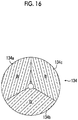
- the rotary filter 134 has a disc shape, and is divided into three regions, each of which is a fan-shaped region having a central angle of 120°, in the circumferential direction, and a B filter portion 134a, a G filter portion 134b, and an R filter portion 134c through which light beams of B, G, and R are respectively transmitted are provided in the three regions.
- the B filter portion 134a, the G filter portion 134b, and the R filter portion 134c have spectral transmittances shown in Fig. 17 .
- the B filter portion 134a allows blue light (B color light) of the white light BB to be transmitted therethrough
- the G filter portion 134b allows green light (G color light) of the white light BB to be transmitted therethrough
- the R filter portion 134c allows red light (R color light) of the white light BB to be transmitted therethrough.
- the transmission band of the G filter portion 134b be set such that the center wavelength of the G color light becomes 530 nm. Since the absorption coefficient of hemoglobin is high in a region near the wavelength of 530 nm, it is possible to increase the contrast between blood vessels and other parts by irradiating the blood vessels with light of this wavelength range.
- the rotary filter 134 is rotatably provided so that the B filter portion 134a, the G filter portion 134b, and the R filter portion 134c are selectively inserted into the optical path of the white light BB.
- the rotary filter 134 is rotated, the B filter portion 134a, the G filter portion 134b, and the R filter portion 134c are sequentially inserted into the optical path of the white light BB.
- the semiconductor light source unit 131 includes a blue semiconductor light source 131a, which is a laser diode (LD) or a light emitting diode (LED), and a driving section 131b for driving the blue semiconductor light source 131a.
- the blue semiconductor light source 131a emits the blue narrowband light BN having a center wavelength of 420 nm (refer to Fig. 17 ). Since the absorption coefficient of hemoglobin is high in a region near the wavelength of 420 nm, it is possible to increase the contrast between blood vessels and other parts by irradiating the blood vessels with light in this wavelength range.
- the driving section 131b is connected to the light source control unit 132.
- the light source control unit 132 adjusts ON/OFF and the amount of light of the blue semiconductor light source 131a by controlling the driving section 131b.
- a laser diode used for the blue semiconductor light source 131a a broad area type InGaN-based laser diode, an InGaNAs-based laser diode, and a GaNAs-based laser diode can be used.
- the light merging section 139 is formed of a dichroic mirror, and allows the B color light, the G color light, and the R color light to be transmitted therethrough as they are and makes the blue narrowband light BN curved by 90° to merge into the optical path of the B color light, the G color light, and the R color light.
- the light transmitted through the light merging section 139 is incident on the light guide 43 through a condensing lens 136.
- a shutter plate 140 is disposed between the rotary filter 134 and the white light source unit 130.
- the shutter plate 40 blocks the white light BB when supplying the blue narrowband light BN to the electronic endoscope 11.
- the shutter plate 140 is a member having a light blocking property for the white light BB, and its planar shape is a shape obtained by cutting a part of a circle.
- the shutter plate 140 has a light blocking portion 140a having a central angle of 240°, and the remaining 120° portion is cut to become a transmission portion 140b through which the white light BB is transmitted.
- the shutter plate 140 is rotatably provided, and the light blocking portion 140a and the transmission portion 140b are inserted alternately selectively into the optical path of the white light BB by rotation.
- the shutter plate 140 has almost the same radius as the rotary filter 134, and the rotation axis matches that of the rotary filter 134.
- the central angle of the transmission portion 140b of the shutter plate 140 is almost the same as that of each of the B filter portion 134a, the G filter portion 134b, and the R filter portion 134c of the rotary filter 34.
- the transmission portion 140b is formed by cutting in this example, the transmission portion 140b may be formed of a transparent plate through which the white light BB is transmitted.
- the rotation of the shutter plate 140 is controlled by the light source control unit 132.
- the rotation control changes with each observation mode.
- the shutter plate 140 In the normal observation mode, the shutter plate 140 is stopped in a state where the light blocking portion 140a is retracted from the optical path of the white light BB and the transmission portion 140b is inserted into the optical path. Accordingly, the white light BB is always incident on the rotary filter 134. Along with this, light beams of three colors of B, G, and R colors are sequentially emitted from the rotary filter 134.
- the blue semiconductor light source 13 is always OFF.
- the shutter plate 140 rotates at the same speed as the rotary filter 134 so that the rotation phase of the transmission portion 140b and the rotation phase of the G filter portion 134b are the same. Accordingly, while the transmission portion 140b is inserted into the optical path of the white light BB and the light blocking portion 140a is retracted from the optical path, the white light BB is transmitted through the G filter portion 134b to generate G color light.
- the G color light is supplied to the electronic endoscope 11 after being transmitted through the condensing lens 136.
- the white light BB is blocked. While the white light BB is blocked, the blue semiconductor light source 131a is turned on to supply the blue narrowband light BN to the electronic endoscope 11. Since the CCD 101 is a monochrome imaging element, color mixing of the white light BB and the blue narrowband light BN is prevented by providing the shutter plate 140.
- the light source control unit 132 controls the degree of opening of the aperture 130b of the white light source unit 130 and the driving section 131b of the semiconductor light source unit 131. By this control, the light amount of the B color light, the G color light, and the R color light from the rotary filter 134 and the light amount of the blue narrowband light BN are adjusted.
- the light amount ratio between the G color light and the blue narrowband light BN used in the first to third special observation modes is set in advance for each of the special observation modes.
- the setting of the light amount ratio is performed by a light amount ratio setting section 132a.
- the light amount ratio setting section 132a sets a light amount ratio corresponding to the observation mode selected by the observation mode selection SW 29.
- the first light amount ratio in the first special observation mode is set such that the light amount of the G color light is same as the light amount of the blue narrowband light BN.
- the second light amount ratio in the second special observation mode is set such that the light amount of the blue narrowband light BN is larger than the light amount of the G color light.
- the third light amount ratio in the third special observation mode is set such that the light amount of the G color light is larger than the light amount of the blue narrowband light BN.
- the monochrome CCD 101 and the rotary filter 134 are used. For this reason, the method of controlling the imaging of the CCD 101 and the based image generation method in a base image 55 are different from those in the case of the CCD 44 of the embodiment described above.
- the CCD 101 performs an accumulation operation for accumulating signal charges and a read operation for reading the accumulated signal charges in an acquisition period of one frame.
- image light beams of three colors of B, G, and R are sequentially captured, and the blue signal B, the green signal G, and the red signal R are sequentially output. Then, based on the signals B, G, and R of three colors, a base image is generated. The operations described above are repeatedly performed while the normal observation mode is set.
- the blue signal B is sequentially output by capturing the image light of the blue narrowband light BN for a period of one frame of a period of two frames for which the blue narrowband light BN is irradiated into the subject.
- the green signal B is sequentially output by capturing the image light of the G color light for an irradiation period of one frame for which the G color light is irradiated into the subject. Then, based on the signals B and G of two colors, a base image is generated.
- the operations described above are repeatedly performed while the first to third special observation modes are set.
- light of the semiconductor light source is used as the blue light, and light obtained by wavelength-separating the white light BB is used as the green light.
- light of the semiconductor light source may be used as the green light, and light obtained by wavelength-separating the white light may be used as the blue light.
- medium-deep blood vessels and superficial blood vessels are separated from each other using the B/G ratio.
- the blood vessels can also be separated using calculation values obtained by calculation using two or more color signals having different pieces of color information, such as a G/B ratio, a B-G difference, a G-B difference, a B/(B + G) ratio, a G/(B + G) ratio, a B/R ratio, an R/B ratio, a B-R difference, an R-B difference, and a B/Y ratio.
- the relationship between the calculated value and the blood vessel depth is stored in a plurality of tables corresponding to the first to third observation modes (first to third light amount ratios), and the boundary value of the calculated value indicating the boundary between the mucous membrane and the superficial blood vessel and the boundary value of the calculated value indicating the boundary between the mucous membrane and the medium-deep blood vessel differ depending on each table.
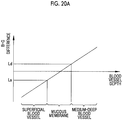
- the B-G difference a value obtained by subtracting the pixel value of the green signal from the pixel value of the blue signal
- the relationship between the B-G difference and the blood vessel depth shown in Fig. 20A is stored in a table that is used in the first observation mode.
- Ls indicates a B-G difference indicating the boundary between the mucous membrane and the superficial blood vessel
- Ld indicates a B-G difference indicating the boundary between the mucous membrane and the medium-deep blood vessel.
- the relationship between the B-G difference and the blood vessel depth shown in Fig. 20B is stored in a table that is used in the second observation mode.
- a B-G difference Ls' at the boundary between the mucous membrane and the superficial blood vessel is set to be larger than Ls
- a B-G difference Ld' at the boundary between the mucous membrane and the medium-deep blood vessel is set to be larger than Ld.
- the relationship between the B-G difference and the blood vessel depth shown in Fig. 20C is stored in a table that is used in the second observation mode.
- a B-G difference Ls" at the boundary between the mucous membrane and the superficial blood vessel is set to be smaller than Ls
- a B-G difference Ld" at the boundary between the mucous membrane and the medium-deep blood vessel is set to be smaller than Ld.
- the G/B ratio is a value obtained by dividing the green signal by the blue signal
- the B-G difference is a value obtained by subtracting the green signal from the blue signal
- the G-B difference is a value obtained by subtracting the blue signal from the green signal
- the B/(B + G) ratio is a value obtained by dividing the blue signal by the sum of the blue signal and the green signal
- the G/(B + G) ratio is a value obtained by dividing the green signal by the sum of the blue signal and the green signal
- the B/R ratio is a value obtained by dividing the blue signal by the red signal
- the R/B ratio is a value obtained by dividing the red signal by the blue signal
- the B-R difference is a value obtained by subtracting the red signal from the blue signal
- the R-B difference is a value obtained by subtracting the blue signal from the red signal
- the B/Y ratio is a value obtained by dividing the green signal by the yellow signal (yellow signal is a signal having wavelength information of 500
Landscapes
- Health & Medical Sciences (AREA)
- Life Sciences & Earth Sciences (AREA)
- Engineering & Computer Science (AREA)
- Surgery (AREA)
- Physics & Mathematics (AREA)
- General Health & Medical Sciences (AREA)
- Medical Informatics (AREA)
- Biomedical Technology (AREA)
- Molecular Biology (AREA)
- Biophysics (AREA)
- Animal Behavior & Ethology (AREA)
- Pathology (AREA)
- Public Health (AREA)
- Heart & Thoracic Surgery (AREA)
- Veterinary Medicine (AREA)
- Nuclear Medicine, Radiotherapy & Molecular Imaging (AREA)
- Radiology & Medical Imaging (AREA)
- Optics & Photonics (AREA)
- Theoretical Computer Science (AREA)
- General Physics & Mathematics (AREA)
- Computer Vision & Pattern Recognition (AREA)
- Quality & Reliability (AREA)
- Signal Processing (AREA)
- Vascular Medicine (AREA)
- Cardiology (AREA)
- Physiology (AREA)
- Multimedia (AREA)
- Endoscopes (AREA)
Claims (13)
- Endoskopsystem (10), umfassend:eine Beleuchtungseinrichtung (13), die eine Lichtemissionseinheit enthält, welche zwei oder mehr Beleuchtungslichtstrahlen emittiert, welche erstes Beleuchtungslicht und zweites Beleuchtungslicht mit unterschiedlichen Wellenlängenbereichen enthalten, und die ein Subjekt mit dem ersten Beleuchtungslicht und dem zweiten Beleuchtungslicht bestrahlt;eine Bildsignal-Erfassungseinrichtung, ausgebildet zum Erfassen von zwei oder mehr Farbsignalen mit unterschiedlichen Stücken von Farbinformation, indem von dem Subjekt zurückkehrendes Licht mithilfe eines Bildgebungselements empfangen und abgebildet wird; undeine Mehrfarbenbild-Erzeugungseinrichtung (61), ausgebildet zum Erzeugen eines Mehrfarbenbilds, gebildet aus berechneten Werten, die erhalten werden durch Ausführen einer vorbestimmten Berechnung für jedes Pixel unter Verwendung der zwei oder mehr Farbsignale;gekennzeichnet durcheine Lichtmengenverhältnis-Einstelleinheit (37a), die ein Lichtmengenverhältnis zwischen dem ersten Beleuchtungslicht und dem zweiten Beleuchtungslicht einstellt,wobei die Beleuchtungseinrichtung das Subjekt mit Beleuchtungslicht basierend auf dem von der Lichtmengenverhältnis-Einstelleinheit (37a) eingestellten Lichtmengenverhältnis bestrahlt, undeine Blutgefäß-Extrahierbild-Erzeugungseinrichtung (63), ausgebildet zum Erzeugen von mindestens einem von einem Erstschicht-Blutgefäß-Extrahierbild in einer spezifischen Tiefe aus dem Mehrfarbenbild, und einem Zweitschicht-Blutgefäß-Extrahierbild, das erhalten wird durch Extrahieren eines Zweitschicht-Blutgefäßes an einer Stelle tiefer als das Erstschicht-Blutgefäß, aus dem Mehrfarbenbild, indem an dem Mehrfarbenbild eine Blutgefäß-Extrahierverarbeitung ausgeführt wird, die abhängig von dem Lichtmengenverhältnis differiert.
- Endoskopsystem (10) nach Anspruch 1,
bei dem die Lichtmengenverhältnis-Einstelleinrichtung vorab eines von mehreren Lichtmengenverhältnissen einstellt, und
die Blutgefäß-Extrahierbild-Erzeugungseinrichtung (63) mehrere Berechnungswerttabellen enthält, die für die mehreren Lichtmengenverhältnisse eingerichtet sind und die eine Korrelation zwischen einer Schleimhaut, dem Erstschicht-Blutgefäß und dem Zweitschicht-Blutgefäß des Subjekts speichern, und die Blutgefäß-Extrahierbild-Erzeugungseinrichtung (63) mindestens eines von dem Erstschicht-Blutgefäß-Extrahierbild und dem Zweitschicht-Blutgefäß-Extrahierbild durch Ausführen einer Blutgefäß-Extrahierverarbeitung unter Verwendung einer solchen Berechnungswerttabelle ausführt, die dem von der Lichtmengenverhältnis-Einstelleinheit (37a) eingestellten Lichtmengenverhältnis entspricht. - Endoskopsystem (10) nach Anspruch 2,
bei dem in jeder der Berechnungswerttabellen ein Berechnungswert, der eine Grenze zwischen einer Schleimhaut und einem Erstschicht-Blutgefäß angibt, als erster Grenzwert gespeichert ist, und ein Berechnungswert, der eine Grenze zwischen der Schleimhaut und dem Zweitschicht-Blutgefäß angibt, als zweiter Grenzwert gespeichert ist, und
der erste und der zweite Grenzwert abhängig von jeder Berechnungswerttabelle differieren. - Endoskopsystem nach einem der Ansprüche 1 bis 3, weiterhin umfassend:
eine Blutgefäß-Verstärkungsbild- oder -Unterdrückungsbild-Erzeugungseinrichtung zum Erzeugen eines Erstschicht-Blutgefäß-Verstärkungsbilds oder -Unterdrückungsbilds, in welchem das Erstschicht-Blutgefäß verstärkt oder unterdrückt ist, unter Verwendung des Erstschicht-Blutgefäß-Extrahierbilds, oder zum Erzeugen eines Zweitschicht-Blutgefäß-Verstärkungsbilds oder -Unterdrückungsbilds, in welchem das Zweitschicht-Blutgefäß verstärkt bzw. unterdrückt wird, unter Verwendung des Zweitschicht-Blutgefäß-Extrahierbilds. - Endoskopsystem (10) nach Anspruch 4, weiterhin umfassend:
eine Anzeigeeinrichtung, ausgebildet zum Anzeigen mindestens eines von dem Erstschicht-Blutgefäß-Verstärkungsbild oder -Unterdrückungsbild und dem Zweitschicht-Blutgefäß-Verstärkungsbild oder -Unterdrückungsbild. - Endoskopsystem (10) nach einem der Ansprüche 1 bis 5,
bei dem die Beleuchtungseinrichtung erstes Beleuchtungslicht abstrahlt, welches blaues Anregungslicht und Fluoreszenzlicht enthält, welches von einem WellenlängenWandlerelement unter Verwendung des blauen Anregungslichts in der Wellenlänge umgewandelt wird, außerdem zweites Beleuchtungslicht, das einen Wellenlängenbereich enthält, bei dem eine Mittenwellenlänge auf einer kurzwelligeren Seite im Vergleich zu dem Anregungslicht liegt, gleichzeitig auf das Subjekt abstrahlt, und
die Bildsignal-Erfassungseinrichtung das Subjekt, auf welches das erste Beleuchtungslicht und das zweite Beleuchtungslicht gleichzeitig aufgestrahlt werden, unter Verwendung eines Farbbildgebungselements abbildet. - Endoskopsystem (10) nach Anspruch 6,
bei dem das Wellenlängenwandlerelement in einer von einem Endoskop, das das erste Beleuchtungslicht und das zweite Beleuchtungslicht auf das Subjekt abstrahlt, getrennten Lichtquelleneinrichtung vorgesehen ist. - Endoskopsystem (10) nach Anspruch 6,
bei dem das Wellenlängenwandlerelement an einem distalen Ende eines Endoskops vorgesehen ist, welches das erste Beleuchtungslicht und das zweite Beleuchtungslicht auf das Subjekt strahlt. - Endoskopsystem (10) nach einem der Ansprüche 6 bis 8,
bei dem eine Mittenwellenlänge des Anregungslichts 445 nm beträgt, und eine Mittenwellenlänge des zweiten Beleuchtungslichts 405 nm beträgt. - Endoskopsystem (10) nach einem der Ansprüche 1 bis 5,
bei dem das erste Beleuchtungslicht Beleuchtungslicht mit einer Mittenwellenlänge von 420 nm ist, und das zweite Beleuchtungslicht Beleuchtungslicht mit einer Mittenwellenlänge ovn 530 nm ist, - Endoskopsystem (10) nach einem der Ansprüche 1 bis 10,
bei dem die Farbsignale ein Blau-Signal mit Information einer Blaukomponente und ein Grün-Signal mit Information über eine Grünkomponente enthalten, und
das Mehrfarbenbild ein B/G-Bild mit einem B/G-Verhältnis ist, erhalten durch Dividieren des Blau-Signals durch das Grün-Signal für jedes Pixel. - Prozessoreinrichtung (12) des Endoskopsystems (10) nach einem der Ansprüche 1 bis 11, enthaltend eine Beleuchtungseinrichtung (13), die eine Lichtemissionseinheit, welche zwei oder mehr Beleuchtungslichtstrahlen emittiert, welche erstes Beleuchtungslicht und zweites Beleuchtungslicht mit voneinander unterschiedlichen Wellenlängenbereichen enthalten, und eine Lichtmengenverhältnis-Einstelleinheit (37a) enthält, die ein Lichtmengenverhältnis zwischen dem ersten Beleuchtungslicht und dem zweiten Beleuchtungslicht einstellt, wobei die Beleuchtungseinrichtung ein Subjekt mit dem ersten Beleuchtungslicht und dem zweiten Beleuchtungslicht basierend auf dem von der Lichtmengenverhältnis-Einstelleinheit (37a) eingestellten Lichtmengenverhältnis bestrahlt, ferner ein elektronisches Endoskop zum Erfassen von zwei oder mehr Farbsignalen mit unterschiedlichen Stücken von Farbinformation durch Empfangen und Abbilden von Rückkehrlicht von dem Subjekt unter Verwendung eines Bildgebungselements, wobei die Prozessoreinrichtung umfasst:eine Mehrfarbenbild-Erzeugungseinrichtung (61), ausgebildet zum Erzeugen eines Mehrfarbenbilds, gebildet aus berechneten Werten, die erhalten werden durch Ausführen einer vorbestimmten Berechnung für jedes Pixel unter Verwendung der zwei oder mehr Farbsignale;eine Blutgefäß-Extrahierbild-Erzeugungseinrichtung, ausgebildet zum Erzeugen von mindestens einem von einem Erstschicht-Blutgefäß-Extrahierbild, erhalten durch Extrahieren eines Erstschicht-Blutgefäßes in einer spezifischen Tiefe aus dem Mehrfarbenbild, und eines Zweitschicht-Blutgefäß-Extrahierbilds, erhalten durch Extrahieren eines Zweitschicht-Blutgefäßes an einer Stelle tiefer als das Erstschicht-Blutgefäß, aus dem Mehrfarbenbild, indem an dem Mehrfarbenbild eine Blutgefäß-Extrahierverarbeitung ausgeführt wird, die abhängig von dem Lichtmengenverhältnis differiert.
- Bildverarbeitungsverfahren, das in dem Endoskopsystem (10) nach den Ansprüchen 1 bis 12 ausgeführt wird, enthaltend eine Beleuchtungseinrichtung, die eine Lichtemissionseinheit enthält, welche zwei oder mehr Beleuchtungslichtstrahlen emittiert, welche erstes Beleuchtungslicht und zweites Beleuchtungslicht mit voneinander unterschiedlichen Wellenlängenbereichen enthalten, und eine Lichtmengenverhältnis-Einstelleinheit (37a) enthält, die ein Lichtmengenverhältnis zwischen dem ersten Beleuchtungslicht und dem zweiten Beleuchtungslicht einstellt, wobei die Beleuchtungseinrichtung ein Subjekt mit dem ersten Beleuchtungslicht und dem zweiten Beleuchtungslicht basierend auf dem von der Lichtmengenverhältnis-Einstelleinheit (37a) eingestellten Lichtmengenverhältnis bestrahlt, ferner ein elektronisches Endoskop zum Erfassen von zwei oder mehr Farbsignalen mit unterschiedlichen Stücken von Farbinformation durch Empfangen und Abbilden von Rückkehrlicht von dem Subjekt unter Verwendung eines Bildgebungselements, wobei das Bildverarbeitungsverfahren umfasst:Erzeugen eines Mehrfarbenbilds, gebildet aus berechneten Werten, die gewonnen werden durch Ausführen einer vorbestimmten Berechnung für jedes Pixel unter Verwendung der zwei oder mehr Farbsignale;Erzeugen mindestens einem von einem Erstschicht-Blutgefäß-Extrahierbild, erhalten durch Extrahieren eines Erstschicht-Blutgefäßes in einer spezifischen Tiefe aus dem Mehrfarbenbild, und einem Zweitschicht-Blutgefäß-Extrahierbild, erhalten durch Extrahieren eines Zweitschicht-Blutgefäßes an einer Stelle tiefer als das Erstschicht-Blutgefäß, aus dem Mehrfarbenbild, indem an dem Mehrfarbenbild eine Blutgefäß-Extrahierverarbeitung ausgeführt wird, die abhängig von dem Lichtmengenverhältnis differiert.
Applications Claiming Priority (2)
| Application Number | Priority Date | Filing Date | Title |
|---|---|---|---|
| JP2012013317A JP5815426B2 (ja) | 2012-01-25 | 2012-01-25 | 内視鏡システム、内視鏡システムのプロセッサ装置、及び画像処理方法 |
| PCT/JP2013/050361 WO2013111623A1 (ja) | 2012-01-25 | 2013-01-11 | 内視鏡システム、内視鏡システムのプロセッサ装置、及び画像処理方法 |
Publications (3)
| Publication Number | Publication Date |
|---|---|
| EP2807973A1 EP2807973A1 (de) | 2014-12-03 |
| EP2807973A4 EP2807973A4 (de) | 2016-04-20 |
| EP2807973B1 true EP2807973B1 (de) | 2019-09-11 |
Family
ID=48873345
Family Applications (1)
| Application Number | Title | Priority Date | Filing Date |
|---|---|---|---|
| EP13741638.4A Active EP2807973B1 (de) | 2012-01-25 | 2013-01-11 | Endoskopsystem, prozessorvorrichtung für ein endoskopsystem und bildverarbeitungsverfahren |
Country Status (5)
| Country | Link |
|---|---|
| US (1) | US9943230B2 (de) |
| EP (1) | EP2807973B1 (de) |
| JP (1) | JP5815426B2 (de) |
| CN (1) | CN104023618B (de) |
| WO (1) | WO2013111623A1 (de) |
Families Citing this family (165)
| Publication number | Priority date | Publication date | Assignee | Title |
|---|---|---|---|---|
| US11871901B2 (en) | 2012-05-20 | 2024-01-16 | Cilag Gmbh International | Method for situational awareness for surgical network or surgical network connected device capable of adjusting function based on a sensed situation or usage |
| JP5869541B2 (ja) * | 2013-09-13 | 2016-02-24 | 富士フイルム株式会社 | 内視鏡システム及びプロセッサ装置並びに内視鏡システムの作動方法 |
| WO2015151703A1 (ja) * | 2014-03-31 | 2015-10-08 | 富士フイルム株式会社 | 内視鏡システム及びその作動方法 |
| WO2016059906A1 (ja) * | 2014-10-16 | 2016-04-21 | オリンパス株式会社 | 内視鏡装置 |
| US11504192B2 (en) | 2014-10-30 | 2022-11-22 | Cilag Gmbh International | Method of hub communication with surgical instrument systems |
| JP6432770B2 (ja) | 2014-11-12 | 2018-12-05 | ソニー株式会社 | 画像処理装置、画像処理方法、並びにプログラム |
| CN107072476B (zh) * | 2014-11-20 | 2018-11-06 | 奥林巴斯株式会社 | 观察装置 |
| CN107072508B (zh) * | 2015-03-25 | 2019-12-20 | 奥林巴斯株式会社 | 观察系统 |
| WO2017057572A1 (ja) * | 2015-09-29 | 2017-04-06 | 富士フイルム株式会社 | 画像処理装置、内視鏡システム、及び画像処理方法 |
| JP6596502B2 (ja) * | 2015-10-08 | 2019-10-23 | オリンパス株式会社 | 内視鏡装置 |
| CN107427186B (zh) | 2016-01-08 | 2019-07-12 | Hoya株式会社 | 内窥镜装置 |
| WO2017141417A1 (ja) * | 2016-02-19 | 2017-08-24 | Hoya株式会社 | 内視鏡用光源装置 |
| JP6488249B2 (ja) | 2016-03-08 | 2019-03-20 | 富士フイルム株式会社 | 血管情報取得装置、内視鏡システム及び血管情報取得方法 |
| US10321816B2 (en) * | 2016-06-17 | 2019-06-18 | Fujifilm Corporation | Light source device and endoscope system |
| EP3533382A4 (de) * | 2016-10-27 | 2019-12-04 | Fujifilm Corporation | Endoskopisches system |
| JP6320592B2 (ja) * | 2017-03-21 | 2018-05-09 | 富士フイルム株式会社 | 内視鏡システム |
| JP6439083B1 (ja) * | 2017-05-02 | 2018-12-19 | オリンパス株式会社 | 内視鏡システム |
| WO2018229833A1 (ja) * | 2017-06-12 | 2018-12-20 | オリンパス株式会社 | 内視鏡システム |
| EP3673787A4 (de) * | 2017-08-23 | 2020-08-19 | FUJIFILM Corporation | Lichtquellenvorrichtung und endoskopsystem |
| US11317919B2 (en) | 2017-10-30 | 2022-05-03 | Cilag Gmbh International | Clip applier comprising a clip crimping system |
| US11510741B2 (en) | 2017-10-30 | 2022-11-29 | Cilag Gmbh International | Method for producing a surgical instrument comprising a smart electrical system |
| US11564756B2 (en) | 2017-10-30 | 2023-01-31 | Cilag Gmbh International | Method of hub communication with surgical instrument systems |
| US11801098B2 (en) | 2017-10-30 | 2023-10-31 | Cilag Gmbh International | Method of hub communication with surgical instrument systems |
| US11911045B2 (en) | 2017-10-30 | 2024-02-27 | Cllag GmbH International | Method for operating a powered articulating multi-clip applier |
| US11229436B2 (en) | 2017-10-30 | 2022-01-25 | Cilag Gmbh International | Surgical system comprising a surgical tool and a surgical hub |
| US11311342B2 (en) | 2017-10-30 | 2022-04-26 | Cilag Gmbh International | Method for communicating with surgical instrument systems |
| US11123070B2 (en) | 2017-10-30 | 2021-09-21 | Cilag Gmbh International | Clip applier comprising a rotatable clip magazine |
| US11291510B2 (en) | 2017-10-30 | 2022-04-05 | Cilag Gmbh International | Method of hub communication with surgical instrument systems |
| US10959744B2 (en) | 2017-10-30 | 2021-03-30 | Ethicon Llc | Surgical dissectors and manufacturing techniques |
| US11786251B2 (en) | 2017-12-28 | 2023-10-17 | Cilag Gmbh International | Method for adaptive control schemes for surgical network control and interaction |
| WO2019133144A1 (en) | 2017-12-28 | 2019-07-04 | Ethicon Llc | Detection and escalation of security responses of surgical instruments to increasing severity threats |
| US11364075B2 (en) | 2017-12-28 | 2022-06-21 | Cilag Gmbh International | Radio frequency energy device for delivering combined electrical signals |
| US11818052B2 (en) | 2017-12-28 | 2023-11-14 | Cilag Gmbh International | Surgical network determination of prioritization of communication, interaction, or processing based on system or device needs |
| US11896322B2 (en) | 2017-12-28 | 2024-02-13 | Cilag Gmbh International | Sensing the patient position and contact utilizing the mono-polar return pad electrode to provide situational awareness to the hub |
| US11147607B2 (en) | 2017-12-28 | 2021-10-19 | Cilag Gmbh International | Bipolar combination device that automatically adjusts pressure based on energy modality |
| US11253315B2 (en) | 2017-12-28 | 2022-02-22 | Cilag Gmbh International | Increasing radio frequency to create pad-less monopolar loop |
| US11937769B2 (en) | 2017-12-28 | 2024-03-26 | Cilag Gmbh International | Method of hub communication, processing, storage and display |
| US20190201112A1 (en) | 2017-12-28 | 2019-07-04 | Ethicon Llc | Computer implemented interactive surgical systems |
| US11202570B2 (en) | 2017-12-28 | 2021-12-21 | Cilag Gmbh International | Communication hub and storage device for storing parameters and status of a surgical device to be shared with cloud based analytics systems |
| US11423007B2 (en) | 2017-12-28 | 2022-08-23 | Cilag Gmbh International | Adjustment of device control programs based on stratified contextual data in addition to the data |
| US11969216B2 (en) | 2017-12-28 | 2024-04-30 | Cilag Gmbh International | Surgical network recommendations from real time analysis of procedure variables against a baseline highlighting differences from the optimal solution |
| US11903601B2 (en) | 2017-12-28 | 2024-02-20 | Cilag Gmbh International | Surgical instrument comprising a plurality of drive systems |
| US11109866B2 (en) | 2017-12-28 | 2021-09-07 | Cilag Gmbh International | Method for circular stapler control algorithm adjustment based on situational awareness |
| US10892995B2 (en) | 2017-12-28 | 2021-01-12 | Ethicon Llc | Surgical network determination of prioritization of communication, interaction, or processing based on system or device needs |
| US11696760B2 (en) | 2017-12-28 | 2023-07-11 | Cilag Gmbh International | Safety systems for smart powered surgical stapling |
| US20190201113A1 (en) | 2017-12-28 | 2019-07-04 | Ethicon Llc | Controls for robot-assisted surgical platforms |
| US11896443B2 (en) | 2017-12-28 | 2024-02-13 | Cilag Gmbh International | Control of a surgical system through a surgical barrier |
| US11273001B2 (en) | 2017-12-28 | 2022-03-15 | Cilag Gmbh International | Surgical hub and modular device response adjustment based on situational awareness |
| US11464559B2 (en) | 2017-12-28 | 2022-10-11 | Cilag Gmbh International | Estimating state of ultrasonic end effector and control system therefor |
| US11045591B2 (en) | 2017-12-28 | 2021-06-29 | Cilag Gmbh International | Dual in-series large and small droplet filters |
| US12458351B2 (en) | 2017-12-28 | 2025-11-04 | Cilag Gmbh International | Variable output cartridge sensor assembly |
| US11317937B2 (en) | 2018-03-08 | 2022-05-03 | Cilag Gmbh International | Determining the state of an ultrasonic end effector |
| US11419630B2 (en) | 2017-12-28 | 2022-08-23 | Cilag Gmbh International | Surgical system distributed processing |
| US11026751B2 (en) | 2017-12-28 | 2021-06-08 | Cilag Gmbh International | Display of alignment of staple cartridge to prior linear staple line |
| US11857152B2 (en) | 2017-12-28 | 2024-01-02 | Cilag Gmbh International | Surgical hub spatial awareness to determine devices in operating theater |
| US12396806B2 (en) | 2017-12-28 | 2025-08-26 | Cilag Gmbh International | Adjustment of a surgical device function based on situational awareness |
| US11304699B2 (en) | 2017-12-28 | 2022-04-19 | Cilag Gmbh International | Method for adaptive control schemes for surgical network control and interaction |
| US11308075B2 (en) | 2017-12-28 | 2022-04-19 | Cilag Gmbh International | Surgical network, instrument, and cloud responses based on validation of received dataset and authentication of its source and integrity |
| US20190206569A1 (en) | 2017-12-28 | 2019-07-04 | Ethicon Llc | Method of cloud based data analytics for use with the hub |
| US11969142B2 (en) | 2017-12-28 | 2024-04-30 | Cilag Gmbh International | Method of compressing tissue within a stapling device and simultaneously displaying the location of the tissue within the jaws |
| US11666331B2 (en) | 2017-12-28 | 2023-06-06 | Cilag Gmbh International | Systems for detecting proximity of surgical end effector to cancerous tissue |
| US11571234B2 (en) | 2017-12-28 | 2023-02-07 | Cilag Gmbh International | Temperature control of ultrasonic end effector and control system therefor |
| US11179208B2 (en) | 2017-12-28 | 2021-11-23 | Cilag Gmbh International | Cloud-based medical analytics for security and authentication trends and reactive measures |
| US11278281B2 (en) | 2017-12-28 | 2022-03-22 | Cilag Gmbh International | Interactive surgical system |
| US11284936B2 (en) | 2017-12-28 | 2022-03-29 | Cilag Gmbh International | Surgical instrument having a flexible electrode |
| US11069012B2 (en) | 2017-12-28 | 2021-07-20 | Cilag Gmbh International | Interactive surgical systems with condition handling of devices and data capabilities |
| US11096693B2 (en) | 2017-12-28 | 2021-08-24 | Cilag Gmbh International | Adjustment of staple height of at least one row of staples based on the sensed tissue thickness or force in closing |
| US11576677B2 (en) | 2017-12-28 | 2023-02-14 | Cilag Gmbh International | Method of hub communication, processing, display, and cloud analytics |
| US11602393B2 (en) | 2017-12-28 | 2023-03-14 | Cilag Gmbh International | Surgical evacuation sensing and generator control |
| US20190201090A1 (en) | 2017-12-28 | 2019-07-04 | Ethicon Llc | Capacitive coupled return path pad with separable array elements |
| US11559307B2 (en) | 2017-12-28 | 2023-01-24 | Cilag Gmbh International | Method of robotic hub communication, detection, and control |
| US11166772B2 (en) | 2017-12-28 | 2021-11-09 | Cilag Gmbh International | Surgical hub coordination of control and communication of operating room devices |
| US10943454B2 (en) | 2017-12-28 | 2021-03-09 | Ethicon Llc | Detection and escalation of security responses of surgical instruments to increasing severity threats |
| US11304763B2 (en) | 2017-12-28 | 2022-04-19 | Cilag Gmbh International | Image capturing of the areas outside the abdomen to improve placement and control of a surgical device in use |
| US11132462B2 (en) | 2017-12-28 | 2021-09-28 | Cilag Gmbh International | Data stripping method to interrogate patient records and create anonymized record |
| US11589888B2 (en) | 2017-12-28 | 2023-02-28 | Cilag Gmbh International | Method for controlling smart energy devices |
| US11832840B2 (en) | 2017-12-28 | 2023-12-05 | Cilag Gmbh International | Surgical instrument having a flexible circuit |
| US11744604B2 (en) | 2017-12-28 | 2023-09-05 | Cilag Gmbh International | Surgical instrument with a hardware-only control circuit |
| US10758310B2 (en) | 2017-12-28 | 2020-09-01 | Ethicon Llc | Wireless pairing of a surgical device with another device within a sterile surgical field based on the usage and situational awareness of devices |
| US11424027B2 (en) | 2017-12-28 | 2022-08-23 | Cilag Gmbh International | Method for operating surgical instrument systems |
| US11659023B2 (en) | 2017-12-28 | 2023-05-23 | Cilag Gmbh International | Method of hub communication |
| US11160605B2 (en) | 2017-12-28 | 2021-11-02 | Cilag Gmbh International | Surgical evacuation sensing and motor control |
| US11324557B2 (en) | 2017-12-28 | 2022-05-10 | Cilag Gmbh International | Surgical instrument with a sensing array |
| US11446052B2 (en) | 2017-12-28 | 2022-09-20 | Cilag Gmbh International | Variation of radio frequency and ultrasonic power level in cooperation with varying clamp arm pressure to achieve predefined heat flux or power applied to tissue |
| US11559308B2 (en) | 2017-12-28 | 2023-01-24 | Cilag Gmbh International | Method for smart energy device infrastructure |
| US11389164B2 (en) | 2017-12-28 | 2022-07-19 | Cilag Gmbh International | Method of using reinforced flexible circuits with multiple sensors to optimize performance of radio frequency devices |
| US20190201039A1 (en) | 2017-12-28 | 2019-07-04 | Ethicon Llc | Situational awareness of electrosurgical systems |
| US11464535B2 (en) | 2017-12-28 | 2022-10-11 | Cilag Gmbh International | Detection of end effector emersion in liquid |
| US12062442B2 (en) | 2017-12-28 | 2024-08-13 | Cilag Gmbh International | Method for operating surgical instrument systems |
| US10987178B2 (en) | 2017-12-28 | 2021-04-27 | Ethicon Llc | Surgical hub control arrangements |
| US10966791B2 (en) | 2017-12-28 | 2021-04-06 | Ethicon Llc | Cloud-based medical analytics for medical facility segmented individualization of instrument function |
| US11234756B2 (en) | 2017-12-28 | 2022-02-01 | Cilag Gmbh International | Powered surgical tool with predefined adjustable control algorithm for controlling end effector parameter |
| US11864728B2 (en) | 2017-12-28 | 2024-01-09 | Cilag Gmbh International | Characterization of tissue irregularities through the use of mono-chromatic light refractivity |
| US11311306B2 (en) | 2017-12-28 | 2022-04-26 | Cilag Gmbh International | Surgical systems for detecting end effector tissue distribution irregularities |
| BR112020013021A2 (pt) | 2017-12-28 | 2020-11-24 | Ethicon Llc | ajuste de uma função do dispositivo cirúrgico com base em reconhecimento situacional |
| US11529187B2 (en) | 2017-12-28 | 2022-12-20 | Cilag Gmbh International | Surgical evacuation sensor arrangements |
| US11304745B2 (en) | 2017-12-28 | 2022-04-19 | Cilag Gmbh International | Surgical evacuation sensing and display |
| US11266468B2 (en) | 2017-12-28 | 2022-03-08 | Cilag Gmbh International | Cooperative utilization of data derived from secondary sources by intelligent surgical hubs |
| US11100631B2 (en) | 2017-12-28 | 2021-08-24 | Cilag Gmbh International | Use of laser light and red-green-blue coloration to determine properties of back scattered light |
| US11633237B2 (en) | 2017-12-28 | 2023-04-25 | Cilag Gmbh International | Usage and technique analysis of surgeon / staff performance against a baseline to optimize device utilization and performance for both current and future procedures |
| US12376855B2 (en) | 2017-12-28 | 2025-08-05 | Cilag Gmbh International | Safety systems for smart powered surgical stapling |
| US11998193B2 (en) | 2017-12-28 | 2024-06-04 | Cilag Gmbh International | Method for usage of the shroud as an aspect of sensing or controlling a powered surgical device, and a control algorithm to adjust its default operation |
| US11257589B2 (en) | 2017-12-28 | 2022-02-22 | Cilag Gmbh International | Real-time analysis of comprehensive cost of all instrumentation used in surgery utilizing data fluidity to track instruments through stocking and in-house processes |
| US11304720B2 (en) | 2017-12-28 | 2022-04-19 | Cilag Gmbh International | Activation of energy devices |
| US11291495B2 (en) | 2017-12-28 | 2022-04-05 | Cilag Gmbh International | Interruption of energy due to inadvertent capacitive coupling |
| US11832899B2 (en) | 2017-12-28 | 2023-12-05 | Cilag Gmbh International | Surgical systems with autonomously adjustable control programs |
| US11540855B2 (en) | 2017-12-28 | 2023-01-03 | Cilag Gmbh International | Controlling activation of an ultrasonic surgical instrument according to the presence of tissue |
| US10918310B2 (en) | 2018-01-03 | 2021-02-16 | Biosense Webster (Israel) Ltd. | Fast anatomical mapping (FAM) using volume filling |
| US11786245B2 (en) | 2017-12-28 | 2023-10-17 | Cilag Gmbh International | Surgical systems with prioritized data transmission capabilities |
| US11678881B2 (en) | 2017-12-28 | 2023-06-20 | Cilag Gmbh International | Spatial awareness of surgical hubs in operating rooms |
| US11056244B2 (en) | 2017-12-28 | 2021-07-06 | Cilag Gmbh International | Automated data scaling, alignment, and organizing based on predefined parameters within surgical networks |
| US11376002B2 (en) | 2017-12-28 | 2022-07-05 | Cilag Gmbh International | Surgical instrument cartridge sensor assemblies |
| US11051876B2 (en) | 2017-12-28 | 2021-07-06 | Cilag Gmbh International | Surgical evacuation flow paths |
| US11410259B2 (en) | 2017-12-28 | 2022-08-09 | Cilag Gmbh International | Adaptive control program updates for surgical devices |
| US11612408B2 (en) | 2017-12-28 | 2023-03-28 | Cilag Gmbh International | Determining tissue composition via an ultrasonic system |
| US11419667B2 (en) | 2017-12-28 | 2022-08-23 | Cilag Gmbh International | Ultrasonic energy device which varies pressure applied by clamp arm to provide threshold control pressure at a cut progression location |
| US11058498B2 (en) | 2017-12-28 | 2021-07-13 | Cilag Gmbh International | Cooperative surgical actions for robot-assisted surgical platforms |
| US11076921B2 (en) | 2017-12-28 | 2021-08-03 | Cilag Gmbh International | Adaptive control program updates for surgical hubs |
| US11432885B2 (en) | 2017-12-28 | 2022-09-06 | Cilag Gmbh International | Sensing arrangements for robot-assisted surgical platforms |
| US12127729B2 (en) | 2017-12-28 | 2024-10-29 | Cilag Gmbh International | Method for smoke evacuation for surgical hub |
| US11612444B2 (en) | 2017-12-28 | 2023-03-28 | Cilag Gmbh International | Adjustment of a surgical device function based on situational awareness |
| US12096916B2 (en) | 2017-12-28 | 2024-09-24 | Cilag Gmbh International | Method of sensing particulate from smoke evacuated from a patient, adjusting the pump speed based on the sensed information, and communicating the functional parameters of the system to the hub |
| WO2019151190A1 (ja) * | 2018-01-30 | 2019-08-08 | 富士フイルム株式会社 | 内視鏡システム及びその作動方法 |
| US11259830B2 (en) | 2018-03-08 | 2022-03-01 | Cilag Gmbh International | Methods for controlling temperature in ultrasonic device |
| US11701162B2 (en) | 2018-03-08 | 2023-07-18 | Cilag Gmbh International | Smart blade application for reusable and disposable devices |
| US11707293B2 (en) | 2018-03-08 | 2023-07-25 | Cilag Gmbh International | Ultrasonic sealing algorithm with temperature control |
| US12303159B2 (en) | 2018-03-08 | 2025-05-20 | Cilag Gmbh International | Methods for estimating and controlling state of ultrasonic end effector |
| US10973520B2 (en) | 2018-03-28 | 2021-04-13 | Ethicon Llc | Surgical staple cartridge with firing member driven camming assembly that has an onboard tissue cutting feature |
| US11096688B2 (en) | 2018-03-28 | 2021-08-24 | Cilag Gmbh International | Rotary driven firing members with different anvil and channel engagement features |
| US11219453B2 (en) | 2018-03-28 | 2022-01-11 | Cilag Gmbh International | Surgical stapling devices with cartridge compatible closure and firing lockout arrangements |
| US11207067B2 (en) | 2018-03-28 | 2021-12-28 | Cilag Gmbh International | Surgical stapling device with separate rotary driven closure and firing systems and firing member that engages both jaws while firing |
| US11589865B2 (en) | 2018-03-28 | 2023-02-28 | Cilag Gmbh International | Methods for controlling a powered surgical stapler that has separate rotary closure and firing systems |
| US11278280B2 (en) | 2018-03-28 | 2022-03-22 | Cilag Gmbh International | Surgical instrument comprising a jaw closure lockout |
| US11471156B2 (en) | 2018-03-28 | 2022-10-18 | Cilag Gmbh International | Surgical stapling devices with improved rotary driven closure systems |
| US11166716B2 (en) | 2018-03-28 | 2021-11-09 | Cilag Gmbh International | Stapling instrument comprising a deactivatable lockout |
| US11090047B2 (en) | 2018-03-28 | 2021-08-17 | Cilag Gmbh International | Surgical instrument comprising an adaptive control system |
| WO2019220859A1 (ja) * | 2018-05-14 | 2019-11-21 | 富士フイルム株式会社 | 画像処理装置、内視鏡システム、及び画像処理方法 |
| JP7093409B2 (ja) | 2018-06-05 | 2022-06-29 | オリンパス株式会社 | 内視鏡システム |
| CN112236067B (zh) | 2018-06-05 | 2024-08-20 | 奥林巴斯株式会社 | 内窥镜系统 |
| WO2019244247A1 (ja) * | 2018-06-19 | 2019-12-26 | オリンパス株式会社 | 内視鏡装置、内視鏡装置の作動方法及びプログラム |
| JP2021191313A (ja) * | 2018-06-19 | 2021-12-16 | オリンパス株式会社 | 内視鏡システム及び内視鏡システムの作動方法 |
| EP3620098B1 (de) * | 2018-09-07 | 2021-11-03 | Ambu A/S | Verbesserung der sichtbarkeit von blutgefässen in farbbildern |
| CN109199312A (zh) * | 2018-09-10 | 2019-01-15 | 苏州新光维医疗科技有限公司 | 光源的调节方法、装置、设备及内窥镜 |
| US11357503B2 (en) | 2019-02-19 | 2022-06-14 | Cilag Gmbh International | Staple cartridge retainers with frangible retention features and methods of using same |
| US11298129B2 (en) | 2019-02-19 | 2022-04-12 | Cilag Gmbh International | Method for providing an authentication lockout in a surgical stapler with a replaceable cartridge |
| US11317915B2 (en) | 2019-02-19 | 2022-05-03 | Cilag Gmbh International | Universal cartridge based key feature that unlocks multiple lockout arrangements in different surgical staplers |
| US11369377B2 (en) | 2019-02-19 | 2022-06-28 | Cilag Gmbh International | Surgical stapling assembly with cartridge based retainer configured to unlock a firing lockout |
| US11751872B2 (en) | 2019-02-19 | 2023-09-12 | Cilag Gmbh International | Insertable deactivator element for surgical stapler lockouts |
| JP2019122865A (ja) * | 2019-05-10 | 2019-07-25 | 富士フイルム株式会社 | 内視鏡光源装置、内視鏡システム、及び内視鏡光源装置の作動方法 |
| US11744453B2 (en) * | 2019-06-13 | 2023-09-05 | Boston Scientific Scimed, Inc. | Methods and apparatus to detect bleeding vessels |
| USD964564S1 (en) | 2019-06-25 | 2022-09-20 | Cilag Gmbh International | Surgical staple cartridge retainer with a closure system authentication key |
| USD952144S1 (en) | 2019-06-25 | 2022-05-17 | Cilag Gmbh International | Surgical staple cartridge retainer with firing system authentication key |
| USD950728S1 (en) | 2019-06-25 | 2022-05-03 | Cilag Gmbh International | Surgical staple cartridge |
| CN114554932A (zh) | 2019-10-10 | 2022-05-27 | 富士胶片株式会社 | 内窥镜系统及其工作方法 |
| JP7324307B2 (ja) * | 2019-12-04 | 2023-08-09 | オリンパス株式会社 | 光源装置、内視鏡システム及び制御方法 |
| US11166622B2 (en) | 2020-02-21 | 2021-11-09 | Ambu A/S | Video processing apparatus |
| US11109741B1 (en) | 2020-02-21 | 2021-09-07 | Ambu A/S | Video processing apparatus |
| US10835106B1 (en) | 2020-02-21 | 2020-11-17 | Ambu A/S | Portable monitor |
| US10980397B1 (en) * | 2020-02-21 | 2021-04-20 | Ambu A/S | Video processing device |
| WO2021181706A1 (ja) * | 2020-03-13 | 2021-09-16 | オリンパス株式会社 | 内視鏡装置、プロセッサ、色彩強調方法 |
| US11328390B2 (en) | 2020-05-13 | 2022-05-10 | Ambu A/S | Method for adaptive denoising and sharpening and visualization systems implementing the method |
| CN114391792B (zh) * | 2021-09-13 | 2023-02-24 | 南京诺源医疗器械有限公司 | 基于窄带成像的肿瘤预测方法、装置及成像内镜 |
| CN115736791B (zh) * | 2022-11-28 | 2024-05-07 | 北京大学 | 内窥镜成像装置及方法 |
| TWI873056B (zh) * | 2024-07-01 | 2025-02-11 | 國立成功大學 | 採用影像分割技術的胃內視鏡影像分析方法與電腦系統 |
| CN119722488B (zh) * | 2024-12-19 | 2025-10-21 | 清华大学 | 内窥镜图像融合系统及方法、图像融合方法及装置和设备 |
Family Cites Families (16)
| Publication number | Priority date | Publication date | Assignee | Title |
|---|---|---|---|---|
| EP2319390B1 (de) * | 2000-07-21 | 2016-04-20 | Olympus Corporation | Endoskop |
| JP3583731B2 (ja) * | 2000-07-21 | 2004-11-04 | オリンパス株式会社 | 内視鏡装置および光源装置 |
| JP2010094152A (ja) * | 2008-10-14 | 2010-04-30 | Fujifilm Corp | 電子内視鏡システム |
| JP4857393B2 (ja) * | 2009-06-10 | 2012-01-18 | オリンパスメディカルシステムズ株式会社 | カプセル型内視鏡装置 |
| JP5767775B2 (ja) * | 2009-07-06 | 2015-08-19 | 富士フイルム株式会社 | 内視鏡装置 |
| JP5401205B2 (ja) * | 2009-08-10 | 2014-01-29 | 富士フイルム株式会社 | 内視鏡装置 |
| JP5460507B2 (ja) * | 2009-09-24 | 2014-04-02 | 富士フイルム株式会社 | 内視鏡装置の作動方法及び内視鏡装置 |
| US8668636B2 (en) * | 2009-09-30 | 2014-03-11 | Fujifilm Corporation | Electronic endoscope system, processor for electronic endoscope, and method of displaying vascular information |
| JP5389742B2 (ja) * | 2009-09-30 | 2014-01-15 | 富士フイルム株式会社 | 電子内視鏡システム、電子内視鏡用のプロセッサ装置、及び電子内視鏡システムの作動方法 |
| JP5389612B2 (ja) * | 2009-11-06 | 2014-01-15 | 富士フイルム株式会社 | 電子内視鏡システム、電子内視鏡用のプロセッサ装置、及び電子内視鏡システムの作動方法 |
| JP5541914B2 (ja) | 2009-12-28 | 2014-07-09 | オリンパス株式会社 | 画像処理装置、電子機器、プログラム及び内視鏡装置の作動方法 |
| JP2011156339A (ja) * | 2010-01-08 | 2011-08-18 | Fujifilm Corp | 医療機器及び内視鏡装置 |
| JP5457247B2 (ja) * | 2010-03-26 | 2014-04-02 | 富士フイルム株式会社 | 電子内視鏡システム、電子内視鏡用のプロセッサ装置、及び電子内視鏡システムの作動方法 |
| JP5395725B2 (ja) * | 2010-04-05 | 2014-01-22 | 富士フイルム株式会社 | 電子内視鏡システム |
| JP2012000160A (ja) * | 2010-06-14 | 2012-01-05 | Fujifilm Corp | 内視鏡装置 |
| JP5496075B2 (ja) * | 2010-12-27 | 2014-05-21 | 富士フイルム株式会社 | 内視鏡診断装置 |
-
2012
- 2012-01-25 JP JP2012013317A patent/JP5815426B2/ja active Active
-
2013
- 2013-01-11 CN CN201380004495.9A patent/CN104023618B/zh active Active
- 2013-01-11 EP EP13741638.4A patent/EP2807973B1/de active Active
- 2013-01-11 WO PCT/JP2013/050361 patent/WO2013111623A1/ja not_active Ceased
-
2014
- 2014-07-01 US US14/321,116 patent/US9943230B2/en active Active
Non-Patent Citations (1)
| Title |
|---|
| None * |
Also Published As
| Publication number | Publication date |
|---|---|
| JP5815426B2 (ja) | 2015-11-17 |
| CN104023618A (zh) | 2014-09-03 |
| EP2807973A1 (de) | 2014-12-03 |
| US9943230B2 (en) | 2018-04-17 |
| CN104023618B (zh) | 2016-04-20 |
| EP2807973A4 (de) | 2016-04-20 |
| JP2013150713A (ja) | 2013-08-08 |
| US20140316283A1 (en) | 2014-10-23 |
| WO2013111623A1 (ja) | 2013-08-01 |
Similar Documents
| Publication | Publication Date | Title |
|---|---|---|
| US9943230B2 (en) | Endoscope system, processor device of endoscope system, and image processing method | |
| EP2813172B1 (de) | Endoskopsystem, prozessorvorrichtung für ein endoskopsystem und bildverarbeitungsverfahren | |
| JP6184571B2 (ja) | 蛍光観察内視鏡システム | |
| JP5496852B2 (ja) | 電子内視鏡システム、電子内視鏡システムのプロセッサ装置、及び電子内視鏡システムの作動方法 | |
| EP2754379B1 (de) | Endoskopsystem und bildanzeigeverfahren | |
| JP5331904B2 (ja) | 内視鏡システム及び内視鏡システムの作動方法 | |
| EP2301416B1 (de) | Verfahren zur Steuerung eines Endoskops und Endoskop | |
| JP5303012B2 (ja) | 内視鏡システム、内視鏡システムのプロセッサ装置及び内視鏡システムの作動方法 | |
| JP5159904B2 (ja) | 内視鏡診断装置 | |
| CN109381154B (zh) | 内窥镜系统 | |
| EP2465433A1 (de) | Endoskopvorrichtung | |
| US20120165627A1 (en) | Endoscopic diagnosis system | |
| EP2465432A1 (de) | Endoskopvorrichtung | |
| WO2012090552A1 (ja) | 内視鏡診断装置 | |
| JPWO2013035532A1 (ja) | 内視鏡システム及びそのプロセッサ装置並びに内視鏡システムの作動方法 | |
| US9596982B2 (en) | Endoscope system and composite image generation method | |
| JP2013099464A (ja) | 内視鏡システム、内視鏡システムのプロセッサ装置、及び画像表示方法 | |
| EP2666403A1 (de) | Endoskopsystem, Prozessorvorrichtung damit sowie Bilderzeugungsverfahren | |
| JP6277068B2 (ja) | 内視鏡用光源装置及び内視鏡システム | |
| JP2015231576A (ja) | 内視鏡システム、内視鏡システムのプロセッサ装置、及び画像処理方法 | |
| JP5965028B2 (ja) | 内視鏡システム | |
| JP6970777B2 (ja) | 内視鏡システム | |
| JP2022009755A (ja) | 内視鏡システム |
Legal Events
| Date | Code | Title | Description |
|---|---|---|---|
| PUAI | Public reference made under article 153(3) epc to a published international application that has entered the european phase |
Free format text: ORIGINAL CODE: 0009012 |
|
| 17P | Request for examination filed |
Effective date: 20140625 |
|
| AK | Designated contracting states |
Kind code of ref document: A1 Designated state(s): AL AT BE BG CH CY CZ DE DK EE ES FI FR GB GR HR HU IE IS IT LI LT LU LV MC MK MT NL NO PL PT RO RS SE SI SK SM TR |
|
| DAX | Request for extension of the european patent (deleted) | ||
| RIN1 | Information on inventor provided before grant (corrected) |
Inventor name: KAKU,TOSHIHIKO Inventor name: IIDA, TAKAYUKI |
|
| RA4 | Supplementary search report drawn up and despatched (corrected) |
Effective date: 20160317 |
|
| RIC1 | Information provided on ipc code assigned before grant |
Ipc: A61B 1/04 20060101AFI20160311BHEP Ipc: A61B 1/06 20060101ALI20160311BHEP Ipc: A61B 1/00 20060101ALI20160311BHEP Ipc: G06T 7/00 20060101ALI20160311BHEP Ipc: G06K 9/00 20060101ALI20160311BHEP Ipc: G06T 7/40 20060101ALI20160311BHEP Ipc: A61B 5/00 20060101ALI20160311BHEP Ipc: A61B 5/02 20060101ALI20160311BHEP |
|
| STAA | Information on the status of an ep patent application or granted ep patent |
Free format text: STATUS: EXAMINATION IS IN PROGRESS |
|
| 17Q | First examination report despatched |
Effective date: 20180710 |
|
| REG | Reference to a national code |
Ref country code: DE Ref legal event code: R079 Ref document number: 602013060371 Country of ref document: DE Free format text: PREVIOUS MAIN CLASS: A61B0001040000 Ipc: A61B0001000000 |
|
| RIC1 | Information provided on ipc code assigned before grant |
Ipc: A61B 5/02 20060101ALI20190221BHEP Ipc: A61B 5/00 20060101ALI20190221BHEP Ipc: A61B 1/00 20060101AFI20190221BHEP Ipc: G06K 9/00 20060101ALI20190221BHEP Ipc: A61B 1/06 20060101ALI20190221BHEP Ipc: G06T 7/00 20170101ALI20190221BHEP Ipc: G06T 7/90 20170101ALI20190221BHEP Ipc: A61B 1/04 20060101ALI20190221BHEP |
|
| GRAP | Despatch of communication of intention to grant a patent |
Free format text: ORIGINAL CODE: EPIDOSNIGR1 |
|
| STAA | Information on the status of an ep patent application or granted ep patent |
Free format text: STATUS: GRANT OF PATENT IS INTENDED |
|
| INTG | Intention to grant announced |
Effective date: 20190409 |
|
| GRAS | Grant fee paid |
Free format text: ORIGINAL CODE: EPIDOSNIGR3 |
|
| GRAA | (expected) grant |
Free format text: ORIGINAL CODE: 0009210 |
|
| STAA | Information on the status of an ep patent application or granted ep patent |
Free format text: STATUS: THE PATENT HAS BEEN GRANTED |
|
| AK | Designated contracting states |
Kind code of ref document: B1 Designated state(s): AL AT BE BG CH CY CZ DE DK EE ES FI FR GB GR HR HU IE IS IT LI LT LU LV MC MK MT NL NO PL PT RO RS SE SI SK SM TR |
|
| REG | Reference to a national code |
Ref country code: GB Ref legal event code: FG4D |
|
| REG | Reference to a national code |
Ref country code: CH Ref legal event code: EP |
|
| REG | Reference to a national code |
Ref country code: AT Ref legal event code: REF Ref document number: 1177410 Country of ref document: AT Kind code of ref document: T Effective date: 20190915 |
|
| REG | Reference to a national code |
Ref country code: DE Ref legal event code: R096 Ref document number: 602013060371 Country of ref document: DE |
|
| REG | Reference to a national code |
Ref country code: IE Ref legal event code: FG4D |
|
| REG | Reference to a national code |
Ref country code: NL Ref legal event code: MP Effective date: 20190911 |
|
| REG | Reference to a national code |
Ref country code: LT Ref legal event code: MG4D |
|
| PG25 | Lapsed in a contracting state [announced via postgrant information from national office to epo] |
Ref country code: NO Free format text: LAPSE BECAUSE OF FAILURE TO SUBMIT A TRANSLATION OF THE DESCRIPTION OR TO PAY THE FEE WITHIN THE PRESCRIBED TIME-LIMIT Effective date: 20191211 Ref country code: BG Free format text: LAPSE BECAUSE OF FAILURE TO SUBMIT A TRANSLATION OF THE DESCRIPTION OR TO PAY THE FEE WITHIN THE PRESCRIBED TIME-LIMIT Effective date: 20191211 Ref country code: LT Free format text: LAPSE BECAUSE OF FAILURE TO SUBMIT A TRANSLATION OF THE DESCRIPTION OR TO PAY THE FEE WITHIN THE PRESCRIBED TIME-LIMIT Effective date: 20190911 Ref country code: HR Free format text: LAPSE BECAUSE OF FAILURE TO SUBMIT A TRANSLATION OF THE DESCRIPTION OR TO PAY THE FEE WITHIN THE PRESCRIBED TIME-LIMIT Effective date: 20190911 Ref country code: FI Free format text: LAPSE BECAUSE OF FAILURE TO SUBMIT A TRANSLATION OF THE DESCRIPTION OR TO PAY THE FEE WITHIN THE PRESCRIBED TIME-LIMIT Effective date: 20190911 Ref country code: SE Free format text: LAPSE BECAUSE OF FAILURE TO SUBMIT A TRANSLATION OF THE DESCRIPTION OR TO PAY THE FEE WITHIN THE PRESCRIBED TIME-LIMIT Effective date: 20190911 |
|
| PG25 | Lapsed in a contracting state [announced via postgrant information from national office to epo] |
Ref country code: AL Free format text: LAPSE BECAUSE OF FAILURE TO SUBMIT A TRANSLATION OF THE DESCRIPTION OR TO PAY THE FEE WITHIN THE PRESCRIBED TIME-LIMIT Effective date: 20190911 Ref country code: GR Free format text: LAPSE BECAUSE OF FAILURE TO SUBMIT A TRANSLATION OF THE DESCRIPTION OR TO PAY THE FEE WITHIN THE PRESCRIBED TIME-LIMIT Effective date: 20191212 Ref country code: RS Free format text: LAPSE BECAUSE OF FAILURE TO SUBMIT A TRANSLATION OF THE DESCRIPTION OR TO PAY THE FEE WITHIN THE PRESCRIBED TIME-LIMIT Effective date: 20190911 Ref country code: LV Free format text: LAPSE BECAUSE OF FAILURE TO SUBMIT A TRANSLATION OF THE DESCRIPTION OR TO PAY THE FEE WITHIN THE PRESCRIBED TIME-LIMIT Effective date: 20190911 Ref country code: ES Free format text: LAPSE BECAUSE OF FAILURE TO SUBMIT A TRANSLATION OF THE DESCRIPTION OR TO PAY THE FEE WITHIN THE PRESCRIBED TIME-LIMIT Effective date: 20190911 |
|
| REG | Reference to a national code |
Ref country code: AT Ref legal event code: MK05 Ref document number: 1177410 Country of ref document: AT Kind code of ref document: T Effective date: 20190911 |
|
| PG25 | Lapsed in a contracting state [announced via postgrant information from national office to epo] |
Ref country code: IT Free format text: LAPSE BECAUSE OF FAILURE TO SUBMIT A TRANSLATION OF THE DESCRIPTION OR TO PAY THE FEE WITHIN THE PRESCRIBED TIME-LIMIT Effective date: 20190911 Ref country code: RO Free format text: LAPSE BECAUSE OF FAILURE TO SUBMIT A TRANSLATION OF THE DESCRIPTION OR TO PAY THE FEE WITHIN THE PRESCRIBED TIME-LIMIT Effective date: 20190911 Ref country code: AT Free format text: LAPSE BECAUSE OF FAILURE TO SUBMIT A TRANSLATION OF THE DESCRIPTION OR TO PAY THE FEE WITHIN THE PRESCRIBED TIME-LIMIT Effective date: 20190911 Ref country code: NL Free format text: LAPSE BECAUSE OF FAILURE TO SUBMIT A TRANSLATION OF THE DESCRIPTION OR TO PAY THE FEE WITHIN THE PRESCRIBED TIME-LIMIT Effective date: 20190911 Ref country code: PL Free format text: LAPSE BECAUSE OF FAILURE TO SUBMIT A TRANSLATION OF THE DESCRIPTION OR TO PAY THE FEE WITHIN THE PRESCRIBED TIME-LIMIT Effective date: 20190911 Ref country code: EE Free format text: LAPSE BECAUSE OF FAILURE TO SUBMIT A TRANSLATION OF THE DESCRIPTION OR TO PAY THE FEE WITHIN THE PRESCRIBED TIME-LIMIT Effective date: 20190911 Ref country code: PT Free format text: LAPSE BECAUSE OF FAILURE TO SUBMIT A TRANSLATION OF THE DESCRIPTION OR TO PAY THE FEE WITHIN THE PRESCRIBED TIME-LIMIT Effective date: 20200113 |
|
| PG25 | Lapsed in a contracting state [announced via postgrant information from national office to epo] |
Ref country code: IS Free format text: LAPSE BECAUSE OF FAILURE TO SUBMIT A TRANSLATION OF THE DESCRIPTION OR TO PAY THE FEE WITHIN THE PRESCRIBED TIME-LIMIT Effective date: 20200224 Ref country code: CZ Free format text: LAPSE BECAUSE OF FAILURE TO SUBMIT A TRANSLATION OF THE DESCRIPTION OR TO PAY THE FEE WITHIN THE PRESCRIBED TIME-LIMIT Effective date: 20190911 Ref country code: SK Free format text: LAPSE BECAUSE OF FAILURE TO SUBMIT A TRANSLATION OF THE DESCRIPTION OR TO PAY THE FEE WITHIN THE PRESCRIBED TIME-LIMIT Effective date: 20190911 Ref country code: SM Free format text: LAPSE BECAUSE OF FAILURE TO SUBMIT A TRANSLATION OF THE DESCRIPTION OR TO PAY THE FEE WITHIN THE PRESCRIBED TIME-LIMIT Effective date: 20190911 |
|
| REG | Reference to a national code |
Ref country code: DE Ref legal event code: R097 Ref document number: 602013060371 Country of ref document: DE |
|
| PLBE | No opposition filed within time limit |
Free format text: ORIGINAL CODE: 0009261 |
|
| STAA | Information on the status of an ep patent application or granted ep patent |
Free format text: STATUS: NO OPPOSITION FILED WITHIN TIME LIMIT |
|
| PG2D | Information on lapse in contracting state deleted |
Ref country code: IS |
|
| PG25 | Lapsed in a contracting state [announced via postgrant information from national office to epo] |
Ref country code: DK Free format text: LAPSE BECAUSE OF FAILURE TO SUBMIT A TRANSLATION OF THE DESCRIPTION OR TO PAY THE FEE WITHIN THE PRESCRIBED TIME-LIMIT Effective date: 20190911 Ref country code: IS Free format text: LAPSE BECAUSE OF FAILURE TO SUBMIT A TRANSLATION OF THE DESCRIPTION OR TO PAY THE FEE WITHIN THE PRESCRIBED TIME-LIMIT Effective date: 20200112 |
|
| 26N | No opposition filed |
Effective date: 20200615 |
|
| PG25 | Lapsed in a contracting state [announced via postgrant information from national office to epo] |
Ref country code: SI Free format text: LAPSE BECAUSE OF FAILURE TO SUBMIT A TRANSLATION OF THE DESCRIPTION OR TO PAY THE FEE WITHIN THE PRESCRIBED TIME-LIMIT Effective date: 20190911 Ref country code: MC Free format text: LAPSE BECAUSE OF FAILURE TO SUBMIT A TRANSLATION OF THE DESCRIPTION OR TO PAY THE FEE WITHIN THE PRESCRIBED TIME-LIMIT Effective date: 20190911 |
|
| REG | Reference to a national code |
Ref country code: CH Ref legal event code: PL |
|
| GBPC | Gb: european patent ceased through non-payment of renewal fee |
Effective date: 20200111 |
|
| REG | Reference to a national code |
Ref country code: BE Ref legal event code: MM Effective date: 20200131 |
|
| PG25 | Lapsed in a contracting state [announced via postgrant information from national office to epo] |
Ref country code: FR Free format text: LAPSE BECAUSE OF NON-PAYMENT OF DUE FEES Effective date: 20200131 Ref country code: LU Free format text: LAPSE BECAUSE OF NON-PAYMENT OF DUE FEES Effective date: 20200111 Ref country code: GB Free format text: LAPSE BECAUSE OF NON-PAYMENT OF DUE FEES Effective date: 20200111 |
|
| PG25 | Lapsed in a contracting state [announced via postgrant information from national office to epo] |
Ref country code: CH Free format text: LAPSE BECAUSE OF NON-PAYMENT OF DUE FEES Effective date: 20200131 Ref country code: BE Free format text: LAPSE BECAUSE OF NON-PAYMENT OF DUE FEES Effective date: 20200131 Ref country code: LI Free format text: LAPSE BECAUSE OF NON-PAYMENT OF DUE FEES Effective date: 20200131 |
|
| PG25 | Lapsed in a contracting state [announced via postgrant information from national office to epo] |
Ref country code: IE Free format text: LAPSE BECAUSE OF NON-PAYMENT OF DUE FEES Effective date: 20200111 |
|
| PG25 | Lapsed in a contracting state [announced via postgrant information from national office to epo] |
Ref country code: TR Free format text: LAPSE BECAUSE OF FAILURE TO SUBMIT A TRANSLATION OF THE DESCRIPTION OR TO PAY THE FEE WITHIN THE PRESCRIBED TIME-LIMIT Effective date: 20190911 Ref country code: MT Free format text: LAPSE BECAUSE OF FAILURE TO SUBMIT A TRANSLATION OF THE DESCRIPTION OR TO PAY THE FEE WITHIN THE PRESCRIBED TIME-LIMIT Effective date: 20190911 Ref country code: CY Free format text: LAPSE BECAUSE OF FAILURE TO SUBMIT A TRANSLATION OF THE DESCRIPTION OR TO PAY THE FEE WITHIN THE PRESCRIBED TIME-LIMIT Effective date: 20190911 |
|
| PG25 | Lapsed in a contracting state [announced via postgrant information from national office to epo] |
Ref country code: MK Free format text: LAPSE BECAUSE OF FAILURE TO SUBMIT A TRANSLATION OF THE DESCRIPTION OR TO PAY THE FEE WITHIN THE PRESCRIBED TIME-LIMIT Effective date: 20190911 |
|
| P01 | Opt-out of the competence of the unified patent court (upc) registered |
Effective date: 20230515 |
|
| PGFP | Annual fee paid to national office [announced via postgrant information from national office to epo] |
Ref country code: DE Payment date: 20251203 Year of fee payment: 14 |