EP2807170B1 - Phragmalin limonoids for the treatment of sexual dysfunction - Google Patents
Phragmalin limonoids for the treatment of sexual dysfunction Download PDFInfo
- Publication number
- EP2807170B1 EP2807170B1 EP13702766.0A EP13702766A EP2807170B1 EP 2807170 B1 EP2807170 B1 EP 2807170B1 EP 13702766 A EP13702766 A EP 13702766A EP 2807170 B1 EP2807170 B1 EP 2807170B1
- Authority
- EP
- European Patent Office
- Prior art keywords
- preferred
- compound
- hydrogen
- methyl
- reagent
- Prior art date
- Legal status (The legal status is an assumption and is not a legal conclusion. Google has not performed a legal analysis and makes no representation as to the accuracy of the status listed.)
- Active
Links
- 0 C*C(C(C)(C1)C2O*)C3(C)C(C(*C)C(*)C(C)(C(*)O)C4C(*)C(N(*)O*)=O)(C4(C4O)O5)OC5(C)OC13C24O* Chemical compound C*C(C(C)(C1)C2O*)C3(C)C(C(*C)C(*)C(C)(C(*)O)C4C(*)C(N(*)O*)=O)(C4(C4O)O5)OC5(C)OC13C24O* 0.000 description 11
- UMNSFRMWDGTWFD-DQSJHHFOSA-N CC(C)/C(/O)=C(\C(C(C)(CCC12)C(c3c[o]cc3)OC(C)=O)C1(C(C1(C(C(C)(C)C3)OC(C)=O)OC(C)=O)O4)OC5(C)OC13C(C)(CCC(OC)=O)C2O5)/C4=O Chemical compound CC(C)/C(/O)=C(\C(C(C)(CCC12)C(c3c[o]cc3)OC(C)=O)C1(C(C1(C(C(C)(C)C3)OC(C)=O)OC(C)=O)O4)OC5(C)OC13C(C)(CCC(OC)=O)C2O5)/C4=O UMNSFRMWDGTWFD-DQSJHHFOSA-N 0.000 description 1
- MPXADBMOMVWPMX-NRNULZJFSA-N CC(C)C(OC(C1(C(CC(OC)=O)C2(C)C(CCC(C)(C3C4)C(c5c[o]cc5)OC4=O)(C3([C@H]3O)O4)OC4OC22C1)I)C32O)=O Chemical compound CC(C)C(OC(C1(C(CC(OC)=O)C2(C)C(CCC(C)(C3C4)C(c5c[o]cc5)OC4=O)(C3([C@H]3O)O4)OC4OC22C1)I)C32O)=O MPXADBMOMVWPMX-NRNULZJFSA-N 0.000 description 1
Images


Classifications
-
- C—CHEMISTRY; METALLURGY
- C07—ORGANIC CHEMISTRY
- C07D—HETEROCYCLIC COMPOUNDS
- C07D493/00—Heterocyclic compounds containing oxygen atoms as the only ring hetero atoms in the condensed system
- C07D493/22—Heterocyclic compounds containing oxygen atoms as the only ring hetero atoms in the condensed system in which the condensed system contains four or more hetero rings
-
- C—CHEMISTRY; METALLURGY
- C07—ORGANIC CHEMISTRY
- C07D—HETEROCYCLIC COMPOUNDS
- C07D493/00—Heterocyclic compounds containing oxygen atoms as the only ring hetero atoms in the condensed system
- C07D493/12—Heterocyclic compounds containing oxygen atoms as the only ring hetero atoms in the condensed system in which the condensed system contains three hetero rings
- C07D493/18—Bridged systems
-
- A—HUMAN NECESSITIES
- A61—MEDICAL OR VETERINARY SCIENCE; HYGIENE
- A61P—SPECIFIC THERAPEUTIC ACTIVITY OF CHEMICAL COMPOUNDS OR MEDICINAL PREPARATIONS
- A61P15/00—Drugs for genital or sexual disorders; Contraceptives
- A61P15/10—Drugs for genital or sexual disorders; Contraceptives for impotence
-
- A—HUMAN NECESSITIES
- A61—MEDICAL OR VETERINARY SCIENCE; HYGIENE
- A61P—SPECIFIC THERAPEUTIC ACTIVITY OF CHEMICAL COMPOUNDS OR MEDICINAL PREPARATIONS
- A61P15/00—Drugs for genital or sexual disorders; Contraceptives
- A61P15/12—Drugs for genital or sexual disorders; Contraceptives for climacteric disorders
Definitions
- the present invention relates to novel chemical compounds, to methods for synthesis of such compounds, and to the use of these novel compounds in the synthesis of other chemical compounds that, among other things, can be used in the treatment of sexual dysfunction, and to compounds for eliciting enhancing effects on sexual behavior.
- WO 2008/145996 described compounds with sexual enhancing activity having the general structure (1): (i.e. structure III in WO 2008/145996 ; for substituents see substituents for structure III in WO 2008/145996 ; note that R15, R5, and R12 in (1) is, respectively, R1, R4 and R5 in WO 2008/145996 ; note however that for the present patent any reference to substituent or atom numbering does not refer to WO 2008/145996 ; rather they refer only to the substituent and atom numberings defined herein).
- WO 2008/145996 claimed the use of compound (1) for the treatment of sexual dysfunctions, such as erectile dysfunction.
- Limonoids (2a) include, for example, compounds with the given names xyloccensin E (Connolly et al. 1976; Sarigaputi et al. 2010), xylocarpin I (Cui et al. 2007), kotschyins (Hay et al. 2007), phragmalins (Arndt et al. 1972; Connolly et al. 1978; Nakatani et al.
- R12 may often be -0-R10, or oxo, and wherein the substituents R1 to R12 vary to a great deal, and where covalent bonds between R1 and R9, and R8 and R9 (marked as hatched lines in 2a and 2b) (and even between R2 and R3, R3 and R4, and R7 and R8) may or may not be present, where they are also found to some extent among species of the Meliaceae family, albeit generally in comparatively much smaller amounts in the various plant tissues, compared to those for (2a).
- Compounds (2b) include the leandreanin A and B, isolated from Neobeguea leandreana ( Coombes et al.: J Nat Prod. 2003, 66(6):735-8 .), kotschyins A, B and C, isolated from Pseudocedrela kotschyi ( Hay et al.: J Nat Prod. 2007 Jan;70(1):9-13 .), phragmalin compounds listed as no. 1, 2, 3, 6 and 7 on page 80 in Piaz et al. ( Piaz et al.; Phytochemistry. 2012,75:78-89 ), ring opened phragmalins isolated from Swietenia macrophyla ( Lin et al. J Nat Prod.
- Compounds (2b) also include compounds with CAS Registry numbers 1173892-10-8 , 1173892-09-5, 1173892-08-4, 1173892-07-3,1173892-06-2, 1173892-05-1, 1173892-04-0, 1173892-03-9,1169770-19-7,1169770-18-6, 1169770-17-5, 1159493-38-5, 1159493-37-4, 1159493-36-3,1159493-35-2, 1159493-34-1, 1159493-33-0,1088920-97-1, 1088920-95-9, 1088920-93-7, 1088920-91-5, 1088920-89-1,1088920-87-9,1088920-85-7, 1088920-83-5, 1088920-81-3, 1088920-69-7, 1088920-67-5, 1088920-65-3, 1088920-63-1, 1088920-61-9 1088920-59-5,1088920-57-3,1088920-55-1, 1088920-
- structure (2) (Hereinafter, the structures (2a) and (2b) are collectively referred to as "structure (2)”. [Note also that the above numbering of the atoms in the skeleton of compound (2a) and (2b) apply throughout this patent also for the corresponding atoms in anyone of compounds (1), (2aa), (2bb), (3), (3a), (4), (4aa), (4bb), (4cc), (4dd), (4ee), (4ff), (4gg), (4hh), (5) and (5a) (listed compounds defined further below and in the amended claims), phragmalin, or compound with the corresponding phragmalin skeleton of this patent and in WO 2008/145996 .]
- structures (2a) and (2b) confine potential starting materials for affording structure (1) [or for obtaining the even more general structure (5); see below] by semi-synthesis, a field that was the subject of our interest for some time.
- structure (2b) is not particularly useful for the sake of the present disclosure, which provides a highly efficient process for synthesis of compound (1), (5) and (5a).
- this disclosure solves the problem of opening the lactone ring in a compound of structure (2a) and closing it in another position to provide a compound with structure (1), as well as how to provide a compound with structure (5) and (5a), and the compound of claim 40 [i.e. general structure (III)] in WO 2008/145996 .
- the process required surprisingly distinct conditions and distinct reagents to proceed at all, while other closely similar conditions to the successful one led to the excessive formation non-desired side products without formation of any desired product at all. Accordingly the narrow range of suited conditions were indeed not foreseeable by prior art, but are disclosed in this patent. On top of this, for the most preferred embodiments [i.e.
- the disclosure provides solutions for achieving a) chemoselectivity and regioselectivity between chemically similar groups (e.g.
- the disclosure provides a highly efficient process for the manufacture of a compound with structure (5), (5a), (1) or the compound of claim 40 [i.e. general structure (III)] in WO 2008/145996 , from raw-materials which are possible to afford in large quantities; the disclosed process being markedly more efficient (i.e. in terms of yield of starting material) than any earlier reported processes for the provision of such compounds.
- the process of this disclosure provides a direct way to afford a compound of structure (2b) from a compound of structure (2a).
- This is also highly important, as compounds of structure (2b) have industrial and medical applicability; the unity inventive steps for this aspect of the invention being the same as for converting the compound (2a) or (2b) to a compound with structure (1), (5) and (5a).
- this patent provides a novel compound (3) [including the more specific structures (3a), (4), (4aa), (4bb), (4cc), (4dd), (4ee), (4ff), (4gg) and (4hh) confined in (3)], including an efficient process to obtain these compounds in high yield, which is in fact the key inventive step in the processes disclosed herein for synthesis of compound (5) [including synthesis of the more specific structure (1) and (5a) confined in (5) and those of claim 40 in WO 2008/145996 also confined in (5)], as well as in synthesis of (2b).
- this compound (3) was totally unexpectedly and extremely surprising found to induce marked aggressive behavior when administered to a mammal, a feature that renders compound (3) further highly useful; all aspects and uses of compound (3) are disclosed herein.
- alkyl refers to an unbranched or branched, saturated hydrocarbyl radical, which may be substituted with one or more halogen atoms. It is preferably C1-10 alkyl and, more preferably, C1-6 alkyl (such as ethyl, propyl, (e.g. n-propyl or isopropyl), butyl (e.g. branched or unbranched butyl), pentyl or, more preferably, methyl).
- cycloalkyl is specified, it is preferably C3-12 cycloalkyl and, more preferably, C5-10 (e.g. C5-7) cycloalkyl.
- alkylene refers to C1-10 (e.g. C1-6) alkylene and, preferably C1-3 alkylene, such as pentylene, butylene (branched or unbranched), preferably, propylene (n-propylene or isopropylene), ethylene or, more preferably, methylene (i.e. -CH 2 -).
- halogen when used herein, includes fluorine, chlorine, bromine and iodine.
- halogeno when used herein, includes fluorine, chlorine, bromine and iodine as substituent.
- heavy atom when used herein, includes an atom which atomic weight is at least 6.9, i.e. lithium and any atom heavier than lithium.
- Preferred heavy atoms are nitrogen, oxygen, sulfur, phosphorous and halogen.
- aryl when used herein includes C6-14 [such as C6-13 (e.g. C6-10)] aryl groups. Such groups may be monocyclic, bicyclic or tricyclic and have between 6 and 14 ring carbon atoms, in which at least one ring is aromatic. The point of attachment of aryl groups may be via any atom of the ring system. However, when aryl groups are bicyclic or tricyclic, they are linked to the rest of the molecule via an aromatic ring.
- C6-14 aryl groups include phenyl, naphthyl and the like, such as 1,2,3,4-tetrahydronaphthyl, indanyl, indenyl and fluorenyl. Most preferred aryl groups include phenyl.
- heteroaryl when used herein refers to an aromatic group containing one or more heteroatom(s) (e.g. one to four heteroatoms) preferably selected from N, O and S (so forming, for example, a mono-, bi-, or tricyclic heteroaromatic group).
- Heteroaryl groups include those that have between 5 and 14 (e.g. 10) members (i.e. number of atoms in a ring) and may be monocyclic, bicyclic or tricyclic, provided that at least one of the rings is aromatic.
- heteroaryl groups are bicyclic or tricyclic, they are linked to the rest of the molecule via an aromatic ring.
- Heterocyclic groups that may be mentioned include benzothiadiazolyl (including 2,1,3-benzothiadiazolyl), isothiochromanyl and, more preferably, acridinyl, benzimidazolyl, benzodioxanyl, benzodioxepinyl, benzodioxolyl (including 1,3-benzodioxolyl), benzofuranyl, benzofurazanyl, benzothiazolyl, benzoxadiazolyl (including 2,1,3-benzoxadiazolyl), benzoxazinyl (including 3,4-dihydro-2H 1,4-benzoxazinyl), benzoxazolyl, benzomorpholinyl, benzoselenadiazolyl (including 2,1,3 benzoselenadiazolyl), benzothienyl, carbazolyl, chromanyl, cinnolinyl, furanyl, imidazolyl, imidazo[
- heteroaryl groups may, where appropriate, be located on any atom in the ring system including a heteroatom.
- the point of attachment of heteroaryl groups may be via any atom in the ring system including (where appropriate) a heteroatom (such as a nitrogen atom), or an atom on any fused carbocyclic ring that may be present as part of the ring system.
- Heteroaryl groups may also be in the N- or S-2 oxidised form.
- heteroaryl groups include pyridyl, pyrrolyl, quinolinyl, furanyl, thienyl, oxadiazolyl, thiadiazolyl, thiazolyl, oxazolyl, pyrazolyl, triazolyl, tetrazolyl, isoxazolyl, isothiazolyl, imidazolyl, pyrimidinyl, indolyl, pyrazinyl, indazolyl, pyrimidinyl, thiophenetyl, pyranyl, carbazolyl, acridinyl, quinolinyl, benzoimidazolyl, benzthiazolyl, purinyl, cinnolinyl and pterdinyl.
- Particularly preferred heteroaryl groups include monocylic heteroaryl groups.
- this includes also structure (2a), (2aa), (2b) and (2bb), when appropriate from a chemical point of view.
- structures (1) to (5) and specific compounds described further on in this patent can represent any and all possible stereo-conformations of said compounds.
- “r.t.” refers to room temperature.
- “eq” refers to equivalent.
- DCM dichloromethane.
- DMF dimethylformamide.
- EtOAc refers to ethyl acetate.
- THF tetrahydrofuran.
- MeOH refers to methanol.
- MeCN refers to acetonitrile.
- Me when used in chemical formula refers to methyl; i.e. -CH 3 as substituent.
- “Et” when used in chemical formula refers to ethyl; i.e.
- TES when used in chemical formula refers to triethylsilyl; i.e. -Si(CH 2 CH 3 ) 3 as substituent.
- Ac when used in chemical formula refers to acetyl; i.e. -C(O)CH 3 as substituent.
- TTESCl refers to chlorotriethylsilane (which is mutatis mutandis intended to refer to the same as triethylsilyl chloride).
- DMAP refers to 4-dimethylaminopyridine.
- EDCI refers to 1-ethyl-3(3-dimethylaminopropyl)carbodiimide.
- TMS refers to tetramethylsilane.
- Ac 2 O refers to acetic anhydride.
- TFA trifluoroacetic acid.
- MeNHOMe ⁇ HCl refers to O-dimethylhydroxylamine hydrochloride which is mutatis mutandis intended to refer to the same as N,O-dimethylhydroxylamine.
- Me 3 Al refers to trimethyl aluminium.
- HEX refers to hexane.
- Py refers to pyridine.
- TMSOTf refers to trimethylsilyl trifluoromethanesulfonate.
- IBA refers to isobutyric anhydride.
- IBC isobutyryl chloride.
- DCC refers to N,N'-dicyclohexylcarbodiimide.
- t -BuOK refers to potassium tert -butoxide.
- MeMgBr refers to CH 3 MgBr.
- Me 2 AlCl refers to dimethylaluminum chloride.
- Et 3 Al refers to triethylaluminium.
- NaH refers to sodium hydride.
- n -BuLi refers to n - butyllithium.
- n -BuMgCl refers to n-butylmagnesium chloride.
- DIBAL-H refers to diisobutylaluminium hydride.
- Protective reagent include, but are not limited to, chloroalkyl ether, chloromethyl ether, benzyl chloromethyl ether, chloromethyl methyl ether, bischloromethyl ether, ⁇ -methoxyethoxymethyl ether, tert -butyl chloromethyl ether, methoxyethyl chloromethyl ether, dichloromethyl methyl ether, Fmoc-Lys(4-methoxytrityl)-OH, 4-methoxytrityl chloride, 4-methoxytriphenylchloromethane, 4,4'-dimethoxytrityl chloride, trimethylsilyl chloride, bis(trimethylsilyl)acetamide, tert-butyldimethylsilylchloride, tri-iso-propylsilyloxymethylating agent, triisopropylsilyl ether
- “Acylation reagent” include, but are not limited to, acid anhydride, acid chloride, acetic anhydride, acetylchloride, propionyl chloride, propionic anyhydride, butyric anhydride, butyric chloride, isobutyric anhydride, isobutyric chloride, benzoyl chloride, pivaloyl chloride, pivalic anhydride, acylating reagents in Smith and Smith, 2011; Warren and Wyatt, 2007, 2009.
- an acylating reagent is a protective reagent, as is clear for the one skilled in the art.
- a protective reagent may be an acylating agent, as is clear for the one skilled in the art.
- Oxidizing reagent include, but are not limited to, oxygen, ozone, hydrogen peroxide, inorganic peroxides, fluorine, chlorine, iodine, bromine, nitric acid, nitrates, sulfuric acid, peroxydisulfuric acid, peroxymonosulfuric acid, chlorite, chlorate, perchlorate, hypochlorite, chromic and dichromic acids, chromium trioxide, pyridinium chlorochromate, chromate compounds, dichromate compounds, permanganates such as KMnO 4 , sodium perborate, nitrous oxide (N 2 O), silver oxide (Ag 2 O), osmium tetroxide (OsO 4 ), Tollens' reagent, 2,2'-dipyridyldisulfide, manganese dioxide (MnO 2 ), perodinanes, Dess-Martin periodinane, oxidizing reagents mentioned in Smith and
- “Amidolytic reagent” is herein defined as a reagent for formation of a Weinreb amide with structure (3), and include, but are not limited to, N,O-dimethylhydroxylamine hydrochloride (MeNHOMe ⁇ HCl), N-methyl-O- tert- butylhydroxylamine hydrochloride, N-1-(1'-naphthyl)-ethyl-O-tert-butylhydroxylamine, N-alkyl-O-alkylhydroxylamine, and reagents for formation of a Weinreb amide where R14 of structure (3) is covalently coupled to a resin by applying the procedures described in Salvino et al. J. Org. Chem. 1999, 64, 1823-1830 for creation of solid phase coupled Weinreb amides.
- Condensation reagent for formation of lactone cycle include reagents capable of forming of lactone cycle, in particular (but not limited to) forming of lactone cycle from a hydroxy group and carboxy group, preferably (but not limited to) selected from the list of carbodiimides such as 1-ethyl-3-(3-dimethylaminopropyl) carbodiimide (EDCI), N,N'-dicyclohexylcarbodiimide (DCC), or condensation reagents (including those used in peptide synthesis) such as bis(2-oxo-3-oxazolidinyl)phosphonic chloride (BOPCl), O-(7-azabenzotriazol-1-yl)-N,N,N,N-tetramethyluronium hexafluorophosphate (HATU), or 2-chloro-1-methylpyridinium iodide (Mukaiyama reagent), or reagents used in the mixed anhydride method (Ch
- Alkylating reagent refers to any compound that causes the substitution of preferably a hydrogen (or even other suited atom) of an organic compound with an alkyl group, and includes halogenated alkyl, alkyl iodide, methyl iodide, diac fdzomethane and alkylation reagent mentioned in Smith and Smith, 2011; Warren and Wyatt, 2007, 2009.
- phragmalin is used in the present invention it can be taken to represent any of xyloccensin, xylocarpin, kotschyin, phragmalin, swietenialid, neobeguin, pseudrelone, bussein, chukrasin, tabulalide or swietenitin with phragmalin being preferred, as well as it can be taken to represent any of the compounds with CAS Registry numbers 1299464-67-7 , 1267877-55-3, 1248571-24-5, 1219132-70-3,1214981-83-5, 1214976-20-1, 1186131-42-9, 1126643-44-4, 1126643-43-3, 1126643-42-2, 1053209-52-1, 1045017-87-5, 1038746-45-0, 952615-91-7, 910578-31-3, 803723-28-6, 803723-27-5, 561307-83-3, 260794-07-8,1164
- the present disclosure includes compounds of structure (1) with acronyms R306, R306AB, R306BA, R306C, R306D, R306E, R306F, R310, R310A, R310A3, R310A4, R310A5, R310B, R310B1, R310B2, R310B3, R310B4, R310B5, R310B6, R310B7, R310B8, R310B9, R310B10, R310B11, R310B12, R310B13, R310B14, R310B15, R310B16, R310B17, R310B18, as defined in WO 2008/145996 .
- “Aggression inducing effect” is defined herein as the effect being observable as an at least 50 % increase, or even more preferably at least 100 % increase, in the total number of aggressive attacks of male mice directed towards female mice (preferably the male and female mice being of 6 to 9 weeks age) after a compound has been administered (orally or sub-cutaneously) to the male mice, each male mouse thereafter being introduced separately to a female mouse; the individual aggressive attacks being counted and compared with the number of aggressive attacks of control male mice (i.e. control mice being male mice of the same age and strain as the treated ones, but which were not administered the compound but otherwise handled in the same way as the treated mice).
- Aggressive attacks counted in the test shall be comprised by attack bites by the male onto the female, and offensive leaps (including sideways leaps) by the male towards the female (see Miczek and O'Donnel, Psychopharmacology, 2012, 57, 47-55 for a description of mouse aggressive behavior and its assessment).
- the observation period shall be 1 h.
- the numeric value of Agr_effect obtained shall amount to 50 % or more, or even preferably to 100 % or more. Moreover, preferably the effect should be statistically significant, at least at p ⁇ 0.05, when assessed using an appropriate statistical method (e.g. t-test, Wilcoxon ranks sum test, chi-square, etc.) in order for the effect to be classified as aggression inducing.
- Example of a suited test to assess an aggression inducing effect is given in Example 4.
- an “aggression inducing compound” (i.e. the compound being “aggression inducing”) is herein defined a compound that in any suited dose and with any suited dosage schedule is capable of inducing an aggression inducing effect; preferably the compound being administered in a dose ranging from 0.04 to 40 mg/kg body weight.
- An example how to assess whether or not a compound is an aggression inducing compound is given in Example 4.
- a "sexually enhancing effect" is defined herein as the effect being observable as an at least 50 % increase, more preferably at least 75 % increase, in the number of mounts of sexually naive male mice onto sexually receptive female mice (both preferably being of 8 to 10 weeks of age), after a compound has been administered (orally or sub-cutaneously) to the male mice, the male mice are thereafter, each one separately, being introduced to a sexually receptive female mouse; the observed number of mounts being compared with the number of mounts for control male mice (i.e. control mice being male mice of the same age and strain as the treated ones, but which were not administered the compound but otherwise handled in the same way as the treated mice). The observation period shall be 1 h.
- the numeric value of Effect obtained shall amount to 50 % or more, even more preferably 75 % or more.
- the effect should be statistically significant, at least at p ⁇ 0.05, when assessed using an appropriate statistical method (e.g. t-test, Wilcoxon ranks sum test chi-square, etc.) in order for the effect to be classified as a sexual enhancing.
- Example of a suited test to assess a sexual enhancing effect is given in Example 5 and in WO 2008/145996 .
- a “sexually enhancing compound” (i.e. the compound being “sexually enhancing”) is herein defined as a compound that in any suited dose and any suited dosage schedule is capable of inducing a sexually enhancing effect; preferably the compound being administered in a dose ranging from 0.04 to 40 mg/kg body weight to the sexually naive male mice for three consecutive days and the sexual enhancing effect then being assessed on anyone of days four to fourteen, counting from the first day of administration of the compound. Examples how to assess whether a compound is a sexually enhancing compound or not are given in Example 5 and in WO 2008/145996 .
- Essentially pure compound The purity a compound of the invention can be determined by chromatography, preferably using a reversed phase chromatographic column as is well known in the art (e.g. using HPLC as described in Example 3 or Example 6, and Figures 5 and 6 ).
- chromatography the preparation of the compound of the invention, for which its purity is to be investigated, is separated into its components, the chromatographic peak corresponding to the compound of the invention is collected, the chromatographic solvent is evaporated, and the weight of the compound eluted from the column is thereafter determined. The weight thus obtained is multiplied by 100, and then divided by the weight of the preparation applied to the column, which gives a measure of the purity of the compound of the invention in percent.
- the purity can be based on measurement of UV-absorption of the eluate from an HPLC column, e.g. as described in Example 3, Figures 5 and 6 , as is also well known in the art.
- the purity based on UV-absorption of HPLC eluates (preferably with detection at 220 nM) can substitute for estimation of purity by weight, as defined in above in this paragraph, according to all aspects of the present invention.
- the purity of a compound is at least 80 % (more preferably at least 90 %) according to anyone of the two here described methods it is in this invention regarded as being an essentially pure compound.
- the present invention provides novel compounds with the general structure (3): wherein the substituents and optional ring structures (denoted as hatched lines) are as detailed in the claims section; specific embodiments of this aspect of the invention are given in Examples 1 to 3 of this patent, there referred to as compounds 7, 8, 14, 15, 18, 19 (LG-1725).
- Particularly useful embodiments of (3) are those for which R1 is 2-methoxy-2-oxoethyl, R2 is acyl, acetyl or isobutyryl, R3 is hydrogen, acetyl or isobutyryl, R4 is hydrogen, acyl or isobutyryl, R5 is hydrogen, R6 is 3-furanyl, R7 is hydrogen, R8 is hydrogen, hydroxy or acetyloxy, R9 is methyl, R12 is hydroxy, oxo or acetyloxy, R13 is methyl, and R14 is methyl.
- substituents in (3) can individually also be any of those defined for (3) in the claims appended herein.
- the invention provides a process as defined in claim 2 according to schema (I) comprising the reaction of a compound having the structure (2a) as defined in claim 2 with amidolytic reagent(s), preferably under alkaline conditions, preferably the amidolytic reagent(s) being selected from the list of N,O-dimethylhydroxylamine hydrochloride (MeNHOMe ⁇ HCl), N-methyl-O-tert-butylhydroxylamine hydrochloride, N-alkyl-O-alkylhydroxylamine, with MeNHOMe ⁇ HCl being most preferred, preferably in the presence of an optional additional reagent (hereinafter the additional reagent being termed "additive”) such as (but not limited to) those selected from the list of catalyst, metal catalyst, alkali-metal catalyst; the additive more specifically preferably being selected from the group of trimethylaluminium (Me 3 Al), Me 2 AlCl, Et 3 Al, NaH, n-BuLi, MeMgBr, M
- the invention provides a process as defined in claim 2 according to schema (Ia) comprising the reaction of a compound according to structure (2aa) as defined in claim 2 with amidolytic reagent(s), preferably under alkaline conditions, preferably the amidolytic reagent(s) being selected from the list of N,O-dimethylhydroxylamine hydrochloride (MeNHOMe ⁇ HCl), N-methyl-O- tert -butylhydroxylamine hydrochloride, N-alkyl-O-alkylhydroxylamine, with MeNHOMe ⁇ HCl being most preferred, preferably in the presence of an optional additional reagent (“additive") such as (but not limited to) those selected from the list of catalyst, metal catalyst, alkali-metal catalyst; the additive more specifically preferably being selected from the group of trimethylaluminium (Me 3 Al), Me 2 AlCl, Et 3 Al, NaH, n -BuLi, MgBr, MeMg
- the invention provides the chemoselective opening of the lactone ring, which can be interpreted as a the hydrolysis of the lactone, forming an intermediate carboxylic acid, which is then followed by the formation of the Weinreb amide (4aa), while leaving the ester group at carbon 7 intact (thus providing chemoselectivity) [for atom numbering see number of atoms in the phragmalin structure (i.e. compound 6 ) below].
- This feature of the invention is illustrated in Examples 1 to 3 of this patent, by the conversion compound 6 to compound 7 ; conversion of compound 13 to compound 14 ; conversion of compound 17 to compound 18 .
- R2 is acyl, acetyl or isobutyryl
- R3 is hydrogen, acyl, acetyl or isobutyryl
- R4 is hydrogen, acyl or isobutyryl
- R5 is hydrogen
- R6 is 3-furanyl
- R7 is hydrogen
- R8 is hydrogen, hydroxy or acetyloxy
- R9 is methyl
- R13 is methyl and R14 is methyl.
- substituents in (2aa) and (4aa) can individually be any of those defined in the appended claims.
- Et 3 Al, Me 2 AlCl, iPrMgCl are therefore in the most specific embodiments of the invention excluded from the list of "additive” according to the above specifications for affording process (I) and (Ia).
- too short time and too long time failed in providing the desired Weinreb amide, as well as only a certain molar ratio of MeNHOMe ⁇ HCl : Me 3 Al gave the desired Weinreb amide; all of this thus showing the extremely distinct conditions required to afford the process (I) and (Ia), the conditions which are defined above, in the Examples and appended claims.
- the invention provides a process as claimed in claim 9 to obtain a further structure (3) from the more specific structure (4) [as well as from the even more specific structure (4aa), and even from (4bb), (4cc), (4dd), (4ee), (4ff), (4gg) and (4hh), and even from structure (3) (for structures see below)] [said compounds which may have been obtained by anyone of the processes (I) and (Ia), or by other means] by subjecting the compound of structure (4) [and here listed other variations of (3)] to chemical reaction, such as derivatization, oxidation, catalysis, decomposition, replacement, substitution, addition, elimination, rearrangement, hydrolysis, acylation, alkylation, reduction, halogenation, hydrogenation, condensation, biochemical reaction, as would be evident by anyone skilled in the art (i.e.
- the invention provides the process of schema (IV) comprizing the regioselective oxidation of the structure (4bb) [which is a more specific structure of structure (3)] to afford another structure (4cc) [which is also a more specific structure of (3)], by subjecting the compound of structure (4bb) to oxidizing condition(s), preferably using oxidizing reagent, such as using any oxidizing reagent and/or condition described in Smith and Smith, 2011; Warren and Wyatt, 2007, 2009, preferably the oxidizing reagent being selected from the list of Dess-Martin periodinane or MnO 2 , with Dess-Martin periodinane being most prefered, the over all reaction being in accordance with schema (IV): wherein R1 is preferably 2-methoxy-2-oxoethyl, R2 is preferably acyl, acetyl or isobutyryl, R3 is preferably hydrogen, acetyl or is
- substituents in (4bb) and (4cc) can individually be any of those defined in the appended claims, including with or without the rings denoted by hatched lines, as well.
- the regioselective oxidation in (IV), affecting only the hydroxy group at carbon 17 but not the hydroxy group at carbon 30, can be achieved by using the specific conditions described in Example 2 and 3 for conversion of compound 14 to 15, and 18 to 19 , but are not limited to these conditions; rather any type of method for oxidation can be used; oxidation methods being well-known in the art (see e.g. Smith and Smith, 2011; Warren and Wyatt, 2007, 2009).
- hydroxy group at carbon 3 of a compound (4bb) needs to be protected with protective group or even more preferably acylated in order to provide structure (4cc) when affording the process according to schema (IV) of the invention; in the case R2 is hydrogen in (4bb), oxidation proceeds at the hydroxy group at carbon 3 which results in that the phragmalin skeleton is destroyed by the oxidation.
- MnO 2 manganese oxide
- R2 is a protective group or an acyl group; preferred is that R2 is acyl, acetyl or isobutyryl, with isobutyryl being most preferred.
- the protective group is introduced (or being present) already at the stage prior to the formation of the Weinreb amide; i.e.
- Example 2 where the preferred route is the conversion of 6 to 13 followed by conversion of 13 to 14 (overall yield from 6 to 14 being about 22 %), to be compared with the less preferred route of first converting 6 to 7 (Example 1), followed by the conversion of 7 to 14 (Example 2) (overall yield from 6 to 14 being only about 10 %); c.f also Example 3 where the preferred route is conversion of 6 to 17 followed by conversion of 17 to 18 (overall yield from 6 to 18 being about 34 %, to be compared with the less preferred route of conversion of 6 to 7 (Example 1) followed by conversion of 7 to 18 (Example 3); the latter giving negligible overall yield for conversion of 6 to 18 due to formation of many side products during the conversion of 7 to 18 ).] Therefore, accordingly, the disclosure incorporates optionally into the other processes described in this patent as a very important aspect the process P1 where a first compound according to structure (2a), where R2 is preferably hydrogen (other substituents being as described below in this DISCLOSURE section), is reacted
- the compound with the respective structure (2a), (2b) and (3) is preferably reacted with an acylating reagent selected from the list of acid anhydride, acid chloride, acetic anhydride, acetylchloride, propionyl chloride, propionic anyhydride, butyric anhydride, butyric chloride, isobutyric anhydride, isobutyric chloride, benzoyl chloride, pivaloyl chloride, pivalic anhydride.
- an acylating reagent selected from the list of acid anhydride, acid chloride, acetic anhydride, acetylchloride, propionyl chloride, propionic anyhydride, butyric anhydride, butyric chloride, isobutyric anhydride, isobutyric chloride, benzoyl chloride, pivaloyl chloride, pivalic anhydride.
- the compound with the respective structure (2a), (2b) and (3) is preferably reacted with a protective reagent selected from the list of chloroalkyl ether, chloromethyl ether, benzyl chloromethyl ether, chloromethyl methyl ether, bischloromethyl ether, ⁇ -methoxyethoxymethyl ether, tert -butyl chloromethyl ether, methoxyethyl chloromethyl ether, dichloromethyl methyl ether, Fmoc-Lys(4-methoxytrityl)-OH, 4-methoxytrityl chloride, 4-methoxytriphenylchloromethane, 4,4'-dimethoxytrityl chloride, trimethylsilyl chloride, bis(trimethylsilyl)acetamide, tert- butyldimethylsilylchloride, tri-iso-propylsilyloxymethylating agent
- any of process P1 to P3 can be incorporated into any other of the processes of this patent (where appropriate from a chemical point of view) in order to introduce an acyl group or protective group onto a hydroxy group at any one of carbons 2, 3, 17 and 30 of compound with structure (2a), (2b) or (3) by introducing into the process of P1 to P3 as the first compound the respective compound (2a), (2b) or (3) where one, two, three or four of carbons 2, 3, 17 and 30 are substituted with a hydroxy group. While the processes P1 and P2 are preferred over process P3, the process P1 is most preferred for optional incorporation into any of the other processes of the present disclosure.
- the invention provides a process as defined in claim 2 according to schema (II) comprising the reaction of a compound according to structure (2b) as defined in claim 2 with amidolytic reagent(s), preferably under alkaline conditions, preferably the amidolytic reagent(s) being selected from the list of N,O-dimethylhydroxylamine hydrochloride (MeNHOMe ⁇ HCl), N-methyl-O- tert -butylhydroxylamine hydrochloride, N-alkyl-O-alkylhydroxylamine, with MeNHOMe ⁇ HCl being most preferred, preferably in the presence of on optional additional reagent (“additive") such as (but not limited to) those selected from the list of catalyst, metal catalyst, alkali-metal catalyst; the additive more specifically preferably being selected from the group of trimethylaluminium (Me 3 Al), Me 2 AlCl, Et 3 Al, NaH, n-BuLi, MeMgBr, MgBr, Li, LiAl
- the invention provides a process as defined in claim 2 according to schema (IIa) where a chemoselective formation of Weinreb amides at carbon 16 of a more specific compound (2bb) of (2b), forming the Weinreb amide (4dd), while leaving the ester group at carbon 7 intact [for atom numbering see structure (2b) above and phragmalin structure below] is afforded by substituting compound (2b) in the process according to schema (II) (as detailed above) with a compound with structure (2bb) in order to form the Weinreb amide (4dd) as shown in schema (IIa):
- R1 (when present) is preferably 2-methoxy-2-oxoethyl
- R2 is preferably acyl, acetyl or isobutyryl
- R3 is preferably hydrogen, acyl, acetyl or isobutyryl
- R4 is preferably hydrogen, acyl, acetyl or isobutyryl
- R5 is preferably hydrogen
- R6 is preferably 3-furanyl
- R7 is preferably hydrogen
- R8 is preferably hydrogen, hydroxy or acetyloxy
- R9 is preferably methyl
- R11 is preferably hydrogen or methyl
- R12 is preferably hydroxy, oxo or acetyloxy, with oxo being most preferred
- R13 is preferably methyl
- R14 is preferably methyl
- R15 is preferably methyl (albeit substituents can individually be anyone as defined in the appended claims, the reaction preferably being afforded by use
- the present patent includes most preferably only the process of the invention which is capable of providing anyone of compounds of (1), (2b), (2bb), (3), (3a), (4), (4aa), (4bb), (4cc), (4dd), (4ff), (4gg), (4hh), (5a) and (5) in a yield which is higher than 50 g, even more preferably higher than 100 g, and even more preferably higher than 150 g, even more preferably higher than 180 g, even more preferably higher than 250 g, even more preferably higher than 390 g, and most preferably higher than 450 g per starting ton (1000 kg) of dried plant material, which is in fact possible only when (2a) or (2aa) is used as starting material, as is demonstrated in Examples 1 to 3 and 8, and by the calculations provided below, but not by using a compound (2b)
- the invention provides a process according to schema (III) as defined in claim 3 where a starting compound with structure (3) as defined in claim 1, wherein R4 in (3) is preferably hydrogen such as in compound (3a); [whenever a structure (3) is used in the process according to schema (III) as starting compound it is also intended the variation (3a), as well any of structures (4), (4aa), (4bb), (4cc), (4dd), (4ee), (4gg) and (4hh) which are also variations of structure (3), whenever appropriate from a chemical point of view and wherein R4 in (3), (4), (4aa), (4bb), (4cc), (4dd), (4ee), (4ff), (4gg) and (4hh).
- the invention provides a process according to schema (III) as defined in claim 3 where a starting compound with structure (3) as defined in claim 1, wherein R4 in (3) is preferably hydrogen such as in compound (3a); [whenever a structure (3) is used in the process according to schema (III) as starting compound it is also intended the variation (3a), as well any of structures (4), (4aa), (4bb), (4cc), (4dd), (4ee), (4ff) (4gg) and (4hh), which are also variations of structure (3), whenever appropriate from a chemical point of view and wherein R4 in (4), (4aa), (4bb), (4cc), (4dd), (4ee), (4ff), (4gg) and (4hh), is preferably hydrogen], undergoes intramolecular lactonization so as to form a product with structure (5) as defined in claim 3 [compound (5) encompassing structure (5a) and (1), as well as well as structures of claim 40 in WO 2008/145996 ], by a first step comprized by subjecting compound
- Particularly useful embodiments of the processes of schema (IIIa) and (IIIb) are those wherein in (4ee), (4ff) [or even in (4gg) or (4hh)], (1) and (5a) R2 is acyl, acetyl or isobutyryl, R3 is hydrogen, acyl, acetyl or isobutyryl, R5 is hydrogen, R6 is 3-furanyl, R7 is hydrogen, R8 is hydrogen, hydroxy or acetyloxy, R9 is methyl, R12 is hydroxy, oxo or acetyloxy, R13 is methyl, R14 is methyl and R15 is methyl.
- the ring closure according to schema (III), (IIIa) and (IIIb) can thus be afforded by hydrolysis of the Weinreb amide (3) so as to form a free carboxylic acid at carbon 16 followed by the ring closing, e.g. using the coupling reagent EDCI (see Example 1 for conversion of 8 to 9 for a specific example of this embodiment of the invention).
- ring closing to lactone can also be performed by use of Lewis acids, preferably by use of trimethylsilyl trifluoromethanesulfonate (TMSOTf), as is demonstrated in Example 2 for the conversion of 15 to 16 , and in Example 3 for the conversion of 19 to 20 .
- TMSOTf trimethylsilyl trifluoromethanesulfonate
- Other methods for ring closing so as to form the desired lactone are well known in the art, and can be used as well (see e.g. Smith and Smith, 2011; Warren and Wyatt, 2007, 2009).
- the invention provides a process as defined in claim 9 wherein the compound (3) is used to obtain a further structure by subjecting compound (3) to chemical reaction, the chemical reaction e.g. being anyone of (but not limited to) derivatization, oxidation, catalysis, decomposition, disconnection, replacement, substitution, addition, elimination, rearrangement, hydrolysis, acylation, alkylation, reduction, halogenation, hydrogenation, condensation, biochemical reaction; that is by introducing compound (3) [or any of its more specific variations (3a), (4), (4aa), (4bb), (4cc), (4dd), (4ee), (4ff), (4gg) or (4hh)] with chemical reagent and/or condition, such as oxidizing reagent, reducing reagent, acylating reagent, protecting reagent, condensation reagent, coupling reagent, halogenating agent, alkylating reagent, alkaline condition, acidic condition, oxidizing condition, reducing condition, as would be evident by anyone
- the invention provides a process as defined in claim 5 where a starting compound with structure (3) is used for obtaining a compound (2b) by subjecting compound (3) to the reaction of deamidation, preferably by the process of hydrolysis using alkaline conditions, preferably the alkaline condition being afforded by use of potassium t-BuOK or KOH, so as to form a carboxy function at position 16, thus forming a first compound with structure (2b) where R11 is hydrogen, which may be optionally followed by alkylation of the first compound (2b) at position 16 by subjecting the first compound (2b) to an alkylating agent so as to form a second compound with structure (2b) where R11 is an alkyl group, using alkylating reagents well known in the art, the alkylating reagent preferably being selected from the list of halogenated alkyl, alkyl iodide, methyl iodide, diazomethane (for further
- R1 when present is preferably 2-methoxy-2-oxoethyl
- R2 is preferably 2-methylbutyryl, pentanoyl, 2-ethylbutyryl, 2,3-dimethylbutyryl, 2-methylpentanoyl, 3-methylpentanoyl, hexanoyl, cyclohexanecarbonyl, with 2-methylbutyryl being most preferred
- R3 is preferably hydrogen, acetyl or isobutyryl with hydrogen being most preferred
- R4 is preferably hydrogen, acyl or is
- schema (I) or (Ia) with schema (V) or (Va) allows a compound (2a) or (2aa) to be converted to a compound (2b) or (2bb), which is a highly desired embodiment of the invention as industrially desired compounds (2b) and (2bb) can then synthesized from readily available compounds (2a) or (2aa).
- schema (Va) are given in Example 8.
- R1 to R15 independently represent, when used herein, a substituent, connected by single or double bond, comprised from one to 40 atoms, and with less than 30 atoms preferred, and with less than 25 atoms more preferred, and with less than 20 atoms even more preferred, and with less than 18 atoms even more preferred, and with less than 15 atoms even more preferred, and with less than 12 atoms even more preferred, and with less than 9 atoms even more preferred, and with less than 6 atoms even more preferred with hydrogen, oxygen, carbon, sulfur, nitrogen, phosphorous and halogen atoms being preferred; where atoms are connected by single or double bonds so as to form a single linear, branched and/or cyclic structure, said substituent optionally preferably comprising zero heavy atom(s), at least 1 heavy atom, even more preferably at least 2 heavy atoms, even more preferably at least 3 heavy atoms, even more preferably at least 4 heavy atoms, and even more preferably at least 5
- the structures (1) to (5), R1 to R31 could also be common protecting groups well-known for the person skilled in the art, and described in the following general references: Kocienski, P. J. Protecting Groups, 3rd ed.; Georg Thieme Verlag: New York, 2005 and Greene, T. W.; Wuts, P. G. M. Protective Groups In Organic Synthesis, 3rd ed.; John Wiley & Sons: New York, 1991 . These references also describe the processes how to introduce a protective group using protective reagents as well as remove protective groups, processess which are well-known in the art, and also described in Smith and Smith, 2011; Warren and Wyatt, 2007, 2009.
- the structures (1) to (5), R2 and/or R10 could also be absent (i.e. being comprised by no atom), the oxygen to which R2 and/or R10 otherwise would have been connected to then being attached to the remainder of anyone of the molecules (1) to (5) with a double bond.
- R1 and R9 not to be connected to each other with covalent bond(s).
- R9 and R8 not to be connected to each other with covalent bond(s).
- a compound of any one of structures (1) to (5) can be subjected to minor modification by the exchange of one, or two, or three hydrogens with methyl, hydroxy, halogeno, halogen, methoxy, or acetyloxy, or by the removal of a methyl group in the compound, exchanging it with a hydrogen. Accordingly, any such modified compound of anyone of compounds (1) to (5) could be exchanged for the respective compound (1) to (5) for all aspects of the present disclosure.
- the invention provides the compound with structure (3).
- Compound (3) thus being the most preferred embodiment of the invention.
- compound (3) [including (3a), (4), (4aa), (4bb), (4cc), (4dd), (4ee), (4ff), (4gg), (4hh)] in a process for synthesis of a compound derived from (3) [including from (3a), (4), (4aa), (4bb), (4cc), (4dd), (4ee), (4ff), (4gg) or (4hh)].
- the disclosure provides the compound (3) [including (3a), (4), (4aa), (4bb), (4cc), (4dd), (4ee), (4ff), (4gg) and (4hh)] for use in a process for providing compounds with structure (5) [which includes the process for providing compounds with structure (1), (5a) and the compound of claim 40 in WO 2008/145996 ], the compounds (5), (5a) and (1), and those in claim 40 in WO 2008/145996 , being highly desired compounds due to their sexual enhancing activity.
- Example 3 An Example for this is provided in Example 3 by the conversion of 20 to compound 21 , 20 being originally obtained from phragmalin.
- any one of R1 to R31, in particular R14 can be coupled to a resin or other high molecular weight component by covalent bond(s), which may in particular be desired as part of the invention in its use for synthesis of compounds complying with structures (1), (2b), (2bb), (3), (3a), (4), (4aa), (4bb), (4cc), (4dd), (4ee), (4ff), (4gg), (4hh), (5a) or (5) or the compound of claim 40 in WO 2008/145996 .
- Weinreb amides with structure (3) including its variations (3a), (4), (4aa), (4bb), (4cc), (4dd), (4ee), (4ff), (4gg) and (4hh), which for sake of this patent are automatically included in (3) whenever appropriate from a chemical point of view].
- structure (3) including its variations (3a), (4), (4aa), (4bb), (4cc), (4dd), (4ee), (4ff), (4gg) and (4hh
- the Weinreb amide (3) may prior to the inclusion in said process have been isolated in purified form (i.e. being "pure”; viz. being an essentially pure compound), or it may exist as an intermediate in a mixture (i.e. being in non-purified form; viz. being “impure"), the latter as would be the case if (3) was formed from a precursor capable of forming Weinreb amide (3) in a reaction mixture without isolating (3).
- Preferred embodiments apply Weinreb amide (3) in a purified form into a process of chemical reaction or for induction of aggression by administration to an animal or even to a human in therapy.
- Weinreb amide (3) where R13 and R14 is methyl can be prepared from the appropriate starting compound by processes well known in the art using amidolytic reagents, the amidolytic reagent preferably being MeNHOMe ⁇ HCl, as is well known in the art, starting from e.g. carboxylic acids (i.e. R11 being H in compound (2b)) (e.g. as described in Niu et al., Organic Letters, 2009, vol. 11, No. 19, 4474-4477 and in references therein), acid chlorides [i.e. -O-R11 being Cl in compound (2b)] (e.g. as described in Nahm and Weinreb, Tetreahedron Lett. 1981, vol. 22, No.
- carboxylic acids i.e. R11 being H in compound (2b)
- acid chlorides i.e. -O-R11 being Cl in compound (2b)
- the Weinreb amide (3) can be obtained using MeNHOMe ⁇ HCl, e.g. together with additive (additional reagent) Me 2 AlCl ( Shimizu et al., Tetrahedron Lett., 1997, 38, 2685-2688 ) or trimethylaluminium (Me 3 Al); however MeNHOMe ⁇ HCl can be substituted with other amidolytic reagent, well known in the art, such as e.g. N-methyl-O- tert -butylhydroxylamine hydrochloride ( Hirner, S and Somfai, P, J. Org. Chem., 2009, 74, 7798-7803 ; Labeeuw, O et al.
- the additive (additional reagent) trimethylaluminium (Me 3 Al) is optional and can be excluded or substituted with other additives (additional reagents) such as dimethylaluminium chloride (AlMe 2 Cl), sodium hydride (NaH), n -butyllithium ( n -BuLi), methylmagnesium bromide (MeMgBr), or diisobutylaluminium hydride (DIBAL-H) or other additives (additional reagents), in particular those described in Labeeuw, O et al.
- additives additional reagents
- a lactone of structure (2a) is converted to the Weinreb amide (3) using O-dimethylhydroxylamine hydrochloride (N,O-dimethylhydroxylamine hydrochloride; MeNHOMe ⁇ HCl), promoted by the presence of trimethylaluminium (Me 3 Al) as additive.
- O-dimethylhydroxylamine hydrochloride N,O-dimethylhydroxylamine hydrochloride; MeNHOMe ⁇ HCl
- MeNHOMe ⁇ HCl trimethylaluminium
- the formation of the Weinreb amide could be afforded in a chemoselective/ regioselective manner affecting only the lactone cycle, but not ester at carbon 7, again practically excluding other methods for formation of the Weinreb amide.
- Phragmalin (herein also called compound 6) is readily available from many sources, as is well known in the art, and can be prepared using methods well known in the art, e.g. as described ( R.R. Arndt and W.H. Baarshers, Tetrahedron, 1972, 28, 2333-2340 ; J.D. Connolly at al, J.C.S. Perkin I, 1978, 285-288 ). Specific examples how to get compounds of structure (3) from phragmalin using MeNHOMe ⁇ HCl as amidolytic agent is given in Examples 1 to 3 (i.e. for obtaining compounds 7 , 8 , 14 , 15 , 18 and 19 ).
- any other phragmalin-like compound with structure (2a) or (2b) can be used as starting point for the process which include (but is not limited to) xyloccensin E, xylocarpin I, kotschyins, phragmalins, swietenialides, leandreanins, neobeguins, pseudrelones, busseins, chukrasins, tabulalides, swietenitins, compounds with CAS (Chemical Abstracts Service) Registry numbers 1299464-67-7 , 1267877-55-3, 1248571-24-5, 1219132-70-3,1214981-83-5, 1214976-20-1, 1186131-42-9, 1126643-44-4, 1126643-43-3, 1126643-42-2, 1053209-52-1, 1045017-87-5, 1038746-45-0, 952615-91-7, 910578-31-3, 803723-28-6, 80
- condensation reagent for formation of lactone cycle such as 1-ethyl-3-(3-dimethylaminopropyl) carbodiimide (EDCI), N,N'-dicyclohexylcarbodiimide (DCC), bis(2-oxo-3-oxazolidinyl)phosphonic chloride (BOPCl), O-(7-azabenzotriazol-1-yl)-N,N,N,N-tetramethyluronium hexafluorophosphate (HATU), 2-chloro-1-methylpyridinium iodide (Mukaiyama reagent), or mixed anhydride method (Chen et al., 1987), with EDCI being preferred.
- An example for this aspect of the invention is the conversion of compound 8 to compound 9 as described in Example 1; see in particular Scheme 1 of Example 1.
- process (III) as defined in claim 3 comprises the transformation of the Weinreb amide to lactone by using Lewis acid, e.g. by use of trimethylsilyl trifluoromethanesulfonate (TMSOTf), boron trifluoride diethyl complex (BF 3 ⁇ Et 2 O), aluminium triethanolate (Al(OEt) 3 ), zinc trifluoromethanesulfonate (Zn(OTf) 2 ), iron(II) acetate (Fe(OAc) 2 ), iron(III) acetate (Fe(OAc) 3 ), iron(III) chloride (FeCl 3 ), copper(I) chloride (CuCl), copper(II) trifluoromethanesulfonate (Cu(OTf) 2 ), magnesium chloride (MgCl 2 ), magnesium methylate (Mg(OMe) 2 ), magnesium trifluoromethanesulfonate (Mg(OTf)) and other related metal salt
- the lactonisation can also be afforded using bases such as potassium carbonate (K 2 CO 3 ), caesium carbonate (Cs 2 CO 3 ), n- butyllithium ( n -BuLi), lithium bis(trimethylsilyl)amide (LiHMDS), sodium bis(trimethylsilyl)amide (NaHMDS), as would be evident to anyone skilled in the art; the trimethylsilyl trifluoromethanesulfonate (TMSOTf) being the preferred reagent.
- bases such as potassium carbonate (K 2 CO 3 ), caesium carbonate (Cs 2 CO 3 ), n- butyllithium ( n -BuLi), lithium bis(trimethylsilyl)amide (LiHMDS), sodium bis(trimethylsilyl)amide (NaHMDS), as would be evident to anyone skilled in the art; the trimethylsilyl trifluoromethanesulfonate (TMSOTf) being the preferred reagent.
- TMSOTf
- the hydroxy group at carbon 3 [i.e. the case that R2 is H in a compound (2) or (3)] was sensitive to oxidation (e.g. when using Dess-Martin perodinane for oxidation, as described in Example 2 for the oxidation of compound 14 to compound 15 ), so that in the unprotective form for the hydroxy group at carbon 3 of a compound (2) or (3) the oxidation resulted in the destruction of the phragmalin skeleton into non-desired structures.
- Specific examples of affording protection of a hydroxy group at this position 3 are the acylations provided in Examples 2 and 3 in the conversions of compound 6 to compound 13 , and compound 6 to compound 17 .
- a key inventive step provided by the present patent is the regioselective protection of the secondary hydroxy group at carbon 3 in a compound (2a) or (2b) to provide a further compound (2a) or (2b), while leaving the secondary hydroxy group at carbon 30 in compound (2a) or (2b) untouched.
- This key step was demonstrated in Examples 2 and 3 by the selective acylations of compound 6 at carbon 3 to provide compound 13 or compound 17 .
- Suited conditions for selective protection of a free hydroxy group at position 3 in a compound (2a) or (2b) are evident from Examples 2 and 3, but are not limited to these conditions; other conditions well known in the art for introduction of protective group or acylation can be used (e.g. those described in Smith and Smith, 2011; Warren and Wyatt, 2007, 2009); this is because primarily the regioselectivity is afforded in a surprising way by the intrinsic properties of the compound (2) or (3) (i.e.
- a further important inventive step is the method for selective oxidation or the protection of the hydroxy group at carbon 17 in a compound (3) where R12 is hydroxy, over a free hydroxy group at carbon 30, when R4 in compound (3) is hydrogen [atom numberings of the phragmalin skeleton in (3) being identical as in (2a)], as is exemplified in Example 2 and 3 by the selective oxidation of the hydroxy group at carbon 17 to keto, while leaving the hydroxy group at carbon 30 untouched in the conversion of compound 14 to compound 15 , and in the conversion of compound 18 to compound 19 , as well as in the regioselective protection of the hydroxy group at carbon 17 over the hydroxy group at carbon 30 in the conversion of compound 7 to compound 8 of Example 1.
- the regioselective oxidation of the hydroxy function at carbon 17 over the hydroxyfunction at carbon 30 is not limited to the conditions given in Examples 2 and 3; other processes for oxidation, well known in the art, can be used as well (e.g. those described by Smith and Smith, 2011; Warren and Wyatt, 2007, 2009). This is because the regioselectivity is afforded in a surprising way by the intrinsic properties of the compound (3) in a manner that is not foreseeable by prior art, but not by the specific reagent or process for oxidation used, which this patent provides as a discovery.
- Acylation of the hydroxy group at carbon 3 in (2a), (2b) or phragmalin can be done using any acylating agent well known in the art, such as by use of acetic anhydride, acetylchloride, isobutyric anhydride, isobutyric chloride, or other acid anhydrides or chlorides.
- acetic anhydride, isobutyric anhydride and isobutyric chloride for the regioselective protection of the hydroxy group at carbon 3 are given in Examples 2 and 3.
- the hydroxy group at carbon 3 can also be protected with any type of protecting group, using protective reagent, well know for the person skilled in the art (e.g. as described in Smith and Smith, 2011; Warren and Wyatt, 2007, 2009).
- R12 is hydroxy it is often more desired that this hydroxy group is selectively converted to a keto-function via oxidation, which can also be afforded in a regioselective manner as shown in Examples 2 and 3.
- This is advantageous as it allows a ring closure with a free hydroxy group at carbon 30 at a following step, as also shown in Examples 2 and 3, which results in the most desired variants of structure (5) wherein R12 is oxo.
- Another possibility is to protect a free hydroxy group at carbon 17 with a protective group, which can be afforded in a regioselective manner, using a protective reagent, as demonstrated in Example 1. This can then also afford a route for ring closure with a free hydroxy group at carbon 30 at a following step, as is also demonstrated in Example 1.
- a yet further embodiment of the invention provides compound (3) for eliciting a biological effect in a living organism.
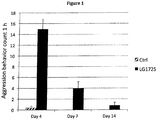
- the compound (3) of the invention elicits aggressive behavioral effects when administered to an animal capable of showing aggressive behavior; i.e. compound (3) is an aggression inducing compound. This is clearly demonstrated in Example 4.
- the study of aggression is an important scientific field, and aggressive behavior among humans has very large socio-economic impact.
- the compound (3) of the invention has therefore a large value for studying the biological and molecular mechanisms underlying aggressive behavior. Accordingly the present patent provides compound (3) for eliciting aggression (or other biological effect) in an animal, preferably a mammal (including even a human), e.g. as an experimental tool in vivo, or otherwise for use in in vitro to explore mechanisms of aggressive behavior, and even in therapy.
- the most important embodiment of this aspect of the invention is compound 19 (LG-1725) but other variants of (3) can be used as well.
- psychiatric conditions relate to both increased and decreased anger and aggression.
- Compound (3) and its variants can accordingly be used for treatment of said list of psychiatric conditions as well as for treatment of neurologic conditions.
- the present disclosure provides a process wherein a compound (2a) or (2aa) which are present in large quantities in some species of Meliaceae can be converted to a compound (3), (3a), (4), (4aa), (4bb), (4cc), (4dd), (4ee), (4ff), (4gg) and (4hh) according to schema (I), (Ia), (IV) and combinations thereof, the compound (3), (4), (4aa), (4bb), (4cc), (4dd), (4ee), (4ff), (4gg) or (4hh) thereafter being converted to (2b) or (2bb) according to schema (V) or (Va).
- this process can take advantage of all inventive steps described herein, including the chemoselective conversion of (2aa) to Weinreb amide at carbon 16, the regioselective oxidation of the hydroxy function at carbon 17, the regioselective deprotection of the hydroxyfunction at carbon 3 ( c.f.
- Example 8 A very specific embodiment of this process is given in Example 8 where hydrolysis of compound 8 [obtained from a compound of type (2aa), namely phragmalin] with potassium tert -butoxide ( t -BuOK) or 10 M aqueous KOH gives compound 22 , 22 subsequently being converted to its methyl ester, compound 23 , using CH 2 N 2 in diethyl ether or methyl iodide (CH 3 I) as alkylating agents.
- compound 8 obtained from a compound of type (2aa), namely phragmalin
- potassium tert -butoxide t -BuOK
- 10 M aqueous KOH gives compound 22 , 22 subsequently being converted to its methyl ester, compound 23 , using CH 2 N 2 in diethyl ether or methyl iodide (CH 3 I) as alkylating agents.
- any compound (2b) or (2bb) can be converted to another compound (2b) or (2bb), using a compound (3) as intermediate, which this patent thus provide as an additional feature.
- R1 is preferably 2-methoxy-2-oxoethyl
- R2 is preferably hydrogen, acetyl, propanoyl, butyryl, isobutyryl, 2-methylbutyryl, pentanoyl, 2-ethylbutyryl, 2,3-dimethylbutyryl, 2-methylpentanoyl, 3-methylpentanoyl, 3-methylpentanoyl, hexanoyl, cyclohexanecarbonyl, cyclopentanecarbonyl, with 2-methylbutyryl being most preferred
- R3 is preferably a hydrogen, acetyl, propanoyl, butyryl, isobutyryl, 2-methylbutyryl, pentanoyl, 2-ethylbutyryl, 2,3-dimethylbutyryl, 2-methylpentanoyl, 3-methylpentanoyl, 3-methylpentan
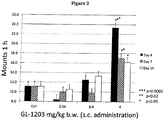
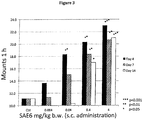
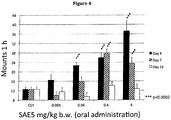
- Example 5 The sexual enhancing effect of GL-1203, SAE6 and SAE5 were demonstrated in Example 5, essentially using the procedures detailed in WO 2008/145996 . All three compounds showed a sexually enhancing effect as defined herein (as well as in WO 2008/145996 , page 11), i.e. the increase in mounts for all of GL-1203, SAE6 and SAE5 exceeding 50 % (even exceeding 75 %) over the controls at the appropriate dose(s) given.
- GL-1203, SAE6 and SAE5 are novel compounds never before synthesized, which can be obtained by the processes described in the present patent. Moreover, the known compound R306 with sexually enhancing activity can also be obtained, as demonstrated in Example 3. Therefore GL-1203, SAE6, SAE5 and R306 are extremely important sexual enhancing compounds, which can be obtained directly by the process of the invention.
- Example 6 demonstrates that the raw material phragmalin used in the synthesis of GL-1203, SAE6, SAE5 and R306 can be obtained from commercially obtained dried Chukrasia tabularis seeds in quantities of 3.52 kg per ton of seeds at 95 % purity.
- Examples 1 to 3 demonstrate that GL-1203, SAE6, SAE5 and R306 can be obtained from phragmalin with overall yields 4.14, 5.33, 15.48 and 14.55 %, respectively.
- R306, SAE5 and SAE6 are more efficient sexual enhancing compounds compared with GL-1203 and R310 (see Example 5 and WO 2008/145996 ); the most desired compounds to produce by the process of the invention are compound 20 (SAE5), compound 16 (SAE6), compound 21 (R306), R306AB, R306BA, R306C, R306D, R306E, R306F, with SAE5 being most preferred.
- the process of the invention to produce the compound (1), (5) or (5a) from a limonoid of structure (2a) or (2b), most preferably from a structure (2a), has the advantage that compounds with structure (2a) or (2b), in particular structures (2a), are richly available from many natural sources, and are even commercially available.
- Phragmalin is a type (2a) compound which can be obtained from Chukrasia tabularis seeds as demonstrated in Example 6 (as well as from stem bark and other parts of Chukrasia tabularis ; see also Connolly et al. Perkin Transactions 1. 1978, (Issue 3) 285-288 ), as well as from Entandrophragma caudatum stem bark and leaves ( R.R.
- busseins also being type (2a) compounds, which can be isolated in gram amounts per kg from Entandrophragma bussei trunk wood (Guex and Tamm, 1984, 1985); busseins even being commercially available from Gaia Chemical Corporation, 10 George Washington Plaza, Gaylordsville, CT 06755, USA).
- Many other species of the Meliaceae family are rich sources of phragmalin limonoids of the structure (2a) [and to a substantial less extent (2b)], as well, and can be used as starting materials for the process of the invention.
- any part of a plant preferably a Meliaceae
- This includes stem bark, roots, root bark, trunk wood, branches, leaves, seeds and fruits, with seeds being most preferred.
- the most preferred compound (2aa) for use in the process of the invention is phragmalin. This is because it can be used to prepare the most desired compounds SAE5, SAE6, R306, R306AB, R306BA, R306C, R306D, R306E, R306F and because phragmalin is readily obtainable in large quantities form plants grown for commercial/agricultural purposes, with the most important source being Chukrasia tabularis (also called Chukrasia velutina , Chikrassia tabularis , bastard cedar, Chittagong wood, Indian mahogany, Burmese almondwood, Lao mahagony, yonhim, yinma, chickrassy and Jamaica cedar).
- Chukrasia tabularis also called Chukrasia velutina , Chikrassia tabularis , bastard cedar, Chittagong wood, Indian mahogany, Burmese almondwood, Lao mahagony, yon
- Chukrasia tabularis is a tree that is grown on plantations (or planted) in Bangladesh, Cambodia, China, India, Indonesia, Laos, Malaysia, Sri Lanka, Thailand, Vietnam, Cameroon, Costa Rica, Nigeria, Puerto Rico, South Africa, US, e.g. for its timber, for decorations and as wind shields at the side of other plantations, e.g. coffee plantations, as well as it's wide-spread in Asia in the wild.
- the present disclosure prefers any compound of structure (5), which is produced with the process of the invention with a yield of more than 50 g/ton, even more preferably more than 100 g/ton, more preferably more than 150 g/ton, even more preferably more than 180 g/ton of starting dried plant material.
- This patent provides novel compounds with sexually enhancing activity which were never earlier manufactured, as well as it provides a process for which these compounds can readily be manufactured in large quantities from commercially available raw materials, simply by scaling up the process described herein. This thus shows the industrial utility of the present patent as well as that it is inventive.
- the present patent claims the compound (3) of the invention which is produced with the process of the invention with a yield of more than 50 g/ton, even more preferably more than 100 g/ton, even more preferably more than 150 g/ton, even more preferably more than 180 g/ton, even more preferably more than 250 g/ton, even more preferably more than 390 g/ton, and most preferably more than 450 g/ton of starting dried plant material.
- a plant material is regarded to be dry when its content of water is less than 10 %.
- the dryness of a plant material can be estimated by a process well known in the art where the plant material is weighed and then subjected to excessive drying at a temperature of between 40-60°C in a well ventilated environment for as long time as the weight of the plant material does not appreciably reduce anymore over time (e.g. between 6 to 72 h; e.g. preferably to a time point where the reduction of weight being less than 0.2 % per hour).
- the Percent_water_content should be 10 % or less.
- the compound of the invention comprises compound (3) [and its variations (3a), (4), (4aa), (4bb), (4cc), (4dd), (4ee), (4ff), (4gg) and (4hh) described herein) when it has been produced directly by the process of the invention as well as when it has been produced by other means.
- the compound of the invention may be obtained in radioactive form, e.g. by semi-synthesis, by exchanging suited group(s) or atom(s) in the compound of the invention with radioactive atom(s), or with group(s) where one or several atom(s) are radioactive.
- Preferred radioactive atoms for the purpose of this embodiment of the invention are 3 H, 14 C, 11 C, 18 O, 125 I and 131 I.
- Manufacturing of radioactive compounds comprises procedures well known in the art and can be applied to afford a radioactive compound of the invention.
- salt of the compound of the invention is the salt of the compound of the invention; in particular the pharmaceutically acceptable salt(s); i.e. those salts of compounds of the invention that are safe and effective for systemic use in mammals and is particularly desired for those compound of the invention that are capable of forming salts.
- the compound of the invention is preferably administered in a composition including a pharmaceutically acceptable carrier or excipient.
- pharmaceutically acceptable means a carrier or excipient that does not cause any untoward effects in patients to whom it is administered.
- Such pharmaceutically acceptable carriers and excipients are well known in the art (see e.g. Remington's Pharmaceutical Sciences, 1990, Rowe et al, 2005, and references therein).
- the exact dose to be administered depends on the circumstances. Normally, the dose should be capable of preventing or lessening the severity or spread of the condition or indication being treated.
- an effective amount of the compound of the invention depends, inter alia, upon the condition, disease or purpose of treatment, the dose, the administration schedule, whether the compound of the invention is administered alone or in conjunction with other therapeutic agents, the general health of the patient, age, and the like.
- the compound of the invention should be administered in a dose of 0.001 to 100 mg body weight per kilo throughout the treatment period.
- the pharmaceutical composition may be formulated in a variety of forms, including liquid, gel, lyophilized, powder, compressed solid, or any other suitable form.
- the preferred form will depend upon the particular indication being treated and will be apparent to one of skill in the art.
- the pharmaceutical composition may be administered orally, subcutaneously, intravenously, intracerebrally, intranasally, transdermally, intraperitoneally, intramuscularly, intrapulmonary, vaginally, rectally, intraocularly, or in any other acceptable manner, e.g. using PowderJect or ProLease technology.
- the composition can be administered continuously by infusion, although bolus injection is acceptable, using techniques well known in the art, such as pumps or implantation. In some instances the composition may be directly applied as a solution or spray.
- the preferred mode of administration will depend upon the particular indication being treated and will be apparent to one of skill in the art. However, the currently preferred mode of administration is via the oral route.
- composition of the invention may be administered in conjunction with other therapeutic agents. These agents may be incorporated as part of the same pharmaceutical composition or may be administered separately from the composition of the invention, either concurrently or in accordance with any other acceptable treatment schedule.
- the pharmaceutical composition may be in solid or liquid form, e.g. in the form of a capsule, tablet, suspension, emulsion or solution.
- the pharmaceutical composition is preferably made in the form of a dosage unit containing a given amount of the active ingredient.
- a suitable daily dose for a human or other mammal may vary widely depending on the condition of the patient and other factors, but can be determined by persons skilled in the art using routine methods.
- Solid dosage forms for oral administration may include capsules, tablets, suppositories, powders and granules.
- the active compound may be admixed with at least one inert diluent such as sucrose, lactose, or starch.
- Such dosage forms may also comprise, as is normal practice, additional substances, e.g. lubricating agents such as magnesium stearate.
- additional substances e.g. lubricating agents such as magnesium stearate.
- the dosage forms may also comprise buffering agents. Tablets and pills can additionally be prepared with enteric coatings.
- the compound of the invention may be admixed with adjuvants such as lactose, sucrose, starch powder, cellulose esters of alkanoic acids, stearic acid, talc, magnesium stearate, magnesium oxide, sodium and calcium salts of phosphoric and sulphuric acids, acacia, gelatin, sodium alginate, polyvinyl-pyrrolidine, and/or polyvinyl alcohol, and tableted or encapsulated for conventional administration.
- the compound of the invention may be dissolved in saline, water, polyethylene glycol, propylene glycol, ethanol, oils (such as corn oil, peanut oil, cottonseed oil or sesame oil), tragacanth gum, and/or various buffers.
- the carrier or diluent may include time delay material, such as glyceryl monostearate or glyceryl distearate alone or with a wax, or other materials well known in the art
- the pharmaceutical is manufactured by dissolving the compound of the invention in pharmaceutically acceptable oil (e.g. hydrogenated caster oil, olive oil, sun flower oil, cotton oil, peanut oil, Neobee M5; tri caprylic/capric triglyceride ester, Miglyol, propyleneglycol dicaprylate, Sefsol, ethoxylated plant fats, soybean oil, or any other suited oil or corresponding carrier) with other optional hydrophobic carrier, detergent or surfactant (e.g.
- pharmaceutically acceptable oil e.g. hydrogenated caster oil, olive oil, sun flower oil, cotton oil, peanut oil, Neobee M5; tri caprylic/capric triglyceride ester, Miglyol, propyleneglycol dicaprylate, Sefsol, ethoxylated plant fats, soybean oil, or any other suited oil or corresponding carrier
- other optional hydrophobic carrier, detergent or surfactant e.g.
- a fat which is solid at room temperature, may also be, such as cocoa butter. The fat is heated which allows the compound of the invention to be solubilized in the fat.
- the preparation After cooling to solidify the fat the preparation can be granulated and use in tablets, or it can be molded into tablets, or capsules can be filled with it. Any other solid fat, or pharmaceutically acceptable substitute thereof, capable of solubilizing the fat-soluble compound of the invention can be used, including with the addtion of with any optional hydrophobic carrier.
- compositions may be subjected to conventional pharmaceutical operations such as sterilization and/or may contain conventional adjuvants such as preservatives, stabilizers, wetting agents, emulsifiers, buffers, fillers, etc.
- conventional adjuvants such as preservatives, stabilizers, wetting agents, emulsifiers, buffers, fillers, etc.
- Liquid dosage forms for oral administration may include pharmaceutically acceptable emulsions, solutions, suspensions and syrups and elixirs containing inert diluents commonly used in the art, such as water. Such compositions may also comprise adjuvants, such as wetting agents, sweeteners, flavoring agents and perfuming agents.
- Example 9 An example of a pharmaceutical composition for a compound (SAE5) for oral use is given in Example 9.
- the compound of the invention may be dissolved in pharmaceutically acceptable oil (e.g. hydrogenated caster oil, olive oil, peanut oil or any other oil) with an optional hydrophobic carrier (e.g. triacetin, benzyl benzoate or ethyl oleate or a combination thereof), and with optional addition of acylated monoglycerides, propyl dicaprylates/dicaprates, caprylic/capric acid triglycerides, or a combination thereof for use as an injectable.
- pharmaceutically acceptable oil e.g. hydrogenated caster oil, olive oil, peanut oil or any other oil
- an optional hydrophobic carrier e.g. triacetin, benzyl benzoate or ethyl oleate or a combination thereof
- acylated monoglycerides propyl dicaprylates/dicaprates, caprylic/capric acid triglycerides, or a combination thereof for use as an injectable.
- the compound of the invention can be administered intravenously in a pharmaceutical preparation comprised by an emulsion.
- a pharmaceutical preparation comprised by an emulsion.
- a pharmaceutical preparation comprised by an emulsion.
- the compound of the invention included i.e. an emulsion
- emulsion e.g. by using (but not limited to) mixtures with one or several of oil, vegetable oil, phospholipids, surfactant, sodium deoxycholate, cholesterol, ethyl oleate, Miglycol, lecithin, water and applying procedures well-known in the art ( Remington's Pharmaceutical Sciences, 1990 , Rowe et al, 2005, Yua et al, 1993, and references therein).
- Any other suitable pharmaceutically acceptable formulation can be used for preparing an injectable for the compound of the invention, as is well known in the art ( Remington's Pharmaceutical Sciences, 1990 , Rowe et al, 2005, and references therein).
- compositions of WO 2008/145996 apply for the sake of the present patent, merely by exchanging the compound or extract of WO 2008/145996 with the compound of this invention.
- Example 9 An example of a pharmaceutical composition for a compound (LG-1725) for injection is given in Example 9.
- treatment schedules are important aspects to achieve an optimal treatment effect, which relates to the long-lasting effect of the compound of the invention and the lag-time before its effect appears (this long-lasting effect is also evident from Example 5).
- a suited treatment schedule has to take into account this long lasting effect, which means that the compound of the invention is administered for an initial period lasting from one to seven days where after the administration is discontinued while the treatment effect may be seen for long time thereafter, even weeks or months in some cases.
- the compound (3) of the invention as claimed herein induces marked aggression.
- the compound of the invention can be used to induce aggressive behavior, or increased level of aggression, by systemic administration to an animal or human, including for treatment of phsychiatric and neurologic conditions.
- compound (2b) and all its variations described herein have useful therapeutic properties and can be administered systemically to an animal or human for treatment purposes.
- reaction does not proceed with DBU as catalyst; it only proceeds when Me 3 Al is used as catalyst.
- the ratio of MeNHOMe ⁇ HCl to Me 3 Al is critical (the best is a molar ratio of 1:2) as well as temperature and time is critical; the best is room temperature and a short reaction times (30 min to 1 h); other molar ratios or temperature proceeds with formation of side products, or does not allow the reaction to proceed at all.
- Step Maximum yield % (fraction) Compound 6 ⁇ Compound 7 45 % (0.45) Compound 7 ⁇ Compound 8 70 % (0.70) Compound 8 ⁇ Compound 9 63 % (0.63) Compound 9 ⁇ Compound 10 92 % (0.92) Compound 10 ⁇ Compound 11 (GL-1203) 51 % (0.51)
- Example 2 synthesis of compounds of structure (5) starting from phragmalin via acylated phragmalin
- Method B from compound 13 : A suspension of MeNHOMe ⁇ HCl (121 mg, 1.24 mmol) in DCM (10 mL) was cooled in an ice bath and to this was added dropwise 2 M Me 3 Al in HEX (1.24 mL, 2.48 mmol). After the addition was complete, the cooling bath was removed and the reaction was stirred for 15 min. The mixture was cooled again in an ice bath and to this was added a solution of compound 13 (75 mg, 0.124 mmol) in DCM (5 mL). The cooling bath was removed and the reaction mixture was stirred at r.t. for 30 min, then cooled again in an ice bath.
- TMSOTf Trimethylsilyltrifluoromethanesulfonate
- Example 3 synthesis of compounds of structure (5) starting from phragmalin via isobutyrylated phragmalin
- Method A from compound 7 : A solution of compound 7 (65 mg, 0.1 mmol) in a mixture of Py (2 mL) and IBA (0.166 mL, 1.0 mmol) was stirred for 11 h at r.t. The mixture was diluted with 10% KHSO 4 (20 mL) and the product was taken up into EtOAc (10 mL). The organic phase was separated, dried over Na 2 SO 4 and evaporated. The product was purified by radial chromatography on silica gel, eluting with EtOAc to give compound 18 as colorless oil. However, the yield of compound 18 according to this route was low due to formation of many side products.
- Method B from compound 17 : A suspension of MeNHOMe ⁇ HCl (121 mg, 1.24 mmol) in DCM (10 mL) was cooled in an ice bath and to this was added dropwise 2 M Me 3 Al in HEX (1.24 mL, 2.48 mmol). After the addition was complete, the cooling bath was removed and the reaction was stirred for 15 min. The mixture was cooled again in an ice bath and to this was added a solution of compound 17 (75 mg, 0.119 mmol) in DCM (5 mL). The cooling bath was removed and the reaction mixture was stirred at r.t. for 30 min and then cooled again in an ice bath.
- Method A Compound 20 (5 mg, 0.00796 mmol) was dissolved in a mixture of DCM and TFA (10 : 1, 1 mL) and IBA (13.2 ⁇ L, 0.08 mmol) was added. The mixture was stirred at r.t. for 16 h and then diluted with saturated aqueous NaHCO 3 (3 mL). The product was extracted with EtOAc (3 x 3 mL) and the combined organic phase dried over Na 2 SO 4 . The extract was evaporated and the residue purified by preparative TLC on silica gel eluting with EtOAc to give compound 21 (4.6 mg, 83 %) as colorless oil.
- Method A of this Example was repeated two additional times starting with 5 - 8 mg of compound 20 , however with the exchange of TFA to TMSOTf (1 eq); the amount of isobutyric anhydride (IBA) used being 10 equivalents and the reaction time being 30 min at r.t.; with yields of compound 21 80 - 94 %.
- IBA isobutyric anhydride
- Method B Compound 20 (5 mg, 0.00796 mmol) was dissolved in a mixture of DCM and TFA (10:1,1 mL) and isobutyryl chloride [IBC; (CH 3 ) 2 CC(O)Cl], (8.5 ⁇ L, 0.08 mmol) was added. The mixture was stirred at r.t. for 16 h, diluted with saturated aqueous NaHCO 3 (3 mL). The product was extracted with EtOAc (3 x 3 mL) and the combined organic phase dried over Na 2 SO 4 . The extract was evaporated and the residue purified by preparative TLC on silica gel eluting with EtOAc to give compound 21 (4.8 mg, 86 %) as colorless oil.
- IBC isobutyryl chloride
- Compound 19 (LG-1725) of Example 3 was dissolved in olive oil and injected subcutaneously into six male mice on each day for three consecutive days at the dose 0.4 mg/kg (in 100 ⁇ l olive oil).
- Six control mice were sham operated and injected with olive oil only. The treatment was then stopped.
- 7 and 14 the animals were then introduced to a female mice primed with 50 ⁇ g/kg ⁇ -estradiol 48 hours before the start of the test, and then with 2 mg/kg progesterone 4 1 ⁇ 2 hours before the test, each by subcutaneous injection (compounds dissolved in olive oil) at a volume of 1 ml/kg, in order to make them sexually receptive, with the purpose of performing a standard sexual behavior test, using the method described in Example 5.
- LG-1725 did not induce any augmented sexual behavior as had been hoped for; instead it induced extreme aggressive behavior of a type that is not present in normal male mice.
- normal male mice introduced to a sexually receptive female will not at all or only occasionally show aggressive behavior directed to the female; instead mountings and other sexual activity is seen.
- the LG-1725 treated animals showed a pronounced aggressive behavior directed to the female which amounted to physical attacks directed towards the female, comprised of attack bites of the female and offensive leaps (including sideways leaps) towards the female.
- the number of these types of aggressive attacks was counted over a period of 1 hour following the introduction of the male mice to the female mice.
- mice Prior to the tests, male and female mice received specific treatments, as follows: Each male mouse received 0.04, 0.4 or 4 mg/kg of GL-1203 or 0.004, 0.04, 0.4 or 4 mg/kg SAE6 by subcutaneous injection of the compound dissolved in olive oil on each day for three consecutive days (the days being termed D-1, D-2 and D-3). The injection volume was 100 ⁇ l. The treatment was then stopped. Control male mice received the identical treatment schedule with subcutaneous olive oil only.
- SAE5 was administered orally to male mice dissolved in olive oil (0.5 ml) at doses 0.004, 0.04, 0.4 or 4 mg/kg on each day for three consecutive days (i.e. D-1, D-2 and D-3). The treatment was then stopped. Control male mice received the identical treatment schedule with oral olive oil only.
- the number of animals in each treatment and dosing group was from 5 to 6.
- the GL-1203 used was prepared as described in Example 1 (compound 11 ); SAE6 was prepared as described in Example 2 (compound 16 ); SAE5 was prepared as shown in Example 3 (compound 20 ).
- mice Female mice were first treated with 50 ⁇ g/kg ⁇ -estradiol 48 hours before the test, and then with 2 mg/kg progesterone 4 1 ⁇ 2 hours before the test, each by subcutaneous injection (compounds dissolved in olive oil) at a volume of 1 ml/kg.
- the behavioral test was performed in a dark room at ambient temperature, during the last enlightened period of the day (3.00 pm) and the first dark period of the night (7.00 pm). Each observation period lasted 4 hours.
- a female mouse was introduced into each cage hosting a male mouse.
- the number of mounts of the male mouse defined as a tentative of lateral or dorsal mounting on the female mouse with or without penis intromission, was then counted during a one-hour observation period and used as a simple measure of sexual behavior activity.
- Results for GL-1203 are shown in Figure 2 , for SAE6 in Figure 3 and For SAE5 in Figure 4 .
- SAE6 and SAE5 and GL-1203 are sexually enhancing compounds as the effects at their effective doses onto the mounting frequence of male mice exceed a 50 % increase in the number of mounts compared with the controls.
- Example 6 Yield of phragmalin isolated from seeds of Chukrasia tabularis Extraction
- Well-dried Chukrasia tabularis seeds (30 kg) (water content 6 %) were purchased from a commercial Chukrasia tabularis tree plantation. 0.5 kg of the seeds were grinded and placed into a large round bottom flask with magnetic stirring. Chloroform (CHCl 3 ) (5 L) was added and the mixture was stirred at r.t. for 24 hours. The content was filtered through a glass pore filter into a round bottom flask. The materials remaining on the filter were washed twice with chloroform using 20 mL chloroform/5 g of seeds for each wash. The combined chloroform extract (SCE) was then evaporated, using a rotavapor at 25°C, which yielded an oily residue. From the total weight of the grinded seeds of 500 g, the oily residue amounted to 144.8 g.
- SCE chloroform extract
- Fractions 1-7 did not contain any ions; evaporation of these fractions yielded 5.79 g of vegetable oil.
- Fractions 8-11 contained the positive ions (M+H) + 701.4 (confirmed as being phragmalin 3,30-diisobutyrate) and 687.4, (confirmed as being phragmalin 3-isobutyrate-30-propionate).
- Fractions 12-15 contained the positive ions (M+H) + 736.4 (confirmed as being phragmalin 3-nicotinate-30-isobutyrate) and 794.4 (confirmed as being 12-alfa-acetoxyphragmalin 3-nicotinate-30-isobutyrate).
- test compound For the assays a sample of the test compound was dissolved in 50 % acetonitrile/water with 0.2 % formic acid. To compensate for instrument drift a substance with well-known mass was used as the internal lock mass. To obtain responses of similar intensity a sample of reference substance was prepared with the same solvent and concentration.
- composition of SAE5 for oral use is Composition of SAE5 for oral use:
- the SAE5 is placed in the heated cocoa butter under gentle stirring until all SAE5 has become dissolved. 1 mL of the solution is then dispensed into gelatin capsules and the cocoa is allowed to solidify. The capsules are thereafter caped.
- composition of LG-1725 for subcutaneous injection is Composition of LG-1725 for subcutaneous injection:
Landscapes
- Chemical & Material Sciences (AREA)
- Organic Chemistry (AREA)
- Health & Medical Sciences (AREA)
- Nuclear Medicine, Radiotherapy & Molecular Imaging (AREA)
- Pharmacology & Pharmacy (AREA)
- Reproductive Health (AREA)
- Bioinformatics & Cheminformatics (AREA)
- Chemical Kinetics & Catalysis (AREA)
- General Chemical & Material Sciences (AREA)
- Medicinal Chemistry (AREA)
- Engineering & Computer Science (AREA)
- Veterinary Medicine (AREA)
- Endocrinology (AREA)
- Life Sciences & Earth Sciences (AREA)
- Animal Behavior & Ethology (AREA)
- General Health & Medical Sciences (AREA)
- Public Health (AREA)
- Gynecology & Obstetrics (AREA)
- Pharmaceuticals Containing Other Organic And Inorganic Compounds (AREA)
- Heterocyclic Carbon Compounds Containing A Hetero Ring Having Oxygen Or Sulfur (AREA)
- Acyclic And Carbocyclic Compounds In Medicinal Compositions (AREA)
- Saccharide Compounds (AREA)
- Plural Heterocyclic Compounds (AREA)
Priority Applications (1)
| Application Number | Priority Date | Filing Date | Title |
|---|---|---|---|
| PL13702766T PL2807170T3 (pl) | 2012-01-25 | 2013-01-25 | Limonoidy fragmaliny do leczenia dysfunkcji seksualnych |
Applications Claiming Priority (4)
| Application Number | Priority Date | Filing Date | Title |
|---|---|---|---|
| SE1200052 | 2012-01-25 | ||
| SE1200678 | 2012-11-06 | ||
| SE1300011 | 2013-01-04 | ||
| PCT/EP2013/051413 WO2013110744A2 (en) | 2012-01-25 | 2013-01-25 | Novel compounds, their manufacture and uses (ii) |
Publications (2)
| Publication Number | Publication Date |
|---|---|
| EP2807170A2 EP2807170A2 (en) | 2014-12-03 |
| EP2807170B1 true EP2807170B1 (en) | 2019-03-13 |
Family
ID=47666104
Family Applications (1)
| Application Number | Title | Priority Date | Filing Date |
|---|---|---|---|
| EP13702766.0A Active EP2807170B1 (en) | 2012-01-25 | 2013-01-25 | Phragmalin limonoids for the treatment of sexual dysfunction |
Country Status (11)
| Country | Link |
|---|---|
| US (1) | US9403841B2 (enExample) |
| EP (1) | EP2807170B1 (enExample) |
| CN (1) | CN104254537B (enExample) |
| AU (1) | AU2013213580B2 (enExample) |
| CA (1) | CA2861045A1 (enExample) |
| DK (1) | DK2807170T3 (enExample) |
| ES (1) | ES2723248T3 (enExample) |
| IN (1) | IN2014DN05615A (enExample) |
| NZ (1) | NZ626736A (enExample) |
| PL (1) | PL2807170T3 (enExample) |
| WO (1) | WO2013110744A2 (enExample) |
Cited By (1)
| Publication number | Priority date | Publication date | Assignee | Title |
|---|---|---|---|---|
| CN111755072A (zh) * | 2020-08-04 | 2020-10-09 | 深圳吉因加医学检验实验室 | 一种同时检测甲基化水平、基因组变异和插入片段的方法及装置 |
Families Citing this family (9)
| Publication number | Priority date | Publication date | Assignee | Title |
|---|---|---|---|---|
| CN104628692B (zh) * | 2015-02-09 | 2016-02-10 | 庄爱华 | 柠檬苦素类化合物,其药物组合物及其制备方法和用途 |
| CN208336488U (zh) * | 2015-07-31 | 2019-01-04 | 株式会社村田制作所 | 线圈天线以及天线装置 |
| CN109394732A (zh) * | 2017-08-16 | 2019-03-01 | 安徽中医药大学 | 盐酸青藤碱肠溶定位渗透泵控释胶囊及其制备方法 |
| CN110903912B (zh) * | 2019-11-29 | 2022-01-28 | 华东理工大学 | 一种芳基油脂及其制备方法与应用 |
| CN112898263B (zh) * | 2021-01-28 | 2022-03-08 | 江西中医药大学 | 一种从佛手中分离的香豆素骈木脂素化合物及其保肝用途 |
| SE2251130A1 (en) | 2022-09-30 | 2024-03-31 | Dicot Ab | New compounds and methods of their manufacturing |
| WO2025040810A1 (en) | 2023-08-23 | 2025-02-27 | Dicot Pharma Ab | Therapeutic compounds, a method of manufacturing thereof as well as uses thereof |
| WO2025141142A1 (en) | 2023-12-29 | 2025-07-03 | Dicot Pharma Ab | A novel method for recovering limonoid compounds |
| WO2025252965A1 (en) | 2024-06-06 | 2025-12-11 | Dicot Pharma Ab | Phragmalin-derived compounds for use in the treatment and/or prevention of a metabolic disease and/or disorder |
Family Cites Families (7)
| Publication number | Priority date | Publication date | Assignee | Title |
|---|---|---|---|---|
| WO2002007743A2 (de) | 2000-07-26 | 2002-01-31 | Vitaplant Ag | Piper methysticum pflanzenextrakt |
| CN1226298C (zh) * | 2003-08-07 | 2005-11-09 | 中国科学院南海海洋研究所 | 柠檬苦素化合物-木果楝内酯及其用途 |
| JP2005213202A (ja) | 2004-01-29 | 2005-08-11 | Maruzen Pharmaceut Co Ltd | 抗酸化剤、抗老化剤及び抗炎症剤、並びに、皮膚化粧料 |
| RU2008114302A (ru) | 2005-09-12 | 2009-10-20 | Каунсил Сайентифик Энд Индастриал Рисерч (In) | ЭКСТРАКТ ИЗ Xylocarpus, ПРИМЕНЯЕМЫЙ ДЛЯ ЛЕЧЕНИЯ ДИАБЕТА И ДИСЛИПИДЕМИИ |
| AU2008256521B2 (en) | 2007-05-29 | 2014-09-04 | Dicot Ab | Novel compounds and pharmaceutical preparations from Neobeguea spec |
| GB0710230D0 (en) | 2007-05-30 | 2007-07-11 | Reckitt Benckiser Nv | Detergent dosing device |
| US7786171B2 (en) | 2008-04-04 | 2010-08-31 | Abbott Laboratories | Amide derivatives as positive allosteric modulators and methods of use thereof |
-
2013
- 2013-01-25 IN IN5615DEN2014 patent/IN2014DN05615A/en unknown
- 2013-01-25 PL PL13702766T patent/PL2807170T3/pl unknown
- 2013-01-25 US US14/374,356 patent/US9403841B2/en active Active
- 2013-01-25 ES ES13702766T patent/ES2723248T3/es active Active
- 2013-01-25 CN CN201380006854.4A patent/CN104254537B/zh not_active Expired - Fee Related
- 2013-01-25 WO PCT/EP2013/051413 patent/WO2013110744A2/en not_active Ceased
- 2013-01-25 DK DK13702766.0T patent/DK2807170T3/da active
- 2013-01-25 CA CA2861045A patent/CA2861045A1/en not_active Abandoned
- 2013-01-25 AU AU2013213580A patent/AU2013213580B2/en not_active Ceased
- 2013-01-25 NZ NZ626736A patent/NZ626736A/en not_active IP Right Cessation
- 2013-01-25 EP EP13702766.0A patent/EP2807170B1/en active Active
Non-Patent Citations (1)
| Title |
|---|
| None * |
Cited By (1)
| Publication number | Priority date | Publication date | Assignee | Title |
|---|---|---|---|---|
| CN111755072A (zh) * | 2020-08-04 | 2020-10-09 | 深圳吉因加医学检验实验室 | 一种同时检测甲基化水平、基因组变异和插入片段的方法及装置 |
Also Published As
| Publication number | Publication date |
|---|---|
| PL2807170T3 (pl) | 2019-09-30 |
| WO2013110744A2 (en) | 2013-08-01 |
| CN104254537A (zh) | 2014-12-31 |
| WO2013110744A3 (en) | 2013-10-31 |
| DK2807170T3 (da) | 2019-05-27 |
| HK1204325A1 (en) | 2015-11-13 |
| US9403841B2 (en) | 2016-08-02 |
| AU2013213580A1 (en) | 2014-07-24 |
| IN2014DN05615A (enExample) | 2015-04-03 |
| AU2013213580B2 (en) | 2017-06-15 |
| US20150011616A1 (en) | 2015-01-08 |
| EP2807170A2 (en) | 2014-12-03 |
| NZ626736A (en) | 2016-11-25 |
| CN104254537B (zh) | 2017-06-30 |
| CA2861045A1 (en) | 2013-08-01 |
| ES2723248T3 (es) | 2019-08-22 |
Similar Documents
| Publication | Publication Date | Title |
|---|---|---|
| US9403841B2 (en) | Phragamalin limonoids for the treatment of sexual dysfunction | |
| Seeram et al. | Rapid large scale purification of ellagitannins from pomegranate husk, a by-product of the commercial juice industry | |
| Dang et al. | α-Glucosidase inhibitors from the leaves of Embelia ribes | |
| Liang et al. | A new cytotoxic casbane diterpene from Euphorbia pekinensis | |
| Li et al. | A new benzoquinone and a new benzofuran from the edible mushroom Neolentinus lepideus and their inhibitory activity in NO production inhibition assay | |
| Zeng et al. | Cytotoxic ceramides and glycerides from the roots of Livistona chinensis | |
| Adekenov | Natural sesquiterpene lactones as renewable chemical materials for new medicinal products | |
| CN1923813A (zh) | 阿朴菲及氧化阿朴菲类生物碱的用途 | |
| Kong et al. | Trichodermadiones A and B from the solid culture of Trichoderma atroviride S361, an endophytic fungus in Cephalotaxus fortunei | |
| US7282593B2 (en) | Withanamide and withanolide compositions and method of use thereof | |
| CN115043792B (zh) | 蓍草提取物、蓍草提取物单体化合物及其制备方法与应用 | |
| He et al. | Rupestines F—M, New guaipyridine sesquiterpene alkaloids from Artemisia rupestris | |
| Al‐Harrasi et al. | 11α‐Ethoxy‐β‐boswellic Acid and Nizwanone, a new boswellic acid derivative and a new triterpene, respectively, from Boswellia sacra | |
| Chen et al. | A New Long‐Chain Alkene and Antituberculosis Constituents from the Leaves of Pourthiaea lucida | |
| Xu et al. | A concise and efficient total synthesis of α-mangostin and β-mangostin from Garcinia mangostana | |
| Xiao et al. | Sesquiterpene lactones from Saussurea involucrata | |
| Tai et al. | New pyrano-pyrone from Goniothalamus tamirensis enhances the proliferation and differentiation of osteoblastic MC3T3-E1 cells | |
| Liu et al. | Rynchopeterine F, unique heterodimer of phenethanol-phenylacetyl linking with lactic acid from the medicinal insect Blaps rynchopetera | |
| Shi et al. | Taxane diterpenoids from Taxus yunnanensis and Taxus cuspidata | |
| Lee et al. | Three new megastigmane glucopyranosides from the Cardamine komarovii | |
| Singh et al. | Structure–activity studies of the pelorusides: New congeners and semi-synthetic analogues | |
| Jiang et al. | Cipatrijugin G, a new trijugin-type limonoid bearing an uncommon γ-hydroxybutenolide unit from the aerial parts of Cipadessa cinerascens | |
| HK1204325B (en) | Phragamalin limonoids for the treatment of sexual dysfunction | |
| Yin et al. | Three new diterpenoid alkaloids from Delphinium tatsienense | |
| Di Fabio et al. | Microwave-assisted oxidation of silibinin: A simple and preparative method for the synthesis of improved radical scavengers |
Legal Events
| Date | Code | Title | Description |
|---|---|---|---|
| PUAI | Public reference made under article 153(3) epc to a published international application that has entered the european phase |
Free format text: ORIGINAL CODE: 0009012 |
|
| 17P | Request for examination filed |
Effective date: 20140806 |
|
| AK | Designated contracting states |
Kind code of ref document: A2 Designated state(s): AL AT BE BG CH CY CZ DE DK EE ES FI FR GB GR HR HU IE IS IT LI LT LU LV MC MK MT NL NO PL PT RO RS SE SI SK SM TR |
|
| AX | Request for extension of the european patent |
Extension state: BA ME |
|
| REG | Reference to a national code |
Ref country code: HK Ref legal event code: DE Ref document number: 1204325 Country of ref document: HK |
|
| 17Q | First examination report despatched |
Effective date: 20160707 |
|
| STAA | Information on the status of an ep patent application or granted ep patent |
Free format text: STATUS: EXAMINATION IS IN PROGRESS |
|
| GRAP | Despatch of communication of intention to grant a patent |
Free format text: ORIGINAL CODE: EPIDOSNIGR1 |
|
| STAA | Information on the status of an ep patent application or granted ep patent |
Free format text: STATUS: GRANT OF PATENT IS INTENDED |
|
| INTG | Intention to grant announced |
Effective date: 20180227 |
|
| RAP1 | Party data changed (applicant data changed or rights of an application transferred) |
Owner name: DICOT AB |
|
| GRAJ | Information related to disapproval of communication of intention to grant by the applicant or resumption of examination proceedings by the epo deleted |
Free format text: ORIGINAL CODE: EPIDOSDIGR1 |
|
| STAA | Information on the status of an ep patent application or granted ep patent |
Free format text: STATUS: EXAMINATION IS IN PROGRESS |
|
| INTC | Intention to grant announced (deleted) | ||
| GRAP | Despatch of communication of intention to grant a patent |
Free format text: ORIGINAL CODE: EPIDOSNIGR1 |
|
| STAA | Information on the status of an ep patent application or granted ep patent |
Free format text: STATUS: GRANT OF PATENT IS INTENDED |
|
| INTG | Intention to grant announced |
Effective date: 20180926 |
|
| GRAS | Grant fee paid |
Free format text: ORIGINAL CODE: EPIDOSNIGR3 |
|
| GRAA | (expected) grant |
Free format text: ORIGINAL CODE: 0009210 |
|
| STAA | Information on the status of an ep patent application or granted ep patent |
Free format text: STATUS: THE PATENT HAS BEEN GRANTED |
|
| AK | Designated contracting states |
Kind code of ref document: B1 Designated state(s): AL AT BE BG CH CY CZ DE DK EE ES FI FR GB GR HR HU IE IS IT LI LT LU LV MC MK MT NL NO PL PT RO RS SE SI SK SM TR |
|
| AX | Request for extension of the european patent |
Extension state: BA ME |
|
| REG | Reference to a national code |
Ref country code: GB Ref legal event code: FG4D |
|
| REG | Reference to a national code |
Ref country code: CH Ref legal event code: EP Ref country code: AT Ref legal event code: REF Ref document number: 1107526 Country of ref document: AT Kind code of ref document: T Effective date: 20190315 |
|
| REG | Reference to a national code |
Ref country code: IE Ref legal event code: FG4D |
|
| REG | Reference to a national code |
Ref country code: DE Ref legal event code: R096 Ref document number: 602013052218 Country of ref document: DE |
|
| REG | Reference to a national code |
Ref country code: DK Ref legal event code: T3 Effective date: 20190520 |
|
| REG | Reference to a national code |
Ref country code: SE Ref legal event code: TRGR |
|
| REG | Reference to a national code |
Ref country code: NL Ref legal event code: FP |
|
| REG | Reference to a national code |
Ref country code: NO Ref legal event code: T2 Effective date: 20190313 |
|
| REG | Reference to a national code |
Ref country code: LT Ref legal event code: MG4D |
|
| PG25 | Lapsed in a contracting state [announced via postgrant information from national office to epo] |
Ref country code: LT Free format text: LAPSE BECAUSE OF FAILURE TO SUBMIT A TRANSLATION OF THE DESCRIPTION OR TO PAY THE FEE WITHIN THE PRESCRIBED TIME-LIMIT Effective date: 20190313 |
|
| REG | Reference to a national code |
Ref country code: ES Ref legal event code: FG2A Ref document number: 2723248 Country of ref document: ES Kind code of ref document: T3 Effective date: 20190822 |
|
| PG25 | Lapsed in a contracting state [announced via postgrant information from national office to epo] |
Ref country code: BG Free format text: LAPSE BECAUSE OF FAILURE TO SUBMIT A TRANSLATION OF THE DESCRIPTION OR TO PAY THE FEE WITHIN THE PRESCRIBED TIME-LIMIT Effective date: 20190613 Ref country code: LV Free format text: LAPSE BECAUSE OF FAILURE TO SUBMIT A TRANSLATION OF THE DESCRIPTION OR TO PAY THE FEE WITHIN THE PRESCRIBED TIME-LIMIT Effective date: 20190313 Ref country code: RS Free format text: LAPSE BECAUSE OF FAILURE TO SUBMIT A TRANSLATION OF THE DESCRIPTION OR TO PAY THE FEE WITHIN THE PRESCRIBED TIME-LIMIT Effective date: 20190313 Ref country code: HR Free format text: LAPSE BECAUSE OF FAILURE TO SUBMIT A TRANSLATION OF THE DESCRIPTION OR TO PAY THE FEE WITHIN THE PRESCRIBED TIME-LIMIT Effective date: 20190313 Ref country code: GR Free format text: LAPSE BECAUSE OF FAILURE TO SUBMIT A TRANSLATION OF THE DESCRIPTION OR TO PAY THE FEE WITHIN THE PRESCRIBED TIME-LIMIT Effective date: 20190614 |
|
| REG | Reference to a national code |
Ref country code: AT Ref legal event code: MK05 Ref document number: 1107526 Country of ref document: AT Kind code of ref document: T Effective date: 20190313 |
|
| PG25 | Lapsed in a contracting state [announced via postgrant information from national office to epo] |
Ref country code: CZ Free format text: LAPSE BECAUSE OF FAILURE TO SUBMIT A TRANSLATION OF THE DESCRIPTION OR TO PAY THE FEE WITHIN THE PRESCRIBED TIME-LIMIT Effective date: 20190313 Ref country code: RO Free format text: LAPSE BECAUSE OF FAILURE TO SUBMIT A TRANSLATION OF THE DESCRIPTION OR TO PAY THE FEE WITHIN THE PRESCRIBED TIME-LIMIT Effective date: 20190313 Ref country code: AL Free format text: LAPSE BECAUSE OF FAILURE TO SUBMIT A TRANSLATION OF THE DESCRIPTION OR TO PAY THE FEE WITHIN THE PRESCRIBED TIME-LIMIT Effective date: 20190313 Ref country code: SK Free format text: LAPSE BECAUSE OF FAILURE TO SUBMIT A TRANSLATION OF THE DESCRIPTION OR TO PAY THE FEE WITHIN THE PRESCRIBED TIME-LIMIT Effective date: 20190313 Ref country code: PT Free format text: LAPSE BECAUSE OF FAILURE TO SUBMIT A TRANSLATION OF THE DESCRIPTION OR TO PAY THE FEE WITHIN THE PRESCRIBED TIME-LIMIT Effective date: 20190713 Ref country code: EE Free format text: LAPSE BECAUSE OF FAILURE TO SUBMIT A TRANSLATION OF THE DESCRIPTION OR TO PAY THE FEE WITHIN THE PRESCRIBED TIME-LIMIT Effective date: 20190313 |
|
| PG25 | Lapsed in a contracting state [announced via postgrant information from national office to epo] |
Ref country code: SM Free format text: LAPSE BECAUSE OF FAILURE TO SUBMIT A TRANSLATION OF THE DESCRIPTION OR TO PAY THE FEE WITHIN THE PRESCRIBED TIME-LIMIT Effective date: 20190313 |
|
| REG | Reference to a national code |
Ref country code: DE Ref legal event code: R097 Ref document number: 602013052218 Country of ref document: DE |
|
| PG25 | Lapsed in a contracting state [announced via postgrant information from national office to epo] |
Ref country code: IS Free format text: LAPSE BECAUSE OF FAILURE TO SUBMIT A TRANSLATION OF THE DESCRIPTION OR TO PAY THE FEE WITHIN THE PRESCRIBED TIME-LIMIT Effective date: 20190713 Ref country code: AT Free format text: LAPSE BECAUSE OF FAILURE TO SUBMIT A TRANSLATION OF THE DESCRIPTION OR TO PAY THE FEE WITHIN THE PRESCRIBED TIME-LIMIT Effective date: 20190313 |
|
| PLBE | No opposition filed within time limit |
Free format text: ORIGINAL CODE: 0009261 |
|
| STAA | Information on the status of an ep patent application or granted ep patent |
Free format text: STATUS: NO OPPOSITION FILED WITHIN TIME LIMIT |
|
| PGFP | Annual fee paid to national office [announced via postgrant information from national office to epo] |
Ref country code: FI Payment date: 20191223 Year of fee payment: 8 Ref country code: NL Payment date: 20191217 Year of fee payment: 8 Ref country code: IE Payment date: 20191220 Year of fee payment: 8 |
|
| 26N | No opposition filed |
Effective date: 20191216 |
|
| PG25 | Lapsed in a contracting state [announced via postgrant information from national office to epo] |
Ref country code: SI Free format text: LAPSE BECAUSE OF FAILURE TO SUBMIT A TRANSLATION OF THE DESCRIPTION OR TO PAY THE FEE WITHIN THE PRESCRIBED TIME-LIMIT Effective date: 20190313 |
|
| PGFP | Annual fee paid to national office [announced via postgrant information from national office to epo] |
Ref country code: DK Payment date: 20191230 Year of fee payment: 8 |
|
| PGFP | Annual fee paid to national office [announced via postgrant information from national office to epo] |
Ref country code: IT Payment date: 20200114 Year of fee payment: 8 Ref country code: NO Payment date: 20191230 Year of fee payment: 8 Ref country code: ES Payment date: 20200227 Year of fee payment: 8 Ref country code: PL Payment date: 20200109 Year of fee payment: 8 |
|
| PGFP | Annual fee paid to national office [announced via postgrant information from national office to epo] |
Ref country code: BE Payment date: 20200127 Year of fee payment: 8 Ref country code: CH Payment date: 20200124 Year of fee payment: 8 |
|
| PGFP | Annual fee paid to national office [announced via postgrant information from national office to epo] |
Ref country code: TR Payment date: 20200114 Year of fee payment: 8 |
|
| PG25 | Lapsed in a contracting state [announced via postgrant information from national office to epo] |
Ref country code: MC Free format text: LAPSE BECAUSE OF FAILURE TO SUBMIT A TRANSLATION OF THE DESCRIPTION OR TO PAY THE FEE WITHIN THE PRESCRIBED TIME-LIMIT Effective date: 20190313 |
|
| PG25 | Lapsed in a contracting state [announced via postgrant information from national office to epo] |
Ref country code: LU Free format text: LAPSE BECAUSE OF NON-PAYMENT OF DUE FEES Effective date: 20200125 |
|
| REG | Reference to a national code |
Ref country code: FI Ref legal event code: MAE |
|
| REG | Reference to a national code |
Ref country code: DK Ref legal event code: EBP Effective date: 20210131 |
|
| REG | Reference to a national code |
Ref country code: NO Ref legal event code: MMEP |
|
| REG | Reference to a national code |
Ref country code: CH Ref legal event code: PL |
|
| REG | Reference to a national code |
Ref country code: NL Ref legal event code: MM Effective date: 20210201 |
|
| REG | Reference to a national code |
Ref country code: BE Ref legal event code: MM Effective date: 20210131 |
|
| PG25 | Lapsed in a contracting state [announced via postgrant information from national office to epo] |
Ref country code: NL Free format text: LAPSE BECAUSE OF NON-PAYMENT OF DUE FEES Effective date: 20210201 Ref country code: FI Free format text: LAPSE BECAUSE OF NON-PAYMENT OF DUE FEES Effective date: 20210125 |
|
| PG25 | Lapsed in a contracting state [announced via postgrant information from national office to epo] |
Ref country code: LI Free format text: LAPSE BECAUSE OF NON-PAYMENT OF DUE FEES Effective date: 20210131 Ref country code: NO Free format text: LAPSE BECAUSE OF NON-PAYMENT OF DUE FEES Effective date: 20210131 Ref country code: CH Free format text: LAPSE BECAUSE OF NON-PAYMENT OF DUE FEES Effective date: 20210131 |
|
| PG25 | Lapsed in a contracting state [announced via postgrant information from national office to epo] |
Ref country code: DK Free format text: LAPSE BECAUSE OF NON-PAYMENT OF DUE FEES Effective date: 20210131 Ref country code: IE Free format text: LAPSE BECAUSE OF NON-PAYMENT OF DUE FEES Effective date: 20210125 |
|
| PG25 | Lapsed in a contracting state [announced via postgrant information from national office to epo] |
Ref country code: IT Free format text: LAPSE BECAUSE OF NON-PAYMENT OF DUE FEES Effective date: 20210125 |
|
| REG | Reference to a national code |
Ref country code: ES Ref legal event code: FD2A Effective date: 20220510 |
|
| PG25 | Lapsed in a contracting state [announced via postgrant information from national office to epo] |
Ref country code: MT Free format text: LAPSE BECAUSE OF FAILURE TO SUBMIT A TRANSLATION OF THE DESCRIPTION OR TO PAY THE FEE WITHIN THE PRESCRIBED TIME-LIMIT Effective date: 20190313 Ref country code: CY Free format text: LAPSE BECAUSE OF FAILURE TO SUBMIT A TRANSLATION OF THE DESCRIPTION OR TO PAY THE FEE WITHIN THE PRESCRIBED TIME-LIMIT Effective date: 20190313 |
|
| PG25 | Lapsed in a contracting state [announced via postgrant information from national office to epo] |
Ref country code: MK Free format text: LAPSE BECAUSE OF FAILURE TO SUBMIT A TRANSLATION OF THE DESCRIPTION OR TO PAY THE FEE WITHIN THE PRESCRIBED TIME-LIMIT Effective date: 20190313 |
|
| PG25 | Lapsed in a contracting state [announced via postgrant information from national office to epo] |
Ref country code: ES Free format text: LAPSE BECAUSE OF NON-PAYMENT OF DUE FEES Effective date: 20210126 Ref country code: BE Free format text: LAPSE BECAUSE OF NON-PAYMENT OF DUE FEES Effective date: 20210131 |
|
| PG25 | Lapsed in a contracting state [announced via postgrant information from national office to epo] |
Ref country code: PL Free format text: LAPSE BECAUSE OF NON-PAYMENT OF DUE FEES Effective date: 20210125 |
|
| P01 | Opt-out of the competence of the unified patent court (upc) registered |
Effective date: 20230722 |
|
| PG25 | Lapsed in a contracting state [announced via postgrant information from national office to epo] |
Ref country code: TR Free format text: LAPSE BECAUSE OF NON-PAYMENT OF DUE FEES Effective date: 20210125 |
|
| PGFP | Annual fee paid to national office [announced via postgrant information from national office to epo] |
Ref country code: SE Payment date: 20260113 Year of fee payment: 14 |
|
| PGFP | Annual fee paid to national office [announced via postgrant information from national office to epo] |
Ref country code: GB Payment date: 20260113 Year of fee payment: 14 |
|
| PGFP | Annual fee paid to national office [announced via postgrant information from national office to epo] |
Ref country code: DE Payment date: 20260123 Year of fee payment: 14 |
|
| PGFP | Annual fee paid to national office [announced via postgrant information from national office to epo] |
Ref country code: FR Payment date: 20260123 Year of fee payment: 14 |