EP2802867B1 - Stabilising and analysing fatty acids in a biological sample stored on solid media - Google Patents
Stabilising and analysing fatty acids in a biological sample stored on solid media Download PDFInfo
- Publication number
- EP2802867B1 EP2802867B1 EP13736428.7A EP13736428A EP2802867B1 EP 2802867 B1 EP2802867 B1 EP 2802867B1 EP 13736428 A EP13736428 A EP 13736428A EP 2802867 B1 EP2802867 B1 EP 2802867B1
- Authority
- EP
- European Patent Office
- Prior art keywords
- acid
- fatty acids
- blood
- paper
- contaminants
- Prior art date
- Legal status (The legal status is an assumption and is not a legal conclusion. Google has not performed a legal analysis and makes no representation as to the accuracy of the status listed.)
- Active
Links
Images



Classifications
-
- G—PHYSICS
- G01—MEASURING; TESTING
- G01N—INVESTIGATING OR ANALYSING MATERIALS BY DETERMINING THEIR CHEMICAL OR PHYSICAL PROPERTIES
- G01N33/00—Investigating or analysing materials by specific methods not covered by groups G01N1/00 - G01N31/00
- G01N33/48—Biological material, e.g. blood, urine; Haemocytometers
- G01N33/483—Physical analysis of biological material
- G01N33/487—Physical analysis of biological material of liquid biological material
-
- A—HUMAN NECESSITIES
- A61—MEDICAL OR VETERINARY SCIENCE; HYGIENE
- A61B—DIAGNOSIS; SURGERY; IDENTIFICATION
- A61B5/00—Measuring for diagnostic purposes; Identification of persons
- A61B5/15—Devices for taking samples of blood
-
- A—HUMAN NECESSITIES
- A61—MEDICAL OR VETERINARY SCIENCE; HYGIENE
- A61B—DIAGNOSIS; SURGERY; IDENTIFICATION
- A61B5/00—Measuring for diagnostic purposes; Identification of persons
- A61B5/15—Devices for taking samples of blood
- A61B5/150007—Details
- A61B5/150015—Source of blood
- A61B5/15003—Source of blood for venous or arterial blood
-
- A—HUMAN NECESSITIES
- A61—MEDICAL OR VETERINARY SCIENCE; HYGIENE
- A61B—DIAGNOSIS; SURGERY; IDENTIFICATION
- A61B5/00—Measuring for diagnostic purposes; Identification of persons
- A61B5/15—Devices for taking samples of blood
- A61B5/150007—Details
- A61B5/150206—Construction or design features not otherwise provided for; manufacturing or production; packages; sterilisation of piercing element, piercing device or sampling device
- A61B5/150305—Packages specially adapted for piercing devices or blood sampling devices
-
- A—HUMAN NECESSITIES
- A61—MEDICAL OR VETERINARY SCIENCE; HYGIENE
- A61B—DIAGNOSIS; SURGERY; IDENTIFICATION
- A61B5/00—Measuring for diagnostic purposes; Identification of persons
- A61B5/15—Devices for taking samples of blood
- A61B5/150007—Details
- A61B5/150358—Strips for collecting blood, e.g. absorbent
-
- A—HUMAN NECESSITIES
- A61—MEDICAL OR VETERINARY SCIENCE; HYGIENE
- A61B—DIAGNOSIS; SURGERY; IDENTIFICATION
- A61B5/00—Measuring for diagnostic purposes; Identification of persons
- A61B5/15—Devices for taking samples of blood
- A61B5/150007—Details
- A61B5/150755—Blood sample preparation for further analysis, e.g. by separating blood components or by mixing
-
- C—CHEMISTRY; METALLURGY
- C09—DYES; PAINTS; POLISHES; NATURAL RESINS; ADHESIVES; COMPOSITIONS NOT OTHERWISE PROVIDED FOR; APPLICATIONS OF MATERIALS NOT OTHERWISE PROVIDED FOR
- C09K—MATERIALS FOR MISCELLANEOUS APPLICATIONS, NOT PROVIDED FOR ELSEWHERE
- C09K15/00—Anti-oxidant compositions; Compositions inhibiting chemical change
- C09K15/04—Anti-oxidant compositions; Compositions inhibiting chemical change containing organic compounds
- C09K15/20—Anti-oxidant compositions; Compositions inhibiting chemical change containing organic compounds containing nitrogen and oxygen
- C09K15/22—Anti-oxidant compositions; Compositions inhibiting chemical change containing organic compounds containing nitrogen and oxygen containing an amide or imide moiety
-
- C—CHEMISTRY; METALLURGY
- C11—ANIMAL OR VEGETABLE OILS, FATS, FATTY SUBSTANCES OR WAXES; FATTY ACIDS THEREFROM; DETERGENTS; CANDLES
- C11B—PRODUCING, e.g. BY PRESSING RAW MATERIALS OR BY EXTRACTION FROM WASTE MATERIALS, REFINING OR PRESERVING FATS, FATTY SUBSTANCES, e.g. LANOLIN, FATTY OILS OR WAXES; ESSENTIAL OILS; PERFUMES
- C11B5/00—Preserving by using additives, e.g. anti-oxidants
-
- C—CHEMISTRY; METALLURGY
- C11—ANIMAL OR VEGETABLE OILS, FATS, FATTY SUBSTANCES OR WAXES; FATTY ACIDS THEREFROM; DETERGENTS; CANDLES
- C11B—PRODUCING, e.g. BY PRESSING RAW MATERIALS OR BY EXTRACTION FROM WASTE MATERIALS, REFINING OR PRESERVING FATS, FATTY SUBSTANCES, e.g. LANOLIN, FATTY OILS OR WAXES; ESSENTIAL OILS; PERFUMES
- C11B5/00—Preserving by using additives, e.g. anti-oxidants
- C11B5/0007—Organic substances
-
- G—PHYSICS
- G01—MEASURING; TESTING
- G01N—INVESTIGATING OR ANALYSING MATERIALS BY DETERMINING THEIR CHEMICAL OR PHYSICAL PROPERTIES
- G01N1/00—Sampling; Preparing specimens for investigation
- G01N1/28—Preparing specimens for investigation including physical details of (bio-)chemical methods covered elsewhere, e.g. G01N33/50, C12Q
- G01N1/36—Embedding or analogous mounting of samples
-
- G—PHYSICS
- G01—MEASURING; TESTING
- G01N—INVESTIGATING OR ANALYSING MATERIALS BY DETERMINING THEIR CHEMICAL OR PHYSICAL PROPERTIES
- G01N30/00—Investigating or analysing materials by separation into components using adsorption, absorption or similar phenomena or using ion-exchange, e.g. chromatography or field flow fractionation
- G01N30/02—Column chromatography
- G01N30/50—Conditioning of the sorbent material or stationary liquid
-
- G—PHYSICS
- G01—MEASURING; TESTING
- G01N—INVESTIGATING OR ANALYSING MATERIALS BY DETERMINING THEIR CHEMICAL OR PHYSICAL PROPERTIES
- G01N33/00—Investigating or analysing materials by specific methods not covered by groups G01N1/00 - G01N31/00
- G01N33/48—Biological material, e.g. blood, urine; Haemocytometers
-
- G—PHYSICS
- G01—MEASURING; TESTING
- G01N—INVESTIGATING OR ANALYSING MATERIALS BY DETERMINING THEIR CHEMICAL OR PHYSICAL PROPERTIES
- G01N33/00—Investigating or analysing materials by specific methods not covered by groups G01N1/00 - G01N31/00
- G01N33/48—Biological material, e.g. blood, urine; Haemocytometers
- G01N33/483—Physical analysis of biological material
- G01N33/487—Physical analysis of biological material of liquid biological material
- G01N33/49—Blood
-
- G—PHYSICS
- G01—MEASURING; TESTING
- G01N—INVESTIGATING OR ANALYSING MATERIALS BY DETERMINING THEIR CHEMICAL OR PHYSICAL PROPERTIES
- G01N33/00—Investigating or analysing materials by specific methods not covered by groups G01N1/00 - G01N31/00
- G01N33/48—Biological material, e.g. blood, urine; Haemocytometers
- G01N33/483—Physical analysis of biological material
- G01N33/487—Physical analysis of biological material of liquid biological material
- G01N33/493—Physical analysis of biological material of liquid biological material urine
-
- G—PHYSICS
- G01—MEASURING; TESTING
- G01N—INVESTIGATING OR ANALYSING MATERIALS BY DETERMINING THEIR CHEMICAL OR PHYSICAL PROPERTIES
- G01N33/00—Investigating or analysing materials by specific methods not covered by groups G01N1/00 - G01N31/00
- G01N33/48—Biological material, e.g. blood, urine; Haemocytometers
- G01N33/50—Chemical analysis of biological material, e.g. blood, urine; Testing involving biospecific ligand binding methods; Immunological testing
- G01N33/92—Chemical analysis of biological material, e.g. blood, urine; Testing involving biospecific ligand binding methods; Immunological testing involving lipids, e.g. cholesterol, lipoproteins, or their receptors
-
- F—MECHANICAL ENGINEERING; LIGHTING; HEATING; WEAPONS; BLASTING
- F04—POSITIVE - DISPLACEMENT MACHINES FOR LIQUIDS; PUMPS FOR LIQUIDS OR ELASTIC FLUIDS
- F04C—ROTARY-PISTON, OR OSCILLATING-PISTON, POSITIVE-DISPLACEMENT MACHINES FOR LIQUIDS; ROTARY-PISTON, OR OSCILLATING-PISTON, POSITIVE-DISPLACEMENT PUMPS
- F04C2270/00—Control; Monitoring or safety arrangements
- F04C2270/04—Force
- F04C2270/042—Force radial
- F04C2270/0421—Controlled or regulated
-
- G—PHYSICS
- G01—MEASURING; TESTING
- G01N—INVESTIGATING OR ANALYSING MATERIALS BY DETERMINING THEIR CHEMICAL OR PHYSICAL PROPERTIES
- G01N30/00—Investigating or analysing materials by separation into components using adsorption, absorption or similar phenomena or using ion-exchange, e.g. chromatography or field flow fractionation
- G01N30/02—Column chromatography
- G01N30/88—Integrated analysis systems specially adapted therefor, not covered by a single one of the groups G01N30/04 - G01N30/86
- G01N2030/8809—Integrated analysis systems specially adapted therefor, not covered by a single one of the groups G01N30/04 - G01N30/86 analysis specially adapted for the sample
- G01N2030/8813—Integrated analysis systems specially adapted therefor, not covered by a single one of the groups G01N30/04 - G01N30/86 analysis specially adapted for the sample biological materials
Definitions
- the present invention relates to a method for stabilising fatty acids present in a sample such as bodily fluids.
- the present invention further relates to a method for preparing a solid medium which is capable of stabilising fatty acids applied thereto.
- omega-3 fatty acids especially eicosapentaenoic acid (EPA) and docosahexaenoic acid (DHA) has been associated with reductions in cardiovascular disease, neurodegenerative diseases, diabetes and arthritis in adults and improved mental development in preterm infants.
- EPA eicosapentaenoic acid
- DHA docosahexaenoic acid
- Dietary omega-3 fatty acid recommendations for cardiac protection include increasing fish intake to two fatty fish meals per week or consuming 600 or 400 mg/day long chain omega-3 fatty acids respectively for men and women. Although it is known that these recommendations will increase cellular omega-3 fatty acid levels to a level within the cardioprotective range in clinical trials, there is almost no knowledge about how these recommendations are influencing the fatty acid status of the general population. Because the fatty acid status in blood is a useful marker for evaluating cardiac risk in human populations and identifying those individuals who would benefit from dietary omega-3 fatty acid supplementation, evaluation of fatty acid status is important.
- a composition suitable for use in stabilizing fatty acids which consists of a filter paper which has been dipped in mixtures of ascorbic acid and EDTA has been described ( US3085003 ).
- a similar composition utilizing a Whatman filter paper has been disclosed in US 2005/205840 A1 .
- a composition of a filter paper with EDTA and an antioxidant can be also used for the preparation of strip papers for urine analysis ( GB 1435877 A ).
- a composition suitable for use in stabilizing fatty acids which consists of a filter paper which has been dipped in mixtures of antioxidants and chelators has been described ( EP 1111384 A1 ).
- BTH can be used as an antioxidant ( US 7056528 B1 ).
- the present inventors have discovered that fatty acids within a dried blood spot may be stabilised for a period of months at ambient conditions.
- the present inventors have further discovered that a highly accurate determination of the fatty acid composition of blood stored on a solid medium for a period of months may be achieved by stabilising the fatty acids and by controlling contaminants in the solid medium.
- the present invention provides a method for stabilising fatty acids, according to the claims, the method comprising applying the fatty acids, or a sample comprising the fatty acids, to a solid medium comprising a solid matrix, at least one chelating agent and at least one antioxidant, wherein the solid matrix comprises less than about 2 ⁇ g/cm 2 of contaminants.
- the sample may be a biological sample.
- the biological sample may be a bodily fluid, for example blood, saliva, breast milk, urine, semen, blood plasma, synovial fluid, serum and the like.
- the bodily fluid may be a mammalian bodily fluid.
- the sample may be a fluid comprising the fatty acids, for example a bodily fluid.
- the fatty acids may be, or may comprise, unsaturated fatty acids.
- the fatty acids may be, or may comprise, long-chain polyunsaturated fatty acids (LCPUFAs).
- LCPUFAs long-chain polyunsaturated fatty acids
- the fatty acids may be, or may comprise, omega-3 fatty acids, for example EPA, DHA and the like.
- the sample may be a biological sample.
- the biological sample is a bodily fluid, for example blood, saliva, breast milk, urine, semen, blood plasma, synovial fluid, serum and the like.
- the method may comprise determining an amount of one or more classes of fatty acids in the sample as a proportion of total lipids in the sample, or as a proportion of total fatty acids in the sample.
- the sample may be applied to the solid medium in an amount that is less than about 100 ⁇ L, or less than about 50 ⁇ L, or less than about 20 ⁇ L.
- Step (b) may be performed weeks or months after step (a).
- the solid matrix may comprise less than about 1 ⁇ g/cm 2 of contaminants, or less than about 0.5 ⁇ g/cm 2 of contaminants.
- the contaminants may be saturated fatty acids.
- the solid matrix may be paper or a paper-based matrix.
- the paper-based matrix may be silica-gel loaded paper.
- the at least one chelating agent may be ethylenediamine-tetraacetic acid (EDTA), ascorbic acid, or salts thereof, or citric acid, or salts thereof.
- EDTA ethylenediamine-tetraacetic acid
- ascorbic acid or salts thereof
- citric acid or salts thereof.
- the at least one antioxidant may be butylated hydroxytoluene (BHT), butylated hydroxyanisole (BHA) or t -butylhydroquinone.
- BHT butylated hydroxytoluene
- BHA butylated hydroxyanisole
- t -butylhydroquinone t -butylhydroquinone
- the chelating agent is ascorbic acid and/or EDTA and the antioxidant is BHT.
- the solid medium may be in the form of a strip.
- the strip may have dimensions of about 1 cm ⁇ 3 cm.
- the antioxidant(s) may be present on the solid medium in an amount between about 0.001 mg and about 10 mg, or in an amount between about 0.01 mg and about 5 mg, or in an amount between about 0.01 and about 1 mg, or in an amount between about 0.01 mg and about 0.5 mg. In one embodiment the antioxidant(s) is/are present in an amount of about 0.1 mg.
- the chelating agent(s) may be present on the solid medium in an amount between about 0.001 mg and about 10 mg, or in an amount between about 0.01 mg and about 5 mg, or in an amount between about 0.01 mg and about 1 mg, or in an amount between about 0.05 mg and about 0.5 mg. In one embodiment the chelating agent(s) is/are present in an amount of about 0.25 mg. In another embodiment the chelating agent(s) is/are present in an amount of about 0.5 mg.
- the present disclosure provides a method for stabilising fatty acids, the method comprising applying the fatty acids, or a sample comprising the fatty acids, to a solid medium comprising silica gel-loaded paper, EDTA and/or ascorbic acid and BHT.
- the present disclosure provides a method for stabilising fatty acids, the method comprising applying the fatty acids, or a sample comprising the fatty acids, to a solid medium comprising a glass microfiber filter, EDTA and/or ascorbic acid and BHT.
- the present disclosure provides a method for preparing a solid medium said medium comprising a solid matrix, at least one chelating agent and at least one antioxidant, wherein the solid matrix comprises less than about 2 ⁇ g/cm 2 of contaminants.
- the solid medium may be for stabilisation of fatty acids.
- the fatty acids may be, or may comprise, unsaturated fatty acids.
- the fatty acids may be, or may comprise, LCPUFAs.
- the fatty acids may be omega-3 fatty acids, for example EPA, DHA and the like.
- the solid matrix may comprise less than about 1 ⁇ g/cm 2 of contaminants, or less than about 0.5 ⁇ g/cm 2 of contaminants.
- the contaminants may be saturated fatty acids.
- the solid matrix is paper or a paper-based matrix.
- the paper-based matrix may be silica gel-loaded paper.
- the at least one chelating agent may be EDTA, ascorbic acid, or salts thereof, or citric acid, or salts thereof.
- the at least one antioxidant may be butylated hydroxytoluene, butylated hydroxyanisole or t -butylhydroquinone.
- the chelating agent is ascorbic acid and/or EDTA and the antioxidant is BHT.
- the solid medium may be in the form of a strip.
- the strip may have dimensions of about 1 cm ⁇ 3 cm.
- the antioxidant(s) may be present on the solid medium in an amount between about 0.001 mg and about 10 mg, or in an amount between about 0.01 mg and about 5 mg, or in an amount between about 0.01 mg and about 1 mg, or in an amount between about 0.01 mg and about 0.5 mg. In one embodiment the antioxidant(s) is/are present in an amount of about 0.1 mg.
- the chelating agent(s) may be present on the solid medium in an amount between about 0.001 mg and about 10 mg, or in an amount between about 0.01 mg and about 5 mg, or in an amount between about 0.01 mg and about 1 mg, or in an amount between about 0.05 mg and about 0.5 mg. In one embodiment the chelating agent(s) is/are present in an amount of about 0.25 mg.
- the present disclosure provides a method for preparing a solid medium, said medium comprising silica gel-loaded paper, EDTA and/or ascorbic acid, and BHT.
- the present invention provides a method for preparing a solid medium comprising a solid matrix, at least one chelating agent and at least one antioxidant, according to the claims, said method comprising providing a solid medium comprising a solid matrix and applying to the solid medium the at least one chelating agent and the at least one antioxidant, wherein the solid matrix comprises less than about 2 ⁇ g/cm 2 of contaminants.
- the solid matrix, chelating agent and antioxidant may be as defined in the above aspects.
- the solid matrix may comprise less than about 1 ⁇ g/cm 2 of contaminants, or less than about 0.5 ⁇ g/cm 2 of contaminants.
- the at least one antioxidant and the at least one chelating agent may be applied to the solid medium in the form of a single solution or separate solutions, one solution comprising the at least one antioxidant and one solution comprising the at least one chelating agent.
- the solution(s) may comprise alcohol and water, for example ethanol and water.
- the concentration of the at least one antioxidant in the solution may be between about 0.1 mg/mL and about 10 mg/mL, or between about 0.5 mg/mL and about 5 mg/mL.
- the concentration of the at least one chelating agent in the solution may be between about 1 mg/mL and about 10 mg/mL, or between about 0.5 mg/mL and about 5 mg/mL.
- the solid medium may be in the form of a strip.
- the amount of solution applied to the strip may be between about 1 and 500 ⁇ L, or between about 1 and 100 ⁇ L.
- the strip may have dimensions of about 1 cm ⁇ 3 cm.
- the contaminants may be saturated fatty acids.
- a and “an” refer to one or to more than one (i.e. to at least one) of the grammatical object of the article.
- an element means one element or more than one element.
- bodily fluid is understood to include any liquid which originates within a human or animal body, including fluids that are secreted or excreted.
- bodily fluids include: blood, semen, blood plasma, serum including blood serum, saliva, sweat, urine, breast milk, bile and peritoneal fluid.
- chelating agent is understood to include any compound capable of complexing multivalent ions including Group II and Group III multivalent metal ions and transition metal ions.
- sorb and “sorbed” are understood to mean that the relevant entity is absorbed or adsorbed or otherwise incorporated into or onto the solid matrix.
- biological sample is understood to mean a sample that is obtained from a living organism, for example plants, animals (including humans), fungi, bacteria, algae and the like.
- paper-based matrix is understood to mean a matrix that comprises, includes or contains paper.
- the paper-based matrix may comprise at least 5% (w/w), at least 10% (w/w), at least 20% (w/w), at least 30% (w/w), at least 40% (w/w), at least 50% (w/w), at least 60% (w/w), at least 70% (w/w), at least 80% (w/w), or at least 90% (w/w), or at least 95% (w/w), or at least 99% (w/w) paper.
- the present invention broadly relates to a method for stabilising fatty acids present in a sample, and to a solid medium for use in stabilising fatty acids.
- the invention further extends to a method for preparing a solid medium for use in stabilising fatty acids.
- the method of the first aspect of the invention provides a simple, safe, convenient and reliable means for stabilising fatty acids present in samples.
- the inventors have found that by use of the method, fatty acids present in blood, breast milk and blood plasma may be stabilised at room temperature for up to 9 weeks with minimal degradation.
- the solid medium includes a solid matrix to which is sorbed at least one chelating agent and at least one antioxidant.
- the solid matrix for use in the present invention is a paper-based matrix, for example silica gel-loaded paper, which includes silica gel-coated paper and silica gel-impregnated paper.
- Suitable silica gel-loaded papers include those available from Whatman, Inc. under number 3668-915. These papers are comprised of cellulose and large pore silica and have a thickness of about 0.27 mm and a flow rate of about 100 mm per 30 minutes (water).
- Other non-limiting examples of paper and paper-based matrices include filter paper and chromatography paper.
- contaminants present in paper-based solid matrices may interfere with the accurate determination of the amount of the respective classes of fatty acids as a proportion of total lipids, particularly when the volume of fluid applied to the solid matrix is low (i.e. less than about 20 ⁇ L).
- the term "contaminant” or "contaminants” may be understood to mean a compound or compounds whose presence in the solid matrix would increase or decrease the calculated proportion of a class of fatty acids as a proportion of total lipids in a sample applied to the matrix, as compared to the calculated proportion of a class of fatty acids as a proportion of total lipids in the sample prior to application to the solid matrix.
- Such contaminants include, for example, saturated fatty acids (such as 16:0 and 18:0), esters of saturated fatty acids, resin acids (such as abietic acid, isopimaric acid, dextropimaric acid and levopimaric acid) and esters of resin acids, which find their way into the paper during production. Whilst it is possible to use a blank solid matrix as a control to correct for contaminants when calculating fatty acid proportions, this adds an additional step to the method and hence reduces efficiency. The inventors have found that accurate determination of the amount of the respective classes of fatty acids as a proportion of total lipids in a fluid can be optimised by ensuring that the contaminants in the solid matrix are less than about 2 ⁇ g/cm 2 .
- the solid matrix comprises contaminants in an amount of less than about 2 ⁇ g/cm 2 , or less than about 1.9 ⁇ g/cm 2 , or less than about 1.8 ⁇ g/cm 2 , or less than about 1.7 ⁇ g/cm 2 , or less than about 1.6 ⁇ g/cm 2 , or less than about 1.5 ⁇ g/cm 2 , or less than about 1.4 ⁇ g/cm 2 , or less than about 1.3 ⁇ g/cm 2 , or less than about 1.2 ⁇ g/cm 2 , or less than about 1.1 ⁇ g/cm 2 or less than about 1 ⁇ g/cm 2 , or less than about 0.9 ⁇ g/cm 2 , or less than about 0.8 ⁇ g/cm 2 , or less than about 0.7 ⁇ g/cm 2 , or less than about 0.6 ⁇ g/cm 2 , or less than about 0.5 ⁇ g/cm
- the solid matrix may comprise contaminants in an amount between about 0.005 ⁇ g/cm 2 and about 0.5 ⁇ g/cm 2 , or in an amount between about 0.005 ⁇ g/cm 2 and about 0.3 ⁇ g/cm 2 , or in an amount between about 0.005 ⁇ g/cm 2 and about 0.1 ⁇ g/cm 2 , or in an amount between about 0.005 ⁇ g/cm 2 and about 0.2 ⁇ g/cm 2 , or in an amount between about 0.005 ⁇ g/cm 2 and about 0.15 ⁇ g/cm 2 .
- the solid matrix comprises saturated fatty acids and/or resin acids, in an amount of less than about 2 ⁇ g/cm 2 , or less than about 1.9 ⁇ g/cm 2 , or less than about 1.8 ⁇ g/cm 2 , or less than about 1.7 ⁇ g/cm 2 , or less than about 1.6 ⁇ g/cm 2 , or less than about 1.5 ⁇ g/cm 2 , or less than about 1.4 ⁇ g/cm 2 , or less than about 1.3 ⁇ g/cm 2 , or less than about 1.2 ⁇ g/cm 2 , or less than about 1.1 ⁇ g/cm 2 or less than about 1 ⁇ g/cm 2 , or less than about 0.9 ⁇ g/cm 2 , or less than about 0.8 ⁇ g/cm 2 , or less than about 0.7 ⁇ g/cm 2 ,
- a method for determining fatty acid composition of a sample comprising fatty acids comprising:
- Step (b) may be performed by methods well known amongst those skilled in the art, for example by derivatisation of the fatty acids in the dried sorbed sample and analysis of the resulting derivatised compounds by gas chromatography (GC).
- the fatty acids in the dried sorbed sample are converted to fatty acid methyl esters by direct transmethylation, for example by heating at 70 °C in a solution of 1% H 2 SO 4 in methanol for 3 hours.
- the fatty acid methyl esters are then extracted into an organic solvent (such as heptane) and the heptane containing the fatty acid methyl esters is injected into a gas chromatograph.
- the identification and quantification of the fatty acid methyl esters may be achieved by comparing the retention times and peak area values of unknown samples to those of commercial lipid standards using the Hewlett-Packard Chemstation data system (see Example 1 herein).
- step (b) comprises:
- the esterified fatty acids may be C 1 -C 6 alkyl esters, for example methyl esters.
- the method may comprise determining an amount of one or more classes of fatty acids (preferably unsaturated fatty acids) in the sample as a proportion (for example a percentage) of total lipids present in the sample, or as a proportion of total fatty acids present in the sample.
- the method may comprise determining an amount of one or more of the following unsaturated fatty acids: 18:1 n-9, 18:2 n-6, 20:4 n-6, 20:5 n-3, 22:5 n-3 and 22:6 n-3.
- Step (b) may be performed weeks or months after step (a).
- step (b) may be performed up to about 12 months, up to about 9 months, up to about 8 months, up to about 7 months, up to about 6 months, up to about 5 months, up to about 4 months, up to about 3 months, up to about 2 months, or up to about 1 month after step (a).
- step (b) is performed up to about 12 weeks, up to about 11 weeks, up to about 10 weeks, up to about 9 weeks, up to about 8 weeks, up to about 7 weeks, up to about 6 weeks, up to about 5 weeks, up to about 4 weeks, up to about 3 weeks, up to about 2 weeks, or up to about 1 week after step (a).
- the sample obtained in step (a) is preferably stored in a cellophane bag prior to performance of step (b).
- the sample is stored in a cellophane bag in the dark at ambient temperature.
- the sample is a biological sample however those skilled in the art will recognise that the methods and mediums of the invention are applicable to any sample comprising fatty acids, and in particular unsaturated fatty acids, which are particularly sensitive to degradation.
- the biological sample is a bodily fluid.
- bodily fluids include: blood, saliva, breast milk, urine, semen, blood plasma, synovial fluid and serum.
- the sample may be an oil, for example an edible oil such as a marine oil or a vegetable oil, which comprises unsaturated fatty acids for which it is desired to determine the fatty acid composition. It may be desirable to determine the fatty acid composition of such oils for quality control purposes and/or to assess shelf life.
- the oil may be an oil derived from a genetically engineered crop (such as canola) which has been developed to produce increased amounts of selected fatty acids, for example omega-3 fatty acids, as a proportion of total lipids produced.
- a genetically engineered crop such as canola
- the method of the second aspect could be used to quantify the increase in omega-3 fatty acids as a proportion of total lipids produced.
- the sample may be applied to the solid medium in an amount that is less than about 100 ⁇ L, or less than about 90 ⁇ L, or less than about 80 ⁇ L, or less than about 70 ⁇ L, or less than about 60 ⁇ L, or less than about 50 ⁇ L, or less than about 40 ⁇ L, or less than about 30 ⁇ L, or less than about 25 ⁇ L, or less than about 20 ⁇ L, or about 20 ⁇ L.
- the sample may be applied to the solid medium in an amount between about 10 ⁇ L and about 250 ⁇ L, or between about 10 ⁇ L and about 150 ⁇ L, or between about 10 ⁇ L and about 100 ⁇ L, or between about 10 ⁇ L and about 75 ⁇ L, or between about 10 ⁇ L and about 60 ⁇ L, or between about 30 ⁇ L and about 60 ⁇ L, or between about 10 ⁇ L and about 20 ⁇ L, or between about 10 ⁇ L and about 30 ⁇ L or about 50 ⁇ L.
- the solid matrix used in the invention comprises at least one chelating agent which is sorbed thereto.
- Chelating agents are well known to those skilled in the art. Chelating agents used in the present invention are EDTA, ethyleneglycol-O,O'-bis(2-aminoethyl)-N,N,N',N'-tetraacetic acid (EGTA) triethanolamine, salicyclic acid, diethylenetriaminepentaacetic acid, diethylenetriamine-N,N,N',N',N"-pentaacetic acid, N,N-Bis(2-(bis-(carboxymethyl)amino)ethyl)-glycine, diethylenetriamine pentaacetic acid, [[(Carboxymethyl)imino]bis(ethylenenitrilo)]-tetra-acetic acid, N,N-bis(carboxymethyl)glycine, triglycollamic acid, Trilone A, ⁇ , ⁇ ', ⁇ "
- the solid matrix used in the invention further comprises at least one antioxidant which is sorbed thereto.
- the antioxidants for use in the present invention are resveratrol, t -butylhydroquinone, BHT, BHA, citric acid, citrate, ascorbic acid, ascorbate, flavanoids such as bacalein, and antioxidant plant extracts.
- the antioxidant(s) may be present on the solid medium in an amount between about 0.001 mg and about 10 mg, or in an amount between about 0.01 mg and about 1 mg, or in an amount between about 0.01 mg and about 0.5 mg. In one embodiment the antioxidant(s) is/are present in an amount of about 0.1 mg.
- the chelating agent(s) may be present on the solid medium in an amount between about 0.001 mg and about 10 mg, or in an amount between about 0.01 mg and about 1 mg, or in an amount between about 0.05 mg and about 0.5 mg. In one embodiment the chelating agent(s) is/are present in an amount of about 0.25 mg. In another embodiment the chelating agent(s) is/are present in an amount of about 0.5 mg.
- the present disclosure further relates to a method for preparing a solid medium comprising a solid matrix, at least one chelating agent and at least one antioxidant, said method comprising providing a solid medium comprising a solid matrix and applying to the solid medium the at least one chelating agent and the at least one antioxidant, wherein the solid matrix comprises less than about 2 ⁇ g/cm 2 of contaminants.
- the solid matrix, chelating agent and antioxidant may be as defined herein.
- the at least one antioxidant and the at least one chelating agent may be applied to the solid medium in the form of a single solution or separate solutions, one solution comprising the at least one antioxidant and one solution comprising the at least one chelating agent.
- the at least one antioxidant and/or the at least one chelating agent are liquids, each may be applied to the solid medium neat.
- the solution(s) may comprise an organic solvent and water, for example an alcohol (such as methanol or ethanol) and water.
- an alcohol such as methanol or ethanol
- the concentration of the at least one antioxidant in the solution may be between about 0.1 mg/mL and about 10 mg/mL, or between about 0.5 mg/mL and about 5 mg/mL.
- the concentration of the at least one chelating agent in the solution may be between about 1 mg/mL and about 10 mg/mL, or between about 0.5 mg/mL and about 5 mg/mL.
- the amount of solution applied to the strip may be between about 1 and 500 ⁇ L, or between about 1 and 100 ⁇ L, or about 50 ⁇ L. Typically the solution is applied dropwise.
- the solid medium may take any shape (for example circular, rectangular, square and the like), but is typically in the form of a strip.
- the strip may have dimensions between about 1 cm ⁇ 1 cm and about 1 cm ⁇ 3 cm, however alternative size strips are contemplated.
- the solid medium is thin (i.e. between 1 to 2 mm) so as to facilitate cheap and easy posting to a central laboratory in a standard envelope.
- kits comprising the solid medium of the third aspect.
- the kit may further comprise a sharp object (for example a pin, needle or the like) for obtaining a sample comprising fatty acids from a subject, for example a bodily fluid.
- a sharp object for example a pin, needle or the like
- the bodily fluid is blood.
- the sharp object is pre-sterilised so as to minimise the risk of the subject suffering an infection following the use thereof.
- the kit may further comprise instructions for use.
- Example 1 Stabilisation of blood spots on Whatman silica gel chromatography paper using a combination of BHT and ascorbic acid / EDTA
- Blood spots were obtained by absorbing a drop of fresh blood ( ⁇ 50 ⁇ l) on both types of blood collection paper strips (1 ⁇ 3cm) in the absence or presence of protectant formulations (Table 1) and all blood spots were air dried at ambient temperature for 6 hrs. Once the blood spots were dried, they were divided into 4 groups. The first group was transesterified immediately following the same procedure as for the fresh blood. The results obtained from these samples were compared with those obtained by directly measuring the fatty acid composition of fresh blood to determine whether there was any oxidative loss of LCPUFA in blood spot samples during air drying and provide a baseline measure for fatty acid composition in blood spots. The blood spots in the remaining three groups were stored in cellophane bags in the dark at ambient temperature, and fatty acid composition in these samples were measured at either 2 weeks, 4 weeks or 9 weeks after the time of blood collection. All samples were processed in triplicate.
- FAME FAME were separated and quantified using a GC (Hewlett-Packard 6890; Palo Alto, CA, USA) equipped with a BPX70 capillary column 50m ⁇ 0.32mm, film thickness 0.25 ⁇ m (SGC Pty Ltd., Victoria, Australia), PTV Injector and a flame ionisation detector (FID).
- the injector temperature was set at 250 °C and the FID temperature at 300 °C, a programmed temperature ramp (140-240 °C) was used.
- Helium gas was utilized as a carrier at a flow rate of 35 cm per second in the column and the inlet split ratio was set at 20:1.
- the identification and quantification of FAME was achieved by comparing the retention times and peak area values of unknown samples to those of commercial lipid standards (Nu-Chek Prep Inc., Elysian, MN, USA) using the Hewlett-Packard Chemstation data system.
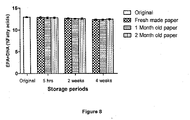
- the greatest stability of fatty acid composition in the blood spots was achieved by combining the antioxidant BHT with an iron chelator (L-ascorbic acid or EDTA) and silica gel paper as a collection paper, as this allowed for the maintenance of original EPA and DHA levels in the blood spot after even 2 months of storage at ambient temperature.
- an iron chelator L-ascorbic acid or EDTA
- a protection system which is made up of a combination of BHT, a chelator and silica gel paper can prevent LCPUFA in blood spots from significant oxidative loss for at least 2 months when stored at ambient temperature.
- This method has the potential to allow accurate evaluation of fatty acid status in capillary blood samples after long term storage and thus enable comparisons between samples which have been stored for different periods of time.
- Example 2 Stabilisation of blood plasma spots on Whatman silica gel chromatography paper using a combination of BHT and EDTA
- Plasma samples were collected from a subject who regularly consumed one capsule of fish oil per day. The blood sample was centrifuged at 3000 rpm for 10 mins at 4°C to separate plasma and red blood cells. A drop of plasma ( ⁇ 50 ⁇ l) was transesterified directly and the resultant FAME were analysed by GC to provide a baseline for the fatty acid composition in plasma total lipids. The rest of plasma was divided into two portions, the first portion was stored at -20°C, and tested for fatty acid composition by direct transesterification at 1, 2 and 4weeks.
- the second portion was spotted onto Whatman silica gel chromatography paper (46 ⁇ 57cm, Whatman, Buckingham, UK ( ⁇ 50 ⁇ l per paper) impregnated with 2mg/ml BHT and 5mg/ml EDTA and dried in air for 5-6hr.
- the plasma spots were then stored in cellophane bags in the dark at room temperature (19-23°C), and fatty acid composition in these samples were measured at 1, 2 and 4weeks after the time of blood collection. All samples were processed in triplicate. The results are shown in Table 4. Table 4.
- Example 3 Stabilisation of breast milk spots on Whatman silica gel chromatography paper using a combination of BHT and EDTA
- Breast milk was obtained from a subject who had been lactating for 5 months and was not taking fish oil supplementation.
- a drop of breast milk ( ⁇ 50 ⁇ l) was transesterified directly and the resultant FAME were analysed by GC to provide a baseline for the fatty acid composition in breast milk total lipids.
- the rest of the breast milk was spotted onto Whatman silica gel chromatography paper (46 ⁇ 57cm, Whatman, Buckingham, UK ( ⁇ 50 ⁇ l per paper) impregnated with 2mg/ml BHT and 5mg/ml EDTA, and dried in air for 5-6hr. Once the breast milk spots were dried, they were divided into 4 groups. The first group was transesterified immediately following the same transesterification procedure as for the fresh breast milk.
- Example 4 Contaminants from paper and other sources
- Blood spot collection papers Five types of paper were used as blood spot collection papers, they are two commercially developed blood spot collection papers: Fluka blood collection kit (Sigma-Aldrich, Buchs, Switzerland) and Whatman 903 specimen collection card (Whatman, Buckingham, UK); And three chromatography papers: Whatman 3MM chromatography paper (46 ⁇ 57cm, Whatman, Buckingham, UK), Whatman silica gel chromatography paper (46 ⁇ 57cm, Whatman, Buckingham, UK) and Whatman glass microfiber filter (GF/B 47 mm, Whatman, Buckingham, UK).
- Fluka blood collection kit Sigma-Aldrich, Buchs, Switzerland
- Whatman 903 specimen collection card Whatman, Buckingham, UK
- Whatman 3MM chromatography paper 46 ⁇ 57cm, Whatman, Buckingham, UK
- Whatman silica gel chromatography paper 46 ⁇ 57cm, Whatman, Buckingham, UK
- Whatman glass microfiber filter GF/B 47 mm, Whatman, Buckingham, UK
- blank Whatman glass microfiber filter strips (1 ⁇ 1 cm) were wiped on a 10 cm 2 surface area of various materials used in our laboratory including a latex glove, a nitrile glove, a polyethylene (PE) ziplock bag, an aluminium foil ziplock bag or a cellophane bag.
- the wiped paper samples were then transmethylated by using the method described above and analysed by GC.
- the contaminant content of blank glass microfiber filter was subtracted from wiped glass microfiber filters to assess the contaminants that originate from those gloves and bags. All the samples were processed in triplicate.
- FAME FAME were separated and quantified by using a GC (Hewlett-Packard 6890; Palo Alto, CA, USA) equipped with a BPX70 capillary column 50 m ⁇ 0.32 mm, film thickness 0.25 ⁇ m (SGC Pty Ltd., Victoria, Australia), PTV Injector and a flame ionisation detector (FID).
- the injector temperature was set at 250 °C and the FID temperature at 300 °C, a programmed temperature ramp (140-240 °C) was used.
- Helium gas was utilized as a carrier at a flow rate of 35 cm per second in the column and the inlet split ratio was set at 20:1.
- the identification and quantification of FAME was achieved by comparing the retention times and peak area values of unknown samples to those of commercial lipid standards (Nu-Chek Prep Inc., Elysian, MN, USA) using the Hewlett-Packard Chemstation data system.
- the results presented here clearly demonstrate that the fatty acid status test results from blood spot samples can vary from those obtained from fresh whole blood.
- the Fluka blood collection kit and Whatman 903 specimen collection card are commercial products which are widely used for blood collection, and Whatman 3MM chromatography paper is also frequently used as a blood collection paper in clinical trials.
- low volumes of blood (25 ⁇ l) on any of these three types of paper produced dubious fatty acid status results when they were used for direct assessment of LCPUFA from a drop of whole blood. From our data it is clear that contaminants from these collection papers interfere with the accurate determination of the amount of the respective classes of fatty acids as a proportion of total lipids. Using blank collection paper as a control to correct for contaminants is feasible for individual fatty acids composition test.
- the inventors have found that the two main contaminants in all types of collection paper corresponded to 16:0 and 18:0 saturated fatty acids (Table 8). This explains the increase in the percentages of 16:0 and 18:0 saturated fatty acids that was detected in blood spot samples when compared with those in fresh blood. Furthermore, the total amount of contaminants varied between different types of collection paper, for example, the Whatman silica gel paper had only 0.1 ⁇ g/cm 2 of contaminants, whereas some batches of the Whatman 903 paper had nearly 25 times of that amount. Washing the papers with solvents and even treating papers with the transmethylation procedure failed to remove the contaminant, leading us to believe that the fatty acids are constitutive of paper.
- Latex gloves contain a significant amount of contaminants however there was virtually no contamination detected from the nitrile glove.
- the PE bag and the aluminium bag each contained large amounts of contaminants which corresponded to oleic acid (18:1 n-9) and erucic acid (22:1 n-9), however, the cellophane bag did not result in the appearance of any significant contamination.
- Table 9 Table 9
- Amount of potential contaminants from different sources Contaminants c orresponding to fatty acid peaks* Nitrile glove Latex glove PE ziplock bag Aluminum foil ziplock bag Cellophane bag 16:0 0.005 ⁇ 0.002 0.62 ⁇ 0.02 0.02 ⁇ 0.01 0 0 18:0 0 0.61 ⁇ 0.01 0.01 ⁇ 0.01 0 0.010 ⁇ 0.002 18:1 n-9 0 0 0.31 ⁇ 0.02 0 0 22:1 n-9 0 0 0.48 ⁇ 0.03 0.32 ⁇ 0.02 0 Total 0.005 ⁇ 0.002 a 1.22 ⁇ 0.02 b 0.82 ⁇ 0.05 c 0.32 ⁇ 0.02 d 0.010 ⁇ 0.002 a *The unit for contaminants is ⁇ g/cm 2 on Whatman glass microfiber filter after wiped on the surface of gloves or bags, values represent mean ⁇ SD (n 3), different superscripts indicate significant difference between groups, p ⁇ 0.05
- Latex gloves, PE bags and aluminium bags are widely used in many laboratories. There have been no previous studies focussing on latex gloves as a source of contamination in experiments, with existing investigations reporting only that latex gloves can release endotoxins which may cause an allergy. However, our experiments have indicated that even these widely used laboratory items have the potential to release hydrophobic contaminants and could contribute to alteration in the results of blood fatty acid composition tests, especially when the blood sample volume is low. Thus, to minimize potential contaminant problems from gloves and bags, the use of nitrile gloves and cellophane bags during collection, processing and storage of the blood spot samples is recommended.
- Example 5 Comparison of capillary blood spot and conventional measurements of fatty acid status
- RBC red blood cells
- the fatty acid composition from capillary DBS and conventional assays Fatty acids Capillary Whole Plasma Plasma Red blood cell DBS blood Total lipids Total lipids Phospholipid s Phospholipid s 16:0 * 23.40 ⁇ 1.84 a 23.61 ⁇ 1.99 a 23.28 ⁇ 2.47 a 29.39 ⁇ 1.90 b 25.36 ⁇ 1.28 a 18:0 11.66 ⁇ 1.24 ab 9.90 ⁇ 1.13 b 7.44 ⁇ 0.94 c 14.31 ⁇ 1.94 a 13.67 ⁇ 1.38 a 18:1 n-9 18.99 ⁇ 2.84 b 18.99 ⁇ 2.95 b 20.78 ⁇ 3.91 a 10.54 ⁇ 2.51 d 15.73 ⁇ 1.73 c 18:2 n-6 26.71 ⁇ 4.18 b 27.96 ⁇ 4.64 b 34.29 ⁇ 5.82 a 25.37 ⁇ 4.70 b 14.33 ⁇ 2.82 c 18:3 n-3 0.46 ⁇ 0.12 b 0.48 ⁇ 0.12 b 0.62 ⁇ 0.15 a 0.22 ⁇ 0.08 c 0.
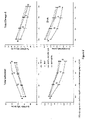
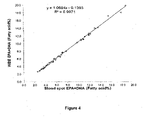
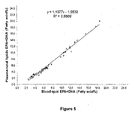
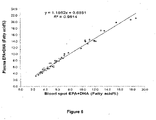
- fatty acid status of individuals is reported in a variety of ways it was important to compare the fatty acid spectrum in a dried blood spot with standard ways of reporting the fatty acids in blood. These included whole blood extract, plasma phospholipids, and red blood cell fatty acids. In addition, fatty acid groupings such as EPA + DHA (omega 3 index) in each of these blood fractions were compared with similar groupings found in dried blood spots.
Landscapes
- Health & Medical Sciences (AREA)
- Life Sciences & Earth Sciences (AREA)
- Engineering & Computer Science (AREA)
- Biomedical Technology (AREA)
- Chemical & Material Sciences (AREA)
- Physics & Mathematics (AREA)
- Hematology (AREA)
- Pathology (AREA)
- General Health & Medical Sciences (AREA)
- Molecular Biology (AREA)
- Biophysics (AREA)
- Urology & Nephrology (AREA)
- Immunology (AREA)
- Heart & Thoracic Surgery (AREA)
- Veterinary Medicine (AREA)
- Public Health (AREA)
- Animal Behavior & Ethology (AREA)
- Surgery (AREA)
- Medical Informatics (AREA)
- General Physics & Mathematics (AREA)
- Biochemistry (AREA)
- Analytical Chemistry (AREA)
- Medicinal Chemistry (AREA)
- Food Science & Technology (AREA)
- Organic Chemistry (AREA)
- Oil, Petroleum & Natural Gas (AREA)
- Chemical Kinetics & Catalysis (AREA)
- Wood Science & Technology (AREA)
- Ecology (AREA)
- Manufacturing & Machinery (AREA)
- Diabetes (AREA)
- Materials Engineering (AREA)
- Endocrinology (AREA)
- Biotechnology (AREA)
- Cell Biology (AREA)
- Microbiology (AREA)
- Investigating Or Analysing Biological Materials (AREA)
- Sampling And Sample Adjustment (AREA)
- Investigating Or Analyzing Non-Biological Materials By The Use Of Chemical Means (AREA)
- Measuring Or Testing Involving Enzymes Or Micro-Organisms (AREA)
Applications Claiming Priority (2)
| Application Number | Priority Date | Filing Date | Title |
|---|---|---|---|
| AU2012900110A AU2012900110A0 (en) | 2012-01-11 | Methods and mediums for stabilising fatty acids | |
| PCT/AU2013/000021 WO2013104025A1 (en) | 2012-01-11 | 2013-01-11 | Stabilising and analysing fatty acids in a biological sample stored on solid media |
Publications (3)
| Publication Number | Publication Date |
|---|---|
| EP2802867A1 EP2802867A1 (en) | 2014-11-19 |
| EP2802867A4 EP2802867A4 (en) | 2016-01-06 |
| EP2802867B1 true EP2802867B1 (en) | 2022-08-03 |
Family
ID=48780974
Family Applications (1)
| Application Number | Title | Priority Date | Filing Date |
|---|---|---|---|
| EP13736428.7A Active EP2802867B1 (en) | 2012-01-11 | 2013-01-11 | Stabilising and analysing fatty acids in a biological sample stored on solid media |
Country Status (13)
| Country | Link |
|---|---|
| US (1) | US9645132B2 (enExample) |
| EP (1) | EP2802867B1 (enExample) |
| JP (1) | JP6325985B2 (enExample) |
| KR (1) | KR102071733B1 (enExample) |
| CN (1) | CN104254775B (enExample) |
| AP (1) | AP2014007862A0 (enExample) |
| BR (1) | BR112014017226B1 (enExample) |
| HK (1) | HK1203609A1 (enExample) |
| MX (1) | MX355406B (enExample) |
| NZ (1) | NZ628481A (enExample) |
| PH (1) | PH12014501589A1 (enExample) |
| RU (1) | RU2639455C2 (enExample) |
| WO (1) | WO2013104025A1 (enExample) |
Families Citing this family (11)
| Publication number | Priority date | Publication date | Assignee | Title |
|---|---|---|---|---|
| CN108872404A (zh) * | 2017-05-09 | 2018-11-23 | 中国科学院上海生命科学研究院 | 超长链饱和脂肪酸或其检测试剂在代谢综合征患病风险预测中的应用 |
| EP3803321A4 (en) * | 2018-05-30 | 2022-01-19 | University Of South Australia | DEVICES AND METHODS FOR COLLECTING AND STORING LIQUID SAMPLES FOR ANALYSIS |
| CN110007040A (zh) * | 2019-03-12 | 2019-07-12 | 广西医科大学 | 一种关节腔内外源kgn含量测定方法 |
| RU2758932C1 (ru) * | 2020-07-17 | 2021-11-03 | Федеральное государственное бюджетное учреждение науки Федеральный исследовательский центр комплексного изучения Арктики имени академика Н.П. Лаверова Уральского отделения Российской академии наук (ФГБУН ФИЦКИА УрО РАН) | Способ измерения массовой концентрации метиловых эфиров жирных кислот в биологических средах методом газожидкостной хроматографии |
| KR102194995B1 (ko) | 2020-09-16 | 2020-12-28 | 장혜란 | 진단을 위한 개선된 건조체액의 안정화 조성물 및 이의 응용방법 |
| KR102541967B1 (ko) | 2020-12-08 | 2023-06-12 | 한국화학연구원 | 플라스틱 분해 미생물 스크리닝 배지 및 이의 제조방법 |
| KR20220082143A (ko) | 2020-12-09 | 2022-06-17 | 충남대학교산학협력단 | 노면온도표시를 위한 감온변색 도료 조성물 및 이를 이용한 노면온도표시선의 시공방법 |
| GB2619714B (en) * | 2022-06-13 | 2025-03-26 | Terex Gb Ltd | Method and device for installing a shaft in a material processing apparatus |
| CN115184114A (zh) * | 2022-07-18 | 2022-10-14 | 脂谱生物科技(上海)有限公司 | 一种具有抗菌涂层的中长链脂肪酸保存试纸及其制备方法 |
| CN115308078B (zh) * | 2022-08-09 | 2024-04-02 | 上海海洋大学 | 一种柔鱼类不同组织脂肪酸质量分数的测定方法 |
| WO2025187102A1 (ja) * | 2024-03-05 | 2025-09-12 | 株式会社 食機能探索研究所 Babilon | 赤血球捕集用濾紙 |
Citations (2)
| Publication number | Priority date | Publication date | Assignee | Title |
|---|---|---|---|---|
| GB1435877A (en) * | 1973-10-18 | 1976-05-19 | Shionogi & Co | Composition and test strip for detecting homocystinuria and cystinuria |
| US7056528B1 (en) * | 1999-10-16 | 2006-06-06 | Lts Lohmann Therapie-Systeme Ag | Transdermal therapeutic system containing tulobuterol hydrochloride for administering the bronchodilator tulobuterol via the skin |
Family Cites Families (26)
| Publication number | Priority date | Publication date | Assignee | Title |
|---|---|---|---|---|
| FR1271568A (enExample) | 1959-07-30 | 1962-01-19 | Shell Int Research | |
| US6627226B2 (en) * | 1988-10-05 | 2003-09-30 | Whatman, Inc. | Dry solid medium for storage and analysis of genetic material |
| WO1990003959A1 (en) | 1988-10-05 | 1990-04-19 | The Flinders University Of South Australia | Solid medium and method for dna storage |
| US5116629A (en) * | 1990-10-24 | 1992-05-26 | General Mills, Inc. | Processed meat products containing fish oils stabilized with fructose |
| JP3177658B2 (ja) * | 1991-03-25 | 2001-06-18 | 東ソー株式会社 | 生体試料用濾紙 |
| US5234702A (en) * | 1992-03-19 | 1993-08-10 | Abbott Laboratories | Antioxidant system for powdered nutritional products |
| WO1996011406A1 (en) * | 1994-10-07 | 1996-04-18 | Flinders Technologies Pty. Ltd. | Apparatus and method for storage, purification or reaction and processing of a biopolymer |
| DE96915910T1 (de) * | 1995-06-07 | 2004-04-22 | Whatman Plc, Maidstone | Trockenes festes medium zur lagerung und analyse von genetischem material |
| US5728663A (en) * | 1996-07-02 | 1998-03-17 | Johnson & Johnson Consumer Products, Inc. | Clear, colorless soap bar with superior mildness, lathering and discolorization resistence |
| US6852289B2 (en) | 1996-10-02 | 2005-02-08 | Saftest, Inc. | Methods and apparatus for determining analytes in various matrices |
| JP3380230B2 (ja) * | 1998-09-02 | 2003-02-24 | アークレイ株式会社 | 血液の保存方法およびそれに用いる血液保存用具 |
| US6746841B1 (en) * | 1999-04-14 | 2004-06-08 | Whatman Inc. | FTA- coated media for use as a molecular diagnostic tool |
| US6420332B1 (en) * | 1998-12-23 | 2002-07-16 | Joseph J. Simpson | Blood and organic stain remover |
| US6673763B1 (en) * | 1999-09-24 | 2004-01-06 | Novozymes A/S | Particles for liquid compositions |
| US6602718B1 (en) * | 2000-11-08 | 2003-08-05 | Becton, Dickinson And Company | Method and device for collecting and stabilizing a biological sample |
| US20050205840A1 (en) * | 2003-10-03 | 2005-09-22 | Farneth William E | Oxygen scavenging compositions and methods of use |
| DE602005016402D1 (de) * | 2004-05-24 | 2009-10-15 | Genvault Corp | Stabile lagerung von protein und stabile lagerung von nukleinsäure in wiedergewinnbarer form |
| CA2613631A1 (en) * | 2005-06-23 | 2007-01-04 | Spherics, Inc. | Improved dosage forms for movement disorder treatment |
| JP4942380B2 (ja) * | 2005-12-02 | 2012-05-30 | 月桂冠株式会社 | カルボン酸のアルキルエステル化方法及びキット |
| WO2009034124A1 (en) * | 2007-09-12 | 2009-03-19 | Novozymes A/S | Omega-3 stabilisation towards oxidation |
| US20100272875A1 (en) * | 2009-04-24 | 2010-10-28 | Monsanto Technology Llc | Omega-3 enriched cereal, granola, and snack bars |
| EP2338874A1 (en) * | 2009-12-16 | 2011-06-29 | Bracco Imaging S.p.A | Process for the preparation of chelated compounds |
| WO2011113043A2 (en) * | 2010-03-12 | 2011-09-15 | University Of South Florida | Sample storage for molecular and immunological detection |
| PL2575795T3 (pl) * | 2010-05-26 | 2020-06-01 | Kerecis Ehf | STABILIZOWANY PREPARAT ZAWIERAJĄCY KWASY TŁUSZCZOWE OMEGA-3 ORAZ ZASTOSOWANIE KWASÓW TŁUSZCZOWYCH DO PIELĘGNACJI SKÓRY l/LUB PIELĘGNACJI RAN |
| CN107202727B (zh) * | 2010-07-14 | 2020-12-22 | 恰根有限公司 | 用于分离和/或纯化生物分子的装置 |
| US9040675B2 (en) * | 2012-04-30 | 2015-05-26 | General Electric Company | Formulations for nucleic acid stabilization on solid substrates |
-
2013
- 2013-01-11 NZ NZ628481A patent/NZ628481A/en not_active IP Right Cessation
- 2013-01-11 EP EP13736428.7A patent/EP2802867B1/en active Active
- 2013-01-11 KR KR1020147022402A patent/KR102071733B1/ko not_active Expired - Fee Related
- 2013-01-11 RU RU2014132765A patent/RU2639455C2/ru active
- 2013-01-11 AP AP2014007862A patent/AP2014007862A0/xx unknown
- 2013-01-11 WO PCT/AU2013/000021 patent/WO2013104025A1/en not_active Ceased
- 2013-01-11 JP JP2014551485A patent/JP6325985B2/ja not_active Expired - Fee Related
- 2013-01-11 HK HK15103828.5A patent/HK1203609A1/xx unknown
- 2013-01-11 MX MX2014008495A patent/MX355406B/es active IP Right Grant
- 2013-01-11 CN CN201380012298.1A patent/CN104254775B/zh not_active Expired - Fee Related
- 2013-01-11 US US14/371,664 patent/US9645132B2/en not_active Expired - Fee Related
- 2013-01-11 BR BR112014017226-9A patent/BR112014017226B1/pt not_active IP Right Cessation
-
2014
- 2014-07-10 PH PH12014501589A patent/PH12014501589A1/en unknown
Patent Citations (2)
| Publication number | Priority date | Publication date | Assignee | Title |
|---|---|---|---|---|
| GB1435877A (en) * | 1973-10-18 | 1976-05-19 | Shionogi & Co | Composition and test strip for detecting homocystinuria and cystinuria |
| US7056528B1 (en) * | 1999-10-16 | 2006-06-06 | Lts Lohmann Therapie-Systeme Ag | Transdermal therapeutic system containing tulobuterol hydrochloride for administering the bronchodilator tulobuterol via the skin |
Also Published As
| Publication number | Publication date |
|---|---|
| KR20140136924A (ko) | 2014-12-01 |
| JP2015503756A (ja) | 2015-02-02 |
| MX2014008495A (es) | 2015-04-16 |
| EP2802867A1 (en) | 2014-11-19 |
| MX355406B (es) | 2018-04-18 |
| WO2013104025A1 (en) | 2013-07-18 |
| PH12014501589B1 (en) | 2014-10-20 |
| CN104254775B (zh) | 2017-07-21 |
| BR112014017226B1 (pt) | 2021-11-30 |
| PH12014501589A1 (en) | 2014-10-20 |
| KR102071733B1 (ko) | 2020-01-30 |
| EP2802867A4 (en) | 2016-01-06 |
| CN104254775A (zh) | 2014-12-31 |
| US9645132B2 (en) | 2017-05-09 |
| NZ628481A (en) | 2016-11-25 |
| AU2013209278A1 (en) | 2014-08-28 |
| RU2014132765A (ru) | 2016-02-27 |
| JP6325985B2 (ja) | 2018-05-16 |
| BR112014017226A2 (pt) | 2020-10-27 |
| HK1203609A1 (en) | 2015-10-30 |
| RU2639455C2 (ru) | 2017-12-21 |
| US20150027208A1 (en) | 2015-01-29 |
| AP2014007862A0 (en) | 2014-08-31 |
Similar Documents
| Publication | Publication Date | Title |
|---|---|---|
| EP2802867B1 (en) | Stabilising and analysing fatty acids in a biological sample stored on solid media | |
| Kuo et al. | Antioxidant and antiglycation properties of different solvent extracts from Chinese olive (Canarium album L.) fruit | |
| Kardum et al. | Effects of polyphenol-rich chokeberry juice on cellular antioxidant enzymes and membrane lipid status in healthy women | |
| Yang et al. | Rosemary extract can be used as a synthetic antioxidant to improve vegetable oil oxidative stability | |
| Abdel‐Aal et al. | Free and bound phenolic acids and total phenolics in black, blue, and yellow barley and their contribution to free radical scavenging capacity | |
| Jabri-Karoui et al. | Research on the phenolic compounds and antioxidant activities of Tunisian Thymus capitatus | |
| Colpo et al. | Brazilian nut consumption by healthy volunteers improves inflammatory parameters | |
| Radojković et al. | Biological activities and chemical composition of Morus leaves extracts obtained by maceration and supercritical fluid extraction | |
| Mišík et al. | Impact of paper filtered coffee on oxidative DNA-damage: results of a clinical trial | |
| Chen et al. | Antioxidant effects of rosemary extracts on sunflower oil compared with synthetic antioxidants | |
| Zeeb et al. | Separation and identification of twelve catechins in tea using liquid chromatography/atmospheric pressure chemical ionization-mass spectrometry | |
| Ercan et al. | Antioxidant and antimicrobial capacity of quinic acid | |
| Mellouk et al. | Antioxidant properties of the red alga Asparagopsis taxiformis collected on the North West Algerian coast | |
| Véricel et al. | Moderate oral supplementation with docosahexaenoic acid improves platelet function and oxidative stress in type 2 diabetic patients | |
| Kivrak et al. | Bioactive compounds, chemical composition, and medicinal value of the giant puffball, Calvatia gigantea (higher basidiomycetes), from Turkey | |
| Peinado et al. | Synergistic antioxidant interaction between sugars and phenolics from a sweet wine | |
| Guler | Studies on antioxidant properties of the different solvent extracts and fatty acid composition of Hyoscyamus reticulatus L. | |
| Park et al. | Effects of Korean black raspberry supplementation on oxidative stress and plasma antioxidant capacity in healthy male smokers | |
| AU2013209278B2 (en) | Stabilising and analysing fatty acids in a biological sample stored on solid media | |
| Ozyurt et al. | GC⨯ GC-TOF/MS Chromatographic Analysis, Antioxidant Capacity and Phenolic Content of Rosa Canina L. at Different Maturities. | |
| Jenske et al. | Concentrations of medium-chain 2-and 3-hydroxy fatty acids in foodstuffs | |
| Karasakal | Evaluation of Antioxidant activities of Brassica napus’s seeds by CUPRAC, ABTSPersulphate and DMPD methods | |
| Celikler et al. | Protective and antigenotoxic effect of Ulva rigida C. Agardh in experimental hypothyroid | |
| Karami et al. | Quantitation of rosmarinic acid and caffeic acid in various Salvia genera by high performance thin layer chromatography | |
| Siger et al. | Tocochromanols |
Legal Events
| Date | Code | Title | Description |
|---|---|---|---|
| PUAI | Public reference made under article 153(3) epc to a published international application that has entered the european phase |
Free format text: ORIGINAL CODE: 0009012 |
|
| 17P | Request for examination filed |
Effective date: 20140811 |
|
| AK | Designated contracting states |
Kind code of ref document: A1 Designated state(s): AL AT BE BG CH CY CZ DE DK EE ES FI FR GB GR HR HU IE IS IT LI LT LU LV MC MK MT NL NO PL PT RO RS SE SI SK SM TR |
|
| DAX | Request for extension of the european patent (deleted) | ||
| RIN1 | Information on inventor provided before grant (corrected) |
Inventor name: GIBSON, ROBERT Inventor name: GE, LIU |
|
| RIC1 | Information provided on ipc code assigned before grant |
Ipc: C11B 5/00 20060101ALI20150805BHEP Ipc: G01N 1/36 20060101ALI20150805BHEP Ipc: A61B 5/15 20060101ALI20150805BHEP Ipc: G01N 33/92 20060101ALI20150805BHEP Ipc: G01N 30/50 20060101AFI20150805BHEP Ipc: G01N 33/48 20060101ALI20150805BHEP |
|
| REG | Reference to a national code |
Ref country code: HK Ref legal event code: DE Ref document number: 1203609 Country of ref document: HK |
|
| RA4 | Supplementary search report drawn up and despatched (corrected) |
Effective date: 20151203 |
|
| RIC1 | Information provided on ipc code assigned before grant |
Ipc: G01N 33/48 20060101ALI20151127BHEP Ipc: G01N 33/92 20060101ALI20151127BHEP Ipc: A61B 5/15 20060101ALI20151127BHEP Ipc: G01N 1/36 20060101ALI20151127BHEP Ipc: G01N 30/50 20060101AFI20151127BHEP Ipc: C11B 5/00 20060101ALI20151127BHEP |
|
| STAA | Information on the status of an ep patent application or granted ep patent |
Free format text: STATUS: EXAMINATION IS IN PROGRESS |
|
| 17Q | First examination report despatched |
Effective date: 20170314 |
|
| GRAP | Despatch of communication of intention to grant a patent |
Free format text: ORIGINAL CODE: EPIDOSNIGR1 |
|
| STAA | Information on the status of an ep patent application or granted ep patent |
Free format text: STATUS: GRANT OF PATENT IS INTENDED |
|
| INTG | Intention to grant announced |
Effective date: 20201028 |
|
| GRAJ | Information related to disapproval of communication of intention to grant by the applicant or resumption of examination proceedings by the epo deleted |
Free format text: ORIGINAL CODE: EPIDOSDIGR1 |
|
| STAA | Information on the status of an ep patent application or granted ep patent |
Free format text: STATUS: EXAMINATION IS IN PROGRESS |
|
| INTC | Intention to grant announced (deleted) | ||
| REG | Reference to a national code |
Ref country code: HK Ref legal event code: WD Ref document number: 1203609 Country of ref document: HK |
|
| GRAP | Despatch of communication of intention to grant a patent |
Free format text: ORIGINAL CODE: EPIDOSNIGR1 |
|
| STAA | Information on the status of an ep patent application or granted ep patent |
Free format text: STATUS: GRANT OF PATENT IS INTENDED |
|
| INTG | Intention to grant announced |
Effective date: 20211029 |
|
| GRAS | Grant fee paid |
Free format text: ORIGINAL CODE: EPIDOSNIGR3 |
|
| GRAA | (expected) grant |
Free format text: ORIGINAL CODE: 0009210 |
|
| STAA | Information on the status of an ep patent application or granted ep patent |
Free format text: STATUS: THE PATENT HAS BEEN GRANTED |
|
| AK | Designated contracting states |
Kind code of ref document: B1 Designated state(s): AL AT BE BG CH CY CZ DE DK EE ES FI FR GB GR HR HU IE IS IT LI LT LU LV MC MK MT NL NO PL PT RO RS SE SI SK SM TR |
|
| REG | Reference to a national code |
Ref country code: AT Ref legal event code: REF Ref document number: 1509141 Country of ref document: AT Kind code of ref document: T Effective date: 20220815 Ref country code: CH Ref legal event code: EP |
|
| REG | Reference to a national code |
Ref country code: DE Ref legal event code: R096 Ref document number: 602013082219 Country of ref document: DE |
|
| REG | Reference to a national code |
Ref country code: IE Ref legal event code: FG4D |
|
| REG | Reference to a national code |
Ref country code: LT Ref legal event code: MG9D |
|
| REG | Reference to a national code |
Ref country code: NL Ref legal event code: MP Effective date: 20220803 |
|
| PG25 | Lapsed in a contracting state [announced via postgrant information from national office to epo] |
Ref country code: SE Free format text: LAPSE BECAUSE OF FAILURE TO SUBMIT A TRANSLATION OF THE DESCRIPTION OR TO PAY THE FEE WITHIN THE PRESCRIBED TIME-LIMIT Effective date: 20220803 Ref country code: RS Free format text: LAPSE BECAUSE OF FAILURE TO SUBMIT A TRANSLATION OF THE DESCRIPTION OR TO PAY THE FEE WITHIN THE PRESCRIBED TIME-LIMIT Effective date: 20220803 Ref country code: PT Free format text: LAPSE BECAUSE OF FAILURE TO SUBMIT A TRANSLATION OF THE DESCRIPTION OR TO PAY THE FEE WITHIN THE PRESCRIBED TIME-LIMIT Effective date: 20221205 Ref country code: NO Free format text: LAPSE BECAUSE OF FAILURE TO SUBMIT A TRANSLATION OF THE DESCRIPTION OR TO PAY THE FEE WITHIN THE PRESCRIBED TIME-LIMIT Effective date: 20221103 Ref country code: NL Free format text: LAPSE BECAUSE OF FAILURE TO SUBMIT A TRANSLATION OF THE DESCRIPTION OR TO PAY THE FEE WITHIN THE PRESCRIBED TIME-LIMIT Effective date: 20220803 Ref country code: LV Free format text: LAPSE BECAUSE OF FAILURE TO SUBMIT A TRANSLATION OF THE DESCRIPTION OR TO PAY THE FEE WITHIN THE PRESCRIBED TIME-LIMIT Effective date: 20220803 Ref country code: LT Free format text: LAPSE BECAUSE OF FAILURE TO SUBMIT A TRANSLATION OF THE DESCRIPTION OR TO PAY THE FEE WITHIN THE PRESCRIBED TIME-LIMIT Effective date: 20220803 Ref country code: FI Free format text: LAPSE BECAUSE OF FAILURE TO SUBMIT A TRANSLATION OF THE DESCRIPTION OR TO PAY THE FEE WITHIN THE PRESCRIBED TIME-LIMIT Effective date: 20220803 Ref country code: ES Free format text: LAPSE BECAUSE OF FAILURE TO SUBMIT A TRANSLATION OF THE DESCRIPTION OR TO PAY THE FEE WITHIN THE PRESCRIBED TIME-LIMIT Effective date: 20220803 |
|
| REG | Reference to a national code |
Ref country code: AT Ref legal event code: MK05 Ref document number: 1509141 Country of ref document: AT Kind code of ref document: T Effective date: 20220803 |
|
| PG25 | Lapsed in a contracting state [announced via postgrant information from national office to epo] |
Ref country code: PL Free format text: LAPSE BECAUSE OF FAILURE TO SUBMIT A TRANSLATION OF THE DESCRIPTION OR TO PAY THE FEE WITHIN THE PRESCRIBED TIME-LIMIT Effective date: 20220803 Ref country code: IS Free format text: LAPSE BECAUSE OF FAILURE TO SUBMIT A TRANSLATION OF THE DESCRIPTION OR TO PAY THE FEE WITHIN THE PRESCRIBED TIME-LIMIT Effective date: 20221203 Ref country code: HR Free format text: LAPSE BECAUSE OF FAILURE TO SUBMIT A TRANSLATION OF THE DESCRIPTION OR TO PAY THE FEE WITHIN THE PRESCRIBED TIME-LIMIT Effective date: 20220803 Ref country code: GR Free format text: LAPSE BECAUSE OF FAILURE TO SUBMIT A TRANSLATION OF THE DESCRIPTION OR TO PAY THE FEE WITHIN THE PRESCRIBED TIME-LIMIT Effective date: 20221104 |
|
| PG25 | Lapsed in a contracting state [announced via postgrant information from national office to epo] |
Ref country code: SM Free format text: LAPSE BECAUSE OF FAILURE TO SUBMIT A TRANSLATION OF THE DESCRIPTION OR TO PAY THE FEE WITHIN THE PRESCRIBED TIME-LIMIT Effective date: 20220803 Ref country code: RO Free format text: LAPSE BECAUSE OF FAILURE TO SUBMIT A TRANSLATION OF THE DESCRIPTION OR TO PAY THE FEE WITHIN THE PRESCRIBED TIME-LIMIT Effective date: 20220803 Ref country code: DK Free format text: LAPSE BECAUSE OF FAILURE TO SUBMIT A TRANSLATION OF THE DESCRIPTION OR TO PAY THE FEE WITHIN THE PRESCRIBED TIME-LIMIT Effective date: 20220803 Ref country code: CZ Free format text: LAPSE BECAUSE OF FAILURE TO SUBMIT A TRANSLATION OF THE DESCRIPTION OR TO PAY THE FEE WITHIN THE PRESCRIBED TIME-LIMIT Effective date: 20220803 Ref country code: AT Free format text: LAPSE BECAUSE OF FAILURE TO SUBMIT A TRANSLATION OF THE DESCRIPTION OR TO PAY THE FEE WITHIN THE PRESCRIBED TIME-LIMIT Effective date: 20220803 |
|
| REG | Reference to a national code |
Ref country code: DE Ref legal event code: R097 Ref document number: 602013082219 Country of ref document: DE |
|
| PG25 | Lapsed in a contracting state [announced via postgrant information from national office to epo] |
Ref country code: SK Free format text: LAPSE BECAUSE OF FAILURE TO SUBMIT A TRANSLATION OF THE DESCRIPTION OR TO PAY THE FEE WITHIN THE PRESCRIBED TIME-LIMIT Effective date: 20220803 Ref country code: EE Free format text: LAPSE BECAUSE OF FAILURE TO SUBMIT A TRANSLATION OF THE DESCRIPTION OR TO PAY THE FEE WITHIN THE PRESCRIBED TIME-LIMIT Effective date: 20220803 |
|
| PLBE | No opposition filed within time limit |
Free format text: ORIGINAL CODE: 0009261 |
|
| STAA | Information on the status of an ep patent application or granted ep patent |
Free format text: STATUS: NO OPPOSITION FILED WITHIN TIME LIMIT |
|
| PG25 | Lapsed in a contracting state [announced via postgrant information from national office to epo] |
Ref country code: AL Free format text: LAPSE BECAUSE OF FAILURE TO SUBMIT A TRANSLATION OF THE DESCRIPTION OR TO PAY THE FEE WITHIN THE PRESCRIBED TIME-LIMIT Effective date: 20220803 |
|
| 26N | No opposition filed |
Effective date: 20230504 |
|
| REG | Reference to a national code |
Ref country code: DE Ref legal event code: R119 Ref document number: 602013082219 Country of ref document: DE |
|
| PG25 | Lapsed in a contracting state [announced via postgrant information from national office to epo] |
Ref country code: SI Free format text: LAPSE BECAUSE OF FAILURE TO SUBMIT A TRANSLATION OF THE DESCRIPTION OR TO PAY THE FEE WITHIN THE PRESCRIBED TIME-LIMIT Effective date: 20220803 |
|
| REG | Reference to a national code |
Ref country code: CH Ref legal event code: PL |
|
| GBPC | Gb: european patent ceased through non-payment of renewal fee |
Effective date: 20230111 |
|
| PG25 | Lapsed in a contracting state [announced via postgrant information from national office to epo] |
Ref country code: LU Free format text: LAPSE BECAUSE OF NON-PAYMENT OF DUE FEES Effective date: 20230111 |
|
| REG | Reference to a national code |
Ref country code: BE Ref legal event code: MM Effective date: 20230131 |
|
| PG25 | Lapsed in a contracting state [announced via postgrant information from national office to epo] |
Ref country code: LI Free format text: LAPSE BECAUSE OF NON-PAYMENT OF DUE FEES Effective date: 20230131 Ref country code: GB Free format text: LAPSE BECAUSE OF NON-PAYMENT OF DUE FEES Effective date: 20230111 Ref country code: DE Free format text: LAPSE BECAUSE OF NON-PAYMENT OF DUE FEES Effective date: 20230801 Ref country code: CH Free format text: LAPSE BECAUSE OF NON-PAYMENT OF DUE FEES Effective date: 20230131 |
|
| PG25 | Lapsed in a contracting state [announced via postgrant information from national office to epo] |
Ref country code: FR Free format text: LAPSE BECAUSE OF NON-PAYMENT OF DUE FEES Effective date: 20230131 Ref country code: BE Free format text: LAPSE BECAUSE OF NON-PAYMENT OF DUE FEES Effective date: 20230131 |
|
| PG25 | Lapsed in a contracting state [announced via postgrant information from national office to epo] |
Ref country code: IE Free format text: LAPSE BECAUSE OF NON-PAYMENT OF DUE FEES Effective date: 20230111 |
|
| PG25 | Lapsed in a contracting state [announced via postgrant information from national office to epo] |
Ref country code: IT Free format text: LAPSE BECAUSE OF FAILURE TO SUBMIT A TRANSLATION OF THE DESCRIPTION OR TO PAY THE FEE WITHIN THE PRESCRIBED TIME-LIMIT Effective date: 20220803 |
|
| PG25 | Lapsed in a contracting state [announced via postgrant information from national office to epo] |
Ref country code: MC Free format text: LAPSE BECAUSE OF FAILURE TO SUBMIT A TRANSLATION OF THE DESCRIPTION OR TO PAY THE FEE WITHIN THE PRESCRIBED TIME-LIMIT Effective date: 20220803 |
|
| PG25 | Lapsed in a contracting state [announced via postgrant information from national office to epo] |
Ref country code: MC Free format text: LAPSE BECAUSE OF FAILURE TO SUBMIT A TRANSLATION OF THE DESCRIPTION OR TO PAY THE FEE WITHIN THE PRESCRIBED TIME-LIMIT Effective date: 20220803 |
|
| PG25 | Lapsed in a contracting state [announced via postgrant information from national office to epo] |
Ref country code: BG Free format text: LAPSE BECAUSE OF FAILURE TO SUBMIT A TRANSLATION OF THE DESCRIPTION OR TO PAY THE FEE WITHIN THE PRESCRIBED TIME-LIMIT Effective date: 20220803 |
|
| PG25 | Lapsed in a contracting state [announced via postgrant information from national office to epo] |
Ref country code: BG Free format text: LAPSE BECAUSE OF FAILURE TO SUBMIT A TRANSLATION OF THE DESCRIPTION OR TO PAY THE FEE WITHIN THE PRESCRIBED TIME-LIMIT Effective date: 20220803 |
|
| PG25 | Lapsed in a contracting state [announced via postgrant information from national office to epo] |
Ref country code: CY Free format text: LAPSE BECAUSE OF FAILURE TO SUBMIT A TRANSLATION OF THE DESCRIPTION OR TO PAY THE FEE WITHIN THE PRESCRIBED TIME-LIMIT; INVALID AB INITIO Effective date: 20130111 |
|
| PG25 | Lapsed in a contracting state [announced via postgrant information from national office to epo] |
Ref country code: HU Free format text: LAPSE BECAUSE OF FAILURE TO SUBMIT A TRANSLATION OF THE DESCRIPTION OR TO PAY THE FEE WITHIN THE PRESCRIBED TIME-LIMIT; INVALID AB INITIO Effective date: 20130111 |
|
| PG25 | Lapsed in a contracting state [announced via postgrant information from national office to epo] |
Ref country code: TR Free format text: LAPSE BECAUSE OF FAILURE TO SUBMIT A TRANSLATION OF THE DESCRIPTION OR TO PAY THE FEE WITHIN THE PRESCRIBED TIME-LIMIT Effective date: 20220803 |