EP2796155A1 - Surface modification method and surface-modified elastic body - Google Patents
Surface modification method and surface-modified elastic body Download PDFInfo
- Publication number
- EP2796155A1 EP2796155A1 EP20140156842 EP14156842A EP2796155A1 EP 2796155 A1 EP2796155 A1 EP 2796155A1 EP 20140156842 EP20140156842 EP 20140156842 EP 14156842 A EP14156842 A EP 14156842A EP 2796155 A1 EP2796155 A1 EP 2796155A1
- Authority
- EP
- European Patent Office
- Prior art keywords
- monomer
- modified
- wavelength
- elastic body
- acid
- Prior art date
- Legal status (The legal status is an assumption and is not a legal conclusion. Google has not performed a legal analysis and makes no representation as to the accuracy of the status listed.)
- Granted
Links
- 0 Cc(c(*)c1*)c(*)c2c1Sc1c(*)c(*)c(*)c(*)c1C2=O Chemical compound Cc(c(*)c1*)c(*)c2c1Sc1c(*)c(*)c(*)c(*)c1C2=O 0.000 description 1
Images
Classifications
-
- C—CHEMISTRY; METALLURGY
- C08—ORGANIC MACROMOLECULAR COMPOUNDS; THEIR PREPARATION OR CHEMICAL WORKING-UP; COMPOSITIONS BASED THEREON
- C08G—MACROMOLECULAR COMPOUNDS OBTAINED OTHERWISE THAN BY REACTIONS ONLY INVOLVING UNSATURATED CARBON-TO-CARBON BONDS
- C08G69/00—Macromolecular compounds obtained by reactions forming a carboxylic amide link in the main chain of the macromolecule
- C08G69/48—Polymers modified by chemical after-treatment
-
- A—HUMAN NECESSITIES
- A61—MEDICAL OR VETERINARY SCIENCE; HYGIENE
- A61L—METHODS OR APPARATUS FOR STERILISING MATERIALS OR OBJECTS IN GENERAL; DISINFECTION, STERILISATION OR DEODORISATION OF AIR; CHEMICAL ASPECTS OF BANDAGES, DRESSINGS, ABSORBENT PADS OR SURGICAL ARTICLES; MATERIALS FOR BANDAGES, DRESSINGS, ABSORBENT PADS OR SURGICAL ARTICLES
- A61L29/00—Materials for catheters, medical tubing, cannulae, or endoscopes or for coating catheters
- A61L29/08—Materials for coatings
- A61L29/085—Macromolecular materials
-
- A—HUMAN NECESSITIES
- A61—MEDICAL OR VETERINARY SCIENCE; HYGIENE
- A61L—METHODS OR APPARATUS FOR STERILISING MATERIALS OR OBJECTS IN GENERAL; DISINFECTION, STERILISATION OR DEODORISATION OF AIR; CHEMICAL ASPECTS OF BANDAGES, DRESSINGS, ABSORBENT PADS OR SURGICAL ARTICLES; MATERIALS FOR BANDAGES, DRESSINGS, ABSORBENT PADS OR SURGICAL ARTICLES
- A61L29/00—Materials for catheters, medical tubing, cannulae, or endoscopes or for coating catheters
- A61L29/14—Materials characterised by their function or physical properties, e.g. lubricating compositions
-
- C—CHEMISTRY; METALLURGY
- C08—ORGANIC MACROMOLECULAR COMPOUNDS; THEIR PREPARATION OR CHEMICAL WORKING-UP; COMPOSITIONS BASED THEREON
- C08F—MACROMOLECULAR COMPOUNDS OBTAINED BY REACTIONS ONLY INVOLVING CARBON-TO-CARBON UNSATURATED BONDS
- C08F2/00—Processes of polymerisation
- C08F2/46—Polymerisation initiated by wave energy or particle radiation
- C08F2/48—Polymerisation initiated by wave energy or particle radiation by ultraviolet or visible light
-
- C—CHEMISTRY; METALLURGY
- C08—ORGANIC MACROMOLECULAR COMPOUNDS; THEIR PREPARATION OR CHEMICAL WORKING-UP; COMPOSITIONS BASED THEREON
- C08J—WORKING-UP; GENERAL PROCESSES OF COMPOUNDING; AFTER-TREATMENT NOT COVERED BY SUBCLASSES C08B, C08C, C08F, C08G or C08H
- C08J7/00—Chemical treatment or coating of shaped articles made of macromolecular substances
- C08J7/12—Chemical modification
- C08J7/16—Chemical modification with polymerisable compounds
- C08J7/18—Chemical modification with polymerisable compounds using wave energy or particle radiation
-
- A—HUMAN NECESSITIES
- A61—MEDICAL OR VETERINARY SCIENCE; HYGIENE
- A61L—METHODS OR APPARATUS FOR STERILISING MATERIALS OR OBJECTS IN GENERAL; DISINFECTION, STERILISATION OR DEODORISATION OF AIR; CHEMICAL ASPECTS OF BANDAGES, DRESSINGS, ABSORBENT PADS OR SURGICAL ARTICLES; MATERIALS FOR BANDAGES, DRESSINGS, ABSORBENT PADS OR SURGICAL ARTICLES
- A61L2400/00—Materials characterised by their function or physical properties
- A61L2400/10—Materials for lubricating medical devices
-
- C—CHEMISTRY; METALLURGY
- C08—ORGANIC MACROMOLECULAR COMPOUNDS; THEIR PREPARATION OR CHEMICAL WORKING-UP; COMPOSITIONS BASED THEREON
- C08J—WORKING-UP; GENERAL PROCESSES OF COMPOUNDING; AFTER-TREATMENT NOT COVERED BY SUBCLASSES C08B, C08C, C08F, C08G or C08H
- C08J2300/00—Characterised by the use of unspecified polymers
- C08J2300/22—Thermoplastic resins
-
- C—CHEMISTRY; METALLURGY
- C08—ORGANIC MACROMOLECULAR COMPOUNDS; THEIR PREPARATION OR CHEMICAL WORKING-UP; COMPOSITIONS BASED THEREON
- C08J—WORKING-UP; GENERAL PROCESSES OF COMPOUNDING; AFTER-TREATMENT NOT COVERED BY SUBCLASSES C08B, C08C, C08F, C08G or C08H
- C08J2300/00—Characterised by the use of unspecified polymers
- C08J2300/26—Elastomers
-
- Y—GENERAL TAGGING OF NEW TECHNOLOGICAL DEVELOPMENTS; GENERAL TAGGING OF CROSS-SECTIONAL TECHNOLOGIES SPANNING OVER SEVERAL SECTIONS OF THE IPC; TECHNICAL SUBJECTS COVERED BY FORMER USPC CROSS-REFERENCE ART COLLECTIONS [XRACs] AND DIGESTS
- Y10—TECHNICAL SUBJECTS COVERED BY FORMER USPC
- Y10T—TECHNICAL SUBJECTS COVERED BY FORMER US CLASSIFICATION
- Y10T428/00—Stock material or miscellaneous articles
- Y10T428/13—Hollow or container type article [e.g., tube, vase, etc.]
- Y10T428/1352—Polymer or resin containing [i.e., natural or synthetic]
- Y10T428/1386—Natural or synthetic rubber or rubber-like compound containing
-
- Y—GENERAL TAGGING OF NEW TECHNOLOGICAL DEVELOPMENTS; GENERAL TAGGING OF CROSS-SECTIONAL TECHNOLOGIES SPANNING OVER SEVERAL SECTIONS OF THE IPC; TECHNICAL SUBJECTS COVERED BY FORMER USPC CROSS-REFERENCE ART COLLECTIONS [XRACs] AND DIGESTS
- Y10—TECHNICAL SUBJECTS COVERED BY FORMER USPC
- Y10T—TECHNICAL SUBJECTS COVERED BY FORMER US CLASSIFICATION
- Y10T428/00—Stock material or miscellaneous articles
- Y10T428/24—Structurally defined web or sheet [e.g., overall dimension, etc.]
- Y10T428/24479—Structurally defined web or sheet [e.g., overall dimension, etc.] including variation in thickness
Definitions
- the present invention relates to methods for surface modification providing a surface having lubricity when wetted; and surface-modified elastic bodies at least partially having a surface modified by the surface modification method, such as medical devices and catheters.
- Catheters used in the medical field and the like such as vascular catheters, and urethral catheters for urethral catheterization, are inserted into blood vessels, digestive tracts, tracheae, bile ducts, or ureters and used in aqueous solutions such as blood and body fluids. Catheters are thus required to be able to be smoothly inserted without damaging tissues.
- a low friction lubricant is applied to the surface of a catheter, or the surface is coated with a lubricant layer, before use (see Patent Literatures 1 to 3).
- these methods have drawbacks in that the surfaces formed by these methods have insufficient lubricity, and that since the lubricants are not chemically fixed on the surfaces of catheters, they are, for example, removed or peeled during the movement within a vessel, whereby the lubricity is reduced.
- the present invention aims to solve the aforementioned problems to provide methods for surface-modifying a rubber vulcanizate or a thermoplastic elastomer, the methods forming a surface with a chemically fixed lubricant instead of resin coating which has drawbacks, such as that the coating is, for example, removed or peeled during the movement within a vessel, whereby the lubricity is reduced.
- the present invention also aims to provide surface-modified elastic bodies, such as fenders and medical devices (e.g. catheters), each at least partially having a surface modified by the surface modification method.
- the present invention relates to a method for surface-modifying an object of a rubber vulcanizate or a thermoplastic elastomer, the method including: step 1 of forming polymerization initiation points on a surface of the object; and step 2 of radically polymerizing a deliquescent monomer starting from the polymerization initiation points by irradiation with ultraviolet light having a wavelength within the range of 300 to 400 nm, to grow polymer chains on the surface of the object.
- the present invention relates to a method for surface-modifying an object of a rubber vulcanizate or a thermoplastic elastomer, the method including step I of radically polymerizing a deliquescent monomer in the presence of a photopolymerization initiator by irradiation with ultraviolet light having a wavelength within the range of 300 to 400 nm, to grow polymer chains on a surface of the object.
- the step 1 preferably includes adsorbing a photopolymerization initiator on the surface of the object, and optionally then irradiating the surface with ultraviolet light having a wavelength within the range of 300 to 400 nm, to form the polymerization initiation points from the photopolymerization initiator on the surface.
- the photopolymerization initiator is preferably at least one of a benzophenone compound and a thioxanthone compound.
- the method preferably includes inserting an inert gas into a reaction container, a reaction tube, and a reaction solution during or before the light irradiation, and polymerizing the monomer in an atmosphere replaced with the inert gas.
- the deliquescent monomer is preferably an alkali metal-containing monomer.
- the alkali metal-containing monomer is preferably at least one selected from the group consisting of alkali metal salts of acrylic acid, methacrylic acid, itaconic acid, 3-vinylpropionic acid, vinylsulfonic acid, 2-sulfoethyl (meth)acrylate, 3-sulfopropyl (meth)acrylate, 2-acrylamide-2-methylpropanesulfonic acid, or styrenesulfonic acid.
- the deliquescent monomer is preferably at least one selected from the group consisting of zwitterionic monomers and alkali metal-containing monomers.
- the (liquid) deliquescent monomer or a solution thereof contains a polymerization inhibitor, and is polymerized in the presence of the polymerization inhibitor.
- the polymerization inhibitor is preferably 4-methylphenol.
- the polymer chains preferably each have a length within the range of 10 to 50000 nm.
- the present invention relates to a surface-modified elastic body, formed by the surface modification method.
- the present invention relates to a surface-modified elastic body, which is formed by the surface modification method and is required to have lubricity in the presence of water.
- the present invention relates to a surface-modified elastic body, including a three-dimensional solid at least partially having a surface modified by the surface modification method.
- the surface-modified elastic body is preferably a polymer brush.
- the present invention relates to a catheter, at least partially having a surface modified by the surface modification method.
- the present invention also relates to a fender, at least partially having a groove surface modified by the surface modification method.
- the present invention provides a method for surface-modifying an object of a rubber vulcanizate or a thermoplastic elastomer, including step 1 of forming polymerization initiation points on a surface of the object, and step 2 of radically polymerizing a deliquescent monomer starting from the polymerization initiation points by irradiation with ultraviolet light having a wavelength within the range of 300 to 400 nm, to grow polymer chains on the surface of the object; and also provides a method for surface-modifying an object of a rubber vulcanizate or a thermoplastic elastomer, including step I of radically polymerizing a deliquescent monomer in the presence of a photopolymerization initiator by irradiation with ultraviolet light having a wavelength within the range of 300 to 400 nm, to grow polymer chains on a surface of the object.
- a polymer with lubricity is fixed on the surface of the object, which makes it possible to provide excellent lubricity and also to provide lubricant durability after repeated movements, or in other words, durability that is so high that there will be little reduction in lubricity.
- forming polymer chains on the surface of the object to be modified by the method enables to provide a surface-modified elastic body such as a catheter or a fender, which is excellent in those properties.
- the present invention includes a method for surface-modifying an object of a rubber vulcanizate or a thermoplastic elastomer, including step 1 of forming polymerization initiation points on a surface of the object, and step 2 of radically polymerizing a deliquescent monomer starting from the polymerization initiation points by irradiation with ultraviolet light having a wavelength within the range of 300 to 400 nm, to grow polymer chains on the surface of the object.
- step 1 polymerization initiation points are formed on a surface of a molded rubber vulcanizate or a molded thermoplastic elastomer (the object to be modified).
- the step 1 may be performed by adsorbing a photopolymerization initiator on the surface of the object to form the polymerization initiation points, or by adsorbing a photopolymerization initiator on the surface of the object and then irradiating the surface with ultraviolet light having a wavelength within the range of 300 to 400 nm to form the polymerization initiation points from the photopolymerization initiator on the surface.
- nylon include nylon 6, nylon 66, nylon 11, and nylon 12.
- the dynamically crosslinked thermoplastic elastomer is preferably one obtained by dynamically crosslinking a halogenated butyl rubber in a thermoplastic elastomer.
- This thermoplastic elastomer is preferably nylon, polyurethane, polypropylene, SIBS (styrene-isobutylene-styrene block copolymer), or the like.
- Examples of rubbers that can be used as the object to be modified include natural rubber, deproteinized natural rubber, styrene butadiene rubber, butadiene rubber, isoprene rubber, silicone rubber, and butyl rubber and halogenated butyl rubber which contain a few percent of isoprene units, calculated as the degree of unsaturation.
- the vulcanization conditions of the rubber may be appropriately set, and the vulcanization temperature of the rubber is preferably 140°C or higher, more preferably 170°C or higher, and still more preferably 175°C or higher.
- photopolymerization initiators examples include carbonyl compounds, organic sulfur compounds such as tetraethylthiuram disulfide, persulfides, redox compounds, azo compounds, diazo compounds, halogen compounds, and photoreducing dyes. Preferred among these are carbonyl compounds.
- the carbonyl compound as a photopolymerization initiator is preferably benzophenone or a derivative thereof (a benzophenone compound).
- a benzophenone compound may suitably be a benzophenone compound represented by the following formula.
- R 1 to R 5 and R 1' to R 5' are the same as or different from one another and each represent a hydrogen atom, an alkyl group, a halogen (fluorine, chlorine, bromine or iodine), a hydroxyl group, a primary to tertiary amino group, a mercapto group, or a hydrocarbon group that may contain an oxygen, nitrogen, or sulfur atom, provided that any two adjacent groups thereof may be joined to each other to form a ring together with the carbon atoms to which they are bonded.
- halogen fluorine, chlorine, bromine or iodine
- benzophenone compound examples include benzophenone, xanthone, 9-fluorenone, 2,4-dichlorobenzophenone, methyl o-benzoylbenzoate, 4,4'-bis(dimethylamino)benzophenone, and 4,4'-bis(diethylamino)benzophenone. Particularly preferred among these are benzophenone, xanthone, and 9-fluorenone, in terms of providing a good polymer brush.
- the photopolymerization initiator may also suitably be a thioxanthone compound because it provides a high polymerization rate and can easily be adsorbed on and/or reacted with rubber or the like.
- it may suitably be a compound represented by the following formula.
- R 6 to R 9 and R 6' to R 9' are the same as or different from one another and each represent a hydrogen atom, a halogen atom, or an alkyl, cyclic alkyl, aryl, alkenyl, alkoxy, or aryloxy group.
- Examples of the thioxanthone compounds represented by the above formula include thioxanthone, 2-isopropylthioxanthone, 4-isopropylthioxanthone, 2,3-diethylthioxanthone, 2,4-diethylthioxanthone, 2,4-dichlorothioxanthone, 2-methoxythioxanthone, 1-chloro-4-propoxythioxanthone, 2-cyclohexylthioxanthone, 4-cyclohexylthioxanthone, 2-vinylthioxanthone, 2,4-divinylthioxanthone, 2,4-diphenylthioxanthone, 2-butenyl-4-phenylthioxanthone, 2-methoxythioxanthone, and 2-p-octyloxyphenyl-4-ethylthioxanthone. Preferred among these are those in which one or two of the groups
- adsorption of a photopolymerization initiator onto the surface of the object to be modified may be performed as follows.
- a photopolymerization initiator e.g. a benzophenone or thioxanthone compound
- the benzophenone or thioxanthone compound is dissolved in an organic solvent to prepare a solution; a surface portion of the object to be modified is treated with this solution so that the compound is adsorbed on the surface portion; and, if necessary, the organic solvent is dried and evaporated off, whereby polymerization initiation points are formed.
- the surface-treating method may be any method that allows the solution of the benzophenone or thioxanthone compound to be brought into contact with the surface of the object to be modified. Suitable methods include applying or spraying the benzophenone or thioxanthone compound solution onto the surface; or, alternatively, immersing the surface into the solution. If only a part of the surface needs to be modified, it is sufficient to adsorb the photopolymerization initiator only onto the necessary part of the surface. In this case, for example, application or spraying of the solution is suitable.
- the solvents include methanol, ethanol, acetone, benzene, toluene, methyl ethyl ketone, ethyl acetate, and THF. Acetone is preferred because it does not swell the object and it can be rapidly dried and evaporated off.
- the surface may be then irradiated with ultraviolet light having a wavelength within the range of 300 to 400 nm to form the polymerization initiation points from the photopolymerization initiator on the surface.
- This irradiation with ultraviolet light may be performed by a known method, for example, by the same method as in step 2 described later.
- step 2 a deliquescent monomer is radically polymerized starting from the polymerization initiation points formed in step 1, by irradiation with ultraviolet light having a wavelength within the range of 300 to 400 nm, to grow polymer chains on the surface of the object.
- the deliquescent monomer refers to a monomer having deliquescent properties, that is, a monomer that automatically captures moisture (water vapor) in the air to form an aqueous solution.
- the deliquescent monomer may suitably be, for example, an alkali metal-containing monomer (a monomer containing an alkali metal within the molecule) or a zwitterionic monomer (a zwitterionic group-containing compound, i.e., a compound having both a center of permanent positive charge and a center of negative charge). These monomers may be used alone, or two or more thereof may be used in combination.
- alkali metal-containing monomers examples include alkali metal salts of acrylic acid (e.g. sodium acrylate, potassium acrylate); alkali metal salts of methacrylic acid (e.g. sodium methacrylate, potassium methacrylate); alkali metal salts of itaconic acid (e.g. sodium itaconate, potassium itaconate); alkali metal salts of 3-vinylpropionic acid (e.g. sodium 3-vinylpropionate, potassium 3-vinylpropionate); alkali metal salts of vinylsulfonic acid (e.g.
- acrylic acid e.g. sodium acrylate, potassium acrylate
- methacrylic acid e.g. sodium methacrylate, potassium methacrylate
- alkali metal salts of itaconic acid e.g. sodium itaconate, potassium itaconate
- alkali metal salts of 3-vinylpropionic acid e.g. sodium 3-vinylpropionate, potassium 3-viny
- alkali metal salts of 2-sulfoethyl (meth)acrylate e.g. sodium 2-sulfoethyl (meth)acrylate, potassium 2-sulfoethyl (meth)acrylate
- alkali metal salts of 3-sulfopropyl (meth) acrylate e.g. sodium 3-sulfopropyl (meth)acrylate, potassium 3-sulfopropyl (meth)acrylate
- alkali metal salts of 2-acrylamide-2-methylpropanesulfonic acid e.g.
- zwitterionic monomers examples include carboxybetaines, sulfobetaines, and phosphobetaines.
- the zwitterionic monomer may also be a compound represented by the following formula (1), and particularly suitably a compound represented by formula (2) below.
- R 11 represents -H or -CH 3 ;
- X represents -O-, -NH-, or -N + -;
- m denotes an integer of 1 or more; and
- Y represents a zwitterionic or halogen group (e.g., Cl - , Br - , or F - ).
- R 11 is -CH 3
- X is -O-
- m is an integer of 1 to 10.
- the cation may be a quaternary ammonium such as a tetraalkylammonium
- the anion may be a carboxylic acid, sulfonic acid, or phosphate.
- R 11 represents -H or -CH 3 ; p and q each denote an integer of 1 or more; and Y 1 and Y 2 represent ionic functional groups of opposite charge to each other.
- p is preferably an integer of 2 or more, and more preferably an integer of 2 to 10.
- the symbol q is preferably an integer of 1 to 10, and more preferably an integer of 2 to 4.
- R 11 is preferably as described hereinabove. The aforementioned cations and anions may be mentioned for Y 1 and Y 2 .
- Suitable typical examples of the zwitterionic monomer include compounds represented by the following formulae (2-1) to (2-4).
- R 11 represents a hydrogen atom or a methyl group
- p and q each denote an integer of 1 to 10.
- R 11 represents a hydrogen atom or a methyl group
- p and q each denote an integer of 1 to 10.
- R 11 represents a hydrogen atom or a methyl group
- R 12 represents a C1 to C6 hydrocarbon group
- p and q each denote an integer of 1 to 10.
- R 11 represents a hydrogen atom or a methyl group
- R 13 , R 14 , and R 15 are the same as or different from one another and each represent a C1 or C2 hydrocarbon group
- p and q each denote an integer of 1 to 10.
- Examples of the compounds represented by the formula (2-1) include dimethyl(3-sulfopropyl)(2-(meth)acryloyloxyethyl)ammonium betaine.
- Examples of the compounds represented by the formula (2-2) include dimethyl(2-carboxyethyl)(2-(meth)acryloyloxyethyl)ammonium betaine.
- Examples of the compounds represented by the formula (2-3) include dimethyl(3-methoxy phosphopropyl)(2-(meth)acryloyloxyethyl)ammonium betaine.
- Examples of the compounds represented by the formula (2-4) include 2-(meth)acryloyloxyethyl phosphorylcholine.
- zwitterionic monomers include 2-(meth)acryloyloxyethyl carboxybetaine and 2-(meth)acryloyloxyethyl sulfobetaine. Particularly preferred among these is 2-(meth)acryloyloxyethyl phosphorylcholine because it has high biocompatibility, or in other words, low protein adsorbability.
- step 2 The following describes an example of the method for radically polymerizing a deliquescent monomer in step 2.
- a (liquid) deliquescent monomer or a solution thereof is applied (sprayed) onto the surface of the object on which a benzophenone or thioxanthone compound or the like has been adsorbed.
- the object is immersed in a (liquid) deliquescent monomer or a solution thereof.
- the object is irradiated with ultraviolet light to allow radical polymerization (photo-radical polymerization) of the monomer to proceed to grow polymer chains on the surface of the object.
- the surface of the object may be covered with a sheet of transparent glass, PET, polycarbonate or the like, followed by irradiation of the covered surface with light (e.g., ultraviolet light) to allow radical polymerization (photo-radical polymerization) of the monomer to proceed to grow polymer chains on the surface of the object.
- light e.g., ultraviolet light
- the solvent for application (spraying), the method for application (spraying), the method for immersion, the conditions for irradiation, and the like may be conventionally known materials or methods.
- the solution of the radically polymerizable monomer may be an aqueous solution or a solution prepared by dissolving the monomer in an organic solvent that does not dissolve a photopolymerization initiator (e.g., a benzophenone or thioxanthone compound) to be used.
- a photopolymerization initiator e.g., a benzophenone or thioxanthone compound
- the (liquid) radically polymerizable monomer or a solution thereof may contain a known polymerization inhibitor such as 4-methylphenol.
- radical polymerization of the deliquescent monomer is allowed to proceed by light irradiation after the (liquid) deliquescent monomer or a solution thereof is applied to the surface, or after the surface is immersed in the (liquid) deliquescent monomer or a solution thereof.
- ultraviolet light sources with an emission wavelength that is mainly in the ultraviolet region can be suitably used, such as high-pressure mercury lamps, metal halide lamps, and LED lamps.
- the light dose may be appropriately adjusted in consideration of the polymerization time and uniform progress of the reaction.
- oxygen is preferably removed from the reaction container, the reaction tube, and the reaction solution during or before the light irradiation.
- some methods may appropriately be employed, for example, in which an inert gas like nitrogen gas or argon gas is inserted into the reaction container, the reaction tube, and the reaction solution to discharge active gas like oxygen from the reaction system, whereby the atmosphere in the reaction system is replaced with the inert gas.
- an inert gas like nitrogen gas or argon gas
- active gas like oxygen from the reaction system
- some measures may appropriately be taken, for example, in which a ultraviolet light source is placed such that no air layer (oxygen content: 15% or higher) exists between the reaction container made of glass, plastics or the like, and the reaction solution or the object.
- the ultraviolet light has a wavelength within the range of 300 to 400 nm. Such a wavelength enables the formation of good polymer chains on the surface of the object.
- Examples of light sources that can be used include high-pressure mercury lamps, LEDs with a center wavelength of 365 nm, and LEDs with a center wavelength of 375 nm. Irradiation with LED light having a wavelength within the range of 355 to 380 nm is more preferred. For example, LEDs with a center wavelength of 365 nm, which is close to the excitation wavelength (366 nm) of benzophenone, are particularly preferred in terms of efficiency. Light with a wavelength of shorter than 300 nm may damage the object by breaking the molecules thereof.
- light with a wavelength of 300 nm or longer is preferred, with light having a wavelength of 355 nm or longer being more preferred because it produces very little damage to the object.
- Light having a wavelength of longer than 400 nm is less likely to activate the photopolymerization initiator, so that the polymerization reaction is not allowed to easily proceed.
- light having a wavelength of 400 nm or shorter is preferred.
- LED light is suitable in that it is in a narrow wavelength range and does not include light with other wavelengths than the center wavelength, a mercury lamp or the like can also achieve similar effects to LED light by using a filter to block light having a wavelength of shorter than 300 nm.
- the present invention also relates to a method for surface-modifying an object of a rubber vulcanizate or a thermoplastic elastomer, including step I of radically polymerizing a deliquescent monomer in the presence of a photopolymerization initiator by irradiation with ultraviolet light having a wavelength within the range of 300 to 400 nm, to grow polymer chains on a surface of the object. More specifically, a deliquescent monomer is radically polymerized using a photopolymerization initiator as an initiator by irradiation with ultraviolet light, to form polymer chains, whereby a surface-modified elastic body can be prepared in which a polymer layer is formed on the surface of the object.
- the object to be modified, the photopolymerization initiator, and the deliquescent monomer used may be as described hereinabove.
- the step I may be performed by contacting a surface of the object with a photopolymerization initiator and a deliquescent monomer, and then irradiating the surface with LED light having a wavelength within the range of 300 to 400 nm, to form polymerization initiation points from the photopolymerization initiator while radically polymerizing the deliquescent monomer starting from the polymerization initiation points to grow polymer chains.
- a (liquid) deliquescent monomer, or a solution thereof, containing a photopolymerization initiator e.g., a benzophenone or thioxanthone compound
- a photopolymerization initiator e.g., a benzophenone or thioxanthone compound
- the object is immersed in a (liquid) deliquescent monomer, or a solution thereof, containing a photopolymerization initiator.
- the object is irradiated with light (e.g., ultraviolet light) to allow radical polymerization (photo-radical polymerization) of the monomer to proceed to grow polymer chains on the surface of the object.
- light e.g., ultraviolet light
- the aforementioned method in which the surface of the object is covered with a sheet of transparent glass, PET, polycarbonate or the like, followed by irradiation of the covered surface with light (e.g., ultraviolet light), may be employed.
- light e.g., ultraviolet light
- the solvent for application spraying
- the method for application spraying
- the method for immersion the method for immersion
- the conditions for irradiation and the like may be as described hereinabove.
- the polymer chains formed in step 2 or step I preferably each have a length within the range of 10 to 50000 nm, more preferably 100 to 50000 nm. Polymer chains shorter than 10 nm are unlikely to provide good lubricity. Polymer chains longer than 50000 nm are unlikely to further provide better lubricity, while they are likely to drive up the costs of raw materials because the monomer used is expensive. In addition, in such cases, surface patterns formed by the surface treatment are likely to be visible to the naked eye, which tends to spoil the appearance and to decrease the sealing properties.
- step 2 and step I two or more kinds of monomers may be radically polymerized simultaneously. Moreover, multiple kinds of polymer chains may be grown on the surface of the object.
- the surface modification method of the present invention may include crosslinking between polymer chains. In this case, ionic crosslinking, or crosslinking by a hydrophilic group containing an oxygen atom, or crosslinking by a halogen group (e.g. iodine) may be performed between the polymer chains.
- Treatment of a rubber vulcanizate or a thermoplastic elastomer by the surface modification method enables to provide a surface-modified elastic body.
- a surface-modified elastic body that is excellent in lubricity in the presence of water can be obtained.
- treatment of at least part of a three-dimensional solid (e.g. elastic body) by the above method enables to provide a surface-modified elastic body having better quality.
- Preferred examples of such a surface-modified elastic body include polymer brushes.
- the term "polymer brush” means an assembly of graft polymer chains obtained by the "grafting from” approach by surface-initiated living radical polymerization.
- the graft chains are preferably oriented in a direction substantially vertical to the surface of the object because, in such a case, the entropy is reduced and thus the molecular mobility of the graft chains is reduced, which ensures lubricity.
- Preferred are semidilute brushes and concentrated brushes, which have a brush density of 0.01 chains/nm 2 or higher.
- treatment of a rubber vulcanizate or a thermoplastic elastomer by the surface modification method enables to prepare a medical device (e.g., a catheter) at least partially having a modified surface.
- the modification is preferably performed at least on a lubricity-requiring part of a surface of the medical device such as a catheter, or may be performed on the entire surface.
- thermoplastic elastomer tube made of nylon 12 to adsorb benzophenone, and then the surface was dried. Then, the tube was irradiated with LED light (5 mW/cm 2 ) with a wavelength of 365 nm for five minutes. During this period, the tube was rotated such that the entire surface was irradiated.
- the tube was immersed in an aqueous solution of potassium 3-sulfopropyl methacrylate (1.25 M) in a glass reaction container.
- the container was sealed with a rubber stopper, and argon gas was inserted and allowed to bubble through the solution for 120 minutes to remove oxygen.
- the glass reaction container was irradiated with LED light with a wavelength of 365 nm for 60 minutes while being rotated.
- radical polymerization was carried out to grow polymer chains on the surface of the nylon tube, whereby a surface-modified elastic body (polymer brush) was prepared.
- thermoplastic elastomer tube made of nylon 12 was applied to the surface of a thermoplastic elastomer tube made of nylon 12 to adsorb benzophenone, and then the surface was dried.
- the tube was immersed in an aqueous solution of potassium 3-sulfopropyl methacrylate (1.25 M) in a glass reaction container.
- the container was sealed with a rubber stopper, and argon gas was inserted and allowed to bubble through the solution for 120 minutes to remove oxygen.
- the glass reaction container was irradiated with LED light with a wavelength of 365 nm for 60 minutes while being rotated.
- radical polymerization was carried out to grow polymer chains on the surface of the nylon tube, whereby a surface-modified elastic body (polymer brush) was prepared.
- thermoplastic elastomer tube made of nylon 12 was applied to the surface of a thermoplastic elastomer tube made of nylon 12 to adsorb 2,4-diethylthioxanthone, and then the surface was dried.
- the tube was immersed in an aqueous solution of potassium 3-sulfopropyl methacrylate (1.25 M) in a glass reaction container.
- the container was sealed with a rubber stopper, and argon gas was inserted and allowed to bubble through the solution for 120 minutes to remove oxygen.
- the glass reaction container was irradiated with LED light with a wavelength of 365 nm for 40 minutes while being rotated.
- radical polymerization was carried out to grow polymer chains on the surface of the nylon tube, whereby a surface-modified elastic body (polymer brush) was prepared.
- a surface-modified elastic body (polymer brush) was prepared in the same manner as in Example 1, except that 2-methacryloyloxyethyl phosphorylcholine was used instead of potassium 3-sulfopropyl methacrylate.
- a surface-modified elastic body (a polymer brush in which polymer chains were grown on the surface of a polyurethane tube) was prepared in the same manner as in Example 1, except that a polyurethane tube was used instead of the nylon tube in Example 1.
- a tube made of nylon 12 was used as it was.
- nylon 12 Used was a tube made of nylon 12, the surface of which is coated with a 5% solution of methyl vinyl ether-maleic anhydride (GANTREZ-AN16, produced by ISP) in methanol.
- GANTREZ-AN16 methyl vinyl ether-maleic anhydride
- nylon 12 is a material often used for vascular catheters
- methyl vinyl ether-maleic anhydride is a typical lubricant for providing lubricity on the surfaces of vascular catheters.
- the surface-modified elastic bodies prepared in the examples and the comparative examples were evaluated by the following methods.
- a cross section of the tube with polymer chains was measured with a SEM at an accelerating voltage of 15 kV and a magnification of 1000 times. The thickness of the polymer layer in the photograph was measured and used as the length of the polymer chain.
- Example 1 Example 2
- Example 3 Example 4
- Example 5 Comparative Example 1 Comparative Example 2
- Table 1 shows that the surfaces of the tubes in the examples each had high lubricity, good durability, and quite a low rate of decrease in lubricity.
- Comparative Example 1 in which a tube was used as it was, had quite poor lubricity; Comparative Example 2, in which a commonly used product was used, had reasonably high initial lubricity, but had low durability and quite a high rate of decrease in lubricity.
Landscapes
- Health & Medical Sciences (AREA)
- Chemical & Material Sciences (AREA)
- Polymers & Plastics (AREA)
- Organic Chemistry (AREA)
- Chemical Kinetics & Catalysis (AREA)
- Medicinal Chemistry (AREA)
- Epidemiology (AREA)
- Life Sciences & Earth Sciences (AREA)
- Animal Behavior & Ethology (AREA)
- General Health & Medical Sciences (AREA)
- Public Health (AREA)
- Veterinary Medicine (AREA)
- General Chemical & Material Sciences (AREA)
- Toxicology (AREA)
- Materials For Medical Uses (AREA)
- Treatments Of Macromolecular Shaped Articles (AREA)
Abstract
Description
- The present invention relates to methods for surface modification providing a surface having lubricity when wetted; and surface-modified elastic bodies at least partially having a surface modified by the surface modification method, such as medical devices and catheters.
- Catheters used in the medical field and the like, such as vascular catheters, and urethral catheters for urethral catheterization, are inserted into blood vessels, digestive tracts, tracheae, bile ducts, or ureters and used in aqueous solutions such as blood and body fluids. Catheters are thus required to be able to be smoothly inserted without damaging tissues.
- In this context, a low friction lubricant is applied to the surface of a catheter, or the surface is coated with a lubricant layer, before use (see Patent Literatures 1 to 3). However, these methods have drawbacks in that the surfaces formed by these methods have insufficient lubricity, and that since the lubricants are not chemically fixed on the surfaces of catheters, they are, for example, removed or peeled during the movement within a vessel, whereby the lubricity is reduced.
-
- Patent Literature 1:
JP 2011-188908 A - Patent Literature 2:
JP 2009-518479 T - Patent Literature 3:
JP H07-100744 B - The present invention aims to solve the aforementioned problems to provide methods for surface-modifying a rubber vulcanizate or a thermoplastic elastomer, the methods forming a surface with a chemically fixed lubricant instead of resin coating which has drawbacks, such as that the coating is, for example, removed or peeled during the movement within a vessel, whereby the lubricity is reduced. The present invention also aims to provide surface-modified elastic bodies, such as fenders and medical devices (e.g. catheters), each at least partially having a surface modified by the surface modification method.
- The present invention relates to a method for surface-modifying an object of a rubber vulcanizate or a thermoplastic elastomer, the method including: step 1 of forming polymerization initiation points on a surface of the object; and step 2 of radically polymerizing a deliquescent monomer starting from the polymerization initiation points by irradiation with ultraviolet light having a wavelength within the range of 300 to 400 nm, to grow polymer chains on the surface of the object.
- The present invention relates to a method for surface-modifying an object of a rubber vulcanizate or a thermoplastic elastomer, the method including step I of radically polymerizing a deliquescent monomer in the presence of a photopolymerization initiator by irradiation with ultraviolet light having a wavelength within the range of 300 to 400 nm, to grow polymer chains on a surface of the object.
- The step 1 preferably includes adsorbing a photopolymerization initiator on the surface of the object, and optionally then irradiating the surface with ultraviolet light having a wavelength within the range of 300 to 400 nm, to form the polymerization initiation points from the photopolymerization initiator on the surface.
- The photopolymerization initiator is preferably at least one of a benzophenone compound and a thioxanthone compound.
- The method preferably includes inserting an inert gas into a reaction container, a reaction tube, and a reaction solution during or before the light irradiation, and polymerizing the monomer in an atmosphere replaced with the inert gas.
- The deliquescent monomer is preferably an alkali metal-containing monomer.
- The alkali metal-containing monomer is preferably at least one selected from the group consisting of alkali metal salts of acrylic acid, methacrylic acid, itaconic acid, 3-vinylpropionic acid, vinylsulfonic acid, 2-sulfoethyl (meth)acrylate, 3-sulfopropyl (meth)acrylate, 2-acrylamide-2-methylpropanesulfonic acid, or styrenesulfonic acid.
- The deliquescent monomer is preferably at least one selected from the group consisting of zwitterionic monomers and alkali metal-containing monomers.
- Preferably, the (liquid) deliquescent monomer or a solution thereof contains a polymerization inhibitor, and is polymerized in the presence of the polymerization inhibitor. The polymerization inhibitor is preferably 4-methylphenol.
- The polymer chains preferably each have a length within the range of 10 to 50000 nm.
- The present invention relates to a surface-modified elastic body, formed by the surface modification method.
- The present invention relates to a surface-modified elastic body, which is formed by the surface modification method and is required to have lubricity in the presence of water.
- The present invention relates to a surface-modified elastic body, including a three-dimensional solid at least partially having a surface modified by the surface modification method.
- The surface-modified elastic body is preferably a polymer brush.
- The present invention relates to a catheter, at least partially having a surface modified by the surface modification method.
- The present invention also relates to a fender, at least partially having a groove surface modified by the surface modification method.
- The present invention provides a method for surface-modifying an object of a rubber vulcanizate or a thermoplastic elastomer, including step 1 of forming polymerization initiation points on a surface of the object, and step 2 of radically polymerizing a deliquescent monomer starting from the polymerization initiation points by irradiation with ultraviolet light having a wavelength within the range of 300 to 400 nm, to grow polymer chains on the surface of the object; and also provides a method for surface-modifying an object of a rubber vulcanizate or a thermoplastic elastomer, including step I of radically polymerizing a deliquescent monomer in the presence of a photopolymerization initiator by irradiation with ultraviolet light having a wavelength within the range of 300 to 400 nm, to grow polymer chains on a surface of the object. Thus, a polymer with lubricity is fixed on the surface of the object, which makes it possible to provide excellent lubricity and also to provide lubricant durability after repeated movements, or in other words, durability that is so high that there will be little reduction in lubricity. Thus, forming polymer chains on the surface of the object to be modified by the method enables to provide a surface-modified elastic body such as a catheter or a fender, which is excellent in those properties.
-
-
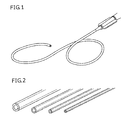
Fig. 1 is a schematic view of an example of a vascular catheter. -
Fig. 2 is a schematic view showing examples of catheters with different diameters. - The present invention includes a method for surface-modifying an object of a rubber vulcanizate or a thermoplastic elastomer, including step 1 of forming polymerization initiation points on a surface of the object, and step 2 of radically polymerizing a deliquescent monomer starting from the polymerization initiation points by irradiation with ultraviolet light having a wavelength within the range of 300 to 400 nm, to grow polymer chains on the surface of the object.
- In step 1, polymerization initiation points are formed on a surface of a molded rubber vulcanizate or a molded thermoplastic elastomer (the object to be modified). For example, the step 1 may be performed by adsorbing a photopolymerization initiator on the surface of the object to form the polymerization initiation points, or by adsorbing a photopolymerization initiator on the surface of the object and then irradiating the surface with ultraviolet light having a wavelength within the range of 300 to 400 nm to form the polymerization initiation points from the photopolymerization initiator on the surface.
- Examples of thermoplastic elastomers that can be used as the object to be modified include nylon, polyester, polyurethane, polypropylene, ABS (acrylonitrile-butadiene-styrene copolymer resin), fluororesins such as polytetrafluoroethylene, and dynamically crosslinked thermoplastic elastomers of these. Specific examples of nylon include nylon 6, nylon 66, nylon 11, and nylon 12. The dynamically crosslinked thermoplastic elastomer is preferably one obtained by dynamically crosslinking a halogenated butyl rubber in a thermoplastic elastomer. This thermoplastic elastomer is preferably nylon, polyurethane, polypropylene, SIBS (styrene-isobutylene-styrene block copolymer), or the like.
- Examples of rubbers that can be used as the object to be modified include natural rubber, deproteinized natural rubber, styrene butadiene rubber, butadiene rubber, isoprene rubber, silicone rubber, and butyl rubber and halogenated butyl rubber which contain a few percent of isoprene units, calculated as the degree of unsaturation.
- The vulcanization conditions of the rubber may be appropriately set, and the vulcanization temperature of the rubber is preferably 140°C or higher, more preferably 170°C or higher, and still more preferably 175°C or higher.
- Examples of the photopolymerization initiators include carbonyl compounds, organic sulfur compounds such as tetraethylthiuram disulfide, persulfides, redox compounds, azo compounds, diazo compounds, halogen compounds, and photoreducing dyes. Preferred among these are carbonyl compounds.
- The carbonyl compound as a photopolymerization initiator is preferably benzophenone or a derivative thereof (a benzophenone compound). For example, it may suitably be a benzophenone compound represented by the following formula.

- In the formula, R1 to R5 and R1' to R5' are the same as or different from one another and each represent a hydrogen atom, an alkyl group, a halogen (fluorine, chlorine, bromine or iodine), a hydroxyl group, a primary to tertiary amino group, a mercapto group, or a hydrocarbon group that may contain an oxygen, nitrogen, or sulfur atom, provided that any two adjacent groups thereof may be joined to each other to form a ring together with the carbon atoms to which they are bonded.
- Specific examples of the benzophenone compound include benzophenone, xanthone, 9-fluorenone, 2,4-dichlorobenzophenone, methyl o-benzoylbenzoate, 4,4'-bis(dimethylamino)benzophenone, and 4,4'-bis(diethylamino)benzophenone. Particularly preferred among these are benzophenone, xanthone, and 9-fluorenone, in terms of providing a good polymer brush.
- The photopolymerization initiator may also suitably be a thioxanthone compound because it provides a high polymerization rate and can easily be adsorbed on and/or reacted with rubber or the like. For example, it may suitably be a compound represented by the following formula.
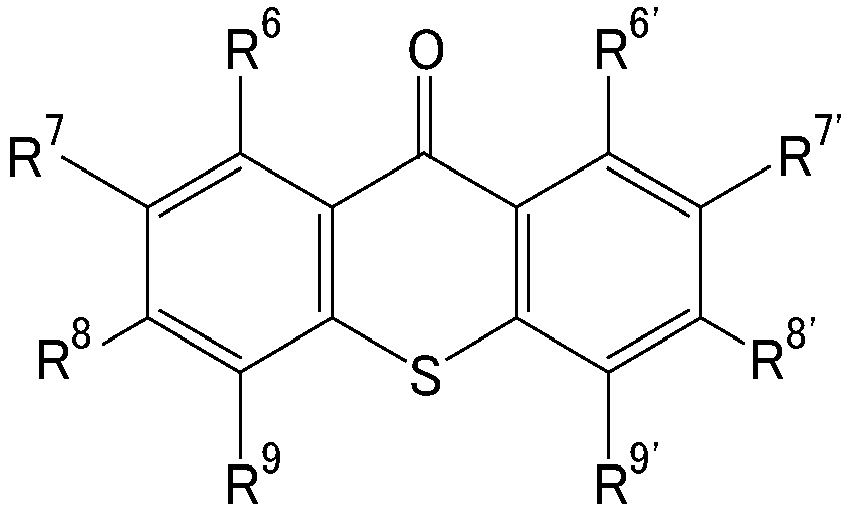
- In the formula, R6 to R9 and R6' to R9' are the same as or different from one another and each represent a hydrogen atom, a halogen atom, or an alkyl, cyclic alkyl, aryl, alkenyl, alkoxy, or aryloxy group.
- Examples of the thioxanthone compounds represented by the above formula include thioxanthone, 2-isopropylthioxanthone, 4-isopropylthioxanthone, 2,3-diethylthioxanthone, 2,4-diethylthioxanthone, 2,4-dichlorothioxanthone, 2-methoxythioxanthone, 1-chloro-4-propoxythioxanthone, 2-cyclohexylthioxanthone, 4-cyclohexylthioxanthone, 2-vinylthioxanthone, 2,4-divinylthioxanthone, 2,4-diphenylthioxanthone, 2-butenyl-4-phenylthioxanthone, 2-methoxythioxanthone, and 2-p-octyloxyphenyl-4-ethylthioxanthone. Preferred among these are those in which one or two of the groups R6 to R9 and R6' to R9', especially two of them, are each substituted with an alkyl group. More preferred is 2,4-diethylthioxanthone.
- The adsorption of a photopolymerization initiator (e.g. a benzophenone or thioxanthone compound) onto the surface of the object to be modified may be performed as follows. In the case of using a benzophenone or thioxanthone compound, for example, the benzophenone or thioxanthone compound is dissolved in an organic solvent to prepare a solution; a surface portion of the object to be modified is treated with this solution so that the compound is adsorbed on the surface portion; and, if necessary, the organic solvent is dried and evaporated off, whereby polymerization initiation points are formed. The surface-treating method may be any method that allows the solution of the benzophenone or thioxanthone compound to be brought into contact with the surface of the object to be modified. Suitable methods include applying or spraying the benzophenone or thioxanthone compound solution onto the surface; or, alternatively, immersing the surface into the solution. If only a part of the surface needs to be modified, it is sufficient to adsorb the photopolymerization initiator only onto the necessary part of the surface. In this case, for example, application or spraying of the solution is suitable. Examples of the solvents include methanol, ethanol, acetone, benzene, toluene, methyl ethyl ketone, ethyl acetate, and THF. Acetone is preferred because it does not swell the object and it can be rapidly dried and evaporated off.
- As described, after the photopolymerization initiator is adsorbed on the surface of the object, the surface may be then irradiated with ultraviolet light having a wavelength within the range of 300 to 400 nm to form the polymerization initiation points from the photopolymerization initiator on the surface. This irradiation with ultraviolet light may be performed by a known method, for example, by the same method as in step 2 described later.
- In step 2, a deliquescent monomer is radically polymerized starting from the polymerization initiation points formed in step 1, by irradiation with ultraviolet light having a wavelength within the range of 300 to 400 nm, to grow polymer chains on the surface of the object.
- The deliquescent monomer refers to a monomer having deliquescent properties, that is, a monomer that automatically captures moisture (water vapor) in the air to form an aqueous solution. The deliquescent monomer may suitably be, for example, an alkali metal-containing monomer (a monomer containing an alkali metal within the molecule) or a zwitterionic monomer (a zwitterionic group-containing compound, i.e., a compound having both a center of permanent positive charge and a center of negative charge). These monomers may be used alone, or two or more thereof may be used in combination.
- Examples of the alkali metal-containing monomers include alkali metal salts of acrylic acid (e.g. sodium acrylate, potassium acrylate); alkali metal salts of methacrylic acid (e.g. sodium methacrylate, potassium methacrylate); alkali metal salts of itaconic acid (e.g. sodium itaconate, potassium itaconate); alkali metal salts of 3-vinylpropionic acid (e.g. sodium 3-vinylpropionate, potassium 3-vinylpropionate); alkali metal salts of vinylsulfonic acid (e.g. sodium vinylsulfonate, potassium vinylsulfonate); alkali metal salts of 2-sulfoethyl (meth)acrylate (e.g. sodium 2-sulfoethyl (meth)acrylate, potassium 2-sulfoethyl (meth)acrylate); alkali metal salts of 3-sulfopropyl (meth) acrylate (e.g. sodium 3-sulfopropyl (meth)acrylate, potassium 3-sulfopropyl (meth)acrylate); alkali metal salts of 2-acrylamide-2-methylpropanesulfonic acid (e.g. sodium 2-acrylamide-2-methylpropanesulfonate, potassium 2-acrylamide-2-methylpropanesulfonate); and alkali metal salts of styrenesulfonic acid (e.g. sodium styrenesulfonate, potassium styrenesulfonate). Preferred among these is potassium 3-sulfopropyl methacrylate.
- Examples of the zwitterionic monomers include carboxybetaines, sulfobetaines, and phosphobetaines. The zwitterionic monomer may also be a compound represented by the following formula (1), and particularly suitably a compound represented by formula (2) below.

- In the formula, R11 represents -H or -CH3; X represents -O-, -NH-, or -N+-; m denotes an integer of 1 or more; and Y represents a zwitterionic or halogen group (e.g., Cl-, Br-, or F-).
- In the formula (1), preferably, R11 is -CH3, X is -O-, and m is an integer of 1 to 10. In the zwitterionic group indicated by Y, the cation may be a quaternary ammonium such as a tetraalkylammonium; the anion may be a carboxylic acid, sulfonic acid, or phosphate.

- In the formula (2), p is preferably an integer of 2 or more, and more preferably an integer of 2 to 10. The symbol q is preferably an integer of 1 to 10, and more preferably an integer of 2 to 4. R11 is preferably as described hereinabove. The aforementioned cations and anions may be mentioned for Y1 and Y2.
- Suitable typical examples of the zwitterionic monomer include compounds represented by the following formulae (2-1) to (2-4).

- In the formula, R11 represents a hydrogen atom or a methyl group; and p and q each denote an integer of 1 to 10.

- In the formula, R11 represents a hydrogen atom or a methyl group; and p and q each denote an integer of 1 to 10.

- In the formula, R11 represents a hydrogen atom or a methyl group; R12 represents a C1 to C6 hydrocarbon group; and p and q each denote an integer of 1 to 10.

- In the formula, R11 represents a hydrogen atom or a methyl group; R13, R14, and R15 are the same as or different from one another and each represent a C1 or C2 hydrocarbon group; and p and q each denote an integer of 1 to 10.
- Examples of the compounds represented by the formula (2-1) include dimethyl(3-sulfopropyl)(2-(meth)acryloyloxyethyl)ammonium betaine. Examples of the compounds represented by the formula (2-2) include dimethyl(2-carboxyethyl)(2-(meth)acryloyloxyethyl)ammonium betaine. Examples of the compounds represented by the formula (2-3) include dimethyl(3-methoxy phosphopropyl)(2-(meth)acryloyloxyethyl)ammonium betaine. Examples of the compounds represented by the formula (2-4) include 2-(meth)acryloyloxyethyl phosphorylcholine. Other examples of the zwitterionic monomers include 2-(meth)acryloyloxyethyl carboxybetaine and 2-(meth)acryloyloxyethyl sulfobetaine. Particularly preferred among these is 2-(meth)acryloyloxyethyl phosphorylcholine because it has high biocompatibility, or in other words, low protein adsorbability.
- The following describes an example of the method for radically polymerizing a deliquescent monomer in step 2. First, a (liquid) deliquescent monomer or a solution thereof is applied (sprayed) onto the surface of the object on which a benzophenone or thioxanthone compound or the like has been adsorbed. Or alternatively, the object is immersed in a (liquid) deliquescent monomer or a solution thereof. Then, the object is irradiated with ultraviolet light to allow radical polymerization (photo-radical polymerization) of the monomer to proceed to grow polymer chains on the surface of the object. Additionally, after the application, the surface of the object may be covered with a sheet of transparent glass, PET, polycarbonate or the like, followed by irradiation of the covered surface with light (e.g., ultraviolet light) to allow radical polymerization (photo-radical polymerization) of the monomer to proceed to grow polymer chains on the surface of the object.
- The solvent for application (spraying), the method for application (spraying), the method for immersion, the conditions for irradiation, and the like may be conventionally known materials or methods. The solution of the radically polymerizable monomer may be an aqueous solution or a solution prepared by dissolving the monomer in an organic solvent that does not dissolve a photopolymerization initiator (e.g., a benzophenone or thioxanthone compound) to be used. Furthermore, the (liquid) radically polymerizable monomer or a solution thereof may contain a known polymerization inhibitor such as 4-methylphenol.
- In the present invention, radical polymerization of the deliquescent monomer is allowed to proceed by light irradiation after the (liquid) deliquescent monomer or a solution thereof is applied to the surface, or after the surface is immersed in the (liquid) deliquescent monomer or a solution thereof. Here, ultraviolet light sources with an emission wavelength that is mainly in the ultraviolet region can be suitably used, such as high-pressure mercury lamps, metal halide lamps, and LED lamps. The light dose may be appropriately adjusted in consideration of the polymerization time and uniform progress of the reaction. In order to prevent the polymerization inhibition due to active gas like oxygen in a reaction container and a reaction tube, oxygen is preferably removed from the reaction container, the reaction tube, and the reaction solution during or before the light irradiation. Thus, some methods may appropriately be employed, for example, in which an inert gas like nitrogen gas or argon gas is inserted into the reaction container, the reaction tube, and the reaction solution to discharge active gas like oxygen from the reaction system, whereby the atmosphere in the reaction system is replaced with the inert gas. Moreover, in order to prevent the reaction inhibition due to oxygen or the like, some measures may appropriately be taken, for example, in which a ultraviolet light source is placed such that no air layer (oxygen content: 15% or higher) exists between the reaction container made of glass, plastics or the like, and the reaction solution or the object.
- The ultraviolet light has a wavelength within the range of 300 to 400 nm. Such a wavelength enables the formation of good polymer chains on the surface of the object. Examples of light sources that can be used include high-pressure mercury lamps, LEDs with a center wavelength of 365 nm, and LEDs with a center wavelength of 375 nm. Irradiation with LED light having a wavelength within the range of 355 to 380 nm is more preferred. For example, LEDs with a center wavelength of 365 nm, which is close to the excitation wavelength (366 nm) of benzophenone, are particularly preferred in terms of efficiency. Light with a wavelength of shorter than 300 nm may damage the object by breaking the molecules thereof. Thus, light with a wavelength of 300 nm or longer is preferred, with light having a wavelength of 355 nm or longer being more preferred because it produces very little damage to the object. Light having a wavelength of longer than 400 nm, however, is less likely to activate the photopolymerization initiator, so that the polymerization reaction is not allowed to easily proceed. Thus, light having a wavelength of 400 nm or shorter is preferred. Although LED light is suitable in that it is in a narrow wavelength range and does not include light with other wavelengths than the center wavelength, a mercury lamp or the like can also achieve similar effects to LED light by using a filter to block light having a wavelength of shorter than 300 nm.
- The present invention also relates to a method for surface-modifying an object of a rubber vulcanizate or a thermoplastic elastomer, including step I of radically polymerizing a deliquescent monomer in the presence of a photopolymerization initiator by irradiation with ultraviolet light having a wavelength within the range of 300 to 400 nm, to grow polymer chains on a surface of the object. More specifically, a deliquescent monomer is radically polymerized using a photopolymerization initiator as an initiator by irradiation with ultraviolet light, to form polymer chains, whereby a surface-modified elastic body can be prepared in which a polymer layer is formed on the surface of the object. In step I, the object to be modified, the photopolymerization initiator, and the deliquescent monomer used may be as described hereinabove.
- For example, the step I may be performed by contacting a surface of the object with a photopolymerization initiator and a deliquescent monomer, and then irradiating the surface with LED light having a wavelength within the range of 300 to 400 nm, to form polymerization initiation points from the photopolymerization initiator while radically polymerizing the deliquescent monomer starting from the polymerization initiation points to grow polymer chains.
- The following describes an example of the method for radically polymerizing a deliquescent monomer in step I. First, a (liquid) deliquescent monomer, or a solution thereof, containing a photopolymerization initiator (e.g., a benzophenone or thioxanthone compound) is applied (sprayed) onto a surface of the object. Or alternatively, the object is immersed in a (liquid) deliquescent monomer, or a solution thereof, containing a photopolymerization initiator. Then, the object is irradiated with light (e.g., ultraviolet light) to allow radical polymerization (photo-radical polymerization) of the monomer to proceed to grow polymer chains on the surface of the object. Additionally, the aforementioned method, in which the surface of the object is covered with a sheet of transparent glass, PET, polycarbonate or the like, followed by irradiation of the covered surface with light (e.g., ultraviolet light), may be employed. Here, the solvent for application (spraying), the method for application (spraying), the method for immersion, the conditions for irradiation, and the like may be as described hereinabove.
- The polymer chains formed in step 2 or step I preferably each have a length within the range of 10 to 50000 nm, more preferably 100 to 50000 nm. Polymer chains shorter than 10 nm are unlikely to provide good lubricity. Polymer chains longer than 50000 nm are unlikely to further provide better lubricity, while they are likely to drive up the costs of raw materials because the monomer used is expensive. In addition, in such cases, surface patterns formed by the surface treatment are likely to be visible to the naked eye, which tends to spoil the appearance and to decrease the sealing properties.
- In step 2 and step I, two or more kinds of monomers may be radically polymerized simultaneously. Moreover, multiple kinds of polymer chains may be grown on the surface of the object. The surface modification method of the present invention may include crosslinking between polymer chains. In this case, ionic crosslinking, or crosslinking by a hydrophilic group containing an oxygen atom, or crosslinking by a halogen group (e.g. iodine) may be performed between the polymer chains.
- Treatment of a rubber vulcanizate or a thermoplastic elastomer by the surface modification method enables to provide a surface-modified elastic body. For example, a surface-modified elastic body that is excellent in lubricity in the presence of water can be obtained. Moreover, treatment of at least part of a three-dimensional solid (e.g. elastic body) by the above method enables to provide a surface-modified elastic body having better quality. Preferred examples of such a surface-modified elastic body include polymer brushes. The term "polymer brush" means an assembly of graft polymer chains obtained by the "grafting from" approach by surface-initiated living radical polymerization. The graft chains are preferably oriented in a direction substantially vertical to the surface of the object because, in such a case, the entropy is reduced and thus the molecular mobility of the graft chains is reduced, which ensures lubricity. Preferred are semidilute brushes and concentrated brushes, which have a brush density of 0.01 chains/nm2 or higher.
- Furthermore, treatment of a rubber vulcanizate or a thermoplastic elastomer by the surface modification method enables to prepare a medical device (e.g., a catheter) at least partially having a modified surface. The modification is preferably performed at least on a lubricity-requiring part of a surface of the medical device such as a catheter, or may be performed on the entire surface.
- The present invention is more specifically described referring to examples in the following. The present invention is, however, not limited to these examples.
- A 3 wt% solution of benzophenone in acetone was applied to the surface of a thermoplastic elastomer tube made of nylon 12 to adsorb benzophenone, and then the surface was dried. Then, the tube was irradiated with LED light (5 mW/cm2) with a wavelength of 365 nm for five minutes. During this period, the tube was rotated such that the entire surface was irradiated.
- Subsequently, the tube was immersed in an aqueous solution of potassium 3-sulfopropyl methacrylate (1.25 M) in a glass reaction container. The container was sealed with a rubber stopper, and argon gas was inserted and allowed to bubble through the solution for 120 minutes to remove oxygen. The glass reaction container was irradiated with LED light with a wavelength of 365 nm for 60 minutes while being rotated. Thus, radical polymerization was carried out to grow polymer chains on the surface of the nylon tube, whereby a surface-modified elastic body (polymer brush) was prepared.
- A 3 wt% solution of benzophenone in acetone was applied to the surface of a thermoplastic elastomer tube made of nylon 12 to adsorb benzophenone, and then the surface was dried.
- Then, the tube was immersed in an aqueous solution of potassium 3-sulfopropyl methacrylate (1.25 M) in a glass reaction container. The container was sealed with a rubber stopper, and argon gas was inserted and allowed to bubble through the solution for 120 minutes to remove oxygen. The glass reaction container was irradiated with LED light with a wavelength of 365 nm for 60 minutes while being rotated. Thus, radical polymerization was carried out to grow polymer chains on the surface of the nylon tube, whereby a surface-modified elastic body (polymer brush) was prepared.
- A 3 wt% solution of 2,4-diethylthioxanthone in acetone was applied to the surface of a thermoplastic elastomer tube made of nylon 12 to adsorb 2,4-diethylthioxanthone, and then the surface was dried.
- Then, the tube was immersed in an aqueous solution of potassium 3-sulfopropyl methacrylate (1.25 M) in a glass reaction container. The container was sealed with a rubber stopper, and argon gas was inserted and allowed to bubble through the solution for 120 minutes to remove oxygen. The glass reaction container was irradiated with LED light with a wavelength of 365 nm for 40 minutes while being rotated. Thus, radical polymerization was carried out to grow polymer chains on the surface of the nylon tube, whereby a surface-modified elastic body (polymer brush) was prepared.
- A surface-modified elastic body (polymer brush) was prepared in the same manner as in Example 1, except that 2-methacryloyloxyethyl phosphorylcholine was used instead of potassium 3-sulfopropyl methacrylate.
- A surface-modified elastic body (a polymer brush in which polymer chains were grown on the surface of a polyurethane tube) was prepared in the same manner as in Example 1, except that a polyurethane tube was used instead of the nylon tube in Example 1.
- A tube made of nylon 12 was used as it was.
- Used was a tube made of nylon 12, the surface of which is coated with a 5% solution of methyl vinyl ether-maleic anhydride (GANTREZ-AN16, produced by ISP) in methanol. It should be noted that nylon 12 is a material often used for vascular catheters, and methyl vinyl ether-maleic anhydride is a typical lubricant for providing lubricity on the surfaces of vascular catheters.
- The surface-modified elastic bodies prepared in the examples and the comparative examples were evaluated by the following methods.
- To determine the length of the polymer chain formed on the surface of the tube, a cross section of the tube with polymer chains was measured with a SEM at an accelerating voltage of 15 kV and a magnification of 1000 times. The thickness of the polymer layer in the photograph was measured and used as the length of the polymer chain.
- Water was applied to the tube surface, and the sliding properties of the surface were then evaluated by a feeling test by human fingers. The feeling test was performed by ten evaluators according to the following rating scale of 1-5: a rating of 5 corresponds to a tube with good sliding properties and a rating of 1 corresponds to a tube with so poor sliding properties that fingers never slide on the surface. The average rating was calculated.
- After water was applied to the tube surface, the tube was held between fingers and moved by sliding on the fingers. This cycle was repeated 100 times. Then, a feeling test was again performed by ten evaluators according to the rating scale for lubricity, and the average rating and the rate of decrease from the initial lubricity were calculated.
[Table 1] Example 1 Example 2 Example 3 Example 4 Example 5 Comparative Example 1 Comparative Example 2 Length of polymer chain (nm) 2500 3000 4500 2000 2000 - - Lubricity 4.7 4.8 4.9 4.3 4.2 1 4.2 Durability 4.6 4.7 4.7 4.1 4.1 1 2.4 Rate of decrease 2% 2% 4% 5% 2% 0% 43% - Table 1 shows that the surfaces of the tubes in the examples each had high lubricity, good durability, and quite a low rate of decrease in lubricity. In contrast, Comparative Example 1, in which a tube was used as it was, had quite poor lubricity; Comparative Example 2, in which a commonly used product was used, had reasonably high initial lubricity, but had low durability and quite a high rate of decrease in lubricity.
- These results demonstrated that forming polymer chains on the surface of a vascular catheter or the like using a deliquescent monomer such as potassium 3-sulfopropyl methacrylate or 2-methacryloyloxyethyl phosphorylcholine can simultaneously provide sufficient lubricity and lubricant durability.
Claims (17)
- A method for surface-modifying an object of a rubber vulcanizate or a thermoplastic elastomer, the method comprising:step 1 of forming polymerization initiation points on a surface of the object; andstep 2 of radically polymerizing a deliquescent monomer starting from the polymerization initiation points by irradiation with ultraviolet light having a wavelength within the range of 300 to 400 nm, to grow polymer chains on the surface of the object.
- A method for surface-modifying an object of a rubber vulcanizate or a thermoplastic elastomer, the method comprising
step I of radically polymerizing a deliquescent monomer in the presence of a photopolymerization initiator by irradiation with ultraviolet light having a wavelength within the range of 300 to 400 nm, to grow polymer chains on a surface of the object. - The method according to claim 1,
wherein the step 1 comprises adsorbing a photopolymerization initiator on the surface of the object, and optionally then irradiating the surface with ultraviolet light having a wavelength within the range of 300 to 400 nm, to form the polymerization initiation points from the photopolymerization initiator on the surface. - The method according to claim 2 or 3,
wherein the photopolymerization initiator is at least one of a benzophenone compound and a thioxanthone compound. - The method according to any one of claims 1 to 4,
wherein the method comprises inserting an inert gas into a reaction container, a reaction tube, and a reaction solution during or before the light irradiation, and polymerizing the monomer in an atmosphere replaced with the inert gas. - The method according to any one of claims 1 to 5,
wherein the deliquescent monomer is an alkali metal-containing monomer. - The method according to claim 6,
wherein the alkali metal-containing monomer is at least one selected from the group consisting of alkali metal salts of acrylic acid, methacrylic acid, itaconic acid, 3-vinylpropionic acid, vinylsulfonic acid, 2-sulfoethyl (meth)acrylate, 3-sulfopropyl (meth)acrylate, 2-acrylamide-2-methylpropanesulfonic acid, or styrenesulfonic acid. - The method according to any one of claims 1 to 5,
wherein the deliquescent monomer is at least one selected from the group consisting of zwitterionic monomers and alkali metal-containing monomers. - The method according to any one of claims 1 to 8,
wherein the (liquid) deliquescent monomer or a solution thereof contains a polymerization inhibitor, and is polymerized in the presence of the polymerization inhibitor. - The method according to claim 9,
wherein the polymerization inhibitor is 4-methylphenol. - The method according to any one of claims 1 to 10,
wherein the polymer chains each have a length within the range of 10 to 50000 nm. - A surface-modified elastic body, formed by the method according to any one of claims 1 to 11.
- A surface-modified elastic body, which is formed by the method according to any one of claims 1 to 11 and is required to have lubricity in the presence of water.
- A surface-modified elastic body, comprising a three-dimensional solid at least partially having a surface modified by the method according to any one of claims 1 to 11.
- The surface-modified elastic body according to any one of claims 12 to 14, which is a polymer brush.
- A catheter, at least partially having a surface modified by the method according to any one of claims 1 to 11.
- A fender, at least partially having a groove surface modified by the method according to any one of claims 1 to 11.
Applications Claiming Priority (1)
| Application Number | Priority Date | Filing Date | Title |
|---|---|---|---|
| JP2013092843A JP5816222B2 (en) | 2013-04-25 | 2013-04-25 | Surface modification method and surface modified elastic body |
Publications (2)
| Publication Number | Publication Date |
|---|---|
| EP2796155A1 true EP2796155A1 (en) | 2014-10-29 |
| EP2796155B1 EP2796155B1 (en) | 2017-11-01 |
Family
ID=50230875
Family Applications (1)
| Application Number | Title | Priority Date | Filing Date |
|---|---|---|---|
| EP14156842.8A Not-in-force EP2796155B1 (en) | 2013-04-25 | 2014-02-26 | Surface modification method and surface-modified elastic body |
Country Status (4)
| Country | Link |
|---|---|
| US (1) | US10189944B2 (en) |
| EP (1) | EP2796155B1 (en) |
| JP (1) | JP5816222B2 (en) |
| CN (1) | CN104119552A (en) |
Cited By (13)
| Publication number | Priority date | Publication date | Assignee | Title |
|---|---|---|---|---|
| EP3127559A1 (en) * | 2015-08-03 | 2017-02-08 | Sumitomo Rubber Industries, Ltd. | Surface modification method and surface-modified elastic body |
| EP3000842A4 (en) * | 2013-06-20 | 2017-02-15 | Sumitomo Rubber Industries, Ltd. | Surface modification method and surface modification body |
| EP3135311A1 (en) * | 2015-08-27 | 2017-03-01 | Sumitomo Rubber Industries, Ltd. | Surface modification method and surface-modified elastic body |
| US9738744B2 (en) | 2013-06-11 | 2017-08-22 | Sumitomo Rubber Industries, Ltd. | Surface modification method for three-dimensional object and syringe gasket |
| US9752003B2 (en) | 2012-11-30 | 2017-09-05 | Sumitomo Rubber Industries, Ltd. | Surface-modified elastic body |
| US9758605B2 (en) | 2012-11-20 | 2017-09-12 | Sumitomo Rubber Industries, Ltd. | Surface modification method and surface-modified elastic body |
| EP3228638A1 (en) * | 2016-04-04 | 2017-10-11 | Sumitomo Rubber Industries, Ltd. | Surface modification method |
| US9963565B2 (en) | 2014-10-02 | 2018-05-08 | Sumitomo Rubber Industries, Ltd. | Surface modification method and surface-modified elastic body |
| US10189944B2 (en) | 2013-04-25 | 2019-01-29 | Sumitomo Rubber Industries, Ltd. | Surface modification method and surface-modified elastic body |
| US10214608B2 (en) | 2015-08-03 | 2019-02-26 | Sumitomo Rubber Industries, Ltd. | Surface modification method and surface-modified body |
| US10280274B2 (en) | 2014-01-06 | 2019-05-07 | Sumitomo Rubber Industries, Ltd. | Method for modifying surface and surface modified elastic body |
| US10344109B2 (en) | 2012-09-10 | 2019-07-09 | Sumitomo Rubber Industries, Ltd. | Surface modification method and surface-modified elastic body |
| EP3983141A4 (en) * | 2019-06-14 | 2023-07-19 | Covalon Technologies Inc. | COATED DEVICES AND RELATED METHODS |
Families Citing this family (6)
| Publication number | Priority date | Publication date | Assignee | Title |
|---|---|---|---|---|
| KR101644686B1 (en) | 2014-04-17 | 2016-08-02 | 서울대학교산학협력단 | Diverse implant for in vivo insertion coated with crosslinked polyphosphorylcholine |
| KR102462510B1 (en) * | 2014-08-26 | 2022-11-01 | 씨. 알. 바드, 인크. | Urinary catheter |
| WO2016158700A1 (en) * | 2015-03-30 | 2016-10-06 | テルモ株式会社 | Medical instrument |
| JP6554984B2 (en) * | 2015-08-03 | 2019-08-07 | 住友ゴム工業株式会社 | Surface-modified metal and method for modifying metal surface |
| JP6362224B2 (en) * | 2016-05-09 | 2018-07-25 | 住友ゴム工業株式会社 | Surface modification method |
| EP3963326B1 (en) | 2019-04-30 | 2025-12-24 | Cornell University | Fibers of polymers that have a backbone including a positively charged component of a zwitterionic moiety |
Citations (4)
| Publication number | Priority date | Publication date | Assignee | Title |
|---|---|---|---|---|
| JP2011188908A (en) | 2010-03-12 | 2011-09-29 | Nipro Corp | Medical instrument with lubricity when moistened |
| WO2012165525A1 (en) * | 2011-06-03 | 2012-12-06 | 住友ゴム工業株式会社 | Surface-modifying method and elastic body with modified surface |
| EP2623335A2 (en) * | 2012-02-02 | 2013-08-07 | Sumitomo Rubber Industries, Ltd. | Surface modification method and surface-modified elastic body |
| EP2664627A1 (en) * | 2012-05-16 | 2013-11-20 | Sumitomo Rubber Industries, Ltd. | Surface modification method and surface-modified elastic body |
Family Cites Families (99)
| Publication number | Priority date | Publication date | Assignee | Title |
|---|---|---|---|---|
| GB1120804A (en) | 1965-01-13 | 1968-07-24 | Richard George Christopher Jen | Method of reducing the coefficient of friction of elastomer surfaces |
| US3418066A (en) | 1966-11-08 | 1968-12-24 | Eastman Kodak Co | Surface oxidation and treatment of polymers |
| US5154727A (en) | 1981-01-07 | 1992-10-13 | Intera Corporation | Process for improving polymer fiber properties and fibers produced thereby |
| JPS60221410A (en) | 1984-04-19 | 1985-11-06 | Nippon Oil & Fats Co Ltd | Surface modification of polymeric material |
| JPS61209667A (en) | 1985-03-13 | 1986-09-17 | 株式会社 日本メデイカル・サプライ | Syringe excellent in slidability |
| JPH084618B2 (en) | 1985-10-14 | 1996-01-24 | 義人 筏 | Manufacturing method of antithrombogenic material |
| JPS6392658A (en) | 1986-10-07 | 1988-04-23 | Bio Material Yunibaasu:Kk | Radical polymerization method in the presence of dissolved air oxygen to modify surface of high-molecular material |
| US5100689A (en) | 1987-04-10 | 1992-03-31 | University Of Florida | Surface modified surgical instruments, devices, implants, contact lenses and the like |
| JPH07100744B2 (en) | 1990-11-30 | 1995-11-01 | テルモ株式会社 | Medical device having surface lubricity when wet and method for producing the same |
| JPH0543634A (en) | 1991-06-06 | 1993-02-23 | Takeda Chem Ind Ltd | Graft polymer |
| GB9118597D0 (en) | 1991-08-30 | 1991-10-16 | Biocompatibles Ltd | Polymer treatments |
| JP3131950B2 (en) | 1991-09-19 | 2001-02-05 | 株式会社ニッショー | Method for manufacturing vascular catheter |
| JPH081793A (en) | 1991-11-26 | 1996-01-09 | Polytec Design:Kk | Method for curing molded rubber using photopolymerizable substance |
| JPH0780295B2 (en) | 1991-12-26 | 1995-08-30 | 住友ゴム工業株式会社 | Offset blanket for printing |
| JPH0625450A (en) | 1992-03-11 | 1994-02-01 | Sumitomo Rubber Ind Ltd | Surface-modified rubber product and manufacturing method thereof |
| DE4208793A1 (en) | 1992-03-19 | 1993-09-23 | Bayer Ag | POLYMER RESINS AND THEIR USE |
| US5414075A (en) | 1992-11-06 | 1995-05-09 | Bsi Corporation | Restrained multifunctional reagent for surface modification |
| DE19709075A1 (en) | 1997-03-06 | 1998-09-10 | Huels Chemische Werke Ag | Process for the production of antimicrobial plastics |
| US5688252A (en) | 1994-09-30 | 1997-11-18 | Takeda Chemical Industries, Ltd. | Syringe |
| JP3658806B2 (en) | 1995-07-20 | 2005-06-08 | 大日本インキ化学工業株式会社 | UV curable composition |
| JPH0967457A (en) | 1995-08-31 | 1997-03-11 | Kureha Elastomer Kk | Production of hydrophilic silicone rubber film |
| JPH09108359A (en) | 1995-10-16 | 1997-04-28 | Terumo Corp | Catheter |
| JPH09313594A (en) | 1996-05-30 | 1997-12-09 | Terumo Corp | Catheter and manufacturing method thereof |
| JP3141790B2 (en) | 1996-09-20 | 2001-03-05 | 東洋インキ製造株式会社 | Active energy ray irradiation method and active energy ray irradiated object |
| KR100488225B1 (en) | 1996-09-04 | 2005-06-16 | 도요 잉키 세이조 가부시끼가이샤 | Electron beam irradiating method and object to be irradiated with electron beam |
| US5855623A (en) | 1996-09-20 | 1999-01-05 | Intera Technologies, Inc. | Process for improving polyamide, acrylic, aramid, cellulosic and polyester properties, and modified polymers produced thereby |
| US5885566A (en) | 1996-09-25 | 1999-03-23 | University Of Florida | Surface modified surgical instruments, medical devices, implants, contact lenses and the like |
| DE59800682D1 (en) * | 1997-04-14 | 2001-06-13 | Degussa | Process for modifying the surface of polymer substrates by graft polymerization |
| GB2325467B (en) | 1997-05-21 | 2000-11-01 | Dainippon Ink & Chemicals | Process for producing material with hydrophilic surface |
| JPH11192305A (en) | 1997-12-26 | 1999-07-21 | Nippon Zeon Co Ltd | Balloon catheter and method of manufacturing the same |
| US6228172B1 (en) | 1998-10-29 | 2001-05-08 | The Boc Group Plc | Tumble coating |
| JP2000273229A (en) | 1999-03-25 | 2000-10-03 | Nitto Denko Corp | Method for producing hydrophilized hydrophobic substrate |
| DE19921900A1 (en) | 1999-05-12 | 2000-11-16 | Creavis Tech & Innovation Gmbh | Preparation of antimicrobial polymer for medical and hygiene articles, varnishes, paints and coatings comprises polymerizing monomers that have been functionalized by a sec. amino group |
| JP4292634B2 (en) | 1999-07-21 | 2009-07-08 | 凸版印刷株式会社 | Method for manufacturing antireflection laminate |
| JP2001046956A (en) | 1999-08-10 | 2001-02-20 | Dainippon Ink & Chem Inc | Cured film forming method and cured film coated product |
| US6358557B1 (en) | 1999-09-10 | 2002-03-19 | Sts Biopolymers, Inc. | Graft polymerization of substrate surfaces |
| JP2001095621A (en) | 1999-09-29 | 2001-04-10 | Nishikawa Rubber Co Ltd | Surface treatment method for cosmetic applicator |
| JP3945982B2 (en) | 2000-11-13 | 2007-07-18 | 独立行政法人科学技術振興機構 | Nanostructured functional body |
| AU2002235694B2 (en) | 2001-02-28 | 2007-06-14 | Covalon Technologies Inc. | Method of making anti-microbial polymeric surfaces |
| WO2002081561A1 (en) | 2001-04-04 | 2002-10-17 | Kaneka Corporation | Thermoplastic resin composition and elastomer composition |
| JP4671214B2 (en) | 2001-06-20 | 2011-04-13 | 藤倉ゴム工業株式会社 | Rubber surface modification method |
| US7348055B2 (en) | 2001-12-21 | 2008-03-25 | Surmodics, Inc. | Reagent and method for providing coatings on surfaces |
| ATE348643T1 (en) | 2002-02-15 | 2007-01-15 | Cv Therapeutics Inc | POLYMER COATING FOR MEDICAL DEVICES |
| US7008979B2 (en) | 2002-04-30 | 2006-03-07 | Hydromer, Inc. | Coating composition for multiple hydrophilic applications |
| EP1382628A1 (en) | 2002-07-16 | 2004-01-21 | Polyganics B.V. | Biodegradable phase separated segmented/block co-polyesters |
| JP2004298220A (en) | 2003-03-28 | 2004-10-28 | Terumo Corp | Prefilled syringe |
| DE10331450A1 (en) | 2003-07-10 | 2005-01-27 | Basf Ag | (Meth) acrylic esters of monoalkoxylated polyols and their preparation |
| US6995222B2 (en) | 2003-12-17 | 2006-02-07 | 3M Innovative Properties Company | Coating compositions with reactive fluorinated copolymers having pendant perfluoropolyether groups |
| JP2005253538A (en) | 2004-03-09 | 2005-09-22 | Sekisui Chem Co Ltd | Vacuum blood collection tube |
| JP4523532B2 (en) | 2004-10-07 | 2010-08-11 | 株式会社リコー | Electrophotographic photoreceptor, image forming method, image forming apparatus, and process cartridge |
| JP3742647B2 (en) | 2005-03-23 | 2006-02-08 | 積水化学工業株式会社 | Substrate surface treatment method |
| JP2007077286A (en) | 2005-09-14 | 2007-03-29 | Mitsubishi Cable Ind Ltd | Surface modification method for fluorine-containing elastomer, fluorine-containing elastomer surface-modified by the method, and sealing material and seal using the surface-modified fluorine-containing elastomer |
| JP2007119563A (en) | 2005-10-27 | 2007-05-17 | Kaneka Corp | Fluorine-containing (meth)acrylic ester polymer and its manufacturing method |
| JP4496434B2 (en) | 2005-11-24 | 2010-07-07 | 信越化学工業株式会社 | Polyfunctional (meth) acrylate compound, photocurable resin composition and article |
| US8133580B2 (en) | 2005-12-09 | 2012-03-13 | Dsm Ip Assets B.V. | Coating composition for a urinary catheter |
| WO2007078819A2 (en) | 2005-12-16 | 2007-07-12 | Arkema Inc. | Low surface energy block co-polymer preparation methods and applications |
| JP5163872B2 (en) | 2005-12-22 | 2013-03-13 | ジェイエスアール クレイトン エラストマー株式会社 | Elastomer structure and photosensitive composition using the same |
| JP4963838B2 (en) | 2006-02-06 | 2012-06-27 | 京セラメディカル株式会社 | Low wear sliding member and artificial joint using the same |
| JP2008024091A (en) | 2006-07-19 | 2008-02-07 | Mitsuba Corp | Surface-modified blade rubber, wiper device, and blade rubber surface modification method |
| EP1918307A3 (en) | 2006-10-30 | 2010-01-20 | The Yokohama Rubber Co., Ltd. | Thermoplastic elastomer and thermoplastic elastomer composition |
| JP5111016B2 (en) * | 2006-11-01 | 2012-12-26 | 三井化学株式会社 | Surface hydrophilic polyolefin molded body and method for producing the same |
| CN101372538B (en) | 2007-08-21 | 2012-08-29 | 北京万和芯源生物技术有限公司 | Process for surface modification assisted by ultraviolet light and articles having surfaces formed thereby |
| JP2009138169A (en) | 2007-12-06 | 2009-06-25 | Sunrise Msi Corp | Ultraviolet-curable adhesive composition |
| JP4912344B2 (en) | 2008-03-21 | 2012-04-11 | 富士フイルム株式会社 | Barrier laminate and production method thereof, barrier film substrate, device and optical member |
| JP2009227842A (en) | 2008-03-24 | 2009-10-08 | Sekisui Plastics Co Ltd | Method for producing polymer gel |
| WO2009124034A1 (en) | 2008-04-01 | 2009-10-08 | The Government Of The United States Of America, As Represented By The Secretary Of The Air Force | Layers durably bonded to surfaces |
| EP2276754B1 (en) | 2008-04-17 | 2014-12-03 | Basf Se | Stabilization and surface modification of organic materials |
| JP2010023710A (en) | 2008-07-22 | 2010-02-04 | Mitsuba Corp | Manufacturing method of blade rubber and wiper blade |
| JP5566906B2 (en) | 2008-11-21 | 2014-08-06 | 京セラメディカル株式会社 | Graft polymerization method and product thereof |
| JP2010142537A (en) | 2008-12-22 | 2010-07-01 | Yoshinari Umemura | Surgical guide for dental implant operation |
| JP2010142573A (en) | 2008-12-22 | 2010-07-01 | Coki Engineering Inc | Gasket for syringe, method for manufacturing the same, and prefilled syringe using the gasket |
| JP5265335B2 (en) | 2008-12-24 | 2013-08-14 | ディーエイチ・マテリアル株式会社 | Radical polymerizable composition |
| JP5775694B2 (en) * | 2008-12-25 | 2015-09-09 | 京セラメディカル株式会社 | Polymer sliding material, artificial joint member, medical instrument and method for manufacturing the same |
| JP5577502B2 (en) | 2009-03-16 | 2014-08-27 | 富山県 | Functional microchip and manufacturing method thereof |
| WO2010131652A1 (en) | 2009-05-12 | 2010-11-18 | ダイキン工業株式会社 | Transfer sheet and process for producing same |
| CN101565489B (en) | 2009-06-02 | 2011-05-11 | 中山大学 | Preparation method of polystyrene with thermo-sensitive surface |
| JP5526321B2 (en) | 2009-08-24 | 2014-06-18 | 独立行政法人 宇宙航空研究開発機構 | Curable composition for outer space, cured product for outer space, and composite film for outer space |
| US8299139B1 (en) | 2009-09-08 | 2012-10-30 | Ovation Polymer Technology And Engineered Materials, Inc. | Process and reactor for synthesis of ultra-high molecular weight acrylic polymers |
| JP5503239B2 (en) | 2009-09-25 | 2014-05-28 | 株式会社朝日Fr研究所 | Method for forming slidable coating on syringe gasket, gasket for syringe having slidable coating, and prefilled syringe |
| EP2483358B1 (en) | 2009-09-29 | 2014-12-10 | Covalon Technologies Inc. | System and method for coating medical devices |
| JP5418321B2 (en) | 2010-03-12 | 2014-02-19 | 株式会社豊田自動織機 | Vehicle member and manufacturing method thereof |
| JP4941794B2 (en) | 2010-03-12 | 2012-05-30 | 等 金澤 | Medical equipment |
| JP2011219520A (en) | 2010-04-05 | 2011-11-04 | Yokohama Rubber Co Ltd:The | Method for producing surface-modified rubber molded product |
| US20120021151A1 (en) | 2010-04-15 | 2012-01-26 | Tatarka Paul D | Transparent, Flexible Products Made With Partially Crystalline Cycloolefin Elastomer |
| JP5477160B2 (en) | 2010-05-20 | 2014-04-23 | 信越化学工業株式会社 | Fluorine-containing (meth) acryl-modified organosilicon compound and curable composition containing the same |
| JP6474540B2 (en) | 2010-11-17 | 2019-02-27 | 国立大学法人山形大学 | Cell separation method for separating cells from solution, hydrating composition for cell adsorption, and cell separation system |
| JP5688100B2 (en) | 2010-12-27 | 2015-03-25 | 住友ゴム工業株式会社 | Surface modification method, surface modified elastic body, gasket for syringe, syringe and tire |
| JP5634287B2 (en) | 2011-02-07 | 2014-12-03 | Dicグラフィックス株式会社 | UV light emitting diode curable ink |
| CN202427397U (en) | 2011-12-15 | 2012-09-12 | 连云港通元机械有限公司 | Stirring kettle |
| JP5763564B2 (en) | 2012-02-01 | 2015-08-12 | 住友ゴム工業株式会社 | Surface modification method and surface modified elastic body |
| JP5945927B2 (en) | 2012-03-30 | 2016-07-05 | 大日本印刷株式会社 | Method for producing protective layer transfer sheet |
| JP2013237802A (en) | 2012-05-16 | 2013-11-28 | Sumitomo Rubber Ind Ltd | Surface modification method and surface-modified elastic body |
| JP6063167B2 (en) | 2012-08-02 | 2017-01-18 | 住友ゴム工業株式会社 | Surface modification method and surface modified elastic body |
| JP6017881B2 (en) | 2012-08-02 | 2016-11-02 | 住友ゴム工業株式会社 | Surface modification method and surface modified elastic body |
| JP6030374B2 (en) * | 2012-08-02 | 2016-11-24 | 住友ゴム工業株式会社 | Surface modification method, surface modified elastic body, gasket for syringe and tire |
| CN104583286B (en) | 2012-09-10 | 2018-09-11 | 住友橡胶工业株式会社 | Surface modifying method and surface modified elastic body |
| JP5620456B2 (en) | 2012-11-20 | 2014-11-05 | 住友ゴム工業株式会社 | Surface modification method and surface modified elastic body |
| JP6053482B2 (en) | 2012-11-30 | 2016-12-27 | 住友ゴム工業株式会社 | Manufacturing method of gasket for syringe |
| JP5816222B2 (en) | 2013-04-25 | 2015-11-18 | 住友ゴム工業株式会社 | Surface modification method and surface modified elastic body |
-
2013
- 2013-04-25 JP JP2013092843A patent/JP5816222B2/en not_active Expired - Fee Related
-
2014
- 2014-01-23 CN CN201410031866.9A patent/CN104119552A/en active Pending
- 2014-02-26 EP EP14156842.8A patent/EP2796155B1/en not_active Not-in-force
- 2014-04-24 US US14/260,358 patent/US10189944B2/en not_active Expired - Fee Related
Patent Citations (4)
| Publication number | Priority date | Publication date | Assignee | Title |
|---|---|---|---|---|
| JP2011188908A (en) | 2010-03-12 | 2011-09-29 | Nipro Corp | Medical instrument with lubricity when moistened |
| WO2012165525A1 (en) * | 2011-06-03 | 2012-12-06 | 住友ゴム工業株式会社 | Surface-modifying method and elastic body with modified surface |
| EP2623335A2 (en) * | 2012-02-02 | 2013-08-07 | Sumitomo Rubber Industries, Ltd. | Surface modification method and surface-modified elastic body |
| EP2664627A1 (en) * | 2012-05-16 | 2013-11-20 | Sumitomo Rubber Industries, Ltd. | Surface modification method and surface-modified elastic body |
Cited By (16)
| Publication number | Priority date | Publication date | Assignee | Title |
|---|---|---|---|---|
| US10344109B2 (en) | 2012-09-10 | 2019-07-09 | Sumitomo Rubber Industries, Ltd. | Surface modification method and surface-modified elastic body |
| US9758605B2 (en) | 2012-11-20 | 2017-09-12 | Sumitomo Rubber Industries, Ltd. | Surface modification method and surface-modified elastic body |
| US9752003B2 (en) | 2012-11-30 | 2017-09-05 | Sumitomo Rubber Industries, Ltd. | Surface-modified elastic body |
| US10189944B2 (en) | 2013-04-25 | 2019-01-29 | Sumitomo Rubber Industries, Ltd. | Surface modification method and surface-modified elastic body |
| US9738744B2 (en) | 2013-06-11 | 2017-08-22 | Sumitomo Rubber Industries, Ltd. | Surface modification method for three-dimensional object and syringe gasket |
| EP3000842A4 (en) * | 2013-06-20 | 2017-02-15 | Sumitomo Rubber Industries, Ltd. | Surface modification method and surface modification body |
| US10647829B2 (en) | 2013-06-20 | 2020-05-12 | Sumitomo Rubber Industries, Ltd. | Surface modification method and surface modification body |
| US10280274B2 (en) | 2014-01-06 | 2019-05-07 | Sumitomo Rubber Industries, Ltd. | Method for modifying surface and surface modified elastic body |
| US9963565B2 (en) | 2014-10-02 | 2018-05-08 | Sumitomo Rubber Industries, Ltd. | Surface modification method and surface-modified elastic body |
| EP3127559A1 (en) * | 2015-08-03 | 2017-02-08 | Sumitomo Rubber Industries, Ltd. | Surface modification method and surface-modified elastic body |
| US10214608B2 (en) | 2015-08-03 | 2019-02-26 | Sumitomo Rubber Industries, Ltd. | Surface modification method and surface-modified body |
| US10759918B2 (en) | 2015-08-03 | 2020-09-01 | Sumitomo Rubber Industries, Ltd. | Surface modification method and surface-modified elastic body |
| EP3135311A1 (en) * | 2015-08-27 | 2017-03-01 | Sumitomo Rubber Industries, Ltd. | Surface modification method and surface-modified elastic body |
| EP3228638A1 (en) * | 2016-04-04 | 2017-10-11 | Sumitomo Rubber Industries, Ltd. | Surface modification method |
| EP3983141A4 (en) * | 2019-06-14 | 2023-07-19 | Covalon Technologies Inc. | COATED DEVICES AND RELATED METHODS |
| US12180386B2 (en) | 2019-06-14 | 2024-12-31 | Covalon Technologies Inc. | Coated devices and related methods |
Also Published As
| Publication number | Publication date |
|---|---|
| CN104119552A (en) | 2014-10-29 |
| US20140322468A1 (en) | 2014-10-30 |
| JP5816222B2 (en) | 2015-11-18 |
| US10189944B2 (en) | 2019-01-29 |
| EP2796155B1 (en) | 2017-11-01 |
| JP2014214226A (en) | 2014-11-17 |
Similar Documents
| Publication | Publication Date | Title |
|---|---|---|
| EP2796155B1 (en) | Surface modification method and surface-modified elastic body | |
| EP3000842B1 (en) | Surface modification method and surface modification body | |
| US10556040B2 (en) | Surface-modified metal and method for modifying metal surface | |
| EP3127948B1 (en) | Surface modification method and surface-modified body | |
| EP3135311A1 (en) | Surface modification method and surface-modified elastic body | |
| EP3070117B1 (en) | Surface modification method and surface-modified elastic object | |
| EP3228638B1 (en) | Surface modification method | |
| EP3127559B1 (en) | Surface modification method and surface-modified elastic body | |
| EP3018168B1 (en) | Surface modification method and surface-modified elastic body | |
| US10058635B2 (en) | Surface treatment agent and medical device | |
| EP3127560A1 (en) | Surface-modified metal and method for modifying metal surface |
Legal Events
| Date | Code | Title | Description |
|---|---|---|---|
| PUAI | Public reference made under article 153(3) epc to a published international application that has entered the european phase |
Free format text: ORIGINAL CODE: 0009012 |
|
| 17P | Request for examination filed |
Effective date: 20140226 |
|
| AK | Designated contracting states |
Kind code of ref document: A1 Designated state(s): AL AT BE BG CH CY CZ DE DK EE ES FI FR GB GR HR HU IE IS IT LI LT LU LV MC MK MT NL NO PL PT RO RS SE SI SK SM TR |
|
| AX | Request for extension of the european patent |
Extension state: BA ME |
|
| R17P | Request for examination filed (corrected) |
Effective date: 20150429 |
|
| RBV | Designated contracting states (corrected) |
Designated state(s): AL AT BE BG CH CY CZ DE DK EE ES FI FR GB GR HR HU IE IS IT LI LT LU LV MC MK MT NL NO PL PT RO RS SE SI SK SM TR |
|
| STAA | Information on the status of an ep patent application or granted ep patent |
Free format text: STATUS: EXAMINATION IS IN PROGRESS |
|
| 17Q | First examination report despatched |
Effective date: 20170202 |
|
| GRAP | Despatch of communication of intention to grant a patent |
Free format text: ORIGINAL CODE: EPIDOSNIGR1 |
|
| STAA | Information on the status of an ep patent application or granted ep patent |
Free format text: STATUS: GRANT OF PATENT IS INTENDED |
|
| INTG | Intention to grant announced |
Effective date: 20170726 |
|
| GRAS | Grant fee paid |
Free format text: ORIGINAL CODE: EPIDOSNIGR3 |
|
| GRAA | (expected) grant |
Free format text: ORIGINAL CODE: 0009210 |
|
| STAA | Information on the status of an ep patent application or granted ep patent |
Free format text: STATUS: THE PATENT HAS BEEN GRANTED |
|
| AK | Designated contracting states |
Kind code of ref document: B1 Designated state(s): AL AT BE BG CH CY CZ DE DK EE ES FI FR GB GR HR HU IE IS IT LI LT LU LV MC MK MT NL NO PL PT RO RS SE SI SK SM TR |
|
| REG | Reference to a national code |
Ref country code: GB Ref legal event code: FG4D |
|
| REG | Reference to a national code |
Ref country code: CH Ref legal event code: EP Ref country code: AT Ref legal event code: REF Ref document number: 941402 Country of ref document: AT Kind code of ref document: T Effective date: 20171115 |
|
| REG | Reference to a national code |
Ref country code: IE Ref legal event code: FG4D |
|
| REG | Reference to a national code |
Ref country code: DE Ref legal event code: R096 Ref document number: 602014016447 Country of ref document: DE |
|
| REG | Reference to a national code |
Ref country code: FR Ref legal event code: PLFP Year of fee payment: 5 |
|
| REG | Reference to a national code |
Ref country code: NL Ref legal event code: MP Effective date: 20171101 |
|
| REG | Reference to a national code |
Ref country code: LT Ref legal event code: MG4D |
|
| REG | Reference to a national code |
Ref country code: AT Ref legal event code: MK05 Ref document number: 941402 Country of ref document: AT Kind code of ref document: T Effective date: 20171101 |
|
| PG25 | Lapsed in a contracting state [announced via postgrant information from national office to epo] |
Ref country code: NO Free format text: LAPSE BECAUSE OF FAILURE TO SUBMIT A TRANSLATION OF THE DESCRIPTION OR TO PAY THE FEE WITHIN THE PRESCRIBED TIME-LIMIT Effective date: 20180201 Ref country code: SE Free format text: LAPSE BECAUSE OF FAILURE TO SUBMIT A TRANSLATION OF THE DESCRIPTION OR TO PAY THE FEE WITHIN THE PRESCRIBED TIME-LIMIT Effective date: 20171101 Ref country code: ES Free format text: LAPSE BECAUSE OF FAILURE TO SUBMIT A TRANSLATION OF THE DESCRIPTION OR TO PAY THE FEE WITHIN THE PRESCRIBED TIME-LIMIT Effective date: 20171101 Ref country code: NL Free format text: LAPSE BECAUSE OF FAILURE TO SUBMIT A TRANSLATION OF THE DESCRIPTION OR TO PAY THE FEE WITHIN THE PRESCRIBED TIME-LIMIT Effective date: 20171101 Ref country code: LT Free format text: LAPSE BECAUSE OF FAILURE TO SUBMIT A TRANSLATION OF THE DESCRIPTION OR TO PAY THE FEE WITHIN THE PRESCRIBED TIME-LIMIT Effective date: 20171101 Ref country code: FI Free format text: LAPSE BECAUSE OF FAILURE TO SUBMIT A TRANSLATION OF THE DESCRIPTION OR TO PAY THE FEE WITHIN THE PRESCRIBED TIME-LIMIT Effective date: 20171101 |
|
| PG25 | Lapsed in a contracting state [announced via postgrant information from national office to epo] |
Ref country code: GR Free format text: LAPSE BECAUSE OF FAILURE TO SUBMIT A TRANSLATION OF THE DESCRIPTION OR TO PAY THE FEE WITHIN THE PRESCRIBED TIME-LIMIT Effective date: 20180202 Ref country code: AT Free format text: LAPSE BECAUSE OF FAILURE TO SUBMIT A TRANSLATION OF THE DESCRIPTION OR TO PAY THE FEE WITHIN THE PRESCRIBED TIME-LIMIT Effective date: 20171101 Ref country code: RS Free format text: LAPSE BECAUSE OF FAILURE TO SUBMIT A TRANSLATION OF THE DESCRIPTION OR TO PAY THE FEE WITHIN THE PRESCRIBED TIME-LIMIT Effective date: 20171101 Ref country code: HR Free format text: LAPSE BECAUSE OF FAILURE TO SUBMIT A TRANSLATION OF THE DESCRIPTION OR TO PAY THE FEE WITHIN THE PRESCRIBED TIME-LIMIT Effective date: 20171101 Ref country code: BG Free format text: LAPSE BECAUSE OF FAILURE TO SUBMIT A TRANSLATION OF THE DESCRIPTION OR TO PAY THE FEE WITHIN THE PRESCRIBED TIME-LIMIT Effective date: 20180201 Ref country code: LV Free format text: LAPSE BECAUSE OF FAILURE TO SUBMIT A TRANSLATION OF THE DESCRIPTION OR TO PAY THE FEE WITHIN THE PRESCRIBED TIME-LIMIT Effective date: 20171101 Ref country code: IS Free format text: LAPSE BECAUSE OF FAILURE TO SUBMIT A TRANSLATION OF THE DESCRIPTION OR TO PAY THE FEE WITHIN THE PRESCRIBED TIME-LIMIT Effective date: 20180301 |
|
| PG25 | Lapsed in a contracting state [announced via postgrant information from national office to epo] |
Ref country code: DK Free format text: LAPSE BECAUSE OF FAILURE TO SUBMIT A TRANSLATION OF THE DESCRIPTION OR TO PAY THE FEE WITHIN THE PRESCRIBED TIME-LIMIT Effective date: 20171101 Ref country code: CY Free format text: LAPSE BECAUSE OF FAILURE TO SUBMIT A TRANSLATION OF THE DESCRIPTION OR TO PAY THE FEE WITHIN THE PRESCRIBED TIME-LIMIT Effective date: 20171101 Ref country code: EE Free format text: LAPSE BECAUSE OF FAILURE TO SUBMIT A TRANSLATION OF THE DESCRIPTION OR TO PAY THE FEE WITHIN THE PRESCRIBED TIME-LIMIT Effective date: 20171101 Ref country code: CZ Free format text: LAPSE BECAUSE OF FAILURE TO SUBMIT A TRANSLATION OF THE DESCRIPTION OR TO PAY THE FEE WITHIN THE PRESCRIBED TIME-LIMIT Effective date: 20171101 Ref country code: SK Free format text: LAPSE BECAUSE OF FAILURE TO SUBMIT A TRANSLATION OF THE DESCRIPTION OR TO PAY THE FEE WITHIN THE PRESCRIBED TIME-LIMIT Effective date: 20171101 |
|
| REG | Reference to a national code |
Ref country code: DE Ref legal event code: R097 Ref document number: 602014016447 Country of ref document: DE |
|
| PG25 | Lapsed in a contracting state [announced via postgrant information from national office to epo] |
Ref country code: SM Free format text: LAPSE BECAUSE OF FAILURE TO SUBMIT A TRANSLATION OF THE DESCRIPTION OR TO PAY THE FEE WITHIN THE PRESCRIBED TIME-LIMIT Effective date: 20171101 Ref country code: RO Free format text: LAPSE BECAUSE OF FAILURE TO SUBMIT A TRANSLATION OF THE DESCRIPTION OR TO PAY THE FEE WITHIN THE PRESCRIBED TIME-LIMIT Effective date: 20171101 Ref country code: IT Free format text: LAPSE BECAUSE OF FAILURE TO SUBMIT A TRANSLATION OF THE DESCRIPTION OR TO PAY THE FEE WITHIN THE PRESCRIBED TIME-LIMIT Effective date: 20171101 Ref country code: PL Free format text: LAPSE BECAUSE OF FAILURE TO SUBMIT A TRANSLATION OF THE DESCRIPTION OR TO PAY THE FEE WITHIN THE PRESCRIBED TIME-LIMIT Effective date: 20171101 |
|
| PLBE | No opposition filed within time limit |
Free format text: ORIGINAL CODE: 0009261 |
|
| STAA | Information on the status of an ep patent application or granted ep patent |
Free format text: STATUS: NO OPPOSITION FILED WITHIN TIME LIMIT |
|
| REG | Reference to a national code |
Ref country code: CH Ref legal event code: PL |
|
| PG25 | Lapsed in a contracting state [announced via postgrant information from national office to epo] |
Ref country code: MC Free format text: LAPSE BECAUSE OF FAILURE TO SUBMIT A TRANSLATION OF THE DESCRIPTION OR TO PAY THE FEE WITHIN THE PRESCRIBED TIME-LIMIT Effective date: 20171101 |
|
| 26N | No opposition filed |
Effective date: 20180802 |
|
| GBPC | Gb: european patent ceased through non-payment of renewal fee |
Effective date: 20180226 |
|
| REG | Reference to a national code |
Ref country code: IE Ref legal event code: MM4A |
|
| REG | Reference to a national code |
Ref country code: BE Ref legal event code: MM Effective date: 20180228 |
|
| PG25 | Lapsed in a contracting state [announced via postgrant information from national office to epo] |
Ref country code: LI Free format text: LAPSE BECAUSE OF NON-PAYMENT OF DUE FEES Effective date: 20180228 Ref country code: CH Free format text: LAPSE BECAUSE OF NON-PAYMENT OF DUE FEES Effective date: 20180228 Ref country code: SI Free format text: LAPSE BECAUSE OF FAILURE TO SUBMIT A TRANSLATION OF THE DESCRIPTION OR TO PAY THE FEE WITHIN THE PRESCRIBED TIME-LIMIT Effective date: 20171101 Ref country code: LU Free format text: LAPSE BECAUSE OF NON-PAYMENT OF DUE FEES Effective date: 20180226 |
|
| PG25 | Lapsed in a contracting state [announced via postgrant information from national office to epo] |
Ref country code: IE Free format text: LAPSE BECAUSE OF NON-PAYMENT OF DUE FEES Effective date: 20180226 |
|
| PG25 | Lapsed in a contracting state [announced via postgrant information from national office to epo] |
Ref country code: BE Free format text: LAPSE BECAUSE OF NON-PAYMENT OF DUE FEES Effective date: 20180228 Ref country code: GB Free format text: LAPSE BECAUSE OF NON-PAYMENT OF DUE FEES Effective date: 20180226 |
|
| PG25 | Lapsed in a contracting state [announced via postgrant information from national office to epo] |
Ref country code: MT Free format text: LAPSE BECAUSE OF NON-PAYMENT OF DUE FEES Effective date: 20180226 |
|
| PG25 | Lapsed in a contracting state [announced via postgrant information from national office to epo] |
Ref country code: TR Free format text: LAPSE BECAUSE OF FAILURE TO SUBMIT A TRANSLATION OF THE DESCRIPTION OR TO PAY THE FEE WITHIN THE PRESCRIBED TIME-LIMIT Effective date: 20171101 |
|
| PG25 | Lapsed in a contracting state [announced via postgrant information from national office to epo] |
Ref country code: HU Free format text: LAPSE BECAUSE OF FAILURE TO SUBMIT A TRANSLATION OF THE DESCRIPTION OR TO PAY THE FEE WITHIN THE PRESCRIBED TIME-LIMIT; INVALID AB INITIO Effective date: 20140226 Ref country code: PT Free format text: LAPSE BECAUSE OF FAILURE TO SUBMIT A TRANSLATION OF THE DESCRIPTION OR TO PAY THE FEE WITHIN THE PRESCRIBED TIME-LIMIT Effective date: 20171101 |
|
| PG25 | Lapsed in a contracting state [announced via postgrant information from national office to epo] |
Ref country code: MK Free format text: LAPSE BECAUSE OF NON-PAYMENT OF DUE FEES Effective date: 20171101 |
|
| PG25 | Lapsed in a contracting state [announced via postgrant information from national office to epo] |
Ref country code: AL Free format text: LAPSE BECAUSE OF FAILURE TO SUBMIT A TRANSLATION OF THE DESCRIPTION OR TO PAY THE FEE WITHIN THE PRESCRIBED TIME-LIMIT Effective date: 20171101 |
|
| PGFP | Annual fee paid to national office [announced via postgrant information from national office to epo] |
Ref country code: DE Payment date: 20220105 Year of fee payment: 9 |
|
| PGFP | Annual fee paid to national office [announced via postgrant information from national office to epo] |
Ref country code: FR Payment date: 20220118 Year of fee payment: 9 |
|
| REG | Reference to a national code |
Ref country code: DE Ref legal event code: R119 Ref document number: 602014016447 Country of ref document: DE |
|
| PG25 | Lapsed in a contracting state [announced via postgrant information from national office to epo] |
Ref country code: FR Free format text: LAPSE BECAUSE OF NON-PAYMENT OF DUE FEES Effective date: 20230228 Ref country code: DE Free format text: LAPSE BECAUSE OF NON-PAYMENT OF DUE FEES Effective date: 20230901 |