EP2787466A1 - Nachrichtenübertragung in Haushaltsgerät - Google Patents
Nachrichtenübertragung in Haushaltsgerät Download PDFInfo
- Publication number
- EP2787466A1 EP2787466A1 EP20140161467 EP14161467A EP2787466A1 EP 2787466 A1 EP2787466 A1 EP 2787466A1 EP 20140161467 EP20140161467 EP 20140161467 EP 14161467 A EP14161467 A EP 14161467A EP 2787466 A1 EP2787466 A1 EP 2787466A1
- Authority
- EP
- European Patent Office
- Prior art keywords
- message
- transmitted
- electronic module
- information
- key
- Prior art date
- Legal status (The legal status is an assumption and is not a legal conclusion. Google has not performed a legal analysis and makes no representation as to the accuracy of the status listed.)
- Granted
Links
Images

Classifications
-
- G—PHYSICS
- G06—COMPUTING OR CALCULATING; COUNTING
- G06F—ELECTRIC DIGITAL DATA PROCESSING
- G06F21/00—Security arrangements for protecting computers, components thereof, programs or data against unauthorised activity
- G06F21/70—Protecting specific internal or peripheral components, in which the protection of a component leads to protection of the entire computer
- G06F21/82—Protecting input, output or interconnection devices
- G06F21/85—Protecting input, output or interconnection devices interconnection devices, e.g. bus-connected or in-line devices
Definitions
- the invention relates to a method for transmitting messages in a household appliance and a corresponding household appliance.
- Such an electronic module may e.g. include: a control module, a user interface, buttons and / or rotary dial, a roasting thermometer and a time module.
- the bus system used may be e.g. comprise a D-Bus or a D-Bus-2, e.g. in the form of a universal bus system based on UART (Universal Asynchronous Receiver Transmitter) for connecting a plurality of bus users (e.g., a control module or the like) inside and outside a home appliance.
- UART Universal Asynchronous Receiver Transmitter
- the bus system provides a defined interface to suppliers and individual components of the household appliance, e.g. an oven.
- the bus nodes communicate with each other via telegrams, the telegrams themselves are defined in a bus specification.
- a telegram comprises e.g. a receiver, a telegram name and a data part.
- a transmitter "control module” to a receiver “user interface” send a telegram "door status" with the data or values "open” or “closed”.
- the user interface in turn interrupts the current oven operation by sending a telegram to the control module.
- the frying thermometer module may transmit a telegram "Current Frying Thermometer Temperature” with the value "78 ° C” to the receiver "User Interface”.
- the defined telegrams are eg the same for a number of brands and / or several device types or device versions (eg oven, steam cooker, microwave combination device, etc.) of a product series.
- the telegrams also transmit sensitive data, such as the specific radiator control for automatic programs.
- One Automatic program includes, for example, several consecutive types of heating, eg top / bottom heat, hot air, microwave, steam, etc.
- the settings, depending on the selected food category and the set weight of the food are determined empirically by the application technology in time-consuming evaluations.
- Automatic programs When automatic programs are running, the same type of heating telegrams are used in the specified sequence and duration. Automatic programs can be read on the bus and automatically evaluated. Other electronic modules in the system (for example, sensor modules) can communicate their measured data over the bus transparently.
- the telegrams for a multiplicity of devices or device types are the same and can be analyzed by a competitor with simple means.
- This is particularly disadvantageous for elaborately created automatic programs that include a specific sequence of telegrams, possibly as a function of sensors (or other telegrams), and allow a particularly advantageous automated preparation of different foods.
- a competitor can thus reconstruct these automatic programs with manageable effort.
- the object of the invention is to avoid the above-mentioned disadvantages and in particular to provide an efficient solution for securing the information transmitted in the telegrams.
- the messages e.g., telegrams
- the home appliance e.g., on a bus system
- the home appliance may be a large household appliance (e.g., a cooking appliance, a laundry treating appliance, a refrigerator, etc.) or a household small appliance (e.g., a toaster, a coffee maker, etc.).
- the cooking appliance may in particular be an oven, a steam cooker, a microwave oven or a combination thereof, for example an oven / microwave combination appliance.
- the predetermined information comprises a key.
- the key may be information or a secret known (only) to the communicating electronic modules. Without knowledge of the secret, listening on the communication channel (e.g., bus system) can not deduce the contents of messages.
- a secret known (only) to the communicating electronic modules. Without knowledge of the secret, listening on the communication channel (e.g., bus system) can not deduce the contents of messages.
- symmetric or asymmetric cryptographic methods can be used in connection with the presented solution.
- the predetermined information includes a secret concerning key information.
- the predetermined information relates to the key information, but this may not contain itself.
- the secret may be determined by indicating where information for encryption is inserted into the message or where it must be extracted from the message for decryption.
- the secret may contain an indication as to how the message is to be encrypted or decrypted.
- the secret is known to the communicating electronic modules.
- the transmitting unit or the receiving unit of the respective electronic module can provide the coding or decoding as a transparent service, so that existing components can continue to be used without great adaptation.
- the secret is a distribution of the key information in the message.
- the secret is the positions of the distributed key information in the message.
- the secret e.g. Bits and / or bytes of a key that are stored distributed in the message. If the decoder knows where the individual bits and / or bytes of the key are in the message, it can assemble the key accordingly and decode the (remaining) message.
- the electronic module may be any component of the household appliance that is or could be coupled to the bus.
- the electronic module may in particular comprise at least one sensor and / or at least one actuator.
- the message to be transmitted is coded by a transmitter, transmitted to a receiver and decoded by the receiver.
- a next development consists in that the message is transmitted via a bus system, in particular a D-bus or a D-bus-2.
- An embodiment is that the encoded message is transmitted by means of a telegram.
- An alternative embodiment is that the message is encoded by means of variable information.
- variable information can be used to ensure that coded messages having the same content look different, i. e.g. be transmitted on the bus system in the form of different-looking telegrams.
- variable information includes time information and / or date information.
- the message to be transmitted is coded by dividing a key into parts and inserting the parts of the key at different positions of the message, the predetermined information indicating at which positions of the message which parts of the key are inserted be or have been.
- the given information is a secret that is stored in the first electronic module and in the second electronic module.
- the bus hardware remains unaffected by this approach, so that the hardware components of the bus system can be used unchanged.
- the bus system may be e.g. to be a D-Bus or a D-Bus-2, which couples individual electronic modules of the household appliance.
- the electronic module may be any component of the household appliance that is or could be coupled to the bus.
- the electronic module may in particular comprise at least one sensor and / or at least one actuator.
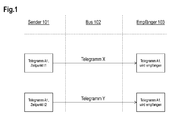
- Fig.1 shows a diagram for visualizing a scenario with a transmitter 101, a bus 102 and a receiver 103.
- the transmitter 101 specifies a telegram A1 for an action, which is transmitted at a time t1. From this, the transmitter 101 creates a telegram X, which it transmits via the bus 102 to the receiver 103.
- the receiver 103 decodes the telegram A1 from the received telegram X.
- the transmitter 101 wishes to transmit the telegram A1 again;
- a telegram Y is created and transmitted via the bus 102 to the receiver 103.
- the receiver 103 is in the long run to decode the message A1 from the received message Y.
- the telegrams X and Y are readable. However, they are not identical and can not be deduced from the double transmission of the telegram A1 without a separate decoding.
- the telegrams to be transmitted over the bus 102 may be encoded (e.g., encoded) depending on the time of dispatch (or other varying time). This ensures that telegrams that convey the same contents look different.
- the telegram can be coded after the command to send over the bus by means of an algorithm.
- the telegram can be added to a dependent of the transmission time t key.
- the position or multiple positions of the key in the telegram are known to the decoder algorithm at the receiver. After reception, the telegram can thus be decoded and further processed.
- Fig.2 shows a symbolic diagram for illustrating a possible generation of telegrams, wherein a telegram 201 is encoded by the transmitter into a telegram 202.
- the telegram 201 includes a bus address 203 of the receiver, a telegram name (e.g., a telegram number) 204, and data 205 (e.g., "1" for door open and "0" for door closed).
- a telegram name e.g., a telegram number
- data 205 e.g., "1" for door open and "0" for door closed.
- the encoded and to be transmitted via the bus telegram 202 includes the bus address 203 of the receiver, a field 206 with the encrypted telegram name 204 and the encrypted data 205 and a key 207th
- Fig.2 Here, only symbolically shows the position of the key 207 within the telegram 202.
- the key 207 is distributed (interleaved) to arbitrary positions within the telegram 202.
- bits and / or bytes of the key 207 may be located at certain predetermined positions of the telegram 202. The positions are known by the decoding algorithm in the receiver and can thus reconstruct the message 201.
- Figure 3 shows by way of example a possibility of interleaving key information K within the field 206 in the form of a telegram 301.
- the key 207 can be varied.
- different keys may be used at different times or for different information.
- the position or the positions of the key 207 within the telegram 202 are varied.
- a pattern for such a variation may e.g. be known to the decoding algorithm.
- a reference to such a pattern e.g. at a fixed position in the telegram 202, the decoding algorithm.
- the approach proposed here is inexpensive to implement.
- the conversion can take place without changing the telegram specifications;
- the communication layer of the bus system is adapted, which transparently provides the service described herein to make the same information look different on the bus.
- the solution also has the advantage that sensitive data can be transmitted over the bus protected.
- the efficient approach of using the same telegrams for different devices, series, types of devices or brands can be maintained.
Landscapes
- Engineering & Computer Science (AREA)
- Computer Hardware Design (AREA)
- Theoretical Computer Science (AREA)
- Computer Security & Cryptography (AREA)
- Software Systems (AREA)
- Physics & Mathematics (AREA)
- General Engineering & Computer Science (AREA)
- General Physics & Mathematics (AREA)
- Selective Calling Equipment (AREA)
- Electric Ovens (AREA)
Abstract
Description
- Die Erfindung betrifft ein Verfahren zur Übertragung von Nachrichten in einem Haushaltsgerät sowie ein entsprechendes Haushaltsgerät.
- Einzelne Elektronikmodule eines Haushaltsgeräts sind über ein Bussystem miteinander vernetzt. Ein solches Elektronikmodul kann z.B. umfassen: ein Regelmodul, eine Benutzerschnittstelle (Userinterface), Tasten und/oder Drehwähler, ein Bratenthermometer und ein Zeitmodul.
- Das verwendete Bussystem kann z.B. einen D-Bus oder einen D-Bus-2 umfassen, z.B. in Form eines universellen Bussystem, basierend auf UART (Universal Asynchronous Receiver Transmitter), um mehrere Busteilnehmer (z.B. ein Regelmodul o.ä.) innerhalb und außerhalb eines Haushaltsgeräts zu verbinden.
- Das Bus-System schafft eine definierte Schnittstelle zu Lieferanten und einzelnen Komponenten des Haushaltsgeräts, z.B. eines Backofens. Die Bus-Teilnehmer kommunizieren über Telegramme miteinander, die Telegramme selbst sind in einer Bus-Spezifikation definiert. Ein Telegramm umfasst z.B. einen Empfänger, eine Telegrammbezeichnung und einem Datenteil.
- Beispielsweise kann ein Sender "Regelmodul" an einen Empfänger "Userinterface" ein Telegramm "Türstatus" mit den Daten bzw. Werten "offen" oder "geschlossen" senden. Das Userinterface wiederum unterbricht den laufenden Backofenbetrieb, indem es ein Telegramm an das Regelmodul schickt. Als weiteres Beispiel kann das Bratenthermometermodul ein Telegramm "Aktuelle Bratenthermometertemperatur" mit dem Wert "78°C" an den Empfänger "Userinterface" übermitteln.
- Um die produktübergreifende Verwendung einzelner Elektronikmodule zu gewährleisten sind die definierten Telegramme z.B. für mehrere Marken und/oder mehrere Gerättypen oder Geräteausführungen (z.B. Backofen, Dampfgarer, Mikrowellenkombigerät, etc.) einer Produktserie gleich spezifiziert. Mittels der Telegramme werden auch sensible Daten, beispielsweise die konkrete Heizkörperansteuerung bei Automatikprogrammen, übertragen. Ein Automatikprogramm umfasst z.B. mehrere aufeinander folgende Heizarten, z.B. Ober-/Unterhitze, Heißluft, Mikrowelle, Dampf, etc. Die Einstellungen, in Abhängigkeit von der gewählten Speisekategorie und dem eingestellten Gewicht der Speise, werden durch die Anwendungstechnik in zeitaufwendigen Auswertungen empirisch ermittelt.
- Es besteht die technische Möglichkeit einer Ankopplung an das Bus-System über standardisierte und frei verkäufliche Hard- und Software (CAN-Bus-Adapter); auf diese Weise kann der Telegrammverkehr aufgezeichnet werden. Durch einfaches Bedienen des Haushaltsgeräts und Überwachen der Telegramme können einzelne Telegramme den Aktionen eindeutig zugeordnet werden und in Folge dessen auch aufwändig erstellte Automatikprogramme ausgelesen werden.
- Dies wird nachfolgend anhand eines Beispiels erläutert: Öffnet der Benutzer die Backofentür eines Herdes erkennt er auf dem Bus ein Telegramm A mit dem Wert 1. Daraufhin schließt der Benutzer die Backofentür und sieht auf dem Bus das Telegramm A mit dem Wert 0. Somit kann der Benutzer das Telegramm A eindeutig dem Türstatus zuordnen. Entsprechend kann der Benutzer nach dem Auswählen und Starten von Heizarten einzelne Heizartentelegramme mitlesen und eindeutig den entsprechenden Heizarten zuordnen.
- Beim Ablauf von Automatikprogrammen werden in vorgegebener Reihenfolge und Dauer dieselben Heizartentelegramme verwendet. Automatikprogramme können hierbei auf dem Bus mitgelesen und automatisiert ausgewertet werden. Auch andere Elektronikmodule im System (z.B. Sensorikmodule) können ihre Messdaten über den Bus transparent mitteilen.
- Hierbei ist es von Nachteil, dass die Telegramme für eine Vielzahl von Geräten bzw. Gerätetypen ggf. auch unterschiedlicher Marken eines Herstellers gleich sind und von einem Wettbewerber mit einfachen Mitteln analysiert werden können. Dies ist insbesondere von Nachteil für aufwändig erstellte Automatikprogramme, die eine bestimmte Abfolge von Telegrammen, ggf. in Abhängigkeit von Sensoren (bzw. weiteren Telegrammen), umfassen und eine besonders vorteilhafte automatisierte Zubereitung von unterschiedlichen Speisen ermöglichen. Ein Wettbewerber kann somit mit überschaubarem Aufwand diese Automatikprogramme rekonstruieren.
- Die Aufgabe der Erfindung besteht darin, die vorstehend genannten Nachteile zu vermeiden und insbesondere eine effiziente Lösung zur Absicherung der in den Telegrammen übertragenen Informationen zu schaffen.
- Diese Aufgabe wird gemäß den Merkmalen der unabhängigen Patentansprüche gelöst. Weiterbildungen der Erfindung ergeben sich auch aus den abhängigen Ansprüchen.
- Zur Lösung der Aufgabe wird ein Verfahren zur Übertragung von Nachrichten zwischen Elektronikmodulen eines Haushaltsgeräts angegeben,
- bei dem eine zu übermittelnde Nachricht mittels einer vorgegebenen Information kodiert wird,
- bei dem die kodierte Nachricht übertragen wird,
- bei dem die kodierte Nachricht mittels der vorgegebenen Information dekodiert wird.
- Somit ist sichergestellt, dass die Nachrichten (z.B. Telegramme), die zwischen Elektronikmodulen des Haushaltsgeräts (z.B. auf einem Bus-System) übertragen werden, zumindest häufig bzw. immer unterschiedliche Inhalte aufweisen, auch wenn die gleiche Information übertragen wird. Damit kann anhand des übertragenen Pakets ohne die vorgegebene Aktion nicht auf den Inhalt rückgeschlossen werden.
- Das Haushaltsgerät kann ein Haushaltsgroßgerät (z.B. ein Gargerät, ein Wäschebehandlungsgerät, ein Kältegerät, usw.) oder ein Haushaltskleingerät (z.B. ein Toaster, eine Kaffeemaschine, usw.) sein. Das Gargerät kann insbesondere ein Backofen, ein Dampfgargerät, ein Mikrowellengerät oder eine Kombination daraus, bspw. ein Backofen-/Mikrowellen-Kombinationsgerät, sein.
- Eine Weiterbildung ist es, dass die vorgegebene Information einen Schlüssel umfasst.
- Bei dem Schlüssel kann es sich um eine Information oder um ein Geheimnis handeln, das (nur) den kommunizierenden Elektronikmodulen bekannt ist. Ohne Kenntnis des Geheimnisses kann durch Mithören auf dem Kommunikationskanal (z.B. Bus-System) nicht auf die Inhalte Nachrichten rückgeschlossen werden.
- Insbesondere können symmetrische oder asymmetrische kryptographische Verfahren im Zusammenhang mit der vorgestellten Lösung eingesetzt werden.
- Eine andere Weiterbildung ist es, dass die vorgegebene Information ein Geheimnis umfasst betreffend eine Schlüsselinformation.
- Auch ist es möglich, dass die vorgegebene Information die Schlüsselinformation betrifft, diese aber ggf. nicht selbst enthält. Beispielsweise kann das Geheimnis dadurch bestimmt sein, dass es angibt, wo eine Information für die Verschlüsselung in die Nachricht eingefügt wird bzw. wo sie der Nachricht zur Entschlüsselung entnommen werden muss.
- Auch kann das Geheimnis einen Hinweis enthalten dahingehend, wie die Nachricht zu verschlüsseln bzw. zu entschlüsseln ist. Vorzugsweise ist das Geheimnis den kommunizierenden Elektronikmodulen bekannt. Insbesondere kann die übertragende Einheit bzw. die empfangende Einheit des jeweiligen Elektronikmoduls die Kodierung bzw. Dekodierung als einen transparenten Dienst bereitstellen, so dass bestehende Komponenten auch ohne große Anpassung weiterhin genutzt werden können.
- Insbesondere ist es eine Weiterbildung, dass das Geheimnis eine Verteilung der Schlüsselinformation in der Nachricht ist.
- Auch ist es eine Weiterbildung, dass das Geheimnis die Positionen der verteilten Schlüsselinformation in der Nachricht ist.
- Insbesondere kann das Geheimnis, z.B. Bits und/oder Bytes eines Schlüssels, in der Nachricht verteilt gespeichert werden. Weiß der Dekoder, wo die einzelnen Bits und/oder Bytes des Schlüssels in der Nachricht stehen, kann er den Schlüssel entsprechend zusammensetzen und die (verbleibende) Nachricht dekodieren.
- Ferner ist es eine Weiterbildung, dass das Elektronikmodul mindestens eines der folgenden Module umfasst:
- ein Steuer- oder Regelmodul,
- eine Benutzerschnittstelle,
- eine Messeinheit,
- eine Schalteinheit umfassend insbesondere Tasten und/oder Drehwähler,
- ein Thermometer,
- ein Zeitmodul.
- Bei dem Elektronikmodul kann es sich um jede Komponente des Haushaltsgeräts handeln, die mit dem Bus koppelbar ist oder sein könnte. Das Elektronikmodul kann insbesondere mindestens einen Sensor und/oder mindestens einen Aktuator umfassen.
- Im Rahmen einer zusätzlichen Weiterbildung wird die zu übermittelnde Nachricht von einem Sender kodiert, zu einem Empfänger übertragen und von dem Empfänger dekodiert.
- Eine nächste Weiterbildung besteht darin, dass die Nachricht über ein Bus-System, insbesondere einen D-Bus oder einen D-Bus-2, übertragen wird.
- Eine Ausgestaltung ist es, dass die kodierte Nachricht mittels eines Telegramms übertragen wird.
- Eine alternative Ausführungsform besteht darin, dass die Nachricht mittels einer veränderlichen Information kodiert wird.
- Durch die veränderliche Information kann sichergestellt werden, dass kodierte Nachrichten, die den gleichen Inhalt haben, unterschiedlich aussehen, d.h. z.B. auf dem Bus-System in Form unterschiedlich aussehender Telegramme übertragen werden.
- Eine nächste Ausgestaltung ist es, dass die veränderliche Information eine Zeitinformation und/oder eine Datumsinformation umfasst.
- Auch ist es eine Ausgestaltung, dass die zu übermittelnde Nachricht kodiert wird, indem ein Schlüssel in Teile zerlegt wird und die Teile des Schlüssels an unterschiedlichen Positionen der Nachricht eingefügt werden, wobei die vorgegebene Information angibt, an welchen Positionen der Nachricht welche Teile des Schlüssels eingefügt werden bzw. wurden.
- Die vorstehend genannte Aufgabe wird auch gelöst durch ein Haushaltsgerät
- mit einem ersten Elektronikmodul und einem zweiten Elektronikmodul,
- mit einem Bus-System anhand dessen das erste Elektronikmodul und das zweite Elektronikmodul verbunden sind,
- wobei von dem ersten Elektronikmodul eine zu übermittelnde Nachricht mittels einer vorgegebenen Information kodierbar und an das zweite Elektronikmodul übertragbar ist,
- wobei von dem zweiten Elektronikmodul die empfangene Nachricht mittels der vorgegebenen Information dekodierbar ist.
- Eine Weiterbildung besteht darin, dass die vorgegebene Information ein Geheimnis ist, das in dem ersten Elektronikmodul und in dem zweiten Elektronikmodul gespeichert ist.
- Ausführungsbeispiele der Erfindung werden nachfolgend anhand der Zeichnungen dargestellt und erläutert.
- Es zeigen:
- Fig.1
- ein Diagramm zur Visualisierung eines Szenarios mit einem Sender, einem Bus und einem Empfänger, wobei der Sender ein Telegramm A1 für eine Aktion zu einem Zeitpunkt t1 und zu einem Zeitpunkt t2 übermittelt und die beiden übermittelten Telegramme nicht identisch sind;
- Fig.2
- ein symbolisches Schaubild zur Veranschaulichung einer möglichen Erzeugung von Telegrammen, wobei ein Telegramm von dem Sender in ein anderes Telegramm umkodiert wird;
- Fig.3
- beispielhaft eine Möglichkeit der Verschachtelung von Schlüsselinformationen innerhalb des Felds eines Telegramms.
- Es wird ein Ansatz vorgeschlagen, der eine Zuordnung von Telegrammen zu Funktionen des Haushaltsgeräts erschwert oder unmöglich macht. Insbesondere soll verhindert werden, dass ein Mitlesen von Telegrammen auf einem Bussystem, das Elektronikmodule des Haushaltsgeräts zur Kommunikation (zum Nachrichtenaustausch) nutzt, einen einfachen Rückschluss auf die Funktionsweise bzw. die Abfolge von Einstellungen oder Aktionen des Haushaltsgeräts ermöglicht.
- Diesbezüglich wird vorgeschlagen, dass Telegramme generiert werden, die auch bei gleichen Aktionen (z.B. Starten einer Heizart, Einstecken eines Sensors, Schließen einer Backofentür, etc.) zumindest teilweise (insbesondere immer) unterschiedliche Bus-Signale verursachen. Vorteilhaft bleibt die Bus-Hardware von diesem Ansatz unberührt, so dass unverändert die Hardware-Komponenten des Bus-Systems verwendet werden können. Bei dem Bus-System kann es sich z.B. um einen D-Bus oder einen D-Bus-2 handeln, der einzelne Elektronikmodule des Haushaltsgeräts koppelt. Bei dem Elektronikmodul kann es sich um jede Komponente des Haushaltsgeräts handeln, die mit dem Bus koppelbar ist oder sein könnte. Das Elektronikmodul kann insbesondere mindestens einen Sensor und/oder mindestens einen Aktuator umfassen.
-
Fig.1 zeigt ein Diagramm zur Visualisierung eines Szenarios mit einem Sender 101, einem Bus 102 und einem Empfänger 103. Der Sender 101 spezifiziert ein Telegramm A1 für eine Aktion, das zu einem Zeitpunkt t1 übermittelt wird. Hieraus erstellt der Sender 101 ein Telegramm X, das er über den Bus 102 an den Empfänger 103 übermittelt. Der Empfänger 103 dekodiert aus dem empfangenen Telegramm X das Telegramm A1. - Zu einem Zeitpunkt t2 möchte der Sender 101 erneut das Telegramm A1 übertragen; es wird hierfür ein Telegramm Y erstellt und über den Bus 102 zu dem Empfänger 103 übermittelt. Der Empfänger 103 ist in der Lange, aus dem empfangenen Telegramm Y das Telegramm A1 zu dekodieren.
- Auf dem Bus 102 sind die Telegramme X und Y jeweils lesbar. Sie sind aber nicht identisch und lassen ohne gesonderte Dekodierung nicht auf die doppelte Versendung des Telegramms A1 rückschließen.
- Beispiel: Der Benutzer wählt eine Heizart aus der Heizartenauswahl und startet diese. Auf dem Bus liest er das Telegramm X mit. Anschließend startet der Benutzer ein Automatikprogramm und sieht das Telegramm Y. Obwohl das Automatikprogramm hier dieselbe Heizart wie zuvor verwendet, ist ein solcher Rückschluss aufgrund der unterschiedlichen Telegramme X und Y nicht mehr möglich. So ist die gleiche Information, verschickt zu unterschiedlichen Zeitpunkten über den Bus, für einen Beobachter der Telegramme auf dem Bus unterschiedlich.
- Beispielsweise können die über den Bus 102 zu übermittelnden Telegramme in Abhängigkeit vom Zeitpunkt des Versendens (oder einem anderen variierenden Zeitpunkt) kodiert (z.B. verschlüsselt) werden. Damit kann gewährleistet werden, dass Telegramme, die gleiche Inhalte transportieren, unterschiedlich aussehen.
- Insbesondere kann das Telegramm nach dem Befehl zum Versenden über den Bus mittels eines Algorithmus kodiert werden. Dem Telegramm kann ein von dem Sendezeitpunkt t abhängiger Schlüssel hinzugefügt werden. Die Position oder die mehreren Positionen des Schlüssels in dem Telegramm sind dem Dekodieralgorithmus beim Empfänger bekannt. Nach Empfang kann somit das Telegramm dekodiert und weiterverarbeitet werden.
- Hierbei ist vorteilhaft sichergestellt, dass durch Mithören auf dem Übertragungsweg nicht länger anhand gleicher Telegramme auf gleiche Aktionen rückgeschlossen werden kann.
-
Fig.2 zeigt ein symbolisches Schaubild zur Veranschaulichung einer möglichen Erzeugung von Telegrammen, wobei ein Telegramm 201 von dem Sender in ein Telegramm 202 kodiert wird. - Das Telegramm 201 umfasst eine Busadresse 203 des Empfängers, eine Telegrammbezeichnung (z.B. eine Telegrammnummer) 204 sowie Daten 205 (z.B. "1" für Türe offen und "0" für Türe geschlossen).
- Das kodierte und über den Bus zu übertragende Telegramm 202 umfasst die Busadresse 203 des Empfängers, ein Feld 206 mit der verschlüsselten Telegrammbezeichnung 204 und den verschlüsselten Daten 205 sowie einen Schlüssel 207.
-
Fig.2 zeigt hierbei nur symbolisch die Position des Schlüssels 207 innerhalb des Telegramms 202. Beispielsweise ist der Schlüssel 207 auf beliebige Positionen innerhalb des Telegramms 202 verteilt (verschachtelt). Zum Beispiel können Bits und/oder Bytes des Schlüssels 207 an bestimmten vorgegebenen Positionen des Telegramms 202 angeordnet sein. Die Positionen kennt der Dekodieralgorithmus im Empfänger und kann somit das Telegramm 201 rekonstruieren. -
Fig.3 zeigt beispielhaft eine Möglichkeit der Verschachtelung von Schlüsselinformationen K innerhalb des Felds 206 in Form eines Telegramms 301. - Insbesondere kann der Schlüssel 207 variiert werden. Zum Beispiel können zu verschiedenen Zeitpunkten oder für verschiedene Informationen unterschiedliche Schlüssel verwendet werden. Auch ist es eine Möglichkeit, dass die Position bzw. die Positionen des Schlüssels 207 innerhalb des Telegramms 202 variiert werden. Ein Muster für eine solche Variation kann z.B. dem Dekodieralgorithmus bekannt sein. Auch kann ein Verweis auf ein solches Muster, z.B. an einer festen Position in dem Telegramm 202, dem Dekodieralgorithmus mitgeteilt werden.
- Der hier vorgeschlagene Ansatz ist kostengünstig zu realisieren. Die Umsetzung kann ohne Änderung der Telegrammspezifikationen erfolgen; vorzugsweise wird die Kommunikationsschicht des Bus-Systems angepasst, die transparent den hier beschriebenen Dienst erbringt, gleiche Informationen auf dem Bus unterschiedlich aussehen zu lassen. Die Lösung hat weiterhin den Vorteil, dass sensible Daten geschützt über den Bus übertragen werden können. Gleichzeitig kann der effiziente Ansatz, gleiche Telegramme für unterschiedliche Geräte, Baureihen, Gerättypen oder Marken zu verwenden, beibehalten werden.
-
- 101
- Sender
- 102
- Bus
- 103
- Empfänger
- 201
- Telegramm
- 202
- Telegramm (über Bus-System)
- 203
- Busadresse (allgemein: Adresse)
- 204
- Telegrammbezeichnung (z.B. Telegrammnummer)
- 205
- Daten des Telegramms
- 206
- Feld mit verschlüsselter Telegrammbezeichnung und verschlüsselten Daten
- 207
- Schlüssel
- 301
- Telegramm mit verschachtelter Schlüsselinformation K
- K
- Schlüsselinformation (Teil des Schlüssels 207)
- X
- Telegramm bzw. Nachricht
- Y
- Telegramm bzw. Nachricht
Claims (14)
- Verfahren zur Übertragung von Nachrichten zwischen Elektronikmodulen eines Haushaltsgeräts,- bei dem eine zu übermittelnde Nachricht (201) mittels einer vorgegebenen Information (207) kodiert wird,- bei dem die kodierte Nachricht (202) übertragen wird,- bei dem die kodierte Nachricht mittels der vorgegebenen Information (207) dekodiert wird.
- Verfahren nach Anspruch 1, bei dem die vorgegebene Information einen Schlüssel umfasst.
- Verfahren nach einem der vorhergehenden Ansprüche, bei dem die vorgegebene Information ein Geheimnis umfasst betreffend eine Schlüsselinformation.
- Verfahren nach Anspruch 3, bei dem das Geheimnis eine Verteilung der Schlüsselinformation in der Nachricht ist.
- Verfahren nach Anspruch 3, bei dem das Geheimnis die Positionen der verteilten Schlüsselinformation in der Nachricht ist.
- Verfahren nach einem der vorhergehenden Ansprüche, bei dem das Elektronikmodul mindestens eines der folgenden Module umfasst:- ein Steuer- oder Regelmodul,- eine Benutzerschnittstelle,- eine Messeinheit,- eine Schalteinheit umfassend insbesondere Tasten und/oder Drehwähler,- ein Thermometer,- ein Zeitmodul.
- Verfahren nach einem der vorhergehenden Ansprüche, bei dem die zu übermittelnde Nachricht von einem Sender kodiert, zu einem Empfänger übertragen und von dem Empfänger dekodiert wird.
- Verfahren nach einem der vorhergehenden Ansprüche, bei dem die Nachricht über ein Bus-System, insbesondere einen D-Bus oder einen D-Bus-2, übertragen wird.
- Verfahren nach einem der vorhergehenden Ansprüche, bei dem die kodierte Nachricht mittels eines Telegramms übertragen wird.
- Verfahren nach einem der vorhergehenden Ansprüche, bei dem die Nachricht mittels einer veränderlichen Information kodiert wird.
- Verfahren nach Anspruch 10, bei dem die veränderliche Information eine Zeitinformation und/oder eine Datumsinformation umfasst.
- Verfahren nach einem der vorhergehenden Ansprüche, bei dem die zu übermittelnde Nachricht kodiert wird, indem ein Schlüssel in Teile zerlegt wird und die Teile des Schlüssels an unterschiedlichen Positionen der Nachricht eingefügt werden, wobei die vorgegebene Information angibt, an welchen Positionen der Nachricht welche Teile des Schlüssels eingefügt werden.
- Haushaltsgerät- mit einem ersten Elektronikmodul (101) und einem zweiten Elektronikmodul (103),- mit einem Bus-System (102) anhand dessen das erste Elektronikmodul (101) und das zweite Elektronikmodul (103) verbunden sind,- wobei von dem ersten Elektronikmodul (101) eine zu übermittelnde Nachricht (X, Y) mittels einer vorgegebenen Information (207, K) kodierbar und an das zweite Elektronikmodul (103) übertragbar ist,- wobei von dem zweiten Elektronikmodul (103) die empfangene Nachricht (X, Y) mittels der vorgegebenen Information (207, K) dekodierbar ist.
- Haushaltsgerät nach Anspruch 13, bei dem die vorgegebene Information ein Geheimnis ist, das in dem ersten Elektronikmodul und in dem zweiten Elektronikmodul gespeichert ist.
Priority Applications (1)
| Application Number | Priority Date | Filing Date | Title |
|---|---|---|---|
| PL14161467T PL2787466T3 (pl) | 2013-04-02 | 2014-03-25 | Transmisja komunikatów w urządzeniu gospodarstwa domowego |
Applications Claiming Priority (1)
| Application Number | Priority Date | Filing Date | Title |
|---|---|---|---|
| DE102013205754.7A DE102013205754A1 (de) | 2013-04-02 | 2013-04-02 | Nachrichtenübertragung in Haushaltsgerät |
Publications (2)
| Publication Number | Publication Date |
|---|---|
| EP2787466A1 true EP2787466A1 (de) | 2014-10-08 |
| EP2787466B1 EP2787466B1 (de) | 2021-06-30 |
Family
ID=50343707
Family Applications (1)
| Application Number | Title | Priority Date | Filing Date |
|---|---|---|---|
| EP14161467.7A Active EP2787466B1 (de) | 2013-04-02 | 2014-03-25 | Nachrichtenübertragung in Haushaltsgerät |
Country Status (4)
| Country | Link |
|---|---|
| EP (1) | EP2787466B1 (de) |
| DE (1) | DE102013205754A1 (de) |
| ES (1) | ES2880479T3 (de) |
| PL (1) | PL2787466T3 (de) |
Citations (1)
| Publication number | Priority date | Publication date | Assignee | Title |
|---|---|---|---|---|
| US20090316905A1 (en) * | 2008-06-19 | 2009-12-24 | Amjad Qureshi | Key exchange through a scramble methodology and system |
Family Cites Families (5)
| Publication number | Priority date | Publication date | Assignee | Title |
|---|---|---|---|---|
| DE19625042B4 (de) * | 1996-06-22 | 2007-08-30 | BSH Bosch und Siemens Hausgeräte GmbH | Steuer- bzw. Regelvorrichtung |
| DE19922561A1 (de) * | 1999-05-17 | 2000-11-23 | Sick Ag | Verfahren und Vorrichtung zur sicheren Übertragung von Datensignalen über ein Bussystem |
| DE102009026752A1 (de) * | 2009-06-04 | 2010-12-09 | BSH Bosch und Siemens Hausgeräte GmbH | Haushaltsgerät mit einer Steuereinheit und einer Datenaustauscheinheit und System mit zumindest einem derartigen Haushaltsgerät |
| TWI432964B (zh) * | 2011-08-15 | 2014-04-01 | Phison Electronics Corp | 金鑰傳送方法、記憶體控制器與記憶體儲存裝置 |
| US20130077641A1 (en) * | 2011-09-22 | 2013-03-28 | Harley F. Burger, Jr. | Systems, Circuits and Methods for Time Stamp Based One-Way Communications |
-
2013
- 2013-04-02 DE DE102013205754.7A patent/DE102013205754A1/de not_active Withdrawn
-
2014
- 2014-03-25 ES ES14161467T patent/ES2880479T3/es active Active
- 2014-03-25 EP EP14161467.7A patent/EP2787466B1/de active Active
- 2014-03-25 PL PL14161467T patent/PL2787466T3/pl unknown
Patent Citations (1)
| Publication number | Priority date | Publication date | Assignee | Title |
|---|---|---|---|---|
| US20090316905A1 (en) * | 2008-06-19 | 2009-12-24 | Amjad Qureshi | Key exchange through a scramble methodology and system |
Also Published As
| Publication number | Publication date |
|---|---|
| ES2880479T3 (es) | 2021-11-24 |
| PL2787466T3 (pl) | 2021-12-06 |
| DE102013205754A1 (de) | 2014-10-02 |
| EP2787466B1 (de) | 2021-06-30 |
Similar Documents
| Publication | Publication Date | Title |
|---|---|---|
| DE102008009659B4 (de) | Verfahren zur Steuerung von mindestens zwei Gargeräten, Gargerät und System aus mindestens zwei Gargeräten | |
| DE102011118565A1 (de) | Smart Home-Gerät, Smart Home-Steuereinheit, Smart Home-System und Verfahren zur Einbindung eines Smart Home-Geräts in ein Smart Home-System | |
| DE112009002450T5 (de) | Thermostatzustandsbenachrichtigung über ein Netzwerk | |
| DE102021205044A1 (de) | Rückstreukommunikationssystem | |
| DE102021205165A1 (de) | Rückstreukommunikationssystem | |
| WO2014001213A1 (de) | Kommunikation eines hausgeräts | |
| DE102012015893A1 (de) | Übermittlung einer Information betreffend ein Haushaltsgerät | |
| WO2017190921A1 (de) | Herstellung einer datenverbindung | |
| DE102013205754A1 (de) | Nachrichtenübertragung in Haushaltsgerät | |
| EP2573632A1 (de) | Verfahren zum Betrieb eines Haushaltsgeräts und zur Verwendung in einem solchen Verfahren vorgesehenes Haushaltsgerät | |
| EP2709374A2 (de) | Vorrichtung zum Einsatz in einem Messsystem zur Erfassung von übertragener Energie | |
| DE102008041394A1 (de) | Kontaktlos auslesbare Identifikationsmarke | |
| WO2013120731A1 (de) | Haushaltsgerät mit einem kommunikationsmodul und verfahren zur übertragung von daten in einem haushaltsgerät | |
| DE102006062244B4 (de) | Verfahren zum Auslesen von Daten aus dem Speicher eines Gargeräts und Gargerät zum Durchführen eines solchen Verfahrens | |
| EP2634969B1 (de) | Verfahren zum Betreiben eines Systems zur Heimautomatisierung sowie ein Heimautomatisierungssteuerungssystem | |
| DE102023100519A1 (de) | Schnittstellenmodul für ein Induktionskochfeld eines Garsystems zum Garen von Gargut, Garsystem zum Garen von Gargut und Verfahren zum Betreiben eines Garsystems | |
| EP2701360B1 (de) | Hausgerät mit Kommunikationsmodul | |
| AT410989B (de) | Gerät für den einsatz in verkaufs- und/oder gastronomiebetrieben | |
| DE102006013312B3 (de) | Flüssigkeitsführendes Haushaltsgerät mit einer elektrischen Steuerung und einer Flüssigkeitsleitung | |
| DE112014007219T5 (de) | Kommunikationseinrichtung, Kommunikationsadapter, Kommunikationssystem, Kommunikationsparameterantwortverfahren und Programm | |
| DE10256942B4 (de) | Verfahren zum Initialisieren von Funkempfängern | |
| DE102004016778A1 (de) | System, bestehend aus mindestens einem Haushaltgerät und einer zentralen Überwachungseinrichtung | |
| DE102019209194A1 (de) | Verfahren zur Sprachbedienung eines Hausgeräts | |
| DE102011075608A1 (de) | Verfahren zum Zuordnen eines physikalischen Kanals eines Sensors, der an einen Bus eines Bus-Systems angeschlossen ist, zu einem Kanal eines in einem Inbetriebnahmeprogramm virtuell dargestellten Sensors sowie Sensor und Inbetriebnahmeprogramm | |
| EP3261260B1 (de) | Elektrisches haushaltsgerät mit einer datenübertragungseinrichtung und vorrichtung zum empfangen von daten von einem solchen gerät |
Legal Events
| Date | Code | Title | Description |
|---|---|---|---|
| PUAI | Public reference made under article 153(3) epc to a published international application that has entered the european phase |
Free format text: ORIGINAL CODE: 0009012 |
|
| 17P | Request for examination filed |
Effective date: 20140325 |
|
| AK | Designated contracting states |
Kind code of ref document: A1 Designated state(s): AL AT BE BG CH CY CZ DE DK EE ES FI FR GB GR HR HU IE IS IT LI LT LU LV MC MK MT NL NO PL PT RO RS SE SI SK SM TR |
|
| AX | Request for extension of the european patent |
Extension state: BA ME |
|
| RAP1 | Party data changed (applicant data changed or rights of an application transferred) |
Owner name: BSH HAUSGERAETE GMBH |
|
| R17P | Request for examination filed (corrected) |
Effective date: 20150408 |
|
| RBV | Designated contracting states (corrected) |
Designated state(s): AL AT BE BG CH CY CZ DE DK EE ES FI FR GB GR HR HU IE IS IT LI LT LU LV MC MK MT NL NO PL PT RO RS SE SI SK SM TR |
|
| 17Q | First examination report despatched |
Effective date: 20150522 |
|
| STAA | Information on the status of an ep patent application or granted ep patent |
Free format text: STATUS: EXAMINATION IS IN PROGRESS |
|
| GRAP | Despatch of communication of intention to grant a patent |
Free format text: ORIGINAL CODE: EPIDOSNIGR1 |
|
| STAA | Information on the status of an ep patent application or granted ep patent |
Free format text: STATUS: GRANT OF PATENT IS INTENDED |
|
| INTG | Intention to grant announced |
Effective date: 20210217 |
|
| GRAS | Grant fee paid |
Free format text: ORIGINAL CODE: EPIDOSNIGR3 |
|
| GRAA | (expected) grant |
Free format text: ORIGINAL CODE: 0009210 |
|
| STAA | Information on the status of an ep patent application or granted ep patent |
Free format text: STATUS: THE PATENT HAS BEEN GRANTED |
|
| AK | Designated contracting states |
Kind code of ref document: B1 Designated state(s): AL AT BE BG CH CY CZ DE DK EE ES FI FR GB GR HR HU IE IS IT LI LT LU LV MC MK MT NL NO PL PT RO RS SE SI SK SM TR |
|
| REG | Reference to a national code |
Ref country code: GB Ref legal event code: FG4D Free format text: NOT ENGLISH Ref country code: CH Ref legal event code: EP |
|
| REG | Reference to a national code |
Ref country code: AT Ref legal event code: REF Ref document number: 1407005 Country of ref document: AT Kind code of ref document: T Effective date: 20210715 Ref country code: DE Ref legal event code: R096 Ref document number: 502014015698 Country of ref document: DE |
|
| REG | Reference to a national code |
Ref country code: IE Ref legal event code: FG4D Free format text: LANGUAGE OF EP DOCUMENT: GERMAN |
|
| REG | Reference to a national code |
Ref country code: LT Ref legal event code: MG9D |
|
| PG25 | Lapsed in a contracting state [announced via postgrant information from national office to epo] |
Ref country code: HR Free format text: LAPSE BECAUSE OF FAILURE TO SUBMIT A TRANSLATION OF THE DESCRIPTION OR TO PAY THE FEE WITHIN THE PRESCRIBED TIME-LIMIT Effective date: 20210630 Ref country code: BG Free format text: LAPSE BECAUSE OF FAILURE TO SUBMIT A TRANSLATION OF THE DESCRIPTION OR TO PAY THE FEE WITHIN THE PRESCRIBED TIME-LIMIT Effective date: 20210930 Ref country code: FI Free format text: LAPSE BECAUSE OF FAILURE TO SUBMIT A TRANSLATION OF THE DESCRIPTION OR TO PAY THE FEE WITHIN THE PRESCRIBED TIME-LIMIT Effective date: 20210630 |
|
| REG | Reference to a national code |
Ref country code: NL Ref legal event code: MP Effective date: 20210630 |
|
| REG | Reference to a national code |
Ref country code: ES Ref legal event code: FG2A Ref document number: 2880479 Country of ref document: ES Kind code of ref document: T3 Effective date: 20211124 |
|
| PG25 | Lapsed in a contracting state [announced via postgrant information from national office to epo] |
Ref country code: GR Free format text: LAPSE BECAUSE OF FAILURE TO SUBMIT A TRANSLATION OF THE DESCRIPTION OR TO PAY THE FEE WITHIN THE PRESCRIBED TIME-LIMIT Effective date: 20211001 Ref country code: LV Free format text: LAPSE BECAUSE OF FAILURE TO SUBMIT A TRANSLATION OF THE DESCRIPTION OR TO PAY THE FEE WITHIN THE PRESCRIBED TIME-LIMIT Effective date: 20210630 Ref country code: NO Free format text: LAPSE BECAUSE OF FAILURE TO SUBMIT A TRANSLATION OF THE DESCRIPTION OR TO PAY THE FEE WITHIN THE PRESCRIBED TIME-LIMIT Effective date: 20210930 Ref country code: SE Free format text: LAPSE BECAUSE OF FAILURE TO SUBMIT A TRANSLATION OF THE DESCRIPTION OR TO PAY THE FEE WITHIN THE PRESCRIBED TIME-LIMIT Effective date: 20210630 Ref country code: RS Free format text: LAPSE BECAUSE OF FAILURE TO SUBMIT A TRANSLATION OF THE DESCRIPTION OR TO PAY THE FEE WITHIN THE PRESCRIBED TIME-LIMIT Effective date: 20210630 |
|
| PG25 | Lapsed in a contracting state [announced via postgrant information from national office to epo] |
Ref country code: EE Free format text: LAPSE BECAUSE OF FAILURE TO SUBMIT A TRANSLATION OF THE DESCRIPTION OR TO PAY THE FEE WITHIN THE PRESCRIBED TIME-LIMIT Effective date: 20210630 Ref country code: CZ Free format text: LAPSE BECAUSE OF FAILURE TO SUBMIT A TRANSLATION OF THE DESCRIPTION OR TO PAY THE FEE WITHIN THE PRESCRIBED TIME-LIMIT Effective date: 20210630 Ref country code: SM Free format text: LAPSE BECAUSE OF FAILURE TO SUBMIT A TRANSLATION OF THE DESCRIPTION OR TO PAY THE FEE WITHIN THE PRESCRIBED TIME-LIMIT Effective date: 20210630 Ref country code: SK Free format text: LAPSE BECAUSE OF FAILURE TO SUBMIT A TRANSLATION OF THE DESCRIPTION OR TO PAY THE FEE WITHIN THE PRESCRIBED TIME-LIMIT Effective date: 20210630 Ref country code: PT Free format text: LAPSE BECAUSE OF FAILURE TO SUBMIT A TRANSLATION OF THE DESCRIPTION OR TO PAY THE FEE WITHIN THE PRESCRIBED TIME-LIMIT Effective date: 20211102 Ref country code: NL Free format text: LAPSE BECAUSE OF FAILURE TO SUBMIT A TRANSLATION OF THE DESCRIPTION OR TO PAY THE FEE WITHIN THE PRESCRIBED TIME-LIMIT Effective date: 20210630 Ref country code: RO Free format text: LAPSE BECAUSE OF FAILURE TO SUBMIT A TRANSLATION OF THE DESCRIPTION OR TO PAY THE FEE WITHIN THE PRESCRIBED TIME-LIMIT Effective date: 20210630 |
|
| REG | Reference to a national code |
Ref country code: DE Ref legal event code: R097 Ref document number: 502014015698 Country of ref document: DE |
|
| PG25 | Lapsed in a contracting state [announced via postgrant information from national office to epo] |
Ref country code: DK Free format text: LAPSE BECAUSE OF FAILURE TO SUBMIT A TRANSLATION OF THE DESCRIPTION OR TO PAY THE FEE WITHIN THE PRESCRIBED TIME-LIMIT Effective date: 20210630 |
|
| PLBE | No opposition filed within time limit |
Free format text: ORIGINAL CODE: 0009261 |
|
| STAA | Information on the status of an ep patent application or granted ep patent |
Free format text: STATUS: NO OPPOSITION FILED WITHIN TIME LIMIT |
|
| PG25 | Lapsed in a contracting state [announced via postgrant information from national office to epo] |
Ref country code: AL Free format text: LAPSE BECAUSE OF FAILURE TO SUBMIT A TRANSLATION OF THE DESCRIPTION OR TO PAY THE FEE WITHIN THE PRESCRIBED TIME-LIMIT Effective date: 20210630 |
|
| 26N | No opposition filed |
Effective date: 20220331 |
|
| PG25 | Lapsed in a contracting state [announced via postgrant information from national office to epo] |
Ref country code: MC Free format text: LAPSE BECAUSE OF FAILURE TO SUBMIT A TRANSLATION OF THE DESCRIPTION OR TO PAY THE FEE WITHIN THE PRESCRIBED TIME-LIMIT Effective date: 20210630 |
|
| REG | Reference to a national code |
Ref country code: CH Ref legal event code: PL |
|
| REG | Reference to a national code |
Ref country code: BE Ref legal event code: MM Effective date: 20220331 |
|
| PG25 | Lapsed in a contracting state [announced via postgrant information from national office to epo] |
Ref country code: LU Free format text: LAPSE BECAUSE OF NON-PAYMENT OF DUE FEES Effective date: 20220325 Ref country code: LI Free format text: LAPSE BECAUSE OF NON-PAYMENT OF DUE FEES Effective date: 20220331 Ref country code: IE Free format text: LAPSE BECAUSE OF NON-PAYMENT OF DUE FEES Effective date: 20220325 Ref country code: CH Free format text: LAPSE BECAUSE OF NON-PAYMENT OF DUE FEES Effective date: 20220331 |
|
| PG25 | Lapsed in a contracting state [announced via postgrant information from national office to epo] |
Ref country code: BE Free format text: LAPSE BECAUSE OF NON-PAYMENT OF DUE FEES Effective date: 20220331 |
|
| REG | Reference to a national code |
Ref country code: DE Ref legal event code: R084 Ref document number: 502014015698 Country of ref document: DE |
|
| PG25 | Lapsed in a contracting state [announced via postgrant information from national office to epo] |
Ref country code: LT Free format text: LAPSE BECAUSE OF FAILURE TO SUBMIT A TRANSLATION OF THE DESCRIPTION OR TO PAY THE FEE WITHIN THE PRESCRIBED TIME-LIMIT Effective date: 20210630 |
|
| REG | Reference to a national code |
Ref country code: AT Ref legal event code: MM01 Ref document number: 1407005 Country of ref document: AT Kind code of ref document: T Effective date: 20220325 |
|
| PG25 | Lapsed in a contracting state [announced via postgrant information from national office to epo] |
Ref country code: AT Free format text: LAPSE BECAUSE OF NON-PAYMENT OF DUE FEES Effective date: 20220325 |
|
| PG25 | Lapsed in a contracting state [announced via postgrant information from national office to epo] |
Ref country code: HU Free format text: LAPSE BECAUSE OF FAILURE TO SUBMIT A TRANSLATION OF THE DESCRIPTION OR TO PAY THE FEE WITHIN THE PRESCRIBED TIME-LIMIT; INVALID AB INITIO Effective date: 20140325 |
|
| PG25 | Lapsed in a contracting state [announced via postgrant information from national office to epo] |
Ref country code: MK Free format text: LAPSE BECAUSE OF FAILURE TO SUBMIT A TRANSLATION OF THE DESCRIPTION OR TO PAY THE FEE WITHIN THE PRESCRIBED TIME-LIMIT Effective date: 20210630 Ref country code: CY Free format text: LAPSE BECAUSE OF FAILURE TO SUBMIT A TRANSLATION OF THE DESCRIPTION OR TO PAY THE FEE WITHIN THE PRESCRIBED TIME-LIMIT Effective date: 20210630 |
|
| REG | Reference to a national code |
Ref country code: ES Ref legal event code: GC2A Effective date: 20240903 |
|
| PG25 | Lapsed in a contracting state [announced via postgrant information from national office to epo] |
Ref country code: MT Free format text: LAPSE BECAUSE OF FAILURE TO SUBMIT A TRANSLATION OF THE DESCRIPTION OR TO PAY THE FEE WITHIN THE PRESCRIBED TIME-LIMIT Effective date: 20210630 |
|
| PGFP | Annual fee paid to national office [announced via postgrant information from national office to epo] |
Ref country code: ES Payment date: 20250416 Year of fee payment: 12 |
|
| PGFP | Annual fee paid to national office [announced via postgrant information from national office to epo] |
Ref country code: IT Payment date: 20250331 Year of fee payment: 12 |
|
| PGFP | Annual fee paid to national office [announced via postgrant information from national office to epo] |
Ref country code: GB Payment date: 20260324 Year of fee payment: 13 |
|
| PGFP | Annual fee paid to national office [announced via postgrant information from national office to epo] |
Ref country code: DE Payment date: 20260331 Year of fee payment: 13 |
|
| PGFP | Annual fee paid to national office [announced via postgrant information from national office to epo] |
Ref country code: FR Payment date: 20260324 Year of fee payment: 13 |
|
| PGFP | Annual fee paid to national office [announced via postgrant information from national office to epo] |
Ref country code: TR Payment date: 20260324 Year of fee payment: 13 |
|
| PGFP | Annual fee paid to national office [announced via postgrant information from national office to epo] |
Ref country code: PL Payment date: 20260313 Year of fee payment: 13 |