EP2785129A2 - Annehmen oder Ablehnen von Zugriffsanforderungen - Google Patents
Annehmen oder Ablehnen von Zugriffsanforderungen Download PDFInfo
- Publication number
- EP2785129A2 EP2785129A2 EP14167037.2A EP14167037A EP2785129A2 EP 2785129 A2 EP2785129 A2 EP 2785129A2 EP 14167037 A EP14167037 A EP 14167037A EP 2785129 A2 EP2785129 A2 EP 2785129A2
- Authority
- EP
- European Patent Office
- Prior art keywords
- request
- wtru
- resources
- qos
- addts
- Prior art date
- Legal status (The legal status is an assumption and is not a legal conclusion. Google has not performed a legal analysis and makes no representation as to the accuracy of the status listed.)
- Withdrawn
Links
- 238000000034 method Methods 0.000 claims abstract description 54
- 230000004044 response Effects 0.000 claims abstract description 32
- 230000008569 process Effects 0.000 description 19
- 238000010586 diagram Methods 0.000 description 14
- 230000005540 biological transmission Effects 0.000 description 6
- 230000007246 mechanism Effects 0.000 description 6
- 230000009471 action Effects 0.000 description 1
- 230000008859 change Effects 0.000 description 1
- 230000011664 signaling Effects 0.000 description 1
Images



Classifications
-
- H—ELECTRICITY
- H04—ELECTRIC COMMUNICATION TECHNIQUE
- H04W—WIRELESS COMMUNICATION NETWORKS
- H04W72/00—Local resource management
- H04W72/04—Wireless resource allocation
-
- H—ELECTRICITY
- H04—ELECTRIC COMMUNICATION TECHNIQUE
- H04L—TRANSMISSION OF DIGITAL INFORMATION, e.g. TELEGRAPHIC COMMUNICATION
- H04L47/00—Traffic control in data switching networks
- H04L47/70—Admission control; Resource allocation
-
- H—ELECTRICITY
- H04—ELECTRIC COMMUNICATION TECHNIQUE
- H04L—TRANSMISSION OF DIGITAL INFORMATION, e.g. TELEGRAPHIC COMMUNICATION
- H04L47/00—Traffic control in data switching networks
- H04L47/70—Admission control; Resource allocation
- H04L47/72—Admission control; Resource allocation using reservation actions during connection setup
- H04L47/724—Admission control; Resource allocation using reservation actions during connection setup at intermediate nodes, e.g. resource reservation protocol [RSVP]
-
- H—ELECTRICITY
- H04—ELECTRIC COMMUNICATION TECHNIQUE
- H04L—TRANSMISSION OF DIGITAL INFORMATION, e.g. TELEGRAPHIC COMMUNICATION
- H04L47/00—Traffic control in data switching networks
- H04L47/70—Admission control; Resource allocation
- H04L47/78—Architectures of resource allocation
- H04L47/781—Centralised allocation of resources
-
- H—ELECTRICITY
- H04—ELECTRIC COMMUNICATION TECHNIQUE
- H04L—TRANSMISSION OF DIGITAL INFORMATION, e.g. TELEGRAPHIC COMMUNICATION
- H04L47/00—Traffic control in data switching networks
- H04L47/70—Admission control; Resource allocation
- H04L47/82—Miscellaneous aspects
- H04L47/824—Applicable to portable or mobile terminals
-
- H—ELECTRICITY
- H04—ELECTRIC COMMUNICATION TECHNIQUE
- H04L—TRANSMISSION OF DIGITAL INFORMATION, e.g. TELEGRAPHIC COMMUNICATION
- H04L45/00—Routing or path finding of packets in data switching networks
- H04L45/42—Centralised routing
-
- H—ELECTRICITY
- H04—ELECTRIC COMMUNICATION TECHNIQUE
- H04W—WIRELESS COMMUNICATION NETWORKS
- H04W40/00—Communication routing or communication path finding
- H04W40/02—Communication route or path selection, e.g. power-based or shortest path routing
- H04W40/12—Communication route or path selection, e.g. power-based or shortest path routing based on transmission quality or channel quality
-
- H—ELECTRICITY
- H04—ELECTRIC COMMUNICATION TECHNIQUE
- H04W—WIRELESS COMMUNICATION NETWORKS
- H04W84/00—Network topologies
- H04W84/18—Self-organising networks, e.g. ad-hoc networks or sensor networks
Definitions
- the present invention is generally related to wireless communication systems. More particularly, the present invention is related to path-based traffic stream (TS) admission control mechanisms in mesh-type wireless communication networks having centralized or distributed admission control architecture.
- TS traffic stream
- a wireless local area network (WLAN) mesh network is an IEEE 802.11-based wireless distribution system (WDS) including two or more mesh points (MPs) interconnected via IEEE 802.11 links and communicating via WLAN mesh services.
- FIG 1 shows a typical WLAN mesh network 100 including a plurality of mesh points (MPs) 10, 20, 30, 40, 50, 60 and 70 and gateways A, B and C.
- MPs mesh points
- Each of the MPs 10, 20, 30,40, 50, 60 and 70 of the WLAN mesh network 100 receives and transmits its own traffic, while also acting as a router for other MPs.
- the gateways A, B, and C provide gateway services to the MPs 10, 20, 30, 40, 50, 60 and 70, including, for example, connections to the Internet, the public switched telephone network (PSTN), and other wired and wireless networks.
- PSTN public switched telephone network
- the MP 50 has no direct data connection with any of the gateways A, B, or C.
- the MP 50 accesses gateway A via the MP 20 and/or the MP 30.
- the WLAN mesh network 100 employs TS admission control to ensure that new incoming TSs can be admitted in the WLAN mesh network 100 without sacrificing current levels of transmission quality.
- a new quality of service (QoS) TS requiring admission control will be admitted as long as the access point (AP) can support the resources/QoS requirements of the TS.
- admission control must ensure that all of the MPs in the network will be able to satisfy the resources/QoS requirements for current and new sessions upon admission of the new TS.
- the present invention is related to a method and apparatus for implementing path-based TS admission control in a wireless mesh network having a distributed and/or centralized admission control architecture.
- a source MP S.MP
- the request propagates through the wireless mesh network until a destination MP (D.MP) is reached and an admitted path is determined. If an intermediate MP is unable to meet the requested resources/QoS for the TS, the S.MP is notified.
- an S.MP requests a route to the D.MP from a central controller.
- the central controller maintains a status of MPs in the wireless mesh network, and selects a best route to handle the TS to satisfy the requested resources/QoS.
- FIG 3 is a signal flow diagram illustrating an example of an S.MP performing path-based TS admission control in a WLAN mesh network having a distributed admission control architecture in which intermediate MPs are able to satisfy the requested/QoS requirements of a new TS generated by an S.MP in accordance with the process of Figure 2 ;
- FIG. 4 is a signal flow diagram illustrating an example of an S.MP performing path-based TS admission control in a WLAN mesh network having a distributed admission control architecture in which an intermediate MP is unable to satisfy the requested resources/QoS requirements of a new TS generated by an S.MP in accordance with another embodiment of the present invention
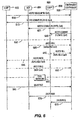
- FIG. 5 is a flow diagram of a process of performing path-based TS admission control in a WLAN mesh network having central controller in accordance with another embodiment of the present invention
- Figure 6 is a signal flow diagram of path-based TS admission control in a WLAN mesh network having centralized admission control architecture in accordance with the process of Figure 5 ;
- FIG. 7 is an exemplary block diagram of an MP configured to perform admission control in both a distributed admission controlled wireless mesh network and/or a centralized admission controlled wireless mesh network in accordance with the present invention.
- FIG. 8 is an exemplary block diagram of a central controller for performing path-based TS admission control in a WLAN mesh network having a centralized admission control architecture in accordance with the present invention.
- the terminology “MP” includes but is not limited to a WTRU, a user equipment (UE), a mobile station, a fixed or mobile subscriber unit, a pager, a user station (STA) or any other type of device capable of operating in a wireless environment.
- the terminology “AP” includes but is not limited to a Node-B, a base station, a site controller or any other type of interfacing device in a wireless environment.
- the present invention is a method and apparatus for path-based TS admission control.
- a WLAN mesh network has distributed admission control architecture. Accordingly, each MP of the WLAN mesh network shares the responsibility for controlling TS admission, as opposed to this function of the WLAN mesh network being performed at a central location, such as a gateway or an AP.
- FIG. 2 is a flow diagram of a process 200 of performing path-based TS admission control in a WLAN mesh network having a distributed admission control architecture in accordance with a preferred embodiment of the present invention.
- an S.MP originates a TS with initial resources/QoS requirements destined to a D.MP.
- the S.MP transmits an add TS request (ADDTS Req) message to a receiving MP in an admitted path to the D.MP (step 210).
- the receiving MP determines whether the TS can be admitted or whether to reject the TS (step 220). If the TS can be admitted, the receiving MP then determines whether to admit the TS with less resources/QoS than requested, (i.e. a modified, or lower, QoS), (step 230).
- An MP may use the following admission criteria parameters to determine whether requested resources/QoS can be satisfied. It should be understood that the following list of parameters is not exhaustive, it is merely exemplary, and multiple parameters may be used in any combination as desired.
- Channel occupancy Individual MPs measure their channel utilization, defined as the percentage of time the physical layer senses that the medium busy, as indicated by either the physical or virtual carrier sense mechanism.
- Buffer occupancy An MP measures the buffer occupancy of its queue of the required access class.
- Link conditions An MP measures the number of frame retransmissions, missing acknowledgement (ACK), or the like.
- the present invention utilizes channel occupancy (CO) for determining whether a given MP is capable of satisfying a requested resources/QoS.
- CO channel occupancy
- Each MP measures CO constantly, or at dynamic or predetermined intervals.
- a TS will be admitted by a given MP if the MP CO, after admitting the TS, remains below a threshold CO, CO threshoid .
- CO Current + ⁇ ⁇ CO ⁇ CO threshold where CO current is the CO before admission of the TS, ⁇ CO is the change in CO due to the admitted TS, and CO threshold is a predetermined or dynamic threshold which the given MP cannot exceed and still guarantee the requested resources/QoS.
- a CO admission parameter may be applied per TS at a given MP.
- an MP may select a more stringent CO threshoid for a given TS carrying real time services, such as voice over internet protocol (VoIP).
- VoIP voice over internet protocol
- this may require a quota for each TS as follows: CO Current TS ⁇ 1 + ⁇ ⁇ CO TS ⁇ 1 ⁇ CO threshold TS ⁇ 1 .
- the calculation of ⁇ CO must consider both the incoming and outgoing effects of admission of a TS.
- the admission control considers both the capacity of the MP to process the incoming TS, (i.e., incoming admission control), as well as the capacity of the MP to transmit the outgoing TS, (i.e., outgoing admission control).
- incoming admission control the capacity of the MP to process the incoming TS
- outgoing admission control the capacity of the MP to transmit the outgoing TS
- the receiving MP determines not to admit, (i.e., rejects), the TS at step 220, the receiving MP transmits an ADDTS Resp message back to the S.MP indicating the reason for the rejection (step 240).
- the process 200 then returns to step 210, allowing the S.MP to start the process 200 over with perhaps modified resources/QoS or an alternative admitted path.
- the receiving MP If the receiving MP admits the TS at step 220, but does not admit the TS with the requested resources/QoS requirements at step 230, the receiving MP transmits an ADDTS Resp message to the S. MP indicating a modified resources/QoS offer (step 250), before returning back to step 210 for further action by the S.MP. If the requested resources/QoS is met by the receiving MP in step 230, it must then be determined whether the current MP is in fact the D.MP (step 260). If not, the receiving MP transmits an ADDTS Req message to the next MP in the admitted path (step 270), and the process 200 returns to step 220 for the determination of TS admission by the next MP. Optionally, the current MP sends an ADDTS Resp message to the S.MP indicating success (step 265).
- the D.MP sends a path admission (PA) response (PA Resp) message to the S.MP via any route (step 280).
- PA Resp path admission response
- the S.MP is now ready to begin a session with the D.MP using the admitted path (step 290).
- a PA Resp timeout mechanism is preferably employed at the S.MP, although it is not required.
- a timeout mechanism is employed, a timer is initialized and is started when the S.MP transmits the ADDTS Req message. If the PA Resp is not received before a predetermined timeout threshold, the S.MP may abandon the ADDTS Req and optionally transmit another ADDTS Req message along the same or another admitted path. Alternatively, the delay can be measured via time stamping the PA Resp and the TS can be terminated if the delay requirement is not satisfied when the PA Resp is received at the S.MP.
- FIG 3 is a signal flow diagram illustrating an example of an S.MP performing path-based TS admission control in a WLAN mesh network 300 having a distributed admission control architecture in which intermediate MPs are able to satisfy the requested resources/QoS requirements of a new TS generated by an S.MP in accordance with the process 200 of Figure 2 .
- the WLAN mesh network 300 includes an S.MP 302, a plurality of intermediate MPs 304, 306, and a D.MP 308. Each intermediate MP 304, 306, is capable of satisfying the resources/QoS requested by the S.MP 302.
- the S.MP 302 transmits an ADDTS Req message to the MP 304, specifying a requested resources/QoS (step 310).
- the MP 304 determines that it can meet the requested resources/QoS, and transmits an ADDTS Req message to the MP 306 (step 330).
- the MP 304 also transmits an ADDTS Resp message back to the S.MP 302 indicating successful admission of the TS by the MP 304 (step 320).
- the MP 306 determines that it can meet the requested resources/QoS of the TS, and transmits an ADDTS Req message to the D.MP 308 (step 350).
- the MP 306 also transmits an ADDTS Resp message back to the S.MP 302 indicating successful admission of the TS by the MP 306 (step 340).
- the D.MP 308 determines that it can meet the requested resources/QoS requirements, and transmits a PA Resp message to the S.MP 302 indicating the admitted path (step 360), and a session between the S.MP 302 and the D.MP 308 is now ready to begin (step 370).
- FIG 4 is a signal flow diagram illustrating an example of an S.MP performing path-based TS admission control in a WLAN mesh network 400 having a distributed admission control architecture where an intermediate MP is unable to satisfy the requested resources/QoS requirements of a new TS generated by an S.MP in accordance with the process 200 of Figure 2 .
- the WLAN mesh network 400 includes an S.MP 402, a plurality of intermediate MPs 404,406,408 and a D.MP 410.
- the S.MP 402 transmits an ADDTS Req message to the MP 404, specifying requested resources/QoS (step 420).
- the MP 404 determines that it can meet the requested resources/QoS, and transmits an ADDTS Req message to MP 406 (step 430).
- the MP 404 also transmits an ADDTS Resp message back to the S.MP 402 indicating successful admission of the TS by the MP 404 (step 425).
- the MP 406 receives the ADDTS Req from MP 404, but determines that it cannot meet the requested resources/QoS of the TS, and transmits an ADDTS Resp message to the S.MP 402 containing the reasons for the rejection (step 435), (e.g., the transmission queue is already full, requested resources exceed an established limit, unable to meet requested resources/QoS requirement, or the like).
- the ADDTS Resp message transmitted by the MP 406 to the S.MP 402 in step 435 may contain an offer for a modified resources/QoS that the MP 406 is able to admit.
- the S.MP 402 upon receiving the ADDTS Resp message from the MP 406 in step 435, determines a new admitted path excluding the MP 406, either because the MP 406 can not handle the TS at all, or because the S.MP 402 is unwilling to lower its resources/QoS requirements to meet the resources/QoS offered by the MP 406.
- the S.MP 402 then transmits another ADDTS Req message to the MP 404, specifying a requested resources/QoS as well as providing information associated with a new route which bypasses the MP 406 (step 440).
- the MP 404 determines that it can meet the requested resources/QoS, and transmits an ADDTS Req message to the MP 408 (step 450).
- the MP 404 also transmits an ADDTS Resp message back to the S.MP 402 indicating successful admission of the TS by the MP 404 (step 445).
- the MP 408 determines that it can meet the requested resources/QoS of the TS, and transmits an ADDTS Req message to the D.MP 410 (step 460).
- the MP 408 also transmits an ADDTS Resp message back to the S.MP 402 indicating successful admission of the TS by MP 408 (step 455).
- the D.MP 410 determines that it can meet the requested resources/QoS requirement, and transmits a PA Resp message to the S.MP 402 indicating that the admitted path (step 465), and a session between the S.MP 402 and the D.MP 410 is now ready to begin (step 470).
- centralized TS admission control architecture is implemented in a WLAN mesh network.
- a central controller performs the TS admission control functions for the entire WLAN mesh network.
- FIG. 5 is a flow diagram of a process of performing path-based TS admission control in a WLAN mesh network having a central controller in accordance with another embodiment of the present invention.
- the S.MP desires to create a TS to a D.MP
- the S.MP transmits an ADDTS Req message to the central controller, including resources/QoS and D.MP identification (step 510).
- the ADDTS Req message includes desired resources/QoS and an identification of the D.MP.
- the central controller selects the best route for satisfying the S.MP's desired resources/QoS requirements based on control policy and knowledge of available routes in the mesh network (step 520).
- step 530 a determination is made as to whether the best route selected by the central controller does in fact satisfy the desired resources/QoS requested by the S.MP. If the best route selected by the central controller does not satisfy the desired resources/QoS requested by the S.MP, the central controller transmits an add TS modify (ADDTS Mod) message to the S.MP (step 540).
- the ADDTS Mod message contains currently available resources/QoS, of the mesh network.
- step 545 a determination is made as to whether the modified resources/QoS are acceptable to the S.MP.
- step 545 If the determination in step 545 is positive, the process 500 then returns to step 510, where the S.MP can again send an ADDTS Req message with a modified resources/QoS requirement based on the ADDTS Mod message. If the determination in step 545 is negative, the process 500 ends.
- the central controller transmits an add TS commit ((ADDTS commit) message to the S.MP and all intermediate MPs comprising the selected path (step 550).
- Each MP receiving the ADDTS Commit message determines whether it can satisfy the requested resources/QoS (step 560). If any of the intermediate MPs are unable to support the requested resources/QoS, the MPs unable to satisfy the requested resources/QoS transmit an add TS Reject (ADDTS Rej) message, to the central controller, indicating the MP's inability to meet the requested resources/QoS (step 570).
- the process 500 central controller then proceeds with steps 540 and 545 as described above. If all intermediate nodes determine they can satisfy the requested resources/QoS in step 560, a session may now begin for a TS from the S.MP to the D.MP along the selected path (step 580).
- FIG. 6 is a signal flow diagram of path-based TS admission control in a WLAN mesh network 600 having centralized admission control architecture in accordance with the process 500 of Figure 5 .
- the mesh network 600 includes an S.MP 602, an intermediate MP 604, a D.MP 606 and a centralized controller 608.
- the S.MP 602 transmits an ADDTS Req message to the centralized controller 608 requesting a TS with the D.MP 606 (step 610).
- the centralized controller 608 checks an internal database of available resources and determines load on various routes between the S.MP 602 and the D.MP 606.
- the centralized controller 608 selects the route with the best resources/QoS metric, and updates its resource database.
- the centralized controller 608 transmits an ADDTS Commit message containing a TS ID, and a resources/QoS requirement to the S.MP 602 (step 615), an ADDTS Commit message to the intermediate MP 604 (step 620), and an ADDTS Commit message to the D.MP 606 (step 625).
- the MP 604 and the D.MP 606 verify available resources.
- the MP 604 and the D.MP 606 are capable of satisfying the resources/QoS requirement, and a session may now begin between the S.MP 602 and the D.MP 606 via intermediate mesh point MP 604 (step 630).
- the MP 604 and the D.MP 606 transmit ADDTS Rej messages to the centralized controller 608 (step 635, 640).
- the MP 604 transmits an ADDTS Rej message to the centralized controller 608 containing resources/QoS that the MP 604 can currently satisfy (step 635).
- the D.MP 606 transmits an ADDTS Rej message to the centralized controller 608 containing resources/QoS that the D.MP 606 can currently satisfy (step 640).
- the centralized controller 608 updates its resource database, and transmits an ADDTS Mod message to the S.MP 602 containing the best available resources/QoS for a TS to the D.MP 606 (step 645).
- the S.MP 602 may then transmit an ADDTS Req message containing new resources/QoS requirements (step 650). The process then repeats itself, until resources/QoS that can be satisfied is achieved and a session begins.
- the S.MP 602 transmits a delete TS request (DELTS Req) message to the centralized controller 608 (step 665).
- the centralized controller 608 updates its resource database accordingly, and transmits a DELTS Req message to the MP 604 instructing the MP 604 to terminate the TS (step 670).
- the centralized controller 608 transmits a DELTS Req message to the D.MP 606 instructing the D.MP 606 to terminate the session (step 675).
- a TS time-out mechanism may be employed for releasing resources back to the mesh network 600. For example, when an in-session TS is idle for longer than a predetermined period of time, the session is terminated and the resources are released to the mesh network 600.
- FIG. 7 is an exemplary block diagram of an MP 700 configured to perform admission control in both a distributed admission controlled wireless mesh network and/or a centralized admission controlled wireless mesh network in accordance with the present invention.
- the MP 700 includes an antenna 705, a receiver 710, a processor 715, a transmitter 720 and an admission control unit 730.
- the processor 715 controls the functioning of the receiver 710 and the transmitter 720, and interfaces with the admission control unit 730.
- the admission control unit 730 includes a message processor 740, a resource (QoS) manager 750 and a PA message processor 760.
- QoS resource
- the message processor 740 In a distributed admission control wireless mesh network, the message processor 740 generates ADDTS Req messages when the MP 700 is an S.MP or an intermediate MP. The message processor 740 generates optional ADDTS Resp messages when the MP 700 is acting as an intermediate MP. When a rejection or modified resources/QoS is offered, the message processor 740 informs the resource (QoS) manager 750 of the offered resources/QoS.
- QoS resource
- the message processor 740 In a wireless mesh network utilizing a centralized admission controller, the message processor 740 generates ADDTS Req messages and ADDTS Rej messages for transmission to the centralized controller. The message processor 740 further processes received ADDTS Commit and ADDTS Modify messages from the centralized controller, and informs the resource (QoS) manger 750 of the required or offered resources.
- QoS resource
- the resource (QoS) manager 750 determines available resources of the MP 700, such as CO, buffer occupancy, or the like. The resource (QoS) manager 750 determines whether resources/QoS requirements of an ADDTS Req message is capable of being satisfied by the MP 700. When TS specific CO is used to determine whether to admit a TS, the resource (QoS) manger 750 determines CO for each TS, as described above. The resource (QoS) manager 750 further determines the requested resources/QoS for ADDTS Req messages when the MP 700 is the S.MP of a TS. Information provided from the message processor 740 is used to manage resources of the MP 700 and make appropriate resource requests to other MPs in the wireless mesh network.
- Information provided from the message processor 740 is used to manage resources of the MP 700 and make appropriate resource requests to other MPs in the wireless mesh network.
- a PA message processor 760 In a wireless mesh network utilizing a centralized admission controller, a PA message processor 760 generates DELTS Req messages for transmission to the centralized controller when the MP 700 is the S.MP of a TS to be terminated. The PA message processor 760 processes received DELTS Req messages from the centralized controller when the MP 700 is an intermediate MP. The PA message processor 760 informs the resource (QoS) manager 750 of released resources.
- QoS resource
- the PA message processor 760 In a wireless mesh network utilizing distributed admission control architecture, the PA message processor 760 generates PA Resp messages when the MP 700 is the D.MP.
- the PA message processor 760 also implements any timeout mechanism for receiving a PA Resp message containing the admitted path, such as the one described above, when the MP 700 is the S.MP.
- the PA message processor 760 upon receiving the PA Resp message, informs the resource (QoS) manager 750 of the allocated resources in the admitted path for commencement of the session.
- QoS resource
- FIG. 8 is an exemplary block diagram of a central controller for performing path-based TS admission control in a WLAN mesh network having a centralized admission control architecture in accordance with the present invention.
- the centralized controller 800 is a logical entity which may be implemented in any MP or as a separate entity.
- the centralized controller 800 includes an antenna 805, a receiver 810, a processor 815, a transmitter 820 and an admission control unit 830.
- the processor 815 controls the functioning of the receiver 810 and the transmitter 820, and interfaces with the admission control unit 830.
- the admission control unit 830 includes a resource database 840, a best route selector 850 and a message processor 860.
- the resource database 840 stores resource information of all of the MPs in the mesh network and maintains current resources/QoS capabilities of all of the MPs.
- the resource database 840 may acquire resource information from, for example, queries, synchronization signaling, response to beacons, and by received ADDTS Req messages, ADDTS Commit messages, and ADDTS Rej messages processed by the ADDTS message processor 860.
- the best route selector 850 calculates traffic loads on the various routes between the S.MP and the D.MP. Based on calculated traffic loads, system operator preferences, and resources/QoS requirements of the TS, the best route selector 850 selects the best route and informs the resource database 840 accordingly.
- the message processor 860 generates ADDTS Commit messages and ADDTS Modify messages in response to ADDTS Req messages and ADDTS Rej messages, respectively.
- the message processor 860 informs and updates the resource database 840 as available resources are reported in the mesh network.
- the message processor 860 also generates DELTS Req messages for transmission to intermediate MPs in response to DELTS Req messages received from the S.MP.
- the message processor 860 informs the resource database 840 of released resources.
- admission control units 730 and 830 may be incorporated into an integrated circuit (IC) or be configured in a circuit comprising a multitude of interconnecting components.
- an admission control mandatory (ACM) field per access category (AC) is included in an ADDTS Req message transmitted by a S.MP.
- the ACM field indicates to intermediate MPs whether admission control is required for the AC of the TS. If admission control is not required, the TS can be sent directly with no need for resources/QoS guarantees or negotiations. This is particularly useful for low priority data that does not require minimal latency in transmission such as, for example, large file transfers.
Landscapes
- Engineering & Computer Science (AREA)
- Computer Networks & Wireless Communication (AREA)
- Signal Processing (AREA)
- Mobile Radio Communication Systems (AREA)
- Small-Scale Networks (AREA)
Applications Claiming Priority (3)
| Application Number | Priority Date | Filing Date | Title |
|---|---|---|---|
| US66059905P | 2005-03-11 | 2005-03-11 | |
| US11/370,335 US20060218353A1 (en) | 2005-03-11 | 2006-03-08 | Method and apparatus for implementing path-based traffic stream admission control in a wireless mesh network |
| EP06737671A EP1869562A4 (de) | 2005-03-11 | 2006-03-09 | Verfahren und vorrichtungen zum implementieren einer verkehrsstrom-zulassungssteuerung auf pfadbasis in einem drahtlosen mesh-netzwerk |
Related Parent Applications (1)
| Application Number | Title | Priority Date | Filing Date |
|---|---|---|---|
| EP06737671A Division EP1869562A4 (de) | 2005-03-11 | 2006-03-09 | Verfahren und vorrichtungen zum implementieren einer verkehrsstrom-zulassungssteuerung auf pfadbasis in einem drahtlosen mesh-netzwerk |
Publications (2)
| Publication Number | Publication Date |
|---|---|
| EP2785129A2 true EP2785129A2 (de) | 2014-10-01 |
| EP2785129A3 EP2785129A3 (de) | 2015-03-11 |
Family
ID=36992247
Family Applications (2)
| Application Number | Title | Priority Date | Filing Date |
|---|---|---|---|
| EP14167037.2A Withdrawn EP2785129A3 (de) | 2005-03-11 | 2006-03-09 | Annehmen oder Ablehnen von Zugriffsanforderungen |
| EP06737671A Withdrawn EP1869562A4 (de) | 2005-03-11 | 2006-03-09 | Verfahren und vorrichtungen zum implementieren einer verkehrsstrom-zulassungssteuerung auf pfadbasis in einem drahtlosen mesh-netzwerk |
Family Applications After (1)
| Application Number | Title | Priority Date | Filing Date |
|---|---|---|---|
| EP06737671A Withdrawn EP1869562A4 (de) | 2005-03-11 | 2006-03-09 | Verfahren und vorrichtungen zum implementieren einer verkehrsstrom-zulassungssteuerung auf pfadbasis in einem drahtlosen mesh-netzwerk |
Country Status (13)
| Country | Link |
|---|---|
| US (1) | US20060218353A1 (de) |
| EP (2) | EP2785129A3 (de) |
| JP (4) | JP4729100B2 (de) |
| CN (1) | CN101707787A (de) |
| AU (2) | AU2006223347B2 (de) |
| BR (1) | BRPI0607965A2 (de) |
| CA (1) | CA2600964A1 (de) |
| GE (1) | GEP20094835B (de) |
| IL (1) | IL185707A0 (de) |
| MX (1) | MX2007011168A (de) |
| NO (1) | NO20075060L (de) |
| SG (1) | SG160374A1 (de) |
| WO (1) | WO2006099099A2 (de) |
Families Citing this family (13)
| Publication number | Priority date | Publication date | Assignee | Title |
|---|---|---|---|---|
| US20060218353A1 (en) * | 2005-03-11 | 2006-09-28 | Interdigital Technology Corporation | Method and apparatus for implementing path-based traffic stream admission control in a wireless mesh network |
| US8385193B2 (en) | 2005-10-18 | 2013-02-26 | Qualcomm Incorporated | Method and apparatus for admission control of data in a mesh network |
| US9807803B2 (en) | 2007-03-01 | 2017-10-31 | Qualcomm Incorporated | Transmission control for wireless communication networks |
| US7773559B2 (en) * | 2007-03-12 | 2010-08-10 | Fujitsu Limited | Traffic engineering on wireless mesh networks |
| US8331282B2 (en) * | 2007-12-28 | 2012-12-11 | Synapsense Corporation | Apparatus and method for adaptive channel hopping in mesh networks |
| US8355357B2 (en) * | 2008-03-10 | 2013-01-15 | Samsung Electronics Co., Ltd. | Apparatus and method for admission control for service flow in broadband wireless access communication system using multi-hop relay scheme |
| US8391879B2 (en) * | 2008-11-10 | 2013-03-05 | Qualcomm Incorporated | Methods and apparatus for supporting distributed scheduling using quality of service information in a peer to peer network |
| JP2011217141A (ja) * | 2010-03-31 | 2011-10-27 | Fujitsu Ltd | 無線通信装置及びデータ中継方法 |
| US9763140B2 (en) * | 2010-11-02 | 2017-09-12 | Cisco Technology, Inc. | Resource reservation on networks comprising wireless and wired segments |
| CN102026291B (zh) * | 2011-01-06 | 2013-04-03 | 西安电子科技大学 | 无线多跳网状网中缓存接纳控制方法 |
| EP2480026B1 (de) * | 2011-01-17 | 2013-01-09 | Alcatel Lucent | Koordinierte Übertragungen in Kommunikationsnetzwerken |
| CN104901878B (zh) * | 2014-03-06 | 2018-11-20 | 华为技术有限公司 | 确定中间节点的方法和装置 |
| US11696112B2 (en) * | 2020-03-31 | 2023-07-04 | Sony Group Corporation | TS operation for RTA session management |
Family Cites Families (49)
| Publication number | Priority date | Publication date | Assignee | Title |
|---|---|---|---|---|
| JPH0697881A (ja) * | 1992-09-16 | 1994-04-08 | Fujitsu Ltd | 中継局のチャネル割当て方法 |
| US5822309A (en) * | 1995-06-15 | 1998-10-13 | Lucent Technologies Inc. | Signaling and control architecture for an ad-hoc ATM LAN |
| US6359923B1 (en) * | 1997-12-18 | 2002-03-19 | At&T Wireless Services, Inc. | Highly bandwidth efficient communications |
| JPH10308776A (ja) * | 1997-05-08 | 1998-11-17 | Hitachi Ltd | ネットワークリソース予約方式 |
| CA2236285C (en) * | 1997-05-08 | 2003-09-16 | Hitachi Ltd. | Network and switching node in which resource can be reserved |
| JPH1198147A (ja) * | 1997-09-18 | 1999-04-09 | Nippon Telegr & Teleph Corp <Ntt> | Atm交換装置 |
| JP2000032048A (ja) * | 1998-07-14 | 2000-01-28 | Fujitsu Ltd | ネットワーク装置 |
| SE521322C2 (sv) * | 1998-12-08 | 2003-10-21 | Ericsson Telefon Ab L M | Arrangemang för att etablera AAL2-förbindelser med predikterande förbindelsetillträdesstyrning i kommunikationsnät |
| US7764596B2 (en) * | 2001-05-16 | 2010-07-27 | Cisco Technology, Inc. | Method for restoring a virtual path in an optical network using dynamic unicast |
| US6678252B1 (en) * | 1999-10-28 | 2004-01-13 | Verizon Laboratories Inc. | Method and apparatus for dynamic source routing in ad hoc wireless networks |
| US6975613B1 (en) * | 1999-12-06 | 2005-12-13 | Telefonaktiebolaget L M Ericsson (Publ) | System and method for scheduling communication sessions in an ad-hoc network |
| US6804222B1 (en) * | 2000-07-14 | 2004-10-12 | At&T Corp. | In-band Qos signaling reference model for QoS-driven wireless LANs |
| US6564061B1 (en) * | 2000-09-01 | 2003-05-13 | Nokia Mobile Phones Ltd. | Class based bandwidth scheduling for CDMA air interfaces |
| JP3871538B2 (ja) * | 2001-10-03 | 2007-01-24 | 沖電気工業株式会社 | ネットワークリソース予約制御方法及びノード |
| US6662024B2 (en) * | 2001-05-16 | 2003-12-09 | Qualcomm Incorporated | Method and apparatus for allocating downlink resources in a multiple-input multiple-output (MIMO) communication system |
| US7349433B2 (en) * | 2001-11-01 | 2008-03-25 | Texas Instruments Incorporated | Signaling for parameterized quality of service (QoS) support |
| US20030093526A1 (en) * | 2001-11-13 | 2003-05-15 | Koninklijke Philips Electronics N. V. | Apparatus and method for providing quality of service signaling for wireless mac layer |
| EP1331766A1 (de) * | 2001-12-20 | 2003-07-30 | Alcatel | Système de télécommunications utilisant l'architecture d'un réseau de service virtuel |
| AU2002225379A1 (en) * | 2001-12-28 | 2003-07-30 | Nokia Corporation | Routing method for mobile ad-hoc network |
| DE60203779T2 (de) * | 2002-01-23 | 2006-03-09 | Sony International (Europe) Gmbh | Ein Verfahren zur Übertragung von End-to-End QoS durch Anwendung des end-to-end negotiation protocols (E2ENP) |
| MXPA04009873A (es) * | 2002-04-09 | 2004-12-07 | Thomson Licensing Sa | Metodos de comunicacion en una red de grupos multiples, dispositivo para conexion a una red de grupos y puente para conectar grupos. |
| US7616961B2 (en) * | 2002-04-29 | 2009-11-10 | Harris Corporation | Allocating channels in a mobile ad hoc network |
| US7068600B2 (en) * | 2002-04-29 | 2006-06-27 | Harris Corporation | Traffic policing in a mobile ad hoc network |
| US7007102B2 (en) * | 2002-04-29 | 2006-02-28 | Harris Corporation | Admission control in a mobile ad hoc network |
| US7187690B2 (en) * | 2002-05-20 | 2007-03-06 | The Boeing Company | Method of maximizing use of bandwidth for communicating with mobile platforms |
| US7039715B2 (en) * | 2002-05-21 | 2006-05-02 | Microsoft Corporation | Methods and systems for a receiver to allocate bandwidth among incoming communications flows |
| JP2004140486A (ja) * | 2002-10-16 | 2004-05-13 | Nippon Telegr & Teleph Corp <Ntt> | ユーザオンデマンド型通信制御システム |
| US7277694B2 (en) * | 2002-10-22 | 2007-10-02 | Qualcomm Incorporated | Method and apparatus for commencing shared or individual transmission of broadcast content in a wireless telephone network |
| US7286511B2 (en) * | 2002-11-07 | 2007-10-23 | Koninklijke Philips Electronics N.V. | System and method for an IEEE 802.11 access point to prevent traffic suffering bad link quality from affecting other traffic |
| US20040109428A1 (en) * | 2002-12-09 | 2004-06-10 | Srikanth Krishnamurthy | Method and apparatus for resource allocation for multiple traffic classes in wireless ad-hoc networks |
| US20060155856A1 (en) * | 2003-01-10 | 2006-07-13 | Sharp Kabushiki Kaisha | Communications device, network system, communication management method, request signal, response signal, program, and recording medium containing the program |
| KR20050107427A (ko) * | 2003-02-13 | 2005-11-11 | 코닌클리즈케 필립스 일렉트로닉스 엔.브이. | 서비스 주기의 동기화 방법 및 시스템 |
| CN1283079C (zh) * | 2003-02-20 | 2006-11-01 | 华为技术有限公司 | Ip网络业务质量保证方法及系统 |
| DE60333396D1 (de) * | 2003-03-05 | 2010-08-26 | Ntt Docomo Inc | Abrechnen in einem Ad-hoc Kommunikationsnetz |
| US8223637B2 (en) * | 2003-06-17 | 2012-07-17 | Avaya Inc. | Quality-of-service and call admission control |
| US7245946B2 (en) * | 2003-07-07 | 2007-07-17 | Texas Instruments Incorporated | Optimal power saving scheduler for 802.11e APSD |
| KR100571910B1 (ko) * | 2003-07-15 | 2006-04-17 | 삼성전자주식회사 | 점대점 네트워크를 통해 통신하는 무선통신망에서QoS를 제공하는 방법 및 QoS를 제공하는 무선통신시스템 |
| JP4069818B2 (ja) * | 2003-07-17 | 2008-04-02 | 株式会社日立製作所 | 帯域監視方法及び帯域監視機能を備えたパケット転送装置 |
| US7394826B2 (en) * | 2003-09-09 | 2008-07-01 | Harris Corporation | Mobile ad hoc network (MANET) providing quality-of-service (QoS) based unicast and multicast features |
| KR20070007032A (ko) * | 2004-01-20 | 2007-01-12 | 엘지전자 주식회사 | 이동 애드 혹 네트워크 시스템 및 운용 방법 |
| CA2557609A1 (en) * | 2004-03-10 | 2005-09-15 | Ab Seesta Oy | Heterogeneous network system, network node and mobile host |
| US7301914B2 (en) * | 2004-06-15 | 2007-11-27 | Motorola, Inc. | Method and apparatus for sending a multicast message |
| US7697893B2 (en) * | 2004-06-18 | 2010-04-13 | Nokia Corporation | Techniques for ad-hoc mesh networking |
| GR1005055B (el) * | 2004-08-27 | 2005-12-06 | Atmel Corporation | Μεθοδος και συστημα για ενα μηχανισμο διασφαλισης ποιοτητας υπηρεσιας για ασυρματα δικτυα. |
| US20060062189A1 (en) * | 2004-09-21 | 2006-03-23 | Nokia Corporation | Wireless transceiver, circuit module, and method for setting channel access time |
| US7397775B2 (en) * | 2004-10-18 | 2008-07-08 | Motorola, Inc. | Method and apparatus for routing calls |
| US7719972B2 (en) * | 2004-12-03 | 2010-05-18 | Intel Corporation | Methods and apparatus for providing an admission control system in a wireless mesh network |
| US8885539B2 (en) * | 2005-01-26 | 2014-11-11 | Hewlett-Packard Development Company, L.P. | Configurable quality-of-service support per virtual access point (VAP) in a wireless LAN (WLAN) access device |
| US20060218353A1 (en) * | 2005-03-11 | 2006-09-28 | Interdigital Technology Corporation | Method and apparatus for implementing path-based traffic stream admission control in a wireless mesh network |
-
2006
- 2006-03-08 US US11/370,335 patent/US20060218353A1/en not_active Abandoned
- 2006-03-09 GE GEAP200610320A patent/GEP20094835B/en unknown
- 2006-03-09 BR BRPI0607965-2A patent/BRPI0607965A2/pt not_active IP Right Cessation
- 2006-03-09 JP JP2008500947A patent/JP4729100B2/ja not_active Expired - Fee Related
- 2006-03-09 MX MX2007011168A patent/MX2007011168A/es not_active Application Discontinuation
- 2006-03-09 AU AU2006223347A patent/AU2006223347B2/en not_active Ceased
- 2006-03-09 EP EP14167037.2A patent/EP2785129A3/de not_active Withdrawn
- 2006-03-09 CA CA002600964A patent/CA2600964A1/en not_active Abandoned
- 2006-03-09 WO PCT/US2006/008514 patent/WO2006099099A2/en not_active Ceased
- 2006-03-09 SG SG201001603-8A patent/SG160374A1/en unknown
- 2006-03-09 CN CN200910208057A patent/CN101707787A/zh active Pending
- 2006-03-09 EP EP06737671A patent/EP1869562A4/de not_active Withdrawn
-
2007
- 2007-09-04 IL IL185707A patent/IL185707A0/en unknown
- 2007-10-08 NO NO20075060A patent/NO20075060L/no not_active Application Discontinuation
-
2010
- 2010-03-29 AU AU2010201246A patent/AU2010201246A1/en not_active Abandoned
-
2011
- 2011-02-15 JP JP2011030186A patent/JP2011103698A/ja active Pending
-
2013
- 2013-10-03 JP JP2013208396A patent/JP2014027681A/ja active Pending
-
2014
- 2014-09-08 JP JP2014182414A patent/JP2014225929A/ja active Pending
Non-Patent Citations (1)
| Title |
|---|
| None |
Also Published As
| Publication number | Publication date |
|---|---|
| CN101707787A (zh) | 2010-05-12 |
| EP1869562A4 (de) | 2012-05-30 |
| IL185707A0 (en) | 2008-01-06 |
| JP2008544589A (ja) | 2008-12-04 |
| AU2010201246A1 (en) | 2010-04-22 |
| JP2011103698A (ja) | 2011-05-26 |
| AU2006223347B2 (en) | 2009-12-24 |
| WO2006099099A3 (en) | 2007-11-22 |
| EP2785129A3 (de) | 2015-03-11 |
| JP2014027681A (ja) | 2014-02-06 |
| CA2600964A1 (en) | 2006-09-21 |
| JP4729100B2 (ja) | 2011-07-20 |
| NO20075060L (no) | 2007-12-10 |
| WO2006099099A2 (en) | 2006-09-21 |
| AU2006223347A1 (en) | 2006-09-21 |
| MX2007011168A (es) | 2007-10-03 |
| SG160374A1 (en) | 2010-04-29 |
| JP2014225929A (ja) | 2014-12-04 |
| GEP20094835B (en) | 2009-11-25 |
| BRPI0607965A2 (pt) | 2009-10-27 |
| US20060218353A1 (en) | 2006-09-28 |
| EP1869562A2 (de) | 2007-12-26 |
Similar Documents
| Publication | Publication Date | Title |
|---|---|---|
| AU2010201246A1 (en) | Method and apparatus for implementing path-based traffic stream admission control in a wireless mesh network | |
| US6910024B2 (en) | System for pricing-based quality of service (PQoS) control in networks | |
| KR100912416B1 (ko) | 라디오 통신 시스템에서 서비스 품질 관련 정보를 선택하기위한 장치, 및 관련 방법 | |
| US6236656B1 (en) | Link-efficiency based scheduling in radio data communications systems | |
| US7626932B2 (en) | Traffic control in an IP based network | |
| JP2008099286A (ja) | 無線メッシュネットワークにおいてデータフロー制御をサポートする方法および装置 | |
| JP2000152321A (ja) | チャネル割当て方法および装置 | |
| JPWO2007102208A1 (ja) | マルチホップ無線ネットワークシステム | |
| EP1506682B1 (de) | Verfahren und netzwerkknoten zur auswahl eines kombinationsknotens | |
| KR101516081B1 (ko) | 무선 메시 네트워크에서 경로 기반 트래픽 스트림 허용 제어를 실행하기 위한 방법 및 장치 | |
| HK1197960A (en) | Accepting or rejecting access requests | |
| KR200417125Y1 (ko) | 무선 메시 네트워크에서 경로 기반 트래픽 스트림 허용제어를 실행하기 위한 장치 | |
| HK1115210A (en) | Traffic stream admission control in a mesh network | |
| EP4274298A1 (de) | Mechanismus zur einstellung zeitabhängiger dienstqualitäten | |
| KR200415521Y1 (ko) | 무선 메쉬 네트워크에서의 데이터 흐름 제어를 지원하는메쉬 포인트 | |
| EP2207385A1 (de) | Verfahren zur Herstellung einer Endverbindung über ein Ad-hoc-Funknetzwerk und entsprechende Vorrichtung | |
| JPH11355336A (ja) | ローカルエリアネットワークの帯域制御方式 |
Legal Events
| Date | Code | Title | Description |
|---|---|---|---|
| 17P | Request for examination filed |
Effective date: 20140505 |
|
| AC | Divisional application: reference to earlier application |
Ref document number: 1869562 Country of ref document: EP Kind code of ref document: P |
|
| AK | Designated contracting states |
Kind code of ref document: A2 Designated state(s): AT BE BG CH CY CZ DE DK EE ES FI FR GB GR HU IE IS IT LI LT LU LV MC NL PL PT RO SE SI SK TR |
|
| PUAI | Public reference made under article 153(3) epc to a published international application that has entered the european phase |
Free format text: ORIGINAL CODE: 0009012 |
|
| PUAL | Search report despatched |
Free format text: ORIGINAL CODE: 0009013 |
|
| REG | Reference to a national code |
Ref country code: HK Ref legal event code: DE Ref document number: 1197960 Country of ref document: HK |
|
| AK | Designated contracting states |
Kind code of ref document: A3 Designated state(s): AT BE BG CH CY CZ DE DK EE ES FI FR GB GR HU IE IS IT LI LT LU LV MC NL PL PT RO SE SI SK TR |
|
| R17P | Request for examination filed (corrected) |
Effective date: 20150910 |
|
| RBV | Designated contracting states (corrected) |
Designated state(s): AT BE BG CH CY CZ DE DK EE ES FI FR GB GR HU IE IS IT LI LT LU LV MC NL PL PT RO SE SI SK TR |
|
| 17Q | First examination report despatched |
Effective date: 20180622 |
|
| STAA | Information on the status of an ep patent application or granted ep patent |
Free format text: STATUS: THE APPLICATION IS DEEMED TO BE WITHDRAWN |
|
| 18D | Application deemed to be withdrawn |
Effective date: 20181103 |
|
| REG | Reference to a national code |
Ref country code: HK Ref legal event code: WD Ref document number: 1197960 Country of ref document: HK |