EP2776129B2 - Compositions for use in the treatment of chronic kidney disease-mineral bone disorder characterized by soft tissue calcification - Google Patents
Compositions for use in the treatment of chronic kidney disease-mineral bone disorder characterized by soft tissue calcification Download PDFInfo
- Publication number
- EP2776129B2 EP2776129B2 EP12791926.4A EP12791926A EP2776129B2 EP 2776129 B2 EP2776129 B2 EP 2776129B2 EP 12791926 A EP12791926 A EP 12791926A EP 2776129 B2 EP2776129 B2 EP 2776129B2
- Authority
- EP
- European Patent Office
- Prior art keywords
- xaa
- variant
- mod
- res
- seq
- Prior art date
- Legal status (The legal status is an assumption and is not a legal conclusion. Google has not performed a legal analysis and makes no representation as to the accuracy of the status listed.)
- Active
Links
Images







Classifications
-
- A—HUMAN NECESSITIES
- A61—MEDICAL OR VETERINARY SCIENCE; HYGIENE
- A61K—PREPARATIONS FOR MEDICAL, DENTAL OR TOILETRY PURPOSES
- A61K38/00—Medicinal preparations containing peptides
- A61K38/04—Peptides having up to 20 amino acids in a fully defined sequence; Derivatives thereof
- A61K38/08—Peptides having 5 to 11 amino acids
-
- A—HUMAN NECESSITIES
- A61—MEDICAL OR VETERINARY SCIENCE; HYGIENE
- A61P—SPECIFIC THERAPEUTIC ACTIVITY OF CHEMICAL COMPOUNDS OR MEDICINAL PREPARATIONS
- A61P13/00—Drugs for disorders of the urinary system
- A61P13/12—Drugs for disorders of the urinary system of the kidneys
-
- A—HUMAN NECESSITIES
- A61—MEDICAL OR VETERINARY SCIENCE; HYGIENE
- A61P—SPECIFIC THERAPEUTIC ACTIVITY OF CHEMICAL COMPOUNDS OR MEDICINAL PREPARATIONS
- A61P19/00—Drugs for skeletal disorders
-
- A—HUMAN NECESSITIES
- A61—MEDICAL OR VETERINARY SCIENCE; HYGIENE
- A61P—SPECIFIC THERAPEUTIC ACTIVITY OF CHEMICAL COMPOUNDS OR MEDICINAL PREPARATIONS
- A61P19/00—Drugs for skeletal disorders
- A61P19/08—Drugs for skeletal disorders for bone diseases, e.g. rachitism, Paget's disease
-
- A—HUMAN NECESSITIES
- A61—MEDICAL OR VETERINARY SCIENCE; HYGIENE
- A61P—SPECIFIC THERAPEUTIC ACTIVITY OF CHEMICAL COMPOUNDS OR MEDICINAL PREPARATIONS
- A61P3/00—Drugs for disorders of the metabolism
- A61P3/12—Drugs for disorders of the metabolism for electrolyte homeostasis
- A61P3/14—Drugs for disorders of the metabolism for electrolyte homeostasis for calcium homeostasis
-
- A—HUMAN NECESSITIES
- A61—MEDICAL OR VETERINARY SCIENCE; HYGIENE
- A61P—SPECIFIC THERAPEUTIC ACTIVITY OF CHEMICAL COMPOUNDS OR MEDICINAL PREPARATIONS
- A61P43/00—Drugs for specific purposes, not provided for in groups A61P1/00-A61P41/00
-
- A—HUMAN NECESSITIES
- A61—MEDICAL OR VETERINARY SCIENCE; HYGIENE
- A61P—SPECIFIC THERAPEUTIC ACTIVITY OF CHEMICAL COMPOUNDS OR MEDICINAL PREPARATIONS
- A61P5/00—Drugs for disorders of the endocrine system
- A61P5/18—Drugs for disorders of the endocrine system of the parathyroid hormones
- A61P5/20—Drugs for disorders of the endocrine system of the parathyroid hormones for decreasing, blocking or antagonising the activity of PTH
Definitions
- Calcium homeostasis is the mechanism by which the body maintains adequate calcium levels. The process is highly regulated, and involves a complex interplay between calcium absorption, transport, storage in bones, deposition in other tissues, and excretion.
- PTH is a regulator of serum calcium levels, and functions to increase the concentration of calcium in the blood by enhancing the release of calcium from bone through the process of bone resorption; increasing reabsorption of calcium from the renal tubules; and enhancing calcium absorption in the intestine by increasing the production of 1,25-(OH) 2 vitamin D, the active form of vitamin D.
- PTH also stimulates phosphorus excretion from the kidney, and increases release from bone.
- CaSR calcium sensing receptor
- Ca 2+ extracellular calcium ion
- PTH protein kinase C
- the CaSR is also expressed on osteoblasts and in the kidney, where it regulates renal Ca 2+ excretion.
- Hypercalcemia is an elevated calcium level in the blood. Acute hypercalcemia can result in gastrointestinal (anorexia, nausea, vomiting); renal (polyuria, polydipsia), neuro-muscular (depression, confusion, stupor, coma) and cardiac (bradycardia, first degree atrio-ventricular) symptoms. Chronic hypercalcemia is also associated with gastrointestinal (dyspepsia, constipation, pancreatitis); renal (nephrolithiasis, nephrocalcinosis), neuro-muscular (weakness) and cardiac (hypertension block, digitalis sensitivity) symptoms. Abnormal heart rhythms can result, and EKG findings of a short QT interval and a widened T wave suggest hypercalcemia.
- Hypercalcemia may be asymptomatic, with symptoms more commonly occurring at high calcium levels (12.0 mg/dL or 3 mmol/l). Severe hypercalcemia (above 15-16 mg/dL or 3.75-4 mmol/l) is considered a medical emergency: at these levels, coma and cardiac arrest can result.
- Hypercalcemia is frequently caused by hyperparathyroidism, leading to excess bone resorption and elevated levels of serum calcium.
- PTH is overproduced by a single parathyroid adenoma; less commonly, multiple adenomas or diffuse parathyroid gland hyperplasia may be causative.
- Increased PTH secretion leads to a net increase in bone resorption, with release of Ca 2+ and phosphate (Pi).
- PTH also enhances renal reabsorption of Ca 2+ and inhibits reabsorption of phosphate (Pi), resulting in a net increase in serum calcium and a decrease in phosphate.
- Secondary hyperparathyroidism occurs when a decrease in the serum Ca 2+ level stimulates PTH secretion.
- One cause of secondary hyperparathyroidism is chronic renal insufficiency (also referred to as chronic kidney disease or CKD), such as that in renal polycystic disease or chronic pyelonephritis, or chronic renal failure, such as that in hemodialysis patients (also referred to as end stage renal disease or ESRD).
- CKD chronic kidney disease
- CKD chronic kidney disease
- CKD chronic kidney disease
- CKD chronic kidney disease
- CKD chronic kidney disease
- CKD chronic kidney disease
- CKD chronic kidney disease
- ESRD end stage renal disease
- Excess PTH may be produced in response to hypocalcemia resulting from low calcium intake, GI disorders, renal insufficiency, vitamin D deficiency, and renal hypercalciuria.
- Tertiary hyperparathyroidism may occur after a long period of secondary hyperparathyroidis
- CKD is characterized by a progressive loss of renal function.
- the National Kidney Foundation's Kidney Disease Outcomes Quality Initiative (NKF KDOQITM) has defined CKD as either kidney damage or glomerular filtration rate (GFR) ⁇ 60 mL/min/1.73 m 2 persisting for 3 months or more.
- Kidney damage may manifest as pathologic abnormalities or markers of kidney damage, including abnormalities in blood or urine tests or imaging studies.
- CKD Two of the most common causes of CKD are hypertension and diabetes mellitus (Type 1 and Type 2). Other causes of CKD include glomerulonephritis, pyelonephritis, and polycystic disease. In addition, the use of ibuprofen and acetaminophen over a long period of time can result in analgesic neuropathy, another cause of CKD.
- the KDOQI guideline divides CKD patients into five stages based on the level of estimated GFR and the presence or absence of urinary protein.
- Stage 1 patients have kidney damage and normal or high GFR ( ⁇ 90 mL/min/1.73 m 2 ).
- Stage 2 patients have kidney damage with a mild decrease in their GFR (60-89 mL/min/1.73 m 2 ).
- Stage 3 patients have moderately decreased GFR (30-59 mL/min/1.73 m 2 ).
- Stage 4 patients have severely decreased GFR (15-29 mL/min/1.73 m 2 ).
- Stage 5 patients have kidney failure (GFR ⁇ 15 mL/min/1.73 m 2 ).
- Kidney failure also referred to as endstage renal disease (ESRD) is reached in Stage 5 CKD and is followed by renal replacement therapy with the treatment options of dialysis or a kidney transplantation.
- ESRD endstage renal disease
- CKD-MBD Chronic kidney disease-mineral and bone disorder
- Elevated PTH levels further exacerbate the mineral imbalances (particularly calcium and phosphorus), and are linked to pathological effects in a variety of organ systems including osteodystrophy, vascular calcification, left ventricular hypertrophy and increased risk for cardiovascular events, which are the leading cause of morbidity and mortality in these patients ( ⁇ 66% 5-year mortality).
- Malignancy is a common cause of non-PTH mediated hypercalcemia. Hypercalcemia of malignancy, is an uncommon but severe complication of cancer, affecting between 10% and 20% of cancer patients, and may occur with both solid tumors and leukemia. The condition has an abrupt onset and has a very poor prognosis, with a median survival of only six weeks.
- Growth factors regulate the production of parathyroid hormone-related protein (PTHrP) in tumor cells. Tumor cells may be stimulated by autocrine GF to increase production of PTHrP, leading to enhanced bone resorption. Tumor cells metastatic to bone may also secrete PTHrP, which can resorb bone and release additional GF which in turn act in a paracrine manner to further enhance PTHrP production.
- GF parathyroid hormone-related protein
- Cinacalcet HCl (Sensipar®), an orally-administered small molecule calcimimetic was approved in the United States and Europe for the treatment of SHPT in CKD patients on dialysis and for the treatment of hypercalcemia in patients with parathyroid carcinoma. Peptide calcimimetics also have been described ( U.S. Patent Publication Nos. 2011/0028394 and 2009/0023652 ).
- calcimimetics sometimes referred to as CaSR agonists
- the calcimimetics are administered according to dosing regimes that provide stable and long-term efficacy in the reduction of serum calcium levels in patients in need thereof.
- the invention provides a composition comprising a therapeutically effective amount of the calcimimetic Ac-c(C)arrrar-NH 2 (SEQ ID NO:3) or a pharmaceutically acceptable salt thereof for use in the treatment of chronic kidney disease-mineral bone disorder (CKD-MBD) characterized by soft tissue calcification in a subject, wherein the therapeutically effective amount of the calcimimetic reduces the amount of soft tissue calcification in the subject.
- CKD-MBD chronic kidney disease-mineral bone disorder
- the present disclosure provides a method for reducing hyperplasia of the parathyroid gland in a subject, comprising administering a therapeutically effective dose of a calcimimetic to the subject.
- the subject has a disease, disorder or condition characterized by elevated PTH levels or hypercalcemia.
- the subject has secondary hyperparathyroidism.
- the subject does not have secondary hyperparathyroidism.
- the subject has CKD.
- the subject does not have CKD.
- the calcimimetic is a peptide.
- the calcimimetic is one that provides prolonged suppression of PTH.
- the present disclosure provides a method for reducing soft tissue calcification in a subject, comprising administering a therapeutically effective dose of a calcimimetic to the subject.
- the subject has a disease, disorder or condition characterized by hypercalcemia.
- the subject has secondary hyperparathyroidism.
- the subject does not have secondary hyperparathyroidism.
- the subject has CKD characterized by soft tissue calcification.
- the subject does not have CKD.
- the vascular calcification is arterial wall calcification.
- the vascular calcification is aortic calcification.
- the soft tissue calcification is renal parenchymal calcification or vascular calcification.
- the calcimimeticisa peptide The calcimimeticis one that provides prolonged suppression of PTH.
- the present disclosure provides a method for slowing the decline in renal function in a subject, comprising administering a therapeutically effective dose of a calcimimetic to the subject.
- the present disclosure also provides a method for preserving or improving renal function in a subject, comprising administering a therapeutically effective dose of a calcimimetic to the subject.
- the subject has a disease, disorder or condition characterized by an elevated serum creatinine level.
- the subject has secondary hyperparathyroidism.
- the subject does not have secondary hyperparathyroidism.
- the subject has CKD characterized by soft tissue calcification. In the disclosure, the subject does not have CKD.
- the calcimimetic is a peptide of SEQ ID NO: 3.
- the calcimimetic is one that provides prolonged suppression of PTH.
- the present disclosure provides a method for increasing or preserving parathyroid gland responsiveness to normal physiologic control in a subject, comprising administering a therapeutically effective dose of a calcimimetic to the subject.
- the subject has a disease, disorder or condition characterized by decreased parathyroid gland responsiveness.
- Parathyroid gland receptors are increased or preserved.
- the parathyroid gland receptor is CaSR.
- the parathyroid gland receptor is FGFR1.
- the parathyroid gland receptor is a Vitamin D receptor.
- the subject has secondary hyperparathyroidism.
- the subject does not have secondary hyperparathyroidism.
- the subject has CKD characterized by soft tissue calcification.
- the subject does not have CKD.
- the calcimimetic is a peptide.
- the calcimimetic is one that provides prolonged suppression of PTH.
- the present disclosure provides a method for slowing progression of chronic kidney disease in a subject, comprising administering a therapeutically effective dose of a calcimimetic to the subject.
- the present disclosure provides a method for preserving or reversing the progression of chronic kidney disease in a subject, comprising administering a therapeutically effective dose of a calcimimetic to the subject.
- the subject has secondary hyperparathyroidism.
- the subject does not have secondary hyperparathyroidism.
- the calcimimetic is a peptide.
- the calcimimetic is one that provides prolonged suppression of PTH.
- the method for providing prolonged PTH suppression in a subject comprising administering to the subject a therapeutically effective amount of a calcimimetic.
- PTH suppression continues more than 16 hours after the last dose of the calcimimetic. In another embodiment, the PTH suppression continues more than 48 hours after the last dose of the calcimimetic.
- the method comprises providing a first dose of the calcimimetic with activity to decrease PTH in a subject, the first dose of the calcimimetic effective, relative to serum PTH concentration prior to administration, and providing a subsequent dose of the calcimimetic 48 to 96 hours, 48 to 76 hours or 40 to 65 hours after providing the first dose.
- the first dose is effective to decrease serum PTH concentration by at least about 40% within 30 minutes after administration.
- the first dose is effective to maintain a reduced serum PTH concentration for at least 40 hours after administration.
- the administering comprises administering parenterally. In another embodiment, the administering comprises administering every 3 days.
- the first dose of the calcimimetic is effective to decrease PTH in a subject, wherein the decrease is relative to serum PTH concentration prior to administration of the first dose.
- serum PTH concentration is decreased by at least about 25%, about 30%, about 35%, about 40%, about 45%, about 50%, or about 55% within about 20 minutes (min), 25 min, 30 min, 35 min, or 40 min after administration of the calcimimetic.
- the first dose is effective to decrease serum PTH concentration by at about 20%-50%, 25%-50%, about 25%-40%, about 30%-50%, about 35%-50% or about 30%-45% within about 20 minutes (min), 25 min, 30 min, 35 min, or 40 min after administration of the calcimimetic.
- the first dose of the calcimimetic is about 0.5-10 mg/kg, about 1-8 mg/kg, about 2-7 mg/kg, about 3-5 mg/kg or about 1-5 mg/kg, In another embodiment, the dose of the compound is about 0.5 mg/kg, 1.0 mg/kg, 2.0 mg/kg, 3.0 mg/kg, 4.0 mg/kg, 5.0 mg/kg, 6.0 mg/kg, 7.0 mg/kg, 8.0 mg/kg, 9.0 mg/kg or 10.0 mg/kg,
- the first dose of the calcimimetic may be administered during hemodialysis.
- the first dose and/or subsequent dose of the calcimimetic may be administered parenterally, intravenously or transdermally.
- the contiguous sequence of amino acid residues may be linked to a compound to facilitate transport across a cell membrane. In another embodiment, the contiguous sequence of amino acid residues is linked to a compound that enhances delivery of the sequence into or across one or more layers of tissue.
- L-norleucine and L-norvaline may be represented as (NLeu) and (NVal), respectively.
- the nineteen naturally occurring amino acids that are chiral have a corresponding D-isomer which is designated by the three letter code with the prefix "D-” or by the lower-case one letter code: alanine ("D-Ala” or “a”), arginine ("D-Arg” or “r"), asparagine (“D-Asn” or “a”), aspartic acid (“D-Asp” or “d”), cysteine ("D-Cys" or “c”), glutamine (“D-Gln” or “q”), glutamic acid (“D-Glu” or "e"), histidine (“D-His” or “h”), isoleucine (“D-Ile” or “i”), leucine (“D-Leu” or “I”), lysine ("D-Lys” or “k”), methionine (“DMet” or “
- amino acid refers to natural and non-natural amino acids.
- the twenty naturally occurring amino acids are designated by the three letter code with the prefix “L-” (except for glycine which is achiral) or by the one letter code in upper-case: alanine ("L-Ala” or “A”), arginine ("L-Arg” or “R”), asparagine ("L-Asn” or “N"), aspartic acid (“L-Asp” or “D”), cysteine ("L-Cys” or “C”), glutamine (“L-Gln” or “Q”), glutamic acid (“L-Glu” or “E”), glycine ("Gly” or “G”), histidine (“L-His” or “H”), isoleucine (“L-Ile” or “I”), leucine ("L-Leu” or “L”), lysine ("L-Lys” or “K”), methionine
- a “cationic subunit” intends a subunit that has a net positive charge at physiologic pH (7.4).
- non-cationic amino acid intends an amino acid residue that has no charge or a net negative charge at physiologic pH (7.4), as is the case, for example, in the amino acid residues where the side chain, or "R group", is neutral (neutral polar and neutral non-polar) and acidic.
- chemical cross-linking refers to covalent bonding of two or more molecules.
- a peptide or peptide fragment is "derived from" a parent peptide or polypeptide if it has an amino acid sequence that is identical or homologous to at least a contiguous sequence of five amino acid residues, more preferably eight amino acid residues, of the parent peptide or polypeptide.
- hypoparathyroidism refers to primary, secondary and tertiary hyperparathyroidism, unless otherwise indicated.
- macromolecule refers to a molecule, such as a peptide, polypeptide, protein or nucleic acid, that typically has a molecular weight greater than about 900 Daltons.
- a “polymer” refers to a linear chain of two or more identical or non-identical subunits joined by covalent bonds.
- calcimimetics as described herein are administered to subjects in need thereof to treat and/or ameliorate symptoms associated with hypercalcemia.
- Primary hyperparathyroidism and malignancy account for about 90% of cases of hypercalcemia.
- Other diseases associated with hypercalcemia include but are not limited to abnormal parathyroid gland function, primary hyperparathyroidism, solitary parathyroid adenoma, primary parathyroid hyperplasia, parathyroid carcinoma, multiple endocrine neoplasia (MEN), familial isolated hyperparathyroidism, familial hypocalciuric hypercalcaemia/familial benign hypercalcaemia, malignancy, solid tumor with metastasis (e.g.
- the calcimimetic is administered as an intravenous (IV) product to be administered three-times weekly for the treatment of CKD-MBD in endstage renal disease (ESRD) patients receiving hemodialysis.
- the calcimimetic is administered via a daily transdermal patch (e.g., for a subject classified as having Stage 3 or Stage 4 CKD).
- calcimimetics as described herein are administered to subjects at risk of, or diagnosed with, early stage chronic kidney disease (CKD) and/or chronic kidney disease-mineral bone disorder (CKD-MBD).
- CKD early stage chronic kidney disease
- CKD-MBD chronic kidney disease-mineral bone disorder
- the subjects may be undergoing dialysis, or the subject may be pre-dialysis.
- the subject may be classified as having Stage 1, Stage 2, Stage 3, Stage 4 or Stage 5 CKD.
- compositions described herein are used to treat a subject exhibiting, or at risk of developing, soft tissue calcification, a well-recognized and common complication of chronic kidney disease.
- Such an individual can have, or be at risk of developing, for example, vascular calcification associated with conditions such as atherosclerosis, stenosis, restenosis, renal failure, diabetes, prosthesis implantation, tissue injury or age-related vascular disease.
- the compositions described herein are used to treat a subject exhibiting, or at risk of developing, elevated serum creatinine levels.
- the compositions described herein are used to treat a subject exhibiting, or at risk of developing, parathyroid gland hypertrophy.
- the 5/6 Nx rat model was used in another study to determine the effects of a calcimimetic on parathyroid gland proliferation.
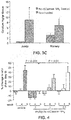
- Serum creatinine provides a means for assessing the progression of kidney failure, and whether or not a pharmaceutical agent is able slow its progression. Higher levels of creatinine indicate a falling glomerular filtration rate and a resultant decreased capability of the kidneys to excrete waste products. Serum creatinine levels were monitored in 5/6 Nx rats who had been treated with 0.3 mg/kg, 1 mg/kg, 3 mg/kg and a vehicle control over a six week period of 3 times weekly dosing (Example 1C).
- a clinical trial was designed to study the effects of Ac-c(C)arrrar-NH 2 (SEQ ID NO:3) in subjects receiving hemodialysis three-times weekly.
- the trial was a double-blind, randomize placebo-controlled, multicenter study.
- the results, described in Example 3 show that a calcimimetic, as described herein, can decrease PTH secretion and synthesis, simultaneously lowering serum PTH, phosphorous and calcium, thereby improving all three major biochemical abnormalities of CKD-MBD.
- a study of the pharmacokinetic profile of Ac-c(C)arrrar-NH 2 shows the calcimimetic to have a relatively low clearance rate of approximately 2 L/h, and the total plasma exposure to the peptide was proportional to the administered dose (Example 3A). These data show a prolonged effect of the calcimimetic, supporting dosing of the hemodialysis patients at a frequency of 2-3 times per week, or possibly 2-4 times per week.
- the calcimimetic is Ac-c(C)arrrar-NH 2 (SEQ ID NO:3).
- the efficacy of the calcimimetic to reduce serum iPTH and calcium levels was also observed in this trial.
- the subjects were administered a single IV bolus of Ac-c(C)arrrar-NH 2 (SEQ ID NO:3)2-4 hours after completion of hemodialysis and blood from the subjects was analyzed for changes in serum iPTH and corrected calcium levels (Example 2B).
- the doses administered were 5 mg, 10 mg, 20 mg, 40 mg or 60 mg. As shown in FIG. 5 , there was a dose-dependent decrease in iPTH which occurred within 30 minutes of dosing.
- a calcimimetic as described herein to a hemodialysis patient, as the iPTH suppression effected by the peptide was sustained through the interdialytic period at doses greater than or equal to about 20 mg, or at doses ranging from about 20 mg to about 100 mg.
- Such doses may provide a decrease in serum iPTH within about 5 min - 45 min after dosing, or about 10 min - 30 min after dosing, or with about an hour after dosing, for example, with an IV bolus, or a peritoneal injection.
- the administered calcimimetic was also effective in reducing serum corrected calcium levels as described in Example 2B.
- the doses of Ac-c(C)arrrar-NH 2 (SEQ ID NO:3), ranging from about 5 mg to about 60 mg resulted in a reduction in serum corrected calcium of about 10% to 14%.
- a calcimimetic which modulates the CaSR activity is effective in treating subjects suffering from excessive levels of PTH or calcium in the blood or in reversing the effects of a loss of calcium homeostasis in such patients, for example, patients diagnosed with hypercalcemia.
- the calcimimetics as described herein have a disease modifying effect such that the therapeutic effects of the calcimimetic lasts for several weeks after drug treatment is stopped.
- a therapeutically effective amount of the calcimimetic results in a 25% to 75% reduction, or a 40% to 50% reduction in serum PTH in a subject undergoing hemodialysis as compared to serum PTH prior to a first dose of the calcimimetic, and wherein the reduction is measured 1 to 7 days, 3 to 8 days or 5 to 10 days after administration of the last dose of the calcimimetic.
- a subject suffering from kidney damage, vascular calcification, parathyroid hyperplasia, hypercalcemia and/or hyperparathyroidism may be treated using the described calcimimetics.
- Untreated SHPT patients with moderately severe hyperparathyroidism often have baseline circulating intact PTH levels >300 pg/ml, and levels that can exceed 600 pg/mL.
- the decrease in PTH levels is measured as a decrease in intact PTH below pretreatment baseline levels.
- the desired decrease in PTH is to bring the plasma PTH levels into generally recognized guidelines established by the National Kidney Foundation or other experts in the treatment of kidney disorders and renal insufficiency.
- means for treating hyperparathyroidism, hypercalcemia and/or bone disease comprising administering a therapeutically effective amount of a described compound.
- the subject can be treated with a described compound in combination with one or more other therapeutically effective agents.
- the described compound may be administered in an amount effective to reduce PTH or PTH effect.
- the reduction in plasma PTH is at least 1%, 2%, 3%, 4%, 5%, 6%, 7%, 8%, 9%, 10%, 11 %, 12%, 13%, 14%, 15%, 16%, 17%, 18%, 19%, 20%, 25% or 30% below pretreatment baseline levels for at least 10 hours post administration of the described compound.
- the reduction in plasma PTH is at least 20% at 10 hours post administration.
- the reduction in plasma PTH is 15 to 40%, preferably 20 to 50%, more preferably 30 to 70% below pretreatment baseline levels for at least 48 hours post administration of the described compound.
- the described compound is administered in an amount effective to decrease serum calcium or calcium effect.
- the reduction in serum calcium may be at least 1 %, 2%, 3%, 4%, 5%, 6%, 7%, 8%, 9%, 10%, 11%, 12%, 13%, 14%, 15%, 16%, 17%, 18%, 19%, 20% or 25% below pretreatment levels for at least 10 hours post administration of the compound.
- the reduction in serum calcium may be at least 5% at 10 hours post administration.
- the reduction in serum calcium may be 5 to 10%, preferably 5 to 20% below pretreatment levels for at least 48 hours post administration of the described compound.
- the described compounds are beneficial for the treatment of various forms of bone disease and/or hypercalcemia in addition to hyperparathyroidism.
- the described compounds may have advantages compared to current therapeutic agents, because they may be administered parenterally and may not be associated with gastrointestinal adverse effects, are not metabolized by cytochrome P450 and may result in more effective reductions in plasma PTH and calcium.
- the described methods may be used with the compound alone or in combination with one or more other therapeutically effective agents.
- Such other therapeutically effective agents include, but are not limited to, treatment with antiresorptive bisphosphonate agents, such as alendronate and risedronate; integrin blockers, such as ⁇ v ⁇ 3 antagonists; conjugated estrogens used in hormone replacement therapy, such as Prempro TM , Premarin TM and Endometrion TM ; selective estrogen receptor modulators (SERMs), such as raloxifene, droloxifene, CP-336,156 (Pfizer) and lasofoxifene; cathespin K inhibitors; vitamin D therapy; vitamin D analogs, such as Zemplar TM (paricalcitol); Calcijex® (calcitriol), Hectorol® (doxercalciferol), One-Alpha® (alfacalcidol) and the analogs in development from Cytochroma known as CTA-018, CTAP201
- a described compound may be administered at a dose sufficient to decrease both PTH and serum calcium levels.A described compound is administered at a dose sufficient to decrease PTH without significantly affecting serum calcium levels. A described compound is administered at a dose sufficient to increase PTH without significantly affecting serum calcium levels.
- the methods described herein comprise administration of a calcimimetic to a subject.
- a calcimimetic to a subject.
- Such agonists are described in U.S. Patent Nos. 6,011,068 and 6,031,003 and U.S. Patent Publication Nos. 2011/0028394 and 2009/0023652 .
- the calcimimetic is cinacalcet hydrochloride.
- a calcimimetic which comprises a peptide comprising the formula: X 1 - X 2 - X 3 - X 4 - X 5 - X 6 - X 7 wherein X 1 is a subunit comprising a thiol-containing group; X 5 is a cationic subunit; X 6 is a non-cationic subunit; X 7 is a cationic a subunit; and at least one, preferably two, of X 2 , X 3 and X 4 is/are independently a cationic subunit.
- the calcimimetic is a compound comprising the sequence carrrar (SEQ ID NO:2).
- the calcimimetic is a conjugate comprised of the peptide carrrar (SEQ ID NO:2), where the peptide is conjugated at its N-terminal residue to a Cys residue.
- the thiol-containing conjugate group has both an N-terminal cap and a C-terminal cap.
- the thiol-containing conjugating group is itself a peptide comprising the amino acid sequence of SEQ ID NO:161.
- the thiol-containing conjugating group and the peptide are the same (i.e., the conjugate is a dimer).
- compounds are in the form of a conjugate, where the thiol-containing subunit in position X 1 is linked through a disulfide linkage to an L-Cys residue.
- These compounds have, for example, the following structure:
- the compound that is linked to the thiol-containing moiety in the X 1 subunit is identified parenthetically, where in these exemplary conjugates the compound L-Cys is indicated (C) is linked to the thiol-containing moiety in the X 1 subunit: Ac-c(C)arrrar-NH 2 (SEQ ID NO:3) and Ac-c(Ac-C)arrrar-NH 2 (SEQ ID NO:141).
- the described agonists When the described agonists are administered as pharmaceuticals, to humans and animals, they can be given alone or as a pharmaceutical composition containing, for example, 0.1 to 99% (more preferably, 10 to 30%) of active ingredient in combination with a pharmaceutically acceptable carrier.
- the pharmaceutical composition may contain 0.2-25%, preferably 0.5-5% or 0.5-2%, of active ingredient.
- These compounds may be administered to humans and other animals for therapy by any suitable route of administration, including, e.g., oral, subcutaneous injection, subcutaneous depot, intravenous injection, intravenous or subcutaneous infusion
- agonists may be administered to humans and other animals for therapy by any suitable route of administration.
- Peptide calcimimetics have been described previously ( U.S. Patent Publication Nos. 2011/0028394 and 2009/0023652 .
- One exemplary peptide calcimimetic is referred to herein as Ac-c(C)arrrar-NH 2 (SEQ ID NO:3) and has the structure:
- Table 1 SEQ ID NO. Compound Structure SEQ ID NO:2 carrrar SEQ ID NO:3 Ac-c(C)arrrar-NH 2 SEQ ID NO:4 Ac-crrrr-NH 2 SEQ ID NO:5 Ac-crrrr-NH 2 SEQ ID NO:6 Ac-crrrrr-NH 2 SEQ ID NO:7 Ac-crrrrr-NH 2 SEQ ID NO:8 Ac-carrrr-NH 2 SEQ ID NO:9 Ac-crarrrr-NH 2 SEQ ID NO:10 Ac-crrarrr-NH 2 SEQ ID NO:11 Ac-crrrarr-NH 2 SEQ ID NO:12 Ac-crrrrar-NH 2 SEQ ID NO:13 Ac-crrrrra-NH 2 SEQ ID NO:14 Ac-crrarra-NH 2 SEQ ID NO:15 Ac-cararrr-NH 2 SEQ ID NO:16
- a pharmaceutical composition comprising a described compound and at least one pharmaceutically acceptable excipient or carrier.
- Methods of preparing such pharmaceutical compositions typically comprise the step of bringing into association a described compound with a carrier and, optionally, one or more accessory ingredients.
- the described compounds and/or pharmaceutical compositions comprising same may be formulated into pharmaceutically-acceptable dosage forms by conventional methods known to those of skill in the art. Typically, formulations are prepared by uniformly and intimately bringing into association a described compound with liquid carriers, or finely divided solid carriers, or both, and then, if necessary, shaping the product.
- compositions herein described aresuitable for parenteral administration comprise one or more described compounds in combination with one or more pharmaceutically-acceptable sterile isotonic aqueous or nonaqueous solutions, dispersions, suspensions or emulsions, or sterile powders which may be reconstituted into sterile injectable solutions or dispersions just prior to use, which may contain sugars, alcohols, amino acids, antioxidants, buffers, bacteriostats, solutes which render the formulation isotonic with the blood of the intended recipient or suspending or thickening agents.
- aqueous and nonaqueous carriers examples include water, ethanol, polyols (such as glycerol, propylene glycol, polyethylene glycol, and the like), and suitable mixtures thereof, vegetable oils, such as olive oil, and injectable organic esters, such as ethyl oleate.
- polyols such as glycerol, propylene glycol, polyethylene glycol, and the like
- vegetable oils such as olive oil
- injectable organic esters such as ethyl oleate.
- Proper fluidity can be maintained, for example, by the use of coating materials, such as lecithin, by the maintenance of the required particle size in the case of dispersions, and by the use of surfactants.
- compositions may also contain adjuvants such as preservatives, wetting agents, emulsifying agents and dispersing agents. Prevention of the action of microorganisms upon the described compounds may be ensured by the inclusion of various antibacterial and antifungal agents, for example, paraben, chlorobutanol, phenol sorbic acid, and the like. It may also be desirable to include agents to control tonicity, such as sugars, sodium chloride, and the like into the compositions. In addition, prolonged absorption of the injectable pharmaceutical form may be brought about by the inclusion of agents which delay absorption such as aluminum monostearate and gelatin.
- adjuvants such as preservatives, wetting agents, emulsifying agents and dispersing agents.
- the absorption of the drug in order to prolong the effect of a drug, it is desirable to slow the absorption of the drug from subcutaneous or intramuscular injection. This may be accomplished by the use of a liquid suspension of crystalline or amorphous material having poor water solubility. The rate of absorption of the drug then depends upon its rate of dissolution which, in turn, may depend upon crystal size and crystalline form. Alternatively, delayed absorption of a parenterally-administered drug form is accomplished by dissolving or suspending the drug in an oil vehicle.
- a described compound may be delivered to a human in a form of solution that is made by reconstituting a solid form of the drug with liquid.
- This solution may be further diluted with infusion fluid such as water for injection, 0.9% sodium chloride injection, 5% dextrose injection and lactated ringer's injection. It is preferred that the reconstituted and diluted solutions be used within 4-6 hours for delivery of maximum potency.
- a described compound may be delivered to a human in a form of tablet or capsule.
- Injectable depot forms are made by forming microencapsulated matrices of the described compounds in biodegradable polymers such as polylactide-polyglycolide. Depending on the ratio of drug to polymer, and the nature of the particular polymer employed, the rate of drug release can be controlled. Examples of other biodegradable polymers include poly(orthoesters) and poly(anhydrides). Depot injectable formulations are also prepared by entrapping the drug in liposomes or microemulsions which are compatible with body tissue.
- the described compounds When the described compounds are administered as pharmaceuticals, to humans and animals, they can be given alone or as a pharmaceutical composition containing, for example, 0.1 to 99% (more preferably, 10 to 30%) of active ingredient in combination with a pharmaceutically acceptable carrier. In other embodiments, the pharmaceutical composition may contain 0.2-25%, preferably 0.5-5% or 0.5-2%, of active ingredient.
- These compounds may be administered to humans and other animals for therapy by any suitable route of administration, including, e.g., subcutaneous injection, subcutaneous depot, intravenous injection, intravenous or subcutaneous infusion. These compounds may be administered rapidly (within ⁇ 1 minute) as a bolus or more slowly over an extended period of time (over several minutes, hours or days). These compounds may be delivered daily or over multiple days, continuously or intermittently. In one embodiment, the compounds may be administered transdermally (e.g., using a patch, microneedles, micropores, ointment, microjet or nanojet).
- the described compounds which may be used in a suitable hydrated form, and/or the pharmaceutical compositions, are formulated into pharmaceutically-acceptable dosage forms by conventional methods known to those of skill in the art.
- Actual dosage levels of the active ingredients in the pharmaceutical compositions may be varied so as to obtain an amount of the active ingredient which is effective to achieve the desired therapeutic response for a particular patient, composition, and mode of administration, without being toxic to the patient.
- the selected dosage level will depend upon a variety of factors including the activity of the particular described compound employed, or the ester, salt or amide thereof, the route of administration, the time of administration, the rate of excretion or metabolism of the particular compound being employed, the rate and extent of absorption, the duration of the treatment, other drugs, compounds and/or materials used in combination with the particular compound employed, the age, sex, weight, condition, general health and prior medical history of the patient being treated, and like factors well known in the medical arts.
- a physician or veterinarian having ordinary skill in the art can readily determine and prescribe the effective amount of the pharmaceutical composition required.
- the physician or veterinarian could start doses of the described compounds employed in the pharmaceutical composition at levels lower than that required in order to achieve the desired therapeutic effect and gradually increase the dosage until the desired effect is achieved.
- the described compounds may be administered as such or in admixtures with pharmaceutically acceptable carriers and can also be administered in conjunction with antimicrobial agents such as penicillins, cephalosporins, aminoglycosides and glycopeptides.
- Conjunctive therapy thus includes sequential, simultaneous and separate administration of the active compound in a way that the therapeutic effects of the first administered one is not entirely disappeared when the subsequent is administered.
- calcimimetic agents As noted above, PTH secretion is regulated by the CaSR which is expressed on the cell surface of parathyroid cells. Thus, in order to activate the CaSR, the agent or compound must be delivered to the parathyroid cell. Transdermal delivery of calcimimetic agents must achieve delivery across the stratum corneum and provide systemic exposure to reach the parathyroid cell. To date, the art has not demonstrated whether a calcimimetic compound can be delivered transdermally in an amount sufficient for therapeutic benefit and in particular in an amount sufficient for decreasing PTH and/or the treatment, attenuation, lessening and/or relief hypercalcemia.
- Vitamin D analogs act by facilitating intestinal absorption of dietary calcium, and reduce PTH levels by inhibiting PTH synthesis and secretion.
- the calcimimetic agents may be administered across the stratum corneum, and/or other layers of the epidermis, for local or systemic delivery, for decreasing parathyroid hormone (PTH) and/or treating hypercalcemia.
- the calcimimetic agent is delivered via microporation. Any one of a number of techniques for microporation is contemplated, and several are briefly described.
- the microporation technique is ablation of the stratum corneum in a specific region of the skin using a pulsed laser light of wavelength, pulse length, pulse energy, pulse number, and pulse repetition rate sufficient to ablate the stratum corneum without significantly damaging the underlying epidermis.
- the calcimimetic agent is then applied to the region of ablation.
- Another laser ablation microporation technique referred to as laser-induced stress waves (LISW)
- LISW involves broadband, unipolar and compressible waves generated by high-power pulsed lasers.
- the LISWs interact with tissues to disrupt the lipids in the stratum corneum, creating intercellular channels transiently within the stratum corneum. These channel, or micropores, in the stratum corneum permit entry of the calcimimetic agent.
- Microneedle arrays comprised of hollow or solid microneedles are contemplated, where the calcimimetic agent can be coated on the external surface of the needles or dispensed from the interior of hollow needles. Examples of microneedle arrays are described, for example, in Nanda et al., Current Drug Delivery, 3:233 (2006 ) and Meidan et al. American J. Therapeutics, 11:312 (2004 ). First generation microneedle arrays were comprised of solid, silicon microneedles that were externally coated with a therapeutic agent. When the microarray of needles was pressed against the skin and removed after about 10 seconds, the permeation of the agent on the needles into the body was readily achieved.
- a pharmaceutical composition comprising a calcimimetic agent and ZEMPLAR TM (paricalcitol).
- Paricalcitol is a synthetic analog of calcitriol, the metabolically active form of vitamin D.
- the recommended initial dose of Zemplar is based on baseline intact parathyroid hormone (iPTH) levels. If the baseline iPTH level is less than or equal to 500 pg/mL, the daily dose is 1 ⁇ g and the "three times a week" dose (to be administered not more than every other day) is 2 ⁇ g.
- HECTOROL The maximum recommended dose of HECTOROL is 20 ⁇ g administered three times a week at dialysis for a total of 60 ⁇ g per week.
- Doxercalciferol is described in U.S. Patent No. 5,602,116 and U.S. Patent No. 5,861,386 and U.S. Patent No. 5,869,473 and U.S. Patent No. 6,903,083 .
- compositions for coating implantable medical devices may also be incorporated into compositions for coating implantable medical devices, bioerodible polymers, implantable pump, and suppositories.
- a composition for coating an implantable device comprising a described compound as described generally above is contemplated, and a carrier suitable for coating the implantable device.
- an implantable device coated with a composition comprising a compound as described generally above, and a carrier suitable for coating said implantable device.
- Suitable coatings and the general preparation of coated implantable devices are described in U.S. Pat. Nos. 6,099,562 ; 5,886,026 ; and 5,304,121 .
- the coatings are typically biocompatible polymeric materials such as a hydrogel polymer, polymethyldisiloxane, polycaprolactone, polyethylene glycol, polylactic acid, ethylene vinyl acetate, and mixtures thereof.
- the coatings may optionally be further covered by a suitable topcoat of fluorosilicone, polysaccarides, polyethylene glycol, phospholipids or combinations thereof to impart controlled release characteristics in the composition.
- Potential bone resorption markers include, but are not limited, hydroxyproline, hydroxylysine, glycosyl-galactosyl hydroxylysine, galactosyl hydroxylysine, pyridinoline, deoxypyridinoline, N-terminal crosslinking telopeptide of type I collagen, C-terminal crosslinking telopeptide of type I collagen, C-terminal crosslinking telopeptide of type I collagen generated by MMPs, bone sialoprotein, acid phosphatase and tartrate-resistant acid phosphatase.
- the described compound may be conjugated to polyethylene glycol (PEG).
- PEG polyethylene glycol
- the selected PEG may be of any convenient molecular weight, and may be linear or branched, and may be optionally conjugated through a linker.
- the average molecular weight of PEG will preferably range from about 2 kiloDalton (kDa) to about 100 kDa, more preferably from about 5 kDa to about 40 kDa.
- the PEG moiety used can be 2, 3, 4, 5, 6, 7, 8, 9, 10, 11, 12, 13, 14, 15, 16, 17, 18, 19, or 20kDa.
- PEGylated peptides are known in the art to increase serum half-life of conjugated peptide.
- a variety of methods are known in the art for the formation of PEGylated peptides.
- the PEG moiety can be linked to the amino terminus, the carboxy terminus or through a side chain of the claimed peptide, optionally through the presence of a linking group.
- the PEG moiety may be linked to the sulfur of a thiol-containing amino acid, such as cysteine, or may be coupled to the sidechain of an amine-containing amino acid, such as lysine.
- One or more individual subunits of the described compounds may also be modified with various derivatizing agents known to react with specific side chains or terminal residues.
- lysinyl residues and amino terminal residues may be reacted with succinic anhydride or other similar carboxylic acid anhydrides which reverses the charge on the lysinyl or amino residue.
- suitable reagents include, e.g., imidoesters such as methyl picolinimidate; pyridoxal; pyridoxal phosphate; chloroborohydride; trinitrobenzenesulfonic acid; O-methylisourea; 2,4,-pentanedione; and transaminase-catalyzed reaction with glyoxalate.
- Arginyl residues may be modified by reaction with conventional agents such as phenylglyoxal, 2,3-butanedione, 1,2- cyclohexanedione, and ninhydrin.
- the kit may further comprise a needle or syringe, preferably packaged in sterile form, for injecting the composition.
- the kit further comprises an instruction means for administering the composition to a subject.
- the instruction means can be a written insert, an audiotape, an audiovisual tape, or any other means of instructing the administration of the composition to a subject.
- the kit may comprise (i) a first container containing a described compound having activity as a CaSR modulator; (ii) a second container containing an anticalcemic agent; and (iii) instruction means for use.
- herein described are articles of manufacture that comprise the contents of the kits described above.
- herein described is provides an article of manufacture comprising an effective amount of a described peptide, alone or in combination with other agents, and instruction means indicating use for treating diseases described herein.
- the therapeutic efficacy of Ac-c(C)arrrar-NH 2 was assessed using the 5/6 nephrectomy (Nx) rat model of renal insufficiency.
- the 5/6 Nx male rats were obtained from Charles River Laboratories (Wilmington, MA). These rats have undergone surgical removal of one kidney and 2/3 of the other kidney and were fed a high-phosphate diet. All experimental procedures with animals were performed according to IACUC guidelines. Statistical analysis was performed using one-way ANOVA with Bonferroni post test. All p-values are nominal.
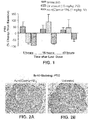
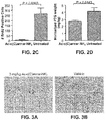
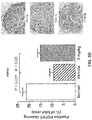
- Parathyroid glands from animals treated with Ac-c(C)arrrar-NH 2 had fewer BrdU-positive cells relative to untreated controls ( FIGS. 2A-C ), indicating reduced parathyroid gland proliferation in the treated animals.
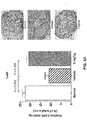
- FIG. 5A Higher levels of CaSR ( FIG. 5A ), FGFR1 ( FIG. 5B ) and Vitamin D receptor ( FIG. 5C ) were seen in the parathyroid glands of animals treated with Ac-c(C)arrrar-NH 2 (SEQ ID NO:3) than in the parathyroid glands of normal controls.
- the therapeutic efficacy Ac-c(C)rrarar-NH 2 was assessed using an adenine-induced model of chronic renal failure in rats.
- the rats were obtained from Charles River Laboratories (Wilmington, MA). The rats were fed a low protein (2.5%), high phosphorus (0.92%) diet containing 0.75% adenine (Teklad Custom Diet). Animals were randomly assigned to receive daily subcutaneous doses of vehicle (10 mM succinic acid, 0.85% NaCl, 0.9% benzyl alcohol, pH 4.5) or Ac-c(C)rrarar-NH 2 (SEQ ID NO:28) at 0.3 or 1 mg/kg (SC) for 4 weeks.
- vehicle 10 mM succinic acid, 0.85% NaCl, 0.9% benzyl alcohol, pH 4.5
- Ac-c(C)rrarar-NH 2 SEQ ID NO:28
- a control group was fed the identical high phosphorus diet and tissues without adenine. Treatment was initiated at the start of diet. All experimental procedures with animals were performed according to IACUC guidelines. Statistical analysis was performed using one-way ANOVA with Bonferroni post test. All p-values are nominal.
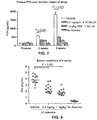
- FIG. 7 Plasma PTH was measured using the Immunotopics BioActive Intact ELISA (Immutopics, San Clemente, CA). Prior to dosing with Ac-c(C)rrarar-NH 2 (SEQ ID NO:28), all treatment groups had similar plasma PTH levels. The no-adenine-control animals maintained consistent plasma PTH levels over the 4 week study. PTH levels were significantly elevated over the course of the study for vehicle-treated uremic animals. Uremic animals treated with Ac-c(C)rrarar-NH 2 (SEQ ID NO:28) at a dose of 0.3 or 1 mg/kg for 2 and 4 weeks had significantly lower plasma PTH than vehicle-treated animals.
- FIG. 8 Serum creatinine was measured using QuantiChrom TM kit (BioAssay Systems, Hayward, CA). Serum creatinine levels from vehicle-treated uremic animals were approximately 8-10 fold higher compared to the control group of non-uremic animals at the end of the 4 weeks. Uremic animals treated with Ac-c(C)rrarar-NH 2 (SEQ ID NO:28) at doses of 0.3 and 1 mg/kg had significantly lower serum creatinine levels compared to vehicle-treated uremic rats.
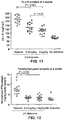
- FIG. 11 The effects of Ac-c(C)rrarar-NH 2 (SEQ ID NO:28) treatment on serum calcium-phosphorus product levels are shown in FIG. 11 .
- Phosphorus and calcium were determined using a Cobas c-501 analyzer.
- Uremic animals treated with vehicle for 4 weeks had an approximate 2.5-fold increase in calcium-phosphorus product compared to non-uremic animals.
- Uremic animals treated with Ac-c(C)rrarar-NH 2 (SEQ ID NO:28) at doses of 0.3 mg/kg or 1 mg/kg for 4 weeks showed an approximate 20% and 40% reduction in serum calcium-phosphorus product, respectively.
- a double-blind, randomized, placebo-controlled, multicenter study in subjects receiving thrice-weekly hemodialysis (HD) was designed and carried out.
- the major inclusion criteria included hemodialysis for at least 3 months prior to the start of the study, a serum iPTH level greater than 300 pg/mL, a serum cCa (corrected calcium) level greater than or equal to 9.0 mg/dL and receiving of stable doses of active vitamin D or analogs, phosphate binders, and calcium supplements.
- Cohorts 1, 2 and 3 were conducted with a two-period crossover design.
- Each cohort enrolled 4 subjects randomized 1:1 to Ac-c(C)arrrar-NH 2 (SEQ ID NO:3) followed by placebo or placebo followed by Ac-c(C)arrrar-NH 2 (SEQ ID NO:3).
- the dose levels of Ac-c(C)arrrar-NH 2 (SEQ ID NO:3) for Cohorts 1-3 were 5, 10 and 20 mg.
- Cohort 5 enrolled 8 subjects were randomized 1:1 to 60 mg Ac-c(C)arrrar-NH 2 (SEQ ID NO:3) or placebo in a parallel group.
- PK analysis was performed on samples obtained from the treated subjects to determine bioavailability of the administered Ac-c(C)arrrar-NH 2 (SEQ ID NO:3).
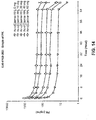
- the results, presented below in Table 2 and in FIG. 14 show that systemic exposure increased in a dose-related manner over the dose range evaluation.
- the geometric mean terminal elimination half-life (81.7 h to 175 h) appeared to be reasonably comparable across the dose range evaluation. Clearance (CL) and volume of distribution as steady state (Vss) values appear to be dose-independent over the range evaluation.
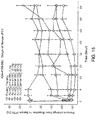
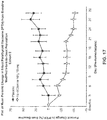
- the data were also analyzed with respect to the percent change in serum PTH levels from baseline. As shown in FIG. 18 , on the last day of Ac-c(C)arrrar-NH 2 (SEQ ID NO:3) dosing, the baseline level of serum iPTH is about 50% less than the level on the first day of dosing.
- Serum samples from the subjects were further analyzed during a 4-week follow-up period following the final dosing with Ac-c(C)arrrar-NH 2 (SEQ ID NO:3).
- the data, presented in FIG. 19 show that levels of serum iPTH in subjects during the 4-week treatment period in which 10 mg/kg Ac-c(C)arrrar-NH 2 (SEQ ID NO:3) was administered and during a 4-week follow-up period.
Landscapes
- Health & Medical Sciences (AREA)
- Life Sciences & Earth Sciences (AREA)
- Veterinary Medicine (AREA)
- Animal Behavior & Ethology (AREA)
- Engineering & Computer Science (AREA)
- Bioinformatics & Cheminformatics (AREA)
- Chemical & Material Sciences (AREA)
- Medicinal Chemistry (AREA)
- Pharmacology & Pharmacy (AREA)
- Public Health (AREA)
- General Health & Medical Sciences (AREA)
- Organic Chemistry (AREA)
- General Chemical & Material Sciences (AREA)
- Chemical Kinetics & Catalysis (AREA)
- Nuclear Medicine, Radiotherapy & Molecular Imaging (AREA)
- Physical Education & Sports Medicine (AREA)
- Epidemiology (AREA)
- Proteomics, Peptides & Aminoacids (AREA)
- Gastroenterology & Hepatology (AREA)
- Immunology (AREA)
- Rheumatology (AREA)
- Endocrinology (AREA)
- Diabetes (AREA)
- Hematology (AREA)
- Obesity (AREA)
- Orthopedic Medicine & Surgery (AREA)
- Urology & Nephrology (AREA)
- Medicines That Contain Protein Lipid Enzymes And Other Medicines (AREA)
- Peptides Or Proteins (AREA)
- Pharmaceuticals Containing Other Organic And Inorganic Compounds (AREA)
- Acyclic And Carbocyclic Compounds In Medicinal Compositions (AREA)
Applications Claiming Priority (2)
| Application Number | Priority Date | Filing Date | Title |
|---|---|---|---|
| US201161558389P | 2011-11-10 | 2011-11-10 | |
| PCT/US2012/064717 WO2013071262A1 (en) | 2011-11-10 | 2012-11-12 | Calcimimetics and methods for their use |
Publications (3)
| Publication Number | Publication Date |
|---|---|
| EP2776129A1 EP2776129A1 (en) | 2014-09-17 |
| EP2776129B1 EP2776129B1 (en) | 2017-03-29 |
| EP2776129B2 true EP2776129B2 (en) | 2020-06-17 |
Family
ID=47258113
Family Applications (1)
| Application Number | Title | Priority Date | Filing Date |
|---|---|---|---|
| EP12791926.4A Active EP2776129B2 (en) | 2011-11-10 | 2012-11-12 | Compositions for use in the treatment of chronic kidney disease-mineral bone disorder characterized by soft tissue calcification |
Country Status (9)
| Country | Link |
|---|---|
| US (3) | US20140315809A1 (enExample) |
| EP (1) | EP2776129B2 (enExample) |
| JP (2) | JP6204369B2 (enExample) |
| CN (2) | CN104168955A (enExample) |
| AU (1) | AU2012335009B2 (enExample) |
| CA (1) | CA2854911C (enExample) |
| HK (1) | HK1202086A1 (enExample) |
| MX (1) | MX355063B (enExample) |
| WO (1) | WO2013071262A1 (enExample) |
Families Citing this family (29)
| Publication number | Priority date | Publication date | Assignee | Title |
|---|---|---|---|---|
| PL1759001T3 (pl) | 2004-04-21 | 2011-09-30 | Alexion Pharma Inc | Koniugaty dostarczane do kości i sposób ich zastosowania do nakierowywania białek do kości |
| EP2459208B1 (en) | 2009-07-29 | 2016-09-28 | Kai Pharmaceuticals, Inc. | Therapeutic agents for reducing parathyroid hormone levels |
| PE20160549A1 (es) * | 2013-06-28 | 2016-06-15 | Amgen Inc | Formulacion liquida estable de etelcalcetida (amg 416) |
| WO2016007873A1 (en) | 2014-07-11 | 2016-01-14 | The Regents Of The University Of Michigan | Compositions and methods for treating craniosynostosis |
| TWI621434B (zh) * | 2014-10-24 | 2018-04-21 | 朗齊生物醫學股份有限公司 | 千憂解藥物應用於癌症治療 |
| JP6787894B2 (ja) | 2014-12-05 | 2020-11-18 | アレクシオン ファーマシューティカルズ, インコーポレイテッド | 組換えアルカリホスファターゼを用いた発作の処置 |
| US9539264B2 (en) | 2014-12-30 | 2017-01-10 | Wisconsin Alumni Research Foundation | Use of 2-methylene-19-nor-(20S)-1-alpha,25-dihydroxyvitamin D3 to treat secondary hyperparathyroidism in patients previously treated with calcimimetics |
| CA2973883A1 (en) * | 2015-01-28 | 2016-08-04 | Alexion Pharmaceuticals, Inc. | Methods of treating a subject with an alkaline phosphatase deficiency |
| JP6993961B2 (ja) | 2015-08-17 | 2022-01-14 | アレクシオン ファーマシューティカルズ, インコーポレイテッド | アルカリホスファターゼの製造 |
| EP3355904A4 (en) | 2015-09-28 | 2019-06-12 | Alexion Pharmaceuticals, Inc. | IDENTIFICATION OF EFFECTIVE DOSE SHEETS FOR TISSUE-SPECIFIC ALKALINE PHOSPHATASE ENZYMERSAT THERAPY OF HYPOPHOSPHATASIA |
| EP3368062A4 (en) | 2015-10-30 | 2019-07-03 | Alexion Pharmaceuticals, Inc. | METHODS OF TREATING CRANIOSYNOSTOSIS IN A PATIENT |
| CN106928320B (zh) * | 2015-12-31 | 2021-01-15 | 深圳翰宇药业股份有限公司 | 一种合成Etelcalcetide的方法 |
| US11065306B2 (en) | 2016-03-08 | 2021-07-20 | Alexion Pharmaceuticals, Inc. | Methods for treating hypophosphatasia in children |
| KR20180125979A (ko) | 2016-04-01 | 2018-11-26 | 알렉시온 파마슈티칼스, 인코포레이티드 | 알칼리성 포스파타아제로 근육 약화의 치료 |
| US10898549B2 (en) | 2016-04-01 | 2021-01-26 | Alexion Pharmaceuticals, Inc. | Methods for treating hypophosphatasia in adolescents and adults |
| WO2017214130A1 (en) | 2016-06-06 | 2017-12-14 | Alexion Pharmaceuticals, Inc. | Metal impact on manufacturing of alkaline phosphatases |
| JP7018933B2 (ja) | 2016-08-18 | 2022-02-14 | アレクシオン ファーマシューティカルズ, インコーポレイテッド | 気管気管支軟化症の治療方法 |
| KR20190129058A (ko) | 2017-03-31 | 2019-11-19 | 알렉시온 파마슈티칼스, 인코포레이티드 | 성인 및 청소년에서 저포스파타제증 (hpp)을 치료하는 방법 |
| WO2019190752A1 (en) | 2018-03-30 | 2019-10-03 | Alexion Pharmaceuticals, Inc. | Manufacturing of glycoproteins |
| WO2020033867A2 (en) | 2018-08-10 | 2020-02-13 | Alexion Pharmaceuticals, Inc. | Methods of treating neurofibromatosis type 1 and related conditions with alkaline phosphatase |
| CN113841052B (zh) * | 2018-10-18 | 2025-02-18 | 费森尤斯医疗保健控股公司 | 用于建模甲状旁腺功能和拟钙剂药物活性的技术 |
| WO2021115272A1 (zh) * | 2019-12-09 | 2021-06-17 | 北京拓界生物医药科技有限公司 | 钙敏感受体激动剂化合物及其应用 |
| CA3161266A1 (en) | 2019-12-09 | 2021-06-17 | Alexion Pharmaceuticals, Inc. | Alkaline phosphatase polypeptides and methods of use thereof |
| US12611447B2 (en) | 2020-09-04 | 2026-04-28 | Alexion Pharmaceuticals, Inc. | Methods for treating bone mineralization disorders |
| KR20230066044A (ko) * | 2020-09-10 | 2023-05-12 | 샨시 마이콧 테크놀로지 컴퍼니 리미티드 | 이중특이적 융합 폴리펩타이드 화합물 |
| AU2022218782B2 (en) | 2021-02-12 | 2026-06-25 | Alexion Pharmaceuticals, Inc. | Alkaline phosphatase polypeptides and methods of use thereof |
| CN117295510A (zh) * | 2021-06-08 | 2023-12-26 | 北京拓界生物医药科技有限公司 | 一种钙敏感受体激动剂的组合物及其应用 |
| TW202313655A (zh) * | 2021-06-08 | 2023-04-01 | 大陸商北京拓界生物醫藥科技有限公司 | 鈣敏感受體激動劑化合物的鹽酸鹽及醫藥組成物和其應用 |
| CN121059580A (zh) * | 2025-10-15 | 2025-12-05 | 西南大学 | 拟钙剂在制备用于治疗常染色体显性多囊肾病的药物中的应用 |
Family Cites Families (19)
| Publication number | Priority date | Publication date | Assignee | Title |
|---|---|---|---|---|
| US5602116A (en) | 1988-08-02 | 1997-02-11 | Bone Care International, Inc. | Method for treating and preventing secondary hyperparathyroidism |
| US5869473A (en) | 1988-08-02 | 1999-02-09 | Bone Care International, Inc. | Method for treating and preventing hyperparathyroidism |
| US5246925A (en) | 1989-03-09 | 1993-09-21 | Wisconsin Alumni Research Foundation | 19-nor-vitamin D compounds for use in treating hyperparathyroidism |
| CA1333616C (en) | 1989-03-09 | 1994-12-20 | Hector F. Deluca | 19-nor-vitamin d compounds |
| US5304121A (en) | 1990-12-28 | 1994-04-19 | Boston Scientific Corporation | Drug delivery system making use of a hydrogel polymer coating |
| US6011068A (en) | 1991-08-23 | 2000-01-04 | Nps Pharmaceuticals, Inc. | Calcium receptor-active molecules |
| US6031003A (en) | 1991-08-23 | 2000-02-29 | Nps Pharmaceuticals, Inc. | Calcium receptor-active molecules |
| US5994341A (en) | 1993-07-19 | 1999-11-30 | Angiogenesis Technologies, Inc. | Anti-angiogenic Compositions and methods for the treatment of arthritis |
| US6099562A (en) | 1996-06-13 | 2000-08-08 | Schneider (Usa) Inc. | Drug coating with topcoat |
| AU3819497A (en) * | 1996-07-31 | 1998-02-20 | General Hospital Corporation, The | Novel parathyroid hormone-related peptide analogs |
| US6051567A (en) | 1999-08-02 | 2000-04-18 | Abbott Laboratories | Low oxygen content compositions of 1α, 25-dihydroxycholecalciferol |
| US6274169B1 (en) | 1999-08-02 | 2001-08-14 | Abbott Laboratories | Low oxygen content compostions of 1α, 25-dihydroxycholecalciferol |
| JP2004504295A (ja) | 2000-07-18 | 2004-02-12 | ボーン ケア インターナショナル インコーポレイテッド | 安定化1α−ヒドロキシビタミンD |
| US6998404B2 (en) * | 2001-08-08 | 2006-02-14 | Genomed, Llc | Treatment or prevention of acute renal failure |
| CA2601669A1 (en) * | 2005-03-17 | 2006-09-28 | Amgen Inc. | Methods of decreasing calcification |
| JP5645408B2 (ja) | 2006-11-16 | 2014-12-24 | カイ ファーマシューティカルズ インコーポレーティッド | 副甲状腺機能亢進症および高カルシウム血症性障害の治療のためのポリカチオン性カルシウムモジュレーターペプチド |
| CA2701638A1 (en) * | 2007-04-02 | 2008-10-09 | Concert Pharmaceuticals Inc. | Pharmaceutical calcimimetics |
| EP2459208B1 (en) | 2009-07-29 | 2016-09-28 | Kai Pharmaceuticals, Inc. | Therapeutic agents for reducing parathyroid hormone levels |
| GB0913525D0 (en) * | 2009-08-03 | 2009-09-16 | Ineos Healthcare Ltd | Method |
-
2012
- 2012-11-12 MX MX2014005662A patent/MX355063B/es active IP Right Grant
- 2012-11-12 CN CN201280066707.1A patent/CN104168955A/zh active Pending
- 2012-11-12 AU AU2012335009A patent/AU2012335009B2/en active Active
- 2012-11-12 WO PCT/US2012/064717 patent/WO2013071262A1/en not_active Ceased
- 2012-11-12 JP JP2014541386A patent/JP6204369B2/ja active Active
- 2012-11-12 US US14/357,702 patent/US20140315809A1/en not_active Abandoned
- 2012-11-12 HK HK15102648.5A patent/HK1202086A1/xx unknown
- 2012-11-12 CN CN201910103503.4A patent/CN109985228A/zh active Pending
- 2012-11-12 CA CA2854911A patent/CA2854911C/en active Active
- 2012-11-12 EP EP12791926.4A patent/EP2776129B2/en active Active
-
2016
- 2016-03-01 US US15/057,742 patent/US20160175383A1/en not_active Abandoned
-
2017
- 2017-05-23 US US15/603,279 patent/US20170252397A1/en not_active Abandoned
- 2017-06-23 JP JP2017123032A patent/JP2017160269A/ja not_active Withdrawn
Non-Patent Citations (12)
| Title |
|---|
| "FR-P01222", J AM SOC NEPHROL, vol. 22, 2011 † |
| "LB-P03147", J AM SOC NEPHROL, vol. 22, 2011 † |
| "Press release regarding a poster presentation of KAI-4169 Phase 2 clinical results at the American Soc. of Nephrology's Kidney Week 2011", Retrieved from the Internet <URL:https://www.businesswire.com/news/home/20111111005115/en/KAI-Pharmaceuticals-Announces-Late-Breaker-Poster-Presentation> † |
| "Press release regarding promising results of KAI-4169 for the treatment of CKD-MBD ", July 2011 (2011-07-01), Retrieved from the Internet <URL:https://www.businesswire.com/news/home/20110607006164/en/KAI-Pharmaceuticals-Announces-Promising-Results-KAI-4169-Program> † |
| "SAO014", NEPHROLOGY DIALYSIS TRANSPLANTATION , vol. 27, no. Supp 2, ii36-ii37, May 2012 (2012-05-01), DOI: 10.1093/ndt/gfs193 † |
| Baruch et al -Abstract † |
| KLAUS OLGAARD, EWA LEWIN AND JUSTIN SILVER: "Calcimimetics, vitamin D and ADVANCE in the management of CKD-MBD", NEPHROLOGY DIALYSIS TRANSPLANTATION., OXFORD UNIVERSITY PRESS., GB, vol. 26, no. 4, 1 April 2011 (2011-04-01), GB, pages 1117 - 1119, XP055448194, ISSN: 0931-0509, DOI: 10.1093/ndt/gfq862 † |
| M J ALADREN REGIDOR: "Cinacalcet reduces vascular and soft tissue calcification in secondary hyperparathyroidism (SHPT) in hemodialysis patients", CLINICAL NEPHROLOGY, DUSTRI VERLAG, NUENCHEN-DEISENHOFEN, DE, vol. 71, no. 2, 1 February 2009 (2009-02-01), DE, pages 207 - 213, XP055448208, ISSN: 0301-0430, DOI: 10.5414/CNP71207 † |
| P. RAGGI, ET AL: "The ADVANCE study: a randomized study to evaluate the effects of cinacalcet plus low-dose vitamin D on vascular calcification in patients on hemodialysis", NEPHROLOGY DIALYSIS TRANSPLANTATION., OXFORD UNIVERSITY PRESS., GB, vol. 26, no. 4, 1 April 2011 (2011-04-01), GB, pages 1327 - 1339, XP055448200, ISSN: 0931-0509, DOI: 10.1093/ndt/gfq725 † |
| Poster by Baruch et al. presented at the ENDO2011 in Boston on June 5, 2011 † |
| Poster P01222 submitted by the patentee in the US † |
| TAKEHISA KAWATA, NOBUO NAGANO, MASAKI OBI, SONOE MIYATA, CHIKA KOYAMA, NAMI KOBAYASHI, SACHIKO WAKITA, MICHIHITO WADA: "Cinacalcet suppresses calcification of the aorta and heart in uremic rats", KIDNEY INTERNATIONAL, NATURE PUBLISHING GROUP, NEW YORK, vol. 74, no. 10, 2 November 2008 (2008-11-02), New York, pages 1270 - 1277, XP055448187, ISSN: 1523-1755, DOI: 10.1038/ki.2008.407 † |
Also Published As
| Publication number | Publication date |
|---|---|
| EP2776129A1 (en) | 2014-09-17 |
| US20140315809A1 (en) | 2014-10-23 |
| EP2776129B1 (en) | 2017-03-29 |
| WO2013071262A1 (en) | 2013-05-16 |
| US20160175383A1 (en) | 2016-06-23 |
| MX355063B (es) | 2018-04-04 |
| CN104168955A (zh) | 2014-11-26 |
| MX2014005662A (es) | 2014-11-10 |
| JP2017160269A (ja) | 2017-09-14 |
| CA2854911A1 (en) | 2013-05-16 |
| CA2854911C (en) | 2019-09-24 |
| AU2012335009A1 (en) | 2014-05-29 |
| JP6204369B2 (ja) | 2017-09-27 |
| AU2012335009B2 (en) | 2017-08-31 |
| HK1202086A1 (en) | 2015-09-18 |
| CN109985228A (zh) | 2019-07-09 |
| JP2015502346A (ja) | 2015-01-22 |
| US20170252397A1 (en) | 2017-09-07 |
Similar Documents
| Publication | Publication Date | Title |
|---|---|---|
| EP2776129B1 (en) | Compositions for use in the treatment of chronic kidney disease-mineral bone disorder characterized by soft tissue calcification | |
| US20250163103A1 (en) | Therapeutic agents for reducing parathyroid hormone levels | |
| HK1241270B (en) | Therapeutic agents for reducing parathyroid hormone levels | |
| HK1241270A1 (en) | Therapeutic agents for reducing parathyroid hormone levels | |
| HK1167108B (en) | Therapeutic agents for reducing parathyroid hormone levels |
Legal Events
| Date | Code | Title | Description |
|---|---|---|---|
| PUAI | Public reference made under article 153(3) epc to a published international application that has entered the european phase |
Free format text: ORIGINAL CODE: 0009012 |
|
| 17P | Request for examination filed |
Effective date: 20140508 |
|
| AK | Designated contracting states |
Kind code of ref document: A1 Designated state(s): AL AT BE BG CH CY CZ DE DK EE ES FI FR GB GR HR HU IE IS IT LI LT LU LV MC MK MT NL NO PL PT RO RS SE SI SK SM TR |
|
| AX | Request for extension of the european patent |
Extension state: BA ME |
|
| 17Q | First examination report despatched |
Effective date: 20150810 |
|
| REG | Reference to a national code |
Ref country code: HK Ref legal event code: DE Ref document number: 1202086 Country of ref document: HK |
|
| GRAP | Despatch of communication of intention to grant a patent |
Free format text: ORIGINAL CODE: EPIDOSNIGR1 |
|
| INTG | Intention to grant announced |
Effective date: 20161031 |
|
| STAA | Information on the status of an ep patent application or granted ep patent |
Free format text: STATUS: GRANT OF PATENT IS INTENDED |
|
| GRAS | Grant fee paid |
Free format text: ORIGINAL CODE: EPIDOSNIGR3 |
|
| GRAA | (expected) grant |
Free format text: ORIGINAL CODE: 0009210 |
|
| STAA | Information on the status of an ep patent application or granted ep patent |
Free format text: STATUS: THE PATENT HAS BEEN GRANTED |
|
| AK | Designated contracting states |
Kind code of ref document: B1 Designated state(s): AL AT BE BG CH CY CZ DE DK EE ES FI FR GB GR HR HU IE IS IT LI LT LU LV MC MK MT NL NO PL PT RO RS SE SI SK SM TR |
|
| AX | Request for extension of the european patent |
Extension state: BA ME |
|
| REG | Reference to a national code |
Ref country code: GB Ref legal event code: FG4D |
|
| REG | Reference to a national code |
Ref country code: CH Ref legal event code: EP |
|
| REG | Reference to a national code |
Ref country code: AT Ref legal event code: REF Ref document number: 879192 Country of ref document: AT Kind code of ref document: T Effective date: 20170415 |
|
| REG | Reference to a national code |
Ref country code: IE Ref legal event code: FG4D |
|
| REG | Reference to a national code |
Ref country code: DE Ref legal event code: R096 Ref document number: 602012030523 Country of ref document: DE |
|
| REG | Reference to a national code |
Ref country code: CH Ref legal event code: NV Representative=s name: ISLER AND PEDRAZZINI AG, CH |
|
| PG25 | Lapsed in a contracting state [announced via postgrant information from national office to epo] |
Ref country code: NO Free format text: LAPSE BECAUSE OF FAILURE TO SUBMIT A TRANSLATION OF THE DESCRIPTION OR TO PAY THE FEE WITHIN THE PRESCRIBED TIME-LIMIT Effective date: 20170629 Ref country code: GR Free format text: LAPSE BECAUSE OF FAILURE TO SUBMIT A TRANSLATION OF THE DESCRIPTION OR TO PAY THE FEE WITHIN THE PRESCRIBED TIME-LIMIT Effective date: 20170630 Ref country code: FI Free format text: LAPSE BECAUSE OF FAILURE TO SUBMIT A TRANSLATION OF THE DESCRIPTION OR TO PAY THE FEE WITHIN THE PRESCRIBED TIME-LIMIT Effective date: 20170329 Ref country code: LT Free format text: LAPSE BECAUSE OF FAILURE TO SUBMIT A TRANSLATION OF THE DESCRIPTION OR TO PAY THE FEE WITHIN THE PRESCRIBED TIME-LIMIT Effective date: 20170329 Ref country code: HR Free format text: LAPSE BECAUSE OF FAILURE TO SUBMIT A TRANSLATION OF THE DESCRIPTION OR TO PAY THE FEE WITHIN THE PRESCRIBED TIME-LIMIT Effective date: 20170329 |
|
| REG | Reference to a national code |
Ref country code: NL Ref legal event code: MP Effective date: 20170329 |
|
| REG | Reference to a national code |
Ref country code: AT Ref legal event code: MK05 Ref document number: 879192 Country of ref document: AT Kind code of ref document: T Effective date: 20170329 |
|
| PG25 | Lapsed in a contracting state [announced via postgrant information from national office to epo] |
Ref country code: RS Free format text: LAPSE BECAUSE OF FAILURE TO SUBMIT A TRANSLATION OF THE DESCRIPTION OR TO PAY THE FEE WITHIN THE PRESCRIBED TIME-LIMIT Effective date: 20170329 Ref country code: BG Free format text: LAPSE BECAUSE OF FAILURE TO SUBMIT A TRANSLATION OF THE DESCRIPTION OR TO PAY THE FEE WITHIN THE PRESCRIBED TIME-LIMIT Effective date: 20170629 Ref country code: LV Free format text: LAPSE BECAUSE OF FAILURE TO SUBMIT A TRANSLATION OF THE DESCRIPTION OR TO PAY THE FEE WITHIN THE PRESCRIBED TIME-LIMIT Effective date: 20170329 Ref country code: SE Free format text: LAPSE BECAUSE OF FAILURE TO SUBMIT A TRANSLATION OF THE DESCRIPTION OR TO PAY THE FEE WITHIN THE PRESCRIBED TIME-LIMIT Effective date: 20170329 |
|
| PG25 | Lapsed in a contracting state [announced via postgrant information from national office to epo] |
Ref country code: NL Free format text: LAPSE BECAUSE OF FAILURE TO SUBMIT A TRANSLATION OF THE DESCRIPTION OR TO PAY THE FEE WITHIN THE PRESCRIBED TIME-LIMIT Effective date: 20170329 |
|
| REG | Reference to a national code |
Ref country code: FR Ref legal event code: PLFP Year of fee payment: 6 |
|
| PG25 | Lapsed in a contracting state [announced via postgrant information from national office to epo] |
Ref country code: SK Free format text: LAPSE BECAUSE OF FAILURE TO SUBMIT A TRANSLATION OF THE DESCRIPTION OR TO PAY THE FEE WITHIN THE PRESCRIBED TIME-LIMIT Effective date: 20170329 Ref country code: AT Free format text: LAPSE BECAUSE OF FAILURE TO SUBMIT A TRANSLATION OF THE DESCRIPTION OR TO PAY THE FEE WITHIN THE PRESCRIBED TIME-LIMIT Effective date: 20170329 Ref country code: ES Free format text: LAPSE BECAUSE OF FAILURE TO SUBMIT A TRANSLATION OF THE DESCRIPTION OR TO PAY THE FEE WITHIN THE PRESCRIBED TIME-LIMIT Effective date: 20170329 Ref country code: CZ Free format text: LAPSE BECAUSE OF FAILURE TO SUBMIT A TRANSLATION OF THE DESCRIPTION OR TO PAY THE FEE WITHIN THE PRESCRIBED TIME-LIMIT Effective date: 20170329 Ref country code: IT Free format text: LAPSE BECAUSE OF FAILURE TO SUBMIT A TRANSLATION OF THE DESCRIPTION OR TO PAY THE FEE WITHIN THE PRESCRIBED TIME-LIMIT Effective date: 20170329 Ref country code: EE Free format text: LAPSE BECAUSE OF FAILURE TO SUBMIT A TRANSLATION OF THE DESCRIPTION OR TO PAY THE FEE WITHIN THE PRESCRIBED TIME-LIMIT Effective date: 20170329 Ref country code: RO Free format text: LAPSE BECAUSE OF FAILURE TO SUBMIT A TRANSLATION OF THE DESCRIPTION OR TO PAY THE FEE WITHIN THE PRESCRIBED TIME-LIMIT Effective date: 20170329 |
|
| PG25 | Lapsed in a contracting state [announced via postgrant information from national office to epo] |
Ref country code: PT Free format text: LAPSE BECAUSE OF FAILURE TO SUBMIT A TRANSLATION OF THE DESCRIPTION OR TO PAY THE FEE WITHIN THE PRESCRIBED TIME-LIMIT Effective date: 20170731 Ref country code: IS Free format text: LAPSE BECAUSE OF FAILURE TO SUBMIT A TRANSLATION OF THE DESCRIPTION OR TO PAY THE FEE WITHIN THE PRESCRIBED TIME-LIMIT Effective date: 20170729 Ref country code: PL Free format text: LAPSE BECAUSE OF FAILURE TO SUBMIT A TRANSLATION OF THE DESCRIPTION OR TO PAY THE FEE WITHIN THE PRESCRIBED TIME-LIMIT Effective date: 20170329 Ref country code: SM Free format text: LAPSE BECAUSE OF FAILURE TO SUBMIT A TRANSLATION OF THE DESCRIPTION OR TO PAY THE FEE WITHIN THE PRESCRIBED TIME-LIMIT Effective date: 20170329 |
|
| REG | Reference to a national code |
Ref country code: DE Ref legal event code: R026 Ref document number: 602012030523 Country of ref document: DE |
|
| PLBI | Opposition filed |
Free format text: ORIGINAL CODE: 0009260 |
|
| PLAX | Notice of opposition and request to file observation + time limit sent |
Free format text: ORIGINAL CODE: EPIDOSNOBS2 |
|
| PG25 | Lapsed in a contracting state [announced via postgrant information from national office to epo] |
Ref country code: DK Free format text: LAPSE BECAUSE OF FAILURE TO SUBMIT A TRANSLATION OF THE DESCRIPTION OR TO PAY THE FEE WITHIN THE PRESCRIBED TIME-LIMIT Effective date: 20170329 |
|
| 26 | Opposition filed |
Opponent name: HEXAL AG / SANDOZ INTERNATIONAL GMBH Effective date: 20171222 |
|
| PLBB | Reply of patent proprietor to notice(s) of opposition received |
Free format text: ORIGINAL CODE: EPIDOSNOBS3 |
|
| PG25 | Lapsed in a contracting state [announced via postgrant information from national office to epo] |
Ref country code: SI Free format text: LAPSE BECAUSE OF FAILURE TO SUBMIT A TRANSLATION OF THE DESCRIPTION OR TO PAY THE FEE WITHIN THE PRESCRIBED TIME-LIMIT Effective date: 20170329 |
|
| PG25 | Lapsed in a contracting state [announced via postgrant information from national office to epo] |
Ref country code: MC Free format text: LAPSE BECAUSE OF FAILURE TO SUBMIT A TRANSLATION OF THE DESCRIPTION OR TO PAY THE FEE WITHIN THE PRESCRIBED TIME-LIMIT Effective date: 20170329 |
|
| PG25 | Lapsed in a contracting state [announced via postgrant information from national office to epo] |
Ref country code: LU Free format text: LAPSE BECAUSE OF NON-PAYMENT OF DUE FEES Effective date: 20171112 |
|
| REG | Reference to a national code |
Ref country code: BE Ref legal event code: MM Effective date: 20171130 |
|
| REG | Reference to a national code |
Ref country code: IE Ref legal event code: MM4A |
|
| PG25 | Lapsed in a contracting state [announced via postgrant information from national office to epo] |
Ref country code: MT Free format text: LAPSE BECAUSE OF NON-PAYMENT OF DUE FEES Effective date: 20171112 |
|
| REG | Reference to a national code |
Ref country code: FR Ref legal event code: PLFP Year of fee payment: 7 |
|
| PG25 | Lapsed in a contracting state [announced via postgrant information from national office to epo] |
Ref country code: IE Free format text: LAPSE BECAUSE OF NON-PAYMENT OF DUE FEES Effective date: 20171112 |
|
| PG25 | Lapsed in a contracting state [announced via postgrant information from national office to epo] |
Ref country code: BE Free format text: LAPSE BECAUSE OF NON-PAYMENT OF DUE FEES Effective date: 20171130 |
|
| PG25 | Lapsed in a contracting state [announced via postgrant information from national office to epo] |
Ref country code: HU Free format text: LAPSE BECAUSE OF FAILURE TO SUBMIT A TRANSLATION OF THE DESCRIPTION OR TO PAY THE FEE WITHIN THE PRESCRIBED TIME-LIMIT; INVALID AB INITIO Effective date: 20121112 |
|
| APBM | Appeal reference recorded |
Free format text: ORIGINAL CODE: EPIDOSNREFNO |
|
| APBP | Date of receipt of notice of appeal recorded |
Free format text: ORIGINAL CODE: EPIDOSNNOA2O |
|
| APAH | Appeal reference modified |
Free format text: ORIGINAL CODE: EPIDOSCREFNO |
|
| APBU | Appeal procedure closed |
Free format text: ORIGINAL CODE: EPIDOSNNOA9O |
|
| PG25 | Lapsed in a contracting state [announced via postgrant information from national office to epo] |
Ref country code: CY Free format text: LAPSE BECAUSE OF NON-PAYMENT OF DUE FEES Effective date: 20170329 |
|
| PG25 | Lapsed in a contracting state [announced via postgrant information from national office to epo] |
Ref country code: MK Free format text: LAPSE BECAUSE OF FAILURE TO SUBMIT A TRANSLATION OF THE DESCRIPTION OR TO PAY THE FEE WITHIN THE PRESCRIBED TIME-LIMIT Effective date: 20170329 |
|
| PG25 | Lapsed in a contracting state [announced via postgrant information from national office to epo] |
Ref country code: TR Free format text: LAPSE BECAUSE OF FAILURE TO SUBMIT A TRANSLATION OF THE DESCRIPTION OR TO PAY THE FEE WITHIN THE PRESCRIBED TIME-LIMIT Effective date: 20170329 |
|
| PUAH | Patent maintained in amended form |
Free format text: ORIGINAL CODE: 0009272 |
|
| STAA | Information on the status of an ep patent application or granted ep patent |
Free format text: STATUS: PATENT MAINTAINED AS AMENDED |
|
| REG | Reference to a national code |
Ref country code: CH Ref legal event code: AELC |
|
| 27A | Patent maintained in amended form |
Effective date: 20200617 |
|
| AK | Designated contracting states |
Kind code of ref document: B2 Designated state(s): AL AT BE BG CH CY CZ DE DK EE ES FI FR GB GR HR HU IE IS IT LI LT LU LV MC MK MT NL NO PL PT RO RS SE SI SK SM TR |
|
| AX | Request for extension of the european patent |
Extension state: BA ME |
|
| REG | Reference to a national code |
Ref country code: DE Ref legal event code: R102 Ref document number: 602012030523 Country of ref document: DE |
|
| PG25 | Lapsed in a contracting state [announced via postgrant information from national office to epo] |
Ref country code: AL Free format text: LAPSE BECAUSE OF FAILURE TO SUBMIT A TRANSLATION OF THE DESCRIPTION OR TO PAY THE FEE WITHIN THE PRESCRIBED TIME-LIMIT Effective date: 20170329 |
|
| P01 | Opt-out of the competence of the unified patent court (upc) registered |
Effective date: 20230512 |
|
| REG | Reference to a national code |
Ref country code: CH Ref legal event code: U11 Free format text: ST27 STATUS EVENT CODE: U-0-0-U10-U11 (AS PROVIDED BY THE NATIONAL OFFICE) Effective date: 20251201 |
|
| PGFP | Annual fee paid to national office [announced via postgrant information from national office to epo] |
Ref country code: DE Payment date: 20251022 Year of fee payment: 14 |
|
| PGFP | Annual fee paid to national office [announced via postgrant information from national office to epo] |
Ref country code: GB Payment date: 20251023 Year of fee payment: 14 |
|
| PGFP | Annual fee paid to national office [announced via postgrant information from national office to epo] |
Ref country code: FR Payment date: 20251022 Year of fee payment: 14 |
|
| PGFP | Annual fee paid to national office [announced via postgrant information from national office to epo] |
Ref country code: CH Payment date: 20251201 Year of fee payment: 14 |