EP2745237B1 - Dynamic selection of surfaces in real world for projection of information thereon - Google Patents
Dynamic selection of surfaces in real world for projection of information thereon Download PDFInfo
- Publication number
- EP2745237B1 EP2745237B1 EP12741178.3A EP12741178A EP2745237B1 EP 2745237 B1 EP2745237 B1 EP 2745237B1 EP 12741178 A EP12741178 A EP 12741178A EP 2745237 B1 EP2745237 B1 EP 2745237B1
- Authority
- EP
- European Patent Office
- Prior art keywords
- information
- act
- processor
- projected
- scene
- Prior art date
- Legal status (The legal status is an assumption and is not a legal conclusion. Google has not performed a legal analysis and makes no representation as to the accuracy of the status listed.)
- Active
Links
Images






Classifications
-
- G—PHYSICS
- G06—COMPUTING OR CALCULATING; COUNTING
- G06F—ELECTRIC DIGITAL DATA PROCESSING
- G06F16/00—Information retrieval; Database structures therefor; File system structures therefor
- G06F16/50—Information retrieval; Database structures therefor; File system structures therefor of still image data
- G06F16/58—Retrieval characterised by using metadata, e.g. metadata not derived from the content or metadata generated manually
- G06F16/5866—Retrieval characterised by using metadata, e.g. metadata not derived from the content or metadata generated manually using information manually generated, e.g. tags, keywords, comments, manually generated location and time information
-
- G—PHYSICS
- G06—COMPUTING OR CALCULATING; COUNTING
- G06F—ELECTRIC DIGITAL DATA PROCESSING
- G06F3/00—Input arrangements for transferring data to be processed into a form capable of being handled by the computer; Output arrangements for transferring data from processing unit to output unit, e.g. interface arrangements
- G06F3/01—Input arrangements or combined input and output arrangements for interaction between user and computer
- G06F3/011—Arrangements for interaction with the human body, e.g. for user immersion in virtual reality
-
- G—PHYSICS
- G06—COMPUTING OR CALCULATING; COUNTING
- G06F—ELECTRIC DIGITAL DATA PROCESSING
- G06F3/00—Input arrangements for transferring data to be processed into a form capable of being handled by the computer; Output arrangements for transferring data from processing unit to output unit, e.g. interface arrangements
- G06F3/01—Input arrangements or combined input and output arrangements for interaction between user and computer
- G06F3/017—Gesture based interaction, e.g. based on a set of recognized hand gestures
-
- G—PHYSICS
- G06—COMPUTING OR CALCULATING; COUNTING
- G06F—ELECTRIC DIGITAL DATA PROCESSING
- G06F3/00—Input arrangements for transferring data to be processed into a form capable of being handled by the computer; Output arrangements for transferring data from processing unit to output unit, e.g. interface arrangements
- G06F3/01—Input arrangements or combined input and output arrangements for interaction between user and computer
- G06F3/03—Arrangements for converting the position or the displacement of a member into a coded form
- G06F3/0304—Detection arrangements using opto-electronic means
-
- G—PHYSICS
- G06—COMPUTING OR CALCULATING; COUNTING
- G06T—IMAGE DATA PROCESSING OR GENERATION, IN GENERAL
- G06T11/00—Two-dimensional [2D] image generation
- G06T11/60—Creating or editing images; Combining images with text
-
- G—PHYSICS
- G06—COMPUTING OR CALCULATING; COUNTING
- G06V—IMAGE OR VIDEO RECOGNITION OR UNDERSTANDING
- G06V20/00—Scenes; Scene-specific elements
- G06V20/20—Scenes; Scene-specific elements in augmented reality scenes
-
- G—PHYSICS
- G06—COMPUTING OR CALCULATING; COUNTING
- G06V—IMAGE OR VIDEO RECOGNITION OR UNDERSTANDING
- G06V30/00—Character recognition; Recognising digital ink; Document-oriented image-based pattern recognition
- G06V30/10—Character recognition
- G06V30/14—Image acquisition
- G06V30/142—Image acquisition using hand-held instruments; Constructional details of the instruments
-
- G—PHYSICS
- G06—COMPUTING OR CALCULATING; COUNTING
- G06V—IMAGE OR VIDEO RECOGNITION OR UNDERSTANDING
- G06V40/00—Recognition of biometric, human-related or animal-related patterns in image or video data
- G06V40/10—Human or animal bodies, e.g. vehicle occupants or pedestrians; Body parts, e.g. hands
- G06V40/107—Static hand or arm
-
- G—PHYSICS
- G06—COMPUTING OR CALCULATING; COUNTING
- G06V—IMAGE OR VIDEO RECOGNITION OR UNDERSTANDING
- G06V40/00—Recognition of biometric, human-related or animal-related patterns in image or video data
- G06V40/10—Human or animal bodies, e.g. vehicle occupants or pedestrians; Body parts, e.g. hands
- G06V40/16—Human faces, e.g. facial parts, sketches or expressions
-
- H—ELECTRICITY
- H04—ELECTRIC COMMUNICATION TECHNIQUE
- H04N—PICTORIAL COMMUNICATION, e.g. TELEVISION
- H04N9/00—Details of colour television systems
- H04N9/12—Picture reproducers
- H04N9/31—Projection devices for colour picture display, e.g. using electronic spatial light modulators [ESLM]
- H04N9/3191—Testing thereof
- H04N9/3194—Testing thereof including sensor feedback
Definitions
- Raskar ET AL "The office of the future: A unified approach to image based modelling and spatially immersive displays", Computer Graphics, SIGGRAPH 98, July 19-24, 1998, pages 1-10, XP002278293 , which discloses to project content onto real world surfaces by using an augmented reality system.
- information may be projected on to a three-dimensional object, as described in, for example, US Patent 7,905,610 by Shapiro .
- Shapiro states in column 4, lines 20-26 that an "image may be pre-distorted based on three-dimensional information, environmental information, etc. See operation 310.
- the pre-distortion may involve an inverse model of the three-dimensional object while calculating the image to be projected.”
- Shapiro's method appears to require user involvement, as described in, for example, column 4, lines 27-34 which state "As yet another option, the user may optimally position the projector and the three-dimensional object at this point. This may be accomplished, for example, by projecting a marker (e.g. cross-hair, etc.) indicating a center of the image that will subsequently be projected. To this end, the marker may be manually aligned with a center of the three-dimensional object, by physically maneuvering the projector and/or three-dimensional object.”
- a marker e.g. cross-hair, etc.
- one or more devices use one or more cameras (and/or other devices such as a projector) to receive information (e.g. an image) from a scene in real world and store the received information in a memory.
- information e.g. an image
- Several such devices include a processor 100 ( FIG. 1A ) that is coupled to a non-volatile memory 203 to execute software (i.e. computer instructions) stored in memory 203, to receive and process information captured by camera(s) 202.
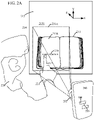
- At least one camera 202 ( FIG. 1A ) is operated in some embodiments so that processor 100 receives (as shown by act 101 in FIG. 1A ) via memory 203, a two dimensional array of color values of an image 231A ( FIG. 2A ) of a scene 214 in real world ( FIG. 2A ), and optionally another two dimensional array of depth values (also called range values) which are indicative of distances of points on surfaces 213S, 211L in the real world, from camera 202.
- camera 202 ( FIG. 1A ) is a depth camera (also called range camera) that directly generates and supplies to processor 100 two sets of values namely color values and depth values.
- a specific manner in which depth values are obtained by processor 100 can be different, depending on the embodiment, and some illustrative embodiments are described next.
- depth values are obtained by operating a projector 205 ( FIG. 4 ) to illuminate a scene with light that is encoded with positional information (also called “structured light”, and abbreviated "SL"), and operating a camera 202 ( FIG. 4 ) to capture one or more images of the scene 214 while illuminated with structured light from projector 205 ( FIG. 4 ).
- act 101 ( FIG. 1A ) to receive an image of color values and depth values may be performed as described in, for example, an article entitled "Dynamic scene shape reconstruction using a single structured light pattern" by Hiroshi Kawasaki et al, IEEE Conference on Computer Vision and Pattern Recognition, 2008 (CVPR 2008), 8 pages.
- act 101 may be performed as described in, for example, an article entitled “Rapid Shape Acquisition Using Color Structured Light and Multi-pass Dynamic Programming” by Li Zhang et al, in Proceedings of the 1st International Symposium on 3D Data Processing, Visualization, and Transmission (3DPVT), Padova, Italy, June 19-21, 2002, pp. 24-36 .
- an image 231A is captured by camera 202 as one of several images in a sequence of frames of an input video 231 generated by camera 202 imaging scene 214.
- Scene 214 in the example of FIG. 2A includes an object 211 in the form of a book that has been laid open on a surface 213S of a table 213.
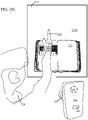
- a user 220 is pointing to a line of text on a left page 211L of book 211 by use of an index finger 212 of user's hand 221.
- a sequence of images 231A-231N is created by camera 202 at a predetermined rate, e.g. 30 frames/second and automatically stored in memory 203 ( FIG. 1A ) as a video that has been captured from scene 214, e.g. for use in time-of-flight calculations to obtain depth values as camera 202 is moved relative to scene 214.
- processor 100 obtains information 233 ( FIG. 2C ) that is to be projected into scene 214.
- information 233 is obtained in act 102 based on an instruction received via a user interface 201 ( FIG. 1A ), e.g. from a microphone (which may supply an audio signal carrying the words "Linear Equations” spoken by a user), or from a keyboard (which may supply a series of key strokes that form the character string for the words "Linear Equations” typed by the user).
- information 233 is obtained differently, e.g. by processor 100 using color values of image 231A to automatically obtain information 233 as follows. Specifically, in some embodiments, information 233 is obtained in act 102 based on recognition within an image 231A ( FIG. 2A ) by processor 100 of a hand gesture, such as index finger 212 outstretched in human hand 221 of human 220, pointing to text 218 printed on an object 211 (such as a book), as illustrated in FIG. 2A .
- a hand gesture such as index finger 212 outstretched in human hand 221 of human 220, pointing to text 218 printed on an object 211 (such as a book), as illustrated in FIG. 2A .
- Hand gestures may be recognized by processor 100 being suitably programmed in any manner apparent to the skilled artisan, e.g. as described in an article entitled “ A Vision based Hand Gesture Interface for Controlling VLC Media Player” by Rautaray et al. published in the International Journal of Computer Applications, vol. 10, no. 7, November 2010 , 6 pages.
- Other embodiments of processor 100 may identify hand gestures as described by, for example, Mitra and Acharya, in an article entitled “ Gesture Recognition: A Survey”, IEEE transactions on Systems, Man, and Cybernetics - Part C: Applications and Reviews, Vol. 37, No. 3, May 2007, 14 pages .
- a two dimensional array of color values (not shown) of image 231A is automatically processed by processor 100 in act 102 ( FIG. 1A ) to identify a region of text 218 that contains a character string "Linear Equations" printed on left page 211L and pointed to by user 220 ( FIG. 2A ) as captured in image 231A ( FIG. 2B ).
- processor 100 responds to the identification by automatically generating a request 232 ( FIG. 2B ) for a video on "Linear Algebra" available on the Internet.
- Request 232 is stored in memory 203 and (in some embodiments after user approval) used to obtain a video 233 (also called output video) which is stored in memory 203 ( FIG. 2C ) and used as information 233 to be projected.
- video 233 also called output video
- FIG. 2C Certain illustrative unclaimed embodiments of how information 233 is obtained in act 102 are described in U.S. Application No 13/549,339 , Attorney Docket No. Q111570U1os, filed on July 13, 2012, entitled "Use Of Association Of An Object Detected In An Image To Obtain Information To Display To A User".
- information 233 that is obtained in act 102 of some unclaimed embodiments has been described above as an output video 233 which constitutes a single element
- the information 233 includes multiple elements (e.g. in a web page) that are independent of one another and can be projected on different surfaces.
- Such multiple elements of information 233 may be identified in tables and/or sections defined in a web page expressed in HTML using tag ⁇ table> for example, to identify different blocks of text and/or graphics in information 233.
- processor 100 is additionally programmed to perform an act 103 (at any time before, during or after act 102 described above), to use the image's depth values to identify a set of surfaces 213S, 211L ( FIG. 2A ) in the scene 214 in real world.
- the set of surfaces 213S, 211L may be identified in act 103 ( FIG. 1A ) by segmentation of image 231A into regions with a consistent curvature, so that when information 233 is projected, the information 233 is well displayed within each region.
- a specific manner in which surfaces are identified in act 103 can be different, depending on the embodiment.
- act 103 uses depth values as described in, for example, an article entitled “ Partitioning 3D Surface Meshes Using Watershed Segmentation” by Alan P. Mangan et al, IEEE Transactions on Visualization and Computer Graphics, Vol. 5, NO. 4, Oct-Dec 1999, pp 308-321 that is incorporated by reference herein in its entirety.
- camera 202 is calibrated, before performing act 101 (described above), e.g. as described in an article entitled “Camera Calibration Toolbox for Matlab” by Jean-Yves Bouguet, 4 pages, last updated July 9 th , 2010. This article is available at a website identified in a string obtained by replacing "%” with “/” and replacing "#” with “.” in the following: "http:%%www#vision#caltech#edu%bouguetj%calib_doc%.
- Image 231A may be segmented using different techniques in different embodiments.
- no depth values are obtained, and surfaces in scene 214 are identified from a sequence of two dimensional images by use of a Hough transform, as described in, for example, US Patent 4,731,860 , entitled “Method for identifying three-dimensional objects using two-dimensional images” by Wahl.
- image 231A is automatically segmented by processor 100 in act 103 ( FIG. 1A ) to identify a set of surfaces.
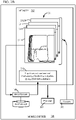
- a set of depth values of image 231A are copied by processor 100 to storage locations 234 ( FIG. 2C ) of memory 203, followed by segmentation to identify surfaces of object 211 in real world ( FIG. 2A ) that correspond to regions 211A, 211B, 212A, 212B, 212C and 212S in image 234 ( FIG. 2C ).
- a surface of page 211L in FIG. 2A corresponds to region 211A in image 234 in FIG. 2C .
- the same reference numerals are used to refer to regions in image 231A and corresponding surfaces in scene 214, in FIGs. 2B and 2A respectively.
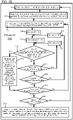
- processor 100 After act 103, many embodiments of processor 100 performs an act 106 for each element in the information obtained in act 102, to find a surface (or patch P) that is suitable for the element.
- a suitability test performed in act 106 can be different, depending on the embodiment, although several embodiments test suitability depending on the number of factors, such as size of the surface, contiguousness of points in the surface, curvature of the surface etc.
- a surface may be found to be suitable in act 106 of some embodiments, when the element of information to be displayed does not span across a boundary of the surface, or when the element does not wrap around in an irregular manner.
- output video 233 is a single element in the information to be projected in act 102. Accordingly, processor 100 evaluates all surfaces 211A, 211B, 212A, 212B, 212C and 212S from a set identified in act 103, for suitability to display output video 233. During such evaluation, each of regions 211C, 211B, 212B and 212A are found to be not suitable to display output video 233, e.g. due to size. In this example, regions 213U and 211A may be found to be acceptable on completion of act 106.
- processor on finding a surface (or patch P) that is suitable for an element, processor also identifies a specific position on the surface, at which the element is to be projected.
- the specific position identified in act 106 depends on several factors, such as the shape of the surface (e.g. rectangular, circular), and where the surface can completely enclose a rectangle in which the selected element is to be displayed.
- processor 100 In operation 106 if processor 100 is successful in finding surfaces for all elements, processor 100 goes to act 108 to identify one or more transfer functions for the corresponding surfaces. The transfer function is identified in act 108 to at least partially neutralize an effect of projection of information on the selected surface. But if processor 100 finds in act 106 that there is no surface suitable for any element of information, then processor 106 goes to act 107 to receive user input (described below).
- planar transform may, for example, shorten a height of frame 233A of an output video 233 so that a transformed frame on projection is rendered appropriately as it gets physically elongated when incident on surface 213S in scene 214 of the real world, specifically at an angle ⁇ relative to surface 213S which is not 90° (i.e. when video 236 is projected as shown in FIG. 2H at angle ⁇ which is slanted rather than perpendicular to surface 213S).
- the transfer function is identified in act 108 by performing matrix inversion on a two dimensional matrix which holds values that model a surface found to be suitable in act 106 (or alternatively a surface that is identified by user input in act 107).
- a model of values is identified in act 108, in any manner, e.g. based on comparing depth values of the surface with one or more models in a library of three dimensional (3D) models 522 ( FIG. 4 ).
- a model is selected in act 108 e.g. as described in an article entitled " Robust 3D Object Registration Based on Pairwise Matching of Geometric Distributions" by N. Werghi, 8 pages, published in 2009 in International Journal of Computers and Applications, Vol. 31, No. 1 .
- processor 100 applies the transfer function to the element of information, e.g. by performing matrix multiplication between the matrix of the transfer function and a matrix of the element of information, to obtain a transformed element (of the information).
- processor 100 stores in memory 203, the transformed element of the information, specifically in a frame buffer 530 ( FIG. 4 ) that is operatively coupled to a projector 205.
- processor 100 goes to act 112 to operate projector 205.
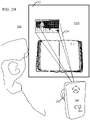
- one or more transformed elements in frame buffer 530 is/are projected into scene 214.
- a projection of the transformed element is incident on a selected surface (e.g. surface 211A in FIG. 2E ) the selected surface 211A transforms the transformed element back, so that information rendered on surface 211A appears normal to human 220 ( FIG. 2E ).
- Projection of a transformed element of information (such as video 236 in FIG. 2H ) on to a three-dimensional surface may be performed in many embodiments in a manner similar or identical to, for example, (1) methods described by US Patent 7,905,610 granted to Shapiro (incorporated by reference above) and (2) methods described by US Publication 2004/0184013 by Raskar entitled “Projecting Warped Images Onto Curved Surfaces”.
- processor 100 returns to act 101, thereby to perform the above-described acts once again.
- processor 100 goes from act 112 to act 107 to receive user input.
- the user input received in act 107 may indicate approval of the projection, e.g. by the user saying "Good job” or making the hand gesture of thumbs up as illustrated in FIG. 2F , by stretching out thumb 210 of hand 221 in front of camera 202.
- processor 100 goes to act 108 (described above), to continue to use the selected surface(s) for information projection.
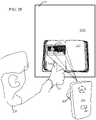
- the user input received in act 107 may indicate disapproval of the projection, e.g. by the user speaking the words "Not Good” (sensed by microphone 1112) or by the user making a hand gesture that points to another surface 213S, as illustrated in FIG. 2G by stretching out index finger 212 of hand 221 in front of (and captured by) camera 202.
- processor 100 again performs acts 108-110 (described above), this time using a different surface 213S identified by user input as illustrated in FIG. 2G , for information projection as illustrated in FIG. 2H .
- processor 100 automatically selects and begins using a different surface (e.g. surface 213S shown in FIG. 2H ) that is found to be suitable for display of the information.
- processor 100 receives user input identifying a shape.
- the user may provide input indicative of a circle, by making a hand gesture.
- the processor 100 uses the shape in the transfer function, to mask out a portion of the element of information to be displayed.
- processor 100 forms a mask of binary values, with the value of 1 being inside the circle and the value of 0 being outside the circle.
- the just described mask is used with a matrix for a 3D model of a selected surface, in act 109 to transform the element of information to be projected.
- Processor 100 performs act 106 illustrated in FIG. 1A , as shown in FIG. 1B and described below. Specifically, in act 151, processor 100 selects an element E of the information to be projected and goes to act 152. In act 152, processor 100 determines height H and width W of a rectangle (such as rectangle 272 in FIG. 2D ) in which the selected element E is to be displayed. The height H and width W are determined by processor 100 of some embodiments based on a predetermined resolution of an image in the element E. In an unclaimed embodiment, height H and width W are determined by processor 100 based on font size of text in the element E. Then processor 100 goes to act 153.
- processor 100 selects a surface (or a patch P within the surface), by comparing the total number of pixels N in a region of the image corresponding to the selected surface (or patch P therein) with an area of a rectangle of height H and width W to be used to display the element i.e. H ⁇ W. If N ⁇ H ⁇ W, then the surface (or patch P) is selected and otherwise not selected. The just-described comparison filters out any surfaces that are too small in size to accommodate (e.g. completely enclose) a selected element E.
- processor 100 performs an act 154 to initialize the row R to the value 0 and performs act 155 to initialize the column C to the value 0, followed by a test in act 156 on the suitability of projecting the selected element E on the selected surface (or patch P), in a rectangle identified in a frame buffer by four corners (R, C), (R, C+W), (R+H, C) and (R+H, C+W), where W is width and H is height of the rectangle, as noted above.
- an X-Y coordinate system in which the four corners are identified is positioned at a bottom left corner of the frame buffer 530 as illustrated in FIG. 2D .
- rectangle 272 is identified in frame buffer 530 in memory 203 in the above described manner, e.g. when element E is a video 233 ( FIG. 2C ), by use of its resolution by processor 100 to identify the above-described four corners.
- processor 100 performs one or more tests, e.g. test whether all pixels in the just-described rectangle which is to be used to project the element E are present in (e.g. contained within) a region of the image that corresponds to the surface.
- the just-described test for pixel availability filters out positions of rectangle 272 relative to an irregularly shaped surface 211A that may be unsuitable for projection, as shown in FIG. 2D (wherein corner (R, C) of rectangle 272 is not present in region 211A).
- corner (R, C) of rectangle 272 is not present in region 211A.
- processor 100 loops using acts 157-160 to check if there is another relative position between rectangle 272 and the selected surface 211A, at which the selected surface 211A may still be suitable, for projection of the rectangle 272. Specifically, processor 100 checks in act 157 ( FIG. 1B ) if column C+W is less than the width of the frame buffer 530, and if so goes to act 158 to increment column C (thereby to move rectangle 272 in the positive X direction, to the right in FIG. 2D ), and then returns to act 156 (described above).
- processor 100 goes to act 159 to check if the row R+H is less than the height of the frame buffer, and if so goes to act 160 to increment row R (thereby to move rectangle 272 in the positive Y direction, upwards in FIG. 2D ) and then returns to act 155 (described above).
- processor 100 tests all possible positions of the rectangle 272 that are enclosed within the frame buffer 530, relative to a selected surface 211A, and when no position is found by testing in act 156 to be suitable, the answer in act 159 is no processor 100 goes to act 161 to check if all surfaces (or patches) have been tested and if not returns to act 153 to select another surface. If the answer in act 161 is yes, processor 100 goes to act 163 to check if all elements of the information to be projected have been processed and if not returns to act 151 to select another element, but if all elements have been processed then processor 100 goes to act 164 (described below).
- processor 100 goes to act 162 to identify and store in memory, in an item in a list 273 ( FIG. 2C ) in memory 203, the coordinates (R, C) of a location on the surface (or patch P), as a specific position at which the element E can be projected.
- each item in the list 273 ( FIG. 2C ) is a candidate, for projection of element E, and one specific candidate is assigned for use in projection in act 164 described below.
- processor 100 associates a selected surface (or patch P) with the element E when one or more tests in act 156 are successful, and then processor 100 goes to act 161.
- processor 100 checks if all surfaces have been tested, and if the answer is no, returns to act 153 to test another surface or patch P. After looping via acts 161 and 153-156 and 162 and depending on the dimensions of element E and on surfaces in a set available for projection (as per act 103 in FIG. 1A ), all surfaces that are tested and found suitable (as per act 156) for projection of element E are identified in a list maintained in memory 203 for element E, when the "yes" branch is taken from act 161.
- the testing of act 156 is performed repeatedly, to associate with video 233, a list 273 that contains two items that identify the corresponding two surfaces 213U and 211A.
- surfaces 213U and 211A constitute a subset, of the set of all surfaces 211A, 211B, 212A, 212B, 212C and 212S identified in act 103.
- Each of surfaces 213U and 211A is associated with video 233 in the list 273 for video 233 by act 162, with a specific position being identified in each element of the list to indicate where on the corresponding surface, video 233 can be projected.
- FIG. 1 the testing of act 156 is performed repeatedly, to associate with video 233, a list 273 that contains two items that identify the corresponding two surfaces 213U and 211A.
- surfaces 213U and 211A constitute a subset, of the set of all surfaces 211A, 211B, 212A, 212B, 212C and 212S identified in act 103.
- memory 203 holds only one list 273 as the information to be projected has only one element, and multiple lists are generated by processor 100 looping back from the "no" branch in act 163 to act 151, e.g. when the to-be-projected information includes multiple elements.
- processor 100 assigns a specific surface for projection of each element E, based on lists in which all candidate surfaces were identified by act 162 for each element E. Specifically, in act 164, processor 100 loops over each surface (or patch P) to identify, from among all lists a subset of lists to which a given surface is assigned, and then from among the subset identify a single list which has fewest number of surfaces and then assigns an element corresponding to that single list, to the given surface.
- any element that remains unassigned is not rendered in frame buffer 530 and not projected in some embodiments while alternative embodiments notify the user, e.g. via an audio message.
- the information is an output video 233 that is projected in its entirety within a surface 211A as illustrated in FIG. 2E , or within another surface 213S as illustrated in FIG. 2H
- the information to be projected includes multiple elements (also called parts), each of which can be projected independently of another part (or element).
- an object 311 such as a bottle cap 241 that is located on surface 213S of table 213 is imaged by mobile device 200 as per act 101 ( FIG. 1A ), and the resulting image is stored in memory 203 as image 331A ( FIG. 3B ).
- Image 331A is thereafter segmented as per act 103 ( FIG.
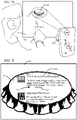
- Information to be projected in this example is generated by execution of game software 309 and stored in storage locations 309S of memory 203 as two distinct elements (or parts) that can be projected independent of one another, namely: (1) a first line of text for a player of the game (illustrated in FIG. 3C as the string of characters "Group 2") and (2) a second line of text for a score (illustrated in FIG. 3C as another string of characters "Score: 0") of that same player.
- processor 100 determines each of regions 241A...241I...241N as being too small to display a first element (namely first text line 333A) in act 153 ( FIG. 1B ) which is therefore filtered out.
- processor 100 identifies region 311S as being sufficiently large to display the first element and evaluates suitability in act 156.
- processor 100 tests various positions of a rectangle to display the first text line 333A relative to surface 311S in scene 314 (which corresponds to region 311S in image 331A), and when a position is found to be suitable the surface 311S and the position are added by processor 100 as a first item in a list for the first text line 333A by act 162.
- next processor 100 identifies region 213S as being sufficiently large to also display the first element and evaluates suitability by repeating act 156.
- processor 100 tests various positions of the same rectangle to display the first text line 333A but this time relative to surface 213S in scene 314 (which corresponds to region 213S in image 331A), and when a position is found to be suitable the surface 213S and the position are added by processor 100 as a second item in the above-described list for the first text line by act 162. Accordingly, at this stage the list for the first text line has two items. Similarly, another list is generated by processor 100 for the second text line which also has two items. Finally, by performing act 164, processor 100 assigns to surface 311S the first text line 333A and assigns to surface 213S the second text line 333B ( FIG. 3D ), followed by operation of the projector 205 to generate a projection.
- processor 100 is programmed to optimize the position of each element that is assigned to a surface in act 164, e.g. so that two text lines 333A and 333B which constitute two elements are positioned as close to one another as possible, as illustrated in FIG. 3E .
- processor 100 may move a shape (such as a rectangle or a circle) for projection of an element in other ways, e.g. by rotation.
- FIG. 3F information displayed by mobile device 200 on surface 311S is obtained from a computer (not shown) at the website www.twitter.com.
- Mobile device 200 may be any device that includes a projector 205 and/or a camera 202, and device 200 may include additional parts that are normally used in any hand held device, e.g. motion sensors, such as accelerometers, gyroscopes or the like, which may be used in one or more acts described above, e.g. in determining the pose (position and orientation) of mobile device 200 relative to object 311 and/or table 213.
- motion sensors such as accelerometers, gyroscopes or the like, which may be used in one or more acts described above, e.g. in determining the pose (position and orientation) of mobile device 200 relative to object 311 and/or table 213.
- mobile device 200 may be any portable electronic device such as a cellular or other wireless communication device, personal communication system (PCS) device, personal navigation device (PND), Personal Information Manager (PIM), Personal Digital Assistant (PDA), laptop, camera, or other suitable mobile device that is capable of imaging scene 214 and/or projecting information into scene 214.
- PCS personal communication system
- PND personal navigation device
- PIM Personal Information Manager
- PDA Personal Digital Assistant
- a single device 200 includes both camera 202 and projector 205 whereas in other embodiments one such device includes camera 202 and another such device includes projector 205 and both devices communicate with one another either directly or via a computer (not shown).
- a mobile device 200 of the type described above may include various object recognition methods using "computer vision” techniques.
- Mobile device 200 may also include a 3D surface segmentor software 511 ( FIG. 4 ) to implement a watershed algorithm used in some embodiments of act 103 described above, to divide up image 231A, into regions of data 521 (also called “surface data") that belongs to different 3D surfaces (or patches) in scene 214.
- mobile device 200 may also include a surface finder 512 that finds a specific surface in the set of surfaces 521, on which an element of information can be projected, e.g. in a rectangle of height H and width W.
- Surface finder 512 which implements a means for finding in some embodiments also includes software to test (e.g.
- Surface finder 512 also selects from a library 522 of 3D models, a single model of a single 3D surface (among the surfaces identified in surface data 521), that is suitable to display the rectangle as described above in reference to act 106 (e.g. as implemented by the method of FIG. 1B ) thereby to implement means for identifying in some embodiments. Accordingly, in some embodiments, surface finder 512 supplies as its output an identifier of a 3D model and also coordinates of a position at which the rectangle can be displayed.
- Mobile device 200 may also include information retriever software 513 to retrieve information 233 having one or more elements to be projected as per act 102 described above.
- An information transformer 514 in mobile device 200 includes two modules as follows: a transfer function identifier and a transfer function applier.
- the transfer function identifier performs matrix inversion as per act 108 described above, and the transfer function applier applies the inverted matrix generated by act 108 to the element of information to obtain a transformed element 525 that is then stored in frame buffer 530 in memory 203 that is operatively coupled to projector 205, and projected into scene 214 on operation of projector 205.
- the information transformer 514 of some embodiments implements a means for storing.
- Mobile device 200 may be also equipped with an IR or RF transmitter or a wireless a transmitter enabled to receive and/or transmit one or more signals over one or more types of wireless communication networks such as the Internet, WiFi, cellular wireless network or other network. Also, mobile device 200 may additionally include a graphics engine 1004, an image processor 1005, a IR camera 1006 (e.g. in an external Printed Circuit Board 1130) and a read only memory (ROM) 1007 to store firmware, and/or software, and/or constant data. Mobile device 200 may also include a disk 1008 (or one or more non-transitory computer readable storage media) to store software executed by processor 100. Mobile device 200 may further include a wireless transmitter and receiver 110 and/or any other communication interfaces 1009, touch screen 1001 or other screen 1002.
- a wireless transmitter and receiver 110 and/or any other communication interfaces 1009, touch screen 1001 or other screen 1002.
- mobile device 200 may be programmed with gesture recognition software that uses a projector 205 in combination with camera 202.
- the projector 205 may be used to render a cell phone's display on everyday surfaces such as a wall, with which users can interact using hand gestures.
- mobile device 200 may be designed to use an IR camera 1006 that tracks specialized IR laser stylus or gloves and supplies user input via an IR link 1131.
- mobile device 200 may be any portable electronic device such as a cellular or other wireless communication device, personal communication system (PCS) device, personal navigation device (PND), Personal Information Manager (PIM), Personal Digital Assistant (PDA), laptop, camera, smartphone, tablet, or other suitable mobile device that is capable of creating an augmented reality (AR) environment.
- PCS personal communication system
- PND personal navigation device
- PIM Personal Information Manager
- PDA Personal Digital Assistant
- laptop camera, smartphone, tablet, or other suitable mobile device that is capable of creating an augmented reality (AR) environment.
- AR augmented reality
- Mobile device 200 of several described embodiments may also include means for remotely controlling a real world object which may be a toy, in response to user input e.g. by use of transmitter in transceiver 1010, which may be an IR or RF transmitter or a wireless a transmitter enabled to transmit one or more signals over one or more types of wireless communication networks such as the Internet, WiFi, cellular wireless network or other network.
- transceiver 1010 which may be an IR or RF transmitter or a wireless a transmitter enabled to transmit one or more signals over one or more types of wireless communication networks such as the Internet, WiFi, cellular wireless network or other network.
- mobile device 200 may include other elements, such as a read-only-memory 1007 which may be used to store firmware for use by processor 100.
- any one or more of surface segmentor 511, surface finder 512, information retriever 513, and information transformer 514 illustrated in FIG. 4 and described above can, but need not necessarily include, one or more microprocessors, embedded processors, controllers, application specific integrated circuits (ASICs), digital signal processors (DSPs), and the like.
- the term processor is intended to describe the functions implemented by the system rather than specific hardware.
- memory refers to any type of computer storage medium, including long term, short term, or other memory associated with the mobile platform, and is not to be limited to any particular type of memory or number of memories, or type of media upon which memory is stored.
- methodologies described herein may be implemented by various means depending upon the application. For example, these methodologies may be implemented in firmware in ROM 1007 ( FIG. 4 ) or software, or hardware or any combination thereof.
- the processing units may be implemented within one or more application specific integrated circuits (ASICs), digital signal processors (DSPs), digital signal processing devices (DSPDs), programmable logic devices (PLDs), field programmable gate arrays (FPGAs), processors, controllers, micro-controllers, microprocessors, electronic devices, other electronic units designed to perform the functions described herein, or a combination thereof.
- ASICs application specific integrated circuits
- DSPs digital signal processors
- DSPDs digital signal processing devices
- PLDs programmable logic devices
- FPGAs field programmable gate arrays
- processors controllers, micro-controllers, microprocessors, electronic devices, other electronic units designed to perform the functions described herein, or a combination thereof.
- the methodologies may be implemented with modules (e.g., procedures, functions
- software 510 may include program codes stored in memory 203 and executed by processor 100. Memory may be implemented within or external to the processor 100. If implemented in firmware and/or software, the functions may be stored as one or more computer instructions or code on a computer-readable medium. Examples include nontransitory computer-readable storage media encoded with a data structure (such as a sequence of images) and computer-readable media encoded with a computer program (such as software 510 that can be executed to perform the method of FIGs. 1A-1B ).
- Computer-readable media includes physical computer storage media.
- a storage medium may be any available medium that can be accessed by a computer.
- such computer-readable media can comprise RAM, ROM, Flash Memory, EEPROM, CD-ROM or other optical disk storage, magnetic disk storage or other magnetic storage devices, or any other medium that can be used to store program code in the form of software instructions (also called “processor instructions” or “computer instructions") or data structures and that can be accessed by a computer;
- disk and disc includes compact disc (CD), laser disc, optical disc, digital versatile disc (DVD), floppy disk and blu-ray disc where disks usually reproduce data magnetically, while discs reproduce data optically with lasers. Combinations of the above should also be included within the scope of computer-readable media.
- item 200 shown in FIG. 4 is a mobile device, alternatively item 200 is implemented by use of form factors that are different, e.g. item 200 is a mobile platform (such as a tablet, e.g. iPad available from Apple, Inc.) alternatively item 200 is any electronic device or system.
- Such an electronic device or system 200 may include multiple physical parts that intercommunicate wirelessly, such as a processor and a memory that are portions of a stationary computer, such as a lap-top computer, a desktop computer, or a server computer communicating over one or more wireless link(s) with sensors and user input circuitry enclosed in a housing that is small enough to be held in a hand.
Landscapes
- Engineering & Computer Science (AREA)
- Theoretical Computer Science (AREA)
- Physics & Mathematics (AREA)
- General Physics & Mathematics (AREA)
- General Engineering & Computer Science (AREA)
- Human Computer Interaction (AREA)
- Multimedia (AREA)
- Signal Processing (AREA)
- Computer Vision & Pattern Recognition (AREA)
- Health & Medical Sciences (AREA)
- Oral & Maxillofacial Surgery (AREA)
- Library & Information Science (AREA)
- Data Mining & Analysis (AREA)
- Databases & Information Systems (AREA)
- General Health & Medical Sciences (AREA)
- User Interface Of Digital Computer (AREA)
- Controls And Circuits For Display Device (AREA)
- Transforming Electric Information Into Light Information (AREA)
- Image Analysis (AREA)
Applications Claiming Priority (3)
| Application Number | Priority Date | Filing Date | Title |
|---|---|---|---|
| US201161525628P | 2011-08-19 | 2011-08-19 | |
| US13/549,388 US9245193B2 (en) | 2011-08-19 | 2012-07-13 | Dynamic selection of surfaces in real world for projection of information thereon |
| PCT/US2012/046817 WO2013028280A2 (en) | 2011-08-19 | 2012-07-14 | Dynamic selection of surfaces in real world for projection of information thereon |
Publications (2)
| Publication Number | Publication Date |
|---|---|
| EP2745237A2 EP2745237A2 (en) | 2014-06-25 |
| EP2745237B1 true EP2745237B1 (en) | 2022-09-07 |
Family
ID=47712374
Family Applications (1)
| Application Number | Title | Priority Date | Filing Date |
|---|---|---|---|
| EP12741178.3A Active EP2745237B1 (en) | 2011-08-19 | 2012-07-14 | Dynamic selection of surfaces in real world for projection of information thereon |
Country Status (7)
| Country | Link |
|---|---|
| US (2) | US20130044912A1 (enExample) |
| EP (1) | EP2745237B1 (enExample) |
| JP (2) | JP2014531787A (enExample) |
| KR (1) | KR101575016B1 (enExample) |
| CN (1) | CN103875004B (enExample) |
| IN (1) | IN2014MN00316A (enExample) |
| WO (2) | WO2013028279A1 (enExample) |
Families Citing this family (73)
| Publication number | Priority date | Publication date | Assignee | Title |
|---|---|---|---|---|
| FI117308B (fi) * | 2004-02-06 | 2006-08-31 | Nokia Corp | Eleohjausjärjestelmä |
| US8718356B2 (en) * | 2010-08-23 | 2014-05-06 | Texas Instruments Incorporated | Method and apparatus for 2D to 3D conversion using scene classification and face detection |
| US20130044912A1 (en) | 2011-08-19 | 2013-02-21 | Qualcomm Incorporated | Use of association of an object detected in an image to obtain information to display to a user |
| JP6044079B2 (ja) * | 2012-02-06 | 2016-12-14 | ソニー株式会社 | 情報処理装置、情報処理方法及びプログラム |
| US9456187B1 (en) | 2012-06-01 | 2016-09-27 | Amazon Technologies, Inc. | Edge-based pose detection |
| US9671566B2 (en) | 2012-06-11 | 2017-06-06 | Magic Leap, Inc. | Planar waveguide apparatus with diffraction element(s) and system employing same |
| US10528853B1 (en) | 2012-06-29 | 2020-01-07 | Amazon Technologies, Inc. | Shape-Based Edge Detection |
| KR102047494B1 (ko) * | 2012-09-10 | 2019-11-21 | 삼성전자주식회사 | 투명 디스플레이 장치 및 그 객체 선택 방법 |
| GB2505708B (en) * | 2012-09-11 | 2015-02-25 | Barco Nv | Projection system with safety detection |
| JP5964190B2 (ja) * | 2012-09-27 | 2016-08-03 | 京セラ株式会社 | 端末装置 |
| CN103777746B (zh) * | 2012-10-23 | 2018-03-13 | 腾讯科技(深圳)有限公司 | 一种人机交互方法、终端及系统 |
| KR102001218B1 (ko) * | 2012-11-02 | 2019-07-17 | 삼성전자주식회사 | 객체와 관련된 정보 제공 방법 및 이를 위한 디바이스 |
| KR101393570B1 (ko) * | 2012-12-28 | 2014-05-27 | 현대자동차 주식회사 | 선택적 조명을 이용한 손 제스처 인식 방법 및 시스템 |
| US9311837B2 (en) | 2013-03-14 | 2016-04-12 | Martigold Enterprises, Llc | Methods and apparatus for message playback |
| US10277945B2 (en) * | 2013-04-05 | 2019-04-30 | Lenovo (Singapore) Pte. Ltd. | Contextual queries for augmenting video display |
| US9563955B1 (en) | 2013-05-15 | 2017-02-07 | Amazon Technologies, Inc. | Object tracking techniques |
| KR102166719B1 (ko) * | 2013-06-27 | 2020-10-16 | 삼성전자주식회사 | 전자장치 및 전자장치를 이용한 정보교환 방법 |
| WO2015006784A2 (en) | 2013-07-12 | 2015-01-15 | Magic Leap, Inc. | Planar waveguide apparatus with diffraction element(s) and system employing same |
| US10295338B2 (en) | 2013-07-12 | 2019-05-21 | Magic Leap, Inc. | Method and system for generating map data from an image |
| US20150193088A1 (en) * | 2013-07-15 | 2015-07-09 | Intel Corporation | Hands-free assistance |
| KR20150026649A (ko) * | 2013-09-03 | 2015-03-11 | 삼성전자주식회사 | 전자 장치에서 제스처를 설정하는 장치 및 방법 |
| KR102106135B1 (ko) * | 2013-10-01 | 2020-05-04 | 한국전자통신연구원 | 행동 인식 기반의 응용 서비스 제공 장치 및 그 방법 |
| US20170026636A1 (en) * | 2013-12-12 | 2017-01-26 | Testo Ag | Method for the positionally accurate projection of a mark onto an object, and projection apparatus |
| US20150193915A1 (en) * | 2014-01-06 | 2015-07-09 | Nvidia Corporation | Technique for projecting an image onto a surface with a mobile device |
| US9207780B2 (en) * | 2014-01-27 | 2015-12-08 | Fuji Xerox Co., Ltd. | Systems and methods for hiding and finding digital content associated with physical objects via coded lighting |
| JP2017512327A (ja) * | 2014-02-07 | 2017-05-18 | コーニンクレッカ フィリップス エヌ ヴェKoninklijke Philips N.V. | 制御システム及び制御システムの動作方法 |
| KR20150110032A (ko) * | 2014-03-24 | 2015-10-02 | 삼성전자주식회사 | 영상데이터 처리 전자장치 및 방법 |
| US10572215B1 (en) * | 2014-03-31 | 2020-02-25 | Amazon Technologies, Inc. | Extendable architecture for augmented reality system |
| US10579207B2 (en) * | 2014-05-14 | 2020-03-03 | Purdue Research Foundation | Manipulating virtual environment using non-instrumented physical object |
| CN105320931B (zh) * | 2014-05-26 | 2019-09-20 | 京瓷办公信息系统株式会社 | 物品信息提供装置和物品信息提供系统 |
| CN107113417B (zh) * | 2014-08-01 | 2020-05-05 | 惠普发展公司,有限责任合伙企业 | 将图像投影到对象上 |
| US9582296B2 (en) * | 2014-09-18 | 2017-02-28 | International Business Machines Corporation | Dynamic multi-user computer configuration settings |
| US9715865B1 (en) * | 2014-09-26 | 2017-07-25 | Amazon Technologies, Inc. | Forming a representation of an item with light |
| US10216996B2 (en) * | 2014-09-29 | 2019-02-26 | Sony Interactive Entertainment Inc. | Schemes for retrieving and associating content items with real-world objects using augmented reality and object recognition |
| KR101909540B1 (ko) * | 2014-10-23 | 2018-10-18 | 삼성전자주식회사 | 가상의 입력 영역을 이용한 포터블 디바이스의 사용자 입력 방법 |
| GB2532464B (en) | 2014-11-19 | 2020-09-02 | Bae Systems Plc | Apparatus and method for selectively displaying an operational environment |
| GB2532465B (en) | 2014-11-19 | 2021-08-11 | Bae Systems Plc | Interactive control station |
| US9886769B1 (en) * | 2014-12-09 | 2018-02-06 | Jamie Douglas Tremaine | Use of 3D depth map with low and high resolution 2D images for gesture recognition and object tracking systems |
| US9344615B1 (en) * | 2015-01-26 | 2016-05-17 | International Business Machines Corporation | Discriminating visual recognition program for digital cameras |
| WO2016122582A1 (en) * | 2015-01-30 | 2016-08-04 | Hewlett Packard Enterprise Development Lp | Relationship preserving projection of digital objects |
| JP6711284B2 (ja) | 2015-02-03 | 2020-06-17 | ソニー株式会社 | 情報処理装置、情報処理方法およびプログラム |
| CN105988568B (zh) * | 2015-02-12 | 2020-07-24 | 北京三星通信技术研究有限公司 | 获取笔记信息的方法和装置 |
| WO2016135473A1 (en) * | 2015-02-25 | 2016-09-01 | Bae Systems Plc | Apparatus and method for effecting a control action in respect of system functions |
| CN106033257B (zh) * | 2015-03-18 | 2019-05-31 | 联想(北京)有限公司 | 一种控制方法和装置 |
| WO2016151869A1 (en) * | 2015-03-23 | 2016-09-29 | Nec Corporation | Information processing apparatus, information processing method, and program |
| CN104796678A (zh) * | 2015-04-28 | 2015-07-22 | 联想(北京)有限公司 | 信息处理方法及电子设备 |
| US10281976B2 (en) * | 2015-07-07 | 2019-05-07 | Seiko Epson Corporation | Display device, control method for display device, and computer program |
| CN108351970B (zh) * | 2015-10-30 | 2023-04-04 | 联合利华知识产权控股有限公司 | 毛发直径测量 |
| US10922576B2 (en) * | 2015-10-30 | 2021-02-16 | Conopco, Inc. | Hair curl measurement |
| US9799111B2 (en) * | 2016-02-11 | 2017-10-24 | Symbol Technologies, Llc | Methods and systems for highlighting box surfaces and edges in mobile box dimensioning |
| KR20240051334A (ko) * | 2016-02-18 | 2024-04-19 | 애플 인크. | 인사이드-아웃 위치, 사용자 신체 및 환경 추적을 갖는 가상 및 혼합 현실을 위한 머리 장착 디스플레이 |
| US10665019B2 (en) * | 2016-03-24 | 2020-05-26 | Qualcomm Incorporated | Spatial relationships for integration of visual images of physical environment into virtual reality |
| US11176231B2 (en) * | 2016-05-19 | 2021-11-16 | Payfone, Inc. | Identifying and authenticating users based on passive factors determined from sensor data |
| AU2017269430A1 (en) * | 2016-05-27 | 2018-12-20 | Rovi Guides, Inc. | Methods and systems for selecting supplemental content for display near a user device during presentation of a media asset on the user device |
| US10249084B2 (en) | 2016-06-10 | 2019-04-02 | Microsoft Technology Licensing, Llc | Tap event location with a selection apparatus |
| US10506221B2 (en) | 2016-08-03 | 2019-12-10 | Adobe Inc. | Field of view rendering control of digital content |
| US20180039479A1 (en) * | 2016-08-04 | 2018-02-08 | Adobe Systems Incorporated | Digital Content Search and Environmental Context |
| US11461820B2 (en) | 2016-08-16 | 2022-10-04 | Adobe Inc. | Navigation and rewards involving physical goods and services |
| US10139961B2 (en) * | 2016-08-18 | 2018-11-27 | Microsoft Technology Licensing, Llc | Touch detection using feature-vector dictionary |
| US10720082B1 (en) * | 2016-09-08 | 2020-07-21 | Ctskh, Llc | Device and system to teach stem lessons using hands-on learning method |
| US10068378B2 (en) | 2016-09-12 | 2018-09-04 | Adobe Systems Incorporated | Digital content interaction and navigation in virtual and augmented reality |
| US10430559B2 (en) | 2016-10-18 | 2019-10-01 | Adobe Inc. | Digital rights management in virtual and augmented reality |
| KR102048674B1 (ko) * | 2017-07-31 | 2019-11-26 | 코닉오토메이션 주식회사 | 조명램프형 멀티미디어 장치 |
| US10300373B2 (en) | 2017-09-08 | 2019-05-28 | Niantic, Inc. | Methods and systems for generating detailed datasets of an environment via gameplay |
| JP6992342B2 (ja) * | 2017-09-13 | 2022-01-13 | 富士フイルムビジネスイノベーション株式会社 | 情報処理装置及びプログラム |
| CN111433729A (zh) * | 2017-12-04 | 2020-07-17 | 惠普发展公司,有限责任合伙企业 | 外围显示设备 |
| DE102018203349A1 (de) * | 2018-03-07 | 2019-09-12 | BSH Hausgeräte GmbH | Interaktionsmodul |
| HK1258418A2 (zh) * | 2018-08-29 | 2019-11-08 | 庄欣达 | 使用扩增实境显示提供一个或多个服务的系统和方法 |
| US10825254B1 (en) * | 2019-05-30 | 2020-11-03 | International Business Machines Corporation | Augmented reality book selection-assist |
| US11474671B2 (en) * | 2020-01-31 | 2022-10-18 | Salesforce.Com, Inc. | Neutralizing designs of user interfaces |
| TWI724858B (zh) * | 2020-04-08 | 2021-04-11 | 國軍花蓮總醫院 | 基於手勢動作的混合實境評量系統 |
| CN113577766B (zh) * | 2021-08-05 | 2024-04-02 | 百度在线网络技术(北京)有限公司 | 对象处理方法及装置 |
| US12718506B2 (en) | 2023-11-08 | 2026-08-25 | Bank Of America Corporation | Systems and methods for generating an interactive 3D environment using spatial computing to generate historical digital components |
Citations (1)
| Publication number | Priority date | Publication date | Assignee | Title |
|---|---|---|---|---|
| US20040258314A1 (en) * | 2003-06-23 | 2004-12-23 | Shoestring Research, Llc | Region segmentation and characterization systems and methods for augmented reality |
Family Cites Families (43)
| Publication number | Priority date | Publication date | Assignee | Title |
|---|---|---|---|---|
| DE3578241D1 (de) | 1985-06-19 | 1990-07-19 | Ibm | Verfahren zum identifizieren dreidimensionaler objekte mittels zweidimensionaler bilder. |
| JP3869897B2 (ja) | 1997-01-28 | 2007-01-17 | キヤノン株式会社 | カメラ制御システムおよび映像受信装置および制御方法および記憶媒体 |
| JP2001211372A (ja) | 2000-01-27 | 2001-08-03 | Nippon Telegr & Teleph Corp <Ntt> | 映像投影装置 |
| US8817045B2 (en) * | 2000-11-06 | 2014-08-26 | Nant Holdings Ip, Llc | Interactivity via mobile image recognition |
| JP4009851B2 (ja) | 2002-05-20 | 2007-11-21 | セイコーエプソン株式会社 | 投写型画像表示システム、プロジェクタ、プログラム、情報記憶媒体および画像投写方法 |
| JP4591720B2 (ja) | 2002-05-20 | 2010-12-01 | セイコーエプソン株式会社 | 投写型画像表示システム、プロジェクタ、プログラム、情報記憶媒体および画像投写方法 |
| US6811264B2 (en) * | 2003-03-21 | 2004-11-02 | Mitsubishi Electric Research Laboratories, Inc. | Geometrically aware projector |
| JP2005313291A (ja) | 2004-04-30 | 2005-11-10 | Mitsubishi Heavy Ind Ltd | ロボット行動とリンクした映像表示方法とその装置 |
| US20070050468A1 (en) | 2005-08-09 | 2007-03-01 | Comverse, Ltd. | Reality context menu (RCM) |
| JP2007142495A (ja) | 2005-11-14 | 2007-06-07 | Nippon Telegr & Teleph Corp <Ntt> | 平面投影装置、及び平面投影プログラム |
| US7905610B1 (en) | 2006-08-29 | 2011-03-15 | Nvidia Corporation | Graphics processor system and associated method for projecting an image onto a three-dimensional object |
| KR100775123B1 (ko) | 2006-09-15 | 2007-11-08 | 삼성전자주식회사 | 영상 객체 인덱싱 방법 및 이를 이용한 영상 객체 인덱싱시스템 |
| TWI433052B (zh) | 2007-04-02 | 2014-04-01 | Primesense Ltd | 使用投影圖案之深度製圖 |
| US8228170B2 (en) | 2008-01-10 | 2012-07-24 | International Business Machines Corporation | Using sensors to identify objects placed on a surface |
| US20090237328A1 (en) * | 2008-03-20 | 2009-09-24 | Motorola, Inc. | Mobile virtual and augmented reality system |
| JP5258399B2 (ja) | 2008-06-06 | 2013-08-07 | キヤノン株式会社 | 画像投影装置及びその制御方法 |
| US7954953B2 (en) * | 2008-07-30 | 2011-06-07 | Microvision, Inc. | Scanned beam overlay projection |
| US8385971B2 (en) | 2008-08-19 | 2013-02-26 | Digimarc Corporation | Methods and systems for content processing |
| JP2010072025A (ja) | 2008-09-16 | 2010-04-02 | Nikon Corp | プロジェクタ付電子機器 |
| US8516561B2 (en) | 2008-09-29 | 2013-08-20 | At&T Intellectual Property I, L.P. | Methods and apparatus for determining user authorization from motion of a gesture-based control unit |
| US20100082629A1 (en) * | 2008-09-29 | 2010-04-01 | Yahoo! Inc. | System for associating data items with context |
| US20100153457A1 (en) * | 2008-12-15 | 2010-06-17 | Grant Isaac W | Gestural Interface Device and Method |
| US9569001B2 (en) * | 2009-02-03 | 2017-02-14 | Massachusetts Institute Of Technology | Wearable gestural interface |
| KR101657565B1 (ko) * | 2010-04-21 | 2016-09-19 | 엘지전자 주식회사 | 증강 원격제어장치 및 그 동작 방법 |
| US9244533B2 (en) | 2009-12-17 | 2016-01-26 | Microsoft Technology Licensing, Llc | Camera navigation for presentations |
| KR20110071349A (ko) * | 2009-12-21 | 2011-06-29 | 삼성전자주식회사 | 휴대단말의 외부 출력 제어 방법 및 장치 |
| US8549418B2 (en) * | 2009-12-23 | 2013-10-01 | Intel Corporation | Projected display to enhance computer device use |
| US8631355B2 (en) * | 2010-01-08 | 2014-01-14 | Microsoft Corporation | Assigning gesture dictionaries |
| US20110213664A1 (en) * | 2010-02-28 | 2011-09-01 | Osterhout Group, Inc. | Local advertising content on an interactive head-mounted eyepiece |
| US20130311329A1 (en) * | 2012-03-29 | 2013-11-21 | Digimarc Corporation | Image-related methods and arrangements |
| CN101907459B (zh) * | 2010-07-12 | 2012-01-04 | 清华大学 | 基于单目视频的实时三维刚体目标姿态估计与测距方法 |
| CN102959616B (zh) | 2010-07-20 | 2015-06-10 | 苹果公司 | 自然交互的交互真实性增强 |
| US20130135199A1 (en) * | 2010-08-10 | 2013-05-30 | Pointgrab Ltd | System and method for user interaction with projected content |
| US8913085B2 (en) | 2010-12-22 | 2014-12-16 | Intel Corporation | Object mapping techniques for mobile augmented reality applications |
| US9041775B2 (en) | 2011-03-23 | 2015-05-26 | Mgestyk Technologies Inc. | Apparatus and system for interfacing with computers and other electronic devices through gestures by using depth sensing and methods of use |
| US9560314B2 (en) * | 2011-06-14 | 2017-01-31 | Microsoft Technology Licensing, Llc | Interactive and shared surfaces |
| US8693726B2 (en) * | 2011-06-29 | 2014-04-08 | Amazon Technologies, Inc. | User identification by gesture recognition |
| US20130044912A1 (en) | 2011-08-19 | 2013-02-21 | Qualcomm Incorporated | Use of association of an object detected in an image to obtain information to display to a user |
| US20130050069A1 (en) | 2011-08-23 | 2013-02-28 | Sony Corporation, A Japanese Corporation | Method and system for use in providing three dimensional user interface |
| WO2013028813A1 (en) | 2011-08-23 | 2013-02-28 | Microsoft Corporation | Implicit sharing and privacy control through physical behaviors using sensor-rich devices |
| US9342610B2 (en) * | 2011-08-25 | 2016-05-17 | Microsoft Technology Licensing, Llc | Portals: registered objects as virtualized, personalized displays |
| US20130207962A1 (en) * | 2012-02-10 | 2013-08-15 | Float Hybrid Entertainment Inc. | User interactive kiosk with three-dimensional display |
| US8994650B2 (en) * | 2012-04-27 | 2015-03-31 | Qualcomm Incorporated | Processing image input to communicate a command to a remote display device |
-
2012
- 2012-07-13 US US13/549,339 patent/US20130044912A1/en not_active Abandoned
- 2012-07-13 US US13/549,388 patent/US9245193B2/en active Active
- 2012-07-14 JP JP2014526005A patent/JP2014531787A/ja active Pending
- 2012-07-14 IN IN316MUN2014 patent/IN2014MN00316A/en unknown
- 2012-07-14 CN CN201280048118.0A patent/CN103875004B/zh active Active
- 2012-07-14 KR KR1020147007213A patent/KR101575016B1/ko not_active Expired - Fee Related
- 2012-07-14 WO PCT/US2012/046816 patent/WO2013028279A1/en not_active Ceased
- 2012-07-14 EP EP12741178.3A patent/EP2745237B1/en active Active
- 2012-07-14 WO PCT/US2012/046817 patent/WO2013028280A2/en not_active Ceased
-
2016
- 2016-10-20 JP JP2016205796A patent/JP6273334B2/ja not_active Expired - Fee Related
Patent Citations (1)
| Publication number | Priority date | Publication date | Assignee | Title |
|---|---|---|---|---|
| US20040258314A1 (en) * | 2003-06-23 | 2004-12-23 | Shoestring Research, Llc | Region segmentation and characterization systems and methods for augmented reality |
Also Published As
| Publication number | Publication date |
|---|---|
| JP6273334B2 (ja) | 2018-01-31 |
| JP2014531787A (ja) | 2014-11-27 |
| WO2013028280A2 (en) | 2013-02-28 |
| CN103875004A (zh) | 2014-06-18 |
| EP2745237A2 (en) | 2014-06-25 |
| WO2013028280A3 (en) | 2013-04-18 |
| IN2014MN00316A (enExample) | 2015-09-11 |
| WO2013028279A1 (en) | 2013-02-28 |
| US20130044193A1 (en) | 2013-02-21 |
| KR20140047733A (ko) | 2014-04-22 |
| JP2017038397A (ja) | 2017-02-16 |
| US9245193B2 (en) | 2016-01-26 |
| KR101575016B1 (ko) | 2015-12-07 |
| CN103875004B (zh) | 2017-12-08 |
| US20130044912A1 (en) | 2013-02-21 |
Similar Documents
| Publication | Publication Date | Title |
|---|---|---|
| US9245193B2 (en) | Dynamic selection of surfaces in real world for projection of information thereon | |
| US11523063B2 (en) | Systems and methods for placing annotations in an augmented reality environment using a center-locked interface | |
| US11290651B2 (en) | Image display system, information processing apparatus, image display method, image display program, image processing apparatus, image processing method, and image processing program | |
| CN107251101B (zh) | 针对使用具有参数的标记的增强现实的场景修改 | |
| US10249089B2 (en) | System and method for representing remote participants to a meeting | |
| US20170255450A1 (en) | Spatial cooperative programming language | |
| US9430093B2 (en) | Monitoring interactions between two or more objects within an environment | |
| EP3776469B1 (en) | System and method for 3d association of detected objects | |
| EP2972950B1 (en) | Segmentation of content delivery | |
| JP2013034168A (ja) | 画像投影装置ならびに画像投影制御装置およびプログラム | |
| US20150248390A1 (en) | Presenting associations of strokes with content | |
| JP2008250950A (ja) | 画像処理装置、制御プログラム、コンピュータ読み取り可能な記録媒体、電子機器及び画像処理装置の制御方法 | |
| JP2008250951A (ja) | 画像処理装置、制御プログラム、コンピュータ読み取り可能な記録媒体、電子機器及び画像処理装置の制御方法 | |
| US20150325051A1 (en) | Method, apparatus and system for rendering virtual content | |
| CN109718554B (zh) | 一种实时渲染方法、装置及终端 | |
| US12223603B2 (en) | Method of learning a target object using a virtual viewpoint camera and a method of augmenting a virtual model on a real object implementing the target object using the same | |
| CN110796701A (zh) | 标记点的识别方法、装置、设备及存储介质 | |
| WO2016136380A1 (ja) | 情報処理システム及びプログラム、サーバ、端末、並びに媒体 | |
| US10372318B2 (en) | Associating strokes with content | |
| US20150138077A1 (en) | Display system and display controll device | |
| CN113535055A (zh) | 一种基于虚拟现实播放点读物的方法、设备及存储介质 | |
| US9304618B2 (en) | Creating a summary of content and stroke association | |
| CN107516099A (zh) | 一种标记图片检测的方法、装置及计算机可读存储介质 | |
| CN117391932B (zh) | 屏幕模型合并方法、装置、电子设备及存储介质 | |
| Ortman et al. | Guidelines for user interactions in mobile augmented reality |
Legal Events
| Date | Code | Title | Description |
|---|---|---|---|
| PUAI | Public reference made under article 153(3) epc to a published international application that has entered the european phase |
Free format text: ORIGINAL CODE: 0009012 |
|
| 17P | Request for examination filed |
Effective date: 20140213 |
|
| AK | Designated contracting states |
Kind code of ref document: A2 Designated state(s): AL AT BE BG CH CY CZ DE DK EE ES FI FR GB GR HR HU IE IS IT LI LT LU LV MC MK MT NL NO PL PT RO RS SE SI SK SM TR |
|
| DAX | Request for extension of the european patent (deleted) | ||
| STAA | Information on the status of an ep patent application or granted ep patent |
Free format text: STATUS: EXAMINATION IS IN PROGRESS |
|
| RIC1 | Information provided on ipc code assigned before grant |
Ipc: G06K 9/00 20060101ALI20190215BHEP Ipc: G06F 3/01 20060101AFI20190215BHEP Ipc: G06F 3/03 20060101ALI20190215BHEP Ipc: H04N 9/31 20060101ALI20190215BHEP Ipc: G06K 9/22 20060101ALI20190215BHEP |
|
| 17Q | First examination report despatched |
Effective date: 20190315 |
|
| GRAP | Despatch of communication of intention to grant a patent |
Free format text: ORIGINAL CODE: EPIDOSNIGR1 |
|
| STAA | Information on the status of an ep patent application or granted ep patent |
Free format text: STATUS: GRANT OF PATENT IS INTENDED |
|
| INTG | Intention to grant announced |
Effective date: 20211112 |
|
| GRAJ | Information related to disapproval of communication of intention to grant by the applicant or resumption of examination proceedings by the epo deleted |
Free format text: ORIGINAL CODE: EPIDOSDIGR1 |
|
| STAA | Information on the status of an ep patent application or granted ep patent |
Free format text: STATUS: EXAMINATION IS IN PROGRESS |
|
| REG | Reference to a national code |
Ref country code: DE Ref legal event code: R079 Ref document number: 602012078714 Country of ref document: DE Free format text: PREVIOUS MAIN CLASS: G06K0009000000 Ipc: G06V0020200000 |
|
| GRAP | Despatch of communication of intention to grant a patent |
Free format text: ORIGINAL CODE: EPIDOSNIGR1 |
|
| STAA | Information on the status of an ep patent application or granted ep patent |
Free format text: STATUS: GRANT OF PATENT IS INTENDED |
|
| INTC | Intention to grant announced (deleted) | ||
| INTG | Intention to grant announced |
Effective date: 20220407 |
|
| RIC1 | Information provided on ipc code assigned before grant |
Ipc: H04N 9/31 20060101ALI20220327BHEP Ipc: G06F 3/03 20060101ALI20220327BHEP Ipc: G06F 3/01 20060101ALI20220327BHEP Ipc: G06V 40/10 20220101ALI20220327BHEP Ipc: G06V 30/142 20220101ALI20220327BHEP Ipc: G06V 20/20 20220101AFI20220327BHEP |
|
| GRAS | Grant fee paid |
Free format text: ORIGINAL CODE: EPIDOSNIGR3 |
|
| GRAA | (expected) grant |
Free format text: ORIGINAL CODE: 0009210 |
|
| STAA | Information on the status of an ep patent application or granted ep patent |
Free format text: STATUS: THE PATENT HAS BEEN GRANTED |
|
| AK | Designated contracting states |
Kind code of ref document: B1 Designated state(s): AL AT BE BG CH CY CZ DE DK EE ES FI FR GB GR HR HU IE IS IT LI LT LU LV MC MK MT NL NO PL PT RO RS SE SI SK SM TR |
|
| REG | Reference to a national code |
Ref country code: GB Ref legal event code: FG4D |
|
| REG | Reference to a national code |
Ref country code: CH Ref legal event code: EP Ref country code: AT Ref legal event code: REF Ref document number: 1517694 Country of ref document: AT Kind code of ref document: T Effective date: 20220915 |
|
| REG | Reference to a national code |
Ref country code: DE Ref legal event code: R096 Ref document number: 602012078714 Country of ref document: DE |
|
| REG | Reference to a national code |
Ref country code: IE Ref legal event code: FG4D |
|
| REG | Reference to a national code |
Ref country code: LT Ref legal event code: MG9D |
|
| REG | Reference to a national code |
Ref country code: NL Ref legal event code: MP Effective date: 20220907 |
|
| PG25 | Lapsed in a contracting state [announced via postgrant information from national office to epo] |
Ref country code: SE Free format text: LAPSE BECAUSE OF FAILURE TO SUBMIT A TRANSLATION OF THE DESCRIPTION OR TO PAY THE FEE WITHIN THE PRESCRIBED TIME-LIMIT Effective date: 20220907 Ref country code: RS Free format text: LAPSE BECAUSE OF FAILURE TO SUBMIT A TRANSLATION OF THE DESCRIPTION OR TO PAY THE FEE WITHIN THE PRESCRIBED TIME-LIMIT Effective date: 20220907 Ref country code: NO Free format text: LAPSE BECAUSE OF FAILURE TO SUBMIT A TRANSLATION OF THE DESCRIPTION OR TO PAY THE FEE WITHIN THE PRESCRIBED TIME-LIMIT Effective date: 20221207 Ref country code: LV Free format text: LAPSE BECAUSE OF FAILURE TO SUBMIT A TRANSLATION OF THE DESCRIPTION OR TO PAY THE FEE WITHIN THE PRESCRIBED TIME-LIMIT Effective date: 20220907 Ref country code: LT Free format text: LAPSE BECAUSE OF FAILURE TO SUBMIT A TRANSLATION OF THE DESCRIPTION OR TO PAY THE FEE WITHIN THE PRESCRIBED TIME-LIMIT Effective date: 20220907 Ref country code: FI Free format text: LAPSE BECAUSE OF FAILURE TO SUBMIT A TRANSLATION OF THE DESCRIPTION OR TO PAY THE FEE WITHIN THE PRESCRIBED TIME-LIMIT Effective date: 20220907 Ref country code: ES Free format text: LAPSE BECAUSE OF FAILURE TO SUBMIT A TRANSLATION OF THE DESCRIPTION OR TO PAY THE FEE WITHIN THE PRESCRIBED TIME-LIMIT Effective date: 20220907 |
|
| REG | Reference to a national code |
Ref country code: AT Ref legal event code: MK05 Ref document number: 1517694 Country of ref document: AT Kind code of ref document: T Effective date: 20220907 |
|
| PG25 | Lapsed in a contracting state [announced via postgrant information from national office to epo] |
Ref country code: HR Free format text: LAPSE BECAUSE OF FAILURE TO SUBMIT A TRANSLATION OF THE DESCRIPTION OR TO PAY THE FEE WITHIN THE PRESCRIBED TIME-LIMIT Effective date: 20220907 Ref country code: GR Free format text: LAPSE BECAUSE OF FAILURE TO SUBMIT A TRANSLATION OF THE DESCRIPTION OR TO PAY THE FEE WITHIN THE PRESCRIBED TIME-LIMIT Effective date: 20221208 |
|
| PG25 | Lapsed in a contracting state [announced via postgrant information from national office to epo] |
Ref country code: SM Free format text: LAPSE BECAUSE OF FAILURE TO SUBMIT A TRANSLATION OF THE DESCRIPTION OR TO PAY THE FEE WITHIN THE PRESCRIBED TIME-LIMIT Effective date: 20220907 Ref country code: RO Free format text: LAPSE BECAUSE OF FAILURE TO SUBMIT A TRANSLATION OF THE DESCRIPTION OR TO PAY THE FEE WITHIN THE PRESCRIBED TIME-LIMIT Effective date: 20220907 Ref country code: PT Free format text: LAPSE BECAUSE OF FAILURE TO SUBMIT A TRANSLATION OF THE DESCRIPTION OR TO PAY THE FEE WITHIN THE PRESCRIBED TIME-LIMIT Effective date: 20230109 Ref country code: CZ Free format text: LAPSE BECAUSE OF FAILURE TO SUBMIT A TRANSLATION OF THE DESCRIPTION OR TO PAY THE FEE WITHIN THE PRESCRIBED TIME-LIMIT Effective date: 20220907 Ref country code: AT Free format text: LAPSE BECAUSE OF FAILURE TO SUBMIT A TRANSLATION OF THE DESCRIPTION OR TO PAY THE FEE WITHIN THE PRESCRIBED TIME-LIMIT Effective date: 20220907 |
|
| PG25 | Lapsed in a contracting state [announced via postgrant information from national office to epo] |
Ref country code: SK Free format text: LAPSE BECAUSE OF FAILURE TO SUBMIT A TRANSLATION OF THE DESCRIPTION OR TO PAY THE FEE WITHIN THE PRESCRIBED TIME-LIMIT Effective date: 20220907 Ref country code: PL Free format text: LAPSE BECAUSE OF FAILURE TO SUBMIT A TRANSLATION OF THE DESCRIPTION OR TO PAY THE FEE WITHIN THE PRESCRIBED TIME-LIMIT Effective date: 20220907 Ref country code: IS Free format text: LAPSE BECAUSE OF FAILURE TO SUBMIT A TRANSLATION OF THE DESCRIPTION OR TO PAY THE FEE WITHIN THE PRESCRIBED TIME-LIMIT Effective date: 20230107 Ref country code: EE Free format text: LAPSE BECAUSE OF FAILURE TO SUBMIT A TRANSLATION OF THE DESCRIPTION OR TO PAY THE FEE WITHIN THE PRESCRIBED TIME-LIMIT Effective date: 20220907 |
|
| REG | Reference to a national code |
Ref country code: DE Ref legal event code: R097 Ref document number: 602012078714 Country of ref document: DE |
|
| PG25 | Lapsed in a contracting state [announced via postgrant information from national office to epo] |
Ref country code: NL Free format text: LAPSE BECAUSE OF FAILURE TO SUBMIT A TRANSLATION OF THE DESCRIPTION OR TO PAY THE FEE WITHIN THE PRESCRIBED TIME-LIMIT Effective date: 20220907 Ref country code: AL Free format text: LAPSE BECAUSE OF FAILURE TO SUBMIT A TRANSLATION OF THE DESCRIPTION OR TO PAY THE FEE WITHIN THE PRESCRIBED TIME-LIMIT Effective date: 20220907 |
|
| PLBE | No opposition filed within time limit |
Free format text: ORIGINAL CODE: 0009261 |
|
| STAA | Information on the status of an ep patent application or granted ep patent |
Free format text: STATUS: NO OPPOSITION FILED WITHIN TIME LIMIT |
|
| PG25 | Lapsed in a contracting state [announced via postgrant information from national office to epo] |
Ref country code: DK Free format text: LAPSE BECAUSE OF FAILURE TO SUBMIT A TRANSLATION OF THE DESCRIPTION OR TO PAY THE FEE WITHIN THE PRESCRIBED TIME-LIMIT Effective date: 20220907 |
|
| 26N | No opposition filed |
Effective date: 20230608 |
|
| PG25 | Lapsed in a contracting state [announced via postgrant information from national office to epo] |
Ref country code: SI Free format text: LAPSE BECAUSE OF FAILURE TO SUBMIT A TRANSLATION OF THE DESCRIPTION OR TO PAY THE FEE WITHIN THE PRESCRIBED TIME-LIMIT Effective date: 20220907 |
|
| PG25 | Lapsed in a contracting state [announced via postgrant information from national office to epo] |
Ref country code: MC Free format text: LAPSE BECAUSE OF FAILURE TO SUBMIT A TRANSLATION OF THE DESCRIPTION OR TO PAY THE FEE WITHIN THE PRESCRIBED TIME-LIMIT Effective date: 20220907 |
|
| PG25 | Lapsed in a contracting state [announced via postgrant information from national office to epo] |
Ref country code: MC Free format text: LAPSE BECAUSE OF FAILURE TO SUBMIT A TRANSLATION OF THE DESCRIPTION OR TO PAY THE FEE WITHIN THE PRESCRIBED TIME-LIMIT Effective date: 20220907 |
|
| REG | Reference to a national code |
Ref country code: CH Ref legal event code: PL |
|
| REG | Reference to a national code |
Ref country code: BE Ref legal event code: MM Effective date: 20230731 |
|
| PG25 | Lapsed in a contracting state [announced via postgrant information from national office to epo] |
Ref country code: LU Free format text: LAPSE BECAUSE OF NON-PAYMENT OF DUE FEES Effective date: 20230714 |
|
| PG25 | Lapsed in a contracting state [announced via postgrant information from national office to epo] |
Ref country code: LU Free format text: LAPSE BECAUSE OF NON-PAYMENT OF DUE FEES Effective date: 20230714 |
|
| REG | Reference to a national code |
Ref country code: IE Ref legal event code: MM4A |
|
| PG25 | Lapsed in a contracting state [announced via postgrant information from national office to epo] |
Ref country code: CH Free format text: LAPSE BECAUSE OF NON-PAYMENT OF DUE FEES Effective date: 20230731 |
|
| PG25 | Lapsed in a contracting state [announced via postgrant information from national office to epo] |
Ref country code: IT Free format text: LAPSE BECAUSE OF FAILURE TO SUBMIT A TRANSLATION OF THE DESCRIPTION OR TO PAY THE FEE WITHIN THE PRESCRIBED TIME-LIMIT Effective date: 20220907 Ref country code: BE Free format text: LAPSE BECAUSE OF NON-PAYMENT OF DUE FEES Effective date: 20230731 |
|
| PG25 | Lapsed in a contracting state [announced via postgrant information from national office to epo] |
Ref country code: IE Free format text: LAPSE BECAUSE OF NON-PAYMENT OF DUE FEES Effective date: 20230714 |
|
| PG25 | Lapsed in a contracting state [announced via postgrant information from national office to epo] |
Ref country code: IE Free format text: LAPSE BECAUSE OF NON-PAYMENT OF DUE FEES Effective date: 20230714 |
|
| PG25 | Lapsed in a contracting state [announced via postgrant information from national office to epo] |
Ref country code: BG Free format text: LAPSE BECAUSE OF FAILURE TO SUBMIT A TRANSLATION OF THE DESCRIPTION OR TO PAY THE FEE WITHIN THE PRESCRIBED TIME-LIMIT Effective date: 20220907 |
|
| PG25 | Lapsed in a contracting state [announced via postgrant information from national office to epo] |
Ref country code: BG Free format text: LAPSE BECAUSE OF FAILURE TO SUBMIT A TRANSLATION OF THE DESCRIPTION OR TO PAY THE FEE WITHIN THE PRESCRIBED TIME-LIMIT Effective date: 20220907 |
|
| PG25 | Lapsed in a contracting state [announced via postgrant information from national office to epo] |
Ref country code: CY Free format text: LAPSE BECAUSE OF FAILURE TO SUBMIT A TRANSLATION OF THE DESCRIPTION OR TO PAY THE FEE WITHIN THE PRESCRIBED TIME-LIMIT; INVALID AB INITIO Effective date: 20120714 |
|
| PG25 | Lapsed in a contracting state [announced via postgrant information from national office to epo] |
Ref country code: HU Free format text: LAPSE BECAUSE OF FAILURE TO SUBMIT A TRANSLATION OF THE DESCRIPTION OR TO PAY THE FEE WITHIN THE PRESCRIBED TIME-LIMIT; INVALID AB INITIO Effective date: 20120714 |
|
| PGFP | Annual fee paid to national office [announced via postgrant information from national office to epo] |
Ref country code: DE Payment date: 20250616 Year of fee payment: 14 |
|
| PG25 | Lapsed in a contracting state [announced via postgrant information from national office to epo] |
Ref country code: TR Free format text: LAPSE BECAUSE OF FAILURE TO SUBMIT A TRANSLATION OF THE DESCRIPTION OR TO PAY THE FEE WITHIN THE PRESCRIBED TIME-LIMIT Effective date: 20220907 |
|
| PGFP | Annual fee paid to national office [announced via postgrant information from national office to epo] |
Ref country code: GB Payment date: 20260618 Year of fee payment: 15 |
|
| PGFP | Annual fee paid to national office [announced via postgrant information from national office to epo] |
Ref country code: FR Payment date: 20260618 Year of fee payment: 15 |