EP2739672B1 - Thermoset resin compositions with increased toughness - Google Patents
Thermoset resin compositions with increased toughness Download PDFInfo
- Publication number
- EP2739672B1 EP2739672B1 EP12756801.2A EP12756801A EP2739672B1 EP 2739672 B1 EP2739672 B1 EP 2739672B1 EP 12756801 A EP12756801 A EP 12756801A EP 2739672 B1 EP2739672 B1 EP 2739672B1
- Authority
- EP
- European Patent Office
- Prior art keywords
- polymer
- thermoset resin
- low
- aromatic
- block copolymer
- Prior art date
- Legal status (The legal status is an assumption and is not a legal conclusion. Google has not performed a legal analysis and makes no representation as to the accuracy of the status listed.)
- Active
Links
Images

Classifications
-
- C—CHEMISTRY; METALLURGY
- C08—ORGANIC MACROMOLECULAR COMPOUNDS; THEIR PREPARATION OR CHEMICAL WORKING-UP; COMPOSITIONS BASED THEREON
- C08G—MACROMOLECULAR COMPOUNDS OBTAINED OTHERWISE THAN BY REACTIONS ONLY INVOLVING UNSATURATED CARBON-TO-CARBON BONDS
- C08G75/00—Macromolecular compounds obtained by reactions forming a linkage containing sulfur with or without nitrogen, oxygen, or carbon in the main chain of the macromolecule
- C08G75/20—Polysulfones
- C08G75/23—Polyethersulfones
-
- C—CHEMISTRY; METALLURGY
- C08—ORGANIC MACROMOLECULAR COMPOUNDS; THEIR PREPARATION OR CHEMICAL WORKING-UP; COMPOSITIONS BASED THEREON
- C08G—MACROMOLECULAR COMPOUNDS OBTAINED OTHERWISE THAN BY REACTIONS ONLY INVOLVING UNSATURATED CARBON-TO-CARBON BONDS
- C08G59/00—Polycondensates containing more than one epoxy group per molecule; Macromolecules obtained by polymerising compounds containing more than one epoxy group per molecule using curing agents or catalysts which react with the epoxy groups
- C08G59/18—Macromolecules obtained by polymerising compounds containing more than one epoxy group per molecule using curing agents or catalysts which react with the epoxy groups ; e.g. general methods of curing
- C08G59/20—Macromolecules obtained by polymerising compounds containing more than one epoxy group per molecule using curing agents or catalysts which react with the epoxy groups ; e.g. general methods of curing characterised by the epoxy compounds used
- C08G59/32—Epoxy compounds containing three or more epoxy groups
- C08G59/38—Epoxy compounds containing three or more epoxy groups together with di-epoxy compounds
-
- C—CHEMISTRY; METALLURGY
- C08—ORGANIC MACROMOLECULAR COMPOUNDS; THEIR PREPARATION OR CHEMICAL WORKING-UP; COMPOSITIONS BASED THEREON
- C08G—MACROMOLECULAR COMPOUNDS OBTAINED OTHERWISE THAN BY REACTIONS ONLY INVOLVING UNSATURATED CARBON-TO-CARBON BONDS
- C08G77/00—Macromolecular compounds obtained by reactions forming a linkage containing silicon with or without sulfur, nitrogen, oxygen or carbon in the main chain of the macromolecule
- C08G77/04—Polysiloxanes
-
- C—CHEMISTRY; METALLURGY
- C08—ORGANIC MACROMOLECULAR COMPOUNDS; THEIR PREPARATION OR CHEMICAL WORKING-UP; COMPOSITIONS BASED THEREON
- C08G—MACROMOLECULAR COMPOUNDS OBTAINED OTHERWISE THAN BY REACTIONS ONLY INVOLVING UNSATURATED CARBON-TO-CARBON BONDS
- C08G77/00—Macromolecular compounds obtained by reactions forming a linkage containing silicon with or without sulfur, nitrogen, oxygen or carbon in the main chain of the macromolecule
- C08G77/04—Polysiloxanes
- C08G77/20—Polysiloxanes containing silicon bound to unsaturated aliphatic groups
-
- C—CHEMISTRY; METALLURGY
- C08—ORGANIC MACROMOLECULAR COMPOUNDS; THEIR PREPARATION OR CHEMICAL WORKING-UP; COMPOSITIONS BASED THEREON
- C08G—MACROMOLECULAR COMPOUNDS OBTAINED OTHERWISE THAN BY REACTIONS ONLY INVOLVING UNSATURATED CARBON-TO-CARBON BONDS
- C08G81/00—Macromolecular compounds obtained by interreacting polymers in the absence of monomers, e.g. block polymers
-
- C—CHEMISTRY; METALLURGY
- C08—ORGANIC MACROMOLECULAR COMPOUNDS; THEIR PREPARATION OR CHEMICAL WORKING-UP; COMPOSITIONS BASED THEREON
- C08J—WORKING-UP; GENERAL PROCESSES OF COMPOUNDING; AFTER-TREATMENT NOT COVERED BY SUBCLASSES C08B, C08C, C08F, C08G or C08H
- C08J5/00—Manufacture of articles or shaped materials containing macromolecular substances
- C08J5/24—Impregnating materials with prepolymers which can be polymerised in situ, e.g. manufacture of prepregs
- C08J5/241—Impregnating materials with prepolymers which can be polymerised in situ, e.g. manufacture of prepregs using inorganic fibres
- C08J5/243—Impregnating materials with prepolymers which can be polymerised in situ, e.g. manufacture of prepregs using inorganic fibres using carbon fibres
-
- C—CHEMISTRY; METALLURGY
- C08—ORGANIC MACROMOLECULAR COMPOUNDS; THEIR PREPARATION OR CHEMICAL WORKING-UP; COMPOSITIONS BASED THEREON
- C08G—MACROMOLECULAR COMPOUNDS OBTAINED OTHERWISE THAN BY REACTIONS ONLY INVOLVING UNSATURATED CARBON-TO-CARBON BONDS
- C08G63/00—Macromolecular compounds obtained by reactions forming a carboxylic ester link in the main chain of the macromolecule
- C08G63/64—Polyesters containing both carboxylic ester groups and carbonate groups
-
- C—CHEMISTRY; METALLURGY
- C08—ORGANIC MACROMOLECULAR COMPOUNDS; THEIR PREPARATION OR CHEMICAL WORKING-UP; COMPOSITIONS BASED THEREON
- C08G—MACROMOLECULAR COMPOUNDS OBTAINED OTHERWISE THAN BY REACTIONS ONLY INVOLVING UNSATURATED CARBON-TO-CARBON BONDS
- C08G63/00—Macromolecular compounds obtained by reactions forming a carboxylic ester link in the main chain of the macromolecule
- C08G63/68—Polyesters containing atoms other than carbon, hydrogen and oxygen
- C08G63/688—Polyesters containing atoms other than carbon, hydrogen and oxygen containing sulfur
-
- C—CHEMISTRY; METALLURGY
- C08—ORGANIC MACROMOLECULAR COMPOUNDS; THEIR PREPARATION OR CHEMICAL WORKING-UP; COMPOSITIONS BASED THEREON
- C08J—WORKING-UP; GENERAL PROCESSES OF COMPOUNDING; AFTER-TREATMENT NOT COVERED BY SUBCLASSES C08B, C08C, C08F, C08G or C08H
- C08J2363/00—Characterised by the use of epoxy resins; Derivatives of epoxy resins
-
- C—CHEMISTRY; METALLURGY
- C08—ORGANIC MACROMOLECULAR COMPOUNDS; THEIR PREPARATION OR CHEMICAL WORKING-UP; COMPOSITIONS BASED THEREON
- C08J—WORKING-UP; GENERAL PROCESSES OF COMPOUNDING; AFTER-TREATMENT NOT COVERED BY SUBCLASSES C08B, C08C, C08F, C08G or C08H
- C08J2467/00—Characterised by the use of polyesters obtained by reactions forming a carboxylic ester link in the main chain; Derivatives of such polymers
-
- C—CHEMISTRY; METALLURGY
- C08—ORGANIC MACROMOLECULAR COMPOUNDS; THEIR PREPARATION OR CHEMICAL WORKING-UP; COMPOSITIONS BASED THEREON
- C08J—WORKING-UP; GENERAL PROCESSES OF COMPOUNDING; AFTER-TREATMENT NOT COVERED BY SUBCLASSES C08B, C08C, C08F, C08G or C08H
- C08J2481/00—Characterised by the use of macromolecular compounds obtained by reactions forming in the main chain of the macromolecule a linkage containing sulfur with or without nitrogen, oxygen, or carbon only; Polysulfones; Derivatives of such polymers
- C08J2481/06—Polysulfones; Polyethersulfones
-
- C—CHEMISTRY; METALLURGY
- C08—ORGANIC MACROMOLECULAR COMPOUNDS; THEIR PREPARATION OR CHEMICAL WORKING-UP; COMPOSITIONS BASED THEREON
- C08L—COMPOSITIONS OF MACROMOLECULAR COMPOUNDS
- C08L63/00—Compositions of epoxy resins; Compositions of derivatives of epoxy resins
-
- C—CHEMISTRY; METALLURGY
- C08—ORGANIC MACROMOLECULAR COMPOUNDS; THEIR PREPARATION OR CHEMICAL WORKING-UP; COMPOSITIONS BASED THEREON
- C08L—COMPOSITIONS OF MACROMOLECULAR COMPOUNDS
- C08L67/00—Compositions of polyesters obtained by reactions forming a carboxylic ester link in the main chain; Compositions of derivatives of such polymers
-
- C—CHEMISTRY; METALLURGY
- C08—ORGANIC MACROMOLECULAR COMPOUNDS; THEIR PREPARATION OR CHEMICAL WORKING-UP; COMPOSITIONS BASED THEREON
- C08L—COMPOSITIONS OF MACROMOLECULAR COMPOUNDS
- C08L81/00—Compositions of macromolecular compounds obtained by reactions forming in the main chain of the macromolecule a linkage containing sulfur with or without nitrogen, oxygen or carbon only; Compositions of polysulfones; Compositions of derivatives of such polymers
- C08L81/06—Polysulfones; Polyethersulfones
Definitions
- thermoset resin compositions particularly multifunctional highly cross-linked resin compositions.
- the invention is of particular utility in epoxy resin compositions.
- the invention also relates to the use of such thermoset resin compositions in fibre-reinforced composite materials and to structural parts made from such composite materials.
- Thermoset materials such as cured epoxy resins have been known for their thermal and chemical resistance. They also display good mechanical properties but they frequently lack toughness and tend to be very brittle. This is especially true as their crosslink density increases or the monomer functionality increases above two. Attempts have been made to strengthen or toughen epoxy resins and other thermoset materials such as bismaleimide resins, benzoxazine resins, cyanate ester resins, epoxy vinyl ester resins and unsaturated polyester resins, and also blends of these, by incorporating therein a variety of elastomeric materials.
- WO 2007/009 957 A1 discloses epoxy resins toughened with a block copolymer and/or a copolymer core shell particle, where the block copolymer has at least one methyl methacrylate block.
- the shell of the core-shell polymer particles may be made of polystyrene or polymethyl methacrylate.
- Fibre-reinforced epoxy resins having improved tackiness, drapability and windability have been described in US patent 6,046,257 where a thermoplastic elastomer based on polyesters or polyamides is added to an epoxy resin.
- thermoset resins comprising an impact modifier selected from diblock or triblock copolymers comprising blocks of methyl methacrylate homopolymers or copolymers, and elastomeric blocks having a glass transition temperature of less than 0 °C derived from diene polymers such as polybutadiene, polyisoprene, and hydrogenation products thereof.
- a disadvantage of prior art block copolymer toughening agents can be a reduction in the glass transition temperature of the resin composition, which can lead to a decrease in the service temperature of the modified and cured thermoset resin.
- the service temperature of material is directly correlated to the glass transition temperature of the material. It is described as the highest temperature at which a material can be used without any failure over an extended time period time (typically at least 5000 hours).
- the "failure" of the material is typically understood as the situation where a property value drops to 50% of its initial value (ASTM-D794).
- High service temperatures for instance, around 150 to 160°C are required for use in aerospace or high-performance automotive applications, in which a component is required to retain shape and performance at elevated temperatures.
- a further disadvantage prior art block copolymer toughening agents can be a reduction in the modulus of the resin.
- the toughened resin must also exhibit good solvent resistance.
- thermoset resins particularly highly cross-linked resins
- Tg glass transition temperature
- thermoset resins particularly highly cross-linked resins
- modifying agents suitable for improving the toughness of thermoset resins which avoid or minimise reduction in the Tg and/or the modulus of the resin, wherein the thermoset resin exhibits good solvent resistance.
- thermoset resins particularly highly cross-linked resins
- thermoset resins particularly highly cross-linked resins.
- thermoset resin systems particularly highly cross-linked resins
- modifying agents for thermoset resin systems which exhibit good tack properties during the preparation of composite materials made therefrom.
- a curable polymer composition comprising a block copolymer (M) suitable for toughening a thermoset resin (R), one or more uncured thermoset resin precursor(s) (P) of said thermoset resin (R), and optionally a curing agent therefor, said block copolymer (M) having at least one block derived from a thermoplastic aromatic polymer (A) wherein an aromatic radical lies within the polymer backbone of the thermoplastic aromatic polymer (A) and wherein the thermoplastic aromatic polymer (A) exhibits a glass transition temperature (Tg) of at least 150 °C, and at least one block derived from a low Tg polymer (B) wherein: (i) the low Tg polymer (B) exhibits a Tg in the range of from -130 °C to +40 °C, (ii) the aromatic polymer (A) is soluble in the uncured thermoset resin precursor(s) (P) of said thermoset resin (R), iii) the low Tg polymer (B) is in
- curable polymer composition refers to a composition prior to curing and a "thermoset resin composition” refers to a post-cured composition.
- the term "soluble" means that a first polymer A forms a mixture with a second polymer B wherein the mixture exhibits the same or substantially the same values of physical properties throughout the mixture, i.e. the mixture comprises an essentially single phase and/or is essentially homogeneous. Conveniently, solubility can be assessed by light scattering. For a polymer A which is soluble in polymer B, the addition of polymer A to polymer B results in essentially no change in light scattering.
- An essentially single phase mixture is characterised by high optical clarity. The boundary between an essentially single phase mixture and a mixture with two (or more) phases is defined by the "cloud point" which, for a given polymer blend, is defined as the temperature at which phase separation is observed. Optical clarity may be assessed on the macro-scale by eye.
- the block copolymers of the present invention promote a morphology in the cured thermoset resins which resists fracture and imparts toughness.
- the block copolymers contain one type of block which is essentially soluble in the thermoset resin or precursor, and one type of block which is essentially insoluble in the thermoset resin or precursor.
- self-assembling block copolymers for thermoset nano-structuration of epoxy resin can dissolve or self-assemble.
- the epoxy-soluble segment promotes the dissolution of the block copolymer molecules while the epoxy-insoluble segment forces the block copolymer molecules out of solution and to self-assemble or organise at the nano-scale.
- the degree of organisation in ordered and disordered nano-structures depends on the nature of the block copolymer and its concentration. At low content, the block copolymers may exhibit a micellar arrangement in the resin. It is believed that the soluble block allows the toughening agent to dissolve during the resin preparation and to remain nano-organised in the thermoset resin effectively up to the gel-point temperature and throughout the cure cycle.
- the block copolymer molecules may be soluble in the resin precursor and only nano-organised upon the resin curing, prior to the gel point (i.e. reaction-induced micro-phase separation).
- the resin morphology is substantially driven by the block copolymer self-assembly, thereby reducing or eliminating the dependence on cure kinetics to induce a two-phase morphology.
- the insoluble domains or structures in the cured thermoset resin are desirably on the nano-scale (i.e. less than 1 ⁇ m, and preferably no more than 100 nm).
- the block copolymer of the present invention utilises the solubility of the aromatic polymer block (A) in thermoset resins to enable the use of low Tg polymers as toughening agents in thermoset resins while avoiding or minimising reduction in Tg and/or modulus of the resin, in systems where the insolubility of the low Tg polymer in the thermoset resin had previously rendered such polymers unusable or inaccessible as toughening agents.
- the block copolymers of the present invention toughen the thermoset resin while avoiding or minimising reduction in the Tg and/or modulus of the resin (relative to that of the neat resin).
- the retention of Tg means that the toughened thermoset resins of the present invention retain a high service temperature.
- the amount of toughening agent needed to impart a given toughness to the thermoset material is lower than for other thermoplastic toughening agents, including conventional high-performance thermoplastic tougheners.
- thermoset resin systems or curable polymer compositions comprising the block copolymers of the present invention exhibit advantageously improved tack properties.
- thermoplastic aromatic polymer block (A) The thermoplastic aromatic polymer block (A)
- the aromatic polymer (A) has a relatively high Tg, which is one factor in the retention of the Tg of the cured thermoset resin.
- the Tg of the aromatic polymer (A) is at least 150°C, preferably at least 160°C, preferably at least 170°C, preferably at least 180°C, and in one embodiment at least 190°C.
- aromatic radicals in the polymer backbone are at least divalent, and are typically divalent.
- aromatic polymer is a polymer wherein the mass fraction of aromatic diradicals that are linked together by the said linking groups in the polymer is at least 51 %, preferably at least 60 %.
- Preferred aromatic polymers (A) are polyether sulphones, for instance poly-1,4-phenylene-oxy-1,4-phenylene-sulphone; the polyether sulphone made from bisphenol A and dichlorodiphenyl sulphone; and poly-bis(1,4-phenylene)-oxy-1,4-phenylene-sulphone.
- thermoplastic aromatic polymer (A) comprises one or more polyarylsulphone(s) comprising ether-linked repeating units, optionally further comprising thioether-linked repeating units, the units being selected from: -[ArSO 2 Ar] n - and optionally from: -[Ar] a - wherein:
- fractional reference is made to the average value for a given polymer chain containing units having various values of n or a.
- the phenylene groups in the polyarylsulphones are linked through a single bond.
- the phenylene groups in the polyarylsulphones may be substituted by one or more substituent groups, each independently selected from C 1-8 branched or straight chain aliphatic saturated or unsaturated aliphatic groups or moieties optionally comprising one or more heteroatoms selected from O, S, N, or halo (for example Cl or F); and/or groups providing active hydrogen especially OH, NH 2 , NHR a or -SH, where R a is a hydrocarbon group containing up to eight carbon atoms, or providing other cross-linking activity especially benzoxazine, epoxy, (meth)acrylate, cyanate, isocyanate, acetylene or ethylene, as in vinyl, allyl or maleimide, anhydride, oxazoline and monomers containing unsaturation.
- substituent groups each independently selected from C 1-8 branched or straight chain aliphatic saturated or unsaturated aliphatic groups or moieties optionally comprising one or more heteroatoms selected from O
- the phenylene groups are meta- or para- (preferably para).
- a mixture of conformations may be present along the polymer backbone.
- the polyarylsulphone comprises a combination of -[ArSO 2 Ar] n - and -[Ar] a - repeating units, linked by ether and/or thio-ether linkages, preferably by ether linkages.
- the polyarylsulphone comprises a combination of polyethersulphone (PES) and polyetherethersulphone (PEES) ether-linked repeating units.
- the relative proportions of -[ArSO 2 Ar] n - and -[Ar] a - repeating units is such that on average at least two -[ArSO 2 Ar] n - repeating units are in immediate mutual succession in each polymer chain present, and the ratio of -[ArSO 2 Ar] n - units to -[Ar] a - units is preferably in the range 1:99 to 99:1, more preferably 10:90 to 90:10. Typically, the ratio [ArSO 2 Ar] n : [Ar] a is in the range 75:25 to 50:50.
- the preferred repeating units in the polyarylsulphones are:
- the preferred relative proportions of the repeating units of the polyarylsulphone may be expressed in terms of the weight percent SO 2 content, defined as 100 times (weight of SO 2 )/(weight of average repeat unit).
- the flow temperature of polyetherethersulphone is generally less than that of a corresponding Mn polyethersulphone, but both possess similar mechanical properties. Accordingly the ratio may be determined, by determining values for a and n above.
- US-6437080 discloses processes for obtaining such compositions from their monomer precursors in a manner to isolate the monomer precursors in selected molecular weight as desired, and those disclosures are incorporated herein by reference.
- the polyarylsulphone may contain up to 50% molar, preferably up to 25% molar, of other repeating units: the preferred SO 2 content ranges then apply to the whole polymer.
- Such units may be for example of the formula: in which L is a direct link, oxygen, sulphur, -CO- or a divalent group (preferably a divalent hydrocarbon radical, preferably wherein the divalent group is a group -C(R 12 ) 2 - wherein each R 12 may be the same or different and selected from H and C 1-8 alkyl (particularly methyl)).
- the polyarylsulphone When the polyarylsulphone is the product of nucleophilic synthesis, its units may have been derived for example from one or more bisphenols and/or corresponding bis-thiols or phenol-thiols selected from hydroquinone, 4,4'-dihydroxybiphenyl, resorcinol, dihydroxynaphthalene (2,6 and other isomers), 4,4'-dihydroxybenzophenone, 2,2'-di(4-hydroxyphenyl)propane and -methane. If a bis-thiol is used, it may be formed in situ, that is, a dihalide may be reacted with an alkali sulphide or polysulphide or thiosulphate.
- additional units are of the formula: in which Q and Q', which may be the same or different, are CO or SO 2 ; Ar' is a divalent aromatic radical; and p is 0, 1,2, or 3, provided that p is not zero where Q is SO 2 .
- Ar' is preferably at least one divalent aromatic radical selected from phenylene, biphenylene or terphenylene. Particular units have the formula: where q is 1, 2 or 3.
- such units may have been derived from one or more dihalides, for example selected from 4,4'-dihalobenzophenone, 4,4'bis(4-chlorophenylsulphonyl)biphenyl, 1,4,bis(4-halobenzoyl)benzene and 4,4'-bis(4-halobenzoyl)biphenyl. They may of course have been derived partly from the corresponding bisphenols.
- the polyarylsulphone may be the product of nucleophilic synthesis from halophenols and/or halothiophenols.
- the halogen if chlorine or bromine may be activated by the presence of a copper catalyst. Such activation is often unnecessary if the halogen is activated by an electron withdrawing group. In any event, fluoride is usually more active than chloride.
- Any nucleophilic synthesis of the polyarylsulphone is carried out preferably in the presence of one or more alkali metal salts, such as KOH, NaOH or K 2 CO 3 in up to 10% molar excess over the stoichiometric.
- the reactive pendant- and/or end-group(s) of polymer (A) is/are selected from OH and NH 2 , particularly NH 2 .
- the polymer comprises two such groups.
- the block copolymer (M) may be derived from a mixture of polyarylsulphones having differing end-groups.
- the polyarylsulphones comprise a plurality of end-groups, at least 50 mol%, preferably at least 60 mol%, preferably at least 70 mol%, preferably at least 80 mol%, preferably at least 85 mol%, and preferably at least 90 mol% of the end-groups will be of one type.
- the number average molar mass M n of the aromatic polymer (A), particularly the preferred polyarylsulphones, is suitably in the range from about 2,000 to about 60,000, preferably from about 2,000 to about 30,000, preferably from about 2,000 to about 15,000, and in one embodiment from about 3,000 to about 10,000 g/mol.
- thermoplastic aromatic polymers (A) The synthesis of the thermoplastic aromatic polymers (A) is further described in US-2004/0044141 and US-6437080 .
- each of the blocks of polymer (A) may be the same or different.
- the molecular weight of each polymer block may be the same or different, or may be defined by a molecular weight range or polydispersity index (PDI).
- the polymer blocks (A) present in the block copolymer are defined by a single molecular weight range or polydispersity index (PDI).
- the chemical identity of the polymer backbone of each polymer (A) may be the same or different, but is preferably the same for each block of polymer (A).
- the term "chemical identity of the polymer backbone” refers to the functional chemical groups which join the monomeric units of the polymer, for instance, polyether, polyester, a polyethersulphone, polyetherethersulphone and the like. Where present, the substituent groups on each of the polymer blocks (A) may be the same or different.
- the low glass transition temperature (Tg) polymer (B) is the low glass transition temperature (Tg) polymer (B)
- the characteristic properties of the low Tg polymer (B) used in the present invention are the low Tg and the limited solubility in the uncured thermoset resin precursor (P).
- the polymer (B) typically also exhibits limited solubility in the aromatic polymer (A) of the block copolymer, and in the cured thermoset resin (R).
- the polymer (B) preferably exhibits a Tg in the range of from -130°C to 40°C, and in one embodiment in the range of from -80°C to 0°C, and in one embodiment from -80°C to -30°C.
- the low Tg polymers B of the invention which are normally elastomeric, are saturated aliphatic polyesters derived from at least divalent linear, branched or cyclic aliphatic alcohols having from 2 to 60 carbon atoms, and at least divalent linear, branched or cyclic aliphatic carboxylic acids having from 3 to 60 carbon atoms, with the proviso that at least one (and in one embodiment both) of the alcohol or the acid components has at least 4 carbon atoms, preferably at least 6, more preferably at least 12, and most preferred at least 18 carbon atoms. If the polyester is derived from more than one alcohol and/or more than one acid, the minimum of four carbon atoms applies to the average number of carbon atoms in the alcohol or acid component. It is also preferred that the polyester has a mass fraction of not more than 10 % of aromatic moieties.
- At least one, and preferably both, of the aliphatic alcohol component and the aliphatic acid component have from 20 to 60 carbon atoms.
- the polyester is derived from aliphatic dicarboxylic acids and aliphatic dihydric alcohols, of the chain lengths described hereinabove.
- Preferred diacids are the so-called dimer fatty acids, usually having from 12 to 48 carbon atoms.
- Preferred alcohols are dihydric alcohols having from 2 to 6 carbon atoms, preferably 4 to 6 carbon atoms, preferably butane-1,4-diol and hexane-1,6-diol.
- Preferred saturated aliphatic polyesters are derived from such dimer fatty acids and dihydric alcohols.
- the saturated aliphatic polyester may be derived from dimer alcohols having from 12 to 48 carbon atoms with low molecular weight diacids (preferably having from 2 to 6 carbon atoms, preferably 4 to 6 carbon atoms, such as adipic acid).
- the number average molar mass M n of the of the low Tg polymer B is in the range of from about 1,000 to about 30,000 g/mol, typically from about 1,000 to about 20,000 g/mol, more typically from about 1,000 to about 10,000 g/mol, more typically from about 2,000 to about 9,000 g/mol, more typically in the range of from about 3000 to about 6000 g/mol.
- the low Tg polymer B segment may be formed from a plurality of polymers, such as commercially available polymers, covalently linked together to obtain the desired molecular weight.
- each of the blocks of polymer (B) may be the same or different.
- the molecular weight of each polymer block may be the same or different, or may be defined by a molecular weight range or polydispersity index (PDI).
- the polymer blocks (B) present in the block copolymer are defined by a single molecular weight range or polydispersity index (PDI).
- the chemical identity of the polymer backbone of each polymer (B) may be the same or different, but is preferably the same for each block of polymer (B).
- the block copolymer (M) is made by chemically linking the segments of the aromatic polymer (A) and the low Tg polymer (B) using conventional techniques well known in the art.
- the segments are suitably functionalised as described hereinabove to facilitate reaction between the two segments, for instance using a difunctional or linking reagent that reacts easily and quantitatively with the functional groups in polymers (A) and (B).
- polymers (A) and (B) may be functionalised with hydroxyl and/or amino groups.
- suitable difunctional or linking reagents include diacid dichlorides such as terephthaloyl dichloride and isophthaloyl dichloride, acid anhydrides and carbodiimides.
- an amino-functional aromatic polymer (A) may be mixed with a low Tg polymer (B) preferably to form a solution, and the mixture then added to a solution of the difunctional reagent.
- an hydroxyl-functional low Tg polymer (B) is first reacted with an excess of the difunctional reagent, before an hydroxyl-functional, or preferably amino-functional, aromatic polymer (A) is added.
- the block copolymer (M) comprising chemically linked segments of polymers (A) and (B) may be isolated from the reaction solution and then dried.
- block copolymer (M) comprises:
- the number average molar mass M n of the block copolymer is in the range of from about 3,000 to about 150,000 g/mol, preferably from about 3,000 to about 80,000 g/mol, preferably from about 3,000 to about 40,000 g/mol, more preferably from about 4,000 to about 30,000 g/mol, and more preferably from about 9,000 to about 30,000 g/mol.
- thermoset resin precursor The thermoset resin precursor
- the present invention is primarily concerned with thermoset epoxy resins derived from one or more epoxy resin precursor(s).
- the epoxy resin precursor preferably has at least two epoxide groups per molecule, and may be a polyfunctional epoxide having three, four, or more epoxide groups per molecule.
- the epoxy resin precursor is suitably liquid at ambient temperature.
- Suitable epoxy resin precursors include the mono- or polyglycidyl derivative of one or more of the group of compounds consisting of aromatic diamines, aromatic monoprimary amines, aminophenols, polyhydric phenols, polyhydric alcohols, polycarboxylic acids and the like, or a mixture thereof.
- Preferred epoxy resin precursors are selected from:
- epoxy resin precursors are selected from the diglycidyl ether of bisphenol A (DGEBA); the diglycidyl ether of bisphenol F (DGEBF); O,N,N-triglycidyl-para-aminophenol (TGPAP); O,N,N-triglycidyl-meta-aminophenol (TGMAP); and N,N,N',N'-tetraglycidyldiaminodiphenyl methane (TGDDM).
- DGEBA diglycidyl ether of bisphenol A
- DGEBF diglycidyl ether of bisphenol F
- TGPAP O,N,N-triglycidyl-para-aminophenol
- TGMAP O,N,N-triglycidyl-meta-aminophenol
- TGDDM N,N,N',N'-tetraglycidyldiaminodiphenyl methane
- epoxy resin precursors are selected from DGEBA and DGE
- the epoxy group to amino hydrogen equivalent ratio is preferably in the range from 1.0 to 2.0. Formulations displaying an excess of epoxy are preferred to the exact stoichiometry.
- epoxy resin precursors suitable for use in the present invention include N,N,N',N'-tetraglycidyl diamino diphenylmethane (e.g. grades MY 9663, MY 720 or MY 721; Ciba-Geigy); N,N,N',N'-tetraglycidyl-bis(4-aminophenyl)-1,4-diiso-propylbenzene (e.g. EPON 1071; Shell Chemical Co.); N,N,N',N'-tetraclycidyl-bis(4-amino-3,5-dimethylphenyl)-1,4-diisopropylbenzene, (e.g.
- EPON 1072; Shell Chemical Co. triglycidyl ethers of p-aminophenol (e.g. MY 0510; Ciba-Geigy); triglycidyl ethers of m -aminophenol (e.g. MY 0610; Ciba-Geigy); diglycidyl ethers of bisphenol A based materials such as 2,2-bis(4,4'-dihydroxy phenyl) propane (e.g. DE R 661 (Dow), or Epikote 828 (Shell)) and Novolac resins preferably of viscosity 8-20 Pa s at 25°C; glycidyl ethers of phenol Novolac resins (e.g.
- DEN 431 or DEN 438; Dow dicyclopentadiene-based phenolic Novolac (e.g. Tactix 556, Huntsman); diglycidyl 1,2-phthalate (e.g. GLY CEL A-100); diglycidyl derivative of dihydroxy diphenyl methane (Bisphenol F) (e.g. PY 306; Ciba Geigy).
- Other epoxy resin precursors include cycloaliphatics such as 3',4'-epoxycyclohexyl-3,4-epoxycyclohexane carboxylate (e.g. CY 179; Ciba Geigy), and those in the "Bakelite" range of Union Carbide Corporation.
- the thermoset resin system or curable polymer composition comprises a blend of epoxy resin precursors having the same or different functionality (wherein the term "functionality" in this context means the number of functional epoxide groups).
- the blend of epoxy resin precursors may comprise one or more epoxy resin precursors having two epoxide groups per molecule (hereinafter referred to as precursor(s) P2), and/or one or more epoxy resin precursors having three epoxide groups per molecule (hereinafter referred to as precursor(s) P3), and/or one or more epoxy resin precursors having four epoxide groups per molecule (hereinafter referred to as precursor(s) P4).
- the blend may also comprise one or more epoxy resin precursors having more than four epoxide groups per molecule (hereinafter referred to as precursor(s) PP). In one embodiment, only P3 precursor(s) may be present.
- a blend of epoxy resin precursors comprises:
- the blend comprises only one epoxy resin precursor of a given functionality, in the proportions noted above.
- thermoset resin The thermoset resin
- thermoset resin system or curable polymer composition of the invention are thermally curable.
- the addition of curing agent(s) and/or catalyst(s) is optional, but the use of such may increase the cure rate and/or reduce the cure temperatures, if desired.
- one or more curing agent(s) are used, optionally with one or more catalyst(s).
- the thermoset resin system or curable polymer composition described herein are thermally cured without the use of curing agents or catalysts.
- the thermoset resin system or curable polymer composition comprises one or more curing agent(s).
- the curing agent is suitably selected from known curing agents, for example as disclosed in EP-A-0311349 , EP-A-0486197 , EP-A-0365168 or in US-6013730 , such as an amino compound having a molecular weight up to 500 per amino group, for example an aromatic amine or a guanidine derivative.
- An aromatic amine curing agent is preferred, preferably an aromatic amine having at least two amino groups per molecule, and particularly preferably diaminodiphenyl sulphones, for instance where the amino groups are in the meta- or in the para-positions with respect to the sulphone group.
- DDS 3,3'- and 4-,4'-diaminodiphenylsulphone
- methylenedianiline bis(4-amino-3,5-dimethylphenyl)-1,4-diisopropylbenzene (available as EPON 1062 from Shell Chemical Co.); bis(4-aminophenyl)-1,4-diisopropylbenzene (available as EPON 1061 from Shell Chemical Co.); 4,4'methylenebis-(2,6-diethyl)-aniline (MDEA; Lonza); 4,4'methylenebis-(3-chloro, 2,6-diethyl)-aniline (MCDEA; Lonza); 4,4'methylenebis-(2,6-diisopropyl)-aniline (M-DIPA; Lonza); 3,5-diethyl toluene-2,4/2,6-diamine (D-ETDA 80; Lonza); 4,4'methylenebis-(2-isopropyl)
- the thermoset resin system or curable polymer composition comprises one or more catalyst(s) to accelerate the curing reaction.
- Suitable catalysts are well known in the art and include Lewis acids or bases. Specific examples include compositions comprising boron trifluoride, such as the etherates or amine adducts thereof (for instance the adduct of boron trifluoride and ethylamine), particularly where epoxy resin precursors are used in conjunction with the aforementioned amine curing agents.
- the curable polymer composition may comprise a curing agent and catalyst, for instance as disclosed in US-6265491 .
- the curing agent is typically present at about 5-60% by weight of the total combined weight of the thermoset resin precursor(s) plus curing agent in the composition, preferably about 20-50% by weight, typically about 25-40% by weight.
- the present invention provides a process for the preparation of toughened thermoset resin compositions (R) said process comprising the steps of
- compositions described herein can be used to manufacture cast or moulded structural materials, in prepregs, and also in adhesive materials.
- the compositions described herein are particularly suitable for fabrication of structures, including load-bearing or impact-resisting structures.
- the compositions may be used neat, or as composite materials reinforced with fibres or fillers.
- thermoset resin compositions defined herein or derivable from the curable polymer compositions defined herein.
- thermoset resin compositions or curable polymer compositions described hereinabove particularly wherein the composite material is, or comprises, a pre-preg.
- Moulded products are obtainable from the compositions of the present invention by the general steps of mixing the block copolymer (M) and the uncured thermoset resin precursor (P), adding curing agent and catalyst as required, homogenising the mixture thus obtained, casting the mixture into a mould to obtain a moulded product, and curing the moulded product at an elevated temperature of at least 100 °C to form a cured moulded product.
- compositions are composite materials further comprising reinforcing agent(s) such as fibres or fillers.
- Fibres can be added short or chopped typically of mean fibre length not more than 2 cm, for example about 6 mm.
- the fibres are continuous and may, for example, be uni-directionally disposed fibres or woven fabric or braided, knitted or non-woven fabrics to form a pre-preg.
- pre-preg refers to pre-impregnated and non-cured fibre-reinforced composite materials.
- a prepreg typically comprises continuous fibres, but combinations of both short and/or chopped fibres and continuous fibres may be utilised.
- the prepreg fibres can be selected from short and/or chopped uni-directional fibres alone.
- Fibres may be sized or unsized. Fibres can be added typically at a concentration of 5 to 35, preferably at least 20%, by weight. For structural applications, it is preferred to use continuous fibre for example glass or carbon, especially at 30 to 70, more especially 50 to 70% by volume.
- the fibre can be organic, especially of stiff polymers such as poly paraphenylene terephthalamide, or inorganic.
- glass fibres such as "E” or “S” can be used, or alumina, zirconia, silicon carbide, other compound ceramics or metals.
- a very suitable reinforcing fibre is carbon, especially as graphite.
- Graphite fibres which have been found to be especially useful in the invention are those supplied by Cytec under the trade designations T650-35, T650-42 and T300; those supplied by Toray under the trade designation T800-HB; and those supplied by Hexcel under the trade designations AS4, AU4, IM 8 and IM 7.
- Organic or carbon fibre is preferably unsized or is sized with a material that is compatible with the composition according to the invention, in the sense of being soluble in the liquid precursor composition without adverse reaction or of bonding both to the fibre and to the thermoset/thermoplastic composition described herein.
- carbon or graphite fibres that are unsized or are sized with resin precursor or (poly)arylsulphone are preferred.
- Inorganic fibre preferably is sized with a material that bonds both to the fibre and to the polymer composition; examples are the organo-silane coupling agents applied to glass fibre.
- the block copolymer defined hereinabove is the only toughening agent present in the composition.
- the composition may further contain conventional toughening agents including high-Tg engineering thermoplastics (for instance the aromatic polymers (A) defined herein, such as the polyethersulphones), particulate toughening agents, for instance pre-formed particles such as glass beads, rubber particles and rubber-coated glass beads, filler such as polytetrafluoroethylene, silica, graphite, boron nitride, mica, talc and vermiculite, pigments, nucleating agents, and stabilisers such as phosphates. Liquid rubbers having reactive groups may also be used.
- the total of such materials and any fibrous reinforcing agent in the composition is typically at least 20% by volume, as a percentage of the total volume of the composition.
- the percentages of fibres and such other materials are calculated on the total composition after reaction or processing at the hereinbelow defined temperatures.
- the toughening agents present in the composition comprise and preferably consist of the block copolymer defined hereinabove and high-Tg engineering thermoplastics (for instance the aromatic polymers (A) defined herein, such as the polyethersulphones).
- thermoset resin system or curable polymer composition or toughened thermoset resin composition of the present invention comprising or derived from a block copolymer (M) and one or more uncured thermoset resin precursor(s) (P), as defined herein, does not further comprise a rubber (for instance a rubber selected from the group consisting of silicone, butadiene, acrylic and nitrile rubbers) and/or does not further comprise silicone fine particles.
- a rubber for instance a rubber selected from the group consisting of silicone, butadiene, acrylic and nitrile rubbers
- the composites are obtained from a curable polymer composition made by combining the components of the curable polymer compositions described hereinabove with fibrous reinforcing agent and/or other materials.
- the manufacture of a pre-preg typically comprises the steps of mixing the modifier (M) and the uncured thermoset resin precursor (P), adding a curing agent and catalyst as required, homogenising the mixture thus obtained, and applying the homogenised mixture to a bundle or strand of parallel aligned fibres or fibre weaves or braided or knitted or non-woven fabrics to form the prepreg.
- a solvent may be present to aid processing.
- the solvent and the proportion thereof are chosen so that the mixture of the components forms at least a stable emulsion, preferably a stable apparently single-phase solution.
- a mixture of solvents is used, for example of a halogenated hydrocarbon and an alcohol, in a ratio suitably in the range 99:1 to 85:15.
- the solvents in such a mixture should boil at under 100°C at 1 atm pressure and should be mutually miscible in the proportions used.
- the components can be brought together by hot melting and/or high shear. The mixture is stirred until sufficiently homogeneous. Thereafter any solvent is removed by evaporation. Evaporation is suitably at 50-200°C and, at least in its final stages, can be at sub-atmospheric pressure, for example in the range 13.33 Pa to 1333 Pa (0.1 to 10 mm Hg).
- the composition preferably contains up to 5% w/w of volatile solvent, to assist flow when used to impregnate fibres. This residual solvent will be removed in contact with the hot rollers of the impregnating machine.
- compositions of the present invention are as follows.
- the composition in the form of a resin solution is transferred onto a suitable mould or tool for preparation of a panel, prepreg or the like, the mould or tool having been preheated to a desired degassing temperature.
- the stable emulsion is combined with any reinforcing, toughening, filling, nucleating materials or agents or the like, and the temperature is raised to initiate curing thereof.
- Suitably curing is carried out at elevated temperature up to 200°C, preferably in the range of 160 to 200°C, more preferably at about 170-190°C, and with use of elevated pressure to restrain deforming effects of escaping gases, or to restrain void formation, suitably at pressure of up to 10 bar, preferably in the range of 3 to 7 bar abs.
- the cure temperature is attained by heating at up to 5°C/min. for example 2°C to 3°C/min and is maintained for the required period of up to 9 hours, preferably up to 6 hours, for example 3 to 4 hours.
- the use of a catalyst may allow even lower cure temperatures. Pressure is released throughout and temperature reduced by cooling at up to 5°C/min. for example up to 3°C/min.
- Post-curing at temperatures in the range of 190°C to 200°C may be performed, at atmospheric pressure, employing suitable heating rates to improve the glass transition temperature of the product or otherwise.
- the mould or tool may be constructed of any suitable material, for instance an unsaturated polyester or thermoset resin such as epoxy or bis-maleimides having a heat resistance in excess of the forming temperature to be employed. Reinforcement is suitably provided in the form of glass fibres.
- Composite moulds may be prepared in a conventional manner.
- the composition can be used for example as an adhesive or for coating surfaces or for making solid structures by casting possibly in a foamed state.
- Short fibre reinforcement may be incorporated with composition prior to curing thereof.
- a fibre-reinforced composition is made by passing essentially continuous fibre into contact with such resin composition.
- the resulting impregnated fibrous reinforcing agent may be used alone or together with other materials, for example a further quantity of the same or a different polymer or resin precursor or mixture, to form a shaped article. This technique is described in more detail in EP-A-56703 , 102158 and 102159 .
- a further procedure comprises forming incompletely cured composition into film by, for example, compression moulding, extrusion, melt-casting or belt-casting, laminating such films to fibrous reinforcing agent in the form of, for example, a non-woven mat of relatively short fibres, a woven cloth or essentially continuous fibre in conditions of temperature and pressure sufficient to cause the mixture to flow and impregnate the fibres and curing the resulting laminate.
- Plies of impregnated fibrous reinforcing agent can be laminated together by heat and pressure, for example by autoclave, vacuum or compression moulding or by heated rollers, at a temperature above the curing temperature of the thermosetting resin or, if curing has already taken place, above the glass transition temperature of the mixture, conveniently at least 180° C and typically up to 200°C, and at a pressure in particular in excess of 1 bar, preferably in the range of 1-10 bar.
- the resulting multi-ply laminate may be anisotropic in which the fibres are continuous and unidirectional, orientated essentially parallel to one another, or quasi-isotropic in each ply of which the fibres are orientated at an angle, conveniently 45° as in most quasi-isotropic laminates but possibly for example 30° or 60° or 90° or intermediately, to those in the plies above and below. Orientations intermediate between anisotropic and quasi-isotropic, and combination laminates, may be used. Suitable laminates contain at least 4 preferably at least 8, plies. The number of plies is dependent on the application for the laminate, for example the strength required, and laminates containing 32 or even more, for example several hundred, plies may be desirable. There may be aggregates, as mentioned above in interlaminar regions. Woven fabrics are an example of quasi-isotropic or intermediate between anisotropic and quasi-isotropic.
- the curable polymer composition is suitably adapted to be cured at a temperature less than that at which the material constituting the mould or tool on or in which it is intended to cure the resin composition becomes heat-sensitive in any way.
- thermoset resin composition comprising disposing the curable polymer composition in a suitable mould or tool, or equivalent state in which it is to be formed, subjecting the composition to the desired elevated temperature at suitable pressure, for example at atmospheric pressure, and maintaining the temperature for a required period, as hereinbefore defined.
- a composite comprising pre-pregs laminated together by heat and pressure, for example by autoclave, compression moulding, or by heated rollers, at a temperature above the curing temperature of the polymer composition.
- the present invention is applicable to the manufacture of composites by conventional prepreg technology and also by resin infusion technology (as described for instance in US-2004/0041128 ).
- Resin infusion is a generic term which covers processing techniques such as Resin Transfer Molding (RTM), Liquid Resin Infusion (LRI), Vacuum Assisted Resin Transfer Molding (VARTM), Resin Infusion with Flexible Tooling (RIFT), Vacuum Assisted Resin Infusion (VARI), Resin Film Infusion (RFI), Controlled Atmospheric Pressure Resin Infusion (CAPRI), VAP (Vacuum Assisted Process) and Single Line Injection (SLI).
- RTM Resin Transfer Molding
- LRI Liquid Resin Infusion
- VARTM Vacuum Assisted Resin Transfer Molding
- RIFT Resin Infusion with Flexible Tooling
- VARI Vacuum Assisted Resin Infusion
- RFI Resin Film Infusion
- CAPRI Controlled Atmospheric Pressure Resin Infusion
- SLI Single Line
- the composite is manufactured through resin infusion wherein a support structure comprising structural reinforcement fibers (dry) and the resin-soluble thermoplastic veil element is placed into a bag, mold or tool to provide a perform, a curable resin matrix composition is injected/infused directly into the combined structural reinforcement fibers and veil, and then cured.
- thermoplast or a thermoplast-modified, thermoset resin shaped product comprising or derived from a composition, pre-preg or composite as hereinbefore defined, particularly one which is obtained by a method as hereinbefore defined.
- compositions of the present invention finds particular utility in the manufacture of components suitable for use in transport applications (including aerospace, aeronautical, nautical and land vehicles, and including the automotive, rail and coach industries), in building/construction applications or in other commercial applications.
- transport applications including aerospace, aeronautical, nautical and land vehicles, and including the automotive, rail and coach industries
- the toughened thermoset resin compositions according to the present invention can also be used for making adhesive joints comprising applying an homogenised mixture (comprising the block copolymer (M) and uncured thermoset resin precursor (P), with curing agent and catalyst as required) as a coating to flat or structured surfaces of at least two bodies, and pressing the coated surfaces of said bodies against each other under heating said bodies to a temperature of at least 50 °C to form an adhesive joint between the said surfaces of the said bodies.
- an homogenised mixture comprising the block copolymer (M) and uncured thermoset resin precursor (P), with curing agent and catalyst as required
- thermoplastic aromatic polymer (A) as defined in claim 1 as a compatibiliser for the low Tg polymer (B) defined in claim 1 in a thermoset resin (R), in thermoset resins where the insolubility of the polymer (B) in the thermoset resin otherwise renders the polymer (B) unusable or inaccessible as a toughening agent, wherein:
- a method of compatibilising a low Tg polymer (B) in a thermoset resin (R), where the insolubility of the low Tg polymer (B) in the thermoset resin otherwise renders the polymer (B) unusable or inaccessible as a toughening agent comprising combining said low Tg polymer (B) with a thermoplastic aromatic polymer block (A) having a Tg of at least 150°C in the form of a block copolymer (M) having at least one block derived from said thermoplastic aromatic polymer (A), and at least one block derived from said low Tg polymer (B), as defined in claim 1.
- the block copolymers of the present invention may also be used to prepare engineered cross-linked thermoplastic particles for interlaminar toughening of pre-pregs and composite materials, as disclosed in WO-2010/136772-A , and in particular the disclosure of the preparation of such particles from the thermoplastic polymer (which, herein, is replaced by the block copolymer of the present invention); and the disclosure of resin systems and prepregs, composites and fibre preforms made therefrom.
- the interlaminar region is the portion of a composite material that comprises the resin-rich region of a composite between layers of fibres (such as carbon fibre).
- the block copolymer of the present invention is typically (and preferably is) used in association with one or more cross-linking agents as disclosed in WO-2010/136772-A .
- the cross-linking affects the dissolution of the particles in the thermosetting resin (typically an epoxy resin as described herein) and the diffusion of the uncured thermosetting resin into the particles.
- the present invention provides an engineered cross-linked thermoplastic particle having a thermoplastic polymer backbone selected from the block copolymers described herein, and a cross-linking agent cross-linked to said thermoplastic polymer backbone, wherein the cross-linking agent has a reactivity of at least two, wherein the cross-linking agent is reactive with the reactive pendant groups of said thermoplastic polymer backbone, wherein the thermoplastic backbone is chemically cross-linkable, wherein the engineered cross-linked thermoplastic particle is substantially insoluble in the thermosetting resin upon curing, wherein the engineered cross-linked thermoplastic particle is capable of swelling upon curing, and wherein the thermosetting resin is capable of diffusing into the engineered cross-linked thermoplastic particle.
- the particles typically have a particle size of from about 1 to about 100 ⁇ m before curing.
- Mated solvent is a dry, water-free mixture of dichloromethane and chloroform, in a volume ratio of 2:1.
- Acidified methanol is a mixture of 1 mL of glacial acetic acid with 1 L of methanol.
- Amine-terminated polyethersulphones were prepared according to the procedure disclosed in EP-0311349-A by reacting 4,4'-dichlorodiphenylsulphone (DCDPS) with hydroquinone (HQ), 4,4'-dihydroxy-diphenylsulphone (bisphenol S, "BisS”) and meta- aminophenol (MAP) in the presence of potassium carbonate in diphenyl sulphone or sulfolane as solvent at a temperature rising to 280 °C. MAP is used to functionalise PES polymer chains.
- DCDPS 4,4'-dichlorodiphenylsulphone
- HQ hydroquinone
- BisS bisphenol S, "BisS”
- MAP meta- aminophenol
- a ratio of the amount of substance n (HQ) of hydroquinone to the amount of substance n (BisS) of n (HQ)/ n (BisS) 1.5 mol/mol was used.
- M n and amine functionality f (N) (average number of aminic nitrogen atoms per polymer chain) of the PES polymers are summarised in Table 1.
- a series of block copolymers was then synthesised by coupling the PES and polyester polyol building blocks by means of a diacid chloride compound in an inert atmosphere, as described below.
- the block copolymer M1 was synthesised from polyester polyol E2 and the polyether sulphone PES-1 according to the following procedure.
- Mass fraction of E segments w (E) in the polymer is calculated by dividing the mass m (E) of segments E by the mass m of the polymer containing this segment.
- Dried PES (16 mmol, equivalent to 49.60 g for PES-1, 118.40 g for PES-2 and 152.00 g for PES-4) was dissolved in 330 mL of mixed solvent and 6.5 mL of anhydrous pyridine. In separate runs, these PES solutions were added each to a solution of acyl chloride functionalised polyester polyol. The reaction solution was stirred at room temperature (20 °C) for a further 48 hours.
- the product of reaction was precipitated by pouring the solution of reaction into 1 L of acidified methanol. After filtration, the precipitated polymer was washed 4 times in 3 L of water, rinsed with 200 mL of methanol and dried under vacuum at 70 °C overnight.
- the block copolymers M5 and M6 were synthesised from chain-extended polyester polyol E1, according to the following procedure.
- the basic polyester polyol solution was added to the cold acid chloride solution. The mixture was stirred further for 5 minutes. The bath of dry ice was then removed. The reaction mixture was allowed to reach room temperature (20 °C) and was vigorously stirred for a further 24 hours.
- the block copolymer M7 was synthesised from chain-extended polyester polyol E1 and PES-3, according to the following procedure.
- the basic polyester polyol solution was added to the cold acid chloride solution. The mixture was stirred further for 5 minutes. The bath of dry ice was then removed. The reaction mixture was allowed to reach room temperature (20 °C) and was vigorously stirred for a further 24 hours.
- a chain-extended PES polymer, M8 was synthesised by reaction of two molecules of PES-2 with one molecule of acid chloride. Modifier M8 is included herein as a comparative example.
- terephthaloyl chloride 0.69 g of terephthaloyl chloride (3.5 mmol) were dissolved in 80 mL of dry dichloromethane. 50.00 g of PES 2 (7 mmol) were dissolved in 175 mL of dichloromethane and 0.5 mL of anhydrous pyridine.
- the basic polyether sulphone solution was poured into the acid chloride solution. The mixture was stirred at room temperature for a further 48 hours.
- the product of reaction was precipitated by pouring the solution of reaction into 1 L of acidified methanol. After filtration, the precipitated polymer was washed 4 times with 3 L each of water, then rinsed with 200 mL of methanol, and dried under vacuum at 70 °C overnight. The number average molar mass of M8 was determined using 1 H-NMR as 15000 g/mol.
- Comparative toughening agent C1 was Fortegra ® 100, a polyether block copolymer available from Dow Chemicals, which is understood to comprise the soluble poly(oxyethylene) segment as disclosed in the patent application US2009/123759 .
- Comparative toughening agent C2 was Nanostrength ® AFX E20 (Arkema, France), which is understood to be an SBM block copolymer (polystyrene/polybutadiene/polymethyl methacrylate) according to example 1 of WO-2006/077153 , and as disclosed in EP-0524054 and EP-0749987 .
- Comparative toughening agent C3 was Nanostrength ® M22 (Arkema, France), which is understood to be a MAM block copolymer (polymethyl methacrylate/polybutyl acrylate/polymethyl methacrylate) according to example 3 of WO-2006/077153 .
- the level of tack of the carbon fibre prepregs was measured semi-quantitatively by experienced operators. After being laid up, two plies of prepregs are pulled apart. The resistance encountered to pull apart the two plies is directly correlated to the tack of the prepregs and scored as follows:
- tack may be evaluated on a commercial universal testing machine. Prepreg sheets are pressure-bonded together and the force required for separating them is measured. Sample: (50 x 50) mm 2 Loading speed: 1 mm/min Load for adhesion: 0.12 MPa Loading time: (5 ⁇ 2) s Peeling speed: 10 mm/min
- Tackiness may then expressed on a scale from 10 to 1; 10 being the maximum peeling force recorded for the neat thermoset resin system for each of the resin/curing agent compositions, and 1 being 10 % or less of the said maximum peeling force.
- Improved tack properties are beneficial in the preparation of composites, and provide advantages in the processability and handling of the composite.
- the E-modulus was calculated following the method proposed by Saxena and Hudak (International Journal of Fracture, 1978, vol. 14, p. 453 et seq.). A notch was machined into the specimen, and a sharp pre-crack was generated by tapping a razor blade at the notch. The initial pre-crack length was estimated from the visible crack appearance at both sides of the specimen. Tests were carried out using a universal testing machine model Zwick Z 2.5 kN under controlled atmosphere conditions (23 °C and 50 % relative humidity) and a cross-head speed of 10 mm/min. A minimum of four specimens of each epoxy formulation were tested.
- G IC was measured according to Boeing Standard BSS 7273 (19 JAN 1994).
- Glass transition temperatures were measured by Dynamic Mechanical Thermal Analysis on cured resins using an Ares LS 2K/2K FRT apparatus. Rectangular bars (1.4 x 4.0 x 45) mm 3 were subjected to a temperature sweep from 30°C to 300°C at a 3 K/min heating ramp, a frequency of 0.1 Hz and a strain of 0.1 %. The temperatures at the maxima of tan ⁇ versus temperature curves are reported as glass transition temperatures.
- Morphology of the toughened resin compositions was determined using optical microscopy (OM), scanning electron microscopy (SEM) or transmission electron microscopy (TEM) and the results of these analyses are presented in the tables below.
- Specimen cross sections were polished prior to optical microscopy analysis in reflection and SEM investigation.
- the polished specimens Prior to SEM analysis, the polished specimens were treated with a super acid solution composed of sulphuric acid, phosphoric acid and distilled water to reveal the morphology. A volume ratio of 10 mL to 4 mL to 1 mL was used.
- the super acid solution activated with 0.1 g of potassium permanganate for 10 mL, etched preferentially the secondary phase developed in the resin systems (i.e. modifier-rich region).
- phase-separated Observed morphologies analysed were classified either as homogeneous or as phase-separated. Where phase-separated, the morphology was classified as:
- particulate nano-structure morphologies tend to exhibit higher fracture toughness relative to particulate morphologies.
- the particulate nano-structure morphologies of the resin systems of the present invention are particularly attractive when solvent resistance is an important requirement for the resin.
- particulate nano-structure morphology in the resin systems of the present invention significantly enhances the fracture toughness, albeit less so than co-continuous nano-morphology, and provides a particularly advantageous combination of high fracture toughness and good solvent resistance.
- the cured thermoset resin compositions of the present invention preferably exhibit a dispersed secondary phase of no more than 100nm, and preferably exhibit particulate nano-structure.
- MEK methyl ethyl ketone
- the curing agents were diamino diphenyl sulphones (DDS), utilised as two different isomers:
- the catalyst was a boron trifluoride ethylamine complex (BF 3 .MEA; Aldrich; melting point of 85-89°C).
- compositions of the mixtures prepared are listed along with the test results in the tables below.
- PY 306 and MY 0510 were mixed at 70°C for 30 minutes.
- the toughening agent was added to the epoxide mixture and stirred in. The temperature was raised to 120°C to allow the toughening agent to fully dissolve after one hour of mixing.
- the blend was then cooled down to 90°C before adding the curing agent, 3,3'-DDS.
- the curing agent was dissolved under constant mixing at 90°C for 30 minutes.
- the blend was cooled further down to 75°C.
- An acetone solution of BF 3 .MEA was then added to the blend, and mixed for a further 20 minutes.
- PES-2 is soluble in the low temperature cure epoxy resin precursors, forming, after cure, either a homogenous phase or a co-continuous secondary phase at the nano-scale.
- M8 (the high molecular weight version of PES-2) is soluble in the epoxy resin precursor and brings micro-structuration to the low temperature epoxy resin.
- a mass fraction of 5 wt % of modifier M3 leads to the formation of nano-particulate resin with a fracture toughness of 0.83 ⁇ 0.05 MPa m 0.5 and a glass transition temperature of 173°C, compared to Example 7.1-1, with a mass fraction of 10 % of PES-2 which leads to a homogeneous blend with a fracture toughness of 0.79 ⁇ 0.03 MPa m 0.5 and a glass transition temperature of 161°C.
- Example 7.1-7 a mass fraction of 20% of M5 in the modified epoxy resin leads to nano-scale morphology and a K IC increase of 35 % compared to Example 7.1-3, which has a mass fraction of 20% of M8 in the modified epoxy resin and which exhibits only sub-micron morphology.
- PY 306 and MY0510 were mixed at 70°C for 30 minutes.
- the toughening agent was then added to the epoxide mixture and stirred in. The temperature was raised to 120°C to allow the toughening agent to fully dissolve after 1 hour of mixing. 4,4'-DDS was then added to the blend and dissolved under constant vigorous mixing at 120°C for 30 minutes.
- the formulated resins were cast into a mould and degassed at 85°C for 2 hours to three hours before curing at 180°C for 3 hours. The characterising data are presented in Table 4.2 below. Table 4.2: Performances of High Temperature Cure Resin Systems Ex .
- the control sample (Example 7.2-1) is a fragile epoxy resin with a fracture toughness K 1C of 0.52 MPa • m 0.5 and a high glass transition temperature of 206 °C.
- the fracture toughness of the resin is remarkably improved by addition of the modifier (toughening agent) of the present invention by up to 148 %, while preserving the high glass transition temperature of the resin and bringing nano-structuration.
- the high temperature cure epoxy resin When modified with a mass fraction of 30 % of PES-3 (Example 7.2-3), the high temperature cure epoxy resin is significantly toughened (the K 1C values increases by 60%), although a significant drop in Tg is encountered (from 206°C to 192°C). In comparison, the addition of a mass fraction of 20% of the block copolymers of the present invention results in even higher K 1C values, while avoiding or minimising any reduction in Tg.
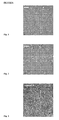
- Figure 1 shows a TEM of Example 7.2-13 according to the present invention.
- the light circles are the “islands” (phases) formed by the blocks of low Tg polymer (B), while the grey “sea” is the continuous phase of cured epoxy resin in which the blocks of polymer (A) are soluble.
- the larger islands have a diameter of approximately from 30 to 70 nm, while the smallest islands have a diameter of less than 20 nm.
- Figure 2 shows a TEM of Example 7.2-14.
- the largest islands have a diameter of approximately 20 nm, while the smallest islands have a diameter of approximately 5 nm.
- the islands are no longer isolated but arranged in three-dimensional ribbons.
- Figure 3 shows a TEM of Example 7.2-8. The very few large islands have a diameter of approximately 100 nm.
- Figure 4 shows a graph which displays the solvent uptake of Example 7.2.13 (particle dispersion) and Example 7.2.14 (particles aggregated in 3D-ribbon).
- the data demonstrate the influence of the morphology on the fluid resistance of nano-structured epoxy resins, illustrating that while co-continuous morphology (Ex. 7.2.14) leads to higher toughness, the solvent resistance of the epoxy resin is inferior to the particle dispersion morphology (Ex. 7.2.13).
- the resins used to prepare the films were mixed following the procedure described in example 7-2. They were used to impregnate a unidirectional carbon fibre tape (besfight® G40-800, 8400 dtex, tensile strength 5.6 GPa, tensile modulus 286 GPa, intermediate modulus type from Toho Tenax), using the dual filming technique. The mass fraction of resin in the finished prepreg was 35 %. Following the preparation of the prepregs, unidirectional laminates were prepared and tested for fracture toughness (G IC ) using Boeing test method BSS 7273.
- G IC fracture toughness
- Example 7.3-1 and 7.3-2 were also tested for tack properties, as described hereinabove.
- the dynamic viscosity of the resin used to prepare these examples was also tested, as described hereinabove.
- the results are presented in Table 4.4.
- Table 4.4 Tack properties and viscosity Example modifier mass fraction of modifier (%) Tack at 0 days Tack at 15 days ⁇ at 70°C (Pa•s) 7.3 - 1 PES 3 30 Low Low 330 7.3 - 2 M6 20 High High 95
- Example 7.3-2 is characterised by a high tack.
- Example 7.3-1 is characterised by a low tack. After 15 days of storage at room temperature (20°C and 50% relative humidity), the same behaviours are observed. A high tack is measured for Example 7.3-2 while a low tack is assessed for Example 7.3-1.
- the data demonstrate that not only does the block copolymer of the invention confer good tack properties to the carbon fibre prepregs, it also promotes a good retention of the tack over time.
Landscapes
- Chemical & Material Sciences (AREA)
- Chemical Kinetics & Catalysis (AREA)
- Medicinal Chemistry (AREA)
- Polymers & Plastics (AREA)
- Organic Chemistry (AREA)
- Health & Medical Sciences (AREA)
- Materials Engineering (AREA)
- Engineering & Computer Science (AREA)
- Manufacturing & Machinery (AREA)
- Inorganic Chemistry (AREA)
- Compositions Of Macromolecular Compounds (AREA)
- Other Resins Obtained By Reactions Not Involving Carbon-To-Carbon Unsaturated Bonds (AREA)
- Graft Or Block Polymers (AREA)
- Epoxy Resins (AREA)
- Polyesters Or Polycarbonates (AREA)
Applications Claiming Priority (2)
| Application Number | Priority Date | Filing Date | Title |
|---|---|---|---|
| GBGB1113196.8A GB201113196D0 (en) | 2011-08-01 | 2011-08-01 | Thermoset resin compositions with increased toughness |
| PCT/GB2012/051779 WO2013017843A2 (en) | 2011-08-01 | 2012-07-25 | Thermoset resin compositions with increased toughness |
Publications (2)
| Publication Number | Publication Date |
|---|---|
| EP2739672A2 EP2739672A2 (en) | 2014-06-11 |
| EP2739672B1 true EP2739672B1 (en) | 2015-11-18 |
Family
ID=44676505
Family Applications (1)
| Application Number | Title | Priority Date | Filing Date |
|---|---|---|---|
| EP12756801.2A Active EP2739672B1 (en) | 2011-08-01 | 2012-07-25 | Thermoset resin compositions with increased toughness |
Country Status (16)
| Country | Link |
|---|---|
| US (1) | US8907049B2 (enExample) |
| EP (1) | EP2739672B1 (enExample) |
| JP (1) | JP6184951B2 (enExample) |
| KR (1) | KR102000655B1 (enExample) |
| CN (1) | CN103906793B (enExample) |
| AU (1) | AU2012291863B2 (enExample) |
| BR (1) | BR112014002564B1 (enExample) |
| CA (1) | CA2843659C (enExample) |
| ES (1) | ES2562106T3 (enExample) |
| GB (1) | GB201113196D0 (enExample) |
| IN (1) | IN2014CN00768A (enExample) |
| MX (1) | MX343157B (enExample) |
| MY (1) | MY171025A (enExample) |
| RU (1) | RU2611628C2 (enExample) |
| TW (1) | TWI548698B (enExample) |
| WO (1) | WO2013017843A2 (enExample) |
Cited By (1)
| Publication number | Priority date | Publication date | Assignee | Title |
|---|---|---|---|---|
| DE102021121497A1 (de) | 2021-08-19 | 2023-02-23 | Fraunhofer-Gesellschaft zur Förderung der angewandten Forschung eingetragener Verein | Zusammensetzung zur Herstellung eines flächigen Halbzeugs |
Families Citing this family (22)
| Publication number | Priority date | Publication date | Assignee | Title |
|---|---|---|---|---|
| EP2808353A1 (en) * | 2013-05-31 | 2014-12-03 | Huntsman International Llc | A method for improving toughness of polyisocyanate polyaddition reaction products |
| JP5852633B2 (ja) * | 2013-07-04 | 2016-02-03 | 太陽インキ製造株式会社 | 硬化性樹脂組成物、その硬化物、これを有するプリント配線板、及び硬化物の製造方法 |
| JP2017523256A (ja) | 2014-05-22 | 2017-08-17 | サイテック インダストリーズ インコーポレイテッド | 強化剤として使用するための官能化重合体粒子 |
| US10023735B2 (en) | 2014-08-18 | 2018-07-17 | International Business Machines Corporation | 3D printing with PHT/PHA based materials and polymerizable monomers |
| US9957345B2 (en) | 2014-08-18 | 2018-05-01 | International Business Machines Corporation | 3D printing with PHT based materials |
| KR102408039B1 (ko) * | 2014-12-18 | 2022-06-13 | 사이텍 인더스트리스 인코포레이티드 | 액상 수지 주입에 적합한 개질된 수지 시스템 |
| US20190023863A1 (en) * | 2015-07-30 | 2019-01-24 | University Of Massachusetts | Impact modified compositions methods of manufacture thereof and articles comprising the same |
| US9758620B2 (en) | 2015-09-03 | 2017-09-12 | International Business Machines Corporation | Tailorable viscoelastic properties of PEG-hemiaminal organogel networks |
| KR101720563B1 (ko) * | 2015-11-05 | 2017-03-29 | 국방과학연구소 | 폴리술폰계 고분자 강인화제를 함유하는 폴리술폰계 고분자 강인화 에폭시 수지 조성물 및 이의 제조 방법 |
| US9873766B2 (en) | 2015-11-24 | 2018-01-23 | International Business Machines Corporation | Systems chemistry approach to polyhexahydrotriazine polymeric structures |
| US10968367B2 (en) | 2016-11-08 | 2021-04-06 | H.B. Fuller Company | Low temperature curable adhesive composition and articles including the same |
| JPWO2018131580A1 (ja) * | 2017-01-13 | 2019-11-07 | 東レ株式会社 | エポキシ樹脂組成物、エポキシ樹脂硬化物、プリプレグ、繊維強化複合材料、ブロック共重合体およびその製造方法 |
| US10213642B2 (en) * | 2017-04-28 | 2019-02-26 | Katie Swarts | Terrain belt for use with a treadmill |
| CN110914355A (zh) * | 2017-07-12 | 2020-03-24 | 赫克塞尔合成有限公司 | 树脂组合物 |
| KR102802243B1 (ko) * | 2018-03-16 | 2025-05-07 | 훈츠만 어드밴스트 머티리얼스 라이센싱 (스위처랜드) 게엠베하 | 저장 안정성 조성물 및 경화성 수지 조성물 |
| KR102311641B1 (ko) | 2018-11-23 | 2021-10-13 | 주식회사 엘지화학 | 수지 조성물, 이를 포함하는 프리프레그, 이를 포함하는 적층판, 및 이를 포함하는 수지 부착 금속박 |
| US11086200B2 (en) | 2019-03-20 | 2021-08-10 | Ticona Llc | Polymer composition for use in a camera module |
| CN113710738A (zh) * | 2019-03-20 | 2021-11-26 | 提克纳有限责任公司 | 用于相机模块的致动器组件 |
| KR20230146005A (ko) * | 2021-02-18 | 2023-10-18 | 도레이 카부시키가이샤 | 섬유 강화 복합 재료용 에폭시 수지 조성물, 섬유 강화복합 재료, 및 섬유 강화 복합 재료의 제조 방법 |
| US12209163B2 (en) | 2021-05-06 | 2025-01-28 | Ticona Llc | Polymer composition for use in a camera module |
| TW202340697A (zh) | 2021-12-13 | 2023-10-16 | 美商堤康那責任有限公司 | 樣品之滾珠凹部性質之測試技術 |
| JP7541419B2 (ja) | 2022-04-22 | 2024-08-28 | エル・コーポレイション | アクリレート官能基を有する線状ブロック共重合体強化剤 |
Family Cites Families (25)
| Publication number | Priority date | Publication date | Assignee | Title |
|---|---|---|---|---|
| GB1139413A (en) | 1965-02-03 | 1969-01-08 | Ici Fibres Ltd | Polyester/polycarbonate block copolymers |
| SU622823A1 (ru) * | 1975-11-17 | 1978-09-05 | Институт элементоорганических соединений АН СССР | Поли/арилат-сульфоны/дл конструкционных материалов и способ их получени |
| DE3275637D1 (en) | 1981-01-21 | 1987-04-16 | Ici Plc | Fibre-reinforced compositions and methods for producing such compositions |
| DE3375488D1 (en) | 1982-07-28 | 1988-03-03 | Ici Plc | Method of producing fibre-reinforced composition |
| ATE32226T1 (de) | 1982-07-28 | 1988-02-15 | Ici Plc | Verfahren zur herstellung von mit fasern verstaerkten zusammensetzungen. |
| ES2096549T3 (es) | 1987-10-05 | 1997-03-16 | Ici Plc | Composicion de polimeros. |
| US4972031A (en) | 1988-10-05 | 1990-11-20 | Imperial Chemical Industries Plc | Plastic moulding composition comprising an uncured or partly cured thermoset resin precursor and a polyarylsulphone |
| DE68911108T2 (de) * | 1988-11-03 | 1994-04-28 | Dow Chemical Co | Herstellung von Poly(arylether/thioether)-polyester-Blockcopolymeren. |
| EP0486197A3 (en) | 1990-11-13 | 1993-06-16 | Ici Composites Inc. | Resin bodies comprising a combination of thermoplastic and thermoset resin |
| FR2679237B1 (fr) | 1991-07-19 | 1994-07-22 | Atochem | Systeme d'amorcage pour la polymerisation anionique de monomeres (meth) acryliques. |
| JP3272032B2 (ja) * | 1992-04-24 | 2002-04-08 | 株式会社巴川製紙所 | 硬化性樹脂組成物 |
| GB9411367D0 (en) | 1994-06-07 | 1994-07-27 | Ici Composites Inc | Curable Composites |
| FR2735480B1 (fr) | 1995-06-15 | 1997-07-18 | Atochem Elf Sa | Procede de polymerisation anionique en continu d'au moins un monomere (meth)acrylique pour l'obtention de polymeres a haut taux de solide |
| US6046257A (en) | 1995-07-18 | 2000-04-04 | Toray Industries, Inc. | Composition for prepreg comprising epoxy resin, polyamide block copolymer and curing agent |
| GB9612523D0 (en) | 1996-06-14 | 1996-08-14 | Fiberite Inc | Improvements relating to resin compositions |
| GB9803714D0 (en) | 1998-02-24 | 1998-04-15 | Cytec Tech Corp | Process for preparing polymers |
| EP1317501B1 (en) * | 2000-08-22 | 2006-11-22 | Cytec Technology Corp. | Flexible polymer element as toughening agent in prepregs |
| GB0020620D0 (en) * | 2000-08-22 | 2000-10-11 | Cytec Tech Corp | Compostions adapted for chain linking |
| GB0020630D0 (en) | 2000-08-22 | 2000-10-11 | Cytec Tech Corp | Support structure or carrier for a curable composition |
| US8004504B2 (en) | 2004-09-27 | 2011-08-23 | Qualcomm Mems Technologies, Inc. | Reduced capacitance display element |
| CN101864261B (zh) | 2004-11-10 | 2012-09-05 | 陶氏环球技术有限责任公司 | 两性嵌段共聚物改性的环氧树脂以及由此制造的粘合剂 |
| JP5142726B2 (ja) | 2005-01-20 | 2013-02-13 | アルケマ フランス | 耐衝撃強度に優れた熱硬化性樹脂材料 |
| WO2006121961A1 (en) | 2005-05-09 | 2006-11-16 | Cytec Technology Corp. | Resin-soluble thermoplastic veil for composite materials |
| ES2335531T3 (es) | 2005-07-15 | 2010-03-29 | Huntsman Advanced Materials (Switzerland) Gmbh | Composicion de tenacidad a la fractura aumentada. |
| US9567426B2 (en) | 2009-05-29 | 2017-02-14 | Cytec Technology Corp. | Engineered crosslinked thermoplastic particles for interlaminar toughening |
-
2011
- 2011-08-01 GB GBGB1113196.8A patent/GB201113196D0/en not_active Ceased
-
2012
- 2012-06-21 TW TW101122289A patent/TWI548698B/zh not_active IP Right Cessation
- 2012-07-20 US US13/554,027 patent/US8907049B2/en active Active
- 2012-07-25 RU RU2014107837A patent/RU2611628C2/ru active
- 2012-07-25 IN IN768CHN2014 patent/IN2014CN00768A/en unknown
- 2012-07-25 KR KR1020147005303A patent/KR102000655B1/ko not_active Expired - Fee Related
- 2012-07-25 BR BR112014002564-9A patent/BR112014002564B1/pt not_active IP Right Cessation
- 2012-07-25 AU AU2012291863A patent/AU2012291863B2/en not_active Ceased
- 2012-07-25 CN CN201280038500.3A patent/CN103906793B/zh active Active
- 2012-07-25 EP EP12756801.2A patent/EP2739672B1/en active Active
- 2012-07-25 CA CA2843659A patent/CA2843659C/en active Active
- 2012-07-25 WO PCT/GB2012/051779 patent/WO2013017843A2/en not_active Ceased
- 2012-07-25 ES ES12756801.2T patent/ES2562106T3/es active Active
- 2012-07-25 JP JP2014523384A patent/JP6184951B2/ja active Active
- 2012-07-25 MY MYPI2014000095A patent/MY171025A/en unknown
- 2012-07-25 MX MX2014001309A patent/MX343157B/es active IP Right Grant
Non-Patent Citations (1)
| Title |
|---|
| BIN ZHANG ET AL: "Synthesis of cyclohexene ring containing semi-crystalline poly(arylene ether sulfones) (PAES)", POLYMER PREPRINTS, AMERICAN CHEMICAL SOCIETY, US, vol. 51, 1 January 2010 (2010-01-01), pages 217 - 218, XP008166774, ISSN: 0032-3934 * |
Cited By (1)
| Publication number | Priority date | Publication date | Assignee | Title |
|---|---|---|---|---|
| DE102021121497A1 (de) | 2021-08-19 | 2023-02-23 | Fraunhofer-Gesellschaft zur Förderung der angewandten Forschung eingetragener Verein | Zusammensetzung zur Herstellung eines flächigen Halbzeugs |
Also Published As
| Publication number | Publication date |
|---|---|
| TWI548698B (zh) | 2016-09-11 |
| KR20140063647A (ko) | 2014-05-27 |
| KR102000655B1 (ko) | 2019-07-16 |
| TW201307479A (zh) | 2013-02-16 |
| MX2014001309A (es) | 2014-04-14 |
| US8907049B2 (en) | 2014-12-09 |
| JP6184951B2 (ja) | 2017-08-23 |
| EP2739672A2 (en) | 2014-06-11 |
| GB201113196D0 (en) | 2011-09-14 |
| MX343157B (es) | 2016-10-26 |
| WO2013017843A2 (en) | 2013-02-07 |
| CN103906793B (zh) | 2016-04-27 |
| ES2562106T3 (es) | 2016-03-02 |
| RU2611628C2 (ru) | 2017-02-28 |
| JP2014521800A (ja) | 2014-08-28 |
| IN2014CN00768A (enExample) | 2015-04-03 |
| AU2012291863A1 (en) | 2014-01-23 |
| CA2843659A1 (en) | 2013-02-07 |
| BR112014002564B1 (pt) | 2021-04-06 |
| BR112014002564A2 (pt) | 2017-02-21 |
| US20130184376A1 (en) | 2013-07-18 |
| WO2013017843A3 (en) | 2013-06-13 |
| CN103906793A (zh) | 2014-07-02 |
| RU2014107837A (ru) | 2015-09-10 |
| CA2843659C (en) | 2020-01-14 |
| MY171025A (en) | 2019-09-23 |
| AU2012291863B2 (en) | 2015-06-25 |
Similar Documents
| Publication | Publication Date | Title |
|---|---|---|
| AU2012291863B2 (en) | Thermoset resin compositions with increased toughness | |
| US10815373B2 (en) | Thermoset resin composite materials comprising inter-laminar toughening particles | |
| US10682791B2 (en) | Modified resin systems suitable for liquid resin infusion | |
| JPH07278412A (ja) | エポキシ樹脂組成物、プリプレグおよび繊維強化プラスチック | |
| JPWO2018131580A1 (ja) | エポキシ樹脂組成物、エポキシ樹脂硬化物、プリプレグ、繊維強化複合材料、ブロック共重合体およびその製造方法 |
Legal Events
| Date | Code | Title | Description |
|---|---|---|---|
| PUAI | Public reference made under article 153(3) epc to a published international application that has entered the european phase |
Free format text: ORIGINAL CODE: 0009012 |
|
| 17P | Request for examination filed |
Effective date: 20140116 |
|
| AK | Designated contracting states |
Kind code of ref document: A2 Designated state(s): AL AT BE BG CH CY CZ DE DK EE ES FI FR GB GR HR HU IE IS IT LI LT LU LV MC MK MT NL NO PL PT RO RS SE SI SK SM TR |
|
| DAX | Request for extension of the european patent (deleted) | ||
| 17Q | First examination report despatched |
Effective date: 20141113 |
|
| GRAP | Despatch of communication of intention to grant a patent |
Free format text: ORIGINAL CODE: EPIDOSNIGR1 |
|
| INTG | Intention to grant announced |
Effective date: 20150612 |
|
| GRAS | Grant fee paid |
Free format text: ORIGINAL CODE: EPIDOSNIGR3 |
|
| GRAA | (expected) grant |
Free format text: ORIGINAL CODE: 0009210 |
|
| AK | Designated contracting states |
Kind code of ref document: B1 Designated state(s): AL AT BE BG CH CY CZ DE DK EE ES FI FR GB GR HR HU IE IS IT LI LT LU LV MC MK MT NL NO PL PT RO RS SE SI SK SM TR |
|
| REG | Reference to a national code |
Ref country code: GB Ref legal event code: FG4D |
|
| REG | Reference to a national code |
Ref country code: CH Ref legal event code: EP |
|
| REG | Reference to a national code |
Ref country code: AT Ref legal event code: REF Ref document number: 761544 Country of ref document: AT Kind code of ref document: T Effective date: 20151215 |
|
| REG | Reference to a national code |
Ref country code: IE Ref legal event code: FG4D |
|
| REG | Reference to a national code |
Ref country code: DE Ref legal event code: R096 Ref document number: 602012012403 Country of ref document: DE |
|
| REG | Reference to a national code |
Ref country code: SE Ref legal event code: TRGR |
|
| REG | Reference to a national code |
Ref country code: ES Ref legal event code: FG2A Ref document number: 2562106 Country of ref document: ES Kind code of ref document: T3 Effective date: 20160302 Ref country code: NL Ref legal event code: FP |
|
| REG | Reference to a national code |
Ref country code: LT Ref legal event code: MG4D |
|
| PG25 | Lapsed in a contracting state [announced via postgrant information from national office to epo] |
Ref country code: HR Free format text: LAPSE BECAUSE OF FAILURE TO SUBMIT A TRANSLATION OF THE DESCRIPTION OR TO PAY THE FEE WITHIN THE PRESCRIBED TIME-LIMIT Effective date: 20151118 Ref country code: NO Free format text: LAPSE BECAUSE OF FAILURE TO SUBMIT A TRANSLATION OF THE DESCRIPTION OR TO PAY THE FEE WITHIN THE PRESCRIBED TIME-LIMIT Effective date: 20160218 Ref country code: LT Free format text: LAPSE BECAUSE OF FAILURE TO SUBMIT A TRANSLATION OF THE DESCRIPTION OR TO PAY THE FEE WITHIN THE PRESCRIBED TIME-LIMIT Effective date: 20151118 Ref country code: IS Free format text: LAPSE BECAUSE OF FAILURE TO SUBMIT A TRANSLATION OF THE DESCRIPTION OR TO PAY THE FEE WITHIN THE PRESCRIBED TIME-LIMIT Effective date: 20160318 |
|
| PG25 | Lapsed in a contracting state [announced via postgrant information from national office to epo] |
Ref country code: PL Free format text: LAPSE BECAUSE OF FAILURE TO SUBMIT A TRANSLATION OF THE DESCRIPTION OR TO PAY THE FEE WITHIN THE PRESCRIBED TIME-LIMIT Effective date: 20151118 Ref country code: LV Free format text: LAPSE BECAUSE OF FAILURE TO SUBMIT A TRANSLATION OF THE DESCRIPTION OR TO PAY THE FEE WITHIN THE PRESCRIBED TIME-LIMIT Effective date: 20151118 Ref country code: FI Free format text: LAPSE BECAUSE OF FAILURE TO SUBMIT A TRANSLATION OF THE DESCRIPTION OR TO PAY THE FEE WITHIN THE PRESCRIBED TIME-LIMIT Effective date: 20151118 Ref country code: RS Free format text: LAPSE BECAUSE OF FAILURE TO SUBMIT A TRANSLATION OF THE DESCRIPTION OR TO PAY THE FEE WITHIN THE PRESCRIBED TIME-LIMIT Effective date: 20151118 Ref country code: PT Free format text: LAPSE BECAUSE OF FAILURE TO SUBMIT A TRANSLATION OF THE DESCRIPTION OR TO PAY THE FEE WITHIN THE PRESCRIBED TIME-LIMIT Effective date: 20160318 Ref country code: GR Free format text: LAPSE BECAUSE OF FAILURE TO SUBMIT A TRANSLATION OF THE DESCRIPTION OR TO PAY THE FEE WITHIN THE PRESCRIBED TIME-LIMIT Effective date: 20160219 |
|
| REG | Reference to a national code |
Ref country code: FR Ref legal event code: PLFP Year of fee payment: 5 |
|
| PG25 | Lapsed in a contracting state [announced via postgrant information from national office to epo] |
Ref country code: CZ Free format text: LAPSE BECAUSE OF FAILURE TO SUBMIT A TRANSLATION OF THE DESCRIPTION OR TO PAY THE FEE WITHIN THE PRESCRIBED TIME-LIMIT Effective date: 20151118 |
|
| REG | Reference to a national code |
Ref country code: DE Ref legal event code: R097 Ref document number: 602012012403 Country of ref document: DE |
|
| PG25 | Lapsed in a contracting state [announced via postgrant information from national office to epo] |
Ref country code: SM Free format text: LAPSE BECAUSE OF FAILURE TO SUBMIT A TRANSLATION OF THE DESCRIPTION OR TO PAY THE FEE WITHIN THE PRESCRIBED TIME-LIMIT Effective date: 20151118 Ref country code: SK Free format text: LAPSE BECAUSE OF FAILURE TO SUBMIT A TRANSLATION OF THE DESCRIPTION OR TO PAY THE FEE WITHIN THE PRESCRIBED TIME-LIMIT Effective date: 20151118 Ref country code: RO Free format text: LAPSE BECAUSE OF FAILURE TO SUBMIT A TRANSLATION OF THE DESCRIPTION OR TO PAY THE FEE WITHIN THE PRESCRIBED TIME-LIMIT Effective date: 20151118 Ref country code: EE Free format text: LAPSE BECAUSE OF FAILURE TO SUBMIT A TRANSLATION OF THE DESCRIPTION OR TO PAY THE FEE WITHIN THE PRESCRIBED TIME-LIMIT Effective date: 20151118 Ref country code: DK Free format text: LAPSE BECAUSE OF FAILURE TO SUBMIT A TRANSLATION OF THE DESCRIPTION OR TO PAY THE FEE WITHIN THE PRESCRIBED TIME-LIMIT Effective date: 20151118 |
|
| PLBE | No opposition filed within time limit |
Free format text: ORIGINAL CODE: 0009261 |
|
| STAA | Information on the status of an ep patent application or granted ep patent |
Free format text: STATUS: NO OPPOSITION FILED WITHIN TIME LIMIT |
|
| 26N | No opposition filed |
Effective date: 20160819 |
|
| PG25 | Lapsed in a contracting state [announced via postgrant information from national office to epo] |
Ref country code: SI Free format text: LAPSE BECAUSE OF FAILURE TO SUBMIT A TRANSLATION OF THE DESCRIPTION OR TO PAY THE FEE WITHIN THE PRESCRIBED TIME-LIMIT Effective date: 20151118 |
|
| REG | Reference to a national code |
Ref country code: CH Ref legal event code: PL |
|
| PG25 | Lapsed in a contracting state [announced via postgrant information from national office to epo] |
Ref country code: MC Free format text: LAPSE BECAUSE OF FAILURE TO SUBMIT A TRANSLATION OF THE DESCRIPTION OR TO PAY THE FEE WITHIN THE PRESCRIBED TIME-LIMIT Effective date: 20151118 |
|
| PG25 | Lapsed in a contracting state [announced via postgrant information from national office to epo] |
Ref country code: CH Free format text: LAPSE BECAUSE OF NON-PAYMENT OF DUE FEES Effective date: 20160731 Ref country code: LI Free format text: LAPSE BECAUSE OF NON-PAYMENT OF DUE FEES Effective date: 20160731 |
|
| REG | Reference to a national code |
Ref country code: IE Ref legal event code: MM4A |
|
| REG | Reference to a national code |
Ref country code: FR Ref legal event code: PLFP Year of fee payment: 6 |
|
| PG25 | Lapsed in a contracting state [announced via postgrant information from national office to epo] |
Ref country code: IE Free format text: LAPSE BECAUSE OF NON-PAYMENT OF DUE FEES Effective date: 20160725 |
|
| PG25 | Lapsed in a contracting state [announced via postgrant information from national office to epo] |
Ref country code: LU Free format text: LAPSE BECAUSE OF NON-PAYMENT OF DUE FEES Effective date: 20160725 |
|
| REG | Reference to a national code |
Ref country code: AT Ref legal event code: UEP Ref document number: 761544 Country of ref document: AT Kind code of ref document: T Effective date: 20151118 |
|
| PG25 | Lapsed in a contracting state [announced via postgrant information from national office to epo] |
Ref country code: HU Free format text: LAPSE BECAUSE OF FAILURE TO SUBMIT A TRANSLATION OF THE DESCRIPTION OR TO PAY THE FEE WITHIN THE PRESCRIBED TIME-LIMIT; INVALID AB INITIO Effective date: 20120725 Ref country code: CY Free format text: LAPSE BECAUSE OF FAILURE TO SUBMIT A TRANSLATION OF THE DESCRIPTION OR TO PAY THE FEE WITHIN THE PRESCRIBED TIME-LIMIT Effective date: 20151118 |
|
| REG | Reference to a national code |
Ref country code: FR Ref legal event code: PLFP Year of fee payment: 7 |
|
| PG25 | Lapsed in a contracting state [announced via postgrant information from national office to epo] |
Ref country code: MK Free format text: LAPSE BECAUSE OF FAILURE TO SUBMIT A TRANSLATION OF THE DESCRIPTION OR TO PAY THE FEE WITHIN THE PRESCRIBED TIME-LIMIT Effective date: 20151118 Ref country code: MT Free format text: LAPSE BECAUSE OF NON-PAYMENT OF DUE FEES Effective date: 20160731 |
|
| PG25 | Lapsed in a contracting state [announced via postgrant information from national office to epo] |
Ref country code: BG Free format text: LAPSE BECAUSE OF FAILURE TO SUBMIT A TRANSLATION OF THE DESCRIPTION OR TO PAY THE FEE WITHIN THE PRESCRIBED TIME-LIMIT Effective date: 20151118 |
|
| PG25 | Lapsed in a contracting state [announced via postgrant information from national office to epo] |
Ref country code: AL Free format text: LAPSE BECAUSE OF FAILURE TO SUBMIT A TRANSLATION OF THE DESCRIPTION OR TO PAY THE FEE WITHIN THE PRESCRIBED TIME-LIMIT Effective date: 20151118 |
|
| PGFP | Annual fee paid to national office [announced via postgrant information from national office to epo] |
Ref country code: TR Payment date: 20180711 Year of fee payment: 7 |
|
| PG25 | Lapsed in a contracting state [announced via postgrant information from national office to epo] |
Ref country code: TR Free format text: LAPSE BECAUSE OF NON-PAYMENT OF DUE FEES Effective date: 20190725 |
|
| PGFP | Annual fee paid to national office [announced via postgrant information from national office to epo] |
Ref country code: SE Payment date: 20220615 Year of fee payment: 11 |
|
| PGFP | Annual fee paid to national office [announced via postgrant information from national office to epo] |
Ref country code: BE Payment date: 20220615 Year of fee payment: 11 |
|
| PGFP | Annual fee paid to national office [announced via postgrant information from national office to epo] |
Ref country code: AT Payment date: 20220627 Year of fee payment: 11 |
|
| P01 | Opt-out of the competence of the unified patent court (upc) registered |
Effective date: 20230624 |
|
| REG | Reference to a national code |
Ref country code: SE Ref legal event code: EUG |
|
| REG | Reference to a national code |
Ref country code: AT Ref legal event code: MM01 Ref document number: 761544 Country of ref document: AT Kind code of ref document: T Effective date: 20230725 |
|
| REG | Reference to a national code |
Ref country code: BE Ref legal event code: MM Effective date: 20230731 |
|
| PG25 | Lapsed in a contracting state [announced via postgrant information from national office to epo] |
Ref country code: AT Free format text: LAPSE BECAUSE OF NON-PAYMENT OF DUE FEES Effective date: 20230725 |
|
| PG25 | Lapsed in a contracting state [announced via postgrant information from national office to epo] |
Ref country code: AT Free format text: LAPSE BECAUSE OF NON-PAYMENT OF DUE FEES Effective date: 20230725 |
|
| PG25 | Lapsed in a contracting state [announced via postgrant information from national office to epo] |
Ref country code: SE Free format text: LAPSE BECAUSE OF NON-PAYMENT OF DUE FEES Effective date: 20230726 Ref country code: BE Free format text: LAPSE BECAUSE OF NON-PAYMENT OF DUE FEES Effective date: 20230731 |
|
| PGFP | Annual fee paid to national office [announced via postgrant information from national office to epo] |
Ref country code: ES Payment date: 20250801 Year of fee payment: 14 |
|
| PGFP | Annual fee paid to national office [announced via postgrant information from national office to epo] |
Ref country code: DE Payment date: 20250604 Year of fee payment: 14 |
|
| PGFP | Annual fee paid to national office [announced via postgrant information from national office to epo] |
Ref country code: GB Payment date: 20260608 Year of fee payment: 15 |
|
| PGFP | Annual fee paid to national office [announced via postgrant information from national office to epo] |
Ref country code: IT Payment date: 20260622 Year of fee payment: 15 |
|
| PGFP | Annual fee paid to national office [announced via postgrant information from national office to epo] |
Ref country code: NL Payment date: 20260615 Year of fee payment: 15 |
|
| PGFP | Annual fee paid to national office [announced via postgrant information from national office to epo] |
Ref country code: FR Payment date: 20260608 Year of fee payment: 15 |