EP2736717B1 - Robust planar composite with an intermediate layer of increased vicat softening temperature - Google Patents
Robust planar composite with an intermediate layer of increased vicat softening temperature Download PDFInfo
- Publication number
- EP2736717B1 EP2736717B1 EP12743672.3A EP12743672A EP2736717B1 EP 2736717 B1 EP2736717 B1 EP 2736717B1 EP 12743672 A EP12743672 A EP 12743672A EP 2736717 B1 EP2736717 B1 EP 2736717B1
- Authority
- EP
- European Patent Office
- Prior art keywords
- layer
- thermoplastic
- layers
- ksa
- ksw
- Prior art date
- Legal status (The legal status is an assumption and is not a legal conclusion. Google has not performed a legal analysis and makes no representation as to the accuracy of the status listed.)
- Active
Links
Images



Classifications
-
- B—PERFORMING OPERATIONS; TRANSPORTING
- B32—LAYERED PRODUCTS
- B32B—LAYERED PRODUCTS, i.e. PRODUCTS BUILT-UP OF STRATA OF FLAT OR NON-FLAT, e.g. CELLULAR OR HONEYCOMB, FORM
- B32B1/00—Layered products having a non-planar shape
-
- B—PERFORMING OPERATIONS; TRANSPORTING
- B32—LAYERED PRODUCTS
- B32B—LAYERED PRODUCTS, i.e. PRODUCTS BUILT-UP OF STRATA OF FLAT OR NON-FLAT, e.g. CELLULAR OR HONEYCOMB, FORM
- B32B27/00—Layered products comprising a layer of synthetic resin
-
- B—PERFORMING OPERATIONS; TRANSPORTING
- B32—LAYERED PRODUCTS
- B32B—LAYERED PRODUCTS, i.e. PRODUCTS BUILT-UP OF STRATA OF FLAT OR NON-FLAT, e.g. CELLULAR OR HONEYCOMB, FORM
- B32B15/00—Layered products comprising a layer of metal
- B32B15/04—Layered products comprising a layer of metal comprising metal as the main or only constituent of a layer, which is next to another layer of the same or of a different material
- B32B15/08—Layered products comprising a layer of metal comprising metal as the main or only constituent of a layer, which is next to another layer of the same or of a different material of synthetic resin
-
- B—PERFORMING OPERATIONS; TRANSPORTING
- B32—LAYERED PRODUCTS
- B32B—LAYERED PRODUCTS, i.e. PRODUCTS BUILT-UP OF STRATA OF FLAT OR NON-FLAT, e.g. CELLULAR OR HONEYCOMB, FORM
- B32B15/00—Layered products comprising a layer of metal
- B32B15/20—Layered products comprising a layer of metal comprising aluminium or copper
-
- B—PERFORMING OPERATIONS; TRANSPORTING
- B32—LAYERED PRODUCTS
- B32B—LAYERED PRODUCTS, i.e. PRODUCTS BUILT-UP OF STRATA OF FLAT OR NON-FLAT, e.g. CELLULAR OR HONEYCOMB, FORM
- B32B27/00—Layered products comprising a layer of synthetic resin
- B32B27/06—Layered products comprising a layer of synthetic resin as the main or only constituent of a layer, which is next to another layer of the same or of a different material
- B32B27/08—Layered products comprising a layer of synthetic resin as the main or only constituent of a layer, which is next to another layer of the same or of a different material of synthetic resin
-
- B—PERFORMING OPERATIONS; TRANSPORTING
- B32—LAYERED PRODUCTS
- B32B—LAYERED PRODUCTS, i.e. PRODUCTS BUILT-UP OF STRATA OF FLAT OR NON-FLAT, e.g. CELLULAR OR HONEYCOMB, FORM
- B32B27/00—Layered products comprising a layer of synthetic resin
- B32B27/06—Layered products comprising a layer of synthetic resin as the main or only constituent of a layer, which is next to another layer of the same or of a different material
- B32B27/10—Layered products comprising a layer of synthetic resin as the main or only constituent of a layer, which is next to another layer of the same or of a different material of paper or cardboard
-
- B—PERFORMING OPERATIONS; TRANSPORTING
- B32—LAYERED PRODUCTS
- B32B—LAYERED PRODUCTS, i.e. PRODUCTS BUILT-UP OF STRATA OF FLAT OR NON-FLAT, e.g. CELLULAR OR HONEYCOMB, FORM
- B32B27/00—Layered products comprising a layer of synthetic resin
- B32B27/30—Layered products comprising a layer of synthetic resin comprising vinyl (co)polymers; comprising acrylic (co)polymers
- B32B27/308—Layered products comprising a layer of synthetic resin comprising vinyl (co)polymers; comprising acrylic (co)polymers comprising acrylic (co)polymers
-
- B—PERFORMING OPERATIONS; TRANSPORTING
- B32—LAYERED PRODUCTS
- B32B—LAYERED PRODUCTS, i.e. PRODUCTS BUILT-UP OF STRATA OF FLAT OR NON-FLAT, e.g. CELLULAR OR HONEYCOMB, FORM
- B32B27/00—Layered products comprising a layer of synthetic resin
- B32B27/32—Layered products comprising a layer of synthetic resin comprising polyolefins
-
- B—PERFORMING OPERATIONS; TRANSPORTING
- B32—LAYERED PRODUCTS
- B32B—LAYERED PRODUCTS, i.e. PRODUCTS BUILT-UP OF STRATA OF FLAT OR NON-FLAT, e.g. CELLULAR OR HONEYCOMB, FORM
- B32B27/00—Layered products comprising a layer of synthetic resin
- B32B27/32—Layered products comprising a layer of synthetic resin comprising polyolefins
- B32B27/327—Layered products comprising a layer of synthetic resin comprising polyolefins comprising polyolefins obtained by a metallocene or single-site catalyst
-
- B—PERFORMING OPERATIONS; TRANSPORTING
- B32—LAYERED PRODUCTS
- B32B—LAYERED PRODUCTS, i.e. PRODUCTS BUILT-UP OF STRATA OF FLAT OR NON-FLAT, e.g. CELLULAR OR HONEYCOMB, FORM
- B32B3/00—Layered products comprising a layer with external or internal discontinuities or unevennesses, or a layer of non-planar shape; Layered products comprising a layer having particular features of form
- B32B3/26—Layered products comprising a layer with external or internal discontinuities or unevennesses, or a layer of non-planar shape; Layered products comprising a layer having particular features of form characterised by a particular shape of the outline of the cross-section of a continuous layer; characterised by a layer with cavities or internal voids ; characterised by an apertured layer
- B32B3/266—Layered products comprising a layer with external or internal discontinuities or unevennesses, or a layer of non-planar shape; Layered products comprising a layer having particular features of form characterised by a particular shape of the outline of the cross-section of a continuous layer; characterised by a layer with cavities or internal voids ; characterised by an apertured layer characterised by an apertured layer, the apertures going through the whole thickness of the layer, e.g. expanded metal, perforated layer, slit layer regular cells B32B3/12
-
- B—PERFORMING OPERATIONS; TRANSPORTING
- B32—LAYERED PRODUCTS
- B32B—LAYERED PRODUCTS, i.e. PRODUCTS BUILT-UP OF STRATA OF FLAT OR NON-FLAT, e.g. CELLULAR OR HONEYCOMB, FORM
- B32B7/00—Layered products characterised by the relation between layers; Layered products characterised by the relative orientation of features between layers, or by the relative values of a measurable parameter between layers, i.e. products comprising layers having different physical, chemical or physicochemical properties; Layered products characterised by the interconnection of layers
- B32B7/02—Physical, chemical or physicochemical properties
- B32B7/027—Thermal properties
-
- B—PERFORMING OPERATIONS; TRANSPORTING
- B32—LAYERED PRODUCTS
- B32B—LAYERED PRODUCTS, i.e. PRODUCTS BUILT-UP OF STRATA OF FLAT OR NON-FLAT, e.g. CELLULAR OR HONEYCOMB, FORM
- B32B7/00—Layered products characterised by the relation between layers; Layered products characterised by the relative orientation of features between layers, or by the relative values of a measurable parameter between layers, i.e. products comprising layers having different physical, chemical or physicochemical properties; Layered products characterised by the interconnection of layers
- B32B7/04—Interconnection of layers
- B32B7/12—Interconnection of layers using interposed adhesives or interposed materials with bonding properties
-
- B—PERFORMING OPERATIONS; TRANSPORTING
- B31—MAKING ARTICLES OF PAPER, CARDBOARD OR MATERIAL WORKED IN A MANNER ANALOGOUS TO PAPER; WORKING PAPER, CARDBOARD OR MATERIAL WORKED IN A MANNER ANALOGOUS TO PAPER
- B31B—MAKING CONTAINERS OF PAPER, CARDBOARD OR MATERIAL WORKED IN A MANNER ANALOGOUS TO PAPER
- B31B50/00—Making rigid or semi-rigid containers, e.g. boxes or cartons
- B31B50/26—Folding sheets, blanks or webs
-
- B—PERFORMING OPERATIONS; TRANSPORTING
- B32—LAYERED PRODUCTS
- B32B—LAYERED PRODUCTS, i.e. PRODUCTS BUILT-UP OF STRATA OF FLAT OR NON-FLAT, e.g. CELLULAR OR HONEYCOMB, FORM
- B32B2250/00—Layers arrangement
- B32B2250/05—5 or more layers
-
- B—PERFORMING OPERATIONS; TRANSPORTING
- B32—LAYERED PRODUCTS
- B32B—LAYERED PRODUCTS, i.e. PRODUCTS BUILT-UP OF STRATA OF FLAT OR NON-FLAT, e.g. CELLULAR OR HONEYCOMB, FORM
- B32B2270/00—Resin or rubber layer containing a blend of at least two different polymers
-
- B—PERFORMING OPERATIONS; TRANSPORTING
- B32—LAYERED PRODUCTS
- B32B—LAYERED PRODUCTS, i.e. PRODUCTS BUILT-UP OF STRATA OF FLAT OR NON-FLAT, e.g. CELLULAR OR HONEYCOMB, FORM
- B32B2307/00—Properties of the layers or laminate
- B32B2307/50—Properties of the layers or laminate having particular mechanical properties
- B32B2307/514—Oriented
- B32B2307/516—Oriented mono-axially
-
- B—PERFORMING OPERATIONS; TRANSPORTING
- B32—LAYERED PRODUCTS
- B32B—LAYERED PRODUCTS, i.e. PRODUCTS BUILT-UP OF STRATA OF FLAT OR NON-FLAT, e.g. CELLULAR OR HONEYCOMB, FORM
- B32B2307/00—Properties of the layers or laminate
- B32B2307/70—Other properties
- B32B2307/718—Weight, e.g. weight per square meter
-
- B—PERFORMING OPERATIONS; TRANSPORTING
- B32—LAYERED PRODUCTS
- B32B—LAYERED PRODUCTS, i.e. PRODUCTS BUILT-UP OF STRATA OF FLAT OR NON-FLAT, e.g. CELLULAR OR HONEYCOMB, FORM
- B32B2307/00—Properties of the layers or laminate
- B32B2307/70—Other properties
- B32B2307/724—Permeability to gases, adsorption
- B32B2307/7242—Non-permeable
- B32B2307/7244—Oxygen barrier
-
- B—PERFORMING OPERATIONS; TRANSPORTING
- B32—LAYERED PRODUCTS
- B32B—LAYERED PRODUCTS, i.e. PRODUCTS BUILT-UP OF STRATA OF FLAT OR NON-FLAT, e.g. CELLULAR OR HONEYCOMB, FORM
- B32B2307/00—Properties of the layers or laminate
- B32B2307/70—Other properties
- B32B2307/724—Permeability to gases, adsorption
- B32B2307/7242—Non-permeable
- B32B2307/7246—Water vapor barrier
-
- B—PERFORMING OPERATIONS; TRANSPORTING
- B32—LAYERED PRODUCTS
- B32B—LAYERED PRODUCTS, i.e. PRODUCTS BUILT-UP OF STRATA OF FLAT OR NON-FLAT, e.g. CELLULAR OR HONEYCOMB, FORM
- B32B2307/00—Properties of the layers or laminate
- B32B2307/70—Other properties
- B32B2307/726—Permeability to liquids, absorption
- B32B2307/7265—Non-permeable
-
- B—PERFORMING OPERATIONS; TRANSPORTING
- B32—LAYERED PRODUCTS
- B32B—LAYERED PRODUCTS, i.e. PRODUCTS BUILT-UP OF STRATA OF FLAT OR NON-FLAT, e.g. CELLULAR OR HONEYCOMB, FORM
- B32B2439/00—Containers; Receptacles
- B32B2439/40—Closed containers
- B32B2439/62—Boxes, cartons, cases
-
- B—PERFORMING OPERATIONS; TRANSPORTING
- B32—LAYERED PRODUCTS
- B32B—LAYERED PRODUCTS, i.e. PRODUCTS BUILT-UP OF STRATA OF FLAT OR NON-FLAT, e.g. CELLULAR OR HONEYCOMB, FORM
- B32B2439/00—Containers; Receptacles
- B32B2439/70—Food packaging
-
- B—PERFORMING OPERATIONS; TRANSPORTING
- B65—CONVEYING; PACKING; STORING; HANDLING THIN OR FILAMENTARY MATERIAL
- B65D—CONTAINERS FOR STORAGE OR TRANSPORT OF ARTICLES OR MATERIALS, e.g. BAGS, BARRELS, BOTTLES, BOXES, CANS, CARTONS, CRATES, DRUMS, JARS, TANKS, HOPPERS, FORWARDING CONTAINERS; ACCESSORIES, CLOSURES, OR FITTINGS THEREFOR; PACKAGING ELEMENTS; PACKAGES
- B65D5/00—Rigid or semi-rigid containers of polygonal cross-section, e.g. boxes, cartons or trays, formed by folding or erecting one or more blanks made of paper
-
- Y—GENERAL TAGGING OF NEW TECHNOLOGICAL DEVELOPMENTS; GENERAL TAGGING OF CROSS-SECTIONAL TECHNOLOGIES SPANNING OVER SEVERAL SECTIONS OF THE IPC; TECHNICAL SUBJECTS COVERED BY FORMER USPC CROSS-REFERENCE ART COLLECTIONS [XRACs] AND DIGESTS
- Y10—TECHNICAL SUBJECTS COVERED BY FORMER USPC
- Y10T—TECHNICAL SUBJECTS COVERED BY FORMER US CLASSIFICATION
- Y10T428/00—Stock material or miscellaneous articles
- Y10T428/13—Hollow or container type article [e.g., tube, vase, etc.]
- Y10T428/1352—Polymer or resin containing [i.e., natural or synthetic]
-
- Y—GENERAL TAGGING OF NEW TECHNOLOGICAL DEVELOPMENTS; GENERAL TAGGING OF CROSS-SECTIONAL TECHNOLOGIES SPANNING OVER SEVERAL SECTIONS OF THE IPC; TECHNICAL SUBJECTS COVERED BY FORMER USPC CROSS-REFERENCE ART COLLECTIONS [XRACs] AND DIGESTS
- Y10—TECHNICAL SUBJECTS COVERED BY FORMER USPC
- Y10T—TECHNICAL SUBJECTS COVERED BY FORMER US CLASSIFICATION
- Y10T428/00—Stock material or miscellaneous articles
- Y10T428/24—Structurally defined web or sheet [e.g., overall dimension, etc.]
- Y10T428/24273—Structurally defined web or sheet [e.g., overall dimension, etc.] including aperture
- Y10T428/24322—Composite web or sheet
- Y10T428/24331—Composite web or sheet including nonapertured component
-
- Y—GENERAL TAGGING OF NEW TECHNOLOGICAL DEVELOPMENTS; GENERAL TAGGING OF CROSS-SECTIONAL TECHNOLOGIES SPANNING OVER SEVERAL SECTIONS OF THE IPC; TECHNICAL SUBJECTS COVERED BY FORMER USPC CROSS-REFERENCE ART COLLECTIONS [XRACs] AND DIGESTS
- Y10—TECHNICAL SUBJECTS COVERED BY FORMER USPC
- Y10T—TECHNICAL SUBJECTS COVERED BY FORMER US CLASSIFICATION
- Y10T428/00—Stock material or miscellaneous articles
- Y10T428/24—Structurally defined web or sheet [e.g., overall dimension, etc.]
- Y10T428/24942—Structurally defined web or sheet [e.g., overall dimension, etc.] including components having same physical characteristic in differing degree
Definitions
- the present invention generally relates to a sheetlike composite comprising a layer configuration with the following layers in the sequence shown:
- the object of present invention is to at least partly eliminate the disadvantages emerging from the prior art.
- a further object is to provide a composite which has a sealing window which is as large as possible.
- a further object is to provide a sheetlike composite which is suitable in particular for the production of containers for transportation and storage of milk, milk products, drinks containing vitamin C and other drinks, foodstuffs, drinks of low carbonic acid content or animal feed products and the like.
- joind used in this description includes the adhesion of two objects beyond van der Waals forces of attraction. These objects can either follow one another directly or be joined to one another via further objects.
- thermoplastic KSu can be provided on the side of the carrier layer directed towards the environment.
- the layer of thermoplastic KSu can also be joined here indirectly or directly to the carrier layer, direct joining being preferred.
- a further layer or several further layers may additionally be provided over the complete or a part of the area on the side of the layer of thermoplastic KSu facing the environment.
- a printed layer may also be applied on the side of the layer of thermoplastic KSu facing the environment.
- possible further layers are also covering or protective layers.
- the layer of thermoplastic KSu itself could also be a covering or protective layer for the printed layer.
- the sheetlike composite comprises at least one further layer of thermoplastic KSu
- this conventionally has a weight per unit area in a range of from 5 to 50 g/m 2 , particularly preferably in a range of from 8 to 40 g/m 2 and most preferably in a range of from 10 to 30 g/m 2 .
- the layer of thermoplastic KSu comprises a thermoplastic polymer to the extent of at least 70 wt.%, preferably at least 80 wt.% and particularly preferably at least 95 wt.%, in each case based on the layer of thermoplastic KSu.
- Possible suitable thermoplastics of the layer of thermoplastic KSu are in particular those which can be easily processed due to good extrusion properties.
- polymers obtained by chain polymerization are suitable, in particular polyesters or polyolefins, cyclic olefin copolymers (COC), polycyclic olefin copolymers (POC), in particular polyethylene and polypropylene, being particularly preferred and polyethylene being very particularly preferred.
- COC cyclic olefin copolymers
- POC polycyclic olefin copolymers
- polyethylene and polypropylene being particularly preferred
- polyethylene being very particularly preferred.
- Mixtures of at least two thermoplastics can also be employed for the layer of thermoplastic KSu.
- Suitable polyethylenes have a melt flow rate (MFR) in a range of from 1 to 25 g/10 min, preferably in a range of from 2 to 20 g/10 min and particularly preferably in a range of from 2.5 to 15 g/10 min, and a density in a range of from 0.890 g/cm 3 to 0.980 g/cm 3 , preferably in a range of from 0.895 g/cm 3 to 0.975 g/cm 3 , and further preferably in a range of from 0.900 g/cm 3 to 0.970 g/cm 3 .
- MFR melt flow rate
- the at least one thermoplastic polymer contained in the layer of thermoplastic KSu preferably all the polymers contained in the layer of thermoplastic KSu, preferably has a melting temperature in a range of from 80 to 155 °C, preferably in a range of from 90 to 145 °C and particularly preferably in a range of from 95 to 135 °C.
- the carrier layer a material which is suitable for this purpose to the person skilled in the art and which has an adequate strength and rigidity to give the container stability to the extent that in the filled state the container essentially retains its shape is employed.
- the weight per unit area of the carrier layer is preferably in a range of from 120 to 450 g/m 2 , particularly preferably in a range of from 130 to 400 g/m 2 and most preferably in a range of from 140 to 380 g/m 2 .
- a suitable cardboard as a rule has a single- or multilayer configuration and can be coated on one or both sides with one or also more covering layers.
- a suitable cardboard furthermore has a residual moisture content of less than 20 wt.%, preferably from 2 to 15 wt.% and particularly preferably from 4 to 10 wt.%.
- thermoplastic KSv which preferably has a weight per unit area in a range of from 5 to 40 g/m 2 , particularly preferably from 8 to 30 g/m 2 and moreover preferably from 10 to 25 g/m 2 .
- the Vicat softening temperature of the layer of thermoplastic KSv is in a range of from 90 °C to 150 °C, preferably from 95 °C to 140 °C and particularly preferably from 100 °C to 135 °C.
- the layer of thermoplastic KSv is present as a mixture of at least two thermoplastics.
- the layer of plastic KSv it is furthermore preferable for the layer of plastic KSv to comprise at least 25 wt.%, particularly preferably at least 35 wt.% and most preferably at least 45 wt.%, in each case based on the layer of plastic KSv, of a thermoplastic which has a Vicat softening temperature of at least 90 °C, preferably at least 95 °C and particularly preferably at least 100 °C.
- This thermoplastic furthermore preferably has a melting point of at least 110 °C, preferably at least 115 °C and particularly preferably at least 120 °C.
- This thermoplastic moreover preferably has a density of at least 0.918 g/cm 3 , preferably at least 0.922 g/cm 3 , particularly preferably at least 0.925 g/cm 3 and moreover preferably at least 0.930 g/cm 3 .
- the layer of plastic KSv is present as a mixture of a polyolefin prepared by means of a metallocene catalyst and a further polymer, the further polymer preferably being a polyolefin which has not been prepared by means of a metallocene catalyst, preferably a polyethylene which has not been prepared by means of a metallocene catalyst (mPE).
- mPE metallocene catalyst
- the layer of thermoplastic KSv is present as a mixture of 25 to 95 wt.%, preferably 35 to 85 wt.% and particularly preferably 45 to 75 wt.% of mPE and 5 to 75 wt.%, preferably 15 to 65 wt.% and particularly preferably 25 to 55 wt.% of PE, the mPE described here fulfilling at least one, preferably at least two and particularly preferably all of the parameters of Vicat softening temperature, melting temperature, MFR value and density mentioned above for the layer of thermoplastic KSv.
- barrier layer a material which is suitable for this purpose to the person skilled in the art and has an adequate barrier action, in particular against oxygen, is employed.
- the barrier layer is a metal layer which is known to the person skilled in the art and can provide a high impermeability to light and oxygen.
- the metal layer is preferably an uninterrupted layer.
- the metal layer has a thickness in a range of from 3 to 20 ⁇ m, preferably a range of from 3.5 to 12 ⁇ m and particularly preferably in a range of from 4 to 10 ⁇ m.
- the metal layer is made of an aluminium foil.
- Suitable aluminium foils have an extensibility of more than 1 %, preferably of more than 1.3 % and particularly preferably of more than 1.5 %, and a tensile strength of more than 30 N/mm 2 , preferably more than 40 N/mm 2 and particularly preferably more than 50 N/mm 2 .
- Suitable alloys for establishing aluminium layers or foils are commercially obtainable under the designations EN AW 1200, EN AW 8079 or EN AW 8111 from Hydro Aluminium GmbH or Amcor Flexibles Singen GmbH.
- An adhesion promoter can be provided between the metal foil and the next layer of thermoplastic on one and/or both sides of the metal foil. According to a particular embodiment of the container according to the invention, however, an adhesion promoter is provided between the metal foil and the next layer of thermoplastic on no side of the metal foil.
- the sheetlike composite according to the invention contains at least the layers of thermoplastic KSv, KSa and KSw, where the layer of thermoplastic KSa follows the barrier layer, and preferably follows indirectly.
- the layer of thermoplastic KSw follows the layer of plastic KSa, and preferably follows directly.
- the layer of thermoplastic KSa preferably has a weight per unit area in a range of from 5 to 50 g/m 2 , particularly preferably from 8 to 40 g/m 2 and moreover preferably from 10 to 30 g/m 2 .
- the plastics which have already been described above for the layer of thermoplastic KSu, in particular, can in turn preferably be employed.
- the Vicat softening temperature of the layer of thermoplastic KSa is in a range of from 90 °C to 150 °C, preferably from 95 °C to 140 °C and particularly preferably from 100 °C to 135 °C.
- the layer of thermoplastic KSa is present as a mixture of at least two thermoplastics.
- the layer of thermoplastic KSa it is furthermore preferable for the layer of thermoplastic KSa to comprise at least 25 wt.%, particularly preferably at least 35 wt.% and most preferably at least 45 wt.%, in each case based on the layer of thermoplastic KSa, of a thermoplastic which has a Vicat softening temperature of at least 90 °C, preferably at least 95 °C and particularly preferably at least 100 °C.
- This thermoplastic furthermore preferably has a melting point of at least 110 °C, preferably at least 115 °C and particularly preferably at least 120 °C.
- This thermoplastic moreover preferably has a density of at least 0.918 g/cm 3 , preferably at least 0.922 g/cm 3 , particularly preferably at least 0.925 g/cm 3 and moreover preferably at least 0.930 g/cm 3 .
- the layer of thermoplastic KSa is present as a mixture of a polyolefin prepared by means of a metallocene catalyst and a further polymer, the further polymer preferably being a polyolefin which has not been prepared by means of a metallocene catalyst, preferably a polyethylene which has not been prepared by means of a metallocene catalyst.
- the layer of thermoplastic KSa is present as a mixture of 25 to 95 wt.%, preferably 35 to 85 wt.% and particularly preferably 45 to 75 wt.% of mPE and 5 to 75 wt.%, preferably 15 to 65 wt.% and particularly preferably 25 to 55 wt.% of PE, the mPE described here fulfilling at least one, preferably at least two and particularly preferably all of the parameters of Vicat softening temperature, melting temperature, MFR value and density mentioned above for the layer of thermoplastic KSv.
- thermoplastic KSw which have already been described for the layers of thermoplastic KSu, KSv or KSa, in particular, can preferably be employed for the layer of thermoplastic KSw, which preferably has a weight per unit area in a range of from 2 to 60 g/m 2 , particularly preferably from 5 to 50 g/m 2 and moreover preferably from 7 to 40 g/m 2 . Further preferably, the layer of thermoplastic KSw occurs as a mixture of at least two thermoplastics.
- the layer of thermoplastic KSw is based on a mixture of at least two polymers, one polymer preferably having a density in a range of from 0.910 to 0.930 g/cm 3 , preferably from 0.915 to 0.925 g/cm 3 . Furthermore preferably, this polymer has a melting temperature in a range of from 100 °C to 115 °C.
- a second polymer preferably has a density in a range of from 0.880 to 0.915 g/cm 3 , preferably 0.890 to 0.910 g/cm 3 and particularly preferably additionally a melting temperature in a range of from 90 °C to 115 °C.
- the layer KSw has a Vicat softening temperature in a range of from 60 to 105 °C, preferably from 65 to 100 °C and particularly preferably from 70 to 95 °C.
- the layer of plastic KSw is present as a mixture of a polyolefin prepared by means of a metallocene catalyst and a further polymer, the further polymer preferably being a polyolefin which has not been prepared by means of a metallocene catalyst, preferably a polyethylene which has not been prepared by means of a metallocene catalyst.
- the layer of plastic KSw is present as a mixture of 65 to 95 wt.%, preferably 70 to 90 wt.% and particularly preferably 75 to 85 wt.% of mPE and 5 to 35 wt.%, preferably 10 to 30 wt.% and particularly preferably 15 to 25 wt.% of PE.
- the layer of thermoplastic KSw is present as a mixture of 15 to 45 wt.%, preferably 20 to 40 wt.% and particularly preferably 25 to 35 wt.% of mPE and 55 to 85 wt.%, preferably 60 to 80 wt.% and particularly preferably 65 to 75 wt.% of PE.
- one or more or all of the layers of thermoplastic of the composite KSv, KSa, KSw and optionally KSu can also comprise an inorganic solid as a filler, in addition to a thermoplastic polymer.
- the particular layer of thermoplastic it is preferable for the particular layer of thermoplastic to comprise a thermoplastic polymer or polymer mixture to the extent of at least 60 wt.%, preferably at least 80 wt.% and particularly preferably at least 95 wt.%, in each case based on the corresponding layer of thermoplastic.
- All solids which seem suitable to the person skilled in the art are possible as the inorganic solid, preferably particulate solids, preferably metal salts or oxides of di- to tetravalent metals.
- the average particle sizes (d50 %) of the inorganic solids, determined by sieve analysis, are preferably in a range of from 0.1 to 10 ⁇ m, preferably in a range of from 0.5 to 5 ⁇ m and particularly preferably in a range of from 1 to 3 ⁇ m.
- At least one, preferably at least two and furthermore preferably at least three of the layers of thermoplastic KSv, KSa, KSw or optionally KSu is a plastics mixture of at least two plastics.
- At least one of the layers of thermoplastic KSv, KSa, KSw or optionally KSu contains at least one polyolefin with a mass density in a range of from 0.918 g/cm 3 to 0.980 g/cm 3 , preferably from 0.922 to 0.970 g/cm 3 , particularly preferably from 0.925 to 0.965 g/cm 3 and moreover preferably from 0.930 to 0.960 g/cm 3 in a range of from 20 wt.% to 100 wt.%, preferably from 45 to 95 wt.% and particularly preferably from 65 to 85 wt.%, in each case based on the total weight of the layer of plastic.
- one of the layers of thermoplastic KSv and KSa has, in particular, the abovementioned mass density.
- both layers of thermoplastic KSv and KSa have a mass density in the abovementioned range.
- the mass density of the layer of thermoplastic KSw does not lie in the range mentioned.
- the layers of thermoplastic KSv, KSa, KSw and optionally KSu each have a melting temperature in the range of from 80 to 155 °C.
- the Vicat softening temperature of the layer of thermoplastic KSv and the Vicat softening temperature of the layer of thermoplastic KSa is in each case higher, particularly preferably by in each case at least 4 K, at least 6 K, at least 8 K, at least 10 K, at least 12 K, at least 14 K, at least 16 K or at least 18 K higher than the Vicat softening temperature of the layer of thermoplastic KSw. Maximum differences in the Vicat softening temperatures of 60 K are often observed.
- the Vicat softening temperature of the at least one layer of thermoplastic KSv and of the at least one layer of thermoplastic KSa is in each case in a range of from 90 to 150 °C, or from 95 to 140 °C or from 100 to 135 °C.
- the Vicat softening temperature of the at least one layer of thermoplastic KSw is preferably in a range of from 60 °C to 105 °C, or from 65 °C to 100 °C or from 70 °C to 95 °C.
- the melting temperature of the layer of thermoplastic KSv and the melting temperature of the layer of thermoplastic KSa is in each case higher, particularly preferably by in each case at least 3 K, or 4 K, at least 6 K, at least 8 K, at least 10 K, at least 12 K, at least 14 K, at least 16 K or at least 18 K higher than the melting temperature of the layer of thermoplastic KSw.
- the melting temperature of the layer of thermoplastic KSv and of the layer of thermoplastic KSa is in each case in a range of from 100 to 150 °C, or from 105 to 140 °C.
- the melting temperature of the layer of thermoplastic KSw is preferably in a range of from 80 °C to 125 °C, or from 85 °C to 120 °C, or from 90 °C to 115 °C.
- the modulus of the difference between the Vicat softening temperature of the layer of thermoplastic KSv and the Vicat softening temperature of the layer of thermoplastic KSa is in a range of from 0 to 10 K, or in a range of from 0 to 5 K, or in a range of from 0 to 3 K or in a range of from 0.1 to 1.8 K.
- the modulus of the difference between the melting temperature of the layer of thermoplastic KSv and the melting temperature of the layer of thermoplastic KSa is in a range of from 0 to 10 K, or in a range of from 0 to 5 K, or in a range of from 0 to 3 K or in a range of from 0.1 to 1.8 K.
- adhesion promoters in the adhesion promoter layer are all plastics which, due to functionalization by means of suitable functional groups, are suitable for generating a firm join by the formation of ionic bonds or covalent bonds to the surface of the other particular layer.
- these are functionalized polyolefins which have been obtained by copolymerization of ethylene with acrylic acids, such as acrylic acid, methacrylic acid, crotonic acid, acrylates, acrylate derivatives or carboxylic acid anhydrides carrying double bonds, for example maleic anhydride, or at least two of these.
- EEMAH polyethylene-maleic anhydride graft polymers
- EAA ethylene/acrylic acid copolymers
- EMA ethylene/methacrylic acid copolymers
- a surface treatment for example, during the coating.
- Suitable processes for the surface treatment are a flame treatment, a treatment with plasma, a corona treatment or a treatment with ozone known, inter alia, to the person skilled in the art.
- other processes which have the effect of formation of functional groups on the surface of the treated layer are also conceivable.
- at least one of these processes is used in the lamination of metal layers, in particular of metal foils.
- the carrier layer can have at least one hole.
- the hole is covered at least with the barrier layer and at least one of the layers of thermoplastic KSa or KSw as hole-covering layers.
- the carrier layer of composite has a hole which is covered at least with the layer of thermoplastic KSv, the barrier layer and the layers of thermoplastic KSa and KSw as hole-covering layers. It is particularly preferable for the hole additionally to be covered with the layer of thermoplastic KSu. It is particularly preferable for the hole additionally to be covered with the layer of thermoplastic KSu.
- One or more further layers, in particular adhesion promoter layers, can furthermore be provided between the layers already mentioned.
- the hole-covering layers to be joined to one another at least partly, preferably to the extent of at least 30 %, preferably at least 70 % and particularly preferably to the extent of at least 90 % of the area formed by the hole. According to a particular embodiment, however, it may be that the hole penetrates through the entire composite and is covered by a closure or opening device which closes the hole.
- the hole provided in the carrier layer can have any form which is known to the person skilled in the art and is suitable for various closures, drinking straws or opening aids.
- the opening of such a container is usually generated by at least partial destruction of the hole-covering layers covering the hole.
- This destruction can be effected by cutting, pressing into the container or pulling out of the container.
- the destruction can be effected by an openable closure joined to the container and arranged in the region of the hole, usually above the hole, or a drinking straw which is pushed through the hole-covering layers covering the hole.
- the carrier layer of the composite has a plurality of holes in the form of a perforation, the individual holes being covered at least with the barrier layer and one of the layers of thermoplastic KSa and KSw as hole-covering layers.
- a container produced from such a composite can then be opened by tearing along the perforation.
- Such holes for perforations are preferably generated by means of a laser.
- the use of laser beams is particularly preferred since a metal foil is employed as the barrier layer. It is furthermore possible for the perforation to be introduced by mechanical perforation tools, usually having blades.
- the sheetlike composite is subjected to a heat treatment at least in the region of the at least one hole.
- a heat treatment at least in the region of the at least one hole.
- this heat treatment also to be carried out around the edge region of the hole.
- the heat treatment can be carried out by radiation, by hot gas, by thermal contact with a solid, by mechanical vibrations or by a combination of at least two of these measures.
- the heat treatment is carried out by irradiation, preferably electromagnetic radiation and particularly preferably electromagnetic induction or also by hot gas.
- irradiation preferably electromagnetic radiation and particularly preferably electromagnetic induction or also by hot gas.
- the plastics of the layers of thermoplastic of the sheetlike composite other than the layers of thermoplastic KSv and KSa contain no comonomers which are known to the person skilled in the art to have the effect of an improvement in adhesion.
- Such copolymers are mentioned inter alia in the abovementioned adhesion promoter layers.
- the layers of thermoplastic KSv and KSa are therefore as a rule not suitable as adhesion promoters or as adhesive layers.
- the sheetlike composite according to the invention can be produced by a process which comprises, inter alia, the following process steps:
- a composite precursor comprising at least the carrier layer is first produced.
- the composite precursor essentially includes the carrier layer, which can already have one or more holes and to which optionally at least one printed layer is applied.
- this composite precursor is a non-printed carrier layer.
- step B at least one layer of thermoplastic is applied to the composite precursor provided.
- the application of this at least one layer is preferably carried out by melt coating, preferably by extrusion coating.
- melt coating preferably by extrusion coating.
- layers of thermoplastic, barrier layers and/or adhesion promoter layers to be applied sequentially or simultaneously by coextrusion in step B.
- step C at least one further layer of thermoplastic is then applied to the opposite side of the composite precursor.
- the application of this at least one further layer of thermoplastic is preferably carried out by melt coating, preferably by extrusion coating.
- melt coating preferably by extrusion coating.
- layers of thermoplastic, barrier layers and/or adhesion promoter layers to be applied sequentially or simultaneously by coextrusion in step C.
- the at least one film or a multilayer composite film is provided in the form of a roll and is laminated on to the composite via further layers, preferably layers of thermoplastic or adhesion promoter layers. This is the case in particular during introduction of metal layers, in particular of metal foils.
- the sheetlike composite has one or more holes to facilitate ease of opening, these can be introduced into the sheetlike composite either before step A., after step B. or after step C.
- a non-printed carrier layer which already has holes is provided as the composite precursor in step A.
- step B the layer of thermoplastic KSu is then first applied to the composite precursor.
- step C the layer of thermoplastic KSv, the barrier layer, the layer of thermoplastic KSa and the layer of thermoplastic KSw are then applied.
- one or more adhesion promoter layers can also be co-applied here.
- step B first the layer of thermoplastic KSv, the barrier layer, the layer of thermoplastic KSa and the layer of thermoplastic KSw are applied.
- step C the layer of thermoplastic KSu is then applied.
- each case further layers for example adhesion promoter layers, can be co-applied.
- the extrusion can be carried out in individual layers by a series of successive individual extruders or also in multiple layers by coextrusion, the abovementioned sequence of the individual layers always being retained.
- a combination of extrusion and lamination coating can also take place in the process according to the invention.
- At least one of the two In connection with the sheetlike composite, but also in connection with the composite precursor, it is preferable for at least one of the two to have at least one or two and more scores along which edges are formed during production of the container. This facilitates the folding and the formation of a kink running along the line prepared by the score, in order to achieve in this way a fold which is as uniform and accurately positioned as possible.
- the scores can be introduced already before step A, after step B or also after step C, it being preferable for the scoring to be carried out after step C, that is to say after the coating of both sides of the carrier layer.
- the sheetlike composite is produced, usually as roll goods, by coextrusion of the individual layers of the sheetlike composite.
- the scores are provided on these roll goods.
- the carrier layer includes a hole or several holes, for at least one of the layers of plastic KSv, KSa, KSw or optionally KSu to be stretched during the application, this stretching preferably being carried out by melt stretching, very particularly preferably by monoaxial melt stretching.
- the layer is applied in the molten state to the composite precursor by means of a melt extruder and the layer applied, which is still in the molten state, is then stretched in preferably the monoaxial direction in order to achieve an orientation of the polymer in this direction.
- the layer applied is then allowed to cool for the purpose of thermofixing.
- the melt layer After the melt layer has been applied to the composite precursor by means of the stretching process described above, the melt layer is allowed to cool for the purpose of thermofixing, this cooling preferably being carried out by quenching via contact with a surface which is kept at a temperature in a range of from 5 to 50 °C, particularly preferably in a range of from 10 to 30 °C.
- the sheetlike composite is heat-treated at least in the region of the at least one hole, in order to effect there an at least partial elimination of the orientation of the polymer.
- thermoplastic KSv, KSa, KSw or optionally KSu is produced by extrusion or coextrusion of at least one polymer P1 through a slot die to obtain an emerging surface, at least one polymer P2 which differs from polymer P1 being provided on the flanks of the surface of the at least one polymer P1 emerging from the slot die.
- Thermoplastic polymers are preferably chosen as the polymer P2.
- Preferred thermoplastic polymers have a high rate of branching, a wide molecular weight distribution, and in the case of extrusion coating, after exit from the die have a low tendency towards "neck-in” and "edge-waving" or film striking.
- thermoplastic to be employed depends on which of the layers of thermoplastic KSu, KSv, KSa or KSw is to be produced by extrusion or coextrusion. With respect to the suitable and preferred thermoplastics, reference is made to the description of the layers of plastic KSu, KSv, KSa and KSw.
- the thermoplastic chosen or the mixture of thermoplastics chosen then forms P1 of the particular layer of thermoplastic. During a coextrusion of different layers, the surface F is formed from several different thermoplastics or plastics mixtures P1.
- the polymer P2 can likewise also be a constituent of the surface F.
- One or more thermoplastics preferably polyethylenes, particularly preferably LDPE and moreover preferably LDPE prepared in an autoclave reactor, are particularly suitable as polymer P2.
- suitable polymers are 23L430 or 19N430 from Ineos. It is also conceivable for a mixture of at least two suitable polymers to be employed as the edge layer P2.
- the polymer P1 and the polymer P2 are preferably coextruded. They thus form intimately bonded regions of the emerging surface.
- the polymer stream P2 can be fed to the extruder die. If the P2 is also a constituent of the film F, this can be branched off into a separate polymer stream in the feed block and passed to the edge region of the extruder die. Alternatively, an additional extruder which provides the P2 and leads it to the extruder die can also be provided.
- thermoplastics are conventionally heated to temperatures of from 210 to 330 °C, measured on the molten polymer film below the exit at the extruder die.
- the extrusion can be carried out by means of extrusion tools which are known to the person skilled in the art and commercially obtainable, such as, for example, extruders, extruder screws, feed block etc.
- the area which has emerged is cooled to a temperature below the lowest melting temperature of the polymers P1 and P2 provided in this surface or its flanks, and at least the flanks of the surface are then separated off from this surface. Cooling can be carried out in any manner which is familiar to the person skilled in the art and seems to be suitable. The thermofixing already described above is also preferred here. At least the flanks are then separated off from the surface F.
- the separating off can be carried out in any manner which is familiar to the person skilled in the art and seems to be suitable.
- the separating off is carried out by a knife, laser beam or water jet, or a combination of two or more of these, the use of knives, in particular knives for a shear cut, being particularly preferred.
- the present disclosure also refers to a container which surrounds an interior and comprises at least the sheetlike composite described above.
- the embodiments, and in particular the preferred embodiments, described in connection with the sheetlike composite according to the invention are also preferred for the container according to the present disclosure.
- the present invention also provides a process for the production of a container surrounding an interior, comprising the process steps, preferably in the sequence shown:
- the plastics compositions employed according to the invention can be made of a single thermoplastic or from two or more thermoplastics. The above statements therefore apply here accordingly to the thermoplastics and the layers of thermoplastic.
- the plastics compositions can be fed to an extruder in any form which is suitable for extruding to the person skilled in the art.
- the plastics compositions are employed as powders or granules, preferably as granules.
- the Vicat softening temperature of the plastics composition KSvm and the Vicat softening temperature of the plastics composition KSam in each case is furthermore preferable for the Vicat softening temperature of the plastics composition KSvm and the Vicat softening temperature of the plastics composition KSam in each case to be higher, particularly preferably by in each case at least 4 K, at least 6 K, at least 8 K, at least 10 K, at least 12 K, at least 14 K, at least 16 K or at least 18 K, than the Vicat softening temperature of the plastics composition KSwm.
- step a If the roll goods provided with scores are not employed directly in step a., container blanks for an individual container are obtained from the roll goods and are provided as the sheetlike composite in step a.
- the container can have a large number of different forms, but an essentially square-shaped structure is preferred.
- the container can furthermore be formed over its complete surface from the sheetlike composite, or can have a 2- or multi-part configuration.
- other materials can also be employed, for example plastic material, which can be employed in particular in the top or the base regions of the container.
- the container it is preferable here for the container to be constructed from the sheetlike composite to the extent of at least 50 %, particularly preferably to the extent of at least 70 % and moreover preferably to the extent of at least 90 % of the surface.
- the container can have a device for emptying the contents. This can be formed, for example, from plastic material and attached to the outside of the container. It is also conceivable that this device is integrated into the container by "direct injection moulding".
- the container has at least one, preferably from 4 to 22 or also more edges, particularly preferably from 7 to 12 edges.
- edge is understood as meaning regions which are formed on folding a surface. Edges which may be mentioned by way of example are the elongated contact regions of in each case two wall surfaces of the container.
- the container walls preferably represent the surfaces of the container framed by the edges.
- process step a. of the process according to the invention a sheetlike composite obtained by the process described above for the production of a sheetlike composite is first provided, from which a container precursor is then formed by folding in process step b.
- the at least one, preferably at least two of the layers of thermoplastic KSv, KSa, KSw and optionally KSu, further preferably at least the layers of thermoplastic KSa and KSw, and particularly preferably each of the layers of thermoplastic KSv, KSa, KSw and optionally KSu, has a temperature above the melting temperature of the particular layer.
- step b the at least one, preferably at least two of the layers of thermoplastic KSv, KSa, KSw and optionally KSu, further preferably at least the layers of thermoplastic KSa and KSw, and particularly preferably each of the layers of thermoplastic KSv, KSa, KSw and optionally KSu, has a temperature below the melting temperature of the particular layer.
- the joining according to step c. is carried out by sealing by means of at least one of the layers of thermoplastic KSu or KSw.
- thermoplastic KSu, KSa or KSw is heated above the melting temperature directly before step c.
- a further folding follows step c. as step d., in the further folding at least one, preferably each of the layers of thermoplastic KSv, KSa, KSw and optionally KSu having a temperature which is below the melting temperature of this layer of thermoplastic.
- folding is understood as meaning an operation in which preferably an elongated kink forming an angle is generated in the folded sheetlike composite by means of a folding edge of a folding tool.
- two adjacent surfaces of a sheetlike composite are often bent ever more towards one another.
- the fold at least two adjacent fold surfaces are formed, which can then be joined at least in part regions to form a container region.
- the joining can be effected by any measure which appears to be suitable to the person skilled in the art and which makes possible a join which is as gas- and liquid-tight as possible.
- the joining can be carried out by sealing or gluing or a combination of the two measures.
- the join is created by means of a liquid and solidification thereof.
- chemical bonds which create the join form between the interfaces or surfaces of the two objects to be joined.
- the surfaces it is often advantageous for the surfaces to be sealed or glued to be pressed together with one another.
- the sealing temperature is preferably chosen such that the thermoplastic or thermoplastics involved in the sealing, preferably the polymers of the layer of thermoplastic KSw and/or optionally of the layer of thermoplastic KSu, are present as a melt.
- the sealing temperatures are therefore at least 1 K, preferably at least 5 K and particularly preferably at least 10 K above the melting temperature of the particular plastic.
- the sealing temperature chosen should not be too high, in order that the exposure of the plastic or plastics to heat is not unnecessarily severe, so that they do not lose their envisaged material properties.
- the container is filled with a foodstuff before step b. or after step c.
- foodstuffs known to the person skilled in the art for human consumption and also animal feeds are possible as the foodstuff.
- Preferred foodstuffs are liquid above 5 °C, for example dairy products, soups, sauces and non-carbonated drinks. The filling can be carried out in various ways.
- the foodstuff and the container can be sterilized separately, before the filling, to the greatest degree possible by suitable measures such as treatment of the container with H 2 O 2 , UV radiation or other suitable high-energy radiation, plasma treatment or a combination of at least two of these, as well as heating of the foodstuff, and the container is then filled.
- This type of filling is often called "aseptic filling" and is preferred according to the invention.
- it is furthermore a widespread procedure to heat the container filled with foodstuff to reduce the germ count. This is preferably carried out by pasteurization or autoclaving. Less sterile foodstuffs and containers can also be employed in this procedure.
- a tubular structure with a fixed longitudinal seam first to be formed from the sheetlike composite by sealing or gluing the overlapping borders.
- This tubular structure is compressed laterally, fixed and separated and formed into an open container by folding and sealing or gluing.
- the foodstuff here can already be filled into the container before the fixing and before the separation and folding of the base in the sense of step b.
- a container which is obtained by shaping the sheetlike composite and is opened on one side is employed. Shaping of the sheetlike composite and obtaining of such an opened container can be carried out by steps b. and c. by any procedure which appears to be suitable for this to the person skilled in the art.
- shaping can be carried out by a procedure in which sheet-like container blanks which already take into account the shape of the container in their cut-out are folded such that an opened container precursor is formed. This is as a rule effected by a procedure in which after folding of this container blank, its longitudinal edges are sealed or glued to form a side wall and the one side of the container precursor is closed by folding and further fixing, in particular sealing or gluing.
- the fold surfaces it is preferable for the fold surfaces to form an angle ⁇ of less than 90°, preferably of less than 45° and particularly preferably of less than 20°.
- the fold surfaces are often folded to the extent that these come to lie on one another at the end of the folding. This is advantageous in particular if the fold surfaces lying on one another are subsequently joined to one another in order to form the container base and the container top, which is often configured gable-like or also flat.
- gable configuration reference may be made by way of example to WO 90/09926 A2 .
- At least the layer of thermoplastic KSw or optionally the layer of thermoplastic KSu or also both is or are heated above the melting temperature of the layers of thermoplastic before step c.
- heating is carried out to temperatures which are at least 1 K, preferably at least 5 K and particularly preferably at least 10 K above the melting temperature of these layers.
- the temperature should as far as possible be above the melting temperature of the particular plastic to the extent that by the cooling, due to the folding, moving and pressing, the plastic does not cool to the extent that this becomes solid again.
- the heating to these temperatures is carried out by irradiation, by mechanical vibrations, by contact with a hot solid or hot gas, preferably hot air, or a combination of these measures.
- a hot solid or hot gas preferably hot air
- any type of radiation which is suitable for softening the plastics to the person skilled in the art is possible.
- Preferred types of radiation are IR rays, UV rays, microwaves or also electromagnetic radiation, in particular electromagnetic induction.
- Preferred types of vibration are ultrasound.
- the maximum transmission intensity of at least one of the perforated covering layers comprising a stretched polymer is furthermore preferable for the maximum transmission intensity of at least one of the perforated covering layers comprising a stretched polymer to differ before and after the heat treatment.
- This can conventionally be ascertained by different representations of the region viewed through a polarization filter.
- the heat-treated regions thus differ by light-dark contrasts from the regions on a surface which are adjacent to these but have not been heat-treated.
- a difference in gloss is generally to be detected due to the change in structure of the polymer inner layer originating from the heat treatment, compared with the regions which have not been heat-treated. The same applies to regions before and after the heat treatment.
- regions of the sheetlike composite can also be heat-treated. These also show a different maximum transmission intensity compared with the non-treated regions. These include all regions in which joining by sealing is carried out and/or scores for folding are provided. Among these regions, the longitudinal seams at which the sheetlike composite is formed into a tubular or jacket-like structure are particularly preferred. After the above heat treatment, the heat-treated regions can be allowed to cool again.
- the present disclosure also refers to the use of the sheetlike composite according to the invention or of a container produced therefrom or comprising this composite for storage of foodstuffs, in particular of sterilized foodstuffs.
- a carrier layer which optionally has holes for closures or drinking straws is first taken. This is first coated according to process step A with the layer of plastic KSu, and in process step C first the layer of plastic KSv, the adhesion promoter layer and then the barrier layer, followed by an adhesion promoter layer of the layer of plastic KSa and finally the layer of plastic KSw are then applied to the side of the carrier layer facing away from the layer of plastic KSu. This is as a rule carried out in a commercially available coating installation.
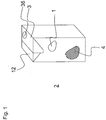
- Figure 1 shows a container 2 surrounding an interior 1 and made of a sheetlike composite 3.
- the container 2 is shown with the container upper side 12 facing upwards.
- the container 2 is made of the sheetlike composite 3 which includes at least the carrier layer 4.
- the container 2 can furthermore include a hole 36.
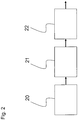
- FIG. 2 shows a schematic flow of devices and production steps by the process according to the invention.
- the sheetlike composite 3 is thus produced from a carrier layer 4, a barrier layer 5 and the layers of thermoplastic KSa 6, KSv 35 and KSw 7 and optionally a further layer of thermoplastic KSu 13 and - if necessary - at least one adhesion promoter layer 19 by an extrusion process and is usually provided as roll goods.
- the score 14 is produced in the roll goods, which can have been provided with an imprint or decoration beforehand.
- container blanks are produced in the composite fabrication 21.
- the composite fabrication 21 is followed by a container production 22, in which in particular the folding and joining are carried out by the process according to the invention. Filling with a foodstuff can also be carried out here.
- Figure 3 shows a container 2 formed during the process according to the invention, which - for a better view - is shown with a container region 23 envisaged for a base 12 on the top.
- the container region 23 envisaged for the base 12 has a plurality of scores 14.
- Figure 4a shows the cross-section through a sheetlike composite 3 with a score 14, formed by a recess 24 and a bulge 25.
- An edge 17 of a folding tool 18 is provided above the recess 24, in order to engage in the recess 24, so that folding can be carried out around the edge 17 along the score 14, in order to obtain a fold 8 shown as a cross-section in Figure 4b .
- This fold 8 has two fold surfaces 9 and 10 which enclose an angle ⁇ and are present as a part 15 of large area and a part 16 of small area. At least one layer of thermoplastic 6, 7 or 13 is melted in a part region 11 of the part 16 of small area.
- Figure 5a shows a section along the line A-A in Figure 3 , before folding, from a sheetlike composite 3 with scores 14.
- edges 17 of folding tools 18 which engage in the scores 14 installed centrally on the front faces, the scores 14 are moved in the direction of the two arrows, as a result of which the folds 8 shown in Figure 5b with the angles ⁇ are formed.
- the section shown here through the outermost part to be folded of the container region envisaged for the base 12 of the container 2 has a part region 11 towards the interior 1 in which at least one layer of thermoplastic 6, 7 or 13 is melted.
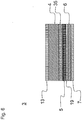
- Figure 6 shows a sheetlike composite 3, the upper side lying on the outside of the container 2 produced therefrom and the under-side on the inside.
- layer of thermoplastic KSu 13 usually PE optionally with a filler content of an inorganic salt
- a carrier layer 4 of cardboard with a weight per unit area in a range of from 120 to 400 g/m 2
- a layer of thermoplastic KSv 35 usually with a weight per unit area in a range of from 5 to 40 g/m 2
- a barrier layer 5 for example a barrier of plastic (not according to the invention)
- a weight per unit area in a range of from 2 to 120 g/m 2 followed by a layer of adhesion promoter 19 with a weight per unit area in a range of from 2 to 30 g/m 2
- a layer of thermoplastic KSu 13 usually PE optionally with a filler content of an inorganic salt
- a carrier layer 4 of cardboard with a weight per unit area in a range of from 120 to 400 g/
- the sheetlike composite from Figure 6 is supplemented by a further layer 19 of adhesion promoter with a weight per unit area in a range of from 2 to 30 g/m 2 provided between the barrier layer 5, for example an aluminium foil with a thickness of 3-12 ⁇ m, and the carrier layer 4.
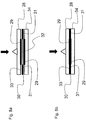
- Figure 8a shows a folded composite region 30 of the sheetlike composite 3 between a sonotrode 28 and an anvil 34, both of which each have a surface relief 29.
- the folded composite region is formed by further reduction of the angle ⁇ in the context of the folding shown in Figure 5b and often has an intermediate space 33 in the regions with few layers.
- the surface relief 29 is configured such that recesses 33 in the surface relief 29 are opposite the multilayer regions 31 of greater thickness formed during folding, in order to allow a distribution of pressure and mechanical vibration over the sonotrode 28 which is as uniform as possible. Furthermore, the fixing of the folded composite region 30 to be joined, until the intermediate space 33 disappears, is improved in this way.
- the sonotrode 28 moves to the anvil 34 in the direction of the arrow, a pressure acting on the folded composite region 30 to be joined, which is held between the surface reliefs 29.
- the folded composite region as shown in Fig. 8b , is pressed together and held according to the surface relief, so that the mechanical ultrasound vibration generated by the sonotrode 28 is transmitted to the folded composite 30 and joining by sealing takes place, in that the molten layers of plastic at least partly flow into one another due to the pressing pressure and solidify again by cooling, usually in a holding time, before the sonotrode 28 has released the folded composite region 30 treated in this way.
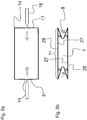
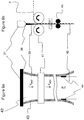
- Figure 9 shows the coating process preferred according to the invention schematically a. in the front view and b. in the side view.
- the coating film in the molten state 39 exits the extruder die slot 38 of the extruder die 37 and is applied to the carrier layer 4 via the cooling and pressing rolls 41.
- the coating film forms the surface F which comprises the polymers P1 42 and P2 43, the polymer P2 43 forming the edge regions of the surface F.
- the edge surfaces P2 43 of the surface F are preferably separated off from the surface F by cutting tools 44, preferably shearing blades.
- the molten coating film 39 exits the extruder die 37 with the speed V exit and is accelerated to the speed V adv by the cooling and pressing rolls and thus stretched monoaxially.
Landscapes
- Physics & Mathematics (AREA)
- Thermal Sciences (AREA)
- Chemical & Material Sciences (AREA)
- Chemical Kinetics & Catalysis (AREA)
- Engineering & Computer Science (AREA)
- Mechanical Engineering (AREA)
- Laminated Bodies (AREA)
- Wrappers (AREA)
Priority Applications (1)
| Application Number | Priority Date | Filing Date | Title |
|---|---|---|---|
| PL12743672T PL2736717T3 (pl) | 2011-07-26 | 2012-07-23 | Mocny płaski kompozyt z warstwą pośrednią o podwyższonej temperaturze mięknienia według vicata |
Applications Claiming Priority (2)
| Application Number | Priority Date | Filing Date | Title |
|---|---|---|---|
| DE102011108401A DE102011108401A1 (de) | 2011-07-26 | 2011-07-26 | Robuster flächenförmiger Verbund mit einer Zwischenschicht mit erhöhter Vicat-Erweichungstemperatur |
| PCT/EP2012/003095 WO2013013802A1 (en) | 2011-07-26 | 2012-07-23 | Robust planar composite with an intermediate layer of increased vicat softening temperature |
Publications (2)
| Publication Number | Publication Date |
|---|---|
| EP2736717A1 EP2736717A1 (en) | 2014-06-04 |
| EP2736717B1 true EP2736717B1 (en) | 2019-09-04 |
Family
ID=46634091
Family Applications (1)
| Application Number | Title | Priority Date | Filing Date |
|---|---|---|---|
| EP12743672.3A Active EP2736717B1 (en) | 2011-07-26 | 2012-07-23 | Robust planar composite with an intermediate layer of increased vicat softening temperature |
Country Status (11)
| Country | Link |
|---|---|
| US (1) | US9902124B2 (enExample) |
| EP (1) | EP2736717B1 (enExample) |
| CN (1) | CN103747956B (enExample) |
| BR (1) | BR112014001725A2 (enExample) |
| DE (1) | DE102011108401A1 (enExample) |
| ES (1) | ES2755001T3 (enExample) |
| IN (1) | IN2014DN00226A (enExample) |
| MX (1) | MX375314B (enExample) |
| PL (1) | PL2736717T3 (enExample) |
| RU (1) | RU2620410C2 (enExample) |
| WO (1) | WO2013013802A1 (enExample) |
Families Citing this family (18)
| Publication number | Priority date | Publication date | Assignee | Title |
|---|---|---|---|---|
| US20150322184A1 (en) | 2014-05-07 | 2015-11-12 | Chevron Phillips Chemical Company Lp | High Performance Moisture Barrier Films at Lower Densities |
| EP2985140B1 (en) * | 2014-08-11 | 2017-12-27 | Ford Global Technologies, LLC | Cladding element for vehicle floor area |
| DE102014015960A1 (de) * | 2014-10-31 | 2016-05-04 | Sig Technology Ag | Behältervorläufer, insbesondere zum Herstellen eines Nahrungsmittelbehälters, aus einemLaminat mit einer Gas- und Aromabarriere aus Kunststoff und einem geschältem und teilweise auf sich selbst umgeschlagenen Randbereich |
| DE102014015958A1 (de) * | 2014-10-31 | 2016-05-04 | Sig Technology Ag | Vorrichtung, insbesondere zum Verschließen eines Kopfbereichs eines Nahrungsmittel-behälters, aus einem Laminat mit geschältem und umgeschlagenen Randbereich |
| DE102014015961A1 (de) * | 2014-10-31 | 2016-05-04 | Sig Technology Ag | Behältervorläufer, insbesondere zum Herstellen eines Nahrungsmittelbehälters, aus einem Laminat mit geschältem und teilweise auf sich selbst umgeschlagenen Randbereich |
| DE102015226767A1 (de) * | 2015-12-28 | 2017-06-29 | Sig Technology Ag | Flächenförmiger Verbund, insbesondere Packstofflaminat für formstabile Nahrungsmittelbehälter, mit einer durch Dynamische Differentialkalorimetrie charakterisierten Polymerzwischenschicht |
| PL3397480T3 (pl) | 2015-12-28 | 2025-10-13 | Sig Services Ag | Kompozyt arkuszowy, w szczególności laminat opakowaniowy na stabilne wymiarowo pojemniki spożywcze, mający polimerową warstwę pośrednią, charakteryzujący się różnicową kalorymetrią skaningową |
| EP3397477B1 (en) | 2015-12-28 | 2024-08-07 | SIG Services AG | Sheet-like composite, especially packaging laminate for dimensionally stable foodstuff containers, having a polymeric internal layer characterized by differential scanning calorimetry |
| WO2017204752A1 (en) * | 2016-05-26 | 2017-11-30 | Kimpai Lamitube Co., Ltd. | Multi layered flexible sheet with high specular gloss |
| DE102016209235A1 (de) * | 2016-05-27 | 2017-11-30 | Sig Technology Ag | Verfahren zum Herstellen eines Behältervorläufers, insbesondere für einen einzelnen formstabilen Nahrungsmittelbehälter, ohne Umfalten des Behältervorläufers |
| DE102016209236A1 (de) * | 2016-05-27 | 2017-11-30 | Sig Technology Ag | Verfahren zum Herstellen einer Verpackung umhüllend Behältervorläufer, insbesondere jeweils für einen einzelnen formstabilen Nahrungsmittelbehälter, mit Umfalten des Behältervorläufers |
| DE102016209237A1 (de) * | 2016-05-27 | 2017-11-30 | Sig Technology Ag | Behältervorläufer mit Aufformkoeffizienten, insbesondere für einen einzelnen formstabilen Nahrungsmittelbehälter |
| WO2017202912A1 (en) * | 2016-05-27 | 2017-11-30 | Sig Technology Ag | Container precursor with shaping coefficient, especially for a single dimensionally stable food or drink product container |
| DE102017005609B4 (de) * | 2017-06-13 | 2022-04-21 | Mühlbauer Gmbh & Co. Kg | Mehrlagige Polymerverbundvorrichtung mit eingeschlossenen Bauteilen, Verfahren zur Herstellung von mehrlagigen Polymerverbundvorrichtungen mit eingeschlossenen Bauteilen und Vorrichtung zur Herstellung von mehrlagigen Polymerverbundvorrichtungen mit eingeschlossenen Bauteilen |
| CN109454924A (zh) * | 2018-12-11 | 2019-03-12 | 纷美(北京)贸易有限公司 | 包装盒和单片包装盒预制材料及其成型方法、成型系统 |
| EP4059706A1 (en) | 2021-03-19 | 2022-09-21 | Alternapak Holding B.V. | Packaging laminate for containers |
| CN115716361A (zh) | 2021-08-26 | 2023-02-28 | 康美包(苏州)有限公司 | 包装用阻隔层、片状复合层及其包装容器 |
| CN115847960A (zh) * | 2022-01-19 | 2023-03-28 | 上海箱箱智能科技有限公司 | 片材 |
Citations (15)
| Publication number | Priority date | Publication date | Assignee | Title |
|---|---|---|---|---|
| WO1990009926A2 (en) | 1989-03-03 | 1990-09-07 | Fbi Brands Ltd. | Packaging perishable liquids in gable top cartons |
| US5716570A (en) | 1995-05-02 | 1998-02-10 | Hoechst Aktiengesellschaft | Process for the production of polypropylene films |
| WO1998026994A1 (en) | 1996-12-19 | 1998-06-25 | Tetra Laval Holdings & Finance S.A. | A packaging laminate, a method of producing the packaging laminate, as well as packaging containers |
| JPH11300913A (ja) | 1998-04-16 | 1999-11-02 | Dainippon Printing Co Ltd | ヒートシール用多層フィルム及びその製造方法並びにそれを用いた紙容器 |
| WO2000020279A1 (en) | 1998-10-07 | 2000-04-13 | Tetra Laval Holdings & Finance Sa | Method of producing sealed packages containing pourable food products from a tube of packing material, and packing unit implementing such a method |
| EP1326746A1 (en) | 2000-10-03 | 2003-07-16 | Tetra Laval Holdings & Finance S.A. | A packaging laminate for a retortable packaging container |
| JP2003221024A (ja) | 2002-01-30 | 2003-08-05 | Toppan Printing Co Ltd | カップ状容器用積層材料 |
| EP1507661A1 (en) | 2002-05-07 | 2005-02-23 | Tetra Laval Holdings & Finance S.A. | Packaging laminate, method for its manufacturing and packaging container manufactured from the packaging laminate |
| WO2005018932A1 (en) * | 2003-08-26 | 2005-03-03 | International Paper Company | Non-foil barrier laminates |
| EP1819604A1 (en) | 2004-12-01 | 2007-08-22 | Tetra Laval Holdings & Finance SA | A packaging laminate for a retortable packaging container |
| EP1507660B1 (en) | 2002-05-07 | 2008-03-26 | Tetra Laval Holdings & Finance S.A. | Packaging laminate, method for its manufacturing and packaging container manufactured from the packaging laminate |
| CN201587629U (zh) * | 2009-12-18 | 2010-09-22 | 上海界龙实业集团股份有限公司 | 一种液体无菌复合包装多彩材料 |
| WO2011003564A1 (en) | 2009-07-08 | 2011-01-13 | Tetra Laval Holdings & Finance S.A. | High barrier packaging laminate, method for manufacturing of the packaging laminate and packaging container |
| WO2011029597A1 (en) | 2009-09-11 | 2011-03-17 | Tetra Laval Holdings & Finance S.A. | A barrier coated thermo-mechanically stable, heat sealable film, a packaging laminate comprising the film, a packaging container formed from the packaging laminate and a method for the production of the film |
| WO2011047871A1 (de) * | 2009-10-22 | 2011-04-28 | Sig Technology Ag | Perforierter verbund mit einer aussenseitigen polyamidschicht |
Family Cites Families (17)
| Publication number | Priority date | Publication date | Assignee | Title |
|---|---|---|---|---|
| DE19515254C2 (de) | 1995-04-26 | 1998-06-04 | Fresenius Ag | PVC-freie Mehrschichtfolie, Verfahren zur Herstellung derselben und deren Verwendung |
| JP2000506462A (ja) * | 1996-03-21 | 2000-05-30 | ゼンゲバルト フェアパックンゲン ゲーエムベーハー | 多層フィルム、その製造方法、およびその使用方法 |
| EP2133279B1 (en) | 1999-01-27 | 2017-06-28 | Tetra Laval Holdings & Finance S.A. | Laminated packaging material for paper container |
| AU771712B2 (en) | 1999-09-16 | 2004-04-01 | Tetra Laval Holdings & Finance Sa | Laminated packaging material and method for producing the same |
| US6858106B1 (en) * | 2000-05-26 | 2005-02-22 | Tetra Laval Holdings & Finance S.A. | Process for producing packaging laminate |
| JP4788031B2 (ja) | 2000-10-16 | 2011-10-05 | 大日本印刷株式会社 | 紙容器製函用積層材およびそれを使用して製函した紙容器 |
| JP2004010067A (ja) | 2002-06-04 | 2004-01-15 | Nihon Tetra Pak Kk | 包装材料、包装容器および包装材料の製造方法 |
| JP4288098B2 (ja) | 2003-04-30 | 2009-07-01 | 日本マタイ株式会社 | 紙容器用積層体及びその製造方法 |
| US20050037162A1 (en) | 2003-08-11 | 2005-02-17 | Adams John Peter | Paperboard laminate for food packaging applications |
| US20050074621A1 (en) | 2003-10-01 | 2005-04-07 | Reighard Tricia Susan | Moisture vapor barrier laminate |
| DE102004055323A1 (de) | 2004-11-16 | 2006-05-18 | Cfs Kempten Gmbh | Transparente tiefziehfähige Folien mit Antifog-Eigenschaften |
| SE528259C2 (sv) | 2004-12-22 | 2006-10-03 | Tetra Laval Holdings & Finance | Förpackningslaminat, sätt i samband med tillverkning därav, film för dess tilverkning samt en förpackningsbehållare |
| JP4770186B2 (ja) | 2005-01-28 | 2011-09-14 | 大日本印刷株式会社 | 紙容器 |
| AU2007219037A1 (en) * | 2006-02-20 | 2007-08-30 | Huhtamaki New Zealand Limited | Improved product packaging |
| JP2009073007A (ja) | 2007-09-20 | 2009-04-09 | Toppan Printing Co Ltd | 紙容器用積層材料及び液体用紙容器 |
| JP5344124B2 (ja) | 2008-09-03 | 2013-11-20 | マツダ株式会社 | 自動車車体の製造方法 |
| DE202010007972U1 (de) * | 2010-07-02 | 2010-12-09 | Kobusch-Sengewald Gmbh | Klare transparente Antifog-Mehrschicht-Folie |
-
2011
- 2011-07-26 DE DE102011108401A patent/DE102011108401A1/de not_active Ceased
-
2012
- 2012-07-23 IN IN226DEN2014 patent/IN2014DN00226A/en unknown
- 2012-07-23 EP EP12743672.3A patent/EP2736717B1/en active Active
- 2012-07-23 BR BR112014001725A patent/BR112014001725A2/pt not_active Application Discontinuation
- 2012-07-23 WO PCT/EP2012/003095 patent/WO2013013802A1/en not_active Ceased
- 2012-07-23 MX MX2014000983A patent/MX375314B/es active IP Right Grant
- 2012-07-23 ES ES12743672T patent/ES2755001T3/es active Active
- 2012-07-23 CN CN201280036242.5A patent/CN103747956B/zh active Active
- 2012-07-23 US US14/234,670 patent/US9902124B2/en active Active
- 2012-07-23 RU RU2014106937A patent/RU2620410C2/ru not_active IP Right Cessation
- 2012-07-23 PL PL12743672T patent/PL2736717T3/pl unknown
Patent Citations (15)
| Publication number | Priority date | Publication date | Assignee | Title |
|---|---|---|---|---|
| WO1990009926A2 (en) | 1989-03-03 | 1990-09-07 | Fbi Brands Ltd. | Packaging perishable liquids in gable top cartons |
| US5716570A (en) | 1995-05-02 | 1998-02-10 | Hoechst Aktiengesellschaft | Process for the production of polypropylene films |
| WO1998026994A1 (en) | 1996-12-19 | 1998-06-25 | Tetra Laval Holdings & Finance S.A. | A packaging laminate, a method of producing the packaging laminate, as well as packaging containers |
| JPH11300913A (ja) | 1998-04-16 | 1999-11-02 | Dainippon Printing Co Ltd | ヒートシール用多層フィルム及びその製造方法並びにそれを用いた紙容器 |
| WO2000020279A1 (en) | 1998-10-07 | 2000-04-13 | Tetra Laval Holdings & Finance Sa | Method of producing sealed packages containing pourable food products from a tube of packing material, and packing unit implementing such a method |
| EP1326746A1 (en) | 2000-10-03 | 2003-07-16 | Tetra Laval Holdings & Finance S.A. | A packaging laminate for a retortable packaging container |
| JP2003221024A (ja) | 2002-01-30 | 2003-08-05 | Toppan Printing Co Ltd | カップ状容器用積層材料 |
| EP1507661A1 (en) | 2002-05-07 | 2005-02-23 | Tetra Laval Holdings & Finance S.A. | Packaging laminate, method for its manufacturing and packaging container manufactured from the packaging laminate |
| EP1507660B1 (en) | 2002-05-07 | 2008-03-26 | Tetra Laval Holdings & Finance S.A. | Packaging laminate, method for its manufacturing and packaging container manufactured from the packaging laminate |
| WO2005018932A1 (en) * | 2003-08-26 | 2005-03-03 | International Paper Company | Non-foil barrier laminates |
| EP1819604A1 (en) | 2004-12-01 | 2007-08-22 | Tetra Laval Holdings & Finance SA | A packaging laminate for a retortable packaging container |
| WO2011003564A1 (en) | 2009-07-08 | 2011-01-13 | Tetra Laval Holdings & Finance S.A. | High barrier packaging laminate, method for manufacturing of the packaging laminate and packaging container |
| WO2011029597A1 (en) | 2009-09-11 | 2011-03-17 | Tetra Laval Holdings & Finance S.A. | A barrier coated thermo-mechanically stable, heat sealable film, a packaging laminate comprising the film, a packaging container formed from the packaging laminate and a method for the production of the film |
| WO2011047871A1 (de) * | 2009-10-22 | 2011-04-28 | Sig Technology Ag | Perforierter verbund mit einer aussenseitigen polyamidschicht |
| CN201587629U (zh) * | 2009-12-18 | 2010-09-22 | 上海界龙实业集团股份有限公司 | 一种液体无菌复合包装多彩材料 |
Non-Patent Citations (20)
| Title |
|---|
| "Extrusion Coating Manual 4th manual", 1 January 1999, article T BEZIGIAN: "CHAPTER 1, 2, 3, 18, 19, 20 21", pages: 1 - 201-207, XP055648086 |
| "Handbook of Beverage Packaging", 1 January 1999, article C. NERMARK: "Packaging of Beverages in drinks cartons", pages: 139 - 164, XP055649980 |
| "Lactam-based polyamides volume II", 1 January 1991, CRC, article PUFFR, ET AL: "Thermal properties of basic Types of PA6 and PA12", pages: 1, XP055756548 |
| "Paper and paperboard converting", 1 January 1998, FAPETOY, article ANTTI SAVOLAINEN, ET AL: "Extrusion coating and produkt applications", pages: 150 - 187, XP055755264 |
| "Springer handbook of condensed matter and materials data", 1 January 2005, SPRINGER, article MARTIENSSEN, ET AL: "Polyamide 6", pages: 1, XP055756542 |
| "Textbook of Polymer Science second edition", 1 January 1962, article FRED BILLMEYER JR: "Textbook of Polymer Science second edition", pages: 238 - 239, XP055649972 |
| A. DORIGATO, A. PEGORETTI, L. FAMBRI, C. LONARDI, M. SLOUF, J. KOLARIK: "Linear low density polyethylene/cycloolefin copolymer blends", EXPRESS POLYMER LETTERS, vol. 5, no. 1, 1 January 2011 (2011-01-01), pages 23 - 37, XP055756322, ISSN: 1788-618X, DOI: 10.3144/expresspolymlett.2011.4 |
| ANONYMOUS: "STM designation D1525-00", 1 May 2000, ASTM, article -: "ASTM D 1525 - 00: Standard Test Method for Vicat Softening Temperature of Plastics", pages: 1 - 8, XP055532247 |
| ANONYMOUS: "Typical Engineering Properties of Polypropylene", DATA SHEET, 1 April 2014 (2014-04-01), pages 1 - 2, XP055379421, [retrieved on 20170608] |
| CHENG-FANG OU ; MING-CHIEH HSU: "Preparation and characterization of cyclo olefin copolymer (COC)/silica nanoparticle composites by solution blending", JOURNAL OF POLYMER RESEARCH, KLUWER ACADEMIC PUBLISHERS-CONSULTANTS BUREAU, NL, vol. 14, no. 5, 3 July 2007 (2007-07-03), NL, pages 373 - 378, XP019530794, ISSN: 1572-8935, DOI: 10.1007/s10965-007-9119-5 |
| DATABASE WPI Week 201073, Derwent World Patents Index; AN 2010-N39045 * |
| FANG ET AL.: "Thermal and Rheological Properties of mLLDPE/LDPE Blends", POLYMER ENGINEERING AND SCIENCE, vol. 45, no. 9, 2005, pages 1254 - 1264, XP055648092, DOI: 10.1002/pen.20401 |
| J. BRANDRUP, ET AL.: "Polymer Handbook 4th edition volume 1", POLYMER HANDBOOK, 1 January 2003 (2003-01-01), pages V/16, V/17, - V/164, V/165, XP055649987, [retrieved on 20191205] |
| JOO SUNG LEE, HYUN WOOK JUNG, JAE CHUN HYUN: "Stabilization of film casting by an encapsulation extrusion method", JOURNAL OF NON-NEWTONIAN FLUID MECHANICS., ELSEVIER., NL, vol. 117, no. 2-3, 1 February 2004 (2004-02-01), NL, pages 109 - 115, XP055756551, ISSN: 0377-0257, DOI: 10.1016/j.jnnfm.2004.01.006 |
| LUCA FAMBRI, JAN KOLARIK, ALESSANDRO PEGORETTI, AMABILE PENATI: "Thermal, thermo-mechanical, and dynamic mechanical properties of polypropylene/cycloolefin copolymer blends", JOURNAL OF APPLIED POLYMER SCIENCE, JOHN WILEY & SONS, INC., US, vol. 122, no. 5, 5 December 2011 (2011-12-05), US, pages 3406 - 3414, XP055756329, ISSN: 0021-8995, DOI: 10.1002/app.34426 |
| MARK J. KIRWAN: "Chapter 13: Paperboard-based liquid Packaging", PAPER AND PAPERBOARD PACKAGING TECHNOLOGY, 1 January 2005 (2005-01-01), pages 387 - 413, XP055649977, [retrieved on 20191205] |
| MICHAEL HESS: "Metallocene Polyolefins and their Blends", MACROMOL. SYMP., 1 January 2001 (2001-01-01), pages 277 - 294, XP055756307 |
| NAMHATA, S.P. ; SANTOLINI, L. ; LOCATI, G.: "Rationalisation of Vicat softening point measurements", POLYMER TESTING, ELSEVIER, AMSTERDAM, NL, vol. 9, no. 2, 1 January 1990 (1990-01-01), AMSTERDAM, NL, pages 75 - 89, XP022883954, ISSN: 0142-9418, DOI: 10.1016/0142-9418(90)90021-5 |
| POLYOLEFIN PLASTOMER, PRODUCTS POLYOLEFIN ELASTOMER, ELASTOMERS DOW: "AFFINITY ™ Polyolefin Plastomers and Polyolefin Elastomers Product Selection Guide", THE DOW CHEMICAL COMPANY, 1 July 2013 (2013-07-01), XP055116158, Retrieved from the Internet <URL:http://msdssearch.dow.com/PublishedLiteratureDOWCOM/dh_08e0/0901b803808e0517.pdf?filepath=elastomers/pdfs/noreg/258-12901.pdf&fromPage=GetDoc> [retrieved on 20140502] |
| YOUNG KEON LEE, ET AL: "Ultralow density polyethylene blends with polypropylene", POLYMER ENGINEERING AND SCIENCE, vol. 31, no. 13, 1 July 1991 (1991-07-01), pages 944 - 953, XP055756540 |
Also Published As
| Publication number | Publication date |
|---|---|
| MX2014000983A (es) | 2014-02-27 |
| RU2014106937A (ru) | 2015-09-10 |
| CN103747956A (zh) | 2014-04-23 |
| ES2755001T3 (es) | 2020-04-21 |
| IN2014DN00226A (enExample) | 2015-07-10 |
| CN103747956B (zh) | 2016-08-24 |
| US20140242311A1 (en) | 2014-08-28 |
| MX375314B (es) | 2025-03-06 |
| RU2620410C2 (ru) | 2017-05-25 |
| BR112014001725A2 (pt) | 2017-02-21 |
| WO2013013802A1 (en) | 2013-01-31 |
| DE102011108401A1 (de) | 2013-01-31 |
| US9902124B2 (en) | 2018-02-27 |
| PL2736717T3 (pl) | 2020-05-18 |
| EP2736717A1 (en) | 2014-06-04 |
Similar Documents
| Publication | Publication Date | Title |
|---|---|---|
| EP2736717B1 (en) | Robust planar composite with an intermediate layer of increased vicat softening temperature | |
| EP2736716B1 (en) | Planar composite with layers of plastic of different vicat softening temperatures | |
| EP3166782B1 (en) | A sheet-like composite, especially for containers, with an adhesion-promoting layer characterised by different c=0 group absorption maxima | |
| US10399736B2 (en) | Planar composite having layers of plastic of different damping properties | |
| US20130213962A1 (en) | Packaging container made of a sheet-like composite with improved adhesion-layer and inner-layer combination | |
| EP2528731B1 (en) | Planar composite with a covered hole, container made thereof and process for making it | |
| WO2011091989A1 (en) | Process for the production of a container for foodstuff from an aluminium-free planar composite with a multiple inner layer by cold folding | |
| US20150352820A1 (en) | Planar composite having layers of plastic from plastics with different damping properties, having a layer comprising lldpe | |
| EP2528732B1 (en) | Process for the production of a container from a planar composite with a multiple inner layer by hot folding | |
| US9073280B2 (en) | Container formed from a roll and having improved opening properties as a result of stretching heat treatment of polymer layers | |
| EP2528728B1 (en) | Process for the production of a container from a planar composite with an inner layer by hot folding | |
| WO2018041678A1 (en) | Sheetlike composite for production of dimensionally stable food and drink product containers having a barrier layer of which the shinier surface faces inward |
Legal Events
| Date | Code | Title | Description |
|---|---|---|---|
| PUAI | Public reference made under article 153(3) epc to a published international application that has entered the european phase |
Free format text: ORIGINAL CODE: 0009012 |
|
| 17P | Request for examination filed |
Effective date: 20140225 |
|
| AK | Designated contracting states |
Kind code of ref document: A1 Designated state(s): AL AT BE BG CH CY CZ DE DK EE ES FI FR GB GR HR HU IE IS IT LI LT LU LV MC MK MT NL NO PL PT RO RS SE SI SK SM TR |
|
| DAX | Request for extension of the european patent (deleted) | ||
| 17Q | First examination report despatched |
Effective date: 20150324 |
|
| STAA | Information on the status of an ep patent application or granted ep patent |
Free format text: STATUS: EXAMINATION IS IN PROGRESS |
|
| RIC1 | Information provided on ipc code assigned before grant |
Ipc: B32B 3/24 20060101ALN20190226BHEP Ipc: B32B 7/02 20190101ALI20190226BHEP Ipc: B65D 5/00 20060101ALN20190226BHEP Ipc: B32B 27/08 20060101ALN20190226BHEP Ipc: B32B 15/20 20060101ALN20190226BHEP Ipc: B32B 27/32 20060101ALN20190226BHEP Ipc: B32B 15/08 20060101ALN20190226BHEP Ipc: B32B 27/10 20060101AFI20190226BHEP Ipc: B32B 7/12 20060101ALN20190226BHEP Ipc: B32B 27/28 20060101ALN20190226BHEP |
|
| GRAP | Despatch of communication of intention to grant a patent |
Free format text: ORIGINAL CODE: EPIDOSNIGR1 |
|
| STAA | Information on the status of an ep patent application or granted ep patent |
Free format text: STATUS: GRANT OF PATENT IS INTENDED |
|
| INTG | Intention to grant announced |
Effective date: 20190408 |
|
| GRAS | Grant fee paid |
Free format text: ORIGINAL CODE: EPIDOSNIGR3 |
|
| GRAA | (expected) grant |
Free format text: ORIGINAL CODE: 0009210 |
|
| STAA | Information on the status of an ep patent application or granted ep patent |
Free format text: STATUS: THE PATENT HAS BEEN GRANTED |
|
| AK | Designated contracting states |
Kind code of ref document: B1 Designated state(s): AL AT BE BG CH CY CZ DE DK EE ES FI FR GB GR HR HU IE IS IT LI LT LU LV MC MK MT NL NO PL PT RO RS SE SI SK SM TR |
|
| REG | Reference to a national code |
Ref country code: GB Ref legal event code: FG4D |
|
| REG | Reference to a national code |
Ref country code: CH Ref legal event code: EP |
|
| REG | Reference to a national code |
Ref country code: AT Ref legal event code: REF Ref document number: 1174800 Country of ref document: AT Kind code of ref document: T Effective date: 20190915 |
|
| REG | Reference to a national code |
Ref country code: DE Ref legal event code: R096 Ref document number: 602012063629 Country of ref document: DE |
|
| REG | Reference to a national code |
Ref country code: IE Ref legal event code: FG4D |
|
| REG | Reference to a national code |
Ref country code: NL Ref legal event code: MP Effective date: 20190904 |
|
| REG | Reference to a national code |
Ref country code: LT Ref legal event code: MG4D |
|
| PG25 | Lapsed in a contracting state [announced via postgrant information from national office to epo] |
Ref country code: SE Free format text: LAPSE BECAUSE OF FAILURE TO SUBMIT A TRANSLATION OF THE DESCRIPTION OR TO PAY THE FEE WITHIN THE PRESCRIBED TIME-LIMIT Effective date: 20190904 Ref country code: HR Free format text: LAPSE BECAUSE OF FAILURE TO SUBMIT A TRANSLATION OF THE DESCRIPTION OR TO PAY THE FEE WITHIN THE PRESCRIBED TIME-LIMIT Effective date: 20190904 Ref country code: LT Free format text: LAPSE BECAUSE OF FAILURE TO SUBMIT A TRANSLATION OF THE DESCRIPTION OR TO PAY THE FEE WITHIN THE PRESCRIBED TIME-LIMIT Effective date: 20190904 Ref country code: FI Free format text: LAPSE BECAUSE OF FAILURE TO SUBMIT A TRANSLATION OF THE DESCRIPTION OR TO PAY THE FEE WITHIN THE PRESCRIBED TIME-LIMIT Effective date: 20190904 Ref country code: NO Free format text: LAPSE BECAUSE OF FAILURE TO SUBMIT A TRANSLATION OF THE DESCRIPTION OR TO PAY THE FEE WITHIN THE PRESCRIBED TIME-LIMIT Effective date: 20191204 Ref country code: BG Free format text: LAPSE BECAUSE OF FAILURE TO SUBMIT A TRANSLATION OF THE DESCRIPTION OR TO PAY THE FEE WITHIN THE PRESCRIBED TIME-LIMIT Effective date: 20191204 |
|
| PG25 | Lapsed in a contracting state [announced via postgrant information from national office to epo] |
Ref country code: AL Free format text: LAPSE BECAUSE OF FAILURE TO SUBMIT A TRANSLATION OF THE DESCRIPTION OR TO PAY THE FEE WITHIN THE PRESCRIBED TIME-LIMIT Effective date: 20190904 Ref country code: LV Free format text: LAPSE BECAUSE OF FAILURE TO SUBMIT A TRANSLATION OF THE DESCRIPTION OR TO PAY THE FEE WITHIN THE PRESCRIBED TIME-LIMIT Effective date: 20190904 Ref country code: RS Free format text: LAPSE BECAUSE OF FAILURE TO SUBMIT A TRANSLATION OF THE DESCRIPTION OR TO PAY THE FEE WITHIN THE PRESCRIBED TIME-LIMIT Effective date: 20190904 Ref country code: GR Free format text: LAPSE BECAUSE OF FAILURE TO SUBMIT A TRANSLATION OF THE DESCRIPTION OR TO PAY THE FEE WITHIN THE PRESCRIBED TIME-LIMIT Effective date: 20191205 |
|
| REG | Reference to a national code |
Ref country code: ES Ref legal event code: FG2A Ref document number: 2755001 Country of ref document: ES Kind code of ref document: T3 Effective date: 20200421 |
|
| PG25 | Lapsed in a contracting state [announced via postgrant information from national office to epo] |
Ref country code: PT Free format text: LAPSE BECAUSE OF FAILURE TO SUBMIT A TRANSLATION OF THE DESCRIPTION OR TO PAY THE FEE WITHIN THE PRESCRIBED TIME-LIMIT Effective date: 20200106 Ref country code: RO Free format text: LAPSE BECAUSE OF FAILURE TO SUBMIT A TRANSLATION OF THE DESCRIPTION OR TO PAY THE FEE WITHIN THE PRESCRIBED TIME-LIMIT Effective date: 20190904 Ref country code: NL Free format text: LAPSE BECAUSE OF FAILURE TO SUBMIT A TRANSLATION OF THE DESCRIPTION OR TO PAY THE FEE WITHIN THE PRESCRIBED TIME-LIMIT Effective date: 20190904 Ref country code: EE Free format text: LAPSE BECAUSE OF FAILURE TO SUBMIT A TRANSLATION OF THE DESCRIPTION OR TO PAY THE FEE WITHIN THE PRESCRIBED TIME-LIMIT Effective date: 20190904 |
|
| PG25 | Lapsed in a contracting state [announced via postgrant information from national office to epo] |
Ref country code: IS Free format text: LAPSE BECAUSE OF FAILURE TO SUBMIT A TRANSLATION OF THE DESCRIPTION OR TO PAY THE FEE WITHIN THE PRESCRIBED TIME-LIMIT Effective date: 20200224 Ref country code: SM Free format text: LAPSE BECAUSE OF FAILURE TO SUBMIT A TRANSLATION OF THE DESCRIPTION OR TO PAY THE FEE WITHIN THE PRESCRIBED TIME-LIMIT Effective date: 20190904 Ref country code: SK Free format text: LAPSE BECAUSE OF FAILURE TO SUBMIT A TRANSLATION OF THE DESCRIPTION OR TO PAY THE FEE WITHIN THE PRESCRIBED TIME-LIMIT Effective date: 20190904 Ref country code: CZ Free format text: LAPSE BECAUSE OF FAILURE TO SUBMIT A TRANSLATION OF THE DESCRIPTION OR TO PAY THE FEE WITHIN THE PRESCRIBED TIME-LIMIT Effective date: 20190904 |
|
| REG | Reference to a national code |
Ref country code: DE Ref legal event code: R026 Ref document number: 602012063629 Country of ref document: DE |
|
| PLBI | Opposition filed |
Free format text: ORIGINAL CODE: 0009260 |
|
| PLAX | Notice of opposition and request to file observation + time limit sent |
Free format text: ORIGINAL CODE: EPIDOSNOBS2 |
|
| 26 | Opposition filed |
Opponent name: TETRA LAVAL HOLDINGS & FINANCE SA Effective date: 20200604 |
|
| PG2D | Information on lapse in contracting state deleted |
Ref country code: IS |
|
| PG25 | Lapsed in a contracting state [announced via postgrant information from national office to epo] |
Ref country code: DK Free format text: LAPSE BECAUSE OF FAILURE TO SUBMIT A TRANSLATION OF THE DESCRIPTION OR TO PAY THE FEE WITHIN THE PRESCRIBED TIME-LIMIT Effective date: 20190904 Ref country code: IS Free format text: LAPSE BECAUSE OF FAILURE TO SUBMIT A TRANSLATION OF THE DESCRIPTION OR TO PAY THE FEE WITHIN THE PRESCRIBED TIME-LIMIT Effective date: 20200105 |
|
| PG25 | Lapsed in a contracting state [announced via postgrant information from national office to epo] |
Ref country code: SI Free format text: LAPSE BECAUSE OF FAILURE TO SUBMIT A TRANSLATION OF THE DESCRIPTION OR TO PAY THE FEE WITHIN THE PRESCRIBED TIME-LIMIT Effective date: 20190904 |
|
| PLAF | Information modified related to communication of a notice of opposition and request to file observations + time limit |
Free format text: ORIGINAL CODE: EPIDOSCOBS2 |
|
| PLBB | Reply of patent proprietor to notice(s) of opposition received |
Free format text: ORIGINAL CODE: EPIDOSNOBS3 |
|
| PG25 | Lapsed in a contracting state [announced via postgrant information from national office to epo] |
Ref country code: MC Free format text: LAPSE BECAUSE OF FAILURE TO SUBMIT A TRANSLATION OF THE DESCRIPTION OR TO PAY THE FEE WITHIN THE PRESCRIBED TIME-LIMIT Effective date: 20190904 |
|
| REG | Reference to a national code |
Ref country code: BE Ref legal event code: MM Effective date: 20200731 |
|
| PG25 | Lapsed in a contracting state [announced via postgrant information from national office to epo] |
Ref country code: LU Free format text: LAPSE BECAUSE OF NON-PAYMENT OF DUE FEES Effective date: 20200723 |
|
| PG25 | Lapsed in a contracting state [announced via postgrant information from national office to epo] |
Ref country code: BE Free format text: LAPSE BECAUSE OF NON-PAYMENT OF DUE FEES Effective date: 20200731 |
|
| PG25 | Lapsed in a contracting state [announced via postgrant information from national office to epo] |
Ref country code: IE Free format text: LAPSE BECAUSE OF NON-PAYMENT OF DUE FEES Effective date: 20200723 |
|
| REG | Reference to a national code |
Ref country code: DE Ref legal event code: R100 Ref document number: 602012063629 Country of ref document: DE |
|
| PLCK | Communication despatched that opposition was rejected |
Free format text: ORIGINAL CODE: EPIDOSNREJ1 |
|
| PG25 | Lapsed in a contracting state [announced via postgrant information from national office to epo] |
Ref country code: MT Free format text: LAPSE BECAUSE OF FAILURE TO SUBMIT A TRANSLATION OF THE DESCRIPTION OR TO PAY THE FEE WITHIN THE PRESCRIBED TIME-LIMIT Effective date: 20190904 Ref country code: CY Free format text: LAPSE BECAUSE OF FAILURE TO SUBMIT A TRANSLATION OF THE DESCRIPTION OR TO PAY THE FEE WITHIN THE PRESCRIBED TIME-LIMIT Effective date: 20190904 |
|
| PG25 | Lapsed in a contracting state [announced via postgrant information from national office to epo] |
Ref country code: MK Free format text: LAPSE BECAUSE OF FAILURE TO SUBMIT A TRANSLATION OF THE DESCRIPTION OR TO PAY THE FEE WITHIN THE PRESCRIBED TIME-LIMIT Effective date: 20190904 |
|
| PLBN | Opposition rejected |
Free format text: ORIGINAL CODE: 0009273 |
|
| STAA | Information on the status of an ep patent application or granted ep patent |
Free format text: STATUS: OPPOSITION REJECTED |
|
| REG | Reference to a national code |
Ref country code: AT Ref legal event code: UEP Ref document number: 1174800 Country of ref document: AT Kind code of ref document: T Effective date: 20190904 |
|
| 27O | Opposition rejected |
Effective date: 20220124 |
|
| REG | Reference to a national code |
Ref country code: GB Ref legal event code: 732E Free format text: REGISTERED BETWEEN 20230713 AND 20230719 |
|
| REG | Reference to a national code |
Ref country code: ES Ref legal event code: PC2A Owner name: SIG COMBIBLOC SERVICES AG Effective date: 20231130 |
|
| REG | Reference to a national code |
Ref country code: DE Ref legal event code: R081 Ref document number: 602012063629 Country of ref document: DE Owner name: SIG SERVICES AG, CH Free format text: FORMER OWNER: SIG TECHNOLOGY AG, NEUHAUSEN AM RHEINFALL, CH |
|
| REG | Reference to a national code |
Ref country code: ES Ref legal event code: PC2A Owner name: SIG SERVICES AG Effective date: 20240906 |
|
| PGFP | Annual fee paid to national office [announced via postgrant information from national office to epo] |
Ref country code: ES Payment date: 20250819 Year of fee payment: 14 |
|
| PGFP | Annual fee paid to national office [announced via postgrant information from national office to epo] |
Ref country code: DE Payment date: 20250722 Year of fee payment: 14 |
|
| PGFP | Annual fee paid to national office [announced via postgrant information from national office to epo] |
Ref country code: TR Payment date: 20250718 Year of fee payment: 14 Ref country code: PL Payment date: 20250715 Year of fee payment: 14 Ref country code: IT Payment date: 20250731 Year of fee payment: 14 |
|
| PGFP | Annual fee paid to national office [announced via postgrant information from national office to epo] |
Ref country code: GB Payment date: 20250724 Year of fee payment: 14 |
|
| PGFP | Annual fee paid to national office [announced via postgrant information from national office to epo] |
Ref country code: FR Payment date: 20250723 Year of fee payment: 14 Ref country code: AT Payment date: 20250721 Year of fee payment: 14 |
|
| PGFP | Annual fee paid to national office [announced via postgrant information from national office to epo] |
Ref country code: CH Payment date: 20250801 Year of fee payment: 14 |