EP2736698B1 - Procédé de détermination de la qualité de mélanges de caoutchouc non mis en réseau et dispositif associé - Google Patents
Procédé de détermination de la qualité de mélanges de caoutchouc non mis en réseau et dispositif associé Download PDFInfo
- Publication number
- EP2736698B1 EP2736698B1 EP12740175.0A EP12740175A EP2736698B1 EP 2736698 B1 EP2736698 B1 EP 2736698B1 EP 12740175 A EP12740175 A EP 12740175A EP 2736698 B1 EP2736698 B1 EP 2736698B1
- Authority
- EP
- European Patent Office
- Prior art keywords
- rubber
- ultrasound
- mixture
- phr
- uncrosslinked rubber
- Prior art date
- Legal status (The legal status is an assumption and is not a legal conclusion. Google has not performed a legal analysis and makes no representation as to the accuracy of the status listed.)
- Active
Links
Images


Classifications
-
- B—PERFORMING OPERATIONS; TRANSPORTING
- B29—WORKING OF PLASTICS; WORKING OF SUBSTANCES IN A PLASTIC STATE IN GENERAL
- B29C—SHAPING OR JOINING OF PLASTICS; SHAPING OF MATERIAL IN A PLASTIC STATE, NOT OTHERWISE PROVIDED FOR; AFTER-TREATMENT OF THE SHAPED PRODUCTS, e.g. REPAIRING
- B29C48/00—Extrusion moulding, i.e. expressing the moulding material through a die or nozzle which imparts the desired form; Apparatus therefor
- B29C48/25—Component parts, details or accessories; Auxiliary operations
- B29C48/92—Measuring, controlling or regulating
-
- G—PHYSICS
- G01—MEASURING; TESTING
- G01N—INVESTIGATING OR ANALYSING MATERIALS BY DETERMINING THEIR CHEMICAL OR PHYSICAL PROPERTIES
- G01N29/00—Investigating or analysing materials by the use of ultrasonic, sonic or infrasonic waves; Visualisation of the interior of objects by transmitting ultrasonic or sonic waves through the object
- G01N29/04—Analysing solids
- G01N29/07—Analysing solids by measuring propagation velocity or propagation time of acoustic waves
-
- G—PHYSICS
- G01—MEASURING; TESTING
- G01N—INVESTIGATING OR ANALYSING MATERIALS BY DETERMINING THEIR CHEMICAL OR PHYSICAL PROPERTIES
- G01N29/00—Investigating or analysing materials by the use of ultrasonic, sonic or infrasonic waves; Visualisation of the interior of objects by transmitting ultrasonic or sonic waves through the object
- G01N29/04—Analysing solids
- G01N29/11—Analysing solids by measuring attenuation of acoustic waves
-
- G—PHYSICS
- G01—MEASURING; TESTING
- G01N—INVESTIGATING OR ANALYSING MATERIALS BY DETERMINING THEIR CHEMICAL OR PHYSICAL PROPERTIES
- G01N29/00—Investigating or analysing materials by the use of ultrasonic, sonic or infrasonic waves; Visualisation of the interior of objects by transmitting ultrasonic or sonic waves through the object
- G01N29/22—Details, e.g. general constructional or apparatus details
- G01N29/228—Details, e.g. general constructional or apparatus details related to high temperature conditions
-
- G—PHYSICS
- G01—MEASURING; TESTING
- G01N—INVESTIGATING OR ANALYSING MATERIALS BY DETERMINING THEIR CHEMICAL OR PHYSICAL PROPERTIES
- G01N29/00—Investigating or analysing materials by the use of ultrasonic, sonic or infrasonic waves; Visualisation of the interior of objects by transmitting ultrasonic or sonic waves through the object
- G01N29/34—Generating the ultrasonic, sonic or infrasonic waves, e.g. electronic circuits specially adapted therefor
- G01N29/348—Generating the ultrasonic, sonic or infrasonic waves, e.g. electronic circuits specially adapted therefor with frequency characteristics, e.g. single frequency signals, chirp signals
-
- G—PHYSICS
- G01—MEASURING; TESTING
- G01N—INVESTIGATING OR ANALYSING MATERIALS BY DETERMINING THEIR CHEMICAL OR PHYSICAL PROPERTIES
- G01N33/00—Investigating or analysing materials by specific methods not covered by groups G01N1/00 - G01N31/00
- G01N33/44—Resins; Plastics; Rubber; Leather
-
- G—PHYSICS
- G01—MEASURING; TESTING
- G01N—INVESTIGATING OR ANALYSING MATERIALS BY DETERMINING THEIR CHEMICAL OR PHYSICAL PROPERTIES
- G01N33/00—Investigating or analysing materials by specific methods not covered by groups G01N1/00 - G01N31/00
- G01N33/44—Resins; Plastics; Rubber; Leather
- G01N33/445—Rubber
-
- B—PERFORMING OPERATIONS; TRANSPORTING
- B29—WORKING OF PLASTICS; WORKING OF SUBSTANCES IN A PLASTIC STATE IN GENERAL
- B29C—SHAPING OR JOINING OF PLASTICS; SHAPING OF MATERIAL IN A PLASTIC STATE, NOT OTHERWISE PROVIDED FOR; AFTER-TREATMENT OF THE SHAPED PRODUCTS, e.g. REPAIRING
- B29C2948/00—Indexing scheme relating to extrusion moulding
- B29C2948/92—Measuring, controlling or regulating
- B29C2948/92009—Measured parameter
- B29C2948/92228—Content, e.g. percentage of humidity, volatiles, contaminants or degassing
-
- B—PERFORMING OPERATIONS; TRANSPORTING
- B29—WORKING OF PLASTICS; WORKING OF SUBSTANCES IN A PLASTIC STATE IN GENERAL
- B29C—SHAPING OR JOINING OF PLASTICS; SHAPING OF MATERIAL IN A PLASTIC STATE, NOT OTHERWISE PROVIDED FOR; AFTER-TREATMENT OF THE SHAPED PRODUCTS, e.g. REPAIRING
- B29C2948/00—Indexing scheme relating to extrusion moulding
- B29C2948/92—Measuring, controlling or regulating
- B29C2948/92009—Measured parameter
- B29C2948/92295—Errors or malfunctioning, e.g. for quality control
-
- B—PERFORMING OPERATIONS; TRANSPORTING
- B29—WORKING OF PLASTICS; WORKING OF SUBSTANCES IN A PLASTIC STATE IN GENERAL
- B29C—SHAPING OR JOINING OF PLASTICS; SHAPING OF MATERIAL IN A PLASTIC STATE, NOT OTHERWISE PROVIDED FOR; AFTER-TREATMENT OF THE SHAPED PRODUCTS, e.g. REPAIRING
- B29C2948/00—Indexing scheme relating to extrusion moulding
- B29C2948/92—Measuring, controlling or regulating
- B29C2948/92323—Location or phase of measurement
- B29C2948/92361—Extrusion unit
- B29C2948/9238—Feeding, melting, plasticising or pumping zones, e.g. the melt itself
- B29C2948/924—Barrel or housing
-
- B—PERFORMING OPERATIONS; TRANSPORTING
- B29—WORKING OF PLASTICS; WORKING OF SUBSTANCES IN A PLASTIC STATE IN GENERAL
- B29C—SHAPING OR JOINING OF PLASTICS; SHAPING OF MATERIAL IN A PLASTIC STATE, NOT OTHERWISE PROVIDED FOR; AFTER-TREATMENT OF THE SHAPED PRODUCTS, e.g. REPAIRING
- B29C2948/00—Indexing scheme relating to extrusion moulding
- B29C2948/92—Measuring, controlling or regulating
- B29C2948/92504—Controlled parameter
- B29C2948/9258—Velocity
- B29C2948/926—Flow or feed rate
-
- B—PERFORMING OPERATIONS; TRANSPORTING
- B29—WORKING OF PLASTICS; WORKING OF SUBSTANCES IN A PLASTIC STATE IN GENERAL
- B29C—SHAPING OR JOINING OF PLASTICS; SHAPING OF MATERIAL IN A PLASTIC STATE, NOT OTHERWISE PROVIDED FOR; AFTER-TREATMENT OF THE SHAPED PRODUCTS, e.g. REPAIRING
- B29C2948/00—Indexing scheme relating to extrusion moulding
- B29C2948/92—Measuring, controlling or regulating
- B29C2948/92504—Controlled parameter
- B29C2948/92704—Temperature
-
- B—PERFORMING OPERATIONS; TRANSPORTING
- B29—WORKING OF PLASTICS; WORKING OF SUBSTANCES IN A PLASTIC STATE IN GENERAL
- B29C—SHAPING OR JOINING OF PLASTICS; SHAPING OF MATERIAL IN A PLASTIC STATE, NOT OTHERWISE PROVIDED FOR; AFTER-TREATMENT OF THE SHAPED PRODUCTS, e.g. REPAIRING
- B29C2948/00—Indexing scheme relating to extrusion moulding
- B29C2948/92—Measuring, controlling or regulating
- B29C2948/92504—Controlled parameter
- B29C2948/92723—Content, e.g. percentage of humidity, volatiles, contaminants or degassing
-
- B—PERFORMING OPERATIONS; TRANSPORTING
- B29—WORKING OF PLASTICS; WORKING OF SUBSTANCES IN A PLASTIC STATE IN GENERAL
- B29C—SHAPING OR JOINING OF PLASTICS; SHAPING OF MATERIAL IN A PLASTIC STATE, NOT OTHERWISE PROVIDED FOR; AFTER-TREATMENT OF THE SHAPED PRODUCTS, e.g. REPAIRING
- B29C2948/00—Indexing scheme relating to extrusion moulding
- B29C2948/92—Measuring, controlling or regulating
- B29C2948/92819—Location or phase of control
- B29C2948/92857—Extrusion unit
- B29C2948/92876—Feeding, melting, plasticising or pumping zones, e.g. the melt itself
-
- B—PERFORMING OPERATIONS; TRANSPORTING
- B29—WORKING OF PLASTICS; WORKING OF SUBSTANCES IN A PLASTIC STATE IN GENERAL
- B29C—SHAPING OR JOINING OF PLASTICS; SHAPING OF MATERIAL IN A PLASTIC STATE, NOT OTHERWISE PROVIDED FOR; AFTER-TREATMENT OF THE SHAPED PRODUCTS, e.g. REPAIRING
- B29C48/00—Extrusion moulding, i.e. expressing the moulding material through a die or nozzle which imparts the desired form; Apparatus therefor
- B29C48/03—Extrusion moulding, i.e. expressing the moulding material through a die or nozzle which imparts the desired form; Apparatus therefor characterised by the shape of the extruded material at extrusion
- B29C48/07—Flat, e.g. panels
-
- B—PERFORMING OPERATIONS; TRANSPORTING
- B29—WORKING OF PLASTICS; WORKING OF SUBSTANCES IN A PLASTIC STATE IN GENERAL
- B29K—INDEXING SCHEME ASSOCIATED WITH SUBCLASSES B29B, B29C OR B29D, RELATING TO MOULDING MATERIALS OR TO MATERIALS FOR MOULDS, REINFORCEMENTS, FILLERS OR PREFORMED PARTS, e.g. INSERTS
- B29K2021/00—Use of unspecified rubbers as moulding material
- B29K2021/003—Thermoplastic elastomers
-
- B—PERFORMING OPERATIONS; TRANSPORTING
- B29—WORKING OF PLASTICS; WORKING OF SUBSTANCES IN A PLASTIC STATE IN GENERAL
- B29K—INDEXING SCHEME ASSOCIATED WITH SUBCLASSES B29B, B29C OR B29D, RELATING TO MOULDING MATERIALS OR TO MATERIALS FOR MOULDS, REINFORCEMENTS, FILLERS OR PREFORMED PARTS, e.g. INSERTS
- B29K2105/00—Condition, form or state of moulded material or of the material to be shaped
- B29K2105/24—Condition, form or state of moulded material or of the material to be shaped crosslinked or vulcanised
- B29K2105/246—Uncured, e.g. green
-
- G—PHYSICS
- G01—MEASURING; TESTING
- G01N—INVESTIGATING OR ANALYSING MATERIALS BY DETERMINING THEIR CHEMICAL OR PHYSICAL PROPERTIES
- G01N2291/00—Indexing codes associated with group G01N29/00
- G01N2291/01—Indexing codes associated with the measuring variable
- G01N2291/011—Velocity or travel time
-
- G—PHYSICS
- G01—MEASURING; TESTING
- G01N—INVESTIGATING OR ANALYSING MATERIALS BY DETERMINING THEIR CHEMICAL OR PHYSICAL PROPERTIES
- G01N2291/00—Indexing codes associated with group G01N29/00
- G01N2291/01—Indexing codes associated with the measuring variable
- G01N2291/015—Attenuation, scattering
-
- G—PHYSICS
- G01—MEASURING; TESTING
- G01N—INVESTIGATING OR ANALYSING MATERIALS BY DETERMINING THEIR CHEMICAL OR PHYSICAL PROPERTIES
- G01N2291/00—Indexing codes associated with group G01N29/00
- G01N2291/02—Indexing codes associated with the analysed material
- G01N2291/023—Solids
- G01N2291/0235—Plastics; polymers; soft materials, e.g. rubber
-
- G—PHYSICS
- G01—MEASURING; TESTING
- G01N—INVESTIGATING OR ANALYSING MATERIALS BY DETERMINING THEIR CHEMICAL OR PHYSICAL PROPERTIES
- G01N2291/00—Indexing codes associated with group G01N29/00
- G01N2291/02—Indexing codes associated with the analysed material
- G01N2291/028—Material parameters
- G01N2291/0289—Internal structure, e.g. defects, grain size, texture
-
- G—PHYSICS
- G01—MEASURING; TESTING
- G01N—INVESTIGATING OR ANALYSING MATERIALS BY DETERMINING THEIR CHEMICAL OR PHYSICAL PROPERTIES
- G01N2291/00—Indexing codes associated with group G01N29/00
- G01N2291/04—Wave modes and trajectories
- G01N2291/048—Transmission, i.e. analysed material between transmitter and receiver
Definitions
- the invention relates to novel methods for determining the quality of an uncrosslinked rubber compound by means of ultrasound and a device suitable for this purpose.
- the inventive method allows both the detection of particulate impurities and the determination of the quality of the distribution of solids in the uncrosslinked rubber mixture. Both criteria determine the quality of rubber compounds.
- Ultrasonic analysis for uncrosslinked substance / filler-containing rubber compounds is only possible to a very limited extent due to the high sound damping. It is desirable to have a simple and rapid method for the determination of particulate impurities and their degree of distribution in an uncrosslinked rubber mixture.
- Rubber is used for various engineering components such as tires, engine mounts, O-rings, etc. Even single coarse particulate impurities ⁇ 100 ⁇ m lead to an early failure of the components made of rubber, especially under dynamic load [ A. Schröder et al., Rubber, Rubber Plastics, 11, pages 584 to 596, 2008 ]. For very small thin-walled components (1 mm) such as O-rings, particulate contamination can lead to leaks. For profiles, particulate contamination must be avoided due to the appearance of the components.
- the degree of distribution of the substances in the rubber also determines the dynamic-mechanical value image of the crosslinked rubber mixture and thus the quality of the technical components resulting therefrom.
- the hysteresis and thus the rolling resistance of a tire increases if the reinforcing nanoscale fillers are insufficiently deagglomerated and distributed [ Payne, AR; Watson, WF: Rubber Chem. And Technol. 36 (1963) No. 1, pp. 147-155 ].
- the quality of an uncrosslinked rubber compound has so far only been checked on a random basis ( ⁇ 0.1% of the total quantity).
- the Mooney viscosity of the rubber and cross-linking curves of the samples are determined. After vulcanization of samples, the tensile-strain behavior of the mixture is determined [ J. Schnetger Lexikon Kautschuktechnik, Heidelberg, 3rd revised edition (2004), 388-391 ]. Single coarse particulate impurities in small numbers are not detected in these tests. On the basis of the measurement results, it is also not possible to distinguish whether a deviation from the specifications is particulate contamination or other defects. moreover Samples are examined by light microscopy [ J. Schnetger Lexikon Kautschuktechnik, Heidelberg, 3rd revised edition (2004), 448-449 ].
- Ultrasound is used to detect gross imperfections in materials that conduct sound well, such as metals or liquids. It is measured in reflection according to the pulse echo method.
- the particle size distribution in low-viscosity suspensions, such as aqueous suspensions or polymer melts can be determined from the frequency spectrum using ultrasound [ US-A 5,121,629 .].
- ultrasound is also used to control the quality of networked components [ J. Schnetger Lexikon Kautschuktechnik, Heidelberg, 3rd revised edition (2004), 557-558 ].
- Unvulcanized rubber compounds lead the ultrasound very poorly due to their viscoelastic properties and the often very high proportion of nanoscale fillers. J. Schnetger Lexikon Kautschuktechnik, Heidelberg, 3rd revised edition (2004), 557-558 ]. That is, the ultrasound penetrates only in a small depth in an uncrosslinked rubber mixture. Therefore, thin-walled unvulcanized rubber samples can be examined, through which the sound just penetrates. In J. Kirchhoff, et al., Gummi Kunststoffe, 55 (2002) 373-381 the cross-linking behavior of rubber compounds is sampled on 2 mm samples.
- EP-2314442A the quality of a rubber mixture is used with regard to the distribution of crosslinking chemicals by means of a marker with a particle size ⁇ 100 ⁇ m and a density> 2 g / cm 3 .
- the sample thickness is only 4 mm.
- the object of the present invention was therefore a new and easy-to-use method for rapid and reliable control of the quality of uncrosslinked rubber mixtures, ie one for the detection of particulate impurities with a Diameter of> 100 microns suitable method to provide and a suitable apparatus for this application.
- the object of this invention was surprisingly achieved by analyzing uncrosslinked rubber compounds during extrusion by simultaneously measuring the transmission of the ultrasound at higher temperatures in a suitable frequency range with respect to changes caused by particulate impurities and changes in the degree of doping of solids therein without the presence of markers or the like. requirement.
- the present invention therefore provides a novel process for determining the quality of an uncrosslinked rubber compound, i. a method for the detection of particulate impurities with a diameter of> 100 microns in a non-crosslinked rubber mixture by measuring the transmission of ultrasound at temperatures greater than 80 ° C, more preferably at more than 100 ° C and frequencies between 0.5 MHz and 20 MHz, whereby the ultrasonic signal is transmitted over a distance of ⁇ 10 mm.
- the frequency of the ultrasonic signal is between 0.5 MHz to 20 MHz, more preferably between 2 MHz and 10 MHz, most preferably between 4 MHz and 7 MHz.
- a large part of the rubber mixture of ⁇ 1%, preferably ⁇ 10%, particularly preferably 100%, of the rubber mixture is analyzed by ultrasound. In this way, a representative and not only random quality control of uncrosslinked rubber compounds is possible.
- Suitable rubbers are, in particular, natural rubber (NR), isoprene rubber (IR), styrene-butadiene rubber (SBR), butadiene rubber (BR), isoprene-isobutylene rubber (IIR), polychloroprene rubber (CR), acrylonitrile-butadiene rubber (NBR), hydrogenated acrylonitrile butadiene rubber (HNBR), carboxylated acrylonitrile butadiene rubber (XNBR), hydrogenated carboxylated acrylonitrile butadiene rubber (HXNBR), ethylene propylene diene rubber (EPDM), ethylene propylene rubber (EPM), fluororubber (FKM), perfluorinated fluoro rubber (FFKM), acrylate-ethylene rubber (AEM), acrylate rubber (ACM), ethylene-methylene-acrylate rubber (EMA), chlorinated polyethylene, chlorosulfonated polyethylene, ethylene-vinyl acetate rubber (EVA), silicone rubber
- the rubber mixture is preferably mixtures of rubbers with fillers, crosslinking agents, anti-aging agents, plasticizers and / or other auxiliaries.
- Fillers according to the invention are e.g. bright inorganic fillers, such as e.g. Mica, kaolin, silica, silica, chalk, talc, carbon fillers, e.g. Carbon black, graphite, carbon nanotubes, magnetizable fillers such as carbonyl iron powder, iron oxides, ferrites and / or fibers such as carbon black. Aramid fiber pulp, carbon fibers.
- bright inorganic fillers such as e.g. Mica, kaolin, silica, silica, chalk, talc
- carbon fillers e.g. Carbon black, graphite, carbon nanotubes
- magnetizable fillers such as carbonyl iron powder, iron oxides, ferrites and / or fibers such as carbon black.
- Aramid fiber pulp such as carbon fibers.
- Crosslinking agents in the sense of the invention are:
- Anti-aging agents in the context of the invention are, for example, discoloring and non-discoloring anti-aging agents, for example paraphenylenediamines, isopropylphenylparaphenylenediamine (IPPD), para-phenylenediamine (6PPD), N, N-ditoly-p-phenylenediamine (DTPD), etc., amines, such as trimethyl-1,2-dihydroquinoline (TMQ), (phenyl) amines] - 1,4-naphthalenedione (PAN), bis (4-octylphenyl) amine (ODPA), styrenated diphenylamine (SDPA), mono- and bisphenols such as 2,2'-methylenebis (4-methyl-6-tert Butylphenol (BPH), 2,2'-isobutylidene bis (4,6-dimethyl-phenol) (NKF), 2,2'-dicyclopentadienyl-bis (4-methyl-6-tert-
- Plasticizers within the meaning of the invention are e.g. long-chain esters and / or ethers, such as thioesters, phthalic, alkylsulfonic, adipic, sebacic, dibenzyl, and / or mineral oils (paraffinic, aromatic naphthenic or synthetic oils).
- Aids within the meaning of the invention are e.g. Dispersing aids, such as e.g. Fatty acids, stearic acid and / or oleic acid and / or activators, such as zinc oxide, lead oxide, bismuth oxide, lithium carbonate, sodium carbonate and / or calcium hydroxide, magnesium oxide, flame retardants such as antimony oxide, coupling agents such as silanes, etc.
- Dispersing aids such as e.g. Fatty acids, stearic acid and / or oleic acid and / or activators, such as zinc oxide, lead oxide, bismuth oxide, lithium carbonate, sodium carbonate and / or calcium hydroxide, magnesium oxide, flame retardants such as antimony oxide, coupling agents such as silanes, etc.
- the uncrosslinked rubber compounds are masterbatches, masterbatches and crosslinkable rubber compounds.
- Crosslinkable rubber compounds are masterbatches which additionally contain 0 to 20 phr of crosslinking agent.
- crosslinkable rubber mixtures which contain, inter alia, 30 to 90 phr of carbon black and / or silica, 3 to 7 phr of zinc oxide and 0.5 phr to 4 phr of sulfur and 1 to 5 phr of accelerator.
- the preparation of the masterbatches, the masterbatch and the crosslinkable rubber mixture is preferably carried out according to the methods known to the skilled worker, as described, for example, in US Pat PCT / EP2009 / 058041 , Fillers, adjuvants, crosslinking agents and / or anti-aging agents are mixed together with the rubber in a mixing unit.
- Suitable mixing units are, for example, internal mixers, rolling mills, extruders.
- the basic mixture is prepared in a mixing unit in a first step. In this case, temperatures of more than 130 ° C can be achieved.
- a second production step after cooling the base mixture to temperatures below 130 ° C., crosslinking agents are added to the basic mixture in a further mixing unit. A part of the crosslinking agent can be added to the base mixture already in the first production step.
- the impurities are contained in the raw materials used, such as rubber, fillers, anti-aging agents, crosslinking agents and / or auxiliaries, and / or arise during the mixing process and / or are added unintentionally.
- Impurities contained in the raw materials used are, for example, insufficiently dispersed agglomerates of fillers, mats of crosslinking agent, auxiliaries and anti-aging agents, preferably having a high melting point of more than 100 ° C, grit, for example, from the production of carbon blacks, impurities in the rubber in natural rubber such as small stones, wood splinters etc ..
- Impurities which are produced during the mixing process of the uncrosslinked rubber mixture are, for example, crosslinked residues of rubber mixtures in mixing units, metal abrasion from the mixing units.
- Impurities added accidentally include, for example, wood chips from pallets, plastic chips, small screws, etc.
- the particulate impurities preferably have a diameter of> 100 .mu.m and more preferably> 500 .mu.m.
- the particulate impurities are solids with a melting point> 80 ° C, preferably> 100 ° C, more preferably> 120 ° C, most preferably ⁇ 150 ° C.
- the particulate impurities and differences in the degree of dispersion in uncrosslinked rubber mixtures with at least one pair, preferably with at least one detection band of at least two pairs of ultrasonic sensors are detected.
- the respective sensors of a pair are opposite, the pairs are arranged in series next to each other.
- the distance between the sensors of a pair is preferably ⁇ 10 mm.
- An ultrasonic sensor of one pair acts as a transmitter and the other sensor as Receiver of the ultrasonic signal.
- In the gap between the sensors is the uncrosslinked rubber compound. In this case, there is preferably a direct contact between sensors and uncrosslinked rubber mixture.
- the gap is bounded on the sides, whereby a flow channel is preferably formed with a height of ⁇ 10 mm, particularly preferably with a height of ⁇ 20 mm, most preferably with a height of 30 mm.
- the width of the flow channel is preferably ⁇ 20 mm, particularly preferably ⁇ 50 mm, very particularly preferably ⁇ 100 mm.
- the uncrosslinked rubber mixture passes through the detection belt at a speed of preferably 0.1 m / min., More preferably 1 m / min., Most preferably 10 m / min.
- an extruder is preferably used.
- the intensity of the transmitted illusion signal at the receiver is measured over the process time. Under process time is understood in the context of the invention, the extrusion time.
- the ultrasonic signal is recorded and evaluated.
- an evaluation unit such as an oscilloscope or preferably a computer.
- the ultrasound signal is emitted in the form of needle pulses or packets of needle pulses, so-called bursts.
- the time interval between the individual needle pulses or bursts is preferably at least ⁇ 1 s, more preferably at least ⁇ 100 ms.
- the transit time required by the signal to travel from the transmitter to the receiver is measured. From the known distance the sound velocity is determined.
- the speed of sound is changed only slightly.
- the speed of sound is also changed. This makes it possible to distinguish between coarse particulate and other impurities.
- the size of the coarse particulate impurities is determined from the duration of the reduction of the signal intensity and the flow rate. From the number of peaks and their width, a particle size distribution can be determined with the evaluation unit. Defective areas of the rubber composition can be removed after exiting the flow channel.
- the extruder is simultaneously used as a mixing unit for the rubber mixture.
- the rubber passes through a detection band of at least one ultrasonic sensor pair, which are arranged over the entire width of the flow channel.
- the rubber mixture passes through two detection bands, which are arranged slightly offset. This ensures that the entire rubber compound is analyzed.
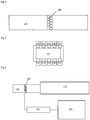
- the invention also relates to an apparatus for carrying out the method according to the invention, comprising an arrangement of an extruder (1), at least one detection band of at least one ultrasonic sensor pair (4) and the flow channel (5) and an evaluation unit (3).
- the device according to the invention is preferably described in the following figures, without being limited thereto.
- Fig. 1 describes by way of example the detection band, consisting of the ultrasonic sensor pairs (4), ie for each pair a transmitter and a receiver and the flow channel (5) in supervision
- Fig. 2 is the arrangement in Fig. 1 shown in side view.
- Fig. 3 shows an arrangement of an extruder (1), the detection band, consisting of the ultrasonic sensor pairs (4) and the flow channel (5) and the Ultraschallprüfelektronik (2) and a computer as an evaluation unit (3).
- a masterbatch consisting of 100 phr of natural rubber SMR10, 50 phr of carbon black N550, 5 phr of plasticizer naftolen ZD, 5 phr of ZnO, 1 phr of stearic acid was prepared with an internal mixer. Approximately 1 kg of this mixture was extruded through a flow channel with a Rubicon EEK32.12L single-screw extruder. The flow channel has a length of 300 mm, a height of 20 mm and a width of 15 mm. In the middle of the flow channel there is a detection band consisting of a pair of ultrasonic sensors K4V1 from GE Sensing & Inspection Technologies GmbH with a mean frequency of 4 MHz.
- the oscillator of the ultrasonic sensor has a diameter of 7 mm. Every 100 ms, one needle pulse was sent from one sensor and received by the other sensor.
- the sensors were controlled by the USLT 2000 test electronics from GE Sensing & Inspection Technologies GmbH and the received measurement signals were sent via the test electronics to a computer where they were processed.
- the temperature of the extruder and the flow channel was heated to 100 ° C.
- the speed of the extruder was 20 rpm.
- the throughput was about 100 g / min. This resulted in an extrusion rate of about 0.25 m / min.
- the mean residence time from the intake to the detection belt was about 2 min.
- the measured data are from the FIG. 4 seen.
- Fig. 4 the relative damping coefficient ⁇ rel is plotted against the process time t of the mixture.
- the distance s of the ultrasound corresponds to the sample thickness.
- ⁇ rel , t - ln I t / I medium / s
- Base Mix 1 contained 100 phr of natural rubber SMR10 and 1 phr of stearic acid. This base mixture 1 was for about 5 min. mixed in a kneader and formed from this mixture within a minute on a double rolling mill Rubicon rubber technology and Maschinentechnik GmbH a coat.
- the masterbatch 2 additionally contained 50 phr of carbon black N110 and was mixed in accordance with masterbatch 1.
- Base Mix 3 is equivalent to Base Mix 2 with the exception that mixing was only for 2 minutes in a kneader.
- Base Mix 4 also corresponds to Base Mix 2 except that the mix was only mixed for 1 minute. Due to the different mixing modes, different distribution and deagglomeration states of the filler were obtained.
- the carbon black N110 in its form of supply consisted of pellets (agglomerated filler units) which had a diameter in the range of ⁇ 2 mm.
- the four different mixtures were fed successively to the extruder in accordance with Example 1 and the relative damping coefficient ⁇ rel . (T) and the speed of sound v were determined.
- Fig. 6 shows the measurements of all 4 basic mixtures, these mixtures were successively fed to the extruder and measured sequentially, see the table below.
- the base mixture 2 has a significantly greater attenuation of the ultrasound than the base mixture 1 without soot.
- the base mixture 3 with a mixing time of only two minutes and a greater proportion of particulate impurities compared to base mixture 2 has a higher attenuation.
- the standard deviation from the mean value of the relative damping coefficient of the base mixture 3 is significantly greater than in the case of base mixture 2.
- Base mixture 4 has a very low deagglomeration of the filler with only one minute mixing time, ie very many coarse particulate impurities.
- the effective attenuation coefficient and the standard deviation are again significantly higher than for the basic mix 2 and 3. From Table 2 and Fig. 5 It is impressively evident that various mixtures (base mixtures 1 to 4) can be clearly distinguished from one another by the process according to the invention. With this method, therefore, the different degree of distribution and Deagglomerationsschreib can be clearly detected.
- v s / t US
- the speed of sound of the base mixtures with soot differs only slightly depending on the mixing time in the kneader ( Fig. 6 ), since in the base mixtures 2-4 the concentrations of soot in the detection volume are the same. In contrast, the speed of sound of the base mixture 1 without soot is much lower.
- other quality-determining criteria than the different degree of distribution measured by means of the time-dependent function of the relative damping coefficient can be excluded.
- the result shows that coarse impurities can be detected by the process according to the invention in a rubber mixture.
- the method is fast. A mixing batch of about 1 kg was examined within minutes without much manual effort. The method is also representative, as the diameter of the transducer of 7 mm of the ultrasonic sensor covers almost half the width of the flow channel of 15 mm.
- the prior art methods provide 5 measurements of Mooney viscosity for a blend.
- the time required is approx. 30 min including sample preparation.
- the time is then about two hours.
- the cause can not be attributed directly to coarse particulate impurities.
- light microscopic image must be made.
- Light micrographs also require a time of about 2 minutes per sample.
- many samples have to be taken here.
- significantly less material is also examined than with the ultrasound method. Here about half of the mixture material is checked. This shows that the method according to the invention is more representative and less time-consuming than the conventional methods.
Landscapes
- Physics & Mathematics (AREA)
- Health & Medical Sciences (AREA)
- Life Sciences & Earth Sciences (AREA)
- Chemical & Material Sciences (AREA)
- Analytical Chemistry (AREA)
- Biochemistry (AREA)
- General Health & Medical Sciences (AREA)
- General Physics & Mathematics (AREA)
- Immunology (AREA)
- Pathology (AREA)
- Engineering & Computer Science (AREA)
- Acoustics & Sound (AREA)
- Food Science & Technology (AREA)
- Medicinal Chemistry (AREA)
- Mechanical Engineering (AREA)
- Compositions Of Macromolecular Compounds (AREA)
- Processing And Handling Of Plastics And Other Materials For Molding In General (AREA)
- Processes Of Treating Macromolecular Substances (AREA)
- Investigating Or Analyzing Materials By The Use Of Ultrasonic Waves (AREA)
- Extrusion Moulding Of Plastics Or The Like (AREA)
Claims (5)
- Procédé destiné à la détection de contaminations particulaires dont le diamètre est > 100 µm dans un mélange de caoutchoucs non réticulé par la mesure de la transmission des ultrasons durant toute la période d'extrusion, caractérisé en ce que la mesure est réalisée à des températures qui sont > 80 °C et à des fréquences comprises entre 0,5 MHz et 20 MHz et en ce que le signal ultrasonore est transmis sur une distance de ≥ 10 mm.
- Procédé selon la revendication 1, caractérisé en ce que la vitesse du son du mélange de caoutchoucs non réticulé est en outre déterminée durant toute la durée de traitement.
- Procédé selon l'une ou plusieurs des revendications 1 à 2, caractérisé en ce que le mélange de caoutchoucs non réticulé est soumis à une bande de détection à partir d'au moins une paire de capteurs à ultrasons.
- Procédé selon l'une ou plusieurs des revendications 1 à 3, caractérisé en ce que la bande de détection est constituée d'au moins deux capteurs à ultrasons qui sont disposés l'un à côté de l'autre et qui sont disposés sur toute la largeur du mélange de caoutchoucs non réticulé.
- Dispositif contenant un agencement composé à partir d'une extrudeuse, d'au moins une bande de détection constituée d'au moins deux paires de capteurs à ultrasons qui sont disposés l'un à côté de l'autre et d'au moins une unité de traitement en vue de la réalisation d'un procédé selon l'une ou plusieurs des revendications 1 à 4.
Priority Applications (1)
| Application Number | Priority Date | Filing Date | Title |
|---|---|---|---|
| EP12740175.0A EP2736698B8 (fr) | 2011-07-28 | 2012-07-27 | Procédé de détermination de la qualité de mélanges de caoutchouc non mis en réseau et dispositif associé |
Applications Claiming Priority (3)
| Application Number | Priority Date | Filing Date | Title |
|---|---|---|---|
| EP11175837A EP2551087A1 (fr) | 2011-07-28 | 2011-07-28 | Procédé de détermination de la qualité de mélanges de caoutchouc non mis en réseau et dispositif associé |
| EP12740175.0A EP2736698B8 (fr) | 2011-07-28 | 2012-07-27 | Procédé de détermination de la qualité de mélanges de caoutchouc non mis en réseau et dispositif associé |
| PCT/EP2012/064787 WO2013014270A1 (fr) | 2011-07-28 | 2012-07-27 | Procédé destiné à la détermination de la qualité de mélanges de caoutchoucs non réticulés et dispositif correspondant |
Publications (3)
| Publication Number | Publication Date |
|---|---|
| EP2736698A1 EP2736698A1 (fr) | 2014-06-04 |
| EP2736698B1 true EP2736698B1 (fr) | 2017-04-26 |
| EP2736698B8 EP2736698B8 (fr) | 2017-07-12 |
Family
ID=46581999
Family Applications (2)
| Application Number | Title | Priority Date | Filing Date |
|---|---|---|---|
| EP11175837A Withdrawn EP2551087A1 (fr) | 2011-07-28 | 2011-07-28 | Procédé de détermination de la qualité de mélanges de caoutchouc non mis en réseau et dispositif associé |
| EP12740175.0A Active EP2736698B8 (fr) | 2011-07-28 | 2012-07-27 | Procédé de détermination de la qualité de mélanges de caoutchouc non mis en réseau et dispositif associé |
Family Applications Before (1)
| Application Number | Title | Priority Date | Filing Date |
|---|---|---|---|
| EP11175837A Withdrawn EP2551087A1 (fr) | 2011-07-28 | 2011-07-28 | Procédé de détermination de la qualité de mélanges de caoutchouc non mis en réseau et dispositif associé |
Country Status (4)
| Country | Link |
|---|---|
| US (1) | US9796124B2 (fr) |
| EP (2) | EP2551087A1 (fr) |
| JP (1) | JP5859123B2 (fr) |
| WO (1) | WO2013014270A1 (fr) |
Families Citing this family (10)
| Publication number | Priority date | Publication date | Assignee | Title |
|---|---|---|---|---|
| DE102012008170A1 (de) * | 2012-04-26 | 2013-10-31 | Entex Rust & Mitschke Gmbh | Planetwalzenextruder mit Planetspindeln und Anlaufring |
| US10126247B2 (en) | 2015-07-30 | 2018-11-13 | Zeon Chemicals L.P. | Rubber crumb inspection system |
| CN106466892A (zh) * | 2015-08-17 | 2017-03-01 | 天津市川浩塑料制品有限公司 | 超声探测型塑料造粒设备 |
| EP3196246A1 (fr) * | 2016-01-25 | 2017-07-26 | LANXESS Deutschland GmbH | Procede de controle de la silanisation de charges claires |
| FR3073775B1 (fr) * | 2017-11-23 | 2020-12-25 | Arianegroup Sas | Installation d'extrusion munie d'un systeme de controle apte a detecter une anomalie |
| EP3722795A4 (fr) | 2017-12-08 | 2021-09-01 | The Yokohama Rubber Co., Ltd. | Procédé et système d'inspection de qualité de matériau de caoutchouc non vulcanisé, et procédé et système de préparation de matériau de caoutchouc non vulcanisé |
| DE102018205227B4 (de) * | 2018-04-06 | 2020-01-23 | Skz-Kfe Ggmbh | Verfahren und Vorrichtung zur Prüfung eines Stoffs sowie Extruder mit einer derartigen Vorrichtung |
| JP7107000B2 (ja) * | 2018-06-07 | 2022-07-27 | 住友ゴム工業株式会社 | 空気入りタイヤ製造方法 |
| EP3699223A1 (fr) * | 2019-02-19 | 2020-08-26 | LANXESS Deutschland GmbH | Contrôle in-line par ultra-sons pour la détection de la préréticulation d'un mélange de caoutchouc lors de la silanisation in situ des charges blanches |
| DE102019218387B4 (de) * | 2019-11-27 | 2021-12-09 | Fraunhofer-Gesellschaft zur Förderung der angewandten Forschung e.V. | Messanordnung und Verfahren zur Bestimmung von Eigenschaften eines zu extrudierenden Materials während der Durchführung eines Schnecken-Extrusionsprozesses |
Family Cites Families (22)
| Publication number | Priority date | Publication date | Assignee | Title |
|---|---|---|---|---|
| US3779070A (en) * | 1971-11-23 | 1973-12-18 | Autometrics Co | Particle size and percent solids monitor |
| JP2676557B2 (ja) * | 1989-09-05 | 1997-11-17 | 東京電力株式会社 | 高分子体の内部欠陥検出方法 |
| US5121629A (en) | 1989-11-13 | 1992-06-16 | E. I. Du Pont De Nemours And Company | Method and apparatus for determining particle size distribution and concentration in a suspension using ultrasonics |
| US5062299A (en) * | 1990-01-05 | 1991-11-05 | Lever Brothers Company, Division Of Conopco, Inc. | Apparatus and method for detecting inhomogeneities in semi-plastic substances through ultrasound |
| JP2936231B2 (ja) * | 1990-01-19 | 1999-08-23 | 東京電力株式会社 | ゴム・プラスチック材料の内部欠陥検出装置 |
| JP3345486B2 (ja) * | 1993-10-09 | 2002-11-18 | 株式会社フジクラ | ポリマー押出機の異物検査方法 |
| JP2996855B2 (ja) * | 1994-02-22 | 2000-01-11 | 株式会社フジクラ | 押出樹脂中の異物検出装置 |
| JPH07260747A (ja) * | 1994-03-22 | 1995-10-13 | Kawasaki Steel Corp | 超音波探傷方法および装置 |
| US5629485A (en) * | 1994-12-13 | 1997-05-13 | The B.F. Goodrich Company | Contaminant detection sytem |
| US5922598A (en) * | 1995-03-24 | 1999-07-13 | Organ, Inc. | Reducing tissue immunogenicity by induction of apoptosis |
| JP3610847B2 (ja) * | 1998-12-09 | 2005-01-19 | Jfeスチール株式会社 | 内部欠陥検出装置 |
| US6134967A (en) * | 1999-05-11 | 2000-10-24 | Beloit Technologies, Inc. | Detection of delamination of rubber covers from metal substrates |
| DE10138790A1 (de) * | 2001-08-07 | 2003-02-20 | Wolfgang Stark | Vorrichtung zur Verfolgung des Vulkanisationsprozesses |
| US6871148B2 (en) * | 2002-07-02 | 2005-03-22 | Battelle Memorial Institute | Ultrasonic system and technique for fluid characterization |
| US7317504B2 (en) * | 2004-04-08 | 2008-01-08 | Asml Netherlands B.V. | Lithographic apparatus and device manufacturing method |
| US20060021642A1 (en) * | 2004-07-30 | 2006-02-02 | Sliwa John W Jr | Apparatus and method for delivering acoustic energy through a liquid stream to a target object for disruptive surface cleaning or treating effects |
| US20060266119A1 (en) * | 2005-05-23 | 2006-11-30 | Applied Sonics, Incorporated | Ultrasonic system for on-line monitoring of pressed materials |
| US20100136696A1 (en) * | 2006-12-29 | 2010-06-03 | Cargill Incorporated | Apparatus and method for the enhancement of contaminant detection |
| DE102008040138A1 (de) | 2008-07-03 | 2010-01-07 | Rhein Chemie Rheinau Gmbh | Verfahren und Vorrichtung zur Herstellung einer vernetzbaren Kautschukmischung |
| EP2310845A1 (fr) | 2008-07-07 | 2011-04-20 | Reosense Ab | Mesure du durcissage |
| DE102009004946B4 (de) * | 2008-10-22 | 2015-04-09 | Sikora Aktiengesellschaft | Verfahren und Vorrichtung zur Messung der Temperatur eines plastifizierten Kunststoffs am Ausgang eines Extruders |
| EP2314442B1 (fr) * | 2009-10-23 | 2013-04-03 | Rhein Chemie Rheinau GmbH | Ensemble de réseaux comprenant des substances marquantes, des nouveaux mélanges de caoutchouc en réseau et son procédé de fabrication et d'utilisation |
-
2011
- 2011-07-28 EP EP11175837A patent/EP2551087A1/fr not_active Withdrawn
-
2012
- 2012-07-27 JP JP2014522111A patent/JP5859123B2/ja active Active
- 2012-07-27 EP EP12740175.0A patent/EP2736698B8/fr active Active
- 2012-07-27 US US14/131,562 patent/US9796124B2/en not_active Expired - Fee Related
- 2012-07-27 WO PCT/EP2012/064787 patent/WO2013014270A1/fr not_active Ceased
Non-Patent Citations (1)
| Title |
|---|
| None * |
Also Published As
| Publication number | Publication date |
|---|---|
| EP2736698A1 (fr) | 2014-06-04 |
| JP5859123B2 (ja) | 2016-02-10 |
| US20140366633A1 (en) | 2014-12-18 |
| JP2014521948A (ja) | 2014-08-28 |
| EP2551087A1 (fr) | 2013-01-30 |
| US9796124B2 (en) | 2017-10-24 |
| WO2013014270A1 (fr) | 2013-01-31 |
| EP2736698B8 (fr) | 2017-07-12 |
Similar Documents
| Publication | Publication Date | Title |
|---|---|---|
| EP2551087A1 (fr) | Procédé de détermination de la qualité de mélanges de caoutchouc non mis en réseau et dispositif associé | |
| EP2314442B1 (fr) | Ensemble de réseaux comprenant des substances marquantes, des nouveaux mélanges de caoutchouc en réseau et son procédé de fabrication et d'utilisation | |
| DE69827963T2 (de) | Mischungen aus elastomeren verbundwerkstoffen und verfahren zu ihrer herstellung | |
| EP2297232B1 (fr) | Procédé et dispositif pour produire un mélange de caoutchouc réticulable | |
| DE112013005326B4 (de) | Herstellungsverfahren für einen feuchten Kautschuk-Masterbatch | |
| EP3408329B1 (fr) | Procede de controle de la silanisation de charges claires | |
| EP3927766A1 (fr) | Contrôle à ultrasons en interne pour la détection de préréticulation d'un mélange de caoutchouc lors de la silanisation in situ de substances de charge claires |
Legal Events
| Date | Code | Title | Description |
|---|---|---|---|
| PUAI | Public reference made under article 153(3) epc to a published international application that has entered the european phase |
Free format text: ORIGINAL CODE: 0009012 |
|
| 17P | Request for examination filed |
Effective date: 20140228 |
|
| AK | Designated contracting states |
Kind code of ref document: A1 Designated state(s): AL AT BE BG CH CY CZ DE DK EE ES FI FR GB GR HR HU IE IS IT LI LT LU LV MC MK MT NL NO PL PT RO RS SE SI SK SM TR |
|
| DAX | Request for extension of the european patent (deleted) | ||
| 17Q | First examination report despatched |
Effective date: 20150213 |
|
| GRAP | Despatch of communication of intention to grant a patent |
Free format text: ORIGINAL CODE: EPIDOSNIGR1 |
|
| STAA | Information on the status of an ep patent application or granted ep patent |
Free format text: STATUS: GRANT OF PATENT IS INTENDED |
|
| INTG | Intention to grant announced |
Effective date: 20161222 |
|
| GRAS | Grant fee paid |
Free format text: ORIGINAL CODE: EPIDOSNIGR3 |
|
| GRAA | (expected) grant |
Free format text: ORIGINAL CODE: 0009210 |
|
| STAA | Information on the status of an ep patent application or granted ep patent |
Free format text: STATUS: THE PATENT HAS BEEN GRANTED |
|
| GRAT | Correction requested after decision to grant or after decision to maintain patent in amended form |
Free format text: ORIGINAL CODE: EPIDOSNCDEC |
|
| AK | Designated contracting states |
Kind code of ref document: B1 Designated state(s): AL AT BE BG CH CY CZ DE DK EE ES FI FR GB GR HR HU IE IS IT LI LT LU LV MC MK MT NL NO PL PT RO RS SE SI SK SM TR |
|
| REG | Reference to a national code |
Ref country code: GB Ref legal event code: FG4D Free format text: NOT ENGLISH |
|
| REG | Reference to a national code |
Ref country code: CH Ref legal event code: EP |
|
| RAP2 | Party data changed (patent owner data changed or rights of a patent transferred) |
Owner name: LANXESS DEUTSCHLAND GMBH |
|
| REG | Reference to a national code |
Ref country code: AT Ref legal event code: REF Ref document number: 887484 Country of ref document: AT Kind code of ref document: T Effective date: 20170515 |
|
| REG | Reference to a national code |
Ref country code: IE Ref legal event code: FG4D Free format text: LANGUAGE OF EP DOCUMENT: GERMAN |
|
| REG | Reference to a national code |
Ref country code: DE Ref legal event code: R096 Ref document number: 502012010183 Country of ref document: DE |
|
| REG | Reference to a national code |
Ref country code: FR Ref legal event code: PLFP Year of fee payment: 6 |
|
| REG | Reference to a national code |
Ref country code: NL Ref legal event code: FP |
|
| REG | Reference to a national code |
Ref country code: LT Ref legal event code: MG4D |
|
| PG25 | Lapsed in a contracting state [announced via postgrant information from national office to epo] |
Ref country code: LT Free format text: LAPSE BECAUSE OF FAILURE TO SUBMIT A TRANSLATION OF THE DESCRIPTION OR TO PAY THE FEE WITHIN THE PRESCRIBED TIME-LIMIT Effective date: 20170426 Ref country code: FI Free format text: LAPSE BECAUSE OF FAILURE TO SUBMIT A TRANSLATION OF THE DESCRIPTION OR TO PAY THE FEE WITHIN THE PRESCRIBED TIME-LIMIT Effective date: 20170426 Ref country code: NO Free format text: LAPSE BECAUSE OF FAILURE TO SUBMIT A TRANSLATION OF THE DESCRIPTION OR TO PAY THE FEE WITHIN THE PRESCRIBED TIME-LIMIT Effective date: 20170726 Ref country code: HR Free format text: LAPSE BECAUSE OF FAILURE TO SUBMIT A TRANSLATION OF THE DESCRIPTION OR TO PAY THE FEE WITHIN THE PRESCRIBED TIME-LIMIT Effective date: 20170426 Ref country code: GR Free format text: LAPSE BECAUSE OF FAILURE TO SUBMIT A TRANSLATION OF THE DESCRIPTION OR TO PAY THE FEE WITHIN THE PRESCRIBED TIME-LIMIT Effective date: 20170727 Ref country code: ES Free format text: LAPSE BECAUSE OF FAILURE TO SUBMIT A TRANSLATION OF THE DESCRIPTION OR TO PAY THE FEE WITHIN THE PRESCRIBED TIME-LIMIT Effective date: 20170426 |
|
| PG25 | Lapsed in a contracting state [announced via postgrant information from national office to epo] |
Ref country code: SE Free format text: LAPSE BECAUSE OF FAILURE TO SUBMIT A TRANSLATION OF THE DESCRIPTION OR TO PAY THE FEE WITHIN THE PRESCRIBED TIME-LIMIT Effective date: 20170426 Ref country code: LV Free format text: LAPSE BECAUSE OF FAILURE TO SUBMIT A TRANSLATION OF THE DESCRIPTION OR TO PAY THE FEE WITHIN THE PRESCRIBED TIME-LIMIT Effective date: 20170426 Ref country code: IS Free format text: LAPSE BECAUSE OF FAILURE TO SUBMIT A TRANSLATION OF THE DESCRIPTION OR TO PAY THE FEE WITHIN THE PRESCRIBED TIME-LIMIT Effective date: 20170826 Ref country code: PL Free format text: LAPSE BECAUSE OF FAILURE TO SUBMIT A TRANSLATION OF THE DESCRIPTION OR TO PAY THE FEE WITHIN THE PRESCRIBED TIME-LIMIT Effective date: 20170426 Ref country code: RS Free format text: LAPSE BECAUSE OF FAILURE TO SUBMIT A TRANSLATION OF THE DESCRIPTION OR TO PAY THE FEE WITHIN THE PRESCRIBED TIME-LIMIT Effective date: 20170426 Ref country code: BG Free format text: LAPSE BECAUSE OF FAILURE TO SUBMIT A TRANSLATION OF THE DESCRIPTION OR TO PAY THE FEE WITHIN THE PRESCRIBED TIME-LIMIT Effective date: 20170726 |
|
| REG | Reference to a national code |
Ref country code: HU Ref legal event code: AG4A Ref document number: E033798 Country of ref document: HU Ref country code: DE Ref legal event code: R097 Ref document number: 502012010183 Country of ref document: DE |
|
| PG25 | Lapsed in a contracting state [announced via postgrant information from national office to epo] |
Ref country code: SK Free format text: LAPSE BECAUSE OF FAILURE TO SUBMIT A TRANSLATION OF THE DESCRIPTION OR TO PAY THE FEE WITHIN THE PRESCRIBED TIME-LIMIT Effective date: 20170426 Ref country code: DK Free format text: LAPSE BECAUSE OF FAILURE TO SUBMIT A TRANSLATION OF THE DESCRIPTION OR TO PAY THE FEE WITHIN THE PRESCRIBED TIME-LIMIT Effective date: 20170426 Ref country code: RO Free format text: LAPSE BECAUSE OF FAILURE TO SUBMIT A TRANSLATION OF THE DESCRIPTION OR TO PAY THE FEE WITHIN THE PRESCRIBED TIME-LIMIT Effective date: 20170426 Ref country code: EE Free format text: LAPSE BECAUSE OF FAILURE TO SUBMIT A TRANSLATION OF THE DESCRIPTION OR TO PAY THE FEE WITHIN THE PRESCRIBED TIME-LIMIT Effective date: 20170426 |
|
| PG25 | Lapsed in a contracting state [announced via postgrant information from national office to epo] |
Ref country code: SM Free format text: LAPSE BECAUSE OF FAILURE TO SUBMIT A TRANSLATION OF THE DESCRIPTION OR TO PAY THE FEE WITHIN THE PRESCRIBED TIME-LIMIT Effective date: 20170426 |
|
| REG | Reference to a national code |
Ref country code: CH Ref legal event code: PL |
|
| PLBE | No opposition filed within time limit |
Free format text: ORIGINAL CODE: 0009261 |
|
| STAA | Information on the status of an ep patent application or granted ep patent |
Free format text: STATUS: NO OPPOSITION FILED WITHIN TIME LIMIT |
|
| GBPC | Gb: european patent ceased through non-payment of renewal fee |
Effective date: 20170727 |
|
| 26N | No opposition filed |
Effective date: 20180129 |
|
| REG | Reference to a national code |
Ref country code: IE Ref legal event code: MM4A |
|
| PG25 | Lapsed in a contracting state [announced via postgrant information from national office to epo] |
Ref country code: CH Free format text: LAPSE BECAUSE OF NON-PAYMENT OF DUE FEES Effective date: 20170731 Ref country code: GB Free format text: LAPSE BECAUSE OF NON-PAYMENT OF DUE FEES Effective date: 20170727 Ref country code: LI Free format text: LAPSE BECAUSE OF NON-PAYMENT OF DUE FEES Effective date: 20170731 Ref country code: IE Free format text: LAPSE BECAUSE OF NON-PAYMENT OF DUE FEES Effective date: 20170727 |
|
| PG25 | Lapsed in a contracting state [announced via postgrant information from national office to epo] |
Ref country code: SI Free format text: LAPSE BECAUSE OF FAILURE TO SUBMIT A TRANSLATION OF THE DESCRIPTION OR TO PAY THE FEE WITHIN THE PRESCRIBED TIME-LIMIT Effective date: 20170426 |
|
| REG | Reference to a national code |
Ref country code: BE Ref legal event code: MM Effective date: 20170731 |
|
| REG | Reference to a national code |
Ref country code: FR Ref legal event code: PLFP Year of fee payment: 7 |
|
| PG25 | Lapsed in a contracting state [announced via postgrant information from national office to epo] |
Ref country code: BE Free format text: LAPSE BECAUSE OF NON-PAYMENT OF DUE FEES Effective date: 20170731 |
|
| REG | Reference to a national code |
Ref country code: AT Ref legal event code: MM01 Ref document number: 887484 Country of ref document: AT Kind code of ref document: T Effective date: 20170727 |
|
| PG25 | Lapsed in a contracting state [announced via postgrant information from national office to epo] |
Ref country code: MT Free format text: LAPSE BECAUSE OF FAILURE TO SUBMIT A TRANSLATION OF THE DESCRIPTION OR TO PAY THE FEE WITHIN THE PRESCRIBED TIME-LIMIT Effective date: 20170426 |
|
| REG | Reference to a national code |
Ref country code: DE Ref legal event code: R079 Ref document number: 502012010183 Country of ref document: DE Free format text: PREVIOUS MAIN CLASS: B29C0047920000 Ipc: B29C0048920000 |
|
| PG25 | Lapsed in a contracting state [announced via postgrant information from national office to epo] |
Ref country code: AT Free format text: LAPSE BECAUSE OF NON-PAYMENT OF DUE FEES Effective date: 20170727 |
|
| PG25 | Lapsed in a contracting state [announced via postgrant information from national office to epo] |
Ref country code: MC Free format text: LAPSE BECAUSE OF FAILURE TO SUBMIT A TRANSLATION OF THE DESCRIPTION OR TO PAY THE FEE WITHIN THE PRESCRIBED TIME-LIMIT Effective date: 20170426 |
|
| PG25 | Lapsed in a contracting state [announced via postgrant information from national office to epo] |
Ref country code: CY Free format text: LAPSE BECAUSE OF NON-PAYMENT OF DUE FEES Effective date: 20170426 |
|
| PG25 | Lapsed in a contracting state [announced via postgrant information from national office to epo] |
Ref country code: MK Free format text: LAPSE BECAUSE OF FAILURE TO SUBMIT A TRANSLATION OF THE DESCRIPTION OR TO PAY THE FEE WITHIN THE PRESCRIBED TIME-LIMIT Effective date: 20170426 |
|
| PG25 | Lapsed in a contracting state [announced via postgrant information from national office to epo] |
Ref country code: TR Free format text: LAPSE BECAUSE OF FAILURE TO SUBMIT A TRANSLATION OF THE DESCRIPTION OR TO PAY THE FEE WITHIN THE PRESCRIBED TIME-LIMIT Effective date: 20170426 |
|
| PG25 | Lapsed in a contracting state [announced via postgrant information from national office to epo] |
Ref country code: PT Free format text: LAPSE BECAUSE OF FAILURE TO SUBMIT A TRANSLATION OF THE DESCRIPTION OR TO PAY THE FEE WITHIN THE PRESCRIBED TIME-LIMIT Effective date: 20170426 |
|
| PG25 | Lapsed in a contracting state [announced via postgrant information from national office to epo] |
Ref country code: AL Free format text: LAPSE BECAUSE OF FAILURE TO SUBMIT A TRANSLATION OF THE DESCRIPTION OR TO PAY THE FEE WITHIN THE PRESCRIBED TIME-LIMIT Effective date: 20170426 |
|
| P01 | Opt-out of the competence of the unified patent court (upc) registered |
Effective date: 20230714 |
|
| PGFP | Annual fee paid to national office [announced via postgrant information from national office to epo] |
Ref country code: LU Payment date: 20240711 Year of fee payment: 13 |
|
| PGFP | Annual fee paid to national office [announced via postgrant information from national office to epo] |
Ref country code: CZ Payment date: 20240717 Year of fee payment: 13 |
|
| PGFP | Annual fee paid to national office [announced via postgrant information from national office to epo] |
Ref country code: NL Payment date: 20250613 Year of fee payment: 14 |
|
| PGFP | Annual fee paid to national office [announced via postgrant information from national office to epo] |
Ref country code: FR Payment date: 20250610 Year of fee payment: 14 |
|
| PGFP | Annual fee paid to national office [announced via postgrant information from national office to epo] |
Ref country code: HU Payment date: 20250630 Year of fee payment: 14 |
|
| PGFP | Annual fee paid to national office [announced via postgrant information from national office to epo] |
Ref country code: DE Payment date: 20250604 Year of fee payment: 14 |
|
| PGFP | Annual fee paid to national office [announced via postgrant information from national office to epo] |
Ref country code: IT Payment date: 20250623 Year of fee payment: 14 |
|
| PG25 | Lapsed in a contracting state [announced via postgrant information from national office to epo] |
Ref country code: LU Free format text: LAPSE BECAUSE OF NON-PAYMENT OF DUE FEES Effective date: 20250727 |
|
| PG25 | Lapsed in a contracting state [announced via postgrant information from national office to epo] |
Ref country code: CZ Free format text: LAPSE BECAUSE OF NON-PAYMENT OF DUE FEES Effective date: 20250727 |