EP2727891A1 - Reversibel Wasser bindendes Mineralwolleprodukt - Google Patents
Reversibel Wasser bindendes Mineralwolleprodukt Download PDFInfo
- Publication number
- EP2727891A1 EP2727891A1 EP13191138.0A EP13191138A EP2727891A1 EP 2727891 A1 EP2727891 A1 EP 2727891A1 EP 13191138 A EP13191138 A EP 13191138A EP 2727891 A1 EP2727891 A1 EP 2727891A1
- Authority
- EP
- European Patent Office
- Prior art keywords
- group
- mineral wool
- coating composition
- wool product
- atoms
- Prior art date
- Legal status (The legal status is an assumption and is not a legal conclusion. Google has not performed a legal analysis and makes no representation as to the accuracy of the status listed.)
- Granted
Links
Images

Classifications
-
- D—TEXTILES; PAPER
- D04—BRAIDING; LACE-MAKING; KNITTING; TRIMMINGS; NON-WOVEN FABRICS
- D04H—MAKING TEXTILE FABRICS, e.g. FROM FIBRES OR FILAMENTARY MATERIAL; FABRICS MADE BY SUCH PROCESSES OR APPARATUS, e.g. FELTS, NON-WOVEN FABRICS; COTTON-WOOL; WADDING ; NON-WOVEN FABRICS FROM STAPLE FIBRES, FILAMENTS OR YARNS, BONDED WITH AT LEAST ONE WEB-LIKE MATERIAL DURING THEIR CONSOLIDATION
- D04H1/00—Non-woven fabrics formed wholly or mainly of staple fibres or like relatively short fibres
- D04H1/40—Non-woven fabrics formed wholly or mainly of staple fibres or like relatively short fibres from fleeces or layers composed of fibres without existing or potential cohesive properties
- D04H1/58—Non-woven fabrics formed wholly or mainly of staple fibres or like relatively short fibres from fleeces or layers composed of fibres without existing or potential cohesive properties by applying, incorporating or activating chemical or thermoplastic bonding agents, e.g. adhesives
- D04H1/64—Non-woven fabrics formed wholly or mainly of staple fibres or like relatively short fibres from fleeces or layers composed of fibres without existing or potential cohesive properties by applying, incorporating or activating chemical or thermoplastic bonding agents, e.g. adhesives the bonding agent being applied in wet state, e.g. chemical agents in dispersions or solutions
-
- C—CHEMISTRY; METALLURGY
- C03—GLASS; MINERAL OR SLAG WOOL
- C03C—CHEMICAL COMPOSITION OF GLASSES, GLAZES OR VITREOUS ENAMELS; SURFACE TREATMENT OF GLASS; SURFACE TREATMENT OF FIBRES OR FILAMENTS MADE FROM GLASS, MINERALS OR SLAGS; JOINING GLASS TO GLASS OR OTHER MATERIALS
- C03C25/00—Surface treatment of fibres or filaments made from glass, minerals or slags
- C03C25/10—Coating
- C03C25/24—Coatings containing organic materials
- C03C25/26—Macromolecular compounds or prepolymers
- C03C25/32—Macromolecular compounds or prepolymers obtained otherwise than by reactions involving only carbon-to-carbon unsaturated bonds
-
- C—CHEMISTRY; METALLURGY
- C03—GLASS; MINERAL OR SLAG WOOL
- C03C—CHEMICAL COMPOSITION OF GLASSES, GLAZES OR VITREOUS ENAMELS; SURFACE TREATMENT OF GLASS; SURFACE TREATMENT OF FIBRES OR FILAMENTS MADE FROM GLASS, MINERALS OR SLAGS; JOINING GLASS TO GLASS OR OTHER MATERIALS
- C03C25/00—Surface treatment of fibres or filaments made from glass, minerals or slags
- C03C25/10—Coating
- C03C25/24—Coatings containing organic materials
- C03C25/26—Macromolecular compounds or prepolymers
- C03C25/32—Macromolecular compounds or prepolymers obtained otherwise than by reactions involving only carbon-to-carbon unsaturated bonds
- C03C25/34—Condensation polymers of aldehydes, e.g. with phenols, ureas, melamines, amides or amines
-
- C—CHEMISTRY; METALLURGY
- C03—GLASS; MINERAL OR SLAG WOOL
- C03C—CHEMICAL COMPOSITION OF GLASSES, GLAZES OR VITREOUS ENAMELS; SURFACE TREATMENT OF GLASS; SURFACE TREATMENT OF FIBRES OR FILAMENTS MADE FROM GLASS, MINERALS OR SLAGS; JOINING GLASS TO GLASS OR OTHER MATERIALS
- C03C25/00—Surface treatment of fibres or filaments made from glass, minerals or slags
- C03C25/10—Coating
- C03C25/24—Coatings containing organic materials
- C03C25/40—Organo-silicon compounds
-
- D—TEXTILES; PAPER
- D04—BRAIDING; LACE-MAKING; KNITTING; TRIMMINGS; NON-WOVEN FABRICS
- D04H—MAKING TEXTILE FABRICS, e.g. FROM FIBRES OR FILAMENTARY MATERIAL; FABRICS MADE BY SUCH PROCESSES OR APPARATUS, e.g. FELTS, NON-WOVEN FABRICS; COTTON-WOOL; WADDING ; NON-WOVEN FABRICS FROM STAPLE FIBRES, FILAMENTS OR YARNS, BONDED WITH AT LEAST ONE WEB-LIKE MATERIAL DURING THEIR CONSOLIDATION
- D04H1/00—Non-woven fabrics formed wholly or mainly of staple fibres or like relatively short fibres
- D04H1/40—Non-woven fabrics formed wholly or mainly of staple fibres or like relatively short fibres from fleeces or layers composed of fibres without existing or potential cohesive properties
- D04H1/42—Non-woven fabrics formed wholly or mainly of staple fibres or like relatively short fibres from fleeces or layers composed of fibres without existing or potential cohesive properties characterised by the use of certain kinds of fibres insofar as this use has no preponderant influence on the consolidation of the fleece
- D04H1/4209—Inorganic fibres
-
- D—TEXTILES; PAPER
- D04—BRAIDING; LACE-MAKING; KNITTING; TRIMMINGS; NON-WOVEN FABRICS
- D04H—MAKING TEXTILE FABRICS, e.g. FROM FIBRES OR FILAMENTARY MATERIAL; FABRICS MADE BY SUCH PROCESSES OR APPARATUS, e.g. FELTS, NON-WOVEN FABRICS; COTTON-WOOL; WADDING ; NON-WOVEN FABRICS FROM STAPLE FIBRES, FILAMENTS OR YARNS, BONDED WITH AT LEAST ONE WEB-LIKE MATERIAL DURING THEIR CONSOLIDATION
- D04H1/00—Non-woven fabrics formed wholly or mainly of staple fibres or like relatively short fibres
- D04H1/40—Non-woven fabrics formed wholly or mainly of staple fibres or like relatively short fibres from fleeces or layers composed of fibres without existing or potential cohesive properties
- D04H1/42—Non-woven fabrics formed wholly or mainly of staple fibres or like relatively short fibres from fleeces or layers composed of fibres without existing or potential cohesive properties characterised by the use of certain kinds of fibres insofar as this use has no preponderant influence on the consolidation of the fleece
- D04H1/4209—Inorganic fibres
- D04H1/4218—Glass fibres
-
- D—TEXTILES; PAPER
- D04—BRAIDING; LACE-MAKING; KNITTING; TRIMMINGS; NON-WOVEN FABRICS
- D04H—MAKING TEXTILE FABRICS, e.g. FROM FIBRES OR FILAMENTARY MATERIAL; FABRICS MADE BY SUCH PROCESSES OR APPARATUS, e.g. FELTS, NON-WOVEN FABRICS; COTTON-WOOL; WADDING ; NON-WOVEN FABRICS FROM STAPLE FIBRES, FILAMENTS OR YARNS, BONDED WITH AT LEAST ONE WEB-LIKE MATERIAL DURING THEIR CONSOLIDATION
- D04H1/00—Non-woven fabrics formed wholly or mainly of staple fibres or like relatively short fibres
- D04H1/40—Non-woven fabrics formed wholly or mainly of staple fibres or like relatively short fibres from fleeces or layers composed of fibres without existing or potential cohesive properties
- D04H1/58—Non-woven fabrics formed wholly or mainly of staple fibres or like relatively short fibres from fleeces or layers composed of fibres without existing or potential cohesive properties by applying, incorporating or activating chemical or thermoplastic bonding agents, e.g. adhesives
- D04H1/587—Non-woven fabrics formed wholly or mainly of staple fibres or like relatively short fibres from fleeces or layers composed of fibres without existing or potential cohesive properties by applying, incorporating or activating chemical or thermoplastic bonding agents, e.g. adhesives characterised by the bonding agents used
Definitions
- the present invention relates to a mineral wool product which reversibly binds water according to claim 1, its use for interior insulation according to claim 12 and a coating composition according to claim 13.
- the external insulation of buildings based on mineral wool insulation boards or foamed plastics is preferred for various reasons, such as in particular the preservation of the usable interior or a displacement of the dew point to the outside. External insulation is not suitable for a significant part of the building stock, however, due to monument protection requirements or lack of space.
- Interior insulation based on foam plastic or mineral wool can lead to problems with condensation effects of the water vapor contained in the room air. For example, a shift of the dew point into the wall may occur. In this case, more water can get into the building structure. Specifically, water can come as a driving rain from the outside into the building, which is largely transported by diffusion phenomena in the direction of the inside of the outer wall and thus contributes to an increase in the water content of the indoor air.
- Another source of water vapor is everyday activities such as washing, ironing, in particular steam ironing, cooking, rinsing and of course bathing and showering.
- Water vapor from all sources can add up to considerable water contents of the room air in the individual rooms.
- When cooling the water vapor-containing room air condenses water preferably on cold outer walls.
- WO 2010/138376 A1 consist of closed-cell unripened beads of expanded polystyrene, in which a vacuum is applied inside and which show good insulation properties.
- plastic-based insulation materials are a possibility for interior insulation, but they deteriorate the indoor climate and also require a very careful and air-tight processing. Even minor damage to such insulating materials, for example, by attaching sockets or hammering nails, lead to leaks and thus to Moisture accumulation between the inside of the outer wall and the back of the plastic insulation, which can not dry out.
- capillary active insulation materials based on calcium silicate are now known in the art. They take on the condensation or condensation water formed on the inside of the outer wall and guide them into the plate interior. As a result, moisture can be well distributed, temporarily stored and returned to the interior as the moisture load decreases. Due to their hygroscopic properties, capillary-active systems preferably consist of calcium silicate. While the capillary absorbency of calcium silicate boards is good, their thermal insulation capacity with a thermal conductivity of about 60 mW / mK is comparatively poor.
- the coating composition is prepared according to the invention by a polymerization reaction between polymer (a) and polyol (b), so that a copolymer is formed.
- Polymer (a) and polyol (b) may be commercially available components.
- the mineral wool product according to the invention binds water immediately by absorption, wherein the absorbed water is reversibly incorporated into the coating composition. Water, which precipitates by falling below the dew point, is thus not available in liquid form. This prevents it from collecting between the inside of the outer wall and the back of the mineral wool product. Such cached water can gradually be released back into the interior, as soon as its moisture load, for example by regular ventilation, decreases.
- the mineral wool product according to the invention is able to bind water again. Such a cycle of absorption and release of water can take place reversibly over a long period of many years.
- the mineral wool product can thus be permanently installed as interior insulation.
- the mineral wool product according to the invention advantageously represents a diffusion-open insulation, which is impermeable to water but permeable to water vapor.
- the coating composition contains further components which can improve the connection between the coating composition and mineral wool.
- a component is used which has a covalent bond between coating composition and Produces mineral wool.
- a component or a linker based on an activated silane is used. Binders based on an activated silane are for example in DE102005056791 . DE 102007047373 or DE 102005063414 disclosed.
- the coating composition of the mineral wool product has particularly good water-binding properties when it contains (a) 100 parts by mass of polymer and (b) 1 to 10 parts by mass of polyol.
- the coating mass of the mineral wool product based on the 100 parts by mass of the polymer (a) further contains (c) 0.1 to 5 parts by mass of the activated silane.
- the polymer (a) of the coating composition has an average molecular weight of from 100,000 to 300,000 g / mol, which allows good swelling capability with in fact water insolubility.
- the polymer (a) of the coating composition is further preferably selected from the group consisting of polyvinyl alcohol, polyvinyl acrylate, polyvinyl acetate, polyvinylpyrrolidone and copolymers and mixtures thereof;
- the polyol (b) of the coating composition may, in a preferred embodiment, have a weight average molecular weight of 4000 to 12000 g / mol.
- the polyol (b) of the coating composition is selected from the group consisting of polyoxyethylene-polyoxypropylene-glyceryl ether, polyethylene-polypropylene-glycol sorbitol ether, or mixtures thereof.
- the end groups of the polyol (b) are modified.
- the end groups of the polyol are covalently modified with epoxide residues or derivatives thereof.
- Reactive epoxide groups accelerate the reaction between polymer (a) and polyol (b).
- the radicals with which the end groups of the polyol can be modified are selected from the group consisting of ethylene oxide, 3-hydroxypropylene oxide, 3-chloropropylene oxide and mixtures thereof.
- Non-nucleophilic bases are sterically demanding compounds that can abstract a proton without, however, undergoing a substitution reaction enter into.
- Non-nucleophilic bases are known to those skilled in the art.
- the non-nucleophilic base may be exemplified by the group consisting of triethylamine (TEA), triethanolamine, 1-hydroxyethane- (1,1-diphosphonic acid) (HEDP), nitrilotris (methylenephosphonic acid) (NTMP), diethylenetriaminepenta (methylenephosphonic acid) (DTPMP), ethylenediamine tetra (methylenephosphonic acid) (EDTMP), phosphonobutane tricarboxylic acid (PBTC).
- TAA triethylamine
- HEDP 1-hydroxyethane- (1,1-diphosphonic acid)
- NTMP nitrilotris (methylenephosphonic acid)
- DTPMP diethylenetriaminepenta
- ETMP ethylenediamine tetra
- PBTC phosphonobutane tricarboxylic acid
- the coating composition applied to the mineral wool product of the present invention may further contain one or more additives.
- additives include pH regulators, defoamers, dyes, flame retardants and antioxidants.
- the application rate of the coating composition is advantageously 0.05 to 3 kg / m 2 , in particular 0.2 to 2 kg / m 2 , preferably 0.5 to 1.5 kg / m 2 and particularly preferably 1 kg / m 2 .
- the coating composition is preferably applied to a sheeted mineral wool product, e.g.
- the coating composition may be applied to mineral wool by methods known to those skilled in the art. The methods include, for example, brushing, spraying, knife coating or soaking.
- the coating composition may be applied with a binder, e.g. mineral wool bonded to a phenol / formaldehyde resin binder.
- a binder e.g. mineral wool bonded to a phenol / formaldehyde resin binder.
- the composition according to the invention may itself act as a binder.
- the mass contains the activated silane to form a stable covalent bond with the mineral wool fibers.
- the coating composition can be cured at elevated temperatures. Suitable means for curing the coating composition is a curing oven. Preferably, the curing takes place at temperatures of 100 to 300 ° C.
- Such a coated mineral wool product according to the invention is outstandingly suitable for internal insulation, since several disadvantages of the current state of the art are overcome.
- mineral wool a material with a low thermal conductivity of 35 mW / mK and less is used, which is significantly lower than that of calcium silicate boards.
- the coated mineral wool product of the present invention has excellent reversible hygroscopic properties, thereby preventing moisture accumulation in the wall construction by rapid absorption. At the same time, absorbed water is released only slowly and controlled in the interior direction as water vapor. Such a reversible cycle is repeatable over long periods of time.
- the use of the mineral wool product according to the invention finally eliminates the need for a frequently problematic vapor barrier and the risk of pronounced and long unnoticed mold growth is avoided.
- the elimination of a vapor barrier also requires a healthy and balanced indoor climate.
- the vapor-permeable mineral wool product according to the invention is impermeable to liquid water, even though it is permeable to water vapor, even due to the high absorption capacity of the coating composition.
- the coating composition according to the invention has excellent hygroscopic properties. It has been found that it can absorb the amount of water that corresponds to its own weight very quickly. The bond is reversible, the absorbed water is advantageous only very slowly, over returned to steam for several days. This cycle can be repeated as often as desired so that the coating composition is suitable for long-term use.
- the coating composition according to the invention can advantageously be bound covalently to a mineral wool substrate to be coated.
- Modified base resin 1 Modified base resin 2
- Modified base resin 3 Target solids content 53% 50% 50% connection Quantity (g) Quantity (g) Quantity (g) aqueous vinyl acetate homopolymer dispersion (54% by weight solids, average molecular weight 200,000 g / mol) 150 Resyn 1601, Celanese) Aqueous polyvinyl acetate dispersion (60% solids, average molecular weight 250 kd) 150 Mowilith DNN, Celanese Aqueous polyvinyl acetate dispersion (50% solids, average molecular weight 250 kd) 150 Mowilith DN50, Celanese Aqueous polyvinylpyrrolidone dispersion 30% (CAS 9082-00-2) (average molecular weight 50 000 g / mol) 2.7 3 2.5 Luvitec K30, BASF Dihydroxyacetone, non-cosmetic 0.16
- the base dispersion was initially charged at room temperature, stirred with a mechanical stirrer, if necessary dilution water added, with further stirring first the defoamer, then the aqueous polyvinylpyrrolidone dispersion and finally added dihydroxyacetone.
- Buffer saline connection Quantity (g) water 50 aqueous glycolic acid solution (70% w / w) 6.5 ethanolamine 9.5 Zr (CO 3 ) 2 4.2 [Zn (CO 3 ) 2 ] * [Zn (OH) 2 ] 3 2.2
- the buffer salt solution water is initially charged, glycolic acid and ethanolamine added, homogenized, then cooled in a freezer to just above freezing to about 2 ° C, then Zr (CO 3 ) 2 added, homogenized at 3 - 8 ° C, then basic zinc carbonate added at 12-15 ° C. The mixture is homogenized for about 5 minutes at room temperature and stored at 14 ° C until use.
- compositions 1-1 to 1-7 having a target solids content of 50% by mass were prepared having the following compositions: coating 1-1 1-2 1-3 1-4 1-5 1-6 1-7 connection Quantity (g) Base resin 1 50 50 50 50 50 50 50 Base resin 2 50 50 Base resin 3 50 50 Polyoxyethylene polyoxypropylene glyceryl ether (CAS 9082-00-2) 1.33 1.25 1.25 Rockopol M1170, PPC Rokita SA Polyethylene-polypropylene glycol sorbitol ether (CAS 56449-05-9) 1.33 Rockopol MH2000, PPC Rokita SA Polyoxyethylene polyoxypropylene glyceryl ether (CAS 9082-00-2) 1.33 1.25 1.25 Rockopol M5000, PPC Rokita SA 3-aminopropyltriethoxysilane 0.13 0.13 0.13 0.13 0.13 0.13 dihydroxyacetone 0.07 0.07 0.07 0.07 0.07 0.07 Buffer saline 0.47 0.47 0.47 0.43 0.43 0.43 0.43 0.
- the 3-aminopropyltriethoxysilane was activated by prior reaction with dihydroxyacetone.
- the silane was placed in the dilution water, the dihydroxyacetone added solid and the mixture stirred until a strong yellowing.
- the respective base resin is initially charged at room temperature, stirred with a mechanical stirrer and, with stirring, the polyol, the activated silane and finally the buffer salt solution are added in succession.
- the three plastic bodies were then stored for 22 h at 30 ° C in water. Thereafter, the specimens were removed from the water, the adhered water was blotted, and first incubated for 2 h at 25 ° C and 62% RH (relative humidity). stored. In the further course, the specimens were stored exclusively at 22 ° C and 58% RH. The specimens were weighed at certain intervals, the weight of which was determined for the first time 5 hours after removal from the water in order to detect only water absorbed by the plastic.
- Table 1 summarizes the results. Columns B to D indicate the masses of the specimens 2-1 to 2-3 after different storage times. Columns E to G show the mass of water still contained in the specimens 2-1 to 2-3 after different storage times. This is calculated from the difference between the masses of the test specimens 2-1 to 2-3 according to columns B to D minus the respective dry mass.
- All three samples can absorb approximately the equivalent of their mass of water and advantageously show a continuous and strongly delayed release of water, which is not completed even after three days.
- On Blauband filter as a carrier (paper, 125 mm diameter, 589 mm 2 area) were each 10 g of the coating compositions 1-1 to 1-3 abandoned without passing the material. Subsequently, the masses were cured for 2 h at about 150 ° C and then cooled in a desiccator. With a template, a circular piece (filter + coating mass) of 82 mm diameter (0.00528 m 2 ) was cut out and stored in a PE bag. The application amount was thus after drying about 5 g / 0.00528 m 2 (about 947 g / m 2 ).
- a circular piece with a diameter of 82 mm was cut from the same type of filter paper and treated analogously to the coated filter papers.
- the flat specimens (coated and uncoated) were then stored for 22 h at 30 ° C in water. Thereafter, the specimens were removed from the water, the adhering water blotted and stored for 2 h at 25 ° C and 62% RH. In the further course, the specimens were stored exclusively at 22 ° C and 58% RH. The specimens were weighed at specific intervals, the weight being determined for the first time 5 hours after removal from the water.
- Table 2 summarizes the results. Columns B to E indicate the masses of the two-dimensional specimens 3-1 to 3-3 and the comparative sample after different storage times. In columns F to I, the amount of water still contained in the flat specimens 3-1 to 3-3 and in the comparative sample. This is calculated from the difference between the masses of the flat specimens 3-1 to 3-3 according to columns B to E minus the respective dry mass
- the three samples were able to absorb approximately the equivalent of the coating weight of water. All three samples also showed a strongly delayed release of water, which was not completed even after three days. By contrast, the uncoated comparative sample of paper had given off substantially all the water after only 5 hours.
- Table 4 Time decrease of the amount of water in the specimen according to DIN EN 1609, (after 3rd loading) sample Time (h) reference 4-1 4-2 4-3 Order quantity (g, dry) 38 50 38 50 38 50 Amount of water (g) 0 13.4 176 157.6 127.5 123 71.9 76 17 0 106 90 70.3 54.9 26.9 30.2 24 0 93.7 77.5 59.5 45.8 19.4 23.3 41 0 67.2 51.8 35.5 25.2 6.2 10.4 48 0 58.2 43.1 27.3 18.4 3.4 7.2 65 0 44.4 29.3 13.6 8.1 1 3.2 72 0 41.3 26.1 10.8 6 0 2.7 89 0 7.4 0 0.4 0.6 0 0.7 96 0 3.5 0 0.3 0.5 0 0.5 113 0 0.8 0 0 0 0 0 0 0 120 0 0.5 0 0 0 0 0 0 140 0 0 0 0 0 0 0 0
- Table 6 Temporal decrease of the amount of water in the specimen according to DIN EN 1609, (after 3rd loading) sample Time (h) reference 4-4 4-5 4-6 4-7 Order quantity (g, dry) 50 50 50 50 50 Amount of water (g) 0 13.4 83.9 36.2 117.5 35.8 19 0 35.2 6.4 64.1 6.8 26 0 24.9 1.8 51.8 1.2 44 0 9.7 0 30.6 0 51 0 5.9 0 23.5 0 68 0 1.0 0 7.8 0 75 0 0.2 0 5.3 0 92 0 0 0.7 0 99 0 0 0 0.2 0 116 0 0 0 0 0 0 0 0 0 0 0 0 0 0 0 0 0 0
- Table 7 Measured values of the hygroscopic sorption property Test conditions reference 4-4 4-5 4-6 4-7 23 ° C / 50% rh 1.25 1.42 1.14 1.43 1.10 23 ° C / 80% rh 1.80 2.95 1.73 2.90 2.28 23 ° C / 93% rh 2.00 4.65 3.10 4.70 3.30 23 ° C / 97% rh 3.40 9.20 3.25 9.20 7.30
- the measurement results show that the coating system according to the invention in the case of the embodiments 4-4, 4-6 and 4-7 in addition to the water absorption in particular by suction from the wall is also able to make a positive contribution by absorbing the water vapor.
- a significantly higher sorption moisture can be detected even at a relative humidity of 80%, the so-called constructional moisture content. As the relative humidity increases, so does the effect, with unwanted capillary condensation usually occurring at these moisture contents in the masonry. This effectively reduces the amount of water vapor available that could potentially be condensed on the cold outer walls.
Landscapes
- Chemical & Material Sciences (AREA)
- Engineering & Computer Science (AREA)
- Life Sciences & Earth Sciences (AREA)
- Textile Engineering (AREA)
- Chemical Kinetics & Catalysis (AREA)
- General Chemical & Material Sciences (AREA)
- Geochemistry & Mineralogy (AREA)
- Materials Engineering (AREA)
- Organic Chemistry (AREA)
- General Life Sciences & Earth Sciences (AREA)
- Inorganic Chemistry (AREA)
- Dispersion Chemistry (AREA)
- Paints Or Removers (AREA)
Abstract
Description
- Die vorliegende Erfindung betrifft ein Mineralwolleprodukt, welches reversibel Wasser bindet gemäß Anspruch 1, dessen Verwendung zur Innenraumdämmung gemäß Anspruch 12 und eine Beschichtungsmasse gemäß Anspruch 13.
- Die Außendämmung von Gebäuden auf Basis von Mineralwolledämmplatten oder Schaumkunststoffen ist aus verschiedenen Gründen wie insbesondere den Erhalt des nutzbaren Innenraums oder eine Verlagerung des Taupunkts nach außen bevorzugt. Eine Außendämmung ist für einen erheblichenTeil des Gebäudebestandes jedoch aufgrund von Denkmalschutzauflagen oder Platzmangel nicht geeignet.
- Strenger werdende gesetzliche Anforderungen zwingen jedoch auch in diesen Fällen zur Durchführung von Wärmedämmmaßnahmen. Hierbei bietet sich dann eine Innenraumdämmung an.
- Innenraumdämmungen auf Schaumkunststoff- oder Mineralwollebasis können jedoch zu Problemen mit Kondensationseffekten des in der Raumluft enthaltenen Wasserdampfs führen. So kann es beispielsweise zu einer Verlagerung des Taupunktes in die Wand kommen. Dabei kann vermehrt Wasser in die Baukonstruktion gelangen. Konkret kann Wasser als Schlagregen von außen in die Baukonstruktion gelangen, das größtenteils durch Diffusionsphänomene auch in Richtung der Innenseite der Außenwand transportiert wird und so zu einer Erhöhung des Wassergehaltes der Raumluft beiträgt.
- Eine oftmals unterschätzte Wasserdampfquelle in Innenräumen ist ferner das stoffwechselbedingte Ausatmen von Wasserdampf und die Ausscheidung von Wasserdampf über die Haut der Bewohner und/oder Besucher.
- Eine weitere Innenraumquelle für Wasserdampf bilden die alltäglichen Tätigkeiten wie Waschen, Bügeln, insbesondere Dampfbügeln, Kochen, Spülen und natürlich Baden und Duschen. Wasserdampf aus sämtlichen Quellen kann sich zu beträchtlichen Wassergehalten der Raumluft in den einzelnen Zimmern aufsummieren. Bei Abkühlung der wasserdampfhaltigen Raumluft kondensiert Wasser bevorzugt an kalten Außenwänden.
- Sofern eine Innendämmung auf der Innenwand eines Wohnraumes angebracht ist, kommt es häufig vor, dass zwischen der Innenseite der Außenwand und der Rückseite der Innendämmung Wasser kondensiert. Eine solche hohe lokale Feuchtigkeit kann kurzfristig zu unerwünschter, zum Teil gesundheitsgefährdender Schimmelbildung sowie langfristig zu Bauschäden führen.
- Im Stand der Technik sind für die Innenraumdämmung mit Aluminium kaschierte Kunststoffplatten, z.B. aus geschäumtem Polystyrol oder Polyurethan bekannt.
- Neueste Vertreter dieser Dämmstoffe sind beispielsweise in
WO 2010/138376 A1 beschrieben, welche aus geschlossenzelligen ungereiften Kügelchen aus expandiertem Polystyrol bestehen, bei welchen im Inneren ein Unterdruck anliegt und welche gute Dämmeigenschaften zeigen. - Neben Problemen der möglichen Ausgasung flüchtiger organischer Bestandteile und brandschutztechnisch möglicherweise bedenklichem Verhalten handelt es sich auch hierbei um sogenannte diffusionshemmende Systeme, die undurchlässig für Wasserdampf sind und somit als Dampfbremse wirken.
- Zwar sind derartige kunststoffbasierte Dämmstoffe eine Möglichkeit zur Innenraumdämmung, jedoch verschlechtern sie das Raumklima und erfordern überdies eine ausgesprochen sorgfältige und luftdichte Verarbeitung. Bereits geringe Schäden an solchen Dämmstoffen, beispielsweise durch das Anbringen von Steckdosen oder Einschlagen von Nägeln, führen zu undichten Stellen und somit zur Ansammlung von Feuchtigkeit zwischen Innenseite der Außenwand und Rückseite der Kunststoffdämmung, die nicht mehr austrocknen kann.
- Zur Vermeidung von Nachteilen, die durch eine Innenraumdämmung, insbesondere durch diffusionsgeschlossene Systeme auftreten, sind im Stand der Technik inzwischen sogenannte kapillaraktive Dämmstoffe auf Basis von Calciumsilikat bekannt. Sie nehmen die an der Innenseite der Außenwand entstehendes Kondens- oder Tauwasser auf und leiten sie in das Platteninnere. Dadurch kann Feuchtigkeit gut verteilt, zeitweise gespeichert und bei abnehmender Feuchtigkeitsbelastung wieder in den Innenraum abgegeben werden. Kapillaraktive Systeme bestehen aufgrund seiner hygroskopischen Eigenschaften bevorzugt aus Calciumsilikat. Während die kapillare Saugfähigkeit von Calciumsilikatplatten gut ist, ist ihr Wärmedämmvermögen mit einer Wärmeleitfähigkeit von ca. 60 mW/mK jedoch vergleichsweise schlecht.
- Nach alledem besteht nach wie vor im Bereich des Bauwesens ein Bedarf an einer zuverlässigen und einfachen Möglichkeit einer Innendämmung, die sowohl gute Wärmedämmeigenschaften als auch die Fähigkeit aufweist, die Feuchtigkeit im Bereich der Innendämmung zuverlässig und ohne Wasserkondensation zu regulieren. Eine solche Innendämmung zur Verfügung zu stellen, ist die Aufgabe, die der vorliegenden Erfindung zugrunde liegt.
- Diese Aufgabe wird durch die Bereitstellung eines Mineralwolleproduktes gemäß Anspruch 1 gelöst.
Weiterhin wird die Aufgabe durch die Verwendung des Mineralwolleproduktes zur Innenraumdämmung gemäß Anspruch 12 gelöst.
Die Beschichtungsmasse gemäß Anspruch 13 löst die erfindungsgemäße Aufgabe ebenfalls. - Die vorliegende Erfindung betrifft ein Mineralwolleprodukt, welches reversibel Wasser bindet und welches wenigstens einseitig mit einer Beschichtungsmasse versehen ist, wobei die Beschichtungsmasse enthält:
- a) wenigstens ein Polymer mit einer mittleren Molmasse von 50 000 bis 500 000 g/mol ausgewählt aus der Gruppe bestehend aus Polyvinylalkohol, Polyvinylacrylat, Polyvinylacetat, Polyvinylpyrrolidon und Copolymeren und Mischungen davon; und
- b) wenigstens ein Polyol mit einer mittleren Molmasse von 2 000 bis 15 000 g/mol.
- Die Beschichtungsmasse wird erfindungsgemäß durch eine Polymerisationsreaktion zwischen Polymer (a) und Polyol (b) hergestellt, so dass ein Copolymer entsteht. Polymer (a) und Polyol (b) können handelsübliche Komponenten sein.
- Das erfindungsgemäße Mineralwolleprodukt bindet Wasser umgehend durch Absorption, wobei das absorbierte Wasser reversibel in die Beschichtungsmasse eingelagert wird. Wasser, welches durch Unterschreitung des Taupunkts ausfällt, steht somit nicht in flüssiger Form zur Verfügung. Dadurch wird verhindert, dass es sich zwischen Innenseite der Außenwand und Rückseite des Mineralwolleprodukts sammeln kann. Derart zwischengespeichertes Wasser kann nach und nach wieder in den Innenraum abgegeben werden, sobald dessen Feuchtigkeitsbelastung, beispielsweise durch regelmäßiges Lüften, abnimmt.
- Nach erfolgter Abgabe der Feuchtigkeit in den Innenraum, ist das erfindungsgemäße Mineralwolleprodukt in der Lage erneut Wasser zu binden. Ein derartiger Zyklus aus Absorption und Abgabe von Wasser kann reversibel über einen langen Zeitraum von vielen Jahren stattfinden. Das Mineralwolleprodukt kann somit dauerhaft als Innenraumdämmung verbaut werden.
- Das erfindungsgemäße Mineralwolleprodukt stellt vorteilhaft eine diffusionsoffene Dämmung dar, die wasserundurchlässig aber wasserdampfdurchlässig ist.
- In einer bevorzugten Ausführungsform enthält die Beschichtungsmasse weitere Komponenten, die die Verbindung zwischen Beschichtungsmasse und Mineralwolle verbessern können. In einer bevorzugten Ausführungsform wird eine Komponente verwendet, die eine kovalente Bindung zwischen Beschichtungsmasse und Mineralwolle herstellt. Bevorzugt wird eine Komponente bzw. ein Linker auf der Basis eines aktivierten Silans verwendet. Bindemittel auf Basis eines aktivierten Silans sind beispielsweise in der
DE102005056791 ,DE 102007047373 oderDE 102005063414 offenbart. - Es ist somit bevorzugt, dass die Beschichtungsmasse, die auf dem erfindungsgemäßen Mineralwolleprodukt aufgebracht ist, weiterhin enthält:
- c) wenigstens ein aktiviertes Silan, ausgewählt aus einer Gruppe von aktivierten Silanen, die erhältlich sind durch die Umsetzung
eines Silans ausgewählt aus der Gruppe bestehend aus Mono-, Di- und Trilakoxysilanen mit einer C1- bis C8-Alkoxygruppe, wobei das Alkoxysilan wenigstens eine C2- bis C10-Aminoalkylgruppe oder eine C2- bis C10-N-Aminoalkylgruppe trägt; 3(2-Aminoethylamino)propyl-trimethoxysilan; (MeO3)-Si-(CH2)3-NH-(CH2)3-Si-(OMe)3; 3-Aminopropylsilantriol; Aminosilan mit ethoxyliertem Nonylphenolat; Phenyl-CH2-NH-(CH2)3-NH-(CH2)3-Si-(OMe)3*HCl; sowie deren Mischungen;
mit
einem enolisierbaren Keton mit wenigstens einer Carbonylgruppe oder einem Keton mit wenigstens einer OH-Gruppe, wobei das Keton 3 bis 12 Kohlenstoffatome enthält
oder mit
mit einem offenkettigen oder zyklischen Acetal oder Halbacetal oder geminalen Diol eines Ketons gemäß Formel (1):
wobei R1 und R2 gleich oder ungleich, unabhängig voneinander ausgewählt sind aus der Gruppe bestehend aus: H; C1 bis C9-Alkyl; C2 bis C9-Alkenyl mit 1-4 Doppelbindungen, C1 bis C9-Hydroxyalkyl; Aryl mit 5 oder 6 C-Atomen im Cyclus oder Heteroaryl mit 1-4 Heteroatomen und 4-8 C-Atomen im Cyclus, Cycloalkyl mit 5-10 C-Atomen, Heterocycloalkyl mit 1-4 Heteroatomen und 4-8 C-Atomen im Cyclus, Carbonyl, Carboxyl, C1-C9-n-Alkylcarbonyl mit einer Position der Carbonylfunktion von 1-9, C1-C9-Alkoxycarbonly worin der Alkylrest insbesondere Methyl, Ethyl, Propyl oder Butyl ist
und wobei das Acetal, Halbacetal oder geminale Diol der folgenden allgemeinen Formel (2) entspricht: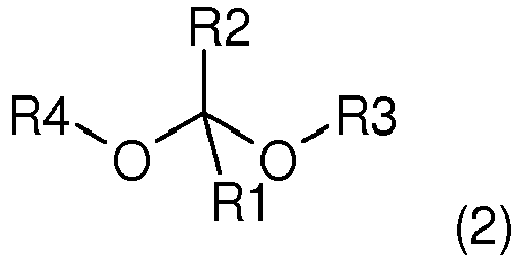
- Es hat sich gezeigt, dass die Beschichtungsmasse des Mineralwolleprodukts besonders gute Wasserbindungseigenschaften aufweist, wenn sie (a) 100 Massenteile Polymer, sowie (b) 1 bis 10 Massenteile Polyol enthält.
- Es ist außerdem bevorzugt, dass die Beschichtungsmasse des Mineralwolleprodukts bezogen auf die 100 Massenteile des Polymers (a) weiterhin (c) 0,1 bis 5 Massenteile des aktivierten Silans enthält.
- In einer bevorzugten Ausführungsform hat das Polymer (a) der Beschichtungsmasse eine mittlere Molmasse von 100000 bis 300000 g/mol, was eine gute Quellfähigkeit bei faktischer Wasserunlöslichkeit erlaubt.
- Das Polymer (a) der Beschichtungsmasse ist im Weiteren vorzugsweise ausgewählt aus der Gruppe bestehend aus Polyvinylalkohol, Polyvinylacrylat, Polyvinylacetat, Polyvinylpyrrolidon und Copolymeren und Mischungen davon;
- Das Polyol (b) der Beschichtungsmasse kann in einer bevorzugten Ausführungsform eine mittlere Molekülmasse von 4000 bis 12000 g/mol haben.
- In einer bevorzugten Ausführungsform ist das Polyol (b) der Beschichtungsmasse ausgewählt aus der Gruppe bestehend aus Polyoxyethylen-Polyoxypropylen-Glycerylether, Polyethylen-Polypropylen-Glycol-Sorbitol-Ether oder Mischungen davon.
- Es ist außerdem bevorzugt, dass die Endgruppen der Polyols (b) modifiziert sind. In einer bevorzugten Ausführungsform sind die Endgruppen des Polyols kovalent mit Epoxidresten oder Derivaten davon modifiziert. Reaktive Epoxidgruppen beschleunigen die Reaktion zwischen Polymer (a) und Polyol (b). Die Reste womit die Endgruppen des Polyols modifiziert sein können, sind ausgewählt aus der Gruppe bestehend aus Ethylenoxid, 3-Hydroxypropylenoxid, 3-Chlorpropylenoxid und Mischungen davon.
- Um die Polymerisationsreaktion zwischen Polymer (a) und Polyol (b) weiter zu beschleunigen, findet diese vorzugsweise in der Anwesenheit einer nichtnukleophilen Base statt. Nichtnucleophile Basen sind sterisch anspruchsvolle Verbindungen, die ein Proton abstrahieren können, ohne jedoch selbst eine Substitutionsreaktion einzugehen. Nichtnukleophile Basen sind dem Fachmann bekannt. Die nichtnukleophile Base kann beispielhaft ausgewählt sein aus der Gruppe bestehend aus Triethylamin (TEA), Triethanolamin, 1-Hydroxyethan-(1,1-diphosphonsäure) (HEDP), Nitrilotris(methylenphosphonsäure) (NTMP), Diethylentriaminpenta(methylenphosphonsäure) (DTPMP) Ethylendiamintetra(methylenphosphonsäure) (EDTMP), Phosphonobutantricarbonsäure (PBTC).
- Die Beschichtungsmasse, die auf dem erfindungsgemäßen Mineralwolleprodukt aufgetragen ist, kann weiterhin ein oder mehrere Additive enthalten. Übliche Additive sind pH-Regulatoren, Entschäumer, Farbstoffe, Flammschutzmittel und Antioxidationsmittel.
- Es hat sich gezeigt, dass die Wirksamkeit des erfindungsgemäßen Mineralwollprodukts von der Auftragsmenge der Beschichtungsmasse abhängig ist. Die Auftragsmenge der Beschichtungsmasse beträgt vorteilhaft 0,05 bis 3 kg/m2, insbesondere 0,2 bis 2 kg/m2, vorzugsweise 0,5 bis 1,5 kg/m2 und insbesondere bevorzugt 1 kg/m2.
- Die Beschichtungsmasse wird vorzugsweise auf einem flächig ausgebildeten Mineralwolleprodukt, z.B. einer Mineralwollematte, aufgetragen, Die Beschichtungsmasse kann mittels Verfahren, die dem Fachmann bekannt sind, auf Mineralwolle aufgebracht werden. Die Verfahren umfassen beispielsweise, Aufstreichen, Sprühen, Rakeln oder auch Tränken.
- Die Beschichtungsmasse kann auf mit einem Bindemittel, z.B. einem Phenol/Formaldehydharz-Bindemittel gebundene Mineralwolle aufgetragen werden.
- Alternativ kann die erfindungsgemäße Masse jedoch auch selbst als Bindemittel fungieren. In diesem Fall ist es vorteilhaft, dass die Masse das aktivierte Silan enthält, um eine stabile kovalente Bindung mit den Mineralwollefasern auszubilden. Die Beschichtungsmasse kann bei erhöhten Temperaturen ausgehärtet werden. Geeignete Vorrichtungen für das Aushärten der Beschichtungsmasse ist ein Härteofen. Vorzugsweise erfolgt das Aushärten bei Temperaturen von 100 bis 300 °C.
- Ein derartig beschichtetes erfindungsgemäßes Mineralwolleprodukt eignet sich hervorragend für die Innendämmung, da mehrere Nachteile des gegenwärtigen Standes der Technik überwunden werden. Mit Mineralwolle wird ein Material mit einer niedrigen Wärmeleitfähigkeit von 35 mW/mK und kleiner verwendet, die deutlich unter jener von Calciumsilikatplatten liegt.
- Außerdem besitzt das erfindungsgemäße beschichtete Mineralwolleprodukt ausgezeichnete reversible hygroskopische Eigenschaften, wodurch Feuchtigkeitsansammlungen in der Wandkonstruktion durch eine rasche Absorption bzw. ein Aufsaugen vermieden werden. Gleichzeitig wird absorbiertes Wasser nur wieder langsam und kontrolliert in Innenraumrichtung als Wasserdampf abgegeben. Ein derartiger reversibler Zyklus ist über lange Zeiträume hinweg wiederholbar.
- Durch den Einsatz des erfindungsgemäßen Mineralwolleprodukts entfällt schließlich die Notwendigkeit einer häufig problematischen Dampfsperre und das Risiko von ausgeprägter und lange unbemerkter Schimmelbildung wird vermieden. Das Entfallen einer Dampfsperre bedingt ferner ein gesundes und ausgeglichenes Raumklima. Das diffusionsoffene erfindungsgemäße Mineralwolleprodukt ist selbst durch das hohe Absorptionsvermögen der Beschichtungsmasse undurchlässig für flüssig vorliegendes Wasser, jedoch gleichzeitig durchlässig für Wasserdampf.
- Die vorliegende Erfindung betrifft weiterhin eine Beschichtungsmasse, enthaltend:
- a) wenigstens ein Polymer mit einer mittleren Molmasse von 50 000 bis 500 000 g/mol ausgewählt aus der Gruppe bestehend aus Polyvinylalkohol, Polyvinylacrylat, Polyvinylacetat, Polyvinylpyrrolidon und Copolymeren; und Mischungen davon;
- b) wenigstens ein Polyol mit einer mittleren Molmasse von 2 000 bis 15 000 g/mol
- c) wenigstens ein aktiviertes Silan, ausgewählt aus einer Gruppe von aktivierten Silanen, die erhältlich sind durch die Umsetzung
eines Silans ausgewählt aus der Gruppe bestehend aus Mono-, Di- und Trilakoxysilanen mit einer C1- bis C8-Alkoxygruppe, wobei das Alkoxysilan wenigstens eine C2- bis C10-Aminoalkylgruppe oder eine C2- bis C10-N-Aminoalkylgruppe trägt; 3(2-Aminoethylamino)propyl-trimethoxysilan; (MeO3)-Si-(CH2)3-NH-(CH2)3-Si-(OMe)3; 3-Aminopropylsilantriol; Aminosilan mit ethoxyliertem Nonylphenolat; Phenyl-CH2-NH-(CH2)3-NH-(CH2)3-Si-(OMe)3*HCl; sowie deren Mischungen;
mit
einem enolisierbaren Keton mit wenigstens einer Carbonylgruppe oder einem Keton mit wenigstens einer OH-Gruppe, wobei das Keton 3 bis 12 Kohlenstoffatome enthält
oder mit
mit einem offenkettigen oder zyklischen Acetal oder Halbacetal oder geminalen Diol eines Ketons gemäß Formel (1):
wobei R1 und R2 gleich oder ungleich, unabhängig voneinander ausgewählt sind aus der Gruppe bestehend aus: H; C1 bis C9-Alkyl; C2 bis C9-Alkenyl mit 1-4 Doppelbindungen, C1 bis C9-Hydroxyalkyl; Aryl mit 5 oder 6 C-Atomen im Cyclus oder Heteroaryl mit 1-4 Heteroatomen und 4-8 C-Atomen im Cyclus, Cycloalkyl mit 5-10 C-Atomen, Heterocycloalkyl mit 1-4 Heteroatomen und 4-8 C-Atomen im Cyclus, Carbonyl, Carboxyl, C1-C9-n-Alkylcarbonyl mit einer Position der Carbonylfunktion von 1-9, C1-C9-Alkoxycarbonyl worin der Alkylrest insbesondere Methyl, Ethyl, Propyl oder Butyl ist
und wobei das Acetal, Halbacetal oder geminale Diol der folgenden allgemeinen Formel (2) entspricht:
- Es ist bevorzugt, dass die erfindungsgemäße Beschichtungsmasse die Komponenten (a) bis (c) in folgenden Mengen enthält:
- (a) 100 Massenteile Polymer;
- (b) 1 bis 10 Massenteile Polyol;
- (c) 0,1 bis 5 Massenteile aktiviertes Silan.
- Die erfindungsgemäße Beschichtungsmasse hat ausgezeichnete hygroskopische Eigenschaften. Es hat sich herausgestellt, dass sie in etwa die Menge Wasser, die ihrem Eigengewicht entspricht, sehr rasch absorbieren kann. Die Bindung ist reversibel, das absorbierte Wasser wird dabei vorteilhaft nur sehr langsam, über mehrere Tage hinweg wieder in Dampfform abgegeben. Dieser Zyklus kann beliebig oft wiederholt werden, so dass die sich die Beschichtungsmasse zur Langzeitverwendung eignet.
- Aufgrund des enthaltenen aktivierten Silans kann die erfindungsgemäße Beschichtungsmasse vorteilhaft kovalent an ein zu beschichtendes Mineralwolle-Substrat gebunden werden.
- Es wurden drei modifizierte Grundharze mit einem Zielfeststoffgehalt von 50 bzw. 53 Masse-% aus folgenden Komponenten hergestellt:
Modifiziertes Grundharz 1 Modifiziertes Grundharz 2 Modifiziertes Grundharz 3 Zielfeststoffgehalt 53% 50% 50 % Verbindung Menge (g) Menge (g) Menge (g) wässrige Vinylacetathomopolymer-Dispersion (54 Gew.-% Feststoffanteil, mittleres Molgewicht 200000 g/mol) 150 Resyn 1601, Celanese) Wässrige Polyvinylacetat-Dispersion (60 % Feststoffanteil, mittleres Molgewicht 250 kd) 150 Mowilith DNN, Celanese Wässrige Polyvinylacetat-Dispersion (50 % Feststoffanteil, mittleres Molgewicht 250 kd) 150 Mowilith DN50, Celanese wässrige Polyvinylpyrrolidon-Dispersion 30% (CAS 9082-00-2) (mittleres Molgewicht 50 000 g/mol) 2,7 3 2,5 Luvitec K30, BASF Dihydroxyaceton, nicht-kosmetisch 0,16 0,18 0,15 Merck Entschäumer Drewplus 16002EG, Ashland 0,72 0,81 0,68 Wasser 3,2 29,8 - Für die Herstellung der modifizierten Grundharze wurde bei Raumtemperatur die Basis-Dispersion vorgelegt, mit einem mechanischen Rührer gerührt, ggf. Verdünnungswasser hinzugefügt, unter weiterem Rühren zuerst der Entschäumer, anschließend die wässrige Polyvinylpyrrolidon-Dispersion und zuletzt Dihydroxyaceton zugegeben.
- Weiterhin wurde eine Puffersalzlösung mit folgender Zusammensetzung hergestellt:
Puffersalzlösung Verbindung Menge (g) Wasser 50 wässrige Glykolsäure-Lösung (70 % w/w) 6,5 Ethanolamin 9,5 Zr(CO3)2 4,2 [Zn(CO3)2]*[Zn(OH)2]3 2,2 - Für die Herstellung der Puffersalzlösung wird Wasser vorgelegt, Glycolsäure und Ethanolamin zugegeben, homogenisiert, dann in einer Kühltruhe bis kurz über den Gefrierpunkt auf etwa 2°C abgekühlt, dann Zr(CO3)2 zugegeben, bei 3 - 8°C homogenisiert, danach basisches Zinkcarbonat bei 12 -15°C hinzugefügt. Die Mischung wird etwa 5 min bei Raumtemperatur homogenisiert, und bei 14°C bis zur Verwendung gelagert.
- Es wurden sieben verschiedene Beschichtungsmassen 1-1 bis 1-7 mit einem Zielfeststoffgehalt von 50 Masse-% mit den folgenden Zusammensetzungen hergestellt:
Beschichtungsmasse 1-1 1-2 1-3 1-4 1-5 1-6 1-7 Verbindung Menge (g) Grundharz 1 50 50 50 Grundharz 2 50 50 Grundharz 3 50 50 Polyoxyethylen-Polyoxypropylen-Glycerylether (CAS 9082-00-2) 1,33 1,25 1,25 Rockopol M1170, PPC Rokita S.A. Polyethylen-Polypropylen-Glycol-Sorbitol-Ether (CAS 56449-05-9) 1,33 Rockopol MH2000, PPC Rokita S.A. Polyoxyethylen-Polyoxypropylen-Glycerylether (CAS 9082-00-2) 1,33 1,25 1,25 Rockopol M5000, PPC Rokita S.A. 3-Aminopropyltriethoxysilan 0,13 0,13 0,13 0,13 0,13 0,13 0,13 Dihydroxyaceton 0,07 0,07 0,07 0,07 0,07 0,07 0,07 Puffersalzlösung 0,47 0,47 0,47 0,43 0,43 0,43 0,43 Wasser 4,4 4,4 4,4 1,26 1,26 1,20 1,20 - Für die Herstellung der Beschichtungsmasse wurde in einem ersten Schritt das 3-Aminopropyltriethoxysilan durch vorherige Reaktion mit Dihydroxyaceton aktiviert. Dazu wurde das Silan im Verdünnungswasser vorgelegt, das Dihydroxyaceton fest hinzugefügt und die Mischung bis zur kräftigen Gelbfärbung gerührt.
- Das jeweilige Grundharz wird bei Raumtemperatur vorgelegt, mit einem mechanischen Rührer gerührt und unter Rühren nacheinander das Polyol, das aktivierte Silan, und zuletzt die Puffersalzlösung zugegeben.
- In einer kreisrunden Aluminiumschale wurden 15 g der jeweiligen Beschichtungsmassen 1-1 bis 1-3 gegeben und 2 h bei 150 °C ausgehärtet. Nach dem Abkühlen in einem Exsikkator, wurden die erhaltenen kompakten Kunststoffkörper 2-1 bis 2-3 in luftdichten PE-Beuteln gelagert.
- Jeweils ein Probekörper wurde gewogen und so dessen Trockenmasse bestimmt. Die Trockenmassen der Kunststoffkörper 1 bis 3 betrugen:
Proben-Nr. 2-1 2-2 2-3 Masse (g) 5,53 5,55 5,63 - Die drei Kunststoffkörper wurden anschließend für 22 h bei 30 °C in Wasser gelagert. Danach wurden die Probenkörper aus dem Wasser entnommen, das anhaftende Wasser abgetupft und zunächst für 2 h bei 25 °C und 62 % RH (relative Feuchtigkeit) gelagert. Im weiteren Verlauf wurden die Probenkörper ausschließlich bei 22 °C und 58 % RH gelagert. Die Probenkörper wurden in bestimmten Zeitabständen gewogen, wobei deren Gewicht erstmalig 5 h nach Entnahme aus dem Wasser bestimmt wurde, um nur durch den Kunststoff aufgenommenes Wasser zu erfassen.
- In Tabelle 1 sind die Ergebnisse zusammengefasst. Spalten B bis D geben die Massen der Probenkörper 2-1 bis 2-3 nach unterschiedlichen Lagerzeiten an. In Spalten E bis G ist die in den Probenkörper 2-1 bis 2-3 nach unterschiedlichen Lagerzeiten noch enthaltene Wassermasse angegeben. Diese berechnet sich aus der Differenz der Massen der Probekörper 2-1 bis 2-3 gemäß Spalten B bis D abzüglich der jeweiligen Trockenmasse.

- Alle drei Proben können in etwa das Äquivalent ihrer Masse an Wasser aufnehmen und zeigen vorteilhaft eine kontinuierliche und stark verzögerte Wasserabgabe, die auch nach drei Tagen noch nicht abgeschlossen ist.
- Auf Blaubandfilter als Träger (Papier, 125 mm Durchmesser, 589 mm2 Fläche) wurden je 10 g der Beschichtungsmassen 1-1 bis 1-3 aufgegeben, ohne das Material zu verstreichen. Anschließend wurden die Massen für 2 h bei ca. 150 °C gehärtet und anschließend im Exsikkator abgekühlt. Mit einer Schablone wurde ein kreisrundes Stück (Filter + Beschichtungsmasse) von 82 mm Durchmesser (0,00528 m2) ausgeschnitten und in einem PE-Beutel gelagert. Die Auftragsmenge betrug somit nach Trocknen ca. 5 g/0,00528 m2 (ca. 947 g/m2).
- Als Vergleichsprobe wurde vom gleichen Filterpapiertyp ein kreisrundes Stück mit einem Durchmesser von 82 mm ausgeschnitten und analog der beschichteten Filterpapiere behandelt.
- Mit Beschichtungsmassen 1-1 bis 1-3 beschichtetes Filterpapier und weiterhin ein unbeschichtetes Filterpapier als Vergleich wurden gewogen und so deren Trockenmasse bestimmt. Die Trockenmassen der beschichteten Filterpapiere 3-1 bis 3-3 und des Vergleichs betrugen:
Proben-Nr. 3-1 3-2 3-3 Vergleich Masse (g) 5,53 5,55 5,63 0,4472 - Die flächigen Probenkörper (beschichtet und unbeschichtet) wurden anschließend für 22 h bei 30 °C in Wasser gelagert. Danach wurden die Probenkörper aus dem Wasser entnommen, das anhaftende Wasser abgetupft und zunächst für 2 h bei 25 °C und 62 % RH gelagert. Im weiteren Verlauf wurden die Probenkörper ausschließlich bei 22 °C und 58 % RH gelagert. Die Probenkörper wurden in bestimmten Zeitabständen gewogen, wobei deren Gewicht erstmalig 5 h nach Entnahme aus dem Wasser bestimmt wurde.
- In Tabelle 2 sind die Ergebnisse zusammengefasst. Spalten B bis E geben die Massen der flächigen Probenkörper 3-1 bis 3-3 und der Vergleichsprobe nach unterschiedlichen Lagerzeiten an. In Spalten F bis I ist die noch enthaltene Wassermenge in den flächigen Probenkörpern 3-1 bis 3-3 und in der Vergleichsprobe angegeben. Diese berechnet sich aus der Differenz der Massen der flächigen Probekörper 3-1 bis 3-3 gemäß Spalten B bis E abzüglich der jeweiligen Trockenmasse

- Die drei Proben waren in der Lage in etwa das Äquivalent der Beschichtungsmasse an Wasser aufzunehmen. Alle drei Proben zeigten ebenfalls eine stark verzögerte Wasserabgabe, die auch nach drei Tagen noch nicht abgeschlossen war. Die unbeschichtete Vergleichsprobe aus Papier hingegen hatte bereits nach 5 Stunden im Wesentlichen das gesamte Wasser abgegeben.
- Auf Mineralwolleplatten der Abmessungen 20 x 20 x 6 cm wurden unterschiedliche Mengen der Beschichtungsmassen 1-1 bis 1-7 aufgetragen:
- Auftragsmenge 1 (A1): 38 g trocken, entsprechend 76 g 50% und weiterhin 950 g/m2) Auftragsmenge 2 (A2): 50 g trocken, entsprechend 100 g 50% und weiterhin 1250 g/m2)
- Zwei Sätze derart beschichteter Mineralwollplatten 4-1 bis 4-3 mit den Beschichtungsmassen 1-1 bis 1-3 wurden gewogen und anschließend wurden jeweils 76 g und 100 g der Beschichtungsmassen aufgetragen. Die Beschichtungsmassen wurden mit einem Spatel gleichmäßig auf der Mineralwolle verteilt und für 2 h bei 150 °C ausgehärtet. Als Referenz wurde ein unbehandeltes Stück Mineralwolle verwendet.
- Die Wasseraufnahme dieser Probekörper wurde mittels eines Eintauchtests nach EN 1609 bestimmt. Hierzu wurden die Probekörper für 24 h in Wasser eingelegt und anschließend für 10 min gemäß dem Verfahren A der EN 1609 abgetropft, dann ausgewogen. Insgesamt wurde der Eintauchtest nach DIN EN 1609 dreimal hintereinander an den selben Proben zur Überprüfung der Reversibilität durchgeführt. Zu diesem Zweck wurden die Probekörper bis zur Gewichtskonstanz rückgetrocknet. Die jeweiligen Ergebnisse der Massenbestimmung der Probekörper vor und nach dem Eintauchen sind in Tabelle 3 zusammengefasst. Jeder Wert ist ein Mittelwert der Ergebnisse von 3 Probekörpern.

- Aus dem Vergleich der Ergebnisse der Tabelle 3 zeigt sich, dass die Wasseraufnahme vollständig reversibel ist, sich während der Zyklen sogar ein ansteigendes Feuchtespeicherpotential ergibt.
- Die derart beladenen Probenkörper wurden bei 21 °C und 64% RH gelagert. Für den dritten Beladungsversuch wurde zu definierten Zeitpunkten die Masse der Probenkörper bestimmt und aus der Differenz die enthaltene Wassermenge berechnet, wobei die jeweiligen Ergebnisse in Tabelle 4 zusammengefasst sind. Der zeitliche Verlauf der Wasserabgabe ist in
Fig. 1 dargestellt.Tabelle 4: Zeitliche Abnahme der Wassermenge im Probenkörper nach DIN EN 1609, (nach 3. Beladung) Probe Zeit (h) Referenz 4-1 4-2 4-3 Auftragsmenge (g, trocken) 38 50 38 50 38 50 Wassermenge (g) 0 13,4 176 157,6 127,5 123 71,9 76 17 0 106 90 70,3 54,9 26,9 30,2 24 0 93,7 77,5 59,5 45,8 19,4 23,3 41 0 67,2 51,8 35,5 25,2 6,2 10,4 48 0 58,2 43,1 27,3 18,4 3,4 7,2 65 0 44,4 29,3 13,6 8,1 1 3,2 72 0 41,3 26,1 10,8 6 0 2,7 89 0 7,4 0 0,4 0,6 0 0,7 96 0 3,5 0 0,3 0,5 0 0,5 113 0 0,8 0 0 0 0 0 120 0 0,5 0 0 0 0 0 140 0 0 0 0 0 0 0 - Die Tabellenwerte wie auch deren grafische Darstellung in
Fig. 1 zeigen, dass das beschichtete Mineralwolleprodukt eine große Speicherkapazität für Wasser aufweist. Dieses gespeicherte Wasser wird erheblich verzögert abgegeben, erst nach 4 Tagen ist der Vorgang der Rücktrocknung und Wasserabgabe praktisch abgeschlossen. - In einer zweiten Versuchsreihe wurden auf Mineralwolleplatten der Abmessungen 20 x 20 x 6 cm die Beschichtungsmassen 1-4 bis 1-7 mit der Auftragsmenge A2 (50 g, tr.) aufgetragen und die Untersuchungen zur Reversibilität und zur zeitlichen Abnahme der Wassermenge wie zuvor beschrieben durchgeführt. Die Daten sind in den Tabellen 5 und 6 zusammengefasst, und bzgl. des zeitlichen Verlaufs in
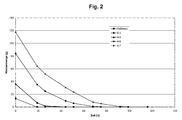
Fig. 1 dargestellt. Die Daten der Referenzprobe sind lediglich zu Vergleichszwecken aus Tabelle 3 übernommen.
Tabelle 6: Zeitliche Abnahme der Wassermenge im Probenkörper nach DIN EN 1609, (nach 3. Beladung) Probe Zeit (h) Referenz 4-4 4-5 4-6 4-7 Auftragsmenge (g, trocken) 50 50 50 50 Wassermenge (g) 0 13,4 83,9 36,2 117,5 35,8 19 0 35,2 6,4 64,1 6,8 26 0 24,9 1,8 51,8 1,2 44 0 9,7 0 30,6 0 51 0 5,9 0 23,5 0 68 0 1,0 0 7,8 0 75 0 0,2 0 5,3 0 92 0 0 0 0,7 0 99 0 0 0 0,2 0 116 0 0 0 0 0 - Die Ergebnisse der zweiten Versuchsreihe wie auch deren grafische Darstellung in
Fig. 2 bestätigen die erheblich größere Speicherkapazität der beschichteten Mineralwolleproben für Wasser im Vergleich zur Referenz. Die vergleichsweise geringe Speicherkapazität der Proben 4-5 und 4-7 von etwa einem Faktor 3 im Vergleich zur Referenz wirkt sich auch in einer dementsprechend kürzeren Rücktrocknungszeit bis zur Gewichtskonstanz aus, die bei diesen Proben nach etwa 30 bis 35 Stunden erreicht ist (Basis Interpolation). - Zur Bestimmung der hygroskopischen Sorptionseigenschaften wurden für die Probekörper 4-4 bis 4-7 gemäß der DIN EN ISO 12571, Ausgabe April 2000 bestimmt. Die Messwerte sind in der folgenden Tabelle 7 zusammengefasst.
Tabelle 7: Messwerte der hygroskopischen Sorptionseigenschaft Prüfklima Referenz 4-4 4-5 4-6 4-7 23°C/50% r.F. 1,25 1,42 1,14 1,43 1,10 23°C/80% r.F. 1,80 2,95 1,73 2,90 2,28 23°C/93% r.F. 2,00 4,65 3,10 4,70 3,30 23°C/97% r.F. 3,40 9,20 3,25 9,20 7,30 - Die Messergebnisse zeigen, dass das erfindungsgemäße Beschichtungssystem im Fall der Ausführungsbeispiele 4-4, 4-6 und 4-7 neben der Wasseraufnahme insbesondere durch Saugen aus der Wand auch in der Lage ist, einen positiven Beitrag durch Absorption des Wasserdampfs zu leisten. Bei diesen Ausführungsbeispielen ist bereits bei einer relativen Feuchte von 80%, dem sog. baupraktischen Feuchtegehalt, eine signifikant höhere Sorptionsfeuchte feststellbar. Mit steigender relativer Feuchte verstärkt sich der Effekt, wobei bei diesen Feuchtegehalten im Mauerwerk üblicherweise unerwünschte Kapillarkondensation eintritt. Damit wird die zur Verfügung stehende Menge an Wasserdampf, die an den kalten Außenwänden potentiell kondensiert könnte, wirksam reduziert.
Claims (13)
- Mineralwolleprodukt, welches reversibel Wasser bindet und welches wenigstens einseitig mit einer Beschichtungsmasse versehen ist, wobei die Beschichtungsmasse enthält:a) wenigstens ein Polymer mit einer mittleren Molmasse von 50 000 bis 500 000 g/mol ausgewählt aus der Gruppe bestehend aus Polyvinylalkohol, Polyvinylacrylat, Polyvinylacetat, Polyvinylpyrrolidon und Copolymeren und Mischungen davon; undb) wenigstens ein Polyol mit einer mittleren Molmasse von 2 000 bis 15 000 g/mol.
- Mineralwolleprodukt nach Anspruch 1, wobei die Beschichtungsmasse weiterhin enthält:c) wenigstens ein aktiviertes Silan, ausgewählt aus einer Gruppe von aktivierten Silanen, die erhältlich sind durch die Umsetzung
eines Silans ausgewählt aus der Gruppe bestehend aus Mono-, Di- und Trilakoxysilanen mit einer C1- bis C8-Alkoxygruppe, wobei das Alkoxysilan wenigstens eine C2- bis C10-Aminoalkylgruppe oder eine C2- bis C10-N-Aminoalkylgruppe trägt; 3(2-Aminoethylamino)propyl-trimethoxysilan; (MeO3)-Si-(CH2)3-NH-(CH2)3-Si-(OMe)3; 3-Aminopropylsilantriol; Aminosilan mit ethoxyliertem Nonylphenolat; Phenyl-CH2-NH-(CH2)3-NH-(CH2)3-Si-(OMe)3*HCl; sowie deren Mischungen;
mit
einem enolisierbaren Keton mit wenigstens einer Carbonylgruppe oder einem Keton mit wenigstens einer OH-Gruppe, wobei das Keton 3 bis 12 Kohlenstoffatome enthält
oder mit
mit einem offenkettigen oder zyklischen Acetal oder Halbacetal oder geminalen Diol eines Ketons gemäß Formel (1):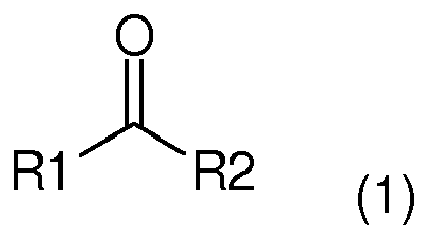
wobei R1 und R2 gleich oder ungleich, unabhängig voneinander ausgewählt sind aus der Gruppe bestehend aus: H; C1 bis C9-Alkyl; C2 bis C9-Alkenyl mit 1-4 Doppelbindungen, C1 bis C9-Hydroxyalkyl; Aryl mit 5 oder 6 C-Atomen im Cyclus oder Heteroaryl mit 1-4 Heteroatomen und 4-8 C-Atomen im Cyclus, Cycloalkyl mit 5-10 C-Atomen, Heterocycloalkyl mit 1-4 Heteroatomen und 4-8 C-Atomen im Cyclus, Carbonyl, Carboxyl, C1-C9-n-Alkylcarbonyl mit einer Position der Carbonylfunktion von 1-9, C1-C9-Alkoxycarbonly worin der Alkylrest insbesondere Methyl, Ethyl, Propyl oder Butyl ist
und wobei das Acetal, Halbacetal oder geminale Diol der folgenden allgemeinen Formel (2) entspricht: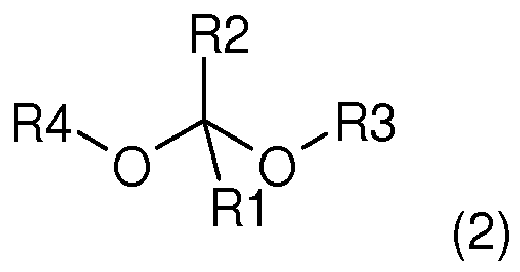
- Mineralwolleprodukt nach Anspruch 1 oder 2, wobei die Beschichtungsmassea) 100 Massenteile Polymer; undb) 1 bis 10 Massenteile Polyol
enthält. - Mineralwolleprodukt nach Anspruch 2, wobei die Beschichtungsmasse c) 0,1 bis 5 Massenteile aktiviertes Silan enthält.
- Mineralwolleprodukt nach einem der vorhergehenden Ansprüche, wobei das Polymer (a) ausgewählt ist aus der Gruppe bestehend aus Polyvinylacetat, Polyvinylpyrrolidon und Mischungen davon.
- Mineralwolleprodukt nach einem der vorhergehenden Ansprüche, wobei das Polyol (b) ausgewählt ist aus der Gruppe bestehend aus Polyethylenglykol (PEG), Polypropylenglykol (PPG) und Copolymeren oder Mischungen davon.
- Mineralwolleprodukt nach einem der vorhergehenden Ansprüche, wobei das Polyol (b) ausgewählt ist aus der Gruppe bestehend aus Polyoxyethylen-Polyoxypropylen-Glycerylether, Polyethylen-Polypropylen-Glycol-Sorbitol-Ether und Mischungen davon.
- Mineralwolleprodukt nach Anspruch 6 oder 7, wobei die Endgruppen des Polyols mit Resten modifiziert sind, die ausgewählt sind aus der Gruppe bestehend aus Ethylenoxid, 3-Hydroxypropylenoxid, 3-Chlorpropylenoxid und Mischungen davon.
- Mineralwolleprodukt nach einem der vorhergehenden Ansprüche, wobei die Beschichtungsmasse weiterhin übliche Zusatzstoffe wie pH-Regulatoren, Entschäumer, Farbstoffe, Flammschutzmittel, Antioxidationsmittel umfasst.
- Mineralwolleprodukt nach einem der vorhergehenden Ansprüche, wobei die Auftragsmenge der Beschichtungsmasse 0,05 bis 3 kg m2, insbesondere 0,2 bis 2 kg/m2, vorzugsweise 0,5 bis 1,5 kg/m2 und insbesondere bevorzugt 1 kg/m2 beträgt.
- Verwendung eines Mineralwolleproduktes gemäß wenigstens einem der Ansprüche 1 bis 10 zur Innendämmung.
- Beschichtungsmasse, enthaltenda) wenigstens ein Polymer mit einer mittleren Molmasse von 50 000 bis 500 000 g/mol ausgewählt aus der Gruppe bestehend aus Polyvinylalkohol, Polyvinylacrylat, Polyvinylacetat, Polyvinylpyrrolidon und Copolymeren; und Mischungen davon;b) wenigstens ein Polyol mit einer mittleren Molmasse von 2 000 bis 15 000 g/molc) wenigstens ein aktiviertes Silan, ausgewählt aus einer Gruppe von aktivierten Silanen, die erhältlich sind durch die Umsetzung
eines Silans ausgewählt aus der Gruppe bestehend aus Mono-, Di- und Trilakoxysilanen mit einer C1- bis C8-Alkoxygruppe, wobei das Alkoxysilan wenigstens eine C2- bis C10-Aminoalkylgruppe oder eine C2- bis C10-N-Aminoalkylgruppe trägt; 3(2-Aminoethylamino)propyl-trimethoxysilan; (MeO3)-Si-(CH2)3-NH-(CH2)3-Si-(OMe)3; 3-Aminopropylsilantriol; Aminosilan mit ethoxyliertem Nonylphenolat; Phenyl-CH2-NH-(CH2)3-NH-(CH2)3-Si-(OMe)3*HCl; sowie deren Mischungen;
mit
einem enolisierbaren Keton mit wenigstens einer Carbonylgruppe oder einem Keton mit wenigstens einer OH-Gruppe, wobei das Keton 3 bis 12 Kohlenstoffatome enthält
oder mit
mit einem offenkettigen oder zyklischen Acetal oder Halbacetal oder geminalen Diol eines Ketons gemäß Formel (1):
wobei R1 und R2 gleich oder ungleich, unabhängig voneinander ausgewählt sind aus der Gruppe bestehend aus: H; C1 bis C9-Alkyl; C2 bis C9-Alkenyl mit 1-4 Doppelbindungen, C1 bis C9-Hydroxyalkyl; Aryl mit 5 oder 6 C-Atomen im Cyclus oder Heteroaryl mit 1-4 Heteroatomen und 4-8 C-Atomen im Cyclus, Cycloalkyl mit 5-10 C-Atomen, Heterocycloalkyl mit 1-4 Heteroatomen und 4-8 C-Atomen im Cyclus, Carbonyl, Carboxyl, C1-C9-n-Alkylcarbonyl mit einer Position der Carbonylfunktion von 1-9, C1-C9-Alkoxycarbonly worin der Alkylrest insbesondere Methyl, Ethyl, Propyl oder Butyl ist
und wobei das Acetal, Halbacetal oder geminale Diol der folgenden allgemeinen Formel (2) entspricht:
- Beschichtungsmasse nach Anspruch 12, enthaltenda) 100 Massenteile Polymer;b) 1 bis 10 Massenteile Polyol;c) 0,1 bis 5 Massenteile aktiviertes Silan.
Applications Claiming Priority (1)
| Application Number | Priority Date | Filing Date | Title |
|---|---|---|---|
| DE102012219988.8A DE102012219988A1 (de) | 2012-10-31 | 2012-10-31 | Reversibel Wasser bindendes Mineralwolleprodukt |
Publications (3)
| Publication Number | Publication Date |
|---|---|
| EP2727891A1 true EP2727891A1 (de) | 2014-05-07 |
| EP2727891A8 EP2727891A8 (de) | 2014-07-09 |
| EP2727891B1 EP2727891B1 (de) | 2017-12-27 |
Family
ID=49488515
Family Applications (1)
| Application Number | Title | Priority Date | Filing Date |
|---|---|---|---|
| EP13191138.0A Active EP2727891B1 (de) | 2012-10-31 | 2013-10-31 | Reversibel Wasser bindendes Mineralwolleprodukt |
Country Status (2)
| Country | Link |
|---|---|
| EP (1) | EP2727891B1 (de) |
| DE (1) | DE102012219988A1 (de) |
Cited By (1)
| Publication number | Priority date | Publication date | Assignee | Title |
|---|---|---|---|---|
| WO2025137029A1 (en) * | 2023-12-22 | 2025-06-26 | Owens Corning Intellectual Capital, Llc | Coated non-woven fibrous mat |
Families Citing this family (1)
| Publication number | Priority date | Publication date | Assignee | Title |
|---|---|---|---|---|
| DE102018112260A1 (de) | 2018-05-22 | 2019-11-28 | Saint-Gobain Isover G+H Ag | Wärmedämmelement, Bauwerkskonstruktion sowie Verfahren zur Vermeidung von Feuchteschäden an einem Bauwerk |
Citations (9)
| Publication number | Priority date | Publication date | Assignee | Title |
|---|---|---|---|---|
| US4795678A (en) * | 1985-07-02 | 1989-01-03 | Ppg Industries, Inc. | Chemically treated glass fibers |
| DE19606394A1 (de) * | 1996-02-21 | 1997-08-28 | Basf Ag | Formaldehydfreie, wäßrige Bindemittel |
| DE69315393T2 (de) * | 1992-08-06 | 1998-04-30 | Rohm & Haas | Wässerige hitzehärtbare Zusammensetzung und ihre Verwendung als Glassfaservliesstoff-Bindemittel |
| DE102005056791A1 (de) | 2005-11-28 | 2007-05-31 | Saint-Gobain Isover G+H Ag | Formaldehydfreies Bindemittel |
| DE102005063414A1 (de) | 2005-11-28 | 2007-12-06 | Saint-Gobain Isover G+H Ag | Aktivierbares Silan |
| DE102007047373A1 (de) | 2007-10-04 | 2009-04-09 | Saint-Gobain Isover G+H Ag | Aktiviertes Silan |
| DE202009008493U1 (de) * | 2009-06-17 | 2009-09-10 | Remmers Baustofftechnik Gmbh | Wandaufbau und Wärmedämmplatte |
| WO2010138376A1 (en) | 2009-05-28 | 2010-12-02 | Nova Chemicals Inc. | Enhanced expanded polystyrene foam insulation |
| US20110130062A1 (en) * | 2007-08-22 | 2011-06-02 | Hunt Technology Limited | Insulation materials |
Family Cites Families (5)
| Publication number | Priority date | Publication date | Assignee | Title |
|---|---|---|---|---|
| DE19514420C1 (de) * | 1995-04-19 | 1997-03-06 | Fraunhofer Ges Forschung | Dampfbremse für den Einsatz zur Wärmedämmung von Gebäuden |
| EP0990727A1 (de) * | 1998-10-02 | 2000-04-05 | Johns Manville International Inc. | Polycarbonsäure/Polyol enthaltendes Bindemittel für Glasfaser |
| EP1144774B1 (de) * | 1998-12-21 | 2004-11-03 | Icopal A/S | Wasserdampfsperre und verfahren zur herstellung derselben |
| JP2011506732A (ja) * | 2007-12-21 | 2011-03-03 | アクゾ ノーベル ナムローゼ フェンノートシャップ | 熱硬化性ポリマー |
| DE102009010938A1 (de) * | 2009-02-27 | 2010-09-09 | Celanese Emulsions Gmbh | Mineralwollfasermatten, Verfahren zu deren Herstellung und Verwendung |
-
2012
- 2012-10-31 DE DE102012219988.8A patent/DE102012219988A1/de not_active Withdrawn
-
2013
- 2013-10-31 EP EP13191138.0A patent/EP2727891B1/de active Active
Patent Citations (9)
| Publication number | Priority date | Publication date | Assignee | Title |
|---|---|---|---|---|
| US4795678A (en) * | 1985-07-02 | 1989-01-03 | Ppg Industries, Inc. | Chemically treated glass fibers |
| DE69315393T2 (de) * | 1992-08-06 | 1998-04-30 | Rohm & Haas | Wässerige hitzehärtbare Zusammensetzung und ihre Verwendung als Glassfaservliesstoff-Bindemittel |
| DE19606394A1 (de) * | 1996-02-21 | 1997-08-28 | Basf Ag | Formaldehydfreie, wäßrige Bindemittel |
| DE102005056791A1 (de) | 2005-11-28 | 2007-05-31 | Saint-Gobain Isover G+H Ag | Formaldehydfreies Bindemittel |
| DE102005063414A1 (de) | 2005-11-28 | 2007-12-06 | Saint-Gobain Isover G+H Ag | Aktivierbares Silan |
| US20110130062A1 (en) * | 2007-08-22 | 2011-06-02 | Hunt Technology Limited | Insulation materials |
| DE102007047373A1 (de) | 2007-10-04 | 2009-04-09 | Saint-Gobain Isover G+H Ag | Aktiviertes Silan |
| WO2010138376A1 (en) | 2009-05-28 | 2010-12-02 | Nova Chemicals Inc. | Enhanced expanded polystyrene foam insulation |
| DE202009008493U1 (de) * | 2009-06-17 | 2009-09-10 | Remmers Baustofftechnik Gmbh | Wandaufbau und Wärmedämmplatte |
Cited By (1)
| Publication number | Priority date | Publication date | Assignee | Title |
|---|---|---|---|---|
| WO2025137029A1 (en) * | 2023-12-22 | 2025-06-26 | Owens Corning Intellectual Capital, Llc | Coated non-woven fibrous mat |
Also Published As
| Publication number | Publication date |
|---|---|
| EP2727891A8 (de) | 2014-07-09 |
| DE102012219988A1 (de) | 2014-04-30 |
| EP2727891B1 (de) | 2017-12-27 |
Similar Documents
| Publication | Publication Date | Title |
|---|---|---|
| DE4321798C2 (de) | Antimikrobische Zusammensetzung | |
| DE102011119029B4 (de) | Verfahren zur Herstellung eines Dämmstoffformteils, Dämmstoffformteil, dessen Verwendung und Dämmelement, hergestellt unter Verwendung des Dämmstoffformteils | |
| EP2606082B1 (de) | Wasser-, lösemittel- und phthalat-freier silanmodifizierter einkomponenten-parkettklebstoff und dessen verwendung zur hochgradig masshaltigen verklebung von parkett, holzbodenbelägen und holzwerkstoffplatten im innenausbau | |
| DE102007001740B3 (de) | Dämmstoffmaterial auf der Basis nachwachsender Rohstoffe | |
| WO2014079873A1 (de) | Intumeszierende zusammensetzung und ausgehärteter intumeszierender stoff | |
| EP2953913B2 (de) | Verwendung nach einem speziellen testverfahren definierbarer trockenmörtel | |
| DE202009018740U1 (de) | Feuchteadaptive Dampfbremse | |
| EP2727891B1 (de) | Reversibel Wasser bindendes Mineralwolleprodukt | |
| US10352011B2 (en) | Humectant compositions that effectively increase moisture retention in soil and associated methods for identifying same | |
| WO2012029787A1 (ja) | ホルムアルデヒド捕捉剤 | |
| WO2014083102A1 (de) | Verwendung von antistatika in beschichtungsmitteln | |
| WO2010009714A2 (de) | System zur wärmedämmung und/oder wandsanierung von gebäuden | |
| DE102008020642A1 (de) | Verfahren zur Herstellung von Holzwerkstoffen und Holzwerkstoffe | |
| EP1600571B1 (de) | Dichtungselement | |
| DE10144187A1 (de) | Konservierungsmittel für Beschichtungszusammensetzungen | |
| DE3603433C2 (de) | ||
| EP2606081B1 (de) | Wasser-, lösemittel- und weichmacher-freier silanmodifizierter einkomponenten-parkettklebstoff und dessen verwendung zur verklebung von parkett, holzbodenbelägen und holzwerkstoffplatten mit allen im innenausbau üblichen, auch problematischen untergründen | |
| KR100651080B1 (ko) | 조습성을 갖는 무기계 바름재 조성물 | |
| EP0688852A1 (de) | Intumeszierendes Imprägniermittel | |
| DE102008044999A1 (de) | Wässrige Harzmischung für Mineralwolleprodukte | |
| EP3694641B1 (de) | Poröses trägersystem zur reduktion der formaldehydemission in einem holzwerkstoff | |
| JP2001132116A (ja) | 調湿パネル | |
| CH695855A5 (de) | Werkstoff umfassend cellulosisches Material und Silikat. | |
| DE1594190C (de) | Wasserlösliche Selbstklebemassen mit erhöhter Wärmebeständigkeit | |
| DE202004014188U1 (de) | Dichtungselement |
Legal Events
| Date | Code | Title | Description |
|---|---|---|---|
| PUAI | Public reference made under article 153(3) epc to a published international application that has entered the european phase |
Free format text: ORIGINAL CODE: 0009012 |
|
| 17P | Request for examination filed |
Effective date: 20131031 |
|
| AK | Designated contracting states |
Kind code of ref document: A1 Designated state(s): AL AT BE BG CH CY CZ DE DK EE ES FI FR GB GR HR HU IE IS IT LI LT LU LV MC MK MT NL NO PL PT RO RS SE SI SK SM TR |
|
| AX | Request for extension of the european patent |
Extension state: BA ME |
|
| RAP1 | Party data changed (applicant data changed or rights of an application transferred) |
Owner name: SAINT-GOBAIN ISOVER |
|
| 17P | Request for examination filed |
Effective date: 20141106 |
|
| RBV | Designated contracting states (corrected) |
Designated state(s): AL AT BE BG CH CY CZ DE DK EE ES FI FR GB GR HR HU IE IS IT LI LT LU LV MC MK MT NL NO PL PT RO RS SE SI SK SM TR |
|
| GRAP | Despatch of communication of intention to grant a patent |
Free format text: ORIGINAL CODE: EPIDOSNIGR1 |
|
| RIC1 | Information provided on ipc code assigned before grant |
Ipc: D04H 1/64 20120101ALI20170623BHEP Ipc: C03C 25/34 20060101ALI20170623BHEP Ipc: D04H 1/4218 20120101ALI20170623BHEP Ipc: C03C 25/40 20060101ALI20170623BHEP Ipc: D04H 1/587 20120101ALI20170623BHEP Ipc: D04H 1/4209 20120101ALI20170623BHEP Ipc: C03C 25/10 20060101AFI20170623BHEP Ipc: C03C 25/26 20060101ALI20170623BHEP Ipc: C03C 25/32 20060101ALI20170623BHEP |
|
| INTG | Intention to grant announced |
Effective date: 20170717 |
|
| GRAS | Grant fee paid |
Free format text: ORIGINAL CODE: EPIDOSNIGR3 |
|
| GRAA | (expected) grant |
Free format text: ORIGINAL CODE: 0009210 |
|
| AK | Designated contracting states |
Kind code of ref document: B1 Designated state(s): AL AT BE BG CH CY CZ DE DK EE ES FI FR GB GR HR HU IE IS IT LI LT LU LV MC MK MT NL NO PL PT RO RS SE SI SK SM TR |
|
| REG | Reference to a national code |
Ref country code: GB Ref legal event code: FG4D Free format text: NOT ENGLISH |
|
| REG | Reference to a national code |
Ref country code: CH Ref legal event code: EP |
|
| REG | Reference to a national code |
Ref country code: AT Ref legal event code: REF Ref document number: 958126 Country of ref document: AT Kind code of ref document: T Effective date: 20180115 |
|
| REG | Reference to a national code |
Ref country code: IE Ref legal event code: FG4D Free format text: LANGUAGE OF EP DOCUMENT: GERMAN |
|
| REG | Reference to a national code |
Ref country code: DE Ref legal event code: R096 Ref document number: 502013009111 Country of ref document: DE |
|
| REG | Reference to a national code |
Ref country code: DE Ref legal event code: R081 Ref document number: 502013009111 Country of ref document: DE Owner name: SAINT-GOBAIN ISOVER G+H AG, DE Free format text: FORMER OWNER: SAINT-GOBAIN ISOVER, COURBEVOIE, FR |
|
| PG25 | Lapsed in a contracting state [announced via postgrant information from national office to epo] |
Ref country code: NO Free format text: LAPSE BECAUSE OF FAILURE TO SUBMIT A TRANSLATION OF THE DESCRIPTION OR TO PAY THE FEE WITHIN THE PRESCRIBED TIME-LIMIT Effective date: 20180327 Ref country code: FI Free format text: LAPSE BECAUSE OF FAILURE TO SUBMIT A TRANSLATION OF THE DESCRIPTION OR TO PAY THE FEE WITHIN THE PRESCRIBED TIME-LIMIT Effective date: 20171227 Ref country code: LT Free format text: LAPSE BECAUSE OF FAILURE TO SUBMIT A TRANSLATION OF THE DESCRIPTION OR TO PAY THE FEE WITHIN THE PRESCRIBED TIME-LIMIT Effective date: 20171227 |
|
| REG | Reference to a national code |
Ref country code: NL Ref legal event code: MP Effective date: 20171227 |
|
| REG | Reference to a national code |
Ref country code: LT Ref legal event code: MG4D |
|
| PG25 | Lapsed in a contracting state [announced via postgrant information from national office to epo] |
Ref country code: RS Free format text: LAPSE BECAUSE OF FAILURE TO SUBMIT A TRANSLATION OF THE DESCRIPTION OR TO PAY THE FEE WITHIN THE PRESCRIBED TIME-LIMIT Effective date: 20171227 Ref country code: GR Free format text: LAPSE BECAUSE OF FAILURE TO SUBMIT A TRANSLATION OF THE DESCRIPTION OR TO PAY THE FEE WITHIN THE PRESCRIBED TIME-LIMIT Effective date: 20180328 Ref country code: LV Free format text: LAPSE BECAUSE OF FAILURE TO SUBMIT A TRANSLATION OF THE DESCRIPTION OR TO PAY THE FEE WITHIN THE PRESCRIBED TIME-LIMIT Effective date: 20171227 Ref country code: BG Free format text: LAPSE BECAUSE OF FAILURE TO SUBMIT A TRANSLATION OF THE DESCRIPTION OR TO PAY THE FEE WITHIN THE PRESCRIBED TIME-LIMIT Effective date: 20180327 Ref country code: HR Free format text: LAPSE BECAUSE OF FAILURE TO SUBMIT A TRANSLATION OF THE DESCRIPTION OR TO PAY THE FEE WITHIN THE PRESCRIBED TIME-LIMIT Effective date: 20171227 |
|
| PG25 | Lapsed in a contracting state [announced via postgrant information from national office to epo] |
Ref country code: NL Free format text: LAPSE BECAUSE OF FAILURE TO SUBMIT A TRANSLATION OF THE DESCRIPTION OR TO PAY THE FEE WITHIN THE PRESCRIBED TIME-LIMIT Effective date: 20171227 |
|
| PG25 | Lapsed in a contracting state [announced via postgrant information from national office to epo] |
Ref country code: ES Free format text: LAPSE BECAUSE OF FAILURE TO SUBMIT A TRANSLATION OF THE DESCRIPTION OR TO PAY THE FEE WITHIN THE PRESCRIBED TIME-LIMIT Effective date: 20171227 Ref country code: SK Free format text: LAPSE BECAUSE OF FAILURE TO SUBMIT A TRANSLATION OF THE DESCRIPTION OR TO PAY THE FEE WITHIN THE PRESCRIBED TIME-LIMIT Effective date: 20171227 Ref country code: CZ Free format text: LAPSE BECAUSE OF FAILURE TO SUBMIT A TRANSLATION OF THE DESCRIPTION OR TO PAY THE FEE WITHIN THE PRESCRIBED TIME-LIMIT Effective date: 20171227 Ref country code: CY Free format text: LAPSE BECAUSE OF FAILURE TO SUBMIT A TRANSLATION OF THE DESCRIPTION OR TO PAY THE FEE WITHIN THE PRESCRIBED TIME-LIMIT Effective date: 20171227 Ref country code: EE Free format text: LAPSE BECAUSE OF FAILURE TO SUBMIT A TRANSLATION OF THE DESCRIPTION OR TO PAY THE FEE WITHIN THE PRESCRIBED TIME-LIMIT Effective date: 20171227 |
|
| PG25 | Lapsed in a contracting state [announced via postgrant information from national office to epo] |
Ref country code: SM Free format text: LAPSE BECAUSE OF FAILURE TO SUBMIT A TRANSLATION OF THE DESCRIPTION OR TO PAY THE FEE WITHIN THE PRESCRIBED TIME-LIMIT Effective date: 20171227 Ref country code: PL Free format text: LAPSE BECAUSE OF FAILURE TO SUBMIT A TRANSLATION OF THE DESCRIPTION OR TO PAY THE FEE WITHIN THE PRESCRIBED TIME-LIMIT Effective date: 20171227 Ref country code: IS Free format text: LAPSE BECAUSE OF FAILURE TO SUBMIT A TRANSLATION OF THE DESCRIPTION OR TO PAY THE FEE WITHIN THE PRESCRIBED TIME-LIMIT Effective date: 20180427 Ref country code: RO Free format text: LAPSE BECAUSE OF FAILURE TO SUBMIT A TRANSLATION OF THE DESCRIPTION OR TO PAY THE FEE WITHIN THE PRESCRIBED TIME-LIMIT Effective date: 20171227 Ref country code: IT Free format text: LAPSE BECAUSE OF FAILURE TO SUBMIT A TRANSLATION OF THE DESCRIPTION OR TO PAY THE FEE WITHIN THE PRESCRIBED TIME-LIMIT Effective date: 20171227 |
|
| PG25 | Lapsed in a contracting state [announced via postgrant information from national office to epo] |
Ref country code: MT Free format text: LAPSE BECAUSE OF FAILURE TO SUBMIT A TRANSLATION OF THE DESCRIPTION OR TO PAY THE FEE WITHIN THE PRESCRIBED TIME-LIMIT Effective date: 20171227 |
|
| REG | Reference to a national code |
Ref country code: DE Ref legal event code: R097 Ref document number: 502013009111 Country of ref document: DE |
|
| PLBE | No opposition filed within time limit |
Free format text: ORIGINAL CODE: 0009261 |
|
| STAA | Information on the status of an ep patent application or granted ep patent |
Free format text: STATUS: NO OPPOSITION FILED WITHIN TIME LIMIT |
|
| PG25 | Lapsed in a contracting state [announced via postgrant information from national office to epo] |
Ref country code: DK Free format text: LAPSE BECAUSE OF FAILURE TO SUBMIT A TRANSLATION OF THE DESCRIPTION OR TO PAY THE FEE WITHIN THE PRESCRIBED TIME-LIMIT Effective date: 20171227 |
|
| 26N | No opposition filed |
Effective date: 20180928 |
|
| PG25 | Lapsed in a contracting state [announced via postgrant information from national office to epo] |
Ref country code: SI Free format text: LAPSE BECAUSE OF FAILURE TO SUBMIT A TRANSLATION OF THE DESCRIPTION OR TO PAY THE FEE WITHIN THE PRESCRIBED TIME-LIMIT Effective date: 20171227 |
|
| REG | Reference to a national code |
Ref country code: CH Ref legal event code: PL |
|
| GBPC | Gb: european patent ceased through non-payment of renewal fee |
Effective date: 20181031 |
|
| REG | Reference to a national code |
Ref country code: BE Ref legal event code: MM Effective date: 20181031 |
|
| PG25 | Lapsed in a contracting state [announced via postgrant information from national office to epo] |
Ref country code: MC Free format text: LAPSE BECAUSE OF FAILURE TO SUBMIT A TRANSLATION OF THE DESCRIPTION OR TO PAY THE FEE WITHIN THE PRESCRIBED TIME-LIMIT Effective date: 20171227 Ref country code: LU Free format text: LAPSE BECAUSE OF NON-PAYMENT OF DUE FEES Effective date: 20181031 |
|
| REG | Reference to a national code |
Ref country code: IE Ref legal event code: MM4A |
|
| PG25 | Lapsed in a contracting state [announced via postgrant information from national office to epo] |
Ref country code: LI Free format text: LAPSE BECAUSE OF NON-PAYMENT OF DUE FEES Effective date: 20181031 Ref country code: CH Free format text: LAPSE BECAUSE OF NON-PAYMENT OF DUE FEES Effective date: 20181031 Ref country code: FR Free format text: LAPSE BECAUSE OF NON-PAYMENT OF DUE FEES Effective date: 20181031 Ref country code: BE Free format text: LAPSE BECAUSE OF NON-PAYMENT OF DUE FEES Effective date: 20181031 |
|
| PG25 | Lapsed in a contracting state [announced via postgrant information from national office to epo] |
Ref country code: GB Free format text: LAPSE BECAUSE OF NON-PAYMENT OF DUE FEES Effective date: 20181031 Ref country code: IE Free format text: LAPSE BECAUSE OF NON-PAYMENT OF DUE FEES Effective date: 20181031 |
|
| REG | Reference to a national code |
Ref country code: AT Ref legal event code: MM01 Ref document number: 958126 Country of ref document: AT Kind code of ref document: T Effective date: 20181031 |
|
| PG25 | Lapsed in a contracting state [announced via postgrant information from national office to epo] |
Ref country code: AT Free format text: LAPSE BECAUSE OF NON-PAYMENT OF DUE FEES Effective date: 20181031 |
|
| PG25 | Lapsed in a contracting state [announced via postgrant information from national office to epo] |
Ref country code: TR Free format text: LAPSE BECAUSE OF FAILURE TO SUBMIT A TRANSLATION OF THE DESCRIPTION OR TO PAY THE FEE WITHIN THE PRESCRIBED TIME-LIMIT Effective date: 20171227 |
|
| PG25 | Lapsed in a contracting state [announced via postgrant information from national office to epo] |
Ref country code: PT Free format text: LAPSE BECAUSE OF FAILURE TO SUBMIT A TRANSLATION OF THE DESCRIPTION OR TO PAY THE FEE WITHIN THE PRESCRIBED TIME-LIMIT Effective date: 20171227 |
|
| PG25 | Lapsed in a contracting state [announced via postgrant information from national office to epo] |
Ref country code: HU Free format text: LAPSE BECAUSE OF FAILURE TO SUBMIT A TRANSLATION OF THE DESCRIPTION OR TO PAY THE FEE WITHIN THE PRESCRIBED TIME-LIMIT; INVALID AB INITIO Effective date: 20131031 Ref country code: MK Free format text: LAPSE BECAUSE OF NON-PAYMENT OF DUE FEES Effective date: 20171227 Ref country code: SE Free format text: LAPSE BECAUSE OF FAILURE TO SUBMIT A TRANSLATION OF THE DESCRIPTION OR TO PAY THE FEE WITHIN THE PRESCRIBED TIME-LIMIT Effective date: 20171227 |
|
| PG25 | Lapsed in a contracting state [announced via postgrant information from national office to epo] |
Ref country code: AL Free format text: LAPSE BECAUSE OF FAILURE TO SUBMIT A TRANSLATION OF THE DESCRIPTION OR TO PAY THE FEE WITHIN THE PRESCRIBED TIME-LIMIT Effective date: 20171227 |
|
| P01 | Opt-out of the competence of the unified patent court (upc) registered |
Effective date: 20230421 |
|
| PGFP | Annual fee paid to national office [announced via postgrant information from national office to epo] |
Ref country code: DE Payment date: 20250902 Year of fee payment: 13 |