EP2725121A2 - Verfahren zum Entfernen von Rost von gerostetem Stahl - Google Patents
Verfahren zum Entfernen von Rost von gerostetem Stahl Download PDFInfo
- Publication number
- EP2725121A2 EP2725121A2 EP13005062.8A EP13005062A EP2725121A2 EP 2725121 A2 EP2725121 A2 EP 2725121A2 EP 13005062 A EP13005062 A EP 13005062A EP 2725121 A2 EP2725121 A2 EP 2725121A2
- Authority
- EP
- European Patent Office
- Prior art keywords
- electrolyte solution
- rusted steel
- alkaline electrolyte
- tartrate
- electrolytic
- Prior art date
- Legal status (The legal status is an assumption and is not a legal conclusion. Google has not performed a legal analysis and makes no representation as to the accuracy of the status listed.)
- Withdrawn
Links
- 229910000831 Steel Inorganic materials 0.000 title claims abstract description 99
- 239000010959 steel Substances 0.000 title claims abstract description 99
- JEIPFZHSYJVQDO-UHFFFAOYSA-N iron(III) oxide Inorganic materials O=[Fe]O[Fe]=O JEIPFZHSYJVQDO-UHFFFAOYSA-N 0.000 title claims abstract description 51
- 238000000034 method Methods 0.000 title claims abstract description 44
- 238000011282 treatment Methods 0.000 claims abstract description 51
- 239000008151 electrolyte solution Substances 0.000 claims abstract description 44
- 229940095064 tartrate Drugs 0.000 claims abstract description 15
- FEWJPZIEWOKRBE-JCYAYHJZSA-N Dextrotartaric acid Chemical compound OC(=O)[C@H](O)[C@@H](O)C(O)=O FEWJPZIEWOKRBE-JCYAYHJZSA-N 0.000 claims abstract description 14
- KRKNYBCHXYNGOX-UHFFFAOYSA-N citric acid Chemical compound OC(=O)CC(O)(C(O)=O)CC(O)=O KRKNYBCHXYNGOX-UHFFFAOYSA-N 0.000 claims description 15
- FAPWRFPIFSIZLT-UHFFFAOYSA-M Sodium chloride Chemical compound [Na+].[Cl-] FAPWRFPIFSIZLT-UHFFFAOYSA-M 0.000 claims description 12
- 239000002738 chelating agent Substances 0.000 claims description 10
- 229910052751 metal Inorganic materials 0.000 claims description 10
- 239000002184 metal Substances 0.000 claims description 10
- HELHAJAZNSDZJO-OLXYHTOASA-L sodium L-tartrate Chemical compound [Na+].[Na+].[O-]C(=O)[C@H](O)[C@@H](O)C([O-])=O HELHAJAZNSDZJO-OLXYHTOASA-L 0.000 claims description 9
- 239000001433 sodium tartrate Substances 0.000 claims description 9
- 229960002167 sodium tartrate Drugs 0.000 claims description 9
- 235000011004 sodium tartrates Nutrition 0.000 claims description 9
- 239000001488 sodium phosphate Substances 0.000 claims description 8
- RYFMWSXOAZQYPI-UHFFFAOYSA-K trisodium phosphate Chemical compound [Na+].[Na+].[Na+].[O-]P([O-])([O-])=O RYFMWSXOAZQYPI-UHFFFAOYSA-K 0.000 claims description 8
- 229910000406 trisodium phosphate Inorganic materials 0.000 claims description 8
- 235000019801 trisodium phosphate Nutrition 0.000 claims description 8
- 230000001680 brushing effect Effects 0.000 claims description 6
- 239000011780 sodium chloride Substances 0.000 claims description 6
- 239000002202 Polyethylene glycol Substances 0.000 claims description 3
- 229920001223 polyethylene glycol Polymers 0.000 claims description 3
- AVTYONGGKAJVTE-OLXYHTOASA-L potassium L-tartrate Chemical compound [K+].[K+].[O-]C(=O)[C@H](O)[C@@H](O)C([O-])=O AVTYONGGKAJVTE-OLXYHTOASA-L 0.000 claims description 2
- LJCNRYVRMXRIQR-OLXYHTOASA-L potassium sodium L-tartrate Chemical compound [Na+].[K+].[O-]C(=O)[C@H](O)[C@@H](O)C([O-])=O LJCNRYVRMXRIQR-OLXYHTOASA-L 0.000 claims description 2
- 239000001472 potassium tartrate Substances 0.000 claims description 2
- 229940111695 potassium tartrate Drugs 0.000 claims description 2
- 235000011005 potassium tartrates Nutrition 0.000 claims description 2
- 239000001476 sodium potassium tartrate Substances 0.000 claims description 2
- 235000011006 sodium potassium tartrate Nutrition 0.000 claims description 2
- 230000000052 comparative effect Effects 0.000 description 30
- 239000000243 solution Substances 0.000 description 12
- HEMHJVSKTPXQMS-UHFFFAOYSA-M Sodium hydroxide Chemical compound [OH-].[Na+] HEMHJVSKTPXQMS-UHFFFAOYSA-M 0.000 description 9
- 238000005554 pickling Methods 0.000 description 8
- MUBZPKHOEPUJKR-UHFFFAOYSA-N Oxalic acid Chemical compound OC(=O)C(O)=O MUBZPKHOEPUJKR-UHFFFAOYSA-N 0.000 description 6
- 239000002253 acid Substances 0.000 description 6
- 230000002378 acidificating effect Effects 0.000 description 5
- 239000000203 mixture Substances 0.000 description 5
- OFOBLEOULBTSOW-UHFFFAOYSA-N Malonic acid Chemical compound OC(=O)CC(O)=O OFOBLEOULBTSOW-UHFFFAOYSA-N 0.000 description 4
- 239000000654 additive Substances 0.000 description 4
- 238000005336 cracking Methods 0.000 description 4
- 238000005868 electrolysis reaction Methods 0.000 description 4
- 229910001220 stainless steel Inorganic materials 0.000 description 4
- GRYLNZFGIOXLOG-UHFFFAOYSA-N Nitric acid Chemical compound O[N+]([O-])=O GRYLNZFGIOXLOG-UHFFFAOYSA-N 0.000 description 3
- 230000015572 biosynthetic process Effects 0.000 description 3
- 238000007796 conventional method Methods 0.000 description 3
- 229910017604 nitric acid Inorganic materials 0.000 description 3
- 230000010355 oscillation Effects 0.000 description 3
- 239000001509 sodium citrate Substances 0.000 description 3
- NLJMYIDDQXHKNR-UHFFFAOYSA-K sodium citrate Chemical compound O.O.[Na+].[Na+].[Na+].[O-]C(=O)CC(O)(CC([O-])=O)C([O-])=O NLJMYIDDQXHKNR-UHFFFAOYSA-K 0.000 description 3
- 239000010935 stainless steel Substances 0.000 description 3
- 229910000851 Alloy steel Inorganic materials 0.000 description 2
- 229910000975 Carbon steel Inorganic materials 0.000 description 2
- VEXZGXHMUGYJMC-UHFFFAOYSA-N Hydrochloric acid Chemical compound Cl VEXZGXHMUGYJMC-UHFFFAOYSA-N 0.000 description 2
- UQSXHKLRYXJYBZ-UHFFFAOYSA-N Iron oxide Chemical compound [Fe]=O UQSXHKLRYXJYBZ-UHFFFAOYSA-N 0.000 description 2
- NBIIXXVUZAFLBC-UHFFFAOYSA-N Phosphoric acid Chemical compound OP(O)(O)=O NBIIXXVUZAFLBC-UHFFFAOYSA-N 0.000 description 2
- QAOWNCQODCNURD-UHFFFAOYSA-N Sulfuric acid Chemical compound OS(O)(=O)=O QAOWNCQODCNURD-UHFFFAOYSA-N 0.000 description 2
- RTAQQCXQSZGOHL-UHFFFAOYSA-N Titanium Chemical compound [Ti] RTAQQCXQSZGOHL-UHFFFAOYSA-N 0.000 description 2
- 239000010962 carbon steel Substances 0.000 description 2
- 230000000694 effects Effects 0.000 description 2
- 239000004744 fabric Substances 0.000 description 2
- -1 hydroxyl ions Chemical class 0.000 description 2
- 150000002500 ions Chemical class 0.000 description 2
- 238000004519 manufacturing process Methods 0.000 description 2
- 239000000463 material Substances 0.000 description 2
- 229910044991 metal oxide Inorganic materials 0.000 description 2
- 150000004706 metal oxides Chemical class 0.000 description 2
- 238000013021 overheating Methods 0.000 description 2
- 235000006408 oxalic acid Nutrition 0.000 description 2
- NBIIXXVUZAFLBC-UHFFFAOYSA-K phosphate Chemical compound [O-]P([O-])([O-])=O NBIIXXVUZAFLBC-UHFFFAOYSA-K 0.000 description 2
- 239000002244 precipitate Substances 0.000 description 2
- 239000004094 surface-active agent Substances 0.000 description 2
- 239000010936 titanium Substances 0.000 description 2
- 229910052719 titanium Inorganic materials 0.000 description 2
- XLYOFNOQVPJJNP-UHFFFAOYSA-N water Substances O XLYOFNOQVPJJNP-UHFFFAOYSA-N 0.000 description 2
- WGLPBDUCMAPZCE-UHFFFAOYSA-N Trioxochromium Chemical compound O=[Cr](=O)=O WGLPBDUCMAPZCE-UHFFFAOYSA-N 0.000 description 1
- 239000003929 acidic solution Substances 0.000 description 1
- 230000002411 adverse Effects 0.000 description 1
- 229910000147 aluminium phosphate Inorganic materials 0.000 description 1
- 238000000137 annealing Methods 0.000 description 1
- QVGXLLKOCUKJST-UHFFFAOYSA-N atomic oxygen Chemical compound [O] QVGXLLKOCUKJST-UHFFFAOYSA-N 0.000 description 1
- 238000007664 blowing Methods 0.000 description 1
- 238000003490 calendering Methods 0.000 description 1
- 238000006243 chemical reaction Methods 0.000 description 1
- 229910000423 chromium oxide Inorganic materials 0.000 description 1
- 238000005238 degreasing Methods 0.000 description 1
- 238000002149 energy-dispersive X-ray emission spectroscopy Methods 0.000 description 1
- 238000001914 filtration Methods 0.000 description 1
- 239000004519 grease Substances 0.000 description 1
- 238000010438 heat treatment Methods 0.000 description 1
- 229910001385 heavy metal Inorganic materials 0.000 description 1
- 238000005098 hot rolling Methods 0.000 description 1
- 238000009434 installation Methods 0.000 description 1
- 229910000000 metal hydroxide Inorganic materials 0.000 description 1
- 150000004692 metal hydroxides Chemical class 0.000 description 1
- 229910021645 metal ion Inorganic materials 0.000 description 1
- 229910000480 nickel oxide Inorganic materials 0.000 description 1
- GNRSAWUEBMWBQH-UHFFFAOYSA-N oxonickel Chemical compound [Ni]=O GNRSAWUEBMWBQH-UHFFFAOYSA-N 0.000 description 1
- 229910052760 oxygen Inorganic materials 0.000 description 1
- 239000001301 oxygen Substances 0.000 description 1
- 238000004064 recycling Methods 0.000 description 1
- 150000003839 salts Chemical class 0.000 description 1
- 238000000926 separation method Methods 0.000 description 1
- 238000001179 sorption measurement Methods 0.000 description 1
- 238000004506 ultrasonic cleaning Methods 0.000 description 1
Images


Classifications
-
- C—CHEMISTRY; METALLURGY
- C25—ELECTROLYTIC OR ELECTROPHORETIC PROCESSES; APPARATUS THEREFOR
- C25F—PROCESSES FOR THE ELECTROLYTIC REMOVAL OF MATERIALS FROM OBJECTS; APPARATUS THEREFOR
- C25F1/00—Electrolytic cleaning, degreasing, pickling or descaling
- C25F1/02—Pickling; Descaling
- C25F1/04—Pickling; Descaling in solution
- C25F1/06—Iron or steel
Definitions
- This invention relates to a method that involves subjecting a rusted steel to an electrolytic treatment in a bath of an alkaline electrolyte solution that contains tartate, and applying a mechanical force to the rusted steel.
- steels such as stainless steel, carbon steel, and alloy steel
- a heat treatment such as annealing or hot-rolling, which tends to cause formation of rust (or scale) of metal oxides, such as iron oxide, nickel oxide or chromium oxide, on a surface of the steel.
- the rust has an adverse effect on the subsequent processing of the steel, and is required to be removed.
- acid pickling is relatively efficient in removing the rust from steel.
- the acid pickling can be combined with one or more auxiliary treatments, such as salt bath, electrolysis, mechanical descaling operation, etc., to improve the rust removing efficiency.
- Acid pickling is conducted by using an acidic solution containing an acid, such as sulfuric acid, nitric acid, hydrochloric acid, phosphoric acid, or combinations thereof. Acid pickling normally has the problem of incomplete pickling or excessive pickling, and tends to generate undesired holes in the surface of the steel and serious pollution problem.
- an acid such as sulfuric acid, nitric acid, hydrochloric acid, phosphoric acid, or combinations thereof. Acid pickling normally has the problem of incomplete pickling or excessive pickling, and tends to generate undesired holes in the surface of the steel and serious pollution problem.
- US Patent No. 5,897,764 discloses a method for removing scale from a surface of a high-grade steel strip in installations for production of pickled hot strip and cold strip.
- the conventional method combines an acidic electrolytic pickling process with an ultrasonic cleaning of the strip surface.
- the amount of the acidic electrolyte solution employed in the conventional method can be reduced, the use of the acidic electrolyte solution undesirably generates heavy metal ions, which results in difficulty in recycling or disposal of the acidic electrolyte solution.
- an object of the present invention is to provide a method for removing rust from a rusted steel that can overcome at least one of the aforesaid drawbacks associated with the prior art.
- a method for removing rust from a rusted steel comprises: (a) subjecting the rusted steel to an electrolytic treatment in an electrolytic bath of an alkaline electrolyte solution that contains tartrate, the tartrate in the alkaline electrolyte solution having a molar concentration equal to or greater than 0.4M, the rusted steel serving as an anode in the electrolytic bath, the electrolytic treatment being conducted by applying a current with a current density equal to or greater than 10 A/dm 2 across the electrolytic bath; and (b) applying a mechanical force to the rusted steel after step (a) so as to remove rust from the rusted steel.
- the method of the preferred embodiment of this invention for removing rust (or scale) from a rusted steel comprises: (a) subjecting the rusted steel to a first electrolytic treatment in a first electrolytic bath of a first alkaline electrolyte solution that contains tartrate, the tartrate in the first alkaline electrolyte solution having a molar concentration equal to or greater than 0.4M, the rusted steel serving as an anode in the first electrolytic bath, the first electrolytic treatment being conducted by applying a current with a current density equal to or greater than 10 A/dm 2 across the first electrolytic bath; and (b) applying a mechanical force to the rusted steel after step (a) so as to remove rust from the rusted steel.
- the rust is dissociated into metal ions, which subsequently react with hydroxyl ions in the first electrolytic bath to form precipitates of metal oxides and/or metal hydroxides.
- the precipitates may be easily removed from the first electrolytic bath by filtration, so that the first alkaline electrolyte solution may be recycled.
- grease on the surface of the rusted steel may also be removed during the first electrolytic treatment. Hence, a degreasing operation prior to the acid pickling in the conventional method may be omitted.
- the steel examples include stainless steel, carbon steel, and alloy steel.
- the rusted steel is stainless steel.
- the rusted steel may be in the form of a plate, a rod or a wire.
- step (a) the first electrolytic treatment is conducted by using a conventional electrolysis apparatus.
- the tartrate is preferably selected from the group consisting of sodium tartrate, potassium tartrate, sodium potassium tartrate, and combinations thereof, and more preferably is sodium tartrate.
- the sodium tartrate in the first alkaline electrolyte solution has a molar concentration ranging from 0.8 to 1.0M.
- the first electrolytic treatment in step (a) is capable of forming a plurality of cracks in the rust on the rusted steel by the reaction of tartrate ions, dissociated from the tartrate, with the rust, thereby destroying the structure of the rust on the rusted steel.
- the first alkaline electrolyte solution preferably has a pH ranging from 7 to 8.5, and more preferably from 7.5 to 8.0. In the preferred embodiment of the present invention, the first alkaline electrolyte solution has a pH ranging from 7.8 to 8.0.
- the first alkaline electrolyte solution may optionally include suitable additives depending on the actual requirements.
- suitable additives may include surfactants, metal chelating agents, etc.
- the metal chelating agent is selected from the group consisting of citric acid, sodium chloride, oxalic acid, malonic acid, nitric acid and combinations thereof. More preferably, the metal chelating agent is selected from the group consisting of citric acid, sodium chloride and the combination thereof.
- the first electrolytic treatment is conducted by applying a current with a current density ranging from 20 to 100 A/dm 2 across the first electrolytic bath.
- the current density more preferably ranges from 40 to 100 A/dm 2 , and most preferably ranges from 60 to 100 A/dm 2 .
- the first electrolytic treatment in step (a) is conducted under a temperature ranging from 30 to 70°C, more preferably from 60 to 70°C.
- the time period of the first electrolytic treatment ranges from 60 to 300 seconds. In the preferred embodiment of the present invention, the time period is 120 seconds.
- the method for removing the rust from the rusted steel of the present invention further comprises subjecting the rusted steel to a second electrolytic treatment in a second electrolytic bath of a second alkaline electrolyte solution that contains trisodium phosphate after step (a) and before step (b), with the rusted steel serving as an anode.
- the trisodium phosphate in the second electrolytic bath is dissociated into phosphate ions.
- the phosphate ions can react with the rust, and enters the cracks in the rust to react with the underlying steel, which facilitates separation of the rust from the steel and permits formation of a matte appearance on the surface of the steel.
- the second alkaline electrolyte solution has a pH ranging from 8 to 13.
- the trisodium phosphate in the second alkaline electrolyte solution has a molar concentration ranging from 0.2 to 0.6M.
- the second alkaline electrolyte solution may optionally include suitable additives depending on the actual requirements.
- the additives may include surfactants, metal chelating agents, etc.
- the metal chelating agent is selected from the group consisting of citric acid, sodium chloride, oxalic acid, malonic acid, nitric acid and combinations thereof. More preferably, the metal chelating agent is selected from the group consisting of citric acid, sodium chloride and the combination thereof.
- the amount of the metal chelating agent may be optionally adjusted depending on the actual requirements.
- the metal chelating agent is used in an amount ranging from 10 parts by weight to 25 parts by weight based on 100 parts by weight of the second alkaline electrolyte solution.
- the second electrolytic treatment is conducted by applying a current with a current density ranging from 20 to 160 A/dm 2 across the second electrolytic bath.
- a current density ranging from 20 to 160 A/dm 2 across the second electrolytic bath.
- the current density preferably ranges from 20 to 100 A/dm 2 , more preferably ranges from 40 to 100 A/dm 2 , and most preferably ranges from 60 to 100 A/dm 2 .
- the second electrolytic treatment is conducted under a temperature ranging from 30 to 70 °C, more preferably from 60 to 70°C.
- the time period of the second electrolytic treatment ranges from 60 to 180 seconds. In the preferred embodiment of the present invention, the time period is 60 seconds.
- the first alkaline electrolyte solution further contains polyethylene glycol.
- the surface tension of water in the first electrolytic bath may be reduced, which may result in an increase in adsorption activity of the first alkaline electrolyte solution to the surface of the rusted steel and which may permit a stable electrolytic operation.
- the mechanical force is applied to the rusted steel by brushing, wiping, ultrasonic vibration, or combinations thereof. More preferably, the mechanical force is applied to the rusted steel by the combination of brushing and ultrasonic vibration.
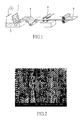
- Fig. 1 illustrates a rust removing system that may be used in the method of the present invention.
- the rust removing system includes: a plurality of rollers for conveying a continuous sheet of the rusted steel 1; an electrolytic bath 2 with a power source connected to a cathode and an anode defined by the continuous sheet 1; a water-jet blowing device 3 for providing the mechanical force 3 to the continuous sheet 1 passing through the electrolytic bath 2; and a pair of calender rollers for calendering the continuous sheet.
- a rusted steel wire (purchased from Walsin company, catalog no.: SS316. having a diameter of 5.5 mm and a length of 50 mm), having a layer of rust with a thickness of 20 ⁇ m, was prepared.
- the rusted steel wire was subjected to a first electrolytic treatment in a first electrolytic bath of a 0.5M sodium tartrate solution (pH 7.8), and was used as an anode of the first electrolytic bath.
- a titanium plate was used as a cathode of the first electrolytic bath.
- a power source was electrically connected to the cathode and the anode.
- the first electrolytic treatment was conducted by applying a current with a current density of 40A/dm 2 across the first electrolytic bath under a temperature 31°C.
- the rusted steel wire was then placed into an ultrasonic oscillator for oscillation for 60 seconds, followed by brushing with a cloth (Manufactured by 3M company, catalog no.: 8501) to obtain a surface treated steel wire of Example 1.
- the surface-treated steel wire was examined by counting a percentage of the rust removed from the surface of the surface-treated steel wire. The percentage is determined by dividing the surface of the surface treated steel wire into 100 square units of the same area, followed by counting the number of the square units that are free of the rust through observation.
- the degree of rust removal indicated by characters "A”, “B”, “C”, and “D” in Tables 1 to 3 and 5 to 7 represent percentage ranges above 90%, above 85% to 90%, 80-85%, and below 80%, respectively.
- the conditions for the first electrolytic treatment and the examination results (degree of removal of the rust) of EX1 are listed in Table 1.
- the procedures and conditions for treating the rusted steel wires of Comparative Examples 1 and 2 were similar to those of Example 1 except for the first electrolyte solution that was used.
- the first electrolyte solution of Comparative Example 1 was sodium citrate solution.
- the first electrolyte solution of Comparative Example 2 was sodium hydroxide solution.
- the conditions for the first electrolytic treatment and the examination results of CE1 and CE2 are listed in Table 1.
- Example 1 exhibits a greater ability in removing the rust from the rusted steel wire as compared to Comparative Examples 1 and 2.
- Example 2 to 4 The procedures and conditions for treating the rusted steel wires of Examples 2 to 4 were similar to those of Example 1 except for the current density that was applied.
- the current densities applied in Examples 2 to 4 were 60, 80, 100 A/dm 2 , respectively.
- the composition of the rust taken from the surface of the rusted steel wire for each of Examples 2 to 4 was examined.
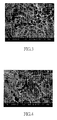
- the surface of the treated steel wire for each of Examples 2 to 4 was examined by scanning electron microscope and energy dispersive spectroscopy (SEM/EDS). The examination results are listed in Table 2 and Figs. 2 to 4 .
- the treated steel wire was placed into an ultrasonic oscillator for oscillation for 60 seconds, followed by brushing with a cloth (Manufactured by 3M company, catalog no.: 8501) to obtain the surface-treated steel wire of each of Examples 2 to 4.
- the surface-treated steel wire of each of Examples 2 to 4 was examined.
- the treatment conditions and the examination results of EX2 to EX4 are listed in Table 2.
- a rusted steel wire (purchased from Walsin company, catalog no.: SS316. having a diameter of 5.5 mm and a length of 50 mm), having a layer of rust with a thickness of 20 ⁇ m, was prepared.
- Comparative Example 3 differs from Example 1 in that no treatment was conducted for the rusted steel wire of Comparative Example 3.
- the composition of the rust of the rusted steel wire was examined.
- the surface of the rusted steel wire was examined by SEM/EDS. The examination results are listed in Table 2 and Fig.5 .
- Example 5 to 11 and Comparative Example 4 The procedures and conditions of treating the rusted steel wires of Examples 5 to 11 and Comparative Example 4 were similar to those of Example 1 except for the molar concentration of the first electrolyte solution, the temperature, and the current density that was applied. The surface-treated steel wire of each of Examples 5 to 11 and Comparative Example 4 was examined.
- the degree of rust removal of Examples 5 to 11 can meet requirements of the steel industries, and the surface-treated steel wire of each of Examples 5 to 11 has a smooth and bright surface.
- the method of the present invention is also effective in treating rusted steel wires that are made from materials different from SS316.
- Example 18 The procedures and conditions for treating the rusted stainless steel wire of Example 18 were similar to those of Example 1 except that, after the first electrolytic treatment and before the oscillation and the brushing, the rusted steel was subjectedto a second electrolytic treatment.
- the rusted steel wire was placed in a second electrolytic bath of a 0.5M trisodium phosphate solution (pH 13) to serve as the anode.
- a titanium plate was used as the cathode.
- a power supply was electrically connected to the cathode and the anode.
- the second electrolytic treatment was conducted by applying a current with a current density 40A/dm 2 across the second electrolytic bath under a temperature 31°C for 60 seconds. The surface-treated steel wire was examined.
- the procedures and conditions for treating the rusted steel wire of Comparative Examples 5 and 6 were similar to those of Example 18 except for the first electrolyte solution that was used.
- the first electrolyte solution of Comparative Example 5 was sodium citrate solution.
- the first electrolyte solution of Comparative Example 6 was sodium hydroxide solution.
- the surface-treated steel wires of Comparative Examples 5 and 6 were examined. The treatment conditions and the examination results of CE5 and CE6 are listed in Table 5.
- Example 18 which uses the sodium tartrate solution as the first electrolyte solution, exhibits a greater degree of rust removal and obtains a more smooth and bright appearance as compared to Comparative Examples 5 and 6.
- the procedures and conditions for treating the rusted steel wires of Examples 19 to 22 and Comparative Example 7 were similar to those of Example 18 except for the concentration of the sodium tartrate solution and the current density applied across the first electrolytic bath.
- the current density applied in the first electrolytic treatment of each of Examples 19 to 22 and Comparative Example 7 was 80 A/dm 2 .
- the concentrations of the sodium tartrate solution for Examples 19 to 22 and Comparative Example 7 were 0.4, 0.6, 0.8, 1.0, and 0.2M, respectively.
- the surface-treated steel wire of each of Examples 19 to 22 and Comparative Example 7 was examined. The treatment conditions and the examination results of EX19 to EX22 and Comparative Example 7 are listed in Table 6.
- EX19 to EX22 exhibit a greater degree of rust removal and obtain a more smooth and bright appearance as compared to Comparative Example 7.
- Example 24 The procedures and conditions for treating the rusted steel wire of Example 24 were similar to those of Example 21 except for the second alkaline electrolyte solution was a mixture of 0.5M trisodium phosphate solution and 500ml 0.5M sodium citrate solution (mixed at a molar ratio of 1:1, the mixture having a pH of about 8).
- the second alkaline electrolyte solution was a mixture of 0.5M trisodium phosphate solution and 500ml 0.5M sodium citrate solution (mixed at a molar ratio of 1:1, the mixture having a pH of about 8).
- Example 23 and 25 to 27 The procedures and conditions for treating the rusted steel wires of Examples 23 and 25 to 27 were similar to those of Example 24 except for the current density applied in the second electrolytic treatment.
- the current densities applied in the second electrolytic treatment for Examples 23 and 25 to 27 were 20, 60, 80, and 100 A/dm 2 , respectively.
- Example 32 to 36 The procedures and conditions for treating the rusted steel wires of Examples 32 to 36 were similar to those of Example 24 except for the temperature under which the second electrolytic treatment was conducted.
- the second electrolytic treatment of Examples 32 to 36 were conducted under 30, 40, 50, 60, and 70°C, respectively.
- Example 8 The procedures and conditions for treating the rusted steel wire of Comparative Example 8 were similar to those of Example 24 except that the second alkaline electrolyte solution was prepared by dissolving 125g sodium chloride and 10g sodium hydroxide in 500ml water.
- Examples 24 to 36 which include the first and second electrolytic treatments, exhibit a greater ability in removing the rust from the rusted steel wire as compared to the Comparative Example 8.
- Examples 35 and 36 which were conducted under a temperature greater than or equal to 60°C in the second electrolytic treatment, exhibit greater efficiency in rust removal than Examples 32 to 34.
Landscapes
- Chemical & Material Sciences (AREA)
- Engineering & Computer Science (AREA)
- Chemical Kinetics & Catalysis (AREA)
- Electrochemistry (AREA)
- Materials Engineering (AREA)
- Metallurgy (AREA)
- Organic Chemistry (AREA)
- Cleaning And De-Greasing Of Metallic Materials By Chemical Methods (AREA)
Applications Claiming Priority (2)
| Application Number | Priority Date | Filing Date | Title |
|---|---|---|---|
| TW101139291 | 2012-10-24 | ||
| TW101139293 | 2012-10-24 |
Publications (2)
| Publication Number | Publication Date |
|---|---|
| EP2725121A2 true EP2725121A2 (de) | 2014-04-30 |
| EP2725121A3 EP2725121A3 (de) | 2016-10-05 |
Family
ID=49518633
Family Applications (1)
| Application Number | Title | Priority Date | Filing Date |
|---|---|---|---|
| EP13005062.8A Withdrawn EP2725121A3 (de) | 2012-10-24 | 2013-10-23 | Verfahren zum Entfernen von Rost von gerostetem Stahl |
Country Status (2)
| Country | Link |
|---|---|
| EP (1) | EP2725121A3 (de) |
| TW (1) | TWI487816B (de) |
Families Citing this family (1)
| Publication number | Priority date | Publication date | Assignee | Title |
|---|---|---|---|---|
| CN107059106A (zh) * | 2017-04-18 | 2017-08-18 | 安徽华辉塑业科技股份有限公司 | 一种液体泵叶片除锈方法 |
Citations (1)
| Publication number | Priority date | Publication date | Assignee | Title |
|---|---|---|---|---|
| US5897764A (en) | 1996-02-02 | 1999-04-27 | Mannesmann Aktiengesellschaft | Process for the treatment of high-grade steel strips |
Family Cites Families (4)
| Publication number | Priority date | Publication date | Assignee | Title |
|---|---|---|---|---|
| GB1082409A (en) * | 1963-12-04 | 1967-09-06 | Mitsubishi Heavy Ind Ltd | An electrolytic descaling solution |
| US3420760A (en) * | 1965-04-30 | 1969-01-07 | Gen Dynamics Corp | Process for descaling steel strip in an aqueous organic chelating bath using alternating current |
| TW201137178A (en) * | 2010-04-29 | 2011-11-01 | Fih Hong Kong Ltd | Electroplated solution for stripping metal coatings and methods for stripping titanium contained metal coatings by using the electroplated solution |
| CN102127798A (zh) * | 2011-01-14 | 2011-07-20 | 燕山大学 | 一种特别适用于二次冷轧带钢的低温电解清洗剂 |
-
2013
- 2013-08-15 TW TW102129299A patent/TWI487816B/zh active
- 2013-10-23 EP EP13005062.8A patent/EP2725121A3/de not_active Withdrawn
Patent Citations (1)
| Publication number | Priority date | Publication date | Assignee | Title |
|---|---|---|---|---|
| US5897764A (en) | 1996-02-02 | 1999-04-27 | Mannesmann Aktiengesellschaft | Process for the treatment of high-grade steel strips |
Also Published As
| Publication number | Publication date |
|---|---|
| TW201416499A (zh) | 2014-05-01 |
| TWI487816B (zh) | 2015-06-11 |
| EP2725121A3 (de) | 2016-10-05 |
Similar Documents
| Publication | Publication Date | Title |
|---|---|---|
| US3420760A (en) | Process for descaling steel strip in an aqueous organic chelating bath using alternating current | |
| AU2012316187B2 (en) | Stainless steel pickling in an oxidizing, electrolytic acid bath | |
| EP2978879B1 (de) | Verfahren zur kontinuierlichen behandlung der oberfläche eines laminats aus rostfreiem stahl in einer lösung auf basis von schwefelsäure | |
| JPH09137300A (ja) | ステンレス鋼からなる帯板製品を製造するための方法及び設備 | |
| CN103806083A (zh) | 碱性电解除锈方法 | |
| CN114599824A (zh) | 钢的电辅助酸洗 | |
| EP2725121A2 (de) | Verfahren zum Entfernen von Rost von gerostetem Stahl | |
| GB2043694A (en) | Anodic deburring or brightening of steel articles | |
| EP4056737A1 (de) | Ionische flüssigkeit zum beizen von rostfreiem stahl und verfahren zum beizen von rostfreiem stahl unter verwendung derselben | |
| CN107312924B (zh) | 一种不锈钢带连续退火酸洗方法 | |
| US6391187B1 (en) | Method for treating a metal product | |
| DE19931820C2 (de) | Verfahren zum entzundern von Titanmaterial und entzundertes Titanmaterial | |
| JP3792335B2 (ja) | ステンレス鋼帯の脱スケールにおける仕上げ電解酸洗方法 | |
| JPH0357196B2 (de) | ||
| JP2003286592A (ja) | ステンレス鋼帯の酸洗方法 | |
| KR20150066115A (ko) | 표면품질이 우수한 티타늄 판재의 제조방법 | |
| JP4352190B2 (ja) | チタン材の脱スケール方法 | |
| JP2577619B2 (ja) | 合金鉄鋼帯の脱スケール方法及び装置 | |
| JP2002348700A (ja) | Cr系ステンレス冷延焼鈍鋼板の脱スケール方法 | |
| US3027310A (en) | Cleaning bath and method of cleaning moving metal strip | |
| JP2517353B2 (ja) | ステンレス鋼帯の脱スケ―ル方法 | |
| JP2577618B2 (ja) | 合金鉄鋼帯の脱スケール方法及び装置 | |
| JP4804657B2 (ja) | オーステナイト系ステンレス冷延焼鈍鋼板の脱スケール方法 | |
| WO1990004047A1 (en) | Method relating to the manufacturing of cold rolled strips and sheets of stainless steel | |
| JP2000212768A (ja) | 溶融めっき鋼板の製造方法 |
Legal Events
| Date | Code | Title | Description |
|---|---|---|---|
| PUAI | Public reference made under article 153(3) epc to a published international application that has entered the european phase |
Free format text: ORIGINAL CODE: 0009012 |
|
| 17P | Request for examination filed |
Effective date: 20131023 |
|
| AK | Designated contracting states |
Kind code of ref document: A2 Designated state(s): AL AT BE BG CH CY CZ DE DK EE ES FI FR GB GR HR HU IE IS IT LI LT LU LV MC MK MT NL NO PL PT RO RS SE SI SK SM TR |
|
| AX | Request for extension of the european patent |
Extension state: BA ME |
|
| PUAL | Search report despatched |
Free format text: ORIGINAL CODE: 0009013 |
|
| RIC1 | Information provided on ipc code assigned before grant |
Ipc: C25F 1/06 20060101AFI20160824BHEP |
|
| AK | Designated contracting states |
Kind code of ref document: A3 Designated state(s): AL AT BE BG CH CY CZ DE DK EE ES FI FR GB GR HR HU IE IS IT LI LT LU LV MC MK MT NL NO PL PT RO RS SE SI SK SM TR |
|
| AX | Request for extension of the european patent |
Extension state: BA ME |
|
| STAA | Information on the status of an ep patent application or granted ep patent |
Free format text: STATUS: THE APPLICATION HAS BEEN PUBLISHED |
|
| STAA | Information on the status of an ep patent application or granted ep patent |
Free format text: STATUS: THE APPLICATION IS DEEMED TO BE WITHDRAWN |
|
| 18D | Application deemed to be withdrawn |
Effective date: 20170406 |