EP2713402B1 - Normally-off high electron mobility transistor - Google Patents
Normally-off high electron mobility transistor Download PDFInfo
- Publication number
- EP2713402B1 EP2713402B1 EP13173455.0A EP13173455A EP2713402B1 EP 2713402 B1 EP2713402 B1 EP 2713402B1 EP 13173455 A EP13173455 A EP 13173455A EP 2713402 B1 EP2713402 B1 EP 2713402B1
- Authority
- EP
- European Patent Office
- Prior art keywords
- depletion
- layer
- forming layer
- normally
- hemt
- Prior art date
- Legal status (The legal status is an assumption and is not a legal conclusion. Google has not performed a legal analysis and makes no representation as to the accuracy of the status listed.)
- Active
Links
Images


Classifications
-
- H—ELECTRICITY
- H10—SEMICONDUCTOR DEVICES; ELECTRIC SOLID-STATE DEVICES NOT OTHERWISE PROVIDED FOR
- H10D—INORGANIC ELECTRIC SEMICONDUCTOR DEVICES
- H10D30/00—Field-effect transistors [FET]
- H10D30/40—FETs having zero-dimensional [0D], one-dimensional [1D] or two-dimensional [2D] charge carrier gas channels
- H10D30/47—FETs having zero-dimensional [0D], one-dimensional [1D] or two-dimensional [2D] charge carrier gas channels having two-dimensional [2D] charge carrier gas channels, e.g. nanoribbon FETs or high electron mobility transistors [HEMT]
-
- H—ELECTRICITY
- H10—SEMICONDUCTOR DEVICES; ELECTRIC SOLID-STATE DEVICES NOT OTHERWISE PROVIDED FOR
- H10P—GENERIC PROCESSES OR APPARATUS FOR THE MANUFACTURE OR TREATMENT OF DEVICES COVERED BY CLASS H10
- H10P10/00—Bonding of wafers, substrates or parts of devices
-
- H—ELECTRICITY
- H10—SEMICONDUCTOR DEVICES; ELECTRIC SOLID-STATE DEVICES NOT OTHERWISE PROVIDED FOR
- H10D—INORGANIC ELECTRIC SEMICONDUCTOR DEVICES
- H10D30/00—Field-effect transistors [FET]
- H10D30/40—FETs having zero-dimensional [0D], one-dimensional [1D] or two-dimensional [2D] charge carrier gas channels
- H10D30/47—FETs having zero-dimensional [0D], one-dimensional [1D] or two-dimensional [2D] charge carrier gas channels having two-dimensional [2D] charge carrier gas channels, e.g. nanoribbon FETs or high electron mobility transistors [HEMT]
- H10D30/471—High electron mobility transistors [HEMT] or high hole mobility transistors [HHMT]
- H10D30/475—High electron mobility transistors [HEMT] or high hole mobility transistors [HHMT] having wider bandgap layer formed on top of lower bandgap active layer, e.g. undoped barrier HEMTs such as i-AlGaN/GaN HEMTs
-
- H—ELECTRICITY
- H10—SEMICONDUCTOR DEVICES; ELECTRIC SOLID-STATE DEVICES NOT OTHERWISE PROVIDED FOR
- H10D—INORGANIC ELECTRIC SEMICONDUCTOR DEVICES
- H10D62/00—Semiconductor bodies, or regions thereof, of devices having potential barriers
- H10D62/10—Shapes, relative sizes or dispositions of the regions of the semiconductor bodies; Shapes of the semiconductor bodies
- H10D62/17—Semiconductor regions connected to electrodes not carrying current to be rectified, amplified or switched, e.g. channel regions
- H10D62/343—Gate regions of field-effect devices having PN junction gates
-
- H—ELECTRICITY
- H10—SEMICONDUCTOR DEVICES; ELECTRIC SOLID-STATE DEVICES NOT OTHERWISE PROVIDED FOR
- H10D—INORGANIC ELECTRIC SEMICONDUCTOR DEVICES
- H10D62/00—Semiconductor bodies, or regions thereof, of devices having potential barriers
- H10D62/80—Semiconductor bodies, or regions thereof, of devices having potential barriers characterised by the materials
- H10D62/85—Semiconductor bodies, or regions thereof, of devices having potential barriers characterised by the materials being Group III-V materials, e.g. GaAs
- H10D62/8503—Nitride Group III-V materials, e.g. AlN or GaN
-
- H—ELECTRICITY
- H10—SEMICONDUCTOR DEVICES; ELECTRIC SOLID-STATE DEVICES NOT OTHERWISE PROVIDED FOR
- H10D—INORGANIC ELECTRIC SEMICONDUCTOR DEVICES
- H10D64/00—Electrodes of devices having potential barriers
- H10D64/111—Field plates
-
- H—ELECTRICITY
- H10—SEMICONDUCTOR DEVICES; ELECTRIC SOLID-STATE DEVICES NOT OTHERWISE PROVIDED FOR
- H10D—INORGANIC ELECTRIC SEMICONDUCTOR DEVICES
- H10D64/00—Electrodes of devices having potential barriers
- H10D64/20—Electrodes characterised by their shapes, relative sizes or dispositions
- H10D64/27—Electrodes not carrying the current to be rectified, amplified, oscillated or switched, e.g. gates
- H10D64/311—Gate electrodes for field-effect devices
- H10D64/411—Gate electrodes for field-effect devices for FETs
Definitions
- the invention relates to a normally-off high electron mobility transistor (HEMT), and more particularly, to a normally-off HEMT including a depletion-forming layer.
- HEMT normally-off high electron mobility transistor
- Various power conversion systems may include a device for controlling a current flow by ON/OFF switching thereof, e.g., a power device.
- the efficiency of a power conversion system may depend on the efficiency of a power device in the power conversion system.
- MOSFETs Metal-Oxide-Semiconductor Field-Effect Transistors
- IGBTs Insulated Gate Bipolar Transistors
- a HEMT may include semiconductor layers having different electrical polarization characteristics.
- a semiconductor layer having a relatively high polarization rate may induce a two-dimensional electron gas (2DEG) in another semiconductor layer attached thereto, and the 2DEG may have very high electron mobility.
- 2DEG two-dimensional electron gas
- a gate voltage of a HEMT When a gate voltage of a HEMT is 0 V, power consumption may occur in a normally-on state in which a current flows between drain and source electrodes thereof due to a low resistance therebetween. To change to a normally-off state in which no current flows between the drain and source electrodes, a negative voltage may be applied to a gate electrode of a HEMT.
- a HEMT having a depletion-forming layer to implement a normally-off characteristic by which no current flows between drain and source electrodes of the HEMT when a gate voltage thereof is 0 V has been researched.
- US 2010/097105 teaches a semiconductor device capable of a bi-directional switching operation used for power control.
- Depletion-forming layers disclosed therein may include protruding portions.
- the invention relates to a normally-off high electron mobility transistor (HEMT) using a depletion-forming layer.
- HEMT normally-off high electron mobility transistor
- HEMT normally-off high electron mobility transistor
- the first part of the depletion-forming layer may be a strip shape
- the second part and third part may be a strip shape in parallel to the first part
- the gate electrode is on the gate insulation layer above at least a portion of the first to third parts of the depletion-forming layer.
- the gate insulating layer defines an opening that exposes a portion of the depletion-forming layer, and the gate electrode contacts the depletion-forming layer through the opening.
- the opening is on the first part of the depletion-forming layer.
- the first nitride semiconductor may include a gallium nitride (GaN) group material.
- GaN gallium nitride
- the second nitride semiconductor may include a nitride that includes at least one of aluminum (Al), gallium (Ga), indium (In) and boron (B).
- the depletion-forming layer may include a p-type nitride semiconductor.
- the depletion-forming layer may include a III-V group nitride semiconductor material.
- example embodiment is used to refer to subject-matter according to the present invention, whereas the term “example” is used to refer to subject-matter not covered by the claims.
- Example embodiments will now be described more fully with reference to the accompanying drawings, in which some example embodiments are shown.
- Example embodiments may, however, be embodied in many different forms and should not be construed as being limited to the embodiments set forth herein; rather, these example embodiments are provided so that this disclosure will be thorough and complete, and will fully convey the scope of example embodiments to those of ordinary skill in the art.
- the thicknesses of layers and regions are exaggerated for clarity.
- Like reference numerals in the drawings denote like elements, and thus their description may be omitted.
- first, second, etc. may be used herein to describe various elements, components, regions, layers and/or sections, these elements, components, regions, layers and/or sections should not be limited by these terms. These terms are only used to distinguish one element, component, region, layer or section from another element, component, region, layer or section. Thus, a first element, component, region, layer or section discussed below could be termed a second element, component, region, layer or section without departing from the teachings of example embodiments.
- spatially relative terms such as “beneath,” “below,” “lower,” “above,” “upper” and the like, may be used herein for ease of description to describe one element or feature's relationship to another element(s) or feature(s) as illustrated in the figures. It will be understood that the spatially relative terms are intended to encompass different orientations of the device in use or operation in addition to the orientation depicted in the figures. For example, if the device in the figures is turned over, elements described as “below” or “beneath” other elements or features would then be oriented “above” the other elements or features. Thus, the exemplary term “below” can encompass both an orientation of above and below. The device may be otherwise oriented (rotated 90 degrees or at other orientations) and the spatially relative descriptors used herein interpreted accordingly.
- Example embodiments are described herein with reference to cross-sectional illustrations that are schematic illustrations of idealized embodiments (and intermediate structures) of example embodiments. As such, variations from the shapes of the illustrations as a result, for example, of manufacturing techniques and/or tolerances, are to be expected. Thus, example embodiments should not be construed as limited to the particular shapes of regions illustrated herein but are to include deviations in shapes that result, for example, from manufacturing. Thus, the regions illustrated in the figures are schematic in nature and their shapes are not intended to illustrate the actual shape of a region of a device and are not intended to limit the scope of example embodiments.
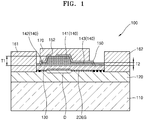
- FIG. 1 is a cross-sectional view schematically showing a structure of a normally-off high electron mobility transistor (HEMT) 100 according to example embodiments.
- HEMT normally-off high electron mobility transistor
- a channel layer 120 is formed on a substrate 110.
- the substrate 110 may be formed of, for example, directed-bonded copper or a semiconductor material such as sapphire, silicon (Si), silicon carbide (SiC), or gallium nitride (GaN).
- Si silicon
- SiC silicon carbide
- GaN gallium nitride
- the channel layer 120 is formed of a first nitride semiconductor material.
- the first nitride semiconductor material may be a group III-V compound semiconductor material.
- the channel layer 120 may be a GaN group material layer.
- the channel layer 120 may be a GaN layer.
- the channel layer 120 may be an undoped GaN layer, and in some cases, the channel layer 120 may be a GaN layer doped with desired (and/or alternatively predetermined) impurities.
- a buffer layer may be further provided between the substrate 110 and the channel layer 120.
- the buffer layer may reduce (and/or prevent) a decrease in crystallizability of the channel layer 120 by alleviating a lattice constant difference and a thermal expansion coefficient difference between the substrate 110 and the channel layer 120.
- the buffer layer may include a nitride including at least one among Al, Ga, In, and B and may have a single-layer structure or a multi-layer structure.
- the buffer layer may be formed of AIN, GaN, AIGaN, InGaN, AlInN, or AlGaInN.
- a seed layer (not shown) for growing the buffer layer may be further provided between the substrate 110 and the buffer layer.
- a channel supply layer 130 is formed on the channel layer 120.
- the channel supply layer 130 induces a two-dimensional electron gas (2DEG) in the channel layer 120.
- the 2DEG may be formed in the channel layer 120 below the interface between the channel layer 120 and the channel supply layer 130.
- the channel supply layer 130 is formed of a second nitride semiconductor material that is different than the first nitride semiconductor material forming the channel layer 120.
- the second nitride semiconductor material may be different from the first nitride semiconductor material with respect to at least one of a polarization characteristic, an energy bandgap, and a lattice constant.
- the second nitride semiconductor material may be higher than the first nitride semiconductor material with respect to at least one of the polarization rate and the energy bandgap.
- the channel supply layer 130 may be formed of at least one nitride that includes at least one among Al, Ga, In, and B and may have a single-layer structure or a multi-layer structure.
- the channel supply layer 130 may be formed of at least one of AIGaN, AlInN, InGaN, AIN, and AlGaInN.
- the channel supply layer 130 may be an undoped layer or a layer doped with desired (and/or alternatively predetermined) impurities.
- the thickness of the channel supply layer 130 may be, for example, less than several tens of nm.
- the thickness of the channel supply layer 130 may be equal to or less than about 50 nm, but the thickness is not limited thereto.
- a source electrode 161 and a drain electrode 162 are formed on the channel layer 120.
- the source electrode 161 and drain electrode 162 are formed at both sides of the channel supply layer 130.
- the source electrode 161 and the drain electrode 162 may be electrically connected to the 2DEG.
- the source electrode 161 and the drain electrode 162 may be formed to be inserted inside the channel layer 120.
- the configuration of the source electrode 161 and drain electrode 162 is not limited thereto.
- the source electrode 161 and the drain electrode 162 may be variously formed.
- a depletion-forming layer 140 is formed on the channel supply layer 130.
- the depletion-forming layer 140 includes a first part 141 having a first thickness T1 and a second part 142 having a second thickness T2 and a third part 143 having the second thickness T2.
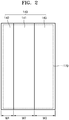
- FIG. 2 is a partial top view of the normally-off HEMT 100 according to example embodiments. In FIG. 2 , some components are omitted for convenience of description.
- the first part 141 may have a strip shape, and the second and third parts 142 and 143 may be formed long at both sides of the first part 141 in a lengthy direction of the first part 141.
- the first part 141 may have a first width W1
- the second part 142 may have a second width W2
- the third part 143 may have a third width W3.
- the first to third widths W1 to W3 may be different from each other.
- the first width W1 may be greater than the third width W3 and the third width W3 may be greater than the second width W2.
- example embodiments are not limited thereto, and the depletion-forming layer 140 may be formed in various shapes.
- at least two of the first to third widths W1 to W3 may be equal.
- the second part 142 is formed to be spaced apart from the source electrode 161 and the third part 143 is formed to be spaced apart from the drain electrode 162.
- the first part 141 may be formed to be closer to the source electrode 161 than the drain electrode 162. However, example embodiments are not limited thereto.
- the depletion-forming layer 140 functions to form a depletion region in the 2DEG.
- An energy bandgap of a portion of the channel supply layer 130, which is located below the depletion-forming layer 140, may increase due to the depletion-forming layer 140, resulting in forming the depletion region of the 2DEG at a portion of the channel layer 120 corresponding to the depletion-forming layer 140.
- the 2DEG may be cut off at a portion corresponding to the first part 141 of the depletion-forming layer 140, and electron density of the 2DEG may decrease at a portion corresponding to the second part 142 and the third part 143 of the depletion-forming layer 140.
- Electron densities of the 2DEG in a region between the depletion-forming layer 140 and the source electrode 161 and a region between the depletion-forming layer 140 and the drain electrode 162 are higher than electron density of the 2DEG below the second part 142 and the third part 143.
- FIG. 1 shows that a region of the 2DEG having relatively high electron density is discriminated from a region of the 2DEG having relatively low electron density by the thicknesses of dots. Electron density is high as dots are thick. A region in which the 2DEG is cut off may be a 'cut-off region', and the normally-off HEMT 100 may have a normally-off characteristic due to the cut-off region.
- the depletion-forming layer 140 may include a p-type semiconductor material. That is, the depletion-forming layer 140 may be a p-type semiconductor layer or a semiconductor layer doped with p-type impurities. In addition, the depletion-forming layer 140 may be formed of a group III-V nitride semiconductor. For example, the depletion-forming layer 140 may be formed of GaN, AIGaN, InN, AlInN, InGaN, or AlInGaN or doped with p-type impurities such as magnesium (Mg). In detail, the depletion-forming layer 140 may be a p-GaN layer or a p-AIGaN layer. The depletion-forming layer 140 may cause an energy bandgap of a portion of the channel supply layer 130 therebelow to increase, thereby forming a cut-off region of the 2DEG or a region having relatively low electron density.
- Mg magnesium
- An insulation layer 150 is formed on the depletion-forming layer 140.
- the insulation layer 150 may be referred to as a gate insulation layer 150 hereinafter.
- the gate insulation layer 150 may be extended to cover the channel supply layer 130.
- the gate insulation layer 150 may be formed to have the thickness of about 50 nm to about 300 nm.
- the gate insulation layer 150 may include at least one among aluminum oxide (Al 2 O 3 ), silicon oxide (SiO x ), silicon nitride (Si x N y ), scandium oxide (Sc 2 O 3 ), aluminum nitride (AIN), gallium oxide (Ga 2 O 3 ), gadolinium oxide (Gd 2 O 3 ), aluminum gadolinium oxide (Al x Gd 2(1-x) O 3 ), aluminum gallium oxide (Al x Ga 2(1-x) O 3 ), magnesium oxide (MgO), and a combination thereof.
- any of insulation materials used for typical transistors may be used as a material for the gate insulation layer 150.
- An opening 152 is formed in the gate insulation layer 150 to expose at least a portion of the surface of the depletion-forming layer 140.
- the opening 152 is formed on the upper surface of the first part 141 of the depletion-forming layer 140.
- the opening 152 may be a through hole, a diameter of which is equal to or less than about 0.25 ⁇ m.
- a gate electrode 170 is formed on the gate insulation layer 150.
- the gate electrode 170 may be arranged above the depletion-forming layer 140 and is formed to contact the depletion-forming layer 140 through the opening 152.
- the gate electrode 170 may be formed to have a narrower area than the depletion-forming layer 140 as shown in FIG. 2 . Since a contact area between the gate electrode 170 and the depletion-forming layer 140 is small (for example less than a width of the gate electrode 170), a leakage current is low and/or may be reduced.
- the gate electrode 170 may include any of various metal materials and metal compounds.
- the depletion-forming layer 140 may be formed to be wider than a region of the gate electrode 170.
- the depletion-forming layer 140 has two thicknesses in FIG. 1 , example embodiments are not limited thereto.
- the depletion-forming layer 140 may have a plurality of thicknesses. A part having the thickest thickness is formed at the central part or formed to be closer to the source electrode 161 at the central part, and the remaining parts have sequentially thinner thicknesses from the central part.
- FIGS. 3A to 3C are cross-sectional views for describing an operation of the normally-off HEMT 100 according to example embodiments.
- a region of the 2DEG having relatively high electron density is discriminated from a region of the 2DEG having relatively low electron density by the thicknesses of dots. Electron density is high as dots are thick.
- FIG. 1 shows a normally-off state of the normally-off HEMT 100.
- a region below the first part 141 is a cut-off region D in which the 2DEG does not exist.
- the 2DEG when a voltage equal to or higher than a threshold voltage is applied to the gate electrode 170, the 2DEG is generated in a cut-off region D, thereby making the normally-off HEMT 100 be in an ON state. That is, a channel formed below the gate electrode 170 is in an ON state, and accordingly, a current flows through the 2DEG formed in the channel layer 120.
- the threshold voltage may vary according to the thickness of the first part 141 of the depletion-forming layer 140 and doping density of the first part 141.
- an area of the depletion-forming layer 140 below the gate electrode 170 increases, resulting in expanding a gate region. Since a contact area between the gate electrode 170 and the depletion-forming layer 140 is small, a leakage current is low.
- the depletion-forming layer 140 is formed to be apart from the source electrode 161, a leakage current path connected from the gate electrode 170 to the source electrode 161 may be blocked.
- FIG. 4 is a cross-sectional view schematically showing a structure of a normally-off HEMT 200 according to an example.
- the same reference numerals are used for the same (and/or substantially the same) components as those in the normally-off HEMT 100 of FIG. 1 , and their detailed description is omitted.
- a depletion-forming layer 240 may be formed on the channel supply layer 130.
- the depletion-forming layer 240 includes a first part 241 having the first thickness T1 and a second part 242 having the second thickness T2, and a third part 243 having the second thickness T2.
- the first part 241 may have a strip shape, and the second part 242 and third part 243 may be formed long at both sides of the first part 241 in a lengthy direction of the first part 241.
- examples are not limited thereto, and the depletion-forming layer 240 may be formed in various shapes.
- the second part 242 may be formed to contact the source electrode 161 and the third part 243 may be formed to contact drain electrode 162.
- the first part 241 may be formed to be closer to the source electrode 161 than the drain electrode 162.
- the second part 242 and third part 243 may be alternatively configured.
- the second part 242 may alternatively be formed similar to the second part 142 in FIG. 1 , which does not contact the source electrode 161.
- the third part 243 may alternatively be formed similar to the third part 143 in FIG. 1 , which does not contact the drain electrode 162.
- one of the second part 242 and the third part 243 may alternatively be arranged so it does not contact an adjacent one of the source electrode 161 and the drain electrode 162.
- the depletion-forming layer 240 may function to form a depletion region in the 2DEG.
- An energy bandgap of a portion of the channel supply layer 130, which is located below the depletion-forming layer 240, may increase due to the depletion-forming layer 240, resulting in forming the depletion region of the 2DEG at a portion of the channel layer 120 corresponding to the depletion-forming layer 240.
- the 2DEG may be cut off at a portion corresponding to the first part 241 of the depletion-forming layer 240, and electron density of the 2DEG may decrease at a portion corresponding to the second part 242 and the third part 243 of the depletion-forming layer 240.
- FIG. 4 shows that a region of the 2DEG having relatively high electron density is discriminated from a region of the 2DEG having relatively low electron density by the thicknesses of dots. Electron density is high as dots are thick. A region in which the 2DEG is cut off may be a 'cut-off region', and the normally-off HEMT 200 may have a normally-off characteristic due to the cut-off region.
- the depletion-forming layer 240 may include a p-type semiconductor material. That is, the depletion-forming layer 240 may be a p-type semiconductor layer or a semiconductor layer doped with p-type impurities. In addition, the depletion-forming layer 240 may be formed of a group III-V nitride semiconductor. For example, the depletion-forming layer 240 may be formed of GaN, AIGaN, InN, AlInN, InGaN, or AlInGaN or doped with p-type impurities such as Mg. In detail, the depletion-forming layer 240 may be a p-GaN layer or a p-AIGaN layer. The depletion-forming layer 240 may cause an energy bandgap of a portion of the channel supply layer 130 therebelow to increase, thereby forming a cut-off region of the 2DEG or a region having relatively low electron density.
- a fabricating process of the normally-off HEMT 200 may be simplified.
- the expansion of the second part 242 and third part 243 of the depletion-forming layer 240 may cause the ON resistance to decrease further.
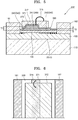
- FIG. 5 is a cross-sectional view schematically showing a structure of a normally-off HEMT 300 according to an example.
- the same reference numerals are used for substantially the same components as those in the normally-off HEMT 100 of FIG. 1 , and their detailed description is omitted.
- a depletion-forming layer 340 may be formed on the channel supply layer 130.
- the depletion-forming layer 340 includes a first part 341 having the first thickness T1, a second part 342 having the second thickness T2, and a third part 343 having the second thickness T2.
- the first part 341 may have a strip shape, and the second part 342 and third part 343 may be formed long at both sides of the first part 341 in a lengthy direction of the first part 341.
- examples are not limited thereto, and the depletion-forming layer 340 may be formed in various shapes.
- the second part 342 may be formed to be apart from the source electrode 161 and the third part 343 may be formed to be apart from the drain electrode 162. However, examples are not limited thereto.
- the second part 342 may expand as in the second part 242 of FIG. 4 and may be formed to contact the source electrode 161 and the third part 343 may expand as in the third part 243 in FIG. 4 and contact the drain electrode 162.
- the first part 341 may be formed to be closer to the source electrode 161 than the drain electrode 162.
- the depletion-forming layer 340 may function to form a depletion region in the 2DEG.
- An energy bandgap of a portion of the channel supply layer 130, which is located below the depletion-forming layer 340, may increase due to the depletion-forming layer 340, resulting in forming the depletion region of the 2DEG at a portion of the channel layer 120 corresponding to the depletion-forming layer 340.
- the 2DEG may be cut off at a portion corresponding to the first part 341 of the depletion-forming layer 340, and electron density of the 2DEG may decrease at a portion corresponding to the second part 342 and the third part 343 of the depletion-forming layer 340.
- FIG. 5 shows that a region of the 2DEG having relatively high electron density is discriminated from a region of the 2DEG having relatively low electron density by the thicknesses of dots. Electron density is high as dots are thick. A region in which the 2DEG is cut off may be a 'cut-off region', and the normally-off HEMT 300 may have a normally-off characteristic due to the cut-off region.
- the depletion-forming layer 340 may include a p-type semiconductor material. That is, the depletion-forming layer 340 may be a p-type semiconductor layer or a semiconductor layer doped with p-type impurities. In addition, the depletion-forming layer 340 may be formed of a group III-V nitride semiconductor. For example, the depletion-forming layer 340 may be formed of GaN, AIGaN, InN, AlInN, InGaN, or AlInGaN or doped with p-type impurities such as Mg. In detail, the depletion-forming layer 340 may be a p-GaN layer or a p-AIGaN layer. The depletion-forming layer 340 may cause an energy bandgap of a portion of the channel supply layer 130 therebelow to increase, thereby forming a cut-off region of the 2DEG or a region having relatively low electron density.
- a first gate electrode 371 is formed on the depletion-forming layer 340.
- the first gate electrode 371 may be formed mainly on the first part 341.
- An insulation layer 350 may be formed on the first gate electrode 371.
- the insulation layer 350 may be referred to a gate insulation layer 350 hereinafter.
- the gate insulation layer 350 may be formed to cover the depletion-forming layer 340 and the channel supply layer 130.
- the gate insulation layer 350 may be formed to have the thickness of about 50 nm to about 300 nm.
- the gate insulation layer 350 may include at least one among Al 2 O 3 , SiO x , Si x N y , Sc 2 O 3 , AIN, Ga 2 O 3 , Gd 2 O 3 , Al x Ga 2(1-x) O 3 , Al x Ga 2(1-x) O 3 , MgO, and a combination thereof.
- example embodiments are not limited thereto.
- a second gate electrode 372 is formed on the gate insulation layer 250.
- the second gate electrode 372 may be arranged above the depletion-forming layer 340.
- the first gate electrode 371 and the second gate electrode 372 may be formed of any of various metal materials and metal compounds.
- the first gate electrode 371 and the second gate electrode 372 may be formed of titanium nitride (TiN), tungsten (W), platinum (Pt), or tungsten nitride (WN) or formed in a multi-layer structure of W/Ti/AI/Ti/TiN.
- the first gate electrode 371 may be formed to have the thickness of about 100 nm to about 300 nm.
- the first gate electrode 371 and the second gate electrode 372 may be electrically connected to each other by a wire 375.
- FIG. 6 is a top view showing an electrical connection between the first gate electrode 371 and the second gate electrode 372. For convenience of description, some components are not shown in FIG. 6 .
- the second gate electrode 372 is formed on the first gate electrode 371, and the first gate electrode 371 is formed to be exposed by the second gate electrode 372.
- the wire 375 connects the exposed first gate electrode 371 to the second gate electrode 372.
- first gate electrode 371 and the second gate electrode 372 are connected to each other by the wire 375 in FIG. 6 , examples are not limited thereto.
- the second gate electrode 372 may be formed to directly contact the exposed first gate electrode 371.
- first gate electrode 371 and the second gate electrode 372 may be electrically connected to each other through an opening (refer to 152 in FIG. 1 ) formed on the gate insulation layer 350.
- FIGS. 5-6 illustrate the depletion-forming layer 340 is spaced apart from the source 161 and drain electrodes 162, examples are not limited thereto.
- the depletion-forming layer 340 of the HEMT 300 in FIGS. 5-6 may be connected to at least one of the source 161 and drain electrodes 162, similar to the HEMT 200, according to an example illustrated in FIG. 4 .
- FIGS. 5-6 illustrate the depletion forming layer 340 includes a second part 342 and a third part 343 that both have the second thickness T2, examples are not limited thereto.
- the second part 342 and the third part 343 may have different thicknesses from each other.
- Normally-off HEMTs may reduce (and/or prevent) a current from leaking in an OFF state and may decrease a turn-on resistance.
- the expansion of a depletion-forming layer causes an electric field to be dispersed, and accordingly, a breakdown voltage of a normally-off HEMT increases.
- Example embodiments described herein should be considered in a descriptive sense only and not for purposes of limitation. Descriptions of features or aspects within each HEMT according to example embodiments should typically be considered as available for other similar features or aspects in other HEMTs according to example embodiments.
Landscapes
- Junction Field-Effect Transistors (AREA)
- Insulated Gate Type Field-Effect Transistor (AREA)
Description
- The invention relates to a normally-off high electron mobility transistor (HEMT), and more particularly, to a normally-off HEMT including a depletion-forming layer.
- Various power conversion systems may include a device for controlling a current flow by ON/OFF switching thereof, e.g., a power device. The efficiency of a power conversion system may depend on the efficiency of a power device in the power conversion system.
- Many power devices commercialized at present are silicon (Si)-based power Metal-Oxide-Semiconductor Field-Effect Transistors (MOSFETs) and Insulated Gate Bipolar Transistors (IGBTs). However, increasing the efficiency of a silicon-based power device may be limited by the physical properties of silicon, manufacturing processes, and so forth. To overcome these limitations, research has looked at using a group III-V compound semiconductor in a power device. In association with this, a high electron mobility transistor (HEMT) using a heterojunction structure of a compound semiconductor has attracted attention.
- A HEMT may include semiconductor layers having different electrical polarization characteristics. In a HEMT, a semiconductor layer having a relatively high polarization rate may induce a two-dimensional electron gas (2DEG) in another semiconductor layer attached thereto, and the 2DEG may have very high electron mobility.
- When a gate voltage of a HEMT is 0 V, power consumption may occur in a normally-on state in which a current flows between drain and source electrodes thereof due to a low resistance therebetween. To change to a normally-off state in which no current flows between the drain and source electrodes, a negative voltage may be applied to a gate electrode of a HEMT.
- As another method, a HEMT having a depletion-forming layer to implement a normally-off characteristic by which no current flows between drain and source electrodes of the HEMT when a gate voltage thereof is 0 V has been researched.
-
US 2010/097105 teaches a semiconductor device capable of a bi-directional switching operation used for power control. Depletion-forming layers disclosed therein may include protruding portions. -
DE 10 2011000911 teaches a high electron mobility transistor. - The invention relates to a normally-off high electron mobility transistor (HEMT) using a depletion-forming layer.
- Additional aspects will be set forth in part in the description which follows and, in part, will be apparent from the description, or may be learned by practice of example embodiments.
- According to the invention, there is provided a normally-off high electron mobility transistor (HEMT) according to claim 1.
- In example embodiments, the first part of the depletion-forming layer may be a strip shape, and the second part and third part may be a strip shape in parallel to the first part.
- The gate electrode is on the gate insulation layer above at least a portion of the first to third parts of the depletion-forming layer.
- The gate insulating layer defines an opening that exposes a portion of the depletion-forming layer, and the gate electrode contacts the depletion-forming layer through the opening.
- The opening is on the first part of the depletion-forming layer.
- In example embodiments, the first nitride semiconductor may include a gallium nitride (GaN) group material.
- In example embodiments, the second nitride semiconductor may include a nitride that includes at least one of aluminum (Al), gallium (Ga), indium (In) and boron (B).
- In example embodiments, the depletion-forming layer may include a p-type nitride semiconductor.
- In example embodiments, the depletion-forming layer may include a III-V group nitride semiconductor material.
- These and/or other aspects will become apparent and more readily appreciated from the following description of non-limiting example embodiments, taken in conjunction with the accompanying drawings. The drawings are not necessarily to scale, emphasis instead being placed upon illustrating principles of inventive concepts.
- In the following, the term "example embodiment" is used to refer to subject-matter according to the present invention, whereas the term "example" is used to refer to subject-matter not covered by the claims.
-
FIG. 1 is a cross-sectional view schematically showing a structure of a normally-off high electron mobility transistor (HEMT) according to example embodiments; -
FIG. 2 is a partial top view of the normally-off HEMT according to example embodiments; -
FIGS. 3A to 3C are cross-sectional views for describing an operation of the normally-off HEMT according to example embodiments; -
FIG. 4 is a cross-sectional view schematically showing a structure of a normally-off HEMT according to an example; -
FIG. 5 is a cross-sectional view schematically showing a structure of a normally-off HEMT according to an example; -
FIG. 6 is a top view showing an electrical connection between a first gate electrode and a second gate electrode ofFIG. 5 . - Example embodiments will now be described more fully with reference to the accompanying drawings, in which some example embodiments are shown. Example embodiments, may, however, be embodied in many different forms and should not be construed as being limited to the embodiments set forth herein; rather, these example embodiments are provided so that this disclosure will be thorough and complete, and will fully convey the scope of example embodiments to those of ordinary skill in the art. In the drawings, the thicknesses of layers and regions are exaggerated for clarity. Like reference numerals in the drawings denote like elements, and thus their description may be omitted.
- It will be understood that when an element is referred to as being "connected" or "coupled" to another element, it can be directly connected or coupled to the other element or intervening elements may be present. In contrast, when an element is referred to as being "directly connected" or "directly coupled" to another element, there are no intervening elements present. As used herein the term "and/or" includes any and all combinations of one or more of the associated listed items. Other words used to describe the relationship between elements or layers should be interpreted in a like fashion (e.g., "between" versus "directly between," "adjacent" versus "directly adjacent," "on" versus "directly on").
- It will be understood that, although the terms "first", "second", etc. may be used herein to describe various elements, components, regions, layers and/or sections, these elements, components, regions, layers and/or sections should not be limited by these terms. These terms are only used to distinguish one element, component, region, layer or section from another element, component, region, layer or section. Thus, a first element, component, region, layer or section discussed below could be termed a second element, component, region, layer or section without departing from the teachings of example embodiments.
- Spatially relative terms, such as "beneath," "below," "lower," "above," "upper" and the like, may be used herein for ease of description to describe one element or feature's relationship to another element(s) or feature(s) as illustrated in the figures. It will be understood that the spatially relative terms are intended to encompass different orientations of the device in use or operation in addition to the orientation depicted in the figures. For example, if the device in the figures is turned over, elements described as "below" or "beneath" other elements or features would then be oriented "above" the other elements or features. Thus, the exemplary term "below" can encompass both an orientation of above and below. The device may be otherwise oriented (rotated 90 degrees or at other orientations) and the spatially relative descriptors used herein interpreted accordingly.
- The terminology used herein is for the purpose of describing particular embodiments only and is not intended to be limiting of example embodiments. As used herein, the singular forms "a," "an" and "the" are intended to include the plural forms as well, unless the context clearly indicates otherwise. It will be further understood that the terms "comprises", "comprising", "includes" and/or "including," if used herein, specify the presence of stated features, integers, steps, operations, elements and/or components, but do not preclude the presence or addition of one or more other features, integers, steps, operations, elements, components and/or groups thereof. Expressions such as "at least one of," when preceding a list of elements, modify the entire list of elements and do not modify the individual elements of the list.
- Example embodiments are described herein with reference to cross-sectional illustrations that are schematic illustrations of idealized embodiments (and intermediate structures) of example embodiments. As such, variations from the shapes of the illustrations as a result, for example, of manufacturing techniques and/or tolerances, are to be expected. Thus, example embodiments should not be construed as limited to the particular shapes of regions illustrated herein but are to include deviations in shapes that result, for example, from manufacturing. Thus, the regions illustrated in the figures are schematic in nature and their shapes are not intended to illustrate the actual shape of a region of a device and are not intended to limit the scope of example embodiments.
- Unless otherwise defined, all terms (including technical and scientific terms) used herein have the same meaning as commonly understood by one of ordinary skill in the art to which example embodiments belong. It will be further understood that terms, such as those defined in commonly-used dictionaries, should be interpreted as having a meaning that is consistent with their meaning in the context of the relevant art and will not be interpreted in an idealized or overly formal sense unless expressly so defined herein.
-
FIG. 1 is a cross-sectional view schematically showing a structure of a normally-off high electron mobility transistor (HEMT) 100 according to example embodiments. - Referring to
FIG. 1 , achannel layer 120 is formed on asubstrate 110. Thesubstrate 110 may be formed of, for example, directed-bonded copper or a semiconductor material such as sapphire, silicon (Si), silicon carbide (SiC), or gallium nitride (GaN). However, this is only illustrative, and thesubstrate 110 may be formed of other various materials. - The
channel layer 120 is formed of a first nitride semiconductor material. The first nitride semiconductor material may be a group III-V compound semiconductor material. For example, thechannel layer 120 may be a GaN group material layer. In detail, thechannel layer 120 may be a GaN layer. In this case, thechannel layer 120 may be an undoped GaN layer, and in some cases, thechannel layer 120 may be a GaN layer doped with desired (and/or alternatively predetermined) impurities. - Although not shown, a buffer layer may be further provided between the
substrate 110 and thechannel layer 120. The buffer layer may reduce (and/or prevent) a decrease in crystallizability of thechannel layer 120 by alleviating a lattice constant difference and a thermal expansion coefficient difference between thesubstrate 110 and thechannel layer 120. The buffer layer may include a nitride including at least one among Al, Ga, In, and B and may have a single-layer structure or a multi-layer structure. For example, the buffer layer may be formed of AIN, GaN, AIGaN, InGaN, AlInN, or AlGaInN. A seed layer (not shown) for growing the buffer layer may be further provided between thesubstrate 110 and the buffer layer. - A
channel supply layer 130 is formed on thechannel layer 120. Thechannel supply layer 130 induces a two-dimensional electron gas (2DEG) in thechannel layer 120. The 2DEG may be formed in thechannel layer 120 below the interface between thechannel layer 120 and thechannel supply layer 130. Thechannel supply layer 130 is formed of a second nitride semiconductor material that is different than the first nitride semiconductor material forming thechannel layer 120. The second nitride semiconductor material may be different from the first nitride semiconductor material with respect to at least one of a polarization characteristic, an energy bandgap, and a lattice constant. In detail, the second nitride semiconductor material may be higher than the first nitride semiconductor material with respect to at least one of the polarization rate and the energy bandgap. - The
channel supply layer 130 may be formed of at least one nitride that includes at least one among Al, Ga, In, and B and may have a single-layer structure or a multi-layer structure. In detail, thechannel supply layer 130 may be formed of at least one of AIGaN, AlInN, InGaN, AIN, and AlGaInN. Thechannel supply layer 130 may be an undoped layer or a layer doped with desired (and/or alternatively predetermined) impurities. The thickness of thechannel supply layer 130 may be, for example, less than several tens of nm. For example, the thickness of thechannel supply layer 130 may be equal to or less than about 50 nm, but the thickness is not limited thereto. - A
source electrode 161 and adrain electrode 162 are formed on thechannel layer 120. Thesource electrode 161 anddrain electrode 162 are formed at both sides of thechannel supply layer 130. Thesource electrode 161 and thedrain electrode 162 may be electrically connected to the 2DEG. As shown inFIG. 1 , thesource electrode 161 and thedrain electrode 162 may be formed to be inserted inside thechannel layer 120. However, the configuration of thesource electrode 161 anddrain electrode 162 is not limited thereto. Thesource electrode 161 and thedrain electrode 162 may be variously formed. - A depletion-forming
layer 140 is formed on thechannel supply layer 130. The depletion-forminglayer 140 includes afirst part 141 having a first thickness T1 and asecond part 142 having a second thickness T2 and athird part 143 having the second thickness T2. -
FIG. 2 is a partial top view of the normally-offHEMT 100 according to example embodiments. InFIG. 2 , some components are omitted for convenience of description. - Referring to
FIG. 2 , thefirst part 141 may have a strip shape, and the second andthird parts first part 141 in a lengthy direction of thefirst part 141. As shown inFIG. 2 , thefirst part 141 may have a first width W1, thesecond part 142 may have a second width W2, and thethird part 143 may have a third width W3. The first to third widths W1 to W3 may be different from each other. For example, the first width W1 may be greater than the third width W3 and the third width W3 may be greater than the second width W2. However, example embodiments are not limited thereto, and the depletion-forminglayer 140 may be formed in various shapes. For example, alternatively at least two of the first to third widths W1 to W3 may be equal. - The
second part 142 is formed to be spaced apart from thesource electrode 161 and thethird part 143 is formed to be spaced apart from thedrain electrode 162. Thefirst part 141 may be formed to be closer to thesource electrode 161 than thedrain electrode 162. However, example embodiments are not limited thereto. - The depletion-forming
layer 140 functions to form a depletion region in the 2DEG. An energy bandgap of a portion of thechannel supply layer 130, which is located below the depletion-forminglayer 140, may increase due to the depletion-forminglayer 140, resulting in forming the depletion region of the 2DEG at a portion of thechannel layer 120 corresponding to the depletion-forminglayer 140. Thus, the 2DEG may be cut off at a portion corresponding to thefirst part 141 of the depletion-forminglayer 140, and electron density of the 2DEG may decrease at a portion corresponding to thesecond part 142 and thethird part 143 of the depletion-forminglayer 140. Electron densities of the 2DEG in a region between the depletion-forminglayer 140 and thesource electrode 161 and a region between the depletion-forminglayer 140 and thedrain electrode 162 are higher than electron density of the 2DEG below thesecond part 142 and thethird part 143. -
FIG. 1 shows that a region of the 2DEG having relatively high electron density is discriminated from a region of the 2DEG having relatively low electron density by the thicknesses of dots. Electron density is high as dots are thick. A region in which the 2DEG is cut off may be a 'cut-off region', and the normally-offHEMT 100 may have a normally-off characteristic due to the cut-off region. - The depletion-forming
layer 140 may include a p-type semiconductor material. That is, the depletion-forminglayer 140 may be a p-type semiconductor layer or a semiconductor layer doped with p-type impurities. In addition, the depletion-forminglayer 140 may be formed of a group III-V nitride semiconductor. For example, the depletion-forminglayer 140 may be formed of GaN, AIGaN, InN, AlInN, InGaN, or AlInGaN or doped with p-type impurities such as magnesium (Mg). In detail, the depletion-forminglayer 140 may be a p-GaN layer or a p-AIGaN layer. The depletion-forminglayer 140 may cause an energy bandgap of a portion of thechannel supply layer 130 therebelow to increase, thereby forming a cut-off region of the 2DEG or a region having relatively low electron density. - An
insulation layer 150 is formed on the depletion-forminglayer 140. Theinsulation layer 150 may be referred to as agate insulation layer 150 hereinafter. Thegate insulation layer 150 may be extended to cover thechannel supply layer 130. Thegate insulation layer 150 may be formed to have the thickness of about 50 nm to about 300 nm. Thegate insulation layer 150 may include at least one among aluminum oxide (Al2O3), silicon oxide (SiOx), silicon nitride (SixNy), scandium oxide (Sc2O3), aluminum nitride (AIN), gallium oxide (Ga2O3), gadolinium oxide (Gd2O3), aluminum gadolinium oxide (AlxGd2(1-x)O3), aluminum gallium oxide (AlxGa2(1-x)O3), magnesium oxide (MgO), and a combination thereof. Besides, any of insulation materials used for typical transistors may be used as a material for thegate insulation layer 150. Anopening 152 is formed in thegate insulation layer 150 to expose at least a portion of the surface of the depletion-forminglayer 140. Theopening 152 is formed on the upper surface of thefirst part 141 of the depletion-forminglayer 140. Theopening 152 may be a through hole, a diameter of which is equal to or less than about 0.25 µm. - A
gate electrode 170 is formed on thegate insulation layer 150. Thegate electrode 170 may be arranged above the depletion-forminglayer 140 and is formed to contact the depletion-forminglayer 140 through theopening 152. Thegate electrode 170 may be formed to have a narrower area than the depletion-forminglayer 140 as shown inFIG. 2 . Since a contact area between thegate electrode 170 and the depletion-forminglayer 140 is small (for example less than a width of the gate electrode 170), a leakage current is low and/or may be reduced. Thegate electrode 170 may include any of various metal materials and metal compounds. The depletion-forminglayer 140 may be formed to be wider than a region of thegate electrode 170. - As shown in
FIG. 1 , although the depletion-forminglayer 140 has two thicknesses inFIG. 1 , example embodiments are not limited thereto. For example, the depletion-forminglayer 140 may have a plurality of thicknesses. A part having the thickest thickness is formed at the central part or formed to be closer to thesource electrode 161 at the central part, and the remaining parts have sequentially thinner thicknesses from the central part. -
FIGS. 3A to 3C are cross-sectional views for describing an operation of the normally-offHEMT 100 according to example embodiments. Hereinafter, a region of the 2DEG having relatively high electron density is discriminated from a region of the 2DEG having relatively low electron density by the thicknesses of dots. Electron density is high as dots are thick. - An operation of the normally-off
HEMT 100 according to example embodiments will now be described with reference toFIGS. 1 and3A to 3C . -
FIG. 1 shows a normally-off state of the normally-offHEMT 100. A region below thefirst part 141 is a cut-off region D in which the 2DEG does not exist. - Referring to
FIG. 3A , when a voltage equal to or higher than a threshold voltage is applied to thegate electrode 170, the 2DEG is generated in a cut-off region D, thereby making the normally-offHEMT 100 be in an ON state. That is, a channel formed below thegate electrode 170 is in an ON state, and accordingly, a current flows through the 2DEG formed in thechannel layer 120. The threshold voltage may vary according to the thickness of thefirst part 141 of the depletion-forminglayer 140 and doping density of thefirst part 141. - Referring to
FIG. 3B , when a voltage higher than a hole injection voltage of thesecond part 142 andthird part 143 of the depletion-forminglayer 140 is applied to thegate electrode 170, holes are injected into thechannel supply channel 130 from thesecond part 142 andthird part 143, and in response to the holes injected into the 2DEG, electron density of the 2DEG in a region below the depletion-forminglayer 140 increases. Accordingly, an ON resistance decreases. - Referring to
FIG. 3C , when a voltage higher than a hole injection voltage of thefirst part 141 of the depletion-forminglayer 140 is applied to thegate electrode 170, holes are injected into thechannel supply layer 130 from the first tothird parts 141 to 143 of the depletion-forminglayer 140, and in response to the injected holes, electron density of the 2DEG in a region below the depletion-forminglayer 140 increases. Accordingly, the ON resistance decreases further. - In the normally-off
HEMT 100 according to example embodiments, an area of the depletion-forminglayer 140 below thegate electrode 170 increases, resulting in expanding a gate region. Since a contact area between thegate electrode 170 and the depletion-forminglayer 140 is small, a leakage current is low. - When a zero voltage is applied to the
gate electrode 170, an electric field is dispersed due to thefirst part 141 of the depletion-forminglayer 140 and thegate electrode 170, and accordingly, a breakdown voltage of the normally-offHEMT 100 increases. - In addition, since the depletion-forming
layer 140 is formed to be apart from thesource electrode 161, a leakage current path connected from thegate electrode 170 to thesource electrode 161 may be blocked. -
FIG. 4 is a cross-sectional view schematically showing a structure of a normally-offHEMT 200 according to an example. The same reference numerals are used for the same (and/or substantially the same) components as those in the normally-offHEMT 100 ofFIG. 1 , and their detailed description is omitted. - Referring to
FIG. 4 , a depletion-forminglayer 240 may be formed on thechannel supply layer 130. The depletion-forminglayer 240 includes afirst part 241 having the first thickness T1 and asecond part 242 having the second thickness T2, and athird part 243 having the second thickness T2. Thefirst part 241 may have a strip shape, and thesecond part 242 andthird part 243 may be formed long at both sides of thefirst part 241 in a lengthy direction of thefirst part 241. However, examples are not limited thereto, and the depletion-forminglayer 240 may be formed in various shapes. - The
second part 242 may be formed to contact thesource electrode 161 and thethird part 243 may be formed to contactdrain electrode 162. Thefirst part 241 may be formed to be closer to thesource electrode 161 than thedrain electrode 162. However, examples are not limited thereto and thesecond part 242 andthird part 243 may be alternatively configured. For example, thesecond part 242 may alternatively be formed similar to thesecond part 142 inFIG. 1 , which does not contact thesource electrode 161. As another example, thethird part 243 may alternatively be formed similar to thethird part 143 inFIG. 1 , which does not contact thedrain electrode 162. In other words, in a HEMT according to examples , one of thesecond part 242 and thethird part 243 may alternatively be arranged so it does not contact an adjacent one of thesource electrode 161 and thedrain electrode 162. - The depletion-forming
layer 240 may function to form a depletion region in the 2DEG. An energy bandgap of a portion of thechannel supply layer 130, which is located below the depletion-forminglayer 240, may increase due to the depletion-forminglayer 240, resulting in forming the depletion region of the 2DEG at a portion of thechannel layer 120 corresponding to the depletion-forminglayer 240. Thus, the 2DEG may be cut off at a portion corresponding to thefirst part 241 of the depletion-forminglayer 240, and electron density of the 2DEG may decrease at a portion corresponding to thesecond part 242 and thethird part 243 of the depletion-forminglayer 240. -
FIG. 4 shows that a region of the 2DEG having relatively high electron density is discriminated from a region of the 2DEG having relatively low electron density by the thicknesses of dots. Electron density is high as dots are thick. A region in which the 2DEG is cut off may be a 'cut-off region', and the normally-offHEMT 200 may have a normally-off characteristic due to the cut-off region. - The depletion-forming
layer 240 may include a p-type semiconductor material. That is, the depletion-forminglayer 240 may be a p-type semiconductor layer or a semiconductor layer doped with p-type impurities. In addition, the depletion-forminglayer 240 may be formed of a group III-V nitride semiconductor. For example, the depletion-forminglayer 240 may be formed of GaN, AIGaN, InN, AlInN, InGaN, or AlInGaN or doped with p-type impurities such as Mg. In detail, the depletion-forminglayer 240 may be a p-GaN layer or a p-AIGaN layer. The depletion-forminglayer 240 may cause an energy bandgap of a portion of thechannel supply layer 130 therebelow to increase, thereby forming a cut-off region of the 2DEG or a region having relatively low electron density. - Since an etching process of both ends of the depletion-forming
layer 240 is unnecessary in the normally-offHEMT 200 according to example embodiments, a fabricating process of the normally-offHEMT 200 may be simplified. - In addition, the expansion of the
second part 242 andthird part 243 of the depletion-forminglayer 240 may cause the ON resistance to decrease further. -
FIG. 5 is a cross-sectional view schematically showing a structure of a normally-offHEMT 300 according to an example. The same reference numerals are used for substantially the same components as those in the normally-offHEMT 100 ofFIG. 1 , and their detailed description is omitted. - Referring to
FIG. 5 , a depletion-forminglayer 340 may be formed on thechannel supply layer 130. The depletion-forminglayer 340 includes afirst part 341 having the first thickness T1, asecond part 342 having the second thickness T2, and athird part 343 having the second thickness T2. Thefirst part 341 may have a strip shape, and thesecond part 342 andthird part 343 may be formed long at both sides of thefirst part 341 in a lengthy direction of thefirst part 341. However, examples are not limited thereto, and the depletion-forminglayer 340 may be formed in various shapes. - The
second part 342 may be formed to be apart from thesource electrode 161 and thethird part 343 may be formed to be apart from thedrain electrode 162. However, examples are not limited thereto. Thesecond part 342 may expand as in thesecond part 242 ofFIG. 4 and may be formed to contact thesource electrode 161 and thethird part 343 may expand as in thethird part 243 inFIG. 4 and contact thedrain electrode 162. Thefirst part 341 may be formed to be closer to thesource electrode 161 than thedrain electrode 162. - The depletion-forming
layer 340 may function to form a depletion region in the 2DEG. An energy bandgap of a portion of thechannel supply layer 130, which is located below the depletion-forminglayer 340, may increase due to the depletion-forminglayer 340, resulting in forming the depletion region of the 2DEG at a portion of thechannel layer 120 corresponding to the depletion-forminglayer 340. Thus, the 2DEG may be cut off at a portion corresponding to thefirst part 341 of the depletion-forminglayer 340, and electron density of the 2DEG may decrease at a portion corresponding to thesecond part 342 and thethird part 343 of the depletion-forminglayer 340. -
FIG. 5 shows that a region of the 2DEG having relatively high electron density is discriminated from a region of the 2DEG having relatively low electron density by the thicknesses of dots. Electron density is high as dots are thick. A region in which the 2DEG is cut off may be a 'cut-off region', and the normally-offHEMT 300 may have a normally-off characteristic due to the cut-off region. - The depletion-forming
layer 340 may include a p-type semiconductor material. That is, the depletion-forminglayer 340 may be a p-type semiconductor layer or a semiconductor layer doped with p-type impurities. In addition, the depletion-forminglayer 340 may be formed of a group III-V nitride semiconductor. For example, the depletion-forminglayer 340 may be formed of GaN, AIGaN, InN, AlInN, InGaN, or AlInGaN or doped with p-type impurities such as Mg. In detail, the depletion-forminglayer 340 may be a p-GaN layer or a p-AIGaN layer. The depletion-forminglayer 340 may cause an energy bandgap of a portion of thechannel supply layer 130 therebelow to increase, thereby forming a cut-off region of the 2DEG or a region having relatively low electron density. - A
first gate electrode 371 is formed on the depletion-forminglayer 340. Thefirst gate electrode 371 may be formed mainly on thefirst part 341. - An
insulation layer 350 may be formed on thefirst gate electrode 371. Theinsulation layer 350 may be referred to agate insulation layer 350 hereinafter. Thegate insulation layer 350 may be formed to cover the depletion-forminglayer 340 and thechannel supply layer 130. Thegate insulation layer 350 may be formed to have the thickness of about 50 nm to about 300 nm. Thegate insulation layer 350 may include at least one among Al2O3, SiOx, SixNy, Sc2O3, AIN, Ga2O3, Gd2O3, AlxGa2(1-x)O3, AlxGa2(1-x)O3, MgO, and a combination thereof. However, example embodiments are not limited thereto. - A
second gate electrode 372 is formed on the gate insulation layer 250. In detail, thesecond gate electrode 372 may be arranged above the depletion-forminglayer 340. Thefirst gate electrode 371 and thesecond gate electrode 372 may be formed of any of various metal materials and metal compounds. For example, thefirst gate electrode 371 and thesecond gate electrode 372 may be formed of titanium nitride (TiN), tungsten (W), platinum (Pt), or tungsten nitride (WN) or formed in a multi-layer structure of W/Ti/AI/Ti/TiN. Thefirst gate electrode 371 may be formed to have the thickness of about 100 nm to about 300 nm. - The
first gate electrode 371 and thesecond gate electrode 372 may be electrically connected to each other by awire 375. -
FIG. 6 is a top view showing an electrical connection between thefirst gate electrode 371 and thesecond gate electrode 372. For convenience of description, some components are not shown inFIG. 6 . - Referring to
FIG. 6 , thesecond gate electrode 372 is formed on thefirst gate electrode 371, and thefirst gate electrode 371 is formed to be exposed by thesecond gate electrode 372. Thewire 375 connects the exposedfirst gate electrode 371 to thesecond gate electrode 372. - Although the
first gate electrode 371 and thesecond gate electrode 372 are connected to each other by thewire 375 inFIG. 6 , examples are not limited thereto. For example, thesecond gate electrode 372 may be formed to directly contact the exposedfirst gate electrode 371. - Alternatively, the
first gate electrode 371 and thesecond gate electrode 372 may be electrically connected to each other through an opening (refer to 152 inFIG. 1 ) formed on thegate insulation layer 350. - Although
FIGS. 5-6 illustrate the depletion-forminglayer 340 is spaced apart from thesource 161 anddrain electrodes 162, examples are not limited thereto. Alternatively, the depletion-forminglayer 340 of theHEMT 300 inFIGS. 5-6 may be connected to at least one of thesource 161 anddrain electrodes 162, similar to theHEMT 200, according to an example illustrated inFIG. 4 . AlthoughFIGS. 5-6 illustrate thedepletion forming layer 340 includes asecond part 342 and athird part 343 that both have the second thickness T2, examples are not limited thereto. For example, thesecond part 342 and thethird part 343 may have different thicknesses from each other. - Normally-off HEMTs according to example embodiments may reduce (and/or prevent) a current from leaking in an OFF state and may decrease a turn-on resistance. In addition, the expansion of a depletion-forming layer causes an electric field to be dispersed, and accordingly, a breakdown voltage of a normally-off HEMT increases.
- Example embodiments described herein should be considered in a descriptive sense only and not for purposes of limitation. Descriptions of features or aspects within each HEMT according to example embodiments should typically be considered as available for other similar features or aspects in other HEMTs according to example embodiments.
Claims (6)
- A normally-off high electron mobility transistor, HEMT, (100) comprising:a channel layer (120) including a first nitride semiconductor;a channel supply layer (130) on the channel layer,the channel supply layer including a second nitride semiconductor,the channel supply layer configured to induce a two-dimensional electron gas, 2DEG, in the channel layer;a source electrode (161) and a drain electrode (162) at sides of the channel supply layer;a depletion-forming layer (140) on the channel supply layer,the depletion-forming layer configured to form a depletion region in at least a partial region of the 2DEG, the depletion-forming layer having at least two thicknesses;a gate insulation layer (150) on the depletion-forming layer, wherein the gate insulating layer defines an opening that exposes a portion of the depletion-forming layer; anda gate electrode (170) on the gate insulation layer wherein the gate electrode contacts the depletion-forming layer through the opening, andwherein the depletion-forming layer includes a first part (141) having a first thickness, and the depletion-forming layer includes a second part (142) at a side of the first part andthe depletion-forming layer includes a third part (143) at a different side of the first part, and wherein the opening in the gate insulating layer is on the first part of the depletion-forming layer, and the first part of the depletion-forming layer is configured to form the depletion region below the first part;the second part and the third part having second thicknesses, wherein the first thickness is larger than the second thicknesses and wherein the second part and the third part are spaced apart from the source electrode and the drain electrode, respectively, andwherein the bottom surface of the entire depletion-forming layer is planar, wherein the first part of the depletion-forming layer has the largest thickness among all parts of the depletion-forming layer and is formed at the central part of the depletion forming layer, and the remaining parts of the depletion-forming layer have sequentially smaller thicknesses, andan electron density of the 2DEG below the at least one of the second part and the third part of the depletion-forming layer is relatively lower than an electron density of the 2DEG that is not located below the depletion-forming layer, and wherein the gate electrode is on the gate insulation layer above at least a portion of each of the first to third parts of the depletion-forming layer.
- The normally-off HEMT of claim 1, wherein
the first part of the depletion-forming layer is a strip shape,
the second part and the third part of the depletion-forming layer are respective strip shapes in parallel to the first part. - The normally-off HEMT of any preceding claim, wherein the first nitride semiconductor includes a gallium nitride (GaN) material.
- The normally-off HEMT of any preceding claim, wherein the second nitride semiconductor includes a nitride including at least one of aluminum (Al), gallium (Ga), indium (In) and boron (B).
- The normally-off HEMT of any preceding claim, wherein the depletion-forming layer includes a p-type nitride semiconductor, preferably a group III nitride semiconductor material.
- The normally-off HEMT of any preceding claim, wherein the first part of the depletion-forming layer separates the gate electrode and the channel supply layer by a greater distance than the second part of the depletion-forming layer separates the gate electrode and the channel supply layer.
Applications Claiming Priority (1)
| Application Number | Priority Date | Filing Date | Title |
|---|---|---|---|
| KR1020120109267A KR101922122B1 (en) | 2012-09-28 | 2012-09-28 | Normally off high electron mobility transistor |
Publications (3)
| Publication Number | Publication Date |
|---|---|
| EP2713402A2 EP2713402A2 (en) | 2014-04-02 |
| EP2713402A3 EP2713402A3 (en) | 2016-01-13 |
| EP2713402B1 true EP2713402B1 (en) | 2021-03-24 |
Family
ID=48656003
Family Applications (1)
| Application Number | Title | Priority Date | Filing Date |
|---|---|---|---|
| EP13173455.0A Active EP2713402B1 (en) | 2012-09-28 | 2013-06-24 | Normally-off high electron mobility transistor |
Country Status (5)
| Country | Link |
|---|---|
| US (1) | US8890212B2 (en) |
| EP (1) | EP2713402B1 (en) |
| JP (1) | JP6367533B2 (en) |
| KR (1) | KR101922122B1 (en) |
| CN (1) | CN103715240A (en) |
Families Citing this family (23)
| Publication number | Priority date | Publication date | Assignee | Title |
|---|---|---|---|---|
| US10700201B2 (en) * | 2012-05-23 | 2020-06-30 | Hrl Laboratories, Llc | HEMT GaN device with a non-uniform lateral two dimensional electron gas profile and method of manufacturing the same |
| CN104377241B (en) * | 2014-09-30 | 2017-05-03 | 苏州捷芯威半导体有限公司 | Power semiconductor device and manufacturing method thereof |
| JP6646363B2 (en) * | 2015-06-02 | 2020-02-14 | 株式会社アドバンテスト | Semiconductor device |
| WO2017069462A1 (en) * | 2015-10-23 | 2017-04-27 | (주)기가레인 | High electron mobility transistor and method for manufacturing same |
| CN105810728B (en) * | 2016-05-06 | 2019-06-18 | 西安电子科技大学 | Enhancement Fin-Insulated Gate High Electron Mobility Transistor |
| DE102017210711A1 (en) | 2016-06-27 | 2017-12-28 | Fraunhofer-Gesellschaft zur Förderung der angewandten Forschung e.V. | Semiconductor device |
| US10211328B2 (en) | 2016-09-20 | 2019-02-19 | Board Of Trustees Of The University Of Illinois | Normally-off cubic phase GaN (c-GaN) HEMT having a gate electrode dielectrically insulated from a c-AlGaN capping layer |
| CN106876443A (en) * | 2017-03-03 | 2017-06-20 | 上海新傲科技股份有限公司 | GaN high electron mobility transistor of high-breakdown-voltage and forming method thereof |
| US11777022B2 (en) * | 2018-01-12 | 2023-10-03 | Intel Corporation | Transistors including first and second semiconductor materials between source and drain regions and methods of manufacturing the same |
| JP7175727B2 (en) * | 2018-11-30 | 2022-11-21 | ローム株式会社 | Nitride semiconductor device |
| EP3719850A1 (en) * | 2019-04-03 | 2020-10-07 | Infineon Technologies Austria AG | Group iii nitride-based transistor device and method of fabricating a gate structure for a group iii nitride-based transistor device |
| CN113748519A (en) | 2019-04-15 | 2021-12-03 | 罗姆股份有限公司 | Nitride semiconductor device and method for manufacturing the same |
| KR102257205B1 (en) * | 2019-11-29 | 2021-05-27 | 주식회사 시지트로닉스 | Nitride semiconductor for decreasing electric field and manufacturing method thereof |
| KR102767849B1 (en) * | 2019-12-12 | 2025-02-14 | 삼성전자주식회사 | Semiconductor device and method of fabricating the same |
| JP7258735B2 (en) | 2019-12-13 | 2023-04-17 | 株式会社東芝 | semiconductor equipment |
| CN111682066A (en) | 2020-06-19 | 2020-09-18 | 英诺赛科(珠海)科技有限公司 | Semiconductor device with improved gate leakage current |
| KR102792554B1 (en) * | 2020-06-23 | 2025-04-08 | 삼성전자주식회사 | High electron mobility transistor and method of manufacturing the same |
| TWI768391B (en) * | 2020-07-02 | 2022-06-21 | 聯華電子股份有限公司 | Hemt layout |
| FR3115156B1 (en) | 2020-10-09 | 2022-08-26 | Commissariat Energie Atomique | Gallium nitride transistor |
| US20230420517A1 (en) * | 2020-11-26 | 2023-12-28 | Rohm Co., Ltd. | Nitride semiconductor device and manufacturing method therefor |
| US11942326B2 (en) * | 2020-12-16 | 2024-03-26 | Semiconductor Components Industries, Llc | Process of forming an electronic device including a doped gate electrode |
| KR102547803B1 (en) * | 2021-05-18 | 2023-06-26 | 삼성전자주식회사 | High electron mobility transistor |
| JP7524140B2 (en) * | 2021-07-26 | 2024-07-29 | 株式会社東芝 | Semiconductor Device |
Citations (1)
| Publication number | Priority date | Publication date | Assignee | Title |
|---|---|---|---|---|
| WO2011163318A2 (en) * | 2010-06-23 | 2011-12-29 | Cornell University | Gated iii-v semiconductor structure and method |
Family Cites Families (23)
| Publication number | Priority date | Publication date | Assignee | Title |
|---|---|---|---|---|
| US6548333B2 (en) | 2000-12-01 | 2003-04-15 | Cree, Inc. | Aluminum gallium nitride/gallium nitride high electron mobility transistors having a gate contact on a gallium nitride based cap segment |
| JP2002231821A (en) | 2001-01-31 | 2002-08-16 | Mitsubishi Electric Corp | Semiconductor device manufacturing method and semiconductor device |
| JP5000057B2 (en) | 2001-07-17 | 2012-08-15 | ルネサスエレクトロニクス株式会社 | Semiconductor device and manufacturing method thereof |
| JP2005175143A (en) | 2003-12-10 | 2005-06-30 | Matsushita Electric Ind Co Ltd | Semiconductor device and manufacturing method thereof |
| JP4041075B2 (en) | 2004-02-27 | 2008-01-30 | 株式会社東芝 | Semiconductor device |
| JP4700295B2 (en) | 2004-06-08 | 2011-06-15 | 富士通セミコンダクター株式会社 | Semiconductor device and manufacturing method thereof |
| US7129127B2 (en) | 2004-09-24 | 2006-10-31 | Texas Instruments Incorporated | Integration scheme to improve NMOS with poly cap while mitigating PMOS degradation |
| JP4705412B2 (en) | 2005-06-06 | 2011-06-22 | パナソニック株式会社 | Field effect transistor and manufacturing method thereof |
| US20090173968A1 (en) * | 2005-12-14 | 2009-07-09 | Nec Corporation | Field Effect Transistor |
| JP4755961B2 (en) * | 2006-09-29 | 2011-08-24 | パナソニック株式会社 | Nitride semiconductor device and manufacturing method thereof |
| WO2008062800A1 (en) * | 2006-11-20 | 2008-05-29 | Panasonic Corporation | Semiconductor device and its drive method |
| JP4712683B2 (en) * | 2006-12-21 | 2011-06-29 | パナソニック株式会社 | Transistor and manufacturing method thereof |
| JP5114947B2 (en) | 2006-12-28 | 2013-01-09 | 富士通株式会社 | Nitride semiconductor device and manufacturing method thereof |
| US7872305B2 (en) | 2008-06-26 | 2011-01-18 | Fairchild Semiconductor Corporation | Shielded gate trench FET with an inter-electrode dielectric having a nitride layer therein |
| US7985986B2 (en) | 2008-07-31 | 2011-07-26 | Cree, Inc. | Normally-off semiconductor devices |
| JP5468768B2 (en) | 2008-12-05 | 2014-04-09 | パナソニック株式会社 | Field effect transistor and manufacturing method thereof |
| WO2010118100A1 (en) | 2009-04-08 | 2010-10-14 | Efficient Power Conversion Corporation | Compensated gate misfet and method for fabricating the same |
| US20110210377A1 (en) * | 2010-02-26 | 2011-09-01 | Infineon Technologies Austria Ag | Nitride semiconductor device |
| JP2011204877A (en) * | 2010-03-25 | 2011-10-13 | Panasonic Corp | Field-effect transistor and method of evaluating the same |
| JP5649112B2 (en) * | 2010-07-30 | 2015-01-07 | パナソニック株式会社 | Field effect transistor |
| JP5620767B2 (en) | 2010-09-17 | 2014-11-05 | パナソニック株式会社 | Semiconductor device |
| KR102065115B1 (en) * | 2010-11-05 | 2020-01-13 | 삼성전자주식회사 | High Electron Mobility Transistor having E-mode and method of manufacturing the same |
| JP4815020B2 (en) | 2011-02-02 | 2011-11-16 | パナソニック株式会社 | Nitride semiconductor device |
-
2012
- 2012-09-28 KR KR1020120109267A patent/KR101922122B1/en active Active
-
2013
- 2013-04-15 CN CN201310128726.9A patent/CN103715240A/en active Pending
- 2013-05-01 US US13/874,920 patent/US8890212B2/en active Active
- 2013-06-24 EP EP13173455.0A patent/EP2713402B1/en active Active
- 2013-09-26 JP JP2013199373A patent/JP6367533B2/en active Active
Patent Citations (1)
| Publication number | Priority date | Publication date | Assignee | Title |
|---|---|---|---|---|
| WO2011163318A2 (en) * | 2010-06-23 | 2011-12-29 | Cornell University | Gated iii-v semiconductor structure and method |
Also Published As
| Publication number | Publication date |
|---|---|
| US8890212B2 (en) | 2014-11-18 |
| CN103715240A (en) | 2014-04-09 |
| EP2713402A2 (en) | 2014-04-02 |
| JP2014072528A (en) | 2014-04-21 |
| KR20140042470A (en) | 2014-04-07 |
| US20140091363A1 (en) | 2014-04-03 |
| EP2713402A3 (en) | 2016-01-13 |
| KR101922122B1 (en) | 2018-11-26 |
| JP6367533B2 (en) | 2018-08-01 |
Similar Documents
| Publication | Publication Date | Title |
|---|---|---|
| US8890212B2 (en) | Normally-off high electron mobility transistor | |
| EP2720272B1 (en) | High electron mobility transistor and method of driving the same | |
| KR101927408B1 (en) | High electron mobility transistor and method of manufacturing the same | |
| US9129889B2 (en) | High electron mobility semiconductor device and method therefor | |
| US9147738B2 (en) | High electron mobility transistor including plurality of gate electrodes | |
| EP2722890B1 (en) | Schottky diode structure and method of fabrication | |
| US9245738B2 (en) | High electron mobility transistor and method of manufacturing the same | |
| KR101922120B1 (en) | High electron mobility transistor and method of manufacturing the same | |
| US8860089B2 (en) | High electron mobility transistor and method of manufacturing the same | |
| CN101689564B (en) | Hetero-structure field effect transistor, integrated circuit including a hetero-structure field effect transistor and method for manufacturing a hetero-structure field effect transistor | |
| JP5203725B2 (en) | III-nitride power semiconductor devices | |
| CN102623498A (en) | Semiconductor device | |
| US20140021510A1 (en) | High electron mobility transistor and method of manufacturing the same | |
| KR20150065005A (en) | Normally off high electron mobility transistor | |
| CN104704615A (en) | Switching element | |
| US12002879B2 (en) | High electron mobility transistor and method of manufacturing the same | |
| US9570597B2 (en) | High electron mobility transistor | |
| KR102038618B1 (en) | High electron mobility transistor | |
| KR101887535B1 (en) | High electron mobility transistor and method of manufacturing the same | |
| KR20150044325A (en) | Electronic Apparatus comprising High electron mobility transistor |
Legal Events
| Date | Code | Title | Description |
|---|---|---|---|
| PUAI | Public reference made under article 153(3) epc to a published international application that has entered the european phase |
Free format text: ORIGINAL CODE: 0009012 |
|
| AK | Designated contracting states |
Kind code of ref document: A2 Designated state(s): AL AT BE BG CH CY CZ DE DK EE ES FI FR GB GR HR HU IE IS IT LI LT LU LV MC MK MT NL NO PL PT RO RS SE SI SK SM TR |
|
| AX | Request for extension of the european patent |
Extension state: BA ME |
|
| PUAL | Search report despatched |
Free format text: ORIGINAL CODE: 0009013 |
|
| AK | Designated contracting states |
Kind code of ref document: A3 Designated state(s): AL AT BE BG CH CY CZ DE DK EE ES FI FR GB GR HR HU IE IS IT LI LT LU LV MC MK MT NL NO PL PT RO RS SE SI SK SM TR |
|
| AX | Request for extension of the european patent |
Extension state: BA ME |
|
| RIC1 | Information provided on ipc code assigned before grant |
Ipc: H01L 29/778 20060101AFI20151207BHEP Ipc: H01L 29/20 20060101ALN20151207BHEP Ipc: H01L 29/10 20060101ALI20151207BHEP Ipc: H01L 29/40 20060101ALN20151207BHEP Ipc: H01L 29/423 20060101ALN20151207BHEP |
|
| 17P | Request for examination filed |
Effective date: 20160707 |
|
| RBV | Designated contracting states (corrected) |
Designated state(s): AL AT BE BG CH CY CZ DE DK EE ES FI FR GB GR HR HU IE IS IT LI LT LU LV MC MK MT NL NO PL PT RO RS SE SI SK SM TR |
|
| STAA | Information on the status of an ep patent application or granted ep patent |
Free format text: STATUS: EXAMINATION IS IN PROGRESS |
|
| 17Q | First examination report despatched |
Effective date: 20170320 |
|
| GRAP | Despatch of communication of intention to grant a patent |
Free format text: ORIGINAL CODE: EPIDOSNIGR1 |
|
| STAA | Information on the status of an ep patent application or granted ep patent |
Free format text: STATUS: GRANT OF PATENT IS INTENDED |
|
| RIC1 | Information provided on ipc code assigned before grant |
Ipc: H01L 29/778 20060101AFI20200916BHEP Ipc: H01L 29/10 20060101ALI20200916BHEP Ipc: H01L 29/20 20060101ALN20200916BHEP Ipc: H01L 29/423 20060101ALN20200916BHEP Ipc: H01L 29/40 20060101ALN20200916BHEP |
|
| RIC1 | Information provided on ipc code assigned before grant |
Ipc: H01L 29/20 20060101ALN20200921BHEP Ipc: H01L 29/778 20060101AFI20200921BHEP Ipc: H01L 29/40 20060101ALN20200921BHEP Ipc: H01L 29/423 20060101ALN20200921BHEP Ipc: H01L 29/10 20060101ALI20200921BHEP |
|
| INTG | Intention to grant announced |
Effective date: 20201008 |
|
| GRAS | Grant fee paid |
Free format text: ORIGINAL CODE: EPIDOSNIGR3 |
|
| GRAA | (expected) grant |
Free format text: ORIGINAL CODE: 0009210 |
|
| STAA | Information on the status of an ep patent application or granted ep patent |
Free format text: STATUS: THE PATENT HAS BEEN GRANTED |
|
| AK | Designated contracting states |
Kind code of ref document: B1 Designated state(s): AL AT BE BG CH CY CZ DE DK EE ES FI FR GB GR HR HU IE IS IT LI LT LU LV MC MK MT NL NO PL PT RO RS SE SI SK SM TR |
|
| REG | Reference to a national code |
Ref country code: GB Ref legal event code: FG4D |
|
| REG | Reference to a national code |
Ref country code: CH Ref legal event code: EP |
|
| REG | Reference to a national code |
Ref country code: DE Ref legal event code: R096 Ref document number: 602013076408 Country of ref document: DE |
|
| REG | Reference to a national code |
Ref country code: IE Ref legal event code: FG4D |
|
| REG | Reference to a national code |
Ref country code: AT Ref legal event code: REF Ref document number: 1375381 Country of ref document: AT Kind code of ref document: T Effective date: 20210415 |
|
| REG | Reference to a national code |
Ref country code: LT Ref legal event code: MG9D |
|
| PG25 | Lapsed in a contracting state [announced via postgrant information from national office to epo] |
Ref country code: HR Free format text: LAPSE BECAUSE OF FAILURE TO SUBMIT A TRANSLATION OF THE DESCRIPTION OR TO PAY THE FEE WITHIN THE PRESCRIBED TIME-LIMIT Effective date: 20210324 Ref country code: FI Free format text: LAPSE BECAUSE OF FAILURE TO SUBMIT A TRANSLATION OF THE DESCRIPTION OR TO PAY THE FEE WITHIN THE PRESCRIBED TIME-LIMIT Effective date: 20210324 Ref country code: GR Free format text: LAPSE BECAUSE OF FAILURE TO SUBMIT A TRANSLATION OF THE DESCRIPTION OR TO PAY THE FEE WITHIN THE PRESCRIBED TIME-LIMIT Effective date: 20210625 Ref country code: BG Free format text: LAPSE BECAUSE OF FAILURE TO SUBMIT A TRANSLATION OF THE DESCRIPTION OR TO PAY THE FEE WITHIN THE PRESCRIBED TIME-LIMIT Effective date: 20210624 Ref country code: NO Free format text: LAPSE BECAUSE OF FAILURE TO SUBMIT A TRANSLATION OF THE DESCRIPTION OR TO PAY THE FEE WITHIN THE PRESCRIBED TIME-LIMIT Effective date: 20210624 |
|
| PG25 | Lapsed in a contracting state [announced via postgrant information from national office to epo] |
Ref country code: RS Free format text: LAPSE BECAUSE OF FAILURE TO SUBMIT A TRANSLATION OF THE DESCRIPTION OR TO PAY THE FEE WITHIN THE PRESCRIBED TIME-LIMIT Effective date: 20210324 Ref country code: LV Free format text: LAPSE BECAUSE OF FAILURE TO SUBMIT A TRANSLATION OF THE DESCRIPTION OR TO PAY THE FEE WITHIN THE PRESCRIBED TIME-LIMIT Effective date: 20210324 Ref country code: SE Free format text: LAPSE BECAUSE OF FAILURE TO SUBMIT A TRANSLATION OF THE DESCRIPTION OR TO PAY THE FEE WITHIN THE PRESCRIBED TIME-LIMIT Effective date: 20210324 |
|
| REG | Reference to a national code |
Ref country code: NL Ref legal event code: MP Effective date: 20210324 |
|
| REG | Reference to a national code |
Ref country code: AT Ref legal event code: MK05 Ref document number: 1375381 Country of ref document: AT Kind code of ref document: T Effective date: 20210324 |
|
| PG25 | Lapsed in a contracting state [announced via postgrant information from national office to epo] |
Ref country code: NL Free format text: LAPSE BECAUSE OF FAILURE TO SUBMIT A TRANSLATION OF THE DESCRIPTION OR TO PAY THE FEE WITHIN THE PRESCRIBED TIME-LIMIT Effective date: 20210324 |
|
| PG25 | Lapsed in a contracting state [announced via postgrant information from national office to epo] |
Ref country code: LT Free format text: LAPSE BECAUSE OF FAILURE TO SUBMIT A TRANSLATION OF THE DESCRIPTION OR TO PAY THE FEE WITHIN THE PRESCRIBED TIME-LIMIT Effective date: 20210324 Ref country code: CZ Free format text: LAPSE BECAUSE OF FAILURE TO SUBMIT A TRANSLATION OF THE DESCRIPTION OR TO PAY THE FEE WITHIN THE PRESCRIBED TIME-LIMIT Effective date: 20210324 Ref country code: EE Free format text: LAPSE BECAUSE OF FAILURE TO SUBMIT A TRANSLATION OF THE DESCRIPTION OR TO PAY THE FEE WITHIN THE PRESCRIBED TIME-LIMIT Effective date: 20210324 Ref country code: SM Free format text: LAPSE BECAUSE OF FAILURE TO SUBMIT A TRANSLATION OF THE DESCRIPTION OR TO PAY THE FEE WITHIN THE PRESCRIBED TIME-LIMIT Effective date: 20210324 Ref country code: AT Free format text: LAPSE BECAUSE OF FAILURE TO SUBMIT A TRANSLATION OF THE DESCRIPTION OR TO PAY THE FEE WITHIN THE PRESCRIBED TIME-LIMIT Effective date: 20210324 |
|
| PG25 | Lapsed in a contracting state [announced via postgrant information from national office to epo] |
Ref country code: PT Free format text: LAPSE BECAUSE OF FAILURE TO SUBMIT A TRANSLATION OF THE DESCRIPTION OR TO PAY THE FEE WITHIN THE PRESCRIBED TIME-LIMIT Effective date: 20210726 Ref country code: PL Free format text: LAPSE BECAUSE OF FAILURE TO SUBMIT A TRANSLATION OF THE DESCRIPTION OR TO PAY THE FEE WITHIN THE PRESCRIBED TIME-LIMIT Effective date: 20210324 Ref country code: ES Free format text: LAPSE BECAUSE OF FAILURE TO SUBMIT A TRANSLATION OF THE DESCRIPTION OR TO PAY THE FEE WITHIN THE PRESCRIBED TIME-LIMIT Effective date: 20210324 Ref country code: SK Free format text: LAPSE BECAUSE OF FAILURE TO SUBMIT A TRANSLATION OF THE DESCRIPTION OR TO PAY THE FEE WITHIN THE PRESCRIBED TIME-LIMIT Effective date: 20210324 Ref country code: RO Free format text: LAPSE BECAUSE OF FAILURE TO SUBMIT A TRANSLATION OF THE DESCRIPTION OR TO PAY THE FEE WITHIN THE PRESCRIBED TIME-LIMIT Effective date: 20210324 Ref country code: IS Free format text: LAPSE BECAUSE OF FAILURE TO SUBMIT A TRANSLATION OF THE DESCRIPTION OR TO PAY THE FEE WITHIN THE PRESCRIBED TIME-LIMIT Effective date: 20210724 |
|
| REG | Reference to a national code |
Ref country code: DE Ref legal event code: R097 Ref document number: 602013076408 Country of ref document: DE |
|
| PG25 | Lapsed in a contracting state [announced via postgrant information from national office to epo] |
Ref country code: AL Free format text: LAPSE BECAUSE OF FAILURE TO SUBMIT A TRANSLATION OF THE DESCRIPTION OR TO PAY THE FEE WITHIN THE PRESCRIBED TIME-LIMIT Effective date: 20210324 Ref country code: MC Free format text: LAPSE BECAUSE OF FAILURE TO SUBMIT A TRANSLATION OF THE DESCRIPTION OR TO PAY THE FEE WITHIN THE PRESCRIBED TIME-LIMIT Effective date: 20210324 Ref country code: DK Free format text: LAPSE BECAUSE OF FAILURE TO SUBMIT A TRANSLATION OF THE DESCRIPTION OR TO PAY THE FEE WITHIN THE PRESCRIBED TIME-LIMIT Effective date: 20210324 |
|
| REG | Reference to a national code |
Ref country code: CH Ref legal event code: PL |
|
| PLBE | No opposition filed within time limit |
Free format text: ORIGINAL CODE: 0009261 |
|
| STAA | Information on the status of an ep patent application or granted ep patent |
Free format text: STATUS: NO OPPOSITION FILED WITHIN TIME LIMIT |
|
| PG25 | Lapsed in a contracting state [announced via postgrant information from national office to epo] |
Ref country code: SI Free format text: LAPSE BECAUSE OF FAILURE TO SUBMIT A TRANSLATION OF THE DESCRIPTION OR TO PAY THE FEE WITHIN THE PRESCRIBED TIME-LIMIT Effective date: 20210324 |
|
| 26N | No opposition filed |
Effective date: 20220104 |
|
| REG | Reference to a national code |
Ref country code: BE Ref legal event code: MM Effective date: 20210630 |
|
| PG25 | Lapsed in a contracting state [announced via postgrant information from national office to epo] |
Ref country code: LU Free format text: LAPSE BECAUSE OF NON-PAYMENT OF DUE FEES Effective date: 20210624 |
|
| PG25 | Lapsed in a contracting state [announced via postgrant information from national office to epo] |
Ref country code: LI Free format text: LAPSE BECAUSE OF NON-PAYMENT OF DUE FEES Effective date: 20210630 Ref country code: IE Free format text: LAPSE BECAUSE OF NON-PAYMENT OF DUE FEES Effective date: 20210624 Ref country code: CH Free format text: LAPSE BECAUSE OF NON-PAYMENT OF DUE FEES Effective date: 20210630 |
|
| PG25 | Lapsed in a contracting state [announced via postgrant information from national office to epo] |
Ref country code: IS Free format text: LAPSE BECAUSE OF FAILURE TO SUBMIT A TRANSLATION OF THE DESCRIPTION OR TO PAY THE FEE WITHIN THE PRESCRIBED TIME-LIMIT Effective date: 20210724 |
|
| PG25 | Lapsed in a contracting state [announced via postgrant information from national office to epo] |
Ref country code: BE Free format text: LAPSE BECAUSE OF NON-PAYMENT OF DUE FEES Effective date: 20210630 |
|
| PG25 | Lapsed in a contracting state [announced via postgrant information from national office to epo] |
Ref country code: IT Free format text: LAPSE BECAUSE OF FAILURE TO SUBMIT A TRANSLATION OF THE DESCRIPTION OR TO PAY THE FEE WITHIN THE PRESCRIBED TIME-LIMIT Effective date: 20210324 |
|
| PG25 | Lapsed in a contracting state [announced via postgrant information from national office to epo] |
Ref country code: HU Free format text: LAPSE BECAUSE OF FAILURE TO SUBMIT A TRANSLATION OF THE DESCRIPTION OR TO PAY THE FEE WITHIN THE PRESCRIBED TIME-LIMIT; INVALID AB INITIO Effective date: 20130624 |
|
| PG25 | Lapsed in a contracting state [announced via postgrant information from national office to epo] |
Ref country code: CY Free format text: LAPSE BECAUSE OF FAILURE TO SUBMIT A TRANSLATION OF THE DESCRIPTION OR TO PAY THE FEE WITHIN THE PRESCRIBED TIME-LIMIT Effective date: 20210324 |
|
| P01 | Opt-out of the competence of the unified patent court (upc) registered |
Effective date: 20230530 |
|
| PG25 | Lapsed in a contracting state [announced via postgrant information from national office to epo] |
Ref country code: MK Free format text: LAPSE BECAUSE OF FAILURE TO SUBMIT A TRANSLATION OF THE DESCRIPTION OR TO PAY THE FEE WITHIN THE PRESCRIBED TIME-LIMIT Effective date: 20210324 |
|
| PG25 | Lapsed in a contracting state [announced via postgrant information from national office to epo] |
Ref country code: MT Free format text: LAPSE BECAUSE OF FAILURE TO SUBMIT A TRANSLATION OF THE DESCRIPTION OR TO PAY THE FEE WITHIN THE PRESCRIBED TIME-LIMIT Effective date: 20210324 |
|
| REG | Reference to a national code |
Ref country code: DE Ref legal event code: R079 Ref document number: 602013076408 Country of ref document: DE Free format text: PREVIOUS MAIN CLASS: H01L0029778000 Ipc: H10D0030470000 |
|
| PGFP | Annual fee paid to national office [announced via postgrant information from national office to epo] |
Ref country code: DE Payment date: 20250507 Year of fee payment: 13 |
|
| PGFP | Annual fee paid to national office [announced via postgrant information from national office to epo] |
Ref country code: GB Payment date: 20250508 Year of fee payment: 13 |
|
| PGFP | Annual fee paid to national office [announced via postgrant information from national office to epo] |
Ref country code: FR Payment date: 20250508 Year of fee payment: 13 |
|
| PG25 | Lapsed in a contracting state [announced via postgrant information from national office to epo] |
Ref country code: TR Free format text: LAPSE BECAUSE OF FAILURE TO SUBMIT A TRANSLATION OF THE DESCRIPTION OR TO PAY THE FEE WITHIN THE PRESCRIBED TIME-LIMIT Effective date: 20210324 |