EP2708256A2 - Device and method for delivery of a medicament - Google Patents
Device and method for delivery of a medicament Download PDFInfo
- Publication number
- EP2708256A2 EP2708256A2 EP13184266.8A EP13184266A EP2708256A2 EP 2708256 A2 EP2708256 A2 EP 2708256A2 EP 13184266 A EP13184266 A EP 13184266A EP 2708256 A2 EP2708256 A2 EP 2708256A2
- Authority
- EP
- European Patent Office
- Prior art keywords
- nicotine
- delivery
- acid
- enhancing compound
- source
- Prior art date
- Legal status (The legal status is an assumption and is not a legal conclusion. Google has not performed a legal analysis and makes no representation as to the accuracy of the status listed.)
- Withdrawn
Links
Images





Classifications
-
- A—HUMAN NECESSITIES
- A24—TOBACCO; CIGARS; CIGARETTES; SIMULATED SMOKING DEVICES; SMOKERS' REQUISITES
- A24F—SMOKERS' REQUISITES; MATCH BOXES; SIMULATED SMOKING DEVICES
- A24F42/00—Simulated smoking devices other than electrically operated; Component parts thereof; Manufacture or testing thereof
- A24F42/10—Devices with chemical heating means
-
- A—HUMAN NECESSITIES
- A24—TOBACCO; CIGARS; CIGARETTES; SIMULATED SMOKING DEVICES; SMOKERS' REQUISITES
- A24B—MANUFACTURE OR PREPARATION OF TOBACCO FOR SMOKING OR CHEWING; TOBACCO; SNUFF
- A24B15/00—Chemical features or treatment of tobacco; Tobacco substitutes, e.g. in liquid form
- A24B15/10—Chemical features of tobacco products or tobacco substitutes
- A24B15/16—Chemical features of tobacco products or tobacco substitutes of tobacco substitutes
-
- A—HUMAN NECESSITIES
- A24—TOBACCO; CIGARS; CIGARETTES; SIMULATED SMOKING DEVICES; SMOKERS' REQUISITES
- A24B—MANUFACTURE OR PREPARATION OF TOBACCO FOR SMOKING OR CHEWING; TOBACCO; SNUFF
- A24B15/00—Chemical features or treatment of tobacco; Tobacco substitutes, e.g. in liquid form
- A24B15/10—Chemical features of tobacco products or tobacco substitutes
- A24B15/16—Chemical features of tobacco products or tobacco substitutes of tobacco substitutes
- A24B15/167—Chemical features of tobacco products or tobacco substitutes of tobacco substitutes in liquid or vaporisable form, e.g. liquid compositions for electronic cigarettes
-
- A—HUMAN NECESSITIES
- A24—TOBACCO; CIGARS; CIGARETTES; SIMULATED SMOKING DEVICES; SMOKERS' REQUISITES
- A24F—SMOKERS' REQUISITES; MATCH BOXES; SIMULATED SMOKING DEVICES
- A24F40/00—Electrically operated smoking devices; Component parts thereof; Manufacture thereof; Maintenance or testing thereof; Charging means specially adapted therefor
- A24F40/40—Constructional details, e.g. connection of cartridges and battery parts
- A24F40/42—Cartridges or containers for inhalable precursors
-
- A—HUMAN NECESSITIES
- A24—TOBACCO; CIGARS; CIGARETTES; SIMULATED SMOKING DEVICES; SMOKERS' REQUISITES
- A24F—SMOKERS' REQUISITES; MATCH BOXES; SIMULATED SMOKING DEVICES
- A24F42/00—Simulated smoking devices other than electrically operated; Component parts thereof; Manufacture or testing thereof
- A24F42/20—Devices without heating means
-
- A—HUMAN NECESSITIES
- A24—TOBACCO; CIGARS; CIGARETTES; SIMULATED SMOKING DEVICES; SMOKERS' REQUISITES
- A24F—SMOKERS' REQUISITES; MATCH BOXES; SIMULATED SMOKING DEVICES
- A24F42/00—Simulated smoking devices other than electrically operated; Component parts thereof; Manufacture or testing thereof
- A24F42/60—Constructional details
-
- A—HUMAN NECESSITIES
- A61—MEDICAL OR VETERINARY SCIENCE; HYGIENE
- A61K—PREPARATIONS FOR MEDICAL, DENTAL OR TOILETRY PURPOSES
- A61K31/00—Medicinal preparations containing organic active ingredients
- A61K31/33—Heterocyclic compounds
- A61K31/395—Heterocyclic compounds having nitrogen as a ring hetero atom, e.g. guanethidine or rifamycins
- A61K31/435—Heterocyclic compounds having nitrogen as a ring hetero atom, e.g. guanethidine or rifamycins having six-membered rings with one nitrogen as the only ring hetero atom
- A61K31/44—Non condensed pyridines; Hydrogenated derivatives thereof
- A61K31/4427—Non condensed pyridines; Hydrogenated derivatives thereof containing further heterocyclic ring systems
- A61K31/4439—Non condensed pyridines; Hydrogenated derivatives thereof containing further heterocyclic ring systems containing a five-membered ring with nitrogen as a ring hetero atom, e.g. omeprazole
-
- A—HUMAN NECESSITIES
- A61—MEDICAL OR VETERINARY SCIENCE; HYGIENE
- A61K—PREPARATIONS FOR MEDICAL, DENTAL OR TOILETRY PURPOSES
- A61K31/00—Medicinal preparations containing organic active ingredients
- A61K31/33—Heterocyclic compounds
- A61K31/395—Heterocyclic compounds having nitrogen as a ring hetero atom, e.g. guanethidine or rifamycins
- A61K31/435—Heterocyclic compounds having nitrogen as a ring hetero atom, e.g. guanethidine or rifamycins having six-membered rings with one nitrogen as the only ring hetero atom
- A61K31/465—Nicotine; Derivatives thereof
-
- A—HUMAN NECESSITIES
- A61—MEDICAL OR VETERINARY SCIENCE; HYGIENE
- A61K—PREPARATIONS FOR MEDICAL, DENTAL OR TOILETRY PURPOSES
- A61K9/00—Medicinal preparations characterised by special physical form
- A61K9/0012—Galenical forms characterised by the site of application
- A61K9/007—Pulmonary tract; Aromatherapy
-
- A—HUMAN NECESSITIES
- A61—MEDICAL OR VETERINARY SCIENCE; HYGIENE
- A61K—PREPARATIONS FOR MEDICAL, DENTAL OR TOILETRY PURPOSES
- A61K9/00—Medicinal preparations characterised by special physical form
- A61K9/14—Particulate form, e.g. powders, Processes for size reducing of pure drugs or the resulting products, Pure drug nanoparticles
- A61K9/16—Agglomerates; Granulates; Microbeadlets ; Microspheres; Pellets; Solid products obtained by spray drying, spray freeze drying, spray congealing,(multiple) emulsion solvent evaporation or extraction
- A61K9/1605—Excipients; Inactive ingredients
- A61K9/1617—Organic compounds, e.g. phospholipids, fats
-
- A—HUMAN NECESSITIES
- A61—MEDICAL OR VETERINARY SCIENCE; HYGIENE
- A61M—DEVICES FOR INTRODUCING MEDIA INTO, OR ONTO, THE BODY; DEVICES FOR TRANSDUCING BODY MEDIA OR FOR TAKING MEDIA FROM THE BODY; DEVICES FOR PRODUCING OR ENDING SLEEP OR STUPOR
- A61M11/00—Sprayers or atomisers specially adapted for therapeutic purposes
- A61M11/04—Sprayers or atomisers specially adapted for therapeutic purposes operated by the vapour pressure of the liquid to be sprayed or atomised
- A61M11/041—Sprayers or atomisers specially adapted for therapeutic purposes operated by the vapour pressure of the liquid to be sprayed or atomised using heaters
-
- A—HUMAN NECESSITIES
- A61—MEDICAL OR VETERINARY SCIENCE; HYGIENE
- A61M—DEVICES FOR INTRODUCING MEDIA INTO, OR ONTO, THE BODY; DEVICES FOR TRANSDUCING BODY MEDIA OR FOR TAKING MEDIA FROM THE BODY; DEVICES FOR PRODUCING OR ENDING SLEEP OR STUPOR
- A61M15/00—Inhalators
- A61M15/009—Inhalators using medicine packages with incorporated spraying means, e.g. aerosol cans
-
- A—HUMAN NECESSITIES
- A61—MEDICAL OR VETERINARY SCIENCE; HYGIENE
- A61M—DEVICES FOR INTRODUCING MEDIA INTO, OR ONTO, THE BODY; DEVICES FOR TRANSDUCING BODY MEDIA OR FOR TAKING MEDIA FROM THE BODY; DEVICES FOR PRODUCING OR ENDING SLEEP OR STUPOR
- A61M15/00—Inhalators
- A61M15/06—Inhaling appliances shaped like cigars, cigarettes or pipes
-
- A—HUMAN NECESSITIES
- A61—MEDICAL OR VETERINARY SCIENCE; HYGIENE
- A61P—SPECIFIC THERAPEUTIC ACTIVITY OF CHEMICAL COMPOUNDS OR MEDICINAL PREPARATIONS
- A61P1/00—Drugs for disorders of the alimentary tract or the digestive system
- A61P1/04—Drugs for disorders of the alimentary tract or the digestive system for ulcers, gastritis or reflux esophagitis, e.g. antacids, inhibitors of acid secretion, mucosal protectants
-
- A—HUMAN NECESSITIES
- A61—MEDICAL OR VETERINARY SCIENCE; HYGIENE
- A61P—SPECIFIC THERAPEUTIC ACTIVITY OF CHEMICAL COMPOUNDS OR MEDICINAL PREPARATIONS
- A61P11/00—Drugs for disorders of the respiratory system
- A61P11/06—Antiasthmatics
-
- A—HUMAN NECESSITIES
- A61—MEDICAL OR VETERINARY SCIENCE; HYGIENE
- A61P—SPECIFIC THERAPEUTIC ACTIVITY OF CHEMICAL COMPOUNDS OR MEDICINAL PREPARATIONS
- A61P25/00—Drugs for disorders of the nervous system
-
- A—HUMAN NECESSITIES
- A61—MEDICAL OR VETERINARY SCIENCE; HYGIENE
- A61P—SPECIFIC THERAPEUTIC ACTIVITY OF CHEMICAL COMPOUNDS OR MEDICINAL PREPARATIONS
- A61P25/00—Drugs for disorders of the nervous system
- A61P25/14—Drugs for disorders of the nervous system for treating abnormal movements, e.g. chorea, dyskinesia
- A61P25/16—Anti-Parkinson drugs
-
- A—HUMAN NECESSITIES
- A61—MEDICAL OR VETERINARY SCIENCE; HYGIENE
- A61P—SPECIFIC THERAPEUTIC ACTIVITY OF CHEMICAL COMPOUNDS OR MEDICINAL PREPARATIONS
- A61P25/00—Drugs for disorders of the nervous system
- A61P25/28—Drugs for disorders of the nervous system for treating neurodegenerative disorders of the central nervous system, e.g. nootropic agents, cognition enhancers, drugs for treating Alzheimer's disease or other forms of dementia
-
- A—HUMAN NECESSITIES
- A61—MEDICAL OR VETERINARY SCIENCE; HYGIENE
- A61P—SPECIFIC THERAPEUTIC ACTIVITY OF CHEMICAL COMPOUNDS OR MEDICINAL PREPARATIONS
- A61P25/00—Drugs for disorders of the nervous system
- A61P25/30—Drugs for disorders of the nervous system for treating abuse or dependence
- A61P25/34—Tobacco-abuse
-
- A—HUMAN NECESSITIES
- A61—MEDICAL OR VETERINARY SCIENCE; HYGIENE
- A61P—SPECIFIC THERAPEUTIC ACTIVITY OF CHEMICAL COMPOUNDS OR MEDICINAL PREPARATIONS
- A61P3/00—Drugs for disorders of the metabolism
- A61P3/04—Anorexiants; Antiobesity agents
-
- A—HUMAN NECESSITIES
- A61—MEDICAL OR VETERINARY SCIENCE; HYGIENE
- A61P—SPECIFIC THERAPEUTIC ACTIVITY OF CHEMICAL COMPOUNDS OR MEDICINAL PREPARATIONS
- A61P43/00—Drugs for specific purposes, not provided for in groups A61P1/00-A61P41/00
-
- A—HUMAN NECESSITIES
- A61—MEDICAL OR VETERINARY SCIENCE; HYGIENE
- A61P—SPECIFIC THERAPEUTIC ACTIVITY OF CHEMICAL COMPOUNDS OR MEDICINAL PREPARATIONS
- A61P9/00—Drugs for disorders of the cardiovascular system
-
- A—HUMAN NECESSITIES
- A61—MEDICAL OR VETERINARY SCIENCE; HYGIENE
- A61P—SPECIFIC THERAPEUTIC ACTIVITY OF CHEMICAL COMPOUNDS OR MEDICINAL PREPARATIONS
- A61P9/00—Drugs for disorders of the cardiovascular system
- A61P9/06—Antiarrhythmics
-
- A—HUMAN NECESSITIES
- A61—MEDICAL OR VETERINARY SCIENCE; HYGIENE
- A61P—SPECIFIC THERAPEUTIC ACTIVITY OF CHEMICAL COMPOUNDS OR MEDICINAL PREPARATIONS
- A61P9/00—Drugs for disorders of the cardiovascular system
- A61P9/10—Drugs for disorders of the cardiovascular system for treating ischaemic or atherosclerotic diseases, e.g. antianginal drugs, coronary vasodilators, drugs for myocardial infarction, retinopathy, cerebrovascula insufficiency, renal arteriosclerosis
-
- A—HUMAN NECESSITIES
- A24—TOBACCO; CIGARS; CIGARETTES; SIMULATED SMOKING DEVICES; SMOKERS' REQUISITES
- A24F—SMOKERS' REQUISITES; MATCH BOXES; SIMULATED SMOKING DEVICES
- A24F40/00—Electrically operated smoking devices; Component parts thereof; Manufacture thereof; Maintenance or testing thereof; Charging means specially adapted therefor
- A24F40/10—Devices using liquid inhalable precursors
-
- A—HUMAN NECESSITIES
- A24—TOBACCO; CIGARS; CIGARETTES; SIMULATED SMOKING DEVICES; SMOKERS' REQUISITES
- A24F—SMOKERS' REQUISITES; MATCH BOXES; SIMULATED SMOKING DEVICES
- A24F40/00—Electrically operated smoking devices; Component parts thereof; Manufacture thereof; Maintenance or testing thereof; Charging means specially adapted therefor
- A24F40/40—Constructional details, e.g. connection of cartridges and battery parts
-
- A—HUMAN NECESSITIES
- A61—MEDICAL OR VETERINARY SCIENCE; HYGIENE
- A61M—DEVICES FOR INTRODUCING MEDIA INTO, OR ONTO, THE BODY; DEVICES FOR TRANSDUCING BODY MEDIA OR FOR TAKING MEDIA FROM THE BODY; DEVICES FOR PRODUCING OR ENDING SLEEP OR STUPOR
- A61M11/00—Sprayers or atomisers specially adapted for therapeutic purposes
- A61M11/04—Sprayers or atomisers specially adapted for therapeutic purposes operated by the vapour pressure of the liquid to be sprayed or atomised
- A61M11/041—Sprayers or atomisers specially adapted for therapeutic purposes operated by the vapour pressure of the liquid to be sprayed or atomised using heaters
- A61M11/047—Sprayers or atomisers specially adapted for therapeutic purposes operated by the vapour pressure of the liquid to be sprayed or atomised using heaters by exothermic chemical reaction
-
- A—HUMAN NECESSITIES
- A61—MEDICAL OR VETERINARY SCIENCE; HYGIENE
- A61M—DEVICES FOR INTRODUCING MEDIA INTO, OR ONTO, THE BODY; DEVICES FOR TRANSDUCING BODY MEDIA OR FOR TAKING MEDIA FROM THE BODY; DEVICES FOR PRODUCING OR ENDING SLEEP OR STUPOR
- A61M15/00—Inhalators
- A61M15/0091—Inhalators mechanically breath-triggered
-
- A—HUMAN NECESSITIES
- A61—MEDICAL OR VETERINARY SCIENCE; HYGIENE
- A61M—DEVICES FOR INTRODUCING MEDIA INTO, OR ONTO, THE BODY; DEVICES FOR TRANSDUCING BODY MEDIA OR FOR TAKING MEDIA FROM THE BODY; DEVICES FOR PRODUCING OR ENDING SLEEP OR STUPOR
- A61M2205/00—General characteristics of the apparatus
- A61M2205/07—General characteristics of the apparatus having air pumping means
- A61M2205/071—General characteristics of the apparatus having air pumping means hand operated
-
- A—HUMAN NECESSITIES
- A61—MEDICAL OR VETERINARY SCIENCE; HYGIENE
- A61M—DEVICES FOR INTRODUCING MEDIA INTO, OR ONTO, THE BODY; DEVICES FOR TRANSDUCING BODY MEDIA OR FOR TAKING MEDIA FROM THE BODY; DEVICES FOR PRODUCING OR ENDING SLEEP OR STUPOR
- A61M2205/00—General characteristics of the apparatus
- A61M2205/82—Internal energy supply devices
- A61M2205/8206—Internal energy supply devices battery-operated
Definitions
- the invention relates to devices and methods for delivering a medicament to a user. More particularly, the invention relates to devices and methods for delivering an aerosol of a medicament to a user's lungs.
- Pulmonary drug delivery systems have been used for decades to deliver medicaments for the treatment of respiratory disorders.
- the principle behind pulmonary drug delivery is aerosolization of drug compounds to be delivered to bronchioles and alveoli.
- bronchioles and alveoli Despite facing challenges like particle size optimization and degradation, a number of companies have developed technologies to deliver treatments for diabetes, migraine, osteoporosis and cancer.
- MDIs metered dose inhalers
- DPIs dry powder inhalers
- nebulizers nebulizers.
- MDIs were among the first to be introduced in the United States in the mid 1950s.
- HFA-based (pressurized) MDI was introduced in the United States in 1995.
- DPIs were introduced in the 1970s, their use has been limited due to the overwhelming dominance of MDIs.
- Nebulizers are generally used within hospital settings. Technological advances within the pulmonary drug delivery technologies markets are taking place in non-CFC-based MDIs, DPIs, and liquid-based inhalers (LBIs).
- pulmonary delivery of medicaments is an efficient method for the treatment of both respiratory and systemic diseases.
- the many advantages of pulmonary delivery are well recognized and include rapid onset, patient self-administration, reduced side-effects, ease of delivery by inhalation, and the elimination of needles.
- the powder in order to deliver a powder directly into the lower respiratory regions the powder should generally have a particle size of less than 5 ⁇ m. Further, powders in the 5-10 ⁇ m range have been found not to penetrate as deeply and instead tend to stimulate the upper respiratory tract regions.
- the medicament When manufacturing drug formulations for dry powder inhalers (DPIs), the medicament must first be milled to obtain an acceptable particle size for pulmonary delivery. This micronization step can cause problems during manufacture. For example, the heat produced during milling can cause degradation of the medicament. Additionally, metal can rub off some mills and contaminate the medicament. Furthermore, due to the small size of the particles, dry powder formulations tend to agglomerate, especially in the presence of moisture.
- DPIs dry powder inhalers
- Agglomeration results in low flowability of the particles which diminishes the efficacy of the dry powder formulation. As a result, careful supervision is required during milling, blending, powder flow, filling and even administration to ensure that the dry powder aerosols are properly delivered.
- the present disclosure describes in part a method for combining nicotine or other medicaments with a delivery enhancing compound in a gaseous stream to generate an aerosol for pulmonary delivery, without the need for excipients or other additives including solvents.
- the disclosure relates to a method of delivering nicotine to a subject by inhalation, the method comprising the steps of:
- the disclosure relates to the method of paragraph [0010], further comprising the step of placing the gaseous carrier in communication with a delivery enhancing compound source comprising the delivery enhancing compound.
- the disclosure relates to the method of [0011], wherein the step of placing the gaseous carrier in communication with the delivery enhancing compound source precedes the step of placing the gaseous carrier comprising the delivery enhancing compound in communication with the nicotine source.
- the disclosure relates to the method of [0010], [0011], or [0012], wherein the delivery enhancing compound source comprises a plurality of compartments comprising two or more precursor compounds.
- the disclosure relates to the method of [0013], wherein the delivery enhancing compound comprises ammonium chloride and the two or more precursor compounds include ammonia and hydrogen chloride.
- the disclosure relates to the methods of [0010]-[0013], or [0014], wherein the nicotine concentration in the gaseous carrier is increased relative to the nicotine concentration that would be contained in the gaseous carrier without the delivery enhancing compound.
- the disclosure relates to the methods of [0010] - [0014], or [0015], wherein the delivery enhancing compound comprises an acid.
- the disclosure relates to the method of [0016], wherein the acid is an organic acid.
- the disclosure relates to the method of [0017], wherein the organic acid has a greater vapor pressure than nicotine base at a given temperature.
- the disclosure relates to the method of [0018], wherein the given temperature is 25, 30, 40, 45, 70 or 100 degrees C.
- the disclosure relates to the methods of [0016]-[0018], or [0019] wherein the acid is selected from the group consisting of 3-Methyl-2-oxovaleric acid, Pyruvic acid, 2-Oxovaleric acid, 4-Methyl-2-oxovaleric acid, 3-Methyl-2-oxobutanoic acid, 2-Oxooctanoic acid and combinations thereof.
- the disclosure relates to the methods of [0010]-[0019], or [0020], wherein the delivery enhancing compound interacts with the nicotine to form particles.
- the disclosure relates to the method of [0021], wherein the particles are less than 6 microns in Mass Median Aerodynamic Diameter.
- the disclosure relates to the method of [0021], wherein the particles are less than 1 micron in Mass Median Aerodynamic Diameter.
- the disclosure relates to the method of [0021], wherein at least some of the particles are between 0.5 and 5 microns in Mass Median Aerodynamic Diameter.
- the disclosure relates to the methods of [0010]-[0023], or [0024], further comprising the step of increasing the temperature of the delivery enhancing compound, the delivery enhancing compound source, the nicotine, the nicotine source and/or the gaseous carrier.
- the disclosure relates to the method of [0025], wherein the temperature is increased to at least 30 degrees Celsius.
- the disclosure relates to the methods of [0010]-[0025], or [0026], wherein the gaseous carrier comprises at least 20 micrograms of nicotine in a volume of gaseous carrier provided to the subject.
- the disclosure relates to the method of [0027], wherein the volume of gaseous carrier delivered to the subject is provided as a single volume.
- the disclosure relates to a method of tobacco product use cessation comprising one or more of the methods of [0010]-[0027], or [0028] and further comprising a delivery to the subject of a therapeutically effective amount of nicotine to at least partially replace nicotine derived from a tobacco product.
- the disclosure relates to a method of treating a disease for which nicotine is therapeutically beneficial comprising one or more of the methods of [0010]-[0027], or [0028], wherein a therapeutically effective amount of nicotine is provided to the subj ect.
- the disclosure relates to the method of [0030], wherein the disease is selected from the group consisting of nicotine addiction, obesity, Alzheimer's Disease, Parkinson's Disease, Ulcerative Colitis, Multiple Sclerosis and combinations thereof.
- the disclosure relates to a method of tobacco product substitution comprising delivering nicotine to a subject by the methods of [0010]-[0027], or [0028] to substitute for nicotine derived from a tobacco product.
- the disclosure relates to a method of tobacco product harm reduction comprising delivering nicotine to a subject by the methods of [0010]-[0027], or [0028] to replace nicotine derived from a tobacco product.
- the disclosure relates to a device configured to be capable of carrying out the methods of [0010]-[0032], or [0033].
- the disclosure relates to a device for delivering nicotine to a subject, the device comprising a housing, the housing comprising:
- the disclosure relates to the device of [0035] wherein a partial vacuum at the outlet is capable of pulling the gaseous carrier through the inlet, the first compartment, the second compartment, the third compartment, when present, and then through the outlet.
- the disclosure relates to the device of [0035] or [0036] wherein the delivery enhancing compound source comprises an adsorption element with the delivery enhancing compound adsorbed thereon and/or wherein the nicotine source comprises an adsorption element with the nicotine adsorbed thereon.
- the disclosure relates to the device of [0037] wherein the adsorption element or elements comprises at least one of glass, aluminum, Polyethylene Terephthalate (PET), Polybutylene Terephthalate (PBT), Polytetrafluoroethylene (PTFE or TEFLON ® ), Expanded Polytetrafluoroethylene (ePTFE) (ePTFE is described for example in U.S. Patent No. 4,830,643 ), and BAREX ® .
- PET Polyethylene Terephthalate
- PBT Polybutylene Terephthalate
- PTFE or TEFLON ® Polytetrafluoroethylene
- ePTFE Expanded Polytetrafluoroethylene
- the disclosure relates to the devices of [0035]-[0037], or [0038], further comprising a first reservoir in communication with the first internal area, the first reservoir comprising the delivery enhancing compound.
- the disclosure relates to the devices of [0035]-[0038], or [0039], further comprising a second reservoir in communication with the second internal area, the second reservoir comprising nicotine.
- the disclosure relates to the devices of [0035]-[0039], or [0040], comprising the third internal area, the third internal area comprising a third internal area element.
- the disclosure relates to the device of [0041], wherein the third internal area element comprises a purifying agent.
- the disclosure relates to the device of [0042], wherein the purifying agent comprises activated charcoal.
- the disclosure relates to the devices of [0041], [0042], or [0043], wherein the third internal area element comprises a flavoring agent.
- the disclosure relates to the devices of [0041]-[0043], or [0044], where the third internal area element comprises a medicament.
- the disclosure relates to the device of [0045], wherein the medicament comprises nicotine.
- the disclosure relates to the devices of [0035]-[0045], or [0046], wherein the housing simulates a tobacco smoking product.
- the disclosure relates to the device of [0047], wherein the tobacco smoking product is a cigarette.
- the disclosure relates to the devices of [0035]-[0045], or [0046], wherein the housing simulates a pharmaceutical inhalation device.
- the disclosure relates to the device of [0049], wherein the simulated pharmaceutical inhalation device is selected form the group consisting of a metered dose inhaler, a pressurized metered dose inhaler, a dry powder inhaler, a nebulizer, and a liquid based inhaler.
- the simulated pharmaceutical inhalation device is selected form the group consisting of a metered dose inhaler, a pressurized metered dose inhaler, a dry powder inhaler, a nebulizer, and a liquid based inhaler.
- the disclosure relates to a method of increasing a nicotine concentration in a gaseous carrier comprising a step of placing the gaseous carrier comprising a delivery enhancing compound in communication with a nicotine source comprising the nicotine.
- the disclosure relates to the method of [0051], further comprising the step of placing the gaseous carrier in communication with a delivery enhancing compound source comprising the delivery enhancing compound.
- the disclosure relates to the method of [0052], wherein the step of placing the gaseous carrier in communication with the delivery enhancing compound source precedes the step of placing the gaseous carrier comprising the delivery enhancing compound in communication with the nicotine source.
- the disclosure relates to the method of [0051], [0052], or [0053], wherein the delivery enhancing compound source comprises a plurality of compartments comprising two or more precursor compounds.
- the disclosure relates to the method of [0054], wherein the delivery enhancing compound comprises ammonium chloride and the two or more precursor compounds include ammonia and hydrogen chloride.
- the disclosure relates to the method of [0051]-[0054], or [0055], wherein the nicotine concentration in the gaseous carrier is increased relative to the nicotine concentration that would be contained in the gaseous carrier without the delivery enhancing compound.
- the disclosure relates to the method of [0051]-[0055], or [0056], wherein the delivery enhancing compound comprises an acid.
- the disclosure relates to the method of [0057], wherein the acid is an organic acid.
- the disclosure relates to the method of [0058], wherein the organic acid has a greater vapor pressure than nicotine at a given temperature.
- the disclosure relates to the method of [0059], wherein the given temperature is 25, 30, 40, 45, 70 or 100 degrees Celsius.
- the disclosure relates to the method of [0057], wherein the acid is selected from the group consisting of 3-Methyl-2-oxovaleric acid, Pyruvic acid, 2-Oxovaleric acid, 4-Methyl-2-oxovaleric acid, 3-Methyl-2-oxobutanoic acid, 2-Oxooctanoic acid and combinations thereof.
- the disclosure relates to the method of [0051]-[0060], or [0061], wherein the delivery enhancing compound interacts with the nicotine to form particles.
- the disclosure relates to the method of [0062], wherein some or all of the particles are less than 6 microns in Mass Median Aerodynamic Diameter.
- the disclosure relates to the method of [0062], wherein some or all of the particles are less than 1 micron in Mass Median Aerodynamic Diameter.
- the disclosure relates to the method of [0062], wherein at least some of the particles are between 0.5 and 5 microns in Mass Median Aerodynamic Diameter.
- the disclosure relates to the method of [0051]-[0064], or [0065], further comprising the step of increasing the temperature of the delivery enhancing compound, the delivery enhancing compound source, the nicotine, the nicotine source and/or the gaseous carrier.
- the disclosure relates to the method of [0066], wherein the temperature is increased to at least 30 degrees Celsius.
- the disclosure relates to the method of [0067], wherein the temperature is elevated by a plurality of heating steps.
- the disclosure relates to a nicotine for tobacco product use cessation, the nicotine delivered by the method of [0051]-[0067], or [0068], further comprising the step of providing the gaseous carrier to a subject after the step of placing the gaseous carrier comprising the delivery enhancing compound in communication with the nicotine source.
- the disclosure relates to the nicotine of [0069], wherein the gaseous carrier comprises at least 20 micrograms of nicotine in a volume of gaseous carrier provided to the subject.
- the disclosure relates to the nicotine of [0070], wherein the volume of gaseous carrier delivered to the subject is provided as a single volume.
- the disclosure relates to a nicotine for tobacco product harm reduction, the nicotine delivered by the method of [0051]-[0067], or [0068], further comprising the step of providing the gaseous carrier to a subject after the step of placing the gaseous carrier comprising the delivery enhancing compound in communication with the nicotine source.
- the disclosure relates to the nicotine of [0072], wherein the gaseous carrier comprises at least 20 micrograms of nicotine in a volume of gaseous carrier provided to the subject.
- the disclosure relates to the nicotine of [0073], wherein the volume of gaseous carrier delivered to the subject is provided as a single volume.
- the disclosure relates to a nicotine for tobacco product substitution, the nicotine delivered by the method of [0051]-[0067], or [0068], further comprising the step of providing the gaseous carrier to a subject after the step of placing the gaseous carrier comprising the delivery enhancing compound in communication with the nicotine source.
- the disclosure relates to the nicotine of [0075], wherein the gaseous carrier comprises at least 20 micrograms of nicotine in a volume of gaseous carrier provided to the subject.
- the disclosure relates to the nicotine of [0076], wherein the volume of gaseous carrier delivered to the subject is provided as a single volume.
- the disclosure relates to a nicotine for the treatment of a disease selected from the group consisting of nicotine addiction, obesity, Alzheimer's Disease, Parkinson's Disease, Ulcerative Colitis, Multiple Sclerosis and combinations thereof, the nicotine delivered by the method of [0051]-[0067], or [0068], further comprising the step of providing the gaseous carrier to a subject after the step of placing the gaseous carrier comprising the delivery enhancing compound in communication with the nicotine source.
- the disclosure relates to a device configured to be capable of carrying out a) the method of [0051]-[0067], or [0068]; and/or b) configured to be capable of delivering the nicotine of [0069]-[0077], or [0078].
- the disclosure relates to a use of nicotine for the manufacture of a medicament for delivery by the method of [0051]-[0067], or [0068].
- the disclosure relates to a use of nicotine for the manufacture of a medicament for tobacco product use cessation for delivery by the method of [0051]-[0067], or [0068].
- the disclosure relates to a use of nicotine for the manufacture of a medicament for tobacco product harm reduction for delivery by the method of [0051]-[0067], or [0068].
- the disclosure relates to a use of nicotine for the manufacture of a medicament for tobacco product substitution for delivery by the method of [0051]-[0067], or [0068].
- the disclosure relates to a use of nicotine for the manufacture of a medicament for the treatment of a disease selected from the group consisting of nicotine addiction, obesity, Alzheimer's Disease, Parkinson's Disease, Ulcerative Colitis, Multiple Sclerosis and combinations thereof, the nicotine delivered by the method of [0051]-[0067], or [0068], further comprising the step of providing the gaseous carrier to a subject after the step of placing the gaseous carrier comprising the delivery enhancing compound in communication with the nicotine source.
- the disclosure relates to a method for delivering a medicament to a user, the method comprising:
- the disclosure relates to the method of [0085], wherein the step of creating the first vapor-containing gaseous stream comprises capturing a vapor of the first substance in the gaseous stream.
- the disclosure relates to the method of [0085] or [0086], wherein the step of creating particles comprises contacting a vapor of the second substance with the first vapor-containing gaseous stream.
- the disclosure relates to the method of [0085], [0086], or [0087], wherein the step of creating the particles comprises an interaction between the first and second substances.
- the disclosure relates to the method of [0088], where said interaction comprises an acid-base reaction.
- the disclosure relates to the method of [0085]-[0088], or [0089], where the first and second substances are volatile substances.
- the disclosure relates to the method of [0090], wherein the first substance is more volatile at ambient temperature than the second substance.
- the disclosure relates to the method of [0085]-[0090], or [0091], wherein one of the first substance and/or the second substance comprises a nicotine.
- the disclosure relates to the method of [0092], wherein the nicotine comprises free base nicotine.
- the disclosure relates to the method of [0085]-[0092], or [0093], wherein the particles comprise nicotine-containing particles.
- the disclosure relates to the method of [0085]-[0093], or [0094], wherein the gaseous stream delivered to a user contains more than 20 micrograms of nicotine-containing particles.
- the disclosure relates to the method of [0085]-[0094], or [0095], wherein the particles comprise nicotine salt particles.
- the disclosure relates to the method of [0085]-[0095], or [0096], wherein the first substance comprises an acid.
- the disclosure relates to the method of [0097], wherein the acid comprises pyruvic acid.
- the disclosure relates to the method of [0085]-[0097], or [0098], wherein the particles comprise nicotine pyruvate.
- the disclosure relates to the method of [0097], wherein the acid comprises 3-methyl-2-oxobutanoic acid.
- the disclosure relates to the method of [0085]-[0099], or [0100], wherein the particles comprise nicotine 3-methyl-2-oxobutanoate.
- the disclosure relates to the method of [0085]-[0100], or [0101], wherein at least some of the particles are visible particles.
- the disclosure relates to the method of [0085]-[0101], or [0102], wherein at least some of the particles are delivered to the lungs of the user.
- the disclosure relates to the method of [0085]-[0102], or [0103], wherein the particles are less than 6 microns in diameter.
- the disclosure relates to the method of [0085]-[0103], or [0104], wherein at least some of the particles are between 0.5 and 5 microns in diameter.
- the disclosure relates to the method of [0010]-[0027], or [0028]; or the method of [0051]-[0067], or [0068]; or the use of [0080] wherein a medicament listed at [0132], such as a compound identified by numbers 1-66 in [0132], is used instead, of or in addition to, the nicotine recited in [0010]-[0027], or [0028]; [0051]-[0067], or [0068]; or [0080].
- a medicament listed at [0132 such as a compound identified by numbers 1-66 in [0132
- the disclosure relates to the device of [0035]-[0049], or [0050] wherein the device is adapted to deliver a medicament listed in [0132], such as a compound identified by numbers 1-66 in [0132], instead of, or in addition to, the nicotine.
- the disclosure relates to use of a medicament of [0132], such as a compound identified by numbers 1-66 in [0132], for delivery by the methods of [0010]-[0027], or [0028]; or [0051]-[0067], or [0068] for treatment of a disease for which the medicament is therapeutically beneficial.
- a medicament of [0132] such as a compound identified by numbers 1-66 in [0132]
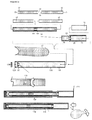
- FIG. 1 a perspective view of the exterior of an exemplary delivery device simulating a cigarette
- FIG. 2 a perspective view of the interior of an exemplary delivery device simulating a cigarette
- FIG. 3 a perspective view of the exemplary delivery device from Figures 1 and 2 in use;
- FIG 4 a sectional view of the subcomponents of an exemplary delivery device showing the assembly stages and final configuration of the components for device use;
- FIG 5 a perspective view of various source elements for providing the nicotine or other medicament and the delivery enhancing compound
- FIG 6 a sectional view of the subcomponents of an exemplary delivery device showing reusable and disposable portions
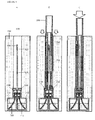
- FIG. 7 a sectional view of the subcomponents of a reusable exemplary delivery device showing the device and a recharging unit for supplying nicotine or other medicament and the delivery enhancing compound;
- FIG. 8 a sectional view of a reusable exemplary delivery device showing the device and a perspective view of a recharging unit for supplying nicotine or other medicament and the delivery enhancing compound;
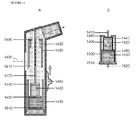
- FIG. 9 a sectional view of a reusable exemplary delivery device showing the device and a recharging unit; 9A shows the recharging unit alone, 9B shows the delivery device seated in the recharging unit and 9C shows the delivery device after compression of the metered dose pumps of the recharging unit for resupplying nicotine or other medicament and the delivery enhancing compound;
- FIG. 10A a sectional view of an exemplary delivery device with a heating component therein shown in perspective view as a separate component; 10B an exemplary delivery device having an external heating unit into which the delivery device is seated for temperature control of the device and/or its constituents;
- FIG. 11 a sectional view of an exemplary device simulates a metered dose inhaler commonly used for pharmaceutical delivery of inhaled medicaments
- FIG. 12 a sectional view of an exemplary device simulates a metered dose inhaler commonly used for pharmaceutical delivery of inhaled medicaments
- FIG. 13 a sectional view of an exemplary device simulates a metered dose inhaler commonly used for pharmaceutical delivery of inhaled medicaments
- FIG. 14 a sectional view of an exemplary device simulates a metered dose inhaler commonly used for pharmaceutical delivery of inhaled medicaments
- FIG. 15 a sectional view of an exemplary device simulates a metered dose inhaler commonly used for pharmaceutical delivery of inhaled medicaments.
- Particle as used herein may refer to a liquid droplet, a solid particulate or a combination of both, such as a liquid droplet nucleated by a solid particulate.
- “Therapeutically effective amount” as used herein may refer to a concentration or amount of nicotine or other medicament which achieves a therapeutic effect in a subject, generally a human subject.
- the subject has an improvement in a disease or medically defined condition.
- the improvement is any improvement or remediation of the symptoms associated with the disease.
- the improvement is an observable or measurable improvement.
- a treatment may improve the disease condition, but may not be a complete cure for the disease.
- the therapeutic effect in some embodiments may include reduction or elimination of nicotine craving in a subject suffering nicotine addiction or in a subject experiencing nicotine use withdrawal symptoms.
- the methods described herein relate to a surprising discovery regarding the dose of nicotine obtained from nicotine delivery devices.
- the inventors have unexpectedly identified methods for increasing the dose of nicotine delivered to a subject by inhalation.
- the importance of this discovery lies in an improved ability to substitute for the nicotine delivery subjects experience while smoking cigarettes and similar tobacco products.
- subjects applying the methods described herein will be provided with superior nicotine replacement therapy during attempts at smoking cessation, harm reduction and/or substitution.
- the methods described herein address a critical need in medical efforts to assist smokers in quitting.
- a volatile first substance i.e. a delivery enhancing compound
- passing the vapor of a volatile first substance results in the formation of particles in a liquid or solid state, which subsequently allows more of the nicotine to evaporate and combine with the first substance, generating further particles.
- the amount of particle formation (mass delivered) at a given temperature would be greater than that formed when the vapor of nicotine is passed over a second volatile substance.
- the amount of particle formation at a given temperature would be greater than that formed when the vapors of the two substances are combined in a parallel mixing apparatus (as disclosed in prior art), due to the amount of particle formation being limited by the volatility of the less volatile substance and to the dilution of the active substance by mixing with the volume of gas containing the other substance. Also, allowing sequential passing of one substance over a second substance may allow for a more efficient combination of the two substances than parallel mixing as disclosed in prior art. Another possibility is that the interaction between the first and second substances is an exothermic process. In other words, energy is released in the form of heat as a result of the exothermic interaction. Without desiring to be bound by theory, it is believed that the heat released may enhance the evaporation of the nicotine.
- the methods involve the step of bringing a gaseous carrier in communication with a nicotine source.
- the gaseous carrier in these embodiments contains a delivery enhancing compound capable of increasing the amount of nicotine in the gaseous carrier, relative to the amount of nicotine that would be in the gaseous carrier lacking the delivery enhancing compound.
- the delivery enhancing compound is capable of reacting with nicotine base or other medicament to form a salt.
- the delivery enhancing compound is capable of reacting with nicotine base to form salt particles.
- the particles are less than 6 micrometers, more preferably less than 1 micrometer, in Mass Median Aerodynamic Diameter.
- the methods disclosed herein may be adapted for use with a variety of other medicaments having similar biophysical and/or chemical properties to nicotine.
- the following compounds are aliphatic or aromatic, saturated or unsaturated nitrogenous bases (nitrogen containing alkaline compounds) in which a nitrogen atom is present in a heterocyclic ring or in an acyclic chain (substitution).
- the compounds have been selected based on melting point (below 150°C) or boiling point (below 300°C) that are expected to favor volatilization: Medicaments - other than Tobacco Smoke Constituents:
- Nicotinic antagonist Nicotine 28. 1,2,3,4-Tetrahydroisoquinolines 47. Methyllycacotinine 1.
- the gaseous carrier may be any gas capable of containing nicotine base and the delivery enhancing compound.
- the gaseous carrier is substantially inert with regard to the form of nicotine and/or the delivery enhancing compound carried, at least for the time period contemplated for delivery to a subject.
- the gaseous carrier is ambient air.
- the gaseous carrier is a substantially pure gas such as carbon dioxide or nitrogen gas, or a blend of such gases.
- the gaseous carrier is supplied from a container designed to hold and deliver the gaseous carrier in a manner to effect the methods described herein.
- the gaseous carrier may comprise Hydrofluorocarbons, which include Hydrofluoroalkanes (HFAs) as propellants.
- HFAs Hydrofluoroalkanes
- the HFAs are one or more of HFA 134a and HFA 227.
- Delivery enhancing compounds are those compounds capable of increasing the total concentration of nicotine in a gaseous carrier when the gaseous carrier is placed in communication with a nicotine source. Nicotine has a vapor pressure of 0.04 mm Hg at 25° C. Delivery enhancing compounds having a vapor pressure greater than nicotine at a given temperature are preferred if ambient temperatures are used.
- Non-limiting examples include inorganic acids such as hydrochloric, hydrobromic, or sulfuric acid, and organic acids including saturated and unsaturated aliphatic acids, saturated and unsaturated alicyclic acids, aromatic acids (including heterocyclic aromatic), polycarboxylic acids, hydroxy, alkoxy, keto, and oxo acids, thioacids, amino acids, and each of the preceding optionally substituted with one or more heteroatoms, including but not limited to halogens.
- the delivery enhancing compound is a carboxylic acid.
- the carboxylic acid is in the class termed "2-Oxo acids.” In some of these embodiments, the carboxylic acid is in the class of ⁇ -Keto acids known as “2-Keto acids.” In some of these embodiments, the acid is selected from the group consisting of 3-Methyl-2-oxovaleric acid, Pyruvic acid, 2-Oxovaleric acid, 4-Methyl-2-oxovaleric acid, 3-Methyl-2-oxobutanoic acid, 2-Oxooctanoic acid and combinations thereof. In some embodiments, the delivery enhancing compound forms solid particles, for example salt particles. In other embodiments, the delivery enhancing compound forms a liquid droplet aerosol.
- the delivery enhancing compound forms a particulate aerosol, the particles of which may, for example, adsorb or absorb nicotine base.
- the particulate aerosol includes ammonium chloride salt particles.
- the particles formed are preferably less than 6 microns, more preferably less than 5 microns or less than 1 micron in size.
- Nicotine (or other medicament) Sources
- Embodiments of a nicotine source use a compound comprising any chemical capable of providing a volatile form of nicotine such as nicotine base or nicotine salts (e.g. nicotine-HCl, -ditartrate). Although more than one form of nicotine can be used, free base nicotine is preferred.
- the nicotine source may comprise other compounds such as antioxidants (BHA, BHT, ascorbate) for stabilizing the nicotine.
- BHA, BHT, ascorbate antioxidants
- nicotine is adsorbed on an element to provide a nicotine source. The adsorbed nicotine is held on the surface of a relatively inert material.
- adsorption element materials include glass, stainless steel, aluminum, PET, PBT, PTFE, ePTFE, and BAREX ® .
- Adsorption is a process that occurs when a gas, liquid or solid solute accumulates on the surface of a solid or, more rarely, a liquid (adsorbent), forming a molecular or atomic film (the adsorbate).
- Physical adsorption is typically the result of van der Waals forces and electrostatic forces between adsorbate molecules and the atoms which compose the adsorbent surface.
- adsorbents are characterized by surface properties such as surface area and polarity.
- a large specific surface area is preferable for providing large adsorption capacity, but the creation of a large internal surface area in a limited volume inevitably gives rise to large numbers of small sized pores between adsorption surfaces.
- the size of the micropores determines the accessibility of adsorbate molecules to the internal adsorption surface, so the pore size distribution of micropores is another important property for characterizing adsorptivity of adsorbents.
- Surface polarity corresponds to affinity with polar substances such as water or alcohols.
- Polar adsorbents are thus called "hydrophilic" and aluminosilicates such as zeolites, porous alumina, silica gel or silica-alumina are examples of adsorbents of this type.
- non-polar adsorbents are generally "hydrophobic.” Carbonaceous adsorbents, polymer adsorbents and silicalite are typical non-polar adsorbents. These adsorbents have more affinity with oil or hydrocarbons than water.
- the adsorbing surface also wicks the adsorbed material by capillary action, when the adsorbent is in liquid form. Wicking occurs when the adhesive intermolecular forces between the liquid and an adsorbing surface are stronger than the cohesive intermolecular forces inside the liquid. The effect causes a concave meniscus to form where the substance is touching a vertical adsorbing surface. Adsorbing surfaces may be selected or designed to wick hydrophilic or hydrophobic liquids.
- the nicotine source element can comprise an absorbing (either porous or nonporous) material.
- nicotine source element materials include polyethylene (PE) and polypropylene (PP).
- a nicotine source may in some embodiments be or be in communication with a nicotine reservoir.
- the reservoir contains a volume of nicotine in liquid form with the liquid reservoir in communication with an adsorbing or absorbing nicotine source element.
- the nicotine reservoir is or forms part of the nicotine source element.
- a non-limiting example of such a combination source and reservoir would be a material (e.g., PE or PP) saturated with nicotine solution.
- the reservoir provides sufficient nicotine solution to enable a delivery device to provide therapeutically effective doses of nicotine over a desired time frame.
- Non-limiting examples would be devices capable of delivering 0-100 micrograms of nicotine per 35 cubic centimeter volume "puff" of gaseous carrier for a desired number of puffs per day (e.g., 200) over a desired number of days (e.g., 1-7 days).
- the amount of nicotine delivered is between 10 and 110, 20 and 100, 50 and 100, or 40 and 60 micrograms of nicotine per 35 cubic centimeter volume "puff.”
- medicaments listed in [0132] may be used in place of or in addition to nicotine to form sources of medicament(s) using the same principles applied to nicotine base as the example species above.
- the gaseous carrier is provided pre-combined with the delivery enhancing compound.
- Other embodiments of the methods described herein include a step of loading a gaseous carrier with a delivery enhancing compound prior to or concurrently with passage of the gaseous carrier over the nicotine source.
- the delivery enhancing compound is generally provided in the form of a delivery enhancing compound source.
- the gaseous carrier in these embodiments is generally brought into direct communication with the delivery enhancing compound source such that the delivery enhancing compound may enter the gaseous carrier from the delivery enhancing compound source.
- delivery enhancing compound sources comprise a delivery enhancing compound source element containing materials which adsorb or absorb the delivery enhancing compound.
- Delivery enhancing compound source element materials will generally be inert with respect to the delivery enhancing compound.
- the delivery enhancing compound is an acid as described above.
- Non-limiting examples of adsorption element materials for such embodiments include glass, stainless steel, aluminum, PET, PBT, PTFE, ePTFE, and BAREX ® .
- Non-limiting examples of absorption element materials for such embodiments include PE and PP.
- a delivery enhancing compound source may in some embodiments be, or be in communication with, a delivery enhancing compound reservoir.
- the reservoir contains a volume of delivery enhancing compound in liquid form with the liquid reservoir in communication with an adsorbing or absorbing delivery enhancing compound source element.
- the nicotine reservoir is or forms part of the delivery enhancing compound source element.
- a non-limiting example of such a combination source and reservoir would be a material (e.g., PE or PP) saturated with delivery enhancing compound solution.
- the reservoir provides sufficient delivery enhancing compound solution to enable a delivery device to provide therapeutically effective doses of nicotine over a desired time frame.
- Non-limiting examples would be devices capable of delivering sufficient delivery enhancing compound to enable delivery of 0-100 micrograms of nicotine per 35 cubic centimeter volume "puff" of gaseous carrier for a desired number of puffs per day (e.g. 200) over a desired number of days (e.g. 1-7 days).
- the amount of nicotine delivered is between 10 and 110, 20 and 100, 50 and 100, or 40 and 60 micrograms of nicotine per 35 cubic centimeter volume "puff.”
- Embodiments delivering 0 micrograms of nicotine are generally intended to be the end points of a gradual nicotine cessation program.
- the method involves a step of increasing the temperature of one or more of the gaseous carrier, the nicotine source and/or the enhancer source (when present).
- Such temperature control steps are generally used to regulate or to further enhance the amount of nicotine delivery.
- the increase in temperature is used only if the nicotine levels delivered would generally be otherwise expected to drop below a desired minimum. In some embodiments this may be more than 20 micrograms, preferably more than 30 micrograms, and more preferably more than 40 micrograms of nicotine per 35cc volume puff.
- a common target delivery concentration is 40-50 micrograms nicotine per 35 cubic centimeter volume "puff" as measured by a well known technique in the nicotine delivery field.
- a lower temperature is used first with the temperature increasing over time to sustain a desired nicotine delivery concentration from a nicotine source.
- a constant temperature is maintained during use.
- the temperature is elevated to a maximum of 100 degrees C, a maximum of 70 degrees C, or the temperature is elevated to 40 ⁇ 5 degrees C.
- pyruvic acid as a delivery enhancing compound may be heated to 40 degrees C to facilitate sustained nicotine delivery over multiple puffs at a desired nicotine concentration range (e.g. 20-50 micrograms per puff).
- Temperature control may in some embodiments be effected by a temperature control element.
- Such elements may be any known mechanism capable of achieving the desired target temperature for the gaseous carrier, the nicotine and/or the delivery enhancing compound(s). Particular examples of temperature control elements are illustrated below in the exemplary devices provided.
- the methods described herein are generally carried out using specially adapted delivery devices configured to carry out the methods described herein during device operation.
- One of skill in the art will be able to design and produce a variety of delivery devices using the foregoing guidance.
- the Inventors provide herein a number of delivery device configurations to further illustrate the methods herein and their practical application by way of specific examples.
- the gaseous carrier delivered to a device user can include a therapeutically effective dose of nicotine for smoking cessation, harm reduction and/or substitution.
- Preferred delivery device embodiments are pulmonary delivery systems. Pulmonary delivery systems have the ability to deliver consistent doses with suitable particle-size and low particle-size variability, to the deep lung.
- pulmonary delivery offers unique potential for precise dose titration, rapid absorption, and high bioavailability to deliver novel therapeutics and improve delivery of existing compounds.
- the aim was to evaluate the effectiveness of a chemically robust acid/base system to generate an aerosol of sufficient characteristics to aerosolize nicotine free base.
- the experimental design included two identical glass test tubes (Tube A contained 5ml of hydrochloric acid (HCl) and Tube B contained 5 ml ammonia (NH 3 )) connected through a "Y" shape tube designed to allow for the vapors from the two test tubes to be admixed instantly in the "Y" shape tubing and then passed over nicotine free base using a Controlled Puff Volume Apparatus, CPVA (40cc air at 2 seconds' duration (3-second interval) for 100 times (100 puffs)).
- CPVA Controlled Puff Volume Apparatus
- EXPERIMENT # 2 Screening for Suitable Acid Candidates for Use in the Development of Acid Over Nicotine Base Aerosol Delivery Arrangement
- the objective of this experiment was to evaluate a series of acid candidates for their ability to admix with nicotine free base to form an aerosol suitable for pulmonary delivery.
- the superior candidates which created aerosols containing the greatest mass of nicotine free base reported as ⁇ g/puff were selected for further evaluation.
- Volatile carboxylic acids were selected as the organic acid of choice due to their relative high volatility and to the fact that they are constituents of cigarettes and other commercial products for human consumption such as food additives, flavoring agents and sweetening agents.
- Two identical rectangular glass chambers measuring 4cm x 2cm x 1cm each contained two inlet/outlet ports extending externally through the top of the chamber before turning 90° away from the center of the chamber. These ports were positioned on opposite sides and near the edge of the chambers. Internally, these ports consisted of a hollow glass tube that extended to near the bottom of the chamber. The purpose of these ports was to provide a controlled pathway for the movement of air across a volume of nicotine free base (chamber "B") or candidate acid (chamber "A").
- chamber B was filled with 200 ⁇ L nicotine free base
- chamber A was filled with 200 ⁇ L pyruvic acid. The volumes of nicotine free base and pyruvic acid were added by Eppendorf pipette.
- Neat nicotine free base and neat pyruvic acid were stored at 4° C and under Nitrogen gas.
- the working volumes of the nicotine free base and pyruvic acid were stored under refrigerated conditions but not under nitrogen.
- the working volumes were brought to room temperature before transferring to the chambers.
- a temperature probe was used to verify that the working volumes had reached room temperature.
- a filling portal was crafted into each chamber and positioned on the top center panel and was used for filling the chambers with the appropriate reactants. Once the appropriate volume was added to the individual chamber, the portal was sealed using a plug of PARAFILM ® that was covered with TEFLON ® tape.
- the chambers were then connected sequentially using TEFLON ® tubing, secured by PARAFILM ® .
- the outlet from Chamber B was then connected by TYGON ® tubing to a filter holder containing a Cambridge filter (44mm diameter) used to collect the reaction product.
- a filter holder containing a Cambridge filter (44mm diameter) used to collect the reaction product.
- Pillsbury HC Smoking machine parameters for collection of total particulate matter and gases from low ignition- potential cigarettes. Under contract to the U.S. Consumer Product Safety Commission #CPSC-S-92-5472 I i March 14, 1993.
- the opposing side of the filter housing was connected to a 100cc syringe by TYGON ® tubing.
- the syringe was affixed to an automated system making up the Controlled Puff Volume Apparatus (CPVA).
- CPVA Controlled Puff Volume Apparatus
- the total time to prepare the set-up from filling the first chamber to initiating the first sampling interval was approximately 5 minutes.
- the CPVA was programmed to pull a volume of 35cc air at 2 seconds duration (30 second intervals) for 20 times (20 puffs).
- the filled chambers were immersed at half height into a water bath and were allowed to equilibrate at 70°C for 10 minutes prior to sampling.
- 3-Methyl-2-oxovaleric acid, Pyruvic acid, 2-Oxovaleric acid, 4-Methyl-2-oxovaleric acid, 3-Methyl-2-oxobutanoic acid and 2-Oxooctanoic acid represent the genus of carboxylic acids termed "2-Keto acids" or "Alpha-Keto acids.”
- the objective of this experiment was to assess which of the leading acid candidates selected from the experiment described above will deliver the greatest amount of nicotine under ambient conditions.
- the current experiment was carried out as described in the previous experiment except that the glass chambers were not immersed in a heated water bath, but sampled at ambient temperature.
- Individual experiments were carried out using the selected acid candidates: 3-Methyl-2-oxovaleric acid, Pyruvic acid, 2-Oxovaleric acid, 4-Methyl-2-oxovaleric acid, 3-Methyl-2-oxobutanoic acid and 2-Oxooctanoic acid.
- a different acid was placed in Chamber A as in the previous experiment with nicotine free base in Chamber B.
- a nicotine free base control experiment was also conducted as in the previous experiment.
- the data from ambient temperature shows that the Pyruvic acid is the superior candidate to form nicotine aerosol with the delivery of 44.68 ⁇ g/puff.
- the objective of this experiment was to compare the prior art configuration to the sequential orientation of acid and base to determine which yields higher nicotine delivery.
- the two leading acid candidates which generated similar nicotine delivery at ⁇ 70°C and one acid candidate which delivered the highest amount of nicotine under ambient temperature were tested under 70° C and ambient conditions, respectively.
- Chamber A contained 200 ⁇ L of the leading acid and chamber B contained 200 ⁇ L of nicotine free base.
- the two chambers were connected via a "Y" shaped glass connector which was then connected to the same PTFE housing containing a Cambridge filter as described previously.
- the vapors from the tubes were allowed to be admixed instantly in the "Y" shaped glass connector upon pulling a volume of 35cc air in 2 seconds duration (30 seconds interval) for 20 times (20 puffs) using a controlled puff volume apparatus (CPVA).
- CPVA controlled puff volume apparatus
- the acid and nicotine chambers were immersed at half height into a water bath with a water temperature of approximately 70°C.
- the chambers were allowed to equilibrate for 10 minutes prior to sampling.
- both the chambers were placed on a laboratory bench. The collected samples were analyzed for nicotine using Gas chromatography with a Nitrogen Phosphorous detector.
- the objective of this experiment was to determine the influence of the arrangement of the acid and base reservoirs in sequence allowing the acid vapors to be lifted into the nicotine free base chamber and over the nicotine to generate a plume cloud with sufficient quantities of nicotine free base. Pyruvic acid was selected for use in this experiment.
- the experimental design was the same as in Experiment #2. This experiment was divided into two parts, A and B.
- the first part, A involved the assessment of the use of 200 ⁇ L each of nicotine free base and pyruvic acid in separate chambers collected over 3 samples (20 puffs per sample).
- the second part of the experiment (part B) involved a comparison of the above system tested under ambient and 40°C conditions to evaluate the effect of mild heat on aerosol formation and nicotine delivery.
- Air-freshener wick samples made of a blend of PE and PP fibers (sold as X-40495 fiber from Porex Technologies) were used as a matrix upon which pyruvic acid was loaded and GORETM Medical Membrane (pore size of 0.2 micron) consisting of an expanded PTFE medical membrane with a non-woven PET membrane support (sold as SMPL-MMT314 from W.L. Gore & Associates, Inc.) was used as a matrix to load nicotine free base.
- GORETM Medical Membrane pore size of 0.2 micron
- SMPL-MMT314 from W.L. Gore & Associates, Inc.
- the membrane sheet was rolled into a straw configuration to provide a polyester inner wall and TEFLON ® outer wall having approximate dimensions of 1.5mm ID and cut into 4cm long pieces.
- a piece of air-freshener wick was loaded with 180 ⁇ L of pyruvic acid (pyruvic acid source element) and the inner walls (polyester side) of three pieces of the 4cm long and 1.5mm ID rolled medical membrane were coated with 90 ⁇ L (3x30 ⁇ L) of nicotine free base.
- the air freshener with loaded pyruvic acid was inserted into the distal end of 8mm ID and 9cm long clear TEFLON ® tube and the three pieces of the medical membrane with nicotine free base were inserted tightly into a TEFLON ® washer which had three holes (nicotine source element).
- the nicotine source element was inserted into the 9cm long, 8mm internal diameter (ID) TEFLON ® tube with the pyruvic acid source element leaving a gap between the pyruvic acid source element and nicotine source element of 2cm.
- the arrangement of the source elements was in such a way that a measured volume of air (35cc at 2sec duration and 30 second puff interval for 20 times) pulled by automated syringe pump traveled first through the pyruvic acid source element and then through the nicotine source element to form an aerosol.
- the proximal end of the device was connected to a controlled puff volume apparatus (CPVA) containing a Cambridge filter (to collect aerosol product).
- CPVA controlled puff volume apparatus
- the 9cm long device (which had both pyruvic acid and nicotine source elements) was completely immersed in a water bath and equilibrated for 10 minutes prior to sampling.
- the ambient condition experiment was carried out by placing the chambers on a laboratory bench.
- Delivery devices of some embodiments comprise a housing which simulates a tobacco smoking article.
- the housing may simulate the size, shape, and/or configuration of any article used for smoking tobacco articles.
- Non-limiting examples of smoking articles according to the present invention include cigarettes, cigars, cigarillos and pipes.
- Delivery devices of some embodiments comprise a housing which simulates a pharmaceutical inhalation device.
- the housing may simulate the size, shape, and/or configuration of any pharmaceutical device used for inhalation.
- pharmaceutical inhalation devices according to the present invention include, metered dose inhalers, pressurized metered dose inhalers, dry powder inhalers, nebulizers and liquid based inhalers.
- Nicotine inhaler 10 having the size, shape, and appearance of a cigarette is shown.
- Nicotine inhaler 10 consists of housing 12, which has an elongated cylindrical shape and is hollow. To allow for a gaseous flow through inhaler 10, housing 12 contains gaseous inlet 14 and gaseous outlet 16 on opposing ends.
- the portion of housing 12 between gaseous inlet 14 and gaseous outlet 16 is divided into three compartments capable of holding a first, second, and/or third substance.
- the first, second, or third substance can comprise a vapor forming medicament, such as nicotine.
- nicotine inhaler 10 includes first compartment 18, second compartment 20, and third compartment 22.
- Nicotine preferably in the free base form, may be placed in any of the three compartments.
- nicotine can be placed within second compartment 20.
- Any suitable acid can be used.
- pyruvic acid can be placed within first compartment 18.
- Pyruvic acid is a volatile substance which has a substantial vapor pressure at room temperature. As such, any free space within first compartment 18 will be filled to some degree with pyruvic acid vapor, that is, gaseous pyruvic acid. Although the vapor pressure of nicotine is less than that of pyruvic acid, nicotine is also a volatile substance. In the same manner, any free space within second compartment 20 will be filled to some degree with nicotine vapor.
- the pyruvic acid is held within first compartment 18 on a delivery enhancing compound source element (not shown) and nicotine is held within second compartment 20 on a nicotine source element (not shown).
- a third substance may be held on a third source element (not shown) within third compartment 22.
- one or more of the source elements may be integral with or part of compartments 18, 20, and 22, respectively.
- the delivery enhancing compound source element can be any size and shape that allows a gaseous stream to contact a vapor of the acid and pass through first compartment 18.
- the nicotine source element can be any size and shape that allows a gaseous stream to contact a vapor of nicotine and pass through second compartment 20.
- the third source element can be any size and shape that allows a gaseous stream to contact a third substance and pass through third compartment 22.
- the delivery enhancing compound source element can be composed of any suitable material capable of holding the acid on its surface while allowing the acid vapors to permeate into the surrounding area.
- the nicotine source element can be composed of any suitable material capable of holding nicotine on its surface while allowing the nicotine vapors to permeate into the surrounding area.
- the third source element can be composed of any suitable material capable of holding a third substance. In specific embodiments, the suitable material holds the third substance on its surface while allowing the vapor of the third substance to permeate into the surrounding area.
- a suitable source element material is inert to any substance to be placed on its surface.
- a suitable material is preferably adsorbing with respect to any substance to be placed on its surface such that said substance is adsorbed on the surface of the material.
- a material having both absorptive and adsorptive characteristics can be employed, a material capable of holding the delivery enhancing compound(s), nicotine and/or third substance through adsorption is preferred.
- Non-limiting examples include glass, aluminum, PET, PBT, PTFE, ePTFE, and BAREX ® .
- the adsorptive material may function via capillary action to continuously present the substances to the surface of the adsorbing material.
- Third compartment 22 can contain a purifying agent.
- activated charcoal can be incorporated into third compartment 22 using any method which provides the resulting third compartment 22 with gas purification capability. Suitable methods are well-known in the art.
- the charcoal may be placed within third compartment 22 as a charcoal plug or filter.
- a user puffs on gaseous outlet 16 of nicotine inhaler 10, as shown in Figure 3 .
- the partial vacuum created by the puffing action draws a gaseous stream into housing 12 through gaseous inlet 14.
- the gaseous stream enters first compartment 18 and captures a vapor of the acid by passing over the pyruvic acid source element held in first compartment 18.
- the gaseous stream that exits first compartment 18 and subsequently enters second compartment 20 is an acid-containing gaseous stream.
- the acid-containing gaseous stream generates a stream of nicotine-containing particles by passing over the nicotine held by the nicotine source element in second compartment 20.
- the stream of nicotine-containing particles passes through third compartment 22 and exits through gaseous outlet 16 into the mouth of the user.
- any unreacted acid is removed from the stream of nicotine-containing particles via the activated charcoal filter in third compartment 22.
- pyruvic acid could be held on a first element in first compartment 18 and/or nicotine could be held on a second element in second compartment 20.
- a third substance such as a purifying or flavoring agent, may be held on a third element in third compartment 22.
- the first, second, and third elements may be integral with or part of compartments 18, 20, and 22, respectively.
- FIG. 4 This exemplary device is illustrated and described by reference to Figures 4-6 .
- the elements of the device are shown in an assembly flow chart.
- the delivery enhancing compound source 30 and the nicotine source 40 are optionally manufactured and stored as independent components generally having frangible barrier end caps 35 and 45 heat sealed on the ends.
- These two elements 30 and 40 are inserted into a first housing 50.
- First housing 50, containing delivery enhancing compound source 30 and the nicotine source 40, is then inserted into a second housing 100.
- the housings 50 and 100 and the elements 30 and 40 are generally extruded plastic tubing. Also inserted into second housing 100 is heating element 95.
- the heating element 95 is generally a thin flexible heating foil which is configured to wrap around housing 50 and to contact housing 50 sufficiently to enable heating the delivery enhancing compound source 30 and/or the nicotine source 40 to a desired temperature (e.g. 40 degrees C). Heating element 95 is also adapted to contact battery 130 to supply power to the heating foil element 95.
- Filter element 80 is adapted to insert and snap-lock into second housing 100.
- Filter element 80 comprises a filter cavity 75 adapted to contain a filter 70.
- Filter 70 is generally a charcoal filter and may contain additional volatile compounds such as flavoring agents commonly used in cigarettes.
- Filter element 80 may have foil seal 150 to seal the assembled pre-use configuration 160.
- Filter element 80 has aperture 90 which aligns with aperture 110 of second housing 100.
- air inlet 140 When assembled, air inlet 140 is formed.
- the filter element 80 and the second housing 100 are configured to permit rotation to select a desired air inlet 140 aperture dimension.
- the air inlet 140 forms when filter element 80 is fully inserted into second housing 100 as shown by 170.
- the full insertion of filter element 80 also forces penetrating elements 60 through frangible barriers 35 and 45 to unseal these elements for an unobstructed air flow pathway from air inlet 140 to particle delivery aperture 180.
- FIG. 5 shows various alternative structures for delivery enhancing compound source 30 and the nicotine source 40.
- the delivery enhancing compound in this configuration is generally a volatile acid which may be held by adsorption onto sintered plug 310, PE wick 320, a fiber bundle 330, a mutilumen tube 340 or 350, woven or non-woven PET, PBT, or PETG fabric material 360, PET static mixer 370, or a helical path wrapped in nonwoven material 380.
- FIG 6 shows some embodiments of this device where the device comprises a reusable portion 210 and a disposable portion 200.
- disposable portion 200 comprises the delivery enhancing compound source 30 and the nicotine source 40, the first housing 50, and the filter element 80.
- the reusable portion 210 comprises second housing 100, heating element 95 and battery 130.
- FIG. 7 A fully reusable exemplary device is illustrated by Figure 7 .
- portion 410 and 420 or 430 and 440 are reversibly attachable.
- the portions may be extruded plastic adapted and dimensioned to permit repeated snap-locking and removal.
- the removable portions 420 or 440 comprise apertures 430 and 440 for communication with delivery enhancing compound source 445 and nicotine source 435.
- Portions 420 or 440 insert into recharging element 450 through aperture 460.
- Elements 470 are sealing o-rings to seal off the reservoir when recharging delivery enhancing compound source 445 and nicotine source 435.
- Loading apertures 480 and 490 are configured to communicate with delivery enhancing compound source 445 and nicotine source 435 once portion 420 is seated in recharging element 450.
- gravity drives flow from delivery enhancing compound reservoir 500 and nicotine reservoir 510 to delivery enhancing compound source 445 and nicotine source 435, respectively.
- the flow from the reservoirs to the sources is in part due to wicking of the reservoir liquid by the source elements.
- delivery enhancing compound source 445 and nicotine source 435 may comprise a source element containing PET to create rapid wicking and thus reloading of sources 445 and 435.
- FIG. 8 Another exemplary device is illustrated by Figures 8 and 9 .
- This exemplary device is rechargeable and configured to simulate a typical cigarette pack.
- delivery device 600 is configured to insert into recharging unit 610 through storage aperture 620 and recharging aperture 630.
- the device 600 is recharged with delivery enhancing compound and/or nicotine.
- Figure 9 shows the recharging element 640 in detail.
- injection element 650 having loading apertures 660 and 670 is in flow communication with reservoirs 720 and 730 through metered dose actuator pumps 680 and 690 and tubes 700 and 710.
- delivery device 600 is shown seated in recharging unit 640.
- Injection element 650 passes through a recharging aperture at the base of the delivery device and into said device so that apertures 660 and 670 are in communication with nicotine source element 740 and delivery enhancing compound source element 750.
- the delivery device 600 is further inserted into recharging unit 640 to actuate the pumps 680 and 690 to deliver metered doses 770 of nicotine and 760 of delivery enhancing compound through apertures 660 and 670, respectively, and into nicotine source element 740 and delivery enhancing compound source element 750, respectively.
- This exemplary device is illustrated by Figure 10 .
- This device configuration has a heating unit 850 external to the delivery device 800.
- electrical contacts 840 are in contact with leads 825 which permit battery 830 to heat foil heating element 860 to control the temperature of the delivery enhancing compound source 870 and nicotine source 880 to, e.g., 40 ⁇ 5 degrees C.
- An alternative configuration places the heating foil 860 within the delivery device 800, as shown in Figure 4 .
- the foregoing exemplary devices are generally configured to simulate a cigarette and cigarette pack.
- the delivery devices suitable for use with the methods herein are readily configured in a variety of ways.
- An example is illustrated in Figure 11 .
- This exemplary device simulates a metered dose inhaler commonly used for pharmaceutical delivery of inhaled medicaments.
- Delivery device 900 comprises a first housing 910 and a second housing 920.
- Second housing 920 is removable ( Figure 11A ) and in ( Figure 11B ) for recharging or replacement of battery 990.
- the in position brings electrical contact 1050 and 1060 into communication thereby allowing battery 990 to heat foil heating element 950 to in turn control the temperature of delivery enhancing compound source 960 and nicotine source 970.
- Air intake actuator 930 is configured to slide anywhere from the position in Figure 11A to 11B .
- Power for heating foil element 950 may be optionally turned on or off using air intake actuator 930 or a separate switching means (not shown).
- Air intake aperture 940 may then be opened to a selected degree thereby controlling the volume of air per inhalation and consequently the amount of nicotine. This feature is analogous to adjustable air intake aperture 140 of Figure 1 .
- air is drawn through air intake aperture 940, down to chamber 1000, through conduit 1010, through the delivery enhancing compound source 960 where delivery enhancing compound is captured in the air flow.
- pyruvic acid vapor may be emanating from a PET source element having liquid pyruvic acid adsorbed thereon.
- This vapor is moved by the air flow through conduit 1020 into the nicotine source 970.
- the delivery enhancing compound increases the concentration of nicotine in the airflow relative to the amount of nicotine vapor that would be contained in the same volume of air flow in the absence of the delivery enhancing compound.
- nicotine pyruvate salt particulates may be formed to enhance delivery of nicotine to a subject. Delivery may be further enhanced by elevating the temperature of, e.g., pyruvic acid and nicotine, by means of heating element 950 to increase the vapor pressure of those compounds.
- the airflow containing nicotine now moves through conduit 1030, through charcoal filter 980 and out the inhalation aperture 1040.
- Figure 11C and D illustrate an embodiment of the exemplary inhaler device 900 wherein a portion of the device having the delivery enhancing compound source 960 and nicotine source 970 in a disposable housing 1050 which is configured to slide into and out of reusable housing 1060 to form a device functionally identical to device 900.
- Battery housing element 1070 is detachable from disposable element 1050 and thus reusable with portion 1060 and a replacement element 1050.
- FIG. 12 A-C illustrates another configuration of an inhalation device.
- the delivery enhancing compound source and the nicotine source are the lower and upper surface areas of split inner tube 1100.
- an impermeable cover 1110 is in place over nicotine reservoir 1120 and delivery enhancing compound reservoir 1130.
- the impermeable cover 1110 reduces evaporative loss from the reservoirs and physically separates the reservoirs from the split inner tube 1100.
- bottom housing 1180 is pushed into main housing 1190 until first catch spring 1140 is locked in the position shown in 12B. This places the reservoirs 1120 and 1130 in parallel proximity to the split inner tube 1100.
- the bottom housing 1180 is further inserted into main housing 1190 until second catch spring 1150 is locked in the position shown in 12C.
- pressure elements 1160 squeeze split inner tube 1100 to force wall 1170 into contact with reservoirs 1120 and 1130.
- This action forces nicotine and delivery enhancing compound (e.g. pyruvic acid) onto the inner surface of wall 1170 to recharge this surface as the nicotine source and the delivery enhancing compound source.
- nicotine and delivery enhancing compound e.g. pyruvic acid
- Figure 13 shows a variant of the device of Figure 12 .
- bottom housing 1250 is depressed against conical spring 1230 to force the nicotine reservoir 1210 and the delivery enhancing compound reservoir 1220 through reservoir cover 1200 and into contact with the inner surface of conical inner tube 1240, thereby coating the surface with nicotine and delivery enhancing compound ( Figure 13B ).
- FIG 14 shows another version of the device of Figure 12 .
- outer housing 1300 is contiguous with the moving components being switch 1310 and the various internal elements shown.
- Switch 1310 is connected to source seating element 1330 by a connecting bar 1320.
- rigid seating element 1330 moves along pole 1360.
- reservoir elements 1340 and 1350 are brought into contact with flexible element 1370 which is also brought into contact with rigid seating element 1330.
- Rigid seating element 1330 is dimensioned to squeeze flexible elements 1370 into contact with reservoir elements 1340 and 1350 in the final portion of the sliding motion ( Fig. 14 B) .
- This action coats the upper portion of flexible element 1370 with, e.g., nicotine base solution from reservoir 1350 and the lower portion of flexible element 1370 with pyruvic acid from 1340 to create a nicotine source and a delivery enhancing compound source, respectively.
- the top surface of reservoir 1350 may be covered by an impermeable material to limit the amount of volatilization of medicament and delivery enhancing compound from the reservoirs when in the operational position ( Figure 14 A) .
- a circular flap of flexible, impermeable material may extend from elements 1320 or 1330 to close off the volume below reservoir 1350 and further limit volatilization. In charging position ( Figure 14B ) the flap would be forced down and away from the reservoirs by flexible element 1370.
- Figure 15 shows another delivery device configuration.
- Figure 15A shows the device 1400 in use mode. Air moves from intake 1410 past delivery enhancing compound source 1500, nicotine source 1490 and through outlet 1415. The nicotine and delivery enhancing compound are coated onto the side walls of their respective sources.
- delivery enhancing compound reservoir 1430 and nicotine reservoir 1420 are provided.
- Switch 1460 may be actuated to recharge the sources. Upon activation by switch 1460, base 1510 is moved along guide rod 1470 toward delivery enhancing compound source 1500 and nicotine source 1490.
- Shown in Figure 15B upon contact with the delivery enhancing compound source 1500, the nicotine source 1490 and the upper stop element 1480, impermeable caps 1440 and 1450 compress reservoirs to force delivery enhancing compound and nicotine out onto the surfaces of the sources 1490 and 1500.
- the reservoirs in this device may be made of any flexible adsorbing or absorbing material capable of holding the nicotine or delivery enhancing solutions.
- the reservoirs will generally be motivated back down guide pole 1470 automatically after recharging the sources, thus making the device a conveniently operated "one click" device.
- the movement of the reservoirs may be achieved by any convenient means.
- a motive wire 1520 may be provided within a groove on guide pole 1470.
- the motive wire 1520 may be attached to base 1510 and moves up and down the guide pole 1470 by a motor rotated element (not shown).
- the top outer portion of device 1400 may be rotated to define the size of inlet 1410 analogous to element 140 shown in Figure 4 .
- the methods and devices herein are useful for the therapeutic delivery of nicotine for smoking cessation, harm reduction and/or substitution.
- the devices and methods herein are useful as an alternative, general nicotine delivery system in place of tobacco based products.
- the methods and devices herein are further useful for the delivery of other medicaments as described herein.
- a method of increasing a nicotine concentration in a gaseous carrier comprising a step of placing the gaseous carrier comprising a delivery enhancing compound in communication with a nicotine source comprising the nicotine.
- the delivery enhancing compound source comprises a plurality of internal areas comprising two or more precursor compounds.
- the acid is selected from the group consisting of 3-Methyl-2-oxovaleric acid, Pyruvic acid, 2-Oxovaleric acid, 4-Methyl-2-oxovaleric acid, 3-Methyl-2- oxobutanoic acid, 2-Oxooctanoic acid and combinations thereof.
- Nicotine for tobacco product use cessation the nicotine delivered by the method of paragraphs [0260]-[0264], further comprising the step of providing the gaseous carrier to a subject after the step of placing the gaseous carrier comprising the delivery enhancing compound in communication with the nicotine source.
- the gaseous carrier comprises at least 20 micrograms of nicotine in a volume of gaseous carrier provided to the subject.
- Nicotine for tobacco product harm reduction the nicotine delivered by the method of paragraphs [0260]-[0264], further comprising the step of providing the gaseous carrier to a subject after the step of placing the gaseous carrier comprising the delivery enhancing compound in communication with the nicotine source.
- the gaseous carrier comprises at least 20 micrograms of nicotine in a volume of gaseous carrier provided to the subject.
- Nicotine for tobacco product substitution the nicotine delivered by the method of paragraphs [0260]-[0264], further comprising the step of providing the gaseous carrier to a subject after the step of placing the gaseous carrier comprising the delivery enhancing compound in communication with the nicotine source.
- the gaseous carrier comprises at least 20 micrograms of nicotine in a volume of gaseous carrier provided to the subject.
- a device configured to be capable of carrying out the method of paragraphs [0260]-[0264].
- a device configured to be capable of delivering the nicotine of paragraph [0278].
- a device configured to be capable of delivering the nicotine of paragraph [0281].
- a device configured to be capable of delivering the nicotine of paragraph [0284].
- a device configured to be capable of delivering the nicotine of paragraph [0287].
- a device for delivering a medicament to a subject comprising a housing, the housing comprising an inlet and an outlet in communication with each other and adapted so that a gaseous carrier may pass into the housing through the inlet, through the housing and out of the housing through the outlet, the device comprising in series from inlet to outlet: a first internal area in communication with the inlet, the first internal areas comprising a delivery enhancing compound source: a second internal area in communication with the first internal area, the second internal area comprising a nicotine or other medicament source; and optionally, a third internal area in communication with the second internal area.
- a partial vacuum at the outlet is capable of pulling the gaseous carrier through the inlet, the first internal area, the second internal area, the third internal area when present and then through the outlet.
- the enhancer source comprises an adsorption element with the delivery enhancing compound adsorbed thereon and/or wherein the nicotine or other medicament source comprises an adsorption element with the nicotine adsorbed thereon.
- the adsorption element or elements comprises at least one of glass, aluminum, PET, PBT, PTFE, ePTFE, and BAREX.
- the pharmaceutical inhalation device is selected form the group consisting of a metered dose inhaler, a pressurized metered dose inhaler, a dry powder inhaler, a nebulizer, and a liquid based inhaler.
- a medicament for delivery to a subject by inhalation comprising the steps of: a) first placing a gaseous carrier comprising a delivery enhancing compound in communication with a medicament source comprising the medicament; and b) second providing the gaseous carrier comprising the medicament to a subject.
- the medicament is selected from the group consisting of: Nicotine, 7-Hydroxymitragynine, Arecoline, Atropine, Bupropion, Cathine (D-norpseudoephedrine), Chlorpheneramine, Dibucaine, Dimemorphan, Dimethyltryptamine, Diphenhydramine, Ephedrine, Hordenine, Hyoscyamine, Ireportedlycoline, Levorphanol, Lobeline, Mesembrine, Mitragynine, Muscarine, Procaine, Pseudo ephedrine, Pyrilamine, Raclopride, Ritodrine, Scopolamine, Sparteine (Lupinidine), Ticlopidine, 1,2,3,4-Tetrahydroisoquinolines, Anabasine, Anatabine, Cotinine, Myosmine, Nicotrine, Norcotinine, Nornicotine, Orciprenaline, Propranolol, Ter
- the medicament is an aliphatic or aromatic, saturated or unsaturated nitrogenous base in which a nitrogen atom is present in a heterocyclic ring or in an acyclic chain.
- a device configured to be capable of carrying out the method of paragraph [0309]-[0322].
Landscapes
- Health & Medical Sciences (AREA)
- Engineering & Computer Science (AREA)
- Life Sciences & Earth Sciences (AREA)
- Veterinary Medicine (AREA)
- Public Health (AREA)
- General Health & Medical Sciences (AREA)
- Animal Behavior & Ethology (AREA)
- Chemical & Material Sciences (AREA)
- Bioinformatics & Cheminformatics (AREA)
- Medicinal Chemistry (AREA)
- Pharmacology & Pharmacy (AREA)
- General Chemical & Material Sciences (AREA)
- Chemical Kinetics & Catalysis (AREA)
- Biomedical Technology (AREA)
- Organic Chemistry (AREA)
- Nuclear Medicine, Radiotherapy & Molecular Imaging (AREA)
- Heart & Thoracic Surgery (AREA)
- Pulmonology (AREA)
- Hematology (AREA)
- Neurology (AREA)
- Neurosurgery (AREA)
- Epidemiology (AREA)
- Anesthesiology (AREA)
- Cardiology (AREA)
- Psychiatry (AREA)
- Addiction (AREA)
- Molecular Biology (AREA)
- Biophysics (AREA)
- Vascular Medicine (AREA)
- Obesity (AREA)
- Hospice & Palliative Care (AREA)
- Psychology (AREA)
- Child & Adolescent Psychology (AREA)
- Diabetes (AREA)
- Urology & Nephrology (AREA)
- Pharmaceuticals Containing Other Organic And Inorganic Compounds (AREA)
- Medicinal Preparation (AREA)
- Manufacture Of Tobacco Products (AREA)
- Acyclic And Carbocyclic Compounds In Medicinal Compositions (AREA)
- Medicines That Contain Protein Lipid Enzymes And Other Medicines (AREA)
Abstract
Description
- The invention relates to devices and methods for delivering a medicament to a user. More particularly, the invention relates to devices and methods for delivering an aerosol of a medicament to a user's lungs.
- Pulmonary drug delivery systems have been used for decades to deliver medicaments for the treatment of respiratory disorders. The principle behind pulmonary drug delivery is aerosolization of drug compounds to be delivered to bronchioles and alveoli. Despite facing challenges like particle size optimization and degradation, a number of companies have developed technologies to deliver treatments for diabetes, migraine, osteoporosis and cancer.
- The available delivery systems include metered dose inhalers (MDIs), dry powder inhalers (DPIs), and nebulizers. MDIs were among the first to be introduced in the United States in the mid 1950s. The HFA-based (pressurized) MDI was introduced in the United States in 1995. Although DPIs were introduced in the 1970s, their use has been limited due to the overwhelming dominance of MDIs. Nebulizers are generally used within hospital settings. Technological advances within the pulmonary drug delivery technologies markets are taking place in non-CFC-based MDIs, DPIs, and liquid-based inhalers (LBIs).
- Many preclinical and clinical studies have demonstrated that pulmonary delivery of medicaments is an efficient method for the treatment of both respiratory and systemic diseases. The many advantages of pulmonary delivery are well recognized and include rapid onset, patient self-administration, reduced side-effects, ease of delivery by inhalation, and the elimination of needles.
- Nevertheless, methods for the administration of most medicaments have not significantly deviated from delivery via the traditional intravenous/intramuscular and oral routes to include pulmonary delivery via inhalation. The use of pulmonary delivery has been limited mainly to the administration of medicaments for the treatment of asthma.
- It has been reported that in order to deliver a powder directly into the lower respiratory regions the powder should generally have a particle size of less than 5 µm. Further, powders in the 5-10 µm range have been found not to penetrate as deeply and instead tend to stimulate the upper respiratory tract regions.
- When manufacturing drug formulations for dry powder inhalers (DPIs), the medicament must first be milled to obtain an acceptable particle size for pulmonary delivery. This micronization step can cause problems during manufacture. For example, the heat produced during milling can cause degradation of the medicament. Additionally, metal can rub off some mills and contaminate the medicament. Furthermore, due to the small size of the particles, dry powder formulations tend to agglomerate, especially in the presence of moisture.
- Agglomeration results in low flowability of the particles which diminishes the efficacy of the dry powder formulation. As a result, careful supervision is required during milling, blending, powder flow, filling and even administration to ensure that the dry powder aerosols are properly delivered.
- Thus, there is a need for new methods to prepare aerosols for medicament delivery. The present disclosure describes in part a method for combining nicotine or other medicaments with a delivery enhancing compound in a gaseous stream to generate an aerosol for pulmonary delivery, without the need for excipients or other additives including solvents.
- In some embodiments, the disclosure relates to a method of delivering nicotine to a subject by inhalation, the method comprising the steps of:
- a) first placing a gaseous carrier comprising a delivery enhancing compound in communication with a nicotine source comprising the nicotine, and
- b) second providing the gaseous carrier comprising the nicotine to a subject.
- In some embodiments, the disclosure relates to the method of paragraph [0010], further comprising the step of placing the gaseous carrier in communication with a delivery enhancing compound source comprising the delivery enhancing compound.
- In some embodiments, the disclosure relates to the method of [0011], wherein the step of placing the gaseous carrier in communication with the delivery enhancing compound source precedes the step of placing the gaseous carrier comprising the delivery enhancing compound in communication with the nicotine source.
- In some embodiments, the disclosure relates to the method of [0010], [0011], or [0012], wherein the delivery enhancing compound source comprises a plurality of compartments comprising two or more precursor compounds.
- In some embodiments, the disclosure relates to the method of [0013], wherein the delivery enhancing compound comprises ammonium chloride and the two or more precursor compounds include ammonia and hydrogen chloride.
- In some embodiments, the disclosure relates to the methods of [0010]-[0013], or [0014], wherein the nicotine concentration in the gaseous carrier is increased relative to the nicotine concentration that would be contained in the gaseous carrier without the delivery enhancing compound.
- In some embodiments, the disclosure relates to the methods of [0010] - [0014], or [0015], wherein the delivery enhancing compound comprises an acid.
- In some embodiments, the disclosure relates to the method of [0016], wherein the acid is an organic acid.
- In some embodiments, the disclosure relates to the method of [0017], wherein the organic acid has a greater vapor pressure than nicotine base at a given temperature.
- In some embodiments, the disclosure relates to the method of [0018], wherein the given temperature is 25, 30, 40, 45, 70 or 100 degrees C.
- In some embodiments, the disclosure relates to the methods of [0016]-[0018], or [0019] wherein the acid is selected from the group consisting of 3-Methyl-2-oxovaleric acid, Pyruvic acid, 2-Oxovaleric acid, 4-Methyl-2-oxovaleric acid, 3-Methyl-2-oxobutanoic acid, 2-Oxooctanoic acid and combinations thereof.
- In some embodiments, the disclosure relates to the methods of [0010]-[0019], or [0020], wherein the delivery enhancing compound interacts with the nicotine to form particles.
- In some embodiments, the disclosure relates to the method of [0021], wherein the particles are less than 6 microns in Mass Median Aerodynamic Diameter.
- In some embodiments, the disclosure relates to the method of [0021], wherein the particles are less than 1 micron in Mass Median Aerodynamic Diameter.
- In some embodiments, the disclosure relates to the method of [0021], wherein at least some of the particles are between 0.5 and 5 microns in Mass Median Aerodynamic Diameter.
- In some embodiments, the disclosure relates to the methods of [0010]-[0023], or [0024], further comprising the step of increasing the temperature of the delivery enhancing compound, the delivery enhancing compound source, the nicotine, the nicotine source and/or the gaseous carrier.
- In some embodiments, the disclosure relates to the method of [0025], wherein the temperature is increased to at least 30 degrees Celsius.
- In some embodiments, the disclosure relates to the methods of [0010]-[0025], or [0026], wherein the gaseous carrier comprises at least 20 micrograms of nicotine in a volume of gaseous carrier provided to the subject.
- In some embodiments, the disclosure relates to the method of [0027], wherein the volume of gaseous carrier delivered to the subject is provided as a single volume.
- In some embodiments, the disclosure relates to a method of tobacco product use cessation comprising one or more of the methods of [0010]-[0027], or [0028] and further comprising a delivery to the subject of a therapeutically effective amount of nicotine to at least partially replace nicotine derived from a tobacco product.
- In some embodiments, the disclosure relates to a method of treating a disease for which nicotine is therapeutically beneficial comprising one or more of the methods of [0010]-[0027], or [0028], wherein a therapeutically effective amount of nicotine is provided to the subj ect.
- In some embodiments, the disclosure relates to the method of [0030], wherein the disease is selected from the group consisting of nicotine addiction, obesity, Alzheimer's Disease, Parkinson's Disease, Ulcerative Colitis, Multiple Sclerosis and combinations thereof.
- In some embodiments, the disclosure relates to a method of tobacco product substitution comprising delivering nicotine to a subject by the methods of [0010]-[0027], or [0028] to substitute for nicotine derived from a tobacco product.
- In some embodiments, the disclosure relates to a method of tobacco product harm reduction comprising delivering nicotine to a subject by the methods of [0010]-[0027], or [0028] to replace nicotine derived from a tobacco product.
- In some embodiments, the disclosure relates to a device configured to be capable of carrying out the methods of [0010]-[0032], or [0033].
- In some embodiments, the disclosure relates to a device for delivering nicotine to a subject, the device comprising a housing, the housing comprising:
- a) an inlet and an outlet in communication with each other and adapted so that a gaseous carrier may pass into the housing through the inlet, through the housing and out of the housing through the outlet, the device comprising in series from inlet to outlet:
- b) a first internal area in communication with the inlet, the first internal area comprising a delivery enhancing compound source,
- c) a second internal area in communication with the first internal area, the second internal area comprising a nicotine source, and
- d) optionally, a third internal area in communication with the second internal area and the outlet.
- In some embodiments, the disclosure relates to the device of [0035] wherein a partial vacuum at the outlet is capable of pulling the gaseous carrier through the inlet, the first compartment, the second compartment, the third compartment, when present, and then through the outlet.
- In some embodiments, the disclosure relates to the device of [0035] or [0036] wherein the delivery enhancing compound source comprises an adsorption element with the delivery enhancing compound adsorbed thereon and/or wherein the nicotine source comprises an adsorption element with the nicotine adsorbed thereon.
- In some embodiments, the disclosure relates to the device of [0037] wherein the adsorption element or elements comprises at least one of glass, aluminum, Polyethylene Terephthalate (PET), Polybutylene Terephthalate (PBT), Polytetrafluoroethylene (PTFE or TEFLON®), Expanded Polytetrafluoroethylene (ePTFE) (ePTFE is described for example in
U.S. Patent No. 4,830,643 ), and BAREX®. - In some embodiments, the disclosure relates to the devices of [0035]-[0037], or [0038], further comprising a first reservoir in communication with the first internal area, the first reservoir comprising the delivery enhancing compound.
- In some embodiments, the disclosure relates to the devices of [0035]-[0038], or [0039], further comprising a second reservoir in communication with the second internal area, the second reservoir comprising nicotine.
- In some embodiments, the disclosure relates to the devices of [0035]-[0039], or [0040], comprising the third internal area, the third internal area comprising a third internal area element.
- In some embodiments, the disclosure relates to the device of [0041], wherein the third internal area element comprises a purifying agent.
- In some embodiments, the disclosure relates to the device of [0042], wherein the purifying agent comprises activated charcoal.
- In some embodiments, the disclosure relates to the devices of [0041], [0042], or [0043], wherein the third internal area element comprises a flavoring agent.
- In some embodiments, the disclosure relates to the devices of [0041]-[0043], or [0044], where the third internal area element comprises a medicament.
- In some embodiments, the disclosure relates to the device of [0045], wherein the medicament comprises nicotine.
- In some embodiments, the disclosure relates to the devices of [0035]-[0045], or [0046], wherein the housing simulates a tobacco smoking product.
- In some embodiments, the disclosure relates to the device of [0047], wherein the tobacco smoking product is a cigarette.
- In some embodiments, the disclosure relates to the devices of [0035]-[0045], or [0046], wherein the housing simulates a pharmaceutical inhalation device.
- In some embodiments, the disclosure relates to the device of [0049], wherein the simulated pharmaceutical inhalation device is selected form the group consisting of a metered dose inhaler, a pressurized metered dose inhaler, a dry powder inhaler, a nebulizer, and a liquid based inhaler.
- In some embodiments, the disclosure relates to a method of increasing a nicotine concentration in a gaseous carrier comprising a step of placing the gaseous carrier comprising a delivery enhancing compound in communication with a nicotine source comprising the nicotine.
- In some embodiments, the disclosure relates to the method of [0051], further comprising the step of placing the gaseous carrier in communication with a delivery enhancing compound source comprising the delivery enhancing compound.
- In some embodiments, the disclosure relates to the method of [0052], wherein the step of placing the gaseous carrier in communication with the delivery enhancing compound source precedes the step of placing the gaseous carrier comprising the delivery enhancing compound in communication with the nicotine source.
- In some embodiments, the disclosure relates to the method of [0051], [0052], or [0053], wherein the delivery enhancing compound source comprises a plurality of compartments comprising two or more precursor compounds.
- In some embodiments, the disclosure relates to the method of [0054], wherein the delivery enhancing compound comprises ammonium chloride and the two or more precursor compounds include ammonia and hydrogen chloride.
- In some embodiments, the disclosure relates to the method of [0051]-[0054], or [0055], wherein the nicotine concentration in the gaseous carrier is increased relative to the nicotine concentration that would be contained in the gaseous carrier without the delivery enhancing compound.
- In some embodiments, the disclosure relates to the method of [0051]-[0055], or [0056], wherein the delivery enhancing compound comprises an acid.
- In some embodiments, the disclosure relates to the method of [0057], wherein the acid is an organic acid.
- In some embodiments, the disclosure relates to the method of [0058], wherein the organic acid has a greater vapor pressure than nicotine at a given temperature.
- In some embodiments, the disclosure relates to the method of [0059], wherein the given temperature is 25, 30, 40, 45, 70 or 100 degrees Celsius.
- In some embodiments, the disclosure relates to the method of [0057], wherein the acid is selected from the group consisting of 3-Methyl-2-oxovaleric acid, Pyruvic acid, 2-Oxovaleric acid, 4-Methyl-2-oxovaleric acid, 3-Methyl-2-oxobutanoic acid, 2-Oxooctanoic acid and combinations thereof.
- In some embodiments, the disclosure relates to the method of [0051]-[0060], or [0061], wherein the delivery enhancing compound interacts with the nicotine to form particles.
- In some embodiments, the disclosure relates to the method of [0062], wherein some or all of the particles are less than 6 microns in Mass Median Aerodynamic Diameter.
- In some embodiments, the disclosure relates to the method of [0062], wherein some or all of the particles are less than 1 micron in Mass Median Aerodynamic Diameter.
- In some embodiments, the disclosure relates to the method of [0062], wherein at least some of the particles are between 0.5 and 5 microns in Mass Median Aerodynamic Diameter.
- In some embodiments, the disclosure relates to the method of [0051]-[0064], or [0065], further comprising the step of increasing the temperature of the delivery enhancing compound, the delivery enhancing compound source, the nicotine, the nicotine source and/or the gaseous carrier.
- In some embodiments, the disclosure relates to the method of [0066], wherein the temperature is increased to at least 30 degrees Celsius.
- In some embodiments, the disclosure relates to the method of [0067], wherein the temperature is elevated by a plurality of heating steps.
- In some embodiments, the disclosure relates to a nicotine for tobacco product use cessation, the nicotine delivered by the method of [0051]-[0067], or [0068], further comprising the step of providing the gaseous carrier to a subject after the step of placing the gaseous carrier comprising the delivery enhancing compound in communication with the nicotine source.
- In some embodiments, the disclosure relates to the nicotine of [0069], wherein the gaseous carrier comprises at least 20 micrograms of nicotine in a volume of gaseous carrier provided to the subject.
- In some embodiments, the disclosure relates to the nicotine of [0070], wherein the volume of gaseous carrier delivered to the subject is provided as a single volume.
- In some embodiments, the disclosure relates to a nicotine for tobacco product harm reduction, the nicotine delivered by the method of [0051]-[0067], or [0068], further comprising the step of providing the gaseous carrier to a subject after the step of placing the gaseous carrier comprising the delivery enhancing compound in communication with the nicotine source.
- In some embodiments, the disclosure relates to the nicotine of [0072], wherein the gaseous carrier comprises at least 20 micrograms of nicotine in a volume of gaseous carrier provided to the subject.
- In some embodiments, the disclosure relates to the nicotine of [0073], wherein the volume of gaseous carrier delivered to the subject is provided as a single volume.
- In some embodiments, the disclosure relates to a nicotine for tobacco product substitution, the nicotine delivered by the method of [0051]-[0067], or [0068], further comprising the step of providing the gaseous carrier to a subject after the step of placing the gaseous carrier comprising the delivery enhancing compound in communication with the nicotine source.
- In some embodiments, the disclosure relates to the nicotine of [0075], wherein the gaseous carrier comprises at least 20 micrograms of nicotine in a volume of gaseous carrier provided to the subject.
- In some embodiments, the disclosure relates to the nicotine of [0076], wherein the volume of gaseous carrier delivered to the subject is provided as a single volume.
- In some embodiments, the disclosure relates to a nicotine for the treatment of a disease selected from the group consisting of nicotine addiction, obesity, Alzheimer's Disease, Parkinson's Disease, Ulcerative Colitis, Multiple Sclerosis and combinations thereof, the nicotine delivered by the method of [0051]-[0067], or [0068], further comprising the step of providing the gaseous carrier to a subject after the step of placing the gaseous carrier comprising the delivery enhancing compound in communication with the nicotine source.
- In some embodiments, the disclosure relates to a device configured to be capable of carrying out a) the method of [0051]-[0067], or [0068]; and/or b) configured to be capable of delivering the nicotine of [0069]-[0077], or [0078].
- In some embodiments, the disclosure relates to a use of nicotine for the manufacture of a medicament for delivery by the method of [0051]-[0067], or [0068].
- In some embodiments, the disclosure relates to a use of nicotine for the manufacture of a medicament for tobacco product use cessation for delivery by the method of [0051]-[0067], or [0068].
- In some embodiments, the disclosure relates to a use of nicotine for the manufacture of a medicament for tobacco product harm reduction for delivery by the method of [0051]-[0067], or [0068].
- In some embodiments, the disclosure relates to a use of nicotine for the manufacture of a medicament for tobacco product substitution for delivery by the method of [0051]-[0067], or [0068].
- In some embodiments, the disclosure relates to a use of nicotine for the manufacture of a medicament for the treatment of a disease selected from the group consisting of nicotine addiction, obesity, Alzheimer's Disease, Parkinson's Disease, Ulcerative Colitis, Multiple Sclerosis and combinations thereof, the nicotine delivered by the method of [0051]-[0067], or [0068], further comprising the step of providing the gaseous carrier to a subject after the step of placing the gaseous carrier comprising the delivery enhancing compound in communication with the nicotine source.
- In some embodiments, the disclosure relates to a method for delivering a medicament to a user, the method comprising:
- passing a gaseous stream over a first substance to create a first vapor-containing gaseous stream;
- passing the first vapor-containing gaseous stream over a second substance to create particles in the gaseous stream; and
- delivering the gaseous stream containing the particles to a user.
- In some embodiments, the disclosure relates to the method of [0085], wherein the step of creating the first vapor-containing gaseous stream comprises capturing a vapor of the first substance in the gaseous stream.
- In some embodiments, the disclosure relates to the method of [0085] or [0086], wherein the step of creating particles comprises contacting a vapor of the second substance with the first vapor-containing gaseous stream.
- In some embodiments, the disclosure relates to the method of [0085], [0086], or [0087], wherein the step of creating the particles comprises an interaction between the first and second substances.
- In some embodiments, the disclosure relates to the method of [0088], where said interaction comprises an acid-base reaction.
- In some embodiments, the disclosure relates to the method of [0085]-[0088], or [0089], where the first and second substances are volatile substances.
- In some embodiments, the disclosure relates to the method of [0090], wherein the first substance is more volatile at ambient temperature than the second substance.
- In some embodiments, the disclosure relates to the method of [0085]-[0090], or [0091], wherein one of the first substance and/or the second substance comprises a nicotine.
- In some embodiments, the disclosure relates to the method of [0092], wherein the nicotine comprises free base nicotine.
- In some embodiments, the disclosure relates to the method of [0085]-[0092], or [0093], wherein the particles comprise nicotine-containing particles.
- In some embodiments, the disclosure relates to the method of [0085]-[0093], or [0094], wherein the gaseous stream delivered to a user contains more than 20 micrograms of nicotine-containing particles.
- In some embodiments, the disclosure relates to the method of [0085]-[0094], or [0095], wherein the particles comprise nicotine salt particles.
- In some embodiments, the disclosure relates to the method of [0085]-[0095], or [0096], wherein the first substance comprises an acid.
- In some embodiments, the disclosure relates to the method of [0097], wherein the acid comprises pyruvic acid.
- In some embodiments, the disclosure relates to the method of [0085]-[0097], or [0098], wherein the particles comprise nicotine pyruvate.
- In some embodiments, the disclosure relates to the method of [0097], wherein the acid comprises 3-methyl-2-oxobutanoic acid.
- In some embodiments, the disclosure relates to the method of [0085]-[0099], or [0100], wherein the particles comprise nicotine 3-methyl-2-oxobutanoate.
- In some embodiments, the disclosure relates to the method of [0085]-[0100], or [0101], wherein at least some of the particles are visible particles.
- In some embodiments, the disclosure relates to the method of [0085]-[0101], or [0102], wherein at least some of the particles are delivered to the lungs of the user.
- In some embodiments, the disclosure relates to the method of [0085]-[0102], or [0103], wherein the particles are less than 6 microns in diameter.
- In some embodiments, the disclosure relates to the method of [0085]-[0103], or [0104], wherein at least some of the particles are between 0.5 and 5 microns in diameter.
- In some embodiments, the disclosure relates to the method of [0010]-[0027], or [0028]; or the method of [0051]-[0067], or [0068]; or the use of [0080] wherein a medicament listed at [0132], such as a compound identified by numbers 1-66 in [0132], is used instead, of or in addition to, the nicotine recited in [0010]-[0027], or [0028]; [0051]-[0067], or [0068]; or [0080].
- In some embodiments, the disclosure relates to the device of [0035]-[0049], or [0050] wherein the device is adapted to deliver a medicament listed in [0132], such as a compound identified by numbers 1-66 in [0132], instead of, or in addition to, the nicotine.
- In some embodiments, the disclosure relates to use of a medicament of [0132], such as a compound identified by numbers 1-66 in [0132], for delivery by the methods of [0010]-[0027], or [0028]; or [0051]-[0067], or [0068] for treatment of a disease for which the medicament is therapeutically beneficial.
- The foregoing has outlined rather broadly the features and technical advantages of the present invention in order that the detailed description of the invention that follows may be better understood. Additional features and advantages of the invention will be described hereinafter which form the subject of the claims of the invention. It should be appreciated by those skilled in the art that the conception and specific embodiment disclosed may be readily utilized as a basis for modifying or designing other structures for carrying out the same purposes of the present invention. It should also be realized by those skilled in the art that such equivalent constructions do not depart from the spirit and scope of the invention as set forth in the appended claims. The novel features which are believed to be characteristic of the invention, both as to its organization and method of operation, together with further objects and advantages will be better understood from the following description when considered in connection with the accompanying figures. It is to be expressly understood, however, that each of the figures is provided for the purpose of illustration and description only and is not intended as a definition of the limits of the present invention.
- For a more complete understanding of the present invention, reference is now made to the following descriptions taken in conjunction with the accompanying drawing, in which:
-
FIG. 1 a perspective view of the exterior of an exemplary delivery device simulating a cigarette; -
FIG. 2 a perspective view of the interior of an exemplary delivery device simulating a cigarette; -
FIG. 3 a perspective view of the exemplary delivery device fromFigures 1 and 2 in use; -
FIG 4 a sectional view of the subcomponents of an exemplary delivery device showing the assembly stages and final configuration of the components for device use; -
FIG 5 a perspective view of various source elements for providing the nicotine or other medicament and the delivery enhancing compound; -
FIG 6 a sectional view of the subcomponents of an exemplary delivery device showing reusable and disposable portions; -
FIG. 7 a sectional view of the subcomponents of a reusable exemplary delivery device showing the device and a recharging unit for supplying nicotine or other medicament and the delivery enhancing compound; -
FIG. 8 a sectional view of a reusable exemplary delivery device showing the device and a perspective view of a recharging unit for supplying nicotine or other medicament and the delivery enhancing compound; and -
FIG. 9 a sectional view of a reusable exemplary delivery device showing the device and a recharging unit; 9A shows the recharging unit alone, 9B shows the delivery device seated in the recharging unit and 9C shows the delivery device after compression of the metered dose pumps of the recharging unit for resupplying nicotine or other medicament and the delivery enhancing compound; -
FIG. 10A a sectional view of an exemplary delivery device with a heating component therein shown in perspective view as a separate component; 10B an exemplary delivery device having an external heating unit into which the delivery device is seated for temperature control of the device and/or its constituents; -
FIG. 11 a sectional view of an exemplary device simulates a metered dose inhaler commonly used for pharmaceutical delivery of inhaled medicaments; -
FIG. 12 a sectional view of an exemplary device simulates a metered dose inhaler commonly used for pharmaceutical delivery of inhaled medicaments; -
FIG. 13 a sectional view of an exemplary device simulates a metered dose inhaler commonly used for pharmaceutical delivery of inhaled medicaments; -
FIG. 14 a sectional view of an exemplary device simulates a metered dose inhaler commonly used for pharmaceutical delivery of inhaled medicaments; -
FIG. 15 a sectional view of an exemplary device simulates a metered dose inhaler commonly used for pharmaceutical delivery of inhaled medicaments. - "Particle" as used herein may refer to a liquid droplet, a solid particulate or a combination of both, such as a liquid droplet nucleated by a solid particulate.
- "Therapeutically effective amount" as used herein may refer to a concentration or amount of nicotine or other medicament which achieves a therapeutic effect in a subject, generally a human subject. The subject has an improvement in a disease or medically defined condition. The improvement is any improvement or remediation of the symptoms associated with the disease. The improvement is an observable or measurable improvement. Thus, one of skill in the art realizes that a treatment may improve the disease condition, but may not be a complete cure for the disease. The therapeutic effect in some embodiments may include reduction or elimination of nicotine craving in a subject suffering nicotine addiction or in a subject experiencing nicotine use withdrawal symptoms.
- To aid in the understanding of the concepts of the present invention, embodiments will be described herein with reference to devices and methods for nicotine delivery. It will be appreciated by one of ordinary skill in the art that the medicaments listed at [0132] may be used in place of or in addition to the nicotine according to the teachings herein.
- The methods described herein relate to a surprising discovery regarding the dose of nicotine obtained from nicotine delivery devices. The inventors have unexpectedly identified methods for increasing the dose of nicotine delivered to a subject by inhalation. The importance of this discovery lies in an improved ability to substitute for the nicotine delivery subjects experience while smoking cigarettes and similar tobacco products. With improved nicotine delivery profiles, subjects applying the methods described herein will be provided with superior nicotine replacement therapy during attempts at smoking cessation, harm reduction and/or substitution. With the continued global problem of smoking related health issues, the methods described herein address a critical need in medical efforts to assist smokers in quitting.
- Without desiring to be bound by theory, it is believed that passing the vapor of a volatile first substance (i.e. a delivery enhancing compound) over a nicotine source results in the formation of particles in a liquid or solid state, which subsequently allows more of the nicotine to evaporate and combine with the first substance, generating further particles. The amount of particle formation (mass delivered) at a given temperature would be greater than that formed when the vapor of nicotine is passed over a second volatile substance. Similarly, the amount of particle formation at a given temperature would be greater than that formed when the vapors of the two substances are combined in a parallel mixing apparatus (as disclosed in prior art), due to the amount of particle formation being limited by the volatility of the less volatile substance and to the dilution of the active substance by mixing with the volume of gas containing the other substance. Also, allowing sequential passing of one substance over a second substance may allow for a more efficient combination of the two substances than parallel mixing as disclosed in prior art. Another possibility is that the interaction between the first and second substances is an exothermic process. In other words, energy is released in the form of heat as a result of the exothermic interaction. Without desiring to be bound by theory, it is believed that the heat released may enhance the evaporation of the nicotine.
- In some embodiments, the methods involve the step of bringing a gaseous carrier in communication with a nicotine source. The gaseous carrier in these embodiments contains a delivery enhancing compound capable of increasing the amount of nicotine in the gaseous carrier, relative to the amount of nicotine that would be in the gaseous carrier lacking the delivery enhancing compound. In some embodiments, the delivery enhancing compound is capable of reacting with nicotine base or other medicament to form a salt. In particular embodiments, the delivery enhancing compound is capable of reacting with nicotine base to form salt particles. In preferred embodiments, the particles are less than 6 micrometers, more preferably less than 1 micrometer, in Mass Median Aerodynamic Diameter. (For Mass Median Aerodynamic Diameter determinations, see Katz IM, Schroeter JD, Martonen TB, Factors affecting the deposition of aerosolized insulin, Diabetes technology & Therapeutics, vol. 3 (3), 2001, pp 387-397, incorporated by reference for this teaching).
- The methods disclosed herein may be adapted for use with a variety of other medicaments having similar biophysical and/or chemical properties to nicotine. The following compounds are aliphatic or aromatic, saturated or unsaturated nitrogenous bases (nitrogen containing alkaline compounds) in which a nitrogen atom is present in a heterocyclic ring or in an acyclic chain (substitution). In addition, the compounds have been selected based on melting point (below 150°C) or boiling point (below 300°C) that are expected to favor volatilization:
Medicaments - other than Tobacco Smoke Constituents: B. Nicotinic antagonist: Nicotine 28. 1,2,3,4-Tetrahydroisoquinolines 47. Methyllycacotinine 1. 7-Hydroxymitragynine 48. Mecamylamine 2. Arecoline 29. Anabasine C. Acetyl cholinesterase inhibitors 3. Atropine 30. Anatabine 4. Bupropion 31. Cotinine 49. Galantamine 5. Cathine (D-norpseudoephedrine) 32. Myosmine 50. Pyridostigmine 33. Nicotrine 51. Physostigmine 6. Chlorpheneramine 34. Norcotinine 52. Tacrine 7. Dibucaine 35. Nornicotine MAO-inhibitors 8. Dimemorphan Anti- asthmatic drugs 53. 5-Methoxy-N,N-dimethyltryptamine 9. Dimethyltryptamine 36. Orciprenaline 10. Diphenhydramine 37. Propranolol 54. 5-methoxy-α-methyltryptamine 11. Ephedrine 38. Terbutaline 12. Hordenine Anti-angina drugs 55. Alpha-methyltryptamine 13. Hyoscyamine 39. Nicorandil 14. Isoarecoline 40. Oxprenolol 56. Iproclozide 15. Levorphanol 41. Verapamil 57. Iproniazide 16. Lobeline Antiarrhythmic drugs 58. Isocarboxazide 17. Mesembrine 42. Lidocaine 59. Linezolid 18. Mitragynine Nicotinic receptor agents 60. Meclobemide 19. Muscarine A. Nicotinic agonist 61. N,N- Dimethyltryptamine 20. Procaine 43. Epibatidine 21. Pseudo ephedrine 44. 5-(2R)-azetidinylmethoxy)-2-chloropyridine (ABT-594) 62. Phenelzine 22. Pyrilamine 63. Phenyl ethylamine 23. Raclopride 45. (S)-3-methyl-5-(1-methyl-2-pyrrolidinyl)isoxazole (ABT 418) 64. Toloxatone 24. Ritodrine 65. Tranylcypromine 25. Scopolamine 66. Tryptamine 26. Sparteine (Lupinidine) 46. (±)-2-(3-Pyridinyl)-1-azabicyclo[2.2.2]octane (RJR-2429) 27. Ticlopidine - Gaseous Carrier and Source Thereof
- The gaseous carrier may be any gas capable of containing nicotine base and the delivery enhancing compound. One of skill in the art will readily be able to select an appropriate gaseous carrier based on the intended use, form of nicotine and specific delivery enhancing compound(s). In preferred embodiments, the gaseous carrier is substantially inert with regard to the form of nicotine and/or the delivery enhancing compound carried, at least for the time period contemplated for delivery to a subject. In some embodiments, the gaseous carrier is ambient air. In other embodiments the gaseous carrier is a substantially pure gas such as carbon dioxide or nitrogen gas, or a blend of such gases. In such embodiments, the gaseous carrier is supplied from a container designed to hold and deliver the gaseous carrier in a manner to effect the methods described herein. For example, in embodiments using metered dose inhaler devices, the gaseous carrier may comprise Hydrofluorocarbons, which include Hydrofluoroalkanes (HFAs) as propellants. In some of these embodiments, the HFAs, are one or more of HFA 134a and HFA 227.
- Delivery Enhancing Compounds
- Delivery enhancing compounds are those compounds capable of increasing the total concentration of nicotine in a gaseous carrier when the gaseous carrier is placed in communication with a nicotine source. Nicotine has a vapor pressure of 0.04 mm Hg at 25° C. Delivery enhancing compounds having a vapor pressure greater than nicotine at a given temperature are preferred if ambient temperatures are used. Non-limiting examples include inorganic acids such as hydrochloric, hydrobromic, or sulfuric acid, and organic acids including saturated and unsaturated aliphatic acids, saturated and unsaturated alicyclic acids, aromatic acids (including heterocyclic aromatic), polycarboxylic acids, hydroxy, alkoxy, keto, and oxo acids, thioacids, amino acids, and each of the preceding optionally substituted with one or more heteroatoms, including but not limited to halogens. In some embodiments, the delivery enhancing compound is a carboxylic acid. In some of these embodiments, the carboxylic acid is in the class termed "2-Oxo acids." In some of these embodiments, the carboxylic acid is in the class of α-Keto acids known as "2-Keto acids." In some of these embodiments, the acid is selected from the group consisting of 3-Methyl-2-oxovaleric acid, Pyruvic acid, 2-Oxovaleric acid, 4-Methyl-2-oxovaleric acid, 3-Methyl-2-oxobutanoic acid, 2-Oxooctanoic acid and combinations thereof. In some embodiments, the delivery enhancing compound forms solid particles, for example salt particles. In other embodiments, the delivery enhancing compound forms a liquid droplet aerosol.
- Alternatively, the delivery enhancing compound forms a particulate aerosol, the particles of which may, for example, adsorb or absorb nicotine base. In particular embodiments, the particulate aerosol includes ammonium chloride salt particles. In embodiments comprising nicotine particle formation or nicotine adsorption/absorption onto particles the particles formed are preferably less than 6 microns, more preferably less than 5 microns or less than 1 micron in size.
- Nicotine (or other medicament) Sources
- Embodiments of a nicotine source use a compound comprising any chemical capable of providing a volatile form of nicotine such as nicotine base or nicotine salts (e.g. nicotine-HCl, -ditartrate). Although more than one form of nicotine can be used, free base nicotine is preferred. The nicotine source may comprise other compounds such as antioxidants (BHA, BHT, ascorbate) for stabilizing the nicotine. In some embodiments, nicotine is adsorbed on an element to provide a nicotine source. The adsorbed nicotine is held on the surface of a relatively inert material. Non-limiting examples of adsorption element materials include glass, stainless steel, aluminum, PET, PBT, PTFE, ePTFE, and BAREX®. Adsorption is a process that occurs when a gas, liquid or solid solute accumulates on the surface of a solid or, more rarely, a liquid (adsorbent), forming a molecular or atomic film (the adsorbate). Physical adsorption is typically the result of van der Waals forces and electrostatic forces between adsorbate molecules and the atoms which compose the adsorbent surface. Thus adsorbents are characterized by surface properties such as surface area and polarity.
- A large specific surface area is preferable for providing large adsorption capacity, but the creation of a large internal surface area in a limited volume inevitably gives rise to large numbers of small sized pores between adsorption surfaces. The size of the micropores determines the accessibility of adsorbate molecules to the internal adsorption surface, so the pore size distribution of micropores is another important property for characterizing adsorptivity of adsorbents. Surface polarity corresponds to affinity with polar substances such as water or alcohols. Polar adsorbents are thus called "hydrophilic" and aluminosilicates such as zeolites, porous alumina, silica gel or silica-alumina are examples of adsorbents of this type. On the other hand, non-polar adsorbents are generally "hydrophobic." Carbonaceous adsorbents, polymer adsorbents and silicalite are typical non-polar adsorbents. These adsorbents have more affinity with oil or hydrocarbons than water. In some embodiments, the adsorbing surface also wicks the adsorbed material by capillary action, when the adsorbent is in liquid form. Wicking occurs when the adhesive intermolecular forces between the liquid and an adsorbing surface are stronger than the cohesive intermolecular forces inside the liquid. The effect causes a concave meniscus to form where the substance is touching a vertical adsorbing surface. Adsorbing surfaces may be selected or designed to wick hydrophilic or hydrophobic liquids.
- In alternative embodiments, the nicotine source element can comprise an absorbing (either porous or nonporous) material. Non-limiting examples of nicotine source element materials include polyethylene (PE) and polypropylene (PP).
- A nicotine source may in some embodiments be or be in communication with a nicotine reservoir. In some embodiments, the reservoir contains a volume of nicotine in liquid form with the liquid reservoir in communication with an adsorbing or absorbing nicotine source element. In other embodiments, the nicotine reservoir is or forms part of the nicotine source element. A non-limiting example of such a combination source and reservoir would be a material (e.g., PE or PP) saturated with nicotine solution. In particular embodiments, the reservoir provides sufficient nicotine solution to enable a delivery device to provide therapeutically effective doses of nicotine over a desired time frame. Non-limiting examples would be devices capable of delivering 0-100 micrograms of nicotine per 35 cubic centimeter volume "puff" of gaseous carrier for a desired number of puffs per day (e.g., 200) over a desired number of days (e.g., 1-7 days). In certain embodiments, the amount of nicotine delivered is between 10 and 110, 20 and 100, 50 and 100, or 40 and 60 micrograms of nicotine per 35 cubic centimeter volume "puff."
- Other medicaments listed in [0132] may be used in place of or in addition to nicotine to form sources of medicament(s) using the same principles applied to nicotine base as the example species above.
- Delivery Enhancing Compound Sources
- In some embodiments of the methods, the gaseous carrier is provided pre-combined with the delivery enhancing compound. Other embodiments of the methods described herein include a step of loading a gaseous carrier with a delivery enhancing compound prior to or concurrently with passage of the gaseous carrier over the nicotine source. In embodiments encompassing a step of loading gaseous carrier with a delivery enhancing compound, the delivery enhancing compound is generally provided in the form of a delivery enhancing compound source. The gaseous carrier in these embodiments is generally brought into direct communication with the delivery enhancing compound source such that the delivery enhancing compound may enter the gaseous carrier from the delivery enhancing compound source. In some embodiments, delivery enhancing compound sources comprise a delivery enhancing compound source element containing materials which adsorb or absorb the delivery enhancing compound. Delivery enhancing compound source element materials will generally be inert with respect to the delivery enhancing compound. In some embodiments, the delivery enhancing compound is an acid as described above. Non-limiting examples of adsorption element materials for such embodiments include glass, stainless steel, aluminum, PET, PBT, PTFE, ePTFE, and BAREX®. Non-limiting examples of absorption element materials for such embodiments include PE and PP.
- A delivery enhancing compound source may in some embodiments be, or be in communication with, a delivery enhancing compound reservoir. In some embodiments, the reservoir contains a volume of delivery enhancing compound in liquid form with the liquid reservoir in communication with an adsorbing or absorbing delivery enhancing compound source element. In other embodiments, the nicotine reservoir is or forms part of the delivery enhancing compound source element. A non-limiting example of such a combination source and reservoir would be a material (e.g., PE or PP) saturated with delivery enhancing compound solution. In particular embodiments, the reservoir provides sufficient delivery enhancing compound solution to enable a delivery device to provide therapeutically effective doses of nicotine over a desired time frame. Non-limiting examples would be devices capable of delivering sufficient delivery enhancing compound to enable delivery of 0-100 micrograms of nicotine per 35 cubic centimeter volume "puff" of gaseous carrier for a desired number of puffs per day (e.g. 200) over a desired number of days (e.g. 1-7 days). In certain embodiments, the amount of nicotine delivered is between 10 and 110, 20 and 100, 50 and 100, or 40 and 60 micrograms of nicotine per 35 cubic centimeter volume "puff." Embodiments delivering 0 micrograms of nicotine are generally intended to be the end points of a gradual nicotine cessation program.
- Temperature
- In some embodiments of the methods, the method involves a step of increasing the temperature of one or more of the gaseous carrier, the nicotine source and/or the enhancer source (when present). Such temperature control steps are generally used to regulate or to further enhance the amount of nicotine delivery. In some embodiments, the increase in temperature is used only if the nicotine levels delivered would generally be otherwise expected to drop below a desired minimum. In some embodiments this may be more than 20 micrograms, preferably more than 30 micrograms, and more preferably more than 40 micrograms of nicotine per 35cc volume puff. For example, a common target delivery concentration is 40-50 micrograms nicotine per 35 cubic centimeter volume "puff" as measured by a well known technique in the nicotine delivery field. See The FTC Cigarette Test Method for Determining Tar, Nicotine and Carbon Monoxide Yield of U.S. Cigarettes: Report of the NCI Ad Hoc Committee. Smoking and Tobacco Control Monograph #7. Dr. R. Shopland (Ed.). Darby, PA: Diane Publishing Co, 1996. In some embodiments, generally a lower temperature is used first with the temperature increasing over time to sustain a desired nicotine delivery concentration from a nicotine source. In other embodiments a constant temperature is maintained during use. In some embodiments, the temperature is elevated to a maximum of 100 degrees C, a maximum of 70 degrees C, or the temperature is elevated to 40±5 degrees C. For example, pyruvic acid as a delivery enhancing compound may be heated to 40 degrees C to facilitate sustained nicotine delivery over multiple puffs at a desired nicotine concentration range (e.g. 20-50 micrograms per puff). Temperature control may in some embodiments be effected by a temperature control element. Such elements may be any known mechanism capable of achieving the desired target temperature for the gaseous carrier, the nicotine and/or the delivery enhancing compound(s). Particular examples of temperature control elements are illustrated below in the exemplary devices provided.
- Devices
- The methods described herein are generally carried out using specially adapted delivery devices configured to carry out the methods described herein during device operation. One of skill in the art will be able to design and produce a variety of delivery devices using the foregoing guidance. The Inventors however provide herein a number of delivery device configurations to further illustrate the methods herein and their practical application by way of specific examples. The gaseous carrier delivered to a device user can include a therapeutically effective dose of nicotine for smoking cessation, harm reduction and/or substitution. Preferred delivery device embodiments are pulmonary delivery systems. Pulmonary delivery systems have the ability to deliver consistent doses with suitable particle-size and low particle-size variability, to the deep lung. Of the various non-invasive drug delivery technologies available, including nasal, transdermal, buccal, and needle-free injections, pulmonary delivery offers unique potential for precise dose titration, rapid absorption, and high bioavailability to deliver novel therapeutics and improve delivery of existing compounds.
- SCREENING FOR A SUITABLE EXPERIMENTAL DESIGN FOR NICOTINE AEROSOL FORMATION
- Several experimental designs were tested as described below to evaluate the generation of aerosol particles by allowing acid vapor to react instantly with base vapor.
- Experiment #1: Hydrochloric Acid and Ammonia Were Used to Generate a Mixture of Vapors in a "Y" Shaped Tube that was Then Passed Over Nicotine Free Base
- The aim was to evaluate the effectiveness of a chemically robust acid/base system to generate an aerosol of sufficient characteristics to aerosolize nicotine free base.
- The experimental design included two identical glass test tubes (Tube A contained 5ml of hydrochloric acid (HCl) and Tube B contained 5 ml ammonia (NH3)) connected through a "Y" shape tube designed to allow for the vapors from the two test tubes to be admixed instantly in the "Y" shape tubing and then passed over nicotine free base using a Controlled Puff Volume Apparatus, CPVA (40cc air at 2 seconds' duration (3-second interval) for 100 times (100 puffs)). The admixture of HCl and NH3 vapors produced a white, dense and visible cloud.
-
Table 1. Amount of Nicotine Obtained After Passing HCl and NH3 Over Nicotine Sample ID Nicotine(µg)/sample Nicotine(µg)/puff HCl and NH3 only 0 0 Nicotine, HCL and NH3 3796.265 37.963 Nicotine only 1291.924 12.919 - Discussion:
- The use of hydrochloric acid, ammonia and nicotine resulted in significant nicotine delivery vs. nicotine only, as shown in Table 1. However, due to the chemical reactivity and corrosive nature of the acid and base chosen for this experiment, alternative constituents were evaluated that are more amenable to human use such as non-corrosive acid alternatives, including volatile and low-volatility organic acids (e.g., fatty acids).
- EXPERIMENT # 2: Screening for Suitable Acid Candidates for Use in the Development of Acid Over Nicotine Base Aerosol Delivery Arrangement
- Objective:
- The objective of this experiment was to evaluate a series of acid candidates for their ability to admix with nicotine free base to form an aerosol suitable for pulmonary delivery. The superior candidates which created aerosols containing the greatest mass of nicotine free base reported as µg/puff were selected for further evaluation. Volatile carboxylic acids were selected as the organic acid of choice due to their relative high volatility and to the fact that they are constituents of cigarettes and other commercial products for human consumption such as food additives, flavoring agents and sweetening agents.
- Experimental Design:
- Two identical rectangular glass chambers measuring 4cm x 2cm x 1cm each contained two inlet/outlet ports extending externally through the top of the chamber before turning 90° away from the center of the chamber. These ports were positioned on opposite sides and near the edge of the chambers. Internally, these ports consisted of a hollow glass tube that extended to near the bottom of the chamber. The purpose of these ports was to provide a controlled pathway for the movement of air across a volume of nicotine free base (chamber "B") or candidate acid (chamber "A"). For this experiment chamber B was filled with 200µL nicotine free base and chamber A was filled with 200µL pyruvic acid. The volumes of nicotine free base and pyruvic acid were added by Eppendorf pipette. Neat nicotine free base and neat pyruvic acid were stored at 4° C and under Nitrogen gas. The working volumes of the nicotine free base and pyruvic acid were stored under refrigerated conditions but not under nitrogen. The working volumes were brought to room temperature before transferring to the chambers. A temperature probe was used to verify that the working volumes had reached room temperature. A filling portal was crafted into each chamber and positioned on the top center panel and was used for filling the chambers with the appropriate reactants. Once the appropriate volume was added to the individual chamber, the portal was sealed using a plug of PARAFILM® that was covered with TEFLON® tape. The chambers were then connected sequentially using TEFLON® tubing, secured by PARAFILM®. The outlet from Chamber B was then connected by TYGON® tubing to a filter holder containing a Cambridge filter (44mm diameter) used to collect the reaction product. See Pillsbury HC, Smoking machine parameters for collection of total particulate matter and gases from low ignition- potential cigarettes. Under contract to the U.S. Consumer Product Safety Commission #CPSC-S-92-5472 I i March 14, 1993. The opposing side of the filter housing was connected to a 100cc syringe by TYGON® tubing. The syringe was affixed to an automated system making up the Controlled Puff Volume Apparatus (CPVA). For detailed methodology, See Levin ED, Rose JE and Behm F. Controlling puff volume without disrupting smoking topography. Behavior Research Methods Instruments & Computers, 21:383-386, 1989, the teachings of which are incorporated by reference herein. The total time to prepare the set-up from filling the first chamber to initiating the first sampling interval was approximately 5 minutes. The CPVA was programmed to pull a volume of 35cc air at 2 seconds duration (30 second intervals) for 20 times (20 puffs). The filled chambers were immersed at half height into a water bath and were allowed to equilibrate at 70°C for 10 minutes prior to sampling.
- Prior to the evaluation of the candidate acids, a control experiment was conducted in which only the nicotine free base was kept in a chamber and nicotine vapors were pulled through a Cambridge filter for 20 times (20 puffs of 35cc air in 2 seconds duration and 30 seconds puff interval). All the samples were quantified by Gas Chromatography (GC) utilizing a NPD (nitrogen phosphorous detector).
- Results:
- The following table shows the results of the acid screen as well as the control experiment. Results are reported by the amount of nicotine measured in each puff.
Table 2. Nicotine Delivery of Acid Over Base at ∼70°c Sample ID Nicotine(µg)/puff Nicotine Control 46.12 4-Methyl-2-oxovaleric acid over Nicotine 281.39 Isovaleric acid over Nicotine 25.00 Caprylic acid (Octanoic acid) over Nicotine 29.44 2-Oxooctanoic acid over Nicotine 90.48 Glycolic acid over Nicotine 35.32 Caproic acid over Nicotine 14.97 Levulinic acid over Nicotine 39.93 2-Oxovaleric acid over Nicotine 297.75 Propionic acid over Nicotine 09.68 Pyroligneous acid over Nicotine 32.54 2-Mercaptopropionic acid over Nicotine 19.29 4-Pentenoic acid over Nicotine 24.92 2-Nonenoic acid over Nicotine 39.84 Geranic acid over Nicotine 40.54 3-Methyl-2-oxovaleric acid over Nicotine 363.89 2-Methyl-4-pentenoic acid over Nicotine 26.03 3-Cyclohexane-1-carboxylic acid over Nicotine 48.24 Glyoxylic acid over Nicotine 35.17 Lactic acid over Nicotine 39.88 Oleic acid over Nicotine 48.45 Trimethylpyruvic acid over Nicotine 26.69 Pyruvic acid over Nicotine 362.28 3-Methyl-2-oxobutanoic acid over Nicotine 213.99 - Discussion:
- The experimental results show that at approximately 70° C, 3-Methyl-2-oxovaleric acid over nicotine delivers the greatest amount of nicotine (363.89µg/puff), followed by Pyruvic acid (362.28µg/puff), 2-Oxovaleric acid (297.75µg/puff), 4-Methyl-2-oxovaleric acid (281.39µg/puff), 3-Methyl-2-oxobutanoic acid (213.99µg/puff) and 2-Oxooctanoic acid 90.48µg/puff. These candidates were evaluated under ambient conditions as described in the following experiment. 3-Methyl-2-oxovaleric acid, Pyruvic acid, 2-Oxovaleric acid, 4-Methyl-2-oxovaleric acid, 3-Methyl-2-oxobutanoic acid and 2-Oxooctanoic acid represent the genus of carboxylic acids termed "2-Keto acids" or "Alpha-Keto acids."
- EXPERIMENT #3: Evaluation of Leading Acid Candidates Under Ambient Temperature
- Objective:
- The objective of this experiment was to assess which of the leading acid candidates selected from the experiment described above will deliver the greatest amount of nicotine under ambient conditions.
- Experimental Design:
- The current experiment was carried out as described in the previous experiment except that the glass chambers were not immersed in a heated water bath, but sampled at ambient temperature. Individual experiments were carried out using the selected acid candidates: 3-Methyl-2-oxovaleric acid, Pyruvic acid, 2-Oxovaleric acid, 4-Methyl-2-oxovaleric acid, 3-Methyl-2-oxobutanoic acid and 2-Oxooctanoic acid. For each experiment a different acid was placed in Chamber A as in the previous experiment with nicotine free base in Chamber B. A nicotine free base control experiment was also conducted as in the previous experiment.
- Results:
- The following table shows the results of the assessment of the leading acid candidates sampled under ambient conditions. Results are reported as the amount of nicotine measured in each puff.
Table 3. Nicotine Delivery Using Selected Acids Over Base (Ambient Temperature) Sample ID Nicotine(µg)/puff Nicotine base control 8.76 3-Methyl-2-oxovaleric acid over nicotine 12.93 Pyruvic acid over nicotine 44.68 2-Oxovaleric acid over nicotine 18.96 4-Methyl-2-oxovaleric acid over nicotine 13.63 2-Oxooctanoic acid over nicotine 04.46 3-Methyl-2-oxobutanoic acid over nicotine 18.65 - Discussion:
- The data from ambient temperature shows that the Pyruvic acid is the superior candidate to form nicotine aerosol with the delivery of 44.68µg/puff.
- EXPERIMENT # 4: Assessment of Leading Acid Candidates from the Previous 70° C and Ambient Temperature Experiments (Experiment 2 and 3 Respectively) Utilizing the Prior Art Design for Aerosol Generation
- Objective:
- The objective of this experiment was to compare the prior art configuration to the sequential orientation of acid and base to determine which yields higher nicotine delivery. The two leading acid candidates which generated similar nicotine delivery at ∼70°C and one acid candidate which delivered the highest amount of nicotine under ambient temperature (from Experiments #2-3) were tested under 70° C and ambient conditions, respectively.
- Experimental Design:
- In this experiment, two identical rectangular glass chambers exactly like those used in Experiment # 2 were employed. Chamber A contained 200µL of the leading acid and chamber B contained 200µL of nicotine free base. The two chambers were connected via a "Y" shaped glass connector which was then connected to the same PTFE housing containing a Cambridge filter as described previously. The vapors from the tubes were allowed to be admixed instantly in the "Y" shaped glass connector upon pulling a volume of 35cc air in 2 seconds duration (30 seconds interval) for 20 times (20 puffs) using a controlled puff volume apparatus (CPVA). For the elevated temperature experiments, the acid and nicotine chambers were immersed at half height into a water bath with a water temperature of approximately 70°C. The chambers were allowed to equilibrate for 10 minutes prior to sampling. For the ambient room temperature experiments, both the chambers were placed on a laboratory bench. The collected samples were analyzed for nicotine using Gas chromatography with a Nitrogen Phosphorous detector.
- Results:
- The following table shows the results of the assessment of the leading acid candidates sampled at an elevated temperature (approximately at 70°C) and ambient conditions and employing prior art systems; also reported for comparison are the results using a sequential acid-over-base design (from Experiments # 2-3). Results are reported as the mass of nicotine measured in each puff.
Table 4. Nicotine Delivery Using a "Y" Shaped Design (Prior Art) Sample ID Nicotine(µg)/puff Prior Art
(Y-Connector)Sequential Design At ∼70°C 3-Methyl-2-oxovaleric acid and nicotine 11.50 363.89 Pyruvic acid and nicotine 23.00 362.28 At ambient room temperature Pyruvic acid and nicotine 3.26 44.68 - Discussion:
- Based on the current data the nicotine delivery in the prior art design is significantly lower than the sequential design and hence the sequential design is the superior method for the delivery of nicotine aerosol.
- Experiment #5: Effectiveness of a Sequential Arrangement of an Acid Reservoir and a Base Reservoir to Provide an Acid Over Base Environment in the Development of an Aerosol Plume with Sufficient Concentrations of Nicotine
- Objective:
- The objective of this experiment was to determine the influence of the arrangement of the acid and base reservoirs in sequence allowing the acid vapors to be lifted into the nicotine free base chamber and over the nicotine to generate a plume cloud with sufficient quantities of nicotine free base. Pyruvic acid was selected for use in this experiment.
- Experimental Design:
- The experimental design was the same as in Experiment #2. This experiment was divided into two parts, A and B. The first part, A, involved the assessment of the use of 200 µL each of nicotine free base and pyruvic acid in separate chambers collected over 3 samples (20 puffs per sample). The second part of the experiment (part B) involved a comparison of the above system tested under ambient and 40°C conditions to evaluate the effect of mild heat on aerosol formation and nicotine delivery.
- Results (part A):
- The following tables show the results of the pyruvic acid over nicotine free base experiment under ambient conditions (part A). Results are reported by the total mass of nicotine and the amount of nicotine measured in each puff.
Table 5. Nicotine Delivery of Acid Over Base Sample ID Total Nicotine
(µg)/sampleNicotine
(µg)/puffPyruvic acid over Nicotine free base-1 782.16 39.11 Pyruvic acid over Nicotine free base-2 623.02 31.15 Pyruvic acid over Nicotine free base-3 533.73 26.69 Mean
(Coefficient of Variation (CV))32.31 (19.5%) - Discussion (part A):
- These results indicate that there is an overall decline in nicotine yield from the first sample to the last, by about 32%.
- Results (part B)
- The following tables show the results of the pyruvic acid over nicotine free base experiment at 40°C. Results are reported by the total mass of nicotine and the amount of nicotine measured in each puff.
Table 6. Nicotine Delivery of Acid Over Base at 40°C Sample ID Total Nicotine
(µg)/sampleNicotine
(µg)/puffPyruvic acid over Nicotine free base-1 2341.09 117.05 Pyruvic acid over Nicotine free base-2 2141.20 107.06 Pyruvic acid over Nicotine free base-3 2137.92 106.90 Mean (CV) 110.337 (5.3%) - Discussion (part B):
- A 3 to 4 fold increase in the mass of Nicotine/puff was observed under heated conditions when compared to ambient conditions. Further, the coefficient of variation significantly improved to about 5% representing good control of the delivery dynamics. Moreover, there was no significant decline in nicotine delivery across puffs.
- Experiment #6: Investigation of Nicotine Aerosol Formation and Delivery by Using the Sequential Set up with Pyruvic Acid in a Miniaturized/cigarette Sized Device (8cm long and 8mm ID)
- Materials and method
- Matrix materials used:
- Air-freshener wick samples made of a blend of PE and PP fibers (sold as X-40495 fiber from Porex Technologies) were used as a matrix upon which pyruvic acid was loaded and GORE™ Medical Membrane (pore size of 0.2 micron) consisting of an expanded PTFE medical membrane with a non-woven PET membrane support (sold as SMPL-MMT314 from W.L. Gore & Associates, Inc.) was used as a matrix to load nicotine free base. The membrane sheet was rolled into a straw configuration to provide a polyester inner wall and TEFLON® outer wall having approximate dimensions of 1.5mm ID and cut into 4cm long pieces.
- Experimental design:
- A piece of air-freshener wick was loaded with 180µL of pyruvic acid (pyruvic acid source element) and the inner walls (polyester side) of three pieces of the 4cm long and 1.5mm ID rolled medical membrane were coated with 90 µL (3x30µL) of nicotine free base. The air freshener with loaded pyruvic acid was inserted into the distal end of 8mm ID and 9cm long clear TEFLON® tube and the three pieces of the medical membrane with nicotine free base were inserted tightly into a TEFLON® washer which had three holes (nicotine source element). The nicotine source element was inserted into the 9cm long, 8mm internal diameter (ID) TEFLON® tube with the pyruvic acid source element leaving a gap between the pyruvic acid source element and nicotine source element of 2cm. The arrangement of the source elements was in such a way that a measured volume of air (35cc at 2sec duration and 30 second puff interval for 20 times) pulled by automated syringe pump traveled first through the pyruvic acid source element and then through the nicotine source element to form an aerosol. The proximal end of the device was connected to a controlled puff volume apparatus (CPVA) containing a Cambridge filter (to collect aerosol product). For the elevated temperature (40°C) experiment, the 9cm long device (which had both pyruvic acid and nicotine source elements) was completely immersed in a water bath and equilibrated for 10 minutes prior to sampling. The ambient condition experiment was carried out by placing the chambers on a laboratory bench.
- Results:
- The samples were analyzed for nicotine content and reported in Table 7 and Table 8.
Table 7. Nicotine Delivery in a Miniaturized Device Experiment at ∼40° Sample ID Nicotine
(µg/puff)Pyruvic acid in air-freshener wick over nicotine in three rolled pieces of medical membrane 103.58 Table 8. Nicotine Delivery in a Miniaturized Device Experiment at Ambient Temperature Sample ID Nicotine
(µg/puff)Pyruvic acid in air-freshener wick over nicotine in three rolled pieces of medical membrane 29.20 - Discussion:
- The data indicates that when both the acid and base were loaded onto a matrix, in this case, air-freshener wick for acid and medical membrane for nicotine free base, a comparable nicotine delivery was obtained as with the previous experimental apparatus used in Experiment 5. In addition, the ∼40° C condition showed a significantly higher amount of nicotine delivery (approximately threefold) when compared to the ambient condition.
- EXEMPLARY DEVICES ADAPTED FOR USE WITH THE METHODS HEREIN
- Delivery devices of some embodiments comprise a housing which simulates a tobacco smoking article. The housing may simulate the size, shape, and/or configuration of any article used for smoking tobacco articles. Non-limiting examples of smoking articles according to the present invention include cigarettes, cigars, cigarillos and pipes.
- Delivery devices of some embodiments comprise a housing which simulates a pharmaceutical inhalation device. The housing may simulate the size, shape, and/or configuration of any pharmaceutical device used for inhalation. Non-limiting examples of pharmaceutical inhalation devices according to the present invention include, metered dose inhalers, pressurized metered dose inhalers, dry powder inhalers, nebulizers and liquid based inhalers.
- Exemplary Device 1
- Directing attention to
Figure 1 , a device for the formation and delivery of a nicotine aerosol to a user according to an embodiment of the present invention is shown. Specifically,nicotine inhaler 10 having the size, shape, and appearance of a cigarette is shown.Nicotine inhaler 10 consists ofhousing 12, which has an elongated cylindrical shape and is hollow. To allow for a gaseous flow throughinhaler 10,housing 12 containsgaseous inlet 14 andgaseous outlet 16 on opposing ends. - The portion of
housing 12 betweengaseous inlet 14 andgaseous outlet 16 is divided into three compartments capable of holding a first, second, and/or third substance. The first, second, or third substance can comprise a vapor forming medicament, such as nicotine. - As illustrated in
Figure 2 ,nicotine inhaler 10 includesfirst compartment 18,second compartment 20, andthird compartment 22. Nicotine, preferably in the free base form, may be placed in any of the three compartments. For example, nicotine can be placed withinsecond compartment 20. A suitable delivery enhancing compound, such as an acid, is placed withinfirst compartment 18. Any suitable acid can be used. For example, pyruvic acid can be placed withinfirst compartment 18. Pyruvic acid is a volatile substance which has a substantial vapor pressure at room temperature. As such, any free space withinfirst compartment 18 will be filled to some degree with pyruvic acid vapor, that is, gaseous pyruvic acid. Although the vapor pressure of nicotine is less than that of pyruvic acid, nicotine is also a volatile substance. In the same manner, any free space withinsecond compartment 20 will be filled to some degree with nicotine vapor. - It should be appreciated that the pyruvic acid is held within
first compartment 18 on a delivery enhancing compound source element (not shown) and nicotine is held withinsecond compartment 20 on a nicotine source element (not shown). Additionally, a third substance may be held on a third source element (not shown) withinthird compartment 22. Furthermore, one or more of the source elements may be integral with or part ofcompartments - The delivery enhancing compound source element can be any size and shape that allows a gaseous stream to contact a vapor of the acid and pass through
first compartment 18. The nicotine source element can be any size and shape that allows a gaseous stream to contact a vapor of nicotine and pass throughsecond compartment 20. The third source element can be any size and shape that allows a gaseous stream to contact a third substance and pass throughthird compartment 22. - The delivery enhancing compound source element can be composed of any suitable material capable of holding the acid on its surface while allowing the acid vapors to permeate into the surrounding area. The nicotine source element can be composed of any suitable material capable of holding nicotine on its surface while allowing the nicotine vapors to permeate into the surrounding area. The third source element can be composed of any suitable material capable of holding a third substance. In specific embodiments, the suitable material holds the third substance on its surface while allowing the vapor of the third substance to permeate into the surrounding area.
- Preferably, a suitable source element material is inert to any substance to be placed on its surface. Additionally, a suitable material is preferably adsorbing with respect to any substance to be placed on its surface such that said substance is adsorbed on the surface of the material. Although a material having both absorptive and adsorptive characteristics can be employed, a material capable of holding the delivery enhancing compound(s), nicotine and/or third substance through adsorption is preferred. Non-limiting examples include glass, aluminum, PET, PBT, PTFE, ePTFE, and BAREX®.
- The adsorptive material may function via capillary action to continuously present the substances to the surface of the adsorbing material.
-
Third compartment 22 can contain a purifying agent. For example, activated charcoal can be incorporated intothird compartment 22 using any method which provides the resultingthird compartment 22 with gas purification capability. Suitable methods are well-known in the art. For example, the charcoal may be placed withinthird compartment 22 as a charcoal plug or filter. - In operation, a user puffs on
gaseous outlet 16 ofnicotine inhaler 10, as shown inFigure 3 . The partial vacuum created by the puffing action draws a gaseous stream intohousing 12 throughgaseous inlet 14. The gaseous stream entersfirst compartment 18 and captures a vapor of the acid by passing over the pyruvic acid source element held infirst compartment 18. The gaseous stream that exitsfirst compartment 18 and subsequently enterssecond compartment 20 is an acid-containing gaseous stream. The acid-containing gaseous stream generates a stream of nicotine-containing particles by passing over the nicotine held by the nicotine source element insecond compartment 20. The stream of nicotine-containing particles passes throughthird compartment 22 and exits throughgaseous outlet 16 into the mouth of the user. Any unreacted acid is removed from the stream of nicotine-containing particles via the activated charcoal filter inthird compartment 22. It should be appreciated that pyruvic acid could be held on a first element infirst compartment 18 and/or nicotine could be held on a second element insecond compartment 20. Additionally, a third substance, such as a purifying or flavoring agent, may be held on a third element inthird compartment 22. Furthermore, the first, second, and third elements may be integral with or part ofcompartments - Exemplary Device 2
- This exemplary device is illustrated and described by reference to
Figures 4-6 . InFigure 4 , the elements of the device are shown in an assembly flow chart. The delivery enhancingcompound source 30 and thenicotine source 40 are optionally manufactured and stored as independent components generally having frangible barrier end caps 35 and 45 heat sealed on the ends. These twoelements compound source 30 and thenicotine source 40, is then inserted into asecond housing 100. Thehousings 50 and 100 and theelements second housing 100 is heating element 95. The heating element 95 is generally a thin flexible heating foil which is configured to wrap around housing 50 and to contact housing 50 sufficiently to enable heating the delivery enhancingcompound source 30 and/or thenicotine source 40 to a desired temperature (e.g. 40 degrees C). Heating element 95 is also adapted to contactbattery 130 to supply power to the heating foil element 95. -
Filter element 80 is adapted to insert and snap-lock intosecond housing 100.Filter element 80 comprises afilter cavity 75 adapted to contain afilter 70.Filter 70 is generally a charcoal filter and may contain additional volatile compounds such as flavoring agents commonly used in cigarettes.Filter element 80 may have foil seal 150 to seal the assembledpre-use configuration 160. -
Filter element 80 has aperture 90 which aligns withaperture 110 ofsecond housing 100. When assembled,air inlet 140 is formed. Thefilter element 80 and thesecond housing 100 are configured to permit rotation to select a desiredair inlet 140 aperture dimension. Theair inlet 140 forms whenfilter element 80 is fully inserted intosecond housing 100 as shown by 170. The full insertion offilter element 80 alsoforces penetrating elements 60 throughfrangible barriers air inlet 140 toparticle delivery aperture 180. -
Figure 5 shows various alternative structures for delivery enhancingcompound source 30 and thenicotine source 40. The delivery enhancing compound in this configuration is generally a volatile acid which may be held by adsorption onto sinteredplug 310,PE wick 320, afiber bundle 330, amutilumen tube PETG fabric material 360, PETstatic mixer 370, or a helical path wrapped innonwoven material 380. -
Figure 6 shows some embodiments of this device where the device comprises areusable portion 210 and adisposable portion 200. Referring toFigure 1 ,disposable portion 200 comprises the delivery enhancingcompound source 30 and thenicotine source 40, the first housing 50, and thefilter element 80. Thereusable portion 210 comprisessecond housing 100, heating element 95 andbattery 130. - Exemplary Device 3
- A fully reusable exemplary device is illustrated by
Figure 7 . Two alternative configurations are illustrated whereinportion removable portions apertures compound source 445 andnicotine source 435.Portions element 450 throughaperture 460.Elements 470 are sealing o-rings to seal off the reservoir when recharging delivery enhancingcompound source 445 andnicotine source 435.Loading apertures 480 and 490 are configured to communicate with delivery enhancingcompound source 445 andnicotine source 435 onceportion 420 is seated in rechargingelement 450. In some embodiments, gravity drives flow from delivery enhancingcompound reservoir 500 andnicotine reservoir 510 to delivery enhancingcompound source 445 andnicotine source 435, respectively. In some embodiments, the flow from the reservoirs to the sources is in part due to wicking of the reservoir liquid by the source elements. For example, delivery enhancingcompound source 445 andnicotine source 435 may comprise a source element containing PET to create rapid wicking and thus reloading ofsources - Exemplary Device 4
- Another exemplary device is illustrated by
Figures 8 and9 . This exemplary device is rechargeable and configured to simulate a typical cigarette pack. Referring toFigure 8 ,delivery device 600 is configured to insert intorecharging unit 610 throughstorage aperture 620 and rechargingaperture 630. When fully seated in therecharging unit 610 on rechargingelement 640, thedevice 600 is recharged with delivery enhancing compound and/or nicotine. -
Figure 9 shows therecharging element 640 in detail. InFigure 9A ,injection element 650 havingloading apertures reservoirs tubes Figure 9B ,delivery device 600 is shown seated in rechargingunit 640.Injection element 650 passes through a recharging aperture at the base of the delivery device and into said device so thatapertures nicotine source element 740 and delivery enhancingcompound source element 750. InFigure 9C , thedelivery device 600 is further inserted intorecharging unit 640 to actuate thepumps metered doses 770 of nicotine and 760 of delivery enhancing compound throughapertures nicotine source element 740 and delivery enhancingcompound source element 750, respectively. - Exemplary Device 5
- This exemplary device is illustrated by
Figure 10 . This device configuration has aheating unit 850 external to thedelivery device 800. Upon insertion ofdelivery device 800 intoheating unit 850,electrical contacts 840 are in contact withleads 825 which permitbattery 830 to heatfoil heating element 860 to control the temperature of the delivery enhancingcompound source 870 andnicotine source 880 to, e.g., 40±5 degrees C. An alternative configuration places theheating foil 860 within thedelivery device 800, as shown inFigure 4 . - Exemplary Device 6
- The foregoing exemplary devices are generally configured to simulate a cigarette and cigarette pack. The delivery devices suitable for use with the methods herein are readily configured in a variety of ways. An example is illustrated in
Figure 11 . This exemplary device simulates a metered dose inhaler commonly used for pharmaceutical delivery of inhaled medicaments. Delivery device 900 comprises afirst housing 910 and asecond housing 920.Second housing 920 is removable (Figure 11A ) and in (Figure 11B ) for recharging or replacement of battery 990. The in position bringselectrical contact foil heating element 950 to in turn control the temperature of delivery enhancingcompound source 960 andnicotine source 970. Air intake actuator 930 is configured to slide anywhere from the position inFigure 11A to 11B . Power forheating foil element 950 may be optionally turned on or off using air intake actuator 930 or a separate switching means (not shown).Air intake aperture 940 may then be opened to a selected degree thereby controlling the volume of air per inhalation and consequently the amount of nicotine. This feature is analogous to adjustableair intake aperture 140 ofFigure 1 . In operation, air is drawn throughair intake aperture 940, down to chamber 1000, throughconduit 1010, through the delivery enhancingcompound source 960 where delivery enhancing compound is captured in the air flow. For example, pyruvic acid vapor may be emanating from a PET source element having liquid pyruvic acid adsorbed thereon. This vapor is moved by the air flow throughconduit 1020 into thenicotine source 970. Here the delivery enhancing compound increases the concentration of nicotine in the airflow relative to the amount of nicotine vapor that would be contained in the same volume of air flow in the absence of the delivery enhancing compound. In the case of pyruvic acid, nicotine pyruvate salt particulates may be formed to enhance delivery of nicotine to a subject. Delivery may be further enhanced by elevating the temperature of, e.g., pyruvic acid and nicotine, by means ofheating element 950 to increase the vapor pressure of those compounds. The airflow containing nicotine now moves throughconduit 1030, throughcharcoal filter 980 and out theinhalation aperture 1040. -
Figure 11C and D illustrate an embodiment of the exemplary inhaler device 900 wherein a portion of the device having the delivery enhancingcompound source 960 andnicotine source 970 in adisposable housing 1050 which is configured to slide into and out ofreusable housing 1060 to form a device functionally identical to device 900.Battery housing element 1070 is detachable fromdisposable element 1050 and thus reusable withportion 1060 and areplacement element 1050. - Exemplary Device 7
-
Figure 12 , A-C illustrates another configuration of an inhalation device. In this configuration, the delivery enhancing compound source and the nicotine source are the lower and upper surface areas of splitinner tube 1100. In the usage configuration 12A, animpermeable cover 1110 is in place overnicotine reservoir 1120 and delivery enhancing compound reservoir 1130. Theimpermeable cover 1110 reduces evaporative loss from the reservoirs and physically separates the reservoirs from the splitinner tube 1100. In use,bottom housing 1180 is pushed into main housing 1190 untilfirst catch spring 1140 is locked in the position shown in 12B. This places thereservoirs 1120 and 1130 in parallel proximity to the splitinner tube 1100. Shown in 9C, thebottom housing 1180 is further inserted into main housing 1190 untilsecond catch spring 1150 is locked in the position shown in 12C. In this third position,pressure elements 1160 squeeze splitinner tube 1100 to forcewall 1170 into contact withreservoirs 1120 and 1130. This action forces nicotine and delivery enhancing compound (e.g. pyruvic acid) onto the inner surface ofwall 1170 to recharge this surface as the nicotine source and the delivery enhancing compound source. - Exemplary Device 8
-
Figure 13 shows a variant of the device ofFigure 12 . In this version,bottom housing 1250 is depressed againstconical spring 1230 to force thenicotine reservoir 1210 and the delivery enhancingcompound reservoir 1220 throughreservoir cover 1200 and into contact with the inner surface of conicalinner tube 1240, thereby coating the surface with nicotine and delivery enhancing compound (Figure 13B ). - Exemplary Device 9
-
Figure 14 shows another version of the device ofFigure 12 . In this version,outer housing 1300 is contiguous with the movingcomponents being switch 1310 and the various internal elements shown.Switch 1310 is connected to sourceseating element 1330 by a connectingbar 1320. Asswitch 1310 is moved up,rigid seating element 1330 moves alongpole 1360. At the charging position,reservoir elements flexible element 1370 which is also brought into contact withrigid seating element 1330.Rigid seating element 1330 is dimensioned to squeezeflexible elements 1370 into contact withreservoir elements Fig. 14 B) . This action coats the upper portion offlexible element 1370 with, e.g., nicotine base solution fromreservoir 1350 and the lower portion offlexible element 1370 with pyruvic acid from 1340 to create a nicotine source and a delivery enhancing compound source, respectively. The top surface ofreservoir 1350 may be covered by an impermeable material to limit the amount of volatilization of medicament and delivery enhancing compound from the reservoirs when in the operational position (Figure 14 A) . A circular flap of flexible, impermeable material may extend fromelements reservoir 1350 and further limit volatilization. In charging position (Figure 14B ) the flap would be forced down and away from the reservoirs byflexible element 1370. -
Exemplary Device 10 -
Figure 15 shows another delivery device configuration.Figure 15A shows thedevice 1400 in use mode. Air moves fromintake 1410 past delivery enhancingcompound source 1500,nicotine source 1490 and through outlet 1415. The nicotine and delivery enhancing compound are coated onto the side walls of their respective sources. To recharge the sources, delivery enhancingcompound reservoir 1430 andnicotine reservoir 1420 are provided.Switch 1460 may be actuated to recharge the sources. Upon activation byswitch 1460,base 1510 is moved alongguide rod 1470 toward delivery enhancingcompound source 1500 andnicotine source 1490. Shown inFigure 15B , upon contact with the delivery enhancingcompound source 1500, thenicotine source 1490 and theupper stop element 1480,impermeable caps sources guide pole 1470 automatically after recharging the sources, thus making the device a conveniently operated "one click" device. The movement of the reservoirs may be achieved by any convenient means. For example, amotive wire 1520 may be provided within a groove onguide pole 1470. Themotive wire 1520 may be attached tobase 1510 and moves up and down theguide pole 1470 by a motor rotated element (not shown). In some versions of this device configuration, the top outer portion ofdevice 1400 may be rotated to define the size ofinlet 1410 analogous toelement 140 shown inFigure 4 . - INDUSTRIAL APPLICABILITY
- The methods and devices herein are useful for the therapeutic delivery of nicotine for smoking cessation, harm reduction and/or substitution. In addition, the devices and methods herein are useful as an alternative, general nicotine delivery system in place of tobacco based products. The methods and devices herein are further useful for the delivery of other medicaments as described herein.
- Although the present invention and its advantages have been described in detail, it should be understood that various changes, substitutions and alterations can be made herein without departing from the spirit and scope of the invention as defined by the appended claims. Moreover, the scope of the present application is not intended to be limited to the particular embodiments of the process, machine, manufacture, composition of matter, means, methods and steps described in the specification. As one of ordinary skill in the art will readily appreciate from the disclosure of the present invention, processes, machines, manufacture, compositions of matter, means, methods, or steps, presently existing or later to be developed that perform substantially the same function or achieve substantially the same result as the corresponding embodiments described herein may be utilized according to the present invention. Accordingly, the appended paragraphs are intended to include within their scope such processes, machines, manufacture, compositions of matter, means, methods, or steps.
- All references and other information cited to, or otherwise identified herein, are hereby incorporated by reference in their entireties as if each had been separately so incorporated. The priority application,
U.S. provisional patent application serial number 60/909,302 filed 30 March 2007
Embodiments of the invention described above are defined in the following numbered paragraphs: - A method of increasing a nicotine concentration in a gaseous carrier comprising a step of placing the gaseous carrier comprising a delivery enhancing compound in communication with a nicotine source comprising the nicotine.
- The method of paragraph [0260], further comprising the step of placing the gaseous carrier in communication with a delivery enhancing compound source comprising the delivery enhancing compound.
- The method of paragraph [0261], wherein the step of placing the gaseous carrier in communication with the delivery enhancing compound source precedes the step of placing the gaseous carrier comprising the delivery enhancing compound in communication with the nicotine source.
- The method of paragraph [0262], wherein the delivery enhancing compound source comprises a plurality of internal areas comprising two or more precursor compounds.
- The method of paragraph [0263], wherein the delivery enhancing compound comprises ammonium chloride and the two or more precursor compounds include ammonia and hydrogen chloride.
- The method of paragraphs [0260]-[0264], wherein the nicotine concentration in the gaseous carrier is increased relative to the nicotine concentration that would be contained in the gaseous carrier without the delivery enhancing compound.
- The method of paragraphs [0260]-[0264], wherein the delivery enhancing compound comprises an acid.
- The method of paragraph [0266], wherein the acid is an organic acid.
- The method of paragraph [0267], wherein the organic acid has a greater vapor pressure than nicotine at a given temperature.
- The method of paragraph [0268], wherein the temperature is 25, 30, 40, 45, 70 or 100 degrees Celsius.
- The method of paragraph 7 wherein the acid is selected from the group consisting of 3-Methyl-2-oxovaleric acid, Pyruvic acid, 2-Oxovaleric acid, 4-Methyl-2-oxovaleric acid, 3-Methyl-2- oxobutanoic acid, 2-Oxooctanoic acid and combinations thereof.
- The method of paragraphs 1-5, wherein the delivery enhancing compound interacts with the nicotine to form particles.
- The method of paragraph [0271], wherein the particles comprise particles of less than 6 microns in Mass Median Aerodynamic Diameter.
- The method of paragraph [0271], wherein the particles comprise particles of less than 1 micron in Mass Median Aerodynamic Diameter.
- The method of paragraph [0271], wherein at least some of the particles are between 0.5 and 5 microns in Mass Median Aerodynamic Diameter.
- The method of paragraphs [0260]-[0264], further comprising the step of increasing the temperature of the delivery enhancing compound, the delivery enhancing compound source, the nicotine, the nicotine source and/or the gaseous carrier.
- The method of paragraph [0275], wherein the temperature is increased to at least 30 degrees Celsius.
- The method of paragraph [0275], wherein the temperature is elevated by a plurality of heating steps.
- Nicotine for tobacco product use cessation, the nicotine delivered by the method of paragraphs [0260]-[0264], further comprising the step of providing the gaseous carrier to a subject after the step of placing the gaseous carrier comprising the delivery enhancing compound in communication with the nicotine source.
- The method of paragraph [0278], wherein the gaseous carrier comprises at least 20 micrograms of nicotine in a volume of gaseous carrier provided to the subject.
- The method of paragraph [0279], wherein the volume of gaseous carrier delivered to the subject is provided as a single volume.
- Nicotine for tobacco product harm reduction, the nicotine delivered by the method of paragraphs [0260]-[0264], further comprising the step of providing the gaseous carrier to a subject after the step of placing the gaseous carrier comprising the delivery enhancing compound in communication with the nicotine source.
- The method of paragraph [0281], wherein the gaseous carrier comprises at least 20 micrograms of nicotine in a volume of gaseous carrier provided to the subject.
- The method of paragraph [0282], wherein the volume of gaseous carrier delivered to the subject is provided as a single volume.
- Nicotine for tobacco product substitution, the nicotine delivered by the method of paragraphs [0260]-[0264], further comprising the step of providing the gaseous carrier to a subject after the step of placing the gaseous carrier comprising the delivery enhancing compound in communication with the nicotine source.
- The method of paragraph [0284], wherein the gaseous carrier comprises at least 20 micrograms of nicotine in a volume of gaseous carrier provided to the subject.
- The method of paragraph [0285], wherein the volume of gaseous carrier delivered to the subject is provided as a single volume.
- Nicotine for the treatment of a disease selected from the group consisting of nicotine addiction, obesity, Alzheimer's Disease, Parkinson's Disease, Ulcerative Colitis, Multiple Sclerosis and combinations thereof, the nicotine delivered by the method of paragraphs [0260]-[0264], further comprising the step of providing the gaseous carrier to a subject after the step of placing the gaseous carrier comprising the delivery enhancing compound in communication with the nicotine source.
- A device configured to be capable of carrying out the method of paragraphs [0260]-[0264].
- A device configured to be capable of delivering the nicotine of paragraph [0278].
- A device configured to be capable of delivering the nicotine of paragraph [0281].
- A device configured to be capable of delivering the nicotine of paragraph [0284].
- A device configured to be capable of delivering the nicotine of paragraph [0287].
- A device for delivering a medicament to a subject, the device comprising a housing, the housing comprising an inlet and an outlet in communication with each other and adapted so that a gaseous carrier may pass into the housing through the inlet, through the housing and out of the housing through the outlet, the device comprising in series from inlet to outlet: a first internal area in communication with the inlet, the first internal areas comprising a delivery enhancing compound source: a second internal area in communication with the first internal area, the second internal area comprising a nicotine or other medicament source; and optionally, a third internal area in communication with the second internal area.
- The device of paragraph [0293] wherein a partial vacuum at the outlet is capable of pulling the gaseous carrier through the inlet, the first internal area, the second internal area, the third internal area when present and then through the outlet.
- The device of paragraph [0293] wherein the enhancer source comprises an adsorption element with the delivery enhancing compound adsorbed thereon and/or wherein the nicotine or other medicament source comprises an adsorption element with the nicotine adsorbed thereon.
- The device of paragraph [0295] wherein the adsorption element or elements comprises at least one of glass, aluminum, PET, PBT, PTFE, ePTFE, and BAREX.
- The device of paragraphs [0293]-[0296], further comprising a first reservoir in communication with the first internal area, the first reservoir comprising the delivery enhancing compound.
- The device of paragraphs [0293]-[0296], further comprising a second reservoir in communication with the second internal area, the second reservoir comprising nicotine or other medicament.
- The device of paragraph [0293]-[0296], comprising the third internal area, the third internal area comprising a third internal area element.
- The device of paragraph [0299], wherein the third internal area element comprises a purifying agent.
- The device of paragraph [0300], wherein the purifying agent comprises activated charcoal.
- The device of paragraph [0301], wherein the third internal area element comprises a flavoring agent.
- The device of paragraph [0302], where the third internal area element comprises a medicament.
- The device of paragraph [0303], wherein the medicament comprises nicotine.
- The device of paragraphs [0293]-[0296], wherein the housing simulates a tobacco smoking product.
- The device of paragraph [0305], wherein the tobacco smoking product is a cigarette.
- The device of paragraphs [0293]-[0296], wherein the housing simulates a pharmaceutical inhalation device.
- The device of paragraph [0307], wherein the pharmaceutical inhalation device is selected form the group consisting of a metered dose inhaler, a pressurized metered dose inhaler, a dry powder inhaler, a nebulizer, and a liquid based inhaler.
- A medicament for delivery to a subject by inhalation, the delivery method comprising the steps of: a) first placing a gaseous carrier comprising a delivery enhancing compound in communication with a medicament source comprising the medicament; and b) second providing the gaseous carrier comprising the medicament to a subject.
- The medicament of paragraph [0309] wherein the medicament is selected from the group consisting of: Nicotine, 7-Hydroxymitragynine, Arecoline, Atropine, Bupropion, Cathine (D-norpseudoephedrine), Chlorpheneramine, Dibucaine, Dimemorphan, Dimethyltryptamine, Diphenhydramine, Ephedrine, Hordenine, Hyoscyamine, Isoarecoline, Levorphanol, Lobeline, Mesembrine, Mitragynine, Muscarine, Procaine, Pseudo ephedrine, Pyrilamine, Raclopride, Ritodrine, Scopolamine, Sparteine (Lupinidine), Ticlopidine, 1,2,3,4-Tetrahydroisoquinolines, Anabasine, Anatabine, Cotinine, Myosmine, Nicotrine, Norcotinine, Nornicotine, Orciprenaline, Propranolol, Terbutaline, Nicorandil, Oxprenolol, Verapamil, Lidocaine, Epibatidine, 5-(2R)-azetidinylmethoxy)-2-chloropyridine (ABT-594), (S)-3-methyl-5-(1-methyl-2-pyrrolidinyl)isoxazole (ABT 418), (±)-2-(3-Pyridinyl)-1-azabicyclo[2.2.2]octane (RJR-2429), Methyllycacotinine, Mecamylamine, Galantamine, Pyridostigmine, Physostigmine, Tacrine, 5-metnoxy-N,N-dimethyltryptamine, 4-methoxy-a-methyltryptamine, Alpha-methyltryptamine, Iproclozide, Iproniazide, Isocarboxazide, Linezolid, Meclobemide, N,N-Dimethyltryptamine, Phenelzine, Phenyl ethylamine, Toloxatone, Tranylcypromine, Tryptamine and combinations thereof.
- The medicament of paragraph [0309] or [0310] wherein the medicament is delivered in a therapeutically effective amount for treatment of a disease for which the medicament is therapeutically beneficial.
- The method of paragraph [0309]- [0311], wherein the medicament is an aliphatic or aromatic, saturated or unsaturated nitrogenous base in which a nitrogen atom is present in a heterocyclic ring or in an acyclic chain.
- The medicament of paragraph [0312] wherein the medicament has a melting point below 150°C and/or boiling point below 300°C.
- The method of paragraph [0309]-[0313], wherein the medicament is a Tobacco Smoke Constituent.
- The method of paragraph [0309]-[0313], wherein the medicament is a Nicotinic receptor agent.
- The method of paragraph [0315] wherein the Nicotinic receptor agent is a Nicotinic agonist.
- The method of paragraph [0315] wherein the Nicotinic receptor agent is a Nicotinic antagonist.
- The method of paragraph [0315] wherein the Nicotinic receptor agent is an Acetyl cholinesterase inhibitor.
- The method of paragraph [0309]-[0313], wherein the medicament is an MAO-inhibitor.
- The method of paragraph [0309]-[0313], wherein the medicament is an Anti-asthmatic drug.
- The method of paragraph [0309]-[0313], wherein the medicament is an Anti-angina drug.
- The method of paragraph [0309]-[0313], wherein the medicament is an Antiarrhythmic drug.
- A device configured to be capable of carrying out the method of paragraph [0309]-[0322].
Claims (14)
- A method for delivering a medicament to a user, the method comprising:passing a gaseous stream over a first substance to create a first vapor- containing gaseous stream;passing the first vapor-containing gaseous stream over a second substance to create particles in the gaseous stream; anddelivering the gaseous stream containing the particles to a user.
- A method according to claim 1, wherein the step of creating the first vapor-containing gaseous stream comprises capturing a vapor of the first substance in the gaseous stream.
- A method according to claim 1 or claim 2, wherein the step of creating particles comprises contacting a vapor of the second substance with the first vapor-containing gaseous stream.
- A method according to any one of the preceding claims, wherein the step of creating the particles comprises an interaction between the first and second substances.
- A method according to claim 4, wherein the interaction comprises an acid-base reaction.
- A method according to any one of the preceding claims, wherein the first and second substances are volatile substances.
- A method according to any one of the preceding claims, wherein one of the first substance and/or the second substance comprises a nicotine.
- A method according to claim 7, wherein the nicotine comprises free base nicotine.
- A method according to any one of the preceding claims, wherein the particles comprise nicotine-containing particles.
- A method according to any one of the preceding claims, wherein the particles comprise nicotine salt particles.
- A method according to any one of the preceding claims, wherein the particles comprise nicotine pyruvate.
- A method according to any one of the preceding claims, wherein at least some of the particles are visible particles.
- A method according to any one of the preceding claims, wherein the particles are less than 6 microns in diameter.
- A method according to any one of the preceding claims, wherein at least some of the particles are between 0.5 and 5 microns in diameter.
Applications Claiming Priority (2)
| Application Number | Priority Date | Filing Date | Title |
|---|---|---|---|
| US90930207P | 2007-03-30 | 2007-03-30 | |
| EP08744313.1A EP2134395B1 (en) | 2007-03-30 | 2008-03-25 | Device for delivery of a medicament |
Related Parent Applications (2)
| Application Number | Title | Priority Date | Filing Date |
|---|---|---|---|
| EP08744313.1A Division EP2134395B1 (en) | 2007-03-30 | 2008-03-25 | Device for delivery of a medicament |
| EP08744313.1A Division-Into EP2134395B1 (en) | 2007-03-30 | 2008-03-25 | Device for delivery of a medicament |
Publications (2)
| Publication Number | Publication Date |
|---|---|
| EP2708256A2 true EP2708256A2 (en) | 2014-03-19 |
| EP2708256A3 EP2708256A3 (en) | 2014-04-02 |
Family
ID=39794782
Family Applications (2)
| Application Number | Title | Priority Date | Filing Date |
|---|---|---|---|
| EP08744313.1A Active EP2134395B1 (en) | 2007-03-30 | 2008-03-25 | Device for delivery of a medicament |
| EP13184266.8A Withdrawn EP2708256A3 (en) | 2007-03-30 | 2008-03-25 | Device and method for delivery of a medicament |
Family Applications Before (1)
| Application Number | Title | Priority Date | Filing Date |
|---|---|---|---|
| EP08744313.1A Active EP2134395B1 (en) | 2007-03-30 | 2008-03-25 | Device for delivery of a medicament |
Country Status (7)
| Country | Link |
|---|---|
| US (2) | US10668058B2 (en) |
| EP (2) | EP2134395B1 (en) |
| JP (2) | JP2010532672A (en) |
| CN (3) | CN102014995B (en) |
| AU (1) | AU2008232897B2 (en) |
| CA (2) | CA2682432C (en) |
| WO (1) | WO2008121610A1 (en) |
Families Citing this family (275)
| Publication number | Priority date | Publication date | Assignee | Title |
|---|---|---|---|---|
| US10244793B2 (en) | 2005-07-19 | 2019-04-02 | Juul Labs, Inc. | Devices for vaporization of a substance |
| CN102014995B (en) | 2007-03-30 | 2015-05-13 | 菲利普莫里斯生产公司 | Devices and methods for delivering medicaments |
| US7845358B2 (en) * | 2007-05-03 | 2010-12-07 | TLC Consulting, Inc. | Method for controlling, reducing, and quitting smoking |
| EP2534957B1 (en) | 2007-12-14 | 2015-05-27 | AeroDesigns, Inc | Delivering aerosolizable products |
| US8991402B2 (en) | 2007-12-18 | 2015-03-31 | Pax Labs, Inc. | Aerosol devices and methods for inhaling a substance and uses thereof |
| EP2113178A1 (en) | 2008-04-30 | 2009-11-04 | Philip Morris Products S.A. | An electrically heated smoking system having a liquid storage portion |
| AT507187B1 (en) | 2008-10-23 | 2010-03-15 | Helmut Dr Buchberger | INHALER |
| CN201379072Y (en) | 2009-02-11 | 2010-01-13 | 韩力 | An improved atomized electronic cigarette |
| AU2010226152B2 (en) * | 2009-03-17 | 2014-09-25 | Philip Morris Products Sa | Tobacco-based nicotine aerosol generation system |
| US8495998B2 (en) | 2009-06-17 | 2013-07-30 | British American Tobacco (Investments) Limited | Inhaler |
| US9781952B2 (en) | 2009-07-22 | 2017-10-10 | Philip Morris Products S.A. | Smokeless cigarette substitute product |
| EP2277398A1 (en) * | 2009-07-22 | 2011-01-26 | Wedegree GmbH | Smoke-free cigarette substitute |
| US8287922B2 (en) * | 2009-08-17 | 2012-10-16 | Chong Corporation | Vaporized Lobelia product and method of use |
| US8962040B2 (en) | 2009-08-17 | 2015-02-24 | Alexander ChinHak Chong | Vaporized medicants and methods of use |
| WO2011022431A1 (en) * | 2009-08-17 | 2011-02-24 | Chong Corporation | Vaporized tobacco product and methods of use |
| US10918684B2 (en) | 2009-08-17 | 2021-02-16 | Cqens Technologies, Inc. | Vaporized medicants and methods of use |
| US10758582B2 (en) | 2009-08-17 | 2020-09-01 | Xten Capital Group, Inc. | Vaporized medicants and methods of use |
| US9770408B2 (en) | 2009-08-17 | 2017-09-26 | Chong Corporation | Vaporized medicants and methods of use |
| US10098918B2 (en) | 2009-08-17 | 2018-10-16 | Chong Corporation | Vaporized medicants and methods of use |
| US9254002B2 (en) | 2009-08-17 | 2016-02-09 | Chong Corporation | Tobacco solution for vaporized inhalation |
| AT508681A1 (en) * | 2009-08-19 | 2011-03-15 | Schwarz Heribert | SMOKING CIGARETTE |
| IN2012DN02325A (en) * | 2009-09-16 | 2015-08-21 | Philip Morris Products Sa | |
| EP2327318A1 (en) | 2009-11-27 | 2011-06-01 | Philip Morris Products S.A. | An electrically heated smoking system with internal or external heater |
| US20130269684A1 (en) | 2012-04-16 | 2013-10-17 | Dance Pharmaceuticals, Inc. | Methods and systems for supplying aerosolization devices with liquid medicaments |
| US10525214B2 (en) | 2010-01-12 | 2020-01-07 | Dance Biopharm Inc. | Preservative-free single dose inhaler system |
| US8950394B2 (en) | 2010-01-12 | 2015-02-10 | Dance Biopharm Inc. | Preservative-free single dose inhaler systems |
| JP5371134B2 (en) * | 2010-02-24 | 2013-12-18 | 日本たばこ産業株式会社 | Flavor suction pipe |
| GB201003552D0 (en) * | 2010-03-03 | 2010-04-21 | Kind Consumer Ltd | A simulated cigarette |
| AT508244B1 (en) | 2010-03-10 | 2010-12-15 | Helmut Dr Buchberger | INHALATORKOMPONENTE |
| US10159278B2 (en) * | 2010-05-15 | 2018-12-25 | Rai Strategic Holdings, Inc. | Assembly directed airflow |
| US9861772B2 (en) * | 2010-05-15 | 2018-01-09 | Rai Strategic Holdings, Inc. | Personal vaporizing inhaler cartridge |
| US11247003B2 (en) | 2010-08-23 | 2022-02-15 | Darren Rubin | Systems and methods of aerosol delivery with airflow regulation |
| LT2982255T (en) | 2010-08-24 | 2019-08-12 | Jt International Sa | INHALATION DEVICE WITH MATERIALS ADJUSTMENT |
| MY164565A (en) * | 2010-08-24 | 2018-01-15 | Japan Tobacco Inc | Non-heating type flavor inhalator and method of manufacturing flavor cartridge |
| AT510837B1 (en) | 2011-07-27 | 2012-07-15 | Helmut Dr Buchberger | INHALATORKOMPONENTE |
| CA2824970C (en) | 2011-02-11 | 2016-05-03 | Batmark Limited | Inhaler component |
| US9399110B2 (en) | 2011-03-09 | 2016-07-26 | Chong Corporation | Medicant delivery system |
| MX356624B (en) | 2011-03-09 | 2018-06-06 | Chong Corp | Medicant delivery system. |
| US20130298921A1 (en) * | 2011-06-23 | 2013-11-14 | Rock Creek Pharmaceuticals, Inc. | Inhaler for smoking cessation |
| EP2740508B1 (en) * | 2011-08-16 | 2016-06-15 | PAX Labs, Inc. | Low temperature electronic vaporization device |
| WO2013034454A1 (en) | 2011-09-06 | 2013-03-14 | British American Tobacco (Investments) Limited | Heating smokeable material |
| PL2753202T3 (en) | 2011-09-06 | 2016-11-30 | Heating smokeable material | |
| EP3892125A3 (en) | 2011-09-06 | 2022-01-05 | Nicoventures Trading Limited | Heating smokable material |
| WO2013034456A1 (en) | 2011-09-06 | 2013-03-14 | British American Tobacco (Investments) Limited | Heating smokable material |
| US20140224268A1 (en) | 2011-09-09 | 2014-08-14 | Philip Morris Products S.A. | Smoking article filter including polymeric insert |
| RU2600911C2 (en) | 2011-09-09 | 2016-10-27 | Филип Моррис Продактс С.А. | Smoking article filter with flow restriction element and cavity |
| EP2583570B1 (en) | 2011-10-21 | 2015-02-18 | Philip Morris Products S.A. | Smoking article having a mouth end cavity with indicia |
| JP5885367B2 (en) | 2011-10-31 | 2016-03-15 | フィリップ・モーリス・プロダクツ・ソシエテ・アノニム | Processing device for smoking articles and cartridge therefor |
| PL2775867T3 (en) | 2011-11-07 | 2019-04-30 | Philip Morris Products Sa | Smoking article with colour change segment |
| EP2782462B1 (en) | 2011-11-07 | 2020-06-03 | Philip Morris Products S.a.s. | Smoking article with movable vapour release component |
| UA112328C2 (en) | 2011-11-07 | 2016-08-25 | Філіп Морріс Продактс С.А. | MENTAL CONTINUOUS SMOKING PRODUCTS |
| UA111862C2 (en) | 2011-11-07 | 2016-06-24 | Філіп Морріс Продактс С.А. | SMOKING PRODUCT WITH LIQUID DELIVERY MATERIAL |
| AR089183A1 (en) | 2011-11-30 | 2014-08-06 | Philip Morris Products Sa | ARTICLE TO SMOKE WITH A VENTILATED NOZZLE THAT INCLUDES FIRST AND SECOND ROADS OF AIR FLOW |
| US8646461B2 (en) | 2011-12-14 | 2014-02-11 | Sentiens, Llc | Device and method for simulating chemosensation of smoking |
| KR101930663B1 (en) * | 2012-04-12 | 2018-12-18 | 제이티 인터내셔널 소시에떼 아노님 | Aerosol-generating devices |
| GB201207039D0 (en) | 2012-04-23 | 2012-06-06 | British American Tobacco Co | Heating smokeable material |
| GB2504076A (en) | 2012-07-16 | 2014-01-22 | Nicoventures Holdings Ltd | Electronic smoking device |
| GB2504075A (en) | 2012-07-16 | 2014-01-22 | Nicoventures Holdings Ltd | Electronic smoking device |
| US10517530B2 (en) | 2012-08-28 | 2019-12-31 | Juul Labs, Inc. | Methods and devices for delivering and monitoring of tobacco, nicotine, or other substances |
| GB201217067D0 (en) | 2012-09-25 | 2012-11-07 | British American Tobacco Co | Heating smokable material |
| US10034988B2 (en) | 2012-11-28 | 2018-07-31 | Fontem Holdings I B.V. | Methods and devices for compound delivery |
| TW201427719A (en) * | 2012-12-18 | 2014-07-16 | Philip Morris Products Sa | Encapsulated volatile liquid source for an aerosol-generating system |
| US10653180B2 (en) | 2013-06-14 | 2020-05-19 | Juul Labs, Inc. | Multiple heating elements with separate vaporizable materials in an electric vaporization device |
| SG11201507630SA (en) | 2013-03-15 | 2015-10-29 | Philip Morris Products Sa | Aerosol-generating device comprising multiple solid-liquid phase-change materials |
| US10279934B2 (en) | 2013-03-15 | 2019-05-07 | Juul Labs, Inc. | Fillable vaporizer cartridge and method of filling |
| UA116796C2 (en) * | 2013-03-15 | 2018-05-10 | Філіп Морріс Продактс С.А. | Aerosol-generating system with differential heating |
| BR112015020436B1 (en) * | 2013-03-15 | 2021-12-28 | Philip Morris Products S.A. | AEROSOL GENERATING SYSTEM, DEVICE AND ARTICLE |
| CN103190708A (en) * | 2013-04-16 | 2013-07-10 | 湖北中烟工业有限责任公司 | Chemically heating smokeless cigarette |
| CZ2015784A3 (en) * | 2013-04-16 | 2015-12-09 | Hubei China Tobacco Industry Co., Ltd | Low-temperature cigarette of physically chemical type |
| CN103202537A (en) * | 2013-04-16 | 2013-07-17 | 湖北中烟工业有限责任公司 | Chemical and electronic combined novel smokeless cigarette |
| GB2513639A (en) | 2013-05-02 | 2014-11-05 | Nicoventures Holdings Ltd | Electronic cigarette |
| KR102490695B1 (en) * | 2013-05-06 | 2023-01-19 | 쥴 랩스, 인크. | Nicotine salt formulations for aerosol devices and methods thereof |
| PL2999365T3 (en) * | 2013-05-21 | 2021-04-19 | Philip Morris Products S.A. | Electrically heated aerosol delivery system |
| AU2014270525B2 (en) | 2013-05-21 | 2018-06-14 | Philip Morris Products S.A. | Aerosol comprising distributing agent and a medicament source |
| US11202470B2 (en) | 2013-05-22 | 2021-12-21 | Njoy, Inc. | Compositions, devices, and methods for nicotine aerosol delivery |
| GB201311620D0 (en) | 2013-06-28 | 2013-08-14 | British American Tobacco Co | Devices Comprising a Heat Source Material and Activation Chambers for the Same |
| UA117370C2 (en) | 2013-07-03 | 2018-07-25 | Філіп Морріс Продактс С.А. | AEROSOL GENERATING MULTIPLE APPLICATION |
| WO2015009862A2 (en) | 2013-07-19 | 2015-01-22 | Altria Client Services Inc. | Liquid aerosol formulation of an electronic smoking article |
| WO2015009500A1 (en) * | 2013-07-19 | 2015-01-22 | Williams Jonnie R | Volatilized delivery of anatabine for treatment of substance addiction |
| US20150027468A1 (en) * | 2013-07-25 | 2015-01-29 | Altria Client Services Inc. | Electronic smoking article |
| CN105491899B (en) * | 2013-09-19 | 2018-10-30 | 菲利普莫里斯生产公司 | Aerosol generating system for generating nicotine salt particles |
| US10194693B2 (en) | 2013-09-20 | 2019-02-05 | Fontem Holdings 1 B.V. | Aerosol generating device |
| NZ718007A (en) | 2013-10-29 | 2017-06-30 | British American Tobacco Investments Ltd | Apparatus for heating smokable material |
| EP4552512A3 (en) | 2013-12-05 | 2025-07-02 | Juul Labs, Inc. | Nicotine liquid formulations for aerosol devices and methods thereof |
| CN105792689B (en) | 2013-12-16 | 2019-10-01 | 菲利普莫里斯生产公司 | Apparatus for aerosol creation including heat exchanger |
| PL3082484T3 (en) | 2013-12-19 | 2020-05-18 | Philip Morris Products S.A. | Aerosol-generating system |
| MX2016007858A (en) | 2013-12-20 | 2016-09-19 | Philip Morris Products Sa | Smoking article including flavour granules having permeable outer layer. |
| US9549573B2 (en) | 2013-12-23 | 2017-01-24 | Pax Labs, Inc. | Vaporization device systems and methods |
| USD842536S1 (en) | 2016-07-28 | 2019-03-05 | Juul Labs, Inc. | Vaporizer cartridge |
| US20160366947A1 (en) | 2013-12-23 | 2016-12-22 | James Monsees | Vaporizer apparatus |
| US10058129B2 (en) | 2013-12-23 | 2018-08-28 | Juul Labs, Inc. | Vaporization device systems and methods |
| KR102267997B1 (en) | 2013-12-23 | 2021-06-23 | 쥴 랩스, 인크. | Vaporization device systems and methods |
| US10076139B2 (en) | 2013-12-23 | 2018-09-18 | Juul Labs, Inc. | Vaporizer apparatus |
| USD825102S1 (en) | 2016-07-28 | 2018-08-07 | Juul Labs, Inc. | Vaporizer device with cartridge |
| US10159282B2 (en) | 2013-12-23 | 2018-12-25 | Juul Labs, Inc. | Cartridge for use with a vaporizer device |
| CN105813485B (en) | 2013-12-31 | 2020-06-12 | 菲利普莫里斯生产公司 | Smoking article with liquid delivery material |
| EP3089599B1 (en) * | 2013-12-31 | 2019-02-13 | Philip Morris Products S.a.s. | An aerosol-generating device, and a capsule for use in an aerosol-generating device |
| RU2667883C2 (en) | 2014-01-02 | 2018-09-24 | Филип Моррис Продактс С.А. | Aerosol-generating system comprising cylindrical polymeric capsule |
| SG11201605633XA (en) | 2014-02-26 | 2016-08-30 | Philip Morris Products Sa | Smoking article with liquid release component having frangible shell |
| CN105960177B (en) | 2014-02-26 | 2019-08-16 | 菲利普莫里斯生产公司 | Smoking article with tactile liquid release component |
| US9839238B2 (en) | 2014-02-28 | 2017-12-12 | Rai Strategic Holdings, Inc. | Control body for an electronic smoking article |
| GB2524736B (en) | 2014-03-31 | 2021-02-24 | Nicoventures Holdings Ltd | Re-charging pack for an e-cigarette |
| EP3171720B1 (en) | 2014-07-24 | 2018-10-24 | Nicoventures Holdings Limited | Re-charging pack for an e-cigarette |
| GB2524735B (en) | 2014-03-31 | 2017-10-25 | Nicoventures Holdings Ltd | Re-charging pack for an e-cigarette |
| GB201407426D0 (en) | 2014-04-28 | 2014-06-11 | Batmark Ltd | Aerosol forming component |
| UA122894C2 (en) | 2014-04-28 | 2021-01-20 | Філіп Морріс Продактс С.А. | Nicotine powder inhaler |
| RU2696570C2 (en) | 2014-04-28 | 2019-08-06 | Филип Моррис Продактс С.А. | Nicotine powder inhaler |
| CA2943746C (en) * | 2014-04-28 | 2023-08-15 | Philip Morris Products S.A. | Flavoured nicotine powder inhaler |
| CA2940009C (en) | 2014-04-30 | 2023-04-04 | Philip Morris Products S.A. | A container having a heater for an aerosol-generating device, and aerosol-generating device |
| WO2015175979A1 (en) | 2014-05-16 | 2015-11-19 | Pax Labs, Inc. | Systems and methods for aerosolizing a smokeable material |
| CN115944117A (en) * | 2014-05-21 | 2023-04-11 | 菲利普莫里斯生产公司 | Aerosol-generating articles with internal receptors |
| TWI669073B (en) | 2014-06-24 | 2019-08-21 | 瑞士商菲利浦莫里斯製品股份有限公司 | Aerosol-generating system, aerosol-generating article, aerosol-generating device and method of controlling the reaction stoichiometry |
| RU2672650C2 (en) * | 2014-06-27 | 2018-11-16 | Филип Моррис Продактс С.А. | Aerosol generating system with improved piercing element |
| GB201500582D0 (en) | 2015-01-14 | 2015-02-25 | British American Tobacco Co | Apparatus for heating or cooling a material contained therein |
| GB2528710B (en) * | 2014-07-24 | 2018-12-26 | Nicoventures Holdings Ltd | E-cigarette re-charging system |
| GB2528673B (en) | 2014-07-25 | 2020-07-01 | Nicoventures Holdings Ltd | Aerosol provision system |
| GB2528712B (en) | 2014-07-29 | 2019-03-27 | Nicoventures Holdings Ltd | E-cigarette and re-charging pack |
| GB2529201A (en) * | 2014-08-13 | 2016-02-17 | Batmark Ltd | Device and method |
| US11350669B2 (en) | 2014-08-22 | 2022-06-07 | Njoy, Llc | Heating control for vaporizing device |
| KR102501825B1 (en) | 2014-09-26 | 2023-02-22 | 필립모리스 프로덕츠 에스.에이. | Aerosol-generating system comprising a novel delivery enhancing compound source |
| US10251426B2 (en) * | 2014-10-03 | 2019-04-09 | Fertin Pharma A/S | Electronic nicotine delivery system |
| EP3009019B1 (en) * | 2014-10-17 | 2019-05-01 | Fontem Holdings 1 B.V. | Cartridge having a liquid transporting element for uses with an electronic smoking device |
| GB201418817D0 (en) | 2014-10-22 | 2014-12-03 | British American Tobacco Co | Apparatus and method for generating an inhalable medium, and a cartridge for use therewith |
| KR102627987B1 (en) | 2014-12-05 | 2024-01-22 | 쥴 랩스, 인크. | Calibrated dose control |
| GB2533135B (en) | 2014-12-11 | 2020-11-11 | Nicoventures Holdings Ltd | Aerosol provision systems |
| US10799652B2 (en) * | 2015-01-08 | 2020-10-13 | Convexity Scientific Inc. | Nebulizer device |
| CN110547520A (en) | 2015-02-06 | 2019-12-10 | 菲利普莫里斯生产公司 | Container for aerosol generating device |
| US10471052B2 (en) | 2015-02-19 | 2019-11-12 | Mymd Pharmaceuticals, Inc. | Method of treating addictions to opioids |
| CN107223024B (en) | 2015-02-26 | 2022-09-27 | 菲利普莫里斯生产公司 | Container for aerosol generating device |
| GB201503411D0 (en) * | 2015-02-27 | 2015-04-15 | British American Tobacco Co | Apparatus and method for generating an inhalable medium, and a cartridge for use therewith |
| RU2692811C2 (en) | 2015-03-27 | 2019-06-27 | Филип Моррис Продактс С.А. | Aerosol-forming system comprising a bimetallic strip |
| WO2016156212A1 (en) * | 2015-03-27 | 2016-10-06 | Philip Morris Products S.A. | Aerosol-generating system comprising integrated piercing element |
| CA2977885A1 (en) | 2015-03-27 | 2016-10-06 | Phillip Morris Products S.A. | Aerosol-generating system comprising a rupturing portion |
| CA2978372A1 (en) * | 2015-03-27 | 2016-10-06 | Philip Morris Products S.A. | Aerosol-generating system comprising a resilient member |
| GB201505595D0 (en) | 2015-03-31 | 2015-05-13 | British American Tobacco Co | Cartridge for use with apparatus for heating smokeable material |
| GB201505593D0 (en) | 2015-03-31 | 2015-05-13 | British American Tobacco Co | Article for use with apparatus for heating smokable material |
| GB201505597D0 (en) | 2015-03-31 | 2015-05-13 | British American Tobacco Co | Article for use with apparatus for heating smokable material |
| EP3302108B1 (en) | 2015-06-05 | 2021-05-19 | Hulecos SA | Device for active humidification and flavouring, system and method of using same |
| GB201511349D0 (en) | 2015-06-29 | 2015-08-12 | Nicoventures Holdings Ltd | Electronic aerosol provision systems |
| GB201511361D0 (en) | 2015-06-29 | 2015-08-12 | Nicoventures Holdings Ltd | Electronic vapour provision system |
| US10251425B2 (en) | 2015-07-06 | 2019-04-09 | Njoy, Llc | Vaporizing device with power component |
| USD809190S1 (en) | 2015-07-13 | 2018-01-30 | Njoy, Llc | Vaporizer |
| US10039323B2 (en) | 2015-07-16 | 2018-08-07 | Njoy, Llc | Vaporizer tank with atomizer |
| WO2017011868A1 (en) * | 2015-07-20 | 2017-01-26 | Medical Developments International Limited | Inhaler device for inhalable liquids |
| CN105011380A (en) * | 2015-08-11 | 2015-11-04 | 深圳市新宜康科技有限公司 | Blade partition type electronic cigarette smoke flue structure |
| KR102622045B1 (en) | 2015-08-21 | 2024-01-10 | 필립모리스 프로덕츠 에스.에이. | A cartridge assembly for an aerosol-generating system and an aerosol-generating system comprising the cartridge assembly. |
| US20170055575A1 (en) | 2015-08-31 | 2017-03-02 | British American Tobacco (Investments) Limited | Material for use with apparatus for heating smokable material |
| US11924930B2 (en) | 2015-08-31 | 2024-03-05 | Nicoventures Trading Limited | Article for use with apparatus for heating smokable material |
| US20170055584A1 (en) | 2015-08-31 | 2017-03-02 | British American Tobacco (Investments) Limited | Article for use with apparatus for heating smokable material |
| US20170071248A1 (en) * | 2015-09-16 | 2017-03-16 | Sansa Corporation (Barbados) Inc. | System and Method for Controlling the Harshness of Nicotine-Based Dry Powder Formulations |
| GB2542838B (en) | 2015-10-01 | 2022-01-12 | Nicoventures Trading Ltd | Aerosol provision system |
| GB201517471D0 (en) * | 2015-10-02 | 2015-11-18 | British American Tobacco Co | Apparatus for generating an inhalable medium |
| US20170119046A1 (en) | 2015-10-30 | 2017-05-04 | British American Tobacco (Investments) Limited | Apparatus for Heating Smokable Material |
| US20170119047A1 (en) | 2015-10-30 | 2017-05-04 | British American Tobacco (Investments) Limited | Article for Use with Apparatus for Heating Smokable Material |
| GB2544493B (en) * | 2015-11-17 | 2020-06-17 | Nerudia Ltd | A dispenser for dispensing a liquid for a substitute smoking device |
| WO2017108721A1 (en) * | 2015-12-21 | 2017-06-29 | Philip Morris Products S.A. | Aerosol-generating system comprising variable air inlet |
| SI3183979T1 (en) | 2015-12-22 | 2018-07-31 | Philip Morris Products S.A. | Cartridge for an aerosol-generating system and an aerosol-generating system comprising a cartridge |
| KR102932738B1 (en) | 2015-12-22 | 2026-03-04 | 필립모리스 프로덕츠 에스.에이. | A cartridge for an aerosol-generating system and an aerosol-generating system comprising a cartridge |
| PL3183980T3 (en) | 2015-12-22 | 2019-02-28 | Philip Morris Products S.A. | A cartridge for an aerosol-generating system and an aerosol-generating system comprising a cartridge |
| US11197498B2 (en) | 2015-12-22 | 2021-12-14 | Philip Morris Products S.A. | Cartridge for an aerosol-generating system and an aerosol-generating system comprising a cartridge |
| CA3008996A1 (en) | 2015-12-24 | 2017-06-29 | Philip Morris Products S.A. | Nicotine particle capsule |
| EP3393560B1 (en) | 2015-12-24 | 2020-03-25 | Philip Morris Products S.a.s. | Nicotine powder delivery system |
| CN117695207A (en) | 2015-12-24 | 2024-03-15 | 菲利普莫里斯生产公司 | Nicotine powder with fragrance |
| RU2729710C2 (en) | 2016-01-25 | 2020-08-11 | Филип Моррис Продактс С.А. | Cartridge assembly comprising guide groove |
| RU2729735C2 (en) | 2016-01-25 | 2020-08-11 | Филип Моррис Продактс С.А. | Cartridge assembly with moving cartridge housing |
| US11247004B2 (en) | 2016-01-25 | 2022-02-15 | Philip Morris Products S.A. | Cartridge assembly with helicoidal activation |
| WO2017129615A1 (en) | 2016-01-25 | 2017-08-03 | Philip Morris Products S.A. | Cartridge assembly having an actuation portion |
| WO2017139675A1 (en) | 2016-02-11 | 2017-08-17 | Pax Labs, Inc. | Securely attaching cartridges for vaporizer devices |
| MX377347B (en) | 2016-02-11 | 2025-03-07 | Juul Labs Inc | Fillable vaporizer cartridge and method of filling |
| US10433580B2 (en) | 2016-03-03 | 2019-10-08 | Altria Client Services Llc | Methods to add menthol, botanic materials, and/or non-botanic materials to a cartridge, and/or an electronic vaping device including the cartridge |
| US10455863B2 (en) | 2016-03-03 | 2019-10-29 | Altria Client Services Llc | Cartridge for electronic vaping device |
| US10368580B2 (en) | 2016-03-08 | 2019-08-06 | Altria Client Services Llc | Combined cartridge for electronic vaping device |
| US10405582B2 (en) | 2016-03-10 | 2019-09-10 | Pax Labs, Inc. | Vaporization device with lip sensing |
| US12501928B2 (en) | 2016-03-11 | 2025-12-23 | Altria Client Services Llc | Multiple dispersion generating e-vaping device having a dual piston cylinder, configured to reduce a transmission of a pressure force from a carbon dioxide capsule to a tank configured to store a pre-aerosol formulation |
| US10368581B2 (en) | 2016-03-11 | 2019-08-06 | Altria Client Services Llc | Multiple dispersion generator e-vaping device |
| US10357060B2 (en) | 2016-03-11 | 2019-07-23 | Altria Client Services Llc | E-vaping device cartridge holder |
| US11744964B2 (en) | 2016-04-27 | 2023-09-05 | Nicoventures Trading Limited | Electronic aerosol provision system and vaporizer therefor |
| KR102535930B1 (en) * | 2016-04-28 | 2023-05-25 | 필립모리스 프로덕츠 에스.에이. | Cartridges containing coupling elements for use in aerosol-generating systems |
| USD849996S1 (en) | 2016-06-16 | 2019-05-28 | Pax Labs, Inc. | Vaporizer cartridge |
| USD836541S1 (en) | 2016-06-23 | 2018-12-25 | Pax Labs, Inc. | Charging device |
| USD851830S1 (en) | 2016-06-23 | 2019-06-18 | Pax Labs, Inc. | Combined vaporizer tamp and pick tool |
| USD848057S1 (en) | 2016-06-23 | 2019-05-07 | Pax Labs, Inc. | Lid for a vaporizer |
| US10212964B2 (en) | 2016-07-07 | 2019-02-26 | Altria Client Services | Additive assembly for electronic vaping device |
| JP6976970B2 (en) | 2016-07-07 | 2021-12-08 | フィリップ・モーリス・プロダクツ・ソシエテ・アノニム | Nicotine inhaler system |
| BR112018076760A2 (en) * | 2016-07-21 | 2019-03-26 | Philip Morris Products Sa | dry powder inhaler |
| GB201612945D0 (en) | 2016-07-26 | 2016-09-07 | British American Tobacco Investments Ltd | Method of generating aerosol |
| DE102016114718B4 (en) * | 2016-08-09 | 2021-02-25 | Hauni Maschinenbau Gmbh | Inhaler |
| GB2556024B (en) | 2016-08-25 | 2021-12-08 | Nicoventures Trading Ltd | Electronic vapour provision device with absorbent element |
| KR102849100B1 (en) | 2016-09-15 | 2025-08-22 | 필립모리스 프로덕츠 에스.에이. | Electronic aerosol-generating smoking device |
| US11660403B2 (en) | 2016-09-22 | 2023-05-30 | Juul Labs, Inc. | Leak-resistant vaporizer device |
| GB201617246D0 (en) * | 2016-10-11 | 2016-11-23 | British American Tobacco (Investments) Limited | Aerosol provision system and method |
| US10130122B2 (en) | 2016-10-28 | 2018-11-20 | Funai Electric Co., Ltd. | Supply item for vapor generating device |
| GB201618481D0 (en) | 2016-11-02 | 2016-12-14 | British American Tobacco Investments Ltd | Aerosol provision article |
| WO2018102696A1 (en) | 2016-12-02 | 2018-06-07 | Vmr Products Llc | Vaporizer |
| US10130124B2 (en) * | 2016-12-06 | 2018-11-20 | Shanghai Green Vaper Technology Co., Ltd. | Low temperature heat not burn electronic cigarette |
| US10518243B2 (en) * | 2016-12-15 | 2019-12-31 | Altria Client Services Llc | Portion of an electronic vaping device formed of an oxygen sequestering agent |
| CN111713750B (en) | 2016-12-16 | 2023-09-05 | 韩国烟草人参公社 | Aerosol Generating System |
| CN114868950A (en) | 2016-12-30 | 2022-08-09 | 菲利普莫里斯生产公司 | Nicotine-containing sheet |
| US10383365B2 (en) * | 2017-02-07 | 2019-08-20 | Daniel Best | Craving suppression method and non-electric nicotine delivery systems and method of use thereof |
| GB201702207D0 (en) * | 2017-02-10 | 2017-03-29 | British American Tobacco Investments Ltd | Vapour provision system |
| GB201702206D0 (en) | 2017-02-10 | 2017-03-29 | British American Tobacco Investments Ltd | Vapour provision system |
| GB201703284D0 (en) | 2017-03-01 | 2017-04-12 | Nicoventures Holdings Ltd | Vapour provision device with liquid capture |
| MX2019011327A (en) * | 2017-03-29 | 2019-10-21 | Philip Morris Products Sa | Cartridge assembly comprising a blocking element. |
| US12274294B2 (en) | 2017-03-30 | 2025-04-15 | Kt&G Corporation | Aerosol generating apparatus and cradle capable of receiving same |
| US11432593B2 (en) | 2017-04-11 | 2022-09-06 | Kt&G Corporation | Device for cleaning smoking member, and smoking member system |
| US11252999B2 (en) | 2017-04-11 | 2022-02-22 | Kt&G Corporation | Aerosol generating device |
| JP6942814B2 (en) | 2017-04-11 | 2021-09-29 | ケーティー・アンド・ジー・コーポレーション | Aerosol generation system that preheats the heater |
| EP3984393A1 (en) | 2017-04-11 | 2022-04-20 | KT&G Corporation | Aerosol generating device and method for providing adaptive feedback through puff recognition |
| US11622582B2 (en) | 2017-04-11 | 2023-04-11 | Kt&G Corporation | Aerosol generating device and method for providing adaptive feedback through puff recognition |
| US11771138B2 (en) | 2017-04-11 | 2023-10-03 | Kt&G Corporation | Aerosol generating device and method for providing smoking restriction function in aerosol generating device |
| CN110494053B (en) | 2017-04-11 | 2022-05-31 | 韩国烟草人参公社 | Aerosol generating device |
| KR102035313B1 (en) | 2017-05-26 | 2019-10-22 | 주식회사 케이티앤지 | Heater assembly and aerosol generating apparatus having the same |
| EP3630243B1 (en) * | 2017-05-31 | 2021-05-05 | Philip Morris Products S.A. | Nicotine powder consumable article |
| JP7128215B2 (en) | 2017-06-09 | 2022-08-30 | フィリップ・モーリス・プロダクツ・ソシエテ・アノニム | Adaptable aerosol generation system |
| WO2019031871A1 (en) | 2017-08-09 | 2019-02-14 | 주식회사 케이티앤지 | Electronic cigarette control method and device |
| KR102657797B1 (en) * | 2017-08-09 | 2024-04-17 | 필립모리스 프로덕츠 에스.에이. | Aerosol-generating article having a rod equipped with multiple longitudinal elongated elements of non-tobacco material |
| EP3666095A4 (en) | 2017-08-09 | 2021-11-24 | KT&G Corporation | AEROSOL GENERATION DEVICE AND REGULATION PROCESS FOR AEROSOL GENERATION DEVICE |
| EP3997993A1 (en) | 2017-09-06 | 2022-05-18 | KT&G Corporation | Aerosol generation device |
| USD887632S1 (en) | 2017-09-14 | 2020-06-16 | Pax Labs, Inc. | Vaporizer cartridge |
| US12459965B2 (en) | 2017-10-09 | 2025-11-04 | Compass Pathfinder Limited | Preparation of psilocybin, different polymorphic forms, intermediates, formulations and their use |
| GB2571696B (en) | 2017-10-09 | 2020-05-27 | Compass Pathways Ltd | Large scale method for the preparation of Psilocybin and formulations of Psilocybin so produced |
| GB201721477D0 (en) | 2017-12-20 | 2018-01-31 | British American Tobacco Investments Ltd | Electronic aerosol provision system |
| GB201721447D0 (en) | 2017-12-20 | 2018-01-31 | British American Tobacco Investments Ltd | Electronic aerosol provision system |
| GB201721470D0 (en) | 2017-12-20 | 2018-01-31 | British American Tobacco Investments Ltd | Electronic aerosol provision system |
| WO2019206943A1 (en) * | 2018-04-24 | 2019-10-31 | Jt International Sa | Electronic cigarette with protective cover |
| KR102707762B1 (en) | 2018-06-05 | 2024-09-23 | 필립모리스 프로덕츠 에스.에이. | Cartridge assembly having an activated perforation member for an aerosol generating system |
| EP3806671B1 (en) | 2018-06-12 | 2024-08-07 | Philip Morris Products S.A. | Aerosol generating system with heated mixing chamber |
| JP7449247B2 (en) | 2018-06-21 | 2024-03-13 | フィリップ・モーリス・プロダクツ・ソシエテ・アノニム | Activatable and reclosable cartridge assembly for aerosol generation systems |
| BR112020024016A2 (en) | 2018-06-21 | 2021-02-23 | Philip Morris Products S.A. | assembly of removable cartridge for an aerosol generating system |
| JP7381505B2 (en) * | 2018-06-22 | 2023-11-15 | フィリップ・モーリス・プロダクツ・ソシエテ・アノニム | Aerosol-generating article comprising a hollow rod of an aerosol-generating substrate |
| KR102713663B1 (en) * | 2018-06-28 | 2024-10-08 | 필립모리스 프로덕츠 에스.에이. | Cartridge for an aerosol generating system containing a nicotine source comprising a liquid nicotine formulation |
| KR102734883B1 (en) | 2018-06-28 | 2024-11-28 | 필립모리스 프로덕츠 에스.에이. | Cartridge for an aerosol generating system comprising an alkaloid source comprising a liquid alkaloid formulation |
| JP7295149B2 (en) | 2018-06-29 | 2023-06-20 | フィリップ・モーリス・プロダクツ・ソシエテ・アノニム | Aerosol generation system with enhanced aerosol delivery |
| US12011045B2 (en) | 2018-07-05 | 2024-06-18 | Philip Morris Products S.A. | Inductively heated aerosol-generating system with ambient temperature sensor |
| GB201812373D0 (en) | 2018-07-30 | 2018-09-12 | Nicoventures Trading Ltd | Generation of an inhalable medium |
| JP7417588B2 (en) | 2018-07-31 | 2024-01-18 | フィリップ・モーリス・プロダクツ・ソシエテ・アノニム | Induction-heated cartridges for aerosol-generation systems and aerosol-generation systems with induction-heated cartridges |
| GB201814197D0 (en) | 2018-08-31 | 2018-10-17 | Nicoventures Trading Ltd | Aerosol generating material characteristic determination |
| CN108741239B (en) * | 2018-09-17 | 2021-01-12 | 杭州清大科瑞生物科技有限公司 | Replaceable stem cell suction device of electronic cigarette type cartridge |
| KR102467836B1 (en) | 2018-10-30 | 2022-11-16 | 주식회사 케이티앤지 | Aerosol-generating article and aerosol-generating device comprising theh same |
| GB201818711D0 (en) | 2018-11-16 | 2019-01-02 | Nicoventures Trading Ltd | Method |
| US12153059B2 (en) * | 2019-01-07 | 2024-11-26 | Luxcan Innovation S.A. | Process for producing a gaseous active ingredient or a gaseous active ingredient mixture, kit for use therein and gaseous composition |
| US11064727B2 (en) | 2019-02-06 | 2021-07-20 | Altria Client Services Llc | Sensor apparatuses and systems |
| JP7550772B2 (en) * | 2019-02-28 | 2024-09-13 | フィリップ・モーリス・プロダクツ・ソシエテ・アノニム | Aerosol-generating systems and aerosol-generating articles including aerosol-forming substrates - Patents.com |
| GB201903249D0 (en) * | 2019-03-11 | 2019-04-24 | Nicoventures Trading Ltd | Aerosol provision device |
| BR112021018067A2 (en) * | 2019-03-11 | 2021-11-23 | Nicoventures Trading Ltd | Aerosol generating system, method for generating an aerosol, aerosol |
| US12377112B2 (en) | 2019-04-17 | 2025-08-05 | Compass Pathfinder Limited | Methods of treating neurocognitive disorders, chronic pain and reducing inflammation |
| WO2020239635A1 (en) * | 2019-05-24 | 2020-12-03 | Nerudia Limited | Aerosol delivery device |
| US12082611B2 (en) | 2019-05-24 | 2024-09-10 | Imperial Tobacco Limited | Aerosol delivery device |
| EP3741411A1 (en) * | 2019-05-24 | 2020-11-25 | Nerudia Limited | Aerosol delivery device |
| EP3741230A1 (en) * | 2019-05-24 | 2020-11-25 | Nerudia Limited | Aerosol delivery device |
| EP3753923A1 (en) | 2019-06-19 | 2020-12-23 | GH Research Limited | Recrystallisation of 5-methoxy-n,n-dimethyltryptamine (5-meo-dmt) in methyl tert.-butyl ether (mtbe) without adding an anti-solvent |
| KR102433808B1 (en) * | 2019-08-08 | 2022-08-18 | 주식회사 케이티앤지 | Aerosol generating system |
| CN119564619A (en) * | 2019-09-12 | 2025-03-07 | 阿奇维生命科学公司 | Compositions comprising cytisine for treating and/or preventing addiction in subjects in need thereof |
| EP3811789A1 (en) * | 2019-10-24 | 2021-04-28 | Nerudia Limited | Smoking substitute system |
| EP4090187B1 (en) | 2020-01-14 | 2026-01-07 | Juul Labs, Inc. | Hybrid gel-fiber wick for use in a vaporizer device |
| EP3868364A1 (en) * | 2020-02-24 | 2021-08-25 | GH Research Limited | Aerosol comprising 5-methoxy-n,n-dimethyltryptamine |
| CN111407985B (en) * | 2020-03-30 | 2021-03-12 | 四川大学华西医院 | Atomizer |
| US12240813B2 (en) | 2020-05-19 | 2025-03-04 | Cybin Irl Limited | Deuterated tryptamine derivatives and methods of use |
| ES3040112T3 (en) * | 2020-06-15 | 2025-10-28 | Philip Morris Products Sa | Anatabine powder compositions |
| CN111607461B (en) * | 2020-06-24 | 2021-07-09 | 深圳昱朋科技有限公司 | Perfume containing secondary metabolite of solanaceae plant, preparation method thereof and perfume product |
| EP4188492A4 (en) * | 2020-07-29 | 2024-08-07 | Gregory Ellis | AYAHUASCA-LIKE SUBSTANCES DELIVERY SYSTEM |
| AU2021328671A1 (en) | 2020-08-18 | 2023-02-16 | Cybin Irl Limited | Phenethylamine derivatives, compositions, and methods of use |
| EP4221682A2 (en) * | 2020-10-02 | 2023-08-09 | Cybin IRL Limited | Methods for delivery of psychedelic medications by inhalation and systems for performing the methods |
| KR102527343B1 (en) * | 2020-10-23 | 2023-05-02 | 주식회사 케이티앤지 | Aerosol generating article comprising liquid composition and aerosol generating system comprising the same |
| JP1714442S (en) | 2020-10-30 | 2022-05-10 | Smoking aerosol generator | |
| JP1714440S (en) | 2020-10-30 | 2022-05-10 | Smoking aerosol generator | |
| JP1715888S (en) | 2020-10-30 | 2022-05-25 | Smoking aerosol generator | |
| JP1714441S (en) | 2020-10-30 | 2022-05-10 | Smoking aerosol generator | |
| JP1714443S (en) | 2020-10-30 | 2022-05-10 | Smoking aerosol generator | |
| USD990765S1 (en) | 2020-10-30 | 2023-06-27 | Nicoventures Trading Limited | Aerosol generator |
| CN114947174A (en) * | 2021-02-25 | 2022-08-30 | 深圳市合元科技有限公司 | Aerosol-forming substrate and aerosol-generating system |
| USD989384S1 (en) | 2021-04-30 | 2023-06-13 | Nicoventures Trading Limited | Aerosol generator |
| CN115336793B (en) * | 2021-05-14 | 2025-09-05 | 深圳麦克韦尔科技有限公司 | Atomizer, electronic atomization device, and aerosol generation method |
| WO2022236830A1 (en) * | 2021-05-14 | 2022-11-17 | 深圳麦克韦尔科技有限公司 | Atomizer, electronic atomization apparatus, and method for generating aerosol |
| CA3246274A1 (en) * | 2022-03-31 | 2023-10-05 | Cybin Irl Limited | Methods for delivery of psychedelic medications by inhalation and systems for performing the methods |
Citations (1)
| Publication number | Priority date | Publication date | Assignee | Title |
|---|---|---|---|---|
| US4830643A (en) | 1988-07-13 | 1989-05-16 | W. L. Gore & Associates, Inc. | Expanded polytetrafluoroethylene tubular container |
Family Cites Families (54)
| Publication number | Priority date | Publication date | Assignee | Title |
|---|---|---|---|---|
| US830626A (en) * | 1905-02-23 | 1906-09-11 | James E Van Ness | Vaporizer. |
| BE333223A (en) * | 1925-03-03 | |||
| US3258015A (en) * | 1964-02-04 | 1966-06-28 | Battelle Memorial Institute | Smoking device |
| US3356094A (en) * | 1965-09-22 | 1967-12-05 | Battelle Memorial Institute | Smoking devices |
| JPS5922682B2 (en) * | 1976-08-06 | 1984-05-28 | 塩野義製薬株式会社 | acaricide |
| EP0003064A3 (en) | 1977-12-07 | 1979-08-08 | Rabam Limited | Method for introducing analogs of vitamin a into the respiratory tract of a cigarette smoker |
| IL73912A0 (en) | 1984-01-09 | 1985-03-31 | Advanced Tobacco Prod | Nicotine preparation |
| IE80788B1 (en) | 1984-09-14 | 1999-04-24 | Reynolds Tobacco Co R | Smoking article |
| CN1024996C (en) * | 1984-12-21 | 1994-06-15 | 美国J·R瑞诺兹烟草公司 | Smoking article |
| US4800903A (en) | 1985-05-24 | 1989-01-31 | Ray Jon P | Nicotine dispenser with polymeric reservoir of nicotine |
| US4715387A (en) * | 1985-08-23 | 1987-12-29 | The Regents Of The Univ. Of California | Aerosol for use in the reduction of tobacco smoking |
| US5033483A (en) * | 1985-10-28 | 1991-07-23 | R. J. Reynolds Tobacco Company | Smoking article with tobacco jacket |
| US5316759A (en) * | 1986-03-17 | 1994-05-31 | Robert J. Schaap | Agonist-antagonist combination to reduce the use of nicotine and other drugs |
| US4765348A (en) | 1986-12-12 | 1988-08-23 | Brown & Williamson Tobacco Corporation | Non-combustible simulated cigarette device |
| IL84516A0 (en) * | 1986-12-12 | 1988-04-29 | Reynolds Tobacco Co R | Smoking articles comprising impact modifying agents |
| JPS63152968A (en) | 1986-12-17 | 1988-06-25 | 杉浦 力夫 | Tobacco for temperance in smoking and its production |
| US4830028A (en) | 1987-02-10 | 1989-05-16 | R. J. Reynolds Tobacco Company | Salts provided from nicotine and organic acid as cigarette additives |
| JPH0217117A (en) | 1988-07-06 | 1990-01-22 | Shin Nippon Koeki Kk | Hair tonic |
| GB8819291D0 (en) * | 1988-08-12 | 1988-09-14 | British American Tobacco Co | Improvements relating to smoking articles |
| CA1313805C (en) | 1988-10-19 | 1993-02-23 | Hermann Schwartz | Article for simulation of smoking |
| US4924886A (en) * | 1988-11-21 | 1990-05-15 | Brown & Williamson Tobacco Corporation | Smoking article |
| JP2925565B2 (en) | 1989-01-19 | 1999-07-28 | 日本たばこ産業株式会社 | Smokeless tobacco |
| US4955397A (en) * | 1989-07-10 | 1990-09-11 | Brown & Williamson Tobacco Corporation | Cigarette |
| US5105834A (en) * | 1989-12-18 | 1992-04-21 | R.J. Reynolds Tobacco Company | Cigarette and cigarette filter element therefor |
| GB9018131D0 (en) | 1990-08-17 | 1990-10-03 | Rothmans International Ltd | Smoking article |
| CA2069687A1 (en) * | 1991-06-28 | 1992-12-29 | Chandra Kumar Banerjee | Tobacco smoking article with electrochemical heat source |
| US5327915A (en) * | 1992-11-13 | 1994-07-12 | Brown & Williamson Tobacco Corp. | Smoking article |
| US5441060A (en) * | 1993-02-08 | 1995-08-15 | Duke University | Dry powder delivery system |
| US6102036A (en) * | 1994-04-12 | 2000-08-15 | Smoke-Stop | Breath activated inhaler |
| KR100217828B1 (en) | 1996-07-24 | 1999-09-01 | 박명규 | Perfume manufacturing method comprising a low nicotine tobacco extract for tobacco flavor and tobacco extract |
| CN1158734A (en) | 1996-12-27 | 1997-09-10 | 张中营 | Cigariete-type medicine for curing tracheitis and asthma and its production process |
| US20020017295A1 (en) * | 2000-07-07 | 2002-02-14 | Weers Jeffry G. | Phospholipid-based powders for inhalation |
| KR100286473B1 (en) | 1998-09-30 | 2001-04-16 | 전창호 | Composition of tobacco, which produces vitamins and aromas when smoking |
| GB9909357D0 (en) * | 1999-04-24 | 1999-06-16 | Glaxo Group Ltd | Medicament carrier |
| JP2001161819A (en) | 1999-12-10 | 2001-06-19 | Ricoh Co Ltd | Inhalation device |
| WO2003041521A2 (en) * | 2001-11-09 | 2003-05-22 | Vector Tobacco Inc. | Method and composition for mentholation of charcoal filtered cigarettes |
| US6772756B2 (en) * | 2002-02-09 | 2004-08-10 | Advanced Inhalation Revolutions Inc. | Method and system for vaporization of a substance |
| JP4474165B2 (en) | 2002-02-20 | 2010-06-02 | 株式会社ネクスト21 | Preparation method for spraying medicine |
| EA005980B1 (en) | 2002-04-12 | 2005-08-25 | Филип Моррис Продактс С.А. | Partially reduced nanoparticle additives for reducing the amount of carbon monoxide and/or nitric oxide present in mainstream smoke |
| WO2003094900A1 (en) * | 2002-05-13 | 2003-11-20 | Alexza Molecular Delivery Corporation | Delivery of drug amines through an inhalation route |
| US7767698B2 (en) * | 2002-06-03 | 2010-08-03 | Mcneil Ab | Formulation and use thereof |
| CA2522289C (en) | 2003-04-14 | 2008-12-09 | Japan Tobacco Inc. | Improved low flame-spreading cigarette |
| CN100381083C (en) * | 2003-04-29 | 2008-04-16 | 韩力 | Non-combustible electronic spray cigarette |
| AU2004269986A1 (en) * | 2003-09-08 | 2005-03-17 | Pfizer Consumer Healthcare Health Ab | Nicotine formulations and use thereof |
| MXPA06002967A (en) | 2003-09-30 | 2006-06-14 | Alza Corp | Osmotically driven active agent delivery device providing an ascending release profile. |
| DE10356925B4 (en) * | 2003-12-05 | 2006-05-11 | Lts Lohmann Therapie-Systeme Ag | Inhaler for basic active pharmaceutical ingredients and process for its preparation |
| US20050150489A1 (en) * | 2004-01-12 | 2005-07-14 | Steve Dunfield | Dispensing medicaments based on rates of medicament action |
| US20050267120A1 (en) * | 2004-04-14 | 2005-12-01 | Boehringer Ingelheim International Gmbh | Alkyne compounds with MCH antagonistic activity and medicaments comprising these compounds |
| WO2006004646A1 (en) * | 2004-06-28 | 2006-01-12 | Nektar Therapeutics | Aerosol formulation comprising nicotine salt |
| US8322350B2 (en) | 2004-12-30 | 2012-12-04 | Philip Morris Usa Inc. | Aerosol generator |
| IL177071A0 (en) * | 2005-08-01 | 2006-12-10 | Nitto Denko Corp | Method of preparing a nicotine transdermal preparation |
| US20070102013A1 (en) | 2005-09-30 | 2007-05-10 | Philip Morris Usa Inc. | Electrical smoking system |
| US7832397B2 (en) * | 2005-12-28 | 2010-11-16 | Philip Morris Usa Inc. | Aerosol powder delivery device |
| CN102014995B (en) | 2007-03-30 | 2015-05-13 | 菲利普莫里斯生产公司 | Devices and methods for delivering medicaments |
-
2008
- 2008-03-25 CN CN200880017582.7A patent/CN102014995B/en not_active Expired - Fee Related
- 2008-03-25 EP EP08744313.1A patent/EP2134395B1/en active Active
- 2008-03-25 CA CA2682432A patent/CA2682432C/en not_active Expired - Fee Related
- 2008-03-25 JP JP2010501159A patent/JP2010532672A/en active Pending
- 2008-03-25 CN CN201510173107.0A patent/CN104906669A/en active Pending
- 2008-03-25 AU AU2008232897A patent/AU2008232897B2/en not_active Ceased
- 2008-03-25 CA CA2963423A patent/CA2963423C/en not_active Expired - Fee Related
- 2008-03-25 WO PCT/US2008/058122 patent/WO2008121610A1/en not_active Ceased
- 2008-03-25 EP EP13184266.8A patent/EP2708256A3/en not_active Withdrawn
- 2008-03-25 CN CN201310077083.XA patent/CN103418062B/en not_active Expired - Fee Related
- 2008-03-25 US US12/054,883 patent/US10668058B2/en active Active
-
2013
- 2013-04-11 JP JP2013082989A patent/JP5714637B2/en not_active Expired - Fee Related
-
2016
- 2016-01-19 US US15/000,249 patent/US20160250201A1/en not_active Abandoned
Patent Citations (1)
| Publication number | Priority date | Publication date | Assignee | Title |
|---|---|---|---|---|
| US4830643A (en) | 1988-07-13 | 1989-05-16 | W. L. Gore & Associates, Inc. | Expanded polytetrafluoroethylene tubular container |
Non-Patent Citations (2)
| Title |
|---|
| KATZ IM; SCHROETER JD; MARTONEN TB: "Factors affecting the deposition of aerosolized insulin", DIABETES TECHNOLOGY & THERAPEUTICS, vol. 3, no. 3, 2001, pages 387 - 397 |
| LEVIN ED; ROSE JE; BEHM F.: "Controlling puff volume without disrupting smoking topography", BEHAVIOR RESEARCH METHODS INSTRUMENTS & COMPUTERS, vol. 21, 1989, pages 383 - 386 |
Also Published As
| Publication number | Publication date |
|---|---|
| CN104906669A (en) | 2015-09-16 |
| EP2134395A1 (en) | 2009-12-23 |
| AU2008232897A1 (en) | 2008-10-09 |
| CA2963423A1 (en) | 2008-10-09 |
| US20080241255A1 (en) | 2008-10-02 |
| CA2963423C (en) | 2020-07-28 |
| AU2008232897A2 (en) | 2009-11-12 |
| WO2008121610A1 (en) | 2008-10-09 |
| CN102014995A (en) | 2011-04-13 |
| AU2008232897B2 (en) | 2014-03-13 |
| CN102014995B (en) | 2015-05-13 |
| CA2682432C (en) | 2017-06-06 |
| JP5714637B2 (en) | 2015-05-07 |
| CA2682432A1 (en) | 2008-10-09 |
| EP2134395A4 (en) | 2015-06-24 |
| US20160250201A1 (en) | 2016-09-01 |
| JP2010532672A (en) | 2010-10-14 |
| EP2134395B1 (en) | 2020-03-18 |
| CN103418062A (en) | 2013-12-04 |
| HK1156262A1 (en) | 2012-06-08 |
| EP2708256A3 (en) | 2014-04-02 |
| JP2013144157A (en) | 2013-07-25 |
| CN103418062B (en) | 2017-04-12 |
| US10668058B2 (en) | 2020-06-02 |
Similar Documents
| Publication | Publication Date | Title |
|---|---|---|
| US10668058B2 (en) | Device and method for delivery of a medicament | |
| CA2774264C (en) | Improved device and method for delivery of a medicament | |
| US9380810B2 (en) | Tobacco-based nicotine aerosol generation system | |
| AU2018203039A1 (en) | Device and method for delivery of a medicament | |
| HK1191580A (en) | Device and method for delivery of a medicament | |
| AU2014200827A1 (en) | Device and method for delivery of a medicament | |
| HK1192491A (en) | Device and method for delivery of a medicament | |
| HK1192491B (en) | Device and method for delivery of a medicament | |
| HK1156262B (en) | Device and method for delivery of a medicament |
Legal Events
| Date | Code | Title | Description |
|---|---|---|---|
| PUAL | Search report despatched |
Free format text: ORIGINAL CODE: 0009013 |
|
| PUAI | Public reference made under article 153(3) epc to a published international application that has entered the european phase |
Free format text: ORIGINAL CODE: 0009012 |
|
| AC | Divisional application: reference to earlier application |
Ref document number: 2134395 Country of ref document: EP Kind code of ref document: P |
|
| AK | Designated contracting states |
Kind code of ref document: A2 Designated state(s): AT BE BG CH CY CZ DE DK EE ES FI FR GB GR HR HU IE IS IT LI LT LU LV MC MT NL NO PL PT RO SE SI SK TR |
|
| AK | Designated contracting states |
Kind code of ref document: A3 Designated state(s): AT BE BG CH CY CZ DE DK EE ES FI FR GB GR HR HU IE IS IT LI LT LU LV MC MT NL NO PL PT RO SE SI SK TR |
|
| RIC1 | Information provided on ipc code assigned before grant |
Ipc: A61M 11/04 20060101ALI20140225BHEP Ipc: A61M 15/06 20060101AFI20140225BHEP Ipc: A61K 31/4439 20060101ALI20140225BHEP Ipc: A61M 15/00 20060101ALI20140225BHEP |
|
| REG | Reference to a national code |
Ref country code: HK Ref legal event code: DE Ref document number: 1191580 Country of ref document: HK |
|
| STAA | Information on the status of an ep patent application or granted ep patent |
Free format text: STATUS: THE APPLICATION IS DEEMED TO BE WITHDRAWN |
|
| 18D | Application deemed to be withdrawn |
Effective date: 20141003 |
|
| REG | Reference to a national code |
Ref country code: HK Ref legal event code: WD Ref document number: 1191580 Country of ref document: HK |