EP2680813B1 - Diethylstilbestrol dosage form and use for the treatment of prostate or breast cancer - Google Patents
Diethylstilbestrol dosage form and use for the treatment of prostate or breast cancer Download PDFInfo
- Publication number
- EP2680813B1 EP2680813B1 EP12709150.2A EP12709150A EP2680813B1 EP 2680813 B1 EP2680813 B1 EP 2680813B1 EP 12709150 A EP12709150 A EP 12709150A EP 2680813 B1 EP2680813 B1 EP 2680813B1
- Authority
- EP
- European Patent Office
- Prior art keywords
- des
- sucrose
- diethylstilbestrol
- matrix
- film
- Prior art date
- Legal status (The legal status is an assumption and is not a legal conclusion. Google has not performed a legal analysis and makes no representation as to the accuracy of the status listed.)
- Active
Links
Images
Classifications
-
- A—HUMAN NECESSITIES
- A61—MEDICAL OR VETERINARY SCIENCE; HYGIENE
- A61K—PREPARATIONS FOR MEDICAL, DENTAL OR TOILETRY PURPOSES
- A61K31/00—Medicinal preparations containing organic active ingredients
- A61K31/045—Hydroxy compounds, e.g. alcohols; Salts thereof, e.g. alcoholates
- A61K31/05—Phenols
-
- A—HUMAN NECESSITIES
- A61—MEDICAL OR VETERINARY SCIENCE; HYGIENE
- A61K—PREPARATIONS FOR MEDICAL, DENTAL OR TOILETRY PURPOSES
- A61K31/00—Medicinal preparations containing organic active ingredients
- A61K31/56—Compounds containing cyclopenta[a]hydrophenanthrene ring systems; Derivatives thereof, e.g. steroids
-
- A—HUMAN NECESSITIES
- A61—MEDICAL OR VETERINARY SCIENCE; HYGIENE
- A61K—PREPARATIONS FOR MEDICAL, DENTAL OR TOILETRY PURPOSES
- A61K9/00—Medicinal preparations characterised by special physical form
- A61K9/0012—Galenical forms characterised by the site of application
- A61K9/0053—Mouth and digestive tract, i.e. intraoral and peroral administration
- A61K9/006—Oral mucosa, e.g. mucoadhesive forms, sublingual droplets; Buccal patches or films; Buccal sprays
-
- A—HUMAN NECESSITIES
- A61—MEDICAL OR VETERINARY SCIENCE; HYGIENE
- A61K—PREPARATIONS FOR MEDICAL, DENTAL OR TOILETRY PURPOSES
- A61K9/00—Medicinal preparations characterised by special physical form
- A61K9/08—Solutions
-
- A—HUMAN NECESSITIES
- A61—MEDICAL OR VETERINARY SCIENCE; HYGIENE
- A61P—SPECIFIC THERAPEUTIC ACTIVITY OF CHEMICAL COMPOUNDS OR MEDICINAL PREPARATIONS
- A61P15/00—Drugs for genital or sexual disorders; Contraceptives
-
- A—HUMAN NECESSITIES
- A61—MEDICAL OR VETERINARY SCIENCE; HYGIENE
- A61P—SPECIFIC THERAPEUTIC ACTIVITY OF CHEMICAL COMPOUNDS OR MEDICINAL PREPARATIONS
- A61P35/00—Antineoplastic agents
-
- A—HUMAN NECESSITIES
- A61—MEDICAL OR VETERINARY SCIENCE; HYGIENE
- A61K—PREPARATIONS FOR MEDICAL, DENTAL OR TOILETRY PURPOSES
- A61K9/00—Medicinal preparations characterised by special physical form
- A61K9/70—Web, sheet or filament bases ; Films; Fibres of the matrix type containing drug
- A61K9/7007—Drug-containing films, membranes or sheets
Definitions
- the present invention relates to oral dosage forms for insertion into the mouth for selective adsorption by the mucosal tissue, particularly for administration of medicinal agents where fast onset of action is desirable and hepatic first-pass effect is not desirable.
- the present invention relates to pharmaceutical formulation of the anti-prostate cancer and anti-breast cancer drug diethylstilbestrol.
- Prostate cancer is the second leading cause of new cancer cases in men worldwide and the six leading cause of cancer death in men. In the US, over two (2) million men currently suffer with prostate cancer and it is estimated that there were approximately 30,000 deaths due to the disease in 2008.
- Diethylstilbestrol is a synthetic nonsteroidal estrogen (female sex hormone). It has been used in the treatment of both Androgen dependent and androgen-independent prostatic carcinoma. DES was the first effective drug for treatment of metastatic prostate cancer in 1941. It was first synthesized in London by Dodds in 1938. DES is inexpensive to manufacture however its biological properties are similar to those of naturally occurring expensive estrogens.
- Oral diethylstilbestrol is an effective dosage form for the treatment of prostate cancer. It induces castrate serum testosterone levels.
- DES may improve the survival of patients with advanced prostate cancer compared with orchiectomy and luteinizing hormone-releasing hormone (LHRH). This is due to its positive effects on the bone by reducing osteoporosis and retarding the development of bond metastases.
- Oral DES therapy for prostate cancer is associated with excess cardiovascular side effects (heart attack, stroke and thrombosis). The cardiovascular side effects of DES are thought to be associated with DES metabolism in the liver. When estrogens are given orally, they are subject to intestinal and hepatic first-pass effect leading to high hormone concentrations in the liver promoting the synthesis of clotting proteins like fibrinogen.
- Diethylstiltrol (DES) is effective in the treatment of both androgen dependent (ADPCa) and androgen-independent carcinoma (AIPCa).
- Oral DES therapy for prostate cancer is associated with excess cardiovascular side effects (heart attack, stroke and thrombosis).
- the cardiovascular side effects of DES are thought to be associated with DES metabolism in the liver.
- estrogens are given orally, they are subject to intestinal and hepatic first-pass effect leading to high hormone concentrations in the liver promoting the synthesis of clotting proteins like fibrinogen.
- US patent publication 2010/0016445 to Beer discloses methods for treating prostate cancer comprising transdermally administering a therapeutically effective amount of diethylstilbesterol (DES), or a pharmaceutically acceptable salt or complex thereof, to a subject.
- US patent publication 2003/0147936 discloses methods and products for the primary hormonal treatment of early stage, low and intermediate risk prostate cancers by prostatic implants of androgen suppressive drugs formulated as fused with a lipoid carrier or encapsulated in microcapsules or in Silastic capsules is provided. Such prostatic implants renders a constant slow-release of their contents to the prostate for extended periods by biodegradation and diffusion. These methods are designed to deliver long term low levels of DES. The present dosage form and method of treatment delivers high therapeutic levels DES quickly while avoiding the detrimental side effects.
- WO2009/029543 discloses pharmaceutical formulations comprising a therapeutic agent entrapped in a sucrose ester biodegradable hydrogel.
- US2010/0112050 discloses a pharmaceutical composition
- a pharmaceutical composition comprising a water soluble matrix comprising an effective amount of a pharmaceutically active agent and an absorption enhancer, which is one or more sucrose fatty acid esters, having an HLB of about 8-16.
- DES Diethylstiltrol
- ADPCa androgen dependent
- AIPCa androgen-independent carcinoma
- a water soluble matrix which can be incorporated into a solid, film or liquid oral dosage form for insertion into the mouth as a means for effectively delivering to, and transporting pharmaceutical active agents selectively through the oral mucosal tissue into the patient.
- This water soluble matrix system delivers the pharmaceutical active agent effectively and rapidly into the body through the mucous membranes in the mouth.
- This system is ideally suited for delivering DES.
- Testosterone is produced by the testes and the adrenal glands.
- Stilboestrol reduces the level of testosterone in the body. It does this by making the brain think there are too many sex hormones circulating in the body. When this occurs, production of testosterone is 'switched off'. This reduced level of testosterone can help to slow down the growth of the cancer cells and may cause the cancer to shrink in size.
- Oral DES therapy for prostate cancer is associated with excess cardiovascular side effects (heart attack, stroke and thrombosis).
- the cardiovascular side effects of DES are thought to be associated with DES metabolism in the liver.
- estrogens When estrogens are given orally, they are subject to intestinal and hepatic first-pass effect leading to high hormone concentrations in the liver promoting the synthesis of clotting proteins like fibrinogen.
- Fibrinogen is a 340-kD glycoprotein that is synthesized in the liver and helps stop bleeding by forming blood clots to plug the bleeding area. It circulates in plasma at a concentration of 2-4 g/L, with a half-life of 4 days.
- the primary physiological role of fibrinogen is in blood coagulation.
- fibrinogen is converted to fibrin by thrombin to form a fibrin clot.
- the first step in this conversion is the cleavage of fibrinopeptides A and B from the fibrinogen ⁇ and ⁇ chains by thrombin.
- the residual molecule formed is referred to as a fibrin monomer.
- a loose fibrin clot develops as fibrin monomers spontaneously polymerize.
- the formation of a firm insoluble fibrin gel depends on cross-linking of the polymer by the transglutaminase activity of factor XIIIa (another clotting factor).
- factor XIIIa another clotting factor
- the delivery of DES is through the buccal route using an oral dissolving film of DES (ODF-DES).
- ODF-DES oral dissolving film of DES
- the oral dosage matrix of this invention transports these pharmaceutically active agents selectively through the mucous membrane in the mouth bypassing the GI system so as to avoid GI irritations and deactivation of the active agent in the GI track. Without GI inactivation, less active agent is needed to produce a therapeutic result.
- the oral dosage matrix of this invention rapidly releases the pharmaceutically active agent for transport quickly into the blood stream of the patient. Transport of the active agents selectively through the mucus membranes of the mouth is facilitated by incorporating one or more fatty acid esters of sucrose having a combined hydrophilic lipophilic balance (HLB) of about 8 to about 16 with the active agent to form the matrix.
- HLB hydrophilic lipophilic balance
- the fatty acid esters of sucrose are an effective absorption enhancer.
- the oral dosage matrix of this invention produces improved bioavailability and delivery of the pharmaceutical active agent DES with rapid onset of therapeutic effectiveness for the patient.
- the oral dosage matrix, pharmaceutically active agent and fatty acid ester of sucrose may be added to additional ingredients to produce dosage forms such as a film, a rapid releasing solid such as a powder or granule, a tablet, and also a liquid which contain a therapeutically effective amount of the pharmaceutically active agent, DES.
- This oral dosage matrix when incorporated into a tablet, film or other solid dosage form or solid dosage unit may further comprise a polymeric mixture of polyvinyl pyrrolidone and a polymeric alginate.
- This solid dosage form is of a size suitable for insertion into the mouth.
- a new delivery matrix for administering DES to a patient by means of selective absorption through mucous membranes located in the mouth. Absorption is the movement of drug into the blood stream.
- This disclosure relates to a matrix which can be incorporated into new oral dosage forms such as a film or tablet and a liquid dosage form.
- oral dosage form shall include but not be limited to an oral disintegrating tablet, paste, gel, liquid, emulsion, film, lollipop, lozenge, buccal and gingival patch, granule and powdered dosage forms.
- dosage form or dosage unit shall mean the combination of the matrix, which comprises a pharmaceutical active agent, DES, and one or more fatty acid esters of sucrose having a combined HLB of about 8 to about 16, preferably about 9 to about 16, with additional ingredients to form a tablet, paste, gel, liquid, emulsion, film, lollipop, lozenge, buccal and gingival patch, granule and powdered dosage form for insertion into the mouth of a patient.
- the dosage forms are preferably water soluble.
- the dosage form contains an effective amount of DES distributed therein.
- DES is practically insoluble in water and soluble in ethanol, chloroform, diethyl ether, acetone, dioxane, ethyl acetate, methyl alcohol, vegetable oils, and aqueous solutions of alkaline hydroxides.
- DES of the present invention may be in the from of a pharmaceutically acceptable salt of DES.
- Non-limiting examples of such salts would be mono and di sodium, mono and di potassium mono and di phosphate and monoglucuronide.
- pharmaceutical agent as used herein refers to DES and its pharmaceutically acceptable salts.
- the dosage form may optionally contain a polymeric mixture of polyvinyl pyrrolidone and a polymeric alginate.
- the dosage form When the dosage form is a solid it may be contoured to a size suitable for insertion into the mouth.
- Preferred solid dosage forms are a film (ODF) and a tablet (ODT). Insertion into the mouth preferably occurs by sublingual or buccal insertion which allows the pharmaceutical agent to be delivered to the patient selectively through the mucosa in the mouth thereby bypassing the GI system and allowing effective administration of DES without causing excess formation of fibrinogen and the related cardiovascular side effects such as heart attack, stroke and thrombosis.
- the dosage form is placed on to the tongue where absorption may also take place.
- the dosage forms of this invention act as a carrier device to transmit the DES to a patient in a fast and effective manner.
- the liquid dosage form will be placed under the tongue for sublingual absorption. When only DES and fatty acid ester of sucrose are present in the liquid, then the liquid is the dosage form.
- This disclosure also is directed to a process for treatment of both Androgen dependent and androgen-independent prostatic carcinoma.
- Diethylstilbestrol is also used for the treatment of breast cancer.
- from about 0.1 mg to about 15 mg per dose of DES is administered one to three times a day.
- from about 0.1 to about 0.5 mg per dose of DES is administered one to three times a day.
- In the treatment of prostate cancer from about 0.1 mg to about 15 mg per dose of DES is administered one to three times a day.
- a preferred embodiment contains about 0.5mg to about 15 mg administered one to three times a day.
- the dose is about 0.1 mg to about 5 mg administered one to three times a day.
- DES may be DES or a pharmaceutically acceptable salt of DES.
- the pharmaceutical agent is delivered by selective absorption through the patient's oral mucosa tissue.
- the dosage form is placed on the tongue.
- a liquid matrix is placed in the mouth of the patient and held there until the active agent has been absorbed. Absorption may take from about 0.5 minute to about 15 minutes preferably about 1 minute to about 10 minutes and more preferably 1 minute to about 5 minutes. Placing the liquid dosage form into the patient's mouth under the tongue is preferred. Liquid dosage forms may be applied by spraying into the mouth from suitable spray device or placed into the mouth with an eye dropper, pipette or similar device. Applicators are well known in the art. Dosing by film, tablet or liquid is preferably once or twice daily. Dosing may vary according to the age of the patient, severity of the condition and the particular active agent.
- the dosage form is a water soluble film comprising the matrix and a polymeric mixture of polyvinyl pyrrolidone and a polymeric alginate.
- the film contains from about 5% to about 95% by weight of polyvinyl pyrrolidone and from about 5% to about 95% of the polymeric alginate, both weights being based upon the weight of the film.
- This film is formed from an aqueous mixture containing from about 5% to about 95% by weight of polyvinyl pyrrolidone and from about 5% to about 95% of the alginate salt, both weights being based upon the dry weight of the mixture.
- the alginate salt can be any conventional pharmaceutically acceptable salt, preferably the alkali earth metal salts and more preferably sodium alginate.
- Both the polyvinyl pyrrolidone and a polymeric alginate utilized in forming this film are water soluble. Sufficient water is used in the formation of the aqueous mixture to dissolve the polyvinyl pyrrolidone and alginate salt.
- the polyvinyl pyrrolidone which is utilized in forming the film has a molecular weight of from about 1 x 10 3 to about 1 x 10 8 daltons and the polymeric alginate has a molecular weight of from about 1 x 10 3 to about 1 x 10 7 daltons and a viscosity of from about 400 cps to about 900 cps measured in a 1% by weight aqueous solution.
- the dosage form is a water soluble film comprising the matrix and pullulan.
- Pullulan typically has a molecular weight of about 5,000 to about 5,000,000 daltons and preferably pullulan has a molecular weight of about 10,000 to about 800,000 daltons.
- the film oral solid dosage unit has a surface area of from about 0.25 cm 2 to about 20 cm 2 and a weight of about 1 mg to about 200 mg, preferably from about 1 cm 2 to about 10 cm 2 and a weight of about 10 mg to about 500 mg, preferably about 10 mg to about 250 mg.
- the dry film has a thickness of between about 0.01 mm to about 5 mm, preferably between about 0.05 mm to about 2.5mm.
- the film will dissolve in the oral cavity in about 0.25 minutes to about 15 minutes, preferably in about 0.5 minutes to about 10 minutes.
- the pharmaceutical composition is a the tablet, when the placed in the oral cavity it will dissolve in about 0.25 minutes to about 15 minutes.
- the pharmaceutical composition is a film and said film preferably contains one or more absorption enhancers in an amount of from about 0.1% by weight to about 15% by weight of the film, more preferable, said film contains a absorption enhancer in an amount of from about 1% by weight to about 10% by weight of the film.
- the pharmaceutical composition is a tablet said tablet preferably contains a absorption enhancer in an amount of from about 0.1% by weight to about 20% by weight of the tablet, more preferably said tablet contains a absorption enhancer in an amount of from about 1% by weight to about 15% by weight of the tablet.
- the pharmaceutical composition is a liquid contains a absorption enhancer in an amount of from about 0.1% by weight to about 10% by weight of the liquid.
- the ratio of polyvinyl pyrrolidone to polymeric alginate in the polymeric mixture is from about 5:1 to about 1:3.
- the dissolution time of the film may be controlled.
- Additional polymers may be incorporated into the matrix as release controlling additives.
- Suitable additional polymers may be selected from the group comprising hydroxy propyl methyl cellulose, hydroxy ethyl cellulose, hydroxy propyl cellulose and polyethylene glycol and like polymers.
- hydroxy ethylcellulose can be used to decrease film hydrophilicity and increase dissolution time to over 25 minutes for both buccal and sublingual applications.
- Hydroxy propyl methylcellulose can be also included to decrease film hydrophilicity and at the same time to decrease dissolution time to the range of 1-5 minutes.
- the unit dosage form may contain known pharmaceutically acceptable additives, flavoring agents, surfactants, colorants, pigments, thickners and adjuvants.
- a non-limiting example of a pigment is titanium dioxide and non-limiting example of a thickener is sodium carboxymethylcellulose.
- Conventional plasticizers such as glycerol and sorbitol may also be present in amounts up to about 40%.
- release-controlling additives such as hydroxypropyl methylcellulose, hydroxypropyl cellulose, and hydroxy ethyl cellulose can be added.
- Conventional flavors such as peppermint oil, sugar or other natural and artificial sweeteners and natural and artificial flavors may be present in the same form of composition of this invention.
- additives may be incorporated into the film by adding to or mixing them into the aqueous solution which is used to form the film. Generally it is desired that these agents are present in the amount of from about 0.1% to about 20%.
- the controlled release matrix may contains one or more absorption enhancers present in an amount of from about 0.1% to about 20% based upon the weight of the dosage unit which may be a film or tablet preferably from about 1% to about 20%.
- the unit dosage form further comprises a nonionic surfactant
- the combined nonionic surfactant and sucrose fatty acid ester have a combined HLB of about 8 to about 17.
- the solid oral unit dosage form of this invention can be utilized to transport any desired pharmaceutically active agent.
- the term "effective amount" designates the amount of drug or pharmaceutical agent that produces the desired biological or medical response of a patient. In accordance with this invention depending upon the pharmaceutical agent that is administered and the desired biological or medical response of a patient desired by the physician, the effective amount will vary. In general, the amount of a pharmaceutically active agent conventionally administered in other unit dosage forms can be used and administered by the unit dosage form of this invention. The dose of pharmaceutically active agent may be adjusted to take into account differences in absorption due to the different route of administration.
- selective as used herein is means that a major portion of the pharmaceutical agent administered passes through the mucosal membranes of the mouth rather than through the gastrointestinal tract.
- the pharmaceutical agent for use in the oral unit dosage form of this invention is DES.
- the amount which is presented in the dosage form of this invention should be that amount which is effective for treating prostate cancer and breast cancer.
- the unit oral dosage of this invention contains a pharmaceutically acceptable mucosal penetrating or permeation enhancer according to the claims.
- These pharmaceutically acceptable mucosal penetrating or permeation enhancers are incorporated into the film or tablet by adding to or mixing them into the solution which is used to form the film or tablet.
- These pharmaceutically acceptable mucosal penetrating or permeation enhancers are present in the total amount of about 0.5% to about 20%, preferably about 1% to about 20%, more preferably about 1% to about 10% and most preferably about 2% to about 10% based upon the weight of the dosage form.
- the pharmaceutically acceptable mucosal penetrating or permeation enhancers are one or more than one fatty acid ester of sucrose which are included in the matrix, that is a film, oral disintegrating tablet, liquid, spray, paste, gel, oral film, lollipop, lozenge, buccal and gingival patch.
- the combined HLB of the fatty acid esters of sucrose will have an HLB of about 8 to about 16; preferably about 9 to about 16 and most preferably about 9.5 to about 16.
- the fatty acid esters of sucrose are selected from the group consisting of sucrose stearate, sucrose palmitate, sucrose laurate, sucrose behenate, sucrose oleate and sucrose erucate.
- Table 2 lists the HLB values for fatty acid esters of sucrose and the monoester content.
- Table 1 HLB Value of Fatty Acid Esters of Sucrose ESTER Trade Name HLB value Mono ester content Sucrose stearate S-070 ⁇ 1 ⁇ 1% S-170 1 1% S-270 2 10% S-370 3 20% S-370 Fine 3 20% S-570 5 30% S-770 7 40% S-970 9 50% D-1809 S-1170, 11 55% D-1811 S-1570 15 70% D-1815 S-1670 16 75% D-1816 Sucrose palmitate p-170 1 1% P-1570 15 70% D-1615 P-1670 16 80% D-1616 Sucrose laurate L-195 1 1% L-595 5 30% LWA-1570 15 70% L-1695 16 80% D-1216 Sucrose behenate B-370 3 20% Sucrose oleate O-170 1 1% OWA-1570 15 70% Sucrose erucate ER-190 2 1 0% ER-290 2 2% Sucrose ester of
- the hydrophilic-lipophilic balance (HLB) of a surfactant is a measure of the degree to which it is hydrophilic or lipophilic, determined by calculating values for the different regions of the molecule, as described by W. C. Griffin “Classification of Surface-Active Agents by 'HLB,'" Journal of the Society of Cosmetic Chemists 1(1949): 311 . and W. C. Griffin “Calculation of HLB Values of Non-Ionic Surfactants," Journal of the Society of Cosmetic Chemists 5(1954): 259 . Other methods have been suggested, notably by J.T. Davies "A quantitative kinetic theory of emulsion type, I. Physical chemistry of the emulsifying agent," Gas/Liquid and Liquid/Liquid Interface. Proceedings of the International Congress of Surface Activity (1957): 426-438 .
- the matrix of a preferred embodiment may further comprise a nonionic surfactant.
- Preferred nonionic surfactants may be one or more of a polysorbate, polyethylene glycol and sorbitan fatty acid ester.
- the polysorbate useful in the present invention is selected from the group consisting of polyoxyethylene (20) sorbitan monolaurate, polyoxyethylene (20) sorbitan monopalmitate, polyoxyethylene (20) sorbitan and polyoxyethylene (20) sorbitan monooleate.
- the sorbitan fatty acid ester useful in the present invention is selected from the group consisting of sorbitan monolaurate, sorbitan monopalmitate, sorbitan monostearate, sorbitan tristearate and sorbitan monooleate.
- the matrix of this invention may further comprise a secondary absorption enhancer selected from the group consisting of glycerol, tween, span, ginger oil, cineole and terpenes.
- a secondary absorption enhancer selected from the group consisting of glycerol, tween, span, ginger oil, cineole and terpenes.
- Preferred terpines include limonene, cymene, pinene, pellandrene and the like.
- the oral dosage form of the present invention may also contain taste masking agents.
- taste masking agents may be for example sweeteners, flavors and blocking agents.
- the oral unit dosage form of this invention is produced by forming an aqueous solution of the matrix and polyvinyl pyrrolidone and the polymeric alginate.
- the aqueous solution containing polyvinyl pyrrolidone and sodium alginate is mixed with pharmaceutically active ingredient, plasticizers, surfactants and pharmaceutically acceptable additives, flavoring agents, adjuvants.
- This mixture is then cast into films by coating and drying generally using a coating and casting machine. Any conventional means of casting the films by means of these machines can be utilized in carrying out the procedure for forming the films.
- the aqueous mixture containing the polyvinyl pyrrolidone, sodium alginate, pharmaceutically active ingredient, plasticizers as well as certain desirable pharmaceutically acceptable additives, flavoring agents, adjuvants is coated on a release liner such as a polyester film.
- a release liner such as a polyester film. Any conventional release liner can be utilized for this purpose.
- the release liner has a silicone surface to facilitate release of the film after drying.
- the coated release liner is heated to a temperature to dry the coated solution and allow the polyvinyl pyrrolidone and the alginate form a polymeric film with the pharmaceutically active agent dispersed therein, preferably uniformly dispersed therein.
- drying can take place at from about 60° to 80° C or higher depending on thickness of the film desired. Drying time can range from 10 minutes for 4 hours.
- the drying and formation of polyvinyl pyrrolidone and sodium alginate polymer films can be carried out by conventional means.
- the film is die-cut into standard sizes and removed from the release liner to produce the oral unit dosage form.
- the oral usage dosage in the form of the film has a surface area from about 0.25 cm 2 to about 20 cm 2 and a weight of about 1 mg to about 200 mg, preferably from about 1 cm 2 to about 10 cm 2 and a weight of about 10 mg to about 200 mg and a thickness of from about 0.1 mm to about 5 mm.
- the fatty acid ester of sucrose is dissolved in a solvent such as isopropyl alcohol at elevated temperature of about 60°C.
- Certain adjuvants such as flavoring agents, and nonionic surfactants are added to the solution to form solution A.
- release controlling agents such as polyvinyl pyrrolidone (PVP) and alginate salt is prepared by dissolving in water. Fillers and sweeteners such as mannitol and sucrose are blended to become a powder B.
- powder B is sprayed with solution A and the optional PVP:alginate solution. The mixture is dried until completely dry.
- the mixture is then passed through a 20 mesh screen or similar process to produce a granulation.
- This granulated PVP is combined with pharmaceutically active agent, preferably a triptan and additional dry ingredients such as the additional polymers, sweetener, lubricant which have a particle size equivalent to being passed through a 60 mesh screen to form the final granulation for tableting.
- Tablets of appropriate size and shape are then prepared by techniques well know in the pharmaceutical arts.
- the formation of tablets that rapidly dissolve in the oral cavity is known in the art. Such tablets have, for example, been described in US 7,431,942 ; 5,464,632 ; and 5,026560 .
- Liquid dosage forms are prepared by dissolving the active agent and absorption enhancer in water.
- This liquid dosage form contains an effective amount of the pharmaceutically active agent dissolved therein.
- This liquid dosage form further comprises one or more fatty acid esters of sucrose as absorption enhancer having a combined HLB of about 8 to about 16; preferably about 9 to about 16 and more preferably about 9.5 to about 16.
- Conventional flavorants such as peppermint oil, natural and artificial flavorants, sugar or other natural and artificial sweeteners may be present in the same form of composition of this invention.
- These additives, flavoring agents, plasticizers and adjuvants may be incorporated into the liquid dosage form by adding to or mixing them into the aqueous solution. Small amounts of alcohol may be helpful in achieving solution of these components.
- Flavorant is defined as a substance that gives another substance flavor, altering the characteristics of the solute, causing it to become sweet, sour, tangy, etc.
- flavorings used in foods and useful in this invention, under definitions agreed in the E.U. and Australia:
- DES oral suspension was prepared at a concentration of 1 mg/ml by dispersing DES powder from capsules in Oral Suspending Vehicle (purchased from PCCA). The mixture was vortexed and sonicated so that the powder was uniformly dispersed. Each animal was then dosed by oral gavage 1 ml of the suspension under light anesthesia with ketamine/xylazine/acepromazine. Blood samples of 0.25ml were collected at 0.5, 1, 2, 4, 8, 12, 24 and 30 h post dose in heparinized tubes, respectively. The blood samples were immediately centrifuged at 13,000 rpm and the clear supernatant (plasma) collected and stored at -80 °C, until during analysis.
- Oral Suspending Vehicle purchased from PCCA.
- Each ODF-DES film containing 1 mg of DES was cut into 2 pieces. Under the light anesthesia, both pieces were carefully inserted into the buccal cavity of the rats on each side. Blood samples were collected at 0.25, 0.5, 1, 2, 4, 8, 12, 24, and 30h into a heparinized tubes. The samples were centrifuged and the plasma collected and stored under -80 °C.
- DES was extracted from the plasma samples using ethyl acetate at a ratio of 1:5.
- One hundred micro-liter of plasma was transferred into a vial and 500 ⁇ l of ethyl acetate and 10 ⁇ l of 5 ⁇ M daidazein (internal standard) were added.
- the mixture was vortexed and centrifuged and the clear supernatant was air-dried and reconstituted with 100 ⁇ L of 50% acetonitrile.
- the reconstituted mixture was analyzed using a validated LC-MS/MS assay.
- the data was analyzed using WinNonlin software.
- Blood samples of 0.25ml were collected by the tail vein at 0.5, 1, 2, 4, 8, 12, 24 and 30 h post dose in heparinized tubes, respectively.
- the blood samples were immediately centrifuged at 13,000 rpm and the clear supernatant (plasma) collected and stored at -80 °C, until during analysis.
- Plasma levels of DES and fibrinogen were determined using a validated LC/MS-MS bio-analytical method.
- the assay was developed with an AP 3200 Qtrap triple quadruple mass spectrometer.
- the main MS/MS parameters were set as follows: curtain gas, nitrogen, 30 psi; gas 1, nitrogen, 80 psi; gas 2, nitrogen, 40 psi; ion source temperature, 500 °C; ion spray source voltage, -4500kv.
- the transitions for DES and internal standard monitored are m/z 266.9-m/z 237.3 and m/z 253.0-m/z 132.0, respectively.
- the LC is an Agilent Technologies 1200 series and the separation was done using an Agilent Eclipse XDB-C18 column (5 ⁇ , 4.6 x 150 mm), maintained at a temperature of 40 °C.
- the gradient mobile phases were: 2.5 mM ammonium acetate, PH 7.6 (A) and 100 % acetonitrile (B), with 35% B (0-1 min), 35 - 95% B (1-5 min), 95% B (5-6 min), and 35% B (7-8 min).
- the flow rate and injection volume were 1 ml/min and 50 ⁇ L, respectively.
- the DES used was of purity greater than 99%. All other reagents were of analytical great. Deionized water was obtained in house using the Milli-Q UV Plus purifying system. Blank plasma was kindly donated by the Cincinnati Hospital at the Texas Medical Center in Houston, TX.
- a stock solution of DES at 1 mg/ml in MeOH was prepared and store at -20 °C.
- the stock solution was diluted to 10 ⁇ g/ml using 50 % acetonitrile and further diluted with plasma to 100 ng/ml working solution.
- Serial dilutions were made from the working solution to prepare the calibration standards and quality control (QC) samples.
- Stock solution of Daidzein at 10 mM prepared in DMSO/MeOH 25/75 was diluted with DMSO/MeOH to 100 ⁇ M then with 50% acetonitrile to a working solution of 50 ⁇ M.
- the working solution of DES was stored at -80°C, while the working solution daidzein was stored at -20°C.
- the levels of fibrinogen were analyzed using the AssayMax Rat Fibrinogen (FBG) ELISA Kit for plasma samples. This kit comes with protocol instructions. Any equivalent assay kit may be employed. We employed the same protocol and the plasma samples were diluted with the mix diluent twice to a final dilution of 1: 2000. Briefly,
- a Standard Curve was generated using a plot 4-parameter graph using the standard concentrations on the x-axis and the corresponding mean 450 nm absorbance on the y-axis.
- the best-fit line was determined by regression analysis using log-log or four-parameter logistic curve-fit.
- C1, C2, C3, C4 represent plasma concentrations from different animals. All of the animals were Sprague-Dawley rats.
- ODF is the film dosage form DES is diethylstilbestrol
- FBN is fibrinogen Time is measured in hours Concentration is measured in nanograms per milliliter (ng/ml)
- C1 C2 C3 C4 mean std 0.25 7.18 5.26 7.02 5.15 6.15 1.10 0.5 0.15 1.72 0.47 2.23 1.14 0.99 1 5.54 4.05 3.67 1.00 3.57 1.89 2 10.25 5.55 5.51 25.34 11.66 9.39 4 9.52 11.52 9.08 21.56 12.92 5.86 8 6.73 4.05 7.59 9.11 6.87 2.12 12 4.55 3.75 6.12 3.17 4.40 1.28 24 4.20 3.97 3.45 1.68 3.32 1.14 30 0.87 3.69 3.34 3.33 2.
- Table 6 Plasma levels in ng/ml of FBN versus time post administration time(h) C1 C2 C3 C4 MEAN STD 0.25 3.88 1.41 4.65 4.87 3.70 1.58 0.5 1.60 0.53 1.24 0.87 1.06 0.46 1 1.23 1.19 0.47 1.17 1.01 0.36 2 2.39 3.06 1.55 1.71 2.18 0.69 4 4.02 1.49 3.48 4.71 3.42 1.39 8 3.42 1.53 2.22 6.35 3.38 2.13 12 2.88 3.21 2.57 5.98 3.66 1.57 24 4.35 3.93 4.01 4.78 4.27 0.39 30 2.59 1.89 1.72 4.26 2.62 1.16 Table 6 contains the concentration in plasma for FBN for up to 30 hours post administration of the ODF containing 1 mg of DES.
- Plasma levels in ng/ml of DES versus time post administration of the oral suspension time(h) conc(ng/ml) C1 C2 C3 C4 mean std 0.5 2.68 5.10 0.15 3.85 2.95 2.11 1 12.87 16.72 2.48 11.52 10.90 6.02 2 3.67 8.42 1.59 4.81 4.62 2.86 4 2.65 5.70 0.66 3.85 3.22 2.12 8 2.34 1.96 0.40 0.53 1.31 0.98 12 2.30 0.89 0.00 0.33 0.88 1.00 24 2.12 0.41 0.00 0.30 0.71 0.96 30 1.96 0.43 0.00 0.21 0.65 0.89 Table 7 contains the concentration in plasma for DES for up to 30 hours post administration of the oral suspension containing 1 mg of DES.
- Table 8 Plasma levels in ng/ml of FBN versus time post administration of the Oral Suspension time(h) C1 C2 C3 C4 MEAN STD 0.5 2.47 2.24 1.98 1.81 2.12 0.29 1 1.49 2.05 1.24 2.01 1.70 0.40 2 3.13 1.75 0.64 0.73 1.56 1.16 4 2.42 3.26 3.09 2.33 2.78 0.47 8 2.26 4.25 3.65 2.87 3.26 0.87 12 2.27 2.41 3.90 3.61 3.05 0.83 24 1.65 1.28 2.29 1.70 1.73 0.42 30 1.40 2.11 2.52 2.66 2.17 0.57 Table 8 contains the concentration in plasma for FBN for up to 30 hours post administration of the oral suspension containing 1 mg of DES.
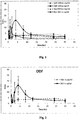
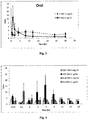
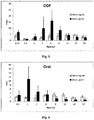
- Figures 1-6 are graphical representations of the mean plasma level data contained in tables 3-6.
- Figures 1 and 4 illustrates the high plasma level of DES obtained from the ODF dosage form compared to the oral suspension of the same amount, 1 mg, of DES.
- Tables 5 and 7 contain the numerical data.
- Figures 1 and 4 also illustrate that the amount of fibrinogen produced by the ODF dosage form and the oral suspension is about the same. These data illustrate that the ODF dosage form produces much higher plasma levels without the risk of increased side effects from the production of fibrinogen.
- Figures 2 and 3 illustrate the relative relationship of DES plasma levels versus fibrinogen plasma levels for the ODF and oral suspension dosage form respectively.
- Figures 5 and 6 illustrate in bar graph format the data contained in tables. These figures 5 and 6 along with figure 5 plot the mean for each time period as well as indicating the range of results for the animals at each time period.
- the bar on the left for each time period represents fibrinogen content and the bar on the right for each time period represents DES content.
- the bar on the left for each time period represents fibrinogen content for the ODF dosage form and the second bar from the left represents DES content from the ODF dosage form.
- the third bar from the left for each time period represents fibrinogen content for the oral suspension dosage form and the fourth bar from the left represents the DES content for the oral suspension dosage form.
- the unit dosage form may contain from 0.01 to 99% (w/w) of the active ingredient.
- the unit dosage for may contain from 0.01 to 50% (w/w) of the active ingredient.
- a solid oral composition such as a tablet or capsule may contain from 1 to 99 % (w/w) oral dosage matrix comprising the active ingredient and wherein the absorption enhancer comprises 0.1 to 20% of the total weight of the dosage form; from 0 to 99% (w/w) diluent or filler; from 0 to 20% (w/w) of a disintegrant; from 0 to 5% (w/w) of a lubricant; from 0 to 5% (w/w) of a flow aid; from 0 to 50% (w/w) of a granulating agent or binder; from 0 to 5% (w/w) of an antioxidant; and from 0 to 5% (w/w) of a pigment.
- a controlled release tablet may in addition contain from 0 to 90 % (w/w) of a release-controlling polymer.
- a liquid oral dosage formulation may contain from 1 to 50 % (w/w) oral dosage matrix comprising the active ingredient and wherein the absorption enhancer comprises 0.1 to 20% of the total weight of the dosage form; and from 50% (w/w) to 99% (w/w) of a liquid carrier or vehicle (e.g. a solvent such as water); and 0-20% (w/w) of one or more other excipients such as buffering agents, antioxidants, suspension stabilisers, tonicity adjusting agents and preservatives.
- a liquid carrier or vehicle e.g. a solvent such as water
Landscapes
- Health & Medical Sciences (AREA)
- Veterinary Medicine (AREA)
- Chemical & Material Sciences (AREA)
- Medicinal Chemistry (AREA)
- Pharmacology & Pharmacy (AREA)
- Life Sciences & Earth Sciences (AREA)
- Animal Behavior & Ethology (AREA)
- General Health & Medical Sciences (AREA)
- Public Health (AREA)
- Epidemiology (AREA)
- Physiology (AREA)
- Nutrition Science (AREA)
- Nuclear Medicine, Radiotherapy & Molecular Imaging (AREA)
- Organic Chemistry (AREA)
- General Chemical & Material Sciences (AREA)
- Chemical Kinetics & Catalysis (AREA)
- Engineering & Computer Science (AREA)
- Bioinformatics & Cheminformatics (AREA)
- Endocrinology (AREA)
- Reproductive Health (AREA)
- Medicinal Preparation (AREA)
- Pharmaceuticals Containing Other Organic And Inorganic Compounds (AREA)
- Acyclic And Carbocyclic Compounds In Medicinal Compositions (AREA)
Applications Claiming Priority (2)
| Application Number | Priority Date | Filing Date | Title |
|---|---|---|---|
| US13/040,143 US8900634B2 (en) | 2008-11-03 | 2011-03-03 | Diethylstilbestrol dosage form and methods of treatment using thereof |
| PCT/GB2012/050475 WO2012117257A1 (en) | 2011-03-03 | 2012-03-02 | Diethylstilbestrol dosage form and use for the treatment of prostate or breast cancer |
Publications (2)
| Publication Number | Publication Date |
|---|---|
| EP2680813A1 EP2680813A1 (en) | 2014-01-08 |
| EP2680813B1 true EP2680813B1 (en) | 2019-05-08 |
Family
ID=45841525
Family Applications (1)
| Application Number | Title | Priority Date | Filing Date |
|---|---|---|---|
| EP12709150.2A Active EP2680813B1 (en) | 2011-03-03 | 2012-03-02 | Diethylstilbestrol dosage form and use for the treatment of prostate or breast cancer |
Country Status (13)
| Country | Link |
|---|---|
| US (1) | US8900634B2 (enExample) |
| EP (1) | EP2680813B1 (enExample) |
| JP (2) | JP6059153B2 (enExample) |
| KR (1) | KR101865776B1 (enExample) |
| CN (1) | CN103561720A (enExample) |
| AU (2) | AU2012223023B2 (enExample) |
| BR (1) | BR112013022438A2 (enExample) |
| CA (1) | CA2827892C (enExample) |
| ES (1) | ES2733282T3 (enExample) |
| RU (1) | RU2602296C2 (enExample) |
| SG (1) | SG192845A1 (enExample) |
| TW (1) | TWI548426B (enExample) |
| WO (1) | WO2012117257A1 (enExample) |
Families Citing this family (14)
| Publication number | Priority date | Publication date | Assignee | Title |
|---|---|---|---|---|
| US8900634B2 (en) * | 2008-11-03 | 2014-12-02 | Nal Pharmaceuticals, Ltd. | Diethylstilbestrol dosage form and methods of treatment using thereof |
| US8715715B2 (en) * | 2008-11-03 | 2014-05-06 | Nal Pharmaceuticals Ltd. | Dosage form for insertion into the mouth |
| EP2906224A1 (en) | 2012-10-15 | 2015-08-19 | CHAMAELEO Pharma Bvba | Fosfestrol for use in curative or palliative treatment of prostate cancer |
| CN105899214A (zh) * | 2012-10-15 | 2016-08-24 | 变色蜥制药公司 | 用于根治性治疗或姑息性治疗雌性哺乳动物的癌症的磷雌酚 |
| JP2016511218A (ja) * | 2012-10-15 | 2016-04-14 | チャマエレオ ファーマ ビーブイビーエー | がんを処置するためのサルフェストロール |
| CA2953546A1 (en) | 2014-06-24 | 2015-12-30 | Taho Pharmaceuticals | Fast acting orally disintegrating film |
| CN105997857A (zh) * | 2016-06-29 | 2016-10-12 | 冯志清 | 一种用于治疗猪乳房炎的注射液 |
| US11007144B2 (en) | 2016-11-15 | 2021-05-18 | Klaria Pharma Holding Ab | Pharmaceutical formulation |
| GB201709141D0 (en) | 2017-06-08 | 2017-07-26 | Klaria Pharma Holding Ab | Pharmaceutical formulation |
| KR101940401B1 (ko) * | 2017-06-12 | 2019-01-21 | 경상대학교산학협력단 | 맛이 차폐된 구강붕해필름 및 이의 제조방법 |
| WO2019028457A2 (en) * | 2017-08-04 | 2019-02-07 | University Of Houston System | FORMULATION OF NANOSUSPENSION OF DIETHYLSTILBESTROL INJECTABLE |
| GB201808462D0 (en) | 2018-05-23 | 2018-07-11 | Klaria Pharma Holding Ab | Pharmaceutical formulation |
| WO2020030991A1 (en) * | 2018-08-09 | 2020-02-13 | Nal Pharmaceutical Group Limited | Dosage form for insertion into the mouth |
| CN113133983B (zh) * | 2020-01-20 | 2023-12-12 | 鲁南制药集团股份有限公司 | 一种治疗前列腺癌的药物组合物 |
Family Cites Families (13)
| Publication number | Priority date | Publication date | Assignee | Title |
|---|---|---|---|---|
| US5026560A (en) | 1987-01-29 | 1991-06-25 | Takeda Chemical Industries, Ltd. | Spherical granules having core and their production |
| US5464632C1 (en) | 1991-07-22 | 2001-02-20 | Prographarm Lab | Rapidly disintegratable multiparticular tablet |
| PT1121103E (pt) | 1998-05-18 | 2007-02-28 | Takeda Pharmaceutical | Comprimidos de desintegração oral compreendendo um benzimidazole |
| US20030180352A1 (en) * | 1999-11-23 | 2003-09-25 | Patel Mahesh V. | Solid carriers for improved delivery of active ingredients in pharmaceutical compositions |
| US20020015730A1 (en) * | 2000-03-09 | 2002-02-07 | Torsten Hoffmann | Pharmaceutical formulations and method for making |
| US20030147936A1 (en) | 2002-02-07 | 2003-08-07 | Velayudhan Sahadevan | Prostatic hormonal implants treatment of prostate cancer |
| TW200539903A (en) * | 2004-03-12 | 2005-12-16 | Smithkline Beecham Plc | Pharmaceutical formulations |
| IL175338A0 (en) * | 2006-05-01 | 2006-09-05 | Biota Ltd | Orally administrable films and preparation thereof |
| WO2008045461A2 (en) | 2006-10-11 | 2008-04-17 | Oregon Health & Science University | Transdermal diethylstilbestrol for treating prostate cancer |
| EP2144601A4 (en) * | 2007-04-05 | 2012-10-10 | Univ Kansas | RAPID DISSOLVING PHARMACEUTICAL COMPOSITIONS COMPRISING PULLULANE |
| WO2009029543A1 (en) | 2007-08-24 | 2009-03-05 | Aegis Therapeutics, Llc | Controlled release formulations |
| US8900634B2 (en) * | 2008-11-03 | 2014-12-02 | Nal Pharmaceuticals, Ltd. | Diethylstilbestrol dosage form and methods of treatment using thereof |
| US8715715B2 (en) * | 2008-11-03 | 2014-05-06 | Nal Pharmaceuticals Ltd. | Dosage form for insertion into the mouth |
-
2011
- 2011-03-03 US US13/040,143 patent/US8900634B2/en not_active Expired - Fee Related
-
2012
- 2012-03-02 AU AU2012223023A patent/AU2012223023B2/en not_active Ceased
- 2012-03-02 BR BR112013022438A patent/BR112013022438A2/pt not_active IP Right Cessation
- 2012-03-02 RU RU2013144383/15A patent/RU2602296C2/ru active
- 2012-03-02 TW TW101106943A patent/TWI548426B/zh not_active IP Right Cessation
- 2012-03-02 WO PCT/GB2012/050475 patent/WO2012117257A1/en not_active Ceased
- 2012-03-02 KR KR1020137025787A patent/KR101865776B1/ko not_active Expired - Fee Related
- 2012-03-02 CA CA2827892A patent/CA2827892C/en not_active Expired - Fee Related
- 2012-03-02 EP EP12709150.2A patent/EP2680813B1/en active Active
- 2012-03-02 JP JP2013555938A patent/JP6059153B2/ja not_active Expired - Fee Related
- 2012-03-02 SG SG2013062864A patent/SG192845A1/en unknown
- 2012-03-02 CN CN201280011570.XA patent/CN103561720A/zh active Pending
- 2012-03-02 ES ES12709150T patent/ES2733282T3/es active Active
-
2016
- 2016-10-07 JP JP2016199070A patent/JP2017061465A/ja not_active Withdrawn
-
2017
- 2017-05-05 AU AU2017203009A patent/AU2017203009B2/en not_active Ceased
Non-Patent Citations (1)
| Title |
|---|
| None * |
Also Published As
| Publication number | Publication date |
|---|---|
| TWI548426B (zh) | 2016-09-11 |
| JP2014506914A (ja) | 2014-03-20 |
| AU2017203009B2 (en) | 2018-07-19 |
| EP2680813A1 (en) | 2014-01-08 |
| AU2012223023A1 (en) | 2013-09-19 |
| WO2012117257A8 (en) | 2013-09-19 |
| CN103561720A (zh) | 2014-02-05 |
| KR101865776B1 (ko) | 2018-06-08 |
| US20110189288A1 (en) | 2011-08-04 |
| AU2017203009A1 (en) | 2017-05-25 |
| BR112013022438A2 (pt) | 2016-12-06 |
| ES2733282T3 (es) | 2019-11-28 |
| TW201249484A (en) | 2012-12-16 |
| SG192845A1 (en) | 2013-09-30 |
| US8900634B2 (en) | 2014-12-02 |
| WO2012117257A1 (en) | 2012-09-07 |
| JP2017061465A (ja) | 2017-03-30 |
| CA2827892A1 (en) | 2012-09-07 |
| CA2827892C (en) | 2019-12-03 |
| JP6059153B2 (ja) | 2017-01-11 |
| AU2012223023B2 (en) | 2017-03-16 |
| RU2013144383A (ru) | 2015-04-10 |
| RU2602296C2 (ru) | 2016-11-20 |
| KR20140021587A (ko) | 2014-02-20 |
Similar Documents
| Publication | Publication Date | Title |
|---|---|---|
| AU2017203009B2 (en) | Diethylstilbestrol dosage form and use for the treatment of prostate or breast cancer | |
| US12611377B2 (en) | Pharmaceutical composition comprising an androgen receptor inhibitor | |
| EP2364144B1 (en) | Dosage form for insertion into the mouth | |
| CN101257889A (zh) | 托吡酯的儿科制剂 | |
| EP2838510B1 (en) | Atomoxetine solution | |
| CN102014904A (zh) | 具有适口味道的去铁酮液体配制品 | |
| EP3975992B1 (en) | Green tea catechins eutectic system | |
| AU2013346766B2 (en) | Effervescent tablet | |
| EP1747781A1 (en) | Stable oral pharmaceutical preparation comprising fosfomycin, which is intended for diabetic patients | |
| HK1192153A (en) | Diethylstilbestrol dosage form and use for the treatment of prostate or breast cancer | |
| CN118252797A (zh) | 一种布地奈德黏性口服溶液、制备方法及其应用 | |
| BG111495A (bg) | Прахообразенфармацевтиченсъставсъдържащметамизол |
Legal Events
| Date | Code | Title | Description |
|---|---|---|---|
| PUAI | Public reference made under article 153(3) epc to a published international application that has entered the european phase |
Free format text: ORIGINAL CODE: 0009012 |
|
| 17P | Request for examination filed |
Effective date: 20130812 |
|
| AK | Designated contracting states |
Kind code of ref document: A1 Designated state(s): AL AT BE BG CH CY CZ DE DK EE ES FI FR GB GR HR HU IE IS IT LI LT LU LV MC MK MT NL NO PL PT RO RS SE SI SK SM TR |
|
| DAX | Request for extension of the european patent (deleted) | ||
| 17Q | First examination report despatched |
Effective date: 20151029 |
|
| RAP1 | Party data changed (applicant data changed or rights of an application transferred) |
Owner name: NAL PHARMACEUTICAL GROUP LIMITED |
|
| STAA | Information on the status of an ep patent application or granted ep patent |
Free format text: STATUS: EXAMINATION IS IN PROGRESS |
|
| GRAP | Despatch of communication of intention to grant a patent |
Free format text: ORIGINAL CODE: EPIDOSNIGR1 |
|
| STAA | Information on the status of an ep patent application or granted ep patent |
Free format text: STATUS: GRANT OF PATENT IS INTENDED |
|
| INTG | Intention to grant announced |
Effective date: 20181019 |
|
| GRAS | Grant fee paid |
Free format text: ORIGINAL CODE: EPIDOSNIGR3 |
|
| GRAA | (expected) grant |
Free format text: ORIGINAL CODE: 0009210 |
|
| STAA | Information on the status of an ep patent application or granted ep patent |
Free format text: STATUS: THE PATENT HAS BEEN GRANTED |
|
| AK | Designated contracting states |
Kind code of ref document: B1 Designated state(s): AL AT BE BG CH CY CZ DE DK EE ES FI FR GB GR HR HU IE IS IT LI LT LU LV MC MK MT NL NO PL PT RO RS SE SI SK SM TR |
|
| REG | Reference to a national code |
Ref country code: GB Ref legal event code: FG4D |
|
| REG | Reference to a national code |
Ref country code: CH Ref legal event code: EP Ref country code: AT Ref legal event code: REF Ref document number: 1129058 Country of ref document: AT Kind code of ref document: T Effective date: 20190515 |
|
| REG | Reference to a national code |
Ref country code: DE Ref legal event code: R096 Ref document number: 602012059830 Country of ref document: DE Ref country code: IE Ref legal event code: FG4D |
|
| REG | Reference to a national code |
Ref country code: NL Ref legal event code: MP Effective date: 20190508 |
|
| REG | Reference to a national code |
Ref country code: LT Ref legal event code: MG4D |
|
| PG25 | Lapsed in a contracting state [announced via postgrant information from national office to epo] |
Ref country code: SE Free format text: LAPSE BECAUSE OF FAILURE TO SUBMIT A TRANSLATION OF THE DESCRIPTION OR TO PAY THE FEE WITHIN THE PRESCRIBED TIME-LIMIT Effective date: 20190508 Ref country code: PT Free format text: LAPSE BECAUSE OF FAILURE TO SUBMIT A TRANSLATION OF THE DESCRIPTION OR TO PAY THE FEE WITHIN THE PRESCRIBED TIME-LIMIT Effective date: 20190908 Ref country code: HR Free format text: LAPSE BECAUSE OF FAILURE TO SUBMIT A TRANSLATION OF THE DESCRIPTION OR TO PAY THE FEE WITHIN THE PRESCRIBED TIME-LIMIT Effective date: 20190508 Ref country code: AL Free format text: LAPSE BECAUSE OF FAILURE TO SUBMIT A TRANSLATION OF THE DESCRIPTION OR TO PAY THE FEE WITHIN THE PRESCRIBED TIME-LIMIT Effective date: 20190508 Ref country code: FI Free format text: LAPSE BECAUSE OF FAILURE TO SUBMIT A TRANSLATION OF THE DESCRIPTION OR TO PAY THE FEE WITHIN THE PRESCRIBED TIME-LIMIT Effective date: 20190508 Ref country code: NO Free format text: LAPSE BECAUSE OF FAILURE TO SUBMIT A TRANSLATION OF THE DESCRIPTION OR TO PAY THE FEE WITHIN THE PRESCRIBED TIME-LIMIT Effective date: 20190808 Ref country code: NL Free format text: LAPSE BECAUSE OF FAILURE TO SUBMIT A TRANSLATION OF THE DESCRIPTION OR TO PAY THE FEE WITHIN THE PRESCRIBED TIME-LIMIT Effective date: 20190508 Ref country code: LT Free format text: LAPSE BECAUSE OF FAILURE TO SUBMIT A TRANSLATION OF THE DESCRIPTION OR TO PAY THE FEE WITHIN THE PRESCRIBED TIME-LIMIT Effective date: 20190508 |
|
| REG | Reference to a national code |
Ref country code: ES Ref legal event code: FG2A Ref document number: 2733282 Country of ref document: ES Kind code of ref document: T3 Effective date: 20191128 |
|
| PG25 | Lapsed in a contracting state [announced via postgrant information from national office to epo] |
Ref country code: RS Free format text: LAPSE BECAUSE OF FAILURE TO SUBMIT A TRANSLATION OF THE DESCRIPTION OR TO PAY THE FEE WITHIN THE PRESCRIBED TIME-LIMIT Effective date: 20190508 Ref country code: BG Free format text: LAPSE BECAUSE OF FAILURE TO SUBMIT A TRANSLATION OF THE DESCRIPTION OR TO PAY THE FEE WITHIN THE PRESCRIBED TIME-LIMIT Effective date: 20190808 Ref country code: LV Free format text: LAPSE BECAUSE OF FAILURE TO SUBMIT A TRANSLATION OF THE DESCRIPTION OR TO PAY THE FEE WITHIN THE PRESCRIBED TIME-LIMIT Effective date: 20190508 Ref country code: GR Free format text: LAPSE BECAUSE OF FAILURE TO SUBMIT A TRANSLATION OF THE DESCRIPTION OR TO PAY THE FEE WITHIN THE PRESCRIBED TIME-LIMIT Effective date: 20190809 |
|
| REG | Reference to a national code |
Ref country code: AT Ref legal event code: MK05 Ref document number: 1129058 Country of ref document: AT Kind code of ref document: T Effective date: 20190508 |
|
| PG25 | Lapsed in a contracting state [announced via postgrant information from national office to epo] |
Ref country code: AT Free format text: LAPSE BECAUSE OF FAILURE TO SUBMIT A TRANSLATION OF THE DESCRIPTION OR TO PAY THE FEE WITHIN THE PRESCRIBED TIME-LIMIT Effective date: 20190508 Ref country code: DK Free format text: LAPSE BECAUSE OF FAILURE TO SUBMIT A TRANSLATION OF THE DESCRIPTION OR TO PAY THE FEE WITHIN THE PRESCRIBED TIME-LIMIT Effective date: 20190508 Ref country code: EE Free format text: LAPSE BECAUSE OF FAILURE TO SUBMIT A TRANSLATION OF THE DESCRIPTION OR TO PAY THE FEE WITHIN THE PRESCRIBED TIME-LIMIT Effective date: 20190508 Ref country code: SK Free format text: LAPSE BECAUSE OF FAILURE TO SUBMIT A TRANSLATION OF THE DESCRIPTION OR TO PAY THE FEE WITHIN THE PRESCRIBED TIME-LIMIT Effective date: 20190508 Ref country code: RO Free format text: LAPSE BECAUSE OF FAILURE TO SUBMIT A TRANSLATION OF THE DESCRIPTION OR TO PAY THE FEE WITHIN THE PRESCRIBED TIME-LIMIT Effective date: 20190508 Ref country code: CZ Free format text: LAPSE BECAUSE OF FAILURE TO SUBMIT A TRANSLATION OF THE DESCRIPTION OR TO PAY THE FEE WITHIN THE PRESCRIBED TIME-LIMIT Effective date: 20190508 |
|
| REG | Reference to a national code |
Ref country code: DE Ref legal event code: R097 Ref document number: 602012059830 Country of ref document: DE |
|
| PG25 | Lapsed in a contracting state [announced via postgrant information from national office to epo] |
Ref country code: SM Free format text: LAPSE BECAUSE OF FAILURE TO SUBMIT A TRANSLATION OF THE DESCRIPTION OR TO PAY THE FEE WITHIN THE PRESCRIBED TIME-LIMIT Effective date: 20190508 |
|
| PLBE | No opposition filed within time limit |
Free format text: ORIGINAL CODE: 0009261 |
|
| STAA | Information on the status of an ep patent application or granted ep patent |
Free format text: STATUS: NO OPPOSITION FILED WITHIN TIME LIMIT |
|
| PG25 | Lapsed in a contracting state [announced via postgrant information from national office to epo] |
Ref country code: TR Free format text: LAPSE BECAUSE OF FAILURE TO SUBMIT A TRANSLATION OF THE DESCRIPTION OR TO PAY THE FEE WITHIN THE PRESCRIBED TIME-LIMIT Effective date: 20190508 |
|
| 26N | No opposition filed |
Effective date: 20200211 |
|
| PG25 | Lapsed in a contracting state [announced via postgrant information from national office to epo] |
Ref country code: PL Free format text: LAPSE BECAUSE OF FAILURE TO SUBMIT A TRANSLATION OF THE DESCRIPTION OR TO PAY THE FEE WITHIN THE PRESCRIBED TIME-LIMIT Effective date: 20190508 |
|
| PGFP | Annual fee paid to national office [announced via postgrant information from national office to epo] |
Ref country code: GB Payment date: 20200327 Year of fee payment: 9 Ref country code: DE Payment date: 20200327 Year of fee payment: 9 Ref country code: IT Payment date: 20200323 Year of fee payment: 9 |
|
| PG25 | Lapsed in a contracting state [announced via postgrant information from national office to epo] |
Ref country code: SI Free format text: LAPSE BECAUSE OF FAILURE TO SUBMIT A TRANSLATION OF THE DESCRIPTION OR TO PAY THE FEE WITHIN THE PRESCRIBED TIME-LIMIT Effective date: 20190508 |
|
| PGFP | Annual fee paid to national office [announced via postgrant information from national office to epo] |
Ref country code: FR Payment date: 20200325 Year of fee payment: 9 |
|
| PGFP | Annual fee paid to national office [announced via postgrant information from national office to epo] |
Ref country code: ES Payment date: 20200401 Year of fee payment: 9 |
|
| PG25 | Lapsed in a contracting state [announced via postgrant information from national office to epo] |
Ref country code: MC Free format text: LAPSE BECAUSE OF FAILURE TO SUBMIT A TRANSLATION OF THE DESCRIPTION OR TO PAY THE FEE WITHIN THE PRESCRIBED TIME-LIMIT Effective date: 20190508 |
|
| REG | Reference to a national code |
Ref country code: CH Ref legal event code: PL |
|
| REG | Reference to a national code |
Ref country code: BE Ref legal event code: MM Effective date: 20200331 |
|
| PG25 | Lapsed in a contracting state [announced via postgrant information from national office to epo] |
Ref country code: LU Free format text: LAPSE BECAUSE OF NON-PAYMENT OF DUE FEES Effective date: 20200302 |
|
| PG25 | Lapsed in a contracting state [announced via postgrant information from national office to epo] |
Ref country code: LI Free format text: LAPSE BECAUSE OF NON-PAYMENT OF DUE FEES Effective date: 20200331 Ref country code: CH Free format text: LAPSE BECAUSE OF NON-PAYMENT OF DUE FEES Effective date: 20200331 Ref country code: IE Free format text: LAPSE BECAUSE OF NON-PAYMENT OF DUE FEES Effective date: 20200302 |
|
| PG25 | Lapsed in a contracting state [announced via postgrant information from national office to epo] |
Ref country code: BE Free format text: LAPSE BECAUSE OF NON-PAYMENT OF DUE FEES Effective date: 20200331 |
|
| REG | Reference to a national code |
Ref country code: DE Ref legal event code: R119 Ref document number: 602012059830 Country of ref document: DE |
|
| GBPC | Gb: european patent ceased through non-payment of renewal fee |
Effective date: 20210302 |
|
| PG25 | Lapsed in a contracting state [announced via postgrant information from national office to epo] |
Ref country code: GB Free format text: LAPSE BECAUSE OF NON-PAYMENT OF DUE FEES Effective date: 20210302 Ref country code: FR Free format text: LAPSE BECAUSE OF NON-PAYMENT OF DUE FEES Effective date: 20210331 Ref country code: DE Free format text: LAPSE BECAUSE OF NON-PAYMENT OF DUE FEES Effective date: 20211001 |
|
| PG25 | Lapsed in a contracting state [announced via postgrant information from national office to epo] |
Ref country code: IT Free format text: LAPSE BECAUSE OF NON-PAYMENT OF DUE FEES Effective date: 20210302 |
|
| REG | Reference to a national code |
Ref country code: ES Ref legal event code: FD2A Effective date: 20220517 |
|
| PG25 | Lapsed in a contracting state [announced via postgrant information from national office to epo] |
Ref country code: MT Free format text: LAPSE BECAUSE OF FAILURE TO SUBMIT A TRANSLATION OF THE DESCRIPTION OR TO PAY THE FEE WITHIN THE PRESCRIBED TIME-LIMIT Effective date: 20190508 Ref country code: CY Free format text: LAPSE BECAUSE OF FAILURE TO SUBMIT A TRANSLATION OF THE DESCRIPTION OR TO PAY THE FEE WITHIN THE PRESCRIBED TIME-LIMIT Effective date: 20190508 |
|
| PG25 | Lapsed in a contracting state [announced via postgrant information from national office to epo] |
Ref country code: MK Free format text: LAPSE BECAUSE OF FAILURE TO SUBMIT A TRANSLATION OF THE DESCRIPTION OR TO PAY THE FEE WITHIN THE PRESCRIBED TIME-LIMIT Effective date: 20190508 Ref country code: IS Free format text: LAPSE BECAUSE OF FAILURE TO SUBMIT A TRANSLATION OF THE DESCRIPTION OR TO PAY THE FEE WITHIN THE PRESCRIBED TIME-LIMIT Effective date: 20190908 |
|
| PG25 | Lapsed in a contracting state [announced via postgrant information from national office to epo] |
Ref country code: ES Free format text: LAPSE BECAUSE OF NON-PAYMENT OF DUE FEES Effective date: 20210303 |