EP2680629B1 - Resource allocation in a communication system - Google Patents
Resource allocation in a communication system Download PDFInfo
- Publication number
- EP2680629B1 EP2680629B1 EP13185604.9A EP13185604A EP2680629B1 EP 2680629 B1 EP2680629 B1 EP 2680629B1 EP 13185604 A EP13185604 A EP 13185604A EP 2680629 B1 EP2680629 B1 EP 2680629B1
- Authority
- EP
- European Patent Office
- Prior art keywords
- mobile device
- base station
- power control
- power
- control parameter
- Prior art date
- Legal status (The legal status is an assumption and is not a legal conclusion. Google has not performed a legal analysis and makes no representation as to the accuracy of the status listed.)
- Active
Links
- 238000013468 resource allocation Methods 0.000 title description 32
- 238000004891 communication Methods 0.000 title description 26
- 238000000034 method Methods 0.000 claims description 42
- 230000004044 response Effects 0.000 claims description 13
- 230000005540 biological transmission Effects 0.000 description 32
- 230000008569 process Effects 0.000 description 30
- 230000002085 persistent effect Effects 0.000 description 23
- 238000012937 correction Methods 0.000 description 15
- 238000010586 diagram Methods 0.000 description 6
- 230000007774 longterm Effects 0.000 description 5
- 238000005259 measurement Methods 0.000 description 4
- 238000012546 transfer Methods 0.000 description 4
- 238000004364 calculation method Methods 0.000 description 3
- 230000001360 synchronised effect Effects 0.000 description 3
- 230000008901 benefit Effects 0.000 description 2
- 230000008859 change Effects 0.000 description 2
- 238000005562 fading Methods 0.000 description 2
- 238000012986 modification Methods 0.000 description 2
- 230000004048 modification Effects 0.000 description 2
- 238000001228 spectrum Methods 0.000 description 2
- 238000012935 Averaging Methods 0.000 description 1
- 230000001413 cellular effect Effects 0.000 description 1
- 230000001419 dependent effect Effects 0.000 description 1
- 238000005516 engineering process Methods 0.000 description 1
- 239000000835 fiber Substances 0.000 description 1
- 230000000737 periodic effect Effects 0.000 description 1
- 238000012913 prioritisation Methods 0.000 description 1
- 230000009467 reduction Effects 0.000 description 1
- 230000002123 temporal effect Effects 0.000 description 1
Images

Classifications
-
- H—ELECTRICITY
- H04—ELECTRIC COMMUNICATION TECHNIQUE
- H04W—WIRELESS COMMUNICATION NETWORKS
- H04W52/00—Power management, e.g. Transmission Power Control [TPC] or power classes
- H04W52/04—Transmission power control [TPC]
- H04W52/18—TPC being performed according to specific parameters
-
- H—ELECTRICITY
- H04—ELECTRIC COMMUNICATION TECHNIQUE
- H04W—WIRELESS COMMUNICATION NETWORKS
- H04W52/00—Power management, e.g. Transmission Power Control [TPC] or power classes
- H04W52/04—Transmission power control [TPC]
- H04W52/18—TPC being performed according to specific parameters
- H04W52/24—TPC being performed according to specific parameters using SIR [Signal to Interference Ratio] or other wireless path parameters
- H04W52/241—TPC being performed according to specific parameters using SIR [Signal to Interference Ratio] or other wireless path parameters taking into account channel quality metrics, e.g. SIR, SNR, CIR or Eb/lo
-
- H—ELECTRICITY
- H04—ELECTRIC COMMUNICATION TECHNIQUE
- H04W—WIRELESS COMMUNICATION NETWORKS
- H04W52/00—Power management, e.g. Transmission Power Control [TPC] or power classes
- H04W52/04—Transmission power control [TPC]
- H04W52/18—TPC being performed according to specific parameters
- H04W52/24—TPC being performed according to specific parameters using SIR [Signal to Interference Ratio] or other wireless path parameters
- H04W52/242—TPC being performed according to specific parameters using SIR [Signal to Interference Ratio] or other wireless path parameters taking into account path loss
-
- H—ELECTRICITY
- H04—ELECTRIC COMMUNICATION TECHNIQUE
- H04W—WIRELESS COMMUNICATION NETWORKS
- H04W52/00—Power management, e.g. Transmission Power Control [TPC] or power classes
- H04W52/04—Transmission power control [TPC]
- H04W52/18—TPC being performed according to specific parameters
- H04W52/26—TPC being performed according to specific parameters using transmission rate or quality of service QoS [Quality of Service]
- H04W52/262—TPC being performed according to specific parameters using transmission rate or quality of service QoS [Quality of Service] taking into account adaptive modulation and coding [AMC] scheme
-
- H—ELECTRICITY
- H04—ELECTRIC COMMUNICATION TECHNIQUE
- H04W—WIRELESS COMMUNICATION NETWORKS
- H04W52/00—Power management, e.g. Transmission Power Control [TPC] or power classes
- H04W52/04—Transmission power control [TPC]
- H04W52/30—Transmission power control [TPC] using constraints in the total amount of available transmission power
- H04W52/36—Transmission power control [TPC] using constraints in the total amount of available transmission power with a discrete range or set of values, e.g. step size, ramping or offsets
- H04W52/365—Power headroom reporting
-
- H—ELECTRICITY
- H04—ELECTRIC COMMUNICATION TECHNIQUE
- H04W—WIRELESS COMMUNICATION NETWORKS
- H04W52/00—Power management, e.g. Transmission Power Control [TPC] or power classes
- H04W52/04—Transmission power control [TPC]
- H04W52/54—Signalisation aspects of the TPC commands, e.g. frame structure
-
- H—ELECTRICITY
- H04—ELECTRIC COMMUNICATION TECHNIQUE
- H04W—WIRELESS COMMUNICATION NETWORKS
- H04W72/00—Local resource management
- H04W72/04—Wireless resource allocation
- H04W72/044—Wireless resource allocation based on the type of the allocated resource
- H04W72/0473—Wireless resource allocation based on the type of the allocated resource the resource being transmission power
-
- H—ELECTRICITY
- H04—ELECTRIC COMMUNICATION TECHNIQUE
- H04W—WIRELESS COMMUNICATION NETWORKS
- H04W72/00—Local resource management
- H04W72/20—Control channels or signalling for resource management
- H04W72/23—Control channels or signalling for resource management in the downlink direction of a wireless link, i.e. towards a terminal
-
- H—ELECTRICITY
- H04—ELECTRIC COMMUNICATION TECHNIQUE
- H04W—WIRELESS COMMUNICATION NETWORKS
- H04W74/00—Wireless channel access
- H04W74/08—Non-scheduled access, e.g. ALOHA
- H04W74/0833—Random access procedures, e.g. with 4-step access
-
- H—ELECTRICITY
- H04—ELECTRIC COMMUNICATION TECHNIQUE
- H04W—WIRELESS COMMUNICATION NETWORKS
- H04W52/00—Power management, e.g. Transmission Power Control [TPC] or power classes
- H04W52/04—Transmission power control [TPC]
- H04W52/06—TPC algorithms
- H04W52/14—Separate analysis of uplink or downlink
- H04W52/146—Uplink power control
-
- H—ELECTRICITY
- H04—ELECTRIC COMMUNICATION TECHNIQUE
- H04W—WIRELESS COMMUNICATION NETWORKS
- H04W52/00—Power management, e.g. Transmission Power Control [TPC] or power classes
- H04W52/04—Transmission power control [TPC]
- H04W52/18—TPC being performed according to specific parameters
- H04W52/24—TPC being performed according to specific parameters using SIR [Signal to Interference Ratio] or other wireless path parameters
- H04W52/247—TPC being performed according to specific parameters using SIR [Signal to Interference Ratio] or other wireless path parameters where the output power of a terminal is based on a path parameter sent by another terminal
Definitions
- This disclosure relates generally to communication systems and equipment, and more specifically to techniques and apparatus for allocating communication system resources to mobile devices in the communication system.
- Many wireless communication systems use base stations to communicate with one or more mobile devices (i.e., user equipment or "UE") within a cell served by the base station.
- Data sent from the base station to the user equipment is transmitted through a wireless channel referred to as a downlink channel, and data transmitted from the user equipment to the base station is transmitted through a wireless channel referred to as an uplink channel.
- the wireless communication system has limited resources that can be allocated to the mobile devices and normally attempts to do the allocation in order to maximize the use of the bandwidth available in the uplink and downlink channels.
- a frequency, or set of frequencies is a resource that can be allocated to the mobile device to use for wireless transmission or reception.
- a time for transmission, or a transmission "time slot,” is also a resource that can be allocated to the mobile device to use for wireless transmission or reception.
- transmit power is a resource that can be allocated to the mobile device to use for wireless transmission.
- the proper allocation of transmit power is needed so that the base station receives relatively even power levels across the spectrum used by the mobile devices. Proper transmit power allocation also helps to avoid interference with transmissions from other mobile devices, whether those other mobile devices are in the same cell or an adjacent cell.
- Power received at the base station can be affected by the distance between the mobile device and the base station, and other types of pathloss between the mobile and base.
- Distance-dependent path loss reduces the power of the receive signal because of the distance the signal travels.
- power can be reduced through shadowing, which occurs when an object comes between the mobile device and base station. For example, if a person with a mobile device walks down a street and a building comes between the mobile device and that base station, pathloss increases due to shadowing.
- US 2003/064744 A1 discloses a power control scheme for a wireless network communication system including a base station and multiple wireless mobiles devices.
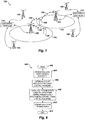
- FIG. 1 is a high-level diagram of portions of a communication system 100 in accordance with one or more embodiments.
- Communication system 100 can be a wireless communication system or other similar communication system that uses power control techniques and algorithms to control a transmit power of one or more devices transmitting data.
- FIG. 1 includes base stations 102 and 104 and mobile devices 106 and 108, which mobile devices can also be referred to as mobile stations, subscriber units, mobile terminals, or user equipment (UE).
- Base station 102 generally communicates wirelessly with mobile devices in cell 110, while base station 104 generally communicates wirelessly with mobile devices in cell 112.
- Base station controller 114 (which in some embodiments can be referred to as an eNode-B or an evolved node-B) is coupled to base station 102, and perhaps other base stations 116, in order to control the operation of base station 102 and other base stations. In various embodiments, base station controller 114 can perform packet scheduling functions, connection mobility control, load balancing, inter Radio-Access-Technology handover, and the like. Similarly, base station controller 118 is coupled to base station 104, and perhaps other base stations 120, for the purpose of controlling base station 104. The base station controllers can be coupled to base stations via a communication link that can be wireless, wireline, fiber optic, or the like. In some embodiments, the base station controller can be co-located with a base station.
- communications system 100 can be implemented according to the specification for the long-term evolution (LTE) project within the Third Generation Partnership Project (3GPP) wireless system, which is essentially a wireless packet data system that can transmit voice (e.g., VoIP) and other data.
- LTE long-term evolution
- 3GPP Third Generation Partnership Project
- Mobile device 106 can communicate with base station 102 via wireless communication link 122.
- Mobile device 108 can communicate with base station 104 via wireless communication link 124.
- interference 126 from mobile device 108 can interfere with transmissions from mobile device 106 in wireless communications link 122, particularly when mobile device 106 and mobile device 108 have been assigned the same transmission frequency.
- the base station (e.g., base stations 102 and 104) can simultaneously receive uplink transmissions from a plurality of mobile devices, such as mobile device 106 and others not shown.
- the base station is adapted to receive the wireless uplink transmissions with receive signal strengths that are substantially the same.
- an uplink transmit power control algorithm can be used to control the transmit power of each mobile device.
- the base station can broadcast a cell-wide power control parameter to all mobile devices in the cell served by the base station.
- base station 102 can broadcast, to all mobile devices (e.g., mobile device 106) served by base station 102, a cell-wide target for received power (i.e., a power control parameter) that is related to the signal to interference-plus-noise ratio (SINR) received at the base station.
- a cell-wide target for received power i.e., a power control parameter
- SINR signal to interference-plus-noise ratio
- the cell-wide power control parameter can be a fractional power control exponent.
- Equation 1 Equation 1 above, with 0 ⁇ ⁇ ⁇ 1, mobile devices at the center of the cell have lower thresholds than those at the edges of the cell, resulting in less interference in the network.
- FIG. 2 there is depicted a "bounce diagram" illustrating messages communicated between various components of communication system 100. As depicted, messages are communicated between mobile device 202, serving base station 204, and base station controller 206.
- Base station controller 206 can be implemented with base station controller 114, as shown in FIG. 1 . Although base station 204 and base station controller 206 are shown separately, they may or may not be physically co-located, depending upon the system.
- the mobile device Before a mobile device has been synchronized (e.g., when the mobile device is in the idle mode), the mobile device can initiate communication with the serving base station by sending an asynchronous RACH 208 (i.e., an asynchronous random access channel message).
- the random access channel is typically shared by all mobile devices in a cell served by the base station.
- Asynchronous RACH 208 preamble can tell base station 204 that mobile device 202 has a message for the base station.
- a request for service on the random access channel can be referred to as a "RACH request.”
- Asynchronous RACH 208 is initially transmitted at a relatively low power to avoid excessive interference. Therefore, asynchronous RACH 208 may not be received by base station 204. If asynchronous RACH 208 is not received by base station 204, there will be no response by base station 204, and mobile device 202 will resend asynchronous RACH 210 at an incrementally higher power level so that the asynchronous RACH is eventually received by base station 204,
- RACH response 212 can include a message from base station 204 that acknowledges mobile device 202 and further instructs mobile device 202 with regard to signal timing, transmit power, and a time and frequency to use for a next uplink transmission.
- RACH response 212 can contain instructions to mobile device 202 to adjust the timing of its transmission by + 1.04 ⁇ S, to adjust transmit power by -2 dB, and to send a synch RACH (i.e., a synchronous RACH message) at a particular start frequency, with a particular number of frequencies, and within a particular time interval.
- a synch RACH i.e., a synchronous RACH message
- mobile device 202 can respond with a synch RACH message 214 that indicates that the mobile device is requesting a service from the base station. Additionally, mobile device 202 can use a part or segment of the message to indicate that it has a resource utilization limitation, if such a resource utilization limitation exceeds a limitation threshold for reporting to the base station.
- the mobile device resource utilization limitation can be a limit to the number of resource blocks that can be used during an uplink transmission relative to a current power level and current modulation and encoding scheme (MCS).
- the mobile device resource utilization limitation can be an amount of remaining power (e.g., a power headroom) that can be used for uplink transmission.
- synch RACH message 214 can indicate that the mobile device has a file to be transferred (i.e., requesting file transfer services), and that the mobile device is power limited to 4 resource blocks (i.e., the mobile device resource utilization limitation indicates that the mobile device should not be assigned more than 4 resource blocks, taking into consideration the current transmit power, the maximum transmit power of the mobile device, and the current modulation and coding scheme).
- the resource utilization limitation must exceed a limitation threshold before the limit is reported to the base station.
- This limitation threshold for reporting should be set at a point where device resource utilization limitations are reported when there is a likelihood that an uplink scheduler will schedule an uplink transmission that exceeds the capacity of the mobile device.
- the base station (or other uplink traffic scheduling entity) can use this information to intelligently schedule uplink traffic in a way that does not exceed the transmit power capabilities of the mobile device. For example, if base station 204 decides to allocate a number of resource blocks greater than the number of blocks that the mobile device has indicated as a limit, the base station can scale back the modulation and coding scheme so that the mobile device can transmit a requested power on all the assigned resource blocks.
- FIG. 3 shows an example of one embodiment of the format of the message.
- message 300 can include header 302, a service request 304, a service request parameter 306, an optional mobile device resource utilization limitation 308, and an error control field 310.
- Header 300 can be used to indicate the type of message.
- Service request 304 can be a field for indicating a request for a service from the base station serving the mobile device. Such a request for service can include a request to transfer a file, a request to place a voice call, a request for email delivery, a request for downloading music or video clips, or the like.
- Service request parameter 306 can contain information related to the service request, such as a file size for the file transfer, or other similar information needed to complete the service request.
- the mobile device resource utilization limitation 308 portion of synch RACH message 214 can include a power limited flag 312 that indicates whether it is possible for the mobile device to be scheduled for an uplink communication in a manner that exceeds its power capability. For example, if the flag is set it can indicate that the mobile device is currently operating at a power that is close to its maximum power, which implies that the base station could schedule an uplink transmission for the mobile device that would exceed its power transmission capacity.
- base station 204 can either limit the maximum number of resource blocks to 2, or base station 204 can schedule 4 resource blocks and assume that mobile device 202 will scale the transmit power by 2 (i.e., reduce the power by 1 ⁇ 2) and use all 4 resource blocks. Note that base station 204 can schedule a number of resource blocks exceeding the number of resource blocks reported in the mobile device resource utilization limitation 308, because the mobile device can be a better candidate for scheduling than other mobile devices.
- mobile device resource utilization limitation field 308 can include a field to indicate resource block capacity 314.
- Resource block capacity field 314 can indicate a maximum number of resource blocks the mobile device can use, or the field can indicate a number of additional blocks that can be used by the mobile device.
- Present transmit power field 316 can be used to indicate the present transmit power of the mobile device. If mobile device sends the present transmit power to the base station, the base station can calculate the maximum number of resource blocks that can be used by the mobile device, or the number of additional blocks that can be used by the mobile device.
- Embodiments of mobile device resource limit field 308 can include power limited flag 312 and either resource block capacity 314 or present transmit power 316, or both.
- Mobile device resource utilization limitation field 308 can also indicate other limitations of the mobile device. For example, many mobile devices can transmit using one of many different levels of modulation and coding schemes (MCS). If a mobile device does not have all the levels, or if some levels are unavailable because of low battery (or other similarly limiting condition), or because the mobile device is not a full-featured device that implements all the MCS levels, then mobile device resource utilization limitation field 308 can inform the scheduler of these limitations so that a mobile device is not scheduled to perform an uplink transmission that it cannot accomplish.
- MCS modulation and coding schemes
- the message is forwarded to base station controller 206 as shown at 216.
- Base station controller 206 can respond with downlink control message 218 sent to serving base station 204, and forwarded to mobile device 202 as shown at 220, wherein the downlink control message instructs mobile device 202 to sound out the channel at a particular time and frequency.
- Mobile device 202 can respond by sending an unlink channel sounding message 222, where the mobile device transmits known codes or data (e.g., a known data sequence) on a set of subcarriers which are more or less evenly distributed across the channel bandwidth.
- the known codes can be pilot sequences embedded in the uplink data channel.
- Channel sounding is a process for characterizing a channel between the base station and the mobile device. The channel can be characterized by calculating the channel impulse response.
- base station 204 After uplink channel sounding message 222 has been received by base station 204, base station 204 prepares a carrier to interference-plus-noise ratio (CINR) and power control (PC) report 224, which is then forwarded to base station controller 206.
- CINR is a measurement of signal effectiveness, expressed in decibels (dBs).
- the carrier is the desired signal, and the interference can include noise, co-channel interference, or other channel interference, or all of these. In order for the signal receiver to decode the signal, the signal must fall into an acceptable CINR range.
- Co-channel interference is more of a problem when frequencies are reused at short distances.
- base station 204 can infer the CINR from long term tracking of the channel through the reference symbols of the data channel.
- base station controller 206 can prepare and send to base station 204 a grant for a resource allocation 226. Grant for resource allocation 226 is then forwarded to mobile device 202 as shown at 228.
- the grant for resource allocation 226 can either be a grant for a dynamic resource allocation or a grant for a persistent resource allocation.
- a grant for a dynamic resource allocation is a relatively short term grant that includes a one-time power control instruction for use during the duration of the dynamic resource allocation grant.
- a grant for a persistent resource allocation is a longer term grant that includes a power control instruction for initial use during the dynamic resource allocation grant, and subsequent power control instructions received periodically during the duration of the persistent resource allocation grant.
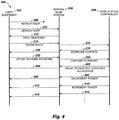
- FIG. 4 is a bounce diagram that depicts messages sent between mobile device 202, serving base station 204, and base station controller 206, resulting in a grant of a persistent resource allocation in accordance with one or more embodiments.
- Messages and data communication 208 through 224 are similar to those discussed above with reference to FIG. 2 .
- synch RACH 214 can include a request for a base station service that is best suited for a persistent resource allocation grant.
- synch RACH 214 can include a request for a voice call.
- Persistent resource allocation grant 402 is sent from base station controller 206 to base station 204, and then forwarded to mobile device 202 as shown at 404.
- Persistent resource allocation grant 402 can contain a power control instruction for initial use during the persistent resource allocation grant. Subsequent power control instructions can be sent from base station controller 206, to base station 204, and to mobile device 202. For example, after a period of time decrement power instruction 406 follows persistent resource allocation grant 402. Decrement power instruction 406 is forwarded to mobile device 202 as shown at 408 to instruct mobile device 202 to reduce its power by a predetermined incremental amount. Following power control instruction 406 are additional periodic power control instructions 410 and 414, which are forwarded to mobile device 202 has shown at 412 and 416, respectively, for the duration of the persistent resource allocation grant.
- mobile device 202 operates in a mode wherein additional power control instructions are not expected from base station 204.
- mobile device 202 operates in a mode wherein additional power control instructions are expected from base station 204 for the duration of the persistent resource allocation.
- FIG. 5 shows a high-level flowchart of processes that can be executed by mobile device 106 in FIG. 1 , or other systems with appropriate functionality, in accordance with one more embodiments.
- the process begins at 502, and thereafter continues at 504 wherein the process sends an asynchronous RACH to the base station.
- the asynchronous RACH message (such as asynchronous RACH message 208, 210 in FIG. 2 .) can be sent from an idle mobile device (e.g. mobile device 106) to the base station (e.g. base station 102) to alert the base station that the mobile device has a message for the base station.
- the process receives a RACH response from the base station, as illustrated at 506.
- the RACH response acknowledges the transmission from the mobile device, and can further instruct the mobile device to adjust its transmission timing and its transmit power, and to respond with a synchronous RACH at a particular time slot and on a particular frequency (e.g., a set of frequencies or resource block).
- the mobile device After receiving the RACH response, the mobile device determines a mobile device power limitation, as depicted at 508. In one embodiment, this step can be implemented by determining the power headroom of the mobile device, wherein the power headroom is the difference between the power the mobile device was instructed to use in the RACH response and the maximum power of the mobile device.
- the process determines a mobile device resource utilization limitation based on the power limitation, as illustrated at 510.
- this step can be implemented by determining a maximum number of resource blocks that can be used by the mobile device in an uplink transmission based on the power headroom. For example, in one embodiment, if the mobile device has currently been instructed to transmit at 21 dBm, and the maximum power for the mobile device is 24 dBm, which makes the power headroom 3 dB, and the maximum number of resource blocks that can be used by the mobile device would be 2, since adding a second resource block requires twice the power, which is an additional 3 dB increase in power.
- the process determines whether the mobile device resource utilization limitation exceeds a reporting threshold, as depicted at 512.
- the reporting threshold can be set to a level that prevents mobile devices that are not limited by their power headroom from reporting the mobile device power limitation. Mobile devices that are not limited by their power headroom can save the bandwidth needed to report the resource utilization limitation because the scheduler in the base station (or base station controller) does not need to be concerned with limiting scheduled resources to a mobile device that is not limited by power headroom. Conversely, if a mobile device is limited by its power headroom, the scheduler needs to know, preferably in advance of scheduling, so that it will not schedule a resource allocation that will exceed the mobile device's transmit power capability.
- the process passes to 514 wherein the process sends a synch RACH (such as sync RACH 214 shown in FIG. 4 ) to the base station, where in the synch RACH includes a resource allocation request and the resource utilization limitation.
- the resource allocation request can include a request for a file transfer, a request for a voice call, a request for a video or music file, or the like.
- the resource utilization limitation can include a maximum number of resource blocks, a maximum level of modulation and coding, or other similar resource limits that depend upon the mobile device transmit power. Note that in another embodiment the resource utilization limitation parameter can be transmitted on a dedicated message, and does not have to be piggy-backed on the sync RACH message.
- the process passes to 516 wherein the mobile device sends a synch RACH to the base station that includes a resource allocation request, but no resource utilization limitation.
- the process can receive a channel sounding command, as illustrated at 518.
- the process sends a channel sounding data sequence, as depicted 520.
- the channel sounding data sequence is a known data sequence, which is transmitted at a known transmit power on preselected frequencies across the bandwidth of the communication system.
- Channel sounding gives the base station and/or the base station controller data that represents the quality of the channel on the various frequencies across the spectrum. This information is useful in scheduling uplink transmissions from the mobile devices because the scheduler prefers to grant resources to mobile devices that are presently capable of using those resources with desirable channel conditions.
- base station 204 can infer the CINR from long term tracking of the channel through the reference symbols of the data channel.
- the process After sending the channel sounding sequence, the process receives a dynamic or a persistent resource allocation grant, and determines whether the grant was dynamic or persistent at 522. If the grant was dynamic, the process receives instructions for a dynamic uplink transmission, including a power control instruction for use during the duration of the dynamic resource grant, as depicted at 524. The process then transmits on the uplink according to the dynamic resource allocation grant as shown at 526, and uses the power control instruction to set the transmit power for the duration of the grant. At the end of data transmission according to the dynamic resource allocation grant, the process ends as depicted at 536.
- the process receives instructions for a persistent uplink transmission, including an initial power control instruction to begin the persistent resource grant transmission, as illustrated at 528.
- the process then transmits on the uplink according to the persistent resource allocation grant, and uses the initial power control instruction to start the persistent grant transmission, as shown at 530.
- the process receives an additional power control instruction, as depicted at 532.
- the process determines whether the persistent grant has expired, as illustrated at 534. If the persistent grant has not expired, the process continues to send more data at 530, and periodically receives updated power control instructions at 532.
- the process of transmitting on the allocated uplink resource according to the persistent resource grant ends, as shown at 536.
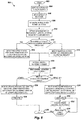
- FIG. 6 shows a high-level flowchart of processes that can be executed by mobile device 106 in FIG. 1 , or other systems with appropriate functionality, in accordance with one or more embodiments.
- the process begins at 602, and thereafter continues at 604 wherein the process receives a cell-wide power control parameter.
- the cell-wide power control parameter is a parameter that is sent to all mobile devices in the cell by the serving base station.
- the parameter can be sent by a broadcast channel.
- the cell-wide power control parameter is a cell target signal to interference-plus-noise ratio (SINR) received at the base station (e.g., base station 102).
- SINR cell target signal to interference-plus-noise ratio
- the cell-wide power control parameter can be a fractional power control exponent, which is shown as symbol " ⁇ " in Equation 1 above.
- an implicit mobile-specific power control parameter is a parameter related to uplink power control that is specific to the mobile device (i.e., a parameter that is not broadcast) and that is implied by other messages or commands sent to the mobile device, or measurements made by the mobile device, which makes the implicit parameter one that does not require additional message traffic from the base station.
- the implicit mobile-specific power control parameter can be a modulation and coding level previously used by the mobile device. The modulation and coding level is sent to the mobile device by the base station, and it implicitly indicates the uplink channel characteristics between the mobile device and the base station.
- the modulation and coding level previously used by the mobile device can be an average modulation and coding level averaged over a time window.
- the implicit mobile-specific power control parameter can be a downlink SINR level (or an averaged downlink SINR level) measured by the mobile device.
- TDD time domain duplex
- FDD frequency domain duplex
- the uplink and downlink channel fast fading components may be uncorrelated even though the pathloss and shadowing components are identical. Averaging the downlink SINR over time and frequency will average out the fading components and provide a good implicit estimate of the uplink channel characteristics.
- the mobile device can also receive a mobile-specific power control parameter, in addition to the cell-wide power control parameter and the implicit mobile-specific power control parameter.
- the mobile-specific power control parameter can be received in a message from the base station that is directed specifically to the mobile device.
- the implicit mobile-specific power control parameter can be a correlation between the mobile-specific power control parameter and a modulation and coding level assigned by the serving base station.
- the implicit mobile-specific power control parameter can vary between the case where the mobile-specific power control parameter correlates directly with the modulation and coding scheme and in the case where the mobile-specific power control parameter correlates in directly with the modulation and decoding scheme.
- a direct correlation between the power control parameter and the modulation and coding scheme is where the mobile device receives a relatively high power in combination with a relatively high modulation and coding level (i.e., a modulation and coding level that requires a higher power), and similarly the case where the mobile device receives a relatively low power in combination with a relatively low modulation and coding level.
- An example of an indirect correlation between the power control parameter and the modulation and coding scheme is where the mobile device receives a relatively high power in combination with a relatively low modulation and coding scheme, and vice versa.
- the process calculates the mobile device uplink transmit power using the cell-wide power control parameter and the implicit mobile-specific power control parameter, as depicted at 608.
- the implicit mobile-specific power control parameter is used to adjust a transmitter power indicated by the cell-wide power control parameter, or to adjust a transmit power indicated by the cell-wide power control parameter in combination with a mobile-specific power control parameter.
- this adjustment can be a percentage of the transmit power indicated by calculations using cell-wide parameters, or by calculations using cell-wide parameters in combination with mobile-specific parameters.
- the base station broadcasts a cell-wide target SINR that maps to an average MCS level of 16 QAM (i.e., 16 point constellation, quadrature amplitude modulation) (SINR 16 ) with coding rate 1 ⁇ 2.
- the mobile device will first calculate its transmit power to ensure that its signal is received at the base station with the cell-wide target SINR 16 . Then, the mobile device can autonomously calculate a correction factor based upon an implicit mobile-specific power control parameter, such as a history of uplink MCS allocated to the mobile device.
- a correction factor of SINR 16 - SINR 4 can be autonomously applied by the mobile device to bring it in line with the expected received SINR 16 at the base station.
- the difference between the target SINR and the implied SINR determines the addition (if the measured MCS implies a lower SINR at the base station) or subtraction (if the measured MCS implies a higher SINR at the base station) of an autonomous correction factor.
- the difference i.e., the correction factor
- the correction factor can be applied directly to the transmit power at one time.
- the correction factor can be incrementally applied over a period, either by applying a number of fixed incremental corrections (e.g., change by 1 dB), or by applying a percentage of the correction factor over a fixed number of corrections (e.g., change by 20% of the correction factor over 5 changes).
- the correction factor can be periodically recalculated, even before a previous correction factor is completely applied.
- the mobile device can make continuous measurements on the downlink SINR levels and average the measurements over time and frequency to estimate a long term downlink received SINR.
- This estimated long term SINR can then be compared to the uplink SINR the mobile device expects based on the autonomously corrected transmit power as calculated in the example above.
- a delta correction factor can be calculated and applied based on the difference, and the delta correction factor can then be used in the calculation of the autonomous correction factor to increase its accuracy.
- the delta correction factor can be used to compensate for inaccuracies in transmit power, which are due to a difference in a set transmit power and an actual transmit power in the mobile device.
- the mobile device After calculating the mobile device uplink transmit power, the mobile device transmits data using the transmit power, as illustrated at 610.
- the data is transmitted on the time and frequency indicated by a resource allocation grant. After transmitting the data using the calculated transmit power, the process ends at 612.
- the mobile device has several options: (1) the mobile device can transmit using a lower power; (2) the mobile device can transmit using a lower MCS level; (3) the mobile device can transmit on a reduced number of resource blocks; (4) the mobile device can repeat the request for resource allocation (e.g., repeat the synch RACH message 214), wherein the repeated request includes an indication of the resource utilization limitation (e.g., 308), which limitation caused the previous grant to exceed the mobile device power limitation.
- the resource utilization limitation e.g., 308
Landscapes
- Engineering & Computer Science (AREA)
- Computer Networks & Wireless Communication (AREA)
- Signal Processing (AREA)
- Quality & Reliability (AREA)
- Mobile Radio Communication Systems (AREA)
Priority Applications (2)
| Application Number | Priority Date | Filing Date | Title |
|---|---|---|---|
| EP19152129.3A EP3490312B1 (en) | 2007-03-19 | 2008-02-25 | Resource allocation in a communication system |
| PL19152129T PL3490312T3 (pl) | 2007-03-19 | 2008-02-25 | Alokacja zasobów w systemie komunikacji |
Applications Claiming Priority (3)
| Application Number | Priority Date | Filing Date | Title |
|---|---|---|---|
| US11/725,423 US9295003B2 (en) | 2007-03-19 | 2007-03-19 | Resource allocation in a communication system |
| EP08730594.2A EP2137994B1 (en) | 2007-03-19 | 2008-02-25 | Resource allocation in a communication system |
| PCT/US2008/054823 WO2008115660A1 (en) | 2007-03-19 | 2008-02-25 | Resource allocation in a communication system |
Related Parent Applications (3)
| Application Number | Title | Priority Date | Filing Date |
|---|---|---|---|
| EP08730594.2 Division | 2008-02-25 | ||
| EP08730594.2A Division EP2137994B1 (en) | 2007-03-19 | 2008-02-25 | Resource allocation in a communication system |
| EP08730594.2A Division-Into EP2137994B1 (en) | 2007-03-19 | 2008-02-25 | Resource allocation in a communication system |
Related Child Applications (2)
| Application Number | Title | Priority Date | Filing Date |
|---|---|---|---|
| EP19152129.3A Division-Into EP3490312B1 (en) | 2007-03-19 | 2008-02-25 | Resource allocation in a communication system |
| EP19152129.3A Division EP3490312B1 (en) | 2007-03-19 | 2008-02-25 | Resource allocation in a communication system |
Publications (3)
| Publication Number | Publication Date |
|---|---|
| EP2680629A2 EP2680629A2 (en) | 2014-01-01 |
| EP2680629A3 EP2680629A3 (en) | 2016-12-28 |
| EP2680629B1 true EP2680629B1 (en) | 2019-03-27 |
Family
ID=39766322
Family Applications (3)
| Application Number | Title | Priority Date | Filing Date |
|---|---|---|---|
| EP13185604.9A Active EP2680629B1 (en) | 2007-03-19 | 2008-02-25 | Resource allocation in a communication system |
| EP19152129.3A Active EP3490312B1 (en) | 2007-03-19 | 2008-02-25 | Resource allocation in a communication system |
| EP08730594.2A Active EP2137994B1 (en) | 2007-03-19 | 2008-02-25 | Resource allocation in a communication system |
Family Applications After (2)
| Application Number | Title | Priority Date | Filing Date |
|---|---|---|---|
| EP19152129.3A Active EP3490312B1 (en) | 2007-03-19 | 2008-02-25 | Resource allocation in a communication system |
| EP08730594.2A Active EP2137994B1 (en) | 2007-03-19 | 2008-02-25 | Resource allocation in a communication system |
Country Status (7)
| Country | Link |
|---|---|
| US (5) | US9295003B2 (enExample) |
| EP (3) | EP2680629B1 (enExample) |
| JP (4) | JP5351776B2 (enExample) |
| KR (7) | KR20150011392A (enExample) |
| CN (2) | CN101637056B (enExample) |
| PL (1) | PL3490312T3 (enExample) |
| WO (1) | WO2008115660A1 (enExample) |
Families Citing this family (82)
| Publication number | Priority date | Publication date | Assignee | Title |
|---|---|---|---|---|
| KR100853699B1 (ko) * | 2006-12-01 | 2008-08-25 | 한국전자통신연구원 | 이동통신 시스템의 호 설정 제어 방법 |
| US7881721B2 (en) * | 2007-04-30 | 2011-02-01 | Freescale Semiconductor, Inc. | Channel sounding techniques for a wireless communication system |
| JP5118894B2 (ja) * | 2007-06-05 | 2013-01-16 | 株式会社Kddi研究所 | 無線基地局 |
| AU2008265071B2 (en) * | 2007-06-20 | 2013-03-28 | Cellular Communications Equipment Llc | Power headroom reporting method |
| EP2163000B1 (en) * | 2007-07-04 | 2017-09-06 | Telefonaktiebolaget LM Ericsson (publ) | User terminal power shortage indication |
| US8169992B2 (en) | 2007-08-08 | 2012-05-01 | Telefonaktiebolaget Lm Ericsson (Publ) | Uplink scrambling during random access |
| BRPI0815862A2 (pt) * | 2007-09-11 | 2015-09-29 | Wi Lan Inc | alocação persistente de recursos |
| US8300716B1 (en) | 2007-12-26 | 2012-10-30 | Marvell International Ltd. | Link adaptation for OFDM systems |
| US8199719B2 (en) | 2008-03-13 | 2012-06-12 | Apple Inc. | Methods and apparatus for performing handover between a long term evolution (LTE) network and another type of radio access network |
| KR101828886B1 (ko) | 2008-04-21 | 2018-02-13 | 애플 인크. | 업링크 구조를 제공하고 무선 통신 네트워크에서 파일럿 신호 오버헤드를 최소화하는 방법 및 시스템 |
| US8902831B2 (en) * | 2008-06-17 | 2014-12-02 | Centre Of Excellence In Wireless Technology | Methods and systems for interference mitigation |
| EP2291024B1 (en) | 2008-06-20 | 2017-09-13 | NEC Corporation | Resource allocation method, base station, mobile station, and program |
| KR101228052B1 (ko) * | 2008-06-20 | 2013-01-31 | 닛본 덴끼 가부시끼가이샤 | 리소스 할당 방법, 특정 방법, 무선 통신 시스템, 기지국, 이동국, 및 기록 매체 |
| US8046022B2 (en) * | 2008-07-08 | 2011-10-25 | Wi-Lan, Inc. | Signal transmission parameter control using channel sounding |
| KR20100048844A (ko) * | 2008-10-31 | 2010-05-11 | 삼성전자주식회사 | 무선통신시스템에서 상향링크 전력 제어 장치 및 방법 |
| KR20150023886A (ko) | 2008-12-03 | 2015-03-05 | 인터디지탈 패튼 홀딩스, 인크 | 캐리어 집적에 대한 업링크 파워 헤드룸 보고 |
| US8572271B2 (en) * | 2009-01-29 | 2013-10-29 | Qualcomm Incorporated | Multimedia management system for seamless multimedia content mobility |
| KR101697596B1 (ko) | 2009-01-29 | 2017-01-18 | 엘지전자 주식회사 | 전송 전력을 제어하는 방법 및 이를 위한 장치 |
| US20120099453A1 (en) * | 2009-04-03 | 2012-04-26 | Telefonaktiebolaget Lm Ericsson (Publ) | Uplink Link Adaption at the User Equipment |
| KR101083482B1 (ko) | 2009-04-16 | 2011-11-16 | 주식회사 세아네트웍스 | 송신 전력 보고 장치 및 방법과 송신 전력 결정 장치 및 방법 |
| US8824424B2 (en) * | 2009-04-21 | 2014-09-02 | Blackberry Limited | System and method for adjusting monitoring of timeslots during data transmission |
| JP5023170B2 (ja) * | 2009-04-27 | 2012-09-12 | 株式会社エヌ・ティ・ティ・ドコモ | ユーザ装置、基地局装置及び通信制御方法 |
| RU2531356C2 (ru) * | 2009-05-07 | 2014-10-20 | Телефонактиеболагет Лм Эрикссон (Пабл) | Управление потребляемой мощностью устройства мобильной связи |
| US9634806B2 (en) * | 2009-06-11 | 2017-04-25 | Qualcomm Incorporated | Data prioritization for a power-limited UE in a wireless communication system |
| KR101517170B1 (ko) * | 2009-09-29 | 2015-05-04 | 삼성전자주식회사 | 다중 안테나 시스템에서 전력 소모를 줄이기 위한 장치 및 방법 |
| KR101811114B1 (ko) | 2009-10-01 | 2017-12-20 | 인터디지탈 패튼 홀딩스, 인크 | 전력 제어 방법 및 장치 |
| US9059749B2 (en) | 2009-10-02 | 2015-06-16 | Sharp Kabushiki Kaisha | Antenna port mode and transmission mode transitions |
| US8768397B2 (en) | 2009-10-02 | 2014-07-01 | Sharp Kabushiki Kaisha | Transmission power control on a wireless communication device for a plurality of regulated bands or component carriers |
| EP2491740A1 (en) * | 2009-10-23 | 2012-08-29 | Telefonaktiebolaget L M Ericsson (PUBL) | Arrangements and methods in communication nodes |
| WO2011050850A1 (en) * | 2009-10-29 | 2011-05-05 | Nokia Siemens Networks Oy | Method and device for adjusting an uplink transmission power of a mobile terminal |
| CN101711058B (zh) * | 2009-12-15 | 2012-12-05 | 中兴通讯股份有限公司 | 一种资源分配方法和系统 |
| US8488562B2 (en) * | 2009-12-18 | 2013-07-16 | Qualcomm Incorporated | Transmission power control in multi-hop networks |
| US8437794B2 (en) * | 2010-01-28 | 2013-05-07 | Alcatel Lucent | Methods of determining uplink target signal-to-interfence-and-noise ratios and systems thereof |
| US20120300616A1 (en) * | 2010-02-02 | 2012-11-29 | Nokia Corporation | Methods and Apparatuses for Resource Mapping for Multiple Transport Blocks Over Wireless Backhaul Link |
| JP4913222B2 (ja) | 2010-02-12 | 2012-04-11 | シャープ株式会社 | 無線通信システム、移動局装置、無線通信方法および集積回路 |
| EP3179809B1 (en) | 2010-03-03 | 2019-07-10 | BlackBerry Limited | Method and apparatus to signal use-specific capabilities of mobile stations to establish data transfer sessions |
| EP4539565A3 (en) * | 2010-03-12 | 2025-06-18 | Malikie Innovations Limited | Timing advance enhancements for cellular communications |
| EP2367393B8 (en) * | 2010-03-12 | 2015-12-30 | BlackBerry Limited | Communication Station and Method for Transmitting Additional Information on an Enhanced Random Access Channel |
| EP3007500B1 (en) | 2010-03-12 | 2022-05-04 | BlackBerry Limited | Communication station and method for transmitting on a random access channel |
| EP2367394B1 (en) * | 2010-03-12 | 2015-11-25 | BlackBerry Limited | Base station and method for receiving transmissions on an enhanced random access channel |
| WO2011122910A2 (ko) | 2010-04-01 | 2011-10-06 | 엘지전자 주식회사 | 무선 접속 시스템에서 상향링크 전력 제어 방법 및 장치 |
| KR101725553B1 (ko) | 2010-04-01 | 2017-04-27 | 엘지전자 주식회사 | 무선 통신 시스템에서 통신을 수행하는 방법 및 장치 |
| KR20110119578A (ko) * | 2010-04-27 | 2011-11-02 | 엘지에릭슨 주식회사 | 소형 기지국 및 그의 상향링크 전력제어 방법 |
| US8644997B2 (en) * | 2010-05-10 | 2014-02-04 | Hamilton Sundstrand Corporation | Load sharing architecture for redundant channel controllers |
| EP2606686B1 (en) * | 2010-08-16 | 2019-03-13 | Telefonaktiebolaget LM Ericsson (publ) | Method and apparatuses for power control using variable step size |
| KR101691038B1 (ko) | 2010-12-10 | 2016-12-30 | 삼성전자주식회사 | 무선 통신 시스템에서 기지국의 자원 운용 방법 및 장치 |
| US20130046889A1 (en) * | 2011-08-15 | 2013-02-21 | Alcatel-Lucent Usa Inc. | Methods and apparatuses for scheduling users in wireless networks |
| EP2761780A1 (en) | 2011-09-30 | 2014-08-06 | Interdigital Patent Holdings, Inc. | Multipoint transmission in wireless communication |
| US9112267B2 (en) * | 2011-10-11 | 2015-08-18 | Alcatel Lucent | Method of accessing a wireless network and a wireless device |
| CN103052074A (zh) * | 2011-10-12 | 2013-04-17 | 中兴通讯股份有限公司 | 降低上行同频干扰的方法及装置 |
| US9332505B2 (en) * | 2011-11-11 | 2016-05-03 | Telefonaktiebolaget L M Ericsson (Publ) | Methods and apparatus for performing measurements in adaptive downlink power transmission |
| CN103167534B (zh) * | 2011-12-15 | 2015-09-23 | 展讯通信(上海)有限公司 | 通信事件的测量处理方法与装置、用户设备 |
| US9553680B1 (en) | 2012-04-02 | 2017-01-24 | Sprint Communications Company L.P. | Uplink interference mitigation |
| US10039116B1 (en) | 2012-04-02 | 2018-07-31 | Sprint Communications Company L.P. | Long term evolution scheduler to mitigate interference |
| US9300431B2 (en) * | 2012-06-04 | 2016-03-29 | Alcatel Lucent | Apparatus, method and computer readable medium for payload segmentation of wireless packet data transmissions |
| WO2014005242A1 (en) * | 2012-07-03 | 2014-01-09 | Telefonaktiebolaget L M Ericsson (Publ) | Method and access point for assigning sounding resources |
| CN103874181B (zh) * | 2012-12-10 | 2017-05-31 | 中国移动通信集团设计院有限公司 | 一种为终端分配下行信道的方法和设备 |
| JP6244009B2 (ja) | 2013-04-03 | 2017-12-06 | インターデイジタル パテント ホールディングス インコーポレイテッド | 累積された送信電力制御コマンドおよび対応するアップリンクサブフレームセットに基づいてアップリンク送信電力を制御するための方法および装置 |
| US20150038140A1 (en) * | 2013-07-31 | 2015-02-05 | Qualcomm Incorporated | Predictive mobility in cellular networks |
| CN110519860B (zh) | 2013-09-13 | 2023-04-07 | 交互数字专利控股公司 | 空闲信道评估(cca)阈值适配方法 |
| US10250362B2 (en) * | 2014-03-20 | 2019-04-02 | Interdigital Patent Holdings, Inc. | Method and apparatus for non-orthogonal access in LTE systems |
| US9585106B2 (en) | 2014-03-27 | 2017-02-28 | Taiwan Semiconductor Manufacturing Company, Ltd. | Network-assisted channel selection and power control for mobile devices |
| US9838975B2 (en) * | 2014-04-20 | 2017-12-05 | Lg Electronics Inc. | Method for determining transmission power for direct communication between terminals in wireless communication system, and apparatus for same |
| KR102301828B1 (ko) | 2014-05-02 | 2021-09-14 | 삼성전자 주식회사 | 무선 통신 시스템에서 실시간 송신 전력 조절 방법 및 장치 |
| US9871578B2 (en) * | 2014-07-30 | 2018-01-16 | Hughes Network Systems, Llc | Clear sky determination in uplink power control using dual time constants |
| US9854527B2 (en) | 2014-08-28 | 2017-12-26 | Apple Inc. | User equipment transmit duty cycle control |
| CN106464470B (zh) * | 2015-01-26 | 2020-01-21 | 华为技术有限公司 | 一种选择控制信道的方法和装置 |
| US11252190B1 (en) * | 2015-04-23 | 2022-02-15 | Amazon Technologies, Inc. | Limited access policy bypass |
| CN109952720A (zh) | 2016-09-28 | 2019-06-28 | Idac控股公司 | 波束成形系统中的新型无线电随机接入 |
| CN108574955B (zh) * | 2017-03-07 | 2023-04-14 | 中兴通讯股份有限公司 | 基于ue触发的移动性场景中测量优化的方法和装置 |
| EP3637910B1 (en) * | 2017-05-18 | 2022-09-14 | LG Electronics Inc. | Method for allocating resource for signal by terminal in wireless communication system and apparatus therefor |
| KR102098030B1 (ko) * | 2017-12-11 | 2020-04-07 | 주식회사 딕스젠 | 결핵진단용 조성물 및 광학적 특성 변화에 기반한 결핵 진단방법 |
| US10616136B2 (en) * | 2018-04-19 | 2020-04-07 | Microsoft Technology Licensing, Llc | Utilization based dynamic resource allocation |
| US10432798B1 (en) | 2018-05-25 | 2019-10-01 | At&T Intellectual Property I, L.P. | System, method, and apparatus for service grouping of users to different speed tiers for wireless communication |
| US10419943B1 (en) | 2018-06-15 | 2019-09-17 | At&T Intellectual Property I, L.P. | Overlay of millimeter wave (mmWave) on citizens broadband radio service (CBRS) for next generation fixed wireless (NGFW) deployment |
| US10798537B2 (en) * | 2018-07-09 | 2020-10-06 | At&T Intellectual Property I, L.P. | Next generation fixed wireless qualification tool for speed-tier based subscription |
| US11265876B2 (en) * | 2018-08-10 | 2022-03-01 | Qualcomm Incorproated | Uplink power modification and communication scheme change requests |
| KR102562310B1 (ko) | 2018-09-27 | 2023-08-01 | 삼성전자주식회사 | 적응적으로 성능을 변경하는 무선 통신장치 및 이의 동작방법 |
| CN112020140B (zh) * | 2019-05-29 | 2023-05-09 | 中国移动通信有限公司研究院 | 资源配置方法及装置、通信设备 |
| CN111342881B (zh) * | 2020-02-05 | 2021-06-29 | 北京邮电大学 | 一种基于无人机进行中继辅助传输的方法及系统 |
| EP4362583A4 (en) * | 2021-06-24 | 2024-07-10 | Beijing Xiaomi Mobile Software Co., Ltd. | RESOURCE ALLOCATION METHOD AND RELATED APPARATUS |
| US12250647B2 (en) * | 2022-09-15 | 2025-03-11 | Apple Inc. | Dynamic power budget allocation using individualized MTPL per radio link for uplink transmission |
Family Cites Families (65)
| Publication number | Priority date | Publication date | Assignee | Title |
|---|---|---|---|---|
| JPH07212404A (ja) | 1994-01-26 | 1995-08-11 | Furukawa Electric Co Ltd:The | ネットワーク間のデータ中継装置 |
| FI103555B1 (fi) * | 1996-06-17 | 1999-07-15 | Nokia Mobile Phones Ltd | Lähetystehon säätö langattomassa pakettidatasiirrossa |
| US5982760A (en) * | 1997-06-20 | 1999-11-09 | Qualcomm Inc. | Method and apparatus for power adaptation control in closed-loop communications |
| US6154450A (en) * | 1997-08-22 | 2000-11-28 | Telefonaktiebolaget Lm Ericsson | Signaling method for CDMA quality based power control |
| US6285665B1 (en) * | 1997-10-14 | 2001-09-04 | Lucent Technologies Inc. | Method for establishment of the power level for uplink data transmission in a multiple access system for communications networks |
| GB9724046D0 (en) * | 1997-11-14 | 1998-01-14 | Northern Telecom Ltd | Up link power for fixed wireless access |
| JP3058270B2 (ja) * | 1998-04-22 | 2000-07-04 | 日本電気株式会社 | Cdma通信方法、スペクトラム拡散通信システム、基地局、および端末装置 |
| US6256483B1 (en) * | 1998-10-28 | 2001-07-03 | Tachyon, Inc. | Method and apparatus for calibration of a wireless transmitter |
| US6628956B2 (en) | 1999-03-15 | 2003-09-30 | Telefonaktiebolaget Lm Ericsson (Publ) | Adaptive power control in a radio communications systems |
| EP1054518B1 (en) * | 1999-05-21 | 2004-04-28 | Alcatel Alsthom Compagnie Generale D'electricite | A method for improving performances of a mobile radiocommunication system using power control |
| KR100605978B1 (ko) * | 1999-05-29 | 2006-07-28 | 삼성전자주식회사 | 부호분할다중접속 이동통신시스템의 불연속 전송모드에서 연속적인 외부순환 전력제어를 위한 송수신 장치 및 방법 |
| US6519705B1 (en) * | 1999-12-15 | 2003-02-11 | At&T Corp. | Method and system for power control in wireless networks using interference prediction with an error margin |
| US20020091991A1 (en) * | 2000-05-11 | 2002-07-11 | Castro Juan Carlos | Unified real-time microprocessor computer |
| US7023824B2 (en) * | 2001-02-27 | 2006-04-04 | Telefonaktiebolaget L M Ericsson (Publ) | Method, apparatus, and system for optimizing transmission power and bit rate in multi-transmission scheme communication systems |
| US6836666B2 (en) * | 2001-05-08 | 2004-12-28 | Lucent Technologies Inc. | Method to control uplink transmissions in a wireless communication system |
| US6587697B2 (en) * | 2001-05-14 | 2003-07-01 | Interdigital Technology Corporation | Common control channel uplink power control for adaptive modulation and coding techniques |
| US7584418B2 (en) * | 2001-05-31 | 2009-09-01 | Oracle International Corporation | Methods, systems, and articles of manufacture for prefabricating an information page |
| US7570656B2 (en) * | 2001-06-18 | 2009-08-04 | Yitran Communications Ltd. | Channel access method for powerline carrier based media access control protocol |
| KR100747524B1 (ko) * | 2001-07-07 | 2007-08-08 | 엘지전자 주식회사 | 다변 데이터 레이트 모드에서의 신호 전력 제어 방법 |
| US7096034B2 (en) * | 2001-10-01 | 2006-08-22 | Microsoft Corporation | System and method for reducing power consumption for wireless communications by mobile devices |
| US6952591B2 (en) * | 2001-11-20 | 2005-10-04 | Lucent Technologies Inc. | Uplink power control algorithm |
| KR100911138B1 (ko) | 2002-04-25 | 2009-08-06 | 삼성전자주식회사 | 전력이 조절되는 적응 변조 및 코딩 방식의 이동통신시스템 및 그 방법 |
| US6944461B2 (en) * | 2002-06-03 | 2005-09-13 | Lucent Technologies Inc. | Communication system and method for quality-based call admission control and scheduling |
| US8095620B2 (en) * | 2002-06-13 | 2012-01-10 | Elbit Systems Land and C41-Tadiran Ltd. | System and method for dynamic allocation of a resource |
| US6850771B2 (en) * | 2002-06-24 | 2005-02-01 | Qualcomm Incorporated | Uplink power control |
| EP1437912B1 (en) * | 2003-01-04 | 2010-09-08 | Samsung Electronics Co., Ltd. | Method for determining data rate of user equipment supporting EUDCH service |
| US8165148B2 (en) * | 2003-01-13 | 2012-04-24 | Qualcomm Incorporated | System and method for rate assignment |
| US20040179469A1 (en) * | 2003-03-13 | 2004-09-16 | Attar Rashid Ahmed | Method and system for a data transmission in a communication system |
| US7746816B2 (en) * | 2003-03-13 | 2010-06-29 | Qualcomm Incorporated | Method and system for a power control in a communication system |
| US20070050777A1 (en) * | 2003-06-09 | 2007-03-01 | Hutchinson Thomas W | Duration of alerts and scanning of large data stores |
| US6970437B2 (en) * | 2003-07-15 | 2005-11-29 | Qualcomm Incorporated | Reverse link differentiated services for a multiflow communications system using autonomous allocation |
| JP4243229B2 (ja) * | 2003-08-16 | 2009-03-25 | 三星電子株式会社 | 移動通信システムでの上りリンクパケットの伝送のためのスケジューリング割当方法及び装置 |
| KR101000391B1 (ko) * | 2003-09-01 | 2010-12-13 | 엘지전자 주식회사 | 역방향 링크의 전송 데이터 레이트 제어 방법 |
| WO2005036358A2 (en) * | 2003-10-08 | 2005-04-21 | Unisys Corporation | Virtualization system for guest |
| CN100353806C (zh) * | 2004-04-01 | 2007-12-05 | 大唐移动通信设备有限公司 | Td-scdma移动通信系统中的接力切换方法 |
| EP1782551B1 (en) * | 2004-07-30 | 2016-10-05 | CommScope Technologies LLC | Power control in a local network node (lnn) |
| JP5209308B2 (ja) * | 2004-08-11 | 2013-06-12 | インターデイジタル テクノロジー コーポレーション | システム性能向上のためのチャネルサウンディング |
| KR100725773B1 (ko) * | 2004-08-20 | 2007-06-08 | 삼성전자주식회사 | 시분할 듀플렉스 방식의 이동통신 시스템에서 단말기의상태에 따라 상향링크 전력제어방식을 적응적으로변경하기 위한 장치 및 방법 |
| CN100382455C (zh) * | 2004-10-15 | 2008-04-16 | 中兴通讯股份有限公司 | 一种cdma系统中基于实际测量量的上行接纳控制方法 |
| KR100688305B1 (ko) * | 2005-02-09 | 2007-03-02 | 가부시키가이샤 엔.티.티.도코모 | 업링크 무선 리소스 할당 방법, 무선 기지국, 및 무선네트워크 제어국 |
| US20060203724A1 (en) | 2005-03-08 | 2006-09-14 | Donna Ghosh | Multi-carrier, multi-flow, reverse link medium access control for a communication system |
| US7499462B2 (en) * | 2005-03-15 | 2009-03-03 | Radiospire Networks, Inc. | System, method and apparatus for wireless delivery of content from a generalized content source to a generalized content sink |
| DE602005011101D1 (de) * | 2005-04-01 | 2009-01-02 | Panasonic Corp | Zeitliche Planung von Endgeräten in einem Funkkommunikationssystem |
| US20060268764A1 (en) * | 2005-05-26 | 2006-11-30 | Harris John M | Method, apparatus and system for use in allocating reverse channel resources |
| US8744465B2 (en) * | 2005-06-16 | 2014-06-03 | Qualcomm Incorporated | Resource allocation method in a communication system |
| CN1905754B (zh) | 2005-07-19 | 2010-09-08 | 三星电子株式会社 | 在通信系统中用于调度上行链路的系统和方法 |
| US8023955B2 (en) * | 2005-08-22 | 2011-09-20 | Sony Corporation | Uplink resource allocation to control intercell interference in a wireless communication system |
| JPWO2007043455A1 (ja) * | 2005-10-07 | 2009-04-16 | 日本電気株式会社 | 信号送信方法、無線通信システム、通信局、移動局、並びに基地局 |
| US7532492B2 (en) * | 2005-12-20 | 2009-05-12 | Tektronix, Inc. | Host controlled voltage input system for an accessory device |
| US7650137B2 (en) * | 2005-12-23 | 2010-01-19 | Apple Inc. | Account information display for portable communication device |
| EP3048849B1 (en) * | 2006-03-07 | 2017-06-21 | Panasonic Corporation | Overhead reduction of uplink control signaling in a mobile communication system |
| WO2008007437A1 (en) * | 2006-07-14 | 2008-01-17 | Fujitsu Limited | Mobile communication system and base station |
| US8112534B2 (en) * | 2006-07-26 | 2012-02-07 | Dell Products L.P. | Apparatus and method for remote power control |
| US20080096524A1 (en) * | 2006-10-20 | 2008-04-24 | Lucent Technologies Inc. | Method for providing a multi-member mobile telecommunications service plan |
| EP2095582A2 (en) | 2006-10-31 | 2009-09-02 | QUALCOMM Incorporated | Random access for wireless communication |
| CA2666215A1 (en) * | 2006-11-01 | 2008-05-08 | Qualcomm Incorporated | Inter-cell power control for interference management |
| WO2008056774A1 (en) | 2006-11-10 | 2008-05-15 | Panasonic Corporation | Radio communication mobile station device and mcs selection method |
| US7715865B2 (en) * | 2006-12-21 | 2010-05-11 | Sony Ericsson Mobile Communications Ab | Compressed mode for reducing power consumption |
| US7940721B2 (en) * | 2006-12-22 | 2011-05-10 | Alcatel-Lucent Usa Inc. | Power overload control method useful with enhanced dedicated channel traffic |
| US8437792B2 (en) | 2007-02-14 | 2013-05-07 | Qualcomm Incorporated | Uplink power control for LTE |
| EP2345301A4 (en) * | 2008-10-30 | 2012-05-02 | Nokia Corp | SOFTWARE-DEFINED RADIO |
| US8310929B1 (en) * | 2009-06-04 | 2012-11-13 | Sprint Spectrum L.P. | Method and system for controlling data rates based on backhaul capacity |
| PL2908585T3 (pl) * | 2009-06-19 | 2017-12-29 | Interdigital Patent Holdings, Inc. | Sygnalizowanie informacji sterującej łączem wysyłania w LTE-A |
| US20110004500A1 (en) * | 2009-07-06 | 2011-01-06 | Microsoft Corporation | Allocating a resource based on quality-of-service considerations |
| US20110075596A1 (en) * | 2009-09-25 | 2011-03-31 | Nokia Corporation | Resource Overbooking |
-
2007
- 2007-03-19 US US11/725,423 patent/US9295003B2/en active Active
-
2008
- 2008-02-25 EP EP13185604.9A patent/EP2680629B1/en active Active
- 2008-02-25 EP EP19152129.3A patent/EP3490312B1/en active Active
- 2008-02-25 JP JP2009554619A patent/JP5351776B2/ja active Active
- 2008-02-25 KR KR1020147035672A patent/KR20150011392A/ko not_active Ceased
- 2008-02-25 KR KR1020167016588A patent/KR101689510B1/ko active Active
- 2008-02-25 KR KR1020147018139A patent/KR101520592B1/ko active Active
- 2008-02-25 WO PCT/US2008/054823 patent/WO2008115660A1/en not_active Ceased
- 2008-02-25 KR KR1020147018141A patent/KR101540898B1/ko active Active
- 2008-02-25 CN CN2008800089376A patent/CN101637056B/zh active Active
- 2008-02-25 EP EP08730594.2A patent/EP2137994B1/en active Active
- 2008-02-25 KR KR1020167005823A patent/KR101637150B1/ko active Active
- 2008-02-25 KR KR1020097020506A patent/KR101689402B1/ko active Active
- 2008-02-25 KR KR1020147018142A patent/KR101604560B1/ko active Active
- 2008-02-25 CN CN2012101885785A patent/CN102711231A/zh active Pending
- 2008-02-25 PL PL19152129T patent/PL3490312T3/pl unknown
-
2012
- 2012-01-16 US US13/351,163 patent/US20120184315A1/en not_active Abandoned
-
2013
- 2013-07-17 US US13/944,137 patent/US10701640B2/en active Active
- 2013-07-17 US US13/944,122 patent/US9992747B2/en active Active
- 2013-08-23 JP JP2013173756A patent/JP5830066B2/ja active Active
-
2015
- 2015-05-11 JP JP2015096885A patent/JP5970107B2/ja active Active
-
2016
- 2016-07-08 JP JP2016136231A patent/JP6227063B2/ja active Active
-
2019
- 2019-05-28 US US16/423,425 patent/US11115936B2/en active Active
Non-Patent Citations (1)
| Title |
|---|
| None * |
Also Published As
Similar Documents
| Publication | Publication Date | Title |
|---|---|---|
| US11115936B2 (en) | Apparatus and methods for communication resource allocation | |
| US7558535B2 (en) | Apparatus and method for adaptively changing uplink power control scheme according to mobile status in a TDD mobile communication system | |
| US20090175187A1 (en) | Method and Arrangement for Triggering Power Headroom Report Transmissions in a Telecommunications System | |
| US20060046789A1 (en) | Apparatus and method for controlling uplink power in a mobile communication system using a TDD scheme | |
| WO2009123515A1 (en) | Interference reduction in a communication network by scheduling and link adaptation | |
| KR20120080327A (ko) | 무선통신시스템에서 상향링크 송신전력을 제어하기 위한 방법 및 장치 | |
| WO2005064821A1 (en) | Method and apparatus for adaptive open-loop power control in mobile communication system using tdd | |
| HK1192679A (en) | Resource allocation in a communication system | |
| HK1177369A (en) | Resource allocation in a communication system |
Legal Events
| Date | Code | Title | Description |
|---|---|---|---|
| PUAI | Public reference made under article 153(3) epc to a published international application that has entered the european phase |
Free format text: ORIGINAL CODE: 0009012 |
|
| 17P | Request for examination filed |
Effective date: 20130923 |
|
| AC | Divisional application: reference to earlier application |
Ref document number: 2137994 Country of ref document: EP Kind code of ref document: P |
|
| AK | Designated contracting states |
Kind code of ref document: A2 Designated state(s): AT BE BG CH CY CZ DE DK EE ES FI FR GB GR HR HU IE IS IT LI LT LU LV MC MT NL NO PL PT RO SE SI SK TR |
|
| REG | Reference to a national code |
Ref country code: HK Ref legal event code: DE Ref document number: 1192679 Country of ref document: HK |
|
| REG | Reference to a national code |
Ref country code: DE Ref legal event code: R079 Ref document number: 602008059550 Country of ref document: DE Free format text: PREVIOUS MAIN CLASS: H04W0016000000 Ipc: H04W0052540000 |
|
| PUAL | Search report despatched |
Free format text: ORIGINAL CODE: 0009013 |
|
| AK | Designated contracting states |
Kind code of ref document: A3 Designated state(s): AT BE BG CH CY CZ DE DK EE ES FI FR GB GR HR HU IE IS IT LI LT LU LV MC MT NL NO PL PT RO SE SI SK TR |
|
| RIC1 | Information provided on ipc code assigned before grant |
Ipc: H04W 16/00 20090101ALI20161124BHEP Ipc: H04W 52/18 20090101ALI20161124BHEP Ipc: H04W 52/14 20090101ALI20161124BHEP Ipc: H04W 52/26 20090101ALI20161124BHEP Ipc: H04L 12/28 20060101ALI20161124BHEP Ipc: H04W 52/54 20090101AFI20161124BHEP Ipc: H04W 52/36 20090101ALI20161124BHEP Ipc: H04W 52/24 20090101ALI20161124BHEP |
|
| STAA | Information on the status of an ep patent application or granted ep patent |
Free format text: STATUS: EXAMINATION IS IN PROGRESS |
|
| 17Q | First examination report despatched |
Effective date: 20170913 |
|
| RAP1 | Party data changed (applicant data changed or rights of an application transferred) |
Owner name: APPLE INC. |
|
| GRAP | Despatch of communication of intention to grant a patent |
Free format text: ORIGINAL CODE: EPIDOSNIGR1 |
|
| STAA | Information on the status of an ep patent application or granted ep patent |
Free format text: STATUS: GRANT OF PATENT IS INTENDED |
|
| INTG | Intention to grant announced |
Effective date: 20181009 |
|
| GRAS | Grant fee paid |
Free format text: ORIGINAL CODE: EPIDOSNIGR3 |
|
| GRAA | (expected) grant |
Free format text: ORIGINAL CODE: 0009210 |
|
| STAA | Information on the status of an ep patent application or granted ep patent |
Free format text: STATUS: THE PATENT HAS BEEN GRANTED |
|
| AC | Divisional application: reference to earlier application |
Ref document number: 2137994 Country of ref document: EP Kind code of ref document: P |
|
| AK | Designated contracting states |
Kind code of ref document: B1 Designated state(s): AT BE BG CH CY CZ DE DK EE ES FI FR GB GR HR HU IE IS IT LI LT LU LV MC MT NL NO PL PT RO SE SI SK TR |
|
| REG | Reference to a national code |
Ref country code: GB Ref legal event code: FG4D |
|
| REG | Reference to a national code |
Ref country code: CH Ref legal event code: EP |
|
| REG | Reference to a national code |
Ref country code: AT Ref legal event code: REF Ref document number: 1114514 Country of ref document: AT Kind code of ref document: T Effective date: 20190415 |
|
| REG | Reference to a national code |
Ref country code: IE Ref legal event code: FG4D |
|
| REG | Reference to a national code |
Ref country code: DE Ref legal event code: R096 Ref document number: 602008059550 Country of ref document: DE |
|
| PG25 | Lapsed in a contracting state [announced via postgrant information from national office to epo] |
Ref country code: LT Free format text: LAPSE BECAUSE OF FAILURE TO SUBMIT A TRANSLATION OF THE DESCRIPTION OR TO PAY THE FEE WITHIN THE PRESCRIBED TIME-LIMIT Effective date: 20190327 Ref country code: NO Free format text: LAPSE BECAUSE OF FAILURE TO SUBMIT A TRANSLATION OF THE DESCRIPTION OR TO PAY THE FEE WITHIN THE PRESCRIBED TIME-LIMIT Effective date: 20190627 Ref country code: FI Free format text: LAPSE BECAUSE OF FAILURE TO SUBMIT A TRANSLATION OF THE DESCRIPTION OR TO PAY THE FEE WITHIN THE PRESCRIBED TIME-LIMIT Effective date: 20190327 Ref country code: SE Free format text: LAPSE BECAUSE OF FAILURE TO SUBMIT A TRANSLATION OF THE DESCRIPTION OR TO PAY THE FEE WITHIN THE PRESCRIBED TIME-LIMIT Effective date: 20190327 |
|
| REG | Reference to a national code |
Ref country code: NL Ref legal event code: MP Effective date: 20190327 |
|
| PG25 | Lapsed in a contracting state [announced via postgrant information from national office to epo] |
Ref country code: NL Free format text: LAPSE BECAUSE OF FAILURE TO SUBMIT A TRANSLATION OF THE DESCRIPTION OR TO PAY THE FEE WITHIN THE PRESCRIBED TIME-LIMIT Effective date: 20190327 Ref country code: GR Free format text: LAPSE BECAUSE OF FAILURE TO SUBMIT A TRANSLATION OF THE DESCRIPTION OR TO PAY THE FEE WITHIN THE PRESCRIBED TIME-LIMIT Effective date: 20190628 Ref country code: HR Free format text: LAPSE BECAUSE OF FAILURE TO SUBMIT A TRANSLATION OF THE DESCRIPTION OR TO PAY THE FEE WITHIN THE PRESCRIBED TIME-LIMIT Effective date: 20190327 Ref country code: LV Free format text: LAPSE BECAUSE OF FAILURE TO SUBMIT A TRANSLATION OF THE DESCRIPTION OR TO PAY THE FEE WITHIN THE PRESCRIBED TIME-LIMIT Effective date: 20190327 Ref country code: BG Free format text: LAPSE BECAUSE OF FAILURE TO SUBMIT A TRANSLATION OF THE DESCRIPTION OR TO PAY THE FEE WITHIN THE PRESCRIBED TIME-LIMIT Effective date: 20190627 |
|
| REG | Reference to a national code |
Ref country code: AT Ref legal event code: MK05 Ref document number: 1114514 Country of ref document: AT Kind code of ref document: T Effective date: 20190327 |
|
| PG25 | Lapsed in a contracting state [announced via postgrant information from national office to epo] |
Ref country code: PT Free format text: LAPSE BECAUSE OF FAILURE TO SUBMIT A TRANSLATION OF THE DESCRIPTION OR TO PAY THE FEE WITHIN THE PRESCRIBED TIME-LIMIT Effective date: 20190727 Ref country code: ES Free format text: LAPSE BECAUSE OF FAILURE TO SUBMIT A TRANSLATION OF THE DESCRIPTION OR TO PAY THE FEE WITHIN THE PRESCRIBED TIME-LIMIT Effective date: 20190327 Ref country code: EE Free format text: LAPSE BECAUSE OF FAILURE TO SUBMIT A TRANSLATION OF THE DESCRIPTION OR TO PAY THE FEE WITHIN THE PRESCRIBED TIME-LIMIT Effective date: 20190327 Ref country code: IT Free format text: LAPSE BECAUSE OF FAILURE TO SUBMIT A TRANSLATION OF THE DESCRIPTION OR TO PAY THE FEE WITHIN THE PRESCRIBED TIME-LIMIT Effective date: 20190327 Ref country code: SK Free format text: LAPSE BECAUSE OF FAILURE TO SUBMIT A TRANSLATION OF THE DESCRIPTION OR TO PAY THE FEE WITHIN THE PRESCRIBED TIME-LIMIT Effective date: 20190327 Ref country code: RO Free format text: LAPSE BECAUSE OF FAILURE TO SUBMIT A TRANSLATION OF THE DESCRIPTION OR TO PAY THE FEE WITHIN THE PRESCRIBED TIME-LIMIT Effective date: 20190327 Ref country code: CZ Free format text: LAPSE BECAUSE OF FAILURE TO SUBMIT A TRANSLATION OF THE DESCRIPTION OR TO PAY THE FEE WITHIN THE PRESCRIBED TIME-LIMIT Effective date: 20190327 |
|
| PG25 | Lapsed in a contracting state [announced via postgrant information from national office to epo] |
Ref country code: PL Free format text: LAPSE BECAUSE OF FAILURE TO SUBMIT A TRANSLATION OF THE DESCRIPTION OR TO PAY THE FEE WITHIN THE PRESCRIBED TIME-LIMIT Effective date: 20190327 |
|
| PG25 | Lapsed in a contracting state [announced via postgrant information from national office to epo] |
Ref country code: IS Free format text: LAPSE BECAUSE OF FAILURE TO SUBMIT A TRANSLATION OF THE DESCRIPTION OR TO PAY THE FEE WITHIN THE PRESCRIBED TIME-LIMIT Effective date: 20190727 Ref country code: AT Free format text: LAPSE BECAUSE OF FAILURE TO SUBMIT A TRANSLATION OF THE DESCRIPTION OR TO PAY THE FEE WITHIN THE PRESCRIBED TIME-LIMIT Effective date: 20190327 |
|
| REG | Reference to a national code |
Ref country code: DE Ref legal event code: R097 Ref document number: 602008059550 Country of ref document: DE |
|
| PG25 | Lapsed in a contracting state [announced via postgrant information from national office to epo] |
Ref country code: DK Free format text: LAPSE BECAUSE OF FAILURE TO SUBMIT A TRANSLATION OF THE DESCRIPTION OR TO PAY THE FEE WITHIN THE PRESCRIBED TIME-LIMIT Effective date: 20190327 |
|
| PLBE | No opposition filed within time limit |
Free format text: ORIGINAL CODE: 0009261 |
|
| STAA | Information on the status of an ep patent application or granted ep patent |
Free format text: STATUS: NO OPPOSITION FILED WITHIN TIME LIMIT |
|
| PG25 | Lapsed in a contracting state [announced via postgrant information from national office to epo] |
Ref country code: SI Free format text: LAPSE BECAUSE OF FAILURE TO SUBMIT A TRANSLATION OF THE DESCRIPTION OR TO PAY THE FEE WITHIN THE PRESCRIBED TIME-LIMIT Effective date: 20190327 |
|
| 26N | No opposition filed |
Effective date: 20200103 |
|
| PG25 | Lapsed in a contracting state [announced via postgrant information from national office to epo] |
Ref country code: TR Free format text: LAPSE BECAUSE OF FAILURE TO SUBMIT A TRANSLATION OF THE DESCRIPTION OR TO PAY THE FEE WITHIN THE PRESCRIBED TIME-LIMIT Effective date: 20190327 |
|
| REG | Reference to a national code |
Ref country code: DE Ref legal event code: R119 Ref document number: 602008059550 Country of ref document: DE |
|
| REG | Reference to a national code |
Ref country code: CH Ref legal event code: PL |
|
| REG | Reference to a national code |
Ref country code: HK Ref legal event code: WD Ref document number: 1192679 Country of ref document: HK |
|
| GBPC | Gb: european patent ceased through non-payment of renewal fee |
Effective date: 20200225 |
|
| REG | Reference to a national code |
Ref country code: BE Ref legal event code: MM Effective date: 20200229 |
|
| PG25 | Lapsed in a contracting state [announced via postgrant information from national office to epo] |
Ref country code: LU Free format text: LAPSE BECAUSE OF NON-PAYMENT OF DUE FEES Effective date: 20200225 Ref country code: MC Free format text: LAPSE BECAUSE OF FAILURE TO SUBMIT A TRANSLATION OF THE DESCRIPTION OR TO PAY THE FEE WITHIN THE PRESCRIBED TIME-LIMIT Effective date: 20190327 |
|
| PG25 | Lapsed in a contracting state [announced via postgrant information from national office to epo] |
Ref country code: CH Free format text: LAPSE BECAUSE OF NON-PAYMENT OF DUE FEES Effective date: 20200229 Ref country code: LI Free format text: LAPSE BECAUSE OF NON-PAYMENT OF DUE FEES Effective date: 20200229 |
|
| PG25 | Lapsed in a contracting state [announced via postgrant information from national office to epo] |
Ref country code: GB Free format text: LAPSE BECAUSE OF NON-PAYMENT OF DUE FEES Effective date: 20200225 Ref country code: IE Free format text: LAPSE BECAUSE OF NON-PAYMENT OF DUE FEES Effective date: 20200225 Ref country code: FR Free format text: LAPSE BECAUSE OF NON-PAYMENT OF DUE FEES Effective date: 20200229 Ref country code: DE Free format text: LAPSE BECAUSE OF NON-PAYMENT OF DUE FEES Effective date: 20200901 |
|
| PG25 | Lapsed in a contracting state [announced via postgrant information from national office to epo] |
Ref country code: BE Free format text: LAPSE BECAUSE OF NON-PAYMENT OF DUE FEES Effective date: 20200229 |
|
| PG25 | Lapsed in a contracting state [announced via postgrant information from national office to epo] |
Ref country code: MT Free format text: LAPSE BECAUSE OF FAILURE TO SUBMIT A TRANSLATION OF THE DESCRIPTION OR TO PAY THE FEE WITHIN THE PRESCRIBED TIME-LIMIT Effective date: 20190327 Ref country code: CY Free format text: LAPSE BECAUSE OF FAILURE TO SUBMIT A TRANSLATION OF THE DESCRIPTION OR TO PAY THE FEE WITHIN THE PRESCRIBED TIME-LIMIT Effective date: 20190327 |