EP2653446A2 - Polykristallines Siliciumgranulat und seine Herstellung - Google Patents
Polykristallines Siliciumgranulat und seine Herstellung Download PDFInfo
- Publication number
- EP2653446A2 EP2653446A2 EP13163980.9A EP13163980A EP2653446A2 EP 2653446 A2 EP2653446 A2 EP 2653446A2 EP 13163980 A EP13163980 A EP 13163980A EP 2653446 A2 EP2653446 A2 EP 2653446A2
- Authority
- EP
- European Patent Office
- Prior art keywords
- polycrystalline silicon
- reactor
- particles
- silicon granules
- ppmw
- Prior art date
- Legal status (The legal status is an assumption and is not a legal conclusion. Google has not performed a legal analysis and makes no representation as to the accuracy of the status listed.)
- Granted
Links
- 229910021420 polycrystalline silicon Inorganic materials 0.000 title claims abstract description 61
- 239000008187 granular material Substances 0.000 title claims description 49
- 238000004519 manufacturing process Methods 0.000 title claims description 10
- 239000000460 chlorine Substances 0.000 claims abstract description 39
- 229910052801 chlorine Inorganic materials 0.000 claims abstract description 36
- ZAMOUSCENKQFHK-UHFFFAOYSA-N Chlorine atom Chemical compound [Cl] ZAMOUSCENKQFHK-UHFFFAOYSA-N 0.000 claims abstract description 35
- 239000002245 particle Substances 0.000 claims description 66
- 239000007789 gas Substances 0.000 claims description 48
- 238000000034 method Methods 0.000 claims description 26
- XUIMIQQOPSSXEZ-UHFFFAOYSA-N Silicon Chemical compound [Si] XUIMIQQOPSSXEZ-UHFFFAOYSA-N 0.000 claims description 20
- 229910052710 silicon Inorganic materials 0.000 claims description 19
- 239000010703 silicon Substances 0.000 claims description 19
- 238000010438 heat treatment Methods 0.000 claims description 14
- 239000012495 reaction gas Substances 0.000 claims description 13
- IJGRMHOSHXDMSA-UHFFFAOYSA-N Atomic nitrogen Chemical compound N#N IJGRMHOSHXDMSA-UHFFFAOYSA-N 0.000 claims description 12
- 229910000039 hydrogen halide Inorganic materials 0.000 claims description 10
- 239000012433 hydrogen halide Substances 0.000 claims description 10
- 238000000151 deposition Methods 0.000 claims description 9
- 238000009826 distribution Methods 0.000 claims description 9
- 230000008021 deposition Effects 0.000 claims description 7
- 229910052736 halogen Inorganic materials 0.000 claims description 6
- 150000002367 halogens Chemical class 0.000 claims description 6
- 229910052757 nitrogen Inorganic materials 0.000 claims description 6
- ZDHXKXAHOVTTAH-UHFFFAOYSA-N trichlorosilane Chemical compound Cl[SiH](Cl)Cl ZDHXKXAHOVTTAH-UHFFFAOYSA-N 0.000 claims description 5
- 239000005052 trichlorosilane Substances 0.000 claims description 5
- 238000000197 pyrolysis Methods 0.000 claims description 3
- 239000011856 silicon-based particle Substances 0.000 abstract description 4
- 229910000041 hydrogen chloride Inorganic materials 0.000 description 28
- IXCSERBJSXMMFS-UHFFFAOYSA-N hydrogen chloride Substances Cl.Cl IXCSERBJSXMMFS-UHFFFAOYSA-N 0.000 description 28
- VEXZGXHMUGYJMC-UHFFFAOYSA-N Hydrochloric acid Chemical compound Cl VEXZGXHMUGYJMC-UHFFFAOYSA-N 0.000 description 27
- 229920005591 polysilicon Polymers 0.000 description 25
- 239000000047 product Substances 0.000 description 21
- 239000013078 crystal Substances 0.000 description 9
- 229910052739 hydrogen Inorganic materials 0.000 description 9
- 230000000694 effects Effects 0.000 description 8
- 239000001257 hydrogen Substances 0.000 description 7
- UFHFLCQGNIYNRP-UHFFFAOYSA-N Hydrogen Chemical compound [H][H] UFHFLCQGNIYNRP-UHFFFAOYSA-N 0.000 description 6
- 238000006243 chemical reaction Methods 0.000 description 5
- 238000005259 measurement Methods 0.000 description 5
- 238000004458 analytical method Methods 0.000 description 4
- 229910052794 bromium Inorganic materials 0.000 description 4
- 229910052731 fluorine Inorganic materials 0.000 description 4
- 239000000203 mixture Substances 0.000 description 4
- 239000002243 precursor Substances 0.000 description 4
- 230000015572 biosynthetic process Effects 0.000 description 3
- 238000005243 fluidization Methods 0.000 description 3
- 238000010191 image analysis Methods 0.000 description 3
- 230000003746 surface roughness Effects 0.000 description 3
- XKRFYHLGVUSROY-UHFFFAOYSA-N Argon Chemical compound [Ar] XKRFYHLGVUSROY-UHFFFAOYSA-N 0.000 description 2
- 239000005046 Chlorosilane Substances 0.000 description 2
- BLRPTPMANUNPDV-UHFFFAOYSA-N Silane Chemical compound [SiH4] BLRPTPMANUNPDV-UHFFFAOYSA-N 0.000 description 2
- 238000009529 body temperature measurement Methods 0.000 description 2
- 239000013590 bulk material Substances 0.000 description 2
- KOPOQZFJUQMUML-UHFFFAOYSA-N chlorosilane Chemical class Cl[SiH3] KOPOQZFJUQMUML-UHFFFAOYSA-N 0.000 description 2
- SLLGVCUQYRMELA-UHFFFAOYSA-N chlorosilicon Chemical compound Cl[Si] SLLGVCUQYRMELA-UHFFFAOYSA-N 0.000 description 2
- 230000001276 controlling effect Effects 0.000 description 2
- 238000012544 monitoring process Methods 0.000 description 2
- 238000001556 precipitation Methods 0.000 description 2
- 230000001105 regulatory effect Effects 0.000 description 2
- 239000007921 spray Substances 0.000 description 2
- 238000005507 spraying Methods 0.000 description 2
- -1 which is preferable Substances 0.000 description 2
- ZCYVEMRRCGMTRW-UHFFFAOYSA-N 7553-56-2 Chemical compound [I] ZCYVEMRRCGMTRW-UHFFFAOYSA-N 0.000 description 1
- WKBOTKDWSSQWDR-UHFFFAOYSA-N Bromine atom Chemical compound [Br] WKBOTKDWSSQWDR-UHFFFAOYSA-N 0.000 description 1
- YCKRFDGAMUMZLT-UHFFFAOYSA-N Fluorine atom Chemical compound [F] YCKRFDGAMUMZLT-UHFFFAOYSA-N 0.000 description 1
- AFCARXCZXQIEQB-UHFFFAOYSA-N N-[3-oxo-3-(2,4,6,7-tetrahydrotriazolo[4,5-c]pyridin-5-yl)propyl]-2-[[3-(trifluoromethoxy)phenyl]methylamino]pyrimidine-5-carboxamide Chemical compound O=C(CCNC(=O)C=1C=NC(=NC=1)NCC1=CC(=CC=C1)OC(F)(F)F)N1CC2=C(CC1)NN=N2 AFCARXCZXQIEQB-UHFFFAOYSA-N 0.000 description 1
- 229910052786 argon Inorganic materials 0.000 description 1
- 230000033228 biological regulation Effects 0.000 description 1
- GDTBXPJZTBHREO-UHFFFAOYSA-N bromine Substances BrBr GDTBXPJZTBHREO-UHFFFAOYSA-N 0.000 description 1
- VQPFDLRNOCQMSN-UHFFFAOYSA-N bromosilane Chemical class Br[SiH3] VQPFDLRNOCQMSN-UHFFFAOYSA-N 0.000 description 1
- 238000012512 characterization method Methods 0.000 description 1
- 239000000356 contaminant Substances 0.000 description 1
- 230000007423 decrease Effects 0.000 description 1
- 238000005137 deposition process Methods 0.000 description 1
- 239000000428 dust Substances 0.000 description 1
- 238000011156 evaluation Methods 0.000 description 1
- 238000002474 experimental method Methods 0.000 description 1
- 239000011737 fluorine Substances 0.000 description 1
- 238000004868 gas analysis Methods 0.000 description 1
- 239000012535 impurity Substances 0.000 description 1
- 230000003993 interaction Effects 0.000 description 1
- 238000005305 interferometry Methods 0.000 description 1
- 229910052740 iodine Inorganic materials 0.000 description 1
- 239000011630 iodine Substances 0.000 description 1
- 238000003947 neutron activation analysis Methods 0.000 description 1
- 230000003287 optical effect Effects 0.000 description 1
- 238000013021 overheating Methods 0.000 description 1
- 230000008092 positive effect Effects 0.000 description 1
- 239000002244 precipitate Substances 0.000 description 1
- 238000002360 preparation method Methods 0.000 description 1
- 238000004886 process control Methods 0.000 description 1
- 238000012545 processing Methods 0.000 description 1
- 239000002994 raw material Substances 0.000 description 1
- 238000001004 secondary ion mass spectrometry Methods 0.000 description 1
- 238000005204 segregation Methods 0.000 description 1
- 229910000077 silane Inorganic materials 0.000 description 1
- 150000004756 silanes Chemical class 0.000 description 1
- 239000002210 silicon-based material Substances 0.000 description 1
- 239000007858 starting material Substances 0.000 description 1
- 238000003860 storage Methods 0.000 description 1
- 238000004876 x-ray fluorescence Methods 0.000 description 1
Images

Classifications
-
- C—CHEMISTRY; METALLURGY
- C30—CRYSTAL GROWTH
- C30B—SINGLE-CRYSTAL GROWTH; UNIDIRECTIONAL SOLIDIFICATION OF EUTECTIC MATERIAL OR UNIDIRECTIONAL DEMIXING OF EUTECTOID MATERIAL; REFINING BY ZONE-MELTING OF MATERIAL; PRODUCTION OF A HOMOGENEOUS POLYCRYSTALLINE MATERIAL WITH DEFINED STRUCTURE; SINGLE CRYSTALS OR HOMOGENEOUS POLYCRYSTALLINE MATERIAL WITH DEFINED STRUCTURE; AFTER-TREATMENT OF SINGLE CRYSTALS OR A HOMOGENEOUS POLYCRYSTALLINE MATERIAL WITH DEFINED STRUCTURE; APPARATUS THEREFOR
- C30B29/00—Single crystals or homogeneous polycrystalline material with defined structure characterised by the material or by their shape
- C30B29/02—Elements
- C30B29/06—Silicon
-
- C—CHEMISTRY; METALLURGY
- C01—INORGANIC CHEMISTRY
- C01B—NON-METALLIC ELEMENTS; COMPOUNDS THEREOF; METALLOIDS OR COMPOUNDS THEREOF NOT COVERED BY SUBCLASS C01C
- C01B33/00—Silicon; Compounds thereof
- C01B33/02—Silicon
- C01B33/021—Preparation
- C01B33/027—Preparation by decomposition or reduction of gaseous or vaporised silicon compounds other than silica or silica-containing material
-
- C—CHEMISTRY; METALLURGY
- C01—INORGANIC CHEMISTRY
- C01B—NON-METALLIC ELEMENTS; COMPOUNDS THEREOF; METALLOIDS OR COMPOUNDS THEREOF NOT COVERED BY SUBCLASS C01C
- C01B33/00—Silicon; Compounds thereof
- C01B33/02—Silicon
- C01B33/021—Preparation
-
- Y—GENERAL TAGGING OF NEW TECHNOLOGICAL DEVELOPMENTS; GENERAL TAGGING OF CROSS-SECTIONAL TECHNOLOGIES SPANNING OVER SEVERAL SECTIONS OF THE IPC; TECHNICAL SUBJECTS COVERED BY FORMER USPC CROSS-REFERENCE ART COLLECTIONS [XRACs] AND DIGESTS
- Y10—TECHNICAL SUBJECTS COVERED BY FORMER USPC
- Y10T—TECHNICAL SUBJECTS COVERED BY FORMER US CLASSIFICATION
- Y10T428/00—Stock material or miscellaneous articles
- Y10T428/29—Coated or structually defined flake, particle, cell, strand, strand portion, rod, filament, macroscopic fiber or mass thereof
- Y10T428/2982—Particulate matter [e.g., sphere, flake, etc.]
Definitions
- the invention relates to a polycrystalline silicon granules and its preparation.
- Polycrystalline silicon granules or polysilicon granules for short is an alternative to the polysilicon produced in the Siemens process. While the polysilicon obtained in the Siemens process as a cylindrical silicon rod, which before its further processing time-consuming and costly comminuted to so-called Chippoly and, if necessary, must be cleaned again, polysilicon granules has bulk material properties and can be used directly as a raw material such. B. are used for single crystal production for the photovoltaic and electronics industry.
- Polysilicon granules are produced in a fluidized bed reactor. This is done by fluidization of silicon particles by means of a gas flow in a fluidized bed, which is heated by a heater to high temperatures. By adding a silicon-containing reaction gas, a pyrolysis reaction takes place on the hot particle surface. Here, elemental silicon is deposited on the silicon particles and the individual particles grow in diameter. By the regular withdrawal of grown particles and addition of smaller silicon particles as seed particles, the process can be operated continuously with all the associated advantages. Silicon-containing compounds (eg chlorosilanes or bromosilanes), monosilane (SiH 4 ) and mixtures of these gases with hydrogen can be used as the silicon-containing educt gas. Such deposition methods and devices for this purpose are, for example US2008299291 known.
- Halogens such as chlorine are a major contaminant in polysilicon production when halogenated silanes such as trichlorosilane are used as precursors in which halogens are present in large quantities.
- US5037503 discloses the production of silicon monocrystals using polysilicon granules having a chlorine content of less than 15 ppmw (trichlorosilane deposition) or a hydrogen content of 7.5 ppmw (silane deposition). When using such polysilicon granules, no spraying effects occur during crystal pulling.
- US4148931A discloses a method for depositing elemental silicon from a reactive gas from a mixture of a halosilane and hydrogen on heated carrier bodies (Siemens process), monitoring the concentration of hydrogen halide in an exhaust gas and using it to control the supply of the reactive gas to regulate the flow of reaction gas such that the concentration of hydrogen halide in the exhaust gas remains substantially constant in time.
- the content of hydrogen halide in the exhaust gas is used as a controlled variable for controlling the manipulated variable of the Switzerlandasstromes. The goal is to maintain a specific rate of deposition that remains constant throughout the reaction process.
- the object of the invention is achieved by a polycrystalline silicon granules having a chlorine content of 10-40 ppmw, which are particles having a convexity of 0.850 - 1.000.
- particles with a convexity of 0.990 - 1.000 are particularly preferred.
- the polycrystalline silicon granulate particles preferably have an average surface roughness R a of less than 50 nm.
- the polycrystalline silicon granules have a nitrogen content of 10-2000 ppba, more preferably 10-100 ppba.
- the polycrystalline silicon granules have a particle size of 150 to 10,000 microns, wherein the mass-median value of the distribution is between 850 and 2000 microns.
- the particle size distribution of the polycrystalline silicon granules has a width of 0.4 ⁇ CV ⁇ 0.7.
- CV denotes a coefficient of variation.
- the polycrystalline silicon granules have a sphericity of 0.750 - 1.000.
- Particularly preferred is a sphericity of 0.900 - 0.999.
- the polycrystalline silicon granules are characterized by a color after the HSL color space of 0 ⁇ H ⁇ 255, 0 ⁇ S ⁇ 13 and 90 ⁇ L ⁇ 200.
- the object of the invention is also achieved by a process for the production of polycrystalline silicon granules in a fluidized bed reactor, comprising fluidizing silicon seed particles by means of a gas flow in a fluidized bed, which is heated by means of a heater, wherein by addition a silicon- and halogen-containing reaction gas by means of pyrolysis elemental silicon is deposited on the hot Keimpumbleobervis, whereby the polycrystalline silicon granules formed, being removed by deposition in the diameter particles and an exhaust gas containing hydrogen halide discharged from the reactor and fresh seed particles are added, characterized in that Controlled variable determines the concentration of hydrogen halide in the exhaust gas and controlled as control variables, a rate of addition of fresh seed particles and heating power of the heater to keep the hydrogen halide concentration in the exhaust gas during operation in a previously defined range, further characterized in that it polycrystalline silicon granules are particles having a convexity of 0.850 - 1.000.
- the growth rate of the particles is determined by the metering rate and the heating power and regulated by an external controlled variable, namely the concentration of hydrogen halide in the reactor exhaust gas.
- HCl is generated in the precipitation reaction.
- the HCl concentration in the exhaust gas is used as a controlled variable.
- the chlorine content in the silicon granules can be adjusted to 10 to 50 ppmw.
- a chlorine content in the polycrystalline silicon granules of 10 to 40 ppmw, particularly preferably 10-25 ppmw.
- the temperature of the fluidized bed in the reaction region is preferably from 850 ° C to 1100 ° C, more preferably from 900 ° C to 1050 ° C, most preferably from 920 ° C to 970 ° C.
- Hydrogen is preferably used to fluidize the seed particles.
- the reaction gas can be injected via one or more nozzles in the fluidized bed.
- the local gas velocities at the outlet of the nozzles are preferably 1 to 160 m / s.
- the concentration of the silicon-containing reaction gas is based on the total amount of gas through the fluidized bed preferably 10 mol% to 50 mol%, more preferably 15 mol% to 40 mol%.
- the concentration of the silicon-containing reaction gas in the reaction gas nozzle is preferably 20 mol% to 80 mol%, more preferably 30 mol% to 60 mol%, based on the total amount of gas through the reaction gas nozzles.
- the bed weight is preferably 100 to 200 kg.
- the reactor heating power to be controlled preferably ranges from 100 to 200 kW.
- the reactor pressure is in the range of 0 to 7 bar overpressure, preferably in the range 0.5 to 3.5 bar overpressure.
- the seed particle dosage rate to be controlled preferably ranges from 1.0 to 2.5 kg / h.
- the mass flow of trichlorosilane is preferably 200 to 400 kg / h.
- the hydrogen volume flow is preferably 100 to 300 Nm 3 / h.
- higher amounts of TCS and H2 are preferred. It will be understood by those skilled in the art that some process parameters are ideally selected depending on the reactor size. Also Reaktorschreib according, seed particle dosing and bed weight are larger reactors z. Example, in a reactor with 600 mm diameter, preferably higher than the values mentioned above.
- the mean diameter of the seed particles is preferably at least 400 ⁇ m.
- the residence time of the reaction gas in the fluidized bed is preferably 0.1 to 10 s, more preferably 0.2 to 5 s.
- Overheating of the reactor can be avoided by monitoring the HCl concentration in the exhaust gas.
- the polysilicon granules are produced in a fluidized bed reactor.
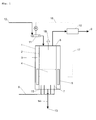
- Fig. 1 shows a sketch of the fluidized bed reactor.
- the fluidized bed reactor consists of a container 1, in which a reactor tube 2 is inserted.
- the fluidized bed is heated by means of a heating device 5 .
- the Switzerland Ceibonase 6 are fed to the reactor via Werner the reactor bottom 15 . They are specifically dosed via nozzles 7 into the reactor interior.
- the reactor exhaust 9 is withdrawn.
- a pyrometer 18 is mounted for measuring the fluidized bed temperature.
- seed particles 12 are fed to the reactor at the reactor head 8 .
- the polysilicon granulate product 13 is removed via a removal line 14 at the reactor bottom 15 .
- Another control system 17 is located between the gas chromatograph 10 and the heating device 5.
- a gas chromatograph As a measuring device for the exhaust gas analysis, a gas chromatograph is used.
- the controlled variable HCl content used in the control section is measured via the online analysis by means of gas chromatograph 10 and output in the unit "vol.% Of the reactor exhaust gas flow".
- the temperature is measured by means of pyrometer 18.
- the determination of the chlorine content in the bulk of the polysilicon is carried out by instrumental neutron activation analysis (INAA) (SEMI PV10).
- the chlorine content in bulk is measured in the unit "ppmw”. Also a measurement by means of X-ray fluorescence analysis (RFA) is possible.
- the nitrogen content in the bulk of the polysilicon is determined by secondary ion mass spectrometry (SIMS) (SEMI MF2139).
- SIMS secondary ion mass spectrometry
- the nitrogen content in bulk is measured in the unit "ppba”.
- the particle size and the particle size distribution of the seed particles and the product are determined by means of an optical particle size analyzer.
- an optical particle size analyzer For this the dynamic image analysis according to the standard ISO / DIS 13322-2 is used.
- the characteristic particle size used is the mass-median value x 50.3 .
- CV Coefficient of Variation
- the sphericity is determined by dynamic image analysis according to the standard ISO / DIS 13322-2.
- the convexity is also determined by dynamic image analysis according to ISO / DIS 13322-2.
- the convex surface is pictorially obtained when the particle is wrapped in a band and no invaginations are present.
- the determination of the surface roughness is carried out by means of measurement with white light interferometry and corresponding evaluation according to EN ISO 4287.
- Color measurement is carried out according to standard DIN 5033-1 to -4.
- the characteristic for the color is the HSL color space with the hue H, the saturation S and the relative brightness L.
- the three parameters H, S and L can each have a value range from 0 to 255, whereby only integer values are permissible.
- the measurements can z. B. with the spectrophotometer PCE-RGB 2 from. PCE Germany GmbH are performed.
- starting material in the form of silicon seed particles is introduced.
- the heating power is increased.
- the energy supplied to the interior of the reactor by the radiant heater is increased.
- the energy increase takes place until a desired HCl content is present in the reactor offgas.
- the seed particle dosing rate is adjusted at the same time so that the desired particle size is present in the product.
- the reactor provides optimum product quality while ensuring that the reactor is stable, controlled and produces with a long run time.
- a stable product quality is characterized in that the chlorine content in the product is in the desired range.
- the controlled via a constant HCl value deposition process in addition to a low chlorine value surprisingly also has a very positive effect on other product parameters, such.
- the HCl content in the reactor exhaust gas 102 represents the controlled variable.
- the input variables for the controller 110 are the desired value of the HCl content in the reactor exhaust gas 104 and the actual value of the HCl content in the reactor exhaust gas 102.
- control works by changing the control variables.
- the manipulated variables used are the seed particle metering rate 120 and the reactor heating power 130.
- control variable heating power is also changed.
- the product quality is essentially characterized by the chlorine content.
- Fig. 3 the chlorine content in silicon is shown as a function of the HCl content in the reactor exhaust gas.
- the HCl content in the fluidized bed must be in the range 1.8 vol% ⁇ c (Cl) ⁇ 2.5 vol.%.
- Table 2 shows Examples 1-5 with all major process and product parameters.
- the examples were carried out in a reactor with a diameter of 400 mm.
- Reactor run time, seed particle dosing rate and reactor heat output are given as a percentage, with 100% of the reactor run time corresponding to 40 days, 100% to the seed particle dosing rate of 1.5 kg / hr and 100% to the reactor heat output of 130 kW.
- Examples 3-5 provide polycrystalline silicon granules having a high convexity and a low chlorine content.
- examples 3-5 are examples according to the invention.
- the method is optimally adjusted in terms of convexity and chlorine content by the control variable HCl, which lies within the desired range. The interaction of the manipulated variables seed particle dosing rate and reactor heat output is consistent.
- Example 4 differs from Example 3, inter alia, by the reactor life.
- the reactor run time is only 50% of the reactor run times of Examples 1 and 2.
- the reactor run time is 200% of the reactor run times of Examples 1 and 2.
- Example 5 also shows a somewhat shorter reactor run time than Example 4.
- Example 4 is thus the preferred variant with regard to the economic production of polycrystalline silicon granules.
- Example 1 describes a process in which the HCl concentration in the exhaust gas is too low at 1.4 vol.%. Consequently, as in Fig. 3 shown, the chlorine content in the product with 50 ppmw too high. Also, the product parameter convexity (value 0.65) is negatively influenced by the not optimally set operating point to lower values. The cause of the low HCl content is too low reactor heating power.
- Example 2 describes another method in which the HCl concentration in the exhaust gas with 1.5 vol.% Is also too low. The result is a likewise increased chlorine content of 48 ppmw and a reduced convexity of 0.68. The cause of the low HCl content is too high a seed particle dosing rate.
- Table 2 ⁇ / b> example 1 2 3 4 5 Reactor pressure / bar ü 2.4 2.4 2.4 2.4 2.4 Fluidized bed temperature / ° C 900 910 980 950 1000 Reactor heat output /% 75 120 150 120 120 120 Germ particle dosing rate /% 100 150 100 100 100 100 100 HCl concentration in the exhaust gas / vol.
Landscapes
- Chemical & Material Sciences (AREA)
- Organic Chemistry (AREA)
- Inorganic Chemistry (AREA)
- Engineering & Computer Science (AREA)
- Crystallography & Structural Chemistry (AREA)
- Materials Engineering (AREA)
- Metallurgy (AREA)
- Silicon Compounds (AREA)
Abstract
Description
- Die Erfindung betrifft ein polykristallines Siliciumgranulat und seine Herstellung.
- Polykristallines Siliciumgranulat oder kurz Polysilicium-Granulat ist eine Alternative zum im Siemens-Verfahren hergestellten Polysilicium. Während das Polysilicium im Siemens-Verfahren als zylindrischer Siliciumstab anfällt, der vor seiner Weiterverarbeitung zeit- und kostenaufwändig zu so genanntem Chippoly zerkleinert und ggf. wiederum aufgereinigt werden muss, besitzt Polysilicium-Granulat Schüttguteigenschaften und kann direkt als Rohmaterial z. B. zur Einkristallerzeugung für die Photovoltaik- und Elektronikindustrie eingesetzt werden.
- Polysilicium-Granulat wird in einem Wirbelschichtreaktor produziert. Dies geschieht durch Fluidisierung von Siliciumpartikeln mittels einer Gasströmung in einer Wirbelschicht, wobei diese über eine Heizvorrichtung auf hohe Temperaturen aufgeheizt wird. Durch Zugabe eines siliciumhaltigen Reaktionsgases erfolgt eine Pyrolysereaktion an der heißen Partikeloberfläche. Dabei scheidet sich elementares Silicium auf den Siliciumpartikeln ab und die einzelnen Partikel wachsen im Durchmesser an. Durch den regelmäßigen Abzug von angewachsenen Partikeln und Zugabe kleinerer Siliciumpartikel als Keimpartikel kann das Verfahren kontinuierlich mit allen damit verbundenen Vorteilen betrieben werden. Als siliciumhaltiges Eduktgas können Silicium-Halogenverbindungen (z. B. Chlorsilane oder Bromsilane), Monosilan (SiH4), sowie Mischungen dieser Gase mit Wasserstoff zum Einsatz kommen. Derartige Abscheideverfahren und Vorrichtungen hierzu sind beispielsweise aus
US2008299291 bekannt. - Von großer Bedeutung für die Performance von Polysilicium-Granulat in seinen Anwendungen ist ein definierter, konstant niedriger Halogengehalt.
- Unter Performance ist z. B. die Vermeidung von Spritzeffekten beim Kristallziehen zu verstehen.
- Halogene wie Chlor stellen eine Hauptverunreinigung bei der Polysiliciumherstellung dar, wenn als Precursor Halogensilane wie Trichlorsilan verwendet werden, in denen Halogene in großen Mengen vorhanden sind.
- Es ist bekannt, dass der sich im Polysilicium-Produkt einstellende Chlorgehalt von den Prozessbedingungen im Wirbelschichtreaktor abhängt.
- So ist aus
US5077028 bereits bekannt, dass mit steigender linearer Wachstumsgeschwindigkeit ein niedrigerer Chlorgehalt im Produkt erhalten werden kann. Es ist möglich, Polysilicium-Granulat mit einem Chlorgehalt von weniger als 20 ppmw bei einer Kristallwachstumsgeschwindigkeit von größer als 0,4 µm/min herzustellen. Um eine solche Kristallwachstumsgeschwindigkeit sicherzustellen, sind Temperatur und Verweilzeit entsprechend einzustellen. Durch einen Chlorgehalt von weniger als 20 ppmw ist sichergestellt, dass keine Spritzeffekte beim Kristallziehen auftreten. -
US5037503 offenbart die Herstellung von Silicium-Einkristallen unter Verwendung von Polysilicum-Granulat mit einem Chlorgehalt von weniger als 15 ppmw (Abscheidung mit Trichlorsilan) oder einem Wasserstoffgehalt von 7,5 ppmw (Abscheidung mit Silan). Bei Verwendung eines solchen Polysilicium-Granulats treten keine Spritzeffekte beim Kristallziehen auf. -
US6007869 beansprucht Polysilicium-Granulat mit einem Chlorgehalt von 6 - 47 ppmw. Durch den niedrigen Chlorgehalt werden negative Effekte beim CZ-Ziehen, wie schlechte Monokristallqualität, Spritzeffekte und Bildung von korrosiven Gasen vermieden. Zur Herstellung des Polysilicium-Granulats muss eine Reaktionsgastemperatur von größer als 900 °C und eine Partikeltemperatur von größer als 1000 °C gewählt werden. - Im Stand der Technik wird in diversen Produktionsverfahren eine Online-Analytik zur Prozesskontrolle eingesetzt.
-
DE102009043946 offenbart ein Verfahren zur Steuerung einer Anlage für die Herstellung von polykristallinem Silizium, wobei die Anlage mindestens einen Reaktor mit mindestens einer Zuleitung und einer Ableitung für ein Gasgemisch umfasst, gekennzeichnet durch die folgenden Schritte: - dass aus der Zuleitung und der Ableitung eines jeden Reaktors Messproben entnommen werden;
- dass die entnommenen Messproben mindestens einem Gaschromatographen über jeweils eine Leitung zugeführt werden;
- dass an Hand der vom Gaschromatographen gewonnenen Messwerte hinsichtlich der Zusammensetzung der zugeführten Messproben Steuersignale gewonnen werden; und
- dass an Hand der gewonnenen Steuersignale mittels einer Steuer- und Regeleinheit über Stellelemente eine Vielzahl von Parametern des mindestens einen Reaktors derart eingestellt werden, dass die Effizienz der Anlage automatisch in ein Produktionsoptimum geführt wird.
-
US4148931A offenbart ein Verfahren zur Abscheidung von elementarem Silicium von einem reaktiven Gas aus einer Mischung aus einem Halogensilan und Wasserstoff an erhitzten Trägerkörpern (Siemens-Prozess), wobei eine Überwachung der Konzentration von Halogenwasserstoff in einem Abgas vorgenommen und zur Kontrolle der Zufuhr des reaktiven Gases verwendet wird, um den Durchfluss von Reaktionsgas derart zu regulieren, dass die Konzentration des Halogenwasserstoffs im Abgas zeitlich im Wesentlichen konstant bleibt. Dabei wird der Gehalt an Halogenwasserstoff im Abgas als Regelgröße zur Steuerung der Stellgröße des Zugasstromes verwendet. Ziel ist die Aufrechterhaltung einer über den Reaktionsprozess konstant bleibenden spezifischen Abscheiderate. - Es hat sich gezeigt, dass die zuvor genannten Verfahren zu Polysilicium führen, das beim Kristallziehen aufgrund des niedrigen Chlorgehalts zwar Spritzeffekte vermeidet, jedoch teilweise Stapelfehler verursacht.
- Außerdem sind die Schüttguteigenschaften und die Fluidisierungseigenschaften der Partikel bzw. in weitaus bedeutenderem Maße auch des Chippolys unbefriedigend.
- Ein weiterer Nachteil tritt bei der Temperaturmessung der Wirbelschicht auf. Aufgrund von Staubbildung wird die Temperaturmessung gestört und kann nicht als Regelgröße zur Steuerung des Reaktors hinsichtlich einer stabilen Produktqualität verwendet werden.
- Aus der beschriebenen Problematik ergab sich die Aufgabenstellung der vorliegenden Erfindung.
- Die Aufgabe der Erfindung wird gelöst durch ein polykristallines Siliciumgranulat mit einem Chlorgehalt von 10-40 ppmw, wobei es sich um Partikel mit einer Konvexität von 0,850 - 1,000 handelt.
- Besonders bevorzugt handelt es sich um Partikel mit einer Konvexität von 0,990 - 1,000.
- Durch eine solche Konvexität ergeben sich optimale Schüttguteigenschaften und Fluidisierungseigenschaften des polykristallinen Siliciumgranulats. Außerdem lässt sich die Bildung von Agglomeraten und damit das Entstehen von Verunreinigungs-Einschlüssen vermeiden.
- Bevorzugt besitzen die polykristallinen Siliciumgranulatpartikel eine mittlere Oberflächenrauhigkeit Ra von kleiner als 50 nm.
- Vorzugsweise weist das polykristalline Siliciumgranulat einen Stickstoffgehalt von 10-2000 ppba, besonders bevorzugt 10-100 ppba auf.
- Durch ein polykristallines Siliciumgranulat mit einem Stickstoffgehalt kleiner 2000 ppba werden Stapelfehler beim Kristallziehen vermieden.
- Außerdem treten beim CZ-Ziehen bereits keinerlei Spritzeffekte auf, wenn der Chlorgehalt im Bereich 10-40 ppmw liegt.
- Weiterhin weist das polykristalline Siliciumgranulat eine Partikelgröße von 150 bis 10000 µm auf, wobei der massenbezogene Medianwert der Verteilung zwischen 850 und 2000 µm liegt.
- Vorzugsweise weist die Partikelgrößenverteilung des polykristallinen Siliciumgranulats eine Breite von 0,4 < CV < 0,7 auf. CV bezeichnet einen Variationskoeffizienten.
- Die zuvor genannten Partikelgrößen und Partikelgrößenverteilung erlauben ein leichteres Handling der Partikel bei der Bestückung des Tiegels im CZ-Verfahren bzw. beim Nachchargieren von Polysilicium-Granulat. Zudem werden auch dadurch Spritzeffeke beim CZ-Verfahren vermieden.
- Vorzugsweise weist das polykristalline Siliciumgranulat eine Sphärizität von 0,750 - 1,000 auf.
- Besonders bevorzugt ist eine Sphärizität von 0,900 - 0,999.
- Ganz besonders bevorzugt ist eine Sphärizität von 0,995 - 0,999.
- Vorzugsweise ist das polykristalline Siliciumgranulat gekennzeichnet durch eine Farbe nach dem HSL-Farbraum von 0 < H < 255, 0 < S < 13 und 90 < L < 200.
- Die Aufgabe der Erfindung wird auch gelöst durch ein Verfahren zur Herstellung von polykristallinem Siliciumgranulat in einem Wirbelschichtreaktor, umfassend Fluidisierung von Siliciumkeimpartikeln mittels einer Gasströmung in einer Wirbelschicht, die mittels einer Heizvorrichtung aufgeheizt wird, wobei durch Zugabe eines silicium- und halogenhaltigen Reaktionsgases mittels Pyrolyse elementares Silicium an den heißen Keimpartikeloberflächen abgeschieden wird, wodurch das polykristalline Siliciumgranulat entsteht, wobei durch Abscheidung im Durchmesser angewachsene Partikel und ein Abgas enthaltend Halogenwasserstoff aus dem Reaktor abgeführt und frische Keimpartikel zudosiert werden, dadurch gekennzeichnet, dass als Regelgröße die Konzentration von Halogenwasserstoff im Abgas bestimmt und als Stellgrößen eine Rate der Zudosierung frischer Keimpartikel und eine Heizleistung der Heizvorrichtung gesteuert werden, um die Halogenwasserstoff-Konzentration im Abgas während des Betriebs in einem zuvor definierten Bereich zu halten, weiterhin gekennzeichnet dadurch, dass es sich beim polykristallinen Siliciumgranulat um Partikel mit einer Konvexität von 0,850 - 1,000 handelt.
- Die Wachstumsgeschwindigkeit der Partikel wird durch die Zudosierungsrate und die Heizleistung bestimmt und durch eine externe Regelgröße, nämlich die Konzentration von Halogenwasserstoff im Reaktorabgas geregelt.
- Falls als silicium- und halogenhaltiges Reaktionsgas Trichlorsilan verwendet wird, was bevorzugt ist, entsteht bei der Abscheidereaktion HCl. In diesem Fall dient die HCl-Konzentration im Abgas als Regelgröße.
- Durch die Regelung lässt sich der Chlorgehalt im Siliciumgranulat auf 10 bis 50 ppmw einstellen.
- Bevorzugt ist ein Chlorgehalt im polykristallinen Siliciumgranulat von 10 bis 40 ppmw, besonders bevorzugt 10-25 ppmw.
- Die Temperatur der Wirbelschicht im Reaktionsbereich beträgt bevorzugt von 850°C bis 1100°C, besonders bevorzugt von 900°C bis 1050 °C, ganz besonders bevorzugt von 920°C bis 970°C.
- Zur Fluidisierung der Keimpartikel wird vorzugsweise Wasserstoff verwendet.
- Das Reaktionsgas kann über eine oder mehrere Düsen in die Wirbelschicht eingedüst werden.
- Die lokalen Gasgeschwindigkeiten am Austritt der Düsen betragen vorzugsweise 1 bis 160 m/s.
- Die Konzentration des siliciumhaltigen Reaktionsgases beträgt bezogen auf die gesamte Gasmenge durch die Wirbelschicht vorzugsweise 10 mol% bis 50 mol%, besonders bevorzugt 15 mol% bis 40 mol%.
- Die Konzentration des siliciumhaltigen Reaktionsgases in der Reaktionsgasdüse beträgt bezogen auf die gesamte Gasmenge durch die Reaktionsgasdüsen vorzugsweise 20 mol% bis 80 mol%, besonders bevorzugt 30 mol% bis 60 mol%.
- Das Bettgewicht beträgt vorzugsweise 100 bis 200 kg.
- Die zu steuernde Reaktorheizleistung bewegt sich vorzugsweise von 100 bis 200 kW.
- Der Reaktordruck bewegt sich im Bereich von 0 bis 7 bar Überdruck, vorzugsweise im Bereich 0,5 bis 3,5 bar Überdruck.
- Die zu steuernde Keimpartikel-Dosierrate bewegt sich vorzugsweise von 1,0 bis 2,5 kg/h.
- Bei einem Reaktor mit einem Durchmesser von z. B. 400 mm beträgt der Massenstrom an Trichlorsilan vorzugsweise 200 bis 400 kg/h. Der Wasserstoffvolumenstrom beträgt vorzugsweise 100 bis 300 Nm3/h. Für größere Reaktoren sind höhere Mengen an TCS und H2 bevorzugt. Dem Fachmann ist klar, dass einige Prozessparameter idealerweise abhängig von der Reaktorgröße ausgewählt werden. Auch Reaktorheizleistung, Keimpartikel-Dosierrate und das Bettgewicht sind bei größeren Reaktoren z. B. bei einem Reaktor mit 600 mm Durchmesser vorzugsweise höher als die zuvor genannten Werte.
- Der mittlere Durchmesser der Keimpartikel beträgt vorzugsweise mindestens 400 µm.
- Die Verweilzeit des Reaktionsgases in der Wirbelschicht beträgt vorzugsweise 0,1 bis 10 s, besonders bevorzugt 0,2 -5 s.
- Es hat sich gezeigt, dass eine stabile und lange Reaktorlaufzeit mit dem Verfahren bewerkstelligt werden kann, was besonders vorteilhaft ist. Überraschenderweise führt ein stabiler Prozess zu einem polykristallinen Siliciumgranulat mit verbesserter Konvexität. Es resultiert kugelförmiges Siliciumgranulat mit niedriger mittlerer Oberflächenrauhigkeit.
- Eine Überhitzung des Reaktors kann durch Überwachung der HCl-Konzentration im Abgas vermieden werden.
- Im Folgenden wird die Erfindung anhand der
Fig. 1 bis 3 näher erläutert. -
Fig. 1 zeigt einen Reaktor zur Durchführung des Verfahrens. -
Fig. 2 zeigt schematisch die Regelung. -
Fig. 3 zeigt den Chlorgehalt im Silicium als Funktion des HCl-Gehalts im Reaktorabgas. - Im Rahmen dieser Erfindung wird das Polysilicium-Granulat in einem Wirbelschichtreaktor hergestellt.
-
Fig. 1 zeigt eine Skizze des Wirbelschichtreaktors. - Der Wirbelschichtreaktor besteht aus einem Behälter 1, in den ein Reaktorrohr 2 eingesetzt ist.
- Zwischen der Innenwand des Behälters und der Außenwand des Reaktorrohrs befindet sich ein Zwischenraum 3.
- Im Inneren des Reaktorrohres befindet sich die Wirbelschicht 4 mit dem Polysilicium-Granulat.
- Die Wirbelschicht wird mittels einer Heizvorrichtung 5 geheizt.
- Die Zugase 6 werden dem Reaktor über Zugasleitungen am Reaktorboden 15 zugeführt. Sie werden dabei gezielt über Düsen 7 ins Reaktorinnere dosiert.
- Am Reaktorkopf 8 wird das Reaktorabgas 9 abgezogen.
- In der Abgasleitung befindet sich ein Gaschromatograph 10 zur Online-Analytik.
- Am Reaktorkopf 8 ist ein Pyrometer 18 zur Messung der Wirbelschicht-Temperatur angebracht.
- Über eine Zuführeinrichtung 11 werden dem Reaktor Keimpartikel 12 am Reaktorkopf 8 zugeführt.
- Das Polysilicium-Granulat-Produkt 13 wird über eine Entnahmeleitung 14 am Reaktorboden 15 entnommen.
- Zwischen dem Gaschromatographen 10 und der Zuführeinrichtung 11 für Keimpartikel besteht eine Regelstrecke 16.
- Eine weitere Regelstrecke 17 befindet sich zwischen dem Gaschromatographen 10 und der Heizvorrichtung 5.
- Um den Prozess zu überwachen, werden während des Reaktorbetriebs verschiedene Parameter direkt bzw. indirekt gemessen.
- Im Reaktorabgas werden über die Online-Analytik alle Abgase der Abscheidereaktion detektiert und quantifiziert.
- Diese sind hauptsächlich Chlorsilane, Chlorwasserstoff und Wasserstoff.
- Als Messeinrichtung für die Abgasanalytik wird ein Gaschromatograph verwendet.
- Die in der Regelungsstrecke verwendete Regelgröße HCl-Gehalt wird über die Online-Analytik mittels Gaschromatograph 10 gemessen und in der Einheit "vol.% des Reaktorabgasstromes" ausgegeben.
- Im Reaktorinneren wird die Temperatur mittels Pyrometer 18 gemessen.
- Die Bestimmung des Chlorgehalts im bulk des Polysiliciums erfolgt durch instrumentelle Neutronenaktivierungsanalyse (INAA) (SEMI PV10). Der Chlorgehalt im bulk wird in der Einheit "ppmw" gemessen. Auch eine Messung mittels Röntgenfluoreszenzanalyse (RFA) ist möglich.
- Die Bestimmung des Stickstoffgehalts im bulk des Polysiliciums erfolgt durch Sekundärionen-Massenspektrometrie (SIMS) (SEMI MF2139). Der Stickstoffgehalt im bulk wird in der Einheit "ppba" gemessen.
- Die Partikelgröße und die Partikelgrößenverteilung der Keimpartikel und des Produkts werden mittels eines optischen Partikelgrößenanalysators bestimmt. Hierzu wird die dynamische Bildanalyse nach der Norm ISO/DIS 13322-2 verwendet. Als charakteristische Partikelgröße wird der massenbezogene Medianwert x50,3 verwendet.
- Zur Charakterisierung der Breite der Partikelgrößenverteilung wird der Variationskoeffizient ("Coefficient of Variation", CV) verwendet, der wie folgt definiert ist:

und der massenbezogenen Partikelgröße bei einem Durchgang von 16 % x16,3. - Die Sphärizität wird über dynamische Bildanalyse nach der Norm ISO/DIS 13322-2 bestimmt.
- Die Sphärizität ist wie folgt definiert:

- Die Konvexität wird ebenfalls über dynamische Bildanalyse nach der Norm ISO/DIS 13322-2 bestimmt.
- Die Konvexität ist wie folgt definiert:

- Die konvexe Fläche wird bildhaft erhalten, wenn man das Partikel mit einem Band umspannt und keine Einstülpungen vorhanden sind.
- Die Bestimmung der Oberflächenrauhigkeit erfolgt dabei mittels Messung mit Weißlichtinterferometrie und entsprechender Auswertung nach EN ISO 4287.
- Die Farbmessung wird nach der Norm DIN 5033-1 bis -4 durchgeführt.
- Als Kenngröße für die Farbe dient der HSL-Farbraum mit dem Farbton (engl.: hue) H, der Sättigung (engl.: saturation) S und der relativen Helligkeit (engl.: lightness) L.
- Die Angabe der Farbe erfolgt in der Form:

- Die drei Parameter H, S und L können jeweils einen Wertebereich von 0 bis 255 einnehmen, wobei nur Integer-Werte zulässig sind.
- Die Messungen können z. B. mit dem Spektralphotometer PCE-RGB 2 der Fa. PCE Deutschland GmbH durchgeführt werden.
- Im Wirbelschichtreaktor wird Startmaterial in Form von Siliciumkeimpartikeln vorgelegt.
- In einer Aufheizphase wird die Heizleistung erhöht. Es wird somit die Energie, die dem Reaktorinneren durch den Strahlungsheizer zugeführt wird, erhöht.
- Die Energieerhöhung erfolgt solange, bis im Reaktorabgas ein gewünschter HCl-Gehalt vorliegt.
- Außerdem wird gleichzeitig die Keimpartikel-Dosierrate so eingestellt, dass die gewünschte Partikelgröße im Produkt vorliegt.
- Befinden sich beide Regelgrößen - HCl-Gehalt im Reaktorabgas und Partikelgröße des Produkts - im Sollbereich, dann hat der Wirbelschichtreaktor den stationären Zustand erreicht.
- In diesem Zustand liefert der Reaktor eine optimale Produktqualität und es ist gleichzeitig gewährleistet, dass der Reaktor stabil, kontrolliert und mit einer langen Laufzeit produziert.
- Eine stabile Produktqualität ist dadurch gekennzeichnet, dass sich der Chlorgehalt im Produkt im gewünschten Bereich befindet.
- Überschreitet die Regelgröße HCl-Gehalt einen bestimmten Grenzwert, dann fällt der Reaktor frühzeitig aufgrund eines zu hohen Temperaturniveaus aus.
- Unterschreitet die Regelgröße HCl-Gehalt wiederum einen bestimmten Grenzwert, dann führt dies zu unerwünscht hohen Chlorgehalten im Produkt.
- Der über einen konstanten HCl-Wert gesteuerte Abscheideprozess wirkt sich neben einem niedrigen Chlorwert überraschenderweise auch sehr positiv auf weitere Produktparameter, wie z. B. Konvexität, Stickstoffgehalt, Partikelgröße, Partikelgrößenverteilung, Sphärizität und Farbe aus.
- Um die Produktqualität, also z. B. den Chlorgehalt im Produkt konstant zu halten, wird eine Regelungscharakteristik verwendet.
- Diese Regelung ist in
Fig. 2 schematisch dargestellt. - Auf die Regelstrecke 100 wirken Störgrößen 101 wie z. B. eine schwankende Keimpartikel-Dosierrate, Entmischungsvorgänge im Keimpartikel-Vorlagebehälter oder schwankende Heizleistungen.
- Der HCl-Gehalt im Reaktorabgas 102 stellt die Regelgröße dar.
- Er wird über den Gaschromatographen der Online-Analytik 103 gemessen.
- Die Eingangsgrößen für den Regler 110 sind der Sollwert des HCl-Gehalts im Reaktorabgas 104 und der Istwert des HCl-Gehalts im Reaktorabgas 102.
- Bei einer Regelabweichung wirkt die Regelung durch Veränderung der Stellgrößen. Als Stellgrößen werden die Keimpartikel-Dosierrate 120 und die Reaktorheizleistung 130 verwendet.
- Im primären Regelkreis wird nur die Keimpartikel-Dosierrate verändert.
- Überschreitet die Regelabweichung einen definierten Grenzwert, dann wird zusätzlich die Stellgröße Heizleistung verändert.
- Ist der HCl-Istwert z. B. zu gering, wird die Keimpartikel-Dosierrate erniedrigt.
- Unterschreitet der HCl-Istwert zusätzlich einen minimalen Grenzwert, dann wird darüber hinaus die Reaktorheizleistung angehoben.
- Ist im Gegensatz dazu der HCl-Istwert zu hoch, wird die Keimpartikel-Dosierrate erhöht.
- Überschreitet der HCl-Istwert zusätzlich einen maximalen Grenzwert, dann wird darüber hinaus die Reaktorheizleistung erniedrigt.
- Die Abscheidung des granularen Polysiliciums kann neben dem Precursor SiHCl3 auch durch Precursoren aus dem Bereich weiterer Trihalogensilane SiHX3 mit X = F, Br, J erfolgen.
- Daher werden bei der Durchführung des Verfahrens als Regelgrößen allgemein Abgaskonzentrationen von Wasserstoffhalogeniden HX mit X = F, Cl, Br, J verwendet.
- Die Produktqualität ist bei Verwendung von SiHCl3 zur Abscheidung im Wesentlichen durch den Chlorgehalt geprägt.
- Werden weitere Trihalogensilane SiHX3 mit X = F, Br, J als Precursoren verwendet, dann hat dies dementsprechend eine Auswirkung auf Produktqualitäten, wie Fluorgehalt, Bromgehalt oder Jodgehalt des Polysiliciums.
- Um die Performance (z. B. Spritzen) des im Rahmen dieser Erfindung hergestellten Polysilicium-Granulats zu untersuchen, wurden Czochralski-Versuche durchgeführt.
- Die Versuchsparameter sind in Tabelle 1 zusammengefasst.
Tabelle 1 Tiegelbefüllung 40 % Polysilicium-Granulat, 60 % Siemens-Polysilicium Aufheizrampe Aufschmelzen in 5 h linear auf 1500 °C Ziehtemperatur 1430 °C Ziehgeschwindigkeit 1,4 mm/min Druck 980 mbar Gasatmosphäre Argon - In
Fig. 3 ist der Chlorgehalt im Silicium als Funktion des HCl-Gehalts im Reaktorabgas dargestellt. - Mit steigendem HCl-Gehalt im Reaktorabgas nimmt der Chlorgehalt im Silicium in einem näherungsweise linearen Zusammenhang ab. Es besteht somit die Möglichkeit, durch definierte Einstellung und Kontrolle eines HCl-Wertes einen definierten Chlorgehalt im Produkt zu erzielen.
- Für einen beispielhaften Chlorbereich von 20 ppmw < c(Cl) < 40 ppmw, bei dem bekannt ist, dass das beim Kristallziehen eingesetzte Silicium nicht zum Spritzen neigt, muss demnach der HCl-Gehalt bei der Wirbelschichtabscheidung im Bereich 1,8 vol.% < c(Cl) < 2,5 vol.% gehalten werden.
- Tabelle 2 zeigt Beispiele 1- 5 mit allen wesentlichen Verfahrens- und Produktparametern.
- Die Beispiele wurden in einem Reaktor mit einem Durchmesser von 400 mm durchgeführt.
- Reaktorlaufzeit, Keimpartikeldosierrate und Reaktorheizleistung sind prozentual angegeben, wobei 100% der Reaktorlaufzeit 40 Tage, 100% der Keimpartikeldosierrate 1,5 kg/h und 100% der Reaktorheizleistung 130 kW entsprechen.
- Nur die Beispiele 3-5 liefern polykristallines Siliciumgranulat mit einer hohen Konvexität und einem niedrigen Chlorgehalt. Bezüglich Konvexität und Chlorgehalt im Produkt handelt es sich demnach nur bei den Beispielen 3-5 um erfindungsgemäße Beispiele. Bei diesen Beispielen ist das Verfahren hinsichtlich Konvexität und Chlorgehalt durch die im Sollbereich liegende Regelgröße HCl optimal eingestellt. Das Zusammenspiel der Stellgrößen Keimpartikel-Dosierrate und Reaktorheizleistung ist stimmig.
- Beispiel 4 unterscheidet sich von Beispiel 3 unter anderem durch die Reaktorlaufzeit. Bei Beispiel 3 beträgt die Reaktorlaufzeit nur 50 % der Reaktorlaufzeiten von Beispiel 1 und 2. Bei Beispiel 4 hingegen beträgt die Reaktorlaufzeit 200 % der Reaktorlaufzeiten von Beispiel 1 und 2.
- Beispiel 5 zeigt ebenfalls eine etwas kürzere Reaktorlaufzeit als Beispiel 4.
- Beispiel 4 ist damit bezüglich der wirtschaftlichen Herstellung von polykristallinem Siliciumgranulat die bevorzugte Variante.
- Beispiel 1 beschreibt ein Verfahren, bei dem die HCl-Konzentration im Abgas mit 1,4 Vol.% zu gering ist. Folglich ist, wie in
Fig. 3 gezeigt, der Chlorgehalt im Produkt mit 50 ppmw zu hoch. Auch der Produktparameter Konvexität (Wert 0,65) wird durch den nicht optimal eingestellten Betriebspunkt zu geringeren Werten hin negativ beeinflusst. Die Ursache für den geringen HCl-Gehalt ist eine zu geringe Reaktorheizleistung. - Beispiel 2 beschreibt ein weiteres Verfahren, bei dem die HCl-Konzentration im Abgas mit 1,5 Vol.% ebenfalls zu gering ist. Die Folge ist ein ebenfalls erhöhter Chlorgehalt von 48 ppmw und eine verringerte Konvexität von 0,68. Die Ursache für den geringen HCl-Gehalt ist eine zu hohe Keimpartikel-Dosierrate.
Tabelle 2 Beispiel 1 2 3 4 5 Reaktordruck / bar ü 2,4 2,4 2,4 2,4 2,4 Wirbelschichttemperatur / °C 900 910 980 950 1000 Reaktorheizleistung / % 75 120 150 120 120 Keimpartikel-Dosierrate / % 100 150 100 100 100 HCl-Konzentration im Abgas / vol. % 1,4 1,5 2,5 2,1 2,4 Konvexität / - 0,65 0,68 0,990 0,999 0,999 N-Konzentration / ppba 2120 2120 100 20 10 Cl-Konzentration / ppmw 50 48 20 25 10 Partikelgröße / µm 1220 1258 1250 1350 1350 Partikelgrößenverteilung CV 0,62 0,62 0,62 0,62 0,62 Sphärizität / - 0,950 0,950 0,75 1,000 1,000 Farbe / <H, S, L> <50, 10, 120> <50, 10, 120> <50, 10, 120> <50, 10, 120> <50, 10, 120> Reaktorlaufzeit / % 100 100 50 200 175
Claims (10)
- Polykristallines Siliciumgranulat mit einem Chlorgehalt von 10-40 ppmw, wobei es sich um Partikel mit einer Konvexität von 0,850 - 1,000 handelt.
- Polykristallines Siliciumgranulat nach Anspruch 1 mit Partikeln einer Konvexität von 0,990-1,000.
- Polykristallines Siliciumgranulat nach einem der Ansprüche 1 oder 2, mit einem Chlorgehalt von 10-25 ppmw.
- Polykristallines Siliciumgranulat nach einem der Ansprüche 1 bis 3, gekennzeichnet durch einen Stickstoffgehalt von 10-100 ppba.
- Polykristallines Siliciumgranulat nach einem der Ansprüche 1 bis 4, wobei die Partikel verschiedene Größen von 150-10000 µm aufweisen, und wobei ein massenbezogener Medianwert einer Partikelgrößenverteilung 850-2000 µm beträgt.
- Polykristallines Siliciumgranulat nach Anspruch 5, wobei ein Variationskoeffizient der Partikelgrößenverteilung 0,4 bis 0,7 beträgt.
- Verfahren zur Herstellung von polykristallinem Siliciumgranulat in einem Wirbelschichtreaktor, umfassend Fluidisierung von Siliciumkeimpartikeln mittels einer Gasströmung in einer Wirbelschicht, die mittels einer Heizvorrichtung aufgeheizt wird, wobei durch Zugabe eines silicium- und halogenhaltigen Reaktionsgases mittels Pyrolyse elementares Silicium an den heißen Keimpartikeloberflächen abgeschieden wird, wodurch das polykristalline Siliciumgranulat entsteht, wobei durch Abscheidung im Durchmesser angewachsene Partikel und ein Abgas enthaltend Halogenwasserstoff aus dem Reaktor abgeführt und frische Keimpartikel zudosiert werden, dadurch gekennzeichnet, dass als Regelgröße die Konzentration von Halogenwasserstoff im Abgas bestimmt und als Stellgrößen eine Rate der Zudosierung frischer Keimpartikel und eine Heizleistung der Heizvorrichtung gesteuert werden, um die Halogenwasserstoff-Konzentration im Abgas während des Betriebs in einem zuvor definierten Bereich zu halten, weiterhin gekennzeichnet dadurch, dass es sich beim polykristallinen Siliciumgranulat um Partikel mit einer Konvexität von 0,850 - 1,000 handelt.
- Verfahren nach Anspruch 7, wobei es sich beim Reaktionsgas um Trichlorsilan handelt und die HCl-Konzentration im Abgas bestimmt wird.
- Verfahren nach Anspruch 8, wobei das hergestellte polykristalline Siliciumgranulat einen Chlorgehalt von 10-40 ppmw aufweist.
- Verfahren nach Anspruch 9, wobei die HCl-Konzentration im Abgas zwischen 1,8-2,5 vol.% gehalten wird und das hergestellte polykristalline Siliciumgranulat einen Chlorgehalt von 10-25 ppmw aufweist.
Applications Claiming Priority (1)
| Application Number | Priority Date | Filing Date | Title |
|---|---|---|---|
| DE102012206439A DE102012206439A1 (de) | 2012-04-19 | 2012-04-19 | Polykristallines Siliciumgranulat und seine Herstellung |
Publications (3)
| Publication Number | Publication Date |
|---|---|
| EP2653446A2 true EP2653446A2 (de) | 2013-10-23 |
| EP2653446A3 EP2653446A3 (de) | 2014-08-20 |
| EP2653446B1 EP2653446B1 (de) | 2016-06-01 |
Family
ID=48182728
Family Applications (1)
| Application Number | Title | Priority Date | Filing Date |
|---|---|---|---|
| EP13163980.9A Not-in-force EP2653446B1 (de) | 2012-04-19 | 2013-04-16 | Polykristallines siliciumgranulat und seine herstellung |
Country Status (8)
| Country | Link |
|---|---|
| US (1) | US8802046B2 (de) |
| EP (1) | EP2653446B1 (de) |
| JP (1) | JP5619945B2 (de) |
| KR (1) | KR101532477B1 (de) |
| CN (1) | CN103373730B (de) |
| CA (1) | CA2810165C (de) |
| DE (1) | DE102012206439A1 (de) |
| ES (1) | ES2588250T3 (de) |
Cited By (6)
| Publication number | Priority date | Publication date | Assignee | Title |
|---|---|---|---|---|
| WO2015197498A1 (de) * | 2014-06-24 | 2015-12-30 | Wacker Chemie Ag | Wirbelschichtreaktor und verfahren zur herstellung von polykristallinem siliciumgranulat |
| EP3253908A1 (de) * | 2015-02-05 | 2017-12-13 | Wacker Chemie AG | Verfahren zur herstellung von multikristallinem silicium |
| WO2018108257A1 (de) * | 2016-12-14 | 2018-06-21 | Wacker Chemie Ag | Verfahren zur herstellung von polykristallinem silicium |
| WO2018108258A1 (de) * | 2016-12-14 | 2018-06-21 | Wacker Chemie Ag | Verfahren zur herstellung von polykristallinem silicium |
| WO2019037850A1 (de) * | 2017-08-23 | 2019-02-28 | Wacker Chemie Ag | Wirbelschichtreaktor zur herstellung von polykristallinem siliciumgranulat |
| WO2022012755A1 (de) | 2020-07-17 | 2022-01-20 | Wacker Chemie Ag | Verfahren zur herstellung von polykristallinem siliciumgranulat |
Families Citing this family (9)
| Publication number | Priority date | Publication date | Assignee | Title |
|---|---|---|---|---|
| CN104803387B (zh) * | 2014-01-29 | 2017-03-22 | 新特能源股份有限公司 | 一种多晶硅还原炉的原料气进料量的控制装置 |
| CN104947187B (zh) * | 2014-03-31 | 2018-03-23 | 新特能源股份有限公司 | 一种硅片母合金的制备方法 |
| DE102014222865A1 (de) * | 2014-11-10 | 2016-05-12 | Wacker Chemie Ag | Wirbelschichtreaktor zur Herstellung von polykristallinem Siliciumgranulat und Verfahren zur Montage eines solchen Wirbelschichtreaktors |
| DE102016204651A1 (de) * | 2016-03-21 | 2017-09-21 | Wacker Chemie Ag | Quetschmanschetten für die Herstellung von Polysilicium-Granulat |
| US10287171B2 (en) | 2016-05-05 | 2019-05-14 | Rec Silicon Inc | Tumbling device for the separation of granular polysilicon and polysilicon powder |
| EP3880686B1 (de) * | 2019-06-14 | 2022-07-06 | Wacker Chemie AG | Verfahren zur herstellung von methylchlorsilanen mit strukturoptimierten silicium-partikeln |
| US20220274839A1 (en) * | 2019-07-16 | 2022-09-01 | Wacker Chemie Ag | Method for producing polycrystalline silicon |
| WO2021164846A1 (de) * | 2020-02-17 | 2021-08-26 | Wacker Chemie Ag | Anodenaktivmaterialien für lithium-ionen-batterien |
| JP7402714B2 (ja) * | 2020-03-05 | 2023-12-21 | 東洋エンジニアリング株式会社 | 流動床型造粒装置または流動床/噴流床型造粒装置 |
Citations (6)
| Publication number | Priority date | Publication date | Assignee | Title |
|---|---|---|---|---|
| US4148931A (en) | 1976-03-08 | 1979-04-10 | Siemens Aktiengesellschaft | Process for depositing elemental silicon semiconductor material from a gas phase |
| US5037503A (en) | 1988-05-31 | 1991-08-06 | Osaka Titanium Co., Ltd. | Method for growing silicon single crystal |
| US5077028A (en) | 1989-03-06 | 1991-12-31 | Osaka Titanium Co., Ltd. | Manufacturing high purity/low chlorine content silicon by feeding chlorosilane into a fluidized bed of silicon particles |
| US6007869A (en) | 1997-08-14 | 1999-12-28 | Wacker-Chemie Gmbh | Process for preparing highly pure silicon granules |
| US20080299291A1 (en) | 2007-05-04 | 2008-12-04 | Wacker Chemie Ag | Process For The Continuous Production Of Polycrystalline High-Purity Silicon Granules |
| DE102009043946A1 (de) | 2009-09-04 | 2011-03-17 | G+R Technology Group Ag | Anlage und Verfahren zur Steuerung der Anlage für die Herstellung von polykristallinem Silizium |
Family Cites Families (14)
| Publication number | Priority date | Publication date | Assignee | Title |
|---|---|---|---|---|
| DE2609564A1 (de) * | 1976-03-08 | 1977-09-15 | Siemens Ag | Verfahren zum abscheiden von elementarem silicium aus der gasphase |
| JPH0694367B2 (ja) * | 1990-01-19 | 1994-11-24 | 大阪チタニウム製造株式会社 | 多結晶シリコンの製造方法 |
| JPH05319989A (ja) * | 1991-03-13 | 1993-12-03 | Nkk Corp | 単結晶製造方法 |
| JP3737863B2 (ja) * | 1996-11-26 | 2006-01-25 | 株式会社トクヤマ | 粒状ポリシリコンの製造方法 |
| DE10124848A1 (de) * | 2001-05-22 | 2002-11-28 | Solarworld Ag | Verfahren zur Herstellung von hochreinem, granularem Silizium in einer Wirbelschicht |
| DE10359587A1 (de) * | 2003-12-18 | 2005-07-14 | Wacker-Chemie Gmbh | Staub- und porenfreies hochreines Polysiliciumgranulat |
| JP4831285B2 (ja) * | 2004-04-30 | 2011-12-07 | 三菱マテリアル株式会社 | 多結晶シリコンの製造方法 |
| US20060105105A1 (en) * | 2004-11-12 | 2006-05-18 | Memc Electronic Materials, Inc. | High purity granular silicon and method of manufacturing the same |
| DE102005042753A1 (de) * | 2005-09-08 | 2007-03-15 | Wacker Chemie Ag | Verfahren und Vorrichtung zur Herstellung von granulatförmigem polykristallinem Silicium in einem Wirbelschichtreaktor |
| KR100783667B1 (ko) * | 2006-08-10 | 2007-12-07 | 한국화학연구원 | 입자형 다결정 실리콘의 제조방법 및 제조장치 |
| DE102006062117A1 (de) * | 2006-12-22 | 2008-06-26 | Schott Solar Gmbh | Verfahren zum Herstellen kristallisierten Siliciums sowie kristallisiertes Silicium |
| EP2303448B1 (de) * | 2008-06-30 | 2012-10-31 | MEMC Electronic Materials, Inc. | Fliessbettreaktorsysteme und verfahren zur minimierung der ablagerung von silizium auf reaktorwänden |
| EP2433113B1 (de) * | 2009-05-22 | 2014-06-04 | Dow Corning Corporation | Quantitative messung von gasphasenprozess-zwischenprodukten mittels ramanspektroskopie |
| DE102010040293A1 (de) * | 2010-09-06 | 2012-03-08 | Wacker Chemie Ag | Verfahren zur Herstellung von polykristallinem Silicium |
-
2012
- 2012-04-19 DE DE102012206439A patent/DE102012206439A1/de not_active Withdrawn
-
2013
- 2013-03-21 CA CA2810165A patent/CA2810165C/en not_active Expired - Fee Related
- 2013-03-27 JP JP2013065611A patent/JP5619945B2/ja not_active Expired - Fee Related
- 2013-04-05 KR KR1020130037195A patent/KR101532477B1/ko not_active Expired - Fee Related
- 2013-04-12 US US13/861,950 patent/US8802046B2/en not_active Expired - Fee Related
- 2013-04-16 ES ES13163980.9T patent/ES2588250T3/es active Active
- 2013-04-16 EP EP13163980.9A patent/EP2653446B1/de not_active Not-in-force
- 2013-04-17 CN CN201310132657.9A patent/CN103373730B/zh not_active Expired - Fee Related
Patent Citations (6)
| Publication number | Priority date | Publication date | Assignee | Title |
|---|---|---|---|---|
| US4148931A (en) | 1976-03-08 | 1979-04-10 | Siemens Aktiengesellschaft | Process for depositing elemental silicon semiconductor material from a gas phase |
| US5037503A (en) | 1988-05-31 | 1991-08-06 | Osaka Titanium Co., Ltd. | Method for growing silicon single crystal |
| US5077028A (en) | 1989-03-06 | 1991-12-31 | Osaka Titanium Co., Ltd. | Manufacturing high purity/low chlorine content silicon by feeding chlorosilane into a fluidized bed of silicon particles |
| US6007869A (en) | 1997-08-14 | 1999-12-28 | Wacker-Chemie Gmbh | Process for preparing highly pure silicon granules |
| US20080299291A1 (en) | 2007-05-04 | 2008-12-04 | Wacker Chemie Ag | Process For The Continuous Production Of Polycrystalline High-Purity Silicon Granules |
| DE102009043946A1 (de) | 2009-09-04 | 2011-03-17 | G+R Technology Group Ag | Anlage und Verfahren zur Steuerung der Anlage für die Herstellung von polykristallinem Silizium |
Cited By (11)
| Publication number | Priority date | Publication date | Assignee | Title |
|---|---|---|---|---|
| WO2015197498A1 (de) * | 2014-06-24 | 2015-12-30 | Wacker Chemie Ag | Wirbelschichtreaktor und verfahren zur herstellung von polykristallinem siliciumgranulat |
| EP3253908A1 (de) * | 2015-02-05 | 2017-12-13 | Wacker Chemie AG | Verfahren zur herstellung von multikristallinem silicium |
| WO2018108257A1 (de) * | 2016-12-14 | 2018-06-21 | Wacker Chemie Ag | Verfahren zur herstellung von polykristallinem silicium |
| WO2018108258A1 (de) * | 2016-12-14 | 2018-06-21 | Wacker Chemie Ag | Verfahren zur herstellung von polykristallinem silicium |
| WO2019037850A1 (de) * | 2017-08-23 | 2019-02-28 | Wacker Chemie Ag | Wirbelschichtreaktor zur herstellung von polykristallinem siliciumgranulat |
| CN110770167A (zh) * | 2017-08-23 | 2020-02-07 | 瓦克化学股份公司 | 用于生产颗粒多晶硅的流化床反应器 |
| KR20200044078A (ko) * | 2017-08-23 | 2020-04-28 | 와커 헤미 아게 | 입상 다결정 실리콘의 제조를 위한 유동층 반응기 |
| US10974218B2 (en) | 2017-08-23 | 2021-04-13 | Wacker Chemie Ag | Fluidized bed reactor for production of granular polycrystalline silicon |
| CN110770167B (zh) * | 2017-08-23 | 2023-01-24 | 瓦克化学股份公司 | 用于生产颗粒多晶硅的流化床反应器 |
| WO2022012755A1 (de) | 2020-07-17 | 2022-01-20 | Wacker Chemie Ag | Verfahren zur herstellung von polykristallinem siliciumgranulat |
| US12509353B2 (en) | 2020-07-17 | 2025-12-30 | Wacker Chemie Ag | Process for producing polycrystalline silicon granulate |
Also Published As
| Publication number | Publication date |
|---|---|
| CA2810165A1 (en) | 2013-10-19 |
| US20130280533A1 (en) | 2013-10-24 |
| US8802046B2 (en) | 2014-08-12 |
| EP2653446B1 (de) | 2016-06-01 |
| CN103373730A (zh) | 2013-10-30 |
| KR20130118238A (ko) | 2013-10-29 |
| CA2810165C (en) | 2015-10-20 |
| CN103373730B (zh) | 2015-09-30 |
| JP2013224254A (ja) | 2013-10-31 |
| ES2588250T3 (es) | 2016-10-31 |
| EP2653446A3 (de) | 2014-08-20 |
| JP5619945B2 (ja) | 2014-11-05 |
| KR101532477B1 (ko) | 2015-06-29 |
| DE102012206439A1 (de) | 2013-10-24 |
Similar Documents
| Publication | Publication Date | Title |
|---|---|---|
| EP2653446B1 (de) | Polykristallines siliciumgranulat und seine herstellung | |
| EP2662334B1 (de) | Polykristallines siliciumgranulat und seine herstellung | |
| EP1544167B1 (de) | Staub- und porenfreies hochreines Polysiliciumgranulat | |
| EP2997175B1 (de) | Reaktor zur herstellung von polykristallinem silicium und verfahren zur entfernung eines silicium enthaltenden belags auf einem bauteil eines solchen reaktors | |
| DE19735378A1 (de) | Verfahren zur Herstellung von hochreinem Siliciumgranulat | |
| EP2794477B1 (de) | Polykristalliner siliciumstab und verfahren zur herstellung von polysilicium | |
| EP2662335B1 (de) | Polykristalliner siliciumstab und verfahren zu dessen herstellung | |
| EP3160903A1 (de) | Wirbelschichtreaktor und verfahren zur herstellung von polykristallinem siliciumgranulat | |
| EP2453042B1 (de) | Verfahren zur Bestimmung von Verunreinigungen in Silicium | |
| EP2976296A2 (de) | Wirbelschichtreaktor und verfahren zur herstellung von granularem polysilicium | |
| DE102016114809A1 (de) | Steuerstrategie zum kompensieren von dichlorsilan für verbessertes wachstum von polykristallinem silizium | |
| EP3999469B1 (de) | Verfahren zur herstellung von polykristallinem silicium | |
| DE112012005334B4 (de) | Verfahren zur Herstellung von Polysilizium | |
| DE68907001T2 (de) | Polysilicium mit vermindertem wasserstoffgehalt. | |
| DE69301035T2 (de) | Verfahren zur Herstellung eines Silizium-Einkristalls | |
| DE60307022T2 (de) | Herstellung von Organohalosilanen | |
| EP3554999B1 (de) | Verfahren zur herstellung von polykristallinem silicium | |
| WO2015104127A1 (de) | Verfahren zur herstellung von granularem polysilicium | |
| EP3691995B1 (de) | Verfahren zur herstellung von chlorsilanen unter verwendung eines katalysators ausgewählt aus der gruppe co, mo, w | |
| EP4182266B1 (de) | Verfahren zur herstellung von polykristallinem siliciumgranulat | |
| WO2020234401A1 (de) | Verfahren zur herstellung von polykristallinem silicium | |
| EP3649078A1 (de) | Verfahren zur herstellung von polykristallinem silicium | |
| EP4541936A2 (de) | Verfahren und vorrichtung zur kontinuierlichen gasphasenabscheidung von silizium auf substraten |
Legal Events
| Date | Code | Title | Description |
|---|---|---|---|
| PUAI | Public reference made under article 153(3) epc to a published international application that has entered the european phase |
Free format text: ORIGINAL CODE: 0009012 |
|
| 17P | Request for examination filed |
Effective date: 20130416 |
|
| AK | Designated contracting states |
Kind code of ref document: A2 Designated state(s): AL AT BE BG CH CY CZ DE DK EE ES FI FR GB GR HR HU IE IS IT LI LT LU LV MC MK MT NL NO PL PT RO RS SE SI SK SM TR |
|
| AX | Request for extension of the european patent |
Extension state: BA ME |
|
| PUAL | Search report despatched |
Free format text: ORIGINAL CODE: 0009013 |
|
| AK | Designated contracting states |
Kind code of ref document: A3 Designated state(s): AL AT BE BG CH CY CZ DE DK EE ES FI FR GB GR HR HU IE IS IT LI LT LU LV MC MK MT NL NO PL PT RO RS SE SI SK SM TR |
|
| AX | Request for extension of the european patent |
Extension state: BA ME |
|
| RIC1 | Information provided on ipc code assigned before grant |
Ipc: C01B 33/027 20060101AFI20140711BHEP |
|
| 17Q | First examination report despatched |
Effective date: 20140807 |
|
| GRAP | Despatch of communication of intention to grant a patent |
Free format text: ORIGINAL CODE: EPIDOSNIGR1 |
|
| INTG | Intention to grant announced |
Effective date: 20160309 |
|
| GRAS | Grant fee paid |
Free format text: ORIGINAL CODE: EPIDOSNIGR3 |
|
| GRAA | (expected) grant |
Free format text: ORIGINAL CODE: 0009210 |
|
| AK | Designated contracting states |
Kind code of ref document: B1 Designated state(s): AL AT BE BG CH CY CZ DE DK EE ES FI FR GB GR HR HU IE IS IT LI LT LU LV MC MK MT NL NO PL PT RO RS SE SI SK SM TR |
|
| REG | Reference to a national code |
Ref country code: GB Ref legal event code: FG4D Free format text: NOT ENGLISH |
|
| REG | Reference to a national code |
Ref country code: CH Ref legal event code: EP Ref country code: AT Ref legal event code: REF Ref document number: 803780 Country of ref document: AT Kind code of ref document: T Effective date: 20160615 |
|
| REG | Reference to a national code |
Ref country code: IE Ref legal event code: FG4D Free format text: LANGUAGE OF EP DOCUMENT: GERMAN |
|
| REG | Reference to a national code |
Ref country code: DE Ref legal event code: R096 Ref document number: 502013003242 Country of ref document: DE |
|
| REG | Reference to a national code |
Ref country code: LT Ref legal event code: MG4D |
|
| REG | Reference to a national code |
Ref country code: NL Ref legal event code: MP Effective date: 20160601 |
|
| PG25 | Lapsed in a contracting state [announced via postgrant information from national office to epo] |
Ref country code: NO Free format text: LAPSE BECAUSE OF FAILURE TO SUBMIT A TRANSLATION OF THE DESCRIPTION OR TO PAY THE FEE WITHIN THE PRESCRIBED TIME-LIMIT Effective date: 20160901 Ref country code: FI Free format text: LAPSE BECAUSE OF FAILURE TO SUBMIT A TRANSLATION OF THE DESCRIPTION OR TO PAY THE FEE WITHIN THE PRESCRIBED TIME-LIMIT Effective date: 20160601 Ref country code: LT Free format text: LAPSE BECAUSE OF FAILURE TO SUBMIT A TRANSLATION OF THE DESCRIPTION OR TO PAY THE FEE WITHIN THE PRESCRIBED TIME-LIMIT Effective date: 20160601 |
|
| REG | Reference to a national code |
Ref country code: ES Ref legal event code: FG2A Ref document number: 2588250 Country of ref document: ES Kind code of ref document: T3 Effective date: 20161031 |
|
| PG25 | Lapsed in a contracting state [announced via postgrant information from national office to epo] |
Ref country code: LV Free format text: LAPSE BECAUSE OF FAILURE TO SUBMIT A TRANSLATION OF THE DESCRIPTION OR TO PAY THE FEE WITHIN THE PRESCRIBED TIME-LIMIT Effective date: 20160601 Ref country code: HR Free format text: LAPSE BECAUSE OF FAILURE TO SUBMIT A TRANSLATION OF THE DESCRIPTION OR TO PAY THE FEE WITHIN THE PRESCRIBED TIME-LIMIT Effective date: 20160601 Ref country code: GR Free format text: LAPSE BECAUSE OF FAILURE TO SUBMIT A TRANSLATION OF THE DESCRIPTION OR TO PAY THE FEE WITHIN THE PRESCRIBED TIME-LIMIT Effective date: 20160902 Ref country code: SE Free format text: LAPSE BECAUSE OF FAILURE TO SUBMIT A TRANSLATION OF THE DESCRIPTION OR TO PAY THE FEE WITHIN THE PRESCRIBED TIME-LIMIT Effective date: 20160601 Ref country code: NL Free format text: LAPSE BECAUSE OF FAILURE TO SUBMIT A TRANSLATION OF THE DESCRIPTION OR TO PAY THE FEE WITHIN THE PRESCRIBED TIME-LIMIT Effective date: 20160601 Ref country code: RS Free format text: LAPSE BECAUSE OF FAILURE TO SUBMIT A TRANSLATION OF THE DESCRIPTION OR TO PAY THE FEE WITHIN THE PRESCRIBED TIME-LIMIT Effective date: 20160601 |
|
| PG25 | Lapsed in a contracting state [announced via postgrant information from national office to epo] |
Ref country code: EE Free format text: LAPSE BECAUSE OF FAILURE TO SUBMIT A TRANSLATION OF THE DESCRIPTION OR TO PAY THE FEE WITHIN THE PRESCRIBED TIME-LIMIT Effective date: 20160601 Ref country code: SK Free format text: LAPSE BECAUSE OF FAILURE TO SUBMIT A TRANSLATION OF THE DESCRIPTION OR TO PAY THE FEE WITHIN THE PRESCRIBED TIME-LIMIT Effective date: 20160601 Ref country code: CZ Free format text: LAPSE BECAUSE OF FAILURE TO SUBMIT A TRANSLATION OF THE DESCRIPTION OR TO PAY THE FEE WITHIN THE PRESCRIBED TIME-LIMIT Effective date: 20160601 Ref country code: RO Free format text: LAPSE BECAUSE OF FAILURE TO SUBMIT A TRANSLATION OF THE DESCRIPTION OR TO PAY THE FEE WITHIN THE PRESCRIBED TIME-LIMIT Effective date: 20160601 Ref country code: IS Free format text: LAPSE BECAUSE OF FAILURE TO SUBMIT A TRANSLATION OF THE DESCRIPTION OR TO PAY THE FEE WITHIN THE PRESCRIBED TIME-LIMIT Effective date: 20161001 |
|
| PG25 | Lapsed in a contracting state [announced via postgrant information from national office to epo] |
Ref country code: PL Free format text: LAPSE BECAUSE OF FAILURE TO SUBMIT A TRANSLATION OF THE DESCRIPTION OR TO PAY THE FEE WITHIN THE PRESCRIBED TIME-LIMIT Effective date: 20160601 Ref country code: PT Free format text: LAPSE BECAUSE OF FAILURE TO SUBMIT A TRANSLATION OF THE DESCRIPTION OR TO PAY THE FEE WITHIN THE PRESCRIBED TIME-LIMIT Effective date: 20161003 Ref country code: SM Free format text: LAPSE BECAUSE OF FAILURE TO SUBMIT A TRANSLATION OF THE DESCRIPTION OR TO PAY THE FEE WITHIN THE PRESCRIBED TIME-LIMIT Effective date: 20160601 |
|
| REG | Reference to a national code |
Ref country code: DE Ref legal event code: R097 Ref document number: 502013003242 Country of ref document: DE |
|
| PLBE | No opposition filed within time limit |
Free format text: ORIGINAL CODE: 0009261 |
|
| STAA | Information on the status of an ep patent application or granted ep patent |
Free format text: STATUS: NO OPPOSITION FILED WITHIN TIME LIMIT |
|
| 26N | No opposition filed |
Effective date: 20170302 |
|
| PG25 | Lapsed in a contracting state [announced via postgrant information from national office to epo] |
Ref country code: DK Free format text: LAPSE BECAUSE OF FAILURE TO SUBMIT A TRANSLATION OF THE DESCRIPTION OR TO PAY THE FEE WITHIN THE PRESCRIBED TIME-LIMIT Effective date: 20160601 Ref country code: SI Free format text: LAPSE BECAUSE OF FAILURE TO SUBMIT A TRANSLATION OF THE DESCRIPTION OR TO PAY THE FEE WITHIN THE PRESCRIBED TIME-LIMIT Effective date: 20160601 |
|
| REG | Reference to a national code |
Ref country code: CH Ref legal event code: PL |
|
| GBPC | Gb: european patent ceased through non-payment of renewal fee |
Effective date: 20170416 |
|
| REG | Reference to a national code |
Ref country code: IE Ref legal event code: MM4A |
|
| REG | Reference to a national code |
Ref country code: FR Ref legal event code: ST Effective date: 20171229 |
|
| PG25 | Lapsed in a contracting state [announced via postgrant information from national office to epo] |
Ref country code: MC Free format text: LAPSE BECAUSE OF FAILURE TO SUBMIT A TRANSLATION OF THE DESCRIPTION OR TO PAY THE FEE WITHIN THE PRESCRIBED TIME-LIMIT Effective date: 20160601 Ref country code: FR Free format text: LAPSE BECAUSE OF NON-PAYMENT OF DUE FEES Effective date: 20170502 |
|
| PG25 | Lapsed in a contracting state [announced via postgrant information from national office to epo] |
Ref country code: CH Free format text: LAPSE BECAUSE OF NON-PAYMENT OF DUE FEES Effective date: 20170430 Ref country code: LI Free format text: LAPSE BECAUSE OF NON-PAYMENT OF DUE FEES Effective date: 20170430 Ref country code: LU Free format text: LAPSE BECAUSE OF NON-PAYMENT OF DUE FEES Effective date: 20170416 Ref country code: GB Free format text: LAPSE BECAUSE OF NON-PAYMENT OF DUE FEES Effective date: 20170416 |
|
| REG | Reference to a national code |
Ref country code: BE Ref legal event code: MM Effective date: 20170430 |
|
| PG25 | Lapsed in a contracting state [announced via postgrant information from national office to epo] |
Ref country code: IE Free format text: LAPSE BECAUSE OF NON-PAYMENT OF DUE FEES Effective date: 20170416 |
|
| PG25 | Lapsed in a contracting state [announced via postgrant information from national office to epo] |
Ref country code: BE Free format text: LAPSE BECAUSE OF NON-PAYMENT OF DUE FEES Effective date: 20170430 |
|
| PG25 | Lapsed in a contracting state [announced via postgrant information from national office to epo] |
Ref country code: MT Free format text: LAPSE BECAUSE OF FAILURE TO SUBMIT A TRANSLATION OF THE DESCRIPTION OR TO PAY THE FEE WITHIN THE PRESCRIBED TIME-LIMIT Effective date: 20160601 |
|
| PG25 | Lapsed in a contracting state [announced via postgrant information from national office to epo] |
Ref country code: AL Free format text: LAPSE BECAUSE OF FAILURE TO SUBMIT A TRANSLATION OF THE DESCRIPTION OR TO PAY THE FEE WITHIN THE PRESCRIBED TIME-LIMIT Effective date: 20160601 |
|
| REG | Reference to a national code |
Ref country code: AT Ref legal event code: MM01 Ref document number: 803780 Country of ref document: AT Kind code of ref document: T Effective date: 20180416 |
|
| PG25 | Lapsed in a contracting state [announced via postgrant information from national office to epo] |
Ref country code: HU Free format text: LAPSE BECAUSE OF FAILURE TO SUBMIT A TRANSLATION OF THE DESCRIPTION OR TO PAY THE FEE WITHIN THE PRESCRIBED TIME-LIMIT; INVALID AB INITIO Effective date: 20130416 |
|
| PGFP | Annual fee paid to national office [announced via postgrant information from national office to epo] |
Ref country code: DE Payment date: 20190418 Year of fee payment: 7 Ref country code: IT Payment date: 20190429 Year of fee payment: 7 Ref country code: ES Payment date: 20190521 Year of fee payment: 7 |
|
| PG25 | Lapsed in a contracting state [announced via postgrant information from national office to epo] |
Ref country code: BG Free format text: LAPSE BECAUSE OF FAILURE TO SUBMIT A TRANSLATION OF THE DESCRIPTION OR TO PAY THE FEE WITHIN THE PRESCRIBED TIME-LIMIT Effective date: 20160601 |
|
| PG25 | Lapsed in a contracting state [announced via postgrant information from national office to epo] |
Ref country code: AT Free format text: LAPSE BECAUSE OF NON-PAYMENT OF DUE FEES Effective date: 20180416 Ref country code: CY Free format text: LAPSE BECAUSE OF NON-PAYMENT OF DUE FEES Effective date: 20160601 |
|
| PG25 | Lapsed in a contracting state [announced via postgrant information from national office to epo] |
Ref country code: MK Free format text: LAPSE BECAUSE OF FAILURE TO SUBMIT A TRANSLATION OF THE DESCRIPTION OR TO PAY THE FEE WITHIN THE PRESCRIBED TIME-LIMIT Effective date: 20160601 |
|
| PG25 | Lapsed in a contracting state [announced via postgrant information from national office to epo] |
Ref country code: TR Free format text: LAPSE BECAUSE OF FAILURE TO SUBMIT A TRANSLATION OF THE DESCRIPTION OR TO PAY THE FEE WITHIN THE PRESCRIBED TIME-LIMIT Effective date: 20160601 |
|
| REG | Reference to a national code |
Ref country code: DE Ref legal event code: R119 Ref document number: 502013003242 Country of ref document: DE |
|
| PG25 | Lapsed in a contracting state [announced via postgrant information from national office to epo] |
Ref country code: DE Free format text: LAPSE BECAUSE OF NON-PAYMENT OF DUE FEES Effective date: 20201103 |
|
| REG | Reference to a national code |
Ref country code: ES Ref legal event code: FD2A Effective date: 20210902 |
|
| PG25 | Lapsed in a contracting state [announced via postgrant information from national office to epo] |
Ref country code: IT Free format text: LAPSE BECAUSE OF NON-PAYMENT OF DUE FEES Effective date: 20200416 |
|
| PG25 | Lapsed in a contracting state [announced via postgrant information from national office to epo] |
Ref country code: ES Free format text: LAPSE BECAUSE OF NON-PAYMENT OF DUE FEES Effective date: 20200417 |