EP2651476B1 - Trockenpulverinhalator - Google Patents
Trockenpulverinhalator Download PDFInfo
- Publication number
- EP2651476B1 EP2651476B1 EP11811080.8A EP11811080A EP2651476B1 EP 2651476 B1 EP2651476 B1 EP 2651476B1 EP 11811080 A EP11811080 A EP 11811080A EP 2651476 B1 EP2651476 B1 EP 2651476B1
- Authority
- EP
- European Patent Office
- Prior art keywords
- capsule
- powder
- dispersion chamber
- opening
- user
- Prior art date
- Legal status (The legal status is an assumption and is not a legal conclusion. Google has not performed a legal analysis and makes no representation as to the accuracy of the status listed.)
- Active
Links
Images




Classifications
-
- A—HUMAN NECESSITIES
- A61—MEDICAL OR VETERINARY SCIENCE; HYGIENE
- A61M—DEVICES FOR INTRODUCING MEDIA INTO, OR ONTO, THE BODY; DEVICES FOR TRANSDUCING BODY MEDIA OR FOR TAKING MEDIA FROM THE BODY; DEVICES FOR PRODUCING OR ENDING SLEEP OR STUPOR
- A61M15/00—Inhalators
- A61M15/0028—Inhalators using prepacked dosages, one for each application, e.g. capsules to be perforated or broken-up
-
- A—HUMAN NECESSITIES
- A61—MEDICAL OR VETERINARY SCIENCE; HYGIENE
- A61M—DEVICES FOR INTRODUCING MEDIA INTO, OR ONTO, THE BODY; DEVICES FOR TRANSDUCING BODY MEDIA OR FOR TAKING MEDIA FROM THE BODY; DEVICES FOR PRODUCING OR ENDING SLEEP OR STUPOR
- A61M15/00—Inhalators
-
- A—HUMAN NECESSITIES
- A61—MEDICAL OR VETERINARY SCIENCE; HYGIENE
- A61M—DEVICES FOR INTRODUCING MEDIA INTO, OR ONTO, THE BODY; DEVICES FOR TRANSDUCING BODY MEDIA OR FOR TAKING MEDIA FROM THE BODY; DEVICES FOR PRODUCING OR ENDING SLEEP OR STUPOR
- A61M15/00—Inhalators
- A61M15/0001—Details of inhalators; Constructional features thereof
- A61M15/0005—Details of inhalators; Constructional features thereof with means for agitating the medicament
- A61M15/0006—Details of inhalators; Constructional features thereof with means for agitating the medicament using rotating means
- A61M15/0008—Details of inhalators; Constructional features thereof with means for agitating the medicament using rotating means rotating by airflow
-
- A—HUMAN NECESSITIES
- A61—MEDICAL OR VETERINARY SCIENCE; HYGIENE
- A61M—DEVICES FOR INTRODUCING MEDIA INTO, OR ONTO, THE BODY; DEVICES FOR TRANSDUCING BODY MEDIA OR FOR TAKING MEDIA FROM THE BODY; DEVICES FOR PRODUCING OR ENDING SLEEP OR STUPOR
- A61M15/00—Inhalators
- A61M15/0001—Details of inhalators; Constructional features thereof
- A61M15/0021—Mouthpieces therefor
-
- A—HUMAN NECESSITIES
- A61—MEDICAL OR VETERINARY SCIENCE; HYGIENE
- A61M—DEVICES FOR INTRODUCING MEDIA INTO, OR ONTO, THE BODY; DEVICES FOR TRANSDUCING BODY MEDIA OR FOR TAKING MEDIA FROM THE BODY; DEVICES FOR PRODUCING OR ENDING SLEEP OR STUPOR
- A61M15/00—Inhalators
- A61M15/0001—Details of inhalators; Constructional features thereof
- A61M15/0021—Mouthpieces therefor
- A61M15/0025—Mouthpieces therefor with caps
- A61M15/0026—Hinged caps
-
- A—HUMAN NECESSITIES
- A61—MEDICAL OR VETERINARY SCIENCE; HYGIENE
- A61M—DEVICES FOR INTRODUCING MEDIA INTO, OR ONTO, THE BODY; DEVICES FOR TRANSDUCING BODY MEDIA OR FOR TAKING MEDIA FROM THE BODY; DEVICES FOR PRODUCING OR ENDING SLEEP OR STUPOR
- A61M15/00—Inhalators
- A61M15/0028—Inhalators using prepacked dosages, one for each application, e.g. capsules to be perforated or broken-up
- A61M15/003—Inhalators using prepacked dosages, one for each application, e.g. capsules to be perforated or broken-up using capsules, e.g. to be perforated or broken-up
-
- A—HUMAN NECESSITIES
- A61—MEDICAL OR VETERINARY SCIENCE; HYGIENE
- A61M—DEVICES FOR INTRODUCING MEDIA INTO, OR ONTO, THE BODY; DEVICES FOR TRANSDUCING BODY MEDIA OR FOR TAKING MEDIA FROM THE BODY; DEVICES FOR PRODUCING OR ENDING SLEEP OR STUPOR
- A61M15/00—Inhalators
- A61M15/0028—Inhalators using prepacked dosages, one for each application, e.g. capsules to be perforated or broken-up
- A61M15/003—Inhalators using prepacked dosages, one for each application, e.g. capsules to be perforated or broken-up using capsules, e.g. to be perforated or broken-up
- A61M15/0031—Inhalators using prepacked dosages, one for each application, e.g. capsules to be perforated or broken-up using capsules, e.g. to be perforated or broken-up by bursting or breaking the package, i.e. without cutting or piercing
-
- A—HUMAN NECESSITIES
- A61—MEDICAL OR VETERINARY SCIENCE; HYGIENE
- A61M—DEVICES FOR INTRODUCING MEDIA INTO, OR ONTO, THE BODY; DEVICES FOR TRANSDUCING BODY MEDIA OR FOR TAKING MEDIA FROM THE BODY; DEVICES FOR PRODUCING OR ENDING SLEEP OR STUPOR
- A61M2202/00—Special media to be introduced, removed or treated
- A61M2202/06—Solids
- A61M2202/064—Powder
-
- A—HUMAN NECESSITIES
- A61—MEDICAL OR VETERINARY SCIENCE; HYGIENE
- A61M—DEVICES FOR INTRODUCING MEDIA INTO, OR ONTO, THE BODY; DEVICES FOR TRANSDUCING BODY MEDIA OR FOR TAKING MEDIA FROM THE BODY; DEVICES FOR PRODUCING OR ENDING SLEEP OR STUPOR
- A61M2205/00—General characteristics of the apparatus
- A61M2205/02—General characteristics of the apparatus characterised by a particular materials
Definitions
- the present invention relates to a dry powder inhaler.
- Inhalers are well known in the state of the art. There are different kinds.
- a first type of inhaler contains a reservoir receiving a multitude of doses of powder, the inhaler being provided with dosing means allowing each actuation to separate a dose of this powder from the reservoir to bring it into an expulsion conduit to to be distributed to the user.
- Another type of inhaler consists in arranging the doses of powder in pre-dosed individual reservoirs and then opening one of these reservoirs each time the inhaler is actuated. This implementation ensures a better seal of the powder, since each dose is open only at the time of its expulsion.
- various variants have already been proposed, such as an elongated blister strip or blisters arranged on a rotating circular disk.
- the device to evacuate the empty capsule, the device must generally be disassembled, which exposes the interior of the device to any external pollution, may subsequently be transmitted to the user during a future inhalation.
- the bodies of these capsule inhalers are generally transparent to allow the user to see the interior of the dispersion chamber, and thus know firstly that the dose of powder has been dispensed after use, and on the other hand to check if the empty capsule has been evacuated.
- a transparent body generates certain specific disadvantages.
- a small amount of powder remains generally adhered to the walls of the dispersion chamber.
- the document WO2010 / 062744 discloses a container containing photosensitive compounds, the container having an inner body in contact with the photosensitive compounds and an outer body provided with a window of anti-UV material.
- the present invention aims to provide a dry powder inhaler, which does not reproduce the aforementioned drawbacks.
- the present invention is intended to provide such an inhaler that has a clean appearance even after several uses.
- the present invention aims to provide such an inhaler that is simple and inexpensive to manufacture and assemble, reliable use, and limiting as much as possible the risk of contamination and / or pollution and / or alteration of the powder before inhalation.
- the present invention therefore relates to a dry powder inhaler, comprising a body forming a dispersion chamber, a dispensing orifice through which the user inhales, a loading opening receiving a capsule containing a dose of dry powder to inhale, and capsule opening means for opening a capsule inserted in said loading opening and emptying said dose of powder into said dispersion chamber, said body, at least at one wall of said dispersion chamber, being made of a tinted transparent material adapted to at least partially filter the ultraviolet rays and to allow viewing of the interior of the dispersion chamber while at least partially masking powder residues adhered to said at least one wall of tinted transparent material.
- said tinted material comprises a high absorbance coefficient in the ultraviolet wavelength range, typically between 10 and 400 nm.
- At least one pigment is added to said material for tinting.
- said at least one pigment comprises chromophoric chemical groups.
- said chromophoric chemical groups absorb ultraviolet rays when mixed with said material.
- said chromophoric chemical groups comprise one or more of the following elements: Ethene, 1-Hexyne, Ethanal, Nitromethane, methyl bromide, methyl iodide.
- the inhaler 100 comprises a hollow body 110 and having an upper opening and a lower opening.
- the upper opening is at least partially closed by a plate portion 120 fixed to said body and the lower opening is closed by a closure element, such as a hatch 150, pivotally mounted on said body 110.
- plate 120 is interposed a sliding member 140 provided with a toothing.
- the plate portion 120 comprises guide means, such as rails 129, cooperating with projections 149 of the sliding member 140, to guide the translational movement of said sliding member.
- a pivoting cover 130 is assembled above said plate portion 120.
- This cover 130 includes the dispensing orifice 131, preferably formed at a mouthpiece around which the user will place his mouth to inhale.
- the device according to this first embodiment consists of five main parts, namely the body 110, the plate portion 120, the sliding member 140, the cover 130 and the hatch 150. All these elements are assembled on each the others by means of an axis 160 passing through a lateral opening 115 provided in the body 110, through appropriate lateral openings 135 of the cover 130 and through a hollow cylinder 155 formed in a part of the hatch 150.
- At least a toothed element 161, 162 is mounted on said axis 160 to cooperate with at least one toothing 145 provided on the sliding member 140.
- the sliding member 140 also has two sets of teeth 145 and 146, the operation of which will be described hereinafter.
- a suitable fastener 163 may be provided for releasably fixing said axis 160 to said body 110 by assembling the different constituent parts together.
- the axis 160 preferably has a particular section, for example substantially square, and the toothed elements also have a similar section so that they are integral in rotation with the axis 160.
- the cover 130 also comprises openings 135 of similar shape so that the cover, the toothed elements and said axis 160 are integral in rotation.
- the plate portion 120 comprises a loading opening 121, advantageously provided with at least one, preferably three positioning ribs 125, advantageously evenly distributed around said loading opening 121. These ribs make it possible to position and hold tightly a capsule 10 in the desired position.
- the capsules 10 comprise an upper portion 11 and a lower portion 12 separable from said upper portion, said ribs 125 serve to maintain said upper portion 11 before and during the separation of said lower portion 12.
- this plate portion 120 also advantageously comprises a reservoir zone 122 formed by an area provided with a plurality of holes 123 for disposing one or more capsule (s) of reserve. This allows the user to always have several capsules available, for example when traveling. In this case, after each use of the device, it only has to use in this capsule container to load the next capsule in the loading opening 121. Of course, such a capsule reservoir is not essential to the operation of the device.
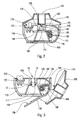
- the Figures 2 to 8 illustrate a cycle of operation of the device according to this first embodiment.
- the body 110 forms inside a dispersion chamber 111 which will be intended to receive the powder after opening the capsule 10.
- the figure 3 shows the device after opening the cover 130. It is found that the opening of the cover 130 causes the rotation of the axis 160 due to the cooperation of the approximately square shape of this axis 160 with the correspondingly shaped orifices 135 of said cover 130. This rotation of the axis 160 thus also causes a rotation of the toothed elements 161 and 162 which rotate with said axis 160.
- a rotation of these toothed elements 161, 162 causes a lateral translation of the sliding member 140.
- the teeth 165 of the element toothed 161 is engaged in the toothing 145 of the sliding member 140.
- the rotation of the toothing 165 of the toothed element will slide the slide member 140 to the right in the figures.
- a single toothed element may be sufficient to cause the displacement of said sliding member.
- the hatch 150 is open and the interior of the dispersion chamber 111 can be discharged from the device.
- the figure 3 also shows a capsule 10 placed inside the loading opening 121. It is noted that the upper part 11 of the capsule is held tightly in the ribs 125 provided in said loading opening 121. Moreover, the lower part 12 of the capsule passes through a first opening 141 made in said sliding member 140 and which, in the open position of the cover 130, is opposite said loading opening 121.
- FIG. 4 to 6 illustrate the closing phase of the cover 130 after loading the capsule 10.
- the hatch 150 will also close and the sliding member 140 will be brought to the left in the figures by the cooperation between the toothed elements 161 and 162 and the teeth of said sliding member 140.
- the lower part 12 of the capsule 10 passing through the first opening 141 of said sliding member 140 a lateral displacement of this sliding member will break the lower portion 12 of the capsule 10 as shown in FIG. figure 4 .
- the sliding member 140 acts therefore as a capsule opening means.
- the upper part 11 of the capsule 10 of course remains tightly held in the loading opening 121, in particular by the ribs 125.
- the lug 135 will cause the upper part 11 of the capsule to be expelled from the loading opening 121 towards the inside of the dispersion chamber 111.
- the capsule 10 has been broken in two, the two upper 11 and lower 12 parts of the capsule 10 resting in the dispersion chamber 111 on the bottom (formed by the hatch 150) and with the powder at least partially expelled out of said capsule parts. The device is then ready for inhalation.
- the figure 7 illustrates the inhalation phase.
- the user places his mouth around the dispensing orifice 131 of the cover 130 and sucks in the direction of the arrow B, shown in FIG. figure 7 . In doing so, it creates a stream of air inside the dispersion chamber 111 which will swirl the two capsule parts 11 and 12 inside said dispersion chamber 111.
- This swirling illustrated by the arrow C on the figure 7 will allow a total emptying of said parts of capsules but also a good dispersion of the powder, and in particular a deagglomeration of possible clusters of powder that could have formed.
- additional air intakes can be provided in the dispersion chamber to promote swirling of the inhalation stream.
- the cover 130 advantageously comprises a grid 137 through which the powder will be able to pass and be expelled in the direction of the dispensing orifice 131.
- the grid avoids in particular that the capsule parts 11, 12 are also expelled from the chamber dispersion.
- the user then inhales the dose of powder that was initially contained in the capsule 10.
- said dispersion chamber may have a frustoconical shape narrowing towards the dispensing orifice 131, in particular to accelerate the inhalation flow by direction of said orifice.
- the user opens the cover 130 again, which, as before, will tilt the hatch 150 at the end of opening.
- This tilting of the hatch 150 illustrated on the figure 8 will allow to evacuate the two parts of empty capsules 11 and 12 of the dispersion chamber 111.
- the device is ready for next use.
- the user can close the device and wait to reopen it the next time he needs it.
- the user is not obliged to empty empty capsule parts after each inhalation but it can of course only do when the next opening of the device when it wants to load a new capsule.
- the hatch 150 may comprise one or more attachment pin (s) 156 which snaps (s) slightly into the bottom of the body 110 in the closed position, to ensure a safe and reliable closure of the hatch 150 in the closed position.
- the Figures 11 and 12 show openings 116 formed in the bottom of the body 110 through which said detent lugs 156 of the hatch will be able to pass.
- this snap is not too strong not to hinder the opening of the hatch when the user opens the hood 130.
- FIGS 9 and 10 show perspective views of the device in closed and open positions
- Figures 11 and 12 are similar views to Figures 9 and 10 but partially cut, showing the internal structure of the device in these two positions.
- the device is therefore particularly simple and clever. It consists of a small number of parts, so it is inexpensive to manufacture and assemble. Moreover, the presence of a dispersion chamber and parts of empty capsules that swirl allow to disagglomerate the powder and thus ensure a better distribution thereof to the user during inhalation. Finally, the evacuation of empty capsule parts does not require disassembly of the device which limits the risk of pollution thereof. The lack of disassembly of the device also avoids the risk of not being able to reassemble it, or to misplace the disassembled parts, especially in children or elderly people.
- the manipulation of the device does not require manipulating the portion forming the mouthpiece around the dispensing orifice 131. could consider a specific gripping portion for handling said hood.
- the risk of contamination at the dispensing orifice 131 is therefore also limited.
- the method of use of the device is very simple, the user having to move the cover between its two end positions to fully operate the device. Thus, he first opens the hood, then he inserts a capsule, he closes the hood and inhales.
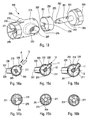
- the Figures 13 to 22 illustrate a second embodiment of an inhaler.
- the figure 13 illustrates in particular an exploded perspective view of the device.
- the inhaler 200 consists of only three pieces.
- a body 210 of substantially cylindrical shape is provided on its periphery with a mouthpiece 230 defining the dispensing orifice and a loading opening 220 adapted to receive a capsule 10.
- This body 210 may comprise a longitudinal central axis.
- the inside of the cylinder 210 forms a dispersion chamber 211.
- a first axial end portion of said body 210 is formed by a first gripping portion 270, fixed with respect to the body 210. This first gripping portion could be simply formed by an axial edge of said body.
- this first gripping portion 270 has a particular external profile, to encourage the user to manipulate the device through it.
- This first gripping portion 270 includes a closure wall 271 of the dispersion chamber 211, said closure wall 271 having an opening 275, extending for example at an angle of about 60 ° to 90 ° in said closure wall 271.
- the body 210 is open, and this opening is closed by a second gripping portion 260 rotatably mounted relative to said body 210.
- This second gripping portion 260 thus forms the second axial end portion of the body.
- this second gripping portion 260 has an external profile similar to that of the first gripping portion 270.
- each gripping portion 260, 270 with a respective hand, and rotate the one relative to the other to manipulate the device.
- a closure element such as a hatch member 250, also having an axial wall 251 provided with a window 255 whose dimensions correspond approximately to the window 275 made in the closure wall 271 of the body 210.
- This hatch member 250 is mounted to rotate integrally on a central axis 261 connected to said second gripping portion 260.
- ribs 263 formed on the end 262 of the central axis 261 cooperate with grooves 257 of said hatch member 250, as shown in FIG. figure 13 .
- the hatch member 250 is thus integral in rotation with the second gripping portion 260 of the device.
- the hatch member 250 is disposed within the body 210 to cooperate with the closure wall 271 thereof.
- the user grasps with both hands the two gripping portions 260 and 270 and rotate relative to each other, as will be explained in more detail below. At no time is the user required to touch the mouthpiece portion 230 to use the device.
- FIGS 14a, 15a and 16a illustrate a loading and opening phase of capsule 10.
- a cross-section is seen through the body 210 and thus the dispersion chamber 211, the loading aperture 220 and the mouthpiece 230 are seen, with in the center the central axis 261 which is rotatably mounted in said chamber.
- dispersion 211 The user loads a capsule 10 according to the arrow A in the loading opening 220.
- the depth of said orifice 220 is adjusted so that when the user fully inserts the capsule 10 into said loading opening 220, the upper part 11 of the capsule is held tight in said loading opening 220 while the lower portion 12 of the capsule projects inside the dispersion chamber 211.
- the rotation of the first axis 261 causes rotation of the projection 265, which will deform the lower part of the capsule, which will therefore separate from the upper part 11 of the capsule, which remains stuck in the loading opening 220 .
- the figure 17 illustrates the position of the open capsule 10 with the upper part 11 wedged in the loading opening 220 and the lower part 12 which has fallen freely into the dispersion chamber 211 to empty into it.
- the Projection 265 therefore acts as capsule opening means.
- the Figures 14b, 15b and 16b illustrate what happens at the first axial end portion of the body, and in particular at the closure wall 271 of the dispersion chamber.
- the window 255 of the axial wall 251 of the hatch member 250 is opposite the window 275 of the closure wall 271.
- the wall portion 251 will therefore gradually close the opening 275 of the axial closure wall 271 of the body 210.
- the figure 15b shows that just before the capsule begins to open, there is still a small open passage but that as soon as the capsule is deformed, which is represented on the figure 16b , the opening is completely closed and the interior of the dispersion chamber 211 is closed.
- the capsule breaks and the powder empties into the dispersion chamber 211, it is closed at its axial end walls.
- the user can then inhale as illustrated by the arrow B on the figure 18 .
- he places his mouth around the mouthpiece and will create an inhalation flow that will allow him to inhale the powder contained in the dispersion chamber 211 through the dispensing orifice 231.
- the substantially The annular of the dispersion chamber 211 around the central axis 261 is advantageous in that it promotes the swirling of the inhalation flow from the mouthpiece.
- the mouthpiece preferably has a gate 237 to allow the powder to pass but prevent the capsule portions from being expelled into the mouth of the user.
- the user-created inhalation flow will swirl the lower capsule portion 12 which freely rotates within the dispersion chamber.
- the dispersion chamber 211 comprises one or more tangential opening (s) 218 formed in the body 210. This promotes the swirling of the flow of inhalation since the user at the moment when he inhales will suck air flows through these tangential openings 218 (arrows D) which will thus naturally turn inside said dispersion chamber 211, and thus to further whirl the lower part 12 of the capsule to disperse and deagglomerate the powder.
- the central axis 261 comprises openings 269, for example arranged around the projection 265. This is illustrated on the figure 13 , but other openings 269 could also be provided along the axis 261. These openings have a double effect. On the one hand, they allow additional air intake during inhalation and thus still create different flows that further promote the emptying of the capsule, the swirling and deagglomeration of the powder. On the other hand, the holes disposed near the projection 265 ensure that the lower portion 12 of the capsule does not fit on said projection 265 by trapping powder. As soon as the user is going to inhale, the flow of air that will pass through said orifices 269 will expel said portion of capsule in the event that it is nested on said projection 265.
- the user After inhalation, the user preferably returns the device to its starting position by rotating the second gripping portion 260 in the opposite direction to the body. In doing so, it will open again the window 275 of the axial closure wall 271, and thus allow the evacuation of the lower portion 12 of the capsule through the aligned windows 255 and 275.
- the user comes to load the next capsule 10 in the loading aperture 220, as shown in FIG. figure 20 it will push the upper part 11 of the previous capsule, which was stuck in the loading aperture 220, inside the dispersion chamber 211. This can then also be removed from the dispersion chamber . This is illustrated on Figures 21 and 22 .
- the body 210 includes a window 219 and the hatch member 250 includes an indication 259, for example the word EJECT, which is displayed in said window 219 when the two windows 255, 275 are opposite each other.
- the word INHALE or the like can be displayed in the window 219 to indicate to the user that he is in the position in which he can inhale.
- Visual cues may also be provided on the second gripping portion 260 and / or the body 210, to visually indicate to the user the two end positions of said second gripping portion with respect to said body.
- This second embodiment therefore makes it possible to produce a device in which the user does not need to manipulate the mouthpiece to use the device. In addition, it does not need to disassemble the device to expel or evacuate the empty capsule parts after each use. The risks of contamination and pollution are therefore greatly limited, as well as the risk of loss of parts removed or those of not being able to reassemble the device after disassembly.
- This second embodiment is even simpler than the first, since it comprises only three parts. It makes it possible to ensure good dispersion of the powder, on the one hand by deagglomerating it in an appropriate manner by virtue of the capsule portion which swirls in the dispersion chamber, but also by virtue of the additional air inlets provided in the body 210 and or the central axis 261.
- the method of using the device is also very simple, the user having to move the second gripping portion between its two end positions to fully operate the device. Thus, it first inserts a capsule, then it rotates the second gripping portion to its second end position, it inhale, and he returns the second grip portion to its first end position.
- the part of the body which forms at least one wall of the dispersion chamber is made of a tinted transparent material.
- This tinted material is adapted firstly to at least partially filter the ultraviolet rays, to prevent any degradation or deterioration of the powder contained in said chamber. This applies to the powder contained in the dispersion chamber before each inhalation, but also to powder residues that remain attached to or bonded to the wall of the dispersion chamber after each inhalation, and which are likely to be at least partially inhaled during subsequent inhalations.
- the use of a tinted transparent material allows a partial visibility of the interior of the dispersion chamber.
- the tinted character could be technically characterized by the absorbance coefficient.
- This absorbance coefficient is a unitless quantity which represents the ratio between the incident flux and the flux transmitted by the material.
- an anti-UV material will have a good absorbance coefficient in the ultraviolet wavelength range, namely between about 10 nm and 400 nm.
- Pigments may be added to the material to favor its characteristics, especially anti-UV.
- These pigments comprise chemical groups called chromophores which absorb ultraviolet rays, for example one or more of the following elements: Ethene, 1-Hexyne, Ethanal, Nitromethane, methyl bromide, methyl iodide.
- the chromophores are present in the pigments, which gives them a color. These are often carbon-carbon or oxygen double bonds, but there are other types. These groups are then incorporated in the matter. It is their percentage proportion which confers the desired color but also gives its different properties to the mixture.
- the material is advantageously a synthetic material such as for example COC (Cyclo Olefin Copolymer) or COP (Cyclo Olefin Polymer, PP (Polypropylene), SAN (Styrene Acrylonitrile) or, preferably, PCTA (Polycyclohexylenedimethylene Terephthalate). alloys of these materials together or with other suitable materials are also possible.
- COC Cyclo Olefin Copolymer
- COP Cyclo Olefin Polymer
- PP Polypropylene
- SAN Styrene Acrylonitrile
- PCTA Polycyclohexylenedimethylene Terephthalate
Landscapes
- Health & Medical Sciences (AREA)
- Engineering & Computer Science (AREA)
- Bioinformatics & Cheminformatics (AREA)
- Pulmonology (AREA)
- Anesthesiology (AREA)
- Biomedical Technology (AREA)
- Heart & Thoracic Surgery (AREA)
- Hematology (AREA)
- Life Sciences & Earth Sciences (AREA)
- Animal Behavior & Ethology (AREA)
- General Health & Medical Sciences (AREA)
- Public Health (AREA)
- Veterinary Medicine (AREA)
- Medical Preparation Storing Or Oral Administration Devices (AREA)
- Containers And Packaging Bodies Having A Special Means To Remove Contents (AREA)
Claims (4)
- Trockenpulverinhalator (100; 200), umfassend einen Körper (110; 210), der eine Verteilungskammer (111; 211) bildet, eine Ausgabeöffnung (131; 231), durch welche hindurch der Benutzer inhaliert, eine Beschickungsöffnung (121; 220), die eine Kapsel (10) aufnimmt, die eine Dosis Trockenpulver zum Inhalieren enthält, und Öffnungsmittel für die Kapsel (140; 265), um eine Kapsel zu öffnen, die in die Beschickungsöffnung eingeführt ist, und die Dosis Pulver in die Verteilungskammer zu leeren, dadurch gekennzeichnet, dass der Körper (110; 210) zumindest auf Höhe einer Wand der Verteilungskammer aus einem durchsichtigen gefärbten Material gefertigt ist, das dazu geeignet ist, zumindest teilweise ultraviolette Strahlen zu filtern und es zu ermöglichen, das Innere der Verteilungskammer zu sehen, wobei es zumindest teilweise Rückstände von Pulver verbirgt, die an der mindestens einen Wand aus durchsichtigem gefärbtem Material haften.
- Inhalator nach Anspruch 1, wobei das gefärbte Material einen Absorptionskoeffizienten aufweist, der im ultravioletten Wellenlängenbereich erhöht ist, typischerweise zwischen 10 und 400 nm.
- Inhalator nach Anspruch 1 oder 2, wobei dem Material mindestens ein Pigment zugegeben ist, um es zu färben, wobei das mindestens eine Pigment chemische farbgebende Gruppierungen umfasst, wobei die chemischen farbgebenden Gruppierungen ultraviolette Strahlen absorbieren, wenn sie dem Material beigemischt sind.
- Inhalator nach Anspruch 3, wobei die chemischen farbgebenden Gruppierungen eines oder mehrere der folgenden Elemente umfassen: Ethylen, 1-Hexin, Acetaldehyd, Nitromethan, Methylbromid, Methyliodid.
Priority Applications (1)
| Application Number | Priority Date | Filing Date | Title |
|---|---|---|---|
| PL11811080T PL2651476T3 (pl) | 2010-12-14 | 2011-12-12 | Inhalator suchego proszku |
Applications Claiming Priority (2)
| Application Number | Priority Date | Filing Date | Title |
|---|---|---|---|
| FR1060451A FR2968566B1 (fr) | 2010-12-14 | 2010-12-14 | Inhalateur de poudre seche. |
| PCT/FR2011/052937 WO2012080635A1 (fr) | 2010-12-14 | 2011-12-12 | Inhalateur de poudre seche. |
Publications (2)
| Publication Number | Publication Date |
|---|---|
| EP2651476A1 EP2651476A1 (de) | 2013-10-23 |
| EP2651476B1 true EP2651476B1 (de) | 2015-10-28 |
Family
ID=44209652
Family Applications (1)
| Application Number | Title | Priority Date | Filing Date |
|---|---|---|---|
| EP11811080.8A Active EP2651476B1 (de) | 2010-12-14 | 2011-12-12 | Trockenpulverinhalator |
Country Status (7)
| Country | Link |
|---|---|
| US (1) | US9242055B2 (de) |
| EP (1) | EP2651476B1 (de) |
| CN (1) | CN103415315B (de) |
| BR (1) | BR112013014958B1 (de) |
| FR (1) | FR2968566B1 (de) |
| PL (1) | PL2651476T3 (de) |
| WO (1) | WO2012080635A1 (de) |
Families Citing this family (19)
| Publication number | Priority date | Publication date | Assignee | Title |
|---|---|---|---|---|
| CN102553040B (zh) * | 2010-12-17 | 2014-07-02 | 陈庆堂 | 滤出药粉吸入器 |
| AU356657S (en) * | 2014-01-28 | 2014-07-29 | Lupin Ltd | Inhaler |
| AU356644S (en) * | 2014-01-28 | 2014-07-29 | Lupin Ltd | Inhaler |
| AU356658S (en) * | 2014-01-28 | 2014-07-29 | Lupin Ltd | Inhaler |
| AU355712S (en) * | 2014-02-20 | 2014-05-22 | Lupin Ltd | Part of inhaler |
| PT107627B (pt) | 2014-04-29 | 2017-03-08 | Hovione Farmaciência S A | Inalador de cápsulas com dobradiça |
| EP3349831A4 (de) * | 2015-09-16 | 2019-06-05 | 1355540 Ontario Inc. | System und verfahren zur freisetzung von trockenpulver |
| CA173518S (en) | 2016-02-08 | 2017-09-01 | Nicoventures Holdings Ltd | Cartridge for an electronic cigarette |
| GB201605100D0 (en) | 2016-03-24 | 2016-05-11 | Nicoventures Holdings Ltd | Vapour provision system |
| GB201605105D0 (en) | 2016-03-24 | 2016-05-11 | Nicoventures Holdings Ltd | Vapour provision apparatus |
| GB201605101D0 (en) | 2016-03-24 | 2016-05-11 | Nicoventures Holdings Ltd | Electronic vapour provision system |
| GB201605102D0 (en) | 2016-03-24 | 2016-05-11 | Nicoventures Holdings Ltd | Mechanical connector for electronic vapour provision system |
| EP3487776A1 (de) | 2016-07-22 | 2019-05-29 | Nicoventures Holdings Limited | Gehäuse für eine dampfbereitstellungsvorrichtung |
| CN106075677B (zh) * | 2016-08-08 | 2022-06-10 | 中山市美捷时包装制品有限公司 | 一种干粉吸入装置的促动机构 |
| PL234586B1 (pl) * | 2017-08-31 | 2020-03-31 | Pulinno Spolka Z Ograniczona Odpowiedzialnoscia | Inhalator pojedynczej dawki suchego proszku |
| CN111542308B (zh) * | 2017-12-13 | 2024-04-02 | 埃姆弗西斯进出口及分销有限公司 | 干粉吸入器 |
| EP3790612B1 (de) * | 2018-05-09 | 2022-02-16 | Pharmadevices S.r.l. | Inhalatorvorrichtung |
| IT201800005209A1 (it) * | 2018-05-09 | 2019-11-09 | Dispositivo inalatore | |
| MX2021012723A (es) * | 2019-04-18 | 2022-01-31 | Jon Greenfield | Inhalador de presión positiva para entrega de medicamento inhalable y métodos para uso. |
Family Cites Families (6)
| Publication number | Priority date | Publication date | Assignee | Title |
|---|---|---|---|---|
| DE4318455A1 (de) * | 1993-06-03 | 1994-12-08 | Boehringer Ingelheim Kg | Kapselhalterung |
| JP3198065B2 (ja) * | 1996-08-19 | 2001-08-13 | 株式会社大協精工 | 衛生品用容器 |
| US7246622B2 (en) * | 2002-10-08 | 2007-07-24 | Vital Signs, Inc. | Carbon dioxide indicating apparatus, particularly, disk-like carbon dioxide indicating apparatus |
| DE102004012971B4 (de) * | 2004-03-17 | 2006-01-12 | Josef Eckert | Inhalator, insbesondere Pulverinhalator |
| DK2266521T3 (da) * | 2008-03-14 | 2013-10-28 | Otsuka Pharma Co Ltd | Plastikampul |
| CA2741281A1 (en) * | 2008-11-03 | 2010-06-03 | Schering Corporation | Light blocking container with viewing window for photosensitive compounds |
-
2010
- 2010-12-14 FR FR1060451A patent/FR2968566B1/fr active Active
-
2011
- 2011-12-12 US US13/993,884 patent/US9242055B2/en not_active Expired - Fee Related
- 2011-12-12 CN CN201180065937.1A patent/CN103415315B/zh active Active
- 2011-12-12 PL PL11811080T patent/PL2651476T3/pl unknown
- 2011-12-12 WO PCT/FR2011/052937 patent/WO2012080635A1/fr not_active Ceased
- 2011-12-12 BR BR112013014958-2A patent/BR112013014958B1/pt active IP Right Grant
- 2011-12-12 EP EP11811080.8A patent/EP2651476B1/de active Active
Also Published As
| Publication number | Publication date |
|---|---|
| FR2968566A1 (fr) | 2012-06-15 |
| US20130269695A1 (en) | 2013-10-17 |
| CN103415315B (zh) | 2016-11-16 |
| CN103415315A (zh) | 2013-11-27 |
| BR112013014958B1 (pt) | 2020-11-17 |
| EP2651476A1 (de) | 2013-10-23 |
| PL2651476T3 (pl) | 2016-04-29 |
| US9242055B2 (en) | 2016-01-26 |
| BR112013014958A2 (pt) | 2016-09-13 |
| WO2012080635A1 (fr) | 2012-06-21 |
| FR2968566B1 (fr) | 2013-10-18 |
Similar Documents
| Publication | Publication Date | Title |
|---|---|---|
| WO2012080635A1 (fr) | Inhalateur de poudre seche. | |
| FR2962343A1 (fr) | Inhalateur de poudre seche. | |
| WO2012004520A1 (fr) | Procede d'utilisation d'un inhalateur de poudre seche | |
| FR2962342A1 (fr) | Inhalateur de poudre seche. | |
| EP2133110B1 (de) | Vorrichtung zur Ausgabe eines Fluidsprodukts | |
| FR2962338A1 (fr) | Inhalateur de poudre seche. | |
| FR2881111A1 (fr) | Dispositif de distribution de produit fluide. | |
| FR2962337A1 (fr) | Inhalateur de poudre seche. | |
| EP2341965A1 (de) | Pulverinhalationsvorrichtung | |
| EP2729207B1 (de) | Trockenpulverinhalator | |
| EP4572827B1 (de) | Trockenpulverinhalator | |
| FR2962339A1 (fr) | Inhalateur de poudre seche. | |
| EP2590700B1 (de) | Einzeldosis-trockenpulverinhalator für eine ablösbare blisterpackung | |
| EP2341964B1 (de) | Pulverinhalationsvorrichtung | |
| EP2364173B1 (de) | Pulverinhalationsvorrichtung | |
| FR2962340A1 (fr) | Inhalateur de poudre seche. | |
| WO2010037961A1 (fr) | Dispositif d'inhalation de poudre | |
| WO2012004524A1 (fr) | Inhalateur de poudre seche. | |
| WO2024038234A1 (fr) | Inhalateur de poudre sèche | |
| WO2024038237A1 (fr) | Inhalateur de poudre sèche | |
| EP4572825B1 (de) | Set mit einem trockenpulverinhalator und einer aufbewahrungsbox | |
| WO2025219598A1 (fr) | Inhalateur de poudre sèche | |
| FR2909642A1 (fr) | Dispositif de distribution de produit fluide |
Legal Events
| Date | Code | Title | Description |
|---|---|---|---|
| PUAI | Public reference made under article 153(3) epc to a published international application that has entered the european phase |
Free format text: ORIGINAL CODE: 0009012 |
|
| 17P | Request for examination filed |
Effective date: 20130712 |
|
| AK | Designated contracting states |
Kind code of ref document: A1 Designated state(s): AL AT BE BG CH CY CZ DE DK EE ES FI FR GB GR HR HU IE IS IT LI LT LU LV MC MK MT NL NO PL PT RO RS SE SI SK SM TR |
|
| DAX | Request for extension of the european patent (deleted) | ||
| GRAP | Despatch of communication of intention to grant a patent |
Free format text: ORIGINAL CODE: EPIDOSNIGR1 |
|
| INTG | Intention to grant announced |
Effective date: 20150521 |
|
| RIN1 | Information on inventor provided before grant (corrected) |
Inventor name: BROUET, GUILLAUME Inventor name: SALLAK, ZAKARIA |
|
| GRAS | Grant fee paid |
Free format text: ORIGINAL CODE: EPIDOSNIGR3 |
|
| GRAA | (expected) grant |
Free format text: ORIGINAL CODE: 0009210 |
|
| AK | Designated contracting states |
Kind code of ref document: B1 Designated state(s): AL AT BE BG CH CY CZ DE DK EE ES FI FR GB GR HR HU IE IS IT LI LT LU LV MC MK MT NL NO PL PT RO RS SE SI SK SM TR |
|
| REG | Reference to a national code |
Ref country code: GB Ref legal event code: FG4D Free format text: NOT ENGLISH |
|
| REG | Reference to a national code |
Ref country code: CH Ref legal event code: EP |
|
| REG | Reference to a national code |
Ref country code: AT Ref legal event code: REF Ref document number: 757587 Country of ref document: AT Kind code of ref document: T Effective date: 20151115 |
|
| REG | Reference to a national code |
Ref country code: IE Ref legal event code: FG4D Free format text: LANGUAGE OF EP DOCUMENT: FRENCH |
|
| REG | Reference to a national code |
Ref country code: DE Ref legal event code: R096 Ref document number: 602011021051 Country of ref document: DE |
|
| REG | Reference to a national code |
Ref country code: FR Ref legal event code: PLFP Year of fee payment: 5 |
|
| REG | Reference to a national code |
Ref country code: LT Ref legal event code: MG4D |
|
| REG | Reference to a national code |
Ref country code: NL Ref legal event code: MP Effective date: 20151028 |
|
| REG | Reference to a national code |
Ref country code: AT Ref legal event code: MK05 Ref document number: 757587 Country of ref document: AT Kind code of ref document: T Effective date: 20151028 |
|
| PG25 | Lapsed in a contracting state [announced via postgrant information from national office to epo] |
Ref country code: NO Free format text: LAPSE BECAUSE OF FAILURE TO SUBMIT A TRANSLATION OF THE DESCRIPTION OR TO PAY THE FEE WITHIN THE PRESCRIBED TIME-LIMIT Effective date: 20160128 Ref country code: ES Free format text: LAPSE BECAUSE OF FAILURE TO SUBMIT A TRANSLATION OF THE DESCRIPTION OR TO PAY THE FEE WITHIN THE PRESCRIBED TIME-LIMIT Effective date: 20151028 Ref country code: IT Free format text: LAPSE BECAUSE OF FAILURE TO SUBMIT A TRANSLATION OF THE DESCRIPTION OR TO PAY THE FEE WITHIN THE PRESCRIBED TIME-LIMIT Effective date: 20151028 Ref country code: IS Free format text: LAPSE BECAUSE OF FAILURE TO SUBMIT A TRANSLATION OF THE DESCRIPTION OR TO PAY THE FEE WITHIN THE PRESCRIBED TIME-LIMIT Effective date: 20160228 Ref country code: NL Free format text: LAPSE BECAUSE OF FAILURE TO SUBMIT A TRANSLATION OF THE DESCRIPTION OR TO PAY THE FEE WITHIN THE PRESCRIBED TIME-LIMIT Effective date: 20151028 Ref country code: HR Free format text: LAPSE BECAUSE OF FAILURE TO SUBMIT A TRANSLATION OF THE DESCRIPTION OR TO PAY THE FEE WITHIN THE PRESCRIBED TIME-LIMIT Effective date: 20151028 Ref country code: LT Free format text: LAPSE BECAUSE OF FAILURE TO SUBMIT A TRANSLATION OF THE DESCRIPTION OR TO PAY THE FEE WITHIN THE PRESCRIBED TIME-LIMIT Effective date: 20151028 |
|
| PG25 | Lapsed in a contracting state [announced via postgrant information from national office to epo] |
Ref country code: LV Free format text: LAPSE BECAUSE OF FAILURE TO SUBMIT A TRANSLATION OF THE DESCRIPTION OR TO PAY THE FEE WITHIN THE PRESCRIBED TIME-LIMIT Effective date: 20151028 Ref country code: AT Free format text: LAPSE BECAUSE OF FAILURE TO SUBMIT A TRANSLATION OF THE DESCRIPTION OR TO PAY THE FEE WITHIN THE PRESCRIBED TIME-LIMIT Effective date: 20151028 Ref country code: RS Free format text: LAPSE BECAUSE OF FAILURE TO SUBMIT A TRANSLATION OF THE DESCRIPTION OR TO PAY THE FEE WITHIN THE PRESCRIBED TIME-LIMIT Effective date: 20151028 Ref country code: PT Free format text: LAPSE BECAUSE OF FAILURE TO SUBMIT A TRANSLATION OF THE DESCRIPTION OR TO PAY THE FEE WITHIN THE PRESCRIBED TIME-LIMIT Effective date: 20160229 Ref country code: FI Free format text: LAPSE BECAUSE OF FAILURE TO SUBMIT A TRANSLATION OF THE DESCRIPTION OR TO PAY THE FEE WITHIN THE PRESCRIBED TIME-LIMIT Effective date: 20151028 Ref country code: SE Free format text: LAPSE BECAUSE OF FAILURE TO SUBMIT A TRANSLATION OF THE DESCRIPTION OR TO PAY THE FEE WITHIN THE PRESCRIBED TIME-LIMIT Effective date: 20151028 Ref country code: GR Free format text: LAPSE BECAUSE OF FAILURE TO SUBMIT A TRANSLATION OF THE DESCRIPTION OR TO PAY THE FEE WITHIN THE PRESCRIBED TIME-LIMIT Effective date: 20160129 Ref country code: BE Free format text: LAPSE BECAUSE OF NON-PAYMENT OF DUE FEES Effective date: 20151231 |
|
| REG | Reference to a national code |
Ref country code: DE Ref legal event code: R119 Ref document number: 602011021051 Country of ref document: DE |
|
| PG25 | Lapsed in a contracting state [announced via postgrant information from national office to epo] |
Ref country code: MC Free format text: LAPSE BECAUSE OF FAILURE TO SUBMIT A TRANSLATION OF THE DESCRIPTION OR TO PAY THE FEE WITHIN THE PRESCRIBED TIME-LIMIT Effective date: 20151028 Ref country code: LU Free format text: LAPSE BECAUSE OF FAILURE TO SUBMIT A TRANSLATION OF THE DESCRIPTION OR TO PAY THE FEE WITHIN THE PRESCRIBED TIME-LIMIT Effective date: 20151212 Ref country code: CZ Free format text: LAPSE BECAUSE OF FAILURE TO SUBMIT A TRANSLATION OF THE DESCRIPTION OR TO PAY THE FEE WITHIN THE PRESCRIBED TIME-LIMIT Effective date: 20151028 |
|
| REG | Reference to a national code |
Ref country code: CH Ref legal event code: PL |
|
| PG25 | Lapsed in a contracting state [announced via postgrant information from national office to epo] |
Ref country code: SM Free format text: LAPSE BECAUSE OF FAILURE TO SUBMIT A TRANSLATION OF THE DESCRIPTION OR TO PAY THE FEE WITHIN THE PRESCRIBED TIME-LIMIT Effective date: 20151028 Ref country code: DK Free format text: LAPSE BECAUSE OF FAILURE TO SUBMIT A TRANSLATION OF THE DESCRIPTION OR TO PAY THE FEE WITHIN THE PRESCRIBED TIME-LIMIT Effective date: 20151028 Ref country code: EE Free format text: LAPSE BECAUSE OF FAILURE TO SUBMIT A TRANSLATION OF THE DESCRIPTION OR TO PAY THE FEE WITHIN THE PRESCRIBED TIME-LIMIT Effective date: 20151028 Ref country code: RO Free format text: LAPSE BECAUSE OF FAILURE TO SUBMIT A TRANSLATION OF THE DESCRIPTION OR TO PAY THE FEE WITHIN THE PRESCRIBED TIME-LIMIT Effective date: 20151028 Ref country code: SK Free format text: LAPSE BECAUSE OF FAILURE TO SUBMIT A TRANSLATION OF THE DESCRIPTION OR TO PAY THE FEE WITHIN THE PRESCRIBED TIME-LIMIT Effective date: 20151028 |
|
| PLBE | No opposition filed within time limit |
Free format text: ORIGINAL CODE: 0009261 |
|
| STAA | Information on the status of an ep patent application or granted ep patent |
Free format text: STATUS: NO OPPOSITION FILED WITHIN TIME LIMIT |
|
| REG | Reference to a national code |
Ref country code: IE Ref legal event code: MM4A |
|
| 26N | No opposition filed |
Effective date: 20160729 |
|
| PG25 | Lapsed in a contracting state [announced via postgrant information from national office to epo] |
Ref country code: LI Free format text: LAPSE BECAUSE OF NON-PAYMENT OF DUE FEES Effective date: 20151231 Ref country code: IE Free format text: LAPSE BECAUSE OF NON-PAYMENT OF DUE FEES Effective date: 20151212 Ref country code: DE Free format text: LAPSE BECAUSE OF NON-PAYMENT OF DUE FEES Effective date: 20160701 Ref country code: CH Free format text: LAPSE BECAUSE OF NON-PAYMENT OF DUE FEES Effective date: 20151231 |
|
| PG25 | Lapsed in a contracting state [announced via postgrant information from national office to epo] |
Ref country code: SI Free format text: LAPSE BECAUSE OF FAILURE TO SUBMIT A TRANSLATION OF THE DESCRIPTION OR TO PAY THE FEE WITHIN THE PRESCRIBED TIME-LIMIT Effective date: 20151028 |
|
| REG | Reference to a national code |
Ref country code: FR Ref legal event code: PLFP Year of fee payment: 6 |
|
| PG25 | Lapsed in a contracting state [announced via postgrant information from national office to epo] |
Ref country code: BG Free format text: LAPSE BECAUSE OF FAILURE TO SUBMIT A TRANSLATION OF THE DESCRIPTION OR TO PAY THE FEE WITHIN THE PRESCRIBED TIME-LIMIT Effective date: 20151028 Ref country code: HU Free format text: LAPSE BECAUSE OF FAILURE TO SUBMIT A TRANSLATION OF THE DESCRIPTION OR TO PAY THE FEE WITHIN THE PRESCRIBED TIME-LIMIT; INVALID AB INITIO Effective date: 20111212 |
|
| PG25 | Lapsed in a contracting state [announced via postgrant information from national office to epo] |
Ref country code: CY Free format text: LAPSE BECAUSE OF FAILURE TO SUBMIT A TRANSLATION OF THE DESCRIPTION OR TO PAY THE FEE WITHIN THE PRESCRIBED TIME-LIMIT Effective date: 20151028 |
|
| PG25 | Lapsed in a contracting state [announced via postgrant information from national office to epo] |
Ref country code: MT Free format text: LAPSE BECAUSE OF FAILURE TO SUBMIT A TRANSLATION OF THE DESCRIPTION OR TO PAY THE FEE WITHIN THE PRESCRIBED TIME-LIMIT Effective date: 20151028 |
|
| REG | Reference to a national code |
Ref country code: FR Ref legal event code: PLFP Year of fee payment: 7 |
|
| PG25 | Lapsed in a contracting state [announced via postgrant information from national office to epo] |
Ref country code: MK Free format text: LAPSE BECAUSE OF FAILURE TO SUBMIT A TRANSLATION OF THE DESCRIPTION OR TO PAY THE FEE WITHIN THE PRESCRIBED TIME-LIMIT Effective date: 20151028 |
|
| PG25 | Lapsed in a contracting state [announced via postgrant information from national office to epo] |
Ref country code: AL Free format text: LAPSE BECAUSE OF FAILURE TO SUBMIT A TRANSLATION OF THE DESCRIPTION OR TO PAY THE FEE WITHIN THE PRESCRIBED TIME-LIMIT Effective date: 20151028 |
|
| PGFP | Annual fee paid to national office [announced via postgrant information from national office to epo] |
Ref country code: PL Payment date: 20191120 Year of fee payment: 9 |
|
| PGFP | Annual fee paid to national office [announced via postgrant information from national office to epo] |
Ref country code: TR Payment date: 20191202 Year of fee payment: 9 |
|
| PGFP | Annual fee paid to national office [announced via postgrant information from national office to epo] |
Ref country code: GB Payment date: 20201217 Year of fee payment: 10 |
|
| PG25 | Lapsed in a contracting state [announced via postgrant information from national office to epo] |
Ref country code: TR Free format text: LAPSE BECAUSE OF NON-PAYMENT OF DUE FEES Effective date: 20201212 |
|
| GBPC | Gb: european patent ceased through non-payment of renewal fee |
Effective date: 20211212 |
|
| PG25 | Lapsed in a contracting state [announced via postgrant information from national office to epo] |
Ref country code: GB Free format text: LAPSE BECAUSE OF NON-PAYMENT OF DUE FEES Effective date: 20211212 |
|
| PG25 | Lapsed in a contracting state [announced via postgrant information from national office to epo] |
Ref country code: PL Free format text: LAPSE BECAUSE OF NON-PAYMENT OF DUE FEES Effective date: 20201212 |
|
| P01 | Opt-out of the competence of the unified patent court (upc) registered |
Effective date: 20230526 |
|
| PGFP | Annual fee paid to national office [announced via postgrant information from national office to epo] |
Ref country code: FR Payment date: 20251231 Year of fee payment: 15 |