EP2637245A1 - Fluorinated compounds for use in lithium battery electrolytes - Google Patents
Fluorinated compounds for use in lithium battery electrolytes Download PDFInfo
- Publication number
- EP2637245A1 EP2637245A1 EP13170324.1A EP13170324A EP2637245A1 EP 2637245 A1 EP2637245 A1 EP 2637245A1 EP 13170324 A EP13170324 A EP 13170324A EP 2637245 A1 EP2637245 A1 EP 2637245A1
- Authority
- EP
- European Patent Office
- Prior art keywords
- electrolyte
- composition
- carbonate
- solvent
- lithium
- Prior art date
- Legal status (The legal status is an assumption and is not a legal conclusion. Google has not performed a legal analysis and makes no representation as to the accuracy of the status listed.)
- Withdrawn
Links
- 239000003792 electrolyte Substances 0.000 title claims abstract description 84
- 229910052744 lithium Inorganic materials 0.000 title claims abstract description 19
- WHXSMMKQMYFTQS-UHFFFAOYSA-N Lithium Chemical compound [Li] WHXSMMKQMYFTQS-UHFFFAOYSA-N 0.000 title claims abstract description 16
- 150000001875 compounds Chemical class 0.000 title claims description 15
- 239000000203 mixture Substances 0.000 claims abstract description 85
- 239000002904 solvent Substances 0.000 claims abstract description 62
- 229910003002 lithium salt Inorganic materials 0.000 claims abstract description 11
- 159000000002 lithium salts Chemical class 0.000 claims abstract description 11
- 125000000217 alkyl group Chemical group 0.000 claims description 30
- 229910001416 lithium ion Inorganic materials 0.000 claims description 30
- KMTRUDSVKNLOMY-UHFFFAOYSA-N Ethylene carbonate Chemical compound O=C1OCCO1 KMTRUDSVKNLOMY-UHFFFAOYSA-N 0.000 claims description 27
- 229910001290 LiPF6 Inorganic materials 0.000 claims description 21
- OIFBSDVPJOWBCH-UHFFFAOYSA-N Diethyl carbonate Chemical compound CCOC(=O)OCC OIFBSDVPJOWBCH-UHFFFAOYSA-N 0.000 claims description 20
- HBBGRARXTFLTSG-UHFFFAOYSA-N Lithium ion Chemical compound [Li+] HBBGRARXTFLTSG-UHFFFAOYSA-N 0.000 claims description 18
- 229910052731 fluorine Inorganic materials 0.000 claims description 16
- 125000004432 carbon atom Chemical group C* 0.000 claims description 13
- 239000011737 fluorine Substances 0.000 claims description 13
- 239000001257 hydrogen Substances 0.000 claims description 11
- 229910052739 hydrogen Inorganic materials 0.000 claims description 11
- PXGOKWXKJXAPGV-UHFFFAOYSA-N Fluorine Chemical compound FF PXGOKWXKJXAPGV-UHFFFAOYSA-N 0.000 claims description 10
- UFHFLCQGNIYNRP-UHFFFAOYSA-N Hydrogen Chemical compound [H][H] UFHFLCQGNIYNRP-UHFFFAOYSA-N 0.000 claims description 9
- -1 LiC-lO4 Inorganic materials 0.000 claims description 9
- IEJIGPNLZYLLBP-UHFFFAOYSA-N dimethyl carbonate Chemical compound COC(=O)OC IEJIGPNLZYLLBP-UHFFFAOYSA-N 0.000 claims description 7
- RUOJZAUFBMNUDX-UHFFFAOYSA-N propylene carbonate Chemical compound CC1COC(=O)O1 RUOJZAUFBMNUDX-UHFFFAOYSA-N 0.000 claims description 5
- BTBUEUYNUDRHOZ-UHFFFAOYSA-N Borate Chemical compound [O-]B([O-])[O-] BTBUEUYNUDRHOZ-UHFFFAOYSA-N 0.000 claims description 4
- 239000006184 cosolvent Substances 0.000 claims description 4
- JBTWLSYIZRCDFO-UHFFFAOYSA-N ethyl methyl carbonate Chemical compound CCOC(=O)OC JBTWLSYIZRCDFO-UHFFFAOYSA-N 0.000 claims description 4
- VAYTZRYEBVHVLE-UHFFFAOYSA-N 1,3-dioxol-2-one Chemical compound O=C1OC=CO1 VAYTZRYEBVHVLE-UHFFFAOYSA-N 0.000 claims description 3
- BJWMSGRKJIOCNR-UHFFFAOYSA-N 4-ethenyl-1,3-dioxolan-2-one Chemical compound C=CC1COC(=O)O1 BJWMSGRKJIOCNR-UHFFFAOYSA-N 0.000 claims description 3
- SBLRHMKNNHXPHG-UHFFFAOYSA-N 4-fluoro-1,3-dioxolan-2-one Chemical compound FC1COC(=O)O1 SBLRHMKNNHXPHG-UHFFFAOYSA-N 0.000 claims description 3
- 229910013375 LiC Inorganic materials 0.000 claims description 3
- 229910013385 LiN(SO2C2F5)2 Inorganic materials 0.000 claims description 3
- 229910013406 LiN(SO2CF3)2 Inorganic materials 0.000 claims description 3
- 229910001540 lithium hexafluoroarsenate(V) Inorganic materials 0.000 claims description 3
- 229910001496 lithium tetrafluoroborate Inorganic materials 0.000 claims description 3
- QSZMZKBZAYQGRS-UHFFFAOYSA-N lithium;bis(trifluoromethylsulfonyl)azanide Chemical compound [Li+].FC(F)(F)S(=O)(=O)[N-]S(=O)(=O)C(F)(F)F QSZMZKBZAYQGRS-UHFFFAOYSA-N 0.000 claims description 3
- BVKZGUZCCUSVTD-UHFFFAOYSA-L Carbonate Chemical compound [O-]C([O-])=O BVKZGUZCCUSVTD-UHFFFAOYSA-L 0.000 abstract description 2
- 125000002015 acyclic group Chemical group 0.000 abstract description 2
- 239000000523 sample Substances 0.000 description 20
- YMWUJEATGCHHMB-UHFFFAOYSA-N Dichloromethane Chemical compound ClCCl YMWUJEATGCHHMB-UHFFFAOYSA-N 0.000 description 15
- 239000010703 silicon Substances 0.000 description 15
- 229910052710 silicon Inorganic materials 0.000 description 15
- OKTJSMMVPCPJKN-UHFFFAOYSA-N Carbon Chemical compound [C] OKTJSMMVPCPJKN-UHFFFAOYSA-N 0.000 description 14
- XUIMIQQOPSSXEZ-UHFFFAOYSA-N Silicon Chemical compound [Si] XUIMIQQOPSSXEZ-UHFFFAOYSA-N 0.000 description 14
- 229910032387 LiCoO2 Inorganic materials 0.000 description 13
- 229910052493 LiFePO4 Inorganic materials 0.000 description 13
- 239000008188 pellet Substances 0.000 description 12
- 229910000676 Si alloy Inorganic materials 0.000 description 11
- 229910002804 graphite Inorganic materials 0.000 description 11
- 239000010439 graphite Substances 0.000 description 11
- 239000011255 nonaqueous electrolyte Substances 0.000 description 11
- 239000000843 powder Substances 0.000 description 11
- SECXISVLQFMRJM-UHFFFAOYSA-N N-Methylpyrrolidone Chemical compound CN1CCCC1=O SECXISVLQFMRJM-UHFFFAOYSA-N 0.000 description 10
- 239000011541 reaction mixture Substances 0.000 description 10
- 239000000047 product Substances 0.000 description 9
- 238000012360 testing method Methods 0.000 description 9
- XKRFYHLGVUSROY-UHFFFAOYSA-N Argon Chemical compound [Ar] XKRFYHLGVUSROY-UHFFFAOYSA-N 0.000 description 8
- 239000002931 mesocarbon microbead Substances 0.000 description 8
- 239000012074 organic phase Substances 0.000 description 8
- XLYOFNOQVPJJNP-UHFFFAOYSA-N water Substances O XLYOFNOQVPJJNP-UHFFFAOYSA-N 0.000 description 8
- VEXZGXHMUGYJMC-UHFFFAOYSA-N Hydrochloric acid Chemical compound Cl VEXZGXHMUGYJMC-UHFFFAOYSA-N 0.000 description 7
- 238000009835 boiling Methods 0.000 description 7
- 150000004649 carbonic acid derivatives Chemical class 0.000 description 7
- 238000006243 chemical reaction Methods 0.000 description 7
- 238000002290 gas chromatography-mass spectrometry Methods 0.000 description 7
- 238000010438 heat treatment Methods 0.000 description 7
- 229910002097 Lithium manganese(III,IV) oxide Inorganic materials 0.000 description 6
- OKKJLVBELUTLKV-UHFFFAOYSA-N Methanol Chemical compound OC OKKJLVBELUTLKV-UHFFFAOYSA-N 0.000 description 6
- ZMANZCXQSJIPKH-UHFFFAOYSA-N Triethylamine Chemical compound CCN(CC)CC ZMANZCXQSJIPKH-UHFFFAOYSA-N 0.000 description 6
- 239000000463 material Substances 0.000 description 6
- 150000003839 salts Chemical class 0.000 description 6
- 239000000243 solution Substances 0.000 description 6
- WSFSSNUMVMOOMR-UHFFFAOYSA-N Formaldehyde Chemical compound O=C WSFSSNUMVMOOMR-UHFFFAOYSA-N 0.000 description 5
- 229910052782 aluminium Inorganic materials 0.000 description 5
- XAGFODPZIPBFFR-UHFFFAOYSA-N aluminium Chemical compound [Al] XAGFODPZIPBFFR-UHFFFAOYSA-N 0.000 description 5
- 238000001816 cooling Methods 0.000 description 5
- 150000005676 cyclic carbonates Chemical class 0.000 description 5
- 238000002360 preparation method Methods 0.000 description 5
- 230000009257 reactivity Effects 0.000 description 5
- 238000002390 rotary evaporation Methods 0.000 description 5
- BBNMWXDGNGRANP-UHFFFAOYSA-N 3,3,4,5,5,5-hexafluoropentan-2-ol Chemical compound CC(O)C(F)(F)C(F)C(F)(F)F BBNMWXDGNGRANP-UHFFFAOYSA-N 0.000 description 4
- IJGRMHOSHXDMSA-UHFFFAOYSA-N Atomic nitrogen Chemical compound N#N IJGRMHOSHXDMSA-UHFFFAOYSA-N 0.000 description 4
- XEEYBQQBJWHFJM-UHFFFAOYSA-N Iron Chemical compound [Fe] XEEYBQQBJWHFJM-UHFFFAOYSA-N 0.000 description 4
- 229910001122 Mischmetal Inorganic materials 0.000 description 4
- JUJWROOIHBZHMG-UHFFFAOYSA-N Pyridine Chemical compound C1=CC=NC=C1 JUJWROOIHBZHMG-UHFFFAOYSA-N 0.000 description 4
- 229910052786 argon Inorganic materials 0.000 description 4
- 229910052799 carbon Inorganic materials 0.000 description 4
- 239000011888 foil Substances 0.000 description 4
- HCDGVLDPFQMKDK-UHFFFAOYSA-N hexafluoropropylene Chemical compound FC(F)=C(F)C(F)(F)F HCDGVLDPFQMKDK-UHFFFAOYSA-N 0.000 description 4
- 238000004519 manufacturing process Methods 0.000 description 4
- 238000000034 method Methods 0.000 description 4
- 229920006395 saturated elastomer Polymers 0.000 description 4
- 239000010935 stainless steel Substances 0.000 description 4
- 229910001220 stainless steel Inorganic materials 0.000 description 4
- 238000003756 stirring Methods 0.000 description 4
- 238000010998 test method Methods 0.000 description 4
- WEVYAHXRMPXWCK-UHFFFAOYSA-N Acetonitrile Chemical compound CC#N WEVYAHXRMPXWCK-UHFFFAOYSA-N 0.000 description 3
- NLXLAEXVIDQMFP-UHFFFAOYSA-N Ammonia chloride Chemical class [NH4+].[Cl-] NLXLAEXVIDQMFP-UHFFFAOYSA-N 0.000 description 3
- 0 CC(C)(*C(C)(**)O1)OC1=O Chemical compound CC(C)(*C(C)(**)O1)OC1=O 0.000 description 3
- CURLTUGMZLYLDI-UHFFFAOYSA-N Carbon dioxide Chemical compound O=C=O CURLTUGMZLYLDI-UHFFFAOYSA-N 0.000 description 3
- LYCAIKOWRPUZTN-UHFFFAOYSA-N Ethylene glycol Chemical compound OCCO LYCAIKOWRPUZTN-UHFFFAOYSA-N 0.000 description 3
- 229910011469 Li4/3Ti5/3O4 Inorganic materials 0.000 description 3
- BZLVMXJERCGZMT-UHFFFAOYSA-N Methyl tert-butyl ether Chemical compound COC(C)(C)C BZLVMXJERCGZMT-UHFFFAOYSA-N 0.000 description 3
- YGYAWVDWMABLBF-UHFFFAOYSA-N Phosgene Chemical compound ClC(Cl)=O YGYAWVDWMABLBF-UHFFFAOYSA-N 0.000 description 3
- UIIMBOGNXHQVGW-UHFFFAOYSA-M Sodium bicarbonate Chemical compound [Na+].OC([O-])=O UIIMBOGNXHQVGW-UHFFFAOYSA-M 0.000 description 3
- YXFVVABEGXRONW-UHFFFAOYSA-N Toluene Chemical compound CC1=CC=CC=C1 YXFVVABEGXRONW-UHFFFAOYSA-N 0.000 description 3
- 239000000654 additive Substances 0.000 description 3
- 230000000996 additive effect Effects 0.000 description 3
- 229910045601 alloy Inorganic materials 0.000 description 3
- 239000000956 alloy Substances 0.000 description 3
- 239000006229 carbon black Substances 0.000 description 3
- 230000000052 comparative effect Effects 0.000 description 3
- 230000001351 cycling effect Effects 0.000 description 3
- 125000001153 fluoro group Chemical group F* 0.000 description 3
- 229920002981 polyvinylidene fluoride Polymers 0.000 description 3
- 229910052761 rare earth metal Inorganic materials 0.000 description 3
- 239000000126 substance Substances 0.000 description 3
- LVFXLZRISXUAIL-UHFFFAOYSA-N 2,2,3,4,4,4-hexafluorobutan-1-ol Chemical compound OCC(F)(F)C(F)C(F)(F)F LVFXLZRISXUAIL-UHFFFAOYSA-N 0.000 description 2
- XMNIXWIUMCBBBL-UHFFFAOYSA-N 2-(2-phenylpropan-2-ylperoxy)propan-2-ylbenzene Chemical compound C=1C=CC=CC=1C(C)(C)OOC(C)(C)C1=CC=CC=C1 XMNIXWIUMCBBBL-UHFFFAOYSA-N 0.000 description 2
- YEJRWHAVMIAJKC-UHFFFAOYSA-N 4-Butyrolactone Chemical compound O=C1CCCO1 YEJRWHAVMIAJKC-UHFFFAOYSA-N 0.000 description 2
- RYGMFSIKBFXOCR-UHFFFAOYSA-N Copper Chemical compound [Cu] RYGMFSIKBFXOCR-UHFFFAOYSA-N 0.000 description 2
- RTZKZFJDLAIYFH-UHFFFAOYSA-N Diethyl ether Chemical compound CCOCC RTZKZFJDLAIYFH-UHFFFAOYSA-N 0.000 description 2
- XTHFKEDIFFGKHM-UHFFFAOYSA-N Dimethoxyethane Chemical compound COCCOC XTHFKEDIFFGKHM-UHFFFAOYSA-N 0.000 description 2
- LFQSCWFLJHTTHZ-UHFFFAOYSA-N Ethanol Chemical compound CCO LFQSCWFLJHTTHZ-UHFFFAOYSA-N 0.000 description 2
- 239000002033 PVDF binder Substances 0.000 description 2
- CDBYLPFSWZWCQE-UHFFFAOYSA-L Sodium Carbonate Chemical compound [Na+].[Na+].[O-]C([O-])=O CDBYLPFSWZWCQE-UHFFFAOYSA-L 0.000 description 2
- 229910000831 Steel Inorganic materials 0.000 description 2
- ATJFFYVFTNAWJD-UHFFFAOYSA-N Tin Chemical compound [Sn] ATJFFYVFTNAWJD-UHFFFAOYSA-N 0.000 description 2
- RTAQQCXQSZGOHL-UHFFFAOYSA-N Titanium Chemical compound [Ti] RTAQQCXQSZGOHL-UHFFFAOYSA-N 0.000 description 2
- 239000011149 active material Substances 0.000 description 2
- 239000010405 anode material Substances 0.000 description 2
- 239000008346 aqueous phase Substances 0.000 description 2
- 230000015572 biosynthetic process Effects 0.000 description 2
- 229910002092 carbon dioxide Inorganic materials 0.000 description 2
- 239000006182 cathode active material Substances 0.000 description 2
- 230000022131 cell cycle Effects 0.000 description 2
- 239000010949 copper Substances 0.000 description 2
- 239000008367 deionised water Substances 0.000 description 2
- 229910021641 deionized water Inorganic materials 0.000 description 2
- 239000012153 distilled water Substances 0.000 description 2
- 229940021013 electrolyte solution Drugs 0.000 description 2
- RIFGWPKJUGCATF-UHFFFAOYSA-N ethyl chloroformate Chemical compound CCOC(Cl)=O RIFGWPKJUGCATF-UHFFFAOYSA-N 0.000 description 2
- 238000004508 fractional distillation Methods 0.000 description 2
- 239000011521 glass Substances 0.000 description 2
- 239000001307 helium Substances 0.000 description 2
- 229910052734 helium Inorganic materials 0.000 description 2
- SWQJXJOGLNCZEY-UHFFFAOYSA-N helium atom Chemical compound [He] SWQJXJOGLNCZEY-UHFFFAOYSA-N 0.000 description 2
- 229910052742 iron Inorganic materials 0.000 description 2
- 239000003273 ketjen black Substances 0.000 description 2
- 238000006138 lithiation reaction Methods 0.000 description 2
- MHCFAGZWMAWTNR-UHFFFAOYSA-M lithium perchlorate Chemical compound [Li+].[O-]Cl(=O)(=O)=O MHCFAGZWMAWTNR-UHFFFAOYSA-M 0.000 description 2
- 229910001486 lithium perchlorate Inorganic materials 0.000 description 2
- 230000007774 longterm Effects 0.000 description 2
- 238000002074 melt spinning Methods 0.000 description 2
- XMJHPCRAQCTCFT-UHFFFAOYSA-N methyl chloroformate Chemical compound COC(Cl)=O XMJHPCRAQCTCFT-UHFFFAOYSA-N 0.000 description 2
- 229910052757 nitrogen Inorganic materials 0.000 description 2
- 239000003960 organic solvent Substances 0.000 description 2
- 239000002245 particle Substances 0.000 description 2
- 239000012071 phase Substances 0.000 description 2
- BWHMMNNQKKPAPP-UHFFFAOYSA-L potassium carbonate Chemical compound [K+].[K+].[O-]C([O-])=O BWHMMNNQKKPAPP-UHFFFAOYSA-L 0.000 description 2
- 239000012264 purified product Substances 0.000 description 2
- UMJSCPRVCHMLSP-UHFFFAOYSA-N pyridine Natural products COC1=CC=CN=C1 UMJSCPRVCHMLSP-UHFFFAOYSA-N 0.000 description 2
- 230000009467 reduction Effects 0.000 description 2
- 238000006722 reduction reaction Methods 0.000 description 2
- 239000002002 slurry Substances 0.000 description 2
- 239000010959 steel Substances 0.000 description 2
- 238000003860 storage Methods 0.000 description 2
- 125000001424 substituent group Chemical group 0.000 description 2
- 238000003786 synthesis reaction Methods 0.000 description 2
- YFHICDDUDORKJB-UHFFFAOYSA-N trimethylene carbonate Chemical class O=C1OCCCO1 YFHICDDUDORKJB-UHFFFAOYSA-N 0.000 description 2
- UCPYLLCMEDAXFR-UHFFFAOYSA-N triphosgene Chemical compound ClC(Cl)(Cl)OC(=O)OC(Cl)(Cl)Cl UCPYLLCMEDAXFR-UHFFFAOYSA-N 0.000 description 2
- 238000005303 weighing Methods 0.000 description 2
- 238000009736 wetting Methods 0.000 description 2
- WNXJIVFYUVYPPR-UHFFFAOYSA-N 1,3-dioxolane Chemical compound C1COCO1 WNXJIVFYUVYPPR-UHFFFAOYSA-N 0.000 description 1
- SIJBDWPVNAYVGY-UHFFFAOYSA-N 2,2-dimethyl-1,3-dioxolane Chemical compound CC1(C)OCCO1 SIJBDWPVNAYVGY-UHFFFAOYSA-N 0.000 description 1
- IFXDUNDBQDXPQZ-UHFFFAOYSA-N 2-methylbutan-2-yl 2-ethylhexaneperoxoate Chemical compound CCCCC(CC)C(=O)OOC(C)(C)CC IFXDUNDBQDXPQZ-UHFFFAOYSA-N 0.000 description 1
- JWUJQDFVADABEY-UHFFFAOYSA-N 2-methyltetrahydrofuran Chemical compound CC1CCCO1 JWUJQDFVADABEY-UHFFFAOYSA-N 0.000 description 1
- ZPIHQUJLTFPALQ-UHFFFAOYSA-N 3,3,4,5,5,5-hexafluoropentan-2-yl hydrogen carbonate Chemical compound OC(=O)OC(C)C(F)(F)C(F)C(F)(F)F ZPIHQUJLTFPALQ-UHFFFAOYSA-N 0.000 description 1
- 239000010963 304 stainless steel Substances 0.000 description 1
- OZPDTHMIVHISNO-UHFFFAOYSA-N 4-(1,1,2,3,3,3-hexafluoropropoxymethyl)-1,3-dioxolan-2-one Chemical compound FC(F)(F)C(F)C(F)(F)OCC1COC(=O)O1 OZPDTHMIVHISNO-UHFFFAOYSA-N 0.000 description 1
- JZKDIKSUZQCSFK-UHFFFAOYSA-N 4-(1,1,2,3,3,3-hexafluoropropyl)-1,3-dioxan-2-one Chemical compound FC(F)(F)C(F)C(F)(F)C1CCOC(=O)O1 JZKDIKSUZQCSFK-UHFFFAOYSA-N 0.000 description 1
- HOXXQMMCPGMKOK-UHFFFAOYSA-N 4-(1,1,2,3,3,3-hexafluoropropyl)-1,3-dioxolan-2-one Chemical compound FC(F)(F)C(F)C(F)(F)C1COC(=O)O1 HOXXQMMCPGMKOK-UHFFFAOYSA-N 0.000 description 1
- BUDYICKXYOODAH-UHFFFAOYSA-N 4-(1,1,2,3,3,3-hexafluoropropyl)-1,3-dioxolane Chemical compound FC(F)(F)C(F)C(F)(F)C1COCO1 BUDYICKXYOODAH-UHFFFAOYSA-N 0.000 description 1
- JFMGYULNQJPJCY-UHFFFAOYSA-N 4-(hydroxymethyl)-1,3-dioxolan-2-one Chemical compound OCC1COC(=O)O1 JFMGYULNQJPJCY-UHFFFAOYSA-N 0.000 description 1
- 239000004342 Benzoyl peroxide Substances 0.000 description 1
- OMPJBNCRMGITSC-UHFFFAOYSA-N Benzoylperoxide Chemical compound C=1C=CC=CC=1C(=O)OOC(=O)C1=CC=CC=C1 OMPJBNCRMGITSC-UHFFFAOYSA-N 0.000 description 1
- 229920013683 Celanese Polymers 0.000 description 1
- 229910052684 Cerium Inorganic materials 0.000 description 1
- 229910000881 Cu alloy Inorganic materials 0.000 description 1
- 208000032953 Device battery issue Diseases 0.000 description 1
- 229910000733 Li alloy Inorganic materials 0.000 description 1
- 229910007540 Li2Si Inorganic materials 0.000 description 1
- 229910002986 Li4Ti5O12 Inorganic materials 0.000 description 1
- 229910014913 LixSi Inorganic materials 0.000 description 1
- 229910052779 Neodymium Inorganic materials 0.000 description 1
- 239000004642 Polyimide Substances 0.000 description 1
- 239000004743 Polypropylene Substances 0.000 description 1
- 229910052777 Praseodymium Inorganic materials 0.000 description 1
- 229910000589 SAE 304 stainless steel Inorganic materials 0.000 description 1
- VYPSYNLAJGMNEJ-UHFFFAOYSA-N Silicium dioxide Chemical compound O=[Si]=O VYPSYNLAJGMNEJ-UHFFFAOYSA-N 0.000 description 1
- PMZURENOXWZQFD-UHFFFAOYSA-L Sodium Sulfate Chemical compound [Na+].[Na+].[O-]S([O-])(=O)=O PMZURENOXWZQFD-UHFFFAOYSA-L 0.000 description 1
- 241000862969 Stella Species 0.000 description 1
- 150000001336 alkenes Chemical class 0.000 description 1
- 230000004075 alteration Effects 0.000 description 1
- 150000001408 amides Chemical class 0.000 description 1
- 235000019270 ammonium chloride Nutrition 0.000 description 1
- 239000012300 argon atmosphere Substances 0.000 description 1
- QVGXLLKOCUKJST-UHFFFAOYSA-N atomic oxygen Chemical compound [O] QVGXLLKOCUKJST-UHFFFAOYSA-N 0.000 description 1
- 230000009286 beneficial effect Effects 0.000 description 1
- 235000019400 benzoyl peroxide Nutrition 0.000 description 1
- XXWUZRIRCSTFSL-UHFFFAOYSA-N bis(3,3,4,5,5,5-hexafluoropentan-2-yl) carbonate Chemical compound FC(F)(F)C(F)C(F)(F)C(C)OC(=O)OC(C)C(F)(F)C(F)C(F)(F)F XXWUZRIRCSTFSL-UHFFFAOYSA-N 0.000 description 1
- 238000007707 calorimetry Methods 0.000 description 1
- 239000001569 carbon dioxide Substances 0.000 description 1
- 150000004651 carbonic acid esters Chemical class 0.000 description 1
- 150000001735 carboxylic acids Chemical class 0.000 description 1
- ZMIGMASIKSOYAM-UHFFFAOYSA-N cerium Chemical compound [Ce][Ce][Ce][Ce][Ce][Ce][Ce][Ce][Ce][Ce][Ce][Ce][Ce][Ce][Ce][Ce][Ce][Ce][Ce][Ce][Ce][Ce][Ce][Ce][Ce][Ce][Ce][Ce][Ce][Ce][Ce][Ce][Ce][Ce][Ce][Ce][Ce][Ce] ZMIGMASIKSOYAM-UHFFFAOYSA-N 0.000 description 1
- 239000011248 coating agent Substances 0.000 description 1
- 238000000576 coating method Methods 0.000 description 1
- 238000002485 combustion reaction Methods 0.000 description 1
- 229910052802 copper Inorganic materials 0.000 description 1
- 239000011889 copper foil Substances 0.000 description 1
- 150000004292 cyclic ethers Chemical class 0.000 description 1
- 125000004122 cyclic group Chemical group 0.000 description 1
- 238000011161 development Methods 0.000 description 1
- 229910003460 diamond Inorganic materials 0.000 description 1
- 239000010432 diamond Substances 0.000 description 1
- 125000000118 dimethyl group Chemical group [H]C([H])([H])* 0.000 description 1
- 150000002009 diols Chemical class 0.000 description 1
- 238000007599 discharging Methods 0.000 description 1
- 238000004821 distillation Methods 0.000 description 1
- 238000001035 drying Methods 0.000 description 1
- 239000007772 electrode material Substances 0.000 description 1
- 239000008151 electrolyte solution Substances 0.000 description 1
- 238000006056 electrooxidation reaction Methods 0.000 description 1
- 150000002170 ethers Chemical class 0.000 description 1
- YKYMHQGFSAMUCV-UHFFFAOYSA-N ethyl 2,2,3,4,4,4-hexafluorobutyl carbonate Chemical compound CCOC(=O)OCC(F)(F)C(F)C(F)(F)F YKYMHQGFSAMUCV-UHFFFAOYSA-N 0.000 description 1
- 238000002474 experimental method Methods 0.000 description 1
- 230000002349 favourable effect Effects 0.000 description 1
- 239000010408 film Substances 0.000 description 1
- 238000009472 formulation Methods 0.000 description 1
- 239000000446 fuel Substances 0.000 description 1
- 239000007789 gas Substances 0.000 description 1
- 238000000769 gas chromatography-flame ionisation detection Methods 0.000 description 1
- 150000002431 hydrogen Chemical class 0.000 description 1
- 125000004435 hydrogen atom Chemical group [H]* 0.000 description 1
- 230000006698 induction Effects 0.000 description 1
- 238000013383 initial experiment Methods 0.000 description 1
- 230000003993 interaction Effects 0.000 description 1
- 150000002500 ions Chemical class 0.000 description 1
- 229910000399 iron(III) phosphate Inorganic materials 0.000 description 1
- 230000002427 irreversible effect Effects 0.000 description 1
- 229910052746 lanthanum Inorganic materials 0.000 description 1
- FZLIPJUXYLNCLC-UHFFFAOYSA-N lanthanum atom Chemical compound [La] FZLIPJUXYLNCLC-UHFFFAOYSA-N 0.000 description 1
- 239000007788 liquid Substances 0.000 description 1
- 239000006193 liquid solution Substances 0.000 description 1
- 239000001989 lithium alloy Substances 0.000 description 1
- 231100000053 low toxicity Toxicity 0.000 description 1
- 230000014759 maintenance of location Effects 0.000 description 1
- 238000003701 mechanical milling Methods 0.000 description 1
- 238000002844 melting Methods 0.000 description 1
- 230000008018 melting Effects 0.000 description 1
- VUZPPFZMUPKLLV-UHFFFAOYSA-N methane;hydrate Chemical compound C.O VUZPPFZMUPKLLV-UHFFFAOYSA-N 0.000 description 1
- 239000002480 mineral oil Substances 0.000 description 1
- 235000010446 mineral oil Nutrition 0.000 description 1
- 239000012046 mixed solvent Substances 0.000 description 1
- 238000002156 mixing Methods 0.000 description 1
- 238000012986 modification Methods 0.000 description 1
- 230000004048 modification Effects 0.000 description 1
- 239000002808 molecular sieve Substances 0.000 description 1
- 239000004570 mortar (masonry) Substances 0.000 description 1
- QEFYFXOXNSNQGX-UHFFFAOYSA-N neodymium atom Chemical compound [Nd] QEFYFXOXNSNQGX-UHFFFAOYSA-N 0.000 description 1
- JRZJOMJEPLMPRA-UHFFFAOYSA-N olefin Natural products CCCCCCCC=C JRZJOMJEPLMPRA-UHFFFAOYSA-N 0.000 description 1
- 150000002894 organic compounds Chemical class 0.000 description 1
- 239000005486 organic electrolyte Substances 0.000 description 1
- 238000013021 overheating Methods 0.000 description 1
- 230000003647 oxidation Effects 0.000 description 1
- 238000007254 oxidation reaction Methods 0.000 description 1
- 230000001590 oxidative effect Effects 0.000 description 1
- 239000001301 oxygen Substances 0.000 description 1
- 229910052760 oxygen Inorganic materials 0.000 description 1
- 229920001721 polyimide Polymers 0.000 description 1
- 229920001155 polypropylene Polymers 0.000 description 1
- 229910000027 potassium carbonate Inorganic materials 0.000 description 1
- PUDIUYLPXJFUGB-UHFFFAOYSA-N praseodymium atom Chemical compound [Pr] PUDIUYLPXJFUGB-UHFFFAOYSA-N 0.000 description 1
- 239000002244 precipitate Substances 0.000 description 1
- 238000003825 pressing Methods 0.000 description 1
- 230000008569 process Effects 0.000 description 1
- 238000012545 processing Methods 0.000 description 1
- 150000002910 rare earth metals Chemical class 0.000 description 1
- 238000010992 reflux Methods 0.000 description 1
- 230000004044 response Effects 0.000 description 1
- 229910052703 rhodium Inorganic materials 0.000 description 1
- 238000004626 scanning electron microscopy Methods 0.000 description 1
- 238000007873 sieving Methods 0.000 description 1
- 150000003376 silicon Chemical class 0.000 description 1
- URGAHOPLAPQHLN-UHFFFAOYSA-N sodium aluminosilicate Chemical compound [Na+].[Al+3].[O-][Si]([O-])=O.[O-][Si]([O-])=O URGAHOPLAPQHLN-UHFFFAOYSA-N 0.000 description 1
- 229910000030 sodium bicarbonate Inorganic materials 0.000 description 1
- 235000017557 sodium bicarbonate Nutrition 0.000 description 1
- 229910000029 sodium carbonate Inorganic materials 0.000 description 1
- HPALAKNZSZLMCH-UHFFFAOYSA-M sodium;chloride;hydrate Chemical class O.[Na+].[Cl-] HPALAKNZSZLMCH-UHFFFAOYSA-M 0.000 description 1
- 239000007787 solid Substances 0.000 description 1
- 239000007784 solid electrolyte Substances 0.000 description 1
- 238000007614 solvation Methods 0.000 description 1
- 239000011877 solvent mixture Substances 0.000 description 1
- 238000009987 spinning Methods 0.000 description 1
- 230000002269 spontaneous effect Effects 0.000 description 1
- 150000003462 sulfoxides Chemical class 0.000 description 1
- 230000002459 sustained effect Effects 0.000 description 1
- 239000010409 thin film Substances 0.000 description 1
- 229910052718 tin Inorganic materials 0.000 description 1
- 239000011135 tin Substances 0.000 description 1
- 239000010936 titanium Substances 0.000 description 1
- 229910052719 titanium Inorganic materials 0.000 description 1
- 229910000314 transition metal oxide Inorganic materials 0.000 description 1
- UONOETXJSWQNOL-UHFFFAOYSA-N tungsten carbide Chemical compound [W+]#[C-] UONOETXJSWQNOL-UHFFFAOYSA-N 0.000 description 1
- 238000005292 vacuum distillation Methods 0.000 description 1
- 229910052720 vanadium Inorganic materials 0.000 description 1
Classifications
-
- H—ELECTRICITY
- H01—ELECTRIC ELEMENTS
- H01M—PROCESSES OR MEANS, e.g. BATTERIES, FOR THE DIRECT CONVERSION OF CHEMICAL ENERGY INTO ELECTRICAL ENERGY
- H01M10/00—Secondary cells; Manufacture thereof
- H01M10/05—Accumulators with non-aqueous electrolyte
- H01M10/056—Accumulators with non-aqueous electrolyte characterised by the materials used as electrolytes, e.g. mixed inorganic/organic electrolytes
- H01M10/0564—Accumulators with non-aqueous electrolyte characterised by the materials used as electrolytes, e.g. mixed inorganic/organic electrolytes the electrolyte being constituted of organic materials only
- H01M10/0566—Liquid materials
- H01M10/0569—Liquid materials characterised by the solvents
-
- H—ELECTRICITY
- H01—ELECTRIC ELEMENTS
- H01M—PROCESSES OR MEANS, e.g. BATTERIES, FOR THE DIRECT CONVERSION OF CHEMICAL ENERGY INTO ELECTRICAL ENERGY
- H01M10/00—Secondary cells; Manufacture thereof
- H01M10/05—Accumulators with non-aqueous electrolyte
- H01M10/052—Li-accumulators
- H01M10/0525—Rocking-chair batteries, i.e. batteries with lithium insertion or intercalation in both electrodes; Lithium-ion batteries
-
- C—CHEMISTRY; METALLURGY
- C07—ORGANIC CHEMISTRY
- C07D—HETEROCYCLIC COMPOUNDS
- C07D317/00—Heterocyclic compounds containing five-membered rings having two oxygen atoms as the only ring hetero atoms
- C07D317/08—Heterocyclic compounds containing five-membered rings having two oxygen atoms as the only ring hetero atoms having the hetero atoms in positions 1 and 3
- C07D317/10—Heterocyclic compounds containing five-membered rings having two oxygen atoms as the only ring hetero atoms having the hetero atoms in positions 1 and 3 not condensed with other rings
- C07D317/14—Heterocyclic compounds containing five-membered rings having two oxygen atoms as the only ring hetero atoms having the hetero atoms in positions 1 and 3 not condensed with other rings with substituted hydrocarbon radicals attached to ring carbon atoms
-
- C—CHEMISTRY; METALLURGY
- C07—ORGANIC CHEMISTRY
- C07D—HETEROCYCLIC COMPOUNDS
- C07D319/00—Heterocyclic compounds containing six-membered rings having two oxygen atoms as the only ring hetero atoms
- C07D319/04—1,3-Dioxanes; Hydrogenated 1,3-dioxanes
- C07D319/06—1,3-Dioxanes; Hydrogenated 1,3-dioxanes not condensed with other rings
-
- H—ELECTRICITY
- H01—ELECTRIC ELEMENTS
- H01M—PROCESSES OR MEANS, e.g. BATTERIES, FOR THE DIRECT CONVERSION OF CHEMICAL ENERGY INTO ELECTRICAL ENERGY
- H01M2300/00—Electrolytes
- H01M2300/0017—Non-aqueous electrolytes
- H01M2300/0025—Organic electrolyte
-
- H—ELECTRICITY
- H01—ELECTRIC ELEMENTS
- H01M—PROCESSES OR MEANS, e.g. BATTERIES, FOR THE DIRECT CONVERSION OF CHEMICAL ENERGY INTO ELECTRICAL ENERGY
- H01M2300/00—Electrolytes
- H01M2300/0017—Non-aqueous electrolytes
- H01M2300/0025—Organic electrolyte
- H01M2300/0028—Organic electrolyte characterised by the solvent
- H01M2300/0034—Fluorinated solvents
-
- H—ELECTRICITY
- H01—ELECTRIC ELEMENTS
- H01M—PROCESSES OR MEANS, e.g. BATTERIES, FOR THE DIRECT CONVERSION OF CHEMICAL ENERGY INTO ELECTRICAL ENERGY
- H01M2300/00—Electrolytes
- H01M2300/0017—Non-aqueous electrolytes
- H01M2300/0025—Organic electrolyte
- H01M2300/0028—Organic electrolyte characterised by the solvent
- H01M2300/0037—Mixture of solvents
-
- Y—GENERAL TAGGING OF NEW TECHNOLOGICAL DEVELOPMENTS; GENERAL TAGGING OF CROSS-SECTIONAL TECHNOLOGIES SPANNING OVER SEVERAL SECTIONS OF THE IPC; TECHNICAL SUBJECTS COVERED BY FORMER USPC CROSS-REFERENCE ART COLLECTIONS [XRACs] AND DIGESTS
- Y02—TECHNOLOGIES OR APPLICATIONS FOR MITIGATION OR ADAPTATION AGAINST CLIMATE CHANGE
- Y02E—REDUCTION OF GREENHOUSE GAS [GHG] EMISSIONS, RELATED TO ENERGY GENERATION, TRANSMISSION OR DISTRIBUTION
- Y02E60/00—Enabling technologies; Technologies with a potential or indirect contribution to GHG emissions mitigation
- Y02E60/10—Energy storage using batteries
Definitions
- This disclosure relates to electrolyte compositions comprising at least one partially-fluorinated compound and at least one electrolyte salt. In other aspects, this disclosure also relates to electrochemical devices comprising the electrolyte compositions and to articles comprising the electrochemical devices.
- Lithium-ion batteries are particularly useful for many portable electronic devices. Lithium-ion batteries employ highly chemically reactive components to provide electrical current. These systems are typically based on the use of lithium metal, lithiated carbon, or a lithium alloy as the negative electrode (anode) and electroactive transition metal oxides as the positive electrode (cathode).
- Lithium-ion batteries are constructed from one or more electrochemical cells connected in parallel or series. Such cells have consisted of a non-aqueous lithium ion-conducting electrolyte composition interposed between electrically-separated and spatially-separated, positive and negative electrodes.
- the electrolyte composition is typically a liquid solution of a lithium salt in a nonaqueous, aprotic organic solvent. A mixture of two or more organic solvents often is used.
- electrolyte solvents for rechargeable lithium batteries are important for optimum battery performance and safety and involves a variety of different factors.
- long-term chemical stability in the presence of the charged positive and negative electrodes, ionic conductivity, safety, and wetting capability tend to be important selection factors in high volume commercial applications.
- an electrolyte solvent be intrinsically stable over the battery's range of operating temperatures and voltages and also that it be either unreactive with electrode materials or that it contribute to effectively forming a passivating film with good ionic conductivity on the electrodes.
- Ionic conductivity requires an electrolyte solvent that effectively dissolves lithium electrolyte salts and facilitates lithium ion mobility. From the viewpoint of safety, the characteristics of low volatility, low flammability, low combustibility, low reactivity toward charged electrodes, passivating characteristics, and low toxicity are all highly desirable. It is also desirable that the battery's electrodes and separator be quickly and thoroughly wetted by the electrolyte solvent, so as to facilitate rapid battery manufacturing and optimize battery performance.
- Aprotic liquid organic compounds have been the most commonly used electrolyte solvents for lithium batteries. Often, compounds such as carbonic acid esters (carbonates) have been used, as these compounds typically share the desirable properties of low reactivity with the positive electrodes operating at less than about 4.4V vs. Li + /Li, low reactivity with lithium-containing negative electrodes, and a thermodynamically favorable solvation interaction with lithium salts, which results in the electrolyte composition having a high ionic conductivity.
- carbonates carbonic acid esters
- aprotic organic electrolyte solvents for use in lithium batteries include cyclic carbonates such as ethylene carbonate and propylene carbonate, cyclic esters of carboxylic acids such as ⁇ -butyrolactone, linear carbonates such as dimethyl caronate, diethyl carbonate and ethyl methyl carbonate, cyclic ethers such as 2-methyltetrahydrofuran and 1,3-dioxolane, linear ethers such as 1,2-dimethoxyethane, amides, and sulfoxides.
- a mixed solvent is often preferred in order to balance, or tailor, the desired properties of the electrolyte composition such as high dielectric constant and low viscosity.
- non-aqueous electrolyte solutions for lithium ion batteries should have a low viscosity to allow for high ion mobility during high rates of charging and discharging.
- the present inventors recognize that there remains a need for electrolyte solvents with one or more of various advantages, such as reduced volatility, low flammability, and low combustibility relative to conventional solvents, that are less reactive with the charged positive electrode and the charged negative electrode, and that effectively dissolve and dissociate salts to form stable electrolyte compositions that adequately wet electrochemical device components and that exhibit adequate ionic conductivities over a range of operating temperatures.
- various embodiments of the present invention have a combination of these advantages. Some embodiments of the present invention may have all of these advantages.
- a solvent composition according to Formula I wherein each of the groups R h 1 , R h 2 and R h 3 is independently hydrogen or C x H 2x+1 , x is an integer from 1 to 4, Y is a single covalent bond or the group -CR h 4 R h 5 -, each of R h 4 and R h 5 is independently a hydrogen or an alkyl group having 1 to 4 carbon atoms.
- R f is -CFR f 1 CHF R f 2 , wherein R f 1 is F, or C n F 2n+1 , and n is an integer from 1 to 8, R f 2 is F, a linear or branched C p F 2p+1 , wherein p is an integer from 1 to 4, or R f 3 O(R f 4 O) m - , wherein m is 0 or 1, and R f 3 is C n F 2n+1 , and n is an integer from 1 to 8, and R f 4 is C q F 2q , wherein q is an integer from 1 to 4, provided that when R f 1 is F and R f 2 is F, then at least one of R h 1 , R h 2 and R h 3 is C x H 2x+1 , and wherein A is a single covalent bond or CH 2 O.
- solvent compositions including the compounds may also quite effectively dissolve electrolyte salts to provide electrolyte compositions that adequately wet electrochemical device components (such as separators) and that exhibit adequate ionic conductivities for use in electrochemical devices over a range of operating temperatures (for example, from about -20°C to about 80°C or even higher, depending upon the power requirements for a particular application).
- the solvent compositions also can present fewer difficulties in storage and handling than do some conventional materials, due to one or more relative advantages such as lower volatility, lower flammability, and/or lower combustibility of the inventive partially fluorinated carbonate compounds and electrolyte compositions.
- At least some of the partially fluorinated carbonate compounds are particularly well-suited for use in large format lithium ion batteries (batteries that operate essentially adiabatically and can therefore experience high temperatures, for example, temperatures above 60°C).
- electrolyte compositions comprising the compounds of the invention can exhibit adequate conductivities, while being less likely to react with charged electrodes or ignite during catastrophic battery failure than some conventional electrolyte compositions.
- solvent compositions including the partially fluorinated carbonate compounds meet a need for electrolyte solvents that have reduced reactivity, volatility, flammability, and combustibility (relative to conventional solvents), yet effectively dissolve electrolyte salts to form stable electrolyte compositions that adequately wet electrochemical device components and that exhibit adequate ionic conductivities over a range of operating temperatures.
- this invention also provides electrochemical devices (preferably, batteries) including the electrolyte compositions; and articles including the electrochemical devices.
- electrochemical devices preferably, batteries
- electrolyte compositions including the electrolyte compositions; and articles including the electrochemical devices.
- fluorine substituted 1,3-dioxolane-2-one compounds are provided as electrolyte solvents for lithium ion batteries.
- fluorine substituted 1,3-dioxane-2-one compounds are provided as electrolyte solvents for lithium ion batteries.
- fluorine substituted acyclic carbonates are provided as electrolyte solvents for lithium ion batteries.
- mixtures of one or more fluorinated compounds of the invention together with non-fluorinated cyclic carbonates, acyclic carbonates, more conventional solvents, or combinations thereof, are provided as electrolytes for lithium ion batteries.
- the invention provides a lithium ion battery with a fluorinated carbonate compound or a mixture of fluorinated carbonate compounds, optionally with non-fluorinated cyclic carbonates and acyclic carbonates and/or a conventional battery solvent as the electrolyte solvent package.
- the electrolyte composition of the present invention provides low reactivity towards charged positive electrodes and charged negative electrodes and low flammability.
- the high boiling points of the electrolyte compositions of the present invention result in less pressure buildup in the cells at operating temperatures.
- a non-aqueous electrolyte solvent should have one or more, preferably several desirable properties. Examples follow. A non-aqueous electrolyte solvent should have low flammability or even be nonflammable. A non-aqueous electrolyte solvent can be nonflammable by having low volatility and/or by being very slow to react with oxygen. One quantitative measure of flammability is flash point. Another measure of flammability involves bringing a lighted match near a weighing pan containing the solvent of interest and observing whether ignition occurs. More details on this measure are found below in the Test Method section. Preferably a formulated electrolyte solution has a flash point above the operating temperature of a battery in which the electrolyte is used. The operating temperature of such batteries is normally around 60°C. A non-aqueous electrolyte should allow the cell to be charged and discharged (cycled) without losing capacity after each consecutive cycle.
- a non-aqueous electrolyte should be electrochemically stable at highly reducing and oxidizing potentials.
- the threshold for electrochemical oxidation of the non-aqueous electrolyte should be at a voltage (versus Li+/Li) that is greater than the cathode (positive electrode) voltage at full state of charge.
- the threshold for electrochemical reduction of the non-aqueous electrolyte should be at a voltage that is lower (versus Li+/Li) than the anode (negative electrode) voltage at full state of charge.
- a non-aqueous electrolyte solvent should be chemically stable to the charged, active cathode material and to the charged, active anode material.
- One measure of stability is the exotherm onset temperature of the reaction between the non-aqueous electrolyte and the charged, active cathode material or the charged, active anode material as determined by accelerating rate calorimetry (ARC).
- SEI Solid Electrolyte Interface
- the present invention provides cyclic carbonate compositions having structures according to Formula I:
- each of the groups R h 1 , R h 2 and R h 3 is independently hydrogen or C x H 2x+1 , wherein x is an integer from 1 to 4, and Y is a covalent bond or the group -CR h 4 R h 5 - where each of R h 4 and R h 5 is independently H or an alkyl group having 1 to 4 carbon atoms.
- R f can be the partially fluorinated alkyl group -CFR f 1 CHF R f 2 , wherein R f 1 is F, or C n F 2n+1 , and n is an integer from 1 to 8. In some embodiments, n is an integer from 1 to 6 and in other embodiments, most preferably n is an integer from 1 to 4.
- R f 2 is F, C p F 2p+1 , wherein p is an integer from 1 to 4 and C n F 2n+1 , may be linear or branched, or R f 3 O(R f 4 O) m -, wherein m is 0 or 1, and R f 3 is C n F 2n+1 wherein n is an integer from 1 to 8, and wherein R f 4 is C q F 2q wherein q is an integer of 1 to 4.
- n is an integer from 1 to 6 and in other embodiments, more preferably n is an integer from 1 to 4.
- R f 3 and R f 4 may be branched.
- R f 2 is C n F 2n+1 or R f 3 O(R f 4 O) m -.
- R f 1 is F and R f 2 is F
- at least one of R h 1 , R h 2 and R h 3 is C x H 2x+1 .
- A can be a single covalent bond or CH 2 O.
- Y is a single covalent bond.
- R is R h 6
- R' is C(R h 7 )(R h 8 )CFR f 1 (CF 2 CF 2 ) n CHFR f 7
- Formula V One more particular embodiment wherein R is R h 6 , and R' is C(R h 7 )(R h 8 )CFR f 1 (CF 2 CF 2 ) n CHFR f 7 involves the composition of Formula V:
- R h 6 is C x H 2x+1 and x is an integer from 1 to 4.
- R h 7 and R h 8 are independently hydrogen or an alkyl group comprising 1 to 4 carbon atoms and n is 0 or 1.
- R f 7 can be F, a linear or branched C p F 2p+1 group, where p is an integer from one to four or R f 7 can be R f 3 O(R f 4 O) m -.
- R h 7 and R h 8 are both hydrogen, then n is 0 and R f 7 is either a linear or branched C n F 2n+1 group, where n is an integer from one to four or R f 7 is R f 3 O(R f 4 O) m -.
- R h 7 and R h 8 are an alkyl group, then n may be 0 or 1.
- n is 1, then at least one of R h 7 and R h 8 is an alkyl group and R f 1 and R f 7 are both F.
- R h 7 and R h 8 are alkyl groups, and n is 0, then R f 1 is F, or C n F 2n+1 and R f 7 is F, C n F 2n+1 or R f 3 O(R f 4 O) m -, as described above.
- R h 7 and R h 8 are alkyl groups, they may together form a ring having from 5 to 6 carbon atoms.
- a few exemplary electrolyte solvent structures are shown below in Formulas VI through VIII:
- R and R' may each be independently represented by group C(R h 7 )(R h 8 )CFR f 1 CF 2 CF 2 ) n CHFR f 7 .
- the structures represented by this embodiment may be symmetrical when R and R' are the same, or the structures may be asymmetrical (when R and R' are different).
- each R h 7 and each R h 8 is independently a hydrogen or an alkyl group comprising 1 to 4 carbon atoms
- n may be zero or one
- at least one of R h 7 and R h 8 in R or R' is an alkyl group.
- R f 1 and R f 7 are both F.
- both R h 7 and R h 8 are alkyl groups, they may be linked to form a ring of from 5 to 6 carbon atoms.
- Lithium salts can be used together with the solvents disclosed herein.
- Exemplary lithium salts are stable and soluble in the chosen charge-carrying media and perform well in the chosen lithium-ion cell, and include LiPF 6 , LiBF 4 , LiClO 4 , lithium bis(oxalato)borate (“LiBOB"), LiN(SO 2 CF 3 ) 2 , LiN(SO 2 C 2 F 5 ) 2 , LiAsF 6 , LiC(SO 2 CF 3 ) 3 , and combinations thereof.
- LiPF 6 LiBF 4
- LiClO 4 lithium bis(oxalato)borate
- LiN(SO 2 CF 3 ) 2 LiN(SO 2 C 2 F 5 ) 2
- LiAsF 6 LiC(SO 2 CF 3 ) 3
- combinations thereof LiPF 6 , LiBF 4 , LiClO 4 , lithium bis(oxalato)borate
- Suitable cosolvents for mixing with the solvents of the present invention include those useful in lithium ion batteries, such as ethylene carbonate, propylene carbonate, dimethyl carbonate, diethyl carbonate, ethylmethyl carbonate, vinylene carbonate, vinylethylene carbonate, fluoroethylene carbonate or combination thereof.
- Rechargeable lithium-ion cells or batteries generally comprise a positive electrode and a negative electrode with a separator therebetween, together with a charge-carrying electrolyte comprising a charge-carrying media or solvent or solvent mixture as provided in this disclosure along with a lithium salt.
- Suitable lithium salts include, for example, those described in the preceding paragraph.
- each compound was tested by placing approximately 5 mL of the compound in an aluminum weighing pan at room temperature and bringing a lighted wooden match to within about 1 mm of the sample surface. If the sample ignited it was given a rating of Yes (a). If the sample did not ignite after about ten seconds, the sample was then contacted with the lighted match. If the sample ignited, it was given a rating of Yes (b), but none of the samples earned this rating. If it did not ignite it was given a rating of No (b).
- Silicon (-325 mesh, 1.04 m 2 /g BET surface area, Sigma-Aldrich, St. Louis, MO) (80%), Super-S carbon (12%, MMM Carbon, Belgium), polyvinylidene difluoride (PVDF), (8%, a 9% by weight solution in N-methyl pyrrolidinone (NMP), NRC, Ottawa, Canada)) and NMP, (twice the mass of the silicon, Sigma-Aldrich) were milled into a slurry by mechanical milling in a modified Spex-8000 ball mill (including steel balls, 12.5 mm diameter, 1:10 mass ratio of silicon to steel balls) for 30 min. using 500 shakes/min.
- PVDF polyvinylidene difluoride
- the slurry was spread in a thick layer on a glass plate and was heated for about 12 h in an oven set at 105°C.
- the dried coating was removed from the glass plate, ground in a mortar and pestle and the powder was passed through a 300 ⁇ m (50 mesh) screen.
- the BET surface area of this silicon electrode powder was 3.82 m 2 /g.
- the silicon electrode powder (80 ⁇ 1 mg) and a circular piece of stainless steel mesh was pressed (96.5 MPa) into a silicon electrode pellet (14 mm diameter, 0.32 mm thick).
- Ethylene Carbonate (EC), Diethyl Carbonate (DEC) and Lithium Hexafluorophosphate (LiPF 6 ) were obtained from EM Science (Gibbstown, NJ).
- a 1 Molar (M) solution of LiPF 6 was prepared by dissolving the appropriate amount of LiPF 6 into the EC:DEC (1:2, v/v) solvent.
- Lithium bis(oxolato)borate (LiBOB) (Chemetall GmbH, Frankfurt, Germany), was dissolved in EC:DEC (1:2, v/v) to a saturated concentration of about 0.8M.
- Coin cells (2325) were prepared with a silicon electrode pellet, lithium metal foil and 1M LiPF 6 EC:DEC (1:2 v/v) electrolyte and a separator. The cells were discharged using capacity control to form nominal Li 1 Si, Li 2 Si and Li 3 Si (including irreversible capacity) using a current density of about 6.5 mA/g. After the discharge was completed, the coin cells were opened in an argon-filled glove box. The silicon electrode pellet was rinsed four times with dimethyl carbonate (DMC) and dried under reduced pressure to remove the residual DMC solvent.
- DMC dimethyl carbonate
- MCMB Mesocarbon microbeads
- Graphite electrode pellets (14 mm in diameter and 1 mm in thickness) were made using the same procedure as for the silicon electrode pellets, except that the graphite electrode pellets were about 300 mg in mass and did not include the stainless steel mesh.
- Coin cells assembled with the graphite electrode pellet, lithium metal foil, separator and 1M LiPF 6 EC:DEC electrolyte were discharged to form nominal Li 0.81 C 6 .
- the samples for the ARC Exotherm Onset Temperature test were prepared as described in Y. Wang, et al., Electrochemical and Solid State Letters, 9(7), A340-A343, (2006 ).
- the sample holder was made from 304 stainless steel seamless tubing with a wall thickness of 0.015 mm (0.006 inches) (Microgroup, Medway, MA).
- the outer diameter of the tubing was 6.35 mm (0.250 inches) and the length of pieces cut for the ARC sample holders was 39.1 mm (1.540 inches).
- the temperature of the ARC was set to 100°C to start the test.
- the sample was equilibrated for 15 min., and the self-heating rate was measured over a period of 10 min.
- LiCoO 2 particle diameter approximately 5 ⁇ m
- LiMn 2 O 4 were obtained from E-One Moli/Energy Canada Ltd. (Vancouver, BC).
- LiPF 6 tella Chemifa Corp., Osaka, Japan
- EC:DEC 1:2 v/v solvent
- LiCoO 2 electrode powder was prepared by combining 7% each of Super S Carbon Black and PVDF, (10% in NMP, NRC, Ottawa, Canada) with about 300 mg of the LiCoO 2 powder.
- the NMP solvent was evaporated by heating the mixture at approximately 100°C and the LiCoO 2 electrode powder was forced through a 50 mesh screen.
- LiCoO 2 electrode pellets were prepared by pressing the powder in a die. The pellets were about 18 mm in diameter and about 1 mm thick.
- Coin cells (2325) with a LiCoO 2 electrode pellet, a stainless steel mesh electrode, a 1 M LiPF 6 EC/DEC (1:2 v/v) electrolyte and three polypropylene No. 2502 separators (Celanese Corp., Dallas, TX) were assembled in an argon-filled glove box.
- the cells were charged with a constant current of 1.0 mA until the cell voltage was 4.2 V vs. Li/Li + . After reaching 4.2 V, the cells were allowed to remain at open circuit conditions for 30 minutes. The open circuit voltage was less than 4.2 V.
- the cells were charged with a constant current of 0.5 mA to 4.2 V versus Li/Li + .
- the charged cells were dissembled in a argon filled glove box.
- the delithiated LiCoO 2 electrode pellet was removed from the cell and was rinsed with dimethylcarbonate (DMC) four times.
- the pellet was placed in the glove box antechamber under reduced pressure for 2 h to remove the residual DMC. Finally, the sample was lightly ground for use in the ARC test.
- DMC dimethylcarbonate
- a sample of delithiated LiMn 2 O 4 was prepared by the same procedure as that used to prepare the delithiated LiCoO 2 , but substituting LiMn 2 O 4 powder.
- the samples for the ARC Exotherm Onset Temperature test with delithiated LiCoO 2 and delithiated LiMn 2 O 4 were prepared in the same manner as the samples for the ARC Exotherm Onset Temperature test with lithiated silicon, except that about 100 mg of either delithiated LiCoO 2 or delithiated LiMn 2 O 4 was used with an equal mass of test electrolyte, and the temperature of the ARC was initially set to 110°C.
- Examples 1-4 were each tested neat in LiFePO 4 /graphite and LiFePO 4 /Li 4/3 Ti 5/3 O 4 coin cells.
- LiFePO 4 (from Phostech Lithium, Montreal, Canada).
- Li 4/3 Ti 5/3 O 4 was obtained from NEI Corp. (Piscataway, NJ).
- the graphite used was mesocarbon microbeads (MCMB) heat treated to near 2650°C. Electrodes were made from the active materials, 10% by weight Super S Carbon Black and 10% by weight PVDF binder.
- LiFePO 4 and Li 4/3 Ti 5/3 O 4 electrodes were coated on aluminum foil and MCMB electrodes were coated on copper foil. A 20% capacity excess of the negative electrode was used in the cells, to ensure that the negative electrode had a stable and known potential versus Li/Li + when the Li-ion cell reached the fully charged state (i.e., LioFePO 4 ).
- the electrolyte formulations were 0.5 M LiPF 6 in each of Examples 1-4 and Comparative Example 1.
- Coin cells (2325) employing Celgard No. 2502 separators were used as test vehicles. Cells were charged using currents corresponding to a normal recharge in 10, 20 or 40 h (C/10, C/20 or C/40) between the limits of 4.2 V and 2.5 V versus Li/Li + .
- Aluminum, silicon, iron, titanium, and tin were obtained as pure elements in high purity (99.8 weight percent or greater) from Alfa Aesar, Ward Hill, MA or Aldrich, Milwaukee, WI.
- a mixture of rare earth elements, also known as mischmetal (MM) was also obtained from Alfa Aesar with 99.0 weight percent minimum rare earth content which contained approximately 50% cerium, 18% neodymium, 6% praseodymium, 22% lanthanum, and 4% other rare earth elements.
- the silicon alloy composition was prepared by melting a mixture of 7.89 g aluminum shot, 35.18 g silicon flakes, 9.34 g iron shot, 1.00 g titanium granules, 17.35 g tin shot, and 29.26 g mischmetal (MM) in an argon-filled arc furnace (from Advanced Vacuum Systems, Ayer, MA) with a copper hearth to produce an ingot.
- the ingot was cut into strips using a diamond blade wet saw.
- the ingots were then further processed by melt spinning.
- the melt spinning apparatus included a vacuum chamber having a cylindrical quartz glass crucible (16 mm internal diameter and 140 mm length) with a 0.35 mm orifice that was positioned above a rotating cooling wheel.
- the rotating cooling wheel (10 mm thick and 203 mm diameter) was fabricated from a copper alloy (Ni-Si-Cr-Cu C18000 alloy from Nonferrous Products, Inc., Franklin, IN).
- the edge surface of the cooling wheel was polished with a rubbing compound (Imperial Microfinishing from 3M, St. Paul, MN) and then wiped with mineral oil to leave a thin film.
- the system was first evacuated to 80 milliTorr (mT) and then filled with helium gas to 200 T.
- the ingot was melted using radio frequency induction.
- 400 T helium pressure was applied to the surface of the molten alloy composition and the alloy composition was extruded through a nozzle onto the spinning (5031 revolutions per min.) cooling wheel. Ribbon strips were formed that had a width of 1 mm and a thickness of 10 ⁇ m.
- the ribbon strips were annealed at 200°C for 2.5 h under an argon atmosphere in a tube furnace, then cooled and powdered.
- Each of Examples 1-4 was used as an additive to the electrolyte in coin cells (2325) with an electrode of LiFePO 4 (from Phostech Lithium, Montreal, PQ, Canada), an electrode of the silicon alloy composition and No. 2502 Celgard separators.
- the silicon alloy electrodes were 92% silicon alloy, 2.2% Ketjen black, 5.5% polyimide PI2555 (HD Microsystems, Parlin, NJ).
- the Ketjen Black and silicon alloy anode were premilled together using a Fritsch Micromill Pulverisette 7 (Goshen, NY) planetary mill with four 13 micrometer diameter, tungsten carbide balls for thirty minutes at a setting of seven.
- LiFePO 4 electrodes were made from the active material, 4% Super S Carbon Black and 6% PVDF binder. LiFePO 4 electrodes were coated on aluminum foil. A 10% capacity excess of the negative electrode was used. This was to ensure that the negative electrode had a stable and known potential versus Li/Li + when the Li-ion cell reached the fully charged state (i.e., Li 0 FePO 4 ).
- Electrolytes used in the cells were 1M LiPF 6 in EC/DEC (1:2, v/v), with 10% of Examples 1-4.
- the coin cells were charged and discharged between 2.5V and 3.7V using a C/10 rate (based on the positive electrode) for the first lithiation of the silicon alloy. For subsequent discharge/charge cycles, a C/5 rate (based on the positive electrode) was used. A trickle current of 10mA/g (based on the active electrode mass of silicon alloy) for lithiation of the silicon alloy was used at the end of each C/5 charge of the cell. The cells remained at open-circuit for 15 min. rest between each charge and discharge.
- Example 1 was prepared by combining 2,2-dimethyl-1,3-dioxolane (200 g, 1.96 moles, Fluka Chemie GmbH, Deisenhofen, Germany) and Luperox 575 (10 g, 0.041 moles) (Arkema, Oakville, Ontario, Canada) were combined in a 600 mL Parr reactor (Parr Instrument Co., Moline, IL). The reactor was warmed to 75°C and hexafluoropropene (300 g, 2.0 moles) (MDA Manufacturing Inc., Decatur, AL) was added at a constant rate. The reactor was allowed to stir at this temperature for 16 h.
- phosgene solution (20% in toluene, 60 g phosgene, 0.60 moles) (Sigma-Aldrich, St. Louis, MO) was added dropwise from a jacketed addition funnel that was maintained at or below 0°C. Following the complete addition of the phosgene solution, the reaction mixture was allowed to warm to room temperature. The reaction mixture was quenched with excess saturated ammonium chloride. The organic phase was collected. The aqueous phase was extracted once with dichloromethane (200 mL).
- MCMB/LiFePO 4 coin cells (2325) made and cycled as per Test Method E with Example 1 as the only electrolyte solvent had a capacity fade rate of 2.65 % capacity fade/cycle for a discharge rate of C/40 and a capacity fade rate of 0.62 % capacity fade/cycle for a discharge rate of C/10.
- Example 2 was prepared by combining 4-(hydroxymethyl)-1,3-dioxolan-2-one (100 g, 0.84 moles) (Huntsman, Salt Lake City, UT) with potassium carbonate (23 g, 0.166 moles) and acetonitrile (200 mL) in a 600 mL Parr reactor. The reactor was warmed to 45°C and hexafluoropropene (139 g, 0.92 moles) was added at a constant rate. The reactor was stirred until the decrease in pressure stopped. Volatile material was removed from the reaction mixture by rotary evaporation. The olefin of the desired product was present and was saturated by reaction with anhydrous HF at room temperature.
- Example 3 was prepared by combining 2,2,3,4,4,4-hexafluorobutan-1-ol (184 g, 1.012 moles, Lancaster Synthesis Ltd., Ward Hill, MA), triethylamine (102 g, 1.008 moles) and methyl-t-butyl ether (350 mL) in a 1-L round bottom flask that was maintained at a temperature between 5°C and 15°C with a carbon dioxide/water bath. To the stirred mix, ethylchloroformate (100 g, 0.92 moles) was added from a jacketed addition funnel that was maintained between 5°C and 15°C. The ethylchloroformate was added over a period of 4 h.
- 2,2,3,4,4,4-hexafluorobutan-1-ol 184 g, 1.012 moles, Lancaster Synthesis Ltd., Ward Hill, MA
- triethylamine 102 g, 1.008 moles
- reaction mixture was stirred for an additional 16 h and was allowed to warm to room temperature. Then 100 mL of distilled water was added to the reaction mixture. The organic phase was collected. The water phase was extracted twice with 100 mL portions of methyl-t-butyl ether and all of the organic phases were combined. The organic phase was washed with a 100 mL portion of distilled water and a 100 mL portion of 1N HCl. The ether was removed by rotary evaporation. The remaining sample was purified by fractional distillation, using a concentric tube column. The product was analyzed by GC/MS.
- the reaction mixture was stirred for about 18 h at ambient temperature.
- the reaction mixture was combined, with stirring, with a premixed solution of 200 mL of 1.023 N HCl and 300 mL of deionized water.
- the resulting mixture separated into two phases.
- the organic phase was washed sequentially with 400 mL of water, 400 mL of 5% Na 2 CO 3(aq) , and two 400 mL portions of water.
- the organic phase was treated for 3 days with activated 3A molecular sieves.
- the product was collected by fractional distillation, under nitrogen, at atmospheric pressure and a head temperature of 151.2-153.0°C.
- the product was analyzed by GC/MS and the purity was measured as 98.9 % by GC-FID.
- Example 6 was prepared by combining 1,3-dioxan-2-one (240 g, 2.35 moles) (Richman Chemical Inc., Lower Gwynedd, PA) with benzoyl peroxide (5 g, 0.02 moles) in a 600 mL Parr reactor. The reactor was heated to 73°C and hexafluoropropene (16 g, 0.1066 moles) was fed into the reactor over a 2 h period. The reactor was maintained at the set temperature for an additional 24 h. The reactor contents were collected and analyzed by GC/MS.
Landscapes
- Chemical & Material Sciences (AREA)
- Organic Chemistry (AREA)
- Engineering & Computer Science (AREA)
- General Chemical & Material Sciences (AREA)
- Chemical Kinetics & Catalysis (AREA)
- Electrochemistry (AREA)
- Manufacturing & Machinery (AREA)
- Materials Engineering (AREA)
- Physics & Mathematics (AREA)
- Condensed Matter Physics & Semiconductors (AREA)
- General Physics & Mathematics (AREA)
- Inorganic Chemistry (AREA)
- Secondary Cells (AREA)
- Organic Low-Molecular-Weight Compounds And Preparation Thereof (AREA)
Abstract
Description
- This disclosure relates to electrolyte compositions comprising at least one partially-fluorinated compound and at least one electrolyte salt. In other aspects, this disclosure also relates to electrochemical devices comprising the electrolyte compositions and to articles comprising the electrochemical devices.
- The rapid development of electronic devices has increased market demand for electrochemical devices such as fuel cells and battery systems. In response to the demand for battery systems in particular, practical, rechargeable lithium batteries have been actively researched. Lithium-ion batteries are particularly useful for many portable electronic devices. Lithium-ion batteries employ highly chemically reactive components to provide electrical current. These systems are typically based on the use of lithium metal, lithiated carbon, or a lithium alloy as the negative electrode (anode) and electroactive transition metal oxides as the positive electrode (cathode).
- Lithium-ion batteries are constructed from one or more electrochemical cells connected in parallel or series. Such cells have consisted of a non-aqueous lithium ion-conducting electrolyte composition interposed between electrically-separated and spatially-separated, positive and negative electrodes. The electrolyte composition is typically a liquid solution of a lithium salt in a nonaqueous, aprotic organic solvent. A mixture of two or more organic solvents often is used.
- The selection of electrolyte solvents for rechargeable lithium batteries is important for optimum battery performance and safety and involves a variety of different factors. However, long-term chemical stability in the presence of the charged positive and negative electrodes, ionic conductivity, safety, and wetting capability tend to be important selection factors in high volume commercial applications.
- Long-term chemical stability requires that an electrolyte solvent be intrinsically stable over the battery's range of operating temperatures and voltages and also that it be either unreactive with electrode materials or that it contribute to effectively forming a passivating film with good ionic conductivity on the electrodes. Ionic conductivity requires an electrolyte solvent that effectively dissolves lithium electrolyte salts and facilitates lithium ion mobility. From the viewpoint of safety, the characteristics of low volatility, low flammability, low combustibility, low reactivity toward charged electrodes, passivating characteristics, and low toxicity are all highly desirable. It is also desirable that the battery's electrodes and separator be quickly and thoroughly wetted by the electrolyte solvent, so as to facilitate rapid battery manufacturing and optimize battery performance.
- Aprotic liquid organic compounds have been the most commonly used electrolyte solvents for lithium batteries. Often, compounds such as carbonic acid esters (carbonates) have been used, as these compounds typically share the desirable properties of low reactivity with the positive electrodes operating at less than about 4.4V vs. Li+/Li, low reactivity with lithium-containing negative electrodes, and a thermodynamically favorable solvation interaction with lithium salts, which results in the electrolyte composition having a high ionic conductivity.
- The most commonly used aprotic organic electrolyte solvents for use in lithium batteries include cyclic carbonates such as ethylene carbonate and propylene carbonate, cyclic esters of carboxylic acids such as γ-butyrolactone, linear carbonates such as dimethyl caronate, diethyl carbonate and ethyl methyl carbonate, cyclic ethers such as 2-methyltetrahydrofuran and 1,3-dioxolane, linear ethers such as 1,2-dimethoxyethane, amides, and sulfoxides. A mixed solvent is often preferred in order to balance, or tailor, the desired properties of the electrolyte composition such as high dielectric constant and low viscosity.
- Drawbacks to the use of conventional lithium battery electrolyte solvents are generally related to their properties such as low boiling points and high flammability or combustibility. Some solvents, such as ethylene carbonate and propylene carbonate, have boiling points above 200°C. However, many electrolyte solvents have boiling points that are substantially lower and have flash points less than 30.2°C (100°F). Such volatile solvents can ignite during catastrophic failure of a fully or partially charged battery that has undergone, for example, a rapid discharge due to a short circuit. Additionally, volatile solvents present difficulties in the preparation and storage of electrolyte compositions as well as in the addition of the electrolyte composition to the battery during the manufacturing process. Also, many conventional battery electrolyte solvents are reactive towards charged electrodes at elevated temperatures, which can result in thermal runaway under abuse conditions. In fact, recent news reports noted that overheating and even spontaneous combustion of secondary batteries have led to product recalls.
- The present inventors noted that non-aqueous electrolyte solutions for lithium ion batteries should have a low viscosity to allow for high ion mobility during high rates of charging and discharging.
- The present inventors recognize that there remains a need for electrolyte solvents with one or more of various advantages, such as reduced volatility, low flammability, and low combustibility relative to conventional solvents, that are less reactive with the charged positive electrode and the charged negative electrode, and that effectively dissolve and dissociate salts to form stable electrolyte compositions that adequately wet electrochemical device components and that exhibit adequate ionic conductivities over a range of operating temperatures. Preferably, various embodiments of the present invention have a combination of these advantages. Some embodiments of the present invention may have all of these advantages.
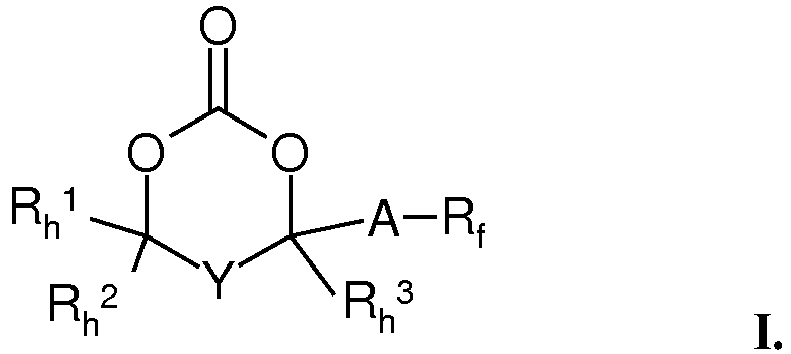
- Briefly, in one aspect, provided is a solvent composition according to Formula I:
- Briefly, in another aspect, provided is a solvent composition according to the formula R-O-C(=O)-O-R', wherein at least one of R and R' is -C(Rh 7)(Rh 8)CFRf 1(CF2CF2)nCHFRf 7, wherein Rf 7 is F, CnF2n+1, or Rf 3O(Rf 4O)m- , n is 0 or 1, m is 0 or 1, and Rh 8 and Rh 7 are alkyl groups having 1 to 4 carbon atoms, and wherein Rh 7 and Rh 8 may together form a ring, provided that when n is 1 both Rf 1 and Rf 7 are fluorine.
- It has been discovered that at least some of the above-described novel partially fluorinated carbonate compounds have surprisingly high boiling points and low volatilities and thus, in general, are less flammable or less combustible than conventional electrolyte solvents. Yet solvent compositions including the compounds may also quite effectively dissolve electrolyte salts to provide electrolyte compositions that adequately wet electrochemical device components (such as separators) and that exhibit adequate ionic conductivities for use in electrochemical devices over a range of operating temperatures (for example, from about -20°C to about 80°C or even higher, depending upon the power requirements for a particular application). The solvent compositions (and electrolyte compositions including the solvent compositions) also can present fewer difficulties in storage and handling than do some conventional materials, due to one or more relative advantages such as lower volatility, lower flammability, and/or lower combustibility of the inventive partially fluorinated carbonate compounds and electrolyte compositions.
- At least some of the partially fluorinated carbonate compounds are particularly well-suited for use in large format lithium ion batteries (batteries that operate essentially adiabatically and can therefore experience high temperatures, for example, temperatures above 60°C). In such batteries, electrolyte compositions comprising the compounds of the invention can exhibit adequate conductivities, while being less likely to react with charged electrodes or ignite during catastrophic battery failure than some conventional electrolyte compositions.
- Thus, at least some solvent compositions including the partially fluorinated carbonate compounds meet a need for electrolyte solvents that have reduced reactivity, volatility, flammability, and combustibility (relative to conventional solvents), yet effectively dissolve electrolyte salts to form stable electrolyte compositions that adequately wet electrochemical device components and that exhibit adequate ionic conductivities over a range of operating temperatures.
- In other aspects, this invention also provides electrochemical devices (preferably, batteries) including the electrolyte compositions; and articles including the electrochemical devices.
- In one embodiment, fluorine substituted 1,3-dioxolane-2-one compounds are provided as electrolyte solvents for lithium ion batteries. In another embodiment, fluorine substituted 1,3-dioxane-2-one compounds are provided as electrolyte solvents for lithium ion batteries. In another embodiment, fluorine substituted acyclic carbonates are provided as electrolyte solvents for lithium ion batteries.
- In another embodiment, mixtures of one or more fluorinated compounds of the invention together with non-fluorinated cyclic carbonates, acyclic carbonates, more conventional solvents, or combinations thereof, are provided as electrolytes for lithium ion batteries. In yet another embodiment, the invention provides a lithium ion battery with a fluorinated carbonate compound or a mixture of fluorinated carbonate compounds, optionally with non-fluorinated cyclic carbonates and acyclic carbonates and/or a conventional battery solvent as the electrolyte solvent package.
- The electrolyte composition of the present invention provides low reactivity towards charged positive electrodes and charged negative electrodes and low flammability. The high boiling points of the electrolyte compositions of the present invention result in less pressure buildup in the cells at operating temperatures.
- Other features and advantages of the invention will be apparent from the following detailed description of the invention and the claims. The above summary of principles of the disclosure is not intended to describe each illustrated embodiment or every implementation of the present disclosure. The figures and the detailed description that follow more particularly exemplify certain preferred embodiments using the principles disclosed herein.
- All numbers are herein assumed to be modified by the term "about." The recitation of numerical ranges by endpoints includes all numbers subsumed within that range (e.g., 1 to 5 includes 1, 1.5, 2, 2.75, 3, 3.80, 4, and 5).
- A non-aqueous electrolyte solvent should have one or more, preferably several desirable properties. Examples follow. A non-aqueous electrolyte solvent should have low flammability or even be nonflammable. A non-aqueous electrolyte solvent can be nonflammable by having low volatility and/or by being very slow to react with oxygen. One quantitative measure of flammability is flash point. Another measure of flammability involves bringing a lighted match near a weighing pan containing the solvent of interest and observing whether ignition occurs. More details on this measure are found below in the Test Method section. Preferably a formulated electrolyte solution has a flash point above the operating temperature of a battery in which the electrolyte is used. The operating temperature of such batteries is normally around 60°C. A non-aqueous electrolyte should allow the cell to be charged and discharged (cycled) without losing capacity after each consecutive cycle.
- A non-aqueous electrolyte should be electrochemically stable at highly reducing and oxidizing potentials. The threshold for electrochemical oxidation of the non-aqueous electrolyte should be at a voltage (versus Li+/Li) that is greater than the cathode (positive electrode) voltage at full state of charge. The threshold for electrochemical reduction of the non-aqueous electrolyte should be at a voltage that is lower (versus Li+/Li) than the anode (negative electrode) voltage at full state of charge.
- A non-aqueous electrolyte solvent should be chemically stable to the charged, active cathode material and to the charged, active anode material. One measure of stability is the exotherm onset temperature of the reaction between the non-aqueous electrolyte and the charged, active cathode material or the charged, active anode material as determined by accelerating rate calorimetry (ARC).
- However, some limited oxidation or reduction or chemical reaction of the non-aqueous electrolyte at the electrode surface can be beneficial if a passivating Solid Electrolyte Interface (SEI) layer is formed in the process. This SEI layer can protect the electrolyte from further reaction with the electrodes.
- In one aspect, the present invention provides cyclic carbonate compositions having structures according to Formula I:
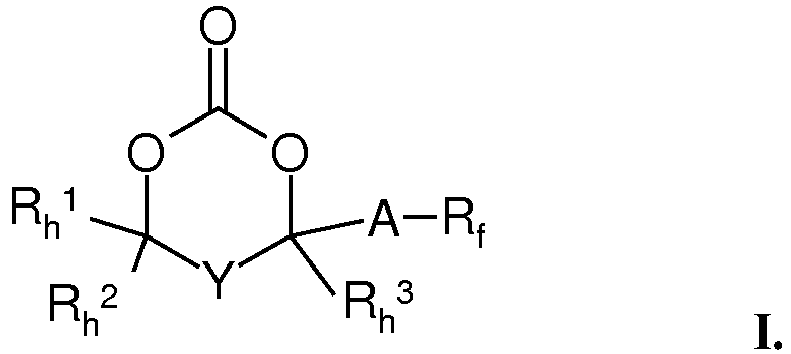
- In Formula I, each of the groups Rh 1, Rh 2 and Rh 3 is independently hydrogen or CxH2x+1, wherein x is an integer from 1 to 4, and Y is a covalent bond or the group -CRh 4Rh 5- where each of Rh 4 and Rh 5 is independently H or an alkyl group having 1 to 4 carbon atoms.
- In Formula I, Rf can be the partially fluorinated alkyl group -CFRf 1CHF Rf 2, wherein Rf 1 is F, or CnF2n+1, and n is an integer from 1 to 8. In some embodiments, n is an integer from 1 to 6 and in other embodiments, most preferably n is an integer from 1 to 4. Rf 2 is F, CpF2p+1, wherein p is an integer from 1 to 4 and CnF2n+1, may be linear or branched, or Rf 3O(Rf 4O)m-, wherein m is 0 or 1, and Rf 3 is CnF2n+1 wherein n is an integer from 1 to 8, and wherein Rf 4 is CqF2q wherein q is an integer of 1 to 4. In some embodiments, n is an integer from 1 to 6 and in other embodiments, more preferably n is an integer from 1 to 4. Rf 3 and Rf 4 may be branched. In some embodiments, Rf 2 is CnF2n+1 or Rf 3O(Rf 4O)m-. In the formula above, when Rf 1 is F and Rf 2 is F, then at least one of Rh 1, Rh 2 and Rh 3 is CxH2x+1.
- In Formula I, A can be a single covalent bond or CH2O. Preferably, in Formula I when A is CH2O, then Y is a single covalent bond.
- More particular cyclic carbonate electrolyte solvent materials are shown in Formula II and III, below, wherein the substituents are as defined above.

- In another aspect, the present invention provides acyclic carbonate compositions having structures according to Formula IV:
R-O-C(=O)-O-R' IV.
- One more particular embodiment wherein R is Rh 6, and R' is C(Rh 7)(Rh 8)CFRf 1(CF2CF2)nCHFRf 7involves the composition of Formula V:

- In Formula V, Rh 6 is CxH2x+1 and x is an integer from 1 to 4. Rh 7 and Rh 8 are independently hydrogen or an alkyl group comprising 1 to 4 carbon atoms and n is 0 or 1. Rf 7 can be F, a linear or branched CpF2p+1 group, where p is an integer from one to four or Rf 7 can be Rf 3O(Rf 4O)m-. When Rh 7 and Rh 8 are both hydrogen, then n is 0 and Rf 7 is either a linear or branched CnF2n+1 group, where n is an integer from one to four or Rf 7 is Rf 3O(Rf 4O)m-. When at least one of Rh 7 and Rh 8 is an alkyl group, then n may be 0 or 1. When n is 1, then at least one of Rh 7 and Rh 8 is an alkyl group and Rf 1 and Rf 7 are both F. When at least one of Rh 7 and Rh 8 is an alkyl group, and n is 0, then Rf 1 is F, or CnF2n+1 and Rf 7 is F, CnF2n+1 or Rf 3O(Rf 4O)m-, as described above. When both Rh 7 and Rh 8 are alkyl groups, they may together form a ring having from 5 to 6 carbon atoms. A few exemplary electrolyte solvent structures are shown below in Formulas VI through VIII:


- In another embodiment of ROC(O)OR', R and R' may each be independently represented by group C(Rh 7)(Rh 8)CFRf 1CF2CF2)nCHFRf 7.The structures represented by this embodiment may be symmetrical when R and R' are the same, or the structures may be asymmetrical (when R and R' are different). In each of the groups R and R', each Rh 7 and each Rh 8 is independently a hydrogen or an alkyl group comprising 1 to 4 carbon atoms, n may be zero or one, and at least one of Rh 7 and Rh 8 in R or R' is an alkyl group. When n is one then Rf 1 and Rf 7 are both F. Where both Rh 7 and Rh 8 are alkyl groups, they may be linked to form a ring of from 5 to 6 carbon atoms.
- In another aspect, provided is an electrolyte solvent composition according to Formula IX:
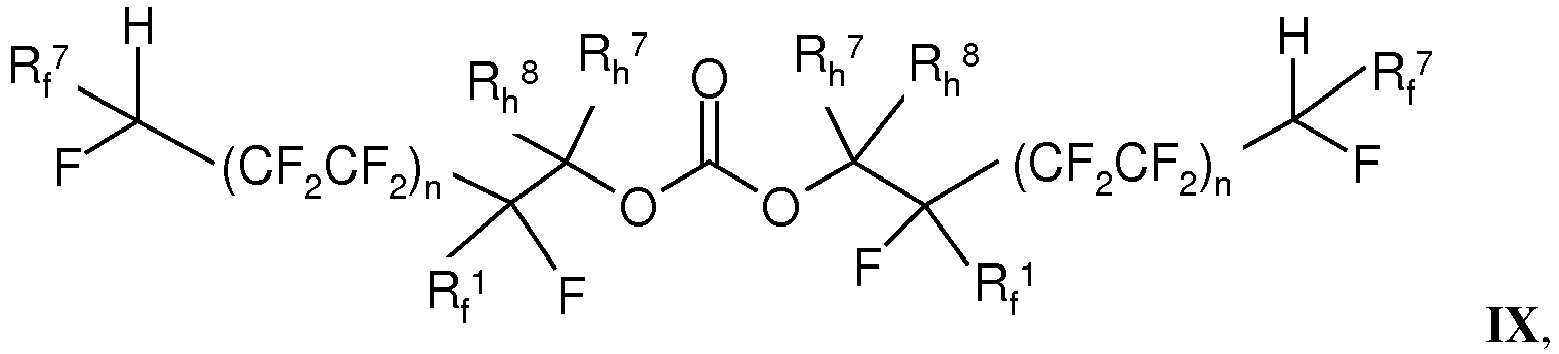
- A few exemplary electrolyte solvent structures are shown below in Formulas X and XI:


- Lithium salts can be used together with the solvents disclosed herein. For example. Exemplary lithium salts are stable and soluble in the chosen charge-carrying media and perform well in the chosen lithium-ion cell, and include LiPF6, LiBF4, LiClO4, lithium bis(oxalato)borate ("LiBOB"), LiN(SO2CF3)2, LiN(SO2C2F5)2, LiAsF6, LiC(SO2CF3)3, and combinations thereof. Suitable cosolvents for mixing with the solvents of the present invention include those useful in lithium ion batteries, such as ethylene carbonate, propylene carbonate, dimethyl carbonate, diethyl carbonate, ethylmethyl carbonate, vinylene carbonate, vinylethylene carbonate, fluoroethylene carbonate or combination thereof.
- Rechargeable lithium-ion cells or batteries generally comprise a positive electrode and a negative electrode with a separator therebetween, together with a charge-carrying electrolyte comprising a charge-carrying media or solvent or solvent mixture as provided in this disclosure along with a lithium salt. Suitable lithium salts include, for example, those described in the preceding paragraph.
- Objects and advantages of this invention are further illustrated by the following examples, but the particular materials and amounts thereof recited in these examples, as well as other conditions and details, should not be construed to unduly limit this invention.
- All numbers are weight percent (wt. %) unless otherwise noted.
- The flammability of each compound was tested by placing approximately 5 mL of the compound in an aluminum weighing pan at room temperature and bringing a lighted wooden match to within about 1 mm of the sample surface. If the sample ignited it was given a rating of Yes (a). If the sample did not ignite after about ten seconds, the sample was then contacted with the lighted match. If the sample ignited, it was given a rating of Yes (b), but none of the samples earned this rating. If it did not ignite it was given a rating of No (b).
- The proper proportions of LiPF6 and the sample compound were combined at room temperature to make a solution containing 1.0 mole of LiPF6 in 1.0 liter of the sample compound. If all of the LiPF6 dissolved in the sample fluorinated compound, the LiPF6 solubility is reported as "Yes". If a major fraction of the LiPF6 remained undissolved, the solubility is reported as "No".
- Silicon (-325 mesh, 1.04 m2/g BET surface area, Sigma-Aldrich, St. Louis, MO) (80%), Super-S carbon (12%, MMM Carbon, Belgium), polyvinylidene difluoride (PVDF), (8%, a 9% by weight solution in N-methyl pyrrolidinone (NMP), NRC, Ottawa, Canada)) and NMP, (twice the mass of the silicon, Sigma-Aldrich) were milled into a slurry by mechanical milling in a modified Spex-8000 ball mill (including steel balls, 12.5 mm diameter, 1:10 mass ratio of silicon to steel balls) for 30 min. using 500 shakes/min. The slurry was spread in a thick layer on a glass plate and was heated for about 12 h in an oven set at 105°C. The dried coating was removed from the glass plate, ground in a mortar and pestle and the powder was passed through a 300 µm (50 mesh) screen. The BET surface area of this silicon electrode powder was 3.82 m2/g. The silicon electrode powder (80 ±1 mg) and a circular piece of stainless steel mesh was pressed (96.5 MPa) into a silicon electrode pellet (14 mm diameter, 0.32 mm thick).
- Ethylene Carbonate (EC), Diethyl Carbonate (DEC) and Lithium Hexafluorophosphate (LiPF6) were obtained from EM Science (Gibbstown, NJ). A 1 Molar (M) solution of LiPF6 was prepared by dissolving the appropriate amount of LiPF6 into the EC:DEC (1:2, v/v) solvent. Lithium bis(oxolato)borate (LiBOB) (Chemetall GmbH, Frankfurt, Germany), was dissolved in EC:DEC (1:2, v/v) to a saturated concentration of about 0.8M.
- Coin cells (2325) were prepared with a silicon electrode pellet, lithium metal foil and 1M LiPF6 EC:DEC (1:2 v/v) electrolyte and a separator. The cells were discharged using capacity control to form nominal Li1Si, Li2Si and Li3Si (including irreversible capacity) using a current density of about 6.5 mA/g. After the discharge was completed, the coin cells were opened in an argon-filled glove box. The silicon electrode pellet was rinsed four times with dimethyl carbonate (DMC) and dried under reduced pressure to remove the residual DMC solvent.
- Mesocarbon microbeads (MCMB) (E-One Moli/Energy Canada Ltd., Vancouver, BC), that had been heat-treated to about 2650°C, were used to prepare a graphite electrode powder by the same procedure used to prepare the silicon electrode powder. The average particle size of the MCMB was about 20 µm determined by scanning electron microscopy (SEM), and the BET specific surface area was 0.81 m2/g. The BET surface area of the graphite electrode powder, after drying and sieving, was 1.82 m2/g. Graphite electrode pellets (14 mm in diameter and 1 mm in thickness) were made using the same procedure as for the silicon electrode pellets, except that the graphite electrode pellets were about 300 mg in mass and did not include the stainless steel mesh. Coin cells assembled with the graphite electrode pellet, lithium metal foil, separator and 1M LiPF6 EC:DEC electrolyte were discharged to form nominal Li0.81C6.
- The samples for the ARC Exotherm Onset Temperature test were prepared as described in Y. Wang, et al., Electrochemical and Solid State Letters, 9(7), A340-A343, (2006). The sample holder was made from 304 stainless steel seamless tubing with a wall thickness of 0.015 mm (0.006 inches) (Microgroup, Medway, MA). The outer diameter of the tubing was 6.35 mm (0.250 inches) and the length of pieces cut for the ARC sample holders was 39.1 mm (1.540 inches). The temperature of the ARC was set to 100°C to start the test. The sample was equilibrated for 15 min., and the self-heating rate was measured over a period of 10 min. If the self-heating rate was less than 0.04°C/ min., the sample temperature was increased by 10°C, at a heating rate of 5°C/ min. The sample was equilibrated at this new temperature for 15 min., and the self-heating rate was again measured. The ARC Exotherm Onset Temperature was recorded when the self-heating rate was sustained above 0.04°C/ min. The test was stopped when the sample temperature reached 350°C or the self-heating rate exceeded 20°C/min. The results of these ARC tests with electrolytes prepared with Examples 1-4 and with Comparative Example 2 are displayed in Table 1.
- LiCoO2 (particle diameter approximately 5 µm) and LiMn2O4 were obtained from E-One Moli/Energy Canada Ltd. (Vancouver, BC). LiPF6 (Stella Chemifa Corp., Osaka, Japan) was dissolved to a concentration of 1M in EC:DEC (1:2 v/v) solvent (available from Ferro Corp., Cleveland, OH).
- A sample of delithiated LiCoO2 was prepared in a standard 2325 coin cell. LiCoO2 electrode powder was prepared by combining 7% each of Super S Carbon Black and PVDF, (10% in NMP, NRC, Ottawa, Canada) with about 300 mg of the LiCoO2 powder. The NMP solvent was evaporated by heating the mixture at approximately 100°C and the LiCoO2 electrode powder was forced through a 50 mesh screen. LiCoO2 electrode pellets were prepared by pressing the powder in a die. The pellets were about 18 mm in diameter and about 1 mm thick.
- Coin cells (2325) with a LiCoO2 electrode pellet, a stainless steel mesh electrode, a 1 M LiPF6 EC/DEC (1:2 v/v) electrolyte and three polypropylene No. 2502 separators (Celanese Corp., Dallas, TX) were assembled in an argon-filled glove box. The cells were charged with a constant current of 1.0 mA until the cell voltage was 4.2 V vs. Li/Li+. After reaching 4.2 V, the cells were allowed to remain at open circuit conditions for 30 minutes. The open circuit voltage was less than 4.2 V. The cells were charged with a constant current of 0.5 mA to 4.2 V versus Li/Li+. After a total of four such charge-rest cycles, where the current in each cycle was reduced by 50% from the current used in the previous cycle, the charged cells were dissembled in a argon filled glove box. The delithiated LiCoO2 electrode pellet was removed from the cell and was rinsed with dimethylcarbonate (DMC) four times. The pellet was placed in the glove box antechamber under reduced pressure for 2 h to remove the residual DMC. Finally, the sample was lightly ground for use in the ARC test.
- A sample of delithiated LiMn2O4 was prepared by the same procedure as that used to prepare the delithiated LiCoO2, but substituting LiMn2O4 powder.
- The samples for the ARC Exotherm Onset Temperature test with delithiated LiCoO2 and delithiated LiMn2O4 were prepared in the same manner as the samples for the ARC Exotherm Onset Temperature test with lithiated silicon, except that about 100 mg of either delithiated LiCoO2 or delithiated LiMn2O4 was used with an equal mass of test electrolyte, and the temperature of the ARC was initially set to 110°C.
- Examples 1-4 were each tested neat in LiFePO4/graphite and LiFePO4/Li4/3Ti5/3O4 coin cells. LiFePO4 (from Phostech Lithium, Montreal, Canada). Li4/3Ti5/3O4 was obtained from NEI Corp. (Piscataway, NJ). The graphite used was mesocarbon microbeads (MCMB) heat treated to near 2650°C. Electrodes were made from the active materials, 10% by weight Super S Carbon Black and 10% by weight PVDF binder. LiFePO4 and Li4/3Ti5/3O4 electrodes were coated on aluminum foil and MCMB electrodes were coated on copper foil. A 20% capacity excess of the negative electrode was used in the cells, to ensure that the negative electrode had a stable and known potential versus Li/Li+ when the Li-ion cell reached the fully charged state (i.e., LioFePO4).
- The electrolyte formulations were 0.5 M LiPF6 in each of Examples 1-4 and Comparative Example 1. Coin cells (2325) employing Celgard No. 2502 separators were used as test vehicles. Cells were charged using currents corresponding to a normal recharge in 10, 20 or 40 h (C/10, C/20 or C/40) between the limits of 4.2 V and 2.5 V versus Li/Li+.
- Initial experiments identified those solvents that could sustain acceptable charge-discharge cycling. There was some indication that some of the electrolytes may not have fully wetted the separator and electrodes. Therefore experiments were repeated for the Example 1 where the electrodes and separators were "pressure wet". Pressure wetting was carried out by submerging the electrodes and separators in a vial of electrolyte, using a stainless steel weight to prevent floating. The vial was placed within a vacuum/pressure vessel, and the vessel was evacuated to approx -25 psi (172 kPa). After 30 seconds, the vessel was slowly pressurized to 120 psi (827 kPa). After an additional 30 seconds, the pressure was slowly released and the electrodes and separators were removed. Coin cells were then made with no additional electrolyte added.
- Aluminum, silicon, iron, titanium, and tin were obtained as pure elements in high purity (99.8 weight percent or greater) from Alfa Aesar, Ward Hill, MA or Aldrich, Milwaukee, WI. A mixture of rare earth elements, also known as mischmetal (MM), was also obtained from Alfa Aesar with 99.0 weight percent minimum rare earth content which contained approximately 50% cerium, 18% neodymium, 6% praseodymium, 22% lanthanum, and 4% other rare earth elements.
- The silicon alloy composition was prepared by melting a mixture of 7.89 g aluminum shot, 35.18 g silicon flakes, 9.34 g iron shot, 1.00 g titanium granules, 17.35 g tin shot, and 29.26 g mischmetal (MM) in an argon-filled arc furnace (from Advanced Vacuum Systems, Ayer, MA) with a copper hearth to produce an ingot. The ingot was cut into strips using a diamond blade wet saw.
- The ingots were then further processed by melt spinning. The melt spinning apparatus included a vacuum chamber having a cylindrical quartz glass crucible (16 mm internal diameter and 140 mm length) with a 0.35 mm orifice that was positioned above a rotating cooling wheel. The rotating cooling wheel (10 mm thick and 203 mm diameter) was fabricated from a copper alloy (Ni-Si-Cr-Cu C18000 alloy from Nonferrous Products, Inc., Franklin, IN). Before processing, the edge surface of the cooling wheel was polished with a rubbing compound (Imperial Microfinishing from 3M, St. Paul, MN) and then wiped with mineral oil to leave a thin film.
- After placing a 20 g ingot strip in the crucible, the system was first evacuated to 80 milliTorr (mT) and then filled with helium gas to 200 T. The ingot was melted using radio frequency induction. As the temperature reached 1350°C, 400 T helium pressure was applied to the surface of the molten alloy composition and the alloy composition was extruded through a nozzle onto the spinning (5031 revolutions per min.) cooling wheel. Ribbon strips were formed that had a width of 1 mm and a thickness of 10 µm. The ribbon strips were annealed at 200°C for 2.5 h under an argon atmosphere in a tube furnace, then cooled and powdered.
- Each of Examples 1-4 was used as an additive to the electrolyte in coin cells (2325) with an electrode of LiFePO4 (from Phostech Lithium, Montreal, PQ, Canada), an electrode of the silicon alloy composition and No. 2502 Celgard separators. The silicon alloy electrodes were 92% silicon alloy, 2.2% Ketjen black, 5.5% polyimide PI2555 (HD Microsystems, Parlin, NJ). The Ketjen Black and silicon alloy anode were premilled together using a Fritsch Micromill Pulverisette 7 (Goshen, NY) planetary mill with four 13 micrometer diameter, tungsten carbide balls for thirty minutes at a setting of seven. LiFePO4 electrodes were made from the active material, 4% Super S Carbon Black and 6% PVDF binder. LiFePO4 electrodes were coated on aluminum foil. A 10% capacity excess of the negative electrode was used. This was to ensure that the negative electrode had a stable and known potential versus Li/Li+ when the Li-ion cell reached the fully charged state (i.e., Li0FePO4).
- Electrolytes used in the cells were 1M LiPF6 in EC/DEC (1:2, v/v), with 10% of Examples 1-4.
- The coin cells were charged and discharged between 2.5V and 3.7V using a C/10 rate (based on the positive electrode) for the first lithiation of the silicon alloy. For subsequent discharge/charge cycles, a C/5 rate (based on the positive electrode) was used. A trickle current of 10mA/g (based on the active electrode mass of silicon alloy) for lithiation of the silicon alloy was used at the end of each C/5 charge of the cell. The cells remained at open-circuit for 15 min. rest between each charge and discharge.
- Example 1 was prepared by combining 2,2-dimethyl-1,3-dioxolane (200 g, 1.96 moles, Fluka Chemie GmbH, Deisenhofen, Germany) and Luperox 575 (10 g, 0.041 moles) (Arkema, Oakville, Ontario, Canada) were combined in a 600 mL Parr reactor (Parr Instrument Co., Moline, IL). The reactor was warmed to 75°C and hexafluoropropene (300 g, 2.0 moles) (MDA Manufacturing Inc., Decatur, AL) was added at a constant rate. The reactor was allowed to stir at this temperature for 16 h. The crude reaction material was distilled using a ten plate Oldershaw column to afford 4-(1,1,2,3,3,3-hexafluoropropyl)-1,3-dioxolane (boiling point (b.p.) of 144°C).
- The above purified product (265.3 g, 1.05 moles) was combined with methanol (674 g, 21.03 moles) and concentrated hydrochloric acid (26.03 g, 0.71 moles) in a 3-L round bottom flask and the mixture was heated at reflux for 72 h. Excess methanol was removed by rotary evaporation. The resulting fluorochemical diol (116 g, 0.55 moles) was combined with pyridine (181 g, 2.3 moles) and dichloromethane (235 mL) in a 1-L round bottom flask. The temperature was maintained below 0°C and phosgene solution (20% in toluene, 60 g phosgene, 0.60 moles) (Sigma-Aldrich, St. Louis, MO) was added dropwise from a jacketed addition funnel that was maintained at or below 0°C. Following the complete addition of the phosgene solution, the reaction mixture was allowed to warm to room temperature. The reaction mixture was quenched with excess saturated ammonium chloride. The organic phase was collected. The aqueous phase was extracted once with dichloromethane (200 mL). The organic phases were combined and washed with 1N hydrochloric acid, saturated, aqueous sodium hydrogen carbonate, saturated brine, dried with anhydrous sodium sulfate, filtered and concentrated via rotary evaporation. Components of the reaction mixture were separated on a one-plate distillation column.
- The purified product was analyzed by Gas Chromatography/Mass Spectrometry (GC/MS). MCMB/LiFePO4 coin cells (2325) made and cycled as per Test Method E with Example 1 as the only electrolyte solvent had a capacity fade rate of 2.65 % capacity fade/cycle for a discharge rate of C/40 and a capacity fade rate of 0.62 % capacity fade/cycle for a discharge rate of C/10.
- Example 2 was prepared by combining 4-(hydroxymethyl)-1,3-dioxolan-2-one (100 g, 0.84 moles) (Huntsman, Salt Lake City, UT) with potassium carbonate (23 g, 0.166 moles) and acetonitrile (200 mL) in a 600 mL Parr reactor. The reactor was warmed to 45°C and hexafluoropropene (139 g, 0.92 moles) was added at a constant rate. The reactor was stirred until the decrease in pressure stopped. Volatile material was removed from the reaction mixture by rotary evaporation. The olefin of the desired product was present and was saturated by reaction with anhydrous HF at room temperature. Vacuum distillation was done to purify the product. The fraction that boiled at 145-150°C at 3 T (0.4 kPa) was collected. The fraction was 97.5% pure. The product was analyzed by GC/MS and F-19 NMR. MCMB/LiFePO4 coin cells (2325) made and cycled as per Test Method E with Example 2 as the only electrolyte solvent had high impedance, and the capacity fade rate could not be calculated.
- Example 3 was prepared by combining 2,2,3,4,4,4-hexafluorobutan-1-ol (184 g, 1.012 moles, Lancaster Synthesis Ltd., Ward Hill, MA), triethylamine (102 g, 1.008 moles) and methyl-t-butyl ether (350 mL) in a 1-L round bottom flask that was maintained at a temperature between 5°C and 15°C with a carbon dioxide/water bath. To the stirred mix, ethylchloroformate (100 g, 0.92 moles) was added from a jacketed addition funnel that was maintained between 5°C and 15°C. The ethylchloroformate was added over a period of 4 h. Once addition was complete, the reaction mixture was stirred for an additional 16 h and was allowed to warm to room temperature. Then 100 mL of distilled water was added to the reaction mixture. The organic phase was collected. The water phase was extracted twice with 100 mL portions of methyl-t-butyl ether and all of the organic phases were combined. The organic phase was washed with a 100 mL portion of distilled water and a 100 mL portion of 1N HCl. The ether was removed by rotary evaporation. The remaining sample was purified by fractional distillation, using a concentric tube column. The product was analyzed by GC/MS.
- In a predried, two-necked, 500 mL round bottom flask, flushed with nitrogen, and equipped with a thermocouple probe, Claisen adapter, magnetic stir bar, water-cooled condenser and addition funnel, 2,2,3,4,4,4-hexafluorobutan-1-ol (90.00 g, 0.4943 moles, Lancaster Synthesis Ltd., Ward Hill, MA), triethylamine (62.7 g, 0.6196 moles) and methyl-t-butyl ether (200 mL) were combined. At an initial temperature of 22°C, methylchloroformate (64.12 g, 0.6678 moles) was added dropwise, from the addition funnel, over a 1 h period. During the addition, the temperature rose to 60°C. A white precipitate formed during the reaction. After the complete addition of the methylchloroformate, the reaction mixture was stirred for about 18 h at ambient temperature. The reaction mixture was combined, with stirring, with a premixed solution of 200 mL of 1.023 N HCl and 300 mL of deionized water. The resulting mixture separated into two phases. The organic phase was washed sequentially with 400 mL of water, 400 mL of 5% Na2CO3(aq), and two 400 mL portions of water. The organic phase was treated for 3 days with activated 3A molecular sieves. The product was collected by fractional distillation, under nitrogen, at atmospheric pressure and a head temperature of 151.2-153.0°C. The product was analyzed by GC/MS and the purity was measured as 98.9 % by GC-FID.
- Each of the Examples 1-4 was rated "Yes" for solubility of LiPF6.
Table 1. Results ARC Exotherm Onset Temperature Example Flammable Cell Cycle Additive (a) Charged LixSi Anode (b) Charged LiCoO2 Cathode Charged Graphite Anode Charged Li2MnO4 Cathode 1 No (b) similar to 1:2 EC/DEC (+) 230°C 175°C 210°C 2 No (b) similar to 1:2 EC/DEC (+) 230°C 210°C 220°C 3 No (b) Lower than 1:2 EC/DEC (=) 210°C No Data 130°C 4 No (b) Lower than 1:2 EC/DEC (=) 240°C No Data 150°C Comparative Example (1:2 EC:DEC) Yes (a) 46% Capacity retention at 100th cycle (-) 140°C 90°C No Data EC No (b) (=) 140°C 150°C Notes:
(a) Cell Cycle Life as 10% Additive to 1:2 EC:DEC (1M LiPF6), Silicon Alloy/LiFeP04 positive
(b) (+) means that the Exotherm Onset Temperature is higher than when EC is used, (=) means that the Exotherm Onset Temperature is the same as when EC is used same as EC, (-) means that the Exotherm Onset Temperature is lower than when EC is used. - A quantity of 3,3,4,5,5,5-hexafluoropentan-2-ol was prepared by combining absolute ethanol 200 proof (100 g, 2.17 moles, AAPER Alcohol and Chemical Co.) with t-amyl peroxy-2-ethylhexanoate (5 g, 0.021 moles) (available as Luperox 575 from Arkema, Oakville, Ontario, Canada) in a 600 mL Parr pressure reactor. The reactor was heated to 75 °C and hexafluoropropene (120 g, 0.8 moles) (MDA Manufacturing Inc., Decatur, AL) was added at a constant rate. The reactor was allowed to stir at this temperature for 16 h. The crude reaction material was distilled using a ten plate Oldershaw column to afford 150 g of 3,3,4,5,5,5-hexafluoropentan-2-ol (b.p. = 121°C).
- In a 1-L, 3-neck round bottom flask, 3,3,4,5,5,5-hexafluoropentan-2-ol (150 g, 0.76 moles) was combined with pyridine (120 g, 1.51 moles) and 200 mL of methylene chloride. The mixture was stirred using an overhead stirrer and kept at a temperature of -15°C using an ethylene glycol/CO2 bath. Triphosgene (40 g, 0.13 moles) (TCI America, Portland, OR) was dissolved in 200 mL of methylene chloride and added to the mix using a jacketed addition funnel maintained at -15°C. Following the addition of the triphosgene, the cooling bath was removed and the reaction mixture was allowed to warm to room temperature over a period of 24 h. Saturated aqueous ammonium chloride (250 mL) was added to the reaction mixture. The organic phase was collected. The aqueous phase was extracted with one 200 mL portion of methylene chloride. The organic portions were combined and washed with a 100 mL portion of 1N HCl, 100 mL of saturated sodium hydrogen carbonate and 100 mL portion of deionized water. A volatile fraction was removed by rotary evaporation. The remaining fraction was distilled and the fraction boiling at 105-107°C and 2.66 kPa was collected. The product was verified by GC/MS.
- Example 6 was prepared by combining 1,3-dioxan-2-one (240 g, 2.35 moles) (Richman Chemical Inc., Lower Gwynedd, PA) with benzoyl peroxide (5 g, 0.02 moles) in a 600 mL Parr reactor. The reactor was heated to 73°C and hexafluoropropene (16 g, 0.1066 moles) was fed into the reactor over a 2 h period. The reactor was maintained at the set temperature for an additional 24 h. The reactor contents were collected and analyzed by GC/MS.
- Various modifications and alterations of this invention will become apparent to those skilled in the art without departing from the scope and principles of this invention, and it should be understood that this invention is not to be unduly limited to the illustrative embodiments set forth hereinabove.
- The following embodiments shall further illustrate the invention.
- 1. A solvent composition according to Formula I:

wherein x is an integer from 1 to 4, Y is a single covalent bond or the group
-CRh 4Rh 5-, each of Rh 4 and Rh 5 is independently a hydrogen or an alkyl group having 1 to 4 carbon atoms,
wherein Rf is -CFRf 1 CHF Rf 2, wherein Rf 1 is F, or CnF2n+1, and n is an integer from 1 to 8, and wherein Rf 2 is F, a linear or branched CpF2p+1, wherein p is an integer from 1 to 4, or Rf 3O(Rf 4O)m-, wherein m is 0 or 1, and wherein Rf 3 is CnF2n+1, and n is an integer from 1 to 8, and Rf 4 is CqF2q, wherein q is an integer from 1 to 4, provided that when Rf 1 is F and Rf 2 is F, then at least one of Rh 1 , Rh 2 and Rh 3 is CxH2x+1, and
wherein A is a single covalent bond or CH2O. - 2. The composition of embodiment 1 wherein one or both of Rf 3 and Rf4 is branched.
- 3. The composition of embodiment 1 wherein A is CH2O and Y is a covalent bond, and Rf is -CFRf 1CHF Rf 2, optionally wherein Rf is -CF2CHFCF3.
- 4. The composition of embodiment 1 wherein A and Y are covalent bonds and Rf is -CFRf 1CHF Rf 2, optionally wherein Rf is -CF2CHFCF3.
- 5. A solvent composition according to the formula R-0-C(=0)-0-R', wherein at least one of R and R' is -C(Rh 7)(Rh 8)CFRf 1(CF2CF2)nCHFRf 7, wherein
Rf 7 is F, CnF2n+1, or Rf 3O(Rf 4O)m-, n is 0 or 1, m is 0 or 1, and - Rh 8 and Rh 7 are alkyl groups having 1 to 4 carbon atoms, and wherein Rh 7 and Rh 8 may together form a ring, provided that when n is 1 both Rf 1 and Rf 7 are fluorine.
- 6. The composition of embodiment 5 wherein R and R' are identical.
- 7. A solvent composition according to the formula R-O-C(=O)-O-R',
wherein R is CxH2x+1 and x is an integer from 1 to 4, and
wherein R' is -C(Rh 7)(Rh 8)CFRf 1(CF2CF2)nCHFRf 7, wherein Rf 7 is F, CpF2p+1, p is an integer from 1 to 4, or Rf 3O(Rf 4O)m-, Rh 7 and Rh 8 are both alkyl groups having 1 to 4 carbon atoms which may together form a ring, m is 0 or 1, and n is 0 or 1, provided that when n is one both Rf 1 and Rf 7 are fluorine. - 8. The composition of embodiment 7 wherein n is 0 and Rf 7 is a linear or branched CpF2p+1 group, where p is an integer from 1 to 4.
- 9. The composition of embodiment 7 wherein n is 0 and Rf7 is Rf 3O(Rf 4O)m-o
- 10. The composition of embodiment 7 wherein n is 0 and wherein Rf 1 is fluorine.
- 11. The composition of embodiment 7 wherein n is 0, Rf 1 is fluorine, and Rf 7 is CpF2p+1
wherein p is 1 to 4. - 12. A solvent composition according to the formula R-O-C(=O)-O-R' wherein R and R' are each independently represented by the group -C(Rh 7)(Rh 8)CFRf 1(CF2CF2)nCHFRf 7 and wherein in each of the groups R and R', each of Rh 7 and Rh 8 is, independently, H or an alkyl group having 1 to 4 carbon atoms, n is 0 or 1, at least one of Rh 7 and Rh 8 in R or R' is an alkyl group, and when n is 1, Rf 1 and Rf 7 are both fluorine.
- 13. The composition of embodiment 12 where Rand R' are identical.
- 14. The composition of embodiment 12 where at least one of Rh 7 and Rh 8 is an alkyl group.
- 15. The composition of embodiment 12 wherein both Rh 7 and Rh 8 in both Rand R' are alkyl groups.
- 16. The composition of embodiment 12 wherein Rh 7 in Rand R' is hydrogen and Rh 8 in Rand R' is an alkyl group.
- 17. The composition of any of embodiments 1-16 further comprising a lithium salt.
- 18. A lithium ion battery comprising an electrolyte and a positive electrode and a negative electrode, wherein said electrolyte comprises a composition according to embodiment 17, optionally wherein each of the fully charged electrodes of said battery have an ARC Exotherm Onset Temperature above about 150°C in the presence of the neat solvent composition.
- 19. A lithium ion battery comprising an electrolyte and a positive electrode and a negative electrode, wherein said electrolyte comprises a composition according to embodiment 17, optionally wherein each of the fully charged electrodes of said battery have an ARC Exotherm Onset Temperature above about 170°C in the presence of the neat solvent composition.
- 20. The composition of embodiment 17 further comprising a salt selected from LiPF6, LiBF4, LiClO4, lithium bis(oxalato)borate, LiN(SO2CF3)2, LiN(SO2C2F5)2, LiAsF6, LiC(SO2CF3)3, and combinations thereof.
- 21. The composition of embodiment 17 further comprising a cosolvent, optionally selected from ethylene carbonate, propylene carbonate, dimethyl carbonate, diethyl carbonate, ethylmethyl carbonate, vinylene carbonate, vinylethylene carbonate, fluoroethylene carbonate, or a combination thereof.
- 22. A lithium ion battery comprising an electrolyte, wherein said electrolyte comprises a composition according to embodiment 17.
- 23. An electrolyte composition comprising a solvent and a lithium salt wherein the solvent comprises a compound according to the formula R-O-C(=O)-O-R',
wherein R is CpH2p+1 and p is an integer from 1 to 4, and
wherein R' is -C(Rh 7)(Rh 8)CFRf 1(CF2CF2)nCHFRf 7, wherein Rf 1 is fluorine or
CpF2p+1, Rf 7 is F, CpF2p+1, or Rf 3O(Rf 4O)m-, and Rh 7 and Rh 8 are independently H or an alkyl group and wherein both Rh 7 and Rh 8 are not alkyl groups, the alkyl groups having 1 to 4 carbon atoms, m is 0 or 1, and n is 0 or 1. - 24. The electrolyte composition of embodiment 23 wherein Rh 7 and Rh 8 are both hydrogen and n is zero.
- 25. The electrolyte composition of embodiment 23 wherein one of Rh 7and Rh 8 is an alkyl group, n is 1, and both Rf 1 and Rf 7 are fluorine.
- 26. The electrolyte composition of embodiment 23 wherein one of Rh 7 and Rh 8 is an alkyl group, n is zero, and Rf 1 is F or CnF2n+1, and Rf 7 and Rh 8 are F, CnF2n+1, or Rf 3O(Rf 4O)m-,
Claims (9)
- An electrolyte composition comprising a solvent and a lithium salt wherein the solvent comprises a compound according to the formula R-O-C(=O)-O-R',
wherein R is CpH2p+1 and p is an integer from 1 to 4, and
wherein R' is -C(Rh 7)(Rh 8)CFRf 1(CF2CF2)nCHFRf 7, wherein Rf 1 is fluorine or CpF2p+1, Rf 7 is F, CpF2p+1, or Rf 3O(Rf 4O)m-, and Rh 7 and Rh 8 are independently H or an alkyl group and wherein both Rh 7 and Rh 8 are not alkyl groups, the alkyl groups having 1 to 4 carbon atoms, m is 0 or 1, and n is 0 or 1. - The electrolyte composition of claim 1 wherein Rh 7 and Rh 8 are both hydrogen and n is zero.
- The electrolyte composition of claim 1 wherein one of Rh 7 and Rh 8 is an alkyl group, n is 1, and both Rf 1 and Rf 7 are fluorine.
- The electrolyte composition of claim 1 wherein one of Rh 7 and Rh 8 is an alkyl group, n is zero, and Rf 1 is F or CnF2n+1, and Rf 7 and Rh 8 are F, CnF2n+1, or Rf 3O(Rf 4O)m-.
- A lithium ion battery comprising an electrolyte and a positive electrode and a negative electrode, wherein said electrolyte comprises a composition according to claim 1, optionally wherein each of the fully charged electrodes of said battery have an ARC Exotherm Onset Temperature above about 150°C in the presence of the neat solvent composition.
- A lithium ion battery comprising an electrolyte and a positive electrode and a negative electrode, wherein said electrolyte comprises a composition according to claim 1, optionally wherein each of the fully charged electrodes of said battery have an ARC Exotherm Onset Temperature above about 170°C in the presence of the neat solvent composition.
- The composition of claim 1 wherein the lithium salt is selected from LiPF6, LiBF4, LiC-lO4, lithium bis(oxalato)borate, LiN(SO2CF3)2, LiN(SO2C2F5)2, LiAsF6, LiC(SO2CF3)3, and combinations thereof.
- The composition of claim 1 further comprising a cosolvent selected from ethylene carbonate, propylene carbonate, dimethyl carbonate, diethyl carbonate, ethylmethyl carbonate, vinylene carbonate, vinylethylene carbonate, fluoroethylene carbonate, or a combination thereof.
- A lithium ion battery comprising an electrolyte, wherein said electrolyte comprises a composition according to claim 1.
Applications Claiming Priority (2)
| Application Number | Priority Date | Filing Date | Title |
|---|---|---|---|
| US87107606P | 2006-12-20 | 2006-12-20 | |
| EP07869119A EP2108209A4 (en) | 2006-12-20 | 2007-12-12 | Fluorinated compounds for use in lithium battery electrolytes |
Related Parent Applications (1)
| Application Number | Title | Priority Date | Filing Date |
|---|---|---|---|
| EP07869119.3 Division | 2007-12-12 |
Publications (1)
| Publication Number | Publication Date |
|---|---|
| EP2637245A1 true EP2637245A1 (en) | 2013-09-11 |
Family
ID=39562893
Family Applications (2)
| Application Number | Title | Priority Date | Filing Date |
|---|---|---|---|
| EP07869119A Withdrawn EP2108209A4 (en) | 2006-12-20 | 2007-12-12 | Fluorinated compounds for use in lithium battery electrolytes |
| EP13170324.1A Withdrawn EP2637245A1 (en) | 2006-12-20 | 2007-12-12 | Fluorinated compounds for use in lithium battery electrolytes |
Family Applications Before (1)
| Application Number | Title | Priority Date | Filing Date |
|---|---|---|---|
| EP07869119A Withdrawn EP2108209A4 (en) | 2006-12-20 | 2007-12-12 | Fluorinated compounds for use in lithium battery electrolytes |
Country Status (7)
| Country | Link |
|---|---|
| US (2) | US8435679B2 (en) |
| EP (2) | EP2108209A4 (en) |
| JP (2) | JP2010514144A (en) |
| KR (1) | KR101646785B1 (en) |
| CN (2) | CN102569892B (en) |
| TW (1) | TWI418551B (en) |
| WO (1) | WO2008079670A1 (en) |
Cited By (1)
| Publication number | Priority date | Publication date | Assignee | Title |
|---|---|---|---|---|
| WO2021037721A1 (en) | 2019-08-29 | 2021-03-04 | Saft | Fluorinated electrolyte composition for a lithium-ion electrochemical element |
Families Citing this family (43)
| Publication number | Priority date | Publication date | Assignee | Title |
|---|---|---|---|---|
| US7557433B2 (en) | 2004-10-25 | 2009-07-07 | Mccain Joseph H | Microelectronic device with integrated energy source |
| KR101009622B1 (en) * | 2007-11-27 | 2011-01-21 | 쓰리엠 이노베이티브 프로퍼티즈 캄파니 | Anode active material for lithium secondary battery, method for preparing same, and lithium secondary battery comprising same |
| US20100028784A1 (en) * | 2008-07-29 | 2010-02-04 | 3M Innovative Properties Company | Electrolyte composition, lithium-containing electrochemical cell, battery pack, and device including the same |
| JP2010108915A (en) * | 2008-09-30 | 2010-05-13 | Sanyo Electric Co Ltd | Nonaqueous electrolytic secondary battery |
| JP5691273B2 (en) * | 2009-07-23 | 2015-04-01 | Jnc株式会社 | Liquid crystal alignment agent, liquid crystal alignment film, and liquid crystal display element |
| JP5479844B2 (en) * | 2009-10-15 | 2014-04-23 | 旭化成ケミカルズ株式会社 | Cyclic carbonate |
| US8993177B2 (en) | 2009-12-04 | 2015-03-31 | Envia Systems, Inc. | Lithium ion battery with high voltage electrolytes and additives |
| US8735005B2 (en) | 2010-04-02 | 2014-05-27 | E I Du Pont De Nemours And Company | Fluorinated cyclic carbonates and compositions thereof |
| JP2013065536A (en) * | 2011-09-01 | 2013-04-11 | Sony Corp | Secondary battery electrolyte, secondary battery, battery pack, electric vehicle, power storage system, electric tool and electronic device |
| CN103959544A (en) | 2011-09-02 | 2014-07-30 | 纳幕尔杜邦公司 | Fluorinated electrolyte compositions |
| CN102417500B (en) * | 2011-09-02 | 2014-05-14 | 湖南有色郴州氟化学有限公司 | Fluorine-containing carbonic ester solvent, its preparation method and electrolyte for lithium ion batteries |
| JP6178317B2 (en) | 2011-09-02 | 2017-08-09 | イー・アイ・デュポン・ドウ・ヌムール・アンド・カンパニーE.I.Du Pont De Nemours And Company | Lithium ion battery |
| US9570778B2 (en) | 2012-04-17 | 2017-02-14 | Daikin Industries, Ltd. | Electrolytic solution, electrochemical device, lithium ion secondary battery, and module |
| WO2013157504A1 (en) * | 2012-04-17 | 2013-10-24 | ダイキン工業株式会社 | Electrolytic solution, electrochemical device, lithium ion secondary battery, and module |
| US10074874B2 (en) | 2012-06-01 | 2018-09-11 | Solvay Sa | Additives to improve electrolyte performance in lithium ion batteries |
| US10044066B2 (en) | 2012-06-01 | 2018-08-07 | Solvary SA | Fluorinated electrolyte compositions |
| WO2014158768A1 (en) | 2013-03-14 | 2014-10-02 | Enevate Corporation | Clamping device for an electrochemical cell stack |
| JP2016519400A (en) | 2013-04-04 | 2016-06-30 | イー・アイ・デュポン・ドウ・ヌムール・アンド・カンパニーE.I.Du Pont De Nemours And Company | Non-aqueous electrolyte composition |
| US10411299B2 (en) | 2013-08-02 | 2019-09-10 | Zenlabs Energy, Inc. | Electrolytes for stable cycling of high capacity lithium based batteries |
| US9666918B2 (en) | 2014-03-28 | 2017-05-30 | International Business Machines Corporation | Lithium oxygen battery and electrolyte composition |
| US10418667B2 (en) * | 2014-11-28 | 2019-09-17 | Sanyo Electric Co., Ltd. | Non-aqueous electrolyte secondary battery |
| US9957280B2 (en) | 2014-12-15 | 2018-05-01 | Samsung Electronics Co., Ltd. | Luminescent compound and electroluminescent device exhibiting thermally activated delayed fluorescence |
| EP3353844B1 (en) | 2015-03-27 | 2022-05-11 | Mason K. Harrup | All-inorganic solvents for electrolytes |
| US20160301107A1 (en) * | 2015-04-07 | 2016-10-13 | Blue Current, Inc. | Functionalized perfluoroalkanes and electrolyte compositions |
| US10324138B2 (en) | 2015-11-16 | 2019-06-18 | Massachusettes Institute Of Technology | Computing system for identification of solid-solid interphase products |
| US10249449B2 (en) | 2016-03-01 | 2019-04-02 | Maxwell Technologies, Inc. | Electrolyte formulations for energy storage devices |
| EP3426651A4 (en) | 2016-03-11 | 2019-08-21 | 3M Innovative Properties Company | Amine-containing cyclic hydrofluoroethers and methods of using the same |
| EP3426643A4 (en) | 2016-03-11 | 2019-08-21 | 3M Innovative Properties Company | Amine-containing acyclic hydrofluoroethers and methods of using the same |
| WO2017192425A1 (en) * | 2016-05-05 | 2017-11-09 | 3M Innovative Properties Company | Electrolyte solutions for rechargeable batteries |
| US10988447B2 (en) | 2016-06-30 | 2021-04-27 | Samsung Electronics Co., Ltd. | Bipyridine derivatives and their uses for organic light emitting diodes |
| US10707531B1 (en) | 2016-09-27 | 2020-07-07 | New Dominion Enterprises Inc. | All-inorganic solvents for electrolytes |
| JP6696590B2 (en) | 2016-12-20 | 2020-05-20 | ダイキン工業株式会社 | Electrolyte solution, electrochemical device, lithium ion secondary battery and module |
| WO2018123359A1 (en) * | 2016-12-27 | 2018-07-05 | ダイキン工業株式会社 | Electrolytic solution, electrochemical device, lithium-ion secondary cell, and module |
| CN107293793B (en) * | 2017-07-06 | 2020-03-31 | 清华大学 | Electrolyte and electrochemical cell |
| GB2582364A (en) | 2019-03-21 | 2020-09-23 | Mexichem Fluor Sa De Cv | Methods |
| US12531269B2 (en) | 2019-06-05 | 2026-01-20 | Enevate Corporation | Silicon-based energy storage devices with fluorinated electrolyte formulations |
| US11973178B2 (en) | 2019-06-26 | 2024-04-30 | Ionblox, Inc. | Lithium ion cells with high performance electrolyte and silicon oxide active materials achieving very long cycle life performance |
| MX2022003255A (en) * | 2019-09-17 | 2022-07-21 | E3Trigen Inc | FLUORINATED ELECTROLYTE ADDITIVES. |
| CN110590556A (en) * | 2019-09-30 | 2019-12-20 | 安徽屹珹新材料科技有限公司 | Preparation method of fluorine-containing asymmetric chain carbonate |
| US11462769B2 (en) | 2019-12-03 | 2022-10-04 | Enevate Corporation | Silicon-based energy storage devices with electrolyte containing a benzoyl peroxide based compound |
| CN115191044A (en) * | 2019-12-17 | 2022-10-14 | 株式会社杰士汤浅国际 | Nonaqueous electrolyte storage element and method for manufacturing same |
| US12355079B2 (en) | 2020-07-02 | 2025-07-08 | Ionblox, Inc. | Lithium ion cells with silicon based active materials and negative electrodes with water-based binders having good adhesion and cohesion |
| KR102908015B1 (en) * | 2022-09-21 | 2026-01-02 | 삼성에스디아이 주식회사 | Electrolyte for rechargeable lithium battery and rechargeable lithium battery the same |
Citations (5)
| Publication number | Priority date | Publication date | Assignee | Title |
|---|---|---|---|---|
| EP0599534A1 (en) * | 1992-11-18 | 1994-06-01 | Mitsui Petrochemical Industries, Ltd. | Novel carbonate compounds, non-aqueous electrolytic solutions and batteries comprising nonaqueous electrolytic solutions |
| JP2000090968A (en) * | 1998-09-16 | 2000-03-31 | Mitsui Chemicals Inc | Non-aqueous electrolyte and non-aqueous electrolyte secondary battery |
| JP2005078820A (en) * | 2003-08-28 | 2005-03-24 | Japan Storage Battery Co Ltd | Nonaqueous electrolyte secondary battery |
| WO2006106656A1 (en) * | 2005-03-30 | 2006-10-12 | Daikin Industries, Ltd. | Electrolyte solution |
| WO2006132372A1 (en) * | 2005-06-10 | 2006-12-14 | Mitsubishi Chemical Corporation | Nonaqueous electrolyte solution, nonaqueous electrolyte secondary battery and carbonate compound |
Family Cites Families (56)
| Publication number | Priority date | Publication date | Assignee | Title |
|---|---|---|---|---|
| US3359296A (en) | 1964-11-13 | 1967-12-19 | Allied Chem | Fluoroalcohol carbonates |
| JPH063737B2 (en) * | 1985-01-16 | 1994-01-12 | 松下電器産業株式会社 | Organic electrolyte battery |
| JP3173875B2 (en) | 1992-06-24 | 2001-06-04 | 富士写真フイルム株式会社 | Photo film feed control device |
| JP3304187B2 (en) | 1994-03-14 | 2002-07-22 | 日本電信電話株式会社 | Electrolyte for lithium secondary battery |
| CA2197085A1 (en) | 1995-06-09 | 1996-12-27 | Mitsui Petrochemical Industries, Ltd. | Fluorine-substituted cyclic carbonate and electrolytic solution and battery containing the same |
| JPH09147911A (en) | 1995-11-22 | 1997-06-06 | Sanyo Electric Co Ltd | Nonaqueous electrolyte battery |
| JPH09148197A (en) | 1995-11-29 | 1997-06-06 | Matsushita Electric Ind Co Ltd | Electric double layer capacitor |
| JPH09180721A (en) | 1995-12-28 | 1997-07-11 | Mitsui Petrochem Ind Ltd | Electrode for lithium battery, manufacturing method thereof, electrochemical device and manufacturing method thereof |
| JPH09306540A (en) | 1996-05-11 | 1997-11-28 | Furukawa Battery Co Ltd:The | Lithium secondary battery |
| DE19619233A1 (en) | 1996-05-13 | 1997-11-20 | Hoechst Ag | Fluorine-containing solvents for lithium batteries with increased security |
| US5830600A (en) * | 1996-05-24 | 1998-11-03 | Sri International | Nonflammable/self-extinguishing electrolytes for batteries |
| JP3758107B2 (en) * | 1996-08-07 | 2006-03-22 | 三井化学株式会社 | Ion conductive polymer gel electrolyte and solid state battery including the polymer gel electrolyte |
| DE69734339T2 (en) | 1996-08-07 | 2006-06-01 | Mitsui Chemicals, Inc. | Ion-conducting gelled polymer electrolyte and solid electrolyte containing this electrolyte |
| JPH10116629A (en) | 1996-10-15 | 1998-05-06 | Mitsui Chem Inc | Non-aqueous electrolyte |
| JPH10116630A (en) | 1996-10-15 | 1998-05-06 | Toray Ind Inc | Non-aqueous electrolyte secondary battery |
| JPH10189046A (en) * | 1996-11-11 | 1998-07-21 | Mitsui Chem Inc | Nonaqueus electrolyte and nonaqueous electrolytic secondary battery |
| JPH10144346A (en) | 1996-11-15 | 1998-05-29 | Nippon Telegr & Teleph Corp <Ntt> | Secondary battery with non-aqueous solvent electrolyte |
| JPH10233345A (en) | 1997-02-20 | 1998-09-02 | Mitsui Chem Inc | Nonaqueous electrolytic solution |
| JPH10247519A (en) | 1997-03-03 | 1998-09-14 | Sanyo Electric Co Ltd | Lithium secondary battery |
| JPH10321479A (en) | 1997-05-20 | 1998-12-04 | Mitsui Chem Inc | Non-aqueous electrolyte for electric double layer capacitor, and non-aqueous electrolytic double layer capacitor |
| JPH1140195A (en) | 1997-07-18 | 1999-02-12 | Hitachi Ltd | Non-aqueous electrolyte secondary battery |
| JPH11176472A (en) | 1997-12-08 | 1999-07-02 | Ricoh Co Ltd | Ion conductive polymer solid electrolyte, and electrochemical device and battery containing the solid electrolyte |
| TW434923B (en) | 1998-02-20 | 2001-05-16 | Hitachi Ltd | Lithium secondary battery and liquid electrolyte for the battery |
| JP4127890B2 (en) | 1998-03-10 | 2008-07-30 | 株式会社Adeka | Non-aqueous electrolyte battery |
| JP4392726B2 (en) | 1998-04-23 | 2010-01-06 | 三井化学株式会社 | Non-aqueous electrolyte and non-aqueous electrolyte secondary battery |
| JP2000026373A (en) | 1998-07-09 | 2000-01-25 | Hitachi Ltd | Halogenated carbonate compound |
| TW447163B (en) | 1998-09-11 | 2001-07-21 | Mitsui Chemicals Inc | Non-hydrolysis electrolytic liquid and secondary battery with non-hydrolysis electrolytic liquid |
| JP2000150317A (en) | 1998-11-06 | 2000-05-30 | Toyota Motor Corp | Electrolyte for capacitor and electric double layer capacitor |
| JP2000195544A (en) | 1998-12-25 | 2000-07-14 | Mitsui Chemicals Inc | Nonaqueous electrolyte and secondary battery using it |
| JP2000228216A (en) | 1999-02-08 | 2000-08-15 | Denso Corp | Non-aqueous electrolyte and non-aqueous electrolyte secondary battery |
| JP2000327634A (en) | 1999-05-25 | 2000-11-28 | Hitachi Ltd | Fluorinated carbonate compound |
| JP4431212B2 (en) | 1999-06-02 | 2010-03-10 | 関東電化工業株式会社 | Method for producing fluorine-containing cyclic carbonate |
| KR100316686B1 (en) * | 1999-07-01 | 2001-12-12 | 안복현 | Nonaqueous electrolyte battery |
| JP5062459B2 (en) | 2001-05-15 | 2012-10-31 | 株式会社Gsユアサ | Nonaqueous electrolyte secondary battery |
| JP2002373702A (en) * | 2001-06-18 | 2002-12-26 | Asahi Denka Kogyo Kk | Non-aqueous electrolyte and non-aqueous electrolyte secondary battery using the electrolyte |
| JP4951820B2 (en) | 2001-06-28 | 2012-06-13 | ダイキン工業株式会社 | Electrode surface film forming agent. |
| JP2003036884A (en) | 2001-07-19 | 2003-02-07 | Sony Corp | Non-aqueous electrolyte and non-aqueous electrolyte battery |
| JP4503209B2 (en) | 2002-01-17 | 2010-07-14 | 株式会社ジーエス・ユアサコーポレーション | Non-aqueous electrolyte battery |
| JP4168241B2 (en) | 2002-08-02 | 2008-10-22 | 株式会社ジーエス・ユアサコーポレーション | Non-aqueous electrolyte battery |
| JP2004281185A (en) | 2003-03-14 | 2004-10-07 | Sanyo Electric Co Ltd | Nonaqueous electrolytic solution for battery, and nonaqueous electrolytic solution battery |
| US7563748B2 (en) | 2003-06-23 | 2009-07-21 | Cognis Ip Management Gmbh | Alcohol alkoxylate carriers for pesticide active ingredients |
| JP2005047875A (en) | 2003-07-31 | 2005-02-24 | Asahi Glass Co Ltd | Method for producing bis (ω-hydrodifluoroalkyl) carbonate, and non-aqueous electrolyte |
| JP2005060261A (en) * | 2003-08-08 | 2005-03-10 | Asahi Glass Co Ltd | Bis (2,2,3,4,4,4-hexafluorobutyl) carbonate, method for producing the same, and non-aqueous electrolyte |
| JP2005071678A (en) | 2003-08-21 | 2005-03-17 | Sony Corp | battery |
| KR100657225B1 (en) * | 2003-09-05 | 2006-12-14 | 주식회사 엘지화학 | Electrolyte solvent for improving safety of battery and lithium secondary battery comprising the same |
| US7785740B2 (en) | 2004-04-09 | 2010-08-31 | Air Products And Chemicals, Inc. | Overcharge protection for electrochemical cells |
| WO2005123656A1 (en) | 2004-06-16 | 2005-12-29 | Asahi Glass Company, Limited | Novel methyl carbonates, and method for production thereof and non-aqueous electrolyte |
| RU2346996C2 (en) | 2004-06-29 | 2009-02-20 | ЮРОПИЭН НИКЕЛЬ ПиЭлСи | Improved leaching of base metals |
| EP1630894A1 (en) | 2004-08-27 | 2006-03-01 | Sanyo Component Europe GmbH | Lithium secondary battery |
| JP4055207B2 (en) * | 2004-09-30 | 2008-03-05 | ソニー株式会社 | Negative electrode active material and battery using the same |
| CN101120474B (en) | 2005-02-16 | 2011-08-24 | 大金工业株式会社 | Electrolyte solution |
| WO2006106657A1 (en) | 2005-03-30 | 2006-10-12 | Daikin Industries, Ltd. | Electrolyte solution |
| US7854855B2 (en) * | 2005-03-31 | 2010-12-21 | Daikin Industries, Ltd. | Electrolytic solution |
| JP4952074B2 (en) * | 2005-06-10 | 2012-06-13 | 三菱化学株式会社 | Non-aqueous electrolyte and non-aqueous electrolyte secondary battery |
| JP5050404B2 (en) | 2006-05-10 | 2012-10-17 | 株式会社Gsユアサ | Non-aqueous electrolyte secondary battery |
| US8236191B2 (en) * | 2007-01-12 | 2012-08-07 | Daikin Industries, Ltd. | Electrical double layer capacitor |
-
2007
- 2007-12-12 CN CN201110411052.4A patent/CN102569892B/en not_active Expired - Fee Related
- 2007-12-12 EP EP07869119A patent/EP2108209A4/en not_active Withdrawn
- 2007-12-12 KR KR1020097012815A patent/KR101646785B1/en not_active Expired - Fee Related
- 2007-12-12 CN CN2007800478079A patent/CN101657931B/en not_active Expired - Fee Related
- 2007-12-12 EP EP13170324.1A patent/EP2637245A1/en not_active Withdrawn
- 2007-12-12 US US12/519,461 patent/US8435679B2/en not_active Expired - Fee Related
- 2007-12-12 JP JP2009543069A patent/JP2010514144A/en active Pending
- 2007-12-12 WO PCT/US2007/087114 patent/WO2008079670A1/en not_active Ceased
- 2007-12-19 TW TW096148802A patent/TWI418551B/en not_active IP Right Cessation
-
2013
- 2013-04-05 US US13/857,763 patent/US9406977B2/en active Active
- 2013-06-05 JP JP2013119111A patent/JP5671099B2/en not_active Expired - Fee Related
Patent Citations (7)
| Publication number | Priority date | Publication date | Assignee | Title |
|---|---|---|---|---|
| EP0599534A1 (en) * | 1992-11-18 | 1994-06-01 | Mitsui Petrochemical Industries, Ltd. | Novel carbonate compounds, non-aqueous electrolytic solutions and batteries comprising nonaqueous electrolytic solutions |
| JP2000090968A (en) * | 1998-09-16 | 2000-03-31 | Mitsui Chemicals Inc | Non-aqueous electrolyte and non-aqueous electrolyte secondary battery |
| JP2005078820A (en) * | 2003-08-28 | 2005-03-24 | Japan Storage Battery Co Ltd | Nonaqueous electrolyte secondary battery |
| WO2006106656A1 (en) * | 2005-03-30 | 2006-10-12 | Daikin Industries, Ltd. | Electrolyte solution |
| US20090291364A1 (en) * | 2005-03-30 | 2009-11-26 | Daikin Industries Ltd. | Electrolytic Solution |
| WO2006132372A1 (en) * | 2005-06-10 | 2006-12-14 | Mitsubishi Chemical Corporation | Nonaqueous electrolyte solution, nonaqueous electrolyte secondary battery and carbonate compound |
| EP1890357A1 (en) * | 2005-06-10 | 2008-02-20 | Mitsubishi Chemical Corporation | Nonaqueous electrolyte solution, nonaqueous electrolyte secondary battery and carbonate compound |
Non-Patent Citations (1)
| Title |
|---|
| Y. WANG ET AL., ELECTROCHEMICAL AND SOLID STATE LETTERS, vol. 9, no. 7, 2006, pages A340 - A343 |
Cited By (2)
| Publication number | Priority date | Publication date | Assignee | Title |
|---|---|---|---|---|
| WO2021037721A1 (en) | 2019-08-29 | 2021-03-04 | Saft | Fluorinated electrolyte composition for a lithium-ion electrochemical element |
| FR3100384A1 (en) | 2019-08-29 | 2021-03-05 | Saft | COMPOSITION OF FLUORINE ELECTROLYTE FOR LITHIUM-ION ELECTROCHEMICAL ELEMENT |
Also Published As
| Publication number | Publication date |
|---|---|
| EP2108209A4 (en) | 2012-05-30 |
| KR20090106480A (en) | 2009-10-09 |
| US20100104950A1 (en) | 2010-04-29 |
| CN102569892B (en) | 2014-10-01 |
| TWI418551B (en) | 2013-12-11 |
| US20130224605A1 (en) | 2013-08-29 |
| CN102569892A (en) | 2012-07-11 |
| CN101657931B (en) | 2013-03-20 |
| TW200922931A (en) | 2009-06-01 |
| KR101646785B1 (en) | 2016-08-08 |
| JP2013211277A (en) | 2013-10-10 |
| JP2010514144A (en) | 2010-04-30 |
| WO2008079670A1 (en) | 2008-07-03 |
| CN101657931A (en) | 2010-02-24 |
| US9406977B2 (en) | 2016-08-02 |
| US8435679B2 (en) | 2013-05-07 |
| JP5671099B2 (en) | 2015-02-18 |
| EP2108209A1 (en) | 2009-10-14 |
Similar Documents
| Publication | Publication Date | Title |
|---|---|---|
| US9406977B2 (en) | Fluorinated compounds for use in lithium battery electrolytes | |
| EP2250700B1 (en) | Redox shuttles for high voltage cathodes | |
| EP2108640B1 (en) | Ester compound, and non-aqueous electrolyte solution and lithium secondary battery each using the ester compound | |
| KR100657225B1 (en) | Electrolyte solvent for improving safety of battery and lithium secondary battery comprising the same | |
| EP3025389B1 (en) | Oxiranyl derivatives as additives for electrolytes in lithium-ion batteries | |
| EP2907183B1 (en) | Electrochemical cells | |
| EP2490292B1 (en) | Electrolyte for a rechargeable lithium battery, and rechargeable lithium battery including the same | |
| JPWO2020054866A1 (en) | Non-aqueous secondary battery | |
| KR20080042119A (en) | Electrolyte composition | |
| EP3317911B1 (en) | Li-ion battery electrolyte with reduced impedance build-up | |
| EP2827430A1 (en) | Use of lithium alkoxyborates and lithium alkoxyaluminates as conducting salts in electrolytes of lithium ion batteries | |
| JP4465968B2 (en) | Secondary battery electrolyte and secondary battery using the same | |
| JP2008192504A (en) | Non-aqueous electrolyte | |
| KR101108945B1 (en) | Electrolyte for lithium-sulphur batteries and lithium-sulphur batteries using the same | |
| EP3656014B1 (en) | Heterocyclic additives bearing sulfonyl fluoride groups for electrolyte compositions of lithium batteries | |
| EP2369671A1 (en) | Non-aqueous electrolyte secondary battery | |
| JP4269137B2 (en) | Electrode surface film forming agent. | |
| JP5134770B2 (en) | Non-aqueous electrolyte for secondary battery and non-aqueous electrolyte secondary battery including the same | |
| JP2008300125A (en) | Nonaqueous electrolyte for battery, and nonaqueous electrolyte secondary battery equipped with the same | |
| JPWO2004059782A1 (en) | Non-aqueous electrolyte additive for secondary battery and non-aqueous electrolyte secondary battery | |
| EP3373380A1 (en) | Electrolyte compositions comprising mixtures of 1,3,5-cyclohexane trinitrile compounds as additives | |
| EP3132486B1 (en) | Alkylbenzoate derivatives as electrolyte additive for lithium based batteries | |
| EP3218950B1 (en) | Acetic acid 2-[(methoxycarbonyl)oxy]methyl ester as electrolyte component | |
| EP3170221B1 (en) | Liquid formulations, processes for their manufacture, and use of such liquid formulations |
Legal Events
| Date | Code | Title | Description |
|---|---|---|---|
| PUAI | Public reference made under article 153(3) epc to a published international application that has entered the european phase |
Free format text: ORIGINAL CODE: 0009012 |
|
| 17P | Request for examination filed |
Effective date: 20130603 |
|
| AC | Divisional application: reference to earlier application |
Ref document number: 2108209 Country of ref document: EP Kind code of ref document: P |
|
| AK | Designated contracting states |
Kind code of ref document: A1 Designated state(s): AT BE BG CH CY CZ DE DK EE ES FI FR GB GR HU IE IS IT LI LT LU LV MC MT NL PL PT RO SE SI SK TR |
|
| RIN1 | Information on inventor provided before grant (corrected) |
Inventor name: MOSHURCHAK, LEE Inventor name: DAHN, JEFFREY R. Inventor name: BULINSKI, MICHAEL J. Inventor name: LI, JING Inventor name: LAMANNA, WILLIAM M. Inventor name: FLYNN, RICHARD M. Inventor name: COSTELLO, MICHAEL G. Inventor name: WANG, YADONG |
|
| 17Q | First examination report despatched |
Effective date: 20140417 |
|
| STAA | Information on the status of an ep patent application or granted ep patent |
Free format text: STATUS: THE APPLICATION HAS BEEN WITHDRAWN |
|
| 18W | Application withdrawn |
Effective date: 20140722 |