EP2632504B2 - Verbundstoffe aus hydroxyapatit und calciumcarbonat sowie verfahren zu ihrer herstellung und verwendung - Google Patents
Verbundstoffe aus hydroxyapatit und calciumcarbonat sowie verfahren zu ihrer herstellung und verwendung Download PDFInfo
- Publication number
- EP2632504B2 EP2632504B2 EP11836764.8A EP11836764A EP2632504B2 EP 2632504 B2 EP2632504 B2 EP 2632504B2 EP 11836764 A EP11836764 A EP 11836764A EP 2632504 B2 EP2632504 B2 EP 2632504B2
- Authority
- EP
- European Patent Office
- Prior art keywords
- calcium
- hydroxyapatite
- carbonate
- sintered
- composition
- Prior art date
- Legal status (The legal status is an assumption and is not a legal conclusion. Google has not performed a legal analysis and makes no representation as to the accuracy of the status listed.)
- Active
Links
Images





Classifications
-
- A—HUMAN NECESSITIES
- A61—MEDICAL OR VETERINARY SCIENCE; HYGIENE
- A61K—PREPARATIONS FOR MEDICAL, DENTAL OR TOILETRY PURPOSES
- A61K33/00—Medicinal preparations containing inorganic active ingredients
- A61K33/42—Phosphorus; Compounds thereof
-
- A—HUMAN NECESSITIES
- A61—MEDICAL OR VETERINARY SCIENCE; HYGIENE
- A61L—METHODS OR APPARATUS FOR STERILISING MATERIALS OR OBJECTS IN GENERAL; DISINFECTION, STERILISATION OR DEODORISATION OF AIR; CHEMICAL ASPECTS OF BANDAGES, DRESSINGS, ABSORBENT PADS OR SURGICAL ARTICLES; MATERIALS FOR BANDAGES, DRESSINGS, ABSORBENT PADS OR SURGICAL ARTICLES
- A61L27/00—Materials for grafts or prostheses or for coating grafts or prostheses
- A61L27/40—Composite materials, i.e. containing one material dispersed in a matrix of the same or different material
- A61L27/42—Composite materials, i.e. containing one material dispersed in a matrix of the same or different material having an inorganic matrix
- A61L27/425—Composite materials, i.e. containing one material dispersed in a matrix of the same or different material having an inorganic matrix of phosphorus containing material, e.g. apatite
-
- A—HUMAN NECESSITIES
- A61—MEDICAL OR VETERINARY SCIENCE; HYGIENE
- A61L—METHODS OR APPARATUS FOR STERILISING MATERIALS OR OBJECTS IN GENERAL; DISINFECTION, STERILISATION OR DEODORISATION OF AIR; CHEMICAL ASPECTS OF BANDAGES, DRESSINGS, ABSORBENT PADS OR SURGICAL ARTICLES; MATERIALS FOR BANDAGES, DRESSINGS, ABSORBENT PADS OR SURGICAL ARTICLES
- A61L27/00—Materials for grafts or prostheses or for coating grafts or prostheses
- A61L27/50—Materials characterised by their function or physical properties, e.g. injectable or lubricating compositions, shape-memory materials, surface modified materials
- A61L27/56—Porous materials, e.g. foams or sponges
-
- A—HUMAN NECESSITIES
- A61—MEDICAL OR VETERINARY SCIENCE; HYGIENE
- A61P—SPECIFIC THERAPEUTIC ACTIVITY OF CHEMICAL COMPOUNDS OR MEDICINAL PREPARATIONS
- A61P19/00—Drugs for skeletal disorders
- A61P19/08—Drugs for skeletal disorders for bone diseases, e.g. rachitism, Paget's disease
-
- C—CHEMISTRY; METALLURGY
- C01—INORGANIC CHEMISTRY
- C01B—NON-METALLIC ELEMENTS; COMPOUNDS THEREOF; METALLOIDS OR COMPOUNDS THEREOF NOT COVERED BY SUBCLASS C01C
- C01B25/00—Phosphorus; Compounds thereof
- C01B25/16—Oxyacids of phosphorus; Salts thereof
- C01B25/26—Phosphates
- C01B25/32—Phosphates of magnesium, calcium, strontium, or barium
- C01B25/322—Preparation by neutralisation of orthophosphoric acid
-
- A—HUMAN NECESSITIES
- A61—MEDICAL OR VETERINARY SCIENCE; HYGIENE
- A61L—METHODS OR APPARATUS FOR STERILISING MATERIALS OR OBJECTS IN GENERAL; DISINFECTION, STERILISATION OR DEODORISATION OF AIR; CHEMICAL ASPECTS OF BANDAGES, DRESSINGS, ABSORBENT PADS OR SURGICAL ARTICLES; MATERIALS FOR BANDAGES, DRESSINGS, ABSORBENT PADS OR SURGICAL ARTICLES
- A61L2430/00—Materials or treatment for tissue regeneration
- A61L2430/02—Materials or treatment for tissue regeneration for reconstruction of bones; weight-bearing implants
Definitions
- HA Hydroxyapatite
- Non-calcium phosphate materials such as calcium sulfate or calcium carbonate.
- Carbonate-substituted HA is normally found in nature, and the carbonate can replace some of the hydroxide on the calcium hydroxide component and/or substitute some of the phosphate groups with carbonate.
- This material is very biologically compatible, but is available only as powder because it cannot be sintered to a high density, as sintering above about 825 degrees transforms the carbonate groups to oxide groups.
- GB2,448,489 (University of Aberdeen) describes substituted calcium phosphate materials including a composition comprising hydroxyapatite.
- WO99/32401 (Abonetics Ltd.) relates to a method for the preparation of carbonated hydroxyapatite compositions.
- HA and calcium carbonate have been used together as layered materials.
- One such commercial material has an outer, hydrothermally formed HA layer on a calcium carbonate core.
- An operative theory is that the HA outer layer provides initial stability and accelerated bone bonding in the graft site, while the calcium carbonate core ensures rapid remodeling once the thin outer layer of HA goes away.
- calcium sulfate can be used alone as a bone grafting material.
- Calcium carbonate can also be used alone as a bone grafting material, but it has many of the disadvantages of calcium sulfate including excessively rapid dissolution.
- the present invention provides a composition according to claim 1.
- Said composition comprises a two-phase composite comprising a matrix phase comprising sintered hydroxyapatite and a discontinuous phase within said matrix phase, said hydroxyapatite comprising a Ca/P ratio of 1.67, said discontinuous phase comprising a plurality of elongated calcium carbonate inclusions having a length dimension of 5 microns to 20 microns.
- Said method comprises: providing a hydroxyapatite material comprising an extraneous carbonatable calcium component, said carbonatable calcium component providing said hydroxyapatite material a Ca/P ratio greater than 1.67; sintering said hydroxyapatite material; and treating said sintered hydroxyapatite material with a carbon dioxide source to convert at least a portion of said carbonatable calcium component to a discontinuous calcium carbonate phase within a hydroxyapatite phase.
- the present invention provides a method of using elongated carbonate inclusions to affect the strength of a hydroxyapatite material as recited in claim 13.
- Said method comprising providing a sintered hydroxyapatite material comprising a carbonatable calcium component, said carbonatable calcium component providing said hydroxyapatite material a Ca/P ratio greater than 1.67; and contacting said sintered hydroxyapatite material and a carbon dioxide source, said contact at least partially sufficient to provide elongated carbonate inclusions randomly-oriented within said sintered hydroxyapatite material, said inclusions affecting the strength of said carbonated hydroxyapatite material; wherein said affected strength may be gauged by crush-test compression and particle size data.
- Various calcium phosphate-related compositions, composites are described, along with method(s) for their preparation, thereby overcoming various deficiencies and shortcomings of the prior art, including those outlined above.
- the present invention is directed to a composition
- a composition comprising a two-phase composite comprising a matrix phase comprising a sintered calcium phosphate component and a discontinuous phase within such a matrix phase, such a discontinuous phase comprising a plurality of elongated carbonate inclusions.
- a calcium phosphate component is selected from sintered hydroxyapatite materials with a Ca/P ratio equal to about 1.67
- such a composition can have a non-powder, granulate morphology--whether porous or non-porous.
- a pore of such a composition can have a cross-dimension of about 50 microns to about 2000 microns. In certain such embodiments, such a cross-dimension can be about 200 microns to about 600 microns.
- Another example includes a two-phase composite comprising a hydroxyapatite matrix phase and a discontinuous phase within such a matrix phase, such a composite comprising a Ca/P ratio greater than about 1.67 and such a discontinuous phase comprising a plurality of elongated inclusions comprising at least a portion of such excess calcium.
- such inclusions of such a discontinuous phase can comprise about 15% to about 20% or more of any such excess calcium component.
- inclusions can have a length dimension of about 5 microns to about 20 microns. Without limitation, at least about 90% of such inclusions can have a cross-dimension of less than about 10 microns. Without limitation as to either inclusion length or cross-dimension, such a composite--whether porous or non-porous--can be sintered and/or have a non-powder, granulated morphology.
- the present invention is directed to a method of preparing a two-phase carbonated hydroxya-patite composition.
- a method comprises providing a hydroxyapatite material comprising a carbonatable calcium component, such a calcium component providing such a hydroxyapatite material a Ca/P ratio greater than about 1.67; sintering such a hydroxyapatite material; and treating such a sintered hydroxyapatite material with a carbon dioxide source to convert at least a portion of such a calcium component thereof to a discontinuous calcium carbonate phase within such a hydroxyapatite phase.
- the Ca/P ratio is greater than about 1.67, and such a hydroxyapatite material comprises an extraneous carbonatable calcium component.
- such an extraneous component can be selected from calcium oxide, and a calcium oxide precursor selected from calcium hydroxide, calcium carbonate, calcium nitrate, calcium sulfate and calcium salts of organic acids and combinations of calcium oxide and/or calcium oxide precursors.
- a calcium oxide precursor selected from calcium hydroxide, calcium carbonate, calcium nitrate, calcium sulfate and calcium salts of organic acids and combinations of calcium oxide and/or calcium oxide precursors.
- such a hydroxyapatite material can be sintered at a temperature up to about 1200°C.
- such a material can be partially or less than fully sintered.
- less sintering can provide more carbonate conversion.
- such a carbon dioxide source can be provided in a fluid form.
- such a fluid form can be selected from gaseous and liquid states of carbon dioxide and solutions comprising such a gaseous or liquid state.
- composition comprising a two-phase calcium phosphate composite characterized by an X-ray diffraction pattern comprising major peaks expressed in degrees two-theta at about 29.5°, about 36.0°, about 39.5°, about 43.0° and about 57.5°, such a composite obtainable by or as be produced by a process comprising sintering a hydroxyapatite material comprising a carbonatable calcium component and carbonating such a sintered material, such a composite comprising the carbonation product of such a calcium component as elongated crystalline inclusions therein.
- Such a composition can have a porous granulated morphology.
- a pore can have a cross-dimension of about 50 microns to about 2000 microns. In certain such embodiments, a pore can have a cross-dimension of about 200 microns to about 600 microns. Regardless, as can be used to distinguish this and various other embodiments of this invention from powders of the prior art, such granules can have a cross-sectional dimension greater than about 100 microns.
- the present invention is directed to a method of using elongated carbonate inclusions to affect the strength of a hydroxyapatite material.
- a method comprises providing a sintered hydroxyapatite material comprising a carbonatable calcium component, with such a component providing such a material a Ca/P ratio greater than about 1.67; and contacting such a sintered hydroxyapatite material and a carbon dioxide source, such contact at least partially sufficient to provide elongated carbonate inclusions within such a hydroxyapatite material.
- inclusions can affect and/or enhance the strength of such a carbonated hydroxyapatite material versus the strength of an uncarbonated hydroxyapatite material.
- such a carbonated hydroxyapatite material can be sintered at a temperature of about 800°C. Regardless, strength affected by such a method can be gauged by crush test compression and/or particle size data.
- This invention can be considered in the context of a molecular mixture of HA and calcium carbonate.
- Calcium phosphate and calcium carbonate particles are formed in situ from excess calcium species incorporated into an HA material, producing in an intimate mixture of HA and calcium carbonate that cannot be achieved by mere physical mixing of the two materials.
- the resulting crystallite size is such that the x-ray diffraction (XRD) pattern shows a crystal pattern for each, and each phase is observable under sufficient magnification, but there is no way to physically separate the component phases. Mixing on this level ensures much greater uniformity than can be obtained through a physical mixing process.
- XRD x-ray diffraction
- the HA material of this invention is carbonated after sintering. Only the calcium hydroxide groups are converted (there is no phosphate group substitution), but this still provides many of the chemical features of natural carbonated HA with the added advantage that it can be in a physical form other than powder. For example, It can be made into a porous granulate material (e.g., a particle cross-section dimension greater than about 100 microns) which is very useful in bone grafting applications.
- HA as compared to tricalcium phosphate (TCP), contains extra calcium in the form of calcium hydroxide to provide a Ca/P ratio of 5/3 (1.67) versus the 3/2 Ca/P ratio of TCP; formula of HA: CA 9 (PO 4 ) 6 CA(OH) 2 , formula of TCP: CA 9 (PO 4 ) 6 )
- the present invention is not a mere physical mixture of HA and calcium carbonate, as evidenced by an apparent limit as to how much carbonate can be incorporated into such a material. With a physical mixture, there would be no upper limit of carbonate incorporation. However, with respect to certain non-limiting embodiments, about 10% to about 25% of any excess calcium oxide (or another suitable carbonate precursor), representing calcium in excess of a Ca/P ratio of 1.67, can be converted to carbonate. At higher oxide levels, conversion to carbonate may not be complete. Among other related observations, the less an initial HA/calcium oxide/precursor material is sintered the higher the amount of carbonate conversion.
- carbonate anions are physically larger than oxide ions and have a corresponding spatial requirement within a crystal lattice. It is believed that less sintering correlates to lower material density, and lower density provides more space for physically larger carbonate anions. All such considerations provide further evidence that this invention is not a mere physical mixture but that calcium carbonate is crystallized within and/or incorporated into an HA lattice.
- the conversion to calcium carbonate is not complete and some calcium oxide or hydroxide is left it may be desirable to convert some or all of the excess calcium oxide or hydroxide to a calcium salt.
- This can be done by reacting an acid (preferably an approximately stoichiometric amount of acid relative to the calcium hydroxide or calcium oxide) with the material.
- the reaction can be carried out in a water solution, or in the case of a volatile acid such as HCl, the acid can be in the vapor phase to react with the solid calcium oxide or calcium hydroxide containing material.
- a water solution or in the case of a volatile acid such as HCl, the acid can be in the vapor phase to react with the solid calcium oxide or calcium hydroxide containing material.
- a process/method of this invention can begin with a material which is made by producing sintered HA with an excess of calcium oxide (or a material capable of being transformed to calcium carbonate such as calcium hydroxide), where the calcium phase (either intrinsic to the HA or additional calcium material, or both) is converted to carbonate by, for example, exposure to CO 2 in some form such as a gas, a water solution (carbonic acid) a supercritical fluid, or a compound capable of transferring carbon dioxide.
- a calcium phase can, in the context of this invention, be considered a carbonatable calcium component, capable of being converted to calcium carbonate--such conversion as would be understood by those skilled in the art through use of known techniques, reaction conditions and reagents, including but not limited to those discussed herein.
- the process of calcium carbonate formation is carried out on sintered HA.
- the high temperatures of sintering if carried out in an oxygen containing atmosphere transforms most calcium compounds to calcium oxide.
- Examples of compounds that can be transformed to calcium oxide by heating in an oxygen containing atmosphere are: calcium hydroxide, calcium carbonate, calcium nitrate, calcium sulfate; and calcium salts of organic acids.
- the calcium oxide can be transformed to calcium hydroxide by exposure to water or water vapor, for example, boiling the material in water.
- the process involves addition of extra calcium (for example, calcium oxide or a calcium oxide precursor) to the HA before sintering.
- the calcium compound can be added to unsintered HA, mixed in by any suitable means, and then the mixture can be sintered.
- the materials to be mixed are powders, and they may be mixed by any suitable means including a grinding/mixing procedure such as ball milling. It is also possible to use a liquid such as water, alcohol, hexane, etc. to facilitate the mixing process. As shown by comparison to the prior art, it is not possible to obtain a molecular mixture of HA and calcium carbonate solely by physical mixing, even if calcium carbonate is used as the calcium compound.
- An especially convenient method of making a precursor material is to react phosphoric acid with an excess of calcium hydroxide.
- One of the common commercial methods of making HA is by reacting phosphoric acid with calcium hydroxide; accordingly, in certain embodiments, this invention can represent a methodology including an excess of calcium hydroxide in the reaction mixture.
- the added calcium precursor remains mixed at the molecular level with the HA, and remains in place during cooling.
- the sintering will be carried out at a temperature sufficient to convert such a calcium compound to calcium oxide.
- the most direct way to convert the calcium oxide to calcium carbonate in the sintered mixture is to, at a temperature below the approximately 825°C decomposition temperature of calcium carbonate, expose the sintered material to CO 2 gas (either pure or in a gas mixture such as air, nitrogen, water vapor, etc.) until the desired conversion of the calcium oxide to calcium carbonate is achieved.
- the concentration of CO 2 in the treatment gas can be as little as 0.001% or as high as 100%.
- the CO 2 concentration mainly affects the rate of conversion, with higher CO 2 concentrations giving a faster conversion.
- the reaction with carbon dioxide gas can be facilitated by suspending the calcium oxide containing calcium phosphate in water.
- Another way to facilitate the reaction is to transform the calcium oxide to calcium hydroxide by, for example, boiling the calcium oxide containing material in water, then (optionally) drying it. Solid calcium hydroxide reacts faster with carbon dioxide than solid calcium oxide. Heat can also be used to facilitate the reaction. The temperature should be below the decomposition point of calcium carbonate (which is about 825°C).
- Temperatures can be above or below the decomposition point of the precursor material as long as the temperature is below the decomposition temperature of calcium carbonate; for example calcium hydroxide melts at about 580°C and decomposes at a somewhat higher temperature. This is still below the 825°C decomposition temperature of calcium carbonate.
- a reaction carried out at a temperature above the melting point of calcium hydroxide may be useful in providing a denser material than if the reaction were carried out below the melting point.
- Water can be used to facilitate the reaction by immersing the solid material to be treated in water, then bubbling the CO 2 through the water. While some of the calcium content of the solid material may dissolve in the water and be lost, some will also remain with the solid in a converted form as long as the reaction is not run too long. After the reaction is completed, the solid can be separated from the water by centrifugation, filtration, decantation, etc.
- the CO 2 can be in a liquid form, including the form of a super-critical fluid, or a chemical solution capable of causing the conversion (such as carbonic acid, etc.).
- the degree of sintering can affect the conversion. Fully sintering the material to a very dense material can make the conversion more difficult: as a molecular mixture, a dense crystal lattice can be considered as having less room for the larger carbonate ions (or even for the hydroxide ions in place of calcium oxide). Therefore, depending on the amount of carbonate desired, it may be necessary to lower the sintering temperature to achieve the full conversion. Alternatively, the lattice density can be decreased by introducing ions known to reduce the density of HA such as magnesium, zinc, manganese, etc.
- the mixed material is sintered before the carbonate conversion is carried out.
- the methods, composites, compositions and/or phases thereof can suitably comprise, consist of or consist essentially of any of the aforementioned components, materials or compounds.
- Each such component, material and/or compound is compositionally distinguishable, characteristically contrasted and can be practiced in conjunction with the present invention separate and apart from another.
- inventive compositions, composites and/or methods as illustratively disclosed herein, can be practiced or utilized in the absence of any one component, material and/or compound which may or may not be disclosed, referenced or inferred herein, the absence of which may or may not be specifically disclosed, referenced or inferred herein.
- inventive compositions, composites and/or methods of this invention can be expressed or claimed providing for any one or more specific components, materials, compounds and/or steps, or by reciting the absence of any one or more specific components, materials, compounds and/or steps.
- compositions, composites and/or methods including the preparation of carbonated hydroxyapatite materials, as are available through the synthetic methodologies described herein.
- claimed methods and compositions/composites provide results and data which are surprising, unexpected and contrary thereto. While the utility of this invention is illustrated through the use of several calcium phosphate compositions/composites and hydroxyapatite and carbonate components thereof, it will be understood by those skilled in the art that comparable results are obtainable with various other compositions/composites and components thereof, as are commensurate with the scope of the claims.
- Calcium hydroxide (4120 grams) was suspended in 40 liters of water in a 114-litre (30-gallon) plastic tank under continuous agitation. Phosphoric acid, 85% concentration, (3110 grams) was slowly added to the calcium hydroxide. This resulted in about a 21% excess of calcium hydroxide over that needed to make hydroxyapatite. After 24 hours, the reaction mixture was concentrated in a filter press. The filter cake was collected and dried in an oven at 120°C. The dried material was broken into random sized lumps and transferred to alumina crucibles, then sintered at 1100°C for 4 hours (with an 8-hour heating ramp). After cooling, the sintered material was checked by x-ray diffraction and found to contain about 79% HA and 21% calcium oxide.
- Example 2 Some of the material (10 grams) from Example 1 was boiled in (300 ml) water for 3 hours to transform the calcium oxide to calcium hydroxide. The ratio of solids to water was about 1:30. XRD analysis of a sample confirmed the conversion of the calcium oxide to calcium hydroxide.
- Example 2 About 50 grams of the boiled material from Example 2 was transferred to boat crucibles and put into a tube furnace. The ends of the tube furnace were sealed except for a 0.64cm (1 ⁇ 4 inch) hole at the back end and a 0.64cm (1 ⁇ 4 inch) inlet pipe in the front end. A flow of about 47 cm 3 /s (6 cubic ft./hour) of CO 2 was fed into the furnace through the tube and the furnace was held at 500°C for 12 hours. XRD analysis of the treated material showed that all of the calcium oxide had transformed to calcium carbonate, while the HA was unchanged.
- Example 2 About 10 grams of material from Example 1 was put in a 250 ml gas bubbler jar. It was covered with about 75 ml of water, and stirred with a magnetic stirring bar while CO 2 was bubbled through at a rate of about 7.9 cubic centimeters per second (1 standard cubic foot per hour (SCFH)). The reaction ran for 2 hours. The pH was initially about 8.5. At the completion of the reaction the pH was about 6.0. The material was separated from the water by centrifugation, then dried at 90° for 4 hours. XRD analysis showed that the calcium oxide content decreased from 21% to 5%, and the carbonate content was 8%. The supernatant water solution, which was cloudy, was dried and the resulting solid was analyzed by XRD.
- Calcium hydroxide (4120 grams) was suspended in 40 liters of water in a 114-litre (30-gallon) plastic tank under continuous agitation. Phosphoric acid, 85% concentration, (3110 grams) was slowly added to the calcium hydroxide. This resulted in about a 21% excess of calcium hydroxide over that needed to make hydroxyapatite. After 24 hours, the reaction mixture was concentrated in a filter press. The filter cake was collected and dried transferred to drying pans. The material was placed in a vacuum oven, the air was evacuated, and the oven was backfilled with carbon dioxide and the temperature was raised to 30 degrees C. The material was left in the carbon dioxide atmosphere for 18 hours, then removed and transferred to alumna crucibles. The material was sintered at 800 degrees, and upon XRD analysis it was found that the excess calcium had fully converted to calcium carbonate. The lower sintering temperature is believed to have prevented thermal decomposition of the carbonate material.
- porous composites and/or compositions can be prepared using techniques known in the art.
- a slurry containing calcium phosphate is produced having a molar ratio of calcium to phosphate greater than 1.67.
- the pH of the calcium phosphate slurry is then reduced to an ideal range of 7 to 4. It can be reduced by adding a buffer or acid; or preferably by converting the calcium oxide (or calcium hydroxide) present in the material to carbonate exposure to carbon dioxide gas.
- a carbomer and/or polyethylene glycol is then added to the slurry, and allowed to mix for greater than one hour. Once sufficient mixing has taken place hydrogen peroxide is added to the mixture. At this point the mixture can be placed in a heated oven and allowed to dry. Once dry, the material is sintered at a temperature greater than 600°C, but preferably less than 1200°C.
- the material is then placed in water or a water atmosphere to convert any CaO present to CaOH. Once the CaO is converted the material is placed in a CO 2 atmosphere until the desired amount of carbonation is achieved. (If the material is converted to the carbonate form before sintering, and is sintered to a temperature below about 800°C, then the after sintering carbonate conversion step is not necessary.)
- a slurry containing calcium phosphate is produced having a molar ratio of calcium to phosphate greater than 1.67.
- the mixture is then dehydrated to a powder, ideally using a spray dryer.
- the powder is then mixed with a pore-making material until a homogenous mixture is achieved.
- the pore-making material can be an organic material that burns away completely during sintering leaving holes (pores) in its place. Examples include polymer fibers, or even thin (dry) spaghetti rods.
- the calcium phosphate/porogen mixture is then pressed to its desired shape at a pressure greater than 6.9MPa (1000psi), but ideally greater than 34.5Mpa (5000psi).
- the pressed piece is than is sintered at a temperature greater than 600°C, but preferably less than 1200°C. Sintering should be done so that the pore making material completely burns out of the material.
- the material is then placed in water or a water atmosphere to convert any CaO present to CaOH. Once the CaO is converted the material is placed in a CO 2 atmosphere until the desired amount of carbonation is achieved.
- a slurry containing calcium phosphate is produced to having a molar ratio of calcium to phosphate greater than 1.67.
- the mixture is than thickened so that the slurry sticks to a polyethylene sponge while still preserving its pores.
- the sponge is then dried in a heated oven. Once dry the sponge is sintered to greater than 600°C, but preferably less than 1200°C. Sintering should be done so that the sponge completely burns out.
- the material is then placed in water or a water atmosphere to convert any CaO present to CaOH. Once the CaO is converted the material is placed in a CO 2 atmosphere until the desired amount of carbonation is achieved.
- porous, granulated composites and/or compositions of this invention can be prepared by appropriate grinding and sieving.
- porous materials prepared as described in examples 6a-c can be ground to a non-powder granulate of particle cross-dimension greater than about 100 microns.
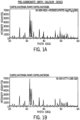
- Figure 1 provides an XRD pattern for pre-conversion HA.
- Figure 1B provides, for comparison purposes, an XRD pattern for calcium oxide.
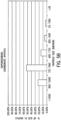
- Figure 1C provides a comparative XRD pattern for calcium carbonate, showing post-conversion carbonate peak positions (*) not present in pre-conversion HA (comparative reference is made to Figure 1A ).
- Figure 2A provides an XRD pattern for post-conversion HA and shows, for comparison, calcium oxide peak positions.
- Figure 2B provides an XRD pattern for post-conversion HA and shows, for comparison, peak positions for pre-conversion HA.
- Figure 2C provides an XRD pattern for post-conversion HA and shows, for comparison, peak positions attributable to carbonate conversion.
- the strength of a non-porous carbonated apatite material of this invention was tested and compared to non-porous uncarbonated HA using a crush test.
- the uncarbonated HA sample was sintered at 800°C, and the same temperature was used to sinter the calcium oxide/HA precursor material for the carbonated apatite sample, which was fully converted to a final carbonate content of 15%. Both samples were ground and sieved to a particle size range of 750 to 1000 microns. (It will be understood by those skilled in the art that porous materials of this invention can be prepared using known synthetic techniques and reagents.)
- the crush testing was carried out on a Quantrol by Dillon compression test instrument fitted with a 16kg (35 pound) load cell.
- the test chamber was a 0.64cm (1/4 inch) diameter cavity, 6.4cm (2.5 inches) deep.
- the sample to be tested was put in the cavity (2.54cm (1 inch) of material) followed by a stainless steel rod that closely fitted the cavity and was used to transmit force from the load cell to the sample.
- the compression test was carried out at a speed of 0.32cm/minute (1/8 inches/minute), and both force and displacement were measured up to a maximum applied load of 16kg (35 pounds).
Landscapes
- Health & Medical Sciences (AREA)
- Chemical & Material Sciences (AREA)
- Public Health (AREA)
- Life Sciences & Earth Sciences (AREA)
- Veterinary Medicine (AREA)
- General Health & Medical Sciences (AREA)
- Animal Behavior & Ethology (AREA)
- Medicinal Chemistry (AREA)
- Epidemiology (AREA)
- Inorganic Chemistry (AREA)
- Organic Chemistry (AREA)
- Oral & Maxillofacial Surgery (AREA)
- Transplantation (AREA)
- Dermatology (AREA)
- Engineering & Computer Science (AREA)
- Pharmacology & Pharmacy (AREA)
- Dispersion Chemistry (AREA)
- Materials Engineering (AREA)
- Composite Materials (AREA)
- Physical Education & Sports Medicine (AREA)
- Bioinformatics & Cheminformatics (AREA)
- Rheumatology (AREA)
- Chemical Kinetics & Catalysis (AREA)
- General Chemical & Material Sciences (AREA)
- Nuclear Medicine, Radiotherapy & Molecular Imaging (AREA)
- Orthopedic Medicine & Surgery (AREA)
- Compositions Of Oxide Ceramics (AREA)
- Materials For Medical Uses (AREA)
- Cosmetics (AREA)
- Pharmaceuticals Containing Other Organic And Inorganic Compounds (AREA)
- Medicinal Preparation (AREA)
Claims (13)
- Zusammensetzung, umfassend einen zweiphasigen Verbundstoff, umfassend eine Matrixphase, die gesinterten Hydroxyapatit umfasst, und eine diskontinuierliche Phase innerhalb der Matrixphase, wobei der Hydroxyapatit ein Ca/P-Verhältnis von 1,67 aufweist, wobei die diskontinuierliche Phase eine Vielzahl von langgestreckten Calciumcarbonateinschlüssen, mit einer Längenabmessung von 5 Mikrometer bis 20 Mikrometer umfasst.
- Zusammensetzung gemäß Anspruch 1, wobei die Zusammensetzung eine Menge an überschüssigem Calcium enthält, die 10 bis 25 % der Gesamtmenge an Calcium entspricht, die in der Hydroxyapatitphase enthalten ist.
- Zusammensetzung gemäß Anspruch 2, wobei 10 % bis 25 %, gegebenenfalls 15 % bis 20 % des überschüssigen Calciums Calciumcarbonat ist.
- Zusammensetzung gemäß Anspruch 3, wobei der Rest des überschüssigen Calciums ausgewählt ist aus NichtCarbonat-Calciumsalzen und Kombinationen der Salze.
- Zusammensetzung gemäß Anspruch 1, gekennzeichnet durch eine poröse Granulatmorphologie.
- Zusammensetzung gemäß Anspruch 5, wobei die Pore eine Querabmessung von 50 Mikrometer bis 2.000 Mikrometer aufweist, und wenn 15 % bis 20 % des überschüssigen Calciums Calciumcarbonat sind, kann die Querabmessung 200 Mikrometer bis 600 Mikrometer betragen.
- Zusammensetzung gemäß Anspruch 1, wobei wenigstens etwa 90 % der Einschlüsse eine Querabmessung von kleiner als etwa 10 Mikrometer aufweisen können.
- Zusammensetzung gemäß Anspruch 1, die gesintert ist und durch eine granulatartige Morphologie gekennzeichnet sein kann.
- Verfahren zur Herstellung einer zweiphasigen carbonisierten Hydroxyapatit-Zusammensetzung, wobei das Verfahren umfasst:Bereitstellen eines Hydroxyapatitmaterials, das eine zusätzliche carbonisierbare Calciumkomponente umfasst, wobei die carbonisierbare Calciumkomponente dem Hydroxyapatitmaterial ein Ca/P-Verhältnis von größer als 1,67 verleiht;Sintern des Hydroxyapatitmaterials; undBehandeln des gesinterten Hydroxyapatitmaterials mit einer Kohlendioxidquelle, um wenigstens einen Teil der carbonisierbaren Calciumkomponente in eine diskontinuierliche Calciumcarbonatphase innerhalb einer Hydroxyapatitphase umzuwandeln.
- Verfahren gemäß Anspruch 9, wobei die zusätzliche carbonisierbare Calciumkomponente ausgewählt sein kann aus CaO und einem Calciumoxidvorläufer ausgewählt aus Ca(OH)2, CaCO3, Ca(NO3)2, CaSO4 und Calciumsalzen von organischen Säuren, und Kombinationen des Calciumoxids und der Calciumoxidvorläufer.
- Verfahren gemäß Anspruch 10, wobei das Hydroxyapatitmaterial bei einer Temperatur von weniger als 1.200 °C gesintert oder teilgesintert wird.
- Verfahren gemäß Anspruch 11, wobei das Kohlendioxid in einer fluidform bereitgestellt wird, und
wobei die Fluidform ausgewählt sein kann aus gasförmigen und flüssigen Zuständen und Lösungen, die einen derartigen Zustand umfassen. - Verfahren zur Verwendung von langgestreckten Carbonateinschlüssen zum Beeinflussen der Festigkeit eines Hydroxyapatitmaterials, wobei das Verfahren umfasst:Bereitstellen eines gesinterten Hydroxyapatitmaterials umfassend eine carbonisierbare Calciumkomponente, wobei die carbonisierbare Calciumkomponente dem Hydroxyapatitmaterial ein Ca/P-Verhältnis von größer als 1,67 verleiht; undInkontaktbringen des gesinterten Hydroxyapatitmaterials mit einer Kohlendioxidquelle, wobei der Kontakt wenigstens zum Teil ausreicht, um langgestreckte Carbonateinschlüsse bereitzustellen, die in dem gesinterten Hydroxyapatitmaterials statistisch ausgerichtet sind, wobei die Einschlüsse die Festigkeit des carbonisierten Hydroxyapatitmaterials beeinflussen;wobei die beeinflusste Festigkeit durch Druckprüfungskompression und Partikelgrößendaten gemessen werden kann.
Priority Applications (1)
| Application Number | Priority Date | Filing Date | Title |
|---|---|---|---|
| EP19194130.1A EP3628342B1 (de) | 2010-10-26 | 2011-10-26 | Verbundstoffe aus hydroxyapatit und calciumcarbonat und zugehörige verfahren zur herstellung und verwendung |
Applications Claiming Priority (2)
| Application Number | Priority Date | Filing Date | Title |
|---|---|---|---|
| US40672510P | 2010-10-26 | 2010-10-26 | |
| PCT/US2011/001823 WO2012057836A2 (en) | 2010-10-26 | 2011-10-26 | Composites of hydroxyapatite and calcium carbonate and related methods of preparation and use |
Related Child Applications (2)
| Application Number | Title | Priority Date | Filing Date |
|---|---|---|---|
| EP19194130.1A Division EP3628342B1 (de) | 2010-10-26 | 2011-10-26 | Verbundstoffe aus hydroxyapatit und calciumcarbonat und zugehörige verfahren zur herstellung und verwendung |
| EP19194130.1A Division-Into EP3628342B1 (de) | 2010-10-26 | 2011-10-26 | Verbundstoffe aus hydroxyapatit und calciumcarbonat und zugehörige verfahren zur herstellung und verwendung |
Publications (4)
| Publication Number | Publication Date |
|---|---|
| EP2632504A2 EP2632504A2 (de) | 2013-09-04 |
| EP2632504A4 EP2632504A4 (de) | 2014-07-02 |
| EP2632504B1 EP2632504B1 (de) | 2019-09-04 |
| EP2632504B2 true EP2632504B2 (de) | 2025-04-02 |
Family
ID=45994621
Family Applications (2)
| Application Number | Title | Priority Date | Filing Date |
|---|---|---|---|
| EP19194130.1A Active EP3628342B1 (de) | 2010-10-26 | 2011-10-26 | Verbundstoffe aus hydroxyapatit und calciumcarbonat und zugehörige verfahren zur herstellung und verwendung |
| EP11836764.8A Active EP2632504B2 (de) | 2010-10-26 | 2011-10-26 | Verbundstoffe aus hydroxyapatit und calciumcarbonat sowie verfahren zu ihrer herstellung und verwendung |
Family Applications Before (1)
| Application Number | Title | Priority Date | Filing Date |
|---|---|---|---|
| EP19194130.1A Active EP3628342B1 (de) | 2010-10-26 | 2011-10-26 | Verbundstoffe aus hydroxyapatit und calciumcarbonat und zugehörige verfahren zur herstellung und verwendung |
Country Status (5)
| Country | Link |
|---|---|
| US (2) | US9078955B2 (de) |
| EP (2) | EP3628342B1 (de) |
| FI (1) | FI3628342T3 (de) |
| PT (1) | PT3628342T (de) |
| WO (1) | WO2012057836A2 (de) |
Families Citing this family (5)
| Publication number | Priority date | Publication date | Assignee | Title |
|---|---|---|---|---|
| FI3628342T3 (fi) | 2010-10-26 | 2025-09-26 | Cap Biomaterials Llc | Hydroksiapatiitin ja kalsiumkarbonaatin komposiitteja ja niihin liittyviä valmistus- ja käyttömenetelmiä |
| FR3021045B1 (fr) | 2014-05-16 | 2020-02-21 | Solvay Sa | Procede de production d'un reactif phosphocalcique, reactif obtenu et son utilisation |
| US10426621B2 (en) * | 2016-04-19 | 2019-10-01 | Warsaw Orthopedic, Inc. | Implantable composite containing carbonated hydroxyapatite |
| CN106946486B (zh) * | 2017-04-19 | 2019-09-10 | 东南大学 | 用于磷酸钙骨水泥的含钙化合物添加剂的合成方法 |
| WO2024251828A1 (en) | 2023-06-06 | 2024-12-12 | Omya International Ag | Method for producing a bioceramic material |
Citations (1)
| Publication number | Priority date | Publication date | Assignee | Title |
|---|---|---|---|---|
| GB2349877A (en) † | 1999-05-10 | 2000-11-15 | Abonetics Ltd | Preparing carbonated hydroxyapatite |
Family Cites Families (19)
| Publication number | Priority date | Publication date | Assignee | Title |
|---|---|---|---|---|
| JPH0251481A (ja) * | 1988-02-01 | 1990-02-21 | Asahi Optical Co Ltd | 多孔質アパタイト焼結体の製法 |
| US5082808A (en) * | 1988-07-04 | 1992-01-21 | Tdk Corporation | Ceramic material and method for making |
| US4976736A (en) | 1989-04-28 | 1990-12-11 | Interpore International | Coated biomaterials and methods for making same |
| US5037639A (en) | 1989-05-24 | 1991-08-06 | American Dental Association Health Foundation | Methods and compositions for mineralizing calcified tissues |
| US5462722A (en) | 1991-04-17 | 1995-10-31 | Liu; Sung-Tsuen | Calcium phosphate calcium sulfate composite implant material |
| GB9310321D0 (en) | 1993-05-19 | 1993-06-30 | Queen Mary & Westfield College | Method for the preparation of carbonated hydroxyapatite compositions |
| GB9727049D0 (en) | 1997-12-22 | 1998-02-18 | Abonetics Ltd | Method for the preparation of carbonated hydroxyapatite compositions |
| GB9727048D0 (en) | 1997-12-22 | 1998-02-18 | Abonetics Ltd | Process for the preparation of magnesium and carbonate substituted hydroxyapatite |
| KR100371559B1 (ko) | 2000-04-03 | 2003-02-06 | 주식회사 경원메디칼 | 생체적합적 골재생을 촉진하는 골대체 및 재생소재용칼슘포스페이트 인조골 |
| GB0010411D0 (en) | 2000-04-28 | 2000-06-14 | Abonetics Ltd | A process for the preparation of carbonated biomedical materials |
| SE0300620D0 (sv) | 2003-03-05 | 2003-03-05 | Bone Support Ab | A new bone substitute composition |
| US20040250729A1 (en) | 2003-06-16 | 2004-12-16 | Jang Bor Z. | Fast-setting carbonated hydroxyapatite compositions and uses |
| JP2006044966A (ja) | 2004-08-02 | 2006-02-16 | Yahashi Kogyo Kk | 水酸アパタイト‐炭酸カルシウム複合粒子の製造方法。 |
| US7749429B2 (en) | 2004-09-14 | 2010-07-06 | Japan Science And Technology Agency | Ceramic particle group and method for production thereof and use thereof |
| US20060110422A1 (en) * | 2004-11-19 | 2006-05-25 | Tas Ahmet C | Conversion of calcite powders into macro- and microporous calcium phosphate scaffolds for medical applications |
| US7273521B1 (en) | 2006-04-28 | 2007-09-25 | J.M. Huber Corporation | Method of producing granulated calcium carbonate/calcium phosphate composite materials with very high calcium to phosphate mole ratios |
| GB2448489A (en) * | 2007-04-11 | 2008-10-22 | Univ Aberdeen | Substituted calcium phosphate materials |
| RU2429885C1 (ru) | 2010-06-16 | 2011-09-27 | Учреждение Российской академии наук Институт металлургии и материаловедения им. А.А. Байкова РАН | Композиционный материал на основе гидроксиапатита и карбоната кальция для заполнения костных дефектов при реконструктивно-пластических операциях |
| FI3628342T3 (fi) | 2010-10-26 | 2025-09-26 | Cap Biomaterials Llc | Hydroksiapatiitin ja kalsiumkarbonaatin komposiitteja ja niihin liittyviä valmistus- ja käyttömenetelmiä |
-
2011
- 2011-10-26 FI FIEP19194130.1T patent/FI3628342T3/fi active
- 2011-10-26 EP EP19194130.1A patent/EP3628342B1/de active Active
- 2011-10-26 US US13/317,717 patent/US9078955B2/en active Active
- 2011-10-26 EP EP11836764.8A patent/EP2632504B2/de active Active
- 2011-10-26 PT PT191941301T patent/PT3628342T/pt unknown
- 2011-10-26 WO PCT/US2011/001823 patent/WO2012057836A2/en not_active Ceased
-
2015
- 2015-07-13 US US14/797,972 patent/US10016457B2/en active Active
Patent Citations (1)
| Publication number | Priority date | Publication date | Assignee | Title |
|---|---|---|---|---|
| GB2349877A (en) † | 1999-05-10 | 2000-11-15 | Abonetics Ltd | Preparing carbonated hydroxyapatite |
Non-Patent Citations (2)
| Title |
|---|
| F. HEILMANN ; O. C. STANDARD ; F. A. M�LLER ; M. HOFFMAN: "Development of graded hydroxyapatite/CaCO3 composite structures for bone ingrowth", JOURNAL OF MATERIALS SCIENCE: MATERIALS IN MEDICINE, vol. 18, no. 9, 5 May 2007 (2007-05-05), Bo, pages 1817 - 1824, XP019529214, ISSN: 1573-4838, DOI: 10.1007/s10856-007-3028-3 † |
| V V SMIRNOV, ET AL: "Synthesis of Composite Biomaterials in the Hydroxyapatite-Calcite System", DOKLADY. CHEMISTRY, vol. 432, 20 May 2010 (2010-05-20), RU, pages 151 - 154, XP055755792, ISSN: 0012-5008 † |
Also Published As
| Publication number | Publication date |
|---|---|
| EP3628342B1 (de) | 2025-08-20 |
| PT3628342T (pt) | 2025-09-19 |
| WO2012057836A3 (en) | 2012-07-05 |
| EP2632504A4 (de) | 2014-07-02 |
| US20150313942A1 (en) | 2015-11-05 |
| EP2632504B1 (de) | 2019-09-04 |
| US10016457B2 (en) | 2018-07-10 |
| WO2012057836A2 (en) | 2012-05-03 |
| US20120107373A1 (en) | 2012-05-03 |
| US9078955B2 (en) | 2015-07-14 |
| FI3628342T3 (fi) | 2025-09-26 |
| EP2632504A2 (de) | 2013-09-04 |
| EP3628342A1 (de) | 2020-04-01 |
Similar Documents
| Publication | Publication Date | Title |
|---|---|---|
| EP0838430B1 (de) | Feine teilchen aus blütenförmigem porösem hydroxyapatit und verfahren zur herstellung | |
| US10016457B2 (en) | Composites of hydroxyapatite and calcium carbonate and related methods of preparation and use | |
| Sopyan et al. | Synthesis of nano sired hydroxyapatite powder using sol-gel technique and its conversion to dense and porous bodies | |
| Sopyan et al. | Effects of manganese doping on properties of sol–gel derived biphasic calcium phosphate ceramics | |
| Estrada-Flores et al. | Facile synthesis of novel calcium silicate hydrated-nylon 6/66 nanocomposites by solution mixing method | |
| Qi et al. | Magnesium whitlockite hollow microspheres: a comparison of microwave-hydrothermal and conventional hydrothermal syntheses using fructose 1, 6-bisphosphate, and application in protein adsorption | |
| CN1488602A (zh) | 多孔磷酸钙生物陶瓷材料及其制备方法 | |
| US10807869B2 (en) | Method for producing porous calcium deficient hydroxyapatite granules | |
| Merzougui et al. | Improvement of the reactivity of triethyl phosphate and structural behavior of hydroxyapatite versus the synthesis conditions by sol–gel route | |
| Ma et al. | Biologically inspired, catechol-coordinated, hierarchical organization of raspberry-like calcium phosphate nanospheres with high specific surface area | |
| KR100814730B1 (ko) | 나노-매크로 사이즈의 계층적 기공구조를 가지는 다공성 생체활성유리 및 이의 합성방법 | |
| JP2023541834A (ja) | 外包鉱物炭素の拡張可能な合成 | |
| Bricha et al. | Hydrothermal synthesis and appraisal of Mg-doped hydroxyapatite nanopowders | |
| JP2756703B2 (ja) | 球状アパタイトおよびその製造法並びに多孔質構造成形体 | |
| JP4065703B2 (ja) | 板状構造をした球状多孔質炭酸カルシウムの製造方法 | |
| JP3376826B2 (ja) | 板状炭酸カルシウム系の球状複合体およびその製造方法 | |
| KR101251057B1 (ko) | 결정성 세공벽을 가지는 중간세공 실리카 물질 및 그 제조방법 | |
| Mohammad et al. | Synthesis and Characterization of Nanoporous Biphasic Calcium Phosphate | |
| Tanaike et al. | Preparation and characterization of porous carbons by defluorination of PTFE with alkali metals-Effect of alkali metals on the porous structure | |
| JP4465217B2 (ja) | リン酸カルシウムウィスカーの製造方法 | |
| JP6788166B2 (ja) | アパタイト体の製造方法 | |
| CN1199034A (zh) | 天然珊瑚羟基磷灰石多孔生物材料的化学扩孔技术 | |
| Makwana et al. | Pluronics as templates for synthesis of nano hydroxyapatite: Electrospinning as a novel approach to fabricate polymer-ceramic nanofiber nanocomposites | |
| ITATANI et al. | Preparation of Porous Hydroxyapatite Ceramics from Hollow Spherical Agglomerates Using a Foaming Agent of Hydrogen Peroxide | |
| Liu et al. | Preparation of β-TCP/HAP composite bioceramics |
Legal Events
| Date | Code | Title | Description |
|---|---|---|---|
| PUAI | Public reference made under article 153(3) epc to a published international application that has entered the european phase |
Free format text: ORIGINAL CODE: 0009012 |
|
| 17P | Request for examination filed |
Effective date: 20130425 |
|
| AK | Designated contracting states |
Kind code of ref document: A2 Designated state(s): AL AT BE BG CH CY CZ DE DK EE ES FI FR GB GR HR HU IE IS IT LI LT LU LV MC MK MT NL NO PL PT RO RS SE SI SK SM TR |
|
| DAX | Request for extension of the european patent (deleted) | ||
| A4 | Supplementary search report drawn up and despatched |
Effective date: 20140530 |
|
| RIC1 | Information provided on ipc code assigned before grant |
Ipc: C01B 25/32 20060101ALI20140523BHEP Ipc: A61L 27/56 20060101ALI20140523BHEP Ipc: A61L 27/42 20060101AFI20140523BHEP Ipc: A61L 27/12 20060101ALI20140523BHEP |
|
| 17Q | First examination report despatched |
Effective date: 20150331 |
|
| STAA | Information on the status of an ep patent application or granted ep patent |
Free format text: STATUS: EXAMINATION IS IN PROGRESS |
|
| GRAP | Despatch of communication of intention to grant a patent |
Free format text: ORIGINAL CODE: EPIDOSNIGR1 |
|
| STAA | Information on the status of an ep patent application or granted ep patent |
Free format text: STATUS: GRANT OF PATENT IS INTENDED |
|
| INTG | Intention to grant announced |
Effective date: 20190409 |
|
| GRAS | Grant fee paid |
Free format text: ORIGINAL CODE: EPIDOSNIGR3 |
|
| GRAA | (expected) grant |
Free format text: ORIGINAL CODE: 0009210 |
|
| STAA | Information on the status of an ep patent application or granted ep patent |
Free format text: STATUS: THE PATENT HAS BEEN GRANTED |
|
| AK | Designated contracting states |
Kind code of ref document: B1 Designated state(s): AL AT BE BG CH CY CZ DE DK EE ES FI FR GB GR HR HU IE IS IT LI LT LU LV MC MK MT NL NO PL PT RO RS SE SI SK SM TR |
|
| REG | Reference to a national code |
Ref country code: GB Ref legal event code: FG4D |
|
| REG | Reference to a national code |
Ref country code: CH Ref legal event code: EP |
|
| REG | Reference to a national code |
Ref country code: AT Ref legal event code: REF Ref document number: 1174443 Country of ref document: AT Kind code of ref document: T Effective date: 20190915 |
|
| REG | Reference to a national code |
Ref country code: DE Ref legal event code: R096 Ref document number: 602011061870 Country of ref document: DE |
|
| REG | Reference to a national code |
Ref country code: IE Ref legal event code: FG4D |
|
| REG | Reference to a national code |
Ref country code: NL Ref legal event code: FP |
|
| REG | Reference to a national code |
Ref country code: LT Ref legal event code: MG4D |
|
| PG25 | Lapsed in a contracting state [announced via postgrant information from national office to epo] |
Ref country code: SE Free format text: LAPSE BECAUSE OF FAILURE TO SUBMIT A TRANSLATION OF THE DESCRIPTION OR TO PAY THE FEE WITHIN THE PRESCRIBED TIME-LIMIT Effective date: 20190904 Ref country code: BG Free format text: LAPSE BECAUSE OF FAILURE TO SUBMIT A TRANSLATION OF THE DESCRIPTION OR TO PAY THE FEE WITHIN THE PRESCRIBED TIME-LIMIT Effective date: 20191204 Ref country code: NO Free format text: LAPSE BECAUSE OF FAILURE TO SUBMIT A TRANSLATION OF THE DESCRIPTION OR TO PAY THE FEE WITHIN THE PRESCRIBED TIME-LIMIT Effective date: 20191204 Ref country code: FI Free format text: LAPSE BECAUSE OF FAILURE TO SUBMIT A TRANSLATION OF THE DESCRIPTION OR TO PAY THE FEE WITHIN THE PRESCRIBED TIME-LIMIT Effective date: 20190904 Ref country code: HR Free format text: LAPSE BECAUSE OF FAILURE TO SUBMIT A TRANSLATION OF THE DESCRIPTION OR TO PAY THE FEE WITHIN THE PRESCRIBED TIME-LIMIT Effective date: 20190904 Ref country code: LT Free format text: LAPSE BECAUSE OF FAILURE TO SUBMIT A TRANSLATION OF THE DESCRIPTION OR TO PAY THE FEE WITHIN THE PRESCRIBED TIME-LIMIT Effective date: 20190904 |
|
| PG25 | Lapsed in a contracting state [announced via postgrant information from national office to epo] |
Ref country code: AL Free format text: LAPSE BECAUSE OF FAILURE TO SUBMIT A TRANSLATION OF THE DESCRIPTION OR TO PAY THE FEE WITHIN THE PRESCRIBED TIME-LIMIT Effective date: 20190904 Ref country code: LV Free format text: LAPSE BECAUSE OF FAILURE TO SUBMIT A TRANSLATION OF THE DESCRIPTION OR TO PAY THE FEE WITHIN THE PRESCRIBED TIME-LIMIT Effective date: 20190904 Ref country code: RS Free format text: LAPSE BECAUSE OF FAILURE TO SUBMIT A TRANSLATION OF THE DESCRIPTION OR TO PAY THE FEE WITHIN THE PRESCRIBED TIME-LIMIT Effective date: 20190904 Ref country code: GR Free format text: LAPSE BECAUSE OF FAILURE TO SUBMIT A TRANSLATION OF THE DESCRIPTION OR TO PAY THE FEE WITHIN THE PRESCRIBED TIME-LIMIT Effective date: 20191205 Ref country code: ES Free format text: LAPSE BECAUSE OF FAILURE TO SUBMIT A TRANSLATION OF THE DESCRIPTION OR TO PAY THE FEE WITHIN THE PRESCRIBED TIME-LIMIT Effective date: 20190904 |
|
| REG | Reference to a national code |
Ref country code: AT Ref legal event code: MK05 Ref document number: 1174443 Country of ref document: AT Kind code of ref document: T Effective date: 20190904 |
|
| PG25 | Lapsed in a contracting state [announced via postgrant information from national office to epo] |
Ref country code: IT Free format text: LAPSE BECAUSE OF FAILURE TO SUBMIT A TRANSLATION OF THE DESCRIPTION OR TO PAY THE FEE WITHIN THE PRESCRIBED TIME-LIMIT Effective date: 20190904 Ref country code: PT Free format text: LAPSE BECAUSE OF FAILURE TO SUBMIT A TRANSLATION OF THE DESCRIPTION OR TO PAY THE FEE WITHIN THE PRESCRIBED TIME-LIMIT Effective date: 20200106 Ref country code: PL Free format text: LAPSE BECAUSE OF FAILURE TO SUBMIT A TRANSLATION OF THE DESCRIPTION OR TO PAY THE FEE WITHIN THE PRESCRIBED TIME-LIMIT Effective date: 20190904 Ref country code: EE Free format text: LAPSE BECAUSE OF FAILURE TO SUBMIT A TRANSLATION OF THE DESCRIPTION OR TO PAY THE FEE WITHIN THE PRESCRIBED TIME-LIMIT Effective date: 20190904 Ref country code: AT Free format text: LAPSE BECAUSE OF FAILURE TO SUBMIT A TRANSLATION OF THE DESCRIPTION OR TO PAY THE FEE WITHIN THE PRESCRIBED TIME-LIMIT Effective date: 20190904 Ref country code: RO Free format text: LAPSE BECAUSE OF FAILURE TO SUBMIT A TRANSLATION OF THE DESCRIPTION OR TO PAY THE FEE WITHIN THE PRESCRIBED TIME-LIMIT Effective date: 20190904 |
|
| PG25 | Lapsed in a contracting state [announced via postgrant information from national office to epo] |
Ref country code: IS Free format text: LAPSE BECAUSE OF FAILURE TO SUBMIT A TRANSLATION OF THE DESCRIPTION OR TO PAY THE FEE WITHIN THE PRESCRIBED TIME-LIMIT Effective date: 20200224 Ref country code: CZ Free format text: LAPSE BECAUSE OF FAILURE TO SUBMIT A TRANSLATION OF THE DESCRIPTION OR TO PAY THE FEE WITHIN THE PRESCRIBED TIME-LIMIT Effective date: 20190904 Ref country code: SK Free format text: LAPSE BECAUSE OF FAILURE TO SUBMIT A TRANSLATION OF THE DESCRIPTION OR TO PAY THE FEE WITHIN THE PRESCRIBED TIME-LIMIT Effective date: 20190904 Ref country code: SM Free format text: LAPSE BECAUSE OF FAILURE TO SUBMIT A TRANSLATION OF THE DESCRIPTION OR TO PAY THE FEE WITHIN THE PRESCRIBED TIME-LIMIT Effective date: 20190904 |
|
| REG | Reference to a national code |
Ref country code: CH Ref legal event code: PL |
|
| REG | Reference to a national code |
Ref country code: DE Ref legal event code: R026 Ref document number: 602011061870 Country of ref document: DE |
|
| PLBI | Opposition filed |
Free format text: ORIGINAL CODE: 0009260 |
|
| PLAX | Notice of opposition and request to file observation + time limit sent |
Free format text: ORIGINAL CODE: EPIDOSNOBS2 |
|
| 26 | Opposition filed |
Opponent name: OMYA INTERNATIONAL AG Effective date: 20200604 |
|
| PG2D | Information on lapse in contracting state deleted |
Ref country code: IS |
|
| PG25 | Lapsed in a contracting state [announced via postgrant information from national office to epo] |
Ref country code: LI Free format text: LAPSE BECAUSE OF NON-PAYMENT OF DUE FEES Effective date: 20191031 Ref country code: CH Free format text: LAPSE BECAUSE OF NON-PAYMENT OF DUE FEES Effective date: 20191031 Ref country code: DK Free format text: LAPSE BECAUSE OF FAILURE TO SUBMIT A TRANSLATION OF THE DESCRIPTION OR TO PAY THE FEE WITHIN THE PRESCRIBED TIME-LIMIT Effective date: 20190904 Ref country code: LU Free format text: LAPSE BECAUSE OF NON-PAYMENT OF DUE FEES Effective date: 20191026 Ref country code: IS Free format text: LAPSE BECAUSE OF FAILURE TO SUBMIT A TRANSLATION OF THE DESCRIPTION OR TO PAY THE FEE WITHIN THE PRESCRIBED TIME-LIMIT Effective date: 20200105 |
|
| REG | Reference to a national code |
Ref country code: BE Ref legal event code: MM Effective date: 20191031 |
|
| REG | Reference to a national code |
Ref country code: CH Ref legal event code: AECN Free format text: DAS PATENT WURDE AUFGRUND DES WEITERBEHANDLUNGSANTRAGS VOM 28.07.2020 REAKTIVIERT. |
|
| PG25 | Lapsed in a contracting state [announced via postgrant information from national office to epo] |
Ref country code: BE Free format text: LAPSE BECAUSE OF NON-PAYMENT OF DUE FEES Effective date: 20191031 Ref country code: SI Free format text: LAPSE BECAUSE OF FAILURE TO SUBMIT A TRANSLATION OF THE DESCRIPTION OR TO PAY THE FEE WITHIN THE PRESCRIBED TIME-LIMIT Effective date: 20190904 Ref country code: MC Free format text: LAPSE BECAUSE OF FAILURE TO SUBMIT A TRANSLATION OF THE DESCRIPTION OR TO PAY THE FEE WITHIN THE PRESCRIBED TIME-LIMIT Effective date: 20190904 |
|
| PG25 | Lapsed in a contracting state [announced via postgrant information from national office to epo] |
Ref country code: IE Free format text: LAPSE BECAUSE OF NON-PAYMENT OF DUE FEES Effective date: 20191026 |
|
| PG25 | Lapsed in a contracting state [announced via postgrant information from national office to epo] |
Ref country code: CH Free format text: LAPSE BECAUSE OF NON-PAYMENT OF DUE FEES Effective date: 20191031 Ref country code: LI Free format text: LAPSE BECAUSE OF NON-PAYMENT OF DUE FEES Effective date: 20191031 |
|
| PGRI | Patent reinstated in contracting state [announced from national office to epo] |
Ref country code: CH Effective date: 20200803 Ref country code: LI Effective date: 20200803 |
|
| PLBB | Reply of patent proprietor to notice(s) of opposition received |
Free format text: ORIGINAL CODE: EPIDOSNOBS3 |
|
| PLAB | Opposition data, opponent's data or that of the opponent's representative modified |
Free format text: ORIGINAL CODE: 0009299OPPO |
|
| R26 | Opposition filed (corrected) |
Opponent name: OMYA INTERNATIONAL AG Effective date: 20200604 |
|
| PG25 | Lapsed in a contracting state [announced via postgrant information from national office to epo] |
Ref country code: CY Free format text: LAPSE BECAUSE OF FAILURE TO SUBMIT A TRANSLATION OF THE DESCRIPTION OR TO PAY THE FEE WITHIN THE PRESCRIBED TIME-LIMIT Effective date: 20190904 |
|
| PG25 | Lapsed in a contracting state [announced via postgrant information from national office to epo] |
Ref country code: MT Free format text: LAPSE BECAUSE OF FAILURE TO SUBMIT A TRANSLATION OF THE DESCRIPTION OR TO PAY THE FEE WITHIN THE PRESCRIBED TIME-LIMIT Effective date: 20190904 Ref country code: HU Free format text: LAPSE BECAUSE OF FAILURE TO SUBMIT A TRANSLATION OF THE DESCRIPTION OR TO PAY THE FEE WITHIN THE PRESCRIBED TIME-LIMIT; INVALID AB INITIO Effective date: 20111026 |
|
| APBM | Appeal reference recorded |
Free format text: ORIGINAL CODE: EPIDOSNREFNO |
|
| APBP | Date of receipt of notice of appeal recorded |
Free format text: ORIGINAL CODE: EPIDOSNNOA2O |
|
| APAH | Appeal reference modified |
Free format text: ORIGINAL CODE: EPIDOSCREFNO |
|
| APBQ | Date of receipt of statement of grounds of appeal recorded |
Free format text: ORIGINAL CODE: EPIDOSNNOA3O |
|
| PG25 | Lapsed in a contracting state [announced via postgrant information from national office to epo] |
Ref country code: TR Free format text: LAPSE BECAUSE OF FAILURE TO SUBMIT A TRANSLATION OF THE DESCRIPTION OR TO PAY THE FEE WITHIN THE PRESCRIBED TIME-LIMIT Effective date: 20190904 |
|
| PG25 | Lapsed in a contracting state [announced via postgrant information from national office to epo] |
Ref country code: MK Free format text: LAPSE BECAUSE OF FAILURE TO SUBMIT A TRANSLATION OF THE DESCRIPTION OR TO PAY THE FEE WITHIN THE PRESCRIBED TIME-LIMIT Effective date: 20190904 |
|
| P01 | Opt-out of the competence of the unified patent court (upc) registered |
Effective date: 20230513 |
|
| APBU | Appeal procedure closed |
Free format text: ORIGINAL CODE: EPIDOSNNOA9O |
|
| PUAH | Patent maintained in amended form |
Free format text: ORIGINAL CODE: 0009272 |
|
| STAA | Information on the status of an ep patent application or granted ep patent |
Free format text: STATUS: PATENT MAINTAINED AS AMENDED |
|
| PLAB | Opposition data, opponent's data or that of the opponent's representative modified |
Free format text: ORIGINAL CODE: 0009299OPPO |
|
| 27A | Patent maintained in amended form |
Effective date: 20250402 |
|
| AK | Designated contracting states |
Kind code of ref document: B2 Designated state(s): AL AT BE BG CH CY CZ DE DK EE ES FI FR GB GR HR HU IE IS IT LI LT LU LV MC MK MT NL NO PL PT RO RS SE SI SK SM TR |
|
| REG | Reference to a national code |
Ref country code: DE Ref legal event code: R102 Ref document number: 602011061870 Country of ref document: DE |
|
| R26 | Opposition filed (corrected) |
Opponent name: OMYA INTERNATIONAL AG Effective date: 20200604 |
|
| REG | Reference to a national code |
Ref country code: NL Ref legal event code: FP |
|
| PGFP | Annual fee paid to national office [announced via postgrant information from national office to epo] |
Ref country code: NL Payment date: 20250923 Year of fee payment: 15 |
|
| PGFP | Annual fee paid to national office [announced via postgrant information from national office to epo] |
Ref country code: GB Payment date: 20250923 Year of fee payment: 15 |
|
| PGFP | Annual fee paid to national office [announced via postgrant information from national office to epo] |
Ref country code: FR Payment date: 20250923 Year of fee payment: 15 |
|
| REG | Reference to a national code |
Ref country code: CH Ref legal event code: U11 Free format text: ST27 STATUS EVENT CODE: U-0-0-U10-U11 (AS PROVIDED BY THE NATIONAL OFFICE) Effective date: 20251101 |
|
| PGFP | Annual fee paid to national office [announced via postgrant information from national office to epo] |
Ref country code: DE Payment date: 20250923 Year of fee payment: 15 |
|
| PGFP | Annual fee paid to national office [announced via postgrant information from national office to epo] |
Ref country code: CH Payment date: 20251101 Year of fee payment: 15 |