EP2628624A2 - Traktor mit Zapfwellenausgang - Google Patents
Traktor mit Zapfwellenausgang Download PDFInfo
- Publication number
- EP2628624A2 EP2628624A2 EP12196846.5A EP12196846A EP2628624A2 EP 2628624 A2 EP2628624 A2 EP 2628624A2 EP 12196846 A EP12196846 A EP 12196846A EP 2628624 A2 EP2628624 A2 EP 2628624A2
- Authority
- EP
- European Patent Office
- Prior art keywords
- tractor
- pto
- shaft
- tractor according
- shift fork
- Prior art date
- Legal status (The legal status is an assumption and is not a legal conclusion. Google has not performed a legal analysis and makes no representation as to the accuracy of the status listed.)
- Granted
Links
Images


Classifications
-
- B—PERFORMING OPERATIONS; TRANSPORTING
- B60—VEHICLES IN GENERAL
- B60K—ARRANGEMENT OR MOUNTING OF PROPULSION UNITS OR OF TRANSMISSIONS IN VEHICLES; ARRANGEMENT OR MOUNTING OF PLURAL DIVERSE PRIME-MOVERS IN VEHICLES; AUXILIARY DRIVES FOR VEHICLES; INSTRUMENTATION OR DASHBOARDS FOR VEHICLES; ARRANGEMENTS IN CONNECTION WITH COOLING, AIR INTAKE, GAS EXHAUST OR FUEL SUPPLY OF PROPULSION UNITS IN VEHICLES
- B60K17/00—Arrangement or mounting of transmissions in vehicles
- B60K17/28—Arrangement or mounting of transmissions in vehicles characterised by arrangement, location, or type of power take-off
Definitions
- the present invention relates to a tractor with PTO output.
- a PTO output is conventionally connected via a so-called PTO transmission to a main drive motor of the tractor to allow operation of a temporary implement mounted on the tractor such as a mower deck.
- the power take-off When driven by the main propulsion engine, the power take-off causes friction loss, whether an implement is connected to the PTO output or not, and increases tractor fuel economy. Extrapolated to the year, this additional consumption can amount to several hundred liters of diesel fuel.
- the object of the invention is therefore to provide a tractor with PTO output, which has an improved fuel efficiency.
- the task is solved by having a tractor with a main engine and a PTO, which has a drive input and a PTO output has, the drive input to the main motor via a clutch in releasable drive connection.
- a clutch in releasable drive connection.
- the coupling is a positive coupling, in particular a dog clutch. This can transmit high torques with a compact design and minimal wear.
- the clutch may comprise a sleeve which can be displaced axially on a shaft and a shift fork acting on a circumferential contour of the sleeve for releasing and closing the drive connection. Since the attack of the shift fork is independent of the rotational position of the shaft and the sleeve, the drive connection can be opened and closed in any rotational position of the sleeve by an axial displacement of the shift fork.
- an axially displaceable carrier on which the shift fork is mounted, have a handle led out of a body of the tractor for opening and closing the clutch.
- the handle adjacent to the PTO output in particular on a front side of the body of the tractor, be led out to be easily accessible to a user, the has just connected an attachment to the PTO output.
- the mobility of the shift fork may be that it is pivotable about an axis parallel to the shaft.
- the shift fork can stably assume any rotational orientations, and wear due to constant frictional contact of the shift fork with the sleeve can be avoided.
- the carrier may be guided in a flange bush which is secured to a breakthrough of the body of the tractor by a toothed disc
- a - preferably electrically operated - actuator may be provided which engages for releasing and closing the drive connection to the clutch.
- Such an actuator can be controlled by an operating element arranged to be accessible from a driver's seat of the tractor in order to be able to put a connected attachment into operation and shut it down without having to leave the driver's seat.
- the actuator may also be controllable by a sensor for detecting a tool connected to the PTO output.
- a sensor for detecting a tool connected to the PTO output.
- Such a sensor may conveniently be used in particular to open the clutch when it is detected that an attachment has been removed. This ensures that the PTO does not run unnoticed by the driver when no attachment is connected.
- a re-closing of the coupling after connecting an attachment conveniently carried out by means of the handle or the control element, so that the driver after attachment of the attachment has the opportunity to decide whether it should be operated immediately or whether, for example. for a road trip, initially to remain unpowered.
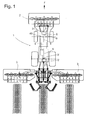
- Fig. 1 shows a schematic plan view of a tractor 1 with front and rear attachments, here a front-mounted front mower 2 and rear-mounted side mower 3.
- a main engine usually a diesel engine 4
- a shaft 5 extends from the diesel engine 4 to a power take-off 6 in the front region of the body to one at a To drive the front of the body led out PTO 7.
- a corresponding structure with a shaft 5 'and a gear 6' can be provided for torque transmission from the diesel engine 4 to a rear-side PTO output 7 '.
- Fig. 2 shows a schematic longitudinal section through the front portion of the body of the tractor 1.
- the shaft 5 is connected to the diesel engine 4 via a first constant velocity joint 8.
- a dog clutch 9 is arranged, which is adjustable between an open position and a position producing a positive connection to a second homokinetic joint 10 position.
- the homokinetic joint 10 is connected to a drive shaft 11 of the power take-off 6.
- the PTO output 7 is led out of the body forward.
- Fig. 3 shows a kinematic diagram of the in Fig. 2 shown construction.
- the homokinetic joint 9 between the shaft 5 and a crankshaft 13 of the diesel engine 4 comprises a ball joint 12, which defines a pivot center of a possible pivoting movement of the PTO shaft 5 relative to the crankshaft 13.
- Interlocking internal and external gears 14 and 15 of the PTO shaft 5 and the crankshaft 13 are fixed to the respective shaft 13 and 5, respectively, but against each other to a limited extent axially movable to allow pivoting of the shaft 5 in the ball joint 12.
- the homokinetic joint 10 at the front end of the shaft 5 is partially mirror-inverted to the joint 8. It comprises a ball joint 16, which connects the power take-off shaft 5 to the drive shaft 12 of the power take-off 6, and an outer toothing 17, which is fixed to the drive shaft 12.
- this external toothing 17 is disengaged from an internal toothing 18, the part of a rotatably on the PTO shaft 5, but axially displaceably arranged sleeve 19, so that the PTO gear 6 is stationary, regardless of whether the PTO shaft 5 rotates or not. Only when the sleeve 19 is advanced to engage the gears 17, 18 can the PTO 6 be driven.
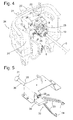
- Fig. 4 shows a perspective view of a front part of the body of the tractor 1 forming front lift housing 24 in which the PTO gear 6 is mounted between two inner stiffening ribs 25 of the housing 24.
- a bridge-shaped plate 26 is fixed, which carries a striker 27. At this striker 27 engages in closed Position the lock of an unillustrated hood of the tractor body.
- the bridge plate 26 carries two forward and backward projecting, downwardly angled tongues 28 having at their lower ends openings 29 in which an actuating rod 30 is guided parallel to the shaft 5 slidably.
- a provided with a handle 31 outer end of the control rod 30 is led out through a bore of the front Hubtechnikgephaseuses 24 forward from the body of the tractor.
- the adjusting rod 30 is offset laterally against the shaft 5, to bring out the handle 31 in addition to centrally above the outside of the front lifting gear housing 24 extending outer stiffening ribs 25 '.
- a shift fork 32 is mounted, the two fingers 33 carry at their free ends facing pin 34.
- the pins 34 engage in a circumferential groove 35 of the sleeve 19 (see Fig. 2, 3rd ) and thus force the sleeve 19 to follow a displacement of the adjusting rod 30 in the longitudinal direction of the PTO shaft 5, without hindering the rotation of the sleeve 19 with the PTO 5.
- control rod 30 By the control rod 30 is rotatable in cross-section round and in the leading them bores of the front Hubwerkmaschinegephaseuse 24 and the bridge plate 26, it can follow radial movements of the PTO 5.
- a comparison of the fingers 33 counterweight 36 of the shift fork 32 is dimensioned so that the center of gravity of the shift fork 32 is located on the longitudinal axis of the control rod 30.
- the shift fork 32 is stable in any rotational position that it can reach. and a continuous friction of the pin 34 on the sleeve 19, which could lead to premature wear is avoided.
- Fig. 6 shows in a further enlarged detail view of one of the tongues 28 of the bridge plate 26 and the guided therein shift rod 30, and Fig. 7 shows the same components in a longitudinal section.
- a flange bushing 37 is received, which guides the adjusting rod 30 and the flange 38 rests against one side of the tongue 29.
- a toothed disk 39 is pushed onto the flange bushing 37.
- teeth of the toothed disk 39 are elastically tensioned in contact with the flange bushing 37, the toothed disk 39 is pressed against the tongue 28, and the tongue 28 is firmly and securely clamped between the toothed disk 39 and the flange 38.
- This simple and inexpensive construction gives a user the opportunity to open or close the dog clutch 10 by pulling or pushing the handle 31 when it is on an attached tractor at the PTO output 7 - or dismantled.
- the clutch 10 in addition be associated with an electrically or hydraulically actuated actuator 40, which is actuated via a corresponding, reachable from the driver's seat operating element 41.
- a display may be provided, at which the state, open or closed, the dog clutch 10 is read.
- the actuator 40 may additionally be controlled via a sensor, not shown, for detecting the presence of an attachment.
- a sensor may cause automatic closure of the clutch 9 when detecting the presence of an implement at the PTO output 7.
- a sensor may serve to open only the clutch 10 when it is detected that the attachment has been disassembled, but not reacting when it has been mounted. Thus, the decision whether a newly mounted attachment to be driven or not, left alone to the driver.
Landscapes
- Engineering & Computer Science (AREA)
- Chemical & Material Sciences (AREA)
- Combustion & Propulsion (AREA)
- Transportation (AREA)
- Mechanical Engineering (AREA)
- Agricultural Machines (AREA)
- Arrangement And Driving Of Transmission Devices (AREA)
Abstract
Description
- Die vorliegende Erfindung betrifft einen Traktor mit Zapfwellenausgang. Ein solcher Zapfwellenausgang ist herkömmlicherweise über ein sogenanntes Zapfwellengetriebe mit einem Hauptantriebsmotor des Traktors verbunden, um den Betrieb eines zeitweilig an dem Traktor montierten Anbaugeräts wie etwa eines Mähwerks zu ermöglichen.
- Wenn das Zapfwellengetriebe durch den Hauptantriebsmotor angetrieben ist, verursacht es Reibungsverluste, egal ob ein Anbaugerät an den Zapfwellenausgang angeschlossen ist oder nicht, und erhöht den Kraftstoffverbrauch des Traktors. Aufs Jahr hochgerechnet kann dieser Mehrverbrauch sich auf mehrere hundert Liter Dieselkraftstoff belaufen.
- Aufgabe der Erfindung ist daher, einen Traktor mit Zapfwellenausgang zu schaffen, der eine verbesserte Kraftstoffeffizienz aufweist.
- Die Aufgabe wird gelöst, indem bei einem Traktor mit einem Hauptmotor und einem Zapfwellengetriebe, das einen Antriebseingang und einen Zapfwellenausgang aufweist, der Antriebseingang mit dem Hauptmotor über eine Kupplung in lösbarer Antriebsverbindung steht. Indem über diese Kupplung die Antriebsverbindung gelöst wird, wenn kein Anbaugerät an dem Zapfwellenausgang angeschlossen ist, kann vermieden werden, dass das Zapfwellengetriebe nutzlos mitgeschleppt wird.
- Vorzugsweise ist die Kupplung eine formschlüssige Kupplung, insbesondere eine Klauenkupplung. Diese kann hohe Drehmomente bei kompakter Bauform und minimalem Verschleiß übertragen.
- Die Kupplung kann zum Lösen und Schließen der Antriebsverbindung eine an einer Welle axial verschiebbare Muffe und eine an einer Umfangskontur der Muffe angreifende Schaltgabel umfassen. Da der Angriff der Schaltgabel unabhängig von der Drehstellung der Welle und der Muffe besteht, kann die Antriebsverbindung in jeder Drehstellung der Muffe durch ein axiales Verschieben der Schaltgabel geöffnet und geschlossen werden.
- Einer einfachen Ausgestaltung zufolge kann ein axial verschiebbarer Träger, an dem die Schaltgabel montiert ist, eine aus einer Karosserie des Traktors herausgeführte Handhabe zum Öffnen und Schließen der Kupplung aufweisen.
- Zweckmäßigerweise kann die Handhabe benachbart zum Zapfwellenausgang, insbesondere an einer Vorderseite der Karosserie des Traktors, herausgeführt sein, um für einen Benutzer gut erreichbar zu sein, der soeben ein Anbaugerät an den Zapfwellenausgang angeschlossen hat.
- Da der Traktor zum Montieren des Anbaugeräts ohnehin stillstehen muss, kann eine einfache, nur bei Stillstand der Welle betätigbare Klauenkupplung verwendet werden, und eine Sperrsynchronisiereinrichtung, die Kosten, Gewicht und Platzbedarf erhöhen würde, wird nicht gebraucht.
- Es kann erforderlich sein, die Welle, die das Zapfwellengetriebe antreibt, zu Reparatur- oder Wartungszwecken auszubauen. Ein solcher Ausbau ist erleichtert, wenn die Schaltgabel quer zur Achse quer zu der Welle bewegbar ist.
- Insbesondere kann die Beweglichkeit der Schaltgabel darin bestehen, dass sie um eine zu der Welle parallele Achse schwenkbar ist. Wenn der Schwerpunkt der Schaltgabel auf der Achse liegt, kann die Schaltgabel beliebige Drehorientierungen stabil einnehmen, und ein Verschleiß durch ständigen Reibkontakt der Schaltgabel mit der Muffe kann vermieden werden.
- Der Träger kann in einer Flanschbuchse geführt sein, die an einem Durchbruch der Karosserie des Traktors durch eine Zahnscheibe gesichert ist
- Alternativ oder ergänzend zu der Handhabe kann ein - vorzugsweise elektrisch betriebener - Aktor vorgesehen sein, der zum Lösen und Schließen der Antriebsverbindung an der Kupplung angreift.
- Ein solcher Aktor kann durch ein von einem Fahrersitz des Traktors aus erreichbar angeordnetes Bedienelement steuerbar sein, um ein angeschlossenes Anbaugerät in Betrieb nehmen und außer Betrieb setzen zu können, ohne dafür den Fahrersitz verlassen zu müssen.
- Der Aktor kann auch durch einen Sensor zum Erfassen eines an dem Zapfwellenausgang angeschlossenen Werkzeugs steuerbar sein. Ein solcher Sensor kann zweckmäßigerweise insbesondere dazu dienen, die Kupplung zu öffnen, wenn erfasst wird, dass ein Anbaugerät abmontiert worden ist. Auf diese Weise ist sichergestellt, dass das Zapfwellengetriebe nicht vom Fahrer unbemerkt mitläuft, wenn kein Anbaugerät angeschlossen ist. Ein erneutes Schließen der Kupplung nach dem Anschließen eines Anbaugeräts erfolgt hingegen zweckmäßigerweise mittels der Handhabe oder des Bedienelements, damit der Fahrer nach Anbringung des Anbaugeräts die Möglichkeit hat, zu entscheiden, ob dieses sofort betrieben werden soll oder ob es, z.B. für eine Straßenfahrt, zunächst noch antriebslos bleiben soll.
- Ein Anzeigeelement, das den Zustand der Antriebsverbindung, offen oder geschlossen, anzeigt, sollte vom Fahrersitz des Traktors aus sichtbar sein.
- Weitere Merkmale und Vorteile der Erfindung ergeben sich aus der nachfolgenden Beschreibung von Ausführungsbeispielen unter Bezugnahme auf die beigefügten Figuren. Es zeigen:
- Fig. 1
- eine schematische Draufsicht auf einen Traktor mit vorderen und hinteren Zapfwellenanschlüssen;
- Fig. 2
- einen schematischen Schnitt durch den vorderen Bereich der Karosserie des Traktors;
- Fig. 3
- ein kinematisches Diagramm der in
Fig. 2 gezeigten Komponenten; - Fig. 4
- eine perspektivische Ansicht eines Chassis-Vorderteils des Traktors mit darin montiertem Zapfwellengetriebe;
- Fig. 5
- ein vergrößertes Detail aus
Fig. 4 ; - Fig. 6
- ein nochmals vergrößertes Detail aus
Fig. 5 ; und - Fig. 7
- die in
Fig. 6 gezeigten Komponenten in einem axialen Schnitt. -
Fig. 1 zeigt in einer schematischen Draufsicht einen Traktor 1 mit vorder- und hinterseitigen Anbaugeräten, hier einem vorderseitig montierten Frontmähwerk 2 und hinterseitig montierten Seitenmähwerken 3. Ein Hauptmotor, üblicherweise ein Dieselmotor 4, ist zentral in der Karosserie des Traktors angeordnet und treibt die Mähwerke 2, 3 sowie, über einen nicht dargestellten Antriebsstrang, die Räder des Traktors 1 an. Eine Welle 5 erstreckt sich vom Dieselmotor 4 zu einem Zapfwellengetriebe 6 im vorderen Bereich der Karosserie, um einen an einer Vorderseite der Karosserie herausgeführten Zapfwellenanschluss 7 anzutreiben. Ein entsprechender Aufbau mit einer Welle 5' und einem Getriebe 6' kann zur Drehmomentübertragung vom Dieselmotor 4 auf einen heckseitigen Zapfwellenausgang 7' vorgesehen sein. -
Fig. 2 zeigt einen schematischen Längsschnitt durch den vorderen Bereich der Karosserie des Traktors 1. Die Welle 5 ist mit dem Dieselmotor 4 über ein erstes homokinetisches Gelenk 8 verbunden. Am vorderen Ende der Welle 5 ist eine Klauenkupplung 9 angeordnet, die zwischen einer offenen Stellung und einer eine formschlüssige Verbindung zu einem zweiten homokinetischen Gelenk 10 herstellenden Stellung verstellbar ist. Das homokinetische Gelenk 10 ist mit einer Antriebswelle 11 des Zapfwellengetriebes 6 verbunden. Der Zapfwellenausgang 7 ist aus der Karosserie nach vorn herausgeführt. -
Fig. 3 zeigt ein kinematisches Diagramm des inFig. 2 dargestellten Aufbaus. Das homokinetische Gelenk 9 zwischen der Welle 5 und einer Kurbelwelle 13 des Dieselmotors 4 umfasst ein Kugelgelenk 12, das einen Schwenkmittelpunkt einer möglichen Schwenkbewegung der Zapfwelle 5 relativ zur Kurbelwelle 13 festlegt. Ineinandergreifende Innen- und Außenverzahnungen 14 bzw. 15 der Zapfwelle 5 und der Kurbelwelle 13 sind an der sie jeweils tragenden Welle 13 bzw. 5 fest, aber gegeneinander in begrenztem Umfang axial bewegbar, um ein Schwenken der Welle 5 im Kugelgelenk 12 zu erlauben. - Das homokinetische Gelenk 10 am vorderen Ende der Welle 5 ist teilweise spiegelbildlich zum Gelenk 8 aufgebaut. Es umfasst ein Kugelgelenk 16, das die Zapfwelle 5 mit der Antriebswelle 12 des Zapfwellengetriebes 6 verbindet, und eine Außenverzahnung 17, die an der Antriebswelle 12 befestigt ist. In der in
Fig. 3 dargestellten Konfiguration ist diese Außenverzahnung 17 außer Eingriff mit einer Innenverzahnung 18, die Teil einer an der Zapfwelle 5 drehfest, aber axial verschiebbar angeordneten Muffe 19 ist, so dass das Zapfwellengetriebe 6 still steht, egal, ob die Zapfwelle 5 rotiert oder nicht. Nur wenn die Muffe 19 vorgeschoben ist, um die Verzahnungen 17, 18 in Eingriff zu bringen, kann das Zapfwellengetriebe 6 angetrieben werden. - Im Innern des Zapfwellengetriebes 6 ist ein Paar von miteinander kämmenden Zahnrädern 20, 21 an der Antriebswelle 11 und der Zapfwelle 22 gezeigt, und in der Zapfwelle 22 ist zwischen dem Zahnrad 21 und dem Zapfwellenausgang 7 eine Reibkupplung 23 angeordnet, die bei rotierender Zapfwelle 5 allmählich geschlossen werden kann, um ein an den Zapfwellenausgang 7 angeschlossenes Anbaugerät allmählich anlaufen zu lassen.
-
Fig. 4 zeigt eine perspektivische Ansicht eines ein Vorderteil der Karosserie des Traktors 1 bildenden Fronthubwerkgehäuses 24, in dem das Zapfwellengetriebe 6 zwischen zwei inneren Versteifungsrippen 25 des Gehäuses 24 montiert ist. An oberen Kanten der Versteifungsrippen 25 ist ein brückenförmiges Blech 26 befestigt, das einen Schließbügel 27 trägt. An diesem Schließbügel 27 greift in geschlossener Stellung das Schloss einer nicht gezeigten Motorhaube der Traktorkarosserie an. Wie insbesondere in der vergrößerten Detailansicht derFig. 5 zu erkennen, trägt das Brückenblech 26 zwei nach vorn und nach hinten abstehende, nach unten abgewinkelte Zungen 28, die an ihren unteren Enden Durchbrüche 29 aufweisen, in denen eine Stellstange 30 parallel zur Welle 5 verschiebbar geführt ist. Ein mit einem Handgriff 31 versehenes äußeres Ende der Stellstange 30 ist durch eine Bohrung des Fronthubwerkgehäuses 24 nach vorn aus der Karosserie des Traktors herausgeführt. Die Stellstange 30 ist seitwärts gegen die Welle 5 versetzt, um den Handgriff 31 neben mittig über die Außenseite des Fronthubwerkgehäuses 24 verlaufenden äußeren Versteifungsrippen 25' herauszuführen. Am inneren Ende der Stellstange 31 ist eine Schaltgabel 32 montiert, deren zwei Finger 33 an ihren freien Enden einander zugewandte Zapfen 34 tragen. Die Zapfen 34 greifen in eine umlaufende Nut 35 der Muffe 19 (sieheFig. 2, 3 ) ein und zwingen so die Muffe 19, einer Verschiebung der Stellstange 30 in Längsrichtung der Zapfwelle 5 zu folgen, ohne die Drehung der Muffe 19 mit der Zapfwelle 5 zu behindern. - Indem die Stellstange 30 im Querschnitt rund und in den sie führenden Bohrungen des Fronthubwerkgehäuses 24 und des Brückenblechs 26 drehbar ist, kann sie radialen Bewegungen der Zapfwelle 5 folgen. Ein den Fingern 33 gegenüberliegendes Gegengewicht 36 der Schaltgabel 32 ist so dimensioniert, dass der Schwerpunkt der Schaltgabel 32 auf der Längsachse der Stellstange 30 liegt. So ist die Schaltgabel 32 in jeder Drehstellung, die sie erreichen kann, stabil, und eine kontinuierliche Reibung der Zapfen 34 an der Muffe 19, die zu vorzeitigem Verschleiß führen könnte, wird vermieden.
-
Fig. 6 zeigt in einer nochmals vergrößerten Detailansicht eine der Zungen 28 des Brückblechs 26 und die darin geführte Schaltstange 30, undFig. 7 zeigt dieselben Komponenten in einem Längsschnitt. In der Bohrung 29 der Zunge 28 ist eine Flanschbuchse 37 aufgenommen, die die Stellstange 30 führt und deren Flansch 38 an einer Seite der Zunge 29 anliegt. Von der gegenüberliegenden Seite aus ist eine Zahnscheibe 39 auf die Flanschbuchse 37 aufgeschoben. Indem einwärts gerichtete Zähne der Zahnscheibe 39 im Kontakt mit der Flanschbuchse 37 elastisch gespannt sind, wird die Zahnscheibe 39 gegen die Zunge 28 gepresst, und die Zunge 28 ist zwischen der Zahnscheibe 39 und dem Flansch 38 fest und sicher geklemmt. - Diese einfache und preiswerte Konstruktion gibt einem Benutzer die Möglichkeit, die Klauenkupplung 10 durch Ziehen bzw. Schieben des Handgriffs 31 zu öffnen oder zu schließen, wenn er bei stehenden Traktor ein Anbaugerät am Zapfwellenausgang 7 an - oder abmontiert.
- Es kann wünschenswert sein, die Kupplung 10 auch vom Fahrersitz aus betätigen zu können, z.B., wenn der Traktor mit montiertem Anbaugerät vor oder nach Einsatz des Anbaugeräts einen Weg auf einer Straße zurücklegen muss, und das Anbaugerät in dieser Zeit nicht angetrieben sein soll. Es kann daher, wie in
Fig. 1 schematisch dargestellt, der Kupplung 10 zusätzlich ein elektrisch oder hydraulisch betätigter Aktor 40 zugeordnet sein, der über ein entsprechendes, vom Fahrersitz aus erreichbares Bedienelement 41 betätigbar ist. An dem Bedienelement 41 kann eine Anzeige vorgesehen sein, an der der Zustand, offen oder geschlossen, der Klauenkupplung 10 ablesbar ist. - Der Aktor 40 kann zusätzlich auch über einen nicht dargestellten Sensor zum Erfassen des Vorhandenseins eines Anbaugeräts gesteuert sein. Ein solcher Sensor kann ein automatisches Schließen der Kupplung 9 veranlassen, wenn er das Vorhandensein eines Anbaugeräts am Zapfwellenausgang 7 erfasst. Er sollte allerdings durch das Bedienelement 41 übersteuerbar sein, um ein Fahren im Straßenverkehr mit montiertem aber nicht angetriebenem Anbaugerät zu ermöglichen. Vorzugsweise kann ein solcher Sensor dazu dienen, nur die Kupplung 10 zu öffnen, wenn erfasst wird, dass das Anbaugerät abmontiert worden ist, aber nicht zu reagieren, wenn es anmontiert worden ist. So bleibt die Entscheidung, ob ein neu anmontiertes Anbaugerät angetrieben werden soll oder nicht, allein dem Fahrer überlassen.
-
- 1
- Traktor
- 2
- Vorderseitiges Anbaugerät
- 3
- Hinterseitiges Anbaugerät
- 4
- Dieselmotor
- 5
- Zapfwelle
- 6
- Zapfwellengetriebe
- 7,7'
- Zapfwellenausgang
- 8,8'
- homokinetisches Gelenk
- 9,9'
- Klauenkupplung
- 10
- homokinetisches Gelenk
- 11
- Antriebswelle
- 12
- Kugelgelenk
- 13
- Kurbelwelle
- 14
- Innenverzahnung
- 15
- Außenverzahnung
- 16
- Kugelgelenk
- 17
- Außenverzahnung
- 18
- Innenverzahnung
- 19
- Muffe
- 20
- Zahnrad
- 21
- Zahnrad
- 22
- Zapfwelle
- 23
- Reibkupplung
- 24
- Fronthubwerkgehäuse
- 25
- Versteifungsrippe
- 26
- Brückenblech
- 27
- Schließbügel
- 28
- Zunge
- 29
- Bohrung
- 30
- Stellstange
- 31
- Handgriff
- 32
- Handgriff
- 33
- Finger
- 34
- Zapfen
- 35
- Nut
- 36
- Gegengewicht
- 37
- Flanschbuchse
- 38
- Flansch
- 39
- Zahnscheibe
- 40
- Aktor
- 41
- Bedienelement
Claims (11)
- Traktor mit einem Hauptmotor (4) und einem Zapfwellengetriebe (6, 6'), das einen Antriebseingang und einen Zapfwellenausgang (7, 7') aufweist, dadurch gekennzeichnet, dass der Antriebseingang mit dem Hauptmotor (4) über eine Kupplung (9, 9') in lösbarer Antriebsverbindung steht.
- Traktor nach Anspruch 1, dadurch gekennzeichnet, dass die Kupplung (9, 9') eine formschlüssige Kupplung, insbesondere eine Klauenkupplung ist.
- Traktor nach Anspruch 1 oder 2, dadurch gekennzeichnet, dass die Kupplung (9) eine zum Lösen und Schließen der Antriebsverbindung an einer Welle (5) axial verschiebbare Muffe (19) und eine an einer Umfangskontur (35) der Muffe (19) angreifende Schaltgabel (32) umfasst.
- Traktor nach Anspruch 3, dadurch gekennzeichnet, dass die Schaltgabel (32) an einem axial verschiebbaren Träger (30) montiert ist, wobei der Träger (30) eine aus einer Karosserie des Traktors (1) herausgeführte Handhabe (31) aufweist.
- Traktor nach Anspruch 3 oder 4, dadurch gekennzeichnet, dass die Schaltgabel (32) quer zu der Welle (5) bewegbar ist.
- Traktor nach Anspruch 5, dadurch gekennzeichnet, dass die Schaltgabel (32) um eine zu der Welle (5) parallele Achse schwenkbar ist und der Schwerpunkt der Schaltgabel (32) auf der Achse liegt.
- Traktor nach einem der Ansprüche 3 bis 6, dadurch gekennzeichnet, dass der Träger (30) in einer Flanschbuchse (37) geführt ist, die an einem Durchbruch (29) der Karosserie des Traktors durch eine Zahnscheibe (39) gesichert ist.
- Traktor nach einem der vorhergehenden Ansprüche, gekennzeichnet durch einen Aktor (40), der zum Lösen und Schließen der Antriebsverbindung an der Kupplung (9) angreift.
- Traktor nach Anspruch 7, dadurch gekennzeichnet, dass der Aktor (9) durch ein von einem Fahrersitz des Traktors aus erreichbar angeordnetes Bedienelement (41) steuerbar ist.
- Traktor nach Anspruch 7 oder 8, dadurch gekennzeichnet, dass der Aktor (40) durch einen Sensor zum Erfassen eines an den Zapfwellenausgang (7) angeschlossenen Werkzeugs steuerbar ist.
- Traktor nach einem der vorhergehenden Ansprüche, dadurch gekennzeichnet, dass ein den Zustand der Antriebsverbindung anzeigendes Anzeigeelement (41) von einem Fahrersitz des Traktors aus sichtbar ist.
Applications Claiming Priority (1)
| Application Number | Priority Date | Filing Date | Title |
|---|---|---|---|
| DE102012002798A DE102012002798A1 (de) | 2012-02-15 | 2012-02-15 | Traktor mit Zapfwellenausgang |
Publications (3)
| Publication Number | Publication Date |
|---|---|
| EP2628624A2 true EP2628624A2 (de) | 2013-08-21 |
| EP2628624A3 EP2628624A3 (de) | 2013-10-02 |
| EP2628624B1 EP2628624B1 (de) | 2015-07-29 |
Family
ID=47520710
Family Applications (1)
| Application Number | Title | Priority Date | Filing Date |
|---|---|---|---|
| EP12196846.5A Active EP2628624B1 (de) | 2012-02-15 | 2012-12-13 | Traktor mit Zapfwellenausgang |
Country Status (2)
| Country | Link |
|---|---|
| EP (1) | EP2628624B1 (de) |
| DE (1) | DE102012002798A1 (de) |
Cited By (1)
| Publication number | Priority date | Publication date | Assignee | Title |
|---|---|---|---|---|
| CN104343965A (zh) * | 2014-11-19 | 2015-02-11 | 重庆华世丹机械制造有限公司 | 微耕机换档机构 |
Family Cites Families (8)
| Publication number | Priority date | Publication date | Assignee | Title |
|---|---|---|---|---|
| US2521729A (en) * | 1945-12-11 | 1950-09-12 | Timken Axle Co Detroit | Propulsion and power take-off gearing for vehicles |
| AT226081B (de) * | 1960-08-31 | 1963-02-25 | Stefan Hermann Christoforetti | Antriebsanordnung für von einer Zugmaschine angetriebene Triebachsen von Anhängern |
| GB1562565A (en) * | 1976-08-16 | 1980-03-12 | Uni Drive Tractors Ltd | Power take-off means for vehicles |
| GB8305935D0 (en) * | 1983-03-03 | 1983-04-07 | Brown Tractors Ltd | Power takeoff mechanisms |
| GB8623857D0 (en) * | 1986-10-03 | 1986-11-05 | Massey Ferguson Services Nv | Power take-off drive unit |
| DE102007003340A1 (de) * | 2007-01-17 | 2008-07-24 | Deere & Company, Moline | Getriebe |
| DE102007062457A1 (de) * | 2007-12-22 | 2009-06-25 | Deere & Company, Moline | Getriebeanordnung eines landwirtschaftlichen oder industriellen Nutzfahrzeugs |
| DE102008041075A1 (de) * | 2008-08-07 | 2010-02-11 | Deere & Company, Moline | Antriebsanordnung und Verfahren zum Antrieb eines landwirtschaftlichen Arbeitsgeräts |
-
2012
- 2012-02-15 DE DE102012002798A patent/DE102012002798A1/de not_active Withdrawn
- 2012-12-13 EP EP12196846.5A patent/EP2628624B1/de active Active
Non-Patent Citations (1)
| Title |
|---|
| None |
Cited By (2)
| Publication number | Priority date | Publication date | Assignee | Title |
|---|---|---|---|---|
| CN104343965A (zh) * | 2014-11-19 | 2015-02-11 | 重庆华世丹机械制造有限公司 | 微耕机换档机构 |
| CN104343965B (zh) * | 2014-11-19 | 2016-06-29 | 重庆华世丹机械制造有限公司 | 微耕机换档机构 |
Also Published As
| Publication number | Publication date |
|---|---|
| EP2628624A3 (de) | 2013-10-02 |
| EP2628624B1 (de) | 2015-07-29 |
| DE102012002798A1 (de) | 2013-08-22 |
Similar Documents
| Publication | Publication Date | Title |
|---|---|---|
| DE102014201254B4 (de) | Getriebeanordnung und Antriebsstrang für ein Hybridfahrzeug sowie Hybridfahrzeug | |
| EP2429851B1 (de) | Antriebsanordnung für ein kraftfahrzeug mit einer nebenabtriebskupplung | |
| EP2853431B1 (de) | Zapfwellengetriebe für eine landwirtschaftliche Arbeitsmaschine | |
| DE2944928A1 (de) | Motor-getriebeanordnung fuer fahrzeuge, insbesondere personenkraftfahrzeuge | |
| DE2410164C2 (de) | Zahnräderwechselgetriebe in Gruppenbauart | |
| DE102007062457A1 (de) | Getriebeanordnung eines landwirtschaftlichen oder industriellen Nutzfahrzeugs | |
| DE102019207925A1 (de) | Nebenabtriebsgetriebe und landwirtschaftliche Arbeitsmaschine | |
| DE102019206075A1 (de) | Fahrantriebssystem für Arbeitsmaschine | |
| EP2628624B1 (de) | Traktor mit Zapfwellenausgang | |
| EP2457432B1 (de) | Getriebeanordnung für ein landwirtschaftliches Arbeitsgerät und zugehöriges Arbeitsgerät | |
| EP3034348B1 (de) | Verteilergetriebe zum Aufteilen eines Drehmoments auf wenigstens eine erste und eine zweite Achswelle eines Kraftfahrzeugs | |
| DE102011119973B4 (de) | Antriebssystem für eine mechanische Umformmaschine und mechanische Umformmaschine | |
| DE102019112157A1 (de) | Zapfwellengetriebeanordnung | |
| DE2159398A1 (de) | Traktor mit Vierradantrieb | |
| DE2404844C2 (de) | ||
| DE3722367C2 (de) | Sicherheitsvorrichtung fuer das arbeitsaggregat landwirtschaftlicher erntemaschinen | |
| DE1484772A1 (de) | Kraftfahrgeraet zum Aufwerfen von Laufgraeben | |
| DE515101C (de) | Zahnraederwechselgetriebe mit dauernd in Eingriff stehenden Raedern und mit als Wechsel-getriebe ausgebildeten regelbaren Kupplungen, insbesondere fuer Kraftfahrzeuge | |
| WO2021089166A1 (de) | Hybridantriebsanordnung, antriebsstranganordnung und verfahren zum steuern einer solchen | |
| DE102019112158A1 (de) | Zapfwellengetriebeanordnung | |
| DE1131519B (de) | Kraftfahrzeug-Triebwerk, vorzugsweise fuer landwirtschaftliche Zugfahrzeuge | |
| DE883999C (de) | Mit Differential vereinigtes mehrgaengiges Zahnraederschaltgetriebe fuer Kraftfahrzeuge | |
| DE1921723A1 (de) | Vorrichtung fuer landwirtschaftliche Zwecke | |
| WO1996001746A1 (de) | Antriebsvorrichtung für landwirtschaftliche erntemaschinen | |
| DE936183C (de) | Landwirtschaftlich genutztes Motorfahrzeug, insbesondere Zugmaschine |
Legal Events
| Date | Code | Title | Description |
|---|---|---|---|
| PUAI | Public reference made under article 153(3) epc to a published international application that has entered the european phase |
Free format text: ORIGINAL CODE: 0009012 |
|
| AK | Designated contracting states |
Kind code of ref document: A2 Designated state(s): AL AT BE BG CH CY CZ DE DK EE ES FI FR GB GR HR HU IE IS IT LI LT LU LV MC MK MT NL NO PL PT RO RS SE SI SK SM TR |
|
| AX | Request for extension of the european patent |
Extension state: BA ME |
|
| PUAL | Search report despatched |
Free format text: ORIGINAL CODE: 0009013 |
|
| AK | Designated contracting states |
Kind code of ref document: A3 Designated state(s): AL AT BE BG CH CY CZ DE DK EE ES FI FR GB GR HR HU IE IS IT LI LT LU LV MC MK MT NL NO PL PT RO RS SE SI SK SM TR |
|
| AX | Request for extension of the european patent |
Extension state: BA ME |
|
| RIC1 | Information provided on ipc code assigned before grant |
Ipc: B60K 17/28 20060101AFI20130826BHEP |
|
| 17P | Request for examination filed |
Effective date: 20140402 |
|
| RBV | Designated contracting states (corrected) |
Designated state(s): AL AT BE BG CH CY CZ DE DK EE ES FI FR GB GR HR HU IE IS IT LI LT LU LV MC MK MT NL NO PL PT RO RS SE SI SK SM TR |
|
| GRAP | Despatch of communication of intention to grant a patent |
Free format text: ORIGINAL CODE: EPIDOSNIGR1 |
|
| RIC1 | Information provided on ipc code assigned before grant |
Ipc: B60K 17/28 20060101AFI20150325BHEP |
|
| INTG | Intention to grant announced |
Effective date: 20150415 |
|
| GRAS | Grant fee paid |
Free format text: ORIGINAL CODE: EPIDOSNIGR3 |
|
| GRAA | (expected) grant |
Free format text: ORIGINAL CODE: 0009210 |
|
| AK | Designated contracting states |
Kind code of ref document: B1 Designated state(s): AL AT BE BG CH CY CZ DE DK EE ES FI FR GB GR HR HU IE IS IT LI LT LU LV MC MK MT NL NO PL PT RO RS SE SI SK SM TR |
|
| REG | Reference to a national code |
Ref country code: GB Ref legal event code: FG4D Free format text: NOT ENGLISH |
|
| REG | Reference to a national code |
Ref country code: CH Ref legal event code: EP |
|
| REG | Reference to a national code |
Ref country code: AT Ref legal event code: REF Ref document number: 738972 Country of ref document: AT Kind code of ref document: T Effective date: 20150815 |
|
| REG | Reference to a national code |
Ref country code: IE Ref legal event code: FG4D Free format text: LANGUAGE OF EP DOCUMENT: GERMAN |
|
| REG | Reference to a national code |
Ref country code: DE Ref legal event code: R096 Ref document number: 502012003920 Country of ref document: DE |
|
| REG | Reference to a national code |
Ref country code: FR Ref legal event code: PLFP Year of fee payment: 4 |
|
| REG | Reference to a national code |
Ref country code: LT Ref legal event code: MG4D |
|
| REG | Reference to a national code |
Ref country code: NL Ref legal event code: MP Effective date: 20150729 |
|
| PG25 | Lapsed in a contracting state [announced via postgrant information from national office to epo] |
Ref country code: FI Free format text: LAPSE BECAUSE OF FAILURE TO SUBMIT A TRANSLATION OF THE DESCRIPTION OR TO PAY THE FEE WITHIN THE PRESCRIBED TIME-LIMIT Effective date: 20150729 Ref country code: GR Free format text: LAPSE BECAUSE OF FAILURE TO SUBMIT A TRANSLATION OF THE DESCRIPTION OR TO PAY THE FEE WITHIN THE PRESCRIBED TIME-LIMIT Effective date: 20151030 Ref country code: LT Free format text: LAPSE BECAUSE OF FAILURE TO SUBMIT A TRANSLATION OF THE DESCRIPTION OR TO PAY THE FEE WITHIN THE PRESCRIBED TIME-LIMIT Effective date: 20150729 Ref country code: NO Free format text: LAPSE BECAUSE OF FAILURE TO SUBMIT A TRANSLATION OF THE DESCRIPTION OR TO PAY THE FEE WITHIN THE PRESCRIBED TIME-LIMIT Effective date: 20151029 Ref country code: LV Free format text: LAPSE BECAUSE OF FAILURE TO SUBMIT A TRANSLATION OF THE DESCRIPTION OR TO PAY THE FEE WITHIN THE PRESCRIBED TIME-LIMIT Effective date: 20150729 |
|
| PG25 | Lapsed in a contracting state [announced via postgrant information from national office to epo] |
Ref country code: PT Free format text: LAPSE BECAUSE OF FAILURE TO SUBMIT A TRANSLATION OF THE DESCRIPTION OR TO PAY THE FEE WITHIN THE PRESCRIBED TIME-LIMIT Effective date: 20151130 Ref country code: HR Free format text: LAPSE BECAUSE OF FAILURE TO SUBMIT A TRANSLATION OF THE DESCRIPTION OR TO PAY THE FEE WITHIN THE PRESCRIBED TIME-LIMIT Effective date: 20150729 Ref country code: ES Free format text: LAPSE BECAUSE OF FAILURE TO SUBMIT A TRANSLATION OF THE DESCRIPTION OR TO PAY THE FEE WITHIN THE PRESCRIBED TIME-LIMIT Effective date: 20150729 Ref country code: PL Free format text: LAPSE BECAUSE OF FAILURE TO SUBMIT A TRANSLATION OF THE DESCRIPTION OR TO PAY THE FEE WITHIN THE PRESCRIBED TIME-LIMIT Effective date: 20150729 Ref country code: SE Free format text: LAPSE BECAUSE OF FAILURE TO SUBMIT A TRANSLATION OF THE DESCRIPTION OR TO PAY THE FEE WITHIN THE PRESCRIBED TIME-LIMIT Effective date: 20150729 Ref country code: IS Free format text: LAPSE BECAUSE OF FAILURE TO SUBMIT A TRANSLATION OF THE DESCRIPTION OR TO PAY THE FEE WITHIN THE PRESCRIBED TIME-LIMIT Effective date: 20151129 Ref country code: RS Free format text: LAPSE BECAUSE OF FAILURE TO SUBMIT A TRANSLATION OF THE DESCRIPTION OR TO PAY THE FEE WITHIN THE PRESCRIBED TIME-LIMIT Effective date: 20150729 |
|
| PG25 | Lapsed in a contracting state [announced via postgrant information from national office to epo] |
Ref country code: NL Free format text: LAPSE BECAUSE OF FAILURE TO SUBMIT A TRANSLATION OF THE DESCRIPTION OR TO PAY THE FEE WITHIN THE PRESCRIBED TIME-LIMIT Effective date: 20150729 |
|
| PG25 | Lapsed in a contracting state [announced via postgrant information from national office to epo] |
Ref country code: CZ Free format text: LAPSE BECAUSE OF FAILURE TO SUBMIT A TRANSLATION OF THE DESCRIPTION OR TO PAY THE FEE WITHIN THE PRESCRIBED TIME-LIMIT Effective date: 20150729 Ref country code: SK Free format text: LAPSE BECAUSE OF FAILURE TO SUBMIT A TRANSLATION OF THE DESCRIPTION OR TO PAY THE FEE WITHIN THE PRESCRIBED TIME-LIMIT Effective date: 20150729 Ref country code: DK Free format text: LAPSE BECAUSE OF FAILURE TO SUBMIT A TRANSLATION OF THE DESCRIPTION OR TO PAY THE FEE WITHIN THE PRESCRIBED TIME-LIMIT Effective date: 20150729 Ref country code: EE Free format text: LAPSE BECAUSE OF FAILURE TO SUBMIT A TRANSLATION OF THE DESCRIPTION OR TO PAY THE FEE WITHIN THE PRESCRIBED TIME-LIMIT Effective date: 20150729 |
|
| REG | Reference to a national code |
Ref country code: DE Ref legal event code: R097 Ref document number: 502012003920 Country of ref document: DE |
|
| PG25 | Lapsed in a contracting state [announced via postgrant information from national office to epo] |
Ref country code: RO Free format text: LAPSE BECAUSE OF FAILURE TO SUBMIT A TRANSLATION OF THE DESCRIPTION OR TO PAY THE FEE WITHIN THE PRESCRIBED TIME-LIMIT Effective date: 20150729 |
|
| PLBE | No opposition filed within time limit |
Free format text: ORIGINAL CODE: 0009261 |
|
| STAA | Information on the status of an ep patent application or granted ep patent |
Free format text: STATUS: NO OPPOSITION FILED WITHIN TIME LIMIT |
|
| 26N | No opposition filed |
Effective date: 20160502 |
|
| PG25 | Lapsed in a contracting state [announced via postgrant information from national office to epo] |
Ref country code: LU Free format text: LAPSE BECAUSE OF FAILURE TO SUBMIT A TRANSLATION OF THE DESCRIPTION OR TO PAY THE FEE WITHIN THE PRESCRIBED TIME-LIMIT Effective date: 20151213 Ref country code: MC Free format text: LAPSE BECAUSE OF FAILURE TO SUBMIT A TRANSLATION OF THE DESCRIPTION OR TO PAY THE FEE WITHIN THE PRESCRIBED TIME-LIMIT Effective date: 20150729 |
|
| REG | Reference to a national code |
Ref country code: CH Ref legal event code: PL |
|
| PG25 | Lapsed in a contracting state [announced via postgrant information from national office to epo] |
Ref country code: SI Free format text: LAPSE BECAUSE OF FAILURE TO SUBMIT A TRANSLATION OF THE DESCRIPTION OR TO PAY THE FEE WITHIN THE PRESCRIBED TIME-LIMIT Effective date: 20150729 |
|
| REG | Reference to a national code |
Ref country code: IE Ref legal event code: MM4A |
|
| PG25 | Lapsed in a contracting state [announced via postgrant information from national office to epo] |
Ref country code: LI Free format text: LAPSE BECAUSE OF NON-PAYMENT OF DUE FEES Effective date: 20151231 Ref country code: CH Free format text: LAPSE BECAUSE OF NON-PAYMENT OF DUE FEES Effective date: 20151231 Ref country code: IE Free format text: LAPSE BECAUSE OF NON-PAYMENT OF DUE FEES Effective date: 20151213 |
|
| REG | Reference to a national code |
Ref country code: FR Ref legal event code: PLFP Year of fee payment: 5 |
|
| PG25 | Lapsed in a contracting state [announced via postgrant information from national office to epo] |
Ref country code: SM Free format text: LAPSE BECAUSE OF FAILURE TO SUBMIT A TRANSLATION OF THE DESCRIPTION OR TO PAY THE FEE WITHIN THE PRESCRIBED TIME-LIMIT Effective date: 20150729 Ref country code: HU Free format text: LAPSE BECAUSE OF FAILURE TO SUBMIT A TRANSLATION OF THE DESCRIPTION OR TO PAY THE FEE WITHIN THE PRESCRIBED TIME-LIMIT; INVALID AB INITIO Effective date: 20121213 Ref country code: BG Free format text: LAPSE BECAUSE OF FAILURE TO SUBMIT A TRANSLATION OF THE DESCRIPTION OR TO PAY THE FEE WITHIN THE PRESCRIBED TIME-LIMIT Effective date: 20150729 |
|
| PG25 | Lapsed in a contracting state [announced via postgrant information from national office to epo] |
Ref country code: CY Free format text: LAPSE BECAUSE OF FAILURE TO SUBMIT A TRANSLATION OF THE DESCRIPTION OR TO PAY THE FEE WITHIN THE PRESCRIBED TIME-LIMIT Effective date: 20150729 |
|
| GBPC | Gb: european patent ceased through non-payment of renewal fee |
Effective date: 20161213 |
|
| PG25 | Lapsed in a contracting state [announced via postgrant information from national office to epo] |
Ref country code: MT Free format text: LAPSE BECAUSE OF FAILURE TO SUBMIT A TRANSLATION OF THE DESCRIPTION OR TO PAY THE FEE WITHIN THE PRESCRIBED TIME-LIMIT Effective date: 20150729 |
|
| PG25 | Lapsed in a contracting state [announced via postgrant information from national office to epo] |
Ref country code: GB Free format text: LAPSE BECAUSE OF NON-PAYMENT OF DUE FEES Effective date: 20161213 |
|
| REG | Reference to a national code |
Ref country code: FR Ref legal event code: PLFP Year of fee payment: 6 |
|
| PG25 | Lapsed in a contracting state [announced via postgrant information from national office to epo] |
Ref country code: TR Free format text: LAPSE BECAUSE OF FAILURE TO SUBMIT A TRANSLATION OF THE DESCRIPTION OR TO PAY THE FEE WITHIN THE PRESCRIBED TIME-LIMIT Effective date: 20150729 Ref country code: MK Free format text: LAPSE BECAUSE OF FAILURE TO SUBMIT A TRANSLATION OF THE DESCRIPTION OR TO PAY THE FEE WITHIN THE PRESCRIBED TIME-LIMIT Effective date: 20150729 |
|
| PG25 | Lapsed in a contracting state [announced via postgrant information from national office to epo] |
Ref country code: AL Free format text: LAPSE BECAUSE OF FAILURE TO SUBMIT A TRANSLATION OF THE DESCRIPTION OR TO PAY THE FEE WITHIN THE PRESCRIBED TIME-LIMIT Effective date: 20150729 |
|
| P01 | Opt-out of the competence of the unified patent court (upc) registered |
Effective date: 20230515 |
|
| PGFP | Annual fee paid to national office [announced via postgrant information from national office to epo] |
Ref country code: DE Payment date: 20251211 Year of fee payment: 14 |
|
| PGFP | Annual fee paid to national office [announced via postgrant information from national office to epo] |
Ref country code: AT Payment date: 20251222 Year of fee payment: 14 |
|
| PGFP | Annual fee paid to national office [announced via postgrant information from national office to epo] |
Ref country code: IT Payment date: 20251223 Year of fee payment: 14 |
|
| PGFP | Annual fee paid to national office [announced via postgrant information from national office to epo] |
Ref country code: FR Payment date: 20251223 Year of fee payment: 14 |
|
| PGFP | Annual fee paid to national office [announced via postgrant information from national office to epo] |
Ref country code: BE Payment date: 20251219 Year of fee payment: 14 |