EP2608896B1 - A method for preparing a surface with a controlled coverage of nanograde particles - Google Patents
A method for preparing a surface with a controlled coverage of nanograde particles Download PDFInfo
- Publication number
- EP2608896B1 EP2608896B1 EP11757205.7A EP11757205A EP2608896B1 EP 2608896 B1 EP2608896 B1 EP 2608896B1 EP 11757205 A EP11757205 A EP 11757205A EP 2608896 B1 EP2608896 B1 EP 2608896B1
- Authority
- EP
- European Patent Office
- Prior art keywords
- peg
- nanoparticles
- terminated
- thiol
- gradient
- Prior art date
- Legal status (The legal status is an assumption and is not a legal conclusion. Google has not performed a legal analysis and makes no representation as to the accuracy of the status listed.)
- Active
Links
Images




Classifications
-
- G—PHYSICS
- G01—MEASURING; TESTING
- G01N—INVESTIGATING OR ANALYSING MATERIALS BY DETERMINING THEIR CHEMICAL OR PHYSICAL PROPERTIES
- G01N19/00—Investigating materials by mechanical methods
- G01N19/04—Measuring adhesive force between materials, e.g. of sealing tape, of coating
-
- A—HUMAN NECESSITIES
- A61—MEDICAL OR VETERINARY SCIENCE; HYGIENE
- A61L—METHODS OR APPARATUS FOR STERILISING MATERIALS OR OBJECTS IN GENERAL; DISINFECTION, STERILISATION OR DEODORISATION OF AIR; CHEMICAL ASPECTS OF BANDAGES, DRESSINGS, ABSORBENT PADS OR SURGICAL ARTICLES; MATERIALS FOR BANDAGES, DRESSINGS, ABSORBENT PADS OR SURGICAL ARTICLES
- A61L27/00—Materials for grafts or prostheses or for coating grafts or prostheses
- A61L27/50—Materials characterised by their function or physical properties, e.g. injectable or lubricating compositions, shape-memory materials, surface modified materials
-
- B—PERFORMING OPERATIONS; TRANSPORTING
- B05—SPRAYING OR ATOMISING IN GENERAL; APPLYING FLUENT MATERIALS TO SURFACES, IN GENERAL
- B05D—PROCESSES FOR APPLYING FLUENT MATERIALS TO SURFACES, IN GENERAL
- B05D1/00—Processes for applying liquids or other fluent materials
- B05D1/18—Processes for applying liquids or other fluent materials performed by dipping
-
- B—PERFORMING OPERATIONS; TRANSPORTING
- B05—SPRAYING OR ATOMISING IN GENERAL; APPLYING FLUENT MATERIALS TO SURFACES, IN GENERAL
- B05D—PROCESSES FOR APPLYING FLUENT MATERIALS TO SURFACES, IN GENERAL
- B05D1/00—Processes for applying liquids or other fluent materials
- B05D1/007—Processes for applying liquids or other fluent materials using an electrostatic field
-
- B—PERFORMING OPERATIONS; TRANSPORTING
- B82—NANOTECHNOLOGY
- B82B—NANOSTRUCTURES FORMED BY MANIPULATION OF INDIVIDUAL ATOMS, MOLECULES, OR LIMITED COLLECTIONS OF ATOMS OR MOLECULES AS DISCRETE UNITS; MANUFACTURE OR TREATMENT THEREOF
- B82B3/00—Manufacture or treatment of nanostructures by manipulation of individual atoms or molecules, or limited collections of atoms or molecules as discrete units
- B82B3/0061—Methods for manipulating nanostructures
- B82B3/0071—Sorting nanostructures
-
- B—PERFORMING OPERATIONS; TRANSPORTING
- B82—NANOTECHNOLOGY
- B82Y—SPECIFIC USES OR APPLICATIONS OF NANOSTRUCTURES; MEASUREMENT OR ANALYSIS OF NANOSTRUCTURES; MANUFACTURE OR TREATMENT OF NANOSTRUCTURES
- B82Y40/00—Manufacture or treatment of nanostructures
-
- B—PERFORMING OPERATIONS; TRANSPORTING
- B82—NANOTECHNOLOGY
- B82Y—SPECIFIC USES OR APPLICATIONS OF NANOSTRUCTURES; MEASUREMENT OR ANALYSIS OF NANOSTRUCTURES; MANUFACTURE OR TREATMENT OF NANOSTRUCTURES
- B82Y5/00—Nanobiotechnology or nanomedicine, e.g. protein engineering or drug delivery
-
- C—CHEMISTRY; METALLURGY
- C12—BIOCHEMISTRY; BEER; SPIRITS; WINE; VINEGAR; MICROBIOLOGY; ENZYMOLOGY; MUTATION OR GENETIC ENGINEERING
- C12Q—MEASURING OR TESTING PROCESSES INVOLVING ENZYMES, NUCLEIC ACIDS OR MICROORGANISMS; COMPOSITIONS OR TEST PAPERS THEREFOR; PROCESSES OF PREPARING SUCH COMPOSITIONS; CONDITION-RESPONSIVE CONTROL IN MICROBIOLOGICAL OR ENZYMOLOGICAL PROCESSES
- C12Q1/00—Measuring or testing processes involving enzymes, nucleic acids or microorganisms; Compositions therefor; Processes of preparing such compositions
- C12Q1/02—Measuring or testing processes involving enzymes, nucleic acids or microorganisms; Compositions therefor; Processes of preparing such compositions involving viable microorganisms
-
- G—PHYSICS
- G01—MEASURING; TESTING
- G01N—INVESTIGATING OR ANALYSING MATERIALS BY DETERMINING THEIR CHEMICAL OR PHYSICAL PROPERTIES
- G01N33/00—Investigating or analysing materials by specific methods not covered by groups G01N1/00 - G01N31/00
- G01N33/48—Biological material, e.g. blood, urine; Haemocytometers
- G01N33/50—Chemical analysis of biological material, e.g. blood, urine; Testing involving biospecific ligand binding methods; Immunological testing
- G01N33/86—Chemical analysis of biological material, e.g. blood, urine; Testing involving biospecific ligand binding methods; Immunological testing involving blood coagulating time or factors, or their receptors
-
- B—PERFORMING OPERATIONS; TRANSPORTING
- B05—SPRAYING OR ATOMISING IN GENERAL; APPLYING FLUENT MATERIALS TO SURFACES, IN GENERAL
- B05D—PROCESSES FOR APPLYING FLUENT MATERIALS TO SURFACES, IN GENERAL
- B05D1/00—Processes for applying liquids or other fluent materials
- B05D1/18—Processes for applying liquids or other fluent materials performed by dipping
- B05D1/20—Processes for applying liquids or other fluent materials performed by dipping substances to be applied floating on a fluid
-
- B—PERFORMING OPERATIONS; TRANSPORTING
- B05—SPRAYING OR ATOMISING IN GENERAL; APPLYING FLUENT MATERIALS TO SURFACES, IN GENERAL
- B05D—PROCESSES FOR APPLYING FLUENT MATERIALS TO SURFACES, IN GENERAL
- B05D5/00—Processes for applying liquids or other fluent materials to surfaces to obtain special surface effects, finishes or structures
- B05D5/04—Processes for applying liquids or other fluent materials to surfaces to obtain special surface effects, finishes or structures to obtain a surface receptive to ink or other liquid
-
- B—PERFORMING OPERATIONS; TRANSPORTING
- B05—SPRAYING OR ATOMISING IN GENERAL; APPLYING FLUENT MATERIALS TO SURFACES, IN GENERAL
- B05D—PROCESSES FOR APPLYING FLUENT MATERIALS TO SURFACES, IN GENERAL
- B05D5/00—Processes for applying liquids or other fluent materials to surfaces to obtain special surface effects, finishes or structures
- B05D5/08—Processes for applying liquids or other fluent materials to surfaces to obtain special surface effects, finishes or structures to obtain an anti-friction or anti-adhesive surface
-
- B—PERFORMING OPERATIONS; TRANSPORTING
- B82—NANOTECHNOLOGY
- B82Y—SPECIFIC USES OR APPLICATIONS OF NANOSTRUCTURES; MEASUREMENT OR ANALYSIS OF NANOSTRUCTURES; MANUFACTURE OR TREATMENT OF NANOSTRUCTURES
- B82Y15/00—Nanotechnology for interacting, sensing or actuating, e.g. quantum dots as markers in protein assays or molecular motors
-
- B—PERFORMING OPERATIONS; TRANSPORTING
- B82—NANOTECHNOLOGY
- B82Y—SPECIFIC USES OR APPLICATIONS OF NANOSTRUCTURES; MEASUREMENT OR ANALYSIS OF NANOSTRUCTURES; MANUFACTURE OR TREATMENT OF NANOSTRUCTURES
- B82Y30/00—Nanotechnology for materials or surface science, e.g. nanocomposites
-
- G—PHYSICS
- G01—MEASURING; TESTING
- G01N—INVESTIGATING OR ANALYSING MATERIALS BY DETERMINING THEIR CHEMICAL OR PHYSICAL PROPERTIES
- G01N2333/00—Assays involving biological materials from specific organisms or of a specific nature
- G01N2333/435—Assays involving biological materials from specific organisms or of a specific nature from animals; from humans
- G01N2333/745—Assays involving non-enzymic blood coagulation factors
- G01N2333/75—Fibrin; Fibrinogen
-
- Y—GENERAL TAGGING OF NEW TECHNOLOGICAL DEVELOPMENTS; GENERAL TAGGING OF CROSS-SECTIONAL TECHNOLOGIES SPANNING OVER SEVERAL SECTIONS OF THE IPC; TECHNICAL SUBJECTS COVERED BY FORMER USPC CROSS-REFERENCE ART COLLECTIONS [XRACs] AND DIGESTS
- Y10—TECHNICAL SUBJECTS COVERED BY FORMER USPC
- Y10S—TECHNICAL SUBJECTS COVERED BY FORMER USPC CROSS-REFERENCE ART COLLECTIONS [XRACs] AND DIGESTS
- Y10S977/00—Nanotechnology
- Y10S977/70—Nanostructure
- Y10S977/81—Of specified metal or metal alloy composition
-
- Y—GENERAL TAGGING OF NEW TECHNOLOGICAL DEVELOPMENTS; GENERAL TAGGING OF CROSS-SECTIONAL TECHNOLOGIES SPANNING OVER SEVERAL SECTIONS OF THE IPC; TECHNICAL SUBJECTS COVERED BY FORMER USPC CROSS-REFERENCE ART COLLECTIONS [XRACs] AND DIGESTS
- Y10—TECHNICAL SUBJECTS COVERED BY FORMER USPC
- Y10T—TECHNICAL SUBJECTS COVERED BY FORMER US CLASSIFICATION
- Y10T428/00—Stock material or miscellaneous articles
- Y10T428/249921—Web or sheet containing structurally defined element or component
-
- Y—GENERAL TAGGING OF NEW TECHNOLOGICAL DEVELOPMENTS; GENERAL TAGGING OF CROSS-SECTIONAL TECHNOLOGIES SPANNING OVER SEVERAL SECTIONS OF THE IPC; TECHNICAL SUBJECTS COVERED BY FORMER USPC CROSS-REFERENCE ART COLLECTIONS [XRACs] AND DIGESTS
- Y10—TECHNICAL SUBJECTS COVERED BY FORMER USPC
- Y10T—TECHNICAL SUBJECTS COVERED BY FORMER US CLASSIFICATION
- Y10T428/00—Stock material or miscellaneous articles
- Y10T428/25—Web or sheet containing structurally defined element or component and including a second component containing structurally defined particles
-
- Y—GENERAL TAGGING OF NEW TECHNOLOGICAL DEVELOPMENTS; GENERAL TAGGING OF CROSS-SECTIONAL TECHNOLOGIES SPANNING OVER SEVERAL SECTIONS OF THE IPC; TECHNICAL SUBJECTS COVERED BY FORMER USPC CROSS-REFERENCE ART COLLECTIONS [XRACs] AND DIGESTS
- Y10—TECHNICAL SUBJECTS COVERED BY FORMER USPC
- Y10T—TECHNICAL SUBJECTS COVERED BY FORMER US CLASSIFICATION
- Y10T428/00—Stock material or miscellaneous articles
- Y10T428/26—Web or sheet containing structurally defined element or component, the element or component having a specified physical dimension
Definitions
- This invention pertains in general to the field of surface chemistry. More particularly the invention relates to surfaces with nano scale properties.
- nanostructured materials with a structure size of 1-1000 nm, have very interesting properties with regards to optimized interaction with biological fluids and living tissue.
- This patent application is a recently published paper describing a method of making nanostructured solid surfaces with nanostructures around 10 nm [1]. The method includes that flat gold surfaces are allowed to react with thiol terminated, lineary alkanes (dithiols), binding to the gold surface with one thiol group, whereas the other thiol end will constitute an overlayering carpet of pristine thiol groups.
- a stable colloidal solution of negatively charged gold particles in the size range of 8-12 nm was brought into contact with the surface and the gold particles were adsorbed to the aforementioned pristine thiol groups. It was observed that the distance between the adsorbed particles could be controlled by varying the ionic strength of the citrate buffer that was used during the adsorption. The distance (center to center) could be varied between 10-100 nm when the molarity (concentration) of the buffer was varied between 10 - 0 nM as judged from visualization experiments with scanning electron microscopy (SEM). Similar results have earlier been demonstrated in particle adsorption experiments with electrostatically stabilized solutions of surface charged polymer particles to mineral surfaces such as glass, silicon dioxide or mica [2-5]. In addition, similar results have also been presented concerning adsorption of negatively charged gold surface nanoparticles from electrostatic stabilized solutions to glass surfaces or silicon dioxide surfaces that are positively charged due to chemical modifications [6].
- FIG 2 The principle of electrostatically controlled particle adsorption is shown in figure 2 .
- An electrostatically stabilized solution 202 containing surface charged nanoparticles 200 is applied to a beaker 201 ( figure 2A ).
- a surface preparation 203 is introduced in the container ( figure 2B ) allowing the particles 200 to bind to the surface 203 by means of electrostatic, semi-covalent, covalent or other types of bindings, leading to that a stable adsorption is obtained after a certain time ( figure 2C ).
- the particles have a certain distance, r, from each other.
- This condition represents a terminal condition for the adsorption, and prolonged incubation time does not have any further impact on surface coverage of particles.
- the distance between two adjacent particles can be estimated from the interaction pair-potential according to the DLVO-theory [1,7], figure 3 .
- the pair potential U(r), where r is the distance between two particles may be calculated as the sum of an attractive potential U attraction (r) emanating from the dispersive forces between the particles as well as a repulsive potential U repuusion (r) emanating from the electrostatic repulsion between the particles.
- the shape of the repulsive potential can be calculated in different ways, but will always vary with the so called Debye-distance which is an approximate measure of the declination of the potential outside the surface of the particle.
- a short Debye-distance means that the repulsive potential is rapidly declining outside the surface of the particle.
- polymer particles in an electrostatic stabilized solution is adsorbed to charged mineral surfaces and that the distance between the adsorbed particles has been controlled with electrostatic repulsion according to the above description [10].
- the adsorbed surfaces either have a native net charge, or have been charged through chemical modification, e.g. with functional silanes.
- the bond between the surface and particles has primarily been of electrostatic nature.
- the surfaces with the adsorbed polymer particles have been used as a lithographic template with which the polymer particle covered parts of the surface have been transformed to isles of gold in the size range of 10-1000 nm surrounded by the substrate surface material.
- the surrounding substrate surface was then modified, e.g. with poly-L-lysine-PEG.
- Lysine is a positively charged polymer, which is adsorbed by negatively charged surfaces, and when conjugated with PEG, in certain cases make these surfaces resistant to bio adhesion.
- the gold surfaces can then be modified with thiol reagents, e.g. linear alkane thiols, which make the gold surfaces hydrophobic.
- thiol reagents e.g. linear alkane thiols
- proteins can be adsorbed, e.g. the protein laminin. Such surfaces have been used to study cell proliferation and surface interaction.
- a method to limit the methodological error and to reduce time spent to prepare surfaces is to create gradients in the chemical characteristics on a surface.
- One example of such a method is the so called “wettability gradient", a surface which is hydrophobic in one end and hydrophilic in the other [11]. Between these endpoints the controlled and continuous gradient of chemical characteristics is found. This type of surface gradient significantly reduces time to prepare as well as the methodological error, and is often used in academic research [12-14].
- reagent 001 e.g. methylchlorosilane
- solvent with high density 002 e.g. trichloroethyleneacetate (tri-).
- tri- trichloroethyleneacetate
- the mixture is then layered under a different solvent 003, e.g. xylene with low density.
- surface 004 e.g. glass on which a gradient will form.
- the solvents start to diffuse into each other where also the set of reagent 001 diffuses and binds to the surface 004.
- US 2003/170480 discloses a gradient disposed on a surface adapted to transport a fluid or a non-fluid.
- the gradient comprises: (a) a surface; and (b) a self-assembled monolayer (SAM) disposed on the surface, the SAM comprising a patterning material, the patterning material being disposed on the surface so as to define: (i) a first region defining an area of high driving force with respect to an interaction with a material to be transported; (ii) a second region defining an area of low driving force with respect to an interaction with a material to be transported; and (iii) a third region defining a region of diffuse driving force with respect to an interaction with a material to be transported, the third region being contiguous with the first and second regions.
- SAM self-assembled monolayer
- US 2009/098366 discloses a method of forming an adsorbed nanoparticle coating on the surface of the substrate.
- the method comprises the steps of: contacting a surface of a substrate with an aqueous solution comprising first nanoparticles having positively charged moieties on a surface thereof and second nanoparticles having negatively charged moieties on a surface thereof; and adsorbing the first and second nanoparticles onto the surface to form an adsorbed nanoparticle coating on the surface of the substrate.
- the present invention preferably seeks to mitigate, alleviate or eliminate one or more of the above-identified deficiencies in the art and disadvantages singly or in any combination and solves at least the above mentioned problems by providing a method, a surface, a product and a use according to the appended claims.
- a method for preparing a continuous gradient of deposited and electrically charged nanoparticles along a solid surface wherein the number of deposited and electrically charged nanoparticles per unit area of the surface is relatively high on one end of the surface and relatively low on the opposite end of the surface.
- the distance between the deposited particles, at the time of deposition, is regulated through electrostatic repulsion between the nanoparticles in a solution.
- the degree of electrostatic repulsion of particles in the solution is obtained by a diffusion of a salt solution into the solution comprising nanoparticles.
- the diffusion of salt solution may be obtained by forming a layer of a salt solution with relatively high density and concentration under a layer of substantially salt free solution comprising nanoparticles, and that the continuous gradient may be regulated by the time of diffusion and concentration of salt in the salt solution.
- the diffusion of the salt solution may be obtained by keeping the salt solution in a reservoir, placed into contact with the suspension of nanoparticles further comprising a matrix allowing diffusion of nanoparticles but prohibiting convection currents, e.g. polysaccharides in a water containing particle form, and which suspension of nanoparticles is in contact with the solid surface.
- convection currents e.g. polysaccharides in a water containing particle form
- the nanoparticles may consist of metal, ceramics, such as glass, or polymer material.
- the solid surface may consist of metal, ceramics, such as glass, or polymer material.
- the bonding forces between the nanoparticles and the surface may comprises covalent bonds, Coulombic interactions, metal bonds, van der Waals bonds, hydrogen bonds, dipole-dipole bonds or ion-dipole bonds.
- the surface is gold, with bound dithiol reagent and the nanoparticles are covalently bound to thiol groups of the dithiol molecules bound to the gold surface.
- negatively charged but non-surface binding particles are mixed with surface binding nanoparticles.
- the method may further comprising adding a first separate surface and a second separate surface to the surface, wherein the first separate surface has a surface chemistry similar to the nanoparticle and the second separate surface has a surface chemistry similar to the surface.
- scale marks are added to the surface.
- An advantage with this is that it may simplify microscopic analysis of adhesion analysis.
- a surface is provided, with a continuous gradient of deposited and electrically charged nanoparticles.
- the nanoparticles have an average diameter between 10 and 60 nm and the average distance of the nanoparticles is about 10-60 nm in one end of the gradient and about 100-150 nm in the other end of the gradient.
- the gradient length may be between 1 mm and 50 mm.
- the gradient is linear.
- the nanoparticles and/or the surface may consist of metal, ceramics, such as glass, or polymer material.
- the nanoparticles and/or the surface may have a compound conjugated to them.
- the compound may be selected from the group consisting of thiol groups, such as methyl terminated, amino terminated, acid terminated, peptide terminated, saccharide-conjugated or PEG-conjugated thiol, or thiol silane; PEG, such as poly-L-lysine-PEG, PEG-modified silanes, malemide-PEG; and aminosilane.
- a chip for use in analysis of adhesion phenomena comprising a gradient surface according to the second aspect, a first separate surface and a second separate surface, wherein the surfaces are separated by barriers.
- the nanoparticles and the first separate surface have the same type of compound conjugated to them.
- the compound is selected from the group consisting of thiol groups, such as methyl terminated, amino terminated, acid terminated, peptide terminated, saccharide-conjugated or PEG-conjugated thiol, or thiol silane; PEG, such as poly-L-lysine-PEG, PEG-modified silanes, malemide-PEG; and aminosilane.
- the gradient surface and the second separate surface have the same type compound conjugated to them.
- the compound is selected from the group consisting of thiol groups, such as methyl terminated, amino terminated, acid terminated, peptide terminated, saccharide-conjugated or PEG-conjugated thiol, or thiol silane; PEG, such as poly-L-lysine-PEG, PEG-modified silanes, malemide-PEG; and aminosilane.
- a fourth aspect use the surface according to the second aspect, or the device according to third aspect, for adhesion analysis is provided.
- the analysis is based on surface plasmon resonance (SPR), electrochemistry, light microscopy or scanning electron microscopy (SEM).
- the present invention provides the advantage over the prior art that it allows forming an improved gradient of nanoparticles on a surface.
- a method for the convenient manufacture of surfaces with adsorbed nanoparticles with a gradient is provided.
- the method may be described as follows.
- a plane surface 203 with the ability to bind electrostatic surface charged nanoparticles 200 from an electrostatically stabilized particle solution is put in a vial 401.
- a salt free, or almost salt free, solution 402 with surface charged particles 200 is then added to the vial.
- a salt solution 403 with a relatively high density is carefully layered under the salt free solution 402 in a way so that the gravity dependent phase level between the solutions 403 and 402 is leveled with the lower part of the surface 203. In time, the salt solution 403 will diffuse into the salt free solution 402 and form a gradient of ionic strength in this.
- the surface does not need to be plane, but may have any kind of curvature or shape.
- the electrostatic dependent repulsion between the particles is reduced when the ionic strength in the buffer close to the surface 203 increases.
- the particles therefore adsorb gradually closer to each other on the surface with the highest density of particles closest to the original phase level between the solutions 402 and 403.
- the lowest density of particles is found in the upper layer of the vial where the ionic strength is low and therefore the electrostatic repulsion is highest.
- the solution is emptied from the vial, from below through the same tube 404 which was used when layering the salt solution 403 under particle containing salt free solution 402.
- FIG. 5 uses vials 501 which allow several surfaces to be used at the same procedure of diffusion as described in figure 4 .
- An advantage of this method is that all surfaces in the vial will be exposed to the same solution of gold particles, molarity of the salt solution, and the time of diffusion. This assures that surfaces can be prepared with a high rate of conformity at the same preparation.
- Figure 6A is a side view and figure 6B is a top view.
- a salt free, or almost salt free suspension 602 comprising nanoparticles and a matrix that allows diffusion of nanoparticles but at the same time prevent convection currents, is poured into the Petri dish.
- a suspension can consist of polysaccharides in a water containing particle form, e.g. gel particles used for gel filtration e.g. Sephadex g-25 or similar material.
- a free solvent e.g. water
- a reservoir 603 such as a round piece of blotter, is placed on the suspension.
- the reservoir 603 is previously filled with the salt solution 403 with high molarity, for example by soaking a blotter in such a solution. This system is then given time for diffusion. The solution 403 will diffuse in the suspension 602 and the circular diffusion front will after a while reaches the surface 203 which eventually will result in a circular surface with a radial concentration gradient of ions. Finally, the suspension 602 is flushed away with a solvent, e.g. water. The end result is a circular surface of adsorbed particles which density is highest in the middle of the surface and lowest towards the periphery.
- a solvent e.g. water
- An important aspect of the described invention is the analytical dynamics, which is the range between that part of the surface gradient with the highest number of adsorbed particles per surface unit and the part of the same gradient surface with the lowest number of adsorbed particles per surface unit.
- the greater this range is, the more analytical information is obtained in adhesion and adsorption experiments.
- a methodological source of error can be electrically particles in low concentration in a salt free solvent such as water has a tendency to bind irregularly to surfaces in unpredictable patterns. Such irregular patterns make the interpretation of additional adhesion and adsorption experiments more difficult.
- a method to prevent the formation of irregular patterns is provided. The method comprises mixing electrically charged, surface binding particles 200 with the electrically charged particles 604 which do not bind to the surface 203. The function of the latter particles is to improve the dispersion of the charged and the binding particles in the solution in order for pattern of binding not to become irregular.
- a gradient area with bound particles is normally between 1 - 50 mm, such as 1 - 10 mm.
- surface adsorption experiments with biopolymers and adhesion experiments with cells can be performed. The result of the experiments can then be correlated to a continuous gradient of bound nanoparticles per surface unit.
- simple biopolymer adsorption experiments it is possible to use surface sensitive, optical methods.
- light microscopy can be used for detailed studies of the cells as well as fluorescent microscopy for studies of fine details.
- the particle gradient is applied to a surface 700 to which a scale has been added to facilitate the analysis through a microscope.
- the scale marks can be vertical 702, horizontal 703 or radial 704.
- the scales and the scale marks can be in different ranges to accommodate different types of analysis e.g. mm range for ocular analysis or 10-500 micrometers range for the analysis for light microscopy or SEM which is described in figure 7B , 705.
- the scale marks can consist of engravings, completely or partly through the particle-binding surface, e.g. a dithiol modified gold surface, so that the underlying substrate, e.g. glass or silica, is exposed.
- the scale marks can be ridges, e.g. in gold, on a particle-binding surface, e.g. a thiol silane modified glass or silica surface.
- the surface pattern is preferably made with photo lithographical techniques.
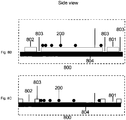
- figure 8 a nanoparticle gradient surface 203 or 700 is present on a chip surface 800, e.g. a glass slide, together with two additional, separate surfaces 801 and 802.
- Figure 8A is a top view and figure 8B and 8C are side views according to two embodiments.
- the two additional, separate surfaces are chemically modified in such a way that one of the surfaces 802 is given the same surface chemistry as the surface with the nanoparticles, whereas the other surface 801 is given the same chemistry as the surface that surrounds the particles in the gradient.
- the operator can examine through a microscope whether the bacteria adsorbs to an area of the gradient surface.
- the operator also obtains information regarding how the bacteria adsorb to surfaces that do not contain nanoparticles but only unmixed surface chemistries. In this way the operator can determine whether the adhesion of the bacteria is related to the presence of nanoparticles or not, and which particle density is necessary for adsorption.
- the different surfaces 203 / 700, 801, an 802 can be separated on the chip 800 with the help of barriers 803 in order to facilitate the use and fabrication of the surface.
- the barriers can be made of engravings or spaces between the surfaces 203/700, 801, and 802 on the chip 800 in such a way that the underlying substrate 804 is exposed. Alternatively, the barriers can consist of ridges between the surfaces 203/700, 801, and 802, specifically in those cases where the particle gradient has been applied on the underlying substrate 804.
- An application of the invention is a product, e.g. a chip comprising a surface, e.g. a glass slide with the three surfaces mentioned above; 1, gold nanoparticle gradient surface where the gold nanoparticle gradient is manufactured on a dithiol modified gold surface on which free dithiols between the particles has reacted with malemide-PEG and the surface of the particles has reacted with a functional thiol, e.g. methyl terminated, amino terminated, acid terminated, or peptide terminated; 2, a gold surface which has been modified dithiol and malemide-PEG; 3, a gold surface which has been modified with the same functional thiol as the surface on the particles.
- a functional thiol e.g. methyl terminated, amino terminated, acid terminated, or peptide terminated
- An application of the invention is a product comprising a surface, e.g. glass slide with the three surfaces mentioned above; 1, gold nanoparticle gradient surface where the gold nanoparticle gradient is manufactured on a dithiol modified gold surface on which free dithiols between the particles has reacted with a malemide-conjugated molecule, e.g. methyl terminated, amino terminated, acid terminated, or peptide terminated, phosphorylated, heterocyclics, aromatics, carbonyles, sugars, inorganics, metal containing particles and the surface of the particles has reacted with a PEG-conjugated thiol.
- a malemide-conjugated molecule e.g. methyl terminated, amino terminated, acid terminated, or peptide terminated, phosphorylated, heterocyclics, aromatics, carbonyles, sugars, inorganics, metal containing particles and the surface of the particles has reacted with a PEG-conjugated thio
- An application of the invention is a product comprising a surface, e.g. glass slide with the three surfaces mentioned above; 1, gold nanoparticle gradient surface where the gold nanoparticle gradient is manufactured on a dithiol modified gold surface on which free dithiols between the particles has reacted with malemide-PEG; 2, a gold surface which has been modified dithiol and malemide-PEG; 3, a pure gold surface.
- the operator can choose which thiol reagent that should be used.
- thiols that can affect adhesion, e.g. thiols conjugated with amino groups, mono- and polysaccharides.
- An application of the invention is a product comprising a surface, e.g. glass slide with the three surfaces mentioned above; 1, gold nanoparticle gradient surface where the gold nanoparticle gradient is manufactured on a dithiol modified gold surface; 2, a gold surface which has been modified dithiol; 3 a pure gold surface.
- a surface e.g. glass slide with the three surfaces mentioned above; 1, gold nanoparticle gradient surface where the gold nanoparticle gradient is manufactured on a dithiol modified gold surface; 2, a gold surface which has been modified dithiol; 3 a pure gold surface.
- An application of the invention is a product comprising a surface, e.g. glass slide with the three surfaces mentioned above; 1, gold nanoparticle gradient surface where the gold nanoparticle gradient is manufactured on a thiol silane modified glass- or silica surface, where free thiol silanes between the particles has reacted with malemide PEG, and where the surface on the particles has reacted with the functional thiol, e.g. methyl terminated, amino terminated, acid terminated, or peptide terminated; 2, a glass or silica surface which has been modified with thiol silane and malemide-PEG; 3, a gold surface which has been modified the same functional thiol as the surface of the particles.
- 1, gold nanoparticle gradient surface where the gold nanoparticle gradient is manufactured on a thiol silane modified glass- or silica surface, where free thiol silanes between the particles has reacted with malemide PEG, and where the surface on the particles has reacted with the functional
- An application of the invention is a product comprising a surface, e.g. glass slide with the three surfaces mentioned above; 1, gold nanoparticle gradient surface where the gold nanoparticle gradient is manufactured on a thiol silane modified glass- or silica surface, where free thiol silanes, between the particles, have reacted with malemide PEG; 2, glass- or silica surface which has been modified with thiol silane and malemide PEG; 3, an unmodified gold surface.
- the operator can choose which thiol reagent to be used.
- An application of the invention is a product comprising a surface, e.g. glass slide with the three surfaces mentioned above; 1, gold nanoparticle gradient surface where the gold nanoparticle gradient is manufactured on a thiol- or aminosilane modified glass- or silica surface, where the silanes under and between the particles has been removed in such a way, e.g. trough plasma treatment, that the particles are sintered on the glass or silica surface where the surfaces between the particles has reacted with PEG-Silane and the surface of the particles has reacted with a functional thiol, e.g.
- An application of the invention is a product comprising a surface, e.g. glass slide with the three surfaces mentioned above; 1, gold nanoparticle gradient surface where the gold nanoparticle gradient is manufactured on a thiol- or aminosilane modified glass- or silica surface and the surface of the particles has reacted with a functional thiol, e.g. PEG terminated, methyl terminated, amino terminated, acid terminated or peptide terminated; 2, a glass or silica surface which has been modified with thiol- or aminosilane; 3, a gold surface which has been modified with the same functional thiol as the surface of the particles.
- a functional thiol e.g. PEG terminated, methyl terminated, amino terminated, acid terminated or peptide terminated
- An application of the invention is a product comprising a surface, e.g. glass slide with the three surfaces mentioned above; 1, gold nanoparticle gradient surface where the gold nanoparticle gradient is manufactured on a thiol- or aminosilane modified glass- or silica surface, where the silanes under and between the particles has been removed in such a way, e.g. trough plasma treatment, that the particles are sintered on the glass or silica surface where the surfaces between the particles have reacted with PEG-Silane; 2, a glass or silica surface which has been modified PEG-Silane; 3, an unmodified gold surface.
- a surface e.g. glass slide with the three surfaces mentioned above; 1, gold nanoparticle gradient surface where the gold nanoparticle gradient is manufactured on a thiol- or aminosilane modified glass- or silica surface, where the silanes under and between the particles has been removed in such a way, e.g. trough plasma treatment, that the particles are sintered on the glass or
- An application of the invention is a product comprising a surface, e.g. glass slide with the three surfaces mentioned above; 1, gold nanoparticle gradient surface where the gold nanoparticle gradient is manufactured on a thiol- or aminosilane modified glass- or silica surface, where the silanes under and between the particles has been removed in such a way, e.g. trough plasma treatment, that the particles are sintered on the glass or silica surface; 2, a glass or silica surface; 3, an unmodified gold surface.
- the operator can choose which surface chemistry and method of modification for the different surfaces.
- the three typical surfaces can in manufacturing be made separate, and then be combined on the glass slides with an adhesive. It is also possible to prepare these surfaces directly on a glass slide.
- FIG. 9A A set up for iSPR analysis of a gradient surface is illustrated in figure 9A .
- An apparatus 900 for imaging SPR such as described in [17], normally controlled with a computer 905, is applied in contact with an SPR-substrate usually comprising a glass surface 901 on which a thin gold layer 902 has been applied.
- a chamber 904 containing a solution is placed, e.g. a buffer in such a way that the gold layer is in contact with the solution.
- the chamber 904 can have an inlet 907 and an outlet 908 and function as a perfusion system to transport solution and analytes to and from the surface.
- the gold surface 902 has been chemically modified with the layer 903 to bind nanoparticles from solution, and a gradient of nanoparticles has been applied to the surface.
- the SPR-response from different positions on the gradient surface can be correlated to partial density at this position.
- bio adhesion e.g. protein-, thrombocyte-, or bacterial adsorption takes place to the gradient surface this can also be detected as an additive response, figure 9B .
- Electrochemical technologies can also be used to estimate the number of nanoparticles on an electrode surface. This specifically is true for conducting nanoparticles for instance gold [19].
- a nanoparticle gradient is applied on a surface 1000 which is made up of n particle binding surfaces 1001 of an electrically conducting material which has been modified with the chemistry 1003 to bind nanoparticles.
- the surfaces 1001 is place on a non-conducting substrate 1002 in such a way that the surfaces 1001 an act as electrodes electrically isolated from one and other.
- the surface 1000 is applied in contact with an electrolyte, e.g. a buffer, in an electrochemical cell 1004 which also can have an inlet 1005 and an outlet 1006 in order to facilitate transportation of electrolyte and analyte to the surface 1000.
- an electrolyte e.g. a buffer
- an electrochemical cell 1004 which also can have an inlet 1005 and an outlet 1006 in order to facilitate transportation of electrolyte and analyte to the surface 1000.
- an electrolyte e.g. a buffer
- an electrochemical cell 1004 which also can have an inlet 1005 and an outlet 1006 in order to facilitate transportation of electrolyte and analyte to the surface 1000.
- an additional reference electrode 1007 and a counter electrode 1008 applied in the electrolyte.
- the electrodes 1007 and or 1008 can also be placed on the surface 1000. All electrodes 1-n on the surface 1000 and in some cases 1007 and 1008, are connected individually by a system for electrochemical reference 10
- the system 1009 could be a system designed for a single type of electrochemical measurements such as impedance measurements.
- the electrochemical response from the different electrodes on the surface 1000 can be measured either between different electrodes on the surface 1000, or by using the electrodes 1007 and 1008 in a conventional tri electrode setup [20].
- the electrochemical response from different electrodes with different positions on the surface 1000 can be correlated to the particle density at this position. If bio adhesion, e.g. cell adhesion, takes place to the gradient surface this can also be detected as an additive, usually a negative, change of the electrochemical response. If a redox active substance comes in contact with the surface this can also be detected as an additive, usually a positive change of the electrochemical response.
- Gold surfaces with size 11 x 20 mm were manufactured by evaporation of first 5 nm Cr and then 200 nm Au on a substrate of SiO2. These were washed and provided with a monolayer of dithiol according to the procedure described in detail [1, 8]. In short, the clean gold surfaces were incubated in a solution of octane dithiol in ethanol where they were reactivated with dithiolthreitol (DDT). An electrostatically stabilized gold particle solution with gold particles around 10 nm in diameter was manufactured according to the procedure described in detail [1, 8]. The gold solution was centrifuged at 16000 g to reduce the ionic strength in the solution, and in order to increase the concentration of the particles.
- DDT dithiolthreitol
- the gold particle pellet was diluted to an approximate particle concentration of 55 nM in pure water with the conductivity of 18.2 M ⁇ *cm.
- This particle solution was transferred to a container designed gradient manufacturing according to figure 5 after which a number of the dithiol prepared surfaces were placed in the same container with a specific distance to the bottom the same. There after a citrate buffer with the concentration 1M and pH 4,0 was placed at the bottom of the gradient container so that the space underneath the surfaces was filled with this buffer. The citrate buffer was then allowed to diffuse over the surfaces during 30 minutes after which the procedure was stopped by emptying the solution from the gradient container from below.
- the citrate buffer with the concentration 50mM was applied underneath the surfaces and was the allowed to diffuse less than 90 minutes which results in a longer gradient with less slope compared to the one obtained with 1 M buffer under 30 minutes.
- the surfaces were analyzed with SEM at different positions on the gradient surface. A selection of pictures is presented in figure 11 .
- Each particle gradient also had reacted with maleimide-PEG in order minimize bioadhesion between the distributed particles, and with octane thiol above the particles which makes the surfaces on the particles hydrophobic in order to promote bio adhesion.
- On each gradient surface an area of app. 1 x 5 mm was analyzed. In these areas all essential parts of the gradient was pictured.
- the SPR wave length presented in the 3D graph z-axis is proportional to the surface coverage of gold nanoparticles.
- a line scan of a "short" gradient is presented together with a line scan for a positive control surface, (in this case a surface modified with only octanedithiol), and a negative control surface modified with octane dithiol and maleimide-PEG.
- Each line scan represents an average of all scans of the surface.
- Example 3 Evaluation of fibrinogen adsorption and thrombocyte adsorption to hydrophobic nanoparticle gradients with iSPR and fluorescence microscopy.
- FIG 14 the response from fibrinogen and thrombocyte adsorption is presented for a gradient surface and a positive controlled surface.
- the blue curve shows the adsorption of fibrinogen
- the green curve the accumulated response from both fibrinogen and thrombocytes.
- the response from the underlying surfaces corresponding to what is shown in figure 13 , has been subtracted from the results in figure 14 .
- the positive surface adsorbs both fibrinogen and thrombocytes homogeneously across the surface, while the gradient surface adsorbs both protein and thrombocytes gradually.
- the negative control surfaces gave no significant response.
- FIG. 15 shows representative thrombocytes at positions with high (A) and low (B) particle coverage respectively.
- Example 4 Evaluation of microbial adhesion to hydrophobic nanoparticle gradients.
Landscapes
- Chemical & Material Sciences (AREA)
- Engineering & Computer Science (AREA)
- Health & Medical Sciences (AREA)
- Life Sciences & Earth Sciences (AREA)
- Nanotechnology (AREA)
- Physics & Mathematics (AREA)
- General Health & Medical Sciences (AREA)
- Crystallography & Structural Chemistry (AREA)
- General Physics & Mathematics (AREA)
- Immunology (AREA)
- Molecular Biology (AREA)
- Analytical Chemistry (AREA)
- Biochemistry (AREA)
- Organic Chemistry (AREA)
- Hematology (AREA)
- Medicinal Chemistry (AREA)
- Biotechnology (AREA)
- Pathology (AREA)
- General Engineering & Computer Science (AREA)
- Manufacturing & Machinery (AREA)
- Biophysics (AREA)
- Proteomics, Peptides & Aminoacids (AREA)
- Urology & Nephrology (AREA)
- Wood Science & Technology (AREA)
- Zoology (AREA)
- Bioinformatics & Cheminformatics (AREA)
- Microbiology (AREA)
- Biomedical Technology (AREA)
- Condensed Matter Physics & Semiconductors (AREA)
- Pharmacology & Pharmacy (AREA)
- Animal Behavior & Ethology (AREA)
- Genetics & Genomics (AREA)
- Composite Materials (AREA)
- Materials Engineering (AREA)
- Medical Informatics (AREA)
- Food Science & Technology (AREA)
- Dermatology (AREA)
- Oral & Maxillofacial Surgery (AREA)
- Transplantation (AREA)
- Epidemiology (AREA)
Applications Claiming Priority (2)
| Application Number | Priority Date | Filing Date | Title |
|---|---|---|---|
| SE1050866A SE535087C2 (sv) | 2010-08-24 | 2010-08-24 | En metod för att preparera en plan yta med en kontrollerad täthetsgradient av deponerade partiklar i nanostorlek |
| PCT/EP2011/064582 WO2012025576A1 (en) | 2010-08-24 | 2011-08-24 | A method for preparing a surface with a controlled coverage of nanograde particles |
Publications (2)
| Publication Number | Publication Date |
|---|---|
| EP2608896A1 EP2608896A1 (en) | 2013-07-03 |
| EP2608896B1 true EP2608896B1 (en) | 2017-12-27 |
Family
ID=44651681
Family Applications (1)
| Application Number | Title | Priority Date | Filing Date |
|---|---|---|---|
| EP11757205.7A Active EP2608896B1 (en) | 2010-08-24 | 2011-08-24 | A method for preparing a surface with a controlled coverage of nanograde particles |
Country Status (8)
| Country | Link |
|---|---|
| US (2) | US9566604B2 (enExample) |
| EP (1) | EP2608896B1 (enExample) |
| JP (2) | JP6114192B2 (enExample) |
| CN (1) | CN103180055B (enExample) |
| DK (1) | DK2608896T3 (enExample) |
| ES (1) | ES2663833T3 (enExample) |
| SE (1) | SE535087C2 (enExample) |
| WO (1) | WO2012025576A1 (enExample) |
Cited By (1)
| Publication number | Priority date | Publication date | Assignee | Title |
|---|---|---|---|---|
| EP3872168A1 (en) | 2020-02-28 | 2021-09-01 | Cline Scientific AB | Chondrocyte differentiation |
Families Citing this family (5)
| Publication number | Priority date | Publication date | Assignee | Title |
|---|---|---|---|---|
| GB201204579D0 (en) * | 2012-03-15 | 2012-05-02 | Univ Nottingham Trent | Coating metal oxide particles |
| EP3091347A1 (en) * | 2015-05-04 | 2016-11-09 | The European Union, represented by the European Commission | Screening of nanoparticle properties |
| EP4056271A1 (en) | 2021-03-10 | 2022-09-14 | Cline Scientific AB | Quantification of cell migration and metastatic potential of tumor cells |
| KR102660710B1 (ko) * | 2021-12-30 | 2024-04-24 | 고려대학교 산학협력단 | 나노새틀라이트-기판 복합체 및 이를 이용한 줄기세포의 부착 및 분화 조절방법 |
| CN116251951B (zh) * | 2023-03-10 | 2023-11-10 | 清华大学 | 一种基于界面张力梯度-静电引力复合制备金属纳米颗粒自组装层的方法及其应用 |
Family Cites Families (21)
| Publication number | Priority date | Publication date | Assignee | Title |
|---|---|---|---|---|
| US6025202A (en) | 1995-02-09 | 2000-02-15 | The Penn State Research Foundation | Self-assembled metal colloid monolayers and detection methods therewith |
| US5609907A (en) | 1995-02-09 | 1997-03-11 | The Penn State Research Foundation | Self-assembled metal colloid monolayers |
| US6242264B1 (en) | 1996-09-04 | 2001-06-05 | The Penn State Research Foundation | Self-assembled metal colloid monolayers having size and density gradients |
| DE10144252A1 (de) | 2001-08-31 | 2003-03-27 | Fraunhofer Ges Forschung | Nanopartikel mit daran immobilisiertem biologisch aktivem TNF |
| FI118061B (fi) | 2001-09-24 | 2007-06-15 | Beanor Oy | Menetelmä ja bioanturi analyysiä varten |
| DE10200648A1 (de) | 2002-01-10 | 2003-07-24 | Inst Neue Mat Gemein Gmbh | Verfahren zur Herstellung Optischer Elemente mit Gradientenstruktur |
| US6972155B2 (en) * | 2002-01-18 | 2005-12-06 | North Carolina State University | Gradient fabrication to direct transport on a surface |
| US20050106570A1 (en) | 2002-04-03 | 2005-05-19 | Japan Science And Technology Agency | Biochip sensor surface carrying polyethylene glycolated nanoparticles |
| US20060003097A1 (en) | 2003-08-06 | 2006-01-05 | Andres Ronald P | Fabrication of nanoparticle arrays |
| US7750352B2 (en) | 2004-08-10 | 2010-07-06 | Pinion Technologies, Inc. | Light strips for lighting and backlighting applications |
| WO2006080895A1 (en) | 2005-01-20 | 2006-08-03 | Agency For Science, Technology And Research | Water-soluble, surface-functionalized nanoparticle for bioconjugation via universal silane coupling |
| DE102005026485A1 (de) | 2005-06-09 | 2006-12-14 | Bayer Technology Services Gmbh | Hydrophile Nanoteilchen mit funktionellen Oberflächengruppen, deren Herstellung und Verwendung |
| US20070127164A1 (en) | 2005-11-21 | 2007-06-07 | Physical Logic Ag | Nanoscale Sensor |
| FR2893934B1 (fr) | 2005-11-25 | 2008-11-14 | Commissariat Energie Atomique | Dispositif nanostructure |
| EP2007514A2 (en) | 2006-03-28 | 2008-12-31 | Inanovate, Inc. | Nano-particle biochip substrates |
| KR100900955B1 (ko) * | 2006-12-06 | 2009-06-08 | 한국전자통신연구원 | 자기조립된 분자의 커버리지 분석용 기판 및 이를 이용하여자기조립된 분자의 커버리지를 분석하는 방법 |
| WO2008136882A2 (en) * | 2007-02-14 | 2008-11-13 | The Board Of Trustees Of The Leland Stanford Junior University | Fabrication method of size-controlled, spatially distributed nanostructures by atomic layer deposition |
| US20090098366A1 (en) | 2007-09-07 | 2009-04-16 | Northwestern University | Methods of coating surfaces with nanoparticles and nanoparticle coated surfaces |
| US20110245528A1 (en) | 2008-09-23 | 2011-10-06 | Schwartz C Eric | Therapeutic compounds |
| US9885154B2 (en) * | 2009-01-28 | 2018-02-06 | Donaldson Company, Inc. | Fibrous media |
| CN101993467B (zh) | 2009-08-24 | 2015-12-09 | 香港科技大学 | 在纳米颗粒表面控制功能分子密度的方法 |
-
2010
- 2010-08-24 SE SE1050866A patent/SE535087C2/sv not_active IP Right Cessation
-
2011
- 2011-08-24 US US13/818,541 patent/US9566604B2/en active Active
- 2011-08-24 WO PCT/EP2011/064582 patent/WO2012025576A1/en not_active Ceased
- 2011-08-24 JP JP2013525302A patent/JP6114192B2/ja not_active Expired - Fee Related
- 2011-08-24 EP EP11757205.7A patent/EP2608896B1/en active Active
- 2011-08-24 ES ES11757205.7T patent/ES2663833T3/es active Active
- 2011-08-24 DK DK11757205.7T patent/DK2608896T3/en active
- 2011-08-24 CN CN201180051333.1A patent/CN103180055B/zh active Active
-
2016
- 2016-12-29 US US15/394,140 patent/US10274415B2/en active Active
-
2017
- 2017-03-14 JP JP2017048302A patent/JP6462746B2/ja not_active Expired - Fee Related
Cited By (1)
| Publication number | Priority date | Publication date | Assignee | Title |
|---|---|---|---|---|
| EP3872168A1 (en) | 2020-02-28 | 2021-09-01 | Cline Scientific AB | Chondrocyte differentiation |
Also Published As
| Publication number | Publication date |
|---|---|
| EP2608896A1 (en) | 2013-07-03 |
| WO2012025576A1 (en) | 2012-03-01 |
| ES2663833T3 (es) | 2018-04-17 |
| US9566604B2 (en) | 2017-02-14 |
| JP6114192B2 (ja) | 2017-04-12 |
| US20170241896A1 (en) | 2017-08-24 |
| US20130180326A1 (en) | 2013-07-18 |
| CN103180055B (zh) | 2014-12-31 |
| JP6462746B2 (ja) | 2019-01-30 |
| US10274415B2 (en) | 2019-04-30 |
| DK2608896T3 (en) | 2018-03-26 |
| SE535087C2 (sv) | 2012-04-10 |
| CN103180055A (zh) | 2013-06-26 |
| JP2017189764A (ja) | 2017-10-19 |
| JP2013541410A (ja) | 2013-11-14 |
| SE1050866A1 (sv) | 2012-02-25 |
Similar Documents
| Publication | Publication Date | Title |
|---|---|---|
| US10274415B2 (en) | Method for preparing a surface with a controlled coverage of nanograde particles | |
| Hou et al. | Self-assembled monolayers on electroless gold impart pH-responsive transport of ions in porous membranes | |
| Zheng et al. | Imparting biomimetic ion-gating recognition properties to electrodes with a hydrogen-bonding structured core− shell nanoparticle network | |
| Nebhani et al. | Orthogonal transformations on solid substrates: efficient avenues to surface modification | |
| Silin et al. | The role of surface free energy on the formation of hybrid bilayer membranes | |
| Kooij et al. | Ionic strength mediated self-organization of gold nanocrystals: An AFM study | |
| de Groot et al. | Smart polymer brush nanostructures guide the self-assembly of pore-spanning lipid bilayers with integrated membrane proteins | |
| US20060014013A1 (en) | Stabilized biocompatible supported lipid membrane | |
| Baranowska et al. | Protein attachment to silane-functionalized porous silicon: A comparison of electrostatic and covalent attachment | |
| US20080003694A1 (en) | Robust, self-assembled, biocompatible films | |
| Giraud et al. | Amino-functionalized monolayers covalently grafted to silica-based substrates as a robust primer anchorage in aqueous media | |
| Zhu et al. | Monolayer arrays of nanoparticles on block copolymer brush films | |
| Xu et al. | Phospholipid polymer biointerfaces for lab-on-a-chip devices | |
| Taylor et al. | Fabrication of protein dot arrays via particle lithography | |
| KR101836226B1 (ko) | 금 나노입자와 고분자 코팅을 활용한 고효율 바이오칩의 제조방법 및 그에 의한 바이오칩 | |
| JP2011185874A (ja) | 生体分子分析用キット、これを用いた生体分子の分析方法 | |
| US20100015718A1 (en) | Substrate for analyzing coverage of self-assembled molecules and analyzing method using the same | |
| Ktari et al. | Immobilization of magnetic nanoparticles onto conductive surfaces modified by diazonium chemistry | |
| Vikholm-Lundin et al. | Assembly of citrate gold nanoparticles on hydrophilic monolayers | |
| Sopoušek et al. | Thick nanoporous matrices of polystyrene nanoparticles and their potential for electrochemical biosensing | |
| Leïchlé et al. | Nanostructuring surfaces with conjugated silica colloids deposited using silicon-basedmicrocantilevers | |
| Calo et al. | Diffusion-controlled deposition of natural nanovesicles containing G-protein coupled receptors for biosensing platforms | |
| Lee et al. | Trends in the development and application of functional biomembrane surfaces | |
| Indrieri et al. | Quantitative investigation by atomic force microscopy of supported phospholipid layers and nanostructures on cholesterol-functionalized glass surfaces | |
| WO2008069479A1 (en) | Substrate for analzing coverage of self-assembled molecules and analyzing method using the same |
Legal Events
| Date | Code | Title | Description |
|---|---|---|---|
| PUAI | Public reference made under article 153(3) epc to a published international application that has entered the european phase |
Free format text: ORIGINAL CODE: 0009012 |
|
| 17P | Request for examination filed |
Effective date: 20130319 |
|
| AK | Designated contracting states |
Kind code of ref document: A1 Designated state(s): AL AT BE BG CH CY CZ DE DK EE ES FI FR GB GR HR HU IE IS IT LI LT LU LV MC MK MT NL NO PL PT RO RS SE SI SK SM TR |
|
| DAX | Request for extension of the european patent (deleted) | ||
| 17Q | First examination report despatched |
Effective date: 20150226 |
|
| GRAP | Despatch of communication of intention to grant a patent |
Free format text: ORIGINAL CODE: EPIDOSNIGR1 |
|
| RIC1 | Information provided on ipc code assigned before grant |
Ipc: B05D 1/00 20060101ALI20170705BHEP Ipc: B05D 1/18 20060101AFI20170705BHEP Ipc: B05D 1/20 20060101ALI20170705BHEP Ipc: B05D 5/04 20060101ALI20170705BHEP Ipc: G01N 19/04 20060101ALI20170705BHEP Ipc: B82Y 30/00 20110101ALI20170705BHEP Ipc: B05D 5/08 20060101ALI20170705BHEP |
|
| INTG | Intention to grant announced |
Effective date: 20170728 |
|
| GRAS | Grant fee paid |
Free format text: ORIGINAL CODE: EPIDOSNIGR3 |
|
| GRAA | (expected) grant |
Free format text: ORIGINAL CODE: 0009210 |
|
| AK | Designated contracting states |
Kind code of ref document: B1 Designated state(s): AL AT BE BG CH CY CZ DE DK EE ES FI FR GB GR HR HU IE IS IT LI LT LU LV MC MK MT NL NO PL PT RO RS SE SI SK SM TR |
|
| REG | Reference to a national code |
Ref country code: GB Ref legal event code: FG4D |
|
| REG | Reference to a national code |
Ref country code: CH Ref legal event code: EP |
|
| REG | Reference to a national code |
Ref country code: AT Ref legal event code: REF Ref document number: 957860 Country of ref document: AT Kind code of ref document: T Effective date: 20180115 |
|
| REG | Reference to a national code |
Ref country code: IE Ref legal event code: FG4D |
|
| REG | Reference to a national code |
Ref country code: DE Ref legal event code: R096 Ref document number: 602011044553 Country of ref document: DE |
|
| REG | Reference to a national code |
Ref country code: DK Ref legal event code: T3 Effective date: 20180320 |
|
| REG | Reference to a national code |
Ref country code: NL Ref legal event code: FP |
|
| REG | Reference to a national code |
Ref country code: ES Ref legal event code: FG2A Ref document number: 2663833 Country of ref document: ES Kind code of ref document: T3 Effective date: 20180417 |
|
| PG25 | Lapsed in a contracting state [announced via postgrant information from national office to epo] |
Ref country code: LT Free format text: LAPSE BECAUSE OF FAILURE TO SUBMIT A TRANSLATION OF THE DESCRIPTION OR TO PAY THE FEE WITHIN THE PRESCRIBED TIME-LIMIT Effective date: 20171227 Ref country code: NO Free format text: LAPSE BECAUSE OF FAILURE TO SUBMIT A TRANSLATION OF THE DESCRIPTION OR TO PAY THE FEE WITHIN THE PRESCRIBED TIME-LIMIT Effective date: 20180327 Ref country code: FI Free format text: LAPSE BECAUSE OF FAILURE TO SUBMIT A TRANSLATION OF THE DESCRIPTION OR TO PAY THE FEE WITHIN THE PRESCRIBED TIME-LIMIT Effective date: 20171227 |
|
| REG | Reference to a national code |
Ref country code: LT Ref legal event code: MG4D |
|
| REG | Reference to a national code |
Ref country code: AT Ref legal event code: MK05 Ref document number: 957860 Country of ref document: AT Kind code of ref document: T Effective date: 20171227 |
|
| PG25 | Lapsed in a contracting state [announced via postgrant information from national office to epo] |
Ref country code: GR Free format text: LAPSE BECAUSE OF FAILURE TO SUBMIT A TRANSLATION OF THE DESCRIPTION OR TO PAY THE FEE WITHIN THE PRESCRIBED TIME-LIMIT Effective date: 20180328 Ref country code: LV Free format text: LAPSE BECAUSE OF FAILURE TO SUBMIT A TRANSLATION OF THE DESCRIPTION OR TO PAY THE FEE WITHIN THE PRESCRIBED TIME-LIMIT Effective date: 20171227 Ref country code: HR Free format text: LAPSE BECAUSE OF FAILURE TO SUBMIT A TRANSLATION OF THE DESCRIPTION OR TO PAY THE FEE WITHIN THE PRESCRIBED TIME-LIMIT Effective date: 20171227 Ref country code: BG Free format text: LAPSE BECAUSE OF FAILURE TO SUBMIT A TRANSLATION OF THE DESCRIPTION OR TO PAY THE FEE WITHIN THE PRESCRIBED TIME-LIMIT Effective date: 20180327 Ref country code: RS Free format text: LAPSE BECAUSE OF FAILURE TO SUBMIT A TRANSLATION OF THE DESCRIPTION OR TO PAY THE FEE WITHIN THE PRESCRIBED TIME-LIMIT Effective date: 20171227 |
|
| PG25 | Lapsed in a contracting state [announced via postgrant information from national office to epo] |
Ref country code: EE Free format text: LAPSE BECAUSE OF FAILURE TO SUBMIT A TRANSLATION OF THE DESCRIPTION OR TO PAY THE FEE WITHIN THE PRESCRIBED TIME-LIMIT Effective date: 20171227 Ref country code: SK Free format text: LAPSE BECAUSE OF FAILURE TO SUBMIT A TRANSLATION OF THE DESCRIPTION OR TO PAY THE FEE WITHIN THE PRESCRIBED TIME-LIMIT Effective date: 20171227 Ref country code: CZ Free format text: LAPSE BECAUSE OF FAILURE TO SUBMIT A TRANSLATION OF THE DESCRIPTION OR TO PAY THE FEE WITHIN THE PRESCRIBED TIME-LIMIT Effective date: 20171227 Ref country code: CY Free format text: LAPSE BECAUSE OF FAILURE TO SUBMIT A TRANSLATION OF THE DESCRIPTION OR TO PAY THE FEE WITHIN THE PRESCRIBED TIME-LIMIT Effective date: 20171227 |
|
| REG | Reference to a national code |
Ref country code: FR Ref legal event code: PLFP Year of fee payment: 8 |
|
| PG25 | Lapsed in a contracting state [announced via postgrant information from national office to epo] |
Ref country code: SM Free format text: LAPSE BECAUSE OF FAILURE TO SUBMIT A TRANSLATION OF THE DESCRIPTION OR TO PAY THE FEE WITHIN THE PRESCRIBED TIME-LIMIT Effective date: 20171227 Ref country code: AT Free format text: LAPSE BECAUSE OF FAILURE TO SUBMIT A TRANSLATION OF THE DESCRIPTION OR TO PAY THE FEE WITHIN THE PRESCRIBED TIME-LIMIT Effective date: 20171227 Ref country code: RO Free format text: LAPSE BECAUSE OF FAILURE TO SUBMIT A TRANSLATION OF THE DESCRIPTION OR TO PAY THE FEE WITHIN THE PRESCRIBED TIME-LIMIT Effective date: 20171227 Ref country code: IS Free format text: LAPSE BECAUSE OF FAILURE TO SUBMIT A TRANSLATION OF THE DESCRIPTION OR TO PAY THE FEE WITHIN THE PRESCRIBED TIME-LIMIT Effective date: 20180427 Ref country code: PL Free format text: LAPSE BECAUSE OF FAILURE TO SUBMIT A TRANSLATION OF THE DESCRIPTION OR TO PAY THE FEE WITHIN THE PRESCRIBED TIME-LIMIT Effective date: 20171227 |
|
| REG | Reference to a national code |
Ref country code: DE Ref legal event code: R097 Ref document number: 602011044553 Country of ref document: DE |
|
| PLBE | No opposition filed within time limit |
Free format text: ORIGINAL CODE: 0009261 |
|
| STAA | Information on the status of an ep patent application or granted ep patent |
Free format text: STATUS: NO OPPOSITION FILED WITHIN TIME LIMIT |
|
| 26N | No opposition filed |
Effective date: 20180928 |
|
| PG25 | Lapsed in a contracting state [announced via postgrant information from national office to epo] |
Ref country code: SI Free format text: LAPSE BECAUSE OF FAILURE TO SUBMIT A TRANSLATION OF THE DESCRIPTION OR TO PAY THE FEE WITHIN THE PRESCRIBED TIME-LIMIT Effective date: 20171227 |
|
| PG25 | Lapsed in a contracting state [announced via postgrant information from national office to epo] |
Ref country code: MC Free format text: LAPSE BECAUSE OF FAILURE TO SUBMIT A TRANSLATION OF THE DESCRIPTION OR TO PAY THE FEE WITHIN THE PRESCRIBED TIME-LIMIT Effective date: 20171227 |
|
| PG25 | Lapsed in a contracting state [announced via postgrant information from national office to epo] |
Ref country code: LU Free format text: LAPSE BECAUSE OF NON-PAYMENT OF DUE FEES Effective date: 20180824 |
|
| PG25 | Lapsed in a contracting state [announced via postgrant information from national office to epo] |
Ref country code: MT Free format text: LAPSE BECAUSE OF NON-PAYMENT OF DUE FEES Effective date: 20180824 |
|
| PG25 | Lapsed in a contracting state [announced via postgrant information from national office to epo] |
Ref country code: TR Free format text: LAPSE BECAUSE OF FAILURE TO SUBMIT A TRANSLATION OF THE DESCRIPTION OR TO PAY THE FEE WITHIN THE PRESCRIBED TIME-LIMIT Effective date: 20171227 |
|
| PG25 | Lapsed in a contracting state [announced via postgrant information from national office to epo] |
Ref country code: PT Free format text: LAPSE BECAUSE OF FAILURE TO SUBMIT A TRANSLATION OF THE DESCRIPTION OR TO PAY THE FEE WITHIN THE PRESCRIBED TIME-LIMIT Effective date: 20171227 Ref country code: HU Free format text: LAPSE BECAUSE OF FAILURE TO SUBMIT A TRANSLATION OF THE DESCRIPTION OR TO PAY THE FEE WITHIN THE PRESCRIBED TIME-LIMIT; INVALID AB INITIO Effective date: 20110824 |
|
| PG25 | Lapsed in a contracting state [announced via postgrant information from national office to epo] |
Ref country code: SE Free format text: LAPSE BECAUSE OF FAILURE TO SUBMIT A TRANSLATION OF THE DESCRIPTION OR TO PAY THE FEE WITHIN THE PRESCRIBED TIME-LIMIT Effective date: 20171227 Ref country code: IE Free format text: LAPSE BECAUSE OF NON-PAYMENT OF DUE FEES Effective date: 20180824 Ref country code: MK Free format text: LAPSE BECAUSE OF NON-PAYMENT OF DUE FEES Effective date: 20171227 |
|
| PG25 | Lapsed in a contracting state [announced via postgrant information from national office to epo] |
Ref country code: AL Free format text: LAPSE BECAUSE OF FAILURE TO SUBMIT A TRANSLATION OF THE DESCRIPTION OR TO PAY THE FEE WITHIN THE PRESCRIBED TIME-LIMIT Effective date: 20171227 |
|
| PGFP | Annual fee paid to national office [announced via postgrant information from national office to epo] |
Ref country code: NL Payment date: 20230829 Year of fee payment: 13 |
|
| PGFP | Annual fee paid to national office [announced via postgrant information from national office to epo] |
Ref country code: GB Payment date: 20230829 Year of fee payment: 13 Ref country code: ES Payment date: 20230905 Year of fee payment: 13 |
|
| PGFP | Annual fee paid to national office [announced via postgrant information from national office to epo] |
Ref country code: FR Payment date: 20230829 Year of fee payment: 13 Ref country code: DK Payment date: 20230829 Year of fee payment: 13 Ref country code: DE Payment date: 20230829 Year of fee payment: 13 Ref country code: BE Payment date: 20230829 Year of fee payment: 13 |
|
| PGFP | Annual fee paid to national office [announced via postgrant information from national office to epo] |
Ref country code: CH Payment date: 20240901 Year of fee payment: 14 |
|
| PGFP | Annual fee paid to national office [announced via postgrant information from national office to epo] |
Ref country code: IT Payment date: 20240806 Year of fee payment: 14 |
|
| REG | Reference to a national code |
Ref country code: DE Ref legal event code: R119 Ref document number: 602011044553 Country of ref document: DE |
|
| REG | Reference to a national code |
Ref country code: DK Ref legal event code: EBP Effective date: 20240831 |
|
| REG | Reference to a national code |
Ref country code: NL Ref legal event code: MM Effective date: 20240901 |
|
| GBPC | Gb: european patent ceased through non-payment of renewal fee |
Effective date: 20240824 |
|
| PG25 | Lapsed in a contracting state [announced via postgrant information from national office to epo] |
Ref country code: NL Free format text: LAPSE BECAUSE OF NON-PAYMENT OF DUE FEES Effective date: 20240901 |
|
| REG | Reference to a national code |
Ref country code: BE Ref legal event code: MM Effective date: 20240831 |
|
| PG25 | Lapsed in a contracting state [announced via postgrant information from national office to epo] |
Ref country code: DE Free format text: LAPSE BECAUSE OF NON-PAYMENT OF DUE FEES Effective date: 20250301 |
|
| PG25 | Lapsed in a contracting state [announced via postgrant information from national office to epo] |
Ref country code: GB Free format text: LAPSE BECAUSE OF NON-PAYMENT OF DUE FEES Effective date: 20240824 Ref country code: DK Free format text: LAPSE BECAUSE OF NON-PAYMENT OF DUE FEES Effective date: 20240831 |
|
| PG25 | Lapsed in a contracting state [announced via postgrant information from national office to epo] |
Ref country code: BE Free format text: LAPSE BECAUSE OF NON-PAYMENT OF DUE FEES Effective date: 20240831 |
|
| PG25 | Lapsed in a contracting state [announced via postgrant information from national office to epo] |
Ref country code: FR Free format text: LAPSE BECAUSE OF NON-PAYMENT OF DUE FEES Effective date: 20240831 |
|
| REG | Reference to a national code |
Ref country code: ES Ref legal event code: FD2A Effective date: 20251001 |
|
| PG25 | Lapsed in a contracting state [announced via postgrant information from national office to epo] |
Ref country code: ES Free format text: LAPSE BECAUSE OF NON-PAYMENT OF DUE FEES Effective date: 20240825 |