EP2586422A1 - Hair styling cosmetic - Google Patents
Hair styling cosmetic Download PDFInfo
- Publication number
- EP2586422A1 EP2586422A1 EP11798251.2A EP11798251A EP2586422A1 EP 2586422 A1 EP2586422 A1 EP 2586422A1 EP 11798251 A EP11798251 A EP 11798251A EP 2586422 A1 EP2586422 A1 EP 2586422A1
- Authority
- EP
- European Patent Office
- Prior art keywords
- hair
- hair styling
- cosmetic composition
- component
- mass
- Prior art date
- Legal status (The legal status is an assumption and is not a legal conclusion. Google has not performed a legal analysis and makes no representation as to the accuracy of the status listed.)
- Withdrawn
Links
Classifications
-
- A—HUMAN NECESSITIES
- A61—MEDICAL OR VETERINARY SCIENCE; HYGIENE
- A61Q—SPECIFIC USE OF COSMETICS OR SIMILAR TOILETRY PREPARATIONS
- A61Q5/00—Preparations for care of the hair
- A61Q5/06—Preparations for styling the hair, e.g. by temporary shaping or colouring
-
- A—HUMAN NECESSITIES
- A61—MEDICAL OR VETERINARY SCIENCE; HYGIENE
- A61K—PREPARATIONS FOR MEDICAL, DENTAL OR TOILETRY PURPOSES
- A61K8/00—Cosmetics or similar toiletry preparations
- A61K8/18—Cosmetics or similar toiletry preparations characterised by the composition
- A61K8/19—Cosmetics or similar toiletry preparations characterised by the composition containing inorganic ingredients
- A61K8/20—Halogens; Compounds thereof
-
- A—HUMAN NECESSITIES
- A61—MEDICAL OR VETERINARY SCIENCE; HYGIENE
- A61K—PREPARATIONS FOR MEDICAL, DENTAL OR TOILETRY PURPOSES
- A61K8/00—Cosmetics or similar toiletry preparations
- A61K8/18—Cosmetics or similar toiletry preparations characterised by the composition
- A61K8/30—Cosmetics or similar toiletry preparations characterised by the composition containing organic compounds
- A61K8/33—Cosmetics or similar toiletry preparations characterised by the composition containing organic compounds containing oxygen
- A61K8/34—Alcohols
-
- A—HUMAN NECESSITIES
- A61—MEDICAL OR VETERINARY SCIENCE; HYGIENE
- A61K—PREPARATIONS FOR MEDICAL, DENTAL OR TOILETRY PURPOSES
- A61K8/00—Cosmetics or similar toiletry preparations
- A61K8/18—Cosmetics or similar toiletry preparations characterised by the composition
- A61K8/30—Cosmetics or similar toiletry preparations characterised by the composition containing organic compounds
- A61K8/60—Sugars; Derivatives thereof
-
- A—HUMAN NECESSITIES
- A61—MEDICAL OR VETERINARY SCIENCE; HYGIENE
- A61K—PREPARATIONS FOR MEDICAL, DENTAL OR TOILETRY PURPOSES
- A61K8/00—Cosmetics or similar toiletry preparations
- A61K8/18—Cosmetics or similar toiletry preparations characterised by the composition
- A61K8/72—Cosmetics or similar toiletry preparations characterised by the composition containing organic macromolecular compounds
- A61K8/81—Cosmetics or similar toiletry preparations characterised by the composition containing organic macromolecular compounds obtained by reactions involving only carbon-to-carbon unsaturated bonds
-
- A—HUMAN NECESSITIES
- A61—MEDICAL OR VETERINARY SCIENCE; HYGIENE
- A61K—PREPARATIONS FOR MEDICAL, DENTAL OR TOILETRY PURPOSES
- A61K8/00—Cosmetics or similar toiletry preparations
- A61K8/18—Cosmetics or similar toiletry preparations characterised by the composition
- A61K8/72—Cosmetics or similar toiletry preparations characterised by the composition containing organic macromolecular compounds
- A61K8/84—Cosmetics or similar toiletry preparations characterised by the composition containing organic macromolecular compounds obtained by reactions otherwise than those involving only carbon-carbon unsaturated bonds
- A61K8/86—Polyethers
-
- A—HUMAN NECESSITIES
- A61—MEDICAL OR VETERINARY SCIENCE; HYGIENE
- A61K—PREPARATIONS FOR MEDICAL, DENTAL OR TOILETRY PURPOSES
- A61K8/00—Cosmetics or similar toiletry preparations
- A61K8/18—Cosmetics or similar toiletry preparations characterised by the composition
- A61K8/72—Cosmetics or similar toiletry preparations characterised by the composition containing organic macromolecular compounds
- A61K8/84—Cosmetics or similar toiletry preparations characterised by the composition containing organic macromolecular compounds obtained by reactions otherwise than those involving only carbon-carbon unsaturated bonds
- A61K8/87—Polyurethanes
Definitions
- the present invention relates to a hair styling cosmetic composition. More precisely, the invention relates to a hair styling cosmetic composition which is excellent in hair styling property and hair restyling property, even though having a low viscosity, and is excellent in non-stickiness, smoothness, and light finish of the hair.
- hair styling resins such as hair-fixing polymer, a film-forming polymer or the like are incorporated for styling.
- hair styling resins are problematic in that they cause stiffness, non-uniformity of films applied on the hair, and reduction in the styling retentivity in high-humidity environments. Accordingly, for solving those problems, various countermeasures have been taken.
- JP 2004-505902A Patent Reference 1
- hair care composition containing a specific water-soluble polyalkylene glycol and a film-forming polymer in a specific ratio and further containing a liquid carrier is excellent in a hair restyling property and gives an improved feeling.
- the hair care composition in the Patent Reference 1 is problematic in that it could not obtain sufficient hair styling property (easiness in hair styling).
- Patent Reference 2 JP 2007-217314A (Patent Reference 2) describes that a misty powder cosmetic composition containing a polymer compound for hair fixation, a polyalcohol, a monoalcohol and a propellant each in a specific amount is excellent in hair restyling property without stickiness and has a natural glossy appearance.
- the misty powder cosmetic composition in the Patent Reference 2 is problematic in that it could not obtain sufficient hair styling properties (easiness in hair styling), and was not easily washed off from the hair.
- JP 3-261713A (Patent Reference 3) describes that a hair cosmetic containing a specific polyoxyalkylene compound and/or polyoxyalkylene alkyl glucoside, a polymer compound for hair fixation, and a high-molecular-weight polyethylene glycol (molecular weight, 6,000 to 30, 000) has a hair styling property and give smoothness or evenness.
- the hair cosmetic in the Patent Reference 3 is problematic in that it could not obtain sufficient hair styling property (easiness in hair styling).
- JP 2002-167317A (Patent Reference 4) describes that a hair cosmetic composition containing an ampholytic polymer, a sugar alcohol, and a sugar alcohol derivative (e.g., polyoxyalkylene adduct to sugar alcohol) has a hair styling property and a hair set retention property, and is free from sticky-feeling and stiff-feeling.
- a hair cosmetic composition in the Patent Reference 4 is problematic in that it could not obtain sufficient hair arranging property, and was not easily washed off from the hair.
- a water-based low-viscosity hair styling cosmetic composition It is especially difficult for a water-based low-viscosity hair styling cosmetic composition to have both a hair styling property (easiness in hair styling) and a hair restyling property. Accordingly, it has been desired to develop a water-based low-viscosity hair styling cosmetic composition that has both hair styling property and hair restyling property, as well as has a good feeling in use.
- the present invention has been made in consideration of the above-mentioned situation, and its object is to provide a hair styling cosmetic composition which is excellent in hair styling performance and hair restyling performance, even though having a low viscosity, and is excellent in non-stickiness, smoothness, and light finish of the hair.
- the invention provides a hair styling cosmetic composition
- a hair styling cosmetic composition comprising (a) one or more substances being solid at room temperature (25°C) selected from among (a 1 ) a sugar alcohol, (a 2 ) a sugar, (a 3 ) a polyalkylene glycol polymer, and (a 4 ) an inorganic salt, in an amount of from 0.1 to 20% by mass, (b) a sugar derivative and/or a sugar alcohol derivative being liquid at room temperature in an amount of from 0.1 to 25% by mass, (c) one or more film-forming polymers selected from among acrylic and vinylic film-forming polymers (but excepting ampholytic polymers) and urethanic polymers, in an amount of from 0.1 to 12% by mass, and (d) an aqueous solvent, wherein the viscosity of the system is at most 10,000 mPa ⁇ s (at 25°C with B-type viscometer).
- a hair styling cosmetic composition which is excellent in hair styling property and hair set retention property, even though having a low viscosity, and is excellent in non-stickiness, smoothness, and lightly-finishing of the hair.
- POE means polyoxyethylene
- POP means polyoxypropylene
- POB means polyoxybutylene
- Component (a) is one or more substances that are solid at room temperature(25°C) and selected from among (a 1 ) a sugar alcohol, (a 2 ) a sugar, (a 3 ) a polyalkylene glycol polymer, and (a 4 ) an inorganic salt.
- the sugar alcohol solid at room temperature is a polyalcohol which is in a solid state at room temperature to be obtained through reduction of the carbonyl group of sugar.
- exemplary sugar alcohol includes maltitol ("Malbit”; by B Food Science Co., Ltd.), sorbitol ("Sorbitol C”; by B Food Science Co., Ltd.), ribitol, mannitol, arabitol, galactitol, xylitol, erythritol, and inositol.
- sorbitol and maltitol from the viewpoint of non-stickiness and non-stiffness.
- Preferred examples of the polyalkylene glycol polymer that is solid at room temperature include an EO polymer composed of ethylene oxide (EO) constitutive units polymerized, a PO polymer composed of propylene oxide (PO) constitutive units polymerized, a BO polymer composed of butylene oxide (BO) constitutive units polymerized, as well as the corresponding copolymers composed of the respective constitutive units copolymerized.
- Especially preferred ones include an EO polymer, an EO/PO copolymer containing EO constitutive units and PO constitutive units, and an EO/BO copolymer containing EO constitutive units and BO constitutive units.
- the type of copolymerization is not specifically defined, including any of block copolymerization, graft copolymerization, random copolymerization, etc.
- polyethylene glycol having a mass-average molecular weight (Mw; hereinafter this may be simply referred to as "molecular weight”) of at least 1,000.
- Mw mass-average molecular weight
- the uppermost limit of the molecular weight is preferably up to about 20,000 or so.
- exemplary ones include PEG having a molecular weight of 1,000 (hereinafter this may be expressed as "PEG 1,000"), PEG 1,540, PEG 2, 000, PEG 4, 000, PEG 6, 000, PEG 8, 000, PEG 10,000, PEG 11,000, and PEG 20,000 .
- PEG 1,000 to 10, 000 are more preferred
- PEG 1, 000 to 8, 000 are even more preferred
- PEG 1,000 to 6,000 are especially preferred from the viewpoint of the hair styling property and hair restyling property.
- EO/PO copolymer examples include EO/PO block copolymers represented by the following formula (XII):
- R 1 and R 2 each independently represent an alkyl group having from 1 to 4 carbon atoms, or a hydrogen atom.
- the alkyl group having from 1 to 4 carbon atoms includes a methyl group, an ethyl group, an n-propyl group, an isopropyl group, an n-butyl group, a sec-butyl group, and a tert-butyl group. Preferred are a methyl group and an ethyl group.
- An alkyl group having 5 or more carbon atoms may lower the hydrophilicity of the copolymer and tend to lower the moisturizing feeling.
- (x + z) means the added molar number of the EO constitutive units; and y means the added molar number of the PO constitutive units.
- [(x +z)/(x+z+y)] is from 0.2 to 0.8, preferably from 0.4 to 0. 7.
- component (a 3 ) 60 ⁇ x + y + z ⁇ 100.
- (x + y + z) is less than 60, then some types of component (a 3 ) may be liquid; but when more than 100, then the composition may be sticky and the solubility thereof may be poor.
- EO/PO block copolymer represented by the above formula (XII) include POE(35)/POP(40) block copolymer dimethyl ether, and POE(50)/POP(40) block copolymer dimethyl ether.
- EO/BO copolymer examples include EO/BO block copolymers represented by the following formula (XIII):
- R 1 and R 2 have the same meanings as in the above formula (XII).
- m means the added molar number of the EO constitutive units
- (k + n) means the added molar number of the BO constitutive units.
- [m/(m + k +n)] is from 0.2 to 0.9, preferably from 0.4 to 0.9.
- ⁇ m + k + n 60 or so.
- (m + k + n) is less than 60, then some types of component (a 3 ) may be liquid; but when more than 100, then the sticky-feeling tends to occur and the solubility may be poor.
- EO/BO block copolymer represented by the above formula (XIII) examples include POE(52)/POB(32) block copolymer dimethyl ether, and POE(73)/POB(11) block copolymer dimethyl ether.
- the salt that is solid at room temperature may be, not specifically defined, any one capable of being generally incorporated in cosmetic compositions, and alkali metal salts, alkaline earth metal salts and the like are preferred for use herein.
- Preferred examples include magnesium chloride, sodium chloride, and manganese chloride.
- component (a) mainly contributes to the hair setting property, the hair arranging property, light finish of the hair, and the hair-pliability property.
- Component (a) is solid at room temperature, and therefore, after the application of the hair styling cosmetic composition on the hair, followed by being volatilized away the solvent from the applied composition, the solid component (a) can remain as widely covering on the hair, and efficacy of component (a) sustain effectively.
- the hair styling cosmetic composition of the invention is water-based and has a low viscosity, and hence, the ingredients therein can be widely and evenly applied on the hair.
- component (a) preferred is use of component (a 1 ) , component (a 3 ), component (a 2 ) and component (a 4 ) in that order. In the invention, preferred is an embodiment where component (a) contains at least component (a 1 ) and/or component (a 3 ).
- the amount of component (a) to be used in the hair styling cosmetic composition of the invention is from 0.1 to 20% by mass, preferably from 3 to 8% by mass. When the amount is less than 0.1% by mass, then component (a) could not sufficiently exert its property; but on the other hand, even though the amount is more than 20% by mass, not only there is no expecting a further improvement in efficacy that is commensurate with the increased amount of its use, but also the viscosity of the composition may increase, which is therefore unfavorable in point of the oily feeling, stickiness, and heavy finish of the hair.
- Component (b) is a sugar derivative and/or a sugar alcohol derivative that are liquid at room temperature.
- Exemplary sugar derivative include glucose derivatives, etc.; and exemplary sugar alcohol derivative include pentahydric or hexahydric sugar alcohol derivatives (e.g., sorbitol derivatives, mannitol derivatives, and xylitol derivatives, etc.), but not limited thereto.
- sugar or sugar alcohol alkylene oxide addition polymers are preferred.
- the alkylene oxide for addition polymerization preferably used here are constituent units of EO, PO, and BO, etc.
- the "sugar or sugar alcohol alkylene oxide addition polymer that is liquid at room temperature” concretely includes POP sorbitol (as commercial products, “Uniol HS-1600D” (by NOF Corp.), etc.), POE (10) methylglucoside (as commercial products, “Glucam E-10” (by Lubrizol Japan Limited), etc.), and POP(20) methylglucoside (as commercial products, “Glucam P-20” (by Lubrizol Japan Limited), etc.).
- the amount of component (b) to be used in the hair styling cosmetic composition of the invention is from 0.1 to 25% by mass, preferably from 3 to 15% by mass. When the amount is less than 0.1% by mass, then component (b) could not sufficiently exert its property; but on the other hand, even though the amount is more than 25% by mass, not only there is no expecting a further improvement in efficacy that is commensurate with the increased amount of its use, but also the viscosity of the composition may increase, which is therefore unfavorable in point of stickiness, and heavy finish of the hair.
- component (c), in the invention used are one or more selected from acrylic and vinylic film-forming polymers (but excepting ampholytic polymers) and urethanic polymers among film-forming polymers that have heretofore been used for hair styling cosmetic composition such as hair styling agents and others, especially from the viewpoint of the hair restyling property thereof.
- Any one among anionic, cationic, and nonionic polymers may be used.
- Exemplary anionic polymers include alkyl acrylate/diacetone acrylamide copolymer [Plas Cize L-53P, Plas Cize L-9909B, Plas Cize L-9948B, etc. (all by Goo Chemical Co., Ltd.)], alkyl acrylate/octylacrylamide copolymer [Dermacryl 79 (by AkzoNobel)], polyethylene glycol/polypropylene glycol-25/dimethicone acrylate copolymer [Rubiflex SILK (by BASF)], acrylic acid/acrylic acid amide/ethyl acrylate copolymer [Ultrahold 8, Ultrahold Strong (both by BASF)], and alkyl acrylate copolymer [Aniset NF-1000, Aniset HS-3000, etc. (all by Osaka Organic Chemical Industry Ltd.)].
- alkyl acrylate/diacetone acrylamide copolymer [Plas Cize L-53P
- Exemplary cationic polymers include vinylpyrrolidone/dimethylaminoethyl methacrylate copolymer diethyl sulfate salt [H.C. Polymer 1S(M), H.C. Polymer 2 (both by Osaka Organic Chemical Industry Ltd.), Gafquat 755N (by ISP)], vinylpyrrolidone/dimethylaminopropylmethacrylamide/lauryldimethylaminopropylm ethacrylamide copolymer [Styleze W-20 (by ISP)], vinylpyrrolidone/N,N-dimethylaminoethyl methacrylate/alkyl acrylate/tripropylene glycol diacrylate copolymer [Cosquat GA467, Cosquat GA468 (both by Osaka Organic Chemical Industry Ltd.)], polydime-thylmethylenepiperidinium chloride [Merquat 100 (by Nalco)], dimethyldiallylammonium chloride
- nonionic polymers include polyvinylpyrrolidone [Luviskol K17, Luviskol K30, Luviskol K90 (all by BASF), PVP K (by ISP)], vinylpyrrolidone/vinyl acetate copolymer [PVP/VA S-630, PVP/VA E-735, PVP/VA E-335 (all by ISP), Luviskol VA73W, Luviskol 37E (both by BASF), PVA-6450 (by Osaka Organic Chemical Industry Ltd.)], vinyl methyl ether/alkyl maleate copolymer [Gauntlets A-425, Gauntlets ES-225, Gauntlets ES-335 (all by ISP)], and vinylpyrrolidone/methacrylamide/vinylimidazole copolymer [Luviset Clear (by BASF)].
- polyvinylpyrrolidone [Luviskol K17, Luviskol K30, Luviskol K90 (all by BASF), PVP
- ampholytic polymers are not used as the acrylic and vinylic film-forming polymers.
- Those ampholytic polymers include acrylic acid octylamide/hydroxypropylpropyl acrylate/butylaminoethyl methacrylate copolymer, methacryloyloxyethylcarboxybetaine/alkyl methacrylate copolymer, dimethyldiallylammonium chloride/acrylic acid copolymer, and dimethyldiallylammonium chloride/acrylamide/acrylic acid copolymer.
- Exemplary urethanic film-forming polymers include silicone/polyether polyurethane resin [Yodosol PUD, by AkzoNobel], “Luviset P.U.R.” (by BASF), and silylated urethanic polymer described in JP 2006-213706A .
- Exemplary acrylic-urethanic film forming polymers include "DynamX” (by AkzoNovel).
- component (c) mainly contributes to the hair setting property, the hair restyling property, and light finish of the hair.
- Component (c) may be used either alone or in combination.
- the amount of component (c) to be used in the hair styling cosmetic composition of the invention is from 0.1 to 12% by mass, preferably from 1 to 6% by mass. When the amount is less than 0.1% by mass, then component (c) could not sufficiently exert its property; but on the other hand, even though the amount is more than 12% by mass, not only there is no expecting a further improvement in efficacy that is commensurate with the increased amount of its use, but also the viscosity of the composition may increase, which is therefore unfavorable in point of stiffness of the hair.
- the hair styling cosmetic composition of the invention may further contain polysaccharide-type polymers.
- exemplary polysaccharide-type polymers include gum arabic, glucan, succinoglycan, carrageenan, karaya gum, tragacanth gum, guar gum, locust bean gum, galactomannan gum, xanthane gum, starch, carob gum, quince seed (Cydonia oblonga) , casein, dextrin, gelatin, sodium pectate, sodium alginate, methyl cellulose, ethyl cellulose, carboxymethyl cellulose, hydroxyethyl cellulose, hydroxypropyl cellulose, crystalline cellulose, O-[2-hydroxy-3-(trimethylammonio)propyl]hydroxyethyl cellulose chloride, O-[2-hydroxy-3-(trimethylammonio)propyl]guar gum chloride, O-[2-hydroxy-3-(trimethylammonio)
- the polysaccharide-type polymer in the case where the polysaccharide-type polymer is incorporated, its amount to be added may be suitably controlled in consideration of the viscosity control, the hair styling property, and light finish of the hair.
- the polymer amount is from 0.01 to 1% by mass, more preferably from 0.05 to 0.5% by mass in the hair styling cosmetic composition.
- the hair styling cosmetic composition of the invention may further contain a surfactant that is solid (solid form) at room temperature (25°C) , if desired, from the view of hair styling property, hair restyling property, etc.
- the surfactant that is solid (solid form) at room temperature (25°C) includes anionic surfactants, cationic surfactants, ampholytic surfactants, and nonionic surfactants.
- Nonionic surfactants are preferred for use in the invention.
- Specific examples of the nonionic surfactants used in the invention suitably include the ones that are solid at room temperature selected from among the nonionic surfactants exemplified below:
- R represents an alkyl group having from 4 to 24 carbon atoms; n means the added molar number of ethylene oxide, indicating a number of from 2 to 100.
- exemplary ones include POE lauryl ether (as commercial products, "Nonion K-220", etc.), POE cetyl ether (as commercial products, “Nonion P-210", etc.), POE oleyl ether (as commercial products, "Nonion E-215", etc.), POE stearyl ether (as commercial products, "Nonion S-215", etc.), and POE tridecyl ether (as commercial products, "Nonion T-208", etc.) (the above are all by NOF Corp.).
- R represents an alkyl group having from 4 to 24 carbon atoms; n means the added molar number of propylene oxide, indicating a number of from 2 to 100.
- exemplary ones include POP alkyl ether (as commercial products, "Unilube MB-7", etc.), and POP stearyl ether (as commercial products, "Unilube MS-70K”, etc.) (all by NOF Corp.).
- R represents an alkyl group having from 4 to 24 carbon atoms
- m means the added molar number of ethylene oxide, indicating a number of from 2 to 100
- n means the added molar number of propylene oxide, indicating a number of from 2 to 100.
- exemplary ones include POE/POP stearyl ether (as commercial products, "Unisafe 34S-23” (by NOF Corp.), etc.), and POE/POP phytosterol (as commercial products, "Nikkol BPS-3007”) (by Nikko Chemicals Co., Ltd.), etc.).
- R represents an alkyl group having from 4 to 24 carbon atoms; n means the added molar number of ethylene oxide, indicating a number of from 2 to 100.
- exemplary ones include polyethylene glycol monooleate (as commercial products, "Nonion 0-4") (by NOF Corp.).
- R represents an alkyl group having from 4 to 24 carbon atoms; n means the added molar number of propylene oxide, indicating a number of from 2 to 100.
- exemplary ones include polyethylene glycol monostearate (as commercial products, "BLAUNON S-400A”) (by Aoki Oil Industrial Co. Ltd.).
- R represents an alkyl group having from 4 to 24 carbon atoms; n means the added molar number of butylene oxide, indicating a number of from 1 to 100.
- exemplary ones include butylene glycol stearate (as commercial products, "Comupoal BS") (by NOF Corp.).
- R represents an alkyl group having from 4 to 24 carbon atoms; a, b each means the added molar number of ethylene oxide, and a + b indicates a number of from 2 to 150.
- exemplary ones include POE glyceryl cocoate (as commercial products, "Unigly MK-207G”) (by NOF Corp.).
- R represents an alkyl group having from 4 to 24 carbon atoms; a, b and c each means the added molar number of ethylene oxide, and a + b + c indicates a number of from 3 to 100.
- exemplary ones include POE glyceryl isostearate (as commercial products, "Uniox GM-5IS”) (by NOF Corp.).
- R each independently represents an alkyl group having from 4 to 24 carbon atoms; a, b and c each means the added molar number of ethylene oxide, and a + b + c indicates a number of from 3 to 100.
- exemplary ones include POE glyceryl triisostearate (as commercial products, "Uniox GT-20IS”) (by NOF Corp.).
- exemplary ones include POE hydrogenated castor oil 60 (as commercial products, "Uniox HC-60”) (by NOF Corp.).
- R each independently represents an alkyl group having from 4 to 24 carbon atoms; n means the added molar number of ethylene oxide, indicating a number of from 2 to 100.
- exemplary ones include POE(20) octyl dodecyl ether (as commercial products, "Emalex OD-20”) (by Nihon Emulsion Co., Ltd.), POE(25) octyl dodecyl ether (as commercial products, "Emalex OD-25”) (by Nihon Emulsion Co., Ltd.).
- the hardness of the surfactant is preferably at least 20 in the invention, more preferably at least 40.
- the "hardness" as referred to herein is calculated as follows: First a melted sample is poured into a cylindrical glass bottle having a diameter of 3 cm and a depth of 3 cm (to a depth of at least 1 cm) and naturalized therein at 25°C for at least 12 hours.
- the surfactant that is solid (solid form) at room temperature is preferably such that the weighted average HLB of all the nonionic surfactants is at least 10, more preferably at least 12, from the viewpoint of the solubility thereof in a water-base solvent such as water or alcoholic solvents and from the hair restyling property.
- HLB is calculated according to the Kawakami equation represented by the following numerical equation 1:
- MW means the molecular weight of the hydrophilic group moiety
- MO means the molecular weight of the oleophilic group moiety
- the surfactant that is solid at room temperature its amount to be used in the hair styling cosmetic composition of the invention is preferably from 1.5 to 12% by mass, more preferably from 2 to 10% by mass, most preferably from 2.5 to 10% by mass.
- the amount is less than 1.5% by mass, then the surfactant could not sufficiently exert its property; but on the other hand, even though the amount is more than 12% by mass, not only there is no expecting a further improvement in efficacy that is commensurate with the increased amount of its use, but also the viscosity of the composition may increase, which is therefore unfavorable in point of the stickiness, and heavy finish of the hair.
- the viscosity of the system of the hair styling cosmetic composition of the invention is at most 10, 000 mPa ⁇ s (at 25°C with B-type viscometer), preferably at most 1,000 mPa ⁇ s.
- the viscosity is preferably at most 100 mPa ⁇ s.
- the lowermost limit of the viscosity is preferably at least 8 mPa ⁇ s or so from the viewpoint of the feeling in use.
- the hair styling cosmetic composition of the invention contains (d) an aqueous solvent as the constituent ingredient.
- the aqueous solvent includes water, alcoholic solvents such as ethanol, etc., or their mixed solvents.
- the hair styling cosmetic composition of the invention is an aqueous one having a low viscosity, and its viscosity may be controlled, for example, by controlling the degree of polymerization of the copolymer to be incorporated therein, or by increasing or decreasing the amount of the polymers to be added, or by controlling the amount of the aqueous solvent to be incorporated therein.
- water-based low-viscosity hair styling cosmetic compositions could hardly exhibit sufficient hair styling performance and hair restyling performance.
- the hair styling cosmetic composition of the present invention has secured sufficient both hair styling performance and hair restyling performance.
- any other ingredient generally used in cosmetics, drugs or the like may be optionally incorporated in the hair styling cosmetic composition of the invention within a range not detracting from the advantageous effects of the invention.
- the ingredient includes powder, higher fatty acid, UV absorbent, polyhydric alcohol, metal ion sequestrant, amino acid, organic amine, polymer emulsion, pH controlling agent, skin nutrient, vitamin, antioxidant, antioxidation promoter, and fragrance. These ingredients may be optionally suitably incorporated, and the hair styling cosmetic composition of the invention can be produced according to the intended preparation form thereof in an ordinary manner.
- the hair styling cosmetic composition of the invention may be in any form of a water system or a dissolution system.
- Preferred use embodiments of the hair styling cosmetic composition of the invention include an aerosol-type hair spray, a non-aerosol-type hair spray, a hair mist, a hair mousse, a set lotion, a hair-styling gel, and a hair liquid.
- the hair styling cosmetic composition of the invention exhibits excellent hair styling performance and hair restyling performance and therefore, even though in the form of a hair spray, a hair mist or the like that is used by spraying, the hair styling cosmetic composition can be widely and evenly applied onto hair, without clogging the spray nozzle of the spray container.
- An aerosol-type cosmetic product is generally charged in a spray container along with a propellant therein.
- the propellant herein usable is any and every propellant known in the field of aerosols, such as liquefied gas of propane, butane, pentane, dimethyl ether or the like, nitrogen, or compressed gas such as compressed air, etc.
- the amount of the propellant to be incorporated is preferably from 5 to 200% by mass relative to 100% by mass of the hair styling cosmetic composition (stock solution).
- a sample (100 to 200 mL) was put into a BL-type viscometer (rotor No. 2, number of revolution 60 rpm, 25 ⁇ 2°C), and the sample viscosity was measured after the lapse of 1 minute from the start of the rotor rotation.
- 0.5 g of a sample was applied onto a bundle of black virgin hair (length 20 cm, mass 4 g), then rubbed into the hair with fingers, and thereafter evaluated according to the sensory test conducted by expert panelists (10 panelists) regarding the easiness in hair styling.
- 0.5 g of a sample was applied onto a bundle of black virgin hair (length 20 cm, mass 4 g), then dried at room temperature for 1 hour, and evaluated according to the sensory test conducted by expert panelists (10 panelists) regarding the easiness in arranging the hair style by pinching, twisting and moving the hair.
- 0.5 g of a sample was applied onto a bundle of black virgin hair (length 20 cm, mass 4 g), then rubbed into the hair with fingers, and evaluated according to the sensory test conducted by expert panelists (10 panelists) regarding the non-stickiness of the hair.
- 0.5 g of a sample was applied onto a bundle of black virgin hair (length 20 cm, mass 4 g), then rubbed into the hair with fingers and finished styling, and thereafter evaluated according to the sensory test conducted by expert panelists (10 panelists) regarding the smoothness of the hair surface.
- 0.5 g of a sample was applied onto a bundle of black virgin hair (length 20 cm, mass 4 g), then rubbed into the hair with fingers and finished styling, and thereafter evaluated according to the sensory test conducted by expert panelists (10 panelists) regarding the light finish of the hair.
- Tables 1 and 2 were evaluated in point of the hair styling property, the hair restyling property, the non-stickiness, the smoothness, and the light finish of the hair according to the above-mentioned evaluation methods. The results are shown in Tables 1 and 2. In Tables 1 and 2, the following commercial products were used for the following ingredients.
- the hair styling cosmetic composition of the invention can exhibit both the effects of hair styling performance and hair restyling performance excellently and with a good balance therebetween, though having a low viscosity, and additionally can have the effects of non-stickiness, smoothness and light finish of the hair.
- the hair styling cosmetic composition beyond the scope of the invention could not exhibit all the advantageous effects of the invention.
- (1), (2), (4), (5), (8) and (11) were added in that order to (15) to prepare an aqueous part.
- (3), (6), (7), (12) and (13) were added in that order to (14) to prepare an alcohol part.
- the aqueous part, the alcohol part and (9) were stirred and mixed, and (10) was charged therein to prepare a mist-type aerosol hair styling agent (aerosol spray).
- Example 16 Example 17
- Example 18 Example 19 Viscosity (mPa ⁇ s/25°C) 15 12.5 19 12.5 Hair styling property (easiness in hair styling) ⁇ ⁇ ⁇ ⁇ Hair restyling property (one hour after application) ⁇ ⁇ ⁇ ⁇ Non-stickiness ⁇ ⁇ ⁇ ⁇ Smoothness ⁇ ⁇ ⁇ ⁇ Light finish of hair ⁇ ⁇ ⁇ ⁇
- the hair styling cosmetic composition of the invention is excellent in hair styling property and hair restyling property, even though having a low viscosity, and is excellent in non-stickiness, smoothness, and light finish of the hair.
Landscapes
- Health & Medical Sciences (AREA)
- Life Sciences & Earth Sciences (AREA)
- Animal Behavior & Ethology (AREA)
- General Health & Medical Sciences (AREA)
- Public Health (AREA)
- Veterinary Medicine (AREA)
- Birds (AREA)
- Epidemiology (AREA)
- Emergency Medicine (AREA)
- Chemical & Material Sciences (AREA)
- Inorganic Chemistry (AREA)
- Cosmetics (AREA)
Abstract
Description
- The present invention relates to a hair styling cosmetic composition. More precisely, the invention relates to a hair styling cosmetic composition which is excellent in hair styling property and hair restyling property, even though having a low viscosity, and is excellent in non-stickiness, smoothness, and light finish of the hair.
- Heretofore, in hair styling cosmetic compositions, hair styling resins such as hair-fixing polymer, a film-forming polymer or the like are incorporated for styling. However, hair styling resins are problematic in that they cause stiffness, non-uniformity of films applied on the hair, and reduction in the styling retentivity in high-humidity environments. Accordingly, for solving those problems, various countermeasures have been taken.
- For example,
JP 2004-505902A -
JP 2007-217314A -
JP 3-261713A -
JP 2002-167317A - It is especially difficult for a water-based low-viscosity hair styling cosmetic composition to have both a hair styling property (easiness in hair styling) and a hair restyling property. Accordingly, it has been desired to develop a water-based low-viscosity hair styling cosmetic composition that has both hair styling property and hair restyling property, as well as has a good feeling in use.
-
- Patent Reference 1:
JP 2004-505902A - Patent Reference 2:
JP 2007-217314A - Patent Reference 3:
JP 3-261713A - Patent Reference 4:
JP 2002-167317A - The present invention has been made in consideration of the above-mentioned situation, and its object is to provide a hair styling cosmetic composition which is excellent in hair styling performance and hair restyling performance, even though having a low viscosity, and is excellent in non-stickiness, smoothness, and light finish of the hair.
- In order to solve the above-mentioned problems, the invention provides a hair styling cosmetic composition comprising (a) one or more substances being solid at room temperature (25°C) selected from among (a1) a sugar alcohol, (a2) a sugar, (a3) a polyalkylene glycol polymer, and (a4) an inorganic salt, in an amount of from 0.1 to 20% by mass, (b) a sugar derivative and/or a sugar alcohol derivative being liquid at room temperature in an amount of from 0.1 to 25% by mass, (c) one or more film-forming polymers selected from among acrylic and vinylic film-forming polymers (but excepting ampholytic polymers) and urethanic polymers, in an amount of from 0.1 to 12% by mass, and (d) an aqueous solvent, wherein the viscosity of the system is at most 10,000 mPa·s (at 25°C with B-type viscometer).
- According to the invention, there is provided a hair styling cosmetic composition which is excellent in hair styling property and hair set retention property, even though having a low viscosity, and is excellent in non-stickiness, smoothness, and lightly-finishing of the hair.
- The invention is described in detail hereinunder. In the following, POE means polyoxyethylene, POP means polyoxypropylene, and POB means polyoxybutylene.
- Component (a) is one or more substances that are solid at room temperature(25°C) and selected from among (a1) a sugar alcohol, (a2) a sugar, (a3) a polyalkylene glycol polymer, and (a4) an inorganic salt.
- The sugar alcohol solid at room temperature is a polyalcohol which is in a solid state at room temperature to be obtained through reduction of the carbonyl group of sugar. Concretely, exemplary sugar alcohol includes maltitol ("Malbit"; by B Food Science Co., Ltd.), sorbitol ("Sorbitol C"; by B Food Science Co., Ltd.), ribitol, mannitol, arabitol, galactitol, xylitol, erythritol, and inositol. Above all, preferred are sorbitol and maltitol from the viewpoint of non-stickiness and non-stiffness.
- The sugar solid at room temperature may be, not specifically defined, any one capable of being generally incorporated in cosmetic compositions, and includes monoses (e.g., aldose, and ketose, etc.), trioses (trisaccharides; e.g., glyceryl aldehyde, and dihydroxyacetone, etc.), tetroses (tetrasaccharides; e.g., erythrose, threose, and erythrulose, etc.), pentoses (pentasaccharides; e.g., ribose, lyxose, xylose, arabinose, apiose, ribulose, and xylulose, etc.), hexoses (hexasaccharides; e.g., glucose (=grape sugar), mannose, galactose, idose, fructose (= fruit sugar), and sorbose) , and heptoses (heptasaccharides; e.g., sedoheptulose, and coriose, etc.). Above all, preferred is fructose (= fruit sugar) as is non-stickiness and is excellent in hair styling property.
- Preferred examples of the polyalkylene glycol polymer that is solid at room temperature include an EO polymer composed of ethylene oxide (EO) constitutive units polymerized, a PO polymer composed of propylene oxide (PO) constitutive units polymerized, a BO polymer composed of butylene oxide (BO) constitutive units polymerized, as well as the corresponding copolymers composed of the respective constitutive units copolymerized. Especially preferred ones include an EO polymer, an EO/PO copolymer containing EO constitutive units and PO constitutive units, and an EO/BO copolymer containing EO constitutive units and BO constitutive units. The type of copolymerization is not specifically defined, including any of block copolymerization, graft copolymerization, random copolymerization, etc.
- As the EO polymer, preferred is polyethylene glycol (PEG) having a mass-average molecular weight (Mw; hereinafter this may be simply referred to as "molecular weight") of at least 1,000. Not specifically defined, the uppermost limit of the molecular weight is preferably up to about 20,000 or so. In concrete terms, exemplary ones include PEG having a molecular weight of 1,000 (hereinafter this may be expressed as "PEG 1,000"), PEG 1,540, PEG 2, 000, PEG 4, 000, PEG 6, 000, PEG 8, 000, PEG 10,000, PEG 11,000, and PEG 20,000 . Above all, PEG 1,000 to 10, 000 are more preferred, PEG 1, 000 to 8, 000 are even more preferred, and PEG 1,000 to 6,000 are especially preferred from the viewpoint of the hair styling property and hair restyling property.
- Preferred examples of the EO/PO copolymer include EO/PO block copolymers represented by the following formula (XII):
-

- In the above formula (XII), the substituents and the symbols have the following meanings.
- R1 and R2 each independently represent an alkyl group having from 1 to 4 carbon atoms, or a hydrogen atom. The alkyl group having from 1 to 4 carbon atoms includes a methyl group, an ethyl group, an n-propyl group, an isopropyl group, an n-butyl group, a sec-butyl group, and a tert-butyl group. Preferred are a methyl group and an ethyl group. An alkyl group having 5 or more carbon atoms may lower the hydrophilicity of the copolymer and tend to lower the moisturizing feeling.
- (x + z) means the added molar number of the EO constitutive units; and y means the added molar number of the PO constitutive units. [(x +z)/(x+z+y)] is from 0.2 to 0.8, preferably from 0.4 to 0. 7. When the proportion of the EO constitutive units to the (EO + PO) constitutive units is less than 0.2, then the smoothness tends to be poor; but when more than 0.8, then the stickiness tends to occur.
- 60 ≤ x + y + z ≤ 100. When (x + y + z) is less than 60, then some types of component (a3) may be liquid; but when more than 100, then the composition may be sticky and the solubility thereof may be poor.
- Specific examples of the EO/PO block copolymer represented by the above formula (XII) include POE(35)/POP(40) block copolymer dimethyl ether, and POE(50)/POP(40) block copolymer dimethyl ether.
- Preferred examples of the EO/BO copolymer include EO/BO block copolymers represented by the following formula (XIII):
-

- In the formula (XIII), R1 and R2 have the same meanings as in the above formula (XII).
- m means the added molar number of the EO constitutive units; and (k + n) means the added molar number of the BO constitutive units. [m/(m + k +n)] is from 0.2 to 0.9, preferably from 0.4 to 0.9. When the proportion of the EO constitutive units to the (EO + BO) constitutive units is less than 0.2, then the smoothness tends to be poor; but when more than 0.9, then the sticky-feeling tends to occur.
- Preferably, 60 ≤ m + k + n ≤ 100 or so. When (m + k + n) is less than 60, then some types of component (a3) may be liquid; but when more than 100, then the sticky-feeling tends to occur and the solubility may be poor.
- Specific examples of the EO/BO block copolymer represented by the above formula (XIII) include POE(52)/POB(32) block copolymer dimethyl ether, and POE(73)/POB(11) block copolymer dimethyl ether.
- The salt that is solid at room temperature may be, not specifically defined, any one capable of being generally incorporated in cosmetic compositions, and alkali metal salts, alkaline earth metal salts and the like are preferred for use herein. Preferred examples include magnesium chloride, sodium chloride, and manganese chloride.
- In the hair styling cosmetic composition of the invention, component (a) mainly contributes to the hair setting property, the hair arranging property, light finish of the hair, and the hair-pliability property. Component (a) is solid at room temperature, and therefore, after the application of the hair styling cosmetic composition on the hair, followed by being volatilized away the solvent from the applied composition, the solid component (a) can remain as widely covering on the hair, and efficacy of component (a) sustain effectively. As described below, the hair styling cosmetic composition of the invention is water-based and has a low viscosity, and hence, the ingredients therein can be widely and evenly applied on the hair.
- As component (a), preferred is use of component (a1) , component (a3), component (a2) and component (a4) in that order. In the invention, preferred is an embodiment where component (a) contains at least component (a1) and/or component (a3).
- The amount of component (a) to be used in the hair styling cosmetic composition of the invention is from 0.1 to 20% by mass, preferably from 3 to 8% by mass. When the amount is less than 0.1% by mass, then component (a) could not sufficiently exert its property; but on the other hand, even though the amount is more than 20% by mass, not only there is no expecting a further improvement in efficacy that is commensurate with the increased amount of its use, but also the viscosity of the composition may increase, which is therefore unfavorable in point of the oily feeling, stickiness, and heavy finish of the hair.
- Component (b) is a sugar derivative and/or a sugar alcohol derivative that are liquid at room temperature. Exemplary sugar derivative include glucose derivatives, etc.; and exemplary sugar alcohol derivative include pentahydric or hexahydric sugar alcohol derivatives (e.g., sorbitol derivatives, mannitol derivatives, and xylitol derivatives, etc.), but not limited thereto. In particular, in the invention, sugar or sugar alcohol alkylene oxide addition polymers are preferred. As the alkylene oxide for addition polymerization, preferably used here are constituent units of EO, PO, and BO, etc.
- The "sugar or sugar alcohol alkylene oxide addition polymer that is liquid at room temperature" concretely includes POP sorbitol (as commercial products, "Uniol HS-1600D" (by NOF Corp.), etc.), POE (10) methylglucoside (as commercial products, "Glucam E-10" (by Lubrizol Japan Limited), etc.), and POP(20) methylglucoside (as commercial products, "Glucam P-20" (by Lubrizol Japan Limited), etc.).
- The amount of component (b) to be used in the hair styling cosmetic composition of the invention is from 0.1 to 25% by mass, preferably from 3 to 15% by mass. When the amount is less than 0.1% by mass, then component (b) could not sufficiently exert its property; but on the other hand, even though the amount is more than 25% by mass, not only there is no expecting a further improvement in efficacy that is commensurate with the increased amount of its use, but also the viscosity of the composition may increase, which is therefore unfavorable in point of stickiness, and heavy finish of the hair.
- As component (c), in the invention, used are one or more selected from acrylic and vinylic film-forming polymers (but excepting ampholytic polymers) and urethanic polymers among film-forming polymers that have heretofore been used for hair styling cosmetic composition such as hair styling agents and others, especially from the viewpoint of the hair restyling property thereof.
- Any one among anionic, cationic, and nonionic polymers may be used.
- Exemplary anionic polymers include alkyl acrylate/diacetone acrylamide copolymer [Plas Cize L-53P, Plas Cize L-9909B, Plas Cize L-9948B, etc. (all by Goo Chemical Co., Ltd.)], alkyl acrylate/octylacrylamide copolymer [Dermacryl 79 (by AkzoNobel)], polyethylene glycol/polypropylene glycol-25/dimethicone acrylate copolymer [Rubiflex SILK (by BASF)], acrylic acid/acrylic acid amide/ethyl acrylate copolymer [Ultrahold 8, Ultrahold Strong (both by BASF)], and alkyl acrylate copolymer [Aniset NF-1000, Aniset HS-3000, etc. (all by Osaka Organic Chemical Industry Ltd.)].
- Exemplary cationic polymers include vinylpyrrolidone/dimethylaminoethyl methacrylate copolymer diethyl sulfate salt [H.C. Polymer 1S(M), H.C. Polymer 2 (both by Osaka Organic Chemical Industry Ltd.), Gafquat 755N (by ISP)], vinylpyrrolidone/dimethylaminopropylmethacrylamide/lauryldimethylaminopropylm ethacrylamide copolymer [Styleze W-20 (by ISP)], vinylpyrrolidone/N,N-dimethylaminoethyl methacrylate/alkyl acrylate/tripropylene glycol diacrylate copolymer [Cosquat GA467, Cosquat GA468 (both by Osaka Organic Chemical Industry Ltd.)], polydime-thylmethylenepiperidinium chloride [Merquat 100 (by Nalco)], dimethyldiallylammonium chloride/acrylamide copolymer [Merquat 550 (by Nalco)], and trimethylaminopropylacrylamide chloride/dimethylacrylamide copolymer.
- Exemplary nonionic polymers include polyvinylpyrrolidone [Luviskol K17, Luviskol K30, Luviskol K90 (all by BASF), PVP K (by ISP)], vinylpyrrolidone/vinyl acetate copolymer [PVP/VA S-630, PVP/VA E-735, PVP/VA E-335 (all by ISP), Luviskol VA73W, Luviskol 37E (both by BASF), PVA-6450 (by Osaka Organic Chemical Industry Ltd.)], vinyl methyl ether/alkyl maleate copolymer [Gauntlets A-425, Gauntlets ES-225, Gauntlets ES-335 (all by ISP)], and vinylpyrrolidone/methacrylamide/vinylimidazole copolymer [Luviset Clear (by BASF)].
- In the invention, mainly from the viewpoint of the hair restyling property, ampholytic polymers are not used as the acrylic and vinylic film-forming polymers. Those ampholytic polymers include acrylic acid octylamide/hydroxypropylpropyl acrylate/butylaminoethyl methacrylate copolymer, methacryloyloxyethylcarboxybetaine/alkyl methacrylate copolymer, dimethyldiallylammonium chloride/acrylic acid copolymer, and dimethyldiallylammonium chloride/acrylamide/acrylic acid copolymer.
- Exemplary urethanic film-forming polymers include silicone/polyether polyurethane resin [Yodosol PUD, by AkzoNobel], "Luviset P.U.R." (by BASF), and silylated urethanic polymer described in
JP 2006-213706A - In the hair styling cosmetic composition of the present invention, component (c) mainly contributes to the hair setting property, the hair restyling property, and light finish of the hair. Component (c) may be used either alone or in combination.
- The amount of component (c) to be used in the hair styling cosmetic composition of the invention is from 0.1 to 12% by mass, preferably from 1 to 6% by mass. When the amount is less than 0.1% by mass, then component (c) could not sufficiently exert its property; but on the other hand, even though the amount is more than 12% by mass, not only there is no expecting a further improvement in efficacy that is commensurate with the increased amount of its use, but also the viscosity of the composition may increase, which is therefore unfavorable in point of stiffness of the hair.
- In addition to the above-mentioned component (c), the hair styling cosmetic composition of the invention may further contain polysaccharide-type polymers. Exemplary polysaccharide-type polymers include gum arabic, glucan, succinoglycan, carrageenan, karaya gum, tragacanth gum, guar gum, locust bean gum, galactomannan gum, xanthane gum, starch, carob gum, quince seed (Cydonia oblonga) , casein, dextrin, gelatin, sodium pectate, sodium alginate, methyl cellulose, ethyl cellulose, carboxymethyl cellulose, hydroxyethyl cellulose, hydroxypropyl cellulose, crystalline cellulose, O-[2-hydroxy-3-(trimethylammonio)propyl]hydroxyethyl cellulose chloride, O-[2-hydroxy-3-(trimethylammonio)propyl]guar gum chloride, O-[2-hydroxy-3-(trimethylammonio)propyl]locust bean gum chloride, and hydroxypropyltrimethylammonium chloride starch.
- In the case where the polysaccharide-type polymer is incorporated, its amount to be added may be suitably controlled in consideration of the viscosity control, the hair styling property, and light finish of the hair. Preferably, the polymer amount is from 0.01 to 1% by mass, more preferably from 0.05 to 0.5% by mass in the hair styling cosmetic composition.
- The hair styling cosmetic composition of the invention may further contain a surfactant that is solid (solid form) at room temperature (25°C) , if desired, from the view of hair styling property, hair restyling property, etc.
- The surfactant that is solid (solid form) at room temperature (25°C) includes anionic surfactants, cationic surfactants, ampholytic surfactants, and nonionic surfactants. Nonionic surfactants are preferred for use in the invention. Specific examples of the nonionic surfactants used in the invention suitably include the ones that are solid at room temperature selected from among the nonionic surfactants exemplified below:
-
RO- ( C2H4O)n-H (I)
[In the formula (I), R represents an alkyl group having from 4 to 24 carbon atoms; n means the added molar number of ethylene oxide, indicating a number of from 2 to 100.]
Concretely, exemplary ones include POE lauryl ether (as commercial products, "Nonion K-220", etc.), POE cetyl ether (as commercial products, "Nonion P-210", etc.), POE oleyl ether (as commercial products, "Nonion E-215", etc.), POE stearyl ether (as commercial products, "Nonion S-215", etc.), and POE tridecyl ether (as commercial products, "Nonion T-208", etc.) (the above are all by NOF Corp.). -
RO- ( C3H6O)n-H (II)
[In the formula (II), R represents an alkyl group having from 4 to 24 carbon atoms; n means the added molar number of propylene oxide, indicating a number of from 2 to 100.]
Concretely, exemplary ones include POP alkyl ether (as commercial products, "Unilube MB-7", etc.), and POP stearyl ether (as commercial products, "Unilube MS-70K", etc.) (all by NOF Corp.). -
RO-(C2H4O)m(C3H6O)n-H (III)
[In the formula (III), R represents an alkyl group having from 4 to 24 carbon atoms; m means the added molar number of ethylene oxide, indicating a number of from 2 to 100; n means the added molar number of propylene oxide, indicating a number of from 2 to 100.]
Concretely, exemplary ones include POE/POP stearyl ether (as commercial products, "Unisafe 34S-23" (by NOF Corp.), etc.), and POE/POP phytosterol (as commercial products, "Nikkol BPS-3007") (by Nikko Chemicals Co., Ltd.), etc.). -
RCOO- ( C2H4O)n-H (IV)
[In the formula (IV), R represents an alkyl group having from 4 to 24 carbon atoms; n means the added molar number of ethylene oxide, indicating a number of from 2 to 100.]
Concretely, exemplary ones include polyethylene glycol monooleate (as commercial products, "Nonion 0-4") (by NOF Corp.). -
RCOO-( C3H6O)n-H (V)
[In the formula (V), R represents an alkyl group having from 4 to 24 carbon atoms; n means the added molar number of propylene oxide, indicating a number of from 2 to 100.]
Concretely, exemplary ones include polyethylene glycol monostearate (as commercial products, "BLAUNON S-400A") (by Aoki Oil Industrial Co. Ltd.). -
RCOO-(C4H8O)n-H (VI)
[In the formula (VI), R represents an alkyl group having from 4 to 24 carbon atoms; n means the added molar number of butylene oxide, indicating a number of from 1 to 100.]
Concretely, exemplary ones include butylene glycol stearate (as commercial products, "Comupoal BS") (by NOF Corp.). - 7. Polyoxyethylene glycerol fatty acid ester represented by the following formula (VII):
-

- [In the formula (VII), R represents an alkyl group having from 4 to 24 carbon atoms; a, b each means the added molar number of ethylene oxide, and a + b indicates a number of from 2 to 150.]
Concretely, exemplary ones include POE glyceryl cocoate (as commercial products, "Unigly MK-207G") (by NOF Corp.). - 8. Polyoxyethylene glyceryl isostearate represented by the following formula (VIII):
-

- [In the formula (VIII), R represents an alkyl group having from 4 to 24 carbon atoms; a, b and c each means the added molar number of ethylene oxide, and a + b + c indicates a number of from 3 to 100.]
Concretely, exemplary ones include POE glyceryl isostearate (as commercial products, "Uniox GM-5IS") (by NOF Corp.). - 9. Polyoxyethylene glyceryl triisostearate represented by the following formula (IX):
-

- [In the formula (IX), R each independently represents an alkyl group having from 4 to 24 carbon atoms; a, b and c each means the added molar number of ethylene oxide, and a + b + c indicates a number of from 3 to 100.]
Concretely, exemplary ones include POE glyceryl triisostearate (as commercial products, "Uniox GT-20IS") (by NOF Corp.). - 10. Polyethylene oxide hydrogenated castor oil represented by the following formula (X):
-

- [In the formula (X), a, b, c, x, y and z each means the added molar number of ethylene oxide, and a + b + c + x + y + z indicates a number of from 2 to 150.]
Concretely, exemplary ones include POE hydrogenated castor oil 60 (as commercial products, "Uniox HC-60") (by NOF Corp.). -

- [In the formula (XI), R each independently represents an alkyl group having from 4 to 24 carbon atoms; n means the added molar number of ethylene oxide, indicating a number of from 2 to 100.]
Concretely, exemplary ones include POE(20) octyl dodecyl ether (as commercial products, "Emalex OD-20") (by Nihon Emulsion Co., Ltd.), POE(25) octyl dodecyl ether (as commercial products, "Emalex OD-25") (by Nihon Emulsion Co., Ltd.). - Using a surfactant that is solid (solid form) at room temperature (25°C) effectively exerts hair styling property and hair set retention property. In addition, hair-washing-off capability could also be enhanced.
- Regarding the standard indicating the solid (solid form) state of the above described surfactant, the hardness of the surfactant is preferably at least 20 in the invention, more preferably at least 40. The "hardness" as referred to herein is calculated as follows: First a melted sample is poured into a cylindrical glass bottle having a diameter of 3 cm and a depth of 3 cm (to a depth of at least 1 cm) and naturalized therein at 25°C for at least 12 hours. Next, using a curd meter (by Asukakiki) and at a sample temperature of 25°C, a load of 400 g is applied to the sample, and at the time when the pressure-sensitive shaft (diameter 1 mm) has stepped into the inside of 5 mm from the flat surface of the sample, the numerical value of the scale is taken as the hardness. A larger numerical value means a higher hardness.
- The surfactant that is solid (solid form) at room temperature is preferably such that the weighted average HLB of all the nonionic surfactants is at least 10, more preferably at least 12, from the viewpoint of the solubility thereof in a water-base solvent such as water or alcoholic solvents and from the hair restyling property. HLB is calculated according to the Kawakami equation represented by the following numerical equation 1:
-

- (wherein MW means the molecular weight of the hydrophilic group moiety; and MO means the molecular weight of the oleophilic group moiety).
- In the case where the surfactant that is solid at room temperature is incorporated, its amount to be used in the hair styling cosmetic composition of the invention is preferably from 1.5 to 12% by mass, more preferably from 2 to 10% by mass, most preferably from 2.5 to 10% by mass. When the amount is less than 1.5% by mass, then the surfactant could not sufficiently exert its property; but on the other hand, even though the amount is more than 12% by mass, not only there is no expecting a further improvement in efficacy that is commensurate with the increased amount of its use, but also the viscosity of the composition may increase, which is therefore unfavorable in point of the stickiness, and heavy finish of the hair.
- The viscosity of the system of the hair styling cosmetic composition of the invention is at most 10, 000 mPa·s (at 25°C with B-type viscometer), preferably at most 1,000 mPa·s. In particular, in the case where the hair styling cosmetic composition of the invention is used by spraying it in the form of a mist or the like in use thereof, the viscosity is preferably at most 100 mPa·s. Not specifically defined, the lowermost limit of the viscosity is preferably at least 8 mPa·s or so from the viewpoint of the feeling in use.
- The hair styling cosmetic composition of the invention contains (d) an aqueous solvent as the constituent ingredient. The aqueous solvent includes water, alcoholic solvents such as ethanol, etc., or their mixed solvents. The hair styling cosmetic composition of the invention is an aqueous one having a low viscosity, and its viscosity may be controlled, for example, by controlling the degree of polymerization of the copolymer to be incorporated therein, or by increasing or decreasing the amount of the polymers to be added, or by controlling the amount of the aqueous solvent to be incorporated therein.
- Heretofore, water-based low-viscosity hair styling cosmetic compositions could hardly exhibit sufficient hair styling performance and hair restyling performance. Though having a low viscosity, the hair styling cosmetic composition of the present invention has secured sufficient both hair styling performance and hair restyling performance.
- In addition to the above-mentioned ingredients, any other ingredient generally used in cosmetics, drugs or the like may be optionally incorporated in the hair styling cosmetic composition of the invention within a range not detracting from the advantageous effects of the invention. The ingredient includes powder, higher fatty acid, UV absorbent, polyhydric alcohol, metal ion sequestrant, amino acid, organic amine, polymer emulsion, pH controlling agent, skin nutrient, vitamin, antioxidant, antioxidation promoter, and fragrance. These ingredients may be optionally suitably incorporated, and the hair styling cosmetic composition of the invention can be produced according to the intended preparation form thereof in an ordinary manner.
- The hair styling cosmetic composition of the invention may be in any form of a water system or a dissolution system. Preferred use embodiments of the hair styling cosmetic composition of the invention include an aerosol-type hair spray, a non-aerosol-type hair spray, a hair mist, a hair mousse, a set lotion, a hair-styling gel, and a hair liquid.
- As being water-based and having a low viscosity, the hair styling cosmetic composition of the invention exhibits excellent hair styling performance and hair restyling performance and therefore, even though in the form of a hair spray, a hair mist or the like that is used by spraying, the hair styling cosmetic composition can be widely and evenly applied onto hair, without clogging the spray nozzle of the spray container. An aerosol-type cosmetic product is generally charged in a spray container along with a propellant therein. As the propellant, herein usable is any and every propellant known in the field of aerosols, such as liquefied gas of propane, butane, pentane, dimethyl ether or the like, nitrogen, or compressed gas such as compressed air, etc. The amount of the propellant to be incorporated is preferably from 5 to 200% by mass relative to 100% by mass of the hair styling cosmetic composition (stock solution).
- The invention is described in detail with reference to the following Examples, but not limited thereto. Unless otherwise specifically indicated, the incorporated is expressed by % by mass (as actual content).
- First described are the evaluation methods used in these Examples.
- A sample (100 to 200 mL) was put into a BL-type viscometer (rotor No. 2, number of revolution 60 rpm, 25 ± 2°C), and the sample viscosity was measured after the lapse of 1 minute from the start of the rotor rotation.
- 0.5 g of a sample was applied onto a bundle of black virgin hair (length 20 cm, mass 4 g), then rubbed into the hair with fingers, and thereafter evaluated according to the sensory test conducted by expert panelists (10 panelists) regarding the easiness in hair styling.
- 0.5 g of a sample was applied onto a bundle of black virgin hair (length 20 cm, mass 4 g), then dried at room temperature for 1 hour, and evaluated according to the sensory test conducted by expert panelists (10 panelists) regarding the easiness in arranging the hair style by pinching, twisting and moving the hair.
- 0.5 g of a sample was applied onto a bundle of black virgin hair (length 20 cm, mass 4 g), then rubbed into the hair with fingers, and evaluated according to the sensory test conducted by expert panelists (10 panelists) regarding the non-stickiness of the hair.
- 0.5 g of a sample was applied onto a bundle of black virgin hair (length 20 cm, mass 4 g), then rubbed into the hair with fingers and finished styling, and thereafter evaluated according to the sensory test conducted by expert panelists (10 panelists) regarding the smoothness of the hair surface.
- 0.5 g of a sample was applied onto a bundle of black virgin hair (length 20 cm, mass 4 g), then rubbed into the hair with fingers and finished styling, and thereafter evaluated according to the sensory test conducted by expert panelists (10 panelists) regarding the light finish of the hair.
-
- 5: Excellent
- 4: Good
- 3: Average (neither good or not good)
- 2: Somewhat not good
- 1: Not good
-
- Θ: At least 40 points as the total rating point.
- O: From 30 points to less than 40 points as the total rating point.
- Δ: From 20 points to less than 30 points as the total rating point.
- ×: Less than 20 points as the total rating point.
- The samples shown in Tables 1 and 2 below were evaluated in point of the hair styling property, the hair restyling property, the non-stickiness, the smoothness, and the light finish of the hair according to the above-mentioned evaluation methods. The results are shown in Tables 1 and 2. In Tables 1 and 2, the following commercial products were used for the following ingredients.
- POP sorbitol (*1): "Uniol HS-1600D" (NOF Corp.).
- POE(10) methyl glucoside (*2) : "Glucam E-10" (by Lubrizol Japan Limited).
- Alkyl acrylate/diacetone acrylamide copolymer (*3) : "Plas Cize L-9909B" (by Goo Chemical Co., Ltd.).
- Vinylpyrrolidone/dimethylaminoethyl methacrylate copolymer diethyl sulfate salt (*4) : "H.C. Polymer 2" (by Osaka Organic Chemical Industry Ltd.).
- Vinylpyrrolidone/vinyl acetate copolymer (*5): "PVP/VA S-630" (by ISP).
- Silicone/polyether polyurethane resin (*6): "Yodosol PUD" (by AkzoNobel).
- POE(25) cetyl ether (*7): "Emalex 125" (by Nihon Emulsion Co., Ltd.).
-

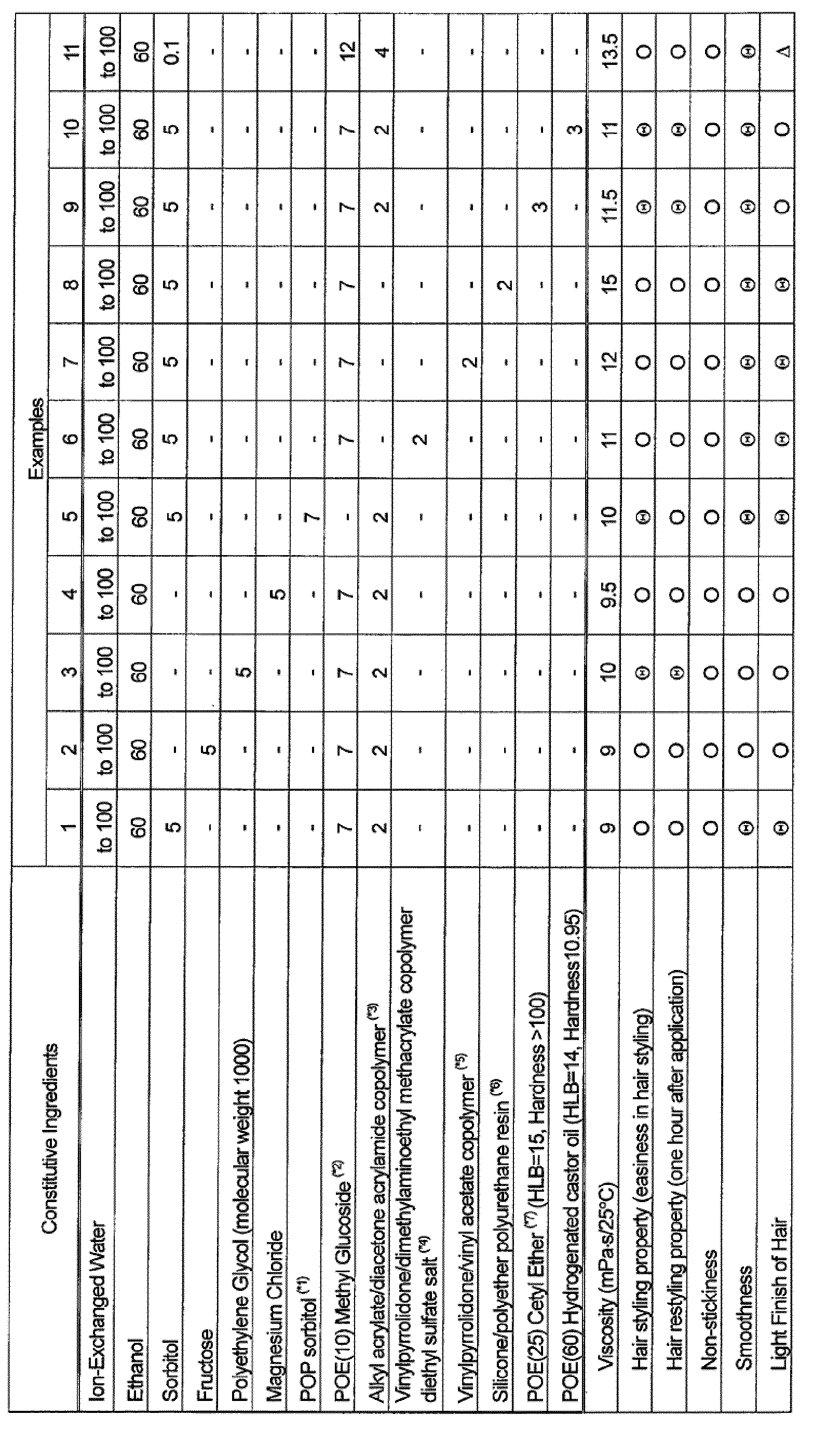
-

- As obvious from the results in Tables 1 and 2, the hair styling cosmetic composition of the invention can exhibit both the effects of hair styling performance and hair restyling performance excellently and with a good balance therebetween, though having a low viscosity, and additionally can have the effects of non-stickiness, smoothness and light finish of the hair. On the other hand, the hair styling cosmetic composition beyond the scope of the invention could not exhibit all the advantageous effects of the invention.
- Furthermore, the samples shown in Examples 16 - 19 were evaluated in point of the hair styling property, the hair restyling property, the non-stickiness, the smoothness, and the light finish of the hair as the same way according to the above-mentioned evaluation methods. The results are shown in Table 3.
-
(Constitutive Ingredients) (% by mass) (1) Sorbitol 10 (2) POE(10) methyl glucoside (Glucam E-10, by Lubrizol Japan) 5 (3) Silicone/polyether-type polyurethane resin (Yodosol PUD, by AkzoNobel) 2 (4) L-menthol 0.1 (5) Citric acid (edible) 0.1 (6) POE(24)/POP(13) decyl tetradecyl ether (Unilube 50MT-2200B, by NOF) 0.5 (7) Fragrance 0.1 (8) Ethyl 4-hydroxybenzoate 0.2 (9) Ethanol 50 (10) Ion-exchanged water to 100 - (1), (2) and (5) were added in that order to (10) to prepare an aqueous part. (4), (6), (7) and (8) were added in that order to (9) to prepare an alcohol part. Subsequently, the alcohol part and (3) were added in that order to the aqueous part, and mixed them with stirring to prepare a mist-type hair styling agent.
-
(Constitutive Ingredients) (% by mass) (1) Polyethylene glycol 4000 5 (2) POP sorbitol (Uniol HS-1600D, by NOF) 5 (3) Vinylpyrrolidone/dimethylaminoethyl methacrylate copolymer diethyl sulfate salt (H.C. Polymer 2, by Osaka Organic Chemical Industry) 3 (4) POE(60) hydrogenated castor oil 3 (5) Diglycerine 0.5 (6) Wine extract 0.1 (7) Fragrance 0.1 (8) Ethyl 4-hydroxybenzoate 0.2 (9) Ethanol 5 (10) Ion-exchanged water to 100 - (2), (5), (3) and melted (1) were added in that order to (10) to prepare an aqueous part. (4), (6), (7) and (8) were added in that order to (9) to prepare an alcohol part. Subsequently, the aqueous part and the alcohol part were mixed with stirring to prepare a mist-type hair styling agent.
-
(Constitutive Ingredients) (% by mass) (1) Maltitol 7 (2) POE(10) methyl glucoside (Glucam E-10, by 10 Lubrizol Japan) (3) Alkyl acrylate/diacetone acrylamide copolymer (Plas Cize L-9948B" (by Goo Chemical) 3 (4) POE(20) cetyl ether (Emalex 120, by NOF) 5 (5) Amino acid 0.05 (6) Fragrance 0.1 (7) Phenoxyethanol 0.5 (8) Ethanol 5 (9) Ion-exchanged water to 100 - (1), (2) and (5) were added in that order to (9) to prepare an aqueous part. Melted (4), (6) and (7) were added in that order to (8) to prepare an alcohol part. Subsequently, the aqueous part, the alcohol part and (3) were mixed with stirring to prepare a mist-type hair styling agent.
-
(Constitutive Ingredients) (% by mass) (1) Fructose 5 (2) Magnesium chloride 5 (3) POP sorbitol (Uniol HS-1600D, by NOF) 2 (4) POE(10) methyl glucoside (Glucam E-10, by Lubrizol Japan) 2 (5) Vinylpyrrolidone/vinyl acetate copolymer (PVP/VA S-630, by ISP) 1 (6) POE(20) cetyl ether (Emalex 120, by NOF) 1 (7) POE(60) hydrogenated castor oil 1 (8) 1,3-Butylene glycol 0.5 (9) Hydrolyzed wheat protein 0.1 (10) Propellant (nitrogen gas) 40 (11) Citric acid (edible) 0.1 (12) Fragrance 0.1 (13) Phenoxyethanol 0.5 (14) Ethanol 30 (15) Ion-exchanged water to 100 - (1), (2), (4), (5), (8) and (11) were added in that order to (15) to prepare an aqueous part. (3), (6), (7), (12) and (13) were added in that order to (14) to prepare an alcohol part. The aqueous part, the alcohol part and (9) were stirred and mixed, and (10) was charged therein to prepare a mist-type aerosol hair styling agent (aerosol spray).
-
[Table 3] Example 16 Example 17 Example 18 Example 19 Viscosity (mPa·s/25°C) 15 12.5 19 12.5 Hair styling property (easiness in hair styling) ○ Θ Θ ○ Hair restyling property (one hour after application) ○ Θ ○ ○ Non-stickiness ○ ○ ○ ○ Smoothness ○ ○ Θ ○ Light finish of hair ○ ○ ○ Θ - The hair styling cosmetic composition of the invention is excellent in hair styling property and hair restyling property, even though having a low viscosity, and is excellent in non-stickiness, smoothness, and light finish of the hair.
Claims (8)
- A hair styling cosmetic composition comprising:(a) one or more substances being solid at room temperature (25°C) selected from among(a1) a sugar alcohol,(a2) a sugar,(a3) a polyalkylene glycol polymer, and(a4) an inorganic salt,in an amount of from 0.1 to 20% by mass,(b) a sugar derivative and/or a sugar alcohol derivative being liquid at room temperature, in an amount of from 0.1 to 25% by mass,(c) one or more film-forming polymers selected from among acrylic and vinylic film-forming polymers (but excepting ampholytic polymers) and urethanic polymers, in an amount of from 0.1 to 12% by mass, and(d) an aqueous solvent,wherein the viscosity of the system is at most 10,000 mPa·s (at 25°C with B-type viscometer).
- The hair styling cosmetic composition as claimed in claim 1, wherein component (b) is one or more selected from among a sugar alkylene oxide addition polymer and a sugar alcohol alkylene oxide addition polymer, which are liquid at room temperature.
- The hair styling cosmetic composition as claimed in claim 1 or 2, wherein component (a1) is one or more selected from among maltitol, sorbitol, ribitol, mannitol, arabitol, galactitol, xylitol, erythritol and inositol.
- The hair styling cosmetic composition as claimed in claim 1, wherein component (a3) is a polyethylene glycol having a mass-average molecular weight of from 1,000 to 20,000.
- The hair styling cosmetic composition as claimed in claim 1, wherein component (d) is water and/or an alcoholic solvent.
- The hair styling cosmetic composition as claimed in claim 5, wherein the alcoholic solvent in component (d) is ethanol.
- The hair styling cosmetic composition as claimed in claim 1, wherein component (a) contains at least component (a1) and/or component (a3) .
- The hair styling cosmetic composition as claimed in claim 1, which has a viscosity of at most 100 mPa·s (at 25°C with B-type viscometer) and is used in the form of a fine mist by spraying the composition.
Applications Claiming Priority (3)
| Application Number | Priority Date | Filing Date | Title |
|---|---|---|---|
| JP2010144376 | 2010-06-25 | ||
| JP2011139940A JP6192254B2 (en) | 2010-06-25 | 2011-06-23 | Hairdressing cosmetics |
| PCT/JP2011/064519 WO2011162370A1 (en) | 2010-06-25 | 2011-06-24 | Hair styling cosmetic |
Publications (2)
| Publication Number | Publication Date |
|---|---|
| EP2586422A1 true EP2586422A1 (en) | 2013-05-01 |
| EP2586422A4 EP2586422A4 (en) | 2014-07-16 |
Family
ID=45371536
Family Applications (1)
| Application Number | Title | Priority Date | Filing Date |
|---|---|---|---|
| EP11798251.2A Withdrawn EP2586422A4 (en) | 2010-06-25 | 2011-06-24 | COSMETIC HAIRSTYLE PRODUCT |
Country Status (8)
| Country | Link |
|---|---|
| US (1) | US20130164246A1 (en) |
| EP (1) | EP2586422A4 (en) |
| JP (1) | JP6192254B2 (en) |
| KR (1) | KR20130120446A (en) |
| CN (1) | CN102970968A (en) |
| BR (1) | BR112012032228A2 (en) |
| TW (1) | TW201212944A (en) |
| WO (1) | WO2011162370A1 (en) |
Families Citing this family (26)
| Publication number | Priority date | Publication date | Assignee | Title |
|---|---|---|---|---|
| JP4834775B2 (en) * | 2010-03-04 | 2011-12-14 | 株式会社 資生堂 | Sunscreen composition |
| JP6114087B2 (en) * | 2012-03-30 | 2017-04-12 | 株式会社コーセー | Hair cosmetics |
| JP6106492B2 (en) * | 2012-03-30 | 2017-03-29 | 株式会社コーセー | Hairdressing cosmetics |
| CN104203209B (en) * | 2012-03-30 | 2017-06-16 | 株式会社高丝 | Hair cosmetic composition |
| JP6117592B2 (en) * | 2012-03-30 | 2017-04-19 | 株式会社コーセー | Hairdressing cosmetics |
| JP6013587B2 (en) * | 2013-03-29 | 2016-10-25 | 株式会社マンダム | Hairdressing composition |
| KR101789396B1 (en) * | 2013-03-29 | 2017-10-23 | 가부시키가이샤 만다무 | Hairstyling composition |
| JP6381870B2 (en) * | 2013-04-30 | 2018-08-29 | 株式会社 資生堂 | Hairdressing cosmetics |
| KR101721351B1 (en) * | 2013-05-16 | 2017-03-29 | 가부시키가이샤 만다무 | Hair styling agent composition |
| KR102166555B1 (en) * | 2013-06-28 | 2020-10-16 | 스미또모 세이까 가부시키가이샤 | Hydrophilic thickener and cosmetic composition |
| JP6592233B2 (en) * | 2013-12-25 | 2019-10-16 | ロート製薬株式会社 | Skin external composition |
| CN105792803A (en) * | 2014-03-28 | 2016-07-20 | 株式会社漫丹 | Hair styling product composition |
| JP6147914B2 (en) * | 2014-03-28 | 2017-06-14 | 株式会社マンダム | Hairdressing composition and method for producing hairdressing composition |
| CN105792802A (en) * | 2014-03-28 | 2016-07-20 | 株式会社漫丹 | Hair styling product composition |
| KR101851166B1 (en) * | 2014-05-16 | 2018-04-24 | 가부시키가이샤 만다무 | Hair styling composition |
| DE102014225420A1 (en) * | 2014-12-10 | 2016-06-16 | Henkel Ag & Co. Kgaa | Means and methods for temporary deformation of keratinous fibers |
| JP6530237B2 (en) * | 2015-05-22 | 2019-06-12 | 株式会社マンダム | Hair styling agent composition |
| JP6662547B2 (en) * | 2016-05-20 | 2020-03-11 | 株式会社マンダム | Hairdressing composition |
| JP6734562B2 (en) * | 2016-08-23 | 2020-08-05 | 日油株式会社 | Fragrance composition |
| WO2018180173A1 (en) * | 2017-03-30 | 2018-10-04 | 株式会社マンダム | Hair dressing composition |
| CN110831572A (en) * | 2017-09-26 | 2020-02-21 | 株式会社漫丹 | Hair treatment composition and hair treatment spray cosmetic |
| JP7429499B2 (en) * | 2018-03-19 | 2024-02-08 | 株式会社ミルボン | Hair styling composition and hair styling method |
| JP6864660B2 (en) * | 2018-09-28 | 2021-04-28 | 株式会社マンダム | Hair styling composition |
| JP7246890B2 (en) * | 2018-10-26 | 2023-03-28 | 株式会社ミルボン | hair treatment method |
| KR102757077B1 (en) * | 2019-09-25 | 2025-01-21 | 가부시키가이샤 만다무 | Aerosol spray deodorant |
| JP7625351B2 (en) * | 2021-03-24 | 2025-02-03 | 株式会社マンダム | Aerosol spray hair styling agent |
Family Cites Families (26)
| Publication number | Priority date | Publication date | Assignee | Title |
|---|---|---|---|---|
| JPS5619845B2 (en) * | 1974-03-29 | 1981-05-09 | ||
| JPS5251035A (en) * | 1975-10-21 | 1977-04-23 | Shiseido Co Ltd | Cosmetics for hair dressing |
| JPS52154529A (en) * | 1976-06-15 | 1977-12-22 | Matsushita Electric Works Ltd | Hair conditioning lotion composition |
| LU84638A1 (en) * | 1983-02-10 | 1984-11-08 | Oreal | HAIR COMPOSITION CONTAINING AT LEAST ONE CATIONIC POLYMER, ANIONIC POLYMER, SUGAR AND SALT |
| JPS61167608A (en) * | 1985-01-18 | 1986-07-29 | Shiseido Co Ltd | Cosmetic |
| JPS624214A (en) * | 1985-07-01 | 1987-01-10 | Shiseido Co Ltd | Cosmetic |
| JPH0720851B2 (en) * | 1990-03-09 | 1995-03-08 | 花王株式会社 | Hair cosmetics |
| JP3312926B2 (en) * | 1992-05-15 | 2002-08-12 | 株式会社ダイゾー | Foamed aerosol hair styling |
| JP3248767B2 (en) * | 1992-11-24 | 2002-01-21 | ライオン株式会社 | Hairdressing composition |
| DE59409566D1 (en) * | 1993-06-23 | 2000-11-30 | Wella Ag | AQUEOUS AGENT FOR SETTING HAIR IN THE FORM OF A HIGH VISCOSITY, SPRAYABLE GEL |
| JPH09301838A (en) * | 1996-05-14 | 1997-11-25 | Pola Chem Ind Inc | Liquid hairdressing |
| JPH11100312A (en) * | 1997-09-29 | 1999-04-13 | Shiseido Co Ltd | Hair cosmetic |
| JPH11199453A (en) * | 1998-01-05 | 1999-07-27 | Pola Chem Ind Inc | Hairdressing cosmetic |
| AU3233000A (en) * | 1999-05-05 | 2000-11-21 | Procter & Gamble Company, The | Hair styling compositions containing select polyalkylene glycol styling agents |
| US6585965B1 (en) | 2000-08-03 | 2003-07-01 | The Procter & Gamble Company | Hair care compositions comprising polyalkylene glycol styling agents |
| EP1322279A1 (en) * | 2000-10-03 | 2003-07-02 | Unilever Plc | Cosmetic and personal care compositions |
| JP3605755B2 (en) * | 2000-11-30 | 2004-12-22 | 株式会社マンダム | Hair cosmetic composition |
| JP2003012465A (en) * | 2001-06-26 | 2003-01-15 | Kao Corp | Hair cosmetics |
| JP2003226619A (en) * | 2002-01-31 | 2003-08-12 | Mandom Corp | Hair cosmetic |
| JP2006069903A (en) * | 2004-08-31 | 2006-03-16 | Mandom Corp | Hairdressing agent |
| JP4699215B2 (en) | 2005-01-07 | 2011-06-08 | 株式会社資生堂 | Hair cosmetics |
| JP2007217314A (en) | 2006-02-15 | 2007-08-30 | Kracie Home Products Kk | Misty hair cosmetics |
| JP2007320872A (en) * | 2006-05-31 | 2007-12-13 | Mandom Corp | Hair cosmetic product |
| JP5592619B2 (en) * | 2008-08-08 | 2014-09-17 | 株式会社 資生堂 | Hairdressing fee |
| US20120301419A1 (en) * | 2009-08-31 | 2012-11-29 | Shiseido Company, Ltd. | Hair Styling Cosmetic Composition |
| CN102596168A (en) * | 2009-08-31 | 2012-07-18 | 株式会社资生堂 | Cosmetic preparation for hair styling |
-
2011
- 2011-05-24 US US13/805,355 patent/US20130164246A1/en not_active Abandoned
- 2011-06-23 JP JP2011139940A patent/JP6192254B2/en active Active
- 2011-06-24 WO PCT/JP2011/064519 patent/WO2011162370A1/en not_active Ceased
- 2011-06-24 TW TW100122207A patent/TW201212944A/en unknown
- 2011-06-24 CN CN2011800314234A patent/CN102970968A/en active Pending
- 2011-06-24 EP EP11798251.2A patent/EP2586422A4/en not_active Withdrawn
- 2011-06-24 BR BR112012032228A patent/BR112012032228A2/en not_active IP Right Cessation
- 2011-06-24 KR KR1020137001524A patent/KR20130120446A/en not_active Withdrawn
Also Published As
| Publication number | Publication date |
|---|---|
| TW201212944A (en) | 2012-04-01 |
| JP6192254B2 (en) | 2017-09-06 |
| WO2011162370A1 (en) | 2011-12-29 |
| CN102970968A (en) | 2013-03-13 |
| KR20130120446A (en) | 2013-11-04 |
| JP2012025744A (en) | 2012-02-09 |
| EP2586422A4 (en) | 2014-07-16 |
| US20130164246A1 (en) | 2013-06-27 |
| BR112012032228A2 (en) | 2016-08-23 |
Similar Documents
| Publication | Publication Date | Title |
|---|---|---|
| US20130164246A1 (en) | Hair Styling Cosmetic Composition | |
| US20120301419A1 (en) | Hair Styling Cosmetic Composition | |
| US20120164092A1 (en) | Hair Styling Cosmetic Composition | |
| US20120251472A1 (en) | Hair Styling Cosmetic Composition | |
| JP5535832B2 (en) | Hairdressing cosmetics | |
| US20120301418A1 (en) | Hair Styling Cosmetic Composition | |
| KR102339025B1 (en) | Composition for hair treatment and mist cosmetic for hair treatment | |
| HK1169595B (en) | Cosmetic preparation for hair styling | |
| JP7409784B2 (en) | Foamy cosmetics for hair styling | |
| HK1168771B (en) | Cosmetic preparation for hair styling | |
| HK1168772A (en) | Cosmetic preparation for hair styling | |
| HK1164142B (en) | Hair-dressing cosmetic | |
| HK1156866B (en) | Hair-dressing cosmetic |
Legal Events
| Date | Code | Title | Description |
|---|---|---|---|
| PUAI | Public reference made under article 153(3) epc to a published international application that has entered the european phase |
Free format text: ORIGINAL CODE: 0009012 |
|
| 17P | Request for examination filed |
Effective date: 20130125 |
|
| AK | Designated contracting states |
Kind code of ref document: A1 Designated state(s): AL AT BE BG CH CY CZ DE DK EE ES FI FR GB GR HR HU IE IS IT LI LT LU LV MC MK MT NL NO PL PT RO RS SE SI SK SM TR |
|
| DAX | Request for extension of the european patent (deleted) | ||
| A4 | Supplementary search report drawn up and despatched |
Effective date: 20140617 |
|
| RIC1 | Information provided on ipc code assigned before grant |
Ipc: A61K 8/60 20060101AFI20140611BHEP Ipc: A61K 8/81 20060101ALI20140611BHEP Ipc: A61K 8/87 20060101ALI20140611BHEP Ipc: A61K 8/86 20060101ALI20140611BHEP Ipc: A61Q 5/06 20060101ALI20140611BHEP Ipc: A61K 8/20 20060101ALI20140611BHEP Ipc: A61K 8/34 20060101ALI20140611BHEP |
|
| STAA | Information on the status of an ep patent application or granted ep patent |
Free format text: STATUS: THE APPLICATION IS DEEMED TO BE WITHDRAWN |
|
| 18D | Application deemed to be withdrawn |
Effective date: 20150106 |