EP2580296B1 - Haftklebstoffe auf der basis von pflanzenöl - Google Patents
Haftklebstoffe auf der basis von pflanzenöl Download PDFInfo
- Publication number
- EP2580296B1 EP2580296B1 EP11728452.1A EP11728452A EP2580296B1 EP 2580296 B1 EP2580296 B1 EP 2580296B1 EP 11728452 A EP11728452 A EP 11728452A EP 2580296 B1 EP2580296 B1 EP 2580296B1
- Authority
- EP
- European Patent Office
- Prior art keywords
- acid
- anhydride
- vegetable oil
- epoxidized vegetable
- dibasic
- Prior art date
- Legal status (The legal status is an assumption and is not a legal conclusion. Google has not performed a legal analysis and makes no representation as to the accuracy of the status listed.)
- Active
Links
Images
Classifications
-
- C—CHEMISTRY; METALLURGY
- C08—ORGANIC MACROMOLECULAR COMPOUNDS; THEIR PREPARATION OR CHEMICAL WORKING-UP; COMPOSITIONS BASED THEREON
- C08G—MACROMOLECULAR COMPOUNDS OBTAINED OTHERWISE THAN BY REACTIONS ONLY INVOLVING UNSATURATED CARBON-TO-CARBON BONDS
- C08G59/00—Polycondensates containing more than one epoxy group per molecule; Macromolecules obtained by polymerising compounds containing more than one epoxy group per molecule using curing agents or catalysts which react with the epoxy groups
- C08G59/18—Macromolecules obtained by polymerising compounds containing more than one epoxy group per molecule using curing agents or catalysts which react with the epoxy groups ; e.g. general methods of curing
- C08G59/20—Macromolecules obtained by polymerising compounds containing more than one epoxy group per molecule using curing agents or catalysts which react with the epoxy groups ; e.g. general methods of curing characterised by the epoxy compounds used
- C08G59/32—Epoxy compounds containing three or more epoxy groups
-
- B—PERFORMING OPERATIONS; TRANSPORTING
- B32—LAYERED PRODUCTS
- B32B—LAYERED PRODUCTS, i.e. PRODUCTS BUILT-UP OF STRATA OF FLAT OR NON-FLAT, e.g. CELLULAR OR HONEYCOMB, FORM
- B32B27/00—Layered products comprising a layer of synthetic resin
-
- C—CHEMISTRY; METALLURGY
- C08—ORGANIC MACROMOLECULAR COMPOUNDS; THEIR PREPARATION OR CHEMICAL WORKING-UP; COMPOSITIONS BASED THEREON
- C08G—MACROMOLECULAR COMPOUNDS OBTAINED OTHERWISE THAN BY REACTIONS ONLY INVOLVING UNSATURATED CARBON-TO-CARBON BONDS
- C08G59/00—Polycondensates containing more than one epoxy group per molecule; Macromolecules obtained by polymerising compounds containing more than one epoxy group per molecule using curing agents or catalysts which react with the epoxy groups
- C08G59/18—Macromolecules obtained by polymerising compounds containing more than one epoxy group per molecule using curing agents or catalysts which react with the epoxy groups ; e.g. general methods of curing
- C08G59/40—Macromolecules obtained by polymerising compounds containing more than one epoxy group per molecule using curing agents or catalysts which react with the epoxy groups ; e.g. general methods of curing characterised by the curing agents used
- C08G59/42—Polycarboxylic acids; Anhydrides, halides or low molecular weight esters thereof
-
- C—CHEMISTRY; METALLURGY
- C09—DYES; PAINTS; POLISHES; NATURAL RESINS; ADHESIVES; COMPOSITIONS NOT OTHERWISE PROVIDED FOR; APPLICATIONS OF MATERIALS NOT OTHERWISE PROVIDED FOR
- C09J—ADHESIVES; NON-MECHANICAL ASPECTS OF ADHESIVE PROCESSES IN GENERAL; ADHESIVE PROCESSES NOT PROVIDED FOR ELSEWHERE; USE OF MATERIALS AS ADHESIVES
- C09J11/00—Features of adhesives not provided for in group C09J9/00, e.g. additives
- C09J11/02—Non-macromolecular additives
- C09J11/06—Non-macromolecular additives organic
-
- C—CHEMISTRY; METALLURGY
- C09—DYES; PAINTS; POLISHES; NATURAL RESINS; ADHESIVES; COMPOSITIONS NOT OTHERWISE PROVIDED FOR; APPLICATIONS OF MATERIALS NOT OTHERWISE PROVIDED FOR
- C09J—ADHESIVES; NON-MECHANICAL ASPECTS OF ADHESIVE PROCESSES IN GENERAL; ADHESIVE PROCESSES NOT PROVIDED FOR ELSEWHERE; USE OF MATERIALS AS ADHESIVES
- C09J163/00—Adhesives based on epoxy resins; Adhesives based on derivatives of epoxy resins
-
- C—CHEMISTRY; METALLURGY
- C09—DYES; PAINTS; POLISHES; NATURAL RESINS; ADHESIVES; COMPOSITIONS NOT OTHERWISE PROVIDED FOR; APPLICATIONS OF MATERIALS NOT OTHERWISE PROVIDED FOR
- C09J—ADHESIVES; NON-MECHANICAL ASPECTS OF ADHESIVE PROCESSES IN GENERAL; ADHESIVE PROCESSES NOT PROVIDED FOR ELSEWHERE; USE OF MATERIALS AS ADHESIVES
- C09J191/00—Adhesives based on oils, fats or waxes; Adhesives based on derivatives thereof
-
- C—CHEMISTRY; METALLURGY
- C09—DYES; PAINTS; POLISHES; NATURAL RESINS; ADHESIVES; COMPOSITIONS NOT OTHERWISE PROVIDED FOR; APPLICATIONS OF MATERIALS NOT OTHERWISE PROVIDED FOR
- C09J—ADHESIVES; NON-MECHANICAL ASPECTS OF ADHESIVE PROCESSES IN GENERAL; ADHESIVE PROCESSES NOT PROVIDED FOR ELSEWHERE; USE OF MATERIALS AS ADHESIVES
- C09J7/00—Adhesives in the form of films or foils
- C09J7/20—Adhesives in the form of films or foils characterised by their carriers
- C09J7/22—Plastics; Metallised plastics
-
- C—CHEMISTRY; METALLURGY
- C09—DYES; PAINTS; POLISHES; NATURAL RESINS; ADHESIVES; COMPOSITIONS NOT OTHERWISE PROVIDED FOR; APPLICATIONS OF MATERIALS NOT OTHERWISE PROVIDED FOR
- C09J—ADHESIVES; NON-MECHANICAL ASPECTS OF ADHESIVE PROCESSES IN GENERAL; ADHESIVE PROCESSES NOT PROVIDED FOR ELSEWHERE; USE OF MATERIALS AS ADHESIVES
- C09J7/00—Adhesives in the form of films or foils
- C09J7/30—Adhesives in the form of films or foils characterised by the adhesive composition
-
- C—CHEMISTRY; METALLURGY
- C09—DYES; PAINTS; POLISHES; NATURAL RESINS; ADHESIVES; COMPOSITIONS NOT OTHERWISE PROVIDED FOR; APPLICATIONS OF MATERIALS NOT OTHERWISE PROVIDED FOR
- C09J—ADHESIVES; NON-MECHANICAL ASPECTS OF ADHESIVE PROCESSES IN GENERAL; ADHESIVE PROCESSES NOT PROVIDED FOR ELSEWHERE; USE OF MATERIALS AS ADHESIVES
- C09J7/00—Adhesives in the form of films or foils
- C09J7/30—Adhesives in the form of films or foils characterised by the adhesive composition
- C09J7/38—Pressure-sensitive adhesives [PSA]
-
- C—CHEMISTRY; METALLURGY
- C09—DYES; PAINTS; POLISHES; NATURAL RESINS; ADHESIVES; COMPOSITIONS NOT OTHERWISE PROVIDED FOR; APPLICATIONS OF MATERIALS NOT OTHERWISE PROVIDED FOR
- C09J—ADHESIVES; NON-MECHANICAL ASPECTS OF ADHESIVE PROCESSES IN GENERAL; ADHESIVE PROCESSES NOT PROVIDED FOR ELSEWHERE; USE OF MATERIALS AS ADHESIVES
- C09J2203/00—Applications of adhesives in processes or use of adhesives in the form of films or foils
-
- C—CHEMISTRY; METALLURGY
- C09—DYES; PAINTS; POLISHES; NATURAL RESINS; ADHESIVES; COMPOSITIONS NOT OTHERWISE PROVIDED FOR; APPLICATIONS OF MATERIALS NOT OTHERWISE PROVIDED FOR
- C09J—ADHESIVES; NON-MECHANICAL ASPECTS OF ADHESIVE PROCESSES IN GENERAL; ADHESIVE PROCESSES NOT PROVIDED FOR ELSEWHERE; USE OF MATERIALS AS ADHESIVES
- C09J2301/00—Additional features of adhesives in the form of films or foils
- C09J2301/30—Additional features of adhesives in the form of films or foils characterized by the chemical, physicochemical or physical properties of the adhesive or the carrier
- C09J2301/302—Additional features of adhesives in the form of films or foils characterized by the chemical, physicochemical or physical properties of the adhesive or the carrier the adhesive being pressure-sensitive, i.e. tacky at temperatures inferior to 30°C
-
- C—CHEMISTRY; METALLURGY
- C09—DYES; PAINTS; POLISHES; NATURAL RESINS; ADHESIVES; COMPOSITIONS NOT OTHERWISE PROVIDED FOR; APPLICATIONS OF MATERIALS NOT OTHERWISE PROVIDED FOR
- C09J—ADHESIVES; NON-MECHANICAL ASPECTS OF ADHESIVE PROCESSES IN GENERAL; ADHESIVE PROCESSES NOT PROVIDED FOR ELSEWHERE; USE OF MATERIALS AS ADHESIVES
- C09J2301/00—Additional features of adhesives in the form of films or foils
- C09J2301/40—Additional features of adhesives in the form of films or foils characterized by the presence of essential components
-
- C—CHEMISTRY; METALLURGY
- C09—DYES; PAINTS; POLISHES; NATURAL RESINS; ADHESIVES; COMPOSITIONS NOT OTHERWISE PROVIDED FOR; APPLICATIONS OF MATERIALS NOT OTHERWISE PROVIDED FOR
- C09J—ADHESIVES; NON-MECHANICAL ASPECTS OF ADHESIVE PROCESSES IN GENERAL; ADHESIVE PROCESSES NOT PROVIDED FOR ELSEWHERE; USE OF MATERIALS AS ADHESIVES
- C09J2463/00—Presence of epoxy resin
-
- Y—GENERAL TAGGING OF NEW TECHNOLOGICAL DEVELOPMENTS; GENERAL TAGGING OF CROSS-SECTIONAL TECHNOLOGIES SPANNING OVER SEVERAL SECTIONS OF THE IPC; TECHNICAL SUBJECTS COVERED BY FORMER USPC CROSS-REFERENCE ART COLLECTIONS [XRACs] AND DIGESTS
- Y10—TECHNICAL SUBJECTS COVERED BY FORMER USPC
- Y10T—TECHNICAL SUBJECTS COVERED BY FORMER US CLASSIFICATION
- Y10T156/00—Adhesive bonding and miscellaneous chemical manufacture
- Y10T156/10—Methods of surface bonding and/or assembly therefor
-
- Y—GENERAL TAGGING OF NEW TECHNOLOGICAL DEVELOPMENTS; GENERAL TAGGING OF CROSS-SECTIONAL TECHNOLOGIES SPANNING OVER SEVERAL SECTIONS OF THE IPC; TECHNICAL SUBJECTS COVERED BY FORMER USPC CROSS-REFERENCE ART COLLECTIONS [XRACs] AND DIGESTS
- Y10—TECHNICAL SUBJECTS COVERED BY FORMER USPC
- Y10T—TECHNICAL SUBJECTS COVERED BY FORMER US CLASSIFICATION
- Y10T428/00—Stock material or miscellaneous articles
- Y10T428/28—Web or sheet containing structurally defined element or component and having an adhesive outermost layer
- Y10T428/2852—Adhesive compositions
- Y10T428/287—Adhesive compositions including epoxy group or epoxy polymer
Definitions
- a pressure sensitive adhesive (also known as “self adhesive” or “self stick adhesive”) is an adhesive which forms a bond at room temperature with a variety of dissimilar surfaces when light pressure is applied. No solvent, heat or radiation is needed to activate the adhesive. It finds wide applications in pressure-sensitive tapes and/or foils, general purpose labels, note pads, automobile trim, packaging, medical, and a wide variety of other products.
- PSAs are derived from rubber, acrylic, modified acrylic, and silicone-based formulations, which are predominately made from petrochemical-based polymers.
- petroleum and natural gas are depleting nonrenewable resources with naturally limited supply and increasing cost, it is desirable to provide PSA compositions that can be made from renewable natural materials.
- Vegetable oils are one of the most abundant renewable materials. Approximately 20 billion pounds are produced annually in the United States. At present, less than 600 million pounds of soybean oil is used in industrial application. Therefore, there is plenty of soybean oil available for new industrial uses.
- Vegetable oil is mainly a mixture of triglycerides with varying composition of long-chain saturated and unsaturated fatty acids depending on the plant, the crop, and the growing conditions.
- the double bonds in unsaturated fatty acids may be converted into more reactive oxirane moieties (the epoxy functional groups) by appropriate reactions.
- Epoxidized vegetable oils (EVOs) such as epoxidized soybean oil (ESO) are commercially available and are widely used in rubbers, plastics, resins, coatings, and various thermosetting composites.
- various acrylic or methacrylic monomers may be used to co-polymerize with acrylated fatty esters/fatty acids/oils.
- petrochemical-based acrylate is still used.
- This approach is considered as an extension of traditional free radical polymerization methods of making petrochemical-based PSAs.
- fatty ester or vegetable oils are first epoxidized. The epoxidized fatty esters or epoxidized vegetable oils are then polymerized to form PSAs through cationically catalyzed ring-opening polymerization of the epoxy rings.
- Some other epoxy compounds may be copolymerized with epoxidized fatty esters or epoxidized vegetable oils for improving the properties of PSAs.
- the third approach involves the direct polymerization of carbon-carbon double bonds on fatty acids, fatty esters or vegetable oils with other free-radically polymerizable compounds such as acrylate or methacrylate. Unlike those in drying oils such as Tung oil, most carbon-carbon double bonds in vegetable oils are not conjugated, thus having relatively low reactivity during the free radical polymerization.
- fatty acids, fatty esters or vegetable oils have to be modified to form conjugated double bonds before the free radical polymerization.
- pressure sensitive adhesive compositions are disclosed herein.
- pressure sensitive adhesive constructs are disclosed herein.
- One aspect disclosed herein is a pressure sensitive adhesive construct comprising:
- An additional aspect disclosed herein is a method for making a pressure sensitive adhesive construct comprising:
- Another aspect disclosed herein is a method for making a pressure sensitive adhesive composition selected from:
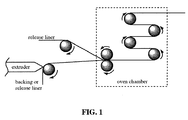
- Fig. 1 illustrates a combination of reactive extrusion and reactive calendar for the preparation of PSA and PSA tapes as disclosed herein.
- aliphatic is defined as including alkyl, alkenyl, alkynyl, halogenated alkyl and cycloalkyl groups as described above.
- a "lower aliphatic” group is a branched or unbranched aliphatic group having from 1 to 10 carbon atoms.
- alkyl refers to a branched or unbranched saturated hydrocarbon group of 1 to 24 carbon atoms, such as methyl, ethyl, n -propyl, isopropyl, n -butyl, isobutyl, t -butyl, pentyl, hexyl, heptyl, octyl, decyl, tetradecyl, hexadecyl, eicosyl, tetracosyl and the like.
- a "lower alkyl” group is a saturated branched or unbranched hydrocarbon having from 1 to 10 carbon atoms. Preferred alkyl groups have 1 to 4 carbon atoms.
- Alkyl groups may be "substituted alkyls" wherein one or more hydrogen atoms are substituted with a substituent such as halogen, cycloalkyl, alkoxy, amino, hydroxyl, aryl, or carboxyl.
- aryl refers to any carbon-based aromatic group including, but not limited to, benzene, naphthalene, etc.
- aryl also includes "heteroaryl group,” which is defined as an aromatic group that has at least one heteroatom incorporated within the ring of the aromatic group. Examples of heteroatoms include, but are not limited to, nitrogen, oxygen, sulfur, and phosphorous.
- the aryl group can be substituted with one or more groups including, but not limited to, alkyl, alkynyl, alkenyl, aryl, halide, nitro, amino, ester, ketone, aldehyde, hydroxy, carboxylic acid, or alkoxy, or the aryl group can be unsubstituted.
- cycloalkyl refers to a non-aromatic carbon-based ring composed of at least three carbon atoms.
- examples of cycloalkyl groups include, but are not limited to, cyclopropyl, cyclobutyl, cyclopentyl, cyclohexyl, and the like.
- heterocycloalkyl group is a cycloalkyl group as defined above where at least one of the carbon atoms of the ring is substituted with a heteroatom such as, but not limited to, nitrogen, oxygen, sulfur, or phosphorous.
- EVOs epoxidized vegetable oils
- an EVO is reacted with a dibasic carboxylic acid or a combination of a monobasic carboxylic acid and a dibasic carboxylic acid resulting in a PSA.
- the PSA compositions include a polyester condensation product prepared at elevated temperatures of at least one EVO and at least one dibasic acid or its anhydride derivative, and optionally at least one monobasic acid or its anhydride derivative.
- Certain embodiments of the PSA adhesive compositions disclosed herein exhibit adhesiveness or tackiness at room temperature, are odorless, are not made with organic solvents and/or toxic catalysts, consist of only renewable materials, and/or are thermally curable.
- the EVO may be made from a vegetable oil by converting at least a portion of vegetable oil's double bonds into more reactive oxirane moieties.
- EVO generally refers to any derivative of vegetable oils whose double bonds are fully or partly epoxidized using any method, e.g. so called in situ performic acid process, which is the most widely applied process in industry.
- vegetable oil refers to a group of polyunsaturated triglycerides, which are composed of three fatty acids connected to a glycerol molecule. Typically, the fatty acids are long chain (C12 to C24 or even longer) materials with multiple double bonds per chain.
- the vegetable oil can be palm oil, olive oil, canola oil, corn oil, cottonseed oil, soybean oil, linseed oil, rapeseed oil, castor oil, coconut oil, palm kernel oil, rice bran oil, safflower oil, sesame oil, sunflower oil, or other polyunsaturated vegetable oils (both naturally existing and genetically modified), or mixtures thereof.
- more than one EVO can be utilized in a single mixture if desired.
- EVOs generally have a functionality (including epoxy groups and possibly hydroxyl groups thereof) well above two, which can result in polymers with fairly high density of cross-linking when polymerized with dibasic acids, and therefore increase the modulus of the polymers and decrease their utility as PSAs.
- modifications of the composition are performed and/or reaction conditions are optimized to obtain polyesters with appropriate density of cross-linking which are appropriate for PSA compositions.
- EVOs such as ESO and epoxidized linseed oil are also readily available from commercial suppliers such as Spectrum Chemical Mfg Corp, California, and Sigma-Aldrich Corp, Missouri.
- the EVO may contain about 1.5 to about 6 epoxy groups (or even more) per triglyceride. It is preferred that the EVO contain functionality (epoxy number) of 2 to 5, more preferably 2.5 to 4.5.
- the epoxy functionality of EVO can be controlled by epoxidizing less than all of the double bonds of the starting vegetable oils.
- the EVOs with high functionality used in the present PSA compositions may optionally be modified by reacting with at least one monobasic acid or its anhydride derivatives ("modifier"), to lower their epoxy functionality, and to reduce the rate and density of cross-linking in the following polymerization with dibasic acids as described below in more detail.
- EVO epoxy functionality of EVO (or modified EVO) determines the rate and density of cross-linking in the polymerizations of EVO and dibasic acids.
- the use and amount of a modifier and the choices of the polymerization temperature and time are also among the factors that eventually determine the properties of the PSAs.
- the dibasic acids used in the preparation of the PSAs may include any organic compounds that contain two carboxylic acid functional groups, and derivatives or analogs thereof. More than one dibasic acid can be utilized in a single mixture if desired.
- Dibasic acids can be aliphatic (linear, branch or cyclic) saturated carboxylic acids containing up to 30 carbon atoms, preferably 3 to 22 carbon atoms, e.g., malonic acid, succinic acid, glutaric acid, adipic acid, pimelic acid, suberic acid, azelaic acid, sebacic acid, and brassylic acid.
- Dibasic acids may also be aromatic acids and derivatives thereof, including without limitation, phthalic acid, isophthalic acid and terephthalic acid.
- Dibasic acid can also be produced from other derivatives such as anhydrides. Specific examples include without limitation succinic anhydride and phthalic anhydride.
- the dibasic acids or anhydride derivatives are preferably derived from natural resources.
- alternative accesses to various dibasic acids from renewable feedstocks have been well reported (see, e.g, " Lipids as renewable resources: current state of chemical and biotechnological conversion and diversification" by J. O. Metzger and U. Bornscheuer (Appl. Microbiol. Biotechnol. 2006 )).
- the monobasic acid which may form a part of the PSA compositions may be any of the organic compounds that contain only one carboxyl group, e.g., free acids or derivatives thereof. More than one monobasic acid can be utilized in a single mixture if desired.
- the monobasic acid can be an aliphatic (linear, branch or cyclic) saturated acid containing up to 36 carbon atoms, preferably 1 to 24 carbon atoms., e.g.
- the monobasic acid can also be aromatic acids and derivatives thereof, such as benzoic acid, naphthalene acid, and derivatives thereof.
- monobasic acid can also be produced from other derivatives such as anhydrides. Specific examples include without limitation, acetic anhydride and propionic anhydride.
- the monobasic acid is preferably derived from natural resources. For example, free fatty acid can be obtained by hydrolysis of natural fats and oils derived from plant or animal sources. In this connection, mixtures of free fatty acids or their esters may also be utilized as starting materials for the sake of cost effectiveness, although the saturated fatty acids are preferred.
- the reaction mixture in addition to the EVO, dibasic acid and/or monobasic acid, can also contain from about 0.05 to 10.0, more particularly 0.1 to 10.0, parts by weight of a catalyst, preferably from about 0.1 to 2 parts by weight, based on the weight of the reactants, especially when the reaction is performed at low temperatures (e.g., ⁇ 120 °C).
- the catalyst can reduce the cure time (e.g., a cure time of 3 to 6 minutes) of the reaction mixture.
- Several catalysts can be used to effectively catalyze the reaction between carboxyl groups and epoxy groups. These catalysts can be:
- the catalyst may be added at any point during the prepolymerization from the initial charge until the coating of the reaction mixtures. In certain embodiments, it is important that the catalyst be added when the catalyst can be homogeneously distributed.
- the PSA compositions may also include additives and fillers. Fillers may either originally occur in the starting materials such as esters of fatty acids, or be included on purpose. Additives such as tackifiers, colored pigments, opacifiers, processing oil plasticizers, solvents and other constituents known to the tape art may be incorporated in the PSAs.
- the polyester condensation product disclosed herein is the majority component of the pressure sensitive adhesive composition meaning the pressure sensitive adhesive composition includes at least about 50, particularly at least about 70, more particularly at least about 80, and most particularly at least about 90, weight percent of the polyester condensation product based on the total weight of the pressure sensitive adhesive composition.
- the reaction (e.g., polymerization) of EVO with dibasic acid and optionally monobasic acid may be accomplished by heating a reaction mixture of EVO and dibasic acid or its anhydride derivative, or a combination of dibasic acid or its anhydride derivative and a monobasic acid or its anhydride derivative, under controlled conditions (especially reaction temperature and time), to a degree that cross-linking does not obviously occur, and the viscosity of the intermediate reaction mixture is appropriate to allow blade-coating.
- the reaction is preferably carried out under an inert atmosphere free from oxygen, e.g. under nitrogen, since the esters are easily oxidized at high temperature to give dark-colored products.
- the polymerization compositions can be considered as a two-part system in which the EVO component (either unmodified or modified with a monobasic acid) comprises one part (component a) and the at least one dibasic acid (and optionally at least one monobasic acid) comprises the second part (component b).
- the two parts can be mixed together in three methods: (1) the two parts are mixed together at room temperature prior to heating; (2) component a in melt or liquid state is mixed together with component b in solid state at room temperature, prior to heating together; (3) both component a and b are in melt or liquid state, prior to mixing and heating.
- the novel EVO-based PSA compositions may be prepared by heating the reaction mixture at a temperature suitably in the range from 80 to 300°C for 1 to 20 minutes, preferably from 100 to 220°C for 3 to 10 minutes, and more particularly from 130 to 180°C for 4 to 6 minutes.
- the compositions may have an open time of up to about 5 or 25 minutes, depending on the nature of the dibasic acid, the functionality of EVO, mixing methods, reaction temperature, and the nature and amount of catalysts (as described above).
- open time denotes the time from mixing of the two parts to the time at which cross-linking takes place to a point that the mixed composition can no longer be applied. Generally, the higher the reaction temperature, the shorter the open time.
- the carboxylic acid groups are mainly consumed by epoxy groups. But at higher temperature, both epoxy groups and hydroxyl groups derived from carboxyl-epoxy reaction may react with carboxylic acid groups. As the reaction proceeds further, the carboxylic acid-hydroxyl esterification reaction dominates the reaction, with the result that the density of cross-linking increases and the mixed composition becomes more difficult for coating and less appropriate for PSAs.
- the reaction can be controlled to generate coatings with low glass transition temperature, sufficient cohesive strength, and good initial tack and adhesive powder which are appropriate for PSA.
- dibasic acid (or an anhydride thereof) can be used in molar ratios of carboxyl groups to EVO epoxy groups (or modified EVO) of from about 3:1 to about 1:3.
- excess carboxyl groups are preferably desired in the reaction mixture, so as to help control the rate and density of cross-linking and promote the adhesive power of the final polyester products.
- the amount of dibasic acid used to make the PSA compositions is preferably such as to provide a 5 to 80 mol % excess of carboxyl groups over that required to esterify all the epoxy groups present in the reaction mixture.
- an initial or first-stage polymerization is accomplished by heating the reaction mixture only to the extent that cross-linking does not obviously occur, and the viscosity of the first-stage reaction mixture is sufficiently low to allow blade-coating of the reaction mixture onto PSA backing materials or release liners (e.g., siliconized release liners).
- PSA backing materials can be paper, cellophane, plastic film, cloth, tape or metal foils.
- the resulting prepolymer coatings on the backings are then heated such as in an air-circulating oven so that appropriate cross-linking of the polyesters can take place to give a "dry" adhesive layer of sufficient cohesion strength, good initial tack and adhesive power that are appropriate for PSA applications.
- the homogenous mixtures can be blade-coated within the open time on PSA backing substrates (such as Kraft paper and PET film) or siliconized release liners with a glass bar immediately after heating of the mixed compositions, with the result that a thin, uniform layer of the mixed compositions is produced on the backing or liner at a coating level of about 2 to about 10 mg/cm 2 .
- PSA backing substrates such as Kraft paper and PET film
- siliconized release liners with a glass bar immediately after heating of the mixed compositions, with the result that a thin, uniform layer of the mixed compositions is produced on the backing or liner at a coating level of about 2 to about 10 mg/cm 2 .
- the "monomer” reaction mixtures (EVOs and dibasic acids) per se are generally of low viscosity, and may be too low in fact to be handled conveniently.
- the "monomer" reaction mixtures are partially polymerized prior to coating to a desirable degree such that a fairly high conversion of the dibasic acid is reached but cross-linking does not obviously occur, thus forming a clear "syrup" of appropriate viscosity.
- the resulting adhesive coatings on the PSA backings are then subjected to heat such as in an air-circulating oven maintained at 100 -300 °C for 8 to 100 minutes (more particularly 10 to 100 minutes), preferably at 120 -250 °C for 30 seconds to 80 minutes, and more particularly at 150 -200 °C for 1 to 60 minutes, so that appropriate cross-linking of the polyesters can take place to give a "dry" adhesive layer of sufficient cohesion strength, good initial tack and adhesive power that are appropriate for PSAs.
- the heat stability of the PSA backing or siliconized release liners should be considered.
- the reactive groups (carboxylic acid groups, and epoxy groups and/or hydroxyl groups) which are still present in the pre-polymers on the PSA backing, are activated to such an extent that they are capable of further polymerization and cross-linking.
- cross-linking is desirable, particularly where it is desired to increase the cohesive strength of the adhesive without unduly affecting its compliance.
- too high density of cross-linking can be deleterious to the PSA properties, with a severe loss of compliance as reflected in the peel test. Therefore, the reaction temperature and time at this stage may be finely tuned for appropriate cross-linking of the PSA systems.
- the PSA compositions include a polyester condensation product prepared at elevated temperatures of modified EVO and at least one dibasic acid or its anhydride derivative, wherein the modified EVO was made by reacting at least one EVO and at least one monobasic acid or its anhydride derivative at elevated temperatures. It should be noted herein that, such modification at the same time increases the hydrophilicity of EVO due to introduction of hydroxyl groups, which facilitates the reaction between EVO and dibasic acids, and improves coating "wet-out" of the reaction mixture to tape backings such as paper.
- the novel EVO-based PSAs may be prepared by mixing (by any mixing methods described above) and heating modified EVO and at least one dibasic acid or its anhydride derivative, or a combination of dibasic acid or its anhydride derivative and a monobasic acid or its anhydride derivative.
- Modified EVO is previously prepared by reacting EVO with at least one monobasic acid or its anhydride derivatives, and catalysts (as described above) if needed, at a temperature suitably in the range from 80 to 300°C for 10 seconds to 300 minutes, preferably from 100 to 220 °C for 30 seconds to 200 minutes, more particularly from 120 to 180°C for 1 to 120 minutes.
- the amount of monobasic acid used in the present PSA compositions to react with EVO is preferably such as to leave about 1.5 to about 6 moles, more preferably about 2 to about 5 moles, more particularly about 2.5 to about 4.5 moles of epoxy groups, in one mole of modified EVO.
- the modified EVO so formed is then further mixed (by any mixing methods described above) and reacted with at least one dibasic acid or its anhydride derivative, or a combination of dibasic acid or its anhydride derivative and a monobasic acid or its anhydride derivative, and catalysts (as described above) if needed, at a temperature suitably in the range from 80 to 300°C for 10 seconds to 50 minutes, preferably from 100 to 220°C for 30 seconds to 30 minutes, and more particularly from 130 to 180°C for 1 to 20 minutes.
- the mixed compositions may have an open time of up to about 10 or 60 minutes, depending on the nature of dibasic acid, functionality of the modified EVO, mixing method, reaction temperature, and the nature and amount of catalysts (as described above).
- the prepolymer coatings on the release liners are covered with a sheet of backing material, resulting in a sandwich assembly which is then pressed (e.g., with a rubber roller) to achieve sufficient wet-out of the adhesive onto the PSA backing.
- the release liner is removed from the sandwich assembly, with the adhesive transferring onto the PSA backing.
- the resulting adhesive coatings on the backing are then heated such as in an air-circulating oven so that appropriate cross-linking of the polyesters can take place to give a dry adhesive layer of sufficient cohesion strength, good initial tack and adhesive power that are appropriate for PSA.
- the sandwich assembly as a whole may be heated to crosslink the polyester and then the release liner may be removed.
- the coating layer on the backing substrate after heating might not have a good appearance, with blotches of no or little adhesive on the PSA backing, probably due to retraction of the adhesive during polymerization and cross-linking.
- the novel process described above was developed to address this issue. As described above, the reaction mixture immediately after the prepolymerization is initially blade-coated on the siliconized face of siliconized release liners. The resulting adhesive coatings on the siliconized release liners are then covered with a sheet of PSA backing material, resulting in the sandwich assembly.
- the preparation of a PSA composition and PSA tapes comprising the composition could be performed with the aid of two siliconized release liners with different adhesion-repellence abilities to the adhesive composition.
- the reaction mixture immediately after the pre-polymerization is initially blade-coated on the siliconized face of a sheet of partially siliconized release liner.
- a "partially” siliconized release liner means that only a portion of the release liner surface is covered by a silicone agent.
- a "fully” siliconized release liner means that substantially all of the release liner surface is covered by a silicone agent.
- the resulting adhesive coating is then covered (the siliconized face inwardly) with a sheet of fully siliconized release liner, resulting in a sandwich assembly which is pressed (e.g., with a rubber roller) to achieve a good contact between the adhesive composition and the two liners.
- the sandwich assembly is then heated such as in an air-circulating oven so that appropriate cross-linking of the polyesters can take place to give a dry adhesive layer of sufficient cohesion strength, good initial tack and adhesive power that are appropriate for PSA.
- the fully siliconized release liner is quickly peeled off without taking away any adhesive composition, after which a sheet of backing material such as paper is immediately and carefully covered on the adhesive layer.
- a first release liner such as, for example, the partially siliconized release liner has an adhesion-repellence that is less than the adhesion-repellence of a second release liner such as, for example, the fully siliconized release liner.
- the second release liner can be more easily removed than the first release liner meaning that one release liner can be removed while the PSA composition still adheres to another release liner.
- the siliconized released liner can be optionally left for protection of the adhesive layers on the paper backing.
- One of the advantages for this method is that low molecular weight starting materials for making the PSA composition do not penetrate the paper backing to give oily or dirty appearance of the resulting PSA tape.
- the present PSAs may be used to manufacture many different types of PSA tapes.
- various flexible tape backings and liners may be used, including films (transparent and non-transparent), plastics such as PET film or modified natural substances such as cellophane, cloths, papers, non-woven fibrous constructions, metal foils, metalized plastics foils, aligned filaments, etc.
- the adhesive layers can be covered with papers or films which contain an adhesive-repellent layer, e.g. a separating layer consisting of silicone, for the protection of the adhesive layers on the PSA backings.
- an adhesive-repellent layer e.g. a separating layer consisting of silicone
- the back side of the PSA films, tapes or foils can be coated with an adhesive-repellent coating (e.g. silicone coating) for facilitating rolling off the PSA.
- the preparation of the PSA and PSA tapes thereof as disclosed herein could be continuously performed using a combination of reactive extrusion and reactive calendaring, which is illustrated in Fig. 1 .
- the reactive calendaring setup is a device that includes a series of rollers placed in an oven chamber.
- the rollers may be unheated and disposed of inside an oven chamber at a preset temperature.
- heated rollers can be used and the whole calendaring setup does not need to be housed in an oven chamber.
- the prepolymerization is done continuously using reactive extrusion in a mono- or twin- screw extruder.
- the hot prepolymer from the extruder is thereupon coated on a backing material (such as film or paper, et al ) or a release liner, which is then laminated with another release liner with different adhesion abilities to the adhesive composition, to give a sandwich assembly.
- the sandwich assembly is directed to heated calendar rollers or calendar rolls placed in an oven chamber at a preset temperature.
- the duration of the process can be fine-tuned by adjusting the number and sizes of the rolls or the travel distance of the assembly inside the oven chamber, so that appropriate cross-linking of the polyesters can take place to give a dry adhesive layer of sufficient cohesion strength, good initial tack and adhesive power that are appropriate for PSA.
- the vegetable oil-based PSA compositions and the method of making them are attractive from both the commercial and environmental perspectives.
- the advantages of these novel PSAs include without limitation:
- This example describes the preparation of a PSA composition from ESO and adipic acid in a molar ratio of 1:1 oxirane group to carboxylic acid group and of PSA tapes comprising the composition.
- ESO (2.88 g, containing about 12.6 mmol of oxirane groups) and adipic acid (0.93 g, containing 12.7 mmol of carboxylic acid groups) were charged to a 50-mL round-bottom flask equipped with a heating mantle and a magnetic stirring. The mixture was then heated at 180 °C with stirring. After the mixture became clear and colorless, the heating was continued for another three minutes at the same temperature to give a pale greenish-yellow, viscous "syrup".
- the flask was then taken out of the mantle, and the syrup was quickly blade-coated on a sheet of white kraft paper with a glass rod at a coating level of about 8 mg/cm 2 , to give a thin, continuous, uniform layer of sticky, long-fiber-forming, "wet" coating.
- the paper coated with the adhesive layer was placed in an air-circulating oven maintained at 160°C. The heat caused the cross-linking reaction of the coating composition. After 35 minutes in the oven, the coating became a clear, pale greenish-yellow, "dry” adhesive layer of sufficient cohesion. Some blotches of no or little adhesive on the paper backing were noticeable probably due to retraction of the adhesive during polymerization and cross-linking.
- the finished PSA tape thus obtained possessed good initial tack, formed ropy structure upon its removal from surfaces (e.g. metal, lacquer, glass, human skin) to which they are applied, and exhibited a good adhesive power of about 1.6 lbf/inch on stainless steel (type 302).
- surfaces e.g. metal, lacquer, glass, human skin
- the 90° peel adhesion test method and conditions are described in Example 2; the sample tape was almost cleanly removed in the test, leaving only a little adhesive residue on the panel.
- This example describes 90° peel adhesion test on stainless steel for the sample tapes.
- the measure of bond strength between an adhesive and a substrate is defined as adhesion.
- Adhesion properties are typically tested using the 90° peel adhesion test method by measuring the force required to remove the pressure-sensitive material from a stainless steel, at a specified angle of 90°, and at a specified speed.
- An exemplary 90° peel adhesion test of sample tapes on a stainless steel test panel (type 302 stainless steel) consists of following steps:
- This example describes the preparation of a PSA composition from ESO and adipic acid in a molar ratio of 1:1.35 oxirane groups to carboxylic acid groups) and of PSA tapes comprising the composition.
- ESO (2.69 g, containing about 11.8 mmol of oxirane groups) and adipic acid (1.16 g, containing 15.9 mmol of carboxyl groups) were charged to a 50-mL, round-bottom flask equipped with a heating mantle and a magnetic stirrer. The mixture was heated by the preheated mantle (180 °C) with stirring.
- the finished PSA tape thus obtained possessed good initial tack, formed ropy structure upon removal of it from surfaces (e.g. metal, lacquer, glass, human skin) to which they are applied, and exhibited a good adhesive power of about 3.1 lbf/inch on stainless steel (type 302).
- the 90° peel adhesion test method and conditions are described in Example 2; the sample tape was almost cleanly removed in the test, leaving only little adhesive residue on the panel.
- This example describes preparing a PSA composition from ESO and adipic acid in a molar ratio of 1:1.2 oxirane groups to carboxylic acid groups and PSA tapes comprising the composition.
- ESO (2.56 g, containing about 11.2 mmol of oxirane groups) and adipic acid (1.16 g, containing 13.7 mmol of carboxylic acid groups) were charged to a 50-mL, round-bottom flask equipped with a heating mantle and magnetic stirring. The mixture was heated by the preheated mantle (180 °C) with stirring.
- the finished PSA tape thus obtained possessed good initial tack, formed ropy structure upon removal of it from surfaces (e.g. metal, lacquer, glass, human skin) to which they are applied, and exhibited a good adhesive power of about 3.2 lbf/inch on stainless steel (type 302).
- the 90° peel adhesion test method and conditions are described in Example 2; the sample tape was almost cleanly removed in the test, leaving only a little adhesive residue on the panel.
- This example describes the preparation of a PSA composition from ESO and adipic acid in a molar ratio of 1.66:1 oxirane groups to carboxyl groups and of PSA tapes comprising the composition.
- ESO (3.26 g, containing about 14.3 mmol of oxirane groups) and adipic acid (0.63 g, containing 8.6 mmol of carboxyl groups) were charged to a 50-mL, round-bottom flask equipped with a heating mantle and a magnetic stirrer. The mixture was heated by a preheated mantle (180 °C) with stirring.
- the finished PSA tape thus obtained possessed fairly good initial tack, formed ropy structure upon removal of it from surfaces (e.g. metal, lacquer, glass, human skin) to which they are applied, and exhibited an adhesive power of about 0.95 lbf/inch on stainless steel (type 302).
- the 90° peel adhesion test method and conditions are described in Example 2; the sample tape was almost cleanly removed in the test, leaving a little adhesive residue on the panel.
- This example describes the preparation of a PSA composition from ESO and adipic acid (in a molar ratio of 1:1 oxirane groups to carboxylic acid groups) and of PSA foils comprising the composition.
- ESO (2.23 g, containing about 9.8 mmol of oxirane groups) and adipic acid (0.72 g, containing 9.8 mmol of carboxylic acid groups) were charged to a 50-mL, round-bottom flask equipped with a heating mantle and a magnetic stirring. The mixture was heated by the preheated mantle (150°C) with stirring.
- the finished PSA foil thus obtained possessed fairly good initial tack, formed ropy structure upon its removal from surfaces (e.g. metal, lacquer, glass, human skin) to which they are applied, and exhibited a good adhesive power of about 1.5 lbf/inch on stainless steel (type 302).
- the 90° peel adhesion test method and conditions are described in Example 2; the sample tape was cleanly removed in the test, leaving no adhesive residue on the panel.
- This example describes the preparation of a PSA composition from ESO and sebacic acid (in a molar ratio of 1:1 oxirane groups to carboxylic acid groups) and of PSA tapes comprising the composition.
- ESO (2.74 g, containing about 12.0 mmol of oxirane groups) and sebacic acid (1.22 g of containing 12.1 mmol of carboxylic acid groups) were charged to a 50-mL, round-bottom flask equipped with a heating mantle and stirrer bar. The mixture was then heated by the preheated mantle (180 °C) with stirring.
- the finished PSA tape thus obtained possessed good initial tack, formed ropy structure upon removal of it from surfaces (e.g. metal, lacquer, glass, human skin) to which they are applied, and exhibited a good adhesive power of about 1.4 lbf/inch on stainless steel (type 302).
- the 90° peel adhesion test method and conditions are described in Example 2; the sample tape was almost cleanly removed in the test, leaving a little adhesive residue on the panel.
- This example describes the preparation of a PSA composition from ESO and succinic acid in a molar ratio of 1:1 oxirane groups to carboxylic acid groups and of PSA tapes comprising the composition.
- ESO (2.78 g, containing about 12.2 mmol of oxirane groups) and succinic acid (0.73 g, containing 12.4 mmol of carboxylic acid groups) were charged to a 50-mL, round-bottom flask equipped with a heating mantle and a magnetic stirring. The mixture was heated up to 180 °C by the preheated mantle with stirring, and heating was continued for five minutes at the same temperature to give a clear, pale greenish-yellow, and viscous "syrup".
- the flask was then taken out of the mantle, and the syrup was quickly blade-coated on a sheet of white kraft paper with a glass rod at a coating level of about 8.6 mg/cm 2 , to give a thin, continuous, uniform layer of clear, pale greenish-yellow, sticky, fiber-forming and "wet" coating.
- the paper coated with the adhesive layer was placed in an air-circulating oven maintained at 160°C. The heat caused the cross-linking reaction of the coating composition.
- the finished PSA tape thus obtained possessed good initial tack, formed ropy structure upon removal of it from surfaces (e.g. metal, lacquer, glass, human skin) to which they are applied, and exhibited a good adhesive power of about 2.3 lbf/inch on stainless steel (type 302).
- the 90° peel adhesion test method and conditions are described in Example 2; the sample was cleanly removed in the test, leaving no adhesive residue on the panel.
- This example describes the preparation of a PSA composition from ESO and succinic acid in a molar ratio of 1:1.53 oxirane groups to carboxylic acid groups and of PSA tapes comprising the said composition.
- ESO (2.35 g, containing about 10.3 mmol of oxirane groups) and succinic acid (0.93 g, containing 15.8 mmol of carboxylic acid groups) were charged to a 50-mL, round-bottom flask equipped with a heating mantle and a magnetic stirring. The mixture was then heated by the preheated mantle (160°C) with stirring, and heating was continued for six minutes at the same temperature to give a clear, pale greenish-yellow and viscous "syrup".
- the flask was then taken out of the mantle, and the syrup was quickly blade-coated on a sheet of white kraft paper with a glass rod at a coating level of about 9 mg/cm 2 , to give a thin, continuous, uniform layer of clear, pale greenish yellow, sticky, fiber-forming, "wet" coating.
- the paper coated with the adhesive layer was placed in an air-circulating oven maintained at 160°C. The heat caused the cross-linking reaction of the coating composition.
- the finished PSA tape thus obtained possessed good initial tack, formed ropy structure upon removal of it from surfaces (e.g. metal, lacquer, glass, human skin) to which they are applied, and exhibited a good adhesive power of about 2.1 lbf/inch on stainless steel (type 302).
- the 90° peel adhesion test method and conditions are described in Example 2; the sample was cleanly removed in the test, leaving no adhesive residue on the panel.
- This example describes the preparation of a PSA composition from ESO and succinic acid (in a molar ratio of 1:1.05 oxirane groups to carboxylic acid groups), and of PSA tapes by transferring said PSA composition from siliconised release liner.
- ESO (2.53 g, containing about 11.1 mmol of oxirane groups) and succinic acid (0.69 g, containing 11.7 mmol of carboxylic acid groups) were charged to a 50-mL, round-bottom flask equipped with a heating mantle and a magnetic stirring.
- the mixture was then heated by the preheated mantle (180°C) with stirring, and heating was continued for five minutes at the same temperature to give a clear, pale greenish-yellow and viscous "syrup".
- the flask was then taken out of the mantle, and the syrup was quickly blade-coated on the siliconised side of a sheet of siliconised paper with a glass rod at a coating level of about 10 mg/cm 2 , to give a thin, uniform layer of sticky, fiber-forming and "wet" coating.
- the adhesive coating was covered with a sheet of kraft paper, resulting in a "sandwich” which was then pressed with a rubber roller to achieve sufficient wet-out of the adhesive onto the kraft paper backing in order to provide adequate adhesion and complete transfer of the adhesive.
- the siliconised paper was peeled off from the "sandwich", with most of the adhesive transferring to the paper backing, but still leaving random patches on the siliconised paper.
- the paper backing coated with the adhesive layer was placed in an air-circulating oven maintained at 160 °C. The heat caused the cross-linking reaction of the coating composition.
- the finished PSA tape thus obtained possessed fairly good initial tack, formed ropy structure upon removal of it from surfaces (e.g. metal, lacquer, glass, human skin) to which they are applied, and exhibited a good adhesive power of about 1.5 lbf/inch on stainless steel (type 302).
- the test method and conditions are described in Example 2; the sample tape was cleanly removed in the test, leaving no adhesive residue on the panel.
- This example describes the preparation of a PSA composition from ESO and adipic acid (in a molar ratio of 1:1.2 oxirane groups to carboxylic acid groups) and of PSA tapes comprising the composition.
- ESO (4.03 g, containing about 17.6 mmol of oxirane groups) and 1.53 g of adipic acid (containing 20.9 mmol of carboxylic acid groups) were charged to a 50-mL, round-bottom flask equipped with a heating mantle and a magnetic stirring. The mixture was then heated by the preheated mantle (160°C) with stirring, to give a clear, almost colorless, "syrup" of low to medium viscosity.
- the flask was then taken out of the mantle, and the syrup was quickly blade-coated on a sheet of white kraft paper with a glass rod at a coating level of about 8 mg/cm 2 , to give a thin, layer of not fiber-forming, "waxy" coating.
- the paper coated with the adhesive layer was placed in an air-circulating oven maintained at 160°C. The heat caused the polymerization and the cross-linking reaction of the coating composition.
- the finished PSA tape thus obtained possessed fairly good initial tack, formed ropy structure upon removal of it from surfaces (e.g. metal, lacquer, glass, human skin) to which they are applied.
- This example describes the preparation of a PSA composition from ESO and adipic acid in a molar ratio of 1:1.2 oxirane groups to carboxylic acid groups with the aid of solvent p -xylene, and of PSA tapes comprising the composition.
- ESO (0.95 g, containing about 4.16 mmol of oxirane groups)
- adipic acid (0.36 g, containing 4.9 mmol of carboxylic acid groups)
- 0.39 g ofp-xylene were charged to a 50-mL, round-bottom flask equipped with a heating mantle and a magnetic stirring. The mixture was heated up to 130°C by the preheated mantle with stirring.
- the finished PSA tape thus obtained possessed fairly good initial tack, formed ropy structure upon removal of it from surfaces (e.g. metal, lacquer, glass, human skin) to which they are applied, and exhibited a good adhesive power of about 3.1 lbf/inch on stainless steel (type 302).
- the 90° peel adhesion test method and conditions are described in Example 2; the sample was almost cleanly removed in the test, leaving only a little adhesive residue on the panel.
- This example describes the preparation of a PSA composition from ESO and adipic acid in a molar ratio of 1:1.2 oxirane groups to carboxylic acid groups and of PSA tapes comprising the composition with the aid of siliconised release liner.
- ESO (7.89 g, containing about 34.5 mmol of oxirane groups) and 3.03 g of adipic acid (containing 41.5 mmol of carboxylic acid groups) were charged to a 50-mL, round-bottom flask equipped with a heating mantle and stirrer bar. The mixture was heated by the preheated mantle (140°C) with stirring.
- the adhesive coating was then covered with a sheet of kraft paper, resulting in a "sandwich” which was then pressed with a rubber roller to achieve sufficient wet-out of the adhesive onto the kraft paper backing in order to provide adequate adhesion.
- the "sandwich” was placed in an air-circulating oven maintained at 160 °C. The heat caused the cross-linking reaction of the coating composition. The "sandwich” was pressed again with the rubber roller after 20 minutes in the oven, and was taken out of the oven after 10 more minutes in the oven.
- the siliconised paper was then peeled off with adhesive completely transferred; and the coating on the paper backing was found to be converted into a clear, pale greenish-yellow, shiny, uniform, "dry” adhesive layer of sufficient cohesion strength.
- the finished PSA tape thus obtained possessed good initial tack, formed ropy structure upon removal of it from surfaces (e.g. metal, lacquer, glass, human skin) to which they are applied, and exhibited a good adhesive power of about 3.2 lbf/inch on stainless steel (type 302).
- the 90° peel adhesion test method and conditions are described in Example 2; the sample was almost cleanly removed in the test, leaving only a little adhesive residue on the panel.
- This example describes the preparation of a PSA composition from ESO and adipic acid in a molar ratio of 1:1.2 oxirane groups to carboxylic acid groups, and of polypropylene tapes comprising the composition with the aid of siliconised released liner.
- ESO (3.68 g, containing about 16.1 mmol of oxirane groups) and adipic acid (1.45 g, containing 19.8 mmol of carboxylic acid groups) were charged to a 50-mL, round-bottom flask equipped with a heating mantle and a magnetic stirring. The mixture was heated by the preheated mantle (140 °C) with stirring.
- the adhesive coating was then covered with a sheet of PP film, resulting in a "sandwich” which was then pressed with a rubber roller to achieve sufficient wet-out of the adhesive onto the kraft paper backing in order to provide adequate adhesion.
- the "sandwich” was placed in an air-circulating oven maintained at 130°C. The heat caused the cross-linking reaction of the coating composition. The "sandwich” was pressed again with the rubber roller after 30 minutes in the oven, and was taken out of the oven after 120 more minutes in the oven.
- the siliconised paper was then peeled off with adhesive completely transferred; and the coating on the polypropylene film was found to be converted into a clear, pale greenish-yellow, shiny, uniform/even, "dry” adhesive layer of sufficient cohesion strength.
- the finished PSA tape thus obtained possessed fairly good initial tack, formed ropy structure upon removal of it from surfaces (e.g. metal, lacquer, glass, human skin) to which they are applied, and exhibited a good adhesive power of about 2.2 lbf/inch on stainless steel (type 302).
- the 90° peel adhesion test method and conditions are described in Example 2; the sample was almost cleanly removed in the test, leaving little adhesive residue on the panel.
- This example describes the preparation of a PSA composition from ESO, adipic acid and lauric acid (oxirane groups/carboxylic acid groups molar ratio, 1:1), and of PSA tapes comprising the composition.
- ESO 2.3 g, containing about 10.1 mmol of oxirane groups
- adipic acid 0.6 g, containing 8.2 mmol of carboxylic acid groups
- lauric acid 0.4 g, containing 2.0 mmol of carboxylic acid groups
- the coating was converted into a pale greenish-yellow, clear, shiny, "dry” adhesive layer of sufficient cohesion strength after 90 minutes in the oven. However some small patches of no or little adhesive on the paper backing were noticeable probably due to retraction of the adhesive during polymerization and cross-linking.
- the finished PSA tape thus obtained possessed fairly good initial tack, formed ropy structure upon removal of it from surfaces (e.g. metal, lacquer, glass, human skin) to which they are applied, and exhibited a good adhesive power of about 1.5 lbf/inch on stainless steel (type 302).
- the 90° peel adhesion test method and conditions are described in Example 2; the sample was almost cleanly removed in the test, leaving only a little adhesive residue on the panel.
- This example describes the preparation of a PSA composition from ESO, adipic acid and lauric acid (oxirane group/carboxylic acid group molar ratio, 1:1.14) in two steps, and of PSA tapes comprising the composition.
- ESO (6.32 g, containing about 27.7 mmol of oxirane groups) and lauric acid (1.28 g, containing 6.39 mmol of carboxylic acid groups) were charged to a 50-mL, round-bottom flask equipped with a heating mantle and a magnetic stirring. The mixture was heated by the preheated mantle (139 °C) with stirring, and the heating was continued for 75 minutes at the same temperature to give a clear, yellow liquid of low to medium viscosity.
- the temperature of mantle was then raised to 160 °C, and adipic acid (1.85 g, containing 25.3 mmol of carboxylic acid groups) was added slowly to the mixture while stirring.
- the flask was taken out of the mantle after eight more minutes, and the viscous syrup was quickly blade-coated on a sheet of white kraft paper with a glass rod at a coating level of about 10 mg/cm 2 , to give a thin, continuous, uniform layer of clear, pale yellow, sort of sticky, short-fiber-forming, "wet" coating.
- the paper coated with the adhesive layer was placed in an air-circulating oven maintained at 160°C. The heat caused the cross-linking reaction of the coating composition.
- the coating was converted into a clear, pale greenish-yellow, shiny, "dry” adhesive layer of sufficient cohesion strength after 100 minutes in the oven. However, some small patches of no or little adhesive on the paper backing were noticeable probably due to retraction of the adhesive during polymerization and cross-linking.
- the finished PSA tape thus obtained possessed fairly good initial tack, formed ropy structure upon removal of it from surfaces (e.g. metal, lacquer, glass, human skin) to which they are applied, and exhibited a good adhesive power of about 2.5 lbf/inch on stainless steel (type 302).
- the 90° peel adhesion test method and conditions are described in Example 2; the sample was almost cleanly removed in the test, leaving only a little adhesive residue on the panel.
- This example describes the preparation of a PSA composition from ESO, adipic acid and lauric acid (oxirane group/carboxylic acid group molar ratio, 1:1.16) in two steps, and PSA tapes comprising the composition.
- ESO (6.38 g, containing about 27.9 mmol of oxirane groups) and acetic acid (0.48 g, containing 8.0 mmol of carboxyl groups) were charged to a 50-mL, round-bottom flask equipped with a heating mantle and a magnetic stirring. The mixture was heated by the preheated mantle (120°C) with stirring, and the heating was continued for 90 minutes at the same temperature to give a clear, yellow liquid of low to medium viscosity.
- the temperature of mantle was then raised to 160 °C, and 1.78 g of adipic acid (containing 24.4 mmol of carboxylic acid groups) was added slowly to the mixture while stirring.
- the flask was taken out of the mantle after ten more minutes, and the viscous syrup was quickly blade-coated on a sheet of white kraft paper with a glass rod at a coating level of about 10 mg/cm 2 , to give a thin, continuous, uniform layer of clear, pale yellow, sort of sticky, short-fiber-forming, "wet" coating.
- the paper coated with the adhesive layer was placed in an air-circulating oven maintained at 160 °C. The heat caused the cross-linking reaction of the coating composition.
- the coating was converted into a clear, pale greenish-yellow, shiny, "dry” adhesive layer of sufficient cohesion strength after 60 minutes in the oven, However, some small patches of no or little adhesive on the paper backing were still noticeable probably due to retraction of the adhesive during polymerization and cross-linking.
- the finished PSA tape thus obtained possessed fairly good initial tack, formed ropy structure upon removal of it from surfaces (e.g. metal, lacquer, glass, human skin) to which they are applied, and exhibited a good adhesive power of about 2.3 lbf/inch on stainless steel (type 302).
- the 90° peel adhesion test method and conditions are described in Example 2; the sample was almost cleanly removed in the test, leaving only a little adhesive residue on the panel.
- This example describes the preparation of a PSA composition from ESO, adipic acid and lauric acid (oxirane group/carboxyl group molar ratio, 1:1.14) in two steps, and the preparation of PSA tapes comprising the composition with the aid of siliconised released liner.
- ESO (4.53 g, containing about 19.8 mmol of oxirane groups) and acetic acid (0.35 g, containing 5.83 mmol of carboxylic acid groups) were charged to a 50-mL, round-bottom flask equipped with a heating mantle and a magnetic stirring.
- the mixture was heated by the preheated mantle (120°C) with stirring, and heating was continued for 160 minutes at the same temperature to give a clear, yellow liquid of low to medium viscosity.
- the temperature of mantle was then raised to 130°C, and 1.23 g of adipic acid (containing 16.8 mmol of carboxyl groups) was added slowly to the mixture while stirring.
- the flask was then taken out of the mantle after 13 more minutes, and the clear, viscous syrup was quickly blade-coated on the siliconised side of a sheet of white kraft paper with a glass rod at a coating level of about 7 mg/cm 2 , to give a thin, continuous, uniform layer of clear, pale yellow, very sticky, fiber-forming, "wet" coating.
- the adhesive coating was then covered with a sheet of kraft paper, resulting in a "sandwich” which was then pressed with a rubber roller to achieve sufficient wet-out of the adhesive onto the kraft paper backing in order to provide adequate adhesion.
- the "sandwich” was placed in an air-circulating oven maintained at 160 °C. The heat caused the cross-linking reaction of the coating composition. The “sandwich” was taken out of the oven after 60 minutes in the oven. The siliconised paper was peeled off with adhesive almost completely transferred; and the coating on the paper backing was found to be converted into a clear, pale greenish-yellow, shiny, uniform, "dry” adhesive layer of sufficient cohesion strength.
- the finished PSA tape thus obtained possessed fairly good initial tack, formed ropy structure upon removal of it from surfaces (e.g. metal, lacquer, glass, human skin) to which they are applied, and exhibited a good adhesive power of about 2.5 lbf/inch on stainless steel (type 302).
- surfaces e.g. metal, lacquer, glass, human skin
- the 90° peel adhesion test method and conditions are described in Example 2; the sample was almost cleanly removed in the test, leaving a little adhesive residue on the panel.
- This example describes the preparation of a PSA composition from ESO and adipic acid in a molar ratio of 1:1.2 oxirane groups to carboxylic acid groups, and of PSA tapes comprising the composition with the aid of two siliconized release liners with different adhesion-repellence properties for the adhesive composition.
- ESO (2.82 g, containing about 12.3 mmol of oxirane groups) was charged to a 50-mL, round-bottom flask equipped with a silicon oil bath and magnetic stirring, and heated up to 135°C by the preheated oil bath with stirring, after which the resulting clear and colorless liquid was maintained at the same temperature.
- the flask was then taken out of the oil bath, and the syrup was quickly blade-coated on the siliconised face of a sheet of partially siliconized release liner with a glass rod at a coating level of about 3 mg/cm 2 , to give a thin, uniform layer of sticky, fiber-forming and "wet" coating layer.
- the adhesive layer was then carefully covered (the siliconized face inwardly) with a sheet of fully siliconized release liner with, resulting in a "sandwich” which was then pressed with a rubber roller to achieve a good contact between the adhesive composition and the two liners.
- the "sandwich” was placed in an air-circulating oven maintained at 160 °C. The heat caused the cross-linking reaction of the coating composition.
- the "sandwich” was taken out of the oven after 30 minutes in the oven.
- the fully siliconized released liner was quickly peeled off without taking away any adhesive composition; a sheet of paper was immediately and carefully covered on the adhesive layer.
- the new "sandwich” was then pressed with a rubber roller to achieve sufficient wet-out of the adhesive onto the paper backing in order to provide adequate adhesion. After the "sandwich” was cooled down, the partially siliconized release liner could be easily peeled off with the adhesive composition being completely transferred to the paper backing.
- the siliconized release liner can be optionally left for the protection of the adhesive layers on the paper backing or be recovered for re-use.
- the adhesive coating on the paper backing was a thin, clear, pale greenish-yellow, shiny, uniform, "dry” adhesive layer of sufficient cohesion strength, and was not found to penetrate the paper backing to give an oily appearance of the PSA tape.
- the finished PSA tape thus obtained possessed good initial tack, formed ropy structure upon removal of it from surfaces (e.g. metal, lacquer, glass, human skin) to which they are applied, and exhibited a good adhesive power of about 2.8 lbf/inch on stainless steel (type 302).
- the 90° peel adhesion test method and conditions are described in Example 2; the sample was cleanly removed in the test, leaving no adhesive residue on the panel.
- This example describes the preparation of a PSA composition from ESO and adipic acid in a molar ratio of 1:1.2 oxirane groups to carboxylic acid groups in the presence of hexadecyltrimethyl ammonium bromide (1.0 wt% based on the weight of the reaction mixture), and of PSA tapes comprising the composition.
- ESO (2.36 g, containing about 10.3 mmol of oxirane groups) was charged to a 50-mL, round-bottom flask equipped with a silicon oil bath and magnetic stirring, heated up to 135°C by the preheated oil bath with stirring, and the resulting clear and colorless liquid was maintained at the same temperature.
- the flask was then taken out of the oil bath, and the syrup was quickly blade-coated on a sheet of white paper with a glass rod at a coating level of about 6 mg/cm 2 , to give a thin, continuous, uniform layer of sticky, long-fiber-forming, "wet" coating.
- the paper coated with the adhesive layer was placed in an air-circulating oven maintained at 160 °C. The heat caused the cross-linking reaction of the coating composition.
- the paper coated with the adhesive layer was taken out of the oven after 6 minutes in the oven.
- the finished PSA tape had a clear, pale greenish-yellow, shiny, "dry” adhesive layer of sufficient cohesion strength, possessed good initial tack, formed ropy structure upon removal of it from surfaces (e.g.
- This example describes the preparation of a PSA composition from ESO and adipic acid in a molar ratio of 1:1.2 oxirane groups to carboxylic acid groups in the presence of triethanolamine (1.4 wt% based on the weight of the reaction mixture), and of PSA tapes comprising the composition.
- ESO (3.34 g, containing about 14.6 mmol of oxirane groups) was charged to a 50-mL, round-bottom flask equipped with a silicon oil bath and magnetic stirring, heated up to 135°C by the preheated oil bath with stirring, and the resulting clear and colorless liquid was maintained at the same temperature.
- the flask was then taken out of the oil bath, and the syrup was quickly blade-coated on a sheet of white paper with a glass rod at a coating level of about 6 mg/cm 2 , to give a thin, continuous, uniform layer of sticky, long-fiber-forming, "wet" coating.
- the paper coated with the adhesive layer was placed in an air-circulating oven maintained at 160°C. The heat caused the cross-linking reaction of the coating composition.
- the paper coated with the adhesive layer was taken out of the oven after 4 minutes in the oven.
- the finished PSA tape had a clear, pale yellow, shiny, "dry” adhesive layer of sufficient cohesion strength, possessed good initial tack, formed ropy structure upon removal of it from surfaces (e.g.
- This example describes the preparation of a PSA composition from ESO and adipic acid in a molar ratio of 1:1.2 oxirane groups to carboxylic acid groups in the presence of chromium (III) tris(acetylacetonate) (0.2 wt% based on the weight of the reaction mixture), and of PSA tapes comprising the composition.
- ESO (2.66 g, containing about 11.6 mmol of oxirane groups) was charged to a 50-mL, round-bottom flask equipped with a silicon oil bath and magnetic stirring, heated up to 135°C by the preheated oil bath with stirring, and the resulting clear and colorless liquid was maintained at the same temperature.
- the flask was then taken out of the oil bath, and the syrup was quickly blade-coated on a sheet of white paper with a glass rod at a coating level of about 6 mg/cm 2 , to give a thin, continuous, uniform layer of sticky, long-fiber-forming, "wet" coating.
- the paper coated with the adhesive layer was placed in an air-circulating oven maintained at 160°C. The heat caused the cross-linking reaction of the coating composition.
- the paper coated with the adhesive layer was taken out of the oven after 4 minutes in the oven.
- the finished PSA tape had a clear, pale yellow, shiny, "dry” adhesive layer of sufficient cohesion strength, possessed good initial tack, formed ropy structure upon removal of it from surfaces (e.g.
Landscapes
- Chemical & Material Sciences (AREA)
- Organic Chemistry (AREA)
- Oil, Petroleum & Natural Gas (AREA)
- Health & Medical Sciences (AREA)
- Chemical Kinetics & Catalysis (AREA)
- Medicinal Chemistry (AREA)
- Polymers & Plastics (AREA)
- Adhesives Or Adhesive Processes (AREA)
- Adhesive Tapes (AREA)
- Laminated Bodies (AREA)
Claims (17)
- Ein druckempfindliches Haftkleber-Konstrukt, umfassend:(a) ein Trägersubstrat, und(b) eine auf dem Trägersubstrat aufgebrachte druckempfindliche Haftkleberzusammensetzung, wobei die druckempfindliche Haftkleberzusammensetzung ausgewählt ist aus:(i) einer druckempfindlichen Haftkleberzusammensetzung, welche ein Produkt umfasst, das durch Reagieren mindestens eines expoxidierten Pflanzenöls und mindestens einer dibasischen Säure oder eines dibasischen Anhydrids derselben, oder einer Kombination einer dibasischen Säure oder eines dibasischen Anhydrids derselben und einer monobasischen Säure oder eines monobasischen Anhydrids derselben hergestellt ist, oder(ii) einer druckempfindlichen Haftkleberzusammensetzung, welche ein Polyesterkondensationsprodukt umfasst, das eine epoxidierte Pflanzenölkomponente umfasst, quervernetzt mit mindestens einer dibasischen Säure oder einem dibasischen Anhydrid derselben oder einer Kombination einer dibasischen Säure oder eines dibasischen Anhydrids derselben und einer monobasischen Säure oder eines monobasischen Anhydrids derselben.
- Konstrukt von Anspruch 1, wobei das epoxidierte Pflanzenöl epoxidiertes Sojaöl ist.
- Konstrukt von Anspruch 1 oder Anspruch 2, wobei die dibasische Säure oder das dibasische Anhydrid Dicarboxylsäure oder ein Anhydrid derselben ist.
- Konstrukt eines beliebigen der Ansprüche 1 bis 3, wobei die monobasische Säure oder das monobasische Anhydrid eine Monocarboxylsäure oder ein Anhydrid derselben ist.
- Konstrukt eines beliebigen der Ansprüche 1 bis 4, wobei die dibasische Säure oder das dibasische Anhydrid ausgewählt ist aus Malonsäure, Bernsteinsäure, Glutarsäure, Adipinsäure, Pimelinsäure, Korksäure, Azelainsäure, Sebacinsäure, Brassylsäure, Phthalsäure, Isophthalsäure, Terephthalsäure, Bernsteinsäureanhydrid, Phthalsäureanhydrid oder einer Mischung derselben.
- Konstrukt eines beliebigen der Ansprüche 1 bis 5, wobei die monobasische Säure oder das monobasische Anhydrid ausgewählt ist aus Ameisensäure, Essigsäure, Propionsäure, Buttersäure, Valeriansäure, Capronsäure, Önanthsäure, Caprylsäure, Pelargonsäure, Caprinsäure, Undecylensäure, Laurinsäure, Tridecylensäure, Myristinsäure, Pentadecylensäure, Palmitinsäure, Margarinsäure, Stearinsäure, Nonadecylensäure, Arachinsäure, Heneicosansäure, Behensäure, Tricosansäure, Lignocerinsäure, Benzoesäure, Naphthylsäure, Essigsäureanhydrid, Propionsäureanhydrid oder einer Mischung derselben.
- Konstrukt eines beliebigen der Ansprüche 1 bis 6, wobei die druckempfindliche Haftkleberzusammensetzung mindestens 50 % Massenanteil des Produkts umfasst, basierend auf der Gesamtmasse der druckempfindlichen Haftkleberzusammensetzung.
- Konstrukt eines beliebigen der Ansprüche 1 bis 7, wobei der druckempfindliche Haftkleber auf dem Trägersubstrat mit einer Beschichtungskonzentration von 2 bis 10 mg/cm2 aufgebracht ist.
- Verfahren zur Herstellung eines druckempfindlichen Haftkleber-Konstrukts, umfassend:Reagieren mindestens eines expoxidierten Pflanzenöls mit mindestens einer dibasischen Säure oder einem dibasischen Anhydrid derselben, oder einer Kombination einer dibasischen Säure oder eines dibasischen Anhydrids derselben und einer monobasischen Säure oder eines monobasischen Anhydrids derselben, undBilden auf einem Trägersubstrat oder Trennpapier einen druckempfindlichen Haftkleber aus dem resultierenden Reaktionsprodukt.
- Verfahren von Anspruch 9, in welchem das Verfahren umfasst:das einleitende Reagieren des epoxidierten Pflanzenöls mit mindestens einer dibasischen Säure oder einem dibasischen Anhydrid derselben, oder einer Kombination einer dibasischen Säure oder eines dibasischen Anhydrids derselben und einer monobasischen Säure oder eines monobasischen Anhydrids derselben zum Herstellen eines Vorpolymer-Produkts;Auftragen des Vorpolymer-Produkts auf ein Trägersubstrat oder ein Trennpapier, undweiteres Reagieren des Vorpolymer-Produkts zum Herstellen der druckempfindlichen Haftkleberzusammensetzung,wobei wahlweise das einleitende Reagieren des expoxidierten Pflanzenöls mit mindestens einer dibasischen Säure oder einem dibasischen Anhydrid derselben, oder einer Kombination einer dibasischen Säure oder eines dibasischen Anhydrids derselben und einer monobasischen Säure oder eines monobasischen Anhydrids derselben aus dem Erwärmen einer Mischung des epoxidierten Pflanzenöls und mindestens einer dibasischen Säure oder eines dibasischen Anhydrids derselben oder einer Kombination einer dibasischen Säure oder eines dibasischen Anhydrids und einer monobasischen Säure oder eines monobasischen Anhydrids bei einer Temperatur von 80 bis 300 °C umfasst.
- Verfahren von Anspruch 10, wobei das weitere Reagieren des Vorpolymer-Produkts das Erwärmen des auf dem Trägersubstrat aufgetragenen Vorpolymer-Produkts bei einer Temperatur von 100 bis 300 °C umfasst.
- Verfahren eines beliebigen der Ansprüche 9 bis 11, wobei die mit dem epoxidierten Pflanzenöl reagierte Menge der dibasischen Säure oder des dibasischen Anhydrids in einem stoffmengenbezogenen Verhältnis dibasischer Säurecarboxylgruppen zu epoxidierten Pflanzenöl-Epoxygruppen von 3:1 bis 1:3 steht.
- Verfahren eines beliebigen der Ansprüche 9 bis 12, wobei die Menge der mit dem epoxidierten Pflanzenöl reagierten dibasischen Säure oder des so reagierten dibasischen Anhydrids ausreichend ist, um einen Überschuss dibasischer Säurecarboxylgruppen von 5 bis 80 mol-% über jene Menge zu liefern, die für das Verestern aller im epoxidierten Pflanzenöl vorhandenen Epoxygruppen erforderlich ist, wobei wahlweise die Menge der mit dem epoxidierten Pflanzenöl reagierten monobasischen Säure oder des so reagierten monobasischen Anhydrids ausreichend ist, um für jedes einzelne Mol des modifizierten epoxidierten Pflanzenöls 1,5 bis 6 Epoxygruppen zu belassen.
- Verfahren eines beliebigen der Ansprüche 9 bis 13, wobei:das Vorpolymerprodukt auf ein Trennpapier oder ein Trägersubstrat aufgetragen wird;ein Trägersubstrat auf eine Oberfläche der Vorpolymerbeschichtung dem Trennpapier gegenüberliegend platziert wird, oder ein Trennpapier auf eine Oberfläche der Vorpolymerbeschichtung dem Trägersubstrat gegenüberliegend platziert wird, um einen aus Trennpapier/Vorpolymer-Produkt/Trägersubstrat bestehenden Aufbau zu bilden;auf den daraus resultierenden Aufbau Druck ausgeübt wird, undmindestens das Vorpolymer-Produkt auf dem Trägersubstrat oder dem Trennpapier erwärmt wird, um die druckempfindliche Haftkleberzusammensetzung zu erzeugen.
- Verfahren von Anspruch 9, in welchem das Verfahren umfasst:das einleitende Reagieren des epoxidierten Pflanzenöls mit mindestens einer dibasischen Säure oder einem dibasischen Anhydrid derselben, oder einer Kombination einer dibasischen Säure oder eines dibasischen Anhydrids derselben und einer monobasischen Säure oder eines monobasischen Anhydrids derselben zum Herstellen eines Vorpolymer-Produkts;Auftragen des Vorpolymer-Produkts auf ein erstes Trennpapier;Platzieren eines zweiten Trennpapiers auf die Oberfläche der Vorpolymerbeschichtung, dem ersten Trennpapier gegenüberliegend, um einen ersten Aufbau Trennpapier/Vorpolymer-Produkt/zweites Trennpapier zu bilden;Ausüben von Druck auf den daraus resultierenden Aufbau;Erwärmen des daraus resultierenden Aufbaus, wahlweise bei einer Temperatur von 100 bis 300 °C;Entfernen des zweiten Trennpapiers, undPlatzieren eines Trägersubstrats auf eine Oberfläche der dem ersten Trennpapier gegenüberliegenden Vorpolymerbeschichtung, um einen ersten Aufbau Trennpapier/Vorpolymer-Produkt/Trägersubstrat zu bilden, wobei wahlweise das einleitende Reagieren des epoxidierten Pflanzenöls mit mindestens einer dibasischen Säure oder einem dibasischen Anhydrid derselben, oder einer Kombination einer dibasischen Säure oder eines dibasischen Anhydrids derselben und einer monobasischen Säure oder eines monobasischen Anhydrids derselben aus dem Erwärmen einer Mischung des epoxidierten Pflanzenöls und mindestens einer dibasischen Säure oder eines dibasischen Anhydrids derselben oder einer Kombination einer dibasischen Säure oder eines dibasischen Anhydrids und einer monobasischen Säure oder eines monobasischen Anhydrids bei einer Temperatur von 80 bis 300 °C umfasst.
- Verfahren eines beliebigen der Ansprüche 9 bis 15, wobei das mindestens eine epoxidierte Pflanzenöl mit mindestens einer dibasischen Säure oder einem dibasischen Anhydrid derselben in Gegenwart eines Katalysators reagiert wird, wobei optional der Katalysator aus einem Amin, einem Metallsalz oder -komplex, einer quartären Ammoniumverbindung, einer quartären Phosphoniumverbindung, einem Phosphin oder einem Alkalimetallhydroxid ausgewählt ist.
- Verfahren zur Herstellung einer druckempfindlichen Haftkleberzusammensetzung, ausgewählt aus:(i) einem Verfahren, umfassend:(a) Reagieren mindestens eines expoxidierten Pflanzenöls mit mindestens einer dibasischen Säure oder einem dibasischen Anhydrid derselben, resultierend in einem modifizierten epoxidierten Pflanzenöl, und(b) Reagieren des modifizierten expoxidierten Pflanzenöls mit mindestens einer dibasischen Säure oder einem dibasischen Anhydrid derselben, oder einer Kombination mindestens einer dibasischen Säure oder eines dibasischen Anhydrids derselben und einer monobasischen Säure oder eines monobasischen Anhydrids derselben zum Herstellen einer druckempfindlichen Haftkleberzusammensetzung, oder(ii) einem Verfahren, umfassend:Reagieren mindestens eines epoxidierten Pflanzenöls mit mindestens einer dibasischen Säure oder einem dibasischen Anhydrid derselben, oder einer Kombination einer dibasischen Säure oder eines dibasischen Anhydrids derselben und einer monobasischen Säure oder eines monobasischen Anhydrids derselben zum Herstellen einer druckempfindlichen Haftkleberzusammensetzung, wobei die mit dem epoxidierten Pflanzenöl reagierte Menge der dibasischen Säure oder des dibasischen Anhydrids in einem stoffmengenbezogenen Verhältnis dibasischer Säurecarboxylgruppen zu epoxidierten Pflanzenöl-Epoxygruppen von 3:1 bis 1:3 steht.
Priority Applications (1)
| Application Number | Priority Date | Filing Date | Title |
|---|---|---|---|
| PL11728452T PL2580296T3 (pl) | 2010-06-08 | 2011-06-07 | Kleje samoprzylepne na bazie oleju roślinnego |
Applications Claiming Priority (3)
| Application Number | Priority Date | Filing Date | Title |
|---|---|---|---|
| US35269110P | 2010-06-08 | 2010-06-08 | |
| US39472610P | 2010-10-19 | 2010-10-19 | |
| PCT/US2011/039450 WO2011156378A2 (en) | 2010-06-08 | 2011-06-07 | Vegetable oil-based pressure sensitive adhesives |
Publications (3)
| Publication Number | Publication Date |
|---|---|
| EP2580296A2 EP2580296A2 (de) | 2013-04-17 |
| EP2580296B1 true EP2580296B1 (de) | 2016-03-16 |
| EP2580296B8 EP2580296B8 (de) | 2016-05-18 |
Family
ID=44627613
Family Applications (1)
| Application Number | Title | Priority Date | Filing Date |
|---|---|---|---|
| EP11728452.1A Active EP2580296B8 (de) | 2010-06-08 | 2011-06-07 | Haftklebstoffe auf der basis von pflanzenöl |
Country Status (12)
| Country | Link |
|---|---|
| US (2) | US9315704B2 (de) |
| EP (1) | EP2580296B8 (de) |
| JP (1) | JP5834072B2 (de) |
| KR (1) | KR101918201B1 (de) |
| CN (1) | CN103038302B (de) |
| AU (1) | AU2011265010B2 (de) |
| BR (1) | BR112012031149B1 (de) |
| ES (1) | ES2566556T3 (de) |
| MX (1) | MX355342B (de) |
| PL (1) | PL2580296T3 (de) |
| RU (1) | RU2560408C2 (de) |
| WO (1) | WO2011156378A2 (de) |
Cited By (1)
| Publication number | Priority date | Publication date | Assignee | Title |
|---|---|---|---|---|
| EP4480983A1 (de) * | 2023-06-20 | 2024-12-25 | ECOPOX GmbH & Co. KG | Härtende zusammensetzung auf basis nachwachsender rohstoffe |
Families Citing this family (16)
| Publication number | Priority date | Publication date | Assignee | Title |
|---|---|---|---|---|
| KR101918201B1 (ko) * | 2010-06-08 | 2019-02-08 | 오리건 스테이트 유니버시티 | 식물성 기름-기초 압력 민감성 접착제 |
| WO2012100171A2 (en) * | 2011-01-20 | 2012-07-26 | Kansas State University Research Foundation | Pressure sensitive adhesives, coatings, and films from plant oils |
| TWI473868B (zh) * | 2011-09-29 | 2015-02-21 | Ind Tech Res Inst | 黏著劑組成物、黏膠及其形成方法與膠帶 |
| WO2013086012A2 (en) | 2011-12-07 | 2013-06-13 | State Of Oregon Acting By And Through The State Board Of Higher Education On Behalf Of Oregon State University | Pressure sensitive adhesives based on fatty acids |
| US9556368B2 (en) | 2011-12-07 | 2017-01-31 | Oregon State University | Vegetable oil-based pressure-sensitive adhesives |
| WO2013086004A1 (en) * | 2011-12-07 | 2013-06-13 | State Of Oregon Acting By And Through The State Board Of Higher Education On Behalf Of Oregon State University | Pressure sensitive adhesives based on carboxylic acids and epoxides |
| WO2013154610A1 (en) * | 2012-04-09 | 2013-10-17 | Avery Dennison Corporation | Pressure sensitive adhesives based on renewable resources, uv curing and related methods |
| US20140154506A1 (en) * | 2012-12-05 | 2014-06-05 | Avery Dennison Corporation | Pressure sensitive adhesives prepared from maleated vegetable oils and expoxidized vegetable oils |
| EP3041874B1 (de) * | 2013-09-06 | 2018-05-16 | 3M Innovative Properties Company | Aushärtbare oder gehärtete zusammensetzungen aus säuremodifiziertem epoxidiertem pflanzenöl und(meth)acrylcopolymer |
| JP6312238B2 (ja) * | 2013-11-26 | 2018-04-18 | 大阪シーリング印刷株式会社 | 粘着剤 |
| KR20170056572A (ko) * | 2014-09-12 | 2017-05-23 | 드렉셀유니버시티 | 그래프트 트리글리세라이드가 사용되는 무수물 경화 열경화성 에폭시 폴리머의 강인화 |
| CN104371642A (zh) * | 2014-11-29 | 2015-02-25 | 湖北大学 | 一种大豆油基压敏胶的制备方法 |
| CN113316624A (zh) | 2018-11-20 | 2021-08-27 | 俄勒冈州立大学 | 来自植物油或动物脂的紫外线辐射固化的压敏粘合剂 |
| SG11202112865YA (en) | 2019-05-31 | 2021-12-30 | Univ Oregon State | Pressure sensitive adhesives made from uv curing of plant oil-based polyesters |
| EP3828219A1 (de) * | 2019-11-28 | 2021-06-02 | SCS Holding GmbH | Zusammensetzung zur herstellung einer masse mit akustisch dämpfenden eigenschaf-ten und ihre verwendung |
| US12146080B1 (en) | 2024-04-08 | 2024-11-19 | University Of Georgia Research Foundation, Inc. | Home compostable adhesives and methods for making and using the same |
Family Cites Families (20)
| Publication number | Priority date | Publication date | Assignee | Title |
|---|---|---|---|---|
| US3304344A (en) * | 1961-12-26 | 1967-02-14 | Union Oil Co | Reaction product of a polyepoxy monomer and complex acids derived from solvent extracts of lubricating oils |
| GB1298325A (en) * | 1969-02-17 | 1972-11-29 | Avery Products Corp | Substrates coated with pressure sensitive adhesives |
| JPS581739A (ja) | 1981-06-29 | 1983-01-07 | Nippon Carbide Ind Co Ltd | 塩化ビニル系フイルムおよびその製法 |
| CN86102255B (zh) * | 1986-04-04 | 1988-05-18 | 李新华 | 一种柔软固体压敏胶及其制法 |
| US4910287A (en) | 1989-01-06 | 1990-03-20 | Ruco Polymer Corporation | 1-methyl imidazole catalyzed carboxyl terminated polyester |
| US5869301A (en) * | 1995-11-02 | 1999-02-09 | Lockhead Martin Energy Research Corporation | Method for the production of dicarboxylic acids |
| JPH1017560A (ja) * | 1996-07-03 | 1998-01-20 | Daicel Chem Ind Ltd | エポキシ化合物の製造方法並びに硬化性樹脂組成物および水性樹脂組成物 |
| US6121398A (en) * | 1997-10-27 | 2000-09-19 | University Of Delaware | High modulus polymers and composites from plant oils |
| CN1280604A (zh) * | 1997-12-02 | 2001-01-17 | 亨克尔两合股份公司 | 粘合剂及其在复合材料中的应用 |
| US6335304B1 (en) | 1999-11-09 | 2002-01-01 | King Industries, Inc | Metal salts of phosphoric acid esters as cross linking catalysts |
| US6646033B2 (en) * | 2001-06-08 | 2003-11-11 | The University Of Delaware | Pressure sensitive adhesives from plant oils |
| JP2009514995A (ja) * | 2005-11-03 | 2009-04-09 | ピーターソン,リリアン | 高リノレン酸亜麻仁油組成物 |
| CN101563434B (zh) * | 2006-07-12 | 2012-01-25 | 埃莱文斯可更新科学公司 | 包含复分解不饱和多元醇酯蜡的热熔性胶粘剂组合物 |
| AU2008245913B2 (en) * | 2007-04-27 | 2013-01-17 | Dow Global Technologies Inc. | Low volatiles coatings, sealants and binders from renewable oils |
| US8796351B2 (en) | 2007-05-21 | 2014-08-05 | Avery Dennison Corporation | Pressure sensitive adhesives made from renewable resources and related methods |
| JP2009029933A (ja) * | 2007-07-27 | 2009-02-12 | Toyo Ink Mfg Co Ltd | エステル型エポキシ樹脂及びそれを含む樹脂組成物及び接着剤組成物 |
| CN101418196A (zh) * | 2007-10-24 | 2009-04-29 | 天津大学 | 以黏米粉为原料的压敏粘性组合物及其应用 |
| JP2009263549A (ja) * | 2008-04-28 | 2009-11-12 | Hitachi Ltd | 植物由来のエポキシ樹脂組成物及びそれを用いた各種機器 |
| KR101918201B1 (ko) * | 2010-06-08 | 2019-02-08 | 오리건 스테이트 유니버시티 | 식물성 기름-기초 압력 민감성 접착제 |
| US20120059087A1 (en) * | 2010-08-18 | 2012-03-08 | Koch Carol A | Pressure sensitive adhesives based on renewable resources and related methods |
-
2011
- 2011-06-07 KR KR1020137000498A patent/KR101918201B1/ko active Active
- 2011-06-07 EP EP11728452.1A patent/EP2580296B8/de active Active
- 2011-06-07 WO PCT/US2011/039450 patent/WO2011156378A2/en not_active Ceased
- 2011-06-07 AU AU2011265010A patent/AU2011265010B2/en not_active Ceased
- 2011-06-07 RU RU2012157252/05A patent/RU2560408C2/ru active
- 2011-06-07 CN CN201180037800.5A patent/CN103038302B/zh not_active Expired - Fee Related
- 2011-06-07 MX MX2012013861A patent/MX355342B/es active IP Right Grant
- 2011-06-07 PL PL11728452T patent/PL2580296T3/pl unknown
- 2011-06-07 ES ES11728452.1T patent/ES2566556T3/es active Active
- 2011-06-07 US US13/701,782 patent/US9315704B2/en active Active
- 2011-06-07 JP JP2013514305A patent/JP5834072B2/ja not_active Expired - Fee Related
- 2011-06-07 BR BR112012031149-2A patent/BR112012031149B1/pt not_active IP Right Cessation
-
2016
- 2016-03-11 US US15/068,291 patent/US9951260B2/en active Active
Cited By (2)
| Publication number | Priority date | Publication date | Assignee | Title |
|---|---|---|---|---|
| EP4480983A1 (de) * | 2023-06-20 | 2024-12-25 | ECOPOX GmbH & Co. KG | Härtende zusammensetzung auf basis nachwachsender rohstoffe |
| WO2024261685A1 (de) | 2023-06-20 | 2024-12-26 | Ecopox Gmbh & Co. Kg | Härtende zusammensetzung auf basis nachwachsender rohstoffe |
Also Published As
| Publication number | Publication date |
|---|---|
| PL2580296T3 (pl) | 2016-08-31 |
| MX355342B (es) | 2018-04-16 |
| EP2580296A2 (de) | 2013-04-17 |
| RU2012157252A (ru) | 2014-07-20 |
| BR112012031149B1 (pt) | 2021-01-12 |
| US9315704B2 (en) | 2016-04-19 |
| KR101918201B1 (ko) | 2019-02-08 |
| EP2580296B8 (de) | 2016-05-18 |
| ES2566556T3 (es) | 2016-04-13 |
| AU2011265010A1 (en) | 2012-12-06 |
| AU2011265010B2 (en) | 2015-11-19 |
| US9951260B2 (en) | 2018-04-24 |
| CN103038302A (zh) | 2013-04-10 |
| RU2560408C2 (ru) | 2015-08-20 |
| BR112012031149A2 (pt) | 2016-11-08 |
| CN103038302B (zh) | 2014-07-09 |
| MX2012013861A (es) | 2013-06-03 |
| KR20130142983A (ko) | 2013-12-30 |
| WO2011156378A2 (en) | 2011-12-15 |
| US20160194535A1 (en) | 2016-07-07 |
| JP5834072B2 (ja) | 2015-12-16 |
| US20130078464A1 (en) | 2013-03-28 |
| WO2011156378A3 (en) | 2012-09-13 |
| JP2013531095A (ja) | 2013-08-01 |
Similar Documents
| Publication | Publication Date | Title |
|---|---|---|
| US9951260B2 (en) | Vegetable oil-based pressure sensitive adhesives | |
| EP2788446B1 (de) | Druckempfindliche haftstoffe auf basis von pflanzenöl | |
| US10030182B2 (en) | Pressure sensitive adhesives based on fatty acids | |
| US20170009103A1 (en) | Pressure-sensitive adhesives based on carboxylic acids and epoxides | |
| AU2013355160B2 (en) | Pressure sensitive adhesives prepared from maleated vegetable oils and expoxidized vegetable oils | |
| WO2013086004A1 (en) | Pressure sensitive adhesives based on carboxylic acids and epoxides | |
| WO2019092118A2 (en) | Adhesive formulations | |
| SG11202112865YA (en) | Pressure sensitive adhesives made from uv curing of plant oil-based polyesters | |
| HK40057661A (en) | Ultraviolet radiation-cured pressure sensitive adhesives from plant oils or animal fats |
Legal Events
| Date | Code | Title | Description |
|---|---|---|---|
| PUAI | Public reference made under article 153(3) epc to a published international application that has entered the european phase |
Free format text: ORIGINAL CODE: 0009012 |
|
| 17P | Request for examination filed |
Effective date: 20130107 |
|
| AK | Designated contracting states |
Kind code of ref document: A2 Designated state(s): AL AT BE BG CH CY CZ DE DK EE ES FI FR GB GR HR HU IE IS IT LI LT LU LV MC MK MT NL NO PL PT RO RS SE SI SK SM TR |
|
| DAX | Request for extension of the european patent (deleted) | ||
| 17Q | First examination report despatched |
Effective date: 20140404 |
|
| GRAP | Despatch of communication of intention to grant a patent |
Free format text: ORIGINAL CODE: EPIDOSNIGR1 |
|
| INTG | Intention to grant announced |
Effective date: 20141202 |
|
| RAP1 | Party data changed (applicant data changed or rights of an application transferred) |
Owner name: STATE OF OREGON ACTING BY AND THROUGH THE STATE BO |
|
| GRAP | Despatch of communication of intention to grant a patent |
Free format text: ORIGINAL CODE: EPIDOSNIGR1 |
|
| INTG | Intention to grant announced |
Effective date: 20150904 |
|
| GRAS | Grant fee paid |
Free format text: ORIGINAL CODE: EPIDOSNIGR3 |
|
| GRAA | (expected) grant |
Free format text: ORIGINAL CODE: 0009210 |
|
| AK | Designated contracting states |
Kind code of ref document: B1 Designated state(s): AL AT BE BG CH CY CZ DE DK EE ES FI FR GB GR HR HU IE IS IT LI LT LU LV MC MK MT NL NO PL PT RO RS SE SI SK SM TR |
|
| REG | Reference to a national code |
Ref country code: GB Ref legal event code: FG4D |
|
| REG | Reference to a national code |
Ref country code: CH Ref legal event code: EP Ref country code: DE Ref legal event code: R082 Ref document number: 602011024056 Country of ref document: DE Representative=s name: WITTMANN HERNANDEZ PATENTANWAELTE PARTNERSCHAF, DE Ref country code: DE Ref legal event code: R081 Ref document number: 602011024056 Country of ref document: DE Owner name: OREGON STATE UNIVERSITY, CORVALLIS, US Free format text: FORMER OWNER: THE STATE OF OREGON ACTING BY AND THROUGH THE STATE BOARD OF HIGHER EDUCATION ON BEHALF OF OREGON STATE UNIVERSITY, CORVALLIS, OREG., US Ref country code: DE Ref legal event code: R082 Ref document number: 602011024056 Country of ref document: DE Representative=s name: HERNANDEZ, YORCK, DIPL.-ING., DE |
|
| REG | Reference to a national code |
Ref country code: IE Ref legal event code: FG4D |
|
| REG | Reference to a national code |
Ref country code: ES Ref legal event code: FG2A Ref document number: 2566556 Country of ref document: ES Kind code of ref document: T3 Effective date: 20160413 |
|
| REG | Reference to a national code |
Ref country code: AT Ref legal event code: REF Ref document number: 781236 Country of ref document: AT Kind code of ref document: T Effective date: 20160415 |
|
| RAP2 | Party data changed (patent owner data changed or rights of a patent transferred) |
Owner name: OREGON STATE UNIVERSITY |
|
| REG | Reference to a national code |
Ref country code: NL Ref legal event code: FP |
|
| REG | Reference to a national code |
Ref country code: DE Ref legal event code: R096 Ref document number: 602011024056 Country of ref document: DE |
|
| REG | Reference to a national code |
Ref country code: FR Ref legal event code: PLFP Year of fee payment: 6 |
|
| REG | Reference to a national code |
Ref country code: DE Ref legal event code: R082 Ref document number: 602011024056 Country of ref document: DE Representative=s name: HERNANDEZ, YORCK, DIPL.-ING., DE |
|
| REG | Reference to a national code |
Ref country code: LT Ref legal event code: MG4D |
|
| PG25 | Lapsed in a contracting state [announced via postgrant information from national office to epo] |
Ref country code: HR Free format text: LAPSE BECAUSE OF FAILURE TO SUBMIT A TRANSLATION OF THE DESCRIPTION OR TO PAY THE FEE WITHIN THE PRESCRIBED TIME-LIMIT Effective date: 20160316 Ref country code: GR Free format text: LAPSE BECAUSE OF FAILURE TO SUBMIT A TRANSLATION OF THE DESCRIPTION OR TO PAY THE FEE WITHIN THE PRESCRIBED TIME-LIMIT Effective date: 20160617 Ref country code: FI Free format text: LAPSE BECAUSE OF FAILURE TO SUBMIT A TRANSLATION OF THE DESCRIPTION OR TO PAY THE FEE WITHIN THE PRESCRIBED TIME-LIMIT Effective date: 20160316 Ref country code: NO Free format text: LAPSE BECAUSE OF FAILURE TO SUBMIT A TRANSLATION OF THE DESCRIPTION OR TO PAY THE FEE WITHIN THE PRESCRIBED TIME-LIMIT Effective date: 20160616 |
|
| REG | Reference to a national code |
Ref country code: AT Ref legal event code: MK05 Ref document number: 781236 Country of ref document: AT Kind code of ref document: T Effective date: 20160316 |
|
| PG25 | Lapsed in a contracting state [announced via postgrant information from national office to epo] |
Ref country code: SE Free format text: LAPSE BECAUSE OF FAILURE TO SUBMIT A TRANSLATION OF THE DESCRIPTION OR TO PAY THE FEE WITHIN THE PRESCRIBED TIME-LIMIT Effective date: 20160316 Ref country code: LV Free format text: LAPSE BECAUSE OF FAILURE TO SUBMIT A TRANSLATION OF THE DESCRIPTION OR TO PAY THE FEE WITHIN THE PRESCRIBED TIME-LIMIT Effective date: 20160316 Ref country code: LT Free format text: LAPSE BECAUSE OF FAILURE TO SUBMIT A TRANSLATION OF THE DESCRIPTION OR TO PAY THE FEE WITHIN THE PRESCRIBED TIME-LIMIT Effective date: 20160316 Ref country code: RS Free format text: LAPSE BECAUSE OF FAILURE TO SUBMIT A TRANSLATION OF THE DESCRIPTION OR TO PAY THE FEE WITHIN THE PRESCRIBED TIME-LIMIT Effective date: 20160316 |
|
| PG25 | Lapsed in a contracting state [announced via postgrant information from national office to epo] |
Ref country code: IS Free format text: LAPSE BECAUSE OF FAILURE TO SUBMIT A TRANSLATION OF THE DESCRIPTION OR TO PAY THE FEE WITHIN THE PRESCRIBED TIME-LIMIT Effective date: 20160716 Ref country code: EE Free format text: LAPSE BECAUSE OF FAILURE TO SUBMIT A TRANSLATION OF THE DESCRIPTION OR TO PAY THE FEE WITHIN THE PRESCRIBED TIME-LIMIT Effective date: 20160316 |
|
| PG25 | Lapsed in a contracting state [announced via postgrant information from national office to epo] |
Ref country code: PT Free format text: LAPSE BECAUSE OF FAILURE TO SUBMIT A TRANSLATION OF THE DESCRIPTION OR TO PAY THE FEE WITHIN THE PRESCRIBED TIME-LIMIT Effective date: 20160718 Ref country code: AT Free format text: LAPSE BECAUSE OF FAILURE TO SUBMIT A TRANSLATION OF THE DESCRIPTION OR TO PAY THE FEE WITHIN THE PRESCRIBED TIME-LIMIT Effective date: 20160316 Ref country code: SK Free format text: LAPSE BECAUSE OF FAILURE TO SUBMIT A TRANSLATION OF THE DESCRIPTION OR TO PAY THE FEE WITHIN THE PRESCRIBED TIME-LIMIT Effective date: 20160316 Ref country code: SM Free format text: LAPSE BECAUSE OF FAILURE TO SUBMIT A TRANSLATION OF THE DESCRIPTION OR TO PAY THE FEE WITHIN THE PRESCRIBED TIME-LIMIT Effective date: 20160316 Ref country code: RO Free format text: LAPSE BECAUSE OF FAILURE TO SUBMIT A TRANSLATION OF THE DESCRIPTION OR TO PAY THE FEE WITHIN THE PRESCRIBED TIME-LIMIT Effective date: 20160316 Ref country code: CZ Free format text: LAPSE BECAUSE OF FAILURE TO SUBMIT A TRANSLATION OF THE DESCRIPTION OR TO PAY THE FEE WITHIN THE PRESCRIBED TIME-LIMIT Effective date: 20160316 |
|
| REG | Reference to a national code |
Ref country code: DE Ref legal event code: R097 Ref document number: 602011024056 Country of ref document: DE |
|
| PLBE | No opposition filed within time limit |
Free format text: ORIGINAL CODE: 0009261 |
|
| STAA | Information on the status of an ep patent application or granted ep patent |
Free format text: STATUS: NO OPPOSITION FILED WITHIN TIME LIMIT |
|
| PG25 | Lapsed in a contracting state [announced via postgrant information from national office to epo] |
Ref country code: MC Free format text: LAPSE BECAUSE OF FAILURE TO SUBMIT A TRANSLATION OF THE DESCRIPTION OR TO PAY THE FEE WITHIN THE PRESCRIBED TIME-LIMIT Effective date: 20160316 Ref country code: DK Free format text: LAPSE BECAUSE OF FAILURE TO SUBMIT A TRANSLATION OF THE DESCRIPTION OR TO PAY THE FEE WITHIN THE PRESCRIBED TIME-LIMIT Effective date: 20160316 |
|
| REG | Reference to a national code |
Ref country code: CH Ref legal event code: PL |
|
| 26N | No opposition filed |
Effective date: 20161219 |
|
| PG25 | Lapsed in a contracting state [announced via postgrant information from national office to epo] |
Ref country code: BG Free format text: LAPSE BECAUSE OF FAILURE TO SUBMIT A TRANSLATION OF THE DESCRIPTION OR TO PAY THE FEE WITHIN THE PRESCRIBED TIME-LIMIT Effective date: 20160616 |
|
| REG | Reference to a national code |
Ref country code: IE Ref legal event code: MM4A |
|
| PG25 | Lapsed in a contracting state [announced via postgrant information from national office to epo] |
Ref country code: CH Free format text: LAPSE BECAUSE OF NON-PAYMENT OF DUE FEES Effective date: 20160630 Ref country code: LI Free format text: LAPSE BECAUSE OF NON-PAYMENT OF DUE FEES Effective date: 20160630 |
|
| PG25 | Lapsed in a contracting state [announced via postgrant information from national office to epo] |
Ref country code: IE Free format text: LAPSE BECAUSE OF NON-PAYMENT OF DUE FEES Effective date: 20160607 Ref country code: SI Free format text: LAPSE BECAUSE OF FAILURE TO SUBMIT A TRANSLATION OF THE DESCRIPTION OR TO PAY THE FEE WITHIN THE PRESCRIBED TIME-LIMIT Effective date: 20160316 |
|
| REG | Reference to a national code |
Ref country code: FR Ref legal event code: PLFP Year of fee payment: 7 |
|
| REG | Reference to a national code |
Ref country code: DE Ref legal event code: R079 Ref document number: 602011024056 Country of ref document: DE Free format text: PREVIOUS MAIN CLASS: C09J0007020000 Ipc: C09J0007200000 |
|
| PG25 | Lapsed in a contracting state [announced via postgrant information from national office to epo] |
Ref country code: HU Free format text: LAPSE BECAUSE OF FAILURE TO SUBMIT A TRANSLATION OF THE DESCRIPTION OR TO PAY THE FEE WITHIN THE PRESCRIBED TIME-LIMIT; INVALID AB INITIO Effective date: 20110607 Ref country code: CY Free format text: LAPSE BECAUSE OF FAILURE TO SUBMIT A TRANSLATION OF THE DESCRIPTION OR TO PAY THE FEE WITHIN THE PRESCRIBED TIME-LIMIT Effective date: 20160316 |
|
| REG | Reference to a national code |
Ref country code: FR Ref legal event code: PLFP Year of fee payment: 8 |
|
| PG25 | Lapsed in a contracting state [announced via postgrant information from national office to epo] |
Ref country code: MK Free format text: LAPSE BECAUSE OF FAILURE TO SUBMIT A TRANSLATION OF THE DESCRIPTION OR TO PAY THE FEE WITHIN THE PRESCRIBED TIME-LIMIT Effective date: 20160316 Ref country code: LU Free format text: LAPSE BECAUSE OF NON-PAYMENT OF DUE FEES Effective date: 20160607 Ref country code: MT Free format text: LAPSE BECAUSE OF NON-PAYMENT OF DUE FEES Effective date: 20160630 |
|
| PG25 | Lapsed in a contracting state [announced via postgrant information from national office to epo] |
Ref country code: AL Free format text: LAPSE BECAUSE OF FAILURE TO SUBMIT A TRANSLATION OF THE DESCRIPTION OR TO PAY THE FEE WITHIN THE PRESCRIBED TIME-LIMIT Effective date: 20160316 |
|
| P01 | Opt-out of the competence of the unified patent court (upc) registered |
Effective date: 20230524 |
|
| PGFP | Annual fee paid to national office [announced via postgrant information from national office to epo] |
Ref country code: NL Payment date: 20230515 Year of fee payment: 13 Ref country code: IT Payment date: 20230510 Year of fee payment: 13 Ref country code: FR Payment date: 20230510 Year of fee payment: 13 |
|
| PGFP | Annual fee paid to national office [announced via postgrant information from national office to epo] |
Ref country code: TR Payment date: 20230606 Year of fee payment: 13 Ref country code: PL Payment date: 20230504 Year of fee payment: 13 |
|
| PGFP | Annual fee paid to national office [announced via postgrant information from national office to epo] |
Ref country code: BE Payment date: 20230517 Year of fee payment: 13 |
|
| PGFP | Annual fee paid to national office [announced via postgrant information from national office to epo] |
Ref country code: GB Payment date: 20230504 Year of fee payment: 13 Ref country code: ES Payment date: 20230707 Year of fee payment: 13 |
|
| REG | Reference to a national code |
Ref country code: NL Ref legal event code: MM Effective date: 20240701 |
|
| GBPC | Gb: european patent ceased through non-payment of renewal fee |
Effective date: 20240607 |
|
| PG25 | Lapsed in a contracting state [announced via postgrant information from national office to epo] |
Ref country code: NL Free format text: LAPSE BECAUSE OF NON-PAYMENT OF DUE FEES Effective date: 20240701 |
|
| PG25 | Lapsed in a contracting state [announced via postgrant information from national office to epo] |
Ref country code: NL Free format text: LAPSE BECAUSE OF NON-PAYMENT OF DUE FEES Effective date: 20240701 |
|
| PG25 | Lapsed in a contracting state [announced via postgrant information from national office to epo] |
Ref country code: BE Free format text: LAPSE BECAUSE OF NON-PAYMENT OF DUE FEES Effective date: 20240630 |
|
| PG25 | Lapsed in a contracting state [announced via postgrant information from national office to epo] |
Ref country code: FR Free format text: LAPSE BECAUSE OF NON-PAYMENT OF DUE FEES Effective date: 20240630 |
|
| PG25 | Lapsed in a contracting state [announced via postgrant information from national office to epo] |
Ref country code: GB Free format text: LAPSE BECAUSE OF NON-PAYMENT OF DUE FEES Effective date: 20240607 Ref country code: IT Free format text: LAPSE BECAUSE OF NON-PAYMENT OF DUE FEES Effective date: 20240607 |
|
| REG | Reference to a national code |
Ref country code: BE Ref legal event code: MM Effective date: 20240630 |
|
| REG | Reference to a national code |
Ref country code: ES Ref legal event code: FD2A Effective date: 20250728 |
|
| PG25 | Lapsed in a contracting state [announced via postgrant information from national office to epo] |
Ref country code: ES Free format text: LAPSE BECAUSE OF NON-PAYMENT OF DUE FEES Effective date: 20240608 |
|
| PG25 | Lapsed in a contracting state [announced via postgrant information from national office to epo] |
Ref country code: PL Free format text: LAPSE BECAUSE OF NON-PAYMENT OF DUE FEES Effective date: 20240607 |
|
| PG25 | Lapsed in a contracting state [announced via postgrant information from national office to epo] |
Ref country code: TR Free format text: LAPSE BECAUSE OF NON-PAYMENT OF DUE FEES Effective date: 20240607 |
|
| PGFP | Annual fee paid to national office [announced via postgrant information from national office to epo] |
Ref country code: DE Payment date: 20260519 Year of fee payment: 16 |