EP2576516B1 - N-[(het)arylethyl)]pyrazole(thio)carboxamides and their heterosubstituted analogues - Google Patents
N-[(het)arylethyl)]pyrazole(thio)carboxamides and their heterosubstituted analogues Download PDFInfo
- Publication number
- EP2576516B1 EP2576516B1 EP11724405.3A EP11724405A EP2576516B1 EP 2576516 B1 EP2576516 B1 EP 2576516B1 EP 11724405 A EP11724405 A EP 11724405A EP 2576516 B1 EP2576516 B1 EP 2576516B1
- Authority
- EP
- European Patent Office
- Prior art keywords
- substituted
- halogen atoms
- different
- same
- alkyl
- Prior art date
- Legal status (The legal status is an assumption and is not a legal conclusion. Google has not performed a legal analysis and makes no representation as to the accuracy of the status listed.)
- Not-in-force
Links
Classifications
-
- A—HUMAN NECESSITIES
- A01—AGRICULTURE; FORESTRY; ANIMAL HUSBANDRY; HUNTING; TRAPPING; FISHING
- A01N—PRESERVATION OF BODIES OF HUMANS OR ANIMALS OR PLANTS OR PARTS THEREOF; BIOCIDES, e.g. AS DISINFECTANTS, AS PESTICIDES OR AS HERBICIDES; PEST REPELLANTS OR ATTRACTANTS; PLANT GROWTH REGULATORS
- A01N43/00—Biocides, pest repellants or attractants, or plant growth regulators containing heterocyclic compounds
- A01N43/48—Biocides, pest repellants or attractants, or plant growth regulators containing heterocyclic compounds having rings with two nitrogen atoms as the only ring hetero atoms
- A01N43/56—1,2-Diazoles; Hydrogenated 1,2-diazoles
-
- C—CHEMISTRY; METALLURGY
- C07—ORGANIC CHEMISTRY
- C07D—HETEROCYCLIC COMPOUNDS
- C07D231/00—Heterocyclic compounds containing 1,2-diazole or hydrogenated 1,2-diazole rings
- C07D231/02—Heterocyclic compounds containing 1,2-diazole or hydrogenated 1,2-diazole rings not condensed with other rings
- C07D231/10—Heterocyclic compounds containing 1,2-diazole or hydrogenated 1,2-diazole rings not condensed with other rings having two or three double bonds between ring members or between ring members and non-ring members
- C07D231/14—Heterocyclic compounds containing 1,2-diazole or hydrogenated 1,2-diazole rings not condensed with other rings having two or three double bonds between ring members or between ring members and non-ring members with hetero atoms or with carbon atoms having three bonds to hetero atoms with at the most one bond to halogen, e.g. ester or nitrile radicals, directly attached to ring carbon atoms
-
- C—CHEMISTRY; METALLURGY
- C07—ORGANIC CHEMISTRY
- C07D—HETEROCYCLIC COMPOUNDS
- C07D231/00—Heterocyclic compounds containing 1,2-diazole or hydrogenated 1,2-diazole rings
- C07D231/02—Heterocyclic compounds containing 1,2-diazole or hydrogenated 1,2-diazole rings not condensed with other rings
- C07D231/10—Heterocyclic compounds containing 1,2-diazole or hydrogenated 1,2-diazole rings not condensed with other rings having two or three double bonds between ring members or between ring members and non-ring members
- C07D231/14—Heterocyclic compounds containing 1,2-diazole or hydrogenated 1,2-diazole rings not condensed with other rings having two or three double bonds between ring members or between ring members and non-ring members with hetero atoms or with carbon atoms having three bonds to hetero atoms with at the most one bond to halogen, e.g. ester or nitrile radicals, directly attached to ring carbon atoms
- C07D231/16—Halogen atoms or nitro radicals
-
- C—CHEMISTRY; METALLURGY
- C07—ORGANIC CHEMISTRY
- C07D—HETEROCYCLIC COMPOUNDS
- C07D401/00—Heterocyclic compounds containing two or more hetero rings, having nitrogen atoms as the only ring hetero atoms, at least one ring being a six-membered ring with only one nitrogen atom
- C07D401/02—Heterocyclic compounds containing two or more hetero rings, having nitrogen atoms as the only ring hetero atoms, at least one ring being a six-membered ring with only one nitrogen atom containing two hetero rings
- C07D401/12—Heterocyclic compounds containing two or more hetero rings, having nitrogen atoms as the only ring hetero atoms, at least one ring being a six-membered ring with only one nitrogen atom containing two hetero rings linked by a chain containing hetero atoms as chain links
-
- C—CHEMISTRY; METALLURGY
- C07—ORGANIC CHEMISTRY
- C07D—HETEROCYCLIC COMPOUNDS
- C07D409/00—Heterocyclic compounds containing two or more hetero rings, at least one ring having sulfur atoms as the only ring hetero atoms
- C07D409/02—Heterocyclic compounds containing two or more hetero rings, at least one ring having sulfur atoms as the only ring hetero atoms containing two hetero rings
- C07D409/12—Heterocyclic compounds containing two or more hetero rings, at least one ring having sulfur atoms as the only ring hetero atoms containing two hetero rings linked by a chain containing hetero atoms as chain links
Definitions
- the present invention relates to fungicidal N-[(het)arylethyl)] pyrazolecarboxamide or thiocarboxamide and their heterosubstituted analogues, their process of preparation and intermediate compounds for their preparation, their use as fungicides, particularly in the form of fungicidal compositions and methods for the control of phytopathogenic fungi of plants using these compounds or their compositions.
- the present invention provides a N-[(het)arylethyl)] pyrazolecarboxamide or thiocarboxamide derivative of formula (I) wherein
- any of the compounds of the present invention can exist in one or more optical or chiral isomer forms depending on the number of asymmetric centres in the compound.
- the invention thus relates equally to all the optical isomers and to their racemic or scalemic mixtures (the term "scalemic” denotes a mixture of enantiomers in different proportions) and to the mixtures of all the possible stereoisomers, in all proportions.
- the diastereoisomers and/or the optical isomers can be separated according to the methods which are known per se by the man ordinary skilled in the art.
- any of the compounds of the present invention can also exist in one or more geometric isomer forms depending on the number of double bonds in the compound.
- the invention thus relates equally to all geometric isomers and to all possible mixtures, in all proportions.
- the geometric isomers can be separated according to general methods, which are known per se by the man ordinary skilled in the art.
- Any of the compounds of the present invention can also exist in one or more geometric isomer forms depending on the relative position (syn/anti or cis/trans) of the substituents of ring B.
- the invention thus relates equally to all syn/anti (or cis/trans) isomers and to all possible syn/anti (or cis/trans) mixtures, in all proportions.
- the syn/anti (or cis/trans) isomers can be separated according to general methods, which are known per se by the man ordinary skilled in the art.
- any of the compounds of formula (I) wherein X represents a hydroxy, a sulfanyl group or an amino group may be found in its tautomeric form resulting from the shift of the proton of said hydroxy, sulfanyl or amino group.
- Such tautomeric forms of such compounds are also part of the present invention. More generally speaking, all tautomeric forms of compounds of formula (I) wherein X represents a hydroxy, a sulfanyl group or an amino group, as well as the tautomeric forms of the compounds which can optionally be used as intermediates in the preparation processes and which will be defined in the description of these processes, are also part of the present invention.
- Preferred compounds according to the invention are compounds of formula (I) wherein X 1 and X 2 independently represent a chlorine or a fluorine atom. More preferred compounds according to the invention are compounds of formula (I) wherein X 1 and X 2 represent a fluorine atom.
- Other preferred compounds according to the invention are compounds of formula (I) wherein B represents a substituted or non-substituted phenyl ring ; a substituted or non-substituted naphthyl ring ; a substituted or non-substituted pyridyl ring ; a substituted or non-substituted thienyl ring ; or a substituted or non-substituted benzothienyl ring ; more preferred compounds according to the invention are compounds of formula (I) wherein B represents a substituted or non-substituted phenyl ring ; other more preferred compounds according to the invention are compounds of formula (I) wherein B represents a substituted or non-substituted 2-pyridyl ring ;
- X independently represents a halogen atom ; substituted or non-substituted C 1 -C 8 -alkyl; C 1 -C 8 -halogenoalkyl comprising up to 9 halogen atoms that can be the same or different; substituted or non-substituted tri(C 1 -C 8 -alkyl)silyl; substituted or non-substituted C 1 -C 8 -alkoxy or C 1 -C 8 -halogenoalkoxy comprising up to 9 halogen atoms that can be the same or different; substituted or non-substituted C 1 -C 8 -alkylsulfanyl or C 1 -C 8 -halogenoalkylsulfanyl comprising up to 9 halogen atoms that can be the same or different ; or wherein two consecutive substituents X together with the phenyl ring form a
- Even more preferred compounds according to the invention are compounds of formula (I) wherein X independently represents fluorine, chlorine, bromine, iodine, methyl, ethyl, propyl, isopropyl, butyl, isobutyl, secbutyl, terbutyl, cyclopropyl, cyclopentyl, cyclohexyl, trimethylsilyl, methoxy, ethoxy, methylsulfanyl, ethylsulfanyl, trifluoromethyl, trichloromethyl, difluoromethoxy, trifluoromethoxy, difluorochloromethoxy, trifluoroethoxy, difluoromethysulfanyl, trifluoromethylsulfanyl and difluorochloromethylsulfanyl;
- Other preferred compounds according to the invention are compounds of formula (I) wherein Z 1 represents a hydrogen atom ; a non-substituted C 3 -C
- the said preferred features can also be selected among the more preferred features of each of X 1 , X 2 , Y, T, B, Z 1 , Z 2 , Z 3 , Z 4 , Z 5 , Z 6 , Z 7 , Z 3 , X and U, so as to form most preferred subclasses of compounds according to the invention.
- the present invention also relates to a process for the preparation of the compound of formula (I).
- a process P1 for the preparation of a compound of formula (I) as herein-defined and wherein T represents O and that comprises reacting a N-susbtituted amine derivative of formula (II) or one of its salts: wherein Z ⁇ Z 2 , Z 3 , W and B are as herein-defined; with a carboxylic acid derivative of formula (III): wherein X 1 , X 2 and Y are as herein-defined and L 1 represents a leaving group selected in the list consisting of a halogen atom, a hydroxyl group, -OR b , -OC( O)R b , R b being a substituted or non-substituted C 1 -C 6 -alkyl, a substituted or non-substituted C 1 -C 6 -haloalkyl,
- N-substituted amine derivatives of formula (II) are known or can be prepared by known processes such as reductive amination of aldehyde or ketone ( Bioorganics and Medicinal Chemistry Letters (2006), 2014 ), or reduction of imines ( Tetrahedron (2005), 11689 ), or nucleophilic substitution of halogen, mesylate or tosylate ( Journal of Medicinal Chemistry (2002), 3887 ).
- Carboxylic acid derivatives of formula (III) can be prepared according to process P2.
- Suitable condensing agent may be selected in the non limited list consisting of acid halide former, such as phosgene, phosphorous tribromide, phosphorous trichloride, phosphorous pentachloride, phosphorous trichloride oxide or thionyl chloride; anhydride former, such as ethyl chloroformate, methyl chloroformate, isopropyl chloroformate, isobutyl chloroformate or methanesulfonyl chloride; carbodiimides, such as N,N'-dicyclohexylcarbodiimide (DCC) or other customary condensing agents, such as phosphorous pentoxide, polyphosphoric acid, N,N'-carbonyldiimidazole, 2-ethoxy-N-ethoxycarbonyl-1,2-dihydroquinoline (E)
- acid halide former such as phosgene, phosphorous tribromide, phosphorous t
- Suitable catalyst may be selected in the list consisting of 4-dimethyl-aminopyridine, 1-hydroxy-benzotriazole or dimethylformamide.
- L 1 represents a halogen atom
- the process according to the present invention is conducted in the presence of an acid binder.
- Suitable acid binders for carrying out process P1 according to the invention are in each case all inorganic and organic bases that are customary for such reactions.
- alkaline earth metal alkali metal hydride, alkali metal hydroxides or alkali metal alkoxides, such as sodium hydroxide, sodium hydride, calcium hydroxide, potassium hydroxide, potassium tert-butoxide or other ammonium hydroxide
- alkali metal carbonates such as cesium carbonate, sodium carbonate, potassium carbonate, potassium bicarbonate, sodium bicarbonate, alkali metal or alkaline earth metal acetates, such as sodium acetate, potassium acetate, calcium acetateand also tertiary amines, such as trimethylamine, triethylamine, diisopropylethylamine, tributylamine, N,N-dimethylaniline, pyridine, N-methylpiperidine, N,N-dimethylaminopyridine, diazabicyclooctane (DABCO), diazabicyclononene (DBN) or diazabicycloundecene
- DABCO di
- Suitable oxidants for carrying out step 1 of process P2 according to the invention are in each case all inorganic and organic oxidant which are customary for such reactions. Preference is given to using benzyltriethylammonium permanganate, bromine, chlorine, m-chloroperbenzoic acid, chromic acid, chromium (VI) oxide, hydrogen peroxide, hydrogen peroxide-boron trifluoride, hydrogen peroxide-urea, 2-hydroxyperoxyhexafluoro-2-propanol; Iodine, oxygen-platinum catalyst, perbenzoic acid, peroxyacetyl nitrate, potassium permanganate, potassium ruthenate, pyridinium dichromate, ruthenium (VIII) oxide, silver (I) oxide, silver (II) oxide, silver nitrite, sodium chlorite, sodium hypochlorite, or 2,2,6,6-tetramethylpiperidin-1-oxyl.
- Suitable acid halides for carrying out steps 2 and 5 of process P2 according to the invention are in each case all organic or inorganic acid halides which are customary for such reactions. Preference is given to using notably phosgene, phosphorous trichloride, phosphorous pentachloride, phosphorous trichloride oxide, thionyl chloride, or carbon tetrachloride-triphenylphosphine.
- Suitable fluorinating agent for carrying out step 3 of process P2 according to the invention is in each case all fluorinating agents which are customary for such reactions. Preference is given to using cesium fluoride, potassium fluoride, potassium fluoride-calcium difluoride, or tetrabutylammonium fluoride.
- reaction temperatures can independently be varied within a relatively wide range.
- processes according to the invention are carried out at temperatures between 0°C and 160°C, preferably between 10°C and 120°C.
- a way to control the temperature for the processes according to the invention is to use the micro-waves technology.
- Steps 1 to 5 of process P2 according to the invention are generally independently carried out under atmospheric pressure. However, in each case, it is also possible to operate under elevated or reduced pressure.
- step 1 of process P2 When carrying out step 1 of process P2 according to the invention, generally one mole or other an excess of the oxidant is employed per mole of aldehyde of formula (IV). It is also possible to employ the reaction components in other ratios.
- a process P3 for the preparation of a compound of formula (I) wherein T represents S starting from a compound of formula (I) wherein T represents O and illustrated according to the following reaction scheme : wherein X 1 , X 2 , Y, Z ⁇ Z 2 , Z 3 , W and B are as herein-defined, in the optional presence of a catalytic or stoechiometric or more, quantity of a base such as an inorganic and organic base.
- alkali metal carbonates such as sodium carbonate, potassium carbonate, potassium bicarbonate, sodium bicarbonate
- heterocyclic aromatic bases such as pyridine, picoline, lutidine, collidine
- tertiary amines such as trimethylamine, triethylamine, tributylamine, N,N-dimethylaniline, N,N-dimethyl-aminopyridine or N-methyl-piperidine.
- Process P3 according to the invention is performed in the presence of a thionating agent.
- Suitable thionating agents for carrying out process P3 according to the invention can be sulphur (S), sulfhydric acid (H 2 S), sodium sulfide (Na 2 S), sodium hydrosulfide (NaHS), boron trisulfide (B 2 S 3 ), bis(diethylaluminium) sulfide ((AlEt 2 ) 2 S), ammonium sulfide ((NH 4 ) 2 S), phosphorous pentasulfide (P 2 S 5 ), Lawesson's reagent (2,4-bis(4-methoxyphenyl)-1,2,3,4-dithiadiphosphetane 2,4-disulfide) or a polymer-supported thionating reagent such as described in Journal of the Chemical Society, Perkin 1 (2001), 358 .
- S sulphur
- H 2 S sulfhydric acid
- Na 2 S sodium sulfide
- the compound according to the present invention can be prepared according to the general processes of preparation described above. It will nevertheless be understood that, on the basis of his general knowledge and of available publications, the skilled worker will be able to adapt this method according to the specifics of each of the compounds, which it is desired to synthesize.
- the present invention also relates to a fungicide composition
- a fungicide composition comprising an effective and non-phytotoxic amount of an active compound of formula (I).
- an effective and non-phytotoxic amount means an amount of composition according to the invention that is sufficient to control or destroy the fungi present or liable to appear on the cropsand that does not entail any appreciable symptom of phytotoxicity for the said crops.
- Such an amount can vary within a wide range depending on the fungus to be controlled, the type of crop, the climatic conditions and the compounds included in the fungicide composition according to the invention. This amount can be determined by systematic field trials that are within the capabilities of a person skilled in the art.
- fungicide composition comprising, as an active ingredient, an effective amount of a compound of formula (I) as herein defined and an agriculturally acceptable support, carrier or filler.
- the term "support” denotes a natural or synthetic, organic or inorganic compound with that the active compound of formula (I) is combined or associated to make it easier to apply, notably to the parts of the plant.
- This support is thus generally inert and should be agriculturally acceptable.
- the support can be a solid or a liquid.
- suitable supports include clays, natural or synthetic silicates, silica, resins, waxes, solid fertilisers, water, alcohols, in particular butanol, organic solvents, mineral and plant oils and derivatives thereof. Mixtures of such supports can also be used.
- composition according to the invention can also comprise additional components.
- the composition can further comprise a surfactant.
- the surfactant can be an emulsifier, a dispersing agent or a wetting agent of ionic or non-ionic type or a mixture of such surfactants.
- the presence of at least one surfactant is generally essential when the active compound and/or the inert support are water-insoluble and when the vector agent for the application is water.
- surfactant content can be comprised from 5% to 40% by weight of the composition.
- additional components can also be included, e.g. protective colloids, adhesives, thickeners, thixotropic agents, penetration agents, stabilisers, sequestering agents.
- the active compounds can be combined with any solid or liquid additive, that complies with the usual formulation techniques.
- composition according to the invention can contain from 0.05 to 99% by weight of active compound, preferably 10 to 70% by weight.
- compositions according to the invention can be used in various forms such as aerosol dispenser, capsule suspension, cold fogging concentrate, dustable powder, emulsifiable concentrate, emulsion oil in water, emulsion water in oil, encapsulated granule, fine granule, flowable concentrate for seed treatment, gas (under pressure),gas generating product, granule, hot fogging concentrate, macrogranule, microgranule, oil dispersible powder, oil miscible flowable concentrate, oil miscible liquid, paste, plant rodlet, powder for dry seed treatment, seed coated with a pesticide, soluble concentrate, soluble powder, solution for seed treatment, suspension concentrate (flowable concentrate), ultra low volume (ULV) liquid, ultra low volume (ULV) suspension, water dispersible granules or tablets, water dispersible powder for slurry treatment, water soluble granules or tablets, water soluble powder for seed treatment and wettable powder.
- These compositions include not only compositions that are ready to be applied to the plant or seed to
- the compounds according to the invention can also be mixed with one or more insecticide, fungicide, bactericide, attractant, acaricide or pheromone active substance or other compounds with biological activity.
- the mixtures thus obtained have normally a broadened spectrum of activity.
- the mixtures with other fungicide compounds are particularly advantageous.
- fungicide mixing partners can be selected in the following lists:
- composition according to the invention comprising a mixture of a compound of formula (I) with a bactericide compound can also be particularly advantageous.
- suitable bactericide mixing partners can be selected in the following list: bronopol, dichlorophen, nitrapyrin, nickel dimethyldithiocarbamate, kasugamycin, octhilinone, furancarboxylic acid, oxytetracycline, probenazole, streptomycin, tecloftalam, copper sulphate and other copper preparations.
- the compounds of formula (I) and the fungicide composition according to the invention can be used to curatively or preventively control the phytopathogenic fungi of plants or crops.
- a method for curatively or preventively controlling the phytopathogenic fungi of plants or crops characterised in that a compound of formula (I) or a fungicide composition according to the invention is applied to the seed, the plant or to the fruit of the plant or to the soil wherein the plant is growing or wherein it is desired to grow.
- the method of treatment according to the invention can also be useful to treat propagation material such as tubers or rhizomes, but also seeds, seedlings or seedlings pricking out and plants or plants pricking out. This method of treatment can also be useful to treat roots.
- the method of treatment according to the invention can also be useful to treat the overground parts of the plant such as trunks, stems or stalks, leaves, flowers and fruit of the concerned plant.
- plants and plant parts can be treated.
- plants are meant all plants and plant populations such as desirable and undesirable wild plants, cultivars and plant varieties (whether or not protectable by plant variety or plant breeder's rights).
- Cultivars and plant varieties can be plants obtained by conventional propagation and breeding methods which can be assisted or supplemented by one or more biotechnological methods such as by use of double haploids, protoplast fusion, random and directed mutagenesis, molecular or genetic markers or by bioengineering and genetic engineering methods.
- plant parts are meant all above ground and below ground parts and organs of plants such as shoot, leaf, blossom and root, whereby for example leaves, needles, stems, branches, blossoms, fruiting bodies, fruits and seed as well as roots, corms and rhizomes are listed.
- Crops and vegetative and generative propagating material for example cuttings, corms, rhizomes, runners and seeds also belong to plant parts.
- plants that can be protected by the method according to the invention mention may be made of major field crops like corn, soybean, cotton, Brassica oilseeds such as Brassica napus (e.g. canola), Brassica rapa, B . juncea (e.g. mustard) and Brassica carinata, rice, wheat, sugarbeet, sugarcane, oats, rye, barley, millet, triticale, flax, vine and various fruits and vegetables of various botanical taxa such as Rosaceae sp.
- Brassica oilseeds such as Brassica napus (e.g. canola), Brassica rapa, B . juncea (e.g. mustard) and Brassica carinata, rice, wheat, sugarbeet, sugarcane, oats, rye, barley, millet, triticale, flax, vine and various fruits and vegetables of various botanical taxa such as Rosaceae sp.
- Brassica oilseeds such as Brassica napus (e.g. can
- Ribesioidae sp. for instance pip fruit such as apples and pears, but also stone fruit such as apricots, cherries, almonds and peaches, berry fruits such as strawberries
- Ribesioidae sp. Juglandaceae sp.
- Betulaceae sp. Anacardiaceae sp., Fagaceae sp., Moraceae sp., Oleaceae sp., Actinidaceae sp., Lauraceae sp., Musaceae sp. (for instance banana trees and plantings), Rubiaceae sp.
- Theaceae sp. for instance coffee
- Theaceae sp. Sterculiceae sp.
- Rutaceae sp. for instance lemons, oranges and grapefruit
- Solanaceae sp. for instance tomatoes, potatoes, peppers, eggplant
- Liliaceae sp. Compositiae sp.
- lettuce, artichoke and chicory - including root chicory, endive or common chicory for instance Umbelliferae sp. (for instance carrot, parsley, celery and celeriac)
- Cucurbitaceae sp. for instance cucumber- including pickling cucumber, squash, watermelon, gourds and melons
- Cruciferae sp for instance white cabbage, red cabbage, broccoli, cauliflower, brussel sprouts, pak choi, kohlrabi, radish, horseradish, cress, Chinese cabbage
- Leguminosae sp for instance peanuts, peas and beans beans - such as climbing beans and broad beans
- Chenopodiaceae sp. for instance mangold, spinach beet, spinach, beetroots
- Malvaceae for instance okra
- Asparagaceae for instance asparagus
- horticultural and forest crops ornamental plants; as well as genetically modified homologues of these crops.
- the method of treatment according to the invention can be used in the treatment of genetically modified organisms (GMOs), e.g. plants or seeds.
- GMOs genetically modified organisms
- Genetically modified plants are plants of which a heterologous gene has been stably integrated into genome.
- the expression "heterologous gene” essentially means a gene which is provided or assembled outside the plant and when introduced in the nuclear, chloroplastic or mitochondrial genome gives the transformed plant new or improved agronomic or other properties by expressing a protein or polypeptide of interest or by downregulating or silencing other gene(s) which are present in the plant (using for example, antisense technology, cosuppression technology or RNA interference - RNAi - technology).
- a heterologous gene that is located in the genome is also called a transgene.
- a transgene that is defined by its particular location in the plant genome is called a transformation or transgenic event.
- the treatment according to the invention may also result in superadditive (“synergistic") effects.
- superadditive for example, reduced application rates and/or a widening of the activity spectrum and/or an increase in the activity of the active compounds and compositions which can be used according to the invention, better plant growth, increased tolerance to high or low temperatures, increased tolerance to drought or to water or soil salt content, increased flowering performance, easier harvesting, accelerated maturation, higher harvest yields, bigger fruits, larger plant height, greener leaf color, earlier flowering, higher quality and/or a higher nutritional value of the harvested products, higher sugar concentration within the fruits, better storage stability and/or processability of the harvested products are possible, which exceed the effects which were actually to be expected.
- the active compound combinations according to the invention may also have a strengthening effect in plants. Accordingly, they are also suitable for mobilizing the defense system of the plant against attack by unwanted microorganisms. This may, if appropriate, be one of the reasons of the enhanced activity of the combinations according to the invention, for example against fungi.
- Plant-strengthening (resistance-inducing) substances are to be understood as meaning, in the present context, those substances or combinations of substances which are capable of stimulating the defense system of plants in such a way that, when subsequently inoculated with unwanted microorganisms, the treated plants display a substantial degree of resistance to these microorganisms.
- the substances according to the invention can be employed for protecting plants against attack by the abovementioned pathogens within a certain period of time after the treatment.
- the period of time within which protection is effected generally extends from 1 to 10 days, preferably 1 to 7 days, after the treatment of the plants with the active compounds.
- Plants and plant cultivars which are preferably to be treated according to the invention include all plants which have genetic material which impart particularly advantageous, useful traits to these plants (whether obtained by breeding and/or biotechnological means).
- Plants and plant cultivars which are also preferably to be treated according to the invention are resistant against one or more biotic stresses, i.e. said plants show a better defense against animal and microbial pests, such as against nematodes, insects, mites, phytopathogenic fungi, bacteria, viruses and/or viroids.
- nematode resistant plants are described in e.g. US Patent Application Nos 11/765,491 , 11/765,494 , 10/926,819 , 10/782,020 , 12/032,479 , 10/783,417 , 10/782,096 , 11/657,964 , 12/192,904 , 11/396,808 , 12/166,253 , 12/166,239 , 12/166,124 , 12/166,209 , 11/762,886 , 12/364,335 , 11/763,947 , 12/252,453 , 12/209,354 , 12/491,396 or 12/497,221 .
- Plants and plant cultivars which may also be treated according to the invention are those plants which are resistant to one or more abiotic stresses.
- Abiotic stress conditions may include, for example, drought, cold temperature exposure, heat exposure, osmotic stress, flooding, increased soil salinity, increased mineral exposure, ozone exposure, high light exposure, limited availability of nitrogen nutrients, limited availability of phosphorus nutrients, shade avoidance.
- Plants and plant cultivars which may also be treated according to the invention are those plants characterized by enhanced yield characteristics. Increased yield in said plants can be the result of, for example, improved plant physiology, growth and development, such as water use efficiency, water retention efficiency, improved nitrogen use, enhanced carbon assimilation, improved photosynthesis, increased germination efficiency and accelerated maturation.
- Yield can furthermore be affected by improved plant architecture (under stress and non-stress conditions), including but not limited to, early flowering, flowering control for hybrid seed production, seedling vigor, plant size, internode number and distance, root growth, seed size, fruit size, pod size, pod or ear number, seed number per pod or ear, seed mass, enhanced seed filling, reduced seed dispersal, reduced pod dehiscence and lodging resistance.
- Further yield traits include seed composition, such as carbohydrate content, protein content, oil content and composition, nutritional value, reduction in anti-nutritional compounds, improved processability and better storage stability.
- Plants that may be treated according to the invention are hybrid plants that already express the characteristic of heterosis or hybrid vigor which results in generally higher yield, vigor, health and resistance towards biotic and abiotic stresses). Such plants are typically made by crossing an inbred male-sterile parent line (the female parent) with another inbred male-fertile parent line (the male parent). Hybrid seed is typically harvested from the male sterile plants and sold to growers. Male sterile plants can sometimes (e.g. in corn) be produced by detasseling, i.e. the mechanical removal of the male reproductive organs (or males flowers) but, more typically, male sterility is the result of genetic determinants in the plant genome.
- cytoplasmic male sterility were for instance described in Brassica species ( WO 92/05251 , WO 95/09910 , WO 98/27806 , WO 05/002324 , WO 06/021972 and US 6,229,072 ).
- male sterile plants can also be obtained by plant biotechnology methods such as genetic engineering.
- a particularly useful means of obtaining male-sterile plants is described in WO 89/10396 in which, for example, a ribonuclease such as barnase is selectively expressed in the tapetum cells in the stamens. Fertility can then be restored by expression in the tapetum cells of a ribonuclease inhibitor such as barstar (e.g. WO 91/02069 ).
- Plants or plant cultivars obtained by plant biotechnology methods such as genetic engineering which may be treated according to the invention are herbicide-tolerant plants, i.e. plants made tolerant to one or more given herbicides. Such plants can be obtained either by genetic transformation, or by selection of plants containing a mutation imparting such herbicide tolerance.
- Herbicide-resistant plants are for example glyphosate-tolerant plants, i.e. plants made tolerant to the herbicide glyphosate or salts thereof. Plants can be made tolerant to glyphosate through different means.
- glyphosate-tolerant plants can be obtained by transforming the plant with a gene encoding the enzyme 5-enolpyruvylshikimate-3-phosphate synthase (EPSPS).
- EPSPS 5-enolpyruvylshikimate-3-phosphate synthase
- EPSPS 5-enolpyruvylshikimate-3-phosphate synthase
- Glyphosate-tolerant plants can also be obtained by expressing a gene that encodes a glyphosate oxido-reductase enzyme as described in U.S. Patent Nos. 5,776,760 and 5,463,175 .
- Glyphosate-tolerant plants can also be obtained by expressing a gene that encodes a glyphosate acetyl transferase enzyme as described in for example WO 02/36782 , WO 03/092360 , WO 05/012515 and WO 07/024782 .
- Glyphosate-tolerant plants can also be obtained by selecting plants containing naturally-occurring mutations of the above-mentioned genes, as described in for example WO 01/024615 or WO 03/013226 . Plants expressing EPSPS genes that confer glyphosate tolerance are described in e.g.
- herbicide resistant plants are for example plants that are made tolerant to herbicides inhibiting the enzyme glutamine synthase, such as bialaphos, phosphinothricin or glufosinate.
- Such plants can be obtained by expressing an enzyme detoxifying the herbicide or a mutant glutamine synthase enzyme that is resistant to inhibition, e.g. described in US Patent Application No 11/760,602 .
- One such efficient detoxifying enzyme is an enzyme encoding a phosphinothricin acetyltransferase (such as the bar or pat protein from Streptomyces species). Plants expressing an exogenous phosphinothricin acetyltransferase are for example described in U.S. Patent Nos.
- hydroxyphenylpyruvatedioxygenase HPPD
- Hydroxyphenylpyruvatedioxygenases are enzymes that catalyze the reaction in which para-hydroxyphenylpyruvate (HPP) is transformed into homogentisate.
- Plants tolerant to HPPD-inhibitors can be transformed with a gene encoding a naturally-occurring resistant HPPD enzyme, or a gene encoding a mutated or chimeric HPPD enzyme as described in WO 96/38567 , WO 99/24585 , WO 99/24586 , WO 2009/144079 , WO 2002/046387 , or US 6,768,044 .
- Tolerance to HPPD-inhibitors can also be obtained by transforming plants with genes encoding certain enzymes enabling the formation of homogentisate despite the inhibition of the native HPPD enzyme by the HPPD-inhibitor. Such plants and genes are described in WO 99/34008 and WO 02/36787 .
- Tolerance of plants to HPPD inhibitors can also be improved by transforming plants with a gene encoding an enzyme having prephenate deshydrogenase (PDH) activity in addition to a gene encoding an HPPD-tolerant enzyme, as described in WO 2004/024928 . Further, plants can be made more tolerant to HPPD-inhibitor herbicides by adding into their genome a gene encoding an enzyme capable of metabolizing or degrading HPPD inhibitors, such as the CYP450 enzymes shown in WO 2007/103567 and WO 2008/150473 .
- PDH prephenate deshydrogenase
- Still further herbicide resistant plants are plants that are made tolerant to acetolactate synthase (ALS) inhibitors.
- ALS-inhibitors include, for example, sulfonylurea, imidazolinone, triazolopyrimidines, pryimidinyoxy(thio)benzoates, and/or sulfonylaminocarbonyltriazolinone herbicides.
- Different mutations in the ALS enzyme also known as acetohydroxyacid synthase, AHAS
- AHAS acetohydroxyacid synthase
- imidazolinone-tolerant plants are also described in for example WO 2004/040012 , WO 2004/106529 , WO 2005/020673 , WO 2005/093093 , WO 2006/007373 , WO 2006/015376 , WO 2006/024351 , and WO 2006/060634 .
- Further sulfonylurea- and imidazolinone-tolerant plants are also described in for example WO 07/024782 and US Patent Application No 61/288958 .
- plants tolerant to imidazolinone and/or sulfonylurea can be obtained by induced mutagenesis, selection in cell cultures in the presence of the herbicide or mutation breeding as described for example for soybeans in U.S. Patent 5,084,082 , for rice in WO 97/41218 , for sugar beet in U.S. Patent 5,773,702 and WO 99/057965 , for lettuce in U.S. Patent 5,198,599 , or for sunflower in WO 01/065922 .
- Plants or plant cultivars obtained by plant biotechnology methods such as genetic engineering which may also be treated according to the invention are insect-resistant transgenic plants, i.e. plants made resistant to attack by certain target insects. Such plants can be obtained by genetic transformation, or by selection of plants containing a mutation imparting such insect resistance.
- An "insect-resistant transgenic plant”, as used herein, includes any plant containing at least one transgene comprising a coding sequence encoding:
- an insect-resistant transgenic plant also includes any plant comprising a combination of genes encoding the proteins of any one of the above classes 1 to 10.
- an insect-resistant plant contains more than one transgene encoding a protein of any one of the above classes 1 to 10, to expand the range of target insect species affected when using different proteins directed at different target insect species, or to delay insect resistance development to the plants by using different proteins insecticidal to the same target insect species but having a different mode of action, such as binding to different receptor binding sites in the insect.
- An "insect-resistant transgenic plant”, as used herein, further includes any plant containing at least one transgene comprising a sequence producing upon expression a double-stranded RNA which upon ingestion by a plant insect pest inhibits the growth of this insect pest, as described e.g. in WO 2007/080126 , WO 2006/129204 , WO 2007/074405 , WO 2007/080127 and WO 2007/035650 .
- Plants or plant cultivars obtained by plant biotechnology methods such as genetic engineering which may also be treated according to the invention are tolerant to abiotic stresses. Such plants can be obtained by genetic transformation, or by selection of plants containing a mutation imparting such stress resistance. Particularly useful stress tolerance plants include:
- Plants or plant cultivars obtained by plant biotechnology methods such as genetic engineering which may also be treated according to the invention show altered quantity, quality and/or storage-stability of the harvested product and/or altered properties of specific ingredients of the harvested product such as:
- Plants or plant cultivars which may also be treated according to the invention are plants, such as cotton plants, with altered fiber characteristics.
- plants can be obtained by genetic transformation, or by selection of plants contain a mutation imparting such altered fiber characteristics and include:
- Plants or plant cultivars which may also be treated according to the invention are plants, such as oilseed rape or related Brassica plants, with altered oil profile characteristics.
- plants can be obtained by genetic transformation, or by selection of plants contain a mutation imparting such altered oil profile characteristics and include:
- Plants or plant cultivars which may also be treated according to the invention are plants, such as oilseed rape or related Brassica plants, with altered seed shattering characteristics.
- Such plants can be obtained by genetic transformation, or by selection of plants contain a mutation imparting such altered seed shattering characteristics and include plants such as oilseed rape plants with delayed or reduced seed shattering as described in US Patent Appl. No. 61/135,230 WO09/068313 and WO10/006732 .
- transgenic plants which may be treated according to the invention are plants containing transformation events, or combination of transformation events, that are the subject of petitions for nonregulated status, in the United States of America, to the Animal and Plant Health Inspection Service (APHIS) of the United States Department of Agriculture (USDA) whether such petitions are granted or are still pending.
- APHIS Animal and Plant Health Inspection Service
- USA United States Department of Agriculture
- transgenic plants include plants containing a transgene in an agronomically neutral or beneficial position as described in any of the patent publications listed in Table C.
- Table A Trait Reference Water use efficiency WO 2000/073475
- Nitrogen use efficiency WO 1995/009911 WO 2007/076115
- WO 1997/030163 WO 2005/103270
- WO 2002/002776 Improved photosynthesis WO 2008/056915 WO 2004/101751
- Nematode resistance WO 1995/020669 WO 2003/033651
- WO 2001/051627 WO 1999/060141
- WO 2006/085966 WO 1993/018170
- Reduced pod dehiscence WO 2006/009649 WO 1997/013865
- WO 1996/030529 WO 1999/015680
- the composition according to the invention may also be used against fungal diseases liable to grow on or inside timber.
- the term "timber" means all types of species of wood, and all types of working of this wood intended for construction, for example solid wood, high-density wood, laminated wood, and plywood.
- the method for treating timber according to the invention mainly consists in contacting one or more compounds according to the invention or a composition according to the invention; this includes for example direct application, spraying, dipping, injection or any other suitable means.
- the dose of active compound usually applied in the method of treatment according to the invention is generally and advantageously from 10 to 800 g/ha, preferably from 50 to 300 g/ha for applications in foliar treatment.
- the dose of active substance applied is generally and advantageously from 2 to 200 g per 100 kg of seed, preferably from 3 to 150 g per 100 kg of seed in the case of seed treatment. It is clearly understood that the doses indicated herein are given as illustrative examples of the method according to the invention. A person skilled in the art will know how to adapt the application doses, notably according to the nature of the plant or crop to be treated.
- the compounds or mixtures according to the invention can also be used for the preparation of composition useful to curatively or preventively treat human or animal fungal diseases such as, for example, mycoses, dermatoses, trichophyton diseases and candidiases or diseases caused by Aspergillus spp., for example Aspergillus fumigatus.
- fungal diseases such as, for example, mycoses, dermatoses, trichophyton diseases and candidiases or diseases caused by Aspergillus spp., for example Aspergillus fumigatus.
- Table 1 illustrates in a non-limiting manner examples of compounds of formula (I) according to the invention :
- M+H (Apcl+) means the molecular ion peak plus 1 a.m.u. (atomic mass unit) as observed in mass spectroscopy via positive atmospheric pressure chemical ionisation.
- logP values were determined in accordance with EEC Directive 79/831 Annex V.A8 by HPLC (High Performance Liquid Chromatography) on a reversed-phase column (C 18), using the method described below:
- Step 1 preparation of of 5-chloro-3-(difluoromethyl)-1-methyl-1H-pyrazole-4-carboxylic acid (IIIa)
- Step 2 preparation of of 5-chloro-3-(difluoromethyl)-1-methyl-1H-pyrazole-4-carbonyl chloride (IIIb)
- Step 3 preparation of 3-(difluoromethyl)-5-fluoro-1-methyl-1H-pyrazole-4-carbonyl fluoride (IIIe)
- Step 4 preparation of of 3-(difluoromethyl)-5-fluoro-1-methyl-1H-pyrazole-4-carboxylic acid (IIId)
- Step 5 preparation of N- ⁇ 1-[3-chloro-5-(trifluoromethyl)pyridin-2-yl]propan-2-yl ⁇ -3-(difluoromethyl)-5-fluoro-1-methyl-1H-pyrazole-4-carboxamide
- Step 1 preparation of 3-(difluoromethyl)-5-fluoro-1-methyl-1H-pyrazole-4-carbonyl chloride (IIIe)
- Step 2 preparation of N- ⁇ 1-[3-chloro-5-(trifluoromethyl)pyridin-2-yl]propan-2-yl ⁇ -N-cyclopropyl-3-(difluoro-methyl)-5-fluoro-1-methyl-1H-pyrazole-4-carboxamide
- the solvent is removed under vacuum and 50 ml of water are then added to the residue.
- the watery layer is extracted twice with ethyl acetate (2 x 25 ml) and the combined organic layers are successively washed by a 1 N solution of HCl, a saturated solution of potassium carbonate and brine and dried over magnesium sulfate to yield after concentration 131 mg of an oil.
- Example A in vivo preventive test on Sphaerotheca fuliginea cucumber
- active compound 1 part by weight of active compound is mixed with the stated amounts of solvent and emulsifier, and the concentrate is diluted with water to the desired concentration.
- the test is evaluated 7 days after the inoculation. 0 % means an efficacy which corresponds to that of the untreated control, while an efficacy of 100 % means that no disease is observed.
- Example J-1 disclosed in international patent WO-2004/074280 corresponds to N- ⁇ 2-[3-chloro-5-(trifluoromethyl)pyridin-2-yl]ethyl ⁇ -5-fluoro-1,3-dimethyl-1H-pyrazole-4-carboxamide.
- the des-fluoro analogue compound CMP1 (anti isomer) claimed in WO-2010/09466 corresponds to 3-(difluoromethyl)-1-methyl-N-[(1R,2S-1S',2R')-2-phenylcyclohexyl]-1H-pyrazole-4-carboxamide.
- the des-fluoro analogue compound CMP2 (anti isomer) corresponds to N-cyclopropyl-N- ⁇ [(3,5-dichlorophenyl)(dimethyl)silyl]methyl ⁇ -5-fluoro-1,3-dimethyl-1H-pyrazole-4-carboxamide.
- Example B in vivo preventive test on Alternaria solani (tomato)
- active compound 1 part by weight of active compound is mixed with the stated amounts of solvent and emulsifier, and the concentrate is diluted with water to the desired concentration.
- the test is evaluated 7 days after the inoculation. 0 % means an efficacy which corresponds to that of the untreated control while an efficacy of 100 % means that no disease is observed.
- the des-fluoro analogue compound CMP3 claimed in WO-2007/060166 corresponds to N-[2-(2,4-dichlorophenyl)ethyl]-3-(difluoromethyl)-1-methyl-1H-pyrazole-4-carboxamide.
- Example 1.02 disclosed in international patent WO-2008/148570 corresponds to N-[2-(2,4-dichlorophenyl)-2-methoxyethyl]-3-(difluoromethyl)-1-methyl-1H-pyrazole-4-carboxamide.
- the des-fluoro analogue compound CMP1 (anti isomer) claimed in WO-2010/09466 corresponds to 3-(difluoromethyl)-1-methyl-N-[(1R,2S-1S',2R')-2-phenylcyclohexyl]-1H-pyrazole-4-carboxamide.
- Example C in vivo preventive test on Pyrenophora teres (barley)
- active compound 1 part by weight of active compound is mixed with the stated amounts of solvent and emulsifier, and the concentrate is diluted with water to the desired concentration.
- the test is evaluated 7-9 days after the inoculation. 0 % means an efficacy which corresponds to that of the untreated control while an efficacy of 100 % means that no disease is observed.
- Example D in vivo preventive test on Venturia inaequalis (apple scab)
- active compound 1 part by weight of active compound is mixed with the stated amounts of solvent and emulsifier, and the concentrate is diluted with water to the desired concentration.
- the plants are then placed in a greenhouse at approximately 21°C and a relative atmospheric humidity of approximately 90 %.
- the test is evaluated 10 days after the inoculation. 0 % means an efficacy which corresponds to that of the untreated control, while an efficacy of 100 % means that no disease is observed.
- Example E in vivo preventive test on Septoria tritici (wheat)
- active compound 1 part by weight of active compound or active compound combination is mixed with the stated amounts of solvent and emulsifier, and the concentrate is diluted with water to the desired concentration.
- the plants are sprayed with a spore suspension of Septoria tritici.
- the plants remain for 48 hours in an incubation cabinet at approximately 20°C and a relative atmospheric humidity of approximately 100 % and afterwards for 60 hours at approximately 15°C in a translucent incubation cabinet at a relative atmospheric humidity of approximately 100 %.
- the plants are placed in the greenhouse at a temperature of approximately 15°C and a relative atmospheric humidity of approximately 80 %.
- the test is evaluated 21 days after the inoculation. 0% means an efficacy which corresponds to that of the untreated control, while an efficacy of 100 % means that no disease is observed.
- Example F in vivo preventive test on Blumeria graminis (barley)
- active compound 1 part by weight of active compound or active compound combination is mixed with the stated amounts of solvent and emulsifier, and the concentrate is diluted with water to the desired concentration.
- the plants are dusted with spores of Blumeria graminis f.sp. hordei.
- the plants are placed in the greenhouse at a temperature of approximately 18°C and a relative atmospheric humidity of approximately 80 % to promote the development of mildew pustules.
- the test is evaluated 7 days after the inoculation. 0% means an efficacy which corresponds to that of the untreated control, while an efficacy of 100 % means that no disease is observed.
- Example G in vivo preventive test on Fusarium nivale (wheat)
- active compound 1 part by weight of active compound or active compound combination is mixed with the stated amounts of solvent and emulsifier, and the concentrate is diluted with water to the desired concentration.
- the plants are slightly injured by using a sandblast and afterwards they are sprayed with a conidia suspension of Fusarium nivale (var. majus).
- the plants are placed in the greenhouse under a translucent incubation cabinet at a temperature of approximately 10°C and a relative atmospheric humidity of approximately 100 %.
- the test is evaluated 5 days after the inoculation. 0% means an efficacy which corresponds to that of the untreated control, while an efficacy of 100 % means that no disease is observed.
- Example H in vivo curative test on Fusarium nivale (wheat)
- active compound 1 part by weight of active compound or active compound combination is mixed with the stated amounts of solvent and emulsifier, and the concentrate is diluted with water to the desired concentration.
- the plants remain in the greenhouse under translucent incubation cloches at a temperature of approximately 10°C and a relative atmospheric humidity of approximately 100 %.
- the test is evaluated 5 days after the inoculation. 0 % means an efficacy which corresponds to that of the untreated control, while an efficacy of 100 % means that no disease is observed.
- Example I in vivo preventive test on Leptosphaeria nodorum (wheat)
- active compound 1 part by weight of active compound is mixed with the stated amounts of solvent and emulsifier, and the concentrate is diluted with water to the desired concentration.
- the test is evaluated 7-9 days after the inoculation. 0% means an efficacy which corresponds to that of the untreated control, while an efficacy of 100% means that no disease is observed.
- Example J in vivo preventive test on Uromyces appendiculatus (beans)
- active compound 1 part by weight of active compound is mixed with the stated amounts of solvent and emulsifier, and the concentrate is diluted with water to the desired concentration.
- the plants are then placed in a greenhouse at approximately 21 °C and a relative atmospheric humidity of approximately 90 %.
- the test is evaluated 10 days after the inoculation. 0% means an efficacy which corresponds to that of the untreated control, while an efficacy of 100 % means that no disease is observed.
- Example K in vivo preventive test on Botrytis cinerea (beans)
- active compound 1 part by weight of active compound is mixed with the stated amounts of solvent and emulsifier, and the concentrate is diluted with water to the desired concentration.
- Example F-3 disclosed in international patent WO-2007/060164 corresponds to N-[1-(4-chlorophenyl)propan-2-yl]-N-cyclopropyl-3-(difluoromethyl)-1-methyl-1H-pyrazole-4-carboxamide.
- the des-fluoro analogue compound CMP3 claimed in WO-2007/060166 corresponds to N-[2-(2,4-dichlorophenyl)ethyl]-3-(difluoromethyl)-1-methyl-1 H-pyrazole-4-carboxamide.
- Example 2-1 disclosed in international patent WO-2006/016708 corresponds to 5-chloro-1,3-dimethyl-N-[2-methyl-1-(2-naphthyl)-1-oxopropan-2-yl]-1H-pyrazole-4-carboxamide.
- the des-fluoro analogue compound CMP4 claimed in WO-2005/05883 corresponds to N- ⁇ 1-[3-chloro-5-(trifluoromethyl)pyridin-2-yl]propan-2-yl ⁇ -N-cyclopropyl-3-(difluoromethyl)-1-methyl-1H-pyrazole-4-carboxamide and the des-fluoro analogue compound CMP5 claimed in WO-2005/05883 corresponds to N- ⁇ 1-[3-chloro-5-(trifluoromethyl)pyridin-2-yl]propan-2-yl ⁇ -N-cyclopropyl-5-fluoro-1,3-dimethyl-1H-pyrazole-4-carboxamide.
- the des-fluoro analogue compound CMP6 claimed in WO-2005/05883 corresponds to N- ⁇ 1-[3-chloro-5-(trifluoromethyl)pyridin-2-yl]propan-2-yl ⁇ -5-fluoro-1,3-dimethyl-1H-pyrazole-4-carboxamide.
- Example J-1 disclosed in international patent WO-2004/074280 corresponds to N- ⁇ 2-[3-chloro-5-(trifluoromethyl)pyridin-2-yl]ethyl ⁇ -5-fluoro-1,3-dimethyl-1H-pyrazole-4-carboxamide.
- the des-fluoro analogue compound CMP1 (anti isomer) claimed in WO-2010/09466 corresponds to 3-(difluoromethyl)-1-methyl-N-[(1R,2S-1S',2R')-2-phenylcyclohexyl]-1H-pyrazole-4-carboxamide.
- Example 1.001 (syn isomer) disclosed in international patent WO-2007/134799 corresponds to N-[(1S,2S-1R',2R')-2-(4-chlorophenyl)cyclopropyl]-3-(difluoromethyl)-1-methyl-1H-pyrazole-4-carboxamide.
- the des-fluoro analogue compound CMP2 (anti isomer) corresponds to N-cyclopropyl-N- ⁇ [(3,5-dichlorophenyl)(dimethyl)silyl]methyl ⁇ -5-fluoro-1,3-dimethyl-1H-pyrazole-4-carboxamide.
- Example L in vivo preventive test on Puccinia triticina (wheat)
- active compound 1 part by weight of active compound or active compound combination is mixed with the stated amounts of solvent and emulsifier, and the concentrate is diluted with water to the desired concentration.
- the plants are placed in the greenhouse at a temperature of approximately 20°C and a relative atmospheric humidity of approximately 80 %.
- the test is evaluated 8 days after the inoculation. 0 % means an efficacy which corresponds to that of the untreated control, while an efficacy of 100 % means that no disease is observed.
- the des-fluoro analogue compound CMP4 claimed in WO-2005/05883 corresponds to N- ⁇ 1-[3-chloro-5-(trifluoromethyl)pyridin-2-yl]propan-2-yl ⁇ -N-cyclopropyl-3-(difluoromethyl)-1-methyl-1H-pyrazole-4-carboxamide and the des-fluoro analogue compound CMP5 claimed in WO-2005/05883 corresponds to N- ⁇ 1-[3-chloro-5-(trifluoromethyl)pyridin-2-yl]propan-2-yl ⁇ -N-cyclopropyl-5-fluoro-1,3-dimethyl-1H-pyrazole-4-carboxamide.
- Example 7 disclosed in international patent WO-2010/09466 corresponds to N-cyclopropyl-N-[2-(2,4-dichlorophenyl)cyclopentyl]-3-(difluoromethyl)-1-methyl-1H-pyrazole-4-carboxamide.
- Example M in vivo protective test on Cochliobolus miyabeanus (rice)
- active compound 1 part by weight of active compound is mixed with the stated amounts of solvent and emulsifier, and the concentrate is diluted with water to the desired concentration.
- the test is evaluated 4 days after the inoculation. 0 % means an efficacy which corresponds to that of the control, while an efficacy of 100 % means that no disease is observed.
- Example 1.14 disclosed in international patent WO-2008/148570 corresponds to N-[1-(2,4-dichlorophenyl)-1-methoxypropan-2-yl]-3-(difluoromethyl)-1-methyl-1 H-pyrazole-4-carboxamide.
- Example N in vivo protective test on Phakopsora pachyrhizi (soybeans)
- active compound 1 part by weight of active compound is mixed with the stated amounts of solvent and emulsifier, and the concentrate is diluted with water to the desired concentration.
- the test is evaluated 11 days after the inoculation. 0% means an efficacy which corresponds to that of the control, while an efficacy of 100 % means that no disease is observed.
- Example O inhibition of Fumonisin FB1 produced by Fusarium proliferatum
- HPLC-MS/MS was done with the following parameters:
- HPLC column Waters Atlantis T3 (trifunctional C18 bonding, fully endcapped)
- Example P inhibition of deoxynivalenol (DON) and acetyldeoxynivalenol (Acetyl-DON) produced by Fusarium graminearum
- the plate was covered and incubated at high humidity at 28°C for 7 days.
- HPLC-MS/MS was done with the following parameters:
- HPLC column Waters Atlantis T3 (trifunctional C18 bonding, fully endcapped)
- Example Q inhibition of aflatoxines produced by Aspergillus parasiticus
- Aflatoxin-inducing liquid media (20g sucrose, yeast extract 4g, KH 2 PO 4 1g, and MgSO 4 7H 2 O 0.5g per liter), supplemented with 20mM of Cavasol (hydroxypropyl-beta-cyclodextrin) and containing 1% of DMSO.
- the assay is started by inoculating the medium with a concentrated spore suspension of Aspergillus parasiticus at a final concentration of 1000 spores/ml.
- the plate was covered and incubated at 20°C for 7 days.
- OD measurement at OD 620nm with multiple read per well (circle: 4 x 4) was taken with an Infinite 1000 (Tecan) to calculate the growth inhibition.
- bottom fluorescence measurement at Em 360nm and Ex 426nm with multiple read per well (square: 3 x 3) was taken to calculate inhibition of aflatoxin formation.
Landscapes
- Chemical & Material Sciences (AREA)
- Organic Chemistry (AREA)
- Life Sciences & Earth Sciences (AREA)
- Agronomy & Crop Science (AREA)
- Pest Control & Pesticides (AREA)
- Plant Pathology (AREA)
- Health & Medical Sciences (AREA)
- Engineering & Computer Science (AREA)
- Dentistry (AREA)
- General Health & Medical Sciences (AREA)
- Wood Science & Technology (AREA)
- Zoology (AREA)
- Environmental Sciences (AREA)
- Agricultural Chemicals And Associated Chemicals (AREA)
- Plural Heterocyclic Compounds (AREA)
Description
- The present invention relates to fungicidal N-[(het)arylethyl)] pyrazolecarboxamide or thiocarboxamide and their heterosubstituted analogues, their process of preparation and intermediate compounds for their preparation, their use as fungicides, particularly in the form of fungicidal compositions and methods for the control of phytopathogenic fungi of plants using these compounds or their compositions.
- In international patent applications
WO-2004/074280 ,WO-2005/058833 ,WO-2005/085238 ,WO-2005/103006 ,WO-2006/122955 ,WO-2007/108483 andWO-2008/081011 certain fungicidal pyrazolecarboxamide derivatives are generically embraced in a broad disclosure of numerous compounds of the following formula :
- In international patent applications
WO-2006/008193 ,WO-2006/008194 ,WO-2006/108791 ,WO-2006/117358 ,WO-2007/006739 ,WO-2008/151828 ,WO-2009/003672 ,WO-2010/084078 andWO-2011/003683 certain fungicidal pyrazolecarboxamide derivatives are generically embraced in a broad disclosure of numerous compounds of the following formula :
- In international patent applications
WO-2006/016708 ,WO-2007/060164 ,WO-2007/060166 ,WO-2007/134799 ,WO-2007/0141009 WO-2007/144174 ,WO-2008/148570 ,WO-2010/063700 ,JP-2007/210924 JP-2008/115084 
- It is always of high-interest in the field of agrochemicals to use pesticidal compounds more active than the compounds already known by the man ordinary skilled in the art whereby reduced amounts of compound can be used whilst retaining equivalent efficacy.
- Furthermore, the provision of new pesticidal compounds with a higher efficacy strongly reduces the risk of appearance of resistant strains in the fungi to be treated.
- We have now found a new family of compounds which show enhanced fungicidal activity over the general known family of such compounds.
- Accordingly, the present invention provides a N-[(het)arylethyl)] pyrazolecarboxamide or thiocarboxamide derivative of formula (I)

- X1 and X2 which can be the same or different, represent a halogen atom;
- Y represents a C1-C4-alkyl;
- T represents O or S ;
- W represents CZ4Z5; O; S ; SO ; SO2; NZ6; SiZ7Z8; or -C(=U)-;
- B represents a phenyl ring that can be susbtituted by up to 5 groups X which can be the same or different; a naphthyl ring that can be susbtituted by up to 7 groups X which can be the same or different; or a saturated, partially saturated or unsaturated, monocyclic or fused bicyclic 4-, 5-, 6-, 7-, 8-, 9-, 10-membered ring comprising from 1 up to 4 heteroaroms selected in the list consisting of N, O, S, that can be substituted by up to 6 groups X which can be the same or different;
- X represents a halogen atom; nitro ; cyano; isonitrile ; hydroxy ; amino ; sulfanyl; pentafluoro-λ6-sulfanyl ; formyl ; formyloxy; formylamino; substituted or non-substituted (hydroxyimino)-C1-C8-alkyl; substituted or non-substituted (C1-C8-alkoxyimino)-C1-C8-alkyl; substituted or non-substituted (C2-C8-alkenyloxyimino)-C1-C8-alkyl; substituted or non-substituted (C2-C8-alkynyloxyimino)-C1-C8-alkyl; substituted or non-substituted (benzyloxyimino)-C1-C8-alkyl; carboxy ; carbamoyl ; N-hydroxycarbamoyl ; carbamate; substituted or non-substituted C1-C8-alkyl; C1-C8-halogenoalkyl having 1 to 5 halogen atoms; substituted or non-substituted C2-C8-alkenyl ; C2-C8-halogenoalkenyl having 1 to 5 halogen atoms ; substituted or non-substituted C2-C8-alkynyl; C2-C8-halogenoalkynyl having 1 to 5 halogen atoms; substituted or non-substituted C1-C8-alkoxy; C1-C8-halogenoalkoxy having 1 to 5 halogen atoms ; substituted or non-substituted C1-C8-alkylsulfanyl; C1-C8-halogenoalkylsulfanyl having 1 to 5 halogen atoms ; substituted or non-substituted C1-C8-alkylsulfinyl; C1-C8-halogenoalkylsulfinyl having 1 to 5 halogen atoms ; substituted or non-substituted C1-C8-alkylsulfonyl; C1-C8-halogenoalkylsulfonyl having 1 to 5 halogen atoms ; substituted or non-substituted C1-C8-alkylamino; substituted or non-substituted di-C1-C8-alkylamino; substituted or non-substituted C2-C8-alkenyloxy; C2-C8-halogenoalkenyloxy having 1 to 5 halogen atoms ; substituted or non-substituted C3-C8-alkynyloxy; C2-C8-halogenoalkynyloxy having 1 to 5 halogen atoms ; substituted or non-substituted C3-C7-cycloalkyl ; C3-C7-halogenocycloalkyl having 1 to 5 halogen atoms ; substituted or non-substituted (C3-C7-cycloalkyl)-C1-C8-alkyl; substituted or non-substituted (C3-C7-cycloalkyl)-C2-C8-alkenyl; substituted or non-substituted (C3-C7-cycloalkyl)-C2-C8-alkynyl; substituted or non-substituted tri(C1-C8-alkyl)silyl; substituted or non-substituted tri(C1-C8-alkyl)silyl-C1-C8-alkyl; substituted or non-substituted C1-C8-alkylcarbonyl; C1-C8-halogenoalkylcarbonyl having 1 to 5 halogen atoms ; substituted or non-substituted C1-C8-alkylcarbonyloxy; C1-C8-halogenoalkylcarbonyloxy having 1 to 5 halogen atoms ; substituted or non-substituted C1-C8-alkylcarbonylamino; C1-C8-halogenoalkyl- carbonylamino having 1 to 5 halogen atoms ; substituted or non-substituted C1-C8-alkoxycarbonyl ; C1-C8-halogenoalkoxycarbonyl having 1 to 5 halogen atoms ; substituted or non-substituted C1-C8-alkyloxycarbonyloxy; C1-C8-halogenoalkoxycarbonyloxy having 1 to 5 halogen atoms ; substituted or non-substituted C1-C8-alkylcarbamoyl; substituted or non-substituted di-C1-C8-alkylcarbamoyl; substituted or non-substituted C1-C8-alkylaminocarbonyloxy; substituted or non-substituted di-C1-C8-alkylaminocarbonyloxy; substituted or non-substituted N-(C1-C8-alkyl)hydroxy carbamoyl ; substituted or non-substituted C1-C8-alkoxycarbamoyl; substituted or non-substituted N-(C1-C8-alkyl)-C1-C8-alkoxycarbamoyl; aryl that can be susbtituted by up to 6 groups Q which can be the same or different ; C1-C8-arylalkyl that can be susbtituted by up to 6 groups Q which can be the same or different; C2-C8-arylalkenyl that can be susbtituted by up to 6 groups Q which can be the same or different; C2-C8-arylalkynyl that can be susbtituted by up to 6 groups Q which can be the same or different; aryloxy that can be susbtituted by up to 6 groups Q which can be the same or different ; arylsulfanyl that can be susbtituted by up to 6 groups Q which can be the same or different; arylamino that can be susbtituted by up to 6 groups Q which can be the same or different ; C1-C8-arylalkyloxy that can be susbtituted by up to 6 groups Q which can be the same or different ; C1-C8-arylalkylsulfanyl that can be susbtituted by up to 6 groups Q which can be the same or different; or C1-C8-arylalkylamino that can be susbtituted by up to 6 groups Q which can be the same or different; or
- two substituents X together with the consecutive carbon atoms to which they are linked can form a 5- or 6-membered, saturated carbocycle or saturated heterocycle, which can be substituted by up to four groups Q which can be the same or different;
- Z1 represents a hydrogen atom ; a formyl group ; a substituted or non-substituted C1-C8-alkyl; substituted or non substituted C1-C8-alkoxy; non-substituted C3-C7-cycloalkyl or a C3-C7-cycloalkyl substituted by up to 10 atoms or groups that can be the same or different and that can be selected in the list consisting of halogen atoms, cyano, C1-C8-alkyl, C1-C8-halogenoalkyl comprising up to 9 halogen atoms that can be the same or different, C1-C8-alkoxy, C1-C8-halogenoalkoxy comprising up to 9 halogen atoms that can be the same or different, C1-C8-alkoxycarbonyl, C1-C8-halogenoalkoxycarbonyl comprising up to 9 halogen atoms that can be the same or different, C1-C8-alkylaminocarbonyl or di-C1-C8-alkylaminocarbonyl;
- Z2, Z3, Z4 and Z5 independently represent a hydrogen atom ; a halogen atom ; cyano ; substituted or non-substituted C1-C8-alkyl; C1-C8-halogenoalkyl having 1 to 5 halogen atoms ; substituted or non-substituted C1-C8-alkoxy; substituted or non-substituted C1-C8-alkylsulfanyl; or substituted or non-substituted C1-C8-alkoxycarbonyl; or
two substituents Zi and Zi+1, i being an integer between 2 and 4, together with the consecutive carbon atoms to which they are linked can form a 3-, 4-, 5-, 6- or 7-membered saturated carbocycle that can be substituted by up to four groups that can be the same or different and that can be selected in the list consisting of halogen atoms, C1-C8-alkyl or C1-C2-halogenoalkyl comprising up to 5 halogen atoms that can be the same or different; - Z6 represents a hydrogen atom ; a substituted or non-substituted C1-C8-alkyl; a C1-C8-halogenoalkyl comprising up to 9 halogen atoms that can be the same or different; a substituted or non-substituted C2-C8-alkenyl; a C2-C8-halogenoalkenyl comprising up to 9 halogen atoms that can be the same or different ; a substituted or non-substituted C3-C8-alkynyl; a C3-C8-halogenoalkynyl comprising up to 9 halogen atoms that can be the same or different; a substituted or non-substituted C3-C7-cycloalkyl; a C3-C7-halogeno-cycloalkyl comprising up to 9 halogen atoms that can be the same or different ; a substituted or non-substituted C3-C7-cycloalkyl-C1-C8-alkyl; formyl ; a substituted or non-substituted C1-C8-alkylcarbonyl; C1-C8-halogenoalkylcarbonyl comprising up to 9 halogen atoms that can be the same or different ; a substituted or non-substituted C1-C8-alkoxycarbonyl; C1-C8-halogenoalkoxycarbonyl comprising up to 9 halogen atoms that can be the same or different; a substituted or non-substituted C1-C8-alkylsulphonyl; C1-C8-halogenoalkylsulphonyl comprising up to 9 halogen atoms that can be the same or different; phenylmethylene that can be substituted by up to 7 groups Q which can be the same or different; or phenylsulphonyl that can be substituted by up to 5 groups Q which can be the same or different;
- Z7 and Z8 independently represent a substituted or non-substituted C1-C8-alkyl;
- U represents O; S ; N-ORa or N-CN ;
- Ra represents a hydrogen atom ; a substituted or non-substituted C1-C4-alkyl; or a C1-C4-halogenoalkyl comprising up to 7 halogen atoms that can be the same or different;
- Q independently represents a halogen atom ; cyano ; nitro ; substituted or non-substituted C1-C8-alkyl; C1-C8-halogenoalkyl having 1 to 9 halogen atoms that can be the same or different ; substituted or non-substituted C1-C8-alkoxy; C1-C8-halogenoalkoxy having 1 to 9 halogen atoms that can be the same or different ; substituted or non-substituted C1-C8-alkylsulfanyl; C1-C8-halogenoalkylsulfanyl having 1 to 9 halogen atoms that can be the same or different; substituted or non-substituted tri(C1-C8)alkylsilyl; substituted or non-substituted tri(C1-C8)alkylsilyl-C1-C8-alkyl ; substituted or non-substituted (C1-C8-alkoxyimino)-C1-C8-alkyl; or substituted or non-substituted (benzyloxyimino)-C1-C8-alkyl;
as well as its salts, N-oxydes, metallic complexes, metalloidic complexes and optically active isomers. - For the compounds according to the invention, the following generic terms are generally used with the following meanings:
- halogen means fluorine, bromine, chlorine or iodine.
carboxy means -C(=O)OH;
carbonyl means -C(=O)-;
carbamoyl means -C(=O)NH2;
N-hydroxycarbamoyl means -C(=O)NHOH;
SO represents a sulfoxyde group;
SO2 represents a sulfone group ; - an alkyl group, an alkenyl group and an alkynyl group as well as moieties containing these terms, can be linear or branched;
- the aryl moeity contained in an aryl group, an arylalkyl group, an arylalkenyl group and an arylalkynyl group as well as moieties containing these terms, can be a phenyl group that can be substituted by up to 5 groups Q which can be the same or different, a naphthyl group that can be substituted by up to 7 groups Q which can be the same or different or a pyridyl group that can be substituted by up to 4 groups Q which can be the same or different;
- heteroatom means sulphur, nitrogen or oxygen.
- in the case of an amino group or the amino moiety of any other amino-comprising group, substituted by two substituent that can be the same or different, the two substituent together with the nitrogen atom to which they are linked can form a heterocyclyl group, preferably a 5- to 7-membered heterocyclyl group, that can be substituted or that can include other hetero atoms, for example a morpholino group or piperidinyl group.
- unless indicated otherwise, a group or a substituent that is substituted according to the invention can be substituted by one or more of the following groups or atoms: a halogen atom, a nitro group, a hydroxy group, a cyano group, an amino group, a sulfanyl group, a pentafluoro-λ6-sulfanyl group, a formyl group, a formyloxy group, a formylamino group, a carbamoyl group, a N-hydroxycarbamoyl group, a carbamate group, a (hydroxyimino)-C1-C6-alkyl group, a C1-C8-alkyl, a tri(C1-C8-alkyl)silyl-C1-C8-alkyl, C1-C8-cycloalkyl, tri(C1-C8-alkyl)silyl-C1-C8-cycloalkyl, a C1-C8-halogenoalkyl having 1 to 5 halogen atoms, a C1-C8-halogenocycloalkyl having 1 to 5 halogen atoms, a C2-C8-alkenyl, a C2-C8-alkynyl, a C2-C8-alkenyloxy, a C2-C8-alkynyloxy, a C1-C8-alkylamino, a di-C1-C8-alkylamino, a C1-C8-alkoxy, a C1-C8-halogenoalkoxy having 1 to 5 halogen atoms, a C1-C8-alkylsulfanyl, a C1-C8-halogenoalkylsulfanyl having 1 to 5 halogen atoms, a C2-C8-alkenyloxy, a C2-C8-halogenoalkenyloxy having 1 to 5 halogen atoms, a C3-C8-alkynyloxy, a C3-C8-halogenoalkynyloxy having 1 to 5 halogen atoms, a C1-C8-alkylcarbonyl, a C1-C8-halogenoalkylcarbonyl having 1 to 5 halogen atoms, a C1-C8-alkylcarbamoyl, a di-C1-C8-alkylcarbamoyl, a N-C1-C8-alkyloxycarbamoyl, a C1-C8-alkoxycarbamoyl, a N-C1-C8-alkyl-C1-C8-alkoxycarbamoyl, a C1-C8-alkoxycarbonyl, a C1-C8-halogenoalkoxycarbonyl having 1 to 5 halogen atoms, a C1-C8-alkylcarbonyloxy, a C1-C8-halogenoalkylcarbonyloxy having 1 to 5 halogen atoms, a C1-C8-alkylcarbonylamino, a C1-C8-halogenoalkylcarbonylamino having 1 to 5 halogen atoms, a C1-C8-alkylaminocarbonyloxy, a di-C1-C8-alkylaminocarbonyloxy, a C1-C8-alkyloxycarbonyloxy, a C1-C8-alkylsulfinyl, a C1-C8-halogenoalkylsulfinyl having 1 to 5 halogen atoms, a C1-C8-alkylsulfonyl, a C1-C8-halogenoalkylsulfonyl having 1 to 5 halogen atoms, a C1-C8-alkylaminosulfamoyl, a di-C1-C8-alkylaminosulfamoyl, a (C1-C6-alkoxyimino)-C1-C6-alkyl, a (C1-C6-alkenyloxyimino)-C1-C6-alkyl, a (C1-C6-alkynyloxyimino)-C1-C6-alkyl, a 2-oxopyrrolidin-1-yl, (benzyloxyimino)-C1-C6-alkyl, C1-C8-alkoxyalkyl, C1-C8-halogenoalkoxyalkyl having 1 to 5 halogen atoms, benzyloxy, benzylsulfanyl, benzylamino, phenoxy, phenylsulfanyl, or phenylamino.
- Any of the compounds of the present invention can exist in one or more optical or chiral isomer forms depending on the number of asymmetric centres in the compound. The invention thus relates equally to all the optical isomers and to their racemic or scalemic mixtures (the term "scalemic" denotes a mixture of enantiomers in different proportions) and to the mixtures of all the possible stereoisomers, in all proportions. The diastereoisomers and/or the optical isomers can be separated according to the methods which are known per se by the man ordinary skilled in the art.
- Any of the compounds of the present invention can also exist in one or more geometric isomer forms depending on the number of double bonds in the compound. The invention thus relates equally to all geometric isomers and to all possible mixtures, in all proportions. The geometric isomers can be separated according to general methods, which are known per se by the man ordinary skilled in the art. Any of the compounds of the present invention can also exist in one or more geometric isomer forms depending on the relative position (syn/anti or cis/trans) of the substituents of ring B. The invention thus relates equally to all syn/anti (or cis/trans) isomers and to all possible syn/anti (or cis/trans) mixtures, in all proportions. The syn/anti (or cis/trans) isomers can be separated according to general methods, which are known per se by the man ordinary skilled in the art.
- Any of the compounds of formula (I) wherein X represents a hydroxy, a sulfanyl group or an amino group may be found in its tautomeric form resulting from the shift of the proton of said hydroxy, sulfanyl or amino group. Such tautomeric forms of such compounds are also part of the present invention. More generally speaking, all tautomeric forms of compounds of formula (I) wherein X represents a hydroxy, a sulfanyl group or an amino group, as well as the tautomeric forms of the compounds which can optionally be used as intermediates in the preparation processes and which will be defined in the description of these processes, are also part of the present invention.
- Preferred compounds according to the invention are compounds of formula (I) wherein X1 and X2 independently represent a chlorine or a fluorine atom. More preferred compounds according to the invention are compounds of formula (I) wherein X1 and X2 represent a fluorine atom.
- Other preferred compounds according to the invention are compounds of formula (I) wherein Y represents methyl.
- Other preferred compounds according to the invention are compounds of formula (I) wherein T represents O.
- Other preferred compounds according to the invention are compounds of formula (I) wherein B represents a substituted or non-substituted phenyl ring ; a substituted or non-substituted naphthyl ring ; a substituted or non-substituted pyridyl ring ; a substituted or non-substituted thienyl ring ; or a substituted or non-substituted benzothienyl ring ; more preferred compounds according to the invention are compounds of formula (I) wherein B represents a substituted or non-substituted phenyl ring ; other more preferred compounds according to the invention are compounds of formula (I) wherein B represents a substituted or non-substituted 2-pyridyl ring ;
- Other preferred compounds according to the invention are compounds of formula (I) wherein X independently represents a halogen atom ; substituted or non-substituted C1-C8-alkyl; C1-C8-halogenoalkyl comprising up to 9 halogen atoms that can be the same or different; substituted or non-substituted tri(C1-C8-alkyl)silyl; substituted or non-substituted C1-C8-alkoxy or C1-C8-halogenoalkoxy comprising up to 9 halogen atoms that can be the same or different; substituted or non-substituted C1-C8-alkylsulfanyl or C1-C8-halogenoalkylsulfanyl comprising up to 9 halogen atoms that can be the same or different ; or wherein two consecutive substituents X together with the phenyl ring form a substituted or non-substituted cyclopentyl or cyclohexyl ring.
- Even more preferred compounds according to the invention are compounds of formula (I) wherein X independently represents fluorine, chlorine, bromine, iodine, methyl, ethyl, propyl, isopropyl, butyl, isobutyl, secbutyl, terbutyl, cyclopropyl, cyclopentyl, cyclohexyl, trimethylsilyl, methoxy, ethoxy, methylsulfanyl, ethylsulfanyl, trifluoromethyl, trichloromethyl, difluoromethoxy, trifluoromethoxy, difluorochloromethoxy, trifluoroethoxy, difluoromethysulfanyl, trifluoromethylsulfanyl and difluorochloromethylsulfanyl;
Other preferred compounds according to the invention are compounds of formula (I) wherein Z1 represents a hydrogen atom ; a non-substituted C3-C7 cycloalkyl ; or a C3-C7 cycloalkyl substituted by up to 10 groups or atoms that can be the same or different and that can be selected in the list consisting of halogen atoms, C1-C8-alkyl, C1-C8-halogenoalkyl comprising up to 9 halogen atoms that can be the same or different, C1-C8-alkoxy or C1-C8-halogenoalkoxy comprising up to 9 halogen atoms that can be the same or different ; more preferably Z1 represents a non-substituted C3-C7-cycloalkyl.; even more preferably Z1 represents cyclopropyl ;
Other preferred compounds according to the invention are compounds of formula (I) wherein Z2, Z3, Z4 and Z5 independently represent a hydrogen atom, a fluorine atom, a substituted or non-substituted C1-C8-alkyl or a substituted or non-substituted C1-C8-alkoxy;
Other preferred compounds according to the invention are compounds of formula (I) wherein two substituent Zi and zi+1, i being an integer between 2 and 4, together with the consecutive carbon atoms to which they are linked can form an optionally mono or polysusbtituted 3-, 4-, 5-, 6- or 7-membered saturated carbocycle ; more preferably an optionally mono or polysusbtituted cyclopropyl, cyclopentyl, cyclohexyl or a cycloheptyl ring ; even more preferably a cyclopropyl, a cyclopentyl or a cyclohexyl ring ;
Other more preferred compounds according to the invention are compounds of formula (I) wherein Z3 and Z4 together with the consecutive carbon atoms to which they are linked can form an cyclopentyl group that can be substituted by up to three groups that can be the same or different and that can be selected in the list consisting of fluorine, chlorine, methyl, ethyl, propyl, isopropyl, isobutyl, secbutyl, terbutyl, trifluoromethyl or difluoromethyl ;
Other more preferred compounds according to the invention are compounds of formula (I) wherein Z3 and Z4 together with the consecutive carbon atoms to which they are linked can form an cyclohexyl group that can be substituted by up to four groups that can be the same or different and that can be selected in the list consisting of fluorine, chlorine, methyl, ethyl, propyl, isopropyl, isobutyl, secbutyl, terbutyl, trifluoromethyl or difluoromethyl ;
Other more preferred compounds according to the invention are compounds of formula (I) wherein Z3 and Z4 together with the consecutive carbon atoms to which they are linked can form an cycloheptyl group that can be substituted by up to four groups that can be the same or different and that can be selected in the list consisting of fluorine, chlorine, methyl, ethyl, propyl, isopropyl, isobutyl, secbutyl, terbutyl, trifluoromethyl or difluoromethyl ;
Other preferred compounds according to the invention are compounds of formula (I) wherein Z6 represents a substituted or non-substituted C1-C8-alkyl;
Other preferred compounds according to the invention are compounds of formula (I) wherein Z7 and Z8 independently represent a non-substituted C1-C8-alkyl. More preferably, Z7 and Z8 independently represent a non-substituted C1-C3-alkyl. Even more preferably, Z7 and Z8 represent methyl. - Other preferred compounds according to the invention are compounds of formula (I) wherein U represents O.
- Other preferred compounds according to the invention are compounds of formula (I) wherein U represents N-O-(C1-C4-alkyl).
- The above mentioned preferences with regard to the substituents of the compounds according to the invention can be combined in various manners. These combinations of preferred features thus provide sub-classes of compounds according to the invention. Examples of such sub-classes of preferred compounds according to the invention can be combined:
- preferred features of X1 with preferred features of X2, Y, T, B, Z1, Z2, Z3, Z4, Z5, Z6, Z7, Z8, X and U;
- preferred features of X2 with preferred features of X1, Y, T, B, Z1, Z2, Z3, Z4, Z5, Z6, Z7, Z8, X and U;
- preferred features of Y with preferred features of X1, X2, T, B, Z1, Z2, Z3, Z4, Z5, Z6, Z7, Z8, X and U;
- preferred features of T with preferred features of X1, X2, Y, B, Z\ Z2, Z3, Z4, Z5, Z6, Z7, Z8, X and U;
- preferred features of B with preferred features of X1, X2, Y, T, Z1, Z2, Z3, Z4, Z5, Z6, Z7, Z8, X and U;
- preferred features of Z1 with preferred features of X1, X2, Y, T, B, Z2, Z3, Z4, Z5, Z6, Z7, Z8, X and U;
- preferred features of Z2 with preferred features of X1, X2, Y, T, B, Z1, Z3, Z4, Z5, Z6, Z7, Z8, X and U;
- preferred features of Z3 with preferred features of X1, X2, Y, T, B, Z1, Z2, Z4, Z5, Z6, Z7, Z3, X and U;
- preferred features of Z4 with preferred features of X1, X2, Y, T, B, Z1, Z2, Z3, Z5, Z6, Z7, Z8, X and U;
- preferred features of Z5 with preferred features of X1, X2, Y, T, B, Z1, Z2, Z3, Z4, Z6, Z7, Z8, X and U;
- preferred features of Z6 with preferred features of X1, X2, Y, T, B, Z1, Z2, Z3, Z4, Z5, Z7, Z8, X and U;
- preferred features of Z7 with preferred features of X1, X2, Y, T, B, Z1, Z2, Z3, Z4, Z5, Z6, Z8, X and U;
- preferred features of Z8 with preferred features of X1, X2, Y, T, B, Z1, Z2, Z3, Z4, Z5, Z6, Z7, X and U;
- preferred features of X with preferred features of X1, X2, Y, T, B, Z1, Z2, Z3, Z4, Z5, Z6, Z7, Z8 and U;
- preferred features of U with preferred features of X1, X2, Y, T, B, Z1, Z2, Z3, Z4, Z5, Z6, Z7, Z8 and X;
- In these combinations of preferred features of the substituents of the compounds according to the invention, the said preferred features can also be selected among the more preferred features of each of X1, X2, Y, T, B, Z1, Z2, Z3, Z4, Z5, Z6, Z7, Z3, X and U, so as to form most preferred subclasses of compounds according to the invention.
- The present invention also relates to a process for the preparation of the compound of formula (I). Thus, according to a further aspect of the present invention there is provided a process P1 for the preparation of a compound of formula (I) as herein-defined and wherein T represents O and that comprises reacting a N-susbtituted amine derivative of formula (II) or one of its salts:


- N-substituted amine derivatives of formula (II) are known or can be prepared by known processes such as reductive amination of aldehyde or ketone (Bioorganics and Medicinal Chemistry Letters (2006), 2014), or reduction of imines (Tetrahedron (2005), 11689), or nucleophilic substitution of halogen, mesylate or tosylate (Journal of Medicinal Chemistry (2002), 3887).
- Carboxylic acid derivatives of formula (III) can be prepared according to process P2.
- In case L1 represents a hydroxy group, the process according to the present invention is conducted in the presence of condensing agent. Suitable condensing agent may be selected in the non limited list consisting of acid halide former, such as phosgene, phosphorous tribromide, phosphorous trichloride, phosphorous pentachloride, phosphorous trichloride oxide or thionyl chloride; anhydride former, such as ethyl chloroformate, methyl chloroformate, isopropyl chloroformate, isobutyl chloroformate or methanesulfonyl chloride; carbodiimides, such as N,N'-dicyclohexylcarbodiimide (DCC) or other customary condensing agents, such as phosphorous pentoxide, polyphosphoric acid, N,N'-carbonyldiimidazole, 2-ethoxy-N-ethoxycarbonyl-1,2-dihydroquinoline (EEDQ), triphenylphosphine/tetrachloromethane, 4-(4,6-dimethoxy[1.3.5]-triazin-2-yl)-4-methylmorpholinium chloride hydrate or bromo-tripyrrolidino-phosphonium-hexafluorophosphate.
- The process according to the present invention is conducted in the presence of a catalyst. Suitable catalyst may be selected in the list consisting of 4-dimethyl-aminopyridine, 1-hydroxy-benzotriazole or dimethylformamide.
- In case L1 represents a halogen atom, the process according to the present invention is conducted in the presence of an acid binder. Suitable acid binders for carrying out process P1 according to the invention are in each case all inorganic and organic bases that are customary for such reactions. Preference is given to using alkaline earth metal, alkali metal hydride, alkali metal hydroxides or alkali metal alkoxides, such as sodium hydroxide, sodium hydride, calcium hydroxide, potassium hydroxide, potassium tert-butoxide or other ammonium hydroxide, alkali metal carbonates, such as cesium carbonate, sodium carbonate, potassium carbonate, potassium bicarbonate, sodium bicarbonate, alkali metal or alkaline earth metal acetates, such as sodium acetate, potassium acetate, calcium acetateand also tertiary amines, such as trimethylamine, triethylamine, diisopropylethylamine, tributylamine, N,N-dimethylaniline, pyridine, N-methylpiperidine, N,N-dimethylaminopyridine, diazabicyclooctane (DABCO), diazabicyclononene (DBN) or diazabicycloundecene (DBU).
- It is also possible to work in the absence of an additional condensing agent or to employ an excess of the amine component, so that it simultaneously acts as acid binder agent.
- According to a further aspect according to the invention, there is provided a process P2 for the preparation of carboxylic acid derivatives of formula (III) wherein T represents O and illustrated according to the following reaction scheme :

5-chloro-3-(difluoromethyl)-1-methyl-1H-pyrazole-4-carbaldehyde is known fromWO-2004/014138 (reference example 35). - Step 1 of process P2 is performed in the presence of an oxidant, and if appropriate in the presence of a solvent.
- Steps 2 and 5 of process P2 are performed in the presence of acid halide, and if appropriate in the presence of a solvent.
- Step 3 of process P2 is performed in the presence of a fluorinating agent, and if appropriate in the presence of a solvent.
- Step 4 of process P2 is performed in the presence of an acid or a base and if appropriate in the presence of a solvent
- Suitable oxidants for carrying out step 1 of process P2 according to the invention are in each case all inorganic and organic oxidant which are customary for such reactions. Preference is given to using benzyltriethylammonium permanganate, bromine, chlorine, m-chloroperbenzoic acid, chromic acid, chromium (VI) oxide, hydrogen peroxide, hydrogen peroxide-boron trifluoride, hydrogen peroxide-urea, 2-hydroxyperoxyhexafluoro-2-propanol; Iodine, oxygen-platinum catalyst, perbenzoic acid, peroxyacetyl nitrate, potassium permanganate, potassium ruthenate, pyridinium dichromate, ruthenium (VIII) oxide, silver (I) oxide, silver (II) oxide, silver nitrite, sodium chlorite, sodium hypochlorite, or 2,2,6,6-tetramethylpiperidin-1-oxyl.
- Suitable acid halides for carrying out steps 2 and 5 of process P2 according to the invention are in each case all organic or inorganic acid halides which are customary for such reactions. Preference is given to using notably phosgene, phosphorous trichloride, phosphorous pentachloride, phosphorous trichloride oxide, thionyl chloride, or carbon tetrachloride-triphenylphosphine.
- Suitable fluorinating agent for carrying out step 3 of process P2 according to the invention is in each case all fluorinating agents which are customary for such reactions. Preference is given to using cesium fluoride, potassium fluoride, potassium fluoride-calcium difluoride, or tetrabutylammonium fluoride.
- When carrying out steps 1 to 5 of process P2 according to the invention, the reaction temperatures can independently be varied within a relatively wide range. Generally, processes according to the invention are carried out at temperatures between 0°C and 160°C, preferably between 10°C and 120°C. A way to control the temperature for the processes according to the invention is to use the micro-waves technology.
- Steps 1 to 5 of process P2 according to the invention are generally independently carried out under atmospheric pressure. However, in each case, it is also possible to operate under elevated or reduced pressure.
- When carrying out step 1 of process P2 according to the invention, generally one mole or other an excess of the oxidant is employed per mole of aldehyde of formula (IV). It is also possible to employ the reaction components in other ratios.
- When carrying out carrying out steps 2 and 5 of process P2 to the invention, generally one mole or other an excess of the acid halides is employed per mole of acid of formula (IIIa) or (IIId). It is also possible to employ the reaction components in other ratios.
- When carrying out steps 3 of process P2 according to the invention generally one mole or other an excess of fluorinating agent is employed per mole of acid chloride (IIIb). It is also possible to employ the reaction components in other ratios.
- When carrying out steps 4 of process P2 according to the invention generally one mole or other an excess of acid or base is employed per mole of acid fluoride (IIIc). It is also possible to employ the reaction components in other ratios.
- According to a further aspect according to the invention, there is provided a process P3 for the preparation of a compound of formula (I) wherein T represents S, starting from a compound of formula (I) wherein T represents O and illustrated according to the following reaction scheme :

- Process P3 according to the invention is performed in the presence of a thionating agent.
- Starting amide derivatives of formula (I) can be prepared according to processes P1.
- Suitable thionating agents for carrying out process P3 according to the invention can be sulphur (S), sulfhydric acid (H2S), sodium sulfide (Na2S), sodium hydrosulfide (NaHS), boron trisulfide (B2S3), bis(diethylaluminium) sulfide ((AlEt2)2S), ammonium sulfide ((NH4)2S), phosphorous pentasulfide (P2S5), Lawesson's reagent (2,4-bis(4-methoxyphenyl)-1,2,3,4-dithiadiphosphetane 2,4-disulfide) or a polymer-supported thionating reagent such as described in Journal of the Chemical Society, Perkin 1 (2001), 358.
- The compound according to the present invention can be prepared according to the general processes of preparation described above. It will nevertheless be understood that, on the basis of his general knowledge and of available publications, the skilled worker will be able to adapt this method according to the specifics of each of the compounds, which it is desired to synthesize.
- In a further aspect, the present invention also relates to a fungicide composition comprising an effective and non-phytotoxic amount of an active compound of formula (I).
- The expression "effective and non-phytotoxic amount" means an amount of composition according to the invention that is sufficient to control or destroy the fungi present or liable to appear on the cropsand that does not entail any appreciable symptom of phytotoxicity for the said crops. Such an amount can vary within a wide range depending on the fungus to be controlled, the type of crop, the climatic conditions and the compounds included in the fungicide composition according to the invention. This amount can be determined by systematic field trials that are within the capabilities of a person skilled in the art.
- Thus, according to the invention, there is provided a fungicide composition comprising, as an active ingredient, an effective amount of a compound of formula (I) as herein defined and an agriculturally acceptable support, carrier or filler.
- According to the invention, the term "support" denotes a natural or synthetic, organic or inorganic compound with that the active compound of formula (I) is combined or associated to make it easier to apply, notably to the parts of the plant. This support is thus generally inert and should be agriculturally acceptable. The support can be a solid or a liquid. Examples of suitable supports include clays, natural or synthetic silicates, silica, resins, waxes, solid fertilisers, water, alcohols, in particular butanol, organic solvents, mineral and plant oils and derivatives thereof. Mixtures of such supports can also be used.
- The composition according to the invention can also comprise additional components. In particular, the composition can further comprise a surfactant. The surfactant can be an emulsifier, a dispersing agent or a wetting agent of ionic or non-ionic type or a mixture of such surfactants. Mention can be made, for example, of polyacrylic acid salts, lignosulphonic acid salts, phenolsulphonic or naphthalenesulphonic acid salts, polycondensates of ethylene oxide with fatty alcohols or with fatty acids or with fatty amines, substituted phenols (in particular alkylphenols or arylphenols), salts of sulphosuccinic acid esters, taurine derivatives (in particular alkyl taurates), phosphoric esters of polyoxyethylated alcohols or phenols, fatty acid esters of polyolsand derivatives of the above compounds containing sulphate, sulphonate and phosphate functions. The presence of at least one surfactant is generally essential when the active compound and/or the inert support are water-insoluble and when the vector agent for the application is water. Preferably, surfactant content can be comprised from 5% to 40% by weight of the composition.
- Optionally, additional components can also be included, e.g. protective colloids, adhesives, thickeners, thixotropic agents, penetration agents, stabilisers, sequestering agents. More generally, the active compounds can be combined with any solid or liquid additive, that complies with the usual formulation techniques.
- In general, the composition according to the invention can contain from 0.05 to 99% by weight of active compound, preferably 10 to 70% by weight.
- Compositions according to the invention can be used in various forms such as aerosol dispenser, capsule suspension, cold fogging concentrate, dustable powder, emulsifiable concentrate, emulsion oil in water, emulsion water in oil, encapsulated granule, fine granule, flowable concentrate for seed treatment, gas (under pressure),gas generating product, granule, hot fogging concentrate, macrogranule, microgranule, oil dispersible powder, oil miscible flowable concentrate, oil miscible liquid, paste, plant rodlet, powder for dry seed treatment, seed coated with a pesticide, soluble concentrate, soluble powder, solution for seed treatment, suspension concentrate (flowable concentrate), ultra low volume (ULV) liquid, ultra low volume (ULV) suspension, water dispersible granules or tablets, water dispersible powder for slurry treatment, water soluble granules or tablets, water soluble powder for seed treatment and wettable powder. These compositions include not only compositions that are ready to be applied to the plant or seed to be treated by means of a suitable device, such as a spraying or dusting device, but also concentrated commercial compositions that must be diluted before application to the crop.
- The compounds according to the invention can also be mixed with one or more insecticide, fungicide, bactericide, attractant, acaricide or pheromone active substance or other compounds with biological activity. The mixtures thus obtained have normally a broadened spectrum of activity. The mixtures with other fungicide compounds are particularly advantageous.
- Examples of suitable fungicide mixing partners can be selected in the following lists:
- (1) Inhibitors of the ergosterol biosynthesis, for example (1.1) aldimorph (1704-28-5), (1.2) azaconazole (60207-31-0), (1.3) bitertanol (55179-31-2), (1.4) bromuconazole (116255-48-2), (1.5) cyproconazole (113096-99-4), (1.6) diclobutrazole (75736-33-3), (1.7) difenoconazole (119446-68-3), (1.8) diniconazole (83657-24-3), (1.9) diniconazole-M (83657-18-5), (1.10) dodemorph (1593-77-7), (1.11) dodemorph acetate (31717-87-0), (1.12) epoxiconazole (106325-08-0), (1.13) etaconazole (60207-93-4), (1.14) fenarimol (60168-88-9), (1.15) fenbuconazole (114369-43-6), (1.16) fenhexamid (126833-17-8), (1.17) fenpropidin (67306-00-7), (1.18) fenpropimorph (67306-03-0), (1.19) fluquinconazole (136426-54-5), (1.20) flurprimidol (56425-91-3), (1.21) flusilazole (85509-19-9), (1.22) flutriafol (76674-21-0), (1.23) furconazole (112839-33-5), (1.24) furconazole-cis (112839-32-4), (1.25) hexaconazole (79983-71-4), (1.26) imazalil (60534-80-7), (1.27) imazalil sulfate (58594-72-2), (1.28) imibenconazole (86598-92-7), (1.29) ipconazole (125225-28-7), (1.30) metconazole (125116-23-6), (1.31) myclobutanil (88671-89-0), (1.32) naftifine (65472-88-0), (1.33) nuarimol (63284-71-9), (1.34) oxpoconazole (174212-12-5), (1.35) paclobutrazol (76738-62-0), (1.36) pefurazoate (101903-30-4), (1.37) penconazole (66246-88-6), (1.38) piperalin (3478-94-2), (1.39) prochloraz (67747-09-5), (1.40) propiconazole (60207-90-1), (1.41) prothioconazole (178928-70-6), (1.42) pyributicarb (88678-67-5), (1.43) pyrifenox (88283-41-4), (1.44) quinconazole (103970-75-8), (1.45) simeconazole (149508-90-7), (1.46) spiroxamine (118134-30-8), (1.47) tebuconazole (107534-96-3), (1.48) terbinafine (91161-71-6), (1.49) tetraconazole (112281-77-3), (1.50) triadimefon (43121-43-3), (1.51) triadimenol (89482-17-7), (1.52) tridemorph (81412-43-3), (1.53) triflumizole (68694-11-1), (1.54) triforine (26644-46-2), (1.55) triticonazole (131983-72-7), (1.56) uniconazole (83657-22-1), (1.57) uniconazole-p (83657-17-4), (1.58) viniconazole (77174-66-4), (1.59) voriconazole (137234-62-9), (1.60) 1-(4-chlorophenyl)-2-(1H-1,2,4-triazol-1-yl)cycloheptanol (129586-32-9), (1.61) methyl 1-(2,2-dimethyl-2,3-dihydro-1H-inden-1-yl)-1H-imidazole-5-carboxylate (110323-95-0), (1.62) N'-{5-(difluoromethyl)-2-methyl-4-[3-(trimethylsilyl)propoxy]phenyl}-N-ethyl-N-methylimidoformamide, (1.63) N-ethyl-N-methyl-N'-{2-methyl-5-(trifluoromethyl)-4-[3-(trimethylsilyl)propoxy]phenyl}imidoformamide and (1.64) O-[1-(4-methoxyphenoxy)-3,3-dimethylbutan-2-yl] 1H-imidazole-1-carbothioate (111226-71-2).
- (2) inhibitors of the respiratory chain at complex I or II, for example (2.1) bixafen (581809-46-3), (2.2) boscalid (188425-85-6), (2.3) carboxin (5234-68-4), (2.4) diflumetorim (130339-07-0), (2.5) fenfuram (24691-80-3), (2.6) fluopyram (658066-35-4), (2.7) flutolanil (66332-96-5), (2.8) fluxapyroxad (907204-31-3), (2.9) furametpyr (123572-88-3), (2.10) furmecyclox (60568-05-0), (2.11) isopyrazam (mixture of syn-epimeric racemate 1 RS,4SR,9RS and anti-epimeric racemate 1 RS,4SR,9SR) (881685-58-1), (2.12) isopyrazam (anti-epimeric racemate 1 RS,4SR,9SR), (2.13) isopyrazam (anti-epimeric enantiomer 1R,4S,9S), (2.14) isopyrazam (anti-epimeric enantiomer 1S,4R,9R), (2.15) isopyrazam (syn epimeric racemate 1RS,4SR,9RS), (2.16) isopyrazam (syn-epimeric enantiomer 1 R,4S,9R), (2.17) isopyrazam (syn-epimeric enantiomer 1S,4R,9S), (2.18) mepronil (55814-41-0), (2.19) oxycarboxin (5259-88-1), (2.20) penflufen (494793-67-8), (2.21) penthiopyrad (183675-82-3), (2.22) sedaxane (874967-67-6), (2.23) thifluzamide (130000-40-7), (2.24) 1-methyl-N-[2-(1,1,2,2-tetrafluoroethoxy)phenyl]-3-(trifluoromethyl)-1H-pyrazole-4-carboxamide, (2.25) 3-(difluoromethyl)-1-methyl-N-[2-(1,1,2,2-tetrafluoroethoxy)phenyl]-1H-pyrazole-4-carboxamide, (2.26) 3-(difluoromethyl)-N-[4-fluoro-2-(1,1,2,3,3,3-hexafluoropropoxy)phenyl]-1-methyl-1 H-pyrazole-4-carboxamide, (2.27) N-[1-(2,4-dichlorophenyl)-1-methoxypropan-2-yl]-3-(difluoromethyl)-1-methyl-1H-pyrazole-4-carboxamide (1092400-95-7) (
WO 2008148570 ), (2.28) 5,8-difluoro-N-[2-(2-fluoro-4-{[4-(trifluoromethyl)pyridin-2-yl]oxy}phenyl)ethyl]quinazolin-4-amine (1210070-84-0) (WO2010025451 ) and (2.29) N-[9-(dichloromethylene)-1,2,3,4-tetrahydro-1,4-methanonaphthalen-5-yl]-3-(difluoromethyl)-1-methyl-1H-pyrazole-4-carboxamide. - (3) inhibitors of the respiratory chain at complex III, for example (3.1) ametoctradin (865318-97-4), (3.2) amisulbrom (348635-87-0), (3.3) azoxystrobin (131860-33-8), (3.4) cyazofamid (120116-88-3), (3.5) coumethoxystrobin (850881-30-0), (3.6) coumoxystrobin (850881-70-8), (3.7) dimoxystrobin (141600-52-4), (3.8) enestroburin (238410-11-2) (
WO 2004/058723 ), (3.9) famoxadone (131807-57-3) (WO 2004/058723 ), (3.10) fenamidone (161326-34-7) (WO 2004/058723 ), (3.11) fenoxystrobin (918162-02-4), (3.12) fluoxastrobin (361377-29-9) (WO 2004/058723 ), (3.13) kresoxim-methyl (143390-89-0) (WO 2004/058723 ), (3.14) metominostrobin (133408-50-1) (WO 2004/058723 ), (3.15) orysastrobin (189892-69-1) (WO 2004/058723 ), (3.16) picoxystrobin (117428-22-5) (WO 2004/058723 ), (3.17) pyraclostrobin (175013-18-0) (WO 2004/058723 ), (3.18) pyrametostrobin (915410-70-7) (WO 2004/058723 ), (3.19) pyraoxystrobin (862588-11-2) (WO 2004/058723 ), (3.20) pyribencarb (799247-52-2) (WO 2004/058723 ), (3.21) triclopyricarb (902760-40-1), (3.22) trifloxystrobin (141517-21-7) (WO 2004/058723 ), (3.23) (2E)-2-(2-{[6-(3-chloro-2-methylphenoxy)-5-fluoropyrimidin-4-yl]oxy}phenyl)-2-(methoxyimino)-N-methylethanamide (WO 2004/058723 ), (3.24) (2E)-2-(methoxyimino)-N-methyl-2-(2-{[({(1E)-1-[3-(trifluoromethyl)phenyl]ethylidene}amino)oxy]methyl}phenyl)ethanamide (WO 2004/058723 ), (3.25) (2E)-2-(methoxyimino)-N-methyl-2-{2-[(E)-({1-[3-(trifluoromethyl)phenyl]ethoxy}imino)methyl]phenyl}ethanamide (158169-73-4), (3.26) (2E)-2-{2-[({[(1 E)-1-(3-{[(E)-1-fluoro-2-phenylethenyl]oxy}phenyl)ethylidene]amino}oxy)methyl]phenyl}-2-(methoxyimino)-N-methylethanamide (326896-28-0), (3.27) (2E)-2-{2-[({[(2E,3E)-4-(2,6-dichlorophenyl)but-3-en-2-ylidene]amino}oxy)methyl]phenyl}-2-(methoxyimino)-N-methylethanamide, (3.28) 2-chloro-N-(1,1,3-trimethyl-2,3-dihydro-1H-inden-4-yl)pyridine-3-carboxamide (119899-14-8), (3.29) 5-methoxy-2-methyl-4-(2-{[({(1E)-1-[3-(trifluoromethyl)phenyl]ethylidene}amino)oxy]methyl}phenyl)-2,4-dihydro-3H-1,2,4-triazol-3-one, (3.30) methyl (2E)-2-{2-[({cyclopropyl[(4-methoxyphenyl)imino]methyl}sulfanyl)methyl]phenyl}-3-methoxyprop-2-enoate (149601-03-6), (3.31) N-(3-ethyl-3,5,5-trimethylcyclohexyl)-3-(formylamino)-2-hydroxybenzamide (226551-21-9), (3.32) 2-{2-[(2,5-dimethylphenoxy)methyl]phenyl}-2-methoxy-N-methylacetamide (173662-97-0) and (3.33) (2R)-2-{2-[(2,5-dimethylphenoxy)methyl]phenyl}-2-methoxy-N-methylacetamide (394657-24-0). - (4) Inhibitors of the mitosis and cell division, for example (4.1) benomyl (17804-35-2), (4.2) carbendazim (10605-21-7), (4.3) chlorfenazole (3574-96-7), (4.4) diethofencarb (87130-20-9), (4.5) ethaboxam (162650-77-3), (4.6) fluopicolide (239110-15-7), (4.7) fuberidazole (3878-19-1), (4.8) pencycuron (66063-05-6), (4.9) thiabendazole (148-79-8), (4.10) thiophanate-methyl (23564-05-8), (4.11) thiophanate (23564-06-9), (4.12) zoxamide (156052-68-5), (4.13) 5-chloro-7-(4-methylpiperidin-1-yl)-6-(2,4,6-trifluorophenyl)[1,2,4]triazolo[1,5-a]pyrimidine (214706-53-3) and (4.14) 3-chloro-5-(6-chloropyridin-3-yl)-6-methyl-4-(2,4,6-trifluorophenyl)pyridazine (1002756-87-7).
- (5) Compounds capable to have a multisite action, like for example (5.1) bordeaux mixture (8011-63-0), (5.2) captafol (2425-06-1), (5.3) captan (133-06-2) (
WO 02/12172 - (6) Compounds capable to induce a host defence, like for example (6.1) acibenzolar-S-methyl (135158-54-2), (6.2) isotianil (224049-04-1), (6.3) probenazole (27605-76-1) and (6.4) tiadinil (223580-51-6).
- (7) Inhibitors of the amino acid and/or protein biosynthesis, for example (7.1) andoprim (23951-85-1), (7.2) blasticidin-S (2079-00-7), (7.3) cyprodinil (121552-61-2), (7.4) kasugamycin (6980-18-3), (7.5) kasugamycin hydrochloride hydrate (19408-46-9), (7.6) mepanipyrim (110235-47-7), (7.7) pyrimethanil (53112-28-0) and (7.8) 3-(5-fluoro-3,3,4,4-tetramethyl-3,4-dihydroisoquinolin-1-yl)quinoline (861647-32-7) (
WO2005070917 ). - (8) Inhibitors of the ATP production, for example (8.1) fentin acetate (900-95-8), (8.2) fentin chloride (639-58-7), (8.3) fentin hydroxide (76-87-9) and (8.4) silthiofam (175217-20-6).
- (9) Inhibitors of the cell wall synthesis, for example (9.1) benthiavalicarb (177406-68-7), (9.2) dimethomorph (110488-70-5), (9.3) flumorph (211867-47-9), (9.4) iprovalicarb (140923-17-7), (9.5) mandipropamid (374726-62-2), (9.6) polyoxins (11113-80-7), (9.7) polyoxorim (22976-86-9), (9.8) validamycin A (37248-47-8) and (9.9) valifenalate (283159-94-4; 283159-90-0).
- (10) Inhibitors of the lipid and membrane synthesis, for example (10.1) biphenyl (92-52-4), (10.2) chloroneb (2675-77-6), (10.3) dicloran (99-30-9), (10.4) edifenphos (17109-49-8), (10.5) etridiazole (2593-15-9), (10.6) iodocarb (55406-53-6), (10.7) iprobenfos (26087-47-8), (10.8) isoprothiolane (50512-35-1), (10.9) propamocarb (25606-41-1), (10.10) propamocarb hydrochloride (25606-41-1), (10.11) prothiocarb (19622-08-3), (10.12) pyrazophos (13457-18-6), (10.13) quintozene (82-68-8), (10.14) tecnazene (117-18-0) and (10.15) tolclofos-methyl (57018-04-9).
- (11) Inhibitors of the melanine biosynthesis, for example (11.1) carpropamid (104030-54-8), (11.2) diclocymet (139920-32-4), (11.3) fenoxanil (115852-48-7), (11.4) phthalide (27355-22-2), (11.5) pyroquilon (57369-32-1), (11.6) tricyclazole (41814-78-2) and (11.7) 2,2,2-trifluoroethyl {3-methyl-1-[(4-methylbenzoyl)amino]butan-2-yl}carbamate (851524-22-6) (
WO2005042474 ). - (12) Inhibitors of the nucleic acid synthesis, for example (12.1) benalaxyl (71626-11-4), (12.2) benalaxyl-M (kiralaxyl) (98243-83-5), (12.3) bupirimate (41483-43-6), (12.4) clozylacon (67932-85-8), (12.5) dimethirimol (5221-53-4), (12.6) ethirimol (23947-60-6), (12.7) furalaxyl (57646-30-7), (12.8) hymexazol (10004-44-1), (12.9) metalaxyl (57837-19-1), (12.10) metalaxyl-M (mefenoxam) (70630-17-0), (12.11) ofurace (58810-48-3), (12.12) oxadixyl (77732-09-3) and (12.13) oxolinic acid (14698-29-4).
- (13) Inhibitors of the signal transduction, for example (13.1) chlozolinate (84332-86-5), (13.2) fenpiclonil (74738-17-3), (13.3) fludioxonil (131341-86-1), (13.4) iprodione (36734-19-7), (13.5) procymidone (32809-16-8), (13.6) quinoxyfen (124495-18-7) and (13.7) vinclozolin (50471-44-8).
- (14) Compounds capable to act as an uncoupler, like for example (14.1) binapacryl (485-31-4), (14.2) dinocap (131-72-6), (14.3) ferimzone (89269-64-7), (14.4) fluazinam (79622-59-6) and (14.5) meptyldinocap (131-72-6).
- (15) Further compounds, like for example (15.1) benthiazole (21564-17-0), (15.2) bethoxazin (163269-30-5), (15.3) capsimycin (70694-08-5), (15.4) carvone (99-49-0), (15.5) chinomethionat (2439-01-2), (15.6) pyriofenone (chlazafenone) (688046-61-9), (15.7) cufraneb (11096-18-7), (15.8) cyflufenamid (180409-60-3), (15.9) cymoxanil (57966-95-7), (15.10) cyprosulfamide (221667-31-8), (15.11) dazomet (533-74-4), (15.12) debacarb (62732-91-6), (15.13) dichlorophen (97-23-4), (15.14) diclomezine (62865-36-5), (15.15) difenzoquat (49866-87-7), (15.16) difenzoquat methylsulphate (43222-48-6), (15.17) diphenylamine (122-39-4), (15.18) ecomate, (15.19) fenpyrazamine (473798-59-3), (15.20) flumetover (154025-04-4), (15.21) fluoroimide (41205-21-4), (15.22) flusulfamide (106917-52-6), (15.23) flutianil (304900-25-2), (15.24) fosetyl-aluminium (39148-24-8), (15.25) fosetyl-calcium, (15.26) fosetyl-sodium (39148-16-8), (15.27) hexachlorobenzene (118-74-1), (15.28) irumamycin (81604-73-1), (15.29) methasulfocarb (66952-49-6), (15.30) methyl isothiocyanate (556-61-6), (15.31) metrafenone (220899-03-6), (15.32) mildiomycin (67527-71-3), (15.33) natamycin (7681-93-8), (15.34) nickel dimethyldithiocarbamate (15521-65-0), (15.35) nitrothal-isopropyl (10552-74-6), (15.36) octhilinone (26530-20-1), (15.37) oxamocarb (917242-12-7), (15.38) oxyfenthiin (34407-87-9), (15.39) pentachlorophenol and salts (87-86-5), (15.40) phenothrin, (15.41) phosphorous acid and its salts (13598-36-2), (15.42) propamocarb-fosetylate, (15.43) propanosine-sodium (88498-02-6), (15.44) proquinazid (189278-12-4), (15.45) pyrimorph (868390-90-3), (15.46) pyrrolnitrine (1018-71-9) (
EP-A 1 559 320 ), (15.47) tebufloquin (376645-78-2), (15.48) tecloftalam (76280-91-6), (15.49) tolnifanide (304911-98-6), (15.50) triazoxide (72459-58-6), (15.51) trichlamide (70193-21-4), (15.52) zarilamid (84527-51-5), (15.53) (3S,6S,7R,8R)-8-benzyl-3-[({3-[(isobutyryloxy)methoxy]-4-methoxypyridin-2-yl}carbonyl)amino]-6-methyl-4,9-dioxo-1,5-dioxonan-7-yl 2-methylpropanoate (517875-34-2) (WO2003035617 ), (15.54) 1-(4-{4-[(5R)-5-(2,6-difluorophenyl)-4,5-dihydro-1,2-oxazol-3-yl]-1,3-thiazol-2-yl}piperidin-1-yl)-2-[5-methyl-3-(trifluoromethyl)-1H-pyrazol-1-yl]ethanone (1003319-79-6) (WO 2008013622 ), (15.55) 1-(4-{4-[(5S)-5-(2,6-difluorophenyl)-4,5-dihydro-1,2-oxazol-3-yl]-1,3-thiazol-2-yl}piperidin-1-yl)-2-[5-methyl-3-(trifluoromethyl)-1H-pyrazol-1-yl]ethanone (1003319-80-9) (WO 2008013622 ), (15.56) 1-(4-{4-[5-(2,6-difluorophenyl)-4,5-dihydro-1,2-oxazol-3-yl]-1,3-thiazol-2-yl}piperidin-1-yl)-2-[5-methyl-3-(trifluoromethyl)-1H-pyrazol-1-yl]ethanone (1003318-67-9) (WO 2008013622 ), (15.57) 1-(4-methoxyphenoxy)-3,3-dimethylbutan-2-yl 1H-imidazole-1-carboxylate (111227-17-9), (15.58) 2,3,5,6-tetrachloro-4-(methylsulfonyl)pyridine (13108-52-6), (15.59) 2,3-dibutyl-6-chlorothieno[2,3-d]pyrimidin-4(3H)-one (221451-58-7), (15.60) 2,6-dimethyl-1H,5H-[1,4]dithiino[2,3-c:5,6-c']dipyrrole-1,3,5,7(2H,6H)-tetrone, (15.61) 2-[5-methyl-3-(trifluoromethyl)-1H-pyrazol-1-yl]-1-(4-{4-[(5R)-5-phenyl-4,5-dihydro-1,2-oxazol-3-yl]-1,3-thiazol-2-yl}piperidin-1-yl)ethanone (1003316-53-7) (WO 2008013622 ), (15.62) 2-[5-methyl-3-(trifluoromethyl)-1H-pyrazol-1-yl]-1-(4-{4-[(5S)-5-phenyl-4,5-dihydro-1,2-oxazol-3-yl]-1,3-thiazol-2-yl}piperidin-1-yl)ethanone (1003316-54-8) (WO 2008013622 ), (15.63) 2-[5-methyl-3-(trifluoromethyl)-1H-pyrazol-1-yl]-1-{4-[4-(5-phenyl-4,5-dihydro-1,2-oxazol-3-yl)-1,3-thiazol-2-yl]piperidin-1-yl}ethanone (1003316-51-5) (WO 2008013622 ), (15.64) 2-butoxy-6-iodo-3-propyl-4H-chromen-4-one, (15.65) 2-chloro-5-[2-chloro-1-(2,6-difluoro-4-methoxyphenyl)-4-methyl-1 H-imidazol-5-yl]pyridine, (15.66) 2-phenylphenol and salts (90-43-7), (15.67) 3-(4,4,5-trifluoro-3,3-dimethyl-3,4-dihydroisoquinolin-1-yl)quinoline (861647-85-0) (WO2005070917 ), (15.68) 3,4,5-trichloropyridine-2,6-dicarbonitrile (17824-85-0), (15.69) 3-[5-(4-chlorophenyl)-2,3-dimethyl-1,2-oxazolidin-3-yl]pyridine, (15.70) 3-chloro-5-(4-chlorophenyl)-4-(2,6-difluorophenyl)-6-methylpyridazine, (15.71)4-(4-chlorophenyl)-5-(2,6-difluorophenyl)-3,6-dimethylpyridazine, (15.72) 5-amino-1,3,4-thiadiazole-2-thiol, (15.73) 5-chloro-N'-phenyl-N'-(prop-2-yn-1-yl)thiophene-2-sulfonohydrazide (134-31-6), (15.74) 5-fluoro-2-[(4-fluorobenzyl)oxy]pyrimidin-4-amine (1174376-11-4) (WO2009094442 ), (15.75) 5-fluoro-2-[(4-methylbenzyl)oxy]pyrimidin-4-amine (1174376-25-0) (WO2009094442 ), (15.76) 5-methyl-6-octyl[1,2,4]triazolo[1,5-a]pyrimidin-7-amine, (15.77) ethyl (2Z)-3-amino-2-cyano-3-phenylprop-2-enoate, (15.78) N'-(4-{[3-(4-chlorobenzyl)-1,2,4-thiadiazol-5-yl]oxy}-2,5-dimethylphenyl)-N-ethyl-N-methylimidoformamide, (15.79) N-(4-chlorobenzyl)-3-[3-methoxy-4-(prop-2-yn-1-yloxy)phenyl]propanamide, (15.80) N-[(4-chlorophenyl)(cyano)methyl]-3-[3-methoxy-4-(prop-2-yn-1-yloxy)phenyl]propanamide, (15.81) N-[(5-bromo-3-chloropyridin-2-yl)methyl]-2,4-dichloropyridine-3-carboxamide, (15.82) N-[1-(5-bromo-3-chloropyridin-2-yl)ethyl]-2,4-dichloropyridine-3-carboxamide, (15.83) N-[1-(5-bromo-3-chloropyridin-2-yl)ethyl]-2-fluoro-4-iodopyridine-3-carboxamide, (15.84) N-{(E)-[(cyclopropylmethoxy)imino][6-(difluoromethoxy)-2,3-difluorophenyl]methyl}-2-phenylacetamide (221201-92-9), (15.85) N-{(Z)-[(cyclopropylmethoxy)imino][6-(difluoromethoxy)-2,3-difluorophenyl]methyl}-2-phenylacetamide (221201-92-9), (15.86) N'-{4-[(3-tert-butyl-4-cyano-1,2-thiazol-5-yl)oxy]-2-chloro-5-methylphenyl}-N-ethyl-N-methylimidoformamide, (15.87) N-methyl-2-(1-{[5-methyl-3-(trifluoromethyl)-1H-pyrazol-1-yl]acetyl}piperidin-4-yl)-N-(1,2,3,4-tetrahydronaphthalen-1-yl)-1,3-thiazole-4-carboxamide (922514-49-6) (WO 2007014290 ), (15.88) N-methyl-2-(1-{[5-methyl-3-(trifluoromethyl)-1H-pyrazol-1-yl]acetyl}piperidin-4-yl)-N-[(1R)-1,2,3,4-tetrahydronaphthaten-1-yl]-1,3-thiazole-4-carboxamide (922514-07-6) (WO 2007014290 ), (15.89) N-methyl-2-(1-{[5-methyl-3-(trifluoromethyl)-1H-pyrazol-1-yl]acetyl}piperidin-4-yl)-N-[(1S)-1,2,3,4-tetrahydronaphthalen-1-yl]-1,3-thiazole-4-carboxamide (922514-48-5) (WO 2007014290 ), (15.90) pentyl {6-[({[(1-methyl-1H-tetrazol-5-yl)(phenyl)methylidene]amino}oxy)methyl]pyridin-2-yl}carbamate, (15.91) phenazine-1-carboxylic acid, (15.92) quinolin-8-ol (134-31-6), (15.93) quinolin-8-ol sulfate (2:1) (134-31-6) and (15.94) tert-butyl {6-[({[(1-methyl-1H-tetrazol-5-yl)(phenyl)methylene]amino}oxy)methyl]pyridin-2-yl}carbamate. - (16) Further compounds, like for example (16.1) 1-methyl-3-(trifluoromethyl)-N-[2'-(trifluoromethyl)biphenyl-2-yl]-1H-pyrazole-4-carboxamide, (16.2) N-(4'-chlorobiphenyl-2-yl)-3-(difluoromethyl)-1-methyl-1H-pyrazole-4-carboxamide, (16.3) N-(2',4'-dichlorobiphenyl-2-yl)-3-(difluoromethyl)-1-methyl-1H-pyrazole-4-carboxamide, (16.4) 3-(difluoromethyl)1-methyl-N-[4'-(trifluoromethyl)biphenyl-2-yl]-1H-pyrazole-4-carboxamide, (16.5) N-(2',5'-difluorobiphenyl-2-yl)-1-methyl-3-(trifluoromethyl)-1H-pyrazole-4-carboxamide, (16.6) 3-(difluoromethyl)-1-methyl-N-[4'-(prop-1-yn-1-yl)biphenyl-2-yl]-1H-pyrazole-4-carboxamide (known from
WO 2004/058723 ), (16.7) 5-fluoro-1,3-dimethyl-N-[4'-(prop-1-yn-1-yl)biphenyl-2-yl]-1 H-pyrazole-4-carboxamide (known fromWO 2004/058723 ), (16.8) 2-chloro-N-[4'-(prop-1-yn-1-yl)biphenyl-2-yl]pyridine-3-carboxamide (known fromWO 2004/058723 ), (16.9) 3-(difluoromethyl)-N-[4'-(3,3-dimethylbut-1-yn-1-yl)biphenyl-2-yl]-1-methyl-1H-pyrazole-4-carboxamide (known fromWO 2004/058723 ), (16.10) N-[4'-(3,3-dimethylbut-1-yn-1-yl)biphenyl-2-yl]-5-fluoro-1,3-dimethyl-1H-pyrazole-4-carboxamide (known fromWO 2004/058723 ), (16.11) 3-(difluoromethyl)-N-(4'-ethynylbiphenyl-2-yl)-1-methyl-1H-pyrazole-4-carboxamide (known fromWO 2004/058723 ), (16.12) N-(4'-ethynylbiphenyl-2-yl)-5-fluoro-1,3-dimethyl-1 H-pyrazole-4-carboxamide (known fromWO 2004/058723 ), (16.13) 2-chloro-N-(4'-ethynylbiphenyl-2-yl)pyridine-3-carboxamide (known fromWO 2004/058723 ), (16.14) 2-chloro-N-[4'-(3,3-dimethylbut-1-yn-1-yl)biphenyl-2-yl]pyridine-3-carboxamide (known fromWO 2004/058723 ), (16.15) 4-(difluoromethyl)-2-methyl-N-[4'-(trifluoromethyl)biphenyl-2-yl]-1,3-thiazole-5-carboxamide (known fromWO 2004/058723 ), (16.16) 5-fluoro-N-[4'-(3-hydroxy-3-methylbut-1-yn-1-yl)biphenyl-2-yl]-1,3-dimethyl-1H-pyrazole-4-carboxamide (known fromWO 2004/058723 ), (16.17) 2-chloro-N-[4'-(3-hydroxy-3-methylbut-1-yn-1-yl)biphenyl-2-yl]pyridine-3-carboxamide (known fromWO 2004/058723 ), (16.18) 3-(difluoromethyl)-N-[4'-(3-methoxy-3-methylbut-1-yn-1-yl)biphenyl-2-yl]-1-methyl-1H-pyrazole-4-carboxamide (known fromWO 2004/058723 ), (16.19) 5-fluoro-N-[4'-(3-methoxy-3-methylbut-1-yn-1-yl)biphenyl-2-yl]-1,3-dimethyl-1H-pyrazole-4-carboxamide (known fromWO 2004/058723 ), (16.20) 2-chloro-N-[4'-(3-methoxy-3-methylbut-1-yn-1-yl)biphenyl-2-yl]pyridine-3-carboxamide (known fromWO 2004/058723 ), (16.21) (5-bromo-2-methoxy-4-methylpyridin-3-yl)(2,3,4-trimethoxy-6-methylphenyl)methanone (known fromEP-A 1 559 320 ) and (16.22) N-[2-(4-{[3-(4-chlorophenyl)prop-2-yn-1-yl]oxy}-3-methoxyphenyl)ethyl]-N2-(methylsulfonyl)valinamide (220706-93-4). - All named mixing partners of the classes (1) to (16) can, if their functional groups enable this, optionally form salts with suitable bases or acids.
- The composition according to the invention comprising a mixture of a compound of formula (I) with a bactericide compound can also be particularly advantageous. Examples of suitable bactericide mixing partners can be selected in the following list: bronopol, dichlorophen, nitrapyrin, nickel dimethyldithiocarbamate, kasugamycin, octhilinone, furancarboxylic acid, oxytetracycline, probenazole, streptomycin, tecloftalam, copper sulphate and other copper preparations.
- The compounds of formula (I) and the fungicide composition according to the invention can be used to curatively or preventively control the phytopathogenic fungi of plants or crops.
- Thus, according to a further aspect of the invention, there is provided a method for curatively or preventively controlling the phytopathogenic fungi of plants or crops characterised in that a compound of formula (I) or a fungicide composition according to the invention is applied to the seed, the plant or to the fruit of the plant or to the soil wherein the plant is growing or wherein it is desired to grow.
- The method of treatment according to the invention can also be useful to treat propagation material such as tubers or rhizomes, but also seeds, seedlings or seedlings pricking out and plants or plants pricking out. This method of treatment can also be useful to treat roots. The method of treatment according to the invention can also be useful to treat the overground parts of the plant such as trunks, stems or stalks, leaves, flowers and fruit of the concerned plant.
- According to the invention all plants and plant parts can be treated. By plants is meant all plants and plant populations such as desirable and undesirable wild plants, cultivars and plant varieties (whether or not protectable by plant variety or plant breeder's rights). Cultivars and plant varieties can be plants obtained by conventional propagation and breeding methods which can be assisted or supplemented by one or more biotechnological methods such as by use of double haploids, protoplast fusion, random and directed mutagenesis, molecular or genetic markers or by bioengineering and genetic engineering methods. By plant parts is meant all above ground and below ground parts and organs of plants such as shoot, leaf, blossom and root, whereby for example leaves, needles, stems, branches, blossoms, fruiting bodies, fruits and seed as well as roots, corms and rhizomes are listed. Crops and vegetative and generative propagating material, for example cuttings, corms, rhizomes, runners and seeds also belong to plant parts.
- Among the plants that can be protected by the method according to the invention, mention may be made of major field crops like corn, soybean, cotton, Brassica oilseeds such as Brassica napus (e.g. canola), Brassica rapa, B. juncea (e.g. mustard) and Brassica carinata, rice, wheat, sugarbeet, sugarcane, oats, rye, barley, millet, triticale, flax, vine and various fruits and vegetables of various botanical taxa such as Rosaceae sp. (for instance pip fruit such as apples and pears, but also stone fruit such as apricots, cherries, almonds and peaches, berry fruits such as strawberries), Ribesioidae sp., Juglandaceae sp., Betulaceae sp., Anacardiaceae sp., Fagaceae sp., Moraceae sp., Oleaceae sp., Actinidaceae sp., Lauraceae sp., Musaceae sp. (for instance banana trees and plantings), Rubiaceae sp. (for instance coffee), Theaceae sp., Sterculiceae sp., Rutaceae sp. (for instance lemons, oranges and grapefruit); Solanaceae sp. (for instance tomatoes, potatoes, peppers, eggplant), Liliaceae sp., Compositiae sp. (for instance lettuce, artichoke and chicory - including root chicory, endive or common chicory), Umbelliferae sp. (for instance carrot, parsley, celery and celeriac), Cucurbitaceae sp. (for instance cucumber- including pickling cucumber, squash, watermelon, gourds and melons), Alliaceae sp. (for instance onions and leek), Cruciferae sp. (for instance white cabbage, red cabbage, broccoli, cauliflower, brussel sprouts, pak choi, kohlrabi, radish, horseradish, cress, Chinese cabbage), Leguminosae sp. (for instance peanuts, peas and beans beans - such as climbing beans and broad beans), Chenopodiaceae sp. (for instance mangold, spinach beet, spinach, beetroots), Malvaceae (for instance okra), Asparagaceae (for instance asparagus); horticultural and forest crops; ornamental plants; as well as genetically modified homologues of these crops.
- The method of treatment according to the invention can be used in the treatment of genetically modified organisms (GMOs), e.g. plants or seeds. Genetically modified plants (or transgenic plants) are plants of which a heterologous gene has been stably integrated into genome. The expression "heterologous gene" essentially means a gene which is provided or assembled outside the plant and when introduced in the nuclear, chloroplastic or mitochondrial genome gives the transformed plant new or improved agronomic or other properties by expressing a protein or polypeptide of interest or by downregulating or silencing other gene(s) which are present in the plant (using for example, antisense technology, cosuppression technology or RNA interference - RNAi - technology). A heterologous gene that is located in the genome is also called a transgene. A transgene that is defined by its particular location in the plant genome is called a transformation or transgenic event.
- Depending on the plant species or plant cultivars, their location and growth conditions (soils, climate, vegetation period, diet), the treatment according to the invention may also result in superadditive ("synergistic") effects. Thus, for example, reduced application rates and/or a widening of the activity spectrum and/or an increase in the activity of the active compounds and compositions which can be used according to the invention, better plant growth, increased tolerance to high or low temperatures, increased tolerance to drought or to water or soil salt content, increased flowering performance, easier harvesting, accelerated maturation, higher harvest yields, bigger fruits, larger plant height, greener leaf color, earlier flowering, higher quality and/or a higher nutritional value of the harvested products, higher sugar concentration within the fruits, better storage stability and/or processability of the harvested products are possible, which exceed the effects which were actually to be expected.
- At certain application rates, the active compound combinations according to the invention may also have a strengthening effect in plants. Accordingly, they are also suitable for mobilizing the defense system of the plant against attack by unwanted microorganisms. This may, if appropriate, be one of the reasons of the enhanced activity of the combinations according to the invention, for example against fungi. Plant-strengthening (resistance-inducing) substances are to be understood as meaning, in the present context, those substances or combinations of substances which are capable of stimulating the defense system of plants in such a way that, when subsequently inoculated with unwanted microorganisms, the treated plants display a substantial degree of resistance to these microorganisms. In the present case, unwanted microorganisms are to be understood as meaning phytopathogenic fungi, bacteria and viruses. Thus, the substances according to the invention can be employed for protecting plants against attack by the abovementioned pathogens within a certain period of time after the treatment. The period of time within which protection is effected generally extends from 1 to 10 days, preferably 1 to 7 days, after the treatment of the plants with the active compounds.
- Plants and plant cultivars which are preferably to be treated according to the invention include all plants which have genetic material which impart particularly advantageous, useful traits to these plants (whether obtained by breeding and/or biotechnological means).
- Plants and plant cultivars which are also preferably to be treated according to the invention are resistant against one or more biotic stresses, i.e. said plants show a better defense against animal and microbial pests, such as against nematodes, insects, mites, phytopathogenic fungi, bacteria, viruses and/or viroids.
- Examples of nematode resistant plants are described in e.g.
US Patent Application Nos 11/765,491 11/765,494 10/926,819 10/782,020 12/032,479 10/783,417 10/782,096 11/657,964 12/192,904 11/396,808 12/166,253 12/166,239 12/166,124 12/166,209 11/762,886 12/364,335 11/763,947 12/252,453 12/209,354 12/491,396 12/497,221 - Plants and plant cultivars which may also be treated according to the invention are those plants which are resistant to one or more abiotic stresses. Abiotic stress conditions may include, for example, drought, cold temperature exposure, heat exposure, osmotic stress, flooding, increased soil salinity, increased mineral exposure, ozone exposure, high light exposure, limited availability of nitrogen nutrients, limited availability of phosphorus nutrients, shade avoidance.
- Plants and plant cultivars which may also be treated according to the invention, are those plants characterized by enhanced yield characteristics. Increased yield in said plants can be the result of, for example, improved plant physiology, growth and development, such as water use efficiency, water retention efficiency, improved nitrogen use, enhanced carbon assimilation, improved photosynthesis, increased germination efficiency and accelerated maturation. Yield can furthermore be affected by improved plant architecture (under stress and non-stress conditions), including but not limited to, early flowering, flowering control for hybrid seed production, seedling vigor, plant size, internode number and distance, root growth, seed size, fruit size, pod size, pod or ear number, seed number per pod or ear, seed mass, enhanced seed filling, reduced seed dispersal, reduced pod dehiscence and lodging resistance. Further yield traits include seed composition, such as carbohydrate content, protein content, oil content and composition, nutritional value, reduction in anti-nutritional compounds, improved processability and better storage stability.
- Examples of plants with the above-mentioned traits are non-exhaustively listed in Table A.
- Plants that may be treated according to the invention are hybrid plants that already express the characteristic of heterosis or hybrid vigor which results in generally higher yield, vigor, health and resistance towards biotic and abiotic stresses). Such plants are typically made by crossing an inbred male-sterile parent line (the female parent) with another inbred male-fertile parent line (the male parent). Hybrid seed is typically harvested from the male sterile plants and sold to growers. Male sterile plants can sometimes (e.g. in corn) be produced by detasseling, i.e. the mechanical removal of the male reproductive organs (or males flowers) but, more typically, male sterility is the result of genetic determinants in the plant genome. In that case, and especially when seed is the desired product to be harvested from the hybrid plants it is typically useful to ensure that male fertility in the hybrid plants is fully restored. This can be accomplished by ensuring that the male parents have appropriate fertility restorer genes which are capable of restoring the male fertility in hybrid plants that contain the genetic determinants responsible for male-sterility. Genetic determinants for male sterility may be located in the cytoplasm. Examples of cytoplasmic male sterility (CMS) were for instance described in Brassica species (
WO 92/05251 WO 95/09910 WO 98/27806 WO 05/002324 WO 06/021972 US 6,229,072 ). However, genetic determinants for male sterility can also be located in the nuclear genome. Male sterile plants can also be obtained by plant biotechnology methods such as genetic engineering. A particularly useful means of obtaining male-sterile plants is described inWO 89/10396 WO 91/02069 - Plants or plant cultivars (obtained by plant biotechnology methods such as genetic engineering) which may be treated according to the invention are herbicide-tolerant plants, i.e. plants made tolerant to one or more given herbicides. Such plants can be obtained either by genetic transformation, or by selection of plants containing a mutation imparting such herbicide tolerance.
- Herbicide-resistant plants are for example glyphosate-tolerant plants, i.e. plants made tolerant to the herbicide glyphosate or salts thereof. Plants can be made tolerant to glyphosate through different means. For example, glyphosate-tolerant plants can be obtained by transforming the plant with a gene encoding the enzyme 5-enolpyruvylshikimate-3-phosphate synthase (EPSPS). Examples of such EPSPS genes are the AroA gene (mutant CT7) of the bacterium Salmonella typhimurium (Comai et al., 1983, Science 221, 370-371), the CP4 gene of the bacterium Agrobacterium sp. (Barry et al., 1992, Curr. Topics Plant Physiol. 7, 139-145), the genes encoding a Petunia EPSPS (Shah et al., 1986, Science 233, 478-481), a Tomato EPSPS (Gasser et al., 1988, J. Biol. Chem. 263, 4280-4289), or an Eleusine EPSPS (
WO 01/66704 EP 0837944 ,WO 00/66746 WO 00/66747 WO02/26995 U.S. Patent Nos. 5,776,760 and5,463,175 . Glyphosate-tolerant plants can also be obtained by expressing a gene that encodes a glyphosate acetyl transferase enzyme as described in for exampleWO 02/36782 WO 03/092360 WO 05/012515 WO 07/024782 WO 01/024615 WO 03/013226 US Patent Application Nos 11/517,991 10/739,610 12/139,408 12/352,532 11/312,866 11/315,678 12/421,292 11/400,598 11/651,752 11/681,285 11/605,824 12/468,205 11/760,570 11/762,526 11/769,327 11/769,255 11/943801 12/362,774 US patent applications 11/588,811 11/185,342 12/364,724 11/185,560 12/423,926 - Other herbicide resistant plants are for example plants that are made tolerant to herbicides inhibiting the enzyme glutamine synthase, such as bialaphos, phosphinothricin or glufosinate. Such plants can be obtained by expressing an enzyme detoxifying the herbicide or a mutant glutamine synthase enzyme that is resistant to inhibition, e.g. described in
US Patent Application No 11/760,602 U.S. Patent Nos. 5,561,236 ;5,648,477 ;5,646,024 ;5,273,894 ;5,637,489 ;5,276,268 ;5,739,082 ;5,908,810 and7,112,665 . - Further herbicide-tolerant plants are also plants that are made tolerant to the herbicides inhibiting the enzyme hydroxyphenylpyruvatedioxygenase (HPPD). Hydroxyphenylpyruvatedioxygenases are enzymes that catalyze the reaction in which para-hydroxyphenylpyruvate (HPP) is transformed into homogentisate. Plants tolerant to HPPD-inhibitors can be transformed with a gene encoding a naturally-occurring resistant HPPD enzyme, or a gene encoding a mutated or chimeric HPPD enzyme as described in
WO 96/38567 WO 99/24585 WO 99/24586 WO 2009/144079 ,WO 2002/046387 , orUS 6,768,044 .. Tolerance to HPPD-inhibitors can also be obtained by transforming plants with genes encoding certain enzymes enabling the formation of homogentisate despite the inhibition of the native HPPD enzyme by the HPPD-inhibitor. Such plants and genes are described inWO 99/34008 WO 02/36787 WO 2004/024928 . Further, plants can be made more tolerant to HPPD-inhibitor herbicides by adding into their genome a gene encoding an enzyme capable of metabolizing or degrading HPPD inhibitors, such as the CYP450 enzymes shown inWO 2007/103567 andWO 2008/150473 . - Still further herbicide resistant plants are plants that are made tolerant to acetolactate synthase (ALS) inhibitors. Known ALS-inhibitors include, for example, sulfonylurea, imidazolinone, triazolopyrimidines, pryimidinyoxy(thio)benzoates, and/or sulfonylaminocarbonyltriazolinone herbicides. Different mutations in the ALS enzyme (also known as acetohydroxyacid synthase, AHAS) are known to confer tolerance to different herbicides and groups of herbicides, as described for example in Tranel and Wright (2002, Weed Science 50:700-712), but also, in
U.S. Patent No. 5,605,011 ,5,378,824 ,5,141,870 , and5,013,659 . The production of sulfonylurea-tolerant plants and imidazolinone-tolerant plants is described inU.S. Patent Nos. 5,605,011 ;5,013,659 ;5,141,870 ;5,767,361 ;5,731,180 ;5,304,732 ;4,761,373 ;5,331,107 ;5,928,937 ; and5,378,824 ; and international publicationWO 96/33270 WO 2004/040012 ,WO 2004/106529 ,WO 2005/020673 ,WO 2005/093093 ,WO 2006/007373 ,WO 2006/015376 ,WO 2006/024351 , andWO 2006/060634 . Further sulfonylurea- and imidazolinone-tolerant plants are also described in for exampleWO 07/024782 US Patent Application No 61/288958 - Other plants tolerant to imidazolinone and/or sulfonylurea can be obtained by induced mutagenesis, selection in cell cultures in the presence of the herbicide or mutation breeding as described for example for soybeans in
U.S. Patent 5,084,082 , for rice inWO 97/41218 U.S. Patent 5,773,702 andWO 99/057965 U.S. Patent 5,198,599 , or for sunflower inWO 01/065922 - Plants or plant cultivars (obtained by plant biotechnology methods such as genetic engineering) which may also be treated according to the invention are insect-resistant transgenic plants, i.e. plants made resistant to attack by certain target insects. Such plants can be obtained by genetic transformation, or by selection of plants containing a mutation imparting such insect resistance.
- An "insect-resistant transgenic plant", as used herein, includes any plant containing at least one transgene comprising a coding sequence encoding:
- 1) an insecticidal crystal protein from Bacillus thuringiensis or an insecticidal portion thereof, such as the insecticidal crystal proteins listed by Crickmore et al. (1998, Microbiology and Molecular Biology Reviews, 62: 807-813), updated by Crickmore et al. (2005) at the Bacillus thuringiensis toxin nomenclature, online at:
- http://www.lifesci.sussex.ac.uk/Home/Neil_Crickmore/Bt/), or insecticidal portions thereof, e.g.,
- proteins of the Cry protein classes Cry1Ab, Cry1Ac, Cry1B, Cry1C, Cry1D, Cry1F, Cry2Ab, Cry3Aa, or Cry3Bb or insecticidal portions thereof (e.g.
EP 1999141 andWO 2007/107302 ), or - such proteins encoded by synthetic genes as e.g. described in and
US Patent Application No 12/249,016
- 2) a crystal protein from Bacillus thuringiensis or a portion thereof which is insecticidal in the presence of a second other crystal protein from Bacillus thuringiensis or a portion thereof, such as the binary toxin made up of the Cry34 and Cry35 crystal proteins (Moellenbeck et al. 2001, Nat. Biotechnol. 19: 668-72; Schnepf et al. 2006, Applied Environm. Microbiol. 71, 1765-1774) or the binary toxin made up of the Cry1A or Cry1F proteins and the Cry2Aa or Cry2Ab or Cry2Ae proteins (
US Patent Appl. No. 12/214,022 EP 08010791.5 - 3) a hybrid insecticidal protein comprising parts of different insecticidal crystal proteins from Bacillus thuringiensis, such as a hybrid of the proteins of 1) above or a hybrid of the proteins of 2) above, e.g., the Cry1A.105 protein produced by corn event MON89034 (
WO 2007/027777 ); or - 4) a protein of any one of 1) to 3) above wherein some, particularly 1 to 10, amino acids have been replaced by another amino acid to obtain a higher insecticidal activity to a target insect species, and/or to expand the range of target insect species affected, and/or because of changes introduced into the encoding DNA during cloning or transformation, such as the Cry3Bb1 protein in corn events MON863 or MON88017, or the Cry3A protein in corn event MIR604; or
- 5) an insecticidal secreted protein from Bacillus thuringiensis or Bacillus cereus, or an insecticidal portion thereof, such as the vegetative insecticidal (VIP) proteins listed at: http://www.lifesci.sussex.ac.uk/home/Neil_Crickmore/Bt/vip.html, e.g., proteins from the VIP3Aa protein class; or
- 6) a secreted protein from Bacillus thuringiensis or Bacillus cereus which is insecticidal in the presence of a second secreted protein from Bacillus thuringiensis or B. cereus, such as the binary toxin made up of the VIP1A and VIP2A proteins (
WO 94/21795 - 7) a hybrid insecticidal protein comprising parts from different secreted proteins from Bacillus thuringiensis or Bacillus cereus, such as a hybrid of the proteins in 1) above or a hybrid of the proteins in 2) above; or
- 8) a protein of any one of 5) to 7) above wherein some, particularly 1 to 10, amino acids have been replaced by another amino acid to obtain a higher insecticidal activity to a target insect species, and/or to expand the range of target insect species affected, and/or because of changes introduced into the encoding DNA during cloning or transformation (while still encoding an insecticidal protein), such as the VIP3Aa protein in cotton event COT102; or
- 9) a secreted protein from Bacillus thuringiensis or Bacillus cereus which is insecticidal in the presence of a crystal protein from Bacillus thuringiensis, such as the binary toxin made up of VIP3 and Cry1A or Cry1F (
US Patent Appl. No. 61/126083 61/195019 US Patent Appl. No. 12/214,022 EP 08010791.5 - 10) a protein of 9) above wherein some, particularly 1 to 10, amino acids have been replaced by another amino acid to obtain a higher insecticidal activity to a target insect species, and/or to expand the range of target insect species affected, and/or because of changes introduced into the encoding DNA during cloning or transformation (while still encoding an insecticidal protein)
- Of course, an insect-resistant transgenic plant, as used herein, also includes any plant comprising a combination of genes encoding the proteins of any one of the above classes 1 to 10. In one embodiment, an insect-resistant plant contains more than one transgene encoding a protein of any one of the above classes 1 to 10, to expand the range of target insect species affected when using different proteins directed at different target insect species, or to delay insect resistance development to the plants by using different proteins insecticidal to the same target insect species but having a different mode of action, such as binding to different receptor binding sites in the insect.
- An "insect-resistant transgenic plant", as used herein, further includes any plant containing at least one transgene comprising a sequence producing upon expression a double-stranded RNA which upon ingestion by a plant insect pest inhibits the growth of this insect pest, as described e.g. in
WO 2007/080126 ,WO 2006/129204 ,WO 2007/074405 ,WO 2007/080127 andWO 2007/035650 . - Plants or plant cultivars (obtained by plant biotechnology methods such as genetic engineering) which may also be treated according to the invention are tolerant to abiotic stresses. Such plants can be obtained by genetic transformation, or by selection of plants containing a mutation imparting such stress resistance. Particularly useful stress tolerance plants include:
- 1) plants which contain a transgene capable of reducing the expression and/or the activity of poly(ADP-ribose) polymerase (PARP) gene in the plant cells or plants as described in
WO 00/04173 WO/2006/045633 ,EP 04077984.5 EP 06009836.5 - 2) plants which contain a stress tolerance enhancing transgene capable of reducing the expression and/or the activity of the PARG encoding genes of the plants or plants cells, as described e.g. in
WO 2004/090140 . - 3) plants which contain a stress tolerance enhancing transgene coding for a plant-functional enzyme of the nicotineamide adenine dinucleotide salvage synthesis pathway including nicotinamidase, nicotinate phosphoribosyltransferase, nicotinic acid mononucleotide adenyl transferase, nicotinamide adenine dinucleotide synthetase or nicotine amide phosphorybosyltransferase as described e.g. in
EP 04077624.7 WO 2006/133827 ,PCT/EP07/002433 EP 1999263 , orWO 2007/107326 . - Plants or plant cultivars (obtained by plant biotechnology methods such as genetic engineering) which may also be treated according to the invention show altered quantity, quality and/or storage-stability of the harvested product and/or altered properties of specific ingredients of the harvested product such as:
- 1) transgenic plants which synthesize a modified starch, which in its physical-chemical characteristics, in particular the amylose content or the amylose/amylopectin ratio, the degree of branching, the average chain length, the side chain distribution, the viscosity behaviour, the gelling strength, the starch grain size and/or the starch grain morphology, is changed in comparison with the synthesised starch in wild type plant cells or plants, so that this is better suited for special applications. Said transgenic plants synthesizing a modified starch are disclosed, for example, in
EP 0571427 ,WO 95/04826 EP 0719338 ,WO 96/15248 WO 96/19581 WO 96/27674 WO 97/11188 WO 97/26362 WO 97/32985 WO 97/42328 WO 97/44472 WO 97/45545 WO 98/27212 WO 98/40503 WO99/58688 WO 99/58690 WO 99/58654 WO 00/08184 WO 00/08185 WO 00/08175 WO 00/28052 WO 00/77229 WO 01/12782 WO 01/12826 WO 02/101059 WO 03/071860 WO 2004/056999 ,WO 2005/030942 ,WO 2005/030941 ,WO 2005/095632 ,WO 2005/095617 ,WO 2005/095619 ,WO 2005/095618 ,WO 2005/123927 ,WO 2006/018319 ,WO 2006/103107 ,WO 2006/108702 ,WO 2007/009823 ,WO 00/22140 WO 2006/063862 ,WO 2006/072603 ,WO 02/034923 EP 06090134.5 EP 06090228.5 EP 06090227.7 EP 07090007.1 EP 07090009.7 WO 01/14569 WO 02/79410 WO 03/33540 WO 2004/078983 ,WO 01/19975 WO 95/26407 WO 96/34968 WO 98/20145 WO 99/12950 WO 99/66050 WO 99/53072 US 6,734,341 ,WO 00/11192 WO 98/22604 WO 98/32326 WO 01/98509 WO 01/98509 WO 2005/002359 ,US 5,824,790 ,US 6,013,861 ,WO 94/04693 WO 94/09144 WO 94/11520 WO 95/35026 WO 97/20936 - 2) transgenic plants which synthesize non starch carbohydrate polymers or which synthesize non starch carbohydrate polymers with altered properties in comparison to wild type plants without genetic modification. Examples are plants producing polyfructose, especially of the inulin and levan-type, as disclosed in
EP 0663956 ,WO 96/01904 WO 96/21023 WO 98/39460 WO 99/24593 WO 95/31553 US 2002031826 ,US 6,284,479 ,US 5,712,107 ,WO 97/47806 WO 97/47807 WO 97/47808 WO 00/14249 WO 00/73422 WO 00/47727 WO 00/73422 EP 06077301.7 US 5,908,975 andEP 0728213 , - 3) transgenic plants which produce hyaluronan, as for example disclosed in
WO 2006/032538 ,WO 2007/039314 ,WO 2007/039315 ,WO 2007/039316 ,JP 2006304779 WO 2005/012529 . 4) transgenic plants or hybrid plants, such as onions with characteristics such as 'high soluble solids content', 'low pungency' (LP) and/or 'long storage' (LS), as described inUS Patent Appl. No. 12/020,360 61/054,026 - Plants or plant cultivars (that can be obtained by plant biotechnology methods such as genetic engineering) which may also be treated according to the invention are plants, such as cotton plants, with altered fiber characteristics. Such plants can be obtained by genetic transformation, or by selection of plants contain a mutation imparting such altered fiber characteristics and include:
- a) Plants, such as cotton plants, containing an altered form of cellulose synthase genes as described in
WO 98/00549 - b) Plants, such as cotton plants, containing an altered form of rsw2 or rsw3 homologous nucleic acids as described in
WO 2004/053219 - c) Plants, such as cotton plants, with increased expression of sucrose phosphate synthase as described in
WO 01/17333 - d) Plants, such as cotton plants, with increased expression of sucrose synthase as described in
WO 02/45485 - e) Plants, such as cotton plants, wherein the timing of the plasmodesmatal gating at the basis of the fiber cell is altered, e.g. through downregulation of fiber-selective β-1,3-glucanase as described in
WO 2005/017157 , or as described inEP 08075514.3 US Patent Appl. No. 61/128,938 - f) Plants, such as cotton plants, having fibers with altered reactivity, e.g. through the expression of N-acetylglucosaminetransferase gene including nodC and chitin synthase genes as described in
WO 2006/136351 - Plants or plant cultivars (that can be obtained by plant biotechnology methods such as genetic engineering) which may also be treated according to the invention are plants, such as oilseed rape or related Brassica plants, with altered oil profile characteristics. Such plants can be obtained by genetic transformation, or by selection of plants contain a mutation imparting such altered oil profile characteristics and include:
- a) Plants, such as oilseed rape plants, producing oil having a high oleic acid content as described e.g. in
US 5,969,169 ,US 5,840,946 orUS 6,323,392 orUS 6,063,947 - b) Plants such as oilseed rape plants, producing oil having a low linolenic acid content as described in
US 6,270,828 ,US 6,169,190 , orUS 5,965,755 - c) Plant such as oilseed rape plants, producing oil having a low level of saturated fatty acids as described e.g. in
US Patent No. 5,434,283 orUS Patent Application No 12/668303 - Plants or plant cultivars (that can be obtained by plant biotechnology methods such as genetic engineering) which may also be treated according to the invention are plants, such as oilseed rape or related Brassica plants, with altered seed shattering characteristics. Such plants can be obtained by genetic transformation, or by selection of plants contain a mutation imparting such altered seed shattering characteristics and include plants such as oilseed rape plants with delayed or reduced seed shattering as described in
US Patent Appl. No. 61/135,230 WO09/068313 WO10/006732 - Particularly useful transgenic plants which may be treated according to the invention are plants containing transformation events, or combination of transformation events, that are the subject of petitions for nonregulated status, in the United States of America, to the Animal and Plant Health Inspection Service (APHIS) of the United States Department of Agriculture (USDA) whether such petitions are granted or are still pending. At any time this information is readily available from APHIS (4700 River Road Riverdale, MD 20737, USA), for instance on its internet site (URL http://www.aphis.usda.gov/brs/not_reg.html). On the filing date of this application the petitions for nonregulated status that were pending with APHIS or granted by APHIS were those listed in table B which contains the following information:
- Petition : the identification number of the petition. Technical descriptions of the transformation events can be found in the individual petition documents which are obtainable from APHIS, for example on the APHIS website, by reference to this petition number. These descriptions are herein incorporated by reference.
- Extension of Petition : reference to a previous petition for which an extension is requested.
- Institution : the name of the entity submitting the petition.
- Regulated article : the plant species concerned.
- Transgenic phenotype : the trait conferred to the plants by the transformation event.
- Transformation event or line : the name of the event or events (sometimes also designated as lines or lines) for which nonregulated status is requested.
- APHIS documents : various documents published by APHIS in relation to the Petition and which can be requested with APHIS.
- Additional particularly useful plants containing single transformation events or combinations of transformation events are listed for example in the databases from various national or regional regulatory agencies (see for example http://gmoinfo.jrc.it/gmp_browse.aspx and http://www.agbios.com/dbase.php).
- Further particularly transgenic plants include plants containing a transgene in an agronomically neutral or beneficial position as described in any of the patent publications listed in Table C.
Table A Table B Petitions of Nonregulated Status Granted or Pending by APHIS as of March 31, 2010 NOTE: To obtain the most up-to-date list of Crops No Longer Regulated, please look at the Current Status of Petitions. This list is automatically updated and reflects all petitions received to date by APHIS, including petitions pending, withdrawn, or approved. Abbreviations: CMV-cucumber mosaic virus; CPB-colorado potato beetle; PLRV- potato leafroll virus; PRSV-papaya ringspot virus; PVY-potato virus Y; WMV2- watermelon mosaic virus 2 ZYMV-zucchini yellow mosaic virus Petitions for Nonregulated Status Pending Applicant Documents Petition Extension of Petition Number*** Institution Regulate d'Article Transgenic Phenotype Transformation Even or Line 10-070-01p Virginia Tech Peanut Sclerotinia blight N70, resistant N70, P39, and W171 09-349-01p Dow AgroSciences Soybean Herbicide Tolerant DAS-68416-4 09-328-01p Bayer Crop Science Soybean Herbicide Tolerant FG72 09-233-01p Dow Corn Herbicide Tolerant DAS-40278-9 09-201-01p Monsanto Soybean MON-877Ø5-6 09-183-01p Monsanto Soybean MON-87769 09-082-01p Monsanto Soybean Lepidopteran resistant MON 87701 09-063-01p Stine Seed Corn Glyphosate tolerant HCEM485 09-055-01p Monsanto Corn Drought Tolerant MON 87460 09-015-01p BASF Plant Science, LLC Soybean Herbicide Tolerant BPS-CV127-9 Soybean 08-366-01p ArborGen Eucalyptus Freeze Tolerant, Fertility Altered ARB-FTE1-08 08-340-01p Bayer Cotton Glufosinate Tolerant, Insect Resistant T304-40XGHB119 08-338-01p Pioneer Corn Male Sterile, Fertility Restored, Visual Marker DP-32138-1 08-315-01p Florigene Rose Altered Flower Color IFD-524Ø1-4 and FD-529Ø1-9 07-253-01p Syngenta Corn Lepidopteran resistant MIR-162 Maize 07-108-01p Syngenta Cotton Lepidopteran Resistant COT67B 06-354-01p Pioneer Soybean High Oleic Acid DP-3Ø5423-1 05-280-01p Syngenta Corn Thermostable alpha-amylase 3272 04-110-01p Monsanto & Forage Genetics Alfalfa Glyphosate Tolerant J101, J163 03-104-01p Monsanto & Scotts Creeping bentgrass Glyphosate Tolerant ASR368 Petitions for Nonregulated Status Granted Applicant Documents Petition Extension of Petition Number*** Institution Regulate d'Article Transgenic Phenotype Transformation Event or Line 07-152-01p Pioneer Corn glyphosate & Imidazolinone tolerant DP-098140-6 04-337-01p University of Florida Papaya Papaya Ringspot Virus Resistant X17-2 06-332-01p Bayer CropScience Cotton Glyphosate tolerant GHB614 06-298-01p Monsanto Corn European Corn Borer resistant MON 89034 06-271-01p Pioneer Soybean Glyphosate & acetolactate synthase tolerant 356043 (DP-356043-5) 06-234-01p 98-329-01p Bayer CropScience Rice Phosphinothricin tolerant LLRICE601 06-178-01p Monsanto Soybean Glyphosate tolerant MON 89788 04-362-01p Syngenta Corn Corn Rootworm Protected MIR604 04-264-01p ARS Plum Plum Pox Virus Resistant C5 04-229-01p Monsanto Corn High Lysine LY038 04-125-01p Monsanto Corn Corn Rootworm Resistant 88017 04-086-01p Monsanto Cotton Glyphosate Tolerant MON 88913 03-353-01p Dow Corn Corn Rootworm Resistant 59122 03-323-01p Monsanto Sugar Beet Glyphosate Tolerant H7-1 03-181-01p 00-136-01p Dow Corn Lepidopteran Resistant & Phosphinothricin tolerant TC-6275 03-155-01p Syngenta Cotton Lepidopteran Resistant COT 102 03-036-01p Mycogen/Dow Cotton Lepidopteran Resistant 281-24-236 03-036-02p Mycogen/Dow Cotton Lepidopteran Resistant 3006-210-23 02-042- 01p Aventis Cotton Phosphinothericin tolerant LLCotton25 01-324- 01p 98-216-01p Monsanto Rapeseed Glyphosate tolerant RT200 01-206- 01p 98-278-01p Aventis Rapeseed Phosphinothricin tolerant & pollination control MS1 & RF1/RF2 01-206- 02p 97-205-01 p Aventis Rapeseed Phosphinothricin tolerant Topas 19/2 01-137- 01p Monsanto Corn Corn Rootworm Resistant MON 863 01-121- 01p Vector Tobacco Reduced nicotine Vector 21-41 00-342- 01p Monsanto Cotton Lepidopteran resistant Cotton Event 15985 00-136-01p Mycogen c/o Dow & Pioneer Corn Lepidopteran resistant phosphinothricin tolerant Line 1507 00-011-01p 97-099-01p Monsanto Corn Glyphosate tolerant NK603 99-173-01p 97-204-01p Monsanto Potato PLRV & CPB resistant RBMT22-82 98-349-01p 95-228-01p AgrEvo Corn Phosphinothricin tolerant and Male sterile MS6 98-335-01p U. of Saskatchewan Flax Tolerant to soil residues of sulfonyl urea herbicide CDC Triffid 98-329-01p AgrEvo Rice Phosphinothricin tolerant LLRICE06, LLRICE62 98-278-01p AgrEvo Rapeseed Phosphinothricin tolerant & Pollination control MS8 & RF3 98-238-01p AgrEvo Soybean Phosphinothricin tolerant GU262 98-216-01p Monsanto Rapeseed Glyphosate tolerant RT73 98-173-01p Novartis Seeds & Monsanto Beet Glyphosate tolerant GTSB77 98-014-01p 96-068-01p AgrEvo Soybean Phosphinothricin tolerant A5547-127 97-342-01p Pioneer Corn Male sterile & Phosphinothricin tolerant 676, 678, 680 97-339-01p Monsanto Potato CPB & PVY resistant RBMT15-101, SEMT15-02, SEMT15-15 97-336-01p AgrEvo Beet Phosphinothricin tolerant T-120-7 97-287-01p Monsanto Tomato Lepidopteran resistant 5345 97-265-01p AgrEvo Corn Phosphinothricin tolerant & Lep. resistant CBH-351 97-205-01p AgrEvo Rapeseed Phosphinothricin tolerant T45 97-204-01p Monsanto Potato CPB & PLRV resistant RBMT21-129 & RBMT21-350 97-148-01p Bejo Cichoriu m intybus Male sterile RM3-3, RM3-4, RM3-6 97-099-01p Monsanto Corn Glyphosate tolerant GA21 97-013-01p Calgene Cotton Bromoxynil tolerant & Lepidopteran resistant Events 31807 & 31808 97-008-01p Du Pont Soybean Oil profile altered G94-1, G94-19, G-168 96-317-01p Monsanto Corn Glyphosate tolerant & ECB resistant MON802 96-291-01p DeKalb Corn European Corn Borer resistant DBT418 96-248-01p 92-196-01p Calgene Tomato Fruit ripening altered 1 additional FLAVRSAVR line 96-068-01p AgrEvo Soybean Phosphinothricin tolerant W62, W98, A2704-12, A2704-21, A5547-35 96-051-01p Cornell U Papaya PRSV resistant 55-1, 63-1 96-017-01p 95-093-01p Monsanto Corn European Corn Borer resistant MON809 & MON810 95-352-01p Asgrow Squash CMV, ZYMV, WMV2 resistant CZW-3 95-338-01p Monsanto Potato CPB resistant SBT02-5 & -7, ATBT04-6 &-27, - 30, -31, -36 95-324-01p Agritope Tomato Fruit ripening altered 35 1 N 95-256-01p Du Pont Cotton Sulfonylurea tolerant 19-51a 95-228-01p Plant Genetic Systems Corn Male sterile MS3 95-195-01p Northrup King Corn European Corn Borer resistant Bt11 95-179-01p 92-196-01p Calgene Tomato Fruit ripening altered 2 additional FLAVRSAVR lines 95-145-01p DeKalb Corn Phosphinothricin tolerant B16 95-093-01p Monsanto Corn Lepidopteran resistant MON 80100 95-053-01p Monsanto Tomato Fruit ripening altered 8338 95-045-01p Monsanto Cotton Glyphosate tolerant 1445, 1698 95-030-01p 92-196-01 p Calgene Tomato Fruit ripening altered 20 additional FLAVRSAVR lines 94-357-01p AgrEvo Corn Phosphinothricin tolerant T14, T25 94-319-01p Ciba Seeds Corn Lepidopteran resistant Event 176 94-308-01p Monsanto Cotton Lepidopteran resistant 531, 757, 1076 94-290-01p Zeneca & Petoseed Tomato Fruit polygalacturonase level decreased B, Da, F 94-257-01p Monsanto Potato Coleopteran resistant BT6, BT10, BT12, BT16, BT17, BT18, BT23 94-230-01p 92-196-01p Calgene Tomato Fruit ripening altered 9 additional FLAVRSAVR lines 94-228-01p DNA Plant Tech Tomato Fruit ripening altered 1345-4 94-227-01p 92-196-01 p Calgene Tomato Fruit ripening altered Line N73 1436-111 94-090-01p Calgene Rapeseed Oil profile altered pCGN3828-212/86- 18 & 23 93-258-01p Monsanto Soybean Glyphosate tolerant 40-3-2 93-196-01p Calgene Cotton Bromoxynil tolerant BXN 92-204-01p Upjohn Squash WMV2 & ZYMV resistant ZW-20 92-196-01p Calgene Tomato Fruit ripening altered FLAVR SAVR *** Extension of Petition Number: Under 7CFR 340.6(e) a person may request that APHIS extend a determination of non-regulated status to other organisms based on their similarity of the previously deregulated article. This column lists the previously granted petition of that degregulated article. **** Preliminary EA: The Environmental Assessment initially available for Public comment prior to finalization. Table C Plant species Event Trait Patent reference Corn PV-ZMGT32 (NK603) Glyphosate tolerance US 2007-056056 Corn MIR604 Insect resistance (Cry3a055) EP 1 737 290 Corn LY038 High lysine content US 7,157,281 Corn 3272 Self processing corn (alpha-amylase) US 2006-230473 Corn PV-ZMIR13 (MON863) Insect resistance (Cry3Bb) US 2006-095986 Corn DAS-59122-7 Insect resistance (Cry34Ab1/Cry35Ab1) US 2006-070139 Corn TC1507 Insect resistance (Cry1F) US 7,435,807 Corn MON810 Insect resistance (Cry1Ab) US 2004-180373 Corn VIP1034 Insect resistance WO 03/052073 Corn B16 Glufosinate resistance US 2003-126634 Corn GA21 Glyphosate resistance US 6,040,497 Corn GG25 Glyphosate resistance US 6,040,497 Corn GJ11 Glyphosate resistance US 6,040,497 Corn FI117 Glyphosate resistance US 6,040,497 Corn GAT-ZM1 Glufosinate tolerance WO 01/51654 Corn MON87460 Drought tolerance WO 2009/111263 Corn DP-098140-6 Glyphosate tolerance / ALS inhibitor tolerance WO 2008/112019 Wheat Event 1 Fusarium resistance (trichothecene 3-O-acetyltransferase) CA 2561992 Sugar beet T227-1 Glyphosate tolerance US 2004-117870 Sugar beet H7-1 Glyphosate tolerance WO 2004-074492 Soybean MON89788 Glyphosate tolerance US 2006-282915 Soybean A2704-12 Glufosinate tolerance WO 2006/108674 Soybean A5547-35 Glufosinate tolerance WO 2006/108675 Soybean DP-305423-1 High oleic acid / ALS inhibitor tolerance WO 2008/054747 Rice GAT-OS2 Glufosinate tolerance WO 01/83818 Rice GAT-OS3 Glufosinate tolerance US 2008-289060 Rice PE-7 Insect resistance (Cry1Ac) WO 2008/114282 Oilseed rape MS-B2 Male sterility WO 01/31042 Oilseed rape MS-BN1/RF-BN1 Male sterility/restoration WO 01/41558 Oilseed rape RT73 Glyphosate resistance WO 02/36831 Cotton CE43-67B Insect resistance (Cry1Ab) WO 2006/128573 Cotton CE46-02A Insect resistance (Cry1Ab) WO 2006/128572 Cotton CE44-69D Insect resistance (Cry1Ab) WO 2006/128571 Cotton 1143-14A Insect resistance (Cry1Ab) WO 2006/128569 Cotton 1143-51 B Insect resistance (Cry1Ab) WO 2006/128570 Cotton T342-142 Insect resistance (Cry1Ab) WO 2006/128568 Cotton event3006-210-23 Insect resistance (Cry1Ac) WO 2005/103266 Cotton PV-GHGT07 (1445) Glyphosate tolerance US 2004-148666 Cotton MON88913 Glyphosate tolerance WO 2004/072235 Cotton EE-GH3 Glyphosate tolerance WO 2007/017186 Cotton T304-40 Insect-resistance (Cry1Ab) WO2008/122406 Cotton Cot202 Insect resistance (VIP3) US 2007-067868 Cotton LLcotton25 Glufosinate resistance WO 2007/017186 Cotton EE-GH5 Insect resistance (Cry1Ab) WO 2008/122406 Cotton event 281-24-236 Insect resistance (Cry1 F) WO 2005/103266 Cotton Cot102 Insect resistance (Vip3A) US 2006-130175 Cotton MON 15985 Insect resistance (Cry1A/Cry2Ab) US 2004-250317 Bent Grass Asr-368 Glyphosate tolerance US 2006-162007 Brinjal EE-1 Insect resistance (Cry1Ac) WO 2007/091277 - Among the diseases of plants or crops that can be controlled by the method according to the invention, mention can be made of:
- Powdery mildew diseases such as :
- Blumeria diseases, caused for example by Blumeria graminis ;
- Podosphaera diseases, caused for example by Podosphaera leucotricha ;
- Sphaerotheca diseases, caused for example by Sphaerotheca fuliginea ;
- Uncinula diseases, caused for example by Uncinula necator ;
- Rust diseases such as :
- Gymnosporangium diseases, caused for example by Gymnosporangium sabinae ;
- Hemileia diseases, caused for example by Hemileia vastatrix ;
- Phakopsora disease, caused for example by Phakopsora pachyrhizi or Phakopsora meibomiae ;
- Puccinia diseases, caused for example by Puccinia recondite, Puccinia graminis or Puccinia striiformis;
- Uromyces diseases, caused for example by Uromyces appendiculatus ;
- Oomycete diseases such as :
- Albugo diseases caused for example by Albugo candida;
- Bremia diseases, caused for example by Bremia lactucae ;
- Peronospora diseases, caused for example by Peronospora pisi or P. brassicae ;
- Phytophthora diseases, caused for example by Phytophthora infestans ;
- Plasmopara diseases, caused for example by Plasmopara viticola ;
- Pseudoperonospora diseases, caused for example by Pseudoperonospora humuli or
- Pseudoperonospora cubensis ;
- Pythium diseases, caused for example by Pythium ultimum ;
- Leafspot, leaf blotch and leaf blight diseases such as :
- Alternaria diseases, caused for example by Alternaria solani ;
- Cercospora diseases, caused for example by Cercospora beticola ;
- Cladiosporum diseases, caused for example by Cladiosporium cucumerinum ;
- Cochliobolus diseases, caused for example by Cochliobolus sativus (Conidiaform: Drechslera, Syn: Helminthosporium) or Cochliobolus miyabeanus ;
- Colletotrichum diseases, caused for example by Colletotrichum lindemuthanium ;
- Cycloconium diseases, caused for example by Cycloconium oleaginum ;
- Diaporthe diseases, caused for example by Diaporthe citri ;
- Elsinoe diseases, caused for example by Elsinoe fawcettii ;
- Gloeosporium diseases, caused for example by Gloeosporium laeticolor ;
- Glomerella diseases, caused for example by Glomerella cingulata ;
- Guignardia diseases, caused for example by Guignardia bidwelli ;
- Leptosphaeria diseases, caused for example by Leptosphaeria maculans ; Leptosphaeria nodorum ;
- Magnaporthe diseases, caused for example by Magnaporthe grisea ;
- Mycosphaerella diseases, caused for example by Mycosphaerella graminicola ; Mycosphaerella arachidicola ; Mycosphaerella fijiensis ;
- Phaeosphaeria diseases, caused for example by Phaeosphaeria nodorum ;
- Pyrenophora diseases, caused for example by Pyrenophora teres, or Pyrenophora tritici repentis;
- Ramularia diseases, caused for example by Ramularia collo-cygni, or Ramularia areola;
- Rhynchosporium diseases, caused for example by Rhynchosporium secalis ;
- Septoria diseases, caused for example by Septoria apii or Septoria lycopercisi ;
- Typhula diseases, caused for example by Typhula incamata ;
- Venturia diseases, caused for example by Venturia inaequalis ;
- Root, Sheath and stem diseases such as :
- Corticium diseases, caused for example by Corticium graminearum ;
- Fusarium diseases, caused for example by Fusarium oxysporum ;
- Gaeumannomyces diseases, caused for example by Gaeumannomyces graminis ;
- Rhizoctonia diseases, caused for example by Rhizocfonia solani ;
- Sarocladium diseases caused for example by Sarocladium oryzae;
- Sclerotium diseases caused for example by Sclerotium oryzae;
- Tapesia diseases, caused for example by Tapesia acuformis ;
- Thielaviopsis diseases, caused for example by Thielaviopsis basicola ;
- Ear and panicle diseases such as :
- Alternaria diseases, caused for example by Alternaria spp. ;
- Aspergillus diseases, caused for example by Aspergillus flavus ;
- Cladosporium diseases, caused for example by Cladosporium spp. ;
- Claviceps diseases, caused for example by Claviceps purpurea ;
- Fusarium diseases, caused for example by Fusarium culmorum ;
- Gibberella diseases, caused for example by Gibberella zeae ;
- Monographella diseases, caused for example by Monographella nivalis ;
- Smut and bunt diseases such as :
- Sphacelotheca diseases, caused for example by Sphacelotheca reiliana ;
- Tilletia diseases, caused for example by Tilletia caries;
- Urocystis diseases, caused for example by Urocystis occulta ;
- Ustilago diseases, caused for example by Ustilago nuda ;
- Fruit rot and mould diseases such as :
- Aspergillus diseases, caused for example by Aspergillus flavus ;
- Botrytis diseases, caused for example by Botrytis cinerea ;
- Penicillium diseases, caused for example by Penicillium expansum ;
- Rhizopus diseases caused by example by Rhizopus stolonifer
- Sclerotinia diseases, caused for example by Sclerotinia sclerotiorum ;
- Verticilium diseases, caused for example by Verticilium alboatrum ;
- Seed and soilborne decay, mould, wilt, rot and damping-off diseases :
- Alternaria diseases, caused for example by Alternaria brassicicola
- Aphanomyces diseases, caused for example by Aphanomyces euteiches
- Ascochyta diseases, caused for example by Ascochyta lentis
- Aspergillus diseases, caused for example by Aspergillus flavus
- Cladosporium diseases, caused for example by Cladosporium herbarum
- Cochliobolus diseases, caused for example by Cochliobolus sativus
- (Conidiaform: Drechslera, Bipolaris Syn: Helminthosporium);
- Colletotrichum diseases, caused for example by Colletotrichum coccodes;
- Fusarium diseases, caused for example by Fusarium culmorum;
- Gibberella diseases, caused for example by Gibberella zeae;
- Macrophomina diseases, caused for example by Macrophomina phaseolina
- Monographella diseases, caused for example by Monographella nivalis;
- Penicillium diseases, caused for example by Penicillium expansum
- Phoma diseases, caused for example by Phoma lingam
- Phomopsis diseases, caused for example by Phomopsis sojae;
- Phytophthora diseases, caused for example by Phytophthora cactorum;
- Pyrenophora diseases, caused for example by Pyrenophora graminea
- Pyricularia diseases, caused for example by Pyricularia oryzae;
- Pythium diseases, caused for example by Pythium ultimum;
- Rhizoctonia diseases, caused for example by Rhizoctonia solani;
- Rhizopus diseases, caused for example by Rhizopus oryzae
- Sclerotium diseases, caused for example by Sclerotium rolfsii;
- Septoria diseases, caused for example by Septoria nodorum;
- Typhula diseases, caused for example by Typhula incamata;
- Verticillium diseases, caused for example by Verticillium dahliae ;
- Canker, broom and dieback diseases such as :
- Nectria diseases, caused for example by Nectria galligena ; Blight diseases such as :
- Monilinia diseases, caused for example by Monilinia laxa ;
- Leaf blister or leaf curl diseases such as :
- Exobasidium diseases caused for example by Exobasidium vexans
- Taphrina diseases, caused for example by Taphrina deformans ;
- Decline diseases of wooden plants such as :
- Esca diseases, caused for example by Phaemoniella clamydospora ;
- Eutypa dyeback, caused for example by Eutypa lata ;
- Ganoderma diseases caused for example by Ganoderma boninense;
- Rigidoporus diseases caused for example by Rigidoporus lignosus
- Diseases of Flowers and Seeds such as
- Botrytis diseases caused for example by Botrytis cinerea;
- Diseases of Tubers such as
- Rhizoctonia diseases caused for example by Rhizoctonia solani;
- Helminthosporium diseases caused for example by Helminthosporium solani;
- Club root diseases such as
- Plasmodiophora diseases, cause for example by Plamodiophora brassicae.
- Diseases caused by Bacterial Organisms such as
- Xanthomonas species for example Xanthomonas campestris pv. oryzae;
- Pseudomonas species for example Pseudomonas syringae pv. lachrymans;
- Erwinia species for example Erwinia amylovora.
- The composition according to the invention may also be used against fungal diseases liable to grow on or inside timber. The term "timber" means all types of species of wood, and all types of working of this wood intended for construction, for example solid wood, high-density wood, laminated wood, and plywood. The method for treating timber according to the invention mainly consists in contacting one or more compounds according to the invention or a composition according to the invention; this includes for example direct application, spraying, dipping, injection or any other suitable means.
- The dose of active compound usually applied in the method of treatment according to the invention is generally and advantageously from 10 to 800 g/ha, preferably from 50 to 300 g/ha for applications in foliar treatment. The dose of active substance applied is generally and advantageously from 2 to 200 g per 100 kg of seed, preferably from 3 to 150 g per 100 kg of seed in the case of seed treatment. It is clearly understood that the doses indicated herein are given as illustrative examples of the method according to the invention. A person skilled in the art will know how to adapt the application doses, notably according to the nature of the plant or crop to be treated.
- The compounds or mixtures according to the invention can also be used for the preparation of composition useful to curatively or preventively treat human or animal fungal diseases such as, for example, mycoses, dermatoses, trichophyton diseases and candidiases or diseases caused by Aspergillus spp., for example Aspergillus fumigatus.
- The various aspects of the invention will now be illustrated with reference to the following table of compound examples and the following preparation or efficacy examples.
-

- In table 1, unless otherwise specified, M+H (Apcl+) means the molecular ion peak plus 1 a.m.u. (atomic mass unit) as observed in mass spectroscopy via positive atmospheric pressure chemical ionisation.
- In table 1, the logP values were determined in accordance with EEC Directive 79/831 Annex V.A8 by HPLC (High Performance Liquid Chromatography) on a reversed-phase column (C 18), using the method described below:
- Temperature: 40°C ; Mobile phases : 0.1% aqueous formic acid and acetonitrile ; linear gradient from 10% acetonitrile to 90% acetonitrile.
- Calibration was carried out using unbranched alkan-2-ones (comprising 3 to 16 carbon atoms) with known logP values (determination of the logP values by the retention times using linear interpolation between two successive alkanones). lambda-max-values were determined using UV-spectra from 200 nm to 400 nm and the peak values of the chromatographic signals.
- The following examples illustrate in a non-limiting manner the preparation and efficacy of the compounds of formula (I) according to the invention.
- In a 500 ml flask, 6.0 g (31 mmol) of 5-chloro-3-(difluoromethyl)-1-methyl-1H-pyrazole-4-carbaldehyde are added to 30 ml of toluene. A solution of 2.4 g (62 mmol) of sodium hydroxide in 6ml of water is added to the reaction mixture, followed by 103 ml of a 30% solution of hydrogen peroxide in water, whilst keeping the temperature below 37°C. After the end of the addition, the reaction mixture is stirred at 50°C for 7 hours. Once the reaction mixture is back to room temperature, the two phases are separated and the organic phase is extracted with 100 ml of water. The combined aqueous phases are acidified to pH 2 with aqueous hydrochloric acid. The resulting white precipitate is filtered, washed twice with 20 ml of water, and dried to yield 3.2 g of 5-chloro-3-(difluoromethyl)-1-methyl-1H-pyrazole-4-carboxylic acid as a white solid. 1H NMR (400 MHz, DMSO-d6 ) δ ppm : 3.78 (s, 3H); 7.12 (t, 1H, JHF = 53.60 Hz)13.19 (s, 1H); IR (KBr): 1688 cm-1 (C=O); 2200-3200 cm-1 broad (hydrogen bond).
- 3.2 g of 5-chloro-3-(difluoromethyl)-1-methyl-1 H-pyrazole-4-carboxylic acid and 44.3 ml of thionyl chloride are refluxed for 5 hours. After cooling down, the reaction mixture is evaporated under vacuum to yield 3.5 g of 5-chloro-3-(difluoromethyl)-1-methyl-1H-pyrazole-4-carbonyl chloride as a yellow oil. 1H NMR (400 MHz, CHCl3-d 6) δ ppm : 3.97 (s, 3H); 7.00 (t, J = 52.01 Hz, 1 H); IR (TQ) : 1759 and 1725 cm-1 (C=O).
- To a dried solution of 4.0 g (70 mmol) of potassium fluoride in 21 ml of tetrahydrothiophene-1,1-dioxide is added a solution of 5.0 g (22 mmol) of 5-chloro-3-(difluordmethyl)-1-methyl-1H-pyrazole-4-carbonyl chloride in 15 ml of toluene at 100°C. The resulting reaction mixture is stirred at 190-200°C for 22 hours. Distillation under vacuum yields 8 g of a solution (25% molar) of 3-(difluoromethyl)-5-fluoro-1-methyl-1H-pyrazole-4-carbonyl fluoride in tetrahydro-thiophene-1,1-dioxide. 1H NMR (250 MHz, CHCl3-d6) δ ppm : 3.87 (s, 3H); 6.79 (t, J = 53.75 Hz, 1 H); 19F NMR (250 MHz, CHCl3-d6 ) δ ppm : 45.37 (s, COF); -117.5 (d, J = 28.2 Hz); -131.6 (m).
- To 400 ml of a 1N sodium hydroxyde aqueous solution, is added dropwise 67.5 g of a solution (10% molar) of 3-(difluoromethyl)-5-fluoro-1-methyl-1H-pyrazole-4-carbonyl fluoride in tetra-hydrothiophene-1,1-dioxide. The temperature is kept below 20°C during the addition. After 2 hours of stirring at room temperature, the reaction mixture is carefully acidified to pH 2 with concentrated aqueous hydrochloric acid. The resulting white precipitate is filtered, washed with water, and dried to yield 6 g of 3-(difluoromethyl)-5-fluoro-1-methyl-1H-pyrazole-4-carboxylic acid as a white solid. 1H NMR (400 MHz, DMSO-d6 ) δ ppm: 3.90 (s, 3H); 7.22 (t, 1H, JHF = 53.55Hz); 13.33 (s, 1H).
- At ambient temperature, 150 mg (0.545 mmol) of 1-[3-chloro-5-(trifluoromethyl)pyridin-2-yl]propan-2-amine, 116 mg (0.60 mmol) of 3-(difluoromethyl)-5-fluoro-1-methyl-1H-pyrazole-4-carboxylic acid, 81 mg (0.60 mmol) of 1-hydroxybenzotriazole and 55 mg (0.545 mmol) of triethylamine are stirred together in 1 ml of dimethylformamide until dissolution. This solution is pourred over a 2g-containing basic alumina chem-elut™ cartridge packed with 1.48 g of Si-DCC resin (1.09 mmol of DCC per g of resin) and left overnight at ambient temperature. The cartridge is then washed three times by 2 ml of acetonitrile. The solvents are removed and the crude amide is purified by column chromatography on silica gel (gradient heptane/ethyl acetate) to yield 187 mg (78% yield) of N-{1-[3-chloro-5-(trifluoromethyl)pyridin-2-yl]propan-2-yl}-3-(difluoromethyl)-5-fluoro-1-methyl-1H-pyrazole-4-carboxamide as yellow solid (M+H = 415).
- 9.1 g of 3-(difluoromethyl)-5-fluoro-1-methyl-1H-pyrazole-4-carboxylic acid and 75.5 ml of thionyl chloride are refluxed for 1.5 hours. After cooling down, the reaction mixture is evaporated under vacuum to yield 10 g of 3-(difluoromethyl)-5-fluoro-1-methyl-1H-pyrazole-4-carbonyl chloride as a yellow oil. GC-MS ; observed M/z :Molecular ion : (M+˙) = 212 ; fragments : (M+-Cl) = 177 and (M+˙-F) = 193.
- At ambient temperature, a solution of 74 mg (0.35 mmol) of 3-(difluoromethyl)-5-fluoro-1-methyl-1H-pyrazole-4-carbonyl chloride in 2 ml of tetrahydrofurane is added dropwise to a solution of 100 mg (0.317 mmol) of N-{1-[3-chloro-5-(trifluoromethyl)pyridin-2-yl]propan-2-yl}cyclopropanamine and 0.137 ml (0.984 mmol) of triethylamine in 3 ml of tetrahydrofurane. The reaction mixture is stirred for 15 hrs at ambient temperature. The solvent is removed under vacuum and 50 ml of water are then added to the residue. The watery layer is extracted twice with ethyl acetate (2 x 25 ml) and the combined organic layers are successively washed by a 1 N solution of HCl, a saturated solution of potassium carbonate and brine and dried over magnesium sulfate to yield after concentration 131 mg of an oil. Column chromatography on silica gel (gradient heptane/ethyl acetate) yields 72 mg (47% yield) of N-{1-[3-chloro-5-(trifluoromethyl)pyridin-2-yl]propan-2-yl}-N-cyclopropyl-3-(difluoromethyl)-5-fluoro-1-methyl-1H-pyrazole-4-carboxamide as a colorless oil (M+H = 455).
- In a 13 ml Chemspeed™ vial is weighted 73 mg (0.726 mmol) of triethylamine. 3 ml of a 0.23 molar solution of 2-amino-1-[3-chloro-5-(trifluoromethyl)pyridin-2-yl]-2-methylpropan-1-one (0.594 mmole) in dichloromethane is added followed by 3 ml of a 0.26 molar solution of 3-(difluoromethyl)-5-fluoro-1-methyl-1H-pyrazole-4-carbonyl chloride (0.66mmole) in dichloro-methane and stirred at ambient temperature for 15 hrs. 1 ml of water is then added and the mixture is deposited on a basic alumina cartridge (2g) and eluted twice by 8 ml of dichloromethane. The solvents are removed to yield 57 mg (19%) of pure N-{1-[3-chloro-5-(trifluoromethyl)pyridin-2-yl]-2-methyl-1-oxopropan-2-yl}-3-(difluoromethyl)-5-fluoro-1-methyl-1H-pyrazole-4-carboxamide as an oil (M+H = 443).
- At ambient temperature, 233 mg (1.1 mmol) of 3-(difluoromethyl)-5-fluoro-1-methyl-1H-pyrazole-4-carbonyl chloride and 234 mg (1 mmol) of 1-(2,4-dichlorophenyl)-1-methoxypropan-2-amine are dissolved in 10 ml of dichloromethane. 121 mg (1.2 mmol) of triethylamine are added and the reaction mixture is stirred for 4 hrs at ambient temperature. The mixture is diluted by 50 ml of ethyl acetate and successively washed by a 1 N solution of HCl (twice), a saturated solution of potassium carbonate (twice) and brine and dried over magnesium sulfate. The solvents are removed and the crude amide is purified by column chromatography on silica gel (gradient heptane/ethyl acetate) to yields 400 mg (97% yield) of N-[1-(2,4-dichlorophenyl)-1-methoxypropan-2-yl]-3-(difluoromethyl)-5-fluoro-1-methyl-1H-pyrazole-4-carboxamide as a pale yellow solid (M+H = 410).
- In a 13 ml Chemspeed™ vial is weighted 0.27mmole of phosphorous pentasulfide (P2S5). 3 ml of a 0.18 molar solution of the amide (I) (0.54mmole) in dioxane is added and the mixture is heated at reflux for two hours. The temperature is then cooled to 80°C and 2.5 ml of water are added. The mixture is heated at 80°C for one more hour. 2 ml of water are then added and the reaction mixture is extracted twice by 4 ml of dichloromethane. The organic phase is deposited on a basic alumina cartridge (2g) and eluted twice by 8 ml of dichloromethane. The solvents are removed and the crude thioamide derivative is analyzed by LCMS and NMR. Insufficiently pure compounds are further purified by preparative LCMS.
-
Solvent: 49 parts by weight of N,N-dimethylformamide Emulsifier: 1 part by weight of Alkylarylpolyglycolether - To produce a suitable preparation of active compound, 1 part by weight of active compound is mixed with the stated amounts of solvent and emulsifier, and the concentrate is diluted with water to the desired concentration.
- To test for preventive activity, young plants are sprayed with the preparation of active compound at the stated rate of application. One day after this treatment, the plants are inoculated with an aqueous spore suspension of Sphaerotheca fuliginea. Then the plants are placed in a greenhouse at approximately 23°C and a relative atmospheric humidity of approximately 70 %.
- The test is evaluated 7 days after the inoculation. 0 % means an efficacy which corresponds to that of the untreated control, while an efficacy of 100 % means that no disease is observed.
- Under these conditions, good (at least 70 %) to total protection is observed at a dose of 500 ppm of active ingredient with the following compounds from table A :
Table A : Example Efficacy Example Efficacy Example Efficacy 11 83 77 95 167 90 15 100 78 100 187 98 21 100 79 100 188 100 26 86 80 100 189 95 28 100 82 95 190 100 31 96 83 100 191 93 33 93 86 100 193 83 37 98 88 94 194 98 38 85 92 88 195 91 41 74 93 95 210 100 43 100 99 98 211 100 44 100 101 83 212 95 55 100 104 86 215 93 65 79 109 85 216 100 67 100 110 75 217 99 68 99 115 100 218 94 69 95 120 100 224 84 70 98 133 100 225 80 71 85 150 100 231 100 73 100 151 93 235 95 74 75 153 93 238 98 75 80 156 93 242 98 76 93 160 95 245 100 - Under the same conditions, high protection (at least 90%) is observed at a dose of 500 ppm of active ingredient with compound 187 and compound 191, whereas poor protection (less than 20%) is observed with the compound of example J-1 disclosed in patent application
WO-2004/074280 as in table A2.Table A2: Example dose (ppm) Efficacy 187 from this invention 500 98 191 from this invention 500 93 J-1 from WO-2004/074280 500 16 - These results show that the compounds according to the invention have a much better biological activity than the structurally closest compounds disclosed in
WO-2004/074280 . - Under the same conditions, excellent protection (greater than 95%) is observed at a dose of 500 ppm of active ingredient with compound 212 (anti isomer), whereas no protection is observed with the des-fluoro analogue compound CMP1 (anti isomer) claimed in
WO-2010/09466 Table A3: Example dose (ppm) Efficacy 212 from this invention 500 95 compound CMP1 500 0 - The des-fluoro analogue compound CMP1 (anti isomer) claimed in
WO-2010/09466 - These results show that the compounds according to the invention have a much better biological activity than the structurally closest compounds.
- Under the same conditions, excellent protection (greater than 95%) is observed at a dose of 500 ppm of active ingredient with compound 242, whereas poor protection (less than 5%) is observed with the des-fluoro analogue compound CMP2 as in table A4.
Table A4: Example dose (ppm) Efficacy 242 from this invention 500 98 CMP2 500 5 - The des-fluoro analogue compound CMP2 (anti isomer) corresponds to N-cyclopropyl-N-{[(3,5-dichlorophenyl)(dimethyl)silyl]methyl}-5-fluoro-1,3-dimethyl-1H-pyrazole-4-carboxamide.
- These results show that the compounds according to the invention have a much better biological activity than the structurally closest compounds.
-
Solvent: 49 parts by weight of N,N-dimethylformamide Emulsifier: 1 part by weight of Alkylarylpolyglycolether - To produce a suitable preparation of active compound, 1 part by weight of active compound is mixed with the stated amounts of solvent and emulsifier, and the concentrate is diluted with water to the desired concentration.
- To test for preventive activity, young plants are sprayed with the preparation of active compound at the stated rate of application. One day after this treatment, the plants are inoculated with an aqueous spore suspension of Alternaria solani. The plants remain for one day in an incubation cabinet at approximately 22°C and a relative atmospheric humidity of 100%. Then the plants are placed in an incubation cabinet at approximately 20°C and a relative atmospheric humidity of 96 %.
- The test is evaluated 7 days after the inoculation. 0 % means an efficacy which corresponds to that of the untreated control while an efficacy of 100 % means that no disease is observed.
- Under these conditions, good (at least 70 %) to total protection is observed at a dose of 500 ppm of active ingredient with the following compounds from table B :
Table B : Example Efficacy Example Efficacy Example Efficacy 4 100 64 100 118 90 9 95 65 90 119 100 11 95 67 100 120 100 12 100 68 95 121 95 13 95 69 94 122 95 14 100 70 95 123 100 15 90 71 94 124 100 16 95 72 94 125 95 17 80 73 100 126 90 19 100 74 95 127 100 20 95 75 95 128 100 21 95 76 95 133 95 22 100 77 100 135 95 24 100 78 100 137 90 26 100 79 100 138 100 27 95 80 95 139 90 28 90 82 95 140 100 29 100 83 100 141 80 30 100 84 95 142 90 31 100 85 100 143 95 32 95 86 100 144 95 33 100 87 95 145 95 34 100 88 100 146 95 35 100 90 95 147 100 36 100 91 95 150 95 37 94 92 100 151 95 38 89 93 100 152 95 39 100 94 100 153 95 40 100 95 100 154 100 41 100 96 95 155 95 42 80 97 95 156 89 43 90 98 95 158 80 44 100 99 95 160 95 45 90 100 95 161 95 46 70 101 100 162 100 47 100 102 95 163 90 48 95 103 90 164 95 49 100 104 95 165 90 50 100 105 95 167 100 51 100 107 90 169 80 52 100 108 90 171 100 53 70 109 95 172 100 55 95 110 80 185 95 56 100 111 95 187 100 57 80 112 95 188 100 59 100 113 80 189 100 60 100 115 100 190 100 61 90 116 100 191 94 63 90 117 95 192 100 Table B (next): Example Efficacy Example Efficacy Example Efficacy 193 100 224 95 236 100 194 100 225 95 237 100 195 95 227 95 238 94 208 95 228 100 239 90 210 100 229 90 240 100 211 100 230 100 242 100 212 89 231 94 243 95 213 89 233 95 244 100 215 78 233 95 245 100 216 71 234 70 247 94 218 70 235 100 248 94 - Under the same conditions, high protection (greater than 90%) to total protection is observed at a dose of 100 ppm of active ingredient with compound 65 and compound 66, whereas no protection is observed with the des-fluoro analogue compound CMP3 claimed in
WO-2007/060166 as in table B2.Table B2: Example dose (ppm) Efficacy 65 from this invention 100 90 66 from this invention 100 100 compound CMP3 100 0 - The des-fluoro analogue compound CMP3 claimed in
WO-2007/060166 corresponds to N-[2-(2,4-dichlorophenyl)ethyl]-3-(difluoromethyl)-1-methyl-1H-pyrazole-4-carboxamide. - These results show that the compounds according to the invention have a much better biological activity than the structurally closest compounds.
- Under the same conditions, high protection (at least 90%) is observed at a dose of 500 ppm and 100 ppm of active ingredient with compound 74 and compound 75, whereas good protection (at least 80%) to poor protection (less than 40%) is observed with the compound of example 1.02 disclosed in patent application
WO-2008/148570 as in table B3.Table B3: Example dose (ppm) Efficacy 74 from this invention 500 95 100 90 75 from this invention 500 95 100 95 1.02 from WO-2008/148570 500 80 100 40 - Example 1.02 disclosed in international patent
WO-2008/148570 corresponds to N-[2-(2,4-dichlorophenyl)-2-methoxyethyl]-3-(difluoromethyl)-1-methyl-1H-pyrazole-4-carboxamide. - These results show that the compounds according to the invention have a much better biological activity than the structurally closest compounds disclosed in
WO-2008/148570 . - Under the same conditions, high protection (greater than 89%) is observed at a dose of 500 ppm and 100 ppm of active ingredient with compound 212 (anti isomer), whereas poor protection (less than 35%) to no protection is observed with the des-fluoro analogue compound CMP1 (anti isomer) claimed in
WO-2010/09466 Table B4: Example dose (ppm) Efficacy 212 from this invention 500 89 100 89 compound CMP1 500 33 100 0 - The des-fluoro analogue compound CMP1 (anti isomer) claimed in
WO-2010/09466 - These results show that the compounds according to the invention have a much better biological activity than the structurally closest compounds.
-
Solvent: 49 parts by weight of N,N-dimethylformamide Emulsifier: 1 part by weight of lkylaryl polyglycol ether - To produce a suitable preparation of active compound, 1 part by weight of active compound is mixed with the stated amounts of solvent and emulsifier, and the concentrate is diluted with water to the desired concentration.
- To test for preventive activity, young plants are sprayed with the preparation of active compound at the stated rate of application. One day after this treatment, the plants are inoculated with an aqueous spore suspension of Pyrenophora teres. The plants remain for 48 hours in an incubation cabinet at 22°C and a relative atmospheric humidity of 100 %. Then the plants are placed in a greenhouse at a temperature of approximately 20°C and a relative atmospheric humidity of approximately 80 %.
- The test is evaluated 7-9 days after the inoculation. 0 % means an efficacy which corresponds to that of the untreated control while an efficacy of 100 % means that no disease is observed.
- Under these conditions, good (at least 70 %) to total protection is observed at a dose of 500 ppm of active ingredient with the following compounds from table C :
Table C : Example Efficacy Example Efficacy Example Efficacy 4 95 67 100 118 94 5 80 68 100 119 100 9 95 70 100 120 100 11 100 71 100 121 100 12 100 72 100 122 94 13 100 73 100 123 95 14 100 74 95 124 95 15 100 75 100 125 100 16 100 76 100 126 100 19 100 77 80 127 100 20 100 78 100 128 94 21 100 79 100 129 90 22 100 80 100 133 100 24 95 82 100 135 95 26 100 83 100 138 95 27 95 84 100 139 90 28 100 85 100 140 95 29 100 86 100 142 78 30 100 87 94 143 89 31 100 88 100 146 100 32 100 89 100 147 100 33 100 90 100 150 78 34 100 91 100 151 100 35 100 92 100 152 100 36 95 93 100 153 80 37 100 94 100 154 100 38 100 95 100 155 100 39 100 96 100 156 100 40 94 97 100 157 80 41 100 98 94 160 100 42 100 99 100 161 100 43 100 100 94 162 95 44 100 101 70 163 95 45 100 102 100 164 100 47 100 103 100 165 95 48 100 104 100 167 100 49 94 105 94 169 100 50 100 106 90 171 100 51 100 107 95 172 100 52 100 108 100 185 94 53 94 109 100 187 100 55 100 110 100 188 100 56 100 111 100 189 95 57 70 112 100 190 100 58 100 113 90 191 100 59 100 114 80 192 100 60 100 115 100 193 100 63 94 116 100 194 100 65 100 117 100 195 100 Table C (next): Example Efficacy Example Efficacy Example Efficacy 208 100 227 100 238 100 210 100 228 100 240 100 211 100 229 70 240 95 215 100 230 100 241 100 216 95 231 100 242 100 218 100 233 100 243 100 220 100 234 100 244 95 222 100 235 100 245 100 224 100 236 100 247 100 225 100 237 100 248 100 -
Solvent: 24.5 parts by weight of acetone Emulsifier: 24.5 parts by weight of N,N-dimethylacetamide - To produce a suitable preparation of active compound, 1 part by weight of active compound is mixed with the stated amounts of solvent and emulsifier, and the concentrate is diluted with water to the desired concentration.
- To test for preventive activity, young plants are sprayed with the preparation of active compound at the stated rate of application. After the spray coating has dried on, the plants are inoculated with an aqueous conidia suspension of the causal agent of apple scab (Venturia inaequalis) and then remain for 1 day in an incubation cabinet at approximately 20°C and a relative atmospheric humidity of 100 %.
- The plants are then placed in a greenhouse at approximately 21°C and a relative atmospheric humidity of approximately 90 %.
- The test is evaluated 10 days after the inoculation. 0 % means an efficacy which corresponds to that of the untreated control, while an efficacy of 100 % means that no disease is observed.
- Under these conditions, high (at least 95 %) to total protection is observed at a dose of 100 ppm of active ingredient with the following compounds from table D :
Table D : Example Efficacy Example Efficacy Example Efficacy 44 100 77 100 187 100 55 100 80 100 188 100 65 100 82 100 190 100 66 100 83 100 210 100 67 100 86 100 211 100 70 100 108 100 224 100 70 100 109 99 224 100 73 100 115 100 231 99 74 100 120 100 235 100 75 95 133 100 238 100 76 100 160 100 242 100 -
Solvent: 49 parts by weight of N,N-dimethylacetamide Emulsifier: 1 part by weight of alkylaryl polyglycol ether - To produce a suitable preparation of active compound, 1 part by weight of active compound or active compound combination is mixed with the stated amounts of solvent and emulsifier, and the concentrate is diluted with water to the desired concentration.
- To test for preventive activity, young plants are sprayed with the preparation of active compound or active compound combination at the stated rate of application.
- After the spray coating has been dried, the plants are sprayed with a spore suspension of Septoria tritici. The plants remain for 48 hours in an incubation cabinet at approximately 20°C and a relative atmospheric humidity of approximately 100 % and afterwards for 60 hours at approximately 15°C in a translucent incubation cabinet at a relative atmospheric humidity of approximately 100 %.
- The plants are placed in the greenhouse at a temperature of approximately 15°C and a relative atmospheric humidity of approximately 80 %.
- The test is evaluated 21 days after the inoculation. 0% means an efficacy which corresponds to that of the untreated control, while an efficacy of 100 % means that no disease is observed.
- Under these conditions, good (at least 70 %) to total protection is observed at a dose of 500 ppm of active ingredient with the following compounds from table E :
Table E : Example Efficacy Example Efficacy Example Efficacy 11 100 82 100 187 100 13 93 83 100 188 100 26 100 86 80 189 70 41 93 88 90 190 100 44 100 99 100 194 100 55 100 106 71 210 100 65 100 107 86 211 100 66 71 108 100 230 100 73 100 109 100 231 100 74 100 120 100 233 90 75 100 133 80 235 100 76 100 151 100 238 100 77 100 160 70 242 100 -
Solvent: 49 parts by weight of N,N-dimethylacetamide Emulsifier: 1 part by weight of alkylaryl polyglycol ether - To produce a suitable preparation of active compound, 1 part by weight of active compound or active compound combination is mixed with the stated amounts of solvent and emulsifier, and the concentrate is diluted with water to the desired concentration.
- To test for preventive activity, young plants are sprayed with the preparation of active compound or active compound combination at the stated rate of application.
- After the spray coating has been dried, the plants are dusted with spores of Blumeria graminis f.sp. hordei.
- The plants are placed in the greenhouse at a temperature of approximately 18°C and a relative atmospheric humidity of approximately 80 % to promote the development of mildew pustules.
- The test is evaluated 7 days after the inoculation. 0% means an efficacy which corresponds to that of the untreated control, while an efficacy of 100 % means that no disease is observed.
- Under these conditions, good (at least 70 %) to total protection is observed at a dose of 500 ppm of active ingredient with the following compounds from table F :
Table F : Example Efficacy Example Efficacy Example Efficacy 11 100 77 100 188 100 13 100 83 100 189 100 26 100 86 100 190 100 41 100 88 80 194 100 44 100 99 89 210 100 55 100 107 78 211 100 65 95 109 100 230 100 66 90 115 100 231 100 70 100 120 94 235 94 73 100 133 100 238 100 74 100 151 100 242 100 75 100 160 70 76 100 187 94 -
Solvent: 49 parts by weight of N,N-dimethylacetamide Emulsifier: 1 part by weight of alkylaryl polyglycol ether - To produce a suitable preparation of active compound, 1 part by weight of active compound or active compound combination is mixed with the stated amounts of solvent and emulsifier, and the concentrate is diluted with water to the desired concentration.
- To test for preventive activity, young plants are sprayed with the preparation of active compound or active compound combination at the stated rate of application.
- After the spray coating has been dried, the plants are slightly injured by using a sandblast and afterwards they are sprayed with a conidia suspension of Fusarium nivale (var. majus).
- The plants are placed in the greenhouse under a translucent incubation cabinet at a temperature of approximately 10°C and a relative atmospheric humidity of approximately 100 %.
- The test is evaluated 5 days after the inoculation. 0% means an efficacy which corresponds to that of the untreated control, while an efficacy of 100 % means that no disease is observed.
- Under these conditions, high (at least 80 %) to total protection is observed at a dose of 500 ppm of active ingredient with the following compounds from table G :
Table G : Example Efficacy Example Efficacy Example Efficacy 44 100 120 100 210 86 55 100 133 100 211 100 66 100 151 100 230 83 73 88 160 83 231 83 86 93 188 100 235 100 88 88 189 100 238 83 99 92 190 88 242 83 115 100 194 100 -
Solvent: 49 parts by weight of N,N-dimethylacetamide Emulsifier: 1 part by weight of alkylaryl polyglycol ether - To produce a suitable preparation of active compound, 1 part by weight of active compound or active compound combination is mixed with the stated amounts of solvent and emulsifier, and the concentrate is diluted with water to the desired concentration.
- To test for curative activity, young plants are slightly injured by using a sandblast and afterwards they are sprayed with a conidia suspension of Fusarium nivale (var. majus) and placed for 24 hours in a greenhouse under a translucent incubation cabinet at a temperature of approximately 10°C and a relative atmospheric humidity of approximately 100 % and are subsequently sprayed with the preparation of active compound at the stated rate of application.
- After the spray coating has been dried, the plants remain in the greenhouse under translucent incubation cloches at a temperature of approximately 10°C and a relative atmospheric humidity of approximately 100 %.
- The test is evaluated 5 days after the inoculation. 0 % means an efficacy which corresponds to that of the untreated control, while an efficacy of 100 % means that no disease is observed.
- Under these conditions, high (at least 85 %) to total protection is observed at a dose of 500 ppm of active ingredient with the following compounds from table H :
Table H : Example Efficacy Example Efficacy Example Efficacy 11 100 75 86 106 93 13 93 76 86 108 100 26 100 77 100 109 100 70 92 82 100 74 100 83 100 -
Solvent: 49 parts by weight of N,N-dimethylacetamide Emulsifier: 1 part by weight of alkylaryl polyglycol ether - To produce a suitable preparation of active compound, 1 part by weight of active compound is mixed with the stated amounts of solvent and emulsifier, and the concentrate is diluted with water to the desired concentration.
- To test for preventive activity, young plants are sprayed with a preparation of active compound at the stated rate of application. One day after this treatment, the plants are inoculated with an aqueous spore suspension of Leptosphaeria nodorum. The plants remain for 48 hours in an incubation cabinet at 22°C and a relative atmospheric humidity of 100 %. Then the plants are placed in a greenhouse at a temperature of approximately 22°C and a relative atmospheric humidity of approximately 90 %.
- The test is evaluated 7-9 days after the inoculation. 0% means an efficacy which corresponds to that of the untreated control, while an efficacy of 100% means that no disease is observed.
- Under these conditions, good (at least 70 %) to total protection is observed at a dose of 500 ppm of active ingredient with the following compounds from table I :
Table I : Example Efficacy Example Efficacy Example Efficacy 11 95 79 80 210 90 13 100 80 100 211 95 15 100 83 90 218 95 16 95 86 100 222 90 19 70 87 70 224 80 26 95 88 90 230 80 28 95 96 90 231 100 31 70 99 95 233 80 41 95 115 95 235 100 43 100 120 100 238 100 44 100 133 100 240 95 55 95 151 70 242 100 67 90 160 70 245 100 70 78 188 100 248 94 77 95 194 90 78 80 195 94 -
Solvent: 24.5 parts by weight of acetone 24.5 parts by weight of N,N-dimethylacetamide Emulsifier: 1 part by weight of alkylaryl polyglycol ether - To produce a suitable preparation of active compound, 1 part by weight of active compound is mixed with the stated amounts of solvent and emulsifier, and the concentrate is diluted with water to the desired concentration.
- To test for preventive activity, young plants are sprayed with the preparation of active compound at the stated rate of application. After the spray coating has dried on, the plants are inoculated with an aqueous spore suspension of the causal agent of bean rust (Uromyces appendiculatus) and then remain for 1 day in an incubation cabinet at approximately 20°C and a relative atmospheric humidity of 100 %.
- The plants are then placed in a greenhouse at approximately 21 °C and a relative atmospheric humidity of approximately 90 %.
- The test is evaluated 10 days after the inoculation. 0% means an efficacy which corresponds to that of the untreated control, while an efficacy of 100 % means that no disease is observed.
- Under these conditions, good (at least 75 %) to total protection is observed at a dose of 100 ppm of active ingredient with the following compounds from table J :
Table J : Example Efficacy Example Efficacy Example Efficacy 55 96 115 98 231 100 65 100 120 100 235 100 66 98 187 96 238 100 70 75 188 98 242 100 80 80 211 100 108 100 224 100 -
Solvent: 24.5 parts by weight of acetone 24.5 parts by weight of N,N-dimethylacetamide Emulsifier: 1 part by weight of alkylaryl polyglycol ether - To produce a suitable preparation of active compound, 1 part by weight of active compound is mixed with the stated amounts of solvent and emulsifier, and the concentrate is diluted with water to the desired concentration.
- To test for preventive activity, young plants are sprayed with the preparation of active compound. After the spray coating has dried on, 2 small pieces of agar covered with growth of Botrytis cinerea are placed on each leaf. The inoculated plants are placed in a darkened chamber at 20°C and a relative atmospheric humidity of 100%.
- 2 days after the inoculation, the size of the lesions on the leaves is evaluated. 0 % means an efficacy which corresponds to that of the untreated control, while an efficacy of 100 % means that no disease is observed. Under these conditions, good (at least 70 %) to total protection is observed at a dose of 100 ppm of active ingredient with the following compounds from table K :
Table K: Example Efficacy Example Efficacy Example Efficacy 44 99 76 72 187 100 55 100 77 97 188 98 65 100 80 100 190 96 66 99 82 98 210 100 67 89 83 98 211 100 70 100 86 100 224 100 70 100 115 93 231 99 73 99 120 94 235 99 74 93 133 100 238 100 75 95 160 100 242 100 - Under the same conditions, total protection is observed at a dose of 500 ppm of active ingredient with compound 55, whereas no protection is observed with the compound of example F-3 disclosed in patent application
WO-2007/060164 as in table K2.Table K2: Example dose (ppm) Efficacy 55 from this invention 500 100 F-3 from WO-2007/060164 500 0 - These results show that the compounds according to the invention have a much better biological activity than the structurally closest compounds disclosed in
WO-2007/060164 . - Under the same conditions, excellent protection (greater than 95%) to total protection is observed at a dose of 100 ppm of active ingredient with compound 65 and compound 66, whereas no protection is observed with the des-fluoro analogue compound CMP3 claimed in
WO-2007/060166 as in table K3.Table K3: Example dose (ppm) Efficacy 65 from this invention 100 100 66 from this invention 100 99 compound CMP3 100 0 - The des-fluoro analogue compound CMP3 claimed in
WO-2007/060166 corresponds to N-[2-(2,4-dichlorophenyl)ethyl]-3-(difluoromethyl)-1-methyl-1 H-pyrazole-4-carboxamide. - These results show that the compounds according to the invention have a much better biological activity than the structurally closest compounds.
- Under the same conditions, total protection is observed at a dose of 500 ppm of active ingredient with compound 160, whereas poor protection (less than 30%) is observed with the compound of example 2-1 disclosed in patent application
WO-2006/016708 as in table K4.Table K4: Example dose (ppm) Efficacy 160 from this invention 500 100 2-1 from WO-2006/016708 500 30 - These results show that the compounds according to the invention have a much better biological activity than the structurally closest compounds disclosed in
WO-2006/016708 . - Under the same conditions, excellent protection (greater than 95%) is observed at a dose of 500 ppm of active ingredient with compound 188, whereas no protection is observed with the des-fluoro analogues compound CMP4 and compound CMP5 claimed in
WO-2005/058833 as in table K5.Table K5: Example dose (ppm) Efficacy 188 from this invention 500 95 compound CMP4 500 0 compound CMP5 500 0 - The des-fluoro analogue compound CMP4 claimed in
WO-2005/05883 WO-2005/05883 - These results show that the compounds according to the invention have a much better biological activity than the structurally closest compounds.
- Under the same conditions, total protection is observed at a dose of 500 ppm of active ingredient with compound 190, whereas no protection is observed with the des-fluoro analogue compound CMP6 claimed in
WO-2005/058833 as in table K6.Table K6: Example dose (ppm) Efficacy 190 from this invention 500 100 compound CMP6 500 0 - The des-fluoro analogue compound CMP6 claimed in
WO-2005/05883 - These results show that the compounds according to the invention have a much better biological activity than the structurally closest compounds.
- Under the same conditions, high protection (at least 90%) to total protection is observed at a dose of 500 ppm of active ingredient with compound 187 and compound 191, whereas no protection is observed with the compound of example J-1 disclosed in patent application
WO-2004/074280 as in table K7.Table K7: Example dose (ppm) Efficacy 187 from this invention 500 100 191 from this invention 500 91 J-1 from WO-2004/074280 500 0 - These results show that the compounds according to the invention have a much better biological activity than the structurally closest compounds disclosed in
WO-2004/074280 . - Under the same conditions, excellent protection (greater than 95%) is observed at a dose of 500 ppm of active ingredient with compound 212 (anti isomer), whereas no protection is observed with the des-fluoro analogue compound CMP1 (anti isomer) claimed in
WO-2010/094666 as in table K8.Table K8: Example dose (ppm) Efficacy 212 from this invention 500 96 compound CMP1 500 0 - The des-fluoro analogue compound CMP1 (anti isomer) claimed in
WO-2010/09466 - These results show that the compounds according to the invention have a much better biological activity than the structurally closest compounds.
- Under the same conditions, total protection is observed at a dose of 500 ppm and 100 ppm of active ingredient with compound 224 (syn isomer), whereas good (at least 85%) to poor protection (less than 10%) is observed with the compound of example 1.001 (syn isomer) disclosed in patent application
WO-2007/134799 as in table K9.Table K9: Example dose (ppm) Efficacy 224 from this invention 500 100 100 100 1.001 from WO-2007/134799 500 89 100 8 - These results show that the compounds according to the invention have a much better biological activity than the structurally closest compounds disclosed in
WO-2007/134799 . - Under the same conditions, total protection is observed at a dose of 500 ppm of active ingredient with compound 242, whereas poor protection (less than 10%) is observed with the des-fluoro analogue compound CMP2 as in table K10.
Table K10: Example dose (ppm) Efficacy 242 from this invention 500 100 CMP2 500 10 - The des-fluoro analogue compound CMP2 (anti isomer) corresponds to N-cyclopropyl-N-{[(3,5-dichlorophenyl)(dimethyl)silyl]methyl}-5-fluoro-1,3-dimethyl-1H-pyrazole-4-carboxamide.
- These results show that the compounds according to the invention have a much better biological activity than the structurally closest compounds.
-
Solvent: 49 parts by weight of N,N-dimethylacetamide Emulsifier: 1 part by weight of alkylaryl polyglycol ether - To produce a suitable preparation of active compound, 1 part by weight of active compound or active compound combination is mixed with the stated amounts of solvent and emulsifier, and the concentrate is diluted with water to the desired concentration.
- To test for preventive activity, young plants are sprayed with the preparation of active compound or active compound combination at the stated rate of application. After the spray coating has been dried, the plants are sprayed with a spore suspension of Puccinia triticina. The plants remain for 48 hours in an incubation cabinet at approximately 20°C and a relative atmospheric humidity of approximately 100 %.
- The plants are placed in the greenhouse at a temperature of approximately 20°C and a relative atmospheric humidity of approximately 80 %.
- The test is evaluated 8 days after the inoculation. 0 % means an efficacy which corresponds to that of the untreated control, while an efficacy of 100 % means that no disease is observed.
- Under these conditions, good (at least 70 %) to total protection is observed at a dose of 500 ppm of active ingredient with the following compounds from table L :
Table L : Example Efficacy Example Efficacy Example Efficacy 24 80 115 90 231 100 26 90 119 80 232 95 33 80 120 70 233 95 80 80 147 70 235 100 93 70 188 90 238 100 95 70 189 80 239 70 102 70 211 100 240 100 104 70 229 80 242 100 108 100 230 95 245 95 - Under the same conditions, high protection (greater than 90%) is observed at a dose of 500 ppm of active ingredient with compound 188, whereas poor protection (less than 15%) is observed with the des-fluoro analogues compound CMP4 and compound CMP5 claimed in
WO-2005/058833 as in table L2.Table L2: Example dose (ppm) Efficacy 188 from this invention 500 90 compound CMP4 500 11 compound CMP5 500 11 - The des-fluoro analogue compound CMP4 claimed in
WO-2005/05883 WO-2005/05883 - These results show that the compounds according to the invention have a much better biological activity than the structurally closest compounds.
- Under the same conditions, excellent protection (greater than 95%) is observed at a dose of 500 ppm of active ingredient with compound 211, whereas poor protection (less than 5%) is observed with the compound of example 7 disclosed in patent application
WO-2010/09466 Table L3: Example dose (ppm) Efficacy 211 from this invention 500 98 7 from WO-2010/094666 500 5 - These results show that the compounds according to the invention have a much better biological activity than the structurally closest compounds disclosed in
WO-2010/09466 -
Solvent: 28.5 parts by weight of acetone Emulsifier: 1.5 part by weight of polyoxyethylene alkyl phenyl ether - To produce a suitable preparation of active compound, 1 part by weight of active compound is mixed with the stated amounts of solvent and emulsifier, and the concentrate is diluted with water to the desired concentration.
- To test for protective activity, young plants are sprayed with the preparation of active compound at the stated rate of application. One day after spraying, the plants are inoculated with an aqueous spore suspension of the causal agent of rice brown spot (Cochliobolus miyabeanus). The plants are then placed in an incubator at approximately 25°C and a relative atmospheric humidity of approximately 100 % for 1 day.
- The test is evaluated 4 days after the inoculation. 0 % means an efficacy which corresponds to that of the control, while an efficacy of 100 % means that no disease is observed.
- Under these conditions, high (at least 90 %) protection is observed at a dose of 250 ppm of active ingredient with the following compounds from table M :
Table M : Example Efficacy Example Efficacy Example Efficacy 50 90 92 90 188 80 73 98 187 85 - Under the same conditions, excellent protection (at least 95%) to good protection (at least 65%) is observed at a dose of 250 ppm, 100 ppm, 50 ppm and 10 ppm of active ingredient with compound 73, whereas excellent protection (at least 95%) to poor protection (less than 20%) is observed with the compound of example 1.14 disclosed in patent application
WO-2008/148570 as in table M2.Table M2: Example dose (ppm) Efficacy 73 from this invention 250 98 100 97 50 92 10 65 1.14 from WO-2008/148570 250 98 100 92 50 80 10 20 - These results show that the compounds according to the invention have a much better biological activity than the structurally closest compounds disclosed in
WO-2008/148570 . -
Solvent: 28.5 parts by weight of acetone Emulsifier: 1.5 part by weight of polyoxyethylene alkyl phenyl ether - To produce a suitable preparation of active compound, 1 part by weight of active compound is mixed with the stated amounts of solvent and emulsifier, and the concentrate is diluted with water to the desired concentration.
- To test for protective activity, young plants are sprayed with the preparation of active compound at the stated rate of application. One day after spraying, the plants are inoculated with an aqueous spore suspension of the causal agent of soybean rust (Phakopsora pachyrhizi). The plants are then placed in a greenhouse at approximately 20°C and a relative atmospheric humidity of approximately 80 %.
- The test is evaluated 11 days after the inoculation. 0% means an efficacy which corresponds to that of the control, while an efficacy of 100 % means that no disease is observed.
- Under these conditions, high (at least 80 %) to total protection is observed at a dose of 250 ppm of active ingredient with the following compounds from table N :
Table N : Example Efficacy Example Efficacy Example Efficacy 211 80 235 100 242 99 231 80 238 85 - Compounds were tested in microtiter plates in fumonisin-inducing liquid media (0.5g malt extract, 1g yeast extract, 1g bacto peptone, 20 g Fructose,1g KH2PO4, 0.3g MgSO4x7Hz2O, 0.3g KCI, 0.05g ZnSO4x7H2O and 0.01g CuSO4x5H2O per liter) containing 0.5% DMSO, inoculated with a concentrated spore suspension of Fusarium proliferatum to a final concentration of 2000 spores/ml.
- Plates were covered and incubated at high humidity at 20 °C for 5 days
- At start and after 5 days OD measurement at OD620 multiple read per well (square: 3 x 3) was taken to calculate growth inhibition.
- After 5 days samples of each culture medium were taken and diluted 1:1000 in 50 % acetonitrile. The amounts of fumonisin FB1 of the samples were analysed per HPLC-MS/MS and results were used to calculate inhibition of FB1 production in comparison to a control without compound.
- HPLC-MS/MS was done with the following parameters:
- Ionization mode: ESI positive
- lonspray voltage: 5500V
- Spraygas Temperature: 500°C
- Declustering potential: 114V
- Collision energy: 51eV
- Collision gas: N2
- MRM trace: 722,3 > 352,3; dwell time 100ms
- HPLC column: Waters Atlantis T3 (trifunctional C18 bonding, fully endcapped)
- Particle size: 3µm
- Column size: 50x2 mm
- Temperature: 40°C
- Solvent A: Water+0.1 % HCOOH (v/v)
- Solvent B: Acetonitrile+0.1% HCOOH (v/v)
- Flow: 400µL/min
- Injection volume: 5µL
-
Time [min] A% B% 0 90 10 2 5 95 4 5 95 4.1 90 10 9 90 10 - Compounds from table O showed excellent (at least 99 %) to total inhibition of Fumonisin FB1 production at 50 µM. Growth inhibition of Fusarium proliferatum of these examples varied from 74 to 86 % at 50 µM.
Table O : Example dose (µM) % inhibition FB1 production % inhibition fungal growth 73 50 100 86 187 50 100 75 188 50 99 74 190 50 100 74 - Compounds were tested in microtiter plates in DON-inducing liquid media (1g (NH4)2HPO4, 0.2g MgSO4x7H2O, 3g KH2PO4, 10g Glycerin, 5g NaCl and 40g Sachharose per liter), supplemented with 10 % oat extract, containing 0.5% DMSO, inoculated with a concentrated spore suspension of Fusarium graminearum to a final concentration of 2000 spores/ml.
- The plate was covered and incubated at high humidity at 28°C for 7 days.
- At start and after 3 days OD measurement at OD620 multiple read per well (square: 3 x 3) was taken to calculate the growth inhibition.
- After 7 days 1 volume of 84/16 acetonitrile/water was added to each well and a sample of the liquid medium was taken and diluted 1:100 in 10 % acetonitrile. The amounts of DON and Acetyl-DON of the samples were analysed per HPLC-MS/MS and results were used to calculate inhibition of DON/AcDON production in comparison to a control without compound.
- HPLC-MS/MS was done with the following parameters:
- Ionization mode: ESI negative
- lonspray voltage: -4500V
- Spraygas Temperature: 500°C
- Declustering potential: -40V
- Collision energy: -22eV
- Collision gas: N2
- MRM trace: 355,0 > 264,9; dwell time 150ms
- HPLC column: Waters Atlantis T3 (trifunctional C18 bonding, fully endcapped)
- Particle size: 3µm
- Column size: 50x2 mm
- Temperature: 40°C
- Solvent A: Water/2.5mM NH4OAc+0.05% CH3COOH (v/v)
- Solvent B: Methanol/2.5mM NH4OAc+0.05% CH3COOH (v/v)
- Flow: 400µL/min
- Injection volume: 11µL
-
Time [min] A% B% 0 100 0 0.75 100 0 1.5 5 95 4 5 95 5 100 0 10 100 0 - Compounds from table P showed excellent (at least 90 %) to total inhibition of DON/Acetyl-DON production at 50 µM. Growth inhibition of Fusarium graminearum of these examples varied from 0 % to total inhibition at 50 µM.
Table P : Example dose (µM) % inhibition FB1 production % inhibition fungal growth 55 50 90 0 73 50 100 100 160 50 100 89 187 50 99 85 188 50 99 95 190 50 100 96 - Compounds were tested in microtiter plates (96 well black flat and transparent bottom) in Aflatoxin-inducing liquid media (20g sucrose, yeast extract 4g, KH2PO4 1g, and MgSO4 7H2O 0.5g per liter), supplemented with 20mM of Cavasol (hydroxypropyl-beta-cyclodextrin) and containing 1% of DMSO. The assay is started by inoculating the medium with a concentrated spore suspension of Aspergillus parasiticus at a final concentration of 1000 spores/ml.
- The plate was covered and incubated at 20°C for 7 days.
- After 7 days of culture, OD measurement at OD620nm with multiple read per well (circle: 4 x 4) was taken with an Infinite 1000 (Tecan) to calculate the growth inhibition. In the same time bottom fluorescence measurement at Em360nm and Ex426nm with multiple read per well (square: 3 x 3) was taken to calculate inhibition of aflatoxin formation.
- Compounds from table Q showed high(at least 86%) to total inhibition of aflatoxines production at 50 µM. Growth inhibition of Fusarium graminearum of these examples varied from 69 to 100 % at 50 µM.
Table Q : Example % Inhibition of Aflatoxin at 50 µM % Inhibition of fungal growth at 50 µM Example % Inhibition of Aflatoxin at 50 µM % Inhibition of fungal growth at 50 µM 4 100 91 79 100 98 11 100 100 80 100 100 12 100 92 82 100 100 13 100 100 83 100 100 14 100 100 84 100 100 15 100 83 85 100 100 17 100 83 86 100 98 19 100 100 87 100 94 20 86 69 88 100 86 22 100 100 90 100 100 24 100 88 91 100 100 26 100 99 92 100 100 29 100 82 93 100 100 30 100 98 94 100 100 31 100 100 95 100 100 32 100 99 96 100 82 33 100 100 97 100 100 34 100 84 98 100 95 35 100 100 100 99 85 36 100 94 101 100 86 37 94 78 102 100 100 39 100 100 103 100 99 40 99 78 104 100 98 41 100 100 105 100 95 42 100 84 106 89 69 43 100 90 107 98 74 44 100 100 108 100 100 47 100 100 109 100 100 49 100 91 111 100 96 50 100 100 112 100 83 51 100 100 115 100 100 52 100 83 117 100 100 55 100 100 118 100 81 56 100 93 119 95 79 59 100 83 120 100 100 60 100 96 121 100 100 61 100 84 123 100 100 65 100 100 124 100 87 66 100 100 125 99 78 67 100 100 126 100 98 68 100 100 127 100 100 69 100 86 128 100 82 70 100 100 129 90 70 73 100 100 133 100 100 74 100 100 135 100 96 75 100 100 138 100 80 76 100 100 146 100 83 77 100 100 147 93 77 78 100 100 151 100 94 Table Q (next) : Example % Inhibition of Aflatoxin at 50 µM % Inhibition of fungal growth at 50 µM Example % Inhibition of Aflatoxin at 50 µM % Inhibition of fungal growth at 50 µM 152 100 82 202 99 81 154 99 80 207 99 37 159 98 77 208 99 100 160 100 100 210 100 100 161 100 85 211 100 100 162 98 80 212 100 99 163 98 80 216 100 84 164 100 95 218 100 99 165 99 81 220 100 81 166 100 97 222 99 81 167 100 100 224 100 100 168 100 97 225 97 83 169 91 75 227 87 71 170 100 95 228 100 93 171 100 93 230 100 100 172 100 85 231 100 100 173 100 83 233 88 76 174 89 76 235 100 100 185 100 87 236 99 84 187 100 100 237 100 100 188 100 100 238 100 100 189 100 90 240 100 84 190 100 100 242 100 100 191 100 100 243 99 84 192 100 100 244 100 100 193 100 91 245 100 100 194 100 100 247 100 100 195 100 81 248 100 100
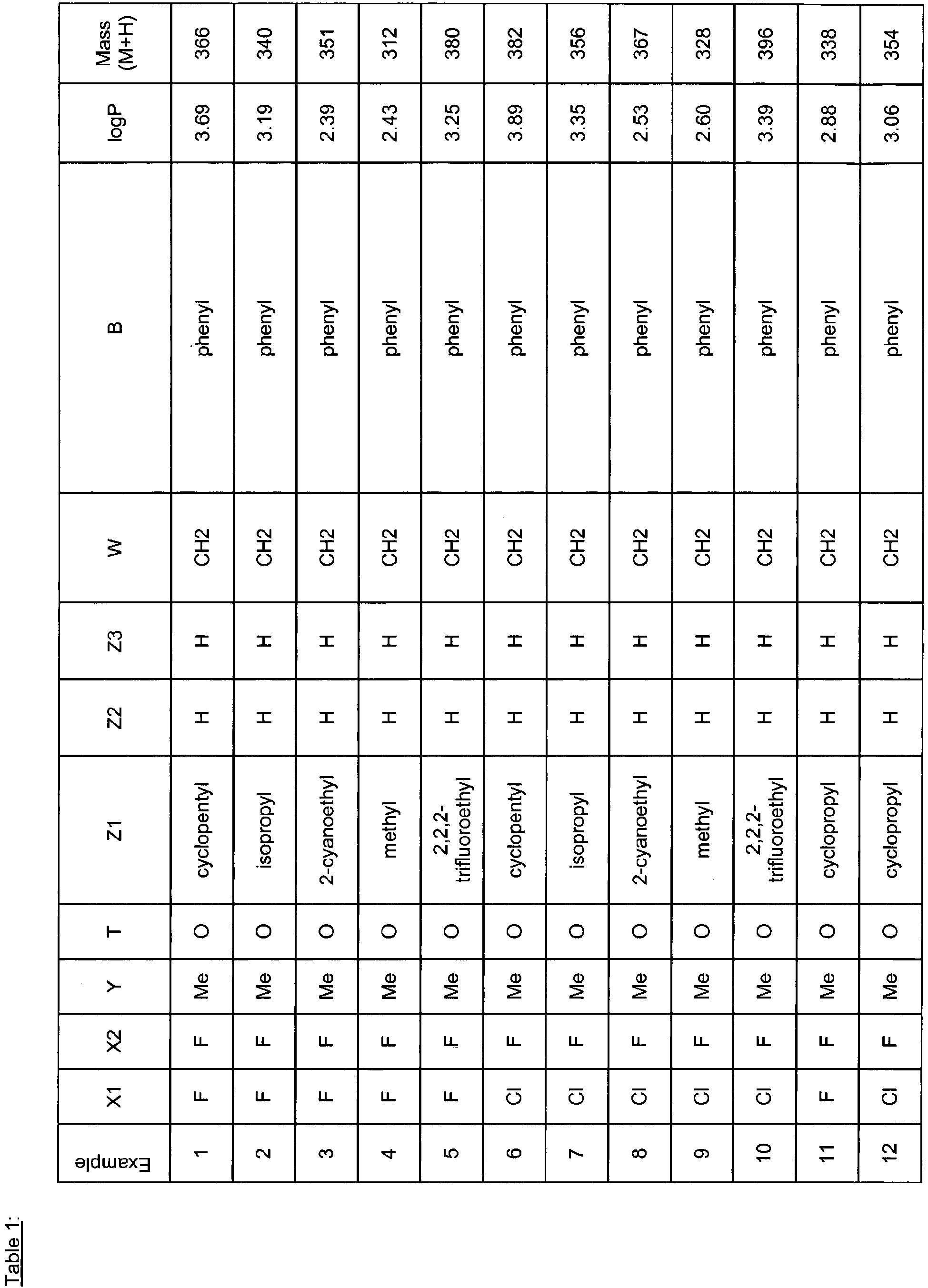


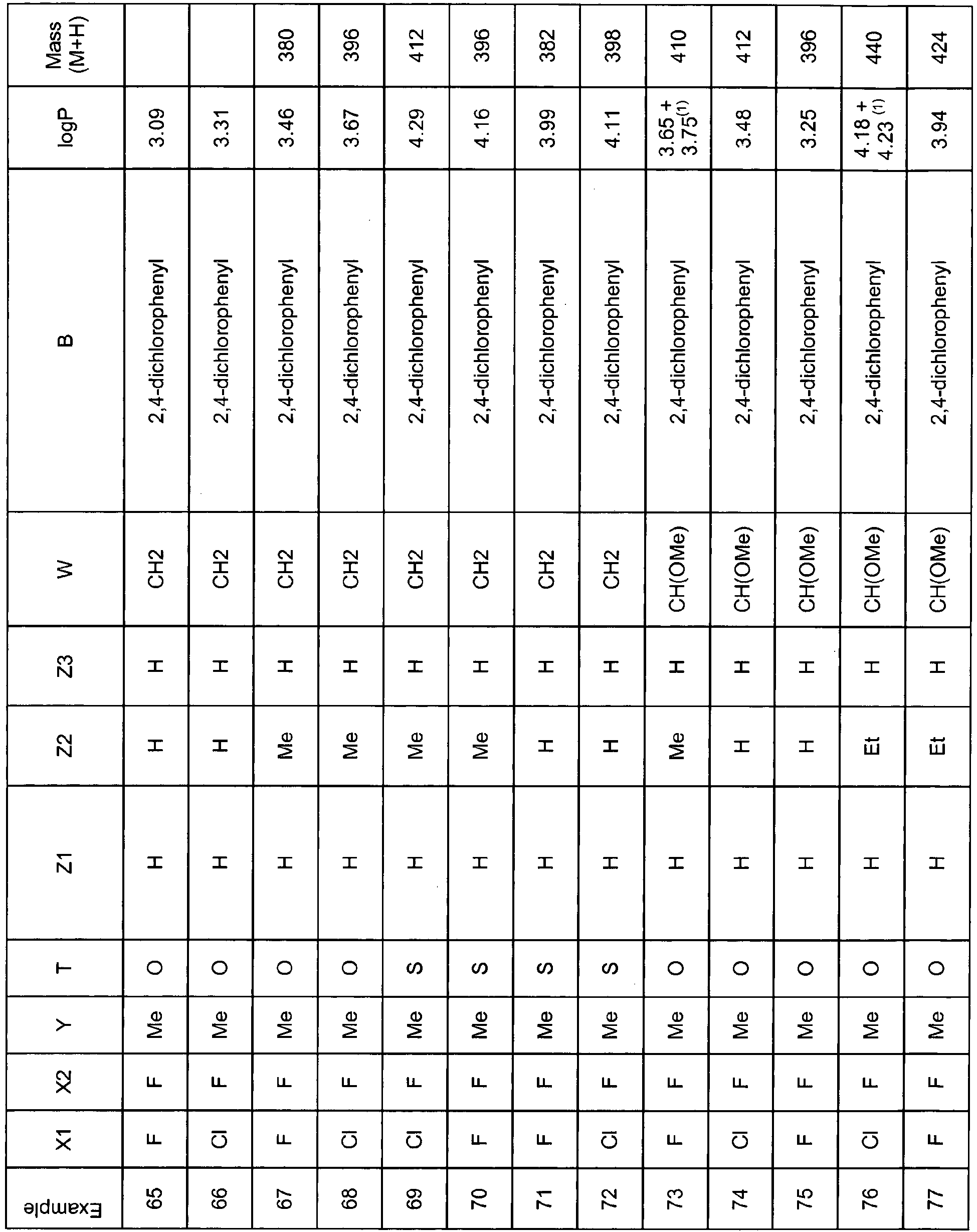


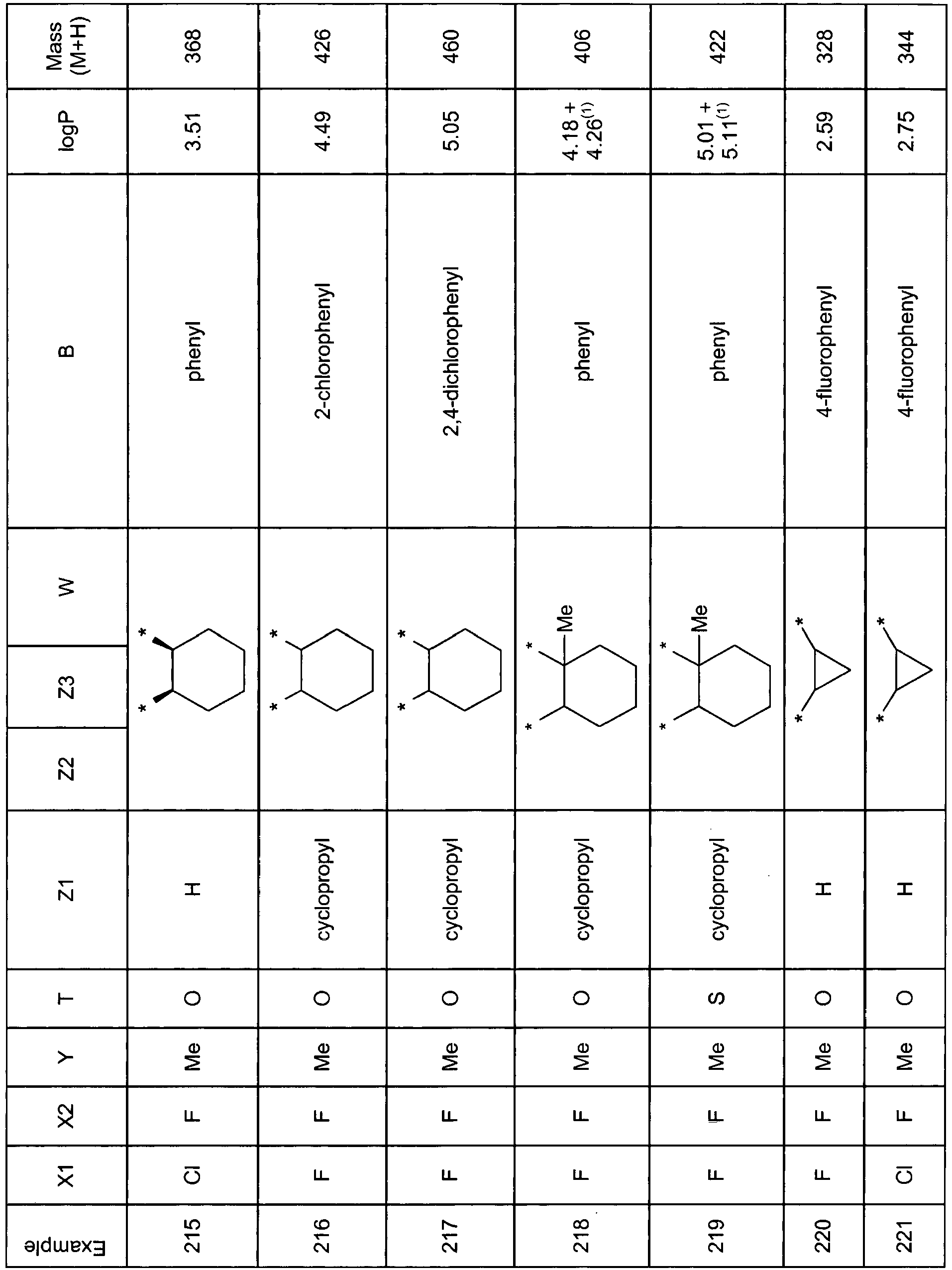


Claims (17)
- A compound of formula (I):
 • X1 and X2 which can be the same or different, represent a halogen atom ;• Y represents a C1-C4-alkyl ;• T represents O or S ;• W represents CZ4Z5 ; O ; S ; SO ; SO2; NZ6; SiZ7Z8 ; or -C(=U)-;• B represents a phenyl ring that can be susbtituted by up to 5 groups X which can be the same or different ; a naphthyl ring that can be susbtituted by up to 7 groups X which can be the same or different ; or a saturated, partially saturated or unsaturated, monocyclic or fused bicyclic 4-, 5-, 6-, 7-, 8-, 9-, 10-membered ring comprising from 1 up to 4 heteroaroms selected in the list consisting of N, O, S, that can be substituted by up to 6 groups X which can be the same or different ;• X represents a halogen atom ; nitro ; cyano ; isonitrile ; hydroxy ; amino ; sulfanyl ; pentafluoro-λ6-sulfanyl ; formyl ; formyloxy ; formylamino ; substituted or non-substituted (hydroxyimino)-C1-C8-alkyl ; substituted or non-substituted (C1-C8-alkoxyimino)-C1-C8-alkyl ; substituted or non-substituted (C2-C8-alkenyloxyimino)-C1-C8-alkyl ; substituted or non-substituted (C2-C8-alkynyloxyimino)-C1-C8-alkyl ; substituted or non-substituted (benzyloxyimino)-C1-C8-alkyl ; carboxy ; carbamoyl ; N-hydroxycarbamoyl ; carbamate ; substituted or non-substituted C1-C8-alkyl ; C1-C8-halogenoalkyl having 1 to 5 halogen atoms ; substituted or non-substituted C2-C8-alkenyl ; C2-C8-halogenoalkenyl having 1 to 5 halogen atoms ; substituted or non-substituted C2-C8-alkynyl ; C2-C8-halogenoalkynyl having 1 to 5 halogen atoms ; substituted or non-substituted C1-C8-alkoxy; C1-C8-halogenoalkoxy having 1 to 5 halogen atoms ; substituted or non-substituted C1-C8-alkylsulfanyl ; C1-C8-halogenoallsylsulfanyl having 1 to 5 halogen atoms ; substituted or non-substituted C1-C8-alkylsulfinyl ; C1-C8-halogenoalkylsulfinyl having 1 to 5 halogen atoms ; substituted or non-substituted C1-C8-alkylsulfonyl ; C1-C8-halogenoalkylsulfonyl having 1 to 5 halogen atoms ; substituted or non-substituted C1-C8-alkylamino ; substituted or non-substituted di-C1-C8-alkylamino ; substituted or non-substituted C2-C8-alkenyloxy ; C2-C8-halogenoalkenyloxy having 1 to 5 halogen atoms ; substituted or non-substituted C3-C8-alkynyloxy ; C2-C8-halogenoalkynyloxy having 1 to 5 halogen atoms ; substituted or non-substituted C3-C7-cycloalkyl ; C3-C7-halogenocycloalkyl having 1 to 5 halogen atoms ; substituted or non-substituted (C3-C7-cycloalkyl)-C1-C8-alkyl ; substituted or non-substituted (C3-C7-cycloalkyl)-C2-C8-alkenyl ; substituted or non-substituted (C3-C7-cycloalkyl)-C2-C8-alkynyl ; substituted or non-substituted tri(C1-C8-alkyl)silyl ; substituted or non-substituted tri(C1-C8-alkyl)silyl-C1-C8-alkyl ; substituted or non-substituted C1-C8-alkylcarbonyl ; C1-C8-halogenoalkylcarbonyl having 1 to 5 halogen atoms ; substituted or non-substituted C1-C8-alkylcarbonyloxy ; C1-C8-halogenoalkylcarbonyloxy having 1 to 5 halogen atoms ; substituted or non-substituted C1-C8-alkylcarbonylamino ; C1-C8-halogenoalkyl- carbonylamino having 1 to 5 halogen atoms ; substituted or non-substituted C1-C8-alkoxycarbonyl ; C1-C8-halogenoalkoxycarbonyl having 1 to 5 halogen atoms ; substituted or non-substituted C1-C8-alkyloxycarbonyloxy ; C1-C8-halogenoalkoxycarbonyloxy having 1 to 5 halogen atoms ; substituted or non-substituted C1-C8-alkylcarbamoyl ; substituted or non-substituted di-C1-C8-alkylcarbamoyl ; substituted or non-substituted C1-C8-alkylaminocarbonyloxy ; substituted or non-substituted di-C1-C8-alkylaminocarbonyloxy ; substituted or non-substituted N-(C1-C8-alkyl)hydroxy carbamoyl ; substituted or non-substituted C1-C8-alkoxycarbamoyl ; substituted or non-substituted N-(C1-C8-alkyl)-C1-C8-alkoxycarbamoyl ; aryl that can be susbtituted by up to 6 groups Q which can be the same or different; C1-C8-arylalkyl that can be susbtituted by up to 6 groups Q which can be the same or different ; C2-C8-arylalkenyl that can be susbtituted by up to 6 groups Q which can be the same or different ; C2-C8-arylalkynyl that can be susbtituted by up to 6 groups Q which can be the same or different ; aryloxy that can be susbtituted by up to 6 groups Q which can be the same or different ; arylsulfanyl that can be susbtituted by up to 6 groups Q which can be the same or different; arylamino that can be susbtituted by up to 6 groups Q which can be the same or different ; C1-C8-arylalkyloxy that can be susbtituted by up to 6 groups Q which can be the same or different ; C1-C8-arylalkylsulfanyl that can be susbtituted by up to 6 groups Q which can be the same or different; or C1-C8-arylalkylamino that can be susbtituted by up to 6 groups Q which can be the same or different; or• two substituents X together with the consecutive carbon atoms to which they are linked can form a 5- or 6-membered, saturated carbocycle or saturated heterocycle, which can be substituted by up to four groups Q which can be the same or different;• Z1 represents a hydrogen atom ; a formyl group ; a substituted or non-substituted C1-C8-alkyl substituted or non substituted C1-C8-alkoxy; non-substituted C3-C7-cycloalkyl or a C3-C7-cycloalkyl substituted by up to 10 atoms or groups that can be the same or different and that can be selected in the list consisting of halogen atoms, cyano, C1-C8-alkyl, C1-C8-halogenoalkyl comprising up to 9 halogen atoms that can be the same or different, C1-C8-alkoxy, C1-C8-halogenoalkoxy comprising up to 9 halogen atoms that can be the same or different, C1-C8-alkoxycarbonyl, C1-C8-halogenoalkoxycarbonyl comprising up to 9 halogen atoms that can be the same or different, C1-C8-alkylaminocarbonyl or di-C1-C8-alkylaminocarbonyl ;• Z2, Z3, Z4 and Z5 independently represent a hydrogen atom ; a halogen atom ; cyano ; substituted or non-substituted C1-C8-alkyl C1-C8-halogenoalkyl having 1 to 5 halogen atoms ; substituted or non-substituted C1-C8-alkoxy ; substituted or non-substituted C1-C8-alkylsulfanyl ; or substituted or non-substituted C1-C8-alkoxycarbonyl ; or
two substituents Zi and Zi+1, i being an integer between 2 and 4, together with the consecutive carbon atoms to which they are linked can form a 3-, 4-, 5-, 6- or 7-membered saturated carbocycle that can be substituted by up to four groups that can be the same or different and that can be selected in the list consisting of halogen atoms, C1-C8-alkyl or C1-C2-halogenoalkyl comprising up to 5 halogen atoms that can be the same or different;• Z6 represents a hydrogen atom ; a substituted or non-substituted C1-C8-alkyl ; a C1-C8-halogenoalkyl comprising up to 9 halogen atoms that can be the same or different; a substituted or non-substituted C2-C8-alkenyl ; a C2-C8-halogenoalkenyl comprising up to 9 halogen atoms that can be the same or different ; a substituted or non-substituted C3-C8-alkynyl ; a C3-C8-halogenoalkynyl comprising up to 9 halogen atoms that can be the same or different ; a substituted or non-substituted C3-C7-cycloalkyl ; a C3-C7-halogeno-cycloalkyl comprising up to 9 halogen atoms that can be the same or different ; a substituted or non-substituted C3-C7-cycloalkyl-C1-C8-alkyl ; formyl ; a substituted or non-substituted C1-C8-alkylcarbonyl ; C1-C8-halogenoalkylcarbonyl comprising up to 9 halogen atoms that can be the same or different ; a substituted or non-substituted C1-C8-alkoxycarbonyl ; C1-C8-halogenoalkoxycarbonyl comprising up to 9 halogen atoms that can be the same or different; a substituted or non-substituted C1-C8-alkylsulphonyl ; C1-C8-halogenoalkylsulphonyl comprising up to 9 halogen atoms that can be the same or different ; phenylmethylene that can be substituted by up to 7 groups Q which can be the same or different ; or phenylsulphonyl that can be substituted by up to 5 groups Q which can be the same or different;• Z7 and Z8 independently represent a substituted or non-substituted C1-C8-alkyl;• U represents O ; S ; N-ORa or N-CN ;• Ra represents a hydrogen atom ; a substituted or non-substituted C1-C4-alkyl ; or a C1-C4-halogenoalkyl comprising up to 7 halogen atoms that can be the same or different;• Q independently represents a halogen atom ; cyano ; nitro ; substituted or non-substituted C1-C8-alkyl ; C1-C8-halogenoalkyl having 1 to 9 halogen atoms that can be the same or different ; substituted or non-substituted C1-C8-alkoxy ; C1-C8-halogenoalkoxy having 1 to 9 halogen atoms that can be the same or different ; substituted or non-substituted C1-C8-alkylsulfanyl ; C1-C8-halogenoalkylsulfanyl having 1 to 9 halogen atoms that can be the same or different; substituted or non-substituted tri(C1-C8)alkylsilyl ; substituted or non-substituted tri(C1-C8)alkylsilyl-C1-C8-alkyl ; substituted or non-substituted (C1-C8-alkoxyimino)-C1-C8-alkyl ; or substituted or non-substituted (benzyloxyimino)-C1-C8-alkyl ;
as well as its salts, N-oxydes, metallic complexes, metalloidic complexes and optically active isomers. - A compound according to claim 1 wherein X1 and X2 independently represent a chlorine or a fluorine atom.
- A compound according to any one of claims 1 to 2 wherein Y represents methyl.
- A compound according to any one of claims 1 to 3 wherein T represents O.
- A compound according to any one of claims 1 to 4 wherein B represents a substituted or non-substituted phenyl ring ; a substituted or non-substituted naphthyl ring ; a substituted or non-substituted pyridyl ring ; a substituted or non-substituted thienyl ring ; or a substituted or non-substituted benzothienyl ring; preferably a substituted or non-substituted phenyl ring or a substituted or non-substituted 2-pyridyl ring.
- A compound according to any one of claims 1 to 5 wherein X independently represents a halogen atom; substituted or non-substituted C1-C8-alkyl ; C1-C8-halogenoalkyl comprising up to 9 halogen atoms that can be the same or different; substituted or non-substituted tri(C1-C8-alkyl)silyl ; substituted or non-substituted C1-C8-alkoxy or C1-C8-halogenoalkoxy comprising up to 9 halogen atoms that can be the same or different ; substituted or non-substituted C1-C8-alkylsulfanyl or C1-C8-halogenoalkylsulfanyl comprising up to 9 halogen atoms that can be the same or different ; or wherein two consecutive substituents X together with the phenyl ring form a substituted or non-substituted cyclopentyl or cyclohexyl ring.
- A compound according to any one of claims 1 to 6 wherein X independently represents fluorine, chlorine, bromine, iodine, methyl, ethyl, propyl, isopropyl, butyl, isobutyl, secbutyl, terbutyl, cyclopropyl, cyclopentyl, cyclohexyl, trimethylsilyl, methoxy, ethoxy, methylsulfanyl, ethylsulfanyl, trifluoromethyl, trichloromethyl, difluoromethoxy, trifluoromethoxy, difluorochloromethoxy, trifluoroethoxy, difluoromethysulfanyl, trifluoromethylsulfanyl and difluorochloro-methylsulfanyl.
- A compound according to any one of claims 1 to 7 wherein Z1 represents a hydrogen atom ; a non-substituted C3-C7 cycloalkyl ; or a C3-C7 cycloalkyl substituted by up to 10 groups or atoms that can be the same or different and that can be selected in the list consisting of halogen atoms, C1-C8-alkyl, C1-C8-halogenoalkyl comprising up to 9 halogen atoms that can be the same or different, C1-C8-alkoxy or C1-C8-halogenoalkoxy comprising up to 9 halogen atoms that can be the same or different.
- A compound according to any one of claims 1 to 8 wherein Z1 represents a non-substituted C3-C7-cycloalkyl, preferably a cyclopropyl.
- A compound according to any one of claims 1 to 9 wherein Z2, Z3, Z4 and Z5 independently represent a hydrogen atom, a fluorine atom, a substituted or non-substituted C1-C8-alkyl or a substituted or non-substituted C1-C8-alkoxy.
- A compound according to any one of claims 1 to 10 wherein two substituent Zi and Zi+1, i being an integer between 2 and 4, together with the consecutive carbon atoms to which they are linked can form an optionally mono or polysusbtituted 3-, 4-, 5-, 6- or 7-membered saturated carbocycle; preferably an optionally mono or polysusbtituted cyclopropyl, cyclopentyl, cyclohexyl or cycloheptyl ring; more preferably a cyclopropyl, a cyclopentyl or a cyclohexyl ring.
- A compound according to any one of claims 1 to 11 wherein Z3 and Z4 together with the consecutive carbon atoms to which they are linked can form an cyclopentyl, cyclohexyl or cycloheptyl group, that can be substituted by up to four groups that can be the same or different and that can be selected in the list consisting of fluorine, chlorine, methyl, ethyl, propyl, isopropyl, isobutyl, secbutyl, terbutyl, trifluoromethyl or difluoromethyl.
- A compound according to any one of claims 1 to 12 wherein Z6 represents a substituted or non-substituted C1-C8-alkyl.
- A compound according to any one of claims 1 to 13 wherein Z7 and Z8 independently represent a non-substituted C1-C3-alkyl, preferably a methyl.
- A compound according to any one of claims 1 to 14 wherein U represents O or N-O-(C1-C4-alkyl).
- A fungicide composition comprising, as an active ingredient, an effective amount of a compound of formula (I) according to claims 1 to 15 and an agriculturally acceptable support, carrier or filler.
- A method for controlling phytopathogenic fungi of crops, characterized in that an agronomically effective and substantially non-phytotoxic quantity of a compound according to claims 1 to 15 or a composition according to claim 16 is applied to the soil where plants grow or are capable of growing, to the leaves and/or the fruit of plants or to the seeds of plants.
Priority Applications (2)
| Application Number | Priority Date | Filing Date | Title |
|---|---|---|---|
| EP11724405.3A EP2576516B1 (en) | 2010-06-03 | 2011-06-01 | N-[(het)arylethyl)]pyrazole(thio)carboxamides and their heterosubstituted analogues |
| PL11724405T PL2576516T3 (en) | 2010-06-03 | 2011-06-01 | N-[(het)arylethyl)]pyrazole(thio)carboxamides and their heterosubstituted analogues |
Applications Claiming Priority (5)
| Application Number | Priority Date | Filing Date | Title |
|---|---|---|---|
| EP10356019 | 2010-06-03 | ||
| US36803010P | 2010-07-27 | 2010-07-27 | |
| EP10356033 | 2010-11-15 | ||
| PCT/EP2011/059025 WO2011151369A1 (en) | 2010-06-03 | 2011-06-01 | N-[(het)arylethyl)] pyrazole(thio)carboxamides and their heterosubstituted analogues |
| EP11724405.3A EP2576516B1 (en) | 2010-06-03 | 2011-06-01 | N-[(het)arylethyl)]pyrazole(thio)carboxamides and their heterosubstituted analogues |
Publications (2)
| Publication Number | Publication Date |
|---|---|
| EP2576516A1 EP2576516A1 (en) | 2013-04-10 |
| EP2576516B1 true EP2576516B1 (en) | 2014-12-17 |
Family
ID=45066203
Family Applications (1)
| Application Number | Title | Priority Date | Filing Date |
|---|---|---|---|
| EP11724405.3A Not-in-force EP2576516B1 (en) | 2010-06-03 | 2011-06-01 | N-[(het)arylethyl)]pyrazole(thio)carboxamides and their heterosubstituted analogues |
Country Status (15)
| Country | Link |
|---|---|
| US (1) | US9232799B2 (en) |
| EP (1) | EP2576516B1 (en) |
| JP (1) | JP5730992B2 (en) |
| KR (1) | KR20130109940A (en) |
| CN (1) | CN102933556B (en) |
| AR (1) | AR081573A1 (en) |
| AU (1) | AU2011260332B2 (en) |
| BR (1) | BR112012030580B1 (en) |
| CA (1) | CA2796191A1 (en) |
| CL (1) | CL2012003357A1 (en) |
| CO (1) | CO6660482A2 (en) |
| ES (1) | ES2533026T3 (en) |
| MX (1) | MX2012013897A (en) |
| PL (1) | PL2576516T3 (en) |
| WO (1) | WO2011151369A1 (en) |
Families Citing this family (21)
| Publication number | Priority date | Publication date | Assignee | Title |
|---|---|---|---|---|
| UA110703C2 (en) * | 2010-06-03 | 2016-02-10 | Байєр Кропсайнс Аг | Fungicidal n-[(trisubstitutedsilyl)methyl]carboxamide |
| WO2011151370A1 (en) | 2010-06-03 | 2011-12-08 | Bayer Cropscience Ag | N-[(het)arylalkyl)] pyrazole (thio)carboxamides and their heterosubstituted analogues |
| BR112014010713A2 (en) | 2011-11-02 | 2017-04-18 | Bayer Ip Gmbh | compounds with nematicidal activity |
| WO2013120940A2 (en) * | 2012-02-14 | 2013-08-22 | Syngenta Participations Ag | Novel compounds |
| UA115666C2 (en) * | 2012-07-12 | 2017-12-11 | Ніссан Кемікал Індастріз, Лтд. | Oxime-substituted amide compound and pest control agent |
| CN105358534A (en) * | 2013-04-23 | 2016-02-24 | 斯洛文尼亚莱柯制药股份有限公司 | Novel synthetic process to 8-chloro-1-methyl-benzo[d]azepine, novel intermediates and the production thereof |
| UY35543A (en) * | 2013-04-30 | 2014-11-28 | Bayer Cropscience Ag | N- (PHENYLCYCALALKYL) CARBOXAMIDS AND N- (PHENYLCICLOALKYL) NEMATICIDED THIOCARBOXAMIDS |
| TW201507722A (en) * | 2013-04-30 | 2015-03-01 | Bayer Cropscience Ag | N-(2-halogen-2-phenethyl)carboxamides as nematicides and endoparasiticides |
| EP3055296B1 (en) * | 2013-10-08 | 2018-11-28 | Bayer CropScience Aktiengesellschaft | N-hetaryl(thio)carbonyl-2-(benzocycloalken-1-yl)cyclamines and their use as fungicides |
| TWI670254B (en) * | 2014-01-15 | 2019-09-01 | 日商日產化學工業股份有限公司 | Terpene substituted guanamine compounds and pest control agents |
| BR112016017430B1 (en) | 2014-02-07 | 2021-07-13 | Nissan Chemical Industries Ltd | FUNGICIDE, INSECTICIDE, NEMATICIDE OR BACTERICIDE COMPOSITION AND METHOD FOR CONTROLLING PESTS, HARMFUL INSECTS, NEMATODES OR BACTERIA |
| EP3109234A4 (en) * | 2014-02-18 | 2017-07-05 | Nissan Chemical Industries, Ltd. | Alkynylpyridine-substituted amide compound and noxious organism control agent |
| WO2016066639A1 (en) * | 2014-10-29 | 2016-05-06 | Bayer Cropscience Aktiengesellschaft | N-(2-substituted 2-phenylethyl)carboxamides and n-(2-substituted 2-phenylethyl)-thiocarboxamides as fungicides |
| US10214510B2 (en) | 2015-04-13 | 2019-02-26 | Bayer Cropscience Aktiengesellschaft | N-cycloalkyl-N-(biheterocyclylethylene)-(thio)carboxamide derivatives |
| JP2021035913A (en) * | 2017-12-21 | 2021-03-04 | 石原産業株式会社 | N-methoxyamide compound or salt thereof, and agricultural and horticultural fungicide containing the same |
| JP2021035914A (en) * | 2017-12-21 | 2021-03-04 | 石原産業株式会社 | N-methoxyamide compound or salt thereof, and agricultural and horticultural fungicide containing the same |
| PY1999323A (en) * | 2018-11-28 | 2020-10-29 | Bayer Ag | (THIO)PYRIDAZINE AMIDES AS FUNGICIDAL COMPOUNDS |
| EP4116291A4 (en) | 2020-03-04 | 2024-03-06 | Wuhan Humanwell Innovative Drug Research and Development Center Limited Company | SYNTHESIS OF A NEW EP4 ANTAGONIST AND USE IN CANCERS AND INFLAMMATIONS |
| US12540118B2 (en) | 2020-09-30 | 2026-02-03 | Jiangsu Flag Chemical Industry Co., Ltd. | Dendrene amide compound, bactericide and use thereof |
| WO2023030492A1 (en) | 2021-09-03 | 2023-03-09 | 武汉人福创新药物研发中心有限公司 | Ep4 antagonist compound as well as salt, polymorph, and use thereof |
| CN119522098A (en) * | 2022-04-19 | 2025-02-25 | 吉尔伽美什制药公司 | Pyridine derivatives for the treatment of mental disorders |
Family Cites Families (225)
| Publication number | Priority date | Publication date | Assignee | Title |
|---|---|---|---|---|
| US2036008A (en) | 1934-11-07 | 1936-03-31 | White Martin Henry | Plug fuse |
| US3247908A (en) | 1962-08-27 | 1966-04-26 | Robook Nicolay Nikolaevich | Adjustable blades hydraulic turbine runner |
| US4761373A (en) | 1984-03-06 | 1988-08-02 | Molecular Genetics, Inc. | Herbicide resistance in plants |
| US5304732A (en) | 1984-03-06 | 1994-04-19 | Mgi Pharma, Inc. | Herbicide resistance in plants |
| US5331107A (en) | 1984-03-06 | 1994-07-19 | Mgi Pharma, Inc. | Herbicide resistance in plants |
| DE3765449D1 (en) | 1986-03-11 | 1990-11-15 | Plant Genetic Systems Nv | PLANT CELLS RESISTED BY GENE TECHNOLOGY AND RESISTANT TO GLUTAMINE SYNTHETASE INHIBITORS. |
| US5637489A (en) | 1986-08-23 | 1997-06-10 | Hoechst Aktiengesellschaft | Phosphinothricin-resistance gene, and its use |
| US5276268A (en) | 1986-08-23 | 1994-01-04 | Hoechst Aktiengesellschaft | Phosphinothricin-resistance gene, and its use |
| US5273894A (en) | 1986-08-23 | 1993-12-28 | Hoechst Aktiengesellschaft | Phosphinothricin-resistance gene, and its use |
| US5378824A (en) | 1986-08-26 | 1995-01-03 | E. I. Du Pont De Nemours And Company | Nucleic acid fragment encoding herbicide resistant plant acetolactate synthase |
| US5013659A (en) | 1987-07-27 | 1991-05-07 | E. I. Du Pont De Nemours And Company | Nucleic acid fragment encoding herbicide resistant plant acetolactate synthase |
| US5605011A (en) | 1986-08-26 | 1997-02-25 | E. I. Du Pont De Nemours And Company | Nucleic acid fragment encoding herbicide resistant plant acetolactate synthase |
| US5638637A (en) | 1987-12-31 | 1997-06-17 | Pioneer Hi-Bred International, Inc. | Production of improved rapeseed exhibiting an enhanced oleic acid content |
| GB8810120D0 (en) | 1988-04-28 | 1988-06-02 | Plant Genetic Systems Nv | Transgenic nuclear male sterile plants |
| US5084082A (en) | 1988-09-22 | 1992-01-28 | E. I. Du Pont De Nemours And Company | Soybean plants with dominant selectable trait for herbicide resistance |
| US6013861A (en) | 1989-05-26 | 2000-01-11 | Zeneca Limited | Plants and processes for obtaining them |
| WO1991002069A1 (en) | 1989-08-10 | 1991-02-21 | Plant Genetic Systems N.V. | Plants with modified flowers |
| US5908810A (en) | 1990-02-02 | 1999-06-01 | Hoechst Schering Agrevo Gmbh | Method of improving the growth of crop plants which are resistant to glutamine synthetase inhibitors |
| US5739082A (en) | 1990-02-02 | 1998-04-14 | Hoechst Schering Agrevo Gmbh | Method of improving the yield of herbicide-resistant crop plants |
| EP0476093B1 (en) | 1990-04-04 | 1997-05-07 | Pioneer Hi-Bred International, Inc. | Production of improved rapeseed exhibiting a reduced saturated fatty acid content |
| US5198599A (en) | 1990-06-05 | 1993-03-30 | Idaho Resarch Foundation, Inc. | Sulfonylurea herbicide resistance in plants |
| EP0536330B1 (en) | 1990-06-25 | 2002-02-27 | Monsanto Technology LLC | Glyphosate tolerant plants |
| FR2667078B1 (en) | 1990-09-21 | 1994-09-16 | Agronomique Inst Nat Rech | DNA SEQUENCE GIVING MALE CYTOPLASMIC STERILITY, MITOCHONDRIAL, MITOCHONDRIA AND PLANT CONTAINING THE SAME, AND PROCESS FOR THE PREPARATION OF HYBRIDS. |
| DE4104782B4 (en) | 1991-02-13 | 2006-05-11 | Bayer Cropscience Gmbh | Novel plasmids containing DNA sequences that cause changes in carbohydrate concentration and carbohydrate composition in plants, as well as plants and plant cells containing these plasmids |
| US5731180A (en) | 1991-07-31 | 1998-03-24 | American Cyanamid Company | Imidazolinone resistant AHAS mutants |
| FR2681546B1 (en) | 1991-09-20 | 1995-12-08 | Essilor Int | MULTI-AXIS DIGITAL CONTROL MACHINING METHOD AND MACHINE. |
| US6270828B1 (en) | 1993-11-12 | 2001-08-07 | Cargrill Incorporated | Canola variety producing a seed with reduced glucosinolates and linolenic acid yielding an oil with low sulfur, improved sensory characteristics and increased oxidative stability |
| US5223526A (en) | 1991-12-06 | 1993-06-29 | Monsanto Company | Pyrazole carboxanilide fungicides and use |
| DE4227061A1 (en) | 1992-08-12 | 1994-02-17 | Inst Genbiologische Forschung | A polyfructane sucrase DNA sequence from Erwinia Amylovora |
| GB9218185D0 (en) | 1992-08-26 | 1992-10-14 | Ici Plc | Novel plants and processes for obtaining them |
| EP0664835B1 (en) | 1992-10-14 | 2004-05-19 | Syngenta Limited | Novel plants and processes for obtaining them |
| GB9223454D0 (en) | 1992-11-09 | 1992-12-23 | Ici Plc | Novel plants and processes for obtaining them |
| RO117111B1 (en) | 1993-03-25 | 2001-10-30 | Ciba Geigy Ag | PESTICIDE PROTEIN AND NUCLEOTIDE SECTION, WHICH CODES |
| AU695940B2 (en) | 1993-04-27 | 1998-08-27 | Cargill Incorporated | Non-hydrogenated canola oil for food applications |
| WO1995004826A1 (en) | 1993-08-09 | 1995-02-16 | Institut Für Genbiologische Forschung Berlin Gmbh | Debranching enzymes and dna sequences coding them, suitable for changing the degree of branching of amylopectin starch in plants |
| DE4330960C2 (en) | 1993-09-09 | 2002-06-20 | Aventis Cropscience Gmbh | Combination of DNA sequences that enable the formation of highly amylose-containing starch in plant cells and plants, processes for producing these plants and the modified starch that can be obtained therefrom |
| EP0675198A4 (en) | 1993-10-01 | 1996-01-10 | Mitsubishi Chem Ind | GENE IDENTIFYING A STERILE PLANT CYTOPLASM AND METHOD FOR PREPARING A HYBRID PLANT USING THE SAME. |
| AU692791B2 (en) | 1993-10-12 | 1998-06-18 | Agrigenetics, Inc. | Brassica napus variety AG019 |
| US5908975A (en) | 1993-11-09 | 1999-06-01 | E. I. Du Pont De Nemours And Company | Accumulation of fructans in plants by targeted expression of bacterial levansucrase |
| CA2186399C (en) | 1994-03-25 | 2001-09-04 | David Cooke | Method for producing altered starch from potato plants |
| CA2190149C (en) | 1994-05-18 | 2011-01-04 | Jens Kossmann | Dna sequences coding for enzymes capable of facilitating the synthesis of linear .alpha.-1,4 glucans in plants, fungi and microorganisms |
| US5824790A (en) | 1994-06-21 | 1998-10-20 | Zeneca Limited | Modification of starch synthesis in plants |
| AU706849B2 (en) | 1994-06-21 | 1999-06-24 | Cerestar Usa, Inc. | Novel plants and processes for obtaining them |
| NL1000064C1 (en) | 1994-07-08 | 1996-01-08 | Stichting Scheikundig Onderzoe | Production of oligosaccharides in transgenic plants. |
| DE4441408A1 (en) | 1994-11-10 | 1996-05-15 | Inst Genbiologische Forschung | DNA sequences from Solanum tuberosum encoding enzymes involved in starch synthesis, plasmids, bacteria, plant cells and transgenic plants containing these sequences |
| DE4447387A1 (en) | 1994-12-22 | 1996-06-27 | Inst Genbiologische Forschung | Debranching enzymes from plants and DNA sequences encoding these enzymes |
| ES2294786T3 (en) | 1995-01-06 | 2008-04-01 | Plant Research International B.V. | DNA SEQUENCES THAT CODIFY ENZYMES THAT SYNTHEIZE CARBOHYDRATE POLYMERS AND METHOD TO PRODUCE TRANSGENIC PLANTS. |
| DE19509695A1 (en) | 1995-03-08 | 1996-09-12 | Inst Genbiologische Forschung | Process for the preparation of a modified starch in plants, and the modified starch isolatable from the plants |
| US5853973A (en) | 1995-04-20 | 1998-12-29 | American Cyanamid Company | Structure based designed herbicide resistant products |
| DE69636637T2 (en) | 1995-04-20 | 2007-08-23 | Basf Ag | BASED ON YOUR STRUCTURE DESIGNED HERBICIDE RESISTANT PRODUCTS |
| DK0826061T3 (en) | 1995-05-05 | 2007-09-24 | Nat Starch Chem Invest | Enhancements to or related to plant starch compositions |
| FR2734842B1 (en) | 1995-06-02 | 1998-02-27 | Rhone Poulenc Agrochimie | DNA SEQUENCE OF A HYDROXY-PHENYL PYRUVATE DIOXYGENASE GENE AND OBTAINING PLANTS CONTAINING A HYDROXY-PHENYL PYRUVATE DIOXYGENASE GENE, TOLERANT TO CERTAIN HERBICIDES |
| US6284479B1 (en) | 1995-06-07 | 2001-09-04 | Pioneer Hi-Bred International, Inc. | Substitutes for modified starch and latexes in paper manufacture |
| US5712107A (en) | 1995-06-07 | 1998-01-27 | Pioneer Hi-Bred International, Inc. | Substitutes for modified starch and latexes in paper manufacture |
| GB9513881D0 (en) | 1995-07-07 | 1995-09-06 | Zeneca Ltd | Improved plants |
| FR2736926B1 (en) | 1995-07-19 | 1997-08-22 | Rhone Poulenc Agrochimie | 5-ENOL PYRUVYLSHIKIMATE-3-PHOSPHATE SYNTHASE MUTEE, CODING GENE FOR THIS PROTEIN AND PROCESSED PLANTS CONTAINING THIS GENE |
| PT1435205E (en) | 1995-09-19 | 2010-02-04 | Bayer Bioscience Gmbh | Process for the production of a modified starch |
| GB9524938D0 (en) | 1995-12-06 | 1996-02-07 | Zeneca Ltd | Modification of starch synthesis in plants |
| DE19601365A1 (en) | 1996-01-16 | 1997-07-17 | Planttec Biotechnologie Gmbh | Nucleic acid molecules from plants encoding enzymes involved in starch synthesis |
| DE19608918A1 (en) | 1996-03-07 | 1997-09-11 | Planttec Biotechnologie Gmbh | Nucleic Acid Molecules Encoding New Debranching Enzymes from Maize |
| US5773704A (en) | 1996-04-29 | 1998-06-30 | Board Of Supervisors Of Louisiana State University And Agricultural And Mechanical College | Herbicide resistant rice |
| DE19618125A1 (en) | 1996-05-06 | 1997-11-13 | Planttec Biotechnologie Gmbh | Nucleic acid molecules that encode new potato debranching enzymes |
| DE19619918A1 (en) | 1996-05-17 | 1997-11-20 | Planttec Biotechnologie Gmbh | Nucleic acid molecules encoding soluble starch synthases from maize |
| CN1257978C (en) | 1996-05-29 | 2006-05-31 | 赫彻斯特-舍林农业发展有限公司 | Nucleic acid molecules encoding enzymes involved in starch synthesis in wheat |
| JP2001503607A (en) | 1996-06-12 | 2001-03-21 | パイオニア ハイ―ブレッド インターナショナル,インコーポレイテッド | A substitute for modified starch in papermaking. |
| EP0904454A1 (en) | 1996-06-12 | 1999-03-31 | Pioneer Hi-Bred International, Inc. | Substitutes for modified starch in paper manufacture |
| EP0904453B1 (en) | 1996-06-12 | 2001-12-19 | Pioneer Hi-Bred International, Inc. | Substitutes for modified starch in paper manufacture |
| AUPO069996A0 (en) | 1996-06-27 | 1996-07-18 | Australian National University, The | Manipulation of plant cellulose |
| US5850026A (en) | 1996-07-03 | 1998-12-15 | Cargill, Incorporated | Canola oil having increased oleic acid and decreased linolenic acid content |
| US5773702A (en) | 1996-07-17 | 1998-06-30 | Board Of Trustees Operating Michigan State University | Imidazolinone herbicide resistant sugar beet plants |
| GB9623095D0 (en) | 1996-11-05 | 1997-01-08 | Nat Starch Chem Invest | Improvements in or relating to starch content of plants |
| US6232529B1 (en) | 1996-11-20 | 2001-05-15 | Pioneer Hi-Bred International, Inc. | Methods of producing high-oil seed by modification of starch levels |
| DE19653176A1 (en) | 1996-12-19 | 1998-06-25 | Planttec Biotechnologie Gmbh | New maize nucleic acid molecules and their use to produce a modified starch |
| CA2193938A1 (en) | 1996-12-24 | 1998-06-24 | David G. Charne | Oilseed brassica containing an improved fertility restorer gene for ogura cytoplasmic male sterility |
| US5981840A (en) | 1997-01-24 | 1999-11-09 | Pioneer Hi-Bred International, Inc. | Methods for agrobacterium-mediated transformation |
| DE19708774A1 (en) | 1997-03-04 | 1998-09-17 | Max Planck Gesellschaft | Enzymes encoding nucleic acid molecules which have fructosyl polymerase activity |
| DE19709775A1 (en) | 1997-03-10 | 1998-09-17 | Planttec Biotechnologie Gmbh | Nucleic acid molecules encoding corn starch phosphorylase |
| GB9718863D0 (en) | 1997-09-06 | 1997-11-12 | Nat Starch Chem Invest | Improvements in or relating to stability of plant starches |
| DE19749122A1 (en) | 1997-11-06 | 1999-06-10 | Max Planck Gesellschaft | Enzymes encoding nucleic acid molecules that have fructosyl transferase activity |
| FR2770854B1 (en) | 1997-11-07 | 2001-11-30 | Rhone Poulenc Agrochimie | DNA SEQUENCE OF A GENE OF HYDROXY-PHENYL PYRUVATE DIOXYGENASE AND PRODUCTION OF PLANTS CONTAINING SUCH A GENE, HERBICIDE TOLERANT |
| FR2772789B1 (en) | 1997-12-24 | 2000-11-24 | Rhone Poulenc Agrochimie | PROCESS FOR THE ENZYMATIC PREPARATION OF HOMOGENTISATE |
| WO1999053072A1 (en) | 1998-04-09 | 1999-10-21 | E.I. Du Pont De Nemours And Company | Starch r1 phosphorylation protein homologs |
| DE19820607A1 (en) | 1998-05-08 | 1999-11-11 | Hoechst Schering Agrevo Gmbh | New enzyme with starch synthase activity, useful for producing starch for foods and packaging materials |
| DE19820608A1 (en) | 1998-05-08 | 1999-11-11 | Hoechst Schering Agrevo Gmbh | New nucleic acid encoding isoamylase from wheat and related transgenic plants producing starch with altered properties |
| AU4261099A (en) | 1998-05-13 | 1999-11-29 | Planttec Biotechnologie Gmbh | Transgenic plants with a modified activity of a plastidial adp/atp translocator |
| DE19821614A1 (en) | 1998-05-14 | 1999-11-18 | Hoechst Schering Agrevo Gmbh | Sugar beet mutants which are tolerant to sulfonylurea herbicides |
| US6635756B1 (en) | 1998-06-15 | 2003-10-21 | National Starch And Chemical Investment Holding Corporation | Starch obtainable from modified plants |
| US6693185B2 (en) | 1998-07-17 | 2004-02-17 | Bayer Bioscience N.V. | Methods and means to modulate programmed cell death in eukaryotic cells |
| DE19836098A1 (en) | 1998-07-31 | 2000-02-03 | Hoechst Schering Agrevo Gmbh | Plants that synthesize a modified starch, process for producing the plants, their use and the modified starch |
| DE19836099A1 (en) | 1998-07-31 | 2000-02-03 | Hoechst Schering Agrevo Gmbh | Nucleic acid molecules coding for a β-amylase, plants which synthesize a modified starch, process for the preparation of the plants, their use and the modified starch |
| DE19836097A1 (en) | 1998-07-31 | 2000-02-03 | Hoechst Schering Agrevo Gmbh | Nucleic acid molecules coding for an alpha-glucosidase, plants that synthesize a modified starch, process for producing the plants, their use and the modified starch |
| CA2341078A1 (en) | 1998-08-25 | 2000-03-02 | Pioneer Hi-Bred International, Inc. | Plant glutamine: fructose-6-phosphate amidotransferase nucleic acids |
| HUP0103414A3 (en) | 1998-09-02 | 2005-12-28 | Bayer Bioscience Gmbh | Nucleic acid molecules encoding an amylosucrase |
| DE19924342A1 (en) | 1999-05-27 | 2000-11-30 | Planttec Biotechnologie Gmbh | Genetically modified plant cells and plants with increased activity of an amylosucrase protein and a branching enzyme |
| US6699694B1 (en) | 1998-10-09 | 2004-03-02 | Planttec Biotechnologie Gmbh | Method for producing α-1,6-branched α-1,4-glucans from sucrose |
| CN100408687C (en) | 1998-11-09 | 2008-08-06 | 拜尔生物科学有限公司 | Nucleic acid molecules from rice and their use for producing modified starch |
| US6531648B1 (en) | 1998-12-17 | 2003-03-11 | Syngenta Participations Ag | Grain processing method and transgenic plants useful therein |
| DE19905069A1 (en) | 1999-02-08 | 2000-08-10 | Planttec Biotechnologie Gmbh | Alternansucrase encoding nucleic acid molecules |
| US6323392B1 (en) | 1999-03-01 | 2001-11-27 | Pioneer Hi-Bred International, Inc. | Formation of brassica napus F1 hybrid seeds which exhibit a highly elevated oleic acid content and a reduced linolenic acid content in the endogenously formed oil of the seeds |
| WO2000066746A1 (en) | 1999-04-29 | 2000-11-09 | Syngenta Limited | Herbicide resistant plants |
| JP2003523173A (en) | 1999-04-29 | 2003-08-05 | シンジェンタ リミテッド | Herbicide-tolerant plants |
| DE19926771A1 (en) | 1999-06-11 | 2000-12-14 | Aventis Cropscience Gmbh | Nucleic acid molecules from wheat, transgenic plant cells and plants and their use for the production of modified starch |
| DE19937348A1 (en) | 1999-08-11 | 2001-02-22 | Aventis Cropscience Gmbh | Nucleic acid molecules from plants encoding enzymes involved in starch synthesis |
| DE19937643A1 (en) | 1999-08-12 | 2001-02-22 | Aventis Cropscience Gmbh | Transgenic cells and plants with altered activity of the GBSSI and BE proteins |
| AU7647000A (en) | 1999-08-20 | 2001-03-19 | Basf Plant Science Gmbh | Increasing the polysaccharide content in plants |
| US6423886B1 (en) | 1999-09-02 | 2002-07-23 | Pioneer Hi-Bred International, Inc. | Starch synthase polynucleotides and their use in the production of new starches |
| US6472588B1 (en) | 1999-09-10 | 2002-10-29 | Texas Tech University | Transgenic cotton plants with altered fiber characteristics transformed with a sucrose phosphate synthase nucleic acid |
| GB9921830D0 (en) | 1999-09-15 | 1999-11-17 | Nat Starch Chem Invest | Plants having reduced activity in two or more starch-modifying enzymes |
| AR025996A1 (en) | 1999-10-07 | 2002-12-26 | Valigen Us Inc | NON-TRANSGENIC PLANTS RESISTANT TO HERBICIDES. |
| CA2401093A1 (en) | 2000-03-09 | 2001-09-13 | Monsanto Technology Llc | Methods for making plants tolerant to glyphosate and compositions thereof |
| EP2266390A3 (en) | 2000-03-09 | 2011-04-20 | E. I. du Pont de Nemours and Company | Sulfonylurea-tolerant sunflower plants |
| US6768044B1 (en) | 2000-05-10 | 2004-07-27 | Bayer Cropscience Sa | Chimeric hydroxyl-phenyl pyruvate dioxygenase, DNA sequence and method for obtaining plants containing such a gene, with herbicide tolerance |
| US6303818B1 (en) | 2000-08-08 | 2001-10-16 | Dow Agrosciences Llc | Unsaturated oxime ethers and their use as fungicides |
| CN100558897C (en) | 2000-09-29 | 2009-11-11 | 辛根塔有限公司 | Herbicide resistant plants |
| US6734340B2 (en) | 2000-10-23 | 2004-05-11 | Bayer Cropscience Gmbh | Monocotyledon plant cells and plants which synthesise modified starch |
| FR2815969B1 (en) | 2000-10-30 | 2004-12-10 | Aventis Cropscience Sa | TOLERANT PLANTS WITH HERBICIDES BY METABOLIC BYPASS |
| IL155599A0 (en) | 2000-10-30 | 2003-11-23 | Maxygen Inc | Polynucleotides encoding proteins which catalyze acetylation of glyphosate |
| JP2004528821A (en) | 2000-12-07 | 2004-09-24 | シンジェンタ リミテッド | Herbicide resistant plants |
| AU2036302A (en) | 2000-12-08 | 2002-06-18 | Commw Scient Ind Res Org | Modification of sucrose synthase gene expression in plant tissue and uses therefor |
| WO2002079410A2 (en) | 2001-03-30 | 2002-10-10 | Basf Plant Science Gmbh | Glucan chain length domains |
| ATE394497T1 (en) | 2001-06-12 | 2008-05-15 | Bayer Cropscience Ag | TRANSGENIC PLANTS THAT PRODUCE STARCH WITH HIGH AMYLOSE CONTENT |
| US20030084473A1 (en) | 2001-08-09 | 2003-05-01 | Valigen | Non-transgenic herbicide resistant plants |
| EP1448605A4 (en) | 2001-10-17 | 2006-07-12 | Basf Plant Science Gmbh | Starch |
| AR037328A1 (en) | 2001-10-23 | 2004-11-03 | Dow Agrosciences Llc | COMPOSITE OF [7-BENCIL-2,6-DIOXO-1,5-DIOXONAN-3-IL] -4-METOXIPIRIDIN-2-CARBOXAMIDE, COMPOSITION THAT UNDERSTANDS AND METHOD THAT USES IT |
| DE10208132A1 (en) | 2002-02-26 | 2003-09-11 | Planttec Biotechnologie Gmbh | Process for the production of maize plants with an increased leaf starch content and their use for the production of maize silage |
| AU2003234328A1 (en) | 2002-04-30 | 2003-11-17 | Pioneer Hi-Bred International, Inc. | Novel glyphosate-n-acetyltransferase (gat) genes |
| UA78071C2 (en) | 2002-08-07 | 2007-02-15 | Kumiai Chemical Industry Co | Herbicidal composition |
| FR2844142B1 (en) | 2002-09-11 | 2007-08-17 | Bayer Cropscience Sa | TRANSFORMED PLANTS WITH ENHANCED PRENYLQUINON BIOSYNTHESIS |
| WO2004040012A2 (en) | 2002-10-29 | 2004-05-13 | Basf Plant Science Gmbh | Compositions and methods for identifying plants having increased tolerance to imidazolinone herbicides |
| AU2003275716A1 (en) | 2002-10-31 | 2004-05-25 | Ishihara Sangyo Kaisha, Ltd. | 3-benzoyl-2,4,5-substituted pyridine derivatives or salts thereof and bactericides containing the same |
| US20040110443A1 (en) | 2002-12-05 | 2004-06-10 | Pelham Matthew C. | Abrasive webs and methods of making the same |
| DE60323149D1 (en) | 2002-12-19 | 2008-10-02 | Bayer Cropscience Gmbh | PLANT CELLS AND PLANTS SYNTHETIZING A STRENGTH WITH INCREASED ENDVISCOSITY |
| GB0230155D0 (en) | 2002-12-24 | 2003-02-05 | Syngenta Participations Ag | Chemical compounds |
| EP1449841A1 (en) * | 2003-02-19 | 2004-08-25 | Bayer CropScience SA | New fungicidal compounds |
| JP2006521099A (en) | 2003-03-07 | 2006-09-21 | ビーエーエスエフ プラント サイエンス ゲーエムベーハー | Promotion of amylose production in plants |
| MXPA05010823A (en) | 2003-04-09 | 2005-12-05 | Bayer Bioscience Nv | Methods and means for increasing the tolerance of plants to stress conditions. |
| CA2521284C (en) | 2003-04-29 | 2014-07-08 | Pioneer Hi-Bred International, Inc. | Novel glyphosate-n-acetyltransferase (gat) genes |
| CA2526480A1 (en) | 2003-05-22 | 2005-01-13 | Syngenta Participations Ag | Modified starch, uses, methods for production thereof |
| RS20050889A (en) | 2003-05-28 | 2008-04-04 | Basf Aktiengesellschaft, | Wheat plants having increased tolerance to imidaz olinone herbicides |
| EP1493328A1 (en) | 2003-07-04 | 2005-01-05 | Institut National De La Recherche Agronomique | Method of producing double low restorer lines of brassica napus having a good agronomic value |
| CA2529426C (en) | 2003-07-14 | 2010-09-07 | Cobra Fixations Cie Ltee - Cobra Anchors Co. Ltd. | Vertically adjustable device for suspending an article from a ceiling |
| WO2005012529A1 (en) | 2003-07-31 | 2005-02-10 | Toyo Boseki Kabushiki Kaisha | Plant producing hyaluronic acid |
| EP1692285B1 (en) | 2003-08-15 | 2012-04-11 | Commonwealth Scientific and Industrial Research Organisation | Methods and means for altering fiber characteristics in fiber-producing plants |
| ES2379553T3 (en) | 2003-08-29 | 2012-04-27 | Instituto Nacional De Tecnologia Agropecuaria | Rice plants that have increased tolerance to imidazolinone herbicides |
| WO2005030941A1 (en) | 2003-09-30 | 2005-04-07 | Bayer Cropscience Gmbh | Plants with increased activity of a class 3 branching enzyme |
| US7626080B2 (en) | 2003-09-30 | 2009-12-01 | Bayer Cropscience Ag | Plants with reduced activity of a class 3 branching enzyme |
| CN100450997C (en) | 2003-10-31 | 2009-01-14 | 三井化学株式会社 | Diamine derivative, its preparation method, and plant disease control agent containing the derivative as an active ingredient |
| EP1548007A1 (en) | 2003-12-19 | 2005-06-29 | Bayer CropScience S.A. | 2-Pyridinylethylcarboxamide derivatives and their use as fungicides |
| CN100556904C (en) | 2004-01-23 | 2009-11-04 | 三共农业株式会社 | 3- (dihydro (tetrahydro) isoquinolin-1-yl) quinoline compounds |
| EP1574511A1 (en) | 2004-03-03 | 2005-09-14 | Bayer CropScience S.A. | 2-Pyridinylethylcarboxamide derivatives and their use as fungicides |
| AR048025A1 (en) | 2004-03-05 | 2006-03-22 | Bayer Cropscience Gmbh | PLANTS WITH INCREASED ACTIVITY OF AN ALMIDON FOSFORILING ENZYME |
| AR048024A1 (en) | 2004-03-05 | 2006-03-22 | Bayer Cropscience Gmbh | PLANTS WITH INCREASED ACTIVITY OF DIFFERENT ENZYMES FOSFORILANTES DEL ALMIDON |
| AR048026A1 (en) | 2004-03-05 | 2006-03-22 | Bayer Cropscience Gmbh | PROCEDURES FOR THE IDENTIFICATION OF PROTEINS WITH ENZYMATIC ACTIVITY FOSFORILADORA DE ALMIDON |
| DK1725666T3 (en) | 2004-03-05 | 2012-05-07 | Bayer Cropscience Ag | Plants with reduced activity for the starch phosphorylation enzyme phosphoglucan-water dikinase |
| US7432082B2 (en) | 2004-03-22 | 2008-10-07 | Basf Ag | Methods and compositions for analyzing AHASL genes |
| KR101276929B1 (en) | 2004-04-26 | 2013-06-19 | 바이엘 크롭사이언스 아게 | 2-pyridinylcycloalkylcarboxamide derivatives useful as fungicides |
| CA2570298A1 (en) | 2004-06-16 | 2006-01-19 | Basf Plant Science Gmbh | Polynucleotides encoding mature ahasl proteins for creating imidazolinone-tolerant plants |
| DE102004029763A1 (en) | 2004-06-21 | 2006-01-05 | Bayer Cropscience Gmbh | Plants that produce amylopectin starch with new properties |
| JP2008507493A (en) * | 2004-07-23 | 2008-03-13 | バイエル・クロツプサイエンス・エス・アー | 4-pyridinylethylcarboxamide derivatives useful as fungicides |
| US20080096932A1 (en) | 2004-07-23 | 2008-04-24 | Darren Mansfield | 3-Pyridinylethylcarboxamide Derivatives as Fungicides |
| CN101031646B (en) | 2004-07-30 | 2013-09-25 | 巴斯夫农业化学产品公司 | Herbicide-resistant sunflower plants, plynucleotides encoding herbicide-resistant acetohydroxy acid synthase large subunit proteins, and methods of use |
| WO2006015376A2 (en) | 2004-08-04 | 2006-02-09 | Basf Plant Science Gmbh | Monocot ahass sequences and methods of use |
| TWI366438B (en) | 2004-08-12 | 2012-06-21 | Ishihara Sangyo Kaisha | Fungicidal composition containing acid amide derivative |
| PT1786908E (en) | 2004-08-18 | 2010-04-29 | Bayer Cropscience Ag | Plants with increased plastidic activity of r3 starch-phosphorylating enzyme |
| AU2005276075B2 (en) | 2004-08-26 | 2010-08-26 | National Dairy Development Board | A novel cytoplasmic male sterility system for Brassica species and its use for hybrid seed production in Indian oilseed mustard Brassica juncea |
| ES2327944T3 (en) | 2004-09-23 | 2009-11-05 | Bayer Cropscience Ag | METHODS AND MEANS TO PRODUCE HIALURONAN. |
| CN101090971B (en) | 2004-10-29 | 2013-01-02 | 拜尔作物科学公司 | Stress tolerant cotton plants |
| AR051690A1 (en) | 2004-12-01 | 2007-01-31 | Basf Agrochemical Products Bv | MUTATION INVOLVED IN THE INCREASE OF TOLERANCE TO IMIDAZOLINONE HERBICIDES IN PLANTS |
| EP1672075A1 (en) | 2004-12-17 | 2006-06-21 | Bayer CropScience GmbH | Transformed plant expressing a dextransucrase and synthesizing a modified starch |
| EP1679374A1 (en) | 2005-01-10 | 2006-07-12 | Bayer CropScience GmbH | Transformed plant expressing a mutansucrase and synthesizing a modified starch |
| JP2006304779A (en) | 2005-03-30 | 2006-11-09 | Toyobo Co Ltd | Hexosamine high production plant |
| EP1707632A1 (en) | 2005-04-01 | 2006-10-04 | Bayer CropScience GmbH | Phosphorylated waxy potato starch |
| EP1710315A1 (en) | 2005-04-08 | 2006-10-11 | Bayer CropScience GmbH | High phosphate starch |
| EP2518065A1 (en) | 2005-04-08 | 2012-10-31 | Bayer CropScience AG | N-(furanylethyl)-heterocyclylcarboxamide derivatives as fungicides |
| US20100105702A1 (en) | 2005-05-03 | 2010-04-29 | Darren Mansfield | Heterocyclylethylamide derivatives |
| EP1885712B1 (en) * | 2005-05-18 | 2011-02-23 | Bayer CropScience AG | New 2-pyridinylcycloalkylcarboxamide derivatives as fungicides. |
| CA2610644A1 (en) | 2005-05-31 | 2006-12-07 | Devgen Nv | Rnai for control of insects and arachnids |
| PL1893759T3 (en) | 2005-06-15 | 2010-01-29 | Bayer Bioscience Nv | Methods for increasing the resistance of plants to hypoxic conditions |
| KR101468830B1 (en) | 2005-06-24 | 2014-12-03 | 바이엘 크롭사이언스 엔.브이. | Methods for altering the reactivity of plant cell walls |
| KR20080033298A (en) | 2005-07-12 | 2008-04-16 | 바이엘 크롭사이언스 소시에떼아노님 | Benzoheterocyclylethylcarboxamide derivative |
| US20070017915A1 (en) | 2005-07-22 | 2007-01-25 | Weder Donald E | Collapsible and/or erectable substantially egg-shaped container |
| AR054174A1 (en) | 2005-07-22 | 2007-06-06 | Bayer Cropscience Gmbh | OVERPRINTING OF ALMIDON SYNTHEASE IN VEGETABLES |
| TW200738701A (en) | 2005-07-26 | 2007-10-16 | Du Pont | Fungicidal carboxamides |
| EP1917360A2 (en) | 2005-08-24 | 2008-05-07 | Pioneer Hi-Bred International Inc. | Compositions providing tolerance to multiple herbicides and methods of use thereof |
| PL1919935T3 (en) | 2005-08-31 | 2013-05-31 | Monsanto Technology Llc | Nucleotide sequences encoding insecticidal proteins |
| ES2614943T3 (en) | 2005-09-16 | 2017-06-02 | Monsanto Technology Llc | Procedures for the genetic control of insect infestations in plants and their compositions |
| PT2275562E (en) | 2005-09-16 | 2016-01-26 | Devgen Nv | Transgenic plant-based methods for plant insect pests using rnai |
| US20080250533A1 (en) | 2005-10-05 | 2008-10-09 | Claus Frohberg | Plants With an Increased Production of Hyaluronan II |
| WO2007039314A2 (en) | 2005-10-05 | 2007-04-12 | Bayer Cropscience Ag | Plants with increased hyaluronan production |
| US8106256B2 (en) | 2005-10-05 | 2012-01-31 | Bayer Cropscience Ag | Methods and means for producing hyaluronan |
| EP1792901A1 (en) | 2005-11-22 | 2007-06-06 | Bayer CropScience S.A. | N-(1-alkyl-2-phenylethyl)-carboxamide derivatives and use thereof as fungicides |
| EP1787981A1 (en) | 2005-11-22 | 2007-05-23 | Bayer CropScience S.A. | New N-phenethylcarboxamide derivatives |
| WO2007080127A2 (en) | 2006-01-12 | 2007-07-19 | Devgen N.V. | Dsrna as insect control agent |
| BRPI0706227A8 (en) | 2006-01-12 | 2019-01-02 | Devgen Nv | transgenic plant-based methods for plant pests using rnai |
| JP2007210924A (en) | 2006-02-08 | 2007-08-23 | Ishihara Sangyo Kaisha Ltd | Bactericidal composition containing carboxylic acid amide derivative |
| US20070214515A1 (en) | 2006-03-09 | 2007-09-13 | E.I.Du Pont De Nemours And Company | Polynucleotide encoding a maize herbicide resistance gene and methods for use |
| TWI435863B (en) * | 2006-03-20 | 2014-05-01 | Nihon Nohyaku Co Ltd | N-2-(hetero) arylethylcarboxamide derivative and pest controlling |
| US20100235951A1 (en) | 2006-03-21 | 2010-09-16 | Bayer Bioscience N.V. | Novel genes encoding insecticidal proteins |
| CA2646476A1 (en) | 2006-03-21 | 2007-09-27 | Bayer Bioscience N.V. | Stress resistant plants |
| WO2007113327A2 (en) * | 2006-04-05 | 2007-10-11 | Bayer Cropscience Sa | Fungicide n-cyclopropyl-sulfonylamide derivatives |
| KR101380139B1 (en) | 2006-05-18 | 2014-04-01 | 신젠타 리미티드 | Novel microbiocides |
| EP2035374A1 (en) * | 2006-06-08 | 2009-03-18 | Syngeta Participations AG | N- (l-alkyl-2- phenylethyl) -carboxamide derivatives and use thereof as fungicides |
| CA2654097A1 (en) | 2006-06-16 | 2007-12-21 | Syngenta Limited | Ethenyl carboxamide derivatives useful as microbiocides |
| WO2008013622A2 (en) | 2006-07-27 | 2008-01-31 | E. I. Du Pont De Nemours And Company | Fungicidal azocyclic amides |
| JP2008115084A (en) | 2006-11-01 | 2008-05-22 | Sumitomo Chemical Co Ltd | Phenethylamide compound and plant disease control agent containing the same |
| AR064565A1 (en) * | 2007-01-03 | 2009-04-08 | Bayer Cropscience Sa | DERIVATIVES OF N-METILCARBOXAMIDE, A PROCEDURE FOR THEIR PREPARATION, A FUNGITIVE COMPOSITION THAT UNDERSTANDS THEM AND A METHOD FOR COMBATING FITOPATOGEN FUNDS THAT USES THEM. |
| BRPI0807060A2 (en) | 2007-02-05 | 2015-06-16 | Basf Se | Fungicidal mixture to control phytopathogenic noxious fungi, composition, method to control phytopathogenic noxious fungi, seed, and use of compounds |
| CA2688682A1 (en) | 2007-05-30 | 2008-12-11 | Syngenta Participations Ag | Cytochrome p450 genes conferring herbicide resistance |
| CL2008001647A1 (en) * | 2007-06-08 | 2008-10-10 | Syngenta Participations Ag | COMPOUNDS DERIVED FROM FENILETIL-AMIDA ACIDO-1H-PIRAZOL-4-CARBOXILICO; COMPOUNDS DERIVED FROM (FENILETIL) AMINA; METHOD TO CONTROL OR PREVENT INFRASTATION OF PLANTS BY PHYTOOPATHOGEN MICROORGANISMS; AND COMPOSITION FOR CONTROL |
| EP2167486A2 (en) * | 2007-06-15 | 2010-03-31 | Syngeta Participations AG | Novel microbiocides |
| US8202894B2 (en) | 2007-07-02 | 2012-06-19 | Syngenta Crop Protection Llc | Microbiocides |
| AR067744A1 (en) * | 2007-07-31 | 2009-10-21 | Bayer Cropscience Sa | FUNGICIDE DERIVATIVES OF (HETERO) ARIL- METILEN -N- CONCENSED CARBOXAMIDE CYCLEALKYL OF 6 ELEMENTS WITH N |
| DK2220239T3 (en) | 2007-11-28 | 2015-07-20 | Bayer Cropscience Nv | BRASSICA PLANT COMPRISING A MUTANT INDEHISCENT allele |
| ES2549379T3 (en) | 2008-01-22 | 2015-10-27 | Dow Agrosciences Llc | 4-amino5-fluoropyrimidine derivatives as fungicides |
| CN105368799A (en) | 2008-04-14 | 2016-03-02 | 拜耳作物科学公司 | Mutated hydroxyphenylpyruvate dioxygenase, dna sequence and isolation of plants which are tolerant to hppd inhibitor herbicides |
| CA3288083A1 (en) | 2008-07-17 | 2025-11-29 | BASF Agricultural Solutions Seed US LLC | Brassica partial knockout mutant indehiscent alleles |
| US8025909B2 (en) | 2008-07-18 | 2011-09-27 | Roux Laboratories Inc. | Use of herbs in hair relaxation |
| WO2010025451A2 (en) | 2008-08-29 | 2010-03-04 | Dow Agrosciences Llc | 5,8-difluoro-4-(2-(4-(heteroaryloxy)-phenyl)ethylamino)quinazolines and their use as agrochemicals |
| MY152114A (en) | 2008-12-05 | 2014-08-15 | Syngenta Participations Ag | Novel pyrazole-4-n-alkoxycarboxamides as microbiocides |
| JP5513522B2 (en) | 2009-01-21 | 2014-06-04 | シンジェンタ パーティシペーションズ アクチェンゲゼルシャフト | New microbicide |
| EP2398770B1 (en) | 2009-02-17 | 2016-12-28 | Bayer Intellectual Property GmbH | Fungicidal n-(phenylcycloalkyl)carboxamide, n-(benzylcycloalkyl)carboxamide and thiocarboxamide derivatives |
| WO2011003683A1 (en) | 2009-07-07 | 2011-01-13 | Syngenta Participations Ag | Novel microbiocides |
| WO2011151370A1 (en) | 2010-06-03 | 2011-12-08 | Bayer Cropscience Ag | N-[(het)arylalkyl)] pyrazole (thio)carboxamides and their heterosubstituted analogues |
| UA110703C2 (en) | 2010-06-03 | 2016-02-10 | Байєр Кропсайнс Аг | Fungicidal n-[(trisubstitutedsilyl)methyl]carboxamide |
| US12608308B2 (en) | 2024-09-04 | 2026-04-21 | SK Hynix Inc. | In-memory partial checksum calculation with flexible media coverage |
-
2011
- 2011-06-01 ES ES11724405.3T patent/ES2533026T3/en active Active
- 2011-06-01 EP EP11724405.3A patent/EP2576516B1/en not_active Not-in-force
- 2011-06-01 PL PL11724405T patent/PL2576516T3/en unknown
- 2011-06-01 AU AU2011260332A patent/AU2011260332B2/en not_active Ceased
- 2011-06-01 US US13/700,501 patent/US9232799B2/en not_active Expired - Fee Related
- 2011-06-01 BR BR112012030580-8A patent/BR112012030580B1/en not_active IP Right Cessation
- 2011-06-01 CA CA2796191A patent/CA2796191A1/en not_active Abandoned
- 2011-06-01 MX MX2012013897A patent/MX2012013897A/en active IP Right Grant
- 2011-06-01 CN CN201180027172.2A patent/CN102933556B/en not_active Expired - Fee Related
- 2011-06-01 WO PCT/EP2011/059025 patent/WO2011151369A1/en not_active Ceased
- 2011-06-01 KR KR1020127031027A patent/KR20130109940A/en not_active Withdrawn
- 2011-06-01 JP JP2013512886A patent/JP5730992B2/en active Active
- 2011-06-02 AR ARP110101913A patent/AR081573A1/en unknown
-
2012
- 2012-11-29 CL CL2012003357A patent/CL2012003357A1/en unknown
- 2012-12-21 CO CO12232541A patent/CO6660482A2/en active IP Right Grant
Also Published As
| Publication number | Publication date |
|---|---|
| CN102933556B (en) | 2015-08-26 |
| EP2576516A1 (en) | 2013-04-10 |
| JP5730992B2 (en) | 2015-06-10 |
| BR112012030580A2 (en) | 2015-09-29 |
| CN102933556A (en) | 2013-02-13 |
| US9232799B2 (en) | 2016-01-12 |
| BR112012030580B1 (en) | 2018-06-05 |
| CL2012003357A1 (en) | 2013-01-25 |
| MX2012013897A (en) | 2012-12-17 |
| KR20130109940A (en) | 2013-10-08 |
| CO6660482A2 (en) | 2013-04-30 |
| CA2796191A1 (en) | 2011-12-08 |
| AU2011260332B2 (en) | 2014-10-02 |
| JP2013528613A (en) | 2013-07-11 |
| US20130131119A1 (en) | 2013-05-23 |
| WO2011151369A1 (en) | 2011-12-08 |
| AR081573A1 (en) | 2012-10-03 |
| AU2011260332A1 (en) | 2012-11-08 |
| PL2576516T3 (en) | 2015-06-30 |
| ES2533026T3 (en) | 2015-04-07 |
Similar Documents
| Publication | Publication Date | Title |
|---|---|---|
| US9375004B2 (en) | 5-halogenopyrazolecarboxamides | |
| EP2576517B1 (en) | N-[(het)arylalkyl)]pyrazole (thio)carboxamides and their heterosubstituted analogues | |
| US9232799B2 (en) | N-[(het)arylethyl)] pyrazole(thio)carboxamides and their heterosubstituted analogues | |
| EP2630138B1 (en) | 1-(heterocyclic carbonyl)-2-substituted pyrrolidines and their use as fungicides | |
| EP2630135B1 (en) | 1-(heterocyclic carbonyl) piperidines | |
| US20130231303A1 (en) | 5-halogenopyrazole(thio)carboxamides | |
| US20130289077A1 (en) | Fungicide hydroximoyl-tetrazole derivatives | |
| EP2576571B1 (en) | Fungicide n-[(trisubstitutedsilyl)methyl]-carboxamide derivatives | |
| US10093611B2 (en) | Benzocycloalkenes as antifungal agents |
Legal Events
| Date | Code | Title | Description |
|---|---|---|---|
| PUAI | Public reference made under article 153(3) epc to a published international application that has entered the european phase |
Free format text: ORIGINAL CODE: 0009012 |
|
| 17P | Request for examination filed |
Effective date: 20130103 |
|
| AK | Designated contracting states |
Kind code of ref document: A1 Designated state(s): AL AT BE BG CH CY CZ DE DK EE ES FI FR GB GR HR HU IE IS IT LI LT LU LV MC MK MT NL NO PL PT RO RS SE SI SK SM TR |
|
| RAP1 | Party data changed (applicant data changed or rights of an application transferred) |
Owner name: BAYER INTELLECTUAL PROPERTY GMBH |
|
| DAX | Request for extension of the european patent (deleted) | ||
| GRAP | Despatch of communication of intention to grant a patent |
Free format text: ORIGINAL CODE: EPIDOSNIGR1 |
|
| INTG | Intention to grant announced |
Effective date: 20140722 |
|
| GRAS | Grant fee paid |
Free format text: ORIGINAL CODE: EPIDOSNIGR3 |
|
| GRAA | (expected) grant |
Free format text: ORIGINAL CODE: 0009210 |
|
| AK | Designated contracting states |
Kind code of ref document: B1 Designated state(s): AL AT BE BG CH CY CZ DE DK EE ES FI FR GB GR HR HU IE IS IT LI LT LU LV MC MK MT NL NO PL PT RO RS SE SI SK SM TR |
|
| REG | Reference to a national code |
Ref country code: GB Ref legal event code: FG4D |
|
| REG | Reference to a national code |
Ref country code: CH Ref legal event code: EP |
|
| REG | Reference to a national code |
Ref country code: IE Ref legal event code: FG4D |
|
| REG | Reference to a national code |
Ref country code: AT Ref legal event code: REF Ref document number: 701782 Country of ref document: AT Kind code of ref document: T Effective date: 20150115 |
|
| REG | Reference to a national code |
Ref country code: DE Ref legal event code: R096 Ref document number: 602011012318 Country of ref document: DE Effective date: 20150129 |
|
| REG | Reference to a national code |
Ref country code: RO Ref legal event code: EPE |
|
| REG | Reference to a national code |
Ref country code: NL Ref legal event code: T3 |
|
| REG | Reference to a national code |
Ref country code: ES Ref legal event code: FG2A Ref document number: 2533026 Country of ref document: ES Kind code of ref document: T3 Effective date: 20150407 |
|
| PG25 | Lapsed in a contracting state [announced via postgrant information from national office to epo] |
Ref country code: FI Free format text: LAPSE BECAUSE OF FAILURE TO SUBMIT A TRANSLATION OF THE DESCRIPTION OR TO PAY THE FEE WITHIN THE PRESCRIBED TIME-LIMIT Effective date: 20141217 Ref country code: NO Free format text: LAPSE BECAUSE OF FAILURE TO SUBMIT A TRANSLATION OF THE DESCRIPTION OR TO PAY THE FEE WITHIN THE PRESCRIBED TIME-LIMIT Effective date: 20150317 |
|
| REG | Reference to a national code |
Ref country code: EE Ref legal event code: FG4A Ref document number: E010384 Country of ref document: EE Effective date: 20150316 |
|
| PG25 | Lapsed in a contracting state [announced via postgrant information from national office to epo] |
Ref country code: RS Free format text: LAPSE BECAUSE OF FAILURE TO SUBMIT A TRANSLATION OF THE DESCRIPTION OR TO PAY THE FEE WITHIN THE PRESCRIBED TIME-LIMIT Effective date: 20141217 Ref country code: HR Free format text: LAPSE BECAUSE OF FAILURE TO SUBMIT A TRANSLATION OF THE DESCRIPTION OR TO PAY THE FEE WITHIN THE PRESCRIBED TIME-LIMIT Effective date: 20141217 Ref country code: GR Free format text: LAPSE BECAUSE OF FAILURE TO SUBMIT A TRANSLATION OF THE DESCRIPTION OR TO PAY THE FEE WITHIN THE PRESCRIBED TIME-LIMIT Effective date: 20150318 Ref country code: SE Free format text: LAPSE BECAUSE OF FAILURE TO SUBMIT A TRANSLATION OF THE DESCRIPTION OR TO PAY THE FEE WITHIN THE PRESCRIBED TIME-LIMIT Effective date: 20141217 |
|
| REG | Reference to a national code |
Ref country code: FR Ref legal event code: PLFP Year of fee payment: 5 |
|
| REG | Reference to a national code |
Ref country code: AT Ref legal event code: MK05 Ref document number: 701782 Country of ref document: AT Kind code of ref document: T Effective date: 20141217 |
|
| REG | Reference to a national code |
Ref country code: PL Ref legal event code: T3 |
|
| PG25 | Lapsed in a contracting state [announced via postgrant information from national office to epo] |
Ref country code: SK Free format text: LAPSE BECAUSE OF FAILURE TO SUBMIT A TRANSLATION OF THE DESCRIPTION OR TO PAY THE FEE WITHIN THE PRESCRIBED TIME-LIMIT Effective date: 20141217 |
|
| PGFP | Annual fee paid to national office [announced via postgrant information from national office to epo] |
Ref country code: ES Payment date: 20150527 Year of fee payment: 5 Ref country code: TR Payment date: 20150525 Year of fee payment: 5 Ref country code: EE Payment date: 20150525 Year of fee payment: 5 Ref country code: RO Payment date: 20150519 Year of fee payment: 5 Ref country code: LT Payment date: 20150529 Year of fee payment: 5 Ref country code: CZ Payment date: 20150601 Year of fee payment: 5 |
|
| PG25 | Lapsed in a contracting state [announced via postgrant information from national office to epo] |
Ref country code: AT Free format text: LAPSE BECAUSE OF FAILURE TO SUBMIT A TRANSLATION OF THE DESCRIPTION OR TO PAY THE FEE WITHIN THE PRESCRIBED TIME-LIMIT Effective date: 20141217 Ref country code: IS Free format text: LAPSE BECAUSE OF FAILURE TO SUBMIT A TRANSLATION OF THE DESCRIPTION OR TO PAY THE FEE WITHIN THE PRESCRIBED TIME-LIMIT Effective date: 20150417 |
|
| PGFP | Annual fee paid to national office [announced via postgrant information from national office to epo] |
Ref country code: NL Payment date: 20150609 Year of fee payment: 5 Ref country code: HU Payment date: 20150612 Year of fee payment: 5 Ref country code: LV Payment date: 20150528 Year of fee payment: 5 Ref country code: PL Payment date: 20150601 Year of fee payment: 5 |
|
| REG | Reference to a national code |
Ref country code: DE Ref legal event code: R097 Ref document number: 602011012318 Country of ref document: DE |
|
| REG | Reference to a national code |
Ref country code: HU Ref legal event code: AG4A Ref document number: E023975 Country of ref document: HU |
|
| PLBE | No opposition filed within time limit |
Free format text: ORIGINAL CODE: 0009261 |
|
| STAA | Information on the status of an ep patent application or granted ep patent |
Free format text: STATUS: NO OPPOSITION FILED WITHIN TIME LIMIT |
|
| PG25 | Lapsed in a contracting state [announced via postgrant information from national office to epo] |
Ref country code: DK Free format text: LAPSE BECAUSE OF FAILURE TO SUBMIT A TRANSLATION OF THE DESCRIPTION OR TO PAY THE FEE WITHIN THE PRESCRIBED TIME-LIMIT Effective date: 20141217 |
|
| 26N | No opposition filed |
Effective date: 20150918 |
|
| PGFP | Annual fee paid to national office [announced via postgrant information from national office to epo] |
Ref country code: IT Payment date: 20150625 Year of fee payment: 5 |
|
| PG25 | Lapsed in a contracting state [announced via postgrant information from national office to epo] |
Ref country code: MC Free format text: LAPSE BECAUSE OF FAILURE TO SUBMIT A TRANSLATION OF THE DESCRIPTION OR TO PAY THE FEE WITHIN THE PRESCRIBED TIME-LIMIT Effective date: 20141217 |
|
| REG | Reference to a national code |
Ref country code: CH Ref legal event code: PL |
|
| PG25 | Lapsed in a contracting state [announced via postgrant information from national office to epo] |
Ref country code: SI Free format text: LAPSE BECAUSE OF FAILURE TO SUBMIT A TRANSLATION OF THE DESCRIPTION OR TO PAY THE FEE WITHIN THE PRESCRIBED TIME-LIMIT Effective date: 20141217 Ref country code: LU Free format text: LAPSE BECAUSE OF FAILURE TO SUBMIT A TRANSLATION OF THE DESCRIPTION OR TO PAY THE FEE WITHIN THE PRESCRIBED TIME-LIMIT Effective date: 20150601 |
|
| REG | Reference to a national code |
Ref country code: IE Ref legal event code: MM4A |
|
| PG25 | Lapsed in a contracting state [announced via postgrant information from national office to epo] |
Ref country code: IE Free format text: LAPSE BECAUSE OF NON-PAYMENT OF DUE FEES Effective date: 20150601 Ref country code: LI Free format text: LAPSE BECAUSE OF NON-PAYMENT OF DUE FEES Effective date: 20150630 Ref country code: CH Free format text: LAPSE BECAUSE OF NON-PAYMENT OF DUE FEES Effective date: 20150630 |
|
| REG | Reference to a national code |
Ref country code: FR Ref legal event code: PLFP Year of fee payment: 6 |
|
| PG25 | Lapsed in a contracting state [announced via postgrant information from national office to epo] |
Ref country code: BE Free format text: LAPSE BECAUSE OF FAILURE TO SUBMIT A TRANSLATION OF THE DESCRIPTION OR TO PAY THE FEE WITHIN THE PRESCRIBED TIME-LIMIT Effective date: 20141217 |
|
| REG | Reference to a national code |
Ref country code: LT Ref legal event code: MM4D Effective date: 20160601 |
|
| PG25 | Lapsed in a contracting state [announced via postgrant information from national office to epo] |
Ref country code: MT Free format text: LAPSE BECAUSE OF FAILURE TO SUBMIT A TRANSLATION OF THE DESCRIPTION OR TO PAY THE FEE WITHIN THE PRESCRIBED TIME-LIMIT Effective date: 20141217 |
|
| REG | Reference to a national code |
Ref country code: EE Ref legal event code: MM4A Ref document number: E010384 Country of ref document: EE Effective date: 20160630 |
|
| PG25 | Lapsed in a contracting state [announced via postgrant information from national office to epo] |
Ref country code: CZ Free format text: LAPSE BECAUSE OF NON-PAYMENT OF DUE FEES Effective date: 20160601 Ref country code: RO Free format text: LAPSE BECAUSE OF NON-PAYMENT OF DUE FEES Effective date: 20160601 Ref country code: LT Free format text: LAPSE BECAUSE OF NON-PAYMENT OF DUE FEES Effective date: 20160601 |
|
| REG | Reference to a national code |
Ref country code: NL Ref legal event code: MM Effective date: 20160701 |
|
| PG25 | Lapsed in a contracting state [announced via postgrant information from national office to epo] |
Ref country code: LV Free format text: LAPSE BECAUSE OF NON-PAYMENT OF DUE FEES Effective date: 20160601 |
|
| PG25 | Lapsed in a contracting state [announced via postgrant information from national office to epo] |
Ref country code: HU Free format text: LAPSE BECAUSE OF NON-PAYMENT OF DUE FEES Effective date: 20160602 Ref country code: EE Free format text: LAPSE BECAUSE OF NON-PAYMENT OF DUE FEES Effective date: 20160630 |
|
| REG | Reference to a national code |
Ref country code: FR Ref legal event code: PLFP Year of fee payment: 7 |
|
| PG25 | Lapsed in a contracting state [announced via postgrant information from national office to epo] |
Ref country code: SM Free format text: LAPSE BECAUSE OF FAILURE TO SUBMIT A TRANSLATION OF THE DESCRIPTION OR TO PAY THE FEE WITHIN THE PRESCRIBED TIME-LIMIT Effective date: 20141217 Ref country code: BG Free format text: LAPSE BECAUSE OF FAILURE TO SUBMIT A TRANSLATION OF THE DESCRIPTION OR TO PAY THE FEE WITHIN THE PRESCRIBED TIME-LIMIT Effective date: 20141217 Ref country code: NL Free format text: LAPSE BECAUSE OF NON-PAYMENT OF DUE FEES Effective date: 20160701 |
|
| PG25 | Lapsed in a contracting state [announced via postgrant information from national office to epo] |
Ref country code: IT Free format text: LAPSE BECAUSE OF NON-PAYMENT OF DUE FEES Effective date: 20160601 Ref country code: CY Free format text: LAPSE BECAUSE OF FAILURE TO SUBMIT A TRANSLATION OF THE DESCRIPTION OR TO PAY THE FEE WITHIN THE PRESCRIBED TIME-LIMIT Effective date: 20141217 |
|
| PG25 | Lapsed in a contracting state [announced via postgrant information from national office to epo] |
Ref country code: PL Free format text: LAPSE BECAUSE OF NON-PAYMENT OF DUE FEES Effective date: 20160601 |
|
| REG | Reference to a national code |
Ref country code: FR Ref legal event code: PLFP Year of fee payment: 8 |
|
| PG25 | Lapsed in a contracting state [announced via postgrant information from national office to epo] |
Ref country code: ES Free format text: LAPSE BECAUSE OF NON-PAYMENT OF DUE FEES Effective date: 20160602 |
|
| REG | Reference to a national code |
Ref country code: ES Ref legal event code: FD2A Effective date: 20180626 |
|
| PG25 | Lapsed in a contracting state [announced via postgrant information from national office to epo] |
Ref country code: MK Free format text: LAPSE BECAUSE OF FAILURE TO SUBMIT A TRANSLATION OF THE DESCRIPTION OR TO PAY THE FEE WITHIN THE PRESCRIBED TIME-LIMIT Effective date: 20141217 |
|
| PG25 | Lapsed in a contracting state [announced via postgrant information from national office to epo] |
Ref country code: PT Free format text: LAPSE BECAUSE OF FAILURE TO SUBMIT A TRANSLATION OF THE DESCRIPTION OR TO PAY THE FEE WITHIN THE PRESCRIBED TIME-LIMIT Effective date: 20141217 |
|
| PG25 | Lapsed in a contracting state [announced via postgrant information from national office to epo] |
Ref country code: AL Free format text: LAPSE BECAUSE OF FAILURE TO SUBMIT A TRANSLATION OF THE DESCRIPTION OR TO PAY THE FEE WITHIN THE PRESCRIBED TIME-LIMIT Effective date: 20141217 |
|
| PGFP | Annual fee paid to national office [announced via postgrant information from national office to epo] |
Ref country code: DE Payment date: 20200519 Year of fee payment: 10 Ref country code: FR Payment date: 20200526 Year of fee payment: 10 |
|
| PGFP | Annual fee paid to national office [announced via postgrant information from national office to epo] |
Ref country code: GB Payment date: 20200520 Year of fee payment: 10 |
|
| REG | Reference to a national code |
Ref country code: DE Ref legal event code: R119 Ref document number: 602011012318 Country of ref document: DE |
|
| GBPC | Gb: european patent ceased through non-payment of renewal fee |
Effective date: 20210601 |
|
| PG25 | Lapsed in a contracting state [announced via postgrant information from national office to epo] |
Ref country code: GB Free format text: LAPSE BECAUSE OF NON-PAYMENT OF DUE FEES Effective date: 20210601 Ref country code: DE Free format text: LAPSE BECAUSE OF NON-PAYMENT OF DUE FEES Effective date: 20220101 |
|
| PG25 | Lapsed in a contracting state [announced via postgrant information from national office to epo] |
Ref country code: FR Free format text: LAPSE BECAUSE OF NON-PAYMENT OF DUE FEES Effective date: 20210630 |
|
| PG25 | Lapsed in a contracting state [announced via postgrant information from national office to epo] |
Ref country code: TR Free format text: LAPSE BECAUSE OF NON-PAYMENT OF DUE FEES Effective date: 20160601 |