EP2573244A1 - Schallabsorptionsmaterial - Google Patents
Schallabsorptionsmaterial Download PDFInfo
- Publication number
- EP2573244A1 EP2573244A1 EP12006446A EP12006446A EP2573244A1 EP 2573244 A1 EP2573244 A1 EP 2573244A1 EP 12006446 A EP12006446 A EP 12006446A EP 12006446 A EP12006446 A EP 12006446A EP 2573244 A1 EP2573244 A1 EP 2573244A1
- Authority
- EP
- European Patent Office
- Prior art keywords
- polymer
- nonwoven fabric
- use according
- fibers
- filaments
- Prior art date
- Legal status (The legal status is an assumption and is not a legal conclusion. Google has not performed a legal analysis and makes no representation as to the accuracy of the status listed.)
- Granted
Links
Images



Classifications
-
- D—TEXTILES; PAPER
- D04—BRAIDING; LACE-MAKING; KNITTING; TRIMMINGS; NON-WOVEN FABRICS
- D04H—MAKING TEXTILE FABRICS, e.g. FROM FIBRES OR FILAMENTARY MATERIAL; FABRICS MADE BY SUCH PROCESSES OR APPARATUS, e.g. FELTS, NON-WOVEN FABRICS; COTTON-WOOL; WADDING ; NON-WOVEN FABRICS FROM STAPLE FIBRES, FILAMENTS OR YARNS, BONDED WITH AT LEAST ONE WEB-LIKE MATERIAL DURING THEIR CONSOLIDATION
- D04H3/00—Non-woven fabrics formed wholly or mainly of yarns or like filamentary material of substantial length
- D04H3/08—Non-woven fabrics formed wholly or mainly of yarns or like filamentary material of substantial length characterised by the method of strengthening or consolidating
- D04H3/14—Non-woven fabrics formed wholly or mainly of yarns or like filamentary material of substantial length characterised by the method of strengthening or consolidating with bonds between thermoplastic yarns or filaments produced by welding
-
- D—TEXTILES; PAPER
- D04—BRAIDING; LACE-MAKING; KNITTING; TRIMMINGS; NON-WOVEN FABRICS
- D04H—MAKING TEXTILE FABRICS, e.g. FROM FIBRES OR FILAMENTARY MATERIAL; FABRICS MADE BY SUCH PROCESSES OR APPARATUS, e.g. FELTS, NON-WOVEN FABRICS; COTTON-WOOL; WADDING ; NON-WOVEN FABRICS FROM STAPLE FIBRES, FILAMENTS OR YARNS, BONDED WITH AT LEAST ONE WEB-LIKE MATERIAL DURING THEIR CONSOLIDATION
- D04H3/00—Non-woven fabrics formed wholly or mainly of yarns or like filamentary material of substantial length
- D04H3/005—Synthetic yarns or filaments
-
- D—TEXTILES; PAPER
- D04—BRAIDING; LACE-MAKING; KNITTING; TRIMMINGS; NON-WOVEN FABRICS
- D04H—MAKING TEXTILE FABRICS, e.g. FROM FIBRES OR FILAMENTARY MATERIAL; FABRICS MADE BY SUCH PROCESSES OR APPARATUS, e.g. FELTS, NON-WOVEN FABRICS; COTTON-WOOL; WADDING ; NON-WOVEN FABRICS FROM STAPLE FIBRES, FILAMENTS OR YARNS, BONDED WITH AT LEAST ONE WEB-LIKE MATERIAL DURING THEIR CONSOLIDATION
- D04H3/00—Non-woven fabrics formed wholly or mainly of yarns or like filamentary material of substantial length
- D04H3/08—Non-woven fabrics formed wholly or mainly of yarns or like filamentary material of substantial length characterised by the method of strengthening or consolidating
- D04H3/14—Non-woven fabrics formed wholly or mainly of yarns or like filamentary material of substantial length characterised by the method of strengthening or consolidating with bonds between thermoplastic yarns or filaments produced by welding
- D04H3/153—Mixed yarns or filaments
Definitions
- the present invention relates to the field of textile products and their applications in the field of sound insulation, in particular the soundproofing in vehicles, aircraft and trains, in the construction industry and in small appliances.
- the invention relates to a sound absorption material of a nonwoven fabric containing at least two polymers, wherein the melting point of at least one first polymer is above the melting point of at least one second polymer, and a process for its preparation.
- the invention further relates to the use of such a scall absorption material for the production of lining parts, which are used in the interior of automobiles and the use of this nonwoven fabric for producing a composite material.
- Nonwovens are textile fabrics made of individual fibers and can be obtained by a wide variety of manufacturing processes, such as carding (dry laid), meltblowing (spunbonding) or aerodynamic nonwoven laying (air laying).
- melt spinning a polymeric substance is heated in an extruder and The polymer exits the nozzle plate as a filament (continuous filament) in molten form, is cooled by an air flow and stretched out of the melt.
- the air stream conveys the endless filaments onto a conveyor belt, which is designed as a sieve.
- the threads can be fixed to form a fiber fabric.
- the solidification of the fiber fabric can be done by heated rollers (calender), by a vapor stream, by hot air or by mechanical or chemical bonding.
- calender heated rollers
- one of the two rolls may be engraved, which may consist of dots, short rectangles or diamond-like surfaces.
- Nonwovens are used for a variety of purposes. Nonwoven fabrics with high strength can be used alone or as a reinforcing layer in fiber composites. In the packaging field, single-layer constructions are usually made using ⁇ meltblown or meltblown-like material structures, i. Fiber structures used from only one domain. Nonwoven fabrics are also used as sound absorption materials.
- a suitable sound absorbing material is the choice not only by the sound absorption ability but also by other factors, such as. As price, weight, thickness, fire resistance, etc. influenced.
- sound damping felts, foams, Pressfasem, glass powder or "stone powder” and recycled materials are used. These can, for example, be treated with the hammer mill and synthetic resin and thermo-treated in order to adapt the properties of the materials to the respective fields of application.
- the present invention seeks to broaden the conventional field of nonwoven applications by imparting sound insulating properties in combination with a small thickness, making them particularly suitable for use in demanding environments such as the interior of automobiles.
- Sound absorption materials of the type mentioned are basically known.
- the sound absorption is based on a disturbance or redirection of the sound energy.
- the energy can be converted into heat on the one hand or there is a reflection of the energy.
- the expert speaks at a power diversion of insulation. The sound is thus damped.
- reflective materials are used for sound insulation, such as e.g. B. capsule walls, partitions or screens, which engage in the propagation path of the sound energy. Due to their porous structure, conventional sound absorption materials convert the sound energy into heat in the medium to high-frequency range.
- Also suitable for sound insulation are synthetic mineral fibers, open-cell foams, porous inorganic bulk materials or natural fibers.
- a small material thickness is advantageous, as this reduces the space requirement.
- the suppliers are asked for car accessories to make the lining parts such that they are designed to save space.
- these parts should be recyclable, high color and lightfastness, in particular a high heat-fastness, a low tendency to fouling, high abrasion resistance, moisture resistance, flame resistance, Having cleanability and good H mayverform stressess- or thermoforming capabilities. It is also of great interest to increase the sound insulation in terms of comfort for the automobile occupants.
- the automotive sector it is customary to produce sound absorption materials as composite materials from a textile carrier with a damping layer and optionally a cover layer.
- the absorption property is achieved in particular by combining the textile carrier with the soundproofing layer.
- microfiber nonwovens made of melt spun nonwoven composite filaments which are at least 80% split into elementary filaments and solidified. These nonwovens are in the DE 100 09 281 A1 described and have multi-component endless filaments. Their preparation comprises the following steps: First, multicomponent continuous filaments are spun, drawn and deposited directly into a nonwoven. Subsequently, a pre-consolidation and the deposited web is then split by means of high-pressure fluid jets in elementary filaments and solidified. Such soundproofing layers have a uniform thickness and an isotropic thread distribution and show excellent soundproofing properties.
- the invention therefore an object of the invention to provide a sound absorbing material and a method for its production, which avoids the disadvantages mentioned above. In particular, it should be easy, inexpensive and time-saving can be produced.
- This object is achieved according to the invention with a sound absorption material a nonwoven fabric containing at least two polymers wherein the melting point of at least one first polymer is above the melting point of at least one second polymer and wherein the first polymer is in the form of elemental segments distributed in a matrix of the second polymer.
- nonwovens of the abovementioned type have outstanding sound absorption properties.
- such nonwovens show an airborne sound absorption coefficient ⁇ (0), measured in the impedance tube according to DIN EN ISO 10354-1, of ⁇ 0.8 at a frequency of 1000 Hz to 4000 Hz.
- Sound absorption tests have shown that the sound absorption material according to the invention is particularly suitable for sound insulation in the sound frequency range of 100 to 5000 Hz.
- the sound absorption materials according to the invention show excellent sound absorption properties even at low thicknesses.
- Practical experiments have shown that the sound absorbing materials according to the invention already at a thickness of the nonwoven fabric of 0.01 mm to 1 mm, preferably from 0.05 mm to 0.5 mm, in particular from 0.1 mm to 0.2 mm, the above achieved airborne sound absorption levels and singular values.
- the thickness of the sound absorbing materials according to the invention may vary.
- the sound absorbing materials according to the invention have a thickness of 0.01 mm to 1 mm, more preferably from 0.05 mm to 0.5 mm, in particular from 0.1 mm to 0.2 mm.
- the air permeability of the sound absorption materials according to the invention measured according to DIN EN ISO 9237 at 20 cm 2 and 50 Pa vary.
- the sound absorption materials according to the invention an air permeability measured according to DIN EN ISO 9237 at a basis weight of 100 g / m 2 of 20 l / m 2 sec to 120 l / m 2 sec, more preferably from 40 l / m 2 sec to 100 l / m 2 sec, in particular from 60 l / m 2 sec to 90 l / m 2 sec, up.
- the nonwoven fabric may have a low basis weight and still exhibit good sound absorption properties.
- the basis weight of the nonwoven fabric can vary widely and be selected, for example, according to the requirements of a composite material.
- the basis weight is from 30 g / m 2 to 400 g / m 2 , more preferably from 35 g / m 2 to 200 g / m 2 , even more preferably from 40 g / m 2 to 150 g / m 2 , especially from 40 g / m 2 to 120 g / m 2 .
- the nonwoven fabric is characterized by further advantageous properties, such as a good hot workability or thermoformability. Because of this, it can be processed very easily and adapted to a wide variety of room requirements.
- the nonwoven fabric is extremely stable at room temperature.
- the nonwoven fabric may have a film-like character over the fused domains, but without the weaknesses of a film or paper. So it is easily possible to design the surface of the nonwoven fabric smooth and wet-strength.
- Such a nonwoven fabric may be considered a "fiber reinforced film”.
- the nonwoven fabric can have a high strength with low weight. This allows easy processing and handling. Furthermore, a high strength is very advantageous when using the Schellabsorptionsmaterials invention as a lining for the interior of automobiles, in particular as a car roof, doormat, door trim, pillar trim, parcel shelf and / or trunk lining and Radkastenausfound.
- the nonwoven fabric is characterized by isotropic mechanical properties, such as an isotropic ratio of maximum tensile force or additional tensile force Machine to transverse direction, off.
- Isotropy in the sense of the invention denotes the independence of a property from the direction.
- Isotropic strength properties are advantageous in particular for the use of the nonwoven fabric as a reinforcing layer, since in this way a particularly uniform stabilization is achieved.
- machine direction / transverse direction ratio of the maximum tensile force and / or tear propagation force in the context of the invention, it is understood that the machine direction / transverse direction ratio of the maximum tensile force and / or tearing force in the range of 0.7 to 1.6, preferably from 0.8 to 1.5, in particular from 0.9 to 1.1, is located.
- Maximum tensile force is the force that must be used to rupture a fiber layer.
- tear propagation force is meant the force that is necessary to tear down an already cracked fiber layer or further tear. The higher these values are, the more stable a situation is.
- the maximum tensile force is measured in the machine direction or transversely to the machine direction.
- the machine direction is understood to mean the direction under which the fibers are deposited longitudinally on a conveyor belt moving in the longitudinal direction.
- the direction transverse thereto or orthogonal thereto is the transverse direction.
- the nonwoven fabric is further characterized by excellent strength properties.
- the tear propagation force measured in accordance with ASTM D5733 in the machine and / or transverse direction can be 10 N to 190 N, preferably 60 N to 180 N, in particular 120 N to 180 N.
- the maximum tensile force measured according to ASTM D5034 in the machine and / or transverse direction may be 70 to 400 N / 50 mm, preferably 100 to 350 N / 50 mm, in particular 150 to 300 N / 50 mm.
- PIE fibers hollow PIE fibers, core / sheath fibers, multilobal fibers, islands-in-sea fibers or side-by-side fibers have proven particularly suitable. Very particular preference is given to PIE fibers, which preferably comprise 4, 6, 8, 10, 14, 16, 18 or 32 elementary segments.
- the multicomponent fibers may be formed as staple fibers. Preferably, the multicomponent fibers are formed as continuous filaments and composed of at least two polymers.
- PIE fibers are understood as meaning fibers of elementary segments which are arranged in the form of cake pieces or circular segments in cross section.
- the effect of reflowing a PIE fiber is the incorporation of stable pie-shaped segments that function as reinforcing filaments in the polymer matrix. As a result, a stabilization is achieved in the manner of a reinforced concrete. In the case of PIE filaments in particular, a marked change in the geometry of the original filament structure is noticeable.
- the cake-piece-shaped segments have a very small diameter in cross-section and therefore the matrix can prevail in a particularly large number.
- the alternating arrangement of the individual core segments in the fibers causes a particularly homogeneous distribution of the various polymers. This leads to an extremely uniform melting with formation of the matrix.
- the sheaths be made of the lower melting polymer.
- the cores are embedded in the matrix polymer matrix in the form of stable circular segments.
- the multicomponent fibers may comprise two or more polymers, provided that at least one polymer has a higher melting point than at least one further polymer. Practical experiments have shown that already with the use of two polymers (bicomponent fibers) nonwovens having a stable matrix structure can be obtained.
- the nonwoven fabric is characterized in that it comprises at least two polymers, wherein the melting point of at least one first polymer is above the melting point of at least one second polymer.
- the first polymer is in the form of elemental segments distributed in a matrix of the second polymer.
- the difference between the melting point of the first and second polymers can vary widely. Conveniently, the difference is at least 15 ° C, in particular at least 20 ° C. Preferably, polymers having a temperature difference of from 15 ° C to 450 ° C, more preferably from 15 ° C to 200 ° C, even more preferably from 20 ° C to 150 ° C, especially from 70 ° C to 150 ° C are used.
- thermoplastic polymers in particular selected from the group consisting of nylon 6, nylon 6.6, nylon 6.10, nylon 6.11, nylon 6-12, polypropylene or polyethylene.
- polymers are selected from the group consisting of polyester, polyamide, thermoplastic copolyetherester elastomers, polyolefins, polyacrylates and thermoplastic liquid crystals.
- Copolyetheresterelastomeren from long-chain and short-chain ester monomers. If elemental segments of polyethylene terephthalate are used, they can preferably be produced from recyclable polyethylene terephthalate.
- thermoplastic polymers polyamides, polyvinyl acetates, saponified polyvinyl acetates, saponified ethylene vinyl acetates and other hydrophilic polymers.
- elastic polymers can also be used. These polymers are preferably selected from the group consisting of: styrene / butadiene copolymers, elastic polypropylene, polyethylene, metallocene-catalyzed ⁇ -olefin homopolymers, as well as copolymers having a density of less than 0.89 g / cm 3 .
- styrene / butadiene copolymers preferably selected from the group consisting of: styrene / butadiene copolymers, elastic polypropylene, polyethylene, metallocene-catalyzed ⁇ -olefin homopolymers, as well as copolymers having a density of less than 0.89 g / cm 3 .
- amorphous polyalphaolefins having a density of less than 0.89 g / cm 3 ethylene vinyl acetate, and ethylene-propylene rubber and propylene-1-butene copolymer and ter
- the multicomponent fibers comprise polypropylene, polyethylene, polyamide, syndiotaticians polystyrene, polyester, and / or mixtures of these polymers, preferably polyethylene terephthalate.
- the first polymer is selected from the group consisting of: polyester, preferably polyethylene terephthalate and / or the second polymer selected from the group consisting of: polypropylene, polyethylene, polyamide and / or polyester, preferably polyethylene terephthalate.
- the sheath or the sea is preferably formed from the second, matrix-producing polymer.
- Preferred polymers for the matrix are Copolyester, polypropylene, polyamide, polyethylene, linear low-pressure polyethylene having an ⁇ -olefin monomer content greater than 10 wt .-%, ethylene copolymer with at least one vinyl monomer or ethylene copolymer with unsaturated aliphatic carboxylic acids.
- the nonwoven fabric is characterized in that the nonwoven fabric is a film-like molten polymer matrix. This contains unmelted elementary segments, which may be circular-segment-shaped or cake-piece-shaped, multilobal or circular in cross-section.
- the weight ratio of the first polymer to the second polymer in the nonwoven fabric can vary within wide limits, as long as it is ensured that the first polymer in the nonwoven fabric is in the form of elementary filaments which are distributed in a matrix of the second polymer.
- the weight ratio of first polymer to second polymer in the nonwoven fabric is 50%: 50%, preferably 70% to 30%, more preferably 60% to 40%.
- the proportion of the matrix in the nonwoven fabric from 1 wt .-% to 60 wt .-%, preferably from 5 wt .-% to 50 wt .-%, in particular from 10 wt .-% to 40 wt .-%.
- a nonwoven fabric having a particularly good flexural strength can be obtained.
- the nonwoven fabric is treated with impregnating agents, in particular flame retardants or hydrophilizing and hydrophobing reagents.
- the nonwoven fabric is sprayed or impregnated with an aqueous flame retardant.
- the nonwoven fabric is eminently suitable for the production of composites because its surface structure is e.g.
- the choice of polymers and plasma or corona treatment of the surface can be easily matched to the other composite components.
- the very dense surface structure also allows the application of adhesive components such. the application of thermoplastic polymers, preferably polyethylene, copolyester or polyamide, for example in the form of solid adhesive powder via appropriate devices.
- the nonwoven fabric can be heat-set at least at the surface via the adhesive components, resulting in stabilization of the nonwoven fabric.
- the treatment can be carried out on one or both sides, preferably on one side, and preferably takes place after impregnation with binders.
- the solid adhesive powder can be fixed by heat in the same processing step.
- the nonwoven fabric which is initially flame-retarded, is provided with powder-based polyethylene-based adhesive and heat-set (for example Schaetti Fix® adhesives from Schaetti AG, Zurich or others).
- Another object of the invention is the use of a composite material comprising at least a first layer containing the nonwoven fabric described above, and a second layer which may be formed as a spacer layer and preferably a fiber composite, in particular a scrim, a nonwoven fabric, a film and / or a film, as a soundproofing material.
- the second layer is formed as a fiber composite with a thickness (uncompressed) of 0.5 to 5, preferably from 0.8 to 3, in particular from 1 to 2 cm.
- the respective layers of the nonwoven fabric may be bonded together in various ways depending on the materials used. Practical experiments have shown that particularly strong composites are obtained when the first and second layers are cohesively bonded together by means of a binder.
- the thickness and composition of the fiber composite may vary widely depending on the particular application of the composite.
- the fiber composite contains textile fiber waste, such as preferably cellulose fibers, hemp, flax, cotton, bast, sisal, kenaf and / or plastics, preferably polyolefins, in particular polyethylene and / or polypropylene and / or their copolymers or metals.
- the fiber waste preferably comprises a binder or a low-melting binder fiber for stabilization and fixation.
- the composite material according to the invention can be joined by coating the nonwoven fabric with the fiber composite by laminating and / or laminating the nonwoven fabric, if appropriate using a binder and / or pressure and / or temperature. Also conceivable is the extrusion of a film-forming polymer melt or the application of a thermoplastic material in powder form with subsequent thermal fixation.
- the method is characterized by the fact that multi-component fibers are connected by applying a pressure of at least 40 N / mm, and at a temperature of at least 100 ° C so flat that at least a first Polymer is distributed in the form of elementary segments in a matrix of at least one second polymer.
- PIE fibers preferably PIE filaments, preferably with 30-50% polyamide content and 70-50% polyester content, preferably at pressures between 50 and 80 N / mm and temperatures between 130 ° C and 180 ° C, in particular by means of a roller combination of a smooth steel roller and a rough steel roller (roughness 40 microns) are solidified.
- the multicomponent fibers can be prepared by methods known to those skilled in the art. Particularly preferred according to the invention is the melt spinning technology.
- a polymeric substance can be heated under pressure in an extruder and pressed through a die to form endless filaments.
- the continuous filaments After exiting the extrusion die, the continuous filaments may be drawn and positioned by means of dynamic laydown methods on a conveyor belt, deflecting them transversely to form a fiber layer.
- An advantage of a transversely deflected positioning of the continuous filaments is that this increases the isotropy of the mechanical properties of the nonwoven fabric.
- the sound absorption material produced by the method according to the invention is characterized in that it comprises a polymer matrix.
- the method described above makes it possible to use energy-intensive mechanical consolidation technologies, e.g. Hydroentanglement, to dispense. Furthermore, it is characterized by the fact that it is inexpensive and fast.
- the temperature and the pressure with which the solidification of the multicomponent fibers takes place can vary within wide limits and is expediently adapted to the respectively used polymer components in the multicomponent fiber. It is essential here that at the selected temperature and pressure, a substantially complete melting of the first polymer but not of the second polymer takes place.
- the surface connection of the multi-component fibers is carried out by Applying at a temperature of 100 to 300 ° C, preferably from 100 to 250 ° C, more preferably from 110 to 200 ° C, in particular from 120 to 180 ° C.
- rollers in particular calenders
- rollers are expediently used.
- rollers with a smooth or only slightly roughened surface are expediently used.
- the surface has a surface roughness of 20 to 60 .mu.m, in particular from 30 to 45 .mu.m.
- the nonwoven fabric is impregnated with binders.
- Suitable binders are in particular acrylates and aminoplasts (phenolic resins, melamine resins), styrene-butadiene copolymers, NBR binder systems and / or polyurethanes.
- the nonwoven fabric it is expedient to increase the surface energy of the nonwoven fabric by corona and / or plasma treatment.
- the plasma or corona treatment is preferably carried out in such a way that the surface is given a surface energy according to ISO 9000 of more than 38 dyn, preferably 38 to 70 dyn, in particular 40 to 60 dyn. It is advantageous that the surface can be made hydrophilic without adding chemicals.
- Conceivable is the antistatic finish of the surface, as well as its inspiration with care substances. Also conceivable and advantageous is the subsequent finishing of the nonwoven fabric with additives selected from the group consisting of: color pigments, permanently acting antistatic agents, flame retardants and / or the hydrophobic properties influencing additives. Particularly preferred is the use of flame retardants. It is also conceivable equipment with hydrophilic or antistatic spin finishes, as well as their Buffalo with care substances. It is also conceivable additives for surface modification already in the continuous film production in an extruder to enter. Also with a coloring no subsequent coloring is necessary, since pigments already with the Endlosfilêtrzeugung can be introduced into an extruder.
- the nonwoven fabric may be subjected to a chemical-type bonding or finishing such as an anti-pilling treatment, a hydrophilization, an antistatic treatment, a refractory-improving treatment, and / or a change in tactile properties or glossiness of a treatment
- a chemical-type bonding or finishing such as an anti-pilling treatment, a hydrophilization, an antistatic treatment, a refractory-improving treatment, and / or a change in tactile properties or glossiness of a treatment
- Mechanical type such as roughening, sanforizing, sanding or a treatment in the tumbler and / or a treatment to change the appearance such as dyeing or printing.
- the fiber titres of the multicomponent fibers preferably have independently of one another values of from 1 dtex to 4 dtex, preferably from 1.5 to 3 dtex, more preferably from 2 dtex to 3 dtex.
- polyethylene terephthalate and polyamide are coextruded in a known manner with a perforation throughput of 0.76 g / L min and aerodynamically stretched to form 16 PIE filaments.
- the proportion of polyamide is between 30 and 50 wt .-%.
- the endless filaments are placed on top of it Conveyor belt stored dynamically. Dynamic deposition is understood to mean that the orientation of the filaments to be deposited in the transverse direction can be influenced in a targeted manner. This is followed by solidification of the continuous filaments by a rough steel roller under pressure and heat.
- the steel roller has temperatures between 130 ° C and 180 ° C at a line pressure between 50 N / mm and 80 N / mm (roughness of 40 microns) on.
- the endless filaments By subjecting the endless filaments to pressure and temperature, the polyamide is fused and the polyethylene terephthalate is distributed in the form of cross-section cake-like elementary filaments in a matrix of the polyamide.
- a spunbonded fabric having a basis weight of 105 g / m 2 is obtained.
- the result is a spunbonded fabric with dense structure and low porosity at characteristic mechanical values (HZK, WRK, MD: CD ratio).
- the parameters of the experiment are shown in Table 1.
- Table 1 Working Example 1, 105 g / m ⁇ sup> 2 ⁇ / sup> PET / PA nonwoven fabric, PIE filaments, mech. Properties. Kalandertemp. Kalandetik PA part is done Weight thickness LD 20cmff50Pa LD Tomb Tensile MD Del MD Grab Tensile CD Dehrung CD Trap tar MD Trap tar CD EN250173 angel LINEN ISO9073-2 LINEN ISO9237 ASTM CE034 ASTM CE034 ASTM CE034 ASTM CE034 ASTM CE034 ASTM D5733 ASTM D5733 ° C Nnm % g / m 2 mm msec rays N50nm % N50nm % N N 131 50 30 1039 0.2 69 562 224.9 43.7 174.2 41.3 165 163.9 130 50 30 104.7 0.22 81 617 22.5 47.8 206 50.1 185.4 170.3 180 80 30 106.6 0.14 27 188.2 319.2 45.4 2722
- polyethylene terephthalate and a low-melting copolyester are coextruded in a known manner at a hole throughput of 0.8 g / L min and aerodynamically stretched to form core / sheath filaments.
- the proportion of co-polyethylene terephthalate is 20 wt .-%.
- the Endless filaments are then dynamically deposited on a conveyor belt. Dynamic deposition is understood to mean that the orientation of the filaments to be deposited in the transverse direction can be influenced in a targeted manner. This is followed by solidification of the continuous filaments by a rough steel roller under pressure and heat.
- the steel roller has a temperature of 130 ° C at a line pressure of 80 N / mm (roughness of 40 microns) on.
- the polyethylene terephthalate is distributed in the form of elementary filaments in a matrix of co-polyethylene terephthalate.
- a post-treatment in a hot-air oven at a temperature of 160 ° C.
- a spunbonded fabric having a basis weight of 100 g / m 2 is obtained. This results in a nonwoven fabric with dense structure and low porosity at characteristic mechanical values (HZK, WRK, MD: CD ratio).
- Embodiment 2 Embodiment 2, 105 g / m ⁇ sup> 2 ⁇ / sup> PET / CoPET nonwoven fabric, SC filaments, mech. Properties. bonding component bonding component Weight thickness LD 5cm 780 Pa Tensile MD Stretching MD Tensile CD Stretching CD Tear MD Tear CD BN 29973 angel.
- polyethylene terephthalate and polyethylene or polypropylene are coextruded in a known manner with an average throughput of 0.65 g / L min and aerodynamically stretched.
- the endless filaments are then dynamically deposited on a conveyor belt.
- Dynamic deposition is understood to mean that the orientation of the filaments to be deposited in the transverse direction can be influenced in a targeted manner. This is followed by solidification of the continuous filaments by a rough steel roller under pressure and heat. The steel roller has temperatures between 125 ° C and 132 ° C.
- the polyolefin is fused and the polyethylene terephthalate distributed in the form of cross-section cake-like elementary filaments in a matrix of polyolefin.
- This spunbonded nonwovens are obtained with a basis weight of 100 - 105 g / m 2 .
- the spunbonded nonwovens have a dense structure, as well as a low porosity, with characteristic mechanical values (maximum tensile force (HZK), tear propagation force (WRK), machine direction (MD): transverse direction (CD) ratio).
- HZK maximum tensile force
- WRK tear propagation force
- MD machine direction
- CD transverse direction
- Table 3 Embodiment 3, 100 -105 g / m ⁇ sup> 2 ⁇ / sup> PET / polyolefin nonwoven fabrics, PIE filaments, mech. Properties. Binding component component Weight acte LD 20cm 3/50 Pa LD Tomb Tensile MD Stretching MD G-ab Tensite CD Identification CD Trap Tear MD Trap Taar CD EN29073 angel.
- DNEN ISO8073-2 DNEN 150 8237 ASTM D5034 ASTM D6034 ASTM D5034 ASTM D5034 ASTM D5733 ASTM D57333 % g / m 2 mm vm Rayis N50 mm % N50mm % N N Royethylen 40 100 0.19 69 725 299 88 280 72 152 149 polypropylene 38 105 17 45 1087 324 57 375 101 185.4 91
- polyethylene terephthalate and polyamide are coextruded in a known manner with a perforation throughput of 0.76 g / L min and aerodynamically stretched to form 16 PIE filaments.
- the proportion of polyamide is 30% by weight.
- the endless filaments are then dynamically deposited on a conveyor belt. Dynamic deposition is understood to mean that the orientation of the filaments to be deposited in the transverse direction can be influenced in a targeted manner. This is followed by solidification of the continuous filaments by a rough steel roller under pressure and heat.
- the steel roller has temperatures of 130 ° C at a line pressure of 50 N / mm (roughness of 40 microns) on.
- the polyamide By subjecting the endless filaments to pressure and temperature, the polyamide is fused and the polyethylene terephthalate in the form of in cross-section cake-piece elementary filaments distributed in a matrix of the polyamide.
- This spunbonded nonwovens are obtained with a basis weight of 40-105 g / m 2 .
- Table 5 Exemplary embodiment 1, sound absorption coefficient (alpha cabin) compared to Evolon 100® Third center frequency Evo100 °
- Example 1 1087 rayls Example 1 1613 rayls set* 30/80/130 50/80/130 30/50/180 Sound absorption coefficient [Hz] ⁇ s 200 0.07 0.03 0 0 250 0.05 0.02 0.03 0.05 315 0.02 0.04 0.06 0.04 400 0.09 0.07 0.09 0.09 500 0.11 0.1 0.13 0.07 630 0.12 0.24 0.2 0.19 800 0.34 0.35 0.34 12:36 1000 0.51 0.53 0.53 0.66 1250 0.77 0.73 0.78 0.73 1600 0.79 0.77 0.84 0.77 2000 0.84 0.91 0.96 0.88 2500 0.86 0.88 1 0.82 3150 0.85 0.88 0.87 0.79 4000 0.89 0.89 0.77 0.74 5000 0.87 0.88 0.86 0.8 * Embodiment 1; PA share [%]; Calender pressure [N / cm]; Calender temperature
- FIG. 3 is the sound absorption coefficient (alpha cabin) of a spunbonded nonwoven according to the invention, which was prepared according to Embodiment 1, shown in comparison to Evolon 100®.
- the various materials are subjected to a test in the impedance tube based on DIN EN ISO 10354: 1.
- the corresponding measured values are in FIG. 4 played.
- the sound absorption coefficient of a spunbonded nonwoven of PIE filaments (PET / PA) according to the invention according to embodiments 2 and 4 is compared with a spunbonded nonwoven fabric of SC filaments (PET / CoPET).
- the fiber dependence of the sound absorption coefficient is measured in the impedance tube according to DIN EN ISO 10345-1.
- the effect of the PIE fiber geometry which is advantageous in terms of an increased degree of sound absorption, is shown in direct comparison to a SC spunbonded nonwoven.
- the density of the two different binder fiber polymers is in the same range (-1.1 g / cm 3 ).
- Example 1 To determine the tensile properties of the base materials of Example 1 under elevated temperature variants are tested based on ASTM D5034 at a test temperature of 160 ° C to maximum tensile strength and maximum tensile elongation at break. The corresponding results are shown in Table 6.
- thermoformability In order to evaluate the deformation properties under heat (thermoformability), fixed specimens of the substrates are deformed in a simple test setup (OTI test) by means of a circular stamp heated to 160 ° C. (ball diameter 9 cm, absolute specimen size 24 cm diameter, freely deformable specimen size 20 cm ).
Landscapes
- Engineering & Computer Science (AREA)
- Textile Engineering (AREA)
- Nonwoven Fabrics (AREA)
Abstract
Description
- Die vorliegende Erfindung betrifft das Gebiet der Textilerzeugnisse und deren Anwendungen im Schallschutzbereich, insbesondere der Schalldämpfung in Fahrzeugen, Flugzeugen und Zügen, in der Baubranche und in kleinen Geräten.
- Die Erfindung betrifft ein Schallabsorptionsmaterial aus einem Vliesstoff, der mindestens zwei Polymere enthält, wobei der Schmelzpunkt mindestens eines ersten Polymers über dem Schmelzpunkt mindestens eines zweiten Polymers liegt, sowie ein Verfahren zu dessen Herstellung. Die Erfindung betrifft ferner die Verwendung eines derartigen Scallabsorptionsmaterials für die Herstellung von Auskleidungsteilen, die im Innenbereich von Automobilen eingesetzt werden sowie die Verwendung dieses Vliesstoffs zur Herstellung eines Verbundwerkstoffs.
- Vliesstoffe sind textile Flächengebilde aus einzelnen Fasern und können mit den verschiedensten Herstellungsverfahren, wie Kardieren (dry laid), Schmelzspinnen / Meltblown (spunbonding) oder auch aerodynamischem Vlieslegen (air laying) gewonnen werden.
- Beim Schmelzspinnen wird eine polymere Substanz in einem Extruder erhitzt und mittels Spinnpumpen durch eine Spinndüse gepresst Das Polymer tritt aus der Düsenplatte als Faden (Endlosfilament) in geschmolzener Form aus, wird durch einen Luftstrom abgekühlt und aus der Schmelze gestreckt. Der Luftstrom befördert die Endlosfilamente auf ein Förderband, das als Sieb ausgebildet ist. Durch eine Absaugung unter dem Siebband können die Fäden unter Bildung eines Fasergeleges fixiert werden. Die Verfestigung des Fasergeleges kann durch beheizte Walzen (Kalander), durch einen Dampfstrom, durch heiße Luft oder durch mechanische bzw. chemische Bindung erfolgen. Bei der Verfestigung durch Kalander kann eine der beiden Walzen mit einer Gravur versehen sein, die aus Punkten, kurzen Rechtecken oder diamantähnlichen Flächen bestehen kann.
- Vliesstoffe werden zu den verschiedensten Zwecken eingesetzt. Vliesstoffe mit hoher Festigkeit können alleine bzw. auch als Verstärkungslage in Faserverbundwerkstoffen verwendet werden. Im Verpackungsbereich werden üblicherweise einlagige Aufbauten unter Verwendung von <Meltblown oder meltblownartigen Materialstrukturen, d.h. Faserstrukturen aus nur einer Domäne verwendet. Auch als Schallabsorptionsmaterialien finden Vliesstoffe Verwendung.
- Auf der Suche nach einem geeigneten Schallabsorptionsmaterial wird die Wahl nicht nur durch die Schallabsorptionsfähigkeit sondern auch durch andere Faktoren, wie z. B. Preis, Gewicht, Dicke, Feuerbeständigkeit, etc. beeinflusst. Üblicherweise kommen als Schalldämpfstoffe Filze, Schäume, Preßfasem, Glaspulver oder "Steinpulver" und wiederverwertete Stoffe zum Einsatz. Diese können beispielsweise mit der Hammermühle und Kunstharz behandelt und thermofiziert werden, um die Eigenschaften der Materialien an die jeweiligen Einsatzgebiete anzupassen.
- Mit der vorliegenden Erfindung soll insbesondere das herkömmliche Anwendungsgebiet von Vliesstoffen ausgeweitet werden, indem diesen schalldämmende Eigenschaften in Kombination mit einer geringen Dicke verliehen werden, sodass sie sich besonders für den Einsatz in räumlich anspruchsvollen Bereichen, wie den Innenbereich von Automobilen eignen.
- Schallabsorptionsmaterialien der eingangs genannten Art sind grundsätzlich bekannt. Im Prinzip basiert die Schallabsorption auf einer Störung bzw. Umleitung der Schallenergie. Hierzu kann die Energie zum einen in Wärme umgewandelt werden oder es erfolgt eine Reflektion der Energie. Der Fachmann spricht bei einer Energieumlenkung von Dämmung. Der Schall wird also gedämpft.
- Üblicherweise werden zur Schalldämmung reflektierende MaterialieNWandungen verwendet, wie z. B. Kapselwandungen, Trennwände oder Schallschirme, die in den Ausbreitungsweg der Schallenergie eingreifen. Konventionelle Schallabsorptionsmaterialien wandeln auf Grund ihrer porösen Struktur die Schallenergie im mittel- bis hochfrequenten Bereich in Wärme um.
- Ebenfalls geeignet für die Schalldämmung sind künstliche Mineralfasern, offenzellige Schaumstoffe, poröse anorganische Schüttgüter oder Naturfasern.
- Im Zuge der steigenden Ansprüche an Schallabsorptionsmaterialien müssen diese Materialien nicht nur in der Lage sein den Schall zu dämpfen, sondern sie müssen auch weiteren Anforderungen hinsichtlich Feuerbeständigkeit, Dicke, Gewicht, Hydrophobie, etc. und Materialbeschaffenheit genügen.
- Besonders im Hinblick auf die Raumakustik ist eine geringe Materialdicke von Vorteil, da hierdurch der Raumbedarf verringert wird. Insbesondere im Automobilbereich werden die Zulieferer für Autozubehör aufgefordert, die Auskleidungsteile derart zu gestalten, dass diese raumsparend ausgestaltet sind.
- Darüber hinaus sollen diese Teile recyclingfähig sein, eine hohe Farb- und Lichtechtheit, insbesondere eine hohe Heißlichtechtheit, eine geringe Verschmutzungsneigung, eine hohe Abriebbeständigkeit, Feuchtigkeitsbeständigkeit, Flammbeständigkeit, Reinigbarkeit und gute Heißverformbarkeits- bzw. Tiefziehfähigkeiten besitzen. Auch von großem Interesse ist es den Schallschutz im Hinblick auf Komfort für die Automobil-Insassen zu erhöhen.
- Im Automobilbereich ist es üblich Schallabsorptionsmaterialien als Verbundwerkstoffe aus einem textilen Träger mit einer Dämpfungslage und ggf. einer Decklage herzustellen. Dabei wird die Absorptionseigenschaft insbesondere durch Kombination des textilen Trägers mit der Schallschutzlage erreicht.
- Ein guter Schallschutz kann mit Mikrofaservliesstoffen aus schmelzgesponnen, zu einem Vlies abgelegten Verbundfilamenten, welche zumindest zu 80 % zu Elementarfilamenten gesplittet und verfestigt sind, erzielt werden. Diese Vliesstoffe sind in der
DE 100 09 281 A1 beschrieben und weisen Mehrkomponenten-Endlos-Filamente auf. Ihre Herstellung umfasst folgende Schritte: Zunächst werden Mehrkomponenten-Endlos-Filamente ersponnen, verstreckt und unmittelbar zu einem Vlies abgelegt. Anschließend erfolgt eine Vorverfestigung und das abgelegte Vlies wird daraufhin mittels Hochdruck-Fluidstrahlen in Elementar-Filamente gesplittet und verfestigt. Derartige Schallschutzlagen weisen eine gleichmäßige Dicke sowie eine isotrope Fadenverteilung auf und zeigen hervorragende schalldämmende Eigenschaften. - Nachteilig an diesen Schallabsorptionsmaterialien ist, dass ihr Herstellungsverfahren zeit- und kostenintensiv ist.
- Der Erfindung lag daher die Aufgabe zugrunde, ein Schallabsorptionsmaterial und ein Verfahren zu dessen Herstellung anzugeben, das die oben genannten Nachteile vermeidet. Insbesondere soll es einfach, kostengünstig und zeitsparend hergestellt werden können.
- Diese Aufgabe wird erfindungsgemäß gelöst mit einem Schallabsorptionsmaterial aus einem Vliesstoff, welcher mindestens zwei Polymere enthält, wobei der Schmelzpunkt mindestens eines ersten Polymers über dem Schmelzpunkt mindestens eines zweiten Polymers liegt und wobei das erste Polymer in Form von Elementarsegmenten vorliegt, die in einer Matrix aus dem zweiten Polymer verteilt sind.
- Überraschenderweise wurde erfindungsgemäß gefunden, dass Vliesstoffe der oben genannten Art hervorragende Schallabsorptionseigenschaften aufweisen. Insbesondere zeigen derartige Vliesstoffe einen Luftschallabsorptionsgrad α(0), gemessen im Impedanzrohr nach DIN EN ISO 10354-1, von ≥0,8 bei einer Frequenz von 1000 Hz bis 4000 Hz.
- Schallabsorptionsversuche haben ergeben, dass das erfindungsgemäße Schallabsorptionsmaterial sich insbesondere zum Schallschutz im Schallfrequenzbereich von 100 bis 5000 Hz eignet.
- Insbesondere wurde überraschend gefunden, dass die erfindungsgemäßen Schallabsorptionsmaterialien bereits bei geringen Dicken hervorragende Schallabsorptionseigenschaften zeigen. Praktische Versuche haben ergeben, dass die erfindungsgemäßen Schallabsorptionsmaterialien bereits bei einer Dicke des Vliesstoffes von 0,01 mm bis 1 mm, vorzugsweise von 0,05 mm bis 0,5 mm, insbesondere von 0,1 mm bis 0,2 mm, die oben genannten Luftschallabsorptionsgrade und Einzahl-Werte erreichen können.
- In Abhängigkeit von den erwünschten Schallabsorptionseigenschaften kann die Dicke der erfindungsgemäßen Schallabsorptionsmaterialien variieren. Vorzugsweise weisen die erfindungsgemäßen Schallabsorptionsmaterialien eine Dicke von 0,01 mm bis 1 mm, noch bevorzugter von 0,05 mm bis 0,5 mm, insbesondere von 0,1 mm bis 0,2 mm, auf.
- Ebenso kann die Luftdurchlässigkeit der erfindungsgemäßen Schallabsorptionsmaterialien gemessen nach DIN EN ISO 9237 bei 20 cm2 und 50 Pa variieren. Vorzugsweise weisen die erfindungsgemäßen Schallabsorptionsmaterialien eine Luftdurchlässigkeit gemessen nach DIN EN ISO 9237 bei einem Flächengewicht von 100 g/m2 von 20 I/m2sec bis 120 I/m2sec, noch bevorzugter von 40 I/m2sec bis 100 I/m2sec, insbesondere von 60 I/m2sec bis 90 I/m2sec, auf.
- Dementsprechend kann der vliesstoff ein geringes Flächengewicht aufweisen und dennoch gute Schallabsorptionseigenschaften zeigen. Nichtsdestotrotz kann das Flächengewicht des Vliesstoffs in weiten Bereichen schwanken und beispielsweise gemäß den Anforderungen an einen Verbundwerkstoff ausgewählt werden. Vorzugsweise beträgt das Flächengewicht 30 g/m2 bis 400 g/m2, noch bevorzugter von 35 g/m2 bis 200 g/m2, noch bevorzugter von 40 g/m2 bis 150 g/m2, insbesondere von 40 g/m2 bis 120 g/m2.
- Darüber hinaus zeichnet sich der Vliesstoff durch weitere vorteilhafte Eigenschaften, wie eine gute Heißverformbarkeit bzw. Tiefziehfähigkeit, aus. Aufgrund dessen kann er besonders einfach verarbeitet und an die verschiedensten Raumanforderungen angepasst werden. Dabei ist der Vliesstoff bei Raumtemperatur äußerst stabil.
- Der Vliesstoff kann über die verschmolzenen Domänen einen folien- bzw. papierartigen Charakter aufweisen, jedoch ohne die Schwächen einer Folie oder eines Papieres. So ist es auf einfache Weise möglich die Oberfläche des Vliesstoffs glatt und nassfest auszugestalten. Ein derartiger Vliesstoff kann als "faserverstärkte Folie" angesehen werden.
- Der Vliesstoff kann bei geringem Gewicht eine hohe Festigkeit aufweisen. Dies ermöglicht eine leichte Verarbeitung und Handhabung. Ferner ist eine hohe Festigkeit sehr vorteilhaft beim Einsatz des erfindungsgemäßen Schellabsorptionsmaterials als Auskleidungsteil für den Innenbereich von Automobilen, wie insbesondere als Autohimmel, Fußmatte, Türverkleidung, Säulenverkleidung, Hutablage und/oder Kofferraumauskleidung sowie Radkastenauskleidung.
- Der Vliesstoff zeichnet sich darüber hinaus durch isotrope mechanische Eigenschaften, wie beispielsweise ein isotropes Verhältnis von Höchstzugkraft oder Weitereißkraft in Maschinen- zu Querrichtung, aus. Isotropie im Sinne der Erfindung bezeichnet die Unabhängigkeit einer Eigenschaft von der Richtung. Isotrope Festigkeitseigenschaften sind insbesondere für den Einsatz des Vliesstoffs als Verstärkungslage vorteilhaft, da hierdurch eine besonders gleichmäßige Stabilisierung erzielt wird.
- Unter isotropem Maschinenrichtung/Querrichtungs-Verhältnis der Höchstzugkraft und/oder Weiterreißkraft im Sinne der Erfindung wird verstanden, dass das Maschinenrichtung/Querrichtungs-Verhältnis der Höchstzugkraft und/oder Weiterreißkraft im Bereich von 0,7 bis 1,6, vorzugsweise von 0,8 bis 1,5, insbesondere von 0,9 bis 1,1, liegt.
- Unter Höchstzugkraft wird die Kraft verstanden, die aufgewendet werden muss, um eine Faserlage zu zerreißen. Unter Weiterreißkraft wird die Kraft verstanden, die notwendig ist um eine bereits eingerissene Faserlage weiter einzureißen oder weiter zu zerreißen. Je höher diese Werte sind, desto stabiler ist eine Lage. Die Höchstzugkraft wird gemessen in Maschinenrichtung oder quer zur Maschinenrichtung. Unter Maschinenrichtung wird die Richtung verstanden, unter der die Fasern in Längsrichtung auf einem sich in Längsrichtung bewegenden Förderband abgelegt werden. Die Richtung quer hierzu bzw. orthogonal hierzu ist die Querrichtung.
- Der Vliesstoff zeichnet sich ferner durch hervorragende Festigkeitseigenschaften aus. So kann die Weiterreißkraft gemessen nach ASTM D5733 in Maschinen- und/oder Querrichtung 10 N bis 190 N, vorzugsweise 60 N bis 180 N, insbesondere 120 N bis 180 N betragen. Die Höchstzugkraft gemessen nach ASTM D5034 in Maschinen- und/oder Querrichtung kann 70 bis 400 N /50 mm, vorzugsweise 100 bis 350 N /50 mm, insbesondere 150 bis 300 N /50 mm, betragen.
- Praktische Versuche haben gezeigt, dass ein Vliesstoff mit besonders guten Festigkeitseigenschaften gewonnen werden kann, wenn bei seiner Herstellung Mehrkomponentenfasern eingesetzt werden, die eine erste Polymerkomponente und eine zweite Polymerkomponente umfassen, wobei die erste Polymerkomponente in einer ersten Zone und die zweite Polymerkomponente in einer zweiten Zonen über den Querschnitt der Mehrkomponentenfasern angeordnet ist, wobei sich beide Polymerkomponenten in Längenrichtung der Mehrkomponentenfasern erstrecken, wobei die erste Polymerkomponente einen Schmelzpunkt oberhalb des Schmelzpunkts der zweiten Polymerkomponente aufweist und wobei die erste Zone die erste Polymerkomponente in Form von mindestens zwei trennbaren Elementarsegmenten umfasst. Als besonders geeignet haben sich PIE-Fasern, Hollow-PIE-Fasern, Kern/Mantel-Fasern, multilobale Fasern, Islands-in-Sea-Fasern oder Side by Side-Fasem erwiesen. Ganz besonders bevorzugt sind PIE-Fasern, die vorzugsweise 4, 6, 8, 10, 14, 16, 18 oder 32 Elementarsegmente umfassen. Die Mehrkomponentenfasern können als Stapelfasern ausgebildet sein. Vorzugsweise sind die Mehrkomponentenfasern als Endlosfilamente ausgebildet und aus mindestens zwei Polymeren aufgebaut.
- Unter PIE-Fasern werden Fasern aus Elementarsegementen verstanden, welche im Querschnitt kuchenstückförmig bzw. kreissegmentförmig angeordnet sind.
- Der Effekt beim Aufschmelzen einer PIE-Faser bzw. kuchenstückartigen Faser ist die Einbindung stabiler kuchenstückförmiger Segmente, die als Verstärkungsfäden in der Polymermatrix fungieren. Hierdurch wird eine Stabilisierung nach Art eines Stahlbetons erreicht. Dabei fällt vor allem bei PIE-Endlosfilamenten eine deutliche Geometrieveränderung der ursprünglichen Filamentstruktur auf.
- Besonders vorteilhaft bei der Verwendung von PIE-Fasern ist, dass die kuchenstückförmigen Segmente im Querschnitt einen sehr geringen Durchmesser aufweisen und die Matrix daher besonders zahlreich durchsetzen können. Darüber hinaus wird durch die alternierende Anordnung der einzelnen Kernsegmente in den Fasern eine besonders homogene Verteilung der verschiedenen Polymere bewirkt. Dies führt dazu, dass ein äußerst gleichmäßiges Aufschmelzen unter Ausbildung der Matrix erfolgt.
- Bei der Verwendung von Kern/Mantel-Fasern ist es bevorzugt, wenn die Mäntel aus dem niedriger schmelzenden Polymer bestehen. Auf diese Weise werden die Kerne in Form stabiler kreisförmiger Segmente in die Matrix aus dem Mantelpolymer eingebettet. Vorteilhaft beim Einsatz der Kern/Mantel-Fasern ist, dass sich aufgrund des kreisförmigen Querschnitts der Kernsegmente eine besonders dichte Struktur, analog einer Kugelpackung, ausbildet.
- Die Mehrkomponentenfasern können zwei oder mehrere Polymere umfassen, sofern mindestens ein Polymer einen höheren Schmelzpunkt als mindestens ein weiteres Polymer aufweist. Praktische Versuche haben ergeben, dass bereits bei der Verwendung von zwei Polymeren (Bikomponentenfasem) Vliesstoffe mit einer stabilen Matrixstruktur erhalten werden können.
- Strukturell zeichnet sich der Vliesstoff dadurch aus, dass er mindestens zwei Polymere umfasst, wobei der Schmelzpunkt mindestens eines ersten Polymers Ober dem Schmelzpunkt mindestens eines zweiten Polymers liegt. Das erste Polymer liegt in Form von Elementarsegmenten vor, welche in einer Matrix aus dem zweiten Polymer verteilt sind.
- Die Differenz zwischen dem Schmelzpunkt des ersten und zweiten Polymers kann in weiten Bereichen variieren. Zweckmäßigerweise beträgt die Differenz mindestens 15 °C, insbesondere mindestens 20 °C. Vorzugsweise werden Polymere mit einer Temperaturdifferenz von 15 °C bis 450 °C, noch bevorzugter von 15 °C bis 200 °C, noch bevorzugter von 20 °C bis 150 °C, insbesondere von 70 °C bis 150 °C eingesetzt.
- Als Polymere können die verschiedensten Materialien eingesetzt werden. Bevorzugte Kombinationen für Mehrkomponentenfasern umfassen vor allem thermoplastische Polymere, insbesondere ausgewählt aus der Gruppe bestehend aus Nylon 6, Nylon 6.6, Nylon 6.10, Nylon 6.11, Nylon 6-12, Polypropylen oder Polyethylen. Weitere mögliche Polymere sind ausgewählt aus der Gruppe bestehend aus Polyester, Polyamid, thermoplastischen Copolyetheresterelastomeren, Polyolefinen, Polyacrylaten und thermoplastischen Flüssigkristallen. Auch denkbar ist der Einsatz von Copolyetheresterelastomeren aus langkettigen und kurzkettigen Estermonomeren. Werden Elementarsegmente aus Polyethylenterephthalat eingesetzt, so können diese bevorzugt aus recyclebaren Polyethylenterphthalat hergestellt werden.
- Durch Wahl der verwendeten Polymere kann das Benetzungsverhalten des Vliesstoffs beeinflusst werden. Zu diesem Zweck werden insbesondere folgende thermoplastische Polymere eingesetzt: Polyamide, Polyvinylacetate, verseifte Polyvinylacetate, verseifte Ethylenvinylacetate und weitere hydrophile Polymere.
- Alternativ können auch elastische Polymere eingesetzt werden. Diese Polymere werden vorzugsweise ausgewählt aus der Gruppe bestehend aus: Styrol/Butadien Copolymeren, elastischem Polypropylen, Polyethylen, Metallocen-katalysierten α-Olefin-Homopolymeren, sowie Copolymeren mit einer Dichte von weniger als 0,89 g/cm3. Darüber hinaus ist die Verwendung von amorphen Polyalphaolefinen mit einer Dichte von weniger als 0,89 g/cm3, Ethylenvinylacetat, sowie Ethylen-Propylenkautschuk und Propylen-1-Buten- Copolymer und Terpolymere denkbar.
- Gemäß einer besonders bevorzugten Ausführungsform der Erfindung enthalten die Mehrkomponentenfasern Polypropylen, Polyethylen, Polyamid, syndiotatkisches Polystyrol, Polyester, und/oder Mischungen aus diesen Polymeren, vorzugsweise Polyethylenterephthalat.
- Gemäß einer weiteren bevorzugten Ausführungsform der Erfindung wird das erste Polymer aus der Gruppe bestehend aus: Polyester, vorzugsweise Polyethylenterephthalat ausgewählt und/oder das zweite Polymer aus der Gruppe bestehend aus: Polypropylen, Polyethylen, Polyamid und/oder Polyester, vorzugsweise Polyethylenterephthalat.
- Werden als Mehrkomponentenfasern Kern/Mantel-Fasern oder Islands-in-Sea-Fasern eingesetzt, so wird der Mantel bzw. die Sea vorzugsweise aus dem zweiten, matrixerzeugenden Polymer gebildet. Bevorzugte Polymere für die Matrix sind Copolyester, Polypropylen, Polyamid, Polyethylen, lineares Niederdruck-Polyethylen mit einem α-Olefinmonomeranteil größer als 10 Gew.-%, Ethylencopolymer mit mindestens einem Vinylmonomer oder Ethylencopolymer mit ungesättigten aliphatischen Carboxylsäuren.
- Der Vliesstoff zeichnet sich dadurch aus, dass im Vliesstoff eine filmähnlich aufgeschmolzene Polymermatrix vorliegt. Diese enthält ungeschmolzene Elementarsegmente, die im Querschnitt kreissegmentförmig bzw. kuchenstückförmig, multilobal oder kreisförmig aufgebaut sein können.
- Elementarsegmente eines kreissegmentförmigen Querschnitts zeigen eine etwa 1,75-mal größere Oberfläche als ein Elementarsegment mit einem runden Querschnitt. Aufgrund der größeren Oberfläche wird eine größere Adhäsionsfläche ausgebildet.
- Das Gewichtsverhältnis von erstem Polymer zu zweitem Polymer im Vliesstoff kann in weiten Bereichen schwanken, sofern gewährleistet ist, dass im Vliesstoff das erste Polymer in Form von Elementarfilamenten vorliegt, welche in einer Matrix aus dem zweiten Polymer verteilt sind. Vorzugsweise beträgt das Gewichtsverhältnis von erstem Polymer zu zweitem Polymer im Vliesstoff 50 %: 50 %, vorzugsweise 70% bis 30%, noch bevorzugter 60% zu 40%.
- Bevorzugterweise beträgt der Anteil der Matrix im Vliesstoff von 1 Gew.-% bis 60 Gew.-%, vorzugsweise von 5 Gew.-% bis 50 Gew.-%, insbesondere von 10 Gew.-% bis 40 Gew.-%. Bei diesen Matrixanteilen kann ein Vliesstoff mit einer besonders guten Biegesteifigkeit erhalten werden.
- Vorzugsweise wird der Vliesstoffs mit Imprägnierungsmitteln, insbesondere Flammschutzmitteln bzw. Hydrophilierungs- und Hydrophobierungsreagenzien behandelt. In einer besonders vorteilhaften Ausführung wird der Vliesstoff mit einem wässrigen Flammschutzmittel besprüht bzw. imprägniert.
- Der Vliesstoff eignet sich hervorragend für die Herstellung von Verbundwerkstoffen, da seine Oberflächenstruktur z.B. Ober die Wahl der Polymere sowie durch Plasma- bzw. Coronabehandlung der Oberfläche auf einfache Weise auf die weiteren Verbundkomponenten abgestimmt werden kann. Die sehr dichte Oberflächenstruktur erlaubt zudem das Aufbringen von Klebekomponenten wie z.B. das Aufbringen von thermoplastischen Polymeren, vorzugsweise Polyethylen, Copolyester oder Polyamid, beispielsweise in Form von festem Klebstoffpulver über entsprechende Vorrichtungen. Durch Erhitzen kann der Vliesstoff zumindest an der Oberfläche über die Klebekomponenten thermofixiert werden, was zu einer Stabilisierung des Vliesstoffs führt. Die Behandlung kann einseitig oder beidseitig, vorzugsweise einseitig, durchgeführt werden und findet vorzugsweise nach einer Imprägnierung mit Bindemitteln statt. Das feste Klebstoffpulver kann im gleichen Verarbeitungsschritt durch Hitzeeinwirkung fixiert werden. In einer vorteilhaften Ausführung wird der zunächst flammgeschützte Vliesstoff mit pulverförmigem Klebstoff auf Polyethylen Basis versehen und thermofixiert (z.B. Klebstoffe Schaetti Fix® der Firma Schaetti AG, Zürich oder andere).
- Ein weiterer Gegenstand der Erfindung ist die Verwendung eines Verbundwerkstoffs umfassend mindestens eine erste Lage, die den oben beschriebenen Vliesstoff enthält, sowie eine zweite Lage, die als Distanzlage ausgebildet sein kann und vorzugsweise einen Faserverbund, insbesondere einen Mullstoff, einen Vliesstoff, einen Film und/oder eine Folie aufweist, als Schallschutzmaterial.
- Gemäß einer bevorzugten Ausführungsform der Erfindung ist die zweite Lage als Faserverbund mit einer Dicke (unkomprimiert) von 0,5 bis 5, vorzugsweise von 0,8 bis 3, insbesondere von 1 bis 2 cm ausgebildet. Die jeweiligen Lagen des Vliesstoffs können in Abhängigkeit von den verwendeten Materialien auf verschiedene Arten und Weisen miteinander verbunden werden. Praktische Versuche haben ergeben, dass besonders feste Verbunde erhalten werden, wenn die erste und zweite Lage stoffschlüssig und mittels eines Bindemittels miteinander verbunden vorliegen.
- Die Dicke und Zusammensetzung des Faserverbunds kann in Abhängigkeit von dem jeweiligen Einsatzzweck des Verbundwerkstoffs in weiten Bereichen variieren. Vorzugsweise enthält der Faserverbund textilen Faserabfall, wie vorzugsweise Zellulosefasern, Hanf, Flachs, Baumwolle, Bast, Sisal, Kenaf und/oder Kunststoffe, vorzugsweise Polyolefine, insbesondere Polyethylen und/oder Polypropylen und/oder deren Copolymere oder Metalle. Darüber hinaus umfasst der Faserabfall vorzugsweise ein Bindemittel oder eine niedrigschmelzende Bindefaser zur Stabilisierung und Fixierung.
- Der erfindungsgemäße Verbundwerkstoff kann durch Beschichten des Vliesstoffs mit dem Faserverbund durch Laminieren und/oder Kaschieren des Vliesstoffs, ggf. unter Verwendung eines Bindemittels und/oder Druck und/oder Temperatur verbunden werden. Ebenfalls denkbar ist das Aufextrudieren einer folienbildenden polymeren Schmelze oder das Aufbringen eines thermoplastischen Materials in Pulverform mit anschließender thermischer Fixierung.
- Das erfindungsgemäße Schallabsorptionsmaterial kann über ein Verfahren, umfassend die folgenden Verfahrensschritte hergestellt werden:
- Bereitstellen von Mehrkomponentenfasern, welche mindestens zwei Polymere mit unterschiedlichen Schmelzpunkten enthalten,
- flächiges Verbinden der Mehrkomponentenfasern mit einer komprimierenden Wärmebehandlung bei einer Temperatur von 100 °C bis 300 °C, sowie einem Druck von 40 N/mm bis 150 N/mm, derart, dass mindestens ein erstes Polymer in Form von Elementarsegmenten in einer Matrix aus mindestens einem zweiten Polymer verteilt wird.
- Das Verfahren zeichnet sich dadurch aus, dass Mehrkomponentenfasern durch Beaufschlagen mit einem Druck von mindestens 40 N/mm, sowie mit einer Temperatur von mindestens 100 °C derart flächig verbunden werden, dass mindestens ein erstes Polymer in Form von Elementarsegmenten in einer Matrix aus mindestens einem zweiten Polymer verteilt wird. Hierdurch kann ein Vliesstoff mit einer hohen Biegesteifigkeit, einer geringen Haftreibung sowie einer dichten Struktur bei geringer Porosität erhalten werden.
- Praktische Versuche haben gezeigt, dass Vliesstoffe mit besonders guten Schallabsorptionseigenschaften erhalten werden können, wenn PIE Fasern, vorzugsweise PIE-Filamente, vorzugsweise mit 30 - 50 % Polyamid Anteil und 70 - 50% Polyester Anteil, vorzugsweise bei Drücken zwischen 50 und 80 N/mm und Temperaturen zwischen 130°C und 180°C, insbesondere mittels einer Walzenkombination aus einer glatten Stahlwalze und einer rauhen Stahlwalze (Rauhtiefe 40 µm) verfestigt werden.
- Die Mehrkomponentenfasern können durch dem Fachmann bekannte Art und Weise hergestellt werden. Erfindungsgemäß besonders bevorzugt ist die Schmelzspinritechnologie.
- Zur Herstellung der Mehrkomponentenfasern kann eine polymere Substanz unter Druck in einem Extruder erhitzt und durch eine Düse gepresst werden, wobei Endlosfilamente entstehen. Nach Austritt aus der Extrusionsdüse können die Endlosfilamente verstreckt und mittels dynamischer Legeverfahren auf einem Förderband unter Bildung einer Faserlage in Querrichtung abgelenkt positioniert werden. Vorteilhaft an einer in Querrichtung abgelenkten Positionierung der Endlosfilamente ist, dass sich hierdurch die Isotropie der mechanischen Eigenschaften des Vliesstoffs erhöht.
- Gemäß einer besonders bevorzugten Ausführungsform der Erfindung werden als Mehrkomponentenfasern, Fasern eingesetzt, die eine erste Polymerkomponente und eine zweite Polymerkomponente umfassen, wobei
- die erste Polymerkomponente in einer ersten Zone und die zweite Polymerkomponente in einer zweiten Zonen über den Querschnitt der Mehrkomponentenfasern angeordnet ist, wobei
- sich beide Polymerkomponenten in Längenrichtung der Mehrkomponentenfasern erstrecken, wobei
- die erste Polymerkomponente einen Schmelzpunkt oberhalb des Schmelzpunkts der zweiten Polymerkomponente aufweist und wobei die erste Zone die erste Polymerkomponente in Form von mindestens zwei trennbaren Elementarsegmenten umfasst.
- Das mit dem erfindungsgemäßen Verfahren hergestellte Schallabsorptionsmaterial zeichnet sich dadurch aus, dass es eine Polymermatrix umfasst. Diese enthält ungeschmolzene Elementarsegmente, vorzugsweise Elementarendlosfilamente, die im Querschnitt kreissegmentförmig bzw. kuchenstückförmig, kreisförmig oder multilobal aufgebaut sein können.
- Das oben beschriebene Verfahren ermöglicht es auf energieintensive mechanische Verfestigungstechnologien, wie z.B. Wasserstrahlverfestigung, zu verzichten. Ferner zeichnet es sich dadurch aus, dass es kostengünstig und schnell ist.
- Die Temperatur und der Druck, mit der die Verfestigung der Mehrkomponentenfasern erfolgt, kann in weiten Bereichen variieren und wird zweckmäßigerweise an die jeweils verwendeten Polymerkomponenten in den Mehrkomponentenfaser angepasst. Wesentlich hierbei ist, dass bei gewählter Temperatur und Druck ein im Wesentlichen vollständiges Aufschmelzen des ersten Polymers nicht jedoch des zweiten Polymers erfolgt.
- Praktische Versuche haben gezeigt, dass Vliesstoffe mit einer geringen Drapierbarkeit erhalten werden, wenn der Druck auf Werte von 45 bis 140 N/mm, vorzugsweise 50 bis 100 N/mm, noch bevorzugter 55 bis 90 N/mm, noch bevorzugter 60 bis 90 N/mm, insbesondere 70 bis 90 N/mm, eingestellt wird.
- Zweckmäßigerweise erfolgt das flächige Verbinden der Mehrkomponentenfasern durch Beaufschlagen mit einer Temperatur von 100 bis 300 °C, vorzugsweise von 100 bis 250 °C, noch bevorzugter von 110 bis 200 °C, insbesondere von 120 bis 180 °C.
- Das Beaufschlagen mit Druck und Temperatur kann auf die dem Fachmann bekannte Art und Weise erfolgen. Zweckmäßigerweise werden hierzu Walzen, insbesondere Kalander, eingesetzt. Insbesondere geeignet sind Walzen mit glatter oder lediglich leicht aufgerauter Oberfläche. Vorzugsweise weist die Oberfläche eine Rautiefe von 20 bis 60 µm, insbesondere von 30 bis 45 µm auf.
- Gemäß einer bevorzugten Ausführungsform der Erfindung wird der Vliesstoff mit Bindemitteln imprägniert. Geeignete Bindemittel sind insbesondere Acrylate und Aminoplaste (Phenolharze, Melaminharze), Styrol-Butadien Copolymere, NBR Bindersysteme und/oder Polyurethane.
- Für manche Anwendungen des Vliesstoffs ist es zweckmäßig die Oberflächenenergie des Vliesstoffes durch Corona- und/oder Plasmabehandlung zu erhöhen. Dabei erfolgt die Plasma- oder Coronabehandlung vorzugsweise derart, dass der Oberfläche eine Oberflächenenergie gemäß ISO 9000 von mehr als 38 dyn, vorzugsweise 38 bis 70 dyn, insbesondere 40 bis 60 dyn, verliehen wird. Hierbei ist vorteilhaft, dass die Oberfläche hydrophil gestaltet werden kann, ohne Chemikalien beizumengen.
- Denkbar ist die antistatische Ausrüstung der Oberfläche, sowie ihre Versehung mit Pflegesubstanzen. Ebenfalls denkbar und vorteilhaft ist die nachträgliche Ausrüstung des Vliesstoffs mit Additiven ausgewählt aus der Gruppe bestehend aus: Farbpigmente, permanent wirkende Antistatika, Flammschutzmittel und/oder die hydrophoben Eigenschaften beeinflussenden Zusätzen. Besonders bevorzugt ist der Einsatz von Flammtschutzmittel. Denkbar ist auch die Ausrüstung mit hydrophilen oder antistatischen Spinnpräparationen, sowie ihre Versehung mit Pflegesubstanzen. Es ist auch denkbar Additive zur Oberflächenmodifikation bereits bei der Endlosfilamenterzeugung in einen Extruder einzugeben. Auch bei einer Färbung ist keine nachträgliche Färbung nötig, da Pigmente bereits bei der Endlosfilamenterzeugung in einen Extruder eingebracht werden können.
- Des Weiteren kann der Vliesstoff einer Bindung oder Veredelung chemischer Art unterzogen werden, wie beispielsweise einer Anti-Pilling-Behandlung, einer Hydrophilierung, einer antistatischen Behandlung, einer Behandlung zur Verbesserung der Feuerfestigkeit und/oder zur Veränderung der taktilen Eigenschaften oder des Glanzes, einer Behandlung mechanischer Art wie Aufrauhen, Sanforisieren, Schmirgeln oder einer Behandlung im Tumbler und/oder einer Behandlung zur Veränderung des Aussehens wie Färben oder Bedrucken.
- Wie oben bereits erläutert ist es mit dem erfindungsgemäßen Verfahren möglich, Vliesstoffe mit einer dichten Struktur und geringen Porosität herzustellen, die bei geringem Gewicht eine hohe Festigkeit aufweisen. Vorzugsweise weisen die Fasertiter der Mehrkomponentenfasern unabhängig voneinander Werte von 1 dtex bis 4 dtex, vorzugsweise von 1,5 bis 3 dtex, noch bevorzugter von 2 dtex bis 3 dtex, auf.
- Es gibt nun verschiedene Möglichkeiten, die Lehre der vorliegenden Erfindung auf vorteilhafte Weise auszugestalten und weiterzubilden. Dazu ist einerseits auf die nachgeordneten Ansprüche, andererseits auf die nachfolgende Erläuterung bevorzugter Ausführungsbeispiele der Erfindung anhand der Zeichnung sowie der Tabellen zu verweisen.
- In der Zeichnung zeigen
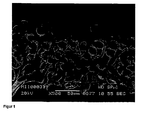
- Fig. 1
- eine Rasterelektronenmikroskopische(REM)-Aufnahme des Faserquerschnitts des im Ausführungsbeispiel 1, Beispiel 8 hergestellten Vliesstoffs (Kern/Mantel-Filamente / PET/PE) bei 500-facher Vergrößerung
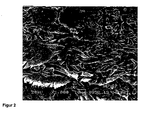
- Fig. 2
- eine Rasterelektronenmikroskopische(REM)-Aufnahme des Faserquerschnitts eines im Ausführungsbeispiel 2 hergestellten Vliesstoffs (PIE-Filamente / PET/PA) bei 1000-facher Vergrößerung
- Fig. 3
- den Schallabsorptionsgrad (Alpha Kabine) eines erfindungsgemäßen Spinnvlieses, das gemäß Ausführungsbeispiel 1 hergestellt wurde, im Vergleich zu Evolon 100®
- Fig. 4
- den Schallabsorptionsgrad eines erfindungsgemäßen Spinnvlieses aus PIE-Filamenten (PET/PA) gemäß den Ausführungsbeispielen 2 und 4 im Vergleich zu einem Spinnvlieses aus SC -Filamenten (PET/CoPET)
- Fig. 5
- die Polymerabhängigkeit des Schallabsorptionsgrades gemessen im Impedanzrohr nach DIN EN ISO 10345-1
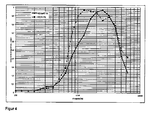
- Fig. 6
- die Gewichtsabhängigkeit des Schallabsorptionsgrades wird gemessen im Impedanzrohr nach DIN EN ISO 10345-1.
- Im Folgenden wird die Erfindung anhand der folgenden Ausführungsbeispiele näher erläutert.
- Zur Herstellung der PIE-Filamente werden Polyethylenterephthalat und Polyamid in bekannter Weise mit einem pro Lochdurchsatz von 0,76 g/L min coextrudiert und aerodynamisch verstreckt, wobei 16 PIE-Filamente entstehen. Der Anteil an Polyamid liegt zwischen 30 und 50 Gew.-%. Die Endlosfilamente werden darauf auf einem Förderband dynamisch abgelegt. Unter dynamischem Ablegen wird verstanden, dass sich die Orientierung der abzulegenden Filamente in Querrichtung gezielt beeinflussen lässt. Darauf erfolgt eine Verfestigung der Endlosfilamente durch eine raue Stahlwalze unter Druck und Wärme. Die Stahlwalze weist Temperaturen zwischen 130 °C und 180 °C bei einem Liniendruck zwischen 50 N/mm und 80 N/mm (Rautiefe von 40 µm) auf. Durch das Beaufschlagen der Endlosfilamente mit Druck und Temperatur wird das Polyamid verschmolzen und das Polyethylenterephthalat in Form von im Querschnitt kuchenstückartigen Elementarfilamenten in einer Matrix aus dem Polyamid verteilt. Hierbei wird ein Spinnvlies mit einem Flächengewicht von 105 g/m2 erhalten. Es entsteht ein Spinnvlies mit dichter Struktur und geringer Porosität bei charakteristischen mechanischen Werten (HZK, WRK, MD:CD Verhältnis). Die Parameter des Versuchs sind in Tabelle 1 dargestellt.
Tabelle 1: Ausführungsbeispiel 1, 105 g/m2 PET/PA Vliesstoff, PIE-Filamente, mech. Eigenschaften. Kalandertemp. Kalandedruck PA-Arteil Gewicht Dicke LD 20cmff50Pa LD Grab Tensile MD Del MD Grab Tensile CD Dehrung CD Trap Teer MD Trap Teer CD EN250173 angel LINEN ISO9073-2 LINEN ISO9237 ASTM CE034 ASTM CE034 ASTM CE034 ASTM CE034 ASTM D5733 ASTM D5733 °C Nnm % g/m2 mm Msec rays N50nm % N50nm % N N 131 50 30 1039 0,2 69 562 224,9 43,7 174,2 41,3 165 163,9 130 50 30 104,7 0,22 81 617 22,5 47,8 206 50,1 185,4 170,3 180 80 30 106,6 0,14 27 188,2 319,2 45,4 2722 43,5 90,7 90,6 180* 50 30 105,7 0,15 31 1613 321,8 48,1 280,3 52,3 86,7 84,7 180* 50 50 104,4 0,15 31 1813 273,8 41,6 226,5 44,7 68,2 68,7 180* 80 50 106,3 0,15 25 2000 285,9 40,9 221,1 40,4 54,2 56,6 130 80 50 105,7 0,17 48 108,7 244,6 43,6 180 39,9 174,9 155,7 130 50 50 106 0,2 85 769 233,2 44,3 179,1 42,6 87 90 - Zur Herstellung der Kern/Mantel-Filamente werden Polyethylenterephthalat und ein niedrig schmelzender Co-Polyester in bekannter Weise mit einem pro Lochdurchsatz von 0,8 g/L min coextrudiert und aerodynamisch verstreckt, wobei Kem/Mantel-Filamente entstehen. Der Anteil an Co-Polyethylenterephthalat beträgt 20 Gew.-%. Die Endlosfilamente werden darauf auf einem Förderband dynamisch abgelegt. Unter dynamischem Ablegen wird verstanden, dass sich die Orientierung der abzulegenden Filamente in Querrichtung gezielt beeinflussen lässt. Darauf erfolgt eine Verfestigung der Endlosfilamente durch eine raue Stahlwalze unter Druck und Wärme. Die Stahlwalze weist eine Temperatur von 130 °C bei einem Liniendruck von 80 N/mm (Rauhtiefe von 40 µm) auf. Durch das Beaufschlagen der Endlosfilamente mit Druck und Temperatur wird das Polyethylenterephthalat in Form von Elementarfilamenten in einer Matrix aus Co-Polyethylenterephtalat verteilt Anschließend erfolgt eine Nachbehandlung im Heißluftofen bei einer Temperatur von 160 °C. Hierbei wird ein Spinnvlies mit einem Flächengewicht von 100 g/m2 erhalten. Hierdurch entsteht ein Vliesstoff mit dichter Struktur und geringer Porosität bei charakteristischen mechanischen Werten (HZK, WRK, MD:CD Verhältnis). Die Parameter des Ausführungsbeispiels sind in Tabelle 2 dargestellt
Tabelle 2: Ausführungsbeispiel 2, 105 g/m2 PET/CoPET Vliesstoff, SC-Filamente, mech. Eigenschaften. Bindekomponente Bindekomponente Gewicht Dicke LD 5cm 780 Pa Tensile MD Dehnung MD Tensile CD Dehnung CD Tear MD Tear CD BN 29973 angel. DINEN BJ ISO 9078-2 DIN EN ISO 9237 EN 29073 T3 EN 29073 T3 EN 29073 T3 EN 29073 T3 Internal Internal g/m3 mm L/m°sec N/50mm % N/50mm % N N Copolyester % 105 0,19 112 304 47 292 45 152 148 - Zur Herstellung der PIE-Filamente werden Polyethylenterephthalat und Polyethylen bzw. Polypropylen in bekannter Weise mit einem pro Lochdurchsatz von 0,65 g/L min coextrudiert und aerodynamisch verstreckt. Die Endlosfilamente werden darauf auf einem Förderband dynamisch abgelegt. Unter dynamischem Ablegen wird verstanden, dass sich die Orientierung der abzulegenden Filamente in Querrichtung gezielt beeinflussen lässt. Darauf erfolgt eine Verfestigung der Endlosfilamente durch eine raue Stahlwalze unter Druck und Wärme. Die Stahlwalze weist Temperaturen zwischen 125 °C und 132 °C auf. Durch das Beaufschlagen der Endlosfilamente mit Druck und Temperatur wird das Polyolefin verschmolzen und das Polyethylenterephthalat in Form von im Querschnitt kuchenstückartigen Elementarfilamenten in einer Matrix aus Polyolefin verteilt. Hierbei werden Spinnvliese mit einem Flächengewicht von 100 - 105 g/m2 erhalten. Die Spinnvliese weisen eine dichte Struktur, sowie eine geringe Porosität, bei charakteristischen mechanischen Werten (Höchstzugkraft (HZK), Weiterreißkraft (WRK), Maschinenrichtung (MD):Querrichtung (CD) Verhältnis) auf.
Die Parameter des Ausführungsbeispiels sind in Tabelle 3 dargestellt.Tabelle 3: Ausführüngsbeispiel 3, 100 -105 g/m2 PET/Polyolefin Vliesstoffe, PIE-Filamente, mech. Eigenschaften. Binde kompomnente komponente Gewicht acte LD 20cm3/50 Pa LD Grab Tensile MD Dehnung MD G-ab Tensite CD Dennung CD Trap Tear MD Trap Taar CD EN29073 angel. DNEN ISO8073-2 DNEN 150 8237 ASTM D5034 ASTM D6034 ASTM D5034 ASTM D5034 ASTM D5733 ASTM D57333 % g/m2 mm Vm rayis N50 mm % N50mm % N N Royethylen 40 100 0,19 69 725 299 88 280 72 152 149 Polypropylen 38 105 17 45 1087 324 57 375 101 185,4 91 - Zur Herstellung der PIE-Filamente werden Polyethylenterephthalat und Polyamid in bekannter Weise mit einem pro Lochdurchsatz von 0,76 g/L min coextrudiert und aerodynamisch verstreckt, wobei 16 PIE-Filamente entstehen. Der Anteil an Polyamid liegt bei 30 Gew.%. Die Endlosfilamente werden darauf auf einem Förderband dynamisch abgelegt. Unter dynamischem Ablegen wird verstanden, dass sich die Orientierung der abzulegenden Filamente in Querrichtung gezielt beeinflussen lässt. Darauf erfolgt eine Verfestigung der Endlosfilamente durch eine raue Stahlwalze unter Druck und Wärme. Die Stahlwalze weist Temperaturen von 130 °C bei einem Liniendruck von 50 N/mm (Rautiefe von 40 µm) auf.
- Durch das Beaufschlagen der Endlosfilamente mit Druck und Temperatur wird das Polyamid verschmolzen und das Polyethylenterephthalat in Form von im Querschnitt kuchenstückartigen Elementarfilamenten in einer Matrix aus dem Polyamid verteilt. Hierbei werden Spinnvliese mit einem Flächengewicht von 40-105 g/m2 erhalten.
- Es entstehen Spinnvliese mit dichter Struktur und geringer Porosität bei charakteristischen mechanischen Werten (HZK, WRK, MD:CD Verhältnis). Die Parameter des Versuchs sind in Tabelle 4 dargestellt.
Tabelle 4: Ausführungsbeispiel 4, 40 - 105 g/m2 PET/PA Vliesstoffe, PIE-Filamente, mech. Eigenschaften. EInde komponente Einde komponone Gewiel Deka LP 22cm/50 Pa LD Grah Tensile MD Dehnung MD Grab terabe CD Dehrung CD Trap Tea MD Trap Tea CD EN29073 angle DNEN ISO9073- OHEN ISO 9237 ASTM D6034 ASTM 05134 ASTM D5034 ASTM 05034 ASTM D5733 ASTM 05783 % g/m2 mm l/m3sec rays N50mn % N80mm % N N Polyamid 30 105 0,15 50 1000 423 60 381 62 50 90 Polyamid 30 80 0.2 738 68 326 46 304 56 93 93 Polyamid 30 60 0,15 1122 45 234 42 222 51 63 68 Polyamid 30 40 0.09 1660 30 145 37 135 47 29 33 - Zur Ermittlung des Schallabsorptionsgrades ausgewählter Varianten des Ausführungsbeispieles 1 im Vergleich zu einem Evolon® Mikrofaserspinnvlies gleichen Gewichtes werden die verschiedenen Materialien einem alpha - Kabinen Test basierend auf ISO 20354:2003 unterzogen. Die entsprechenden Messwerte sind in Tabelle 5 wiedergegeben.
Tabelle 5: Ausführungsbeispiel 1, Schallabsorptionsgrad (Alpha Kabine) im Vergleich zu Evolon 100® Terz-Mittenfrequenz Evo100° Beispiel 1 617 rayls Beispiel 1 1087 rayls Beispiel 1 1613 rayls set* 30/80/130 50/80/130 30/50/180 Schallabsorptionsgrad [Hz] ∪s 200 0,07 0,03 0 0 250 0,05 0,02 0,03 0,05 315 0,02 0,04 0,06 0,04 400 0,09 0,07 0,09 0,09 500 0,11 0,1 0,13 0,07 630 0,12 0,24 0,2 0,19 800 0,34 0,35 0,34 0.36 1000 0,51 0,53 0,53 0,66 1250 0,77 0,73 0,78 0,73 1600 0,79 0,77 0,84 0,77 2000 0,84 0,91 0,96 0,88 2500 0,86 0,88 1 0,82 3150 0,85 0,88 0,87 0,79 4000 0,89 0,89 0,77 0,74 5000 0,87 0,88 0,86 0,8 * Ausführungsbeispiel 1; PA Anteil [%]; Kalanderdruck [N/cm]; Kalandertemperatur [°C] - In
Figur 3 ist der Schallabsorptionsgrad (Alpha Kabine) eines erfindungsgemäßen Spinnvlieses, das gemäß Ausführungsbeispiel 1 hergestellt wurde, im Vergleich zu Evolon 100® dargestellt. - Zur Ermittlung des Schallabsorptionsgrades einer ausgewählten Variante des Ausführungsbeispieles 4 (105 gsm PET/PA PIE) im Vergleich zum Ausführungsbeispiel 2 (100 gsm PET/CoPET SC) werden die verschiedenen Materialien einem Test im Impedanzrohr basierend auf DIN EN ISO 10354:1 unterzogen. Die entsprechenden Messwerte sind in
Figur 4 wiedergegeben. In dieser Abbildung wird der Schallabsorptionsgrad eines erfindungsgemäßen Spinnvlieses aus PIE-Filamenten (PET/PA) gemäß den Ausführungsbeispielen 2 und 4 mit einem Spinnvlieses aus SC - Filamenten (PET/CoPET) verglichen. Die Faserabhängigkeit des Schallabsorptionsgrades wird gemessen im Impedanzrohr nach DIN EN ISO 10345-1. - Hierbei zeigt sich die hinsichtlich eines erhöhten Schallabsorptionsgrades vorteilhafte Wirkung der PIE Fasergeometrie im direkten Vergleich zu einem SC Spinnvlies. Die Dichte der beiden verschiedenen Bindefaserpolymere liegt dabei im gleichen Bereich (-1,1 g/cm3).
- Zur Ermittlung des Schallabsorptionsgrades der Varianten des Ausführungsbeispieles 3 (105 gsm PET/Polyolefin PIE) im Vergleich zu einer ausgewählten vergleichbaren Variante des Ausführungsbeispiel 4 (105 gsm PET/PA PIE) werden die verschiedenen Materialien einem Test im Impedanzrohr basierend auf DIN EN ISO 10354:1 unterzogen. Die entsprechenden Messwerte sind in
Figur 5 wiedergegeben. - Hierbei zeigt sich die hinsichtlich eines erhöhten Schallabsorptionsgrades vorteilhafte Wirkung der PIE Fasergeometrie in Kombination mit Polyamid als Bindekomponente im direkten Vergleich zu Polyolefinhaltigen Spinnvlies vor allem in höheren Frequenzbereichen.
- Zur Ermittlung des Schallabsorptionsgrades der Varianten des Ausführungsbeispieles 4 (40 - 105 gsm PET/PA PIE) werden die verschiedenen Materialien einem Test im Impedanzrohr basierend auf DIN EN ISO 10354:1 unterzogen. Die entsprechenden Messwerte sind in
Figur 6 wiedergegeben. - Hierbei zeigt sich die hinsichtlich eines erhöhten Schallabsorptionsgrades vorteilhafte Wirkung der PIE Fasergeometrie in Kombination mit Polyamid als Bindekomponente im direkten Vergleich zu Polyolefinhaltigen Spinnvlies vor allem in höheren Frequenzbereichen deutlich.
- Zur Ermittlung der Zugeigenschaften der Basismaterialien aus Ausführungsbeispiel 1 unter erhöhter Temperatur werden Varianten in Anlehnung an ASTM D5034 bei einer Prüftemperatur von 160°C auf Höchstzugkraft und Höchstzugkraftdehnung getestet. Die entsprechenden Ergebnisse sind in Tabelle 6 wiedergegeben. Um die Verformungseigenschaften unter Hitze (Tiefziehfähigkeit) zu bewerten, werden fixierte Prüflinge der Substrate in einem einfachen Versuchsaufbau (OTI Test) mittels eines auf 160°C aufgeheizten runden Stempels verformt (Kugeldurchmesser 9 cm, absolute Prüflingsgröße 24 cm Durchmesser, frei verformbare Prüflingsgröße 20 cm). Dabei werden die Weglänge bis zur Beschädigung in cm, die bei einer Verformung von 5% auftretende Kraft in N, sowie die zur Verformung maximal aufzuwendende Kraft in N als Messgrößen zur Bewertung der Materialeigenschaften herangezogen. Eine große Weglänge bei 160°C bei entsprechender (niedriger) Kraft bedeuted demnach positive Verformungseigenschaften unter Hitzeeinwirkung (Tiefziehfähigkeit). Entsprechende Messwerte sind in Tabelle 6 wiedergegeben.
Tabelle 6: Hitzeabhängiger Zug- und Verformungstest an Basismaterialien des Ausführungsbeispieles 1, Versuchstemperatur 160°C. Versuchsbedingungen Grab Tensile Dehnung Grab Tensile Dehnung Vorformungstest MD MD CD CD PA- Anteil Kalanderdruck Kalandertemperatur ASTM D5034 ASTM D5034 ASTM D5034 ASTM D5034 OTI Strecke OTI M 6% OTI max. Kraft Prüftemp. 160°C 160°C 160°C 160°C 160°C 160°C 160°C % N/mm °C N % N % cm N N 30 50 130 155,9 49,4 170.9 49,5 10,26 262.8 1655 30 80 130 158,2 48,8 152 48,5 10,8 248 1859 30 80 180° 148.1 36,7 145,5 42 11.06 287,5 2016 30 50 180° 187,9 42,4 153,9 42,7 11,02 279,1 2005 50 50 180° 139,6 35,2 131,5 39,1 10,44 255,9 1731 50 50 180° 141,5 33,3 130,9 36,3 10,12 262.3 1629 50 60 130 145,6 40 135,8 41.9 10,68 246,6 1778 50 50 130 147.9 40 156.2 47,2 10,36 249.6 1663
Claims (16)
- Verwendung eines Vliesstoffs umfassend mindestens zwei Polymere, wobei der Schmelzpunkt mindestens eines ersten Polymers über dem Schmelzpunkt mindestens eines zweiten Polymers liegt und wobei das erste Polymer in Form von Elementarsegmenten vorliegt, die in einer Matrix aus dem zweiten Polymer verteilt sind als Schallabsorptionsmaterial.
- Verwendung nach Anspruch 1, dadurch gekennzeichnet, dass der Vliesstoff einen Luftschallabsorptionsgrad α(0), gemessen im Impedanzrohr nach DIN EN ISO 10354-1, bei einem Flächengewicht von 100 g/m2, von ≥0,6 bei einer Frequenz von 1000 Hz bis 4000 Hz aufweist.
- Verwendung nach Anspruch 1, dadurch gekennzeichnet, dass der Vliesstoff eine Luftdurchlässigkeit von 20 - 100 Vm2sec, gemessen nach DIN EN ISO 9237, bei einem Flächengewicht von 100 g/m2, bei 20 cm2 und 50 Pa aufweist.
- Verwendung nach Anspruch 1 oder 2, dadurch gekennzeichnet, dass der Vliesstoff eine Dicke von 0,01 mm bis 1 mm, vorzugsweise von 0,05 mm bis 0,5 mm, insbesondere von 0,1 mm bis 0,2 mm, aufweist.
- Verwendung nach einem oder mehreren der Ansprüche 1 bis 3, dadurch gekennzeichnet, dass der Anteil der Matrix im Vliesstoff im Bereich von 1 Gew.-% bis 60 Gew.%, vorzugsweise von 5 Gew.% bis 50 Gew.-%, insbesondere von 10 Gew.-% bis 40 Gew.-%, beträgt.
- Verwendung nach einem oder mehreren der Ansprüche 1 bis 4, dadurch gekennzeichnet, dass die Differenz zwischen den Schmelzpunkten des ersten und zweiten Polymers mindestens 15 °C, vorzugsweise mindestens 20 °C, beträgt.
- Verwendung nach einem oder mehreren der Ansprüche 1 bis 5, dadurch gekennzeichnet, dass im Vliesstoff Elementarsegmente aus einem ersten Polymer vorliegen, die im Querschnitt kreissegmentförmig bzw. kuchenstückförmig, kreisförmig oder multilobal aufgebaut sind, welche in einer Matrix aus dem zweiten Polymer verteilt sind.
- Verwendung nach einem oder mehreren der Ansprüche 1 bis 6, dadurch gekennzeichnet, dass der Vliesstoff mit mindestens einem Bindernittel ausgewählt insbesondere aus Acrylaten und Aminoplasten (Phenolharze, Melaminharze), Styrol-Butadien Copolymeren, NBR Bindersystemen und/oder Polyurethanen imprägniert und mit einem Flammschutzmittel versehen ist.
- Verwendung nach einem oder mehreren der Ansprüche 1 bis 7, dadurch gekennzeichnet, dass der Vliesstoff auf mindestens einer Seite mindestens eine Klebekomponente im Pulverform, vorzugsweise aus einem thermoplastisches Polymer, insbesondere aus Polyethylen, Copolyester oder Polyamid aufweist und/oder mit einem Flammschutzmittel versehen ist.
- Verwendung nach einem oder mehreren der Ansprüche 1 bis 8, dadurch gekennzeichnet, dass der Vliesstoff ein Flächengewicht von 30 g/m2 bis 400 g/m2, vorzugsweise von 35 g/m2 bis 200 g/m2, noch bevorzugter von 40 g/m2 bis 150 g/m2, insbesondere von 40 g/m2 bis 120 g/m2, aufweist.
- Verwendung nach einem oder mehreren der Ansprüche 1 bis 9 zur Herstellung von Auskleidungsteilen für den Innenbereich von Automobilen, vorzugsweise Autohimmeln, Fußmatten, Türverkleidungen, Säulenverkleidungen, Hutablagen und/oder Kofferraumauskleidungen sowie Radkastenauskleidungen und/oder zur Schalldämpfung in Fahrzeugen, Flugzeugen und Zügen, in der Baubranche und in kleinen Geräten, insbesondere im Schallfrequenzbereich von 100 bis 5000 Hz.
- Verwendung nach einem oder mehreren der Ansprüche 1 bis 10, dadurch gekennzeichnet, dass das Schallabsorptionsmaterial hergestellt wird mit einem Verfahren umfassend die folgenden Verfahrensschritte:- Bereitstellen von Mehrkomponentenfasern, welche mindestens zwei Polymere mit unterschiedlichen Schmelzpunkten enthalten,- flächiges Verbinden der Mehrkomponentenfasern mit einer komprimierenden Wärmebehandlung bei einer Temperatur von 100 °C bis 300 °C sowie einem Druck von 40 N/mm bis 150 N/mm, derart, dass mindestens ein erstes Polymer in Form von Elementarsegmenten in einer Matrix aus mindestens einem zweiten Polymer verteilt wird.
- Verwendung nach einem oder mehreren der Ansprüche 1 bis 11, dadurch gekennzeichnet, dass die Mehrkomponentenfasern, eine erste Polymerkomponente und eine zweite Polymerkomponente umfassen, wobei- die erste Polymerkomponente in einer ersten Zone und die zweite Polymerkomponente in einer zweiten Zonen über den Querschnitt der Mehrkomponentenfasern angeordnet ist, wobei- sich beide Polymerkomponenten in Längenrichtung der Mehrkomponentenfasern erstrecken, wobei- die erste Polymerkomponente einen Schmelzpunkt oberhalb des Schmelzpunkts der zweiten Polymerkomponente aufweist und wobei die erste Zone die erste Polymerkomponente in Form von mindestens zwei trennbaren Elementarsegmenten umfasst.
- Verwendung nach Anspruch 12, dadurch gekennzeichnet, dass als Mehrkomponentenfasern PIE-Fasern, Hollow-PIE-Fasern, Kern/Mantel-Fasern, multilobale Fasern oder Side by Side-Fasern eingesetzt werden, welche aus mindestens zwei Polymeren mit unterschiedlichen Schmelzpunkten aufgebaut sind.
- Verwendung nach einem oder mehreren der Ansprüche 11 bis 13, dadurch gekennzeichnet, dass das flächige Verbinden der Mehrkomponentenfasern durch Beaufschlagen mit einem Druck von 40 N/mm bis 100 N/mm, vorzugsweise von 60 N/mm bis 80 N/mm, insbesondere von 50 N/mm bis 90 N/mm, durchgeführt wird.
- Verwendung nach einem oder mehreren der Ansprüche 11 bis 14 an den vierziger, dadurch gekennzeichnet, dass das flächige Verbinden der Mehrkomponentenfasern durch Beaufschlagen mit einer Temperatur von mehr als 100 °C, vorzugsweise von 100 °C bis 300 °C, noch bevorzugter von 110 °C bis 200 °C, insbesondere von 120 °C bis 180 °C, durchgeführt wird.
Priority Applications (1)
| Application Number | Priority Date | Filing Date | Title |
|---|---|---|---|
| EP12006446.4A EP2573244B1 (de) | 2011-09-20 | 2012-09-14 | Schallabsorptionsmaterial |
Applications Claiming Priority (2)
| Application Number | Priority Date | Filing Date | Title |
|---|---|---|---|
| EP11007649.4A EP2573243B1 (de) | 2011-09-20 | 2011-09-20 | Vliesstoff mit einer Elementarfilamente enthaltenden Matrix |
| EP12006446.4A EP2573244B1 (de) | 2011-09-20 | 2012-09-14 | Schallabsorptionsmaterial |
Publications (2)
| Publication Number | Publication Date |
|---|---|
| EP2573244A1 true EP2573244A1 (de) | 2013-03-27 |
| EP2573244B1 EP2573244B1 (de) | 2015-02-18 |
Family
ID=46826217
Family Applications (3)
| Application Number | Title | Priority Date | Filing Date |
|---|---|---|---|
| EP11007649.4A Active EP2573243B1 (de) | 2011-09-20 | 2011-09-20 | Vliesstoff mit einer Elementarfilamente enthaltenden Matrix |
| EP12765995.1A Active EP2758580B1 (de) | 2011-09-20 | 2012-09-11 | Vliesstoff mit einer elementarfilamente enthaltenden matrix |
| EP12006446.4A Active EP2573244B1 (de) | 2011-09-20 | 2012-09-14 | Schallabsorptionsmaterial |
Family Applications Before (2)
| Application Number | Title | Priority Date | Filing Date |
|---|---|---|---|
| EP11007649.4A Active EP2573243B1 (de) | 2011-09-20 | 2011-09-20 | Vliesstoff mit einer Elementarfilamente enthaltenden Matrix |
| EP12765995.1A Active EP2758580B1 (de) | 2011-09-20 | 2012-09-11 | Vliesstoff mit einer elementarfilamente enthaltenden matrix |
Country Status (2)
| Country | Link |
|---|---|
| EP (3) | EP2573243B1 (de) |
| WO (1) | WO2013041193A1 (de) |
Cited By (1)
| Publication number | Priority date | Publication date | Assignee | Title |
|---|---|---|---|---|
| US11541829B2 (en) | 2020-06-18 | 2023-01-03 | Freudenberg Performance Materials Lp | Acoustical baffle |
Families Citing this family (5)
| Publication number | Priority date | Publication date | Assignee | Title |
|---|---|---|---|---|
| DE102014110585A1 (de) * | 2014-07-28 | 2016-01-28 | Bundesdruckerei Gmbh | Datenblatt und Verfahren zu dessen Herstellung sowie ein Wert- und/oder Sicherheitsdokument |
| WO2018178184A1 (de) * | 2017-03-28 | 2018-10-04 | Mann+Hummel Gmbh | Spinnvliesmaterial, gegenstand umfassend ein spinnvliesmaterial, filtermedium, filterelement und deren verwendung |
| CN114622341A (zh) * | 2020-12-15 | 2022-06-14 | 浙江青昀新材料科技有限公司 | 一种聚乙烯无纺布及其应用 |
| WO2025080546A1 (en) * | 2023-10-09 | 2025-04-17 | Ascend Performance Materials Operations Llc | Spunlace with stable construction and wicking performance |
| CN118065056B (zh) * | 2024-04-16 | 2024-09-06 | 江苏青昀新材料有限公司 | 一种耐屈挠的非织造无纺布及其制备方法 |
Citations (2)
| Publication number | Priority date | Publication date | Assignee | Title |
|---|---|---|---|---|
| DE10009281C1 (de) | 2000-02-28 | 2001-03-22 | Freudenberg Carl Fa | Schallabsorptionsmaterial |
| US20040071947A1 (en) * | 2002-10-12 | 2004-04-15 | Sung-Su Hwang | Fiber sheet with heat-treated surface layer |
Family Cites Families (8)
| Publication number | Priority date | Publication date | Assignee | Title |
|---|---|---|---|---|
| US4039711A (en) * | 1971-06-07 | 1977-08-02 | The Kendall Company | Non-woven fabrics |
| US20050039836A1 (en) * | 1999-09-03 | 2005-02-24 | Dugan Jeffrey S. | Multi-component fibers, fiber-containing materials made from multi-component fibers and methods of making the fiber-containing materials |
| US20030041953A1 (en) * | 2001-08-31 | 2003-03-06 | Bba Nonwovens Simpsonville, Inc. | Method of making a bonded nonwoven web |
| US7452832B2 (en) * | 2003-12-15 | 2008-11-18 | E.I. Du Pont De Nemors And Company | Full-surface bonded multiple component melt-spun nonwoven web |
| US7438777B2 (en) | 2005-04-01 | 2008-10-21 | North Carolina State University | Lightweight high-tensile, high-tear strength bicomponent nonwoven fabrics |
| CN101678255A (zh) * | 2007-05-31 | 2010-03-24 | 东丽株式会社 | 圆筒状袋式过滤器用无纺布、其制造方法及由其制成的圆筒状袋式过滤器 |
| DE102007049031A1 (de) * | 2007-10-11 | 2009-04-16 | Fiberweb Corovin Gmbh | Polypropylenmischung |
| US8906815B2 (en) * | 2007-12-28 | 2014-12-09 | 3M Innovative Properties Company | Composite nonwoven fibrous webs and methods of making and using the same |
-
2011
- 2011-09-20 EP EP11007649.4A patent/EP2573243B1/de active Active
-
2012
- 2012-09-11 EP EP12765995.1A patent/EP2758580B1/de active Active
- 2012-09-11 WO PCT/EP2012/003804 patent/WO2013041193A1/de not_active Ceased
- 2012-09-14 EP EP12006446.4A patent/EP2573244B1/de active Active
Patent Citations (2)
| Publication number | Priority date | Publication date | Assignee | Title |
|---|---|---|---|---|
| DE10009281C1 (de) | 2000-02-28 | 2001-03-22 | Freudenberg Carl Fa | Schallabsorptionsmaterial |
| US20040071947A1 (en) * | 2002-10-12 | 2004-04-15 | Sung-Su Hwang | Fiber sheet with heat-treated surface layer |
Cited By (1)
| Publication number | Priority date | Publication date | Assignee | Title |
|---|---|---|---|---|
| US11541829B2 (en) | 2020-06-18 | 2023-01-03 | Freudenberg Performance Materials Lp | Acoustical baffle |
Also Published As
| Publication number | Publication date |
|---|---|
| EP2758580A1 (de) | 2014-07-30 |
| EP2573243A1 (de) | 2013-03-27 |
| WO2013041193A1 (de) | 2013-03-28 |
| EP2573243B1 (de) | 2015-02-11 |
| EP2573244B1 (de) | 2015-02-18 |
| EP2758580B1 (de) | 2016-11-02 |
Similar Documents
| Publication | Publication Date | Title |
|---|---|---|
| DE60001749T2 (de) | Verbundvlies mit binder | |
| EP0942057B2 (de) | Klebeband zur Bündelung von Kabeln | |
| DE60012330T2 (de) | Verbundvliesmaterial | |
| EP2573244B1 (de) | Schallabsorptionsmaterial | |
| EP2115201B1 (de) | Hochfester leichter vliesstoff aus spinnvlies, verfahren zu seiner herstellung und seine verwendung | |
| EP1261766B1 (de) | Schallabsorptionsmaterial | |
| DE102005006234B4 (de) | Selbsttragende, Luftschall absorbierende Motorraumverkleidung für Kraftfahrzeuge | |
| DE102015009370A1 (de) | Aerogelvliesstoff | |
| DE10151411B4 (de) | Schichtstoff mit verbesserten Eigenschaften | |
| DE202010018588U1 (de) | Mehrschichtiges Vliesverbundmaterial mit elastischen Eigenschaften | |
| EP2376275A2 (de) | Verfahren zur herstellung von fasergelegen, sowie fasergelege und deren verwendung | |
| EP3052688B1 (de) | Flächengebilde mit hoher temperaturstabilität | |
| EP2943352B1 (de) | Beschichtungssystem | |
| EP0805752B1 (de) | Flächenartiges verbundisoliermaterialsystem und verfahren zu dessen herstellung | |
| EP1927639B1 (de) | Technisches Vliesklebeband | |
| DE60005527T2 (de) | Hydrodynamisch verfestigte trägerbahnen und deren verwendung | |
| DE29720598U1 (de) | Vliesstoff aus Naturfasern und Kunstfasern | |
| EP1707666A1 (de) | Synthetisches Leder, Verfahren zu dessen Herstellung und dessen Verwendung | |
| DE102004030393A1 (de) | Verfahren zur Herstellung eines dreidimensional geformten Vliesstoffes, Vorrichtung zur Benutzung in dem Verfahren, danach erhaltener dreidimensional geformter Vliesstoff und seine Verwendung | |
| EP2183418B1 (de) | Verfahren zur herstellung eines weiterreissfesten flächengebildes, weiterreissfestes flächengebilde und dessen verwendung | |
| WO2004008059A1 (de) | Schutztextilie gegen ballistische einwirkungen | |
| DE19952432B4 (de) | Schichtstoff | |
| DE19935408A1 (de) | Mehrlagenschichtstoff | |
| DE19955730C2 (de) | Hydrodynamisch verbundene Trägervliese und deren Verwendung | |
| WO2005021853A2 (de) | Thermoformbares trägerteil |
Legal Events
| Date | Code | Title | Description |
|---|---|---|---|
| PUAI | Public reference made under article 153(3) epc to a published international application that has entered the european phase |
Free format text: ORIGINAL CODE: 0009012 |
|
| AK | Designated contracting states |
Kind code of ref document: A1 Designated state(s): AL AT BE BG CH CY CZ DE DK EE ES FI FR GB GR HR HU IE IS IT LI LT LU LV MC MK MT NL NO PL PT RO RS SE SI SK SM TR |
|
| AX | Request for extension of the european patent |
Extension state: BA ME |
|
| 17P | Request for examination filed |
Effective date: 20130926 |
|
| RBV | Designated contracting states (corrected) |
Designated state(s): AL AT BE BG CH CY CZ DE DK EE ES FI FR GB GR HR HU IE IS IT LI LT LU LV MC MK MT NL NO PL PT RO RS SE SI SK SM TR |
|
| 17Q | First examination report despatched |
Effective date: 20140103 |
|
| GRAP | Despatch of communication of intention to grant a patent |
Free format text: ORIGINAL CODE: EPIDOSNIGR1 |
|
| INTG | Intention to grant announced |
Effective date: 20140825 |
|
| GRAS | Grant fee paid |
Free format text: ORIGINAL CODE: EPIDOSNIGR3 |
|
| GRAA | (expected) grant |
Free format text: ORIGINAL CODE: 0009210 |
|
| AK | Designated contracting states |
Kind code of ref document: B1 Designated state(s): AL AT BE BG CH CY CZ DE DK EE ES FI FR GB GR HR HU IE IS IT LI LT LU LV MC MK MT NL NO PL PT RO RS SE SI SK SM TR |
|
| REG | Reference to a national code |
Ref country code: GB Ref legal event code: FG4D Free format text: NOT ENGLISH |
|
| REG | Reference to a national code |
Ref country code: CH Ref legal event code: EP |
|
| REG | Reference to a national code |
Ref country code: AT Ref legal event code: REF Ref document number: 710720 Country of ref document: AT Kind code of ref document: T Effective date: 20150315 |
|
| REG | Reference to a national code |
Ref country code: IE Ref legal event code: FG4D Free format text: LANGUAGE OF EP DOCUMENT: GERMAN |
|
| REG | Reference to a national code |
Ref country code: DE Ref legal event code: R096 Ref document number: 502012002273 Country of ref document: DE Effective date: 20150402 |
|
| REG | Reference to a national code |
Ref country code: NL Ref legal event code: T3 |
|
| REG | Reference to a national code |
Ref country code: LT Ref legal event code: MG4D |
|
| PG25 | Lapsed in a contracting state [announced via postgrant information from national office to epo] |
Ref country code: HR Free format text: LAPSE BECAUSE OF FAILURE TO SUBMIT A TRANSLATION OF THE DESCRIPTION OR TO PAY THE FEE WITHIN THE PRESCRIBED TIME-LIMIT Effective date: 20150218 Ref country code: SE Free format text: LAPSE BECAUSE OF FAILURE TO SUBMIT A TRANSLATION OF THE DESCRIPTION OR TO PAY THE FEE WITHIN THE PRESCRIBED TIME-LIMIT Effective date: 20150218 Ref country code: NO Free format text: LAPSE BECAUSE OF FAILURE TO SUBMIT A TRANSLATION OF THE DESCRIPTION OR TO PAY THE FEE WITHIN THE PRESCRIBED TIME-LIMIT Effective date: 20150518 Ref country code: FI Free format text: LAPSE BECAUSE OF FAILURE TO SUBMIT A TRANSLATION OF THE DESCRIPTION OR TO PAY THE FEE WITHIN THE PRESCRIBED TIME-LIMIT Effective date: 20150218 Ref country code: LT Free format text: LAPSE BECAUSE OF FAILURE TO SUBMIT A TRANSLATION OF THE DESCRIPTION OR TO PAY THE FEE WITHIN THE PRESCRIBED TIME-LIMIT Effective date: 20150218 Ref country code: ES Free format text: LAPSE BECAUSE OF FAILURE TO SUBMIT A TRANSLATION OF THE DESCRIPTION OR TO PAY THE FEE WITHIN THE PRESCRIBED TIME-LIMIT Effective date: 20150218 |
|
| PG25 | Lapsed in a contracting state [announced via postgrant information from national office to epo] |
Ref country code: IS Free format text: LAPSE BECAUSE OF FAILURE TO SUBMIT A TRANSLATION OF THE DESCRIPTION OR TO PAY THE FEE WITHIN THE PRESCRIBED TIME-LIMIT Effective date: 20150618 Ref country code: GR Free format text: LAPSE BECAUSE OF FAILURE TO SUBMIT A TRANSLATION OF THE DESCRIPTION OR TO PAY THE FEE WITHIN THE PRESCRIBED TIME-LIMIT Effective date: 20150519 Ref country code: RS Free format text: LAPSE BECAUSE OF FAILURE TO SUBMIT A TRANSLATION OF THE DESCRIPTION OR TO PAY THE FEE WITHIN THE PRESCRIBED TIME-LIMIT Effective date: 20150218 Ref country code: LV Free format text: LAPSE BECAUSE OF FAILURE TO SUBMIT A TRANSLATION OF THE DESCRIPTION OR TO PAY THE FEE WITHIN THE PRESCRIBED TIME-LIMIT Effective date: 20150218 |
|
| REG | Reference to a national code |
Ref country code: FR Ref legal event code: PLFP Year of fee payment: 4 |
|
| PG25 | Lapsed in a contracting state [announced via postgrant information from national office to epo] |
Ref country code: CZ Free format text: LAPSE BECAUSE OF FAILURE TO SUBMIT A TRANSLATION OF THE DESCRIPTION OR TO PAY THE FEE WITHIN THE PRESCRIBED TIME-LIMIT Effective date: 20150218 Ref country code: EE Free format text: LAPSE BECAUSE OF FAILURE TO SUBMIT A TRANSLATION OF THE DESCRIPTION OR TO PAY THE FEE WITHIN THE PRESCRIBED TIME-LIMIT Effective date: 20150218 Ref country code: DK Free format text: LAPSE BECAUSE OF FAILURE TO SUBMIT A TRANSLATION OF THE DESCRIPTION OR TO PAY THE FEE WITHIN THE PRESCRIBED TIME-LIMIT Effective date: 20150218 Ref country code: SK Free format text: LAPSE BECAUSE OF FAILURE TO SUBMIT A TRANSLATION OF THE DESCRIPTION OR TO PAY THE FEE WITHIN THE PRESCRIBED TIME-LIMIT Effective date: 20150218 Ref country code: RO Free format text: LAPSE BECAUSE OF FAILURE TO SUBMIT A TRANSLATION OF THE DESCRIPTION OR TO PAY THE FEE WITHIN THE PRESCRIBED TIME-LIMIT Effective date: 20150218 |
|
| REG | Reference to a national code |
Ref country code: DE Ref legal event code: R097 Ref document number: 502012002273 Country of ref document: DE |
|
| PG25 | Lapsed in a contracting state [announced via postgrant information from national office to epo] |
Ref country code: PL Free format text: LAPSE BECAUSE OF FAILURE TO SUBMIT A TRANSLATION OF THE DESCRIPTION OR TO PAY THE FEE WITHIN THE PRESCRIBED TIME-LIMIT Effective date: 20150218 |
|
| PLBE | No opposition filed within time limit |
Free format text: ORIGINAL CODE: 0009261 |
|
| STAA | Information on the status of an ep patent application or granted ep patent |
Free format text: STATUS: NO OPPOSITION FILED WITHIN TIME LIMIT |
|
| PG25 | Lapsed in a contracting state [announced via postgrant information from national office to epo] |
Ref country code: IT Free format text: LAPSE BECAUSE OF FAILURE TO SUBMIT A TRANSLATION OF THE DESCRIPTION OR TO PAY THE FEE WITHIN THE PRESCRIBED TIME-LIMIT Effective date: 20150218 |
|
| 26N | No opposition filed |
Effective date: 20151119 |
|
| PG25 | Lapsed in a contracting state [announced via postgrant information from national office to epo] |
Ref country code: SI Free format text: LAPSE BECAUSE OF FAILURE TO SUBMIT A TRANSLATION OF THE DESCRIPTION OR TO PAY THE FEE WITHIN THE PRESCRIBED TIME-LIMIT Effective date: 20150218 |
|
| PG25 | Lapsed in a contracting state [announced via postgrant information from national office to epo] |
Ref country code: MC Free format text: LAPSE BECAUSE OF FAILURE TO SUBMIT A TRANSLATION OF THE DESCRIPTION OR TO PAY THE FEE WITHIN THE PRESCRIBED TIME-LIMIT Effective date: 20150218 Ref country code: LU Free format text: LAPSE BECAUSE OF FAILURE TO SUBMIT A TRANSLATION OF THE DESCRIPTION OR TO PAY THE FEE WITHIN THE PRESCRIBED TIME-LIMIT Effective date: 20150914 |
|
| REG | Reference to a national code |
Ref country code: CH Ref legal event code: PL |
|
| REG | Reference to a national code |
Ref country code: IE Ref legal event code: MM4A |
|
| PG25 | Lapsed in a contracting state [announced via postgrant information from national office to epo] |
Ref country code: IE Free format text: LAPSE BECAUSE OF NON-PAYMENT OF DUE FEES Effective date: 20150914 Ref country code: LI Free format text: LAPSE BECAUSE OF NON-PAYMENT OF DUE FEES Effective date: 20150930 Ref country code: CH Free format text: LAPSE BECAUSE OF NON-PAYMENT OF DUE FEES Effective date: 20150930 |
|
| REG | Reference to a national code |
Ref country code: FR Ref legal event code: PLFP Year of fee payment: 5 |
|
| PG25 | Lapsed in a contracting state [announced via postgrant information from national office to epo] |
Ref country code: MT Free format text: LAPSE BECAUSE OF FAILURE TO SUBMIT A TRANSLATION OF THE DESCRIPTION OR TO PAY THE FEE WITHIN THE PRESCRIBED TIME-LIMIT Effective date: 20150218 |
|
| PG25 | Lapsed in a contracting state [announced via postgrant information from national office to epo] |
Ref country code: BG Free format text: LAPSE BECAUSE OF FAILURE TO SUBMIT A TRANSLATION OF THE DESCRIPTION OR TO PAY THE FEE WITHIN THE PRESCRIBED TIME-LIMIT Effective date: 20150218 Ref country code: SM Free format text: LAPSE BECAUSE OF FAILURE TO SUBMIT A TRANSLATION OF THE DESCRIPTION OR TO PAY THE FEE WITHIN THE PRESCRIBED TIME-LIMIT Effective date: 20150218 Ref country code: HU Free format text: LAPSE BECAUSE OF FAILURE TO SUBMIT A TRANSLATION OF THE DESCRIPTION OR TO PAY THE FEE WITHIN THE PRESCRIBED TIME-LIMIT; INVALID AB INITIO Effective date: 20120914 |
|
| PG25 | Lapsed in a contracting state [announced via postgrant information from national office to epo] |
Ref country code: CY Free format text: LAPSE BECAUSE OF FAILURE TO SUBMIT A TRANSLATION OF THE DESCRIPTION OR TO PAY THE FEE WITHIN THE PRESCRIBED TIME-LIMIT Effective date: 20150218 |
|
| PG25 | Lapsed in a contracting state [announced via postgrant information from national office to epo] |
Ref country code: BE Free format text: LAPSE BECAUSE OF NON-PAYMENT OF DUE FEES Effective date: 20150930 |
|
| REG | Reference to a national code |
Ref country code: FR Ref legal event code: PLFP Year of fee payment: 6 |
|
| PG25 | Lapsed in a contracting state [announced via postgrant information from national office to epo] |
Ref country code: MK Free format text: LAPSE BECAUSE OF FAILURE TO SUBMIT A TRANSLATION OF THE DESCRIPTION OR TO PAY THE FEE WITHIN THE PRESCRIBED TIME-LIMIT Effective date: 20150218 Ref country code: PT Free format text: LAPSE BECAUSE OF FAILURE TO SUBMIT A TRANSLATION OF THE DESCRIPTION OR TO PAY THE FEE WITHIN THE PRESCRIBED TIME-LIMIT Effective date: 20150218 |
|
| REG | Reference to a national code |
Ref country code: FR Ref legal event code: PLFP Year of fee payment: 7 |
|
| PG25 | Lapsed in a contracting state [announced via postgrant information from national office to epo] |
Ref country code: AL Free format text: LAPSE BECAUSE OF FAILURE TO SUBMIT A TRANSLATION OF THE DESCRIPTION OR TO PAY THE FEE WITHIN THE PRESCRIBED TIME-LIMIT Effective date: 20150218 |
|
| REG | Reference to a national code |
Ref country code: AT Ref legal event code: MM01 Ref document number: 710720 Country of ref document: AT Kind code of ref document: T Effective date: 20170914 |
|
| PG25 | Lapsed in a contracting state [announced via postgrant information from national office to epo] |
Ref country code: AT Free format text: LAPSE BECAUSE OF NON-PAYMENT OF DUE FEES Effective date: 20170914 |
|
| PGFP | Annual fee paid to national office [announced via postgrant information from national office to epo] |
Ref country code: DE Payment date: 20250926 Year of fee payment: 14 |
|
| PGFP | Annual fee paid to national office [announced via postgrant information from national office to epo] |
Ref country code: NL Payment date: 20250925 Year of fee payment: 14 Ref country code: TR Payment date: 20250827 Year of fee payment: 14 |
|
| PGFP | Annual fee paid to national office [announced via postgrant information from national office to epo] |
Ref country code: GB Payment date: 20250923 Year of fee payment: 14 |
|
| PGFP | Annual fee paid to national office [announced via postgrant information from national office to epo] |
Ref country code: FR Payment date: 20250925 Year of fee payment: 14 |