EP2552410B1 - Method for preserving alum adjuvants and alum-adjuvanted vaccines - Google Patents
Method for preserving alum adjuvants and alum-adjuvanted vaccines Download PDFInfo
- Publication number
- EP2552410B1 EP2552410B1 EP11712653.2A EP11712653A EP2552410B1 EP 2552410 B1 EP2552410 B1 EP 2552410B1 EP 11712653 A EP11712653 A EP 11712653A EP 2552410 B1 EP2552410 B1 EP 2552410B1
- Authority
- EP
- European Patent Office
- Prior art keywords
- alkyl
- adjuvant
- freeze
- concentration
- dmg
- Prior art date
- Legal status (The legal status is an assumption and is not a legal conclusion. Google has not performed a legal analysis and makes no representation as to the accuracy of the status listed.)
- Active
Links
Images



Classifications
-
- A—HUMAN NECESSITIES
- A61—MEDICAL OR VETERINARY SCIENCE; HYGIENE
- A61K—PREPARATIONS FOR MEDICAL, DENTAL OR TOILETRY PURPOSES
- A61K9/00—Medicinal preparations characterised by special physical form
- A61K9/08—Solutions
-
- A—HUMAN NECESSITIES
- A61—MEDICAL OR VETERINARY SCIENCE; HYGIENE
- A61K—PREPARATIONS FOR MEDICAL, DENTAL OR TOILETRY PURPOSES
- A61K9/00—Medicinal preparations characterised by special physical form
- A61K9/14—Particulate form, e.g. powders, Processes for size reducing of pure drugs or the resulting products, Pure drug nanoparticles
- A61K9/19—Particulate form, e.g. powders, Processes for size reducing of pure drugs or the resulting products, Pure drug nanoparticles lyophilised, i.e. freeze-dried, solutions or dispersions
-
- A—HUMAN NECESSITIES
- A61—MEDICAL OR VETERINARY SCIENCE; HYGIENE
- A61K—PREPARATIONS FOR MEDICAL, DENTAL OR TOILETRY PURPOSES
- A61K31/00—Medicinal preparations containing organic active ingredients
- A61K31/095—Sulfur, selenium, or tellurium compounds, e.g. thiols
- A61K31/10—Sulfides; Sulfoxides; Sulfones
-
- A—HUMAN NECESSITIES
- A61—MEDICAL OR VETERINARY SCIENCE; HYGIENE
- A61K—PREPARATIONS FOR MEDICAL, DENTAL OR TOILETRY PURPOSES
- A61K31/00—Medicinal preparations containing organic active ingredients
- A61K31/13—Amines
- A61K31/131—Amines acyclic
-
- A—HUMAN NECESSITIES
- A61—MEDICAL OR VETERINARY SCIENCE; HYGIENE
- A61K—PREPARATIONS FOR MEDICAL, DENTAL OR TOILETRY PURPOSES
- A61K31/00—Medicinal preparations containing organic active ingredients
- A61K31/13—Amines
- A61K31/14—Quaternary ammonium compounds, e.g. edrophonium, choline
-
- A—HUMAN NECESSITIES
- A61—MEDICAL OR VETERINARY SCIENCE; HYGIENE
- A61K—PREPARATIONS FOR MEDICAL, DENTAL OR TOILETRY PURPOSES
- A61K33/00—Medicinal preparations containing inorganic active ingredients
- A61K33/06—Aluminium, calcium or magnesium; Compounds thereof, e.g. clay
- A61K33/08—Oxides; Hydroxides
-
- A—HUMAN NECESSITIES
- A61—MEDICAL OR VETERINARY SCIENCE; HYGIENE
- A61K—PREPARATIONS FOR MEDICAL, DENTAL OR TOILETRY PURPOSES
- A61K39/00—Medicinal preparations containing antigens or antibodies
- A61K39/39—Medicinal preparations containing antigens or antibodies characterised by the immunostimulating additives, e.g. chemical adjuvants
-
- A—HUMAN NECESSITIES
- A61—MEDICAL OR VETERINARY SCIENCE; HYGIENE
- A61K—PREPARATIONS FOR MEDICAL, DENTAL OR TOILETRY PURPOSES
- A61K47/00—Medicinal preparations characterised by the non-active ingredients used, e.g. carriers or inert additives; Targeting or modifying agents chemically bound to the active ingredient
- A61K47/06—Organic compounds, e.g. natural or synthetic hydrocarbons, polyolefins, mineral oil, petrolatum or ozokerite
- A61K47/16—Organic compounds, e.g. natural or synthetic hydrocarbons, polyolefins, mineral oil, petrolatum or ozokerite containing nitrogen, e.g. nitro-, nitroso-, azo-compounds, nitriles, cyanates
- A61K47/18—Amines; Amides; Ureas; Quaternary ammonium compounds; Amino acids; Oligopeptides having up to five amino acids
- A61K47/183—Amino acids, e.g. glycine, EDTA or aspartame
-
- A—HUMAN NECESSITIES
- A61—MEDICAL OR VETERINARY SCIENCE; HYGIENE
- A61K—PREPARATIONS FOR MEDICAL, DENTAL OR TOILETRY PURPOSES
- A61K47/00—Medicinal preparations characterised by the non-active ingredients used, e.g. carriers or inert additives; Targeting or modifying agents chemically bound to the active ingredient
- A61K47/06—Organic compounds, e.g. natural or synthetic hydrocarbons, polyolefins, mineral oil, petrolatum or ozokerite
- A61K47/20—Organic compounds, e.g. natural or synthetic hydrocarbons, polyolefins, mineral oil, petrolatum or ozokerite containing sulfur, e.g. dimethyl sulfoxide [DMSO], docusate, sodium lauryl sulfate or aminosulfonic acids
-
- A—HUMAN NECESSITIES
- A61—MEDICAL OR VETERINARY SCIENCE; HYGIENE
- A61K—PREPARATIONS FOR MEDICAL, DENTAL OR TOILETRY PURPOSES
- A61K39/00—Medicinal preparations containing antigens or antibodies
- A61K2039/555—Medicinal preparations containing antigens or antibodies characterised by a specific combination antigen/adjuvant
- A61K2039/55505—Inorganic adjuvants
Definitions
- the invention relates to a method for preserving an aluminium salt adjuvant during freezing or freeze-drying, typically during freezing or freeze-drying of a vaccine preparation comprising an aluminium salt adjuvant and one or more vaccine antigens.
- Aluminium salt adjuvants are currently the most widely used adjuvants for human and veterinary vaccines.
- Aluminium adjuvant compounds include aluminium salts such as aluminium phosphate (AlPO 4 ) and aluminium hydroxide (Al(OH) 3 ) which are generically referred to in the field of vaccine adjuvants as " alum ".
- AlPO 4 aluminium phosphate
- Al(OH) 3 aluminium hydroxide
- alum adjuvants act as an immune system stimulus as well as providing a depot of antigen at the site of administration (e.g. by injection) thereby providing a gradual and continuous release of antigen to stimulate antibody production.
- Aluminium adjuvants in their natural form are commonly known as gels, which are particulate suspensions in aqueous media.
- Freeze-drying lyophilisation
- Freeze-drying causes the collapse of the gel structure of the adjuvant resulting in aggregation and precipitation of the adjuvant salt on resuspension in water. The effect is to significantly reduce the immunogenicity of the vaccine.
- WO 01/93829 describes a method of preparing an adjuvanted vaccine comprising spray-drying or spray freeze-drying an aqueous solution comprising:
- WO 2008/118691 describes a method of preparing an immunologically-active adjuvant-bound dried vaccine composition comprising (a) combining at least one aluminium-salt adjuvant, at least one buffer system, at least one glass-forming agent and at least one antigen to create a liquid vaccine formulation; (b) freezing the liquid vaccine formulation to create a frozen vaccine formulation; and (c) lyophilizing the frozen vaccine formulation to create a dried vaccine composition.
- the glass-forming agent is preferably trehalose.
- an aluminium salt adjuvant can be reduced by freezing or freeze-drying, in particular freeze-drying, the adjuvant in the presence of a N,N-di(C 1-6 alkyl)- or N,N,N-tri(C 1-6 alkyl)-glycine or a physiologically acceptable salt or ester thereof.
- the additional presence of one or more sugars can lead to a further reduction in the structural damage to the adjuvant during freezing or freeze-drying.
- the present invention provides a method for preserving an aluminium-salt adjuvant during freezing or freeze-drying comprising freezing or freeze-drying an aqueous suspension or solution comprising:
- the present invention also provides:
- the frozen or freeze-dried vaccine compositions facilitate appropriate storage and maximize the shelf-life of the compositions.
- the compositions can be stock piled for prolonged periods of time.
- the immunogenicity, potency and efficacy of the vaccines can thus be maintained.
- the N,N-di(C 1-6 alkyl)- or N,N,N-tri(C 1-6 alkyl)-glycine or physiologically acceptable salt or ester thereof and the sugar(s) act as cryoprotectants and protect the aluminium salt adjuvants against the stresses encountered during freezing and also as a lyoprotectant during freeze-drying.
- the present invention relates to the reduction and/or prevention of structural damage to aluminium salt vaccine adjuvants when frozen or freeze-dried, especially freeze-dried.
- structural damage is reduced or prevented by freezing or freeze-drying the adjuvant in the presence of a N,N-di(C 1-6 alkyl)- or N,N,N-tri(C 1-6 alkyl)-glycine or physiologically acceptable salt or ester thereof and (ii) one or more sugars.
- the aluminium salt adjuvant on which typically at least one antigen is adsorbed, is contacted with the N,N-di(C 1-6 alkyl)- or N,N,N-tri(C 1-6 alkyl)-glycine or physiologically acceptable salt or ester thereof in aqueous solution.
- the resulting aqueous composition in which one or more sugars may also be present, is then frozen or freeze-dried.
- the method is a method of preparing a vaccine composition comprising an aluminium salt adjuvant and at least one antigen.
- a vaccine preparation comprising the aluminium adjuvant can be thawed or reconstituted after freezing or freeze-drying respectively, prior to administration of the vaccine preparation to a patient.
- the invention enables the structure and function of the aluminium adjuvant to be preserved during the freezing or freeze-drying step.
- the immunogenicity of aluminium adjuvanted vaccines following freezing or freeze-drying can consequently be maintained.
- aluminium salt suitable for use as an adjuvant may be used in the invention.
- the aluminium salt may be aluminium hydroxide (Al(OH) 3 ), aluminium phosphate (AlPO 4 ), aluminium hydrochloride, aluminium sulphate, ammonium alum, potassium alum or aluminium silicate.
- the aluminium salt adjuvant used is aluminium hydroxide or aluminium phosphate.
- the aluminium salt adjuvant is aluminium hydroxide (Al(OH) 3 ).
- the aluminium salt adjuvant takes the form of a hydrated gel made from an aluminium salt, the hydrated gel being a particulate suspension in aqueous media.
- aluminium-salt adjuvants are well known to those skilled in the art.
- aluminium hydroxide and aluminium phosphate adjuvants are generally prepared by exposing aqueous solutions of aluminium ions (typically as sulfates or chlorides) to alkaline conditions in a well-defined and controlled chemical environment, as known to those skilled in the art. Such methods can be used for example, to prepare an aluminium hydroxide or aluminium phosphate hydrated gel.
- an antigen suitable for use in the invention includes any immunogenic component of a vaccine.
- the antigen may be a protein, bacterial-specific protein, mucoprotein, glycoprotein, peptide, lipoprotein, polysaccharide, peptidoglycan, nucleoprotein or fusion protein.
- the antigen may be derived from a microorganism (such as a bacterium, virus or fungus), a protozoan, a tumour, a malignant cell, a plant, an animal, a human, or an allergen.
- the antigen is a protein but excludes a whole virus or virion.
- the antigen may be synthetic, for example as derived using recombinant DNA techniques.
- the antigen may be a disease-related antigen such as a pathogen-related antigen, tumour-related antigen, allergy-related antigen, neural defect-related antigen, cardiovascular disease antigen, rheumatoid arthritis-related antigen.
- the antigen may be an inactivated or attenuated/detoxifed toxin (toxoid).
- the pathogens from which the vaccine immunogen is derived may include human papilloma viruses (HPV), HIV, HSV2/HSV1, influenza virus (types A, B and C), para influenza virus, polio virus, RSV virus, rhinoviruses, rotaviruses, hepaptitis A virus, norwalk virus, enteroviruses, astroviruses, measles virus, mumps virus, varicella-zoster virus, cytomegalovirus, epstein-barr virus, adenoviruses, rubella virus, human T-cell lymphoma type I virus (HTLV-I), hepatitis B virus (HBV), hepatitis C virus (HCV), hepatitis D virus, poxvirus, vaccinia virus, Salmonella, Neisseria, Borrelia, Chlamydia, Clostridium such as C.
- HPV human papilloma viruses
- HIV HIV
- HSV2/HSV1 influenza virus
- Bordetella such as Bordetella pertussis
- Corynebacterium such as C. diptheriae, Plasmodium, Coxoplasma, Pneumococcus, Meningococcus, Cryptococcus, Streptococcus, Vibriocholerae, Staphylococcus, Haemophilus
- Bacillus such as Bacillus anthracis (anthrax), Escherichia, Candida, Aspergillus, Entamoeba, Giardia and Trypanasoma.
- the vaccine may further be used to stimulate a suitable immune response against numerous veterinary diseases.
- the vaccine antigen may therefore be derived from a foot and mouth disease virus (including serotypes O, A, C, SAT-1, SAT-2, SAT-3 and Asia-1), coronavirus, bluetongue virus, feline leukaemia virus, avian influenza virus, hendra and nipah virus, pestivirus such as bovine viral diarrhoea virus and canine parvovirus.
- Tumor-associated antigens include for example, melanoma-associated antigens, mammary cancer-associated antigens, colorectal cancer-associated antigens or prostate cancer-associated antigens
- An allergen-related antigen includes any allergen antigen suitable for use in a vaccine to stimulate suppression of an allergic reaction in an individual to which the vaccine is administered (e.g. antigens derived from pollens, dust mites, insects, food allergens, dust, poisons, toxins, venoms and parasites).
- N,N-di(C 1-6 alkyl)- or N,N,N-tri(C 1-6 alkyl)-glycine may be present as a physiologically acceptable salt or ester thereof.
- the salt is typically a salt with a physiologically acceptable acid and thus includes those formed with an inorganic acid such as hydrochloric or sulphuric acid or an organic acid such as citric, tartaric, malic, maleic, mandelic, fumaric or methanesulphonic acid.
- the hydrochloride salt is preferred.
- the ester is typically a C 1-6 alkyl ester, preferably a C 1-4 alkyl ester.
- the ester may therefore be the methyl, ethyl, propyl, isopropyl, butyl, isobutyl or tert-butyl ester.
- the ethyl ester is preferred.
- a C 1-6 alkyl group is preferably a C 1-4 alkyl group.
- Preferred alkyl groups are selected from methyl, ethyl, propyl, isopropyl, butyl, isobutyl and tert-butyl. Methyl and ethyl are particularly preferred.
- N,N-di(C 1-6 alkyl)- or N,N,N-tri(C 1-6 alkyl)-glycine also include compounds in which the carboxylate anion is protonated to give -COOH and the ammonium cation is associated with a pharmaceutically acceptable anion.
- the compounds defined above may be used in any tautomeric or enantiomeric form.
- the alkyl group is typically a C 1-4 alkyl group.
- Preferred alkyl groups are selected from methyl, ethyl, propyl, isopropyl, butyl, isobutyl and tert-butyl. Methyl and ethyl are particularly preferred.
- N,N-dimethylglycine or N,N,N-trimethylglycine or physiologically acceptable salts or esters thereof are also termed dimethylglycine (DMG) or 2-(dimethylamino)-acetic acid.
- N,N,N-trimethylglycine is termed trimethylglycine (TMG).
- the N,N-di(C 1-6 alkyl)- or N,N,N-tri(C 1-6 alkyl)-glycine may be a glycine derivative of formula (IA) or a physiologically acceptable salt or ester thereof: wherein R 5 and R 6 independently represent C 1-6 alkyl, for example C 1-4 alkyl such as methyl or ethyl; and R 7 represents C 1-6 alkyl, for example C 1-4 alkyl such as methyl or ethyl.
- Preferred compounds of formula (IA) are trimethylglycine (TMG) and physiologically acceptable salts or esters thereof.
- Sugars suitable for use in the present invention include reducing sugars such as glucose, fructose, glyceraldehydes, lactose, arabinose and maltose; and preferably non-reducing sugars such as sucrose and raffinose.
- the sugar may be a monosaccharide, disaccharide, trisaccharide, or other oligosaccharides.
- sugar includes sugar alcohols.
- Monosaccharides such as galactose and mannose; dissaccharides such as sucrose, lactose and maltose; trisaccharides such as raffinose and tetrasaccharides such as stachyose are envisaged.
- Trehalose, umbelliferose, verbascose, isomaltose, cellobiose, maltulose, turanose, melezitose and melibiose are also suitable for use in the present invention.
- a suitable sugar alcohol is mannitol.
- sugars may be present. Two, three or four sugars may be used. When one or more sugars are present in the aqueous suspension that is frozen or freeze-dried, preferably sucrose or sucrose and raffinose are present.
- Sucrose is a disaccharide of glucose and fructose.
- Raffinose is a trisaccharide composed of galactose, fructose and glucose.
- the aqueous suspension or solution to be frozen or freeze-dried can be prepared by admixing the aluminium salt adjuvant with an aqueous solution of the N,N-di(C 1-6 alkyl)- or N,N,N-tri(C 1-6 alkyl)-glycine or physiologically acceptable salt or ester thereof.
- the N,N-di(C 1-6 alkyl)- or N,N,N-tri(C 1-6 alkyl)-glycine or physiologically acceptable salt or ester thereof may in particular be selected from dimethylglycine and trimethylglycine. Any suitable aqueous solution may be used.
- the solution may be buffered.
- the solution may be a HEPES, Tris-buffered, phosphate-buffered or pure water solution.
- One or more sugars is dissolved in the aqueous solution prior to admixture with the adjuvant.
- the sugar(s) can be admixed with the suspension of the adjuvant in the aqueous solution of the N,N-di(C 1-6 alkyl)- or N,N,N-tri(C 1-6 alkyl)-glycine or physiologically acceptable salt or ester thereof.
- the antigen(s) are generally adsorbed onto the adjuvant prior to admixture of the adjuvant with the aqueous solution of the N,N-di(C 1-6 alkyl)- or N,N,N-tri(C 1-6 alkyl)-glycine or physiologically acceptable salt or ester thereof.
- the adjuvants can be prepared in the form of a hydrated gel and the antigen adsorbed into the hydrated gel.
- Antigen adsorption can be carried out using techniques well known to those skilled in the art. For example, for certain protein antigens, adsorption may best be carried out at a pH interval where the adjuvant and antigen will have opposite electrical charges, facilitating electrostatic attraction and adsorption. Protein adsorption for a particular antigen-adjuvant combination will depend on the nature of the antigen and the chemical environment (pH, ionic strength, presence of surfactants etc).
- concentrations of the N,N-di(C 1-6 alkyl)- or N,N,N-tri(C 1-6 alkyl)-glycine or physiologically acceptable salt or ester thereof and of the or each sugar in the aqueous suspension or solution to be frozen or can be determined by routine experimentation. Optimised concentrations can thus be selected.
- the N,N-di(C 1-6 alkyl)- or N,N,N-tri(C 1-6 alkyl)-glycine or physiologically acceptable salt or ester thereof can act synergistically with the sugar(s) to improve stability.
- the concentration of the N,N-di(C 1-6 alkyl)- or N,N,N-tri(C 1-6 alkyl)-glycine or physiologically acceptable salt or ester thereof in the aqueous suspension or solution is typically in the range of 0.001M or more, preferably in the range of 0.01 M or more and more preferably 0.1M or more, for example from 0.1M to 5.0M.
- concentration that is employed will depend on several factors including, where present, the nature of the antigen; the particular N,N-di(C 1-6 alkyl)- or N,N,N-tri(C 1-6 alkyl)-glycine or physiologically acceptable salt or ester thereof being used; whether one or more sugar is being used and the identity of the sugar(s); and the particular freezing or freeze-drying procedure that is adopted.
- the concentration of sugar or total concentration of sugar in the aqueous suspension or solution that is to be frozen or freeze-dried is typically 1M or less or 0.7M or less, for example 0.5M or less or 0.29M or less.
- a 10% w/v sucrose solution has a sucrose concentration of 0.29M.
- the sugar concentration or the total concentration may be down to 0.1mM, to 0.5mM, to 0.073M or to 0.146M.
- the concentration of sugar in the aqueous suspension or solution for freezing or freeze-drying is typically 1M or less or 0.7M or less, for example 0.5M or less or 0.29M or less.
- a 10% w/v sucrose solution has a sucrose concentration of 0.29M.
- the concentration of the sugar such as sucrose or raffinose or, if more than one sugar is present, the total concentration of sugar is 0.5M or less, 0.2M or less, 0.1M or less or 10mM or less.
- the minimum concentration of the sugar or, if more than one sugar is present, the minimum total concentration of sugar may be 0.01M, 0.1M or 0.2M.
- the sugar concentration for example the concentration of sucrose or raffinose, or the total concentration if more than one sugar is present may thus be from 0.01M to 0.7M, from 0.029M to 0.5M, from 0.058M to 0.3M or from 0.1M to 0.3M.
- the concentration of sucrose is preferably from 0.01 to 0.2M and the concentration of DMG or salt or ester thereof is preferably from 0.2 to 2M.
- the particular concentration that is employed will depend on several factors including the nature of the antigen, the particular the N,N-di(C 1-6 alkyl)- or N,N,N-tri(C 1-6 alkyl)-glycine or physiologically acceptable salt or ester thereof being used and the particular freezing or freeze-drying procedure that is adopted.
- the sugar concentration or the total concentration may be from 0.1mM to 0.7M, from 5mM to 0.7M, from 0.073M to 0.5M, or from 0.146M to 0.389M.
- the mannitol concentration is typically 0.2 to 1M or 0.2 to 0.8M, preferably 0.25 to 0.6M or 0.4 to 0.8M, for example 0.5 to 0.6M.
- the most effective concentration of the N,N-di(C 1-6 alkyl)- or N,N,N-tri(C 1-6 alkyl)-glycine or physiologically acceptable salt or ester thereof will depend on the particular type of compound used, the sugar and the type of aluminium salt adjuvant that is used e.g. whether an aluminium hydroxide or aluminium phosphate adjuvant is used.
- the invention has the advantage that lower concentrations of sugars can be used when in combination with a N,N-di(C 1-6 alkyl)- or N,N,N-tri(C 1-6 alkyl)-glycine or physiologically acceptable salt or ester thereof.
- a N,N-di(C 1-6 alkyl)- or N,N,N-tri(C 1-6 alkyl)-glycine or physiologically acceptable salt or ester thereof As a result, when such vaccine preparations are reconstituted or thawed, the concentration of sugar is reduced and the likelihood of site-specific reaction is minimised.
- Freezing is conducted by any suitable method. Freezing may thus be carried out by immersing in liquid nitrogen or liquid nitrogen vapour, placing in a freezer at a temperature of from -4°C to -80°C or using a dry ice and alcohol freezing bath. At atmospheric pressure, temperatures such as -4°C or below, -10°C or below, -15°C or below, -20°C or below, -25°C or below may be used.
- freeze-drying is achieved by freeze-drying or spray freeze-drying.
- freeze-drying By reducing the water in the material and sealing the material in a vial, the material can be easily stored, shipped and later reconstituted to its original form.
- the drying conditions can be suitably optimised via routine experimentation.
- composition which incorporates the viral particles.
- a matrix incorporating the viral particles is thus produced.
- the composition is typically an amorphous solid.
- a solid matrix, generally an amorphous solid matrix, is thus generally formed.
- amorphous is meant non-structured and having no observable regular or repeated organization of molecules (i.e. non-crystalline).
- the freeze-drying procedure can be effected to form an amorphous cake.
- Freeze-drying can be carried out according to standard procedures. There are three main stages: freezing, primary drying and secondary drying. Freezing is typically performed using a freeze-drying machine. In this step, it is important to cool the biological material below its eutectic point, the lowest temperature at which the solid and liquid phase of the material can coexist. This ensures that sublimation rather than melting will occur in the following steps. Alternatively, amorphous materials do not have a eutectic point, but do have a critical point, below which the product must be maintained to prevent melt-back or collapse during primary and secondary drying.
- a cold condenser chamber and/or condenser plates provide surfaces on which the water vapour is trapped by resolidification.
- the vacuum can either be broken with an inert gas such as nitrogen prior to sealing or the material can be sealed under vacuum.
- freeze-drying is achieved by spray freeze-drying the viral particles admixed with the preservation mixture of the invention.
- These techniques are well known to those skilled in the art and involve a method of freeze-drying a liquid feed through liquid nitrogen. The liquid feed is atomized into a spray of droplets. The droplets are then dried by contact with the liquid nitrogen.
- the frozen or freeze-dried vaccine compositions are converted into liquid form (aqueous solution) prior to administration to a patient.
- a frozen composition is thawed and diluted as necessary with e.g. phosphate-buffered saline or Water for Injections.
- a freeze-dried composition is reconstituted as an aqueous solution, for example by phosphate-buffered saline or Water for Injections.
- the resulting aqueous solution can then be administered, e.g. by injection, to a patient in need of vaccination.
- the N,N-di(C 1-6 alkyl)- or N,N,N-tri(C 1-6 alkyl)-glycine or a physiologically acceptable salt or ester thereof and one or more sugars typically acts as a resuspension agent for the vaccine composition, for example when it is converted into liquid form (aqueous solution) prior to administration to a patient.
- Aluminium salt adjuvants in their natural form are commonly in the form of gels that are particulate suspensions in aqueous media. Freezing or drying often causes structural alterations typified by an increased particle size with corresponding increased sedimentation rates and tighter packing of the sedimented solid compounds. Using the present invention, however, damage in the form of increased particle size, increased sedimentation rate and/or tighter packing of sedimented solids as a result of freezing or freeze-drying can be reduced.
- Structural damage in the form of increased particle size with corresponding increased sedimentation rates and tighter packing of the sedimented solid compounds can been assessed using the adjuvant agglomeration assay described in Example 1.
- Other analytical methods for assessing the physiochemical characteristics of aluminium adjuvants before and after freezing or freeze-drying may also be used.
- particle size distributions of the aluminium gel particles can be obtained using laser diffraction analysis, X-ray diffraction or infrared spectroscopy. Microscopy can also be used to visualise structural changes.
- Aluminium hydroxide gel (Al(OH) 3 ) was obtained from Sigma (A8222) as a 13mg/ml solution (with a pH of 6.8).
- the adjuvant was frozen by being placed in a laboratory freezer where it was left overnight at -20°C. It was then allowed to thaw at and equilibrate to room temperature (approximately 20°C).
- Adjuvants were examined microscopically at a magnification of 100x. Examples of the normal, undamaged amorphous structure and damaged agglomerated crystalline structure post-freezing of aluminium hydroxide are shown in Figure 1 .
- Photograph A shows the evenly distributed particulate suspension of undamaged adjuvant compared with photograph B which shows the formation of large agglomerated flat crystal structures typical of freeze-damaged adjuvant.
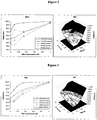
- the aluminium hydroxide adjuvant was obtained from Sigma (A8222) as a 13mg/ml solution at pH 6.8. Initially, 50 ⁇ l volumes of the aluminium hydroxide were added to 100 ⁇ l volumes of sucrose and/or a further excipient diluted in Dulbecco's phosphate buffered saline (PBS) in wells of 96 well flat bottomed microplates. The further excipient was DMG. A list of final concentrations of DMG and sucrose before freezing can be seen in Table 1 below.
- the amount of agglomeration was assessed by taking up samples from each well into 100 ⁇ l micropipettes, allowing resettling to occur for 1 hour at room temperature and then measuring the height of the sedimented gel as a percentage of the total height of the solution in the pipette.
- the height of the sedimented gel as a percentage of the total height of the solution in the pipette was expressed as % gel volume. The greater the % gel volume, the more structurally intact is the adjuvant.
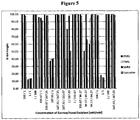
- the aluminium hydroxide adjuvant was obtained from Sigma (A8222) as a 13mg/ml solution at pH 6.8. Initially, 50 ⁇ l volumes of the aluminium hydroxide adjuvant were added to 100 ⁇ l volumes of sucrose and/or a further excipient diluted in Dulbecco's phosphate buffered saline (PBS) in wells of 96 well flat bottomed microplates. The further excipients were S-methyl-L-methionine, MSM and TMG. The adjuvants were frozen at -20°C. A list of final concentrations of sucrose and the further excipient before freezing can be seen in Table 2 below.
- the aluminium hydroxide adjuvant was obtained from Sigma (A8222) as a 13mg/ml solution at pH 6.8. A volume of adjuvant was centrifuged to form a pellet which was subsequently washed in 40mM HEPES + 25mM NaCl at pH 7.9 (twice) and re-suspended in half the original volume, resulting in an approximately 26 mg/ml solution. Into each vial was added 75 ⁇ l of 26 mg/ml adjuvant solution and 225 ⁇ l of relevant excipient (adjusted in concentration to account for added adjuvant volume) to equal the appropriate concentration, with each vial containing a final adjuvant concentration of 6.5 mg/ml. A list of final concentrations of excipients are set out in Table 4 below.
- Samples were freeze dried by the VirTis Advantage freeze dryer, using the drying cycles shown in Table 3 below, lasting for approximately 3 days. Samples were frozen at -40°C for 2 hours before a vacuum was applied, initially at 300 milliTorre with a Thermo Savant VLP pump (Thermofisher, UK). Shelf temperature and vacuum were adjusted throughout the process and the condenser was maintained at -80°C. Step 11 was extended until the samples were stoppered before releasing the vacuum.
- the vials containing freeze-dried adjuvant were reconstituted into 300 ⁇ l of purified water and vortexed.
- the amount of agglomeration was assessed by taking up samples from each well into 100 ⁇ l micropipettes, allowing resettling to occur for 90 minutes at room temperature and then measuring the height of the sedimented gel as a percentage of the total height of the solution in the pipette.
- the height of the sedimented gel as a percentage of the total height of the solution in the pipette was expressed as % gel volume. The greater the % gel volume, the more structurally intact is the adjuvant.
- Table 4 Further excipient Conc. (mM) of further excipient Conc.
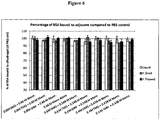
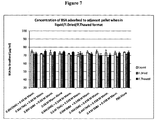
- Bovine serum albumin (BSA) is commonly used as a model in experiments where, for example, protein adsorption onto an adjuvant is to be measured.
- Alhydrogel (supplied at 2% stock (w/v)) was added to PBS containing BSA to equal a final 10 ml volume with concentration of 0.52% Alhydrogel and 200 ⁇ g/ml BSA.
- the protein adsorption step was incubated by gently rocking at room temperature before placing overnight at +4 °C.
- the adjuvant was mixed with the excipient concentration in a 1:1 ratio (2ml + 2ml) to create half concentration of excipients above, 0.26 % Alhydrogel and 100 ⁇ g/ml BSA. This was incubated at +4 °C for 12 hours before being split off into 300 ⁇ l volumes which were either (a) frozen (-80°C), (b) lyophilised as set out in Table 15 below or (c) held at +4 °C as liquid.
- the liquid, frozen and lyophilised vials were then placed at room temperature to equilibrate/thaw whilst the lyophilised vials were reconstituted in 300 ⁇ l of purified water and vortexed until complete reconstitution was observed.
- each of the excipient combinations was run in duplicate with a duplicate counterpart blank (i.e. no protein).
- the liquid, lyophilised and frozen samples were run on separate plates.
- To standardise protein concentrations each plate was run with a standard curve starting with BSA at 200 ⁇ g/ml serially diluted down to 6.25 ⁇ g/ml.
- a volume of 50 ⁇ l of adjuvant sample was added to each well before adding 125 ⁇ l of Bradford solution (equilibrated to room temperature).
- the plates were transferred to the plate reader which was set on the plate shake mode (to keep adjuvant in suspension) for 5 minutes before each plate was read at an absorbance at 595nm.
- Table 16 Excip [M] 0.8M DMG + 0.66M Mann 0.8M TMG + 0.66M Mann 0.8M SMM + 0.66M Mann * 0.66M Mann* % BSA (of PBS Ctrl.) 99.49 98.12 96.76 100.00
- Table 17 Excip [M] 0.6M DMG + 0.548 M Mann 0.6M TMG + 0.548 M Mann 0.6M SMM + 0.548 M Mann* % BSA (of PBS Ctrl.) 97.27 101.877 100.68
- Table 18 Excip [M] 0.4M DMG + 0.438 M Mann 0.4M TMG + 0.438 M Mann 0.4M SMM + 0.438 M Mann* % BSA (of PBS Ctrl.) 97.088 94.37 95.39 * indicates a Reference Example.
- This experiment compares a mannitol base with DMG, TMG, and SMM at levels that have previously been shown to protect adjuvant structure. It compares the antigenicity of the antibody bound to the alum both when the alum antibody has been kept at 4°C and when it has been freeze thawed, using a dot blot to probe the activity of the antibody in both storage methods.
- Mouse antibody adsorbed onto alum was freeze thawed and kept at 4°C in the presence of various excipients. This was assayed using a dot blot to see if the mouse antibody had retained its antigenicity.
- 2% alhydrogel solution was diluted to 0.52% with PBS and mouse antibody added to a concentration of 200 ⁇ g/ml. This was allowed to mix for an hour at room temperature with agitation then put at 4°C over night. The alum-antibody solution was then diluted 1:1 with excipient solutions to give final excipient concentrations as listed below:
- a nitrocellulose membrane was cut to the required size and 2 ⁇ l of samples applied as dots. This was allowed to dry and then incubated in 10ml PBS +0.05% Tween 20+ 5% milk for 1hour at room temperature on a rocker. This solution was then removed and the membrane then incubated in 10ml of anti-mouse-HRP (horseradish peroxidase) diluted to 1:5000 in PBS +0.05% Tween 20+ 5% millk for 1hour at room temperature on a rocker. The membranes were then washed for 3 x 10 minutes with PBS +0.05% Tween 20. The membranes were blotted on tissue paper to remove excess buffer and then 10ml of TMB (tetramethylbenzidine) was put on to the membrane for 5 minutes. The TMB was then dabbed off and blot colour scanned.
- TMB tetramethylbenzidine
- Figure 8 shows the layout of samples tested in Figure 8
- Figure 8A shows the layout of samples tested in Figure 8
- Figure 8B shows that in both the liquid ( Figure 8A ) and freeze-thawed ( Figure 8B ) samples, all samples not containing antibody are negative as expected and the positive control of antibody only is strongly positive.
- the liquid samples all the dots are similar at the same dilutions.
- the frozen samples are less consistent, especially between the samples in excipient and the PBS control sample.
- the PBS sample is weaker at the 1:500 dilution then the samples in the different excipients.
- Figure 9 (Table 20 shows the layout of samples tested in Figure 9 ) shows results consistent with this. All the negative controls without antibody are negative, including the excipient only controls which show that the excipients are not interfering with the assay. The PBS samples are again weaker than the liquid samples when frozen, especially when compared to samples in excipient at 1:300 and 1:500. Table 19 - Layout of samples tested in Figure 7 1. 0.52% alum only 2. Mouse mAb 50ug/ml 1:100 3. Mouse mAb 50ug/ml 1:500 4. Mouse mAb-12% mannitol-0.26% alum 5. Mouse mAb-12% mannitol-0.26% alum 1:100 6.
- Mouse mAb-12% mannitol-0.26% alum 1:500 7.
- Mouse mAb-12% mannitol-0.8M DMG-0.26% alum 8.
- Mouse mAb-12% mannitol-0.8M DMG-0.26% alum 1:100 9.
- Mouse mAb-12% mannitol-0.8M DMG-0.26% alum 1:500 10.
- Mouse mAb-12% mannitol-0.8M TMG-0.26% alum 11.
- Mouse mAb-12% mannitol-0.8M TMG-0.26% alum 1:100 12.
- Mouse mAb-12% mannitol-0.8M TMG-0.26% alum 1:500 13.
- Mouse mAb-12% mannitol-0.8M Vit U 0.26% alum 14.
- Mouse mAb-12% mannitol-0.26% alum 1:500 7.
- Mouse mAb-12% mannitol-0.8M DMG-0.26% alum 1:100 8.
- Mouse mAb-12% mannitol-0.8M DMG-0.26% alum 1:300 9.
- Mouse mAb-12% mannitol-0.8M DMG-0.26% alum 1:500 10.
- Mouse mAb-12% mannitol-0.8M TMG-0.26% alum 1:300 12.
- Mouse mAb-12% mannitol-0.8M TMG-0.26% alum 1:500 13.
Landscapes
- Health & Medical Sciences (AREA)
- Chemical & Material Sciences (AREA)
- Life Sciences & Earth Sciences (AREA)
- Animal Behavior & Ethology (AREA)
- Public Health (AREA)
- Veterinary Medicine (AREA)
- Medicinal Chemistry (AREA)
- Pharmacology & Pharmacy (AREA)
- Epidemiology (AREA)
- General Health & Medical Sciences (AREA)
- Chemical Kinetics & Catalysis (AREA)
- General Chemical & Material Sciences (AREA)
- Engineering & Computer Science (AREA)
- Oil, Petroleum & Natural Gas (AREA)
- Inorganic Chemistry (AREA)
- Immunology (AREA)
- Microbiology (AREA)
- Mycology (AREA)
- Bioinformatics & Cheminformatics (AREA)
- Proteomics, Peptides & Aminoacids (AREA)
- Medicines Containing Antibodies Or Antigens For Use As Internal Diagnostic Agents (AREA)
- Medicinal Preparation (AREA)
Applications Claiming Priority (3)
| Application Number | Priority Date | Filing Date | Title |
|---|---|---|---|
| GBGB1005518.4A GB201005518D0 (en) | 2010-03-31 | 2010-03-31 | Preservation of alum-adjuvanted vaccines |
| GBGB1005522.6A GB201005522D0 (en) | 2010-03-31 | 2010-03-31 | Method for preserving alum-adjuvanted vaccines |
| PCT/GB2011/000497 WO2011121305A2 (en) | 2010-03-31 | 2011-03-31 | Method for preserving alum adjuvants and alum-adjuvanted vaccines |
Publications (2)
| Publication Number | Publication Date |
|---|---|
| EP2552410A2 EP2552410A2 (en) | 2013-02-06 |
| EP2552410B1 true EP2552410B1 (en) | 2018-10-24 |
Family
ID=43971221
Family Applications (1)
| Application Number | Title | Priority Date | Filing Date |
|---|---|---|---|
| EP11712653.2A Active EP2552410B1 (en) | 2010-03-31 | 2011-03-31 | Method for preserving alum adjuvants and alum-adjuvanted vaccines |
Country Status (13)
| Country | Link |
|---|---|
| US (1) | US9101607B2 (cg-RX-API-DMAC7.html) |
| EP (1) | EP2552410B1 (cg-RX-API-DMAC7.html) |
| JP (1) | JP6023696B2 (cg-RX-API-DMAC7.html) |
| KR (1) | KR101819250B1 (cg-RX-API-DMAC7.html) |
| CN (1) | CN102892409B (cg-RX-API-DMAC7.html) |
| AU (1) | AU2011234268B2 (cg-RX-API-DMAC7.html) |
| BR (1) | BR112012025044A2 (cg-RX-API-DMAC7.html) |
| CA (1) | CA2795050C (cg-RX-API-DMAC7.html) |
| DK (1) | DK2552410T3 (cg-RX-API-DMAC7.html) |
| ES (1) | ES2708989T3 (cg-RX-API-DMAC7.html) |
| GB (1) | GB2499480A (cg-RX-API-DMAC7.html) |
| HU (1) | HUE042330T2 (cg-RX-API-DMAC7.html) |
| WO (1) | WO2011121305A2 (cg-RX-API-DMAC7.html) |
Families Citing this family (8)
| Publication number | Priority date | Publication date | Assignee | Title |
|---|---|---|---|---|
| ES2617921T3 (es) | 2010-03-31 | 2017-06-20 | Stabilitech Ltd. | Excipientes para estabilizar partículas virales |
| CN102892424B (zh) | 2010-03-31 | 2015-04-01 | 稳定性科技有限公司 | 病毒颗粒的稳定 |
| GB201117233D0 (en) | 2011-10-05 | 2011-11-16 | Stabilitech Ltd | Stabilisation of polypeptides |
| WO2015157637A1 (en) * | 2014-04-11 | 2015-10-15 | Surmodics Ivd, Inc. | Compositions and methods for in vitro diagnostic tests including zwitterionic solubilization reagent |
| GB201406569D0 (en) * | 2014-04-11 | 2014-05-28 | Stabilitech Ltd | Vaccine compositions |
| GB2562241B (en) * | 2017-05-08 | 2022-04-06 | Stabilitech Biopharma Ltd | Vaccine compositions |
| AR111760A1 (es) * | 2017-05-19 | 2019-08-14 | Novartis Ag | Compuestos y composiciones para el tratamiento de tumores sólidos mediante administración intratumoral |
| CN113750228B (zh) * | 2021-09-25 | 2024-02-20 | 大连理工大学 | 一种冷冻保护剂在铝佐剂中的应用 |
Family Cites Families (62)
| Publication number | Priority date | Publication date | Assignee | Title |
|---|---|---|---|---|
| US3927208A (en) | 1973-05-14 | 1975-12-16 | Rit Rech Ind Therapeut | Live bovine adenovirus vaccines, preparation thereof and method of vaccination using them |
| US4631189A (en) | 1980-03-10 | 1986-12-23 | Da Vinci Laboratories, a division of FoodScience Corporation | N,N-dimethylglycine and use in immune response |
| JPS6013718A (ja) * | 1983-07-05 | 1985-01-24 | Chemo Sero Therapeut Res Inst | B型肝炎ワクチン |
| JPS60193925A (ja) | 1984-03-13 | 1985-10-02 | Chemo Sero Therapeut Res Inst | 凍結乾燥製剤化ワクチン |
| US4808700A (en) | 1984-07-09 | 1989-02-28 | Praxis Biologics, Inc. | Immunogenic conjugates of non-toxic E. coli LT-B enterotoxin subunit and capsular polymers |
| JPS61189228A (ja) | 1985-02-19 | 1986-08-22 | Nippon Sekijiyuujishiya | 血液凝固第8因子製剤の製法 |
| US4950596A (en) | 1985-03-04 | 1990-08-21 | The Dow Chemical Company | Stabilization of intracellular enzymes |
| JPS6238173A (ja) | 1985-08-13 | 1987-02-19 | 三菱レイヨン株式会社 | 抗血液凝固剤 |
| US5169758A (en) | 1986-05-02 | 1992-12-08 | Boehringer Mannheim Gmbh | Stabilized, NAD(P)H-dependent, soluble nitrate reductase, a process for the preparation thereof and a reagent containing it |
| NZ221306A (en) | 1986-08-15 | 1990-02-26 | Commw Scient Ind Res Org | 2-component immunoadjuvant comprising a mycobacterial free immunoadjuvant oil and a polycationic polyelectrolyte immunoadjuvant and vaccines thereof |
| ES2044941T5 (es) * | 1987-08-21 | 1999-02-16 | Mallinckrodt Group Inc | Estabilizador de hormonas promotoras del crecimiento. |
| GB8826429D0 (en) | 1988-11-11 | 1988-12-14 | Univ Leeds Ind Service Ltd | Enzyme stabilisation systems |
| JP3064413B2 (ja) | 1989-08-15 | 2000-07-12 | マサチユセツツ・インスチチユート・オブ・テクノロジー | 安定化ワクチン組成物 |
| CA2051092C (en) | 1990-09-12 | 2002-07-23 | Stephen A. Livesey | Method and apparatus for cryopreparation, dry stabilization and rehydration of biological suspensions |
| ZA936095B (en) | 1992-08-21 | 1994-03-14 | Univ Melbourne | Cytokine applications. |
| WO1995011700A1 (en) * | 1993-10-29 | 1995-05-04 | Pharmos Corp. | Submicron emulsions as vaccine adjuvants |
| DK1516628T3 (da) | 1995-07-27 | 2013-09-08 | Genentech Inc | Stabil, isotonisk lyofiliseret proteinformulering |
| GB9521806D0 (en) | 1995-10-25 | 1996-01-03 | Cortecs Ltd | Preservation methods |
| FR2746109B1 (fr) | 1996-03-12 | 1998-04-17 | Rhone Poulenc Rorer Sa | Milieu pour la conservation de materiel biologique |
| AU707186B2 (en) | 1997-07-01 | 1999-07-01 | Transgene S.A. | Compositions useful for transferring therapeutically active substances into a target cell, and their use in gene therapy |
| EP1032647B1 (en) | 1997-11-26 | 2006-03-29 | Universal Preservation Technologies, Inc. | Preservation of sensitive biological samples by vitrification |
| EP1133316B1 (en) | 1998-11-16 | 2009-01-21 | Introgen Therapeutics, Inc. | Formulation of adenovirus for gene therapy |
| US6689600B1 (en) | 1998-11-16 | 2004-02-10 | Introgen Therapeutics, Inc. | Formulation of adenovirus for gene therapy |
| AUPQ347199A0 (en) | 1999-10-15 | 1999-11-11 | Csl Limited | Novel polypeptide fragments |
| KR20030020294A (ko) * | 2000-06-08 | 2003-03-08 | 파우더젝트 백신, 인코포레이티드 | 분말 조성물 |
| DE10041515A1 (de) | 2000-08-24 | 2002-03-14 | Gerold Schuler | Verfahren zur Herstellung gebrauchsfertiger, Antigen-beladener oder -unbeladener, kryokonservierter reifer dendritischer Zellen |
| US20040110267A1 (en) | 2000-12-15 | 2004-06-10 | Stratagene | Room temperature stable competent cells |
| US7229645B2 (en) | 2001-06-08 | 2007-06-12 | Powderject Research Limited | Spray freeze-dried compositions |
| US7101693B2 (en) | 2001-09-07 | 2006-09-05 | Brigham Young University | Plasticized hydrophilic glasses for improved stabilization of biological agents |
| JP4936618B2 (ja) | 2001-09-21 | 2012-05-23 | 株式会社ノエビア | 微細エマルション組成物 |
| US20040161776A1 (en) * | 2001-10-23 | 2004-08-19 | Maddon Paul J. | PSMA formulations and uses thereof |
| EP3210624A1 (en) | 2002-02-27 | 2017-08-30 | Immunex Corporation | Stabilized tnfr-fc composition comprising arginine |
| WO2004002534A1 (en) | 2002-06-27 | 2004-01-08 | Novo Nordisk A/S | Use of dimethyl sulfone as isotonicity agent |
| EP1523563A2 (en) | 2002-07-10 | 2005-04-20 | Transgene S.A. | Modified adenoviral fiber with ablated to cellular receptors |
| WO2004035818A1 (en) | 2002-10-21 | 2004-04-29 | Biotage Ab | Use of osmolytes to heat stabilise luciferase and/or apyrase |
| MXPA05006147A (es) | 2002-12-10 | 2005-08-26 | Schering Plough Ltd | Ligando del activador del receptor de nf-kb de canino, y metodos para preparar y usar el mismo. |
| US20060247167A1 (en) | 2003-09-01 | 2006-11-02 | Novo Nordisk A/S | Stable formulations of peptides |
| US7642077B2 (en) | 2003-12-08 | 2010-01-05 | Genencor International, Inc. | Biocomposite comprising co-precipitate of enzyme, silicate and polyamine |
| US20070111211A1 (en) | 2003-12-30 | 2007-05-17 | Virumar Pituach Tarkivim Ltd. | Integrated viral complexes, methods of production thereof, vaccines containing same and methods of use thereof |
| WO2005120546A2 (en) | 2004-03-03 | 2005-12-22 | Essentia Biosystems, Inc. | Compositions and methods for topical diagnostic and therapeutic transport |
| US20060058238A1 (en) | 2004-09-15 | 2006-03-16 | Lee Laurent-Applegate | Fetal skin cell protein compositions for the treatment of skin conditions, disorders or diseases and methods of making and using the same |
| KR101506925B1 (ko) | 2004-10-01 | 2015-03-30 | 램스코르 인코포레이티드 | 편리하게 이식가능한 서방형 약물 조성물 |
| PA8661401A1 (es) | 2005-01-28 | 2006-09-08 | Wyeth Corp | Formulaciones del liquido polipeptido estabilizado |
| GB0502661D0 (en) | 2005-02-09 | 2005-03-16 | Stabilitech Ltd | A desiccated product |
| TWI398272B (zh) | 2005-03-08 | 2013-06-11 | Intervet Int Bv | 化學定義的安定劑 |
| CA2602434C (en) | 2005-04-08 | 2016-06-07 | Argos Therapeutics, Inc. | Dendritic cell compositions and methods |
| US20090155351A1 (en) | 2005-10-04 | 2009-06-18 | Alk-Abello A/S | Solid Vaccine Formulation |
| KR101357685B1 (ko) | 2005-11-21 | 2014-02-06 | 사노피 파스퇴르 리미티드 / 사노피 파스퇴르 리미떼 | 재조합 바이러스용 안정화 제형 |
| JP4394724B2 (ja) | 2005-11-30 | 2010-01-06 | 株式会社癌免疫研究所 | 新規ペプチド化合物 |
| JP5806444B2 (ja) | 2005-12-02 | 2015-11-10 | ノバルティス アーゲー | 免疫原性組成物で使用するためのナノ粒子 |
| EP1987067A4 (en) | 2006-02-15 | 2012-01-25 | Imclone Llc | ANTIBODY FORMULATION |
| ES2286951B1 (es) * | 2006-05-26 | 2008-10-01 | Instituto Cientifico Y Tecnologico De Navarra, S.A | Nanoparticulas bioadhesivas para la administracion de moleculas biologicamente activas. |
| US20090047255A1 (en) | 2006-11-03 | 2009-02-19 | Alphavax, Inc. | Alphavirus and Alphavirus Replicon Particle Formulations and Methods |
| GB0705245D0 (en) | 2007-03-19 | 2007-04-25 | Stabilitech Ltd | Stable biological products |
| DK2131857T3 (en) | 2007-03-22 | 2015-09-14 | Univ Colorado Regents | A method of producing an immunologically active adjuvansbundet dried vaccine composition |
| US7879805B2 (en) | 2007-06-01 | 2011-02-01 | Acologix, Inc. | High temperature stable peptide formulation |
| US20090029463A1 (en) * | 2007-07-25 | 2009-01-29 | Bioe, Inc. | Differentiation of Multi-Lineage Progenitor Cells to Chondrocytes |
| US20090123436A1 (en) | 2007-11-08 | 2009-05-14 | Surmodics, Inc. | Cryopreservative compositions and methods |
| GB2479069B (en) | 2008-09-24 | 2012-07-25 | Stabilitech Ltd | Method for preserving polypeptides using a sugar and polyethyleneimine |
| US20110212127A1 (en) | 2008-09-24 | 2011-09-01 | Stabilitech Ltd. | Method for Preserving Polypeptides Using a Sugar and Polyethyleneimine |
| CN101670104A (zh) | 2009-09-24 | 2010-03-17 | 浙江大学 | 一种含人参皂甙的油佐剂及其制备方法 |
| CN102892424B (zh) | 2010-03-31 | 2015-04-01 | 稳定性科技有限公司 | 病毒颗粒的稳定 |
-
2011
- 2011-03-31 KR KR1020127028370A patent/KR101819250B1/ko not_active Expired - Fee Related
- 2011-03-31 BR BR112012025044A patent/BR112012025044A2/pt not_active Application Discontinuation
- 2011-03-31 DK DK11712653.2T patent/DK2552410T3/en active
- 2011-03-31 US US13/637,828 patent/US9101607B2/en active Active
- 2011-03-31 ES ES11712653T patent/ES2708989T3/es active Active
- 2011-03-31 CN CN201180014386.6A patent/CN102892409B/zh not_active Expired - Fee Related
- 2011-03-31 EP EP11712653.2A patent/EP2552410B1/en active Active
- 2011-03-31 HU HUE11712653A patent/HUE042330T2/hu unknown
- 2011-03-31 GB GB1216472.9A patent/GB2499480A/en not_active Withdrawn
- 2011-03-31 CA CA2795050A patent/CA2795050C/en active Active
- 2011-03-31 WO PCT/GB2011/000497 patent/WO2011121305A2/en not_active Ceased
- 2011-03-31 AU AU2011234268A patent/AU2011234268B2/en not_active Ceased
- 2011-03-31 JP JP2013501932A patent/JP6023696B2/ja active Active
Non-Patent Citations (1)
| Title |
|---|
| None * |
Also Published As
| Publication number | Publication date |
|---|---|
| AU2011234268A1 (en) | 2012-09-27 |
| CA2795050C (en) | 2018-05-22 |
| KR20130012956A (ko) | 2013-02-05 |
| HUE042330T2 (hu) | 2019-06-28 |
| BR112012025044A2 (pt) | 2016-06-21 |
| WO2011121305A3 (en) | 2011-11-24 |
| AU2011234268B2 (en) | 2015-07-02 |
| US20130156797A1 (en) | 2013-06-20 |
| ES2708989T3 (es) | 2019-04-12 |
| WO2011121305A2 (en) | 2011-10-06 |
| GB2499480A (en) | 2013-08-21 |
| CN102892409A (zh) | 2013-01-23 |
| US9101607B2 (en) | 2015-08-11 |
| CN102892409B (zh) | 2015-12-09 |
| GB201216472D0 (en) | 2012-10-31 |
| DK2552410T3 (en) | 2019-02-18 |
| CA2795050A1 (en) | 2011-10-06 |
| KR101819250B1 (ko) | 2018-01-16 |
| EP2552410A2 (en) | 2013-02-06 |
| JP2013523705A (ja) | 2013-06-17 |
| JP6023696B2 (ja) | 2016-11-09 |
Similar Documents
| Publication | Publication Date | Title |
|---|---|---|
| EP2552410B1 (en) | Method for preserving alum adjuvants and alum-adjuvanted vaccines | |
| JP4902103B2 (ja) | 凍結乾燥フォームによる生物活性材料の保存 | |
| EP2148923B1 (en) | Preservation of bioactive materials by freeze dried foam | |
| RU2484847C2 (ru) | Лиофилизированный препарат, содержащий гриппозную вакцину, и способ его получения | |
| EP2852662B1 (en) | Herpesvirus compositions and related methods | |
| WO2011032108A2 (en) | Formulation for room temperature stabilization of a live attenuated bacterial vaccine | |
| Clausi | Lyophilized vaccine preparations containing aluminum salt adjuvants: Preparation, immunogenicity, and stability | |
| HK1185271A (en) | Preservation of bioactive materials by freeze dried foam |
Legal Events
| Date | Code | Title | Description |
|---|---|---|---|
| PUAI | Public reference made under article 153(3) epc to a published international application that has entered the european phase |
Free format text: ORIGINAL CODE: 0009012 |
|
| 17P | Request for examination filed |
Effective date: 20120917 |
|
| AK | Designated contracting states |
Kind code of ref document: A2 Designated state(s): AL AT BE BG CH CY CZ DE DK EE ES FI FR GB GR HR HU IE IS IT LI LT LU LV MC MK MT NL NO PL PT RO RS SE SI SK SM TR |
|
| DAX | Request for extension of the european patent (deleted) | ||
| RAP1 | Party data changed (applicant data changed or rights of an application transferred) |
Owner name: STABILITECH LTD. |
|
| 17Q | First examination report despatched |
Effective date: 20160219 |
|
| STAA | Information on the status of an ep patent application or granted ep patent |
Free format text: STATUS: EXAMINATION IS IN PROGRESS |
|
| GRAP | Despatch of communication of intention to grant a patent |
Free format text: ORIGINAL CODE: EPIDOSNIGR1 |
|
| STAA | Information on the status of an ep patent application or granted ep patent |
Free format text: STATUS: GRANT OF PATENT IS INTENDED |
|
| INTG | Intention to grant announced |
Effective date: 20180517 |
|
| GRAS | Grant fee paid |
Free format text: ORIGINAL CODE: EPIDOSNIGR3 |
|
| RAP1 | Party data changed (applicant data changed or rights of an application transferred) |
Owner name: STABILITECH BIOPHARMA LTD |
|
| GRAA | (expected) grant |
Free format text: ORIGINAL CODE: 0009210 |
|
| STAA | Information on the status of an ep patent application or granted ep patent |
Free format text: STATUS: THE PATENT HAS BEEN GRANTED |
|
| AK | Designated contracting states |
Kind code of ref document: B1 Designated state(s): AL AT BE BG CH CY CZ DE DK EE ES FI FR GB GR HR HU IE IS IT LI LT LU LV MC MK MT NL NO PL PT RO RS SE SI SK SM TR |
|
| REG | Reference to a national code |
Ref country code: GB Ref legal event code: FG4D |
|
| REG | Reference to a national code |
Ref country code: CH Ref legal event code: EP |
|
| REG | Reference to a national code |
Ref country code: IE Ref legal event code: FG4D |
|
| REG | Reference to a national code |
Ref country code: DE Ref legal event code: R096 Ref document number: 602011053170 Country of ref document: DE Ref country code: AT Ref legal event code: REF Ref document number: 1055847 Country of ref document: AT Kind code of ref document: T Effective date: 20181115 |
|
| REG | Reference to a national code |
Ref country code: CH Ref legal event code: NV Representative=s name: VENI GMBH, CH |
|
| REG | Reference to a national code |
Ref country code: DK Ref legal event code: T3 Effective date: 20190212 |
|
| REG | Reference to a national code |
Ref country code: NL Ref legal event code: FP |
|
| REG | Reference to a national code |
Ref country code: SE Ref legal event code: TRGR |
|
| REG | Reference to a national code |
Ref country code: LT Ref legal event code: MG4D |
|
| REG | Reference to a national code |
Ref country code: ES Ref legal event code: FG2A Ref document number: 2708989 Country of ref document: ES Kind code of ref document: T3 Effective date: 20190412 |
|
| PG25 | Lapsed in a contracting state [announced via postgrant information from national office to epo] |
Ref country code: LV Free format text: LAPSE BECAUSE OF FAILURE TO SUBMIT A TRANSLATION OF THE DESCRIPTION OR TO PAY THE FEE WITHIN THE PRESCRIBED TIME-LIMIT Effective date: 20181024 Ref country code: HR Free format text: LAPSE BECAUSE OF FAILURE TO SUBMIT A TRANSLATION OF THE DESCRIPTION OR TO PAY THE FEE WITHIN THE PRESCRIBED TIME-LIMIT Effective date: 20181024 Ref country code: PL Free format text: LAPSE BECAUSE OF FAILURE TO SUBMIT A TRANSLATION OF THE DESCRIPTION OR TO PAY THE FEE WITHIN THE PRESCRIBED TIME-LIMIT Effective date: 20181024 Ref country code: BG Free format text: LAPSE BECAUSE OF FAILURE TO SUBMIT A TRANSLATION OF THE DESCRIPTION OR TO PAY THE FEE WITHIN THE PRESCRIBED TIME-LIMIT Effective date: 20190124 Ref country code: LT Free format text: LAPSE BECAUSE OF FAILURE TO SUBMIT A TRANSLATION OF THE DESCRIPTION OR TO PAY THE FEE WITHIN THE PRESCRIBED TIME-LIMIT Effective date: 20181024 Ref country code: NO Free format text: LAPSE BECAUSE OF FAILURE TO SUBMIT A TRANSLATION OF THE DESCRIPTION OR TO PAY THE FEE WITHIN THE PRESCRIBED TIME-LIMIT Effective date: 20190124 Ref country code: IS Free format text: LAPSE BECAUSE OF FAILURE TO SUBMIT A TRANSLATION OF THE DESCRIPTION OR TO PAY THE FEE WITHIN THE PRESCRIBED TIME-LIMIT Effective date: 20190224 |
|
| PG25 | Lapsed in a contracting state [announced via postgrant information from national office to epo] |
Ref country code: PT Free format text: LAPSE BECAUSE OF FAILURE TO SUBMIT A TRANSLATION OF THE DESCRIPTION OR TO PAY THE FEE WITHIN THE PRESCRIBED TIME-LIMIT Effective date: 20190224 Ref country code: GR Free format text: LAPSE BECAUSE OF FAILURE TO SUBMIT A TRANSLATION OF THE DESCRIPTION OR TO PAY THE FEE WITHIN THE PRESCRIBED TIME-LIMIT Effective date: 20190125 Ref country code: RS Free format text: LAPSE BECAUSE OF FAILURE TO SUBMIT A TRANSLATION OF THE DESCRIPTION OR TO PAY THE FEE WITHIN THE PRESCRIBED TIME-LIMIT Effective date: 20181024 Ref country code: AL Free format text: LAPSE BECAUSE OF FAILURE TO SUBMIT A TRANSLATION OF THE DESCRIPTION OR TO PAY THE FEE WITHIN THE PRESCRIBED TIME-LIMIT Effective date: 20181024 |
|
| REG | Reference to a national code |
Ref country code: HU Ref legal event code: AG4A Ref document number: E042330 Country of ref document: HU |
|
| REG | Reference to a national code |
Ref country code: DE Ref legal event code: R097 Ref document number: 602011053170 Country of ref document: DE |
|
| PG25 | Lapsed in a contracting state [announced via postgrant information from national office to epo] |
Ref country code: CZ Free format text: LAPSE BECAUSE OF FAILURE TO SUBMIT A TRANSLATION OF THE DESCRIPTION OR TO PAY THE FEE WITHIN THE PRESCRIBED TIME-LIMIT Effective date: 20181024 |
|
| PG25 | Lapsed in a contracting state [announced via postgrant information from national office to epo] |
Ref country code: SM Free format text: LAPSE BECAUSE OF FAILURE TO SUBMIT A TRANSLATION OF THE DESCRIPTION OR TO PAY THE FEE WITHIN THE PRESCRIBED TIME-LIMIT Effective date: 20181024 Ref country code: EE Free format text: LAPSE BECAUSE OF FAILURE TO SUBMIT A TRANSLATION OF THE DESCRIPTION OR TO PAY THE FEE WITHIN THE PRESCRIBED TIME-LIMIT Effective date: 20181024 Ref country code: SK Free format text: LAPSE BECAUSE OF FAILURE TO SUBMIT A TRANSLATION OF THE DESCRIPTION OR TO PAY THE FEE WITHIN THE PRESCRIBED TIME-LIMIT Effective date: 20181024 Ref country code: RO Free format text: LAPSE BECAUSE OF FAILURE TO SUBMIT A TRANSLATION OF THE DESCRIPTION OR TO PAY THE FEE WITHIN THE PRESCRIBED TIME-LIMIT Effective date: 20181024 |
|
| PLBE | No opposition filed within time limit |
Free format text: ORIGINAL CODE: 0009261 |
|
| STAA | Information on the status of an ep patent application or granted ep patent |
Free format text: STATUS: NO OPPOSITION FILED WITHIN TIME LIMIT |
|
| 26N | No opposition filed |
Effective date: 20190725 |
|
| PG25 | Lapsed in a contracting state [announced via postgrant information from national office to epo] |
Ref country code: SI Free format text: LAPSE BECAUSE OF FAILURE TO SUBMIT A TRANSLATION OF THE DESCRIPTION OR TO PAY THE FEE WITHIN THE PRESCRIBED TIME-LIMIT Effective date: 20181024 |
|
| PG25 | Lapsed in a contracting state [announced via postgrant information from national office to epo] |
Ref country code: LU Free format text: LAPSE BECAUSE OF NON-PAYMENT OF DUE FEES Effective date: 20190331 |
|
| PG25 | Lapsed in a contracting state [announced via postgrant information from national office to epo] |
Ref country code: TR Free format text: LAPSE BECAUSE OF FAILURE TO SUBMIT A TRANSLATION OF THE DESCRIPTION OR TO PAY THE FEE WITHIN THE PRESCRIBED TIME-LIMIT Effective date: 20181024 |
|
| PG25 | Lapsed in a contracting state [announced via postgrant information from national office to epo] |
Ref country code: MT Free format text: LAPSE BECAUSE OF NON-PAYMENT OF DUE FEES Effective date: 20190331 |
|
| REG | Reference to a national code |
Ref country code: AT Ref legal event code: UEP Ref document number: 1055847 Country of ref document: AT Kind code of ref document: T Effective date: 20181024 |
|
| PG25 | Lapsed in a contracting state [announced via postgrant information from national office to epo] |
Ref country code: CY Free format text: LAPSE BECAUSE OF FAILURE TO SUBMIT A TRANSLATION OF THE DESCRIPTION OR TO PAY THE FEE WITHIN THE PRESCRIBED TIME-LIMIT Effective date: 20181024 |
|
| PG25 | Lapsed in a contracting state [announced via postgrant information from national office to epo] |
Ref country code: MK Free format text: LAPSE BECAUSE OF FAILURE TO SUBMIT A TRANSLATION OF THE DESCRIPTION OR TO PAY THE FEE WITHIN THE PRESCRIBED TIME-LIMIT Effective date: 20181024 |
|
| PGFP | Annual fee paid to national office [announced via postgrant information from national office to epo] |
Ref country code: MC Payment date: 20230315 Year of fee payment: 13 Ref country code: IE Payment date: 20230310 Year of fee payment: 13 Ref country code: FI Payment date: 20230320 Year of fee payment: 13 Ref country code: DK Payment date: 20230321 Year of fee payment: 13 Ref country code: AT Payment date: 20230310 Year of fee payment: 13 |
|
| PGFP | Annual fee paid to national office [announced via postgrant information from national office to epo] |
Ref country code: SE Payment date: 20230314 Year of fee payment: 13 Ref country code: HU Payment date: 20230321 Year of fee payment: 13 Ref country code: BE Payment date: 20230309 Year of fee payment: 13 |
|
| P01 | Opt-out of the competence of the unified patent court (upc) registered |
Effective date: 20230404 |
|
| PGFP | Annual fee paid to national office [announced via postgrant information from national office to epo] |
Ref country code: NL Payment date: 20230309 Year of fee payment: 13 |
|
| PGFP | Annual fee paid to national office [announced via postgrant information from national office to epo] |
Ref country code: CH Payment date: 20230401 Year of fee payment: 13 |
|
| PG25 | Lapsed in a contracting state [announced via postgrant information from national office to epo] |
Ref country code: FI Free format text: LAPSE BECAUSE OF NON-PAYMENT OF DUE FEES Effective date: 20240331 |
|
| REG | Reference to a national code |
Ref country code: DK Ref legal event code: EBP Effective date: 20240331 |
|
| PG25 | Lapsed in a contracting state [announced via postgrant information from national office to epo] |
Ref country code: FI Free format text: LAPSE BECAUSE OF NON-PAYMENT OF DUE FEES Effective date: 20240331 |
|
| REG | Reference to a national code |
Ref country code: CH Ref legal event code: PL |
|
| REG | Reference to a national code |
Ref country code: NL Ref legal event code: MM Effective date: 20240401 |
|
| REG | Reference to a national code |
Ref country code: AT Ref legal event code: MM01 Ref document number: 1055847 Country of ref document: AT Kind code of ref document: T Effective date: 20240331 |
|
| PG25 | Lapsed in a contracting state [announced via postgrant information from national office to epo] |
Ref country code: MC Free format text: LAPSE BECAUSE OF NON-PAYMENT OF DUE FEES Effective date: 20240402 |
|
| PG25 | Lapsed in a contracting state [announced via postgrant information from national office to epo] |
Ref country code: HU Free format text: LAPSE BECAUSE OF NON-PAYMENT OF DUE FEES Effective date: 20240401 |
|
| PG25 | Lapsed in a contracting state [announced via postgrant information from national office to epo] |
Ref country code: MC Free format text: LAPSE BECAUSE OF NON-PAYMENT OF DUE FEES Effective date: 20240402 Ref country code: HU Free format text: LAPSE BECAUSE OF NON-PAYMENT OF DUE FEES Effective date: 20240401 |
|
| REG | Reference to a national code |
Ref country code: SE Ref legal event code: EUG |
|
| PG25 | Lapsed in a contracting state [announced via postgrant information from national office to epo] |
Ref country code: NL Free format text: LAPSE BECAUSE OF NON-PAYMENT OF DUE FEES Effective date: 20240401 |
|
| REG | Reference to a national code |
Ref country code: BE Ref legal event code: MM Effective date: 20240331 |
|
| PG25 | Lapsed in a contracting state [announced via postgrant information from national office to epo] |
Ref country code: NL Free format text: LAPSE BECAUSE OF NON-PAYMENT OF DUE FEES Effective date: 20240401 |
|
| PG25 | Lapsed in a contracting state [announced via postgrant information from national office to epo] |
Ref country code: BE Free format text: LAPSE BECAUSE OF NON-PAYMENT OF DUE FEES Effective date: 20240331 |
|
| PG25 | Lapsed in a contracting state [announced via postgrant information from national office to epo] |
Ref country code: AT Free format text: LAPSE BECAUSE OF NON-PAYMENT OF DUE FEES Effective date: 20240331 |
|
| PG25 | Lapsed in a contracting state [announced via postgrant information from national office to epo] |
Ref country code: IE Free format text: LAPSE BECAUSE OF NON-PAYMENT OF DUE FEES Effective date: 20240331 |
|
| PG25 | Lapsed in a contracting state [announced via postgrant information from national office to epo] |
Ref country code: IE Free format text: LAPSE BECAUSE OF NON-PAYMENT OF DUE FEES Effective date: 20240331 Ref country code: BE Free format text: LAPSE BECAUSE OF NON-PAYMENT OF DUE FEES Effective date: 20240331 Ref country code: AT Free format text: LAPSE BECAUSE OF NON-PAYMENT OF DUE FEES Effective date: 20240331 Ref country code: CH Free format text: LAPSE BECAUSE OF NON-PAYMENT OF DUE FEES Effective date: 20240331 |
|
| PGFP | Annual fee paid to national office [announced via postgrant information from national office to epo] |
Ref country code: DE Payment date: 20250319 Year of fee payment: 15 |
|
| PG25 | Lapsed in a contracting state [announced via postgrant information from national office to epo] |
Ref country code: DK Free format text: LAPSE BECAUSE OF NON-PAYMENT OF DUE FEES Effective date: 20240331 |
|
| PGFP | Annual fee paid to national office [announced via postgrant information from national office to epo] |
Ref country code: FR Payment date: 20250319 Year of fee payment: 15 |
|
| PGFP | Annual fee paid to national office [announced via postgrant information from national office to epo] |
Ref country code: IT Payment date: 20250320 Year of fee payment: 15 Ref country code: GB Payment date: 20250319 Year of fee payment: 15 |
|
| PGFP | Annual fee paid to national office [announced via postgrant information from national office to epo] |
Ref country code: ES Payment date: 20250402 Year of fee payment: 15 |
|
| PG25 | Lapsed in a contracting state [announced via postgrant information from national office to epo] |
Ref country code: SE Free format text: LAPSE BECAUSE OF NON-PAYMENT OF DUE FEES Effective date: 20240401 |