EP2550027B2 - Polysaccharide and protein-polysaccharide cross-linked hydrogels for soft tissue augmentation - Google Patents
Polysaccharide and protein-polysaccharide cross-linked hydrogels for soft tissue augmentation Download PDFInfo
- Publication number
- EP2550027B2 EP2550027B2 EP11711228.4A EP11711228A EP2550027B2 EP 2550027 B2 EP2550027 B2 EP 2550027B2 EP 11711228 A EP11711228 A EP 11711228A EP 2550027 B2 EP2550027 B2 EP 2550027B2
- Authority
- EP
- European Patent Office
- Prior art keywords
- cross
- linked
- dermal
- hydrogel
- elastin
- Prior art date
- Legal status (The legal status is an assumption and is not a legal conclusion. Google has not performed a legal analysis and makes no representation as to the accuracy of the status listed.)
- Active
Links
Images


Classifications
-
- A—HUMAN NECESSITIES
- A61—MEDICAL OR VETERINARY SCIENCE; HYGIENE
- A61L—METHODS OR APPARATUS FOR STERILISING MATERIALS OR OBJECTS IN GENERAL; DISINFECTION, STERILISATION OR DEODORISATION OF AIR; CHEMICAL ASPECTS OF BANDAGES, DRESSINGS, ABSORBENT PADS OR SURGICAL ARTICLES; MATERIALS FOR BANDAGES, DRESSINGS, ABSORBENT PADS OR SURGICAL ARTICLES
- A61L27/00—Materials for grafts or prostheses or for coating grafts or prostheses
- A61L27/14—Macromolecular materials
- A61L27/26—Mixtures of macromolecular compounds
-
- A—HUMAN NECESSITIES
- A61—MEDICAL OR VETERINARY SCIENCE; HYGIENE
- A61K—PREPARATIONS FOR MEDICAL, DENTAL OR TOILETRY PURPOSES
- A61K47/00—Medicinal preparations characterised by the non-active ingredients used, e.g. carriers or inert additives; Targeting or modifying agents chemically bound to the active ingredient
- A61K47/30—Macromolecular organic or inorganic compounds, e.g. inorganic polyphosphates
- A61K47/36—Polysaccharides; Derivatives thereof, e.g. gums, starch, alginate, dextrin, hyaluronic acid, chitosan, inulin, agar or pectin
-
- A—HUMAN NECESSITIES
- A61—MEDICAL OR VETERINARY SCIENCE; HYGIENE
- A61K—PREPARATIONS FOR MEDICAL, DENTAL OR TOILETRY PURPOSES
- A61K47/00—Medicinal preparations characterised by the non-active ingredients used, e.g. carriers or inert additives; Targeting or modifying agents chemically bound to the active ingredient
- A61K47/30—Macromolecular organic or inorganic compounds, e.g. inorganic polyphosphates
- A61K47/42—Proteins; Polypeptides; Degradation products thereof; Derivatives thereof, e.g. albumin, gelatin or zein
-
- A—HUMAN NECESSITIES
- A61—MEDICAL OR VETERINARY SCIENCE; HYGIENE
- A61L—METHODS OR APPARATUS FOR STERILISING MATERIALS OR OBJECTS IN GENERAL; DISINFECTION, STERILISATION OR DEODORISATION OF AIR; CHEMICAL ASPECTS OF BANDAGES, DRESSINGS, ABSORBENT PADS OR SURGICAL ARTICLES; MATERIALS FOR BANDAGES, DRESSINGS, ABSORBENT PADS OR SURGICAL ARTICLES
- A61L27/00—Materials for grafts or prostheses or for coating grafts or prostheses
- A61L27/14—Macromolecular materials
- A61L27/20—Polysaccharides
-
- A—HUMAN NECESSITIES
- A61—MEDICAL OR VETERINARY SCIENCE; HYGIENE
- A61L—METHODS OR APPARATUS FOR STERILISING MATERIALS OR OBJECTS IN GENERAL; DISINFECTION, STERILISATION OR DEODORISATION OF AIR; CHEMICAL ASPECTS OF BANDAGES, DRESSINGS, ABSORBENT PADS OR SURGICAL ARTICLES; MATERIALS FOR BANDAGES, DRESSINGS, ABSORBENT PADS OR SURGICAL ARTICLES
- A61L27/00—Materials for grafts or prostheses or for coating grafts or prostheses
- A61L27/14—Macromolecular materials
- A61L27/22—Polypeptides or derivatives thereof, e.g. degradation products
- A61L27/24—Collagen
-
- A—HUMAN NECESSITIES
- A61—MEDICAL OR VETERINARY SCIENCE; HYGIENE
- A61L—METHODS OR APPARATUS FOR STERILISING MATERIALS OR OBJECTS IN GENERAL; DISINFECTION, STERILISATION OR DEODORISATION OF AIR; CHEMICAL ASPECTS OF BANDAGES, DRESSINGS, ABSORBENT PADS OR SURGICAL ARTICLES; MATERIALS FOR BANDAGES, DRESSINGS, ABSORBENT PADS OR SURGICAL ARTICLES
- A61L27/00—Materials for grafts or prostheses or for coating grafts or prostheses
- A61L27/50—Materials characterised by their function or physical properties, e.g. injectable or lubricating compositions, shape-memory materials, surface modified materials
- A61L27/52—Hydrogels or hydrocolloids
-
- A—HUMAN NECESSITIES
- A61—MEDICAL OR VETERINARY SCIENCE; HYGIENE
- A61L—METHODS OR APPARATUS FOR STERILISING MATERIALS OR OBJECTS IN GENERAL; DISINFECTION, STERILISATION OR DEODORISATION OF AIR; CHEMICAL ASPECTS OF BANDAGES, DRESSINGS, ABSORBENT PADS OR SURGICAL ARTICLES; MATERIALS FOR BANDAGES, DRESSINGS, ABSORBENT PADS OR SURGICAL ARTICLES
- A61L27/00—Materials for grafts or prostheses or for coating grafts or prostheses
- A61L27/50—Materials characterised by their function or physical properties, e.g. injectable or lubricating compositions, shape-memory materials, surface modified materials
- A61L27/54—Biologically active materials, e.g. therapeutic substances
-
- A—HUMAN NECESSITIES
- A61—MEDICAL OR VETERINARY SCIENCE; HYGIENE
- A61P—SPECIFIC THERAPEUTIC ACTIVITY OF CHEMICAL COMPOUNDS OR MEDICINAL PREPARATIONS
- A61P17/00—Drugs for dermatological disorders
-
- A—HUMAN NECESSITIES
- A61—MEDICAL OR VETERINARY SCIENCE; HYGIENE
- A61P—SPECIFIC THERAPEUTIC ACTIVITY OF CHEMICAL COMPOUNDS OR MEDICINAL PREPARATIONS
- A61P23/00—Anaesthetics
-
- A—HUMAN NECESSITIES
- A61—MEDICAL OR VETERINARY SCIENCE; HYGIENE
- A61P—SPECIFIC THERAPEUTIC ACTIVITY OF CHEMICAL COMPOUNDS OR MEDICINAL PREPARATIONS
- A61P29/00—Non-central analgesic, antipyretic or antiinflammatory agents, e.g. antirheumatic agents; Non-steroidal antiinflammatory drugs [NSAID]
-
- A—HUMAN NECESSITIES
- A61—MEDICAL OR VETERINARY SCIENCE; HYGIENE
- A61P—SPECIFIC THERAPEUTIC ACTIVITY OF CHEMICAL COMPOUNDS OR MEDICINAL PREPARATIONS
- A61P31/00—Antiinfectives, i.e. antibiotics, antiseptics, chemotherapeutics
-
- A—HUMAN NECESSITIES
- A61—MEDICAL OR VETERINARY SCIENCE; HYGIENE
- A61P—SPECIFIC THERAPEUTIC ACTIVITY OF CHEMICAL COMPOUNDS OR MEDICINAL PREPARATIONS
- A61P37/00—Drugs for immunological or allergic disorders
- A61P37/02—Immunomodulators
- A61P37/06—Immunosuppressants, e.g. drugs for graft rejection
-
- A—HUMAN NECESSITIES
- A61—MEDICAL OR VETERINARY SCIENCE; HYGIENE
- A61P—SPECIFIC THERAPEUTIC ACTIVITY OF CHEMICAL COMPOUNDS OR MEDICINAL PREPARATIONS
- A61P39/00—General protective or antinoxious agents
- A61P39/06—Free radical scavengers or antioxidants
-
- A—HUMAN NECESSITIES
- A61—MEDICAL OR VETERINARY SCIENCE; HYGIENE
- A61P—SPECIFIC THERAPEUTIC ACTIVITY OF CHEMICAL COMPOUNDS OR MEDICINAL PREPARATIONS
- A61P5/00—Drugs for disorders of the endocrine system
-
- A—HUMAN NECESSITIES
- A61—MEDICAL OR VETERINARY SCIENCE; HYGIENE
- A61L—METHODS OR APPARATUS FOR STERILISING MATERIALS OR OBJECTS IN GENERAL; DISINFECTION, STERILISATION OR DEODORISATION OF AIR; CHEMICAL ASPECTS OF BANDAGES, DRESSINGS, ABSORBENT PADS OR SURGICAL ARTICLES; MATERIALS FOR BANDAGES, DRESSINGS, ABSORBENT PADS OR SURGICAL ARTICLES
- A61L2300/00—Biologically active materials used in bandages, wound dressings, absorbent pads or medical devices
- A61L2300/40—Biologically active materials used in bandages, wound dressings, absorbent pads or medical devices characterised by a specific therapeutic activity or mode of action
- A61L2300/402—Anaestetics, analgesics, e.g. lidocaine
-
- A—HUMAN NECESSITIES
- A61—MEDICAL OR VETERINARY SCIENCE; HYGIENE
- A61L—METHODS OR APPARATUS FOR STERILISING MATERIALS OR OBJECTS IN GENERAL; DISINFECTION, STERILISATION OR DEODORISATION OF AIR; CHEMICAL ASPECTS OF BANDAGES, DRESSINGS, ABSORBENT PADS OR SURGICAL ARTICLES; MATERIALS FOR BANDAGES, DRESSINGS, ABSORBENT PADS OR SURGICAL ARTICLES
- A61L2300/00—Biologically active materials used in bandages, wound dressings, absorbent pads or medical devices
- A61L2300/40—Biologically active materials used in bandages, wound dressings, absorbent pads or medical devices characterised by a specific therapeutic activity or mode of action
- A61L2300/404—Biocides, antimicrobial agents, antiseptic agents
-
- A—HUMAN NECESSITIES
- A61—MEDICAL OR VETERINARY SCIENCE; HYGIENE
- A61L—METHODS OR APPARATUS FOR STERILISING MATERIALS OR OBJECTS IN GENERAL; DISINFECTION, STERILISATION OR DEODORISATION OF AIR; CHEMICAL ASPECTS OF BANDAGES, DRESSINGS, ABSORBENT PADS OR SURGICAL ARTICLES; MATERIALS FOR BANDAGES, DRESSINGS, ABSORBENT PADS OR SURGICAL ARTICLES
- A61L2300/00—Biologically active materials used in bandages, wound dressings, absorbent pads or medical devices
- A61L2300/40—Biologically active materials used in bandages, wound dressings, absorbent pads or medical devices characterised by a specific therapeutic activity or mode of action
- A61L2300/41—Anti-inflammatory agents, e.g. NSAIDs
-
- A—HUMAN NECESSITIES
- A61—MEDICAL OR VETERINARY SCIENCE; HYGIENE
- A61L—METHODS OR APPARATUS FOR STERILISING MATERIALS OR OBJECTS IN GENERAL; DISINFECTION, STERILISATION OR DEODORISATION OF AIR; CHEMICAL ASPECTS OF BANDAGES, DRESSINGS, ABSORBENT PADS OR SURGICAL ARTICLES; MATERIALS FOR BANDAGES, DRESSINGS, ABSORBENT PADS OR SURGICAL ARTICLES
- A61L2300/00—Biologically active materials used in bandages, wound dressings, absorbent pads or medical devices
- A61L2300/40—Biologically active materials used in bandages, wound dressings, absorbent pads or medical devices characterised by a specific therapeutic activity or mode of action
- A61L2300/426—Immunomodulating agents, i.e. cytokines, interleukins, interferons
-
- A—HUMAN NECESSITIES
- A61—MEDICAL OR VETERINARY SCIENCE; HYGIENE
- A61L—METHODS OR APPARATUS FOR STERILISING MATERIALS OR OBJECTS IN GENERAL; DISINFECTION, STERILISATION OR DEODORISATION OF AIR; CHEMICAL ASPECTS OF BANDAGES, DRESSINGS, ABSORBENT PADS OR SURGICAL ARTICLES; MATERIALS FOR BANDAGES, DRESSINGS, ABSORBENT PADS OR SURGICAL ARTICLES
- A61L2300/00—Biologically active materials used in bandages, wound dressings, absorbent pads or medical devices
- A61L2300/40—Biologically active materials used in bandages, wound dressings, absorbent pads or medical devices characterised by a specific therapeutic activity or mode of action
- A61L2300/43—Hormones, e.g. dexamethasone
-
- A—HUMAN NECESSITIES
- A61—MEDICAL OR VETERINARY SCIENCE; HYGIENE
- A61L—METHODS OR APPARATUS FOR STERILISING MATERIALS OR OBJECTS IN GENERAL; DISINFECTION, STERILISATION OR DEODORISATION OF AIR; CHEMICAL ASPECTS OF BANDAGES, DRESSINGS, ABSORBENT PADS OR SURGICAL ARTICLES; MATERIALS FOR BANDAGES, DRESSINGS, ABSORBENT PADS OR SURGICAL ARTICLES
- A61L2300/00—Biologically active materials used in bandages, wound dressings, absorbent pads or medical devices
- A61L2300/40—Biologically active materials used in bandages, wound dressings, absorbent pads or medical devices characterised by a specific therapeutic activity or mode of action
- A61L2300/432—Inhibitors, antagonists
- A61L2300/434—Inhibitors, antagonists of enzymes
-
- A—HUMAN NECESSITIES
- A61—MEDICAL OR VETERINARY SCIENCE; HYGIENE
- A61L—METHODS OR APPARATUS FOR STERILISING MATERIALS OR OBJECTS IN GENERAL; DISINFECTION, STERILISATION OR DEODORISATION OF AIR; CHEMICAL ASPECTS OF BANDAGES, DRESSINGS, ABSORBENT PADS OR SURGICAL ARTICLES; MATERIALS FOR BANDAGES, DRESSINGS, ABSORBENT PADS OR SURGICAL ARTICLES
- A61L2300/00—Biologically active materials used in bandages, wound dressings, absorbent pads or medical devices
- A61L2300/40—Biologically active materials used in bandages, wound dressings, absorbent pads or medical devices characterised by a specific therapeutic activity or mode of action
- A61L2300/442—Colorants, dyes
-
- A—HUMAN NECESSITIES
- A61—MEDICAL OR VETERINARY SCIENCE; HYGIENE
- A61L—METHODS OR APPARATUS FOR STERILISING MATERIALS OR OBJECTS IN GENERAL; DISINFECTION, STERILISATION OR DEODORISATION OF AIR; CHEMICAL ASPECTS OF BANDAGES, DRESSINGS, ABSORBENT PADS OR SURGICAL ARTICLES; MATERIALS FOR BANDAGES, DRESSINGS, ABSORBENT PADS OR SURGICAL ARTICLES
- A61L2400/00—Materials characterised by their function or physical properties
- A61L2400/06—Flowable or injectable implant compositions
-
- A—HUMAN NECESSITIES
- A61—MEDICAL OR VETERINARY SCIENCE; HYGIENE
- A61L—METHODS OR APPARATUS FOR STERILISING MATERIALS OR OBJECTS IN GENERAL; DISINFECTION, STERILISATION OR DEODORISATION OF AIR; CHEMICAL ASPECTS OF BANDAGES, DRESSINGS, ABSORBENT PADS OR SURGICAL ARTICLES; MATERIALS FOR BANDAGES, DRESSINGS, ABSORBENT PADS OR SURGICAL ARTICLES
- A61L2430/00—Materials or treatment for tissue regeneration
- A61L2430/34—Materials or treatment for tissue regeneration for soft tissue reconstruction
Definitions
- injectable dermal filler products have been developed for treating or correcting facial imperfections, for example, wrinkles and volume loss due to the natural effects of aging.
- injectable "dermal fillers” temporarily restore a smoother, more youthful appearance.
- dermal fillers are long-lasting, soft, smooth and natural appearing when introduced into or beneath the skin. Further, these products are preferably easy to introduce into a patient using a fine gauge needle and a low extrusion force such that there will be minimal discomfort to the patient.
- Collagen based soft tissue fillers were developed over 20 years ago, and for some time, bovine collagen-based fillers were the only U.S. Food and Drug Administration (FDA)-approved dermal fillers. Because these early dermal fillers were bovine-based, one of the main disadvantages to their use has been the potential for allergic reaction in patients.
- FDA Food and Drug Administration
- human-derived collagen filler compositions received FDA approval. These collagens provide the advantage of a significantly reduced risk of allergic reactions. Unfortunately, such human-derived collagen filler compositions tended to rapidly degrade shortly after injection.
- HA hyaluronic acid
- HA also known as hyaluronan
- HA is a naturally occurring, water soluble polysaccharide, specifically a glycosaminoglycan, which is a major component of the extra-cellular matrix and is widely distributed in animal tissues.
- HA has excellent biocompatibility and does not cause allergic reactions when implanted into a patient.
- HA has the ability to bind to large amounts of water, making it an excellent volumizer of soft tissues.
- HA-based fillers which exhibit ideal in vivo properties as well as ideal surgical usability has proven difficult.
- HA-based fillers that exhibit desirable stability properties in vivo can be so highly viscous that injection through fine gauge needles is difficult.
- HA-based fillers that are relatively easily injected through fine gauge needles often have relatively inferior stability properties in vivo .
- US 2007/0203095 discloses a cross-linked HA gel wherein the cross-links include N-acylurea and/or O-acyl isourea.
- WO 2009/026158 discloses a composition comprising a hydrophilic polymer and a ligand binding moiety covalently attached to the polymer.
- US 2009/0263447 teaches crosslinking of HA by activation of the HA using a coupling agent and reaction of the activated HA with a cross-linking agent comprising an oligopeptide or a polypeptide.
- the present invention relates to soft tissue fillers, for example, dermal and subdermal filler compositions, hereinafter, sometimes, interchangeably referred to as "dermal fillers", “soft tissue fillers” or “fillers”.
- One aspect of the invention is an injectable dermal or sub-dermal filler composition suitable for soft tissue augmentation, which is a hydrogel comprising hyaluronic acid and/or a salt thereof cross-linked with a biocompatible protein selected from collagen and elastin via zero-length cross-linked moieties.
- the composition further comprises at least one other active ingredient incorporated into the cross-linked biocompatible polymer.
- the hydrogel may be formed by reacting at least one cross-linkable biocompatible polymer, which is hyaluronic acid and/or a salt thereof, with at least one zero-length cross-linking agent at neutral pH.
- the neutral pH can be between 6.0 and 8.0, between 6.5 and 7.5, or about 7.0.
- the cross-linkable biocompatible polymer is hyaluronic acid (HA) and the zero-length cross-linking agent is 1-ethyl-3-(3-dimethylaminopropyl) carbodiimide (EDC).
- HA hyaluronic acid
- EDC 1-ethyl-3-(3-dimethylaminopropyl) carbodiimide
- the zero-length cross-linking agent is reacted with the HA in the presence of N-hydroxysuccinimide (NHS), sulfo-NHS (or sulfonyl-NHS) or 4-dimethylaminopyridine (DMAP).
- NHS N-hydroxysuccinimide
- DMAP 4-dimethylaminopyridine
- the hydrogel further includes a second cross-linked biocompatible polymer which is elastin.
- the hydrogel can include an active agent selected from the group consisting of enzyme inhibitors, anesthetic agents, medicinal neurotoxins, antioxidants, anti-infective agents, anti-inflammatory agents, ultraviolet (UV) light blocking agents, dyes, hormones, immunosuppressants, and combinations thereof.
- an active agent selected from the group consisting of enzyme inhibitors, anesthetic agents, medicinal neurotoxins, antioxidants, anti-infective agents, anti-inflammatory agents, ultraviolet (UV) light blocking agents, dyes, hormones, immunosuppressants, and combinations thereof.
- the present invention further provides a method for making an injectable dermal or sub-dermal filler composition suitable for soft tissue augmentation.
- the method includes providing hyaluronic acid and/or a salt thereof; dissolving the hyaluronic acid and/or a salt thereof in a buffered solution which maintains a pH from 6.0 to 8.0; adding a cross-linkable biocompatible protein selected from collagen and elastin to the buffered solution, adding at least one zero-length cross-linking agent to the buffered solution to form a reaction mixture; and allowing the reaction mixture to stand for a time appropriate to form a hydrogel comprising hyaluronic acid and/or a salt thereof crosslinked with the protein via zero-length cross-linked moieties.
- Embodiments of the method of the invention can include one or more of the buffered solution being a phosphate buffered saline having a pH of between 6.5 and 7.5, and the at least one zero-length cross-linking agent being EDC.
- the buffered solution being a phosphate buffered saline having a pH of between 6.5 and 7.5
- the at least one zero-length cross-linking agent being EDC.
- NHS is included in the adding step.
- the method includes a dialyzing step after the adding step.
- the method includes the use of a second cross-linkable biocompatible polymer which is elastin.
- the method includes adding an active agent.
- the active agent may be an active agent selected from the group consisting of enzyme inhibitors, anesthetic agents, medicinal neurotoxins, antioxidants, anti-infective agents, anti-inflammatory agents, ultraviolet light blocking agents, dyes, hormones, immunosuppressants, and combinations thereof.
- a method for making a hydrogel for soft tissue augmentation comprises the steps of providing a 0.1 M phosphate buffered saline (PBS) solution having a pH between 6.5 and 7.5; dissolving from 20 to 80 mg/mL HA and from 2 to 20 weight percent soluble elastin in the PBS to form a polymer mixture; adding 5 to 30 mol percent EDC and NHS to the polymer mixture to form a reaction mixture; allowing the reaction mixture to react for 12 to 48 hours at 22° to 60° C to form a gel; dialyzing the gel against PBS to form a purified gel; and sizing the purified gel to form a hydrogel for soft tissue augmentation.
- PBS phosphate buffered saline
- the method includes adding an active agent selected from the group consisting of enzyme inhibitors, anesthetic agents, medicinal neurotoxins, antioxidants, anti-infective agents, anti-inflammatory agents, ultraviolet light blocking agents, dyes, hormones, immunosuppressants, and combinations thereof.
- an active agent selected from the group consisting of enzyme inhibitors, anesthetic agents, medicinal neurotoxins, antioxidants, anti-infective agents, anti-inflammatory agents, ultraviolet light blocking agents, dyes, hormones, immunosuppressants, and combinations thereof.
- Another aspect of the invention is a method of augmenting dermal or sub-dermal soft tissue, the method comprising filling the dermal or sub-dermal soft tissue by injecting a hydrogel therein, wherein the hydrogel comprises hyaluronic acid and/or a salt thereof cross-linked with a biocompatible protein via zero-length cross-linked moieties, with the proviso that the method is not a method for treatment of the human or animal body by therapy.
- the present description generally relates to soft tissue fillers, which are dermal or subdermal fillers, based on cross-linked biocompatible polymers.
- the compositions are hydrogels comprising cross-linked biocompatible hyaluronic acid and/or a salt thereof having zero-length cross-linked moieties and optionally at least one other active ingredient incorporated into the cross-linked biocompatible polymer.
- the present HA-based hydrogels have enhanced rheology (i.e., flow characteristics), elasticity, and persistence relative to known HA-based hydrogels. Methods or processes of preparing such compositions are also provided, as well as products made by such methods or processes.
- compositions and methods of the present description are beneficial for the development of biomaterials suitable for soft tissue augmentation.
- HA-based as used herein refers to compositions including cross-linked HA plus the one or more other cross-linked polymers as defined above.
- HA can refer to hyaluronic acid and any of its hyaluronate salts, including, but not limited to, sodium hyaluronate (NaHA), potassium hyaluronate, magnesium hyaluronate, calcium hyaluronate, and combinations thereof.
- Hydrogels of the present description can include 2, 3, 4, 5, 6, 7, 8, 9, 10, or more biocompatible polymers.
- Suitable biocompatible polymers include polysaccharides (e.g., HA, chitosan, chondroitin sulfate, alginate, carboxymethylcellulose), poly(ethyleneglycol), poly(lactic acid), poly(hydroxyethylmethacrylate), poly(methylmethacrylate), and proteins (e.g., elastin and collagen).
- polysaccharides e.g., HA, chitosan, chondroitin sulfate, alginate, carboxymethylcellulose
- poly(ethyleneglycol) poly(lactic acid), poly(hydroxyethylmethacrylate), poly(methylmethacrylate)
- proteins e.g., elastin and collagen
- the HA concentration in the hydrogel is preferably at least 10 mg/mL and up to 100 mg/mL.
- concentration of HA in some of the compositions is in a range between 15 mg/mL and 80 mg/mL, or 15 mg/mL to 30 mg/mL. In some embodiments, the concentration of HA is about 26 mg/mL.
- zero-length cross-linking agents couple polymers without adding any additional spacer arm atoms and therefore zero-length cross-linking agents are not incorporated into the cross-linked polymer matrix.
- Suitable zero-length cross-linking agents include carbodiimides such as EDC.
- Non-water soluble carbodiimides include dicyclohexylcarbodiide (DCC) and diisopropylcarbodiimide (DIC), which may also be suitable.
- Carbodiimide-mediated coupling between carboxylates and alcohol or amine functional groups proceeds readily at ambient temperature, neutral pH and under aqueous conditions.
- Neutral pH can be, for example, between 6.0 and 8.0, between 6.5 and 7.5, or about 7.0.
- EDC can be used to mediate esterification between carboxylates and alcohols or amidation between carboxylates and amines.
- cross-linked HA is formed by exploiting reactive groups present on HA (e.g, carboxylate and alcohol).
- amidation between lysine side-chains of proteins with carboxylate groups of HA is achieved to form HA-protein cross-linked hydrogels.
- Cross-linking agents and unreacted polymers can be removed by dialysis.
- EDC is used in conjunction with NHS or sulfonyl-NHS (sulfo-NHS), collectively referred to as "NHS” herein.
- NHS stabilizes reactive intermediates formed by EDC; thus, the addition of NHS can increase the coupling efficiency of EDC.
- DMAP 4-dimethylaminopyridine
- DMAP 4-dimethylaminopyridine
- the HA-based compositions in accordance with the present description include cross-linked HA-based compositions and at least partially cross-linked HA-based compositions.
- Uncross-linked HA as used herein refers to both truly uncross-linked (e.g., "free") HA chains as well as lightly cross-linked chains and fragments thereof that are generally in soluble liquid form.
- the soft tissue fillers of the present invention can include an active agent selected from the group consisting of enzyme inhibitors, anesthetic agents, medicinal neurotoxins (e.g., botulinum toxin and clostridium toxin), antioxidants, anti-infective agents (e.g., antibiotics), anti-inflammatory agents, UV light blocking agents, dyes, hormones, immunosuppressants, and combinations thereof.
- an active agent selected from the group consisting of enzyme inhibitors, anesthetic agents, medicinal neurotoxins (e.g., botulinum toxin and clostridium toxin), antioxidants, anti-infective agents (e.g., antibiotics), anti-inflammatory agents, UV light blocking agents, dyes, hormones, immunosuppressants, and combinations thereof.
- the soft tissue fillers of the present invention can include one or more anesthetic agents in an amount effective to mitigate pain experienced upon injection of the composition.
- the local anesthetic can be selected from the group of ambucaine, amolanone, amylocaine, benoxinate, benzocaine, betoxycaine, biphenamine, bupivacaine, butacaine, butamben, butanilicaine, butethamine, butoxycaine, carticaine, chloroprocaine, cocaethylene, cocaine, cyclomethycaine, dibucaine, dimethysoquin, dimethocaine, diperodon, dycyclonine, ecgonidine, ecgonine, ethyl chloride, etidocaine, beta-eucaine, euprocin, fenalcomine, formocaine, hexylcaine, hydroxytetracaine, isobutyl p-aminobenzoate, leucinocaine
- the anesthetic agent is lidocaine, such as in the form of lidocaine HCl.
- the compositions described herein may have a lidocaine or other anesthetic in a concentration of between 0.1% and 5% by weight or between 0.2% and 1.0% by weight of the composition. In one embodiment, the composition has a lidocaine concentration of about 0.3% by weight (w/w %) of the composition.
- the concentration of lidocaine in the compositions described herein can be therapeutically effective, meaning the concentration is adequate to provide a therapeutic benefit.
- the present invention also provides methods for making hydrogels.
- the initial step of providing raw HA material can be in the form of dry HA fibers or powder.
- the raw HA material may be HA, its salts and/or mixtures thereof.
- the HA material can comprise, for example, NaHA fibers or powder of bacterial-sourced NaHA.
- the HA material may be animal derived.
- the HA material may be a combination of raw materials including HA and at least one other polysaccharide, for example, glycosaminoglycan (GAG).
- GAG glycosaminoglycan
- the HA material in the compositions nearly entirely comprises or consists of high molecular weight HA. That is, nearly 100% of the HA material in the present compositions may be high molecular weight HA. In other embodiments, the HA material in the compositions comprises a combination of high molecular weight HA and low molecular weight HA.
- the HA material of the compositions may comprise between 5% and 95% high molecular weight HA with the balance of the HA material including low molecular weight HA.
- the ratio of high molecular weight to low molecular weight HA is at least 2 (w/w ⁇ 2), with the high molecular weight HA having a molecular weight of above about 1.0 MDa.
- HA-based gels can be prepared according to the present invention by first cleaning and purifying dry or raw HA material having a desired high/low molecular weight ratio. These steps generally involve hydrating the dry HA fibers or powder in the desired high/low molecular weight ratio, for example, using pure water, and filtering the material to remove large foreign matters and/or other impurities. The filtered, hydrated material is then dried and purified. The high and low molecular weight HA may be cleaned and purified separately, or may be mixed together, for example, in the desired ratio, just prior to cross-linking.
- the method of the present invention includes the step of dissolving the cross-linkable biocompatible polymer in a buffered solution maintained at a pH between 6.0 and 8.0, such as between 6.5 and 7.5, or about 7.0.
- the buffer is phosphate buffered saline (PBS).
- a second biocompatible polymer is added, this being collagen or elastin.
- the biocompatible polymers can be added in ratios which yield suitable flow characteristics, elasticity, viscosity, and persistence.
- the second biocompatible polymer is elastin.
- 20 to 80 mg/mL HA is dissolved in the buffer solution, and 2 to 20 weight percent of soluble elastin is dissolved in the buffer solution.
- the method further includes the step of adding at least one zero-length cross-linking agent to the buffered solution.
- the zero-length cross-linking agent is EDC.
- NHS can be added to the reaction mixture before, or together with, EDC to increase cross-linking efficiency.
- EDC and NHS can be added in any ratio, such as 10:1, 5:1, 2:1, 1:1, 1:2, 1:5, or 1:10.
- EDC and NHS are added in one portion (i.e., 1:1 ratio).
- EDC and NHS can be prepared at any suitable concentration, such as 1 to 50 mol percent, and more preferably 5 to 30 mol percent.
- the reaction mixture is allowed to stand for a time appropriate to form a hydrogel suitable for soft tissue implantation.
- the time is between 12 hours and 72 hours, between 12 and 48 hours, or about 24 hours.
- the reaction mixture is maintained at an appropriate temperature, such as between 22 and 60 degrees Celsius.
- the step of cross-linking may be carried out using any means known to those of ordinary skill in the art. Those skilled in the art appreciate how to optimize conditions of cross-linking according to the nature of the biocompatible polymers, and how to carry out cross-linking to an optimized degree.
- a degree of cross-linking is preferably sufficient for the final hydrogel composition obtained from the present methods to remain implanted at the injection site without excessive diffusion away from the injection site.
- the degree of cross-linking is 2% to 20%, and more preferably 4% to 12%, wherein the degree of cross-linking is defined as the percent weight ratio of the cross-linking agent to HA-monomeric units in the composition.
- the degree of cross-linking can be less than 6% or more preferably less than 5%.
- the method of making a hydrogel can include the step of dialyzing the hydrogel after the hydrogel is formed to remove cross-linking agents, unreacted starting materials, and by-products such as N-acylurea.
- the dialysis is performed using a buffer solution.
- the buffer solution is PBS.
- the purified hydrogel can then be sized using any suitable method, such as by passing through a stainless steel screen having the desired mesh size.
- the cross-linked HA-based gels can comprise a cross-linked HA component capable of absorbing at least one time its weight in water. When neutralized and swollen, the cross-linked HA component and water absorbed by the cross-linked HA component is in a weight ratio of about 1:1.
- compositions described herein display an elastic modulus and viscous modulus which is dependent on the specific biocompatible polymers used and the presence and/or absence of at least one active agent.
- the elastic modulus of the HA-based compositions can be at least 50 Pa, but is more preferably between 150 Pa and 1500 Pa, such as between 500 Pa and 1200 Pa.
- the viscous modulus can be between 50 Pa and 500 Pa, such as between 50 Pa and 200 Pa. In one exemplary embodiment, the viscous modulus is about 160 Pa.
- the method includes the step of adding an active ingredient to the hydrogel.
- the active ingredient can be selected from the group consisting of enzyme inhibitors, anesthetic agents, medicinal neurotoxins, antioxidants, anti-infective agents, anti-inflammatory agents, ultraviolet light blocking agents, dyes, hormones, immunosuppressants, and combinations thereof. The use of more than one active agent is specifically not excluded.
- one or more active agents are added to the purified hydrogel.
- one or more active agents are added to the reaction buffer and are cross-linked with the biocompatible polymer and/or the active agents are entrapped or encased by the cross-linked biocompatible polymer.
- Syringes useful for administering the hydrogels of the present description include any syringe known in the art capable of delivering viscous dermal filler compositions.
- the syringes generally have an internal volume of 0.4 mL to 3 mL, more preferably between 0.5 mL and 1.5 mL or between 0.8 mL and 2.5 mL. This internal volume is associated with an internal diameter of the syringe which affects the extrusion force needed to inject high viscosity dermal filler compositions.
- the internal diameters are generally 4 mm to 9 mm, more preferably from 4.5 mm to 6.5 mm or from 4.5 mm to 8.8 mm.
- the extrusion force needed to deliver the HA-based compositions from the syringe is dependent on the needle gauge.
- the gauges of needles used generally include gauges between 18G and 40G, more preferably 25G to 33G or from 16G to 25G. A person of ordinary skill in the art can determine the correct syringe dimensions and needle gauge required to arrive at a particular extrusion force requirement.
- extrusion forces displayed by the HA-based compositions described herein using the needle dimensions described above are applied using injection speeds that are comfortable to a patient. Comfortable to a patient is used to define a rate of injection that does not injure or cause excess pain to a patient upon injection to the soft tissue.
- comfortable as used herein includes not only patient comfort, but also comfort and ability of the physician or medical technician injecting the HA compositions.
- Extrusion forces of the present HA compositions can be from 8 N to 40 N, or more preferably from 10 N to 30 N, or 15 N to 20 N.
- Sterilization comprises any method known in the art to effectively kill or eliminate transmissible agents, preferably without substantially altering or degrading the HA-based compositions and any active agents.
- Autoclaving can be accomplished by applying a mixture of heat, pressure and moisture to a sample in need of sterilization. Many different sterilization temperatures, pressures and cycle times can be used for this step.
- the filled syringes may be sterilized at a temperature of 120°C to 130°C or greater. Moisture may or may not be utilized.
- the pressure applied is in some embodiments depending on the temperature used in the sterilization process.
- the sterilization cycle may be at least 1 minute to 20 minutes or more.
- Another method of sterilization incorporates the use of a gaseous species which is known to kill or eliminate transmissible agents.
- ethylene oxide is used as the sterilization gas and is known in the art to be useful in sterilizing medical devices and products.
- a further method of sterilization incorporates the use of an irradiation source which is known in the art to kill or eliminate transmissible agents.
- a beam of irradiation is targeted at the syringe containing the HA solution, and the wavelength of energy kills or eliminates the unwanted transmissible agents.
- Preferable energy useful include, but is not limited to ultraviolet light, gamma irradiation, visible light, microwaves, or any other wavelength or band of wavelengths which kills or eliminates the unwanted transmissible agents, preferably without substantially altering of degrading the HA-based composition or any active agent.
- Polysaccharide hydrogels were generated by cross-linking HA using EDC and NHS (or sulfo-NHS, collectively "NHS").
- Carbodiimide-mediated coupling of HA is performed in 0.1 M PBS at neutral pH (6.5-7.5). HA is dissolved in buffer (20-80 mg/mL). 5-30 mol % EDC and NHS are then added in one portion. Next, the polymer is allowed to cross-link over 12-72 hours at 22-60 °C. The resulting gel may be diluted and is then dialyzed extensively at ambient temperature against PBS to remove N-acylurea by-products and any unused starting materials. Sizing of the purified gel is then performed through a stainless steel screen.
- Polysaccharide-protein hydrogels were generated by cross-linking HA and elastin using EDC and NHS.
- Carbodiimide-mediated coupling of HA and elastin is performed in 0.1 M PBS at neutral pH (6.5-7.5). HA (20-80 mg/mL) and soluble elastin (2-20 wt %) are dissolved in PBS. 5-30 mol % EDC and NHS are added in one portion. Next, the polysaccharide and protein are allowed to cross-link at ambient temperature over 12-48 hours at 22-60 °C. The resultant gel is then dialyzed extensively at ambient temperature against PBS to remove the N-acylurea byproducts and starting materials. Sizing of the purified gel is then performed through a stainless steel screen.
- a strain sweep analysis provides information about a gel's elastic modulus (G') and viscous modulus (G").
- G' gel's elastic modulus
- G" viscous modulus
- Figure 1 depicts typical strain sweep data for a hydrogel comprised of EDC/NHS cross-linked HA and HA-elastin.
- the G' for the two gels is 1100 Pa and 505 Pa, respectively where as that of BDDE crosslinked HA is 150 Pa.
- the G'/G" of the EDC/NHS cross-linked HA is 6.9 and that of HA-elastin is 3.7, respectively.
- the G'/G" of BDDE-crosslinked HA is approximately 2.5.
- EDC/NHS cross-linked HA and HA-proteins have improved properties suitable for soft tissue augmentation, such as, for example, dermal filling.
- Hydrogels prepared according to Examples 1 and 2 were subjected to enzyme degradation in vitro to assess resistance to enzymatic degradation.
- the increase in soluble HA is 37 % and 4% for the EDC/NHS cross-linked HA and HA-elastin, respectively.
- the increase in soluble HA for BDDE crosslinked HA is 41%.
- HA-elastin resists enzymatic degradation more than the EDC/NHS cross-linked HA, and both HA and HA-elastin resist degradation more than BDDE crosslinked HA.
- EDC/NHS cross-linked HA and HA-proteins are expected to have improved in vivo persistence.
- Extrusion force analysis was performed on an INSTRON® (Norwood, MA) instrument using a 0.8 mL syringe equipped with a 30 gauge (G) needle. The hydrogel was extruded at a constant rate of 50 mm/min.
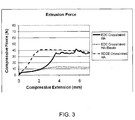
- Shown in Figure 3 is a graph of compressive extension plotted against compressive force for EDC/NHS cross-linked HA and HA-elastin as compared to BDDE crosslinked HA. This data shows that the maximum average compressive force of the EDC/NHS cross-linked HA and HA elastin are 37 N and 13 N, respectively, while that of BDDE crosslinked HA is 38 N. Accordingly, EDC/NHS cross-linked HA and HA-elastin can be administered via injection through a 30 G needle.
- the percentage of uncross-linked HA is an important parameter in evaluating relative cross-linking efficiency, as well as to predict the in vivo persistence of a hydrogel. It is well documented that uncross-linked HA is rapidly degraded in vivo ; therefore, hydrogels with a larger percentage of uncross-linked HA are likely to have less in vivo persistence.
- Total uncross-linked HA is measured by diluting the gel 20x in PBS, and then allowing the gel to swell over 1 week with constant agitation. The solution is then filtered through a 0.22 ⁇ m filter to remove particulate and gel matter, and is then analyzed by SEC-MALS to measure the percentage of recovered HA.
- the EDC/NHS cross-linked HA and HA-elastin contain approximately 10 % and 41% total uncross-linked HA, respectively. This data indicates that both EDC/NHS cross-linked HA and HA-elastin are expected to have suitable in vivo persistence.
Landscapes
- Health & Medical Sciences (AREA)
- Chemical & Material Sciences (AREA)
- Life Sciences & Earth Sciences (AREA)
- Medicinal Chemistry (AREA)
- General Health & Medical Sciences (AREA)
- Veterinary Medicine (AREA)
- Public Health (AREA)
- Animal Behavior & Ethology (AREA)
- Epidemiology (AREA)
- Dermatology (AREA)
- Transplantation (AREA)
- Oral & Maxillofacial Surgery (AREA)
- Pharmacology & Pharmacy (AREA)
- Chemical Kinetics & Catalysis (AREA)
- Organic Chemistry (AREA)
- General Chemical & Material Sciences (AREA)
- Nuclear Medicine, Radiotherapy & Molecular Imaging (AREA)
- Engineering & Computer Science (AREA)
- Bioinformatics & Cheminformatics (AREA)
- Immunology (AREA)
- Inorganic Chemistry (AREA)
- Dispersion Chemistry (AREA)
- Molecular Biology (AREA)
- Biomedical Technology (AREA)
- Proteomics, Peptides & Aminoacids (AREA)
- Biophysics (AREA)
- Pain & Pain Management (AREA)
- Anesthesiology (AREA)
- Toxicology (AREA)
- Communicable Diseases (AREA)
- Oncology (AREA)
- Biochemistry (AREA)
- Diabetes (AREA)
- Endocrinology (AREA)
- Rheumatology (AREA)
- Materials For Medical Uses (AREA)
- Medicinal Preparation (AREA)
- Polymers & Plastics (AREA)
Description
- Various injectable dermal filler products have been developed for treating or correcting facial imperfections, for example, wrinkles and volume loss due to the natural effects of aging. Injectable "dermal fillers" temporarily restore a smoother, more youthful appearance.
- Ideally, dermal fillers are long-lasting, soft, smooth and natural appearing when introduced into or beneath the skin. Further, these products are preferably easy to introduce into a patient using a fine gauge needle and a low extrusion force such that there will be minimal discomfort to the patient.
- Collagen based soft tissue fillers were developed over 20 years ago, and for some time, bovine collagen-based fillers were the only U.S. Food and Drug Administration (FDA)-approved dermal fillers. Because these early dermal fillers were bovine-based, one of the main disadvantages to their use has been the potential for allergic reaction in patients.
- In February 2003, human-derived collagen filler compositions received FDA approval. These collagens provide the advantage of a significantly reduced risk of allergic reactions. Unfortunately, such human-derived collagen filler compositions tended to rapidly degrade shortly after injection.
- In December 2003, the first hyaluronic acid (HA)-based dermal filler was approved by the FDA. This was rapidly followed by the development of many other HA-based dermal fillers.
- HA, also known as hyaluronan, is a naturally occurring, water soluble polysaccharide, specifically a glycosaminoglycan, which is a major component of the extra-cellular matrix and is widely distributed in animal tissues. HA has excellent biocompatibility and does not cause allergic reactions when implanted into a patient. In addition, HA has the ability to bind to large amounts of water, making it an excellent volumizer of soft tissues.
- The development of HA-based fillers which exhibit ideal in vivo properties as well as ideal surgical usability has proven difficult. For example, HA-based fillers that exhibit desirable stability properties in vivo, can be so highly viscous that injection through fine gauge needles is difficult. Conversely, HA-based fillers that are relatively easily injected through fine gauge needles often have relatively inferior stability properties in vivo.
- Current hydrogel synthesis strategies perform cross-linking of HA under basic conditions using small molecules to link the respective chains together. However, under these conditions the HA chains hydrolyze into shorter fragments and small molecule linkers are introduced into the hydrogel.
-
US 2007/0203095 discloses a cross-linked HA gel wherein the cross-links include N-acylurea and/or O-acyl isourea. -
WO 2009/026158 discloses a composition comprising a hydrophilic polymer and a ligand binding moiety covalently attached to the polymer. -
US 2009/0263447 teaches crosslinking of HA by activation of the HA using a coupling agent and reaction of the activated HA with a cross-linking agent comprising an oligopeptide or a polypeptide. - It is an objective of the present invention to provide stable, elastic soft tissue fillers with improved rheological properties.
- The present invention relates to soft tissue fillers, for example, dermal and subdermal filler compositions, hereinafter, sometimes, interchangeably referred to as "dermal fillers", "soft tissue fillers" or "fillers".
- One aspect of the invention is an injectable dermal or sub-dermal filler composition suitable for soft tissue augmentation, which is a hydrogel comprising hyaluronic acid and/or a salt thereof cross-linked with a biocompatible protein selected from collagen and elastin via zero-length cross-linked moieties. In some embodiments, the composition further comprises at least one other active ingredient incorporated into the cross-linked biocompatible polymer.
- The hydrogel may be formed by reacting at least one cross-linkable biocompatible polymer, which is hyaluronic acid and/or a salt thereof, with at least one zero-length cross-linking agent at neutral pH. For example, the neutral pH can be between 6.0 and 8.0, between 6.5 and 7.5, or about 7.0.
- In some embodiments, the cross-linkable biocompatible polymer is hyaluronic acid (HA) and the zero-length cross-linking agent is 1-ethyl-3-(3-dimethylaminopropyl) carbodiimide (EDC).
- In some embodiments, the zero-length cross-linking agent is reacted with the HA in the presence of N-hydroxysuccinimide (NHS), sulfo-NHS (or sulfonyl-NHS) or 4-dimethylaminopyridine (DMAP).
- In some embodiments, the hydrogel further includes a second cross-linked biocompatible polymer which is elastin.
- In some embodiments, the hydrogel can include an active agent selected from the group consisting of enzyme inhibitors, anesthetic agents, medicinal neurotoxins, antioxidants, anti-infective agents, anti-inflammatory agents, ultraviolet (UV) light blocking agents, dyes, hormones, immunosuppressants, and combinations thereof.
- The present invention further provides a method for making an injectable dermal or sub-dermal filler composition suitable for soft tissue augmentation. The method includes providing hyaluronic acid and/or a salt thereof; dissolving the hyaluronic acid and/or a salt thereof in a buffered solution which maintains a pH from 6.0 to 8.0; adding a cross-linkable biocompatible protein selected from collagen and elastin to the buffered solution, adding at least one zero-length cross-linking agent to the buffered solution to form a reaction mixture; and allowing the reaction mixture to stand for a time appropriate to form a hydrogel comprising hyaluronic acid and/or a salt thereof crosslinked with the protein via zero-length cross-linked moieties.
- Embodiments of the method of the invention can include one or more of the buffered solution being a phosphate buffered saline having a pH of between 6.5 and 7.5, and the at least one zero-length cross-linking agent being EDC.
- In some embodiments, NHS is included in the adding step.
- In some embodiments, the method includes a dialyzing step after the adding step.
- In some embodiments, the method includes the use of a second cross-linkable biocompatible polymer which is elastin.
- In one embodiment, the method includes adding an active agent. The active agent may be an active agent selected from the group consisting of enzyme inhibitors, anesthetic agents, medicinal neurotoxins, antioxidants, anti-infective agents, anti-inflammatory agents, ultraviolet light blocking agents, dyes, hormones, immunosuppressants, and combinations thereof.
- In a specific embodiment of the invention, a method for making a hydrogel for soft tissue augmentation is provided which comprises the steps of providing a 0.1 M phosphate buffered saline (PBS) solution having a pH between 6.5 and 7.5; dissolving from 20 to 80 mg/mL HA and from 2 to 20 weight percent soluble elastin in the PBS to form a polymer mixture; adding 5 to 30 mol percent EDC and NHS to the polymer mixture to form a reaction mixture; allowing the reaction mixture to react for 12 to 48 hours at 22° to 60° C to form a gel; dialyzing the gel against PBS to form a purified gel; and sizing the purified gel to form a hydrogel for soft tissue augmentation. In some embodiments, the method includes adding an active agent selected from the group consisting of enzyme inhibitors, anesthetic agents, medicinal neurotoxins, antioxidants, anti-infective agents, anti-inflammatory agents, ultraviolet light blocking agents, dyes, hormones, immunosuppressants, and combinations thereof.
- Another aspect of the invention is a method of augmenting dermal or sub-dermal soft tissue, the method comprising filling the dermal or sub-dermal soft tissue by injecting a hydrogel therein, wherein the hydrogel comprises hyaluronic acid and/or a salt thereof cross-linked with a biocompatible protein via zero-length cross-linked moieties, with the proviso that the method is not a method for treatment of the human or animal body by therapy.
-
-
Figure 1 graphically illustrates the elasticity and viscosity of EDC/NHS cross-linked HA and HA-elastin in accordance with an embodiment of the invention. -
Figure 2 graphically illustrates the resistance of HA and HA-elastin to enzyme degradation. -
Figure 3 graphically illustrates the extrusion force of EDC/NHS cross-linked HA and HA-elastin in accordance with an embodiment of the invention. - Where the definition of terms as used in the specification departs from the commonly used meaning of the term, applicant intends to utilize the definitions provided herein, unless specifically indicated.
- The present description generally relates to soft tissue fillers, which are dermal or subdermal fillers, based on cross-linked biocompatible polymers. The compositions are hydrogels comprising cross-linked biocompatible hyaluronic acid and/or a salt thereof having zero-length cross-linked moieties and optionally at least one other active ingredient incorporated into the cross-linked biocompatible polymer. The present HA-based hydrogels have enhanced rheology (i.e., flow characteristics), elasticity, and persistence relative to known HA-based hydrogels. Methods or processes of preparing such compositions are also provided, as well as products made by such methods or processes.
- A surprising advantage of the compositions and methods of the present description is that the molecular weight of the polymer chains remains high and the resultant hydrogels have improved rheological properties while at the same time have low extrusion forces. Hydrogels with fine-tuned hardness and elasticity are beneficial for the development of biomaterials suitable for soft tissue augmentation.
- HA-based as used herein refers to compositions including cross-linked HA plus the one or more other cross-linked polymers as defined above. In addition, HA can refer to hyaluronic acid and any of its hyaluronate salts, including, but not limited to, sodium hyaluronate (NaHA), potassium hyaluronate, magnesium hyaluronate, calcium hyaluronate, and combinations thereof. Hydrogels of the present description can include 2, 3, 4, 5, 6, 7, 8, 9, 10, or more biocompatible polymers. Suitable biocompatible polymers include polysaccharides (e.g., HA, chitosan, chondroitin sulfate, alginate, carboxymethylcellulose), poly(ethyleneglycol), poly(lactic acid), poly(hydroxyethylmethacrylate), poly(methylmethacrylate), and proteins (e.g., elastin and collagen).
- Generally, the HA concentration in the hydrogel is preferably at least 10 mg/mL and up to 100 mg/mL. For example, the concentration of HA in some of the compositions is in a range between 15 mg/mL and 80 mg/mL, or 15 mg/mL to 30 mg/mL. In some embodiments, the concentration of HA is about 26 mg/mL.
- Generally, zero-length cross-linking agents couple polymers without adding any additional spacer arm atoms and therefore zero-length cross-linking agents are not incorporated into the cross-linked polymer matrix. Suitable zero-length cross-linking agents include carbodiimides such as EDC. Non-water soluble carbodiimides include dicyclohexylcarbodiide (DCC) and diisopropylcarbodiimide (DIC), which may also be suitable.
- Carbodiimide-mediated coupling between carboxylates and alcohol or amine functional groups proceeds readily at ambient temperature, neutral pH and under aqueous conditions. Neutral pH can be, for example, between 6.0 and 8.0, between 6.5 and 7.5, or about 7.0. Typically in water, EDC can be used to mediate esterification between carboxylates and alcohols or amidation between carboxylates and amines. Thus, cross-linked HA is formed by exploiting reactive groups present on HA (e.g, carboxylate and alcohol). In addition, by taking advantage of the high reactivity of amine groups on proteins, amidation between lysine side-chains of proteins with carboxylate groups of HA is achieved to form HA-protein cross-linked hydrogels. Cross-linking agents and unreacted polymers can be removed by dialysis.
- In some embodiments, EDC is used in conjunction with NHS or sulfonyl-NHS (sulfo-NHS), collectively referred to as "NHS" herein. NHS stabilizes reactive intermediates formed by EDC; thus, the addition of NHS can increase the coupling efficiency of EDC. Alternatively, 4-dimethylaminopyridine (DMAP) can be used to catalyze the coupling reaction.
- Without being limited thereto, the HA-based compositions in accordance with the present description include cross-linked HA-based compositions and at least partially cross-linked HA-based compositions. Uncross-linked HA as used herein refers to both truly uncross-linked (e.g., "free") HA chains as well as lightly cross-linked chains and fragments thereof that are generally in soluble liquid form.
- The soft tissue fillers of the present invention can include an active agent selected from the group consisting of enzyme inhibitors, anesthetic agents, medicinal neurotoxins (e.g., botulinum toxin and clostridium toxin), antioxidants, anti-infective agents (e.g., antibiotics), anti-inflammatory agents, UV light blocking agents, dyes, hormones, immunosuppressants, and combinations thereof.
- In addition, the soft tissue fillers of the present invention can include one or more anesthetic agents in an amount effective to mitigate pain experienced upon injection of the composition. The local anesthetic can be selected from the group of ambucaine, amolanone, amylocaine, benoxinate, benzocaine, betoxycaine, biphenamine, bupivacaine, butacaine, butamben, butanilicaine, butethamine, butoxycaine, carticaine, chloroprocaine, cocaethylene, cocaine, cyclomethycaine, dibucaine, dimethysoquin, dimethocaine, diperodon, dycyclonine, ecgonidine, ecgonine, ethyl chloride, etidocaine, beta-eucaine, euprocin, fenalcomine, formocaine, hexylcaine, hydroxytetracaine, isobutyl p-aminobenzoate, leucinocaine mesylate, levoxadrol, lidocaine, mepivacaine, meprylcaine, metabutoxycaine, methyl chloride, myrtecaine, naepaine, octacaine, orthocaine, oxethazaine, parethoxycaine, phenacaine, phenol, piperocaine, piridocaine, polidocanol, pramoxine, prilocaine, procaine, propanocaine, proparacaine, propipocaine, propoxycaine, psuedococaine, pyrrocaine, ropivacaine, salicyl alcohol, tetracaine, tolycaine, trimecaine, zolamine, and salts thereof. In one embodiment, the anesthetic agent is lidocaine, such as in the form of lidocaine HCl. The compositions described herein may have a lidocaine or other anesthetic in a concentration of between 0.1% and 5% by weight or between 0.2% and 1.0% by weight of the composition. In one embodiment, the composition has a lidocaine concentration of about 0.3% by weight (w/w %) of the composition. The concentration of lidocaine in the compositions described herein can be therapeutically effective, meaning the concentration is adequate to provide a therapeutic benefit.
- The present invention also provides methods for making hydrogels. The initial step of providing raw HA material can be in the form of dry HA fibers or powder. The raw HA material may be HA, its salts and/or mixtures thereof. The HA material can comprise, for example, NaHA fibers or powder of bacterial-sourced NaHA. In some aspects of the present description, the HA material may be animal derived. The HA material may be a combination of raw materials including HA and at least one other polysaccharide, for example, glycosaminoglycan (GAG).
- In some embodiments, the HA material in the compositions nearly entirely comprises or consists of high molecular weight HA. That is, nearly 100% of the HA material in the present compositions may be high molecular weight HA. In other embodiments, the HA material in the compositions comprises a combination of high molecular weight HA and low molecular weight HA.
- The HA material of the compositions may comprise between 5% and 95% high molecular weight HA with the balance of the HA material including low molecular weight HA. In a typical composition, the ratio of high molecular weight to low molecular weight HA is at least 2 (w/w ≥ 2), with the high molecular weight HA having a molecular weight of above about 1.0 MDa.
- It will be appreciated by those of ordinary skill in the art that the selection of high and low molecular weight HA material and their relative percentages or ratios is dependent upon the desired characteristics, for example, extrusion force, elastic modulus, viscous modulus and persistence of the final HA-based product. For additional information that may be helpful in understanding this and other aspects of the present description, see
U.S. Patent Application Publication No. 2006/0194758 . - HA-based gels can be prepared according to the present invention by first cleaning and purifying dry or raw HA material having a desired high/low molecular weight ratio. These steps generally involve hydrating the dry HA fibers or powder in the desired high/low molecular weight ratio, for example, using pure water, and filtering the material to remove large foreign matters and/or other impurities. The filtered, hydrated material is then dried and purified. The high and low molecular weight HA may be cleaned and purified separately, or may be mixed together, for example, in the desired ratio, just prior to cross-linking.
- The method of the present invention includes the step of dissolving the cross-linkable biocompatible polymer in a buffered solution maintained at a pH between 6.0 and 8.0, such as between 6.5 and 7.5, or about 7.0. In a preferred embodiment, the buffer is phosphate buffered saline (PBS). A second biocompatible polymer is added, this being collagen or elastin. The biocompatible polymers can be added in ratios which yield suitable flow characteristics, elasticity, viscosity, and persistence. In a preferred embodiment, the second biocompatible polymer is elastin. In a particularly preferred embodiment, 20 to 80 mg/mL HA is dissolved in the buffer solution, and 2 to 20 weight percent of soluble elastin is dissolved in the buffer solution.
- The method further includes the step of adding at least one zero-length cross-linking agent to the buffered solution. The use of more than one cross-linking agent or a different cross-linking agent is not excluded from the scope of the present description. In a preferred embodiment, the zero-length cross-linking agent is EDC. NHS can be added to the reaction mixture before, or together with, EDC to increase cross-linking efficiency. EDC and NHS can be added in any ratio, such as 10:1, 5:1, 2:1, 1:1, 1:2, 1:5, or 1:10. In a preferred embodiment, EDC and NHS are added in one portion (i.e., 1:1 ratio). EDC and NHS can be prepared at any suitable concentration, such as 1 to 50 mol percent, and more preferably 5 to 30 mol percent.
- The reaction mixture is allowed to stand for a time appropriate to form a hydrogel suitable for soft tissue implantation. In some embodiments, the time is between 12 hours and 72 hours, between 12 and 48 hours, or about 24 hours. In some embodiments, the reaction mixture is maintained at an appropriate temperature, such as between 22 and 60 degrees Celsius.
- The step of cross-linking may be carried out using any means known to those of ordinary skill in the art. Those skilled in the art appreciate how to optimize conditions of cross-linking according to the nature of the biocompatible polymers, and how to carry out cross-linking to an optimized degree. A degree of cross-linking is preferably sufficient for the final hydrogel composition obtained from the present methods to remain implanted at the injection site without excessive diffusion away from the injection site. In some embodiments, the degree of cross-linking is 2% to 20%, and more preferably 4% to 12%, wherein the degree of cross-linking is defined as the percent weight ratio of the cross-linking agent to HA-monomeric units in the composition. The degree of cross-linking can be less than 6% or more preferably less than 5%.
- The method of making a hydrogel can include the step of dialyzing the hydrogel after the hydrogel is formed to remove cross-linking agents, unreacted starting materials, and by-products such as N-acylurea. In some embodiments, the dialysis is performed using a buffer solution. In a preferred embodiment, the buffer solution is PBS. The purified hydrogel can then be sized using any suitable method, such as by passing through a stainless steel screen having the desired mesh size.
- The cross-linked HA-based gels can comprise a cross-linked HA component capable of absorbing at least one time its weight in water. When neutralized and swollen, the cross-linked HA component and water absorbed by the cross-linked HA component is in a weight ratio of about 1:1.
- The compositions described herein display an elastic modulus and viscous modulus which is dependent on the specific biocompatible polymers used and the presence and/or absence of at least one active agent. In some embodiments, the elastic modulus of the HA-based compositions can be at least 50 Pa, but is more preferably between 150 Pa and 1500 Pa, such as between 500 Pa and 1200 Pa. In some embodiments, the viscous modulus can be between 50 Pa and 500 Pa, such as between 50 Pa and 200 Pa. In one exemplary embodiment, the viscous modulus is about 160 Pa.
- In some embodiments, the method includes the step of adding an active ingredient to the hydrogel. As discussed in more detail above, the active ingredient can be selected from the group consisting of enzyme inhibitors, anesthetic agents, medicinal neurotoxins, antioxidants, anti-infective agents, anti-inflammatory agents, ultraviolet light blocking agents, dyes, hormones, immunosuppressants, and combinations thereof. The use of more than one active agent is specifically not excluded. In some embodiments, one or more active agents are added to the purified hydrogel. In other embodiments, one or more active agents are added to the reaction buffer and are cross-linked with the biocompatible polymer and/or the active agents are entrapped or encased by the cross-linked biocompatible polymer.
- Syringes useful for administering the hydrogels of the present description include any syringe known in the art capable of delivering viscous dermal filler compositions. The syringes generally have an internal volume of 0.4 mL to 3 mL, more preferably between 0.5 mL and 1.5 mL or between 0.8 mL and 2.5 mL. This internal volume is associated with an internal diameter of the syringe which affects the extrusion force needed to inject high viscosity dermal filler compositions. The internal diameters are generally 4 mm to 9 mm, more preferably from 4.5 mm to 6.5 mm or from 4.5 mm to 8.8 mm. Further, the extrusion force needed to deliver the HA-based compositions from the syringe is dependent on the needle gauge. The gauges of needles used generally include gauges between 18G and 40G, more preferably 25G to 33G or from 16G to 25G. A person of ordinary skill in the art can determine the correct syringe dimensions and needle gauge required to arrive at a particular extrusion force requirement.
- The extrusion forces displayed by the HA-based compositions described herein using the needle dimensions described above are applied using injection speeds that are comfortable to a patient. Comfortable to a patient is used to define a rate of injection that does not injure or cause excess pain to a patient upon injection to the soft tissue. One skilled in the art will appreciate that comfortable as used herein includes not only patient comfort, but also comfort and ability of the physician or medical technician injecting the HA compositions. Although certain extrusion forces may be achievable with the HA compositions of the present description, one skilled in the art understands that high extrusion forces can lead to lack of control during injection and that such lack of control may result in additional pain to the patient. Extrusion forces of the present HA compositions can be from 8 N to 40 N, or more preferably from 10 N to 30 N, or 15 N to 20 N.
- Sterilization, as used herein comprises any method known in the art to effectively kill or eliminate transmissible agents, preferably without substantially altering or degrading the HA-based compositions and any active agents.
- One preferable method of sterilization of the filled syringes is by autoclave. Autoclaving can be accomplished by applying a mixture of heat, pressure and moisture to a sample in need of sterilization. Many different sterilization temperatures, pressures and cycle times can be used for this step. For example, the filled syringes may be sterilized at a temperature of 120°C to 130°C or greater. Moisture may or may not be utilized. The pressure applied is in some embodiments depending on the temperature used in the sterilization process. The sterilization cycle may be at least 1 minute to 20 minutes or more.
- Another method of sterilization incorporates the use of a gaseous species which is known to kill or eliminate transmissible agents. Preferably, ethylene oxide is used as the sterilization gas and is known in the art to be useful in sterilizing medical devices and products.
- A further method of sterilization incorporates the use of an irradiation source which is known in the art to kill or eliminate transmissible agents. A beam of irradiation is targeted at the syringe containing the HA solution, and the wavelength of energy kills or eliminates the unwanted transmissible agents. Preferable energy useful include, but is not limited to ultraviolet light, gamma irradiation, visible light, microwaves, or any other wavelength or band of wavelengths which kills or eliminates the unwanted transmissible agents, preferably without substantially altering of degrading the HA-based composition or any active agent.
- Polysaccharide hydrogels were generated by cross-linking HA using EDC and NHS (or sulfo-NHS, collectively "NHS").
- Carbodiimide-mediated coupling of HA is performed in 0.1 M PBS at neutral pH (6.5-7.5). HA is dissolved in buffer (20-80 mg/mL). 5-30 mol % EDC and NHS are then added in one portion. Next, the polymer is allowed to cross-link over 12-72 hours at 22-60 °C. The resulting gel may be diluted and is then dialyzed extensively at ambient temperature against PBS to remove N-acylurea by-products and any unused starting materials. Sizing of the purified gel is then performed through a stainless steel screen.
- Polysaccharide-protein hydrogels were generated by cross-linking HA and elastin using EDC and NHS.
- Carbodiimide-mediated coupling of HA and elastin is performed in 0.1 M PBS at neutral pH (6.5-7.5). HA (20-80 mg/mL) and soluble elastin (2-20 wt %) are dissolved in PBS. 5-30 mol % EDC and NHS are added in one portion. Next, the polysaccharide and protein are allowed to cross-link at ambient temperature over 12-48 hours at 22-60 °C. The resultant gel is then dialyzed extensively at ambient temperature against PBS to remove the N-acylurea byproducts and starting materials. Sizing of the purified gel is then performed through a stainless steel screen.
- The flow characteristics of the hydrogels prepared according to Examples 1 and 2 were evaluated in order to assess their elasticity and viscosity.
- A strain sweep analysis provides information about a gel's elastic modulus (G') and viscous modulus (G"). A large value of G' compared to G" indicates a very elastic gel.
Figure 1 depicts typical strain sweep data for a hydrogel comprised of EDC/NHS cross-linked HA and HA-elastin. The G' for the two gels is 1100 Pa and 505 Pa, respectively where as that of BDDE crosslinked HA is 150 Pa. The G'/G" of the EDC/NHS cross-linked HA is 6.9 and that of HA-elastin is 3.7, respectively. In comparison, the G'/G" of BDDE-crosslinked HA is approximately 2.5. Taken together, this data suggests that the resulting gels from EDC/NHS mediated cross-linking have higher elasticity and hardness compared to BDDE-crosslinked hydrogel. Accordingly, EDC/NHS cross-linked HA and HA-proteins have improved properties suitable for soft tissue augmentation, such as, for example, dermal filling. - Hydrogels prepared according to Examples 1 and 2 were subjected to enzyme degradation in vitro to assess resistance to enzymatic degradation.
- It is generally understood that improved resistance to enzyme degradation correlates to improved in vivo persistence. A superior gel resists degradation and therefore has a smaller difference of free HA before and after enzyme degradation. First, the percentage of uncross-linked (i.e., "free" HA) before and after enzymatic degradation with bovine testicular hyaluronidase (HAse) is measured by size exclusion chromatography (SEC) on an Agilent (Santa Clara, CA) HPLC system equipped with multi-angle laser light scattering (MALS) and refractive index detectors.
Figure 2 depicts enzymatic degradation of EDC/NHS cross-linked HA and HA-elastin, and BDDE-crosslinked HA hydrogel. As shown inFigure 2 , the increase in soluble HA is 37 % and 4% for the EDC/NHS cross-linked HA and HA-elastin, respectively. The increase in soluble HA for BDDE crosslinked HA is 41%. Thus, HA-elastin resists enzymatic degradation more than the EDC/NHS cross-linked HA, and both HA and HA-elastin resist degradation more than BDDE crosslinked HA. As a result, EDC/NHS cross-linked HA and HA-proteins are expected to have improved in vivo persistence. - The extrusion force of hydrogels prepared according to Examples 1 and 2 were determined to evaluate the feasibility of administering the hydrogels through a needle.
- Extrusion force analysis was performed on an INSTRON® (Norwood, MA) instrument using a 0.8 mL syringe equipped with a 30 gauge (G) needle. The hydrogel was extruded at a constant rate of 50 mm/min. Shown in
Figure 3 is a graph of compressive extension plotted against compressive force for EDC/NHS cross-linked HA and HA-elastin as compared to BDDE crosslinked HA. This data shows that the maximum average compressive force of the EDC/NHS cross-linked HA and HA elastin are 37 N and 13 N, respectively, while that of BDDE crosslinked HA is 38 N. Accordingly, EDC/NHS cross-linked HA and HA-elastin can be administered via injection through a 30 G needle. - Total uncross-linked HA (i.e., free HA) was determined in the hydrogels prepared according to Examples 1 and 2.
- The percentage of uncross-linked HA is an important parameter in evaluating relative cross-linking efficiency, as well as to predict the in vivo persistence of a hydrogel. It is well documented that uncross-linked HA is rapidly degraded in vivo; therefore, hydrogels with a larger percentage of uncross-linked HA are likely to have less in vivo persistence. Total uncross-linked HA is measured by diluting the gel 20x in PBS, and then allowing the gel to swell over 1 week with constant agitation. The solution is then filtered through a 0.22 µm filter to remove particulate and gel matter, and is then analyzed by SEC-MALS to measure the percentage of recovered HA. In this specific example, the EDC/NHS cross-linked HA and HA-elastin contain approximately 10 % and 41% total uncross-linked HA, respectively. This data indicates that both EDC/NHS cross-linked HA and HA-elastin are expected to have suitable in vivo persistence.
Claims (10)
- An injectable dermal or sub-dermal filler composition suitable for soft tissue augmentation, which is a hydrogel comprising hyaluronic acid and/or a salt thereof cross-linked with a biocompatible protein selected from collagen and elastin via zero-length cross-linked moieties.
- An injectable dermal or sub-dermal filler composition according to Claim 1, wherein the protein is collagen.
- An injectable dermal or sub-dermal filler composition according to Claim 1, wherein the protein is elastin.
- A method for producing an injectable dermal or sub-dermal filler composition suitable for soft tissue augmentation, the method comprising the steps of:providing hyaluronic acid and/or a salt thereof;dissolving the hyaluronic acid and/or a salt thereof in a buffered solution which maintains a pH of between 6.0 and 8.0;adding a cross-linkable biocompatible protein selected from collagen and elastin to the buffered solution;adding at least one zero-length cross-linking agent to the buffered solution to form a reaction mixture; andallowing the reaction mixture to stand for a time appropriate to form a hydrogel comprising hyaluronic acid and/or a salt thereof cross-linked with the protein via zero-length cross-linked moieties.
- A method according to Claim 4, wherein the buffered solution is phosphate buffered saline (PBS) having a pH of between 6.5 and 7.5.
- A method according to Claim 4 or Claim 5, wherein the at least one zero-length cross-linking agent is 1-ethyl-3-(3-dimethylaminopropyl) carbodiimide (EDC).
- A method according to any of Claims 4-6, further comprising adding N-hydroxysuccinimide (NHS) to the buffered solution.
- A method according to any of Claims 4-7, wherein the protein is elastin.
- A method according to Claim 4, which comprises the steps of:providing a 0.1 M PBS solution having a pH between 6.5 and 7.5;dissolving 20 to 80 mg/mL of hyaluronic acid or a hyaluronic acid salt and 2 to 20 wt.% of soluble elastin in the PBS to form a polymer mixture;adding 5 to 30 mol% of EDC and NHS to the polymer mixture to form a reaction mixture;allowing the reaction mixture to react for 12 to 48 hours at 22 to 60°C to form a gel;dialyzing the gel against PBS to form a purified gel;sizing the purified gel to form a hydrogel; andadding an active agent to the hydrogel, the active agent being an enzyme inhibitor, an anesthetic agent, a medicinal neurotoxin, an antioxidant, an anti-infective agent, an anti-inflammatory agent, a UV-blocking agent, a dye, a hormone, an immunosuppressant, or a combination thereof.
- A method of augmenting dermal or sub-dermal soft tissue, the method comprising filling the dermal or sub-dermal soft tissue by injecting a hydrogel therein, wherein the hydrogel comprises hyaluronic acid and/or a salt thereof cross-linked with a biocompatible protein via zero-length cross-linked moieties, with the proviso that the method is not a method for treatment of the human or animal body by therapy.
Priority Applications (6)
| Application Number | Priority Date | Filing Date | Title |
|---|---|---|---|
| DK16168906.2T DK3078388T3 (en) | 2010-03-22 | 2011-03-21 | CROSS-BREAKED HYDROGEN WAVES |
| PL16168906T PL3078388T3 (en) | 2010-03-22 | 2011-03-21 | Crosslinked hydrogels for soft tissue enlargement |
| EP19157683.4A EP3520827B1 (en) | 2010-03-22 | 2011-03-21 | Cross-linked hydrogels for soft tissue augmentation |
| PL11711228T PL2550027T5 (en) | 2010-03-22 | 2011-03-21 | Polysaccharide and protein-polysaccharide cross-linked hydrogels for soft tissue enlargement |
| EP22174583.9A EP4062950A1 (en) | 2010-03-22 | 2011-03-21 | Syringe comprising dermal filler for soft tissue augmentation |
| EP16168906.2A EP3078388B1 (en) | 2010-03-22 | 2011-03-21 | Cross-linked hydrogels for soft tissue augmentation |
Applications Claiming Priority (2)
| Application Number | Priority Date | Filing Date | Title |
|---|---|---|---|
| US31628310P | 2010-03-22 | 2010-03-22 | |
| PCT/US2011/029150 WO2011119468A1 (en) | 2010-03-22 | 2011-03-21 | Polysaccharide and protein-polysaccharide cross-linked hydrogels for soft tissue augmentation |
Related Child Applications (4)
| Application Number | Title | Priority Date | Filing Date |
|---|---|---|---|
| EP16168906.2A Division EP3078388B1 (en) | 2010-03-22 | 2011-03-21 | Cross-linked hydrogels for soft tissue augmentation |
| EP16168906.2A Division-Into EP3078388B1 (en) | 2010-03-22 | 2011-03-21 | Cross-linked hydrogels for soft tissue augmentation |
| EP19157683.4A Division EP3520827B1 (en) | 2010-03-22 | 2011-03-21 | Cross-linked hydrogels for soft tissue augmentation |
| EP22174583.9A Division EP4062950A1 (en) | 2010-03-22 | 2011-03-21 | Syringe comprising dermal filler for soft tissue augmentation |
Publications (3)
| Publication Number | Publication Date |
|---|---|
| EP2550027A1 EP2550027A1 (en) | 2013-01-30 |
| EP2550027B1 EP2550027B1 (en) | 2016-05-11 |
| EP2550027B2 true EP2550027B2 (en) | 2019-03-20 |
Family
ID=43983977
Family Applications (4)
| Application Number | Title | Priority Date | Filing Date |
|---|---|---|---|
| EP22174583.9A Pending EP4062950A1 (en) | 2010-03-22 | 2011-03-21 | Syringe comprising dermal filler for soft tissue augmentation |
| EP11711228.4A Active EP2550027B2 (en) | 2010-03-22 | 2011-03-21 | Polysaccharide and protein-polysaccharide cross-linked hydrogels for soft tissue augmentation |
| EP16168906.2A Active EP3078388B1 (en) | 2010-03-22 | 2011-03-21 | Cross-linked hydrogels for soft tissue augmentation |
| EP19157683.4A Revoked EP3520827B1 (en) | 2010-03-22 | 2011-03-21 | Cross-linked hydrogels for soft tissue augmentation |
Family Applications Before (1)
| Application Number | Title | Priority Date | Filing Date |
|---|---|---|---|
| EP22174583.9A Pending EP4062950A1 (en) | 2010-03-22 | 2011-03-21 | Syringe comprising dermal filler for soft tissue augmentation |
Family Applications After (2)
| Application Number | Title | Priority Date | Filing Date |
|---|---|---|---|
| EP16168906.2A Active EP3078388B1 (en) | 2010-03-22 | 2011-03-21 | Cross-linked hydrogels for soft tissue augmentation |
| EP19157683.4A Revoked EP3520827B1 (en) | 2010-03-22 | 2011-03-21 | Cross-linked hydrogels for soft tissue augmentation |
Country Status (10)
| Country | Link |
|---|---|
| US (8) | US8691279B2 (en) |
| EP (4) | EP4062950A1 (en) |
| AU (3) | AU2011229730B2 (en) |
| CA (1) | CA2794254C (en) |
| DK (2) | DK3078388T3 (en) |
| ES (2) | ES2729994T3 (en) |
| HU (2) | HUE043344T2 (en) |
| PL (2) | PL3078388T3 (en) |
| PT (1) | PT2550027T (en) |
| WO (1) | WO2011119468A1 (en) |
Cited By (1)
| Publication number | Priority date | Publication date | Assignee | Title |
|---|---|---|---|---|
| US11801329B2 (en) | 2018-05-03 | 2023-10-31 | Collplant Ltd. | Dermal fillers and applications thereof |
Families Citing this family (61)
| Publication number | Priority date | Publication date | Assignee | Title |
|---|---|---|---|---|
| US20110077737A1 (en) * | 2007-07-30 | 2011-03-31 | Allergan, Inc. | Tunably Crosslinked Polysaccharide Compositions |
| US8697044B2 (en) | 2007-10-09 | 2014-04-15 | Allergan, Inc. | Crossed-linked hyaluronic acid and collagen and uses thereof |
| PT2818184T (en) | 2007-11-16 | 2019-01-28 | Aclaris Therapeutics Inc | Compositions and methods for treating purpura |
| US8394782B2 (en) | 2007-11-30 | 2013-03-12 | Allergan, Inc. | Polysaccharide gel formulation having increased longevity |
| US9161970B2 (en) | 2007-12-12 | 2015-10-20 | Allergan, Inc. | Dermal filler |
| US9044477B2 (en) * | 2007-12-12 | 2015-06-02 | Allergan, Inc. | Botulinum toxin formulation |
| US8357795B2 (en) | 2008-08-04 | 2013-01-22 | Allergan, Inc. | Hyaluronic acid-based gels including lidocaine |
| CA2735173C (en) | 2008-09-02 | 2017-01-10 | Tautona Group Lp | Threads of hyaluronic acid and/or derivatives thereof, methods of making thereof and uses thereof |
| US9114188B2 (en) | 2010-01-13 | 2015-08-25 | Allergan, Industrie, S.A.S. | Stable hydrogel compositions including additives |
| US20110172180A1 (en) | 2010-01-13 | 2011-07-14 | Allergan Industrie. Sas | Heat stable hyaluronic acid compositions for dermatological use |
| US8586562B2 (en) | 2010-03-12 | 2013-11-19 | Allergan Industrie, Sas | Fluid compositions for improving skin conditions |
| EP4062950A1 (en) | 2010-03-22 | 2022-09-28 | Allergan, Inc. | Syringe comprising dermal filler for soft tissue augmentation |
| US9005605B2 (en) | 2010-08-19 | 2015-04-14 | Allergan, Inc. | Compositions and soft tissue replacement methods |
| US8697057B2 (en) | 2010-08-19 | 2014-04-15 | Allergan, Inc. | Compositions and soft tissue replacement methods |
| US8883139B2 (en) | 2010-08-19 | 2014-11-11 | Allergan Inc. | Compositions and soft tissue replacement methods |
| US8889123B2 (en) | 2010-08-19 | 2014-11-18 | Allergan, Inc. | Compositions and soft tissue replacement methods |
| US9393263B2 (en) | 2011-06-03 | 2016-07-19 | Allergan, Inc. | Dermal filler compositions including antioxidants |
| RU2624239C2 (en) | 2011-06-03 | 2017-07-03 | Аллерган, Инк. | Dermal fillers compositions, including antioxidants |
| US9408797B2 (en) | 2011-06-03 | 2016-08-09 | Allergan, Inc. | Dermal filler compositions for fine line treatment |
| US20130096081A1 (en) | 2011-06-03 | 2013-04-18 | Allergan, Inc. | Dermal filler compositions |
| US9662422B2 (en) | 2011-09-06 | 2017-05-30 | Allergan, Inc. | Crosslinked hyaluronic acid-collagen gels for improving tissue graft viability and soft tissue augmentation |
| US20130244943A1 (en) | 2011-09-06 | 2013-09-19 | Allergan, Inc. | Hyaluronic acid-collagen matrices for dermal filling and volumizing applications |
| DK3505180T3 (en) * | 2011-09-30 | 2022-09-19 | Allergan Pharmaceuticals Int Ltd | In vivo synthesis of elastic fiber |
| EP3243533B1 (en) * | 2011-10-11 | 2020-06-17 | Allergan Holdings France S.A.S. | Threads of cross-linked hyaluronic acid and methods of use thereof |
| EP4491202A3 (en) * | 2011-11-04 | 2025-03-12 | Allergan, Inc. | Hyaluronic acid-collagen matrices for dermal filling and volumizing applications |
| WO2013101939A1 (en) * | 2011-12-28 | 2013-07-04 | Allergan, Inc. | Hyalruonic acid-collagen matrices for tissue engineering |
| EP4122441A1 (en) * | 2012-01-13 | 2023-01-25 | Allergan, Inc. | Crosslinked hyaluronic acid-collagen gels for improving tissue graft viability and soft tissue augmentation |
| WO2013106715A1 (en) * | 2012-01-13 | 2013-07-18 | Allergan, Inc. | Crosslinked hyaluronic acid-collagen gels for improving tissue graft viability and soft tissue augmentation |
| IN2014DN10147A (en) | 2012-06-15 | 2015-08-21 | Merz Pharma Gmbh & Co Kgaa | |
| WO2014063194A1 (en) | 2012-10-23 | 2014-05-01 | The University Of Sydney | Elastic hydrogel |
| US10842913B2 (en) | 2012-12-10 | 2020-11-24 | Allergan Pharmaceuticals International Limited | Scalable three-dimensional elastic construct manufacturing |
| PT3613423T (en) | 2013-07-10 | 2022-12-07 | Matrix Biology Inst | HIGH ELASTICITY HYALURONAN COMPOSITIONS AND THEIR USES |
| RU2677637C2 (en) | 2013-08-13 | 2019-01-18 | Эластаджен Пти Лтд | Regeneration of damaged tissue |
| WO2016051219A1 (en) | 2014-09-30 | 2016-04-07 | Allergan Industrie, Sas | Stable hydrogel compositions including additives |
| EP3524596B1 (en) | 2014-12-23 | 2020-09-09 | Crossing S.r.l. | Reagents comprising 2-halo-4,6-dialkoxy-1,3,5-triazines in the presence of amines and their use in a stabilization method. |
| CA2972094C (en) | 2015-01-12 | 2023-10-24 | Wake Forest University Health Sciences | Multi-layer skin substitute products and methods of making and using the same |
| RU2715234C2 (en) | 2015-02-13 | 2020-02-26 | Аллерган Эндюстри, Сас | Implants for sculpting, augmenting or correcting facial features such as chin |
| US20180177707A1 (en) | 2015-06-30 | 2018-06-28 | Merz Pharma Gmbh & Co. Kgaa | Method of preparing a composition based on hyaluronic acid |
| PT3352766T (en) | 2015-09-24 | 2022-03-22 | Matrix Biology Inst | High elasticity hyaluronan compositions and methods of use thereof |
| US20170136144A1 (en) | 2015-11-12 | 2017-05-18 | John C. Herr | Compositions and methods for vas-occlusive contraception |
| KR102402097B1 (en) | 2016-08-04 | 2022-05-25 | 웨이크 포리스트 유니버시티 헬스 사이언시즈 | Blood-brain barrier model and methods of making and using the same |
| ES2883839T3 (en) * | 2016-10-13 | 2021-12-09 | Allergan Inc | Coacervated Hyaluronan Hydrogels for Dermal Filler Applications |
| US12383421B2 (en) | 2017-01-05 | 2025-08-12 | Contraline, Inc. | Contraceptive devices |
| GB201711360D0 (en) * | 2017-07-14 | 2017-08-30 | Raft Entpr Ltd | Tissue scaffold |
| WO2019018664A1 (en) * | 2017-07-19 | 2019-01-24 | Dentsply Sirona Inc. | Water-soluble hydrogel-based dental composition and methods of making and using same |
| US11826757B2 (en) | 2017-08-02 | 2023-11-28 | Wake Forest University Health Sciences | Niches-on-a-chip |
| US20210212810A1 (en) | 2017-12-07 | 2021-07-15 | Wake Forest University Health Sciences | Multi-layer skin constructs and methods of making and using the same |
| WO2019121694A1 (en) * | 2017-12-22 | 2019-06-27 | Nestlé Skin Health Sa | Injectable compositions of cross-linked hyaluronic acid and bupivacaine, and uses thereof |
| AU2019380413B2 (en) | 2018-11-13 | 2025-04-17 | Contraline, Inc. | Systems and methods for delivering biomaterials |
| FR3095206B1 (en) * | 2019-04-17 | 2021-11-05 | Lab Vivacy | POLYMER CROSS-LINKING PROCESS |
| CN119112703A (en) * | 2019-12-26 | 2024-12-13 | 阿勒根公司 | Physically blended HA-collagen dermal fillers |
| AU2021273196A1 (en) * | 2020-05-14 | 2022-12-15 | Contraline, Inc. | Biomaterial compositions and methods of delivery |
| CN111643730A (en) * | 2020-07-14 | 2020-09-11 | 华熙生物科技股份有限公司 | Preparation method and application of crosslinked hyaluronic acid gel for injection |
| JP2021072906A (en) * | 2021-01-18 | 2021-05-13 | アラーガン、インコーポレイテッドAllergan,Incorporated | Coacervate hyaluronan hydrogel for use in dermal filler |
| US20220362437A1 (en) * | 2021-05-13 | 2022-11-17 | Shanghai Qisheng Biological Preparation Co., Ltd. | Hyaluronic Acid Compositions Containing Slowly Resorbable Polymers |
| EP4395796A4 (en) | 2021-09-01 | 2024-12-25 | Shanghai Qisheng Biological Preparation Co., Ltd. | CARTILAGE REGENERATION USING IN SITU POLYMERIZABLE INJECTABLE COLLAGEN COMPOSITIONS CONTAINING CHONDROCYTES OR STEM CELLS |
| EP4457266A4 (en) | 2021-12-28 | 2025-10-22 | Shanghai Qisheng Biological Preparation Co Ltd | HYALURONIC ACID-COLLAGEN COPOLYMER COMPOSITIONS AND MEDICAL APPLICATIONS THEREOF |
| KR20250124803A (en) | 2022-12-15 | 2025-08-20 | 메르츠 파마 게엠베하 운트 코. 카가아 | Injectable gel containing botulinum toxin and use thereof |
| JP2026523363A (en) | 2023-05-25 | 2026-07-14 | メルツ エステティックス ゲゼルシャフト ミット ベシュレンクテル ハフツング | Crosslinked material containing polysaccharide moieties interconnected by ester bonds |
| EP4567050A1 (en) | 2023-12-04 | 2025-06-11 | Quantum Beauty Cosmetics Joint Stock Company | A method for preparing a cross-linked hyaluronic acid gel |
| WO2026099144A1 (en) | 2024-11-05 | 2026-05-15 | Merz Pharma Gmbh & Co. Kgaa | Self-crosslinked hydrogel combination with botulinum neurotoxin |
Citations (6)
| Publication number | Priority date | Publication date | Assignee | Title |
|---|---|---|---|---|
| EP0341745A1 (en) † | 1988-05-13 | 1989-11-15 | FIDIA S.p.A. | Crosslinked carboxy polysaccharides |
| US6013679A (en) † | 1989-08-01 | 2000-01-11 | Anika Research, Inc. | Water-insoluble derivatives of hyaluronic acid and their methods of preparation and use |
| WO2000046252A1 (en) † | 1999-02-05 | 2000-08-10 | Vitrolife Uk Limited | Process for cross-linking hyaluronic acid to polymers |
| WO2000046253A1 (en) † | 1999-02-03 | 2000-08-10 | Vitrolife Uk Limited | Process for the production of multiple cross-linked hyaluronic acid derivatives |
| WO2005052035A1 (en) † | 2003-11-28 | 2005-06-09 | Universite Louis Pasteur | Method for preparing crosslinked polyelectrolyte multilayer films |
| WO2006015490A1 (en) † | 2004-08-13 | 2006-02-16 | Ottawa Health Research Institute | Ophthalmic devices and related methods and compositions |
Family Cites Families (321)
| Publication number | Priority date | Publication date | Assignee | Title |
|---|---|---|---|---|
| US2128827A (en) | 1938-03-09 | 1938-08-30 | Frank B Killian | Method and apparatus for manufacturing thin rubber articles |
| CA807629A (en) | 1966-06-30 | 1969-03-04 | Colgate-Palmolive Company | Lotion and detergent compositions |
| JPS4838158B1 (en) | 1970-10-05 | 1973-11-15 | ||
| US3783009A (en) | 1971-02-22 | 1974-01-01 | Air Reduction | Method for improving perfection of epitaxially grown germanium films |
| CA949965A (en) | 1971-12-03 | 1974-06-25 | Robert H. Marchessault | Method of preparing cross-linked starch and starch derivatives |
| US3949073A (en) | 1974-11-18 | 1976-04-06 | The Board Of Trustees Of Leland Stanford Junior University | Process for augmenting connective mammalian tissue with in situ polymerizable native collagen solution |
| US4060081A (en) | 1975-07-15 | 1977-11-29 | Massachusetts Institute Of Technology | Multilayer membrane useful as synthetic skin |
| CA1073360A (en) | 1975-10-22 | 1980-03-11 | John R. Daniels | Non-antigenic collagen and articles of manufacture |
| US4233360A (en) | 1975-10-22 | 1980-11-11 | Collagen Corporation | Non-antigenic collagen and articles of manufacture |
| JPS581933Y2 (en) | 1979-04-23 | 1983-01-13 | 株式会社日本製鋼所 | Cable clamp device |
| JPS55153711A (en) | 1979-05-19 | 1980-11-29 | Pola Chem Ind Inc | Cosmetic lotion |
| US4279812A (en) | 1979-09-12 | 1981-07-21 | Seton Company | Process for preparing macromolecular biologically active collagen |
| JPS6052129B2 (en) | 1979-10-04 | 1985-11-18 | 呉羽化学工業株式会社 | Manufacturing method of medical collagen fiber |
| US4424208A (en) | 1982-01-11 | 1984-01-03 | Collagen Corporation | Collagen implant material and method for augmenting soft tissue |
| US4582640A (en) | 1982-03-08 | 1986-04-15 | Collagen Corporation | Injectable cross-linked collagen implant material |
| US4501306A (en) | 1982-11-09 | 1985-02-26 | Collagen Corporation | Automatic syringe filling system |
| SE442820B (en) | 1984-06-08 | 1986-02-03 | Pharmacia Ab | GEL OF THE CROSS-BOND HYALURONIC ACID FOR USE AS A GLASS BODY SUBSTITUTE |
| SE456346B (en) | 1984-07-23 | 1988-09-26 | Pharmacia Ab | GEL TO PREVENT ADHESION BETWEEN BODY TISSUE AND SET FOR ITS PREPARATION |
| GB8418772D0 (en) | 1984-07-24 | 1984-08-30 | Geistlich Soehne Ag | Chemical substances |
| US4605691A (en) | 1984-12-06 | 1986-08-12 | Biomatrix, Inc. | Cross-linked gels of hyaluronic acid and products containing such gels |
| US4582865A (en) | 1984-12-06 | 1986-04-15 | Biomatrix, Inc. | Cross-linked gels of hyaluronic acid and products containing such gels |
| US4636524A (en) | 1984-12-06 | 1987-01-13 | Biomatrix, Inc. | Cross-linked gels of hyaluronic acid and products containing such gels |
| SE8501022L (en) | 1985-03-01 | 1986-09-02 | Pharmacia Ab | FORMAT CREATES AND PROCEDURES FOR ITS PREPARATION |
| US4713448A (en) | 1985-03-12 | 1987-12-15 | Biomatrix, Inc. | Chemically modified hyaluronic acid preparation and method of recovery thereof from animal tissues |
| US4642117A (en) | 1985-03-22 | 1987-02-10 | Collagen Corporation | Mechanically sheared collagen implant material and method |
| US4803075A (en) | 1986-06-25 | 1989-02-07 | Collagen Corporation | Injectable implant composition having improved intrudability |
| GB2193898A (en) | 1986-07-03 | 1988-02-24 | Words Ind Limited | A board game |
| GB8619400D0 (en) | 1986-08-08 | 1986-09-17 | Sea Containers Ltd | Base frame structure |
| FR2608456B1 (en) | 1986-12-18 | 1993-06-18 | Mero Rousselot Satia | MICROCAPSULES BASED ON GELATIN AND POLYSACCHARIDES AND PROCESS FOR OBTAINING THEM |
| US5091171B2 (en) | 1986-12-23 | 1997-07-15 | Tristrata Inc | Amphoteric compositions and polymeric forms of alpha hydroxyacids and their therapeutic use |
| US5385938B1 (en) | 1986-12-23 | 1997-07-15 | Tristrata Inc | Method of using glycolic acid for treating wrinkles |
| FR2623167B2 (en) | 1987-08-14 | 1992-08-07 | Genus Int | IMPROVEMENT IN ARTICLES WITH ELASTIC ARTICULATIONS RIGIDIFYING ON THEIR TENSIONING |
| US5017229A (en) | 1990-06-25 | 1991-05-21 | Genzyme Corporation | Water insoluble derivatives of hyaluronic acid |
| US6174999B1 (en) | 1987-09-18 | 2001-01-16 | Genzyme Corporation | Water insoluble derivatives of polyanionic polysaccharides |
| US5162430A (en) | 1988-11-21 | 1992-11-10 | Collagen Corporation | Collagen-polymer conjugates |
| US5614587A (en) | 1988-11-21 | 1997-03-25 | Collagen Corporation | Collagen-based bioadhesive compositions |
| US5565519A (en) | 1988-11-21 | 1996-10-15 | Collagen Corporation | Clear, chemically modified collagen-synthetic polymer conjugates for ophthalmic applications |
| US5643464A (en) | 1988-11-21 | 1997-07-01 | Collagen Corporation | Process for preparing a sterile, dry crosslinking agent |
| SE462587B (en) | 1988-11-30 | 1990-07-23 | Wiklund Henry & Co | DEVICE FOR MARKING THE WORK PAPER WITH WRITTEN OR OTHER SIGNS |
| JPH02215707A (en) | 1989-02-15 | 1990-08-28 | Chisso Corp | Skin cosmetic |
| ATE123306T1 (en) | 1989-05-19 | 1995-06-15 | Hayashibara Biochem Lab | ALPHA-GLYCOSYL-L-ASCORBIC ACID AND THEREOF PREPARATION AND USES. |
| EP0416250A3 (en) | 1989-08-01 | 1991-08-28 | The Research Foundation Of State University Of New York | N-acylurea and o-acylisourea derivatives of hyaluronic acid |
| CA2023922A1 (en) | 1989-09-05 | 1991-03-06 | James M. Curtis | Method of manufacturing an implantable article provided with a micropillared surface |
| JP2832848B2 (en) | 1989-10-21 | 1998-12-09 | 株式会社林原生物化学研究所 | Crystal 2-O-α-D-glucopyranosyl-L-ascorbic acid, its production method and use |
| US5246698A (en) | 1990-07-09 | 1993-09-21 | Biomatrix, Inc. | Biocompatible viscoelastic gel slurries, their preparation and use |
| US5143724A (en) | 1990-07-09 | 1992-09-01 | Biomatrix, Inc. | Biocompatible viscoelastic gel slurries, their preparation and use |
| JP3115625B2 (en) | 1991-03-30 | 2000-12-11 | 帝國製薬株式会社 | Topical patch containing lidocaine |
| US5314874A (en) | 1991-04-19 | 1994-05-24 | Koken Co., Ltd. | Intracorporeally injectable composition for implanting highly concentrated cross-linked atelocollagen |
| EP0632820B1 (en) | 1992-02-28 | 2000-05-17 | Collagen Corporation | High concentration homogenized collagen compositions |
| IT1260154B (en) | 1992-07-03 | 1996-03-28 | Lanfranco Callegaro | HYALURONIC ACID AND ITS DERIVATIVES IN INTERPENETRATING POLYMERS (IPN) |
| EP0680525B1 (en) | 1993-01-20 | 1997-05-07 | E.R. SQUIBB & SONS, INC. | Fibres |
| JP2995090B2 (en) | 1993-03-19 | 1999-12-27 | キユー・メド・アクチエボラーグ | Compositions and methods for tissue augmentation |
| US5531716A (en) | 1993-09-29 | 1996-07-02 | Hercules Incorporated | Medical devices subject to triggered disintegration |
| US5616568A (en) | 1993-11-30 | 1997-04-01 | The Research Foundation Of State University Of New York | Functionalized derivatives of hyaluronic acid |
| CA2146090C (en) | 1994-05-10 | 1998-11-24 | Mark E. Mitchell | Apparatus and method of mixing materials in a sterile environment |
| US5616689A (en) | 1994-07-13 | 1997-04-01 | Collagen Corporation | Method of controlling structure stability of collagen fibers produced form solutions or dispersions treated with sodium hydroxide for infectious agent deactivation |
| AU706434B2 (en) | 1994-10-18 | 1999-06-17 | Ethicon Inc. | Injectable liquid copolymers for soft tissue repair and augmentation |
| US5716404A (en) | 1994-12-16 | 1998-02-10 | Massachusetts Institute Of Technology | Breast tissue engineering |
| US20050186673A1 (en) | 1995-02-22 | 2005-08-25 | Ed. Geistlich Soehne Ag Fuer Chemistrie Industrie | Collagen carrier of therapeutic genetic material, and method |
| US6962979B1 (en) | 1995-03-14 | 2005-11-08 | Cohesion Technologies, Inc. | Crosslinkable biomaterial compositions containing hydrophobic and hydrophilic crosslinking agents |
| US5972326A (en) | 1995-04-18 | 1999-10-26 | Galin; Miles A. | Controlled release of pharmaceuticals in the anterior chamber of the eye |
| FR2733427B1 (en) | 1995-04-25 | 2001-05-25 | W K Et Associes | INJECTABLE BIPHASIC COMPOSITIONS CONTAINING HYALURONIC ACID, ESPECIALLY USEFUL IN REPAIRING AND AESTHETIC SURGERIES |
| FR2733426B1 (en) | 1995-04-25 | 1997-07-18 | Debacker Yves | MEDICAL DEVICE FOR FILLING SKIN VOLUME DEFORMATIONS SUCH AS WRINKLES AND SCARS BY INJECTION OF 2 DIFFERENT PHYSICO-CHEMICAL FORMS OF A BIOLOGICAL POLYMER |
| US6214331B1 (en) | 1995-06-06 | 2001-04-10 | C. R. Bard, Inc. | Process for the preparation of aqueous dispersions of particles of water-soluble polymers and the particles obtained |
| US6129761A (en) | 1995-06-07 | 2000-10-10 | Reprogenesis, Inc. | Injectable hydrogel compositions |
| US5827937A (en) | 1995-07-17 | 1998-10-27 | Q Med Ab | Polysaccharide gel composition |
| US5571503A (en) | 1995-08-01 | 1996-11-05 | Mausner; Jack | Anti-pollution cosmetic composition |
| US6007843A (en) | 1995-09-29 | 1999-12-28 | Lam Pharmaceuticals Corp. | Sustained release delivery system |
| US6833408B2 (en) | 1995-12-18 | 2004-12-21 | Cohesion Technologies, Inc. | Methods for tissue repair using adhesive materials |
| IT1277707B1 (en) | 1995-12-22 | 1997-11-11 | Chemedica Sa | OPHTHALMIC FORMULATION BASED ON SODIUM HYALURONATE FOR USE IN OCULAR SURGERY |
| US5980948A (en) | 1996-08-16 | 1999-11-09 | Osteotech, Inc. | Polyetherester copolymers as drug delivery matrices |
| US6066325A (en) | 1996-08-27 | 2000-05-23 | Fusion Medical Technologies, Inc. | Fragmented polymeric compositions and methods for their use |
| FR2752843B1 (en) | 1996-08-30 | 1998-10-16 | Sod Conseils Rech Applic | CROSSLINKED COPOLYMERS BASED ON POLYCARBOXYLIC POLYMERS AND THEIR USE AS SUPPORTS OF PHARMACEUTICAL COMPOSITIONS |
| IT1287967B1 (en) | 1996-10-17 | 1998-09-10 | Fidia Spa In Amministrazione S | PHARMACEUTICAL PREPARATIONS FOR LOCAL ANESTHETIC USE |
| US5866165A (en) | 1997-01-15 | 1999-02-02 | Orquest, Inc. | Collagen-polysaccharide matrix for bone and cartilage repair |
| FR2759576B1 (en) | 1997-02-17 | 1999-08-06 | Corneal Ind | PRE-DESCEMETIC SCLERO-KERATECTOMY IMPLANT |
| FR2759577B1 (en) | 1997-02-17 | 1999-08-06 | Corneal Ind | DEEP SCLERECTOMY IMPLANT |
| US7767452B2 (en) | 1997-02-20 | 2010-08-03 | Kleinsek Don A | Tissue treatments with adipocyte cells |
| US5935164A (en) | 1997-02-25 | 1999-08-10 | Pmt Corporaton | Laminated prosthesis and method of manufacture |
| FR2764514B1 (en) | 1997-06-13 | 1999-09-03 | Biopharmex Holding Sa | IMPLANT INJECTED IN SUBCUTANEOUS OR INTRADERMAL WITH CONTROLLED BIORESORBABILITY FOR REPAIR OR PLASTIC SURGERY AND AESTHETIC DERMATOLOGY |
| US7192984B2 (en) | 1997-06-17 | 2007-03-20 | Fziomed, Inc. | Compositions of polyacids and polyethers and methods for their use as dermal fillers |
| US6391336B1 (en) | 1997-09-22 | 2002-05-21 | Royer Biomedical, Inc. | Inorganic-polymer complexes for the controlled release of compounds including medicinals |
| FR2780730B1 (en) | 1998-07-01 | 2000-10-13 | Corneal Ind | INJECTABLE BIPHASIC COMPOSITIONS, ESPECIALLY USEFUL IN RESTORATIVE AND AESTHETIC SURGERIES |
| ITPD980169A1 (en) | 1998-07-06 | 2000-01-06 | Fidia Advanced Biopolymers Srl | AMIDES OF HYALURONIC ACID AND ITS DERIVATIVES AND PROCESS FOR THEIR PREPARATION. |
| IT1301994B1 (en) | 1998-08-05 | 2000-07-20 | Jasper Ltd Liability Co | HYALURONIC ACID DERIVATIVES. |
| US6630457B1 (en) | 1998-09-18 | 2003-10-07 | Orthogene Llc | Functionalized derivatives of hyaluronic acid, formation of hydrogels in situ using same, and methods for making and using same |
| IT1303738B1 (en) | 1998-11-11 | 2001-02-23 | Aquisitio S P A | CARBOXYLATE POLYSACCHARIDE CROSS-LINKING PROCESS. |
| DK172900B1 (en) | 1998-12-18 | 1999-09-27 | Per Julius Nielsen | Preparation and kit for use in intraocular surgery |
| KR20000062691A (en) | 1999-03-01 | 2000-10-25 | 존슨 앤드 존슨 비젼 케어, 인코포레이티드 | Method of sterilization |
| US6767928B1 (en) | 1999-03-19 | 2004-07-27 | The Regents Of The University Of Michigan | Mineralization and biological modification of biomaterial surfaces |
| US7015198B1 (en) * | 1999-05-11 | 2006-03-21 | Orentreich Foundation For The Advancement Of Science, Inc. | Materials for soft tissue augmentation and methods of making and using same |
| US6372494B1 (en) | 1999-05-14 | 2002-04-16 | Advanced Tissue Sciences, Inc. | Methods of making conditioned cell culture medium compositions |
| US7045152B2 (en) | 1999-09-08 | 2006-05-16 | Duke University | Treating pulmonary disorders with gaseous agent causing repletion of GSNO |
| US6594503B1 (en) | 2000-02-02 | 2003-07-15 | Motorola, Inc. | Communication device with dial function using optical character recognition, and method |
| US6521223B1 (en) | 2000-02-14 | 2003-02-18 | Genzyme Corporation | Single phase gels for the prevention of adhesions |
| US6682760B2 (en) | 2000-04-18 | 2004-01-27 | Colbar R&D Ltd. | Cross-linked collagen matrices and methods for their preparation |
| KR20010096388A (en) | 2000-04-19 | 2001-11-07 | 진세훈 | Human glans enhancing materials and glans enhancing method |
| US6991652B2 (en) | 2000-06-13 | 2006-01-31 | Burg Karen J L | Tissue engineering composite |
| DK1294414T3 (en) | 2000-06-29 | 2006-07-24 | Biosyntech Canada Inc | Preparation and method of healing and regenerating cartilage and other tissues |
| FR2811671B1 (en) | 2000-07-17 | 2003-02-28 | Corneal Ind | POLYMER (S) HYDROGEL, BIODEGRATION RESISTANT, PREPARATION AND USE AS TISSUE REGENERATION SUPPORT |
| FR2811996B1 (en) | 2000-07-19 | 2003-08-08 | Corneal Ind | CROSS-LINKING OF POLYSACCHARIDE (S), PREPARATION OF HYDROGEL (S); POLYSACCHARIDE (S) AND HYDROGEL (S) OBTAINED, THEIR USES |
| WO2002009792A1 (en) | 2000-07-28 | 2002-02-07 | Anika Therapeutics, Inc. | Bioabsorbable composites of derivatized hyaluronic acid |
| US6620196B1 (en) | 2000-08-30 | 2003-09-16 | Sdgi Holdings, Inc. | Intervertebral disc nucleus implants and methods |
| US6773723B1 (en) | 2000-08-30 | 2004-08-10 | Depuy Acromed, Inc. | Collagen/polysaccharide bilayer matrix |
| JP4187917B2 (en) | 2000-09-08 | 2008-11-26 | 独立行政法人科学技術振興機構 | Method for producing glycosaminoglycan-collagen complex for tissue regeneration matrix |
| US6924273B2 (en) | 2000-10-03 | 2005-08-02 | Scott W. Pierce | Chondroprotective/restorative compositions and methods of use thereof |
| CA2424896A1 (en) | 2000-10-06 | 2002-04-11 | Jagotec Ag | A controlled-release, parenterally administrable microparticle preparation |
| KR100375299B1 (en) | 2000-10-10 | 2003-03-10 | 주식회사 엘지생명과학 | Crosslinked derivatives of hyaluronic acid by amide formation and their preparation methods |
| JP2005513081A (en) | 2000-12-13 | 2005-05-12 | パーデュー・リサーチ・ファウンデイション | Microencapsulation of drugs by solvent exchange |
| US6979440B2 (en) | 2001-01-29 | 2005-12-27 | Salvona, Llc | Compositions and method for targeted controlled delivery of active ingredients and sensory markers onto hair, skin, and fabric |
| AUPR289601A0 (en) | 2001-02-05 | 2001-03-01 | Commonwealth Scientific And Industrial Research Organisation | Method of tissue repair |
| US7119062B1 (en) | 2001-02-23 | 2006-10-10 | Neucoll, Inc. | Methods and compositions for improved articular surgery using collagen |
| TW574301B (en) | 2001-05-02 | 2004-02-01 | Ind Tech Res Inst | Manufacturing method of epoxide crosslinked polysaccharides matrix |
| US20050227936A1 (en) * | 2001-05-18 | 2005-10-13 | Sirna Therapeutics, Inc. | RNA interference mediated inhibition of TGF-beta and TGF-beta receptor gene expression using short interfering nucleic acid (siNA) |
| ES2385030T3 (en) | 2001-06-29 | 2012-07-17 | Medgraft Microtech, Inc. | Biodegradable injectable implants and procedures related to their manufacture and use |
| US6749841B2 (en) | 2001-07-26 | 2004-06-15 | Revlon Consumer Products Corporation | Stabilized aqueous acidic antiperspirant compositions and related methods |
| JP4230135B2 (en) | 2001-08-21 | 2009-02-25 | 独立行政法人科学技術振興機構 | Method for producing glycosaminoglycan-collagen complex cross-linked by multifunctional cross-linking agent |
| US7651684B2 (en) | 2001-12-07 | 2010-01-26 | Cytori Therapeutics, Inc. | Methods of using adipose tissue-derived cells in augmenting autologous fat transfer |
| US20060189516A1 (en) | 2002-02-19 | 2006-08-24 | Industrial Technology Research Institute | Method for producing cross-linked hyaluronic acid-protein bio-composites |
| JP4489437B2 (en) | 2002-02-21 | 2010-06-23 | エンセル,インコーポレイテッド | Immobilized bioactive hydrogel matrix as a surface coating |
| JP3916516B2 (en) | 2002-06-10 | 2007-05-16 | 独立行政法人科学技術振興機構 | Scaffolding material for hard tissue-soft tissue interface regeneration |
| US6780366B2 (en) | 2002-08-15 | 2004-08-24 | Mentor Corporation | Drip retainer |
| KR100523953B1 (en) | 2002-08-27 | 2005-10-25 | 주식회사 엘지생명과학 | Microbeads of natural polysaccharide and hyaluronic acid and processes for preparing the same |
| KR100507545B1 (en) | 2002-09-03 | 2005-08-09 | 주식회사 엘지생명과학 | Hyaluronic acid derivatives and processes for preparing them |
| US20040127932A1 (en) | 2002-09-12 | 2004-07-01 | Shah Tilak M. | Dip-molded polymeric medical devices with reverse thickness gradient, and method of making same |
| US6767824B2 (en) * | 2002-09-23 | 2004-07-27 | Padmapani C. Nallan | Method of fabricating a gate structure of a field effect transistor using an alpha-carbon mask |
| DE10246340A1 (en) | 2002-10-04 | 2004-04-29 | Wohlrab, David, Dr. | Combination preparation of hyaluronic acid and at least one local anesthetic and its use |
| US20040101959A1 (en) | 2002-11-21 | 2004-05-27 | Olga Marko | Treatment of tissue with undifferentiated mesenchymal cells |
| CN1732022A (en) | 2002-12-30 | 2006-02-08 | 血管技术国际股份公司 | Silk stent grafts |
| TWI251596B (en) | 2002-12-31 | 2006-03-21 | Ind Tech Res Inst | Method for producing a double-crosslinked hyaluronate material |
| US7465766B2 (en) * | 2004-01-08 | 2008-12-16 | The Cleveland Clinic Foundation | Hydroxyphenyl cross-linked macromolecular network and applications thereof |
| WO2004067575A1 (en) | 2003-01-31 | 2004-08-12 | Biosphere S.P.A. | Water soluble and biocompatible gels of hyaluronic acid cross-linked with bi-functional l-aminoacids or l-aminoesters |
| EP1594558A1 (en) | 2003-01-31 | 2005-11-16 | Zimmer Orthobiologics, Inc. | Hydrogel compositions comprising nucleus pulposus tissue |
| WO2004073759A1 (en) | 2003-02-19 | 2004-09-02 | Aventis Pharmaceuticals Holdings Inc. | Composition and method for intradermal soft tissue augmentation |
| WO2004087007A2 (en) | 2003-03-25 | 2004-10-14 | Biocure, Inc. | Hydrogel string medical device |
| FR2861734B1 (en) | 2003-04-10 | 2006-04-14 | Corneal Ind | CROSSLINKING OF LOW AND HIGH MOLECULAR MASS POLYSACCHARIDES; PREPARATION OF INJECTABLE SINGLE PHASE HYDROGELS; POLYSACCHARIDES AND HYDROGELS OBTAINED |
| AU2003901834A0 (en) | 2003-04-17 | 2003-05-01 | Clearcoll Pty Ltd | Cross-linked polysaccharide compositions |
| JP2004323453A (en) | 2003-04-25 | 2004-11-18 | Chisso Corp | Degradable gel and method for producing the same |
| JP4208843B2 (en) | 2003-05-13 | 2009-01-14 | 三益半導体工業株式会社 | Wafer isolation method, wafer isolation apparatus, and wafer isolation transfer machine |
| CA2528134C (en) | 2003-06-04 | 2015-05-12 | University Of South Carolina | Tissue scaffold having aligned fibrils, apparatus and method for producing the same, and artificial tissue and methods of use thereof |
| DE10329927A1 (en) | 2003-07-02 | 2005-02-24 | Framatome Anp Gmbh | pressure fitting |
| CN1829743B (en) | 2003-07-30 | 2010-06-30 | 安特易斯有限公司 | Biomedical composite matrices |
| WO2005034852A2 (en) | 2003-08-26 | 2005-04-21 | Gel-Del Technologies, Inc. | Protein biomaterials and biocoacervates and methods of making and using thereof |
| EP2514445B1 (en) | 2003-10-22 | 2018-07-18 | Encelle, Inc. | Bioactive hydrogel compositions for the regeneration of connective tissue |
| ES2406555T3 (en) | 2003-10-29 | 2013-06-07 | Teijin Limited | Composed of hyaluronic acid, hydrogel thereof and material to treat joints |
| WO2005046746A2 (en) | 2003-11-10 | 2005-05-26 | Angiotech International Ag | Medical implants and fibrosis-inducing agents |
| US20090148527A1 (en) | 2007-12-07 | 2009-06-11 | Robinson Michael R | Intraocular formulation |
| US20050101582A1 (en) | 2003-11-12 | 2005-05-12 | Allergan, Inc. | Compositions and methods for treating a posterior segment of an eye |
| US20070224278A1 (en) | 2003-11-12 | 2007-09-27 | Lyons Robert T | Low immunogenicity corticosteroid compositions |
| US20060141049A1 (en) | 2003-11-12 | 2006-06-29 | Allergan, Inc. | Triamcinolone compositions for intravitreal administration to treat ocular conditions |
| US20050158356A1 (en) | 2003-11-20 | 2005-07-21 | Angiotech International Ag | Implantable sensors and implantable pumps and anti-scarring agents |
| US7316822B2 (en) | 2003-11-26 | 2008-01-08 | Ethicon, Inc. | Conformable tissue repair implant capable of injection delivery |
| US8124120B2 (en) | 2003-12-22 | 2012-02-28 | Anika Therapeutics, Inc. | Crosslinked hyaluronic acid compositions for tissue augmentation |
| BRPI0418309B8 (en) | 2003-12-30 | 2021-05-25 | Genzyme Corp | "cohesive crosslinked hyaluronate and/or hylan gels, process for the preparation thereof, as well as compositions and devices comprising said gels". |
| US8524213B2 (en) | 2003-12-30 | 2013-09-03 | Genzyme Corporation | Polymeric materials, their preparation and use |
| DE102004002001A1 (en) | 2004-01-14 | 2005-08-11 | Reinmüller, Johannes, Dr.med. | Agent for the treatment of inflammatory diseases |
| JP2007519756A (en) | 2004-01-30 | 2007-07-19 | アンジオテック インターナショナル アーゲー | Compositions and methods for treating contracture |
| FR2865737B1 (en) | 2004-02-03 | 2006-03-31 | Anteis Sa | BIOCOMPATIBLE RETICLE GEL |
| US20050226936A1 (en) | 2004-04-08 | 2005-10-13 | Q-Med Ab | Method of soft tissue augmentation |
| US8288362B2 (en) | 2004-05-07 | 2012-10-16 | S.K. Pharmaceuticals, Inc. | Stabilized glycosaminoglycan preparations and related methods |
| EP1753787B1 (en) | 2004-05-20 | 2016-10-19 | Mentor Worldwide LLC | Method of covalently linking hyaluronan and chitosan |
| CA2567532C (en) | 2004-05-20 | 2013-10-01 | Mentor Corporation | Methods for making injectable polymer hydrogels |
| GB0411583D0 (en) * | 2004-05-24 | 2004-06-23 | Univ Bath | Process |
| JP2008502690A (en) | 2004-06-15 | 2008-01-31 | アンドリュー シァン チェン, | Phospholipid composition and methods for its preparation and use |
| FR2873379B1 (en) | 2004-07-23 | 2008-05-16 | Jerome Asius | PROCESS FOR THE PREPARATION OF RETICULATED HYALURONIC ACID, RETICULATED HYALURONIC ACID WHICH CAN BE OBTAINED BY THIS METHOD, IMPLANT CONTAINING THE RETICULATED HYALURONIC ACID, AND USE THEREOF |
| AU2005272578A1 (en) | 2004-08-13 | 2006-02-23 | Angiotech International Ag | Compositions and methods using hyaluronic acid and hyluronidase inhibitors |
| US20060040895A1 (en) | 2004-08-19 | 2006-02-23 | Kipling Thacker | Aesthetic use of hyaluronan |
| US7414021B2 (en) | 2004-10-01 | 2008-08-19 | Vincent Carmine Giampapa | Method and composition for restoration of age related tissue loss in the face or selected areas of the body |
| KR100762928B1 (en) | 2004-10-29 | 2007-10-04 | 재단법인서울대학교산학협력재단 | Non-woven form of bone tissue-induced regeneration shielding membrane made of silk fibroin nanofibers and method for manufacturing same |
| NO20044818D0 (en) | 2004-11-05 | 2004-11-05 | Bioforsk As | Spermine in cosmetic preparations |
| US20060105022A1 (en) | 2004-11-15 | 2006-05-18 | Shiseido Co., Ltd. | Process for preparing crosslinked hyaluronic acid gel |
| EP1817347B1 (en) | 2004-11-24 | 2017-05-17 | Albumedix A/S | Method of cross-linking hyaluronic acid with divinylsulfone |
| SE532953C2 (en) | 2004-11-25 | 2010-05-18 | Soedra Cell Ab | Plant and method for creating a cover around a set of pulp sheets |
| FR2878444B1 (en) | 2004-11-30 | 2008-04-25 | Corneal Ind Soc Par Actions Si | VISCOELASTIC SOLUTIONS COMPRISING SODIUM HYALURONATE AND HYDROXYPROPYLMETHYLCELLULOSE, PREPARATION AND USES |
| WO2006067608A1 (en) | 2004-12-22 | 2006-06-29 | Laboratoire Medidom S.A. | Aqueous formulations based on sodium hyaluronate for parenteral use |
| US8303972B2 (en) * | 2005-04-19 | 2012-11-06 | Advanced Cardiovascular Systems, Inc. | Hydrogel bioscaffoldings and biomedical device coatings |
| US8828433B2 (en) * | 2005-04-19 | 2014-09-09 | Advanced Cardiovascular Systems, Inc. | Hydrogel bioscaffoldings and biomedical device coatings |
| EP1893174A2 (en) | 2005-05-10 | 2008-03-05 | Cytophil, Inc. | Injectable hydrogels and methods of making and using same |
| JPWO2006126575A1 (en) | 2005-05-26 | 2008-12-25 | 日本電気株式会社 | Parameter adjustment method and information recording / reproducing apparatus. |
| EP1726299A3 (en) | 2005-05-27 | 2007-04-18 | StratoSphere Pharma AB | Cores and microcapsules suitable for parenteral administration as well as process for their manufacture |
| CA2610022A1 (en) | 2005-06-06 | 2006-12-14 | Georgetown University | Compositions and methods for lipo modeling |
| US7521434B2 (en) * | 2005-06-27 | 2009-04-21 | Luromed Llc | Cross-linked gels of hyaluronic acid with hydrophobic polymers and processes for making them |
| US7491709B2 (en) | 2005-07-01 | 2009-02-17 | Wayne Carey | Treatment with hyaluronic acid |
| CN102266274B (en) | 2005-08-11 | 2016-05-18 | 株式会社林原 | Agent for enhancing collagen production and uses thereof |
| JP4982718B2 (en) | 2005-08-31 | 2012-07-25 | 株式会社林原 | Composition for oral intake for beautiful skin |
| ES2747978T3 (en) | 2005-10-03 | 2020-03-12 | Mark A Pinsky | Non-phospholipid liposomes comprising hyaluronic acid |
| US20070104693A1 (en) | 2005-11-07 | 2007-05-10 | Quijano Rodolfo C | Breast augmentation system |
| US20070104692A1 (en) | 2005-11-07 | 2007-05-10 | Quijano Rodolfo C | Breast tissue regeneration |
| US20070202084A1 (en) | 2005-12-14 | 2007-08-30 | Anika Therapeutics, Inc. | Bioabsorbable implant of hyaluronic acid derivative for treatment of osteochondral and chondral defects |
| WO2007070547A2 (en) | 2005-12-14 | 2007-06-21 | Anika Therapeutics, Inc. | Treatment of arthritis and other musculoskeletal disorders with crosslinked hyaluronic acid |
| FR2894827B1 (en) | 2005-12-21 | 2010-10-29 | Galderma Res & Dev | PHARMACEUTICAL OR COSMETIC PREPARATIONS FOR TOPICAL AND / OR PARENTERAL APPLICATION, PROCESSES FOR THEIR PREPARATION, AND USES THEREOF |
| FR2895907B1 (en) | 2006-01-06 | 2012-06-01 | Anteis Sa | VISCOELASTIC GEL FOR DERMATOLOGICAL USE |
| US8999933B2 (en) | 2006-01-18 | 2015-04-07 | Biolitec Pharma Marketing Ltd | Photodynamic cosmetic procedure and healing method |
| US20070184087A1 (en) | 2006-02-06 | 2007-08-09 | Bioform Medical, Inc. | Polysaccharide compositions for use in tissue augmentation |
| US20070212385A1 (en) | 2006-03-13 | 2007-09-13 | David Nathaniel E | Fluidic Tissue Augmentation Compositions and Methods |
| US20070260054A1 (en) | 2006-03-15 | 2007-11-08 | Surmodics, Inc. | Hydrophobic derivatives of natural biodegradable polysaccharides and uses thereof |
| US20070218038A1 (en) * | 2006-03-17 | 2007-09-20 | Pegasus Biologics, Inc. | Stabilized, sterilized collagen scaffolds with active adjuncts attached |
| FR2900575B1 (en) | 2006-05-05 | 2008-10-17 | Anteis Sa | BIOCOMPATIBLE CONTROLLED RELEASE GEL, PREPARATION METHOD AND USE THEREOF |
| EP2019647A4 (en) | 2006-05-19 | 2010-04-28 | Univ Boston | NOVEL HYDROPHILIC POLYMERS AS GELS AND LUBRICANTS FOR MEDICAL USE |
| US20070298005A1 (en) | 2006-06-22 | 2007-12-27 | Marie-Josee Thibault | Injectable composition for treatment of skin defects or deformations |
| WO2008003321A2 (en) | 2006-07-07 | 2008-01-10 | Novozymes Biopolymer A/S | Compositions with several hyaluronic acid fractions for cosmetic use |
| EP1884231A1 (en) | 2006-08-01 | 2008-02-06 | Auriga International S.A. | Cosmetic or pharmaceutical composition containing hyaluronic acid |
| ITMI20061726A1 (en) | 2006-09-11 | 2008-03-12 | Fidia Farmaceutici | CROSSLINKATI DERIVATIVES BASED ON HYALURONIC ACID RETICULATED VIA CLICK CHEMISTRY |
| WO2008034176A1 (en) | 2006-09-19 | 2008-03-27 | Ultraceuticals R & D Pty Ltd | Cross-linked polysaccharide gels |
| US8968272B2 (en) | 2006-10-06 | 2015-03-03 | Lipocosm Llc | Closed system and method for atraumatic, low pressure, continuous harvesting, processing, and grafting of lipoaspirate |
| FR2908415B1 (en) * | 2006-11-10 | 2009-01-23 | Abr Dev Sarl | RETICULATED HYALURONIC ACID AND PROCESS FOR PREPARING THE SAME |
| WO2008063569A1 (en) | 2006-11-16 | 2008-05-29 | Coapt Systems, Inc. | Co-mixed human fat and gel suspension implant material |
| FR2909560B1 (en) | 2006-12-06 | 2012-12-28 | Fabre Pierre Dermo Cosmetique | HYALURONIC ACID GEL FOR INTRADERMAL INJECTION |
| JP5539727B2 (en) | 2006-12-11 | 2014-07-02 | チット2ジェル リミテッド | A novel injectable chitosan mixture forming a hydrogel |
| KR100759091B1 (en) | 2006-12-13 | 2007-09-17 | 조강선 | Skin filler composition |
| EP2107913B1 (en) | 2006-12-22 | 2012-02-15 | Croma-Pharma Gesellschaft m.b.H. | Use of thiolated polysaccharides for tissue augmentation |
| US20080188416A1 (en) | 2007-02-05 | 2008-08-07 | Freedom-2, Inc. | Tissue fillers and methods of using the same |
| CN101677957A (en) | 2007-02-05 | 2010-03-24 | 卡比兰生物外科公司 | The polymer formulations that is used for delivery of bioactive agents |
| US7776840B2 (en) | 2007-02-21 | 2010-08-17 | Cutanea Life Sciences, Inc. | Methods of use of biomaterial and injectable implant containing biomaterial |
| US7939578B2 (en) | 2007-02-23 | 2011-05-10 | 3M Innovative Properties Company | Polymeric fibers and methods of making |
| US8642067B2 (en) | 2007-04-02 | 2014-02-04 | Allergen, Inc. | Methods and compositions for intraocular administration to treat ocular conditions |
| US11078262B2 (en) | 2007-04-30 | 2021-08-03 | Allergan, Inc. | High viscosity macromolecular compositions for treating ocular conditions |
| EP2155149A2 (en) | 2007-05-11 | 2010-02-24 | Galderma Research & Development | Pharmaceutical or cosmetic preparations for topical and/or parenteral application, preparation methods thereof and use of same |
| US20100323985A1 (en) | 2007-05-11 | 2010-12-23 | Marc Moutet | Pharmaceutical or cosmetic preparations for topical and/or parenteral application, preparation methods thereof and use of same |
| WO2008143816A1 (en) * | 2007-05-15 | 2008-11-27 | Mucosal Therapeutics | Compositions and methods for reducing friction between the surface of tendons or other soft tissues |
| CA2687990A1 (en) | 2007-05-23 | 2008-12-04 | Allergan, Inc. | Cross-linked collagen and uses thereof |
| EP2162158A2 (en) | 2007-05-23 | 2010-03-17 | Allergan, Inc. | Coated hyaluronic acid particles |
| WO2008148071A2 (en) | 2007-05-24 | 2008-12-04 | Nidus2, Llc | Injectable dermis |
| ATE487441T1 (en) | 2007-06-01 | 2010-11-15 | Allergan Inc | DEVICE FOR GENERATING TENSILE-INDUCED GROWTH OF BIOLOGICAL TISSUE |
| WO2008157608A1 (en) | 2007-06-18 | 2008-12-24 | Cartlix, Inc. | Composite scaffolds for tissue regeneration |
| US9011894B2 (en) | 2007-06-29 | 2015-04-21 | Carbylan Therapeutics, Inc. | Sterile hyaluronic acid polymer compositions and related methods |
| EP2520309A1 (en) | 2007-07-27 | 2012-11-07 | Humacyte, Inc. | Compositions and methods for soft tissue augmentation |
| US20120071437A1 (en) | 2007-07-30 | 2012-03-22 | Allergan, Inc. | Tunable crosslinked polysaccharide compositions |
| US20110077737A1 (en) | 2007-07-30 | 2011-03-31 | Allergan, Inc. | Tunably Crosslinked Polysaccharide Compositions |
| US8318695B2 (en) | 2007-07-30 | 2012-11-27 | Allergan, Inc. | Tunably crosslinked polysaccharide compositions |
| FR2920000B1 (en) | 2007-08-13 | 2010-01-29 | Oreal | COSMETIC OR PHARMACEUTICAL COMPOSITION CONTAINING HYALURONIC ACID, AND COSMETIC PROCESS FOR DECREASING SIGNS OF AGING |
| WO2009026158A2 (en) * | 2007-08-16 | 2009-02-26 | Carnegie Mellon University | Inflammation-regulating compositions and methods |
| EP2033689A1 (en) | 2007-08-22 | 2009-03-11 | Italfarmacia S.r.l. | Injectable dermatological composition for treatment of the wrinkles |
| KR100813224B1 (en) | 2007-08-24 | 2008-03-13 | 한양대학교 산학협력단 | Temperature Reversible Coacervate Combination Gel for Protein Drug Delivery |
| FR2920968B1 (en) | 2007-09-14 | 2009-11-13 | Oreal | COSMETIC PROCESS FOR AESTHETIC TREATMENT AND / OR REPAIR OF SKIN |
| US8697044B2 (en) | 2007-10-09 | 2014-04-15 | Allergan, Inc. | Crossed-linked hyaluronic acid and collagen and uses thereof |
| US7910134B2 (en) | 2007-10-29 | 2011-03-22 | Ayman Boutros | Alloplastic injectable dermal filler and methods of use thereof |
| US8394784B2 (en) | 2007-11-30 | 2013-03-12 | Allergan, Inc. | Polysaccharide gel formulation having multi-stage bioactive agent delivery |
| US20090143348A1 (en) | 2007-11-30 | 2009-06-04 | Ahmet Tezel | Polysaccharide gel compositions and methods for sustained delivery of drugs |
| US8394782B2 (en) | 2007-11-30 | 2013-03-12 | Allergan, Inc. | Polysaccharide gel formulation having increased longevity |
| FR2924815B1 (en) | 2007-12-06 | 2010-02-12 | Ceprim Technologies | DEVICE AND METHOD FOR ULTRASONIC CLEANING OF THE CONTACT POINTS OF INTEGRATED CIRCUIT TEST CARDS OR PRINTED CIRCUIT BOARDS |
| FR2924615B1 (en) | 2007-12-07 | 2010-01-22 | Vivacy Lab | HYDROGEL COHESIVE BIODEGRADABLE. |
| US9044477B2 (en) | 2007-12-12 | 2015-06-02 | Allergan, Inc. | Botulinum toxin formulation |
| US9161970B2 (en) | 2007-12-12 | 2015-10-20 | Allergan, Inc. | Dermal filler |
| US20090181104A1 (en) | 2007-12-14 | 2009-07-16 | Gino Rigotti | Breast reconstruction or augmentation using computer-modeled deposition of processed adipose tissue |
| TW200927074A (en) | 2007-12-25 | 2009-07-01 | Univ Nat Taiwan | Colloidal frame used in tissue engineering |
| US20090169615A1 (en) | 2007-12-26 | 2009-07-02 | Pinsky Mark A | Collagen Formulations for Improved Skin Care |
| BRPI0908087A2 (en) | 2008-02-11 | 2015-08-25 | Univ Johns Hopkins | Compositions and Methods for Adipose Tissue Implantation and Adipose Tissue Products |
| US20090291986A1 (en) | 2008-05-22 | 2009-11-26 | Apostolos Pappas | Composition and method of treating facial skin defect |
| US20090297632A1 (en) | 2008-06-02 | 2009-12-03 | Waugh Jacob M | Device, Methods and Compositions to Alter Light Interplay with Skin |
| DE102008027486B4 (en) | 2008-06-10 | 2013-11-07 | Human Med Ag | Method and apparatus for separating tissue cells from a fluid |
| DE102009055227B3 (en) | 2009-12-23 | 2011-06-22 | Human Med AG, 19061 | Method for conveying a fluid and device for generating a volume flow |
| US20120089491A1 (en) | 2008-07-02 | 2012-04-12 | Katia Weber | System and method of providing enhanced transaction data |
| WO2010003797A1 (en) | 2008-07-09 | 2010-01-14 | Novozymes Biopharma Dk A/S | Hyaluronic acid for corneal wound healing |
| US8357795B2 (en) | 2008-08-04 | 2013-01-22 | Allergan, Inc. | Hyaluronic acid-based gels including lidocaine |
| CA2735173C (en) | 2008-09-02 | 2017-01-10 | Tautona Group Lp | Threads of hyaluronic acid and/or derivatives thereof, methods of making thereof and uses thereof |
| EP2341953B1 (en) | 2008-09-04 | 2018-11-21 | The General Hospital Corporation | Hydrogels for vocal cord and soft tissue augmentation and repair |
| FI20085839A0 (en) | 2008-09-08 | 2008-09-08 | Timo Ylikomi | Methods and tools for soft tissue technology |
| GB0816496D0 (en) | 2008-09-10 | 2008-10-15 | Zhao Xiaobin | Hyaluronic acid cryogel |
| CN102164606B (en) | 2008-09-30 | 2014-04-16 | 电气化学工业株式会社 | Light-stabilized pharmaceutical composition |
| US20100098794A1 (en) | 2008-10-17 | 2010-04-22 | Armand Gerard | Topical anti-wrinkle and anti-aging moisturizing cream |
| US20100111919A1 (en) | 2008-10-31 | 2010-05-06 | Tyco Healthcare Group Lp | Delayed gelation compositions and methods of use |
| US9248165B2 (en) * | 2008-11-05 | 2016-02-02 | Hancock-Jaffe Laboratories, Inc. | Composite containing collagen and elastin as a dermal expander and tissue filler |
| KR20180023070A (en) | 2008-11-07 | 2018-03-06 | 클록스 테크놀로지스 인크. | Oxidatitive photoactivated skin rejeuvenation composition comprising hyaluronic acid, glucosamine, or allantoin |
| FR2938187B1 (en) | 2008-11-07 | 2012-08-17 | Anteis Sa | INJECTABLE COMPOSITION BASED ON HYALURONIC ACID OR ONE OF ITS HEAT-STERILIZED SALTS, POLYOLS AND LIDOCAINE |
| ITRM20080636A1 (en) | 2008-11-28 | 2010-05-29 | Univ Palermo | PROCEDURE FOR THE PRODUCTION OF FUNCTIONAL DERIVATIVES OF HYALURONIC ACID AND RELATIVE HYDROGELS. |
| US20100136070A1 (en) | 2008-12-03 | 2010-06-03 | Jakk Group, Inc. | Methods, devices, and compositions for dermal filling |
| JP2012519556A (en) | 2009-03-05 | 2012-08-30 | バイオミメティック セラピューティクス, インコーポレイテッド | Platelet-derived growth factor compositions and methods for treating osteochondral defects |
| US20100249924A1 (en) | 2009-03-27 | 2010-09-30 | Allergan, Inc. | Bioerodible matrix for tissue involvement |
| PT2236523T (en) | 2009-03-30 | 2018-03-21 | Scivision Biotech Inc | Method for producing cross-linked hyaluronic acid |
| DK2413894T3 (en) | 2009-04-02 | 2017-04-03 | Allergan Inc | HIGHLY FORMED HYDROGLES FOR SOFTWARE STRENGTH |
| US9371402B2 (en) | 2009-04-09 | 2016-06-21 | Scivision Biotech Inc. | Method for producing cross-linked hyaluronic acid |
| US20110189292A1 (en) | 2009-04-20 | 2011-08-04 | Allergan, Inc. | Dermal fillers comprising silk fibroin hydrogels and uses thereof |
| US20110111031A1 (en) | 2009-04-20 | 2011-05-12 | Guang-Liang Jiang | Drug Delivery Platforms Comprising Silk Fibroin Hydrogels and Uses Thereof |
| US8420077B2 (en) | 2009-04-20 | 2013-04-16 | Allergan, Inc. | Silk fibroin hydrogels and uses thereof |
| US20110052695A1 (en) | 2009-04-20 | 2011-03-03 | Allergan, Inc. | Drug delivery platforms comprising silk fibroin hydrogels and uses thereof |
| US9173975B2 (en) | 2009-04-24 | 2015-11-03 | Ingeneron, Inc. | Reparative cell delivery via hyaluronic acid vehicles |
| US9101538B2 (en) | 2009-05-20 | 2015-08-11 | Donna M. Tozzi | Injectable amino-acid composition |
| IT1395392B1 (en) | 2009-08-27 | 2012-09-14 | Fidia Farmaceutici | VISCOELASTIC FROSTS LIKE NEW FILLERS |
| WO2011072399A1 (en) | 2009-12-18 | 2011-06-23 | The Governing Council Of The University Of Toronto | Injectable polymer composition for use as a cell delivery vehicle |
| US8790683B2 (en) | 2009-12-22 | 2014-07-29 | National Cheng Kung University | Cell tissue gel containing collagen and hyaluronan |
| US20110171286A1 (en) | 2010-01-13 | 2011-07-14 | Allergan, Inc. | Hyaluronic acid compositions for dermatological use |
| US20110171310A1 (en) | 2010-01-13 | 2011-07-14 | Allergan Industrie, Sas | Hydrogel compositions comprising vasoconstricting and anti-hemorrhagic agents for dermatological use |
| US9114188B2 (en) | 2010-01-13 | 2015-08-25 | Allergan, Industrie, S.A.S. | Stable hydrogel compositions including additives |
| US20110172180A1 (en) | 2010-01-13 | 2011-07-14 | Allergan Industrie. Sas | Heat stable hyaluronic acid compositions for dermatological use |
| US20110171311A1 (en) | 2010-01-13 | 2011-07-14 | Allergan Industrie, Sas | Stable hydrogel compositions including additives |
| US8801682B2 (en) | 2010-01-27 | 2014-08-12 | Human Med Ag | Apparatus for separating tissue cells from a fluid |
| US8586562B2 (en) | 2010-03-12 | 2013-11-19 | Allergan Industrie, Sas | Fluid compositions for improving skin conditions |
| EP4062950A1 (en) | 2010-03-22 | 2022-09-28 | Allergan, Inc. | Syringe comprising dermal filler for soft tissue augmentation |
| ES2368307B1 (en) | 2010-04-28 | 2012-10-17 | Universidade De Santiago De Compostela | HYDROGELS ELABORATED BASED ON ANIONIC POLYMERS OF NATURAL ORIGIN. |
| US20110295238A1 (en) | 2010-05-26 | 2011-12-01 | Human Med Ag | Device for fluid jet-supported separation and suctioning of tissue cells from a biological structure |
| KR20110138765A (en) | 2010-06-22 | 2011-12-28 | (주)차바이오앤디오스텍 | Compound filler containing cells and hyaluronic acid derivatives isolated from human adipose tissue |
| CA2805008C (en) | 2010-07-12 | 2015-05-12 | Shin Poong Pharmaceutical Co., Ltd. | Filler composition for tissue augmentation comprising a hydrogel of hyaluronic acid cross-linked with alkylene diamine |
| US8741281B2 (en) | 2010-08-19 | 2014-06-03 | Allergan, Inc. | Compositions and soft tissue replacement methods |
| US8697057B2 (en) | 2010-08-19 | 2014-04-15 | Allergan, Inc. | Compositions and soft tissue replacement methods |
| US8883139B2 (en) | 2010-08-19 | 2014-11-11 | Allergan Inc. | Compositions and soft tissue replacement methods |
| US9005605B2 (en) | 2010-08-19 | 2015-04-14 | Allergan, Inc. | Compositions and soft tissue replacement methods |
| EP2605762A1 (en) | 2010-08-19 | 2013-06-26 | Allergan, Inc. | Compositions comprising adipose tissue and a pge2 analogue and their use in the treatment of a soft tissue condition |
| US8900571B2 (en) | 2010-08-19 | 2014-12-02 | Allergan, Inc. | Compositions and soft tissue replacement methods |
| US8926963B2 (en) | 2010-08-19 | 2015-01-06 | Allergan, Inc. | Compositions and soft tissue replacement methods |
| US8894992B2 (en) | 2010-08-19 | 2014-11-25 | Allergan, Inc. | Compositions and soft tissue replacement methods |
| DE102011080218B4 (en) | 2010-10-20 | 2014-11-20 | Human Med Ag | Method and apparatus for separating adult stem cells from adipose tissue |
| US20130274222A1 (en) | 2010-10-20 | 2013-10-17 | Tautona Group Lp | Threads of cross-linked hyaluronic acid and methods of preparation and use thereof |
| US9299476B2 (en) | 2010-10-22 | 2016-03-29 | Newsouth Innovations Pty Limited | Polymeric material |
| FR2968306B1 (en) | 2010-12-06 | 2014-02-28 | Teoxane | PROCESS FOR PREPARING RETICULATED GEL |
| FR2968305B1 (en) | 2010-12-06 | 2014-02-28 | Teoxane | PROCESS FOR PREPARING RETICULATED GEL |
| US20130096081A1 (en) | 2011-06-03 | 2013-04-18 | Allergan, Inc. | Dermal filler compositions |
| US9408797B2 (en) | 2011-06-03 | 2016-08-09 | Allergan, Inc. | Dermal filler compositions for fine line treatment |
| RU2624239C2 (en) | 2011-06-03 | 2017-07-03 | Аллерган, Инк. | Dermal fillers compositions, including antioxidants |
| US9393263B2 (en) | 2011-06-03 | 2016-07-19 | Allergan, Inc. | Dermal filler compositions including antioxidants |
| CN103796659A (en) | 2011-07-13 | 2014-05-14 | 车比奥及戴奥斯泰有限公司 | Cartilage cell treating agent comprising collagen, hyaluronic acid derivative, and stem cell derived from mammal umbilical cord |
| WO2013015579A2 (en) | 2011-07-26 | 2013-01-31 | (주)차바이오앤디오스텍 | Medical composite organic material including collagen and hyaluronic acid derivatives |
| KR102034645B1 (en) | 2011-07-26 | 2019-10-22 | 주식회사 차메디텍 | Medicinal Composite Biomaterial Comprising Collagen and Hyaluronic Acid Derivative |
| US20130116190A1 (en) | 2011-09-06 | 2013-05-09 | Allergan, Inc. | Hyaluronic acid-collagen matrices for tissue engineering |
| US20130116411A1 (en) | 2011-09-06 | 2013-05-09 | Allergan, Inc. | Methods of making hyaluronic acid/collagen compositions |
| US9662422B2 (en) | 2011-09-06 | 2017-05-30 | Allergan, Inc. | Crosslinked hyaluronic acid-collagen gels for improving tissue graft viability and soft tissue augmentation |
| US20130244943A1 (en) | 2011-09-06 | 2013-09-19 | Allergan, Inc. | Hyaluronic acid-collagen matrices for dermal filling and volumizing applications |
| US20130129835A1 (en) | 2011-09-06 | 2013-05-23 | Allergan, Inc. | Crosslinked hyaluronic acid-collagen gels for improving tissue graft viability and soft tissue augmentation |
| EP4491202A3 (en) | 2011-11-04 | 2025-03-12 | Allergan, Inc. | Hyaluronic acid-collagen matrices for dermal filling and volumizing applications |
| EP4578462A3 (en) | 2011-12-08 | 2025-12-03 | ALLERGAN Industrie, SAS | Dermal filler compositions |
| WO2016051219A1 (en) | 2014-09-30 | 2016-04-07 | Allergan Industrie, Sas | Stable hydrogel compositions including additives |
-
2011
- 2011-03-21 EP EP22174583.9A patent/EP4062950A1/en active Pending
- 2011-03-21 EP EP11711228.4A patent/EP2550027B2/en active Active
- 2011-03-21 DK DK16168906.2T patent/DK3078388T3/en active
- 2011-03-21 HU HUE16168906A patent/HUE043344T2/en unknown
- 2011-03-21 WO PCT/US2011/029150 patent/WO2011119468A1/en not_active Ceased
- 2011-03-21 EP EP16168906.2A patent/EP3078388B1/en active Active
- 2011-03-21 PL PL16168906T patent/PL3078388T3/en unknown
- 2011-03-21 AU AU2011229730A patent/AU2011229730B2/en active Active
- 2011-03-21 HU HUE11711228A patent/HUE030138T2/en unknown
- 2011-03-21 ES ES16168906T patent/ES2729994T3/en active Active
- 2011-03-21 ES ES11711228T patent/ES2585388T5/en active Active
- 2011-03-21 US US13/052,690 patent/US8691279B2/en active Active
- 2011-03-21 PT PT117112284T patent/PT2550027T/en unknown
- 2011-03-21 DK DK11711228.4T patent/DK2550027T4/en active
- 2011-03-21 EP EP19157683.4A patent/EP3520827B1/en not_active Revoked
- 2011-03-21 CA CA2794254A patent/CA2794254C/en active Active
- 2011-03-21 PL PL11711228T patent/PL2550027T5/en unknown
-
2014
- 2014-03-19 US US14/219,652 patent/US9012517B2/en active Active
-
2015
- 2015-03-23 US US14/665,820 patent/US9480775B2/en active Active
-
2016
- 2016-03-30 AU AU2016201976A patent/AU2016201976B2/en active Active
- 2016-10-04 US US15/284,657 patent/US10111984B2/en active Active
-
2017
- 2017-12-06 AU AU2017272194A patent/AU2017272194B2/en active Active
-
2018
- 2018-10-17 US US16/163,064 patent/US10905797B2/en active Active
-
2021
- 2021-01-28 US US17/161,446 patent/US20210154364A1/en not_active Abandoned
-
2024
- 2024-02-05 US US18/432,437 patent/US20250001042A1/en not_active Abandoned
-
2025
- 2025-04-23 US US19/187,580 patent/US20260034270A1/en active Pending
Patent Citations (7)
| Publication number | Priority date | Publication date | Assignee | Title |
|---|---|---|---|---|
| EP0341745A1 (en) † | 1988-05-13 | 1989-11-15 | FIDIA S.p.A. | Crosslinked carboxy polysaccharides |
| US6013679A (en) † | 1989-08-01 | 2000-01-11 | Anika Research, Inc. | Water-insoluble derivatives of hyaluronic acid and their methods of preparation and use |
| US6013679C1 (en) † | 1989-08-01 | 2001-06-19 | Anika Res Inc | Water-insoluble derivatives of hyaluronic acid and their methods of preparation and use |
| WO2000046253A1 (en) † | 1999-02-03 | 2000-08-10 | Vitrolife Uk Limited | Process for the production of multiple cross-linked hyaluronic acid derivatives |
| WO2000046252A1 (en) † | 1999-02-05 | 2000-08-10 | Vitrolife Uk Limited | Process for cross-linking hyaluronic acid to polymers |
| WO2005052035A1 (en) † | 2003-11-28 | 2005-06-09 | Universite Louis Pasteur | Method for preparing crosslinked polyelectrolyte multilayer films |
| WO2006015490A1 (en) † | 2004-08-13 | 2006-02-16 | Ottawa Health Research Institute | Ophthalmic devices and related methods and compositions |
Non-Patent Citations (1)
| Title |
|---|
| K TOMIHATA ET AL.: "CROSSLINKING OF HYALURONIC ACID WITH WATER-SOLUBLE CARBODIIMIDE", J BIOMED MATER RES, vol. 37, no. 2, 1997, pages 243 - 251, XP 000965636 † |
Cited By (1)
| Publication number | Priority date | Publication date | Assignee | Title |
|---|---|---|---|---|
| US11801329B2 (en) | 2018-05-03 | 2023-10-31 | Collplant Ltd. | Dermal fillers and applications thereof |
Also Published As
Similar Documents
| Publication | Publication Date | Title |
|---|---|---|
| US20250001042A1 (en) | Polysaccharide and protein-polysaccharide cross-linked hydrogels for soft tissue augmentation | |
| AU2009278883B2 (en) | Hyaluronic acid-based gels including anesthetic agents | |
| CA3000588C (en) | In situ cross-linkable polysaccharide compositions and uses thereof | |
| EP4169541A1 (en) | Soft tissue filler | |
| AU2020267294A1 (en) | Hyaluronic acid-based gels including anesthetic agents | |
| HK1228808B (en) | Cross-linked hydrogels for soft tissue augmentation | |
| HK1228808A1 (en) | Cross-linked hydrogels for soft tissue augmentation | |
| HK40029946A (en) | Hyaluronic acid-based gels including anesthetic agents | |
| HK1191242A (en) | Method of preparing a hyaluronic acid-based gel including lidocaine hcl. |
Legal Events
| Date | Code | Title | Description |
|---|---|---|---|
| PUAI | Public reference made under article 153(3) epc to a published international application that has entered the european phase |
Free format text: ORIGINAL CODE: 0009012 |
|
| 17P | Request for examination filed |
Effective date: 20121017 |
|
| AK | Designated contracting states |
Kind code of ref document: A1 Designated state(s): AL AT BE BG CH CY CZ DE DK EE ES FI FR GB GR HR HU IE IS IT LI LT LU LV MC MK MT NL NO PL PT RO RS SE SI SK SM TR |
|
| DAX | Request for extension of the european patent (deleted) | ||
| 17Q | First examination report despatched |
Effective date: 20131025 |
|
| GRAP | Despatch of communication of intention to grant a patent |
Free format text: ORIGINAL CODE: EPIDOSNIGR1 |
|
| RIC1 | Information provided on ipc code assigned before grant |
Ipc: A61L 27/52 20060101ALI20150923BHEP Ipc: A61L 27/50 20060101ALI20150923BHEP Ipc: A61L 27/26 20060101ALI20150923BHEP Ipc: A61L 27/20 20060101AFI20150923BHEP |
|
| INTG | Intention to grant announced |
Effective date: 20151008 |
|
| GRAS | Grant fee paid |
Free format text: ORIGINAL CODE: EPIDOSNIGR3 |
|
| GRAA | (expected) grant |
Free format text: ORIGINAL CODE: 0009210 |
|
| AK | Designated contracting states |
Kind code of ref document: B1 Designated state(s): AL AT BE BG CH CY CZ DE DK EE ES FI FR GB GR HR HU IE IS IT LI LT LU LV MC MK MT NL NO PL PT RO RS SE SI SK SM TR |
|
| REG | Reference to a national code |
Ref country code: GB Ref legal event code: FG4D |
|
| REG | Reference to a national code |
Ref country code: CH Ref legal event code: EP |
|
| REG | Reference to a national code |
Ref country code: AT Ref legal event code: REF Ref document number: 798129 Country of ref document: AT Kind code of ref document: T Effective date: 20160515 |
|
| REG | Reference to a national code |
Ref country code: IE Ref legal event code: FG4D |
|
| REG | Reference to a national code |
Ref country code: DE Ref legal event code: R096 Ref document number: 602011026411 Country of ref document: DE |
|
| REG | Reference to a national code |
Ref country code: RO Ref legal event code: EPE |
|
| REG | Reference to a national code |
Ref country code: PT Ref legal event code: SC4A Ref document number: 2550027 Country of ref document: PT Date of ref document: 20160812 Kind code of ref document: T Free format text: AVAILABILITY OF NATIONAL TRANSLATION Effective date: 20160801 |
|
| REG | Reference to a national code |
Ref country code: DK Ref legal event code: T3 Effective date: 20160818 |
|
| REG | Reference to a national code |
Ref country code: NL Ref legal event code: FP |
|
| REG | Reference to a national code |
Ref country code: SE Ref legal event code: TRGR |
|
| REG | Reference to a national code |
Ref country code: LT Ref legal event code: MG4D |
|
| REG | Reference to a national code |
Ref country code: NO Ref legal event code: T2 Effective date: 20160511 |
|
| REG | Reference to a national code |
Ref country code: ES Ref legal event code: FG2A Ref document number: 2585388 Country of ref document: ES Kind code of ref document: T3 Effective date: 20161005 |
|
| PG25 | Lapsed in a contracting state [announced via postgrant information from national office to epo] |
Ref country code: LT Free format text: LAPSE BECAUSE OF FAILURE TO SUBMIT A TRANSLATION OF THE DESCRIPTION OR TO PAY THE FEE WITHIN THE PRESCRIBED TIME-LIMIT Effective date: 20160511 |
|
| PG25 | Lapsed in a contracting state [announced via postgrant information from national office to epo] |
Ref country code: LV Free format text: LAPSE BECAUSE OF FAILURE TO SUBMIT A TRANSLATION OF THE DESCRIPTION OR TO PAY THE FEE WITHIN THE PRESCRIBED TIME-LIMIT Effective date: 20160511 Ref country code: RS Free format text: LAPSE BECAUSE OF FAILURE TO SUBMIT A TRANSLATION OF THE DESCRIPTION OR TO PAY THE FEE WITHIN THE PRESCRIBED TIME-LIMIT Effective date: 20160511 Ref country code: HR Free format text: LAPSE BECAUSE OF FAILURE TO SUBMIT A TRANSLATION OF THE DESCRIPTION OR TO PAY THE FEE WITHIN THE PRESCRIBED TIME-LIMIT Effective date: 20160511 |
|
| PG25 | Lapsed in a contracting state [announced via postgrant information from national office to epo] |
Ref country code: SK Free format text: LAPSE BECAUSE OF FAILURE TO SUBMIT A TRANSLATION OF THE DESCRIPTION OR TO PAY THE FEE WITHIN THE PRESCRIBED TIME-LIMIT Effective date: 20160511 Ref country code: EE Free format text: LAPSE BECAUSE OF FAILURE TO SUBMIT A TRANSLATION OF THE DESCRIPTION OR TO PAY THE FEE WITHIN THE PRESCRIBED TIME-LIMIT Effective date: 20160511 |
|
| REG | Reference to a national code |
Ref country code: GR Ref legal event code: EP Ref document number: 20160401902 Country of ref document: GR Effective date: 20161118 |
|
| REG | Reference to a national code |
Ref country code: DE Ref legal event code: R026 Ref document number: 602011026411 Country of ref document: DE |
|
| PLBI | Opposition filed |
Free format text: ORIGINAL CODE: 0009260 |
|
| PG25 | Lapsed in a contracting state [announced via postgrant information from national office to epo] |
Ref country code: SM Free format text: LAPSE BECAUSE OF FAILURE TO SUBMIT A TRANSLATION OF THE DESCRIPTION OR TO PAY THE FEE WITHIN THE PRESCRIBED TIME-LIMIT Effective date: 20160511 |
|
| PLAX | Notice of opposition and request to file observation + time limit sent |
Free format text: ORIGINAL CODE: EPIDOSNOBS2 |
|
| 26 | Opposition filed |
Opponent name: NESTLE SKIN HEALTH SA Effective date: 20170213 |
|
| REG | Reference to a national code |
Ref country code: FR Ref legal event code: PLFP Year of fee payment: 7 |
|
| REG | Reference to a national code |
Ref country code: HU Ref legal event code: AG4A Ref document number: E030138 Country of ref document: HU |
|
| PG25 | Lapsed in a contracting state [announced via postgrant information from national office to epo] |
Ref country code: SI Free format text: LAPSE BECAUSE OF FAILURE TO SUBMIT A TRANSLATION OF THE DESCRIPTION OR TO PAY THE FEE WITHIN THE PRESCRIBED TIME-LIMIT Effective date: 20160511 |
|
| PLBB | Reply of patent proprietor to notice(s) of opposition received |
Free format text: ORIGINAL CODE: EPIDOSNOBS3 |
|
| PG25 | Lapsed in a contracting state [announced via postgrant information from national office to epo] |
Ref country code: MC Free format text: LAPSE BECAUSE OF FAILURE TO SUBMIT A TRANSLATION OF THE DESCRIPTION OR TO PAY THE FEE WITHIN THE PRESCRIBED TIME-LIMIT Effective date: 20160511 |
|
| PG25 | Lapsed in a contracting state [announced via postgrant information from national office to epo] |
Ref country code: LU Free format text: LAPSE BECAUSE OF NON-PAYMENT OF DUE FEES Effective date: 20170321 |
|
| REG | Reference to a national code |
Ref country code: FR Ref legal event code: PLFP Year of fee payment: 8 |
|
| PG25 | Lapsed in a contracting state [announced via postgrant information from national office to epo] |
Ref country code: MT Free format text: LAPSE BECAUSE OF NON-PAYMENT OF DUE FEES Effective date: 20170321 |
|
| PG25 | Lapsed in a contracting state [announced via postgrant information from national office to epo] |
Ref country code: AL Free format text: LAPSE BECAUSE OF FAILURE TO SUBMIT A TRANSLATION OF THE DESCRIPTION OR TO PAY THE FEE WITHIN THE PRESCRIBED TIME-LIMIT Effective date: 20160511 |
|
| PUAH | Patent maintained in amended form |
Free format text: ORIGINAL CODE: 0009272 |
|
| STAA | Information on the status of an ep patent application or granted ep patent |
Free format text: STATUS: PATENT MAINTAINED AS AMENDED |
|
| REG | Reference to a national code |
Ref country code: CH Ref legal event code: AELC |
|
| 27A | Patent maintained in amended form |
Effective date: 20190320 |
|
| AK | Designated contracting states |
Kind code of ref document: B2 Designated state(s): AL AT BE BG CH CY CZ DE DK EE ES FI FR GB GR HR HU IE IS IT LI LT LU LV MC MK MT NL NO PL PT RO RS SE SI SK SM TR |
|
| REG | Reference to a national code |
Ref country code: DE Ref legal event code: R102 Ref document number: 602011026411 Country of ref document: DE |
|
| REG | Reference to a national code |
Ref country code: SE Ref legal event code: RPEO |
|
| REG | Reference to a national code |
Ref country code: BE Ref legal event code: FP Effective date: 20160803 |
|
| REG | Reference to a national code |
Ref country code: DK Ref legal event code: T4 Effective date: 20190507 |
|
| REG | Reference to a national code |
Ref country code: NL Ref legal event code: FP |
|
| REG | Reference to a national code |
Ref country code: NO Ref legal event code: TB2 |
|
| REG | Reference to a national code |
Ref country code: AT Ref legal event code: UEP Ref document number: 798129 Country of ref document: AT Kind code of ref document: T Effective date: 20160511 |
|
| REG | Reference to a national code |
Ref country code: ES Ref legal event code: DC2A Ref document number: 2585388 Country of ref document: ES Kind code of ref document: T5 Effective date: 20190808 |
|
| PG25 | Lapsed in a contracting state [announced via postgrant information from national office to epo] |
Ref country code: BG Free format text: LAPSE BECAUSE OF FAILURE TO SUBMIT A TRANSLATION OF THE DESCRIPTION OR TO PAY THE FEE WITHIN THE PRESCRIBED TIME-LIMIT Effective date: 20160511 |
|
| REG | Reference to a national code |
Ref country code: GR Ref legal event code: EP Ref document number: 20190401231 Country of ref document: GR Effective date: 20190906 |
|
| PG25 | Lapsed in a contracting state [announced via postgrant information from national office to epo] |
Ref country code: CY Free format text: LAPSE BECAUSE OF NON-PAYMENT OF DUE FEES Effective date: 20160511 |
|
| PG25 | Lapsed in a contracting state [announced via postgrant information from national office to epo] |
Ref country code: MK Free format text: LAPSE BECAUSE OF FAILURE TO SUBMIT A TRANSLATION OF THE DESCRIPTION OR TO PAY THE FEE WITHIN THE PRESCRIBED TIME-LIMIT Effective date: 20160511 |
|
| P01 | Opt-out of the competence of the unified patent court (upc) registered |
Effective date: 20230331 |
|
| PGFP | Annual fee paid to national office [announced via postgrant information from national office to epo] |
Ref country code: FI Payment date: 20231228 Year of fee payment: 14 |
|
| PGFP | Annual fee paid to national office [announced via postgrant information from national office to epo] |
Ref country code: PL Payment date: 20231220 Year of fee payment: 14 |
|
| PGFP | Annual fee paid to national office [announced via postgrant information from national office to epo] |
Ref country code: GR Payment date: 20240226 Year of fee payment: 14 |
|
| PGFP | Annual fee paid to national office [announced via postgrant information from national office to epo] |
Ref country code: IS Payment date: 20240212 Year of fee payment: 14 |
|
| REG | Reference to a national code |
Ref country code: AT Ref legal event code: UEP Ref document number: 798129 Country of ref document: AT Kind code of ref document: T Effective date: 20190320 |
|
| PGFP | Annual fee paid to national office [announced via postgrant information from national office to epo] |
Ref country code: IE Payment date: 20240226 Year of fee payment: 14 Ref country code: NL Payment date: 20240212 Year of fee payment: 14 |
|
| PGFP | Annual fee paid to national office [announced via postgrant information from national office to epo] |
Ref country code: AT Payment date: 20240226 Year of fee payment: 14 |
|
| PGFP | Annual fee paid to national office [announced via postgrant information from national office to epo] |
Ref country code: RO Payment date: 20240228 Year of fee payment: 14 Ref country code: HU Payment date: 20240221 Year of fee payment: 14 Ref country code: CZ Payment date: 20240221 Year of fee payment: 14 Ref country code: PT Payment date: 20240226 Year of fee payment: 14 |
|
| PGFP | Annual fee paid to national office [announced via postgrant information from national office to epo] |
Ref country code: TR Payment date: 20240213 Year of fee payment: 14 Ref country code: SE Payment date: 20240308 Year of fee payment: 14 Ref country code: NO Payment date: 20240226 Year of fee payment: 14 Ref country code: DK Payment date: 20240227 Year of fee payment: 14 Ref country code: BE Payment date: 20240212 Year of fee payment: 14 |
|
| PGFP | Annual fee paid to national office [announced via postgrant information from national office to epo] |
Ref country code: CH Payment date: 20240401 Year of fee payment: 14 |
|
| PG25 | Lapsed in a contracting state [announced via postgrant information from national office to epo] |
Ref country code: PT Free format text: LAPSE BECAUSE OF NON-PAYMENT OF DUE FEES Effective date: 20250922 |
|
| PG25 | Lapsed in a contracting state [announced via postgrant information from national office to epo] |
Ref country code: FI Free format text: LAPSE BECAUSE OF NON-PAYMENT OF DUE FEES Effective date: 20250321 |
|
| PG25 | Lapsed in a contracting state [announced via postgrant information from national office to epo] |
Ref country code: CZ Free format text: LAPSE BECAUSE OF NON-PAYMENT OF DUE FEES Effective date: 20250321 |
|
| REG | Reference to a national code |
Ref country code: CH Ref legal event code: H13 Free format text: ST27 STATUS EVENT CODE: U-0-0-H10-H13 (AS PROVIDED BY THE NATIONAL OFFICE) Effective date: 20251023 |
|
| PG25 | Lapsed in a contracting state [announced via postgrant information from national office to epo] |
Ref country code: RO Free format text: LAPSE BECAUSE OF NON-PAYMENT OF DUE FEES Effective date: 20250321 |
|
| REG | Reference to a national code |
Ref country code: DK Ref legal event code: EBP Effective date: 20250331 |
|
| REG | Reference to a national code |
Ref country code: SE Ref legal event code: EUG |
|
| REG | Reference to a national code |
Ref country code: NL Ref legal event code: MM Effective date: 20250401 |
|
| PG25 | Lapsed in a contracting state [announced via postgrant information from national office to epo] |
Ref country code: HU Free format text: LAPSE BECAUSE OF NON-PAYMENT OF DUE FEES Effective date: 20250322 |
|
| REG | Reference to a national code |
Ref country code: AT Ref legal event code: MM01 Ref document number: 798129 Country of ref document: AT Kind code of ref document: T Effective date: 20250321 |
|
| REG | Reference to a national code |
Ref country code: BE Ref legal event code: MM Effective date: 20250331 |
|
| PG25 | Lapsed in a contracting state [announced via postgrant information from national office to epo] |
Ref country code: NL Free format text: LAPSE BECAUSE OF NON-PAYMENT OF DUE FEES Effective date: 20250401 |
|
| PG25 | Lapsed in a contracting state [announced via postgrant information from national office to epo] |
Ref country code: NO Free format text: LAPSE BECAUSE OF NON-PAYMENT OF DUE FEES Effective date: 20250331 |
|
| PG25 | Lapsed in a contracting state [announced via postgrant information from national office to epo] |
Ref country code: AT Free format text: LAPSE BECAUSE OF NON-PAYMENT OF DUE FEES Effective date: 20250321 |
|
| PG25 | Lapsed in a contracting state [announced via postgrant information from national office to epo] |
Ref country code: GR Free format text: LAPSE BECAUSE OF NON-PAYMENT OF DUE FEES Effective date: 20251003 Ref country code: BE Free format text: LAPSE BECAUSE OF NON-PAYMENT OF DUE FEES Effective date: 20250331 |
|
| PG25 | Lapsed in a contracting state [announced via postgrant information from national office to epo] |
Ref country code: CH Free format text: LAPSE BECAUSE OF NON-PAYMENT OF DUE FEES Effective date: 20250331 |
|
| PG25 | Lapsed in a contracting state [announced via postgrant information from national office to epo] |
Ref country code: SE Free format text: LAPSE BECAUSE OF NON-PAYMENT OF DUE FEES Effective date: 20250322 Ref country code: IE Free format text: LAPSE BECAUSE OF NON-PAYMENT OF DUE FEES Effective date: 20250321 |
|
| PGFP | Annual fee paid to national office [announced via postgrant information from national office to epo] |
Ref country code: GB Payment date: 20260211 Year of fee payment: 16 |
|
| PG25 | Lapsed in a contracting state [announced via postgrant information from national office to epo] |
Ref country code: DK Free format text: LAPSE BECAUSE OF NON-PAYMENT OF DUE FEES Effective date: 20250331 |
|
| PGFP | Annual fee paid to national office [announced via postgrant information from national office to epo] |
Ref country code: DE Payment date: 20260213 Year of fee payment: 16 |
|
| PGFP | Annual fee paid to national office [announced via postgrant information from national office to epo] |
Ref country code: IT Payment date: 20260310 Year of fee payment: 16 |
|
| PGFP | Annual fee paid to national office [announced via postgrant information from national office to epo] |
Ref country code: FR Payment date: 20260209 Year of fee payment: 16 |
|
| PG25 | Lapsed in a contracting state [announced via postgrant information from national office to epo] |
Ref country code: TR Free format text: LAPSE BECAUSE OF NON-PAYMENT OF DUE FEES Effective date: 20250321 |
|
| PGFP | Annual fee paid to national office [announced via postgrant information from national office to epo] |
Ref country code: ES Payment date: 20260407 Year of fee payment: 16 |
|
| PG25 | Lapsed in a contracting state [announced via postgrant information from national office to epo] |
Ref country code: PL Free format text: LAPSE BECAUSE OF NON-PAYMENT OF DUE FEES Effective date: 20250321 |
|
| PG25 | Lapsed in a contracting state [announced via postgrant information from national office to epo] |
Ref country code: IS Free format text: LAPSE BECAUSE OF NON-PAYMENT OF DUE FEES Effective date: 20251003 |