EP2549025B1 - Module de construction de bâtiment - Google Patents
Module de construction de bâtiment Download PDFInfo
- Publication number
- EP2549025B1 EP2549025B1 EP12177010.1A EP12177010A EP2549025B1 EP 2549025 B1 EP2549025 B1 EP 2549025B1 EP 12177010 A EP12177010 A EP 12177010A EP 2549025 B1 EP2549025 B1 EP 2549025B1
- Authority
- EP
- European Patent Office
- Prior art keywords
- notches
- modules
- module
- passage
- construction module
- Prior art date
- Legal status (The legal status is an assumption and is not a legal conclusion. Google has not performed a legal analysis and makes no representation as to the accuracy of the status listed.)
- Active
Links
Images


Classifications
-
- E—FIXED CONSTRUCTIONS
- E04—BUILDING
- E04B—GENERAL BUILDING CONSTRUCTIONS; WALLS, e.g. PARTITIONS; ROOFS; FLOORS; CEILINGS; INSULATION OR OTHER PROTECTION OF BUILDINGS
- E04B1/00—Constructions in general; Structures which are not restricted either to walls, e.g. partitions, or floors or ceilings or roofs
- E04B1/02—Structures consisting primarily of load-supporting, block-shaped, or slab-shaped elements
- E04B1/10—Structures consisting primarily of load-supporting, block-shaped, or slab-shaped elements the elements consisting of wood
-
- E—FIXED CONSTRUCTIONS
- E04—BUILDING
- E04B—GENERAL BUILDING CONSTRUCTIONS; WALLS, e.g. PARTITIONS; ROOFS; FLOORS; CEILINGS; INSULATION OR OTHER PROTECTION OF BUILDINGS
- E04B2/00—Walls, e.g. partitions, for buildings; Wall construction with regard to insulation; Connections specially adapted to walls
- E04B2/74—Removable non-load-bearing partitions; Partitions with a free upper edge
- E04B2/7407—Removable non-load-bearing partitions; Partitions with a free upper edge assembled using frames with infill panels or coverings only; made-up of panels and a support structure incorporating posts
- E04B2/7453—Removable non-load-bearing partitions; Partitions with a free upper edge assembled using frames with infill panels or coverings only; made-up of panels and a support structure incorporating posts with panels and support posts, extending from floor to ceiling
-
- E—FIXED CONSTRUCTIONS
- E04—BUILDING
- E04B—GENERAL BUILDING CONSTRUCTIONS; WALLS, e.g. PARTITIONS; ROOFS; FLOORS; CEILINGS; INSULATION OR OTHER PROTECTION OF BUILDINGS
- E04B2/00—Walls, e.g. partitions, for buildings; Wall construction with regard to insulation; Connections specially adapted to walls
- E04B2/74—Removable non-load-bearing partitions; Partitions with a free upper edge
- E04B2002/7488—Details of wiring
Definitions
- the present invention relates to the field of modular building construction.
- the invention relates more particularly to a building construction module.
- construction module is meant a carrier assembly comprising firstly a structure, made from lateral uprights interconnected by cross members and, secondly, a working veil, forming bracing, which ensures the stability of the wall , resistance to static and dynamic forces, and participates in air and water tightness.
- the working veil is usually a wood-based panel, such as LVL (Laminated Veneer Lumber) or plywood or OSB (Oriented Strand Board).
- the module may further comprise intermediate amounts arranged at regular intervals between two lateral uprights.
- a thermal insulation is inserted between the panels that cover the interior and exterior facing, in other words in the thickness of the uprights. This technique allows to leave a layer of air between the facings and the frame thus limiting the thermal bridges.
- Another remarkable advantage of the construction from prefabricated modules is to offer standard modules to simplify the construction steps therefore reduce the construction time of buildings and therefore the costs.
- the realization of a construction from such modules is still too long. Indeed, after the introduction and assembly of the modules in particular, non-standard construction elements are used to make reservations or long and tedious holes to be able to pass conduits for conveying water, gas, electricity or telephony for example. When making these reservations or holes for the passage of pipes, it is very common that the insulation and / or the vapor barrier is seriously damaged so that it / it can then no longer effectively perform its original function .
- the assembly of the modules together is also a rather delicate phase to implement. In general they are assembled by screwing and / or bonding, but this phase requires a lot of manpower, to both stabilize the modules in position and fix them. Finally, upon delivery, the modules are stacked on pallets to be deposited on site by means of a forklift for example, and it is not uncommon for a module to fall off the stack and get damaged.
- the invention aims to reduce the time and facilitate the construction work of a building by means of prefabricated building modules.
- the invention aims to remedy at least one of the disadvantages of the prior art and aims in particular to facilitate the handling of modules, forming carrier assemblies, during their delivery on site, avoiding the use of transport pallets for reduce the risk of falling, facilitate assembly work, avoid the risk of crushing hands, and thus reduce construction times.
- the subject of the invention is a building module forming a load-bearing assembly comprising lateral uprights interconnected by sleepers, mainly characterized in that notches are formed in said lateral uprights and distributed on said lateral uprights. on either side of an axis of horizontal symmetry, in that two central notches, flanking said axis of symmetry, are made so that their spacing allows a passage of two forks of forklift, and in that sleepers are positioned at the axis of said central notches and have a depth corresponding to the depth of the module less the depth of said notches.
- the notches allow easier handling during the delivery of the modules on site.
- the notches are adapted to the forks of a forklift so that the weight of the modules is evenly distributed on the forklift, so that any risk of falling is discarded.
- Intermediate crosspieces are furthermore positioned at the axis of the notches provided for the forks, which makes it possible to slide the forks to an intermediate post without the risk of tearing the latter.
- the building module according to the invention can be made of a material derived from wood, such as plywood, OSB, LVL or equivalent, or solid wood or composite materials.
- the modules have standard dimensions of 2500 mm in height and 200 mm in depth. However, the height of the modules may vary depending on the desired height of the part under construction. Similarly, the depth of the modules may vary depending in particular on the desired mechanical strength as well as the desired thermal and / or sound insulation.
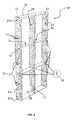
- the figure 1 represents a perspective diagram of four modules 10, 20, 30, 40 coated and stacked, ready to be delivered on site.
- Each of these modules 10, 20, 30, 40 advantageously comprises notches 11, 21, 31, 41 formed along the lateral uprights 13, 23, 33, 43. These notches allow the passage and the installation of pipes in the module quickly and without any fixation. All ducts, pipes, and cables used to convey water, gas, electricity, telephony, etc.
- the lateral uprights have a longitudinal axis corresponding to the height of the module, when it is in place.
- the notches 11, 21, 31, 41 are advantageously distributed along the lateral uprights 13, 23, 33, 43, on each side of an axis of symmetry S, perpendicular to the longitudinal axis of the lateral uprights. More particularly, the longitudinal axis of the lateral uprights representing the height of the module, when it is installed, the axis of symmetry S around which the notches are made is therefore horizontal. This horizontal axis of symmetry S makes it possible to optimize the distribution of the loads during the transport of the modules with forklifts.
- the two central notches are formed on either side of this axis of symmetry S, so that they have a gap E corresponding to the standard spacing of two forklift forks. It should be noted that this spacing of the forks can be adjusted on certain forklifts.
- the central notches are also used to allow the establishment of the forks of a carriage, so as to facilitate the transport of modules without the use of pallets transport.
- the notches may further have a flat bottom 11c as illustrated in FIG. figure 1 .
- the notches have a shape adapted to the shape of the forks of the forklift.
- Such a flat bottom also allows a better distribution of the weight of the modules on the forks of the forklift during the handling of the modules.
- the notches can also have a calculated width and depth to allow the easy passage of a worker's hand, to allow him to lift one or more modules with excellent grip and the rest without any risk of crushing. fingers or hand. It is thus expected, notches to flat bottom and dimensions suitable for manual handling. So far, during such handling, we needed a third person to move the modules and put shims to rest.
- each notch 11 has a narrowed opening, so that when the pipes are deposited in the module, the latter do not tend to fall outwardly but remain well in their respective locations.
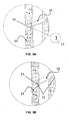
- the notches can be partially closed after the passage of the pipes.
- This partial closure is illustrated on the Figures 3A and 3B .
- a simple wedge can be inserted into force in the opening of the notch for example.
- each notch comprises in fact 2 nested notches 11a, 11b.
- a first notch 11a is made to allow the passage of the pipes.
- the second notch 11b is then cut in the first notch.
- This double notch 11a, 11b can be made in a single cutting step, in the factory.
- the two notches 11a and 11b may be of different sizes.
- the minimum size of the first notch 11a is such that it allows the passage of pipes and forks of a forklift.
- the drop of the cut of the notch can be used to be cut to the size of the second notch 11b.
- this piece referenced 21 on figures 2 , 3A and 3B once placed in the second notch 11b, allows to partially close the double notch and maintain the pipes in their housing 11a.
- This part 21 also makes it possible to mechanically reinforce the vertical upright 13 in the final destination of the module 10 as a load-bearing wall.
- This piece 21 can be just fitted into its housing. It can also optionally be glued at the end of the assembly.
- the housing thus defined to allow the passage and the crossing of the pipes, as illustrated on the figure 3B , has a depth substantially of the order of 50mm.
- the modules are designed in a standard way and do not require any modification or transformation on the construction site, so that no cutting and therefore no drop is made during assembly on the site. Similarly, the notches being made in the factory, no cutting causing falls is performed for the passage of ducts. Thus, no cutting being performed on the site, the recycling of materials can be done directly in the factory.
- the standard structure of the modules includes side jambs spaced 600 mm apart.
- Standard modules typically have a width of 600, 900, 1200 or 1500mm. Consequently, the modules whose width exceeds 600mm include, in addition to their lateral uprights, intermediate amounts so as to have a rigid support every 600mm. This rigid support also allows the fixing of external coatings, wood cladding type, or pvc or resin etc ...
- Such a module 10, comprising an intermediate amount 14 is shown on the figure 2 .
- the intermediate amount 14 also includes notches 11 for the passage of pipes. These notches are advantageously aligned with the notches of the lateral uprights 13. They also allow the passage of the forks of a forklift for stable transport of the module.
- the module schematized on the figure 2 is very symmetrical.
- the modules can advantageously be mounted in a reversible manner to the laying, that is to say that the top and bottom can be reversed.
- the module 10 further comprises crosspieces 15. These crosspieces 15 do not have a depth identical to that of the module, but they have a slight shrinkage. These sleepers 15 are focused on the notches 11 provided for the passage of the forks. This location of the sleepers reinforces the mechanical strength of the module on the passage of the forks of a lifting machine. The depth of the sleepers is less than that of the lateral uprights 13 and intermediate 14, a value identical to the depth of the notches 11. In this way, the sleepers also allow a vertical passage of the pipes and the support of the forks during travel modules.
- the module also comprises upper 18 and lower 19 spacers of a depth identical to that of the lateral and intermediate uprights.
- the high and low end notches are advantageously placed in the axis of the door lintels, window and other opening.
- the axis of the notches is therefore 175mm from the high and low edges of the standard modules.
- Orifices 17, 17a are further provided on the side posts 13. These holes are provided for the passage of fixing bolts.
- the lateral uprights advantageously comprise, along their length, six orifices 17, arranged symmetrically and two by two. These six holes allow the passage of bolts for fixing the modules to each other.
- Two other orifices, referenced 17a, are arranged at both ends of each lateral upright 13. These two orifices 17a are provided to allow the passage of a bolt of a fastening system.
- the figure 4 illustrates the assembly of two building modules.
- the assembly is made between on the one hand a standard module 10, comprising lateral uprights 13, an intermediate upright 14, and a bracing panel 16 and, on the other hand, a module 60, comprising an opening 66 for window.
- the module 60 is fixed to the standard module 10 by means of fastening systems 70 and by bolting 17.
- the opening module 60 also comprises crosspieces 65, upper and lower spacers 68 68 and an intermediate amount 64 It further comprises a post 67 on either side of the opening. These posts 67 and allow reliable attachment of fasteners to retain the shutters.
- the notches 61 are then only on the vertical uprights flanking the posts 67 and the intermediate amount 64.
- the standard module 10 generally has a height of 2500 mm, a depth of 200 mm and a width of 1200 mm.
- the standard module 60 dedicated to receiving a window, meanwhile, generally has a height of 2500 mm, a depth of 200 mm and a width of 1500 mm, the opening 66 for receiving the window having a height of 1350 mm. mm and a width of 1200 mm.
- the ends of the upper struts 18, 68 are provided with referenced orifices 12, 22, 32, 42, as illustrated in FIGS. figures 1 and 2 .
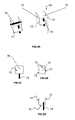
- the attachment system 70 is a stirrup which is advantageously in the form of a U. It can be metallic or composite material for example. It is represented in more detail on the Figures 5A to 5D .
- the vertical walls 72 of the U penetrate the orifices 12 formed in the upper spacers 18, 68 of the modules 10, 60 to be assembled so that the U encompasses the lateral uprights 13, 63 of the modules to be assembled.
- An orifice 75, made in each vertical wall 72 of the U 70, makes it possible to insert a fixing device, for example a bolt 74, which passes right through the yoke 70 and the orifices 17a made in the lateral uprights 13. , 63 modules to assemble.
- the bolt / nut system makes it possible to tighten the walls of the U on the lateral uprights 13, 63 of the modules 10, 60 in the manner of a jaw.
- holes 17a are preformed on a vertical axis of each lateral upright.
- the axis of drilling on the lateral upright is 100mm deep.
- the U is secured by means of a bolt / nut system to be able to clamp to a desired force.
- this clamping system avoids a risk of deformation of the modules at the time of tightening.
- other clamping means may be provided, such as a rod provided with a clip, or a U with claws and returned in force in its housing.
- the horizontal wall 71 of the stirrup 70 in U comprises another orifice 76 intended to receive an anchor pin 73.
- This anchor pin 73 is intended to be fixed in the ground and in the lateral upright 13, 63 of one of the modules 10 and 60 to assemble.
- the previous module (s) be anchored to the ground in order to fix the following modules.
- a hole is made in the ground to a desired depth to fix the U-shaped stirrup.
- the orifice 76, provided in the horizontal wall 71 of the stirrup 70 U-shaped, to insert an anchor pin 73, is preferably offset relative to the center of the wall 71, so that during attachment, the anchor pin 73 is fixed in the thickness of the lateral upright the second module to be assembled to a first module already attached to the ground.
- the U may be previously fixed to the ground, and in this case, the modules are fitted on it by penetration of the vertical walls 72 of the U in the orifices 12 provided on the lower struts, and by penetration of the dowel. anchoring 73 in the hole provided for this purpose in the thickness of the lateral amount of the module to be anchored.
- This variant requires a good calculation of the location of the U-bracket and not to move during drilling.
- the modules, once anchored to the ground, are assembled to each other by means of a bolt / nut device for example.
- Anchoring the modules to the ground by fixing the anchor pin 73 in the thickness of the lateral uprights allows a better resistance to tearing. It is further possible, if desired, to complete this anchorage by additional fasteners directly into the lower struts.
- the attachment system intended to penetrate the holes of the upper spacers and to be fixed on the lateral uprights of the modules, is no longer in the form of a U but under
- the size of the H also takes into account the thickness of the beam positioned between the modules of the lower and upper stages.
- holes are also made in this rail, facing the orifices 12 made in the upper and lower spacers of the modules to be assembled, to allow insertion of the vertical walls of the H.
- an H is then ensured by two bolt / nut devices for example, arranged on either side of the horizontal bar of the H, the bolt passing right through the lateral uprights of the modules to be assembled so as to secure the lower and upper modules 4 to 4
- the H can be replaced by one or two plates, platinum for example or any other equivalent material, so as to connect an upper module and a lower module.
- the parts constituting the modules are manufactured and assembled in the factory to form standard modules.
- the modules 10 for forming the walls (walls) of the buildings and the modules 60 for receiving the windows as described above can thus be marketed ready for construction.
- the construction of a building from such modules is fast because it is facilitated by the presence of the passages that form the notches for pipes.
- the assembly of the modules together and their handling is simple and fast.
Landscapes
- Engineering & Computer Science (AREA)
- Architecture (AREA)
- Physics & Mathematics (AREA)
- Electromagnetism (AREA)
- Civil Engineering (AREA)
- Structural Engineering (AREA)
- Life Sciences & Earth Sciences (AREA)
- Wood Science & Technology (AREA)
- Joining Of Building Structures In Genera (AREA)
- Rod-Shaped Construction Members (AREA)
- Load-Bearing And Curtain Walls (AREA)
Priority Applications (1)
| Application Number | Priority Date | Filing Date | Title |
|---|---|---|---|
| PL12177010T PL2549025T3 (pl) | 2011-07-22 | 2012-07-19 | Moduł konstrukcyjny budynku |
Applications Claiming Priority (1)
| Application Number | Priority Date | Filing Date | Title |
|---|---|---|---|
| FR1156675A FR2978173B1 (fr) | 2011-07-22 | 2011-07-22 | Module de construction de batiment |
Publications (2)
| Publication Number | Publication Date |
|---|---|
| EP2549025A1 EP2549025A1 (fr) | 2013-01-23 |
| EP2549025B1 true EP2549025B1 (fr) | 2015-09-02 |
Family
ID=46507933
Family Applications (1)
| Application Number | Title | Priority Date | Filing Date |
|---|---|---|---|
| EP12177010.1A Active EP2549025B1 (fr) | 2011-07-22 | 2012-07-19 | Module de construction de bâtiment |
Country Status (5)
| Country | Link |
|---|---|
| EP (1) | EP2549025B1 (pl) |
| ES (1) | ES2554620T3 (pl) |
| FR (1) | FR2978173B1 (pl) |
| PL (1) | PL2549025T3 (pl) |
| PT (1) | PT2549025E (pl) |
Families Citing this family (1)
| Publication number | Priority date | Publication date | Assignee | Title |
|---|---|---|---|---|
| CA2941521A1 (en) * | 2016-03-17 | 2017-09-17 | Economy Housing Korea Co., Ltd. | Structural modular panel in building component system and its construction method |
Family Cites Families (6)
| Publication number | Priority date | Publication date | Assignee | Title |
|---|---|---|---|---|
| US2277217A (en) * | 1939-03-02 | 1942-03-24 | Faber Herbert Alfred | Building construction |
| US5524402A (en) * | 1988-11-16 | 1996-06-11 | Sykes; Christopher C. | Partition structures and frame elements therefor |
| US4924646A (en) * | 1988-11-23 | 1990-05-15 | Marquardt Wayne P | Wire guard |
| US20050120662A1 (en) * | 2003-12-04 | 2005-06-09 | William Paul | Floor and ceiling receiving tracks for seating interconnecting metal studs exhibiting diamond shaped apertures |
| FR2914662A1 (fr) * | 2007-04-06 | 2008-10-10 | Jean Michel Carlier | Habitation par assemblage de modules prefabriques |
| US20090282759A1 (en) * | 2008-05-14 | 2009-11-19 | Porter William H | Relocatable building wall construction |
-
2011
- 2011-07-22 FR FR1156675A patent/FR2978173B1/fr not_active Expired - Fee Related
-
2012
- 2012-07-19 ES ES12177010.1T patent/ES2554620T3/es active Active
- 2012-07-19 PT PT121770101T patent/PT2549025E/pt unknown
- 2012-07-19 PL PL12177010T patent/PL2549025T3/pl unknown
- 2012-07-19 EP EP12177010.1A patent/EP2549025B1/fr active Active
Also Published As
| Publication number | Publication date |
|---|---|
| EP2549025A1 (fr) | 2013-01-23 |
| ES2554620T3 (es) | 2015-12-22 |
| FR2978173A1 (fr) | 2013-01-25 |
| PT2549025E (pt) | 2015-12-30 |
| FR2978173B1 (fr) | 2013-08-16 |
| PL2549025T3 (pl) | 2016-04-29 |
Similar Documents
| Publication | Publication Date | Title |
|---|---|---|
| CA2905191C (fr) | Systeme de construction modulaire | |
| EP2061936B1 (fr) | Edifice, notamment d'habitation composé des cadres et poteaux et procede de son montage | |
| EP3310973A1 (fr) | Construction type poteaux et poutres préfabriqués | |
| EP4350095B1 (fr) | Construction, de préférence modulaire, comprenant un châssis de plafond en bois et un châssis de plancher en bois | |
| EP2549025B1 (fr) | Module de construction de bâtiment | |
| EP2191081B1 (fr) | Elements PREFABRIQUES DE CONSTRUCTION EN BOIS ET SYSTEME CONSTRUCTIF | |
| WO2016097621A1 (fr) | Ensemble d'éléments et procédé pour la construction d'un édifice | |
| FR3127969A1 (fr) | Dispositif modulaire de pose d’un appareillage sur une plateforme | |
| EP2576933B1 (fr) | Élément de construction à base de carton et procédé de construction à l'aide de tels éléments | |
| EP2108758B1 (fr) | Procédé de réalisation d'un élément de structure | |
| FR2786797A1 (fr) | Echafaudage pour toit | |
| EP0826840A1 (fr) | Unités de construction | |
| FR2684126A1 (fr) | Batiment de stockage de grande hauteur resistant au feu et procede pour sa construction. | |
| FR3053707B1 (fr) | Systeme constructif en bois et procede d'assemblage de ce systeme | |
| WO2007113402A1 (fr) | Construction de structures metalliques porteuses grandes portees | |
| EP1784544A1 (fr) | Structure porteuse pour batiment et procede de construction d'une structure porteuse. | |
| FR3047503A1 (fr) | Dispositif de fixation d'un garde-corps a un mur prefabrique et garde-corps associe | |
| FR2473589A1 (fr) | Procede pour la realisation d'ossature porteuse de batiment a partir d'elements metalliques prefabriques et elements pour la mise en oeuvre du procede | |
| FR3022271A1 (fr) | Construction mixte bois et beton | |
| EP1469973A1 (fr) | Construction murale perfectionnee du type panneau sandwiche | |
| FR2898918A1 (fr) | Edifice modulaire d'habitation | |
| FR2885148A1 (fr) | Procede et dispositif d'assemblage d'une charpente de toiture sur une construction. | |
| FR2585051A1 (fr) | Cloison auto-porteuse notamment pour constructions legeres et enceintes isothermes | |
| EP2507439A2 (fr) | Procédé de montage d'une construction à montage rapide | |
| FR2523181A1 (fr) | Construction par assemblage d'elements standardises |
Legal Events
| Date | Code | Title | Description |
|---|---|---|---|
| PUAI | Public reference made under article 153(3) epc to a published international application that has entered the european phase |
Free format text: ORIGINAL CODE: 0009012 |
|
| AK | Designated contracting states |
Kind code of ref document: A1 Designated state(s): AL AT BE BG CH CY CZ DE DK EE ES FI FR GB GR HR HU IE IS IT LI LT LU LV MC MK MT NL NO PL PT RO RS SE SI SK SM TR |
|
| AX | Request for extension of the european patent |
Extension state: BA ME |
|
| 17P | Request for examination filed |
Effective date: 20130313 |
|
| RAP1 | Party data changed (applicant data changed or rights of an application transferred) |
Owner name: MODULE 3D |
|
| 17Q | First examination report despatched |
Effective date: 20140428 |
|
| GRAP | Despatch of communication of intention to grant a patent |
Free format text: ORIGINAL CODE: EPIDOSNIGR1 |
|
| INTG | Intention to grant announced |
Effective date: 20150305 |
|
| GRAS | Grant fee paid |
Free format text: ORIGINAL CODE: EPIDOSNIGR3 |
|
| GRAA | (expected) grant |
Free format text: ORIGINAL CODE: 0009210 |
|
| AK | Designated contracting states |
Kind code of ref document: B1 Designated state(s): AL AT BE BG CH CY CZ DE DK EE ES FI FR GB GR HR HU IE IS IT LI LT LU LV MC MK MT NL NO PL PT RO RS SE SI SK SM TR |
|
| REG | Reference to a national code |
Ref country code: GB Ref legal event code: FG4D Free format text: NOT ENGLISH |
|
| REG | Reference to a national code |
Ref country code: AT Ref legal event code: REF Ref document number: 746722 Country of ref document: AT Kind code of ref document: T Effective date: 20150915 Ref country code: CH Ref legal event code: EP |
|
| REG | Reference to a national code |
Ref country code: IE Ref legal event code: FG4D Free format text: LANGUAGE OF EP DOCUMENT: FRENCH |
|
| REG | Reference to a national code |
Ref country code: DE Ref legal event code: R096 Ref document number: 602012010171 Country of ref document: DE |
|
| REG | Reference to a national code |
Ref country code: RO Ref legal event code: EPE |
|
| REG | Reference to a national code |
Ref country code: ES Ref legal event code: FG2A Ref document number: 2554620 Country of ref document: ES Kind code of ref document: T3 Effective date: 20151222 |
|
| REG | Reference to a national code |
Ref country code: PT Ref legal event code: SC4A Free format text: AVAILABILITY OF NATIONAL TRANSLATION Effective date: 20151127 |
|
| REG | Reference to a national code |
Ref country code: AT Ref legal event code: MK05 Ref document number: 746722 Country of ref document: AT Kind code of ref document: T Effective date: 20150902 |
|
| PG25 | Lapsed in a contracting state [announced via postgrant information from national office to epo] |
Ref country code: LV Free format text: LAPSE BECAUSE OF FAILURE TO SUBMIT A TRANSLATION OF THE DESCRIPTION OR TO PAY THE FEE WITHIN THE PRESCRIBED TIME-LIMIT Effective date: 20150902 Ref country code: LT Free format text: LAPSE BECAUSE OF FAILURE TO SUBMIT A TRANSLATION OF THE DESCRIPTION OR TO PAY THE FEE WITHIN THE PRESCRIBED TIME-LIMIT Effective date: 20150902 Ref country code: FI Free format text: LAPSE BECAUSE OF FAILURE TO SUBMIT A TRANSLATION OF THE DESCRIPTION OR TO PAY THE FEE WITHIN THE PRESCRIBED TIME-LIMIT Effective date: 20150902 Ref country code: NO Free format text: LAPSE BECAUSE OF FAILURE TO SUBMIT A TRANSLATION OF THE DESCRIPTION OR TO PAY THE FEE WITHIN THE PRESCRIBED TIME-LIMIT Effective date: 20151202 |
|
| REG | Reference to a national code |
Ref country code: NL Ref legal event code: FP |
|
| REG | Reference to a national code |
Ref country code: LT Ref legal event code: MG4D |
|
| PG25 | Lapsed in a contracting state [announced via postgrant information from national office to epo] |
Ref country code: SE Free format text: LAPSE BECAUSE OF FAILURE TO SUBMIT A TRANSLATION OF THE DESCRIPTION OR TO PAY THE FEE WITHIN THE PRESCRIBED TIME-LIMIT Effective date: 20150902 Ref country code: AT Free format text: LAPSE BECAUSE OF FAILURE TO SUBMIT A TRANSLATION OF THE DESCRIPTION OR TO PAY THE FEE WITHIN THE PRESCRIBED TIME-LIMIT Effective date: 20150902 Ref country code: RS Free format text: LAPSE BECAUSE OF FAILURE TO SUBMIT A TRANSLATION OF THE DESCRIPTION OR TO PAY THE FEE WITHIN THE PRESCRIBED TIME-LIMIT Effective date: 20150902 |
|
| PG25 | Lapsed in a contracting state [announced via postgrant information from national office to epo] |
Ref country code: IS Free format text: LAPSE BECAUSE OF FAILURE TO SUBMIT A TRANSLATION OF THE DESCRIPTION OR TO PAY THE FEE WITHIN THE PRESCRIBED TIME-LIMIT Effective date: 20160102 Ref country code: SK Free format text: LAPSE BECAUSE OF FAILURE TO SUBMIT A TRANSLATION OF THE DESCRIPTION OR TO PAY THE FEE WITHIN THE PRESCRIBED TIME-LIMIT Effective date: 20150902 Ref country code: EE Free format text: LAPSE BECAUSE OF FAILURE TO SUBMIT A TRANSLATION OF THE DESCRIPTION OR TO PAY THE FEE WITHIN THE PRESCRIBED TIME-LIMIT Effective date: 20150902 |
|
| REG | Reference to a national code |
Ref country code: DE Ref legal event code: R097 Ref document number: 602012010171 Country of ref document: DE |
|
| REG | Reference to a national code |
Ref country code: GR Ref legal event code: EP Ref document number: 20150402477 Country of ref document: GR Effective date: 20160201 |
|
| REG | Reference to a national code |
Ref country code: FR Ref legal event code: PLFP Year of fee payment: 5 |
|
| PLBE | No opposition filed within time limit |
Free format text: ORIGINAL CODE: 0009261 |
|
| STAA | Information on the status of an ep patent application or granted ep patent |
Free format text: STATUS: NO OPPOSITION FILED WITHIN TIME LIMIT |
|
| 26N | No opposition filed |
Effective date: 20160603 |
|
| PG25 | Lapsed in a contracting state [announced via postgrant information from national office to epo] |
Ref country code: DK Free format text: LAPSE BECAUSE OF FAILURE TO SUBMIT A TRANSLATION OF THE DESCRIPTION OR TO PAY THE FEE WITHIN THE PRESCRIBED TIME-LIMIT Effective date: 20150902 Ref country code: SI Free format text: LAPSE BECAUSE OF FAILURE TO SUBMIT A TRANSLATION OF THE DESCRIPTION OR TO PAY THE FEE WITHIN THE PRESCRIBED TIME-LIMIT Effective date: 20150902 |
|
| PGFP | Annual fee paid to national office [announced via postgrant information from national office to epo] |
Ref country code: TR Payment date: 20160628 Year of fee payment: 5 |
|
| REG | Reference to a national code |
Ref country code: CH Ref legal event code: PL |
|
| PG25 | Lapsed in a contracting state [announced via postgrant information from national office to epo] |
Ref country code: MC Free format text: LAPSE BECAUSE OF FAILURE TO SUBMIT A TRANSLATION OF THE DESCRIPTION OR TO PAY THE FEE WITHIN THE PRESCRIBED TIME-LIMIT Effective date: 20150902 |
|
| PG25 | Lapsed in a contracting state [announced via postgrant information from national office to epo] |
Ref country code: LI Free format text: LAPSE BECAUSE OF NON-PAYMENT OF DUE FEES Effective date: 20160731 Ref country code: CH Free format text: LAPSE BECAUSE OF NON-PAYMENT OF DUE FEES Effective date: 20160731 |
|
| REG | Reference to a national code |
Ref country code: IE Ref legal event code: MM4A |
|
| REG | Reference to a national code |
Ref country code: FR Ref legal event code: PLFP Year of fee payment: 6 |
|
| PG25 | Lapsed in a contracting state [announced via postgrant information from national office to epo] |
Ref country code: IE Free format text: LAPSE BECAUSE OF NON-PAYMENT OF DUE FEES Effective date: 20160719 |
|
| PG25 | Lapsed in a contracting state [announced via postgrant information from national office to epo] |
Ref country code: LU Free format text: LAPSE BECAUSE OF NON-PAYMENT OF DUE FEES Effective date: 20160719 |
|
| PG25 | Lapsed in a contracting state [announced via postgrant information from national office to epo] |
Ref country code: SM Free format text: LAPSE BECAUSE OF FAILURE TO SUBMIT A TRANSLATION OF THE DESCRIPTION OR TO PAY THE FEE WITHIN THE PRESCRIBED TIME-LIMIT Effective date: 20150902 Ref country code: CY Free format text: LAPSE BECAUSE OF FAILURE TO SUBMIT A TRANSLATION OF THE DESCRIPTION OR TO PAY THE FEE WITHIN THE PRESCRIBED TIME-LIMIT Effective date: 20150902 Ref country code: HU Free format text: LAPSE BECAUSE OF FAILURE TO SUBMIT A TRANSLATION OF THE DESCRIPTION OR TO PAY THE FEE WITHIN THE PRESCRIBED TIME-LIMIT; INVALID AB INITIO Effective date: 20120719 |
|
| PG25 | Lapsed in a contracting state [announced via postgrant information from national office to epo] |
Ref country code: MT Free format text: LAPSE BECAUSE OF FAILURE TO SUBMIT A TRANSLATION OF THE DESCRIPTION OR TO PAY THE FEE WITHIN THE PRESCRIBED TIME-LIMIT Effective date: 20150902 Ref country code: HR Free format text: LAPSE BECAUSE OF FAILURE TO SUBMIT A TRANSLATION OF THE DESCRIPTION OR TO PAY THE FEE WITHIN THE PRESCRIBED TIME-LIMIT Effective date: 20150902 Ref country code: MK Free format text: LAPSE BECAUSE OF FAILURE TO SUBMIT A TRANSLATION OF THE DESCRIPTION OR TO PAY THE FEE WITHIN THE PRESCRIBED TIME-LIMIT Effective date: 20150902 |
|
| REG | Reference to a national code |
Ref country code: FR Ref legal event code: PLFP Year of fee payment: 7 |
|
| PG25 | Lapsed in a contracting state [announced via postgrant information from national office to epo] |
Ref country code: BG Free format text: LAPSE BECAUSE OF FAILURE TO SUBMIT A TRANSLATION OF THE DESCRIPTION OR TO PAY THE FEE WITHIN THE PRESCRIBED TIME-LIMIT Effective date: 20150902 |
|
| PG25 | Lapsed in a contracting state [announced via postgrant information from national office to epo] |
Ref country code: AL Free format text: LAPSE BECAUSE OF FAILURE TO SUBMIT A TRANSLATION OF THE DESCRIPTION OR TO PAY THE FEE WITHIN THE PRESCRIBED TIME-LIMIT Effective date: 20150902 |
|
| PGFP | Annual fee paid to national office [announced via postgrant information from national office to epo] |
Ref country code: GR Payment date: 20200623 Year of fee payment: 9 Ref country code: PT Payment date: 20200623 Year of fee payment: 9 Ref country code: CZ Payment date: 20200629 Year of fee payment: 9 |
|
| PGFP | Annual fee paid to national office [announced via postgrant information from national office to epo] |
Ref country code: BE Payment date: 20200624 Year of fee payment: 9 Ref country code: NL Payment date: 20200625 Year of fee payment: 9 Ref country code: GB Payment date: 20200624 Year of fee payment: 9 Ref country code: PL Payment date: 20200625 Year of fee payment: 9 |
|
| PGFP | Annual fee paid to national office [announced via postgrant information from national office to epo] |
Ref country code: ES Payment date: 20200803 Year of fee payment: 9 Ref country code: RO Payment date: 20200708 Year of fee payment: 9 Ref country code: DE Payment date: 20200622 Year of fee payment: 9 |
|
| PGFP | Annual fee paid to national office [announced via postgrant information from national office to epo] |
Ref country code: IT Payment date: 20200622 Year of fee payment: 9 |
|
| REG | Reference to a national code |
Ref country code: DE Ref legal event code: R119 Ref document number: 602012010171 Country of ref document: DE |
|
| REG | Reference to a national code |
Ref country code: NL Ref legal event code: MM Effective date: 20210801 |
|
| GBPC | Gb: european patent ceased through non-payment of renewal fee |
Effective date: 20210719 |
|
| REG | Reference to a national code |
Ref country code: BE Ref legal event code: MM Effective date: 20210731 |
|
| PG25 | Lapsed in a contracting state [announced via postgrant information from national office to epo] |
Ref country code: GB Free format text: LAPSE BECAUSE OF NON-PAYMENT OF DUE FEES Effective date: 20210719 Ref country code: DE Free format text: LAPSE BECAUSE OF NON-PAYMENT OF DUE FEES Effective date: 20220201 |
|
| PG25 | Lapsed in a contracting state [announced via postgrant information from national office to epo] |
Ref country code: RO Free format text: LAPSE BECAUSE OF NON-PAYMENT OF DUE FEES Effective date: 20210719 Ref country code: PT Free format text: LAPSE BECAUSE OF NON-PAYMENT OF DUE FEES Effective date: 20220119 Ref country code: NL Free format text: LAPSE BECAUSE OF NON-PAYMENT OF DUE FEES Effective date: 20210801 Ref country code: GR Free format text: LAPSE BECAUSE OF NON-PAYMENT OF DUE FEES Effective date: 20220207 Ref country code: CZ Free format text: LAPSE BECAUSE OF NON-PAYMENT OF DUE FEES Effective date: 20210719 |
|
| PG25 | Lapsed in a contracting state [announced via postgrant information from national office to epo] |
Ref country code: TR Free format text: LAPSE BECAUSE OF NON-PAYMENT OF DUE FEES Effective date: 20170719 |
|
| PG25 | Lapsed in a contracting state [announced via postgrant information from national office to epo] |
Ref country code: IT Free format text: LAPSE BECAUSE OF NON-PAYMENT OF DUE FEES Effective date: 20210719 Ref country code: BE Free format text: LAPSE BECAUSE OF NON-PAYMENT OF DUE FEES Effective date: 20210731 |
|
| REG | Reference to a national code |
Ref country code: ES Ref legal event code: FD2A Effective date: 20220929 |
|
| PG25 | Lapsed in a contracting state [announced via postgrant information from national office to epo] |
Ref country code: ES Free format text: LAPSE BECAUSE OF NON-PAYMENT OF DUE FEES Effective date: 20210720 |
|
| PG25 | Lapsed in a contracting state [announced via postgrant information from national office to epo] |
Ref country code: PL Free format text: LAPSE BECAUSE OF NON-PAYMENT OF DUE FEES Effective date: 20210719 |
|
| PGFP | Annual fee paid to national office [announced via postgrant information from national office to epo] |
Ref country code: FR Payment date: 20250731 Year of fee payment: 14 |