EP2546918A2 - Battery management systems with vertical bus circuits - Google Patents
Battery management systems with vertical bus circuits Download PDFInfo
- Publication number
- EP2546918A2 EP2546918A2 EP12175862A EP12175862A EP2546918A2 EP 2546918 A2 EP2546918 A2 EP 2546918A2 EP 12175862 A EP12175862 A EP 12175862A EP 12175862 A EP12175862 A EP 12175862A EP 2546918 A2 EP2546918 A2 EP 2546918A2
- Authority
- EP
- European Patent Office
- Prior art keywords
- battery management
- management chip
- pair
- data signals
- differential
- Prior art date
- Legal status (The legal status is an assumption and is not a legal conclusion. Google has not performed a legal analysis and makes no representation as to the accuracy of the status listed.)
- Withdrawn
Links
Images


Classifications
-
- H—ELECTRICITY
- H01—ELECTRIC ELEMENTS
- H01M—PROCESSES OR MEANS, e.g. BATTERIES, FOR THE DIRECT CONVERSION OF CHEMICAL ENERGY INTO ELECTRICAL ENERGY
- H01M10/00—Secondary cells; Manufacture thereof
- H01M10/42—Methods or arrangements for servicing or maintenance of secondary cells or secondary half-cells
- H01M10/425—Structural combination with electronic components, e.g. electronic circuits integrated to the outside of the casing
-
- H—ELECTRICITY
- H02—GENERATION; CONVERSION OR DISTRIBUTION OF ELECTRIC POWER
- H02J—ELECTRIC POWER NETWORKS; CIRCUIT ARRANGEMENTS OR SYSTEMS FOR SUPPLYING OR DISTRIBUTING ELECTRIC POWER; SYSTEMS FOR STORING ELECTRIC ENERGY
- H02J7/00—Circuit arrangements for charging or discharging batteries or for supplying loads from batteries
- H02J7/50—Circuit arrangements for charging or discharging batteries or for supplying loads from batteries acting upon multiple batteries simultaneously or sequentially
-
- H—ELECTRICITY
- H02—GENERATION; CONVERSION OR DISTRIBUTION OF ELECTRIC POWER
- H02J—ELECTRIC POWER NETWORKS; CIRCUIT ARRANGEMENTS OR SYSTEMS FOR SUPPLYING OR DISTRIBUTING ELECTRIC POWER; SYSTEMS FOR STORING ELECTRIC ENERGY
- H02J7/00—Circuit arrangements for charging or discharging batteries or for supplying loads from batteries
- H02J7/80—Circuit arrangements for charging or discharging batteries or for supplying loads from batteries including monitoring or indicating arrangements
- H02J7/82—Control of state of charge [SOC]
-
- H—ELECTRICITY
- H02—GENERATION; CONVERSION OR DISTRIBUTION OF ELECTRIC POWER
- H02J—ELECTRIC POWER NETWORKS; CIRCUIT ARRANGEMENTS OR SYSTEMS FOR SUPPLYING OR DISTRIBUTING ELECTRIC POWER; SYSTEMS FOR STORING ELECTRIC ENERGY
- H02J7/00—Circuit arrangements for charging or discharging batteries or for supplying loads from batteries
- H02J7/80—Circuit arrangements for charging or discharging batteries or for supplying loads from batteries including monitoring or indicating arrangements
- H02J7/84—Control of state of health [SOH]
-
- Y—GENERAL TAGGING OF NEW TECHNOLOGICAL DEVELOPMENTS; GENERAL TAGGING OF CROSS-SECTIONAL TECHNOLOGIES SPANNING OVER SEVERAL SECTIONS OF THE IPC; TECHNICAL SUBJECTS COVERED BY FORMER USPC CROSS-REFERENCE ART COLLECTIONS [XRACs] AND DIGESTS
- Y02—TECHNOLOGIES OR APPLICATIONS FOR MITIGATION OR ADAPTATION AGAINST CLIMATE CHANGE
- Y02E—REDUCTION OF GREENHOUSE GAS [GHG] EMISSIONS, RELATED TO ENERGY GENERATION, TRANSMISSION OR DISTRIBUTION
- Y02E60/00—Enabling technologies; Technologies with a potential or indirect contribution to GHG emissions mitigation
- Y02E60/10—Energy storage using batteries
Definitions
- Multiple battery modules can be used to power various electronic devices.
- multiple battery management chips can be coupled to the battery modules.
- a host processor can be used to communicate with the battery management chips.
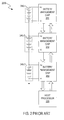
- FIG. 1 shows a block diagram of a conventional battery management system 100 with a host processor 120 that communicates with the battery management chips via a common bus 130.
- the conventional battery management system 100 includes battery modules 140-1-140-3 that are coupled to battery management chips 101-103, respectively. Each of the battery modules 140-1-140-3 can include one or more battery cells.
- the battery management chips 101-103 can monitor the cell status of the battery modules 140-1-140-3, respectively.
- the battery management system 100 further includes a host processor 120 used to communicate with the battery management chips 101-103 via a common bus 130.
- the common bus 130 operates at the host processor 120's voltage. However, the cumulative voltage of the multiple battery modules 140-1-140-3 coupled in series can expose the common bus 130 to a high voltage potential.
- each of the isolators 110-1-110-3 includes multiple opto-couplers, e.g., two opto-coupler pairs as shown in FIG. 1 .
- the isolators 110-1-110-3 are coupled between the battery management chips 101-103 and the common bus 130 to isolate the common bus 130 from the relatively high voltage potential to protect the battery management system 100.
- the opto-couplers are relatively expensive. As a result, the cost of the system is relatively high.
- FIG. 2 shows a block diagram of a conventional battery management system 200 with a host processor 220 that communicates with the battery management chips.
- the conventional battery management system 200 includes battery modules 240-1-240-3 that are coupled to battery management chips 201-203, respectively.
- the battery management chips 201-203 are coupled to each other via an upward bus and a downward bus, e.g., a Serial Peripheral Interface (SPI) bus.
- the battery management system 200 further includes a host processor 220 coupled to the bottom battery management chip 203 via the upward bus and the downward bus. As a result, the host processor 220 can communicate with the battery management chips 201-203 via the upward bus and the downward bus.
- SPI Serial Peripheral Interface
- a relatively large negative voltage is generated at the break node due to the resulting quick current change in the battery management system 200, e.g., the current changes from a relatively large value to zero quickly.
- the relatively large negative voltage is high enough to damage the battery management chips adjacent the connection break, e.g., battery management chips 201 and 202 can be damaged when the connection break occurs between battery modules 240-1 and 240-2.
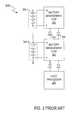
- FIG. 3 shows a block diagram of a conventional battery management system 300.
- the conventional battery management system 300 includes battery modules 340-1 and 340-2, battery management chips 301 and 302 coupled to the battery modules 340-1 and 340-2 respectively, and a host processor 320.
- Battery management chip 301 is coupled to the battery management chip 302 via high-voltage diodes 331 and 332 to protect the battery management chips 301 and 302 from being damaged due to a high negative voltage caused by a connection break between battery modules 340-1 and 340-2.
- the diodes 331 and 332 are forward-biased in normal operation, and reverse-biased when the negative voltage is generated to protect the battery management system 300 from being damaged.
- the reverse voltages of the diodes 331 and 332 are also relatively high.
- a high-voltage diode is relatively expensive.
- the high-voltage diodes respond relatively slowly.
- the battery management chips 301 and 302 may be damaged before the diodes 331 and 332 can respond and take protective action.
- a few milliamps of current are needed to ensure forward conduction, which results in high operating power consumption.
- a battery management chip includes a battery management unit and a vertical bus circuit.
- the battery management unit monitors a cell status of multiple cells in a battery module coupled to the battery management chip in response to an instruction from a host processor.
- the vertical bus circuit transfers the instruction from the host processor to the battery management unit.
- the vertical bus circuit includes a first receiver, a command processor and a first transmitter.
- the first receiver receives a first pair of differential input data signals.
- the command processor is coupled to the first receiver and processes the first pair of differential input data signals.
- the first transmitter is coupled to the command processor and outputs a first pair of differential output data signals.
- a system in another embodiment, includes a first chip, a second chip and a host processor.
- the first chip includes a first vertical bus circuit.
- the second chip is coupled to the first chip via a passive galvanic isolator.
- the host processor is coupled to the first chip and sends first data to the first chip and the second chip.
- the host processor is coupled to the first vertical bus circuit via a converter.
- the converter converts the first data from a first type of protocol to a first pair of differential data signals that conform to a second type of protocol.
- FIG. 1 shows a block diagram of a conventional battery management system.
- FIG. 3 shows a block diagram of another conventional battery management system.
- FIG. 4 shows a block diagram of an example of a battery management system, in accordance with one embodiment of the present invention.
- FIG. 5A shows a block diagram of an example of a vertical bus circuit, in accordance with one embodiment of the present invention.
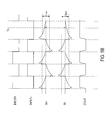
- FIG. 5B shows an example of signals associated with a receiver in a vertical bus circuit, in accordance with one embodiment of the present invention.
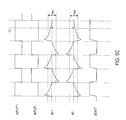
- FIG. 5C shows an example of signals associated with a receiver in a vertical bus circuit, in accordance with one embodiment of the present invention.
- FIG. 6 shows a flowchart of examples of operations performed by a battery management system, in accordance with one embodiment of the present invention.
- Embodiments described herein may be discussed in the general context of computer-executable instructions residing on some form of computer-usable medium, such as program modules, executed by one or more computers or other devices.
- program modules include routines, programs, objects, components, data structures, etc., that perform particular tasks or implement particular abstract data types.
- the functionality of the program modules may be combined or distributed as desired in various embodiments.
- Computer-usable media may comprise computer storage media and communication media.
- Computer storage media includes volatile and nonvolatile, removable and non-removable media implemented in any method or technology for storage of information such as computer-readable instructions, data structures, program modules or other data.
- Computer storage media includes, but is not limited to, random access memory (RAM), read only memory (ROM), electrically erasable programmable ROM (EEPROM), flash memory or other memory technology, compact disk ROM (CD-ROM), digital versatile disks (DVDs) or other optical storage, magnetic cassettes, magnetic tape, magnetic disk storage or other magnetic storage devices, or any other medium that can be used to store the desired information.
- Communication media can embody computer-readable instructions, data structures, program modules or other data in a modulated data signal such as a carrier wave or other transport mechanism and includes any information delivery media.
- modulated data signal means a signal that has one or more of its characteristics set or changed in such a manner as to encode information in the signal.
- communication media includes wired media such as a wired network or direct-wired connection, and wireless media such as acoustic, radio frequency (RF), infrared and other wireless media. Combinations of any of the above should also be included within the scope of computer-readable media.
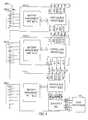
- FIG. 4 shows a block diagram of an example of a battery management system 400, in accordance with one embodiment of the present invention.
- the battery management system 400 includes battery modules 402-i, e.g., 402-1, 402-2 and 402-3, coupled in series, battery management chips 410-i, e.g., 410-1, 410-2 and 410-3, coupled to the battery modules 402-1, 402-2 and 402-3, respectively, and a host processor 440 coupled to the battery management chip 410-1. Since the embodiment shown in FIG. 4 is only for illustrative purposes, the number of the battery management chips can be changed to any number depending on the requirements of the particular application.
- a battery module 402-i further includes one or more battery cells, e.g., six battery cells as shown in the example of FIG. 4 .
- the battery management chips 410-1, 410-2 and 410-3 are coupled to each other via one or more galvanic isolators.
- the galvanic isolators are passive isolators so that no additional power supply is needed to power the galvanic isolators.
- multiple capacitors C1-C10 can be used in the battery management system 400 to galvanically isolate the battery management chips 410-1-410-3. As shown in the example of FIG.
- battery management chip 410-3 is coupled to the battery management chip 410-2 via capacitors C6-C10
- battery management chip 410-2 is coupled to the battery management chip 410-1 via capacitors C1-C5.
- multiple transformers or inductors can also be used in the battery management system 400 to galvanically isolate the battery management chips 410-1-410-3.
- the galvanic isolators between the adjacent battery management chips, the battery management chips are galvanically isolated and are protected if a connection break occurs between adjacent battery modules. Moreover, the cost of the battery management system is reduced by using the passive galvanic isolators.
- each battery management chip 410-i includes a corresponding battery management unit 411-i and a corresponding vertical bus circuit 412-i.
- the battery management unit 411-i can monitor and sample the status (e.g., cell voltage) of each battery cell in the corresponding battery module 402-i according to an instruction received from the host processor 440.
- the vertical bus circuit 412-i transfers signals between the battery management unit 411-i and the host processor 440.
- the vertical bus circuit 412-i receives a first pair of differential input data signals (e.g., a positive differential signal INPUT+ and a negative differential signal INPUT-) via pins IN(i-1)'+ and IN(i-1)'- from the lower battery management chip 41 0-(i-1) and outputs a first pair of differential output data signals (e.g., a positive differential signal OUTPUT+ and a negative differential signal OUTPUT-) via pins OUTi+ and OUTi- to the upper battery management chip 410-(i+1).
- a first pair of differential input data signals e.g., a positive differential signal INPUT+ and a negative differential signal INPUT-
- a first pair of differential output data signals e.g., a positive differential signal OUTPUT+ and a negative differential signal OUTPUT-
- the first pair of differential input/output signals represents an instruction from the host processor 440, e.g., instructing each battery management unit 411-i to monitor and sample the cell voltage of each battery cell in the corresponding battery module 402-i.
- the vertical bus circuit 412-i further receives a second pair of differential input data signals via pins INi+ and INi- from the upper battery management chip 410-(i+1) and outputs a second pair of differential output data signals via pins OUT(i-1)'+ and OUT(i-1)'- to the lower battery management chip 410-(i-1).
- the second pair of differential input/output signals represents the cell status, e.g., cell voltage, of each battery cell in the upper battery modules.
- the second pair of differential output signals represents the cell status, e.g., cell voltage, of each battery cell in the corresponding battery module 402-i, and each cell voltage is monitored by the battery management unit 411-i.
- the pins IN3+, IN3-, OUT3+ and OUT3- of the battery management chip 410-3 are coupled to the ground, indicating that the battery management chip 410-3 is the top chip; as such, the battery management chip 410-3 does not receive the second pair of differential input data signals via pins IN3+ and IN3; however, the battery management chip 410-3 can output the second pair of differential output data signals via pins OUT2'+ and OUT2'- to the lower battery management chip 410-2.
- the vertical bus circuit 412-1 in the bottom battery management circuit 410-1 receives the first pair of differential input data signals via pins IN0'+ and IN0'- from a converter 413 and outputs the first pair of differential output data signals via pins OUT1+ and OUT1- to the upper battery management chip 410-2.
- the vertical bus circuit 412-1 further receives the second pair of differential input data signals via pins IN1+ and IN1-from battery management chip 410-2 and outputs the second pair of differential output data signals via pins OUT0'+ and OUTO'- to the converter 413.
- the vertical bus circuit 412-i can further provide an alert signal via a pin ALT(i-1)' to inform the host processor 440 of the status of the corresponding battery management chip 410-i (for example, whether self-testing of the battery management chip 410-i is completed) and to request service from the host processor 440.
- the alert signal is sent to the lower battery management chip 410-(i-1) and is further transferred to the host processor 440.
- the differential input/output data signals by using the differential input/output data signals, noise on the vertical bus is reduced or eliminated.
- an abnormal condition e.g., an open circuit or a short circuit
- communication can continue by using a single wire of the differential signal pair.
- an abnormal condition e.g., an open circuit or a short circuit
- communication can continue by using the other pair of wires to transmit the differential input/output data signals.
- the wires transferring the differential input/output data signals can operate in a bidirectional mode.
- the converter 413 is coupled to the host processor 440 and the vertical bus circuit 412-1 as shown in the example of FIG. 4 .
- the converter 413 communicates with the host processor 440 using a first type of protocol, e.g., the Serial Peripheral Interface (SPI) bus protocol.
- SPI Serial Peripheral Interface
- the converter 413 communicates with the vertical bus circuit 412-1 using a second type of protocol, e.g., a vertical bus protocol
- the battery management chip 410-i communicates with the adjacent battery management chips 410-(i+1) and 41 0-(i-1) using the second type of protocol, e.g., vertical bus protocol.
- the converter 413 is able to convert the data communicated using the first type of protocol and received from the host processor 440 via the pin SDI into a pair of differential data signals that are communicated using the second type of protocol and can be transferred to the vertical bus circuit 412-1 via pins IN0'- and IN0'+.
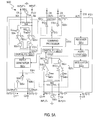
- an offset voltage V offset is provided to define a hysteresis area for an output signal DOUT of the receiver 532-i, and further for noise rejection and high frequency signal rejection.
- the non-inverting terminal of the comparator 512-i is coupled to the inverting terminal of the comparator 514-i through an embedded offset voltage generator, e.g., a voltage source 543-i.
- the non-inverting terminal of the comparator 514-i is coupled to the inverting terminal of the comparator 512-i through an embedded offset voltage generator, e.g., a voltage source 544-i as shown in the example of FIG. 5A .
- the comparators 512-i and 514-i, the offset voltage generators 544-i and 543-i, and the NAND gates 541-i and 542-i can be implemented as a hysteresis unit for the output signal DOUT of the receiver 532-i. If the difference between the signals IN+ and IN- is greater than the offset voltage V offset , the output signal DOUT can be logic low or logic high.
- FIG. 5B shows an example of signals associated with the receiver 532-i in the vertical bus circuit 412-i as shown in FIG. 5A .
- Signals INPUT+ and INPUT- represent the differential input data signals sent to the capacitors C4 and C3, respectively, from the lower battery management chip 410-(i-1).
- signals INPUT+ and INPUT- represent the differential input data signals from the converter 413 if the battery management chip is the bottom battery management chip 410-1.
- Signals IN+ and IN- are signals that are received by the receiver 532-i via capacitors C4 and C3 respectively.
- Signal DOUT is output by the NAND gate 541-i, and it represents the output of the receiver 532-i.
- the digital PLL 517-i synchronizes the received data signal with the clock in the battery management chip 410-i and sends the synchronized data to the command processor 510-i.
- the command processor 510-i can process the synchronized data.
- the command processor 510-i can compare the address in the synchronized data with the address of the corresponding battery management chip 410-i. If the addresses match, the command processor 510-i sends the data to the reply generator 507-i.
- the reply generator 507-i instructs the battery management chip 410-i to implement the instruction, e.g., instructs the battery management unit 411-i to sample the cell voltages of the corresponding battery module 402-i, and generates a reply to the host processor 440. If the addresses do not match, the command processor 510-i sends the synchronized data to the transmitter 533-i.
- the transmitter 533-i includes multiple inverters 511-i, 513-i and 515-i as shown in the example of FIG. 5A .
- the inverters 511-i and 515-i can drive and output a positive differential signal, and the inverter 513-i can drive and output a negative differential signal.
- the transmitter 533-i outputs a pair of differential output data signals indicative of the synchronized data via the pins OUTi+ and OUTi- to the vertical bus circuit 412-(i+1) in the battery management chip 410-(i+1).
- FIG. 5C shows an example of signals associated with the receiver 531-i in the vertical bus circuit 412-i as shown in FIG. 5A .
- Signals IN'+ and IN'- are signals received by the receiver 531-i via the capacitors C6 and C7, respectively.
- Signal DOUT' is output by the NAND gate 552-i, and it represents the output of the receiver 531-i. In one embodiment, signal DOUT' is indicative of the positive differential data signal INPUT'+ received via the capacitor C6. As shown in the example of FIG.
- the inverters 504-i and 506-i can drive and output a positive differential signal, and the inverter 508-i can drive and output a negative differential signal.
- the transmitter 534-i outputs a pair of differential output data signals indicative of the data received from the reply generator 507-i to the vertical bus circuit 412-(i-1) in the battery management chip 41 0-(i-1) via the pins OUT(i-1)'+ and OUT(i-1)'-.
- the battery management chip 410-i is the bottom battery management chip 410-1
- the transmitter 534-1 outputs the pair of differential output data signals via the pins OUT0'+ and OUTO'- to the converter 413.
- the converter 413 can convert the received pair of differential data signals into data which conforms to the first type of protocol, e.g., SPI bus protocol, and send the converted data to the host processor 440.
- the receivers 531-i and 532-i as shown in the example of FIG. 5A have relatively low power consumption and simple circuitry. Moreover, noise that exists at the pins (e.g., pins IN(i-1)'+, IN(i-1)'-, INi+ and INi-) can be canceled out if the difference of the differential input signals of the receiver 532-i/531-i is within the hysteresis area which is defined by the offset voltage V offset .
- the alert logic 522-i in the vertical bus circuit 412-i can provide an alert signal to inform the host processor 440 of the status of the corresponding battery management chip 410-i, for example, whether self-testing of the battery management chip 410-i is completed, and to request service from the host processor 440.
- the alert signal is transferred to the modulator 523-i for encoding.
- the encoded alert signal is sent to the vertical bus circuit 412-(i-1) in the battery management chip 410-(i-1) via the pin ALT(i-1)'.
- the receiver 521-(i-1) transfers the received encoded alert signal to the alert logic 522-(i-1).
- the alert logic 522-(i-1) decodes the received encoded alert signal and sends the decoded alert signal to the modulator 523-(i-1) for encoding.
- a new encoded alert signal is sent to the vertical bus circuit 412-(i-2) via the pin ALT(i-2)' and is further transferred to the host processor 440.
- FIG. 6 shows a flowchart of operations 600 performed by a battery management system, in accordance with one embodiment of the present invention.
- FIG. 6 is described in combination with FIG. 4 .
- a converter 413 converts the instruction received from the host processor 440 via a pin SDI into a first pair of differential input data signals and transfers the first pair of differential input data signals to the vertical bus circuit 412-1 via pins IN0'-and IN0'+.
- a battery management chip 410-i can monitor cell statuses (e.g., cell voltages) of battery module 402-i if an address in the instruction matches an address of the battery management chip. Further, the battery management chip 410-i can inform the host processor 440 of the statuses of the battery module 402-i by generating and transferring a first pair of differential output data signals.
- the first pair of differential output data signals can indicate the cell statuses of battery module 402-1 and can be transferred to the converter 413 from chip-to-chip.
- the converter 413 converts the first pair of differential output data signals into first output data, and sends the first output data to the host processor 440 via a pin SDO to inform the host processor 440 of the cell statuses of battery management chip 402-i.
Landscapes
- Engineering & Computer Science (AREA)
- Power Engineering (AREA)
- Microelectronics & Electronic Packaging (AREA)
- Manufacturing & Machinery (AREA)
- Chemical & Material Sciences (AREA)
- Chemical Kinetics & Catalysis (AREA)
- Electrochemistry (AREA)
- General Chemical & Material Sciences (AREA)
- Charge And Discharge Circuits For Batteries Or The Like (AREA)
- Secondary Cells (AREA)
Applications Claiming Priority (1)
| Application Number | Priority Date | Filing Date | Title |
|---|---|---|---|
| US13/184,384 US8907625B2 (en) | 2011-07-15 | 2011-07-15 | Battery management systems with vertical bus circuits |
Publications (1)
| Publication Number | Publication Date |
|---|---|
| EP2546918A2 true EP2546918A2 (en) | 2013-01-16 |
Family
ID=46514136
Family Applications (1)
| Application Number | Title | Priority Date | Filing Date |
|---|---|---|---|
| EP12175862A Withdrawn EP2546918A2 (en) | 2011-07-15 | 2012-07-11 | Battery management systems with vertical bus circuits |
Country Status (6)
| Country | Link |
|---|---|
| US (1) | US8907625B2 (enExample) |
| EP (1) | EP2546918A2 (enExample) |
| JP (1) | JP2013027298A (enExample) |
| CN (1) | CN102882248B (enExample) |
| IN (1) | IN2012DE00713A (enExample) |
| TW (1) | TWI448039B (enExample) |
Cited By (3)
| Publication number | Priority date | Publication date | Assignee | Title |
|---|---|---|---|---|
| EP3514884A1 (en) * | 2018-01-17 | 2019-07-24 | TTI (Macao Commercial Offshore) Limited | Battery management system |
| CN113542925A (zh) * | 2021-06-21 | 2021-10-22 | 南京绿电智联科技有限公司 | 一种变送器信号电力信息的传输系统及其传输方法 |
| KR102449819B1 (ko) * | 2021-11-26 | 2022-10-04 | 주식회사 오토실리콘 | 갈바닉 절연 통신구조를 구비한 배터리 장치 |
Families Citing this family (23)
| Publication number | Priority date | Publication date | Assignee | Title |
|---|---|---|---|---|
| EP4382341A3 (en) | 2013-04-15 | 2024-09-11 | Hitachi Astemo, Ltd. | Battery system |
| JP6262475B2 (ja) * | 2013-09-10 | 2018-01-17 | ローム株式会社 | 電圧検出装置 |
| KR101680189B1 (ko) * | 2013-09-24 | 2016-11-28 | 주식회사 엘지화학 | 배터리 관리 시스템 |
| CN103728568B (zh) * | 2014-01-06 | 2017-01-25 | 东风汽车公司 | 一种锂电池单体电压检测方法 |
| DE102014202626A1 (de) | 2014-02-13 | 2015-08-13 | Robert Bosch Gmbh | Batteriemanagementsystem für eine Batterie mit mehreren Batteriezellen und Verfahren |
| US9430438B2 (en) * | 2014-03-08 | 2016-08-30 | Atieva, Inc. | Communication bus with zero power wake function |
| CN104460923A (zh) * | 2014-11-28 | 2015-03-25 | 青岛海信医疗设备股份有限公司 | 一种智能电池管理方法及上位机、便携式移动设备 |
| CN105720617A (zh) * | 2014-12-02 | 2016-06-29 | 国家电网公司 | 一种串联电池组间的信息传输方法 |
| CN104953558B (zh) * | 2015-07-31 | 2018-08-24 | 中颖电子股份有限公司 | 一种电池保护系统 |
| KR101733410B1 (ko) * | 2016-11-11 | 2017-05-10 | 일진머티리얼즈 주식회사 | 저온 물성이 우수한 이차전지용 전해동박 및 그의 제조방법 |
| JP6408068B2 (ja) * | 2017-05-31 | 2018-10-17 | 日立オートモティブシステムズ株式会社 | 電池システム |
| CN109428399B (zh) * | 2017-08-28 | 2022-02-08 | 国家能源投资集团有限责任公司 | 储能系统监测方法、装置及系统 |
| JP6649447B2 (ja) * | 2018-09-19 | 2020-02-19 | 日立オートモティブシステムズ株式会社 | 電池システム |
| CN109494418B (zh) * | 2018-11-12 | 2021-04-27 | 上海汽车集团股份有限公司 | 电池管理系统的电芯采样装置及方法 |
| US12132810B2 (en) * | 2018-12-18 | 2024-10-29 | Texas Instruments Incorporated | Protocol auto-detection |
| CN109683098B (zh) * | 2018-12-19 | 2021-06-18 | 上海琪埔维半导体有限公司 | 一种用于动力电池系统的电流检测系统 |
| TWI721534B (zh) * | 2019-03-20 | 2021-03-11 | 立錡科技股份有限公司 | 電池系統及其中之電池模組及電池控制電路 |
| EP3780528A1 (en) | 2019-08-14 | 2021-02-17 | NXP USA, Inc. | Multi-level encoding for battery management system |
| EP3780526A1 (en) * | 2019-08-14 | 2021-02-17 | NXP USA, Inc. | Multi-level encoding for battery management system field |
| JP7499882B2 (ja) * | 2020-05-12 | 2024-06-14 | 上海汽▲車▼集▲團▼股▲フン▼有限公司 | 差動信号双方向アイソレーション通信回路及び方法 |
| KR102941182B1 (ko) * | 2021-10-19 | 2026-03-18 | 주식회사 엘지에너지솔루션 | 소비전류 제어 장치 및 이를 포함하는 배터리 관리 장치 |
| CN117360322A (zh) * | 2022-06-30 | 2024-01-09 | 比亚迪半导体股份有限公司 | 电池管理芯片及系统和车辆 |
| CN117040672A (zh) | 2023-07-18 | 2023-11-10 | 北京海博思创科技股份有限公司 | 基于自动时钟同步的芯片通讯电路、方法及装置 |
Family Cites Families (14)
| Publication number | Priority date | Publication date | Assignee | Title |
|---|---|---|---|---|
| US6181103B1 (en) | 1997-05-27 | 2001-01-30 | Shu-Chin Chen | Advanced intelligent computer power management system |
| CA2323964A1 (en) | 1998-03-12 | 1999-09-16 | Hironori Akamatsu | Bus selector and integrated circuit system |
| JP2005513614A (ja) | 2001-12-14 | 2005-05-12 | コーニンクレッカ フィリップス エレクトロニクス エヌ ヴィ | 無線データ通信バスシステム |
| US6871244B1 (en) * | 2002-02-28 | 2005-03-22 | Microsoft Corp. | System and method to facilitate native use of small form factor devices |
| US7447872B2 (en) | 2002-05-30 | 2008-11-04 | Cisco Technology, Inc. | Inter-chip processor control plane communication |
| TW567459B (en) | 2002-10-22 | 2003-12-21 | Hannstar Display Corp | Driving chip, serial differential signal circuit, driving circuit of liquid crystal display, and method of receiving differential signal transmitted from bus |
| CN100363915C (zh) | 2006-03-20 | 2008-01-23 | 哈尔滨工业大学 | 一种串并综合型总线系统及其数据传送方法 |
| US7973515B2 (en) * | 2007-03-07 | 2011-07-05 | O2Micro, Inc | Power management systems with controllable adapter output |
| CN101119036B (zh) | 2007-07-23 | 2011-01-19 | 柏禄帕迅能源科技有限公司 | 用于电动汽车的电池管理系统 |
| JP2009247195A (ja) * | 2008-03-31 | 2009-10-22 | O2 Micro Inc | 充電電流を調節できるバッテリ管理システム |
| TW201006091A (en) * | 2008-07-18 | 2010-02-01 | Nan Ya Printed Circuit Board | Battery management systems and methods |
| US8227944B2 (en) | 2009-01-06 | 2012-07-24 | O2Micro Inc | Vertical bus circuits |
| US8022669B2 (en) | 2009-01-06 | 2011-09-20 | O2Micro International Limited | Battery management system |
| US8612733B2 (en) * | 2011-07-15 | 2013-12-17 | O2Micro, Inc. | Battery management systems with enumerating circuits |
-
2011
- 2011-07-15 US US13/184,384 patent/US8907625B2/en active Active
-
2012
- 2012-03-13 IN IN713DE2012 patent/IN2012DE00713A/en unknown
- 2012-03-26 JP JP2012068830A patent/JP2013027298A/ja active Pending
- 2012-07-11 EP EP12175862A patent/EP2546918A2/en not_active Withdrawn
- 2012-07-12 TW TW101125140A patent/TWI448039B/zh active
- 2012-07-13 CN CN201210243235.4A patent/CN102882248B/zh active Active
Non-Patent Citations (1)
| Title |
|---|
| None |
Cited By (4)
| Publication number | Priority date | Publication date | Assignee | Title |
|---|---|---|---|---|
| EP3514884A1 (en) * | 2018-01-17 | 2019-07-24 | TTI (Macao Commercial Offshore) Limited | Battery management system |
| CN113542925A (zh) * | 2021-06-21 | 2021-10-22 | 南京绿电智联科技有限公司 | 一种变送器信号电力信息的传输系统及其传输方法 |
| CN113542925B (zh) * | 2021-06-21 | 2024-05-31 | 北方信通智能科技(南京)有限公司 | 一种变送器信号电力信息的传输系统及其传输方法 |
| KR102449819B1 (ko) * | 2021-11-26 | 2022-10-04 | 주식회사 오토실리콘 | 갈바닉 절연 통신구조를 구비한 배터리 장치 |
Also Published As
| Publication number | Publication date |
|---|---|
| IN2012DE00713A (enExample) | 2015-08-21 |
| TWI448039B (zh) | 2014-08-01 |
| CN102882248A (zh) | 2013-01-16 |
| CN102882248B (zh) | 2014-11-19 |
| TW201330449A (zh) | 2013-07-16 |
| US20130019037A1 (en) | 2013-01-17 |
| JP2013027298A (ja) | 2013-02-04 |
| US8907625B2 (en) | 2014-12-09 |
Similar Documents
| Publication | Publication Date | Title |
|---|---|---|
| EP2546918A2 (en) | Battery management systems with vertical bus circuits | |
| EP2546919A2 (en) | Battery management systems with enumerating circuits | |
| US11070067B2 (en) | Battery management unit and battery pack including same | |
| US11125824B2 (en) | Master battery management unit using power from battery module | |
| JP4196122B2 (ja) | 電池パック | |
| JP6440986B2 (ja) | 給電装置およびそのコントローラ、制御方法、それを用いた電子機器 | |
| US9711977B2 (en) | Battery management system for transmitting secondary protection signal and diagnosis signal using a small number of insulation elements | |
| US11449381B2 (en) | Apparatus and method for diagnosing communication fault | |
| US10124694B2 (en) | Battery management apparatus | |
| US9705663B2 (en) | Communication system having synchronized units and synchronization method for units | |
| US12049154B2 (en) | Battery control system, battery pack, electric vehicle, and id setting method for the battery control system | |
| CN102403544A (zh) | 二次电池组 | |
| KR101583374B1 (ko) | 주파수 변조를 이용하여 식별자를 설정하는 배터리 관리 유닛 및 방법 | |
| JP6796766B2 (ja) | 蓄電システム及び蓄電方法 | |
| CN105612677A (zh) | 用于防止由于通信错误的错误的控制算法的执行的电池管理单元 | |
| US11145931B2 (en) | Configuring large capacity batteries | |
| CN115485950A (zh) | 电池管理系统中的多功能无线模块监测系统 | |
| CN105098851B (zh) | 一种堆叠集成电路间的通讯系统 |
Legal Events
| Date | Code | Title | Description |
|---|---|---|---|
| PUAI | Public reference made under article 153(3) epc to a published international application that has entered the european phase |
Free format text: ORIGINAL CODE: 0009012 |
|
| AK | Designated contracting states |
Kind code of ref document: A2 Designated state(s): AL AT BE BG CH CY CZ DE DK EE ES FI FR GB GR HR HU IE IS IT LI LT LU LV MC MK MT NL NO PL PT RO RS SE SI SK SM TR |
|
| AX | Request for extension of the european patent |
Extension state: BA ME |
|
| STAA | Information on the status of an ep patent application or granted ep patent |
Free format text: STATUS: THE APPLICATION IS DEEMED TO BE WITHDRAWN |
|
| 18D | Application deemed to be withdrawn |
Effective date: 20170201 |