EP2543687A1 - Resin composition, prepreg, and laminated sheet - Google Patents
Resin composition, prepreg, and laminated sheet Download PDFInfo
- Publication number
- EP2543687A1 EP2543687A1 EP11750634A EP11750634A EP2543687A1 EP 2543687 A1 EP2543687 A1 EP 2543687A1 EP 11750634 A EP11750634 A EP 11750634A EP 11750634 A EP11750634 A EP 11750634A EP 2543687 A1 EP2543687 A1 EP 2543687A1
- Authority
- EP
- European Patent Office
- Prior art keywords
- resin
- resin composition
- weight
- group
- parts
- Prior art date
- Legal status (The legal status is an assumption and is not a legal conclusion. Google has not performed a legal analysis and makes no representation as to the accuracy of the status listed.)
- Granted
Links
Classifications
-
- B—PERFORMING OPERATIONS; TRANSPORTING
- B32—LAYERED PRODUCTS
- B32B—LAYERED PRODUCTS, i.e. PRODUCTS BUILT-UP OF STRATA OF FLAT OR NON-FLAT, e.g. CELLULAR OR HONEYCOMB, FORM
- B32B15/00—Layered products comprising a layer of metal
- B32B15/04—Layered products comprising a layer of metal comprising metal as the main or only constituent of a layer, which is next to another layer of the same or of a different material
- B32B15/08—Layered products comprising a layer of metal comprising metal as the main or only constituent of a layer, which is next to another layer of the same or of a different material of synthetic resin
-
- C—CHEMISTRY; METALLURGY
- C08—ORGANIC MACROMOLECULAR COMPOUNDS; THEIR PREPARATION OR CHEMICAL WORKING-UP; COMPOSITIONS BASED THEREON
- C08G—MACROMOLECULAR COMPOUNDS OBTAINED OTHERWISE THAN BY REACTIONS ONLY INVOLVING UNSATURATED CARBON-TO-CARBON BONDS
- C08G59/00—Polycondensates containing more than one epoxy group per molecule; Macromolecules obtained by polymerising compounds containing more than one epoxy group per molecule using curing agents or catalysts which react with the epoxy groups
- C08G59/18—Macromolecules obtained by polymerising compounds containing more than one epoxy group per molecule using curing agents or catalysts which react with the epoxy groups ; e.g. general methods of curing
- C08G59/20—Macromolecules obtained by polymerising compounds containing more than one epoxy group per molecule using curing agents or catalysts which react with the epoxy groups ; e.g. general methods of curing characterised by the epoxy compounds used
- C08G59/22—Di-epoxy compounds
- C08G59/24—Di-epoxy compounds carbocyclic
-
- B—PERFORMING OPERATIONS; TRANSPORTING
- B32—LAYERED PRODUCTS
- B32B—LAYERED PRODUCTS, i.e. PRODUCTS BUILT-UP OF STRATA OF FLAT OR NON-FLAT, e.g. CELLULAR OR HONEYCOMB, FORM
- B32B27/00—Layered products comprising a layer of synthetic resin
- B32B27/04—Layered products comprising a layer of synthetic resin as impregnant, bonding, or embedding substance
-
- B—PERFORMING OPERATIONS; TRANSPORTING
- B32—LAYERED PRODUCTS
- B32B—LAYERED PRODUCTS, i.e. PRODUCTS BUILT-UP OF STRATA OF FLAT OR NON-FLAT, e.g. CELLULAR OR HONEYCOMB, FORM
- B32B27/00—Layered products comprising a layer of synthetic resin
- B32B27/38—Layered products comprising a layer of synthetic resin comprising epoxy resins
-
- C—CHEMISTRY; METALLURGY
- C08—ORGANIC MACROMOLECULAR COMPOUNDS; THEIR PREPARATION OR CHEMICAL WORKING-UP; COMPOSITIONS BASED THEREON
- C08G—MACROMOLECULAR COMPOUNDS OBTAINED OTHERWISE THAN BY REACTIONS ONLY INVOLVING UNSATURATED CARBON-TO-CARBON BONDS
- C08G59/00—Polycondensates containing more than one epoxy group per molecule; Macromolecules obtained by polymerising compounds containing more than one epoxy group per molecule using curing agents or catalysts which react with the epoxy groups
- C08G59/18—Macromolecules obtained by polymerising compounds containing more than one epoxy group per molecule using curing agents or catalysts which react with the epoxy groups ; e.g. general methods of curing
- C08G59/20—Macromolecules obtained by polymerising compounds containing more than one epoxy group per molecule using curing agents or catalysts which react with the epoxy groups ; e.g. general methods of curing characterised by the epoxy compounds used
- C08G59/22—Di-epoxy compounds
- C08G59/24—Di-epoxy compounds carbocyclic
- C08G59/245—Di-epoxy compounds carbocyclic aromatic
-
- C—CHEMISTRY; METALLURGY
- C08—ORGANIC MACROMOLECULAR COMPOUNDS; THEIR PREPARATION OR CHEMICAL WORKING-UP; COMPOSITIONS BASED THEREON
- C08G—MACROMOLECULAR COMPOUNDS OBTAINED OTHERWISE THAN BY REACTIONS ONLY INVOLVING UNSATURATED CARBON-TO-CARBON BONDS
- C08G59/00—Polycondensates containing more than one epoxy group per molecule; Macromolecules obtained by polymerising compounds containing more than one epoxy group per molecule using curing agents or catalysts which react with the epoxy groups
- C08G59/18—Macromolecules obtained by polymerising compounds containing more than one epoxy group per molecule using curing agents or catalysts which react with the epoxy groups ; e.g. general methods of curing
- C08G59/40—Macromolecules obtained by polymerising compounds containing more than one epoxy group per molecule using curing agents or catalysts which react with the epoxy groups ; e.g. general methods of curing characterised by the curing agents used
- C08G59/4007—Curing agents not provided for by the groups C08G59/42 - C08G59/66
- C08G59/4014—Nitrogen containing compounds
-
- C—CHEMISTRY; METALLURGY
- C08—ORGANIC MACROMOLECULAR COMPOUNDS; THEIR PREPARATION OR CHEMICAL WORKING-UP; COMPOSITIONS BASED THEREON
- C08G—MACROMOLECULAR COMPOUNDS OBTAINED OTHERWISE THAN BY REACTIONS ONLY INVOLVING UNSATURATED CARBON-TO-CARBON BONDS
- C08G59/00—Polycondensates containing more than one epoxy group per molecule; Macromolecules obtained by polymerising compounds containing more than one epoxy group per molecule using curing agents or catalysts which react with the epoxy groups
- C08G59/18—Macromolecules obtained by polymerising compounds containing more than one epoxy group per molecule using curing agents or catalysts which react with the epoxy groups ; e.g. general methods of curing
- C08G59/40—Macromolecules obtained by polymerising compounds containing more than one epoxy group per molecule using curing agents or catalysts which react with the epoxy groups ; e.g. general methods of curing characterised by the curing agents used
- C08G59/50—Amines
- C08G59/504—Amines containing an atom other than nitrogen belonging to the amine group, carbon and hydrogen
-
- C—CHEMISTRY; METALLURGY
- C08—ORGANIC MACROMOLECULAR COMPOUNDS; THEIR PREPARATION OR CHEMICAL WORKING-UP; COMPOSITIONS BASED THEREON
- C08G—MACROMOLECULAR COMPOUNDS OBTAINED OTHERWISE THAN BY REACTIONS ONLY INVOLVING UNSATURATED CARBON-TO-CARBON BONDS
- C08G59/00—Polycondensates containing more than one epoxy group per molecule; Macromolecules obtained by polymerising compounds containing more than one epoxy group per molecule using curing agents or catalysts which react with the epoxy groups
- C08G59/18—Macromolecules obtained by polymerising compounds containing more than one epoxy group per molecule using curing agents or catalysts which react with the epoxy groups ; e.g. general methods of curing
- C08G59/40—Macromolecules obtained by polymerising compounds containing more than one epoxy group per molecule using curing agents or catalysts which react with the epoxy groups ; e.g. general methods of curing characterised by the curing agents used
- C08G59/62—Alcohols or phenols
- C08G59/621—Phenols
-
- C—CHEMISTRY; METALLURGY
- C08—ORGANIC MACROMOLECULAR COMPOUNDS; THEIR PREPARATION OR CHEMICAL WORKING-UP; COMPOSITIONS BASED THEREON
- C08J—WORKING-UP; GENERAL PROCESSES OF COMPOUNDING; AFTER-TREATMENT NOT COVERED BY SUBCLASSES C08B, C08C, C08F, C08G or C08H
- C08J5/00—Manufacture of articles or shaped materials containing macromolecular substances
- C08J5/24—Impregnating materials with prepolymers which can be polymerised in situ, e.g. manufacture of prepregs
-
- C—CHEMISTRY; METALLURGY
- C08—ORGANIC MACROMOLECULAR COMPOUNDS; THEIR PREPARATION OR CHEMICAL WORKING-UP; COMPOSITIONS BASED THEREON
- C08J—WORKING-UP; GENERAL PROCESSES OF COMPOUNDING; AFTER-TREATMENT NOT COVERED BY SUBCLASSES C08B, C08C, C08F, C08G or C08H
- C08J5/00—Manufacture of articles or shaped materials containing macromolecular substances
- C08J5/24—Impregnating materials with prepolymers which can be polymerised in situ, e.g. manufacture of prepregs
- C08J5/241—Impregnating materials with prepolymers which can be polymerised in situ, e.g. manufacture of prepregs using inorganic fibres
- C08J5/244—Impregnating materials with prepolymers which can be polymerised in situ, e.g. manufacture of prepregs using inorganic fibres using glass fibres
-
- C—CHEMISTRY; METALLURGY
- C08—ORGANIC MACROMOLECULAR COMPOUNDS; THEIR PREPARATION OR CHEMICAL WORKING-UP; COMPOSITIONS BASED THEREON
- C08J—WORKING-UP; GENERAL PROCESSES OF COMPOUNDING; AFTER-TREATMENT NOT COVERED BY SUBCLASSES C08B, C08C, C08F, C08G or C08H
- C08J5/00—Manufacture of articles or shaped materials containing macromolecular substances
- C08J5/24—Impregnating materials with prepolymers which can be polymerised in situ, e.g. manufacture of prepregs
- C08J5/249—Impregnating materials with prepolymers which can be polymerised in situ, e.g. manufacture of prepregs characterised by the additives used in the prepolymer mixture
-
- C—CHEMISTRY; METALLURGY
- C08—ORGANIC MACROMOLECULAR COMPOUNDS; THEIR PREPARATION OR CHEMICAL WORKING-UP; COMPOSITIONS BASED THEREON
- C08L—COMPOSITIONS OF MACROMOLECULAR COMPOUNDS
- C08L63/00—Compositions of epoxy resins; Compositions of derivatives of epoxy resins
- C08L63/10—Epoxy resins modified by unsaturated compounds
-
- B—PERFORMING OPERATIONS; TRANSPORTING
- B32—LAYERED PRODUCTS
- B32B—LAYERED PRODUCTS, i.e. PRODUCTS BUILT-UP OF STRATA OF FLAT OR NON-FLAT, e.g. CELLULAR OR HONEYCOMB, FORM
- B32B2457/00—Electrical equipment
-
- C—CHEMISTRY; METALLURGY
- C08—ORGANIC MACROMOLECULAR COMPOUNDS; THEIR PREPARATION OR CHEMICAL WORKING-UP; COMPOSITIONS BASED THEREON
- C08J—WORKING-UP; GENERAL PROCESSES OF COMPOUNDING; AFTER-TREATMENT NOT COVERED BY SUBCLASSES C08B, C08C, C08F, C08G or C08H
- C08J2363/00—Characterised by the use of epoxy resins; Derivatives of epoxy resins
-
- Y—GENERAL TAGGING OF NEW TECHNOLOGICAL DEVELOPMENTS; GENERAL TAGGING OF CROSS-SECTIONAL TECHNOLOGIES SPANNING OVER SEVERAL SECTIONS OF THE IPC; TECHNICAL SUBJECTS COVERED BY FORMER USPC CROSS-REFERENCE ART COLLECTIONS [XRACs] AND DIGESTS
- Y10—TECHNICAL SUBJECTS COVERED BY FORMER USPC
- Y10T—TECHNICAL SUBJECTS COVERED BY FORMER US CLASSIFICATION
- Y10T428/00—Stock material or miscellaneous articles
- Y10T428/249921—Web or sheet containing structurally defined element or component
-
- Y—GENERAL TAGGING OF NEW TECHNOLOGICAL DEVELOPMENTS; GENERAL TAGGING OF CROSS-SECTIONAL TECHNOLOGIES SPANNING OVER SEVERAL SECTIONS OF THE IPC; TECHNICAL SUBJECTS COVERED BY FORMER USPC CROSS-REFERENCE ART COLLECTIONS [XRACs] AND DIGESTS
- Y10—TECHNICAL SUBJECTS COVERED BY FORMER USPC
- Y10T—TECHNICAL SUBJECTS COVERED BY FORMER US CLASSIFICATION
- Y10T442/00—Fabric [woven, knitted, or nonwoven textile or cloth, etc.]
- Y10T442/20—Coated or impregnated woven, knit, or nonwoven fabric which is not [a] associated with another preformed layer or fiber layer or, [b] with respect to woven and knit, characterized, respectively, by a particular or differential weave or knit, wherein the coating or impregnation is neither a foamed material nor a free metal or alloy layer
Definitions
- the present invention relates to a resin composition and more specifically relates to a resin composition for use in prepregs for printed wiring boards, a prepreg comprising the resin composition impregnated into or coated on a base material, and a laminated sheet obtained by curing the prepreg.
- Filling of inorganic fillers is known as a method for reducing the coefficient of thermal expansion in a plane direction of the laminated sheet.
- the resultant resin composition is hard and brittle. This poses a problem that the frequency of replacement of drill bits is increased due to abrasion or breakage of drill bits, that is, the productivity is lowered, and, at the same time, the accuracy of hole position is lowered.
- the present inventors have now found that, in a resin composition comprising an epoxy resin, a maleimide compound, a curing agent, and an inorganic filler, the use of a specific epoxy resin, despite the fact that the content of the inorganic filler is substantially the same as that of the conventional resin composition for printed wiring boards, can realize a low coefficient of thermal expansion in a plane direction of a cured product of the resin composition and, at the same time, can realize excellent heat resistance and flame retardance.
- the present invention has been made based on such finding.
- an object of the present invention is to provide a resin composition that, despite the fact that the content of an inorganic filler is on approximately the same level as that of the conventional resins, can realize a low coefficient of thermal expansion in a plane direction of a resin cured product and, at the same time, can realize excellent heat resistance and flame retardance.
- Another object of the present invention is to provide a prepreg comprising the resin composition impregnated into or coated onto a base material, and a laminated sheet prepared using the prepreg.
- a resin composition comprising: an epoxy resin (A); a maleimide compound (B); a curing agent (C); and an inorganic filler (D), the epoxy resin (A) being represented by formula (I): wherein Ar's each independently represent a naphthylene or phenylene group, provided that at least one hydrogen atom in both the naphthylene and phenylene groups is optionally substituted by an alkyl group having 1 to 4 carbon atoms or a phenylene group; R 1 represents a hydrogen atom or a methyl group; R 2 's each independently represent a hydrogen atom, an alkyl group having 1 to 4 carbon atoms, or an aralkyl group represented by formula (II): wherein R 4 and R 5 each independently represent a hydrogen atom or a methyl group; Ar represents a phenylene or naphthylene group, provided that 1 to 3 hydrogen atoms in the phenylene or naphthy
- a prepreg comprising the resin composition impregnated into or coated on a base material, a laminated sheet comprising a cured product of the prepreg, and a metal foil-clad laminated sheet comprising: a cured product of a stack of the prepreg; and a metal foil provided on the prepreg.
- the laminated sheet prepared using the resin composition according to the present invention is advantageous in that, despite the fact that the content of the inorganic filler is on approximately the same level as that of the conventional resin, the coefficient of thermal expansion in a plane direction of a resin cured product is low and, at the same time, the heat resistance is excellent. Accordingly, the laminated sheet is suitable as materials for semiconductor packages, of which good productivity in terms of drilling workability is required. Further, the resin composition according to the present invention can realize high flame retardance despite the fact that neither a halogen compound nor a phosphorus compound is used.
- the resin composition according to the present invention comprises an epoxy resin (A) having a structure represented by formula (I), a maleimide compound (B), a curing agent (C), and an inorganic filler (D) as indispensable ingredients. Individual ingredients constituting the resin composition according to the present invention will be described.
- the epoxy resin (A) used in the present invention is represented by formula (I): wherein Ar's each independently represent a naphthylene or phenylene group, provided that at least one hydrogen atom in both the naphthylene and phenylene groups is optionally substituted by an alkyl group having 1 to 4 carbon atoms or a phenylene group; R 1 represents a hydrogen atom or a methyl group; R 2 's each independently represent a hydrogen atom, an alkyl group having 1 to 4 carbon atoms, or an aralkyl group represented by formula (II): wherein R 4 and R 5 each independently represent a hydrogen atom or a methyl group; Ar represents a phenylene or naphthylene group, provided that 1 to 3 hydrogen atoms in the phenylene or naphthylene group are optionally nuclearly substituted by an alkyl group having 1 to 4 carbon atoms; and o represents a real number of 0.1 to 4 on average; and R 3 represents a
- epoxy resins represented by formula (IV) or (V) are preferred: wherein R 7 represents a hydrogen atom or a methyl group; and R 8 's each independently represent a hydrogen atom, an alkyl group having 1 to 4 carbon atoms, an aralkyl group represented by formula (II): wherein R 9 represents a hydrogen atom or a methyl group; and R 10 's each independently represent a hydrogen atom, an alkyl group having 1 to 4 carbon atoms, or an aralkyl group represented by formula (II).
- the epoxy resins may be commercially available products, and examples of suitable epoxy resins include EXA-7311 (manufactured by DIC).
- an epoxy resin other than the epoxy resin represented by formula (I) may be contained.
- non-halogen epoxy resins may be used as epoxy resins usable in combination with epoxy resins represented by formula (I).
- non-halogen epoxy resins include, but are not limited to, bisphenol A epoxy resins, bisphneol F epoxy resins, phenol novolak epoxy resins, cresol novolak epoxy resins, bisphenol A novolak epoxy resins, trifunctional phenol epoxy resins, tetrafunctional phenol epoxy resins, naphthalene epoxy resin, biphenyl epoxy resins, aralkyl novolak epoxy resins, alicyclic epoxy resins, polyol epoxy resins, compounds obtained by epoxidizing a double bond, for example, in glycidylamines, glycidyl esters, and butadiene, and compounds obtained by reacting hydroxyl-containing silicone resins with epichlorohydrin.
- the non-halogen epoxy resins may be used solely or in a combination of two or more of them.
- aralkyl novolak epoxy resins represented by formula (VIII) are preferred particularly from the viewpoint of improving flame retardance.
- Preferred aralkyl novolak epoxy resins include, but are not limited to, phenol phenyl aralkyl epoxy resins, phenol biphenyl aralkyl epoxy resins, and naphthol aralkyl epoxy resins.
- Ar 1 and Ar 2 each independently represent an aryl group that optionally has, as a substituent, a monocyclic or polycyclic aromatic hydrocarbon group selected from the group consisting of phenyl, naphthyl, and biphenyl groups; Rx and Ry each independently represent a hydrogen atom, an alkyl group, or an aryl group; G represents a glycidyl group; m is an integer of 1 to 5; and n is an integer of 1 to 50.
- phosphorus-containing epoxy resins or brominated epoxy resins may be used in combination with the epoxy resin represented by formula (I). Any bromine atom-containing compound having two or more epoxy groups per molecule may be used as the brominated epoxy resin without particular limitation.
- Preferred brominated epoxy resins include brominated bisphenol A epoxy resins and brominated phenol novolak epoxy resins.
- the content of the epoxy resin (A) is preferably approximately 5 to 60 parts by weight, particularly preferably 10 to 40 parts by weight, based on 100 parts by weight in total of the epoxy resin (A), the maleimide compound (B), and the curing agent (C).
- maleimide compound (B) any compound having one or more maleimide groups per molecule may be used as the maleimide compound (B) in the present invention without particular limitation.
- examples thereof include, but are not limited to, N-phenylmaleimide, N-hydroxyphenylmaleimide, bis(4-maleimidophenyl)methane, 2,2-bis ⁇ 4-(4-maleimidophenoxy)-phenyl ⁇ propane, bis(3,5-dimethyl-4-maleimidophenyl) methane, bis(3-ethyl-5-methyl-4-maleimidophenyl)methane, bis(3,5-diethyl-4-maleimidophenyl)methane, polyphenylmethane maleimide, prepolymers of these maleimide compounds, or prepolymers of maleimide compounds and amine compounds.
- the maleimide compounds may be used solely or in a combination of two or more of them. Among them, bis(4-maleimidophenyl)methane, 2,2-bis ⁇ 4-(4-maleimidophenoxy)-phenyl ⁇ propane, and bis(3-ethyl-5-methyl-4-maleimidophenyl)methane are preferred.
- the content of the maleimide compound (B) is preferably approximately 3 to 50 parts by weight, particularly preferably 5 to 30 parts by weight, based on 100 parts by weight in total of the epoxy resin (A), the maleimide compound (B), and the curing agent (C).
- any curing agent that is commonly used for epoxy resin curing purposes may be used as the curing agent (C) without particular limitation.
- cyanate ester resins (C1) that are excellent in heat resistance and especially electric characteristics such as dielectric constant and dielectric loss tangent, and phenolic resins (C2) that have low water absorption and high heat resistance are suitable for use.
- any common publicly known cyanate ester resin may be used as the cyanate ester resin (C1) that functions as the curing agent in the present invention without particular limitation.
- Examples thereof include, but are not limited to, 1,3-dicyanatobenzene, 1,4-dicyanatobenzene, 1,3,5-tricyanatobenzene, bis(3,5-dimethyl-4-cyanatophenyl)methane, 1,3-dicyanatonahthalene, 1,4-dicyanatonahthalene, 1,6-dicyanatonahthalene, 1,8-dicyanatanahthalene, 2,6-dicyanatonahthalene, 2,7-dicyanatonahthalene, 1,3,6-tricyanatonahthalene, 4,4'-dicyanatobiphenyl, bis(4-cyanatophenyl)methane, 2,2'-bis(4-cyanatophenyl ⁇ prapane, bis(4-cyanatophenyl)ether, bis(4-cyanatophenyl)thio
- naphthol aralkyl cyanate ester resins represented by formula (VI) are particularly suitable for use as the cyanate ester resin from the viewpoint of enhancing the flame retardance of the resin composition.
- R 11 represents a hydrogen atom or a methyl group; and q is an integer of 1 or more.
- the resin skeleton is more rigid. Accordingly, while maintaining the heat resistance, the water absorption and heat resistance are improved and, at the same time, the curability is improved by virtue of a reduction in factors for reaction inhibition.
- the curing agent is added to the resin composition so that the ratio between the number of cyanate groups in the cyanate ester resin and the number of epoxy groups in the epoxy resin (A), i.e., CN/Ep, is in the range of 0.7 to 2.5.
- CN/Ep is less than 0.7, the flame retardance of the laminated sheet is lowered while, when CN/Ep is more than 2.5, the heat resistance and the like are lowered.
- the cyanate ester which is a curing agent may be added as a bismaleimide triazine resin which is a prepolymerization product of the cyanate ester with the maleimide compound.
- any resin having two or more phenolic hydroxyl groups per molecule may be adopted as the phenolic resin (C2) that is used as the curing agent in the present invention without particular limitation.
- Examples thereof include compunds in which two or more hydrogen atoms bound to the aromatic ring per molecule are substituted by a hydroxyl group, for example, phenol novolak resins, alkyl phenol novolak resins, bisphenol A novolak resins, dicyclopentadiene phenol resins, Xylok phenol resins, terpene-modified phenol resins, polyvinyl phenols, and aralkyl phenol resins.
- the phenol resins may be used solely or in a combination of two or more of them.
- naphthol aralkyl resins represented by formula (VII) are particularly suitable for use as the phenolic resin (C2) from the viewpoints of improving low water absorption and high heat resistance of the resin composition.
- r is an integer of 1 or more.
- the resin skeleton has a more rigid strucure and, thus, the water absorption can be further improved while maintaining the heat resistance.
- the curing agent is added to the resin composition so that the ratio between the number of phenol groups in the phenol resin and the number of epoxy groups in the epoxy resin (A), i.e., OH/Ep, is in the range of 0.7 to 2.5.
- OH/Ep is less than 0.7, the glass transition temperature is lowered.
- OH/Ep is more than 2.5, the flame retardance is sometimes lowered.
- the phenolic resin which is the curing agent may be used in combination with the cyanate ester resin or a bismaleimide triazine resin obtained by prepolymerizing a cyanate ester with a maleimide compound.
- any inorganic filler commonly used in resin compositions for electrical wiring boards may be used as the inorganic filler (D) in the present invention without particular limitation.
- examples thereof include, but are not limited to, silicas such as naturally occurring silica, fused silica, amorphous silica, and hollow silica, molybdenum compounds such as boehmite, molybdenum oxide, and zinc molybdate, alumina, talc, calcined talc, mica, glass short fibers, and spherical glass (for example finely divided glass such as E-glass, T-glass, and D-glass).
- the inorganic fillers may be used solely or in a combination of two or more of them.
- the inorganic filler (D) has a mean particle diameter (D50) of 0.2 to 5 ⁇ m from the viewpoint of dispersibility.
- D50 means a median diameter and is a diameter at which, when the particle size distribution of the measured powder is divided into two parts, the amount of the particles having a larger particle side is equal to the amount of the particles having a smaller particle side.
- the D50 value of the inorganic filler is generally measured by a wet laser diffraction scattering method.
- the content of the inorganic filler (D) is preferably 50 to 200 parts by weight, more preferably 80 to 150 parts by weight, based on 100 parts by weight in total of the epoxy resin (A), the maleimide compound (B), and the curing agent (C).
- the amount of the inorganic filler incorporated is below the lower limit of the above-defined range, the level of thermal expansion is increased. On the other hand, when the amount of the inorganic filler incorporated is above the upper limit of the above-defined range, the moldability and the drilling workability are sometimes deteriorated.
- the inorganic filler (D) may be added solely to the resin composition, or alternatively may be added in combination with silane coupling agents and wetting/dispersing agents. Any silane coupling agent commonly used for surface treatment of inorganic materials may be used without particular limitation.
- silane coupling agents include, but are not limited to, aminosilane coupling agents such as ⁇ -aminopropyltriethoxysilane and N- ⁇ -(aminoethyl)- ⁇ -aminopropyltrimethoxysilane, epoxysilane coupling agents such as ⁇ -glycidoxypropyltrimethoxysilane, vinylsilane coupling agents such as ⁇ -methacryloxypropyltrimethoxysilane, cationic silane coupling agents such as N- ⁇ -(N-vinylbenzylaminoethyl)- ⁇ -aminopropyltrimethoxysilane hydrochloride, and phenylsilane coupling agents.
- the silane coupling agents may be used solely or in a combination of two or more of them.
- any dispersion stabilizer commonly used for coating materials may be used as the wetting/dispersing agent without particular limitation.
- the dispersion stabilizers may be commercially available products. Examples of suitable dispersion stabilizers include Disperbyk-110, 111, 180, 161, BYK-W996, W9010, and W903 manufactured by BYK Japan K.K.
- curing accelerators may be contained for proper curing speed adjustment purposes. Any curing accelerator commonly used as curing accelerators for epoxy resins, cyanate ester resins, phenolic resins and the like may be used without particular limitation. Examples thereof include, but are not limited to, organometal salts of copper, zinc, cobalt, nickel and the like, imidazoles and derivatives thereof, and tertiary amines.
- the curing accelerators may be used solely or in a proper combination of two or more of them.
- the resin composition may if necessary contain a silicone-composited powder.
- the silicone-composited powder is that the surface of finely divided powder particles of an addition polymerization product of a vinyl group-containing dimethylpolysiloxane with methylhydrogen polysiloxane has been coated with a silicone resin to improve the dispersibility.
- the silicone-composited powder has a mean particle diameter (D50) in the range of 1 to 15 ⁇ m from the viewpoint of dispersibility.
- the content of the silicone-composited powder is preferably not more than 30 parts by weight, particularly preferably 5 to 25 parts by weight, based on 100 parts by weight in total of the epoxy resin (A), the maleimide compound (B), and the curing agent (C). When the content of the silicone-composited powder added is above the upper limit of the above-defined range, the moldability is sometimes lowered.
- the resin composition may if necessary contain silicone resin powders as an auxiliary flame-retardant.
- the silicone resin powder is formed of polymethylsilsesquioxane in which a siloxane bond has been crosslinked in a three-dimensional network form.
- the content of the silicone resin powder is preferably not more than 30 parts by weight, particularly preferably not more than 25 parts by weight, based on 100 parts by weight in total of the epoxy resin (A), the maleimide compound (B), and the curing agent (C).
- the content of the silicone-composited powder added is above the upper limit of the above-defined range, the moldability is sometimes lowered.
- various polymeric compounds such as other heat-curable resins, thermoplastic resins, and oligomers or elastomers thereof, and other flame-retardant compounds and additives may be added in such an amount that does not sacrifice desired properties of the resin composition. Any of them that are commonly used in resin compositions for printed wiring boards may be used without particular limitation.
- flame-retardant compounds include nitrogen-containing compounds such as melamine and benzoguanamine and oxazine ring-containing compounds.
- Additives include, for example, ultraviolet absorbers, antioxidants, photopolymerization initiators, fluorescent brightener, photosensitizers, dyes, pigments, thickeners, lubricants, antifoaming agents, dispersants, leveling agents, brightener, and polymerization initiators. These additives may be used solely or in a proper combination of two or more of them according to need.
- the prepreg according to the present invention comprises the resin composition impregnated into or coated on a base material.
- base materials used in various materials for printed wiring boards may be used. Examples thereof include glass fibers such as E-glass, D-glass, S-glass, NE-glass, T-glass, and Q-glass fibers, inorganic fibers other than the glass fibers, or organic fibers such as polyimide, polyamide, and polyester fibers. These base materials may be properly selected depending upon contemplated applications and properties. Among them, E-glass fibers are more preferred from the viewpoint of an excellent balance between the coefficient of thermal expansion in a plane direction and the drilling workability.
- the form of the base material is not particularly limited as long as the base material can be impregnated or coated with the resin composition. Examples thereof include woven fabrics, nonwoven fabrics, rovings, chopped strand mats, and surfacing mats.
- the thickness of the base material is approximately 0.01 to 0.30 mm but is not limited to this thickness range.
- the prepreg according to the present invention may be produced by impregnating or coating the base material with the resin composition.
- the prepreg may be produced by impregnating or coating the base material with a resin varnish comprising the resin composition and an organic solvent and heating the impregnated or coated base material in a drier of 100 to 200°C for 1 to 60 min to semi-cure the resin.
- the amount of the resin composition (including the inorganic filler) deposited on the base material is preferably in the range of 20 to 90% by weight based on the whole prepreg.
- the organic solvent is used to lower the viscosity of the resin composition, improve the handleability, and, at the same time, enhance impregnation of the resin composition into the glass cloth.
- Any organic solvent may be used in the resin varnish without particular limitation as long as the epoxy resin (A), the maleimide compound (B), and the curing agent (C) can be dissolved therein.
- Examples thereof include, but are not limited to, ketones such as acetone, methyl ethyl ketone, methyl isobutyl ketone, and cyclohexanone, aromatic hydrocarbons such as benzene, toluene, and xylene, and amides such as dimethylformamide and diemthylacetamide.
- ketones such as acetone, methyl ethyl ketone, methyl isobutyl ketone, and cyclohexanone
- aromatic hydrocarbons such as benzene, toluene, and xylene
- amides such
- the laminated sheet according to the present invention comprises a molded (cured) product of the prepreg or a stack of a plurality of sheets of the prepreg.
- the laminated sheet is produced by providing a single sheet of the prepreg or a stack of a plurality of sheets of the prepreg, optionally placing a metal foil of copper or aluminum provided on one surface or both surfaces of the single prepareg or the stack, and subjecting the assembly to molding (curing). Any metal foil used in materials for printed wiring boards may be used without particular limitation. Techniques for conventional laminated sheets for printing wiring boards or multilayered boards may be adopted in the lamination molding.
- the lamination molding is generally carried out under conditions of the use of a multistage press, a multistage vacuum press, continuous molding, an autoclave molding machine or the like, a temperature of 100 to 300°C, a pressure of 2 to 100kgf/cm 2 , and a heating time of 0.05 to 5 hr.
- a multilayered board can be formed by lamination molding of a combination of the prepreg with a separately provided wiring board for an internal layer.
- the cyanate ester resin thus obtained was analyzed by liquid chromatography and an IR spectrum. As a result, peaks attributable to starting materials were not detected. Further, the structure of the cyanate ester resin was identified by 13C-NMR and 1H-NMR. As a result, it was found that the conversion of OH group to OCN group was not less than 99%.
- the cyanate equivalent of the cyanate ester resin obtained above was 261 g/eq.
- the ⁇ -naphthol aralkyl cyanate ester resin obtained in Synthesis Example 1 50 parts by weight
- 40 parts by weight of a polyoxynaphthylene epoxy resin (EXA-7311, epoxy equivalent: 277 g/eq., manufactured by DIC) were mixed together, and the mixture was dissolved in methyl ethyl ketone.
- a wetting/dispersing agent (disperbyk-161, manufactured by Bik-Chemie Japan K.K.) (3 parts by weight), 120 parts by weight of spherical fused silica particles (SC2050MB, manufactured by Admatex), 10 parts by weight of a silicone resin powder (Tospearl 120, manufactured by Momentive Performance Materials Japan LLC), and 0.02 part by weight of zinc ocylate were mixed together to obtain a varnish.
- the resultant varnish was diluted with methyl ethyl ketone.
- the diluted varnish was impregnated into and coated on a 0.1 mm-thick E-glass woven fabric.
- the impregnated and coated E-glass woven fabric was heat-dried at 160°C for 4 min to obtain a prepreg having a resin content of 50% by weight.
- the bismaleimide triazine resin obtained in Synthesis Example 2 (45 parts by weight), 40 parts by weight of a polyoxynaphthylene epoxy resin (EXA-7311, epoxy equivalent: 277 g/eq., manufactured by DIC), and 15 parts by weight of a phenol biphenyl aralkyl epoxy resin (NC-3000-FH, epoxy equivalent:320 g/eq., manufactured by Nippon Kayaku Co., Ltd.) were mixed together, and the mixture was dissolved in methyl ethyl ketone.
- EXA-7311 polyoxynaphthylene epoxy resin
- NC-3000-FH epoxy equivalent:320 g/eq., manufactured by Nippon Kayaku Co., Ltd.
- a wetting/dispersing agent (disperbyk-w903, manufactured by Bik-Chemie Japan K.K.)( 2 parts by weight of), 10 parts by weight of talc coated with zinc molybdate (ChemGuard 911C, amount of zinc molybdate supported: 10% by weight, manufactured by Sherwin-Williams Chemicals ), 120 parts by weight of spherical fused silica particles (SC2050MR, manufactured by Admatex), and 0.02 part by weight of zinc octylate were mixed into the soluiton to prepare a varnish.
- the varnish thus obtained was diluted with methyl ethyl ketone.
- the diluted varnish was impregnated into and coated on a 0.1 mm-thick E-glass woven fabric.
- the impregnated and coated E-glass woven fabric was heat-dried at 160°C for 4 min to obtain a prepreg having a resin content of 50% by weight.
- the bismaleimide triazine resin obtained in Synthesis Example 2 (45 parts by weight), 10 parts by weight of the ⁇ -naphthol aralkyl cyanate ester resin obtained in Synthesis Example 1, 40 parts by weight of a polyoxynaphthylene epoxy resin (EXA-7311, epoxy equivalent: 277 g/eq., manufactured by DIC), 5 parts by weight of a phenol novolak epoxy resin (N770, epoxy equivalent: 190 g/eq., manufactured by DIC), 10 parts by weight of talc coated with zinc molybdate (ChemGuard 911 C, amount of zinc molybdate supported: 10% by weight, manufactured by Sherwin-Williams Chemicals), 120 parts by weight of spherical fused silica particles (SC2050MB, manufactured by Admatex), and 0.02 part by weight of zinc octylate were mixed together to prepare a varnish.
- EXA-7311 polyoxynaphthylene epoxy resin
- the varnish thus obtained was diluted with methyl ethyl ketone.
- the diluted varnish was impregnated into and coated on a 0.1 mm-thick E-glass woven fabric.
- the impregnated and coated E-glass woven fabric was heat-dried at 160°C for 4 min to obtain a prepreg having a resin content of 50% by weight.
- the bismaleimide triazine resin obtained in Synthesis Example 2 (45 parts by weight), 10 parts by weight of a prepolymer of 2,2-bis(4-cyanatophenyl)propane (CA210: cyanato equivalent 139, manufactured by Mitsubishi Gas Chemical Co., Inc.), 40 parts by weight of a polyoxynaphthylene epoxy resin (EXA-7311, epoxy equivalent: 277 g/eq., manufactured by DIC), and 5 parts by weight of a phenol biphenyl aralkyl epoxy resin (NC-3000-FH, epoxy equivalent: 320 g/eq., manufactured by Nippon Kayaku Co., Ltd.) were mixed together.
- a prepolymer of 2,2-bis(4-cyanatophenyl)propane (CA210: cyanato equivalent 139, manufactured by Mitsubishi Gas Chemical Co., Inc.)
- EXA-7311 polyoxynaphthylene epoxy resin
- NC-3000-FH phenol bipheny
- Talc coated with zinc molybdate (ChemGuard 911 C, amount of zinc molybdate supported: 10% by weight, manufactured by Sherwin-Williams Chemicals ) (10 parts by weight), 30 parts by weight of a silicone rubber powder having a surface coated with a silicone resin (silicone-composited powder KMP-600, manufactured by The Shin-Etsu Chemical Co., Ltd.), 60 parts by weight of spherical fused silica particles (SC2050MB, manufactured by Admatex), and 0.02 part by weight of zinc octylate were mixed into the mixed solution to prepare a varnish.
- the varnish thus obtained was diluted with methyl ethyl ketone.
- the diluted varnish was impregnated into and coated on a 0.1 mm-thick T-glass cloth, and the impregnated and coated T-glass cloth was heat-dried at 160°C for 4 min to obtain a prepreg having a resin content of 50% by weight.
- ⁇ -Naphthol aralkyl cyanate ester resin obtained in Synthesis Example 1 50 parts by weight
- 40 parts by weight of polyoxynaphthylene epoxy resin (EXA-7311, epoxy equivalent: 277 g/eq., manufactured by DIC) were mixed together, and the mixture was dissolved in methyl ethyl ketone.
- Spherical fused silica particles (SC2050MB, manufactured by Admatex) (90 parts by weight), 10 parts by weight of a silicone resin powder (Tospearl120, manufactured by Momentive Performance Materials Japan LLC), 15 parts by weight of a silicone rubber powder having a surface coated with a silicone resin (silicone-composited powder KMP-600, manufactured by The Shin-Etsu Chemical Co., Ltd.), and 0.05 part by weight of zinc octylate were mixed into the solution to prepare a varnish.
- the varnish thus obtained was diluted with methyl ethyl ketone.
- the diluted varnish was impregnated into and coated on a 0.1 mm-thick E-glass woven fabric, and the impregnated and coated woven fabric was heat-dried at 160°C for 4 min to obtain a prepareg having a resin content of 50% by weight.
- the ⁇ -naphthol aralkyl cyanate ester resin obtained in Synthesis Example 1 35 parts by weight
- 10 parts by weight of a biphenyl aralkyl phenol resin (KAYAHARD GPH-103, manufactured by Nippon Kayaku Co., Ltd., hydroxyl equivalent: 231 g/eq.)
- the diluted varnish was impregnated into and coated on a 0.1 mm-thick E-glass woven fabric, and the impregnated and coated E-glass woven fabric was heat-dried at 160°C for 4 min to obtain a prepreg having a resin content of 50% by weight.
- the ⁇ -naphthol aralkyl cyanate ester resin obtained in Synthesis Example 1 35 parts by weight
- 10 parts by weight of a naphthol aralkyl resin SN-495, hydroxyl equivalent: 236 g/eq., manufactured by Nippon Steel Chemical Co., Ltd.
- 10 parts by weight of bis(3-ethyl-5-methyl-4maleimidophenyl)methane BMI-70, manufactured by K.I.
- the diluted varnish was impregnated into and coated on a 0.1 mm-thick E-glass woven fabric, and the impregnated and coated E-glass woven fabric was heat-dried at 160°C for 4 min to obtain a prepareg having a resin content of 50% by weight.
- a wetting/dispersing agent (disperbyk-161, manufactured by Bik-Chemie Japan K.K.) (1 part by weight), 120 parts by weight of spherical fused silica particles (SC2500-SQ, manufactured by Admatex), 10 parts by weight of a silicone resin powder (Tospearl120, manufactured by Momentive Performance Materials Japan LLC), and 0.05 part by weight of zinc octylate were then mixed into the solution to prepare a varnish.
- the varnish thus obtained was diluted with methyl ethyl ketone.
- the diluted varnish was impregnated into and coated on a 0.1 mm-thick E-glass woven fabric, and the impregnated and coated E-glass woven fabric was heat-dried at 160°C for 4 min to prepare a prepareg having a resin content of 50% by weight.
- a naphthol aralkyl resin (SN-495, hydroxyl equivalent: 236 g/eq., manufactured by Nippon Steel Chemical Co., Ltd.) (40 parts by weight), 20 parts by weight of bis(3-ethyl-5-methyl-4maleimidophenyl)methane (BMI-70, manufactured by K.I.
- the varnish thus obtained was diluted with methyl ethyl ketone.
- the diluted varnish was impregnated into and coated on a 0.1 mm-thick E-glass woven fabric, and the impregnated and coated E-glass woven fabric was heat-dried at 160°C for 4 min to obtain a prepareg having a resin content of 50% by weight.
- a phenyl aralkyl phenol resin (KAYAHARD GPH-103, hydroxyl equivalent: 231 g/eq., manufactured by Nippon Kayaku Co., Ltd.) (30 parts by weight), 10 parts by weight of an aminotriazine novolak resin (PHENOLITE LA-3018-50P, hydroxyl equivalent: 151 g/eq., manufactured by DIC), 1 a parts by weight of bis(3-ethyl-5-methyl-4maleimidophenyl)methane (BMI-70, manufactured by K.I.
- the diluted varnish was impregnated into and coated on a 0.1 mm-thick E-glass woven fabric, and the impregnated and coated E-glass woven fabric was heat-dried at 160°C for 4 min to obtain a prepareg having a resin content of 50% by weight.
- a cresol novolak phenol resin (KA-1165, hydroxyl equivalent: 119 g/eq., manufactured by DIC) (20 parts by weight), 10 parts by weight of an aminotriazine novolak resin (PHENOLITE LA-3018-50P, hydroxyl equivalent: 151 g/eq., manufactured by DIC), 10 parts by weight of bis(3-ethyl-5-methyl-4maleimidophenyl)methane (BMI-70, manufactured by K.I.
- a polyoxynaphthylene epoxy resin (EXA-7311, epoxy equivalent: 277 g/eq., manufactured by DIC)
- 20 parts by weight of a phenol biphenyl aralkyl epoxy resin (NC-3000-FH, epoxy equivalent: 320 g/eq., manufactured by Nippon Kayaku Co., Ltd.)
- 1 part by weight of a wetting/dispersing agent (disperbyk-161, manufactured by Bik-Chemie Japan K.K.), 100 parts by weight of spherical fused silica particles (SC2500-SQ, manufactured by Admatex)
- 10 parts by weight of a silicone resin powder (Tospearl120, manufactured by Momentive Performance Materials Japan LLC)
- 10 parts by weight of a silicone rubber powder having a surface coated with a silicone resin (silicone-composified powder KMP-600, manufactured by The Shin-Etsu Chemical Co., Ltd.), and 0.02 part by weight of imidazo
- the varnish thus obtained was diluted with methyl ethyl ketone.
- the diluted varnish was impregnated into and coated on a 0.1 mm-thick E-glass woven fabric, and the impregnated and coated E-glass woven fabric was heat-dried at 160°C for 4 min to obtain a prepareg having a resin content of 50% by weight.
- a naphthalene skeleton phenol resin (EPICLON EXB-9500, hydroxyl equivalent: 153 g/eq., manufactured by DIC) (30 parts by weight), 10 parts by weight of an aminotriazine novolak resin (PHENOLITE LA-3018-50P, hydroxyl equivalent: 151 g/eq., manufactured by DIC), 10 parts by weight of bis(3-ethyl-5-methyl-4maleimidophenyl)methane (BMI-70, manufactured by K.I.
- a polyoxynaphthylene epoxy resin (EXA-7311, epoxy equivalent:277 g/eq., manufactured by DIC)
- 10 parts by weight of a phenol biphenyl aralkyl epoxy resin (NC-3000-FH, epoxy equivalent:320 g/eq., manufactured by Nippon Kayaku Co., Ltd.)
- 1 part by weight of a wetting/dispersing agent (disperbyk-161, manufactured by Bik-Chemie Japan K.K.), 80 parts by weight of spherical fused silica particles (SC2500-SQ, manufactured by Admatex)
- 10 parts by weight of a silicone resin powder (Tospearl120, manufactured by Momentive Performance Materials Japan LLC), 15 parts by weight of a silicone rubber powder having a surface coated with a silicone resin (silicone-composited powder KMP-600, manufactured by The Shin-Etsu Chemical Co., Ltd.), and 0.02 part by weight of imidazole
- the varnish thus obtained was diluted with methyl ethyl ketone.
- the diluted varnish was impregnated into and coated on a 0.1 mm-thick E-glass woven fabric, and the impregnated and coated E-glass woven fabric was heat-dried at 160°C for 4 min to obtain a prepareg having a resin content of 50% by weight.
- a prepreg was obtained in the same manner in Example 1, except that a phenol biphenyl aralkyl epoxy resin (NC-3000-FH, epoxy equivalent: 320 g/eq., manufactured by Nippon Kayaku Co., Ltd. ) was used instead of the polyoxynaphthylene epoxy resin used in Example 1.
- a phenol biphenyl aralkyl epoxy resin NC-3000-FH, epoxy equivalent: 320 g/eq., manufactured by Nippon Kayaku Co., Ltd.
- a prepreg was obtained in the same manner in Example 1, except that a phenol novolak epoxy resin (N770, epoxy equivalent:190 g/eq., manufactured by DIC) was used instead of the polyoxynaphthylene epoxy resin used in Example 1.
- a prepreg was obtained in the same manner in Example 1, except that a phenol biphenyl aralkyl epoxy resin (NC-3000-FH, epoxy equivalent: 320 g/eq., manufactured by Nippon Kayaku Co., Ltd.) was used instead of the bis(3-ethyl-5-methyl-4maleimidophenyl)methane used in Example 1.
- a phenol biphenyl aralkyl epoxy resin NC-3000-FH, epoxy equivalent: 320 g/eq., manufactured by Nippon Kayaku Co., Ltd.
- a prepreg was obtained in the same manner in Example 1, except that a phenol biphenyl aralkyl epoxy resin (NC-3000-FH,epoxy equivalent: 320 g/eq., manufactured by Nippon Kayaku Co., Ltd.) was used instead of the polyoxynaphthylene epoxy resin used in Example 1 and the spherical fused silica particles were not added.
- a phenol biphenyl aralkyl epoxy resin NC-3000-FH,epoxy equivalent: 320 g/eq., manufactured by Nippon Kayaku Co., Ltd.
- a prepreg was obtained in the same manner in Example 1, except that 40 parts by weight of a phenol biphenyl aralkyl epoxy resin (NC-3000-FH, epoxy equivalent: 320 g/eq., manufactured by Nippon Kayaku Co., Ltd.) was used instead of the polyoxynaphthylene epoxy resin used in Example 1 and the addition amount of the spherical fused silica particles was changed from 120 parts by weight to 250 parts by weight.
- a phenol biphenyl aralkyl epoxy resin NC-3000-FH, epoxy equivalent: 320 g/eq., manufactured by Nippon Kayaku Co., Ltd.
- a prepreg was obtained in the same manner in Example 1, except that a phenol biphenyl aralkyl epoxy resin (NC-3000-FH,epoxy equivalent:320 g/eq., manufactured by Nippon Kayaku Co., Ltd.) was used instead of the polyoxynaphthylene epoxy resin used in Example 1 and the addition amount of the spherical fused silica particles was changed from 120 parts by weight to 200 parts by weight.
- a phenol biphenyl aralkyl epoxy resin NC-3000-FH,epoxy equivalent:320 g/eq., manufactured by Nippon Kayaku Co., Ltd.
- a prepreg was obtained in the same manner in Example 1, except that a phenol biphenyl aralkyl epoxy resin (NC-3000-FH, epoxy equivalent: 320 g/eq., manufactured by Nippon Kayaku Co., Ltd.) was used instead of the polyoxynaphthylene epoxy resin used in Example 1 and the addition amount of the spherical fused silica particles was changed from 120 parts by weight to 180 parts by weight.
- a phenol biphenyl aralkyl epoxy resin NC-3000-FH, epoxy equivalent: 320 g/eq., manufactured by Nippon Kayaku Co., Ltd.
- a prepreg was obtained in the same manner in Example 5, except that a phenol biphenyl aralkyl epoxy resin (NC-3000-FH,epoxy equivalent: 320 g/eq., manufactured by Nippon Kayaku Co., Ltd.) was used instead of the polyoxynaphthylene epoxy resin used in Example 5.
- a phenol biphenyl aralkyl epoxy resin NC-3000-FH,epoxy equivalent: 320 g/eq., manufactured by Nippon Kayaku Co., Ltd.
- a prepreg was obtained in the same manner in Example 5, except that the addition amount of the spherical fused silica particles used in Comparative Example 8 was changed from 90 parts by weight to 150 parts by weight.
- a prepreg was obtained in the same manner in Example 8, except that a phenol biphenyl aralkyl epoxy resin (NC-3000-FH, epoxy equivalent: 320 g/eq., manufactured by Nippon Kayaku Co., Ltd.) was used instead of the polyoxynaphthylene epoxy resin used in Example 8.
- a phenol biphenyl aralkyl epoxy resin NC-3000-FH, epoxy equivalent: 320 g/eq., manufactured by Nippon Kayaku Co., Ltd.
- a prepreg was obtained in the same manner in Example 8, except that a phenol novolak epoxy resin (N770, epoxy equivalent: 190 g/eq., manufactured by DIC) was used instead of the polyoxynaphthylene epoxy resin used in Example 8.
- N770 phenol novolak epoxy resin
- N770 epoxy equivalent: 190 g/eq., manufactured by DIC
- a prepreg was obtained in the same manner in Example 9, except that a phenol biphenyl aralkyl epoxy resin (NC-3000-FH, epoxy equivalent: 320 g/eq., manufactured by Nippon Kayaku Co., Ltd.) was used instead of the polyoxynaphthylene epoxy resin used in Example 9.
- a phenol biphenyl aralkyl epoxy resin NC-3000-FH, epoxy equivalent: 320 g/eq., manufactured by Nippon Kayaku Co., Ltd.
- a prepreg was obtained in the same manner in Example 9, except that a phenol novolak epoxy resin (N770, epoxy equivalent: 190 g/eq., manufactured by DIC) was used instead of the polyoxynaphthylene epoxy resin used in Example 9.
- N770 phenol novolak epoxy resin
- N770 epoxy equivalent: 190 g/eq., manufactured by DIC
- a prepreg was obtained in the same manner in Example 12, except that the addition amount of the polyoxynaphthylene epoxy resin used in Example 12 was changed from 40 parts by weight to 0 part by weight and the addition amount of the phenol biphenyl aralkyl epoxy resin used in Example 12 was changed from 10 parts by weight to 50 parts by weight.
- a prepreg was obtained in the same manner in Example 12, except that a phenol novolak epoxy resin (N770, epoxy equivalent: 190 g/eq., manufactured by DIC) was used instead of the polyoxynaphthylene epoxy resin used in Example 12.
- N770 phenol novolak epoxy resin
- N770 epoxy equivalent: 190 g/eq., manufactured by DIC
- a 12 ⁇ m-thick electrolytic copper foil (3EC-III, manufactured by MITSUI MINING & SMELTING CO., LTD.) was disposed on the upper surface and the lower surface of the stack, followed by lamination molding under conditions of a pressure of 30 kgf/cm 2 , a temperature of 220°C, and a time of 120 min to obtain a metal-clad laminated sheet having a 0.4 mm-thick insulating layer.
- the metal-clad laminated sheet could not be formed by lamination molding.
- Flame retardance evaluated according to a UL94 vertical combustion testing method.
- Glass transition temperature measured with a dynamic viscoelasticity analyzer (manufactured by TA INSTRUMENTS) according to JIS C 6481.
- Coefficient of thermal expansion determined by providing a thermomechanical analyzer (manufactured by TA INSTRUMENTS), raising the temperature from 40°C to 340°C at a temperature rise rate of 10°C/min, and measuring a coefficient of linear expansion in a plane direction from 60°C to 120°C. The measurement direction was a warp direction of the glass cloth in the laminated sheet.
- the laminated sheets using the prepregs of Examples 1 to 12 exhibited excellent results in terms of flame retardance, glass transition temperature, thermal expansion, bit breakage, and drilling workability (accuracy of hole position), whereas the laminated sheets using the prepregs of Comparative Examples 1 to 15 did not have a good balance among flame retardance, water absorption, heat resistance, and reflow resistance and exhibited poor results in terms of at least one of the above properties.
- the coefficient of thermal expansion was higher than that of the resin composition of Example 5.
- the resin composition of Comparative Example 9 where the amount of the inorganic filler added was increased in order to lower the coefficient of thermal expansion of the resin composition of Comparative Example 8 exhibited approximately the same coefficient of thermal expansion as that of the resin composition of Example 12 but was inferior in accuracy of hole position to the resin composition of Example 12.
- the resin composition of Comparative Example 10 was the same as the resin composition of Example 8, except that a phenol biphenyl aralkyl epoxy resin was used instead of the polyoxynaphthylene epoxy resin.
- the resin composition of Comparative Example 10 had a higher coefficient of thermal expansion and a lower glass transition temperature than the resin composition of Example 8.
- the resin composition of Comparative Example 11 was the same as the resin composition of Example 8, except that a phenol novolak epoxy resin was used instead of the polyoxynaphthylene epoxy resin.
- the resin composition of Comparative Example 11 had a higher coefficient of thermal expansion and a lower flame retardance than the resin composition of Example 8.
- the resin composition of Comparative Example 12 was the same as the resin composition of Example 9, except that a phenol biphenyl aralkyl epoxy resin was used instead of the polyoxynaphthylene epoxy resin.
- the resin composition of Comparative Example 12 had a higher coefficient of thermal expansion and a lower glass transition temperature than the resin composition of Example 9.
- the resin composition of Comparative Example 13 was the same as the resin composition of Example 9, except that a phenol novolak epoxy resin was used instead of the polyoxynaphthylene epoxy resin.
- the resin composition of Comparative Example 13 had a higher coefficient of thermal expansion and a lower flame retardance than the resin composition of Example 9.
- the resin composition of Comparative Example 14 was the same as the resin composition of Example 12, except that the polyoxynaphthylene epoxy resin was absent and only the phenol biphenyl aralkyl epoxy resin was used.
- the resin composition of Comparative Example 14 had a higher coefficient of thermal expansion and a lower glass transition temperature than the resin composition of Example 12.
- the resin composition of Comparative Example 15 was the same as the resin composition of Example 12, except that a phenol novolak epoxy resin was used instead of the polyoxynaphthylene epoxy resin.
- the resin composition of Comparative Example 15 had a higher coefficient of thermal expansion and a lower flam retardance than the resin composition of Example 12.
- the laminated sheet prepared using the resin composition according to the present invention is advantageous in that, despite the fact that the content of an inorganic filler is on approximately the same level as that of the conventional resins, the coefficient of thermal expansion in a plane direction of the resin cured product is low and, at the same time, the heat resistance and the flame retardance are also excellent.
Landscapes
- Chemical & Material Sciences (AREA)
- Health & Medical Sciences (AREA)
- Chemical Kinetics & Catalysis (AREA)
- Medicinal Chemistry (AREA)
- Polymers & Plastics (AREA)
- Organic Chemistry (AREA)
- Engineering & Computer Science (AREA)
- Materials Engineering (AREA)
- Manufacturing & Machinery (AREA)
- Inorganic Chemistry (AREA)
- Reinforced Plastic Materials (AREA)
- Epoxy Resins (AREA)
- Compositions Of Macromolecular Compounds (AREA)
- Laminated Bodies (AREA)
Abstract
Description
- The present invention relates to a resin composition and more specifically relates to a resin composition for use in prepregs for printed wiring boards, a prepreg comprising the resin composition impregnated into or coated on a base material, and a laminated sheet obtained by curing the prepreg.
- In recent years, there is an ever-increasing tendency towards high-density integration, high function, and high-density assembly of semiconductors extensively used, for example, in electronic equipments, communication instruments, and personal computers. This has led to a demand for better properties and higher reliability of laminated sheets for semiconductor plastic packages. Further, due to a growing interest in environmental problems, a laminated sheet having heat resistance high enough to be applicable to a reflow process at elevated temperatures has been demanded from the viewpoint of using lead-free solders.
- Further, there is a recent demand for a reduction in coefficient of thermal expansion in a plane direction of laminated sheets. When the difference in coefficient of thermal expansion between a semiconductor element and a printed wiring board for a semiconductor plastic package is large, warpage occurs in the semiconductor plastic package due to the difference in coefficient of thermal expansion upon exposure to thermal shock, sometimes leading to poor connection between the semiconductor element and the printed wiring board for a semiconductor plastic package or between the semiconductor plastic package and the printied wiring board mounted.
- Filling of inorganic fillers is known as a method for reducing the coefficient of thermal expansion in a plane direction of the laminated sheet. When the amount of the inorganic filler filled is large, the resultant resin composition is hard and brittle. This poses a problem that the frequency of replacement of drill bits is increased due to abrasion or breakage of drill bits, that is, the productivity is lowered, and, at the same time, the accuracy of hole position is lowered.
- The incorporation of an organic filler having rubber elasticity in a varnish containing an epoxy resin is known effective for a reduction in thermal expansion in a plane direction (Patent documents 1 to 5). When this varnish is used, however, a bromine flame retardant is sometimes added to the varnish from the viewpoint of rendering the laminated sheet flame-retardant. This method sometimes increases environmental burden.
- In order to solve this problem, a method is known in which a silicone rubber is used as a rubber elastic powder (patent document 6). Laminated sheets obtained using the varnish with the silicone rubber added thereto have an excellent coefficient of thermal expansion, but on the other hand, the drilling workability is unsatisfactory. Accordingly, lowering the coefficient of thermal expansion of the resin per se rather than lowering in coefficient of thermal expansion by the filler alone is demanded.
-
- Patent document 1 : Japanese Patent No.
3173332 - Patent document 2 : Japanese Patent Application Laid-Open No.
48001/1996 - Patent document 3 : Japanese Patent Application Laid-Open No.
2000-158589/2000 - Patent document 4 : Japanese Patent Application Laid-Open No.
246849/2003 - Patent document 5 : Japanese Patent Application Laid-Open No.
143973/2006 - Patent document C : Japanese Patent Application Laid-Open No.
035728/2009 - The present inventors have now found that, in a resin composition comprising an epoxy resin, a maleimide compound, a curing agent, and an inorganic filler, the use of a specific epoxy resin, despite the fact that the content of the inorganic filler is substantially the same as that of the conventional resin composition for printed wiring boards, can realize a low coefficient of thermal expansion in a plane direction of a cured product of the resin composition and, at the same time, can realize excellent heat resistance and flame retardance. The present invention has been made based on such finding.
- Accordingly, an object of the present invention is to provide a resin composition that, despite the fact that the content of an inorganic filler is on approximately the same level as that of the conventional resins, can realize a low coefficient of thermal expansion in a plane direction of a resin cured product and, at the same time, can realize excellent heat resistance and flame retardance. Another object of the present invention is to provide a prepreg comprising the resin composition impregnated into or coated onto a base material, and a laminated sheet prepared using the prepreg.
- According to one aspect of the present invention, there is provided a resin composition comprising: an epoxy resin (A); a maleimide compound (B); a curing agent (C); and an inorganic filler (D),
the epoxy resin (A) being represented by formula (I):
Ar's each independently represent a naphthylene or phenylene group, provided that at least one hydrogen atom in both the naphthylene and phenylene groups is optionally substituted by an alkyl group having 1 to 4 carbon atoms or a phenylene group;
R1 represents a hydrogen atom or a methyl group;
R2's each independently represent a hydrogen atom, an alkyl group having 1 to 4 carbon atoms, or an aralkyl group represented by formula (II):
R3 represents a hydrogen atom, an aralkyl group represented by formula (II), or an epoxy group-containing aromatic hydrocarbon group represented by formula (III):
m and n each are an integer of 0 to 4, provided that m and n are not simultaneously 0 (zero); and
the position of binding to the naphthalene structure site may be any of the 1- to 8-positions. - According to another aspect of the present invention, there are provided a prepreg comprising the resin composition impregnated into or coated on a base material, a laminated sheet comprising a cured product of the prepreg, and a metal foil-clad laminated sheet comprising: a cured product of a stack of the prepreg; and a metal foil provided on the prepreg.
- The laminated sheet prepared using the resin composition according to the present invention is advantageous in that, despite the fact that the content of the inorganic filler is on approximately the same level as that of the conventional resin, the coefficient of thermal expansion in a plane direction of a resin cured product is low and, at the same time, the heat resistance is excellent. Accordingly, the laminated sheet is suitable as materials for semiconductor packages, of which good productivity in terms of drilling workability is required. Further, the resin composition according to the present invention can realize high flame retardance despite the fact that neither a halogen compound nor a phosphorus compound is used.
- The resin composition according to the present invention comprises an epoxy resin (A) having a structure represented by formula (I), a maleimide compound (B), a curing agent (C), and an inorganic filler (D) as indispensable ingredients. Individual ingredients constituting the resin composition according to the present invention will be described.
- The epoxy resin (A) used in the present invention is represented by formula (I):

R1 represents a hydrogen atom or a methyl group;
R2's each independently represent a hydrogen atom, an alkyl group having 1 to 4 carbon atoms, or an aralkyl group represented by formula (II):
R3 represents a hydrogen atom, an aralkyl group represented by formula (II), or an epoxy group-containing aromatic hydrocarbon group represented by formula (III):
m and n each are an integer of 0 to 4, provided that m and n are not simultaneously 0 (zero); and
the position of binding to the naphthalene structure site may be any of the 1- to 8-positions. - In the present invention, among the epoxy resins (A), epoxy resins represented by formula (IV) or (V) are preferred:


- The epoxy resins may be commercially available products, and examples of suitable epoxy resins include EXA-7311 (manufactured by DIC).
- In the present invention, an epoxy resin other than the epoxy resin represented by formula (I) may be contained. From the viewpoint of a recent growing interest in environmental problems, non-halogen epoxy resins may be used as epoxy resins usable in combination with epoxy resins represented by formula (I). Examples of such non-halogen epoxy resins include, but are not limited to, bisphenol A epoxy resins, bisphneol F epoxy resins, phenol novolak epoxy resins, cresol novolak epoxy resins, bisphenol A novolak epoxy resins, trifunctional phenol epoxy resins, tetrafunctional phenol epoxy resins, naphthalene epoxy resin, biphenyl epoxy resins, aralkyl novolak epoxy resins, alicyclic epoxy resins, polyol epoxy resins, compounds obtained by epoxidizing a double bond, for example, in glycidylamines, glycidyl esters, and butadiene, and compounds obtained by reacting hydroxyl-containing silicone resins with epichlorohydrin. The non-halogen epoxy resins may be used solely or in a combination of two or more of them.
- Among the non-halogen epoxy resins, aralkyl novolak epoxy resins represented by formula (VIII) are preferred particularly from the viewpoint of improving flame retardance. Preferred aralkyl novolak epoxy resins include, but are not limited to, phenol phenyl aralkyl epoxy resins, phenol biphenyl aralkyl epoxy resins, and naphthol aralkyl epoxy resins.

- Further, depending upon applications where the resin composition is used, phosphorus-containing epoxy resins or brominated epoxy resins may be used in combination with the epoxy resin represented by formula (I). Any bromine atom-containing compound having two or more epoxy groups per molecule may be used as the brominated epoxy resin without particular limitation. Preferred brominated epoxy resins include brominated bisphenol A epoxy resins and brominated phenol novolak epoxy resins.
- The content of the epoxy resin (A) is preferably approximately 5 to 60 parts by weight, particularly preferably 10 to 40 parts by weight, based on 100 parts by weight in total of the epoxy resin (A), the maleimide compound (B), and the curing agent (C).
- Any compound having one or more maleimide groups per molecule may be used as the maleimide compound (B) in the present invention without particular limitation. Examples thereof include, but are not limited to, N-phenylmaleimide, N-hydroxyphenylmaleimide, bis(4-maleimidophenyl)methane, 2,2-bis{4-(4-maleimidophenoxy)-phenyl}propane, bis(3,5-dimethyl-4-maleimidophenyl) methane, bis(3-ethyl-5-methyl-4-maleimidophenyl)methane, bis(3,5-diethyl-4-maleimidophenyl)methane, polyphenylmethane maleimide, prepolymers of these maleimide compounds, or prepolymers of maleimide compounds and amine compounds. The maleimide compounds may be used solely or in a combination of two or more of them. Among them, bis(4-maleimidophenyl)methane, 2,2-bis{4-(4-maleimidophenoxy)-phenyl}propane, and bis(3-ethyl-5-methyl-4-maleimidophenyl)methane are preferred.
- The content of the maleimide compound (B) is preferably approximately 3 to 50 parts by weight, particularly preferably 5 to 30 parts by weight, based on 100 parts by weight in total of the epoxy resin (A), the maleimide compound (B), and the curing agent (C).
- In the present invention, any curing agent that is commonly used for epoxy resin curing purposes may be used as the curing agent (C) without particular limitation. Among others, cyanate ester resins (C1) that are excellent in heat resistance and especially electric characteristics such as dielectric constant and dielectric loss tangent, and phenolic resins (C2) that have low water absorption and high heat resistance are suitable for use.
- Any common publicly known cyanate ester resin may be used as the cyanate ester resin (C1) that functions as the curing agent in the present invention without particular limitation. Examples thereof include, but are not limited to, 1,3-dicyanatobenzene, 1,4-dicyanatobenzene, 1,3,5-tricyanatobenzene, bis(3,5-dimethyl-4-cyanatophenyl)methane, 1,3-dicyanatonahthalene, 1,4-dicyanatonahthalene, 1,6-dicyanatonahthalene, 1,8-dicyanatanahthalene, 2,6-dicyanatonahthalene, 2,7-dicyanatonahthalene, 1,3,6-tricyanatonahthalene, 4,4'-dicyanatobiphenyl, bis(4-cyanatophenyl)methane, 2,2'-bis(4-cyanatophenyl}prapane, bis(4-cyanatophenyl)ether, bis(4-cyanatophenyl)thioether, bis(4-cyanatophenyl)sulfone, 2,2'-bis(4-cyanatophenyl)propane, bis(3,5-dimethyl, 4-cyanatophenyl)methane, and phenol novolak cyanate esters. The cyanate ester resins may be used solely or in a combination of two or more of them.
- In the present invention, naphthol aralkyl cyanate ester resins represented by formula (VI) are particularly suitable for use as the cyanate ester resin from the viewpoint of enhancing the flame retardance of the resin composition.

- In the resin composition containing the naphthol aralkyl cyanate ester, the resin skeleton is more rigid. Accordingly, while maintaining the heat resistance, the water absorption and heat resistance are improved and, at the same time, the curability is improved by virtue of a reduction in factors for reaction inhibition.
- When the cyanate ester resin (C1) is used as the curing agent (C), preferably, the curing agent is added to the resin composition so that the ratio between the number of cyanate groups in the cyanate ester resin and the number of epoxy groups in the epoxy resin (A), i.e., CN/Ep, is in the range of 0.7 to 2.5. When CN/Ep is less than 0.7, the flame retardance of the laminated sheet is lowered while, when CN/Ep is more than 2.5, the heat resistance and the like are lowered. The cyanate ester which is a curing agent may be added as a bismaleimide triazine resin which is a prepolymerization product of the cyanate ester with the maleimide compound.
- Any resin having two or more phenolic hydroxyl groups per molecule may be adopted as the phenolic resin (C2) that is used as the curing agent in the present invention without particular limitation. Examples thereof include compunds in which two or more hydrogen atoms bound to the aromatic ring per molecule are substituted by a hydroxyl group, for example, phenol novolak resins, alkyl phenol novolak resins, bisphenol A novolak resins, dicyclopentadiene phenol resins, Xylok phenol resins, terpene-modified phenol resins, polyvinyl phenols, and aralkyl phenol resins. The phenol resins may be used solely or in a combination of two or more of them.
- In the present invention, naphthol aralkyl resins represented by formula (VII) are particularly suitable for use as the phenolic resin (C2) from the viewpoints of improving low water absorption and high heat resistance of the resin composition.

- In the resin composition containing the naphthol aralkyl resin, the resin skeleton has a more rigid strucure and, thus, the water absorption can be further improved while maintaining the heat resistance.
- When the phenolic resin (C2) is used as the curing agent (C), preferably, the curing agent is added to the resin composition so that the ratio between the number of phenol groups in the phenol resin and the number of epoxy groups in the epoxy resin (A), i.e., OH/Ep, is in the range of 0.7 to 2.5. When OH/Ep is less than 0.7, the glass transition temperature is lowered. On the other hand, when OH/Ep is more than 2.5, the flame retardance is sometimes lowered. The phenolic resin which is the curing agent may be used in combination with the cyanate ester resin or a bismaleimide triazine resin obtained by prepolymerizing a cyanate ester with a maleimide compound.
- Any inorganic filler commonly used in resin compositions for electrical wiring boards may be used as the inorganic filler (D) in the present invention without particular limitation. Examples thereof include, but are not limited to, silicas such as naturally occurring silica, fused silica, amorphous silica, and hollow silica, molybdenum compounds such as boehmite, molybdenum oxide, and zinc molybdate, alumina, talc, calcined talc, mica, glass short fibers, and spherical glass (for example finely divided glass such as E-glass, T-glass, and D-glass). The inorganic fillers may be used solely or in a combination of two or more of them.
- Preferably, the inorganic filler (D) has a mean particle diameter (D50) of 0.2 to 5 µm from the viewpoint of dispersibility. D50 means a median diameter and is a diameter at which, when the particle size distribution of the measured powder is divided into two parts, the amount of the particles having a larger particle side is equal to the amount of the particles having a smaller particle side. The D50 value of the inorganic filler is generally measured by a wet laser diffraction scattering method.
- The content of the inorganic filler (D) is preferably 50 to 200 parts by weight, more preferably 80 to 150 parts by weight, based on 100 parts by weight in total of the epoxy resin (A), the maleimide compound (B), and the curing agent (C). The amount of the inorganic filler incorporated is below the lower limit of the above-defined range, the level of thermal expansion is increased. On the other hand, when the amount of the inorganic filler incorporated is above the upper limit of the above-defined range, the moldability and the drilling workability are sometimes deteriorated.
- The inorganic filler (D) may be added solely to the resin composition, or alternatively may be added in combination with silane coupling agents and wetting/dispersing agents. Any silane coupling agent commonly used for surface treatment of inorganic materials may be used without particular limitation. Examples of such silane coupling agents include, but are not limited to, aminosilane coupling agents such as γ-aminopropyltriethoxysilane and N-β-(aminoethyl)-γ-aminopropyltrimethoxysilane, epoxysilane coupling agents such as γ-glycidoxypropyltrimethoxysilane, vinylsilane coupling agents such as γ-methacryloxypropyltrimethoxysilane, cationic silane coupling agents such as N-β-(N-vinylbenzylaminoethyl)-γ-aminopropyltrimethoxysilane hydrochloride, and phenylsilane coupling agents. The silane coupling agents may be used solely or in a combination of two or more of them.
- Any dispersion stabilizer commonly used for coating materials may be used as the wetting/dispersing agent without particular limitation. The dispersion stabilizers may be commercially available products. Examples of suitable dispersion stabilizers include Disperbyk-110, 111, 180, 161, BYK-W996, W9010, and W903 manufactured by BYK Japan K.K.
- In addition to the above ingredients, if necessary other ingredients may be contained in the resin composition according to the present invention. For example, curing accelerators may be contained for proper curing speed adjustment purposes. Any curing accelerator commonly used as curing accelerators for epoxy resins, cyanate ester resins, phenolic resins and the like may be used without particular limitation. Examples thereof include, but are not limited to, organometal salts of copper, zinc, cobalt, nickel and the like, imidazoles and derivatives thereof, and tertiary amines. The curing accelerators may be used solely or in a proper combination of two or more of them.
- The resin composition may if necessary contain a silicone-composited powder. The silicone-composited powder is that the surface of finely divided powder particles of an addition polymerization product of a vinyl group-containing dimethylpolysiloxane with methylhydrogen polysiloxane has been coated with a silicone resin to improve the dispersibility. Preferably, the silicone-composited powder has a mean particle diameter (D50) in the range of 1 to 15 µm from the viewpoint of dispersibility. The content of the silicone-composited powder is preferably not more than 30 parts by weight, particularly preferably 5 to 25 parts by weight, based on 100 parts by weight in total of the epoxy resin (A), the maleimide compound (B), and the curing agent (C). When the content of the silicone-composited powder added is above the upper limit of the above-defined range, the moldability is sometimes lowered.
- The resin composition may if necessary contain silicone resin powders as an auxiliary flame-retardant. The silicone resin powder is formed of polymethylsilsesquioxane in which a siloxane bond has been crosslinked in a three-dimensional network form. The content of the silicone resin powder is preferably not more than 30 parts by weight, particularly preferably not more than 25 parts by weight, based on 100 parts by weight in total of the epoxy resin (A), the maleimide compound (B), and the curing agent (C). When the content of the silicone-composited powder added is above the upper limit of the above-defined range, the moldability is sometimes lowered.
- In the resin composition according to the present invention, for example, various polymeric compounds such as other heat-curable resins, thermoplastic resins, and oligomers or elastomers thereof, and other flame-retardant compounds and additives may be added in such an amount that does not sacrifice desired properties of the resin composition. Any of them that are commonly used in resin compositions for printed wiring boards may be used without particular limitation. Examples of flame-retardant compounds include nitrogen-containing compounds such as melamine and benzoguanamine and oxazine ring-containing compounds. Additives include, for example, ultraviolet absorbers, antioxidants, photopolymerization initiators, fluorescent brightener, photosensitizers, dyes, pigments, thickeners, lubricants, antifoaming agents, dispersants, leveling agents, brightener, and polymerization initiators. These additives may be used solely or in a proper combination of two or more of them according to need.
- The prepreg according to the present invention comprises the resin composition impregnated into or coated on a base material. Publicly known base materials used in various materials for printed wiring boards may be used. Examples thereof include glass fibers such as E-glass, D-glass, S-glass, NE-glass, T-glass, and Q-glass fibers, inorganic fibers other than the glass fibers, or organic fibers such as polyimide, polyamide, and polyester fibers. These base materials may be properly selected depending upon contemplated applications and properties. Among them, E-glass fibers are more preferred from the viewpoint of an excellent balance between the coefficient of thermal expansion in a plane direction and the drilling workability.
- The form of the base material is not particularly limited as long as the base material can be impregnated or coated with the resin composition. Examples thereof include woven fabrics, nonwoven fabrics, rovings, chopped strand mats, and surfacing mats. The thickness of the base material is approximately 0.01 to 0.30 mm but is not limited to this thickness range.
- The prepreg according to the present invention may be produced by impregnating or coating the base material with the resin composition. For example, the prepreg may be produced by impregnating or coating the base material with a resin varnish comprising the resin composition and an organic solvent and heating the impregnated or coated base material in a drier of 100 to 200°C for 1 to 60 min to semi-cure the resin. The amount of the resin composition (including the inorganic filler) deposited on the base material is preferably in the range of 20 to 90% by weight based on the whole prepreg.
- The organic solvent is used to lower the viscosity of the resin composition, improve the handleability, and, at the same time, enhance impregnation of the resin composition into the glass cloth. Any organic solvent may be used in the resin varnish without particular limitation as long as the epoxy resin (A), the maleimide compound (B), and the curing agent (C) can be dissolved therein. Examples thereof include, but are not limited to, ketones such as acetone, methyl ethyl ketone, methyl isobutyl ketone, and cyclohexanone, aromatic hydrocarbons such as benzene, toluene, and xylene, and amides such as dimethylformamide and diemthylacetamide. One of or a proper combination of two or more of these organic solvents may be used.
- The laminated sheet according to the present invention comprises a molded (cured) product of the prepreg or a stack of a plurality of sheets of the prepreg. The laminated sheet is produced by providing a single sheet of the prepreg or a stack of a plurality of sheets of the prepreg, optionally placing a metal foil of copper or aluminum provided on one surface or both surfaces of the single prepareg or the stack, and subjecting the assembly to molding (curing). Any metal foil used in materials for printed wiring boards may be used without particular limitation. Techniques for conventional laminated sheets for printing wiring boards or multilayered boards may be adopted in the lamination molding. For example, the lamination molding is generally carried out under conditions of the use of a multistage press, a multistage vacuum press, continuous molding, an autoclave molding machine or the like, a temperature of 100 to 300°C, a pressure of 2 to 100kgf/cm2, and a heating time of 0.05 to 5 hr. Further, in the present invention, a multilayered board can be formed by lamination molding of a combination of the prepreg with a separately provided wiring board for an internal layer.
- The present invention is further illustrated by the following Examples. However, the present invention is not to be construed as being limited to these Examples.
- A reactor equipped with a thermometer, a stirrer, a dropping funnel, and a reflux condenser was preliminarily cooled with brine to 0 to 5°C. Cyanogen chloride (7.47 g, 0.122 mol), 9.75 g (0.0935 mol) of 35% hydrochloric acid, 76 ml of water, and 44 ml of methylene chloride were charged into the reactor. The temperature within the reactor and pH were kept at -5 to +5°C and 1 or less, respectively, and, while stirring, a solution of 20 g (0.0935 mol) of a-naphthaL aralkyl (compound of formula (VII); SN: 485, OH group equivalent: 214 g/eq., softening point: 86°C, manufactured by Nippon Steel Chemical Co., Ltd.), and 14.16 g (0.14 mol) of triethylamine dissolved in 92 ml of methylene chloride was added dropwise to the contents in the reactor through a dropping funnel over a time period of one hr. After the completion of the dropwise addition, 4.72 g (0.047 mol) of triethylamine was added dropwise thereto over a time period of 15 min.
- After the completion of the dropwise addition of the triethylamine, the mixture was stirred at the same temperature for 15 min, followed by separation of the reaction solution to obtain an organic layer. The organic layer was washed twice with 100 ml of water. Methylene chloride was removed by distillation under the reduced pressure with an evaporator, and the residue was finally concentrated to dryness at 80°C for one hr to obtain 23.5 g of an a-naphthol aralkyl cyanate ester resin represented by formula (IX):

- The cyanate ester resin thus obtained was analyzed by liquid chromatography and an IR spectrum. As a result, peaks attributable to starting materials were not detected. Further, the structure of the cyanate ester resin was identified by 13C-NMR and 1H-NMR. As a result, it was found that the conversion of OH group to OCN group was not less than 99%. The cyanate equivalent of the cyanate ester resin obtained above was 261 g/eq.
- 2,2-Bis(4-cynatophenyl)propane (CX: manufactured by Mitsubishi Gas Chemical Co., Inc.) (75 parts by weight) and 25 parts by weight of bis(3-ethyl-5-methyl-4-maleimidephenyl)methane (BMI-70: manufactured by K.I. Kasei K.K.) were mixed together, and the mixture was melt and stirred at 150°C. A reaction was allowed to proceed until the viscosity of the mixture became 12 poises. The mixture was dissolved in methyl ethyl ketone to obtain a bismaleimide triazine resin. The cyanate equivalent of the bismaleimide triazine resin was 185 g/eq.
- The α-naphthol aralkyl cyanate ester resin obtained in Synthesis Example 1 (50 parts by weight), 10 parts by weight of bis(3-ethyl-5-methyl-4maleimidophenyl)methane (BMI-70, manufactured by K.I. Kasei K.K.), and 40 parts by weight of a polyoxynaphthylene epoxy resin (EXA-7311, epoxy equivalent: 277 g/eq., manufactured by DIC) were mixed together, and the mixture was dissolved in methyl ethyl ketone. A wetting/dispersing agent (disperbyk-161, manufactured by Bik-Chemie Japan K.K.) (3 parts by weight), 120 parts by weight of spherical fused silica particles (SC2050MB, manufactured by Admatex), 10 parts by weight of a silicone resin powder (Tospearl 120, manufactured by Momentive Performance Materials Japan LLC), and 0.02 part by weight of zinc ocylate were mixed together to obtain a varnish. The resultant varnish was diluted with methyl ethyl ketone. The diluted varnish was impregnated into and coated on a 0.1 mm-thick E-glass woven fabric. The impregnated and coated E-glass woven fabric was heat-dried at 160°C for 4 min to obtain a prepreg having a resin content of 50% by weight.
- The bismaleimide triazine resin obtained in Synthesis Example 2 (45 parts by weight), 40 parts by weight of a polyoxynaphthylene epoxy resin (EXA-7311, epoxy equivalent: 277 g/eq., manufactured by DIC), and 15 parts by weight of a phenol biphenyl aralkyl epoxy resin (NC-3000-FH, epoxy equivalent:320 g/eq., manufactured by Nippon Kayaku Co., Ltd.) were mixed together, and the mixture was dissolved in methyl ethyl ketone. A wetting/dispersing agent (disperbyk-w903, manufactured by Bik-Chemie Japan K.K.)( 2 parts by weight of), 10 parts by weight of talc coated with zinc molybdate (ChemGuard 911C, amount of zinc molybdate supported: 10% by weight, manufactured by Sherwin-Williams Chemicals ), 120 parts by weight of spherical fused silica particles (SC2050MR, manufactured by Admatex), and 0.02 part by weight of zinc octylate were mixed into the soluiton to prepare a varnish. The varnish thus obtained was diluted with methyl ethyl ketone. The diluted varnish was impregnated into and coated on a 0.1 mm-thick E-glass woven fabric. The impregnated and coated E-glass woven fabric was heat-dried at 160°C for 4 min to obtain a prepreg having a resin content of 50% by weight.
- The bismaleimide triazine resin obtained in Synthesis Example 2 (45 parts by weight), 10 parts by weight of the α-naphthol aralkyl cyanate ester resin obtained in Synthesis Example 1, 40 parts by weight of a polyoxynaphthylene epoxy resin (EXA-7311, epoxy equivalent: 277 g/eq., manufactured by DIC), 5 parts by weight of a phenol novolak epoxy resin (N770, epoxy equivalent: 190 g/eq., manufactured by DIC), 10 parts by weight of talc coated with zinc molybdate (ChemGuard 911 C, amount of zinc molybdate supported: 10% by weight, manufactured by Sherwin-Williams Chemicals), 120 parts by weight of spherical fused silica particles (SC2050MB, manufactured by Admatex), and 0.02 part by weight of zinc octylate were mixed together to prepare a varnish. The varnish thus obtained was diluted with methyl ethyl ketone. The diluted varnish was impregnated into and coated on a 0.1 mm-thick E-glass woven fabric. The impregnated and coated E-glass woven fabric was heat-dried at 160°C for 4 min to obtain a prepreg having a resin content of 50% by weight.
- The bismaleimide triazine resin obtained in Synthesis Example 2 (45 parts by weight), 10 parts by weight of a prepolymer of 2,2-bis(4-cyanatophenyl)propane (CA210: cyanato equivalent 139, manufactured by Mitsubishi Gas Chemical Co., Inc.), 40 parts by weight of a polyoxynaphthylene epoxy resin (EXA-7311, epoxy equivalent: 277 g/eq., manufactured by DIC), and 5 parts by weight of a phenol biphenyl aralkyl epoxy resin (NC-3000-FH, epoxy equivalent: 320 g/eq., manufactured by Nippon Kayaku Co., Ltd.) were mixed together. Talc coated with zinc molybdate (ChemGuard 911 C, amount of zinc molybdate supported: 10% by weight, manufactured by Sherwin-Williams Chemicals ) (10 parts by weight), 30 parts by weight of a silicone rubber powder having a surface coated with a silicone resin (silicone-composited powder KMP-600, manufactured by The Shin-Etsu Chemical Co., Ltd.), 60 parts by weight of spherical fused silica particles (SC2050MB, manufactured by Admatex), and 0.02 part by weight of zinc octylate were mixed into the mixed solution to prepare a varnish. The varnish thus obtained was diluted with methyl ethyl ketone. The diluted varnish was impregnated into and coated on a 0.1 mm-thick T-glass cloth, and the impregnated and coated T-glass cloth was heat-dried at 160°C for 4 min to obtain a prepreg having a resin content of 50% by weight.
- α-Naphthol aralkyl cyanate ester resin obtained in Synthesis Example 1 (50 parts by weight), 10 parts by weight of bis(3-ethyl-5-methyl-4maleimidophenyl)methane (BMI-70, manufactured by K.I. Kasei K.K.), and 40 parts by weight of polyoxynaphthylene epoxy resin (EXA-7311, epoxy equivalent: 277 g/eq., manufactured by DIC) were mixed together, and the mixture was dissolved in methyl ethyl ketone. Spherical fused silica particles (SC2050MB, manufactured by Admatex) (90 parts by weight), 10 parts by weight of a silicone resin powder (Tospearl120, manufactured by Momentive Performance Materials Japan LLC), 15 parts by weight of a silicone rubber powder having a surface coated with a silicone resin (silicone-composited powder KMP-600, manufactured by The Shin-Etsu Chemical Co., Ltd.), and 0.05 part by weight of zinc octylate were mixed into the solution to prepare a varnish. The varnish thus obtained was diluted with methyl ethyl ketone. The diluted varnish was impregnated into and coated on a 0.1 mm-thick E-glass woven fabric, and the impregnated and coated woven fabric was heat-dried at 160°C for 4 min to obtain a prepareg having a resin content of 50% by weight.
- The α-naphthol aralkyl cyanate ester resin obtained in Synthesis Example 1 (35 parts by weight), 10 parts by weight of a biphenyl aralkyl phenol resin (KAYAHARD GPH-103, manufactured by Nippon Kayaku Co., Ltd., hydroxyl equivalent: 231 g/eq.), 10 parts by weight of bis(3-ethyl-5-methyl-4maleimidophenyl)methane (BMI-70, manufactured by K.I. Kasei K.K.), and 45 parts by weight of a polyoxynaphthylene epoxy resin (EXA-7311, epoxy equivalent: 277 g/eq., manufactured by DIC) were mixed together, and the mixture was dissolved in methyl ethyl ketone. A wetting/dispersing agent (disperbyk-161, manufactured by Bik-Chemie Japan K.K.) (3 parts by weight), 120 parts by weight of spherical fused silica particles (SC2500-SQ, manufactured by Admatex), and 0.05 part by weight of zinc octylate were then mixed into the solution to prepare a varnish. The varnish thus obtained was diluted with methyl ethyl ketone. The diluted varnish was impregnated into and coated on a 0.1 mm-thick E-glass woven fabric, and the impregnated and coated E-glass woven fabric was heat-dried at 160°C for 4 min to obtain a prepreg having a resin content of 50% by weight.
- The α-naphthol aralkyl cyanate ester resin obtained in Synthesis Example 1 (35 parts by weight), 10 parts by weight of a naphthol aralkyl resin (SN-495, hydroxyl equivalent: 236 g/eq., manufactured by Nippon Steel Chemical Co., Ltd.), 10 parts by weight of bis(3-ethyl-5-methyl-4maleimidophenyl)methane (BMI-70, manufactured by K.I. Kasei K.K.), and 45 parts by weight of a polyoxynaphthylene epoxy resin (EXA-7311, epoxy equivalent:277 g/eq., manufactured by DIC) were mixed together, and the mixture was dissolved in methyl ethyl ketone. A wetting/dispersing agent (disperbyk-161, manufactured by Bik-Chemie Japan K.K.) (3 parts by weight), 120 parts by weight of spherical fused silica particles (SC2500-SQ, manufactured by Admatex), and 0.05 part by weight of zinc octylate were then mixed into the solution to prepare a varnish. The varnish thus obtained was diluted with methyl ethyl ketone. The diluted varnish was impregnated into and coated on a 0.1 mm-thick E-glass woven fabric, and the impregnated and coated E-glass woven fabric was heat-dried at 160°C for 4 min to obtain a prepareg having a resin content of 50% by weight.
- The α-naphthol aralkyl cyanate ester resin obtained in Synthesis Example 1 (40 parts by weight), 10 parts by weight of bis(3-ethyl-5-methyl-4maleimidophenyl)methane (BMI-70, manufactured by K.I. Kasei K.K.), 10 parts by weight of a naphthalene skeleton phenol resin (EPICLON EXB-9500, hydroxyl equivalent:153 g/eq., manufactured by DIC), and 45 parts by weight of a polyoxynaphthylene epoxy resin (EXA-7311, epoxy equivalent:277 g/eq., manufactured by DIC) were mixed together, and the mixture was dissolved in methyl ethyl ketone. A wetting/dispersing agent (disperbyk-161, manufactured by Bik-Chemie Japan K.K.) (1 part by weight), 120 parts by weight of spherical fused silica particles (SC2500-SQ, manufactured by Admatex), 10 parts by weight of a silicone resin powder (Tospearl120, manufactured by Momentive Performance Materials Japan LLC), and 0.05 part by weight of zinc octylate were then mixed into the solution to prepare a varnish. The varnish thus obtained was diluted with methyl ethyl ketone. The diluted varnish was impregnated into and coated on a 0.1 mm-thick E-glass woven fabric, and the impregnated and coated E-glass woven fabric was heat-dried at 160°C for 4 min to prepare a prepareg having a resin content of 50% by weight.
- A naphthol aralkyl resin (SN-495, hydroxyl equivalent: 236 g/eq., manufactured by Nippon Steel Chemical Co., Ltd.) (40 parts by weight), 20 parts by weight of bis(3-ethyl-5-methyl-4maleimidophenyl)methane (BMI-70, manufactured by K.I. Kasei K.K.), 40 parts by weight of a polyoxynaphthylene epoxy resin (EXA-7311, epoxy equivalent: 277 g/eq., manufactured by DIC), 3 parts by weight of a wetting/dispersing agent (disperbyk-w903, manufactured by Bik-Chemie Japan K.K.), 80 parts by weight of spherical fused silica particles (SC2500-SQ, manufactured by Admatex), 10 parts by weight of silicone resin powder (Tospearl120, manufactured by Momentive Performance Materials Japan LLC), 15 parts by weight of a silicone rubber powder having a surface coated with a silicone resin (silicone-composited powder KMP-600, manufactured by The Shin-Etsu Chemical Co., Ltd.), and 0.03 part by weight of imidazole (2P4MZ, manufactured by SHIKOKU CHEMICALS CORPORATION) were mixed together to prepare a varnish. The varnish thus obtained was diluted with methyl ethyl ketone. The diluted varnish was impregnated into and coated on a 0.1 mm-thick E-glass woven fabric, and the impregnated and coated E-glass woven fabric was heat-dried at 160°C for 4 min to obtain a prepareg having a resin content of 50% by weight.
- A phenyl aralkyl phenol resin (KAYAHARD GPH-103, hydroxyl equivalent: 231 g/eq., manufactured by Nippon Kayaku Co., Ltd.) (30 parts by weight), 10 parts by weight of an aminotriazine novolak resin (PHENOLITE LA-3018-50P, hydroxyl equivalent: 151 g/eq., manufactured by DIC), 1 a parts by weight of bis(3-ethyl-5-methyl-4maleimidophenyl)methane (BMI-70, manufactured by K.I. Kasei K.K.), 50 parts by weight of a polyoxynaphthylene epoxy resin (EXA-7311, epoxy equivalent: 277 g/eq., manufactured by DIC), 1 part by weight of a wetting/dispersing agent (disperbyk-161, manufactured by Bik-Chemie Japan K.K.), 100 parts by weight of spherical fused silica particles (SC2500-SQ, manufactured by Admatex), and 0.03 part by weight of imidazole (2E4MZ, manufactured by SHIKOKU CHEMICALS CORPORATION) were mixed together to prepare a varnish. The varnish thus obtained was diluted with methyl ethyl ketone. The diluted varnish was impregnated into and coated on a 0.1 mm-thick E-glass woven fabric, and the impregnated and coated E-glass woven fabric was heat-dried at 160°C for 4 min to obtain a prepareg having a resin content of 50% by weight.
- A cresol novolak phenol resin (KA-1165, hydroxyl equivalent: 119 g/eq., manufactured by DIC) (20 parts by weight), 10 parts by weight of an aminotriazine novolak resin (PHENOLITE LA-3018-50P, hydroxyl equivalent: 151 g/eq., manufactured by DIC), 10 parts by weight of bis(3-ethyl-5-methyl-4maleimidophenyl)methane (BMI-70, manufactured by K.I. Kasei K.K.), 40 parts by weight of a polyoxynaphthylene epoxy resin (EXA-7311, epoxy equivalent: 277 g/eq., manufactured by DIC), 20 parts by weight of a phenol biphenyl aralkyl epoxy resin (NC-3000-FH, epoxy equivalent: 320 g/eq., manufactured by Nippon Kayaku Co., Ltd.), 1 part by weight of a wetting/dispersing agent (disperbyk-161, manufactured by Bik-Chemie Japan K.K.), 100 parts by weight of spherical fused silica particles (SC2500-SQ, manufactured by Admatex), 10 parts by weight of a silicone resin powder (Tospearl120, manufactured by Momentive Performance Materials Japan LLC), 10 parts by weight of a silicone rubber powder having a surface coated with a silicone resin (silicone-composified powder KMP-600, manufactured by The Shin-Etsu Chemical Co., Ltd.), and 0.02 part by weight of imidazole (2E4MZ, manufactured by SHIKOKU CHEMICALS CORPORATION) were mixed together to prepare a varnish. The varnish thus obtained was diluted with methyl ethyl ketone. The diluted varnish was impregnated into and coated on a 0.1 mm-thick E-glass woven fabric, and the impregnated and coated E-glass woven fabric was heat-dried at 160°C for 4 min to obtain a prepareg having a resin content of 50% by weight.
- A naphthalene skeleton phenol resin (EPICLON EXB-9500, hydroxyl equivalent: 153 g/eq., manufactured by DIC) (30 parts by weight), 10 parts by weight of an aminotriazine novolak resin (PHENOLITE LA-3018-50P, hydroxyl equivalent: 151 g/eq., manufactured by DIC), 10 parts by weight of bis(3-ethyl-5-methyl-4maleimidophenyl)methane (BMI-70, manufactured by K.I. Kasei K.K.), 40 parts by weight of a polyoxynaphthylene epoxy resin (EXA-7311, epoxy equivalent:277 g/eq., manufactured by DIC), 10 parts by weight of a phenol biphenyl aralkyl epoxy resin (NC-3000-FH, epoxy equivalent:320 g/eq., manufactured by Nippon Kayaku Co., Ltd.), 1 part by weight of a wetting/dispersing agent (disperbyk-161, manufactured by Bik-Chemie Japan K.K.), 80 parts by weight of spherical fused silica particles (SC2500-SQ, manufactured by Admatex), 10 parts by weight of a silicone resin powder (Tospearl120, manufactured by Momentive Performance Materials Japan LLC), 15 parts by weight of a silicone rubber powder having a surface coated with a silicone resin (silicone-composited powder KMP-600, manufactured by The Shin-Etsu Chemical Co., Ltd.), and 0.02 part by weight of imidazole (2E4MZ, manufactured by SHIKOKU CHEMICALS CORPORATION) were mixed together to prepare a varnish. The varnish thus obtained was diluted with methyl ethyl ketone. The diluted varnish was impregnated into and coated on a 0.1 mm-thick E-glass woven fabric, and the impregnated and coated E-glass woven fabric was heat-dried at 160°C for 4 min to obtain a prepareg having a resin content of 50% by weight.
- A prepreg was obtained in the same manner in Example 1, except that a phenol biphenyl aralkyl epoxy resin (NC-3000-FH, epoxy equivalent: 320 g/eq., manufactured by Nippon Kayaku Co., Ltd. ) was used instead of the polyoxynaphthylene epoxy resin used in Example 1.
- A prepreg was obtained in the same manner in Example 1, except that a phenol novolak epoxy resin (N770, epoxy equivalent:190 g/eq., manufactured by DIC) was used instead of the polyoxynaphthylene epoxy resin used in Example 1.
- A prepreg was obtained in the same manner in Example 1, except that a phenol biphenyl aralkyl epoxy resin (NC-3000-FH, epoxy equivalent: 320 g/eq., manufactured by Nippon Kayaku Co., Ltd.) was used instead of the bis(3-ethyl-5-methyl-4maleimidophenyl)methane used in Example 1.
- A prepreg was obtained in the same manner in Example 1, except that a phenol biphenyl aralkyl epoxy resin (NC-3000-FH,epoxy equivalent: 320 g/eq., manufactured by Nippon Kayaku Co., Ltd.) was used instead of the polyoxynaphthylene epoxy resin used in Example 1 and the spherical fused silica particles were not added.
- A prepreg was obtained in the same manner in Example 1, except that 40 parts by weight of a phenol biphenyl aralkyl epoxy resin (NC-3000-FH, epoxy equivalent: 320 g/eq., manufactured by Nippon Kayaku Co., Ltd.) was used instead of the polyoxynaphthylene epoxy resin used in Example 1 and the addition amount of the spherical fused silica particles was changed from 120 parts by weight to 250 parts by weight.
- A prepreg was obtained in the same manner in Example 1, except that a phenol biphenyl aralkyl epoxy resin (NC-3000-FH,epoxy equivalent:320 g/eq., manufactured by Nippon Kayaku Co., Ltd.) was used instead of the polyoxynaphthylene epoxy resin used in Example 1 and the addition amount of the spherical fused silica particles was changed from 120 parts by weight to 200 parts by weight.
- A prepreg was obtained in the same manner in Example 1, except that a phenol biphenyl aralkyl epoxy resin (NC-3000-FH, epoxy equivalent: 320 g/eq., manufactured by Nippon Kayaku Co., Ltd.) was used instead of the polyoxynaphthylene epoxy resin used in Example 1 and the addition amount of the spherical fused silica particles was changed from 120 parts by weight to 180 parts by weight.
- A prepreg was obtained in the same manner in Example 5, except that a phenol biphenyl aralkyl epoxy resin (NC-3000-FH,epoxy equivalent: 320 g/eq., manufactured by Nippon Kayaku Co., Ltd.) was used instead of the polyoxynaphthylene epoxy resin used in Example 5.
- A prepreg was obtained in the same manner in Example 5, except that the addition amount of the spherical fused silica particles used in Comparative Example 8 was changed from 90 parts by weight to 150 parts by weight.
- A prepreg was obtained in the same manner in Example 8, except that a phenol biphenyl aralkyl epoxy resin (NC-3000-FH, epoxy equivalent: 320 g/eq., manufactured by Nippon Kayaku Co., Ltd.) was used instead of the polyoxynaphthylene epoxy resin used in Example 8.
- A prepreg was obtained in the same manner in Example 8, except that a phenol novolak epoxy resin (N770, epoxy equivalent: 190 g/eq., manufactured by DIC) was used instead of the polyoxynaphthylene epoxy resin used in Example 8.
- A prepreg was obtained in the same manner in Example 9, except that a phenol biphenyl aralkyl epoxy resin (NC-3000-FH, epoxy equivalent: 320 g/eq., manufactured by Nippon Kayaku Co., Ltd.) was used instead of the polyoxynaphthylene epoxy resin used in Example 9.
- A prepreg was obtained in the same manner in Example 9, except that a phenol novolak epoxy resin (N770, epoxy equivalent: 190 g/eq., manufactured by DIC) was used instead of the polyoxynaphthylene epoxy resin used in Example 9.
- A prepreg was obtained in the same manner in Example 12, except that the addition amount of the polyoxynaphthylene epoxy resin used in Example 12 was changed from 40 parts by weight to 0 part by weight and the addition amount of the phenol biphenyl aralkyl epoxy resin used in Example 12 was changed from 10 parts by weight to 50 parts by weight.
- A prepreg was obtained in the same manner in Example 12, except that a phenol novolak epoxy resin (N770, epoxy equivalent: 190 g/eq., manufactured by DIC) was used instead of the polyoxynaphthylene epoxy resin used in Example 12.
- For each of the prepregs thus obtained, four sheets of the prepreg were superimposed on each other to constitute a stack. A 12 µm-thick electrolytic copper foil (3EC-III, manufactured by MITSUI MINING & SMELTING CO., LTD.) was disposed on the upper surface and the lower surface of the stack, followed by lamination molding under conditions of a pressure of 30 kgf/cm2, a temperature of 220°C, and a time of 120 min to obtain a metal-clad laminated sheet having a 0.4 mm-thick insulating layer. In the prepreg of Comparative Example 5, the metal-clad laminated sheet could not be formed by lamination molding.
- Flame retardance, glass transition temperature, coefficient of thermal expansion, and drilling workability were evaluated for the metal-clad laminated sheets thus obtained. The copper foil was removed by etching the metal-clad laminated sheet before the flame retardance, glass transition temperature, and coefficient of thermal expansion were evaluated by the following method.
- Flame retardance: evaluated according to a UL94 vertical combustion testing method.
- Glass transition temperature: measured with a dynamic viscoelasticity analyzer (manufactured by TA INSTRUMENTS) according to JIS C 6481.
- Coefficient of thermal expansion: determined by providing a thermomechanical analyzer (manufactured by TA INSTRUMENTS), raising the temperature from 40°C to 340°C at a temperature rise rate of 10°C/min, and measuring a coefficient of linear expansion in a plane direction from 60°C to 120°C. The measurement direction was a warp direction of the glass cloth in the laminated sheet.
- The drilling workability was evaluated in terms of hits of drill bit breakage and accuracy of hole positions under the following drilling conditions.
Machining device: ND-1 V212, manufactured by Hitachi Via Asia Pte. Ltd.
Number of superimposed sheets: four metal foil-clad laminated sheets
Entry sheet: LE400, manufactured by Mitsubishi Gas Chemical Co., Ltd.
Backup board: PS-1160D, manufactured by RISHO KOGYO CO., LTD.
Drill bit: MD MC 0.18×3.3 L508A, manufactured by UNION TOOL CO.
Rotating speed: 160krpm
Feed rate: 0.8 m/min
Hits: 3000 - The results of evaluation were as shown in Tables 1 and 2 below.
-
Table 1 Evaluation item Example 1 2 3 4 5 6 7 8 9 10 11 12 Flame retardance V-0 V-0 V-0 V-0 V-0 V-0 V-0 V-0 V-0 V-0 V-0 V-0 Tg (°C) 251 255 251 249 252 242 252 253 251 240 242 251 Coefficient of thermal expansion (ppm/°C) 9.2 9.4 9.3 9.5 9.3 9.3 9.4 9.4 9.2 9.2 9.6 9.5 Bit breakage >3000 >3000 >3000 >3000 >3000 >3000 >3000 >3000 >3000 >3000 >3000 >3000 Accuracy of hole position (µm) 35.0 35.0 35.0 25.0 30.0 35.0 35.0 35.0 25.0 30.0 30.0 25.0 -
Table 2 Evaluation item Comparative Example 1 2 3 4 5 6 7 8 9 10 11 12 13 14 15 Flame retardance V-0 V-1 V-1 Total loss by fire - V-0 V-0 V-0 V-0 V-0 V-1 V-0 V-1 V-0 V-1 Tg (°C) 231 242 230 250 - 235 232 234 232 234 238 224 229 234 241 Coefficient of thermal expansion (ppm/°C) 10.4 10.3 9.3 14.2- - 8.5 9.5 10.3 9.4 10.5 10.4 10.6 10.5 10.2 10.4 Bit breakage >3000 >3000 >3000 >3000 - 1245 2135 >3000 >3000 >3000 >3000 >3000 >3000 >3000 >3000 Accuracy of hole position (µm) 35.0 35.0 35.0 18.0 - 55.0 48.0 30.0 45.0 30.0 25.0 25.0 25.0 25.0 25.0 - As is also apparent from Tables 1 and 2, the laminated sheets using the prepregs of Examples 1 to 12 exhibited excellent results in terms of flame retardance, glass transition temperature, thermal expansion, bit breakage, and drilling workability (accuracy of hole position), whereas the laminated sheets using the prepregs of Comparative Examples 1 to 15 did not have a good balance among flame retardance, water absorption, heat resistance, and reflow resistance and exhibited poor results in terms of at least one of the above properties.
- In particular, for the resin composition of Comparative Example 1, due to the incorporation of a phenol biphenyl aralkyl epoxy resin instead of the polyoxynaphthylene epoxy resin, the coefficient of thermal expansion was high, whereas the glass transition temperature was low. For the resin composition of Comparative Example 2, due to the incorporation of only a phenol novolak epoxy resin instead of the polyoxynaphthylene epoxy resin, the coefficient of thermal expansion was high, whereas the flame retardance was poor.
- For the resin composition of Comparative Example 3, due to the absence of the maleimide compound (B), the coefficient of thermal expansion was high, whereas the glass transition temperature was low and, at the same time, the flame retardance was poor. For the resin composition of Comparative Example 4, due to the absence of the inorganic filler (D), the drilling workability (accuracy of hole position) was good, whereas the coefficient of thermal expansion was high and, at the same time, the flame retardance was poor.
- For the resin composition of Comparative Example 5 where, instead of the polyoxynaphthylene epoxy resin, an inorganic filler (D) having approximately the same level of coefficient of thermal expansion in approximately the same amount as the polyoxynaphthylene epoxy resin in Example 1 was contained, a laminated sheet could not be formed by molding. On the other hand, for the resin compositions of Comparative Examples 6 and 7 where, as with Comparative Example 5, instead of the polyoxynaphthylene epoxy resin, an inorganic filler (D) having approximately the same level of coefficient of thermal expansion in approximately the same amount as the polyoxynaphthylene epoxy resin was contained, a laminated sheet could be formed by molding. However, the resin compositions of Comparative Examples 6 and 7 had poor drilling workability and moldability.
- For the resin composition of Comparative Example 8 where the polyoxynaphthylene epoxy resin was not contained, the coefficient of thermal expansion was higher than that of the resin composition of Example 5. On the other hand, the resin composition of Comparative Example 9 where the amount of the inorganic filler added was increased in order to lower the coefficient of thermal expansion of the resin composition of Comparative Example 8 exhibited approximately the same coefficient of thermal expansion as that of the resin composition of Example 12 but was inferior in accuracy of hole position to the resin composition of Example 12.
- The resin composition of Comparative Example 10 was the same as the resin composition of Example 8, except that a phenol biphenyl aralkyl epoxy resin was used instead of the polyoxynaphthylene epoxy resin. The resin composition of Comparative Example 10 had a higher coefficient of thermal expansion and a lower glass transition temperature than the resin composition of Example 8. The resin composition of Comparative Example 11 was the same as the resin composition of Example 8, except that a phenol novolak epoxy resin was used instead of the polyoxynaphthylene epoxy resin. The resin composition of Comparative Example 11 had a higher coefficient of thermal expansion and a lower flame retardance than the resin composition of Example 8. The resin composition of Comparative Example 12 was the same as the resin composition of Example 9, except that a phenol biphenyl aralkyl epoxy resin was used instead of the polyoxynaphthylene epoxy resin. The resin composition of Comparative Example 12 had a higher coefficient of thermal expansion and a lower glass transition temperature than the resin composition of Example 9. The resin composition of Comparative Example 13 was the same as the resin composition of Example 9, except that a phenol novolak epoxy resin was used instead of the polyoxynaphthylene epoxy resin. The resin composition of Comparative Example 13 had a higher coefficient of thermal expansion and a lower flame retardance than the resin composition of Example 9. The resin composition of Comparative Example 14 was the same as the resin composition of Example 12, except that the polyoxynaphthylene epoxy resin was absent and only the phenol biphenyl aralkyl epoxy resin was used. The resin composition of Comparative Example 14 had a higher coefficient of thermal expansion and a lower glass transition temperature than the resin composition of Example 12. The resin composition of Comparative Example 15 was the same as the resin composition of Example 12, except that a phenol novolak epoxy resin was used instead of the polyoxynaphthylene epoxy resin. The resin composition of Comparative Example 15 had a higher coefficient of thermal expansion and a lower flam retardance than the resin composition of Example 12.
- As is apparent from the above results, the laminated sheet prepared using the resin composition according to the present invention is advantageous in that, despite the fact that the content of an inorganic filler is on approximately the same level as that of the conventional resins, the coefficient of thermal expansion in a plane direction of the resin cured product is low and, at the same time, the heat resistance and the flame retardance are also excellent.
Claims (16)
- A resin composition comprising: an epoxy resin (A); a maleimide compound (B); a curing agent (C); and an inorganic filler (D),
the epoxy resin (A) being represented by formula (1):
Ar's each independently represent a naphthylene or phenylene group, provided that at least one hydrogen atom in both the naphthylene and phenylene groups is optionally substituted by an alkyl group having 1 to 4 carbon atoms or a phenylene group;
R1 represents a hydrogen atom or a methyl group;
R2's each independently represent a hydrogen atom, an alkyl group having 1 to 4 carbon atoms, or an aralkyl group represented by formula (II):
R3 represents a hydrogen atom, an aralkyl group represented by formula (II), or an epoxy group-containing aromatic hydrocarbon group represented by formula (III):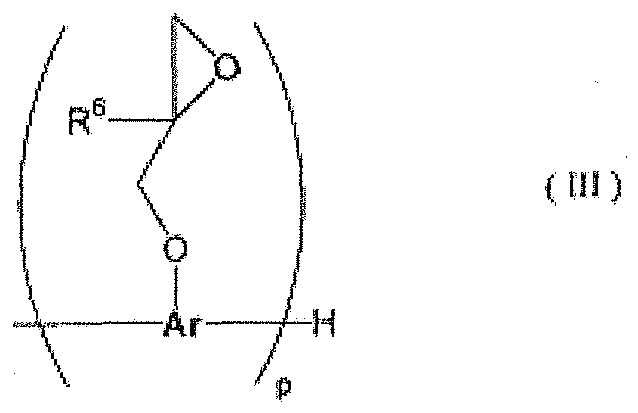
m and n each are an integer of 0 to 4, provided that m and n are not simultaneously 0 (zero); and
the position of binding to the naphthalene structure site may be any of the 1- to 8-positions. - The resin composition according to claim 1, wherein Ar in formula (I) is a naphthylene group, at least one hydrogen atom of which is optionally substituted by an alkyl group having 1 to 4 carbon atoms or a phenylene group.
- The resin composition according to claim 1, wherein m and n in formula (I) are an integer of 0 to 2, provided that m and n are not simultaneously 0 (zero).
- The resin composition according to claim 1, wherein the epoxy resin (A) is represented by general formula (IV) or (V):


- The resin composition according to any one of claims 1 to 4, wherein the curing agent (C) comprises a cyanate ester resin (C1).
- The resin composition according to claims 5, wherein the cyanate ester resin (C1) is represented by formula (VI):

- The resin composition according to any one of claims 1 to 6, wherein the curing agent (C) further comprises a phenolic resin (C2).
- The resin composition according to claim 7, wherein the phenolic resin (C2) is represented by formula (VII):

- The resin composition according to any one of claims 1 to 8, wherein the epoxy resin (A) is contained in an amount of 5 to 60 parts by weight based on 100 parts by weight in total of the epoxy resin (A), the maleimide compound (B), and the curing agent (C).
- The resin composition according to any one of claims 1 to 9, wherein the maleimide compound (B) is contained in an amount of 3 to 50 parts by weight based on 100 parts by weight in total of the epoxy resin (A), the maleimide compound (B), and the curing agent (C).
- The resin composition according to claim 5, 6, 9, or 10, wherein the cyanate ester resin (C1) is contained in an amount that meets a requirement of CN/Ep of 0.7 to 2.5 wherein CN represents the number of cyanate groups in the cyanate ester resin (C1); and Ep represents the number of epoxy groups in the epoxy resin (A).
- The resin composition according to claim 7, 8, 9, or 10, wherein the phenolic resin (C2) is contained in an amount that meets a requirement of OH/Ep of 0.7 to 2.5 wherein OH represents the number of phenol groups in the phenolic resin (C2); and Ep represents the number of epoxy groups in the epoxy resin (A).
- The resin composition according to any one of claims 1 to 12, wherein the inorganic filler (D) is contained in an amount of 50 to 200 parts by weight based on 100 parts by weight in total of the epoxy resin (A), the maleimide compound (B), and the curing agent (C).
- A prepreg comprising: a base material; and a resin composition according to any one of claims 1 to 13 impregnated into or coated on the base material.
- A laminated sheet comprising a cured product of a prepreg according to claim 14.
- A metal foil-clad laminated sheet comprising: a cured product of a stack of a prepreg according to claim 14 and a metal foil provided on the prepreg.
Applications Claiming Priority (2)
| Application Number | Priority Date | Filing Date | Title |
|---|---|---|---|
| JP2010045625 | 2010-03-02 | ||
| PCT/JP2011/054590 WO2011108524A1 (en) | 2010-03-02 | 2011-03-01 | Resin composition, prepreg, and laminated sheet |
Publications (3)
| Publication Number | Publication Date |
|---|---|
| EP2543687A1 true EP2543687A1 (en) | 2013-01-09 |
| EP2543687A4 EP2543687A4 (en) | 2017-05-24 |
| EP2543687B1 EP2543687B1 (en) | 2020-01-15 |
Family
ID=44542175
Family Applications (1)
| Application Number | Title | Priority Date | Filing Date |
|---|---|---|---|
| EP11750634.5A Active EP2543687B1 (en) | 2010-03-02 | 2011-03-01 | Resin composition, prepreg, and laminated sheet |
Country Status (8)
| Country | Link |
|---|---|
| US (1) | US20130045650A1 (en) |
| EP (1) | EP2543687B1 (en) |
| JP (2) | JP5892340B2 (en) |
| KR (3) | KR20170133431A (en) |
| CN (2) | CN102844350B (en) |
| SG (2) | SG183841A1 (en) |
| TW (1) | TWI499632B (en) |
| WO (1) | WO2011108524A1 (en) |
Cited By (2)
| Publication number | Priority date | Publication date | Assignee | Title |
|---|---|---|---|---|
| JP2014507505A (en) * | 2011-07-22 | 2014-03-27 | エルジー・ケム・リミテッド | Thermosetting resin composition, prepreg and metal foil laminate using the same |
| EP3584276A4 (en) * | 2017-02-17 | 2020-12-30 | Hitachi Chemical Company, Ltd. | PREPREG, LAMINATE, CIRCUIT BOARD, CORNELESS SUBSTRATE, SEMICONDUCTOR ENCLOSURE, AND METHOD FOR MANUFACTURING THE CORNELESS SUBSTRATE |
Families Citing this family (42)
| Publication number | Priority date | Publication date | Assignee | Title |
|---|---|---|---|---|
| JP2012041386A (en) * | 2010-08-12 | 2012-03-01 | Sumitomo Bakelite Co Ltd | Thermosetting resin composition for circuit board |
| US20130136930A1 (en) | 2010-08-31 | 2013-05-30 | Mitsubishi Gas Chemical Company, Inc. | Resin composition, prepreg, and laminate |
| US10655003B2 (en) | 2010-10-14 | 2020-05-19 | Lg Chem, Ltd. | Resin blend for melting process |
| JP5958827B2 (en) * | 2011-01-20 | 2016-08-02 | 三菱瓦斯化学株式会社 | Resin composition, prepreg, and laminate |
| WO2012165240A1 (en) * | 2011-05-27 | 2012-12-06 | 三菱瓦斯化学株式会社 | Resin composition, prepreg and laminate |
| JP5344022B2 (en) * | 2011-11-16 | 2013-11-20 | 住友ベークライト株式会社 | Epoxy resin composition, prepreg, laminate, resin sheet, printed wiring board, and semiconductor device |
| EP2810971B1 (en) * | 2012-01-31 | 2018-09-19 | Mitsubishi Gas Chemical Company, Inc. | Metal foil-clad laminate and printed wiring board using a resin composition |
| JP5987261B2 (en) * | 2012-08-16 | 2016-09-07 | Dic株式会社 | Curable resin composition, cured product, and printed wiring board |
| JP5987262B2 (en) * | 2012-08-16 | 2016-09-07 | Dic株式会社 | Curable resin composition, cured product, and printed wiring board |
| WO2014061811A1 (en) * | 2012-10-19 | 2014-04-24 | 三菱瓦斯化学株式会社 | Resin composition, pre-preg, laminate, metal foil-clad laminate, and printed wiring board |
| CN102924865A (en) * | 2012-10-19 | 2013-02-13 | 广东生益科技股份有限公司 | Cyanate resin composition and prepregs, laminates and metal foil-clad laminates produced therefrom |
| CN102911502A (en) * | 2012-10-19 | 2013-02-06 | 广东生益科技股份有限公司 | Cyanate resin composition and prepregs, laminates and metal foil-clad laminates produced therefrom |
| KR102075187B1 (en) | 2012-10-19 | 2020-02-07 | 미츠비시 가스 가가쿠 가부시키가이샤 | Resin composition, prepreg, laminate, and printed wiring board |
| CN103724998A (en) * | 2013-05-30 | 2014-04-16 | 广东生益科技股份有限公司 | A kind of cyanate ester resin composition and its application |
| CN103724999A (en) * | 2013-05-30 | 2014-04-16 | 广东生益科技股份有限公司 | A kind of cyanate ester resin composition and its application |
| JP2014240456A (en) * | 2013-06-11 | 2014-12-25 | 住友ベークライト株式会社 | Prepreg with primer layer, metal-clad laminate, printed wiring board and semiconductor package |
| KR101516068B1 (en) * | 2013-06-14 | 2015-04-29 | 삼성전기주식회사 | Resin composition for printed circuit board, build-up film, prepreg and printed circuit board |
| JP6186977B2 (en) * | 2013-07-22 | 2017-08-30 | 住友ベークライト株式会社 | Resin composition, resin sheet, prepreg, laminate, printed wiring board, and semiconductor device |
| KR102331386B1 (en) * | 2013-10-25 | 2021-11-25 | 미츠비시 가스 가가쿠 가부시키가이샤 | Cyanic acid ester compound, curable resin composition containing said compound, and cured product thereof |
| JP6229439B2 (en) * | 2013-11-05 | 2017-11-15 | 住友ベークライト株式会社 | Metal-clad laminate, printed wiring board, and semiconductor device |
| JP2015232066A (en) * | 2014-06-09 | 2015-12-24 | 日立化成株式会社 | Thermosetting resin composition, and prepreg, laminate and printed wiring board prepared using the same |
| JP6318885B2 (en) * | 2014-06-09 | 2018-05-09 | 日立化成株式会社 | Thermosetting resin composition, and prepreg, laminate and printed wiring board using the same |
| KR101737179B1 (en) * | 2014-09-23 | 2017-05-18 | 삼성에스디아이 주식회사 | Epoxy resin composition for encapsulating semiconductor device and semiconductor device encapsulated using the same |
| WO2016052290A1 (en) * | 2014-10-01 | 2016-04-07 | Dic株式会社 | Epoxy resin composition and cured product thereof |
| US10869390B2 (en) * | 2015-07-06 | 2020-12-15 | Mitsubishi Gas Chemical Company, Inc. | Resin composition, prepreg, metal foil-clad laminate, and printed circuit board |
| JP6354884B1 (en) * | 2017-03-13 | 2018-07-11 | 横浜ゴム株式会社 | Cyanate ester resin composition and prepreg |
| WO2018212116A1 (en) | 2017-05-15 | 2018-11-22 | 三菱瓦斯化学株式会社 | Film forming material for lithography, composition for forming film for lithography, underlayer film for lithography, and pattern forming method |
| JP6905683B2 (en) * | 2017-07-11 | 2021-07-21 | 三菱瓦斯化学株式会社 | Resin composition, prepreg, metal foil-clad laminate, resin sheet and printed wiring board |
| CN107696184A (en) * | 2017-08-31 | 2018-02-16 | 成都九十度工业产品设计有限公司 | A kind of resin impregnating paper chassis of bus sheet material |
| TWI675063B (en) * | 2018-01-02 | 2019-10-21 | 聯茂電子股份有限公司 | Halogen-free epoxy resin composition, laminated substrate and printed circuit board thereof |
| WO2019167359A1 (en) | 2018-02-28 | 2019-09-06 | 三菱瓦斯化学株式会社 | Compound, resin, composition and film-forming material for lithography using same |
| EP3816728A4 (en) | 2018-06-26 | 2021-08-11 | Mitsubishi Gas Chemical Company, Inc. | FILM-FORMING MATERIAL FOR LITHOGRAPHY, FILM-FORMING COMPOSITION FOR LITHOGRAPHY, UNDERLAYMENT FILM FOR LITHOGRAPHY AND PATTERN FORMING PROCESS |
| WO2020027206A1 (en) | 2018-07-31 | 2020-02-06 | 三菱瓦斯化学株式会社 | Optical component-forming composition, optical component, compound, and resin |
| EP3842863A4 (en) | 2018-08-20 | 2021-11-03 | Mitsubishi Gas Chemical Company, Inc. | LITHOGRAPHY FILM FORMING MATERIAL, LITHOGRAPHY FILM FORMING COMPOSITION, LITHOGRAPHY UNDERLAYMENT FILM, AND PATTERN FORMATION METHOD |
| WO2020121734A1 (en) * | 2018-12-12 | 2020-06-18 | パナソニックIpマネジメント株式会社 | Resin composition, prepreg, resin-attached film, resin-attached metal foil, metal-cladded laminate sheet, and printed wiring board |
| WO2020133494A1 (en) * | 2018-12-29 | 2020-07-02 | 广东生益科技股份有限公司 | Resin composition, prepreg, laminated board, metal foil-clad laminated board, and printed circuit board |
| CN114845874B (en) * | 2019-12-17 | 2024-08-23 | 三菱瓦斯化学株式会社 | Resin sheet and printed circuit board |
| CN112936690A (en) * | 2021-02-03 | 2021-06-11 | 哈尔滨玻璃钢研究院有限公司 | Forming method of ablation-resistant lining |
| WO2022201979A1 (en) * | 2021-03-23 | 2022-09-29 | パナソニックIpマネジメント株式会社 | Resin composition, prepreg, resin-equipped film, resin-equipped metal foil, metal-cladded laminated plate, and printed wiring board |
| WO2023063277A1 (en) * | 2021-10-15 | 2023-04-20 | 三菱瓦斯化学株式会社 | Resin composition, laminate, semiconductor chip having resin composition layer, substrate for mounting semiconductor chip having resin composition layer, and semiconductor device |
| JPWO2023063282A1 (en) * | 2021-10-15 | 2023-04-20 | ||
| CN116875053B (en) * | 2023-07-31 | 2025-05-16 | 常熟生益科技有限公司 | Resin composition and application thereof |
Family Cites Families (24)
| Publication number | Priority date | Publication date | Assignee | Title |
|---|---|---|---|---|
| JPH0848001A (en) | 1994-08-08 | 1996-02-20 | Matsushita Electric Works Ltd | Copper clad laminated sheet |
| JP3173332B2 (en) | 1995-03-13 | 2001-06-04 | 新神戸電機株式会社 | Manufacturing method of metal foil-clad laminate |
| JPH093167A (en) * | 1995-04-21 | 1997-01-07 | Toshiba Corp | Resin composition and resin-sealed semiconductor device using the same |
| JPH11124487A (en) * | 1997-10-22 | 1999-05-11 | Mitsubishi Gas Chem Co Inc | Cyanate-maleimide liquid resin composition and semiconductor encapsulation device |
| JPH11322895A (en) * | 1998-05-19 | 1999-11-26 | Hitachi Ltd | Epoxy resin, epoxy resin composition |
| JP2000158589A (en) | 1998-11-30 | 2000-06-13 | Shin Kobe Electric Mach Co Ltd | Manufacturing method of metal foil clad laminate |
| JP2003002949A (en) * | 2001-06-26 | 2003-01-08 | Matsushita Electric Works Ltd | Liquid epoxy resin composition for sealing semiconductor and semiconductor device |
| JP2003246849A (en) | 2002-02-26 | 2003-09-05 | Shin Kobe Electric Mach Co Ltd | Epoxy resin composition, and prepreg, laminate and printed wiring board using the same |
| JP4198508B2 (en) * | 2003-04-08 | 2008-12-17 | 三井化学株式会社 | Modified polyimide resin composition and prepreg and laminate using the same |
| JP4059244B2 (en) | 2004-11-24 | 2008-03-12 | 松下電工株式会社 | Epoxy resin composition, prepreg, laminated board, printed wiring board |
| JP4707615B2 (en) | 2006-06-20 | 2011-06-22 | ヤンマー株式会社 | Combine |
| JP5387872B2 (en) * | 2006-07-31 | 2014-01-15 | Dic株式会社 | Epoxy resin composition and cured product thereof |
| JP5332094B2 (en) * | 2006-09-21 | 2013-11-06 | 住友ベークライト株式会社 | Semiconductor sealing resin composition and semiconductor device |
| JP5263705B2 (en) * | 2007-02-07 | 2013-08-14 | 三菱瓦斯化学株式会社 | Prepreg and laminate |
| US7601429B2 (en) * | 2007-02-07 | 2009-10-13 | Mitsubishi Gas Chemical Company, Inc. | Prepreg and laminate |
| JP5024205B2 (en) | 2007-07-12 | 2012-09-12 | 三菱瓦斯化学株式会社 | Prepreg and laminate |
| JP5384809B2 (en) * | 2007-07-18 | 2014-01-08 | 三菱瓦斯化学株式会社 | Prepreg and laminate |
| JP2009120667A (en) * | 2007-11-13 | 2009-06-04 | Showa Highpolymer Co Ltd | Thermosetting resin composition, and cured material and laminated plate produced by using the same |
| JP2009155399A (en) * | 2007-12-25 | 2009-07-16 | Hitachi Chem Co Ltd | Thermosetting resin composition, and prepreg and laminate both made by using the same |
| JP2009227742A (en) * | 2008-03-19 | 2009-10-08 | Sumitomo Bakelite Co Ltd | Epoxy resin composition, epoxy resin composition for sealing semiconductor, and semiconductor device |
| DE602009000326D1 (en) * | 2008-04-01 | 2010-12-23 | Mitsubishi Gas Chemical Co | Resin composition, prepreg and laminated with a metal foil laminate |
| JP5008201B2 (en) * | 2008-05-21 | 2012-08-22 | 三智商事株式会社 | Wireless IC tag |
| TWI540170B (en) * | 2009-12-14 | 2016-07-01 | Ajinomoto Kk | Resin composition |
| JP3173332U (en) | 2011-11-17 | 2012-02-02 | 奇▲こう▼科技股▲ふん▼有限公司 | Oil-impregnated bearing fan structure |
-
2011
- 2011-03-01 KR KR1020177031295A patent/KR20170133431A/en not_active Ceased
- 2011-03-01 SG SG2012064515A patent/SG183841A1/en unknown
- 2011-03-01 WO PCT/JP2011/054590 patent/WO2011108524A1/en not_active Ceased
- 2011-03-01 KR KR1020127025387A patent/KR102002178B1/en active Active
- 2011-03-01 KR KR1020197020384A patent/KR102107366B1/en active Active
- 2011-03-01 US US13/581,926 patent/US20130045650A1/en not_active Abandoned
- 2011-03-01 JP JP2012503180A patent/JP5892340B2/en active Active
- 2011-03-01 CN CN201180011924.6A patent/CN102844350B/en active Active
- 2011-03-01 CN CN201510737274.3A patent/CN105315435A/en active Pending
- 2011-03-01 SG SG10201501469PA patent/SG10201501469PA/en unknown
- 2011-03-01 EP EP11750634.5A patent/EP2543687B1/en active Active
- 2011-03-02 TW TW100106911A patent/TWI499632B/en active
-
2015
- 2015-10-07 JP JP2015199633A patent/JP6071117B2/en active Active
Non-Patent Citations (1)
| Title |
|---|
| See references of WO2011108524A1 * |
Cited By (4)
| Publication number | Priority date | Publication date | Assignee | Title |
|---|---|---|---|---|
| JP2014507505A (en) * | 2011-07-22 | 2014-03-27 | エルジー・ケム・リミテッド | Thermosetting resin composition, prepreg and metal foil laminate using the same |
| US9278505B2 (en) | 2011-07-22 | 2016-03-08 | Lg Chem, Ltd. | Thermosetting resin composition and prepreg and metal clad laminate using the same |
| EP3584276A4 (en) * | 2017-02-17 | 2020-12-30 | Hitachi Chemical Company, Ltd. | PREPREG, LAMINATE, CIRCUIT BOARD, CORNELESS SUBSTRATE, SEMICONDUCTOR ENCLOSURE, AND METHOD FOR MANUFACTURING THE CORNELESS SUBSTRATE |
| US11214660B2 (en) | 2017-02-17 | 2022-01-04 | Showa Denko Materials Co., Ltd. | Prepreg, laminate, printed wiring board, coreless substrate, semiconductor package and method for producing coreless substrate |
Also Published As
| Publication number | Publication date |
|---|---|
| CN102844350A (en) | 2012-12-26 |
| US20130045650A1 (en) | 2013-02-21 |
| KR20190086052A (en) | 2019-07-19 |
| TWI499632B (en) | 2015-09-11 |
| JP6071117B2 (en) | 2017-02-01 |
| JP5892340B2 (en) | 2016-03-23 |
| KR102107366B1 (en) | 2020-05-07 |
| WO2011108524A1 (en) | 2011-09-09 |
| KR102002178B1 (en) | 2019-10-21 |
| CN102844350B (en) | 2015-11-25 |
| CN105315435A (en) | 2016-02-10 |
| EP2543687B1 (en) | 2020-01-15 |
| SG183841A1 (en) | 2012-10-30 |
| SG10201501469PA (en) | 2015-04-29 |
| JP2016053168A (en) | 2016-04-14 |
| KR20130018721A (en) | 2013-02-25 |
| JPWO2011108524A1 (en) | 2013-06-27 |
| KR20170133431A (en) | 2017-12-05 |
| TW201141936A (en) | 2011-12-01 |
| EP2543687A4 (en) | 2017-05-24 |
Similar Documents
| Publication | Publication Date | Title |
|---|---|---|
| EP2543687B1 (en) | Resin composition, prepreg, and laminated sheet | |
| US9902825B2 (en) | Resin composition, prepreg, and laminated sheet | |
| EP2716676B1 (en) | Resin composition, prepreg and laminate | |
| JP5024205B2 (en) | Prepreg and laminate | |
| US10017660B2 (en) | Resin composition, and prepreg and laminated sheet using the same | |
| US10212813B2 (en) | Resin composition, prepreg, and laminated sheet | |
| JP5692062B2 (en) | Method for storing resin solution, and method for producing prepreg and laminate | |
| EP2666821B1 (en) | Resin composition, prepreg and laminate | |
| HK1178186A (en) | Resin composition, prepreg, and laminated sheet |
Legal Events
| Date | Code | Title | Description |
|---|---|---|---|
| PUAI | Public reference made under article 153(3) epc to a published international application that has entered the european phase |
Free format text: ORIGINAL CODE: 0009012 |
|
| 17P | Request for examination filed |
Effective date: 20120918 |
|
| AK | Designated contracting states |
Kind code of ref document: A1 Designated state(s): AL AT BE BG CH CY CZ DE DK EE ES FI FR GB GR HR HU IE IS IT LI LT LU LV MC MK MT NL NO PL PT RO RS SE SI SK SM TR |
|
| DAX | Request for extension of the european patent (deleted) | ||
| REG | Reference to a national code |
Ref country code: HK Ref legal event code: DE Ref document number: 1178186 Country of ref document: HK |
|
| RA4 | Supplementary search report drawn up and despatched (corrected) |
Effective date: 20170425 |
|
| RIC1 | Information provided on ipc code assigned before grant |
Ipc: C08G 59/50 20060101ALI20170419BHEP Ipc: C08K 3/00 20060101ALI20170419BHEP Ipc: B32B 27/04 20060101ALI20170419BHEP Ipc: B32B 27/38 20060101ALI20170419BHEP Ipc: C08J 5/24 20060101ALI20170419BHEP Ipc: C08G 59/62 20060101ALI20170419BHEP Ipc: C08G 59/40 20060101ALI20170419BHEP Ipc: B32B 15/08 20060101ALI20170419BHEP Ipc: C08L 63/10 20060101ALI20170419BHEP Ipc: C08G 59/24 20060101AFI20170419BHEP |
|
| STAA | Information on the status of an ep patent application or granted ep patent |
Free format text: STATUS: EXAMINATION IS IN PROGRESS |
|
| 17Q | First examination report despatched |
Effective date: 20180604 |
|
| GRAP | Despatch of communication of intention to grant a patent |
Free format text: ORIGINAL CODE: EPIDOSNIGR1 |
|
| STAA | Information on the status of an ep patent application or granted ep patent |
Free format text: STATUS: GRANT OF PATENT IS INTENDED |
|
| INTG | Intention to grant announced |
Effective date: 20190725 |
|
| RIN1 | Information on inventor provided before grant (corrected) |
Inventor name: TAKAHASHI, HIROSHI Inventor name: MIYAHIRA, TETSURO Inventor name: OGASHIWA, TAKAAKI Inventor name: UENO, MASAYOSHI Inventor name: KATO, YOSHIHIRO |
|
| GRAJ | Information related to disapproval of communication of intention to grant by the applicant or resumption of examination proceedings by the epo deleted |
Free format text: ORIGINAL CODE: EPIDOSDIGR1 |
|
| STAA | Information on the status of an ep patent application or granted ep patent |
Free format text: STATUS: EXAMINATION IS IN PROGRESS |
|
| GRAP | Despatch of communication of intention to grant a patent |
Free format text: ORIGINAL CODE: EPIDOSNIGR1 |
|
| STAA | Information on the status of an ep patent application or granted ep patent |
Free format text: STATUS: GRANT OF PATENT IS INTENDED |
|
| INTC | Intention to grant announced (deleted) | ||
| INTG | Intention to grant announced |
Effective date: 20190920 |
|
| GRAS | Grant fee paid |
Free format text: ORIGINAL CODE: EPIDOSNIGR3 |
|
| GRAA | (expected) grant |
Free format text: ORIGINAL CODE: 0009210 |
|
| STAA | Information on the status of an ep patent application or granted ep patent |
Free format text: STATUS: THE PATENT HAS BEEN GRANTED |
|
| AK | Designated contracting states |
Kind code of ref document: B1 Designated state(s): AL AT BE BG CH CY CZ DE DK EE ES FI FR GB GR HR HU IE IS IT LI LT LU LV MC MK MT NL NO PL PT RO RS SE SI SK SM TR |
|
| REG | Reference to a national code |
Ref country code: GB Ref legal event code: FG4D Ref country code: CH Ref legal event code: EP |
|
| REG | Reference to a national code |
Ref country code: IE Ref legal event code: FG4D |
|
| REG | Reference to a national code |
Ref country code: DE Ref legal event code: R096 Ref document number: 602011064631 Country of ref document: DE |
|
| REG | Reference to a national code |
Ref country code: AT Ref legal event code: REF Ref document number: 1225091 Country of ref document: AT Kind code of ref document: T Effective date: 20200215 |
|
| REG | Reference to a national code |
Ref country code: NL Ref legal event code: FP |
|
| REG | Reference to a national code |
Ref country code: LT Ref legal event code: MG4D |
|
| PG25 | Lapsed in a contracting state [announced via postgrant information from national office to epo] |
Ref country code: FI Free format text: LAPSE BECAUSE OF FAILURE TO SUBMIT A TRANSLATION OF THE DESCRIPTION OR TO PAY THE FEE WITHIN THE PRESCRIBED TIME-LIMIT Effective date: 20200115 Ref country code: RS Free format text: LAPSE BECAUSE OF FAILURE TO SUBMIT A TRANSLATION OF THE DESCRIPTION OR TO PAY THE FEE WITHIN THE PRESCRIBED TIME-LIMIT Effective date: 20200115 Ref country code: NO Free format text: LAPSE BECAUSE OF FAILURE TO SUBMIT A TRANSLATION OF THE DESCRIPTION OR TO PAY THE FEE WITHIN THE PRESCRIBED TIME-LIMIT Effective date: 20200415 Ref country code: PT Free format text: LAPSE BECAUSE OF FAILURE TO SUBMIT A TRANSLATION OF THE DESCRIPTION OR TO PAY THE FEE WITHIN THE PRESCRIBED TIME-LIMIT Effective date: 20200607 |
|
| PG25 | Lapsed in a contracting state [announced via postgrant information from national office to epo] |
Ref country code: GR Free format text: LAPSE BECAUSE OF FAILURE TO SUBMIT A TRANSLATION OF THE DESCRIPTION OR TO PAY THE FEE WITHIN THE PRESCRIBED TIME-LIMIT Effective date: 20200416 Ref country code: IS Free format text: LAPSE BECAUSE OF FAILURE TO SUBMIT A TRANSLATION OF THE DESCRIPTION OR TO PAY THE FEE WITHIN THE PRESCRIBED TIME-LIMIT Effective date: 20200515 Ref country code: BG Free format text: LAPSE BECAUSE OF FAILURE TO SUBMIT A TRANSLATION OF THE DESCRIPTION OR TO PAY THE FEE WITHIN THE PRESCRIBED TIME-LIMIT Effective date: 20200415 Ref country code: HR Free format text: LAPSE BECAUSE OF FAILURE TO SUBMIT A TRANSLATION OF THE DESCRIPTION OR TO PAY THE FEE WITHIN THE PRESCRIBED TIME-LIMIT Effective date: 20200115 Ref country code: LV Free format text: LAPSE BECAUSE OF FAILURE TO SUBMIT A TRANSLATION OF THE DESCRIPTION OR TO PAY THE FEE WITHIN THE PRESCRIBED TIME-LIMIT Effective date: 20200115 Ref country code: SE Free format text: LAPSE BECAUSE OF FAILURE TO SUBMIT A TRANSLATION OF THE DESCRIPTION OR TO PAY THE FEE WITHIN THE PRESCRIBED TIME-LIMIT Effective date: 20200115 |
|
| REG | Reference to a national code |
Ref country code: DE Ref legal event code: R097 Ref document number: 602011064631 Country of ref document: DE |
|
| PG25 | Lapsed in a contracting state [announced via postgrant information from national office to epo] |
Ref country code: MC Free format text: LAPSE BECAUSE OF FAILURE TO SUBMIT A TRANSLATION OF THE DESCRIPTION OR TO PAY THE FEE WITHIN THE PRESCRIBED TIME-LIMIT Effective date: 20200115 Ref country code: DK Free format text: LAPSE BECAUSE OF FAILURE TO SUBMIT A TRANSLATION OF THE DESCRIPTION OR TO PAY THE FEE WITHIN THE PRESCRIBED TIME-LIMIT Effective date: 20200115 Ref country code: ES Free format text: LAPSE BECAUSE OF FAILURE TO SUBMIT A TRANSLATION OF THE DESCRIPTION OR TO PAY THE FEE WITHIN THE PRESCRIBED TIME-LIMIT Effective date: 20200115 Ref country code: CZ Free format text: LAPSE BECAUSE OF FAILURE TO SUBMIT A TRANSLATION OF THE DESCRIPTION OR TO PAY THE FEE WITHIN THE PRESCRIBED TIME-LIMIT Effective date: 20200115 Ref country code: SM Free format text: LAPSE BECAUSE OF FAILURE TO SUBMIT A TRANSLATION OF THE DESCRIPTION OR TO PAY THE FEE WITHIN THE PRESCRIBED TIME-LIMIT Effective date: 20200115 Ref country code: EE Free format text: LAPSE BECAUSE OF FAILURE TO SUBMIT A TRANSLATION OF THE DESCRIPTION OR TO PAY THE FEE WITHIN THE PRESCRIBED TIME-LIMIT Effective date: 20200115 Ref country code: LT Free format text: LAPSE BECAUSE OF FAILURE TO SUBMIT A TRANSLATION OF THE DESCRIPTION OR TO PAY THE FEE WITHIN THE PRESCRIBED TIME-LIMIT Effective date: 20200115 Ref country code: RO Free format text: LAPSE BECAUSE OF FAILURE TO SUBMIT A TRANSLATION OF THE DESCRIPTION OR TO PAY THE FEE WITHIN THE PRESCRIBED TIME-LIMIT Effective date: 20200115 Ref country code: SK Free format text: LAPSE BECAUSE OF FAILURE TO SUBMIT A TRANSLATION OF THE DESCRIPTION OR TO PAY THE FEE WITHIN THE PRESCRIBED TIME-LIMIT Effective date: 20200115 |
|
| REG | Reference to a national code |
Ref country code: CH Ref legal event code: PL |
|
| REG | Reference to a national code |
Ref country code: AT Ref legal event code: MK05 Ref document number: 1225091 Country of ref document: AT Kind code of ref document: T Effective date: 20200115 |
|
| PLBE | No opposition filed within time limit |
Free format text: ORIGINAL CODE: 0009261 |
|
| STAA | Information on the status of an ep patent application or granted ep patent |
Free format text: STATUS: NO OPPOSITION FILED WITHIN TIME LIMIT |
|
| 26N | No opposition filed |
Effective date: 20201016 |
|
| REG | Reference to a national code |
Ref country code: BE Ref legal event code: MM Effective date: 20200331 |
|
| PG25 | Lapsed in a contracting state [announced via postgrant information from national office to epo] |
Ref country code: LU Free format text: LAPSE BECAUSE OF NON-PAYMENT OF DUE FEES Effective date: 20200301 |
|
| PG25 | Lapsed in a contracting state [announced via postgrant information from national office to epo] |
Ref country code: IT Free format text: LAPSE BECAUSE OF FAILURE TO SUBMIT A TRANSLATION OF THE DESCRIPTION OR TO PAY THE FEE WITHIN THE PRESCRIBED TIME-LIMIT Effective date: 20200115 Ref country code: CH Free format text: LAPSE BECAUSE OF NON-PAYMENT OF DUE FEES Effective date: 20200331 Ref country code: IE Free format text: LAPSE BECAUSE OF NON-PAYMENT OF DUE FEES Effective date: 20200301 Ref country code: LI Free format text: LAPSE BECAUSE OF NON-PAYMENT OF DUE FEES Effective date: 20200331 Ref country code: AT Free format text: LAPSE BECAUSE OF FAILURE TO SUBMIT A TRANSLATION OF THE DESCRIPTION OR TO PAY THE FEE WITHIN THE PRESCRIBED TIME-LIMIT Effective date: 20200115 |
|
| PG25 | Lapsed in a contracting state [announced via postgrant information from national office to epo] |
Ref country code: SI Free format text: LAPSE BECAUSE OF FAILURE TO SUBMIT A TRANSLATION OF THE DESCRIPTION OR TO PAY THE FEE WITHIN THE PRESCRIBED TIME-LIMIT Effective date: 20200115 Ref country code: BE Free format text: LAPSE BECAUSE OF NON-PAYMENT OF DUE FEES Effective date: 20200331 Ref country code: PL Free format text: LAPSE BECAUSE OF FAILURE TO SUBMIT A TRANSLATION OF THE DESCRIPTION OR TO PAY THE FEE WITHIN THE PRESCRIBED TIME-LIMIT Effective date: 20200115 |
|
| REG | Reference to a national code |
Ref country code: HK Ref legal event code: WD Ref document number: 1178186 Country of ref document: HK |
|
| PG25 | Lapsed in a contracting state [announced via postgrant information from national office to epo] |
Ref country code: TR Free format text: LAPSE BECAUSE OF FAILURE TO SUBMIT A TRANSLATION OF THE DESCRIPTION OR TO PAY THE FEE WITHIN THE PRESCRIBED TIME-LIMIT Effective date: 20200115 Ref country code: MT Free format text: LAPSE BECAUSE OF FAILURE TO SUBMIT A TRANSLATION OF THE DESCRIPTION OR TO PAY THE FEE WITHIN THE PRESCRIBED TIME-LIMIT Effective date: 20200115 Ref country code: CY Free format text: LAPSE BECAUSE OF FAILURE TO SUBMIT A TRANSLATION OF THE DESCRIPTION OR TO PAY THE FEE WITHIN THE PRESCRIBED TIME-LIMIT Effective date: 20200115 |
|
| PG25 | Lapsed in a contracting state [announced via postgrant information from national office to epo] |
Ref country code: MK Free format text: LAPSE BECAUSE OF FAILURE TO SUBMIT A TRANSLATION OF THE DESCRIPTION OR TO PAY THE FEE WITHIN THE PRESCRIBED TIME-LIMIT Effective date: 20200115 Ref country code: AL Free format text: LAPSE BECAUSE OF FAILURE TO SUBMIT A TRANSLATION OF THE DESCRIPTION OR TO PAY THE FEE WITHIN THE PRESCRIBED TIME-LIMIT Effective date: 20200115 |
|
| P01 | Opt-out of the competence of the unified patent court (upc) registered |
Effective date: 20230515 |
|
| PGFP | Annual fee paid to national office [announced via postgrant information from national office to epo] |
Ref country code: NL Payment date: 20260213 Year of fee payment: 16 |
|
| PGFP | Annual fee paid to national office [announced via postgrant information from national office to epo] |
Ref country code: GB Payment date: 20260202 Year of fee payment: 16 |
|
| PGFP | Annual fee paid to national office [announced via postgrant information from national office to epo] |
Ref country code: DE Payment date: 20260128 Year of fee payment: 16 |
|
| PGFP | Annual fee paid to national office [announced via postgrant information from national office to epo] |
Ref country code: FR Payment date: 20260209 Year of fee payment: 16 |