EP2541439A1 - Method and system for processing a search request - Google Patents
Method and system for processing a search request Download PDFInfo
- Publication number
- EP2541439A1 EP2541439A1 EP11305820A EP11305820A EP2541439A1 EP 2541439 A1 EP2541439 A1 EP 2541439A1 EP 11305820 A EP11305820 A EP 11305820A EP 11305820 A EP11305820 A EP 11305820A EP 2541439 A1 EP2541439 A1 EP 2541439A1
- Authority
- EP
- European Patent Office
- Prior art keywords
- item
- sequence
- data strings
- data
- search
- Prior art date
- Legal status (The legal status is an assumption and is not a legal conclusion. Google has not performed a legal analysis and makes no representation as to the accuracy of the status listed.)
- Withdrawn
Links
Images




Classifications
-
- G—PHYSICS
- G06—COMPUTING OR CALCULATING; COUNTING
- G06F—ELECTRIC DIGITAL DATA PROCESSING
- G06F16/00—Information retrieval; Database structures therefor; File system structures therefor
- G06F16/90—Details of database functions independent of the retrieved data types
- G06F16/95—Retrieval from the web
- G06F16/953—Querying, e.g. by the use of web search engines
-
- G—PHYSICS
- G06—COMPUTING OR CALCULATING; COUNTING
- G06F—ELECTRIC DIGITAL DATA PROCESSING
- G06F16/00—Information retrieval; Database structures therefor; File system structures therefor
- G06F16/20—Information retrieval; Database structures therefor; File system structures therefor of structured data, e.g. relational data
- G06F16/24—Querying
- G06F16/245—Query processing
-
- G—PHYSICS
- G06—COMPUTING OR CALCULATING; COUNTING
- G06F—ELECTRIC DIGITAL DATA PROCESSING
- G06F16/00—Information retrieval; Database structures therefor; File system structures therefor
- G06F16/90—Details of database functions independent of the retrieved data types
- G06F16/95—Retrieval from the web
- G06F16/951—Indexing; Web crawling techniques
-
- G—PHYSICS
- G06—COMPUTING OR CALCULATING; COUNTING
- G06F—ELECTRIC DIGITAL DATA PROCESSING
- G06F16/00—Information retrieval; Database structures therefor; File system structures therefor
- G06F16/30—Information retrieval; Database structures therefor; File system structures therefor of unstructured textual data
- G06F16/33—Querying
-
- G—PHYSICS
- G06—COMPUTING OR CALCULATING; COUNTING
- G06F—ELECTRIC DIGITAL DATA PROCESSING
- G06F16/00—Information retrieval; Database structures therefor; File system structures therefor
- G06F16/30—Information retrieval; Database structures therefor; File system structures therefor of unstructured textual data
- G06F16/33—Querying
- G06F16/3331—Query processing
- G06F16/3332—Query translation
Definitions
- the present invention relates to the field of data service interrogation, particularly at processing stages of client search requests.
- the invention can be implemented with computer hardware and software means. It can include a server side where the processing of data applicable to a customer takes place.
- This server side which may be comprised of single or plural computer devices- preferably communicates via network resources with at least one remote user device such as but not exclusively a desktop computer, a smart phone or the like.
- the invention can be implemented on any device.
- Mobile phone applications are targeted as well as web browsers.
- TV (including games) displays can also be used to implement the user interaction with the system.
- the invention will now be described in the field of travel reservation systems aimed at providing, upon request, information (availability, price%) and booking services to users.
- This exemplary application can be related to air travel only or to any kind of travel and leisure products such as, for instance, hotels, cars, cruises, vacations, etc. It is not however limiting the scope of the invention.
- Figure 1 shows a classic rich interface for booking a flight ticket according to the prior art.
- a user wants to book a ticket from an origin to a destination on a given date, then the user must fill at least three different fields:
- the interface of figure 1 is a rather complex interface lacking user-friendliness, but corresponds to most well known Web sites dedicated to travel and leisure reservation services.
- figure 2a shows a simple yet powerful input interface according to the present invention.
- the online user is presented with a very simple web page containing only a logo and a search request input zone. The user can enter several keywords describing the requested trip.
- Keyword sequence could be "nce nyc 22/03" describing a request for the 22 nd March from Nice, France to New York, USA. Or “Nice Paris summer 2 adults 1 child” describing a request for a trip planned for next summer involving a family. More generally, the keywords may be entered in a way closer to natural language.
- the input page displayed at the user device 1 may include other input areas, it is preferred that it only includes the previously described input zone.
- the input of the user may comprise any characters he/she can type using a keyboard, a mobile touch screen or any other input means. This includes letters, numbers, symbols or any other characters. Spaces or some characters such as "-" or "/" can be used by the user so that a plurality of data strings are defined within his input. Data strings are then groups of characters within the sequence. Data strings can correspond to a word or a portion of a word, an abbreviation, cryptic commands, date or date range representations or entries with any other group of characters reflecting one aspect of the user request.
- the sequence of data strings is understood by the invention method and system as comprising a first extremity and a second extremity.
- the first extremity is defined as the starting extremity which is the beginning of the sequence. Typically, this corresponds to the extremity where the user input has started and/or where the reading of the sequence would normally start.
- the second extremity is the one situated opposite the first extremity. This will usually correspond to the end of the sequence.
- sequence of data strings will thus be generated by a free-text input of the user in the input zone.
- Each data string will typically reflect one keyword or a portion of a keyword the user wishes to use for the request.
- free-text and keyword shall here be understood as any set of characters as previously presented.
- the search request comprising the sequence of data strings is then forwarded in the form of a message of any conventional type to a remote portion of the invention.
- the forwarding step can be triggered by any means such as by pressing the "enter" button of a keyboard, clicking on an icon or else.
- Web technologies are advantageously used for communication purposes as well as for the interface management at the user level. Mobile applications on the user end are also possible. By way of example, any browser and any Internet protocol can be implemented.
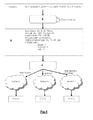
- Figure 3 depicts that the user device 1 is advantageously in bilateral communication with a server side via a network 2 such as the internet.
- the server side may include means 3 for interfacing with at least one user device 1.
- Means 3 for interfacing will usually comprise means for receiving the search request from the user device 1 and means for transmitting a reply to the user device 1.
- the server side also preferably comprises a parsing engine 4, interpreting means 5 and a query builder 6 which will all be described hereafter. All these components advantageously involve or share at least one data processor.
- the parsing engine 4 is configured to analyze the sequence of data strings in the perspective of detecting items which could reflect the wishes of the user, i.e. search parameters. Such items are advantageously a list of elements (such as words, groups of words, dates or date ranges, numbers and signs) that are pre-determined and stored in at least one data repository.
- An example of repository is depicted in figure 3 in the form of a database 7. It is worth saying that a plurality of repositories can be used and at least one of them can be located remote from the parsing engine 4 and connected via any communication means.
- plural repositories are used, each for specific data.
- one repository can be for cities and airports, another one for dates and time, a further one for airlines and so forth.
- Such repositories may consist in data storage means used for other purposes.
- one database can be used both for the invention as well as for other parts of the reservation system. For instance a database of airport names used in the context of flight schedules or fare quote operations between origin and destinations can also be accessed for the invention.
- the invention compares the data strings of the search request with the stored items in an attempt to detect a match which indicates that a matching item has been recognized in the data strings.
- a detected match can be a full match (all the characters of an item match all the characters of at least one data string), or an approximative match (the two compared elements are sufficiently close to be deemed to match).
- a vicinity criterion can be used which reflects a distance between the two compared elements: this can be defined, for example as the number of wrong letters within a given word. More sophisticated formula may also be applied, such as the square root of the sum of the squares of the numbers of wrong letters within any given word. Correct alternatives to the misspelled word are then ordered according to their distance to that word.
- the system may automatically apply a correction or return a message to the user device, requesting the user to confirm that the corrected element (the matching item) is what he/she actually meant. Preferably, this is done by returning the full free-text in a corrected version (or a few possible corrected versions). The user can then confirm the appropriate corrected version, for example by simply clicking on a hyperlink embedding the corrected version. This triggers a message from the user device 1 to the parsing engine via means 3.
- Another preferred embodiment is auto-completion (implemented through dedicated JavaScript client-side libraries), where the user is directly presented with the right search items.
- the parsing stage follows a special algorithm.
- the parsing engine 4 tries to recognize the largest item embedded in the request by starting from second extremity of the sequence (i.e. starting from the end of the sequence when reading it). At the start, the whole sequence is considered. If no item matches, one data string is removed from consideration and the new potential longest portion of the sequence is compared with the items. The process goes on until the considered portion of the sequences matches an item. This item is then set as first matching item.
- the invention then tries to recognize a further item.
- the portion of the sequence corresponding to the first matching item is removed from consideration thus leading to a remaining portion.
- This portion is parsed the same way as the whole sequence has been parsed before, until a second matching item is found.
- the number of matching items is not limited.
- the invention can detect two or more items even though they are originally incorporated in a single input zone of the displayed input page.
- the abbreviation "iter” in the figure 5a and 5b stands for iteration and refer to various sub-step of the stage “1 - iterate until “Remaining-to-be-parsed” is empty detailed hereafter.
- the “remaining to be parsed” corresponds to the remaining portion described above, i.e., to the sequence of data strings minus the already recognized matching items. At the start of the process it is set as the full sequence.
- the “association list” is the list of matching items / data strings couples already found.
- the “longest recognized sublist” corresponds to the remaining portion of the sequence to be parsed.
- the “matches sublist” is for identifying a match in a current iteration. In case of such identification, the "Has matched" Boolean is set to "True”.
- the "longest match” identifies the longest item that matches during a current iteration.
- the interpretation occurs after all matching items have been recognized. However, the interpretation may begin upon recognition of only one or of a few matching items.
- the interpretation consists in identifying search parameters among the matching items previously recognized during the parsing stage. Rules are advantageously used for the interpretation.
- the process first advantageously takes the type of the matching items into account.
- the items can reflect various types of information such as geographical information, date information....
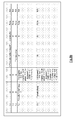
- the system preferably holds a list of potential search data fields which are associated to at least one type of items (Search data fields correspond to search parameter types). Examples of fields are given in the first column of figure 6 .
- fields such as origin and destination are linked to items types related to geographical information, (including cities, airports, countries, continents). Departure date and return date will also often be used as parameters.
- one matching item can potentially be associated with at least one search data field depending on its type.
- some advertisement may be displayed even before the user has typed anything in the input field, targeted to the recognized potential needs of that user.
- the interpreted user request may also be used as an information basis for selecting advertisement matching the user's wishes.
- Figure 6 provides several examples of default values depending on the search parameters.
- Default values may also be derived from information contained in repositories the invention can access to.
- reservation systems usually include a lot of information split into several databases or repositories.
- the invention may benefit form these information sources at the step of defining default parameters.
- PNR data PNR stands for Passengers Name Record
- schedule data Another example is schedule data which may help determine the destination of the travel based on an origin and in view of flights existing from that origin. The same may apply to determine a destination.
- the above examples are not exclusive and any other sources of data (such as sources used for availability or fare determination) can be used.
- search parameter (which is here defined as the association of a search data field with a value).
- a query can then be built by a query builder 6.
- the query builder is in charge with the construction of a query message that fits the format of one travel data service or of its communication channel. It associates the search parameters (or at least some of them) to base the query.
- queries can be built each time several travel data services working with different formats are interrogated.
- Figure 3 shows that three travel data services are involved with three different formats: Edifact, Web Services and other querying technologies.
- a matching item may be translated into a formatted item which represents a generic format of an item.
- Most search engines especially in the travel industry, use to perform searches based on formatted data fields. For instance, city or airport codes as well as airline codes are defined for the whole industry and are used as input of the search systems.
- the user may not be aware of these codes (or not have any knowledge of the language of the website; e.g.: the user is an English citizen accessing a Japanese website).
- the invention copes with this by proposing an automatic translation of the matching items into another format such as a code format or a foreign language format.
- NICE the input string "NICE” of the request is detected as a matching item and translated into "NCE” which corresponds to a IATA code for this airport (IATA is the acronym of International Air Transport Association). Similarly “Reykjavik” is converted into “KEF”.
- Data repositories can be used for the translation step in which several similar items (corresponding to the same search parameter) are specified with correspondence tables. Again the invention can benefit from information already existing in computer reservation system such as Low Fare Search (LFS) systems implemented for the Travel and Tourism industry.
- LFS Low Fare Search
- Travel data service can be a remote system in communication with the query builder via any communication means such as Internet.
- the travel data service comprises a search engine and at least one local or deported data repository.
- the search engine can be a Low Fare Search Engine as used in the travel and tourism industry.
- the invention enables the user to obtain accurate information obtained by a real time interrogation made with a search engine.
- the interrogation is made by a search engine in the form of a low fare search request.
- Figure 3 depicts three travel data services in the field of the travel and tourism industry, GDS 1, GDS2 and GDS3 where GDS stands for Global Distribution System.
- a reply is constructed in destination of the user device 1.
- the reply can be directly built and sent by the travel data service(s) (e.g. one GDS) or the response obtained from the travel data service(s) is (are) transformed at another level, to generate the final reply to be sent to the user.
- the travel data service(s) e.g. one GDS
- the response obtained from the travel data service(s) is (are) transformed at another level, to generate the final reply to be sent to the user.
- receiving means 3, the parsing engine 4, the interpreting means 5, the query builder 6 and means for preparing the reply are integrated in the same computer system and preferably in the same server
- the result of the Low Fare Search (LFS) request is displayed as a list of hyper-links pointing to the corresponding Travel Recommendations (TR), ordered by default according to their travel times vs. prices.
- the Travel Recommendation details are displayed, as well as hyper-links to book them.
- the details of the Travel Recommendations are retrieved through the corresponding distribution service, if those details were not already given by the Low Fare Search (LFS) response.
- the user request is restated, as understood, within a new search request input field, at the top of the page. That distribution display is shown in figure 2b .
- a list of corrected suggestions is displayed. That list may take the shape of simple hyperlinks. One example is depicted in figure 2c .
- the amended request is displayed within the request input field, and the new corresponding result (list of Travel Recommendations) is displayed.
- some advertisements may be displayed on a position of the screen, e.g. the right hand side, targeting the potential recognized needs of the user. For instance, if the user request is "nce mia dec", the Invention understands that the user would like to make a trip from Nice, France, to Miami, FL, USA, on the next December and proposes, within the advertisement part of the screen, hyper-links on Web sites proposing related travel products, e.g. lastminutes.com proposing trips to the sun of Sydney or Tunisia during December, and/or hotels, car rentals and entertainment (theatre, museum, restaurants, etc) in the destination area.
- the user request is "nce mia dec”
- hyper-links on Web sites proposing related travel products e.g. lastminutes.com proposing trips to the sun of Morocco or Tunisia during December, and/or hotels, car rentals and entertainment (theatre, museum, restaurants, etc) in the destination area.
- the Invention may require interfacing with existing distribution systems, an obvious way to implement it is to use the Web Services of a GDS (for instance, Sabre®, TravelPort® or Amadeus®), even though the Invention is not limited to that kind of protocols.
- the Invention has then to recognize the user request keywords against some well-known static lists of referential data, e.g. geographical, time- and passenger-related, and to formulate the distribution request with the corresponding syntax and protocol, e.g. XML and SOAP (or XML-RPC or even RESTful) in the case of Web Services.
- XML and SOAP or XML-RPC or even RESTful
- any other algorithm may be used by the Invention. Parts of existing algorithms may also be used. In fact, pieces of algorithm, such as "Approximate Pattern Matching", form a possible part of the implementation of the Invention.
Landscapes
- Engineering & Computer Science (AREA)
- Theoretical Computer Science (AREA)
- Databases & Information Systems (AREA)
- Data Mining & Analysis (AREA)
- Physics & Mathematics (AREA)
- General Engineering & Computer Science (AREA)
- General Physics & Mathematics (AREA)
- Computational Linguistics (AREA)
- Information Retrieval, Db Structures And Fs Structures Therefor (AREA)
Priority Applications (12)
| Application Number | Priority Date | Filing Date | Title |
|---|---|---|---|
| EP11305820A EP2541439A1 (en) | 2011-06-27 | 2011-06-27 | Method and system for processing a search request |
| US13/135,685 US9183298B2 (en) | 2011-06-27 | 2011-07-12 | Method and system for processing a search request |
| CA2839145A CA2839145C (en) | 2011-06-27 | 2012-06-26 | Method and system for processing a search request |
| CN201280031773.5A CN103649953B (zh) | 2011-06-27 | 2012-06-26 | 用于处理搜索请求的方法和系统 |
| IN244DEN2014 IN2014DN00244A (https=) | 2011-06-27 | 2012-06-26 | |
| PCT/EP2012/062296 WO2013000884A1 (en) | 2011-06-27 | 2012-06-26 | Method and system for processing a search request |
| JP2014517644A JP6198728B2 (ja) | 2011-06-27 | 2012-06-26 | 検索要求を処理する方法及びシステム |
| AU2012277966A AU2012277966B2 (en) | 2011-06-27 | 2012-06-26 | Method and system for processing a search request |
| SG2013089917A SG195305A1 (en) | 2011-06-27 | 2012-06-26 | Method and system for processing a search request |
| BR112013032037A BR112013032037A2 (pt) | 2011-06-27 | 2012-06-26 | método para processar uma solicitação de pesquisa, meio legível por computador, programa legível por computador e sistema para processar uma solicitação de pesquisa |
| KR1020147001279A KR101618997B1 (ko) | 2011-06-27 | 2012-06-26 | 검색 요청을 처리하는 방법 및 시스템 |
| ZA2013/09358A ZA201309358B (en) | 2011-06-27 | 2013-12-11 | Method and system for processing a search request |
Applications Claiming Priority (1)
| Application Number | Priority Date | Filing Date | Title |
|---|---|---|---|
| EP11305820A EP2541439A1 (en) | 2011-06-27 | 2011-06-27 | Method and system for processing a search request |
Publications (1)
| Publication Number | Publication Date |
|---|---|
| EP2541439A1 true EP2541439A1 (en) | 2013-01-02 |
Family
ID=44759623
Family Applications (1)
| Application Number | Title | Priority Date | Filing Date |
|---|---|---|---|
| EP11305820A Withdrawn EP2541439A1 (en) | 2011-06-27 | 2011-06-27 | Method and system for processing a search request |
Country Status (12)
| Country | Link |
|---|---|
| US (1) | US9183298B2 (https=) |
| EP (1) | EP2541439A1 (https=) |
| JP (1) | JP6198728B2 (https=) |
| KR (1) | KR101618997B1 (https=) |
| CN (1) | CN103649953B (https=) |
| AU (1) | AU2012277966B2 (https=) |
| BR (1) | BR112013032037A2 (https=) |
| CA (1) | CA2839145C (https=) |
| IN (1) | IN2014DN00244A (https=) |
| SG (1) | SG195305A1 (https=) |
| WO (1) | WO2013000884A1 (https=) |
| ZA (1) | ZA201309358B (https=) |
Cited By (2)
| Publication number | Priority date | Publication date | Assignee | Title |
|---|---|---|---|---|
| US9183298B2 (en) | 2011-06-27 | 2015-11-10 | Amadeus S.A.S. | Method and system for processing a search request |
| US11734323B2 (en) | 2017-12-22 | 2023-08-22 | Google Llc | Electronic list user interface |
Families Citing this family (16)
| Publication number | Priority date | Publication date | Assignee | Title |
|---|---|---|---|---|
| US9659099B2 (en) | 2011-03-14 | 2017-05-23 | Amgine Technologies (Us), Inc. | Translation of user requests into itinerary solutions |
| US11763212B2 (en) | 2011-03-14 | 2023-09-19 | Amgine Technologies (Us), Inc. | Artificially intelligent computing engine for travel itinerary resolutions |
| CN103593466B (zh) * | 2013-11-26 | 2017-08-04 | 优视科技有限公司 | 网页加载方法及客户端和服务器 |
| WO2015153776A1 (en) | 2014-04-01 | 2015-10-08 | Amgine Technologies (Us), Inc. | Inference model for traveler classification |
| CN104021787A (zh) * | 2014-06-13 | 2014-09-03 | 中国民航信息网络股份有限公司 | 基于语音识别的机票搜索系统及方法 |
| US9509765B2 (en) * | 2014-07-31 | 2016-11-29 | Splunk Inc. | Asynchronous processing of messages from multiple search peers |
| US11049047B2 (en) * | 2015-06-25 | 2021-06-29 | Amgine Technologies (Us), Inc. | Multiattribute travel booking platform |
| WO2016205076A1 (en) | 2015-06-18 | 2016-12-22 | Amgine Technologies (Us), Inc. | Scoring system for travel planning |
| US11941552B2 (en) | 2015-06-25 | 2024-03-26 | Amgine Technologies (Us), Inc. | Travel booking platform with multiattribute portfolio evaluation |
| CN106227774B (zh) * | 2016-07-15 | 2019-09-20 | 海信集团有限公司 | 信息搜索方法及装置 |
| US10339221B2 (en) * | 2017-10-05 | 2019-07-02 | Amadeus S.A.S. | Auto-completion and auto-correction of cryptic language commands with dynamic learning of syntax rules |
| JP7071091B2 (ja) * | 2017-11-01 | 2022-05-18 | Tis株式会社 | 入力内容決定装置 |
| CN112597180A (zh) * | 2020-11-20 | 2021-04-02 | 深圳市世强元件网络有限公司 | 电子元件售卖平台服务项目搜索方法、装置及计算机设备 |
| EP4075294A1 (en) * | 2021-04-15 | 2022-10-19 | Amadeus S.A.S. | Device, system and method for providing a hybrid command line |
| CN114003630B (zh) * | 2021-12-28 | 2022-03-18 | 北京文景松科技有限公司 | 一种数据搜索方法、装置、电子设备及存储介质 |
| US12106042B1 (en) * | 2023-06-09 | 2024-10-01 | International Business Machines Corporation | Enhanced computer automation to transfer data between software applications |
Citations (3)
| Publication number | Priority date | Publication date | Assignee | Title |
|---|---|---|---|---|
| US20030144831A1 (en) * | 2003-03-14 | 2003-07-31 | Holy Grail Technologies, Inc. | Natural language processor |
| WO2006083939A2 (en) * | 2005-01-31 | 2006-08-10 | 4Info, Inc. | Prioritization of search responses system and method |
| WO2010097319A1 (en) * | 2009-02-27 | 2010-09-02 | Amadeus S.A.S. | Graphical user interface for search request management |
Family Cites Families (17)
| Publication number | Priority date | Publication date | Assignee | Title |
|---|---|---|---|---|
| JP2596260B2 (ja) * | 1990-07-18 | 1997-04-02 | 三菱電機株式会社 | 対応表使用データベース検索装置 |
| JPH0540783A (ja) * | 1991-08-06 | 1993-02-19 | Nec Corp | 自然言語解析装置 |
| JP2000163410A (ja) * | 1998-11-30 | 2000-06-16 | Brother Ind Ltd | 文字処理装置及び文字処理プログラムを記録したコンピュータ読み取り可能な記録媒体 |
| US7017162B2 (en) * | 2001-07-10 | 2006-03-21 | Microsoft Corporation | Application program interface for network software platform |
| US7899067B2 (en) * | 2002-05-31 | 2011-03-01 | Cisco Technology, Inc. | Method and apparatus for generating and using enhanced tree bitmap data structures in determining a longest prefix match |
| JP2004139553A (ja) * | 2002-08-19 | 2004-05-13 | Matsushita Electric Ind Co Ltd | 文書検索システムおよび質問応答システム |
| US7174507B2 (en) * | 2003-02-10 | 2007-02-06 | Kaidara S.A. | System method and computer program product for obtaining structured data from text |
| US7254774B2 (en) * | 2004-03-16 | 2007-08-07 | Microsoft Corporation | Systems and methods for improved spell checking |
| US7634503B2 (en) * | 2005-11-21 | 2009-12-15 | Amadeus S.A.S. | Method and system for selecting answers in answer set using a customizable table |
| US20080195630A1 (en) * | 2007-02-13 | 2008-08-14 | Amadeus S.A.S. | Web service interrogation method and apparatus |
| US20080270451A1 (en) * | 2007-04-24 | 2008-10-30 | Interse A/S | System and Method of Generating a Metadata Model for Use in Classifying and Searching for Information Objects Maintained in Heterogeneous Data Stores |
| US20090094223A1 (en) * | 2007-10-05 | 2009-04-09 | Matthew Berk | System and method for classifying search queries |
| EP2224358A1 (en) * | 2009-02-27 | 2010-09-01 | AMADEUS sas | Graphical user interface for search request management |
| JP2011070412A (ja) * | 2009-09-25 | 2011-04-07 | Seiko Epson Corp | 画像検索装置および画像検索方法 |
| CN102083109B (zh) | 2010-04-29 | 2013-06-05 | 电信科学技术研究院 | 一种离线检测的方法、装置及系统 |
| US9721040B2 (en) * | 2010-12-09 | 2017-08-01 | Oracle International Corporation | Mechanism to input, search and create complex data strings within a single dialog |
| EP2541439A1 (en) | 2011-06-27 | 2013-01-02 | Amadeus s.a.s. | Method and system for processing a search request |
-
2011
- 2011-06-27 EP EP11305820A patent/EP2541439A1/en not_active Withdrawn
- 2011-07-12 US US13/135,685 patent/US9183298B2/en active Active
-
2012
- 2012-06-26 CA CA2839145A patent/CA2839145C/en active Active
- 2012-06-26 SG SG2013089917A patent/SG195305A1/en unknown
- 2012-06-26 WO PCT/EP2012/062296 patent/WO2013000884A1/en not_active Ceased
- 2012-06-26 KR KR1020147001279A patent/KR101618997B1/ko not_active Expired - Fee Related
- 2012-06-26 CN CN201280031773.5A patent/CN103649953B/zh active Active
- 2012-06-26 JP JP2014517644A patent/JP6198728B2/ja active Active
- 2012-06-26 IN IN244DEN2014 patent/IN2014DN00244A/en unknown
- 2012-06-26 BR BR112013032037A patent/BR112013032037A2/pt not_active IP Right Cessation
- 2012-06-26 AU AU2012277966A patent/AU2012277966B2/en active Active
-
2013
- 2013-12-11 ZA ZA2013/09358A patent/ZA201309358B/en unknown
Patent Citations (3)
| Publication number | Priority date | Publication date | Assignee | Title |
|---|---|---|---|---|
| US20030144831A1 (en) * | 2003-03-14 | 2003-07-31 | Holy Grail Technologies, Inc. | Natural language processor |
| WO2006083939A2 (en) * | 2005-01-31 | 2006-08-10 | 4Info, Inc. | Prioritization of search responses system and method |
| WO2010097319A1 (en) * | 2009-02-27 | 2010-09-02 | Amadeus S.A.S. | Graphical user interface for search request management |
Non-Patent Citations (2)
| Title |
|---|
| MARTINS B ET AL: "Spelling correction for search engine queries", ELECTRONIC PUBLISHING, ARTISTIC IMAGING, AND DIGITAL TYPOGRAPHY; [LECTURE NOTES IN COMPUTER SCIENCE , ISSN 0302-9743], SPRINGER VERLAG, DE, vol. 3230, 1 January 2004 (2004-01-01), pages 372 - 383, XP002423041, ISBN: 978-3-540-24128-7, DOI: 10.1007/978-3-540-30228-5_33 * |
| UNKNOWN ET AL: "Modern natural language interfaces to databases : composing statistical parsing with semantic tractability", PROCEEDINGS OF THE 20TH INTERNATIONAL CONFERENCE ON COMPUTATIONAL LINGUISTICS , COLING '04, 1 January 2004 (2004-01-01), Morristown, NJ, USA, pages 141 - es, XP055413356, DOI: 10.3115/1220355.1220376 * |
Cited By (2)
| Publication number | Priority date | Publication date | Assignee | Title |
|---|---|---|---|---|
| US9183298B2 (en) | 2011-06-27 | 2015-11-10 | Amadeus S.A.S. | Method and system for processing a search request |
| US11734323B2 (en) | 2017-12-22 | 2023-08-22 | Google Llc | Electronic list user interface |
Also Published As
| Publication number | Publication date |
|---|---|
| JP6198728B2 (ja) | 2017-09-20 |
| SG195305A1 (en) | 2013-12-30 |
| AU2012277966A1 (en) | 2013-05-02 |
| WO2013000884A1 (en) | 2013-01-03 |
| KR20140053964A (ko) | 2014-05-08 |
| KR101618997B1 (ko) | 2016-05-09 |
| AU2012277966B2 (en) | 2015-04-30 |
| US20120330982A1 (en) | 2012-12-27 |
| BR112013032037A2 (pt) | 2016-12-20 |
| CA2839145A1 (en) | 2013-01-03 |
| JP2015501457A (ja) | 2015-01-15 |
| US9183298B2 (en) | 2015-11-10 |
| CN103649953B (zh) | 2017-05-24 |
| ZA201309358B (en) | 2016-08-31 |
| IN2014DN00244A (https=) | 2015-06-05 |
| CA2839145C (en) | 2018-10-16 |
| CN103649953A (zh) | 2014-03-19 |
Similar Documents
| Publication | Publication Date | Title |
|---|---|---|
| US9183298B2 (en) | Method and system for processing a search request | |
| US11392896B2 (en) | Event extraction systems and methods | |
| US10083205B2 (en) | Query cards | |
| US20090157664A1 (en) | System for extracting itineraries from plain text documents and its application in online trip planning | |
| US8949212B1 (en) | Location-based informaton display | |
| US20140279864A1 (en) | Generating data records based on parsing | |
| US20090012824A1 (en) | Apparatus and method for supplying an aggregated and enhanced itinerary | |
| US9760600B2 (en) | Serving recurrent calendar events | |
| US20160180257A1 (en) | Automatic conversion of formatted travel information | |
| US20130117303A1 (en) | Data search device, data search method, and program | |
| CN102314461A (zh) | 一种导航提示方法及系统 | |
| US20090292527A1 (en) | Methods, Apparatuses and Computer Program Products for Receiving and Utilizing Multidimensional Data Via A Phrase | |
| US9792378B2 (en) | Computerized systems and methods for identifying a character string for a point of interest | |
| US8280870B2 (en) | Search engine and associated method | |
| JP2015215660A (ja) | 運賃規則翻訳システム、運賃規則翻訳方法、及び運賃規則翻訳プログラム | |
| AU2012228281B2 (en) | System and method for processing complex queries | |
| US20140195385A1 (en) | Apparatus and a method for simplying and displaying information | |
| JP2007233862A (ja) | サービス検索システム及びサービス検索方法 | |
| WO2018222254A1 (en) | Event extraction systems and methods |
Legal Events
| Date | Code | Title | Description |
|---|---|---|---|
| PUAI | Public reference made under article 153(3) epc to a published international application that has entered the european phase |
Free format text: ORIGINAL CODE: 0009012 |
|
| AK | Designated contracting states |
Kind code of ref document: A1 Designated state(s): AL AT BE BG CH CY CZ DE DK EE ES FI FR GB GR HR HU IE IS IT LI LT LU LV MC MK MT NL NO PL PT RO RS SE SI SK SM TR |
|
| AX | Request for extension of the european patent |
Extension state: BA ME |
|
| 17P | Request for examination filed |
Effective date: 20130628 |
|
| RBV | Designated contracting states (corrected) |
Designated state(s): AL AT BE BG CH CY CZ DE DK EE ES FI FR GB GR HR HU IE IS IT LI LT LU LV MC MK MT NL NO PL PT RO RS SE SI SK SM TR |
|
| STAA | Information on the status of an ep patent application or granted ep patent |
Free format text: STATUS: EXAMINATION IS IN PROGRESS |
|
| 17Q | First examination report despatched |
Effective date: 20171012 |
|
| STAA | Information on the status of an ep patent application or granted ep patent |
Free format text: STATUS: THE APPLICATION HAS BEEN WITHDRAWN |
|
| 18W | Application withdrawn |
Effective date: 20181220 |