EP2530215B1 - Tragstruktur sowie Bauelement mit einer derartigen Tragstruktur - Google Patents
Tragstruktur sowie Bauelement mit einer derartigen Tragstruktur Download PDFInfo
- Publication number
- EP2530215B1 EP2530215B1 EP20120168299 EP12168299A EP2530215B1 EP 2530215 B1 EP2530215 B1 EP 2530215B1 EP 20120168299 EP20120168299 EP 20120168299 EP 12168299 A EP12168299 A EP 12168299A EP 2530215 B1 EP2530215 B1 EP 2530215B1
- Authority
- EP
- European Patent Office
- Prior art keywords
- support structure
- layer
- reinforcing layer
- structure according
- wood
- Prior art date
- Legal status (The legal status is an assumption and is not a legal conclusion. Google has not performed a legal analysis and makes no representation as to the accuracy of the status listed.)
- Not-in-force
Links
- 238000010276 construction Methods 0.000 title claims description 5
- 239000010410 layer Substances 0.000 claims description 87
- 230000003014 reinforcing effect Effects 0.000 claims description 47
- 239000002023 wood Substances 0.000 claims description 42
- 239000000835 fiber Substances 0.000 claims description 40
- 239000012792 core layer Substances 0.000 claims description 23
- 239000011159 matrix material Substances 0.000 claims description 17
- 229920000642 polymer Polymers 0.000 claims description 16
- 241000208202 Linaceae Species 0.000 claims description 5
- 235000004431 Linum usitatissimum Nutrition 0.000 claims description 5
- 229920002430 Fibre-reinforced plastic Polymers 0.000 claims description 3
- 239000011151 fibre-reinforced plastic Substances 0.000 claims description 3
- 239000000463 material Substances 0.000 claims description 2
- 229920002678 cellulose Polymers 0.000 claims 1
- 239000001913 cellulose Substances 0.000 claims 1
- 239000011120 plywood Substances 0.000 description 12
- 230000002787 reinforcement Effects 0.000 description 11
- 239000007787 solid Substances 0.000 description 9
- 239000002131 composite material Substances 0.000 description 5
- 238000009413 insulation Methods 0.000 description 5
- 239000004743 Polypropylene Substances 0.000 description 4
- 229920001155 polypropylene Polymers 0.000 description 4
- -1 polypropylene Polymers 0.000 description 3
- 229920001169 thermoplastic Polymers 0.000 description 3
- 239000004416 thermosoftening plastic Substances 0.000 description 3
- 238000004040 coloring Methods 0.000 description 2
- 238000003475 lamination Methods 0.000 description 2
- 239000002985 plastic film Substances 0.000 description 2
- 229920006255 plastic film Polymers 0.000 description 2
- 229920003229 poly(methyl methacrylate) Polymers 0.000 description 2
- 239000004926 polymethyl methacrylate Substances 0.000 description 2
- 239000011145 styrene acrylonitrile resin Substances 0.000 description 2
- 244000198134 Agave sisalana Species 0.000 description 1
- 240000008564 Boehmeria nivea Species 0.000 description 1
- 244000025254 Cannabis sativa Species 0.000 description 1
- 235000012766 Cannabis sativa ssp. sativa var. sativa Nutrition 0.000 description 1
- 235000012765 Cannabis sativa ssp. sativa var. spontanea Nutrition 0.000 description 1
- 229920003043 Cellulose fiber Polymers 0.000 description 1
- 244000060011 Cocos nucifera Species 0.000 description 1
- 235000013162 Cocos nucifera Nutrition 0.000 description 1
- 239000004593 Epoxy Substances 0.000 description 1
- 229920000877 Melamine resin Polymers 0.000 description 1
- 240000000907 Musa textilis Species 0.000 description 1
- 229920002522 Wood fibre Polymers 0.000 description 1
- 238000010521 absorption reaction Methods 0.000 description 1
- 239000004676 acrylonitrile butadiene styrene Substances 0.000 description 1
- 238000004026 adhesive bonding Methods 0.000 description 1
- 238000005452 bending Methods 0.000 description 1
- 239000011230 binding agent Substances 0.000 description 1
- 230000005540 biological transmission Effects 0.000 description 1
- 239000004566 building material Substances 0.000 description 1
- 235000009120 camo Nutrition 0.000 description 1
- 235000005607 chanvre indien Nutrition 0.000 description 1
- 239000011248 coating agent Substances 0.000 description 1
- 238000000576 coating method Methods 0.000 description 1
- 230000006835 compression Effects 0.000 description 1
- 238000007906 compression Methods 0.000 description 1
- 230000000694 effects Effects 0.000 description 1
- 229920001971 elastomer Polymers 0.000 description 1
- 239000000806 elastomer Substances 0.000 description 1
- 230000002349 favourable effect Effects 0.000 description 1
- 239000002657 fibrous material Substances 0.000 description 1
- 238000007730 finishing process Methods 0.000 description 1
- 239000011487 hemp Substances 0.000 description 1
- 239000011810 insulating material Substances 0.000 description 1
- JDSHMPZPIAZGSV-UHFFFAOYSA-N melamine Chemical compound NC1=NC(N)=NC(N)=N1 JDSHMPZPIAZGSV-UHFFFAOYSA-N 0.000 description 1
- 238000003801 milling Methods 0.000 description 1
- 239000004745 nonwoven fabric Substances 0.000 description 1
- ISWSIDIOOBJBQZ-UHFFFAOYSA-N phenol group Chemical group C1(=CC=CC=C1)O ISWSIDIOOBJBQZ-UHFFFAOYSA-N 0.000 description 1
- 229920001568 phenolic resin Polymers 0.000 description 1
- 239000004417 polycarbonate Substances 0.000 description 1
- 229920000515 polycarbonate Polymers 0.000 description 1
- 229920000647 polyepoxide Polymers 0.000 description 1
- 229920001225 polyester resin Polymers 0.000 description 1
- 229920000139 polyethylene terephthalate Polymers 0.000 description 1
- 239000005020 polyethylene terephthalate Substances 0.000 description 1
- 239000002861 polymer material Substances 0.000 description 1
- 229920005749 polyurethane resin Polymers 0.000 description 1
- SCUZVMOVTVSBLE-UHFFFAOYSA-N prop-2-enenitrile;styrene Chemical compound C=CC#N.C=CC1=CC=CC=C1 SCUZVMOVTVSBLE-UHFFFAOYSA-N 0.000 description 1
- 229920005989 resin Polymers 0.000 description 1
- 239000011347 resin Substances 0.000 description 1
- 230000000087 stabilizing effect Effects 0.000 description 1
- 229920000638 styrene acrylonitrile Polymers 0.000 description 1
- 239000000126 substance Substances 0.000 description 1
- 229920001187 thermosetting polymer Polymers 0.000 description 1
- 239000002025 wood fiber Substances 0.000 description 1
Images

Classifications
-
- B—PERFORMING OPERATIONS; TRANSPORTING
- B32—LAYERED PRODUCTS
- B32B—LAYERED PRODUCTS, i.e. PRODUCTS BUILT-UP OF STRATA OF FLAT OR NON-FLAT, e.g. CELLULAR OR HONEYCOMB, FORM
- B32B21/00—Layered products comprising a layer of wood, e.g. wood board, veneer, wood particle board
- B32B21/04—Layered products comprising a layer of wood, e.g. wood board, veneer, wood particle board comprising wood as the main or only constituent of a layer, which is next to another layer of the same or of a different material
- B32B21/08—Layered products comprising a layer of wood, e.g. wood board, veneer, wood particle board comprising wood as the main or only constituent of a layer, which is next to another layer of the same or of a different material of synthetic resin
-
- B—PERFORMING OPERATIONS; TRANSPORTING
- B32—LAYERED PRODUCTS
- B32B—LAYERED PRODUCTS, i.e. PRODUCTS BUILT-UP OF STRATA OF FLAT OR NON-FLAT, e.g. CELLULAR OR HONEYCOMB, FORM
- B32B27/00—Layered products comprising a layer of synthetic resin
- B32B27/30—Layered products comprising a layer of synthetic resin comprising vinyl (co)polymers; comprising acrylic (co)polymers
- B32B27/302—Layered products comprising a layer of synthetic resin comprising vinyl (co)polymers; comprising acrylic (co)polymers comprising aromatic vinyl (co)polymers, e.g. styrenic (co)polymers
-
- B—PERFORMING OPERATIONS; TRANSPORTING
- B32—LAYERED PRODUCTS
- B32B—LAYERED PRODUCTS, i.e. PRODUCTS BUILT-UP OF STRATA OF FLAT OR NON-FLAT, e.g. CELLULAR OR HONEYCOMB, FORM
- B32B27/00—Layered products comprising a layer of synthetic resin
- B32B27/32—Layered products comprising a layer of synthetic resin comprising polyolefins
-
- E—FIXED CONSTRUCTIONS
- E04—BUILDING
- E04C—STRUCTURAL ELEMENTS; BUILDING MATERIALS
- E04C3/00—Structural elongated elements designed for load-supporting
- E04C3/02—Joists; Girders, trusses, or trusslike structures, e.g. prefabricated; Lintels; Transoms; Braces
- E04C3/12—Joists; Girders, trusses, or trusslike structures, e.g. prefabricated; Lintels; Transoms; Braces of wood, e.g. with reinforcements, with tensioning members
- E04C3/122—Laminated
-
- B—PERFORMING OPERATIONS; TRANSPORTING
- B32—LAYERED PRODUCTS
- B32B—LAYERED PRODUCTS, i.e. PRODUCTS BUILT-UP OF STRATA OF FLAT OR NON-FLAT, e.g. CELLULAR OR HONEYCOMB, FORM
- B32B2262/00—Composition or structural features of fibres which form a fibrous or filamentary layer or are present as additives
- B32B2262/04—Cellulosic plastic fibres, e.g. rayon
-
- B—PERFORMING OPERATIONS; TRANSPORTING
- B32—LAYERED PRODUCTS
- B32B—LAYERED PRODUCTS, i.e. PRODUCTS BUILT-UP OF STRATA OF FLAT OR NON-FLAT, e.g. CELLULAR OR HONEYCOMB, FORM
- B32B2262/00—Composition or structural features of fibres which form a fibrous or filamentary layer or are present as additives
- B32B2262/06—Vegetal fibres
-
- B—PERFORMING OPERATIONS; TRANSPORTING
- B32—LAYERED PRODUCTS
- B32B—LAYERED PRODUCTS, i.e. PRODUCTS BUILT-UP OF STRATA OF FLAT OR NON-FLAT, e.g. CELLULAR OR HONEYCOMB, FORM
- B32B2419/00—Buildings or parts thereof
Definitions
- the invention relates to a support structure with a core layer and a reinforcing layer made of fiber-reinforced plastic. Furthermore, the invention relates to a component with such a support structure.
- Support structures and components executed therewith are required in many areas, for example in the construction sector or in the automotive industry.
- An example of the related art provides the WO 2009/103474 A1 , From the DE 10 2009 023 737 A1 are composites with digitally printed nonwovens known. Composite materials are also known from the DE 10 2007 008 423 A1 ,
- the wood core layer is made of natural wood.
- the natural fiber reinforcement layers form a reinforcement that prevents distortion of the wood core layer and gives the support structure the required rigidity with low weight.
- the use of natural fibers allows processing of the support structure, in particular a blank, with comparatively little effort and in particular with little wear for processing tools. A milling of the reinforcement layer For example, is readily possible and generates at most low wear.
- the wood core layer can be a board stacking beam, a plywood section, a solid wood beam or a plywood core. Such a wood core layer is also referred to as glulam (BS wood, BSH) according to DIN EN 14080.
- the material connection between the reinforcing layer and the wood core layer can be done by lamination or gluing.
- the polymer matrix may be a duroplastic or a thermoplastic.
- thermosetting matrix polymers are phenolic, melamine, polyester, epoxy and polyurethane resins.
- thermoplastic matrix polymers include polypropylene (PP), styrene-acrylonitrile (SAN), polyethylene terephthalate (PBT), acrylonitrile-butadiene-styrene (ABS), thermoplastic polyuretane elastomer (TPU), polycarbonate (PC ) or polymethyl methacrylate (PMMA) resins.
- the natural fibers may have fiber lengths in the range between 10 mm and 100 mm or even longer individual fiber lengths.
- a modulus of elasticity of the natural fibers may range between 80 GPa and 100 GPa.
- a flexural elastic modulus of a natural fiber polymer matrix web may range between 20 GPa and 35 GPa, and more preferably within the range of 30 GPa.
- a specific modulus of elasticity, ie a denormalized elastic modulus, may be in the range of 20 GPa / kg / dm 3 .
- the natural fiber may have a density in the range between 1.0 g / cm 3 and 1.6 g / cm 3 .
- the natural fiber may have a fiber thickness in the range of 10 to 100 microns, and in particular in the range of 20 microns. Natural fibers provide reinforcing layers which have good composite adhesion. SAN leads in particular to a good composite adhesion. Reinforcing layers with natural fibers can be realized with high weather resistance and low moisture absorption. Overall, there is a support structure, which is made to a large extent from renewable resources is.
- the use of composites with natural fibers is known from the DE 103 49 110 B3 . DE 102 51 518 B4 . WO 97/34060 A1 and WO 2010/069 935 A2 ,
- the embedded natural fibers are at least partially enveloped by the polymer matrix.
- a reinforcing layer of the support structure serves for the structural reinforcement of this, that is for receiving forces that act on the support structure, for example, for receiving bending, compression or torsional forces.
- a decorative layer does not constitute such a reinforcing layer.
- Anisotropy of the fiber orientation makes it possible to specifically adapt the reinforcing layer to a specific force load which is subject to the supporting structure. Also a unidirectional fiber alignment for force adjustment is possible.
- the reinforcement layer has several partial layers with different preferred orientations of the natural fibers. Within each of the partial layers, a uniform orientation of the natural fibers is present in one direction. In particular, there is no fibrous tissue. Different alignment sequences depending on the stress requirements are possible.
- the reinforcement layer may, for. B. be two-ply with the alignment sequence 0 ° / 90 °.
- Natural fibers according to claim 2 have been found to be particularly suitable in terms of low processing wear.
- Cellulose fibers or bast fibers have a favorable chemical and structural similarity to wood and have an advantageously low fiber density.
- Flax as a natural fiber material has been found to be particularly suitable due to its combination of properties.
- the flax can be made as an endless spun, discontinuous fiber with about 100 mm single fiber length are processed, wherein the fiber are processed in the form of card slivers.
- flax it is also possible to use another natural fiber, for example hemp, ramie, sisal, abaca or coconut.
- a fiber content according to claim 4 has been found to be particularly suitable.
- the fiber content may be at least 25% by volume or at least 40% by volume.
- a lower limit of fiber content may be 42 volume percent.
- a cover layer according to claim 5 leads to a pleasing appearance of the support structure.
- a cover layer can allow the further processing and refinement of the support structure. Such further processing or finishing processes are known to the person skilled in the art.
- the top layer can be made of plywood or veneer.
- the cover layer may be formed by a coloring or a plastic film.
- Matrix polymer materials according to claim 6 have been found to be particularly suitable for the polymer matrix.
- Reinforcing layer arrangements according to claims 7 and 8 are advantageous depending on the load requirements of the support structure.
- the support structure sections may in particular be sections of the wood core layer, for example around at least one plywood core section or around at least one solid wood rod or solid wood beam.
- the advantages of a component according to claim 9 correspond to those which have already been explained above with reference to the support structure.
- the component may be a carrier in roofs and ceilings, for example for a prefabricated house.
- the component can be used in the interior of houses or ships.
- the component can be used as a door or as another component in furniture construction or in engineering timber construction.
- a front door 1 as an example of a component has a support structure 2 designed as a surface support element.
- the support structure 2 simultaneously represents the door leaf of the door 1.
- the support structure 2 has sections a wood core layer 3.
- the wood core layer 3 each comprise a laminated wood core section 4 each consisting of a plurality of individual wooden boards 5, which are glued together.
- a laminated wood core section 4 is also referred to as a board stacking beam or glued laminated timber beam.
- Each of the two edge-side plywood core sections 4 has a plurality of such wooden boards 5. Depending on the embodiment, three to about ten such wooden boards 5 glued together form the respective plywood core section 4.
- the wood core layer 3 further includes several solid wood rods or beams. 6
- the support structure 2 still has an inner sound insulation core 7 made of sound-insulating material.
- the sound insulation core 7 need not contain wood components.
- the support structure 2 also has two main reinforcement layers 8, 9 which cover the main surfaces of the surface support element support structure 2, in the present embodiment, therefore, the entire front surface and the entire rear surface of the door leaf. Furthermore, the supporting structure 2 has additional reinforcing layers 10, 11, 12, which are designed as separating layers.
- the additional reinforcing layer 10 is used as a separating layer between that shown in FIG FIG. 1 Executed shown plywood core section 4 and the adjacent this solid wood rod 6.
- the additional reinforcement layer 11 is designed as a separating layer between the two solid wood rods 6.
- the additional reinforcing layer 12 is used as a separating layer between in the FIG. 1 formed solid wood rod 6 and the sound insulation core 7.
- the additional reinforcing layers in FIGS. 10 to 12 represent laminate ribs standing with the door 1 installed.
- the sound insulation core 7 has natural wood strips 12a, which are glued on both sides to the main reinforcing layers 8, 9. Shown in the
- FIG. 1 Representing a plurality of natural wood strips exactly one of the natural wood strips 12a.
- the natural wood strips 12a have an S-shaped cross-section and thus have a spring effect between their connection points between the main reinforcing layers 8, 9.
- a glued to the respective main reinforcing layer 8, 9 strips partial cross section of natural wood strips 12a acts as a stabilizing rib for the respective main reinforcing layer 8, 9.
- the S-shaped, resilient design of the natural wood strips 12a reduces a sound transmission perpendicular to the main reinforcing layers 8, 9 through the door 1.
- the reinforcing layers 8 to 12 are formed from fiber-reinforced plastic and are connected flat and cohesively with the wood core layer 3.
- the reinforcing layers 8 to 12 each have a polymer matrix with embedded natural fibers.
- the natural fibers of the reinforcement layers 8 to 12 are flax.
- the reinforcing layers 8 to 12 have a fiber content of at least 25 percent by volume.
- the fiber content is in the range between 25 and 60 percent by volume, for example 42 percent by volume.
- the matrix polymer of the reinforcing layers 8 to 12 is polypropylene (PP).
- PP polypropylene
- SAN Styrene-acrylonitrile
- the auxiliary reinforcing layers 10 to 12 are hot laminated between the core layers between which they are arranged.
- the matrix polymer penetrates as a binder in the porous wood surface of the adjacent wooden board 5 or the adjacent solid wood bar 6 of the wood core layer 3.
- a connection of the additional reinforcement layer 12 to the sound insulation core 7 is not required.
- the main reinforcing layers 8, 9 are each covered by a cover layer 13, 14 covering the reinforcing layers 8, 9 in the form of a plywood cover plate.
- the cover layers 13, 14 have a thickness in the range between 2.5 mm and 8.5 mm.
- the main reinforcing layers 8, 9 are on the other hand hot laminated or glued between the wood core layer 3 on the one hand and the respective cover layer 13, 14 on the other.
- the cover layers 13, 14 may also be formed by a coating, another coloring or by a plastic film.
- the support structure 2 still has fittings in the form of hinges 15, which in the FIG. 1 are indicated only schematically. These fittings are not necessarily directly connected to the reinforcing layers 8 to 12 of the support structure 2. The connection of the fittings with the support structure 2 via the wood core layer. 3
- the reinforcing layers 8 to 12 are constructed as a multi-layer layer with a plurality of partial layers. This, in the FIG. 1 Partial layers, not shown, each have a preferred orientation of the embedded natural fibers.
- the reinforcing layers 8 to 12 thus have an anisotropic, in particular practically unidirectional fiber orientation.
- the different partial layers have different preferred orientations.
- the order of the orientation angles of the fiber orientation of the partial layers within, for example, the main reinforcing layers 8, 9 may be 0 ° / 90 ° / 0 ° / 90 ° / 0 ° or 0 ° / + 45 ° / 0 ° / -45 ° / 0 ° , In these sequence examples, it is assumed that the main reinforcing layers 8, 9 each have five partial layers. Other alignment angular sequences are possible. Also, a different number of partial layers within one of the reinforcing layers 8 to 12 is possible.
- the partial layers are hot laminated to each other, wherein a bond between the individual partial layers is produced by the matrix polymer.
- bonding can also take place.
- the reinforcing layers 8 to 12 may also have a total of practically unidirectionally oriented natural fibers, that is to say they may each be single-layered.
- the support structure 2 can also be used in other components, for example, in beams in roofs and ceilings for prefabricated houses, the interior of houses, ships, etc., or generally in furniture or engineering timber.
- FIG. 2 Based on FIG. 2 a further embodiment of a support structure 16 is explained below. Components that correspond to those that exist and with reference to the FIG. 1 already described, bear the same reference numbers and will not be discussed again in detail.
- the support structure 16 has a wood core layer 17, which is a solid wood layer or a plywood core with wooden boards analogous to the plywood core section 4 of the embodiment according to FIG. 1 can act.
- the wood core layer 17 may also be a plywood layer.
- the wood core layer 17 is covered by two reinforcing layers 18, 19, the structure of the main reinforcing layers 8, 9 after FIG. 1 equivalent. In a section of the reinforcing layer 18 are shown some of the natural fibers 18a embedded in the polymer matrix 18b.
- the two reinforcing layers 18, 19 are hot laminated to the wood core layer 17.
- FIG. 3 Based on FIG. 3 is explained below on a further embodiment of a support structure 20. Components which correspond to those described above with reference to FIGS. 1 . 2 already described, bear the same reference numbers and will not be discussed again in detail.
- the support structure 21 has an additional cover layer 13, the cover layer 13 of the embodiment according to FIG. 1 equivalent.
Landscapes
- Engineering & Computer Science (AREA)
- Architecture (AREA)
- Life Sciences & Earth Sciences (AREA)
- Wood Science & Technology (AREA)
- Civil Engineering (AREA)
- Structural Engineering (AREA)
- Laminated Bodies (AREA)
Description
- Die Erfindung betrifft eine Tragstruktur mit einer Kernschicht und einer Verstärkungslage aus faserverstärktem Kunststoff. Ferner betrifft die Erfindung ein Bauelement mit einer derartigen Tragstruktur.
- Tragstrukturen und hiermit ausgeführte Bauelemente werden in vielen Bereichen benötigt, beispielsweise auf dem Bausektor oder auch im Automobilbau. Ein Beispiel für den diesbezüglichen Stand der Technik liefert die
WO 2009/103474 A1 . Aus derDE 10 2009 023 737 A1 sind Verbundwerkstoffe mit digital bedruckten Vliesstoffen bekannt. Verbundwerkstoffe sind weiterhin bekannt aus derDE 10 2007 008 423 A1 . - Es ist eine Aufgabe der vorliegenden Erfindung, eine Tragstruktur der eingangs genannten Art so weiterzubilden, dass sie einerseits stabil, andererseits aber auch möglichst leicht und unaufwändig bearbeitbar ist.
- Diese Aufgabe ist erfindungsgemäß gelöst durch eine Tragstruktur mit den im Anspruch 1 angegebenen Merkmalen.
- Es wurde erkannt, dass Holz als Bestandteil der Kernschicht anders als z. B. isolierte Holzfasern als Baustoff unaufwändig innerhalb der Tragstruktur verwendet werden kann. Die Holz-Kernschicht besteht aus natürlichem Holz. Die Naturfaser-Verstärkungslagen bilden eine Armierung, die einem Verzug der Holz-Kernschicht vorbeugt und der Tragstruktur bei geringem Gewicht die erforderliche Steifigkeit verleiht. Der Einsatz der Naturfasern ermöglicht ein Bearbeiten der Tragstruktur, insbesondere einen Zuschnitt, mit vergleichsweise geringem Aufwand und insbesondere mit geringem Verschleiß für Bearbeitungswerkzeuge. Ein Fräsen der Verstärkungslage ist beispielsweise ohne weiteres möglich und erzeugt allenfalls geringen Verschleiß. Bei der Holz-Kernschicht kann es sich um einen Brettstapelbalken, um einen Schichtholzabschnitt, um einen Massivholz-balken oder um einen Sperrholzkern handeln. Eine derartige Holz-Kernschicht wird gemäß DIN EN 14080 auch als Brettschichtholz (BS-Holz, BSH) bezeichnet.Der Stoffschluss zwischen der Verstärkungslage und der Holz-Kernschicht kann durch Laminieren oder Verkleben erfolgen. Bei der Polymermatrix kann es sich um einen Duroplast oder um einen Thermoplast handeln. Beispiele für duromere Matrix-Polymere sind Phenol-, Melamin-, Polyester-, Epoxid- und Polyurethan-Harze. Beispiele für thermoplastische Matrix-Polymere sind Polypropylen- (PP), Styrol-Acrylnitril-(SAN), Polyethylenterephthalat-(PBT), Acrylnitril-Butadien-Styrol-(ABS), thermoplastische Polyuretan-Elastomer-(TPU), Polycarbonat-(PC) oder Polymethylmethacrylat-(PMMA) Harze. Die Naturfasern können Faserlängen im Bereich zwischen 10 mm und 100 mm oder auch noch längere Einzelfaserlängen aufweisen. Ein Elastizitätsmodul der Naturfasern kann im Bereich zwischen 80 GPa und 100 GPa liegen. Ein Biege-Elastizitätsmodul eines Naturfaser-Polymermatrix-Geleges kann im Bereich zwischen 20 GPa und 35 GPa und insbesondere im Bereich von 30 GPa liegen. Ein spezifisches Elastizitätsmodul, d. h. ein dichtenormiertes Elastizitätsmodul, kann im Bereich von 20 GPa/kg/dm3 liegen. Die Naturfaser kann eine Dichte im Bereich zwischen 1,0 g/cm3 und 1,6 g/cm3 aufweisen. Die Naturfaser kann eine Faserstärke im Bereich von 10 bis 100 µm, und insbesondere im Bereich von 20 µm aufweisen. Naturfasern ergeben Verstärkungslagen, die eine gute Verbundhaftung aufweisen. SAN führt insbesondere zu einer guten Verbundhaftung. Verstärkungslagen mit Naturfasern können mit hoher Witterungsbeständigkeit und geringer Feuchtigkeitsaufnahme realisiert werden. Insgesamt ergibt sich eine Tragstruktur, die zu einem großen Anteil aus nachwachsenden Rohstoffen gefertigt ist. Der Einsatz von Verbundwerkstoffen mit Naturfasern ist bekannt aus der
DE 103 49 110 B3 ,DE 102 51 518 B4 ,WO 97/34060 A1 WO 2010/069 935 A2 . Die eingebetteten Naturfasern werden von der Polymermatrix zumindest teilweise umhüllt. Auch eine Einbettung so, dass die Naturfasern von der Polymermatrix vollständig umhüllt werden, ist möglich. Eine Verstärkungslage der Tragstruktur dient zur strukturellen Verstärkung von dieser, also zur Aufnahme von Kräften, die auf die Tragstruktur wirken, beispielsweise zur Aufnahme von Biege-, Druck- oder Torsionskräften. Eine Dekorlage stellt keine derartige Verstärkungslage dar. Eine Anisotropie der Faserausrichtung ermöglicht es, die Verstärkungslage an eine bestimmte Kraftbeanspruchung, der die Tragstruktur unterliegt, spezifisch anzupassen. Auch eine unidirektionale Faserausrichtung zur Kraftanpassung ist möglich. Die Verstärkungslage weist mehrere Teillagen mit unterschiedlichen Vorzugs-Ausrichtungen der Naturfasern auf. Innerhalb jeweils einer der Teillagen liegt eine einheitliche Ausrichtung der Naturfasern im Wesentlichen in einer Richtung vor. Es liegt also insbesondere kein Fasergewebe vor. Verschiedene Ausrichtungsabfolgen je nach den Beanspruchungsanforderungen sind möglich. Die Verstärkungslage kann z. B. zweilagig mit der Ausrichtungs-Abfolge 0°/90° sein. - Naturfasern nach Anspruch 2 haben sich hinsichtlich des geringen Bearbeitungsverschleißes als besonders geeignet herausgestellt. Zellulose-Fasern beziehungsweise Bastfasern haben eine vorteilhafte chemische und strukturelle Ähnlichkeit zu Holz und haben eine vorteilhaft niedrige Faserdichte.
- Flachs als Naturfasermaterial hat sich aufgrund seiner Eigenschaftskombination als besonders geeignet herausgestellt. Das Flachs kann als endlosversponnene, diskontinuierliche Faser mit etwa 100 mm Einzel-Faserlänge verarbeitet werden, wobei die Faser in Form von Kardenbändern verarbeitet werden.
- Alternativ zu Flachs kann auch eine andere Naturfaser, beispielsweise Hanf, Ramie, Sisal, Abaca oder Kokos zum Einsatz kommen.
- Ein Fasergehalt nach Anspruch 4 hat sich als besonders geeignet herausgestellt. Der Fasergehalt kann mindestens 25 Volumenprozent oder auch mindestens 40 Volumenprozent sein. Eine Untergrenze des Fasergehalts kann bei 42 Volumenprozent liegen.
- Eine Decklage nach Anspruch 5 führt zu einem gefälligen Erscheinungsbild der Tragstruktur. Eine Decklage kann die Weiterbearbeitung und Veredelung der Tragstruktur ermöglichen. Derartige Weiterbearbeitungs- beziehungsweise Veredelungsverfahren sind dem Fachmann bekannt. Die Decklage kann aus Sperrholz oder Furnier ausgeführt sein. Alternativ kann die Decklage durch eine Einfärbung oder eine Kunststoff-Folie gebildet sein.
- Matrix-Polymermaterialien nach Anspruch 6 haben sich für die Polymermatrix als besonders geeignet herausgestellt.
- Verstärkungslagen-Anordnungen nach den Ansprüchen 7 und 8 sind je nach dem Belastungsanforderungen an die Tragstruktur vorteilhaft. Es können auch mehrere beabstandete Verstärkungs-Trennlagen innerhalb der Tragstruktur vorliegen. Bei den Tragstruktur-Abschnitten kann es sich insbesondere um Abschnitte der Holz-Kernschicht handeln, beispielsweise um mindestens einen Schichtholz-Kernabschnitt bzw. um mindestens einen Massivholz-Stab oder Massivholz-Balken.
- Die Vorteile eines Bauelements nach Anspruch 9 entsprechen denen, die vorstehend unter Bezugnahme auf die Tragstruktur bereits erläutert wurden. Das Bauelement kann ein Träger in Dächern und Decken, beispielsweise für ein Fertighaus, sein. Das Bauelement kann beim Innenausbau von Häusern oder Schiffen zum Einsatz kommen. Das Bauelement kann als Tür oder als sonstige Komponente im Möbelbau oder im Ingenieurholzbau zum Einsatz kommen.
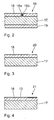
- Ein Ausführungsbeispiel der Erfindung wird nachfolgend anhand der Zeichnung erläutert. In dieser zeigen:
- Figur 1
- einen Querschnitt durch eine Tür mit einer erfindungsgemäßen Tragstruktur;
- Figur 2
- schematisch in einer zu
Figur 1 ähnlichen Querschnittsdarstellung eine weitere Ausführung einer Tragstruktur; und - Figuren 3 und 4
- in zu
Figur 2 ähnlichen Querschnittsdarstellungen weitere Ausführungen einer Tragstruktur. - Eine Haustür 1 als Beispiel für ein Bauelement hat eine als Flächentragelement ausgeführte Tragstruktur 2. Die Tragstruktur 2 stellt gleichzeitig das Türblatt der Tür 1 dar.
- Die Tragstruktur 2 hat abschnittsweise eine Holz-Kernschicht 3. Beiderseits im Bereich einer Stirnseite des in der
Figur 1 gezeigten Querschnitts umfasst die Holz-Kernschicht 3 jeweils einen Schichtholz-Kernabschnitt 4 aus jeweils einer Mehrzahl einzelner Holzbretter 5, die miteinander verleimt sind. Ein solcher Schichtholz-Kernabschnitt 4 wird auch als Brettstapelbalken beziehungsweise Brettschichtholz-Balken bezeichnet. Jeder der beiden randseitigen Schichtholz-Kernabschnitte 4 hat eine Mehrzahl derartiger Holzbretter 5. Je nach Ausführung können drei bis etwa zehn derartiger Holzbretter 5 miteinander verleimt den jeweiligen Schichtholz-Kernabschnitt 4 bilden. Zur Holz-Kernschicht 3 gehören weiterhin mehrere Massivholz-Stäbe oder -Balken 6. - Zusätzlich zur Holz-Kernschicht 3 hat die Tragstruktur 2 noch einen inneren Schalldämmungskern 7 aus schalldämmendem Material. Der Schalldämmungskern 7 muss keine Holzbestandteile beinhalten.
- Die Tragstruktur 2 hat zudem zwei Haupt-Verstärkungs-Lagen 8, 9, die die Hauptflächen der Flächentragelement-Tragstruktur 2 abdecken, im vorliegenden Ausführungsbeispiel also die gesamte Vorderfläche und die gesamte Rückfläche des Türblatts. Weiterhin hat die Tragstruktur 2 als Trennlagen ausgeführte Zusatz-Verstärkungslagen 10, 11, 12. Die Zusatz-Verstärkungslage 10 ist als Trennlage zwischen dem in der
Figur 1 links dargestellten Schichtholz-Kernabschnitt 4 und dem diesem benachbarten Massivholz-Stab 6 ausgeführt. Die Zusatz-Verstärkungslage 11 ist als Trennlage zwischen den beiden Massivholz-Stäben 6 ausgeführt. Die Zusatz-Verstärkungslage 12 ist als Trennlage zwischen dem in derFigur 1 rechts dargestellten Massivholz-Stab 6 und dem Schalldämmungskern 7 ausgebildet. Die Zusatz-Verstärkungslagen in 10 bis 12 stellen bei verbauter Tür 1 stehende Laminat-Rippen dar. - Der Schalldämmungskern 7 weist Naturholz-Leisten 12a auf, die beidseitig an die Haupt-Verstärkungs-Lagen 8, 9 angeleimt sind. Dargestellt ist in der
-
Figur 1 stellvertretend für eine Mehrzahl Naturholz-Leisten genau eine der Naturholz-Leisten 12a. Die Naturholz-Leisten 12a haben einen S-förmigen Querschnitt und haben dadurch eine Federwirkung zwischen ihren Verbindungspunkten zwischen den Haupt-Verstärkungs-Lagen 8, 9. Ein an die jeweilige Haupt-Verstärkungs-Lage 8, 9 angeleimter Leisten-Teilquerschnitt der Naturholz-Leisten 12a wirkt als stabilisierende Rippe für die jeweilige Haupt-Verstärkungs-Lage 8, 9. Zudem verringert die S-förmige, federnde Gestaltung der Naturholz-Leisten 12a eine Schallübertragung senkrecht zu den Haupt-Verstärkungs-Lagen 8, 9 durch die Tür 1. - Die Verstärkungslagen 8 bis 12 sind aus faserverstärktem Kunststoff gebildet und sind flächig und stoffschlüssig mit der Holz-Kernschicht 3 verbunden. Die Verstärkungslagen 8 bis 12 haben jeweils eine Polymermatrix mit eingebetteten Naturfasern. Bei der dargestellten Ausführung der Tragstruktur 2 handelt es sich bei den Naturfasern der Verstärkungslagen 8 bis 12 um Flachs.
- Die Verstärkungslagen 8 bis 12 haben einen Fasergehalt von mindestens 25 Volumenprozent. Der Fasergehalt liegt im Bereich zwischen 25 und 60 Volumenprozent, beispielsweise bei 42 Volumenprozent.
- Als Matrix-Polymer der Verstärkungslagen 8 bis 12 dient Polypropylen (PP). Auch Styrol-Acrylnitril (SAN) kann als Matrix-Polymer zum Einsatz kommen.
- Die Zusatz-Verstärkungslagen 10 bis 12 sind zwischen die Kernschichten, zwischen denen sie angeordnet sind, heiß laminiert. Das Matrix-Polymer dringt dabei als Binder in die poröse Holzoberfläche des benachbarten Holzbretts 5 oder des benachbarten Massivholz-Stabs 6 der Holzkernschicht 3 ein. Eine Anbindung der Zusatz-Verstärkungslage 12 an den Schalldämmungskern 7 ist nicht erforderlich.
- Die Haupt-Verstärkungslagen 8, 9 werden jeweils von einer die Verstärkungslagen 8, 9 überdeckenden Decklage 13, 14 in Form einer Sperrholz-Deckplatte abgedeckt. Die Decklagen 13, 14 haben eine Stärke im Bereich zwischen 2,5 mm und 8,5 mm.
- Die Haupt-Verstärkungslagen 8, 9 sind zwischen die Holz-Kernschicht 3 einerseits und die jeweilige Decklage 13, 14 andererseits heißlaminiert oder geklebt. Alternativ zu der Sperrholz-Ausführung können die Decklagen 13, 14 auch durch eine Lackierung, eine sonstige Einfärbung oder durch eine Kunststoff-Folie gebildet sein.
- Stirnseitig hat die Tragstruktur 2 noch Beschläge in Form von Scharnieren 15, die in der
Figur 1 lediglich schematisch angedeutet sind. Diese Beschläge sind nicht notwendigerweise mit den Verstärkungslagen 8 bis 12 der Tragstruktur 2 direkt verbunden. Die Verbindung der Beschläge mit der Tragstruktur 2 erfolgt über die Holz-Kernschicht 3. - Die Verstärkungslagen 8 bis 12, insbesondere die Haupt-Verstärkungslagen 8 und 9, sind als Mehrlagenschicht mit einer Mehrzahl von Teillagen aufgebaut. Diese, in der
Figur 1 nicht dargestellten Teillagen haben jeweils eine Vorzugs-Ausrichtung der eingebetteten Naturfasern. Die Verstärkungslagen 8 bis 12 haben also eine anisotrope, insbesondere praktisch unidirektionale Faserausrichtung. - Die verschiedenen Teillagen haben unterschiedliche Vorzugs-Ausrichtungen. Die Abfolge der Ausrichtungswinkel der Faserausrichtung der Teillagen innerhalb beispielsweise den Haupt-Verstärkungslagen 8, 9 kann 0°/90°/0°/90°/0° oder 0°/+45°/0°/-45°/0° sein. Bei diesen Abfolgebeispielen ist vorausgesetzt, dass die Haupt-Verstärkungslagen 8, 9 jeweils fünf Teillagen aufweist. Auch andere Ausrichtungs-Winkelabfolgen sind möglich. Auch eine andere Anzahl von Teillagen innerhalb einer der Verstärkungslagen 8 bis 12 ist möglich.
- Die Teillagen werden aufeinander heiß auflaminiert, wobei ein Verbund zwischen den einzelnen Teillagen durch das Matrix-Polymer hergestellt wird.
- Alternativ zu einem Laminieren zur Verbindung der Verstärkungslagen 8 bis 12 mit den anliegenden Komponenten der Tragstruktur 2 kann auch ein Verkleben erfolgen.
- Alternativ können die Verstärkungslagen 8 bis 12 auch insgesamt praktisch unidirektional ausgerichtete Naturfasern aufweisen, also jeweils einlagig ausgeführt sein.
- Die Tragstruktur 2 kann auch bei anderen Bauelementen zum Einsatz kommen, beispielsweise bei Trägern in Dächern und Decken für Fertighäuser, beim Innenausbau von Häusern, Schiffen usw. oder generell im Möbelbau oder im Ingenieurholzbau.
- Anhand der
Figur 2 wird nachfolgend eine weitere Ausführung einer Tragstruktur 16 erläutert. Komponenten, die denjenigen entsprechen, die vorstehen und in Bezugnahme auf dieFigur 1 bereits erläutert wurden, tragen die gleichen Bezugsziffern und werden nicht nochmals im Einzelnen diskutiert. - Die Tragstruktur 16 hat eine Holz-Kernschicht 17, bei der es sich um eine Massivholzschicht oder um einen Schichtholz-Kern mit Holzbrettern analog zum Schichtholz-Kernabschnitt 4 der Ausführung nach
Figur 1 handeln kann. Bei der Holz-Kernschicht 17 kann es sich auch um eine Sperrholzschicht handeln. Beidseitig wird die Holz-Kernschicht 17 abgedeckt durch zwei Verstärkungslagen 18, 19, deren Aufbau den Haupt-Verstärkungslagen 8, 9 nachFigur 1 entspricht. In einem Ausschnitt der Verstärkungslage 18 sind einige der Naturfasern 18a dargestellt, die in die Polymermatrix 18b eingebettet sind. - Die beiden Verstärkungslagen 18, 19 sind auf die Holz-Kernschicht 17 heiß auflaminiert.
- Anhand der
Figur 3 wird nachfolgend auf eine weitere Ausführung einer Tragstruktur 20 erläutert. Komponenten, die denjenigen entsprechen, die vorstehend unter Bezugnahme auf dieFiguren 1 ,2 bereits erläutert wurden, tragen die gleichen Bezugsziffern und werden nicht nochmals im Einzelnen diskutiert. - Im Unterschied zur Tragstruktur 16 nach
Figur 2 hat die Tragstruktur 20 ausschließlich eine Verstärkungslage 18, die der Verstärkungslage 18 der Tragstruktur 16 nachFigur 2 entspricht. - Anhand der
Figur 4 wird nachfolgend auf eine weitere Ausführung einer Tragstruktur 21 erläutert. Komponenten, die denjenigen entsprechen, die vorstehend unter Bezugnahme auf dieFiguren 1 bis 3 bereits erläutert wurden, tragen die gleichen Bezugsziffern und werden nicht nochmals im Einzelnen diskutiert. - Im Unterschied zur Ausführung nach
Figur 3 hat die Tragstruktur 21 eine zusätzliche Decklage 13, die der Decklage 13 der Ausführung nachFigur 1 entspricht.
Claims (9)
- Tragstruktur (2; 16; 20; 21)- mit einer zumindest abschnittsweise vorliegenden HolzKernschicht (3; 17),- mit mindestens einer Verstärkungslage (8 bis 12; 18, 19; 18) aus faserverstärktem-Kunststoff, die flächig und stoffschlüssig mit der Holz-Kemschicht (3; 17) verbunden ist,- wobei die Verstärkungslage (8 bis 12; 18, 19; 18)dadurch gekennzeichnet, dass-- eine Polymermatrix (18b) mit eingebetteten Naturfasern (18a) und-- eine anisotrope Faserausrichtung aufweist,- die Verstärkungslage (8 bis 12; 18, 19; 18) mehrere Teillagen mit unterschiedlichen Vorzugs-Ausrichtungen der Naturfasern (18a) aufweist.
- Tragstruktur nach Anspruch 1, dadurch gekennzeichnet dass die eingebeteten Naturfasern (18a) Zellulose enthalten.
- Tragstruktur nach Anspruch 2, dadurch gekennzeichnet, dass die eingebetteten Naturfasern (18a) Flachs enthalten.
- Tragstruktur nach einem der Ansprüche 1 bis 3, dadurch gekennzeichnet, dass die Verstärkungslage (8 bis 12; 18, 19; 18) einen Fasergehalt von mindestens 25 Volumenprozent aufweist.
- Tragstruktur nach einem der Ansprüche 1 bis 4, gekennzeichnet durch eine die Verstärkungslage (8, 9; 18) überdeckende Decklage (13, 14; 13) aus einem Holzwerkstoff.
- Tragstruktur nach einem der Ansprüche 1 bis 5, gekennzeichnet durch PP oder SAN als Matrix-Polymer der Polymermatrix (18b).
- Tragstruktur nach einem der Ansprüche 1 bis 6, dadurch gekennzeichnet, dass die Tragstruktur (2; 16; 20; 21) als Flächentragelement ausgeführt ist, wobei die Verstärkungslage (8, 9; 18, 19; 18) mindestens eine der Hauptflächen des Flächentragelements abdeckt.
- Tragstruktur nach einem der Ansprüche 1 bis 7, dadurch gekennzeichnet, dass die Verstärkungslage (10 bis 12) als Trennlage zwischen Tragstruktur-Abschnitten (4, 6; 6, 6; 6, 7) angeordnet ist.
- Bauelement (1) mit einer Tragstruktur (2) nach einem der Ansprüche 1 bis 9.
Applications Claiming Priority (1)
| Application Number | Priority Date | Filing Date | Title |
|---|---|---|---|
| DE102011076873A DE102011076873A1 (de) | 2011-06-01 | 2011-06-01 | Tragstruktur sowie Bauelement mit einer derartigen Tragstruktur |
Publications (2)
| Publication Number | Publication Date |
|---|---|
| EP2530215A1 EP2530215A1 (de) | 2012-12-05 |
| EP2530215B1 true EP2530215B1 (de) | 2015-03-04 |
Family
ID=46177334
Family Applications (1)
| Application Number | Title | Priority Date | Filing Date |
|---|---|---|---|
| EP20120168299 Not-in-force EP2530215B1 (de) | 2011-06-01 | 2012-05-16 | Tragstruktur sowie Bauelement mit einer derartigen Tragstruktur |
Country Status (2)
| Country | Link |
|---|---|
| EP (1) | EP2530215B1 (de) |
| DE (1) | DE102011076873A1 (de) |
Families Citing this family (1)
| Publication number | Priority date | Publication date | Assignee | Title |
|---|---|---|---|---|
| ES2590879T3 (es) * | 2012-07-02 | 2016-11-23 | Basf Se | Materiales de madera ligeros multicapa a partir de materiales lignocelulósicos con un núcleo y dos capas de superficie con celulosa tratada, fibras naturales tratadas, fibras sintéticas o sus mezclas en el núcleo |
Family Cites Families (8)
| Publication number | Priority date | Publication date | Assignee | Title |
|---|---|---|---|---|
| US5747151A (en) * | 1996-03-12 | 1998-05-05 | Tingley; Daniel A. | Glue-laminated wood structural member with sacrificial edges |
| DE19937269A1 (de) * | 1998-10-07 | 2000-04-13 | Sortimo Int Gmbh | Mehrschichtplatte als Einlegeboden für Fahrzeuge |
| DE10251518B4 (de) | 2002-11-04 | 2009-10-01 | Deutsches Zentrum für Luft- und Raumfahrt e.V. | Kontinuierliches Fertigungsverfahren zur Herstellung von Gegenständen aus Faserverbundwerkstoffen aus nachwachsenden Rohstoffen |
| DE10349110B3 (de) | 2003-05-28 | 2004-12-09 | Daimlerchrysler Ag | Faserstrang enthaltend Naturfasern und Kompositwerkstoff verstärkt mit Naturfasern sowie Verwendung von beiden |
| DE102007008423A1 (de) * | 2007-02-21 | 2008-08-28 | Johns Manville Europe Gmbh | Neue Verbundwerkstoffe, Verfahren zu deren Herstellung und deren Verwendung |
| DE102008010869A1 (de) | 2008-02-23 | 2009-09-10 | Thermoplast Composite Gmbh | Tragstruktur sowie Verfahren zur Herstellung und Verwendung einer derartigen Tragstruktur |
| CH700137A1 (de) * | 2008-12-19 | 2010-06-30 | Swissfiber Ag | Biegeträger-verbundelement aus holz und faserverstärktem kunststoff. |
| DE102009023737A1 (de) * | 2009-06-03 | 2010-12-09 | Johns Manville Europe Gmbh | Digitales Bedrucken von Vliesstoffen und deren Verwendung in Verbundwerkstoffen |
-
2011
- 2011-06-01 DE DE102011076873A patent/DE102011076873A1/de not_active Ceased
-
2012
- 2012-05-16 EP EP20120168299 patent/EP2530215B1/de not_active Not-in-force
Also Published As
| Publication number | Publication date |
|---|---|
| EP2530215A1 (de) | 2012-12-05 |
| DE102011076873A1 (de) | 2012-12-06 |
Similar Documents
| Publication | Publication Date | Title |
|---|---|---|
| DE69530376T2 (de) | Verstärkungsplatte mit einem oberflächenmaterial auf cellulosebasis, verfahren zur verstärkung einer holzstruktur und die verstärkte holzstruktur | |
| AT504841B1 (de) | Gleitbrettkern für schi oder snowboards | |
| DE60032125T2 (de) | Verbundbauelemente und herstellungsverfahren | |
| DE102008009478B4 (de) | Leichtbauplatte sowie Herstellungsverfahren | |
| DE202007009532U1 (de) | Platte mit einem Schichtaufbau | |
| EP2247222B1 (de) | Tragstruktur sowie verfahren zur herstellung und verwendung einer derartigen tragstruktur | |
| DE4110640A1 (de) | Formkoerper | |
| EP2530215A1 (de) | Tragstruktur sowie Bauelement mit einer derartigen Tragstruktur | |
| Blanchet et al. | A decade review on hardwood composites and their research developments | |
| DE202009001846U1 (de) | Leichtbaukörper aus einem Faserverbundwerkstoff auf Basis von Holzfasermatten, insbesondere für Rotorblätter in Windkraftanlagen | |
| DE102008004091B4 (de) | Verbundträger für hohe mechanische Belastungen und Verfahren zur Herstellung solcher Träger | |
| DE202009005360U1 (de) | Platte | |
| WO2008079554A1 (en) | Reinforced wood panel | |
| AT515504B1 (de) | Flächiges Bauelement | |
| DE102020104211A1 (de) | Schallschutzelement | |
| DE102017115893A1 (de) | Verbundbauteil | |
| DE202006004985U1 (de) | Sandwichplattenverbund | |
| DE9415570U1 (de) | Schalungstafel aus Kunststoff | |
| DE10148181A1 (de) | Leimholz | |
| DE1779210A1 (de) | Verbundplatten und Verfahren zu ihrer Herstellung | |
| DE102022117843A1 (de) | Schichtstoffplatte, insbesondere für den Möbelbau in Wohnwagen und -mobilen | |
| DE2819077A1 (de) | Verstaerkungsschichtstoff | |
| DE10032860A1 (de) | Gerüstbohle in Leichtbauweise | |
| AT15976U1 (de) | Türblatt | |
| DE10249581A1 (de) | Trägerplatte |
Legal Events
| Date | Code | Title | Description |
|---|---|---|---|
| PUAI | Public reference made under article 153(3) epc to a published international application that has entered the european phase |
Free format text: ORIGINAL CODE: 0009012 |
|
| AK | Designated contracting states |
Kind code of ref document: A1 Designated state(s): AL AT BE BG CH CY CZ DE DK EE ES FI FR GB GR HR HU IE IS IT LI LT LU LV MC MK MT NL NO PL PT RO RS SE SI SK SM TR |
|
| AX | Request for extension of the european patent |
Extension state: BA ME |
|
| 17P | Request for examination filed |
Effective date: 20130603 |
|
| RBV | Designated contracting states (corrected) |
Designated state(s): AL AT BE BG CH CY CZ DE DK EE ES FI FR GB GR HR HU IE IS IT LI LT LU LV MC MK MT NL NO PL PT RO RS SE SI SK SM TR |
|
| 17Q | First examination report despatched |
Effective date: 20131002 |
|
| GRAP | Despatch of communication of intention to grant a patent |
Free format text: ORIGINAL CODE: EPIDOSNIGR1 |
|
| INTG | Intention to grant announced |
Effective date: 20141010 |
|
| GRAS | Grant fee paid |
Free format text: ORIGINAL CODE: EPIDOSNIGR3 |
|
| GRAA | (expected) grant |
Free format text: ORIGINAL CODE: 0009210 |
|
| AK | Designated contracting states |
Kind code of ref document: B1 Designated state(s): AL AT BE BG CH CY CZ DE DK EE ES FI FR GB GR HR HU IE IS IT LI LT LU LV MC MK MT NL NO PL PT RO RS SE SI SK SM TR |
|
| REG | Reference to a national code |
Ref country code: GB Ref legal event code: FG4D Free format text: NOT ENGLISH |
|
| REG | Reference to a national code |
Ref country code: CH Ref legal event code: EP |
|
| REG | Reference to a national code |
Ref country code: IE Ref legal event code: FG4D Free format text: LANGUAGE OF EP DOCUMENT: GERMAN |
|
| REG | Reference to a national code |
Ref country code: AT Ref legal event code: REF Ref document number: 714058 Country of ref document: AT Kind code of ref document: T Effective date: 20150415 |
|
| REG | Reference to a national code |
Ref country code: DE Ref legal event code: R096 Ref document number: 502012002383 Country of ref document: DE Effective date: 20150416 |
|
| REG | Reference to a national code |
Ref country code: NL Ref legal event code: VDEP Effective date: 20150304 |
|
| PG25 | Lapsed in a contracting state [announced via postgrant information from national office to epo] |
Ref country code: ES Free format text: LAPSE BECAUSE OF FAILURE TO SUBMIT A TRANSLATION OF THE DESCRIPTION OR TO PAY THE FEE WITHIN THE PRESCRIBED TIME-LIMIT Effective date: 20150304 Ref country code: HR Free format text: LAPSE BECAUSE OF FAILURE TO SUBMIT A TRANSLATION OF THE DESCRIPTION OR TO PAY THE FEE WITHIN THE PRESCRIBED TIME-LIMIT Effective date: 20150304 Ref country code: NO Free format text: LAPSE BECAUSE OF FAILURE TO SUBMIT A TRANSLATION OF THE DESCRIPTION OR TO PAY THE FEE WITHIN THE PRESCRIBED TIME-LIMIT Effective date: 20150604 Ref country code: FI Free format text: LAPSE BECAUSE OF FAILURE TO SUBMIT A TRANSLATION OF THE DESCRIPTION OR TO PAY THE FEE WITHIN THE PRESCRIBED TIME-LIMIT Effective date: 20150304 Ref country code: LT Free format text: LAPSE BECAUSE OF FAILURE TO SUBMIT A TRANSLATION OF THE DESCRIPTION OR TO PAY THE FEE WITHIN THE PRESCRIBED TIME-LIMIT Effective date: 20150304 Ref country code: SE Free format text: LAPSE BECAUSE OF FAILURE TO SUBMIT A TRANSLATION OF THE DESCRIPTION OR TO PAY THE FEE WITHIN THE PRESCRIBED TIME-LIMIT Effective date: 20150304 |
|
| REG | Reference to a national code |
Ref country code: LT Ref legal event code: MG4D |
|
| PG25 | Lapsed in a contracting state [announced via postgrant information from national office to epo] |
Ref country code: GR Free format text: LAPSE BECAUSE OF FAILURE TO SUBMIT A TRANSLATION OF THE DESCRIPTION OR TO PAY THE FEE WITHIN THE PRESCRIBED TIME-LIMIT Effective date: 20150605 Ref country code: LV Free format text: LAPSE BECAUSE OF FAILURE TO SUBMIT A TRANSLATION OF THE DESCRIPTION OR TO PAY THE FEE WITHIN THE PRESCRIBED TIME-LIMIT Effective date: 20150304 Ref country code: RS Free format text: LAPSE BECAUSE OF FAILURE TO SUBMIT A TRANSLATION OF THE DESCRIPTION OR TO PAY THE FEE WITHIN THE PRESCRIBED TIME-LIMIT Effective date: 20150304 |
|
| PG25 | Lapsed in a contracting state [announced via postgrant information from national office to epo] |
Ref country code: NL Free format text: LAPSE BECAUSE OF FAILURE TO SUBMIT A TRANSLATION OF THE DESCRIPTION OR TO PAY THE FEE WITHIN THE PRESCRIBED TIME-LIMIT Effective date: 20150304 |
|
| PG25 | Lapsed in a contracting state [announced via postgrant information from national office to epo] |
Ref country code: SK Free format text: LAPSE BECAUSE OF FAILURE TO SUBMIT A TRANSLATION OF THE DESCRIPTION OR TO PAY THE FEE WITHIN THE PRESCRIBED TIME-LIMIT Effective date: 20150304 Ref country code: RO Free format text: LAPSE BECAUSE OF FAILURE TO SUBMIT A TRANSLATION OF THE DESCRIPTION OR TO PAY THE FEE WITHIN THE PRESCRIBED TIME-LIMIT Effective date: 20150304 Ref country code: EE Free format text: LAPSE BECAUSE OF FAILURE TO SUBMIT A TRANSLATION OF THE DESCRIPTION OR TO PAY THE FEE WITHIN THE PRESCRIBED TIME-LIMIT Effective date: 20150304 Ref country code: PT Free format text: LAPSE BECAUSE OF FAILURE TO SUBMIT A TRANSLATION OF THE DESCRIPTION OR TO PAY THE FEE WITHIN THE PRESCRIBED TIME-LIMIT Effective date: 20150706 Ref country code: CZ Free format text: LAPSE BECAUSE OF FAILURE TO SUBMIT A TRANSLATION OF THE DESCRIPTION OR TO PAY THE FEE WITHIN THE PRESCRIBED TIME-LIMIT Effective date: 20150304 |
|
| PG25 | Lapsed in a contracting state [announced via postgrant information from national office to epo] |
Ref country code: IS Free format text: LAPSE BECAUSE OF FAILURE TO SUBMIT A TRANSLATION OF THE DESCRIPTION OR TO PAY THE FEE WITHIN THE PRESCRIBED TIME-LIMIT Effective date: 20150704 Ref country code: PL Free format text: LAPSE BECAUSE OF FAILURE TO SUBMIT A TRANSLATION OF THE DESCRIPTION OR TO PAY THE FEE WITHIN THE PRESCRIBED TIME-LIMIT Effective date: 20150304 |
|
| REG | Reference to a national code |
Ref country code: DE Ref legal event code: R119 Ref document number: 502012002383 Country of ref document: DE |
|
| PG25 | Lapsed in a contracting state [announced via postgrant information from national office to epo] |
Ref country code: IT Free format text: LAPSE BECAUSE OF FAILURE TO SUBMIT A TRANSLATION OF THE DESCRIPTION OR TO PAY THE FEE WITHIN THE PRESCRIBED TIME-LIMIT Effective date: 20150304 |
|
| REG | Reference to a national code |
Ref country code: CH Ref legal event code: PL |
|
| PLBE | No opposition filed within time limit |
Free format text: ORIGINAL CODE: 0009261 |
|
| STAA | Information on the status of an ep patent application or granted ep patent |
Free format text: STATUS: NO OPPOSITION FILED WITHIN TIME LIMIT |
|
| PG25 | Lapsed in a contracting state [announced via postgrant information from national office to epo] |
Ref country code: MC Free format text: LAPSE BECAUSE OF FAILURE TO SUBMIT A TRANSLATION OF THE DESCRIPTION OR TO PAY THE FEE WITHIN THE PRESCRIBED TIME-LIMIT Effective date: 20150304 Ref country code: CH Free format text: LAPSE BECAUSE OF NON-PAYMENT OF DUE FEES Effective date: 20150531 Ref country code: LI Free format text: LAPSE BECAUSE OF NON-PAYMENT OF DUE FEES Effective date: 20150531 Ref country code: LU Free format text: LAPSE BECAUSE OF FAILURE TO SUBMIT A TRANSLATION OF THE DESCRIPTION OR TO PAY THE FEE WITHIN THE PRESCRIBED TIME-LIMIT Effective date: 20150516 Ref country code: DK Free format text: LAPSE BECAUSE OF FAILURE TO SUBMIT A TRANSLATION OF THE DESCRIPTION OR TO PAY THE FEE WITHIN THE PRESCRIBED TIME-LIMIT Effective date: 20150304 |
|
| 26N | No opposition filed |
Effective date: 20151207 |
|
| REG | Reference to a national code |
Ref country code: IE Ref legal event code: MM4A |
|
| REG | Reference to a national code |
Ref country code: FR Ref legal event code: ST Effective date: 20160129 |
|
| PG25 | Lapsed in a contracting state [announced via postgrant information from national office to epo] |
Ref country code: SI Free format text: LAPSE BECAUSE OF FAILURE TO SUBMIT A TRANSLATION OF THE DESCRIPTION OR TO PAY THE FEE WITHIN THE PRESCRIBED TIME-LIMIT Effective date: 20150304 |
|
| PG25 | Lapsed in a contracting state [announced via postgrant information from national office to epo] |
Ref country code: DE Free format text: LAPSE BECAUSE OF NON-PAYMENT OF DUE FEES Effective date: 20151201 Ref country code: IE Free format text: LAPSE BECAUSE OF NON-PAYMENT OF DUE FEES Effective date: 20150516 |
|
| PG25 | Lapsed in a contracting state [announced via postgrant information from national office to epo] |
Ref country code: FR Free format text: LAPSE BECAUSE OF NON-PAYMENT OF DUE FEES Effective date: 20150601 |
|
| PG25 | Lapsed in a contracting state [announced via postgrant information from national office to epo] |
Ref country code: MT Free format text: LAPSE BECAUSE OF FAILURE TO SUBMIT A TRANSLATION OF THE DESCRIPTION OR TO PAY THE FEE WITHIN THE PRESCRIBED TIME-LIMIT Effective date: 20150304 |
|
| GBPC | Gb: european patent ceased through non-payment of renewal fee |
Effective date: 20160516 |
|
| PG25 | Lapsed in a contracting state [announced via postgrant information from national office to epo] |
Ref country code: BG Free format text: LAPSE BECAUSE OF FAILURE TO SUBMIT A TRANSLATION OF THE DESCRIPTION OR TO PAY THE FEE WITHIN THE PRESCRIBED TIME-LIMIT Effective date: 20150304 Ref country code: SM Free format text: LAPSE BECAUSE OF FAILURE TO SUBMIT A TRANSLATION OF THE DESCRIPTION OR TO PAY THE FEE WITHIN THE PRESCRIBED TIME-LIMIT Effective date: 20150304 Ref country code: HU Free format text: LAPSE BECAUSE OF FAILURE TO SUBMIT A TRANSLATION OF THE DESCRIPTION OR TO PAY THE FEE WITHIN THE PRESCRIBED TIME-LIMIT; INVALID AB INITIO Effective date: 20120516 Ref country code: GB Free format text: LAPSE BECAUSE OF NON-PAYMENT OF DUE FEES Effective date: 20160516 |
|
| PG25 | Lapsed in a contracting state [announced via postgrant information from national office to epo] |
Ref country code: CY Free format text: LAPSE BECAUSE OF FAILURE TO SUBMIT A TRANSLATION OF THE DESCRIPTION OR TO PAY THE FEE WITHIN THE PRESCRIBED TIME-LIMIT Effective date: 20150304 |
|
| PG25 | Lapsed in a contracting state [announced via postgrant information from national office to epo] |
Ref country code: BE Free format text: LAPSE BECAUSE OF NON-PAYMENT OF DUE FEES Effective date: 20150531 |
|
| PG25 | Lapsed in a contracting state [announced via postgrant information from national office to epo] |
Ref country code: TR Free format text: LAPSE BECAUSE OF FAILURE TO SUBMIT A TRANSLATION OF THE DESCRIPTION OR TO PAY THE FEE WITHIN THE PRESCRIBED TIME-LIMIT Effective date: 20150304 |
|
| PG25 | Lapsed in a contracting state [announced via postgrant information from national office to epo] |
Ref country code: MK Free format text: LAPSE BECAUSE OF FAILURE TO SUBMIT A TRANSLATION OF THE DESCRIPTION OR TO PAY THE FEE WITHIN THE PRESCRIBED TIME-LIMIT Effective date: 20150304 |
|
| REG | Reference to a national code |
Ref country code: AT Ref legal event code: MM01 Ref document number: 714058 Country of ref document: AT Kind code of ref document: T Effective date: 20170516 |
|
| PG25 | Lapsed in a contracting state [announced via postgrant information from national office to epo] |
Ref country code: AT Free format text: LAPSE BECAUSE OF NON-PAYMENT OF DUE FEES Effective date: 20170516 |
|
| PG25 | Lapsed in a contracting state [announced via postgrant information from national office to epo] |
Ref country code: AL Free format text: LAPSE BECAUSE OF FAILURE TO SUBMIT A TRANSLATION OF THE DESCRIPTION OR TO PAY THE FEE WITHIN THE PRESCRIBED TIME-LIMIT Effective date: 20150304 |