EP2526114B1 - Chromatographisches verfahren zur aufreinigung von fc enthaltenden proteinen - Google Patents
Chromatographisches verfahren zur aufreinigung von fc enthaltenden proteinen Download PDFInfo
- Publication number
- EP2526114B1 EP2526114B1 EP11700457.2A EP11700457A EP2526114B1 EP 2526114 B1 EP2526114 B1 EP 2526114B1 EP 11700457 A EP11700457 A EP 11700457A EP 2526114 B1 EP2526114 B1 EP 2526114B1
- Authority
- EP
- European Patent Office
- Prior art keywords
- protein
- concentration
- buffer
- mol
- washing
- Prior art date
- Legal status (The legal status is an assumption and is not a legal conclusion. Google has not performed a legal analysis and makes no representation as to the accuracy of the status listed.)
- Active
Links
Images


Classifications
-
- C—CHEMISTRY; METALLURGY
- C07—ORGANIC CHEMISTRY
- C07K—PEPTIDES
- C07K1/00—General methods for the preparation of peptides, i.e. processes for the organic chemical preparation of peptides or proteins of any length
- C07K1/14—Extraction; Separation; Purification
- C07K1/16—Extraction; Separation; Purification by chromatography
- C07K1/22—Affinity chromatography or related techniques based upon selective absorption processes
-
- A—HUMAN NECESSITIES
- A61—MEDICAL OR VETERINARY SCIENCE; HYGIENE
- A61K—PREPARATIONS FOR MEDICAL, DENTAL OR TOILETRY PURPOSES
- A61K39/00—Medicinal preparations containing antigens or antibodies
- A61K39/395—Antibodies; Immunoglobulins; Immune serum, e.g. antilymphocytic serum
- A61K39/39591—Stabilisation, fragmentation
-
- C—CHEMISTRY; METALLURGY
- C07—ORGANIC CHEMISTRY
- C07K—PEPTIDES
- C07K16/00—Immunoglobulins [IG], e.g. monoclonal or polyclonal antibodies
-
- C—CHEMISTRY; METALLURGY
- C07—ORGANIC CHEMISTRY
- C07K—PEPTIDES
- C07K16/00—Immunoglobulins [IG], e.g. monoclonal or polyclonal antibodies
- C07K16/18—Immunoglobulins [IG], e.g. monoclonal or polyclonal antibodies against material from animals or humans
- C07K16/22—Immunoglobulins [IG], e.g. monoclonal or polyclonal antibodies against material from animals or humans against growth factors ; against growth regulators
-
- C—CHEMISTRY; METALLURGY
- C07—ORGANIC CHEMISTRY
- C07K—PEPTIDES
- C07K2317/00—Immunoglobulins specific features
- C07K2317/10—Immunoglobulins specific features characterized by their source of isolation or production
- C07K2317/14—Specific host cells or culture conditions, e.g. components, pH or temperature
Definitions
- the invention relates to chromatographic methods for purifying proteins and to means for such methods.
- Biomolecules such as proteins, polynucleotides, polysaccharides and the like are increasingly gaining commercial importance as drugs, as diagnostics, as additives in foods, detergents and the like, as research reagents and for many other applications.
- the need for such biomolecules can be determined - e.g. in the case of proteins - usually no longer satisfy by isolating the molecules from natural sources but requires the use of biotechnological production methods.
- the biotechnological production of proteins typically begins with the isolation of the DNA encoding the desired protein and its cloning into a suitable expression vector. After transfection of the expression vector into suitable prokaryotic or eukaryotic expression cells and subsequent selection of transfected cells, the latter are cultured in fermenters and the desired protein is expressed. Subsequently, the harvest of the cells or of the culture supernatant and the workup and purification of the protein contained therein takes place.
- process- and product-dependent impurities can be distinguished.
- the process-dependent contaminants include components of the host cells, such as proteins (host cell proteins, HCPs) and nucleic acids, and are derived from cell culture (such as media components) or from work-up (such as salts or detached chromatography ligands).
- Product-dependent impurities are molecular variants of the product with different properties. These include truncated forms such as precursors and hydrolytic degradation products, but also modified forms, for example, caused by deamination, incorrect glycosylations or incorrectly linked disulfide bridges.
- the product-dependent variants include polymers and aggregates.
- Other contaminants are contaminants. This refers to all other materials of a chemical, biochemical or microbiological nature that are not directly related to the manufacturing process. Contaminants are e.g. Viruses that can undesirably occur in cell cultures.
- the target protein is isolated, concentrated and stabilized ("capturing").
- viruses are removed, and in the third, a purification process in which most impurities such as nucleic acids, other proteins and endotoxins are depleted.
- any remaining traces of contaminants are eliminated (“polishing").
- Affinity chromatography matrices also referred to below as affinity matrices, are used as a stationary phase in the industrial purification of various substances.
- Immobilized ligands can be used to specifically enrich and purify substances that have a certain affinity for each have used ligands.
- immobilized protein A For the industrial purification of antibodies (immunoglobulins), in particular the purification of monoclonal antibodies, the use of immobilized protein A has proven to be an initial purification step.
- Protein A is an approximately 41 kDa protein from Staphylococcus aureus that binds to the CH 2 / CH 3 domain of the Fc region of immunoglobulins with high affinity (10 -8 M - 10 -12 M of human IgG).
- immunoglobulins or fusion proteins having a protein A-binding Fc region from the mobile phase specifically bind to the protein A ligand covalently coupled to a carrier (eg, Sepharose).
- a carrier eg, Sepharose
- Protein A from Staphylococcus aureus (wild-type protein A) and genetically engineered, recombinant protein A (rec. Protein A) interact via non-covalent interactions with the constant region (Fc fragment) of the antibodies. This specific interaction can be exploited to efficiently separate contaminants from the antibody.
- the pH value the interaction between the antibody and the protein A ligand can be specifically resolved and the antibodies released from the stationary phase or eluted.
- wash buffers containing arginine, isopropanol, NaCl or a detergent have been used ( WO2008031020 . W02007109163 . W02007081906 . W02003066662 , Millipore Tech Brief TB1026EN00), but not the combination of these components in a single wash buffer.
- a salt and a detergent ie, a polymer such as poly (ethylene glycol), poly (propylene glycol), and copolymers consisting of these, was used in the US Pat. No. 6,870,034 B2 described.
- washing buffer according to the invention can be used as standard in antibody purification and, due to the omission of optimization steps, allows the process development to be shortened.
- the wash buffer has a pH of 6 to 8.
- the arginine concentration in the wash buffer is preferably 0.4-0.6 mol / l, in particular 0.5 mol / l.
- the sodium chloride concentration in the washing buffer is preferably 0.9-1.1 mol / l, in particular 1 mol / l.
- the alcohol used in the washing buffer is preferably isopropanol in a concentration of 10-20% (v / v), in particular in a concentration of 15% (v / v).
- Polyvinylpyrrolidone is preferably used in a concentration of 0.1-2% (w / v), especially 0.25% (w / v). Additionally or alternatively, polyoxyethylene sorbitan monolaurates (Polysorbate 20, Polysorbate 80) may be used in a concentration of 0.05-2% (w / v).
- the present invention relates to methods of depleting contaminants, particularly host cell proteins (HCPs), and DNA from protein compositions obtained from cell cultures in which proteins are recombinantly or endogenously expressed.
- HCPs host cell proteins
- the invention relates to methods for purifying or enriching a protein (target protein), which can be reversibly immobilized on a stationary phase via a ligand and are thus accessible to affinity chromatography.
- the target protein may be an immunoglobulin or a protein which contains the Fc domain of an immunoglobulin and can bind to protein A.
- these are immunoglobulins which consist of two heavy and two light immunoglobulin chains.
- Antibodies consist of two identical heavy chains (H) and two identical light chains (L) joined together by covalent disulfide bonds to form a Ysilon-shaped structure.
- the light chains each consist of a variable and a constant domain, which are referred to as VL and CL.
- the heavy chains each have a variable and three to four constant domains depending on the immunoglobulin. These are referred to as VH and CH1, CH2, CH3.
- the variable domains of a light and a heavy chain form the antigen binding site.
- the domain CH2 contains a carbohydrate chain, which forms a binding site for the complement system.
- the CH3 domain contains the Fc receptor binding site.
- Protein A binds to the Fc domain of immunoglobulins through interactions with the heavy chain.
- the binding affinity is highest on human IgG1, IgG2 and IgG2a as well as IgG2b of mice. With moderate affinity it binds to human IgM, IgA, IgE and to IgG3 and IgG1 of mice. It reacts however neither with human IgG3, IgD nor with the following immunoglobulins of mice: IgM, IgA and IgE.
- Target proteins to which the method according to the invention can be applied are all proteins which have an Fc domain, for example immunoglobulins.
- Immunoglobulins may be polyclonal or monoclonal antibodies expressed in hybridoma cells or recombinant host cells. Such antibodies may have been originally produced by immunization of animals, especially mammals, including transgenic animals, e.g. Mice expressing human immunoglobulins.
- suitable target proteins are also fusion proteins in which any protein and the Fc domain of an immunoglobulin have been fused.
- Protein A matrices according to the invention are affinity chromatography matrices containing immobilized protein A as ligands. This includes affinity matrices containing wild-type protein A, for example from Staphylococcus aureus as ligands.
- affinity matrices containing wild-type protein A for example from Staphylococcus aureus as ligands.
- a description of protein A can be found inter alia in Lofdahl, S. et al., 1983 ( Lindmark, R., Thoren-Tolling, K., Sjoquist J (1983); Binding of immunoglobulin to protein A and immunoglobulin levels in mammalian sera: J Immunol Methods 1983 Aug 12; 62 (1): 1-13 .) and Lindmark et.
- the invention also relates to matrices with recombinantly produced protein A as ligands.
- Recombinant protein A is exemplified by Duggleby CJ and Jones, SA, 1983 ( Duggleby, CJ and Jones, SA (1983), Cloning and expression of Staphylococcus aureus protein A gene in Escherichia coli. Nucl.Acid.Res.
- the protein A can in this case be coupled to various carrier materials such as, for example, agaroses, polysaccharides, dextranes, silica gels, glass beads.
- carrier materials such as, for example, agaroses, polysaccharides, dextranes, silica gels, glass beads.
- suitable support materials can be found in Harlow, E. and Lane, D. 1999.
- a commonly used support material is agarose-based materials, such as e.g. the "Sepharose” known to those skilled in the Amersham Pharmacia Biotech Company, Uppsala, Sweden.
- Specific examples of protein A sepharoses can be found in the manual of this company on the subject "Affinity Chromatography" from the year 2001.
- those skilled in the art further protein A-chromatography matrices are known, such.
- the method according to the invention includes a treatment of the corresponding matrices, wherein the enumeration of the matrices is to be understood as illustrative and not exhaustive.
- the coupling of the ligand is usually via free amino, carboxyl or sulfur groups by means of cyanogen bromide activation, NHS activation or thiol coupling to the carrier matrix. See, for example, Manual Affinity Chromatography, Amersham Pharmacia Biotech, Uppsala, Sweden, 2001.
- polyvinylpyrrolidone PVP, also Polyvidone or Povidone, CAS: 9003-39-8
- Polyvinylpyrrolidone is a water-soluble polymer consisting of N-vinylpyrrolidone monomer units. However, it can also be solved in other polar solvents.
- PVP is a hygroscopic, amorphous powder with a white to light yellow color.
- the commercial polymers have a molecular weight in the range of about 2,500 to 2,500,000 daltons.
- Detergents may be used in the wash buffers of the present invention in addition to or as an alternative to PVP.
- Detergents are surface-active and amphiphilic molecules, the micelles, ie aggregates of detergent molecules, may form in which the hydrophilic head faces outward toward the aqueous solvent.
- Detergents according to the invention are both non-ionic and ionic substances.
- nonionic detergents such as e.g. Polyglycol ethers (type NP-40, Tergitol NP40, CAS: 127087-87-0), a PEG alkyl ether polyoxyethylene (23) lauryl ether (CAS: 9002-92-0), PEG sorbitan fatty acid esters such as polyoxyethylene (20) sorbitan monolaurate ( Polysorbate 20, CAS: 9005-64-5) or polyoxyethylene (20) sorbitan monooleate (polysorbate 80, CAS: 9005-65-6), alkylphenyl PEG ethers such as t-octylphenoxypolyethoxyethanol (Triton-X-100, CAS: 9002-93-1), or PEO-PPO block co-polymers (poloxamer derivatives), such as polyoxyethylene-polyoxypropylene block copolymer (Pluronic F
- the pH values of the wash and elution buffers are dependent on the overall system and are therefore usually determined and optimized individually for each system.
- the wash buffer has a pH of from 5 to 8. It will be understood by those skilled in the art that the pH at which a protein elutes from a column is dependent on many factors. These include: the buffer systems during binding, washing and elution, the presence of impurities, the geometry of the matrix particles, the nature of the coupling of the affinity ligand to the chromatography matrix. In particular, the specific properties of the protein have a decisive influence.
- combinations may occur in which, even above a pH of pH 4, partial or complete elution of the protein from the affinity ligand may occur.
- the wash buffer must have a higher Have pH.
- the person skilled in the art is aware that in such a case, he must adjust the pH of the wash buffer accordingly. In most cases, however, the binding between the protein and the protein A affinity ligand will only dissolve below pH 4.
- the wash buffer has a pH of 6 to 8.
- the Protein A column is first equilibrated with phosphate buffer (PBS) buffer, which in terms of physicochemical properties corresponds approximately to the loading pool.
- the loading pool consists of the supernatant of the cell culture containing the product to be purified as well as additional media components necessary for the growth of the mammalian cells used, such as CHO or NSO cells.
- This cell-free supernatant of the cell culture or a concentrate thereof is loaded onto the protein A column.
- the target protein binds to the protein A binding site on the column.
- the column is then flushed with equilibration buffer until the unbound media components and cell products are eluted.
- the described wash buffer can be added after the equilibration buffer or directly after loading. The amount of wash buffer is dependent on the scale and is therefore given relative to the size of the chromatography column.
- the volume of wash buffers is about 2 to 5 times the volume of the chromatography column (2 - 5 bed volumes, BV).
- the column may be re-treated with the equilibration buffer or other buffer to avoid eluting any components of the wash buffer with the product.
- the buffer used here must have a pH lower than that of the wash buffer but higher than that of the elution buffer and similar in buffer salt and composition to the elution buffer.
- a buffer having a pH below pH 4 is used, which may contain, for example, the salts acetate or citrate as its main constituent.
- Elution buffers may include an acetate in concentrations between 10 mM to 200 mM, preferably between 20 mM and 100 mM, more preferably 50 mM and 100 mM or citrate in concentrations between 10 and 200 mM, preferably between 20 and 100 mM, both should be in buffer above pH range below 4, preferably between 3 and 4, more preferably between 3.4 and 3.6.
- additives such as arginine or PVP may also be included.
- a glycine buffer can be used in concentrations between 10 and 200 mM, preferably between 25 and 100 mM, with a pH between 2 and 3.5, or other buffers suitable for binding between the Fc domain of the antibody and to reduce the protein A.
- the eluate can then be worked up further in the following process, for example incubation at low pH or neutralization.
- test series were carried out in which the standard procedure only changed the one or more wash buffers. It was either the equilibration buffer with no additive added, a wash buffer with a single additive, several different buffers sequentially with one additive each, or a wash buffer with a combination of several additives.
- the applied protein solution was always the same for the respective protein.
- the amount of impurities in the eluate was measured.
- the wash buffers were identified, after which the eluate had the smallest possible amounts of the respective contaminant.
- yields, turbidity and monomer contents were also measured.
- the columns used had a volume of 1 mL to 8 mL and contained one of the two chromatography gels MabSelect or MabSelect Xtra (GE Healthcare),
- the equilibration buffer used was a phosphate buffer (PBS) containing 10 mM phosphate, 5 mM potassium chloride and 140 mM sodium chloride at pH 7.4.
- PBS phosphate buffer
- wash buffers were based on a PBS buffer (pH 7.4) 8 mmol / L sodium monohydrogenphosphate, 1.5 mmol / L potassium hydrogen phosphate, 2.7 mM potassium chloride and 140 mM sodium chloride.
- a generic sandwich ELISA was used, which determines host cell proteins as a sum parameter.
- polyclonal detection antibodies are used.
- the monomer content was determined using the Agilent Series HPLC 1200 (waters) system and, depending on the protein, a TSK 3000SW or a TSK 3000SWXL column (TosoH).
- the isocratic method runs at a flow of 1 mL / min with a Tris buffer at pH 7.0.
- the DNA is determined by the threshold method ( Kung, VT et al., Picogram Quantitation of Total DNA Using DNA Binding Proteins in a Silicon Sensor-Based System, Anal. Biochem. 1990, 187, 220-227 ).
- Phast system GE Healthcare
- the samples are separated with a Phast SDS gel (4% -15%, GE).
- the coloring takes place after the Heukeshoven silver coloring ( Heukeshoven, Dernick 1988, Electrophoresis 9 (1), pages 28-32 ).
- the turbidity is measured in the 2100AN Turbidimeter (Hach) after calibration with turbidity standards of the manufacturer.
- the eluate shows the best value after each washing with the buffer, which contains all four additives.
- the combination of additives leads to a significant reduction in turbidity, both in the combination of the three components 0.86 mol / L sodium chloride, 0.25% (w / v) PVP and 15% (v / v) isopropanol, as well as the combination of all four additives 0.86 mol / L sodium chloride, 0.25% (w / v) PVP, 15% (v / v) isopropanol and 0.5 mol / L arginine.
- the best HCP depletion is achieved with the wash buffer containing all four additional components.
- the wash buffer with the combination of sodium chloride, PVP and isopropanol also gives good values. When washing with buffers containing the four components individually, more HCP in the eluate is obtained.
- the eluates of the individual wash buffers have higher levels of HCP than the eluates of the combined wash buffers.
- the application of the washing buffer described also shows that turbidity in the eluate are significantly reduced.
- the proportion of monomer and the yield (BI MAb 06a) also improve, or at least remain the same (BI MAb 1003a).
- wash buffer described is therefore suitable for significantly improving the production process for proteins.
- impurities are depleted which would otherwise have to be removed with an additional purification step.
Landscapes
- Chemical & Material Sciences (AREA)
- Health & Medical Sciences (AREA)
- Organic Chemistry (AREA)
- Life Sciences & Earth Sciences (AREA)
- Medicinal Chemistry (AREA)
- General Health & Medical Sciences (AREA)
- Proteomics, Peptides & Aminoacids (AREA)
- Genetics & Genomics (AREA)
- Biophysics (AREA)
- Molecular Biology (AREA)
- Biochemistry (AREA)
- Immunology (AREA)
- Analytical Chemistry (AREA)
- Mycology (AREA)
- Microbiology (AREA)
- Bioinformatics & Cheminformatics (AREA)
- Pharmacology & Pharmacy (AREA)
- Epidemiology (AREA)
- Animal Behavior & Ethology (AREA)
- Public Health (AREA)
- Veterinary Medicine (AREA)
- Engineering & Computer Science (AREA)
- Peptides Or Proteins (AREA)
Description
- Die Erfindung betrifft chromatographische Verfahren zur Reinigung von Proteinen und Mittel für solche Verfahren.
- Biomoleküle wie Proteine, Polynukleotide, Polysaccharide und dergleichen gewinnen als Medikamente, als Diagnostika, als Zusatzstoffe in Nahrungsmitteln, Waschmitteln und dergleichen, als Forschungsreagenzien und für viele weitere Anwendungen zunehmend an kommerzieller Bedeutung. Der Bedarf an solchen Biomolekülen lässt sich - z.B. im Falle von Proteinen - in aller Regel nicht mehr durch Isolierung der Moleküle aus natürlichen Quellen befriedigen sondern erfordert den Einsatz biotechnologischer Produktionsmethoden.
- Die biotechnologische Herstellung von Proteinen beginnt typischerweise mit der Isolierung der DNA, die für das gewünschte Protein codiert, und deren Klonieren in einen geeigneten Expressionsvektor. Nach Transfektion des Expressionsvektors in geeignete prokaryontische oder eukaryontische Expressionszellen und anschließender Selektion transfizierter Zellen werden letztere in Fermentern kultiviert und das gewünschte Protein zur Expression gebracht. Anschließend erfolgt die Ernte der Zellen bzw. des Kulturüberstandes und die Aufarbeitung und Reinigung des darin enthaltenen Proteins.
- Im Falle eukaryontischer Expressionssysteme, also bei Verwendung von Säugetierzellkulturen wie etwa CHO oder NS0-Zellen konnte in den zurückliegenden 15 Jahren eine Steigerung der beim Expressionsschritt erreichbaren Konzentration des gewünschten Proteins in den Zellkulturen bzw. Zellkulturüberständen um den Faktor 100 erzielt werden. Im gleichen Zeitraum stieg die Bindekapazität von Chromatographiematerialien, die bei der anschließenden Aufreinigung der Proteine eingesetzt werden, gerade einmal um den Faktor 3. Aus diesem Grund besteht ein dringender Bedarf an verbesserten, optimierten Aufreinigungsverfahren für Biomoleküle, insbesondere Proteine, die in großem, industriellem Maßstab durchgeführt werden können.
- Im Falle von Biopharmazeutika, wie etwa als Medikamente eingesetzten Proteinen, z.B. therapeutischen Antikörpern, ist neben der Produktausbeute auch die Abtrennung von Verunreinigungen von überragender Bedeutung. Hierbei können prozess- und produktabhängige Verunreinigungen unterschieden werden. Die prozessabhängigen Verunreinigungen beinhalten Komponenten der Wirtszellen wie Proteine (Wirtszellproteine, "Host cell proteins", HCP) und Nukleinsäuren und stammen aus der Zellkultur (wie Medienbestandteile) oder aus der Aufarbeitung (wie etwa Salze oder abgelöste Chromatographie-Liganden). Produktabhängige Verunreinigungen sind molekulare Varianten des Produkts mit abweichenden Eigenschaften. Hierzu zählen verkürzte Formen wie Vorläufer und hydrolytische Abbauprodukte, aber auch modifizierte Formen, entstanden beispielsweise durch Desaminierungen, falsche Glykosylierungen oder falsch verknüpfte Disulfidbrücken. Ebenso zu den produktabhängigen Varianten zählen Polymere und Aggregate. Weitere Verunreinigungen sind Kontaminanten. Damit werden alle weiteren Materialien chemischer, biochemischer oder mikrobiologischer Natur bezeichnet, die nicht direkt zum Herstellungsprozess gehören. Kontaminanten sind z.B. Viren, die unerwünschterweise in Zellkulturen auftreten können.
- Verunreinigungen führen im Falle von Biopharmazeutika zu Sicherheitsbedenken. Diese werden verstärkt, wenn - wie sehr häufig bei Biopharmazeutika - die Verabreichung der therapeutischen Proteine über Injektion oder Infusion direkt in die Blutbahn erfolgt. So können Wirtszellkomponenten zu allergischen Reaktionen oder immunopathologischen Effekten führen. Daneben können Verunreinigungen auch zu einer unerwünschten Immunogenität des verabreichten Proteins führen, also eine unerwünschte Immunreaktion des Patienten auf das Therapeutikum auslösen, bis hin zu einem lebensbedrohenden anaphylaktischen Schock. Daher besteht ein Bedarf an geeigneten Reinigungsprozessen, mit denen alle unerwünschten Substanzen auf ein unbedenkliches Maß abgereichert werden können. Andererseits können auch im Falle von Biopharmazeutika wirtschaftliche Aspekte nicht ignoriert werden. So sollen die eingesetzten Produktions- und Reinigungsverfahren die Rentabilität des damit erzeugten biopharmazeutischen Produkts nicht gefährden. Zudem spielt auch die Zeit, innerhalb der ein neuer Aufreinigungsprozess etabliert werden kann, eine erhebliche Rolle: Neben dem Einfluss auf die Kosten muss die Prozessentwicklung mit der vorklinischen und klinischen Entwicklung des Medikaments abgestimmt sein. So können z.B. bestimmte präklinische und sämtliche klinischen Studien erst beginnen, wenn hinreichende Mengen des Biopharmazeutikums in hinreichender Reinheit zur Verfügung stehen.
- Als Ausgangspunkt für die Entwicklung eines auch in großem Maßstab durchführbaren Aufreinigungsprozesses für einen Antikörper kann z.B. folgender Standard-prozess, bestehend aus vier Grundschritten, dienen: Im ersten Schritt wird das Zielprotein isoliert, aufkonzentriert und stabilisiert ("capturing"). Im zweiten Schritt werden Viren entfernt, im dritten erfolgt eine Reinigung, bei der die meisten Verunreinigungen wie Nukleinsäuren, andere Proteine und Endotoxine abgereichert werden. Im letzten Schritt werden die ggf. noch verbliebenen Spuren von Kontaminanten beseitigt ("polishing").
- Neben Filtrations- und Fällungsschritten kommt dabei (säulen-)chromatographischen Verfahren eine ganz zentrale Bedeutung zu. So beinhaltet etwa das "capturing" häufig einen affinitätschromatographischen Reinigungsschritt. Dementsprechend sind heutzutage zahlreiche säulenchromatographische Verfahren und hierbei verwendbare Chromatographiematerialen bekannt.
- Affinitätschromatographie-Matrices, nachfolgend auch als Affinitätsmatrices bezeichnet, werden bei der industriellen Reinigung von verschiedenen Substanzen als stationäre Phase eingesetzt. Über immobilisierte Liganden lassen sich Substanzen spezifisch anreichern und reinigen, die eine gewisse Affinität zu dem jeweils verwendeten Liganden besitzen. Für die industrielle Aufreinigung von Antikörpern (Immunglobulinen), insbesondere die Reinigung monoklonaler Antikörper, hat sich die Verwendung von immobilisiertem Protein A als initialen Reinigungsschritt bewährt. Protein A ist ein Protein mit etwa 41 kDA aus Staphylococcus aureus, das mit hoher Affinität (10-8 M - 10-12 M an humanem IgG) an die CH2/CH3-Domäne der Fc-region von Immunglobulinen bindet. Bei der Protein-A-Chromatographie binden Immunglobuline oder Fusionsproteine, die ein Protein-A-bindende Fc-Region aufweisen, aus der mobilen Phase spezifisch an den Protein A-Liganden, der kovalent an einen Träger (z.B. Sepharose) gekoppelt ist. Protein A aus Staphylococcus aureus (wildtyp Protein A) sowie gentechnisch verändertes, rekombinantes Protein A (rec. Protein A) interagiert über nicht-kovalente Wechselwirkungen mit der konstanten Region (Fc-Fragment) der Antikörper. Diese spezifische Interaktion kann ausgenutzt werden um Verunreinigungen effizient von dem Antikörper abzutrennen. Durch eine Veränderung des pH-Werts kann die Interaktion zwischen Antikörper und Protein A-Liganden gezielt aufgelöst und die Antikörper von der stationären Phase freigesetzt bzw. eluiert werden.
- Die Effektivität der Affinitätschromatographie kann gesteigert werden, wenn die stationäre Phase nach Beladung gewaschen wird. Waschen meint hier die Anwendung einer mobilen Phase, die Verunreinigungen von der stationären Phase eluiert, nicht jedoch das Zielprodukt. Im Falle der Affinitätschromatographie von Antikörpern über Protein A-Matrices sind Waschpuffer verwendet worden, die Arginin, Isopropanol, NaCl, oder ein Detergenz enthalten (
WO2008031020 ,W02007109163 ,W02007081906 ,W02003066662 , Millipore Tech Brief TB1026EN00), nicht jedoch die Kombination dieser Komponenten in einem einzigen Waschpuffer. Eine Kombination von zwei dieser Komponenten, einem Salz und einem Detergens, d.h. ein Polymer wie Z.B. Polyethylene Glykol, Polypropylene Glykol und Copolymere bestehend aus diesen, wurde in demUS Patent 6,870,034 B2 beschrieben. - Überraschend wurde gefunden, dass eine bestimmte Kombination von Komponenten in einem einzigen Waschpuffer bei der Protein A-Chromatographie zu einer höheren Reinheit eines zu reinigenden Zielproteins führt, als die separate Anwendung der gleichen Komponenten nacheinander. Der erfindungsgemäße Waschpuffer ist darüber hinaus bei der Antikörperreinigung standardmäßig einsetzbar und erlaubt durch den Wegfall von Optimierungsschritten die Verkürzung der Verfahrensentwicklung.
- Die Erfindung betrifft ein Verfahren zur Abreicherung von Verunreinigungen aus einer Zusammensetzung, die ein Protein enthält, das die Fc-Domäne eines Immunglobulins aufweist (Zielprotein), durch Protein-A-Chromatographie, mit den Schritten:
- a. Anwendung einer mobilen Phase, die das Zielprotein enthält, auf eine stationäre Phase, die Protein A enthält, unter Bedingungen, unter denen das Zielprotein an die stationäre Phase bindet;
- b. Anwendung eines Waschpuffers mit einem pH-Wert zwischen 5 und 8 als mobiler Phase, als Zusätze enthaltend
- i. Arginin in einer Konzentration von 0,1 - 1 mol/l,
- ii. Natriumchlorid in einer Konzentration von 0,2 bis 2 mol/l,
- iii. einen Alkohol, ausgewählt aus der Gruppe bestehend aus Isopropanol, n-Propanol, und Ethanol, in einer Konzentration von 5 - 30 % (w/v) und
- iv. Polyvinylpyrrolidon und/oder ein Detergens in einer Konzentration von 0.05 - 2 % (w/v);
- c. Anwendung eines Elutionspuffers als mobiler Phase unter Bedingungen, unter denen das Zielprotein von der stationären Phase eluiert wird.
- In einem weiteren Aspekt hat der Waschpuffer einen pH-Wert von 6 bis 8.
- Bevorzugt beträgt die Argininkonzentration im Waschpuffer 0,4 - 0,6 mol/l, insbesondere 0,5 mol/l. Die Natriumchloridkonzentration im Waschpuffer beträgt bevorzugt 0,9 - 1,1 mol/l, insbesondere 1 mol/l. Als Alkohol im Waschpuffer kommt bevorzugt Isopropanol in einer Konzentration von 10 - 20 % (v/v) zur Anwendung, insbesondere in einer Konzentration von 15 % (v/v).
- Polyvinylpyrrolidon (PVP) wird bevorzugt in einer Konzentration von 0,1 - 2 % (w/v) verwendet, insbesondere 0,25 % (w/v). Zusätzlich oder alternativ können Polyoxyethylen-sorbitan-monolaurate (Polysorbat 20, Polysorbat 80) in einer Konzentration von 0,05 - 2 % (w/v) verwendet werden.
- In einem weiteren Aspekt betrifft die vorliegende Erfindung einen Waschpuffer für die Affinitätschromatographie mit einem pH-Wert von pH 5 bis pH 8, als enthaltend
- i. Arginin in einer Konzentration von 0,1 - 1 mol/l,
- ii. Natriumchlorid in einer Konzentration von 0,2 bis 2 mol/l,
- iii. einen Alkohol, ausgewählt aus der Gruppe bestehend aus Isopropanol, n-Propanol, und Ethanol, in einer Konzentration von 5 - 30 % (v/v), und
- iv. Polyvinylpyrrolidon oder ein Detergens in einer Konzentration von 0.05 - 2 % (w/v); .
-
- Fig. 1
- zeigt die Ausbeuten (1a), Trübungen (1b), Monomergehälter (1c) und Menge an HCP (1d) im Eluat der Affinitätschromatographie nach Waschung mit Waschpuffern unterschiedlicher Kombination und Zusammensetzung am Beispiel des Antikörpers BI-MAb 06a. Die Zahlen auf der Abszisse beziehen sich auf die im Beispiel genannten Zusätze zum Waschpuffer.
- Fig. 2
- zeigt die Ausbeuten (2a), Trübungen (2b), Monomergehälter (2c) und Menge an HCP (2d) im Eluat der Affinitätschromatographie nach Waschung mit Waschpuffern unterschiedlicher Kombination und Zusammensetzung am Beispiel des Antikörpers BI-MAb 1003a. Die Zahlen auf der Abszisse beziehen sich auf die im Beispiel genannten Zusätze zum Waschpuffer.
- Fig. 3
- vergleicht die Menge an HCP im Eluat der Affinitätschromatographie nach Waschung mit Waschpuffern unterschiedlicher Kombination und Zusammesetzung am Beispiel BI-MAb 07c. Die Zahlen auf der Abszisse beziehen sich auf die im Beispiel genannten Zusätze zum Waschpuffer.
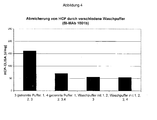
- Fig. 4
- vergleicht die Menge an HCP im Eluat der Affinitätschromatographie nach Waschung mit Waschpuffern unterschiedlicher Kombination und Zusammesetzung am Beispiel BI-MAb 1001 b. Die Zahlen auf der Abszisse beziehen sich auf die im Beispiel genannten Zusätze zum Waschpuffer.
- Die vorliegende Erfindung betrifft Verfahren zur Abreicherung von Verunreinigungen, insbesondere Wirtszellprotein (Host Cell Proteins, HCP) und DNS aus Proteinzusammensetzungen, wie sie aus Zellkulturen erhalten werden, in denen Proteine rekombinant oder endogen exprimiert werden. Insbesondere betrifft die Erfindung Verfahren zur Reinigung bzw. Anreicherung eines Proteins (Zielprotein), die sich über einen Liganden reversibel an einer stationären Phase immobilisieren lassen und so der Affinitätschromatographie zugänglich sind.
- Das Zielprotein kann insbesondere ein Immunglobulin oder ein Protein sein, das die Fc-Domäne eines Immunglobulins enthält und an Protein A binden kann. In einer bevorzugten Ausführungsform handelt es sich dabei um Immunglobuline, die aus zwei schweren und zwei leichten Immunglobulinketten bestehen. Antikörper bestehen aus zwei identischen schweren Ketten (heavy chains, H) sowie zwei identischen leichten Ketten (light chains, L), die durch kovalente Disulfidbrücken zu einer Ypsilon-förmigen Struktur miteinander verbunden sind. Die leichten Ketten bestehen aus jeweils einer variablen und einer konstanten Domäne, die als VL und CL bezeichnet werden. Die schweren Ketten andererseits haben jeweils eine variable und drei bis vier konstante Domänen abhängig vom Immunglobulin. Bezeichnet werden diese analog als VH und CH1, CH2, CH3. Die variablen Domänen einer leichten und einer schweren Kette bilden die Antigenbindungsstelle. Die Domäne CH2 enthält eine Kohlenhydratkette, die eine Bindungsstelle für das Komplementsystem bildet. Die CH3 Domäne enthält die Fc-Rezeptor-Bindungsstelle.
- Protein A bindet an die Fc-Domäne von Immunglobulinen durch Interaktionen mit der schweren Kette. Die Bindungsaffinität ist am höchsten an humanem IgG1, IgG2 und IgG2a so wie IgG2b von Mäusen. Mit moderater Affinität bindet es an humanem IgM, IgA, IgE und an IgG3 und IgG1 von Mäusen. Es reagiert jedoch weder mit humanem IgG3, IgD noch mit den folgenden Immunglobulinen von Mäusen: IgM, IgA und IgE.
- Zielproteine, auf die das erfindungsgemässe Verfahren angewendet werden kann, sind alle Proteine die eine Fc-Domäne aufweisen, beispielsweise Immunglobuline. Immunglobuline können polyklonale oder monoklonale Antikörper sein, die in Hybridomzellen oder rekombinanten Wirtszellen exprimiert werden. Solche Antikörper können ursprünglich durch Immunisierung von Tieren, insbesondere Säugetieren, erzeugt worden sein, einschließlich transgener Tiere, z.B. Mäusen, die die Immunglobuline des Menschen exprimeren. Geeignete Zielproteine sind aber auch Fusionsproteine, bei denen ein beliebiges Protein und die Fc-Domäne eines Immunglobulins fusioniert wurden.
- Protein A-Matrices im Sinne der Erfindung sind Affinitätschromatographie-Matrices die immobilisiertes Protein A als Liganden enthalten. Dies umfasst Affinitätsmatrices die wildtyp Protein A, beispielsweise aus Staphylococcus aureus als Liganden enthalten. Eine Beschreibung von Protein A befindet sich u.a. bei Lofdahl, S. et al., 1983 (Lindmark, R., Thoren-Tolling, K., Sjoquist J (1983); Binding of immunoglobulins to protein A and immunoglobulin levels in mammalian sera: J Immunol Methods 1983 Aug 12;62(1):1-13.) und Lindmark et. al., 1983 (Lindmark, R., Thoren-Tolling, K., Sjoquist J (1983); Binding of immunoglobulins to protein A and immunoglobulin levels in mammalian sera: J Immunol Methods 1983 Aug 12;62(1):1-13.). Darüber hinaus bezieht sich die Erfindung auch auf Matrices mit rekombinant hergestelltem Protein A als Liganden. Rekombinantes Protein A ist beispielhaft von Duggleby C.J. und Jones, S.A., 1983 (Duggleby, C.J. und Jones, S.A. (1983), Cloning and expression of Staphylococcus aureus protein A gene in Escherichia coli. Nucl.Acid.Res. 1983 May 25; 11 (10):3065-76.) oder Li, R. et al., 1998 (Li, R. Dowd, V., Stewart, D.J., Burton, S.J. Lowe, C.R., Design, sythesis and application of a protein A mimetic. Nat.Biotechnol. 1998 Feb; 16(2):190-5.) beschrieben und dem Fachmann bekannt.
- Das Protein A kann hierbei an verschiedene Trägermaterialien wie zum Beispiel an Agarosen, Polysaccharide, Dextrane, Silica-Gele, Glas-beads gekoppelt sein. Eine nicht abschließende Aufstellung geeigneter Trägermaterialien findet sich in Harlow, E. und Lane, D. 1999. Ein häufig verwendetes Trägermaterial bilden auf Agarose basierende Materialien, wie z.B. die dem Fachmann bekannten "Sepharosen" der Firma Amersham Pharmacia Biotech, Uppsala, Schweden. Spezielle Beispiele für Protein A-Sepharosen finden sich im Manual dieser Firma zu dem Thema "Affinity Chromatography" aus dem Jahr 2001. Darüber hinaus sind dem Fachmann weitere Protein A-Chromatographie-Matrices bekannt, wie z.B. MabSelect (Firma Amersham Pharmacia Biotech, Uppsala, Schweden), STREAMLINE™ rProtein A, (Firma Amersham Pharmacia Biotech, Uppsala, Schweden), Poros A (Millipore, Durham, England). Das erfindungsgemäße Verfahren schließt eine Behandlung der entsprechenden Matrices mit ein, wobei die Aufzählung der Matrices beispielhaft und nicht abschließend zu verstehen ist.
- Die Kopplung des Liganden erfolgt in der Regel über freie Amino-, Carboxyl- oder Schwefel-Gruppen mittels Cyanogen-Bromid-Aktivierung, NHS-Aktivierung oder Thiol-Kopplung an die Trägermatrix. Siehe hierzu beispielhaft Manual "Affinity Chromatography", Amersham Pharmacia Biotech, Uppsala, Schweden, 2001. In einer besonders bevorzugten Ausführungsform wird Polyvinylpyrrolidon (PVP, auch Polyvidon oder Povidon, CAS: 9003-39-8) in den erfindungsgemäßen Waschpuffern verwendet. Polyvinylpyrrolidon ist ein wasserlösliches Polymer, welches aus N-vinylpyrrolidon-Monomereinheiten besteht. Es kann allerdings auch in anderen polaren Solventen gelöst werden. PVP ist ein hygroskopisches, amorphes Pulver mit weißer bis hellgelber Farbe. Der handelsüblichen Polymere haben eine Molmassen im Bereich von ca. 2500 bis 2.500.000 Dalton. In den Waschpuffern der vorliegenden Erfindung können zusätzlich oder alternativ zu PVP auch Detergenzien verwendet werden. Detergenzien sind oberflächenaktive und amphiphile Moleküle, die Mizellen, also Aggregate von Detergenz-Molekülen, bilden können bei denen der hydrophile Kopf nach außen zum wässrigen Lösungsmittel hin zeigt.
- Detergenzien im Sinne der Erfindung sind sowohl nicht-ionische als auch ionische Substanzen. Bevorzugt werden jedoch nicht-ionischen Detergenzien wie z.B. Polyglykolether (Typ NP-40, Tergitol NP40, CAS: 127087-87-0), ein PEG-Alkylether Polyoxyethylen(23)laurylether (CAS: 9002-92-0), PEG-Sorbitanfettsäureester wie Polyoxyethylen(20)sorbitan-monolaurat (Polysorbat 20, CAS: 9005-64-5) oder Polyoxyethylen (20)sorbitan-monooleat (Polysorbat 80, CAS: 9005-65-6), Alkylphenyl-PEG-Ether wie t-Octylphenoxypolyethoxyethanol (Triton-X-100, CAS: 9002-93-1), oder PEO-PPO-Block-Co-Polymere (Poloxamer-Derivate), wie Polyoxyethylen-polyoxypropylen-block-copolymer (Pluronic F 68, Lutrol F 68, Poloxamer 188, CAS: 9003-11-6 oder Poloxamer 407, Pluronic F 127, Lutrol F 127, CAS: 9003-11-6).
- Die pH-Werte der Wasch- und Elutionspuffer sind vom Gesamt-System abhängig und werden daherin der Regel für jedes System individuell bestimmt und optimiert.
- In einem Aspekt hat der Waschpuffer einen pH-Wert von 5 bis 8. Dem Fachmann ist geläufig, dass der pH-Wert, bei dem ein Protein von einer Säule eluiert, von vielen Faktoren abhängig ist. Unter anderem können dies sein: die Puffer-Systeme während der Bindung, Waschung und Elution, die Anwesenheit von Verunreinigungen, die Geometrie der Matrix-Partikel, die Art der Kopplung des Affinitätsliganden an die Chromatographie-Matrix. Insbesondere haben die spezifischen Eigenschaften des Proteins entscheidenden Einfluss.
- In einigen Fällen kann es zu Kombinationen kommen, bei denen es auch oberhalb eines pH-Wertes von pH 4 zu einer teilweisen oder vollständigen Elution des Proteins von dem Affinitätsliganden kommen kann. In einem solchen Fall, und wenn ein Verlust an Protein nicht akzeptabel ist, muss der Waschpuffer einen höheren pH-Wert aufweisen. Dem Fachmann ist bekannt, dass er in einem solchen Fall den pH-Wert des Waschpuffers entsprechend anpassen muss. In den meisten Fällen wird die Bindung zwischen dem Protein und dem Protein A Affinitätsliganden sich jedoch erst unterhalb von pH 4 lösen.
- In einem weiteren Aspekt hat der Waschpuffer einen pH-Wert von 6 bis 8.
- In einer typischen Ausführungsform kann die Erfindung beispielsweise wie folgt ausgeführt werden:
- Protein A-Chromatographie ist in der Regel der erste Reinigungsschritt. Der zellfreie Zellkulturüberstand kann direkt auf die Säule gegeben werden, oder es kann erst eine Konzentrierung über eine Ultrafiltrationsmembran erfolgen, ein so genanntes UF/DF System.
- Die Protein A-Säule wird zunächst mit Phosphatpuffer (PBS) Puffer equilibriert, der in den physikochemischen Eigenschaften in etwa dem Beladungspool entspricht. Der Beladungspool besteht aus dem Überstand der Zellkultur, der das zu reinigende Produkt enthält sowie auch zusätzliche Medienbestandteile, die notwendig für das Züchten der angewendeten Säugetierzellen wie zum Beispiel CHO- oder NSO-Zellen sind. Dieser zellfreie Überstand der Zellkultur oder ein Konzentrat davon wird auf die Protein A Säule beladen. Dabei bindet das Zielprotein mit der Protein A-Bindestelle an der Säule. Anschließend wird die Säule mit Equilibrierungspuffer gespült, bis die nicht gebundenen Medienbestandteile und Zellprodukte eluiert sind. Der beschriebene Waschpuffer kann im Anschluss an den Equilibrierungspuffer oder direkt nach der Beladung aufgegeben werden. Die Menge des Waschpuffers ist abhängig vom Maßstab und wird daher relativ zur Größe der Chromatographie-Säule angegeben.
- Üblicherweise beträgt das Volumen von Waschpuffern ca. das 2 bis 5fache des Volumens der Chromatographie-Säule (2 - 5 Bett-Volumina, BV). Nach der Applikation des Waschpuffers kann die Säule erneut mit dem Equilibrierungspuffer oder einem anderen Puffer behandelt werden, um keine Bestandteile des Waschpuffers mit dem Produkt zu eluieren. Der hier angewendete Puffer muß einen pH Wert haben, der niedriger als der des Waschpuffers, aber höher als der des Elutionspuffers ist und in Puffersalz und Zusammensetzung dem Elutionspuffer ähnelt. Zur Elution wird ein Puffer mit einem pH-Wert unter pH 4 verwendet, der als Hauptbestandteil zum Beispiel die Salze Acetat oder Citrat enthalten kann. Elutionspuffer können beinhalten ein Acetat in Konzentrationen zwischen 10 mM bis 200 mM, bevorzugt zwischen 20 mM und 100 mM, besonders bevorzugt 50 mM und 100 mM oder Citrat in Konzentrationen zwischen 10 und 200 mM, vorzugsweise zwischen 20 und 100 mM, beide Puffer sollten im oben genannten pH-Bereich unter 4, vorzugsweise zwischen 3 und 4, besonders bevorzugt zwischen 3,4 und 3,6. Zusätzlich können auch Additive wie Arginin oder PVP enthalten sein. Außerdem kann ein Glycinpuffer benutzt werden in Konzentrationen zwischen 10 und 200 mM, vorzugsweise zwischen 25 und 100 mM, mit einem pH-Wert zwischen 2 und 3,5, oder andere Puffer, die geeignet sind, die Bindung zwischen der Fc-Domäne des Antikörpers und dem Protein A zu reduzieren. Das Eluat kann dann im folgenden Prozess weiter aufgearbeitet werden, zum Beispiel Inkubation bei niedrigem pH-Wert oder Neutralisation.
- Es wurden Experimente mit verschiedenen Proteinen durchgeführt, die aus unterschiedlichen Zelllinen stammen (CHO und NS0), die in unterschiedlichen Medien fermentiert wurden, und deren Fc-Teile unterschiedlichen IgG-Subtypen angehören (IgG1, IgG2, IgG4).
- Es wurden jeweils Versuchsreihen durchgeführt, bei denen vom Standard vorgehen jeweils nur der oder die Waschpuffer verändert wurden. Es wurde entweder der Equilibrierungspuffer ohne Zusatz aufgegeben, ein Waschpuffer mit einem einzelnen Zusatz, mehrere verschiedene Puffer sequenziell mit jeweils einem Zusatz, oder ein Waschpuffer mit einer Kombination mehrerer Zusätze.
- Die aufgetragene Protein-Lösung war dabei für das jeweilige Protein immer gleich. Gemessen wurde in jedem Versuch die Menge an Verunreinigungen im Eluat. Durch Vergleiche zwischen den Versuchen wurden jeweils die Waschpuffer identifiziert, nach denen das Eluat möglichst geringe Mengen der jeweiligen Verunreinigung aufwies. Bei einigen Versuchen wurden auch Ausbeuten, Trübungen und Monomer-Gehälter gemessen.
- Die Chromatographie-Experimente wurden an einem automatisierten System ÄKTA-FPLC Modell 900 (GE Healthcare) durchgeführt. Für die Versuche wurden vier verschiedene Produkte verwendet. Von den Produkten wurde als Ausgangsmaterial jeweils entweder der zellfreie Kulturüberstand verwendet oder konzentrierter Kulturüberstand, wobei mit einer 50 kD Omega Membran (Pall) zehnfach ankonzentriert und anschließend mit PBS dreifach diafiltriert wurde.
- Die eingesetzten Säulen hatten ein Volumen von 1 mL bis 8 mL und enthielten eines der beiden Chromatographie-Gele MabSelect oder MabSelect Xtra (GE Healthcare),
- In allen Versuchen wurde als Equilibrierungspuffer ein Phosphatpuffer (PBS) mit 10 mM Phosphat, 5 mM Kaliumchlorid und 140 mM Natriumchlorid bei pH 7,4 verwendet.
- Alle Waschpuffer basierten auf einem PBS Puffer (pH 7.4) mit
8 mmol/L Natriummonohydrogenphosphat,
1,5 mmol/L Kaliumhydrogenphosphat,
2,7 mM Kaliumchlorid und
140 mM Natriumchlorid. - Als Zusätze wurden jeweils eingesetzt, einzeln oder in unterschiedlichen Kombinationen (wie in den Abbildungen angegeben):
- (1) 860 mmol/L Natriumchlorid (Gesamtgehalt 1 mol/L Natriumchlorid)
- (2) 0,25 % (w/V) Polyvinylpyrrolidon (PVP)
- (3) 15 % (V/V) Isopropanol
- (4) 0,5 mol/L L-Arginin
- Zur Elution wird je nach Produkt ein unterschiedlicher Puffer verwendet, mit unterschiedlichen Acetatkonzentrationen und pH. Folgende Konzentrationen wurden benutzt:
- BI-Mab 06a: 100 mM Acetat ph 3,4
- BI-Mab 1003a: 50 mM Acetat ph 3,4
- BI-Mab 1001 b: 50 mM Acetat ph 3,4
- BI-Mab 07c: 50 mM Acetat ph 3,6
- Die Eluate der Versuche wurden hinsichtlich ihres Gehalts an Verunreinigungen verglichen und die Ausbeuten bestimmt.
- Zur Bestimmung der Menge an Zellbestandteilen wurde ein generischer Sandwich-ELISA verwendet, der Wirtszell-Proteine als Summenparameter bestimmt. Für den Assay werden polyklonale Detektions-Antikörper verwendet.
- Zur Bestimmung des Monomeranteils wurde das System Agilent Series HPLC 1200 (waters) und je nach Protein eine TSK 3000SW oder eine TSK 3000SWXL Säule (TosoH) verwendet. Die isokratische Methode läuft bei einem Fluss von 1 mL/min mit einem Tris-Puffer bei pH 7,0.
- Die Bestimmung der DNA erfolgt nach der Threshold-Methode (Kung, V.T. et al., Picogram Quantitation of Total DNA Using DNA-Binding Proteins in a Silicon Sensor-Based System, Anal. Biochem. 1990, 187, 220-227).
- Zur Durchführung einer SDS-PAGE wird ein Phast-System (GE Healthcare) verwendet. Aufgetrennt werden die Proben mit einem Phast SDS-Gel (4%-15%, GE). Die Färbung erfolgt nach der Heukeshoven Silberfärbung (Heukeshoven, Dernick 1988, Electrophoresis 9 (1), Seiten 28-32).
- Zur Bestimmung der Menge an Antikörper in der Beladung und im Eluat wurde eine PA 2-1001-00 ProteinA Säule (Applied Biosystems) und ein Agilent Series 1200 HPLC-System (waters) verwendet. Die Bindung und Elution erfolgt über einen Gradienten von pH 7,4 bis pH 2,8 im PBS Puffersystem, die Auswertung anhand einer externen Kalibriergerade des jeweiligen Antikörpers.
- Die Messung der Trübung erfolgt im 2100AN Turbidimeter (Hach) nach Kalibration mit Trübungsstandards des Herstellers.
- Die Versuche zeigen einen deutlichen Einfluss der Waschung auf Ausbeute, Monomer, Trübung und Wirtszell-Proteine (Host Cell Proteins, HCP).
- In den Qualitätskriterien Ausbeute, Monomer-Gehalt und HCP-Abreicherung zeigt das Eluat jeweils nach der Waschung mit dem Puffer den besten Wert, der alle vier Zusätze enthält. Außerdem führt die Kombination der Zusätze zu einer erheblichen Reduktion von Trübungen, und zwar sowohl bei der Kombination der drei Bestandteile 0,86 mol/L Natriumchlorid, 0,25% (w/V) PVP und 15% (V/V) Isopropanol, als auch bei der Kombination aller vier Zusätze 0,86 mol/L Natriumchlorid, 0,25% (w/V) PVP, 15% (V/V) Isopropanol und 0,5 mol/L Arginin.
- Die beste HCP Abreicherung wird mit dem Waschpuffer erzielt, der alle vier zusätzlichen Komponenten enthält. Ebenfalls gute Werte liefert der Waschpuffer mit der Kombination aus Natriumchlorid, PVP und Isopropanol. Bei der Waschung mit Puffern, die die vier Komponenten einzeln enthalten, wird mehr HCP im Eluat erhalten.
- Auch bei den Trübungen führt die Kombination der Wasch-Substanzen in einem Puffer zu einem besseren Wert.
- Die Eluate der Versuche der einzelnen Waschpuffer haben höhere Werte an HCP als die Eluate der Versuche mit kombinierten Waschpuffern.
- Experimente mit BI-MAb 1001 b, ein Antikörper der Subklasse IgG2 Die Eluate der Versuche der einzelnen Waschpuffer haben höhere Werte an HCP als die Eluate der Versuche mit kombinierten Waschpuffern.
- Die vier Experimente zeigen, dass die Kombination aus den vier Zusätzen Natriumchlorid, PVP, Isopropanol und Arginin in einem einzigen Waschpuffer vorteilhaft gegenüber der Anwendung von Waschpuffern mit einzelnen Zusätzen in Bezug auf den Gehalt an Host Cell Proteinen (HCP) im Eluat ist.
- Die Anwendung des beschriebenen Waschpuffers zeigt ebenfalls, dass Trübungen im Eluat deutlich reduziert sind. Dabei verbessern sich auch der Anteil an Monomer und die Ausbeute (BI-MAb 06a), oder sie bleiben zumindest gleich (BI-MAb 1003a).
- Der beschriebene Waschpuffer ist daher geeignet, das Produktionsverfahren für Proteine erheblich zu verbessern. Durch die Einführung der Kombination der Waschpuffer werden Verunreinigungen abgereichert, die andernfalls mit einem zusätzlichen Reinigungsschritt entfernt werden müssten.
Claims (8)
- Verfahren zur Abreicherung von Verunreinigungen aus einer Zusammensetzung, die ein Protein enthält, das die Fc-Domäne eines Immunglobulins aufweist (Zielprotein), durch Protein-A-Chromatographie, mit den Schritten:a. Anwendung einer mobilen Phase, die das Zielprotein enthält, auf eine stationäre Phase, die Protein A enthält, unter Bedingungen, unter denen das Zielprotein an die stationäre Phase bindet;b. Anwendung eines Waschpuffers mit einem pH-Wert von 5 bis 8 als mobiler Phase, enthaltendi. Arginin in einer Konzentration von 0,1 - 1 mol/l,ii. Natriumchlorid in einer Konzentration von 0,2 bis 2 mol/l,iii. einen Alkohol, ausgewählt aus der Gruppe bestehend aus Isopropanol, n-Propanol, und Ethanol, in einer Konzentration von 5 - 30 % v/v, undiv. Polyvinylpyrrolidon oder ein Detergenz in einer Konzentration von 0.05 - 2 % (w/v);c. Anwendung eines Elutionspuffers als mobiler Phase unter Bedingungen, unter denen das Zielprotein von der stationären Phase eluiert wird.
- Verfahren nach Anspruch 1, dadurch gekennzeichnet, dass die Argininkonzentration im Waschpuffer 0,4 - 0,6 mol/l beträgt.
- Verfahren nach einem der vorangehenden Ansprüche, dadurch gekennzeichnet, dass die Natriumchloridkonzentration im Waschpuffer 0,9 - 1,1 mol/l beträgt.
- Verfahren nach einem der vorangehenden Ansprüche, dadurch gekennzeichnet, dass der Alkohol im Waschpuffer Isopropanol in einer Konzentration von 10 - 20 % (w/v) ist.
- Verfahren nach einem der vorangehenden Ansprüche, dadurch gekennzeichnet, dass Polyvinylpyrrolidon (PVP) in einer Konzentration von 0,1 - 2 % (w/v) ist.
- Verfahren nach einem der vorangehenden Ansprüche, dadurch gekennzeichnet, dass das Detergens ein Polyoxyethylen-sorbitan-monolaurat in einer Konzentration von 0,05 - 2 % (w/v) ist.
- Verfahren nach einem der vorangehenden Ansprüche, dadurch gekennzeichnet, dass es sich bei den Verunreinigungen um Wirtszellproteine (HCP) handelt.
- Waschpuffer für die Affinitätschromatographie mit einem pH-Wert von 5 bis 8, enthaltendi. Arginin in einer Konzentration von 0,1 - 1 mol/l,ii. Natriumchlorid in einer Konzentration von 0,2 bis 2 mol/l,iii. einen Alkohol, ausgewählt aus der Gruppe bestehend aus Isopropanol, n-Propanol, und Ethanol, in einer Konzentration von 5 - 30 % (w/v), undiv. Polyvinylpyrrolidon oder ein Detergens in einer Konzentration von 0.05 - 2 % (w/v);
Priority Applications (1)
| Application Number | Priority Date | Filing Date | Title |
|---|---|---|---|
| EP11700457.2A EP2526114B1 (de) | 2010-01-22 | 2011-01-21 | Chromatographisches verfahren zur aufreinigung von fc enthaltenden proteinen |
Applications Claiming Priority (4)
| Application Number | Priority Date | Filing Date | Title |
|---|---|---|---|
| EP10151416 | 2010-01-22 | ||
| EP10171975 | 2010-08-05 | ||
| EP11700457.2A EP2526114B1 (de) | 2010-01-22 | 2011-01-21 | Chromatographisches verfahren zur aufreinigung von fc enthaltenden proteinen |
| PCT/EP2011/050817 WO2011089212A1 (de) | 2010-01-22 | 2011-01-21 | Chromatographisches verfahren zur aufreinigung von fc enthaltenden proteinen |
Publications (2)
| Publication Number | Publication Date |
|---|---|
| EP2526114A1 EP2526114A1 (de) | 2012-11-28 |
| EP2526114B1 true EP2526114B1 (de) | 2014-06-18 |
Family
ID=43598239
Family Applications (1)
| Application Number | Title | Priority Date | Filing Date |
|---|---|---|---|
| EP11700457.2A Active EP2526114B1 (de) | 2010-01-22 | 2011-01-21 | Chromatographisches verfahren zur aufreinigung von fc enthaltenden proteinen |
Country Status (11)
| Country | Link |
|---|---|
| US (1) | US9284347B2 (de) |
| EP (1) | EP2526114B1 (de) |
| JP (1) | JP5567691B2 (de) |
| KR (1) | KR101753569B1 (de) |
| CN (1) | CN102712673B (de) |
| AU (1) | AU2011208659B2 (de) |
| CA (1) | CA2784959C (de) |
| DK (1) | DK2526114T3 (de) |
| ES (1) | ES2492681T3 (de) |
| SG (1) | SG182553A1 (de) |
| WO (1) | WO2011089212A1 (de) |
Families Citing this family (21)
| Publication number | Priority date | Publication date | Assignee | Title |
|---|---|---|---|---|
| US8383783B2 (en) * | 2010-04-23 | 2013-02-26 | Serum Institute Of India, Ltd. | Simple method for simultaneous removal of multiple impurities from culture supernatants to ultralow levels |
| ES2688348T3 (es) * | 2011-06-01 | 2018-11-02 | Novartis Ag | Solución y método de lavado para cromatografía de afinidad |
| RU2646098C2 (ru) | 2013-04-30 | 2018-03-01 | Интас Фармасьютикалс Лтд | Новый способ клонирования, экспрессии и очистки для получения ранибизумаба |
| TWI596107B (zh) | 2013-06-25 | 2017-08-21 | 卡地拉保健有限公司 | 單株抗體之新穎純化方法 |
| WO2015189832A1 (en) * | 2014-06-13 | 2015-12-17 | Lupin Limited | Process for the purification of tnfr:fc fusion protein |
| US11566082B2 (en) | 2014-11-17 | 2023-01-31 | Cytiva Bioprocess R&D Ab | Mutated immunoglobulin-binding polypeptides |
| US10988527B2 (en) | 2014-12-31 | 2021-04-27 | Lg Chem, Ltd. | Method for preparing TNFR-Fc fusion protein containing target content of impurities |
| ES2874974T3 (es) | 2016-05-11 | 2021-11-05 | Cytiva Bioprocess R & D Ab | Matriz de separación |
| US10889615B2 (en) | 2016-05-11 | 2021-01-12 | Cytiva Bioprocess R&D Ab | Mutated immunoglobulin-binding polypeptides |
| JP7031934B2 (ja) | 2016-05-11 | 2022-03-08 | サイティバ・バイオプロセス・アールアンドディ・アクチボラグ | 分離マトリックス |
| JP7106187B2 (ja) | 2016-05-11 | 2022-07-26 | サイティバ・バイオプロセス・アールアンドディ・アクチボラグ | 分離マトリックスを保存する方法 |
| US10703774B2 (en) | 2016-09-30 | 2020-07-07 | Ge Healthcare Bioprocess R&D Ab | Separation method |
| US10654887B2 (en) | 2016-05-11 | 2020-05-19 | Ge Healthcare Bio-Process R&D Ab | Separation matrix |
| US10730908B2 (en) | 2016-05-11 | 2020-08-04 | Ge Healthcare Bioprocess R&D Ab | Separation method |
| ES2909833T3 (es) | 2016-05-11 | 2022-05-10 | Cytiva Bioprocess R & D Ab | Método de limpieza y/o desinfección de una matriz de separación |
| US12448411B2 (en) | 2016-09-30 | 2025-10-21 | Cytiva Bioprocess R&D Ab | Separation method |
| CA3079118A1 (en) | 2017-11-14 | 2019-05-23 | Bio-Sourcing S.A. | Antibody purification |
| EP3546475A1 (de) * | 2018-03-27 | 2019-10-02 | Sanofi | Volldurchflussverfahren zur reinigung rekombinanter proteine |
| CN113166200B (zh) * | 2018-12-21 | 2024-03-01 | 上海药明生物技术有限公司 | 一种提高蛋白a层析法去除聚集体的方法 |
| CN111333776B (zh) * | 2020-03-20 | 2021-11-09 | 暨南大学 | 一种氮杂环类有机聚合物整体材料及制备与应用 |
| WO2024017826A2 (en) * | 2022-07-19 | 2024-01-25 | Glaxosmithkline Intellectual Property Development Limited | Methods for purifying recombinant polypeptides |
Family Cites Families (10)
| Publication number | Priority date | Publication date | Assignee | Title |
|---|---|---|---|---|
| US5874218A (en) * | 1990-06-11 | 1999-02-23 | Nexstar Pharmaceuticals, Inc. | Method for detecting a target compound in a substance using a nucleic acid ligand |
| US5585246A (en) * | 1993-02-17 | 1996-12-17 | Biometric Imaging, Inc. | Method for preparing a sample in a scan capillary for immunofluorescent interrogation |
| CA2473144C (en) | 2002-02-05 | 2013-05-28 | Genentech, Inc. | Protein purification |
| US8084032B2 (en) * | 2004-01-21 | 2011-12-27 | Ajinomoto Co., Inc. | Purification method which prevents denaturation of an antibody |
| WO2007059473A2 (en) * | 2005-11-12 | 2007-05-24 | Introgen Therapeutics, Inc. | Methods for the production and purification of adenoviral vectors |
| CA2636109A1 (en) | 2006-01-06 | 2007-07-19 | Amgen Inc. | Methods and systems for isolating target molecules from complex solutions by column-chromatography using eluants containing organic solvents |
| US8263750B2 (en) * | 2006-03-16 | 2012-09-11 | Amgen Inc. | Method for purifying a protein using protein-A affinity chromatography using an intermediate wash step |
| AR062711A1 (es) * | 2006-09-08 | 2008-11-26 | Wyeth Corp | Lavado de arginina en l a purificacion de proteinas usando cromatografia de afinidad |
| RU2011137030A (ru) * | 2009-03-11 | 2013-04-20 | УАЙТ ЭлЭлСи | Способы очистки малых модулярных иммунофармацевтических белков |
| DK3272764T3 (da) | 2009-12-18 | 2024-05-06 | Novartis Ag | Fremgangsmåde til affinitetskromatografi |
-
2011
- 2011-01-21 KR KR1020127019071A patent/KR101753569B1/ko active Active
- 2011-01-21 ES ES11700457.2T patent/ES2492681T3/es active Active
- 2011-01-21 DK DK11700457.2T patent/DK2526114T3/da active
- 2011-01-21 JP JP2012549368A patent/JP5567691B2/ja active Active
- 2011-01-21 EP EP11700457.2A patent/EP2526114B1/de active Active
- 2011-01-21 SG SG2012052452A patent/SG182553A1/en unknown
- 2011-01-21 WO PCT/EP2011/050817 patent/WO2011089212A1/de not_active Ceased
- 2011-01-21 CN CN201180006652.0A patent/CN102712673B/zh active Active
- 2011-01-21 CA CA2784959A patent/CA2784959C/en active Active
- 2011-01-21 AU AU2011208659A patent/AU2011208659B2/en active Active
- 2011-01-21 US US13/522,030 patent/US9284347B2/en active Active
Also Published As
| Publication number | Publication date |
|---|---|
| CN102712673B (zh) | 2014-04-30 |
| US20130197197A1 (en) | 2013-08-01 |
| JP5567691B2 (ja) | 2014-08-06 |
| AU2011208659B2 (en) | 2015-05-28 |
| HK1174044A1 (en) | 2013-05-31 |
| AU2011208659A1 (en) | 2012-07-19 |
| ES2492681T3 (es) | 2014-09-10 |
| CA2784959C (en) | 2018-06-26 |
| CA2784959A1 (en) | 2011-07-28 |
| CN102712673A (zh) | 2012-10-03 |
| US9284347B2 (en) | 2016-03-15 |
| WO2011089212A1 (de) | 2011-07-28 |
| KR20120118013A (ko) | 2012-10-25 |
| KR101753569B1 (ko) | 2017-07-04 |
| DK2526114T3 (da) | 2014-09-29 |
| SG182553A1 (en) | 2012-08-30 |
| JP2013517318A (ja) | 2013-05-16 |
| EP2526114A1 (de) | 2012-11-28 |
Similar Documents
| Publication | Publication Date | Title |
|---|---|---|
| WO2011089212A1 (de) | Chromatographisches verfahren zur aufreinigung von fc enthaltenden proteinen | |
| DE602004006725T2 (de) | Reinigung von Antikörpern durch Protein A und Ionenaustauschromatographie | |
| DE69936946T2 (de) | Reinigung von Antikörpern durch Ionenaustauschchromatographie | |
| DE69526929T2 (de) | Antikörperreinigung | |
| EP2542567B1 (de) | Selektive anreicherung von antikörpern | |
| TWI574975B (zh) | 用於減少蛋白質純化期間樣本中一或多種雜質含量之方法 | |
| EP3247718B1 (de) | Modulation von ladungsvarianten in einer monoklonalen antikörperzusammensetzung | |
| WO2013158279A1 (en) | Protein purification methods to reduce acidic species | |
| US20200283472A1 (en) | A process for purification of fc-fusion proteins | |
| TR201815709T4 (tr) | İyon değişim membranı kromatografisi. | |
| JP2023139142A (ja) | 眼科用タンパク質医薬品の精製方法(Refining method of ophthalmic protein pharmaceuticals) | |
| AU2012269240B2 (en) | Single unit chromatography antibody purification | |
| WO2013054250A1 (en) | Purification method | |
| CN114729003A (zh) | 提高离子交换色谱过程中抗体产率的方法 | |
| JP2025509267A (ja) | 臨床ヒトIgG製品の親和性クロマトグラフィーによる製造 | |
| HK1174044B (en) | Chromatographic method for purifying fc-containing proteins |
Legal Events
| Date | Code | Title | Description |
|---|---|---|---|
| PUAI | Public reference made under article 153(3) epc to a published international application that has entered the european phase |
Free format text: ORIGINAL CODE: 0009012 |
|
| 17P | Request for examination filed |
Effective date: 20120822 |
|
| AK | Designated contracting states |
Kind code of ref document: A1 Designated state(s): AL AT BE BG CH CY CZ DE DK EE ES FI FR GB GR HR HU IE IS IT LI LT LU LV MC MK MT NL NO PL PT RO RS SE SI SK SM TR |
|
| DAX | Request for extension of the european patent (deleted) | ||
| GRAJ | Information related to disapproval of communication of intention to grant by the applicant or resumption of examination proceedings by the epo deleted |
Free format text: ORIGINAL CODE: EPIDOSDIGR1 |
|
| GRAP | Despatch of communication of intention to grant a patent |
Free format text: ORIGINAL CODE: EPIDOSNIGR1 |
|
| RIC1 | Information provided on ipc code assigned before grant |
Ipc: C07K 1/22 20060101AFI20131209BHEP Ipc: A61K 39/395 20060101ALI20131209BHEP Ipc: C07K 16/00 20060101ALI20131209BHEP |
|
| INTG | Intention to grant announced |
Effective date: 20140107 |
|
| GRAS | Grant fee paid |
Free format text: ORIGINAL CODE: EPIDOSNIGR3 |
|
| GRAA | (expected) grant |
Free format text: ORIGINAL CODE: 0009210 |
|
| AK | Designated contracting states |
Kind code of ref document: B1 Designated state(s): AL AT BE BG CH CY CZ DE DK EE ES FI FR GB GR HR HU IE IS IT LI LT LU LV MC MK MT NL NO PL PT RO RS SE SI SK SM TR |
|
| REG | Reference to a national code |
Ref country code: GB Ref legal event code: FG4D Free format text: NOT ENGLISH |
|
| REG | Reference to a national code |
Ref country code: CH Ref legal event code: EP |
|
| REG | Reference to a national code |
Ref country code: AT Ref legal event code: REF Ref document number: 673305 Country of ref document: AT Kind code of ref document: T Effective date: 20140715 |
|
| REG | Reference to a national code |
Ref country code: IE Ref legal event code: FG4D Free format text: LANGUAGE OF EP DOCUMENT: GERMAN |
|
| REG | Reference to a national code |
Ref country code: DE Ref legal event code: R096 Ref document number: 502011003447 Country of ref document: DE Effective date: 20140731 |
|
| REG | Reference to a national code |
Ref country code: SE Ref legal event code: TRGR |
|
| REG | Reference to a national code |
Ref country code: DK Ref legal event code: T3 Effective date: 20140922 |
|
| REG | Reference to a national code |
Ref country code: NL Ref legal event code: T3 |
|
| PG25 | Lapsed in a contracting state [announced via postgrant information from national office to epo] |
Ref country code: GR Free format text: LAPSE BECAUSE OF FAILURE TO SUBMIT A TRANSLATION OF THE DESCRIPTION OR TO PAY THE FEE WITHIN THE PRESCRIBED TIME-LIMIT Effective date: 20140919 Ref country code: NO Free format text: LAPSE BECAUSE OF FAILURE TO SUBMIT A TRANSLATION OF THE DESCRIPTION OR TO PAY THE FEE WITHIN THE PRESCRIBED TIME-LIMIT Effective date: 20140918 Ref country code: CY Free format text: LAPSE BECAUSE OF FAILURE TO SUBMIT A TRANSLATION OF THE DESCRIPTION OR TO PAY THE FEE WITHIN THE PRESCRIBED TIME-LIMIT Effective date: 20140618 |
|
| PG25 | Lapsed in a contracting state [announced via postgrant information from national office to epo] |
Ref country code: RS Free format text: LAPSE BECAUSE OF FAILURE TO SUBMIT A TRANSLATION OF THE DESCRIPTION OR TO PAY THE FEE WITHIN THE PRESCRIBED TIME-LIMIT Effective date: 20140618 Ref country code: LV Free format text: LAPSE BECAUSE OF FAILURE TO SUBMIT A TRANSLATION OF THE DESCRIPTION OR TO PAY THE FEE WITHIN THE PRESCRIBED TIME-LIMIT Effective date: 20140618 Ref country code: HR Free format text: LAPSE BECAUSE OF FAILURE TO SUBMIT A TRANSLATION OF THE DESCRIPTION OR TO PAY THE FEE WITHIN THE PRESCRIBED TIME-LIMIT Effective date: 20140618 |
|
| PG25 | Lapsed in a contracting state [announced via postgrant information from national office to epo] |
Ref country code: RO Free format text: LAPSE BECAUSE OF FAILURE TO SUBMIT A TRANSLATION OF THE DESCRIPTION OR TO PAY THE FEE WITHIN THE PRESCRIBED TIME-LIMIT Effective date: 20140618 Ref country code: CZ Free format text: LAPSE BECAUSE OF FAILURE TO SUBMIT A TRANSLATION OF THE DESCRIPTION OR TO PAY THE FEE WITHIN THE PRESCRIBED TIME-LIMIT Effective date: 20140618 Ref country code: EE Free format text: LAPSE BECAUSE OF FAILURE TO SUBMIT A TRANSLATION OF THE DESCRIPTION OR TO PAY THE FEE WITHIN THE PRESCRIBED TIME-LIMIT Effective date: 20140618 Ref country code: PT Free format text: LAPSE BECAUSE OF FAILURE TO SUBMIT A TRANSLATION OF THE DESCRIPTION OR TO PAY THE FEE WITHIN THE PRESCRIBED TIME-LIMIT Effective date: 20141020 Ref country code: SK Free format text: LAPSE BECAUSE OF FAILURE TO SUBMIT A TRANSLATION OF THE DESCRIPTION OR TO PAY THE FEE WITHIN THE PRESCRIBED TIME-LIMIT Effective date: 20140618 |
|
| PG25 | Lapsed in a contracting state [announced via postgrant information from national office to epo] |
Ref country code: PL Free format text: LAPSE BECAUSE OF FAILURE TO SUBMIT A TRANSLATION OF THE DESCRIPTION OR TO PAY THE FEE WITHIN THE PRESCRIBED TIME-LIMIT Effective date: 20140618 Ref country code: IS Free format text: LAPSE BECAUSE OF FAILURE TO SUBMIT A TRANSLATION OF THE DESCRIPTION OR TO PAY THE FEE WITHIN THE PRESCRIBED TIME-LIMIT Effective date: 20141018 |
|
| REG | Reference to a national code |
Ref country code: DE Ref legal event code: R097 Ref document number: 502011003447 Country of ref document: DE |
|
| PLBE | No opposition filed within time limit |
Free format text: ORIGINAL CODE: 0009261 |
|
| STAA | Information on the status of an ep patent application or granted ep patent |
Free format text: STATUS: NO OPPOSITION FILED WITHIN TIME LIMIT |
|
| 26N | No opposition filed |
Effective date: 20150319 |
|
| PG25 | Lapsed in a contracting state [announced via postgrant information from national office to epo] |
Ref country code: BE Free format text: LAPSE BECAUSE OF NON-PAYMENT OF DUE FEES Effective date: 20150131 |
|
| PG25 | Lapsed in a contracting state [announced via postgrant information from national office to epo] |
Ref country code: SI Free format text: LAPSE BECAUSE OF FAILURE TO SUBMIT A TRANSLATION OF THE DESCRIPTION OR TO PAY THE FEE WITHIN THE PRESCRIBED TIME-LIMIT Effective date: 20140618 |
|
| REG | Reference to a national code |
Ref country code: LT Ref legal event code: MM4D Effective date: 20150121 |
|
| PG25 | Lapsed in a contracting state [announced via postgrant information from national office to epo] |
Ref country code: LU Free format text: LAPSE BECAUSE OF FAILURE TO SUBMIT A TRANSLATION OF THE DESCRIPTION OR TO PAY THE FEE WITHIN THE PRESCRIBED TIME-LIMIT Effective date: 20150121 |
|
| REG | Reference to a national code |
Ref country code: DK Ref legal event code: EBP Effective date: 20150131 |
|
| REG | Reference to a national code |
Ref country code: SE Ref legal event code: EUG |
|
| PG25 | Lapsed in a contracting state [announced via postgrant information from national office to epo] |
Ref country code: MC Free format text: LAPSE BECAUSE OF FAILURE TO SUBMIT A TRANSLATION OF THE DESCRIPTION OR TO PAY THE FEE WITHIN THE PRESCRIBED TIME-LIMIT Effective date: 20140618 |
|
| PG25 | Lapsed in a contracting state [announced via postgrant information from national office to epo] |
Ref country code: LT Free format text: LAPSE BECAUSE OF NON-PAYMENT OF DUE FEES Effective date: 20150121 Ref country code: FI Free format text: LAPSE BECAUSE OF NON-PAYMENT OF DUE FEES Effective date: 20150121 |
|
| REG | Reference to a national code |
Ref country code: IE Ref legal event code: MM4A |
|
| PG25 | Lapsed in a contracting state [announced via postgrant information from national office to epo] |
Ref country code: SE Free format text: LAPSE BECAUSE OF NON-PAYMENT OF DUE FEES Effective date: 20150122 |
|
| PG25 | Lapsed in a contracting state [announced via postgrant information from national office to epo] |
Ref country code: IT Free format text: LAPSE BECAUSE OF NON-PAYMENT OF DUE FEES Effective date: 20150121 |
|
| REG | Reference to a national code |
Ref country code: FR Ref legal event code: PLFP Year of fee payment: 6 |
|
| PG25 | Lapsed in a contracting state [announced via postgrant information from national office to epo] |
Ref country code: IE Free format text: LAPSE BECAUSE OF NON-PAYMENT OF DUE FEES Effective date: 20150121 Ref country code: DK Free format text: LAPSE BECAUSE OF NON-PAYMENT OF DUE FEES Effective date: 20150131 |
|
| REG | Reference to a national code |
Ref country code: ES Ref legal event code: FD2A Effective date: 20160226 |
|
| PG25 | Lapsed in a contracting state [announced via postgrant information from national office to epo] |
Ref country code: ES Free format text: LAPSE BECAUSE OF NON-PAYMENT OF DUE FEES Effective date: 20150122 |
|
| PG25 | Lapsed in a contracting state [announced via postgrant information from national office to epo] |
Ref country code: MT Free format text: LAPSE BECAUSE OF FAILURE TO SUBMIT A TRANSLATION OF THE DESCRIPTION OR TO PAY THE FEE WITHIN THE PRESCRIBED TIME-LIMIT Effective date: 20140618 |
|
| REG | Reference to a national code |
Ref country code: FR Ref legal event code: PLFP Year of fee payment: 7 |
|
| REG | Reference to a national code |
Ref country code: AT Ref legal event code: MM01 Ref document number: 673305 Country of ref document: AT Kind code of ref document: T Effective date: 20160121 |
|
| PG25 | Lapsed in a contracting state [announced via postgrant information from national office to epo] |
Ref country code: HU Free format text: LAPSE BECAUSE OF FAILURE TO SUBMIT A TRANSLATION OF THE DESCRIPTION OR TO PAY THE FEE WITHIN THE PRESCRIBED TIME-LIMIT; INVALID AB INITIO Effective date: 20110121 Ref country code: BG Free format text: LAPSE BECAUSE OF FAILURE TO SUBMIT A TRANSLATION OF THE DESCRIPTION OR TO PAY THE FEE WITHIN THE PRESCRIBED TIME-LIMIT Effective date: 20140618 Ref country code: AT Free format text: LAPSE BECAUSE OF NON-PAYMENT OF DUE FEES Effective date: 20160121 Ref country code: SM Free format text: LAPSE BECAUSE OF FAILURE TO SUBMIT A TRANSLATION OF THE DESCRIPTION OR TO PAY THE FEE WITHIN THE PRESCRIBED TIME-LIMIT Effective date: 20140618 |
|
| PG25 | Lapsed in a contracting state [announced via postgrant information from national office to epo] |
Ref country code: TR Free format text: LAPSE BECAUSE OF FAILURE TO SUBMIT A TRANSLATION OF THE DESCRIPTION OR TO PAY THE FEE WITHIN THE PRESCRIBED TIME-LIMIT Effective date: 20140618 |
|
| REG | Reference to a national code |
Ref country code: FR Ref legal event code: PLFP Year of fee payment: 8 |
|
| PG25 | Lapsed in a contracting state [announced via postgrant information from national office to epo] |
Ref country code: MK Free format text: LAPSE BECAUSE OF FAILURE TO SUBMIT A TRANSLATION OF THE DESCRIPTION OR TO PAY THE FEE WITHIN THE PRESCRIBED TIME-LIMIT Effective date: 20140618 |
|
| PG25 | Lapsed in a contracting state [announced via postgrant information from national office to epo] |
Ref country code: AL Free format text: LAPSE BECAUSE OF FAILURE TO SUBMIT A TRANSLATION OF THE DESCRIPTION OR TO PAY THE FEE WITHIN THE PRESCRIBED TIME-LIMIT Effective date: 20140618 |
|
| REG | Reference to a national code |
Ref country code: CH Ref legal event code: U11 Free format text: ST27 STATUS EVENT CODE: U-0-0-U10-U11 (AS PROVIDED BY THE NATIONAL OFFICE) Effective date: 20260201 |
|
| PGFP | Annual fee paid to national office [announced via postgrant information from national office to epo] |
Ref country code: NL Payment date: 20260121 Year of fee payment: 16 |
|
| PGFP | Annual fee paid to national office [announced via postgrant information from national office to epo] |
Ref country code: GB Payment date: 20260123 Year of fee payment: 16 |
|
| PGFP | Annual fee paid to national office [announced via postgrant information from national office to epo] |
Ref country code: DE Payment date: 20260121 Year of fee payment: 16 |
|
| PGFP | Annual fee paid to national office [announced via postgrant information from national office to epo] |
Ref country code: FR Payment date: 20260123 Year of fee payment: 16 |
|
| PGFP | Annual fee paid to national office [announced via postgrant information from national office to epo] |
Ref country code: CH Payment date: 20260201 Year of fee payment: 16 |